John
2. The Book of Signs (1:19–12:50)
A. The Testimony of John the Baptist (1:19–51)
B. Jesus and the Institutions of Judaism (2:1–4:54)
C. Jesus and the Festivals of Judaism (5:1–10:42)
D. Foreshadowing Death and Resurrection (11:1–12:50)
3. The Book of Glory (13:1–20:31)
A. The Passover Meal (13:1–30)
B. The Farewell Discourse (13:31–17:26)
A. The Miracle of 153 Fish (21:1–14)
Introduction
Few books of the Bible have influenced the life and thought of the Christian church as has the Fourth Gospel. Its readers have always noted its profundity and literary energy. Here Christians have discovered a portrait of Christ that has been deeply satisfying. We are intrigued to witness how John joins intimacy of expression with penetrating insight. Scholars have poured so much energy into unraveling the Gospel’s many enigmas that the flood of academic articles and books shows no sign of abating. Yet the Gospel seems to evade our grasp and as a result has become an inexhaustible subject of interest.
Until the eighteenth century, the Fourth Gospel was held to be the most accurate and valuable Gospel. But the rise of biblical criticism eclipsed John’s prominence. Critics noted its differences from the Synoptic Gospels (Matthew, Mark, Luke). Lengthy discourses replaced parables and pithy sayings. John’s language and theology seemed to indicate that here the story of Jesus had been refashioned for the Greek world. The result: the Fourth Gospel could no longer be viewed as contributing reliably to the history of Jesus’s life. Critics looked on its early apostolic origin with grave doubt.
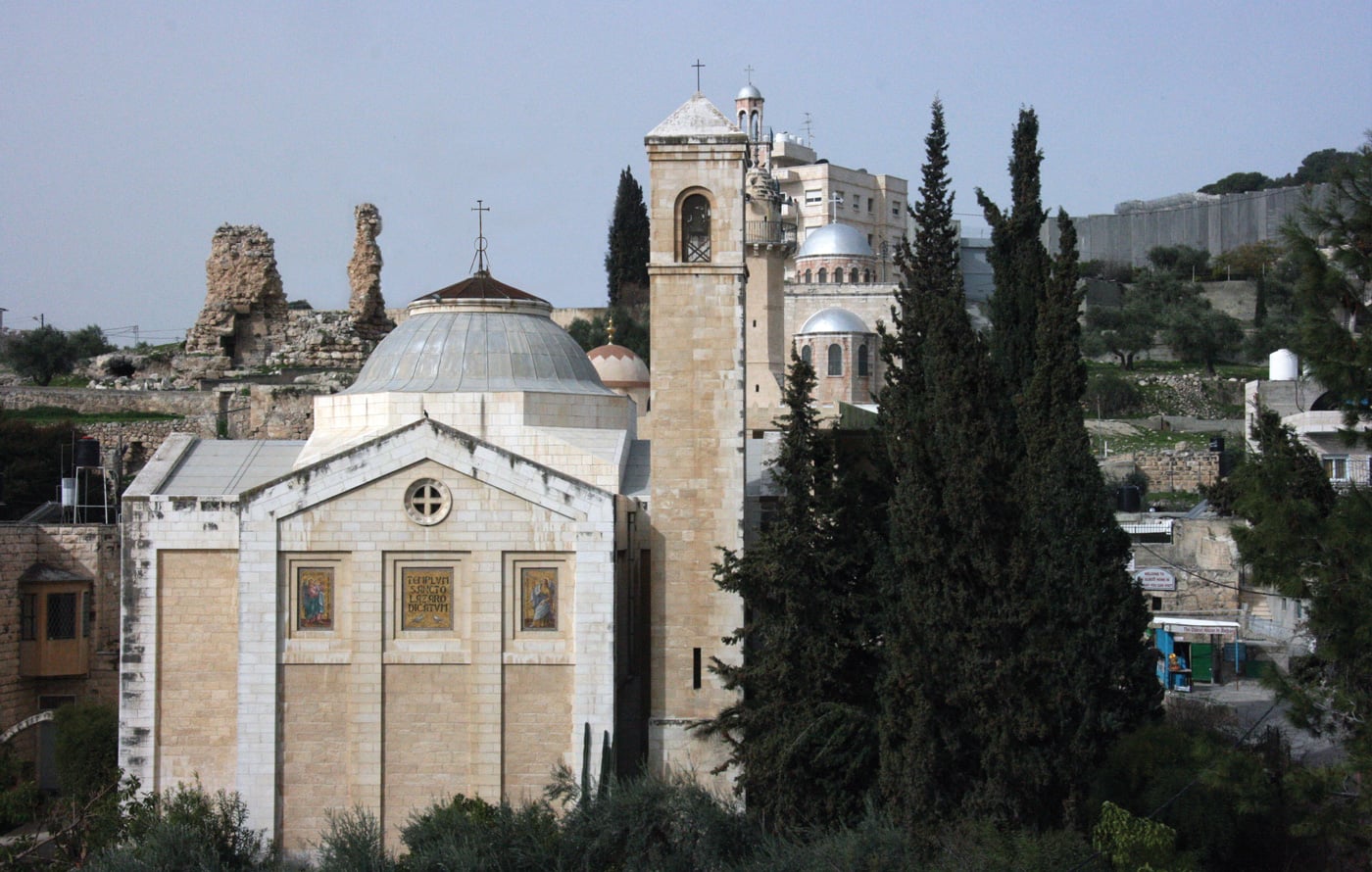
Today scholars hold a variety of opinions concerning this Gospel. They are constantly weighing textual, grammatical, historical, and theological issues. And there are few “agreed” results. This alone should caution us when yet another interpretative theory is ushered into view. But at least one trend can be charted in this mass of literature. Since the 1950s a fresh appreciation for John has become almost universal. While John does diverge from the Synoptic Gospels, its independent narratives are still to be valued. For instance, only John records Jesus’s dialogue with Nicodemus, but this single witness in no way implies that the incident never happened. More importantly, John’s cultural orientation is now viewed as heavily dependent on the Palestinian Judaism of Jesus’s day. In other words, John’s thought world does not have to be Greek. For example, important Jewish scrolls discovered near Israel’s Dead Sea (Qumran) have proved that Judaism in Jesus’s day was using language similar to that of the Fourth Gospel. Even archaeological finds have substantiated some of the specific narratives of the Gospel that formerly had weathered heavy criticism (e.g., the pool with five porticoes in 5:2).
This “new look” has reopened a number of old questions. If John’s frame of reference is Jewish, then the Gospel’s date may be early. And if it is early, it may have originated with the circle of apostles—even John the son of Zebedee. Now the possibility of apostolic authority behind the Gospel is a legitimate defensible alternative. Johannine study has indeed come full circle.
Above all, this new outlook on John demands that the interpreter seriously employ the Old Testament and all available Jewish materials. No longer will it suffice to interpret, for example, the miracle at Cana (2:1–11) in terms of the Hellenistic god Dionysus of Thrace, who also supposedly changed water into wine. On the contrary, John’s primary reference is to Jesus’s messianic announcement (using Old Testament and Synoptic imagery). This will be the approach used in this commentary. The message of the Fourth Gospel is clothed with allusions and metaphors that spring from first-century Judaism. Granted, this Judaism was complex and well acquainted with Greek influences, but still, the Gospel’s text is elucidated best when seen as firmly rooted in the Old Testament and Palestinian Judaism.
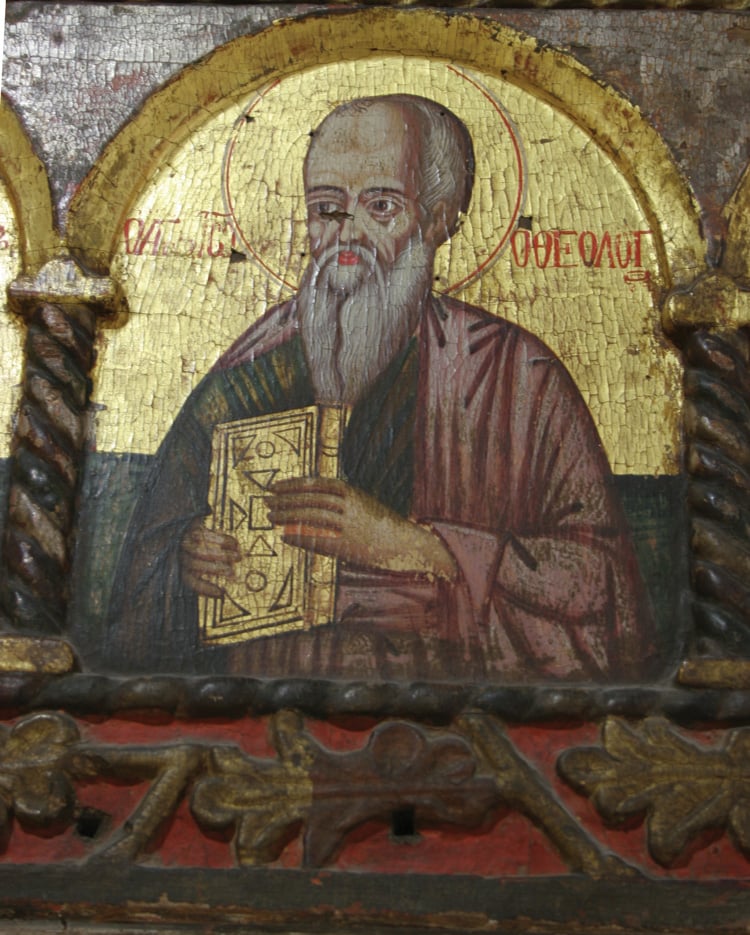
An icon of John from a larger piece entitled Christ and Twelve Apostles (Antalya, Turkey, nineteenth century AD)
Authorship
The Fourth Gospel provides no explicit internal evidence concerning its author. “John” is nowhere identified as such. But this silence is not unusual and is a feature found in the Synoptics as well. The Fourth Gospel may, however, provide us with clues concealed in the enigmatic figure of the “beloved disciple” (NIV “the disciple whom Jesus loved”). This title occurs five times in John (13:23; 19:26; 20:2; 21:7, 20). John 21:24 describes the beloved disciple as the one “who testifies to these things and who wrote them down.” Therefore the origin of the Gospel must in some way be connected to this person. The Gospel of John may be a record of his eyewitness account of Jesus’s life.
But who is this disciple? First, some have suggested that he is an idealized literary figure: the ideal Christian disciple. To a degree this is true (he is faithful and intimate in his knowledge of Jesus). But this hardly excludes the possibility of a genuine historical person. Second, Lazarus has sometimes been nominated. Lazarus is the only male figure said to be loved by Jesus (11:3, 5, 36). Further, the beloved disciple texts occur only after Lazarus is introduced in chapter 11. But this solution is unlikely. Why would Lazarus’s name be mentioned in chapters 11 and 12 but then left shrouded in subsequent accounts? Third, we know that a man named John Mark was a part of the early church (Acts 12:12) and that he was associated with Peter. If Mark was related to the Levite Barnabas (Col. 4:10), this may also explain how the beloved disciple knows the high priest in John 18:15. A strong patristic tradition, however, maintains that Mark wrote the second Gospel—and besides, the beloved disciple was certainly one of the Twelve (13:23), and John Mark was not.
The best solution may still be the traditional one: John the son of Zebedee (Mark 3:17; Acts 1:13). This man was one of the Twelve and along with James and Peter formed an inner circle around Jesus. This is the origin of his eyewitness testimony and penetrating insight. In the Synoptics John appears with Peter more than with any other, and in Acts they are companions in Jerusalem (Acts 3–4) as well as in Samaria (Acts 8:14). This dovetails with the Peter/John connection in the Fourth Gospel. Raymond Brown has offered a novel theory to buttress this (Brown, 1:xcvii; 2:905–6). He suggests that John and Jesus may have been cousins (through their mothers). This explains two things. In John 19:25 Jesus entrusts Mary to John due to a natural family relation. (She may have been John’s aunt.) And in 18:15–16 John is known by the high priest through Mary’s priestly relatives (Luke 1:5, 36).
Patristic evidence points to the same conclusion. Writing at about AD 200, Irenaeus says that the beloved disciple was John the disciple of Jesus and that John originated the Gospel at Ephesus. Irenaeus even writes that when he was young, he knew another teacher, Polycarp, bishop of Smyrna (ca. 69–155), who claimed to have been tutored by John himself. The church historian Eusebius (ca. 300) records this John/Polycarp/Irenaeus connection in the same way. Further, Polycrates, bishop of Ephesus (189–198), refers to John’s association with the Gospel in his letter to Victor the bishop of Rome. It is also confirmed by Clement of Alexandria (ca. 200) and the Latin Muratorian Canon (180–200).
Criticisms of this conclusion are commonplace, and we would do well to consider the most important ones. (1) Earlier in this century critics regularly pointed to John’s inaccurate geographical details. They affirmed that this inaccuracy could hardly come from an eyewitness writer. But subsequent historical and archaeological study has if anything shown John’s reliability. (See Craig Blomberg’s volume The Historical Reliability of John’s Gospel.) (2) Could a fisherman-turned-apostle have penned a work of such subtlety and insight? Could a Galilean such as this be acquainted with Greek thought? Of course. Recent study of Palestinian Judaism has shown a remarkable degree of Greek cultural penetration at all levels of society. And while the New Testament does affirm that John the apostle was a commoner (Acts 4:13), we still are unwise to predict what John could or could not accomplish. Furthermore this fails to consider that John’s disciples, an amanuensis (professional scribe), or John’s community may have edited the final edition of the Gospel. (3) Finally, some lodge the complaint that John was not readily accepted in the early church. This is true. But we have to reckon with two facts. First, our evidence for John’s neglect is not as weighty as it seems. Important early writers may not quote John or allude to him, but to note what a patristic writer fails to say is an argument from silence. Second, John found wide acceptance in heretical gnostic circles. This has been confirmed recently by the gnostic documents found at Nag Hammadi, where in the Gospel of Truth Johannine themes abound. The unorthodox on the fringes of the Greek church embraced John and provided the earliest widely known commentaries (Valentinus, Heracleon). Therefore, the church was cautious in its use of the Gospel because of its dangerous abuse elsewhere.
Date
All that we have been saying about the new appreciation for the Jewishness of the Fourth Gospel and the fact that John the son of Zebedee stands behind the Gospel’s authority implies some conclusion about its date. The sources of John must be early and have their roots in first-generation Christianity. But fixing a certain date for the publication of the Gospel is difficult because objective data are slim. The latest possible date is AD 150. Not only do patristic references, allusions in apocryphal Gospels (Gospel of Peter), and Nag Hammadi point to this; but also recently in Egypt two papyrus fragments of John (Rylands Papyrus 457; Egerton Papyrus 2) have been dated at about AD 150. Allowing time for John to circulate, the Gospel could not have been completed long after 125.
The earliest possible date for the Gospel is more difficult. If John knows and employs the Synoptics (and this is disputed), then AD 70 or 80 is appropriate. In John 9:22, 12:42, and 16:2 we read about Jewish believers being excommunicated from the synagogues. In AD 85 the rabbis of Palestine instituted such expulsions for Christians (e.g., Rabbi Gamaliel II). Therefore we find a remarkable consensus of scholarly opinion that John was published somewhere between 80 and 100. Irenaeus says that the apostle lived to a great age—until the reign of Trajan (98–117). And Jerome, writing much later (ca. 375), argued that John died “in the sixty-eighth year” after Jesus’s death: hence, about AD 98.
However, an earlier date may be within reach. Current research has challenged John’s “dependence” on the Synoptics (especially Mark and Luke). If anything, John may know pre-Synoptic traditions. Above all, the way in which John describes the topography of Jerusalem, his knowledge of the geographical and political divisions in Judaism, and his use of metaphors all point to a date approximating that of the Synoptic writers. The great watershed date of AD 70 (when Jerusalem was destroyed by Rome) is critical: John presupposes a Judaism before this war. And with his critical disposition toward the temple (John 2:13–24; 4:21–24) and severe conflicts with Jewish leaders (cf. chaps. 5, 8, 10), we are surprised to find no reference to this catastrophic event. To paraphrase C. H. Dodd, much in John is barely intelligible outside of the context of pre-70 Judaism.
To sum up, the traditions about Jesus that John preserves most likely stem from the earliest apostolic period: perhaps AD 60–65. But the final edition of the Gospel may have been published later. John and/or his disciples may have edited the work, making additions and sharpening its message for later Christianity.
Tradition tells us that the place of writing was Ephesus, and no decisive reasons have been raised against it. There may even be biblical support for it. The Fourth Gospel entertains a polemic aimed at followers of John the Baptist (see 1:19–28, 35–42; 3:22–36; 10:40–42). Elsewhere in the book of Acts we learn about Paul encountering followers of John the Baptist with deficient beliefs. Surprisingly, they too are located in Ephesus. But it would be impossible to be certain.
Purpose
The interpretation of any biblical book is strengthened when we understand the deeper motives and concerns that have led the author to write. John’s vigor and concentration reveal a remarkable intensity of purpose. It is as if a powerful truth had broken upon him and he was compelled to express it. To a greater extent than the Synoptics, each section of the Fourth Gospel contributes to a central theme: the appearance of the Son of God in human history. John explores two facets of this appearing: revelation and redemption.
John 1:5 underscores this revelation: “The light shines in the darkness, and the darkness has not overcome it” (RSV). Dualistic language describes this harsh invasion of the world by God. Offending every modern sensibility, John writes that in Christ we behold the glory of God—even though he has appeared in flesh. But this offense is an ancient one too. The darkness assails the light but cannot vanquish it. The world is in permanent enmity with the Son. But even though Jesus is persecuted, tried, and crucified, still John affirms that the light is not extinguished.
But the gift of Christ is not simply his revelation of the Father (14:9). John’s second message concerns redemption: “In him was life, and the life was the light of men” (1:4 RSV). There is hope for us in the world. The message of this invasion of history is also a message of sacrifice and redemption. Those who embrace this revelation, who identify with the light, and who have faith shall gain eternal life. The life of the Son is poured out in sacrifice, thereby creating the community of the redeemed (John 17:6, 20–26). They bear Christ’s Spirit, which sustains them because the hatred once extended toward the Son is now extended to them (15:12–27).
Thus John’s purpose in writing is to explain this revelation and redemption and to explicate their possibilities. In John 20:31 the author makes clear this aim: “But these are written that you may believe that Jesus is the Messiah, the Son of God, and that by believing you may have life in his name.” Here several major themes converge: belief, acknowledgment of Jesus’s sonship, and the promise of life. But even here the mystery of John confronts us. An ancient manuscript discrepancy in the Greek word for “believe” places the meaning of the verse in doubt. One set of Greek manuscripts implies that John is evangelistic (“that you might come to believe”); the other implies encouragement (“that you might continue believing”). This latter reading has the best support and more helpfully explains the character of John. It is written for Christians who, already knowing the rudiments of Christ’s life and Christian truth, now wish to go further. Not only is there an uncompromising maturity in this Gospel, but also its narratives imply that it was written to address certain practical circumstances in the church. On the one hand, some would say that John is engaged in a polemic—asserting Christian truth amid unsympathetic forces. On the other hand, John’s purpose also includes the clarification of Christian doctrines at an early stage of church development.
Audience
Jewish audience. John’s Gospel reflects Jewish concerns. The conflict between Jesus and the Pharisees that we meet in the Synoptics is given marked attention in John. A brief perusal of John 8:31–59 or 10:19–39 makes this clear. There is a sustained attack on the religious position of Judaism. For instance, “the Jews” virtually becomes a technical term in John for those who reject Jesus. In 9:22 (KJV, RSV) the parents of the blind man who are Jewish fear “the Jews.” But this is not all. The messiahship of Jesus and his relationship to the festivals and institutions of Judaism are both emphasized.
What does this mean? Each Gospel was written not only to record the history of Jesus but also to address particular circumstances in the life of its first readers. Here the Christians of John’s church may have needed encouragement due to persecution and hostilities. So John buttresses Christian claims against Jewish unbelief. The historical fact of Jewish unbelief in Jesus’s day is joined with Jewish opposition in John’s day. But make no mistake. John’s Gospel is not anti-Semitic, despite this intense debate with “the Jews.” This Gospel bears witness to a harsh divorce that took place in the first century within Judaism: Jews who believed in Jesus were in full debate with Jews who did not. And as readers of this Gospel, we are listening in.
Christian audience. John’s Gospel also reflects Christian concerns. At the time the Gospel was published, the early Christian church had grown and diversified considerably. Therefore, it is no surprise to find that John has included historical materials relevant to Christian needs in his generation. It would be a mistake, however, to think that any of these needs became the controlling force in John’s literary design. On the contrary, they serve as subthemes that run through the Gospel and clarify John’s situation. Scholars have identified an extensive list of topics, but we shall note in passing only four prominent motifs.
The significance of John the Baptist. Did the Baptist himself have followers who failed or refused to follow Jesus? Luke 3:15 and Acts 19:1–7 imply this, while later writings confirm it (see the Latin Pseudo-Clementine Recognitions). The Fourth Gospel takes pains to affirm that the Baptist was not the Messiah (John 1:20; 3:28), that he was not the light (1:8–9), and that Jesus is superior (1:30; 3:29–30; 10:41). We even witness disciples of John the Baptist becoming Jesus’s first converts (1:35–42). Matthew, Mark, and Luke have no parallel motif.
The place of sacramentalism. Of course, John has a “sacramental” view of history inasmuch as the incarnation of Christ for him means the genuine appearance of God in history. Worship can affirm such genuine appearances when worship symbols (baptism, the Lord’s Supper) take on the real properties of that which they depict. Hence such symbols are called sacraments. Scholars have identified a unique Johannine interest in the Christian sacraments, but there is little agreement about John’s intention. Some note an absence of interest (e.g., the Lord’s Supper is omitted), while others see allusions everywhere (baptism: John 3; 5; 9; Eucharist: John 2; 6; both: 19:34). It seems best to conclude that John’s principal message about each is corrective (see 3:1–21; 6:52–65): without the Spirit these expressions of worship become powerless rituals void of their original purpose.
Our future hope: Eschatology. Many early Christians longed for the second coming of Christ and anticipated an imminent end to history. This explains the cherished sayings of Jesus about this in the Synoptics, where this future expectation is described (see Mark 13; Matthew 24; Luke 21). How did they cope when this hope was frustrated (cf. 2 Pet. 3:1–12)? John does not record Jesus’s Synoptic eschatological discourses. He still maintains the future hope (5:25–30; 1 John 2:28) but introduces a fresh emphasis: the longed-for presence of Jesus is mediated to us now in the Spirit. In the upper room Jesus’s announcement of the Spirit takes on eschatological tones (see 14:18–23). That is, in one vital way that we often overlook, Jesus has come back and is already with us in the Spirit. In technical terms, John emphasizes a realized eschatology in contrast to the apocalyptic hope of the Synoptics.
Christology. Irenaeus, the second-century church father, wrote that the Gospel of John was penned to refute the gnostic heretic Cerinthus. While this is not likely, Irenaeus nevertheless correctly observed that John’s presentation of Christ was carefully considered. Questions about Jesus’s nature, origin, and relation to the Father are examined in a fashion unparalleled by the Synoptics. For instance, John affirms the oneness of Jesus and the Father (10:30; 14:9–10), their distinction (14:28; 17:1–5), and their unity of purpose (5:17–18; 8:42). It is not surprising that in the formation of trinitarian doctrine, John’s Gospel played a notable role (cf. Tertullian, Against Praxeas). This was particularly true at the Council of Nicea (325), when Arius denied the eternal nature of the Son. In later Arian debates, Athanasius was heavily dependent on the Fourth Gospel and found in the Greek term logos, a title for Jesus used in the Johannine prologue, a most serviceable tool for depicting the person of Christ (On the Incarnation of the Word of God).
John claims full divinity for Jesus. On the one hand, if anyone were inclined toward adoptionism (that Jesus was a divinely inspired man), John’s Gospel gives an unrelenting argument to the contrary. On the other hand, the Greek world was comfortable with divinities and, if anything, hesitated to affirm Jesus’s full humanity (docetism). Here John contends that Jesus is truly human, truly flesh (1:14; cf. 20:27). The brilliance and abiding value of John is that it strikes a middle path between these concerns. Jesus was eternally divine and fully incarnate, fully God and fully human.
But scholars have been quick to point out that this “balanced Christology” seems artificial. If one removes the prologue (1:1–18), the balance is tipped and, in the words of some, John becomes a “naive docetist” (see Käsemann). But this seems unfairly harsh (Morris 1978, 37–53). One solution has been to view John as having stages of development; the prologue may have been added to the Gospel at a later stage when the Epistles of John were published. The battle cry of 1 John is certainly against docetism (1 John 4:1–3), and if the high Christology of the Fourth Gospel had been fueling heretical docetic beliefs, then the addition of the hymnic prologue would have given the needed balance.
Nevertheless, it is vital to say that the humanity of Christ is intrinsic to the whole of the Gospel of John. “John portrays Jesus in a twofold light without reflection or speculation. He is equal to God; he is indeed God in the flesh; yet he is fully human” (Ladd, 289). This affirmation alone has rendered John valuable to the church and its creeds.
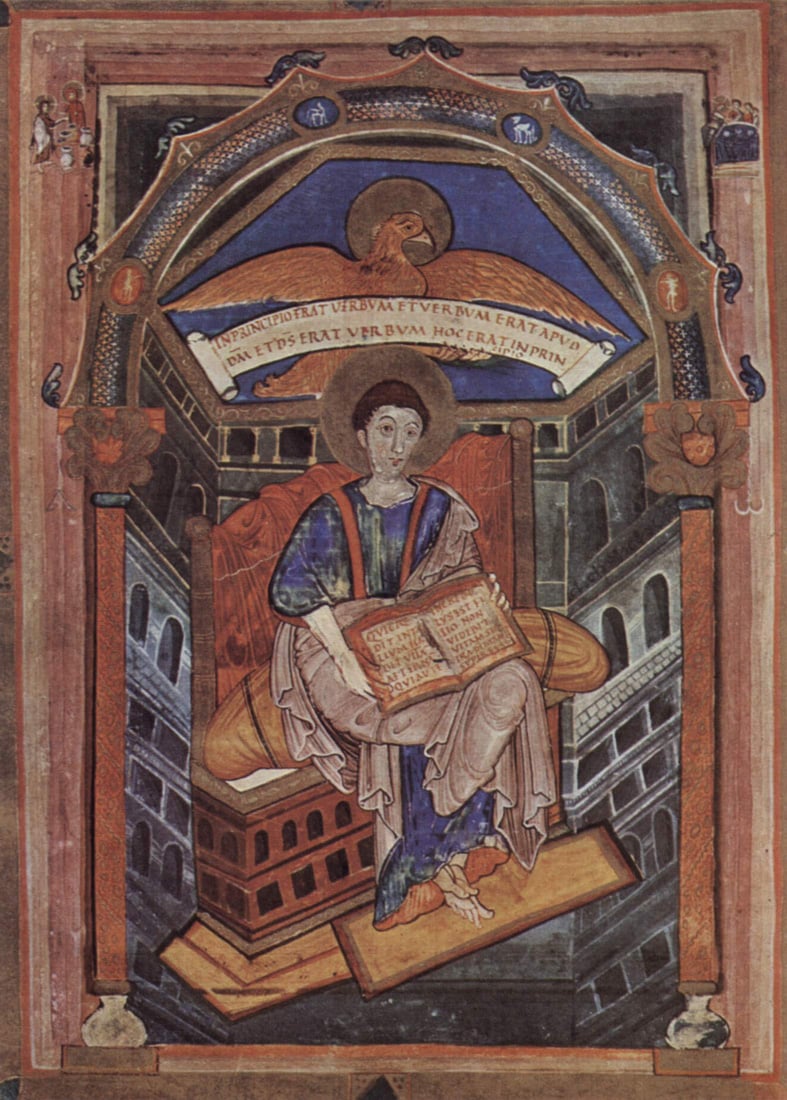
This illustration from the Gospels of Saint Médard depicts John beneath his symbol, the eagle (Soissons, France, early ninth century AD).
Commentary
One reason why the Gospel of John was symbolized in the ancient church by the eagle is the lofty heights attained by its prologue. With skill and delicacy John handles issues of profound importance. It comes as no surprise, then, that this prologue has been foundational to the classic Christian formulation of the doctrine of Christ. Here divinity and humanity, preexistence and incarnation, revelation and sacrifice are each discussed with deceptive simplicity. This prologue may well have been an ancient Christian hymn. We know of other hymns from the early church, especially in Paul’s writings, and here too is an artful flowing of language and theology.
The initial allusion to Genesis 1 cannot be missed (1:1). John begins by introducing Jesus as the Word (Greek logos). Here he builds on contemporary Jewish thought where the Word of God took on personal creative attributes (Gen. 1:1–30; Ps. 33:6, 9). In the New Testament period it was personified (Wisdom of Solomon 7:24–26; 18:15–16) and known by some (e.g., Philo) as the immanent power of God creatively at work in the world. John identifies Jesus Christ as this Word and therefore can attribute to him various divine functions such as creation (1:3, 10) and the giving of life (1:4).
But John goes further. He is ready to infer some personal identity between the Logos and God. “And the Word was God” (1:1). Attempts to detract from this literal translation for grammatical reasons (e.g., “the word was a god,” or “divine,” etc.) run aground when we consider the number of other times such a divine ascription is given to Jesus: he employs the divine Old Testament title I AM (e.g., 8:24, 28, 58); he is one with God (10:30); and he is even addressed by Thomas in the Gospel’s final scene as “my Lord and my God” (20:28).
The entry of the Logos into the world (the incarnation) is described as light shining in darkness (1:5). Even though John the Baptist’s testimony is clear (1:6–9), still Jesus experiences rejection (1:10–11). But there is more. The darkness is hostile. There is enmity. John 1:5 says that the “darkness has not overcome [the light].” The Greek term translated “overcome” (RSV; NIV note: “understood”) means “seize with hostile intent” (cf. 8:3–4; Mark 9:18). The hostility of the darkness points to the cross. But as the Book of Glory (13:1–20:31) shows, the power of darkness will not prevail.
John indicates, however, that the light has its followers; Jesus has his disciples (1:12–13). Even though his own people—adherents to Judaism—spurn his message, those who do receive him obtain power to become God’s children. Verses 12–13 anticipate the story of Nicodemus (3:1–21), in which this rebirth is explored. A careful reading of 1 John shows that “children of God” and “born of God” were commonplace terms describing Johannine disciples (1 John 3:2, 9; 4:4, 7, 12–13). In other words, there will be a powerful transformation of those who embrace this light. In the upper room Jesus will draw out the implications: this power will come about through the Spirit, who will quicken each believer (14:15–31).
The prologue’s finale is found in verses 14–18. John sums up in fresh language what has already been said. Now the abstract thought of light and darkness gives way to concrete Old Testament images. John 1:14 is one of the most important verses in the Bible. The Word did not just appear to be human; the Word became flesh. This assertion would have stunned the Greek mind, for which the separation of the divine spirit and the mundane world (Greek sarx, “flesh”) was an axiom of belief. But the second phrase is equally stunning for the Jew. This Word dwelt (Greek skēnoō) among us and revealed his glory. John uses Old Testament terms of the dwelling (literally “tabernacling”) of God with his people. The tabernacle (cf. Exod. 25:8–9; Zech. 2:10) was the dwelling place of God. Now Jesus is the locus of God’s dwelling. Hence, the glory of God, once restricted to the tabernacle (Exod. 40:34), is now visible in Christ. The Old Testament contrast with Jesus is extended to Moses (John 1:17–18), while the benefits of their covenants are compared. Moses gave law; Jesus brought grace. Moses’s request to see God was denied (Exod. 33:20; cf. Deut. 4:12); but Jesus has come to us from the very heart of the Father (John 1:18). The authority of his revelation is that much greater (cf. Heb. 3:1–6).
2. The Book of Signs (1:19–12:50)
The Book of Signs chronicles Jesus’s public ministry within Israel. It begins with the traditional Synoptic starting place (John the Baptist) and concludes with Jesus in Jerusalem at his final Passover. Throughout the narrative, Jesus presents himself to Judaism through a series of miracles and compelling discourses but in the end finds rejection. Messianic fulfillment is a prominent motif. Jesus’s messiahship is shown to be the fulfillment of the principal festivals and institutions of Judaism. But since the Jews fail to grasp the message of Jesus’s signs, John shows us who will: the Greeks. The book closes with Jesus’s final plea to Judaism and a picture of eager Greeks imploring Philip, “Sir . . . we would like to see Jesus” (12:21).
A. The testimony of John the Baptist (1:19–51). The opening frame establishes two points: first, it clarifies the relation between Jesus and John the Baptist; second, it provides a study in the nature of conversion and true discipleship. It is, however, a literary unit, as the sequence of days makes clear (1:29, 35, 43). In each successive day, interest shifts from John to Jesus. John’s disciples even become Jesus’s disciples. The section is closely tied to the unit on the Baptist in 3:22–36, where again John is demoted and Jesus is elevated. The entire section may be, as 1:19 indicates, “John’s testimony.”
The Gospel assumes that we know something already about John the Baptist’s ministry at the Jordan River. No introduction is given; instead, we listen as priests and Levites (specialists in ritual purification) question John about his identity and work (1:19–28). The Baptist makes three specific denials: he is not the Messiah (1:20; cf. Luke 3:15). Neither is he Elijah (1:21). Jesus elsewhere indicates that John does fulfill Elijah’s spiritual role as messianic forerunner (cf. Matt. 11:14 with Mal. 4:5). Apparently John needs to deny a material identification with Elijah in order to distinguish himself further from Christ. Last, John is not the prophet (1:21). This no doubt is the messianic prophet like Moses described in Deuteronomy 18:15–18. “Prophet” will later become a title for Jesus (John 6:14; 7:40).
But if John is none of these popular eschatological figures, who is he? What is he doing? The first question (1:22–23) is answered from Isaiah 40:3. He is a herald, a forerunner (cf. Mark 1:1–3). The second (1:24–27) is also anticipatory: his water baptism will be overshadowed by the appearance of a “greater one” who will baptize in the Spirit (1:33; cf. Mark 1:7–8 NLT).
The denials of the Baptist are now complete, and the way is clear for true testimony to Jesus to begin (1:29–34). Note that this is not a narrative of Jesus’s baptism but a testimony, an account in John’s own words confessing the identity of Jesus. That Jesus is announced as “the Lamb of God” is striking (1:29). This might refer to the daily sacrifice at the temple. But it is likely better to view it as the sacrificial Passover lamb of Exodus 12 (cf. Isa. 53:7). Later the Gospel will fully employ this imagery when Jesus is sacrificed on the cross at Passover (19:14, 36).
The chief announcement of John the Baptist centers on the eminence of Jesus. Jesus is superior to John inasmuch as he “was before [him]” (1:30; cf. 1:15). It would not be unlikely if this included the thought of Jesus’s anointing with the Spirit (1:32–33). This was the principal event at the Jordan. John’s account of this differs from the Synoptics in one respect: two times John remarks that the Spirit descends and remains on Jesus. This permanent anointing stands in stark contrast to the temporary anointing of the Old Testament prophets. This permanence was central to the Jewish depiction of the Messiah (Isa. 11:2; 42:1; cf. Testament of Levi 18:6–7).
The testimony of John continues, as he now directs his disciples to follow Jesus (1:35–42). This section and the next model for us the true character of discipleship. First, disciples must follow Jesus (1:37–38, 43); they must “come and see” (1:39, 46), experiencing for themselves the truth of Christ. And then they must go and bring others: Andrew finds his brother Simon (1:41), and Philip finds Nathanael (1:45). Second, we read a roll call of titles for Jesus from 1:35–51—Lamb of God (1:36), Rabbi (1:38), Messiah/Christ (1:41), Jesus of Nazareth, son of Joseph (1:45), Son of God (1:49), King of Israel (1:49), and Son of Man (1:51). Disciples must know whom they follow.
In 1:35–42 John the Baptist sees Jesus and repeats the identification given at Jesus’s baptism (1:36, repeating 1:29). He then ushers his disciples into Jesus’s company. The language here is important. The first question of the disciples, “Where are you staying?” (1:38), employs a vital word for John. “Staying” or “abiding” (Greek menō) appears throughout the Gospel (forty times) and describes the union of the believer with Christ (see, e.g., 8:31, 35; 14:10; 15:4–17). Hence Andrew and an unnamed disciple (John?) abide with Christ.
On day three we meet the first apostles who follow Christ. Now we learn that Jesus has other followers who are not yet apostles and who share a similar intimate discipleship (1:43–51). From Perea Jesus moves to Galilee and calls more followers. Philip, a native of Bethsaida (east of Capernaum), discovers the Messiah, but the focus of the narrative turns to his immediate response. He finds Nathanael and extends to him the same words used by Jesus for Andrew in 1:39, “Come and see” (1:46). Disciples must therefore make more disciples in the manner of Jesus.
To be a disciple means coming under the authority of Jesus. In 1:42 Jesus renames Simon as Peter. Now in 1:47–50 Nathanael experiences Jesus’s prophetic power over his life. But this power is minor in comparison to what Jesus will display. The description of Jesus in 1:51 may be based on Jacob’s vision in Genesis 28:12. Jesus is the locus of God’s self-revelation on earth. In this regard, this final verse reiterates the affirmation of the prologue: Jesus is the full revelation of the glory and presence of God.
B. Jesus and the institutions of Judaism (2:1–4:54). The stories that hallmark the beginning of Jesus’s public ministry all share a similar theme: messianic replacement and abundance. In chapters 2–4 Jesus is compared with important institutions, and in each instance, his presence makes them obsolete. (The same will be true of 5:1–10:42. There Jesus will appear during the major Jewish festivals and demonstrate his authority.) This theme is similar to the Synoptic parables of replacement: new wine breaks old wineskins, and new patches cannot be affixed to old cloth (Matt. 9:16–17). So too the former institutions of Judaism cannot sustain the impact of Christ’s coming.
The section has an interesting literary division. The first story is set in Cana of Galilee, and so is the final miracle (the healing of the official’s son). The wedding miracle is referred to as Jesus’s first sign (2:11), while the closing healing miracle is Jesus’s second sign (4:54). These literary indicators define the limits of the section. Then in 5:1 we at once learn that Jesus is on his way to “one of the Jewish festivals.”
2:1–25. We know that Jesus is already in the region of Galilee (1:43), and the best identification for Cana is Khirbet Qana, nine miles north of Nazareth. John indicates that Jesus arrives here on “the third day” (2:1). This may refer to traveling time to Cana or fit the day sequence in chapter 1. In the latter case, some believe that John is chronicling the momentous first week of Jesus (a new week of creation?). Cana is a climax of sorts: here the disciples believe in him for the first time because Jesus manifests his glory (2:11).
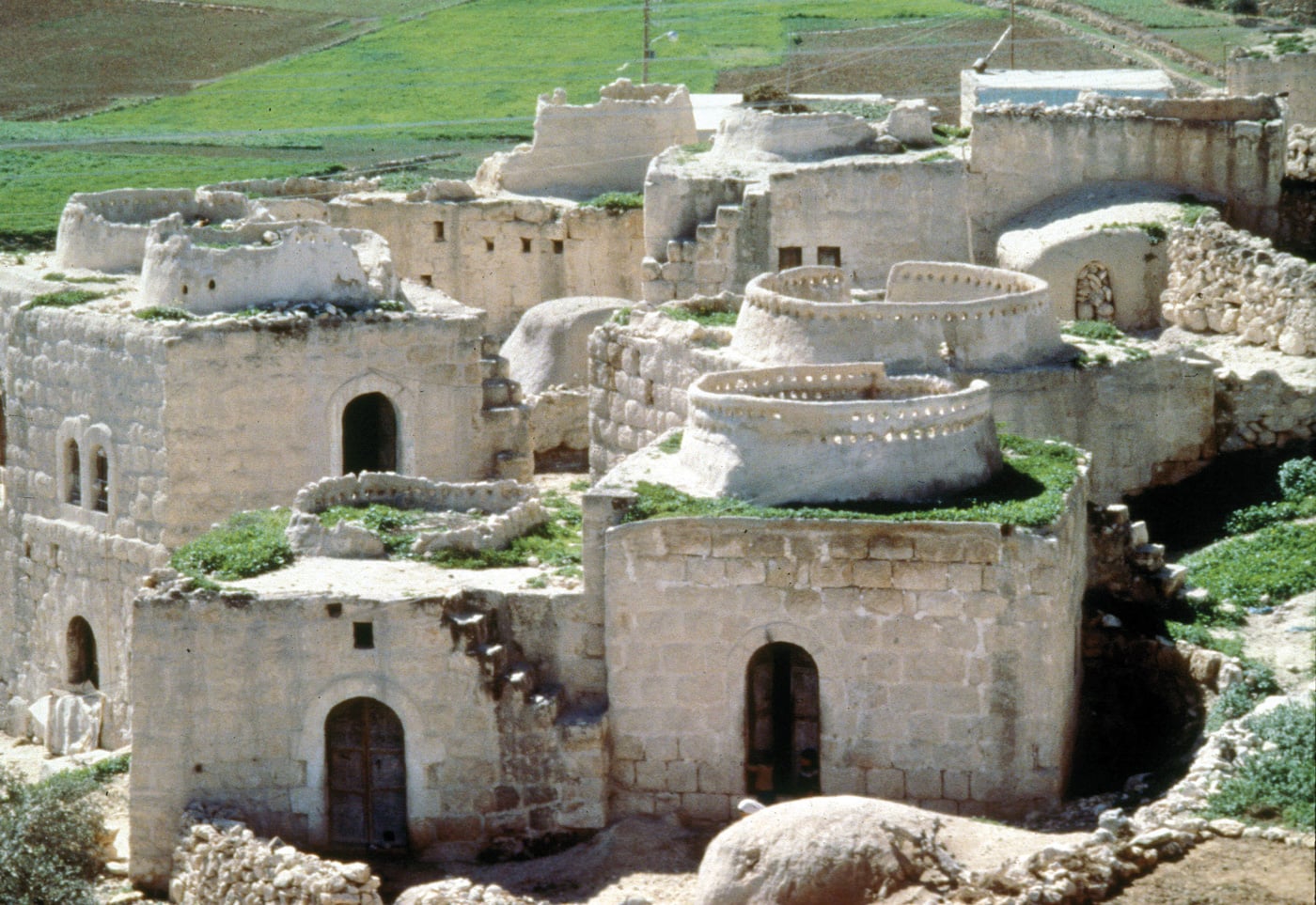
The village of Cana was a half-day’s walk north of Nazareth. While the ancient village has likely been located, little of it has been excavated. The village of Der-Samet, seen here, which is near Hebron, may show the same building styles known in first-century Cana.
Weddings (2:1–12) were festive events in first-century Judaism, and entire communities participated. Since Galilee is Jesus’s home, it is not surprising that he is in attendance. When the wine fails (2:3), Jesus’s mother draws him in. His response in verse 4 is not meant to give offense. “Woman” was a customary polite address (cf. Matt. 15:28; Luke 13:12). Jesus will use it again when he is on the cross (19:26). In verse 4 “What have you to do with me?” (RSV) is an awkward English rendering of a Semitic idiom meaning, “How can this affair concern me?”
The miraculous solution is described in some detail (2:6–9), and as in Synoptic miracle stories, there is a climaxing testimony, in this case on the lips of the steward (2:10). Six stone jars each holding twenty or thirty gallons are filled with water, and this in turn supplies the wedding with an enormous quantity of wine (about 175 gallons).
Some degree of symbolism can be affirmed here without denigrating the historical character of the event. This is Jesus’s first public sign, and the key to interpreting it is Jesus’s messianic announcement and abundance. The wedding banquet was an Old Testament symbol of the Messiah’s arrival (cf. Isa. 54:4–8; 62:4–5), which Jesus often employed (Matt. 22:1–14; Mark 2:19–20). The Old Testament also describes this messianic era with the image of an abundance of wine (Jer. 31:12; Hos. 14:7; Amos 9:13–14). Jewish apocalypticism taught that the vine would give its fruit ten thousandfold (2 Baruch 29:5; see also 1 Enoch 10:19). Therefore Jesus announced himself with powerful eschatological metaphors.
But for the Messiah to come (and this is the unexpected news) the old institutions must pass away. Jesus enacts his first miracle on a religious device of Judaism. What were these jars? The Mishnah indicated that stone jars could be used as permanent vessels for purification (ritual washing). Jesus has transformed their contents. In the previous chapter John the Baptist offered a ritual washing, but he announced a more powerful baptism to come (1:33). Jesus has now taken up the necessary symbols as the fulfiller of Judaism.
Two remarkable statements frame the story: “They have no more wine” (2:3), and “You have saved the best [wine] till now” (2:10). This is a poignant commentary on the bankruptcy of Judaism and the arrival of Jesus. The new wine is abundantly superior to the old. But moreover, that which contained the old wine must pass away.
From here Jesus travels with his family (cf. Mark 6:3) to Capernaum, a village on the north shore of the Sea of Galilee. According to the Synoptics, this was an important center of activity for Jesus in Galilee.
Pilgrimage played an important role in the life of every Jewish family. Passover was one such pilgrimage festival in which Jewish families traveled to Jerusalem for worship. Hence Jesus travels from Galilee to Judea. The story of the temple cleansing (2:13–25) provides us with one of the closest Synoptic/Johannine parallels (cf. Matt. 21:12–13; Mark 11:15–17; Luke 19:45–46). Aside from its chronological placement (the Synoptics have it at the end of Jesus’s ministry), the stories are strikingly alike. Some would argue that they narrate the same event.
Jesus is offended by two things that he witnesses. First, although the selling of sacrificial animals (2:14) was necessary for worship, it may be that this usually took place in the Jerusalem market area east of the city in the Kidron Valley. Obviously the high priest Caiaphas has brought the commercial enterprise into the Court of Gentiles. Second, money changers converted pagan coinage (with imperial images) to acceptable currency in order for Jewish men to pay their half-shekel annual tax (cf. Matt. 17:27). The cacophony of noise and the spirit of commercial self-interest had little to do with the purposes of the season. In response Jesus drives out these merchants with a whip (2:15), but John rightly adds that it is simply made of cord, for genuine weapons were prohibited by the temple police.
Again we find here the themes of messianic announcement and replacement. In the Old Testament, the prophets linked the ultimate renewal of the temple with the eschatological day of the Lord (Isa. 56:7; Mal. 3:1). Jesus’s rebuke in John 2:16 reflects this and stems from Zechariah 14:21. This is why in 2:18 those who witness this demand a sign—some justification. They recognize the messianic importance of the act. But Jesus’s response picks up another line of Old Testament thought: in the day of the Lord a new temple would be built (Ezekiel 40–46; Tobit 14:5), and this temple would be Jesus’s body (John 2:21). This reiterates what we have already seen (cf. 1:14, 51): this sacred Jewish institution would find a dramatic new replacement (cf. 4:21–24).
Of course it would be difficult for the citizens of Jerusalem to understand this. The Jews think that Jesus must mean a refurbishing of Herod’s temple begun in 20 BC (2:20). Even the disciples’ comprehension has to await the resurrection (2:22). Nevertheless, Jesus’s words will be remembered, twisted, and used to condemn him at his trial (Mark 14:58).
It is interesting to compare these first two signs of Jesus in Cana and Jerusalem. In Galilee Jesus finds faith (2:11), but in Jerusalem, while some believe (2:23), the Jews there generally lack comprehension. Throughout the Gospel, Jesus will find faith in Galilee and conflict in Judea. Indeed, it will be in Jerusalem that he will be killed. Verses 23–25 describe the unsatisfactory nature of the Jerusalem reception and go on to generalize about the shortcomings of humanity (2:25). They also serve as a transitional section for the next chapter. Nicodemus will be one such man: he has witnessed the signs and come forward (3:2), but he fails to apprehend who Jesus is and to believe.
3:1–36. At first glance this section on Jesus and the new birth seems to consist of two disparate parts: the dialogue with Nicodemus (3:1–21) and the critical comparison of Jesus and the Baptist (3:22–36). Note, for instance, how in 3:22 Jesus moves “into the land of Judea” (NASB, NKJV) when he has just been in Jerusalem, a city of Judea (2:13, 23). While numerous plausible theories have offered to relocate 3:22–36 (generally after 1:19–34), they are difficult to support. In fact, a connecting thread may unite the chapter. On a literary level, Jesus now dislocates yet another office in Judaism, the rabbinate. Nicodemus’s ability as a teacher is faulty (3:10), while Jesus is addressed as “rabbi” (3:2). On another level, the subject the teacher Nicodemus cannot penetrate (rebirth, 3:3) is really center stage. In 1:33 we learned about a new baptism in the Spirit, which would come with the work of Jesus; in 3:1–21 it is explicated. If “born of water and the Spirit” (3:5) does refer to baptism (Jesus’s baptism; Christian baptism), then the section on the relative merits of John’s baptism (3:22–36) naturally follows. It extends the discussion broached in 1:33 in that Jesus’s baptizing work exceeds that of John. In 4:1–3 we even find the only New Testament reference to Jesus baptizing. And here Jesus “was gaining and baptizing more disciples than John” (4:1).
While Jesus is in Jerusalem at Passover (2:13), a Pharisee named Nicodemus comes to him at night (3:1–21). His approach is well intentioned, but his spiritual perception is inadequate. (It may be that “night” in 3:2 is symbolic; for Nicodemus is not “of the light”; see, e.g., 1:4–5; 3:19–20; 9:4; 11:10; 13:30.) He reappears in 7:50 at a Sanhedrin meeting giving advice sympathetic to Jesus’s case. And in 19:39 his sympathies become explicit: he joins Joseph of Arimathea in burying and anointing the body of Christ.
This passage introduces the first major discourse so typical of Jesus’s teaching in the Fourth Gospel. In this and other such discourses, questions posed to Jesus enable him to transpose the topic to a higher plateau (e.g., chap. 14). Earthly understanding must give way to spiritual understanding. Here Nicodemus makes three comments (3:2, 4, 9), each of which Jesus greets with a response (3:3, 5–8, 10–15).
When Nicodemus inquires about the character of Jesus’s signs, Jesus replies that rebirth is a prerequisite for seeing the kingdom of God (3:3, 7). Nicodemus’s misunderstanding (3:4) turns on a literal understanding of the Greek phrase gennēthē anōthen, “born again.” How can anyone be born twice? Yet anōthen can also mean “from above” (a spatial vs. a temporal rendering), and this is Jesus’s intended meaning. Typically, the Johannine Jesus employs a play on words. Anōthen in John takes the spatial sense (“from above”), as is evident from its use in 3:31 (also 19:11, 23). In other words, entrants to the kingdom must be born from “above,” that place from which Jesus originates. The Christian, as it were, must become like Jesus, who is “from above” (3:31). The theological language for this is brought out in 3:5–8. This birth must consist of water (repentance, baptism, or the ministration of John) and the Spirit (the eschatological endowment brought by Jesus; 7:39; 20:22). This experience cannot be quantified but, like the wind, emerges under the power of God (3:8).
The deficits in Nicodemus’s understanding are common to those who cannot understand heavenly things (3:12; cf. 1 Cor. 2:1–16). Before Pentecost, this is true of the disciples too (cf. 2:22). But the key that will unlock the problem is the complex of events that includes Christ’s death, resurrection, and ascension (3:13–15)—in Johannine language, Christ’s glorification. It is the result of this work that will release the Spirit (7:37–39).
It is difficult to know whether 3:16–21 continues the words of Jesus or represents the comments of the evangelist (see NIV note on 3:15). The same holds for 3:31–36. Are these the words of the Baptist or the author? Some scholars argue that a certain symmetry should be seen: Jesus and John’s statements are followed by the beloved disciple’s additional remarks (3:16–21 follows 3:1–15 as 3:31–36 follows 3:22–30).
In 3:16–21 we learn how this gift of spiritual birth offered to Nicodemus might be appropriated. Belief in the Son gains eternal life (3:15–16, 18). Disbelief gains judgment and condemnation (3:18–19, 35). This sums up the worldview characteristic of John’s Gospel: one is either attracted to or repulsed by the light (3:19–21); one pursues either truth or evil. There is no equivocation here. Yet the coming of the Son was not inspired by a desire to condemn—it stemmed from love (3:16–17). But judgment is an inevitable result. Light brings exposure (3:20): it reveals who we really are.
Is the prospect of Jesus truly better? Evidence from the New Testament and the first century indicates that John the Baptist had followers who did not go over to Jesus (cf. Acts 19:1–7). The scene now shifts to the work of the Baptist with his disciples (3:22–36), and it makes one point: Jesus’s baptism is superior: “He must become greater; I must become less” (3:30).
The scene is set at the Jordan River, where John is at work (3:22–24). A minor crisis arises when it is observed that Jesus’s following is exceeding that of John (3:26). The transition is breeding animosity, but John the Baptist responds with a series of testimonies: the providence of God determines the success of ministry (3:27), and as he made clear at the outset (1:29), Jesus is the Christ and bridegroom (3:28–29); John is merely his advocate.
These concrete expressions (echoing the Synoptic Gospels) now expand into abstract statements in 3:31–36. The superiority of Jesus is grounded in his superior heritage: he is from above (3:31). The Son has come from the Father, but the Baptist belongs to the earth. John the Baptist speaks “as one from the earth” (3:31), but the Son utters the words of God (3:34). Therefore, there is an inestimable difference. Once more, the Spirit provides the major difference: out of his love for his Son, God has given to him “the Spirit without limit” (3:34). Jesus’s possession of the Spirit supplies him with superior authority and enables him to offer new birth to men like Nicodemus.
4:1–54. Jesus’s departure from the Jordan River is prompted by his concern that the Pharisees are viewing him as supplanting John the Baptist’s ministry (4:1; cf. 3:22–36). Would the hostility toward John now be aimed at Jesus? In the Synoptics, it is John’s arrest that brings Jesus into Galilee (Mark 1:14). The same is true in the Fourth Gospel. Jesus avoids incrimination stemming from his association with John. To be sure, Jesus’s ministry was similar to that of John: both men employed baptism (4:1–2). Even in Galilee after the death of John, Herod Antipas will fear that Jesus may be John come back from the dead (Mark 6:14–20).
The usual route from the Jordan River to Galilee traversed the rift valley to Scythopolis (Beth Shan) and then went northwest into the valleys of lower Galilee. Instead, Jesus climbs into the Judean mountains and follows the ridge route north through the tribal territories of Benjamin and Ephraim and on into Samaria (4:5–6). The precise location of the city of Sychar remains uncertain; however, it is probably Shechem (so identified by Jerome and the Syriac) inasmuch as the traditional site for Jacob’s Well is 250 feet from there. Further, Shechem is on the road from Judea to Galilee.
Jesus’s conversation with the woman of Samaria (4:1–42) is striking on several counts. First, the enmity between Jew and Samaritan is well established (see Luke 10:29–37) and stands behind the woman’s words in 4:9. Moreover, few Jewish rabbis would initiate open conversations with women as Jesus does (see 4:27). Nevertheless, Jesus does so, and the ensuing dialogue harmonizes with the theological developments we have seen thus far: Jesus overturns the sanctity of an important religious institution. In this case it is the sacred well of Jacob. At Cana (2:1–11), Jerusalem (3:5), the Jordan (3:22–26), and here, water serves a symbolic role, depicting the older institution that needs the messianic gift of Christ. As water became wine (2:9) and John’s baptism was replaced by that of Jesus (3:30; 4:1), so now well water will be replaced by living water. What is this gift that makes all else obsolete? It is the eschatological Spirit promised by Jesus (3:5). This is what will bring power to John’s baptism. The same is true in Samaria. John’s only other reference to living water is in 7:38–39, where it is defined as the Spirit. The Spirit is explicitly emphasized even as the dialogue develops (4:23–24).
The dialogue with the woman enjoys a literary structure much like that in chapter 3: inquiries by the woman based on a misunderstanding of Jesus’s spiritual intent serve to transport the discussion to deeper levels of thought. But while Nicodemus never reenters the scene to issue his response (suggesting no faith in Jerusalem?), things are different in Samaria. We read a series of improving titles for Jesus (“Sir,” 4:11, 15; “Prophet,” 4:19; “Messiah,” 4:25, 29; “Savior of the world,” 4:42); the woman’s testimony converts many in the village (4:39); and Jesus remains with them for two days before going north into Galilee (4:43).
In verses 7–15 Jesus discusses living water. This section (like the next) introduces an “earthly” subject and through the questions of the woman leads to a spiritual message. Jesus’s request for a drink of water is rebuffed (4:9), but he issues a challenge to the woman: if she knew who Jesus was, she would see that he is the supplier of living water (4:10). A second round (4:11–15) turns on her misunderstanding: Jesus cannot supply water because he has no access to the well. But here at last Jesus’s clarification unfolds his meaning. His water ends all thirst and provides eternal life (4:14). It is the Spirit. (Compare this discourse with that on living bread in John 6:35–59.) Marvelously the woman asks to drink.
In the next section Jesus’s focus is on true worship (4:16–26). When the light enters the darkness of the world, it necessarily brings judgment (3:19–20). Before the gifts of God can be obtained, the soul must be cleansed of sin. Jesus probes the moral life of the woman (4:16–18), but she does not flee—she admits to Jesus’s prophetic powers (4:19). She chooses to remain in the light; yet now she hopes that the religious institutions of her acquaintance will free her from Jesus’s scrutiny. Mount Gerizim (a mountain towering over the well) was the Samaritan holy place; Jesus is obviously a Jew who venerates Jerusalem. But Jesus dismisses these institutions too (as he dismissed the well): again the new dimension that transcends these is the Spirit (4:23–24). This spiritual worship is not worship in the inner aesthetic recesses of a person: it is worship animated by God’s own eschatological Spirit. Jesus’s challenge and offer in each of these scenes is the same. Yet here we move a step further; worship must also be in “truth.” It must affirm the realities of truth (Jesus is the truth, 14:6), be doctrinally informed (cf. 1 John 4:1–3), and be directed toward Jesus.
Now Jesus takes up the subject of true nourishment (4:27–38). When the disciples return from the village (see 4:8), the woman departs in haste, leaving her jar behind (4:28). In the light of Jesus’s offer, is it now obsolete? Her positive report in Shechem (“Could this be the Messiah?”) leads many to make their own inquiries at the well. (Note the parallel on evangelism and discipleship in 1:35–51 with Andrew and Philip.)
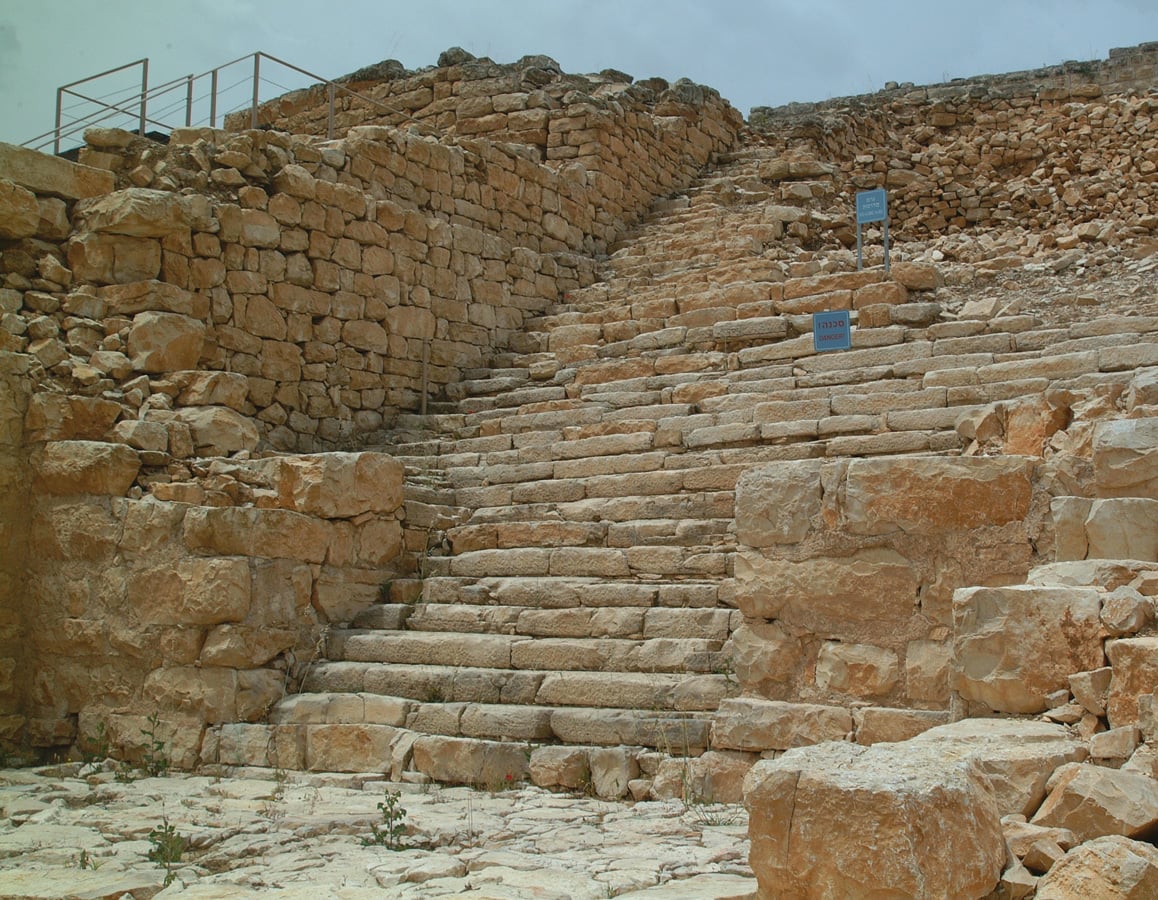
The woman at the well tells Jesus, “Our ancestors worshiped on this mountain, but you Jews claim that the place where we must worship is in Jerusalem” (John 4:20). The Samaritans, neighboring rivals to the Jews in Judea, had their own temple and rejected Jewish worship. Seen here are the remains of the steps from the Samaritan temple on Mount Gerizim.
Not even the disciples are exempt from misunderstanding Jesus. Jesus sent them out for food (4:8), yet now when Jesus is encouraged to eat he says that he has food enough (4:32). The disciples’ misunderstanding (4:33) propels the discourse forward (4:34–38). His nourishment is found in accomplishing his urgent mission.
The woman’s testimony bears fruit (4:39–42). And yet those who are invited to come out to see Jesus for themselves (as were Peter and Nathanael in 1:35–50) must obtain their own faith. Jesus remains in Samaria for two days, and many in the village believe (4:42).
The miracle in which the official’s son is healed (4:43–54) brings Jesus back to Cana, the town that introduced this section of the Gospel (2:1–12). In both instances the sign of Jesus is numbered (2:11; 4:54), and his work is greeted with belief. Notice how there is a progression as Jesus moves from Jerusalem (chap. 3) to Cana (chap. 4). In Jerusalem Jesus cannot trust men (2:24), and Nicodemus comes making secretive inquiries at night (3:1–2). Then in Samaria Jesus is received eagerly (4:39–42), while in Galilee the enthusiasm for him is open (4:45). The transition from Jerusalem to Galilee is a transition from unbelief to belief, from darkness to light. The proverb of verse 44 (used in the Synoptics to refer to Nazareth; cf. Mark 6:4) is applied here to Jerusalem, the city that kills the prophets (Luke 13:33; cf. John 4:19; 6:14).
The healing miracle finds a close parallel in the Synoptic cure of the centurion’s servant (Matt. 8:4–13) and the story of the Syrophoenician woman (Mark 7:24–30). Both are cures effected at a distance. In John the miracle serves to display the new life promised by Jesus in the preceding discourses (3:16; 4:14, 36). In Cana, as in Samaria, Jesus hopes to inspire belief (4:50), and in this case, the official’s son is saved (4:51). The Johannine account underscores one feature of the miracle: Jesus’s word is powerful and effectual. The very hour of healing is the hour of Jesus’s utterance (4:52). This combination of miracle and belief (4:50, 53) is what distinguishes the Johannine term “sign.” The powerful works of Jesus are designed to evoke a response, to reveal who Jesus is. They are signs that lead elsewhere—to faith. This is the intent of the signs in Cana, Jerusalem, Samaria, and again in Cana. This is the aim that John has even for his reader of the Book of Signs. “Many people saw the signs he was performing and believed in his name” (2:23).
C. Jesus and the festivals of Judaism (5:1–10:42). This major section now compares Jesus with the festivals of Judaism in much the same way that the earlier unit (2:1–4:54) focused on Jewish institutions. Again, themes of messianic replacement and abundance will appear. However, now the subtleties of the comparison will become vital. In each instance, Jesus is described in the context of the festival (Sabbath, Passover, Tabernacles, Dedication), and as his discourse expands, elements from the festival will be swept up and given fresh definition. Jesus is their replacement! Or better, veiled within the liturgical and theological themes of the festival are symbols that point to Jesus, symbols whose true meanings are satisfied in Christ.
All of the Book of Signs (chaps. 1–12) might be viewed as giving the reader evidence—judicial evidence—for the truth of Christ’s claims. Indeed, the word “sign” (Greek sēmeion) may be a judicial term for evidence. So too we have been introduced to witnesses who substantiate Jesus’s case: John the Baptist (“I testify,” 1:34), the Spirit (1:33; 3:32–34), and the Samaritan woman (“Many . . . believed in him because of the woman’s testimony,” 4:39). In chapter 5 Jesus will be forced to itemize his witnesses (5:31–40).
This forensic motif will become prominent in chapters 5–10. The trial of Jesus, which officially commences in chapter 18, is begun already, as interrogators in Jerusalem approach Jesus, examining his case. In virtually every chapter the “Jews” play this role. They assess Jesus’s case, weigh the evidence, and make a judgment. This fascinating literary format places readers in an interesting position. They are forced to evaluate the evidence and the testimony for themselves. The first witness is John the Baptist (1:19–35), and the section closes (10:40–42) with a final reference to the Baptist’s testimony and the value of Jesus’s signs. By 10:42 the majority of the witnesses, the evidence, and the signs are in. The jury (the reader) may deliberate.
5:1–47. Jesus and the Sabbath receive prominent attention in this section. A feast now prompts Jesus to return to Jerusalem (5:1). Three pilgrimage feasts were known at this time—Passover, Pentecost, and Tabernacles—and scholars debate which could be meant here. The text is unclear, but at least it serves to introduce us to the literary motif of Jewish feasts that will follow. In this chapter the festival is the weekly Sabbath, a day of worship and rest. Jesus works a healing miracle (5:2–9), conflict follows (5:10–18), and then Jesus provides a major discourse explaining the authority of his work and his divine identity (5:19–47).
The location of the pool (5:2) had a history of controversy until archaeologists excavated it in the courtyard of St. Anne’s Church in Jerusalem. The pool’s name, Bethesda (see NIV note), is still unclear since manuscripts reflect numerous readings (5:2). John notes that various people with infirmities waited at the pool hoping to benefit from healing power associated with the site. This has led some scholars to see in the archaeological remains evidence for a healing sanctuary near the pool. Jesus, however, ignores the pool’s supposed powers and with a word heals the lame man (5:8–9). But as with so many other healing stories in the Synoptics (cf. Mark 3:1–6), it is the Sabbath, and this arouses objections among the Jewish leaders. (Note that the NIV omits 5:4, placing it in a footnote, since the verse does not appear in the best ancient Greek manuscripts.)
When the lame man carries his bed, he violates a well-known Sabbath prohibition (Mishnah Shabbat 7:2). But since he does not know Jesus (Matt. 5:11, 13), he cannot indicate to his accusers who directed him thus. This comes later in the temple (5:14), when Jesus and the man meet again. Does 5:14 teach that there was a connection between this man’s sin and his infirmity? The New Testament elsewhere avoids this conclusion (see John 9:3; Luke 13:1–5). Although a causal relationship may not necessarily exist between personal suffering and sin, sin may result in human misery and penalties (see Rom. 1:27).
The importance of verses 16–18 cannot be missed. For the first time we learn of Jewish hostility toward Jesus and the plan to kill him (5:18). The judicial theme comes out in 5:16 in the word “persecute” (diōkō), the grammar of which indicates a protracted period of persecution. God and Jesus form the substance of the following discourse. Jesus justifies working on the Sabbath because of his special relation with God (5:17): if God can work, so can Jesus. This is a dangerous defense. Could it be proven?
Jesus’s divine authority is the subject of one of the most exalted discourses in the Gospel (5:19–47). Here Jesus makes explicit claims to divinity inasmuch as he associates himself directly with God. The discourse consists of three units.
First, Jesus describes his work as continuing the work of the Father (5:19–30). While prohibiting human labor on the Sabbath, the rabbis agree that God sustains the natural processes of life (birth, death, rainfall, etc.). Sovereignty over life was chief among these divine tasks. Jesus justifies his labors by assuming divine prerogatives (5:21). (Note how in John 4:46–54 Jesus gave life to a young boy.) In addition, judgment (which condemns or justifies) belongs solely to God. This authority now belongs to Jesus too (5:22–24), who exercises it not only in the present age (5:24) but also in the future, eschatological age (5:25–30).
Second, Jesus buttresses his case by introducing witnesses for his defense (5:31–40). In Jewish law one witness (even a person witnessing of himself [5:30–31]) was insufficient either to condemn or confirm a charge (Deut. 17:6; Mishnah Ketubbot 2:9). Therefore, this section answers the legal complaint: four witnesses are ushered forward. John the Baptist (John 5:33–35), the mighty works or signs of Jesus (5:36), God the Father (5:37–38), and the Scriptures (5:39–40) all substantiate Jesus’s claims.
But what is the root cause of Jesus’s rejection? The third unit (5:41–47) provides an analysis and prophetic critique. The problem is not intellectual—it centers instead on inner disposition. “You do not have the love of God in your hearts” (5:42). Jesus is angered not because they refuse to glorify him (5:41) but because they refuse to glorify God (5:44). The desire for human praise, affirmation, and prestige has crippled them, and they cannot love God (5:44a). Human noteworthies are esteemed (5:43b), but the Son, who bears divine credentials, is rejected. The very Scripture used to condemn Jesus will soon bring the severest judgment on its possessors (5:45–47).
6:1–71. Jesus and Passover are the focus of chapter 6. The scene now shifts to Galilee, where in the springtime festival of Passover (6:4) Jesus miraculously feeds a multitude of five thousand people. This is the only miracle of Jesus that appears in all four Gospels; it must have been deemed very important by the early church (Matt. 14:13–21; Mark 6:31–44; Luke 9:10–17). John’s Gospel follows the Synoptic account closely. But John also echoes Matthew and Mark in that the feeding miracle is followed by the story of Jesus walking on the sea (6:16–21; cf. Matt. 14:22–33; Mark 6:45–52).
But this is where the comparisons end. Two typically Johannine literary features that we have witnessed elsewhere stand out. First, the symbolic elements of the festival are emphasized in order to highlight their christological significance. Passover spoke of Moses, who not only fed the Israelites in the wilderness (Exod. 16:4–36) but also became the ideal messianic figure in Judaism. Jesus is therefore depicted as the prophet like Moses (6:14; cf. Deut. 18:15) who exceeds the manna miracle of Moses (6:30–34, 48–51). Second, the Johannine discourse is the vehicle used to advance this comparison. When questioned by the Jews, Jesus presses home the spiritual meaning of this event in what may be the longest public discourse in the Gospel (6:25–65).

The hills above Tabgha, the traditional site where Jesus multiplied the loaves and fishes (John 6:5–13)
The Sea of Galilee was often called the Sea of Tiberias, in honor of Herod Antipas’s founding of the new provincial center of Tiberias in AD 26 (cf. John 21:1). The Passover is probably a year after the one mentioned in 2:13. During the intervening year, Mark notes, John the Baptist was arrested, and by the time of the feeding of the five thousand he has been executed (Mark 6:14–29, where the Baptist is beheaded). This lapse of time explains Jesus’s growing popularity (6:2–3).
Jesus’s charge to Philip to feed the people (6:5) recalls the conversation of 4:31–38, in Samaria. Spiritual food is at issue. It is a test (6:6) because Jesus needs to elevate the disciples’ consciousness as to the manner of his ministry. Nevertheless, misunderstanding ensues. (Note the motif already in 3:4; 4:11, 33.) Hence, Philip inventories their savings (eight months’ wages, 6:7), and Andrew spots a boy with a few provisions (6:9). John alone records that the boy holds barley bread, which was the bread of the poor, but symbolically it may recall the great Old Testament feeding miracle of Elisha (2 Kings 4:42). John also notes that it is Jesus who distributes the bread (not the disciples) and that in his prayer of blessing, rather than using the Synoptic eulogeō (“to bless”), Jesus gives thanks (Greek eucharisteō; cf. 1 Cor. 11:24). Is this a veiled symbol of the Eucharist or the Lord’s Supper? This use of symbolism seems natural to Jesus’s teaching in John, and in this chapter the eucharistic application will become more explicit (6:52–58).
The dangers of Jesus’s popularity and the perils of misunderstandings are shown in the crowd’s response (6:14). They have interpreted the sign: Jesus has enacted the “Moses miracle” of Passover. However, Jesus flees (6:15) because the crowd wishes to force on him a political definition of messiah (“make him king by force”). Mark records this same crisis: Jesus puts the disciples on a boat and personally disappears into the mountains (Mark 6:45–46).
The destination of the disciples is Capernaum, and after they have worked against the wind for hours heading to the fishing village of Peter and Andrew (6:16–19), Jesus joins them—walking on the sea. The fear of the disciples indicates the miraculous and incomprehensible nature of the event. Above all, Jesus reveals himself through yet another symbolic expression, “I am” (Greek egō eimi). In the Greek Old Testament the name of God revealed to Moses on Mount Sinai is egō eimi, or “I am” (Exod. 3:13–14). John’s use of this divine Old Testament title elsewhere for Jesus (8:58; 18:6) may imply its use here. Once the company arrives in Capernaum, Galileans from the earlier site of feeding follow him there and become suspicious because Jesus was not in the boat (6:22, 25). Jews from Tiberias likewise search for him and come to Capernaum (6:23). The zeal of the Galilean Jews is noteworthy (cf. 4:43–45).
In the Capernaum synagogue (6:59) Jesus provides a full discourse explaining his person and work. Again, the discourse is propelled forward by inquiries (6:25, 28, 30, 34, 41, 52), and at each level the revelation of Christ deepens.
Initially the crowds merely possess the surface apprehension of the miracle (6:25). They must go deeper and unveil the sign, for the signs are revelatory. Like the woman needing water (4:7), these people need imperishable food supplying eternal life (6:27; 4:14). For this food alone they must labor. What then is labor? Faith in Christ (6:29). But the human impulse is to demand evidence so compelling that we must believe. If Jesus is making personal claims on the order of Moses, then his sign must exceed that of Moses (6:30). In John 6:31 Jesus’s response is an intricate Jewish commentary (midrash) based on one or several Old Testament texts: “He gave them bread from heaven to eat” (cf. Exod. 16:4, 15; Ps. 78:24). The true bread they seek is not dependent on Moses (or Judaism): it is whatever God rains on humans as a gift, and which gives life (6:33). The Jews here resemble the Samaritan woman inasmuch as they are intrigued: “Sir, give us/me this bread/water” (6:34; 4:15).
The divine origin of Jesus is a favorite Johannine theme (3:13–31), and John often ironically presents it in innocent inquiries (e.g., 7:28, 34–36). So too the question of 6:25 about Jesus’s mysterious appearance in Capernaum goes unanswered, because now a theological response is at hand. Jesus is the bread of life that has mysteriously descended (6:35, 38). The twin themes of hunger and thirst (cf. chaps. 4, 6) are now satisfied. Belief is still the key (6:36; cf. 6:29); however, now a new note is struck. God is sovereign over the ministry of Jesus (6:38) as well as its results (6:37, 39, 44). Those whom God calls are effectively called and securely preserved (6:39–40; cf. 10:14–18; 17:6). In other words, the work of Jesus and the gathering of disciples are both a result of God’s perfect will.
From the crowd’s point of view this revelation is hard to accept, and they murmur (6:41–43). Is Jesus not a commonplace citizen of Galilee (cf. Mark 6:1–6)? How can he descend from heaven? But Jesus knows that further explanation will not complete what is lacking. The gift of faith and the ability to apprehend who Christ really is—these are divine things (6:44–48). Faith is not merely rational persuasion: it includes God’s drawing us (6:44). To stay in Judaism is death (6:49), but to consume the bread of life brings life (6:50–51).
But a deeper revelation is to come: the bread to be consumed is Jesus’s flesh offered in sacrifice (6:51). Still, the discourse is urged forward through a literal misunderstanding. How can humans eat his flesh (6:52)? The following explanation (6:53–58) reinforces this thought and draws on sacrificial images (flesh and blood). If symbolism is still at work (as it likely is), the symbols inevitably suggest the elements of the Lord’s Supper. It is not the sacrament that gives life; rather, salvation is found in the sacrifice behind it and the faith that it evokes (6:35, 40, 47). Outside the Eucharist an admonition to drink blood in any other Jewish setting would be incomprehensible.
But if the descent of Christ gives difficulty to the crowds (6:41–42), this deeper teaching causes the disciples to stumble (6:60). They too murmur (6:61). Jesus breaks the impasse by showing that literal flesh is not the key; rather, it is the Spirit who conveys life (6:63). If the Eucharist is still at issue, the message is clear: its physical element “counts for nothing” if the Spirit’s power is not present.
But to understand this fully takes more than human minds can grasp (6:64, 66). Jesus repeats the exhortation given to the crowds in 6:44–47. Penetrating the mysteries of God is also a divine gift (6:64–65). The deeper realities offend, and here some disciples draw back and abandon Christ (6:66). But Peter knows that the greatest virtue is to continue embracing Jesus no matter where he might lead (6:68–70).
7:1–9:41. The third feast of Judaism to inspire Johannine interest is the autumn harvest of Tabernacles. It joined Passover and Pentecost as a pilgrimage feast and was celebrated on 15 Tishri (September-October), commemorating the end of the harvest field labor (Lev. 23:39). It also recalled Israel’s wandering and life in booths (Lev. 23:42–43). Every Jewish male was obligated to attend sometime during the course of seven days of worship and sacrifice (Exod. 23:14–17; Deut. 16:16).
John’s interest in the Feast of Tabernacles (John 7:2, 37) is specialized and builds on the symbolic ceremonies conducted at the temple. Two ceremonies in particular frame Jesus’s self-disclosure. Water and light each play a ceremonial role based on eschatological prophecies in Zechariah (see below). In this context Jesus announces that he is the source of “living water” (7:38) and that he is the “light of the world” (8:12). The discourses that follow pick up prior themes (Jesus’s authority and origin) and add to the judicial evidence for Jesus’s case that the Book of Signs has been accumulating. Just as Sabbath (chap. 5) and Passover (chap. 6) became literary springboards to reveal who Jesus is, so now the Feast of Tabernacles becomes a place where Jesus unveils himself in Jewish imagery.
7:1–52. Jesus’s reluctance to return to Judea (7:1–13) is understandable when we recall the events of his last visit. The subject of his death arose then (5:16), and it will arise again (7:1, 7, 19). In fact, this will be Jesus’s last visit to Jerusalem; in the coming spring he will be crucified. Nevertheless, his brothers (cf. 2:12) urge him to go—to make his identity plain (7:3–4)—but their intentions are not in Jesus’s interest since, as John states clearly, they “did not believe in him” (7:5).
Does Jesus deceive them when he says that he will not go to the feast (7:8) and then he does (7:10)? (See the note in the NIV.) The earliest interpreters of John viewed this as a classic case of Jesus’s symbolism and its attendant misunderstanding. Jesus’s brothers lack belief and do not have divine insight; not just anyone can fully comprehend the Son (cf. 6:44). “Going up” (Greek anabainō) elsewhere for Jesus means death, resurrection, and ascension (cf. 20:17). This is why Jesus’s “time has not yet fully come” (7:6, 8)—Jesus is sovereign over his death and departure (so 10:17–18). He may attend the feast, but he alone will control the hour of death.
Jesus’s arrival is marked by controversy (7:10–13). Judaism is divided (7:40–44). This echoes the Synoptic picture of Jesus’s final days in Jerusalem, where Jesus’s teachings find both a popular following and the concentrated hatred of the Jewish leadership. It is possible that the Johannine chronology gives the best picture of Jesus’s final Judean visit: he comes to the city in the autumn, teaches in the region during the winter, and is crucified during Passover in the spring.
The now familiar form of the Johannine discourse meets us again at the Feast of Tabernacles. Questions that essentially misunderstand who Jesus is provoke him to respond. Irony is John’s literary device throughout. Here two Jewish objections to Jesus are central to the debate: the authority of Jesus’s teaching and the nature of his origin.
Educational standards for rabbis were well established in the first century. Advanced study under a rabbinic scholar (e.g., Paul under Gamaliel) in a school was common. Jesus possessed no such credentials. In effect, the Jews wish to see these, and Jesus complies: his diplomas are divine (7:14–24). The Synoptics attest to Jesus’s uncanny sense of authority (Matt. 7:28–29). Here Jesus explains the source of that authority.
The Jewish notion of authority was specialized. No one possessed inherent authority; it was secondary and indirect. Authority was passed down and conferred to the rabbi through ordination. It was as if the authority of Moses was preserved through the generations. And if the chain was broken, authority might be lost. Jesus’s problem was this: he was not ordained. On whose shoulders was he standing? What traditions were his? What was the source of his authority? Jesus’s answer is clear: his authority stems directly from God (7:14–18). Jesus does answer the rabbis in their own categories: his authority was properly conferred to him—but his source of authority is unconventional to say the least.
In particular, Jesus demonstrates his authority by overturning traditional teaching on the Sabbath. Note how in 7:22 the rabbinic concept of tradition and authority is employed. Still, Jesus supplants this with his own instruction: doing good (e.g., healing [5:1–18]) is no violation of the Sabbath. Circumcision is the precedent (7:23).
In chapter 5 Jesus asserted his authority in the same way, and it led to speculation about destroying him (5:15–16) on the basis of his claims about himself (5:17–18). The same responses are evidenced here (7:25–36). Again an ironic misunderstanding (7:27) fuels the discourse. Popular Jewish belief held that the Messiah would be concealed until his surprise unveiling to Israel. But the crowds know Jesus’s home—he is from Galilee. But this is wrong at a deeper level. Jesus comes from God (7:28–29). John employs the crowd’s false perception of Jesus’s origin in order to explain Jesus’s true origin. In response, the listeners are divided (cf. 6:66–71). Some are hostile (7:30), but others step closer toward faith (7:31). The light either draws to itself or repels.
Once again the Jewish leadership misunderstands Jesus (7:32–36). Jesus is going where they cannot travel. This of course is his return to the Father, but they take it to mean his travel to prohibited Gentile lands (7:35). This illustrates once more the truth that access to divine revelation rests solely in God’s sovereign hand (6:44–58).
On the last feast day, numerous ceremonies involving sacrifice and ritual water could be viewed at the temple. Reading Zechariah 9–14, we see the priests portray how in the last days everlasting fountains would flow from Jerusalem (Zech. 13:1; 14:8). Pitchers of water from the Gihon Spring were poured on the altar as the Hallel Psalms were sung (Psalms 113–18). This was especially meaningful since at this time of year water was scarce in Israel, and people feared drought.
In this setting (7:37–39) Jesus sweeps up this symbolism and announces that he is the source of true drink (cf. 4:10). John 7:38 has always posed difficulties for interpreters. The NIV makes the believer the one in whom living water is flowing. But the Greek can be punctuated another way: “If anyone thirsts, let him come to me; and let him drink, who believes in me.” This reading is best. It means that Jesus is the source of the eschatological Feast of Tabernacles water. Jesus is the source of the Spirit (7:39a). In 19:34 we may even have a symbol of this flowing when Jesus is glorified (7:39b).
At the middle of the feast (7:14) Jesus’s revelation is met by a response from the people (7:25–31) and the Jewish leadership (7:32–36). On this last day the same applies: the people and the leaders are divided (7:40–52). Some express incipient faith (7:40–41, 46); others show contempt (7:41, 44, 47–49). In both cases the issue of Jesus’s inferior Galilean origin is a problem (7:41–42, 52). In John 1:46 this same concern troubled Nathanael, but there was a difference. He had the courage to “come and see” Jesus for himself. This too is the counsel of Nicodemus in 7:51. A true verdict requires an assessment of the evidence—the facts. This applies to the Sanhedrin. But also in John’s judicial literary format, this applies to the reader. The Book of Signs is submitting evidence for our inspection.
7:53–8:11. The section about the woman caught in adultery has always proved difficult. Three questions persist: (1) Is it an insertion into the text of John? Most scholars answer in the affirmative. The best Greek manuscripts do not have it, and when they do, it appears in a variety of places (e.g., after John 7:36; 21:25; Luke 21:38; or even Luke 24:53). It also has a style unlike that of John, and it interrupts the Feast of Tabernacles story (see 8:12). If it belonged here, 7:53–8:1 would imply that Jesus was at the Sanhedrin meeting in 7:45–52! (2) Is the story authentically from Jesus? Yes it is. It is similar to Synoptic stories of Jewish entrapment climaxed by Jesus’s profound pronouncement (8:7). (3) Why was it located here in John? The surrounding discourse (esp. chap. 8) asserts themes that the story illustrates. Jesus judges no one (8:15), and his accusers cannot convict him of sin (8:46). (For a current study on the history of the text, see Burge 1984.)
But these concerns should not deter us from the power and authority of the story. The account has always been a favorite for good reason. The falsehood of the scribes and Pharisees is indicated in two ways. First, the Old Testament law on which they base their charges (8:5) required the punishment of both parties (Lev. 20:10; Deut. 22:22). The woman’s partner is absent. Was she set up? Second, Jewish law carefully stipulated what evidence needed to be in hand. No execution was possible without a solid case. Hence Sanhedrin records indicate judges who would even demand to know the color of the sheets on the bed. The law even distinguished intercourse from preliminary sexual contact. This extensive demand for evidence made adultery charges rare in Judaism since couples would naturally take precautionary measures to conceal themselves. However, the law was aware of men who, rather than divorce their wives for an illicit affair, chose to have them “set up” with witnesses for execution. (If a man thus executed his wife, he became heir to her property; but not if he divorced her.) But this self-interest was deemed morally wrong. If witnesses viewed preliminary coition, they were obliged to interrupt the act and prevent the greater crime. If, as we suspect, a man has discharged his wife thus and engineered testimony (“caught in the act,” 8:4) to execute her without warning her, the entire affair may appear legal but reeks of injustice. In Jesus’s eyes the entire situation would have been reprehensible.
The woman is simply a pawn for the Jewish leaders who wish to play off Jesus’s well-known compassion for sinners (even women sinners! cf. Luke 7:36–50) against the demands of the law. They wish to discredit Jesus (8:6). However, Jesus does not deny the woman’s sin but draws her accusers into the circle of condemnation.
8:12–59. John 8:12 returns to the festival setting of Tabernacles (cf. 7:2). The discourse of 7:14–39 focused on one symbolic element: the everlasting temple water of Zechariah. Now Jesus employs a second ritual theme: everlasting light (8:12–20). Zechariah also predicted that light would shine forth perpetually from the temple in the last days (Zech. 14:6–7). This too was associated with Moses and the wilderness tabernacles: was not Israel led by a pillar of light (Exod. 13:21)? The Feast of Tabernacles was further celebrated during the autumn equinox, recognizing the failing summer sun.
Pilgrims to Jerusalem enjoyed the light ceremonies of the temple (see Mishnah Sukkah 5:2–4). Four enormous candlesticks were lit each night, illuminating the brilliant temple limestone. It is a tribute to the Jewishness of John that he records an incidental detail of importance. Just as Jesus spoke of messianic fulfillment at the height of the water ceremonies (7:37), now John says that Jesus is in the area of the temple treasury (8:20). The treasury was in the Court of Women, and this was the location of the festival lampstands! Beneath the ritual lights of the Feast of Tabernacles Jesus announces, “I am the light of the world.”
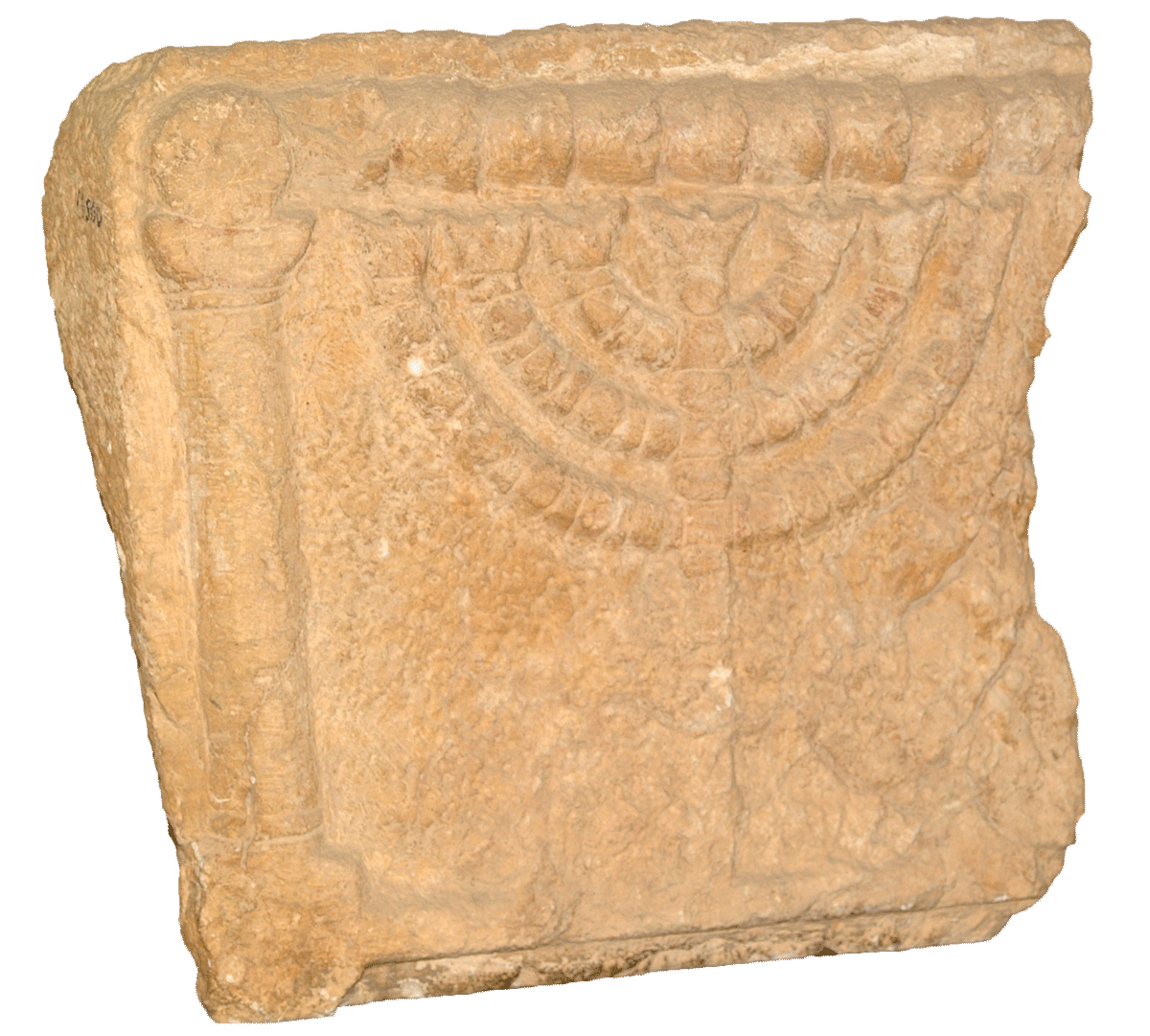
The seven-branched lampstand, or menorah, was a common decorative element in synagogues, such as the synagogue in Eshtemoa near Hebron (third–fourth century AD), where this lintel was excavated. The menorah was a symbol of the temple and the lampstands lit there each night.
“Light” is a frequent metaphor for Jesus in the Gospel (see 1:5; 3:19; 12:46; 1 John 1:5). As light, Jesus discloses the person of God for us; illumines life and gives us meaning and purpose; and also exposes sin, judging those who dwell in darkness. These are persistent themes in the Fourth Gospel. Here the pilgrims at the Feast of Tabernacles recognize something authoritative in Jesus’s words but demand legal substantiation (8:13–19). This question was posed in chapter 5 at another festival. In the Old Testament (Deut. 17:6) and the Mishnah (Ketubbot 2:9) it was held that a person could not be condemned unless two witnesses were present (cf. Matt. 18:16; 2 Cor. 13:1). This was extended to self-testimony. Now, however, Jesus does not inventory his witnesses. He has done this already (5:30–47). The most acute witness to Jesus is the Father (8:18). Jesus’s self-witness is also valid because Jesus can assume the authority of the Father, namely, that of judgment (5:22; 8:16). But since Jesus’s opponents do not know the Father, they can hardly perceive the weight of his testimony.
The balance of the Tabernacles discourse now takes on the traditional format we have seen many times. Misunderstanding on the part of Jesus’s questioners propels the discourse forward, leading Jesus to further self-revelations. Now, however, in Jerusalem, these revelations will become more profound than anything before, and the hostilities more direct. Here (8:59) and at the next feast (Dedication, 10:31, 33), violence seems imminent. If what Jesus says is true, he must be followed or destroyed.
Where is Jesus going (8:21–30)? This is the second time this question has been asked (cf. 7:32–36). Earlier Jesus volunteered no explanation. Now when his audience mistakenly thinks that he will commit suicide (8:22), Jesus unveils something of his true origins (8:23–24). Jesus is returning to the place from which he originated, “from above” (8:23; cf. 3:31). The divine implications of this are explicit in 8:24. Jesus uses the divine name (egō eimi) as a description of his identity. In this round (8:24, 28) and the next (8:58), this is the climax of Jesus’s testimony. The Greek form of the Hebrew name Yahweh (Exod. 3:14) is applied to Christ in an absolute way. Jesus is the great I AM.
Again the crowd misunderstands. “Who are you?” (8:25). “I am” (8:24) usually requires a predicate. Still they fail to see. Jesus bears the full authority of God! But here at last Jesus indicates when they will perceive: at the cross (8:28). This is the second passion prediction in John (elsewhere 3:14 and 12:32–34; cf. the same triple prediction in the Synoptics: Mark 8:31; 9:31; 10:33–34). The metaphoric language in all three passion sayings is critical: the cross is the lifting up of Jesus (not his destruction). “Lifting up” (Greek hypsoō) is often used for exaltation (Acts 2:33; 5:31). His elevation on Calvary is the initial step in his departure. It is in this process that his divinity will be unmistakable. He will be exalted.
Jesus discusses Abraham’s true descendants in 8:31–59. The implications of this radical teaching are clear, and controversy is sure to follow. Jesus is overturning the canons of Jewish religion in their entirety! Knowing him who bears this power and authority will bring true freedom (8:32). But again, the Jews understand this in earthly terms: they are free since they are not slaves (8:33). But Jesus is concerned with spiritual slavery (8:34–36), and this they cannot perceive.
From here Jesus is engaged in the harshest polemic in the Gospel (8:37–59; cf. Matt. 23:1–39). Verse 35 is key. If the Jews are not sons in God’s household (as Jesus claims), two results follow: their tenure there is limited, and they have another father. Being a descendant of Abraham (8:37) and being a son (8:35, 38) are two different things. Jesus claims that lineage has no effect on spiritual status before God (so Paul, Rom. 2:25–29). But their desire to kill Jesus is telling: they have a spiritual father other than God (8:38–43). At once they see where Jesus is headed: at issue is not only Jewish lineage (8:39) but also their sonship. Jesus is challenging both. The lethal attack is launched in 8:44. The failure of Jesus’s opponents to accept the truth and to hear God’s word (8:47) has led them to desire Jesus’s murder.
Jesus’s spiritual critique is now turned back on him, and he is assailed with words not even found in the Synoptics (8:48–49). If the Jews here are children of the devil (8:44), then Jesus is demon possessed (7:20; 8:48). The nearest parallel to this is in Mark 3:22–27, where Jesus is said to be in league with Satan. But John 8:48 cuts deeper.
Despite this offense, Jesus presses home the implications of his divine status. This will bring the final crisis. Jesus and those who believe in him are free from the threat of death (cf. 8:31–33, 51). This is astounding. Does Jesus claim to be greater than Abraham and the other Old Testament heroes who died (8:52–53)? If this is Jesus’s claim, he must be demon possessed (8:52). But Jesus takes up the challenge. In 8:56–58 the discourse comes to its climax: Jesus is indeed making personal divine claims as compared with Abraham. Two times in this discourse we hear the refrain, “Who are you?” (8:25), “Who do you think you are?” (8:53). Now the answer is given. Jesus’s existence has been eternal—before Abraham—and he is the bearer of the divine name (8:24, 28, 58). His attackers understand him fully now and try to kill him for blasphemy, but he slips away (8:59; cf. 7:44; 8:20).
9:1–41. In chapter 9 Jesus brings light to a blind man. Cast in the form of so many Synoptic conflict stories, this narrative is closely connected with the previous chapter. We are still at the Feast of Tabernacles setting, and Jesus is still affirming that he is “the light of the world” (9:5; cf. 8:12). Here the light of Jesus is parabolically viewed in the service of a blind man who gains his vision. But those who live in darkness without this light (the Jewish opponents) cannot see. In the end, the Pharisees are described as blind since they do not possess the spiritual vision or the light of Christ. It is interesting to trace the attitudes of the blind man and the Pharisees here. The former makes three confessions of ignorance (9:12, 25, 36) but in the end is led to true vision and faith (9:34–38). The latter make numerous confident statements of knowledge (9:16, 24, 29) but are shown to be ignorant (9:41). The story is symbolic, then, of spiritual vision and blindness complete with their attendant dispositions (cf. the similar blindness motif in Mark 8:14–30).
The healing in 9:1–34 and the one described in 5:1–18 have much in common (Sabbath, pool, interrogation, conflict). Here too the question of the origin of suffering arises (9:2; 5:14). And again, the link between sin and suffering is opaque. If we take the traditional punctuation, 9:3 implies that the purpose of the infirmity is the glory of God that will follow the healing. The man was born blind so that God could show his glory. However, some scholars have argued that the punctuation should stop at 9:3b, giving the following translation: “ ‘Neither this man nor his parents sinned,’ Jesus said. ‘But so that the work of God may be displayed in his life—we must do the works of him who sent me.’ ” In this case, no comment is given as to the purpose of the man’s blindness, but instead Jesus simply says that we need to get to work to correct it, thereby showing God’s glory.
Healing with mud and saliva was well known among the ancients, and Jesus employed it often (cf. Mark 7:33; 8:23). The focus of the healing, however, is its symbolic element: the man is told to wash in the Pool of Siloam. This was the pool at the south end of the city filled by the Gihon Spring and was the source for the water ceremonies at the Feast of Tabernacles. But for John something deeper is at hand. We recall that Jesus replaced these Tabernacles waters in 7:37–39. Now the pool, which is their source, bears Christ’s name. Siloam means “sent” (9:7), and the Fourth Gospel regularly refers to Jesus as one who is “sent” (e.g., 5:36–38; 8:16, 18, 26). The blind man finds his healing in Jesus both in symbol and in reality.
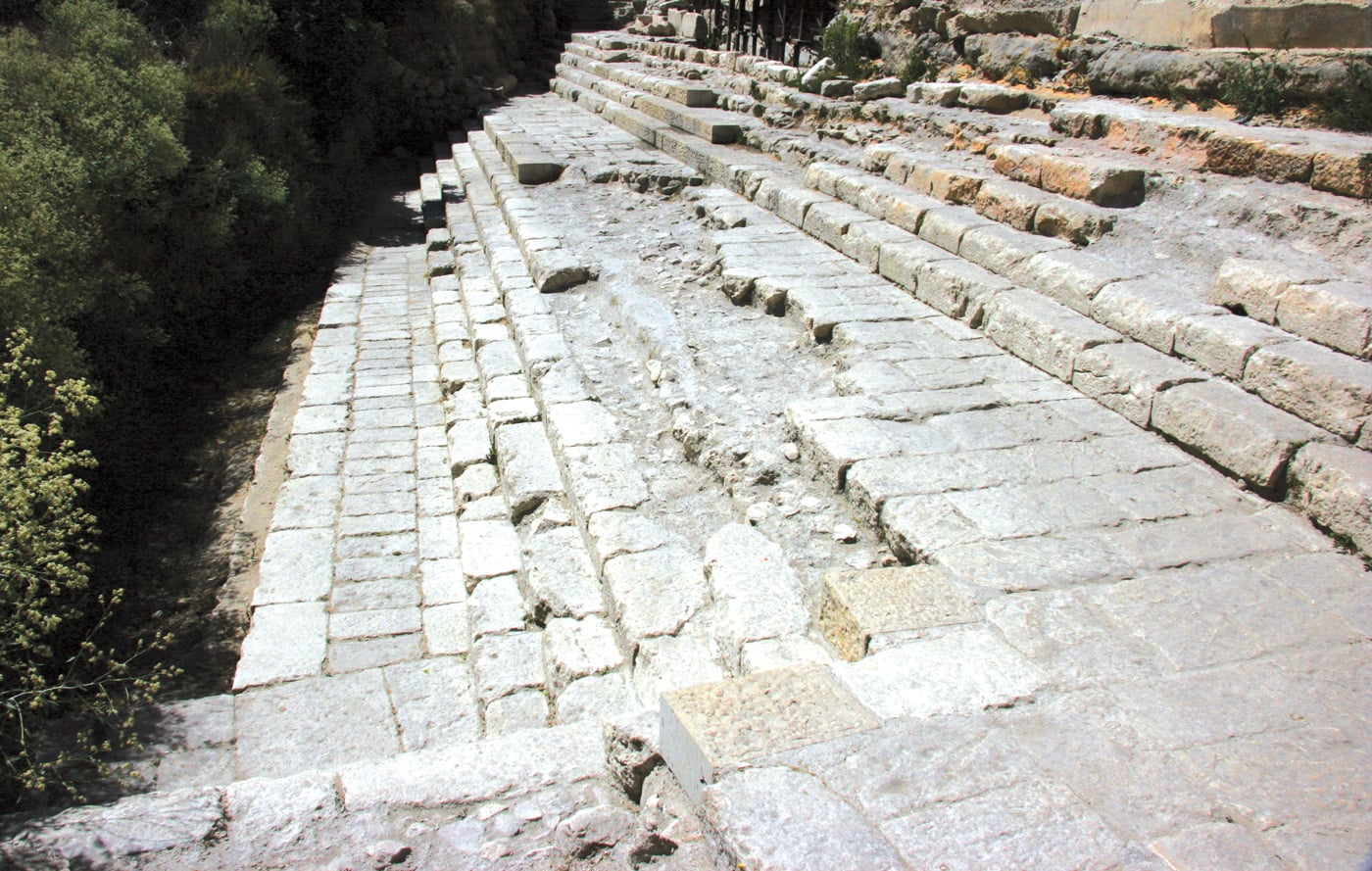
Stairs leading down to the Pool of Siloam (left), discovered at the south end of Jerusalem by Israeli archaeologists in 2004. This spring-fed pool, where Jesus told the blind man to go wash (John 9:7), was a source of water and ritual washing in Jesus’s day.
The judicial interest we have witnessed thus far in the Book of Signs takes a fresh turn. Rather than Jesus, the healed man goes on trial. Since it is the Sabbath (9:14), the Jewish leadership feels compelled to investigate a possible criminal violation. The interrogation has four steps, as various witnesses move to center stage. In much the same way that in John 4 the Samaritan woman revealed her developing faith by using a progression of titles for Christ, so here the narrative parades Christ’s names (“Jesus,” 9:11; “Siloam,” 9:11; “prophet,” 9:17; “Messiah,” 9:22; “from God,” 9:33; “Son of Man,” 9:35; “Lord,” 9:38).
Step one involves the interrogation of the man by his neighbors (9:8–12). They are witnesses to the miracle but remain incredulous. After this, Pharisees take over, and they examine the man and his family. Step two (9:13–17) confirms the Sabbath violation but uncovers a flaw of logic in the trial. If God listens to Jesus (e.g., he heals), how can Jesus be a Sabbath violator? Step three (9:18–23) shows how they choose to resolve the dilemma: God is consistent with his law; therefore, the miracle must be a fraud. God does not entertain sin and miracles at the same time. One element must go. But the man’s parents are no use. They confirm that this is their son and that he was blind, but their fear of the authorities makes them reluctant to say more.
Step four is easily the most important (9:24–34). The man is recalled a second time in hope of finding a way to condemn Jesus’s sin. The brute fact of the miracle cannot be ignored, and yet even with this tangible evidence in hand the religious leaders spurn both the man and Jesus. Their allegiance is set; they are intransigent. The language of 9:28 is important. The Pharisees have polarized everyone’s commitments: you cannot be a disciple of Moses and a disciple of Jesus at the same time. The chasm between church and synagogue is at hand (cf. 8:39–47).
The blind man’s final defense (9:30–33) supports the logic both of his own case and John’s case in the Book of Signs. Are not the signs of Jesus compelling evidence? Why have these leaders rejected the man and Jesus? Because there is no acceptable excuse, the result is judgment (9:39, 41).
In an earlier story the lame man who was healed and who suffered abuse at the temple was found again by Jesus and encouraged (5:14). So now, once this blind man is expelled from the synagogue (9:34), Jesus finds him again and commends his efforts. Since the man witnessed and accepted the signs, belief was an easy thing (9:38). His disposition to the sign was all-important. But for the Pharisees, whose minds were closed, the light could not penetrate. They became blind because they remained in the darkness (9:39). John 8:41 suggests we have personal responsibility for how we respond to the revelation we receive. To see the signs of God and reject them is a more serious matter than never having perceived them at all.
10:1–39. The Festival of Dedication now introduces us to the fourth festival of Judaism that Jesus attends and that, like the others, becomes a place of discourse and revelation. Unlike the other feasts, the Feast of Dedication was a minor, more recent celebration. It recalled the desecration of the temple in 168 BC by the Greek monarch Antiochus IV Epiphanes, the corrupt priests installed by him, and the Maccabean wars, which finally regained and purified the temple in 164 BC. A moving account of this is given in 1 Maccabees 4:36–58, which is followed by Judas Maccabeus’s announcement that this dedication (Hanukkah) should be celebrated each winter on the twenty-fifth day of the Jewish month Kislev (November-December).
This Jewish background provides striking depth to the discourse of Jesus in chapter 10. As we have suggested, Jesus has been in Jerusalem since autumn (the Feast of Tabernacles, 7:2–3), and now his conflict with the Jerusalem leadership has reached a peak. Jesus will not publicly debate the Jews again after chapter 10. This final crisis tone is paralleled by the Synoptic account found, for instance, in Matthew 23, where Jesus’s criticisms are extremely biting. The same is found in John 10. After the conflict with the Pharisees in chapter 9, which described them as blind (9:39–41), now they are depicted as false shepherds (10:1, 10, 12–13).
Because the literary division between this festival and the previous one is less clear (cf. 5:1; 6:1; 7:1), scholars are divided on the question of where 10:1–21 should fall. Does it apply to the foregoing (the subject of 10:21 implies this) or to the material in 10:22–39? We have chosen to unify all of chapter 10 under this final feast. There is a strict change of subject at 10:1, and the second half of the chapter still presupposes the sheep metaphor (see 10:26–27). Moreover, the subject of the discourse in 10:1–21 applies directly to the Feast of Dedication, which recalled the corrupt priests of the Greek era (Jason and Menelaus) and had in Jesus’s day evolved into a ceremony of priestly rededication. Synagogues read aloud Ezekiel 34, in which false priests are described as false shepherds. Therefore in a season that studied religious leadership and its historic failings, Jesus gathers up the current metaphor from Ezekiel 34 and interprets it in light of his own mission.
The metaphoric teaching of Jesus in 10:1–21 closely resembles the parables of the Synoptics. The parable is given in 10:1–5, a note of incomprehension is recorded in verse 6, and then Jesus interprets the meaning of the parable (cf. the format of Mark 4).
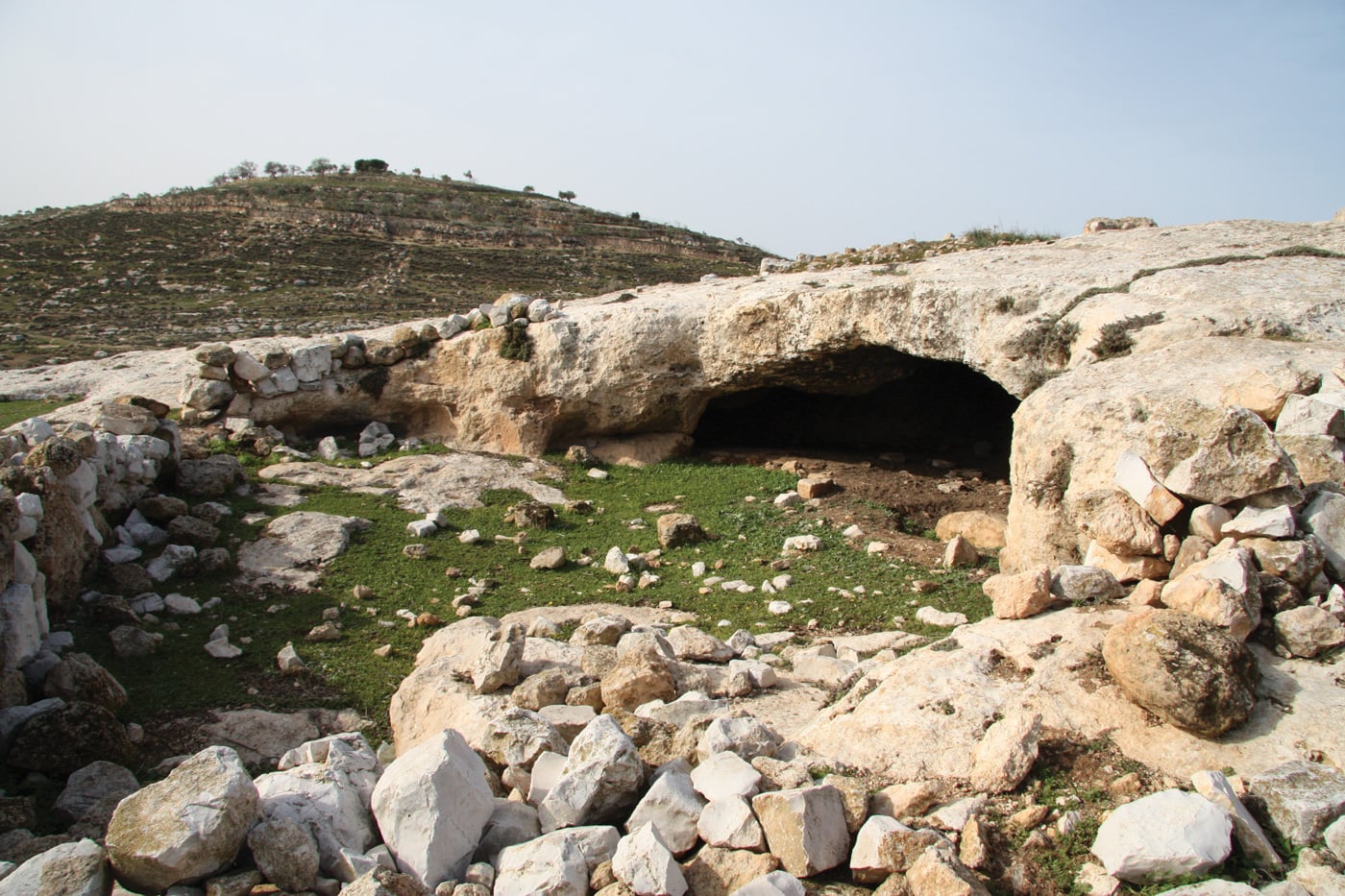
In John 10:7, Jesus identifies himself as the gate to the sheepfold. As seen here, ancient sheepfolds were built of stone and had one access gate.
The parable itself discusses the legitimate leaders of the sheep. Just as with the corrupt priests of the Maccabean era, Jesus suggests that there may still be false leaders of God’s people whose intentions are malevolent. Two criteria set apart fraudulent leaders. First, their entry into authority is wrong (10:1). Sheepfolds were often protective stone fences with one access gate. If the gatekeeper (10:3) has not ordained the shepherd’s entry, he is to be feared, not followed. Here Jesus indicates that he alone has true authority because he has obtained the gatekeeper’s invitation. Second, the false leader’s voice cannot be recognized. The intimacy between shepherd and sheep is a well-known Palestinian phenomenon. Sheep can even bear personal names! Here Jesus shows that he alone knows and is known by the sheep. In John this is a central feature of discipleship: discerning Jesus’s voice and abiding in him.
As in other discourses, the failure of the listeners to understand Jesus’s meaning (10:6) leads him to explain himself more fully (cf. 3:9–14; 7:35–39). Initially Jesus affirms that he is the way (“the gate,” 10:7, 9) through which one finds salvation or pasture. This is an advance over the parable, wherein the shepherd is distinguished from the gatekeeper and the gate. Now we learn that Jesus distributes not simply access to leadership but life itself. If the parable has allegorical elements, note that now in the interpretation Jesus assumes a new sovereignty over the fold. Has he assumed divine tasks again? The sheepfold is designed to keep out those who would harm the sheep (10:10), and Jesus is their guardian. He refuses access to many, including those like the Pharisees. These leaders destroy, but God sent Christ so that those who believe might not be destroyed (3:16; 6:39; 17:12).
But Jesus is also the good shepherd (10:11, 14). God is often described as the shepherd of Israel (Gen. 49:24; Ps. 23; 78:52–53), and similarly, the patriarchs, Moses, and David were shepherds. Leadership in Israel meant shepherding, and thus impious Israelite kings were called false shepherds (1 Kings 22:17; Jer. 10:21; 23:1–2; Ezek. 34:1–31). In Mark’s account of the feeding of the five thousand, Jesus is evidently using this same pastoral motif for himself (6:30–44, esp. vv. 34, 39–40). Here in 10:11–18 the superiority of Jesus’s work is given. Not only is his devotion to the sheep such that he is willing to die for them while others flee from danger (10:11–13, 17); he also knows them deeply—so deeply that in 10:15 an appropriate analogy for this knowledge is Jesus’s relationship to his Father. As Jesus is in the Father, so the disciple is in Christ (cf. 14:20, 24).
A variety of secondary themes emerges from these teachings. Is there only one flock of Jesus? Is Judaism the limit of his care? John 10:16 indicates the contrary: “other sheep” refers to members (Gentiles?) beyond Judaism. Is the death of the shepherd something tragic—beyond his control? Not at all. His power enables him voluntarily to die and regain his life (10:18). Elsewhere in the New Testament, God raises up Jesus (Acts 2:24; Rom. 4:24; Eph. 1:20; Heb. 11:19; 1 Pet. 1:21). But in Johannine thought the Father and the Son possess the same powers (10:28–30). The Son controls the hour of death entirely (2:4; 7:6, 8; 8:20).
The responses to Jesus’s discourses have followed a pattern that is seen again here. At Passover, Tabernacles, and now at Dedication, a division erupts among the listeners (6:41, 60; 7:25, 45; 10:19–21). There is no neutral position for one who is faced with Christ’s revelation. Either hostility (10:20) or the seeds of faith (10:21) will follow. Those who believe are ready to cast off the extreme charge of demon possession lodged against Jesus at the Feast of Tabernacles (7:20; 8:48). Jesus’s teachings and miracles (esp. 9:1–7) are confirming evidence for them.
With this encounter we reach a sort of crescendo in the Gospel. The evidences accumulating in the Book of Signs will shift following this chapter. No longer will Jesus discourse with the Jewish leaders. He will later be with friends in Bethany (11:1–12:8), supportive crowds (12:12–19), and Gentiles (12:20–36). Then Jesus will “hide himself” from all but his personal disciples (12:36). Here in chapter 10 the height of Jesus’s self-revelation is completed: his identity with the Father is now explicit (10:30, 33) and centered on his claim to the title Son of God (10:34–36). Similarly, the hostilities are keen: twice attempts are made on his life, but he escapes (10:31, 39). This narrative epitomizes Jesus’s ultimate claims about himself and the fateful Jewish reaction (10:22–39).
The temple courtyard was surrounded by colonnaded porches that gave shelter from the weather. Solomon’s Porch was on the east. Since it is winter (the season of Dedication) Jesus is found there sheltered from the cold Jerusalem wind (10:22–23). If the judicial emphases that we are following are correct, here the christological inquiries take on new significance. The evidence has been displayed (10:25–26), and now Judaism aims its two charges that will reappear later at the formal trial: (1) Are you claiming to be the Christ (cf. Luke 22:67)? (2) Are you the Son of God (cf. John 19:7 and Luke 22:70)?
The way in which Jesus defends his claims and explains Jewish disbelief affirms that God is sovereign over who accepts revelation. The leaders are simply not of Jesus’s fold and hence cannot hear his voice. This divine control over revelation has appeared elsewhere (6:37, 44, 65; cf. 17:6). Understanding the signs alone is a divine gift.
In 10:28–29 the sovereignty of Jesus and God over the flock is in exact parallel (“no one can snatch them out of my/his hand”). This operational or functional unity leads to the essential or “ontological” unity of 10:30: “I and the Father are one.” These verses are crucial and have played a vital role in the formation of trinitarian doctrine. Christ has regularly assumed divine prerogatives, and he has emphasized his oneness with the Father. Now the doctrinal point is explicit. The authority of Jesus’s messiahship rests above all on his unique relation with the Father.
The Jewish leaders judge it as blasphemy (10:31). Jesus in turn employs a defense that at first may seem peculiar to us today. He debates like a rabbi. First, he notes that the general ascription of “gods” was known in the Old Testament (Psalm 82) and used for those who were vehicles for the word of the Lord (10:34–35). Is Christ not at least this? Second, Christ is more. If the first premise is correct, what do we say of him who is a unique vehicle of the word of God—who is the Word (John 1:1)? Of course Psalm 82:6 does not mean that agents of God are divine, but the presence of the term “god” alone is sufficient for Jesus to make his point following rabbinic theological logic.
We have seen how in the various feasts of Sabbath, Passover, and Tabernacles messianic replacement was used to unveil Jesus’s identity. Here only the most careful reader will catch the allusion. We have seen how the Feast of Dedication recalled the cleansing and rededication of the temple. Here one of the chief terms from 1 Maccabees 4 is used of Christ. In John 10:36 Jesus has been “set apart” (NIV) or “consecrated” (RSV) and sent into the world. This term (Greek hagiazō, “to make holy”) recalls the Maccabean story (1 Maccabees 4:48). Jesus is the truly consecrated temple of God (cf. John 1:14; 2:21).
The final appeal of Jesus, in 10:37–39, again rests on his works and their evidential value. The Jews of the Book of Signs have obtained the signs sufficient for belief. And these will point the way toward the conclusion of the unity of the Father and the Son (10:38; cf. 10:30). But just as the former revelation of this brought hostility (10:30–31), so now Jesus’s opponents attempt to arrest him (10:39).
10:40–42. Jesus now withdraws before the crucial events of his final week. He knows the region of the Jordan and Perea well (Matt. 19:1; Mark 10:1), and this is his refuge. Soon he will climb the ascent from Jericho to Bethany and inaugurate the week of the passion.
In the literary format of John these verses indicate a major transition. Jesus has withdrawn from public purview. The public signs are over. The Book of Signs, which began with John the Baptist (1:18), now anticipates its completion with a second reference to him (10:40). The Fourth Evangelist even reminds us of the subject of these ten chapters. Although John worked no signs, Jesus did; and those who witnessed these and perceived their truth found faith (10:42).
More signs await those disciples of the inner circle (chaps. 11–12), and we as readers are privileged to view these. The final plea for belief, however, will come to us at 12:44–50, when we with the rest of the disciples will have viewed sufficient signs, sufficient evidences from which to reach a verdict about Jesus.
D. Foreshadowing death and resurrection (11:1–12:50). It has often been argued that 10:40–42 was at one time the conclusion of Jesus’s public ministry in John’s Gospel and that at some later stage the Gospel was edited to include chapters 11 and 12. For instance, the sequence of events here (movement to Perea, Bethany, Ephraim, and back) is difficult to reconcile with the Synoptics, as is the motive for Jesus’s arrest (11:45–53; 12:9–11). Further, the term “the Jews” now loses its harsh polemical tone so common to John (cf. 9:22 with 11:19, 45). But despite this, traditional Johannine elements abound: the use of egō eimi (“I am”) in 11:25 and the literary device of misunderstanding (11:11–12, 23–24, 50–51). Nevertheless, the Synoptics know little of Mary and Martha—much less Lazarus—and this narrative is a unique (but not inauthentic) Johannine story.
What is the purpose of chapters 11–12? While the Synoptics at this point expand on Jesus’s teachings in Jerusalem during his final spring visit (cf. Matthew 21–26), John has chosen a miracle story that epitomizes Christ’s mission and fate. With superb dramatic form, the Lazarus story (11:1–44) sums up Jesus’s career. It is the ultimate sign. Jesus, the source of life (10:28; 11:25), now gives life to one man. But even this ultimate revelation is condemned, leaving Jesus judged as worthy of death (11:50).
Moreover, woven into this story are hints of Jesus’s own passion. He too will die and come forth. The Lord of life will lay down his life and return from the grave like Lazarus. Later in the same town of Bethany, Mary will anoint Jesus—figuratively preparing him for burial (12:3–8).
Therefore, chapters 11 and 12 provide a transition, preparing us for John’s second book, the Book of Glory (chaps. 13–20). Jesus’s signs are finished, and he is advancing toward “the hour”—the hour of death, resurrection, and glory.
11:1–57. The village of Bethany, two miles east of Jerusalem, was the regular residence of Jesus while he was in Judea (cf. Mark 11:11; 14:3). While Lazarus is not known in the Synoptics (but see Luke 16:20), Luke does refer to the sisters Mary and Martha (Luke 10:38–42). The profile of the two sisters in Luke (the compulsive Martha; the contemplative Mary) is paralleled in John (11:20; 12:2–3).
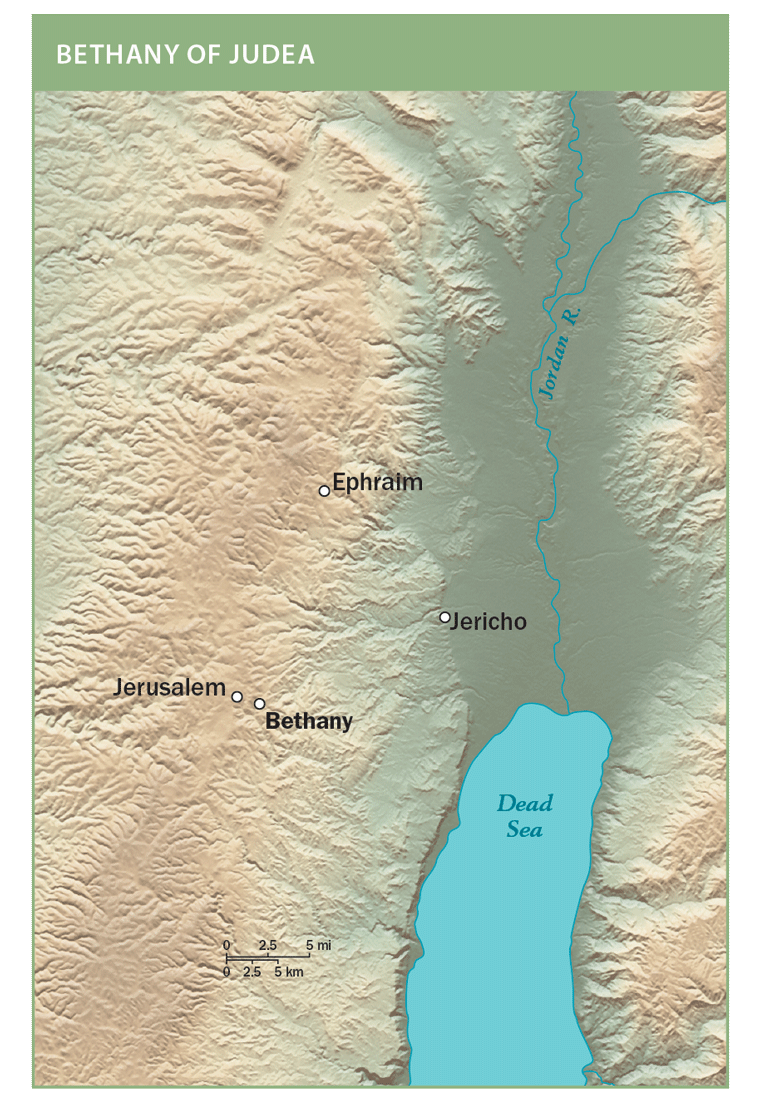
While Jesus was in the Jordan Valley (John 10:40), his friends must have known his whereabouts, since Mary and Martha are able to contact him. Jesus’s response to Lazarus’s illness (11:1–44) is similar to his explanation of the blind man’s infirmity in 9:3. Sometimes crises serve divine purposes so that God may be glorified when they are resolved.
That Jesus does not respond at once (11:6) in no way disparages his love for the family (11:5). There are problems with a return to the mountains of Judea, which the apostolic party fully realizes (11:8, 16). Threats of death have been known for over a year (5:18; 7:25), and some have even tried to kill Jesus already (8:59; 10:31). But the Lord feels the pressing need to depart. His time is short, and just as with the hours of daylight for the traveler, each hour must be used to maximum benefit (9:10; cf. 12:35–36). The spiritual light now present is even more valuable than this. Jesus is the light of the world (8:12), and while he is present and able to dispel darkness, his work must progress. The task at hand is the revival of Lazarus, who is now dead (11:11–14; note the familiar use of misunderstanding). A paradoxical exchange is thus at hand: Jesus chooses to risk death in Judea in order to save a man from death. He indeed is the good shepherd who is willing to lay down his own life for the life of his sheep (10:15).
It is a tribute to John’s interest in historical detail that he mentions how long Lazarus has been dead (11:17, 39) and the exact location of Bethany. Because the ancient world did not have precise methods to monitor death or coma, most rabbis held theories about the impossibility of resuscitation after three or four days of death. Our story is making one point: Lazarus was fully dead by anyone’s standards, and the miracle (11:43–44) involves resurrection, not resuscitation.
When Jesus enters the hill country, it is clear that the customary mourning is under way (11:18–19, 31). (Mark 5:38–39 provides an interesting parallel.) Although Martha is the first to greet Jesus on the road (11:20–27), Mary will come later (11:31–32), and John no doubt wants us to compare them. Both women express the same words: “Lord, if you had been here, my brother would not have died” (11:21, 32). Jesus is the Lord of life (11:25), but the women despair. Their hope is in a healing miracle because resurrection is so far beyond their comprehension (11:26–27). While Mary is overcome (11:35; cf. 12:3; Luke 10:39), Martha pursues a conversation. “Even now” in 11:22 implies faith—even now in death Jesus may be able to do something. But is the only comfort in the last days, the future resurrection? Ironic misunderstanding (11:23–24) gives the conversation its classic Johannine form and allows Jesus to elevate his meaning. The resurrection life is a present experience! Eternal life begins now for the person who trusts in Christ (11:25–26). The horror of death is gone (11:26a; cf. 3:16–21). When pressed, Martha cannot affirm Jesus’s powers to this extent (11:26b); but still she holds on to what she does know (11:27). Jesus is her Lord; knowledge of his powerful abilities will come with time.
One unique feature of this story is the way in which Jesus expresses his emotions over Lazarus’s death (11:33, 35, 38; cf. Luke 19:41). He does not approach suffering and death dispassionately. He feels the pain. He knows tragedy and has feelings. In this case these emerge out of his love for his friend Lazarus (11:36).
Lazarus was buried in a typical first-century stone tomb (cf. Jesus’s tomb, 20:1; Mark 15:46). Since these were designed for multiple burials, there would be no difficulty reopening it (11:39) if sufficient help was available. Again we are given a second confirmation that Lazarus is dead (11:39), this time in graphic terms. But this does not deter Jesus. As his feeding miracle demonstrated that he was the bread of life (6:35), and as his healing of the blind illustrated that he was the light of the world (8:12), so now he will prove that he is the resurrection and the life (11:25).
All that Jesus does has one aim: to promote the glory of God (11:40). His audible prayer heard here (11:41–42; cf. 12:27) serves this purpose. Jesus is no miracle worker with simple powerful feats at his disposal. His deeds are signs that promote belief. They reveal something of God’s presence at work, and they illumine Christ as God’s divine agent.
Burial cloths further confirm Lazarus’s death (11:44) and provide another parallel to Jesus’s burial (19:39–40; 20:5–7). The unusual reference to a face cloth appears only here and in 20:7. One interesting difference, however, is that Lazarus requires aid with his bindings—Jesus’s grave clothes are noticeably left behind.
As with so many other signs of Jesus (e.g., 7:40–44), the onlookers immediately divide into two camps. Here at Bethany, too, the events compel some to believe, while others file a report with members of the Sanhedrin, who determine Jesus’s fate (11:45–57). The deliberations of the Sanhedrin, now called to a formal meeting about Jesus, typify the drift of the Jewish leadership’s reaction to Christ since chapter 9: Jesus’s signs seem compelling, but the practical implications of this are more than they can bear. What if the masses start to follow him? Would it not upset the fragile political equilibrium with Rome (11:48)? Would Caesar tolerate a messiah? The Sanhedrin must choose either to follow the logic of Jesus’s truth, regardless of the cost, or to retreat into the safety of their own nicely controlled religion.
Caiaphas chooses the latter (11:49–50)—that Jesus must die in order to save Israel’s precarious freedoms—but John takes this as a prophecy that even the high priest himself misunderstands (11:51–53). Of course Jesus must die for the sake of the Jewish nation (and for that matter the Gentiles, 11:52) but in a sense the Sanhedrin will never understand.
Because of the high council’s resolve to kill Jesus (11:53) he goes into seclusion in much the same way that he did after the Feast of Tabernacles (cf. 10:39–42). Ephraim’s location (11:54) has proved perplexing. It may be the Old Testament village of Ophrah (Josh. 18:23) northeast of Bethel (modern et-Taiyibeh).
With the pilgrimage Feast of Passover at hand, everyone is expecting Jesus to appear. Questions are alive in both the crowds and the Sanhedrin (11:56–57), and for good reason. The last pilgrimage feast (Tabernacles, John 7–9) witnessed numerous conflicts with Jesus. The city is astir with anticipation (7:10–13, 25–26, 32–33). Therefore, precautions are taken: if Jesus appears in the city from his wilderness retreat, his whereabouts should be reported (cf. 11:46).
12:1–50. Both John (12:1–8) and the Synoptics (Matt. 26:6–13; Mark 14:3–9) record the anointing at Bethany, and since the settings are virtually identical, the narratives pose a textbook case in the difficulties of Synoptic/Johannine interdependence. Added to this is a Lukan story (Luke 7:36–38) with interesting parallels to both Mark and John.
Jesus’s return from the wilderness (11:54) is prompted by another Feast of Passover, one year since the last festival, celebrated in Galilee (6:4). Jesus returns to Bethany, where Lazarus, Mary, and Martha live, and from here he will make his final visit to Jerusalem (12:12). If the Markan account is a true parallel, then this residence is also the home of Simon the leper (Mark 14:3).
Again Mary and Martha take up their usual roles (cf. Luke 10:38–42; John 11:20): Martha busies herself with the duties of a hostess, and Mary makes an unusual gesture of devotion to Jesus. Imported from North India, this perfume was precious indeed, and the anointing was extravagant. A denarius was one day’s wage, and this was worth three hundred (Mark says more than three hundred denarii). When Mary lets down her hair (cf. Luke 7:38), she strictly breaks Jewish convention—women never did this in public. But this is simply more extravagance, justified because no devotion to Jesus can be excessive. Jesus’s defense of her in Mark 14:6 makes this abundantly clear. Judas is the antithesis of all this. Money is his concern since he is the treasurer (John 12:6; 13:29). But his flaw is twofold: care of the poor cannot come before undiluted worship of Christ (12:8); and when this care springs from an impure heart (12:6), its spiritual value evaporates.
Jesus’s final visit to Jerusalem is recorded in 12:9–50. Before long the presence of Jesus in Bethany becomes public knowledge, and crowds arrive to see both him and Lazarus. Although the Sanhedrin desired to seize him when he appeared (11:57), the crowds may have interfered with a clean arrest (cf. Luke 19:47–48). The Johannine account introduces a new element. Lazarus’s death is planned too (12:10–11) because he has become a celebrity (12:17–19). It is this fame spreading from Bethany that greets Jesus as he rides into the city from the eastern hills (12:9–19). The triumphal entry into Jerusalem is narrated in each of the Gospels (Matt. 21:1–11; Mark 11:1–10; Luke 19:28–40), and John’s differences stem chiefly from his abbreviated version. The crowd celebrates Jesus’s arrival with festive displays and shouts. The Old Testament explanation in each account comes from Zechariah 9:9, although John amends Zechariah’s “Rejoice greatly” to “Do not be afraid” (John 12:15). This may be a unique allusion to Zephaniah 3:14–17, in which the prophet dispels the fears of Israel, affirming that “the Lord is in your midst” (Zeph. 3:15 ESV). For John, Jesus’s arrival is a fitting fulfillment.
The celebrations of the Jews are now echoed by an entirely unexpected interest among some Greeks in Jerusalem (12:20–36). This is unexpected because Greeks are Gentiles (though these may be proselytes) and unaccepted by Jews. John’s irony cannot be missed: when Jesus’s efforts to unveil himself to Israel have been exhausted, Greeks arrive, eager to see Jesus. Jewish reluctance is exceeded by Greek zeal. Mark’s Gospel follows a similar structure. In Mark the watershed is in 8:27–30, and from then on Jesus devotes himself exclusively to his disciples. But prior to this revelation at Caesarea Philippi, Jesus finds an unprecedented response among the Greeks (Mark 7:24–30; 7:31–37; 8:1–10). Once Judaism fails to embrace the signs of Christ, Gentiles are given the opportunity (Matt. 21:41–44; Luke 2:32; 4:25–27; Rom. 1:16).
Jesus’s response to Andrew and Philip’s report is extremely important. The “hour” that has been put off for years (cf. John 2:4; 7:6; 8:20) has now arrived (12:23). Jesus recognizes the culmination of all that he has been attempting in Judaism. The cross and death are all that remain (12:24). But in John it is not a death of disgrace and shame; Jesus will be glorified, and this will mysteriously result in great things. The same is true of his followers (12:23–26). Self-effacement and self-denial are the only pathways to finding the company of Jesus or the honor of the Father (cf. Matt. 10:37–39; Mark 8:34–38). The humanity of Jesus can be seen in how even he wrestles with this truth (John 12:27; cf. Mark 14:36). Strength is found here and later in Gethsemane, when he submits himself to God’s higher purposes. The glory of God is manifest when his servants persevere in temptations such as this and in ultimate trials (12:28–29). The cross will be the ultimate test for Jesus, and here in the midst of God’s glory Jesus himself will be glorified (17:1–5).
The crowds receive the confirming voice from heaven just as they received the signs (12:28–30). Throughout his Gospel, John’s view of revelation has taken shape: a sign from God is revelatory only when it is greeted by faith. The Book of Signs will only speak to those whom the Father is already giving into the Shepherd’s hand (6:44–45; 10:27–29).
It is now time for Jesus to define his hour of death and glory. It too will be a sign, but how will it be received? Can the average person accept that the world’s judgment will be inaugurated when one man is crucified (12:31–32)? This crowd cannot (12:34)—but neither could the disciples at this point (Mark 8:31–33; 9:30–32; 10:32–34). But fortunately the crowd stays with Jesus; they keep inquiring. The last question posed to Jesus is in John 12:34: “Who is this ‘Son of Man’?” In the previous chapter Martha could not comprehend all that Jesus revealed (11:21–27), but still she held on to the light she possessed. When confusion and uncertainty are at hand, John would not have us walk away in disbelief. Jesus now affirms the same (12:35–36). Continue to engage God! Embrace the light! Walk in it!
Jesus’s disclosure of himself is finished (12:36). He now hides himself from public view because his signs are completed, and they are left for us to interpret.
John the evangelist, who has been the narrator of the story all along (2:22–25; 3:16–21, 31–36; 7:5), now sums up the meaning of Jesus’s public ministry (12:37–43). John 12:37 makes plain what all of early Christianity was forced to acknowledge: Jesus’s many signs fell on disbelief. John joins the other evangelists in drawing texts from Isaiah that must have been commonly used in the early church (Isa. 6:10; 53:1; cf. Matt. 13:14–17). Isaiah too found disbelief in Israel and attributed it to God’s sovereignty over revelation. John, however, has woven this theme into the entirety of the Book of Signs. Hence the unbelievers are unable to believe (John 12:39); God affects their perception (12:40). John, however, does not probe the mystery of the interplay between human responsibility and divine sovereignty. In 12:41 Isaiah’s words are interpreted as prophecies directed to Jesus because the glory Isaiah viewed (6:1–5) is Jesus’s glory too. This closing frame in the Book of Signs repeats what we read in the prologue: Christ is the glory of the Father unveiled for human eyes (1:14).
But has no one believed the signs? Of course there are the disciples, but has not God opened the eyes and ears of some Jewish leaders? John has not neglected these: there are some who believe, but they fear persecution (12:42). Nicodemus typifies these men (3:1–21; 19:39), for when he did speak up (7:50–52), he was severely rebuked. Similarly the parents of the blind man feared expulsion from the synagogue (9:22). Nevertheless, the praise of God awaits those people of prominence and esteem who ignore the cost and make their faith visible (12:43).
The Book of Signs concludes with a harrowing cry from Jesus imploring Jews to believe (12:44–50). It reiterates much of what has gone before. Jesus is light; he reveals God and disperses the darkness (1:9; 8:12). Above all, he has not spoken on his own authority; he is God’s agent in the world. Belief in Christ is belief in God. To see Christ is to see the Father (12:44–45; 14:9). Even the words of Jesus have not been his own but stem from what the Father has directed (12:49–50; 17:6–8). This truth, however, has serious implications inasmuch as there will be a divine accounting for all Jesus has said.
The signs are complete, and the Book of Signs may now close. Evidence for Jesus’s case is public. The Sanhedrin has made its decision about him (11:53), but the crowd still asks, “Who is this ‘Son of Man’?” For them and for us the Book of Signs is open for examination. From John’s point of view, these signs will compel us to believe.
3. The Book of Glory (13:1–20:31)
With chapter 13 we move to another major literary division in the Fourth Gospel, which contrasts directly with the Book of Signs (1:19–12:50). The contrast is chiefly one of perspective. In the Book of Signs, for instance, Jesus addresses a public audience. His teaching provokes a crisis of faith, as some believe while others reject him. Here, though, the audience is narrowed to the circle of disciples who follow him to the cross. We noted how in chapter 12 Jesus “hid himself” (12:36), indicating an end to his public self-disclosure. Now his focus is on “his own” (13:1; 17:6–19). We could also point out that, while the interest of the first half of John is on the signs of Jesus, now the Gospel will concentrate on the coming of “the hour” (12:23, 27; 13:1)—that is, the hour of his glorification (13:31–32). It is not an hour of tragedy in this Gospel but one of victory that involves Christ’s passion, crucifixion, resurrection, and ascension. Just as the many signs of Jesus were accompanied by discourses (cf. John 6, the feeding miracle and the bread-of-life discourse), so too this last sign of death and resurrection will be interpreted by lengthy teaching in the upper room (chaps. 13–16).
The Gospel imitates the arc of a pendulum: it begins at a high point, descends, and elevates again. The Johannine prologue reflects this too, as the Word is in God’s presence (1:1), experiences rejection (1:10–11), and then returns to places of glory (1:18). With the Book of Glory we are in the upward swing of the arc, the descent having been chronicled by those chapters that describe Jesus’s efforts to reveal himself (chaps. 1–12). The lowest point is reached when Judaism confirms Jesus’s death (11:50), and John is forced to explain Jewish disbelief (12:37–50). The highest point comes with the return from the grave of the glorified Lord. Here, echoing the prologue again, the disciples are the recipients of life-giving power (1:12–13; 20:22).
A. The Passover meal (13:1–30). The Synoptics record that, during his last week of ministry, during the Passover festival, Jesus enjoys a final meal with his disciples (Mark 14:12–25). Each Synoptic writer terms this “the Passover” (Matt. 26:17; Mark 14:12; Luke 22:7–9), which is ordinarily served after dusk on the Jewish date of 15 Nisan (in March-April). John mentions such a meal (13:2, 26) and indicates through mention of the betrayal of Judas (13:21–30) that this meal is the Passover from the Synoptics (cf. Mark 14:17–21).
However, John’s date seems not to be 15 Nisan (Passover), for later he will say that Jesus is crucified on 14 Nisan, when the temple lambs are being slaughtered (19:14). Hence John’s story shows the meal to be on the day of Preparation, one night prior to the Passover feast.
Scholars have solved this riddle in a variety of ways. The easiest and most popular solution is simply to say that one Gospel tradition or the other is incorrect. But critics can find fault with each account: Would the Sanhedrin hold a trial on a feast day, as the Synoptics contend? Or has John moved the cross to 14 Nisan to develop a paschal emphasis for Jesus’s death (cf. 19:32–37)? Others have pointed to competing calendars in the first century. Still others think that Jesus was simply offering an irregular Passover meal one day early.
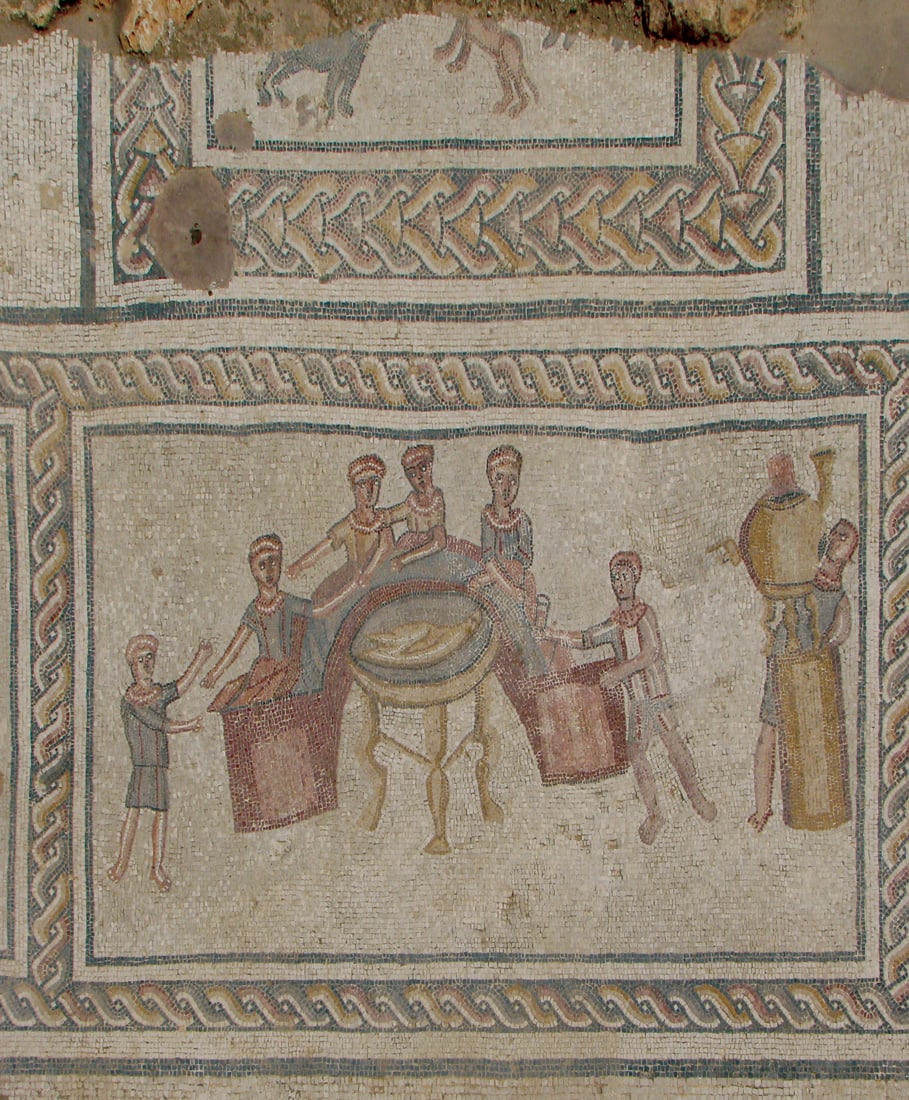
This mosaic (Sepphoris, third–fourth century AD) depicts a triclinium, a Roman dining room featuring couches or benches that were placed in a “U” around a central table. Jesus and his disciples would have dined in a similar setting, reclining around the table (as the beloved disciple is described as doing in John 13:23).
But there is another solution that deserves consideration. It is clear that John understands this meal to be the same one as in the Synoptics. The reference to Judas Iscariot (13:21–30; cf. Matt. 26:20–25) solidly links the two. John also implies that this is indeed a Passover meal: pilgrims must eat it in Jerusalem as the law requires (John 11:55; 12:12, 18, 20), it is a ceremonial meal with formal “reclining” (required at Passover), Jesus does not leave the precincts of Jerusalem after the meal (as the law required) but goes to Gethsemane, Passover alms are distributed (13:29), and the disciples are in a state of Levitical purity (13:10) required at Passover. Therefore John’s meal clearly suggests a Passover meal. But what do we do with the passages that imply Jesus is crucified on the “day of Preparation”?
The argument that, according to John, Jesus was crucified on 14 Nisan (the day of Preparation) is anchored to five texts that imply the Passover has not yet happened when Jesus is crucified.
- “Now before the feast of the Passover, when Jesus knew that his hour had come to depart out of this world to the Father . . . during supper . . .” (13:1–2 RSV).
- “Some thought that, because Judas had the money box, Jesus was telling him, ‘Buy what we need for the feast’ . . .” (13:29 RSV).
- “They themselves did not enter the praetorium, so that they might not be defiled, but might eat the passover” (18:28 RSV).
- “Now it was the day of Preparation of the Passover; it was about the sixth hour” (19:14 RSV).
- “Since it was the day of Preparation, in order to prevent the bodies from remaining on the cross on the sabbath (for that sabbath was a high day), the Jews asked Pilate that their legs might be broken, and that they might be taken away” (19:31 RSV).
We shall look at these verses in turn later in the commentary, but for now note that they do not necessarily imply that the meal in John 13 was before Passover. In 13:1 “before the Passover Festival” probably describes when Jesus knew his hour had come, and the meal mentioned in 13:2 refers to the Passover itself, described in 13:1. John 13:29 records that Judas must make a purchase for the feast, but this may well be something they need at the moment—or something needed for the next day. In 18:28 the authorities fear defilement from Gentile contact, but such ritual uncleanness would expire at sundown (if it were 14 Nisan). These men likely refer to eating an afternoon meal (the Jewish hagigah) on the day following the night of Passover (15 Nisan). Finally, the “day of Preparation” referred to in 19:14 and 19:31 does not necessarily refer to preparation for the Passover. It may refer to preparation for the Sabbath. In fact, 19:31 makes the connection with the Sabbath explicit. Mark 15:42 refers to Jesus’s day of crucifixion (Friday) in this manner as well (“And when evening had come, since it was the day of Preparation, that is, the day before the Sabbath . . .” [RSV]). Furthermore, we have no extrabiblical evidence in Aramaic or Greek describing 14 Nisan as “the day of Preparation of the Passover.” Many scholars think the phrase may simply be an idiom meaning, “Friday of Passover week” (or, “the day of Sabbath preparation within the week of Passover”).
If this line of reasoning is correct, John’s chronology fits the Synoptic outline perfectly. Thursday evening begins the date 15 Nisan, when Jesus hosts a Passover meal; on Friday afternoon Jesus is crucified on the day of (Sabbath) Preparation during Passover. This explanation may appear complex, but it is important. In critical discussions of the historical reliability of John’s Gospel, the problem of chronology and the Johannine passion narrative always comes up for examination.
The Synoptic emphasis is found in the words of institution during the meal (Luke 22:14–23). While it comes as a surprise that the Fourth Gospel does not record this (but see 6:52–58), we find that another event, the foot washing, is prominent (13:1–20). The theme of servanthood so central to the narrative, however, does appear in Luke in the upper room: Jesus rebukes the disciples’ interest in greatness and authority as he instructs them about servanthood (Luke 22:24–27).
Foot washing was a common custom due to the wearing of sandals and the dry, dusty Palestinian roads. A good host would provide a servant who would work in this capacity, but if none were there he certainly would not take up the chore himself, as Jesus does (13:4–5). That which enables Jesus to serve like this may be described in 13:3. Jesus has perfect self-esteem: he knows of God’s love expressed in his origin and destiny and therefore can relinquish human status to become a servant.
A variety of themes runs through the narrative. First, foot washing speaks of Jesus’s death. Jesus’s dialogue with Peter (13:6–11) explains that an understanding of this will come about only after Jesus’s death (13:7; cf. 2:22; 12:16). Since this washing is the criterion for fellowship with Christ, Peter dare not object (13:7–8). Cleansing (through the cross; baptism?) speaks of cleansing from sin; hence it is not just any washing that is important: Jesus must cleanse his followers (13:8). As in other dialogues, misunderstanding follows. Peter’s zeal for Christ leads him astray: if he supplements Jesus’s provision, will he have more of Christ (13:9)? Verse 10 gives Jesus’s reply, but it is difficult to interpret. The reference to bathing (which is new) is often seen as an allusion to baptism (see Greek louō; Acts 22:16; 1 Cor. 6:11; Eph. 5:26; Titus 3:5; Heb. 10:22), in which case Jesus may mean that once a disciple is cleansed of sin through conversion/baptism, only partial washing (confession) is needed for postbaptismal sin (cf. 1 John 1:8–2:6). This is the patristic interpretation, which may be right but is now complicated by some important ancient manuscripts omitting the key phrase “except for his feet” (13:10 ESV).
Second, impurities speak of Judas (13:10–11). The metaphor of cleansing and impurity shifts from Peter to the larger group of apostles at the end of 13:10 (the final “you” in 13:10 is plural). Not only is Peter partially clean, but so are the disciples (13:11) since Judas Iscariot is among them. This will be developed at length in verses 21–30.
Third, foot washing is a symbol of mutual service (13:12–17). In this sense Jesus has modeled behavior he wishes his followers to emulate. If service on this order is possible for him, then it cannot be beneath us (13:16). Here disciples are pressed beyond a mere knowledge of Jesus’s will. Blessing follows faith expressed in deeds (13:17; cf. Matt. 7:24–27). But as in John 13:10–11, when Jesus’s thoughts are interrupted by the imminent betrayal of Judas, so here service on this order is not possible for anyone who is not called (cf. 6:44; 10:29). This applies to Judas in particular (13:18–19).
While the Fourth Gospel does not explore the motives behind Judas’s betrayal (13:21–30) nor the overtures of the Sanhedrin (see Matt. 26:14–16, 20–25; 27:3–10; Luke 22:3–6), it does provide us with the poignant account of the beloved disciple’s inquiry. This is the first real introduction to the story of this disciple. When Jesus expresses his dismay concerning the betrayal (13:21), the disciples examine themselves (Luke 22:23), and Peter prompts the beloved disciple (John) to ask Jesus. The disciples are reclining on a couch around a low table. John is to the right of Jesus and hence in the best position for a confidential question (13:25–26).
Two times in this account (13:2, 27) we learn that Satan is the true power behind Judas. It is interesting that Satan’s appearances are so few in this Gospel. It contains no exorcisms, and Satan’s only role involves the efforts of those who are Jesus’s fiercest opponents (the Jews, 8:44; Judas Iscariot, 6:70; 13:2, 27). Satan’s chief work is in undermining Jesus’s testimony and his glorification. No suspicions are raised when Judas departs (13:27) because he was the custodian of the group’s funds (cf. 12:6) and he had tasks to do: acquire provisions for the festival and give special offerings to the poor on Passover night.
Verse 30 is crucial because it marks the time after which Jesus may instruct his chosen disciples privately and fully. Judas has departed, and the final sentence reads, “It was night.” This motif has symbolic as well as literal value. The hour of death, pushed forward by Judas, is when the light of the world is extinguished (9:4). Darkness is the opposite of light and typifies those outside of Jesus’s fold (3:19), who stumble without him (11:10). At the Gethsemane arrest, Luke records Jesus speaking of this period as a time “when darkness reigns” (Luke 22:53).
B. The Farewell Discourse (13:31–17:26). In the upper room, Jesus now turns to his faithful followers and instructs them at some length. The discourse runs from 13:31 to 16:33 without narrative interruption and then concludes with Jesus’s prayer (17:1–26), which precedes the arrest (18:1–11). The literary form of this section is called the “farewell speech” and was well known in Judaism at this time. For example, one can turn to the Testaments of the Twelve Patriarchs, an intertestamental extracanonical work that records the final words of Israel’s patriarchs. The Assumption of Moses (first century AD) does the same for Israel’s prophet-leader in Transjordan. Each Jewish farewell speech shows similar elements that are found in Jesus’s farewell: (1) There is a plea for obedience to the law. Thus in 13:34 and 15:12 Jesus speaks of his new commandment of love. (2) Often writings are left behind (cf. Assumption of Moses 10:11; 4 Ezra), and in the Fourth Gospel itself we have the chronicle of Jesus’s life now deposited for his followers. (3) Spirit-filled representatives carry on the work, just as Joshua obtained the Spirit that rested on Moses (Assumption of Moses 10–12). Here Jesus promises the Spirit of truth (14:17), who anoints the disciples and particularly the beloved disciple for his work. (4) Finally, the anxiety of those left behind is relieved. So Jesus speaks of comfort, terming the Spirit “the Comforter” or “Paraclete” (Greek paraklētos; NIV “Advocate”; 14:16, 26; 15:26).
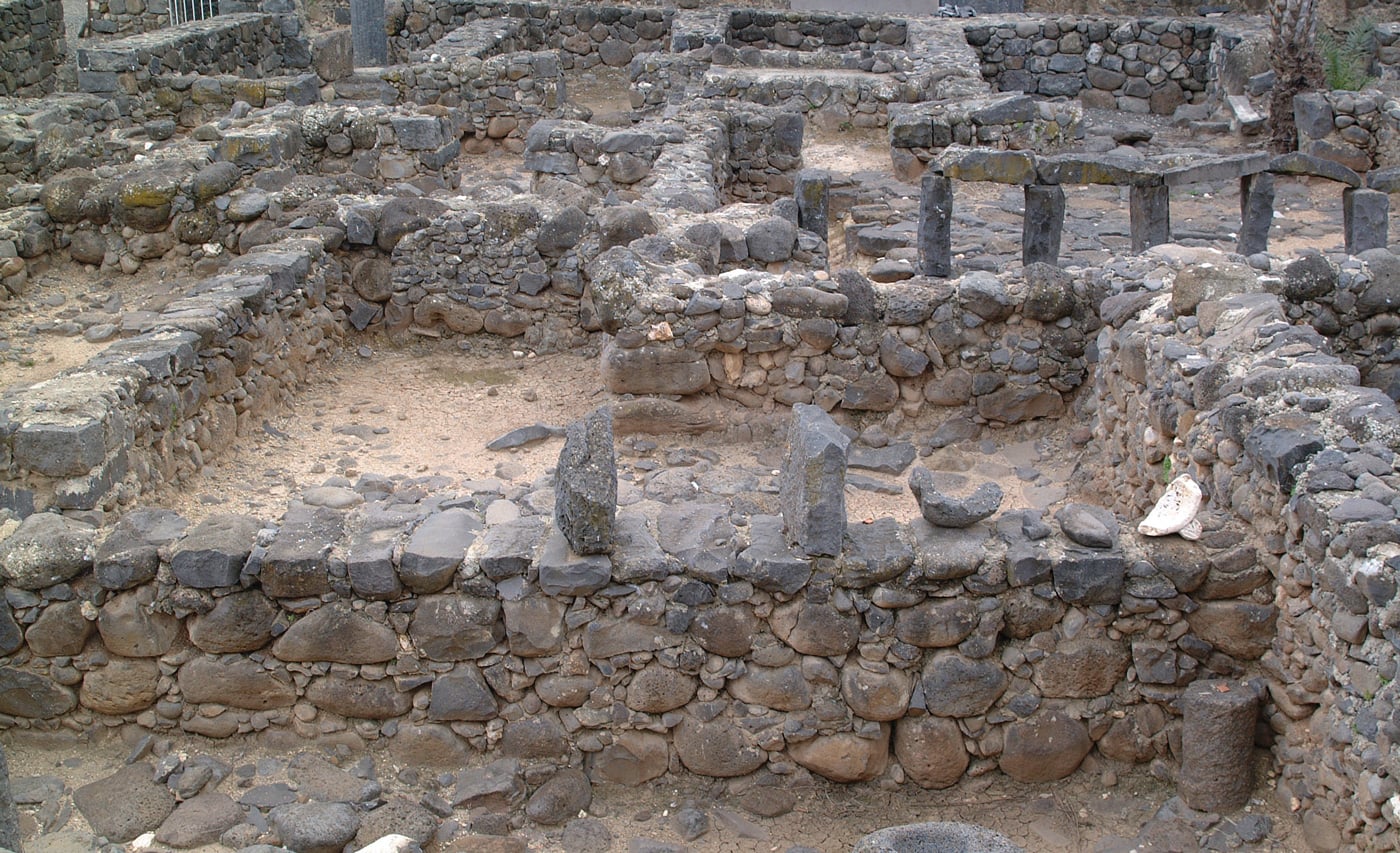
In John 14:2, Jesus says, “My Father’s house has many rooms.” During the time of Jesus, extended families often lived in large compounds with many rooms that surrounded a common courtyard. Shown here are the remains of such a compound in Capernaum.
It is evident then that Jesus recognizes the importance of this evening and is making his formal farewell. He addresses his disciples’ worries in light of his imminent death and departure. But above all he holds out a promise and hope centered on the coming of the Holy Spirit—one who will guide, teach, encourage, empower, and mediate to the believer the comforting presence of Christ.
13:31–14:31. The specific subject of the Farewell Discourse is Jesus’s departure to the Father (13:31–14:3), and here we see John’s technical language being employed. “Glorification” has been used to describe both Jesus’s ministry (8:54; 11:4; 12:28) and his death (7:39; 12:16, 23). Now this latter specialized usage comes in full (13:31, 32; 17:1); the cross is another time in which Jesus is glorified, and in turn so is the Father (21:19). But glorification as a process is complex: it is not just Christ being lifted up on the cross; rather, it is the entire passion, from betrayal to empty tomb—a process that inaugurates his return to the Father. Hence 13:31 states that Jesus’s glorification has already begun. The onset of “the hour” is behind him; his departure is under way (13:33).
As Jesus mystified his Jewish audience at the Feast of Tabernacles with this teaching (7:33–36), so now Peter is perplexed (13:36–38). He presses the question about departure, and unlike the Jewish leaders in chapter 7, he knows that it may involve death (13:37–38; cf. 8:21–22). Nevertheless, Jesus answers now in full, and chapter 14 will seek to answer the question of Christ’s departure, provision, and return. But Jesus is not simply intent on explaining this. In the meanwhile, the character of the surviving community (the church) is important (see 13:34–35). The command of love expressed in unity and fidelity to Jesus will be taken up in chapters 15 and 17.
In early Christianity, the problem of Jesus’s departure was resolved by looking forward to his return, or second coming (Greek parousia). For some this was the only comfort. However, the discourse in chapter 14 is a carefully designed reassessment of this. It begins with a description of the traditional futurist hope (14:1–3). Jesus is preparing rooms in heaven (14:2) and someday will return to transport his followers there (14:3). The discourse then introduces three questioners (Thomas, 14:5; Philip, 14:8; Judas, 14:22) who ask leading questions so that Jesus’s answer may be sharpened. In the end this futurist eschatology is refashioned into what is called realized eschatology. That is, hope and comfort are not in the future but can be realized now. Thus the coming of Jesus (14:3) shifts to the coming of the Spirit (14:23, 28). The “rooms” (Greek monē, 14:2) of heavenly dwelling become rooms (monē, 14:23; NIV “home”) of divine indwelling.
The sequence of exchanges has an interesting thematic development. There are four interlocking steps:
- Jesus: I am going and coming (Greek erchomai, 14:1–4). Thomas: We do not know the way you are going (14:5).
- Jesus: I am the way to the Father (14:6). Philip: Show us the Father (14:8).
- Jesus: You have seen the Father already. I will manifest him (and myself) to you (14:9–11). Judas: How will you manifest yourself (14:22)?
- Jesus: In the Spirit—by coming (Greek erchomai, 14:23) to you.
For Thomas (14:5–7) the chief concern is whether they will accompany Jesus. Note that it is not a moral or ethical way; it is salvific. The way to be found is the way of salvation leading to the Father (14:4–17). Two surprises come about: Jesus is both the means (14:6) and the end (14:7). There is no suspended hope, because the object of their faith (the Father) is now present in Christ. In him the Father is already present (cf. 8:19; 10:30, 38).
Philip now inquires about this Father-Son relationship (14:8–11), and Jesus makes himself explicit. It is the Father himself who is present in Jesus (hence John’s full divinity of Jesus), and this validates both his words and works. Whenever the Father is present, he manifests himself. This pertains to Jesus’s followers as well (14:12–14), who will be enabled to exhibit similar works. Running through these verses is a theological parallel between the Father’s relation to the Son and the Spirit’s relation to the disciple. As the Father abides in (Greek menō, 14:10) Jesus, so too the Spirit abides in (menō, 14:17) the believer. Thus the confidence of Christ can be ours: as the Father was committed to his Son, so Jesus through his Spirit will stand with us in every need (14:13–14). The point in these verses is not that every prayerful request will be granted but that the character of Christ’s relationship with God at this level may be ours. But here we must recall Jesus’s consistent submission to his Father’s will (5:19, 30; 6:38; 7:16–17; 8:28–29) and his desire simply to glorify (12:28; 17:4) and please God (8:29).
The provision of Jesus that will bring about this relationship is declared to be the indwelling Spirit (14:15–17), who now bears two new names: the Paraclete (NIV “advocate,” 14:16) and the Spirit of truth. Paraclete (Greek paraklētos) is unique to John (elsewhere, 14:26; 15:26; 16:7; 1 John 2:1) and expresses the Spirit’s strengthening, equipping role. A paraklētos was a judicial advocate (cf. Matt. 10:16–20), and here Jesus says that Christians alone can enjoy his aid (John 14:17). As Jesus was alien to the world (1:10), so too his provision of the Spirit will be unknown and unrecognized. As Jesus was on trial in the world (cf. the Book of Signs), now his followers have a judicial aid to support them (15:18–27).
The continuation of Jesus’s reassuring words now picks up the language of the second coming (14:18–24). Futurist eschatology imperceptibly blends with realized eschatology. In Judaism, disciples who had lost their rabbi were often called orphans (14:18), but this will not be the case for Jesus’s followers—he will come back visibly (14:18–19). But what sort of return is this if the world cannot take part? Will there be no secular verification? Remarkably the description of the coming of the Paraclete in verses 15–17 parallels the coming of Jesus in verses 18–21. Note the stress on love and obedience (14:15, 21), the world (14:17, 19), personal recognition (14:17, 19), and indwelling (14:17, 20).
Judas (not Iscariot, 14:22) asks the question that brings the discourse to its climax. If the manifestation of Jesus mentioned in verse 21 is private, then it needs some explaining. Finally, Jesus says that the hope he has been describing here is not apocalyptic at all. Jesus’s return can also be found in the inner experience of the Son and the Father within the believer. The room of dwelling (see 14:2) is now redefined and found in the disciple’s heart (14:23).
Jesus provides further reassurance by predicting beforehand the impending crisis (14:29–31) and affirming that he will indeed return (14:28). But as we have seen, this is a redefined return. The chief attribute he desires for them is peace (similarly, Paul in Rom. 5:1; Eph. 2:17), and this will come about through the Spirit (John 14:26; cf. Eph. 2:18). On Easter Day, when Jesus appears to the disciples, “peace” is his first word (20:19, 21), and this is followed by their anointing with the Spirit (20:22).
This second Paraclete promise (14:25–31) contributes to our understanding of the roles of the Spirit (cf. 14:16). Here the emphasis is on revelation. The Paraclete will be a teacher (1 John 2:22–27), bringing back to memory the sayings of Jesus (John 14:26). Thus, here is practical equipment for the church! But we also have here a confirmation of the production of the Gospel record itself. The Spirit will be a preserving, conservative force in revelation. He will not primarily be creative but will reiterate Jesus’s words. Once again we see the Spirit functioning like Jesus: as Jesus was dependent on the Father (14:10), so the Spirit depends on Christ.
15:1–16:4a. The vine metaphor (15:1–17) builds on the emphases of Jesus in chapter 14. There we saw that the answer to the disciples’ anxiety concerning Jesus’s death and departure is found in the Spirit. Christ in Spirit will indwell the believer. Jesus’s new metaphor in chapter 15 affirms this again. The verb for indwelling (Greek menō; 14:17) appears numerous times (NIV “remain,” 15:4–7, 9–10), but now it is viewed in terms of its results. Spiritual experiences must lead to fruit-bearing in the form of new obedience and love.
The vine/vineyard metaphor is used frequently in the Old Testament. Israel is often depicted as a vine transplanted from Egypt (Ps. 80:8–11) and brought to fertile soil (Ezek. 17:1–6). Enemies may trample the vineyard (Jer. 12:10–11), but God tends it carefully and looks for fruit (Isa. 5:1–7). The vineyard may be the preeminent biblical symbol of the locus of God’s activity, his nurture, and his expectations (cf. Matt. 21:33–41).
Jesus’s use of the metaphor is surprising. Rather than claiming to be the vinedresser and assuming the prerogatives of God (e.g., John 5), Jesus is the vine (which formerly stood for Israel). Union with Jesus means participation in the new Israel, the people of God (cf. Paul, who uses a similar metaphor in Rom. 11:17–24). This theological notion has appeared elsewhere, in John 10:7 (“I am the gate for the sheep”) and in 14:6 (“I am the way”). Attachment to Jesus is the only means of access to God’s household. In other words, Jesus marks the beginning of the new Israel.
Two themes dominate the section. First, the believer must have an inner apprehension of Christ (in Spirit; 14:23). Abiding or remaining (Greek menō) in Christ is a prerequisite Christian experience. Initially, Christ dwells in us (15:4–5), but this is no tribute to our merit; for our acceptability as vessels—our cleanliness—is his accomplishment (15:3). Conversely, we abide in Christ (15:4–5), and this is the origin of fruitful living. Just as branches are barren when they are not attached to the vine (15:4), the possibility of separation from the Vine is a dreadful prospect (15:2, 6).
Second, there should be outer evidence of Christ’s indwelling. Note how carefully the passage balances our mutual participation with God. Our effort is necessary. For instance, on the one hand, we must devote ourselves to Jesus’s words and be obedient (15:7, 10). But on the other hand, it is also the nurture of God that causes us to flourish and glorify him (15:8). “Apart from me you can do nothing” (15:5). Jesus describes God as a vinedresser who prunes with skill, knowing the benefits that will accrue to the branch in later seasons.
The results of this reciprocal abiding are given in 15:7–17. (1) Prayer with confidence. Jesus mentions twice the certainty that comes with prayer joined to spiritual union (15:7, 16; cf. 14:12–14). (2) Assurance. We acquire confidence in Jesus’s love for us because it is modeled on God’s love for him (15:9–10; 17:26). Assurance is closely related to our knowledge of Christ’s love (see Rom. 8:35–39). (3) Joy. This is not mere happiness but a deeper tranquility that is free from worry about the affairs of living and that knows God’s purposes are good (15:11; 16:20–24; 17:13). (4) A new community. Throughout the discourse, Jesus exhorts his followers to love one another (13:34; 15:12, 17; 17:21; see 1 John 2:7–11). As his love for us is modeled on God’s divine love for him (15:9), now our love for one another should be modeled on his love and sacrifice (15:13, 17). Christlike love should be the hallmark of the church (see esp. 17:20–26; 1 John).
The remarkable summary of Jesus’s offer and expectations appears in 15:14–17. What especially stands out is his offer of friendship. In Christ, disciples have unparalleled access to God. True friendship is always hallmarked by complete candor, honesty, and transparency between persons. Jesus has become that sort of friend because he has unveiled himself fully (15:15). Moreover, this is not a casual thing passed out indiscriminately: Christ has chosen us to be his friends (15:16)! The indwelling of Christ and his love are thoroughly individual and personal in these chapters. But Jesus’s seriousness cannot be missed. If he has offered this qualitative relationship to us, we must extend it to one another (15:17).
Early Christianity was unanimous in its outlook on the world. Insofar as the church formed a radically new community, it experienced strife and conflict with society. Social divisions recur with marked frequency in the book of Acts. In his letters, Paul describes persecution as virtually a constituent part of the Christian experience (1 Cor. 4:11–13; 1 Thess. 2:13–16; 2 Tim. 3:10–13). This treatment was expected because the disciples of Christ had inherited the hostilities shown to their master.
Jesus predicted these conflicts in his final teachings (Matt. 10:17–25; 24:9–14; Mark 13:9–13), and here in the Farewell Discourse the subject is addressed in full (15:18–16:33). The conflicts are outlined, but in addition the provisions of Jesus are given.
Jesus explains that the precedent for this experience is his own (15:18, 20). Christ and his followers are alien to the world’s values and therefore cannot obtain its affections (15:18–16:4a). Jesus has selectively created a new order—“I have chosen you” (15:19)—and this implies judgment on the old. The language here is strong: hatred will typify the division between church and world.
The world’s guilt is based on its accountability before divine revelation. God in Christ has come, spoken, and acted on our behalf (15:22–24), and our response forms the basis of our judgment. This is a common Johannine theme. In 5:45 the disbelieving Jews will be held accountable to their own Scriptures, which speak of Christ. In 9:18 the judges of the blind man will themselves be judged because they rejected the sign. And in 12:37 John connects the disbelief of the Jews with a rejection of Jesus’s revelatory signs.
Nevertheless, the disciples will not be alone in these conflicts. Jesus reminds them again of the Paraclete (cf. 14:16, 26), who will be their aid. This promise dovetails with similar promises in the Synoptics (Mark 13:11), but John has heightened the judicial setting. In the Book of Signs (John 1–12) we saw how Jesus’s ministry was described in forensic terms: he was on trial before a world that was weighing the evidence (signs). Now this lifelong trial is promised for the disciples. This judicial-literary metaphor explains the origin of the Spirit’s new title. A paraclete is a legal assistant or advocate who aids and counsels. He substantiates our witness (another legal term) as we too are placed on trial before the world. Jesus is quite specific about the extent of these hostilities (16:1–4a) in order to equip his followers for the near future (cf. 1 Pet. 4:12). In 16:1 the Greek word behind “fall away” (NIV) is skandalizō, which means to trip or stumble (a skandalon is a trap). In Johannine thought this term refers to anything that causes the disciple to fall away or weaken in faith (6:61; 1 John 2:10; cf. Matt. 26:31).

In John 16:7, Jesus promises to his disciples the arrival of the Holy Spirit. The symbol of the Spirit has traditionally been a dove (cf. John 1:32–33), as featured here in the alabaster window above the Altar of the Chair of St. Peter at St. Peter’s Basilica in Rome (designed by Bernini, seventeenth century).
16:4b–33. The further work of the Paraclete now receives attention. In 16:4b–15 we come to Jesus’s fourth and fifth predictions (cf. 14:16, 26; 15:26). The closing subject of chapter 15 (the world) continues to be Jesus’s concern. While sorrow may follow Jesus’s departure (16:5–6), it is actually necessary for him to go, since the coming of the Spirit is dependent on his death/glorification (cf. 7:39). In some fashion the Spirit and Jesus are mutually exclusive; or, as we shall see in chapters 19 and 20, the Spirit comes in the midst of Christ’s glorification. The Spirit is Jesus’s Spirit and is released in his death (cf. 19:30, 34; 20:22).
The relation between the Spirit and the world has been gradually developing. In 14:15–16 we learned that the world cannot know the Spirit. In 15:26–27 we saw the Paraclete serving as a defense advocate before the world’s hostilities. Now in 16:8–11 the Paraclete passes to the attack. This too is a judicial description, for in Jewish courts accusers could themselves be accused and convicted. In verse 8 the term “convict” (Greek elenchō; NIV “prove”) is legal terminology for the trial. While the symmetry of the verses is difficult, their message is clear: the Paraclete will engage the world through the mission of the church. The Spirit will substantiate the church’s voice, inwardly persuading the hearts of its hearers and strengthening its witnesses.
The final Spirit saying (16:12–15) turns to a new subject and should be compared with 14:25–26. In this earlier passage the Spirit’s work was conservative, preserving the historical sayings of Christ. Now we learn that there are things to be revealed that are yet unknown (16:12). The Spirit will be a guide into truth, especially that which pertains to future disclosures (16:13). Thus Jesus is predicting a prophetic anointing similar to that known to Paul (1 Cor. 12:29; 14:21–23; Eph. 4:11; 1 Thess. 5:19–20). First John 2:26–27 implies that the Johannine churches used this gift as well. But note a very important limit on this “charismatic” activity: the Spirit will not diverge from the historical revelation of Jesus Christ (John 16:13–14). The Johannine church understood this necessary reflex back to its original moorings. Note the number of times that John points his readers back to what we knew “from the beginning” (1 John 1:1–3).
The picture so far has developed thus: Jesus must go away, but he will return; yet this return will be realized in a significant way through the Spirit’s indwelling the Christian. The Spirit will instruct, defend, empower, and guide the disciple within the world. The remaining question—When will these events take place?—will point to Easter (16:16–33).
Seven times we find a reference to “a little while” (16:16–19), which indicates the disciples’ worry about the interval between departure and return. Their concern is understandable, since in 16:10 Jesus said that they would see him no more; however, a time of “seeing him” (16:17, 19, 22) precedes this final removal, and it is not too distant. That this refers to Easter can be seen in two ways. First, joy will hallmark their attitude (16:20–22, 24), and on Easter Day, when they see Jesus, rejoicing is their response (20:22; Greek chairō). Second, “seeing” Jesus is a part of the Easter witness. In fact, Mary’s exclamation in 20:18 is, “I have seen the Lord!” With this evidence it is no surprise to find that the coming of the Spirit, the anointing described throughout these chapters, is finally given on Easter (20:19–22).
Another advantage of this day besides joy is a deepened knowledge of God and his will (16:25–28). The era of misunderstanding will be over (see this motif in chaps. 1–12), and accurate perception will be ours (cf. 2:22; 12:16). John 16:25–28 parallels 16:12–15 inasmuch as it implies a gift of previously unknown insight into God. Hence access to the Father is direct (16:26–27) because Jesus and the Father will be united with us (14:9, 23; 17:21).
Proof that the disciples are not yet equipped—and need to be—can be seen in verses 29–33. They think they understand clearly (16:25, 29) and have full belief. But this cannot be theirs until the Spirit is on them. In fact, they will flee when the crisis of the cross is upon them (16:32). But Jesus understands the limitations of his people; when they grieve over their flight, their recollection of these words will bring comfort (16:33).
17:1–26. Having concluded his discourse, Jesus now turns to prayer. Each of the Synoptic Gospels records a time of prayer in the Garden of Gethsemane (Matt. 26:36–46; Mark 14:32–42; Luke 22:40–46), and no doubt John 17 should be compared with this. If John 14:31 was the terminus of the upper room teaching, then John may want us to consider this prayer to be at another location. Some think that Jesus is somewhere between the upper room and the garden (Kidron Valley; 18:1) and suggest that he is in the temple, since at Passover the city gates would remain open. If this is correct (and we cannot be certain), the prayer may be one of consecration, since the Greek term hagiazō, “to make holy” or “sanctify” (17:17, 19), appears elsewhere only at the temple (10:36). In this sense Jesus may be preparing himself for death as a holy sacrificial victim (cf. Deut. 15:19).
Just as the farewell discourse was a well-established literary custom in Judaism, the same can be said for a prayer of departure. The departure of Moses in Deuteronomy offers a good comparison. The great prophet’s final words are spoken from the plains of Moab and recorded in Deuteronomy 1–31. This is followed by two prayers (Deuteronomy 32–33) and a closing account of Moses’s death (Deuteronomy 34). In Moses’s first prayer he blesses God and then he goes on to bless Israel, interceding for them as they go out to appropriate their tribal lands. In Jesus’s prayer we find the same two interests. Jesus turns from his own concerns (17:1–8) to those of the church (17:9–26), just like Moses. In this latter role Jesus becomes a priest interceding for his people (see Rom. 8:34; Heb. 7:25). Note how in 1 John 2:1 another Johannine teaching even depicts Christ as our Paraclete (or advocate) in heaven.
The first words of the prayer in Greek bear a significant Johannine phrase: “the hour [NIV “time”] has come.” This hour has been anticipated from the outset (2:4; 7:30; 8:20) and is described as the time of Jesus’s glorification (12:23, 27; 13:1; cf. 19:14, 27). This glorification is a process culminating in Jesus’s return to the Father by way of the cross. Now Jesus prays that his glory (and the Father’s) might be evident (17:1–8). In the Book of Signs Jesus’s works manifested glory (1:14; 2:11; 11:4, 40; 12:28). But if these signs were veiled, now he asks that his last great sign would speak powerfully. Note how in 12:32 Jesus predicted the true power of the sign of the cross.
In the prologue to the Gospel we learned how the arrival of God’s Son made the glory of God visible (1:14). Now Jesus mentions that this effort has been successful (17:4). Those who are chosen, who have apprehended this glory, find life (17:3); but it is a salvation strictly mediated through the Son. The Son himself possesses glory—a glory shared with the Father—and this will be reappropriated upon Christ’s return (17:5). This thought is important and draws us into the incarnational theology of John. Coming from the Father, he takes up our humanity at some expense, only to return once more to his original glory with the Father. This resembles Paul’s thought in Philippians 2:5–11.
The glory of God has been visible in Christ in yet one more way. Jesus has revealed God’s name (Greek onoma, “name”; NIV “you”; 17:6). Paul says the same: this Christ who emptied himself is the bearer of “the name that is above every name” (Phil. 2:9). The name of God is a vital Old Testament concept beginning with Moses’s experience on Sinai (Exod. 3:13–15; Deut. 12:5; Isa. 52:6), and Jesus has given this throughout his public ministry in the great “I am” sayings (e.g., 8:28, 58). In the Old Testament, possessing God’s name is precious; it implies relationship, obedience, and knowledge. Only Christians possess God’s name in this Old Testament sense (17:6), and they alone draw the correct inference: the Son who bears this name has come from God and must be believed.
Jesus now prays exclusively for his followers (17:9–19) even though they have been on his mind all along (17:6–7). In one sense this prayer is a continuation of that prayer for glory in 17:1–5. Christ’s glory is continually manifested through the lives of his people (17:10). But this will happen only if they, like him, are holy (17:19). Three petitions of Jesus for his people will achieve this end. (1) Unity (17:11–12). Christ prays that the unity shared between him and the Father might be realized in the church. But note the prerequisite that will facilitate this in verse 11: “Keep them in thy name” (literal). Christian unity stems from personal faithfulness in God’s presence. Like the good shepherd of 10:7–18, Jesus has protected his sheep until now, but other provisions will soon be necessary. (2) Joy and perseverance (17:13–16). Conflict will hallmark the life of any who simultaneously live in the world and adhere to God’s word. This was made clear in 15:18–16:4a. Jesus, however, asks not simply for spiritual protection (17:15) but for a new disposition: joy in the midst of suffering. (3) Holiness (17:17–19). This attribute reflects the presence of Christ because he, like God, is holy (17:19). Sanctification comes through sustained exposure to the truth found in God’s word (17:17). It is not just a superior moral effort but something deriving from the holiness of Christ, in whose presence we are to live (17:19).
Once before Jesus hinted at the church, which would grow much later. The good shepherd has “other sheep that are not of this sheep pen” (10:16). Now Jesus turns directly to concerns for others who will believe as a result of his disciples’ work (17:20–26). It is interesting that Jesus’s chief concern in 17:20–23 is again for unity. The later church of John must have been torn by divisions if 1 John is evidence (cf. 1 John 2:7–11, 18–21). Again he asks that the Father-Son relation would be the model of this unity (John 17:21; cf. v. 11). And again it is facilitated only by a profound spiritual unity with God in Christ (17:21, 23). Unity is not merely a human achievement but flows from a mature walk with Christ.
Just as we noted the importance of Jesus’s final public words (12:44–50), now we read his final private teachings for his disciples before his arrest. John 17:24–26 sweeps up subjects from the entire Farewell Discourse but emphasizes one central theme: Jesus desires that he and the Father indwell the believer, conveying to that person the certainty of God’s love. While God’s presence will be experienced at the end of time (17:24), the Holy Spirit will manifest the reality of Christ in us in this present world. Jesus’s final prayer asks that two things be “in” us: God’s love and Christ’s presence. Later John will write the same thing. How do we know that we abide in him? We bear God’s love (1 John 4:7, 16) and Christ’s own Spirit (4:13).
C. The passion (18:1–19:42). The story of Jesus’s trial, death, and resurrection provides us with an excellent opportunity to test historical tradition in the Fourth Gospel, since so much of John’s passion narrative overlaps with the Synoptics. The New Testament scholar C. H. Dodd even began his magisterial volume with a study of this section (see Dodd). Nevertheless, the Johannine account has had to weather various criticisms. Scholars have noted how John places all guilt on the Jews while leaving Pilate innocent. (In Luke, however, Pilate announces Jesus’s innocence three times; see Luke 23:4, 14, 22.) Further, we can note how John theologically reshapes a story of agony into a story of victory and glory (note 18:36). John is no doubt emphasizing themes important to him when, for instance, the arresting party falls to the ground at the mention of the divine name (18:6). Yet it is not necessary to argue that John has dramatically embellished his account with no regard for history (Bruce 1980, 7–20). Incidental historical details abound, such as the name of the high priest’s slave (18:10–11), his relation to Peter’s questioner in 18:26, and the type of courtyard fire (charcoal, 18:18). When added to the harmony of this account with the Synoptics, these details lend significant credibility to John’s independent account (cf. the interrogation before Annas, 18:13–14, 19–24).
The consistent sequence of events in the passion of Jesus both here and in the Synoptics shows how this story had an ancient, pre-Gospel history. It may have been the first narrative circulating among the early Christians who needed to answer the apologetic question, “If Jesus was the Messiah, why was he crucified?”
18:1–27. It was the custom of Jewish celebrants on Passover to spend the night after their meal in prayer and meditation. Jesus does the same, crossing the Kidron Valley east of Jerusalem and entering a garden. The place of the arrest (18:1–11) is apparently familiar to all, since Judas, who left during the meal (13:30), now arrives with the arresting party (18:2–3). The authorities have found exactly what they needed: a quiet place where Jesus can be arrested without public notice.
John and Matthew stress the armaments of the party and imply that they expect a fight. John 18:3, however, stands out in that it tells us that a detachment of Roman troops assists. Rather than record Judas’s identifying kiss, John writes that Jesus takes the initiative to voluntarily identify himself (18:4–5). His hour has come, and he will instigate its advance. The emphases that follow are uniquely Johannine. When Jesus utters the divine name (“I am,” 18:5), the party falls prostrate in awe. When they recover, he exchanges his life for the freedom of his followers (cf. 6:39; 17:12; and the shepherd, 10:11–18). Peter’s zeal is misguided (18:10–11) since interfering with “the hour” is just as wrong as hastening its approach (7:6–9).
Once Jesus is bound he is taken for a preliminary interrogation before Annas, who served as high priest from AD 6 to 15. Even though he is deposed now, he still retains his title due to his weighty influence. In fact, all of his five sons became priests (cf. Luke 3:2; Acts 4:6). His son-in-law, Caiaphas, is featured in the Synoptic trial and given only passing reference in John (11:49; 18:13–14, 24).
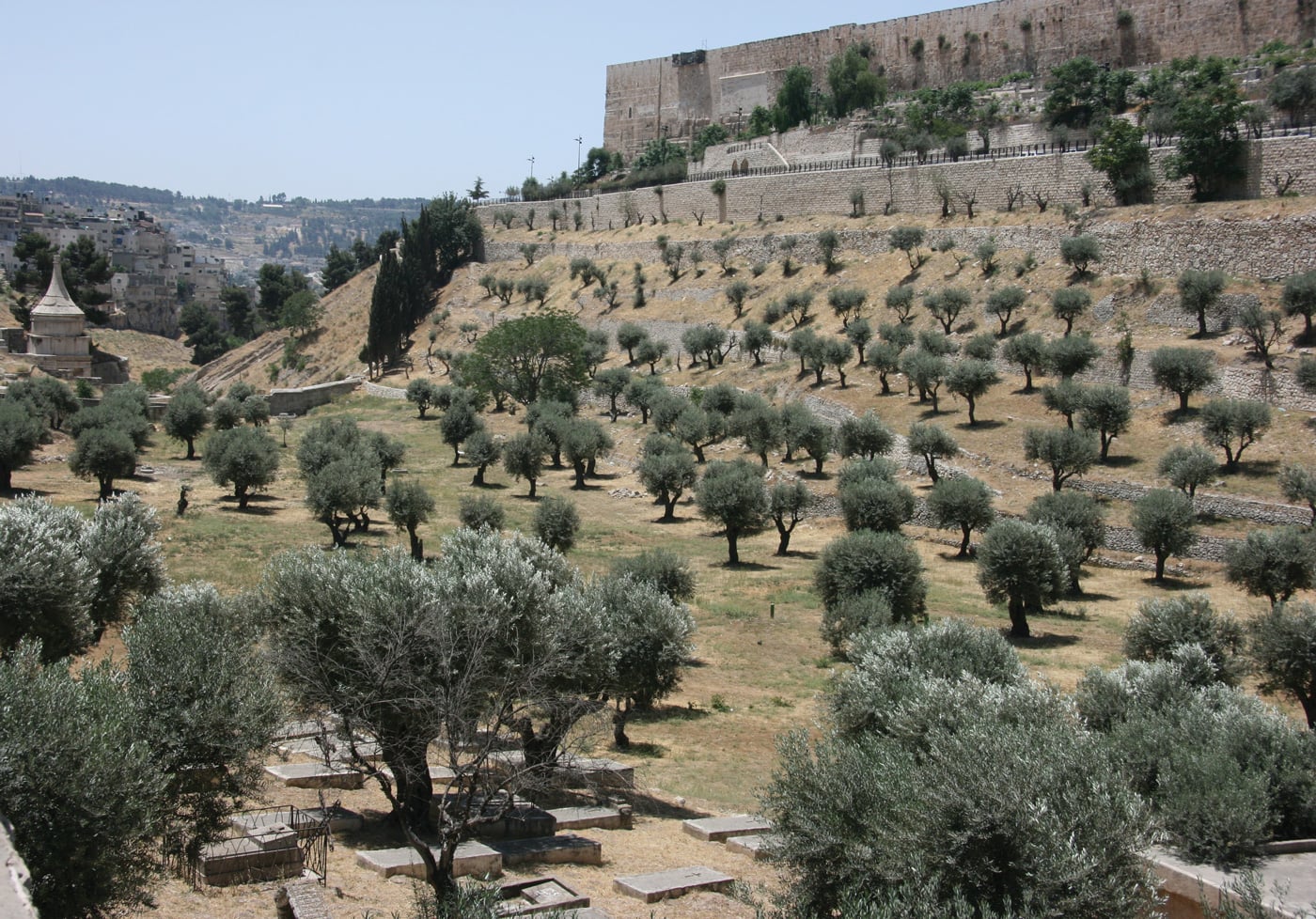
The Kidron Valley, which Jesus crossed on his way from Jerusalem to an olive orchard known as the Garden of Gethsemane (John 18:1)
Intertwined in the trial sequence (18:12–27) is the story of Peter’s threefold denial (18:15–18, 25–27; cf. Mark 14:66–72). Jesus has predicted Peter’s fear of identification in this crisis (John 13:36–38), and now it is fulfilled. John diverges, however, from the Synoptic story. He records that “another disciple” (likely John) who was acquainted with the priest let Peter into the courtyard (18:15–16). It is interesting that John records the specific type of fire (18:18). A charcoal fire (Greek anthrakia; NIV “fire”) will appear once again in 21:9, when Jesus reunites with Peter.
The Jewish interrogation is briefly recorded in 18:19–23, but certainly extensive questioning occurred. The Fourth Gospel does not record the charges and countercharges well known to us in the Synoptics. Instead (as with the arrest) Jesus initiates and provides the substance of the dialogue. It is his hour of glorification. He is in control. His chief defense is that his teachings have been public—open to the inspection of all. In other words, no inquiry will uncover more than is already known. On a literary level, we might say that the Book of Signs has provided exhaustive evidence for Jesus’s trial. No more is required.
From the house of Caiaphas (often thought to be located on Jerusalem’s western hill or “upper city”) Jesus is led to the praetorium, or governor’s palace. It was necessary to involve the Roman authorities in capital cases since the Roman subjugation of Palestine had eliminated numerous Jewish judicial powers (see 18:31). Since AD 6 Pilate was the fifth Roman governor (AD 26–36) to rule Judea. Based in Caesarea with numerous troops, Pilate came to Jerusalem occasionally to conduct his administrative duties with the Jews. The praetorium was his residence, although it is uncertain whether he chose Herod’s palace in Jerusalem or the Antonia Fortress, with its garrison near the temple (the traditional site since Crusader times).
18:28–19:16. This entire narrative section bears the marks of a carefully written unit. Its dramatic suspense is second to none. Pilate moves in and out of the praetorium five times (18:29, 33, 38; 19:9, 13), establishing the innocence of Jesus and exploring his title of “king.” In fact, kingship weaves continuously through the story, becoming the principal theme (18:33, 36–37, 39; 19:2–3, 12, 14–15, 19–22) until Pilate’s caution turns to fear (19:8). Even when Jesus is crucified, Pilate insists on Jesus’s title in death (19:19–22).
Pilate meets with the Jewish leadership outside his residence so that they might not become ritually unclean due to contact with Gentiles (18:28). The accusation that Jesus is a criminal is less clear than the Synoptic charges that bring political offenses to mind (especially Luke 23:2). Pilate is initially unmoved and prefers to leave the case in Jewish courts, but his audience reminds him of the Roman restriction prohibiting the Jews from carrying out capital punishment.
Pilate now goes inside (18:33) to Jesus, who is in custody and speaks with him. In this round Pilate’s first inquiry is important: “king” was a political title that was enjoyed in Judea only by Herod the Great. Is Jesus making a political challenge with this word? Jesus accepts the title but redefines it: his kingdom is otherworldly. He is not an insurrectionist of the sort that Rome fears. Pilate feels no threat and glibly dismisses Jesus, but his closing remark (“What is truth?”) shows that he cannot be one who recognizes Jesus’s voice (18:38). Soon, however, Pilate’s interest will be piqued.
Jesus is innocent, and this judgment is conveyed outside (18:38). But since Pilate’s generous overture is rejected (18:39–40), Jesus is flogged, a severe punishment often preliminary to crucifixion. However, the mocking of the soldiers serves another purpose: this is Jesus’s symbolic coronation. He is hailed “king” and so arrayed (19:2–3), but Pilate hopes that the severity of Jesus’s pitiful condition and profuse bleeding will permit him to be released. Instead, Pilate is met with calls for death, which would usually give a governor no hesitation. But now the crowd offers a new title for Jesus: Jesus claims to be the Son of God. The round closes differently than the previous one. Pilate is afraid (19:8).
When Pilate reenters the praetorium, it is evident that the glib tone of 18:38 has disappeared. “Son of God” was a metaphysical claim; it evoked a meaning not unknown among Romans. Pilate’s initial question (19:9) shows that he is probing the identity of Jesus. Like Nicodemus earlier (3:1–21), Pilate is making a discreet inquiry. And like many who came to Jesus, he has to choose to follow the light or the darkness. Pilate’s reflex to his own power (19:10) is completely demolished when Jesus explains how the governor actually derives his power from God. Furthermore, Pilate has been the unwitting pawn of other powers, the Jews, who have instigated this trial (19:11). The round ends with Pilate’s earnest desire to release Jesus (cf. Matt. 27:18–19).
As Pilate readies himself to come outside, already voices meet him. But now a new threat is hurled at him, and his stamina collapses (19:12–16). “Friend of Caesar” (19:12) was a technical term meaning “loyal to Caesar,” and it referred to people who had distinguished themselves in imperial service. It was the guarantee of a good career. Therefore Pilate must choose between this new king and Caesar. In two discourses, Jesus described the dangerous temptation to regard secular acclaim above divine approval (5:44; 12:43).
Pilate chooses the former (19:13–16) and goes through the motions of making a judicial edict. The “Stone Pavement” (Aramaic gabbata, “elevated place”?) may have been a visible platform for such pronouncements. (Archaeologists claim to have found this pavement in the remains of the Antonia Fortress.) The time of this announcement, “about noon,” is indicated (19:14) because of a theme that will arise during the crucifixion. The hour of Jesus’s condemnation is the hour when the temple began to slaughter the ritual lambs for Passover. Jesus is one such lamb (19:31–36).
The decision between Caesar and the king Jesus, weighed earlier by Pilate, is decided now by the chief priests (19:15). This is their irrevocable rejection of Christ: “We have no king but Caesar” (similarly, Matt. 27:24–25).
19:17–42. Each of the Gospels is content to give us a brief description of the crucifixion (19:17–37), thereby sparing us its gruesome details. It was despised by Jews and Romans alike and employed mainly in the provinces for slaves and criminals. Following a severe flogging with a metal- or bone-tipped whip, the victim was forced to march to the site of death carrying the crossbeam, even though often the individual was already fatally injured. Jesus had already been scourged thus (19:1; cf. Mark 15:16–20). The Synoptics mention that Jesus’s condition is so serious that he cannot carry anything as he walks, but a passerby named Simon of Cyrene is forced into service (Mark 15:20–21).
Golgotha is the Aramaic word for skull or cranium (19:17), and may derive from the shape of a hill or simply be an apt metaphor for a place of death. It was certainly outside the city walls of Jerusalem, and if the northern courses of Herod’s walls have been correctly determined then the traditional site of Jerusalem’s Church of the Holy Sepulchre can be accepted.
The extended attention given to the title on the cross is strictly Johannine (19:19–22; cf. Mark 15:26). While it conveys historical information, its chief importance is theological. Jesus’s death has been described as his glorification (e.g., John 7:39; 13:31). It has also been called his “lifting up” (3:14; 8:28; 12:32, 34) inasmuch as he is returning to the Father and to his previous glory (17:1–5). Therefore, the cross is not a place of defeat or humiliation in Johannine thought. It is a further revelatory sign since it will evoke faith and create followers (12:32). If we keep this in mind, then the place of regal language (kingship) becomes clear: Christ, already crowned (19:2), is now enthroned (19:19–22). The irony of the scene fits well the two-level understanding that has accompanied the signs and discourses throughout the Gospel (e.g., 3:3; 4:7–8). Pilate misunderstands the truth that he so valiantly defends. Only John mentions that the title is in three languages (19:20), and this underscores his interest in those outside of Judea who are also a part of Christ’s fold (cf. 10:16; 12:20; 17:20).
The Romans customarily removed and confiscated the clothing of the crucified, thereby heightening his shame and giving the soldiers some benefit for their labors. This occurs at Golgotha (19:23–24; cf. Mark 15:24). John’s narrative explains that Jesus’s garments are divided four ways, but he focuses on a seamless undergarment valued by the guards. Its preservation is explained from Psalm 22:18, but its symbolic meaning may lie elsewhere. The garments of the high priest included this item (Exod. 28:4; 39:27), and it may suggest some priestly symbolism for Jesus (which is a common New Testament thought; see Heb. 4:14; Rev. 1:13); but this interpretation must remain uncertain.
The presence of women at the cross is striking (19:25–27). Unlike the apostles, who fled, the women would have been safe from incrimination because of ancient oriental chivalry giving them a protected status. We see that John attends as well but for one purpose: Jesus’s first word from the cross makes provision for his mother’s future. Mary is taken into the beloved disciple’s care. A plethora of symbols is often attached to this act (e.g., does John represent the church to whom the heritage of Israel, Mary, is entrusted?), but few of these suggestions find any consensus.
The remaining activity on the cross (19:28–37) now emphasizes two dominant theological themes. First, Jesus is a Passover victim dying a sacrificial death. This motif already appeared in 19:14 (also 1:29) and again comes to mind here. Jesus’s thirst (19:28) echoes Psalm 22:15, while the hyssop that satisfies his thirst reflects Exodus 12:22 and Passover symbolism. Hyssop was used with blood on Israel’s doorposts in Egypt. This is a uniquely Johannine note (cf. Mark 15:36). John is also the only one of the evangelists who speaks of the Roman crurifragium, or breaking of legs (19:31–37). Again this serves Passover imagery in that the Passover lamb could have no broken bones (19:36; Exod. 12:46). Jesus was already dead (19:30), but if a man were not, a violent blow to the legs with a lance would hasten death since the body would no longer have leg support. Finally, we should refer to the blood from Jesus’s side (19:34). (On the medical question see Zugibe, 118–31.) The sacrificial blood cannot be congealed—it must be a living victim—and here John has provided proof (see Mishnah Pesahim 5:3, 5).
Second, the hour of death ushers forward the Spirit. As Jesus discussed his departure in his Farewell Discourse (John 13:16), we saw how the Spirit was promised to replace the presence of Christ (14:16). The Spirit would turn grief to joy. Here on the cross two veiled allusions indicate the connection between the Spirit and the hour of glory. In 19:30 Jesus says, “It is finished,” and bowing his head “he gave over the Spirit” (author’s translation). The phrase is different from that in the Synoptics and is found nowhere in Greek literature for death. “Give over” (Greek paradidōmi) means handing something on (1 Cor. 15:3), and here Jesus directs himself not to the Father but to those followers below. Hence this is a symbolic act depicting an anointing about to come (John 20:22). The blood and water—especially the water—may be symbolic. John 7:37–39 states that living waters will flow from Christ; in the immediate context (7:39) this is related to the Spirit and the hour of glorification. Thus 19:34 may fulfill 7:37–39, indicating that at the hour of death Jesus’s spirit is about to be released.
Since the Passover would officially begin at dusk, Joseph from Arimathea (a village of uncertain location) and Nicodemus remove the body of Jesus so that he can be buried before the feast (19:38–42). Mark notes that Joseph is a member of the Sanhedrin (Mark 15:43); Matthew mentions his wealth (Matt. 27:57). Along with Nicodemus (John 3:1–15; 7:50–52), Joseph exerts his influence on Pilate to obtain Jesus’s body (19:38). The myrrh and aloes (19:39) along with linen cloths were commonly used in Jewish burials, but the amount of spices (about seventy-five pounds) seems extraordinary.
D. The resurrection (20:1–29). The final chapter of the Book of Glory concludes those elements that make up the hour of Christ’s glorification. First, there is the account of the empty tomb, which records the evidence of the resurrection but emphasizes above all the faith of the beloved disciple (20:1–10). Second, Matthew’s story of Jesus’s appearance to various women (see Matt. 28:9–10) has a parallel in the account about Mary Magdalene, a woman who dramatizes the grief of the apostolic company and their joy upon seeing Jesus again (John 20:11–18). Finally, Jesus appears to his disciples and during his visit breathes on them the Holy Spirit (20:19–29).
Mary’s arrival at the empty tomb (20:1–10) is before morning (20:1; on Mary see 19:25 and Luke 8:2), and although John mentions her alone, the Synoptic Gospels say that she is accompanied by other women (cf. Matt. 28:1; Mark 16:1; Luke 24:10). Rolling-stone tombs were not impossible to reopen and were designed to offer future access to a tomb for secondary Jewish burial or for additional primary burials. Mary’s surprise centers not so much on the fact that the stone is rolled back (for to her mind Joseph or Nicodemus might have reopened it) but on the absence of Jesus’s body. The text gives no indication that she believes in his resurrection at this point (John 20:9). For her, Jesus’s body has simply been reburied elsewhere.
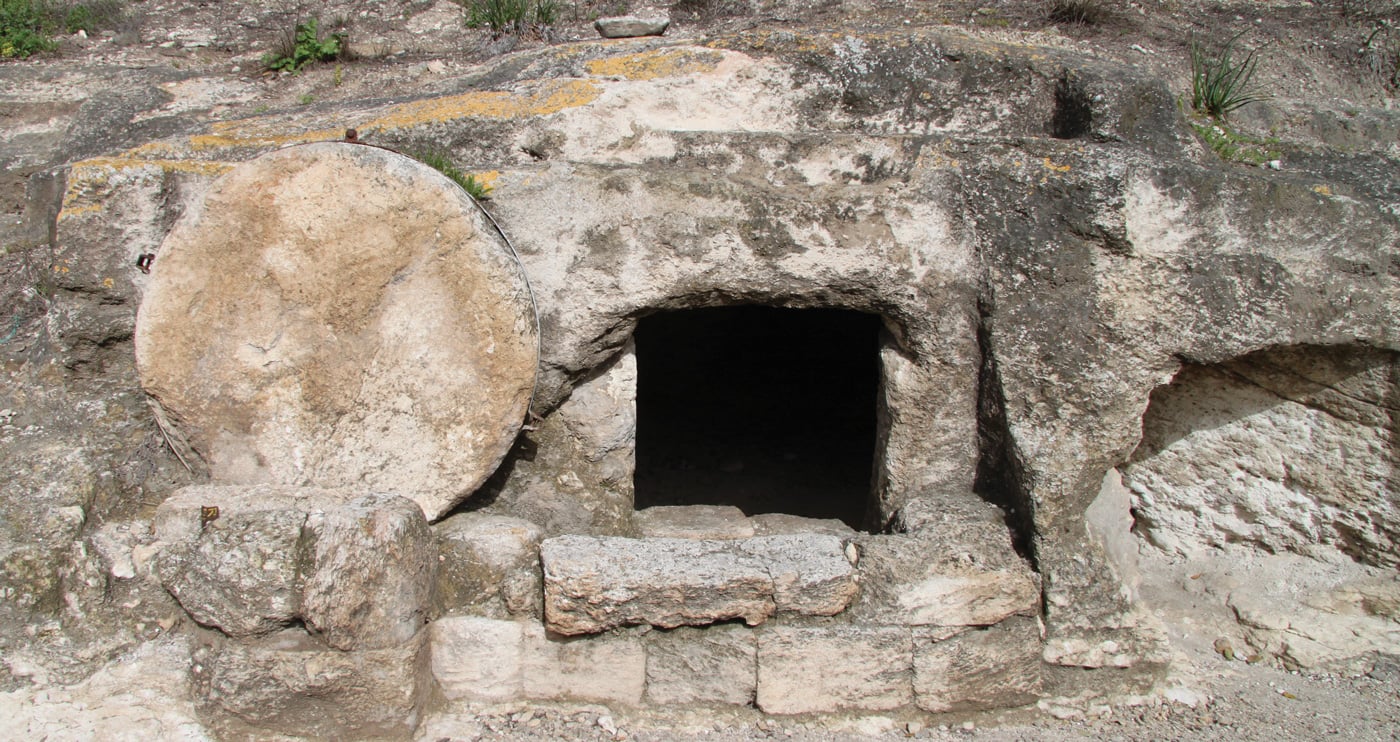
Rolling-stone tombs were common among the wealthy in first-century Judea. This tomb located in lower Galilee typifies the kind of tomb owned by Joseph of Arimathea and used for the burial of Jesus.
Her report to the disciples introduces a complete shift in subject (20:3–10). While the story provides numerous accurate details about what they view (20:5–7), the story primarily emphasizes the relation between John (the beloved disciple) and Peter. In the Fourth Gospel, John always gains the upper hand. He outruns Peter to the tomb (20:4) and looks in first. Even though Peter goes in first, John believes when he enters (20:8; cf. 20:29). This theme appears elsewhere in the Gospel. At the Last Supper, for instance, Peter recognizes in John some unique access to Christ (13:23–24). In 18:15–16 the beloved disciple admits Peter to the high priest’s home. And in 21:6–8 they are contrasted once again. Many scholars note that John bears the remarkable title “beloved disciple” (NIV “the disciple whom Jesus loved”) and conclude that to some degree the Fourth Gospel venerates him as a hero. No doubt the profundity of the Fourth Gospel and its penetration into the truth of Christ indicate John’s depth of faith and experience, to which these narratives of contrast bear witness.
The story of Mary Magdalene and Jesus (20:11–18) bears some resemblance to two separate Synoptic narratives. Mary now witnesses two angels (20:12) and afterward meets Jesus and seeks to embrace him (20:16–17). In Luke two angels appear to the women when they arrive at the tomb (Luke 24:4–9), and in Matthew we read about women seeing Jesus near the tomb and worshiping him (Matt. 28:9–10). The Johannine account, while independent of these, has clear historical moorings. (Note that Mary Magdalene appears in both Synoptic stories: Matt. 28:1; Luke 24:10.)
With the hour of glory, what message does this passage convey? Weeping (Greek klaiō, 20:11, 13, 15) is a prominent theme here and has a special Johannine usage. Elsewhere it appears at Lazarus’s funeral (11:31, 33), which is a paradigm of Jesus’s death. But, moreover, it is found in Jesus’s own prediction: “Very truly I tell you, you will weep and mourn” (16:20). Mary experiences the grief of being alone without Jesus. Yet in the Farewell Discourse, Jesus remarked that this mourning would become rejoicing (16:22).
But what will create this joy? The answer of the Farewell Discourse is now dramatized. Mary misunderstands Jesus’s appearance, thinking him to be a gardener (20:14–15). But when he calls her by name, she at once recognizes his voice (see 10:3, “He calls his own sheep by name”). Yet now she misunderstands the meaning of Jesus’s presence. Why does Jesus forbid her embrace (20:17) whereas in 20:27 he will invite Thomas to touch him? Mary is trying to hold on to the joy she has found in his resurrection. In effect Jesus is saying that his permanent presence with her will be in another form. This is precisely the message of the Farewell Discourse. Jesus’s “coming” will also be in the Spirit Paraclete, who will indwell his followers individually (14:18–26).
The message she is to convey (20:17) is that the final steps of departure are at hand. “Ascending” (Greek anabainō) is referred to in both the perfect and the present tenses: it has begun and is still under way. And it is necessary that it continue this way, since the coming of the Spirit is directly dependent on Jesus’s departure (16:7).
The story of Mary, therefore, is an interpretative vehicle that underscores the transition now under way. Jesus will not leave them as orphans (14:18) because as he moves through “the hour” he will give his Spirit. For this they must make ready. The gift of the Spirit will climax the events of “the hour.”
On the evening of this Easter Sunday, Jesus appears to the disciples and provides confirmation of his resurrection (20:20). Twice he speaks of “peace” (20:19, 21), fulfilling that which he promised in his farewell: “Peace I leave with you; my peace I give you” (14:27; 16:33). Seeing the Lord was also a part of this promise (16:16; thus for Mary, 20:18; the disciples, 20:20, 25; and Thomas, 20:25, 29), as was rejoicing (16:20; 20:20). In other words, Jesus is recalling his words from the upper room, and this must necessarily include the coming of the Spirit (20:19–29).
That this is a definitive gift of the Spirit and no symbolic event is clear. The comments in John 7:39 are satisfied: Christ has been glorified and the gift is given. The breathing of Jesus (Greek emphysaō) echoes Genesis 2:7, when God gives life to Adam. Jesus is such a creator (John 1:3), and the Spirit gives life (6:63). Thus, the gift of the Spirit is Christ’s re-creation. Above all, Jesus has given his own breath, his own Spirit, and the personal dimensions of his indwelling are emphasized. (On the relation of this anointing with that in Acts 2 see Burge 1986.)
In this hour Jesus also transfers to his disciples his own mission. He sends them forth (20:21) in the same way the Father commissioned him (13:16, 20; 17:18). The basis of the church’s authority is that it bears the commission of Christ. Furthermore, they will bear the divine Spirit, ensuring their success. The authority over sins (20:23) also reflects Jesus’s ministry (3:19–20; 9:40–41). However, its meaning must be carefully understood. The judgment of Christ stemmed from his revelation of the light and the response of his listeners. When the light is unveiled, each one brings judgment on himself depending on his response. The mission of the church is to continue the revelatory work of Christ in the world.
When Jesus met with the disciples, Thomas (11:16; 14:5; 21:2) was absent. He receives the now familiar Easter greeting (20:25) but claims that unless he can acquire this certainty himself (i.e., “see the Lord”) he will not believe. On the following Sunday the group is gathered again, and Jesus appears, offering to Thomas that which he seeks. Thomas provides the Gospel’s final response to Jesus when he offers the ultimate title of divinity and lordship to him (20:28). Jesus’s final words speak to Thomas and to the church together. While “seeing” forms the basis of the apostolic witness (Acts 1:21–22; 1 Cor. 15:3–8; 1 John 1:1–4), it cannot belong to all. Those who believe without seeing—without demanding signs (cf. John 4:48)—are more blessed still.
E. Conclusion (20:30–31). It is evident that this is a natural conclusion to the Gospel (see commentary on 21:1–25). The Fourth Evangelist stresses the purpose of his Gospel: that we might believe. (The verb has two readings, which the NIV calls attention to in a margin note: “to begin to believe” [aorist] and “to continue to believe” [present]; the former implies an evangelistic purpose, the latter a pastoral intent for those who already believe.) The Gospel is a record of signs—of evidences—that the reader must weigh. It stems from Jesus’s disciples, who are trustworthy witnesses (see 19:35), and in particular from the testimony of John (21:24). Its aim is to lead us to faith in Christ because in him alone can we find life.
The origin and placement of this final chapter has perplexed many. John 20:30–31 seems to be a natural ending to the Gospel, whereas chapter 21 seems to be an appendage. In 20:29 a blessing is given on those “who have not seen” and yet believe, and here we hardly expect another visit from the resurrected Christ. It is even possible that the editors who included this chapter identify themselves in 21:24 (see below).
That John’s Gospel has experienced some editorial attention need not surprise us; hints to this effect have been seen all along. We noted the prologue already (1:1–18) and the account of the adulterous woman (7:53–8:11, which also raises manuscript variant problems). Each is a narrative with its own unique history. We even noted how some scholars would reverse chapters 5 and 6 for greater sequential clarity. And finally, some have pointed to chapters 11 and 12, suggesting an expansion to the Book of Signs.
But to note such features is not to say that these additions cannot be from the pen of the Fourth Evangelist. On the contrary, each narrative enjoys a striking unity with the rest of the Gospel. In chapter 21 these connections are numerous. In 21:14 the appearance of Jesus is numbered as his third, which presupposes his appearances in 20:19 and 20:26. Typical of the Fourth Gospel is the John/Peter rivalry in 21:7 (cf. 13:23–25; 20:3–9). There is also characteristic Johannine language, such as the charcoal fire in 21:9 (cf. 18:18), the word for “fish” in 21:9–10, 13 (Greek opsarion, 6:9, 11), the reference to Thomas and Nathanael in 21:2 (cf. 1:45–46; 11:16; 14:5; 20:24), the name of Simon’s father in 21:15 (see 1:42), and the double use of “truly/amen” in 21:18 (see, e.g., 5:19; 6:26; 8:34).
This evidence suggests that chapter 21 is authentically Johannine but secondary to the original format of the Gospel (but see Smalley 1974). John 21:20–23 implies that John the apostle has died and that the community he founded is wrestling with his absence. Disciples who have survived their master identify themselves in 21:24 (“we know that his testimony is true”). No doubt they collected together John’s teachings—including chapter 21—and gave the Gospel its final form. This may even be the origin of other editorial “seams,” the testimonials such as that in 19:35, and the special title for John the son of Zebedee, “the beloved disciple.”
A. The miracle of 153 fish (21:1–14). Both Mark and Matthew record a resurrection appearance to the apostles after Easter, and Matthew specifically identifies Galilee as the place (Matt. 28:16–20; Mark 16:12–20; 14:26–28). This is also the Johannine setting. The story of the miraculous catch of fish has close parallels with another miracle (Luke 5:1–11). (Some would urge that John’s story is another rendering of that in Luke, but this conclusion is not necessary.) Here Jesus repeats the earlier fishing miracle, and this repetition becomes the vehicle of revelation. (The same is true of the meal in 21:9–14 as well as Peter’s triple confession in 21:15–17, echoing his triple denial, 18:15–18, 25–27.) Jesus takes them through the same experience twice, and in this discloses his identity to them.
The Sea of Tiberias is an alternate name for the Sea of Galilee and comes from Herod Antipas’s regional capital of Tiberias, on the western shore. The apostles and a number of additional disciples have returned to their native Galilee after Easter (cf. Matt. 28:16), some apparently assuming their former occupations. In Matthew and Mark a critical note is sounded: each mentions the disciples’ lack of faith and records Jesus’s call to go forth into the world (Matt. 28:17, 19; Mark 16:14, 15). Something apparently has failed in the men’s resolve and conviction.
In the present story Jesus takes charge of Peter’s fishing venture. Despite a night of fruitless toil (21:3; compare the earlier miracle, in Luke 5:5) they are obedient to the voice on the shore, even though they do not yet recognize Jesus (21:4; cf. 20:29). Just like in the earlier fishing miracle, the nets are filled (21:6; Luke 5:6), and just like before, Peter responds prominently in devotion to Christ (21:7; Luke 5:8). However, the familiar superiority of the beloved disciple appears even here (cf. 13:23–24; 20:3–4, 8). He recognizes Jesus first, and on his word Peter runs to the beach. It is interesting to think about the beloved disciple’s response in light of this rivalry motif. He stays with the fish and brings them safely to shore.
Although Peter’s despair is turned to jubilation at the size of the catch and the appearance of Jesus, the meaning of the miracle lies deeper. Johannine symbolism often produces two levels of meaning (e.g., 3:3–4; 4:7–8), and we should expect the same here. The fish and bread served by Christ recall the feeding miracle in 6:1–14. (Peter might even recall an earlier charcoal fire, 18:18.) Jesus is revealing himself by evoking memories of past activities.
But here the recently caught fish play a central role. The beloved disciple has not neglected them (21:8), and Jesus orders Peter to bring the net finally ashore (21:10–11). The number of fish (153) is striking and is not an accidental note. First-century writers enjoyed cryptic devices, especially numerical values that symbolized some word or thought (e.g., 666 in Rev. 13:18). Jerome says that 153 was the ancient number of known fish species. In effect John would be saying that all people are part of the church’s mission. But evidence for this interpretation is slim. Some scholars suggest mathematical sums (1 + 2 + 3 . . . + 17 = 153. And 17 = 10 + 7, two numbers of perfection) (e.g., Barrett, 581–82). But the riddle remains unsolved.
Essentially Jesus is emphasizing the mission of the disciples. When Jesus directs their work, they will prosper. And the beloved disciple has indeed chosen the correct task: to remain with the fish so that none are lost (cf. Matt. 4:19). This is the same theme in John 21:15–19. Peter will be challenged to compare his devotion to Christ with his care for Christ’s sheep.
B. Jesus and Peter (21:15–23). The exchange between Jesus and Peter is one of the most celebrated dialogues in the Bible (21:15–17). Its interpretation turns on our understanding of verse 15: “Do you love me more than these?” What is Jesus’s comparison? (“These,” Greek toutōn, being any gender, has no clear antecedent.) On the one hand, is Peter being asked if his love for Christ exceeds his love for fishing? This is plausible since it was Peter who instigated the trip to sea (21:3), and Jesus will challenge the apostle to recommit his efforts to ministry with the new sheep metaphor. On the other hand, “these” may refer to the other disciples. If Peter’s love for Christ excels generally, then it should be followed by a coordinate care for God’s flock.
Either way, Jesus’s challenge to Peter is that he consider carefully his love for his Lord and take up the task of shepherding. The dialogue enjoys numerous interplays of Greek synonyms: two words for love (agapaō, phileō), the flock (arnia, probata), tending/caring (boskō, poimainō), and know (oida, ginōskō). Of these pairs of synonyms, the interplay of verbs for “love” has inspired most comment. (Jesus uses agapaō twice and then phileō in the final exchange; Peter uses phileō throughout.) This variation is either a feature of John’s Greek style—the other synonym pairs suggest this—or it bears some meaning. If the latter is true then two options are possible. Either Jesus consents to Peter’s verb and we find in phileō an affectionate love Peter desires to express, or agapaō is the greater love (a sacrificial love), and Jesus is challenging the quality of Peter’s affection. In this sense Peter confesses some limit to his love. Above all it must be recalled that these verbs were interchangeable in the first century and that even John himself seems to use them as synonyms (cf. 3:35 with 5:20; 13:23; 19:26; 21:7, 20). This is the most common interpretation among modern commentators.
Jesus now turns to a description of the fate of Peter and John (21:18–23) and especially what it will mean for Peter to “follow” him (21:19). Peter once announced that he was willing to follow Jesus even to death (13:37). Jesus demurred, predicting Peter’s denial (13:38). But now all things are changed. Jesus now predicts Peter’s faithfulness even to death (21:18), and John, for fear that we might misunderstand, provides an explanatory note (21:19; so too 12:33). “Stretch out your hands” implies crucifixion. While we know that Peter was martyred in the 60s, Tertullian in the early third century AD explains that he died on a cross.
In 21:20–23 the discussion of Peter’s martyrdom opens the subject of the beloved disciple’s death. The nature of Jesus’s comment (21:22) and the editorial notes of the writer (21:23) indicate that within the community of believers was a belief that John was going to survive until the second coming of Christ. But he did not. Here is evidence of the dismay that must have gripped the church during the eventual death of the apostles. Jesus’s words are repeated: disciples should continue to follow and not be distracted by speculations about Christ’s future will. For John’s church the message is clear: John’s survival may not have been Christ’s will at all.
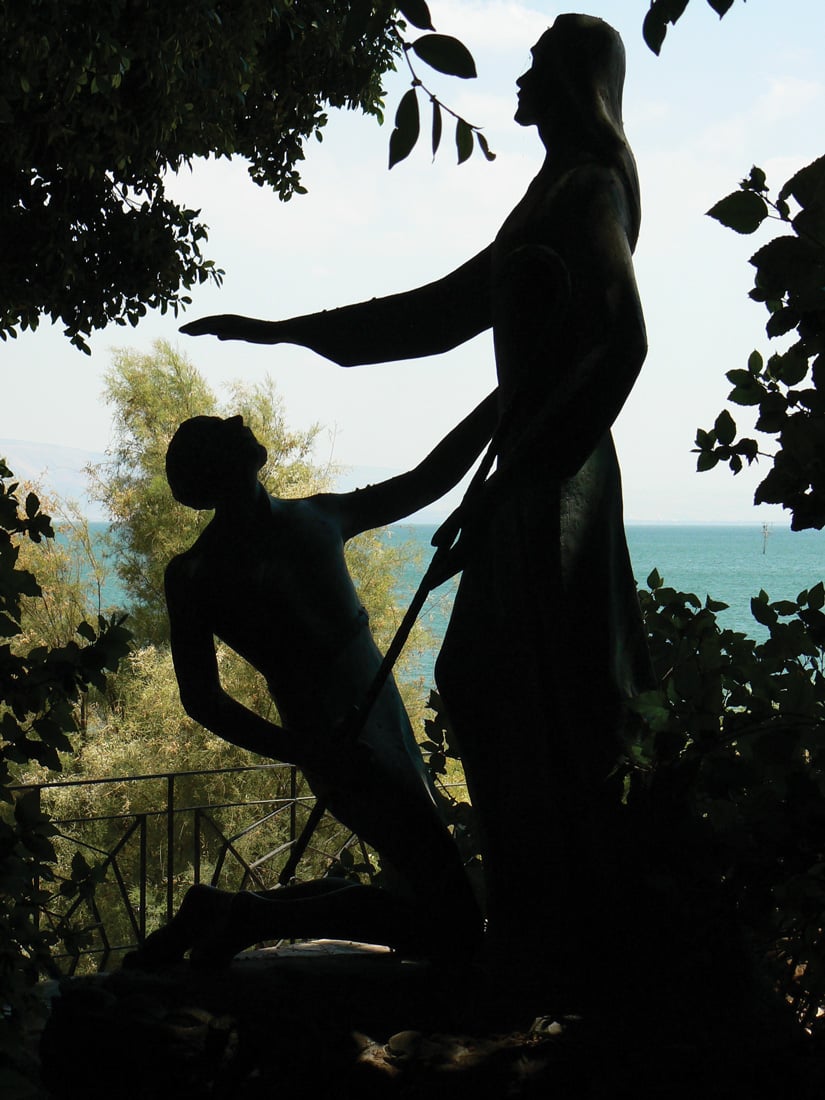
Along the Sea of Galilee’s north shore, on the grounds of the Franciscan Catholic Church of St. Peter’s Primacy, stands this modern statue commemorating Jesus’s commissioning of Peter (see John 21:15–19). At this location, archaeologists have uncovered the remains of a fourth-century church, proving the sanctity of this site in antiquity.
C. Appendix (21:24–25). These final notes assert the authority of the beloved disciple as a reliable eyewitness and as the originator of a trustworthy historical tradition. This same sort of confirmation is given in 19:35. From 1 John 1:1–4 we can see how John’s connection with the historical events of Jesus’s life was valued. Moreover, the Gospel bears eloquent testimony to the power of John’s spiritual perception of Christ, and this too must have been deeply respected.
The disciples of John who penned these words identify themselves in the plural “we” of 21:24. They have survived their pastor and now have collected his teachings for the church. The process must have been difficult, for as 21:25 indicates, the amount of material at their disposal was voluminous.
Select Bibliography
Barrett, C. K. The Gospel according to St. John. 2nd ed. Philadelphia: Westminster, 1978.
Bauckham, Richard. The Testimony of the Beloved Disciple: Narrative, History, and Theology in the Gospel of John. Grand Rapids: Baker Academic, 2007.
Beasley-Murray, G. R. John. Word Biblical Commentary. Waco: Word, 1987.
Blomberg, Craig. The Historical Reliability of John’s Gospel: Issues and Commentary. Downers Grove, IL: InterVarsity, 1998.
Brown, Raymond E. The Gospel according to John. 2 vols. New York: Doubleday, 1966–70.
Bruce, F. F. The Gospel of John. Grand Rapids: Eerdmans, 1984.
———. “The Trial of Jesus in the Fourth Gospel.” In Gospel Perspectives. Vol. 1 of Studies of History and Tradition in the Four Gospels. Edited by R. T. France and D. Wenham. Sheffield: JSOT Press, 1980.
Burge, Gary M. The Anointed Community: The Holy Spirit in the Johannine Tradition. Grand Rapids: Eerdmans, 1986.
———. John. NIV Application Commentary. Grand Rapids: Zondervan, 2000.
———. “A Specific Problem in the New Testament Text and Canon: The Woman Caught in Adultery (John 7:53–8:11).” Journal of the Evangelical Theological Society 27 (1984): 141–48.
Carson, D. A. The Gospel according to John. Pillar New Testament Commentary. Grand Rapids: Eerdmans, 1991.
Dodd, C. H. Historical Tradition in the Fourth Gospel. Cambridge: Cambridge University Press, 1963.
Käsemann, Ernst. The Testament of Jesus. Philadelphia: Fortress, 1968.
Keener, Craig. The Gospel of John: A Commentary. 2 vols. Peabody, MA: Hendrickson, 2003.
Ladd, George Eldon. A Theology of the New Testament. Rev. ed. Grand Rapids: Eerdmans, 1993.
Milne, Bruce. The Message of John. The Bible Speaks Today. Downers Grove, IL: InterVarsity, 1993.
Morris, Leon. The Gospel according to John. New International Commentary on the New Testament. Grand Rapids: Eerdmans, 1971.
———. “The Jesus of St. John.” In Unity and Diversity in New Testament Theology. Edited by Robert A. Guelich. Grand Rapids: Eerdmans, 1978.
Smalley, S. S. John: Evangelist and Interpreter. New York: Thomas Nelson, 1978.
———. “The Sign in John 21.” New Testament Studies 20 (1974): 275–88.
Whitacre, Rodney A. John. IVP New Testament Commentary. Downers Grove, IL: InterVarsity, 1999.
Zugibe, F. T. The Cross and the Shroud. New York: Paragon, 1986.