Matthew
1. Jesus’s Identity and Preparation for Ministry (1:1–4:16)
A. Birth and Infancy (1:1–2:23)
B. Baptism and Temptation (3:1–4:16)
2. Jesus’s Announcement of the Kingdom to Israel and Resulting Responses (4:17–16:20)
A. Proclamation of the Kingdom in Word and Action (4:17–11:1)
B. Rejection by Leaders and Jesus’s Withdrawal from Conflict (11:2–16:20)
3. Jesus to Jerusalem: Kingdom Enactment through Death and Resurrection (16:21–28:20)
A. Journey to the Cross and Teaching on Discipleship (16:21–20:28)
B. Final Proclamation, Confrontation, and Judgment in Jerusalem (20:29–25:46)
C. Jesus’s Execution by Rome and Resurrection/Vindication by God (26:1–28:20)
Introduction
Purpose
The author of the Gospel of Matthew, writing to believers in Jesus in the latter part of the first century, portrays Jesus as God’s chosen Messiah, who paradoxically ushers in the reign of God through his self-giving ministry and death. Matthew communicates that Jesus’s messianic claims and mission are vindicated at his resurrection, when God grants him all authority. Matthew seeks to persuade his readers to respond in trust, loyalty, and obedience to Jesus Messiah and his teachings and to empower them to invite others to follow and obey Jesus through the promise of Jesus’s presence with them.
A Narrative Reading
This commentary offers a narrative reading of Matthew, emphasizing its story features, internal coherence, and thematic development. Narrative criticism as a method for studying the Gospels analyzes a narrative at two levels—story and discourse. Analysis of the story level focuses on setting, character, and plot development. Discourse-level assessment focuses on the ways the implied author (implied within the narrative) tells the story to communicate with the implied audience. An author communicates on the discourse level through sequencing (see “Sources” below), structural devices (see “Structure” below), thematic development, and authorial comments. (For a description of narrative analysis, including implied author and audience concepts, see Brown 2007, 157–63, also 40–42.) For example, Matthew narrates nine miracle stories in 8:1–9:34 in order to stress themes of Jesus’s authority and the importance of faith. Thus, while attending to story and discourse levels, a narrative reading also seeks to understand the book of Matthew in light of its historical setting.
Author, Date, and Audience
Although the Gospel itself is anonymous, the title (added in the second century) specifies Matthew as the author. Church tradition also attributes it to Matthew the apostle (Eusebius, Ecclesiastical History 3.24.16, citing testimony from Papias, a second-century bishop). Modern scholarship has questioned these traditions, but certain scholars continue to support Matthew as the author of the first Gospel (see discussion in Keener, 38–41).
One difficulty for determining authorship is the nature of narratives, which point away from the author and toward the story being told. Matthew’s author intends the audience to focus its attention on Jesus and the events and time frame of his life rather than on the author and the author’s world. Yet reconstructing something about the author, audience, and date from the Gospel is possible by studying indirect references within the story (e.g., does 22:7 indicate Matthew writes after the destruction of Jerusalem?) and attending to direct authorial commentary where it occurs (e.g., 24:15; 28:15). Such reconstruction of the implied author, date, and audience (implied within the narrative) may be sketchy, since internal evidence can support contrasting reconstructions (as in the dating of Matthew).
The internal evidence of the first Gospel suggests that the author is a Jewish follower of Jesus (e.g., 1:2–17; Old Testament fulfillment themes), possibly from a scribal background (cf. 13:52; 23:1–2), who writes to a primarily Jewish audience (e.g., explanation of Pharisaic traditions from Mark 7:3–4 omitted in Matt. 15:1–2; also Gentile-inclusion theme), most likely between AD 68 and 85. In this commentary, “Matthew” will be used to refer to the Gospel’s implied author.
Sources
Matthew’s clearest source is the Jewish Scriptures (the Old Testament), which he cites and alludes to frequently (over seventy times by some counts). In fact, the Old Testament story is assumed and evoked throughout Matthew (e.g., Israel’s exile and restoration in chapters 1–4; Psalm 22 in Matt. 27:32–50). Of the four evangelists, Matthew cites the Old Testament most often. Ten times he employs a formulaic introduction to highlight Jesus as fulfillment of the Old Testament (1:22–23; 2:15; 2:17–18; 2:23; 4:14–16; 8:17; 12:17–21; 13:35; 21:4–5; 27:9; cf. also 2:5; 3:3; 13:13–15). These fulfillment quotations typically connect at the story level (by connecting the Old Testament quotation with an event in Jesus’s life) and function theologically (on the discourse level) to illuminate Jesus’s fulfillment of Old Testament themes and contours in a more thematic way (see commentary on 2:1–23). Richard Beaton refers to the “bi-referentiality” of these citations (see Beaton, 5, 120; these two levels of narrative are described below). Matthew’s use of the Old Testament sets Jesus’s life and mission within the story and promises of Israel.
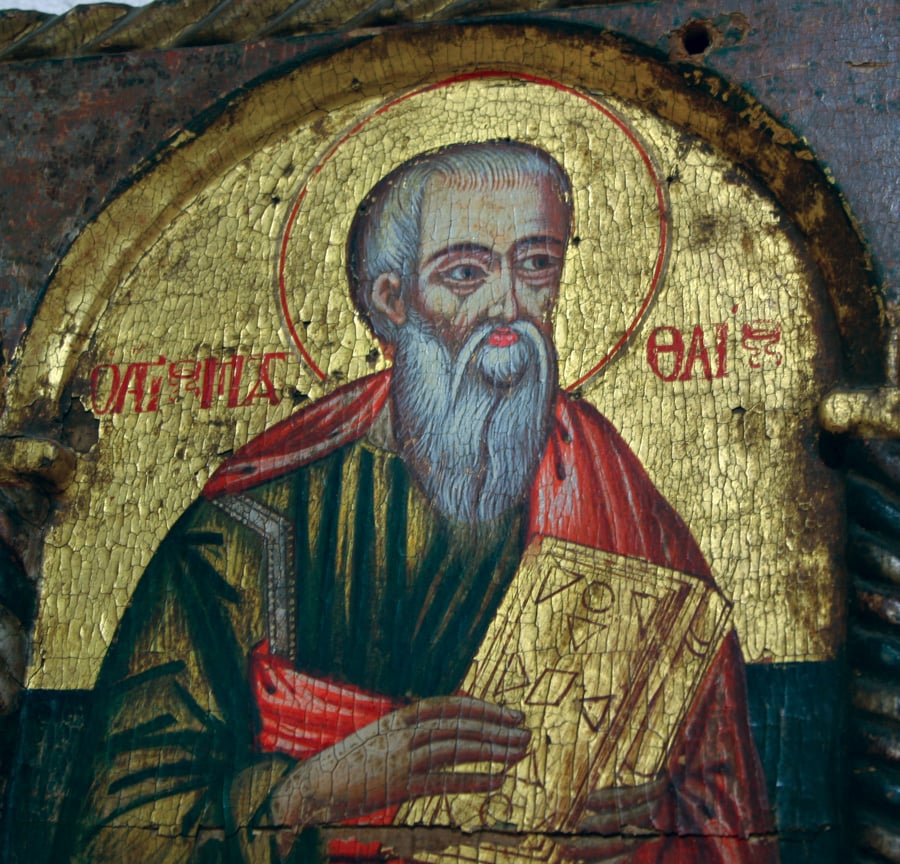
An icon of Matthew from a larger piece entitled Christ and Twelve Apostles (Antalya, Turkey, nineteenth century AD)
Modern Gospels scholarship has argued for a written dependence between Matthew, Mark, and Luke (the Synoptic Gospels), given their frequent overlap. Matthew most likely used Mark as a source for his Gospel, along with other oral and/or written Jesus traditions. Matthew begins making use of Mark at Matthew 3:3 (cf. Mark 1:3), continuing to borrow material throughout his Gospel. (About 90 percent of Mark is included in Matthew.) He omits some material from Mark (e.g., Mark 8:22–26), adds freely to it (e.g., blocks of Jesus’s teachings), and sometimes rearranges passage order (e.g., Mark 4:35–5:43 lies behind Matt. 8:23–9:26 prior to material from Mark 2:23–4:34 in Matt. 12:1–13:58). Such freedom of arrangement would have fit ancient narrative practices. For example, Greco-Roman biographies were typically arranged by topic rather than strict chronology (e.g., eight kingdom parables clustered in Matthew 13).
Theological Themes
God’s reign (the kingdom of God) as theological centerpiece. Studying a Gospel’s theology involves exploring the author’s presentation of God’s person and activity, which in Matthew focuses on the kingdom of God (Matthew’s “kingdom of heaven”; see commentary on 4:17–25). A key assumption in Matthew is that Israel’s God has promised to restore them in faithfulness to covenant promises. God’s rule will be fully established in this world when God comes to bring restoration (e.g., Isa. 52:1–10). A central affirmation in Matthew is that Jesus, the Davidic Messiah, inaugurates God’s reign, as God’s chosen king and Lord (28:18) and the manifestation of “God with us” (1:23; 28:20). Matthew also develops the kingdom theme by reference to Isaiah’s motif of exile/return (e.g., Isa. 40:1–9; cf. Matt. 3:3). Jesus is portrayed as the one who both makes possible and enacts Israel’s return from exile.
An “already/not yet” eschatology characterizes Matthew’s kingdom theology. God has inaugurated the kingdom in Jesus, the Messiah-King; yet the consummation of God’s reign is future, at “the end of the age” (a phrase Matthew uses; cf. 13:39, 40, 49; 24:3; 28:20). In line with the “not yet,” Jesus’s teaching highlights the present hidden nature of the kingdom, so that divine revelation and human faith are needed to perceive it (chap. 13). The hiddenness of the kingdom arises partly from the paradoxical way Jesus comes to be king—not through assertion of power but by willing and missional self-sacrifice (27:27–50). Yet Jesus’s cross-shaped mission is authenticated and vindicated by his resurrection, when God grants Jesus all authority (28:18), showing him to be God’s faithful and favored Son (3:17; 17:5).
In Old Testament prophetic expectation, God’s reign and Israel’s restoration would coincide with Gentile ingathering (e.g., Mic. 4:1–2; Isa. 25:1–12). Matthew emphasizes this aspect of God’s kingdom throughout his narrative, beginning by highlighting Gentiles in Jesus’s genealogy (1:3, 56) and concluding with Jesus’s mission to all nations (28:19; cf. also 2:1; 4:15; 8:5–13; 15:21–28; 21:43; 24:14; though also 10:5–6; 15:24). God’s plan that Abraham’s family would be a blessing to the earth’s peoples (Gen. 12:3) comes to fruition as Jesus inaugurates the kingdom (see commentary on 28:1–20).
Christology. Matthew’s portrait of Jesus is multifaceted and informed by various christological titles, Jesus’s actions in the plot (e.g., healings; cf. 11:2–5), and key Old Testament story lines and texts tied to his identity. I sketch here four (overlapping) categories, which will emerge in this commentary: Jesus as Davidic Messiah who inaugurates the kingdom, as representative of Israel, as the embodiment of Yahweh in Israel’s restoration, and as fulfiller of the Scriptures.
Matthew consistently portrays Jesus as Davidic Messiah, emphasizing his royal identity (1:1; 2:5–6; 21:1–11; with the Hebrew mashiah translated into Greek as christos). Though first-century messianic views were numerous and varied, the royal connotations of Davidic association would have been commonplace (e.g., Psalms of Solomon 17:5; cf. “Son of David” title in 9:27; 12:23; 15:22; 20:30, 31; 21:9, 15; 22:42). This association coheres with Matthew’s theological emphasis on God’s kingdom begun in Jesus, the royal Messiah. Yet Matthew also expands this category as Jesus speaks and enacts God’s reign in ways that move outside Jewish messianic expectations, especially as he enacts the role of servant of the Lord from Isaiah (cf. Isa. 42:1–4 cited in Matt. 12:18–21; Isa. 53:4 cited in Matt. 8:17; also likely allusions to Isaiah 53 at Matt. 20:28 and 26:28). For Matthew, Isaiah’s portrait of the servant, who willingly takes on suffering to bring justice and mercy to Israel and the nations, describes Jesus (though not in first-century Jewish expectations, since Isaiah’s Suffering Servant was understood as referring to Israel, not the Messiah; e.g., Isa. 44:1).
Another messianic title Matthew uses is “Son of God” (e.g., 14:33; 16:16), easily heard by modern ears as a divine title. Yet the clearest Old Testament examples of those called son by God are Israel (e.g., Exod. 4:22; Hos. 11:1; also Jubilees 1:25) and Israel’s kings (2 Sam. 7:14; Ps. 2:1–12). Therefore, the term “Son of God” has messianic connotations (e.g., 2 Esdras 7:28–29; Dead Sea Scrolls, 4Q246 2.1) (Wright 1996, 485–86). In addition to evoking Jesus’s role as Israel’s representative (see below), Matthew uses the phrase as an alternate way to designate Jesus as Messiah (cf. 16:16; 26:63; alternate to “king” in 27:41–44), although with emphasis on Jesus’s intimacy with the Father (e.g., 3:17; 11:25–27; 17:5).
Matthew highlights Jesus as the faithful representative of Israel in identity and mission, especially in chapters 1–4. Just as God brought Israel from exile in Egypt, God does the same for Jesus and his family (2:15, 19–21). In contrast to Israel’s disobedience when tempted in the wilderness, Jesus proves his faithfulness to God when facing the same temptations (4:1–11) and demonstrates the covenant loyalty that God requires of Israel (cf. 3:17 with Isa. 42:1–4; cf. also Matthew’s use of Psalm 22 in Matt. 27:27–50). Jesus’s faithfulness even to death is vindicated by God in the resurrection, again at the temple’s destruction in AD 70 as Jesus predicts, and finally at “the end of the age,” when Jesus will judge all humanity. Matthew highlights vindication by repeated evocation of Daniel 7:13–14, which pictures a vindicated “son of man” approaching God’s throne and receiving all authority (see 10:23; 16:27–28; 24:30–31; 26:64; see also 25:31 and 28:18). In Daniel’s vision explained, it is “the holy people of the Most High” (i.e., Israel’s faithful) who are represented by the son of man (cf. Dan. 7:18, 22, 27), so that Matthew’s use of this vision connects the vindication of Jesus’s faithfulness to his role as Israel’s representative. Matthew’s use of “Son of Man” is always a self-designation by Jesus. In many cases, it seems to be just that: a way that Jesus refers to himself, possibly in solidarity with Israel (see God’s frequent reference to Ezekiel as “son of man,” e.g., Ezek. 2:1). Yet when “Son of Man” occurs in allusions/citations to Daniel 7:13–14, Matthew means to communicate Jesus’s vindication to a position of universal authority.
A central christological affirmation implicit but crucial to Matthew’s story is Jesus as the embodiment of Yahweh (Israel’s God; cf. Exod. 3:14–15). For Matthew, Jesus enacts Israel’s redemption (1:21), fulfilling God’s promises that God will bring redemption (Wright 1996, 653). For example, Matthew affirms Jesus as “the Lord” for whom John prepares the way, citing Isaiah’s prophecy that Yahweh (“Lord” translates the divine name; Isa. 40:3) will return to Zion (Matt. 3:3; Isa. 40:1–5), connecting Jesus intimately with Yahweh’s mission and even identity (cf. also Matt. 22:41–46). Jesus is also granted the role of universal Lord and judge, a role reserved in the Old Testament Scriptures for God alone (11:27; 25:31; esp. 28:18; cf. Dan. 7:13–14). Jesus’s lordship implicitly affirms Jesus’s inclusion in the “unique divine identity” (Bauckham, viii). Appropriate to his lordship, Matthew portrays characters worshiping Jesus (Greek proskyneō is used ten times with Jesus as object, more than the combined total from Mark, Luke, and John). Matthew highlights worship of Jesus by beginning and ending with it (the Magi in 2:2, 11; Jesus’s followers in 28:9, 17).
A final christological category Matthew emphasizes is Jesus as fulfiller of the Scriptures. This category arches over the others, since, according to Matthew, the covenant and promises of God find their fulfillment in Jesus (with “the Law and the Prophets” referring to the Old Testament Scriptures at 5:17; 7:12; 11:13; 22:40). Matthew highlights this category with his many Old Testament citations and allusions and his affirmation of Jesus’s obedience to God’s will (see above; also 12:12). Yet Matthew focuses particular attention on Jesus’s relationship to the Jewish law (Hebrew torah). Jesus is shown to fulfill rather than abolish the law (the torah) by interpreting and teaching it rightly (5:17, with 5:21–48), because Jesus interprets the torah by its central qualities of mercy, justice, love, and faithfulness (9:13; 12:7; 22:24–40; 23:23). In this way, Jesus’s torah interpretation is not burdensome (11:28–30), like some teaching he critiques (23:4). Yet Matthew’s Jesus also embodies the torah by virtue of his messianic authority (e.g., 7:29; 11:25–30). It is Jesus’s teaching (on the Law and the Prophets) that is authoritative for his followers (28:19).
Structure
While scholars debate Matthew’s overarching structure, it is not for lack of discernible structural clues, which are abundant. The twofold “From that time on Jesus began to [preach/show] . . .” at 4:17 and 16:21 signals major turning points in Matthew’s plot. Second, each of the five major blocks of Jesus’s teaching concludes with the formulaic “After/When Jesus had finished . . .” (7:28–29; 11:1; 13:53; 19:1; 26:1), transitioning between Jesus’s teaching and the subsequent story. Other structural signs include use of inclusio (a bookending device; cf. 4:23 // 9:35; 1:23 // 28:20) and a preference for groupings of three (e.g., 8:1–9:34—nine miracle stories in three groupings of three; 21:28–22:14—three parables).
Commentary
1. Jesus’s Identity and Preparation for Ministry (1:1–4:16)
In the first major section of Matthew’s Gospel, the author introduces Jesus of Nazareth by identifying him as the Jewish Messiah, son of David; the enactor of restoration from exile; hope for the Gentiles; the obedient Son who represents faithful Israel; and “God with us.” Moving from Jesus’s genealogy and his conception by the Spirit to the threat that his God-authenticated kingship poses to Herod, Matthew narrates God’s protection and guidance of Jesus and his family in the face of societal and political threats. Decades elapse between Matthew 2 and 3, where we are introduced to John the Baptist and the adult Jesus. Matthew 3 narrates Jesus’s preparation for ministry as he is baptized by John, signaling God’s covenant faithfulness to Israel and affirming Jesus’s faithfulness. Jesus’s wilderness temptations in Matthew 4 affirm his identity as the faithful Son of God, fulfilling Israel’s call to covenant faithfulness, which includes being a light to the Gentiles (4:13–16).
A. Birth and infancy (1:1–2:23). Matthew begins the infancy narrative of Jesus by emphasizing Jesus’s lineage from Joseph (1:1–17) and Mary’s conception of Jesus from the Holy Spirit. He resolves the tension between these two by narrating Joseph’s adoption of Jesus (1:18–25). He highlights Jesus’s Jewish and Davidic ancestry, the surprising presence of Gentiles in his lineage, and the themes of exile and restoration now enacted in Jesus the Messiah of Israel, who is Immanuel, “God with us.” Matthew continues narrating Jesus’s infancy (2:1–23) by describing the immediate threat that Jesus as Messiah-King is to Rome’s client-king Herod, all the while affirming through Old Testament citations that Jesus is the legitimate, Davidic “king of the Jews.” Once again, Gentiles make an entrance (the Magi) and themes of exile’s end and restoration now begun in Jesus are evoked in Matthew’s Old Testament usage. Throughout the story, God’s guidance comes through dreams, angel’s voices, and even an eastern star.
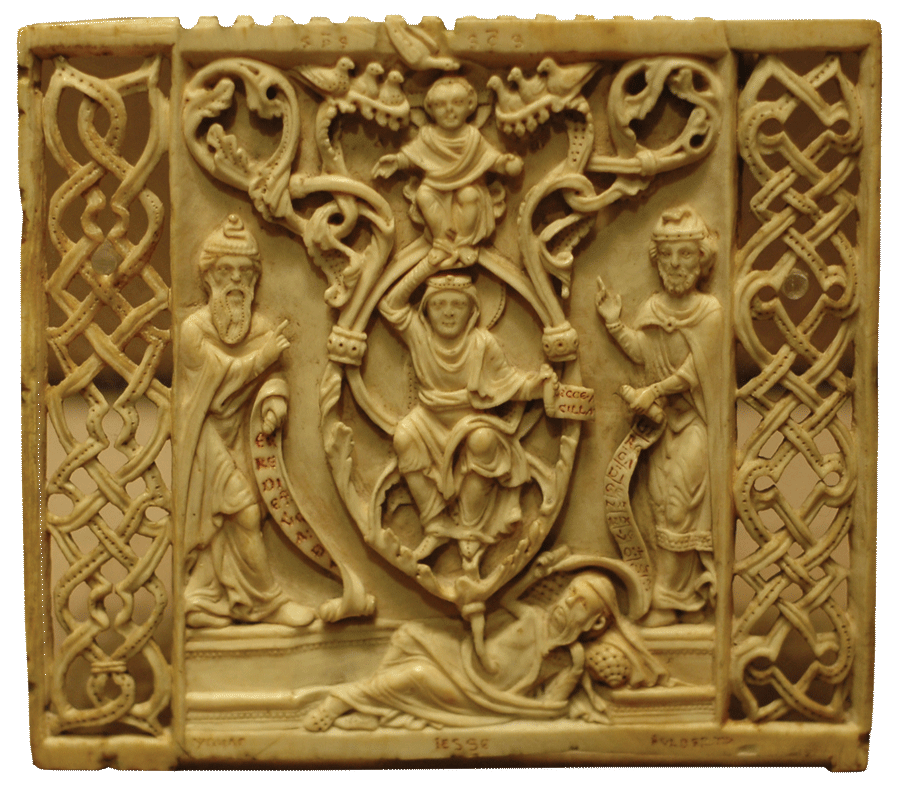
Used to illustrate the genealogy of Jesus, a Jesse tree is an artistic representation of a shoot from the stump of Jesse (Isa. 11:1–2). Typically, Jesse reclines at the base with a branch coming out of his side. Side branches embrace figures that represent other ancestors of Jesus. Jesus is at the top, with Mary just beneath him. This portion of an ivory comb from Bavaria (1200 AD) shows a Jesse tree with prophets on either side of Mary and Jesus.
1:1–17: Jesus’s genealogy. Matthew begins his Gospel with a clear affirmation of the identity of this person Jesus, who will occupy the center of his narrative. From the opening title, the author highlights three aspects of Jesus’s identity: Jesus is the Messiah (“Jesus Christ”), Jesus is a descendant of David (“son of David”), and Jesus is a descendant of Abraham (“son of Abraham”). These three affirmations will inform the rest of Matthew’s story of Jesus; they also frame the genealogy of Jesus that follows 1:1. In fact, Matthew has carefully structured the genealogy to reflect these affirmations in reverse order, so that 1:1–16 forms a literary parallelism (A-B-C-Cʹ-Bʹ-Aʹ):
Jesus as
A Christ (1:1)
B Son of David (1:1)
C Son of Abraham (1:1)
Cʹ Abraham (1:2)
Bʹ David (1:6)
Aʹ Christ (1:16)
Beginning with a genealogy is a natural way in Matthew’s Jewish context to focus concerted attention on Jesus’s identity. In ancient perspective, family line was intimately connected to identity. In addition to the inverted literary framework, Matthew structures Jesus’s genealogy by arranging it in three groups of fourteen (1:17). This shaping coheres with the genre of ancient genealogy, in which the listing of generations could be condensed (i.e., generations skipped) for specific purposes.
Matthew indicates at 1:17 that the reader is to hear three movements of fourteen as important. The genealogy begins with Abraham, signaling the origins of Israel as a people. The first grouping ends (and the second begins) with David, the prototypical king of Israel. The second grouping ends (and the third begins) with the time of exile to Babylon, highlighting that time in Israel’s history when there was no king in Israel and the people were exiled from the land. An exilic motif may also be signaled in the genealogy by the addition of “and his brothers” (1:11). The repetition of this phrase at 1:2 and 1:11 suggests that “and his brothers” marks Israel’s two primary exiles, times when God’s people are dislocated from the land God has promised them. The genealogy’s final grouping ends with “Jesus, who is called the Christ” (1:16 KJV, RSV; Greek christos is the term that translates the Hebrew mashiah). The beginnings and ends of these three movements in Israel’s history might be summarized as (1) the origin of Israel (Abraham); (2) kingship provided for Israel (David); (3) kingship and land lost (exile); and (4) kingship restored (Jesus, the Christ). In the genealogy, Matthew rehearses Israel’s history to emphasize that Davidic kingship is restored in Jesus the Messiah.
Scholars have understood Matthew’s emphasis on the number fourteen in various ways. Its significance might rest in the notion of seven as indicating completion, either fourteen as a doubled seven or three sets of fourteen indicating that six cycles of seven lead into the time of the Messiah—a seventh seven (e.g., Dan. 9:24). More likely, given David’s prominence in the genealogy (1:1, 6, 17; cf. 1:20), fourteen is a gematria (the sum numeric value of Hebrew letters in a word) derived from David’s name. The three Hebrew consonants in David’s name (dalet-vav-dalet: D-V-D) total fourteen.
An intriguing aspect of Matthew’s genealogy is the presence of four women in its early moments: Tamar, Rahab, Ruth, and Uriah’s wife (1:3, 5–6). The inclusion of women in Jewish genealogies is atypical, since genealogies were patriarchal in form. The inclusion of these four women hints at an important theme to come: Gentile inclusion. Tamar and Rahab, both Canaanites (Tamar likely so: Gen. 38:1–6; Rahab: Josh. 2:1), and Ruth, a Moabite (Ruth 1:4), are surprising ancestors of Jesus, given their Gentile origins (see “Theological Themes” in the introduction). While there is no biblical evidence for the ethnic identity of Bathsheba, the fact that Matthew refers to her as “Uriah’s wife” rather than by her name provides evidence that he is highlighting precisely her Gentile connection (Uriah the Hittite; 2 Sam. 11:3).
Through his carefully crafted genealogy, Matthew emphasizes Jesus as the Messiah, the long-awaited Davidic king who will restore the hopes of exiled Israel and will usher Gentiles into Israel’s blessing (cf. Gen. 12:1–3). Yet, just as the author reaches the zenith of Jesus’s genealogy, he introduces a crucial problem for understanding Jesus as belonging to this lineage. For at 1:16, it becomes clear that Joseph’s lineage is being rehearsed; yet Jesus is born of Mary, not Joseph (“of whom” [NKJV, RSV] translates a Greek relative pronoun that is singular and feminine, so it cannot refer to Joseph). Matthew answers this conundrum in 1:18–25.
1:18–25: Jesus’s birth. The narration of Jesus’s birth is closely tied to the preceding genealogy by the repeated Greek term genesis, translated as “genealogy” in 1:1 and “birth” in 1:18. Both accounts provide an important aspect of Jesus’s “origin,” another possible translation of genesis. These two passages provide the question and answer to Jesus’s connection to Joseph’s lineage, with Joseph as a focal character in 1:18–25.
Matthew narrates that Joseph is engaged to Mary when he discovers her pregnancy. Because of his righteous character (see commentary on 3:1–17), he plans to divorce her in a way that avoids drawing attention to the situation. Jewish engagements at this time were enacted by a marriage contract, although the wife would not move to her husband’s household until a year after becoming engaged. If a breaking of the engagement was desired, a legal dissolution of the marriage contract was required. This provides the context for Joseph’s plan to “divorce” Mary. (If later rabbinic writings indicate first-century marriage practices, Mary and Joseph were likely in their teens: Mary between the ages of twelve and fourteen with Joseph a bit older.)
Before Joseph is able to pursue this plan, however, an angel of the Lord appears and speaks to him in a dream. Angels and dreams will continue to guide Jesus’s family in the days ahead (2:13, 19; cf. 2:12). Matthew draws on the plot features of angels and dreams to highlight the authority of the messages they communicate. The angel’s message (1:20–21) emphasizes Joseph’s expected response to wed Mary and name Jesus, the Holy Spirit’s role in Jesus’s conception (emphasized already at 1:18), and the salvific nature of Jesus’s mission—“he will save his people from their sins” (1:21). The latter pronouncement fits the exilic motif already introduced in the genealogy (1:11–12). The Old Testament motif of Israel’s exile and return is theologically connected to the forgiveness of Israel’s sin that originally brought about exile (cf. Jer. 31:27–34).
In 1:18–25, Matthew emphasizes Joseph’s naming of Jesus. The angel commands Joseph to name the child and explains the meaning of “Jesus” (1:21; Hebrew: Joshua, meaning “salvation”). At the passage’s conclusion, Matthew confirms that Joseph does indeed name Jesus as instructed (1:25). The importance of this act becomes clear in light of ancient Jewish adoptive practices. For legal adoption to occur, all that Joseph needed to do was acknowledge Jesus as his own, which Joseph does by remaining with Mary and naming the child (Davies and Allison, 1:220). Joseph adopts Jesus into his family and so into his lineage (1:1–17). Matthew reemphasizes the importance of naming, since he also names Jesus. The author’s first of many “fulfillment quotations,” in which he cites the Old Testament as fulfilled by some aspect of Jesus’s life, occurs here (1:22–23; see “Sources” in the introduction). The citation from Isaiah 7:14 provides Matthew’s name for Jesus—Immanuel, “God with us.” Jesus as God’s presence with his people emerges as an important theme in Matthew, given its prominent placement by the author here and in Jesus’s final words of the Gospel—“I am with you always” (28:20; cf. also 18:20). The importance of naming is also signaled by the bookending of Jesus’s name in 1:18 (at the beginning of the Greek sentence) and as the final word of 1:25.
Having affirmed the identity of Jesus via his familial origins (Matthew 1), the author turns to the ways in which Jesus’s messianic identity aligns with Jewish scriptural hopes and puts him at odds with the ruling powers of his day.
2:1–23: Jesus as long-awaited and rival king. The story in Matthew 2 is organized around four scriptural quotations (2:5–6, 15, 17–18, and 23) that ground Jesus’s identity as king and bringer of restoration and authorize Jesus as true king of Israel. The chapter also serves to introduce a key conflict in Matthew’s story. Jesus as Messiah-King, even in his infancy, is understood as a threat to the existing political structures represented by Herod (73–4 BC), king of Judea, Samaria, Galilee, Perea, and Near Eastern territories beyond Galilee. Herod, an Idumean by ethnicity, was granted rule over the Jews by Rome in 40 BC because of his allegiance. His position as king is emphasized at 2:1, 3, 9. The Jewish leaders (“chief priests and teachers of the law”; 2:4), whom Herod consults when he hears about a rival “king of the Jews,” should be understood as religious/political leaders, given that their interests are generally aligned with those of Herod and Rome (and since religion and politics were virtually inseparable in the ancient world).
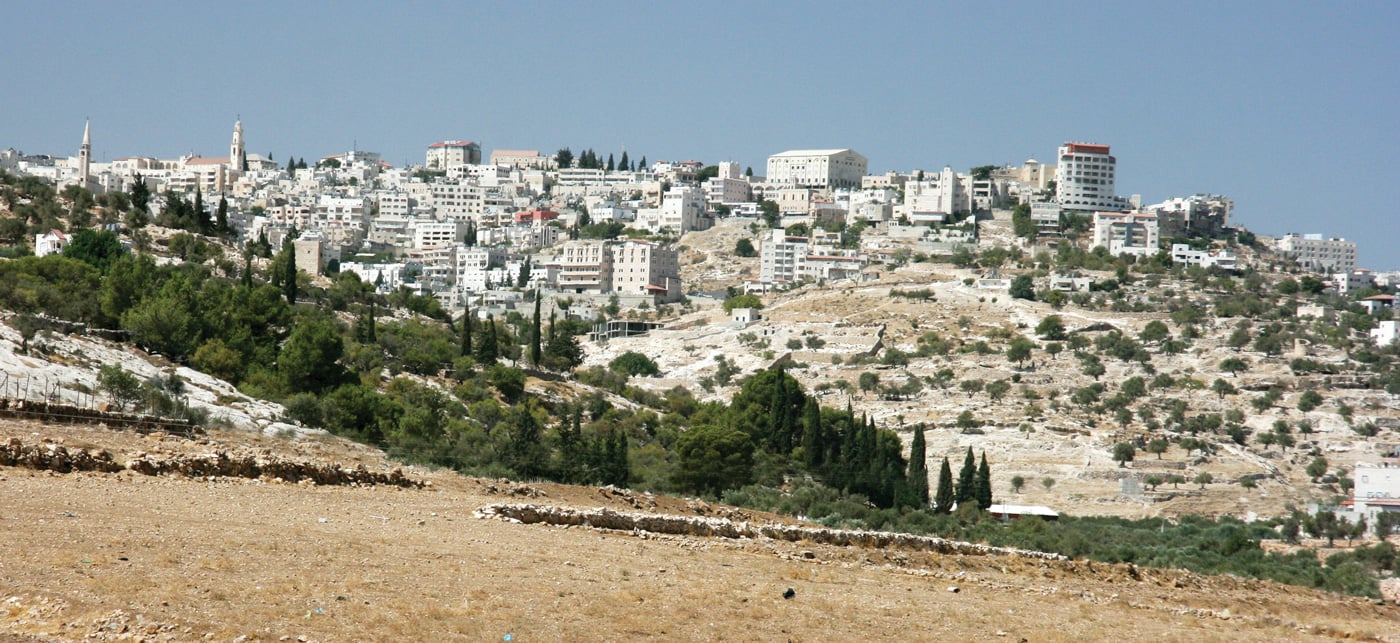
The modern city of Bethlehem, the birthplace of Jesus (Matt. 2:1–8)
When Magi arrive in Jerusalem inquiring as to the anticipated birthplace of the “king of the Jews” (2:1–2), Herod is troubled and calls on those steeped in the Jewish Scriptures to answer their question. The reply by the teachers of the law comes from Micah 5:2, which references Bethlehem producing a shepherd-king for Israel (for the analogy of king to shepherd in the Old Testament, see Ps. 78:70–72; Jer. 23:1–6). Matthew, using this citation to communicate more directly with his audience, appears to draw from the context of Micah 5:2 to highlight restoration from exile through a shepherd-ruler (Matt. 2:6–7; cf. 1:11–12 for the theme of restoration from exile). This emphasis is supported by the immediate context of the Micah quotation, which points to a time in Israel’s history when they were soon to be overrun and exiled by the Assyrians (Mic. 5:1, 5). The promise of the prophet’s message is for a ruler who will bring about return from exile and restoration of God’s people (5:2–4).
Once Herod knows the location and the timing of the star that the Magi have followed, he asks them to search out and alert him to the child’s whereabouts so that he might join the Magi in worshiping this king (2:8). The reader has some hint that all is not right in Herod’s request, since Matthew has indicated that Herod as king was disturbed by his original encounter with the Magi. Suspicion of Herod’s motives is confirmed by a warning to the Magi in a dream not to return to Herod (2:12). Instead, after the star leads the Magi to Jesus, they give gifts and worship him (their purpose in coming; 2:2, 11); then they return home.
The Magi are a part of Matthew’s literary landscape for only twelve verses, but their presence has had an influence that exceeds Matthew’s brief reference to them. Church traditions have cast them as three kings. Yet no indication of their number is provided, and they were most likely royal servants or astrologers who came from the East, possibly Persia or Babylon (Powell 2001, 146–47). Matthew probably draws attention to them in chapter 2 to emphasize Gentile inclusion as he has already done by including Gentile women in his genealogy (1:3, 5–6). Though Jesus comes as the rightful king of the Jews, Gentiles unexpectedly show up in his lineage, and Gentiles are surprisingly the first worshipers at his feet.
Though the Magi have not told Herod the child’s exact location, Jesus is still in danger. Once again, an angel of the Lord appears to Joseph in a dream (2:13; cf. 1:20), this time warning him to take Jesus and Mary to Egypt to avoid the treacherous reach of Herod. Joseph again obeys the Lord’s command that comes through the angel and takes his family to Egypt. Matthew comments on the flight to Egypt with another Old Testament quotation: “And so was fulfilled what the Lord had said through the prophet: ‘Out of Egypt I called my son’ ” (Matt. 2:15; citing Hos. 11:1).
Matthew’s fulfillment quotations connect to two levels of his narrative. On the story level, the clear connection between Hosea 11:1 and the plot of Matthew 2 is the move to and return from Egypt. As God brought Israel, God’s son, from Egypt (Hos. 11:1), so God will bring Jesus, God’s son, out of Egypt. The typological nature of the connection between Hosea and Matthew is clear in the parallel actions of God in each. This connection highlights Matthew’s interest in portraying Jesus as representative of Israel. The same connection will be picked up and developed further in Matthew 3–4 (on “Son of God,” see 4:3 and “Theological Themes” in the introduction).
A second connection between the quotation from Hosea and Matthew 2 occurs on the level of the communication between author and reader—the discourse level of the narrative, where the Hosea quotation evokes the movement from exile to restoration (as did the Micah citation at Matt. 2:6). The immediate context of Hosea 11:1 is a recapitulation of this movement from Israel’s sin and exile in Egypt and Assyria (11:2–7) to God’s compassion and restoration in bringing Israel back from exile (11:8–11). Similarly, Matthew shows Jesus enacting a return from Egyptian exile (2:14–15; cf. also emphasis on return to “Israel” in 2:20–21).
Matthew’s narration continues, with Herod reacting to the news that the Magi have outwitted him (2:16). Herod orders all boys two years and under in the environs of Bethlehem to be killed. Matthew then cites Jeremiah 31:15, which connects Rachel to Bethlehem on the story level (she was buried in Bethlehem according to Gen. 35:19) and speaks of her mourning for her lost children. On the discourse level, we again hear echoes of exile and restoration, since Jeremiah 31 is a chapter that explicitly promises Israel’s restoration from exile (e.g., Jer. 31:10, 16–17). By drawing on Jewish biblical hopes, Matthew once again intimates that Jesus is the long-awaited restorer of Israel.
The author concludes the birth story of Jesus by narrating the return of Jesus and his family to “the land of Israel” (used twice; 2:20–21), and specifically to Nazareth in Galilee, after Herod’s death (4 BC; 2:22–23). Once again, the Lord’s guidance comes to Joseph through an angel in a dream, instructing him to return to Israel and then warning him about Herod’s son Archelaus, now ruling in Judea. Joseph obeys, as he has at each instance of divine guidance (1:24; 2:14, 21–22). For Matthew, Jesus’s return to the land mirrors Israel’s return from Egypt (Exod. 14:1–15:27; Hos. 11:1) and begins Israel’s return from their present exile (Matt. 1:11–12; 2:5–6, 15, 17–18).
The last fulfillment formula of Matthew 2 comes at the final moment of the birth narrative. “So was fulfilled what was said through the prophets, that he would be called a Nazarene [Greek Nazōraios]” (2:23). The interpretive difficulty at 2:23 is that this declaration cannot be found in the Old Testament or elsewhere. It is most likely that Matthew is relying here on a wordplay rather than a full quotation (intending the reader to connect Nazōraios to the location, Nazareth, in the previous line). Support for this comes from the general way he introduces the statement as coming from “the prophets” rather than a particular prophet. The precise wordplay is debated, with some scholars hearing a connection to the Nazirite vow (Hebrew nazir) in Numbers 6. In this case, the wordplay would be emphasizing Jesus as holy or set apart. More likely, Nazōraios plays on the Hebrew word netser, translated “branch.” This Hebrew word occurs in Isaiah 11:1, where netser refers to a son of Jesse (David’s father; cf. 1 Samuel 16): “from [Jesse’s] roots a Branch will bear fruit.” The term netser was used to evoke messianic hopes in other Jewish writings of Matthew’s day (e.g., Dead Sea Scrolls, Thanksgiving Hymns 7.19). Thus Matthew concludes the story of Jesus’s birth just as he began it (1:1), by emphasizing Jesus as Messiah, son of David, the hope of Israel’s restoration.
B. Baptism and temptation (3:1–4:16). Matthew moves from narrating the infancy stories to two preparatory events for the ministry of Jesus—his baptism and temptation. Both narratives are set in the wilderness (“desert”), tying Jesus’s preparation for his ministry to the identity of the people of Israel as they prepared to enter the land promised to them. Both stories are also marked by the Spirit, signaling that the time of eschatological promise has begun. John the Baptist is introduced in Matthew 3 as the forerunner who signals Jesus’s ministry by calling Israel and its leaders to repentance, announcing God’s kingdom, and warning of judgment, while hinting at Gentile inclusion into God’s restored people. Jesus’s own baptism becomes both a sign of God’s covenant faithfulness to Israel and an affirmation of Jesus’s obedient, faithful sonship to God. The theme of Jesus as faithful Son continues in the temptation narrative (4:1–11). Using citations from Deuteronomy, Matthew contrasts Israel’s disobedience in the wilderness with Jesus’s obedient response in the face of temptation. In 4:12–16, Matthew transitions to Jesus’s public ministry (4:17), highlighting Jesus’s ministry in Galilee and hinting again at Gentile inclusion into the kingdom, which Jesus will soon announce.
3:1–17: Jesus’s baptism. In Matthew 3, the author introduces John the Baptist, forerunner of Jesus Messiah. In his preparatory role, John is baptizing Jews in the wilderness near the Jordan River and calling God’s people to “repent, for the kingdom of heaven has come near” (3:2). This message is identical to the message typifying Jesus’s ministry to Israel soon to begin (4:17), thus emphasizing John’s alignment with Jesus’s message of the kingdom (see “Theological Themes” in the introduction).
It is possible that the origin of John’s baptism is connected to (1) Jewish purification washings, either those indicated in the Old Testament (e.g., Num. 19:12) or first-century practices such as those from the Qumran community in the area of the Dead Sea; (2) Gentile baptism upon conversion to Judaism; or (3) some combination of these. Whatever the specific origin, it seems that John’s baptism drew on expectations about washings or baptism but combined these with unexpected elements, such as his preaching of the kingdom (similar to the eschatological tone of Qumran). If John is drawing on the practice of baptizing Jewish converts but is now calling Jews to a “conversionist” baptism, then his message is an implicit indictment of Jewish disloyalty to God and so a call to return to covenant faithfulness. The latter comes through clearly in John’s emphasis on repentance (3:2, 6, 11).

The Jordan River, where John the Baptist baptized (Matt. 3:6). During the first century AD, the river would have been wider and the vegetation along the banks denser.
Matthew highlights John’s continuity with the Old Testament story of God’s covenant with Israel by means of an Old Testament fulfillment quotation (3:3) and by demonstrating John’s connection to the Old Testament prophet Elijah (3:4). By quoting Isaiah 40:3 in relation to John, Matthew shows John as the one who prepares the way for the Lord. In Isaiah’s context, the announcement of comfort to Israel focuses on the end of exile and the return of Yahweh, Israel’s God, to Israel (40:1–5). The prophet goes on to speak of the good news of God’s return to Israel (Isa. 40:9; the Greek Septuagint uses the term euangelion [“good news”], defined in Isa. 52:7 as the news of God’s reign; see the use of the same Greek term in Matt. 4:23). Given this context of promise of God’s presence and restoration from exile, the reader hears John as preparing the way for Jesus, who will bring God’s restoration, a message already heard in Matthew 1–2.
Matthew’s description of John’s clothing evokes the picture of Elijah from 2 Kings 1:8. Picturing John as a kind of Elijah emphasizes John’s role as forerunner of the coming of the Lord (cf. Mal. 4:5–6) as well as John’s prophetic role. Like the prophets of old, John preaches a message of promise and warning. Matthew focuses attention on John’s warnings particularly to the Jerusalem leaders, Pharisees and Sadducees, who come to the Jordan River either to observe John’s baptism or to be baptized themselves (the Greek is ambiguous in this regard). John has strong words for these leaders who should be producing fruit in keeping with repentance—that is, in keeping with a return to covenant loyalty (3:8). The notion of bearing fruit is a common one in the Old Testament, focused especially on God’s expectation that Israel would produce fruit (e.g., Isa. 5:1–7; 27:2–6; 37:31–32; cf. Matt. 7:15–19; 12:33; 21:43). Thus John warns Israel, especially its leaders, to live up to God’s covenantal expectations for them.
For Matthew, the consequences of refusing to repent and to bear fruit are severe. John warns of the “coming wrath” (3:7) and, following the analogy of bearing fruit, warns of fruitless trees being destroyed (3:10). John warns against a presumption that Jewish ancestry will ensure vindication at the final judgment. Instead, his words hint at Matthew’s prominent theme of Gentile inclusion, since if “out of these stones God can raise up children for Abraham” (3:9), then presumably he can make Gentiles into Abraham’s children (cf. 8:11)!
The theme of judgment is a prominent one in Matthew (e.g., 12:33–37; 13:37–43, 47–50) and indicates both the punishment of the unfaithful and the vindication of the faithful righteous at the final judgment. Both strands are important in Matthew. Even though the former is the one emphasized here (3:7–12), Matthew’s implication is that those who embrace repentance and produce fruit will be prepared for the kingdom and will receive the promised Holy Spirit (3:11), a signal of God’s eschatological restoration (cf. Joel 2:28–29). John’s warnings carry over into Jesus’s role, as one who will baptize with fire—that is, purification or judgment—as well as with the Holy Spirit (3:11–12). John’s subordinate role to Jesus’s mission is emphasized in 3:11–12. John’s baptism of repentance, though the first eschatological signal, is penultimate to and prepares for Jesus’s baptism with fire and the Spirit.
When Jesus comes to be baptized by John (3:13–17), John demurs, indicating that Jesus should baptize him. Jesus’s reply is intriguing: he must be baptized “to fulfill all righteousness” (3:15). Of all the Gospel writers, Matthew uses the noun “righteousness” (Greek dikaiosynē) most frequently (seven times in Matthew as compared with once in Luke and twice in John). The use of “righteousness” here likely evokes covenant faithfulness more broadly, not simply torah obedience, since how Jesus’s baptism would fulfill the law is not obvious. In addition, in some instances Matthew uses dikaiosynē to refer to God’s eschatological act of righting all things (e.g., the pairing of God’s “kingdom and his righteousness” at 6:33; see also 21:32) (Hagner, 56). This understanding seems to fit best here: Jesus pursues John’s eschatological baptism as a way of signaling the fulfillment of God’s restoration in Jesus himself.
The Spirit of God descends on Jesus at his baptism, indicating that the time of God’s restoration has begun (3:11, 16; cf. also 1:18, 20). The confirming word about Jesus comes from “a voice from heaven,” a circumlocution for God’s name (3:17). The climactic moment of the chapter occurs here in God’s words affirming Jesus as faithful Son: “This is my Son, whom I love; with him I am well pleased” (cf. 17:5, where the same words occur). Though a number of Old Testament texts may possibly receive allusion here (Gen. 22:2; Ps. 2:7; with the most likely allusion being to Isaiah’s obedient servant of Yahweh; Isa. 42:1; cf. Matt. 12:18), the story connection fostered is an affirmation of Jesus’s identity as obedient son in line with Israel’s calling to be faithful to God. This connection between Jesus and Israel has already been made via son language in Matthew 2:15. The explicit language of “Son of God” will be highlighted in 4:1–11, with a direct connection to obedience. Here, the focus at Jesus’s baptism is God’s affirmation of pleasure and love in the obedient son who has come to fulfill all righteousness.
4:1–11: Jesus’s temptation. The temptation narrative follows Jesus’s baptism and continues the focus on the preparation of Jesus for his public ministry. On the level of Matthew’s communication with the reader, he continues to emphasize Jesus’s identity as God’s obedient Son—Jesus as Israel’s representative.
God’s Spirit has descended on Jesus at his baptism. Now the Spirit leads Jesus into the desert, where he will be tempted by the devil (also referred to here as the tempter and Satan). By indicating the setting of the temptations in the desert (4:1), Matthew ties Jesus’s temptation to the testing of Israel in the wilderness. The parallel “forty days and forty nights” to Israel’s forty-year wilderness wanderings confirms this connection, which Matthew highlights through Jesus’s citation from Deuteronomy in response to each temptation.

The Judean wilderness, where Jesus fasted for forty days following his baptism (Matt. 4:1)
Each of the first two temptations begins with the conditional “If you are the Son of God” (4:3, 6). So far, Matthew has used “Son of God” to (1) compare Jesus to Israel, God’s son (cf. Hos. 11:1; Matt. 2:15), and (2) affirm Jesus’s intimate relationship with God and obedience to God, especially if Isaiah 42:1 is the allusion behind God’s affirmation of Jesus in 3:17 (cf. Isa. 42:3 for the faithfulness of Isaiah’s servant). Jewish understandings of “Son of God” language would likely have evoked messianic themes as well, since Israel’s king—and subsequently Israel’s anticipated Messiah—would have been the representative of Israel par excellence (2 Sam. 7:12–16; see “Theological Themes” in the introduction).
The first temptation centers on Jesus’s hunger after fasting for forty days, with the devil tempting Jesus to turn stones into bread. Jesus answers, as he does in each case, with a scriptural text from Deuteronomy. The affirmation from Deuteronomy 8:3 prioritizes the sustenance of God’s words over bread. In Deuteronomy, this affirmation comes as part of a call for Israel to remember their forty years in the desert as a time when God tested their obedience and humbled them. God fed them manna to teach them the true source of their sustenance (Deut. 8:2–3), with Deuteronomy 8:5 identifying Israel as God’s son. The use of Deuteronomy 8:3 connects the wilderness testing of Jesus to that of Israel, contrasting Jesus’s obedience by not pursuing bread with Israel’s disobedience (8:3, 5; cf. Exod. 16:1–5).
In the second temptation, the devil entices Jesus to throw himself from the highest point of the Jerusalem temple, citing Psalm 91:11–12 as evidence that God will send angels to protect anyone who “make[s] the Most High [their] dwelling” (Ps. 91:9). Jesus’s reply again comes from Deuteronomy, this time 6:16: “Do not put the Lord your God to the test.” The verse in Deuteronomy adds, “as you did at Massah,” indicating the time when the Israelites questioned God’s provision of water for them (Exod. 17:1–7). Jesus, in his refusal to heed the devil’s temptation to test God, provides the contrast to the wilderness experience of Israel.
The final temptation consists of an implicit claim by the devil that all the kingdoms of the world belong to him and that he will give them to Jesus if Jesus will worship him (4:8–9). Matthew shows Jesus drawing from Deuteronomy 6 in his response: “Worship the Lord your God, and serve him only” (Matt. 4:10; Deut. 6:13). This call to exclusive allegiance to Yahweh is the positive side of the prohibition against testing the Lord that Jesus has already cited (Deut. 6:16). Though Israel failed the loyalty test in the wilderness, Matthew shows Jesus to be fully faithful to God through all three wilderness temptations. (Luke narrates the same three temptations but places the temple temptation last in order. By doing so, he emphasizes a temple motif that begins and ends his Gospel; see Luke 1:8; 24:53.)
An ironic note rings at the passage’s end. Though Jesus has rejected the idea of asking God to send protecting angels (4:6), after he has sent the devil away angels care for him (4:11). God has provided for Jesus in the wilderness; and Jesus has proven himself the obedient Son, faithful representative of Israel.
4:12–16: Transition to Jesus’s public ministry. Jesus’s return to Galilee comes on the heels of news about John’s imprisonment. With John’s preparatory work accomplished, Matthew shows Jesus moving from Nazareth to Capernaum, on the sea (or lake) of Galilee, to begin his public ministry (4:17–16:20; cf. 8:5). Matthew includes another fulfillment quotation in 4:14–16. The connection between Isaiah 9:1–2 and Matthew 4:12 on the plot level focuses on Jesus’s relocation to Capernaum. For his readers, Matthew connects the redemption promised in Isaiah 9—the light dawning in darkness—to Jesus’s ministry in Galilee about to be inaugurated (4:17). Galilee of the first century included both Jews and Gentiles, with a larger Jewish population in the lower Galilean region. Matthew, with Isaiah’s reference to “Galilee of the Gentiles,” hints at the inclusion of all nations in the redemption brought by Jesus (cf. 28:19; also 1:3, 5–6; 2:1–12; 3:9), though the explicit focus of his preresurrection ministry will be Israel (cf. 10:5–6; 15:24).
2. Jesus’s Announcement of the Kingdom to Israel and Resulting Responses (4:17–16:20)
The second major section of Matthew focuses on Jesus’s announcement and enactment of the reign of God and the responses it generates in Israel. The people have been prepared for Jesus’s kingdom inauguration by John’s call to repentance and announcement of the kingdom’s impending arrival (identical to that of Jesus; cf. 3:2 and 4:17). In addition, Jesus’s return to and relocation within Galilee sets up his Galilean ministry spanning 4:17–16:20.
Matthew 4:17–16:20 is structured by a number of formal and conceptual repetitions, the most overarching of which is the repeated formula at 4:17 and 16:21 (“from that time on Jesus began to . . .”; see “Structure” in the introduction). Three of Matthew’s five great discourses sit within Matthew 4:17–16:20, each focused on announcing God’s kingdom. In the first (chaps. 5–7), Jesus proclaims his manifesto of the kingdom. In the second (chap. 10), Jesus empowers and instructs his disciples for kingdom ministry. In the third (chap. 13), Jesus reveals more about God’s kingdom, including its manifestation in two stages, so that its present expression has a hidden quality. This goes a long way to explain the growing rejection of Jesus’s ministry by Jewish leaders and the ambivalence more generally from the crowds (11:2–16:20). Yet for those with ears to hear and eyes to see, Jesus is revealed to be the Messiah, the inaugurator of God’s reign (cf. 16:16). In his teachings and miracles, human faith can see the authority and compassion of the God of Israel.
A. Proclamation of the kingdom in word and action (4:17–11:1). In this section of his Gospel, Matthew defines the center of Jesus’s public ministry as the proclamation and enactment of God’s kingdom. After summarizing Jesus’s proclamation that the kingdom is about to arrive (4:17), Matthew turns to Jesus’s teaching about the kingdom and its relation to covenantal loyalty in the Sermon on the Mount (5:1–7:29). Then Matthew shows Jesus enacting God’s kingdom authority and mercy through his healings and other miracles with a wide range of responses to his ministry, from exceptional faith to unbelief (8:1–9:38). This section concludes with Jesus’s instructions to his twelve disciples to participate in his mission (10:1–11:1).
4:17–25: Jesus’s message and ministry. At 4:17, Matthew provides the centerpiece of Jesus’s proclamation to Israel: “Repent, for the kingdom of heaven has come near” (for repentance theme, cf. 3:2). This summary of Jesus’s message begins with an introductory phrase, “From that time on Jesus began to [preach],” which is repeated in 16:21, signaling its structural importance for defining the movement of Matthew’s story.
For Matthew, Jesus’s ministry can be summed up as proclamation of the soon-to-arrive kingdom, or reign, of God. Matthew’s “kingdom of heaven” is conceptually the same as Mark’s “kingdom of God” (cf. Mark 1:15 // Matt. 4:17; also Mark 10:14, 23 // Matt. 19:14, 23). Matthew probably follows the Jewish convention of circumlocution—avoiding reference to “God” when another construction can communicate the same idea (heaven as God’s dwelling place). Though the reign of Israel’s God is a regular Jewish affirmation (e.g., Ps. 93:1; 96:10; 99:1; 146:10), the Old Testament prophets also promise a day when God will reign fully over the heavens and the earth, making all things right (e.g., Mic. 4:1–8; Isa. 24:21–23; 52:1–10; Dan. 2:44; see also Psalms of Solomon 17). It is the arrival of that day that is evoked with the kingdom language in Jesus’s ministry. Most first-century Jewish believers longed for God’s rule to come in redemption and vindication for the faithful of Israel, in judgment of idolatrous nations, and in restoration of the land and of Davidic kingship. When Jesus came on the scene preaching that the kingdom is near, the religious and political reverberations of such preaching would have ignited that hope.
Directly following this inaugural preaching summary, Matthew narrates the call of Jesus’s disciples (4:18–22). Jesus issues a call for these four fishermen to follow him, making the analogy that their work will now involve fishing for people (4:19). The initiative that Jesus shows in this scene contrasts with the conventional practice of a would-be disciple attaching himself to a rabbi. Jesus initiates the relationship, and these fishermen leave their livelihood (4:19, 21) to follow Jesus (see 10:2–4 for the naming of all twelve disciples).
In Matthew 4:23–25, Matthew summarizes Jesus’s ministry by describing his three primary activities: teaching, preaching, and healing (4:23). Preaching “the good news of the kingdom” connects with the summary of Jesus’s preaching at 4:17, while subsequent chapters take up teaching (chaps. 5–7) and healing (chaps. 8–9). The summary statement in 4:23 is virtually repeated at 9:35, creating a bracket surrounding the narration of Jesus’s Galilean ministry of teaching and healing (4:23–9:35). The crowds respond by bringing their sick to Jesus for healing (4:24), following him from the entire region of Galilee and Judea, including Jerusalem, and even Syria to the north and Perea to the east (“the region across the Jordan”; 4:25). The scope of the geographic description seems to indicate “the whole of the area that is populated with Jewish people” (Wilkins, 183).
5:1–7:29: Jesus’s first discourse—the Sermon on the Mount. The first major section of 4:17–16:20 highlights Jesus’s teaching ministry. It is no accident that Matthew begins his narration of Jesus’s ministry with an extended teaching by Jesus. Matthew structures his Gospel in part by arranging most of Jesus’s teaching into five major blocks, or “discourses” (see “Structure” in the introduction).
In this discourse, often called the Sermon on the Mount, Jesus teaches his disciples (along with the crowds; see 5:1–2 and 7:28–29) about the kingdom that he has announced in 4:17. The single consistent theme of the sermon is the imminent kingdom of God (5:3, 10, 19–20; 6:10, 33; 7:21; see “Theological Themes” in the introduction). Focused on Jesus’s expectations for his disciples in light of the arrival of God’s reign, the sermon centers on a call to covenantal faithfulness (e.g., 5:13–16, 17–20; 7:12) and provides a vision of how discipleship ought to look as God comes to make all things right (e.g., 5:7–10; 6:9–13, 25–34).
5:1–16. While much of this discourse consists of exhortation, its headlining passage announces blessing (5:3–12, with allusions to Isa. 61:1–11). These blessings, the great reversals that will happen with the arrival of God’s reign, indicate that God’s decisive act of restoration precedes and grounds the expectation for kingdom discipleship and enables the believing community to live it out. Thus, although the Sermon on the Mount has sometimes been viewed as idealistic and unattainable, Matthew gives every indication that he expects his readers to hear it as an attainable ethic for believers in community with Jesus in their midst (18:20; 28:20).
With the first four beatitudes (5:3–6), Jesus pronounces a blessed condition on those who would not be considered blessed or fortunate in life: those who are spiritually poor or hopeless, those who mourn, those who are meek or oppressed, and those who are “starved for justice” (Powell 1996, 467). (The translation of “justice” for dikaiosynē here and in 5:10 fits a covenantal understanding of that term as God’s commitment to making all things right; see commentary on 3:1–17.) These four blessings focus on those whose situation is most destitute, with the promise that they will find their situation reversed in God’s coming kingdom. The reversal of situation is captured in each case by a specific blessing: the kingdom belongs to them (5:3), they will receive comfort (5:4), they will inherit the earth (5:5), and their longing for justice will be filled (5:6).

The hills along the north shore of the Sea of Galilee where Jesus may have given the Sermon on the Mount
In the final four beatitudes (with the fourth expanded; 5:11–12), blessings are conferred on those who live in a way that signals their alignment with the values characterizing God’s reign. As God’s people show mercy and singular allegiance, enact peace and justice, and live with the resulting persecution, they show their alignment with God’s care for those most destitute (5:3–6). The harmony between their actions and God’s kingdom ensures they will receive mercy (5:7), see God (5:8), and be called God’s children (5:9; cf. 12:50), and that they are already receiving the kingdom (5:10; note present tense of this blessing and at 5:3).
The beatitudes are followed by a declaration of the distinctive identity and mission of Jesus’s followers. They are “the salt of the earth” (5:13) and “the light of the world” (5:14–16), indicating their distinctive identity within their environment for the sake of mission to the world. The light imagery evokes God’s expectation for Israel to be a light to Gentiles (Isa. 60:1–3; see also 9:1–2; 49:6; Matt. 4:16). Matthew’s Jesus uses this imagery to define his followers in relation to Israel’s mission to the nations, setting their own mission in covenantal context.
5:17–48. The body of the Sermon on the Mount begins by highlighting the disposition of Jesus and his followers in relation to the Old Testament law, or torah (5:17–48). Jesus affirms his mission to fulfill the Law and the Prophets (the Old Testament Scriptures) rather than abolish them. He warns his followers against breaking or influencing others to break any of the torah’s commands (5:19). In fact, their torah observance (“righteousness,” Greek dikaiosynē), understood as an expression of covenantal loyalty, must surpass the covenant adherence of the Pharisees and teachers of the law (5:20; cf. 15:6; 23:1–4 for the latter’s lack of obedience). As 5:21–48 makes clear, it is Jesus’s interpretation and explanation of the torah that must guide his followers.
The often-termed “antitheses” of Matthew (“You have heard that it was said, . . . but I tell you . . .”; 5:21, 27, 31, 33, 38, 43) reflect Jesus’s interpretation and intensification—rather than contradiction—of six Old Testament commands or cases. In each case, the expectation for Jesus’s followers is more stringent than its Old Testament counterpart (a surpassing righteousness; 5:20). This intensification fits the Jewish, rabbinic practice of “making a fence” around the torah in order to minimize the possibility of transgression (Mishnah Avot 1:1).
The Old Testament prohibition against murder is broadened to include anger (5:21–22; Exod. 20:13), with a related call to reconciliation (5:23–26). Jesus also expands the prohibition against adultery to include lust (5:31–32; Exod. 20:14). The third case involves the Old Testament prohibition of remarriage to a first spouse after a divorce and second marriage have occurred (Deut. 24:1–4). Jesus again commands a stricter ethic by limiting the allowable reason for divorce to porneia (a Greek term meaning sexual infidelity of some sort, though the specific connotation Matthew intends by this term is debated) rather than the broader circumstance of a husband’s displeasure for something indecent (Deut. 24:1).
The fourth case raises the importance of keeping oaths made to the Lord (Deut. 23:21–23). Jesus narrows this to a prohibition against making oaths generally (5:33). Philo, a first-century Jewish writer, laments the “habit of swearing incessantly and thoughtlessly about ordinary matters” (Philo, On the Decalogue 92). This habit provides the context for Jesus’s prohibition against making oaths. Instead, his followers ought to let their word alone rather than an oath guarantee their actions (5:34–37).
In its original context, “eye for eye” (the Old Testament lex talionis, or law of retribution; Exod. 21:24; Matt. 5:38) was likely a means of limiting personal revenge, leaving the exacting of fair retribution to a court. Once again, Jesus further limits an Old Testament prescription, this time disallowing all forms of retaliation to various insults to honor: a backhanded blow as an act to dishonor (5:39), legal removal of one’s basic possessions (5:40), Roman conscription of a civilian to carry loads (5:41), and more general requests to borrow money or possessions (5:42). While in each of these illustrations commentators have recognized elements of hyperbole (e.g., removal of both tunic and cloak would leave a person naked), the exaggeration emphasizes nonresistance as a nonnegotiable for Jesus’s disciples. In a context in which active political or social resistance has severe consequences, Jesus’s radical ethic of nonretaliation moves beyond capitulation to one’s oppressors to active self-sacrifice for others, even enemies.
The final “antithesis” has a summative function. By its emphasis on love of everyone, even one’s enemies, it captures the spirit of the other five directives. While the Old Testament command to love one’s neighbor derives from Leviticus 19:18, the coordinate “hate your enemy” is not an Old Testament quotation. It may be that the sentiment is an expression derived from texts such as Psalm 139:21–22. Jesus broadens the love command to explicitly include love of enemies and prayer for them (5:44). The rationale provided is that love of neighbor fulfills no greater ethic than that of tax collectors and pagans (5:46–47). Of the six cases of torah interpretation that Jesus has specified, only the final case includes a purpose. As Israel was to image God to the nations, Jesus’s followers are called to be like their heavenly Father, morally complete or perfect (5:45, 48). They do this supremely by fulfilling the command to love, which sums and binds together all other commands (cf. 22:40).
6:1–18. From Jesus’s interpretation of torah, Matthew turns to Jesus’s teaching on Jewish religious practices (expressed as “righteousness” [Greek dikaiosynē]; 6:1; cf. 5:20) of giving to the poor (6:2–4), prayer (6:5–15), and fasting (6:16–18). These three practices are joined in Tobit 12:8, along with “righteousness,” indicating their centrality in Jewish piety. The three sections are each structured by a prohibition, a command, and a promise. The common thread is a warning against doing acts of righteousness for human, instead of divine, approval (6:2, 5, 16). Jesus promises future reward to those who give, pray, and fast “in secret” rather than act to be seen by others (6:4, 6, 18).
The Lord’s Prayer (6:9–13) falls within the section on prayer, extending that section beyond the formal symmetry of prohibition, command, and promise. Just preceding the Lord’s Prayer is a call to avoid “babbling like pagans” in prayer (6:7), which likely refers to magical understandings of prayer in which repetitions would have been thought to compel the gods to action. In contrast, Jesus’s followers are to cling to the truth that their Father knows and anticipates their prayers (6:8).
The Lord’s Prayer provides a model prayer for disciples (6:9–13) and is thoroughly kingdom focused, looking ahead with longing for God’s reign to be consummated. The address, “Our Father in heaven,” indicates that the familial relationship to God that Jesus himself enjoys (see son language in Matthew 3 and 4) is shared in some way with Jesus’s followers, who are God’s children (cf. 5:16, 45, 48). After the address, three parallel petitions ask God to bring the kingdom, defined as universal recognition of God’s holiness and accomplishment of God’s will on earth:
May your name be hallowed (revered as holy)
May your kingdom come
May your will be done. (author’s translation; cf. NLT)
The final three petitions focus on daily needs (though the Greek term translated “daily” occurs nowhere else in Greek writings, so its meaning is unclear), forgiveness, and deliverance from temptation (6:11–13). Matthew’s teaching that follows the Lord’s Prayer presents forgiveness as an imperative for disciples (6:14–15; see commentary on 18:1–35).
6:19–7:12. The remainder of the body of the Sermon on the Mount covers various topics but fleshes out to some extent the ideas introduced in the Lord’s Prayer: a call to singular loyalty to God (6:19–24) and trust for daily needs (6:27–34), a warning against judging others (7:1–6), and a call to prayer (7:7–11).
Jesus calls his followers to loyalty to God in contrast to storing up possessions (6:19–21) and money (6:24). The saying comparing the eye to a lamp (6:22–23), though not fully clear to today’s readers, may draw on the ancient view that light goes out from a person’s eyes, so that the person’s body or self can be assessed by his or her eyes (cf. 5:16). The “healthy” eye might be better rendered “single-focused” (the Greek term frequently refers to singleness of purpose), since the context is about loyalty and the impossibility of serving two masters.
Jesus also calls the disciples to a life free from worry, a life defined by trusting in their God, who cares and provides daily needs of food and clothing (6:25–34). This exhortation was a weighty one in a cultural context where many people lived at a subsistence level (e.g., the day laborers of Matt. 20:1–15, who might have needed their end-of-day wage to feed their families). But for Jesus, life is to be free of worry, even if economically justifiable. His followers are to be characterized by focusing their first energies and priorities on the kingdom—God coming to make all things right (6:33). Trusting in God’s righteousness eliminates worry and “little faith” (6:30; cf. 8:26 for this concept).
The final exhortations of the Sermon on the Mount include a warning against judging others (7:1), possibly focused on inappropriate eschatological judgments—determining about others what only God will decide at the end (cf. 13:27–30). Jesus goes on to warn against attending to the sins of others, while being oblivious to the gross sin in one’s own life (7:3–5). The warnings against judging are tempered, however, by a call to discernment (7:6). Much speculation has gone into determining the referents for the “sacred” and “dogs/pigs.” The “sacred” for Matthew would likely be related to the “good news of the kingdom” that Jesus brings (4:23; cf. 13:45). What we can say is that Jesus indicates that some will reject the sacred, and so his disciples are to be discerning as to their audience (cf. 10:14–15).
Also included at the end of the sermon is an encouragement to ongoing prayer (indicated by the Greek present tense in the imperatives to ask, seek, and knock; 7:7). The reason disciples can pray and expect an answer (7:8) is that they are children of a Father who gives good gifts when asked (7:9–11). The summative command of the Sermon on the Mount comes in 7:12, often called the golden rule: “So in everything, do to others what you would have them do to you.” Jesus’s ethical teachings in Matthew 5–7 come down to this motivation and its expression in action. In fact, the golden rule sums up “the Law and the Prophets” (7:12). This phrase hearkens back to the beginning of the body of the sermon, where Jesus affirms that he has come to fulfill the Law and the Prophets (5:17). Jesus as Messiah fulfills the Law and rightly interprets Scripture so that his followers hear self-giving for others at its center (e.g., 5:44; 7:12).
7:13–29. The conclusion to the Sermon on the Mount focuses on warnings about two paths (7:15–26). Jesus warns about the broad road leading to destruction, encouraging his disciples to take the narrow path leading to life (7:13–14). Jesus also warns of false prophets, who are recognizable by their evil fruits. A disciple is characterized by doing God’s will (7:15–23). The two ways are illustrated by a closing parable in which a wise person and a foolish person build houses, one on rock, the other on sand (7:24–27). The wise person hears Jesus’s words and enacts them; the foolish one hears but does not obey. The sermon’s conclusion calls Jesus’s disciples as well as Matthew’s readers to obedience—to be the wise person who obeys Jesus’s teachings.
Five times Matthew uses identical wording to transition from Jesus’s teaching (in the five discourses) to Jesus’s activity that follows: “When Jesus had finished [saying these things]” (7:28; cf. 11:1; 13:53; 19:1; 26:1). In this instance, Matthew narrates the response of the crowds to Jesus’s teaching—amazement at his authority. While torah teachers usually gave instruction by referencing what former teachers had said, Jesus speaks with his own authority (“But I tell you . . .”; e.g., 5:22). Matthew introduces the theme of authority here and reiterates it throughout the story of Jesus’s ministry in Matthew 8–10.
8:1–9:38: Jesus’s enactment of the kingdom. After expressing Jesus’s kingdom ministry in teaching (5:1–7:29), Matthew narrates Jesus’s kingdom ministry in action (8:1–9:38). Matthew demonstrates Jesus’s authority to heal the sick, cast out demons, forgive sins, and calm a storm. Other themes include Jesus’s compassion in his role as Isaiah’s servant of the Lord and the qualities of full allegiance and faith for those who would follow Jesus.
Matthew 8–9 is structured by three sets of three miracle stories (8:1–17; 8:23–9:8; 9:18–38) interwoven with teachings on kingdom discipleship (8:18–22; 9:9–17). The first set of miracle stories involves a leper (8:1–4), a servant of a Gentile centurion (8:5–13), and Peter’s mother-in-law (8:14–15). The common factor in all three stories is Jesus’s power over illness and his compassion for those in need.
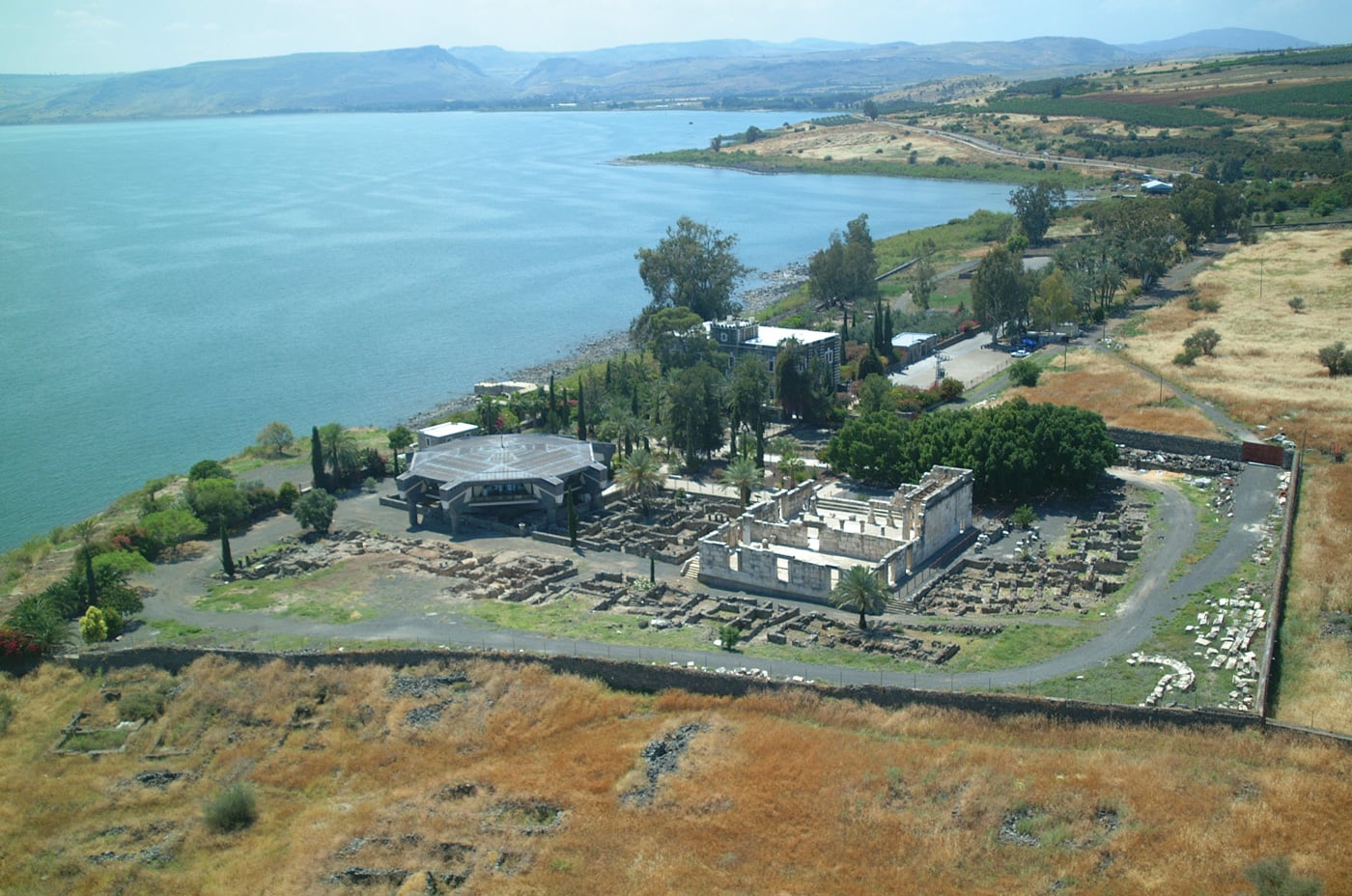
The excavation of Capernaum, the ancient village on Galilee’s north shore where Jesus was approached by a centurion (Matt. 8:5)
8:1–17. Jesus willingly heals a leper (with “leprosy” being a term that could describe any number of skin diseases) upon hearing the leper’s trust in Jesus’s healing ability (8:2–3). Matthew emphasizes Jesus’s authority and compassion as well as the importance of faith. Jesus touches the leper to heal him, a profound gesture to one who presumably rarely had physical contact during his illness (cf. Lev. 5:3 with Lev. 13:1–59). After healing him, Jesus commands him (1) to fulfill the requirements of the law for ritual cleansing with sacrifices, bodily washings, and purification rites (cf. Lev. 14:2–32); and (2) to refrain from speaking about the healing. The latter fits with other commands to silence in Matthew (e.g., 9:30; 12:16; 16:20), likely indicating the need for Jesus to conceal his messianic identity in the face of political ramifications until his own public declaration (at 21:1–11).
Capernaum (8:5) was the setting of a customs station and was near a trade route. Given this strategic location, the presence of Roman soldiers was likely. To hear of a centurion, a commander of eighty to one hundred soldiers and a representative of Rome’s great military power, approaching Jesus in an attitude of submission (8:5–6), requesting healing for his servant (the Greek term may possibly be translated “son”), would have likely surprised Matthew’s audience.
The healing of a centurion’s servant is one of only two clear moments in Matthew where Jesus crosses the ethnic boundary between Jew and Gentile in his Galilean ministry (cf. also 15:21–28). On both occasions, it is the “great faith” of the Gentile supplicant on behalf of another that provides the impetus for the healing (8:10; 15:28). On both occasions, there is initial hesitation on Jesus’s part (8:7; 15:23–24), in line with Matthew’s explicit limitation of Jesus’s ministry to Israel (10:5–6; 15:24). At Matthew 8:7, Jesus’s first response to this Gentile is rendered best as a question, “Shall I come and heal him?” (8:7), given the emphatic “I” at the beginning of the clause.
The centurion’s response, which recognizes Jesus’s authority delegated to him by God (8:8–9), causes Jesus to be astonished and to commend his great faith (8:10). Matthew’s theme of Gentile inclusion is highlighted in 8:11–12, where Jesus intimates that Gentiles will share in the kingdom (on feasting imagery; cf. Isa. 25:6) while some Jews would be excluded. Jesus heals the servant without even being present with him because of the centurion’s faith (8:13).
The account of Jesus’s healing of Peter’s mother-in-law (8:14–15) emphasizes Jesus’s power to heal by his touch (as with the leper; 8:3). Matthew sums up these first three miracles and Jesus’s healing ministry generally (8:16) with a fulfillment quotation from Isaiah 53:4, emphasizing Jesus as the one who takes Israel’s diseases upon himself (8:17). Readers have already heard a likely allusion tying Jesus to Isaiah’s servant at Jesus’s baptism (3:17). At 8:17, Matthew makes a clear connection between Isaiah’s servant of the Lord and Jesus (cf. Isa. 53:4, 11).
8:18–22. Matthew includes here a teaching on discipleship. Although the identity of the two “would-be” disciples has been debated (is either a true disciple?), the account focuses on Jesus’s expectations for his disciples in light of the arrival of God’s kingdom: sacrifice and uncompromising allegiance (8:18–20), even in the face of family obligations (8:21–22; for “Son of Man” [8:20] as Jesus’s self-designation, see “Theological Themes” in the introduction).
8:23–9:8. Matthew uses the next set of three miracle stories to demonstrate that Jesus’s power not only is for healing but also extends over nature (8:23–27) and the demonic (8:28–34) and includes authority to forgive sins (9:1–8). Not only do these accounts show Jesus’s authority, but they also raise more deliberately the issue of Jesus’s identity (e.g., 8:27), as well as show a range of responses to his ministry that includes faith, little faith, awe, and rejection.
When Jesus and his disciples are caught in a storm on the Galilean Sea, Jesus rebukes and calms the storm (8:23–26). Matthew emphasizes the disciples’ inadequate faith (Greek oligopistos, “little faith,” in 8:26; see also 6:30; 14:31; 16:8; and 17:20 for “little faith” used to characterize the disciples) and ties it to their inappropriate fear in light of Jesus’s presence with them. Their little faith provides a contrast to the great faith exhibited by the Gentile centurion (8:10) and the faith implicit in the leper’s affirmation of Jesus’s healing power (8:2). The disciples’ question at the end of the story raises the issue of Jesus’s identity given his authority over nature itself—“What kind of man is this?” (8:27).
Matthew moves from Jesus’s authority over nature to his power over the demonic (8:28–34). Jesus has crossed the lake and arrived in the region of Gadarenes, part of the Decapolis (cf. Matt. 4:25). (Manuscripts differ on the location name; some read “Gerasenes,” an area thirty-three miles from the Galilean Sea [cf. Mark 5:1], others “Gergesenes,” which was on the seashore, in addition to “Gadarenes,” some six miles away.) This area was home to Gentiles as well as some Jews (Josephus, Jewish War 1.155; 3.51–58), which accounts for the presence of a herd of pigs (8:30; eating pork was forbidden by the law). Yet it is not at all clear that the two demon-possessed men healed by Jesus are Gentiles, since Jesus’s mission in Matthew is to Israel (10:5–6; 15:24) and since Matthew otherwise explicitly names Gentiles who receive the benefit of Jesus’s ministry (8:5–13; 15:21–28). After Jesus casts the demons into a herd of pigs, which then rush into the lake and drown, the townspeople beg Jesus to leave their region (8:31–34). With their rejection, Matthew continues to construct a continuum of responses to Jesus’s ministry, ranging from rejection to inadequate faith to great faith.
Matthew’s account of Jesus’s healing a paralytic emphasizes his authority to forgive sin (9:1–8). In response to the faith of the paralytic’s friends, Jesus unexpectedly grants the man forgiveness rather than healing (9:2; although in ancient context, it might be assumed that the two were connected; cf. John 5:14). Some teachers of the law privately assess that Jesus is blaspheming, presumably because only God can forgive sins (cf. Mark 2:7). Jesus intercepts their thoughts and raises the question of whether it is easier to forgive sin or to heal, implying that forgiving sin is the harder of the two. Yet he heals the paralytic to show that the forgiveness granted is genuine (9:6–7). The crowd’s response contrasts with the response of the teachers of the law: the crowd is filled with awe and praises God for the authority to forgive sins that Jesus displays (9:8).
9:9–17. Between the second and third sets of miracles in chapters 8–9, Matthew again focuses on discipleship in light of the kingdom’s arrival. The call of Matthew, a tax collector, to be a disciple of Jesus (9:9; cf. 4:18–22) is tied to Jesus’s practice of eating with “sinners” (9:10–13). Tax collectors were those who had aligned their interests with the Roman occupation and would have been despised by their Jewish compatriots. “Sinners” is a broad category that would include tax collectors and any Jews judged as unfaithful to Israel’s covenant with Yahweh. Faithful Jews would typically avoid eating with such people, since they might invite ritual defilement by doing so. By eating with them Jesus demonstrates that God welcomes “sinners” into the kingdom, for God is merciful (9:13). The citation from Hosea 6:6 signals Jesus’s prophetic critique of obedience to purity regulations (sacrifice) without corresponding commitment to mercy, a key covenantal value (Greek eleos, which corresponds to the Hebrew covenantal term hesed). As Jesus will make clear later in Matthew, obedience to the law must be enacted with mercy and love at the center (12:7; 23:23; also 22:34–40).
After enacting mercy toward sinners as a signal of God’s kingdom, Jesus responds to a question from John the Baptist’s disciples by alluding to the kingdom’s arrival. When asked why Jesus’s disciples do not fast, Jesus answers that the time does not allow for it. Jesus’s presence (as a sign of the kingdom’s presence) is a time of joy and so is not appropriate to fasting (9:14–15). New wine calls for new wineskins (9:17). The arrival of the kingdom calls for a refocused (eschatological) interpretation of the “old” that aligns with God’s kingship in Jesus.
9:18–38. The final set of three miracle stories again highlights Jesus’s authority to heal and also focuses on faith that often precedes healing (9:22, 29) as well as Jesus’s growing notoriety in the Galilean region (9:26, 31, 33). The first miracle story involves the healing of a bleeding woman and the raising of a dead girl. A ruler approaches Jesus, asking him to come to his daughter who has just died and expressing his faith in Jesus’s ability to raise her (9:18). On his way to their home, a woman who has been subject to bleeding for twelve years approaches Jesus. Believing that contact with Jesus will heal her, she touches his cloak (9:20–21). Jesus declares that her faith has brought about her healing. The story ends with the raising of the ruler’s daughter as Jesus takes her by the hand. Matthew ties the two stories into one, sandwiching the former within the latter (as Mark does; Mark 5:21–43; see “Sources” in the introduction). This connection serves to highlight the dual themes of faith and Jesus’s authority and compassion.
The healing of two blind men occurs after they cry out to Jesus for mercy (cf. 9:13), recognizing him as “Son of David” (Messiah; see “Theological Themes” in the introduction). Jesus heals them “according to [their] faith” in his power to heal them (9:28–29). Matthew again highlights the faith of those coming for healing as well as Jesus’s authority to heal simply by a touch of his hand (9:29). As he has done earlier (cf. 8:4), Matthew also indicates a certain level of secrecy that Jesus attempts to maintain (unsuccessfully here: 9:31), which parallels the notoriety that is accompanying his healing ministry (9:26, 33).
The final healing story involves Jesus’s healing of a mute and demon-possessed man (9:32–33). On hearing the healed man speak, the crowd is amazed, exclaiming, “Nothing like this has ever been seen in Israel” (9:33). The Pharisees provide a contrasting response, attributing Jesus’s power to demons (9:34). This final picture of Jesus’s early Galilean ministry highlights the divided responses toward his enactment of the kingdom. While Jewish leaders question his authority (9:3, 34), the Galilean crowds follow Jesus as he ministers, expressing awe and amazement at his deeds and praising God (9:8, 33; cf. 7:28–29). The disciples, who have committed themselves to follow Jesus as their master (9:9; cf. 4:18–22), are described by Jesus as those of little or inadequate faith (8:26; cf. 6:30). Those who seek Jesus for healing often show faith in his power (8:2; 9:2, 18, 21–22, 28–29), with a Gentile supplicant being commended for his “great faith” (8:10). Matthew draws on this range of responses to encourage great faith in his reader as the proper response to Jesus’s messianic authority (9:27).
Matthew concludes this section on Jesus’s messianic teaching (chaps. 5–7) and kingdom enactment (Matthew 8–9) by summarizing Jesus’s ministry to Israel in teaching, preaching, and healing (9:35; almost verbatim to 4:23). Upon seeing the crowds who have heard his teachings and brought their sick to him, Jesus is filled with compassion for the people of Israel, whom he likens to sheep without a shepherd. This response serves to indict Israel’s leaders for not shepherding the people (cf. Ezekiel 34 for similar imagery in Ezekiel’s critique of leaders in his day) and transitions between Jesus’s ministry to Israel and his instructions to his disciples regarding their part in this ministry. The disciples are to be the answer to their own prayer for workers to join Jesus in kingdom mission (9:37–38).
10:1–11:1: Jesus’s second discourse—the Mission Discourse. This extended discourse of Jesus is the second of five in Matthew and provides guidance for his disciples’ mission to Israel. Matthew ties the Mission Discourse to Jesus’s own mission by emphasizing their common activities: preaching, healing, raising the dead, cleansing lepers, and casting out demons (10:1, 7–8; cf. Jesus doing the same in chaps. 5–9). Matthew also revisits the comparison of Israel to sheep needing a shepherd (10:6: cf. 10:16). Jesus’s disciples are called to be authentic shepherds of God’s people in contrast to Israel’s current leadership (9:36).
The Mission Discourse centers on the identification of the twelve disciples, their commission for ministry by Jesus, and his instructions for their mission. Matthew identifies the twelve disciples (called “apostles” only at 10:2) by name in 10:2–4. The choice of twelve followers is symbolic for Israel’s twelve tribes and signals that Jesus is reconstituting or redefining Israel around himself and his enactment of God’s kingdom. From this point on, Matthew will use the terms “the Twelve” and “the disciples” virtually interchangeably.
In the commissioning and empowering of the Twelve, Jesus grants them authority to heal and cast out demons (10:1) and limits their mission to Israel (10:5–6). The message they are to preach is virtually identical to the one Jesus (and John before him) has been preaching to the Jewish crowds (10:7; cf. 3:2; 4:17)—the soon-to-arrive reign of God.
The instructions that follow their commission to preach and heal (10:5–15) are quite specific to the mission of the Twelve. These instructions include relying on the hospitality of those within the towns they visit (so not bringing funds or extra supplies; 10:9–10), finding worthy hosts who will welcome them and their message (10:11–15), and symbolically renouncing those who reject their kingdom preaching: “Let your peace return to you” and, “Shake the dust off your feet” (10:13–14; paralleling how Jews might shake dust of foreign soil from their feet when returning to Judea [Keener, 320]). Jesus also warns the Twelve that they will be persecuted by some Jews and even arrested by Gentile leaders (10:17–18). They are not to worry about their defense, since Jesus promises that “the Spirit of [their] Father” will speak through them (10:19–20). Jesus calls them to stand firm in the face of betrayal and hatred, continuing their town-to-town ministry, since the coming of the Son of Man will precede the completion of their preaching (10:21–23).
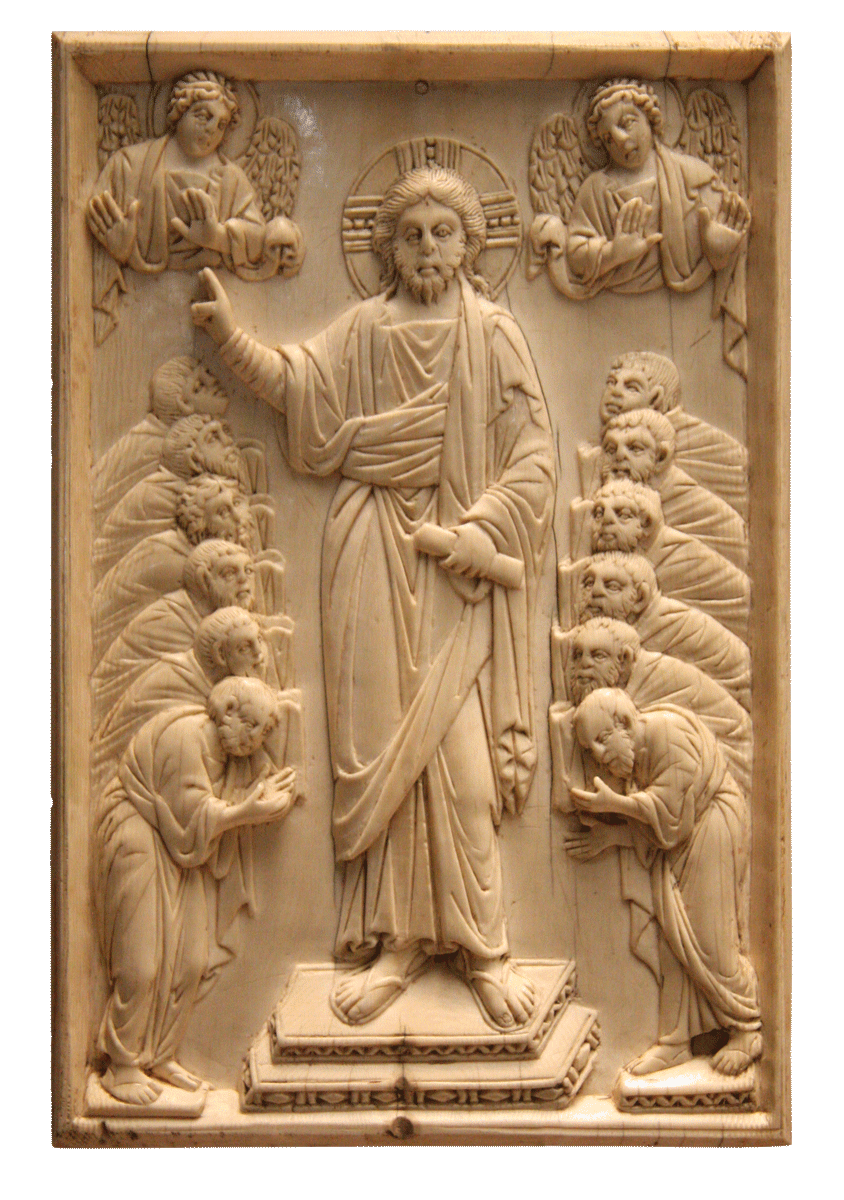
Ivory book-binding plate illustrating the Mission Discourse, in Matthew 10:1–11:1 (Constantinople, tenth century AD)
Jesus’s words, “You will not finish going through the towns of Israel before the Son of Man comes” (10:23), have often been understood as a reference to Jesus’s second coming. Yet “comes” (Greek erchomai) is not the usual term Matthew uses for Jesus’s reappearing (Greek parousia is nearly a technical term in the New Testament for the return of Jesus at the final judgment; see 24:3, 27, 37, 39). It is likely, instead, that Jesus’s words in 10:23 intentionally echo Daniel 7, in which “one like a son of man, coming with the clouds of heaven” into God’s presence, is vindicated and given power over all people and nations (Dan. 7:13–14). If so, Matthew indicates that the disciples’ mission to Israel will still be ongoing at the time of his vindication and enthronement. (For Matthew, Jesus’s vindication occurs at his resurrection [Matt. 28:18–20] and at the temple’s destruction in AD 70 [see commentary on 24:1–51].)
In 10:24–42, the scope of the Mission Discourse broadens to include Jesus’s followers beyond the Twelve (and Matthew’s readers as well). Jesus’s words in 10:24–42 begin by telling his followers that they will be maligned and persecuted as he has been (10:25; cf. 9:34). Yet he reassures them that they need not fear their persecutors; only God is worthy of such reverence (10:26, 28, 31). They can have boldness to speak “from the roofs,” because God will make known the truth in the end (10:26–27) and cares for them deeply (10:29–31).
Jesus exhorts his followers to single-minded allegiance to him—an allegiance that freely acknowledges and aligns itself with Jesus (10:32–33), an allegiance that is greater than loyalties to one’s family (10:34–37). This notion was quite countercultural in the first-century Jewish context, where family loyalties and obligations were paramount (cf. also 8:21–22). To be “worthy of [Jesus]” is to love Jesus more than all others and to take up one’s cross and follow him (10:38). On the story level, which focuses on Jesus’s teaching the Twelve, the metaphor of a cross poses a vision of discipleship as a path to death, since carrying one’s cross was what Rome forced criminals to do on the way to execution. Matthew is also foreshadowing for his readers Jesus’s own death by crucifixion. While it is possible to romanticize the cross today, the analogy of cross to discipleship would have been stark and sobering for Jesus’s hearers.
Jesus’s final words in the Mission Discourse (10:40–42) promise a reward for those who receive prophets, righteous persons, and “these little ones” who are disciples (see also the discussion of Greek mikros, “little one,” in Matthew 18). These three terms refer to the Twelve and others like them sent out in mission, who travel without provisions or status but who go with Jesus’s authority on his mission (10:1, 7–8). God will reward those who receive these “missionaries” and their message.
Matthew signals the end of this second discourse with the formulaic “After Jesus had finished [instructing his twelve disciples]” (cf. 7:28; see also “Structure” in the introduction). From 11:2 to 16:20, Jesus continues to teach and preach (11:1) but faces increasing hostility from Jewish leadership as his message and actions engender increasing attention and controversy.
B. Rejection by leaders and Jesus’s withdrawal from conflict (11:2–16:20). In Matthew 11:2–16:20, Matthew narrates Jesus’s ongoing ministry to Israel in the face of increased confrontation with and rejection by Jewish leaders. Faced with these controversies, Jesus withdraws from confrontation and instead turns to compassionate ministry focused on the Jewish crowds (12:15; 14:13; 15:21, 30). Matthew shows a range of responses to Jesus’s emerging identity, from rejection by Jewish leaders and Jesus’s hometown to the disciples’ right confession of Jesus as Messiah–Son of God (cf. 14:33; 16:16; cf. chap. 13 for varied responses expressed in parable). Yet Matthew also narrates the struggle of Jesus’s disciples to fully understand and embrace the truths about God’s kingdom that Jesus both announces and embodies. The hidden nature of the kingdom means that divine revelation coupled with human faith is required to grasp its reality.
11:2–12:50: Rejection of Jesus as Messiah by Jewish leaders. This section of Matthew, between his second and third major discourses, focuses on Jesus’s emerging messianic identity and the rejection he experiences as many, particularly the Jewish leadership in Galilee, question his actions and become increasingly antagonistic. Matthew highlights Jesus’s identity as an unexpected Messiah, especially Jesus as fulfiller of Isaiah’s vision of restoration and Jesus as God’s Wisdom (11:2–30). The unexpected nature of Jesus’s messianic identity explains the divergent responses to his ministry. Stories of controversy, especially between the Pharisees and Jesus, cluster in Matthew 12 (12:1–8, 9–14, 22–32, 38–45), providing a vivid illustration of those who “stumble” over Jesus (or “fall away”; Greek skandalizō; 11:6).
11:2–30. This section of narrative begins with a question from John the Baptist that highlights concern over Jesus’s identity (11:2–3). Reports of Jesus’s messianic activity have reached John in prison. In context, the actions of the Messiah (11:2) refer to Jesus’s healing, preaching, and teaching (see Matt. 4:23; 9:35). John’s question demonstrates that Jesus’s activity defies messianic expectations: “Are you the one who is to come?” (11:3). Though evidence from Jewish sources indicates that there was no single set of expectations about the Messiah, it is unlikely that central messianic acts would have included healing, especially within the trajectory of Davidic messianic expectation (see “Theological Themes” in the introduction). Instead, confrontation of pagan occupiers (Rome in the first century) would have ranked high on the list of things the Messiah would accomplish (cf. Psalms of Solomon 17:23–27). Jesus’s early ministry according to Matthew shows no sign of this kind of direct political action. John’s question allows Matthew to clarify what kind of Messiah Jesus is (with this section beginning with and ending on Jesus’s messianic identity: 11:2; 16:16–20).
Jesus’s answer, drawing language and ideas from Isaiah, indicates that his messianic ministry is characterized by signs of God’s in-breaking kingdom—Israel’s restoration—that include healing of the sick and preaching good news to the poor (Isa. 35:5–6; 61:1; also 26:19; 29:18). These are precisely the activities that Matthew has used to characterize Jesus’s ministry to Israel (Matt. 4:23–9:38). Jesus concludes his allusion to Isaiah by pronouncing blessing on all who do not “stumble” or “fall away” (skandalizō) because of Jesus. The Greek term skandalizō is used here metaphorically of the response of stumbling over the truth that Jesus is an unexpected Messiah. Matthew draws on this term elsewhere to express how people stumble over rather than embrace some part of Jesus’s identity or message (e.g., 13:57; 15:12; cf. also 26:31). This blessing for those who receive Jesus sets the tone for various responses that will be highlighted in 11:2–12:50 and beyond.
Jesus’s commentary about John (11:7–15) connects with the report of John’s question about Jesus’s identity, with Jesus confirming John’s role as prophet and forerunner (citing Mal. 3:1; cf. Matt. 11:10). John’s preparatory role is emphasized by Jesus’s statement that even the “least in the kingdom” is greater than John (11:11). This is a temporal statement rather than an assessment of value: John is the one who prepares for Jesus, the enactor of the kingdom, and so John is not of the generation that sees the kingdom being inaugurated (11:13). He is imprisoned before Jesus announces the kingdom (4:12, 17) and dies in prison without seeing firsthand Jesus’s ministry (14:3–12). Yet John has the unique role of “the Elijah who was to come” (11:14), preparing Israel for the Lord’s (Yahweh’s) coming (Mal. 4:5–6), which Matthew shows to be happening in Jesus’s ministry.
Jesus’s clarifying statement that John sits at the hinge of history (as precursor of the kingdom) also includes ambiguity (11:12). The verb might be intended to be read as a passive—“subjected to violence.” The emphasis is then on the suffering that John and Jesus and those following them must endure as the kingdom arrives. On the other hand, if the verb is active—“forcefully advancing” (see NIV note)—the meaning would indicate that Jesus’s kingdom inauguration necessitates a clash between God and evil.
Jesus goes on to compare the general response to John with people’s response to himself. Jesus claims that this generation—those who have been privy to Jesus’s preaching and healing—is impossible to please (on “generation” language in this part of Matthew, see 12:39–45). They reject John’s ascetic lifestyle consonant with kingdom preparation (repentance), but they also reject Jesus’s celebratory and hospitable way of living in the inaugural days of the kingdom (11:15–19; cf. 9:9–13). In spite of rejection by this generation, Jesus claims that “wisdom is proved right by her deeds” (11:19). In context, it is Jesus who is proved right or vindicated (NASB) by his deeds, thus aligning himself with wisdom. Wisdom is personified in the Old Testament and Second Temple Jewish literature (e.g., Prov. 9:1–6; Wisdom of Solomon 6:11–16), and Matthew implies that Jesus is the embodiment of God’s Wisdom. The bookending of the motif of Jesus’s deeds in the first and last verses of this passage provides confirmation (11:2, 19). The “deeds of the Messiah” (11:2; see discussion above) are the deeds of Wisdom (11:19; cf. 11:28–30).
After focusing on Jesus’s identity in relation to John and the petulant response of “this generation,” Matthew 11 continues by emphasizing Jesus’s judgment on the current generation that has seen the miracles Jesus has done but has not responded with appropriate repentance (11:20–24; for Jesus as judge, cf. 13:40–42; 25:31–33). Capernaum, Jesus’s home base (8:5), and Chorazin (two miles from Capernaum) are judged as cities that have witnessed greater miracles than Tyre, Sidon, and Sodom (Old Testament cities receiving God’s judgment; cf. Gen. 19:1–38; Zech. 9:2) and yet have not returned to God.
Matthew 11 concludes by returning to Jesus as the embodiment of the Wisdom of God (11:25–30; as in 11:1–19) as well as introducing the theme of revelation (11:25, 27). According to this prayer of Jesus, God has hidden the truth of the kingdom—what God is doing in Jesus—from the wise but has revealed it to “little children” (11:25), and the Son (Jesus, who has been described already as “Son of Man” and “Son of God”) is the means of that revelation (11:27). This notion that God through Jesus reveals the nature of God’s reign to some while it is hidden to others emerges more fully in the Parables Discourse of Matthew 13, as well as at Peter’s climactic messianic declaration in 16:16–17.
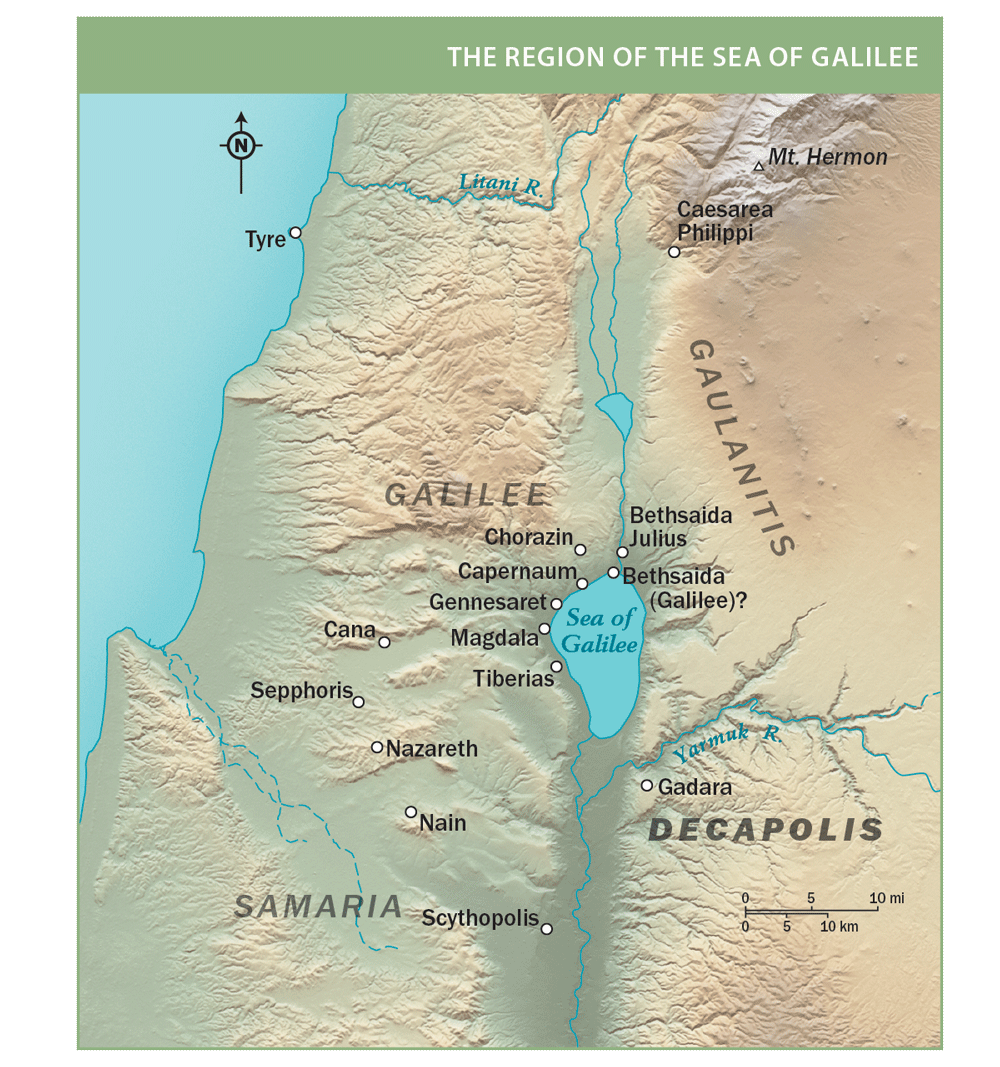
Matthew communicates Jesus as God’s Wisdom in the comforting words of 11:28–30, which evoke earlier Jewish writings about wisdom or torah, such as Sirach 6:18–27; 51:23–29 or Wisdom of Solomon 6:11–16. In these writings, personified Wisdom (1) invites people to come to her (compare Wisdom of Solomon 24:19 to Jesus’s “Come to me”; 11:28); (2) is described as having a “yoke” (the same Greek term is used in Sirach 51:26 and Matt. 11:29), a word frequently associated with the torah; and (3) provides “rest” (in Sirach 6:28; 51:27; and Matt. 11:29) rather than causing one to be “weary” (in Wisdom of Solomon 6:14; Sirach 51:27; and Matt. 11:28). Jesus takes on the role of Wisdom, summoning to himself all who are weary from the heavy loads (“burden”; 11:28, 30) imposed by the teachers of the law (cf. Matt. 23:4). Jesus rightly interprets and fulfills the torah, because Jesus himself is the embodiment of the torah and the Wisdom of God (see “Theological Themes” in the introduction).
12:1–50. With the torah introduced, Matthew now narrates two controversies between Jesus and the Pharisees about the law; both controversies are focused on Jesus’s practice of the Sabbath (12:1–8, 9–14). The Pharisees (12:2) were a Jewish sect considered to be experts in the law and were zealous in their obedience to it. An important part of their focus was adherence in everyday life to purity regulations intended to govern temple worship. Their desire was “to live out the rigor and piety of what was experienced at temple all year long” (Brown 2007, 209; cf. the description of the Pharisees on pp. 207–10). In the process, their prioritization of purity maintenance resulted in stricter boundaries between themselves and those people or activities that might make them ritually unclean for a period of time. Jesus’s critique of the Pharisees, as we will see, is not of their commitment to purity regulations but of their prioritizing them over torah regulations focused on mercy, justice, and faithfulness (cf. 15:1–6; 23:23).
In the controversy stories of Matthew 12:1–8 and 12:9–14, the Pharisees accuse Jesus or his disciples of breaking Sabbath laws. For the first accusation, Jesus cites examples of David and Old Testament priests who were required to work on the Sabbath (e.g., Num. 28:9–10) to clear his disciples of the charge of lawbreaking when they glean grain to eat when hungry (12:1–5). Jesus also alludes to his own priority over the temple and its regulations and cites Hosea 6:6: “I desire mercy, not sacrifice” (cf. 9:13). While Jesus’s words at 12:6–8 could be construed as abolishing the law, his use of Old Testament precedent to prove his disciples “innocent” (12:7) indicates that it is one’s interpretation of the law that is again at issue rather than a superseding of it (cf. 5:17). Jesus views mercy as at the center of the law with the specific applicability of other regulations being governed by mercy (and justice, faithfulness; 23:23) as well as by the eschatological truth of the arrival of the Messiah (who is greater than the temple). In the second Sabbath incident, Jesus heals a man’s shriveled hand and defends the action by an argument from lesser to greater: as anyone would rightly rescue a sheep from a pit on the Sabbath, it is even more in keeping with the law to do good to another human being on the Sabbath (12:11–12). Again, Jesus defends the action in question as lawful. Jesus and his disciples are faithful to the torah rather than lawbreakers.
Matthew narrates the Pharisees’ response to Jesus’s Sabbath healing: they plot to kill him (12:14). The conflict between Jesus and Jewish leadership intensifies, and as it does, Jesus withdraws, turning his attention to the Jewish crowds following him (12:15). Matthew will indicate in 14:13 and 15:21 this same response of Jesus’s withdrawing after controversy. In this case, Jesus interacts with the crowds by healing their sick yet warns them not to reveal his identity (cf. 8:4; 9:30; 16:20). Matthew connects both of these actions to a citation from Isaiah 42:1–4, the longest of his fulfillment quotations (see “Sources” in the introduction). Jesus’s compassionate healing ministry is alluded to in 12:20 (Isa. 42:3), and his warning of secrecy connects to 12:19 (Isa. 42:2). In addition, the Isaiah citation confirms that Jesus is Isaiah’s servant of the Lord (also 8:17), who will bring justice not only to Israel but also to the Gentiles (“nations” in 12:18, 21, can be rendered alternately as “Gentiles”; cf. NRSV).
In Matthew 12:22–32, the healing of a demon-possessed man turns into a controversy over the source of Jesus’s power. While the people respond by wondering whether Jesus might be the Messiah (“Son of David”; 12:23), the Pharisees ascribe his power to the prince of demons (as at 9:34). Jesus’s response to this accusation centers on the impossibility of a kingdom warring against itself (so Satan could not drive out demons; 12:25–26). Instead, Jesus’s exorcism of demons is an indication that his power comes from God’s Spirit, a sign that “the kingdom of God has come upon you” (12:28; for the connection of God’s Spirit and final restoration, see Joel 2:28–29). Jesus then claims through a parable that his power over demons proves that he has already bound Satan (12:29), so that it is one’s response to Jesus that is all-important (12:30). The following saying (12:31–32) is difficult to decipher but likely indicates that, although God’s forgiveness is wide (even sins against the Son of Man may be forgiven), the Pharisees’ misattribution of the Spirit’s power to Satan (12:24, 28) cannot be forgiven, since it signals a fundamental rejection of the work of God in Jesus.
In Matthew 12:33–37, Jesus intimately connects a person with their deeds (“fruit”; cf. 3:10; 7:16–20) and then highlights how speech arises from what is in the heart. While in Matthew 7:15–27 Jesus has emphasized the importance of actions (over words; 7:21), here he highlights the converse—that one’s words will bring either acquittal or condemnation on the day of judgment (12:27). Two truths are emphasized: only one who is good can produce good words and actions; and one’s words (as well as actions) will be the basis of final judgment (cf. 16:27). Jewish theology was quite able to hold together the notion of God’s gracious salvation and a final accounting based on works (and words), since God’s salvation preceded and provided the basis for God’s covenant with Israel and Israel was called to remain faithful to that covenant to the end.
The controversies between Jesus and the Pharisees continue in 12:38–45, where Pharisees and teachers of the law ask Jesus to provide a miraculous sign, presumably to authenticate his words (cf. John 2:18; also Matt. 16:1). In the context of Matthew, this request is highly ironic, since Jesus has just provided a sign (cast out a demon to heal a man; 12:22) and the Pharisees have questioned its authenticity! Jesus condemns the request, judging them to be part of “a wicked and adulterous generation” (also 16:4). The only sign he will give them is a riddle: “As Jonah was three days and three nights in the belly of a huge fish, so the Son of Man will be three days and three nights in the heart of the earth” (12:40; cf. 16:4). This is the first allusion Jesus makes in Matthew to his own death (see 12:14 for the Pharisees’ plot against him). The rest of this section focuses on Jesus’s judgment of “this generation” for its lack of repentance in the presence of the one who is greater than Jonah and Solomon (12:41–42; cf. 11:20–24; 23:36). A parable about an evil spirit returning with multiple spirits to the person it has left indicates the final condition of wickedness that brings Jesus’s judgment on this generation (12:43–45). Even after experiencing Jesus’s miraculous works and kingdom message, the Pharisees of Matthew 12 epitomize all from that generation who do not respond to Jesus in repentance and faithfulness.
The final passage of Matthew 12 bridges to the Parables Discourse of Matthew 13 by introducing the motif of insiders and outsiders (12:46–50). Jesus is told that his family has arrived and is outside waiting to speak to him (12:46–47). Jesus responds by identifying his family with his disciples (who are inside the house; see 13:1) and everyone who “does the will of my Father in heaven” (12:49–50). In chapter 13, Matthew will develop this motif of insiders and outsiders (metaphorically, but using literal cues as signals to it; cf. 13:1, 36) in concert with the themes of revelation, parabolic teaching, and understanding (e.g., 13:11, 13, 34–35, 51).
13:1–53: Jesus’s third discourse—the Parables Discourse. Having narrated the rejection of Jesus’s messianic identity by Jewish leaders who represent “this generation” (11:16–24; 12:1–14, 22–45) as well as the wondering response of the Jewish crowds (12:23), Matthew follows up with an extended discourse by Jesus that comments on the varied responses to his kingdom message and also reveals more about the kingdom that Jesus is initiating. Called the Parables Discourse because it includes eight of Jesus’s parables (or seven, depending on the status of 13:52), this discourse not only relies on the form of parable, but also highlights the effect of parables in hiding and revealing kingdom truths for their hearers (with each parable after the first introduced by “The kingdom of heaven is like . . .”; 13:24, 31, 33, 44, 45, 47; cf. 13:52).
Chapter 13 may be outlined to highlight the structural symmetry of pairs of parables and the two Old Testament quotations, as well as the focuses of the two halves of the chapter, one half on the crowds (13:1–35) and the other on the disciples (13:36–53).
| 13:1–9 | Parable of the soils |
| 13:10–17 | Reason for parables: Isaiah quotation |
| 13:18–23 | Interpretation of parable of the soils |
| 13:24–30 | Parable of the wheat and weeds |
| 13:31–32 | Parable of the mustard seed |
| 13:33 | Parable of the yeast |
| 13:34–35 | Reason for parables: Psalm quotation |
| 13:36–43 | Interpretation of parable of the wheat and weeds |
| 13:44 | Parable of the treasure |
| 13:45–46 | Parable of the pearl |
| 13:47–50 | Parable of the fish and net |
| 13:51–52 | Response of the disciples and parable of the house owner |
| 13:53 | Conclusion to Parables Discourse |
The first parable (13:1–9, 18–23) illustrates the variety of responses to the message about the kingdom by comparing people to kinds of soil receiving seed. Matthew has narrated a whole range of responses in chapters 8–9 and 11–12 (see commentary on 9:18–38), from great faith (8:5–13) to outright rejection (12:24). In this parable, the spectrum includes, on one end, those who lack any understanding about the kingdom Jesus preaches and brings (13:19) and, on the other, those who hear and understand Jesus’s message and yield much fruit (cf. 3:10 for bearing-fruit motif).

This area near Capernaum shows the rocky fields and hard paths that would have been familiar to the audience who heard Jesus tell the parable of the soils (Matt. 13:1–9).
Understanding emerges as an important theme in this first parable of Matthew 13 as well as in the two explanations for why Jesus speaks in parables (13:10–17, 34–35), with Scripture cited in both explanations. To answer the disciples’ question of why he speaks to the crowd in parables (13:10), Jesus cites Isaiah 6:9–10 and distinguishes between three groups, the crowds (his audience in 13:1–35), the disciples who receive additional explanation of his parables (e.g., 13:37–43), and the earlier prophets and righteous ones who longed to hear what the disciples are now hearing (13:16–17). The Isaiah citation comes from that prophet’s call to ministry, in which God indicates that Isaiah will prophesy to an obstinate people, who do not truly hear or see what God is doing (cf. Isa. 6:1–13). In similar fashion, Jesus’s ministry also lands on ears that do not truly hear—that do not understand (13:11–12). Teaching in parables both hides and reveals, depending on the kind of “soil” on the receiving end.
In Matthew 13:34–35, Matthew narrates the reason Jesus speaks in parables by citing Psalm 78:2. Here the reason for Jesus’s speaking in parables to the crowds has to do with revealing what has previously been hidden—what is not easily understood. Parables in this case fit the nature of the truths of the kingdom being revealed, which are difficult to fully grasp (even the disciples do not always understand; 13:36). Once again, the reason for parables is about revelation (to those who are ready and willing to understand; 13:23) and obscurity (for those who are calloused; 13:15). This tension in the chapter is underscored in Jesus’s invitation to the crowds and the disciples (and Matthew’s invitation to his readers) at 13:9 and 13:43 (cf. also 11:15). Though the parables and their truths are difficult to comprehend and accept, anyone with ears among Jesus’s listeners (and in Matthew’s audience) is invited to hear and understand.
In three clearly paired sets of parables, Jesus sets forth the mystery of the kingdom that he has already mentioned. The parables of the mustard seed and the yeast both indicate that, though the kingdom is seemingly insignificant or hidden at present, there will come a time when it will be unmistakable and all-encompassing. By these parables, Matthew’s Jesus communicates the already (present in Jesus) and the not yet of God’s reign. This same idea is expanded in the parables of the wheat and weeds and the fish and net, which indicate that judgment issuing in the separation of the righteous from the wicked will happen at “the end of the age” (a common phrase in Matthew; see 13:39–40, 49; 24:3; 28:20). The first of these two parables expressly indicates that judgment is withheld in the present (hidden) manifestation of the kingdom because it is not yet clear who is among the righteous (13:30, 38). The third pair of parables—those of the treasure and the pearl—illustrates the immeasurable worth of the kingdom in spite of its seeming insignificance and hiddenness (for language of the kingdom as hidden, see 13:35, 44; cf. 13:33 ESV). The kingdom, even in its present, hidden manifestation, is worth everything one has and brings great joy (13:44).
Two moments mark the end of the Parables Discourse. The first narrates Jesus’s question to his disciples of whether they have understood his parables. Although their answer is an unqualified yes, Matthew will show their lack of understanding as the story progresses (e.g., 15:15; 16:22). The final saying or parable of Matthew 13 (13:52) calls the hearer to respond to the kingdom rightly, as did the first parable of the chapter. Jesus’s parabolic instruction about the kingdom contains both new and old, expected and unexpected. Though the kingdom as Jesus conceives it has much in continuity with Old Testament and first-century Jewish expectations (e.g., God’s rule reclaiming this world), it also has new elements not fully anticipated. The kingdom as presently hidden, with its clear manifestation still to come, is one of these surprising truths highlighted in Jesus’s parabolic teaching of Matthew 13. (On the formulaic ending to Jesus’s five major discourses, see “Structure” in the introduction; here 13:53.)
13:54–16:20: Conflict and identity. In this section, Matthew continues to narrate the growing conflict between the Jewish leaders and Jesus. As before (12:15), he withdraws from this conflict to engage in compassionate ministry to the crowds and interaction with his disciples (with withdrawal language at 12:15; 14:13; and 15:21). Jesus’s identity is highlighted in this section of narrative, as the disciples come to confess Jesus as the Messiah (16:13–20) while others misunderstand (14:1–12) or reject his identity as the Messiah (13:54–58; 16:1–4).
13:54–14:36. Matthew’s narration of the unbelief of Jesus’s hometown (13:54–58) not only provides a vivid example of seed sown on unproductive soil (13:4, 19), but also frames the Parables Discourse by providing a point of contrast to Jesus’s declaration that his true family are those who do God’s will (12:46–50; cf. familial-language overlap at 12:49–50 and 13:55–56). Jesus’s hometown is portrayed with the negative characterization given the Jewish leaders in Matthew 12: they distrust his authority, questioning its source. While the leaders have claimed Jesus’s authority is demonic in origin (12:24), his hometown cannot overlook his family origins (13:54–56). In both cases, they stumble over Jesus’s messianic identity (13:57; Greek skandalizō as “take offense” or “stumble”; cf. 11:6; also 15:12).
At the beginning of chapter 14, Matthew inserts a flashback to Herod’s execution of John the Baptist (14:1–12). Herod the tetrarch (14:1; meaning “ruler of one-quarter”) was a son of Herod the Great (2:1). After the latter’s death, his kingdom was divided between three of his sons, with Galilee and Perea being assigned to Herod Antipas, who ruled these regions from 4 BC to AD 39. Herod Antipas, as a client-ruler of the occupation, represents Roman power and rule, as his father did (2:1). Matthew narrates in his story of Jesus how key leaders from Roman and Jewish quarters misconstrue Jesus’s identity.
Herod’s explanation for Jesus’s powers differs from that of Jesus’s hometown and the Jewish leaders, but it is similarly wrong. Herod believes Jesus to be John the Baptist back from the dead (14:2; cf. 11:2–5 for focus on John at the beginning of this section, where it is John who questions Jesus’s identity). Herod is portrayed in 14:1–12 as superstitious (14:2), vindictive (14:3), fearful (14:5), and rash (14:6–7). In the end, he has John beheaded (14:10).
After hearing the news of John’s death, Jesus withdraws to focus on compassionate ministry (14:13; cf. also 12:15; 15:21). A summary statement by Matthew emphasizes Jesus’s compassionate healing of the crowds (14:14; cf. 9:36). What follows is the first of two miraculous feeding stories (14:15–21; cf. 15:32–39), illustrating Jesus’s compassion toward the crowds and his miraculous power. Some have identified Jesus as a Moses figure in these feedings, with allusions to Moses feeding the people of Israel during their time in the wilderness (e.g., Exodus 16; see also Moses typology in Matthew 2 and 5–7). Matthew may also be connecting Jesus’s miraculous feedings to Jewish expectation that provision of manna would return at the time of the Messiah (cf. 2 Baruch 29:8). Matthew’s reference to the large number of those fed (five thousand men, with women and children beyond that number) highlights Jesus’s extraordinary power (14:21).
Jesus’s authority is immediately reemphasized in Matthew’s narration of Jesus’s walking on water (14:22–33). The disciples are alone in the boat while Jesus has gone away by himself to pray (14:22–23). When the wind comes up on the lake, Jesus comes to the disciples “walking on the lake” (14:24–25; “the fourth watch of the night” [KJV, RSV] was 3:00–6:00 a.m.). When Jesus calls to them to allay their fears, Peter attempts to join Jesus (14:26–29). His fear of the wind, however, causes him to sink. Jesus rescues him, referring to Peter as one of “little faith” (14:30–31). Matthew has previously tied “little faith” (Greek oligopistos) to anxiety about daily needs (6:30) and fear (8:26). Here he connects it to Peter’s “doubt” or wavering (Greek distazō; attributed to the disciples generally at 28:17). In spite of inadequate trust in Jesus’s power, the disciples recognize Jesus’s identity as “Son of God,” which points to their understanding of Jesus as the Messiah (see “Theological Themes” in the introduction). This is the first messianic confession from the disciples, and it mirrors Peter’s confession at the climactic moment of this section of Matthew (16:16).
Matthew has framed Jesus’s feeding of the five thousand and his walking on water with two summaries about Jesus’s healing ministry (14:13–14, 34–36). The first highlights his compassion to heal; the second emphasizes his power to heal (“all who touched him were healed”; 14:36). Gennesaret (14:34) is a plain located on the northwest coast of the Sea of Galilee.
15:1–39. After narrating Jesus’s interaction with the crowds and his disciples, Matthew again turns to controversy (15:1–20), this time between Jesus and Jewish teachers who have come to Galilee from Jerusalem. These Pharisees and teachers of the law confront Jesus over the lack of concern shown by his disciples in their table practices (15:1–2). The Pharisees follow the “tradition of the elders”; that is, they not only obey the torah but also observe teachings of past teachers (rabbis) on the torah (with many such teachings recorded in the Mishnah, ca. AD 200). In this particular case, hand washing to remove ritual impurity was required before eating. The likely background for this practice is the Old Testament command for priests to wash their hands (and feet) before entering the Tent of Meeting and before offering sacrifices (Exod. 30:17–21). Pharisees desired to bring the rigors of purity rites associated with the temple into everyday experience. Washing their hands before meals would have mirrored priestly temple practices.
Jesus’s critique of the Pharisees’ expectation that his disciples follow the oral tradition is not a direct criticism of that set of traditions. Instead, Jesus criticizes adherence to these traditions when adherence results in the breaking of the law itself! He claims that these Pharisees are breaking the command to honor parents by devoting to God resources that could and should provide for parents (15:3–6; cf. 23:3 for a similar indictment of law disobedience). Then Jesus cites Isaiah 29:13 (15:7–9), tying the hypocrisy of torah disobedience in the name of adherence to traditions to this same kind of hypocrisy that Isaiah saw in his day. Isaiah’s complaint—empty worship drawn from human rules—fits Jesus’s complaint against these Jewish teachers as well.
Jesus uses a parable of sorts to indicate that ritual cleansing before meals is unnecessary and misses the true source of impurity (15:10–11). Jesus’s explanation of his parable or riddle (15:16–20) clarifies that it is the heart of a person (rather than hands) that ultimately produces what is unclean, for from the heart come intentions that result in disobedient actions (cf. list of 15:19). Here Matthew’s Jesus is not invalidating the Jewish purity system; rather, he is providing an alternate interpretation of purity issues over against the tradition of the elders. (Mark’s Gospel takes this story in a different direction, particularly in his extrapolation that all foods are clean [Mark 7:19]. Nevertheless, there is no Gospel evidence that Jesus or his disciples broke with kosher dietary practices.)
In response to Jesus’s critique of the Pharisees and scribes, his disciples let him know that “the Pharisees were offended [skandalizō; cf. 11:6]” by his words (15:12). The language Matthew uses here, skandalizō, indicates that the Pharisees “stumble over” Jesus and his teaching. Jesus responds by picturing the judgment that will come to those who, like these Pharisees, not only are out of alignment with God (15:13) but also are leading others astray (15:14).
Peter, as representative of the Twelve (his frequent role in Matthew; cf. 16:16), asks Jesus to explain the parable (15:15). Jesus’s response to his disciples indicates that he expects them to have understood his teaching here (15:16–17). Despite their insider status in relation to Jesus’s teaching in parables (13:11, 18–23, 36–43, 51), they do not fully understand Jesus’s teachings. Jesus’s words “Are you [plural] still so dull?” (15:16) demonstrate that they have fallen short of his expectations for understanding. Jesus’s call to “listen and understand” (15:10) invites Matthew’s audience to do what few characters in the story have done well—to hear Jesus and to understand his words (cf. 13:9, 43).
Engagement in controversy again leads to Jesus’s withdrawing to compassionate ministry (15:21–31; cf. 12:15; 14:13), this time in the direction of Tyre and Sidon—Mediterranean coastal cities northwest of Galilee. In this location, Jesus is approached by a Gentile woman, a Canaanite, with the term evoking the Old Testament association of Israel’s enemies (15:22; cf. Num. 21:1). Using the messianic title “Son of David,” she cries out to him to heal her demon-possessed daughter (15:22). Yet Jesus speaks to her only after his disciples have entreated him to deal with her cries. His answer echoes the mission parameters he has already given to his disciples: “I was sent only to the lost sheep of Israel” (15:24; cf. 10:5–6). This initial scenario has much in common with the entreaty of the Gentile centurion on behalf of his servant who is ill (8:5–13), especially if 8:7 is understood as a question on Jesus’s part. In both cases, which are the only instances in Matthew where a Gentile seeks out Jesus for a healing, Jesus hesitates to cross the boundaries of his God-established mission. Yet in both cases, it is the persistence of the Gentile supplicant, highlighting their “great faith” (8:10; 15:28), that convinces Jesus to minister outside Jewish parameters prior to the establishment of the Gentile mission at his resurrection (28:19; see “Theological Themes” in the introduction). The woman’s exceptional faith provides the model for Matthew’s readers, who have witnessed the lack of faith in Jewish leaders (12:24; cf. 15:12) and Jesus’s hometown (13:58) and the “little faith” of the disciples (14:31).
Matthew provides another summary of Jesus’s compassionate healing ministry at 15:29–31 (cf. earlier summaries at 12:15–21; 14:13–14; 14:34–36). The crowds respond with amazement, praising “the God of Israel” (a commonplace Old Testament phrase; e.g., Judg. 5:3). Matthew narrates next the feeding of the four thousand (15:32–39), which also emphasizes Jesus’s compassion for the crowds (15:32) as well as his messianic power (see commentary on 13:54–14:36). Many have also noted the eucharistic overtones in the feeding miracles (e.g., breaking loaves, giving thanks; at 14:19 and 15:36; cf. 26:26).
16:1–20. In anticipation of the climactic scene of 11:2–16:20, Matthew returns to a number of motifs that he has developed. First, in Matthew 16:1–4, we see a challenge to Jesus by Pharisees and Sadducees that demonstrates their opposition to Jesus’s ministry (16:1; cf. 12:14) in a request for a sign. (The analogy to weather signs in 16:2–3 is missing in some early manuscripts, presumably omitted by scribes in locations outside of Palestine where such signs did not forecast the same weather.) In their refusal to receive Jesus and the signs he has already displayed (cf. 11:20–24; 12:41–42), they epitomize the “wicked and adulterous generation” that rejects Jesus’s enactment of God’s kingdom (16:4; cf. 11:16; 12:39–45). Jesus leaves his opponents (16:4; cf. Jesus’s withdrawals at 12:15; 14:13; 15:21), and they will not reappear in the narrative until 19:3.
As Matthew turns to Jesus with his disciples (16:5–12), a number of disciple-related themes resurface. Once again, Jesus refers to his disciples as “you of little faith” (16:8), this time in relation to their incomprehension of Jesus’s power at the two miraculous feedings. Even though Jesus has demonstrated that he is able to provide food for large crowds, the disciples are concerned that they have forgotten to bring bread with them, in the process misunderstanding Jesus’s warning about “the yeast of the Pharisees and Sadducees” (16:6–7; cf. the example of the Pharisees’ teaching at 15:1–20). The disciples’ little faith has been a motif in Matthew thus far both when Jesus describes them as having little faith (cf. 6:30; 8:26; 14:31) and in their inadequate appropriation of their own authority to participate in Jesus’s ministry (10:1; cf. Jesus’s expectation for their fuller participation in the miraculous feedings at 14:16–17; 15:32–33). The disciples are portrayed as those who understand at some level (cf. 13:11, 51; 14:33; 16:12) but lack fully adequate understanding of Jesus’s authority (e.g., 15:16–17; 16:8–11). Because of their mixed portrayal, they are not ideal examples for Matthew’s readers. Rather, Matthew intends his audience to sometimes emulate and sometimes distance themselves from the disciples’ responses (Brown 2002, 128–33).
The climactic moment of Matthew 11:2–16:20 is Peter’s confession that Jesus is the Messiah (16:16). In response to Jesus’s question about his identity as perceived by others, the disciples provide a range of responses (16:13–14; including John the Baptist in line with Herod’s belief at 14:2). Peter speaks on behalf of the disciples, rightly identifying Jesus as “the Messiah, the Son of the living God” (16:16). Although Matthew tells his readers that Jesus is the Messiah from the very beginning of the Gospel (1:1), this is the first occasion in which a character within the story identifies Jesus as the Messiah. The additional “Son of the living God” was likely understood as a messianic title within first-century Judaism (see “Theological Themes” in the introduction; also 26:63). Matthew’s intention for this additional phrase includes the intimate relationship already demonstrated between Jesus and the Father (e.g., 3:17; 4:3; 11:25–27).
Jesus confirms that Peter’s confession on behalf of the Twelve is true and has been given by divine revelation (16:17). Whether Jesus promises to build his church on Peter himself (as in Catholic interpretation, highlighting the wordplay between Peter’s name and the Greek petra [“rock”]) or on the messianic confession Peter has made (the typical Protestant interpretation), it is clear that Matthew shows the binding and loosing authority of 16:19 to extend from Peter to the rest of Jesus’s disciples and the church itself at 18:17–18. Given the use of binding and loosing terminology in Judaism of the time and Matthew’s use of related language elsewhere (5:19; 23:4), these concepts likely focus on determining the applicability of particular laws in particular situations (something Jesus does at 12:1–12, for example) (Powell 2003, 438). Jesus promises this authority to interpret and apply commands (presumably, the “keys of the kingdom”; 16:19) to Peter and then the entire church (18:17). Though promised at this juncture, the fulfillment of these promised kingdom keys comes only at the end of Matthew’s Gospel, where Jesus is given all authority (28:18). The disciples (and the church) receive their authority by derivation—by means of Jesus’s presence with them (28:20).
After these promises, Jesus warns the Twelve against telling anyone of his identity as Messiah. Given the swiftness of Roman action against would-be Jewish messiahs of the first century, such concern for discretion (cf. 8:4; 9:30; 12:16) would be necessary and wise. (On the rise and fall of such would-be messiahs, see Josephus, Jewish Antiquities 17.10.4–7.) It is telling that the Romans crucify Jesus within a week of his public “debut” as Messiah (see commentary on 20:29–21:27).
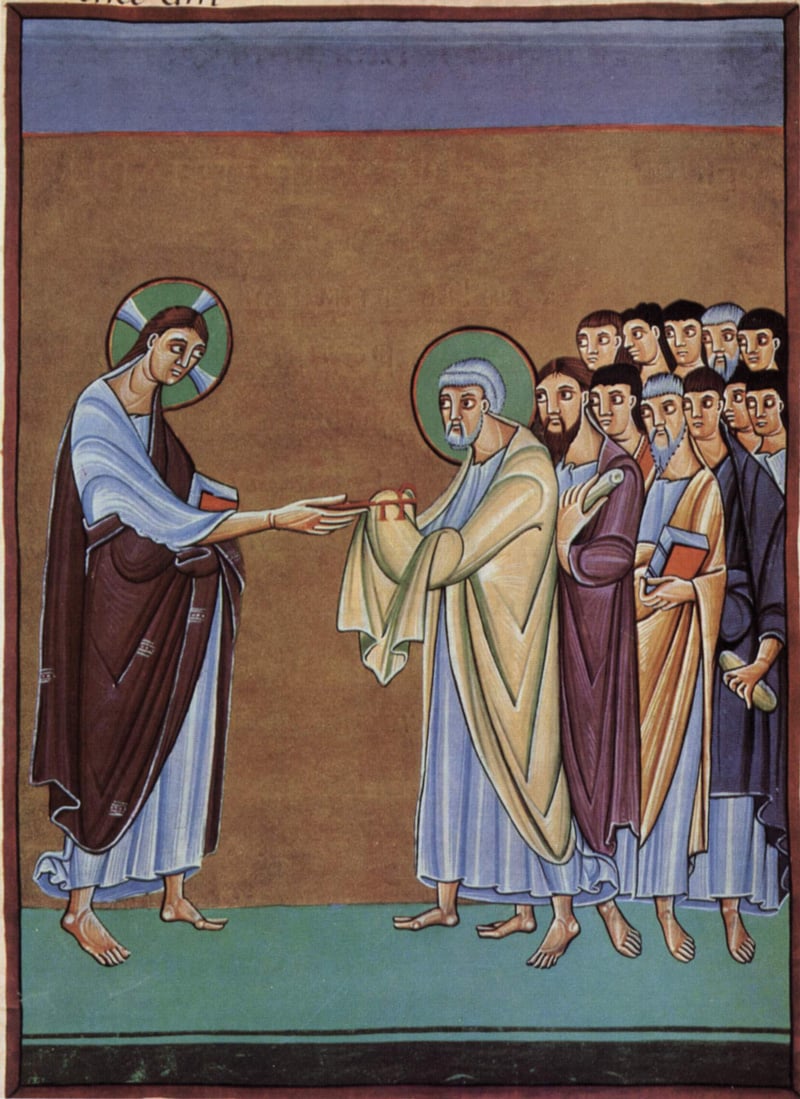
Jesus hands Peter “the keys of the kingdom of heaven” (Matt. 16:19) in this illumination from The Pericopes of Henry II (eleventh century AD).
3. Jesus to Jerusalem: Kingdom Enactment through Death and Resurrection (16:21–28:20)
In 16:21–28:20, Matthew narrates Jesus’s journey to Jerusalem to fulfill his mission to be “a ransom for many” (20:28). After repeated predictions of his death and extended teaching that his disciples are to follow his example of service without thought of personal status (16:21–20:28), Jesus rides into Jerusalem as Messiah, symbolically enacting Zechariah’s vision of a peaceable king (21:1–11). He indicts the Jerusalem leadership for their mismanagement of the temple and demonstrates his authority to do so by virtue of his identity as Messiah and Lord (21:12–22:46). His predictions of the fall of the temple and about his reappearing and final judgment call his followers to live faithfully and mercifully in preparation for what is to come (23:1–25:46). Matthew narrates in detail the events leading up to Jesus’s execution by Rome influenced by the Jerusalem elite. Jesus embodies his mission to be Israel’s Messiah-King through self-sacrifice rather than assertion of his rightful authority (26:1–27:66). His identity and mission are vindicated at his resurrection, which sees him enthroned with authority over all and enacting his mission to reach all nations through his presence with his people (28:1–20).
A. Journey to the cross and teaching on discipleship (16:21–20:28). In this section, Matthew focuses on Jesus’s journey from Galilee to Jerusalem, and he structures the section around three passion predictions—statements by Jesus that he will soon suffer and be crucified in Jerusalem (16:21; 17:22–23; 20:17–19). In the culminating moment, Matthew provides the purpose for Jesus’s sacrificial journey—to become “a ransom for many” (20:28). Woven between these predictions and this purpose statement are teachings and object lessons for Jesus’s disciples on the nature of discipleship. Jesus’s relationship with the Twelve is the central plot element in this section. Even in the few passages that begin with other characters (e.g., 17:14–20; 19:3–12), their conclusions show Jesus “debriefing” with his disciples about discipleship (Brown 2002, 47–49).
16:21–17:27: Jesus discusses the cross and discipleship. Immediately after Peter rightly confesses Jesus to be the Messiah (16:16), Matthew narrates Jesus’s first passion prediction (16:21). Jesus explains to his disciples the necessity of his impending suffering and death at the hands of Jerusalem leaders. In two subsequent passion predictions, Jesus indicates that he will be betrayed into human hands (17:22–23) and be crucified by Gentiles (20:17–19), demonstrating Matthew’s emphasis on wide-ranging culpability for Jesus’s execution (see 27:26).
In response to Jesus’s prediction, Peter rebukes him, denying that execution will be Jesus’s lot (16:22). Peter’s response demonstrates two things. First, he has not heard Jesus’s prediction of being “raised to life” in any meaningful way. This is understandable from the perspective of first-century Jewish expectations. Though a majority of first-century Jews would have believed in bodily resurrection, they would not have conceived of resurrection as a series of individual resurrections. Instead, Jewish hopes focused on a corporate resurrection of God’s faithful people at the time of final restoration (e.g., Dan. 12:1–3; cf. 2 Maccabees 7:13–14, 20–23). So Jesus’s reference to his resurrection here was not likely heard as Christian readers of Matthew have (rightly) heard it since: as referring to Jesus’s resurrection ahead of the final, general resurrection (cf. 1 Cor. 15:20–23).
Second, while Peter has rightly understood Jesus’s identity as Messiah (16:16), he does not understand the kind of Messiah Jesus is. Since it is not clear that suffering was a part of first-century messianic configurations, Peter’s response is understandable. Yet for Jesus (and Matthew), suffering and death are central for defining the kind of Messiah Jesus comes to be. Though Rome executed any number of would-be messiahs for their pretensions, Jesus is not predicting his death based on such likelihood but on necessity (“must”; 16:21). Peter’s words, though probably well meaning, function as a stumbling block to the fulfillment of Jesus’s mission; they do not represent the divine perspective (16:23).
Matthew follows this passion prediction with a teaching on discipleship that echoes the call to sacrifice that Jesus models (16:24–28). Self-denial and carrying one’s cross provide the pattern for discipleship (16:24; cf. 10:38 for the connotations of a cross for first-century readers), just as they are definitional for Jesus’s role as Messiah. Yet the paradox of discipleship is that losing one’s life (Greek psychē) results in finding it. Since psychē can refer to both earthly and transcendent life (often translated as “soul” for the latter), a wordplay is operative in 16:25–26. Jesus defines losing one’s life (and so self-denial) in terms of tangible actions (16:27), which Matthew will illustrate in subsequent chapters (Matthew 18 particularly).
Reference to “the Son of Man coming in his kingdom” (16:28) points ahead to the foretaste of Jesus as king at his transfiguration (17:1–9) as well as to his enthronement at his resurrection (chap. 28). The vision of the Son of Man coming in his kingdom derives from Daniel 7:13–14 and is a picture of Jesus’s vindication of his claims and his mission (see 10:23; 24:30–31). When Matthew references Jesus’s second coming, he uses a different, quite specific term, which occurs in Matthew 24:3, 27, 37, and 39. The transfiguration and the subsequent debriefing with Peter, James, and John reveal more clearly who Jesus is (17:1–13). Mountains are key locations for revelation, in Scripture generally and in Matthew specifically (cf. Matthew 5–7, 17, 24–25, 28). The central moment is when the divine voice affirms Jesus and his mission: “This is my Son, whom I love; with him I am well pleased” (17:5). These are the same words spoken by God at 3:17 (see commentary on 3:1–17 for possible Old Testament allusions), with only John privy to them. The disciples now learn of the intimate relationship between God and Jesus, the Son. The added words—“Listen to him!”—emphasize Jesus’s teaching role with the disciples in this part of Matthew.
The appearance of Moses and Elijah with Jesus (17:3) precipitates the disciples’ question about the scribal understanding that Elijah must “come first” (17:10). The teachers of the law reflect Malachi’s prophecy that Elijah’s appearance would precede the “day of the Lord” (4:5–6; cf. Sirach 48:10 for an expectation that Elijah would usher in Israel’s restoration). Given the disciples’ recent confirmation of Jesus’s messianic identity and experience of him in glorified form, it is not at all difficult to see why they would be wondering about the imminent arrival of that final day (Matthew’s “end of the age”; e.g., 13:39; 24:3; 28:20). Jesus affirms the truth of this expectation but with a twist: Elijah has already come and been rejected, as will the Son of Man (17:12). The disciples make the connection between this prophesied Elijah and John the Baptist (see 3:4; 11:7–14).
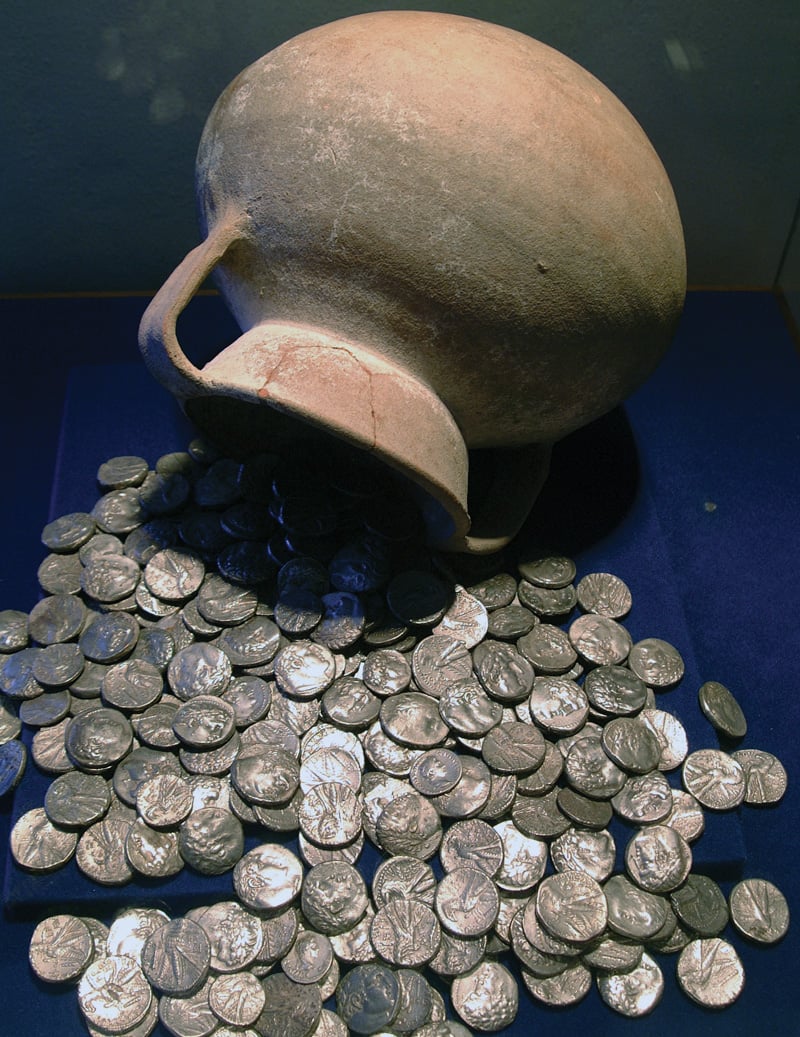
These Tyrian shekels are from the Ussfiyeh hoard, discovered on Mount Carmel in 1960. Originally minted in the city of Tyre, Tyrian shekels were worth four drachmas each; thus one was enough to cover the temple tax for Jesus and Peter (Matt. 17:27).
Matthew narrates the healing of a demon-possessed boy (17:14–20), whose father has sought his healing from the disciples while Jesus was away with Peter, James, and John. When the disciples fail, the father comes to Jesus. Jesus’s response echoes his words against “this generation” in 12:39–45, where Jewish leaders inappropriately ask Jesus for a miraculous sign. In this case, Jesus reacts against the general unbelief of the present generation as exemplified by the disciples’ inability to heal the boy (17:17). After Jesus heals him, the disciples privately ask why they were unsuccessful (17:18–19). Jesus attributes their inability to their “little faith” (oligopistia; 17:20; see also 6:30; 8:26; 14:31; 16:8), distinguishing the disciples from and connecting them to the current generation, whom Jesus characterizes as lacking faith (“unbelieving”; 17:17). The disciples’ little faith here corresponds to their inability to cast out a demon. They do not adequately trust in the authority Jesus has already given them (cf. 10:1). With faith as small as a mustard seed, the disciples could do miraculous things. Yet their little faith falls short of the small amount of faith necessary for doing the impossible (17:20). (The NIV omits 17:21, placing it in a footnote, since it is most likely a copyist’s addition in light of its parallel in Mark 9:29 and its omission in many manuscripts.)
Jesus predicts his execution and resurrection to his disciples a second time, yet they grieve at this news, indicating that they do not understand what Jesus means by “on the third day . . . raised to life” (17:22–23; see 16:21).
The final passage of 16:21–17:27 narrates Jesus’s pronouncement on paying the temple tax while also introducing the motif of stumbling that will be explored in Matthew 18. The two-drachma temple tax (equivalent to the half-shekel of Exod. 30:11–16) was levied on all adult Jewish males annually, though there is debate on how rigidly this was followed in the first century. When questioned by the collectors of this tax whether his teacher pays it, Peter responds in the affirmative. Jesus then takes the situation as a teaching opportunity and uses the analogy of human kingship: while kings levy taxes, they do not tax their own offspring (17:25–26). In the same way, those who are children of the kingdom are exempt from taxation (17:27). Yet Jesus’s teaching and practice goes further: he will pay the tax to avoid causing others to stumble (NIV “cause offense”; cf. 11:6). Kingdom freedoms are constrained by concern for others (cf. 18:6–7). The amount miraculously provided is just enough to pay for Peter and Jesus (a four-drachma coin for both two-drachma payments).
18:1–35: Jesus’s fourth discourse—The Community Discourse. The messages of the Community Discourse—embedded in 16:21–20:28, with its focus on defining Messiah and discipleship—center on the need for the messianic community to renounce status concerns, care for their most vulnerable, and pursue restoration and forgiveness of those who stray. The community of disciples must deny self and live a cross-shaped existence (16:24) empowered by Jesus’s presence within the community.
Though possessing a certain seamlessness, Matthew 18 may be divided into two sections, each beginning with a question posed to Jesus (18:1, 21). These narrative moments lead into Jesus’s extended answer in each case. The Community Discourse includes teachings of Jesus for the twelve disciples on the story level as well as addressing Matthew’s audience quite directly (see “A Narrative Reading” in the introduction).
In Matthew 18:1–20, Jesus begins by addressing the disciples’ question about who is greatest in God’s kingdom (18:1). This is a status question—an understandable one in the context of ancient conventions that clearly spell out honor and status levels based on birth, family, title, wealth, and relationship with others. As their daily conventions revolve around attention to status concerns, the disciples assume that the inauguration of God’s reign will set up a new set of status criteria. They are hopeful that they will rank higher in God’s status system than in that of the Greco-Roman world (cf. 20:20–21).
Jesus’s response indicates that the disciples’ assumptions about God’s kingdom are mistaken. He brings a child to them to signal their need for change regarding status concerns (18:2–3). Instead of being preoccupied with their status in the kingdom, they need to become like children to enter the kingdom. Jesus then indicates it is the humble status of children that the disciples should emulate (18:4). While today’s readers of Matthew often hear “humble” (ESV, NASB) as an internal disposition, the original audience (and the disciples) would have understood this as a term indicating social status (see NIV). In that cultural context, children did not possess status inherently; they did not have the rights and honor that modern Western society gives them. Instead, they were considered weak and irrational and as possessing little status until they reached adulthood (Brown 2002, 70–71). As such, they are ideal examples for the disciples, who are preoccupied with status concerns. Jesus aligns himself with those marginalized in the status systems of his day, and he calls the disciples to do the same: anyone who welcomes a child welcomes Jesus (18:5)!
In Matthew 18:6–10, Jesus expands his discussion about those in the messianic community who, like children, possess little or no status. Jesus defends these “little ones” (mikros) against those who would cause them to sin (skandalizō: “stumble”; 18:6) or who look down on them (18:10). Warnings are given against bringing about the sin and stumbling of others (18:5–6) or of oneself (18:7–9). Using hyperbole to great effect (“cut [your hand] off”; “gouge [your eye] out”), Jesus teaches that it is better to lose hand, foot, or eye if it causes sin than to risk “eternal fire” (18:8). Jesus grounds the value of these persons of low status in their access to his Father and in God’s concern for them. (The NIV places 18:11 in a footnote, since it is almost certainly a later scribal addition drawn from Luke 19:10.)
To illustrate God’s deep care for little ones, especially those who stray, Jesus tells a parable of a shepherd who leaves his ninety-nine sheep in safety to seek and find the one that has strayed away (18:12–13). His joy is greater over the restoration of that single sheep than over the rest who never strayed. Jesus applies the parable (18:14) to the Father’s great concern over losing even a single little one.
The theme of restoration initiated in the parable finds further emphasis and clarity in 18:15–20, where the restoration of a sinning community member is paramount. The goal of the process described in 18:15–20 is to win over one’s brother or sister (18:15). The restorative process involves (1) bringing the purported sin to the person privately; (2) if the first action does not result in restoration, bringing one or two witnesses along in line with the Old Testament command to protect the accused from false testimony (18:16; not to aid the accuser; cf. Deut. 19:15); and (3) if neither action results in restoration, bringing in the church as a whole to advocate for restoration (18:17). As a last resort, the church is to treat the erring member as an outsider (with tax collectors and pagans connoting outsiders in Matthew’s social context; cf. 5:46–47). Though it is not explicit, the reader is right to presume that this final action (as with the rest) is also for the purpose of restoration (cf. 1 Cor. 6:9–12 for a similar excluding action with the goal of restoration).
Jesus’s words at 18:18 echo his earlier promise concerning binding and loosing (cf. 16:19). Jesus then uses language of “two or three” (from 18:16, reflecting Deut. 19:15) to promise that God will hear and answer when the Christian community agrees in prayer (18:19), based on Jesus’s presence with them (18:20). The promise of Jesus’s presence grounds the instructions for discipline not only in 18:15–19 but also in 18:1–14. At the thematic center of the Community Discourse, Matthew emphasizes Jesus’s presence with his people as the hope for their common life (cf. 1:23; 28:20 for the bookended theme of Jesus’s presence).
The second half of Matthew 18 is introduced by Peter’s question regarding the appropriate number of times that forgiveness is warranted (18:21). Although generous in his suggestion, Peter’s sevenfold forgiveness contrasts with Jesus’s answer of “seventy-seven times” (18:22). His answer alludes to Genesis 4:24, where Cain’s son Lamech claims that God will avenge him seventy-seven times (cf. Gen. 4:13–15). Jesus’s call to his messianic community is to live out a reversal of escalating vengeance through unlimited forgiveness. To illustrate, Jesus tells a parable of a servant who is released from an astronomical debt of ten thousand talents by a compassionate king (with a talent being roughly equivalent to six thousand denarii) only to refuse release of a debt of one hundred denarii for a fellow servant (with a denarius representing about a day’s wage). The king’s reversal of debt forgiveness and his punishment of the servant at the parable’s conclusion is compared to God’s treatment of “each of you unless you forgive your brother or sister” (18:35). This teaching echoes Matthew 6:14–15, where God’s forgiveness is predicated on one’s forgiveness of others. The parable provides a helpful expansion, clarifying that the warning is issued to those who have already experienced God’s forgiveness, so that human forgiveness is portrayed as arising organically and necessarily from an experience of God’s forgiveness.
19:1–20:28: Illustrations of discipleship. 19:1–30. Signaling the conclusion of the fourth discourse, Matthew includes the familiar formula, “When Jesus had finished [saying these things]” (19:1; repeated at 7:28; 11:1; 13:53; 26:1). The next section takes place to the east of Judea, across the Jordan River (19:1). After summarizing Jesus’s ministry of healing to the crowds (19:2), Matthew narrates a legal debate between the Pharisees and Jesus (19:3–9; cf. 12:1–14). The Pharisees use a question about legal reasons for divorce to test Jesus (“for any and every reason?”). Jesus answers by citing Genesis 1:27 and 2:24, indicating the basis for the permanence of marriage in God’s creational intention that husband and wife be “one flesh” (19:4–6). In turn, the Pharisees cite Deuteronomy 24:1, which may have been used in Jewish debates for both wide latitude and a narrow understanding of permissible divorce. Jesus argues that Deuteronomy provides a concession rather than a command. His own teaching on divorce, according to Matthew, allows for it only in cases of unfaithfulness, fitting the more conservative interpretation of Deuteronomy (19:9; cf. discussion of exception clause at 5:32; and Mark 10:11 for Jesus’s divorce teaching without an exception clause).
The debate with the Pharisees recedes into the background as Jesus debriefs with his disciples, who misconstrue his teaching as a reason to avoid marriage altogether (19:10). Jesus takes the opportunity to teach that choosing celibacy for God’s kingdom is the right course for those “to whom it has been given” (19:11), while not undermining the importance of marriage. Jesus’s teaching affirms both “life-long marriage as one flesh according to the original intention of God and singleness for the sake of the kingdom according to the power of God” (Brown 2002, 79). Using this story, Matthew continues to subvert prevailing status expectations about the kingdom (cf. 18:1–5). Here, Jesus limits the power of husbands to divorce their wives “for any and every reason” to only cases of marital unfaithfulness and, in a culture in which they were socially marginalized, elevates the status of eunuchs within kingdom perspective.
In 19:13–15, Matthew highlights status issues by reiterating Jesus’s perspective on children (cf. 18:5). The disciples attempt to keep children from Jesus, showing that they have not assimilated Jesus’s teaching at 18:1–5. Jesus corrects the disciples, inviting children to come to him and indicating the central place that children have in God’s kingdom.
In counterpart, Matthew narrates a story illustrating how persons of great status, the rich, do not have priority in God’s reign or kingdom (19:16–26). In fact, the story of the rich man who comes to Jesus asking the way to eternal life concludes with Jesus teaching his disciples the difficulty the rich will have entering God’s kingdom (19:23–24). Jesus’s initial response to the man’s question is that obedience to God’s commandments brings life (19:17–19; with his examples drawn from Deut. 5:6–21). The man says that he has kept these but indicates he still lacks something (19:20). Jesus calls him to complete loyalty (the Greek term may be rendered “perfect” or “complete”) by selling his possessions, giving the proceeds to the poor, and then following Jesus (19:21). Jesus calls this man to give up precisely that which stands in the way of discipleship—his “great wealth” (19:22), something he is not yet willing to do.
Jesus’s debriefing with his disciples (19:23–26) points to the great difficulty of the rich in entering God’s kingdom (with the image of a camel going through a needle’s eye emphasizing this difficulty). The disciples are astonished by this statement (19:25), indicating that they consider the rich to have great status and advantage in God’s kingdom (as they do in ancient society). Jesus’s concluding statement intimates the leveling of the playing field in God’s scheme of things, since what is humanly impossible (salvation) is quite possible for God (19:26). God can save both rich and poor, though Matthew shows that those who are poor and of lesser status are closer to the kingdom than the rich and powerful (e.g., here and 5:3–6).
Peter’s subsequent question provides opportunity for an extended teaching on status and reward (19:27–20:16). In contrast to the rich man, the disciples have “left everything to follow [Jesus]” (19:27). Peter’s question about what they will have elicits Jesus’s two-pronged answer. First, he assures his followers that their faithful discipleship will result in their vindication at the “renewal of all things” and a role in that final judgment (“thrones” likely connote a judging role; yet cf. 25:31–46 for disciples also being judged in that final day). All followers of Jesus who have left home and family (cf. 12:48–50) will be rewarded with blessing and eternal life (with hundredfold language used to indicate abundance of blessing; 19:29). Second, Jesus also warns against presuming on one’s kingdom status or reward (19:30). With language that clearly connotes status (first/last), Jesus qualifies his promise of reward and status. This same warning is repeated at 20:16, after the parable of the workers, which addresses status presumption.
20:1–28. In the parable (20:1–15), Jesus compares God’s reign to the payment of groups of day laborers working in a vineyard for a particular landowner. After hiring laborers throughout the day, the landowner pays those hired during the last hour a full day’s wage (a denarius)—the same amount he has promised to those who began working in the early morning. Seeing this, those hired first expect to receive more than a denarius, yet they receive just what was promised them. They grumble to the landowner: “You have made them equal to us who have borne the burden of the work” (20:12). Their accusation is the inequity of equal pay for unequal work. The landowner counters that he paid them an agreed-on and fair wage. They resent not his fairness but his generosity (20:15). Jesus’s parable warns against presuming reward and status in the kingdom (19:30; 20:16), especially for those who are “first” (in story context, the Twelve—who expect higher status in the kingdom; cf. 18:1; 19:27; 20:20–21). The parable also hints at a surprising (and offensive!) equality within the kingdom.
In Matthew 20:17–19, Matthew provides Jesus’s third passion prediction to his disciples, this time making explicit that Jesus’s death will be crucifixion at the hands of the Gentiles (20:19). Without narrating a specific response of the disciples (as he does at 16:22 and 17:23), Matthew implies a continuing incomprehension on the part of the disciples as to what Jesus’s mission is really about by telling the story of a bid for status in the kingdom by James and John.
The request for second and third positions in the coming kingdom (to sit at Jesus’s right and left) comes through the mother of James and John (20:20–21). Yet it is clear that James and John are involved in the plan since they answer Jesus’s question about drinking the cup he will drink (with cup language used in the Old Testament to signal God’s judgment; e.g., Jer. 25:15; 49:12). That they think they will be able to drink that cup, which refers to Jesus’s execution, indicates that they have not understood either Jesus’s passion predictions (16:21; 17:22–23; 20:17–19) or his expectations for their role in his mission, which is rooted in self-sacrifice for others (16:24–26; 18:1–35). When the other disciples are angered by James and John’s request, Jesus counters their perspectives on status with a series of sayings that culminate Jesus’s kingdom teachings in 16:21–20:28. Jesus first contrasts their relationships within the believing community with the way rulers of the Gentiles take the role of absolute master over others (20:25). The disciples, by contrast, should take the position of servants and slaves in relation to one another (20:26–27). Living out the metaphor of a slave is much like living out the child analogy Jesus has used in 18:1–5. In both cases, Jesus holds up as an example one with little or no status. His disciples should emulate those of little status rather than one who holds and maintains power and status. Jesus corrects those who seek to be “greatest” (18:1; see also 20:26) and “first” (19:30; 20:16, 27) in a kingdom that is not about status pursuit but status renunciation. Jesus in Matthew 20:26–27 “reinterpret[s] greatness and ‘firstness’ to such an extent that all sense of rank is removed from them” (Brown 2002, 91).
Jesus’s own mission is the example to emulate: “The Son of Man did not come to be served, but to serve, and to give his life as a ransom for many” (20:28). Jesus’s words very likely evoke Isaiah’s servant of the Lord, described as “[the Lord’s] righteous servant [who] will justify many” (Isa. 53:11–12; see “Theological Themes” in the introduction). Matthew signals here for the first time in his narrative that it is Jesus’s death that will bring Israel’s redemption (cf. 1:21; also 26:28) and God’s kingdom. God’s reign is inaugurated by God’s servant, who pours out his life for others rather than dominates as the Gentiles do. An inversion of power redefines kingdom and discipleship to such an extent as to be almost unrecognizable.
B. Final proclamation, confrontation, and judgment in Jerusalem (20:29–25:46). In this section, Matthew narrates Jesus’s arrival and early actions in Jerusalem, the ensuing controversies with the Jerusalem leaders regarding his authority, and Jesus’s subsequent prophetic judgment of the temple and its leadership. Through these Jerusalem encounters, Matthew emphasizes Jesus’s identity as Davidic Messiah and his rightful authority and lordship over the temple and its present leadership as well as all humanity at the end of the age. Matthew also highlights the importance of living out covenantal faithfulness, mercy, and justice for all who would follow Jesus as king.
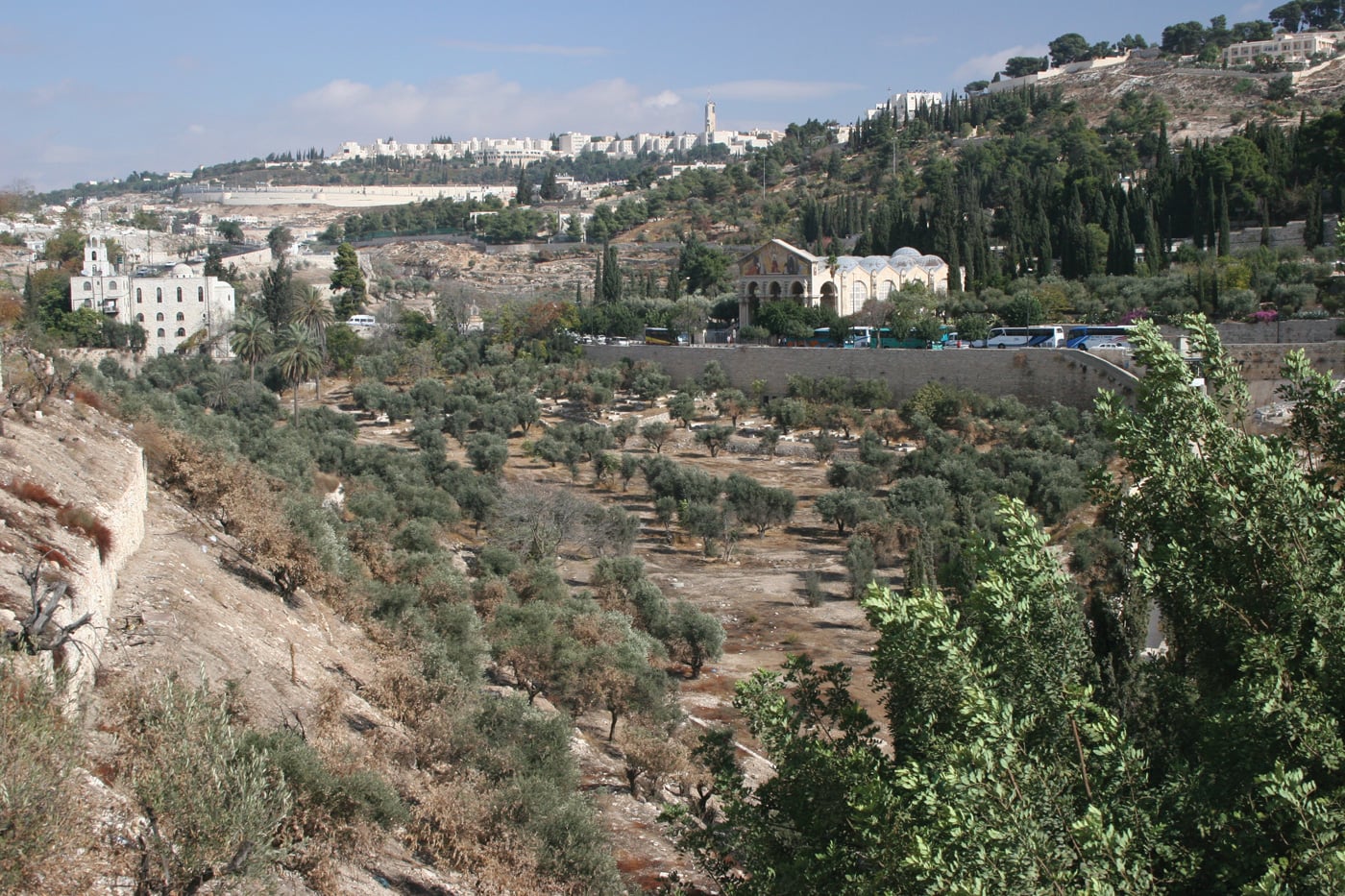
Matthew 21:2 describes Jesus approaching Jerusalem from the Mount of Olives, which is in the upper right of this photo of the Kidron Valley. To enter Jerusalem, Jesus would have traveled down from the Mount of Olives, across the Kidron Valley, and then up into the city.
20:29–22:46: Jesus in Jerusalem. 20:29–21:27. Jesus’s healing of two blind men (20:29–34) is a transitional story between Jesus’s teaching of the disciples in 16:21–20:28 and his arrival in Jerusalem in 21:1–11. Links occur between the calls of the blind man to Jesus as “Son of David” (20:30, 31) and the cries of the Jerusalem crowds, “Hosanna to the Son of David!” (21:9), and the crowds are reintroduced to a central place in Matthew’s story (20:31; 21:9, 11). The healing story emphasizes Jesus’s messianic compassion and authority (20:34) and ends with the two men following Jesus—language used by Matthew to signal discipleship (e.g., 4:19; 16:24).
For Matthew, Jesus’s entry into Jerusalem (21:1–11) enacts Zechariah’s prophetic announcement that Israel’s king would arrive in Jerusalem not as a warrior on his horse but on a donkey—as in times of peace (Zech. 9:9–10; also 1 Kings 1:33, 38). Just as Zechariah’s prophecy anticipates a “gentle” king (21:5; see the Greek Septuagint of Zech. 9:9), Matthew’s Jesus has already identified himself as “gentle” (11:29; see also 5:5 [NIV “meek”]). Matthew emphasizes Jesus’s symbolic appropriation of the peaceable and gentle king by narrating Jesus’s instructions to procure a donkey (21:1–3), by quoting Zechariah 9:9 as fulfilled in Jesus’s arrival in Jerusalem (21:4–5), and by concluding with the response of the crowds to Jesus’s royal entrance. The crowds accompanying Jesus hail him as “the Son of David”—a messianic title. They choose a blessing from Psalm 118, which may have been understood to have royal connotations (Ps. 118:26; Matt. 21:9). When questioned by the people of Jerusalem, these crowds who have followed Jesus from Galilee to Jerusalem identify him as “the prophet” (21:11; a possible reference to Deut. 18:15–19; cf. John 6:14).
Matthew immediately turns to Jesus’s clearing the temple upon his arrival in Jerusalem (21:12–13). The selling of sacrificial animals was a necessary accommodation for pilgrims traveling long distances to Jerusalem for Passover (26:2), as was the changing of money from Greek and Roman currency (with their pagan images/inscriptions) to the prescribed temple currency of coins from Tyre in Phoenicia. Jesus’s complaint in his symbolic action is likely about the location of such transactions within the temple confines (probably the Court of Gentiles, which accommodated large crowds during festivals) rather than a rejection of these practices altogether. He cites Isaiah (56:7; at Matt. 21:13) to indicate the temple’s purpose as a house of prayer, not a “den of robbers” (an allusion to Jer. 7:11).
Jesus’s action in the temple signals (implicitly but clearly) his messianic identity and anticipates his prophetic judgment on the temple in 23:37–24:35. “Those who had witnessed his overtly messianic arrival could hardly fail to read this [temple] action in the same light, as an assertion of messianic authority” (France, 784; France discusses pertinent Jewish literature tying temple rebuilding or purification to the Messiah’s arrival [784–85]). Jesus, as the Messiah, has the right to call the temple’s leadership to account for its administration. Jesus demonstrates the purpose of the temple as a place of prayer, welcome, and healing (21:14). His identity as “Son of David” is reaffirmed in the shouts of children, to the consternation of the chief priests and teachers of the law (21:15–16; cf. Ps. 8:2).
In the third of three symbolic acts, Matthew’s Jesus curses a fig tree that has no figs (21:18–22), evoking Old Testament prophetic critique of Israel’s fruitlessness (Mic. 7:1; cf. Jer. 8:13). Matthew uses this account to emphasize Jesus’s critique of the current temple administration (in combination with 21:12–13, with the most immediate referent for mountain in 21:21 being the temple mount) and to call disciples to faith without doubt (cf. 17:20).
The question the chief priests and elders raise about Jesus’s authority (21:23) sets the terms for a series of controversies between Jesus and the Jerusalem leadership (chaps. 21 and 22). Jesus agrees to answer their question about the source of his authority for his recent actions if they will identify John’s baptism as divine or human in origin (21:24–25). Their dilemma: if they say divine, they will have no excuse for rejecting his message; if they say human, they will antagonize the crowds, who believe John was God’s prophet. They claim ignorance, and Jesus does not answer their question (21:27). Yet, in the ensuing controversies, Jesus asserts his God-given authority powerfully and effectively, so that, in the end, no one dares to ask him any more questions (22:46).
21:28–22:14. Jesus first addresses the Jerusalem leaders with three parables that indict them for abdicating their leadership role in guiding Israel in righteousness (21:32). In the parable of the two sons (21:28–32), Jesus contrasts the son who, though initially disobedient, repents (the Greek term is rendered variously as “changed his mind” and “repent” in 21:29 and 32) and obeys his father with the son who says he will obey but does not. In regard to believing John the Baptist’s message, the tax collectors and prostitutes are like the first son, the chief priests and elders like the second (21:31–32). According to Jesus, the wayward of Israel enter God’s kingdom ahead of its leaders, because the latter “did not repent and believe [John]” (21:32).
This harsh indictment leads into a parable of judgment on the same leaders (21:33–46). Jesus draws on the Old Testament portrayal of Israel as a vineyard (e.g., Isa. 5:1–7) and tells a story of a vineyard entrusted by a landowner to local tenants. When he sends his servants to collect the fruit, the tenants beat or kill them. Even when he sends his son, they do the same. The judgment on the tenants is the vineyard’s removal from them and its transfer to other tenants (21:41). Jesus cites Psalm 118:22–23 to indicate God’s vindication of the rejected one (cf. 28:18) and declares that God’s kingdom will be taken away from Israel’s current leaders and given “to a people who will produce its fruit” (21:43; with the singular noun “a people” likely referring to faithful Jews and Gentiles). The judgment of this parable and the previous one is aimed specifically at the Jewish leaders, who have failed to lead and care for the Jewish people as they ought. Their failure is seen precisely in their rejection of both John and Jesus (the son of the parable). The chief priests and Pharisees know that Jesus has referred to them in these two parables (21:45), so they seek to arrest him secretly (21:46).
The third parable Matthew includes (22:1–14) is likely also intended for the Jewish leadership, though the ending is not specific to them as at 21:31–32, 45. God’s kingdom is likened to a wedding banquet held by a king for his son. Those invited refuse to come, even killing the king’s servants who bring the invitation. In response, the king sends his army to destroy these murderers and burn their city (with a possible reference to the fall of Jerusalem in AD 70; see “Author, Date, and Audience” in the introduction). Since the original guests refuse the king’s invitation, he opens the banquet to anyone his servants can find, “the bad as well as the good” (22:10; cf. 13:40–43, 49–50). Jesus’s parable up to this point emphasizes the affront of refusing God’s kingdom invitation and the judgment that will fall on those who reject that invitation, as the Jewish leadership has been doing. The final scene of the parable strikes closer to home. A man who is at the banquet is discovered without the proper wedding garments and thrown out. This scene warns those who have responded to the kingdom invitation (offered by Jesus) of judgment if they do not bear fruit (with “weeping and gnashing of teeth” being a common image for judgment in Matthew; cf. 8:12; 13:42, 50; 24:51; 25:30). Though the wedding garment is an ambiguous image, in context it seems best interpreted along an ethical line, since both good and bad enter the parable’s banquet (22:10) and since the previous two parables emphasize ethical behavior (21:32, 43; for similar warnings to insiders, cf. 7:21–23; 16:27).
22:15–46. After Jesus’s parables prophesying judgment on Jewish leadership, various groups of leaders go on the offensive by bringing difficult questions to Jesus. The first group is a coalition of Pharisees and Herodians (with the Herodians likely representing the interests of Herod and other clients of Rome within his circle) who ask Jesus whether it is “right to pay the imperial tax to Caesar” (22:17). Knowing that they intend to trap him, Jesus denounces their hypocrisy, possibly for bringing a coin with Caesar’s image into the temple area (22:18–19; cf. 6:1–18). Jesus asks them to identify whose portrait and inscription are on the denarius they produce (22:18–20). When they reply, “Caesar’s,” Jesus gives an answer that defies the no-win situation they think they have created. “Give back to Caesar what is Caesar’s, and to God what is God’s” (22:21). Jesus appears to concede payment of the census tax (requiring a denarius per person) to Rome, while intimating God’s ownership of all things (a bedrock of Jewish theology; cf. Ps. 24:1). By a rather ambiguous answer, Jesus subverts the reach of the emperor—a reach that would claim to extend to all of life—by signaling that what belongs to God must be given to God. Jesus’s questioners are rightly amazed at his answer (22:22).
The next group of leaders questioning Jesus is the Sadducees (22:23–33), who pose a question meant to reveal the absurdity of belief in bodily resurrection. They hypothesize a woman widowed seven times from the death of seven brothers. Their question: At the resurrection from the dead whose wife will she be? Jesus answers that they are (dead) wrong, because they are ignorant of both the Scriptures and God’s power (22:29)! At the renewal of all things there will be no need for marriage as context for procreation, since the power of God will ensure that the resurrected faithful will never again die (in this, they will be like the angels; 22:30). Jesus argues from the Scriptures (Exod. 3:6) that the dead will be raised: if God can still be referred to as the God of Abraham, Isaac, and Jacob long after these men have died, then the implication is that God will raise them to life again at the final resurrection (22:31–32). In his defense of the promise of future resurrection, Matthew’s Jesus implicitly affirms that God’s rule will arrive in spite of the current Roman regime. As with his teaching on Roman taxation, Jesus’s message here has a subversive element (Wright 2003, 419).
The final question asked of Jesus again comes from the Pharisees, who send one of their torah experts to ask Jesus about the greatest commandment (22:34–36). Matthew has already emphasized Jesus’s torah interpretation through the lens of love and mercy (cf. 5:43–48; 9:13; 12:7), and Jesus’s answer at 22:40 fits that theme: “All the Law and the Prophets hang on” the commands to love God (Deut. 6:5) and love neighbor (Lev. 19:18). Given previous accusations that Jesus was lax in his torah observance (cf. 12:1–14; 15:1–20), these Jerusalem Pharisees may have hoped to discover a problem with Jesus’s torah interpretation. If so, Jesus gave them nothing to fault. His answer falls well within the parameters of Jewish teachings (e.g., Testament of Dan 5.3).
While the Pharisees remain assembled, Jesus turns the tables to ask his own question (22:41–46), which silences the entire Jewish leadership after their litany of questions (21:23–27; 22:15–40). His query answers their questions of his authority by addressing the issue of his messianic identity. When he asks them whose son the Messiah is, they answer in expected fashion: “The son of David” (22:42). While their answer is accurate (see Matthew’s preference for this title for Jesus in 1:1; 12:23; 21:9), it is not fully adequate. Citing Psalm 110:1, Jesus asks how David could call his own son “Lord” in a psalm that clearly elevates and vindicates this “Lord” (22:44). Jesus concludes with a riddle: How can David’s “Lord” be his son? (22:45). Although no one in the story can answer the riddle, the reader of Matthew knows its solution. Matthew has shown Jesus to be the Messiah and has defined Messiah both as Davidic in ancestry (1:1–17) and as “Lord”—a title used for Jesus throughout Matthew’s Gospel (e.g., 7:22; 8:2, 25; 17:4; 20:30–31; 25:44), which signals Jesus’s authority over all things (cf. 28:18). The riddle requires a double affirmative: Jesus as the Messiah is both David’s son and his Lord. Matthew concludes this section in which Jesus’s authority is questioned by affirming that Jesus derives his authority from his identity as Messiah and Lord (see “Theological Themes” in the introduction).
23:1–39: Judgment on Jewish leadership. The preliminary judgments issued by Jesus on the Jerusalem elite in Matthew 21–22 lead into a more extended section of judgment in Matthew 23–25, with chapter 23 focused on prophetic judgments leveled against teachers of the law and Pharisees specifically. Yet the story audience of these woes is the crowds and Jesus’s disciples (23:1) rather than the teachers and Pharisees themselves. Matthew intends this chapter to shape the discipleship and leadership of the Christian community, focusing on themes of avoiding hypocrisy and right teaching of and adherence to the law.
Jesus begins by calling the crowds and disciples to respect the teaching role of these leaders (see the description of the Pharisees in the commentary on 12:1–14) but warns against following them in their actions since “they do not practice what they preach” (23:2–3; cf. 15:3–6; 23:23 for examples of Pharisaic disobedience). The indictment that these leaders put heavy loads on people in relation to the law provides the negative counterpoint to Jesus’s claim that his “burden is light” (11:30). The second warning Jesus gives his followers is to avoid the example of the Pharisees and teachers of the law in seeking human attention and honor (23:5–7; cf. 6:1–18). Phylacteries were small leather boxes containing portions of Scripture that were bound to the upper arm and the forehead in literal observance of Exodus 13:9, while tassels were worn on the corners of one’s outer garment to remind Jews of God’s commands (Num. 15:37–39). Jesus’s criticism of the Pharisees and teachers is that they increase the visibility of these symbols in order to gain recognition from others. In contrast, Jesus’s followers are to humble themselves and serve others, rejecting the desire and pursuit of human exaltation and honor (23:11–12; cf. similar themes in 18:1–20:28).
After calling his followers to a contrasting way of discipleship, Jesus directs seven “woes” or judgments at the Pharisees and teachers of the law (23:13–36). The first six woes are arranged in thematic pairs, focused on mission (first and second woes), law (third and fourth), and incongruity between the outside and inside person (fifth and sixth), with the final woe culminating the other six.
The first (23:13) and second (23:15) woes condemn the Pharisees and teachers for their hypocrisy in closing the kingdom to others and themselves, even as they win converts. A convert who follows their lead in rejecting God’s kingdom as announced and embodied in Jesus would become “a child of hell.” (The NIV places 23:14 in a footnote, since it is very likely a later scribal addition drawn from Mark 12:40 or Luke 20:47.)
The third (23:16–22) and fourth (23:23–24) woes focus on hypocrisy in Pharisaic interpretation of the law and traditions associated with it. In the third woe, Jesus critiques any attempt to distinguish between binding and nonbinding oaths, since all are binding before God (though cf. Matt. 5:33–37). Jesus’s interpretation is consistent with Old Testament teaching that oath making is not required but does bind any oath made as an oath to God (cf. Deut. 23:21–23). Jesus’s interpretation critiques traditional commentary on the law when it abrogates the law itself (cf. 15:1–9). The fourth woe judges these teachers for their detailed obedience in tithing but their neglect of what Jesus calls “the more important matters of the law—justice, mercy and faithfulness” (23:23). These values are central to Jesus’s torah interpretation in Matthew (e.g., 5:17; 9:13; 12:7, 20; see commentary on 12:1–50).
The fifth (23:25–26) and sixth (23:27–28) woes charge the Pharisees and teachers with the hypocrisy of an outward appearance of piety without a corresponding inward righteousness. The accusation is that inside they are full of greed, self-indulgence, hypocrisy, and wickedness (23:25, 28). The antidote is to “clean the inside” so that the outside can be clean (23:26).
The final woe (23:29–36) judges the hypocrisy of these leaders in commemorating martyrs of the past, claiming that they wouldn’t have taken part in their deaths (23:29–30). Jesus accuses them of being descendants of those who murdered the prophets in two ways. First, they have called those murderers their “ancestors” (23:30) and have thus testified to their own complicity (23:31–32). Second, Jesus claims that they will persecute and murder those of his followers that he will send to them (23:34). Jesus sums up the Old Testament martyrs from the first (Abel, Gen. 4:8) to the last (if Zechariah of 2 Chron. 24:20–21 is being referred to. We possess no historical evidence for the martyrdom of Zechariah, son of Berekiah, mentioned in Zech. 1:1. If Zechariah of 2 Chronicles is meant, then he would be the last martyr of the Old Testament, with Chronicles being the final book in the order of the Hebrew Bible). Jesus indicts “this generation” in his conclusion to the woes to Pharisees and teachers of the law, as he has done earlier in Matthew (12:38–45).
In the conclusion of chapter 23, Matthew describes Jesus’s lament over Jerusalem and his desire to gather the people of Jerusalem as a hen gathers her chicks. The unwillingness to be gathered by Jesus echoes the unfaithfulness of this generation that Jesus has already lamented (17:17). Jesus’s prediction of judgment is that “your house is left to you desolate”—a reference to the Jerusalem temple (destroyed by Rome in AD 70; for “house” as temple, cf. Jer. 7:1–8; Lam. 2:7; also Matt. 21:13; 24:1–2).
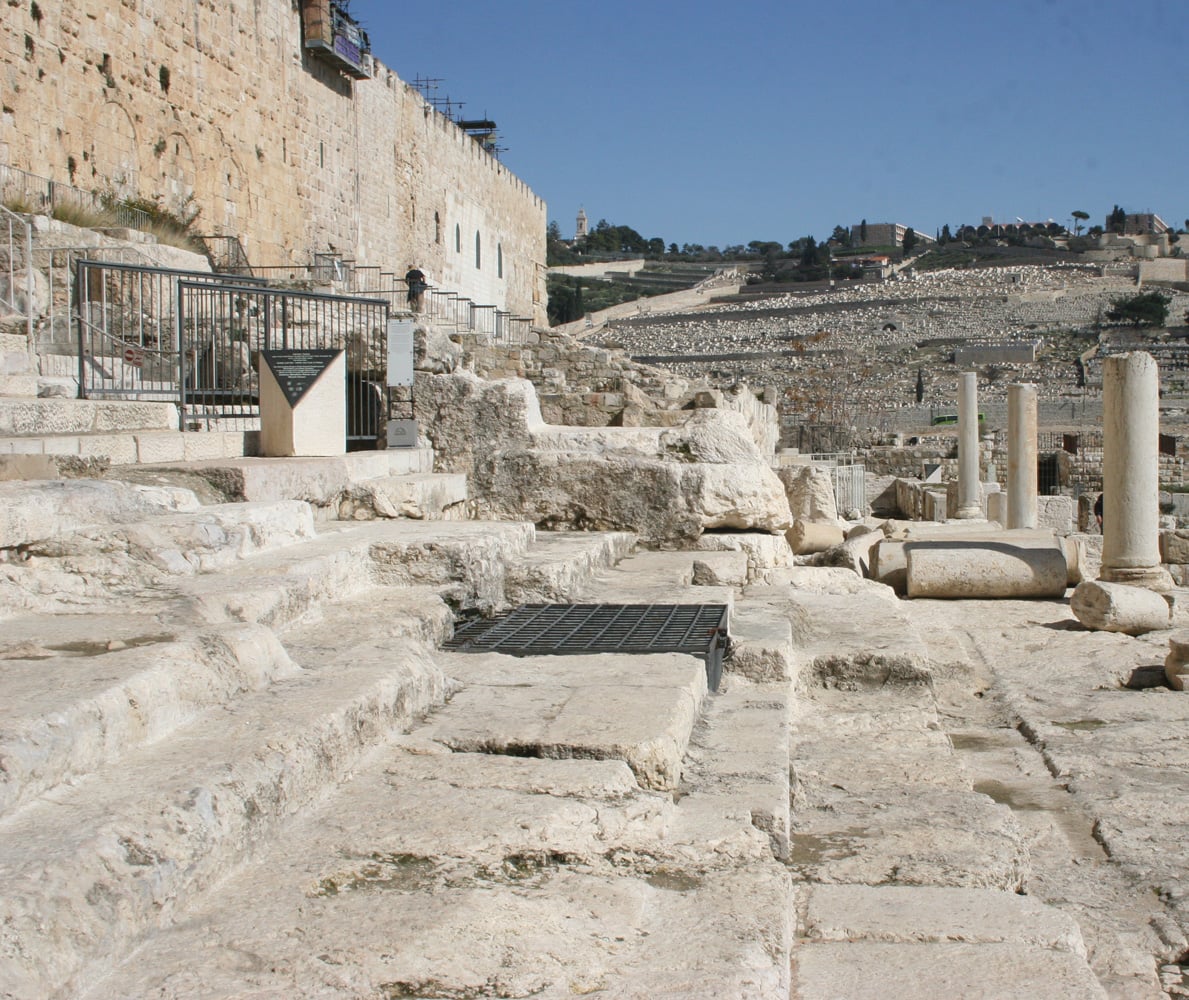
Jesus predicted the fate of the temple as he left it on his way to the Mount of Olives (Matt. 24:1–3). In this photo of a staircase leading to the temple, the worn stairs seen to the lower left are original and were in use during the time of Jesus. The Mount of Olives is in the background in the upper right.
Yet the final moment of this prophetic judgment offers a word of hope (23:39): “You will not see me again until you say, ‘Blessed is he who comes in the name of the Lord’ ” (Ps. 118:26). The temple (and redemptive) overtones of Psalm 118 (cf. 118:19–20, 26–27), as well as the acclamation of Jesus by the Galilean crowds with these same words (21:9), suggest that the judgments predicted in this chapter need not be final. Matthew’s Jesus envisions a time after the temple’s desolation when his appearing may produce not only judgment but also possibly restoration if only Jerusalem will welcome him as the Lord’s blessed one—the Messiah (“until” as conditional) (Davies and Allison, 3:323).
24:1–25:46: Jesus’s fifth discourse—The Eschatological Discourse. Matthew’s fifth and final extended section of Jesus’s teaching continues with the theme of judgment on Jerusalem leaders and the temple begun in chapters 21–23. Matthew provides glimpses of Jesus’s second coming or reappearing and the end of the age, with its final judgment of all peoples. Regarding the temple’s destruction, Jesus warns his followers against confusing precursor signs with the events that will occur when it falls (24:4–35). The opposite warning is given for Jesus’s reappearing: there will be no anticipatory signs, so the disciples should always be prepared (24:36–41). The last half of the discourse consists of five parables exhorting Jesus’s disciples to be prepared by living lives of faithfulness and mercy (24:42–25:46).
24:1–51. Matthew 24:1–2 transitions between Jesus’s prophecy of the temple’s desolation (23:38–39) and the Eschatological Discourse, beginning with the disciples’ questions (24:3). As Jesus departs from the temple to the Mount of Olives, he predicts, “Not one stone here will be left on another” (24:1–2). In response, the disciples ask two questions: (1) When will the destruction of the temple occur? and (2) What will be the sign of Jesus’s reappearing (Greek parousia) and the end of the age? (with “coming” and “end” combined as one entity by a shared Greek article).
The rest of the chapter answers these two questions, although scholars do not agree where Matthew’s Jesus turns from answering the first to the second or whether the two answers are fully distinct. Yet a number of signals indicate that 24:1–35 addresses the first question of the temple’s destruction, with 24:36–51 (along with Matthew 25) turning to the question of Jesus’s parousia and the end of the age (following France, 889–94). Matthew uses the Greek term parousia in a technical sense (as do other New Testament writers) to indicate Jesus’s “reappearing” at the final consummation, or the “end of the age” in Matthew’s language, at 24:3 (parousia at 24:3, 27, 37, 39; see also 1 Cor. 15:23; 1 Thess. 3:13; 4:15). The term parousia can be translated “coming”; but given the use of another word for a “coming” of Jesus in Matthew 24 (erchomai; cf. 24:30 and see discussion below), it is helpful to distinguish when Matthew chooses to use the technical term parousia, since at these points he is clearly referring to Jesus’s “reappearing” (second coming).
Jesus’s words concerning the temple’s destruction (24:4–35) begin by warning his disciples that they will be tempted to misinterpret various events as signaling the temple’s destruction when those signs are actually precursors to it. Matthew’s reference to “the end” (Greek telos) at 24:6, 13–14 uses language distinct from his Greek phrase for “the end of the age” (24:3; also at 13:39–40, 49; 28:20), possibly indicating that with telos he is referring to a more immediate “end”—namely, the temple’s destruction. Precursor signs of the temple’s end include false messiahs (24:5; cf. 24:23–26); wars, famines, and earthquakes (24:6–7); and persecution of the disciples (24:9–13). The preaching of the gospel “in the whole world” (cf. Acts 11:28 and Col. 1:6, where this phrase delimits the Greco-Roman world) will be penultimate to the temple’s destruction (24:14).
In 24:15–26, Jesus moves to describe the horror of the temple’s (and Jerusalem’s) destruction. The reference to “the abomination that causes desolation” derives from Daniel (Dan. 8:13; 9:27; 11:31; 12:11; Matt. 24:15) and refers generally to the transgressing of the temple confines by Gentiles (Romans, in the case of AD 70). When this occurs, there will be no more time for preparation, as was the case with the precursor signs of 24:4–14; it will be time to flee (24:16–20). Only the brevity of this time alleviates its horror: “For the sake of the elect those days will be shortened” (24:22).
In Matthew 24:27–28 Jesus briefly contrasts the destruction of the temple with Jesus’s parousia (“reappearing”; NIV “coming” in 24:27). Matthew has just indicated that the temple’s destruction will be accompanied by enticements to find the messiah in obscure places, such as the desert or inner rooms (24:23–26). In contrast, the “parousia of the Son of Man” will be as visible as lightning flashing across the breadth of the sky (24:27).
Matthew’s Jesus gives three final pictures about the temple’s destruction: the first from Old Testament prophets, a second from Daniel specifically, and a third from the image of a fig tree (24:29–35). The words of Matthew 24:29 echo common Old Testament cosmic language used to signal God’s actions of judgment or salvation within human history (e.g., Isa. 13:10; 34:4; Ezek. 32:7; Hag. 2:6, 21). Therefore, the cosmic activity of 24:29 signals the “earth-shattering” future destruction of the temple as judgment from God (Wright 1996, 354–60).
The quotation of Daniel 7:13–14 in Matthew 24:30–31 pictures the vindicated Son of Man approaching (“coming” to) the heavenly throne of God and receiving glory (with “coming”—erchomai, not parousia—indicating a heavenward coming in Matthew as in Daniel). Matthew has already used this image of Jesus’s vindication from Daniel 7 (Matt. 10:23; 16:28). For Matthew, Jesus in his message and mission will be vindicated first at his resurrection and again when his predictions concerning the temple come to pass. (For Matthew’s application of Daniel 7 language to various moments of Jesus’s own vindication, including his resurrection and the temple’s destruction, see France, 396–97.) The NIV’s “the peoples of the earth will mourn” (at the Son’s vindication; 24:30) can also be rendered “the tribes of the earth,” possibly indicating Israel’s mourning at the temple’s destruction (cf. Zech. 12:10–14). The final image of this section is that of a fig tree (24:32–33; cf. 21:18–22), used to emphasize that discernible signs will precede the temple’s destruction and that Jesus’s predictions about it will come true before the passing of “this generation” (in AD 70; 24:34).
Jesus’s words in Matthew 24:36–41 turn to address his parousia or reappearing (“coming” in 24:37, 39 translates parousia). In contrast to the signs that will attend the destruction of the temple, Jesus’s reappearing will be characterized by suddenness (24:37–41), with no one except the Father knowing its timing (24:36). The resulting admonition is to be prepared—the point of the two brief parables about a thief’s unexpected arrival (24:42–44) and a servant at his master’s delay and unexpected return (24:45–51).
25:1–46. This theme of preparedness for Jesus’s reappearing at the end of the age is the center point of the parable of the ten virgins and the bridegroom (Matt. 25:1–13). Though not much is known about first-century Jewish wedding customs, it may be that these young, unmarried women leave the groom’s home to welcome and accompany the couple back to the groom’s household (Davies and Allison, 3:395). When the bridegroom is “a long time in coming” (25:5), five virgins run out of lamp oil because they neglected to bring extra. They miss the opportunity to join the bridegroom and enter the wedding banquet (25:10). Jesus’s parable calls all his followers to be ready for his reappearing, since they “do not know the day or the hour” (25:13; cf. 24:36, 42).
The second parable of Matthew 25 illustrates what preparedness looks like (25:14–30). Three servants are entrusted with large sums of money (a “talent” equals approximately six thousand denarii, with a denarius being a day’s wage; see NIV note to 25:15) from their master and expected to use it to gain more during his long absence (25:19). The first two do so (25:20–23), while the third servant simply buries the money and so makes no profit (25:24–27). The master takes away the money given to this third servant and commands that he be thrown into the darkness (25:28–30; for similar language of “weeping and gnashing of teeth” signaling final judgment, cf. 8:12; 13:42, 50; 22:13; 24:51). This parable points to faithfulness as the key to preparedness for Jesus’s reappearing and final judgment.
The concluding parable of Jesus’s final discourse illustrates what faithfulness should look like by painting a portrait of the final judgment of humanity (25:31–46). Though this teaching is often called a parable, its only parabolic aspects involve the image of a shepherd separating sheep from goats (25:32). Matthew draws on imagery from Daniel 7:13–14 again, indicating that the ultimate vindication of Jesus as God’s chosen one will occur at the final judgment (with the picture of Jesus enthroned pointing to his judging role; cf. 19:28). At the final judgment, “all the nations” will appear before Jesus, the king (25:32, 34). Although the Greek term ta ethnē can refer to “the Gentiles” as well, here it most likely refers to all “nations” (all people) including Israel, given the universal scope of the scene. The criteria for judgment are not surprising in light of Matthew’s earlier themes. Mercy and justice practiced on behalf of “the least of these” is what ultimately separates those who enter life and those who do not (25:40, 45). Matthew has demonstrated the importance of these qualities for Jesus’s ministry (9:13, 27, 36; 12:7, 15, 18–21; 14:14; 15:32; 20:31, 34) and for his expectations of disciples (5:7, 10; 23:23).
At issue is the identity of the “least of these.” They are described as brothers and sisters (25:40, though not at 25:45), which would indicate that they are the needy and least among Jesus’s followers (cf. 12:49–50; also “least” is the superlative form of “little ones” [mikros], identified as Jesus’s followers at 10:42; 18:6–10). Yet Jesus’s clear teaching in Matthew on the solidarity between himself and his followers (10:40–42; 18:5, 20) does little to explain the surprise of the righteous that Jesus identifies himself with “the least” of his followers. The surprise may stem from Jesus’s identification with all human need. “They have helped . . . not a Jesus recognized in his representatives, but a Jesus incognito” (France, 959).
C. Jesus’s execution by Rome and resurrection/vindication by God (26:1–28:20). In 26:1–28:20, Matthew narrates Jesus’s final days and hours as he willingly suffers and goes to his execution to restore his people and usher in God’s reign. Though the disciples desert him and Rome and the Jerusalem leaders crucify him as a criminal, God vindicates Jesus as Messiah and Lord at his resurrection.
26:1–56: Betrayal and desertion. Matthew signals the conclusion of the fifth discourse with the familiar formula, “When Jesus had finished [saying these things],” this time referencing “all these things” to signal the final of the five blocks of Jesus’s teaching (26:1; see “Structure” in the introduction). Immediately afterward, Matthew narrates another passion prediction by Jesus (cf. 16:21; 17:22–23; 20:17–19) and the intensifying plot by the Jewish leadership against Jesus (26:3–5; cf. 21:46). Jesus’s prediction connects his crucifixion—a Roman form of execution—to the Passover feast, which is two days away (26:2; cf. 26:17–29). Passover, one of three central Jewish festivals, celebrated Israelite freedom from bondage to Egypt. As such—and given the great numbers of Jewish pilgrims attending—Passover could become the locus of political foment, as the chief priests and elders fear (26:5; cf. 27:24 for Pilate’s similar concern). No one in power—the Jerusalem leaders or Rome—wanted a messiah to arise during Passover! (For a historical example, see Josephus, Jewish Antiquities 17.9.3).
In 26:6–13 (set in Bethany, just east of Jerusalem), Matthew narrates how an unnamed woman anoints Jesus with expensive perfume—an act Jesus commends and the disciples decry. Jesus interprets her act as preparation for burial (with perfumes often used in embalming) and praises her deed as one that will be recounted along with the spread of the gospel itself (26:13). Her action contrasts Judas’s act of betrayal in 26:14–16. As one of Jesus’s inner circle (“one of the Twelve”), Judas will have opportunity to lead the chief priests to Jesus when he is away from the people, who might rise to Jesus’s defense (cf. 26:5).
Matthew marks the beginning of the Passover celebration at 26:17 (with “the first day of the Festival of Unleavened Bread” signaling its inception or the day anticipating it, as in Mark 14:12; for the combining of the two festivals cf. Deut. 16:1–8; Philo, On the Special Laws 2.150). He tells his disciples to prepare their Passover meal by going into Jerusalem and meeting a man with whom Jesus has presumably made room arrangements. In the later evening, Jesus celebrates the Passover meal with his disciples (26:20). Matthew emphasizes two moments: Jesus’s identification of Judas as his betrayer (26:21–25) and his interpretation of their Passover meal around himself and his forthcoming death (26:16–29; though little is known about pre–AD 70 Passover practices). The bread and wine of the Passover meal are reinterpreted to signify Jesus’s sacrificial death “for the forgiveness of sins” (1:21) as the means of covenant renewal (“my blood of the covenant”; 26:28; cf. likely allusions to Exod. 24:8; Isa. 53:12—for “many”; Jer. 31:31–34). Jesus connects his enactment of the renewed covenant with the still future consummation of God’s kingdom (26:29; cf. the kingship theme at 27:33–56).
After moving east from the city to the Mount of Olives (across the Kidron Valley from Jerusalem; 26:30), Jesus predicts that not only Judas but also all his disciples will fall away (skandalizō—“stumble”; cf. 11:6), citing Zechariah 13:7, concerning the scattering of the flock at the striking of the shepherd. Though Peter protests, Jesus predicts Peter will disown him before morning arrives (26:34; cf. 26:69–75).
Jesus and his disciples move to a nearby olive grove called Gethsemane (26:36–46), where Jesus prays repeatedly that the necessity of his impending death be removed (26:39, 42, 44; for cup language, see 20:22), though he submits to his Father’s will (for obedience to God’s will in Matthew, see 7:21; 12:48–50). The disciples, whom Jesus asks to keep watch as he prays, fall asleep at each turn. Although privy to Jesus’s predictions and teaching about his imminent death, they continue to show that they do not understand the full import of his words. They do nothing to prepare for his death (26:6–13); they boldly protest Jesus’s prediction about their falling away (26:31–35); and yet they succumb to sleep when they should be watching for Jesus’s enemies and praying that they will resist temptation (26:38, 41). Jesus announces the arrival of his betrayer before they show any awareness of the danger (26:46).
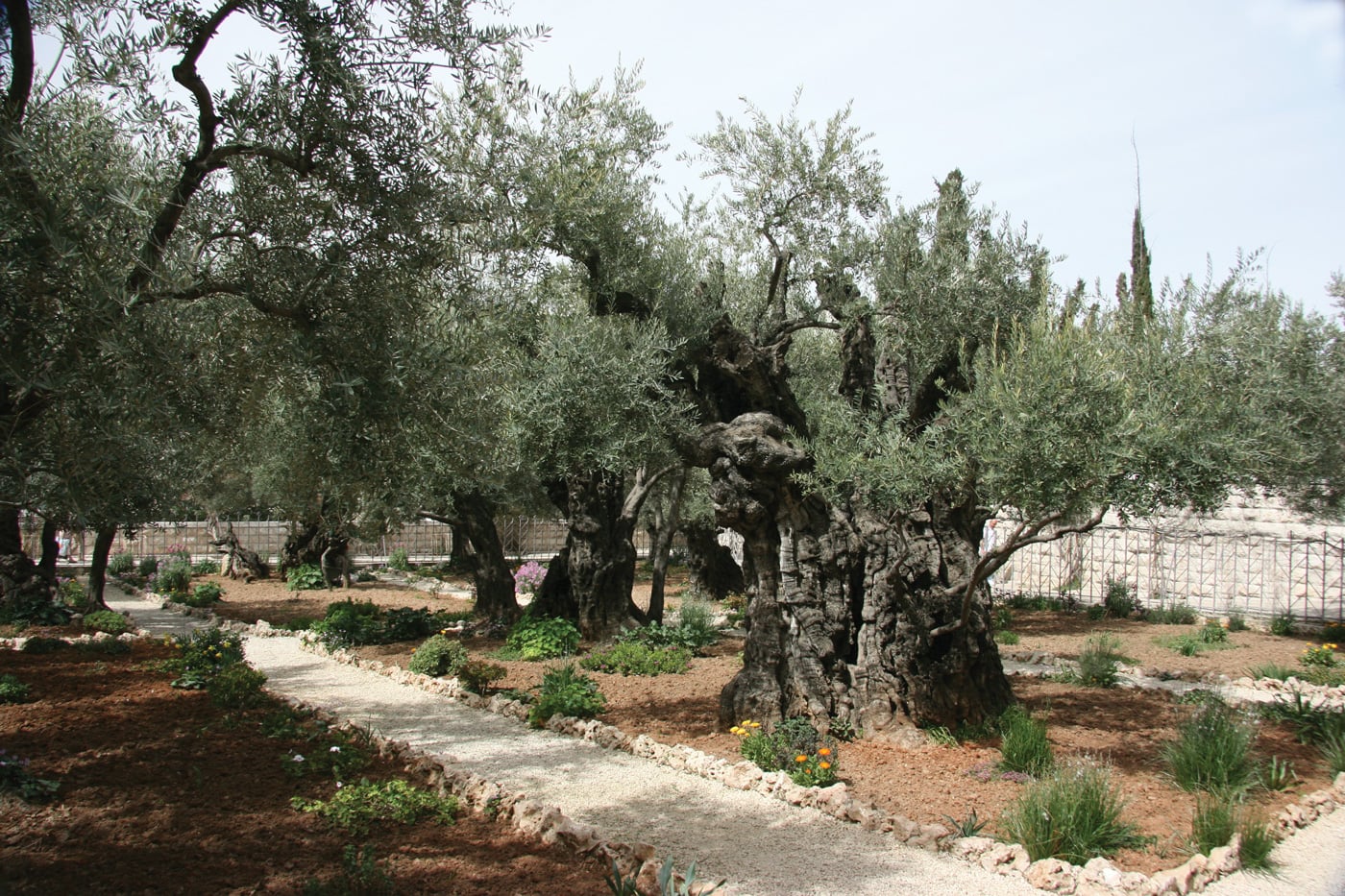
An olive grove in the Garden of Gethsemane, where Jesus prayed after the Last Supper and was arrested (Matt. 26:36–46)
Matthew’s account of Jesus’s arrest (26:47–56) begins with a kiss from Judas (26:49), who has brought an armed crowd gathered by the chief priests and Jewish elders (cf. 26:3), which includes their servants, who attempt to arrest Jesus (26:50–51). When one of Jesus’s disciples strikes the high priest’s servant, Jesus rebukes his violent response. Jesus, according to Matthew, is not the leader of a human rebellion (Greek lēstēs; 26:55) against Rome. Though he could call on angels to rescue him (26:53; cf. 4:6, 11), he will submit to the Father’s will for his mission, in order that the Scriptures might be fulfilled (26:54, 56). Since Matthew does not cite a particular scriptural text but refers to “Scriptures” (plural; 26:54) and “the writings of the prophets” (26:56), these statements likely indicate Jesus’s fulfillment of the Old Testament Scriptures generally. In contrast to Jesus’s command of the situation, his disciples flee the scene, deserting him as predicted (26:31).
26:57–27:26: Jesus on trial. Upon arrest, Jesus is brought before the Sanhedrin, the Jewish ruling council that, according to Matthew, comprised chief priests, Jewish elders, and some teachers of the law (26:57–68)—in other words, the Jerusalem elite. The high priest Caiaphas (whose tenure spanned AD 18–36) leads the proceedings, which consist of a search for and examination of testimony against Jesus by others and by Jesus himself. Their intent is to bring charges against Jesus to Pilate, the Roman governor (the prefect of Judea; cf. 27:1–2). Evidence from later rabbinic sources indicates that those convening Jesus’s “trial” did not follow the (ideal) legal parameters for Jewish trials before the Sanhedrin. This is not surprising, given the sudden nature of Jesus’s arrest and the concern over arresting Jesus in Jerusalem during the Passover festival (26:5). This last-minute trial eventually produces two witnesses who agree with each other (a requirement from Deut. 19:15). Their testimony is that Jesus threatened, “I am able to destroy the temple of God and rebuild it in three days” (26:61), though Matthew has nowhere recorded these words (cf. John 2:19). Yet Jesus’s temple action and his words of judgment against the temple and its current leadership (21:12–13; 23:37–39; 24:1–35) may have been conflated with Jesus’s predictions of being killed and then raised in “three days” (12:40; 16:21; 17:23; 20:19), producing the misconception that Jesus was threatening to destroy the temple (with these accusations repeated at 27:40). Jesus does not respond to this accusation with its mix of truth and falsehood.
Caiaphas then asks Jesus the messianic question: “Tell us if you are the Messiah, the Son of God” (26:63; for “Son of God” as a messianic title, see “Theological Themes” in the introduction). His question is a logical follow-up to the errant testimony about Jesus destroying the temple (cf. 21:12–13; for an expectation that the Messiah would purify Jerusalem, see Psalms of Solomon 17:33). Jesus answers in the affirmative and adds the implicit claim of his vindication as Messiah by God via allusion to Daniel 7:13–14 (see commentary on 24:1–51). Jesus’s claim of future vindication necessarily implies that Caiaphas and the Sanhedrin will be proved wrong in their assessment of Jesus. Between Jesus’s silence concerning the temple accusations, his claim to be Messiah and the future ruling one (Dan. 7:14), and the implication that those trying him will be proved utterly wrong, it is not surprising that Caiaphas declares Jesus’s words blasphemy and the Sanhedrin calls for his death (26:65–66; 27:1), which will require Roman authorization.
Presumably during Jesus’s hearing before the Sanhedrin, Peter denies knowing Jesus (26:58, 69–75). Three bystanders recognize Peter as one who was with Jesus, either by sight or by his Galilean accent. Peter in all three instances denies any association with Jesus. After his third denial, the rooster crows. Peter remembers Jesus’s pointed prediction and weeps bitterly (26:34, 75). All twelve disciples have deserted Jesus.
After the brief interlude of Peter’s denial, Matthew continues narrating Jesus’s trial, with the Sanhedrin turning him over to Pilate, the Roman governor of Judea (27:1–2), presumably to authorize and enact the death sentence they have deemed appropriate to his claims and perceived threats (for Roman jurisdiction of capital cases, see John 18:31; Josephus, Jewish War 6.126). An important theme in the trial scene (and Judas’s demise sandwiched within; 27:3–10) is that of innocence and culpability. Jesus alone is innocent (27:4, 19); but Matthew spreads the responsibility for his death broadly, so that Judas, the chief priests and elders, the crowd, and Pilate are implicated in Jesus’s death (cf. 27:4, 20, 24–26; see discussion below).
The account of Judas’s regret and his suicide (27:3–5) concludes with the chief priest using the money returned by Judas to buy a burial field (27:6–8). For Matthew, the connections between the details of Judas’s demise and Zechariah 11:12–13 illustrate again Old Testament fulfillment in Jesus’s story.
In Jesus’s hearing before Pilate, the charge against him has undergone a cultural translation: Jesus’s acknowledgment of his identity as the Messiah becomes a charge that he claims to be “the king of the Jews” (27:11). Yet what the Sanhedrin expects of the Messiah is essentially the same as what Pilate understands by “king of the Jews.” Both claims are religious and political, although Pilate is presumably less versed in the religious nature of Jewish messianic hopes. So both charges imply sedition. They fear that this Jesus may be preparing to lead a rebellion against Rome, which both the Jerusalem elite and Rome (Pilate) would have been keen on suppressing. While Jesus acknowledges his kingship when asked by Pilate (27:11), he does not defend himself when the Jerusalem authorities bring charges against him (27:12–14).
Pilate offers to release one prisoner (according to his custom; 27:15) and gives the crowd the choice of either Jesus or Barabbas, whom Matthew describes as “a well-known prisoner” (according to Mark 15:7, a murderer and insurrectionist). Matthew indicates that Pilate offers this choice because of the Jewish leaders’ envy of Jesus (27:18). The descriptor “called the Messiah” makes most sense with the inclusion of “Jesus Barabbas” present in some manuscripts, so that “Barabbas” and “Messiah” distinguish the two men, who both have the (common) name “Jesus.” But the chief priests and elders incite the crowd to call for Jesus’s death (and Barabbas’s release; 27:20–23), which Pilate readily implements (27:26).
The issues of innocence and culpability are thematic and complex in this narrative. Most clearly expressed are Jesus’s innocence (27:4, 19) and the culpability of Judas (27:4) and the Jewish leaders of Jerusalem (27:1, 20), with the latter fitting the emphasis in chapters 21–28 on the Jerusalem leaders as Jesus’s primary antagonists (e.g., 21:15, 45–46; 23:1–39; 26:3–5; 28:11–12).
More ambiguous in light of Matthew’s purposes are the Jewish crowds, who have been read at some points in history as primarily responsible for Jesus’s death, especially with the words attributed to them at 27:25 (“His blood be on us and on our children!”). Yet there are problems with attaching primary blame here since the makeup of the “people” at 27:25 is ambiguous. They would seem to be identical to the “crowd” just mentioned at 27:20, 24, who have been persuaded by the Jerusalem leaders to call for Jesus’s execution and may be related to the handpicked “crowd” sent by those same leaders at Jesus’s arrest (26:47). This places the greater culpability back on the Jewish leadership (27:20). In fact, the very “people” (Greek laos; 27:25) who presume to own responsibility for Jesus’s death are the same people whom the Jerusalem leaders fear will be open to the deception of the resurrection (27:64) (Carter, 528).
The context of the people’s words at 27:25 points to Pilate (along with the Jerusalem leaders) as primarily responsible for Jesus’s death. The political reality is that only Rome can legally execute Jesus. Pilate, as Rome’s representative in Jerusalem, authorizes Jesus’s execution (27:1–2, 26). Though in 27:24 Pilate claims that he is innocent of Jesus’s blood and transfers responsibility to the people, he is no more able to do this than the Jewish leaders who say the same words to Judas (27:4). Unless he transfers his authority to the people, Pilate cannot transfer his responsibility for using it. Innocent blood (27:4, 24; cf. 23:35) is not so easily washed away.
The warning from Pilate’s wife regarding Jesus’s innocence (27:19) heightens Pilate’s culpability when he decides to crucify Jesus. That she has received revelation from God is affirmed by the mode of her knowledge: dreams have been used by Matthew to emphasize God’s direction (cf. 1:20; 2:12, 19). Her presence in this narrative reminds the reader of other faithful Gentiles enfolded into Matthew’s story of Jesus (see “Theological Themes” in the introduction) and contrasts with the injustice of Pilate’s decision to crucify Jesus.
27:27–66: Jesus’s crucifixion, death, and burial. The crucifixion scene begins with Pilate’s soldiers mocking and humiliating Jesus as they dress him in “kingly” fashion (robe and crown of thorns; 27:28–29) and hail him as “king of the Jews” (27:29). They intend these royal accoutrements and words to show Jesus’s messianic pretensions to be ridiculous. Matthew, however, wants his readers to hear irony. What the soldiers ridicule, Matthew shows to be utterly true—Jesus truly is king of the Jews.
The theme of Jesus’s kingship permeates the crucifixion narrative (27:33–56), which takes place on Golgotha (from Aramaic, meaning “skull”)—a location where other executions likely occurred. The charge written atop the cross reads, “This is Jesus, the King of the Jews” (27:37). He is mocked by the Jerusalem leaders, who claim that if he is “the King of Israel . . . the Son of God,” he should be able to rescue himself from death (27:42–43). The title Son of God is used synonymously with king (Messiah), as elsewhere in Matthew (e.g., 27:40).
Matthew also draws on Psalm 22 in the crucifixion scene, a psalm that portrays the suffering of an afflicted man who nevertheless trusts God for rescue. The connections with Jesus’s situation include the following: (1) Jesus is mocked by Roman soldiers, passersby, Jerusalem leaders, and two robbers crucified with him (27:31, 39, 41, 44; cf. Ps. 22:7); (2) Jesus is crucified (27:35): his hands and feet are “pierced” (Ps. 22:16); (3) Jesus’s garments are divided by lot-casting (27:35; Ps. 22:18); (4) Jesus’s trust in God is mocked using the words of Psalm 22:7 (Matt. 27:43); and (5) Jesus echoes the psalmist’s despair, “My God, my God, why have you forsaken me?” (27:46; Ps. 22:1, Aramaic).
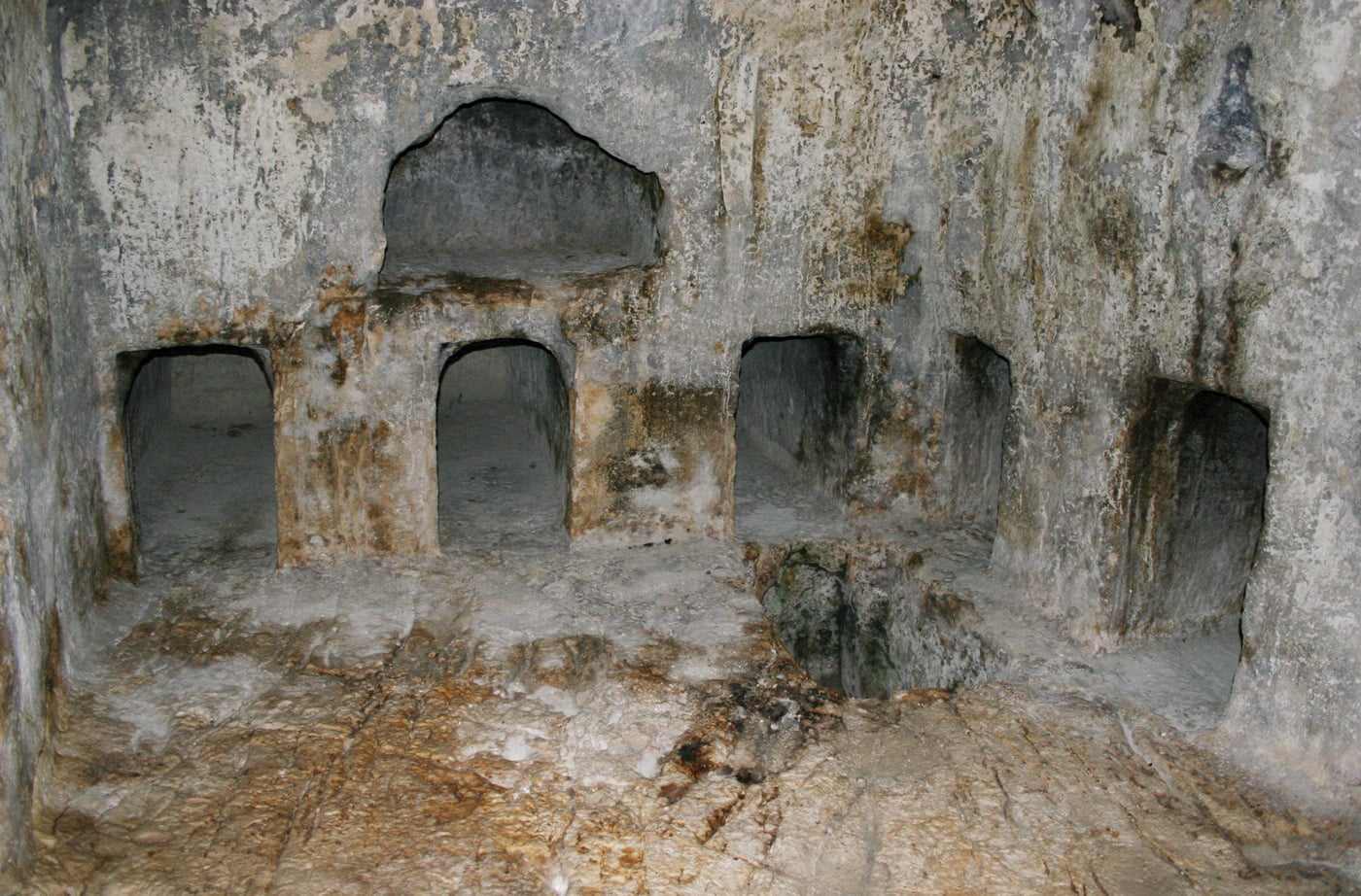
The interior of a tomb in Jerusalem from the first century AD. Matthew 27:52–53 describes tombs, such as this one, breaking open and the bodies of holy people emerging to enter the holy city.
By interweaving motifs of Jesus’s kingship and faithfulness in suffering, Matthew redefines kingship and kingdom in terms of suffering and sacrifice. Jesus as God’s Messiah (and as “God with us”; 1:23) lives out his mission to Israel and the world in line with self-denial and willing sacrifice for others rather than in assertion of prerogatives and power.
According to Matthew, Jesus willingly dies (26:42; 27:50) as a ransom for God’s covenant people (20:28; 26:28), to save them from their sin (1:21). He is the king—the Messiah—inaugurating God’s kingdom by his life and death. Matthew confirms this vision of an inaugurated kingdom by his narration of events that follow Jesus’s death (27:51–54). He writes of an earthquake accompanying the tearing of the temple curtain (27:51). Matthew likely refers to the inner curtain that separated the innermost, restricted area of the temple—the Most Holy Place—from the rest of the temple (cf. Exod. 26:31–36; though the term can describe the curtain separating the temple from its courts). If so, Matthew indicates through this apocalyptic sign that Jesus’s death inaugurates a new kind of access to God’s presence (1:23; 18:20; 28:20) not tied to the temple or limited to the covenant with Israel (as argued by Daniel Gurtner). Earthquakes are part of stock apocalyptic imagery used to confirm God’s activity and so the cosmic significance of historical events (cf. Ps. 18:6–8; Isa. 29:5–6).
Matthew also connects Jesus’s death to a resurrecting of “many holy people,” who then make appearances in Jerusalem following Jesus’s resurrection (27:52–53). This sign fits the apocalyptic tone of 27:51–53, signaling the cosmic ramifications of Jesus’s death. If 27:52 alludes to Ezekiel 37:11–14, Matthew is demonstrating that Jesus’s death ushers in return from exile (cf. Matthew 1–4), anticipating the day when God will vanquish all enemies, including death. It is as if, with the raising of these holy ones, resurrection spills over into human experience prior to Jesus’s own resurrection—the first and prototypical resurrection: “With the death of Jesus history has begun its final rush to the eschatological denouement” (Nolland, 1214).
The final response to Jesus’s death and its accompanying signs comes from the Roman guards, who exclaim, “Surely he was the Son of God!” (27:54). Whatever these Gentile onlookers mean by “Son of God” (the title, with connotations of divinity, was common enough in the Greco-Roman world), Matthew wants his readers to hear this exclamation as affirming Jesus as God’s Messiah and Israel’s representative, as well as the favored Son in intimate relationship with the Father (see “Theological Themes” in the introduction).
Matthew concludes the crucifixion scene by portraying the many Galilean women who remain with Jesus, even as his twelve disciples have deserted him (27:55–56; cf. 26:56, 75). Some women continue attending Jesus after his death, holding vigil at the tomb (27:61; 28:1). The reader of Matthew’s passion narrative has seen other women providing a faithful contrast to their male counterparts: the unnamed woman who anoints Jesus for burial (26:6–13) and Pilate’s wife, who testifies to Jesus’s innocence (27:19). Joining these faithful women is Joseph of Arimathea, who was discipled by Jesus and who buries him (27:57).
Matthew indicates that the day after Jesus’s death and burial (which occurred on “Preparation Day”—the day preceding the Sabbath and/or Passover), the chief priests and Pharisees ask Pilate to post guards at the tomb to prevent theft of Jesus’s body (27:62–66). They are concerned that Jesus’s followers may, in line with Jesus’s resurrection predictions, steal his body and deceive the people with such claims. This is Matthew’s last word about “the people” (Greek laos; 27:64), a word that provides hope that they might still believe (see discussion at 27:25). Pilate grants their request, ordering Jesus’s tomb to be secured and guarded.
28:1–20: Resurrection and commissioning. Once the Sabbath is over, Mary Magdalene and Mary the mother of James and Joses (cf. 27:56, 61) return to the tomb. Instead of finding it sealed and guarded, they experience an earthquake (cf. 27:51) and see an angel roll back the entrance stone (28:1–2). The guards faint in fear, while the angel comforts the two women and calms their fears with the news that Jesus has risen as predicted (28:4–6). They are invited to see the evidence—the empty tomb—and instructed to tell Jesus’s (now eleven) disciples that Jesus has risen and will meet them in Galilee (28:6–7). Matthew’s portrait of the two Marys as the first witnesses of the empty tomb (and the resurrection; 28:9) would have surprised his original audience. Ancient perspectives prioritized male testimony over female and would have tended to view women’s testimony as less reliable (less rational and so less trustworthy; cf. Josephus, Jewish Antiquities 4.8.15; Origen, Against Celsus 2.55). Yet, according to Matthew, not only are these women the first witnesses of the resurrected Jesus, but they are also the first to worship him in his resurrected state (28:9; cf. 28:17) and are commissioned to tell the disciples the news.
The sparse resurrection account (only ten verses; compare this with the 125 verses devoted to Jesus’s death) is followed by the “cover-up” by the chief priests and elders, who bribe the guards to say that Jesus’s disciples stole his body (28:11–15). Matthew briefly steps from the story to indicate that this explanation continues to circulate when he writes his Gospel (28:15).
The Gospel’s final story shows Jesus meeting with his disciples on a Galilean mountain (28:16–20; with mountains being locations of revelation in Matthew; cf. chaps. 5–7, 17, 24–25). One of the Twelve has betrayed Jesus, Peter has denied knowing him, and the others have fled at his arrest (26:56). Yet Jesus summons the eleven to meet him in Galilee and refers to them as his “brothers,” signaling restoration of relationship (28:10). As they meet, they worship Jesus (as the women have already done; 28:9). Yet the disciples continue to “doubt” (Greek distazō; cf. 14:31–33 for the same combination of worship and wavering from the disciples). Matthew implicitly reintroduces the disciples’ “little faith” at his story’s end (with “doubt” and “little faith” as synonyms in 14:31). Fortunately, Jesus’s mission does not depend on an exemplary response by the disciples but on Jesus’s ongoing presence with them (28:20).
Matthew 28:18–20, often called the Great Commission, evokes Daniel’s vision of a vindicated Son of Man enthroned beside the Ancient of Days and given “authority, glory, and sovereign power” (Dan. 7:14; for Matthew’s frequent use of Dan. 7:13–14, see “Theological Themes” in the introduction). For Matthew, this enthronement and vindication occurs first and foremost at Jesus’s resurrection, so that 28:18–20 establishes the significance of his resurrection narrated in 28:1–10. Although Jerusalem’s political rulers have viewed Jesus’s death as vindication of their own power, Jesus’s resurrection demonstrates his vindication by God as rightful king (Messiah).
The final words of Matthew’s Gospel are Jesus’s commission to his disciples to make other disciples from all nations—Jew and non-Jew alike. Jesus’s own mission, circumscribed during his ministry by the phrase “the lost sheep of Israel” (15:24; cf. 10:5–6), is expanded to all nations after his resurrection/vindication. Teaching and baptism are the two activities Jesus intends his disciples to accomplish “in the name of the Father and of the Son and of the Holy Spirit” (28:19–20; with the trinitarian formula distinguishing this baptism from John’s baptism in Matthew 3). Disciples are to be taught “to obey everything [Jesus has] commanded,” continuing Matthew’s pervasive theme of obedience (cf. 5:20; 7:15–27; 19:17–19; bearing-fruit motif).
The promise of Jesus’s presence with his disciples (28:20) grounds this commission to make disciples. Though they are authorized to go out in mission (see the authority promised at 16:19; 18:18–19), their authority is derivative. It is Jesus who has been given all authority. Instead of explicitly granting that authority to his disciples here, Jesus promises his ongoing presence. They participate in his authority by participating in his presence with them. This promise of presence, echoing across Matthew’s Gospel (at its beginning, middle, and end: 1:23; 18:20; 28:20), is the hope and power for the spread of Jesus’s mission. Disciples may be those who waver between worship and doubt, but Jesus—the crucified, resurrected, and vindicated Messiah—will be with them until “the very end of the age.” Matthew concludes his narrative with a vision for Christian discipleship and mission grounded on Jesus’s sacrifice in death and vindication in resurrection and empowered by Jesus’s promised presence with his followers.
Select Bibliography
Bauckham, Richard. God Crucified: Monotheism and Christology in the New Testament. Grand Rapids: Eerdmans, 1998.
Beaton, Richard. Isaiah’s Christ in Matthew’s Gospel. Society for New Testament Studies Monograph Series 123. Cambridge: Cambridge University Press, 2002.
Brown, Jeannine K. The Disciples in Narrative Perspective: The Portrayal and Function of the Matthean Disciples. Academia Biblica 9. Atlanta: Scholars Press, 2002.
———. Scripture as Communication: Introducing Biblical Hermeneutics. Grand Rapids: Baker Academic, 2007.
Carter, Warren. Matthew and the Margins. Maryknoll, NY: Orbis, 2000.
Davies, W. D., and Dale C. Allison. Matthew. 3 vols. International Critical Commentary. Edinburgh: T. & T. Clark, 1988–97.
France, R. T. The Gospel of Matthew. New International Commentary on the New Testament. Grand Rapids: Eerdmans, 2007.
Garland, David. Reading Matthew: A Literary and Theological Commentary on the First Gospel. New York: Crossroad, 1993.
Gurtner, Daniel M. The Torn Veil: Matthew’s Exposition of the Death of Jesus. Society for New Testament Studies Monograph Series 139. Cambridge: Cambridge University Press, 2007.
Hagner, Donald A. Matthew 1–13. Word Biblical Commentary. Dallas: Word, 1993.
Keener, Craig S. A Commentary on the Gospel of Matthew. Grand Rapids: Eerdmans, 1999.
Nolland, John. The Gospel of Matthew. New International Greek Testament Commentary. Grand Rapids: Eerdmans, 2005.
Powell, Mark Allan. “Binding and Loosing: A Paradigm of Ethical Discernment from the Gospel of Matthew.” Currents in Theology and Mission 30 (2003): 438–45.
———. Chasing the Eastern Star: Adventures in Biblical Reader Response Criticism. Louisville: Westminster John Knox, 2001.
———. God with Us: A Pastoral Theology of Matthew’s Gospel. Minneapolis: Fortress, 1995.
———. “Matthew’s Beatitudes: Reversals and Rewards of the Kingdom.” Catholic Biblical Quarterly 58 (1996): 460–79.
Westerholm, Stephen. Understanding Matthew: The Early Christian Worldview of the First Gospel. Grand Rapids: Baker Academic, 2006.
Wilkins, Michael J. Matthew. NIV Application Commentary. Grand Rapids: Zondervan, 2004.
Wright, N. T. Jesus and the Victory of God. Minneapolis: Fortress, 1996.
———. The Resurrection of the Son of God. Minneapolis: Fortress, 2003.