Mark
1. Ministry in Galilee (1:1–8:26)
A. Preparation for Ministry (1:1–13)
B. Summary of Jesus’s Message (1:14–15)
C. Galilean Ministry (1:16–7:23)
D. Jesus Travels to Gentile Regions (7:24–8:9)
E. Opposition from Pharisees and Disciples (8:10–26)
2. Journey to Jerusalem (8:27–16:20)
A. Peter’s Confession at Caesarea Philippi and the Transfiguration (8:27–9:29)
B. “On the Way” to Jerusalem (9:30–10:52)
C. Stories of Conflict in the Temple in Jerusalem (11:1–13:37)
D. The Abandonment of Jesus in Jerusalem (14:1–72)
E. The Trial and Crucifixion of Jesus in Jerusalem (15:1–47)
G. Later Resurrection Traditions (16:9–20)
Introduction
For the first seventeen centuries of church history, Mark, the shortest of the four Gospels, was regarded as an inferior abbreviation of the Gospel of Matthew. Discussions of the Gospels in the early centuries of Christianity cite Matthew and John most frequently, Luke a distant third, and Mark last and only rarely. Until modern times, church lectionaries likewise included citations from Luke and Mark only when they differed from Matthew and John, which were regarded as the two most important Gospels. In the early nineteenth century, however, careful literary analyses of the first three Gospels led a majority of scholars to hypothesize that Mark was not a servile abbreviator of Matthew but rather the earliest of the Gospels, and the primary source for both Matthew and Luke. This radical reevaluation of Mark has resulted in two centuries of unprecedented attention and a flood of literature devoted to the Gospel of Mark.

Authorship, Date, Place of Composition, and Audience
Like the other canonical Gospels, Mark nowhere identifies its author, nor even, as is the case with Luke (1:1–4) and John (20:30–31), the occasion of writing. Early and reputable witnesses, however, including Papias, Eusebius, Clement of Alexandria, and Origen, attest that the second Gospel derives from John Mark, who, although not an apostle, was a faithful interpreter of Peter, whose testimony was the chief source of Mark’s Gospel. This John Mark, the son of Mary in whose house the early church gathered in Jerusalem (Acts 12:12), was an assistant on Paul’s first missionary journey. Although he quit the journey at Perga (Acts 12:25; 13:4, 13), the New Testament indicates he later traveled with Barnabas (Acts 15:37–41), was reconciled with Paul (Col. 4:10; Philem. 24; 2 Tim. 4:11), and finally joined Peter in Rome (1 Pet. 5:13). The aforementioned church fathers state that Mark composed the Gospel in service of Peter’s preaching in Rome, although he took liberties with the chronological order of some events. The Gospel must have been composed sometime after AD 64, when Peter arrived in Rome, but probably before the fall of Jerusalem in AD 70, for chapter 13, which reflects some aspects of the First Jewish Revolt, does not seem to reflect the fall of Jerusalem.
If Mark composed the Gospel in Rome and for Roman Christians, then his primary audience was Roman Gentiles. This is corroborated by the fact that Mark seldom quotes from the Old Testament, explains Jewish customs unfamiliar to Gentiles (7:3–4; 12:18; 14:12; 15:42), translates Aramaic and Hebrew phrases by their Greek equivalents (3:17; 5:41; 7:11, 34; 10:46; 14:36; 15:22, 34), and incorporates a number of Latinisms.
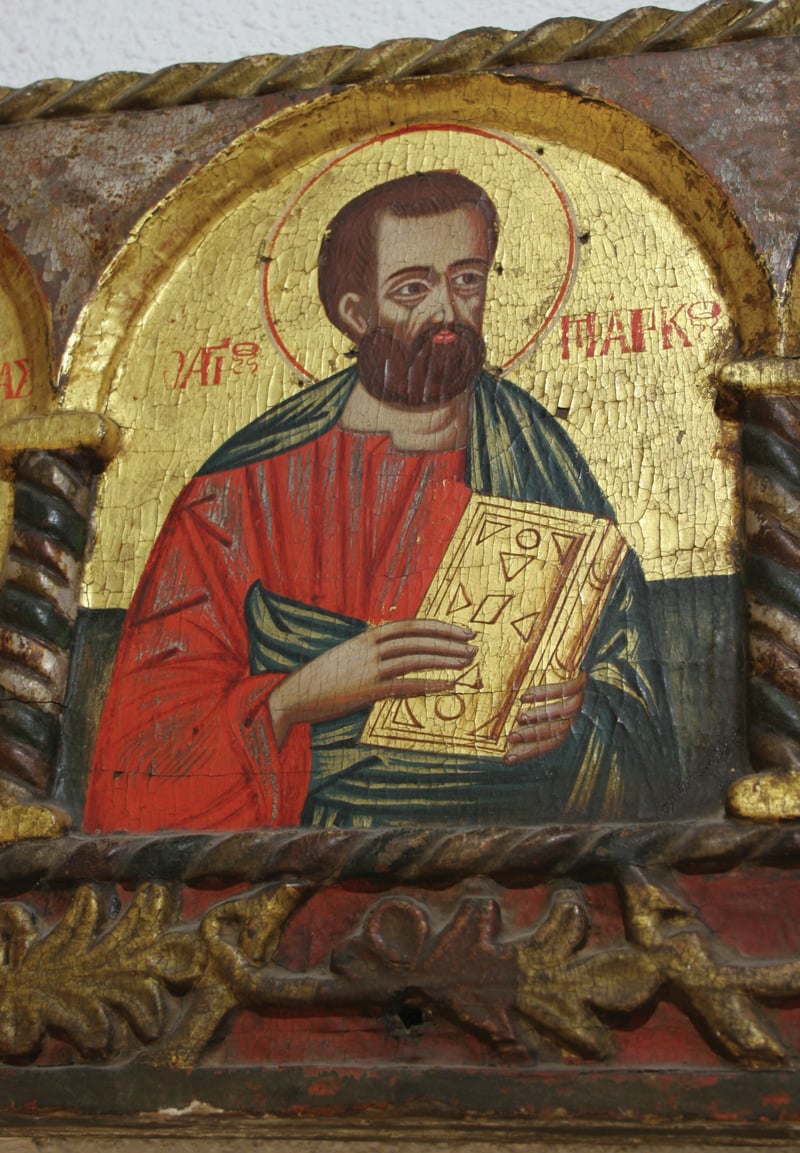
An icon of Mark from a larger piece entitled Christ and Twelve Apostles (Antalya, Turkey, nineteenth century AD)
Style
The second Gospel communicates meaning implicitly rather than explicitly. Readers are not told what things mean; rather, readers must enter the drama of the narrative to experience its meaning. Mark writes in an unadorned though vivid style, maintaining a vigorous tempo throughout by linking sentences with “and,” “again,” and “immediately.” Mark rarely intrudes into the plot of the narrative with his own editorial comment, and he does so only when necessary to establish the meaning of an otherwise obscure point (e.g., 3:30; 7:19). Unlike the other Gospels, and especially John, which rely on long didactic units of Jesus’s teachings and dialogues, the second Gospel is action packed, portraying who Jesus is by what he does. Mark’s modest vocabulary range is augmented by several very effective literary techniques. As master of the unexpected, Mark employs irony and paradox throughout the Gospel in order to challenge false preconceptions of Jesus and the kingdom of God so that readers may experience “a new teaching . . . with authority” (1:27) and learn that new wine requires new wineskins (2:22). The second Gospel also achieves meaning by its artful arrangement of material. Mark often places stories side by side in order to let them comment on each other (e.g., 4:35–41 // 5:1–20), and Mark is unique among the Gospels in employing the “sandwich technique”—inserting a seemingly unrelated story into the middle of a story in order to make a third point by implication.
Major Themes
Jesus is the unrivaled subject of every section in the Gospel with the exception of two sections about John the Baptizer (1:4–8; 6:14–29), both of which foreshadow Jesus. The characteristic of Jesus that left the most lasting impression on his followers and caused the most offense to his opponents was his authority, which Jesus received at his baptism (1:9–11), to teach, heal, minister, and even suffer as God’s Son. Several episodes—particularly Jesus’s presumption to forgive sins (2:10), redefine Sabbath (2:27–28), and subjugate nature (4:35–41)—depict Jesus doing what only God can do. Divine Sonship is most supremely expressed, however, through the motif of the servant of the Lord who “give[s] his life as a ransom for many” (10:45). Mark refers to Jesus by numerous titles, including teacher, rabbi, Son of David, Christ/Messiah, Lord, Son of Man, and Son of God, the last of which is the key to Mark’s presentation of Jesus. The Gospel begins with the announcement of Jesus as God’s Son (1:1); he is recognized as such by demons (1:24; 3:11; 5:7), and at the baptism (1:11) and transfiguration (9:7) is declared God’s Son by the Father. He is not knowable to humanity as God’s Son, however, until his suffering on the cross—and there first by a Gentile Roman centurion (15:39).
The major themes that interface with Jesus’s divine Sonship in Mark include discipleship, faith, insiders-outsiders, and the journey. Regarding discipleship, Mark repeatedly emphasizes that Jesus’s followers must share Jesus’s fate: as Jesus is with the Father, so disciples are to be with Jesus (3:13); and as Jesus serves in humility and suffering, so too must his disciples deny themselves and take up their cross and follow him (8:34). The most difficult lesson for disciples to learn is faith and trust in Jesus, which comes not by a magical formula but only by repeated hearing of Jesus and by participation in his mission. Those who should understand and follow often do not (Jesus’s family, 3:31–35; Jesus’s hometown, 6:1–6; religious leaders, 11:27–33), whereas a host of unlikely outsiders (lepers, 1:40–42; the unclean, 5:34; foreigners, 7:24–30; the blind, 10:52; the poor, 12:41–44; and the centurion in charge of Jesus’s crucifixion, 15:39) confess and follow Jesus. An “insider” is not defined by moral perfection but by being in Jesus’s presence and doing the will of the Father (3:34–35; 4:11). Above all, the response of faith and discipleship is exemplified by following Jesus “on the way” to his passion in Jerusalem (8:31; 9:31; 10:32–34, 52). The “way” or journey thus describes the way Jesus must go and the way the disciples must follow if both are to fulfill God’s plan.
Commentary
1. Ministry in Galilee (1:1–8:26)
A. Preparation for ministry (1:1–13). The first verse of Mark summarizes the content of the Gospel and functions as its de facto title. The opening word, “Beginning,” recalls the opening word of Genesis (so too the book of Hosea and Gospel of John), implying that in the gospel of Jesus Christ a new creation is at hand. “Beginning” should probably be understood not as the first of several things in a sequence but rather first in terms of “source” or “essence.” Mark’s Gospel thus intends to set forth the essence of God’s redemptive work in Jesus Christ. The word “gospel” does not mean a book but rather the story of salvation in Jesus. The Greek word for “gospel” means “good news.” Several verses in the Greek Old Testament use the term in this sense (1 Sam. 31:9; 2 Sam. 1:20; 1 Chron. 10:9), and even in the Greco-Roman world the birthday of Caesar Augustus (63 BC–AD 14) was hailed as “good news.” For Mark, the advent of Jesus is “good news” because it fulfills God’s release from sin and oppression and the proclamation of peace foretold by the prophet Isaiah (52:7; 61:1–3). The name Jesus in Hebrew (Yehoshua) means “God is salvation”; the name Christ—Greek for “Messiah” (Hebrew mashiah)—is not a personal name but a title meaning “God’s anointed.” The offices of prophets, priests, and kings were conferred in the Old Testament by anointing. With reference to Jesus, “Christ” refers to the eschatological fulfillment of the kingly office of King David (2 Samuel 7; Psalm 2). The final term in Mark’s opening line is “Son of God.” Although this title is absent in the important fourth-century manuscript Codex Sinaiticus and in quotations of the verse by several church fathers, the many manuscripts that include the term offer support that it was part of the original text. “Son of God” is the most important and most complete title for Jesus in the Gospel of Mark, signifying the full deity of Jesus the Messiah. Thus, in his opening line, Mark announces that the essence of the good news of God’s redemptive intrusion in the world is not a doctrine, teaching, or law, but a person, Jesus of Nazareth.
Surprisingly, Mark begins a Gospel intended for Roman Gentiles with a quotation from the Old Testament (1:2–3). The introduction to the quotation, “It is written,” designates the authority of God. The quotation is a collage of three Old Testament texts: verse 2 comes from Exodus 23:20 and Malachi 3:1; and verse 3 comes from Isaiah 40:3. The whole is attributed to Isaiah—who was considered the greatest of Old Testament prophets—evidently because the third verse is the defining element. In Exodus 23:20, 23, the “messenger” who would lead God’s people is a divine messenger of Yahweh, but here it applies to John, thus indicating his divinely ordained purpose. The references to “ahead of you” (literally “before your face”), “who will prepare your way,” and “prepare the way for the Lord” all refer to Yahweh in the Old Testament, but here they refer to Jesus, whom Mark depicts as fulfilling the role of God. Thus, Mark employs the quotation to indicate that John the Baptizer is the divinely appointed messenger of Yahweh who does not simply herald the advent of the Messiah but of God himself appearing in Jesus of Nazareth. Mark’s commencement of his Gospel with this Old Testament quotation signals not only that the advent of Jesus stands in continuity with the work of God in Israel but also that the mission of Jesus is not understandable apart from the Old Testament. The gospel is thus not separate from God’s work in Israel but a completion of it. Finally, the references to Jesus’s ministry as a “way” or “path” suggest that the mission of Jesus leads not to escape from the world but to a practical and transforming way within the world.
John the Baptizer is immediately introduced in verse 4, but John’s person and work are more restricted in Mark than in the other Gospels. In 1:4–8, Mark limits John’s appearance to the single purpose of prefiguring Jesus, the More Powerful One (1:7). The origins of John’s rite of baptism for the remission of sins are obscure and much debated. Jews practiced ritual washings before worship or in the reception of proselytes. These, however, were self-washings and were practiced repeatedly, whereas John’s baptism was a once-for-all lustration administered by a second party. John’s baptism thus signified an action of God rather than a human act. Moreover, proselyte baptism signified engrafting into a faith community, whereas John’s baptism signified moral and spiritual regeneration necessary to enter into a covenant relationship with God in preparation for the coming of the Messiah.
The Greek word for “repentance” means “change of one’s thinking” and connotes a willful act rather than an emotional feeling. Repentance, which must result in “fruit” (Matt. 3:8; Luke 3:8), is the single prerequisite necessary to prepare for the imminent in-breaking of God. Mark specifies that the inhabitants of Judea and Jerusalem, both centers of Jewish leadership and authority, “went out” to John, similar to the way the Israelites “went out” to Moses in order to seek the Lord (Exod. 33:7). John’s camel-hair garment and leather belt, as unusual in his day as they would be in ours, signified the dress of a prophet (Zech. 13:4), and specifically of Elijah (2 Kings 1:8). In the Old Testament, Elijah was more than the forerunner of the Messiah; he was the forerunner of the Day of the Lord, God’s eschatological kingdom (Mal. 3:1; Sirach 48:10). The in-breaking of God’s kingdom is signified in 1:7 by John’s reference to Jesus as the More Powerful One. In first-century Judaism, loosing of sandals and washing of feet were duties of Gentile slaves; the assumption of this role by John signifies his humility and subordination in relation to Jesus. John’s baptism in water was intended to symbolize Jesus’s baptism in the Holy Spirit (1:8). In the Old Testament, bestowal of the Spirit belonged exclusively to God. John’s attributing of this function to Jesus, the More Powerful One, again signifies that Jesus comes in the power and prerogative of God.
According to the early church (Acts 1:21–22), the event that inaugurated Jesus’s ministry and endowed it with saving significance was his baptism (1:9–11). It is with this event that Mark commences the story of Jesus, rather than with his birth (Matthew and Luke) or preexistence (John). Mark’s wording (“Jesus . . . was baptized by John,” 1:9) portrays Jesus as the undisputed subject of the event, with John serving as mediator. Arising from the water, Jesus experiences three things that Jews associated with the advent of God’s eschatological kingdom:
- The tearing apart of the sky: According to Second Temple Judaism, the Spirit of God had stopped speaking directly to God’s people after the cessation of the great Old Testament prophets. At the advent of the Messiah, however, the long-awaited Spirit would return and reveal God in an unprecedented manner (Isa. 64:1; Testament of Levi 18:6–8; Testament of Judah 24:1–3). The Greek word for “tear” appears again in Mark only at the tearing of the temple curtain at the crucifixion, where Jesus is again recognized as the Son of God.
- The descent of the Spirit: The eschatological age would be verified and empowered by the descent of God’s Spirit; here the Spirit does not merely rest on Jesus but enters into him.
- The voice from heaven: Jesus is declared to be God’s beloved Son. Jesus is not made God’s Son at this point, but rather, his divine Sonship is acknowledged and declared at the baptism. The divine declaration of verse 11 combines Suffering Servant imagery (see Isa. 42:1; 49:3), royal Sonship imagery (Ps. 2:7; Exod. 4:22–23), and beloved filial imagery (Gen. 22:2, 12, 16).
The three heavenly signs designate the baptism as the inaugural event of Jesus’s ministry, in which he is empowered by God’s Spirit to speak and act not simply for God, but as God.
Jesus’s forty-day trial in the wilderness (1:12–13) may reflect God’s testing of Israel in the wilderness for forty years (Deut. 8:2). The wilderness plays an important role in the Old Testament not only in the wilderness wandering after the Exodus but also in the prophets, as a place of Israel’s refreshment with God and refinement for obedience to his call. Immediately after the baptism, the Spirit literally “drives” (NIV “sent”) Jesus out into the wilderness, like the scapegoat of Leviticus 16:21. The same Spirit that descended on Jesus at the baptism has an appointment for him with God’s adversary to determine whether Jesus will use his divine Sonship for his own advantage or in obedience to God’s saving purpose for the world.
B. Summary of Jesus’s message (1:14–15). The commencement of Jesus’s public ministry in Galilee is announced in connection with the arrest of John the Baptizer. The same Greek word (paradidōmi, “hand over”) for John’s arrest (NIV “put in prison”) will later be used for the handing over of the Son of Man (9:31; 10:33) and of Christian disciples (13:9, 11–12). This signifies that Jesus will proclaim the gospel, as it was proclaimed by John, in the face of adversity and suffering. “Good news” is thus costly news. The long-awaited eschatological era and the kingdom of God are fulfilled in Jesus’s person and ministry; God’s kingdom is not something the pious evoke from God but is the reign that God introduces in Jesus, and into which people enter by repentance and faith. Repentance (the Greek word means to change one’s thinking) and faith (the Greek connotes trust) are active responses to the kingdom of God as proclaimed by Jesus.
C. Galilean ministry (1:16–7:23). 1:16–45. The call of the first four disciples—Peter, Andrew, James, and John—occurs on the northwest shore of the Sea of Galilee (1:16–20). The sea is a picturesque lake seven miles wide and thirteen miles long that is surrounded by hills and that lies seven hundred feet below sea level. Unlike other rabbis, who called students to learn torah, Jesus entered into the world of the disciples and called them to himself. What they need to know they will learn as they follow him. In order to become “fishers of men”—that is, to participate in the mission of spreading the kingdom of God—the fishermen must leave their nets and even families and follow Jesus. Each fisherman must respond personally to the call of Jesus, but in so doing he enters into a new fellowship of others who also hear and obey the summons of Christ.

The north shore of the Sea of Galilee with its characteristic coves. This was the region of much of Jesus’s public ministry and where he called his first disciples (Mark 1:16–20).
The first act of Jesus’s public ministry in Mark is an exorcism (1:21–28), in which the More Powerful One (1:7) exercises the divine authority he received at baptism to free a man from demon possession and to prevail over the dominion of Satan (see 3:27). Although Jesus was raised in Nazareth, he chose Capernaum, propitiously situated on the northwest shore of the Sea of Galilee on the Via Maris, the main trade route leading from the Mediterranean to Damascus, as his base of operations. The population of Capernaum was largely (though not entirely) Jewish, and on the Sabbath Jesus teaches in the synagogue, the Jewish assembly hall for teaching torah. The authority with which Jesus teaches surpasses even that of the scribes, torah experts who enjoyed legendary reputations and special privileges among Jews. Rather than noting the specific content of Jesus’s preaching, Mark stresses the unique authority with which Jesus taught and healed a man of demon possession. The plea of the demoniac, “What do you want with us?” occurs a dozen times in Scripture, normally indicating that the two parties have nothing in common with each other. As a member of the spiritual realm, the demon recognizes Jesus’s divine nature as “the Holy One of God” (1:24). The story begins and ends with the amazement of the crowd at Jesus’s authority, which supersedes that of the scribes and rescues a man from the grip of Satan. Jesus teaches and heals with one and the same authority, by which Mark signifies that Jesus’s word is deed.
The Greek word for “immediately” (1:29; NIV “as soon as”)—which occurs eleven times in Mark 1—contributes to the sense of urgency in Mark’s narrative: the time is at hand (1:15) for the authority of God’s Son to bear witness to the gospel. Close to the synagogue is Peter’s house, where Jesus heals Peter’s mother-in-law of a fever (1:30–31). The Greek word for “wait on” (1:31) is diakoneō, from which “deacon” is derived. Mark’s use of this word to describe Peter’s mother-in-law serving the company following her healing may have been included to remind the members of the church in Rome to which he is writing to use the gifts, health, and opportunities God gives each believer to serve the Christian community in tangible ways. What Jesus has done to one person in healing Peter’s mother-in-law he now does to the whole community (1:32–34). After sunset on Saturday, Sabbath prohibitions against work and travel ceased, and Capernaum shows up en masse with people suffering from a host of physical and demonic maladies.
Mark closes the day’s activities in Capernaum with a reference to Jesus’s forbidding the demons to speak (1:34). This unexpected command seems to contradict Jesus’s mission to proclaim and promote the kingdom of God. At least three reasons can be given for the command to silence. First, rumors of Jesus’s messianic status were not to Jesus’s advantage—and could invite Roman reprisals—since the popular understanding of “messiah” carried military connotations. Second and more important, the command to silence seems to derive from Jesus’s conscious patterning of his ministry after Isaiah’s servant of the Lord, for whom hiddenness, ironically, was paramount in achieving God’s purpose. Finally and of ultimate importance, Jesus cannot be truly and fully known until his redemptive suffering on the cross. Until that time, all proclamations of him—at least from imperfectly informed humans and demonic opponents—are premature and must be silenced.
Mark 1:35–39 describes Jesus’s itinerant ministry among the small villages along the northwest quadrant of the Sea of Galilee. Mark normally prefers to describe Jesus’s encounters with specific persons and places, but general summaries like verses 35–39 remind readers of the broad reach and expanse of his ministry. Jesus was more than a private teacher and healer: he was a public figure in Galilee. This is the first of three times in Mark when Jesus seeks solitude in order to pray (also 6:46; 14:32–39), each of which is set within a context of either implied or expressed opposition. Here Peter and other, unnamed disciples pursue Jesus and seek to control his movements. The effect, whether intended or not, would prevent Jesus from fulfilling his wider ministry. In 8:32–33 Peter will pose a greater hindrance to Jesus’s ministry. Jesus resists the intrusion of the disciples by reasserting his mission: to proclaim the gospel among the Jewish synagogues and to confront demonic oppression.
Jesus is then approached by a man with leprosy (1:40–45). Leprosy, a widespread and dreaded skin disease in the ancient world, robbed a victim of dignity as well as health. Fear of its contagion required lepers to make themselves physically repulsive and to be quarantined from society (Leviticus 13–14; Mishnah Nega’im), thus depriving them of their occupations, homes, families, and worshiping communities. Leprosy was often regarded as a divine punishment and hence required not simply healing but divine cleansing (a word that occurs four times here). In desperation, this leper breaks the fifty-pace buffer zone (Luke 17:12) to reach Jesus. Jesus responds not by reviling him but by declaring his desire to cleanse him. In touching the leper, Jesus demonstrates the power of “divine contagion” to heal disease contagion. Jesus sternly commands the cleansed leper to remain silent and to present himself to a priest, whose function it was to render a certificate of healing, thus allowing the leper to resume normal life. The leper, however, “spreads the news,” and as a consequence Jesus needs to remain “outside in lonely places.” Jesus and the leper, in other words, have traded places!
2:1–3:6. In this section, Mark narrates five stories in which Jesus exercises his unique authority as the Son of God. In each story, Jesus supersedes the authority of the law and rabbinic custom, and in each he incurs the opposition of Jewish leaders, especially the Pharisees and scribes. These five encounters demonstrate that Jesus is not the captive of any social or religious party; rather, he offers a word of both judgment and redemption to them all.
The first story, in 2:1–12, begins ostensibly as a healing story of four men who bring a paralytic to Jesus. So many people gather to hear Jesus “preach the word to them” that there is no room inside or outside the house. Finding the door to the house blocked by the crowd, the resourceful foursome digs through the mud plaster and thatch roof common to Palestinian dwellings and lowers the litter with the paralytic down to Jesus. The determination of the four friends, like that of the leper in the preceding story, illustrates that genuine faith (mentioned here in 2:5 for the first time in Mark) overcomes obstacles to get to Jesus. Just as intercessory prayer is efficacious for others, so here the faith of the four porters plays a role in the forgiveness of the paralytic’s sins. Mention of forgiveness of sins shifts the story abruptly from the paralytic to the scribes. Offended by Jesus’s pronouncement of forgiveness, the scribes accuse Jesus of blasphemy, for only God can forgive sins (Exod. 34:6–7; Ps. 103:3; Isa. 43:25; Mic. 7:18). Desiring the onlookers to know that “the Son of Man has authority on earth to forgive sins” (2:10), Jesus provides evidence of forgiveness of sins (which cannot be verified) by healing the paralytic (which can be verified). As in 1:21–28, the authority of Jesus in both spiritual and physical realms is the same authority. In answer to the scribe’s question, “Who can forgive sins but God alone?” Mark invites us to supply the name of Jesus.
In the Gospels, “Son of Man” occurs only from the mouth of Jesus as a self-designation. It occurs fourteen times in Mark, where, in agreement with its uses in the other Gospels, it refers (1) to Jesus’s future exaltation as judge (8:38; 13:26; 14:62), (2) to Jesus’s earthly authority (2:10, 28), and most frequently (3) to Jesus’s sufferings (nine times in Mark). Each use of the title refers to a divine attribute (or the fulfillment of one). “Son of Man,” therefore, does not refer to Jesus’s humanity, as might be supposed, but rather to his humiliation, authority, and exaltation in fulfillment of God’s ordained way.
In 2:13, as occurs often in the first half of the Gospel, Mark describes Jesus teaching beside the Sea of Galilee. The frequent references to crowds going out to him (1:32, 45; 2:13; 3:8; 4:1) may symbolize that discipleship entails leaving behind some of life’s comforts and securities. “Teaching,” which occurs some fifteen times in Mark, indicates the essential role that instruction plays in Jesus’s ministry, and the large crowds that attend it indicate the public nature of the gospel.
The Roman tax system functioned, in part, by renegade Jews like Levi (2:14–17) receiving a franchise to collect taxes in set regions. Whatever amount a tax collector obtained in addition to the contracted sum with Rome was his to keep. The Roman system of taxation thus attracted unscrupulous individuals and virtually required dishonesty in order for a tax collector to survive economically. That Jesus would call as a disciple a tax collector, who was detested because of his collaboration with the Roman occupation and ritually unclean because of it, was no less offensive than his touching of a leper (1:40–45). This story repeats and reinforces the truth of 2:1–12: there he forgave sins; here he demonstrates forgiveness of sinners by eating with them. The scandal of Jesus’s eating with tax collectors consists in the fact that he does not make moral repentance a precondition of his acceptance and love of sinners.
That Jesus’s disciples do not follow the examples of the disciples of John the Baptizer and the disciples of the Pharisees, both of whom were considered morally and ritually exemplary, is a further cause of offense to his contemporaries (2:18–22). The Pharisees, a lay movement that came into existence during the Maccabean revolt (168–146 BC), staunchly resisted the accommodation of Jewish life to prevailing Greco-Roman ideals. Pharisees, who constituted perhaps only 1 percent of the Jewish population in Jesus’s day, exercised an influence far beyond their numbers because of their uncompromising allegiance to the sovereignty of God, their belief in the resurrection of the dead and in the existence of angels and demons, and their scrupulous adherence to both the written torah and the oral traditions founded on it. Jesus stood in formal agreement with most of the foundational beliefs of Pharisaism, although he emphasized fulfilling the intent rather than simply the letter of the law. It is not surprising, therefore, that the Gospels record more exchanges of Jesus with the Pharisees than with any other school of first-century Judaism.
Although fasting was technically required of Jews only on the Day of Atonement (Lev. 16:29–30; Mishnah Yoma 8:1), Pharisees typically fasted on Mondays and Thursdays of every week (Didache 8:1; Babylonian Talmud Ta’anit 12a). The Pharisees understood true religion to consist of fasting (i.e., what is not done), whereas in this story Jesus understands it as feasting (i.e., what is done). Indeed, Jesus depicts himself as the groom at a wedding feast. This imagery again implies divine Sonship, for in the Old Testament God is often considered the bridegroom and husband of Israel (Isa. 5:1; 54:5–6; 62:4–5; Ezek. 16:6–8; Hos. 2:19). While the bridegroom is present, fasting should be suspended, although it may be resumed when the bridegroom is “taken from them.” The root of Mark’s Greek verb here is used in the Greek version of Isaiah 53:8 to describe the vicarious death of the Suffering Servant.
The significance of Jesus as the bridegroom is conveyed in two crisp metaphors or parables about a new patch that shrinks and tears an old garment (2:21), and new wine that bursts old wineskins (2:22). Jesus is like the new patch and new wine: he cannot be merely integrated or appended to existing structures, including Judaism, torah, and synagogue. Like new wine, Jesus requires new “wineskins” of transformed hearts and transformed communities, such as the church.
Of the two observances most characteristic of Judaism, circumcision and Sabbath, the latter is the more important and the subject of the fourth conflict narrative, in Mark 2:23–28. The Sabbath commandment forbids Jews (as well as their slaves and animals) from beginning any work that would extend over the Sabbath—from sunset Friday to sunset Saturday—or from doing any work on the Sabbath that was not absolutely necessary (“necessary” work referred to work that preserved life). Thus, a person could be rescued from the mouth of a wild animal or retrieved from under a fallen tree on the Sabbath, but a dislocated foot or hand could not be set on the Sabbath. The preeminence of the Sabbath is signaled by two factors: it is the longest of the Ten Commandments (Exodus 20; Deuteronomy 5), and it is rooted in the order of creation—as God created six days and rested on the seventh (Gen. 1:1–2:4), Jews were divinely mandated to rest on the Sabbath.
When Jesus and the disciples walk through a field and eat grain, the Pharisees accuse them of “doing what is unlawful on the Sabbath” (2:24). The putative infractions are either traveling (walking more than 1,999 paces was considered a journey) or harvesting, or both. In defense, Jesus appeals to the precedent of when David and his companions ate from the twelve loaves of altar bread intended for the priests (1 Sam. 21:1–6; cf. Exod. 40:23; Lev. 24:5–9). The appeal to David hints at Jesus’s messianic status, for David was both Israel’s greatest king and precursor of the Messiah (2 Sam. 7:11–14; Ps. 110:1). In 2:27 Jesus clarifies the relationship of human life to Sabbath. In contrast to the Pharisees, who make human life subservient to the Sabbath, Jesus declares that people are not made for Sabbath rules, but rather the Sabbath is intended to bless and enhance human life. Second and more important, Jesus grounds this teaching in his own authority as Son of Man. In declaring that “the Son of Man is Lord even of the Sabbath” (2:28), Jesus once again puts himself unambiguously in the place of God.
Each of the five conflict stories in 2:1–3:6 portrays Jesus’s sovereign authority as superseding all other authorities—whether of society, of scribes and Pharisees, or even of the law—in order to introduce God’s kingdom to needy, alienated, and sinful people. In this fifth and final conflict story (3:1–6), all eyes are trained on Jesus to see if he will heal on the Sabbath. A shriveled hand is not life threatening and does not qualify as an exception to Jewish Sabbath rules. Mark places this story immediately after 2:27–28 in order to demonstrate Jesus’s revolutionary teaching of doing—not refraining from—God’s work on the Sabbath. Before healing the man, Jesus asks two questions. The first question, about doing good or evil, refers to healing the man; but the second, about saving life or killing, cannot refer to the man, since a shriveled hand is not fatal. The second question refers, rather, to the intentions of the Jewish religious leaders with regard to Jesus. Grieved and indignant about their hardness of heart, Jesus commands the man to stretch forth his hand. Only in exposing his malady to Jesus is he healed. But Jesus is thereby jeopardized (see also 1:45), for “the Pharisees went out and began to plot with the Herodians how they might kill Jesus” (3:6). Thus, early in his ministry, the shadow of the cross falls on Jesus.
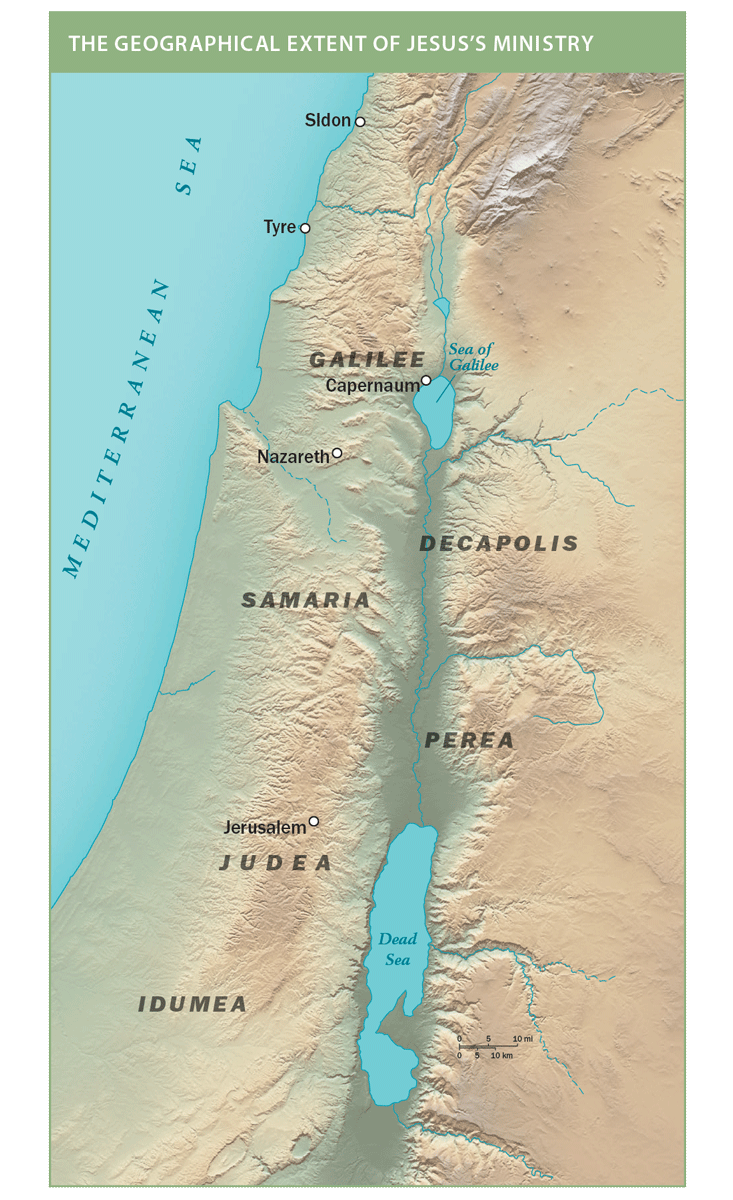
3:7–35. In another narrative summary (3:7–12; also 1:35–39), Mark notifies readers of the wide geographical extent and ethnic diversity of Jesus’s ministry. The distance from Sidon in the north to Idumea in the south is roughly two hundred miles, and the regions of Jordan extend fifty miles east of Galilee. The audience comes from Jewish (Galilee, Judea, and Jerusalem), mixed Jewish-Gentile (Transjordan and Idumea), and Gentile regions (Tyre, Sidon). A boat is made ready for Jesus as a refuge from the size and press of the crowd. The accent falls on the demons who, as spiritual forces, become the second party in addition to God to recognize Jesus’s divine Sonship. By their subjection, the demons demonstrate Jesus’s sovereignty over them.
From his entourage Jesus chooses twelve men to follow him as formal apprentices or apostles (3:13–19). The number twelve, a common number in Judaism, suggests that the twelve apostles reconstitute the twelve tribes of Israel. The Greek of 3:13 emphasizes the solemnity and symbolism of the event: Jesus issues the call from a mountain (mountains were sites of divine revelation in Israel) and summons the Twelve to himself. Jesus calls the Twelve first to be with him, then to verbal proclamation of the gospel, and finally to cast out demons—that is, to oppose evil and demonic forces. Apostleship thus entails the whole person—the relational, verbal, and behavioral. All lists of the apostles in the New Testament give preeminence to Peter, James, and John as an inner circle among the Twelve. As far as we know, none of the Twelve was a Jewish religious leader. Rather, all were representative of the common and diverse extremes (e.g., a tax collector and a Zealot) in first-century Judaism. The inclusion of the name of Judas, Jesus’s betrayer, reminds readers that the original Twelve were not a perfect fellowship; indeed, the worst betrayer came from within the chosen rank of Jesus’s apostles.
The narrative in 3:20–35 is the first of Mark’s signature “sandwich” units, in which a seemingly unrelated story is shoehorned into the middle of another story. The middle story determines the meaning of the flanking halves and succeeds in making an entirely new point of the A1-B-A2 sequence. Mark begins (A1, 3:20–21) and ends (A2, 3:31–35) the narrative with Jesus in a house surrounded by family and followers, into which he inserts the B-story of Jesus and Beelzebul (3:22–30).
The story begins with a house so besieged by a crowd that Jesus and the disciples are “not even able to eat.” Evidently believing that Jesus is on a collision course with the Jewish religious establishment, his friends and followers (“his own people,” 3:21 NASB, NKJV) conclude that Jesus “is out of his mind” (3:21) and attempt to “take charge of him.” Leaving this episode momentarily in abeyance, Mark inserts the accusation of the scribes that Jesus is in league with Satan (3:22). The Greek reference to “Beelzeboul” (NIV “Beelzebul”) appears to equate Satan with the pagan god Baal, who was ubiquitously detested in Israel. The contemptuous epithet, apparently meaning “Baal the prince,” or “Baal’s dominion,” insinuates that Jesus derives his power to cast out demons from the archdemon himself. Jesus responds with a threefold refutation. Verses 23–26 appeal to logic: since the ministry of Jesus is diametrically opposed to Satan, if what the scribes say is true, then Satan is clearly working against himself and hastening his own downfall. Verse 27 refutes the accusation in a terse but trenchant parable: Jesus is the More Powerful One (1:7), who plunders the “strong man’s [Satan’s] house” and makes his possessions (those oppressed by Satan) his own. Finally, in 3:28–29 Jesus issues a solemn warning against blaspheming the work of God’s Holy Spirit. The key to understanding this controversial admonition is Mark’s editorial insertion, “They were saying, ‘He has an impure spirit’ ” (3:30). Anyone who can call the ministry of Jesus evil can no longer judge between good and evil, light and darkness. Such a sin is eternal because loss of ability to differentiate between good and evil entails also the loss of ability to repent of evil.
Mark concludes the “sandwich” in verses 31–35 by completing the episode of Jesus and his followers that he introduced in verses 20–21. The whole sandwich is devoted to the theme of insiders and outsiders. Jesus’s mother and brothers stand outside seeking him (3:32); that is, they intend to assert a claim on him. Ironically, those who would be expected to be on the inside (his own family and the Jewish religious establishment represented in the scribes) misjudge Jesus and remain outsiders. For Mark, there are only two positions in relation to Jesus: those who stand on the outside with false assumptions, or those unnamed and unexpected disciples “seated in a circle around [Jesus] . . . [who do] God’s will” (3:34–35), who are his true “brother and sister and mother” (3:35).
4:1–34. Chapter 4, on parables, and chapter 13, on eschatology, are the only two chapters in Mark devoted entirely to Jesus’s teaching. The parable of the sower (4:1–20) is another A-B-A sandwich construction, in which Jesus’s teaching on the mystery of the kingdom of God (4:10–12) divides the parable of the sower (4:1–9) and its explanation (4:13–20).
The parable discourse takes place in the now familiar context of Jesus’s teaching alongside the northwest quadrant of the Sea of Galilee. Jewish rabbis did not typically teach in parables, but parables were the preferred form of Jesus’s public teaching; the first three Gospels, in fact, contain some sixty of his parables. The word “parable” means something placed alongside something else as a means of clarification. Jesus employs ordinary experiences from fishing, farming, family life, and so forth to illustrate various aspects of the kingdom of God. Parables are not allegories, wherein each element of the story, like a mathematical equation, represents a specific reality. Jesus’s parables, rather, usually have only a single main point, and like stained glass windows in a cathedral, they reveal their brilliance only when hearers enter “into” the narrative. The summons to “listen” or “hear” begins and ends the parable of the sower (4:3, 9), by which Jesus teaches that active involvement or heeding is the way to engage a parable. A sower scatters seed widely on unpromising terrain in hopes of a harvest. Three-quarters of the seed is lost to hardpan, rocks, thorns, and parched ground. Despite these adversities, some seed lands on good soil, and the parable ends, surprisingly, with an extraordinary harvest of “thirty, sixty, or even a hundred times” the number of seeds sown. The harvest is no mere human harvest, in fact, but a metaphor of the kingdom of God: despite the opposition of religious leaders, fickle crowds, and obstinate disciples, the harvest of Jesus’s ministry will be extraordinary.

Sunset over the northwest shore of the Sea of Galilee, where much of the Galilean ministry of Jesus occurred
The rationale for speaking in parables in verses 10–12 constitutes the B-part of the sandwich. In a private setting, Jesus teaches that the gospel is presented differently to different audiences. To “insiders” Jesus proclaims the mystery of God’s kingdom openly. “Mystery” means the truth of God that is available only as a revelation of God. On the one hand, insiders consist of the disciples and the others “around him” (the same Greek phrase is used in 3:34)—that is, those who are in fellowship with Jesus and who do God’s will. “Outsiders,” on the other hand, are taught in parables. Surprisingly, parables hide the meaning of the kingdom from outsiders rather than open it to them (4:12). The point of the explanation in verses 10–12 is that parables, like the kingdom of God inaugurated in Jesus himself, cannot be understood by those who hear casually or carelessly from the outside, but only by those who hear in faith and fellowship with Jesus and in obedience to God’s will.
Verses 13–20 complete the sandwich by returning to the parable of the sower. So important is the parable of the sower, in fact, that it contains the key to understanding all parables (4:13). Its explanation focuses on false and correct ways of hearing and responding to the gospel, which is represented by the seed. The seed that is eaten by birds, or falls on rocky soil, or is choked by thorns represents false ways. In each of these instances, Mark indicates by the aorist tense of the Greek verb for “hear” (4:15–16, 18) that the gospel is given only a brief, superficial, even careless hearing. As a result, it is lost. The people who represent good soil, by contrast, attend to the gospel with earnest and ongoing engagement, which Mark signals by the present tense of the Greek verb for “hear.” The mark of a true disciple, an insider, is to “hear the word and accept it and bear fruit” (4:20 ESV, NASB). Those who genuinely hear and receive the mystery of the kingdom of God will, by the grace of its generative power, produce a harvest beyond belief.
Mark includes three additional, shorter parables in the parable medley of chapter 4 (4:21–34); the first is about an oil lamp on a stand (4:21–25). The NIV makes the lamp the object of the verse, but the Greek makes it the subject; that is, “Does the lamp come in order to be placed under the bowl or bed?” In the Old Testament, a lamp can be a metaphor for God (2 Sam. 22:29) or the Messiah (2 Kings 8:19; Ps. 132:17). The unusual wording of verse 21 implies that Jesus is the lamp of God who has come to bring light and revelation (e.g., John 1:5; 8:12). True, the lamp may appear hidden or insignificant, in the same way that Jesus, the gospel, and the kingdom of God at first seem hidden or inconsequential (4:22). Nevertheless, God brings to light what is hidden, and he does so once again by the admonition to hear, to which Mark appeals three times in verses 23–24. Those who hear, like the “insiders” of 4:11, will receive the kingdom of God in greater measure, and those who do not will lose it altogether (4:24–25).
The final two parables once again liken the kingdom of God to seeds, the first parable (4:26–29) focusing on the process of growth. Who but Jesus would liken the sublime kingdom of God to the mundane subject of slow- growing seeds? A farmer plants a seed and then goes about life as usual. The seed grows imperceptibly, and even the farmer “does not know how” (4:27). The seed possesses a power of generation independent of the farmer, who can be absent and even ignorant, yet the seed grows. Humanity, likewise, goes about business as usual, but the kingdom of God is present and growing, even if small and unobserved. The kingdom is not dependent on human activity; indeed, apart from sowing, the only human activity noted in this parable is waiting in confidence that, in God’s time and power, the gospel will grow into a fruitful harvest.
The final parable stresses the contrast between the insignificant beginning and inconceivable end of a mustard seed (4:30–32). The Old Testament celebrated the mighty cedar as a symbol of God’s power and splendor (Ps. 80:10; Zech. 11:2; Jer. 22:23). Jesus, however, likens the kingdom of God to a mustard seed, so small that it is practically invisible. From insignificance and obscurity, God’s kingdom grows into a bush or tree that provides refuge for “the birds of the air” (NASB, RSV)—which may imply the inclusion of all the nations in God’s coming kingdom.
Mark’s concluding explanation of parables in verses 33–34 resembles verses 10–12 and resumes the theme of insiders-outsiders. Jesus spoke “many similar parables,” of which the parables of chapter 4 are but a sampling. By parables, Jesus spoke “as much as they [outsiders] could understand” (4:33)—and understanding depends on hearing, which Mark includes for the tenth and final time in the chapter. But in private, Jesus, who is himself the living parable of God, “explained everything” to insiders, his disciples (4:34).
4:35–5:20. Mark now places two stories adjacent to one another, each interpreting the other. The first, in 4:35–41, describes a storm on the Sea of Galilee, the fury of which threatens to sink the boat in which Jesus and the disciples are sailing. The following story, in 5:1–20, describes a demon-possessed man who wreaks havoc on himself and on all who come into contact with him. Both stories display Jesus’s power to rescue lives from cataclysms and from the chaos of both nature and human nature.
The first account is replete with details reminiscent of eyewitness experience and is recounted in a way that recalls the storms of Jonah 1 and Psalm 107:23–32. The Sea of Galilee lies some 700 feet below sea level, surrounded by steep hills on the west and even more forbidding mountains on the east. Less than 30 miles to the north, Mount Hermon rises to 9,200 feet above sea level, and the confluence of cold air from Mount Hermon and hot air rising from the Sea of Galilee not infrequently produces squalls of hurricane force. As Jesus and the disciples proceed eastward across the lake, their boat is seized by such a storm. Fearing their impending deaths, the disciples rouse Jesus from sleep in the stern and reproach him, “Teacher, don’t you care if we drown?” (4:38). Jesus then “rebuked the wind and said to the waves, ‘Quiet! Be still!’ ” (4:39). The Greek words for “rebuke,” “quiet,” and “be still” frequently occur in Hellenistic exorcism accounts. By describing the quelling of the storm in the language of exorcism, Mark portrays Jesus as the Strong One (1:7; 3:37) who vanquishes Satan and evil forces. Indeed, Jesus is the manifestation of God who does what only God can do. At the word of Jesus, calm replaces chaos. Ironically, the disciples are more terrified by the power of Jesus than by the terror of the storm. “Who is this?” they ask. “Even the wind and the waves obey him.” This is the question not only before the disciples but also before Mark’s readers: will their experience of Jesus lead to faith (4:40) or to fear and doubt?
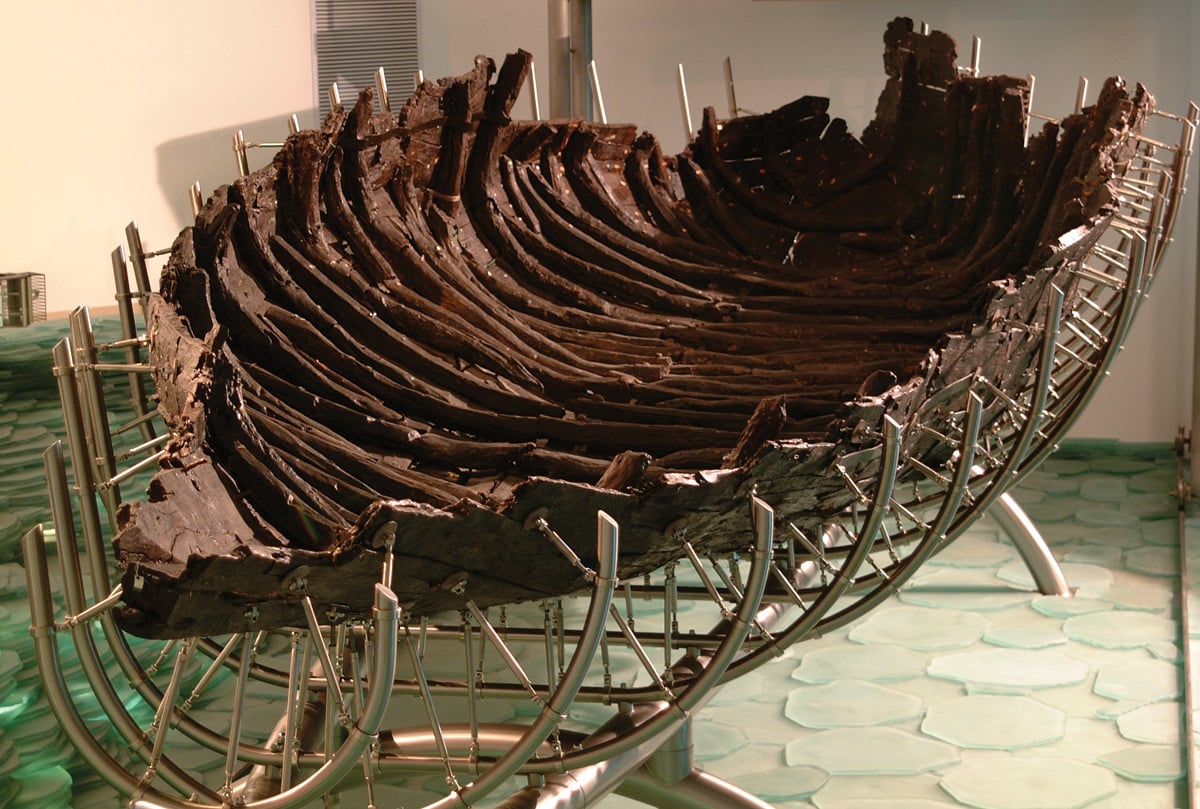
This first-century fishing vessel, discovered in 1986 along the Sea of Galilee, is an example of the fishing boats used by Jesus’s disciples (Mark 4:35–41).
The calming of a natural storm is immediately followed with an account of the calming of a violent storm in human nature (5:1–20). The encounter takes places on the east side of the lake in the Decapolis, although the exact location is disputed in the Greek textual tradition. Decapolis (literally “Ten Cities”) was a loose description for the Gentile region east of the Jordan River where the Hasmoneans and later the Romans established showcase cities of pagan culture and ideals that were intended to surpass Jewish settlements west of the Jordan. The wretchedness of the demoniac, who even in life is consigned to the place of the dead, is described in more graphic detail in Mark 5:2–5 than in either Matthew 8:28 or Luke 8:27. From a Jewish perspective, everything in 5:1–20 reeks of uncleanness: Jesus meets a man with an unclean spirit living among unclean tombs surrounded by unclean herds of swine, all in unclean Gentile Decapolis. A legion in the Roman army consisted of nearly six thousand soldiers; the attribution of “Legion” to the demoniac may suggest that his demonic oppression rivals the force and domination of the Roman army in the Decapolis. The superhuman strength and explosive terror of the demoniac are no contest for the Son of God, however, whom the demoniac recognizes in Jesus, and to whom he pleads for clemency.
The demons acquiesce to Jesus’s superior authority but beg not to be banished from the region. There is a measure of grace even in Jesus’s judgment of Satan’s minions, for he consents to their plea. Entering a herd of swine, the demons trigger a stampede down a cliff, causing some two thousand pigs to drown in the lake. The moral question posed by the undeserved loss of the livestock is not considered in the story. Evidently, for Jesus (and Mark) the rescue and restoration of one human being is more important than even a large-scale economic catastrophe. The exercise of Jesus’s miraculous power restores the demoniac to his “right mind” (5:15), just as it restored the lake to order and calm in the previous story; but it also results in fear (5:15) among the inhabitants of the region, as it did earlier among the disciples. The miraculous exorcism does not lead those in the Decapolis to believe; rather, it leads them to expel Jesus (5:17). Jesus refuses the demoniac’s request to follow him, perhaps because a Gentile would have been a stumbling block in Jesus’s mission to Israel. Jesus, however, sends the man to announce “how much Jesus had done for him” (5:20), which is always the heart of human testimony to the divine. In so doing, the healed demoniac becomes the first missionary to the Gentiles.
5:21–43. This healing story is another example of Mark’s sandwich technique, in which the story of the healing of Jairus’s daughter (5:21–24, 35–43) is interrupted by that of the woman with a hemorrhage (5:25–34). Having crossed the lake, Jesus and the disciples disembark on the western (Jewish) shore. A synagogue ruler named Jairus emerges from the crowd and begs Jesus to heal his daughter, who is deathly ill. A synagogue ruler was the president or head of a local Jewish worshiping community. His duties included general oversight and maintenance of the building, procuring Scripture scrolls, arranging Sabbath services, and perhaps education of Jewish children. Worship services were officiated, however, by scribes, rabbis, and trained laypersons rather than by the synagogue ruler. In going with Jairus (5:24), Jesus fulfills his mission declared in 1:38, “This is why I have come.”
While Mark’s Gospel is the shortest of the four, his stories, although fewer in number, are usually recounted in fuller detail. This is particularly true of his portrayal of human need. Mark’s account of the woman’s futile attempts to receive medical help and her desperate effort to reach Jesus (5:26–27) are omitted in Matthew and Luke. The description of the woman’s recovery—the Greek word translated “suffering” (5:29) combines both physical affliction and shame—conveys that the woman’s prospects for health were no better than the little girl’s prospects for life. As was the case with leprosy, a protracted menstruation problem left a woman unclean throughout its duration. Like the leper (1:40), the woman risks defiling Jesus with her uncleanness, in the desperate hope of being healed. She acts on what she hears and knows of Jesus. Although it was a serious violation of Jewish law for her to approach Jesus in her state, Mark portrays her act as a sign of faith. Immediately she is healed from her long-incurable disease. Like the man in 3:1–6, in bringing her infirmity to Jesus, she is healed. The woman’s intent to touch Jesus is rivaled by Jesus’s desire, despite the disciples’ remonstrations, to know who touched him. Not content simply to dispatch a miracle, Jesus wants to encounter the woman. For Jesus, miracle must lead to meeting. Jesus’s tender response, “Daughter, your faith has healed you” (5:34), overcomes the woman’s fear of social ostracism. The Greek word for “heal,” sōzō, means both “to heal” and “to save”—both senses are appropriate in this instance.
The drama now intensifies as the interruption, so profitable to the woman, has cost the life of Jairus’s daughter. “Why bother the teacher anymore?” ask Jairus’s servants (5:35). In the Greek, Mark’s description of Jesus’s response is masterful. The word parakouō (NIV “overhearing”) can mean (1) to overhear something not intended for one’s ears, (2) to ignore (see NIV note), or (3) to discount the truth of something. All three meanings apply to Jesus’s response in verse 36. In direct address to Jairus, Jesus commands, “Don’t be afraid; just believe.” The present tense of “believe” means to keep believing, just as in the parable of the sower it meant to keep hearing (4:20). The word for “believe” in verse 36 is the same Greek root as the word for the woman’s faith in verse 34. Jesus thus bids Jairus to demonstrate the same trust that the hemorrhaging woman demonstrated. Arriving at Jairus’s house, Jesus allows only Peter, James, and John, his inner circle of disciples, and the girl’s parents to accompany him into her room. Jesus’s figurative reference to the girl’s death as “sleeping” is met with scorn by the professional mourners. The command talitha koum is Aramaic, meaning, “Little girl [literally ‘little lamb’], arise.” Immediately, reports Mark, the girl arises, to the amazement of all present. What does Mark achieve by sandwiching the story of the hemorrhaging woman into the story of Jairus and his daughter? Mark wants to show that Jairus, a man of reputation and respect, must learn the meaning of faith from an unnamed woman whose only identification is her shame. If Jairus can trust Jesus as the woman trusted Jesus, he need not fear. Faith means trusting in Jesus when all human hopes have been exhausted.
6:1–30. The itinerant ministry of Jesus and his disciples in Galilee includes a visit to Jesus’s hometown of Nazareth, some twenty-five miles to the southwest of Capernaum (6:1–6a). Nazareth lacked both distinction and importance. It is not mentioned in the Old Testament or in Josephus or rabbinic literature; even in Christian literature it is not mentioned until two hundred years after Jesus’s day. According to archaeological evidence, first-century Nazareth was an obscure hamlet of earthen dwellings cut into sixty acres of rocky hillside, with a population of no more than five hundred peasants. The reference to Jesus as a “carpenter” (6:3) is not overtly demeaning, for the majority of the people in Nazareth practiced occupations in the same social category. “Mary’s son” (6:3), however, is disrespectful, at the least, and may even insinuate illegitimacy, for in Judaism a son was regularly identified in relation to his father, even if deceased. “Mary’s son” can scarcely be allusion to the virgin birth (otherwise unmentioned in Mark), since the expression is disparaging rather than honoring. According to Jewish custom, Jesus’s sisters are unnamed and unnumbered probably because they have married into other family units. Of Jesus’s four named brothers, only James and Jude are mentioned again in the New Testament. Catholic and Orthodox traditions teach that Mary remained “ever virgin” and that Jesus’s siblings were half brothers and sisters. The plain sense of verse 3, and of the New Testament in general, however, is that Jesus was the eldest sibling of five brothers and at least two sisters. Surprisingly, Jesus is not a celebrity in Nazareth as he is elsewhere in Galilee, but a “stumbling block” (6:3; NIV “offense”). This repeats Mark’s insider-outsider motif: those we should expect to believe in Jesus do not, and those we should not expect to believe in him do. The return to Nazareth ends with Jesus “amazed at their lack of belief” (6:6). The greatest hindrance to faith is not sinfulness but hardness of heart.
Mark now develops the theme of discipleship by means of another sandwich unit (6:6b–30), in which the mission of the Twelve (6:6b–13, 30) is divided by the poignant account of the martyrdom of John the Baptizer (6:14–29). The Greek word for “witness” is martyreō, from which the English word “martyr” is derived. By sandwiching the death of John between the sending and return of the Twelve, Mark signifies that those who heed Jesus’s summons to mission must be prepared for the ultimate witness of martyrdom.
Jesus “calls” and “sends” the disciples into mission in verse 7 with the same authority by which he himself ministers, and with which he commissioned them as apostles in 3:13–14. The sending into mission of disciples whose trust and understanding of Jesus is flawed (1:36–39; 3:21; 4:38; 5:31) is a reminder that service to Christ is rendered not by merit or perfection but by dependence on him. Mention that Jesus “gave them authority over impure spirits” (6:7) confirms that Jesus’s disciples, like their master himself, are sent into the world to confront evil. The mission of the Twelve is not their own but is an extension of Jesus’s ministry. The sending of the disciples with only staff, sandals, belt, and tunic (6:8–9) recalls the sending out of the Israelites from Egypt at the exodus (Exod. 12:11). Disciples are sent not in plenty but in need, thus ensuring both their dependence on their Lord and their receptivity to others. If disciples go with an elaborate support apparatus, then they need not go in faith; and if they do not go in faith, their proclamation is not believable. The command to remain where they are received (6:10) teaches that trust in the Jesus who sends them into mission includes trust in those whom he has designated to meet their needs. The command to shake the dust off their feet when they are not received (6:11) is tantamount to declaring a Jewish village heathen, since Jews were required to shake themselves free of dust when returning from Gentile regions, lest they pollute the Holy Land. The missionary outreach of the Twelve, like the ministry of Jesus, consists of the proclamation of repentance, exorcisms, and healings (6:12–13).
Before Mark reports the return of the Twelve in verse 30, he inserts the account of the martyrdom of John the Baptizer. There are only two stories in the Gospel of Mark that are neither from nor about Jesus. Both, however, are about John, and both foreshadow Jesus. The first, in 1:2–8, foreshadows Jesus’s ministry, and the second, here in 6:14–29, foreshadows his death. Mark reported John’s imprisonment in 1:14, and now in a flashback he recounts his death. Jesus’s fame reaches King Herod, who fears that he is a reincarnation of John the Baptizer, whom he beheaded (6:14–16). “King Herod” was Herod Antipas, the son of Herod the Great, ruler of Galilee and Perea from 4 BC until AD 39. Herodias, the wife of Antipas’s half brother Herod Philip (not the tetrarch Philip of Luke 3:1), was actually the granddaughter of Herod the Great and thus a niece of Antipas. The opinion of Antipas that Jesus is Elijah or the Baptizer returned to life or one of the ancient prophets (6:15) is widespread and is later voiced by Jesus’s own disciples (8:28). Josephus, who also recounts the death of the Baptizer at the hands of Antipas (Jewish Antiquities 18.116–19), also attributes John’s arrest to Antipas’s fears of John’s influence on the people, though Mark includes the additional reason of John’s denunciation of the treacherous marriage between Antipas and Herodias (6:18).
A tentative ruler whose actions were determined by the influences of others, Herod Antipas cannot risk allowing John to remain at large, nor can he bring himself to eliminate him. Herodias, cunning and calculating, emerges as the prime mover in the story by exploiting Antipas’s impotence and by sacrificing the honor of her daughter in order to eliminate the Baptizer. The daughter, whom Josephus identifies as Salome, inflames the celebrities, officials, and leaders of Galilee with an explicit dance at Antipas’s birthday banquet. Desiring to impress his glittering guests, Antipas promises the girl “up to half my kingdom” (6:23) for her performance—a promise that Rome would not possibly allow. At the order of Herodias, the girl requests the head of John. Mark does not record whether John is executed at Antipas’s palace at Machaerus, east of the Dead Sea (as reported by Josephus), or in Sepphoris, the capital of Galilee. John—who is not granted a word in the story—meets his end by a cold sword wielded by petty functionaries at the command of a treacherous ruler who seeks to please the crowd. By appending the return of the Twelve to the death of John in 6:30, Mark signals that, in following Jesus, one must reckon with the fate of John, as Jesus will teach in 8:34: “If anyone would come after me, he must deny himself and take up his cross and follow me.”
6:31–56. Following Herod’s sadistic banquet, Mark reports on a banquet of Jesus (6:31–44). The banquet of Herod was in a palace; Jesus’s is in the open. Herod invited important people; Jesus receives all people. Herod bolstered his own reputation; Jesus ministers to peoples’ hunger and needs. So memorable is Jesus’s banquet that it is the only miracle recorded in all four Gospels.
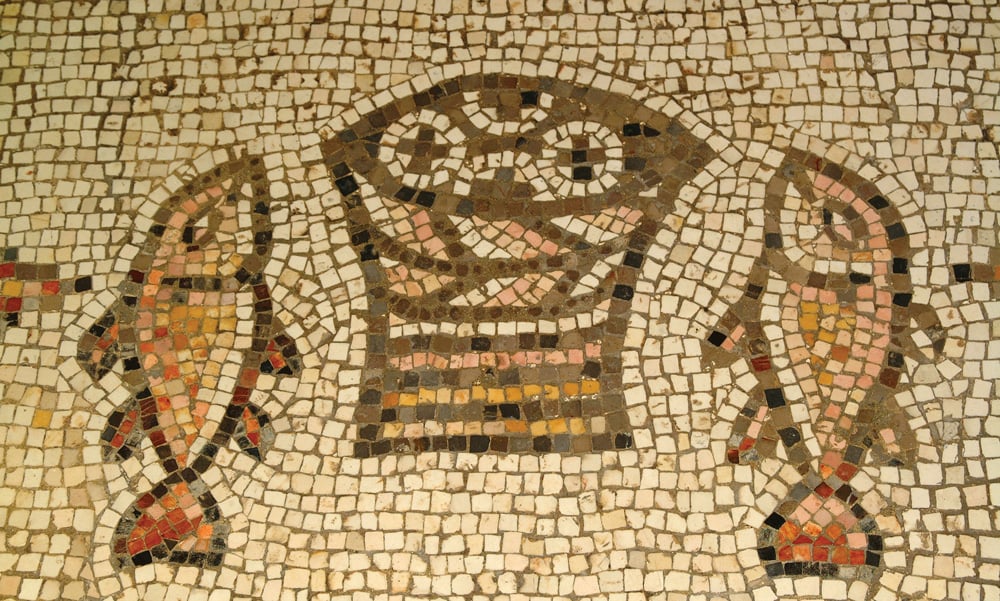
A mosaic of loaves and fishes, recalling the feeding of the five thousand (Mark 6:34–44), from the floor of a Byzantine church excavated on the north shore of the Sea of Galilee, near Capernaum
After the return of the Twelve, and in fulfillment of the first prerequisite of apostleship (3:14), Jesus summons the Twelve away from the pursuit of the crowd to be with him in rest and solitude. The crowd anticipates their retreat, however, and precedes them to the destination. Despite the invasiveness of the crowd, Jesus looks on it with compassion and, according to custom, teaches the people. Given the remoteness of the region, lateness of the hour, and size of the crowd, the disciples recommend dismissing the crowd to the surrounding villages for provisions. Rather than accepting this reasonable solution, Jesus intensifies the impending crisis by ordering, “You give them something to eat” (6:37). The disciples look beyond themselves to solve the problem, whereas Jesus looks among them for the solution. “How many loaves do you have?” he asks (6:38). Despite the obvious inadequacy of this amount, Jesus orders the crowd to sit in groups of hundreds and fifties, perhaps in imitation of Moses’s similar command to the Israelites in the wilderness (Exod. 18:25; Num. 31:14). The prayer with which Jesus receives and multiplies the bread and fish is similar to his prayer over the bread and wine at the institution of the Lord’s Supper (14:22). In utilizing the Twelve to dispense the bread, Jesus ministers to the crowd through the disciples. Like the harvest in the parable of the sower (4:9, 20), the feeding of the five thousand results in a miracle of abundance: “All ate and were satisfied” (6:42), with twelve basketfuls remaining (6:43).
The feeding miracle takes place within sight of Gamala in Galilee, where the Zealot movement originated. The “many people [who] were coming and going” (6:31) in the region, and the reference to “sheep without a shepherd” (6:34), which in the Old Testament is normally a military image (Num. 27:17; 1 Kings 22:17; Ezek. 34:5; see also Judith 11:19), betray a revolutionary fervor among the wilderness crowd and the hope that Jesus might be a military Messiah against Rome. This is further supported by the reference to five thousand men (6:44; the Greek andres specifies men alone; see Matt. 14:21), and above all by John 6:15, which explicitly states that the people “intended to come and make [Jesus] king by force.” Jesus, however, refuses the populist and militant sentiments of the crowd, and like Moses, who supplied the Israelites with manna in the wilderness, feeds the crowd with the multiplication of bread and fish as a foreshadowing of the eschatological banquet of God.
Two statements in 6:45–52 bear further witness to the potential of a messianic uprising during the wilderness banquet. Jesus quickly compels the disciples to sail to Bethsaida (the northeast shore of the lake, 6:45), ostensibly to prevent them from becoming swept up in the crowd’s messianic fervor. He then repairs to the hills to pray (6:46). This is the second of three instances in Mark where Jesus prays (1:35; 6:45; 14:35–39). Each prayer is set at night in a lonely place, each finds the disciples removed from him and misunderstanding his mission, and in each Jesus faces a crisis. In this instance, the crisis may be the temptation to assume the populist messianic ideal.
From the hills, Jesus spies the disciples alone in the storm-tossed boat at night, “straining at the oars” (6:48). The Greek word implies “torment” and “distress,” conditions that befall the disciples whenever they are separated from Jesus. During the fourth watch of the night (3:00–6:00 a.m.), Jesus walks to the disciples on the water. The Greek cannot mean to walk “beside” the water, or anything other than walking on the open water. Readers are assured it is not an optical illusion, for the disciples “all saw him” (6:50). The baffling reference to “passing by them” (6:48) appears to signal a self-revelation of God, recalling God “passing by” on the water (Job 9:8; NIV “treads on the waves of the sea”), or “passing by” Moses (Exod. 33:22) and Elijah (1 Kings 19:11) on Mount Sinai. As in the forgiveness of sins (2:10) and power over nature (4:39), in walking on the water Jesus does what only God can do. “It is I” (6:50) is identical with God’s self-disclosure to Moses in Exodus 3:14, and may further evince Jesus’s divinity. As in earlier calming of storms in nature (4:41) and in human nature (5:15), the revelation of Jesus’s person and exhibition of his power causes fear, misunderstanding, and even hardness of heart in the disciples (6:49–50, 52). Mark reminds readers, however, that following Jesus is not measured by perfect or complete understanding, but by being in the boat with him.
Chapter 6 concludes with a summary report (6:53–56; see also 1:35–39; 3:7–12) of Jesus’s healing throngs of needy people on the west side of the lake. “Gennesaret,” the only proper noun in the account, refers to a densely populated region between Capernaum and Tiberias. In a flurry of commotion, nameless and faceless people who are identified only by their need and desperation swarm to Jesus from town and countryside simply to “touch even the edge of his cloak” (6:56). The account concludes with the assurance of Jesus’s untiring goodness, for “all who touched it were healed” (6:56). The accent in the account remains on the blessings of Jesus’s physical touch, however, for there is no mention of faith, discipleship, or understanding of Jesus’s saving purpose.
7:1–23. Jesus’s confrontation with the Pharisees and scribes over the question of uncleanness marks the end of his ministry in Galilee, which began in 1:14. Henceforth in Mark, Jesus will reappear in Galilee only intermittently, in 8:11 and 9:33. The Pharisees and scribes, last seen in chapter 3, come from Jerusalem, which throughout Mark is seen as the primary center of opposition to Jesus. The issue of ritual purity was the dominant trait of Pharisaism, and not surprisingly it is the issue at stake in 7:1–23, the longest conflict discourse in Mark. In accusing Jesus and the disciples of eating with unclean hands, the Pharisees are not primarily concerned with hygiene but with ritual and ceremonial observances instituted to maintain Jewish distinctiveness over against Gentile culture. The explanation of the observances in 7:2–4, which would be wholly unnecessary if Mark were writing for Jews, is one of many indications of a Gentile audience, and probably Roman Gentiles.
Quoting Isaiah 29:13 in Mark 7:6–7, Jesus accuses the Pharisees and scribes of cloaking evil intentions with pleasing words. The charge of “hypocrite” (7:6) implies the same, for “hypocrite,” which is the Greek word for a theater performer, designated an actor who wore various masks to impersonate different roles. The “tradition of the elders” (7:3–4) refers to the unwritten oral tradition that would later be codified in the Mishnah (ca. AD 200). In contrast to Sadducees, Pharisees believed that the oral tradition was equally authoritative with the written torah. Pharisees affirmed that the written laws of torah declared what God required but that the oral tradition was necessary to determine how to fulfill God’s requirements. Unfortunately, the focus on the how shifted attention away from the original intent of the law and onto an array of peripheral observances. Jesus expressly declares that the “tradition of the elders” does not clarify torah or assist in its fulfillment but actually skews its meaning, resulting in “nullifying” the commandments of God and replacing them with mere human traditions (7:8–9, 13). The instance of “Corban” (a Hebrew word meaning “offering”) in verses 11–13 is a case in point. The fifth commandment requires honor of father and mother (7:10; Exod. 20:12), but the ritual of Corban allowed Israelites to take money that would otherwise be used for support of parents and dedicate it to God by investing it in the temple. Similar to deferred giving today, Corban allowed people to retain possession over their property, proceeds, or interest during their own lifetime, after which the money became temple property. The result was the evading of an explicit commandment—thereby the defrauding of one’s parents—in the name of a higher obligation to God. Corban—and the many practices like it (7:13)—was a glaring distortion of the law, which actually prevented a person from fulfilling the law.
Summoning the crowds, Jesus commands them to hear, for hearing, as Jesus taught in the parable discourses of chapter 4, leads to understanding (7:14). “Nothing outside a person can defile them by going into them. Rather, it is what comes out of a person that defiles them” (7:15). Uncleanness, in other words, is not essentially related to external matters—foods, objects, customs, regulations, rituals, and rites—but to the inner intentions of heart and mind. The latter defile a person, and it was on account of them, rather than external observances, that torah was instituted. The importance of this teaching is reinforced by private instruction in a “house” (7:17), where, removed from the interference and influence of the crowd, the disciples commonly received revelation from Jesus. Not for the first or last time, the disciples are “dull” (7:18) and uncomprehending. Jesus illustrates the point by food, which does not come from within but from without, and simply passes through the body (7:18–19). Mark adds his own parenthetical remark at the end of verse 19, assuring readers that Jesus therefore “declared all foods clean.” Christians, in other words, are free from kosher. What they are not free from—and this is the ultimate point of the discourse in 7:1–23—is the real source and nature of “uncleanness.” “What comes out of a person is what defiles them” (7:20). From the “heart”—the depth and center of human personality—come forth “evil thoughts . . . sexual immorality, theft, murder, adultery, greed, malice, deceit, lewdness, envy, slander, arrogance and folly” (7:21–22). None of these behaviors and attitudes is the result of an external cause that can be regulated by the oral tradition. Rather, “these evils come from inside” (7:23). “Uncleanness” is not a property of objects or observances but of inner attitudes, a condition of the heart. Goodness—or evil—originates within the will of humanity, and the law was given by God to change the will, the intent, of the heart.
D. Jesus travels to Gentile regions (7:24–8:9). The story of a Gentile who was a “true Israelite” (7:24–30) is the first of three stories in Mark 7:24–8:9 in which Jesus extends his ministry to Gentile regions. Tyre lay thirty miles northwest of the Sea of Galilee along the Mediterranean and epitomized a long history of antagonism to Israel. The home of the infamous Jezebel of 1 Kings (16:31–32), as well as a staging ground for attacks on Israel during the Maccabean revolt (1 Maccabees 5:14–15), Tyre, in the words of the Jewish historian Josephus, was “a notoriously bitter enemy” of Israel (Against Apion 1.13). Mark does not specify why Jesus goes to Tyre, although he says that Jesus hopes to evade detection (7:24). It is not difficult to imagine that Jesus quit Galilee to escape the intrigues of the Pharisees (3:6; 7:1–23) and the ire of Herod Antipas, ruler of Galilee who killed John the Baptizer (6:14–30). A Gentile woman who belongs to the infamous pagans of Syria Phoenicia seeks out Jesus, begging him to relieve her daughter of a demon (7:26). No one with such notorious credentials surely ever presumed to approach an adherent to the “tradition of the elders.” “ ‘First let the children eat all they want,’ [Jesus] told her, ‘for it is not right to take the children’s bread and toss it to the dogs’ ” (7:27). Although Jews often spoke of Gentiles as “dogs,” Jesus did not normally regard people in such stereotypes. His reference seems unnecessarily offensive—unless the woman presumed that in coming to Tyre Jesus was forsaking his ministry to Israel in favor of a mission solely to the Gentiles. If she presumed this—and it is difficult to account for Jesus’s reference to her as a “dog” if she did not—Jesus may have employed this blunt stereotype to remind her that Jews, despite their opposition, retained priority in his mission. This interpretation is supported by Mark 1:2–3, which affirms that the gospel comes from Israel, and that Gentiles participate in the gospel only insofar as they are engrafted into salvation history in Israel (see Rom. 11:11–32). In his response to the Syrophoenician woman, Jesus reminds her that there is no place for Gentile pride or arrogance over disobedient Israel (see Rom. 11:18–21). The woman’s reply in verse 28 shows her understanding and acceptance of Israel’s privilege. Indeed, this Gentile woman understands Jesus’s mission better than most Jews, including his own disciples. Like Jacob, who “struggled with God and with humans” and prevailed (Gen. 32:28), this woman “took Christ at his own words,” said Luther; “he then treated her not as a dog but as a child of Israel” (Bainton, 362).
A second story further expands the ministry of Jesus to the Gentiles (7:31–37). From Tyre, Jesus travels twenty miles north to Sidon, then southeast to the Gentile Decapolis east of the Sea of Galilee, following a horseshoe circuit of one hundred rugged miles. In the Decapolis a man “who was deaf and could hardly talk” (7:32) is brought to Jesus for healing. The description of the man’s speech and hearing defects is a single word in Greek, a word that occurs only once elsewhere in the Greek Bible, in Isaiah 35:6. Use of this rare term indicates that Mark intends for readers to see the healing of verses 31–37 as a fulfillment of Isaiah 35, in which the glory of the Lord anoints the desert wastelands of Lebanon with joy. The regions of Tyre and Sidon are precisely the Lebanon of Isaiah 35, thus indicating that the eschatological redeemer of Zion promised to the Gentiles in Isaiah 35 is none other than Jesus. The removal of the man from the crowd may be Jesus’s way of indicating his personal importance to him. Spittle, like other body excretions, normally fell under the category of defilements in Judaism, but in holy persons spittle was often considered a healing agent. The “tradition of the elders” (7:1–23) forbade Jews from contacting unclean objects or persons, but in his intimate contact with this man by touch and spittle, Jesus demonstrates his embrace of Gentiles. The empathy of Jesus’s prayer in 7:34 and the concrete description of the healing in Greek (“the fetter of his tongue was broken” [NIV “his tongue was loosened,” 7:35]) suggest release from demonic bondage as well as physical healing. The command to silence in verse 36—the only such command to Gentiles in Mark—indicates that, for all their differences, Jews and Gentiles were both equally prone to disobey Jesus. The concluding chorus in 7:37, “He has done everything well,” may recall Genesis 1:31, reminding readers that the Son’s work in redemption, like the Father’s in creation, is good.
This section closes with a third story about Jesus’s ministry to the Gentiles, the feeding of the four thousand (8:1–9). On the Gentile, east side of the Sea of Galilee—perhaps in the vicinity of the healing of the demoniac (5:1–20)—Jesus attracts a large crowd that remains with him for three days. The Greek word describing the presence of the crowd (8:2) connotes its special attachment to Jesus; ironically, Gentiles receive Jesus with a devotion that Jews do not. The “compassion” (8:2) Jesus feels for the persevering crowd is (according to the Greek word used) deep and powerful. Jesus does not want to dismiss the vulnerable multitude in the desolate region, and the disciples, sensing an impending crisis, ask where bread could be found for such a crowd in such a place (8:4). It may seem odd that the disciples, having witnessed the earlier feeding of the five thousand, would ask such a question. It should be remembered, however, that it is not unusual for even mature believers (and the disciples are not yet mature) to doubt the power of God after having experienced it. It is possible (though not certain) that Mark regards the seven loaves of bread produced as a symbol of the seven Gentile nations of the Old Testament (e.g., Deut. 7:1); but if so, the Gentile nations are not displaced or destroyed, but fed by Jesus. Although the feeding of the four thousand is similar to the feeding of the five thousand in 6:31–44, and is sometimes thought to be a doublet of it, the second feeding differs specifically in the size of the crowd (four thousand people in 8:9 rather than five thousand men in 6:44), in the Greek words for “basketfuls” (8:8 and 6:43), and especially in the prominence of Jesus, who in the four thousand speaks in the first person, displays deeper compassion, perceives the impending crisis, and personally seats and attends to the crowd. Clearly, the feeding of the four thousand shows Jesus’s compassion for Gentiles in the wilderness, as the feeding of the five thousand shows his compassion for Jews in the wilderness.
E. Opposition from Pharisees and disciples (8:10–26). Following the feeding of the four thousand, Jesus and the disciples cross to the west side of the Sea of Galilee, landing at Dalmanutha (8:10). This is the lone reference in all ancient literature to Dalmanutha, the location of which is uncertain. The implication of the story, however, is that it was either near to or identical with Magadan (Matt. 15:39), about three miles north of Tiberias. At Dalmanutha the Pharisees ask Jesus “for a sign from heaven” (8:11)—that is, for an outward and compelling proof of his authority. Several words in verses 11–12 (“dispute” [NIV “question”], “seek to control” [NIV “asked”], “attempt to discredit” [NIV “test”], and “sighed in exasperation” [NIV “sighed deeply”]) indicate the antagonism of the Pharisees. For Mark, the demand for a sign is an undisguised indication of unbelief. Jesus solemnly declares that unbelief will not be honored by a sign; he will not grant by empirical means what can be granted only by faith and trust. Jesus resolutely “left them, got back into the boat and crossed to the other side” (8:13).
The lack of understanding that Jesus encountered in Dalmanutha now accompanies him in the boat (8:14–21). Jesus warns the disciples, who have only one loaf of bread with them on the voyage, to “watch out for the yeast of the Pharisees and that of Herod” (8:15). “Yeast” is a leaven that ferments in dough, causing it to rise. In Jesus’s warning, the “yeast” appears to signify the disbelief of the Pharisees and Herod fermenting among the disciples. The disciples, however, uncomprehending of Jesus’s metaphor, remain fixed on “bread.” In an attempt to overcome the disciples’ obtuseness, Jesus presses them with seven rhetorical questions: Do you still not see? Do you still not understand? Are your hearts hardened? Can you not see? Can you not hear? Do you not remember? Do you still not understand? (8:17–21). Have the lessons of both miraculous feedings been lost on the disciples? asks Jesus. The conversation about bread in the boat marks a low point in the disciples’ understanding of Jesus and his ministry.
Mark is fond of juxtaposing two stories in order to demonstrate an interrelationship between them (e.g., 4:35–41 // 5:1–20). The placement of the healing of a blind man in Bethsaida (8:22–26) immediately following the conversation about bread in the boat (8:14–21) is another example of such a juxtaposition. In Bethsaida, on the east side of the mouth of the Jordan River at the north end of the Sea of Galilee, a blind man is brought to Jesus (8:22). As with the healing of the deaf-mute in the Decapolis (7:31–37), Jesus conducts the man outside the village (to separate him from its unbelief [6:45]?), applies spittle to his eyes, and places his hands on him. Both acts enhance the personal nature of the encounter. Jesus then asks, “Do you see anything?” (8:23). His question echoes the pleading question to the disciples in the previous story, “Do you still not see?” (8:17). There are, moreover, seven references to “seeing” in the original Greek in verses 23–25, just as there were seven references to lack of understanding in the previous story. The healing of the blind man of Bethsaida is the only miracle in the Gospels that proceeds in stages (which is probably why Matthew and Luke omit it). Mark’s inclusion of the story immediately following the failure of the disciples to understand signifies that faith is a process. Like the blind man, the disciples, who “have eyes but fail to see” (8:18), can also be made to see and understand, but not on their own. The ability to see, both physically and spiritually, is a gift of God, made possible by the repeated touch of Jesus.
2. Journey to Jerusalem (8:27–16:20)
A. Peter’s confession at Caesarea Philippi and the transfiguration (8:27–9:29). 8:27–9:1. The Caesarea Philippi declaration is like a continental divide in the Gospel of Mark. Prior to Caesarea Philippi, Jesus randomly and repeatedly crisscrosses the Sea of Galilee; thereafter he sets his face to Jerusalem. In the first half of the Gospel, Jesus teaches the masses in Galilee, casts out demons, and forbids people from announcing his identity; thereafter he primarily instructs the disciples, with no further exorcisms (apart from 9:29) or commands to silence. The first half of the Gospel takes Jesus outside Israel to Tyre, Sidon, and the Decapolis; the second half takes him to its heart in Jerusalem. Both halves conclude with christological confessions, the first with a Jewish confession of Peter that Jesus is the Messiah (8:29), the second with a confession of the Gentile centurion that Jesus is the Son of God (15:39).
From Bethsaida, Jesus sets out with the disciples to Caesarea Philippi, twenty-five miles to the north at the foot of Mount Hermon. Founded by Herod Philip in honor of Caesar Augustus, “Philip’s Caesarea” lay at the northernmost edge of his tetrarchy, at the source of the Jordan River and at the famous sanctuary of Pan, the pagan god of flocks and nature. “On the way” the party passed beneath the distinct camelback promontory of Gamala, where the Zealot movement was founded in AD 6 and where militant messianic fervor ran high. In Caesarea Philippi, a region rife with competing religious claims, Jesus for the first time solicits a claim about his identity. “Who do people say I am?” he asks the disciples (8:27). The disciples repeat the popular opinion earlier voiced by Antipas (6:14–15) that Jesus is John the Baptist, Elijah, or one of the prophets. Elijah, in particular, was reputed to have been taken bodily into heaven without dying (2 Kings 2:11), whence he would come as a herald of the great and terrible day of the Lord (Mal. 3:1; 4:5–6). Great as these figures were, they are inadequate analogies, for they imply that Jesus is merely a reappearance of something that happened before. Identifying Jesus with preexistent categories is like pouring “new wine into old wineskins” (Mark 2:22). Not content with the opinions of others, Jesus presses the disciples for a personal confession: “Who do you say I am?” (8:29). He has not rushed this moment; enough time has elapsed for the disciples to make a judgment based on personal experience. The answer cannot be supplied by collecting more data or evidence or by further discussion; it can be reached only by a decision of personal faith. Peter insightfully and courageously declares, “You are the Messiah” (8:29). The Greek word for Christ (christos) translates the Hebrew word for messiah (mashiah), which means “anointed one.” In the Old Testament, “messiah” is an infrequent epithet of one who could come as a future eschatological king according to the model of the Davidic monarchy (2 Samuel 7; Psalm 2) to establish God’s reign on earth. After the Maccabean revolt, however, and especially after the onset of the Roman occupation of Palestine in the early first century BC, the concept of messiah increasingly assumed military expectations. Indeed, in AD 132–35, the Jewish guerrilla warrior Bar Kokhba openly proclaimed himself messiah in his unsuccessful attempt to overthrow the Roman occupation of Palestine.

The Banias (or Paneas) Waterfall, near Caesarea Philippi. In this region, Peter confessed Jesus to be the Messiah (Mark 8:27–29).
In declaring Jesus “Messiah,” Peter supplies the right answer, but he has the wrong understanding. Rejecting Peter’s militant messianic understanding, Jesus “began to teach them that the Son of Man must suffer many things and be rejected by the elders, the chief priests and the teachers of the law, and that he must be killed and after three days rise again” (8:31). Jesus’s teaching is so contrary to the disciples’ expectations that, as he repeatedly touched the blind man in 8:22–26, he will repeat it three times (8:31; 9:31; 10:33–34) “on the way” to Jerusalem (8:27). At last Peter and the disciples understand—and “rebuke [Jesus]” (8:32). Never was it heard in Israel that the Messiah would suffer, or by suffering expiate the sins of Israel. It is important to recall that the one figure in the Old Testament associated with suffering—the Suffering Servant of Isaiah (42, 49, 51, 52–53)—is nowhere in Jewish history or literature associated with the Messiah. Ironically, the suffering of God’s Messiah will not come from humanity at its worst—the godless and wicked—but from humanity at its best—“the elders, the chief priests and the teachers of the law” (8:31). So essential is humiliation and suffering to the mission of Jesus that to attempt to divert Jesus from it—as Peter does in verse 32—is not to “have in mind the concerns of God, but merely human concerns” (8:33). To judge the work of God in any other light than the perspective of God is to become an “adversary” to God, which is the Hebrew meaning of “Satan” (1 Kings 11:14).
In 8:34, the subject shifts from Christology to discipleship. For Mark, these are not two separate matters but two sides of the same coin. A proper confession of Jesus is inevitably also a confession of what believers must become. In verse 34, Jesus teaches that discipleship consists of following him, denying self, and taking up one’s cross. Today the cross is primarily an object of art or jewelry, but in Jesus’s day it was a hated instrument of cruelty, suffering, dehumanization, and shame. Reserved for the lowest social classes, and particularly slaves, the cross was the extreme terror apparatus of the Roman totalitarian state. The depiction of discipleship by such a repugnant symbol may account for the fact that in the second half of Mark there are fewer and smaller crowds around Jesus than in the first half. The image of the cross signifies a total claim on the disciple’s allegiance and a total relinquishment of his or her resources to Jesus.
This truth is reinforced in 8:35–37, each verse of which declares the total claim of the gospel on one’s existence. To lose one’s life for the gospel is, ironically, to save it (8:35); to gain the whole world at the cost of one’s life would be a fatal bargain, for what could one give to regain one’s life? (8:36–37). Concluding his solemn address to the disciples in the prophetic imagery of an “adulterous and sinful generation” (Isa. 57:3–13; Ezek. 16:32–41; Hos. 2:2–6), Jesus warns that whoever is ashamed of the way of the cross in this life will be looked on with equal shame by the Son of Man in the world to come. Mark concludes his climactic discourse on Christology and discipleship with a saying of Jesus that the kingdom of God will come in power in the lifetimes of “some who are standing here” (9:1). Mark strategically places this saying between the prediction of Jesus’s death in 8:31 and the account of his transfiguration (9:2–9), which anticipates his resurrection. That “the kingdom of God has come with power” (9:1) must therefore be understood to refer to the resurrection of Jesus from the dead—which Jesus’s hearers would indeed live to see.
9:2–29. The initial reference “after six days” (9:2), opening the transfiguration narrative (9:2–13), is unusual since Mark rarely gives specific time delimitations. The “six days” appears to link the transfiguration to Peter’s confession, assuring the bewildered disciples of the divine confirmation of Jesus’s way to the cross. Peter, James, and John appear elsewhere as Jesus’s inner circle (Mark 5:37; 13:3; 14:33). The “high mountain” (9:2) probably refers to Mount Hermon, rising 9,200 feet above Caesarea Philippi; the glorification of Jesus on its summit, however, doubtless also recalls the epiphany of God to Moses on Mount Sinai (Exod. 34:35). The Greek word for “transfigured” (9:2) means to “change” or “transform,” in this instance into dazzling light. The figures of Elijah and Moses, who epitomize the Old Testament prophets and law, appear in audience with Jesus, signifying that the law and prophets lead to and are fulfilled in Jesus. Peter’s desire to erect three “shelters” (9:5) is not as foolish as is often supposed, for the Greek word skēnē, “tabernacle,” recalls the tabernacle in the wilderness erected to the glory of God (Exod. 40:34–36; Tobit 13:11). The cloud that envelops the disciples, momentarily revealing the glory of Jesus as God incarnate (9:7), expressly recalls the presence and glory of God that enveloped the tabernacle (Exod. 24:15–16; 40:34–36). “This is my Son, whom I love” (9:7) recalls the divine words at the baptism of Jesus, though here it is directed not to Jesus (see 1:11) but to the disciples. “Listen to him” (9:7) designates Jesus as the prophet who would follow Moses (see Deut. 18:15–18), and it assures the bewildered disciples that Jesus’s prediction of his suffering and death in Jerusalem (8:31) is not a mistake but God’s providential will for him. Taking up one’s cross and following Jesus (8:34) is a difficult teaching, to be sure, but the transfiguration does not end on an ominous note, for Jesus does not escape to heaven with Elijah and Moses but remains “with [the disciples]” (9:8) on the journey to Jerusalem.
On the descent from the mountain, Jesus commands the disciples to be silent for the final time, admonishing them to banish thoughts of messianic triumphalism and not to mention the transfiguration until the resurrection of the Son of Man (9:9). The Greek of verse 10 indicates that the disciples did not simply keep the secret but suppressed it. Their puzzlement is a further sign of their blindness (8:14–21), for among the Pharisees the doctrine of the resurrection had been an article of faith for two centuries. The disciples ask, “Why do the teachers of the law say that Elijah must come first?” (9:11). Their question, by suggesting that Elijah’s return to restore all things (Mal. 4:5–6) should obviate the need for the Son of Man to suffer, indicates further resistance to the idea of suffering. Elijah will restore all things, affirms Jesus, but not before “the Son of Man must suffer much and be rejected” (9:12). This latter reference is an apparent allusion to the suffering of the servant of the Lord in Isaiah 53:3. Indeed, says Jesus, “They have done to [Elijah] everything they wished” (9:13). The fate of “Elijah” here refers to the fate of John the Baptizer (see Matt. 17:13). The suffering of Isaiah’s servant of the Lord and the fate of Elijah (i.e., John the Baptizer) concur that the triumphant day of the Lord can be purchased only by the suffering of the Son of Man.
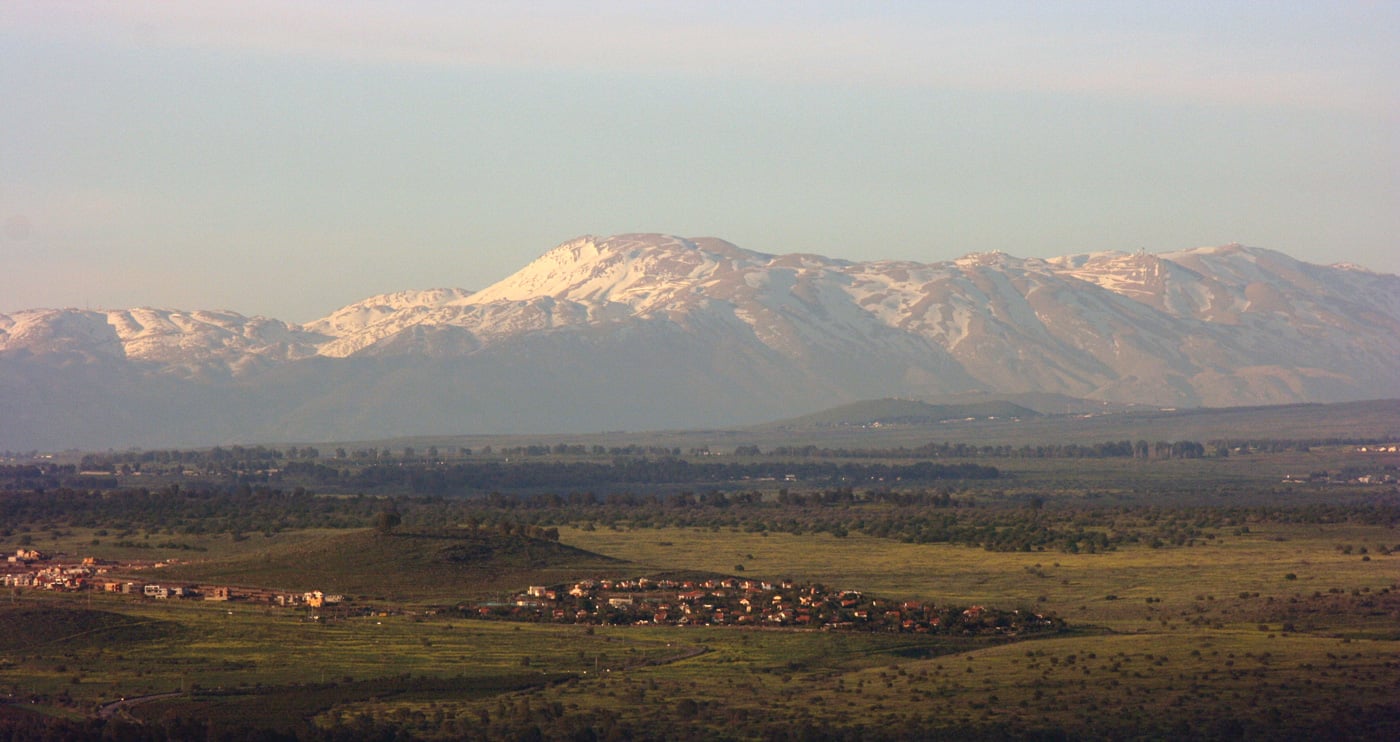
Mount Hermon, most likely the “high mountain” where Jesus was transfigured (Mark 9:2–8)
In the second-to-last miracle story in Mark (9:14–29), a desperate father struggles for the life of his son and the existence of his faith. While Jesus and the three principal apostles, Peter, James, and John, were on the Mount of Transfiguration, a man brought his son who was “possessed by a spirit that has robbed him of speech” (9:17) to the remaining disciples for healing. The boy’s condition is identified by the parallel story in Matthew 17:15 as epilepsy, a diagnosis that Mark’s further descriptions amply confirm (9:18, 20–22, 26). The disciples’ inability to heal the boy is another instance of their inadequacies when Jesus is not with them (also 6:48). Jesus does not chastise the disciples, for inability is not a fault. His exasperation at the crowd (9:19), however, implies more serious problems of misunderstanding and hardness of heart. In recounting the boy’s condition, the father declares his own heart. At the sight of Jesus, the malevolent spirit convulses the boy, while his father cries to Jesus, “If you can do anything, take pity on us and help us” (9:22). So inseparable is the father’s desperation from his son’s condition that he begs for help and compassion “on us” (9:22). “ ‘If you can’?” replies Jesus in surprise (9:23). The problem is not one of God’s unwillingness or inability but of human disbelief. True faith is always aware how small and insignificant it is. True faith stands in the gap between the promise of God and the weakness of the flesh. In complete vulnerability, the father brings both his faith and weakness to Jesus: “I do believe; help me overcome my unbelief!” (9:24). Seeing the crowd converge and not wanting to make a display of his power, Jesus “rebukes” the spirit and commands it to leave the boy (9:25). If the boy’s condition was epilepsy, Mark understands it in this instance to be demonically instigated. An encounter with Jesus can leave things initially worse than before, as indicated by the deathlike condition of the boy after the expulsion of the demon. Here too the father must trust Jesus rather than immediate and apparent circumstances. Stretching forth his hand, Jesus “lifted [the boy] to his feet, and he stood up” (9:27). This description echoes the raising of Jairus’s daughter from the dead (Mark 5:41), emphasizing the miraculous authority of Jesus. Disappointed in their inability to heal the boy, the disciples ask Jesus privately, “Why couldn’t we drive [the demon] out?” (9:28). Jesus directs the disciples to the necessity of prayer. Indeed, the very inadequacy of the disciples must drive them to prayer; for prayer, as one scholar says, is “faith turned to God”—that is, God’s gift to the disciples in facing situations beyond their abilities.
B. “On the way” to Jerusalem (9:30–10:52). 9:30–50. As Jesus and the disciples are “on the way” from Caesarea Philippi to Jerusalem—a distance of two hundred miles as the crow flies—Mark includes four brief narratives on humility and suffering, each of which illustrates and reinforces Jesus’s call to self-denial and cross bearing (8:31–38).
Passing through Galilee for the final time, “Jesus did not want anyone to know where they were” (9:30). The anonymous journey may have been advised by the continued opposition of Antipas and the Jewish authorities, but above all because Jesus’s face was set toward Jerusalem. “On the way,” Jesus gives the second and shortest of three passion predictions (8:31; 9:31; 10:33–34). In the second prediction, Jesus does not attribute his death to the Jewish leaders, as in the first, but to all humanity. Moreover, the Greek word for “delivered” (9:31) is in the passive voice, which was a common way for Jews to avoid using the name of God (for fear of defiling it). This implies that Jesus’s impending suffering in Jerusalem is a fulfillment of the divine will. The disciples, however, “did not understand what [Jesus] meant and were afraid to ask” (9:32). Ironically, when the word of God is decisively spoken, the human response—and here from those with the greatest opportunity to understand—remains one of ignorance and fear.
The second of the four stories, in 9:33–37, takes place in Capernaum, Jesus’s base of operations in the first half of Mark. Alone with the disciples, Jesus asks what they talked about “on the way.” They meet his question with embarrassed silence, for they were arguing who was the greatest. The placement of this story after the second passion prediction accentuates the contrast between Jesus and the disciples: he embraces humility, they argue who is greatest; he surrenders his life in service, they desire recognition and distinction. The second passion prediction is thus followed by a second misunderstanding. “Sitting down, Jesus called the Twelve” (9:35). In sitting and summoning, Jesus assumes the role and authority of a rabbi. “Anyone who wants to be first must be the very last, and the servant of all” (9:35). At no point does the way of Jesus part more sharply from the world than in its understanding of greatness. Jesus redefines greatness in terms of giving rather than getting, and no vocation affords the opportunity of giving more than that of a servant. The most basic meaning of “servant” (Greek diakonos) is “waiting tables,” a posture Jesus himself assumes (Luke 22:27). Worldly greatness is reserved for the gifted few, but in the kingdom of God anyone can be great because anyone can serve. Service is the primary way for believers to imitate and fulfill the mission of Jesus (10:43–45). Jesus then embraces a child and commands the disciples, as he teaches in Matthew 25:40, to embrace “the least of these brothers and sisters of mine.”
The third narrative, in verses 38–41, reminds disciples not to judge others by their own standards but by Jesus’s generosity. As a member of Jesus’s inner circle, John, son of Zebedee, takes an elitist attitude toward an unnamed exorcist. Failing to learn the object lesson of the previous story, John regards his call as one of entitlement and exclusion; indeed, he speaks of following us rather than following Jesus (9:38). Ironically, John wants the exorcist to stop doing what he and the other disciples could not do (9:28). Jesus is more generous than the disciples. Faith no larger than a mustard seed is acceptable (Mark 4:30–32), as is a little child (9:36–37). Even a cup of cold water given in Christ’s name will not go unrewarded (9:41). Jesus receives what is done to a follower of Jesus as done to himself.
The final narrative is a graphic warning against causing others to sin, or “stumble.” Verse 42 asserts the inestimable value of the small and insignificant. Not causing “one of these little ones . . . to stumble” does not refer to children but to those “who believe in me”—that is, to disciples. Whatever is done to a follower of Jesus, whether good (9:41) or bad (9:42), is done to Jesus. Verses 43–48 shift the focus from jeopardizing others to endangering self. The instruction to cut off hands, feet, or eyes is not a command to literal physical mutilation. Like the millstone of verse 42, these are metaphors that are exaggerated for effect: let nothing—not even things as dear as hands, feet, and eyes—prevent you from entering the kingdom of God. Some ancient manuscripts insert the saying in verse 48 after the saying about hands (9:43) and feet (9:45). “Gehenna” (NIV “hell”) is a Semitic word for the Hinnom Valley, southwest of Jerusalem, where human sacrifice was practiced under Ahaz and Manasseh (2 Kings 16:3; 21:6). Ever after Ahaz and Manasseh, the Hinnom Valley symbolized the divine wrath and punishment of hell, which was to be avoided at all costs. The concluding references to fire and salt—both of which accompanied temple sacrifices (Lev. 1:1–17; 2:13)—are probably further metaphors of the trials and cost of discipleship.
10:1–31. Chapter 10 entails the call to discipleship in three fundamental aspects of life: marriage (10:1–12), children (10:13–16), and possessions (10:17–31).
Near the end of the journey from the north and before entering Jerusalem, Jesus teaches in “the region of Judea and across the Jordan” in Perea (10:1). There the Pharisees question him about divorce (10:1–12). Divorce and marriage were burning questions in Jesus’s day, as they are in ours. The question of whether it was lawful for a man to divorce his wife (10:2) was a “test,” however; indeed, it was a trap, for Jewish law unambiguously permitted divorce (Deut. 24:1–3). The only question was on what grounds. Here opinions varied widely, from conservative rabbis like Shammai, who permitted divorce on the sole ground of adultery, to liberal rabbis like Hillel, who allowed divorce (at least in theory) for virtually any reason. In posing the question, the Pharisees desire both to maintain an easy divorce policy and to catch Jesus in violation of torah. Jesus asks what Moses (i.e., the law) commands (10:3). The Pharisees promptly quote from Deuteronomy 24:1–3, that “a man [may] write a certificate of divorce and send [his wife] away” (10:4). The law permits divorce, maintains Jesus, only “because your hearts were hard” (10:5)—that is, as a concession to human sin rather than as a true picture of God’s will.
The Pharisees focus on exceptions to marriage; Jesus focuses on how to fulfill God’s intentions for it. The purpose of Deuteronomy 24:1–3, according to Jesus, was to limit the consequences of sin by permitting divorce, but it does not reveal the divine intention for marriage. Going behind the authority of torah, Jesus cites the first and fundamental teaching on marriage: at creation God made them “male and female” (Gen. 1:27), and in marriage the two “become one flesh” (Gen. 2:24). God ordained marriage, in other words, to be a union of a man and a woman who become inseparably one. Unlike the Pharisees, who stacked the deck of divorce in favor of the male, Jesus portrays male and female as created mutually equal—and mutually responsible in the marriage union. The Pharisees considered the man the lord of marriage, but Jesus says God is the lord of marriage: “What God has joined together, let no one separate” (10:9). The mutual responsibility for marriage is accentuated in verses 10–12, when Jesus teaches the disciples in private that, in suing for divorce and contracting a second marriage thereafter, both men and women are guilty of adultery.
The next fundamental aspect of life to be addressed is children (10:13–16). When some children are brought to Jesus, the disciples “rebuked them” (10:13). “Rebuke,” normally reserved in Mark for exorcisms (1:25; 3:12; 9:25), is a strong denunciation, implying an attitude toward children that the disciples earlier (9:38) displayed toward an independent exorcist. Seeing their exclusivism, Jesus is “indignant” (10:14)—the only passage in the Gospels apart from 1:41 where the anger of Jesus is so sharply aroused. “Let the little children come to me,” he orders, “for the kingdom of God belongs to such as these” (10:14). Jesus’s attitude toward children is remarkable—and unprecedented—in the ancient world. In Jewish and Roman societies, childhood was not regarded with the same tenderness as in modern Western societies. It was typically regarded, rather, as an unavoidable and uncelebrated interim between birth and adulthood. In blessing and embracing children, Jesus was not acknowledging their innocence, purity, or spontaneity—for that would imply their acceptance was based on some virtue in themselves. Rather, children are blessed for what they lack—size, power, and sophistication. Having nothing to bring to Jesus, they have everything to receive from him by grace. Neediness—not merit—is the prerequisite to entering the kingdom of God, which is present in Jesus.
In the third discussion of what is fundamental to life (10:17–31), the possessions and social standing of the rich man are a striking contrast with the deficiencies of the children in the previous story. The rich man approaches Jesus with great eagerness and apparent receptiveness; he is the first person in Mark to ask to inherit eternal life, and he receives a clearer picture of the kingdom than anyone yet in Mark. Ironically, however, he turns away. Jesus deflects the address “good teacher” (10:17) perhaps because, like rabbis in general, he wished to avoid possible blasphemy against God, but more likely because he wished to redirect the man’s thoughts to the commandments of God. To the prohibitions of murder, adultery, theft, false testimony, and dishonoring parents, Jesus adds a commandment, not found in the Decalogue, against defrauding the poor—perhaps because wealth is often gained at the expense of the poor (10:19). It is often supposed that the rich man cannot have been sincere in claiming to have kept all the commandments. We should remember, however, that the Ten Commandments speak of acts that could—and were meant to—be kept (even if one intended otherwise). We should doubtless accept the truthfulness of the rich man’s claim, “All these [commandments] I have kept since I was a boy” (10:20), for (1) Jesus does not challenge his declaration, and (2) Jesus would scarcely look on insincerity with “love,” as he does in verse 21. It is often imagined that if the law were perfectly kept, one would gain eternal life. To a man who has, in fact, kept the law, Jesus declares, “One thing you lack. . . . Go, sell everything you have . . . give to the poor. . . . Then come, follow me” (10:21). Jesus offers himself as a substitute for the man’s possessions. The man’s full adherence to the law, good as it is, is no substitute for knowing and following Jesus. This offer, however, the man cannot accept. Standing on his own merits, he is self-confident; but when he is called to give up his security and follow Jesus, his “face fell, and he went away sad” (10:22 NLT).
Possessions pose a problem for the disciples as well as for the rich man, for Jesus “looked around” and twice warns, “How hard it is for the rich to enter the kingdom of God” (10:23–25). The famous statement in verse 25 about a camel going through the eye of a needle is humorous, to be sure, but also deadly earnest. The most common attempt to weaken it—that is, that “the eye of the needle” refers to a small Jerusalem gate through which camels might enter by kneeling (implying that the rich may enter the kingdom if they humble themselves!)—is far-fetched, for that gate lay nine centuries in the future when Jesus spoke. The intended offense of the analogy is not lost on the disciples, who, nearly as shocked as the rich man (10:22), ask, “Who then can be saved?” (10:26). Jesus’s word does not comfort them, in other words, but convicts them of their utter insufficiency before God. This, at last, is the right frame of mind—which explains why Jesus answers their question and not the rich man’s. “With man this is impossible, but not with God; all things are possible with God” (10:27). Only where things are no longer possible may the disciples receive all things from God. Peter asks whether the sacrifices the disciples have made to follow Jesus are then worthless (10:28). They have given up homes, families, and fields (10:29), their most essential relationships and allegiances. Jesus assures them that when all has been forsaken for him, he will return all a hundredfold—though not without trials—in this life, and he will give them eternal life in the world to come. Discipleship entails a deep irony: the “first will be last, and the last first” (10:31).
10:32–52. The final passion prediction, in 10:32–34, is the most explicit of the three, with many predictions fulfilled in chapters 14–15. Jewish leaders are responsible for Jesus’s death in the first prediction (8:31); Gentiles in the second (9:31); but “the chief priests and the teachers of the law” and “Gentiles” (10:33)—that is, both Jews and Gentiles—in the third prediction. Discipleship is always following Jesus “on [the] way up to Jerusalem” (10:32). Nowhere else does Mark speak of Jesus “leading the way” except to his suffering and death. Peter has just boasted of having “left everything to follow” Jesus (10:28), but on the actual road to Jerusalem he and the disciples are reluctant and afraid.
The failure of the disciples to understand the way of Jesus is exposed with acid clarity in 10:35–45, where, immediately following Jesus’s announcement of his impending humiliation, James and John ask for fame. James and John think of God’s kingdom in terms of benefits. Jesus, however, speaks of the costs of participating in it in terms of a “cup” and “baptism” (10:38), both metaphors of suffering. The brothers assure Jesus of their willingness to bear the costs of discipleship. Despite their assurance, Jesus declares that the rewards of glory are hidden in the eternal purpose of God (10:40). Disciples are not to follow Jesus because of future rewards but because they wish to be with Jesus—wherever he leads.
The other disciples are “indignant” with James and John for their request of special honor, perhaps because they secretly have hoped for it themselves (10:41). The dissension among the Twelve becomes the pretext for one of Jesus’s most important lessons and self-revelations. Earthly rulers and officials, says Jesus, “exercise authority” (10:42)—and usually with severity. The beginning of verse 43 reads in Greek: “It is not this way among you”; that is, this is not the way the kingdom of God works. Repeating the lesson of 9:35, Jesus solemnly declares that the preeminent value of God’s kingdom is not power, prestige, or authority, but service (10:43). The idea of a “slave”—a position of absolute inferiority in the ancient world—being “first” was as paradoxical as the idea of a camel going through the eye of a needle (10:25). Disciples must practice service rather than authority because it is Jesus’s posture: “The Son of Man did not come to be served, but to serve, and to give his life as a ransom for many” (10:45). Jesus calls disciples not to an ethical system but to “the way of the Lord” (Mark 1:3), the very pattern of the incarnation. A servant is preeminent because a servant gives, and giving is the essence of God, who gave his Son for the sins of the world. In describing the Son of Man as giving “his life as a ransom for many” (10:45), Jesus appropriates the unique description of the servant of the Lord in Isaiah 53:10–11. The servant is the only figure in the Old Testament whose suffering is vicariously effective for others. Verse 45 attests to Jesus’s supreme consciousness of his impending suffering and death in Jerusalem as a “ransom for many,” a self-substitution on behalf of all humanity.
The healing of a blind man in Jericho concludes the journey to Jerusalem (10:46–52). Bartimaeus is the only person healed in the Synoptic Gospels who is named, and by concluding with a comment that he “followed [Jesus] on the way” (10:52 ESV), Mark designates him a model disciple. Jericho lies 20 miles northeast and 3,500 feet lower than Jerusalem. As Jesus, the disciples, and a large crowd leave Jericho, a blind beggar, whose name in Aramaic means “son of Timaeus,” cries out, “Jesus, Son of David, have mercy on me” (10:47). What Bartimaeus lacks in eyesight he makes up for in insight. “Son of David” recalls the hopes of a promised deliverer like David (2 Sam. 7:11–14), thus indicating that Bartimaeus associates messianic expectations with Jesus. Refusing to be silenced by the crowd, Bartimaeus repeats the cry. Unlike the crowd, Jesus does not treat Bartimaeus as an annoying problem. He stops, summons him, and restores his dignity by asking, “What do you want me to do for you?” (10:51). It is the same question Jesus asked James and John in 10:36, but whereas they asked for superhuman glory, Bartimaeus simply asks for human eyesight. Jesus restores his sight with warm assurance: “Go . . . your faith has healed you” (10:52). The Greek word sōzō, which means both “heal” and “save,” is doubly appropriate here, for the encounter with Jesus has changed Bartimaeus from a beggar beside the way to a disciple on the way.
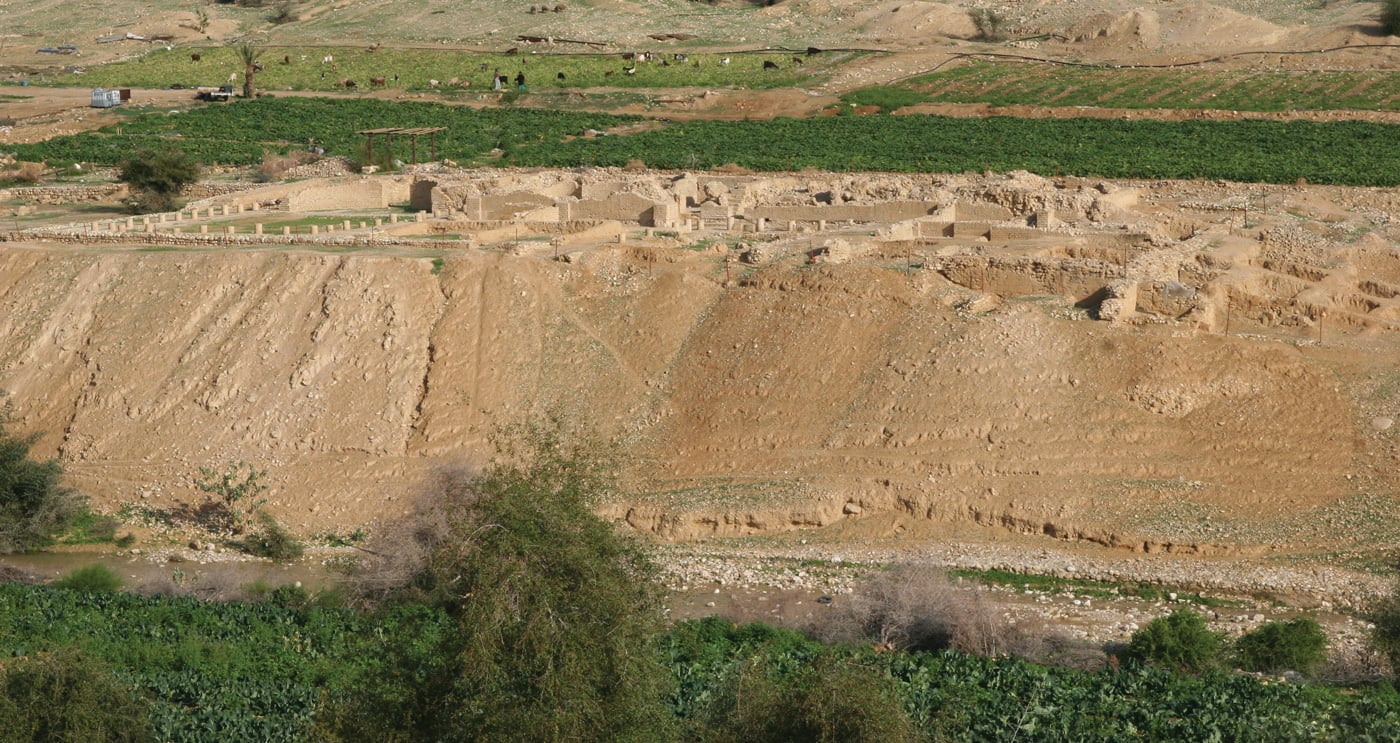
On the road outside Jericho, Jesus healed the blind man Bartimaeus (Mark 10:46–52). Most of ancient Jericho, as it was in Jesus’s day, lies beneath the modern Arab oasis town. But the winter palace of Herod the Great (seen here) remains.
C. Stories of conflict in the temple in Jerusalem (11:1–13:37). Mark 11–16 is commonly called the “passion narrative,” the account of Jesus’s suffering and death in Jerusalem. In devoting fully one-third of his narrative to the final week of Jesus’s life, Mark indicates its importance for understanding Jesus and the gospel. All the material in Mark 11–13—and most of 14–15—is oriented around the focal point of the temple. Mark does not present Jesus as either a preserver or reformer of the temple, however, but as its replacement. The locus Dei—the dwelling place of God in the world—is no longer (and will never again be) the Jerusalem temple, but Jesus himself.
11:1–26. Jesus begins his final week by making his way to the temple in Jerusalem (11:1–11). Unlike the modern road to Jerusalem, which proceeds from Jericho to Bethany to Bethphage to Jerusalem, the Roman road in Jesus’s day ran along the spine of the mountain flank that led from Jericho up to Bethphage on the Mount of Olives, and from there either down to Bethany or to Jerusalem. It is this route that Mark describes in 11:1. The Mount of Olives runs on a north-south axis east of Jerusalem, and its summit, three hundred feet higher and less than a mile distant, affords a breathtaking view of the holy city. Mark, who seldom mentions place names, may mention the Mount of Olives because of its association in Judaism with the coming of the Messiah and the final judgment (Ezek. 11:23; Zech. 14:4; Josephus, Jewish Antiquities 20.169). From the summit of the Mount of Olives, Jesus sends two unnamed disciples to an unnamed village (Bethany?) to fetch a “colt” (the Greek means the young of either horse or donkey) on which to ride into Jerusalem. Jesus may have known about the colt because of his connections in Bethany (see John 11–12). The reference to “the Lord” needing the colt (11:3) and to the riding of an unbroken animal both suggest Jesus’s divine authority. The preparation for the entry into Jerusalem demonstrates Jesus’s precise foreknowledge and sovereignty over subsequent events.
Once the colt has been procured, the way is strewn with cloaks and branches as Jesus rides into Jerusalem. “Hosanna” (11:9) is a transliterated Hebrew word meaning, “Save, I pray.” “Blessed is he who comes in the name of the Lord” is a quotation from Psalm 118:25–26, where it refers not to the Messiah but to pilgrims entering Jerusalem. “Blessed is the coming kingdom of our father David” (not a Scripture quotation) insinuates messianic overtones, however. Like modern military parades, triumphal processions were common throughout the ancient Near East as a means for rulers to exhibit their prowess and subjugate populations through displays of military might. This narrative is traditionally and rightly designated the triumphal entry according to Matthew 21:1–11 and John 12:12–19. Mark’s narrative is scarcely triumphal, however, for the crowds vanish, Jesus enters the temple alone, and having looked around briefly, he returns to Bethany, whence he came. This is the first of Mark’s clues that the temple is not the habitation of God’s Son.
The cursing of the fig tree (11:12–25) often offends readers, not only because it is the only miracle of destruction in the canonical Gospels, but also because Jesus curses a tree for not producing fruit out of season (10:13). The fig tree story is another of Mark’s sandwich units, however, in which the cursing and withering of the tree is interrupted by the “cleansing of the temple” episode. The splicing of the two stories together signifies that the fate of the unfruitful fig tree foreshadows God’s judgment on the unfruitful temple. Walking the roughly two miles from Bethany to Jerusalem, Jesus sees a fig tree in leaf and approaches it in hopes of finding figs to eat. In Judea fig trees produce immature green figs before coming to leaf, and once foliage appears one expects to find branches loaded with figs, which, though not mature, are edible (Hos. 9:10; Song 2:13). The statement, “It was not the season for figs” (11:13), must mean not the season for ripe figs. More important than botany, however, is the theological symbolism of the story. The fig tree is often a symbol of God’s judgment in the Old Testament, and here as in the prophetic tradition (Isa. 34:4; Jer. 8:13; Hos. 2:12; Joel 1:7; Mic. 7:1) the curse of the fig tree symbolizes God’s judgment on the temple.
In the central, B-part of the sandwich, Mark turns to the clearing of the temple in verses 15–19. Herod the Great commenced building the temple in Jerusalem in 20 BC, and it was still under construction in Jesus’s day. The temple consisted of four majestic divisions, the first of which, the Court of Gentiles, an open-air rectangle of 500 × 325 yards (35 acres!) enclosed by a perimeter of massive porticoes, was accessible to both Jews and Gentiles. The Court of Gentiles, where animals were sold for sacrifice and currency exchanged for the Tyrian shekel (made of pure metal and with no image), is the setting of verses 15–19. Quoting Isaiah 56:7, Jesus overturns the tables of animal sellers and money changers in order to make the temple a place of prayer “for all nations” (11:17). The commercial interests associated with the Jewish sacrificial system have deprived the “nations” (Greek “Gentiles”) of the one place where non-Jews could worship. The Messiah was popularly expected to “cleanse” the temple of Gentiles and restore it for exclusive Jewish rites and rituals. Jesus does not “cleanse” and restore the sacrificial system of the temple, but clears it for Gentiles. The chief priests and scribes—the two groups responsible for oversight of the temple—fully understand his intent and begin “looking for a way to kill him” (11:18; also 3:6). Jesus then abandons the temple to go “out of the city”—a second reminder (11:11) that the temple is not the habitation of God’s Son. Mark completes the sandwich unit with the note that the next day the fig tree was “withered from the roots” (11:20–21). Something “withered from the roots” cannot be revived. That expression, which recalls the seed in the parable of the sower that had no depth of soil (4:6), signifies that the new covenant in Jesus’s blood (14:24) has replaced the blood of animal sacrifices and that by his resurrection from the dead Jesus will raise a new temple not made by human hands (14:58). The saying in verses 23–25 is appended to the fig tree–temple sandwich in order to remind readers that Jesus, and not the temple, is the object of the believer’s faith and prayer, and that faith and prayer make possible forgiveness, which is the epitome of the gospel.
11:27–12:44. Beginning with the episode in 11:27–33, and continuing through chapter 12, Mark reports a series of controversies and conflicts between Jesus and the Sanhedrin, the supreme judicatory that controlled the temple and extended its influence over Jewish life. Composed of chief priests, elders (both Pharisees and Sadducees), and scribes, and ideally totaling seventy-one members, the Sanhedrin was granted full authority over Jewish religious affairs and significant control over Jewish political life as a buffer organization between Rome and Palestine.
11:27–12:12. “The chief priests, the teachers of the law and the elders” (11:27)—in other words, a delegation of the Sanhedrin—confront Jesus in the temple with the question, “By what authority are you doing these things?” (11:28). By “these things” they are evidently recalling Jesus’s presumption to forgive sins (2:10), supersession of torah and Sabbath (2:23–3:6), acceptance of sinners and tax collectors (2:16), disruption of temple operations (11:15–19), and other challenges to their authority. In Israel’s most authoritative place, and by its most authoritative body, Jesus is summoned to give account of his own authority. The question, “Who gave you authority to do this?” (11:28), recognizes that no one possesses authority on his own to do what Jesus does. Such authority, presumably, comes only from God—and herein is the trap of the Sanhedrin’s question. If Jesus claims such authority, he can be charged with blasphemy, which in Judaism was a capital offense. Jesus meets their question with a counterquestion: “John’s baptism—was it from heaven, or of human origin?” (11:30). This is not a diversionary tactic but an attempt to direct the Sanhedrin to the proper answer. At John’s baptism Jesus was declared God’s Son and endowed with God’s Spirit to do “these things.” A decision about John can open a door to a decision about Jesus. The Sanhedrin weighs the political consequences before them and answers evasively, “We don’t know” (11:33). That was not entirely true. They were, rather, unwilling to commit, and to those unwilling to commit, Jesus is unwilling to reveal himself.
The parable of the vineyard (12:1–12) retells the history of Israel in the well-known imagery of a vineyard (e.g., Isa. 5:1–7), though it is adapted to the widespread system of absentee landownership in first-century Palestine. The parable depicts the central purpose of Israel’s history as leading to the landowner’s beloved son (12:6), and Israel’s failure to receive the son as grounds for its judgment. The placement of this parable as the final and only parable outside chapter 4 indicates its supreme importance for Mark. Tenant farmers are entrusted with the oversight of a vineyard, but when the owner sends servants to collect his produce, the tenants maltreat some and kill others. In a final act of outrage, the tenants kill the owner’s beloved son and throw his body to the birds, thinking the vineyard will be theirs. After every conceivable overture of clemency, the landowner intervenes and takes vengeance on the tenants. The landowner in the parable represents God. His judgment falls not on the vineyard (Jews/Israel), however, but on the “tenants,” or leaders of Israel, who in Jesus’s day were the members of the Sanhedrin. Supreme place in the parable is accorded the “son, whom he loved” (12:6). The son is sent by the father, but unlike the servants, the son is the “heir”: he goes as the father’s representative, with the father’s authority, to the father’s property, to collect the father’s due. The beloved son (a phrasing that elsewhere in Mark refers only to Jesus; see 1:11; 9:7 NASB, RSV), unmistakably highlights Jesus’s consummate role in the history of Israel. Despite the schemes of the tenants, the vineyard is not destroyed; it is God’s possession, and it will be given to “others” (12:9), which may refer to Gentiles. The concluding quotation from Psalm 118:22–23 about a rejected stone that later becomes a crowning stone played an important role in early Christianity as an explanation for Jewish rejection of the gospel (Luke 20:17; Acts 4:11; Rom. 9:33; 1 Pet. 2:6–8). The quotation ends with the assurance that “the Lord has done this, and it is marvelous in our eyes” (12:11). God’s providence, in other words, has overseen the intrigues of the tenants, even the rejection and death of the son, and through them—as in the parable of the sower (4:3–9)—brings about a harvest beyond compare. The parable concludes in verse 12 with the religious leaders conniving to do to Jesus what the tenants did to the beloved son.
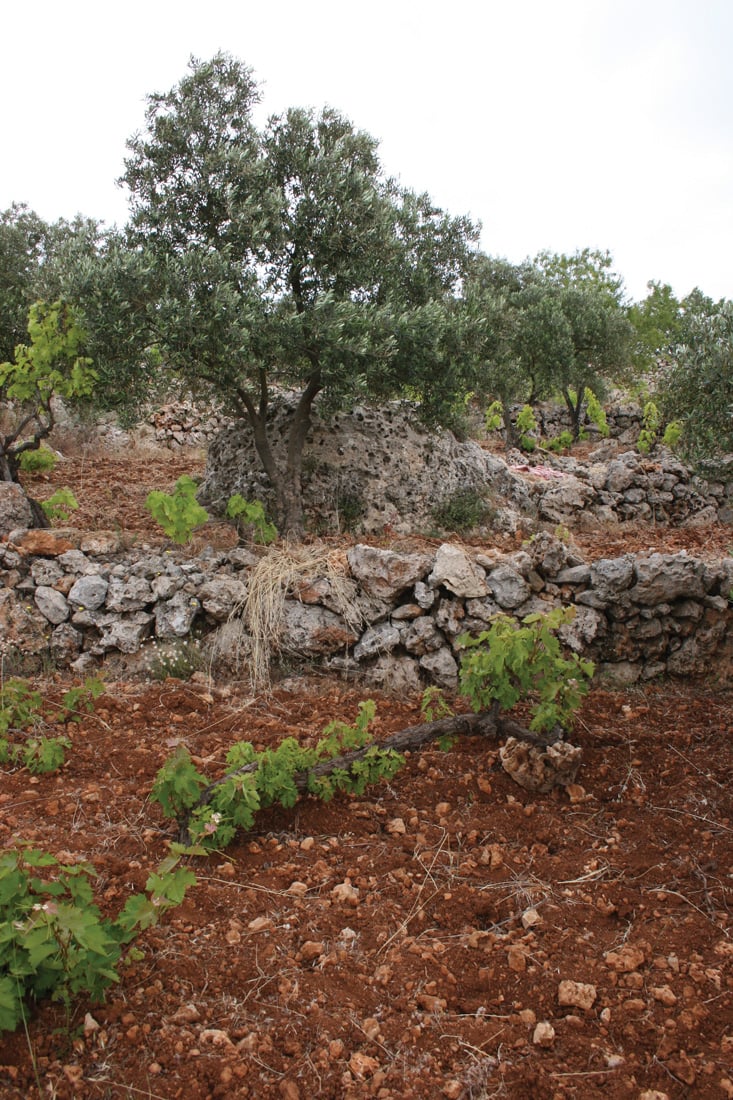
Vineyards, like this one, were common in Judea. Jesus used the vineyard and those who tend it as a vital metaphor for Israel (Mark 12:1–12).
12:13–37. All the stories in 11:27–12:44 portray the opposition of the Sanhedrin to Jesus. The chief priests challenged Jesus in 11:27–33, and beginning in 12:13 the remaining constituents of the Sanhedrin—the Pharisees (12:13–17), Sadducees (12:18–27), and scribes (12:28–40)—challenge Jesus as well. The Pharisees are sent “to catch [Jesus] in his words” (12:13), and they begin by flattery (12:14). The Herodians appear to have been partisans of Herod the Great and his pervasive dynasty. Their coalition with the Pharisees, with whom they shared little in common, was surely based more on a common enemy in Jesus than on common values (see Mark 3:6). “Is it right to pay the imperial tax to Caesar or not?” (12:14), they ask. The imperial poll tax here referred to the required payment of a denarius (the average daily wage), stamped with the impression of Tiberius Caesar (Roman emperor AD 14–37). The question of the Pharisees and Herodians is designed to ensnare Jesus however he answers: support for taxation will discredit him in the eyes of the people, who detest Roman occupation; refusal to pay will invite Roman retaliation for insurrection. In a brilliant repartee, Jesus grants that the image and inscription are Caesar’s; therefore, the coin belongs to Caesar. This answer acknowledges the legitimacy of human government. Jesus then adds, “And [give] to God what is God’s” (12:17). This answer—which has not been asked of Jesus—indicates that the political question of the Pharisees and Herodians cannot be answered without answering the more fundamental theological question—namely, that government may not assert total claim over its citizens. Political and civil duties cannot be properly rendered until the ultimate claim of God is acknowledged. Humanity, which bears God’s image (Gen. 1:26), belongs to God.
Following the test of the Pharisees comes Mark’s lone challenge to Jesus from the Sadducees (12:18–27). The Sadducees and Pharisees both arose during the Maccabean revolt (second century BC). Although they differed greatly in outlook, the Sadducees and Pharisees dominated Jewish life, and especially the Sanhedrin. Pharisees believed in divine sovereignty; Sadducees attributed events to human free will. Pharisees accepted the authority of the Torah, Writings, and Prophets (the three divisions of the Hebrew Bible), and even oral tradition; Sadducees affirmed the authority of written torah alone. Pharisees affirmed the existence of angels, demons, and the resurrection from the dead; Sadducees denied all three. Theologically, Pharisees were less restrictive and more tolerant than Sadducees, whose exclusive reliance on the Torah (the first five books of the Old Testament) and allegiance to Rome resulted in theological and political conservatism. Pharisaism on the one hand was a lay movement neither interested in political rule nor exclusively associated with the temple. Sadducees, on the other hand, constituted a clerical and lay aristocracy closely associated with the priesthood and temple, and although they were fewer in number than Pharisees, they dominated the high priesthood and Sanhedrin and collaborated with Rome for the privilege of power.
The Sadducees, who denied the resurrection of the dead (because it is not attested in the Torah), intended to discredit Jesus by devising an ingenious test case of a woman lawfully married to seven brothers. The idea is based on the custom of levirate marriage (Gen. 38:8; Deut. 25:5–6), whereby a man was obligated to marry a childless widow of his deceased brother in order to preserve the honor, name, and property of the deceased brother—and prevent the widow from marrying a Gentile. Assuming that resurrected existence is a mere extension of earthly life, the Sadducees reason that a woman who was married to seven husbands sequentially on earth could not be married to them simultaneously in heaven. In a summary rejection of their premise, Jesus declares the whole artifice is false “because you do not know the Scriptures or the power of God” (12:24). This is a bold indictment, for torah and power were the two strong suits of the Sadducees. The resurrected life, continues Jesus, is not a prolongation of earthly life, but an entirely new dimension of existence (1 Cor. 15:40–44), like the life of “the angels in heaven” (12:25). Indeed, even torah—which the Sadducees accept as God-given—presumes the resurrection of the dead, for the promise “I am the God of Abraham, the God of Isaac, and the God of Jacob” (12:26; Exod. 3:6) was not temporal (i.e., ended by death) but eternal.
The final test of Jesus from the constituents of the Sanhedrin comes from a scribe (12:28–37). Scribes (NIV “teachers of the law”) were torah experts of great erudition who both advised the Sanhedrin and enjoyed legendary reputations and privileges. Famous rabbis were often asked, as Jesus is asked here, to summarize the essence of all 613 commandments in the torah in a nutshell. According to the NIV (12:28), the scribe asks which is the greatest of the “commandments.” The Greek, however, does not read “commandments” but something more absolute and unqualified: which commandment comes before everything and is incumbent on everyone? Jesus answers by quoting the Shema (12:29–30), the quintessential summary of the torah in Deuteronomy 6:4–5 recited morning and evening by every pious Jew. The word “all” occurs four times in the quotation, emphasizing the need for total love to God. The Shema commands believers to love God with heart, soul, and strength, but Mark records Jesus adding a fourth command, to love God “with all your mind” (12:30). The scribe asked for only one commandment, but as in his earlier response to the Pharisees and Herodians (12:17), Jesus appends a second, “Love your neighbor as yourself” (Lev. 19:18). Both of these commandments form a unity, encompassing the one will of God in a single “commandment greater” than everything else. No rabbi before Jesus brought love of God and love of others—theology and ethics—into such indivisible unity.
“Well said, teacher,” replies the scribe (12:32). Of nineteen references to scribes in Mark, this is Jesus’s only encounter with a nonadversarial scribe. The collage of Scripture texts in 12:32–33 indicates that this scribe—and perhaps not he alone—understands love (Greek agapē) to supersede “burnt offerings and sacrifices.” As torah authorities, scribes presumed to speak the final word in religious matters. It is Jesus, however, who passes final judgment on the scribe, “You are not far from the kingdom of God” (12:34). The scribe’s nearness to the kingdom is not due to his knowledge of torah but to his proximity to Jesus.
“From then on,” notes Mark, “no one dared ask [Jesus] any more questions” (12:34). Jesus has survived interrogation from Sanhedrin (11:27–33), Pharisees (12:13–17), Sadducees (12:18–27), and scribes (12:28–34)—and prevailed over them. Now, at the end of the day, Jesus asks the question of the day. Why do the scribes say that “the Messiah is the son of David?” (12:35). As in the parable of the vineyard (12:1–12), Jesus chooses to raise the question of “the Son [of God]” at the heart of Israel and before the authorities of Israel. The issue of identity, which Jesus raised privately on the way to Caesarea Philippi, he now raises publicly in the precincts of the temple. Behind Jesus’s question lay the common assumption that the Messiah would be a descendant of King David. Jesus challenges this assumption by quoting Psalm 110:1, “The Lord said to my Lord: ‘Sit at my right hand’ ” (12:36). If David was the author of this psalm (as was widely accepted in Jesus’s day), and if “Lord” refers to God and “my Lord” to the Messiah, then the Messiah is not David’s descendant but his Lord and master. “How then can [the Messiah] be [David’s] son?” asks Jesus (12:37). The Messiah is not an extension of David but his superior; not the fruit of David but the root of David (Rev. 22:16). The Messiah is not David’s son, after all; he is God’s Son!
12:38–44. In the final episode of Jesus’s public teaching, Mark contrasts scribes, in their “flowing robes” and seats of honor (12:38–39), and a “poor widow” of no honor (12:42). The ostentation of scribes and their temptation to use their prestige for self-advancement (“they devour widows’ houses” [12:40]) fall under Jesus’s judgment, just as false prophets have fallen under the prophets’ judgment (Isa. 10:2; Amos 2:1–16; Mic. 3:1–12). A widow, by contrast, deposits a mere pittance—“a few cents” (12:42)—into the temple treasury. In addition to being a place of worship, the temple functioned as a sacred bank by collecting and storing dues, taxes, donations of money and precious objects, and individual wealth. The “temple treasury” (12:41) was located in the Court of Women, the courtyard immediately inside the sanctuary, where Jews (including men, women, and children) were allowed, but not Gentiles. In contrast to the well-to-do scribes and crowds, “this poor widow” (12:43), declares Jesus, put “more into the treasury” because she gave out of her need, not out of her surplus. For Jesus, the value of a gift is not the amount given but the cost to the giver. The reference to the sacrifice of “all she had” (12:44) is a fitting final word for Jesus’s public ministry, for the widow gave what all disciples must give in obeying the call to “come, follow me” (1:17).
13:1–37. Like the farewell discourses of major biblical figures (Jacob, Genesis 49; Moses, Deuteronomy 32–33; Joshua, Joshua 23; Samuel, 1 Samuel 12; Paul, Acts 20), Mark 13 attributes to Jesus a final discourse that constitutes the longest block of teaching in the Gospel. Some instructions occur in other contexts in other Gospels (compare Mark 13:9–13 with Matthew 10:17–22), suggesting that some of the teachings in chapter 13 were delivered at various times in Jesus’s ministry. The organizing theme of the chapter is eschatology (from Greek eschatos, “last [things]”), in which future events, including some as distant as the second coming of the Son of Man, are prefigured by the destruction of the temple and fall of Jerusalem in AD 70. Mark places the whole eschatological discourse on the Mount of Olives, where Jesus sits “opposite the temple” (13:3), which is symbolic as well as literal, for the chapter concludes Mark 11–13 (all of which is set in the temple) with the pronouncement of Jesus’s judgment on the temple and prediction of its destruction.
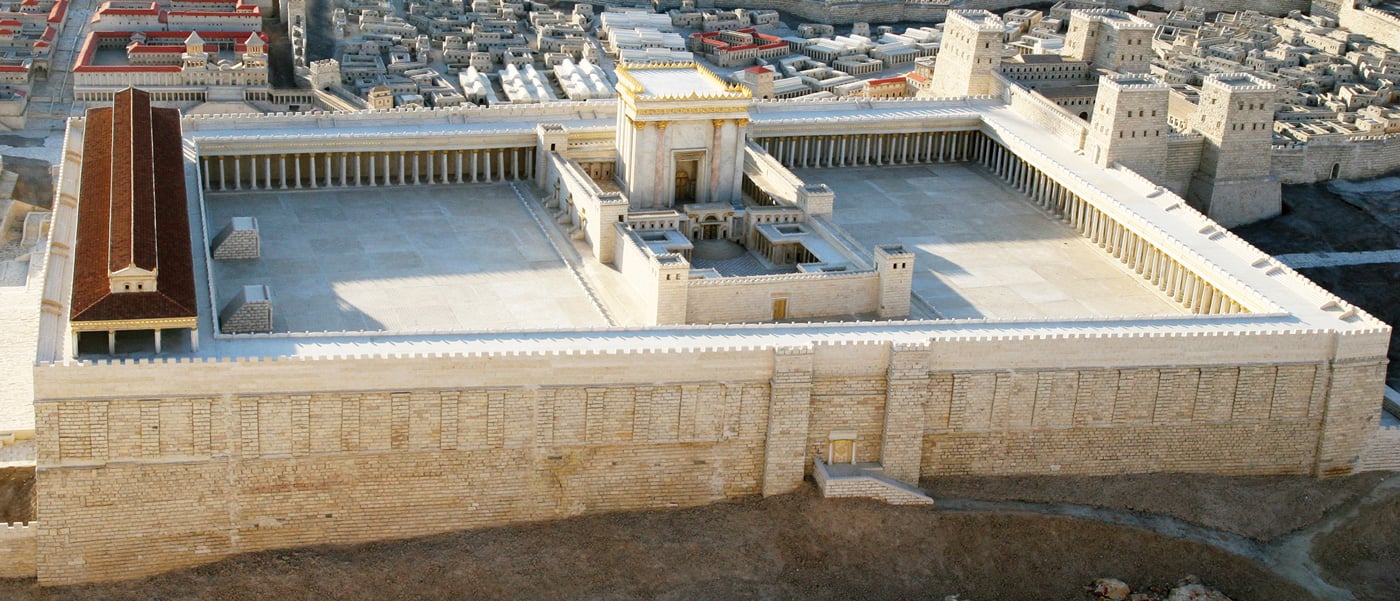
A large scale model of the Herodian temple (Israel Museum, West Jerusalem). This view looks on from the east showing the Gentile courts surrounding the central holy places.
Mark appears to divide Jesus’s teaching on the future into two time frames. Events identified by “all these things” (13:2, 4, 8, 29, 30) relate to the immediate future and the destruction of the temple by Rome in AD 70. Events identified by “those days” (or “that day,” 13:17, 19–20, 24, 32) concern the distant future and the second coming of the Son of Man in final judgment and glory. These two designations result in the following outline:
A1 End of temple and fall of Jerusalem (13:1–13)
B1 Tribulation and second coming of Son of Man (13:14–27)
A2 End of temple and fall of Jerusalem (13:28–31)
Mark 13 warns readers against attempts at constructing timetables and deciphering signs of the second coming. Disciples are admonished to be alert and watchful (13:5, 9, 23, 33, 35, 37), for neither they (13:33, 35) nor even Jesus (13:32) knows the time of the end. Disciples are not to be led astray by even the most obvious signs (13:5–6, 21–22), for the end is not yet (13:7, 13). Discipleship is not fulfilled by predicting future events but by faithfulness in the present, especially in trials, adversity, and suffering.
Construction of the Herodian temple began in 20 BC and was still in progress in Jesus’s day. The temple was constructed on a scale of such magnitude that when it was completed in AD 66, it exceeded in size any other temple in the ancient world. On leaving the temple, the disciples draw Jesus’s attention to the magnificence of its stones and buildings (13:1). Jesus warns the disciples not to be misled by its grandeur, for it will be like the “fig tree withered from the roots” (11:20): “Not one stone here will be left on another” (13:2). The Mount of Olives earlier commenced Jesus’s triumphal entry into Jerusalem (11:1). Now, sitting in authority on its summit (13:3), from which the prophet Zechariah declared God’s judgment on Jerusalem (Zech. 14:1–8), Jesus warns the disciples of two impending dangers. First, the disciples are to “watch out” (13:5) and “be on [their] guard” (13:9) against false teachers and messiahs. Such people will work “signs” (13:4—the word is used negatively here, as it was in 8:11–12); indeed, they “will come in [Jesus’s] name, claiming ‘I am he’ ” (13:6), but they nevertheless “deceive” and lead astray. The first and gravest future danger is not external but internal, inside the household of faith. Second, disciples are warned of external dangers—wars, natural calamities, famine—that will affect all people (13:5–8). Despite the severity of these disasters, they neither impede the spread of God’s reign nor signal the end (13:7). They indeed subject the church to adversity, for believers will be accused, arrested, tried, and beaten (13:9–11). Most distressing, believers will be betrayed, hated, and even killed by fellow believers and family members “because of me” (13:13). Despite these hardships, however, “the gospel [will] be preached to all nations” (13:10). Adversity will afford believers unprecedented opportunities to declare their faith before authorities and rulers, and they need not be anxious about doing so, for the Holy Spirit will speak through them (13:11). In Jesus’s depiction of the future, adversity is not an abnormality but the norm of Christian existence in the end times. Believers who “stand firm to the end will be saved” (13:13).
In 13:14 Jesus mentions a specific calamity (“the abomination that causes desolation”) that appears to prefigure the end times, which are further profiled in verses 14–27. “Abomination” (see Dan. 9:27; 11:31; 12:11; 1 Maccabees 1:54) describes the outrage of Antiochus IV, the Seleucid king, who in 168 BC erected an altar to Zeus in the Jerusalem temple and sacrificed a sow on it. His intention was to exterminate Judaism, and his provocation ignited the Maccabean revolt of 166–142 BC. For Jesus, the “abomination” of Antiochus IV was a prefigurement of a blasphemous antichrist who in the end time would do a scandalous deed before the return of the Son of Man in judgment and glory. Scholars often regard the destruction of the temple by Titus in AD 70 as the realization of the “abomination,” for some details in verses 14–18 recall the siege and destruction of Jerusalem by Titus. If this is correct, Mark warns readers (“let the reader understand,” 13:14) that the catastrophic fall of Jerusalem in AD 70 is a foreshadowing of the disasters that will take place at the end of time, when “the man of lawlessness” will appear (2 Thess. 2:3–4), a blasphemous antichrist who will do horrors and outrages before the return of the Lord. “Those . . . days” (13:19)—now referring to the end time—will be so dire and unprecedented that unless God intervenes and shortens them, “no one [will] survive” (13:20). The true Messiah is sparing with signs and wonders in order not to coerce allegiance, but the last days will see many false prophets and messiahs perform many wonders and attract many followers (13:21–22). “Be on your guard” (13:23), warns Jesus, for the true disciple knows these deceptions in advance and is not distracted from faithful obedience to the Lord. In “those days” (13:24)—the end of time—earthly calamities will be mirrored by celestial portents—the darkening of sun and moon and shaking of stars and planets (13:24–25)—all foretold in the Old Testament prophets. Then the Son of Man, though now subjected to suffer in Jerusalem (8:31; 9:31; 10:33–34) and destined to be crucified as a common criminal (Phil. 2:8), will come “in clouds with great power and glory” (13:26). Jesus, who is now Son of God in humility, will be revealed as Son of God in power (Rom. 1:3–4) by fulfilling the prophecy of Daniel 7:13 and by vindicating the elect at the final judgment. The great assurance of the second coming is that the Creator and Redeemer of all will condemn evil, end suffering, and gather his “elect” to himself.
Verses 28–31 return to the impending fall of Jerusalem and thus the near future, which was the subject of verses 5–13. As with the fig tree (13:28), which blossoms when winter is past and summer has arrived, when “you see these things happening” (13:29)—that is, the fall of the temple (13:4)—you know that the end is “right at the door” (13:29). The generation to which Jesus speaks will witness the fall of Jerusalem, which itself is a preview of the end of the world. Jesus’s statement that “heaven and earth will pass away, but my words will never pass away” (13:31) is a claim only God can make. In making this claim, Jesus assures his disciples that his words will outlive the cosmos and that the world to come is already present in his teaching.
The Olivet Discourse concludes in 13:32–37, on the subject of the distant future. “About that day or hour no one knows,” says Jesus (13:32). “That day” reintroduces the theme of the second coming of verses 14–27. Remarkably, in this, the only passage in the Gospel of Mark where Jesus explicitly calls himself “the Son [of God],” he confesses what he does not know and cannot do! The Son relinquishes all claims concerning the future to the Father’s plan. In the great mysteries of life, humans want signs; Jesus, however, wants only the Father. Given such mysteries, Jesus’s concluding word—five times in verses 33–37—is “Be on guard,” “Be alert,” “Keep watch.” When and how the end will come cannot be known, only that it will come—suddenly! Given that reality, the only sensible way to live, like a householder awaiting the uncertain time of the owner’s return (13:34), is in constant readiness. “Watch!”
D. The abandonment of Jesus in Jerusalem (14:1–72). Mark 14 and 15 rehearse the betrayal, suffering, and crucifixion of Jesus, commonly known as the “passion” (from Latin patior, “suffering”). Chapter 14, the longest in the Gospel, commences the chain of events in Jesus’s abandonment, first by Judas and the chief priests, then by the Sanhedrin and all his disciples, and finally by the crowds and even the Father (15:34). The passion commences with the betrayal of Jesus by Judas, into which Mark sandwiches a story of a woman who anoints Jesus with costly ointment. The key to Mark’s sandwich construction is found in the middle episode, which in this instance is a costly sacrifice of faith for Jesus, whereas in the plot with the Sanhedrin Judas sacrifices his faith itself by the betrayal of his master.
14:1–16. The Jewish Passover was celebrated annually (Exodus 12) by ritually slaughtering a year-old male lamb or goat on the afternoon of the fourteenth of Nisan (March-April). The Passover meal, eaten in family gatherings after sunset (i.e., 15 Nisan), commenced the weeklong Feast of Unleavened Bread (Exod. 12:15–20). The plot of the “chief priests and the teachers of the law” (i.e., the Sanhedrin, 14:1) is described with blunt realism: they intend to seek out Jesus, arrest him by guile, and kill him. Jerusalem, the only place where Passover could be celebrated, drew enormous crowds for the festival; this increased the potential of an uprising as well as the need for security precautions on the part of the Romans. The Jewish authorities hope to seize Jesus without provoking his Galilean sympathizers (14:2). Mark now inserts the story of the anointing of Jesus by an unnamed woman, whose compassion stands in stark contrast to the plot of the religious authorities (14:3–11). It was normally a breach of etiquette for a woman to interrupt Jewish male fellowship, but Mark portrays the woman’s intrusion as an act of faith (also Mark 5:34). Mark’s profuse description of the ointment in verse 4, which amounted to the equivalent of a year’s earnings, is an attempt to convey the value of the woman’s sacrifice. Smashing the jar symbolizes the totality and irrevocability of the gift. No gift or act of generosity from either crowds or disciples approximates what this woman does. Some present regard the act as a “waste,” a judgment that both demeans the woman and insinuates Jesus’s unworthiness of it. Jesus accepts the gift as “a beautiful thing” (14:6), for the woman “did what she could” (14:8). In nearly the same words Jesus earlier commended the incomparably smaller gift of the poor widow in 12:44, indicating that the value of a gift consists not in amount but in giving what one is able. Jesus receives the anointing as a preparation for his burial, and he commemorates it because the woman somehow understands that the mystery of the gospel is revealed in Jesus’s death (14:9). Mark closes the sandwich by returning to Judas. Identifying him as “one of the Twelve” may warn readers that closeness to Jesus does not guarantee faithfulness. Mark is silent about Judas’s motives for betraying Jesus, although money played a role (14:11). Judas’s betrayal is more premeditated, but all the disciples will defect as well (14:50).
The preparation of the Passover in verses 12–16 is reminiscent of the preparation of the entry into Jerusalem in 11:1–6; both show Jesus’s foreknowledge and governance of events as his “hour” (14:35) approaches. “The first day of the Festival of Unleavened Bread” technically began at sundown on the fifteenth of Nisan (Thursday evening), but Mark appears to place the beginning of Passover on Thursday afternoon, the fourteenth of Nisan, when Passover lambs were slaughtered in the temple. The mood of expectancy and urgency produced by the great influx of Passover pilgrims in Jerusalem is reflected in the triple occurrence of the Greek word for “prepare” in verses 12–16. The disciples are given what appear to be undercover instructions to meet “a man carrying a jar of water” (14:13). This must locate the meeting place at or near the Pool of Siloam or the Gihon Spring, the two water sources of Jerusalem. Carrying water was normally women’s (or slaves’) labor; a man carrying a water jug would have caught the eye of the disciples, suggesting perhaps that he was a member of the all-male Essene sect. Jerusalem residents customarily made spare rooms available for Passover pilgrims, and the target water bearer, perhaps in accordance with previous arrangements by Jesus, ushers the disciples to a well-appointed banquet room.
14:17–31. Mark sets the Last Supper (14:22–26) in another sandwich construction, placed between Jesus’s predictions of the betrayal (14:17–21) and defection (14:27–31) of the disciples. The sandwich dramatically illustrates the self-sacrifice of Jesus in contrast to the infidelity of the disciples. Reclining was the customary position of feasting in the ancient world, and while Jesus is reclining with the disciples at Passover, he solemnly announces, “One of you will betray me” (14:18). The announcement of betrayal in a context of sacred feasting and intimacy is bitterly ironic. “One who is eating with me” (14:18), “who dips bread into the bowl with me” (14:20), does not limit the field of suspects but expands it to include all the disciples. Jesus’s unsettling announcement provokes soul-searching—and self-justification—in the disciples. “Surely you don’t mean me?” they reply (14:19). There was one traitor in the formal sense, but by dawn all the disciples will abandon Jesus, if not from greed (14:10–11), then from weakness (14:37–42), fear (14:50–52), or cowardice (14:66–72). In one of the most concise expressions in Scripture of the relationship between predestination and free will (16:21), Jesus says that the betrayal of the Son of Man is both foreordained (“it is written” implies divine purpose) and yet a free choice for which the culprit is responsible.
At the centerpiece of the sandwich, Mark places the Last Supper, narrated with liturgical form and brevity (14:22–26). The account is built on seven Greek verbs in verse 22 (eat, take, bless, break, give, say, take), signifying the gracious activity of Jesus on behalf of the disciples. In pronouncing the bread and wine his “body” and “blood,” Jesus signifies the gift of himself, wholly and without reserve. Of the four Gospel writers, only Mark adds “and they all drank from it” (14:23). The Last Supper is a table of grace, not of merit, for the “all” who drink (14:23) and swear allegiance (14:31) also fall away (14:27) and flee (14:50). The “blood of the covenant” (14:24) recalls Exodus 24:3–8, the first covenant at Sinai, sealed with the blood of a sacrificial animal. Unlike in the first covenant, however, in the new covenant (Jer. 31:31–34) the blood of Jesus is not thrown on the community but imbibed into it. The “many” in verse 24 alludes to the Suffering Servant of Isaiah, who “bore the sin of many, and made intercession for the transgressors” (Isa. 53:12). Jesus concludes the supper by resuming the eschatological motif of chapter 13 (14:17, 19, 20, 24, 32): “until that day when I drink it new in the kingdom of God” (14:25). The Last Supper is intended as the interim feast of believers with their Lord until his return.
Mark closes the A-B-A sandwich construction with a conversation between Jesus and Peter (14:27–31) that recalls the theme of 14:17–21, where Jesus predicted “one of you will betray me” (14:18). Following the Passover, Jesus announces, “You will all fall away [Greek skandalizō]” (14:27). The Greek word is used in a passive sense, implying that the disciples will not willfully defect but fall away through weakness. Jesus supports his announcement by quoting Zechariah 13:7: “I will strike the shepherd, and the sheep will be scattered.” The “I” refers to God, the shepherd to Jesus, and the sheep to the disciples. This quotation repeats the paradox of 14:21: evil is used by God to fulfill his greater purpose. The Zechariah quotation (like Isa. 53:10) also implies that Jesus understands his impending passion in Jerusalem not as an accident but as divinely ordained. Jesus announces that he will be reunited with the disciples after his resurrection, not in Jerusalem or the temple, but in Galilee, where their call to discipleship began (1:16). Until now, when Jesus announced his impending suffering “on the way” to Jerusalem, the disciples often responded by claiming their position and privilege. Peter protests similarly here that he will not fall away (14:29–31), a protest echoed by all the disciples (14:31). Despite Peter’s vociferous protests, Jesus sadly informs him that he will deny him not in a momentary lapse, but three times.
14:32–52. Following the Last Supper, Jesus goes to Gethsemane (Hebrew “olive press”), an olive grove in the valley between the Mount of Olives and the temple mount where he and the disciples often gathered (Luke 22:39; John 18:1–2). Commanding the disciples to remain, Jesus departs a few paces in order to pray (14:32–42). This is the third time in Mark that Jesus prays (cf. 1:35; 6:46); each prayer is set in a context of crisis and decision, this being the most traumatic. In all the Bible, no affliction or agony is described with the intensity of 14:34–35. According to Mark, the decision to submit to the Father’s will in Gethsemane causes Jesus greater internal suffering than does the physical crucifixion of Golgotha. The “cup” and “hour” (14:35–36), reflecting apocalyptic imagery, do not refer to Jesus’s arrest but to his messianic destiny. Jesus’s distress is not the result of facing his own death but of giving his life as “a ransom for many” (10:45; Isa. 53:12). Jesus must become the sin-bearer of all humanity, which will result in his complete alienation, even from God (15:34). “Abba” (14:36; Aramaic “Papa”), an address of God seldom if ever used by rabbis, expresses Jesus’s consciousness of being God’s Son and his intimacy and trust with the Father. “Take this cup from me” reveals Jesus’s human desire to avoid the cross, but his plea is finally resolved in submission to the Father’s will: “Not what I will, but what you will” (14:36). Ironically, at the point where Jesus feels most distant from God’s presence, he is closest to his will. Gethsemane is the prelude to Golgotha, for in the valley below Jerusalem his soul is crucified, and on a hill above Jerusalem he will relinquish his body. The three warnings of Jesus to the disciples to “watch” (14:34, 37–38) reveal their failure to fulfill the Olivet Discourse (13:36–37), and they prefigure Peter’s three forthcoming denials. The admonition to the disciples, “Watch and pray,” for “the spirit is willing, but the flesh is weak” (14:38), is a reminder that trust and obedience of God are always a struggle against temptation and weakness.
In contrast to the intensity and pathos of Gethsemane, the arrest is narrated in resigned objectivity (14:43–52). “My betrayer is at hand” (14:42 ESV, NKJV) immediately identifies Judas, who, as if to remind readers that disciples of Jesus can also be betrayers of Jesus, is again named as “one of the Twelve” (14:43; 14:10; 3:19). Judas’s accomplices are the “chief priests, the teachers of the law, and the elders,” the three constituent bodies of the Sanhedrin, now “armed with swords and clubs” (14:43). As a disciple, Judas knew Jesus’s daytime movements and nighttime lodgings, and he gives a prearranged sign to the authorities, lest in the darkness of an olive grove at night they fall upon the wrong person. The sign is a kiss—a tender or passionate kiss, according to the Greek of 14:45. Why Judas chose this sign is unclear—although it had been similarly used at least twice in the Old Testament (Gen. 27:26; 2 Sam. 20:9–10). Betrayal by an intimate act of affection, and by an epithet of respect, “Rabbi” (“my great one”), is a profound mockery. Jesus is immediately “seized” by the soldiers, a term that repeatedly characterizes the arrest (14:44, 46, 49, 51). The disciple who cuts off the ear of the servant of the high priest is often thought to be Peter, but Mark simply identifies him as “one of those standing near” (14:47). Jesus reproaches the crowd for assaulting him as a “bandit” or “robber” (14:48; NIV “leading a rebellion”), the word in Greek (lēstēs) sometimes referring to an adherent of the Zealot movement. The reference to the fulfillment of Scriptures in 14:49 must recall Isaiah 53:12: he “was numbered with the transgressors.” “Then everyone deserted him and fled” is Mark’s bitter climax to the arrest. All have drunk the cup (14:23), all have pledged to die with him (14:31)—and all flee! The young man who flees the mayhem of the arrest is sometimes thought to be Mark himself, author of the Gospel. We have no certain knowledge that Mark was present in Jesus’s earthly ministry; but if he was—and if he wished to confess his own flight at the arrest—would he have expressed it so opaquely? The lack of identity of the naked man more likely invites readers to examine their own readiness to abandon Jesus: “There is no one righteous, not even one. . . . All have turned away” (Rom. 3:10, 12).
14:53–72. For the third time in chapter 14 Mark employs the technique of sandwiching one story into the midst of another, thereby making a third point by implication. The present sandwich consists of Peter’s denial (14:53–54; 14:66–72) divided by Jesus’s trial before the Sanhedrin (14:55–65). The theme of the sandwich is bearing witness under persecution—the Greek word “witness” is mentioned seven times in this unit—by contrasting Jesus’s faithful witness with Peter’s false witness.
The sandwich begins with Peter following Jesus “at a distance, right into the courtyard of the high priest” (14:54). The distance will soon stretch into a denial. The focus then shifts to Jesus, who is hauled before the Sanhedrin on the heels of his arrest (14:53). The Sanhedrin normally met in the temple sanctuary, but “the courtyard of the high priest” suggests a meeting in the private dwelling of the high priest Caiaphas, whose house lay about a kilometer to the southwest of Gethsemane. Beneath the house of Caiaphas, now commemorated by the Church of Saint Peter in Gallicantu (Cockcrow), a warren of rock-hewn chambers provided maximum security for prisoners such as Jesus. The proceedings against Jesus in 14:55–65 egregiously violate Jewish jurisprudence set forth in the Mishnah. In particular, a verdict of guilty in capital cases required a second sitting the following day; both must be in the daytime, and neither on the eve of the Sabbath or a festival. A charge of blasphemy, moreover, could be sustained only if the accused cursed God publicly, resulting in death by stoning. The manifest departures from stipulated protocol suggest that the Sanhedrin proceeded in the fashion of a grand jury by hearing and condemning Jesus in a single sitting, and perhaps with less than a quorum. In “looking for evidence against Jesus” (14:55), the Sanhedrin produces “many” (14:56) false witnesses, though their testimonies disagree. The only specific accusation Mark records is that Jesus would “destroy this temple made with human hands and in three days . . . build another, not made with hands” (14:58). Given that the temple lay at the heart of Jewish worship and the power of the Sanhedrin, this was a serious charge. For Mark, the accusation again testifies that Jesus has replaced the temple as the place where humanity meets God.
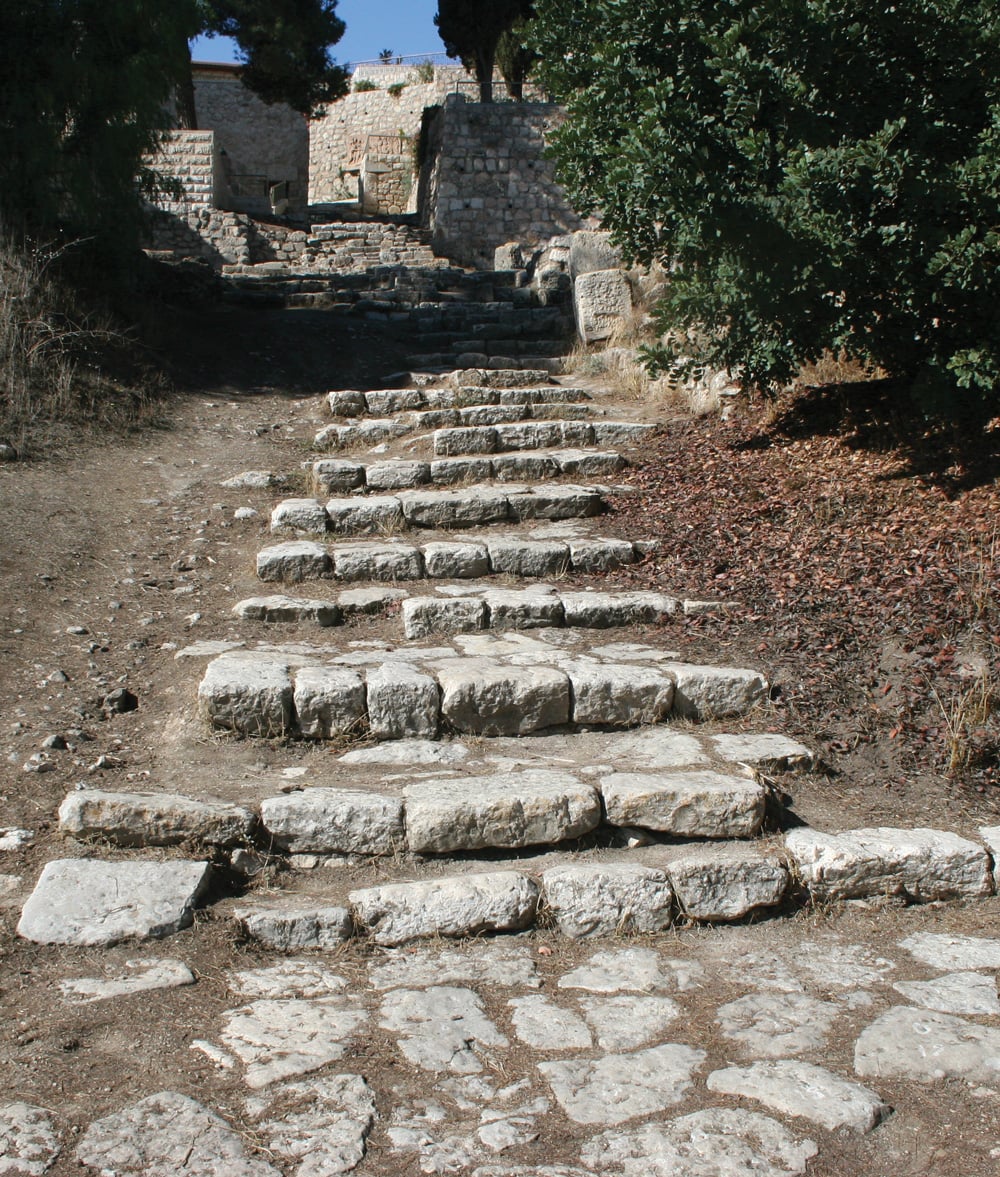
Ancient Roman steps leading from the area south of Jerusalem to the Kidron Valley and the Garden of Gethsemane, where Jesus was arrested. Following his capture, Jesus may well have walked these steps (or some nearby) to his interrogation.
The silence of Jesus throughout the trial—in this respect too John the Baptist was a forerunner of Jesus (Mark 6:14–29)—again reflects the Suffering Servant of Isaiah: “as a sheep before its shearers is silent, so he did not open his mouth” (Isa. 53:7). Jesus breaks silence only at the insistence of the high priest, “Are you the Messiah, the Son of the Blessed One?” (14:61). Ironically, Mark places the two most complete christological confessions from humans in the mouths of those responsible for Jesus’s death: the high priest at the trial and the centurion at the cross (15:39). Throughout Mark, Jesus has remained silent about his divine Sonship and commanded the same of others, because until his suffering he cannot rightly be known as God’s Son. Now that his execution is imminent, Jesus fully affirms, “I am [God’s Son]” (14:62). Although he is presently Son of God in humility (Rom. 1:3), he will come in the future on the clouds of heaven, seated at the right hand of the Mighty One (14:62). The claim to be the messiah was not a crime in Judaism (on the term “messiah,” see the commentary on 8:27–9:1). The charge of “blasphemy” (14:64) was limited to equating oneself to God, which indicates the high priest fully understood Jesus’s claim to be God’s Son. The tearing of the high priest’s clothes (the Greek term indicates an inner garment) was a sign of profound consternation (2 Sam. 1:11; 2 Kings 18:37). The mockery of, spitting on, and beating of Jesus in verse 65 fulfill both the treatment of the Suffering Servant (Isa. 50:6) and the third passion prediction (10:33–34).
Mark concludes the sandwich unit by returning to Peter, who is warming himself by the fire in the courtyard of the high priest (14:54, 66). Verses 66–72 focus exclusively on Peter, who alone of the participants is named. Nights in Jerusalem in March-April require the warmth of a fire, the light from which allows Peter to be identified. While Jesus undergoes a trial by the high priest, Peter undergoes one by a mere servant girl. To her accusation that he was with “that Nazarene,” Peter vociferously denies (according to the Greek) that he knows Jesus either in theory or practice (14:68). The statement that Peter “went out into the entryway” (14:68) is both factual and symbolic, for he is now farther from Jesus. Peter is identified by his Galilean accent and again accused of association with Jesus—to which he explodes in a volley of abuse and denial (14:71). Peter cannot bring himself to mention the name of Jesus, but he cannot forestall the cockcrow heralding the shattering truth of his denial. Mark concludes the abandonment of Jesus in chapter 14 on the bitter note of weeping (14:72).
E. The trial and crucifixion of Jesus in Jerusalem (15:1–47). 15:1–20. Following the sentence of the Sanhedrin, Jesus is transferred to Pontius Pilate, the Roman prefect of Judea, whose consent was necessary in cases of capital punishment (cf. John 18:31). Before Pilate, as before the Sanhedrin, Jesus is portrayed as submitting in silence. The events leading to the crucifixion, and the crucifixion itself, are narrated in Mark (as in all the Gospels) with utmost restraint; rather than exploiting the brutality and cruelty of crucifixion, or sentimentalizing it, the Gospels accentuate the shame and mockery to which Jesus was subjected. Pilate, fifth Roman governor of Palestine, who ruled from AD 26 to 37, normally resided at Caesarea Maritima. During festivals, when Jewish pilgrims thronged to the temple, Pilate’s presence was required in Jerusalem, where he resided in Herod’s palace, which is the probable site of the hearing of Jesus. Although Pilate was the longest-ruling Roman governor of Judea, his tenure ended in banishment. He was repeatedly challenged by his Jewish subjects, and his insensitivity and inflexibility in dealing with their confrontations led to his eventual exile under the emperor Caligula.
Pilate asks Jesus the same question asked by the high priest in 14:61: “Are you the king of the Jews?” (15:2). In Greek it is a statement with a question implied, making Pilate also an unknowing confessor of Jesus. Although, as pointed out above, the claim to be the messiah was not a crime in Judaism, its political implications of earthly rule (see Luke 23:2) pose a potential threat for Pilate. Jesus’s answer to Pilate’s question in verse 2, neither an affirmation nor denial, could be rendered, “You would do well to consider the question.” Jesus’s remaining silence in the face of lies, hatred, and cruelty dominates Mark’s subsequent passion narrative.
Evidently harboring doubts about the necessity of Jesus’s execution, Pilate proposes releasing an insurrectionist, whose name “Barabbas” (in Aramaic) means “son of the father.” The real “Son of the Father” will die in place of another “son of the father,” who is a known criminal, “the righteous for the unrighteous” (1 Pet. 3:18). The proposed prisoner exchange misfires, however; the crowd “came up” (15:8) in protest against Pilate to Herod’s palace, on the prominent western hill in Jerusalem. Mark explicitly states that the moving force behind Jesus’s crucifixion is no longer the scribes and Pharisees as in Galilee, nor the Sanhedrin, but solely the “chief priests [who] stirred up the crowd” (15:11) against Jesus. Pilate makes three anemic appeals for Jesus’s release (15:9, 12, 14), but his efforts are politically motivated (“wanting to satisfy the crowd,” 15:15) rather than based on moral conviction. Facing mounting uproar—“Crucify him!” (15:13–14)—Pilate decides that Jesus is unworthy of defending on principle or by a show of force. In the end, he stands down and consigns Jesus to crucifixion. Although the chief priests appear to have instigated events leading to the crucifixion, Pilate bears final responsibility for it, for crucifixion was a Roman punishment requiring the approval of a Roman governor.
Jesus’s trial before Pilate, like John’s before Antipas (Mark 6:14–29), is profoundly ironic: Pilate first seeks amnesty for Jesus, then for himself; the Jewish subjects rule, and sovereign Pilate is increasingly subjected, whereas even in chains Jesus remains free in his divinely ordained purpose. Pilate becomes an impotent potentate; the chief priest an agent provocateur; and Jesus remains innocent, silent, defenseless.
In preparation for crucifixion, Jesus is stripped, bound to a post, and beaten an unspecified number of times with a short leather whip woven with bits of bone, metal, or stone. “Flogging” (15:15), or flagellation, lacerated and stripped flesh, often exposing bones and entrails. Its purpose was to shorten the duration of crucifixion, but it was so brutal that not a few prisoners died before being crucified. The mistreatment of Jesus by Pilate and the soldiers fulfills the final passion prediction—the “handing over” (10:33 // 15:15), “mockery” (10:34 // 15:20), “spitting” (10:34 // 15:19), and “flogging” (10:34 // 15:15)—to the detail. This took place in “the palace” (Praetorium; 15:16), most probably Herod’s lavish residence on the western hill, which Josephus says contained “enough bedchambers for one-hundred guests” (Jewish War 5.177–83; Jewish Antiquities 15.318). In macabre sport, a “company of soldiers” mocks Jesus by draping him in purple (symbolizing royalty), crowning him with thorns, and lampooning Caesar’s salute, “Hail, King of the Jews” (15:17–18). A “company” was one-tenth of a Roman legion, or about six hundred soldiers. Mockery leads to violence as they beat “him on the head with a staff” (15:19). Bespattered with blood and ridicule, the figure of Jesus recalls Isaiah’s Suffering Servant:
I offered my back to those who beat me,
my cheeks to those who pulled out my beard;
I did not hide my face
from mocking and spitting. (Isa. 50:6)
15:21–39. With restrained objectivity, and without sentimentality, sensationalism, or appealing to readers’ emotions, Mark recounts the crucifixion in order to show what Jesus’s death accomplished. Cicero described the hideous brutality of crucifixion as the “most cruel and horrifying punishment.” Reserved for non-Roman citizens, crucifixion unleashed excessive and prolonged cruelty on the classes for which it was intended: slaves, violent criminals, and prisoners of war. As a rule, victims were crucified naked and in public in order to add shame and degradation to extreme suffering. The Jewish messiah was expected as a victorious conqueror; there is no certain evidence in any layer of Jewish tradition outside the New Testament of a messiah who would suffer. The concept of a messiah suffering on a cross of shame (Heb. 12:2) was so scandalous that some twenty-five years after Jesus’s death Paul confessed that the preaching of a crucified messiah was “a stumbling block to Jews and foolishness to Gentiles” (1 Cor. 1:23). Some gnostic sects were so aghast at the idea of a crucified messiah that they put Simon of Cyrene, not Jesus, on the cross.
One of the realities of Roman occupation most detested by Jews was compulsory service. Exercising this privilege, soldiers force an unknown passerby, Simon of Cyrene, to carry the heavy crossbeam of Jesus’s cross to the site of crucifixion. Simon’s place of origin in Cyrene (North Africa) may indicate he was a man of color. Mark may mention the names of his sons Alexander and Rufus because they were known by or members of the church in Rome to which he was writing (see Rom. 16:13). Simon becomes the first person in Mark literally to take up his cross and follow Jesus (8:34). According to Jewish and Roman custom, victims were executed outside city limits (Lev. 24:14; Num. 15:35–36). Jesus is brought to a place called “Golgotha” (15:22; Aramaic “skull” or “scalp”) for crucifixion. Both the oldest Christian tradition and the most recent archaeological excavations corroborate the Church of the Holy Sepulchre in Jerusalem as the site of the crucifixion. The administration of “wine mixed with myrrh” (15:23; see Ps. 69:21), a primitive narcotic, was intended to deaden pain. The dividing of Jesus’s garments in verse 24 fulfills the same fate of the suffering righteous man in Psalm 22:18. Jews reckoned time beginning with sunrise at 6 a.m., so that the “third hour” (ESV, NASB) was “nine in the morning” (15:25). Roman and Jewish custom required the cause of execution to be affixed to the cross, which in this case reflects Pilate’s accusation (15:2, 9, 12, 18), “king of the Jews.” The crucifixion of Jesus between two robbers, “one on his right and one on his left” (15:27), is remarkably similar in wording to Mark 10:40: the two criminals, in other words, occupy the places requested by James and John! The sole point at which Mark departs from the reserve of the crucifixion narrative is in emphasizing the mockery of Jesus. Nondescript bystanders shook their heads and “hurled insults” (15:29; cf. 14:55–58); “the chief priests and the teachers of the law mocked him” (15:31); even the robbers “heaped insults on him” (15:32). Ironically, the derision of the chief priests makes them guilty of the charge of blasphemy, for which they condemned Jesus (14:64). The challenge to “come down now from the cross, that we may see and believe” (15:32), yet another appeal for a sign (8:11–13), is evidence of unbelief. The taunt that Jesus “can’t save himself” (15:31) repeats the temptation in Gethsemane to avoid “this cup” of suffering (14:36). If Jesus submits to the temptation and comes down from the cross, he cannot be a “ransom for many” (10:45).
The crucifixion of Jesus is attended by several portents, the first being darkness from “noon . . . until three in the afternoon” (15:33). The darkness covers “the whole land,” symbolizing the universal and cosmic rejection of Jesus. It appears to express God’s eschatological judgment, “In that day . . . I will make the sun go down at noon and darken the earth in broad daylight” (Amos 8:9). Although Jesus was silent before the Sanhedrin and Pilate, he cries out from the cross, “My God, my God, why have you forsaken me?” (15:34; Ps. 22:1). His rejection by Rome, Israel, and even his own followers is so total that in his dying breath he senses separation from God. The bystanders mistake Jesus’s cry “my God” (Aramaic eloi) for “Elijah” (Hebrew eliyyahu), the name of one who was taken bodily into heaven (2 Kings 2:11) and was popularly believed to be the rescuer of righteous Jews in times of crisis. The hope is further evidence that God will not let his Righteous One die. In order to ameliorate his suffering, a mixture of sour wine and vinegar (15:36; Ps. 69:21) is offered to Jesus.
With utter finality and objectivity, Mark reports that “Jesus breathed his last” (15:37). At his death two further portents occur that signal the climax of the Gospel of Mark. The first is the tearing of the temple curtain “from top to bottom” (15:38). Mark intends this to be a revelatory portent, for “tear” is the same word used of the tearing of the heavens at Jesus’s baptism in 1:10 (the only other time the word is used in Mark). In both tearings, Jesus is declared the Son of God. There were two curtains in the temple, a larger embroidered tapestry depicting “a panorama of the heavens” (Josephus, Jewish War 5.213) before the Court of Israel (where Jewish males worshiped), and a smaller curtain before the inviolable Most Holy Place, into which the chief priest entered only on the Day of Atonement. Both curtains are rich in symbolism, although it is unclear which Mark intends. Mark’s vocabulary may favor the smaller curtain, since the term he uses refers throughout the New Testament only to the curtain before the Most Holy Place. If this curtain is intended, then the cross of Jesus signifies the true and final Day of Atonement, allowing humanity access to the heart of God.
The second portent at the crucifixion is the confession of the centurion, “Surely this man was the Son of God” (15:39). “Son of God” is Mark’s load-bearing christological title, which until this moment has been unconfessed by any human being. Heretofore in Mark, Jesus has commanded both demons and people to silence, for until the cross all declarations about Jesus are premature. The Son of God can be rightly known only in his suffering and death on the cross. The centurion—a Gentile in charge of the execution of Jesus—is the first person to confess Jesus as God’s Son, thus embodying the scandal of grace: “While we were God’s enemies, we were reconciled to him through the death of his Son” (Rom. 5:10).
15:40–47. The oldest ascertainable form of the Gospel of Mark ends with the story of Joseph of Arimathea (15:40–41, 47), which sandwiches the account of the women attending Jesus’s crucifixion and empty tomb (15:42–46). In contrast to the women, who watch the crucifixion “from a distance” (15:40) and who are anxious, distressed, and fearful at the tomb (16:5, 8), Joseph acts with resolution and boldness in procuring the body of Jesus from Pilate and burying him honorably. The faithfulness of Joseph is thus contrasted to the fearfulness of the women.
The temple discourse (13:32–37) and the agony of Gethsemane (14:34, 38) ended with the command to “watch.” The sandwich unit begins in 15:40 with the names of several women “watching” the crucifixion. The Greek word for “watch” is used by Mark to suggest watching in detachment rather than in solidarity. Mary Magdalene appears in all four Gospels as the first witness of the resurrection of Jesus. “Mary,” “James the younger,” and “Joseph” (15:40) are probably (although not certainly) Jesus’s family members mentioned in 6:3. The names of these and the reference to “many other women” (15:41) indicate that Jesus was followed by more than the Twelve apostles. Ironically, women unmentioned before now remain to the bitter end at the cross. True, they stand at a “distance,” but the distance of the women is better than the absence of the apostles. Into the report of the women’s trepidation at the cross Mark inserts the story of Joseph of Arimathea, who on late Friday afternoon retrieves Jesus’s body for burial. Arimathea is probably the Ramathaim of 1 Samuel 1:1 (see also Ramah in 1 Sam. 15:34), about twenty miles northwest of Jerusalem. It took courage for a prominent member of the Sanhedrin to request from the governor the body of a man executed as an enemy of the Roman state. The description of Joseph as a man “waiting for the kingdom of God” (15:43) indicates he was a faithful Jew and perhaps a secret believer in Jesus. The ironies of the crucifixion abound: earlier a Roman centurion who crucified Jesus confessed him as the Son of God (15:39); now a member of the Jewish council that condemned Jesus gives him an honorable burial. Mark certifies the death of Jesus on the basis of three witnesses: Joseph (15:43), Pilate (15:44), and the centurion (15:45), two of whom have physical contact with the corpse. This grim fact is necessary and conclusive evidence that chapter 16 is about resurrection, not resuscitation. The body of Jesus was placed on a shelf cut into the side of a limestone cave, the mouth of which was sealed by a large, disk-shaped stone.
Mark completes the sandwich begun in verse 40 by returning to the story of the women in verse 47.
F. The resurrection (16:1–8). Following the Sabbath, Mary Magdalene and Mary the mother of Joses (probably Jesus’s mother) visit the tomb of Jesus early on Sunday morning. Their ointments of oil mixed with myrrh and aloes (John 19:39), which they had not had time to buy or apply when Jesus was buried, were not intended for embalming (i.e., to prevent decay of the body) but to perfume the decaying corpse as an act of devotion. The naming of the women three times in connection with Jesus’s death and resurrection (15:40, 47; 16:1) establishes the veracity of the resurrection on the basis of eyewitnesses. The names of women attest to the authenticity of the resurrection narrative, for had the early Christians fabricated the resurrection account they would scarcely have done so on the testimony of women, which was immaterial in Jewish legal proceedings. “Just after sunrise” (16:2) assures readers that the women had not mistaken the tomb in the darkness. The removal of the large stone from the tomb suggests that in all respects the resurrection of Jesus was God’s work. The “white robe” (16:5) on the young man at the tomb, plus his knowledge of the errand of the women and the “alarm” (16:5) he evokes within them, all imply an angelic being rather than the young man mentioned in 14:51. The visit to the tomb is vintage Markan irony: the living are preoccupied with death; the angelic sentry at the tomb is a herald of life (16:6). The angel’s invitation to inspect the “place where they laid him” (16:6) indicates that the tomb was empty; thus, the women are not to expect a vision or mystical experience, but a meeting with the resurrected Jesus. The empty tomb does not prove the resurrection, however, for the body of Jesus could have been stolen (see Matt. 27:64). Faith is not the result of a fact—even a fact as awesome as the empty tomb—but of an encounter with the resurrected Lord. The announcement, “Tell [Jesus’s] disciples and Peter, ‘He is going ahead of you into Galilee,’ ” (16:7) is both a fulfillment of 14:28 and a word of grace. Peter’s denial has not been the final word; the final word belongs to the resurrected Jesus, who promises to go “ahead of you” (16:7). Mark has warned that faith is not evoked by signs, miracles, and portents (8:11–13), and that includes even the resurrection, for the sandwich unit ends in 16:8 with the women silenced by fear and fleeing in bewilderment. In his earthly ministry, people disobeyed Jesus’s command to silence; now at the empty tomb, the women disobey the command to proclaim the resurrection!
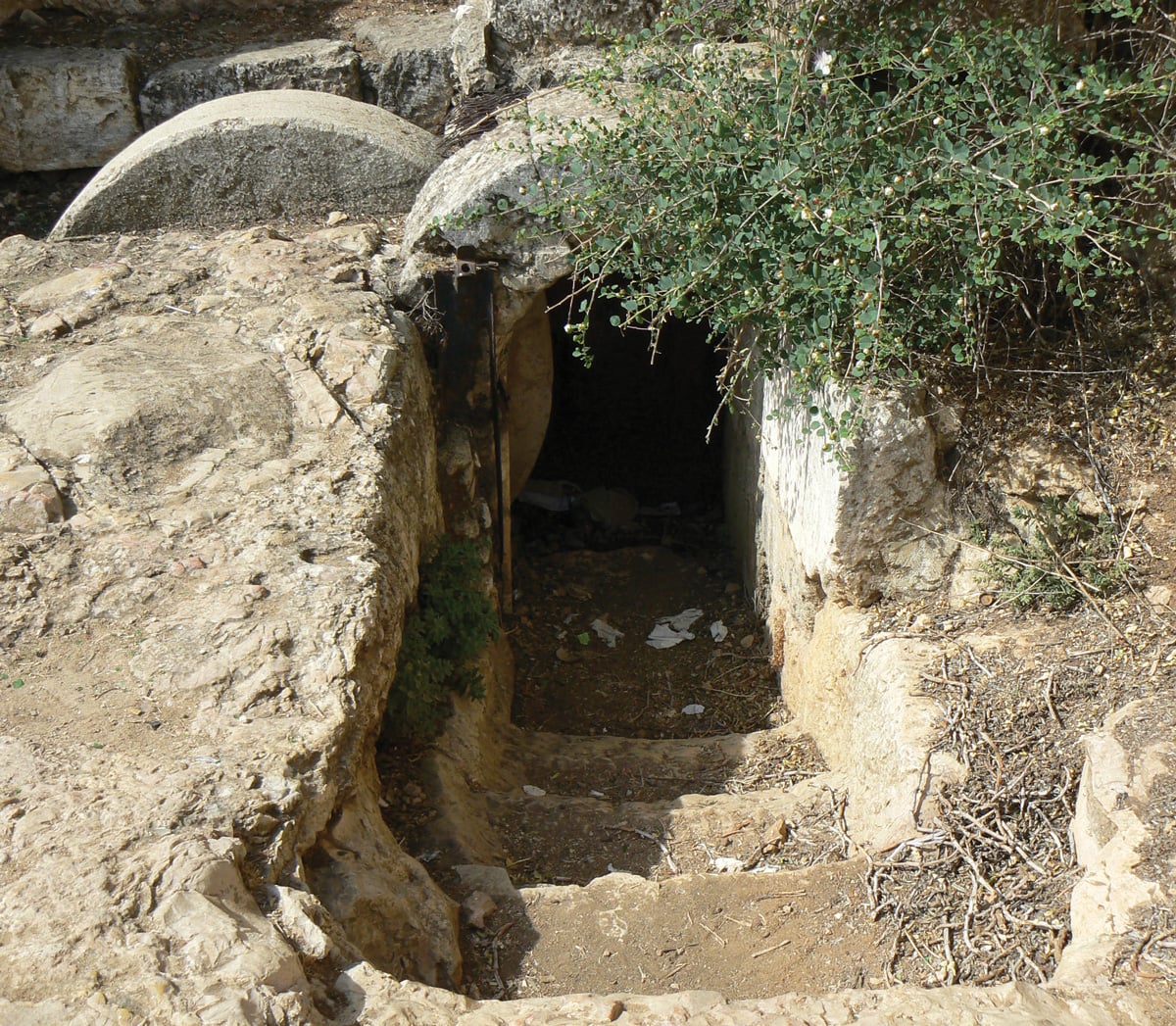
This first-century-BC rolling-stone tomb, possibly the burial place for Herod’s family, is similar to the tomb in which Jesus was buried.
G. Later resurrection traditions (16:9–20). Verses 9–20 represent one of the most difficult textual problems in the New Testament. The two oldest and most important Greek manuscripts of the New Testament omit the longer ending of Mark, as do several early translations, versions, and testimonies of church fathers. The literary character of 16:9–20 also differs from that of the rest of the Gospel of Mark. Twenty-seven new words occur in the longer ending, plus several stylistic features otherwise absent from Mark. The role of signs in 16:17–18 contradicts Mark 8:11–13. These and other factors make it virtually certain that Mark did not write 16:9–20. This longer ending of Mark, which was added in the early decades of the second century, consists of a resurrection harmony excerpted from the other three Gospels. The various excerpts appear to have been selected and edited in the secondary ending in accordance with the theme of the unbelief of the disciples.
If the Gospel of Mark originally ended at 16:8, then readers, like the women, are left in a state requiring a response of faith, which must be elicited by hearing rather than by sight. This is the conclusion that a majority of modern scholars draw with regard to the oldest ascertainable ending of Mark. Although Mark may have ended his Gospel at 16:8, it is not certain—and perhaps even unlikely—that he did. It seems hard to imagine that Mark, who begins his Gospel with a direct and bold declaration of Jesus as God’s Son and promised Messiah, would end his Gospel on a note of bewilderment (16:8). Very few ancient texts end as inconclusively as 16:8, which breaks off in mid-sentence. The addition of the longer ending at a later date is certain if artless evidence that the early church considered 16:8 a defective ending. It seems probable, therefore, that the Gospel of Mark originally concluded with a resurrection narrative, similar perhaps to that of the Gospel of Matthew. Not infrequently ancient manuscripts suffered the loss of first and last pages due to wear and tear, and this may have been the fate of the final leaf of Mark’s original manuscript. Although Mark, most probably the earliest of the four Gospels, does not contain in its present form a resurrection appearance of Jesus, it should be remembered that the earliest written testimony to the resurrection occurs in 1 Corinthians 15, written a decade earlier by the apostle Paul.
The theme of the secondary ending is the call of the disciples from unbelief (16:11, 13, 14 [2×], 16) to belief (16:16–17). The first call of Jesus comes through Mary Magdalene, the first herald of the saving faith of the gospel (16:9–11). The reference to the exorcism of seven demons comes from Luke 8:2, and Mary’s report to the despondent disciples reflects John 20:14, 18. The second call of Jesus comes through the story of two travelers in verses 12–13, which presupposes the walk to Emmaus (Luke 24:13–35). The third call comes from a personal appearance of Jesus to the eleven disciples in verse 14, who upbraids the disciples for disbelieving the two earlier witnesses. Verses 15–16, also from Jesus, reflect the Great Commission of Matthew 28:19. Salvation by faith, sealed by baptism, is ordained for “all creation.” Salvation is accompanied by signs of power, according to verses 17–18, including exorcisms, glossolalia, healings, handling of snakes, and drinking of poison. The last two signs are nowhere else attested in Scripture and apparently derive from later sectarian Christian practices. The first three signs, however, indicate that the early Christian proclamation was undergirded—as is true in many parts of the world today—by heavenly gifts of witness and ministry. Verses 19–20 conclude with the ascension of Jesus, which reflects Acts 1:9–11. The longer ending of Mark thus reflects some circumstances and themes, such as disbelief and dramatic signs, that appear to derive from a later period of the early church and that clearly differ from the Gospel of Mark. The longer ending reflects the chief characteristics of the early church in its emphasis on belief, mission, proclamation, and the saving significance of the gospel for all creation, and though it is not especially Markan, it is not unevangelical.
Select Bibliography
Bainton, Roland. Here I Stand: A Life of Martin Luther. Nashville: Abingdon, 1950.
Cranfield, C. E. B. The Gospel according to Saint Mark. Cambridge: Cambridge University Press, 1974.
Evans, Craig. Mark 8:27–16:20. Word Biblical Commentary. Dallas: Word, 2001.
France, Richard. The Gospel of Mark. New International Greek Testament Commentary. Grand Rapids: Eerdmans, 2002.
Guelich, Robert. Mark 1–8:26. Word Biblical Commentary. Dallas: Word, 1989.
Gundry, Robert. Mark: A Commentary on His Apology for the Cross. Grand Rapids: Eerdmans, 1993.
Hengel, Martin. Studies in the Gospel of Mark. Translated by J. Bowden. Philadelphia: Fortress, 1985.
Hooker, Morna D. A Commentary on the Gospel according to St Mark. London: A & C Black, 1991.
Hurtado, Larry W. Mark. New International Biblical Commentary. Peabody, MA: Hendrickson, 1989.
Lane, William. The Gospel according to Mark. New International Commentary on the New Testament. Grand Rapids: Eerdmans, 1974.
Martin, Ralph P. Mark: Evangelist and Theologian. Grand Rapids: Zondervan, 1973.
Schweizer, Eduard. The Good News according to Mark. Translated by D. Madvig. London: SPCK, 1971.
Swete, Henry Barclay. The Gospel according to St Mark. 3rd ed. London: Macmillan, 1909.
Taylor, Vincent. The Gospel according to St. Mark. 2nd ed. New York: St. Martin’s Press, 1966.