Proverbs
2. Prologue: Introducing the Way of Wisdom (1:8–9:18)
A. The Initial Appeals of the Parents and Lady Wisdom (1:8–33)
B. The Commendation of Wisdom (2:1–4:27)
C. Warnings against Folly, Especially Sexual Infidelity (5:1–7:27)
D. Wisdom’s Final Appeals (8:1–9:18)
3. Proverbial Collections: Advanced Instruction in Wisdom (10:1–29:27)
A. The Original Solomonic Collection (10:1–22:16)
B. Sayings of the Wise: Admonitions for Societal Relationships (22:17–24:22)
C. More Sayings of the Wise: The Necessity of Honesty and Diligence (24:23–34)
D. The Later Solomonic Collection (25:1–29:27)
A. Agur’s Message: Relying on God’s Word, Learning from His Work (30:1–33)
B. The Message of Lemuel’s Mother: A Call for Royal Justice (31:1–9)
C. Lady Wisdom Exemplified (31:10–31)
Introduction
There are few Old Testament books as attractive to the modern reader as the book of Proverbs. Four reasons for this appeal can be suggested: the brevity of its basic unit, its universal and timeless nature, the practical focus and range of its everyday subjects, and its rhetorical appeal to modern intellectuals. Nevertheless, each of these features presents its own unique challenges. First, the individual proverbs often appear to be arranged somewhat arbitrarily, so that readers seem compelled to interpret each one without the benefit of literary context. Second, the book of Proverbs shares so many formal, verbal, and conceptual elements with ancient Near Eastern proverbial collections that its claim to be part of the uniquely inspired Word of God has been questioned. In addition, Proverbs appears to reflect few of the central themes of Old Testament theology. Third, the pragmatic emphasis of the book, especially within the proverbial collections, obscures its theological foundations, some of which may be implicit and presupposed. Fourth, the terseness of expression and frequent juxtaposition of clauses, especially in the original Hebrew, impede the attempt to translate or interpret those proverbs with the usual degree of certainty.
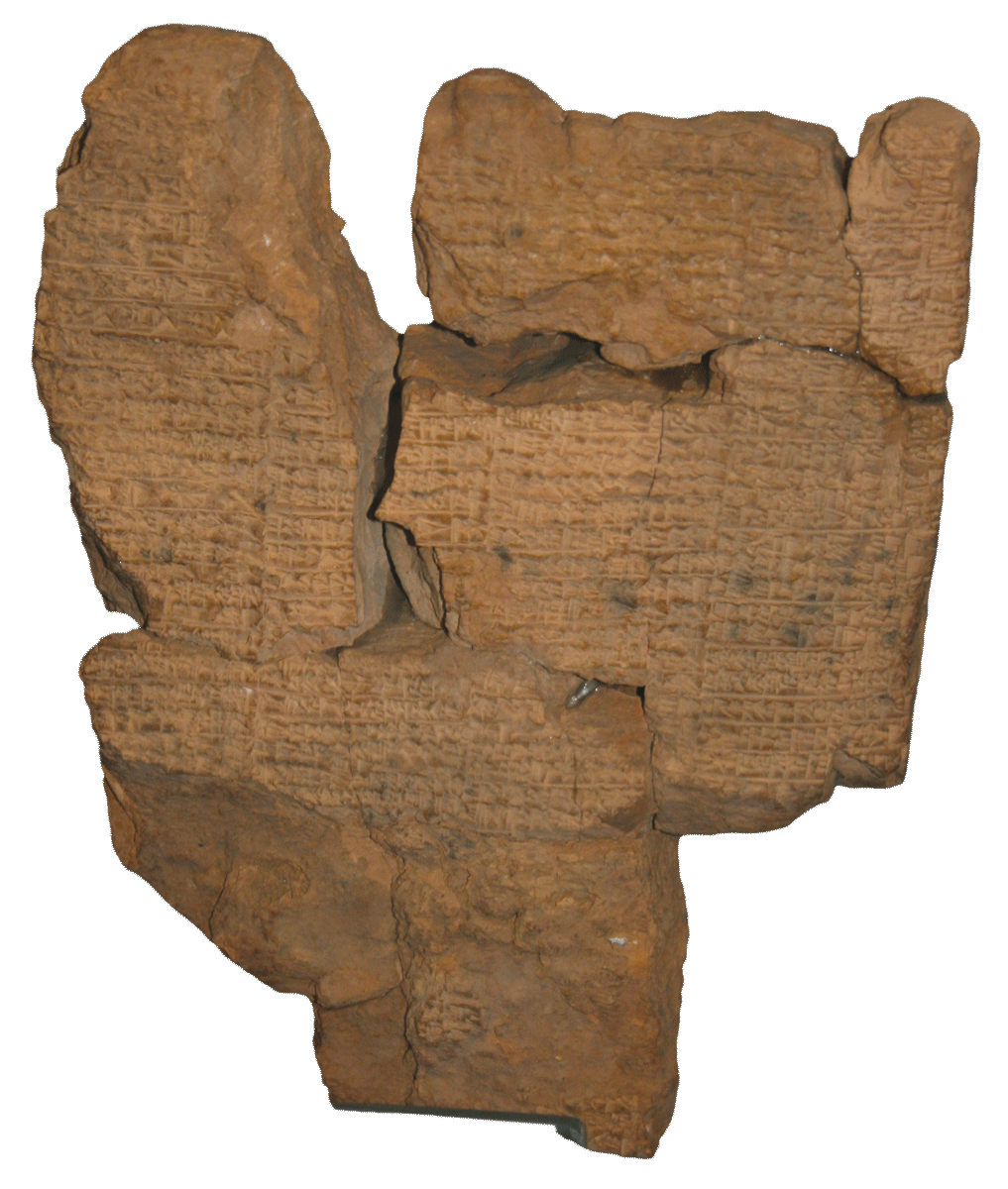
Title and Authorship
The book of Proverbs contains several proverbial collections, each of which has its own brief title (10:1; 24:23; 25:1; 30:1; 31:1) or introductory section (22:17–21). The initial title in 1:1 (“The proverbs of Solomon son of David, king of Israel”) identifies the book’s dominant (but not only) literary form and author. This title is expanded in 1:2–7, which state the objectives and foundational premises of this wisdom text in a manner that parallels 22:17–21 and several Egyptian instructional texts. The titles of the proverbial collections in Proverbs 10:1 and 25:1 similarly associate their contents with Solomon, which fits the portrayal of his reign in 1 Kings and 2 Chronicles. According to 1 Kings 3:12, God granted Solomon a “wise and discerning heart” that manifested itself in his judicial decisions, international relations, the temple construction project, encyclopedic knowledge, and literary compositions. These are described most fully in 1 Kings 4:29–34, which makes several important claims: (1) Solomon’s wisdom was God-given and surpassed that of all of his contemporaries. (2) During the united monarchy under Solomon, some Israelites had sufficient knowledge of and access to wisdom writings of the East (probably Mesopotamia, not Arabia) and Egypt to warrant such a comparison between Solomon and his contemporaries and to establish Solomon’s international reputation. (3) Solomon’s literary output included more than three thousand proverbs (which could have included many of the 950 verses in the book of Proverbs), as well as more than one thousand songs.
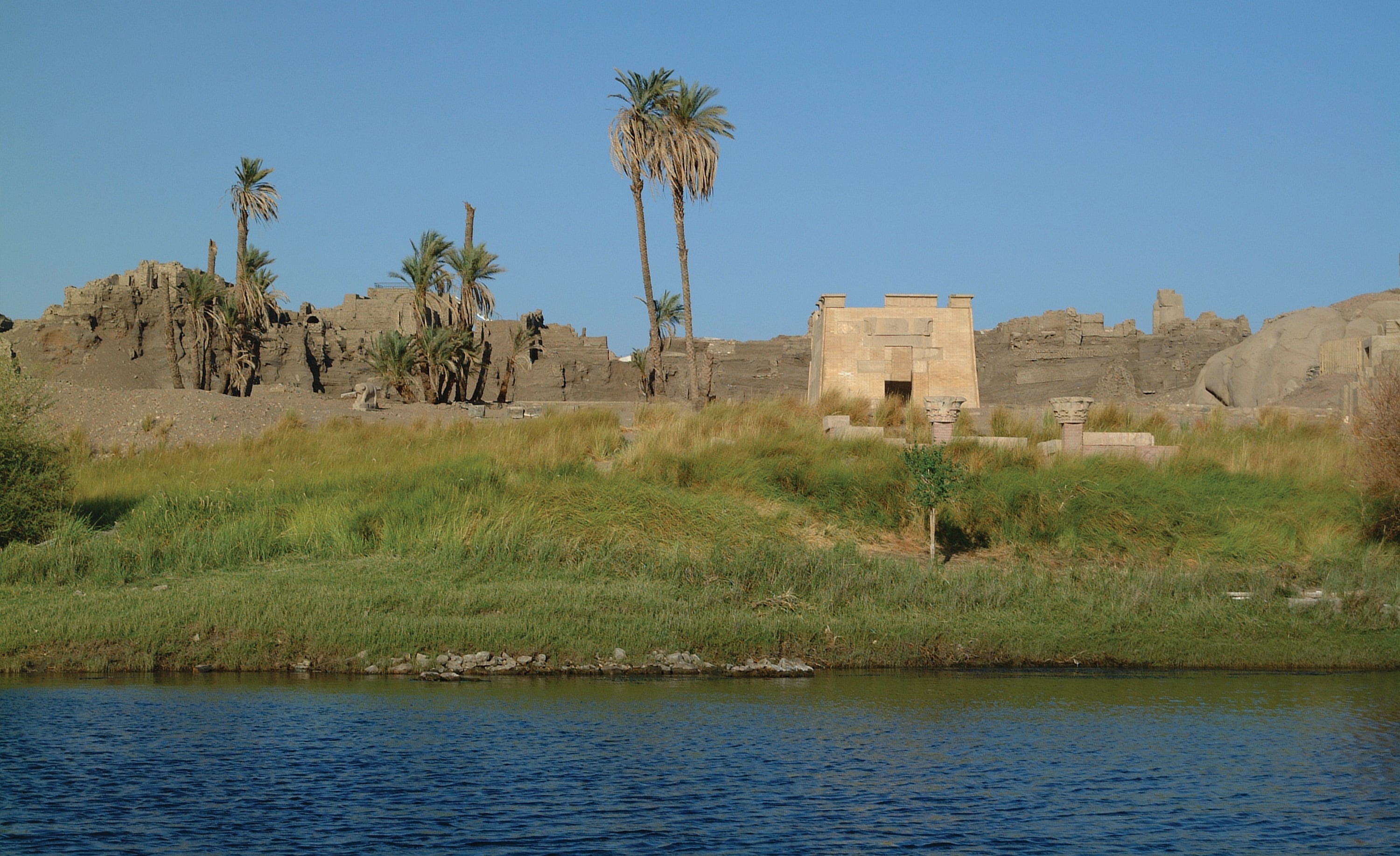
This tablet from Nippur (eighteenth century BC) containing Sumerian proverbs is one of many such proverbial collections from the ancient Near East.
In light of these qualifications, Solomon’s traditional association with Old Testament wisdom writings (including Ecclesiastes and Song of Songs) is understandable. This has even led some scholars to claim that he is the author of the entire book of Proverbs, viewing Agur (in Prov. 30:1, “gatherer”) and Lemuel (in 31:1, “belonging to God”), as symbolic designations for Solomon. Nevertheless, many contemporary scholars deny that the present canonical book contains any proverbs or instructions that originated with Solomon. James Crenshaw states bluntly: “Wisdom and Solomon have nothing to do with each other” (Crenshaw, 40). Ultimately, the validity of biblical claims regarding Solomonic wisdom depends on one’s view of the reliability of biblical historiography. If Solomon was, in reality and not simply in legend, an incomparably wise ruler and sage, it is certainly plausible that many of the proverbial sayings that he personally formulated would be preserved in the canonical anthology ascribed to him.
To posit Solomonic authorship for some of the contents of the proverbial collections by no means demands his editorial responsibility for the entire book. Taking Proverbs 1:1 seriously does not exclude the extensive contribution of other unknown sages, authors, and editors. According to the talmudic tractate Baba Batra (15a), “Hezekiah and his men wrote Isaiah, Proverbs, the Song of Songs, and Qoheleth.” The textual basis for this is Proverbs 25:1, which may suggest a larger compositional or editorial role played by a scribal group in the time of Hezekiah, two centuries after Solomon—this group perhaps even added the introductory prologue in 1:8–9:18. As already noted, there are several additional authors mentioned in the titles to the individual subcollections of proverbs and sayings. Proverbs 30 constitutes “the sayings of Agur son of Jakeh—an oracle”; Proverbs 31 contains, similarly, “the sayings of King Lemuel—an oracle his mother taught him.” (Neither Agur nor Lemuel is mentioned elsewhere in biblical or extrabiblical sources.) Proverbs 22:17 (“Pay attention and listen to the sayings of the wise”) and 24:23 (“These also are sayings of the wise”) are usually taken as titles that introduce additional proverbial collections from anonymous sages. The Greek translators of these verses, however, viewed neither of them as constituting an introductory title, and the insertion of the subheadings “Sayings of the Wise” and “Further Sayings of the Wise” into the NIV text simply reflects a Bible editor’s interpretation. Given the nature of proverbial wisdom, which often has an oral origin, it is likely that Solomon and other contributors to the book of Proverbs both coined and collected proverbial sayings.
Date
Seeking to determine the date of an anthology like the book of Proverbs is a tenuous undertaking. First of all, one must distinguish between the date of origin of individual proverbs, the date of their compilation into collections, and the date of the editing of the book of Proverbs, which certainly could have gone through several editions before the final canonical edition was completed. Second, the universal and timeless nature of the individual proverbial sayings and instructions makes them difficult to date. Third, the striking formal differences between Proverbs 1–9 and 10–31 require separate treatments of the two major sections of the book. Most scholars view chapters 10–31 as being earlier than 1–9, citing several of its striking features in support of this claim. From a form-critical perspective, Hermann Gunkel and his early followers claimed that the shorter forms (e.g., two-clause proverbial sayings in chaps. 10–31) are earlier than the longer instructional discourses (e.g., 1:8–19). From a conceptual standpoint, the figure of personified wisdom as developed in Proverbs 1–9 is seen to be dependent on later Persian or Greek models. In terms of content, Proverbs 1–9 is considered late due to its highly reflective theological content that closely links wisdom and its acquisition to personal piety and divine endowment. As a result, Proverbs 1–9 is commonly understood as a prologue that was composed much later to serve as a theological introduction to chapters 10–31.
There is no evidence, however, that any of the proverbial collections ever circulated in Israel independently from chapters 1–9. Apart from chapters 1–9, a proper framework for understanding the purpose and theological basis for chapters 10–29 is lacking. Furthermore, the arguments in support of a postexilic origin for Proverbs 1–9 have been countered by Egyptologists, such as Kenneth Kitchen, who note that proverbial collections preceded by lengthy prologues, the personification of abstract qualities such as wisdom, and similar theological and personal ethical reflection are found in various Egyptian and Mesopotamian wisdom collections dated to the third and second millennia BC, that is, prior to the time of Solomon (Kitchen, 134–36). Divergent claims regarding the dating of texts within chapters 10–31 usually focus on the contents of those texts rather than on their language. Two features figure prominently in such discussions. Some scholars, such as William McKane, distinguish, for example, between secular-individualistic, community-focused, and moralistic-Yahwistic proverbs, which then are ascribed to different phases of Israel’s intellectual and religious development (McKane, 10–22). Other scholars posit diverse socioeconomic backgrounds (or “life settings,” e.g., tribal, agrarian, scribal, royal) as giving rise to individual proverbs and collections. It is rather questionable to suggest, however, that only farmers can formulate proverbs about crop growth (e.g., 14:4). In any case, these issues have little bearing on how one should understand these individual proverbs within their present canonical-compositional collections. Nevertheless, given the book’s association with Solomon and its frequent focus on the duties of a king or courtier, it is likely that the book as a whole was composed in a royal-scribal setting. This does not preclude individual proverbs from originating in a tribal or rural setting, nor is there reason to believe that the canonical book was not intended to have a much broader readership.
Literary Features
A wide range of literary forms are used in the book of Proverbs, not all of which are native to or typical of wisdom discourse. These include the instruction (chaps. 1–9), individual sentence (primarily chaps. 10–30), numerical saying (6:16–19; 30:15–31, possibly also a riddle), beatitude (3:13; 8:32, 34; 28:14), acrostic (i.e., alphabetic sequence, 31:10–31), and allegory (5:15–23). Especially in chapters 1–9, stylistic devices, such as the call to attention (4:1; 5:1), rhetorical question (6:27–28), and personal observation and reflection (4:3–8; 7:6–23), are commonly employed. By far, the dominant form is the individual sentence or proverb. Most proverbs take the form of the wisdom saying, which consists of a declaration formulated with indicative verbs, including participles. In chapters 1–9 and 22–24, however, the admonition (a command or a prohibition), expressed with imperative verb forms, is also common. Admonitions typically contain a motivational clause that seeks to persuade the addressee to heed the instruction by noting promised benefits for obedience or adverse consequences for ignoring it (“Do not love sleep or you will grow poor; stay awake and you will have food to spare,” 20:13). Often this takes the form of an appeal to discernment on the basis of experience or common sense (“Do not lust in your heart after her beauty or let her captivate you with her eyes. . . . Can a man scoop fire into his lap without his clothes being burned?” 6:25, 27). Alternatively, it can involve an explicit reference to the way of life or death or to Yahweh (“Do not exploit the poor because they are poor and do not crush the needy in court, for the Lord will take up their case and will plunder those who plunder them,” 22:22–23).
Ted Hildebrandt has helpfully described a proverb as a “short, salty, concrete, fixed, paradigmatic, poetically-crafted saying” (Hildebrandt, 234). The meaning of the Hebrew word for “proverb” is disputed, based on the meaning of the related verbal root or Semitic cognate word. The most commonly suggested meanings for “proverb” are (1) a comparison or noted similarity (from the verb “to resemble”) or (2) a powerful word (from “to rule”). As noted above, an individual proverb in the book of Proverbs usually consists of two parallel lines. The second line continues and completes the theme and thought of the first line by means of emphatic restatement or supplementary comment, striking comparison, contrast, illustration, or reference to the consequences of specific actions. This can be illustrated by 18:22–23 (“He who finds a wife finds what is good / and receives favor from the Lord” [supplementation]; “A poor man pleads for mercy, / but a rich man answers harshly” [contrast]). Individual proverbial assertions can be categorized according to the kind of comment they make regarding a given topic, such as classification (14:15; 27:7; 29:5), comparison (25:13; 26:14), evaluation (17:16; 22:1), and act-consequence (15:13; 19:20).
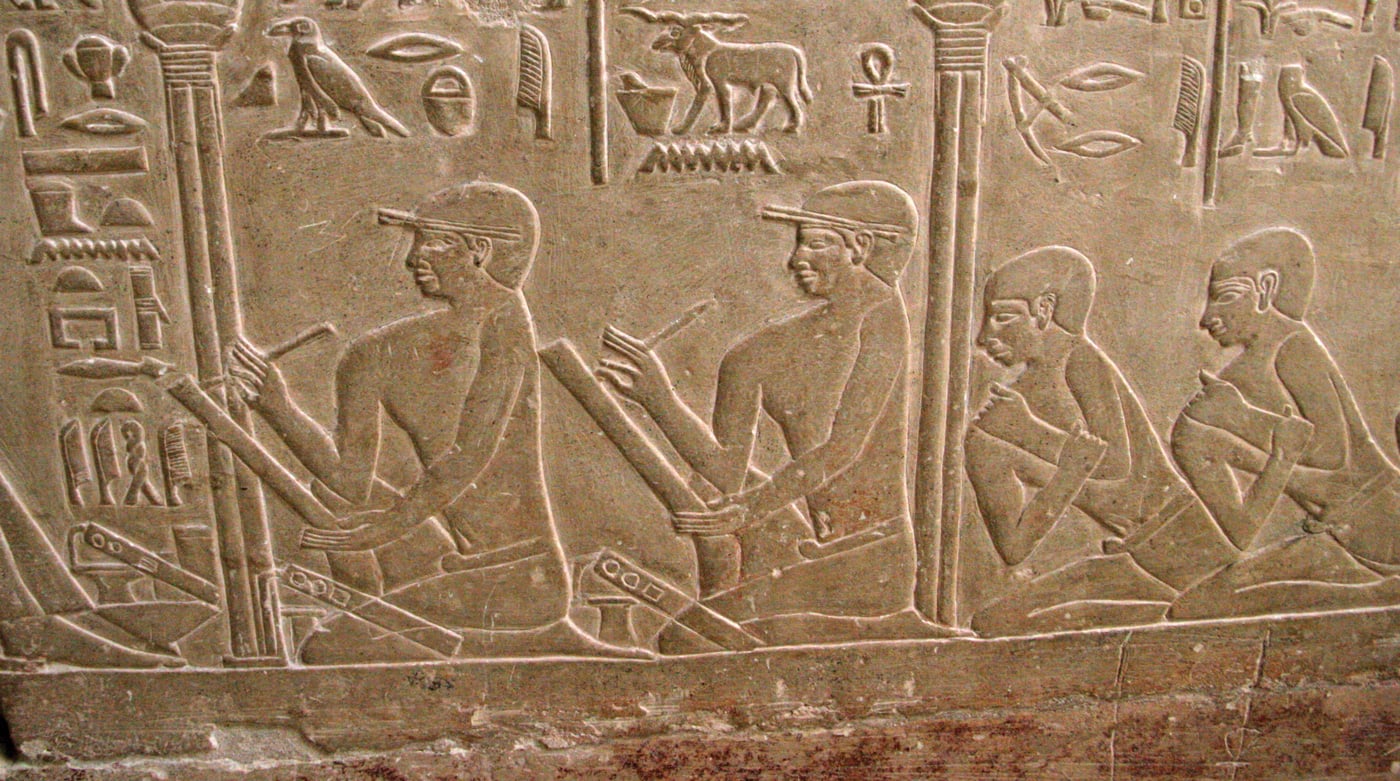
Many of the ancient proverb collections still in existence today are practice writing tablets from scribal schools. This Egyptian relief showing two scribes is from the Tomb of Mere-Ruka, Sakara (ca. 2300 BC).
Structure and Theological Themes
Proverbs is best understood as a carefully edited anthology. This has a number of implications for how the book should be interpreted. First of all, chapters 1–9 function as a theological introduction to biblical wisdom and an interpretative introduction to the proverbial collections that follow. After the divine origin and God-centered orientation of wise behavior has been established in the prologue, even the “secular” proverbs in chapters 10–31 are to be read through this theological lens. Second, chapters 10–29 in turn often echo and offer numerous practical everyday illustrations of the theological principles set forth in chapters 1–9, including those exemplified by Lady Wisdom and Lady Folly. Third, even though many individual proverbs may have had an independent oral existence prior to their incorporation within the collections of the canonical book, they are now to be interpreted within the context of their present literary collections, in which various ordering principles can frequently be identified. Numerous individual proverbs are repeated fully or in part elsewhere within the book and thus have a different emphasis or application in each of their respective contexts (compare, for example, 13:14 with 14:27). Fourth, chapters 30–31 form a literary bracket with chapters 1–9 (i.e., a theological prologue and epilogue; note the verbal links between 9:10 and 30:3 as well as 31:30) around the proverbial collections. Within this bracket, 30:1–9 (a sage’s confession and prayer) and 31:1–9 (a queen mother’s charge) offer complementary summaries of wise behavior, and 31:10–31 describes Lady Wisdom (from chaps. 1–9) incarnated as a real-life, if somewhat idealized, wife.
As Proverbs 1:7 already makes clear (“The fear of the Lord is the beginning of knowledge”), biblical wisdom involves more than intellectual prowess. Rather, wisdom is better defined as the ability—divinely bestowed and acquired through a lifelong process—that enables one in various situations to make and carry out decisions pleasing to God and ultimately socially and personally beneficial. With “wisdom” (Hebrew hokmah) serving as the broader term, related words, such as “understanding,” “knowledge,” “prudence,” “insight,” and “discernment,” express various intellectual and practical aspects of wise behavior. This is in contrast to the terms related to folly, which convey varying degrees of personal blame and hope for corrective change, from naïveté (Hebrew peti, 1:4) to hard-core mockery of God-fearing wisdom (Hebrew lets, 9:7) and practical atheism (Hebrew nabal, 17:21; cf. Ps. 14:1; 53:1). Wisdom theology is rooted in creation, which reflects God’s sovereign ordering of all things (3:19–20) and enables one to derive insights even from the observation of this in nature (6:6). But it is also rooted in the “law” of God (Hebrew torah, Deut. 4:44 and Prov. 6:23), claiming the same authority as the Mosaic instruction and promising the same benefits (and consequences) as are associated with obedience (and disobedience) to the covenantal stipulations (e.g., long life in the land; compare Deut. 4:40 and Prov. 2:21). Wisdom theology’s foundational principle is the fear of the Lord (Prov. 1:7; 8:13; 9:10; 31:30), which involves not simply sincere reverence for God but also reliance on him and the avoidance of evil, and is essentially the Old Testament equivalent of saving faith in the New Testament. Thus the acquisition of wisdom is a lifelong process to be furthered through instruction and observation as well as through discipline and correction. This covenantal foundation and the broad ethical demands flowing from reverence for Yahweh distinguish Proverbs from the more utilitarian, courtly emphasis of Egyptian instructional literature, despite the many themes, stylistic features, and objectives that these texts share.
Commentary
Proverbs 1–9 serves as the theological introduction to the canonical book, giving a foundational introduction to biblical wisdom—its nature, sources, acquisition, and value. Chapters 10–29 build on this foundation, offering a plethora of illustrations of what wisdom and its opposite, folly, look like in everyday life. In effect, Proverbs 1–9 offers the “Wisdom 101” course, while Proverbs 10–29 presents “Wisdom 201.” Proverbs 1 is introductory both to the book as a whole and to the prologue in particular, introducing all of the prominent elements of chapters 1–9. Within this theological introduction, 1:1–7 forms the foreword, giving the book’s title, purpose, and central theme.
The title (1:1) presents King Solomon as the primary author, raising the possibility of an initial edition of the book that contained only Solomonic proverbs, perhaps ending at 22:16. Interestingly, outside of this preface and the titles to the Solomonic collections (Prov. 10:1; 25:1), the word “proverb” occurs only in 26:7, 9. The purpose statements in 1:2–6 are grammatically linked to verse 1: these Solomonic proverbs are presented in order to achieve specific pedagogical and behavioral goals. Verse 5, which interrupts the sequence, describes how wise individuals will respond to this challenge. Verses 2a and 3–4 refer to the contents of the instruction. The book of Proverbs is designed to help its readers experience wise discipline, the theory and practice of proper living. Appropriately, the first wisdom term employed here is the general term “wisdom” (Hebrew hokmah; there are almost one hundred occurrences in Proverbs of this or a related form of the word). “Discipline” (NIV “instruction”) designates the process of learning to live consistently according to wisdom principles through training, modeling, and correction. Verses 2b and 6 suggest that one must also learn the skill of interpreting and properly applying various wisdom forms, something that the fool is unable to do (Prov. 26:7, 9). Several of the Egyptian instructions, including the Instruction of Amenemope, contain similar purpose statements. Verse 3b indicates that biblical wisdom is not simply the art of successfully navigating around the twists, turns, and submerged boulders of life; it also involves the pursuit of justice, equity, and fairness in interpersonal, especially legal and commercial, relationships.
Verses 4–5 introduce those potentially benefiting from this instruction. The primary addressees are the “simple,” who presumably are also “young.” The “simple” (Hebrew peti) are inexperienced, even naive, the stereotypical “freshmen,” but also open-minded and not yet set in their ways. Even the beginner in wisdom’s school can receive the necessary instruction to meet life’s challenges. The NIV takes verse 5 as an admonition; it also could be translated as a statement. In either case, a distinguishing characteristic of the truly wise is that they continually augment their wisdom resources. The wise individual devotes special attention to the various subgenres through which the insights of the wise are expressed, including enigmatic sayings that need to be solved (“riddles,” 1:6; cf. Judg. 14:12 and 1 Kings 10:1). Verse 7a concludes the foreword by introducing the foundational theological principle or motto of the book of Proverbs. The phrase “the fear of the Lord” also occurs in Proverbs 9:10, thus bracketing the book’s introductory section (also 1:29; 2:5; 8:13, and nine times in chaps. 10–31). To fear the Lord is not to cower in terror before an unknowable deity; rather, it entails a life lived in constant awareness of one’s dependence on and obligation toward the sovereign Creator. This expression distinguishes biblical wisdom from all other types of human learning. Ancient Near Eastern wisdom literature outside of Israel never presents wisdom as rooted in one’s relationship to a deity. The “beginning” refers to the essential foundation without which no growth in understanding can take place. Verse 7b concludes the preface by distinguishing fools, who alone despise the benefits of wise discipline (cf. 1:2), from those addressed in these introductory remarks.
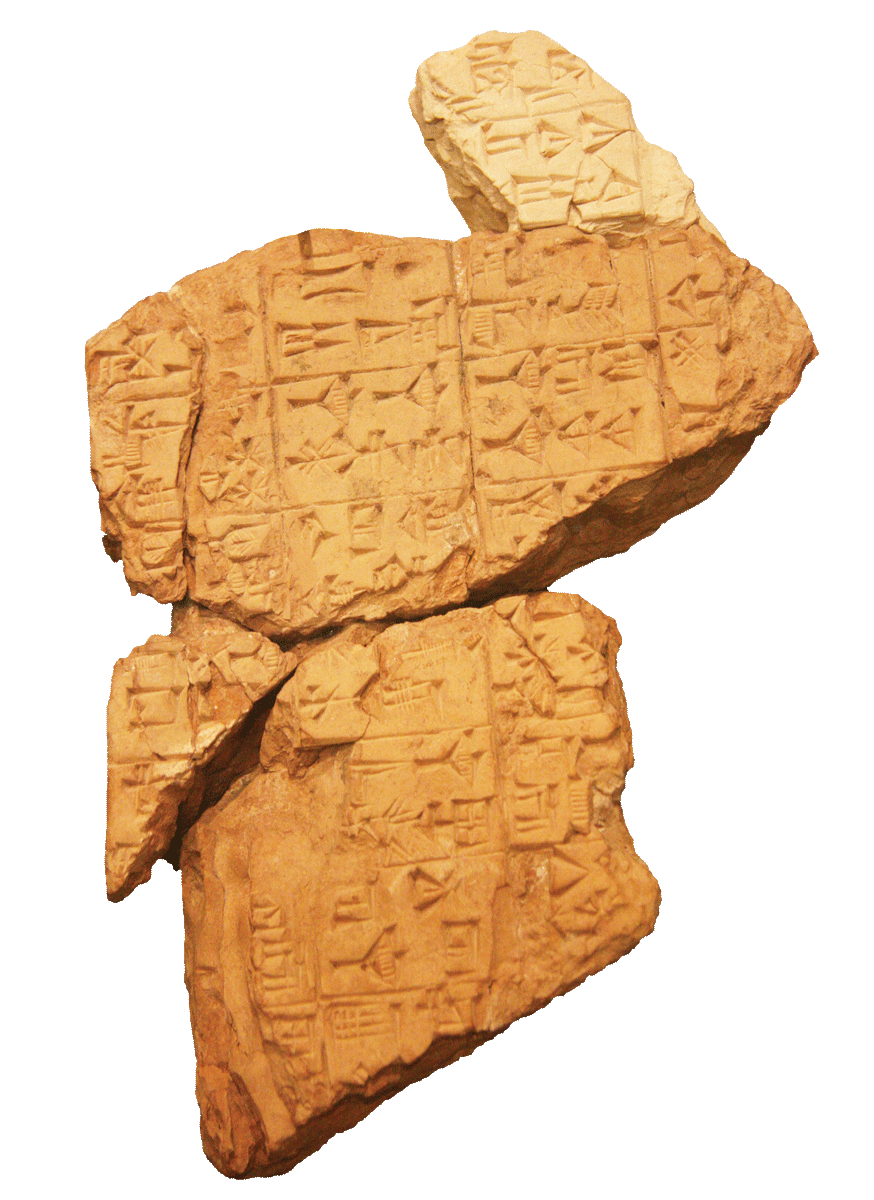
The Instructions of Shurrupak to His Son Ziusudra, a collection of Sumerian proverbs found on this tablet from 2400 BC, begin similarly to Proverbs 1:8: “Shurrupak gave instructions to his son.” Other versions add, “My son, let me give you instructions: you should pay attention!”
2. Prologue: Introducing the Way of Wisdom (1:8–9:18)
A. The initial appeals of the parents and Lady Wisdom (1:8–33). Proverbs 1:8–19 contains the first parental lesson out of ten (or more) in the prologue, exhibiting the basic structural features that the additional lessons will follow. On the basis of posited Egyptian literary models, scholars have often divided up this section into a number of originally independent “lectures.” Nevertheless, a convincing case can be made that the prologue as a whole presents a carefully composed and unified argument. Michael Fox lists the following three features as typical in these lessons: (1) the exordium, or introduction, consisting of an address to the audience, an exhortation to hear and remember the teachings, and motivational statements that extol the teachings’ excellence and value to their possessor; (2) the lesson, or teaching proper; and (3) the conclusion, or summary statement, which generalizes the lesson’s principle (Fox, 45).
This first lesson contains three addresses to the son (1:8, 10, 15), each followed by imperatives (commands or prohibitions), thus dividing the instruction into three sections. Verses 8–9 contain the introductory call to attention and the benefits of doing so; verses 10–14 offer an anticipatory warning against yielding to the temptation to join a violent gang; and verses 15–19 present the admonition proper, followed by reasons for heeding it. The command to “listen” occurs at least twelve times in Proverbs, eight of these in chapters 1–9, and emphasizes the importance of being receptive to the guidance of a parent or sage. In conformity to the ancient Near Eastern instructional genre, Proverbs is directed at young sons, preparing them to lead an effective public life of service, perhaps in the royal court (since Solomon is the designated author). The Egyptian texts, however, never refer to a mother’s instruction, as in verse 8, which suggests that the home is the setting for such training. The lessons learned there will adorn the youth like a garland or wreath (1:9; 4:9) or decorative chains (Song 4:9).
Those unambiguously labeled as “sinful” seek comrades in their devious, violent, unprovoked, and unjustified actions, for which they possess an enormous appetite (1:10–12), offering the enticing promise of sharing the battle “plunder” (1:13; cf. Deut. 20:14 and Josh. 11:14, which use the same word). Verse 15 introduces the major image and theme of the two ways in Proverbs, which can refer either to specific decisions or actions or to one’s general life choices or lifestyle. Paul quotes this description of frivolous bloodshed in Romans 3:15. Proverbs 1:17 introduces a proverbial saying that suggests that a bird is cleverer than these evil schemers, who in setting an ambush for others are actually lying in wait (1:11, 18) for their own lives!
In 1:20–35, wisdom is presented not simply as an abstract capacity or skill but as a person who directly addresses those most lacking in wisdom. Although the nature and origin of Lady Wisdom (Hebrew hokmah is a feminine noun) have been much discussed, this figure is best understood as both a poetic personification of a divine attribute and a foil, or conceptual antithesis, to the promiscuous or foolish woman. The designation for Lady Wisdom is literally “wisdoms,” possibly an intensive plural, implying that she embodies the fullness of wisdom qualities (similar to the plural form elohim for God and the plural behemot—literally “beasts”—for Behemoth [Job 40:15]). The presence of a female figure justifies the use of the language of romantic love, as the author portrays the acquisition of wisdom as something profoundly personal, enjoyable, beneficial, and lifelong.
In this section, Lady Wisdom is presented as a prophetlike figure who seeks to rescue fools from the error (and consequences) of their ways, in effect assuming a mediatorial role between God and humanity. According to the fourfold description of Lady Wisdom’s location (1:20–21), she calls out to those engaged in the business of everyday life, where commerce, communication, and legal affairs are conducted. She rebukes both the naive and the hardened mockers for clinging to their folly and repeatedly spurning her corrective counsel (1:22–27). As a result of their resistance, when “calamity” strikes, the roles will be reversed (1:26). These youths will then call out for help (1:28; cf. 1:24), only to be ignored and mocked by her and abandoned to bear their self-inflicted—and potentially fatal—troubles alone (1:28–33).
B. The commendation of wisdom (2:1–4:27). 2:1–22. With Proverbs 2, the parental speaker begins a positive recommendation of wisdom, which encompasses three lengthy exhortations (chaps. 2–4). Proverbs 2 lays the foundation, describing the source and primary benefits of wisdom, while chapters 3–4 offer more detailed descriptions of the values of wise behavior. One striking emphasis in Proverbs 2 is the acquisition of wisdom as the result of both intensive human effort and divine endowment, while the remaining instructions focus on the first of these two, human effort. Furthermore, the instruction in chapter 2 differs from the others in Proverbs 1–9 in that it contains no imperative verbal forms in the Hebrew text. If one pays close attention to the sequence of conjunctions (i.e., if, then, for, thus), a clear structure emerges. Three (or four) conditions for obtaining wisdom are set forth in 2:1–4, followed by 2:5–8 and 2:9–19, which portray, respectively, the general and specific protection that wisdom offers all who attain it. Verses 20–22 conclude the instruction by describing the ultimate benefits of following the way of wisdom.
Proverbs 2:1–4 assumes that the son sincerely desires to obtain wisdom. A clear progression is discernible in the sequence of verbs employed in setting forth the conditions, moving from passive to active engagement. The first step is receptivity: “accept” (the same Hebrew verb occurs also in 1:3; 4:10; 8:10; 10:8; 21:11; and 24:32). The child must welcome the parental instruction and store it up as valuable and authoritative “commands” (cf. Ps. 119:11). Verse 2 describes holistic engagement involving the ear and heart, while verse 3 notes the urgency of the undertaking, as one cries aloud for wisdom. Verse 4 forms the climax of the quest for wisdom; the same persistence required of one seeking precious metals is demanded of the one who wishes to become wise (cf. Job 28).
The initial rewards for persevering in one’s quest for wisdom are set forth (2:5–8). The first result is somewhat surprising. Rather than becoming exceedingly wise or successful, one first must develop true piety, understanding what it means to fear the Lord. The quest for true wisdom inevitably leads first to God, since, according to verse 6, he is its ultimate source, and it is his exclusive prerogative to grant wisdom to every earnest seeker.
Wisdom’s primary benefit according to this instruction is protection during one’s journey through life. Remarkably, the quester has been transformed in the process, becoming “upright,” “blameless,” “just,” and one of God’s “faithful ones.” What God “holds . . . in store” for those who “store up” (using the same Hebrew verb) the parents’ words (2:1) is “success” (the Hebrew word denotes “top grade” wisdom, which brings success, 2:7). God also serves as a protective shield for the blameless, perhaps an allusion to his earlier promise to Abraham (Gen. 15:1), of whom he made a similar demand (Gen. 17:1).
The second benefit is described in 2:9–11 (“Then . . .”). In seeking wisdom, one develops not only an intimate relationship with God but also an intimate understanding of moral rectitude (2:9; cf. 1:3). Since wisdom now pervades the command center of one’s life and acquiring knowledge has become an enjoyable task, personal discretion assumes the role previously carried out by God (2:8) of protecting the youth from the dangers brought about by wrong choices and missteps (2:11). Divine wisdom will help the youth get on the right path and stay on it. Verses 12–19 then describe the two primary threats to the moral integrity of the youth: perverse men (2:12–15) and seductive women (2:16–19). These two groups are described in a similar fashion, using participial verbal forms to emphasize their habitual modes of speaking and the good that they leave behind (2:13, 17).
In verse 16, the dangerous woman is introduced for the first time in Proverbs; a fuller portrait of this woman is given in Proverbs 5–7. This person’s designation as a “strange” (Hebrew zarah; 2:16; 5:3, 20; 7:5; cf. 22:14; see also commentary on 5:1–23) woman or a “foreigner” (2:16; 5:20; 6:24; 7:5; cf. 20:16; 23:27; 27:13) in some translations has spawned extensive discussion regarding the import of these designations. The NIV’s translation of these words as “adulterous” and “wayward” woman, respectively, clearly involves an interpretive paraphrase. There is no indication in the text of Proverbs, however, that either designation reflects Israelite fear of foreigners or even the fear that a foreign wife’s pagan religious practices will undermine Israelite devotion to Yahweh. The descriptions of this individual in Proverbs 1–9 suggest, rather, that she is a married, adulterous Israelite woman, who is “estranged” from her husband and from society in general by virtue of her promiscuity. More significantly, she represents all forms of socially destructive sexual behavior. Unlike the wicked men of 2:12–15, who do not present a direct threat to the son unless he joins them on their “crooked” paths that presumably will not reach the desired destination, a single encounter with the seductress can be fatal, and 2:19 expresses this threat comprehensively.
Verses 20–22 introduce the ultimate benefits of staying on the right path: good companions (2:20), long life in the land (2:21), and avoiding the fate of the wicked (2:22). These verses use language reminiscent of the covenantal promises and threats regarding the land. (For example, Deut. 28:63 uses the same rare verb translated “torn” in Prov. 2:22.) In effect, covenantal promises to the nation are being extended to the individual who embraces wisdom. Such an individual will remain in the land under God’s favor rather than be cut off (the same Hebrew verb is used in the Mosaic law to describe divine judgment; see Lev. 7:20, 21, 25, 27; 17:4, 9–10, 14; 18:29).
3:1–35. Chapter 3 continues the positive recommendation of wisdom. Based on thematic development, the chapter can be subdivided into four subsections: 3:1–4, 5–12, 13–26, 27–35. Verses 1–4 set forth additional advantages of preserving wisdom instruction. The words “teaching” and “commands” (Hebrew torah and mitsvah, 3:1, also in 6:20, 23; 7:2) are commonly paired with reference to Mosaic law (cf. Exod. 24:12; Josh. 22:5). Parental instructions are authoritative, not simply good advice. To “forget” involves not simply letting something slip one’s mind; it entails failing to act accordingly. Observing this exhortation, the son is assured, will result in a long and satisfying life (3:2; cf. Exod. 20:12; Eph. 6:1–3). This promise is problematic, since many people know someone who lived a wise, God-fearing life only to die young. Bruce Waltke (2004, 107–9) explains that proverbs teach the ABCs of morality, emphasizing their ultimate validation in the future despite temporary exceptions. This would be confirmed if the first phrase, literally “length of days” (cf. Deut. 30:20; Ps. 21:4; 23:6; 91:16; 93:5; Lam. 5:20), refers to an extension of life beyond clinical death, but this is unclear. “Love and faithfulness” (Hebrew hesed and emet; cf. Prov. 14:22; 16:6; 20:28) should be publicly displayed (“bind . . . around”) and permanent traits (“write . . . on,” 3:3). Such fidelity to one’s divine-human and human-human commitments will lead to divine and human favor (3:4; cf. Luke 2:52). These two relationships are in turn further unfolded in 3:5–12 and 27–35, respectively.
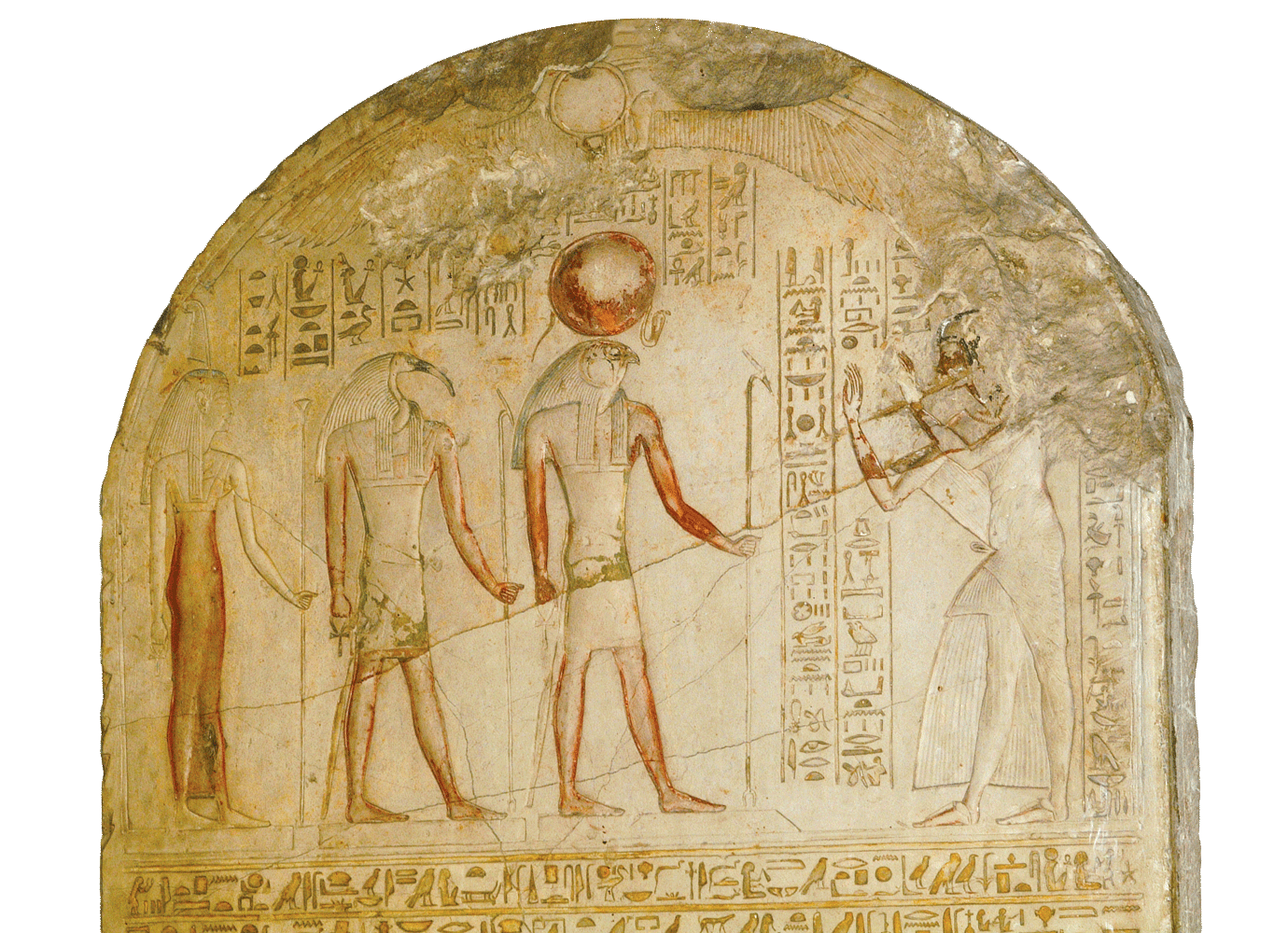
Proverbs 3:16 says of Wisdom, “Long life is in her right hand; in her left hand are riches and honor.” The same concept is visually portrayed in an Egyptian stele (tomb of Horemheb, Saqqara, 18th dynasty): life (the ankh) is held in the gods’ right hands and power and authority (the scepter) in their left.
Proverbs 3:5–10 continues the pattern of verses 1–4, the odd-numbered verses containing commands and the even verses promised results. Verses 5–6 encourage complete reliance on God and his revealed will—rather than on oneself—in all decisions and actions. As a result, God will help one to head straight for the goal and avoid unnecessary detours. Verses 7–8 continue the theme of life direction, with verse 7a paralleling verse 5b. The phrase “in your own eyes” directs one’s attention back to verse 4, “in the sight [literally “eyes”] of God and man”; here it is a question of whose approval one values. Ironically, although Proverbs repeatedly emphasizes the quest for wisdom, the greatest folly is to assume that one has arrived (3:7a), for that fosters self-reliance. Verse 7b underlines the inseparable relationship between wisdom, piety, and obedience. Reverence for God compels a person to avoid all that is displeasing to God (Prov. 8:13; 16:6; 23:17; cf. 13:19), and living a life that thus avoids destructive behavior will enhance one’s physical well-being (4:22).
Verses 9–10 imply that trusting God completely includes trusting him with one’s material needs by returning a portion of one’s wealth. Verse 9 contains a rare mention of sacrifices in Proverbs; the offering of first fruits is described in Exodus 23:19 and Deuteronomy 18:4. The assurance in verse 10 speaks of abundance but not necessarily of miraculous multiplication (cf. Israel’s corporate covenantal promises: Lev. 26:3–5; Joel 2:23–24). Verses 11–12 serve as a counterpart to verses 5–6, encouraging the youth, as in verse 1, to be receptive to instruction. Here the Lord is compared with a loving parent who, of necessity, dispenses both discipline and corrective rebuke (the pair appears nine times in Proverbs, always in this order; cf. Deut. 8:5; Heb. 12:5–6).
A threefold recommendation of wisdom is given in 3:13–26. (1) The person who finds personified wisdom will experience a happy, pleasant, and lengthy life (3:13–18; “blessed” begins and concludes the unit). By use of several richly evocative metaphors, wisdom is described as incomparably more profitable than precious metals or gems, as offering tranquil paths, and as a life-giving and life-enhancing tree (Prov. 11:30; 13:12; 15:4; cf. Gen. 2:9; 3:22, 24; Rev. 2:7), which is truly worth hugging! (2) The very same treasures that a person can “find” or “gain” according to 3:13 were foundational when God created the cosmos (3:19–20; Proverbs 8 expands on this claim). Divine knowledge is reflected in God’s superintendence of nature in both catastrophic (Gen. 7:11) and everyday (Job 36:28) circumstances. If wisdom and understanding were essential even for God in carrying out his creational and providential tasks, how much more should we as humans consider their acquisition indispensable for carrying out our responsibilities in God’s world! (3) The final unit modifies the instructional form by abbreviating the charge (3:21) and expanding the explanation (3:22–26). You should hang on to your specialized skills in advising and decision making, for they literally can save lives (as detailed in 3:23–26; cf. 1:33) and enhance your reputation (3:22; cf. 1:9).
Proverbs 3:27–35 describes the impact of acquired wisdom on interpersonal relationships, thus corresponding to 3:5–12. These verses suggest that one can avoid “the ruin that overtakes the wicked” (3:25; both 26 and 32–34 point to divine causality) by not treating others wickedly. Verses 27–30 are parallel in formulation, each beginning with a negative imperative (“do not”) followed by a qualifying phrase. The first two verses address good deeds that should not be neglected, while the next two deal with evil deeds to be avoided. (Don’t harm the one who has not harmed you!) The fifth negative imperative, in 3:31, warns against envying a violent person, presumably because no punishment for such actions is apparent, leading one to copy those ways. Verses 32–34 give the rationale for this prohibition by noting God’s response. Above all, such people are detestable to the Lord (3:32). This is the first of twenty-one occurrences of the word toebah in Proverbs (here, what the Lord “detests”; translated as “abomination” in the KJV), which designates morally or cultically abhorrent practices (e.g., aberrant sexual relationships, idol worship, occult activities, child sacrifice, eating unclean food, sacrificing defective animals, business fraud). The godly, however, are offered friendship with God, literally his “secret counsel” (NKJV; cf. Ps. 25:14; 55:14; Amos 3:7). Various proverbs suggest that one’s behavior can influence the well-being of one’s entire household (3:33)—they often share one’s attitudes and actions and will share also in one’s fate. Five different designations for the “bad” person appear in 3:31–35, as well as four designations for the “good.” Verse 35 characterizes the preceding actions and attitudes under the general rubrics of wisdom and folly as moral categories and presents their well-deserved consequences: honor or shame.
4:1–27. Proverbs 4, which concludes the positive commendation of wisdom, consists of three instructions, each of which begins with a direct address (4:1, 10, 20). In 4:1–9, which utilizes several terms from the preceding section, the father passes on counsel from his own father that is marked by another metaphorical presentation of wisdom as a woman. Verse 1 uses “my sons” rather than “my son” for the first time in the book (cf. Prov. 5:7; 7:24; 8:32), which, along with the reference to the mother in Proverbs 1:8 and 6:20, suggests that a parent rather than a professional teacher (as some claim) is speaking here. The call to heed is grounded not in consequences but rather in an awareness of one’s family heritage. The grandfather’s words are quoted in 4:4b–9. Obedience brings life (4:4b = 7:2a)—this is a promise not of eternal life but of an existence enhanced both qualitatively and quantitatively, as developed in the preceding instruction (3:2, 18, 22). “Get” (Hebrew qanah, 4:5, 7) is a favored term, used fourteen times in Proverbs. There is an intimate relationship between retaining (godly) parental instruction and acquiring wisdom and understanding, and the latter should be one’s top priority. The metaphorical Lady Wisdom is hinted at in 4:5 (since one can “get” or “acquire” a wife; cf. Ruth 4:5), but she emerges clearly in verses 6–9 (similar to 3:13–18): you should not “forsake” (also 4:2) wisdom but rather lovingly embrace her. In return, wisdom will guard (2:11) and grace you like a crown.
A second instruction follows in 4:10–19, which, like 1:10–19, warns against following the “way” or “path” (i.e., mode of behavior; 4:11, 14, 19) of the wicked rather than wisdom’s way. The twofold path is a common motif within the wisdom tradition and is found throughout the Old Testament and New Testament (e.g., Prov. 12:26, 28; Ps. 1:6; 119:29–30; Jer. 6:16; 21:8; Matt. 7:13–14; 2 Pet. 2:15). In a culture in which this-worldly prosperity was often viewed as a sign of divine blessing and an early death as a divine curse, no greater motivation could be given to a youthful audience than the promise of a long, good life marked by steady progress rather than stumbling (4:10–12; cf. 3:6). Verses 16–17 explain why one should completely avoid the “path” of evildoers (4:14–15): such individuals are obsessed with carrying out wicked and violent actions. It literally makes their day, being as essential to their existence as bread and wine. Verses 18–19 offer an additional reason. The way of the righteous person just keeps getting brighter as one proceeds along it, while the way of the wicked is always utterly dark. (Note the poetic justice in the contrasting uses of “stumble” in 4:12, 16, 19.)
A final section, 4:20–27, is dominated by positive imperatives, again promising life to those who keep to the right path (4:22, 23; cf. 10, 13). The contrast in verse 21 between losing sight of and retaining these words within the heart involves not simply memorizing them but rather consistently keeping them in mind when deciding what actions to take in a given situation. Sustained health is a frequently emphasized component of the promise of life (4:22) resulting from wise living. One should watchfully protect the heart from all harmful influences, such as twisted talk and crooked conversation (4:24; also 6:12). This must become a top priority, because life-determining decisions flow forth from the heart as control center. Verses 24–27 describe how to safeguard one’s heart. (Proverbs 4:20–27 begins and ends with the same command, “turn” [literally “turn aside from”].) Wisdom and folly engage the entire person: ear (4:20), eyes and eyelids (4:21, 25), body/flesh (4:22), heart (4:21, 23), mouth and lips (4:24), and feet (4:26–27). The concluding verses take up the path metaphor, warning the youth, as in chapter 2, to get on the right track and then to avoid getting sidetracked (cf. Deut. 17:20; 28:14; Josh. 1:7; 23:6; 2 Kings 22:2; 2 Chron. 34:2).
C. Warnings against folly, especially sexual infidelity (5:1–7:27). Proverbs 5–7 forms the second major section of the prologue. Whereas the lessons in chapters 2–4 primarily involve the commendation of wisdom and its benefits, those in 5–7 offer warnings against folly (i.e., against harmful relationships) and its consequences, especially involvement with “the loose woman.” Instruction regarding sexual issues (5:3–6, 8–20; 6:24–35; 7:16–19) is supplemented by ethical instruction on other topics (6:1–19) and framed by introductory and concluding material (5:1–2, 7, 21–23; 6:20–23; 7:1–4).
5:1–23. Proverbs 5 differs from chapters 6–7 in its positive commendation of marital fidelity and its delights. A general warning against the “strange” (KJV) or “adulterous” (NIV) woman (5:3–6; see commentary on 2:1–22), which expands on 2:16–19, follows the usual call to attentiveness (5:1–2). Acquiring discretion (5:2) is critical because the loose woman is so dangerously seductive to those who lack it. Sweet (Song 4:11) and smooth flattering talk (5:3; cf. 2:16; 6:24; 7:5, 21) may constitute an irresistible combination, but in 5:4 the woman is unmasked. In reality she is like gall and a double-edged sword. The NIV’s “gall” is literally “wormwood” (5:4; cf. Jer. 23:15; Lam. 3:19), a nonpoisonous (despite NLT’s “poison”) plant known for its bitter taste and use in eradicating intestinal worms. The phrase “in the end” introduces an important concept in Proverbs (5:4; cf. 5:11; 14:12, 13; 16:25; 19:20; 20:21; 23:18, 32; 24:14, 20; 25:8; 29:21). The wise person sees beyond the attractive (or painful) present to the ultimate consequence (or benefit), as summarized in Ecclesiastes 7:8. This attractive woman is headed downward toward death (5:5) due to her carelessness (5:6). The same Hebrew verb translated here as “she gives no thought” (5:6), denoting scrutinizing attention, occurs in 4:26 and 5:21. In Proverbs, ignorance of what one is doing (i.e., staggering down a crooked path like a drunkard [cf. Isa. 29:9] or a blind person [Lam. 4:14]) and of its consequences is characteristic of the foolish individual (see also Prov. 4:19; 7:23; 9:13, 18).
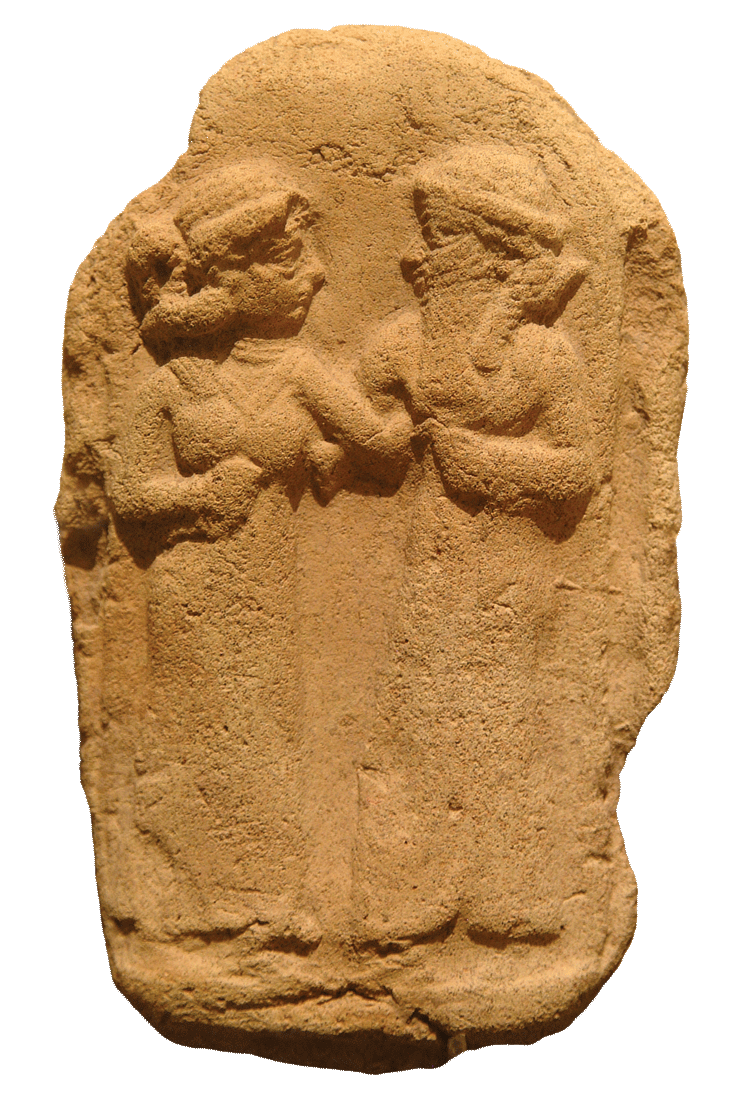
Clay plaque from Ur of an affectionate couple (2000–1750 BC)
A specific warning against this woman follows in 5:7–14, with the introductory phrase “now then” calling for an appropriate response to what verses 1–6 have just presented (cf. 7:24; 8:32). The farther away from danger one stays, the less likely one is to be drawn in by her wiles (5:8) and suffer for it (5:9–11). Three consequences are noted. (1) You will “lose your honor” (or “splendor,” 5:9a)—perhaps referring, in light of verse 9b, either to possessions amassed through payment for years of hard work or, more likely, to service rendered to a cruel taskmaster (or an angry husband; cf. 6:34–35)—as a penalty for being caught in the act (5:9–10). (2) With poetic justice, the young man who yields to the “strange woman” (5:3, Hebrew zarah) will end up giving his strength to satiate “strangers” (5:10, Hebrew zarim)—the son has more to lose than his virtue! (3) He also will experience physical anguish and debilitation (5:11); venereal disease could be the cause. The remorseful fool rages angrily (5:12–14). He has learned too late the high cost of rejecting discipline and correction (cf. Prov. 1:7, 30) offered by parents or teachers (financial and physical ruin and social ostracism), barely avoiding an even worse fate (e.g., death).
In 5:15–20, the speaker shifts abruptly to a call for sexual fidelity and praise of marital bliss. Sexual pleasure within the context of marriage is addressed in verses 15, 17a, 18–19; sex outside of marriage is discouraged in verses 16, 17b, 20. The parental charge begins with a vivid but tasteful water metaphor (reminiscent of Song 4:12, 15), developed positively in verse 15 and negatively in verse 16 (cf. 7:18; 9:17; Song 5:1). The repeated use of “your” in 5:15–18 emphasizes the exclusivity, not the possessiveness, of the relationship between husband and wife. Verse 15 describes an intentional, private, refreshing “drink,” verse 16 a promiscuous, public, and polluted “overflow” or “spill” (NLT). Thus the initial warning not to yield to the woman’s allure, lest one be forced to share one’s prized possessions (i.e., wealth) with strangers, is followed by a warning against voluntarily sharing one’s most valuable “possession” (i.e., his wife) with strangers (5:17, 20) due to a permissive lifestyle. Verses 18–20 describe the exhilaration of marital sexuality. One’s lifelong partner (cf. Prov. 2:17; Mal. 2:14), or “loving doe” (5:19; cf. Song 2:7; 3:5), is a source of both delight and intense pleasure. There is a striking progression in the verbal sequence in verses 18–19: “praise her . . . enjoy her . . . and continually be intoxicated by her [also 7:18] until you stagger!” (author’s translation). That the son should trade such pure ecstasy for the thrill of an illicit liaison is inconceivable (5:20).
The father’s warning against sexual indiscretion is sealed by a theological rationale (5:21–23). God carefully notes and assesses everything that a person does (5:21), and a lack of self-discipline as well as sinful folly (5:23; cf. 5:12–13) can capture, hold fast, and even destroy a person. Abandoning one’s wife for the lure of the seductress may cause one’s head to spin, but it can be a fatal misstep (the same Hebrew verb, “stagger,” occurs in 5:19–20 [NIV “intoxicated”] and 23 [NIV “led astray”]).
6:1–35. The next lesson, in 6:1–19, treats several topics related to financial affairs (6:1–5), work (6:6–11), and negative character traits (6:12–19), followed by another lesson on sexual morality (6:20–35). A common tone unites the chapter, as the father warns his child, either explicitly or implicitly, against loans (6:1–5), laziness (6:6–11), evildoers (6:12–15), a catalog of detestable actions (6:16–19), and the prostitute (6:20–35).
6:1–19. In the first section (6:1–5), the parent/speaker begins exceptionally by immediately sketching a dangerous scenario the youth should escape. The subject of guaranteeing loans is addressed elsewhere in Proverbs (11:15; 17:18; 20:16; 22:26; 27:13) and is illustrated by Judah’s actions in Genesis 43:8–9; 44:30–34. Whether one formally seals the deal with a neighbor or a stranger, one has in effect been trapped by one’s words. Since such a transaction is not regulated by Mosaic legislation, there is only one thing to say: “Free yourself” (6:3, 5) immediately, no matter what it takes. Compassion for a financially strapped friend is not the issue here; intentionally jeopardizing one’s economic well-being is an action to be avoided at any cost.
The next section (6:6–11), regarding laziness, is linked to the preceding unit in three ways. Both involve actions that negatively affect one’s financial well-being, warn against sleeping at the wrong time (6:4, 9), and employ the imperative “go” (6:3, 6). This is the first of many appearances of the lazy man (NIV “sluggard”) in the book (Prov. 10:26; 13:4; 15:19; 19:24; 20:4; 21:25; 22:13; 24:30; 26:13–16). In a book that emphasizes deliberate, decisive, and diligent behavior, laziness is a serious character flaw. Ancient Near Eastern (and contemporary) wisdom commonly turns to nature to illustrate positive and negative behavioral patterns, and the ant has much to teach the slacker (6:6–8; also 30:25), including initiative, diligence, and timely preparations for future needs. The speaker seeks to rouse the slothful person from any form of excessive repose (i.e., sleep, slumber, or rest; 6:9–10), thereby avoiding a truly rude awakening: being suddenly overpowered by poverty (6:11; cf. 24:33–34).
While lazy individuals are their own worst enemies, others are far more dangerous. Five characteristic actions of those labeled “troublemakers” and “villains” are noted in verses 12–15, which lack any conceptual connection with the two preceding sections. The word translated “troublemaker” is a Hebrew compound word, familiar from the KJV “sons of Belial,” meaning “without profit”—that is, useless. The term occurs twenty-seven times in the Old Testament (cf. 16:27; 19:28); it is used to describe the men of Gibeah who gang-rape the Levite’s concubine (Judg. 19:22; 20:13) and the sons of Eli (1 Sam. 2:12). “Villains” are destructive abusers of power; both are perverse societal menaces. Their twisted words, devious (though obscure) gestures, and perverted minds constantly foment dissension (6:14). Just as for the lazy, sudden disaster awaits them (6:15). Their actions hardly seem to warrant such harsh divine punishment compared with the bloodthirsty band of thieves similarly threatened in Proverbs 1:26–27. Wisdom ethics, however, gives greater value to the integrity and well-being of the family and the community than to an individual’s personal preferences.
In justifying this threat, a list of seven detestable vices follows in 6:16–19 (cf. Prov. 26:25). The “numerical” form of verse 16 (i.e., “There are six . . . , seven”; cf. Job 5:19) is found in various types of Old Testament literature, most notably in Proverbs 30:18–31, as well as in Ugaritic and Akkadian texts. This form places climactic emphasis on the final element, which is here quite similar to 6:14b. Far from advocating a mechanical link between deed and consequence, Proverbs affirms that Yahweh ultimately upholds justice in his world. The word “detestable” (KJV “abomination”; Hebrew toebah; see commentary on 3:1–35) occurs frequently in Proverbs, compared to, for example, Deuteronomy. Each of the first five actions in this vice list involves a body part, in a sequence moving downward from head to foot, indicating the totality of one’s involvement in mischief (6:17–18). The final two vices (6:19) diverge stylistically, perhaps involving actions that depend on the preceding five. Since the order here is climactic, attacking the integrity of the family or clan unit (through instigating disputes, 6:19b) is viewed as more heinous than perverting the legal system (through false witness, 6:19a; cf. 12:17; 14:5, 25; 19:5, 9; 21:28; 25:18).
6:20–35. This next lesson resumes the typical instructional form, with an extended call to heed the parental counsel (6:20–23) preceding the specific warnings (6:24–35). It also takes up the topic of Proverbs 5, developing the grave consequences of sexual immorality more fully. Presumably one ties the commands of both parents “around your neck” (6:21) in order to keep them plainly in view when deciding which direction to head. Verse 22 cites three daily situations in which such instruction proves useful, offering guidance, protection, and a conversation partner—metaphorically speaking, both a proper path to follow and a light to illumine it (6:23a; cf. Ps. 119:105).
In particular, this counsel is intended to keep the youth from the immoral woman (6:24; NIV “your neighbor’s wife”), who can ruin his life. This smooth-tongued temptress, already familiar from chapters 2 and 5, is called literally “a woman of evil.” This expression occurs only here in the Old Testament; the Septuagint may have read a similarly written word, translating “married woman.” The admonition in verse 25 consists of a twofold warning. The negative command, “Do not lust in your heart after her beauty” (6:25a), recalls the tenth commandment (Exod. 20:17; Deut. 5:21), which employs the same Hebrew verb, while the NLT’s “Don’t let her coy glances seduce you” (6:25b) vividly captures the process. The remainder of the instruction (6:26–35) details the dangers that one will thereby avoid. While every prostitute has her price, the adulteress will, metaphorically speaking, stalk you like prey (6:26; cf. Job 10:16; Mic. 7:2). This is the first reference to prostitution in Proverbs (cf. 7:10; 23:27; 29:3); however, the emphasis here is clearly on adultery (cf. 6:29, 32, 34).
Two additional vivid comparisons are made. (1) Whoever commits adultery is playing with fire and bound to get burned (6:27–29). “No one . . . will go unpunished,” in verse 29, recalls the covenantal formulation in Exodus 20:7; 34:7; Numbers 14:18; Deuteronomy 5:11; and Nahum 1:3 (see also Prov. 11:21; 17:5; 19:5, 9; 28:20). (2) Whoever “steals” what belongs to another, whatever the motivation (e.g., being sex starved; 6:30), will be punished when caught (6:29–35; the Mosaic law mandates only twofold restitution, compared to the sevenfold requirement here; cf. Exod. 22:3–4, 7). Here the consequences for violating the eighth and seventh commandments are contrasted (Exod. 20:14–15). Anyone committing adultery lacks judgment (6:32, literally “lacks heart”; NIV “has no sense”), since it is a self-destructive act (similarly 7:22–23), as verses 33–35 detail. Lasting shame will be the least of his problems! The rage of a cheated husband knows no bounds; no restitution payment or bribe will assuage his jealous desire for revenge (Prov. 27:4; Song 8:6). And it all began with a few flattering words and some eye makeup (6:24–25).
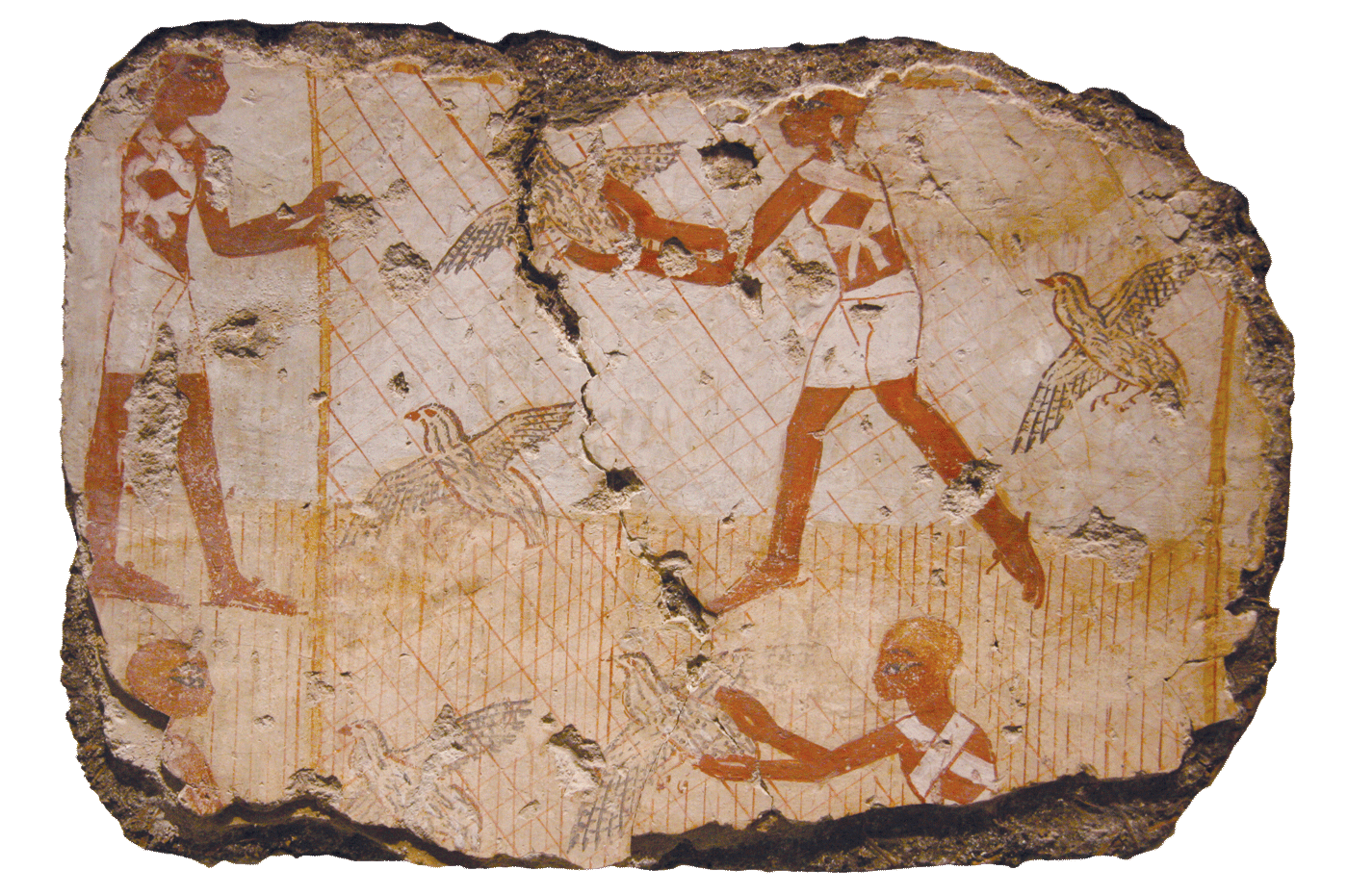
Proverbs 7:23 likens succumbing to temptation to “a bird darting into a snare,” as depicted in this painting of men using a net to catch quail (tomb of Nebamun, Egypt, ca. 1350 BC).
7:1–27. The extensive warning against the “wayward” or “adulterous” woman concludes with a final lesson in chapter 7, which focuses on the temptation. Its structure is quite similar to that of the preceding lesson, consisting of a call to heed (7:1–4), a nearly identical purpose statement functioning as a warning (to “keep you from . . . ,” 7:5; cf. 6:24) and an extended illustration (7:6–23), and an explicit warning (7:24–27; cf. 6:25). Once again, the goal of the instruction is to preserve and enhance life (7:2; cf. 4:4). Accordingly, these wisdom-imparting commands are to be treasured (cf. Prov. 2:1), carefully preserved both externally and internally (cf. Prov. 3:3; 6:21), as diligently protected as the pupils of one’s eyes (= “the apple of your eye,” 7:2), and welcomed as “family” (7:4). A wordplay binds the introduction together: keep my words (7:1), and they will keep you safe (7:5).
The temptation is portrayed as a scenario observed by the speaker through the window of his home (7:6). The victim is portrayed as easy prey—and not completely innocent: young, naive (cf. Prov. 1:4), lacking judgment (cf. 6:32), and heading for her house just as night falls (7:7–9). The adulteress is shockingly goal-oriented, heading straight toward him, clothed like a prostitute to cunningly camouflage her actual marital status, a familiar sight around town, defiant, brazen, and aggressive (7:10–13). As Waltke sums it up, “she ‘rapes’ dull men by clever deceit” (Waltke 2004, 374), literally ambushing them (7:12; cf. 1:11, 18). Her seductive speech seals the deal (7:21; hence the repeated warnings: 2:16; 5:3; 7:5). Her reference to recently fulfilled vows suggests both fidelity in worship and fresh meat to dine on (7:14). The youth alone is the object of her attention and affection, or rather, of her lust (7:15, 18; contrast 5:19); her bed has been specially prepared and perfumed for him (7:16). Multicolored imported linens and exotic fragrances indicate her wealth and provide an enticing love nest. Best of all, they can enjoy a secret, all-night tryst without any fear of getting caught (7:19–20).
Her mission is successful: “All at once he followed her” (7:22a). Instead of describing the anticipated sensual ecstasy, the description concludes with three animal similes (7:22b–23). Having yielded to his animal instincts, the youth is reduced to a doomed beast. He is as oblivious as an ox headed for slaughter, a stag stepping into a noose (following the Septuagint; NASB follows the Masoretic Text: “as one in fetters to the discipline of a fool”), or a bird darting into a snare. Certain death awaits all four (cf. 6:26, 32). Perhaps now the sons will pay closer attention (7:24) when warned against straying onto her path (7:25). Suddenly the simple scenario observed through a window is replaced by a broad mural portraying a multitude of similarly stupid victims who once crowded the highway that headed straight down to hell—or at least a dead end in the local cemetery (depending on one’s interpretation of Sheol, 7:26–27).
D. Wisdom’s final appeals (8:1–9:18). In Proverbs 8–9, personified Wisdom makes her final appeal, speaking again in the first person to her young audience.
8:1–36. Chapter 8 offers a lengthy discourse commending wisdom, which can be divided into four sections. In verses 1–11, wisdom’s surpassing value is asserted, while verses 12–21 portray wisdom’s “associates” and attributes. Wisdom’s worth is then further affirmed in a description of its ancient origin—at the time of creation (8:22–31), before wisdom assumes the role of the parent/sage in directly urging the “sons” to heed her counsel (8:32–36).
8:1–11. Lady Wisdom’s appearance here is reminiscent of Proverbs 1:20–33, with 8:1–3 paralleling 1:20–21 and 8:5 similar to 1:22, although her message in chapter 8 is more positive. She stations herself in places of prominence, commerce, and heavy traffic, where as many will hear her voice as possible (8:1–3). She does not confine herself to the temple or palace—or to the covenant people of Israel—for her appeal is to all humanity, in particular to those most in need of understanding (8:4–5). In verses 6–9 she stresses the moral excellence rather than the eloquence of her speech: it is trustworthy, right (cf. Prov. 1:3; 2:9), reliable, righteous, honest (cf. Prov. 24:26), and faultless, devoid of any deception or perversion. Thus her instruction is more valuable than the most precious metals (8:10; 3:14); indeed, wisdom is incomparably desirable (8:11 = 3:15, briefly abandoning the personification for a third-person reference to wisdom).
8:12–21. The mention of wisdom in verses 1 and 11 leads to verse 12, in which wisdom refers to herself for the first time: “I, wisdom . . .” In the Hebrew text, the repeated use of the independent pronoun “I” in 8:12, 14b, 17 punctuates the section (8:12–21), as wisdom gives an extensive self-introduction. Whereas 1:2–6 simply introduces various terms associated with wisdom, in 8:12 these are presented as wisdom’s housemates. Verse 13a seems to interrupt the flow. The expression “fear of the Lord,” however, occurs strategically in Proverbs 1–9 (1:7, 29; 2:5; 8:13; 9:10). Here it grounds wisdom’s attitude toward arrogance, evil, and corruption. Together with the description of her speech in the preceding section, it clearly demonstrates that wisdom is primarily a moral, not an intellectual, enterprise. Verse 14 emphasizes precisely those attributes essential for all government officials (8:15–16): counsel and ingenuity, discernment and power (the Hebrew term for “power” occurs only here in Proverbs; it most commonly refers to the power possessed by God). “I have insight” in 8:14b is literally “I am insight”; that is, insight is “part of her very essence” (Waltke 2004, 402) but is also available to all who welcome her.
In verse 17, “I” introduces a subunit bracketed by “those who love me” (8:17–21). Wisdom’s “love” here involves bestowing her rich gifts on all who desire her, not just on rulers. Those “who seek me find me” (8:17b) evokes passages such as Deuteronomy 4:29; Jeremiah 29:13; and Matthew 7:7 (also Matt. 6:33, which describes how “all these things will be given to you as well”). Verse 19 grounds the claim in verse 10, and wisdom’s “fruit” is not simply material wealth (8:18). “Righteous(ness)”/“just” occurs five times in chapter 8 (vv. 8, 15, 16 [see NIV note], 18 [NIV “prosperity”], 20). Since wisdom walks about on just paths (cf. Prov. 12:28; Ps. 23:3), practicing what she preaches, she gives goods only to her lovers (8:20–21).
8:22–31. A new section commences by associating wisdom not with earthly rulers (as in 8:15–16) but with Yahweh, the Creator of the universe (8:22). This section then proceeds to describe wisdom’s ancient origin and earliest activities. Although God is the subject of all verbs in verses 22–29, wisdom’s close association with him is emphasized repeatedly. A number of interpretive difficulties are found in this section. God’s first action is to create/bring forth or to acquire/possess wisdom. In the Old Testament, the Hebrew verb qanah can be used to express both of these activities. Elsewhere in Proverbs (cf. 1:5; 4:5, 7; see commentary on 4:1–27) and in the majority of its Old Testament occurrences, “acquire” is the most likely nuance of qanah. In 8:22 it could simply affirm that God already possessed (having previously acquired) wisdom when he began his work of creation, and some Greek translations interpret it similarly. In Genesis 4:1, probably Genesis 14:19, 22, and Psalm 139:13, the verb describes instead the act of bringing something into being. The Greek Septuagint and Aramaic Targum translate the verb as “create” in Proverbs 8:22. More importantly, other verbs in this section also speak of wisdom’s origin or birth (e.g., “formed” in 8:23, “given birth” in 8:24–25), without implying the involvement of any divine sexual partner. The interpretation of the verb qanah has played a significant role in christological discussions, since many early Christian interpreters, including Tertullian, Origen, and Athanasius, identified “wisdom” in Proverbs 8 with Jesus, on the basis of texts like Colossians 1:15 and 2:3. Ironically, some contemporary interpreters find instead in Proverbs 8 support for an ancient Israelite goddess! It is best simply to understand wisdom here as a personified divine trait.
Verses 22–29 have many images and terms in common with other poetic creation texts, such as are found in Job, Psalms, and Isaiah, except this language is subordinated to the section’s emphasis on the “priority” of wisdom, both temporally (“before” and “when” occur repeatedly in these verses) and in importance. These descriptions express God’s wise planning and sovereign control (using seven different Hebrew verbs) rather than either a primitive, prescientific cosmology or revelatory knowledge of the universe’s makeup. In 8:30–31, the focus shifts to wisdom’s role (“Then I was . . . I was”). The rendering “the craftsman” or artisan in NIV 1984 (8:30a) is one of several suggested translations for Hebrew amon, supported by its use in Jeremiah 52:15 and a similar word in Song of Solomon 7:1. It could refer either to wisdom or, more likely, to Yahweh, who constructs the cosmos in this section. The NIV reads “constantly” (literally “faithful”), which is supported by “always” (literally “at every time”) in 8:30b. A preferable option is “little child” (literally “one looked after”; see NIV note), as in Lamentations 4:5 and Esther 2:20 (“bring up”), which Fox takes verbally as “growing up” (Fox, 287). This is supported by the references earlier to wisdom’s birth and by the actions described in 8:30b–31 (cf. Isa. 66:12, which translates “delight” as “dandled”; the other verb here can be translated “laugh/play”). Wisdom was continually beside God, delighting (see Psalm 119, regarding God’s law) and reveling in what he was creating day by day. More specifically, she was celebrating the creation of planet Earth and of humanity. If wisdom has been delighting in us since the creation, should we not delight in wisdom as well?
8:32–36. “Now then, my children,” in 8:32, signals the transition to application. Exceptionally, wisdom replaces the parent here. By heeding wisdom’s instructions (“listen” occurs three times) day by day, one can become wise (8:33–34). Two contrasting claims conclude this discourse (8:35–36). To find wisdom is to find life and to obtain divine favor (cf. Prov. 12:2; 18:22), whereas to miss wisdom is to be self-destructive, since wisdom-haters are death-lovers (cf. 8:17, 21).
9:1–18. The prologue comes to a climax in chapter 9 with invitations to two rival banquets, raising the question of which voice the sons will heed and whose meal they will share—wisdom’s or folly’s? The two descriptions are similar in structure and formulation (9:1–6, 13–18) and are separated by a theological interlude (9:7–12). Therefore, it is helpful to compare the two rather than consider them separately. The “Woman of Wisdoms” (9:1, an intensive plural, also 1:20) is competing with Lady Foolishness (9:13, only here in the Old Testament). The former, Wisdom, is characterized as diligent and prosperous by her extensive preparations of house (its seven columns imply perfection) and banquet and her employment of servants (9:1–3a). The latter, Folly, makes no preparations and is labeled explicitly as loud, gullible, and ignorant (9:13). Both own a house (9:1, 14) and station themselves “at the highest point of the city” (9:3b, 14b). Both call out (9:3a, 15a), issuing an identical general invitation (9:4 = 9:16), although the latter’s audience is specifically described as following a straight course until she detours them (9:15). Both offer a free meal. Wisdom shares her food and self-mixed wine (9:5), while Folly provides only stolen water and pilfered food (9:17), their source adding flavor to the menu. Both scenes conclude by noting the consequences of accepting the respective invitation (9:6, 18). Wisdom calls for the simple to abandon their naive ways (or naive companions) and henceforth proceed with discernment. Folly on the contrary conceals the fate of her dinner guests: her gravy will be followed by the grave (similar to Prov. 7:26–27)! By concluding the introductory section of Proverbs on this tragic note, the author/sage not only extends a final warning but also implies that not all his youthful readers will heed it.
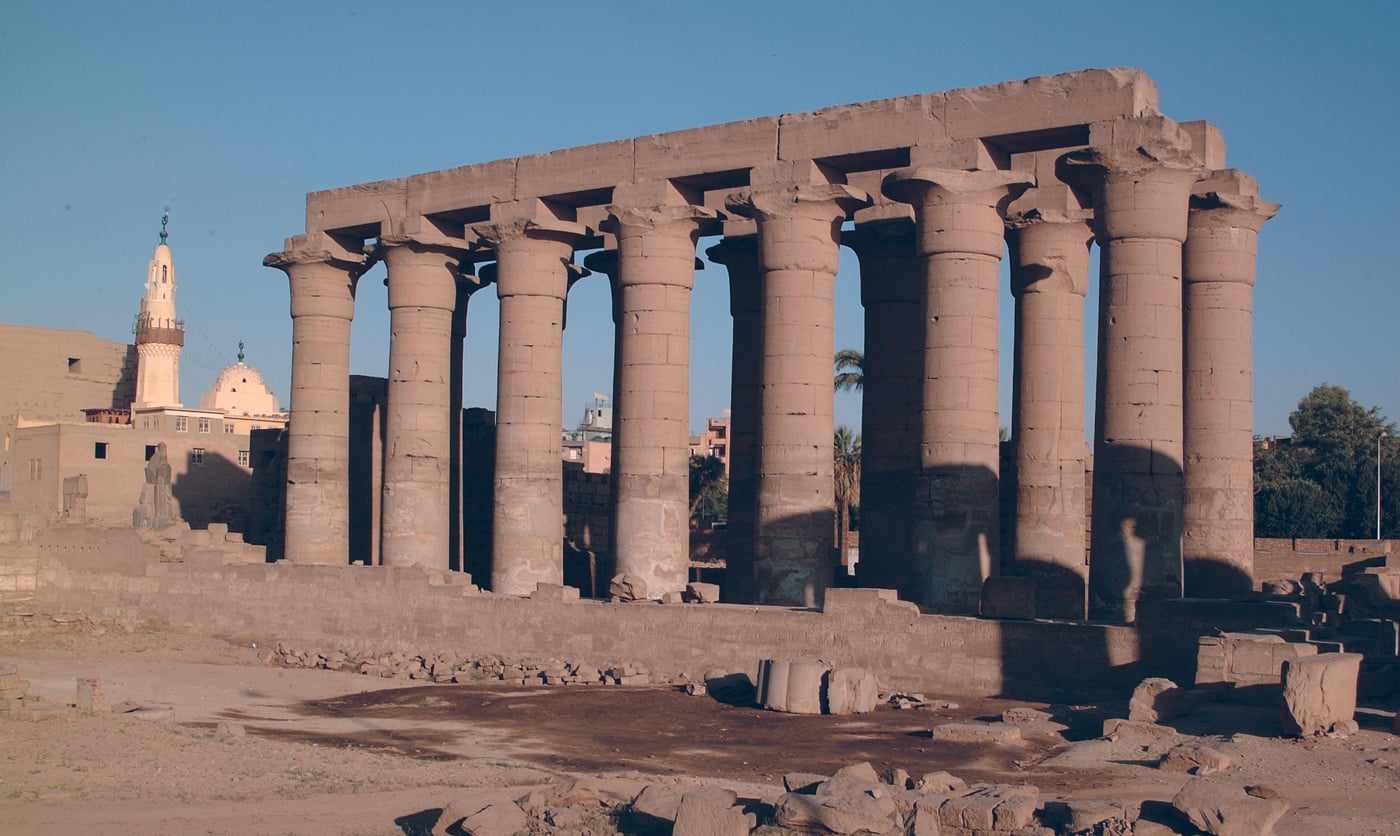
Wisdom lives in a house of seven pillars (Prov. 9:1), similar to the two sets of seven pillars that mark the colonnade of the court of Amenhotep II (18th dynasty) at the Temple of Luxor, Egypt.
This outcome is already anticipated by the intervening section, verses 7–12. This section, which contrasts two potential audiences for wisdom’s correction, ironically begins and ends by referring to the mocker. Some will reject the painful message and hate and abuse the messenger (9:7–8a); others will continually receive and benefit from the message (cf. Prov. 1:5) and understandably love the messenger (9:8b–9). The pairing of the mocker, one of the worst types of fools, with the wicked in verse 7 and the wise with the righteous in verse 9, underlines the near interchangeability of these two categories in Old Testament wisdom teaching. The foundational place of reverence for Yahweh is affirmed once more (9:10; cf. 1:7), while personal knowledge of the utterly Holy One (an intensive plural; cf. Isa. 6:3) will not be mentioned again until Proverbs 30:3. The section begins by addressing the sage as one who instructs others (9:8–9). It concludes, however, by highlighting one of wisdom’s prime benefits—an extended life span (9:11)—and by emphasizing that both wisdom and folly, despite their social consequences, make the greatest impact on the individual (9:12). Thus the way is prepared for wise individuals to profit from the various proverbial collections that begin in chapter 10.
3. Proverbial Collections: Advanced Instruction in Wisdom (10:1–29:27)
If one views Proverbs 1–9 as a basic introduction to proverbial wisdom, then chapters 10–29 serve as the advanced course. Or, to express it differently, the prologue presents and commends wisdom, while the collections that follow illustrate the scope and variety of situations in which wisdom is advantageous (without absolutely guaranteeing success) if employed properly and in a timely manner. Proverbs 1–9 also gives the reader a theological lens through which to read the individual proverbs. Although many of them seem to be secular and even mundane, viewing individual proverbs through the lens of (1) the fear of the Lord as foundational, (2) wisdom as both divine gift and human acquisition, and (3) the wise as righteous and fool as wicked will transform one’s evaluation and application of them. Furthermore, regardless of the original social setting that gave rise to such sayings, in terms of interpretation their life setting is now less important than their book setting. The assertions and admonitions of individual verses are now qualified, expanded, explained, generalized, or illustrated by the verses that surround them.
All interpreters of Proverbs acknowledge that chapters 10–31 constitute an anthology containing various proverbial collections diverse in style, content, and origin. What is disputed is the extent (or even the existence) of compositional design within and between the various collections. Stated simply, is the order (and literary context) of the individual proverbs significant and therefore to be taken into consideration when interpreting each verse? Or should one view each proverb as an independent literary unit and interpret it as such? The second approach has dominated commentaries in the past and is adopted in the recent commentary by Tremper Longman III (see Longman 2006). For more than two decades, however, the first approach has been explored in numerous learned monographs and briefer studies and employed by most contemporary commentators, most fully by Bruce Waltke (see Waltke 2004–5). Those skeptical toward this newer approach dismiss alleged compositional patterns as imposed rather than identified by the interpreter, asserting that “whoever seeks, will find,” or, at the very least, “if there’s any doubt, don’t [claim any editorial intentionality].”
Several lines of evidence converge in support of this newer viewpoint, without demonstrating that every proverb and every collection exhibit editorial design. (1) Since the ancient sages devoted themselves to analyzing and ordering their world, it is likely that they also gave order to their literary compositions. (2) Some of the ancient Near Eastern instructional texts, especially from Egypt, contain thematic groupings of proverbs. (3) Ted Hildebrandt has demonstrated that there are dozens of paired proverbs within the book, which should be taken together (as “proverbial pairs”) (Hildebrandt 1988). (4) The repetition of words, phrases, clauses, half-verses, and entire verses within individual or adjoining chapters is too frequent to be coincidental. (5) Such repeated clauses or verses sometimes appear to mark the beginning and end of sections or subsections. (6) Consecutive proverbs frequently offer comments on the same general or specific topic. Since reading is essentially a sequential process, it is natural to read each succeeding proverb in light of those that immediately precede it. (7) The center of the book is marked by the highest concentration of references to Yahweh and the king, the same verbs being used with reference to both subjects. On the basis of these seven features, we will seek to point out, where possible, striking indications and implications of compositional design in the following chapters.
A. The original Solomonic collection (10:1–22:16). 10:1–15:33. Proverbs 10–15 is characterized by the predominance of contrasting (i.e., antithetical) parallelism within the individual proverbs and an emphasis on the righteous/wicked (e.g., 10:3, 6–7, 11, 16, 20, 24–25, 28–30, 32) rather than on the wise/fool (10:1, 8, 13–14, 23).
10:1–32. Chapter 10 offers a clear illustration of how the newer approach highlights possible connections between verses. A new title in verse 1a indicates that a new section/collection begins here. If one analyzes these verses in terms of positive and negative behavior or outcomes, a pattern emerges (see Table 1).
In the first subunit (10:1–5), verse 1b offers a general description of the effects that wise and foolish children have on their parents, while verse 5 concludes the subunit by noting the specific behaviors that elicit this response. Verse 2 compares the relative worth of “ill-gotten treasures” and righteousness, while verse 3 offers an explanation. The Lord provides for the righteous while preventing the wicked from satisfying their cravings. Verse 4 implicitly qualifies such provision; it may come through diligent labor rather than by just relaxing and waiting for it. Those who indulge in the latter behavior bring poverty upon themselves (10:4a) as well as disgrace upon their parents (10:5).
The second subunit (10:6–11) emphasizes the impact of both edifying and harmful speech, culminating in verse 11: a righteous person’s words can be life-giving. The second line of each verse describes the fate of the wicked/fool. Notably, both verses 8b and 10b, and 6b and 11b, are identical, which is unlikely a coincidence; such repetition is emphatic. Verse 7a explains the “blessings” of the righteous, while verse 7b offers a contrast.
Table 1: Examples of Contrasting
Parallelism in Proverbs 10
| First subunit | ||
|---|---|---|
| 10:1 | + | − |
| 10:2 | − | + |
| 10:3 | + | − |
| 10:4 | − | + |
| 10:5 | + | − |
| Second subunit | ||
| 10:6 | + | − |
| 10:7 | + | − |
| 10:8 | + | − |
| 10:9 | + | − |
| 10:10 | − | − |
| 10:11 | + | − |
The third subunit (10:12–21) begins by contrasting hatred (also in 10:18) with love, the latter half of the verse being quoted in James 5:20 and 1 Peter 4:8. One who hates foments discord, while one who loves overlooks offenses. The wise “store up” (cf. Prov. 2:1; 7:1) knowledge (10:14a) rather than relying on amassing wealth like the rich do (10:15a) and are assured that their “wages” as righteous individuals are “life” itself (10:16a). That is because a lack of judgment can result in a physical beating (10:13b) and even death (10:21b). They also realize that not only poverty (10:15b) but also one’s careless words (10:14b) can be ruinous. The effects of speech are again prominent in this subunit (10:13–14, 18–21); the restraint of the wise in this area adds value to their words (10:19). The righteous/wise not only experience life but also can lead others to life (10:16a, 17a, also 21a; cf. 10:11a).
The fourth subunit (10:22–26), which Waltke labels “Pain and Pleasure” (Waltke 2004, 473), begins by referring to the Lord’s blessing as bestowing wealth without pain (10:22; the same Hebrew root is translated “grief” in 10:10; cf. 10:14–16). Employing a lazy person, however, can be a painful experience (10:26). This subunit is framed by synthetic proverbs rather than antithetical, as in verses 23–25. The foolish/wicked and the wise/righteous find pleasure in different things (10:23) and with contrasting results (10:24–25).
The final subunit (10:27–32) consists exclusively of positive-negative verses. Following the introductory thematic reference to the “fear of the Lord” in verse 27a, reinforced by the “way of the Lord” in verse 29a, the first half of each verse mentions the “righteous” (or “blameless,” in 10:29a). Verses 28–30 affirm their stability, while verses 31–32 focus on their speech. The fear of the Lord not only extends the life of the righteous but also governs their tongues, ruling out any perversity. Although not every succeeding chapter can be analyzed here in such detail, similar patterns, links, and associations are often evident.
11:1–31. As Proverbs 11 begins, verses 1–2 introduce the specific theme of (commercial) integrity and the general theme of wisdom respectively before describing some benefits of honesty and righteousness in 11:3–6. The repetition of “by” in verses 5b and 6b indicates how the wicked bring about their own doom (11:7). Three paired verses are linked next. The righteous are “delivered” (11:8–9; NIV “rescued”), which produces joy in the “city” because of their civic contributions (11:10–11), in contrast with the destructive speech of the wicked (11:9a, 11b), who do not preserve neighborhood confidences (11:12–13). The community focus introduced in verse 10 continues in verse 14, which affirms the guidance provided by wise advisors. It concludes in verse 15, which echoes the sentiment of Proverbs 6:1–5.
The next section introduces a positive pair: a gracious woman and a kind man (11:16–17), who themselves benefit from their attitude. She gains honor, while the ruthless only get rich, harming themselves in the process of earning deceptive wages; this ultimately will end not in comfort but in death, since their perversity makes God their foe (11:16b, 17b, 18a, 19b, 20a—which parallels 11:1). To sum up, the wicked will not escape punishment, unlike the righteous (11:21). Verse 22 offers a qualification to verse 16a, since “gracious” (NIV “kindhearted”) can have a broad range of nuances. She may be charming, but if she loses her good judgment, she will quickly turn ugly.
The following unit is framed by verses 23 and 27, which both refer to the unspecified “good” (Hebrew tob) that the righteous desire, allowing a broad application. Since they seek “only” good for themselves and others, they will get what they are looking for; ironically, so will the wicked (11:27b)! Verses 24–26 describe the paradoxical nature of two contrasting attitudes toward one’s possessions—one type of “good.” The generous keep on giving to others while continuing to prosper (contingent, of course, on God’s blessing, 11:26b), while stingy hoarders may experience “only” impoverishment.
Those who trust in wealth rather than in God (11:28, perhaps therefore hoarding it; contrast 3:5) put themselves at risk. Fools can easily ruin not only themselves but also their whole households. The fool will thus be reduced to debt slavery and leave nothing for the family to inherit except wind (11:29, the source of the 1960 movie title; cf. Eccles. 1:14). The righteous, however, will flourish and nourish like a healthy tree (11:28b, 30a). The soul-winner’s favorite verse, 11:30b (e.g., NIV 1984 “he who wins souls is wise”), could stem from a faulty translation. The expression “to take souls” normally means to kill, as the Greek Septuagint apparently translates (cf. Prov. 1:19). Given the associations in this verse with the righteous, the wise, and a tree of life (cf. Gen. 2:9), however, a negative meaning is unlikely. One should then read verse 30b in light of verse 30a, as recommending either that wise people pick for themselves the fruit of this tree, thereby enjoying “lives” (an intensive plural; cf. NIV “the one who is wise saves lives”), or that they take others to this tree, without its fruit being limited to eternal life. Verse 31 offers an emphatic summary of the opposite “rewards” of the righteous and the wicked, anticipating requital during their earthly sojourn.
12:1–28. Proverbs 12 begins with three general proverbs (12:1–3). Verse 1 indicates the necessary attitude toward instruction and correction (i.e., love; cf. Prov. 4:6), which, according to verse 2, is displayed by a good person who gains God’s approval (cf. 11:1, 20, 27) and thus is established as righteous, unlike those who futilely pursue success through evil (12:3).
Verse 4 introduces a domestic context with the virtuous wife (cf. Prov. 31:10), who contributes to her house standing firm (12:7, similar to 12:3). These verses reveal a progression from character (12:4) to plans (12:5) to words (12:6) to consequences (12:7), with the negative clauses developing from disgraceful behavior to deceitful advice to destructive words to downfall and doom.
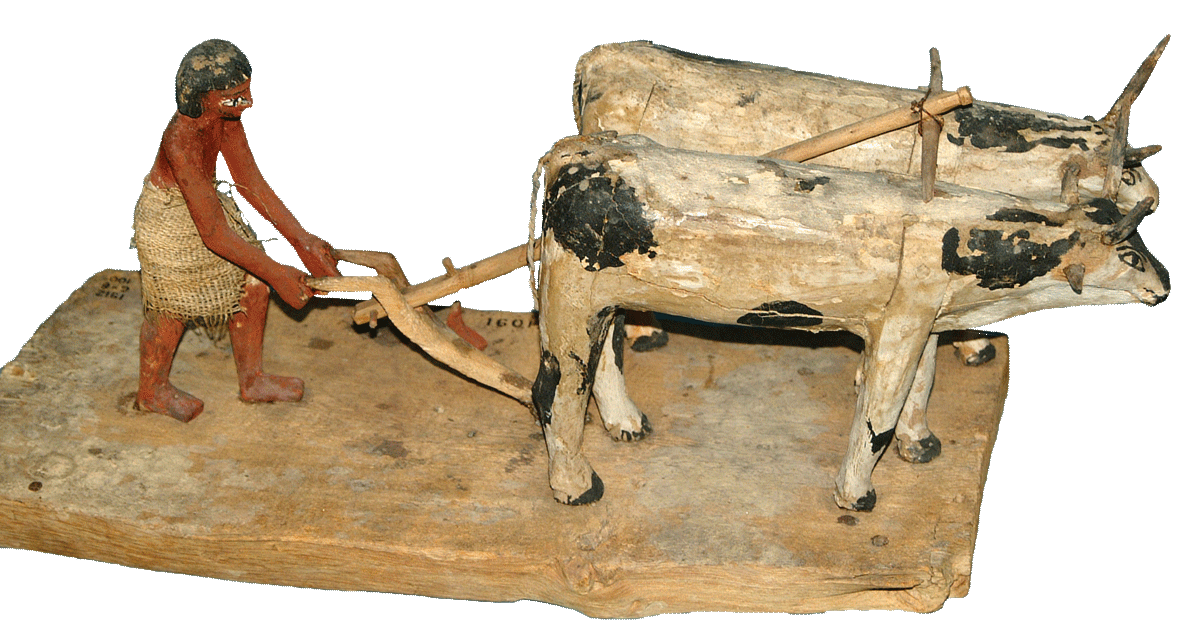
According to Proverbs 12:11, “Those who work their land”—like the figure in this wooden model, who is plowing with two oxen (Egypt, second millennium BC)—”will have abundant food.”
Proverbs 12:8–12 focuses on work. One’s reputation should be derived from one’s prudence (12:8), not from one’s pretense (12:9). On the farm, righteousness expresses itself even in one’s treatment of animals (12:10) and wisdom in diligently tilling the field to produce plentiful crops (12:11). Metaphorically speaking, employing a wordplay connected to agriculture, the righteous person’s “root” yields fruit (12:12). An additional word repetition is suggestive: those who lack sound judgment (12:11b) will likely lack bread (12:9b). The wicked, however, are not content to “chase fantasies” (12:11b), preferring a “snare” to capture prey (12:12a; cf. KJV “net”; the NIV’s “stronghold” substitutes the object for the instrument—the meaning here is disputed).
Speech is the focus of the lengthy unit 12:13–23. Ironically connected to the preceding verse (12:12a), evil persons can themselves be “snared” (NIV “trapped”) by their own defiant utterances (12:13a), although one’s lips can bear good “fruit” as well (12:14a). The wise heed spoken advice, while fools think they need none (12:15). The shrewd also ignore an insult, while fools immediately respond by displaying their vexation (12:16; cf. 9:7). In a legal setting, honest rather than deceitful testimony is sought (12:17); both inside and outside the court, words can hurt or heal (12:18). Truth will ultimately prevail, much to the joy of those promoting peace, but lies will be exposed, as will the deceitful hearts that spawned them (12:19–20). Trouble will therefore overwhelm the wicked, while the righteous will be spared (12:21; cf. 22:8), because the Lord detests lying lips while approving of those who are trustworthy (12:22; cf. 12:2). Thus speech is a key area in which the wise and the foolish greatly differ. The wise do not tell all they know; the foolish loudly proclaim their folly (12:23, also 12:15–16).
Work’s reward is mentioned in passing in verse 14b; in verses 24–27, the contrast between the diligent and the lazy frames a brief unit. The diligent will rise to exercise authority over others or at least enjoy hearty meals, while the lazy will descend to conscripted labor or at least go hungry (12:24, 27). Verse 25 recalls another important power from the preceding section—the healing power of the tongue (cf. 12:18b). If one modifies the vowels of its first word, 12:26 affirms that “the righteous has an advantage over his neighbor” (Heim, 157), as illustrated in verse 27, since the righteous are, in Proverbs’ conceptual world, both wise and diligent. Verse 28 concludes the chapter, contrasting the “way of the wicked” (12:26) with the “way of righteousness” (12:28), which leads not simply to a long and full life but even to an unending life (literally “no death”; NIV “immortality”; see also Waltke 2004, 518).
13:1–25. Following an introductory proverb affirming the receptivity of the wise (13:1), Proverbs 13:2–6 briefly takes up themes of the previous chapter, linked by the repetition of “appetite, soul” (Hebrew nepesh, which occurs four times in 13:2–4). One’s words can fill one’s life with either luscious or foul fruit, and thus restraint in speech is essential (13:2–3), just as diligent labor enables one to fulfill one’s desires (13:4). The righteous eschew false words (NLT “lies”), thereby protecting their lives (13:5a, 6a). The wicked, in contrast, enjoy broadcasting odious scandal (cf. same verb in Gen. 34:30; Exod. 5:21) and suffer the consequences (13:5b, 6b).
Wealth and poverty are examined in 13:7–11. Wealth can be feigned (13:7) or life-saving (13:8a) and can rapidly disappear if acquired dishonestly rather than through sustained effort (13:11). Those living in poverty, in contrast, cannot respond to a painful rebuke (13:8b; cf. 13:1b), much less a death threat. Verse 9 affirms that the righteous shine more brightly than the wicked, whom God will extinguish (cf. Prov. 20:20; 24:20), and in this context more brightly than the wealthy, who may soon fade. Verse 10b echoes the sentiment of 13:1a: wisely accepting advice is the opposite of arrogant quarreling (13:10a).
A lengthy unit on fulfillment versus frustration follows in 13:12–19, as indicated by the expression “a longing fulfilled,” which brackets the section in verses 12b and 19a. This allows one to interpret verses 13–18 as indicating how wise and foolish actions lead to contrasting outcomes: a sick heart or a life-giving tree (13:12). Wise actions include obeying God’s commands, heeding wise instruction and correction (13:13–14, 18), acting prudently (13:15–16), and serving reliably (13:17). Such behavior will result, respectively, in reward, a fountain of life, favor, healing, and honor—a truly “sweet” outcome (13:19a)!
A parent’s legacy is the focus of 13:20–25. According to verses 22 and 24, the legacy can be both material and moral in nature. The righteous are rewarded with “good things” (13:21b), such as fertile fields producing abundant food (13:23a, 25a). A “good person” can pass these things on to heirs (13:22a), though wealth can be lost both through one’s own misdeeds (13:22b) and through injustice (13:23b). In a society in which child abuse is far too prevalent, the call to apply the rod conscientiously as an expression of parental love (13:24) strikes one as antiquated. Here one should note (1) that the rod is mentioned seven times in Proverbs, and its “pedagogical effectiveness” in instilling wisdom is praised (29:15); (2) that God is our model for loving correction (3:11–12); and (3) that the parent’s primary educational tool is not the rod but wise instruction, as exemplified in 13:20, which can be translated imperatively (following alternative Hebrew readings): “Walk with the wise and become wise” (so the NIV).
14:1–35. Commentators disagree regarding how to subdivide Proverbs 14. Striking here is the opening clause (14:1a, “The wise woman builds her house”), which echoes 9:1. It is followed by the first of three occurrences of “the fear of the Lord” in the chapter (14:2, 26–27). One’s conduct reflects one’s attitude toward God (14:2). Wise behavior is constructive; folly is destructive (14:1, 3; the NIV 1984 emends KJV’s “rod of pride” to “rod to his back”). Verse 4 offers a homey illustration of how one wisely builds a house: without oxen there is less cleanup work to do in the barn, but less harvested grain as well.
The focus of 14:5–7 is speech, both in a legal setting (14:5; cf. 12:17) and in general. Mocking fools cannot obtain wisdom; therefore, their words will be devoid of true knowledge (14:6–7).
Proverbs 14:8–15 addresses self-perception and self-deception, framed by the phrase “the prudent give thought to their ways/steps” (14:8, 15). The prudent perceive where they are heading, while fools do not have a clue! Mockers do not even take sin (and the resultant need to make amends) seriously, while the upright do and receive (divine) approval (14:9). One can be equally clueless about another person’s private pains and pleasures and their commingling (14:10, 13, both with “heart”). Verse 11 is linked to its context by the word “upright” (cf. 14:9, 12) and its use of the house motif (cf. 14:1). It also reflects the seamless alternation (and virtual equation) of wisdom/folly and righteousness/wickedness in Proverbs. Verse 12 continues the main theme: one may be deceived about the deadly destination of a “way” that appears to be straight (or “upright”; cf. Prov. 12:15; 16:2). A backslider is punished for choosing wrong “ways,” while the “good” are rewarded (14:14). Hence, only the gullible will believe whatever they are told (literally “every word”); the prudent are more reflective (14:15).
This concluding verse also introduces the next development in thought (14:16–18). In carefully considering their “steps,” the wise display their reverence for God by making a wide detour around evil (14:16a; cf. 3:7; 4:27). Fools, however, exhibit reckless, uncontrolled behavior, which is conduct the uncorrected, naive person naturally inherits (14:15a, 16b–18a). The prudent, in contrast, easily acquire knowledge to augment their skill set for dealing with life’s challenges (14:18b; cf. 14:6b, 15b).
Proverbs 14:19–24 initially describes two unexpected attitudes (see “evil . . . good” in 14:19, 22). The wicked bow down before the righteous, though probably against their will (14:19), and the poor are hated even by their peers, while many love the rich, though probably for questionable reasons (14:20). Such an attitude toward the needy merits condemnation as sin, since they of all people deserve kind treatment (14:21). Those who, in fact, “plan what is good” will both practice and experience steadfast love (NIV “love and faithfulness”; Hebrew hesed and emet; cf. Prov. 3:3; 16:6). But merely planning good (i.e., “mere talk”) accomplishes little—no pain, no gain (14:23). Accumulated wealth is a “crowning” achievement for the wise (cf. 14:18, 35), while all that fools multiply is folly (14:24).
Life-and-death matters are addressed in 14:25–27. Verse 25 affirms the life-saving power of a truthful witness in a capital case (cf. 14:5 in the context of speech), while a proverbial pair describes three metaphorical benefits of reverence for God (14:26–27). It provides a secure fortress to protect one’s children and a life-giving fountain (cf. Prov. 13:14), while keeping one from deadly snares, since those who fear God will avoid both evil and divine punishment and will experience God’s favor and blessing. Verses 30 and 32 also concern life and death. Verses 28–35 are framed by national concerns: the value of a large population (14:28), the even greater value of a righteous population (14:34), and the king’s understandably strong response to a servant’s shameful actions (14:35). The intervening proverbs could then be taken as describing some of those shameful actions (as well as their opposites). Short-temperedness, envy, and oppression of the poor, as expressing contempt for one’s Maker and refuge (14:29–32), are juxtaposed with patience, tranquility, and kindness to the needy (cf. 14:21), and wisdom so striking that even fools—and the king—take note (14:33; cf. 14:35a).
15:1–33. The covenantal name Yahweh occurs nine times in Proverbs 15 (and also in chap. 3), giving this instruction a more explicitly theological tone. Verses 1–4 focus on speech, with verse 1 taking up the motif of (the king’s) anger from 14:35. It notes that a gentle answer can roll back the waves of anger (the Hebrew word for “answer” occurs four times: 15:1, 23; 16:1, 4), while a painful word further stirs it up. Waltke comments regarding verse 2a: “Instead of brutalizing people with their knowledge of the cause-effect relationship in God’s ordained moral order, the wise state it kindly, sensitively, and gently with an aim to save their audience, not to condemn and destroy it” (Waltke 2004, 614). Verse 3 reminds us that this cause-effect nexus is not mechanistic but rather is upheld by an ever-observant God. Verse 4 corresponds to verse 1, contrasting the soothing and spirit-crushing power of the tongue, using the favored analogy of the life-giving tree (cf. Prov. 3:18; 11:30; 13:12). Mention of individuals who reject correction (i.e., fools and mockers) brackets the next section (15:5–12), giving it a focus on the benefits of instruction. Great treasures as well as great knowledge are available to those who will heed it (15:6–7). More important, one living a righteous life experiences God’s favor and love (15:8–9) rather than animosity leading to divine discipline or death, as God punishes wayward actions and attitudes (15:10–11).
The reference to the human heart in 15:7b and 11b is taken up in verses 13–15, which juxtapose the value of a joyful/cheerful heart with that of a discerning one and contrast two metaphorical menus (15:14b, 15b). Verse 14b also parallels verse 2b, illustrating the saying: “Garbage in, garbage out.” Two “better-than” proverbs (15:16–17) take up the meal imagery as well as the heart attitudes of the preceding verses (discernment [v. 14] ← fear of the Lord [v. 16]; joy [v.15] ← love [v. 17]), debunking society’s elevation of wealth and plenty. One’s heart attitude is more important than one’s circumstances. Verse 18 concludes the unit by suggesting one source of turmoil and animosity—a hot-headed individual. Such a person is also repeatedly mentioned as a social menace in Egyptian instructional texts.
By contrasting the sluggard’s thorn-impeded path with the superhighway of upright people (literally “straight ones”), verse 19 identifies laziness as a moral issue. Verbal links connect the following verses. Only a discerning individual walks “straight” (15:21b). A father finds joy in a wise son (15:20; cf. 10:1); one lacking sense, in folly (15:21); and an audience, in an apt answer (15:23; cf. 15:1). Verses 22–23 highlight two important features of wise counsel: more is better, and timing is everything (Eccles. 10:11).
Proverbs 15:24–29 contrasts five actions, individuals, and consequences, three of which explicitly mention God: the way of the prudent leading upward to life (15:24), the attitude of the proud bringing down their house (15:25), the plans of the wicked provoking God’s displeasure (15:26), the deeds of one who pursues illicit gain troubling their family (15:27; cf. Josh. 6:18; 7:25), and the careful words of the righteous being heard by God (15:28–29). The righteous reflect before replying (15:28a; cf. 15:23); the wicked blurt out evil (15:28b; cf. 15:2b). Therefore, the Lord distances himself from the wicked while hearing the prayer of the righteous (15:29; cf. 15:8).
This major section, Proverbs 10–15, concludes with 15:30–33. (According to Waltke 2005, 5–6, these verses serve rather to introduce the next major section.) Verses 31–32 use a form of the word “hear” (NIV “heed”). Although hearing good news can cheer and refresh the “heart” (15:30), heeding correction can preserve life, give one a home among the wise, and impart sound judgment (literally “heart”; cf. “lacking of heart,” 15:21; 15:31–32). Such receptivity to wisdom’s instruction is rooted in the fear of the Lord, which teaches one that humility always precedes honor (15:33).
16:1–22:16. The second section of the major proverbial collection, presumably also “Solomonic,” gives counsel for rulers and for everyday life. Whereas contrasting (antithetical) proverbs dominate Proverbs 10–15, in chapters 16–22 the second line of a proverb more frequently reinforces or completes the assertion in the first. Although the thematic contrast between the wise and the foolish continues, the contrast between the righteous and the wicked is far less prominent than in chapters 10–15. For example, “righteous” (Hebrew tsaddiq) occurs thirty-nine times in chapters 10–15 but only ten times in chapters 16–22. Similarly, “wicked” (Hebrew rasha) occurs forty-two times in chapters 10–15 but seventeen times in 16–22.
Proverbs 16:11 states, “Honest scales and balances belong to the Lord.” In the model shown here, a deben (right), a stone weight used in ancient Egypt, is used to measure the accurate weight of a Ptolemaic bronze coin (left) from 250 BC.
16:1–33. Chapter 16 constitutes the center of the book, the rabbinic editors marking verse 17 as the middle verse. Therefore, it is significant that the second greatest concentration of “Yahweh” (or “Lord”) and the greatest concentration of “king” (cf. chap. 25) in the book occur here. The relationship between divine and delegated rule is explored in 16:1–15; verses 10–11 mark the transition. Several terms refer to both God and king (e.g., “detests” [respectively, 16:5, 12]; “atone/appease” [16:6, 14]; “take pleasure in” [16:7, 13]; “establish” [16:9, 12]), supporting this comparison.
God’s sovereign involvement in human affairs is expounded in verses 1–9—a theological gold mine. (Corresponding affirmations begin and conclude the chapter in 16:1, 33.) We can order our thoughts, but God facilitates effective speech (16:1). He evaluates our motives, even if they are hidden to us (16:2). Thus we can commit our activities to him to give them lasting value (16:3). Every human action receives an appropriate divine response (literally “answer”), including the evil day awaiting the wicked (16:4). He detests and will punish their arrogant behavior (16:5). Though “steadfast love” (NIV “love”) in dealing with others can make amends for their failures, God-fearers will avoid such evil in the first place (16:6). God, however, can enable those pleasing him to live in harmony even with their foes (16:7). Therefore, the righteous needy are really better off than the wicked wealthy (16:8). Verse 9 summarizes: we can responsibly make plans (echoing 16:1a), but God “establishes” our steps (so the NIV in 16:3b, 9b).
The righteous king (16:10–15) will model similar attitudes and surround himself with like-minded aides, experiencing similar divinely bestowed success. He will exalt just verdicts, standards, actions, and words (16:10–13), which will temper how he wields his delegated authority over life and death (16:14–15).
As one crosses the midpoint of the book of Proverbs, wise and foolish speech are again described (16:16–30). Verses 16–19 are introductory and sound familiar notes: wisdom’s supreme value (16:16) and a straight road that avoids both evil and disaster (16:17). The familiar proverb “Pride goes before a fall” contrasts the parallel clauses of verse 18. In context, and paired with verse 19, it illustrates what the “upright” of verse 17 will avoid. Wisdom gives life stability.
Proverbs 16:20–24 concerns wise speech. Heeding instructions and trusting in the Lord (16:20) are both characteristic of the humble (16:19). A sage’s reputation for insight, a spoonful of rhetorical sugar, and skilled speech issuing from a wise heart all serve to “promote instruction” (16:21, 23). This encourages others to drink from discretion’s life-giving fountain rather than being chastened like fools (16:22). The holistic benefits of “pleasant” or “gracious words” are emphasized in 16:24 (cf. 12:18; 13:17; 15:4).
The destructive speech of fools offers a striking contrast (16:25–30). Proverbs 16:25 is identical to 14:12, perhaps repeated here to underline this contrast, while 16:26 is linked to 16:24 by the word “soul/appetite” (Hebrew nepesh; see also commentary on 13:1–25). As a general proverbial statement, it describes the inner forces that produce external actions—both good and evil. Words can burn like fire (16:27), igniting discord, separating intimate friends (16:28), and luring the unsuspecting onto harmful bypaths (16:29). Evil lips can even be used to gesture to one’s accomplices in carrying out one’s perverse plots (16:30).
The chapter closes in 16:31–33 by summarizing central wisdom themes. Righteous conduct leads to a long life (16:31), and conquering oneself (literally “one who governs his spirit”) is more significant than conquering a city (16:32). Above all, life is not a crapshoot; God ultimately controls everyone’s destiny (16:33).
17:1–28. There are fewer internal verbal and conceptual links within chapter 17 than in the preceding chapters, making it difficult to discern subunits. There is a domestic emphasis, with “house” in verses 1 and 13; “son/child” in verses 2, 6, and 25; and “brother” in verses 2 (NIV “one of the family”) and 17; while friendship is mentioned in verses 9 and 17–18. The initial verses portray unexpected values or incongruous situations (17:1–8). A dry morsel eaten in tranquility is deemed better than fresh meat eaten amid strife (17:1; cf. 15:16–17). The disturbed home motif continues in verse 2, with a wise servant supplanting a son as heir. God assesses the purity of one’s heart attitudes (17:3), unlike the wicked, who apparently prefer listening to malicious words (17:4)—such as mockery of the poor and their calamity, as well as of their Maker—thereby provoking punishment (17:5). Some people view their grandchildren or parents, rather than a rich wardrobe, as their crowning glory (17:6; cf. 16:31). Excessive speech is inappropriate for a senseless person and, even more so, deceitful speech for a ruler (17:7). Bribes, however, often work like a lucky charm, bringing success rather than reprisal (17:8).
The verses that follow highlight beneficial and destructive relationships (17:9–20). One’s response to an offense can either deepen or destroy a friendship (17:9; cf. 16:28). A well-intentioned rebuke (from such a friend) can make a deep impact (17:10), while a rebel may receive a harsher message (17:11). A fool on the loose is more dangerous than an angry she-bear (17:12), such as a fool who repays good with evil, bringing unending disaster on his home (17:13). Similarly, provoking strife releases flood waters, causing great damage (17:14), while perverting justice provokes divine displeasure (17:15). Even given sufficient cash, a fool will not acquire wisdom (17:16). A true friend constantly offers loving support, especially when there is trouble (17:17). There is, however, a limit to the assistance that one can wisely give: don’t secure a friend’s debts (17:18; cf. 11:15). Whereas some love their friends (17:17), others show affection for sin and strife, erecting pretentious, perverse, and thus precarious barriers between themselves and others, and so inviting disaster (17:19–20).
Proverbs 17:21–28 portrays a foolish child causing grief in the family (17:21–22, 25) and a wicked person (by juxtaposition, presumably the same individual) perverting justice (17:23, 26). Such a person lacks a proper perspective (17:24), as well as proper restraint in speech and in controlling emotions (17:27–28).
18:1–24. The thematic emphasis of Proverbs 18:1–8 is the fool’s speech. Accordingly, 17:27–28 could be viewed as introductory or transitional. The theme is launched by introducing three types of speakers: the antisocial person, the fool, and the wicked. The antisocial person (literally “one who separates himself”; cf. 17:9) pursues self-gratification, leading him to irrationally provoke quarrels (18:1; cf. 17:14; 20:3). The fool “takes fatuous pleasure in his morally bankrupt heart’s exposing itself” (Waltke 2005, 70), rather than in gaining understanding (18:2). Contempt for others accompanies the wicked person, and the feelings are mutual (18:3). One can drown in words, but wise speech is a continual source of refreshment (18:4). One must not show partiality to the wicked, thereby skewing justice (18:5), but sooner or later their words will bring them down (18:6–7). Verses 8–9 close the unit by introducing two more destructive individuals: the gossip, whose juicy rumors are eagerly devoured, and the slacker, who is also a societal saboteur (cf. Prov. 26:22).
The next unit begins with an ironic proverbial pair (18:10–11). Whereas the righteous seek refuge in the towering character of their God, the rich vainly consider their wealth as making them invulnerable to trouble’s assault. Such haughty thoughts (literally “high heart,” a wordplay) precede doom, while the humility of the righteous is rewarded (18:12; 12b = 15:33b). Haughtiness also leads one to respond before considering what a conversation partner has to say; this can also lead to humiliation (18:13), and perhaps even to a crushed spirit, which is worse than disease (18:14). In contrast, the ears of the wise eagerly listen and learn (18:15).
Disputes, especially within a legal context, are dealt with in 18:16–21. Accordingly, “gift” probably refers to a bribe or private present that secures an unfair advantage for a person rather than to generosity or giftedness (18:16; cf. 21:14). Verse 17 affirms the persuasive power of a well-crafted argument—at least, prior to cross-examination. Verse 18 commends the alternative of casting lots to settle a dispute, since God, rather than elders, then determines the outcome (16:33; Jon. 1:7). This is preferable to leaving the offended person less approachable than a fortified city (18:19; cf. 18:11). The proverbial pair in verses 20–21 describes speech’s dual effects and fits the disputational context well. The words that we speak can satisfy like fruit, but we may have to harvest and eat our words (18:20). No wonder people love (and should fear) the tongue’s ability to dispense both life and death (18:21).
Proverbs 18:22–24 fits well with the initial emphasis on companionship, especially the poor person’s lack thereof in 19:1–7. Verse 22 begins with the most intimate of human relationships, affirming that finding a (wise) wife is valuable (cf. 8:35; 19:8) and an indication of divine favor. The poor, however, often find themselves alone, their pleas for compassion rebuffed by the rich (18:23). Yet even with companions you can come to ruin if you lack a true friend (literally “one who loves”), who will stick with you in a crisis (18:24; cf. 15:9 [a divine friend?]).
19:1–20:4. The initial verses of chapter 19 continue the theme of companionship, with an emphasis on the poor (19:1–9). Despite the social ostracism experienced by the poor, it is better for them to maintain their integrity in word and deed than to resort to perverse speech like a fool (19:1). Lacking knowledge, the fool rushes ahead and slips (or NKJV “sins,” 19:2). When his own folly thus subverts his course, he angrily blames God (19:3). New companions flock to the wealthy while abandoning the poor (19:4). Whereas a fool with “twisted” or “perverse” lips may self-destruct (19:1b, 3), a false witness will be directly punished by God (19:5). People flock to the ruler (not “generous man” [NASB, ESV], 19:6) as to the rich, seeking the best friend that money can buy. In contrast, the poor are even hated by their siblings and abandoned by companions. No words can bring them back (19:7). Verse 8 is connected to 18:22 and 19:2 by the Hebrew word for “good”: to find a wife is to “find what is good,” to lack knowledge is “not good,” and by preserving understanding one literally “finds good” (and therefore “prospers”). The unit concludes by repeating verse 5, changing only the last word. Those acquiring sound judgment love their lives (19:8a), while profuse liars will perish (19:9b).
Verses 10–15 focus on the court and the home. Verse 10 is transitional: it is not fitting for fools to enjoy luxury, not because it is undeserved, but because they cannot use it well (cf. Prov. 26:1). Similarly, slaves are unsuited for leadership roles (also 30:22), especially if lacking wisdom (cf. 14:35; 17:2). In context, the high value of forbearance and forgiveness is applied to the king, who will either refresh like dew or rage like a lion—but it could apply to a courtier as well (19:11–12). Verses 13–15 juxtapose a dysfunctional and a healthy household. In the dysfunctional home, a foolish son ruins the father’s estate, probably through chronic laziness (19:15), while his quarrelsome wife irritates like a leaky roof. In the healthy household, the estate is preserved and enhanced through the skill of the God-given wife.
These contrasting homes prompt a mini lesson on parental instruction (19:16–29) similar to Proverbs 1–7, with imperatives (commands or exhortations) in 19:18, 20, and 27 and references to Yahweh (“the Lord”) in verses 17, 21, and 23. Heeding instruction, rather than living carelessly, preserves life (19:16). An alternate reading verse 16b is “be put to death” (i.e., by God), suggesting that “his ways” (NIV 1984) refers instead to God. This is supported by verse 17: showing kindness toward the poor (thus resolving 18:23) is one of God’s foundational “ways.” Thus parents who neglect discipline designed to instill wisdom in their children are actually seeking their premature death (19:18) and may end up repeatedly bailing them out of trouble (19:19)! Whereas verse 18 directly addresses the parent, verse 20 directly addresses the child: wisdom, not subordination, is the ultimate goal. Verse 21 juxtaposes valuable human counsel and sovereign divine counsel (19:20a, 21b); divine counsel always prevails. The human longing for “loyal love” (Hebrew hesed; NIV “unfailing love”) in verse 22a recalls 18:24, while verse 22b echoes 19:1. The NIV’s alternate translation for verse 22a (“Greed is a person’s shame”) is influenced by 22b but less likely. Reverence for God leads to a life marked by fulfillment and protection from harm (19:23). A contrasting portrait of inconceivable laziness (19:24) recalls the vice that first prompted this lesson (19:15). The mocker is immune to discipline’s benefit and knowledge (19:25), resulting in the kind of son who disgracefully mistreats his parents (19:26; cf. 19:13a). Thus the lesson concludes by ironically reversing 19:20 in 19:27.
Proverbs 19:28–20:4 describes several foolish menaces to society who deserve a beating. This reference to “beatings” serves to bracket chapter 20 (19:29; 20:30), while the word “mock” links 19:28–20:1. Such “fools” include the worthless (Hebrew beliyyaal) witness and the wicked, who gulps down (Hebrew yeballa, a wordplay) evil (19:28); the drunken brawler (19:1); raging, roaring royalty (20:2; cf. 19:12a); the instigator of quarrels (20:3); and the destitute sluggard (20:4).
20:5–30. Verses 5–13 consider challenges to accurate assessment. The metaphor “deep waters” in verse 5 is unclear but probably negative (cf. Prov. 18:4 and Ps. 69:2, 14). The sometimes dubious intentions of a person are hidden in the depths of the heart, but a discerning person can bring them to the surface for a closer look. Similarly, not everyone proclaiming “loyal love” is to be taken seriously, for faithful friends are rare (20:6). Those leading a life of integrity, leaving a trail of blessing, are clearly identifiable as righteous (20:7). The trained eye of the king is capable of distinguishing between the righteous grain and wicked chaff (20:8), but anyone claiming complete purity and innocence is self-deceived (20:9). One can deceive others by using falsified weights and measures, but these provoke divine displeasure (20:10). Waltke rejects the traditional understanding of verse 11, translating it, “Even a youth in his evil deeds dissembles. So is his conduct pure, or is it upright?” (Waltke 2005, 120, 137–38), since the Hebrew word for “actions” usually refers to evil deeds. This interpretation fits well in the thematic sequence. Taken with verse 9, however, which also refers to “pure” behavior, the proverb more likely affirms that, even as a youth, one can distinguish oneself as pure and upright by one’s conduct rather than by one’s claims, just like the elderly righteous (20:7). Verse 12 refers again to God’s role in assessment (20:10 and 12 end with “them both”): he endows humans with the sensory organs that make this possible (20:12). Verse 13 concludes the unit, linking to verse 12 by the phrase “open your eyes” (NIV “stay awake”), also countering verse 4. Perhaps it should be taken metaphorically: open your eyes and perceive accurately where laziness will take you!
The next verses (20:14–17) move into the realm of commerce, where hyperbole and haggling prevail (20:14), knowledge-rich lips are rare gems (20:15), debts should be carefully secured (20:16), and fraudulent practices can turn a “sweet” deal sour (20:17). Before undertaking something big, seek wise counsel, being careful to avoid those who might betray your trust (20:18–19).
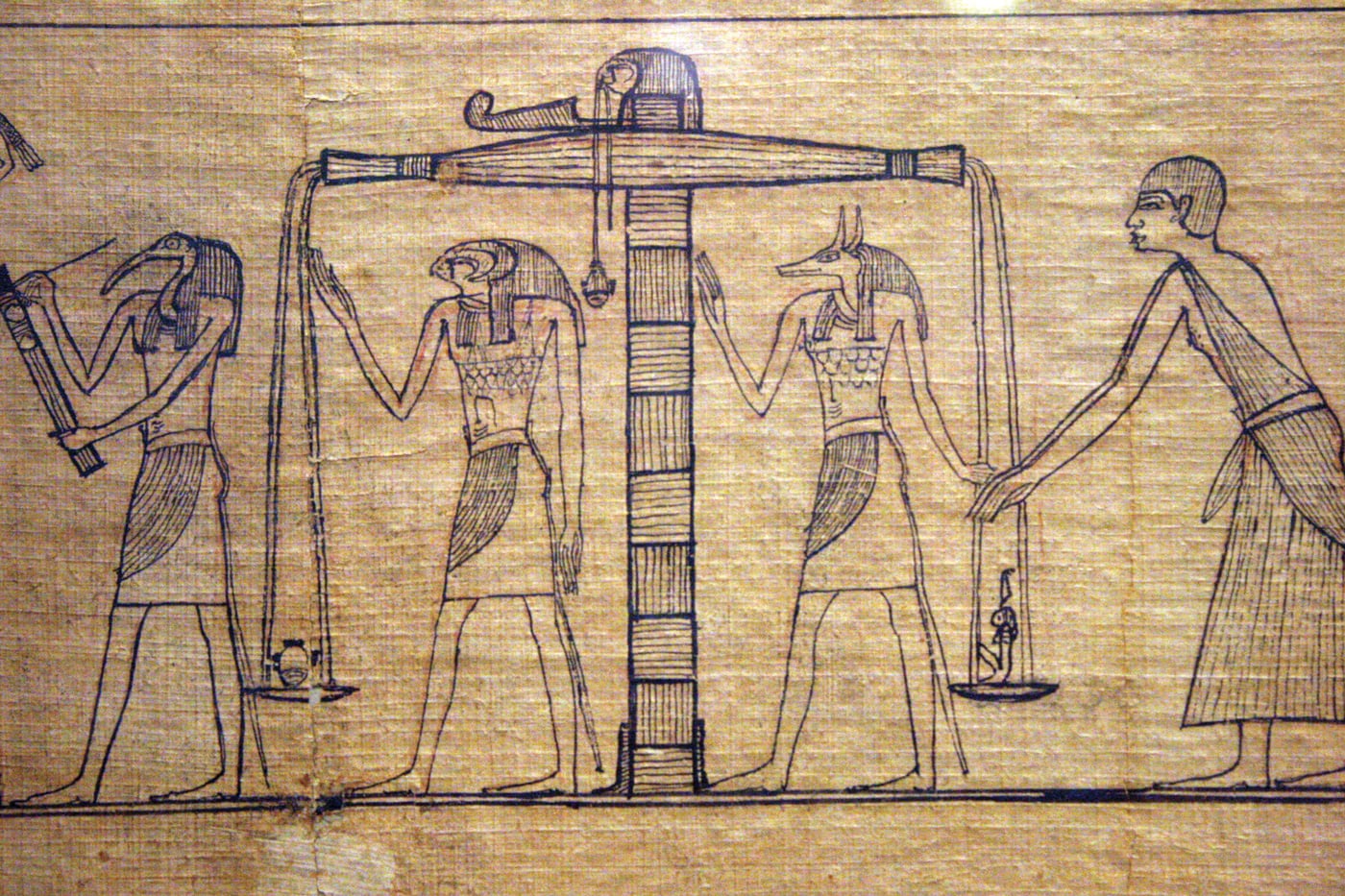
The weighing of the heart in a scene from the Book of the Dead, dated to the Ptolemaic Period (fourth–first century BC)
The final section (20:20–30), in which several verses take up ideas occurring earlier in the chapter, focuses on the outcome of or retribution for one’s actions, specifically by God (20:22–24, 27) and the king (20:26, 28). Those who curse their parents will be extinguished (20:20). An inheritance obtained prematurely may not lead to happiness in the end (20:21). Taking revenge usurps a divine prerogative (20:22; cf. Rom. 12:19). God detests deceptive standards (and will punish, 20:23; cf. 20:10), but in fact he sovereignly directs our steps and destinies, surpassing human comprehension (20:24). Those making hasty vows set a trap for themselves (20:25). The wise king separates out the wicked as chaff and gives them a good “threshing” (20:26; cf. 20:8). The Lord’s searchlight shines through (or illumines) the king, exposing the “inmost being” of individuals to him (20:27; cf. 20:5). It is the king’s “steadfast love” (NIV “love”) as ruler, however, that stabilizes his rule, not the delegated authority he wields (20:28). Youth and old age may have their respective advantages (20:29), but all can benefit from the type of divine “beating” that removes evil from one’s “inmost being” (20:30, same expression as in 20:27).
21:1–31. Some interpreters take the initial verses of chapter 21 with the preceding section, since the king is mentioned in 20:26, 28 and 21:1. Chapter 21, however, is framed by proverbs asserting Yahweh’s sovereignty over human outcomes (21:1, 30–31, similar to 16:1, 33). Three “Yahweh” (or “Lord”) proverbs set the tone for a new section, which encompasses the entire chapter. God can direct the decisions (literally “heart”) of even the most powerful human beings, like a watercourse, to specifically benefit those who please him and abundantly irrigate their lives (21:1). “Weighing the heart” is a common ancient Egyptian image of divine judgment; God’s assessment of human ways is complete and accurate (21:2; cf. 16:25). His priority concerns what is actually just and right(eous), not simply proper ritual or what people think is (up)right (21:2a, 3; cf. 21:8b). His assessment includes the unrestrained intents of the wicked (21:4, literally “broad heart”). The NIV 1984’s “lamp” contrasts with Yahweh’s “lamp” in 20:27, but what this lamp illumines remains unclear. Following the NIV instead, the wicked are like an uncultivated field, which produces only sinful weeds. The following verses expand on the yield of the wicked. Unlike the plans of diligent individuals, who profitably carry out their plans, haste (and lack of planning) makes waste (21:5; cf. 14:23). Treasures gained through deception are as temporary as a vapor (Ecclesiastes’ favorite word), for those who own such treasures are seeking death (21:6, NIV alternate translation) through their crooked path marked by violence and injustice (21:7–8a).
The next subsection (21:9–19) is framed by two similar proverbs (21:9 = 25:24; 21:19; reinforced by references to the wicked in 21:10, 18). Both express a preference for peace with privation (house roof, wilderness) over a contentious companion and introduce a thematic emphasis on the wicked’s impact on communal life—and their punishment (even a wife is considered “wicked” if inciting contention). Controlled by their evil desires, they show neighbors no compassion and ignore the cries of the poor (21:10, 13a). When such incorrigible mockers are punished (literally “fined”) by local officials, even the naive can learn a lesson (21:11; cf. 19:25). More significantly, the Righteous One (correctly capitalized in the NIV) observes the wicked and brings disaster on their homes. Now their cries are those that go unheeded (21:12–13). The wicked may offer a covert bribe to placate the righteous wrath directed toward them, but they will cower in terror if justice is carried out, much to the joy of the righteous (21:14–15). Whoever wanders away from the prudent path will join only one community—the community of the departed (21:16). The contextual message of verse 17 is suggested by the concept of “joy” that it shares with verse 15: take pleasure in justice achieved rather than loving pleasure itself, as represented by wine and cosmetics. Verse 18 is not to be taken theologically. Rather, as Kidner summarizes it (Kidner, 144), the treacherous wicked are the “‘expendable’ members of society,” who will face disaster rather than the upright righteous.
Whereas the preceding subsection focuses on the wicked, 21:20–29 highlights the advantages of wisdom. Not only do the wise have plenty of fine fare stored up, but as those who pursue righteousness and loyal love, they find life, prosperity (literally “righteousness,” a metonymy of reward for relationship; cf. 22:4), and honor as well (21:20–21). Wisdom makes them powerful and spares them from speech-provoked trouble (21:22–23), unlike the deadly folly of four characters: insolent mockers, craving sluggards, hypocritical worshipers, and ruthless perjurers (21:24–28). The wicked brazenly feign strength, while the upright discern the import of their decisions and conduct (21:29). Verses 30–31 conclude the section by reminding the reader that, despite its many benefits, human wisdom cannot prevail against God’s sovereign plans. And although one can strategically prepare for battle, victory is God’s gift.
22:1–16. An initial thematic emphasis in Proverbs 22 is God’s sovereignty over wealth and poverty. Verse 1 asserts a countercultural value: a good reputation (literally “a name”; cf. Eccles. 7:1) and good favor (cf. Prov. 3:4), presumably through one’s wise conduct, are more worthy of pursuit than substantial wealth. The claim of verse 2 is not that God is the creator of a socioeconomic hierarchy; rather, both rich and poor are under his sovereign care and control. Accordingly, wealth may be one reward for humble reverence toward God (22:4; cf. 21:21). Verses 3 and 5 describe the contrasting walks of the shrewd/righteous and the untrained/perverse. The former warily avoid “evil” (NASB; NIV: “danger”); the latter follow a thorn-filled path and “pay the penalty” (22:3b; literally “are fined,” continuing the financial theme). Verse 6 (though lacking in the Greek Septuagint) is a favorite proverb on biblical parenting, but its translation and import are disputed, since the exact meaning of the Hebrew for “his way” is unclear. Taken in context, his way could refer back to the fear of Yahweh in verse 4a (i.e., God’s way) in contrast to the way of the perverse in verse 5a. In Proverbs youth is associated with gullibility and the need for wise instruction (cf. Prov. 1:4; 7:7) by parents and others. Once launched in the right direction, the child will likely stay on course throughout life. Verse 15, which is linked to 22:5–6 by the verb “stays/drive far from” and the training theme, supports this interpretation. Folly is an innate part of a child’s makeup and must be removed by discipline while the child is still young.
The second subsection, addressing the mistreatment of the poor and indicating that some poverty is self-inflicted, is bracketed by 22:7 and 16. Those who thus wickedly abuse their power will be divinely punished (22:8), while those who generously care for the poor will be divinely rewarded (22:9). Other fools (22:15) afflicting society include the mocker (22:10), the treacherous (22:12b), the lazy (22:13), and the adulteress (22:14, here portrayed as a potential agent of divine punishment). Both the king and the Lord, however, are looking for those whose words are marked by purity, grace, and knowledge to befriend and support (22:11–12a).
The first major collection of proverbs concludes in 22:16.
B. Sayings of the wise: Admonitions for societal relationships (22:17–24:22). Since the discovery and translation of the Egyptian Instruction of Amenemope in the 1920s, scholars have noted its striking parallels with this section of Proverbs and debated the nature of that relationship. In a 1996 essay, Paul Overland lists seventeen verbal or thematic parallels between the texts, claiming that the author of Proverbs 22–24 excerpted and summarized the Instruction of Amenemope. Most Old Testament scholars are so convinced of this alleged literary dependence that they emend the Hebrew text in at least five places to conform to the Egyptian text and speculatively subdivide Proverbs 22:17–24:22 into thirty “sayings” to correspond to the thirty chapters of the Instruction of Amenemope (e.g., NIV). More caution is warranted, however, since these parallels (1) derive from only eight of the thirty chapters, (2) are confined to 22:17–23:11, (3) occur in Proverbs in a puzzling order (i.e., 2, 3, 16, 1, 4, 5, 12, 13, 17, 14, 15, 9, 10, 11, 6, 7, 8), and (4) are quite similar to other Old Testament and ancient Near Eastern texts. Moreover, even if the Israelite sage has borrowed from Egyptian wisdom here because it accurately expresses how God “set up the world,” the sage has transformed that wisdom by theologically refocusing it to promote reverence for Yahweh.
Rhetorically, 22:17–24:22 is similar to Proverbs 1–9 in the prevalence of imperative verb forms, including the call to heed these “sayings of the wise” (compare 22:17 with 4:20 and 5:1), followed by explanatory (i.e., motivation) clauses. Unlike Proverbs 10:1–22:16, this unit consists not of individual proverbs but of a series of admonitions on various topics, most of them being two or more verses in length.
22:17–23:11. The primary purpose of this instruction (22:17–21) is not pragmatic (i.e., to train capable court advisors; see 22:18, 21) but faith-related (“that your trust may be in the Lord,” 22:19a). The number “thirty sayings” in 22:20a reflects an emendation of the text based on the “Amenemope hypothesis.” The alternate reading “formerly” in the NIV 1984 accurately translates the Hebrew word that corresponds to the temporal expression “today” in 22:19b.
The social topics that follow have been encountered previously in chapters 1–9 and 10–22. The first section highlights harmful attitudes and actions regarding wealth and possessions (22:22–23:11).You should not exploit or devastate the poor or legally disadvantaged, because Yahweh will come to their defense and do to you as you did to them (22:22–23, an inclusio with 23:10–11). It is equally hazardous to have anger-controlled companions and become like them (22:24–25). You should also avoid cosigning on loans because you may end up losing more than your shirt (22:26–27)! Verse 28 warns against violating the property rights of others (cf. 23:10). Verse 29 affirms the value of developing professional skills (cf. 22:21 and Ps. 45:1). Lacking any imperative (i.e., command or exhortation; cf. 22:22, 24, 26, 28), 22:29 may serve to introduce the next topic.
Proverbs 23:1–3 and 6–8 are linked by the repeated phrase “do not crave his delicacies” (22:3a, 6b; cf. Sirach 31:12–32:2), suggesting that the focus in verses 1–3 is not on improper conduct when your abilities bring you into the presence of a powerful person. (One can also translate “what” in verse 1b as “who” [see NIV note]; the word is perhaps intentionally ambiguous.) Drastic measures may be needed to curb an uncontrolled appetite or inordinate desire (22:2–3). Such food may be “deceptive,” intended as a test of your self-discipline rather than simply as a calorie-rich diet. Verses 4–5 support this interpretation, warning against exhausting efforts to acquire fleeting riches. Verses 6–8 involve a begrudging host (literally “one evil of eye”), complementing the equally deceptive host of verses 1–3. The much cited translation of verse 7a, “as he thinks in his heart, so is he” (NKJV; cf. NIV alternate) is possible but uncertain; the Greek Septuagint translates “like a hair in his throat.” Forget the flattery intended to win his favor, for both his food and his feigned hospitality may prove nauseous!
Verse 9 is linked to verse 8 by the motif of wasted words. A discerning person exercises restraint in attitudes, actions, and speech (23:1b, 4b, 9a). Proverbs 23:10–11 concludes the section by warning against the illegal acquisition of property (cf. 22:28), especially at the expense of the weak and needy (i.e., orphans). In wording identical to the initial warning in 22:22–23, it is expressed that God will take up their legal cause as their “family protector” (Waltke 2005, 245; Hebrew goel).
23:12–24:22. The second half of the instruction focuses on the wise, responsive child, paralleling Proverbs 1–9 more fully than does the first half of the instruction. (The Hebrew root hkm, “wisdom,” occurs eight times in these verses.) It begins with a renewed call to accept experience-rich instruction (23:12, literally “discipline”; cf. 22:17), followed by a warning against neglecting the “discipline” (23:13–14) of the young, and presumably foolish, person. Verse 13b is ironically ambiguous: rather than killing the youth, the rod of correction may actually save the youth’s life (cf. 22:15). Verse 14b, literally “deliver his soul from Sheol,” may even speak of avoiding the ultimate fate of the wicked. The son is directly addressed and encouraged to live wisely in 23:15–16, 19, 26; 24:13–14, 21 (cf. also 23:22–25), punctuating the section, with an admonition to fear Yahweh in 23:17 and 24:21 framing it. The resultant joy of the parents is mentioned as a motivation in 23:15–16, 24–25. The foundational warning is against envying sinners (23:17; 24:1; 24:19). Their apparent “success” will be short-lived, while sustained zeal for God and a life marked by wisdom gives one a lasting, even an eternal, hope (23:18; 24:14). Specific admonitions then condemn (1) gluttony and especially drunkenness as leading to rags, not riches (23:20–21), as well as a plethora of physical, emotional, and mental afflictions (23:29–35), and (2) promiscuity with a prostitute or adulteress, who first captivates (just like wine, 23:31) and then takes one captive (23:27–28; cf. 22:14).
Proverbs 24:1–22 contrasts evil plotting (24:1–2, 8–9, 15–16) with wise planning (24:3–7). Repeated warnings against envying the wicked (24:1, 19–20) frame the subunit. Unlike evil men who plan destruction (24:1–2), wisdom is constructive and enriching (24:3–4; cf. 9:1 and 14:1), supremely powerful and effective (24:5–6), and too lofty and unattainable for fools (24:7).
Accordingly, those who devise ways to harm others gain a reputation as a master schemer or conspirer (24:8; cf. 12:2; 14:17). Ironically, this capacity for forging shrewd plans is viewed positively in Proverbs 1–9 (the same Hebrew noun the NIV translates as “schemer” in 24:8, it translates as “discretion” in 1:4; 2:11; 3:21; 5:2; 8:12). Such actions are described further as foolish, sinful, and socially repulsive (24:9). In light of the preceding verses, verses 10–12 apparently then challenge the wise to use their “strength” (24:5, 10) to rescue the potential victims of such deadly plots—or of any life-threatening crisis (24:11). Feigning ignorance will not suffice when they are confronted by the omniscient discerner of human motives (24:12; cf. 16:2; 21:2), protector of lives, and rewarder of deeds.
The previous contrast from 24:1–9 resumes in verses 13–14, describing wisdom as “honey” for the soul, which gives one a secure and lasting “future hope.” The call to eat this good “honey” is followed by three warnings regarding one’s attitude toward the wicked. First, we should not act like them in plotting against the righteous, knowing that God will help them get back on their feet again while causing the wicked to stumble (24:15–16). Second, we should not gleefully celebrate our enemies’ downfall, lest God be displeased with our heartless disdain toward fellow human beings and cut short their punishment (or perhaps redirect his attention to us; 24:17–18; cf. 17:5; Job 31:29). Third, we should neither be vexed by (cf. Ps. 37:1, 7–8) nor envy them, since, unlike the wise, evildoers have “no future hope.” Instead, they will be extinguished like a lamp (24:19–20). Therefore, the best course for the son to take is to fear both God and his agent, the king, rather than making common cause with dissenters, since both of them are capable of suddenly turning his ordered life into a rubble heap (24:21–22).
C. More sayings of the wise: The necessity of honesty and diligence (24:23–34). A new collection of proverbs (24:23–34) is introduced in verse 23a simply as “also of the wise,” the word “sayings” being added by the translator. It addresses two familiar themes: honesty, especially in legal settings, and diligence in one’s work. The basic claim is stated in verse 23b: judicial partiality is not good. Acquitting the guilty rightfully provokes widespread, even national, outrage and condemnation, as the people call on God to curse those who pervert justice but to bless richly those who legally correct wrongdoers (24:24–25). Verse 26 broadens the theme: a straightforward response, whatever the setting, is as much an expression of devoted love as a kiss on the lips. Verse 27 introduces the second theme, diligence, by calling for proper preparations, provisions, and priorities. Then verses 28–29 complete the first theme, warning against being a perjurer or a hostile witness (cf. Prov. 3:29–30) motivated by a desire for revenge. The collection concludes with a colorful description of the sluggard’s irrational behavior, along with its consequences (24:30–34; cf. 6:10–11). The rundown condition of the vineyard is a precursor to the resultant poverty, offering the observant sage a valuable lesson.
D. The later Solomonic collection (25:1–29:27). A second “Solomonic” proverbial collection begins in 25:1, extending through 29:27. These were “compiled” or edited two centuries after the reign of Solomon, during the reign of Hezekiah.
Proverbs 25:12 compares the rebuke of a wise judge to “an earring of gold or an ornament of fine gold,” such as this beautiful gold earring from the area of Iran (eighth–sixth century BC).
25:1–27:27. The first subsection of this collection is on relating wisely to rulers, neighbors, family, and social menaces. In these chapters God is rarely mentioned (only 25:2, 22) and numerous comparisons are used (in the NIV, “like” occurs more frequently in chaps. 25–27 than in all of chaps. 10–24).
25:1–28. Chapter 25 focuses on how to relate properly to various groups within society, frequently employing proverbial pairs (i.e., two consecutive related verses) to do so. Verses 2–5 lay the foundation for verses 6–15, which address court officials, although one could apply them more broadly. Verses 2–3, which have the ideal ruler in view, affirm a hierarchy in authority of God–king–subjects. The purposes of both God as Creator and monarch as shrewd and insightful statesman may remain inscrutable, but the latter should be honored for his skills. Accordingly, the wise king strengthens the realm by removing the wicked from positions of influence (25:4–5). The wise courtier therefore avoids self-promotion and public disgrace by approaching the great with humility (25:6–7; cf. Luke 14:8–10). Verses 8–10 warn against committing similarly rash actions in the legal sphere, also resulting in public shame. These specific examples of foolish speech are followed by proverbs about valued speech. A fitting word, even in the form of a timely rebuke, is beautiful (literally “golden,” 25:11–12). Thus a reliable envoy is as refreshing as snow, while one who makes inflated, unfulfilled promises is as disappointing as rainless clouds (25:13–14). Finally, a gentle but persistent tongue can break down even the strongest ruler’s resistance (25:15).
Two proverbs regarding honey frame a section offering instruction on how to be a good neighbor, which employs vivid comparisons (25:16, 27): too much of a good thing can be bad! (1) Don’t become burdensome through overly frequent visits, thereby possibly turning friend into foe (25:16–17). (2) Don’t betray trust in a time of crisis, assaulting others through false testimony (25:18–19; cf. 26:18–19). (3) Don’t be insensitive in a time of sorrow (25:20). The NIV translates “on a wound” for the NIV 1984’s “on soda.” The point of either comparison would be that the so-called friend’s behavior would only make matters worse. (4) Be generous in a time of need, thereby possibly turning an enemy into a friend and receiving divine payback (25:21–22, quoted in Rom. 12:20). The meaning of “heap burning coals on his head” (cf. Prov. 6:28), unfortunately, remains obscure, since causing a foe great pain sounds contrary to the biblical injunction against taking revenge. Perhaps referring metaphorically to some ancient ritual, the burning probably refers here to psychological pain produced by benevolent actions, resulting in remorse and, hopefully, reconciliation.
The instructions in 25:16–22 are followed by sayings (25:23–28) about various types of unwelcome individuals: the deceptive (25:23, literally “tongue of hiddenness”; Ps. 101:5), the quarrelsome (25:24 = 21:9), the compromising (25:25–26, literally “a righteous one [whose foot] slips before the wicked”; cf. 10:30), and those obsessed with honor (25:27); each of them, to some degree, lacks self-restraint (25:28). The repetition of “search out” and “honorable” in verse 27 from 25:2–3 (an inclusio; the Hebrew for “honorable” the NIV translates as “glory” in 25:2) and “honey” from verse 16 suggests that the NIV 1984’s “seek one’s own honor” is misleading. Rather, the proverb warns against a preoccupation with the sources or nature of honor (cf. 22:4; Longman 2006, 459: “Nor is it honorable to investigate honor”).
26:1–28. Proverbs 26 describes, and by implication warns against, a series of dysfunctional and often dangerous members of society, beginning with the fool (26:1–12). How should one respond to fools (26:1–5)? It is just as inappropriate to honor them as it is to curse the innocent. But in the latter situation, God will defuse the curse (26:1–2). The corrective rod is a more fitting means of dealing with fools (26:3), though a well-considered corrective word may also be effective, as long as one neither speaks as foolishly as they do nor affirms them in their folly (26:4–5). It is foolhardy to honor fools by employing them as messengers (26:6–10; e.g., the failure of Ahimaaz in 2 Sam. 18:19–33), for such an arrangement may harm the employer (26:6), the fool, who is incapable of using proverbial sayings properly (26:7–9), and others as well (26:10). This is because fools disgustingly repeat their folly rather than learn from their mistakes and are self-deluded regarding their capabilities (26:11–12).
Next in line is the sluggard, who is similarly self-deluded (26:13–16; compare 26:16a and 12a). This portrait employs proverbs similar to those found elsewhere in the book (compare 26:13 with 22:13; 26:14 with 6:9–10; 24:33; and 26:15 with 19:24). Whereas those who meddle in someone else’s dispute hurt only themselves (26:17, i.e., being bit by a stray dog), the one who considers deceiving others to be a game is like a crazed archer (26:18–19). Similarly, the gossip or slanderer (26:20–22; 26:22 = 18:8) enjoys adding the charcoal of rumors to fiery quarrels—or igniting them in the first place. The series climaxes in an extensive description of the hateful person (26:24, 26, 28; NIV 1984 “malicious man”; NIV “enemies”), whose warm and witty words disguise a corrupt and conniving heart (26:23–25). Ultimately, however, such people’s hidden and harmful malice will be publicly exposed and recoil upon them (26:26–28; cf. Ps. 7:15–16).
27:1–27. Proverbs 27 offers more general advice on a wide range of topics. A primary emphasis in 27:1–22 is on one’s relationship with friends (27:6) or companions/neighbors (27:9, 10, 14, 17). As in chapters 1–9, a parent addresses a child here (27:11), framing the section by warning against arrogant self-confidence and self-praise (27:1–2, 21) and, by implication, against becoming a fool (27:3, 22). The destructive, jealous rage of a fool (27:3–4) is juxtaposed with the beneficial, though painful, corrective word of a genuine true friend and is contrasted with the reticence of a so-called friend and a foe’s feigned affection (27:5–6). Two general proverbs follow. Verse 7 may simply illustrate how circumstances dictate tastes (although both are distorted); however, in context, the sweet-tasting, bitter food may refer to the “wounds from a friend” (27:6). The Hebrew verb nadad (27:8) designates one forced to flee (NIV) from home like a bird (rather than one unfaithfully straying, as in NIV 1984) and thereby being deprived of the sweet counsel of a close companion (NIV “pleasantness,” 27:9). Whereas verse 8 pities the one forced to flee, perhaps due to a crisis, verse 10 admonishes this one not to forsake a proven friend in such a situation, who will more readily supply concrete assistance than a distant relative.
The parent’s charge to “my child” or “my son” to be wise (27:11) could involve avoiding obvious “danger” (or “evil,” 27:12 = 22:3), including guaranteeing a stranger’s debt (27:13). Being a good companion or neighbor requires a degree of self-restraint (27:14), unlike the conduct of the quarrelsome wife, who lacks this and cannot be turned off, so to speak (27:15–16; cf. 19:13). Rather than irritating one another, friends should “sharpen” each other (27:17). (Similarly, reliable servants benefit others and deserve honor [27:18].) Just as water can reflect one’s face, in the case of intimate friends “one human heart reflects another” (27:19 NRSV)—including those who are insatiable and incorrigible (27:20–22).
Chapter 27 concludes with advice concerning the material benefits of carefully attending to one’s flocks and herds (27:23–27). It is linked to verse 1 by verse 24 in affirming the tenuousness of wealth and power, while offering concrete advice for securing the former.
28:1–29:27. Chapters 28–29, on righteousness and a nation’s welfare, together conclude this anonymous proverbial collection. They are similar to chapters 10–15 stylistically in their dominant use of contrasting parallel clauses and thematically in their repeated contrast between the righteous and the wicked (Hebrew rasha occurs five times each in chaps. 28 and 29 but is absent from chap. 27; cf. commentary on 16:1–22:16). Some interpreters consider these chapters to be “rules for rulers,” although fewer than one-fourth of the verses refer to either rulers or their subjects. More striking is the emphasis on traditional Hebrew piety here. Proverbs 28:12, 28 and 29:2, 16 are parallel, dividing these chapters into four subsections: 28:1–11; 28:12–28; 29:1–16; 29:17–27. According to these verses, the stability and mood of a nation directly depend on whether the righteous or the wicked are in charge and “thriving.”
28:1–11. The initial subsection begins by contrasting the psychological states of the wicked and the righteous (28:1). Discernment (28:2, 5, 7, 11) and heeding God’s commands (28:4, 7, 9) are crucial both in government (28:2–6) and in the home (28:7–11). Hebrew torah is better understood here as referring to divine “law” (NIV 1984) than to human “instruction” (NIV, 28:4; cf. “seek the Lord” in 28:5, only here in Proverbs). A nation where these are lacking will be marred by instability and chaos (28:2), oppression of the poor (28:3), and badly skewed values (28:4–6). A discerning child also avoids those who are self-indulgent (28:7) and exploitation of the poor (28:8), enjoying instead answered prayer (28:9), good things (28:10), and keen insight into the true character of others (28:11).
28:12–28. The second subsection is framed by descriptions of the contrasting responses of citizens to the righteous and wicked leaders (28:12, 28; cf. 11:10). A close relationship with God and moral uprightness are crucial, especially for rulers (28:15–16). This involves acknowledging and abandoning one’s sins and shuddering at the thought of disobeying God (28:13–14), for example, through the perversity and violence of unjust gain or bloodshed (28:15–18). The keys to prospering are honest, hard work (28:19a, 20a; cf. 12:11), coupled with a trust in God rather than in one’s own efforts, which expresses itself in generosity toward the poor (28:25b–27). This approach stands in stark contrast to get-rich-quick schemes involving bribery, stinginess, flattery, rationalized robbery, and greed (28:21–25a), which are doomed to fail or even to provoke divine judgment (28:19b, 20b, 22b, 27b).
29:1–16. The third subsection is doubly framed by proverbs concerning the importance of heeding and consistently giving correction (29:1, 15) and the contrasting responses to or consequences of the righteous or wicked rule (29:2, 16). This juxtaposition suggests that an undisciplined child may grow up to become not only a disgraceful son but also a disgraceful ruler. This is reinforced by verses 3–4, which describe, respectively, a son who squanders an inheritance on prostitutes and a ruler who destroys a country by taking bribes. A major responsibility for a king is to protect the rights of the poor (29:7, 14), for both the poor and the powerful owe their very existence to God (29:13; cf. 22:2). The remaining verses in this section introduce various foolish types, who undermine a nation’s stability and disturb its tranquility (29:8a, 9b, 11a). These include flatterers, who end up snaring themselves with their words (29:5–6), provocative mockers (29:8), disrupters of the legal system (29:9), bloodthirsty foes of all who are godly (29:10), and unrestrained and deceptive courtiers (29:11–12).
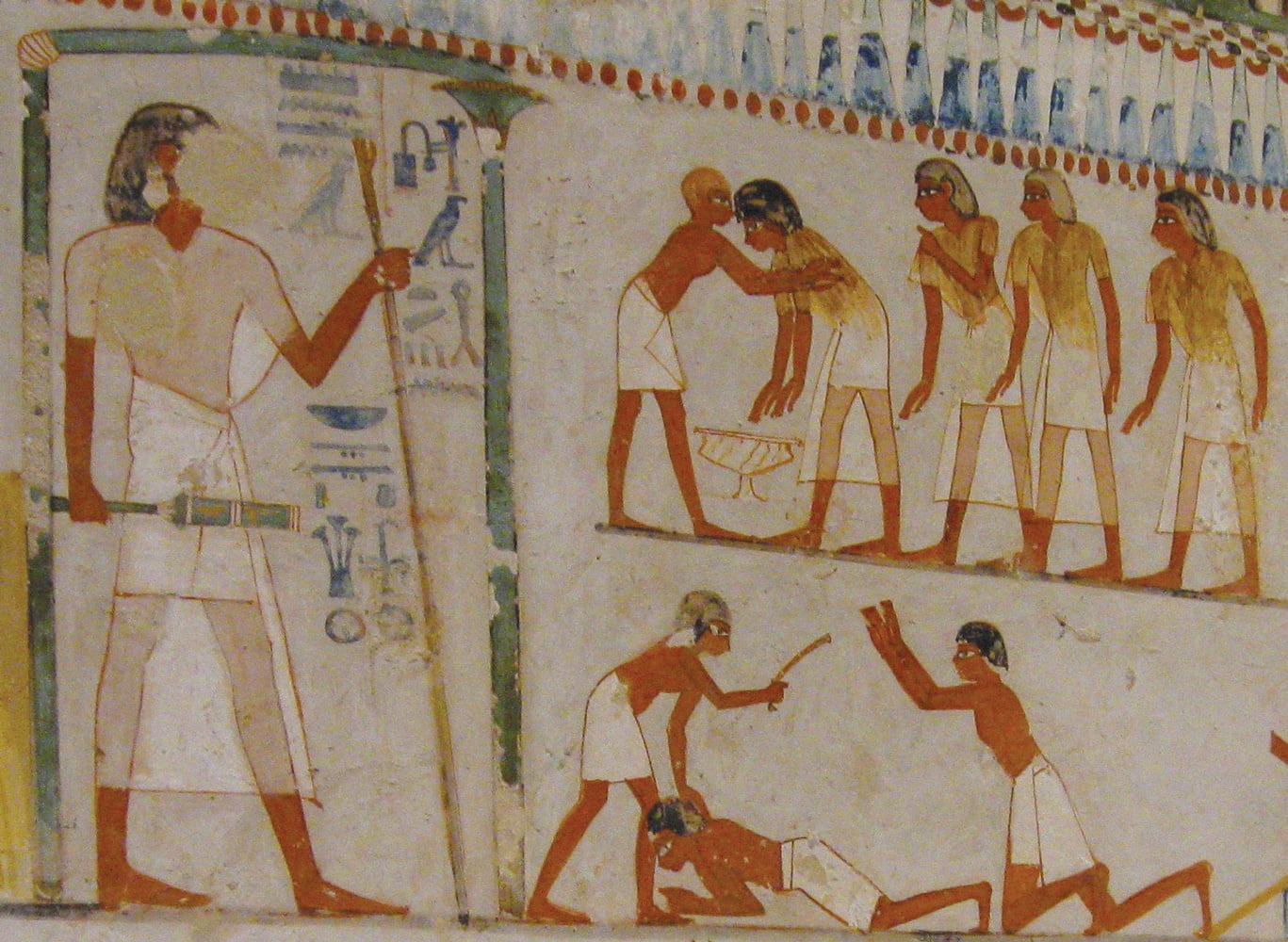
Proverbs 29:19 says that servants require more than verbal discipline. Some masters understood the need for corporal punishment as license to beat their slaves, such as in this Egyptian painting (Tomb of Menna, 1400–1390 BC).
29:17–27. The fourth subsection begins with a call to discipline one’s children (29:17, the only imperative [command] in the chapter), bolstered by the assurance that the child will in turn become a source of parental relief and delight (cf. 29:3). As previously in the chapter, the stage shifts in the following proverb (29:18) from the family to the nation. The familiar but misleading KJV wording, “Where there is no vision, the people perish,” has led to the common misuse of this proverb to justify long-range planning, which the NIV has corrected. The mention of divine “revelation” (the same Hebrew term refers to a prophet oracle, as in 1 Sam. 3:1; Isa. 1:1) and the people “casting off restraint” recalls the golden calf incident in Exodus 32:25, where the same verb is translated by the NIV as “running wild” and “out of control.” Observing God’s “law” (NIV 1984; NIV: “instruction”; Hebrew torah; see commentary on 28:1–11), however, will bring a nation his blessing. Alternatively, the proverb may claim for the wisdom instruction genre the same inspired and authoritative status normally associated with Old Testament prophetic and legal texts. The emphasis on constraining improper behavior continues in the following verses. Like a child, a servant needs discipline (29:17, 19), but mere words may not suffice, especially if people have previously indulged that servant (29:19, 21). Those who cannot control their tongue, temper, or ego are prone, respectively, to folly, sin, and humiliation (29:20, 22, 23). And partnering with the wrong individuals, such as thieves, is self-destructive, pressuring one to refuse one’s duty to offer legal testimony out of fear of others rather than trust in God for one’s safety (29:24–25; cf. 28:25). Although people may think that a personal meeting with a ruler will guarantee the meeting of their needs, justice comes from God alone (29:26). In light of the divine standards emphasized in this section, the mutual antipathy between the righteous and the wicked is easy to understand (29:27; cf. 29:10).
Although the final two chapters of Proverbs contain the wisdom of two more sages, from a thematic-theological standpoint they form an epilogue that corresponds to and serves to complete the prologue (Proverbs 1–9; parallels will be noted below). The words of Agur son of Jakeh and of King Lemuel are both called an “oracle,” a term otherwise applied to prophetic utterances (30:1; 31:1; cf. the opening verses of Nahum, Habakkuk, and Malachi), perhaps thereby claiming divine origin and authority (so the NIV’s “an inspired utterance”). Less likely, the Hebrew word massa could designate a region in the Arabian Peninsula named after one of Ishmael’s descendants (i.e., Massa; cf. Gen. 25:13–14; 1 Chron. 1:29–30; see NIV 1984 note), making the authors non-Israelite.
A. Agur’s message: Relying on God’s word, learning from his work (30:1–33). In the Greek Septuagint, Proverbs 30:1–14 is placed before 24:23, while 30:15–33 is located after 24:34, leading some to suggest that Agur’s words end with verse 14. The initial section expresses Agur’s earnest personal piety and echoes various Old Testament texts (30:1–9). Just as verse 1b moves from a claim of physical weakness (“I am weary, God”) to confidence (“but I can prevail”), verses 2–3 move from intellectual weakness to confidence, since the Hebrew syntax of verse 3 expresses a contrast: “I have not formally studied wisdom, but I have personal knowledge of the Holy One” (author’s translation; cf. Prov. 9:10). The content of the rhetorical questions in 30:4, which describe the unique heavenly access and creative power of the “Holy One,” remind one of Deuteronomy 30:12 (cf. Job 11:7–8) and Job 26:8, respectively; they are similar in form to those in Isaiah 40:12–14 and Job 38–39. The final question (“What is his name, and what is the name of his son?”), without directly referring to Jesus Christ, anticipates his coming as the one whom the first question describes (cf. John 3:13). The following confession shifts the focus from God’s work to God’s word (30:5–6). These verses quote both Psalm 18:30 (= 2 Sam. 22:31; cf. Ps. 119:140) and Deuteronomy 4:2; 12:32 (cf. Rev. 22:18–19), by implication claiming the same “flawless” status for Agur’s wisdom as that invoked by the use of the word “oracle” in verse 1a. The section concludes with a simple but earnest prayer (and the only one expressed in the book), invoking divine aid in avoiding empty and deceitful speech and in procuring only sufficient material resources (cf. Matt. 6:11) to avoid the opposite temptations of impious self-sufficiency and hunger-induced theft.
In the remainder of the chapter (30:10–33), the numerical saying becomes the dominant form. In these often riddlelike proverbs, which draw striking examples from nature, the final item is emphasized. These verses also can be attributed to Agur, since no other author is named. The first subunit (30:10–17) consists of proverbs loosely connected with each other by repeated words or themes. Three consecutive verses refer to damaging the reputation of another: one who desecrates God’s name by stealing, one who slanders a servant before his master, and one who denigrates father and mother (30:9–11; being cursed/cursing link 30:10–11). Verses 11–14 describe four disreputable types: despisers of parents, the self-righteous, the arrogant, and the greedy. Avarice, the vice of the fourth of these, is described as cutting open the poor in order to devour them. This is illustrated in the animal world by the leech, whose twin suckers (literally “daughters”) keep crying for more. It culminates in a numerical saying that lists four insatiables: the realm of the dead, the barren womb, parched soil, and fire. The subunit is rounded off by verse 17, which again describes the disrespectful, disobedient child (cf. 30:11) with a sinful eye (cf. 30:12–13) that will be pecked out by, presumably divinely dispatched, scavenging birds.
A series of four numerical proverbs follows (30:18–31). There are four wonder-evoking movements (literally “ways,” 30:18–19): a soaring eagle, a slithering snake, a ship cutting through the waves, and a young couple enjoying sexual union. Upon completion, none of these actions leaves behind any obvious traces. The sage hastens to concede, however, that such natural “laws of motion” can be perverted. The adulteress, who “eats and [then] wipes her mouth,” removing every trace of her sexual snack (30:20; contrast Song 5:1), recalls the various destructive meals described in 30:14–17 (cf. 30:22b and 25b). Four developments shake the planet by disturbing the established or ideal social order (30:21–23): a male servant elevated to king, a “hardened fool” (NIV “godless fool”; Hebrew nabal; see “Structure and Theological Themes” in the introduction) apparently rewarded with plenty, a married woman who is disliked (cf. Deut. 21:15–17; 22:13, 16; 24:3), and a female servant who supplants her mistress. Four small, weak but wise animals achieve remarkable success (30:24–28): ants are amply supplied with food, rock badgers are protected by inaccessible cliffs, locusts advance irresistibly, and lizards are at home in the royal palace. A final numerical saying describes those known for their stately strut (30:29–31): the fearless lion, the rooster, the male goat, and the king accompanied by troops. That such a regal stride may be pretentious for the rooster and goat is suggested by the concluding verses, which draw warnings from the preceding numerical sayings (30:32–33): one should not act like a “[hardened] fool,” exalting oneself, hatching schemes, and provoking quarrels by stoking anger.
B. The message of Lemuel’s mother: A call for royal justice (31:1–9). The closing “oracle” (NIV “inspired utterance”) is ascribed to King Lemuel (whose name means “belonging to God”), who simply passes on what his mother has taught him (31:1). Like chapter 30, Proverbs 31:1–9 clearly belongs to this oracle, while the remaining verses of the chapter could constitute an independent section, although lacking a new title/author ascription. Whereas in Proverbs 1–9 King Solomon admonishes his “son(s)” to acquire and practice wisdom, in Proverbs 31 the queen mother lovingly but strongly admonishes her son regarding the demands and duties of his royal office, addressing three topics. First, she warns against sexual dissipation, which could wipe out his career (31:3; cf. 5:9–10). Second, she warns against drunkenness, which could cloud his mind, distracting or hindering him from administering the law of the land, especially on behalf of the oppressed (31:4–5). She recommends a better use for his supply of alcoholic beverages: rather than drinking it himself and forgetting his duties, he should give it to the dying and suffering, briefly helping them to forget their miserable circumstances (31:5–7). Finally, and more importantly, she calls on him to be a vocal advocate for the rights of the voiceless and vanquished, judging rightly on their behalf (31:8–9). Rather than focusing on royal prerogatives, pomp, and power, Lemuel’s mother emphasizes his responsibilities toward the weakest of his subjects. (Compare the Solomonic description of the king’s ultimately unsatisfying pursuit of personal pleasure in Eccles. 2:1–11.)
C. Lady Wisdom exemplified (31:10–31). Proverbs 31:10–31 is stylistically distinct from the preceding set of admonitions. (The only imperative [command] is in the final verse.) In a twenty-two-verse alphabetic poem, in which each succeeding verse begins with the next Hebrew letter, a woman is presented who embodies all of wisdom’s skills and virtues, from a to z. In context this section serves to counterbalance the initial admonition against sexual promiscuity in verse 3. At the same time, it takes up the sustained contrast within Proverbs 1–9 between Lady Wisdom and Lady Folly, presenting a woman who is both capable and virtuous, one who consistently practices what the book preaches in both the domestic and public spheres. By implication, Lemuel (or any young man) is urged to marry a woman who resembles this idealized but not unrealistic portrait. Like King Lemuel, she properly uses her strength (31:3, 10, 29) and opens her mouth (31:8–9, 26), caring for the poor and needy (31:9, 20) as well as for her family.
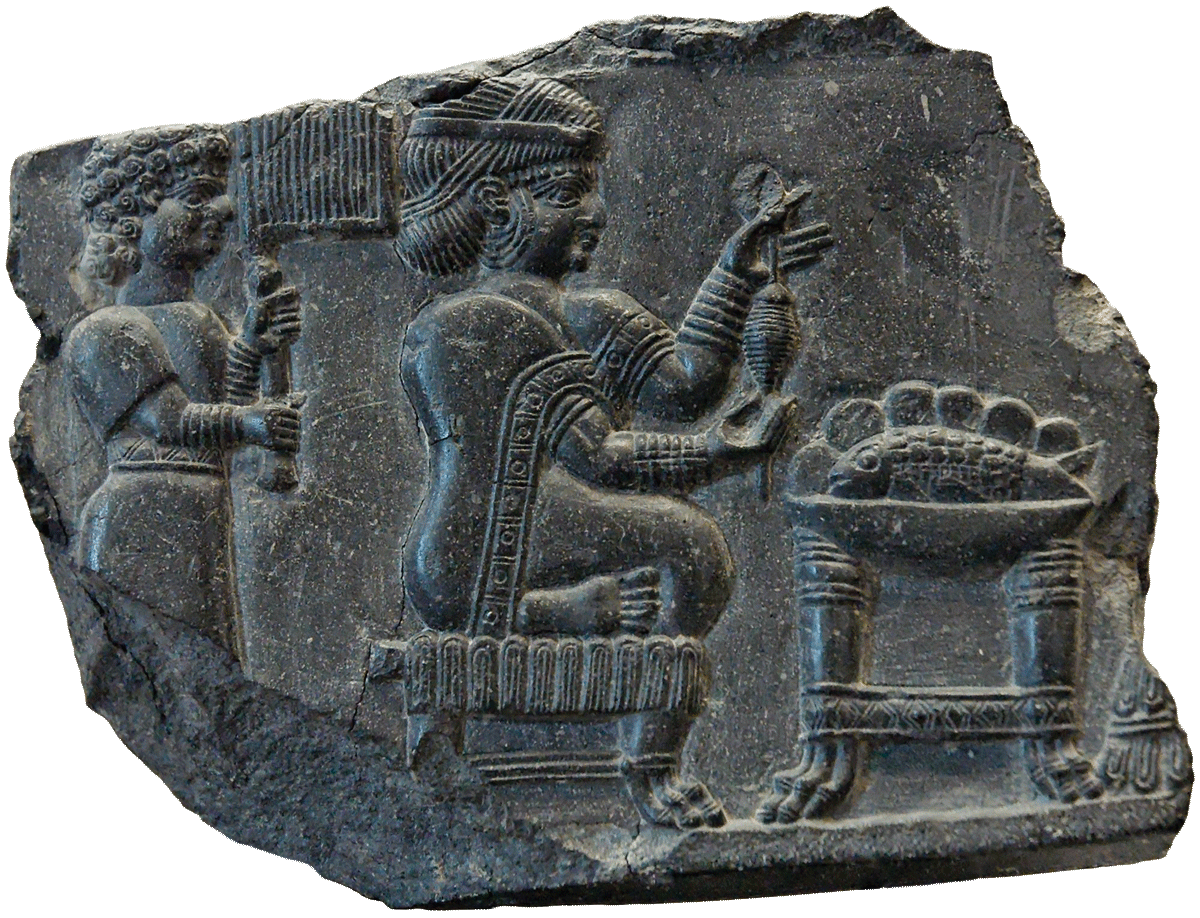
A young woman grasps a spindle with her fingers, as in Proverbs 31:19, in this relief fragment from Susa (eighth–seventh century BC).
This description is clearly structured. Verses 10–12 affirm her great value in general terms, while verses 13–27 describe her activities in detail, warranting a concluding call in verses 28–31 to praise her. Several of the terms and images used here occurred previously in chapters 1–9. Such a woman is a rare gem (31:10; cf. 3:15; 8:11), a partner in whom her husband can place his complete confidence (31:11a). Like a victorious warrior, she will bring him rich spoil, consistently benefiting rather than harming him throughout life (31:11b–12). Through her industry and ingenuity, she augments the family’s income and nourishes her household (31:13–18; cf. 31:24), much like a merchant ship or a lioness rising before dawn to stalk prey (31:15; NIV “food”; cf. Job 4:11). She produces both textiles and grapes for sale and invests in real estate. Her commercial trade is so profitable that their household lamps have oil to spare (31:18b—she is not sleep deprived, cf. 31:15a). Her balanced concerns are expressed through repetition in verses 19–20: she stretches out her hands to spin thread and to care for the poor and needy. She is unafraid of severe weather or the future—she fears God alone (31:21a, 25b, 30b)—for her family’s clothing and bedding are luxurious, not merely adequate (31:21b–22). The mention at this point in the text of her husband’s role and respect in the city administration (31:23) suggests that these are contingent on her manifold contributions to the household. Her most distinctive “clothing,” however, is not fine linen and purple but rather “strength and dignity” (31:22b, 25a). Furthermore, her speech, like that of the sage, is marked by wisdom and faithful instruction (31:26). In sum, she vigilantly oversees the affairs of her home, exhibiting no traits of the lazy (31:27).
Not surprisingly, although not to be taken for granted, her children and husband praise her, publicly extolling her unsurpassed character and accomplishments, and the town’s leading citizens should as well (31:28–29, 31). As the book concludes, the foundational and lasting benefits of reverence for God (31:30; cf. 1:7; 2:5; 8:13; 9:10) are contrasted with the fleeting attractions of personal charm and physical beauty. The wise son will do whatever it takes in order to make this woman his lifelong partner, and the wise reader will pay whatever it costs in order to engage in a lifelong journey along “the way of wisdom” (4:11) so vividly set forth and illustrated throughout the book of Proverbs.
Select Bibliography
Crenshaw, James L. Old Testament Wisdom: An Introduction. 2nd ed. Louisville: Westminster John Knox, 1998.
Fox, Michael V. Proverbs 1–9. Anchor Bible. New York: Doubleday, 2000.
Heim, Knut Martin. Like Grapes of Gold Set in Silver: An Interpretation of Proverbial Clusters in Proverbs 10:1–22:16. Beihefte zur Zeitschrift für die alttestamentliche Wissenschaft 273; Berlin: Walter de Gruyter, 2001.
Hildebrandt, Ted A. “Proverb.” In Cracking Old Testament Codes: A Guide to Interpreting the Literary Genres of the Old Testament. Edited by D. B. Sandy and R. L. Giese Jr. Nashville: Broadman & Holman, 1995.
———. “Proverbial Pairs: Compositional Units in Proverbs 10–29.” Journal of Biblical Literature 107 (1988): 207–24.
Kidner, Derek. Proverbs. Tyndale Old Testament Commentaries. Downers Grove, IL: InterVarsity, 1964.
Kitchen, K. A. On the Reliability of the Old Testament. Grand Rapids: Eerdmans, 2003.
Longman, Tremper, III. How to Read Proverbs. Downers Grove, IL: InterVarsity, 2002.
———. Proverbs. Baker Commentary on the Old Testament Wisdom and Psalms. Grand Rapids: Baker Academic, 2006.
McKane, William. Proverbs: A New Approach. Old Testament Library. Philadelphia: Westminster, 1970.
Overland, Paul. “Structure in The Wisdom of Amenemope.” In “Go to the Land I Will Show You”: Studies in Honor of Dwight W. Young. Edited by J. E. Coleson and V. H. Matthews. Winona Lake, IN: Eisenbrauns, 1996.
Schultz, Richard L. “Unity or Diversity in Wisdom Theology?—A Canonical and Covenantal Perspective.” Tyndale Bulletin 48 (1997): 271–306.
Waltke, Bruce K. The Book of Proverbs: Chapters 1–15. New International Commentary on the Old Testament. Grand Rapids: Eerdmans, 2004.
———. The Book of Proverbs: Chapters 16–31. New International Commentary on the Old Testament. Grand Rapids: Eerdmans, 2005.