Ecclesiastes
1. Introductory Remarks (1:1–11)
B. Theme Verse: Everything Is Ephemeral (1:2)
C. Goal of the Investigation (1:3–11)
2. Everything under the Sun Is Examined (1:12–6:9)
A. Human Achievements and Wisdom (1:12–2:26)
C. Social Relationships (4:1–16)
D. Warnings against Wrong Attitudes toward God and Government (5:1–9)
3. Positive Attitudes in the Light of Injustice and Uncertainty (6:10–10:20)
A. Recognize That Bad Days Can Bring About Good (6:10–7:14)
B. Recognize That Righteousness and Wisdom Offer Only Limited Protection (7:15–29)
C. Recognize That One Must Submit to the Government despite Injustice (8:1–17)
D. Recognize That, in the Light of Death, One Must Redeem the Time (9:1–10)
E. One Should Embrace Wisdom and Avoid Folly (9:11–10:20)
5. Concluding Explanatory Remarks (12:8–14)
A. Theme Verse: Everything Is Ephemeral (12:8)
B. Hermeneutical Reflections (12:9–14)
Introduction
There are few Old Testament books as intriguing and as difficult to interpret as Ecclesiastes. The book speaks directly to a contemporary society seeking desperately for meaning in life while involved in the often-reckless pursuit of material and personal success.
Yet it also contains numerous assertions that appear not only to contradict other biblical texts but also to be at odds with other passages within Ecclesiastes itself. Although such statements prompted some early rabbinic discussion concerning the nature of the book’s inspiration, there is no evidence that its canonicity was ever in doubt.
What quickly becomes clear when one surveys the diverse understandings offered by ancient and contemporary interpreters of the book is that one’s decision regarding some basic issues largely shapes the interpretation of the book as a whole. For example, how should we translate the oft-repeated Hebrew word hebel (KJV “vanity”; NIV “meaningless”)? Or what is the point of the refrainlike call to “eat and drink and find satisfaction in [one’s] work” (2:24; 3:12–13, 22; 5:18–19; 8:15; 9:7–9)? Interestingly, even though most contemporary scholars question the traditional ascription of the book to Solomon, this opinion appears to have little impact on their overall assessment of the message of Ecclesiastes.
Title, Authorship, and Date
The familiar English title of the book, Ecclesiastes, is a Greek word meaning “assembly member, assembler,” which simply translates its Hebrew title “Qoheleth,” the author’s preferred self-designation. The word “Qoheleth,” in turn, is a transliterated participle that the NIV consistently renders as “the Teacher” (KJV, NASB “the Preacher”).
Despite the fact that the book never mentions King Solomon by name, he has traditionally been viewed as the author. There are three primary reasons for this ascription: (1) the author is described in 1:1 as “son of David, king in Jerusalem,” although the word “son” could designate any royal descendant. When this is combined with 1:12, which describes him further as “king over Israel in Jerusalem,” only Solomon could be intended if “Israel” refers to the united monarchy. (2) The speaker’s first-person claims about his personal achievements and acquisitions correspond closely to the narrative descriptions of Solomon’s reign in 1 Kings. (Compare, for example, Eccles. 1:16 and 2:4–10 with 1 Kings 3:12; 4:29–34; 5:13–18; 7:1–8; 9:17–19; 10:14–29; also Eccles. 7:20 with 1 Kings 8:46 and Eccles. 7:28 with 1 Kings 11:1–3.) (3) The claims of 1 Kings 4:29–34 that Solomon not only possessed unsurpassed wisdom but also authored numerous proverbs make him a plausible author who not only could test life’s offerings to the full but also commend his discoveries to his people in a literary form. The cumulative effect of this textual support is sufficiently weighty that even most scholars who reject Solomonic authorship nevertheless assume that a later author has, as it were, slipped into the famed king’s sandals in order to view the rich opportunities and cruel realities of life through his eyes. For them Solomon is simply the pseudonymous author of or the fictive voice in the book.
Those questioning the traditional authorship note specific elements of the book’s language, content, and concepts that they view either as incompatible with Solomonic authorship or, more generally, with a date of composition early in the Israelite monarchy (i.e., tenth century BC). Despite the traditional association of Solomon with both Proverbs and Ecclesiastes, there are striking differences between the Hebrew of Proverbs and that of Ecclesiastes, the latter containing numerous grammatical forms and specific words that occur elsewhere only in exilic or postexilic Old Testament books or in Aramaic or postbiblical (Mishnaic) Hebrew. Words such as pitgam (8:11, “sentence”) and pardes (2:5, “garden”) are taken as indicating Persian influence and thus a date after the exile.
In the objections to Solomonic authorship based on the book’s content, at least four points are raised. (1) The fact that Solomon is never mentioned by name in the book, the speaker instead being referred to (1:1–2; 7:27; 12:8–10) or referring to himself (1:12) as “Qoheleth,” is taken as indicating that the author is an anonymous sage. (2) A king like Solomon would not repeatedly criticize the abuses of royal power (e.g., 5:8–9; 8:9–11). (3) It is unlikely that the book’s skepticism toward the benefits of wisdom and righteousness could stem from the same author as the optimistic or positivistic claims of Proverbs. (4) The book appears to allude to or depend on specific events and socioeconomic conditions from the Persian period.
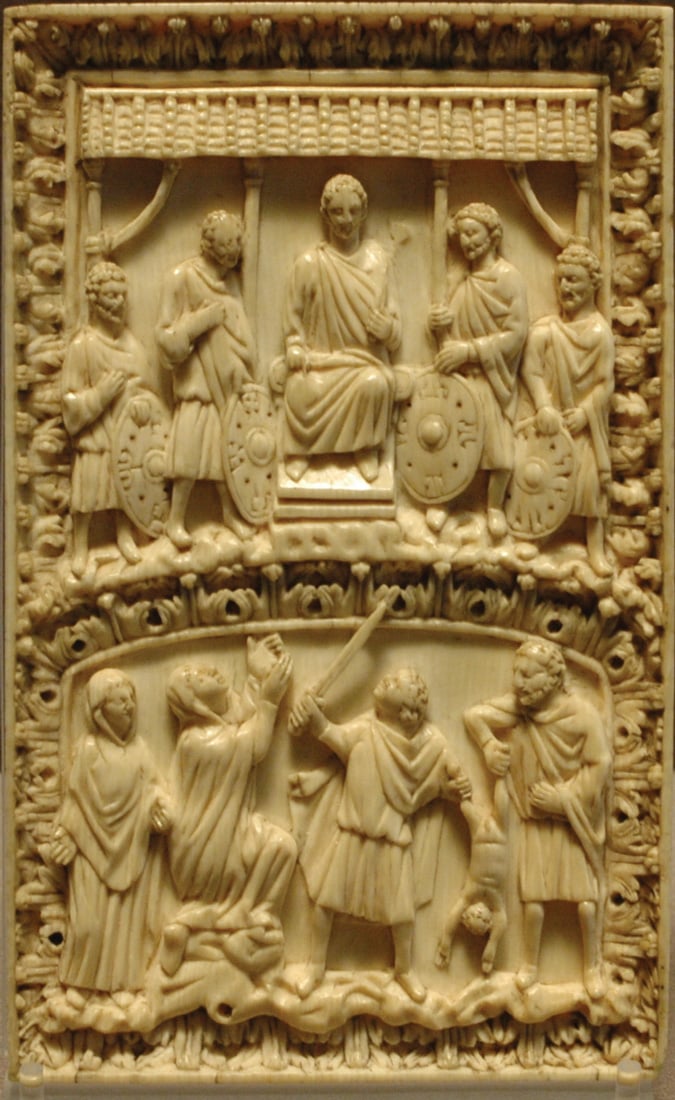
Solomon’s unsurpassed wisdom is depicted in this carved ivory codex binding (tenth–eleventh century AD) portraying his judgment between two women who lay claim to the same child (I Kings 3:16–28).
An additional point is raised based on the book’s concepts: Some of the emphases and specific expressions of Ecclesiastes are similar to those found in Greek philosophy, especially Stoicism and Epicureanism.
A minority of scholars still support a Solomonic origin for the book, which would put its composition in the mid-tenth century BC. According to an Aramaic translation of the book, Solomon authored the book during a time of religious apostasy, which occurred late in his life. The book itself, however, does not support such a claim (cf. 12:9–10) or suggest a specific period of his life. Those rejecting the traditional author, including many conservative scholars, tend to date the book no earlier than the late postexilic period, with an increasing number supporting a third-century-BC date.
Although a detailed defense of Solomonic authorship in response to the preceding objections cannot be offered here, the following points may be noted. The language argument certainly is weightier than the content argument. After a thorough examination of the linguistic evidence, however, Daniel Fredericks concludes that a preexilic date for Ecclesiastes is defensible and that the book should not be dated later than the exilic period (Fredericks, 13). Given the relative paucity of surviving Hebrew and Aramaic texts from this period, any effort to use specific linguistic features to set an absolute date for any biblical composition is fraught with difficulties, and the editorial updating of a wisdom book such as Ecclesiastes is a reasonable explanation for the existence of “late” features. With regard to the content argument, the author may call himself “the Teacher” to emphasize the specific hat he is donning in this book in addressing a broad range of topics and a broad audience, drawing on common wisdom themes and sources. And one can identify at least as many parallel concepts in ancient Mesopotamian or Egyptian texts as in Greek compositions. In the following interpretive comments, a Solomonic perspective will be assumed throughout, based on our conclusions regarding the possibility but not the necessity of a Solomonic origin for the book’s teachings. Accordingly, we will avoid tying this perspective too tightly to any concrete historical setting, either monarchic or postexilic.
Literary Features
Although the question of authorship is not insignificant, issues related to the compositional unity, rhetoric, genre, structure, and overall purpose of Ecclesiastes have a much greater impact on its interpretation. Seemingly contradictory statements have led interpreters to identify multiple voices within the book. Compare, for example, 5:10 (“whoever loves wealth is never satisfied with his income”) with 10:19 (“money is the answer for everything”) or 1:18 (“with much wisdom comes much sorrow; the more knowledge, the more grief”) with 7:11 (“Wisdom, like an inheritance, is a good thing and benefits those who see the sun”). One explanation is that a skeptical speaker verging on heresy has been (later) countered editorially by the addition of an orthodox perspective. Some understand the concluding verses, 12:13–14, as a pious postscript that serves to reject all that precedes it within the book. It is preferable, however, to view this repeated juxtaposition of divergent, even opposing, proverbs as the intentional rhetorical strategy of the author, who seeks as sage to examine human pursuits from all sides in order to assess realistically both their benefits and limitations and advocate a balanced perspective.
Striking similarities and differences between Ecclesiastes and a wide range of biblical and ancient Near Eastern texts have complicated efforts to identify its genre, since it is arguably unique. The book begins with a lengthy first-person section (1:12–2:26, although first-person statements continue through chap. 10), but the lessons drawn from these experiences are quite unlike those of other royal autobiographical texts, such as the Cuthaean Legend of Naram-Sin. Ecclesiastes lacks the sustained wrestling with divine injustice that marks Job and a number of Mesopotamian texts, such as the Babylonian Theodicy, as well as the pervasive cynicism of texts such as the Dialogue of Pessimism. The book itself suggests that its teachings result from an intentional and wide-ranging examination of all that is done under the sun, not simply for self-discovery but also for the benefit of others (compare 1:13 and 2:3 with 12:9–10).
Structure and Theological Themes
Many interpreters despair of finding any structural framework or logical development within the central section of the book, chapters 3–11. They dismiss any attempt as a creative imposition on a loose collection of miscellaneous topics and sayings. This commentary, however, will seek to demonstrate that the sage who authored this book sought not only to find order in his world but also to order his discoveries. In light of his initial thesis stated in 1:2 that everything is utterly “temporary” (Hebrew hebel, used thirty-eight times in the book), he seeks to determine what nevertheless has lasting value (1:3, NIV “gain”; Hebrew yitron) in such a world. To this end, he proceeds to analyze and assess the foundational activities and dimensions of life under the “sun”: human achievements and wisdom (1:12–2:26), time and eternity (3:1–22), social relationships (4:1–16, followed by an admonitory interlude in 5:1–9), and wealth (5:10–6:9). As a result of his investigation, he comes to understand that seemingly bad days can bring about good (6:10–7:14), that righteousness and wisdom offer only limited protection in this world (7:15–29), that one must submit to the government despite injustice (8:1–17), that in the light of death one must make full use of one’s opportunities (9:1–10), and that one should embrace wisdom and avoid folly (9:11–10:20). Despite having emphasized the elusive nature and ephemeral value of many of our most prized possessions and achievements, the author concludes by affirming the value of vigorous and joyful engagement in life, tempered by reverence for God (11:1–12:7), until death overtakes us.
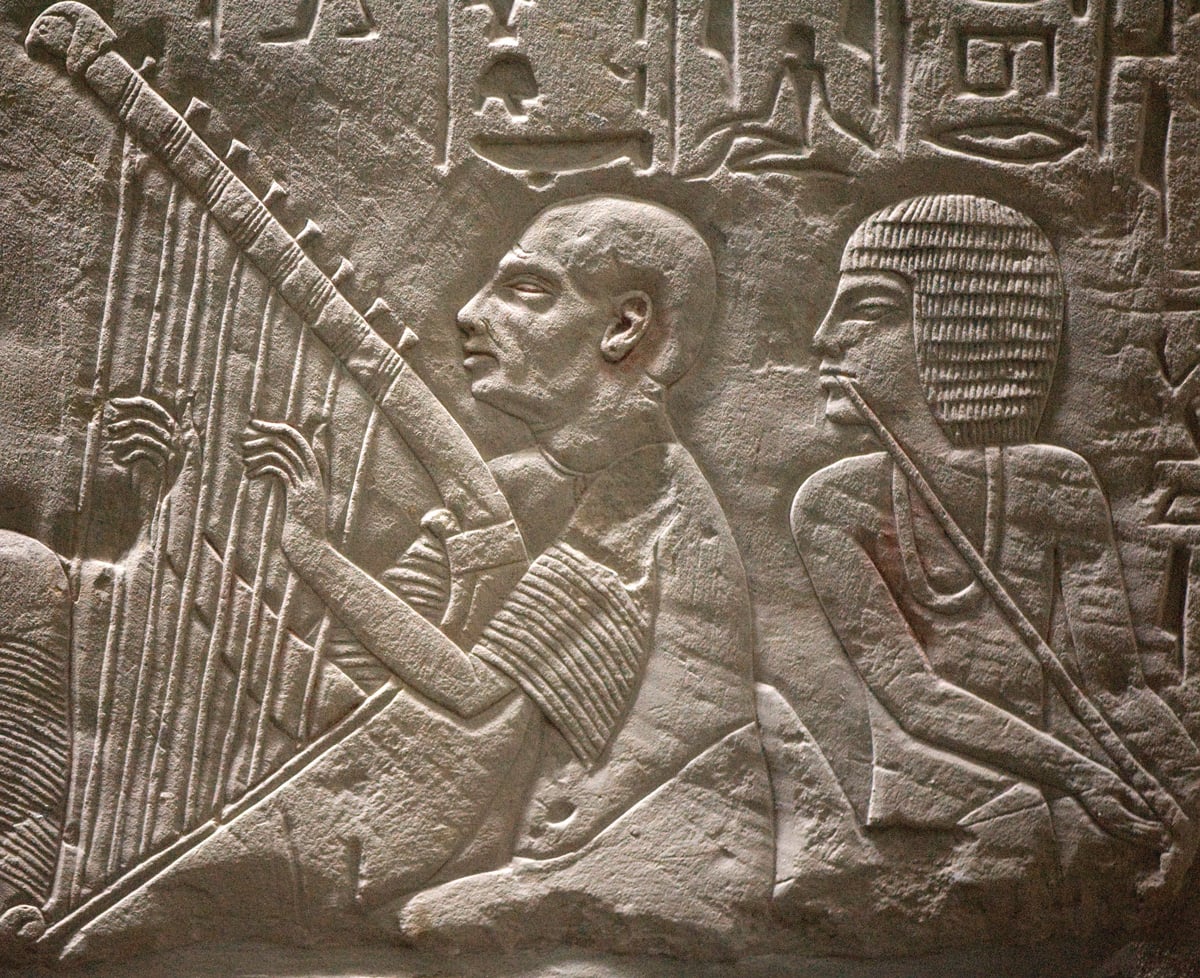
The Harper’s Song—part of which appears in the hieroglyphs above the blind harper in this relief (Tomb of Intef, Saqqara, 1333–1307 BC)—contains thematic similarities to the book of Ecclesiastes.
The book of Ecclesiastes draws on Genesis 1–3 repeatedly; it refers to God as the “Creator” (12:1), who created humans from the dust of the ground and imparted the “spirit” to them (3:20–21; 12:7), and who makes “everything beautiful in its time” (3:11). In a fallen world, though, human (Hebrew adam) efforts are marked by wearisome “labor” or “toil” and produce no lasting results. In Ecclesiastes, God’s most frequent activity is “giving” (used thirteen times of God). He gives both toil (1:13; 2:26; 3:10) and enjoyment in life (2:24, 26; 3:13; 5:18), wisdom and knowledge (2:26; cf. 12:11), wealth and honor (5:19; 6:2), and the numbered days of one’s life (5:18; 8:15; 9:9). God remains sovereign (6:10; 9:1), and his work incomprehensible (3:11; 7:14; 8:17; 11:5). Ultimately every person will encounter him as judge (3:15; 5:6; 7:16–17; 11:9; 12:14), though the present delay in divine justice can be quite troubling (3:16–17; 8:12–13) and uncertainty regarding the future can lead to debilitating doubt and even despair (3:22; 6:12; 7:14; 8:7; 9:1, 12; 10:14).
Though God’s work is inscrutable, he has “set eternity” within the human heart (3:11), and the appropriate human response is to “revere” him (3:14; cf. 5:7). This exhortation is balanced by Ecclesiastes’ dominant encouragement to find joy in the everyday experiences of life (2:24–25; 3:12–13; 5:19–20; 8:15; 9:7–8; 11:8–10), which recurs almost like a refrain and progresses in the course of the book from an assertion to a command. Without these twin pursuits, life is reduced to futility (i.e., “chasing after the wind,” 1:14, 17; 2:11, 17, 26; 4:4, 6; 5:16; 6:9), without rest (2:23; 4:6; 5:12; 8:16), satisfaction (4:8; 5:10; 6:3, 7, 9), or meaning (2:17–23; 4:8). Despite these difficulties, Ecclesiastes repeatedly emphasizes that life is not without “gain.” Wisdom, wealth, and wife, though temporary, should be embraced and enjoyed as divine gifts. The book encourages us therefore to “accept our lot” (especially 5:18–19; 9:9), even though the present is difficult and the future is veiled (2:12, 18; 6:12; 7:14; 9:3; 10:14; 12:7).
Commentary
1. Introductory Remarks (1:1–11)
A. Title (1:1). The book begins with a title that attributes these “sayings” to “Qoheleth.” Deuteronomy 1:1; Nehemiah 1:1; Proverbs 30:1; 31:1; Jeremiah 1:1; and Amos 1:1 introduce their books similarly as containing the words of a specific individual, without necessarily claiming thereby that this person wrote or edited the present canonical book. Although often left untranslated as the proper name Qoheleth, this word is more likely a professional title, literally “the Assembler” of the people. The same Hebrew verb is used in 1 Kings 8:1–2 when Solomon assembles (Hebrew qahal) the Israelite leaders prior to the temple dedication celebration, in which the whole assembly of Israel participates. Instruction is then the assumed purpose for which the author assembles the people. Alternatively, the word could describe him as the “assembler” or author/editor of wise sayings (cf. 12:9–10). It is clear from the royal activities and achievements noted in chapters 1–2 that the book sets forth “Solomon’s”—rather than a later monarch’s—wisdom, whether as the actual originator of its teachings or merely as a literary foil or voice for a later author. In biblical scholarship, it has become conventional to refer to the author as Qoheleth, thus distinguishing him from the historical king. In calling himself Qoheleth (1:12), he may be emphasizing his role as sage rather than as ruler. The third-person references to Qoheleth could point to the work of an editor.
B. Theme verse: Everything is ephemeral (1:2). The main body of the book is bracketed by Solomon’s foundational assessment of life “under the sun” (1:2 and 12:8). As noted above, how one understands the Hebrew word hebel (NIV “meaningless”), which occurs five times in this verse, largely determines how one characterizes the basic message of the book. There have been numerous suggestions, although no single English word adequately renders its contextual meaning throughout the book—for example, absurdity, contradiction, irony, opacity, vanity (KJV and NASB), naught. Psalm 144:4 offers a helpful indicator of its possible meaning: “Man is like a breath [hebel]; his days are like a fleeting shadow.” Hebel is also the Hebrew spelling of Abel, the first human to die (Gen. 4:8), and all humans have experienced similarly the transient or otherwise insubstantial nature of their life and achievements. Since all human endeavors under the sun are stamped with a t for temporary, such pursuits often seem to be futile or even senseless, but this gives no warrant for translating the word consistently as “meaningless” in the book, as the NIV does. The repetition of the word in verse 2 is emphatic, similar to “Song of Songs” and “holy of holies”; that is, everything is utterly temporary.
C. Goal of the investigation (1:3–11). How should one then live in such a world? The phrase “under the sun” is used exclusively in Ecclesiastes (twenty-nine times, with the variant expressions “see the sun” [6:5; 7:11; 11:7] and “under the heavens” [1:13; 2:3; 3:1]). It designates the earthly realm of existence and activity as humans experience and view it apart from divine revelation regarding the final judgment and the eternal dimension. Qoheleth largely restricts himself to the former perspective throughout the book, while not denying thereby that the latter exists. Verse 3 suggests that verse 2 is not making a blanket nihilistic claim regarding the created world but rather prompting a thorough search for what ultimately remains as “gain” or profit from one’s work. This investigation dominates the first half of the book. The underlying Hebrew word yitron is a commercial term that occurs only in Ecclesiastes. Verses 4–11 offer a poetic overview and suggest the provisional answer that little or nothing is gained. In the realm of nature, despite the relative permanence of the earth (1:4), one observes constant movement. This is emphasized by the dominance of participial forms and the sixfold use of the verb “go” in verses 4–7. There is no progress, however, for the sun (1:5; cf. Ps. 19:4–6), wind (1:6), and rivers (1:7) repeatedly run the same courses. In the realm of the human senses (speaking, seeing, hearing, 1:8), there is effort without satisfaction. Weary words (rather than NIV’s “things are wearisome”) cannot fulfill. In the realm of human activities, nothing fundamentally new is done or discovered, despite claims to the contrary (1:9–10). Even the memory of the proudest achievements of the past or present generation (cf. 1:4a) will soon fade (1:11).
2. Everything under the Sun Is Examined (1:12–6:9)
A. Human achievements and wisdom (1:12–2:26). In the first major section of the book, Qoheleth examines various aspects of life “under the sun” (1:12–6:9), intermittently evaluating what he has experienced or observed. In an extended autobiographical section (1:12–2:26), Qoheleth relates his personal experiences. He first examines by means of wisdom (1:13; cf. 7:23) the gain that comes through a life marked by achievements and pleasures and then examines wisdom itself. He relates his findings in these two realms first in summary form (1:12–15; 1:16–18) and then more fully (2:1–11; 2:12–16) before drawing both negative and positive conclusions (2:17–26).
1:12–18. The opening summary exhibits a parallel structure, as Qoheleth sets forth his qualification (1:12, 16), his purpose (1:13a, 17a), the result (1:13b–14, 17b), and an explanatory saying (1:15, 18). His first qualification—that he ruled over (all) Israel in Jerusalem (1:12)—applied only to David and Solomon. Verse 13 emphasizes his single-minded effort (literally “I gave my heart,” also 1:17; 7:21; 8:9, 16) to examine human activities in depth and in breadth, despite their unpleasant nature (“heavy burden”; a better translation is NJPS’s “unhappy business”). Surprisingly, for reasons to be explained in chapter 2, all of these activities appear to be as futile (Hebrew hebel) as “chasing after the wind” (1:14; also 1:17; 2:11, 17, 26; 4:4, 6, 16; 6:9, cf. 5:16; 8:8). Expressed proverbially (1:15; cf. 7:13), capturing the wind is as impossible as restoring something that has been damaged or counting something that is not there.
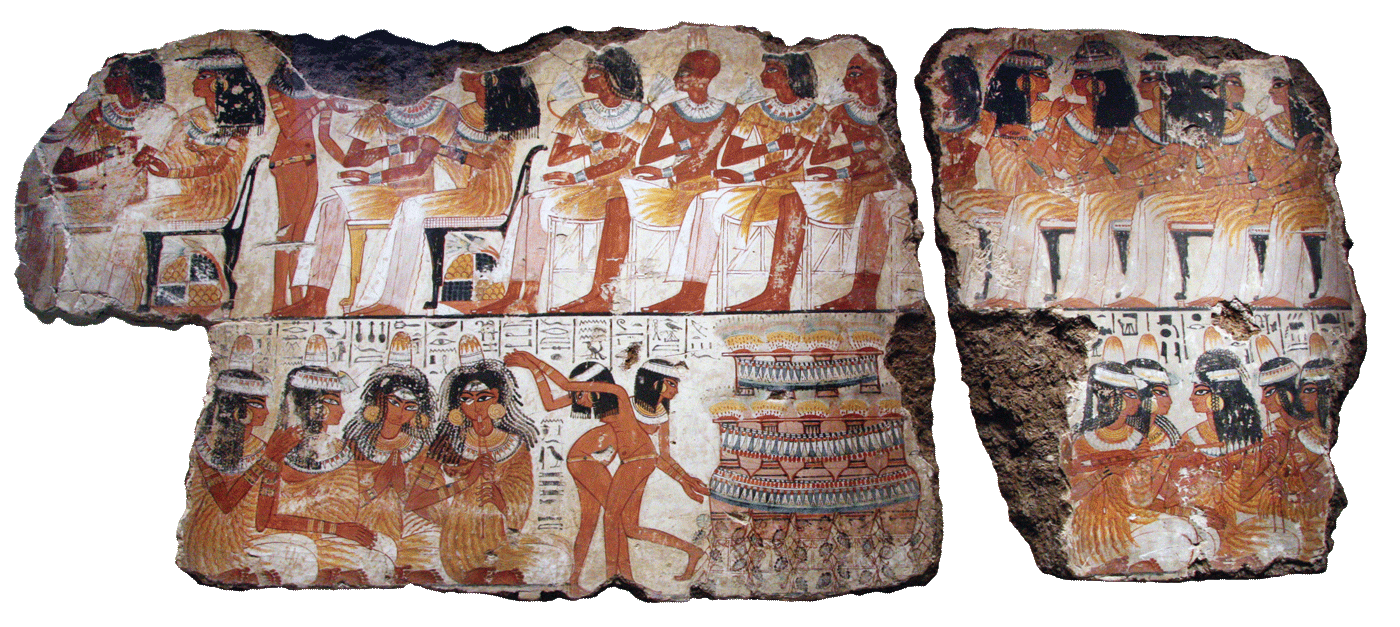
This Egyptian painting (tomb of Nebamun, ca. 1350 BC) illustrates the role of dancers and musicians to delight the heart, such as Qoheleth sought with his male and female singers (Eccles. 2:8).
Solomon was reputedly the wisest individual and exhibited unrivaled theoretical and practical skills (cf. 1 Kings 10:7). Thus he was uniquely qualified to assess wisdom’s worth (1:16). Interpreters have taken the phrase “more than anyone who has ruled over Jerusalem before me” (cf. 2:9) as pointing to a later Davidic king as speaker, since Solomon would not make such a claim with David as his only predecessor. This conclusion is unwarranted, since even the postexilic author of 1 Chronicles 29:25 makes a strikingly similar assertion regarding Solomon. Although Qoheleth seeks to understand wisdom better by studying its opposites, “madness and folly” (1:17), wisdom itself is experienced as a mixed blessing. As the concluding proverb asserts (1:18), increased wisdom and knowledge are accompanied by increased vexation and pain. No amount of wisdom and knowledge will enable one to explain or resolve all of life’s challenges.
2:1–16. Qoheleth’s actual test is related in this strongly autobiographical section that has striking parallels with the Solomonic narrative in 1 Kings. Verse 10 might give the impression that these verses express his later sober reflections on an earlier period of sensual excesses, but the emphasis is rather on the intentional and restrained nature of his investigation (2:3b: “my mind still guiding me with wisdom”; verse 9b: “In all this my wisdom stayed with me”). He begins by testing himself with “pleasure.” The NIV translates the same Hebrew word as “pleasure” in 2:2, 10 and 7:4, but as “happiness” in 2:26; “gladness” in 5:20; 9:7; and “enjoyment” in 8:15. He ultimately will see the “enjoyment” of life as something good. Here he simply notes that pleasure soon fades and thus accomplishes little (2:1b, 2b), while indulging in laughter (or NJPS “revelry”) is madness (2:2a). As one form of pleasure, he tries stimulating his senses with wine (2:3a). The parallel expression, literally “to grasp folly,” is puzzling, since nowhere else in the book does Qoheleth admit engaging in foolish behavior. Perhaps this merely reflects his following judgment that such activities are not “worthwhile” pursuits for individuals “during the few days of their lives.”
Next, Qoheleth details his private architectural and horticultural projects (2:4–6), personal acquisitions of slaves, herds and flocks, and treasures (2:7–8a), and sources of musical and sexual delight (2:8b). The NIV notes that the translation “harem” for Hebrew shiddah is uncertain. A similar Hebrew word, shad, means “breast” and occurs together with the word translated here as “delights” in Song of Solomon 7:6–7, supporting this understanding (compare Judg. 5:30, literally “a womb or two”). He summarizes his unrivaled status and accomplishments (2:9) and opportunities for self-gratification (2:10a) and concludes positively (2:10b) that his heart (i.e., the core of his being) “took delight in all [his] work” and in the fruits of his labors. Such efforts ultimately can be viewed as only temporary and futile, like pursuing the wind, since they bring no lasting gain or benefit (2:11, answering the question posed in 1:3). Precisely why this negative conclusion is warranted will be explained in 2:17–23.
Next, in 2:12–16, Qoheleth investigates wisdom and its converse, madness and folly (2:12a; cf. 1:17). Verse 12b is viewed by some commentators as unintelligible or displaced but may serve to anticipate 2:18–21, which also deals with the king’s successor. Verse 12b, translated literally, asks, “For what kind of person is it who will come after the king, in the matter of what has already been done?” (so Eaton, 68). Verses 12–15 contain a sequence of verbal actions that set forth Qoheleth’s epistemological process. These will be repeated, with some variations, throughout the book: (1) verse 12—“I turned . . . to consider” (selection of object of examination), (2) verse 13—“I saw” (observation), (3) verse 14—“I came to realize” (reflection), (4) verse 15—“I thought/said in my heart” (conclusion). His observations affirm the traditional assessment of wisdom’s relative benefit (2:13; Hebrew yitron, as in 1:3). He also states this proverbially (2:14a): the wise are able to see where they are going, unlike the fool, who constantly stumbles about in the dark. Yet, in his quest for lasting gain, Qoheleth must recognize that both the wise and the foolish share the common destiny of death, the ultimate equalizer (2:14b–15). The NIV’s “fate” implies a predetermination not suggested by the more neutral Hebrew word miqreh (“occurrence” or “what befalls a person”). This word is used seven times in the book, always referring to death. The inevitability of death makes Qoheleth question the value of his pursuit of wisdom, for he concludes that, in the end, this too is temporary (2:15). Not only will his wisdom perish with him, but he and his wisdom also will soon be forgotten (2:16; cf. 1:11).
2:17–26. This leads to Qoheleth’s concluding evaluation of this area of investigation. On the negative side (2:17–23), he claims to have hated life. All work, especially his own life’s work, was “grievous” or burdensome to him (cf. Eccles. 1:13b), a futile pursuit of lasting gain (2:17–18a). His strong emotions here appear to contradict his previous assessment of the delight he derived from his labor (2:10b, but note 2:11) until he explains his response. First, upon death, a potentially foolish heir will take control of all that Qoheleth has accrued through his efforts, wisdom, and skill. This heir has not contributed to its acquisition and, unfortunately, may have no inclination to steward it well (2:18b–21). Second, one’s work life is marked by pain and vexation (NIV “grief”), and even by sleepless nights (2:22–23).
On the positive side (2:24–26), Qoheleth affirms that life, along with its daily activities such as eating, drinking, and working, can be enjoyed—but only as a divine gift and not apart from God. (NIV’s “without him” here follows Septuagint, Syriac, and some Hebrew manuscripts; the Masoretic Text reads “apart from me.”) God grants “wisdom, knowledge, and happiness” to the one “who pleases him” (NIV; literally “good before him”). In contrast, the “sinner” (Hebrew hote; contra NJPS, “him who displeases”) may gather possessions only to pass them on without ever enjoying them, if God withholds that ability. Ecclesiastes 7:26 and 8:12–13 (cf. also 9:2, 18) indicate that this benefit has a moral basis rather than resting on God’s “unpredictable and totally arbitrary pleasure” (so Loader, 32). Qoheleth thus concludes his first inquiry by issuing for the first time his repeated call to “eat, drink, and enjoy one’s work” (not simply its by-products).
B. Time and eternity (3:1–22). Next Qoheleth turns to the examination of how time, viewed against the backdrop of eternity, affects human efforts to engage in profitable activities.
3:1–8. He begins with a highly structured “Catalogue of Times” (Fox, 193), which affirms and illustrates that “there is a time for everything” (3:1–8), certainly the book’s best-known text. The poem begins with an initial summary claim regarding time and every human purpose (Hebrew hepets; 3:1). It is disputed whether this verse is to be taken descriptively (i.e., there is a predetermined time to acknowledge or be passively submitted to) or prescriptively (i.e., there is a proper time for action to seek or for making an appropriate response). This is followed by seven (symbolizing completeness) couplets of paired actions (i.e., 7 × 2 × 2 = 28). The fourteen pairs of terms employ merism, a figure of speech that designates a sphere by means of polar opposites (e.g., Gen. 1:1 “the heavens and the earth” = the cosmos; Ps. 1:2 “day and night” = continually). Although some interpreters claim that the author has made no attempt to order the activities progressively or in terms of their importance, J. A. Loader has identified an alternating pattern of values that is quite attractive. By labeling the actions within each pair as either generally “favorable” (F) or “unfavorable” (U), Loader (34–35) discovers the following pattern:
v. 2: FUFU; v. 3: UFUF; v. 4: UFUF; v. 5: FUFU; v. 6: FUFU; v. 7: UFUF; v. 8: FUUF. Also noteworthy is the fact that the Catalogue begins in v. 2a with birth and death and concludes with war and peace in v. 8b, both pairs describing fundamental human experiences.
Following Loader’s lead, a coherent development can be traced in this poem, but its point remains unchanged even if one finds this interpretation strained and thus unconvincing. Verse 2 describes the beginning and end of animal and plant life, as determined by God, although “uproot” most likely does not refer to harvesting (cf. Zeph. 2:4). The NIV’s “to be born” is literally “to give birth.” Verse 3 describes the destruction and repair or construction of a body and a building, as determined by humans. Verse 4 describes opposite moods, which might accompany the preceding actions, in both their emotional (“weep . . . laugh”) and ceremonial (“mourn . . . dance”) expressions.
Verse 5 describes the treatment of stones and people in terms of joining and separating.
It is unclear what gathering stones refers to, but it must have a negative connotation (as in judicial stoning) if Loader’s analysis is correct. Verse 6 describes the treatment of possessions similarly, emphasizing their unintentional or intentional loss. The verb translated “scatter” in verse 5 is translated as “throw away” in verse 6. Similar to verse 4, the first terms in verse 7 describe proper responses to tragedy in both gesture and speech (cf. 2 Sam. 13:31; Job 2:12–13). The poem concludes with the primal emotions of love and hate and their societal effects in war and peace. Through this catalog of a wide variety of opposite actions and emotions, the poem presents a selective but comprehensive portrait of human life “under the sun.”
3:9–22. The meaning and implications of this introductory poem must be determined by the verses that follow it, regardless of whether it was written specifically for this context or incorporated from elsewhere. Verse 9 poses the book’s foundational question again (1:3): In light of the just-highlighted ordering of the times, what gain can be achieved through one’s labor? An answer is given in verses 10–15, qualified further in verses 16–21, and reinforced in verse 22. In observing the divinely assigned tasks that occupy humans, Qoheleth concludes that God “has made everything beautiful in its time.” The NIV’s “burden” in verse 10 for Hebrew inyan is too negative. Verse 11 may echo the creation narrative (Gen. 1:31), also taking up the key word of the preceding section, “time” (occurs twenty-nine times in 3:1–8, but only ten times in the rest of Ecclesiastes). All such activities have their appropriate or fitting occasion within God’s sovereign ordering of the times. To the extent that one can discern these times, one should either delay action or act decisively (8:5: “the wise heart will know the proper time”; cf. also Eccles. 5:2, 4; 8:3; 10:10–11). Yet these times find their true significance—as merely temporal pursuits—against the backdrop of the sense of perpetuity (NIV “eternity”; Hebrew olam) that God has placed in every human heart. The traditional translation of this important Hebrew word is defensible here, even though it is sometimes used in terms of relative rather than absolute duration (i.e., “permanently,” as in Exod. 21:6). Though realizing that more can be observed “under the sun,” humans are unable to fully comprehend God’s work (3:11b).
How should one respond to the fact that God grants beautiful times as well as a glimpse of eternity? With respect to time, Qoheleth reiterates his conclusion from 2:24–26. He affirms that there is no better course for humans than to enjoy life as a divine gift and to do what is good (3:12–13; cf. 7:20). With respect to eternity, he acknowledges that only divine actions transcend the transience of the “under-the-sun” world and the need for revision (cf. Deut. 4:2; 12:32). The best course for humans, then, is to revere God, since, unlike humans, who cannot produce anything fundamentally new (cf. Eccles. 1:9–10), God can even “call the past to account” (3:14–15). This rendering is supported by 3:16–17, which continues the theme of divine judgment. An alternative translation of the difficult wording of verse 15b is “God seeks out the persecuted,” which does not fit the context as well, or “God can seek (successfully) that which already has been pursued” (in vain by others), which contrasts with verse 15a.
The opening phrase of 3:16–22, “and I saw something else,” links this section with 3:10 rather than with chapter 4. Here Qoheleth describes something that does not appear to be very “beautiful in its time.” In the place where justice should be administered, wickedness is being perpetrated instead (3:16). He offers two responses to this dilemma, each introduced by “I thought.” First, he is confident that God has set a time for executing judgment. (The Hebrew phrase for “a time for every activity” in 3:17 is identical to 3:1.) Furthermore, God temporarily allows such wickedness to prevail in order to “test” (or “clarify for”; cf. Eccles. 9:1) humans, so that they will discover that, left to themselves, they are mere beasts (3:18), a point emphasized by a striking use of assonance (Hebrew shehem-behemah hemmah lahem).
This thought leads the author to return to his earlier assertion regarding the equalizing effect of death (2:14–16) and draw out further similarities. From an under-the-sun perspective, humans and animals share a common destiny, and their deaths are indistinguishable. Both are marked by transience, utterly dependent on their life-sustaining “breath” (Hebrew ruah, 3:19, but translated as “spirit” in 3:21). Genesis also describes both animals and humans as “living beings” (Gen. 1:24 [NIV “living creatures”; 2:7; cf. ESV). Both are on their return trip to the dust (3:20), paraphrasing Genesis 3:19. The author nevertheless stops short of equating the two, distinguishing their final direction in verse 21. The NIV 1984’s alternate translation offers a literal (and the only defensible) rendering of the unemended Masoretic Text: “Who knows the spirit of man, which rises upward, or the spirit of the animal, which goes down into the earth?” (see also Eccles. 12:7). This point is obscured by most modern translations, which view the rhetorical question in verse 21 as a denial of any distinction between man and beast. The section concludes with a brief reiteration of verses 12–15: enjoy your time-bound lot in life, since your (eternal?) future remains veiled (3:22).
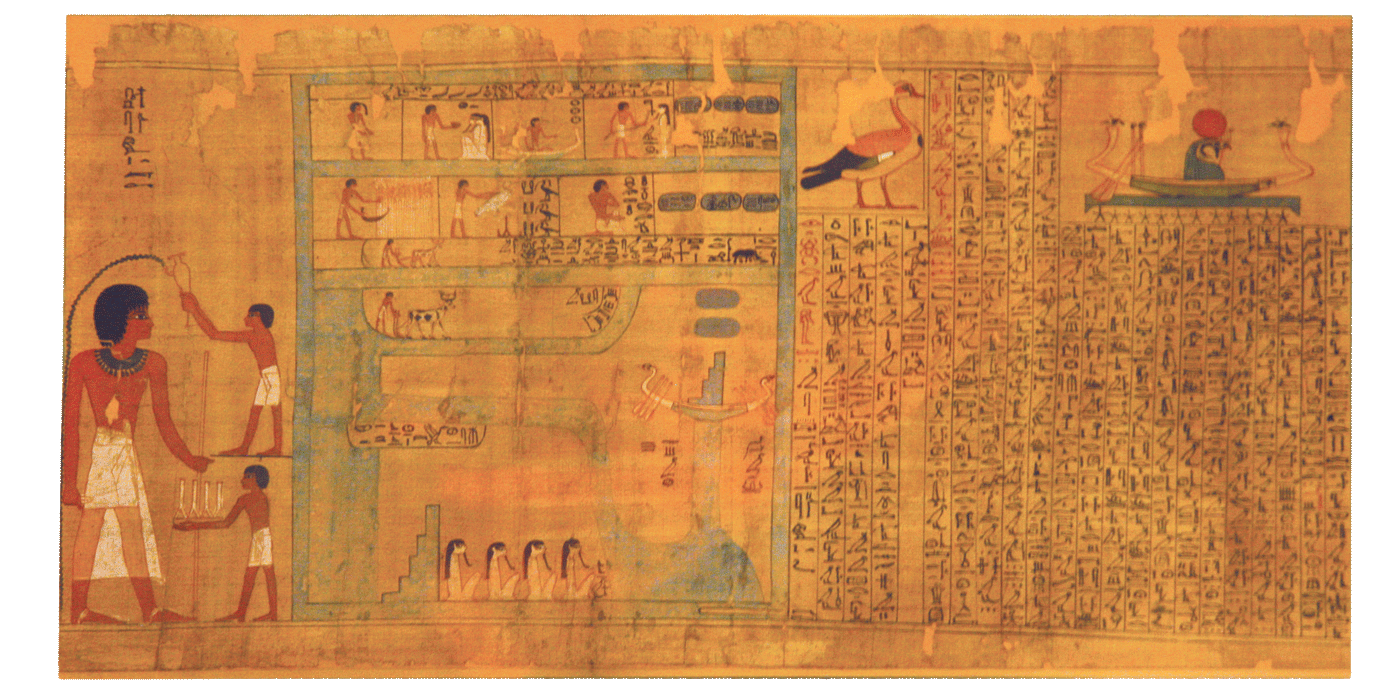
Just as Qoheleth speculated on the fate of humans and animals after death (Eccles. 3:19–21), other ancient Near Eastern cultures formulated various conceptions of the afterlife. For example, this illustration from the Egyptian Book of the Dead (papyrus, ca. 1450 BC) pictures the “Field of Reeds” where the dead would find plentiful water supplies to support their agricultural activities.
C. Social relationships (4:1–16). Next, Qoheleth examines life in society. Chapter 4 can be analyzed as a coherent unit. If one subdivides it into four subsections (i.e., 4:1–3, 4–6, 7–12, 13–16), each of them displays the following features: (1) a thematic emphasis on the value of companionship, (2) no mention of God, (3) no positive resolution to the observed problem, (4) the verb “I saw” (4:1, 4, 7, 15), (5) the inclusion of a “better than” saying (4:3, 6, 9, 13), and (6) a reference to “two” (4:3, 6, 8–12; cf. 4:13). He portrays humans in these successive scenarios as oppressed without comfort, envious, isolated, and inconstant.
4:1–3. The first subunit focuses on injustice, which was introduced in the preceding section (3:16–17). Thematic continuity is suggested by the introductory phrase “Again I looked and saw . . .” Three forms of the same Hebrew root “oppression . . . oppressed . . . oppressors”) give focus to this theme. To suggest that a king like Solomon could not be speaking here because he could (and should) have taken action to end such human abuse misses the point of this chapter, since he is involved here in making global observations. That which especially shocked him is introduced by Hebrew vehinneh, left untranslated in the NIV (but NASB “And behold . . .”). It was not simply the tears and the power imbalance but rather the fact that no one came alongside the oppressed to comfort them that was so painful (cf. Job 16:2; Ps. 69:20). The use of exact repetition in 4:1 is emphatic and a favored stylistic technique of the author (cf. 3:16). This observation is followed in verses 2–3 by one of the most negative-sounding (i.e., unbiblical, though see Job 3:1–26; Jer. 20:14–18) claims in the book—that the dead are better off than the living and those never born better off still! This statement is qualified, however, by a surprising reason: they have not “seen the evil that is done under the sun.” Although the Hebrew verb for “see” in Ecclesiastes can denote personal experience as well as observation from a distance, it should not be limited to the former here. Qoheleth will continue to wrestle with the problem of theodicy (i.e., divine injustice); here he focuses on those condemned to suffer alone.
4:4–6. The second subunit gives Qoheleth’s analysis of the workplace: all diligent and skillful labor is motivated solely by competitive envy. This may strike us as a rather cynical (and inaccurate) assessment, but it is typical of wisdom pedagogy to generalize and universalize in order to make a point. (There is no indication that Qoheleth’s efforts, as recounted in chap. 2, had a similar motivation.) Without explaining why, he notes that seeking to keep up with the Joneses is futile. Lest one think he is thereby questioning the value of diligent efforts, he counters with a proverb and a better-than saying (4:5–6). These verses are linked by three references to “hands.” Only fools avoid work—to their own ruin (literally “and eats his own flesh”; cf. Prov. 6:10–11 = Prov. 24:33–34). Working solely to supply one’s material needs, if accompanied by “tranquility,” is preferable to striving constantly for more (literally “two fistfuls,” cf. Prov. 17:1).
4:7–12. The third subunit also focuses initially on the workplace, with thematic continuity signaled by the opening words “Again I saw,” similar to verse 1. For the first time in the book, the author uses hebel (i.e., something senseless) in his observation rather than in his concluding statement. “There was” typically introduces a specific example or case study in Ecclesiastes (e.g., 2:21; 7:15; 8:14; contrasted with “there was no . . . ,” e.g., 4:1; 7:20). Unlike the individual in the preceding scenario, who works constantly with an eye on others, this individual has no one to look to (similar to the first scenario, 4:1). Lacking a partner or any relative with whom to share the accrued wealth, this person labors without end and without contentment. This theme will be developed more fully in 5:10–6:9. Then this “workaholic” is stopped short by the obvious question: why am I working so hard while depriving myself of any enjoyment? This makes no sense and turns work into a “miserable business.” Companionship is preferable to isolation, for partners can share together in the fruits of their labors. The author then expands on the benefits of companionship in 4:10–12. These verses are not to be viewed as an independent section, since they lack the key elements of the other subunits (i.e., “I saw,” a “better” saying). Despite the popularity of these verses as a wedding text, they refer rather to one’s needs during a journey: assistance after falling (4:10), warmth when sleeping (4:11), and backup when attacked (4:12). The concluding proverb about “a cord of three strands” can be traced back to ancient Sumer.
4:13–16. The fourth subunit begins uniquely with a better-than saying, which introduces the evaluative comparison between two successive monarchs (4:13–14). King 1 is old but unexpectedly foolish, no longer receptive to corrective advice. King 2 is still a youth and of ignoble birth but nevertheless wise and therefore “better.” The Hebrew word for “poor” in verse 13 and 9:15–16 refers to one’s lowly social status (i.e., a commoner) rather than to one’s financial situation. King 2 was born into poverty in King 1’s kingdom and rose to power after being imprisoned. The NIV’s “hypothetical” translation in verse 14 (“may have come . . . may have been”) is unnecessary; a concrete chronological sequence of monarchs is being described here. Commentators both ancient and modern have sought to identify these individuals with Old Testament figures such as the Pharaoh and Joseph or various Hellenistic rulers, but none sufficiently fit these details. Qoheleth gives special attention to the fickleness of their subjects in verses 15–16. The masses (literally “all the people he was before,” i.e., whom he led, as in Num. 27:17) thronged to the side of youthful King 2 when he replaced King 1. Unfortunately, those of the next generation of subjects “were not pleased” (or “may not be pleased”) with King 2, for the crowd’s adulation quickly dies out, regardless of how one governs.
D. Warnings against wrong attitudes toward God and government (5:1–9). Ecclesiastes 5:1–9 offers an interlude before Qoheleth concludes his investigation of life under the sun. This section is distinct from the one that immediately precedes it, as indicated by the repeated references to God, the dominance of imperative verb forms, and the complete absence of first-person verb forms. Here for the first time in the book, the author directly addresses the reader. This section, addressing one’s attitude toward God (5:1–7) and government (5:8–9), in its context may serve to warn against rash responses to the preceding observations of the incongruities and injustices of life under the sun.
In 5:1–7, the author cautions the reader to exercise restraint in various cultic activities, particularly while making vows that involve subsequent voluntary offerings. The occasion is not specified, although vows in the Old Testament often involve leveraging divine protection and favor. (See, for example, Gen. 28:20–22; Judg. 11:30–31; 1 Sam. 1:11; and 2 Sam. 15:7–8; wisdom literature seldom addresses such matters.) This section is framed by positive charges (5:1, 7), while four negative admonitions dominate verses 2–6. Whenever you head for the temple, Qoheleth tells the worshiper, you should draw near (a technical cultic term) in order to listen to God rather than to tell him something. Otherwise, you will “offer the sacrifice of fools,” probably referring here to excessive words uttered before God (5:2–3, 7). Such foolish words have their source in a foolish heart (5:2; cf. Matt. 12:34). Folly in the Old Testament is a moral category with a cognitive dimension; such individuals are ignorant and thus do wrong. These instructions reflect Qoheleth’s conclusion in chapter 3 regarding discerning the proper time: it can be just as harmful to act too hastily (5:2) as to act too slowly (5:4). Verse 2 emphasizes the difference rather than the distance between God and humans. Our words directed toward God should be kept to a minimum not because they are futile but because they should be sincere and weighty. Just as multiplied concerns spawn dreams, so verbosity results in foolish speech (5:3), both of these by-products being equally insubstantial (Hebrew hebel, 5:7a). Verses 4–6 are verbally dependent on the Mosaic legislation in Deuteronomy 23:21–23 regulating vows. A shocking sequence of consequences can follow a voluntary but legally binding rash pledge: divine displeasure (5:4), sin, divine wrath, and divine judgment (all in 5:6). Telling the temple messenger who comes to collect the promised sacrifice (cf. Mal. 1:13–14) that such a vow was “a mistake” (Hebrew shegagah; cf. 10:5; Num. 15:25) is an attempt to downplay it as an “inadvertent” sin. Such an excuse is excluded by this explicit warning, and a deep reverence for God (5:7b) will avert such a cultic disaster (cf. Lev. 19:5–8).
Ecclesiastes 5:8–9 is probably the most difficult passage in the book to interpret. It is loosely linked with verses 1–7 by the reference to a “higher” authority and by the negative admonition in verse 8. Verse 8 takes up the theme of injustice and oppression again (cf. Eccles. 3:16; 4:1). Upon observing the blatant deprivation of human rights, one should not be stunned or appalled by this “activity” (NIV “such things”; Hebrew hepets, as in Eccles. 3:1). The NIV’s “be surprised” is too weak a translation for the Hebrew verb here. The reason for this admonition is literally that “a high one is keeping watch over a high one, and high ones over them.” If one views the author’s basic attitude toward government as positive, this statement could be taken as pointing to the benefits of hierarchical levels of jurisdiction, especially if one takes the plural as a superlative (i.e., the highest one, God). “Do not be upset—other officials are keeping an eye on the situation!” Or, more cynically, it could be understood as retorting, “What do you expect, when every bureaucrat is protecting another?” The Hebrew word used here for “district” is taken by some as a certain indicator of the book’s late date of composition, since in Nehemiah and Esther the same term frequently designates the Persian satraps. But the term also occurs in 1 Kings 20:14, 15, 17, and 19, referring to provincial commanders in the time of Elijah.
The wording of verse 9 is even more ambiguous. The fact that it begins with the key Hebrew word yitron (“profit”) suggests that it is making a positive rather than a negative assertion. Literally, it claims: “But a profit of a land in all is this: a king served by a field (or: a king for a tilled field).” The latter option fits better with the book’s overall treatment of the theme (esp. in chap. 8). Despite potential abuses of power, human government is a God-ordained and beneficial institution.
E. Wealth (5:10–6:9). Qoheleth concludes his examination of foundational human activities with an extensive and highly structured analysis of wealth. This section can be subdivided into three distinct scenarios involving wealth on the basis of the threefold use of “I saw” (5:13; 5:18; 6:1) as well as the striking verbal and conceptual parallels between 5:10–12 and 6:7–9. Two negative portraits (5:13–17; 6:1–6) frame a positive one (5:18–20). These three observations are in turn framed by an introduction and a conclusion (5:10–12; 6:7–9), which state the basic inadequacy of riches for providing lasting “gain.” In sum, they do not last and also cause problems. This section offers a clear example of the misleading nature of the biblical chapter divisions and also illustrates the author’s pattern of touching on a topic briefly at one point in the book (e.g., 4:4–9) and then treating it more fully later.
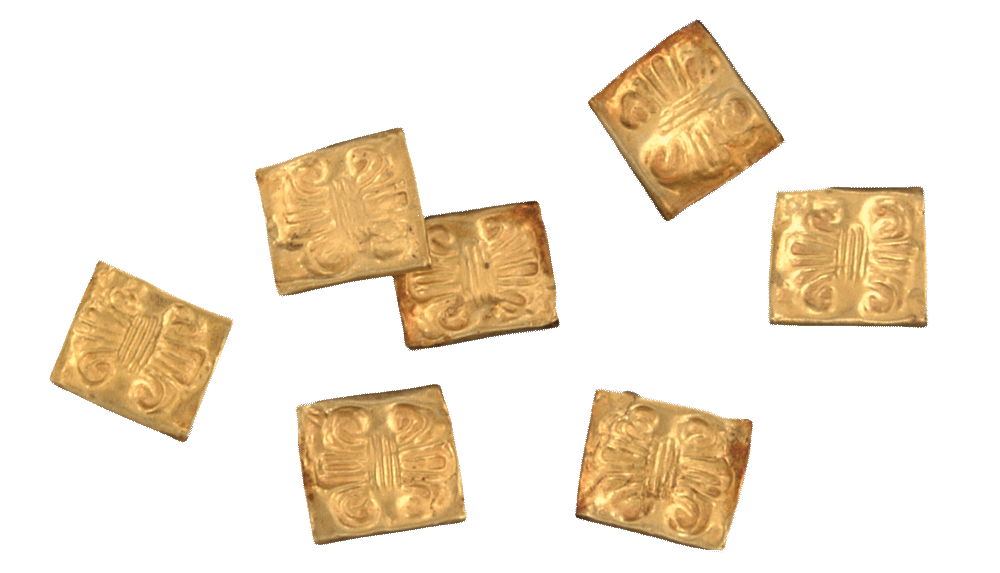
These gold plaques are part of the four hundred gold, silver, bronze, and stone jewelry items found in a ceramic jug under the floor of a house at Beth Shemesh (thirteenth century BC). This cache of valuables has long outlived its owner, demonstrating Qoheleth’s point that just as everyone comes into the world empty-handed, “so they depart” (Eccles. 5:15).
5:10–12. The introduction begins with a proverb: whoever loves money (and lots of it) will never find lasting satisfaction therein (5:10), because an increase in one’s goods attracts more consumers. As a result, the owner watches wealth vanish, with minimal personal benefit (5:10–11). Furthermore, wealth can deprive its owner of sleep (cf. Eccles. 2:23; 8:16), whether due to an overly rich meal (NASB “full stomach”) or the fear of a sudden financial reversal. Such problems do not plague the simple laborer (5:12).
5:13–17. The first scenario continues this negative portrayal, offering minimal details and thus facilitating a broader application. Hoarded wealth can harm its owner, perhaps through distorting values and lifestyle, leading either to decadence or to miserly self-deprivation (5:13). Verse 17 along with 4:8 may support the latter interpretation, in describing life as lived “in the dark” (contrasted with light in Eccles. 2:13; 11:7–8), plagued by psychological, physical, and emotional pain (cf. Eccles. 2:23). Wealth also can be easily lost. The Hebrew expression for “some misfortune” (also in 1:13; 4:8) may refer here to a “bad investment” (NASB; cf. NJPS: “unlucky venture”) or some other sudden reversal of fortune (5:14a). Having lost all, this person is left as bereft of possessions (literally “naked”; Job makes a nearly identical claim in Job 1:21) as at birth and “empty-handed,” despite strenuous labor, with nothing to pass on to an heir (5:14b–15). This leads the author to a related thought, a second “grievous evil” (5:16; cf. 5:13), namely, that all individuals end up departing as “naked” as when they arrived in this world. They can achieve no lasting “gain,” since they are, in effect, toiling “for the wind” (5:16).
5:18–20. The second scenario stands in stark contrast to the empty existence just sketched. Verses 18–20 describe wealth enjoyed through divine enablement; God is mentioned four times in these verses. The NASB captures the tone of the introductory phrase better than the NIV: “Here is what I have seen to be good and fitting” (the Hebrew word for “fitting” is also used in 3:11 [NIV “beautiful”]). For the fourth time in the book, eating, drinking, and “finding satisfaction” in one’s work (literally “seeing good”) during this brief life is commended. In this context, the sage clarifies that God’s gift extends beyond wealth and possessions to the ability to partake of food, to accept one’s lot, to enjoy one’s work, and even to avoid hyperfocusing on the brevity and difficulties of life. The closing claim that “God keeps him occupied with gladness of heart” should be understood as a strong affirmation of the value of life, despite everything, rather than as a cynical concession that such gladness merely provides a brief distraction.
6:1–6. The final scenario, which presents another weighty “evil” (cf. Eccles. 8:6) that Qoheleth has observed, is closely linked to the preceding unit. Here too God grants an individual the ability to achieve wealth, possessions, and the resultant deference (as Solomon himself enjoyed, according to 2 Chron. 1:1–2), in principle supplying everything one could possibly desire. But, in this case, God prevents this individual from benefiting (literally “eating”) from these goods. Instead, God allows an outsider rather than another family member to consume them (6:2), as previously envisioned in Ecclesiastes 2:26—the height of futility! In verses 3–6, the situation is intensified. The individual whose appetite (or “soul”) is not satisfied by that which is good (6:3; cf. 6:6) is so miserable that even the hyperbolic experience of prime Israelite blessings (i.e., fathering one hundred children, 6:3, and living for two thousand years, 6:6), cannot compensate for this lack. Stating it extremely, not being born in the first place would be preferable, like a stillborn child that in its fleeting (Hebrew hebel) and obscure existence misses much but also is spared much (cf. Eccles. 4:2–3). The mention in verse 3 of being deprived of a proper burial is somewhat puzzling. One possibility is to relate this to the stillborn: “then even without a burial, I say the stillborn is better off . . .” (so Murphy, 45; similarly NJPS; cf. Job 3:16). Alternately, the once wealthy and respected person of verse 2 is presented as being deprived of even the final honor of burial (compare Jer. 22:19) and thus failing to enter into rest, in contrast with the stillborn (6:5). Ultimately all are headed for the same destiny of death (6:6; cf. 3:20).
6:7–9. The conclusion parallels the introduction (5:10–12). All human efforts simply serve to fill the mouth, but they cannot satisfy the appetite (6:7; cf. 5:10). Verse 8 fits somewhat awkwardly between verses 7 and 9, though it parallels 5:11b in its formulation. In context, if wealth ultimately cannot satisfy, then the wise are no better off in this respect than the fool, nor is the poor person who has learned the proper conduct for societal survival. Better is “what the eye sees” as a present possession (i.e., a bird in the hand) than “the roving of the appetite” (i.e., two in the bush, 6:9a). Being content with what one has is a gain, while pursuing satisfaction through further acquisition is futile. The final occurrence in the book of the phrase “a chasing after the wind” concludes its first major subdivision.
3. Positive Attitudes in the Light of Injustice and Uncertainty (6:10–10:20)
After examining the major areas of life in his quest for lasting—or even limited—gain, Qoheleth proceeds in the second major section of the book (6:10–10:20) to inculcate positive attitudes regarding “how should we then live,” a foundational query of Francis Schaeffer. This presents a special challenge in a world marked by “transience” (Fredericks’s translation of hebel) and uncertainty and marred by injustice. In particular, the author is intent on clarifying the contributions and limitations of wisdom in this endeavor. This shift in purpose is marked by the increased use of imperative verb forms, which, apart from 5:1–9, are completely absent from the first major section. In addition, the repeated use of the phrases “cannot know” and “cannot find out” replaces “chasing after the wind.” In the process, Qoheleth addresses the problems posed by God’s “twisting” of the times, such as bad things happening to good people, bad government, the inescapability of death, and the limited benefits of godly or wise behavior.
A. Recognize that bad days can bring about good (6:10–7:14). Qoheleth seeks to demonstrate in this first subsection that seemingly “bad” days can bring about good.
6:10–12. Properly speaking, these verses are transitional, serving to summarize one section and introduce (or frame, with the parallel verses 7:13–14) the next. Ecclesiastes 6:10 marks the middle verse of the book, as indicated by the masoretic editors. Here the author sets forth some basic assertions: (1) The world is unchangeable (6:10a; cf. 1:9; 3:15). (2) The limitations of human beings are well known, namely that one cannot successfully contend with God, who is mightier, as Job also learned (6:10b–11). Since multiplying words before him only serves to increase their vacuity, nothing can be gained thereby (similarly Eccles. 5:3, 7). (3) Disputing God’s actions is not only futile but also senseless, since one possesses insufficient knowledge of what is truly good for a person during their short life span, which passes as quickly as a shadow (6:12a, cf. Job 14:2). That is because no one can offer reliable information regarding the shape of future events (6:12b), regardless of whether the word “after” here refers to one’s immediate (7:14) or postmortem (3:22) future.
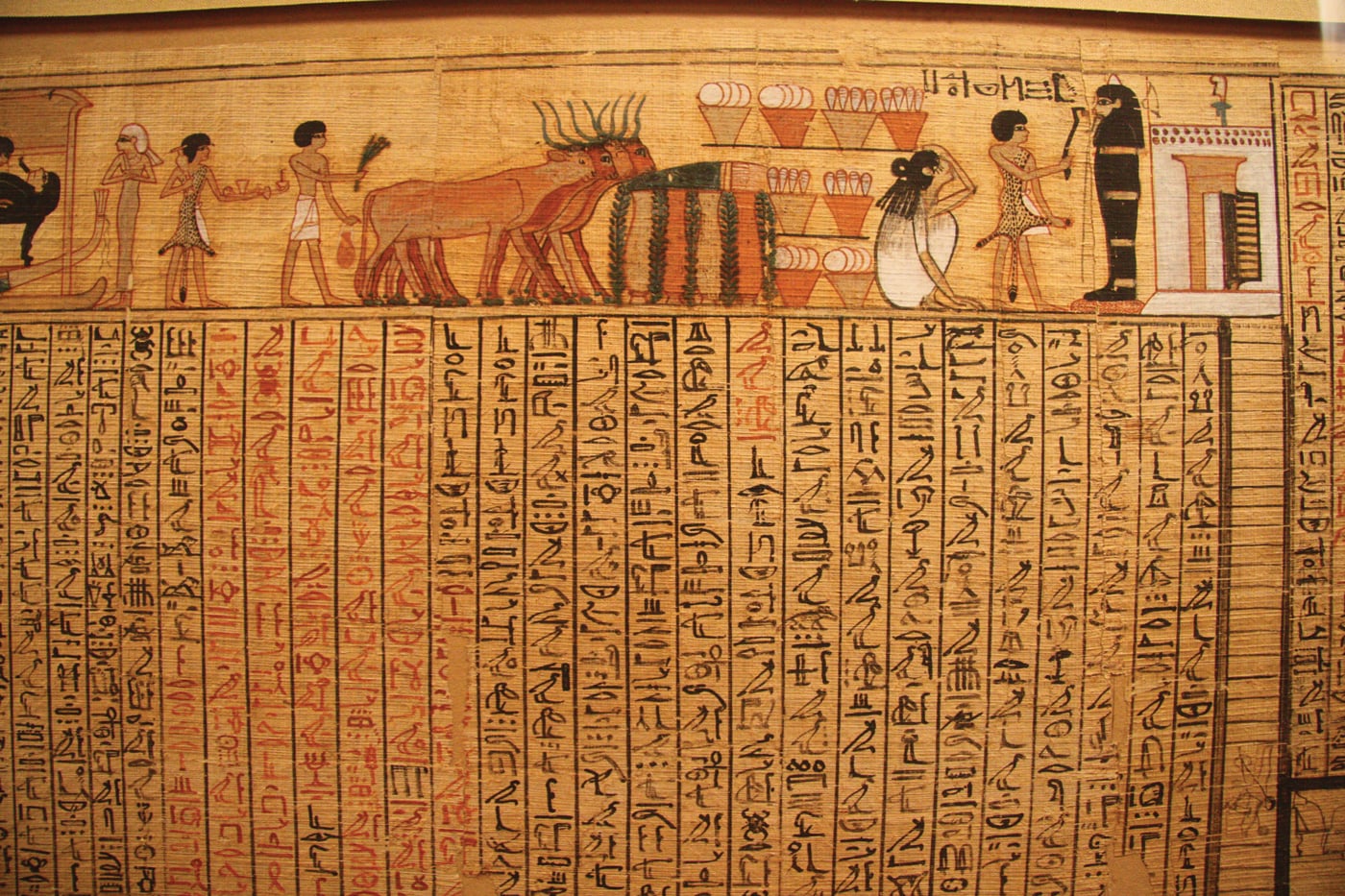
The sarcophagus portrayed here has a perfume cone on the top of its head, representing the “fine perfume” (Eccles. 7:1) or aromatic oils associated with preparing bodies for burial or the afterlife (Book of the Dead, ca. 1391–1353 BC).
7:1–12. The general nature of the rhetorical question in 6:12 (“Who knows what is good for a man in life?”) becomes apparent in this central section of the unit. Here the author employs a series of traditional proverbs in order to affirm, somewhat ironically, nine things that are good or better (all with Hebrew tob), many of which initially appear to be undesirable. The major emphasis here is that wisdom can be acquired or augmented in the hard times of life. The Hebrew root for wisdom occurs seven times in these verses. The initial proverb (7:1a), which uses a wordplay to tout the superiority of a good name (Hebrew shem) over a good perfume (Hebrew shemen), could have a number of applications. For example, following 5:10–6:9, it could affirm the superiority of character to wealth, as in Proverbs 22:1. Linked to 7:1b–4, however, the verse most likely refers to one’s reputation at death and the aromatic oil used in preparing a corpse for burial. A good name makes a more lasting impression than a good smell. Similarly, the sorrowful reflection on death at a funeral is better for the “heart” (four times in 7:2–4) than the levity of a birthday celebration. This is because the former makes a deeper impact, as people are confronted thereby with their own mortality. Additional difficult lessons can be learned, for example, through preferring a sage’s painful rebuke to the frivolous and perhaps flattering song of fools (7:5). Verse 6 explains the inferiority of the latter: a fool’s levity is as noisy and useless as thorns (Hebrew hassirim) used for fuel under a cooking pot (Hebrew hassir, another wordplay), for both soon fade away (Hebrew hebel).
Such hard-won insights, unfortunately, are constantly at risk (7:7–10). Oppression (as in Eccles. 4:1; 5:8, contra NIV’s “extortion”) can drive even a wise person mad, while a bribing gift can destroy the core of one’s being (literally “heart”). Perseverance and patience are to be valued over pride (literally “better long of spirit than high of spirit”), hasty and persistent reactions to provocation, and plaintive comparisons (7:8–10). Verses 11–12, which conclude the central section by comparing wisdom and wealth, support the possibility that verse 1a may continue the main theme of 5:10–6:9. Both wisdom and inherited property are beneficial, providing protective “shelter” for their owner, but sagacity is superior in its ability to preserve life, as affirmed in numerous proverbs.
7:13–14. These concluding verses parallel the introductory verses (6:10–12) and are dominated by three positive imperatives, beginning with “Consider [literally “see”] the work of God!” (KJV). Alluding to the reminder that humans are not able to contend with the superior strength of God in 6:10b, the author asks in 7:13: “Who is able to straighten what he has made crooked?” Here the author takes up the proverb of Ecclesiastes 1:15 and ascribes this “twisting action” to God. Humans cannot change what God has ordained. So Qoheleth charges us, in pleasant times, to enjoy them and, in unpleasant times, to reflect on the fact (literally “see”) that both good and bad days come from God and serve his sovereign purposes, although we as humans cannot find out anything about the future (7:14).
B. Recognize that righteousness and wisdom offer only limited protection (7:15–29). This unit can be clearly distinguished in style from the preceding unit. First-person verbs detailing Qoheleth’s investigative procedure, as well as his discoveries, structure 7:15–29 but are absent from 6:10–7:14. Note the following examples: “I have seen” (7:15), “all this I tested by wisdom and I said” (7:23; cf. 1:13), “so I turned my mind to understand” (7:25), “I find” (7:26), “this is what I have discovered” (7:27), “I found” (7:28), “this only have I found” (7:29). Furthermore, in this section the focus is on the righteous person (Hebrew tsaddiq) for the first time (7:15, 16, 20). The question at issue is how wisdom literature’s prominent “retribution doctrine” that righteousness (as well as wisdom) is richly rewarded while wickedness (as well as folly) is punished (e.g., Prov. 10:3, 7, 16, 24–25, 30) can be squared with one’s everyday observations.
7:15–19. Qoheleth begins by citing two contrary examples: a righteous man who perishes (prematurely) in his righteousness and a wicked man who lives long in his wickedness. The Hebrew preposition translated here as “in” could be understood either as “in spite of” or “due to”; either way the jarring observation stands (7:15). This apparent injustice prompts some rather pagan-sounding advice: do not be overrighteous, overwise, overwicked, or a fool (7:16–17). According to some interpreters, this constitutes a recommendation of moderation in all things, “the golden mean,” as if a little godlessness is perfectly acceptable as long as one does not attract God’s attention! Although numerous suggestions have been made, a contextually plausible solution may be to see here a presentation of varying degrees of righteousness: relative (7:15), pretentious (7:16), and absolute (7:20).
Several linguistic clues support this interpretation: (1) Nowhere else in the Hebrew Bible does a form of “to be” (Hebrew hayah) occur with “righteous” as a command or exhortation (cf. Ezek. 18:5). Usually, “being” righteous is expressed in Hebrew simply through a verbal form of the root tsdq (e.g., Job 9:2, 15, 20). (2) The verb form of the word translated “be overwise” can, in some constructions, mean “to pretend to be,” most notably in Numbers 16:3 (to lord it over; i.e., act like a chief), 1 Samuel 21:14–15 (to pretend to be crazy), and 2 Samuel 13:5–6 (to feign illness). Conversely, the similar formulation of the parallel admonitions in verse 17 weakens this grammatical evidence: Do not act wickedly overmuch (cf. “overrighteous”); do not “be [Hebrew hayah; cf. Prov. 3:7] a fool!” The explanation for this is perhaps to be found in the parallel questions that conclude verses 16–17. On the one hand, the person who seeks to exhibit exaggerated righteousness and wisdom in order to avoid a fate similar to that of the righteous person of verse 15 will be in for a big shock. The NIV’s “destroy yourself” is too strong here (cf. Isa. 59:16; 63:5, which use the same verbal form). On the other hand, the one who concludes that divine justice is blind and thus plunges headlong into ungodly and foolish behavior may end up dying prematurely (literally “before [his] time,” contrast Eccles. 3:2). Therefore, the author concludes (7:18) that the God-fearer will take hold of both warnings (7:16a, 17a), thereby escaping both fates (7:16b, 17b, rather than NIV’s “avoid all extremes”). Proverbially speaking (7:19), acting wisely in such a situation offers a person more protection than a city council, as will be illustrated more fully in 9:13–18.
7:20–24. The following verses continue to develop the theme by conceding that no one is completely righteous (7:20–22) or wise (7:23–24). Accordingly, how righteous does one have to be before claiming to be treated unjustly by God? There is no one who never sins (7:20), especially in speech (7:21–22). A similar acknowledgment is made in Solomon’s prayer in 1 Kings 8:46 // 2 Chronicles 6:36 and in Proverbs 20:9. “Cursing” here (Hebrew qillel) may have the weaker sense of merely denigrating or insulting someone. It is possible to understand verses 23–29 as constituting a new subsection that focuses on wisdom. “All this” in verse 23 probably refers backward to the preceding observations and deliberations in 7:15–22 rather than forward. In seeking the depth of wisdom necessary to comprehend such matters, he falls far short of his goal. This is because “what is” or “what has been” (NIV “whatever exists”) under the sun is “far off and most profound” and thus beyond human discovery (7:24).
7:25–29. This leads to a more modest search. These verses use the Hebrew word for “seek” three times (7:25, 28, 29; NIV “search”), for “discover/find” seven times (26, 27 [2×], 28 [3×], 29), and for “scheme [of things]” three times (7:25, 27, 29). The third word is a mathematical term, literally “calculation” (NASB “explanation”). In his quest for a wise explanation and his effort to “understand the stupidity of wickedness and the madness of folly” (7:25), Qoheleth makes three discoveries:
1. Wicked and foolish women are dangerous, even life-threatening, but one can escape their snare (7:26). This verse echoes the descriptions of the adulteress and Lady Folly in Proverbs 2:16–19; 5:3–6; 7:5–23; and 9:13–18, but it certainly does not refer to all women (cf. Eccles. 9:9).
2. In this world, things just do not “add up” (7:27–28a). Exemplary human beings (Hebrew adam, not ish, “male”), for example, in their righteousness and wisdom, are extremely rare, only one in a thousand. Qoheleth’s reported failure to find the woman he was seeking (7:28b) sounds rather misogynistic, but it is not necessarily normative or expressing a blanket condemnation of the female gender. Possible explanations include that this conclusion reflects Solomon’s personal experience (after seven hundred wives and three hundred concubines, 1 Kings 11:3!), the preceding reference to the foolish woman in verse 26, or Eve’s role in the fall, according to Genesis 3 (in light of the possible reference to it in 7:29). An intriguing alternative noted by Michael Fox is that “Qoheleth could understand one man in a thousand but not a single woman” (Fox, 271).
3. God did not make humans this way. The author concludes with his most significant discovery or “explanation” (“This only have I found,” 7:29), drawing again on Genesis 1–3. Although originally created morally “upright” (cf. Prov. 20:11; 21:8), individuals soon sought out “many schemes.” Alternatively, the repetition here of two key words from the opening verse of this subsection (“search” and “scheme,” 7:25) may merely express his intellectual resignation: “they have engaged in too much reasoning” (so NJPS). If one understands 7:15–29 as basically constituting a coherent discourse unit, then the former interpretation is more likely.
C. Recognize that one must submit to the government despite injustice (8:1–17). In chapter 8, Qoheleth takes up the topic of the role of government and judicial authority, especially in relationship to “evil” (the Hebrew root for “evil” occurs seven times in Ecclesiastes 8). This section is remarkably similar in some of its perspectives to Romans 13, though not necessarily Paul’s source. Both texts note the theological basis as well as the personal benefits of submission to authority, although Ecclesiastes 8 focuses more on the latter than Romans 13. Here the author addresses more fully how the wise person should relate to authority that is sometimes used to perpetrate rather than punish injustice (cf. Eccles. 3:16–17; 4:1–3, 13–16; 5:8–9). This unit is framed by brief reflections on wisdom (8:1, 16–17) that link it to what precedes and follows.
8:1. Following the failed quest for wisdom related in 7:23 and the previous use of the who question in the book (cf. Eccles. 2:25; 3:21–22; 6:12; 7:13, 24), one expects a negative response to the questions in verse 1a: No one is truly wise or understands such things. Verse 1b, however, suggests a more modest but positive claim: the wise are remarkable, being able to interpret sayings such as the following proverb about wisdom’s transformative effect on a person (cf. Job 29:24; Prov. 21:29).
8:2–15. The section can be divided into two parts. Verses 2–8 urge and offer a rationale for allegiance to the monarch, while verses 9–15 set forth Qoheleth’s personal observations and reflections on justice. The positive injunction to carry out the king’s command (8:2a) is followed by two related negative admonitions in verse 3a. First, do not withdraw hastily from his presence. This refers to leaving his service, as in Ecclesiastes 10:4, rather than simply violating court protocol. Second, do not stand up for (i.e., participate or persist in) a bad cause (literally “a bad matter”; NJPS “a dangerous situation,” also in 8:5a), such as an insurrection. These instructions are reinforced in 8:5a, while the remaining verses offer a threefold rationale: (1) due to the loyalty oath taken by the subject before God (8:1b), (2) due to the monarch’s superior position and power (8:3b–4), and (3) in order to stay out of harm’s way (8:5). The phrase “time and procedure” in verses 5b–6a should be taken as a hendiadys (two words representing a single concept; here, “a judgment-time”), since verse 6a echoes 3:1 and 3:17. The development of thought in verses 6–8 is somewhat unclear, but the repetition of the Hebrew root for “have power” in verses 4, 8 (twice), and 9 suggests a thematic connection. Misery weighs heavily on the wise (8:6b) in part because they know neither what will happen to change things nor when it will occur (8:7). Rather than taking matters into their own hands, however, the wise will wait for the appointed time of judgment to arrive (8:5). Then the powerful ones (8:4) will finally meet their match. The king cannot exert authority over the wind (or over his spirit, Hebrew ruah, possibly a deliberate wordplay) or over his death. Moreover, just as no one is exempted from duty in wartime, so wickedness will not free its perpetrators from the consequences of their actions (8:8).
The related theme of injustice is developed in verses 9–15 through personal observations. Verse 9 is transitional, summarizing verses 2–8 (“All this I saw,” cf. Eccles. 7:23) as “a time when a man lords it over others to their hurt.” This follows the NIV’s footnote and is contextually preferable to the NIV’s “his own,” despite verse 8b and 5:13. “Then too” (in such a situation), he observes a disturbing inequity, the exact details of which are difficult to translate (8:10). This is complicated by the presence of a well-attested ancient textual variant. The NIV follows the variant: godless and sacrilegious individuals “receive praise” and a proper burial. The other reading, which probably is preferable, offers a contrast: the wicked are buried, “while such as acted righteously [the same Hebrew verb as used in 2 Kings 7:9] are forgotten in the city” (so NJPS), perhaps implying that they are deprived of a similar burial. Not only do the wicked seem to escape punishment (8:10), but the delayed execution of sentences for crimes also prompts others to perpetrate evil (8:11). Despite observing that prolific sinners often still live a long life (8:12a), Qoheleth reaffirms his core theological conviction that those who fear God will ultimately be better off than the godless (8:12b–13). Now, however, just the opposite occurs, as Job also repeatedly complains, with righteous individuals apparently receiving what the wicked deserve and vice versa (8:14, expanding on 7:15). Verse 14 begins and ends by labeling this state of affairs as hebel, “meaningless,” for it temporarily makes godly living seem senseless. Somewhat surprisingly, Qoheleth concludes this consideration of long-delayed justice with his familiar commendation of the enjoyment of life (8:15). Since we can neither avoid suffering injustice nor expedite divine judgment, we might as well seek those sources of happiness that can sweeten (“accompany”) our labor under the sun.
8:16–17. These verses are transitional, describing the ongoing quest for wisdom, which is also mentioned in verse 1. The formulation of verse 16 closely parallels verse 9, while verse 17 echoes 7:23–29 in its repeated references to seeking and not finding. The author concludes that, although one can investigate God’s work thoroughly, one cannot fully comprehend what occurs on earth, despite strenuous efforts and exaggerated claims. What remains opaque, in particular, is the relationship between our own stressful work and God’s sovereign work.
D. Recognize that, in the light of death, one must redeem the time (9:1–10). Chapters 9–10 of Ecclesiastes address the subjects of how one should live in light of the certainty of death and in light of the theoretical and practical limits of wisdom. The exact demarcation of these respective sections is less clear. Ecclesiastes 8:16–17 could serve as the introduction to 9:1–10, and 9:11–12 could be taken as addressing either the first or the second topic. Verse 11 refers to the wise, while verse 12 may refer to death, and the use of first-person verbs in chapter 9 (vv. 1, 11, 13, 16) is inconclusive.
As in Ecclesiastes 7:23 and 8:9, commentators are not unified regarding whether “all this” (twice in 9:1) points backward or forward. The NIV translation here paraphrases a difficult Hebrew text; the remainder of verse 1 could express the goal rather than the result of his examination. In light of his preceding observations regarding injustice under the sun, Qoheleth affirms that the requiting of the deeds of both the righteous and the wicked is in God’s sovereign control. Love and hate could be a merism (as in Eccles. 3:8), expressing the full range of emotions that may motivate one’s actions, probably human rather than divine (as in 9:6). These emotions are associated exclusively with humans in the book (Eccles. 2:17–18; 3:8; 5:10; 9:9). How a specific person will be treated by others and treat others remains unknown, for both those classified as “good” and those labeled “bad” share common experiences under the sun, as well as the common destiny of death (9:2, as in 2:14–15; 3:19).
What is crucial, then, is how one responds to the universal fact of death (9:3–6). How sad it is when the human heart is dominated by evil and folly throughout life, and afterward one simply joins the dead (9:3). But where there is life, there is hope, whether you are a wretch (i.e., dog) or a royal (i.e., lion). The NIV’s “is among” and alternative “be chosen” reflect two ancient variant readings. The author’s claim elsewhere that death is preferable to life (cf. Eccles. 4:2; 6:3) must be tempered in light of his comments here and in the following verses, though the exact content of this “hope” (or “confidence,” as in 2 Kings 18:19) is unspecified. Verses 5–6 contrast the living and the dead, describing the latter as having no further participation or portion in life under the sun and being forgotten (cf. Eccles. 1:11; 2:16). Here it should be kept in mind that this is not the only statement in the Old Testament—or in Ecclesiastes—about what follows death.
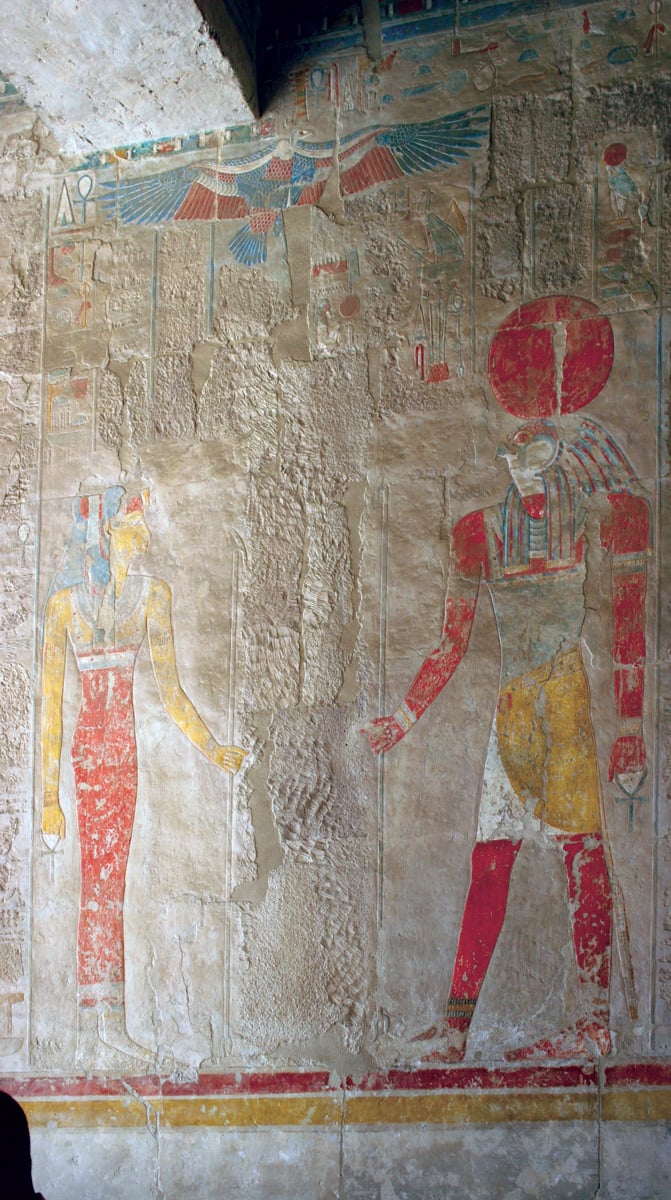
Ecclesiastes 9:5–6 says, “The dead know nothing; . . . even their name is forgotten.” This is vividly depicted in a relief from the temple of Hatshepsut at Karnak. The chiseled marks to the left of the god Horus show where the figure of Hatshepsut was erased by her successor Thutmosis III so her memory would be forgotten.
While the dead know (or experience) nothing, the living know that they will die (9:5), which, according to Ecclesiastes 7:1–4, can have a profound effect on how the wise live. Thus Qoheleth concludes his deliberations on death with his final climactic commendation of joy, only here expressed as an imperatival charge (9:7–9): eat and drink with a merry heart! Celebrate life continuously with “party clothes” and rich oils (Ps. 23:5; 104:15; Esther 8:15; also Epic of Gilgamesh, Tablet 10)! Share this joy with your marriage partner! This is not a license for unbounded self-indulgence (cf. also Eccles. 11:9), for it is balanced by a call to strenuous, skillful, and smart work (9:10). What is the basis for such advice? (1) Such a course of action bears God’s stamp of approval, since it is his gift (9:7b; cf. 3:13; 5:19), our lot in life, and the reward for our labor (9:9b). (2) Our opportunities for both work and pleasure under the sun are limited. Our days are hebel, and we all are headed for the realm of the dead (i.e., Sheol, 9:9a, 10b).
E. One should embrace wisdom and avoid folly (9:11–10:20). If one understands “his hour” and “evil times” (literally “his time,” “bad time”) in 9:12 as referring to death (as in 7:17), then one can view 9:11–12 as the conclusion of the discourse on death. It is preferable, however, to view these verses as the introduction to the following section on the benefits of wisdom in contrast with folly. This chapter strongly resembles the book of Proverbs in both form and content and is more loosely organized than the rest of Ecclesiastes.
9:11–10:1. Qoheleth begins by noting some of wisdom’s limitations, introducing them with “I saw” (9:11, 13). First, success in various human activities, such as victory, wealth, or social favor, is not guaranteed either by physical skill, such as speed and strength, or by mental prowess (using three wisdom terms). This is because “time and chance,” a hendiadys designating unexpected events, can happen to anyone (9:11). Since even death (i.e., “his time”) can approach without warning, catastrophe can strike as suddenly as a fishnet or a bird trap captures its unsuspecting prey (9:12).
Second, wisdom can be unappreciated. Verses 13–15 present a brief scenario that features another “wise commoner” (as in Eccles. 4:13–16). That individual single-handedly delivered his small city when it was besieged by a powerful and well-equipped king. Sadly, no one later remembered his contribution, presumably by rewarding or promoting him (cf. Eccles. 2:16). This interpretation is preferable to seeing here merely a potential delivery, through “remembering” during the crisis that such a capable person lived there. Verses 16–17 draw some conclusions from this situation. Although wisdom is superior to military might, some wise people are despised and their words not heeded (9:16), even though their calm counsel is more worthy of attention than the shouts of a ruler of fools (9:17). Ecclesiastes 9:18–10:1 notes a third limitation, that despite wisdom’s superiority (9:18a parallels 9:16a), a single sinner can destroy much that is beneficial. The NIV’s “sinner” correctly renders the Hebrew participle hote (cf. 2:26; 7:26; 8:12; and 9:2) and is preferable to NRSV’s “bungler” and NJPS’s “error.” This limitation is vividly reinforced by the proverb in 10:1. Just as a few dead flies can cause the finest perfume to stink and ooze, so a little folly, which wisdom theology equates with sin and godlessness, can overpower an impressive display of wisdom.
10:2–20. The exposition of wisdom’s limitations in 9:11–10:1 as contingent, unappreciated, and fragile could lead to the conclusion that it is not such a valuable commodity after all. This section continues, however, by focusing instead on fools and folly, sometimes in contrast to the wise and wisdom. It is somewhat arbitrary to separate verses 2–20 from the preceding, especially since their unity largely consists of their common theme.
First-person verbs occur in 10:5 and 10:7, just as in 9:11 and 9:13, and both 10:1 and 10:2 offer direct comparisons. The subsection begins with a general characterization of the fool. Fools suffer from a congenital heart defect, a flaw at the very center of their being, which skews all of their actions and attitudes (10:2). (Contrary to contemporary practice, right and left are seldom contrasted in the Old Testament [but see Gen. 48:13–14, 17–20].) The resultant ineptitude is set forth in verse 3 (cf. 10:15): in performing everyday tasks, fools lack “sense” (literally “heart,” cf. Prov. 10:21), broadcasting their folly to all (cf. Prov. 12:23).
In 10:4–7 and 16–20, folly in high places is portrayed: verses 4–7 begin with an admonition directed to the wise (10:4), while verses 16–20 end with one (10:20). If a ruler is angry with you, do not act rashly (10:4; cf. 8:2), for your calmness may help him to avoid committing great sins (as Prov. 29:22 also acknowledges). The NIV, in translating the Hebrew root hata (cf. 9:18) as “errors” rather than “sins” (only here of almost six hundred Old Testament occurrences), takes this word as referring instead to the cause of the ruler’s anger (as in Prov. 10:12). The former interpretation is supported by verse 5: Qoheleth has observed the type of “evil” or harmful “error” (here shegagah, as in Eccles. 5:6) that powerful leaders can promote. Social structures are turned upside down, with fools and servants being promoted and wealthy leaders and princes demoted (10:6–7). The Egyptian Admonitions of Ipu-wer contain similar descriptions. That “the rich” are contrasted here with fools suggests that these may be those who enjoy the fruits of divine favor, wisdom, and diligence (cf. Eccles. 5:19; Prov. 8:18, 21; 10:4, 22; 14:24).
The contrast between the wise and the foolish is taken up again in 10:8–15. Verses 8–9 describe four workplace injuries, while verses 10–11 explain how two of these, a woodcutting injury and a snake bite (the fourth and the second), can be prevented through the timely use of wisdom, as expressed in the NASB (“Wisdom has the advantage of giving success”; Hebrew yitron is also used in 10:11: “no profit”). The wise person sharpens the ax blade before chopping and charms the snake before it strikes. By implication, the fool instead relies on “brawn over brains” and gets bit. Verses 12–14 describe the fool’s speech. Unlike the gracious words of the wise, which can benefit both the speaker (cf. Prov. 22:11), probably the emphasis here, and the listeners (cf. Prov. 25:11–13), the fool’s lips harm the speaker (10:12, literally “swallow him up”). This is not surprising, since their words go from bad to worse (10:13), as their verbal stream flows unabated (10:14a; cf. 5:3, 7) despite a lack of certain knowledge (10:14b, echoing 6:12 and 8:7). No wonder the fools’ work is tiring: they wear themselves out in carrying out the simplest of tasks, such as finding the way to town (10:15; cf. 10:3)!
The section concludes with a further description of folly in high places (10:16–20). Verses 16–19 contrast two countries. One is ruled by those ill prepared for such a task (10:16a), either due to youthful inexperience or, more likely, low social status. Thus the NIV’s “servant” for Hebrew naar, contrasted with one “of noble birth” in verse 17, is preferable to the NIV’s alternative “child,” as in 1 Kings 3:7 and Isaiah 3:4–5. This country’s leaders put pleasure before business (10:16b). Proverbially speaking, they carelessly allow the place to get run down (10:18), while living out the self-indulgent motto expressed in verse 19. The other, more fortunate, country is ruled by a king who is well prepared for that role and by leaders who limit eating to its proper time (as in Eccles. 3:1) and purpose (“for strength,” 10:17). The subsection concludes with another warning, perhaps prompted by the preceding portrait of administrative failure (10:20; cf. 10:4; 5:8; 8:3). Since nothing is to be gained thereby, avoid cursing or denigrating (Hebrew qillel, as in Eccles. 7:21–22) the all-powerful king even in your thoughts (contra NASB’s “bedchamber,” which imposes synonymy), since such thoughts may ultimately find expression in words. You may think you are safe from the influential rich in the privacy of your bedroom, but be careful—the room may be bugged (or birded)!
The book of Ecclesiastes climaxes in a lengthy section dominated by imperative verbs (11:1, 2, 6, 8–10; 12:1; “Remember” in 12:6 is added by the NIV for the sake of clarity).
Here the author issues his final challenge to the reader, addressing three major topics, which Derek Kidner (96) succinctly summarizes as “Be bold!” (11:1–6), “Be joyful!” (11:7–10), and “Be godly!” (12:1–7). Several repeated words serve to link these three subunits: disaster/trouble(s) (11:2, 10; 12:1 [all the same Hebrew word]), clouds (11:3–4; 12:2), rain (11:3; 12:2), light (11:7; 12:2), darkness (11:8; 12:2), remember (11:8; 12:1).
A. Be bold (11:1–6). The first subunit addresses the question, how should one act when so much remains unknown or unknowable (11:2b, 5, 6b)? Some commentators take verses 1–2 as offering commercial advice: send your merchandise across the sea, expecting a profit (11:1), as Solomon did in 1 Kings 10:22 (cf. Prov. 31:14). And spread the risk, perhaps by using multiple ships, or diversify your investments, so that you will not be bankrupted by some unexpected catastrophe (11:2; cf. 5:14). In light of striking parallels in Egyptian wisdom instructions, however, these verses are more likely an encouragement to “strategic” philanthropy, as encouraged in Proverbs 19:17 and Luke 16:9. For example, the Instruction of ʿOnchsheshonqy (an Egyptian wisdom tradition from ca. 200 BC) advises, “Do a good deed and throw it into the flood. / When it subsides you will find it” (Simpson, 519), and the Instruction of Ptahhotep (ca. 2200 BC) recommends, “Gratify your friends with what has come into your possession, / . . . No one knows what will come to pass when he considers tomorrow, / . . . But one can bring happiness (to) friends when there is need” (Simpson, 139). In other words, freely give away some of your goods—with hopeful patience and fearless generosity.
Verses 3–6 encourage decisive, unhesitant action despite uncertainty. Verse 3 describes two processes of nature: rain, which is somewhat predictable, and the direction a tree falls, which is unpredictable and which humans cannot control. Constantly watching the wind that can knock down a tree or the clouds that will bring rain, while waiting for more favorable weather conditions, can keep one from either sowing or reaping (11:4). Despite our ignorance regarding such natural phenomena, we must act. The NIV distinguishes two examples in verse 5: the path of the wind (as in 11:4a; cf. John 3:8) and the formation of a fetus in a pregnant woman. But it is preferable to see here a wordplay with Hebrew ruah designating wind in verse 4 and spirit in verse 5. The use of this word in Ecclesiastes 8:8 is similarly ambiguous, perhaps intentionally. Thus, only one example is noted: how the life-breath (as in Eccles. 3:21; 12:7) enters a fetus. This and more fall under the rubric of the “work of God” (cf. Eccles. 7:13; 8:17). God sovereignly accomplishes all things, often in ways that are humanly unknowable, and the NIV’s “the Maker” incorrectly narrows the scope of divine action here. The subunit ends with positive counsel (11:6), which parallels verse 1: Sow your seed continually and untiringly (similar to Eccles. 9:10a)—probably referring here to a wide range of human endeavors (cf. John 4:37; 1 Cor. 9:11; 2 Cor. 9:6; Gal. 6:7)—since you cannot know in advance which efforts will prosper.
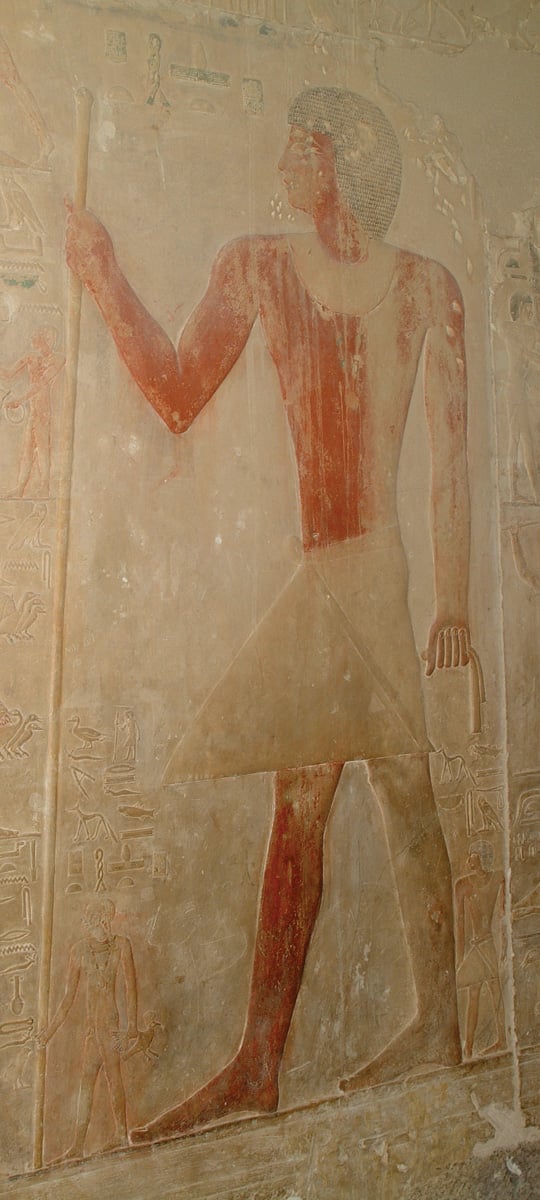
Ptahhotep II, an important Egyptian official during the 5th dynasty (ca. 2465–2325 BC) who composed the Instruction of Ptahhotep, is shown with his son in this painting from his tomb at Saqqara.
B. Be joyful (11:7–10). The second subunit presents Qoheleth’s final commendation of joyful living, although the typical reference to eating and drinking is lacking here. The subunit begins by affirming that it is good to be alive (11:7, literally “to see the sun”; cf. 6:5). We should enjoy the light of each day God grants us, not knowing how many we will have and keeping in mind the many dark and meaningless days to follow (11:8). The reference here is to our death, as in 6:4, rather than to difficulties during life, as in Ecclesiastes 5:17. Such unencumbered happiness is clearly more attainable when one is young and vigorous. Therefore, the author encourages the young to “follow the ways of your heart and whatever your eyes see” (11:9). This sounds like aimless self-indulgence, which disturbed rabbinic interpreters, who saw in this counsel a direct contradiction of Numbers 15:39 (“that you may . . . not prostitute yourselves by going after [the lusts of] your own hearts and eyes”; NIV adds “the lusts of”). In light of the regulative role of the heart referred to in Ecclesiastes 2:3 (cf. Prov. 16:9), the contrast made in 6:9 (“Better what the eye sees than the roving of the appetite”), and the concluding reminder in this verse that God will ultimately judge the individual on the basis of these activities, this advice is better understood as “Let your conscience be your guide and be content with what you have!” This fits better with 11:10, which encourages the young person to avoid those things that can detract either psychologically (cf. Eccles. 2:23; 5:17; 7:9) or physically (cf. Eccles. 5:13; 12:12) from the enjoyment of life, because youthful vigor (perhaps literally “dark hair”) is fleeting (Hebrew hebel).
C. Be reverent (12:1–7). The final subsection is closely linked to the preceding. Whereas the preceding verses challenge the young to enjoy life while they can while keeping in mind the dark days to come, 12:1–7 begins by challenging them to keep God in mind while they are still young, before unpleasant days come (12:1a). As the lengthiest of the three, it offers a context for the preceding calls to decisive action and joyful living. The direct command to “remember” God is rare in the Old Testament (elsewhere only Neh. 4:14; Jer. 51:50; cf. Deut. 8:18), as is the description “your Creator” (elsewhere only Isa. 43:1). “Remember” here is a logical extension of the imperative “know” in 11:9b, while “Creator” is a fitting title for the source of life’s everyday gifts, given the book’s frequent allusions to the Genesis 1–3 narrative. The remainder of the text offers a threefold motivating contrast with “the days of your youth,” each commencing with the word “before” (12:1b–2, 6). Verse 1b contrasts the present enjoyable days with the coming “days of trouble” (cf. “bad times,” Eccles. 7:14), when life will not or no longer will be pleasing.
In 12:2 those days of light (11:7) are contrasted with gloomy cloud-shrouded days, when all celestial light sources are darkened. The description here reminds one of the cataclysmic day of the Lord, as announced by the prophets (cf. Isa. 5:30; 13:10; Ezek. 32:8; Joel 2:2, 31; Amos 5:20; Zeph. 1:15). The description of that “day” in verses 3–5, which expands on this image, indicates that the end of the individual’s life is in focus here rather than the eschatological end of the world. These verses contain a partially allegorical portrayal of the debilitating effects of old age, offering a striking contrast to the youthful traits of 11:9–10. This is accomplished through the description of an estate where “business as usual” has ceased, perhaps due to the storm of verse 2 or a resident’s death, as verse 5 implies. The imagery is enigmatic and its meaning, accordingly, disputed, although the basic point of the scenario is clear. Verse 3 describes the reactions of four individuals or groups, namely, the male and female owners and household servants. The male housekeepers (= arms, cf. 2 Sam. 15:16) shake, while the “strong” men (= legs, probably designating financial or character strength) bend or grow crooked. The miller maids (= molars) have become too few to grind, while the view through the windows for the ladies of leisure is obscured (= eyes, cf. Judg. 5:28; 2 Kings 9:30). The double doors to the street (= ears, possibly lips, cf. Job 41:14) are shut tight, so that outdoor noises grow faint (12:4a). On edge, one is startled by any sudden noise, such as a bird call, or one sleeps so lightly that the least sound awakens. The sound of the female singers (= voice) is made low (12:4b; cf. Isa. 29:4). According to verse 5a, one then becomes fearful of heights and unknown travel dangers, the phobias of old age. This is accompanied by the appearance of white hair (the color of almond blossoms), a limping gait (the grasshopper dragging itself along), and the loss of sexual desire (the ineffective caper, a stimulant or aphrodisiac).
An explanation of the preceding description is offered in 12:5b: humanity is heading for its eternal, or enduring, house, while paid mourners already begin their procession through the streets. Recently, the translation “dark house” has been suggested, based on one possible meaning of the Hebrew root ʿlm, the description of the dead in 6:4, and the aptness of this description for a tomb. Given the use of olam (from the same Hebrew root) elsewhere in the book (Eccles. 1:4, 10; 2:16; 3:11, 14; 9:6), however, a meaning for this use is more likely in 12:5. In Ecclesiastes, this word designates that which lasts in contrast with that which is only temporary. Thus understanding “eternal house” here as referring specifically either to the grave or to an eternal residence in heaven (similar to John 14:2–3) is unwarranted. This is reinforced in the third contrast set forth in verses 6–7, which begins with several images of death: a broken decorative cord with its attached bowl (perhaps an oil lamp, as in Zech. 4:2–3) and a shattered water jar and well wheel. Unlike the language of verse 3–5, verse 6 probably is not intended to be taken allegorically (i.e., anatomically). Rather, it simply emphasizes the finality, irreversibility, and destructiveness of death: the light goes out and thirst goes unquenched. The subunit concludes in verse 7 with a more literal contrast. Whereas the dust returns to the earth (the phrase echoes Genesis 3:19 and 2:7; cf. Job 10:9), the “spirit,” or life-breath, returns to God, who originally issued it. This verse thus parallels Ecclesiastes 3:20–21. The reference in verse 7b to God as “giving” the human spirit (Hebrew ruah) recalls his description as Creator in verse 1a and offers a final rationale for “remembering” him. One should avoid reading too much into “returning to God” (despite Eccles. 5:2: “God is in heaven”), since Psalm 104:29 and Job 34:14–15 speak similarly of God gathering the spirits of both animals and humans.
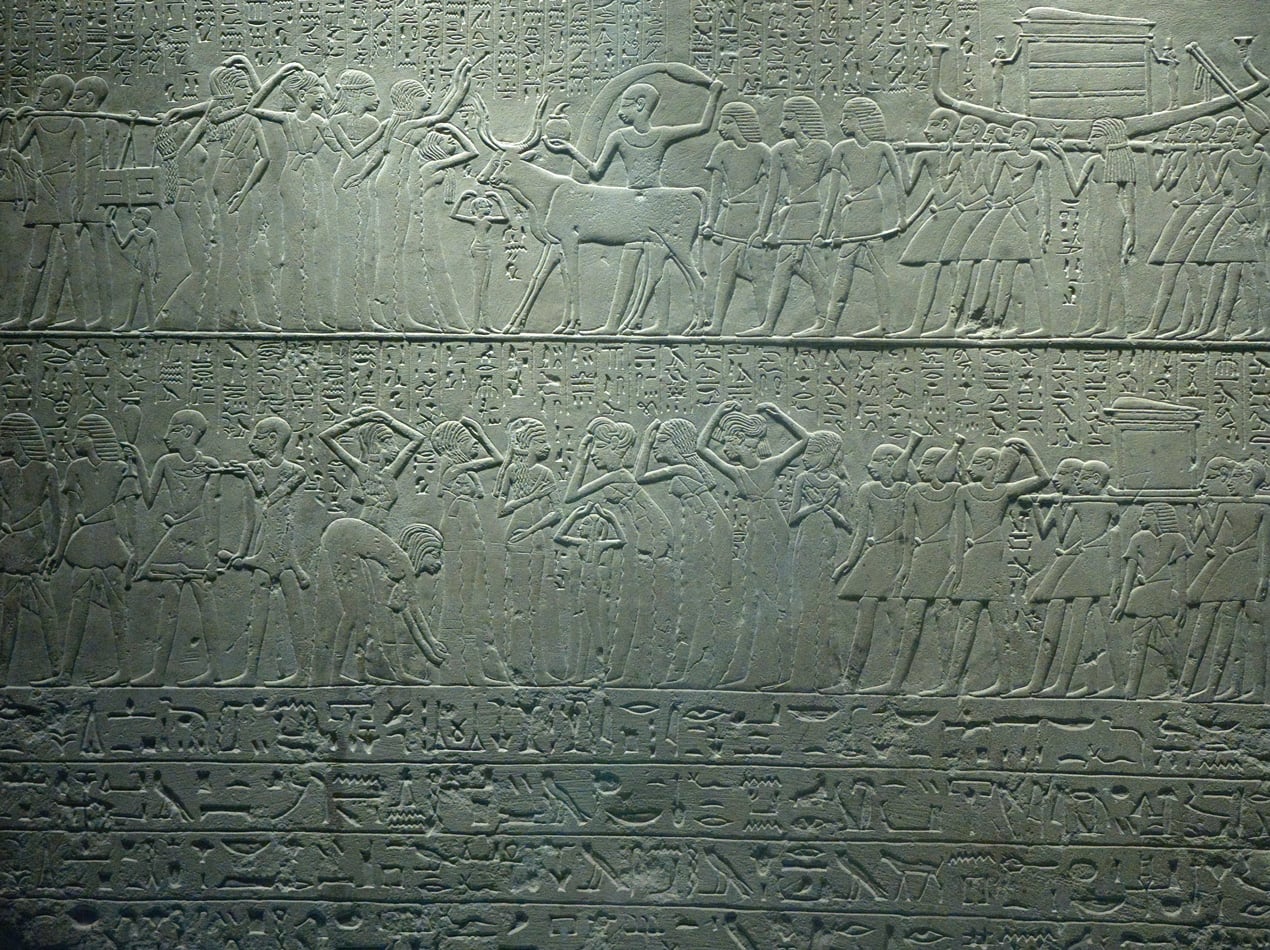
Relief showing a procession of mourners (tomb of Merymery, Saqqara, ca. 1391–1353), as described in Ecclesiastes 12:5
5. Concluding Explanatory Remarks (12:8–14)
A. Theme verse: Everything is ephemeral (12:8). The concluding remarks are preceded by the repetition of the theme verse, which affirms that everything is utterly ephemeral. The preceding verses (12:1–7) offer the book’s final and most dramatic illustration of the brevity of life. Verse 8, which is similar in formulation to Ecclesiastes 1:2, thus forms with it a literary bracket around Qoheleth’s investigations and findings. This observation has led several commentators to identify a distinct prologue in 1:1–11 or 1:3–11 and an epilogue in 12:8–14 or 12:9–14, which have been added by a later narrator/editor who introduces, incorporates, and then evaluates Qoheleth’s autobiographically oriented reflections in 1:12–12:7. Such a suggestion is not inherently problematic, since 1:1 and 12:9–12 in particular are editorial in nature and similar to ancient Near Eastern colophons. As will be noted below, many of the key words in this section occur repeatedly throughout the book, though sometimes with a different nuance. This fact could support either a common author or an editor’s intentional imitation. The more significant consideration is how one assesses this proposed editor’s attitude toward Qoheleth’s wisdom. Since the nineteenth century, there have been interpreters, including those responsible for the Scofield Bible notes, who have understood this so-called appendix to Ecclesiastes as a full-blown rejection of Qoheleth’s unorthodox views. These views are therefore corrected or countered by the orthodox ending (12:13–14). In mathematical terms, one places a large “minus” sign before the parenthesis around 1:12–12:8, saying, in effect: “Not that but rather this.” According to this interpretation, it probably was only the later addition of 12:13–14 that succeeded in shoehorning this book into the Hebrew canon.
B. Hermeneutical reflections (12:9–14). Even if this concluding section stems from a second author, there is no compelling reason to interpret these verses as offering a critique rather than an explanation of the book’s compositional purpose and a hermeneutical guide to its proper understanding. Interestingly, in the Hebrew text, verses 9 and 12 begin identically (NJPS “A further word” or “and furthermore”), while verse 13 begins with, literally, “a final word” (cf. Eccles. 3:11; 7:2), possibly thereby dividing this section into three parts. Verses 9–10 describe Qoheleth’s (i.e., the Teacher’s) purpose, procedure, and product, which parallel in some respects the narrative description of Solomonic wisdom in 1 Kings 4:29–34. Qoheleth was a wise person who publicly instructed the people. For that purpose, he pondered (literally “listened carefully to” or “weighed”), thoroughly investigated, and edited many proverbs. The NIV’s translation of 12:10 emphasizes the intentional aesthetic, stylistic, and moral quality of these words. Another option is to take this verse as referring to Qoheleth’s efforts both to find (i.e., collect) apt sayings and to compose truthful sayings himself (cf. Prov. 22:20–21).
The effect of such wisdom sayings is described in 12:11–12. In referring to the “words of the wise,” he appears to make a broader, even canonical, claim, since an identical phrase is used in the prologue to Proverbs (1:6, also 22:17; Eccles. 9:17). Such sayings are effective, even if painful (as in Eccles. 7:5; cf. Ps. 141:5), like cattle prods that get you moving in the right direction. Furthermore, those who master such anthologies are secure, like firmly planted nails (see NASB; cf. Isa. 41:7), since these words are given by a “shepherd.” This has traditionally been understood as claiming God, Israel’s shepherd, as the ultimate source of wisdom. Alternatively, the entire verse could be understood as developing the metaphor of a goad whose sharp embedded tip is deftly wielded by a shepherd (so Fox, 353–56). Although the Old Testament consistently acknowledges the divine origin of wisdom (e.g., 1 Kings 4:29; 5:12; Ps. 51:6; Prov. 2:6; Eccles. 2:26) and frequently describes God as a shepherd, these two concepts are not combined elsewhere. Interestingly, Psalm 78:72 notes that King David employed wisdom in shepherding Israel, while Ecclesiastes 12:9 implies that Qoheleth viewed public instruction as a proper means for guiding the people. Verse 12 is difficult to translate. The NJPS prefers “A further word” (as in 12:9, similarly NKJV), while the NIV translates the Hebrew phrase as “in addition to” (as in Esther 6:6). Here the editor adopts the typical wisdom form of address, “my son,” which does not occur elsewhere in Ecclesiastes but is prevalent in Proverbs 1–9 and 23–24. He warns the “son” against devoting equal attention to the countless other books that are not of similar origin, quality, or benefit. The NKJV offers a different suggestion: “Be admonished by these” (i.e., the texts of 12:11), unlike the king described in Ecclesiastes 4:13.
In 12:13–14 is a summary of Qoheleth’s basic message, the “bottom line” after all of his words have been heard: “Fear God and keep his commandment, for this pertains to every human” (contra NIV’s “this is the whole duty of man”). Verse 14 offers the motivation for heeding this charge. The coming comprehensive judgment of God will encompass every human deed, including those carefully concealed from others. These verses do not constitute an orthodox corrective, since they state nothing that the main body of the book has not affirmed previously: (1) the value of revering God (3:14; 5:7; 7:18; 8:12–13), (2) the need to obey God’s commands (e.g., 5:4–6, which cites Deut. 23:21–23 regarding vows; cf. also 8:5, literally “a command-keeper”), and (3) the certainty of divine judgment, either under the sun or after death (3:15, 17; 5:6; 7:17; 8:12–13; 11:9; possibly 8:5–6). Despite the diverse and sometimes disturbing course of Qoheleth’s reflections and conclusion, at the core he has not strayed from the central convictions of the Israelite faith.
Select Bibliography
Eaton, Michael A. Ecclesiastes. Tyndale Old Testament Commentaries. Downers Grove, IL: InterVarsity, 1983.
Fox, Michael V. A Time to Tear Down and a Time to Build Up: A Rereading of Ecclesiastes. Grand Rapids: Eerdmans, 1999.
Fredericks, Daniel C. Coping with Transience: Ecclesiastes on Brevity in Life. Sheffield: JSOT Press, 1993.
Keddie, Gordon J. Looking for the Good Life: The Search for Fulfillment in the Light of Ecclesiastes. Phillipsburg, NJ: Presbyterian and Reformed, 1991.
Kidner, Derek. A Time to Mourn, and a Time to Dance: Ecclesiastes and the Way of the World. Downers Grove, IL: InterVarsity, 1976.
Loader, J. A. Ecclesiastes: A Practical Commentary. Translated by J. Vriend. Grand Rapids: Eerdmans, 1986.
Longman, Tremper, III. The Book of Ecclesiastes. New International Commentary on the Old Testament. Grand Rapids: Eerdmans, 1998.
Murphy, Roland E. Ecclesiastes. Word Biblical Commentary. Dallas: Word, 1992.
Ogden, Graham. Qoheleth. 2nd ed. Sheffield: Sheffield Phoenix Press, 2007.
Provan, Iain. Ecclesiastes, Song of Songs. NIV Application Commentary. Grand Rapids: Zondervan, 2001.
Simpson, William K., ed. The Literature of Ancient Egypt. 3rd ed. New Haven: Yale University Press, 2003.
Whybray, R. N. Ecclesiastes. New Century Bible Commentary. Grand Rapids: Eerdmans, 1989.