Revelation
1. Heaven as the Throne Room and the Royal Court of God (1:1–3:22)
A. Prologue: An Apocalypse from God and a Letter from John (1:1–6)
B. The Epiphany of the Glorious Son (1:7–20)
C. The Seven Churches before the Divine Judge (2:1–3:22)
2. Heaven as the Eschatological Temple and the Theater for Cosmic Warfare (4:1–19:21)
A. The Heavenly Liturgy Begins (4:1–5:15)
B. The Seven Seals: Where Is God When His People Suffer? (6:1–8:1)
C. The Seven Trumpets: Why History Belongs to the Intercessors (8:2–11:19)
D. The Empire Unveiled as an Agent of Satan (12:1–15:4)
E. The Seven Bowls: Why God Delays Ultimate Justice until the End (15:5–16:21)
F. The End of the Empire (17:1–19:10)
G. The Return of the King (19:11–21)
3. Heaven as a New City and the Earth as a New Eden (20:1–22:21)
A. The Vindication of God and His People (20:1–15)
Introduction
No other book has stirred the imagination and emotions of its readers as much as the Apocalypse of John. It has been the source of inspiration for classic works of literature like Milton’s Paradise Lost and Dante’s Divine Comedy, for timeless symphonies like Handel’s Messiah, for masterpieces of art like Michelangelo’s Sistine Chapel fresco The Last Judgment, and for such adored hymns as “Holy, Holy, Holy,” “Crown Him with Many Crowns,” and “Come, Thou Almighty King.” Imagine, if you will, the rise of the curtain to an epic drama. The eternal God of the universe rips open the sky. An angel of the Lord flies down and sweeps you up to the highest part of the cosmos. This same angel gives you a personal tour of the heavens. You hear a litany of saints sing until the foundations of the earth shake. At their song’s zenith, God appears on a fiery chariot and unveils to you the intimate details of his divine plan for all humanity. If you can envision these scenes, then you can grasp something of the power and grandeur of Revelation.
Revelation is also one of the most controversial texts of the New Testament. Ever since the publication of Hal Lindsey and Carole Carlson’s Late Great Planet Earth (1970), Revelation has been wrongly read as a horoscope to the future. Lindsey popularized a (dispensationalist) way of reading Revelation in the twentieth century that continues to have a cultural influence on American evangelicalism today. Typically this method attempts to connect the narrative episodes in the biblical texts with the real-time events reported by the local news. Many, for instance, have tried to identify “the beast” (Rev. 13:1–10) with the world leaders of their day. Their guesses have ranged from the pope to Nazi Germany’s Adolf Hitler to every modern US president. The ten horns of the beast have been likened to the United Nations and the European League (17:7–14), the number 666 to a barcode tattooed on the forehead or hand and used like a credit card (13:17–18), and the natural catastrophes of the seven seals, trumpets, and bowls to global warming (6:12–14; 8:7–12; 16:3–12). All these connections are fallacious. None are based on a historically informed reading of the biblical text. Yet these ideas endure and never seem to be left behind.
Interpretative Approaches to Revelation
The method of reading the Bible in one hand and the daily newspaper in the other is the poorer representative of the futurist approach. Futurists believe that most of the visions in Revelation (especially Revelation 4–22) point to events in the future that directly precede the second coming of Christ. Some like Lindsey think that from its pages a road map to the future can be charted out. Other nondispensational futurists are critical of correlating biblical prophecy with the evening news but still believe that Revelation mainly describes events that will occur at Jesus’s impending return. But Christian interpreters throughout the centuries have exercised other approaches. The preterist approach (from the Latin word praeteritus, meaning “past” or “gone by”) insists that Revelation reflects the historical conditions of the first-century church alone and that it speaks to the persecuted communities of Asia Minor in John’s day. The historicist approach believes that Revelation offers an overview of the church’s entire history and Revelation’s chapters can be divided between the apostolic, patristic, medieval, Reformation, and post-Reformation periods. The idealist approach argues that the visions are symbolic of eternal realities and they cannot be tied to any specific historical event. It is probably best, however, not to limit oneself to any particular approach but to remain eclectic. The eclectic approach appreciates the contributions of each previous approach but limits itself to none of them.
Literary Genre(s)
The Greek word apocalypsis, literally “an apocalypse,” is frequently translated as “a revelation.” As a literary genre, apocalyptic literature was as widespread in the Roman world as biographies, histories, novels, and poetry are today. Several Jewish apocalypses were already in circulation in the first and second centuries AD, including 1–2 Enoch, the Apocalypse of Zephaniah, 4 Ezra, 2 Baruch, the Apocalypse of Abraham, and the Apocalypse of Adam, to name a few. The Old Testament includes one canonical example: Daniel.
Apocalyptic literature is an intensified form of prophecy. If prophetic literature saw repentance as the ideal solution to the problem of sin and apostasy, then apocalyptic literature addressed a situation so dire and a people so enslaved to evil that repentance no longer seemed possible unless God broke into history to create new possibilities for humanity. The way apocalypses show how God operates in our world is through visionary experiences. God lifts the curtain behind the events of human history and shows how he is working in the spiritual realm to carry out his redemptive plan.
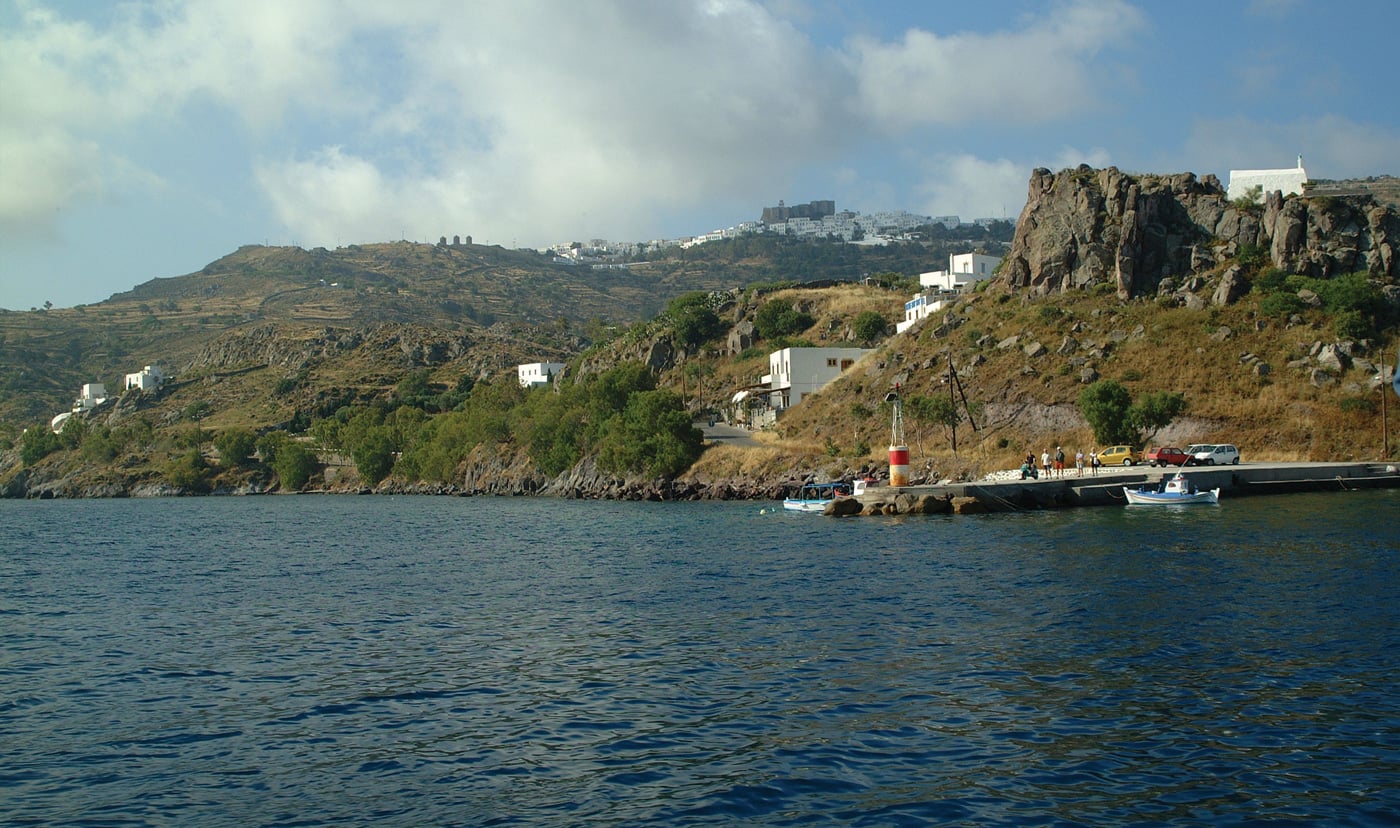
It was the practice of the early church to have seers report their visions and share them as a word of prophecy during a public time of Christian worship (1 Cor. 14:29–33; Shepherd of Hermas, Visions 1–4; cf. Acts 10:9–11:18). The prophetic word was subject to the discernment of the church, but if it was found authentic, the congregation was then accountable to hear and obey it (Rev. 1:3; 22:7). Because the author of Revelation was exiled on the island of Patmos, his particular vision was written down in the form of a letter, circulated to the seven churches of Asia Minor, and read aloud in a liturgical setting (1:3–4).
Revelation is actually a threefold genre. It is part apocalypse (1:1), part prophecy (1:3; 22:7), and part letter (1:4–5; 22:21). These literary genres were never meant to be read as a road map to the future. Neither do they restrict the relevance of Revelation only to those Christians living near the time of Christ’s return. Rather, whenever the author of Revelation discusses the future, its purpose is to encourage a response from the reader in the immediate moment. In the same way Jonah foretold a future judgment against the citizens of Nineveh in order to evoke an immediate repentance from them (Jonah 3:4–10), the prophet John even when describing far-off judgments expects his contemporary readers to respond now, not later. The readers of this apocalypse are asked to repent, make costly commitments, and with haste join God in what he is doing to rescue the world from sin. Revelation cannot be treated as a note stuffed in a bottle, lost in the sea of time, only to be opened and deciphered by those on shore who live within proximity of Jesus’s return. Whatever John the seer observed in his visions, it must have been understandable to the original audience who first received its message.
Date and Authorship
The author of Revelation identifies himself as John (1:1, 4, 9; 22:8), a servant of Christ (1:1), and a prophet to the churches in Roman Asia (1:3; 22:7). John was exiled by Rome on an island called Patmos in the Aegean Sea because of his Christian witness (1:9). Beyond these details, little else is said about him. Patristic traditions claim that this John was none other than the apostle, one of the Twelve, the son of Zebedee (e.g., Justin Martyr, Dialogue with Trypho 81.4). Those skeptical of apostolic authorship note the differences between Revelation and the Gospel of John (which is also believed to be written by the apostle). They point out, for example, variations in language and writing style. The Gospel’s Greek is refined, but Revelation’s contains a number of grammatical irregularities (see the note to Rev. 1:4b). There are also differences in theology. John’s Gospel has a realized or inaugurated eschatology (i.e., the “last days” began with Jesus’s ministry, and rebirth is evidence for the kingdom’s arrival; John 3:15–16; 4:13–14; 5:24), while Revelation has a final eschatology (i.e., Revelation focuses not on the present invasion of the kingdom but on its consummation at Jesus’s return; 19:1–22:5). Yet many of these variances can be explained. John may have had an amanuensis, or secretary, who helped him compose the Gospel but no such assistance with Revelation, and hence the changes in grammar and style. Theological divergence could be due to different emphases and not content. John’s Gospel does speak about final eschatological events (e.g., John 5:28–29; 14:2–4) as well as realized ones, though focusing on the latter, while Revelation records John’s immediate ecstatic encounters with the Spirit (1:10; 4:2; 17:3; 21:10), though emphasizing the final flooding of the Spirit at history’s end (22:1–5). Although alternative Johns have been suggested throughout the centuries, none of them (e.g., John Mark, John the Baptist, John the elder, a pseudonymous or anonymous John) have been so convincing as to rule out apostle John as the author.
The date of composition for Revelation is near the end of Emperor Domitian’s reign (81–96) around the year 95, though a minority number of commentators have suggested dates as early as the 60s during Nero’s administration or as late as the second century under Trajan. Domitian has been characterized as a cruel despot by many Roman historians (e.g., Pliny the Younger, Panegyric 48–49), but accounts of his villainy were probably exaggerated. Roman historians at that time condemned Domitian’s reign as a propagandistic foil by which his successor Trajan’s new rule could appear benevolent and successful. It is also incorrect to think that Domitian launched a large-scale systematic persecution of all Christians throughout the entire empire (see Eusebius, Ecclesiastical History 3.14–20). Based on a more balanced reconstruction of Domitian’s reign and from the internal evidence found within Revelation 2–3, we can surmise that the hostilities against Christians were indeed real, at times intense (e.g., Antipas’s martyrdom at Pergamum; 2:13), but localized and part of a spectrum of other issues that challenged the believing community. What threatened the church the most was not persecution but moral compromise with the idolatrous values of Roman culture.
The Historical and Social Setting of John’s Churches
Asia Minor was a Roman province where the imperial cult was popular and politically influential. When Asia Minor came under Roman rule in 133 BC, it was natural for the inhabitants to honor the Roman emperor as part of their ongoing practice of worshiping living monarchs. Veneration was a sign of loyalty and gratitude to those who brought unified peace and political stability to the land. Although in Rome only dead emperors could be deified by the Senate, it appears that outside of Rome, Caesar could be honored as a living deity. Domitian, for example, accepted the divine title “Our lord and god” from Ephesus and other cities. He even used it himself when making imperial pronouncements (Suetonius, Domitian 13.2).
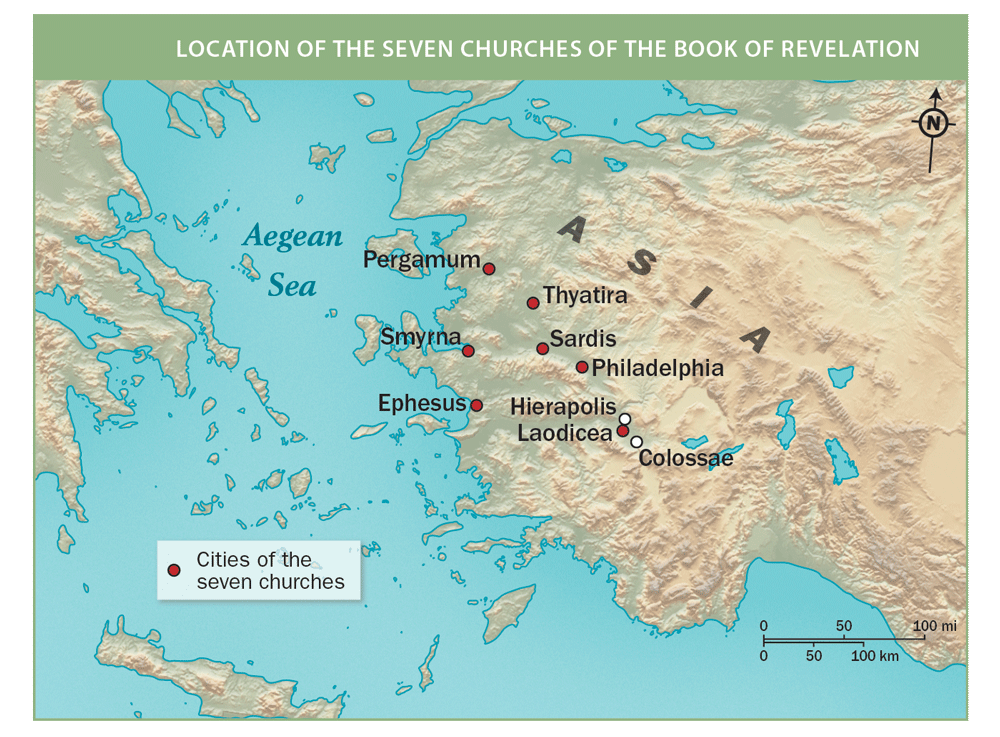
The seven churches to which the book of Revelation is addressed (1:11) were all located in major urban centers. Faithful Christians who were committed to monotheism and worshiped Christ, not Caesar, as Lord and God faced a crisis as they were pressured to participate in the cultic life of the city. Trade guilds (cf. Acts 19:24–25) would sponsor imperial festivals to enhance the status of their city before Rome and to compete for political favors. A lack of support for the cult often meant exclusion from the guild, economic hardship, and sometimes even confiscation of property, imprisonment, or death (Rev. 2:9–10; 2:13; 3:8).
Hostility came not only from the Roman government, the local city magistrates, and trade guilds but also from the Diaspora Jews. The Jewish people were among the few in the Roman Empire who were exempt from mandatory participation in the imperial cult. Jews were obligated to make daily sacrifices to God on behalf of the emperor but were not required to worship Caesar himself (Josephus, Jewish War 2.409; Against Apion 2.73; cf. Tacitus, Annals 5.5.4). Early Christianity, considered a “Nazarene sect” (Acts 24:5) of Judaism, was thus protected under this provision. However, as hostilities between the synagogue and church erupted over the identity of Jesus as the Messiah, it appears that the synagogue might have pressed the distinction between Judaism and Christianity publicly. The Christians, now seen as non-Jews, were expected to participate in the imperial cult. When the churches at Smyrna (2:9) and Philadelphia (3:9) refused, there were social and economic sanctions lodged against them by city officials based on the testimony of the Jews.
These cultic festivals often meant that an abundance of quality meat sacrificed to idols was available to all at the temples and at the markets. Idol food was a particular point of controversy for John’s communities. Apparently some false Christian prophets taught the permissibility of eating idol meat and joining the cultic feasts despite the dangers of idolatry (2:2; 2:6; 2:14–17; 2:20–25). In Revelation it appears that cultural accommodation, Roman luxury, exotic entertainment, wealth, and economic prosperity posed greater threats to the integrity of the Christian community than outside persecution did.
The Golden Rule for the Interpretative Task
Reading a composition according to its literary genre is essential for the interpreter. No one reads poetry, for example, as if it were prose. Likewise, the early Christian communities that received Revelation knew what an apocalypse was and how to interpret it for its central message. Though we are at a disadvantage since we do not share the same literary and cultural instincts of the first-century reader, there is a simple guideline, or “golden rule” that all interpreters of Revelation can practice. Readers should look to the Old Testament and the historical setting of John’s churches for the source material of his visions.
In the series of seven trumpet judgments, it is doubtful, for example, that John was given a glimpse into a dark future and, upon seeing unmanned air reconnaissance vehicles with machine guns, started to describe them as armored locusts with scorpion stingers (Rev. 9:1–12). John indeed saw locusts, but they appear as an intensified version of the eighth Egyptian plague (Exod. 10:12–20). The locusts symbolize God’s judgment against idolatrous empires like Egypt and Rome. John expected his audience to recognize the exodus imagery and to use the entire Old Testament as a literary resource for interpreting the remaining visions. The author knew well the Scriptures of Israel and presumed anyone reading his apocalypse would refer to them frequently.
The Central Message of Revelation
John’s goal was to help his first-century readers understand the significance of their own present events in the larger scheme of God’s redemptive plan for humanity. True to the way the apocalyptic and prophetic genres operated in his day, Revelation gave a glimpse of what God had done in the past and was doing then in John’s current time and place to undo evil (Revelation 1–18). The seer is also transported into the future to witness the ultimate destiny of God’s people (but not until Revelation 19–22) so that he can view the present from the perspective of eternity. When sin and suffering run rampant, it is difficult to see God at work in our world. So the visions of John function to lift the veil and display the hidden dimensions of God’s immediate invasion of time and space. Revelation is therefore not a playbook for how the future will unfold, although it does announce evil’s demise and humankind’s redemption as the ultimate outcome of history. John’s visions speak to the reality of God for his day and what the ancient churches of Asia Minor could do to cooperate with the Spirit’s activity among them. Yet to relegate the significance of Revelation to the past would be a mistake.
The message of Revelation has an enduring relevance for Christians of our century as well as the first. It is a profoundly theological book that uses symbols, metaphor, and figurative language from the Old Testament Scriptures and the cultural traditions of the Greco-Roman world to speak about God and salvation. Though much of Revelation unveils how the Roman Empire perpetuates evil through its military, its social patronage system, and the imperial cult, these very same issues of violence, economic injustice, and idolatrous religious practice are just as cogent for the modern church that engages evil today as it was for the ancient Christian movement.
When confronted with the three cycles of seven seals, trumpets, and bowls, ancient and modern readers alike cannot help but wrestle with the perennial question of theodicy (i.e., why a good and powerful God does not act immediately to stop evil) that is asked by all generations of Christians. During the seals, human sin and suffering are allowed to run their course to the point where the martyrs of the fifth seal cry out, “How long, Sovereign Lord . . . until you judge?” (6:10). Divine agency has been masked by silence, and the saints are asked to endure, trust, pray, witness, and worship their God even in moments of hardship and doubt (7:1–8:5). During the trumpets, the people of God are surprised to see that their very prayers for divine justice on earth and their witness to the nations contribute, in part, to the unleashing of the plagues that judge the idolatrous values of human society (8:1–5). Here divine power and human agency cooperate to dismantle the structures of evil (10:1–11:14). During the bowls, the initiative for the judgments comes directly from God himself (16:1). At last, God intervenes but with a finality that is frightening (16:2–21). From the seals to the bowls, the faithful begin to distinguish a divine purpose behind the chaos of our world. God does not cancel out sinful actions taken by people in an instant, for to do so would mean releasing a final form of judgment that would destroy all sinners. No one would survive. He instead maximizes the possibility for all people to repent by making the cross his principal means for exacting justice in our world (5:1–13; 12:11; 15:2–4).
The bowls that bring blood stand in utter contrast to the life-giving blood of the slain Lamb (1:5; 5:9; 7:14; 12:11; 15:3; 17:14; 19:17–19), whose sacrificial death promises freedom and not torment, forgiveness and not judgment, eternal life and not death to those who faithfully follow him. Revelation presents evil in all its ugliness and power, but it also demonstrates that the way of the cross can dismantle sin and liberate the sinner. As we journey with the first-century church’s titanic struggle against evil and the cost they bore to join God in his liberating work, modern believers cannot help but be challenged to live sacrificially and meet the challenges of life with an enduring faith.
The Literary Structure of Revelation as a Heavenly Liturgy
John saw visions, but we read about them. We are the beneficiaries of the author’s tireless hours of reflection, writing, and rewriting so that the final literary form by which we receive these visions best communicates what he saw on Patmos two millennia ago. But what did John see as his spirit was taken from Patmos and was swept up to the highest heights of heaven (1:9–10)? As John received his tour of the heavenly realm, he saw God’s courtroom illuminated by burning lampstands (1:12–20), the throne of God as a fiery chariot mounted on the wings of cherubim (4:1–11; 5:6–7; cf. Num. 7:89), a sanctuary door or gate (4:1), an altar for the burnt offering and incense (6:9; 8:3–5), libation bowls (15:7–8; 16:1–21), the ark of the covenant and Tent of Meeting (11:19; 15:5; 21:3), a brazen sea made clear like glass (15:2), and a large courtyard (11:2–3). His vision is a stunning rendition of heaven as the eschatological temple of the Lord. The earthly tabernacle built by Moses (Exod. 25:9–40) and the first temple built by Solomon (1 Chron. 28:11–19) were but crude copies of it. Although some Old Testament prophets had partial glimpses of this heavenly temple (cf. Ezek. 1:4–28; Isa. 6:1–7; Dan. 7:9–14; Zech. 4:1–9), John catches sight of the entire sanctuary and walks through it at the height of its splendor, transcendence, and glory.
What is more, this heavenly temple is not empty. It is buzzing with life and activity. All of heaven is worshiping the Triune God. Angels, fantastic creatures, resurrected elders, the saints of history, and a dumbstruck John participate in an eternal liturgy that finds an earthly equivalent in the Jewish morning worship service for the daily sacrifices at the Jerusalem temple. Although not exact, the heavenly liturgy roughly follows the same order of worship used during the Second Temple era (as outlined in the Mishnah tractate Tamid). At dawn, the ashes from the altars were cleared and the candles on the menorah prepared (Rev. 1:12–20). Then the sacrificial lamb was slaughtered and its blood poured out at the base of the altar (Rev. 5:6–9; 6:9–11). A blessing, the Ten Commandments, the Shema (“Hear, O Israel”; Deut. 6:4–9), and other Torah texts were read from scrolls (Rev. 5:2–7; 6:1–8:1). Meanwhile, another procession of priests walked from the inner court through the gate (cf. Rev. 4:1) into the Holy Place to make the incense offerings and pray in silence (Rev. 8:1–5). The burnt offering was made, the temple trumpets were blown (cf. Rev. 8:6–11:19), the cups of libation were poured out (cf. Rev. 16:1–21), the Levites broke out in song and music, and the people prostrated themselves in homage to God (Rev. 5:9–14; 14:3–4; 15:3–4). All these liturgical elements have been incorporated by the author of Revelation to describe his visionary experience. It comes as no surprise, then, that the heavenly liturgy, the eschatological temple, and its glorious furnishings form the literary backbone of John’s Apocalypse.
Interwoven within the narrative framework of the heavenly temple is the theme of cosmic warfare. When the next element of the liturgy begins, the temple imagery fades out and a cosmic battle scene fades in. The seals on the Torah scrolls that are read as a blessing (Deut. 17:18; Neh. 9:38) turn into the seals on the royal decrees of a reigning monarch (1 Kings 21:8; Esther 8:8; cf. Rev. 6:1–8:1), temple trumpets blown over the sacrifices (Lev. 23:24; 25:9; Ps. 150:3) turn into war trumpets that herald an attack (Josh. 6:16–21; cf. Rev. 8:2–11:19), bowls of libation (Exod. 25:29; 1 Chron. 28:17) turn into bowls of divine wrath (Jer. 25:15–17; cf. Rev. 15:1–16:21), the angelic hosts who worship the Lord and the Lamb (Rev. 5:11–14) become the army of God (Rev. 19:11–14). As each segment of the worship service unfolds, different episodes in God’s titanic war against the forces of evil are unveiled. The armies of God led by the Lamb wage war against Satan and his beasts (Rev. 12:1–14:20; 17:1–19:21). At stake in this struggle between good and evil are the redemption of humanity and the vindication of God. The liturgy is always the background and binding literary structure of Revelation, but it uses the imaging technique of fading out and fading in to forefront selectively the secondary theme of cosmological combat. The oscillation between liturgy and cosmic warfare brings together the key theological emphases of Revelation: the problem of suffering and God’s providential action in the world, the identity of Christ as part of the Godhead, salvation and the perseverance of the saints, the mission of the church, eschatology, and the new creative order at Jesus’s return. What John has left us is nothing less than a literary symphony.
Commentary
1. Heaven as the Throne Room and the Royal Court of God (1:1–3:22)
The opening vision of Revelation takes place within the theater of a heavenly court, with the Lord Almighty seated on his throne, the Son as his royal viceroy, and the Holy Spirit in the form of seven spirits (1:4–6). The courtiers are the angels of the Lord, one of whom is sent to John. Though John is exiled on the island of Patmos, he is nevertheless taken up in his spirit to this heavenly courtroom and commissioned as a scribe to write what he sees (1:9–11). Christ appears as the glorified Son of Man and divine judge (1:12–20), the seven churches of Asia Minor are put on trial, and John records their judgment in the form of seven letters (2:1–3:22).
A. Prologue: An apocalypse from God and a letter from John (1:1–6). The first three words of the Greek text in Revelation are apocalypsis Iēsou Christou, literally “a revelation of Jesus Christ” (1:1). (Scholars differ on how to translate this Greek phrase. Some translate it as “a revelation about Jesus.” Others translate it as “a revelation from Jesus,” i.e., “what Jesus reveals.” It is best read as “a revelation of Jesus,” which allows for both interpretations.) Apocalypsis literally means an “unveiling” or an “uncovering,” but in the context of other Jewish apocalypses and even later Christian ones (see the introduction), it is more accurately defined as “the dramatic disclosure of God’s will.” God lifts the curtain from the theater of history to unveil how he is working behind the scenes to redeem humanity and to set right all wrongs in our fallen world.
There is an explicit chain of agents through which the apocalypse is delivered. God and Jesus are the source of the revelation (1:1a), the angel is a heavenly intermediary (1:1b), and John is both seer and scribe (1:2, 4, 11). Each church would read the “words of this prophecy” aloud to the whole congregation during a public time of worship. The revelatory chain moves from God, to Jesus, to his angel, to John, to the churches, and finally to us, the readers; and a special blessing or beatitude (1:3; cf. 22:7; Matt. 5:3–11) is pronounced to all those who hear and obey. Since the events that God “signified” (KJV) or encoded in these visions are “the things that must soon take place” (1:1 ESV), and since “the time is near” for their fulfillment (1:3), readers should be wary of any interpretation that relegates the relevancy of Revelation to the distant future.
John moves from the revelation of Jesus and its prophetic urgency to an epistolary greeting (1:4a). From the highest height of heaven, where God’s throne resides (Isa. 6:1; 1 Enoch 14:18, 22), grace and peace pour forth from the one “who is, and who was, and who is to come,” a divine title meant to be read as a single name and a theological reflection on Exodus 3:14, when Yahweh revealed himself as “I am who I am” (1:4b; a rabbinic commentary on this text [Exodus Rabbah 3.14] expands the name to: “I am he who was, and I am he now, and I am he forever. So it is said three times, I am.”). Before the throne is the Holy Spirit in the form of seven spirits, an allusion to the sevenfold ministry in Isaiah 11:2–3. The Hebrew text of Isaiah 11:2–3 only mentions six spirits, but its Greek translation (i.e., the Septuagint) lists seven. The final person of the Godhead is Jesus, whose atoning death and victory over sin has freed humanity (1:5–6).
B. The epiphany of the glorious Son (1:7–20). The two Old Testament figures, the Son of Man who “is coming with the clouds” (Dan. 7:13) like a king riding a chariot (cf. Isa. 19:1; Ps. 104:3) and the messenger of God who is pierced and rejected by Israel (Zech. 12:10) are now unveiled as being the same person. Jesus is the one whom “every eye will see,” and “all the tribes of the earth will beat their breasts and mourn because of him” (Rev. 1:7, author’s translation; cf. Matt. 24:30). The very sight of a pierced and risen Christ will convince all people of their own wickedness.
Old Testament theophanies (i.e., epiphanies or appearances of God in his glory) typically feature human observers struck by their sinfulness in the presence of the Holy One (Isa. 6:5–7; Job 42:5–6; cf. Rev. 1:17). The vision of Christ pierced and crucified is proleptic; it is a present glimpse for John and his readers of what will happen when Christ returns. We too will weep at the sight of Jesus because we will realize then, more deeply than we do now, that it was our sin that crucified the Lord of glory (cf. Acts 2:36–37). To the double “Yes!” and “Amen!” (1:7 NLT), God adds his own affirming guarantee: his title. “The Alpha and Omega” are the first and last letters of the Greek alphabet, meaning from beginning to end; he will providentially guide all history according to his sovereign plan (1:8; cf. Isa. 41:4; 48:12).
John tells the reader that he was on the island of Patmos, some thirty-five miles from the mainland. Other islands in the Aegean Sea were used as places of banishment by the Roman court (Tacitus, Annals 3.68; 4.30), so it is likely that Patmos (a rocky, volcanic, barren islet) was also used for that same purpose. John was exiled because he preached God’s word and remained true to his testimony (1:9). He was a brother and “partner” (ESV; NIV: “companion”) in affliction with God’s family. (The Greek word translated as “partner” refers to a person with whom we share a deep communion or fellowship.) Together they have experienced not only the depths of tribulation but also the heights of the kingdom, and the power to endure. We are reminded that to be Christian is to share this common call to suffering (1:9; cf. 1 Pet. 2:21; 2 Tim. 3:12).
It is on “the Lord’s Day” (i.e., Sunday) when John has an ecstatic experience that sweeps his spirit into the heavenly realm (1:10; cf. 2 Cor. 12:2). With imagery that anticipates the heavenly liturgy to come (Revelation 4–5), a great voice like a temple trumpet (see Lev. 23:24) resounds and commissions John to write what he sees on a scroll. A messenger will then take the scroll from Patmos to the mainland and travel a circular route from Ephesus to Smyrna, Pergamum, Thyatira, Sardis, Philadelphia, and finally Laodicea (1:11).
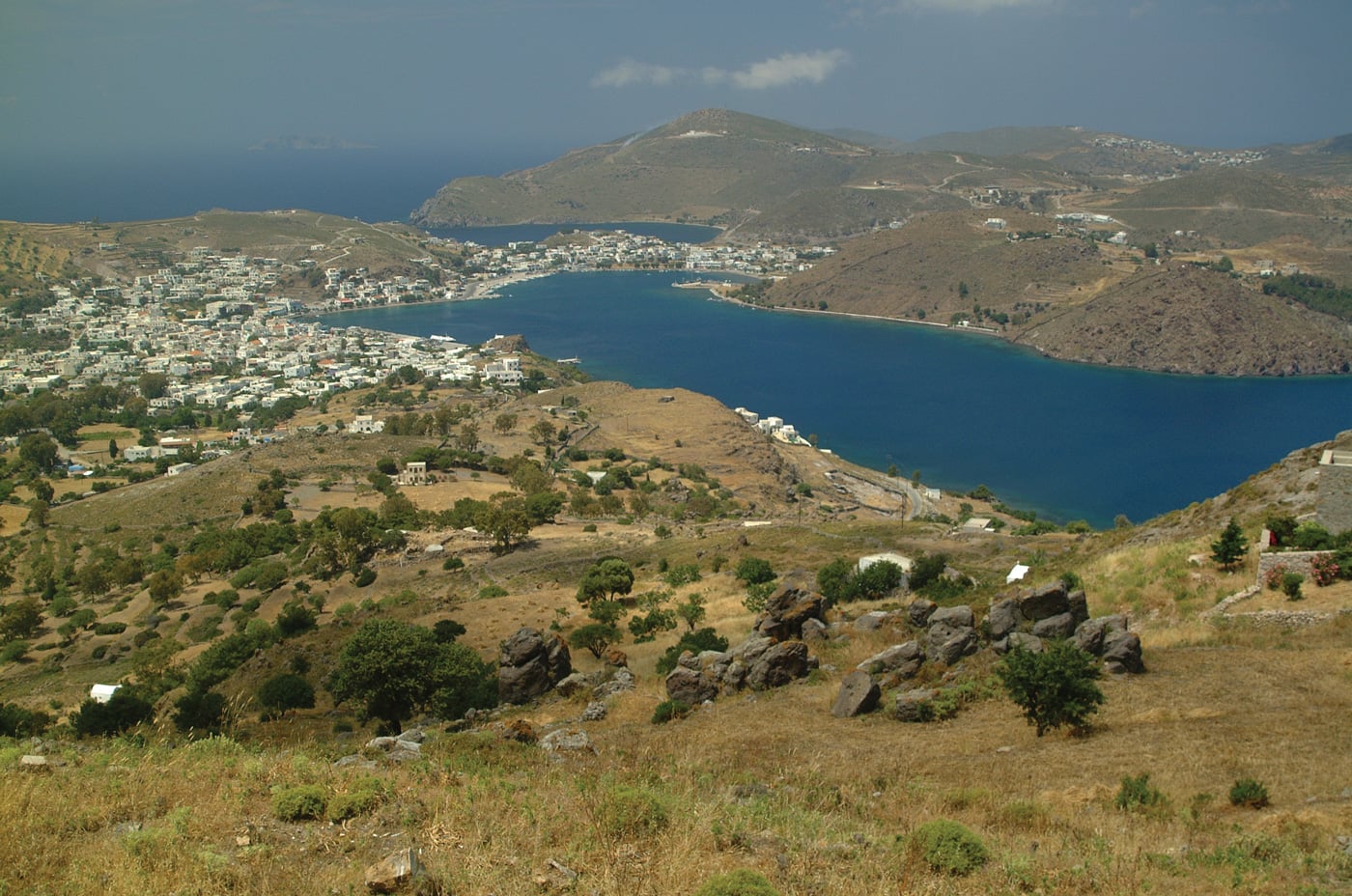
Patmos (shown here) is a Greek island located off the western coast of Turkey. John was in exile on Patmos due to his testimony about Jesus (Rev. 1:9).
When John turns to see who is speaking to him (1:12), he is stunned by the blinding sight of Christ. He is the “one like the Son of Man” (NRSV; cf. Dan. 7:13) who stands among the seven golden lampstands of God’s heavenly temple (1:12–13). Lampstands, or menorahs, were furnishings in the earthly tabernacle (Exod. 25:31–40), Solomon’s temple (1 Chron. 28:15), and Herod’s (Josephus, Jewish Antiquities 3.199). However, these earthly versions were pale imitations of the seven glorious lampstands seen by John (Heb. 8:5).
Even though the divine origin of “one like the son of man” is ambiguous in the Aramaic text of Daniel 7:9–14, it is clear in Revelation that this Son of Man is part of the Godhead, since he shares divine features ascribed to the Lord Almighty. In Daniel, it was God, as the “Ancient of Days” who judged the enemies of Israel, whose clothing was white as snow, whose hair was like wool, and whose throne was like a fiery chariot with wheels of flame (Dan. 7:9; cf. Ezek. 1:13–21). But in Revelation, the one on fire is not Daniel’s Ancient of Days but the Son of Man, whose “eyes were like blazing fire,” whose hair is white as wool and snow (1:14), and who holds the stars in his hands (1:16; cf. Dan. 12:3) and acts as judge (1:16). The seven stars in the Son’s right hand are a reference to the sun, moon, and the five planets that a person could see with the naked eye (Saturn, Jupiter, Mars, Venus, and Mercury). Ancient astrologers thought the future was written in the stars, but here it is the Son of Man who holds the destiny of his people. The double-edged sword protruding from Christ’s mouth is the Roman longsword used for penetrating armor. Here it is a metaphor for the power of God’s Word to pierce our souls (1:16; cf. 2:12, 16; 19:15, 21; Ps. 52:2; 57:4; Heb. 4:12).
In 1:12–16, Jesus is also described as the angelic “man dressed in linen” from Daniel 10:5–9. Both Christ and the angelic messenger have divine robes, golden belts, feet as burnished bronze, eyes like torches, and shining faces (as lightning in Dan. 10:6, but brighter in Rev. 1:16, like the sun). Although in Daniel this man might be the archangel Gabriel (see Dan. 8:16; 9:21; 12:6–7), in Revelation he is the representation of God himself.
Like the prophets of other call narratives in the Old Testament (Isa. 6:1–10; Ezek. 1:28–2:3; Dan. 8:15–18; 10:4–21), John at first reacts to the divine epiphany with terror (1:17), because no sinner can stand before a holy God and live. Also like earlier prophets, John is reassured with the words “Do not be afraid!” (1:17; cf. Dan. 10:12, 19; Isa. 41:13) and strengthened by the Son’s right hand (cf. Dan. 10:18). In this final scene, a mystery is unveiled. The stars in the right hand of the Son have turned into angels, and the lampstands into the seven churches of Asia Minor. In Daniel, heavenly bodies can symbolize God’s people and their angelic representatives (Dan. 12:1–3; cf. Phil. 2:15). In Revelation, the stars and lampstands represent the church of God, whose light and witness will never fade because Jesus is ever in their midst (1:13, 20).
C. The seven churches before the divine judge (2:1–3:22). In Revelation 2–3, Christ lays bare the true spiritual condition of John’s seven churches. In a dramatic reversal of the Old Testament expectations concerning Daniel’s Son of Man, the Son does not put God’s enemies on trial (as he does in Dan. 7:10–12, 26–27) but rather God’s people (cf. 2 Cor. 5:10; Heb. 12:5–11). Some historicist and futurist interpreters have tried to link the seven churches with successive periods of church history (e.g., Ephesus is the apostolic age, Smyrna the second- and third-century church, Pergamum the Constantinian era, Thyatira the medieval church, etc.), but such attempts ignore how closely each letter is situated within the geographical and cultural location of its first-century hearers.
2:1–7: The letter to Ephesus. Ephesus, whose harbor, roads, location, wealth, and special privileges with Rome made it an axis of trade in the Mediterranean, was the most cosmopolitan of the seven cities. Home to the imperial cult, it boasted magnificent temples dedicated to the emperors Domitian and Hadrian. It was also the site for one of the seven wonders of the ancient world: the Artemision, the temple of Artemis (goddess of the hunt and fertility). The Artemision was famous for its size, with a platform spanning over one hundred thousand square feet, and for its tree shrine at the center. The temple functioned as a place of asylum for fleeing criminals and symbolized abundant life. It also served as a bank that could receive huge monetary deposits.
On the surface, the Ephesian church appeared as zealous and productive as the city. In 2:2–3, Christ commends the Ephesian believers for their works, intensive labor, and perseverance. Under fire from several fronts (2:2, 6), they did not stumble or grow weary in their ministry. Yet Christ has one thing against them: they have abandoned “the love [they] had at first” (2:4; cf. Jer. 2:2; Ezek. 16:8). There is a sense of tragic irony as Christ walks intimately among the churches (2:1) yet is lost in the busyness of the Ephesian congregation.
Three verbs, each in the form of a command, unveil the process by which Christians recapture their first love: remember, repent, and do (the first things). “Remember from where you have fallen,” says Christ (2:5a NASB). The first step toward restoration is to remember the starting point where one’s heart began to drift from God. Reconciliation involves remembering correctly how the offender has hurt the offended, since the wrongdoer must confess the offense and seek forgiveness. Second, one must repent and completely turn away from the pattern of behavior that hurt the offended. Last, the forgiven should do the kind of good works that characterized the love he or she first shared with the forgiver (2:5b).
There are no shortcuts to repentance, and sometimes the initial task of remembering accurately when one’s faith began to stray can be a Herculean feat since time and sin distort a person’s memory (cf. Num. 11:18–20; 14:2–4). But if the Ephesians do not repent, they will lose the light of their witness (2:5b). If they repent, Christ will give them the right to eat from the Tree of Life in the paradise of God (2:7). This final image not only points to paradise regained (Gen. 2:8–15) but also directly challenges the Artemis cult. The true refuge for the sinner is not the tree of Artemis but the cross. The common word for “tree” in Greek is dendron, but 2:7 uses xylon, referring to cut wood, things made of wood, or a nonliving tree. So the “tree of life” in 2:7 is literally the “dead wood of life,” or the cross (e.g., “cursed is everyone who hangs on a tree [xylon],” Gal. 3:13 NASB, NRSV [= Deut. 21:23]; cf. Acts 10:39; 1 Pet. 2:24). What a powerful invitation! Return to the cross and regain your first love.
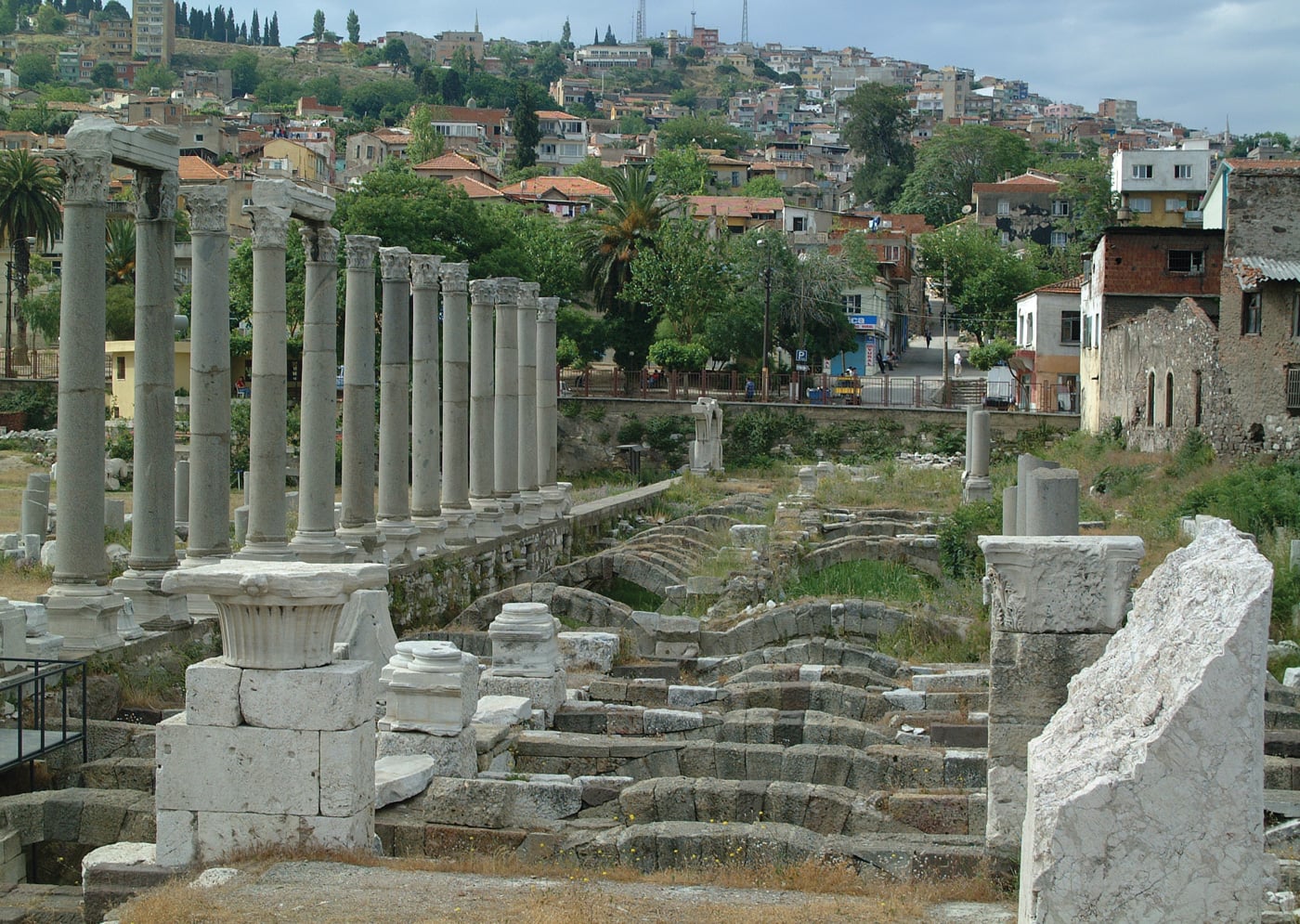
The columns of the western stoa bordering the agora in Smyrna (second century AD). The city of Smyrna is located on the Aegean Sea on the western coast of Asia Minor. John writes to the suffering church of Smyrna so that they may remain faithful in the midst of persecution.
2:8–11: The letter to Smyrna. Smyrna was a large port city known for its architectural achievements and aesthetic appeal. Its coins read: “Smyrna, first in Asia . . . for its beauty and splendor.” Smyrna was known for its magnificent buildings and numerous temples (including one to the imperial cult). When viewed from a distance, Smyrna looked like a crown resting on the summit of a hill (Aelius Aristides, Orations 21.437; 22.443). In the sixth century BC, the city had been destroyed by the king of Lydia but was later rebuilt to its former glory in 290 BC. Because of its death and rebirth, Smyrna was likened to the legendary phoenix, which dies in flame and reincarnates from its ashes. In contrast to the beauty of Smyrna, its faux resurrection, and its crowning summit, Christ appears as the truly beautiful and glorious one, the true resurrection (2:8), and the bestower of an imperishable crown for the faithful (2:11). As the one who orchestrates history from first to last, Christ addresses a church under pressure and reassures them that their faith is not in vain.
The tribulation of the church in Smyrna originated from vicious slander (2:9) by the local Jewish community, who had rejected the Nazarene sect as heretical (cf. Acts 25:5) and advised the city’s officials to suppress the Christian movement. In doing so, the Jews were unwittingly becoming instruments of evil, a “synagogue of Satan.” The fact that Christ addresses this group as “those who say they are Jews” and yet “are not” foreshadows the final parting of ways between Judaism and Christianity in the second century.
Instead of offering immediate relief, Christ actually warns them that their situation will worsen. Many early Christians experienced exclusion from the trade guilds, property loss, and poverty. Some will be thrown into prison, while others will suffer a martyr’s death (2:10). The apostolic father Polycarp, bishop of Smyrna, was executed in this city by fire and sword (Martyrdom of Polycarp 4.1–3). Christians should not be surprised if their obedience leads to further persecution (cf. 2 Tim. 3:12). Yet the residents of Smyrna are actually abundantly rich in their present faith toward God (cf. Luke 12:21; James 2:5). A “crown of life” or athlete’s laurel (Greek stephanos), which was a symbol of endurance and honor, awaits all those who finish the race of life with faithfulness (cf. 2 Tim. 4:7).
2:12–17: The letter to Pergamum. Pergamum was situated on a plateau some one thousand feet above the Caicus River valley and stood prominently in the expanse of the Mysian hills. The city was known for its great libraries, parchment materials, large theater, and many shrines (including the ones to Zeus, Athena, Asclepius, Hygeia, and Apollo). The temple of the Sebastoi (Greek for “the venerated ones,” referring to Augustus Caesar and his successors) in Pergamum was the first imperial temple erected in Asia Minor (29 BC). Of the three greatest cities in Roman Asia (i.e., Ephesus, Smyrna, and Pergamum; Dio Chrysostom, Orations 34.48), the imperial cult was the most influential in Pergamum. Every five years or so, the Pergamene games were held in honor of the imperial family. It was a circus of epic proportions.
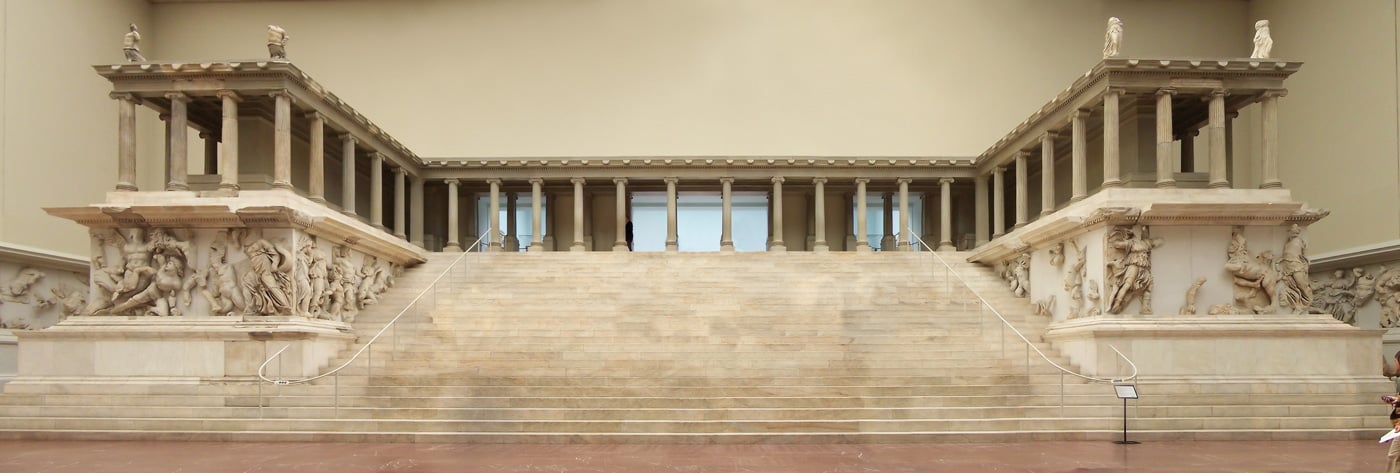
The restored and reconstructed Altar to Zeus from Pergamum (second century BC). This altar may be what John refers to in Revelation 2:13.
A Christian living in Pergamum could not avoid participating in the festivals or eating idol food without severe repercussions. Believers who refused to promote the imperial cult were ostracized from the trade guilds and even experienced confiscation of property, prison, and possibly death. Pergamum was one of the few cities that received from Rome the “right of the sword,” enabling it to execute criminals at its discretion. The anonymous Antipas, whom Christ praises as “my faithful witness” (2:13), was the first of the Christian martyrs in this city.
Next John identifies someone in the church as the false prophet Balaam (2:14; cf. Num. 22:5–24:25). According to Jewish legend, Balaam advised King Balak to send Moabite women into the Israelite camp to seduce them into idolatry (Num. 25:1–5). Similarly, Christians who eat idol food (2:14), particularly during the cultic feasts, are guilty of the same spiritual adultery as Israel (2:14; cf. Jer. 3:6–9; Ezek. 23:35–38; Hos. 2:1–14). Those who teach idol food’s permissibility are guilty of the same kind of false prophecy as Balaam (cf. Jude 11; 2 Pet. 2:15–16). The Balaam sect at Pergamum was probably a local manifestation of the wider Nicolaitan movement (2:15; cf. 2:6). It is possible they justified their participation in the imperial festivals on the theological basis that an idol is nothing (cf. 1 Cor. 8:4) and thus cultic feasting was harmless (cf. 1 Cor. 10:19–22).
Christ’s appearance as one “who has the sharp, double-edged sword” (2:12; cf. 1:16) is a direct challenge to “the right of sword” exercised by Pergamum. No one has the authority to judge God’s people except Christ (2:16). As judge, Christ warns the Balaam group that he will wage war against them with the sword of God’s word (2:16b). He also calls all the house churches to repent (2:16a) for their corporate sin of neglect. To those who overcome, Christ promises manna (Exod. 16:12–31) and will sustain them through their desertlike circumstances (2:17; cf. Deut. 8:3). The white stone was a pebble cast as a vote of acquittal during a trial. This stone is also an admission pass to a special feast: the eschatological wedding banquet with Christ (Rev. 19:7–9; cf. Matt. 22:11–13).
2:18–29: The letter to Thyatira. Thyatira, unlike the other cities of Asia Minor, lay on almost level ground and was bordered by rising hills. Its landscape and location made the city vulnerable to constant invasion, but its exporting business prospered because of the various roads that ran through the city and connected it to the Greek East. The first Christian convert in Macedonia—Lydia, a merchant of purple linens—was originally from Thyatira (Acts 16:14–15). Thyatira’s guild of dyers was prominent, along with its clothiers, linen workers, and coppersmiths. It is possible that the Greek word roughly rendered “burnished bronze” (the term does not translate easily into English) may have referred to a special metal alloy of copper and a silverlike zinc produced only in Thyatira. This metal is used to describe the luminous quality of the divine Son of Man (2:18).
To a church whose city had a history of reconquest, Christ describes himself as “the Son of God” (2:18; cf. 2 Sam. 7:12–16; Ps. 110:1–2), the conquering Davidic king who would crush all of Israel’s enemies with an iron rod (2:26–28; cf. Ps. 2:8–9). The Thyatiran believers also faced the same temptation to participate in cultic feasts (2:14). A false prophetess whom John pejoratively calls Jezebel deceived the church into idolatrous behavior (2:20). Jezebel in the Old Testament was the infamous wife of King Ahab, who promoted Baal worship, murdered God’s prophets, and persecuted Elijah (2 Kings 9:22; 1 Kings 18–21). The Jezebel of Thyatira was a leader (probably a patroness of a house church) who shared “Satan’s so-called deep secrets” (a wordplay on her claim that she taught the deep things of God; 2:24; cf. 1 Cor. 2:10; 8:1, 4) and taught the permissibility of idol food. To Jezebel and her disciples (2:23; cf. 1 Cor. 4:7), Christ warns that he will throw her and those who are spiritually united with her onto a sickbed (2:22; cf. Matt. 9:2). He will strike them with a deadly disease leading to death unless they repent (2:22–23; cf. 1 Cor. 11:29–30; Acts 5:3–10).
But Christ also tells the faithful in Thyatira to repent. In one of the most theologically striking texts of all seven letters, he warns the church, “You are forgiving [Greek aphiēmi] the woman Jezebel,” when she should not be forgiven (2:20; both the NIV and NRSV translate the Greek verb as “you tolerate,” but “you are forgiving” is to be preferred). With words reminiscent of the Johannine commission, “If you forgive [Greek aphiēmi] the sins of any, they are forgiven” (John 20:23 ESV), Christ calls the church to the priestly duty of discerning whether members have truly repented (2:21–22). It is the church’s duty not to forgive until they take sin seriously (cf. Matt. 18:15–18). The one who searches the heart cannot be fooled by shallow repentance but will instead judge all according to their works (2:23). But to those who persevere, the son of David will share the right to rule the nations with him (2:27–28; cf. Ps. 2:9; Isa. 14:12).
3:1–6: The letter to Sardis. The city of Sardis had a reputation for wealth that exceeded its reality. According to an early Greek legend, King Midas washed off the cursed touch that turned everything into gold by bathing in the Pactolus River, which ran through Sardis. Sardis in its early history prospered through gold deposits discovered in the river. During the Roman era, however, Sardis became prosperous through its textile industry, its important trade routes, and its fertile plains. It had at least two temples on site, one to Augustus and the other to Artemis. In AD 17, Sardis suffered from a sudden earthquake, called the greatest disaster in local memory by Pliny the Elder (Natural History 2.86). With help from the emperors Tiberius and Claudius, Sardis was rebuilt. It quickly regained part of its former prosperity and sought the right to renew the imperial cult.
To the church in Sardis, Christ appears as the divine judge, the Son of Man, holding the seven spirits and stars (Rev. 1:12–16). Perhaps to outsiders the church looked like the epitome of success. But when Christ lifts the veil, John is horrified to see a congregation that is on the brink of spiritual death (3:1). Their works always fall short of genuine sacrifice (3:3). Though Sardis was known for its booming garment and textile trade, these believers wear soiled clothing (3:4), a poignant symbol of moral compromise with their surrounding culture. Christ warns them to wake up, strengthen what little faith remains, remember what they first heard, and obey (3:3–4). If they do not heed this warning, when the Son of Man returns (cf. Matt. 24:42–44; 1 Thess. 5:1–6), they will be caught off guard (as they were when the earthquake hit in AD 17) and shocked to find themselves on the wrong side of eternity. But to the faithful, Christ promises to dress them gloriously in white (a symbol of purity and victory) and never to blot out their names from the book of life (a heavenly register; see Exod. 32:32–33).
3:7–13: The letter to Philadelphia. Legend has it that Philadelphia was named after two rulers of the Attalid dynasty, the brothers Eumenes II and Attalus II Philadelphus. Philadelphia was known as the “gate” or “door” because it stood at the juncture of two major road systems. One road ran north from Ephesus and through a pass above the Cogamis Valley, while the other road ran east of Philadelphia through the Phrygian province. Philadelphia experienced the benefits and burdens of living in a volcanic area called the Katakaumenē (literally “burned over”), which provided rich, fertile soil for the city’s large vineyards but because of frequent tremors also sent citizens fleeing from the city. Philadelphia, along with Sardis and Laodicea, experienced the infamous earthquake of AD 17 that leveled all three urban centers. When Philadelphia was rebuilt with Roman aid, the city was renamed “Neocaesarea” to honor the imperial family, and later “Philadelphia Flavia” to honor the Flavian emperor Vespasian.
The Philadelphian church had “little strength” (3:8a). Nevertheless, a church that seems weak to the outside world is where God can display his glory (cf. 1 Cor. 1:26–29; 2 Cor. 12:8–10). As in Smyrna (Rev. 2:8–11), the church at Philadelphia was experiencing hostilities from the Jewish synagogue (3:9) but did not deny Jesus’s name (3:8b). Because of their perseverance (3:10) and works (3:8a), the holy and true one gives three promises. First, Christ tells the Philadelphians that the door to the church’s mission and ministry (cf. 1 Cor. 16:9; 2 Cor. 2:12; Col. 4:3) will stay open. No one can shut it. Second, he promises to vindicate the church before the Jewish community (3:9; cf. Isa. 60:14; Rom. 11:11). Last, the one who holds the keys to David’s kingdom (3:7; cf. Isa. 22:2) promises them a place in David’s new city, the New Jerusalem (3:12; cf. 21:2, 10; Jer. 3:17). Unlike the earthly Philadelphia, whose name changed twice, the heavenly Jerusalem and its citizens have a permanent name (i.e., the name of God) and with it the assurance that they belong to Christ. Believers will be a pillar in the portico of God’s eschatological temple, which no earthquake can shake (cf. Ezek. 40:49), and they will receive the power to remain steadfast (3:12; cf. 1 Cor. 15:48).
3:14–22: The letter to Laodicea. The city of Laodicea, compared with Hierapolis and Colossae, was the most prominent of the three cities in the Lycus River valley. A trade route that connected Laodicea with Ephesus, along with lesser roads north to Hierapolis and east to Colossae, allowed for a prosperous exporting business. The city was a central hub between the three regions of Lydia, Phrygia, and Caria. Laodicea’s textile industry was known for a fine, dark wool. The city was also a banking center, exchanging Roman coinage, gold, and other items of deposit for local currency. Laodicea was so wealthy that when the infamous earthquake of AD 17 struck, it was the only city that refused Roman aid. It was home to a medical school that prized among its other healing drugs an ointment for burns. Laodicea receives a scathing rebuke from Christ, who attacks these points of civic pride.
The Laodicean church was completely unaware of its true spiritual condition. Christ tells them: “I know your deeds, that you are neither cold nor hot. . . . Because you are lukewarm . . . I am about to spit you out of my mouth” (3:15–16). While neighboring Hierapolis was famous for its hot (95 degrees Fahrenheit) medicinal water springs, and Colossae for its pure, cold water, Laodicea had a poor water supply and imported water from five miles out through an aqueduct. The water was tepid on arrival. Christ laments that Laodicea is neither hot nor cold but rather disgusting (in the spiritual sense) like its lukewarm waters. Though they think highly of themselves (3:17a), they are actually wretched, pitiful, morally bankrupt, blind, and naked (3:17b).
Referencing their wealth, Christ admonishes the church to buy what really matters (3:18): purity of heart (like gold refined by fire), forgiveness and holiness (like white garments; 7:14; cf. Lev. 16:14–16), and moral discernment (like eyes healed by medicinal ointments). The purpose of this rebuke and accompanying discipline (perhaps in the form of the trials to come; 6:1–8:1; cf. Heb. 12:5–11) is repentance. Christ loves the church and has not given up on it. Yet in a heart-wrenching image, he stands outside knocking at the church’s door (3:20; cf. Song of Sol. 5:2; Luke 12:36–37). To those who let Jesus in, Christ promises an intimate and restored fellowship (symbolized by the shared meal; 3:20).
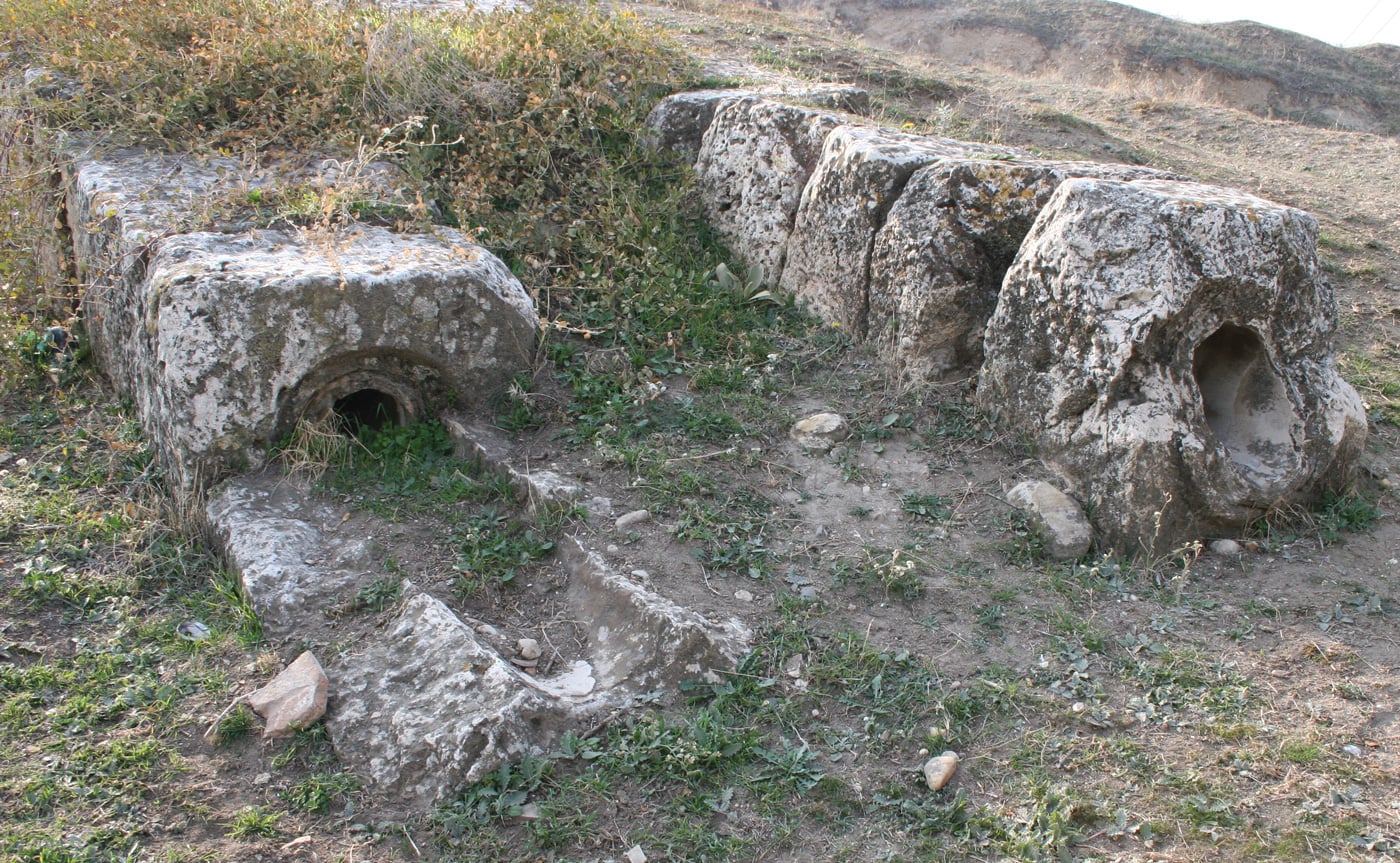
The aqueduct system at Laodicea, seen here, brought lukewarm water into the city. This water that is “neither hot nor cold” is alluded to in Revelation 3:15–16.
2. Heaven as the Eschatological Temple and the Theater for Cosmic Warfare (4:1–19:21)
In Revelation 1–3, John saw the throne room of God from which the divine Son of Man judges the seven churches in Asia. This theophany, specifically a throne-chariot theophany, is described with even greater detail in Revelation 4–5, which continues the image of heaven as the throne room and royal court of God, but also introduces the central composite vision that forms the backbone of the entire book of Revelation. When John receives his tour of heaven from the various members of God’s court, he begins at the throne but steps out to discover that the throne room is part of a larger magnificent structure, namely, the eschatological temple of the Lord. For the most part (Revelation 4–19), John’s central vision takes place in the true heavenly temple, after which the earthly tabernacle built by Moses, the first temple of Solomon, and the second temple renovated by Herod the Great were modeled (Exod. 25:9–40; 2 Chron. 28:11–19; Josephus, Jewish War 5.212–18).
A. The heavenly liturgy begins (4:1–5:15). 4:1–11: Praise the Creator. The first thing John sees is the open door to the gates of the heavenly temple (4:1; cf. 11:19; 15:5), and his spirit is immediately swept up into the inner sanctuary, where the throne of God resides (Rev. 7:15). The blowing of a temple trumpet usually heralds the next part of a Jewish liturgy (cf. Lev. 23:24), and so the familiar “voice like a trumpet” that commissioned John as a scribe in his first vision (1:10) now issues a new call to worship. A heavenly liturgy of epic proportions begins.
The object of worship is the Lord God Almighty in his full glory. In the throne-chariot epiphany traditions of Ezekiel 1–2, Isaiah 6, Daniel 7, and later Jewish apocalypses (e.g., 1 Enoch 55; 61), God appears as a divine ruler seated on his heavenly throne (4:2) whose glorious splendor is depicted with the most luminous terms possible. Semiprecious stones like jasper and carnelian are worn like a tunic by God, and a rainbow of emerald is worn like a belt (4:3; cf. Exod. 28:13; Ezek. 1:16, 26–28; 28:13). Reminiscent of the Sinai theophany, where God appears before Israel in the form of a storm cloud (Exod. 19:17–18), flashes of lightning and peals of thunder roar from the throne (4:5; cf. Ezek. 1:13–14). The flaming torches from the menorah in the temple are the seven spirits, or the Holy Spirit (Rev. 1:4; cf. Isa. 11:2–3), whose light burns constantly and whose presence sustains the churches (4:5). A sea of glasslike crystal covers the temple floor. The sea is a symbol of chaos and sin in the Old Testament (Ps. 74:13–17), but its calm state before the throne means that chaos has clearly been subdued by God (4:6; cf. Ezek. 1:22; Gen. 1:8).
In a series of concentric circles surrounding God’s throne, the different members of his heavenly council are identified. In the first outer circle are the twenty-four elders, who are similar to the elders at the Sinai theophany (Exod. 24:9–18) but also likened to the divisions of twenty-four priests, gatekeepers, and Levites of the earthly temple (1 Chron. 24:3–19; 26:17–19; 25:6–31). The elders of John’s vision represent the entire people of God in their appointed priestly duties (4:4a). Their thrones refer to the multiple-thrones scene of Daniel 7, where the resurrected saints or “holy ones” are given the right to cojudge with the Ancient of Days (Dan. 7:9–10, 18, 27; cf. 1 Cor. 6:3). The elders are dressed in white, a testimony to their pure faith, and are also wearing golden athlete wreaths, a symbol of their perseverance (4:4b).
In the second concentric circle (moving toward the center) are the four living creatures with six wings that resemble the cherubim of Ezekiel 1:4–25, with the faces of a lion, an ox, a man, and an eagle (4:6–7). The four angelic beings embody the entire created order from the four corners of the earth (7:1; 20:8): land animals, birds, human beings, and the like. The eyes of the cherubim “all around” signify divine omniscience and their role as agents of God’s will (4:8a). In an endless chorus, they sing a hymn identical to the one sung by the seraphim of Isaiah: “Holy, holy, holy is the Lord God, the All Powerful and Mighty One” (4:8b, author’s translation; cf. Isa. 6:3); thus the reader is reminded that God is wholly separate from us and that only out of his mercy does the Creator meddle in the lives of sinful human beings.
The twenty-four elders join the litany of the four cherubim with their own acts of worship. They fall prostrate and throw down their laurels before the enthroned one (4:9–10). In the ancient world, it was a common ritual for magistrates to surrender their crowns to pay homage to the emperor. Here the elders offer their crowns not to Caesar but to the Creator. At stake is the question: Who is the real Lord of the universe? Who has true power? In a hymn of their own, the elders proclaim, “Our Lord and God! You alone are worthy of worship, honor and glory. It was your life-giving power that created the world and continues to sustain all creation” (4:11, author’s translation).
5:1–15: Praise the slain Lamb. As though the second movement in a symphony, the celebration in the eschatological temple of God continues, with a reading of a scroll. Typically, in a Jewish synagogue liturgy, the seals on a Torah scroll are broken so that God’s Word may be read to the whole congregation. However, this scroll in the right hand of the enthroned Creator cannot be opened or read (5:1). Even a being as powerful as the angel with the great voice must ask, “Who is worthy to break the seals and open the scroll?” (5:2). The silence that follows (5:3) and the godly lament of John (5:4; cf. Ezra 10:1, 6; Neh. 1:3–6) demonstrate that no living creature can read or execute the contents of the scroll. Since there is writing on the inside and the back (5:1), the scroll type is undoubtedly an opistograph (“written on both sides”), which was used with legal documents. Most likely this scroll is a last will and testament (cf. Ezek. 2:9–10; Dan. 8:26; 12:9; 1 Enoch 81:2–3). When legal documents were sealed in the ancient world, though the internal contents were hidden, often a shorter summary was given on the back of a rolled-up scroll. Only the executor of the will, that is, the one who could accomplish the instructions of the author, was eligible to break open the scroll and read from it. It is possible, then, that on the inside of God’s scroll is written his full plan of redemption, and on the back is a description of God’s will as it was revealed partially over time in the history of Israel.
Who, then, is worthy of executing God’s divine plan? Could it be the Lion from the tribe of Judah (Gen. 49:9) who is the Root of David (Isa. 11:1, 10; Jer. 23:5; cf. Rev. 22:16)? These two royal titles emphasize the authority of the Messiah to conquer and judge Israel’s enemies. Perhaps he can read the scroll. Then suddenly the scene shifts from the Lion of Judah to the slain Lamb (5:6). Though “standing as if it had been slaughtered” (5:6 NRSV), this Lamb is paradoxically described as having “seven horns” (a symbol of perfect power) and “seven eyes” (a symbol of perfect omniscience through the Spirit). The Lamb shares the position of axis mundi, or “the cosmic center,” with the Creator himself (5:6). In a radical redefinition of true power, the slain Lamb, not the Lion, is the one who actually takes the scroll (5:7) and one by one breaks its seals (6:1–8:1).
In response, the whole court falls prostrate before the Lord and the Lamb (5:8). The elders each hold a lyre (cf. Ps. 33:2–3; 43:4) and a golden bowl of incense (a temple utensil, but here a symbol of the saints’ prayers), and with them they continue worshiping the Creator (4:8–11) by worshiping the Lamb (5:9–14). The new song is first sung by the elders (5:9–10). Then comes a chorus of countless angels with their own refrain (5:11–12), and finally the entire creative order joins with a doxology (5:13). The Lamb is exalted for his redemptive work on the cross. His death provides atonement for every tribe, language, people, and nation (5:9; cf. 1:5; 7:9).
The arrangement of God’s heavenly court in concentric circles (that is, the throne at the center, followed by the circles of cherubim, the twenty-four elders, countless angels, and all creation) resembles the Greek amphitheater and parodies the Roman imperial court, which focused on the emperor and his surrounding entourage of advisors, courtiers, and friends. The collective visions of Revelation 4–5 function to directly challenge Rome’s definition of power as empire and domination. In the first liturgical movement (4:1–11), power is defined as creative: it is life-giving (not life-destroying) and brings order (rather than causing chaos). In the second (5:1–15), power is defined as redemptive. The way of the Lamb is faithful suffering. It stands in stark contrast with the coercive, violent, and manipulative use of force, which characterizes the military might of Rome. True power belongs to the Lord, the Creator of the universe, and his Son, the Lamb, who takes away the sins of the world, and to those who worship them both.
B. The seven seals: Where is God when his people suffer? (6:1–8:1). 6:1–8: The Four Horsemen of the Apocalypse. In this next set of visions, the slain Lamb breaks the seals on the scroll (6:1) one by one to unveil the contents of God’s redemptive plan. The breaking of the first four seals follows a set pattern: the Lamb opens a seal, the cherubim issue the command, “Come,” and a demonic rider on a colored horse proceeds to carry out the scroll’s contents. Revelation’s portrayal of riders on white, red, black, and pale green horses is taken from Zechariah 1:8–15 and 6:1–8. The Zechariah texts describe four riders on similarly colored horses or chariots who patrol the four corners of the earth and report to God that the empires of the world feel falsely secure. The four horsemen of Revelation, however, take on a much more direct role in the judgment of falsely secure nations. The riders represent evil forces that God allows to have some limited influence on human history.

A lead bulla, or seal, with a menorah impression (Byzantine period). Beginning in Revelation 6:1, the Lamb opens a series of seven seals.
The first rider, on a white horse, is a symbol of empire (6:2). The color white has so far been associated with the purity and victory of God’s people (1:14; 2:17; 3:4; 4:4), but here the rider is a satanic parody of false conquest (the Greek verb for “conquer” is emphatically used twice in the same sentence: literally “He rode out to conquer as one who conquers”) and of false endurance (the latter signified by the stephanos, “athlete’s wreath”). The bow that the rider carries is a distinctly non-Roman weapon used in Greece, Anatolia, and the eastern Mediterranean, though most infamously among the Parthians, who bordered the Roman Empire’s eastern frontier and whose cavalries had excellent archers. There was always a potential danger that the Parthians would break through the Roman lines of defense and invade the western part of the empire. The vision of the first rider is a stark warning against those who put their hope in Rome or any other government for national security. Empires rise and empires fall. The only enduring kingdom is the one established by the slain Lamb (5:10).
The second rider, on a fiery red horse, is a symbol of violence, war, and bloodshed (6:3–4). The great (Roman) sword that he carries and his charge to “take away peace from the earth” is a blistering critique of the pax Romana (Latin for “Roman peace”). The Roman peace was both policy and ideology. Augustus Caesar boasted that the Roman military machine had established a peaceful order to disparate lands and united the entire civilized world. But peace enforced by the sword is no true peace, and the civil unrest that ensued under Rome’s iron hand had been cataloged case after case by its own historians. One notorious example is the scandalous year (AD 69) of four succeeding emperors (Galba, Otho, Vitellius, and ultimately Vespasian) that almost tore the empire apart from within.
The third rider, on a black horse, is a symbol of economic crisis and injustice (6:5–6). The measuring scale and the inflated prices for wheat and barley (eight and five times the expected cost) signal a food shortage. A denarius, a day’s wages, for either a quart of wheat or three quarts of barley would hardly feed a small family, and there would be no money left to buy olive oil and (cheap) wine (which often replaced drinking water) despite their affordability. Even though through international trade the Roman economy made available all kinds of goods and services (see, e.g., the list of items in Rev. 18:11–14), access to them was disproportionate between the rich and poor. The former had easy access to luxury items, while the latter were unable to purchase basic staple foods. Both New Testament writers and Roman historians record several famines that devastated local grain supplies throughout the empire (Acts 11:28; Suetonius, Claudius 19; Tacitus, Annals 12.43), which could account for some economic woes of that day.
The fourth rider, on the pale green horse (6:7–8), unlike his predecessors actually has a name, “Death,” and a sinister partner who comes right after him: “Hades” (the place of the dead). The last rider epitomizes the aftereffects of the first three cavaliers: wherever there is empire, violence, and economic crisis, death is sure to follow. The earthly beasts or wild animals, which probably fed off the carrion of bodies left in the wake of previous riders, complete the picture of chaos and divine judgment (cf. Ezek. 14:21; Jer. 15:3). Yet these forces of evil are not allowed to run amok. There is a constraint to the anarchy. The reach of the four riders is limited (by God) to a fourth of the world for this first cycle of judgments (6:8). So one by one, with each passing rider, God allows these false sources of security (i.e., government, warfare, a prosperous economy, and good health) to be the very means through which God judges the wicked but in the process also exposes the corrupt and fragile idols for what they are.
6:9–17: The fifth and sixth seals. The next two seals represent two different human responses to suffering. When the Lamb breaks open the fifth seal (6:9–11), John is astonished to see the souls of slaughtered martyrs under the altar of the heavenly temple, as if their blood were mixed in, and a part of, the sacrificial offering (Lev. 4:18; 8:15). These martyrs were killed because they proclaimed God’s word and bore witness to Jesus (Rev. 1:9). From the cry of Abel’s blood spilled on the ground by Cain (Gen. 4:10) to the cries of Christians crucified and burned alive in the gardens of Nero, God’s people have prayed, “How long, Sovereign Lord . . . until you judge [our enemies] and avenge [us]?” (6:10). Why has God not acted? This scene reveals God’s answer to their prayers for justice (cf. Ps. 6:3; 35:17; 80:4). First, the altar tells us that God considers their sacrifice an act of true worship (cf. Rom. 12:1; Phil. 2:17). Moreover, their suffering has not been wasted but has a purpose; it is integral to a divine plan that will include even more joining their ranks until a certain number is reached (6:11). He has given them white robes of victory to reward their endurance and affirm their priestly roles (cf. Lev. 16:32).
When the Lamb opens the sixth seal (6:12–17), the scene shifts from the perennial problems of human history to the cosmic events that signal the final consummation of God’s kingdom. A great earthquake, the sun turning dark as sackcloth, the moon becoming like blood, the stars falling from the sky, the sky splitting apart, and every mountain being thrown from its place (6:12–14) are examples of figurative language John borrows from apocalyptic traditions to describe creation under decay (Isa. 13:10–13; Joel 2:10, 30–31; Hab. 3:6; cf. Rom. 8:19–22). These “last days” began with the resurrection of Christ (Acts 2:17; Heb. 1:2) and reach their conclusion at his imminent return (Mark 13:24–27). Even then, human beings can remain unrepentant. From every segment of society, from kings to lowly slaves, there are people who would rather pray to the mountains to fall down and cover them or hide in the caves than cry out to the Lord and be saved (6:15–16; cf. Joel 2:32).
7:1–8:1: Worship interlude and the seventh seal. After the sixth seal is broken, there is an interlude of worship. The eschatological end is delayed by four angels (7:1), who—symbolizing a restraining force on lawlessness (2 Thess. 2:7)—hold back the winds on which the four demonic cavaliers ride (cf. Zech. 6:5). These angels also operate in conjunction with the worship and witness of the church. When the veil is lifted, we see that the church’s presence in human history has had a sanctifying effect on the world. The angel who rises with the sun commands the other four not to harm creation (i.e., the earth, the sea, and even the trees; cf. Gen. 1:9–13) until every servant of God receives a signet seal (7:2). It was believed that Yahweh, like all kings, had a signet ring by which he authenticated decrees and marked what was his (Esther 8:8; Job 9:7; Sirach 17:22). God reins in the chaos for his sealed ones so that their mission can continue.
The 144,000 represent all saints from both the Old and the New Testament (see the introduction) and are listed here in a tribal census (7:4–7). Unlike other Old Testament lists of Israel’s twelve tribes (Num. 1:5–15; 1 Chron. 2:1–2), conspicuously missing from Revelation’s roster is Dan. The absence of Dan, who had a history and reputation for apostasy (1 Kings 12:28–30; Testament of Dan 5:6), serves as a warning that only those who persevere to the end will be saved (Rev. 2:7; 2:10–11). Sadly not all who start off in the Christian life finish it.
When the 144,000 appear again, they stand as a countless multitude whose diversity is evident, since individual persons can still be distinguished by nation, tribe, culture, and language and yet all are perfectly united in their litany to the Lord (7:9–10). This picture of the church triumphant provides hope for today’s divided congregation. Here the people of God are one voice, dressed in white priestly robes (Rev. 6:11), holding palm branches (a symbol of homage to a king during his coronation; cf. Mark 11:8; 2 Maccabees 10:7). They shake the heavens by shouting, “Salvation belongs to our God, who is [both] the One seated on the throne and the Lamb!” (7:10, author’s translation). Joining in the liturgy are the four cherubim, the twenty-four elders, and the myriad of angels of Revelation 4–5, who fall prostrate and sing their own doxology (7:11–12). Those robed in white who “come out of” the great tribulation are not a persecuted group belonging to the distant future of a war-torn world (7:14). The grammar of this verse suggests that John and his readers are viewing this event as an ongoing situation that has already begun. The “great tribulation” that the Jewish apocalypses and Jesus himself said would happen in the last days (Dan. 12:1; Matt. 24:21) began with the resurrection of Christ and refers to the immediate trials faced by the church universal (Rev. 2:9–11). Believers who wash and whiten their robes are those who let suffering purify their faith and refine their character.
The next liturgical segment evokes images from the Festival of Booths (Lev. 23:34; Zech. 14:16; John 7:2), a weeklong holiday when Jews eat their meals in temporary booths or huts to commemorate how the tabernacle accompanied the Israelites through their wilderness wanderings during the exodus. God promises the faithful that he will permanently “dwell” with them (7:15 KJV; NIV “shelter them with his presence”; Greek skēnoō means literally “pitch a tent” over them; cf. Ezek. 37:26–28) and never let them go hungry or thirsty again, nor let the sun’s heat fall on them (Isa. 49:10). Christ will shepherd (Ezek. 34:16, 23) and lead them to a place with living water (a symbol of eternal life; cf. John 4:14) where there is no more death or tears (Isa. 25:8). All will find perfect peace in the presence of the Lamb (7:17).
When the seventh seal breaks, appropriately there is silence (8:1). The eschatological hour and a half denotes a limited period of time before divine judgment can commence (Dan. 7:25; 9:27; Hab. 2:20), but here, as part of the liturgy, the silence is also a moment of reverent awe. Heaven is telling us, Be still and know the Godness of God (cf. Ps. 46:10).
Taken as a whole, the seven seals give a partial answer to the problem of theodicy (i.e., why a good and powerful God does not act immediately to end human suffering). They demonstrate that the origin of suffering and evil is complex. There are several degrees of separation from God, who once held the scroll (4:1); to the slain Lamb, who takes it and breaks the seals (5:7; 6:1, 3, 5, 7, 9, 12; 8:1); to the cherubim, who give the command, “Come” (6:1, 3, 5, 7); to the four summoned riders who unleash each disaster (6:2, 4–5, 8); to the human agents who perpetuate the suffering caused by empire, violence, economic injustice, and death (6:15–16). In one sense, the seals affirm that God is in control of human history, that nothing happens outside his authority, and that suffering cannot affect our world unless he allows for it. On the other hand, to say that God is directly punishing sinners by causing them to become blind (cf. John 9:2–3) or receive cancer or lose their jobs and homes is to fail to understand the complexities of evil, much like Job’s friends do (Job 2:11; 4:7–11; 8:3–6; 11:10–15). The degrees of separation in the agency of the seals demonstrate that God is not the direct cause of suffering. By his providential will, he allows sin to run its course, but for a redemptive purpose. His hope is that when people experience the consequences of sin, whether directly because of their personal actions or indirectly because we live in a fallen world where bad things happen, all will turn to Christ for deliverance. Mysteriously, God does not stop evil by suspending the human freedom that contributes to it but rather turns evil into an unwitting actor of his design.
C. The seven trumpets: Why history belongs to the intercessors (8:2–11:19). 8:2–5: Prelude of prayer. During a time of silence and prayer, the priest usually made an incense offering as part of the daily sacrifices of the Jerusalem temple (Mishnah Tamid 5.1–6; 6.1–3; 7.3). The priests typically sprinkled sacrificial blood on the altars of the outer temple courts (cf. Lev. 1:5) and later entered into the inner sanctuary to burn the incense on a separate altar before the Most Holy Place (cf. Exod. 30:1–9; Luke 1:8–12). In John’s vision of the heavenly temple, there is only one altar, which fulfills both functions. For the fifth seal, John saw the slain martyrs at the base of the altar cry out: “How long . . . ?” (6:9–10). Here those same cries for justice and vindication rise up like incense and mix together with prayers from all the saints (8:3). These prayers go directly to the Most Holy Place, where the throne of God resides, and God hears their every word (8:4). Not one prayer is wasted. Like the incense, each prayer is a fragrant offering to the Lord (cf. Ps. 141:2). The whole world feels the power of prayer when the angel (“of his presence”; Isa. 63:9) takes the golden censer, or thurible, and flings it on the earth (8:5). The crashes of thunder, flashes of lightning, and the earthquake are characteristics of the Sinai theophany (Exod. 19:16–17; 20:18–21) and tell the readers that as a result of prayer, God is making his presence known to all.
8:6–13: The first four trumpets. The seven angels who stand before God at the throne (8:2, 6) are arguably the same seven angels who represent the churches in Revelation 2–3. What does it mean, then, that these heavenly representatives of God’s people are the ones who blow the trumpets and set loose the cataclysmic events to follow? As the church prays for and works toward God’s kingdom on earth (cf. Matt. 6:10; Luke 11:2), it also contributes to that part of God’s redemptive plan that allows for sin to run its course. Our prayers and witness open the possibility for divine judgment to break into our present reality, expose evil, and urge evildoers toward repentance. Sometimes people will simply not repent until they experience the pain of a world without God (cf. Rom. 1:24–32). But God can use suffering as an opportunity for unbelievers to repent and for believers to refine their faith.
With the blowing of the first trumpet, the heavenly liturgy moves forward with greater drama. John and his readers brace themselves for the next set of divine judgments. The account of the first four trumpets employs imagery from the Exodus plagues, which historically forced Pharaoh to release the Israelites from their captivity in Egypt. The ten plagues (Exodus 7–12) were designed to attack the various gods of the Egyptian pantheon, from the Nile River to Pharaoh himself, who was considered to be a living deity. One by one God defeated the idols of the Egyptian Empire and demonstrated once and for all that Yahweh is Lord over Egypt, the one true Creator, and the Redeemer of Israel (Exod. 9:14–16; 10:1–2). With the four trumpets, the same Creator and Redeemer exposes the idolatrous values of the Roman world.
The first trumpet unleashes hail and fire mixed with blood, which rain from heaven and burn up a third of the earth, a third of the trees, and all green grass (8:7). The disaster is reminiscent of the seventh Egyptian plague (hail and thunderstorm; Exod. 9:22–26) and the first (the Nile to blood; Exod. 7:17–21), which devastated the food and water supply. The Nile, with its irrigation canals and reservoirs, made Egypt the breadbasket of the Mediterranean and its economy prosperous. The Nile was turned to blood and the land judged to make Egypt experience its vulnerability and need for God. The Roman Empire was founded on bloodshed, and it could only reap more blood as it burned up the lands with its wars (Josephus, Jewish War 6.404–7). There are numerous other examples of how the land was devastated and the food supply cut short in the first century. (See the discussion on the third seal above.) Whatever material losses we experience in life, they should awaken our dependency on God.
The second trumpet features a burning mountain being thrown into the sea, which turns a third of the sea to blood, kills a third of the sea creatures, and destroys a third of the ships (8:8). This disaster evokes again the first Egyptian plague (the Nile to blood) and especially the aftermath, in which all the fish die (Exod. 7:21). We are also reminded of Jeremiah 51:25, where God promises to make the “destroying mountain,” Babylon, into a “burned-out mountain.” Here the burning mountain is Rome, which the Jewish people considered a second Babylon (Dead Sea Scrolls, Pesher Habakkuk 1.6, 12–13; Rev. 18:8). The destruction of the ships in the sea is a symbol of Rome’s decline as an economic power (Rev. 18:19), since the sea was a means for prosperous trade and international commerce. Those remembering the eruption of Mount Vesuvius in AD 79 and the scorched lands and dead life in its wake would find this vision especially terrifying.
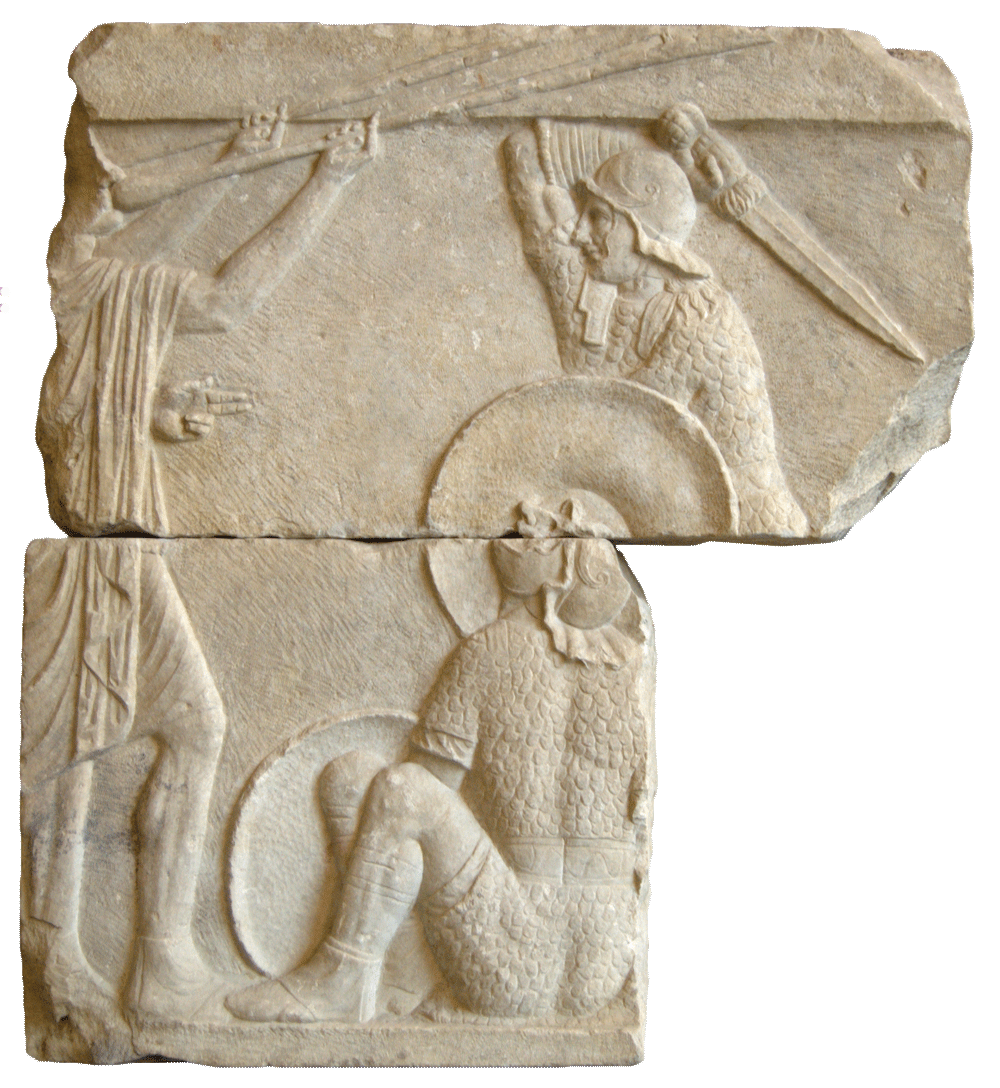
The type of trumpet introduced in Revelation 8:6 may be either a shofar made from a ram’s horn or a long metal horn like the two in this relief that are being blown to announce the victor of a gladiator contest (first century BC).
The third trumpet focuses on a huge burning star falling from heaven and into a third of the earth’s rivers and springs (8:10). The star’s name is Wormwood (a particularly bitter herb used medicinally, of which one ounce can treat up to 524 gallons of water [Theophrastus, History of Plants 1.12.1]), and it has the effect of poisoning the water supply (8:11). As with the previous two, this disaster evokes the first Egyptian plague, but in this case the aftermath, in which the smell of the Nile makes the water undrinkable (Exod. 7:21). The event is also a reversal of the miracle at Marah (which means “bitter” in Hebrew), when Moses—because Israel was grumbling—threw a piece of wood into the region’s bitter waters and turned them sweet (Exod. 15:23–25). The third trumpet vision assures the church that Rome’s political power is in decline (like a star falling from its exalted place; cf. Isa. 14:12–15) yet also warns that with political decline often comes moral decadence. The Roman lifestyle of luxury can still pollute the church and lead it to the kind of ethical compromises that were taught by Balaam, Jezebel, and the Nicolaitans of Revelation 2–3. Also, not all people are happy with Rome. Those crushed by the Roman military machine are embittered, grumbling, and dying, and this spirit of bitterness can also infect the church.
The fourth trumpet strikes a third of the sun, moon, and stars with darkness to such an extent that there is no light for a third of the day and night (8:12). This catastrophe recalls the ninth Egyptian plague (darkness; Exod. 10:21–29), which blotted out the supreme god of Egypt, Amon-Re (the sun deity), as well as Pharaoh, his divine son and earthly representative. The plague of darkness demonstrated that Egypt does not rule the world. It also crushed the pride of Pharaoh’s court magicians, who claimed that they could read the stars and from them discern Egypt’s destiny. John’s community would have understood the fourth trumpet as an indictment against the imperial cult and its inability to save, guide, or help its devotees to manage their destiny. Despite legends surrounding the birth and death of Augustus Caesar with celestial signs (Suetonius, Augustus 94.4; 100.4), God, not the emperor, is the author of all history. He alone has the power to judge the Roman Empire and cover it in darkness (cf. Amos 8:9; Mark 13:24).
This vision is suddenly interrupted by the sight of an eagle flying overhead (8:13). The eagle symbolizes God’s imminent judgment swooping down on Israel’s enemies (Jer. 48:40–42), but it was also the insignia of Rome (2 Esdras 11:1–12:39; Josephus, Jewish War 5.48). The eagle’s interruption places some restraint on the reach of the previous trumpet visions. Before God judges Rome completely, he will use Rome as an agent of divine justice to the world (cf. how God used Babylon to judge the nations like a vulture or eagle in Hab. 1:8). But the eagle inspires both dread (for the unrepentant) and hope (for God’s people). In the midst of judging a sinful world, God will strengthen his people through the trials to come. He will mount them up on eagle’s wings and sustain them with the winds of his Spirit (Exod. 19:4; Isa. 40:31).
9:1–21: The fifth and sixth trumpets. The fifth trumpet is the first of three “woes” (8:13), or laments, that signal a heightened intensity in the cycle of plagues. If the first four plagues affected the natural world—the earth and trees, the sea, the rivers, and the sky—the last three plagues will attack humanity more directly. When the fifth trumpet is blown, a chain of events starts but centers on the actions of a dense swarm of demonic locusts unleashed from a bottomless pit or abyss (i.e., a prison for evil spirits; Luke 8:31; 2 Pet. 2:4; 1 Enoch 10:4–14). The swarm is reminiscent of the eighth Egyptian plague (locusts; Exod. 10:12–20) but also possibly the third (gnats; 8:16–19) and fourth (flies; 8:20–24), since locusts, gnats, and flies were all insects thought to originate in the belly of the earth and could cover the land like a blanket of darkness (Exod. 10:15; Joel 2:2, 10; cf. Rev. 8:12). The demonic locusts of Revelation, unlike the locusts that devastated Egypt’s farming lands, are not allowed to damage the grass, trees, or any vegetation (9:3). But like the flies and gnats that bit the Egyptians, the locusts are given the power to torment (9:5) unbelieving humanity for a limited time (symbolized by the nonliteral five months; 9:5, 10). But they cannot kill. Meanwhile, God’s faithful who have his seal of protection (9:4; 7:3–4; Ezek. 9:3–6) are not harmed, much as Israel was spared from certain plagues against Egypt (Exod. 9:4, 26; 10:23; 11:7; 12:23).
So what are we to make of this nightmarish vision? Certainly these are no ordinary locusts, since they are described with the combined features of animals, human beings, weapons of war, and other fantastic images from the apocalyptic imagination (9:7–10; cf. Joel 2:4–7). The angel of the abyss, whose name is Abaddon (Hebrew for “destruction”; cf. Job 26:6; Prov. 15:11) and Apollyon (Greek for “destroyer”), commands the army. This is a spiritual battle. Deuteronomy 28 warns that in the last days God’s people will suffer through the Egyptian plagues because of their idolatry (28:27, 38–39, 42, 60), but Revelation has applied this text to the world at large and the idolatrous values that Roman society propagates. The pain the demonic locusts inflict is due to the unseen and hidden consequences of sin (Deut. 28:27). Evil and suffering, like the locusts, have a human face (Rev. 9:7–8). When the veil is lifted on the destiny of rebellious humankind, John sees how those who embrace the fallen values of the secular world are tortured from within by the very greed, corruption, lust, bitterness, anger, loneliness, and inner turmoil that are generated from life apart from God. According to Deuteronomy 28, the plagues cause “madness, blindness and confusion of mind” (28:28). Idolaters will have no rest and tremble in despair; they will be filled with constant dread, with life suspended in doubt (Deut. 28:65–66). The emotional, psychological, and spiritual torment is so great that people seek and long for death but cannot die (Rev. 9:6). Any life that shuts out God, even one as potentially comfortable and luxurious as what Rome had to offer, cannot satisfy, but instead makes people slaves to a much wider evil (cf. Deut. 28:68).
The sixth trumpet, or second woe (9:13–21), brings John and his readers closer to the final judgment of the unredeemed. The account of the sixth trumpet evokes several images: the tenth and most devastating Egyptian plague (the death of the firstborn; Exod. 12:29–32), the attempt by Pharaoh to rout Israel’s escape with his chariot army (Exod. 14:7–14), and his unrepentant response to God’s judgments (Exod. 8:15, 32). There is also a strong literary and theological connection between the fifth and sixth trumpets. The fifth trumpet’s swarm of countless demonic locusts (9:7–10) shares characteristics with the sixth trumpet’s demonic armies of 200 million riders (9:17–19). Both armies are composed of fantastic monsters with hybrid animal-human traits; both draw on horses and riders as symbols of power; both are released by fallen angelic beings (9:1–2, 14–15); both have tails that inflict injury (though the locusts cannot kill, while the demonic horses can); and both function as agents of judgment against idolatry (9:20). Also, the sixth trumpet vision consummates the process of inner spiritual decay described by the fifth. What began as moral corruption and material excess in the fifth trumpet culminates in the sixth, with the wages of sin leading to actual death (cf. Rom. 3:23). The fire, smoke, and sulfur—whose red, dark blue, and yellow hues parallel the breastplate colors of the cavaliers (9:17)—are Old Testament metaphors for the fatal judgment of the ungodly and their eternal separation from God (Gen. 19:24; Isa. 34:9–10; Ezek. 38:22).
The infinite wave of demonic hordes invading westward from the Euphrates River (9:14) would have undoubtedly stirred up the deep-seated Roman fears of a potential Parthian invasion (see Rev. 6:2). Though John was not predicting the future conquest of Rome by the Parthians, he was nevertheless taking the political anxieties of the Roman world and using them to produce a scene of horror. John’s readers would have also noted that the Euphrates was traditionally the place of Israel’s enemies. The Old Testament prophets warned that God would use the Assyrians (Isa. 7:20; 8:5–8), the Babylonians (2 Kings 24:7; Jer. 46:2), and the Persians (Dan. 5:28; 11:1–2) from “beyond the river” or “from the north” to bring divine judgment to the world. However, when the veil is lifted, Rome’s demise is not due to a military invasion from enemies on its external eastern border but rather from the inner moral corrosion of its leading citizens.
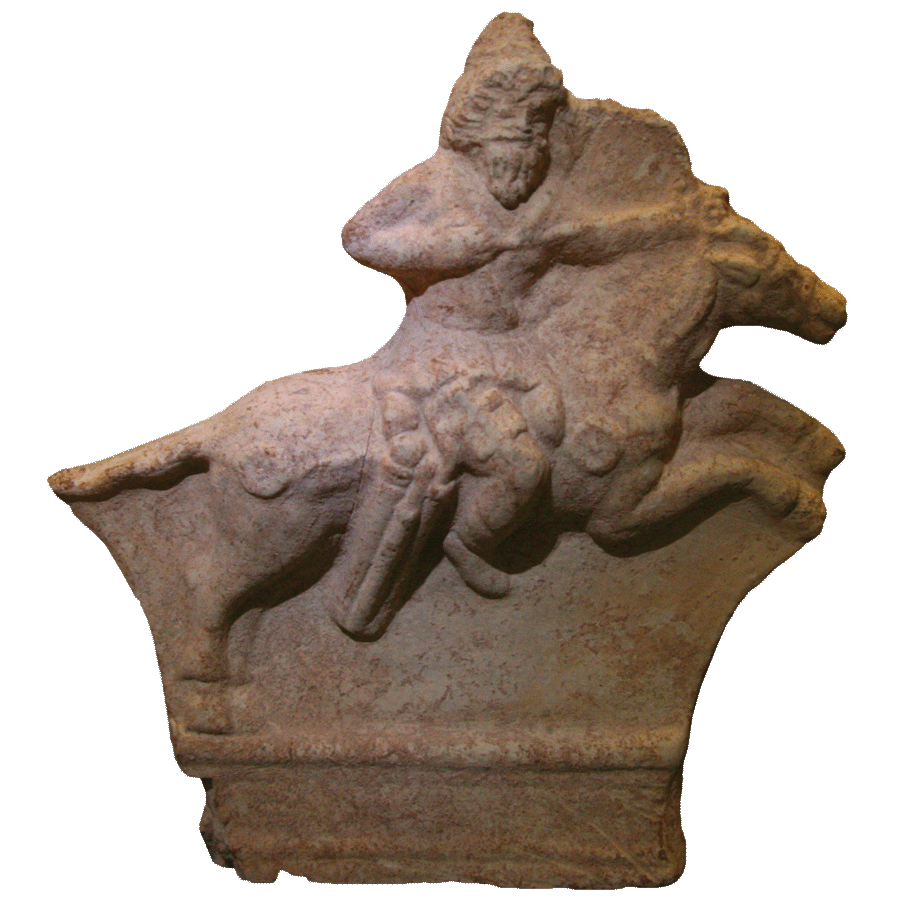
This Parthian horse archer is from Syria or Iraq (first–third centuries AD). Parthians were feared by the Romans since an army of these warriors defeated a Roman army at Carrhae, east of the Euphrates, in 53 BC.
First-century Jewish reflections on the exodus event posited another purpose of the plagues: to bring Pharaoh and the Egyptians to repentance (Philo, Life of Moses 1.95; cf. Josephus, Jewish Antiquities 2.293–95). But, tragically, instead of repenting, “he [Pharaoh] hardened his heart” against God (Exod. 7:13, 22; 8:15, 19, 32; 9:7). John sees this tragedy of hardened hearts repeated in the human response to the seven trumpet plagues. Nonbelievers continue to worship idols that can neither see nor hear nor truly help them in their hour of need (Rev. 9:20). As God strips away every idol through the plagues until no alternative sources of security are left, we witness the ultimate expression of pride and human sinfulness: people, even in outright misery (9:6), would rather die than turn to God for deliverance (9:21).
10:1–11:19: Witness interlude and the seventh trumpet. There is a two-part interlude of witness between the sixth and seventh trumpets that keeps John’s audience in further suspense. In the first part (10:1–11), a powerful angel descends from heaven and stands on the earth. He is immense, with one foot on the sea and the other on land (10:1–2; cf. Dan. 12:5–7). Unlike the other angels mentioned in Revelation so far, this angel shares divine characteristics associated only with God and the Son of Man (9:1). The angel is clothed with a cloud and has legs of fire (10:1; cf. Exod. 13:20–22; Dan. 7:13), his face is like the sun (Rev. 1:16; cf. Dan. 10:6), a rainbow hangs over his head (cf. Gen. 9:13–16; Ezek. 1:26–28), and his voice is thunderous like a roaring lion (cf. Amos 3:7; 10:7; Exod. 19:16–17; 20:18–21). The being is likely “the angel of Yahweh” (NIV “angel of the Lord”) who acted as a representative of God himself (Exod. 3:2–12; Acts 7:35, 38). Just when we would expect that this godlike titan will command the seventh trumpet to be blown and human history as we know it will end, he instead seals up the seven thunders (cf. Dan. 12:4) and reverses their impending judgments (Rev. 10:4).
Before the seventh trumpet heralds a new age when “time will be no more” (10:6; NIV “There will be no more delay!”), the church has a mission. The angel gives a “little scroll” to John, and he is asked to eat the scroll—that is, completely identify with its contents—and proclaim its message to the world (10:9–10). It tastes as sweet as honey but is bitter in the stomach (10:9; cf. Ezek. 2:8–3:3; 3:14). In the same way that Ezekiel received God’s word with joy but also an impossible mission to proclaim judgment to a hardened people, John and his churches are called to preach a sweet and bitter gospel that offers grace yet demands repentance. In light of the Roman Empire’s increasing hostility against Christianity, theirs will be a mission embittered by suffering and even death. The trumpets by themselves cannot bring people to repentance. The trumpets only provide the context for people to see sin in its ugliest form. To repent, the world needs the church to be a prophetic witness (cf. Ezek. 3:16–21).
In the second part of the interlude (11:1–14), we hear the same message as in the first but with increased drama. The two witnesses (11:3; cf. Deut. 17:6; 19:15), who are given authority to prophesy against many peoples, languages, and even kings (11:11), represent the entire prophetic tradition in the history of God’s people, from Israel (symbolized by the olive trees; 11:4; cf. Hos. 14:5–6; Rom. 11:24–25) to the church (symbolized by the menorahs; 1:20). The prophets of both Testaments received heavy persecution and died in martyrdom (11:7–10; cf. Heb. 11:32–40). God’s people, however, refuse to use the same tools of violence that their enemies employ. Proclamation and witness are the weapons of choice for the church (1:16; 2:12, 16), which uses the fire of God’s preached word to consume evildoers (11:5; cf. Jer. 5:14; 1 Kings 18:36). The ministry of the church can bring judgment to the unrepentant (11:6), much like the ten plagues did against Egypt, or the drought against Ahab’s rule during the days of Elijah (1 Kings 17:1; James 5:17–18). The 1,260 days (which equal 42 months, or 3.5 years) are not literal (cf. Dan. 7:25; 12:7). These numbers are a symbolic reminder that the time of the empire (i.e., the time of the beast; see Rev. 11:7; 13:1–18) and the period of the church’s persecution are fixed. God will not let his people suffer indefinitely and without purpose. Instead, God knows his own, for he has John measure the temple, the altar, and the worshipers to demarcate the truly faithful (11:1). Only those at the altar, who genuinely sacrifice and serve the Lord, will be vindicated at the resurrection (11:11–12). The rest, who are in the outer courts, away from the inner sanctuary, are fakes (11:2). These apostates will be judged along with the rest of the sinning city (11:13). As the second woe passes (11:14), and with the third about to come, the interlude ends with the wicked having to give glory to God (Dan. 4:37).
The seventh trumpet gives John, the readers, and all Christians a partial glimpse of history’s end and God’s eternal reign over the entire cosmos (11:15–19; cf. Matt. 24:31; 1 Cor. 15:52–58). The kingdom of the Lord God Almighty and of his Son, the Messiah, is shown in its fullest and most glorious splendor (11:15, 17). God’s kingdom, which has been moving throughout the mission of Israel and the church to recapture what was lost to sin, has finally swallowed up the kingdom of the world (11:15). Like the rising of the sun after a long and painful night, the years of endurance and faithful witness by God’s people have reached their reward: the saints will be raised to eternal life, the wicked judged, and God’s glory, which once was confined to an earthly temple and ark (11:19), is finally opened for the entire universe to bask in its light (11:19). The darkness has ended forever. This is God’s future promise to the church and our present source of thanksgiving as we preach the gospel until our Lord’s return (11:17).
D. The empire unveiled as an agent of Satan (12:1–15:4). 12:1–18: The celestial woman and the dragon. The scene opens with a great sign: a woman pregnant with a son (12:2). This child will become the messianic savior of humankind (12:5; cf. Ps. 2:9). The reader familiar with the nativity story may be tempted to identify this woman as Mary the mother of Jesus (Luke 1:26–35). But a closer reading shows that the woman is a heavenly personification of all God’s people throughout the history of Israel and the church. Clothed with the sun, moon, and twelve stars, the cosmic woman represents Jacob, Rachel, and his twelve sons (12:1; cf. Gen. 37:9). She is also captive Israel, whose sufferings, like the birth pangs of a pregnant mother, anticipate the apocalyptic arrival of God’s kingdom (12:2; cf. Isa. 13:6, 8; Jer. 6:24). She is ultimately the church, who bears witness to Jesus even in the face of death (12:17). It is through the lineage, history, and faithfulness of God’s people that the Lord’s Messiah was born.
Now enters the celestial dragon (12:3). This one is gigantic, fiery red (a symbol of bloodshed and violence; Rev. 6:4), with seven heads (a symbol of mock perfection), having ten horns (a symbol of false power; cf. Dan. 7:7–8), and wearing seven royal crowns (symbols of political authority, unlike the stephanos, or athlete’s laurel, worn by the woman; 12:1). The dragon is the anticreator, who disrupts the order of the heavens with chaos by flinging a third of the stars to the earth (12:4; Gen. 1:14–19). As the ancient serpent in the Garden of Eden (Gen. 3:1–6), it deceives (2:9) human agents to do its dirty work (13:1–18). As Satan (2:9, 13; 3:9), the devil, he accuses the saints within the heavenly courtroom of God (12:10; cf. Job 1:6–12). But with Christ’s triumph of the cross and resurrection (12:5), the accuser has been forced out of God’s heavenly court (12:7) and is no longer able to prosecute believers, since the blood of the Lamb atones for sins (12:10–11). He fails to devour the messianic child (12:4–5) and cannot stop the church (12:13–18). Defeat is inevitable, and the dragon knows it! (12:12).
The account of the dragon, the woman, and her son bears a literary resemblance to other combat myths in the ancient world. (For further reading, see Collins, 53–85.) The Egyptian saga tells of the mother goddess Isis, who, pursued by the red dragon Set, escapes to an island and bears the sun god Horus. In the Babylonian epic Enuma Elish (literally “When On High,” which are the first words of the text), Marduk, god of light, kills the seven-headed dragon Tiamat in a heavenly war. But the most familiar combat myth for John’s readers was that of the Greek and Roman goddess Leto, who, while pregnant, is pursued by the dragon Python. After Poseidon hides her on an island, Leto gives birth to Apollo. Apollo grows into a formidable warrior, vanquishes Python, and becomes a paradigmatic deity for the Roman emperors Augustus, Nero, and Domitian. All these stories share a common climactic end: the hero defeats evil by violently slaying the monster.
Unlike these ancient heroes, however, Christ and the church do not use weapons of violence to conquer the enemy. They overcome the dragon through the sword of God’s word (Rev. 1:16; 2:12, 16), by the blood of the Lamb, and by faithful suffering (12:11, 17). They defeat the dragon by freeing its human agents from sin’s control and helping humanity to repent (Rev. 9:20–21; 16:9–11). The church is called to return evil with good (Rom. 12:14–21). Like the Israelites who were rescued from the Red Sea (12:15–16; cf. Exod. 14:26–29; 15:19), like the wilderness generation who were nourished in the desert (12:6, 14; cf. Exod. 16:12–13; Ps. 105:40–41), and like the returning exiles who were carried on eagles’ wings back to Zion (12:14; Isa. 40:31; cf. Exod. 25:20), God’s people are completely sustained and empowered by the Spirit in their battle with the dragon. Because they are not afraid to die (12:11), God can use them to do his work. John and his communities have joined the fray midstory, and this vision ends with the dragon poised defiantly on the shores of the sea, frustrated at its inability to kill the woman and the messianic son, and determined to destroy the woman’s next generation of offspring (12:17–18).
13:1–18: The beasts of the sea and earth. In Revelation 12, Satan was unveiled as the force of evil in our world, the phantom menace behind human history who wages war against God’s people. In Revelation 13, the dragon calls forth two legendary creatures, Leviathan from the sea (13:1) and Behemoth from the earth (13:11), as its agents of suffering and sin. According to Jewish tradition, these beasts were created on the fifth day, and their separation between the sea and the land was symbolic of God’s establishing order to the primordial chaos (Gen. 1:21; Job 40:15–19; 41:1–2; 4 Ezra 6:49–52). Here, however, we have a sinister reversal, as the dragon summons both creatures from their domains to unleash chaos onto the created world.
The beast from the sea clearly resembles the dragon and likewise has seven heads and ten horns, but more diadem crowns (i.e., ten on its horns compared with the seven on the dragon’s heads, emphasizing the beast’s political might; 13:1; 12:3). Its resemblance to and commissioning by the dragon (13:2) suggest that the beast serves Satan. This beast combines the qualities of the four separate monsters of Daniel 7:1–8 into one: the body of a leopard, the feet of a bear, and the mouth of a lion, and ten horns (13:2). In Daniel’s visions, each represents an earthly empire (possibly Babylonians, Medes, Persians, and Greeks) that occupied and persecuted Israel at various points in history. The horn of Daniel’s fourth beast, which boasts “great things” (Dan. 7:20 KJV, RSV), is the Seleucid Antiochus IV Epiphanes, whose program to outlaw Judaism and Hellenize the Jews (1 Maccabees 1:41–64; 2 Maccabees 6:1–11) ignited a war for Judean independence that lasted approximately three and a half years, or forty-two months (168–65 BC; cf. Dan. 7:25).
This amalgamated monster symbolizes Roman imperial rule. The heads represent the imperial family, and the head that has a “fatal wound” (13:3, 12) is an allusion to the “revival of Nero” myth (Latin Nero redivivus), an urban legend that the slain Nero (who committed suicide by stabbing a sword into his throat; 13:14) would rise again to reconquer the Roman world. Despite the lethal wound to one of the heads, it is the entire beast that is healed (13:3, 12, 14; the distinction between part and whole—i.e., the head’s fatal injury and the entire beast’s recovery—is clearer in the Greek). Thus, after Nero’s suicide (AD 68), Rome survived four emperors (Galba, Otho, Vitellius, and Vespasian) who vied for power. What looked like anarchy and a mortal blow would be followed by a remarkable recovery when Vespasian established the Flavian dynasty. Roman civilization would flourish again. Rome had united the known world by the sword and maintained civic order despite internal conflict. The empire must have seemed like an unstoppable juggernaut. No wonder the ancient world worshiped Rome and wondered, “Who is like the beast? Who can wage war against it?” (13:4).
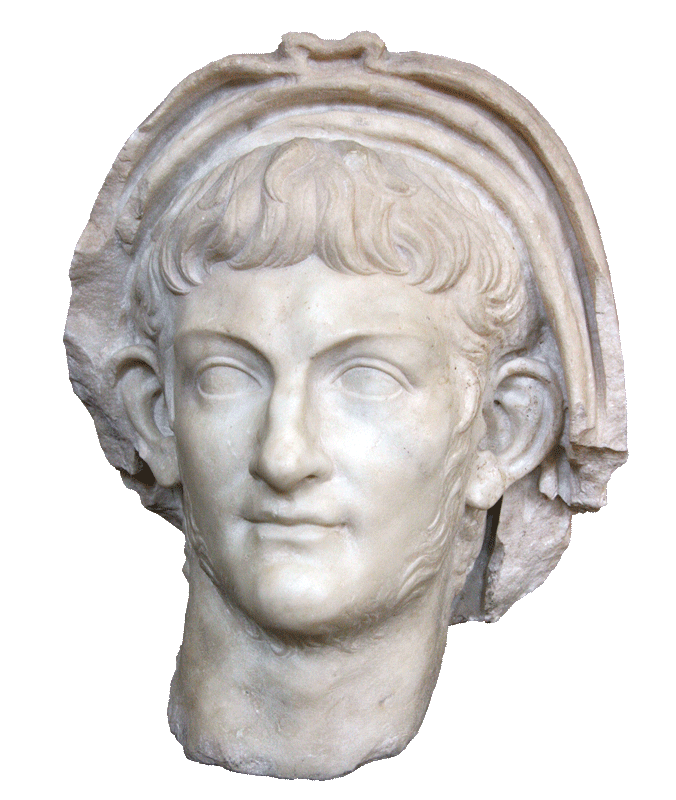
The Roman emperor Nero, who died in AD 68. Legends surrounding Nero’s return may be in the background of John’s description of the beast in Revelation 13.
Like the mouth of the beast that bragged “great things” (13:5 KJV; cf. the little horn of Dan. 7:20) and blasphemed against God (13:6), emperors promoted their own glory by establishing the imperial cult in almost every major city throughout the Mediterranean. Caesars were given divine names like Apollo, Zeus, “our lord and god,” “son of god,” and “savior,” and were praised for bringing a “gospel of peace” to newly annexed lands. Christians who refused to participate in emperor worship were persecuted (13:15; cf. 11:7–8). But just like Antiochus’s tyrannical reign over Judea was limited to forty-two months (Dan. 7:25), the days of Roman dominance over God’s people are numbered (13:5). Meanwhile, God does not bring an immediate end to suffering (13:10a; cf. Jer. 15:2) but calls for endurance and faithfulness from among the elect (13:10b).
The second beast speaks with the authority of the dragon and promotes the worldwide veneration of the first beast (13:11–12). The second beast symbolizes the wealthy social elite of Asia Minor, its magistrates, city officials, and trade guilds, who not only held political office but were also priests in the imperial cult. They erected imperial temples, set up “the image” of the emperor on statues and other icons (13:15; cf. Exod. 32:1–35), and sponsored extravagant festivals. Since the success of the festivals guaranteed political favors from Rome, those who refused to participate in the imperial cult (like the churches of Smyrna, Pergamum, and Philadelphia; 2:8–17; 3:7–13) “could not buy or sell,” since they were ostracized by the trade guilds (13:17).
The “mark,” or slave brand (13:17), of 666 on the right hand or forehead of the beast parodies the signet seal (7:3; 9:4; 14:1) on God’s people. Contrary to popular notions that 666 is a physical tattoo, the mark of the beast is figurative. It means that God knows who belongs to Satan. The number 666 is an example of the ancient practice gematria, which assigns a number to a person by adding the numerical equivalent of each letter in his or her name. For instance, “Jesus” in Greek (Iēsous) adds up to 888 (see Sibylline Oracles 1.324–30). John writes that the number or name (3:17) of the beast is a man’s and that it requires wisdom to decode it (13:18). The best candidate is Emperor Nero, whose name transliterated into the Hebrew Neron Caesar (nrwn qsr) adds up to 666. Nero infamously had Christians crucified, burnt alive, and torn by wild animals (Tacitus, Annals 15.44.2–8; cf. Heb. 11:36–38). Those with Nero’s number would be citizens loyal to Rome who carried on his legacy of corruption, persecution, and vainglory. Alternatively, the number 666 could simply designate sinful humanity. Six is one short of seven, perfection. Therefore, 666 would be complete or utter imperfection and sinfulness (Irenaeus, Against Heresies 5.28.2–3).
Although the word “antichrist” is not used anywhere in the book of Revelation, many Christians have thought of the first beast as an antichrist figure, importing the term from John’s letters (1 John 2:18, 22; 4:3; 2 John 1:7). This is appropriate as long as one remembers that an antichrist is anyone or anything that takes the place of Christ as Lord. There were many antichrists in John’s day, and he expected more (1 John 2:18). The beast of the sea has parodied the death and resurrection of Christ, with its fatal head wound and miraculous recovery. The beast of the earth appears as a lamb with two horns. They try to imitate the slain Lamb, but fail. The empire had its gospel (the pax Romana). It claimed to be the world’s savior, and the world believed it. But the peace that Rome brought to disparate lands was wrought by slaughter and violence; its prosperity was at the cost of poverty and injustice for others. Roman luxury led to moral decay and decadence. Any good that humanity attempts outside the agency and authority of God easily turns demonic.
14:1–5: Mount Zion descending. It often seems that the dragon and his beasts are winning the war against the saints (13:7). But in Revelation 14, we are asked to take a sacred pause and place our immediate disheartening experiences within a larger, more epic story. The church has been riding the ripple effects of the cross and resurrection for the past two millennia, and this victorious journey will reach its zenith when the followers of the slain Lamb celebrate the end of evil and the beginning of eternity.
The Lamb standing on Mount Zion with the army of 144,000 is a fulfillment of Old Testament messianic expectations that God would install Israel’s king, his Son, on the throne in Jerusalem, and his Anointed One would bring decisive victory over Israel’s enemies (Ps. 2:1–12; Isa. 24:23; 4 Ezra 13:29–50). Mount Zion was the southern mountainous area of Jerusalem, site of Solomon’s temple, and eventually represented the dwelling place of the Lord and his people (Ps. 132:13–18; 135:21). In Revelation, Zion is a new and heavenly Jerusalem (cf. Heb. 12:22–23) that descends on the earth in glorious splendor (3:12; 21:2). The 144,000 (as in Rev. 7:4) represent the entire people of God in both Testaments. They are not modern Israel. The kingdom that is consummated from Mount Zion is eschatological and transcendent. The new song is sung not on earth but from heaven (14:3) and by all God’s angelic courtiers (cf. 5:9). The song celebrates the redemptive sacrifice of the slain Lamb and his rightful coronation as part of the Godhead (14:3; cf. 5:12–14). The church is invited to learn and join this new song. Like the pure bride on the day of her wedding (21:2; cf. Isa. 37:22) and like ritually pure warriors on the eve of battle (14:4; cf. Lev. 15:16–18; 1 Sam. 21:5), God’s people are ready to worship because they have lived out their lives in holiness, moral purity, and complete fidelity to Christ.
14:6–13: Gospel of repentance. The next set of visions is three angelic pronouncements. The first angel proclaims an eternal gospel that is good news to some and bad news to others (14:6). For those who respond to the gospel (14:7; cf. 5:9; 7:9), their long-awaited vindication is indeed good news. For those who refuse to repent, a terrifying judgment ensues (11:9–14). The second angel announces proleptically that Rome has fallen (14:8a; cf. 18:1–24). Babylon was a symbol for Rome (cf. 1 Pet. 5:13; Dead Sea Scrolls, Pesher Habakkuk 2.11–12); both nations had been not only agents of God’s judgment (cf. Jer. 25:8–11) but also objects of judgment (cf. Jer. 25:12–14). God is now stopping the wine of immoral passion (14:8b; cf. 17:2) that stemmed from the Roman lifestyle of wealth and luxury. The city will be judged; its horrific end is described in greater detail in 17:1–18.
The third angel declares that those who participate in the imperial cult and embrace the idolatrous values of the world will experience “the wine of God’s fury,” or God’s just response to evil (14:9–10; cf. Jer. 25:15–29). Wine was often diluted with water to reduce its potency so people could drink and revel further. But the cup of God’s wrath is undiluted, his final judgment unmitigated (14:10). For those who drink of this cup, there will be no Sabbath rest, no true shalom, no peace (14:11; cf. Heb. 3:10–19). Thus, the godly should remain “faithful to Jesus” (the Greek phrase can also be translated as “faith in Jesus”; 14:12).
14:14–16: Grain harvest of the righteous. When Christ appears again as the one like the Son of Man (14:14; cf. 1:12–20; Dan. 7:13–14), he comes as a victor (symbolized by the golden laurel; cf. 1 Cor. 9:24–27), as a divine figure (symbolized by the cloud theophany; cf. Exod. 24:15–18), and as a judge for the eschatological harvest (symbolized by the sickle; cf. Joel 3:13). Jesus promised that he would return to gather the elect as a farmer reaps a grain harvest (Matt. 13:36–43; Mark 13:26–27). The command to reap comes from the inner sanctuary (14:15; cf. 1 Thess. 4:16), which stands for God himself, since no one in heaven except the Father, not even the Son, knows the day and hour of final judgment (Matt. 24:36; Mark 13:32). The harvesting of the righteous is an image of final salvation, where seeds of the gospel sown by the church (11:3–13; 14:6) bear fruit over the entire earth (14:16; cf. John 4:36).
14:17–20: Grape harvest of the wicked. The fate of the wicked evokes Old Testament judgment oracles where the armies of the Lord trample over their enemies like those who tread over grapes (Isa. 18:5–7; Jer. 25:30; 51:33; cf. Lam. 1:15). The ripeness of the grapes demonstrates that sin has run its course (Joel 3:13) and the time for repentance has passed (Amos 8:2). Before chaos can consume all creation (Gen. 6:5–7; 19:12–13), God breaks into history to end evil’s reign. The unrepentant are pictured as harvested grapes, cast into “the great winepress of God’s wrath” (14:19–20). The juices are the blood of the wicked (cf. Isa. 63:2–6). Ancient winepresses in Israel were made of stone and built into the ground. Grapes were pressed by foot, and their juices flowed downward through grooves into a collecting vat. This vat is overflowing to cover 1,600 stadia, or about 184 miles. The area bathed in blood would cover all of Palestine (from Tyre in the north to Egypt in the south) and immerse a person as high as their chest (“as high as the horses’ bridles”; 14:20). It is a gruesome scene; yet God is neither sadistic nor cruel. The scene speaks more to the revulsion of sin than to the violence of God. Such horror serves as a warning to the Christian community, that to side with the beast is to abandon God and resign oneself to a fate worse than death. The winepress is outside the Holy City (cf. Zech. 14:2–5), that is, outside the reach of God’s grace and salvation. Those who are caught in the winepress are reaping the consequences of their violent rejection of the gospel.
15:1–4: Song of the new exodus. The celestial opera that began with two great signs in heaven—the cosmic woman (12:1) and the red dragon (12:3)—ends here with a third great sign: seven angels with seven plagues (15:1). The seven angels represent the churches in Asia Minor (1:20), and they also symbolize the church universal, whose prayers and witness play a key role in unveiling God’s judgments on the world (8:2, 6). Those who have conquered the beast with their faithful suffering are about to sing the anthem of the Lamb (15:2).
With one voice, the saints from every generation praise both the all-powerful Creator and the slain Redeemer for their great works of salvation (15:3; cf. 5:9–14). The song of the Lamb is modeled after the Song of Moses (cf. Exod. 15:1–18) but not limited to it, for the Lamb’s is a composite of several Old Testament texts (Deut. 32:4; Ps. 98:1–2; 111:2–9; Jer. 10:7; 16:19; Amos 4:13) celebrating the entire redemptive history of God. Just as the Lord delivered the Israelites from Pharaoh (likened to Leviathan in Isa. 30:7; 51:9–10) at the Red Sea (Exod. 14:26–30), God has saved his people forever by defeating the dragon, the beast, and their minions. In the old exodus, the faithful passed through the sea, but in the new, God has completely subdued the sea (often a symbol of cosmic evil) (Rev. 4:6; cf. Ezek. 1:22). The fire alludes to the wheels of flame and the fiery rivers that flow from God’s chariot-throne (Dan. 7:9–10). Together the crystal sea and fire testify to the Spirit’s reordering of creation (cf. Gen. 1:1–2, 6–8; Ps. 74:13–14).
E. The seven bowls: Why God delays ultimate justice until the end (15:5–16:21). 15:5–8: Tabernacle prelude. John’s attention is now drawn to that part of the heavenly temple called “the tabernacle of the covenant law” (15:5). If the earthly tabernacle represented for Israel a better way of meeting God than previously, in the burning bush, the pillar of fire, a cloud of thunder, or an unapproachable mountain (Exod. 25:8–9), then the heavenly tabernacle, with its curtains open so that the ark is visible (Rev. 15:5; cf. 11:19), anticipates a further step. A revolutionary new way for believers to commune with God is the resurrection (21:1–5). But before this can take place, God’s ultimate justice for the world must be executed through the last cycle of bowl judgments (15:8). Seven angels dressed in priestly, ceremonially clean, bright linen robes (15:6; cf. Exod. 28:40–43) receive the libation bowls from the cherubim within the tabernacle (cf. Exod. 29:40). When the angels pour out the wine offering, it becomes the wine of God’s wrath (15:7; 16:19; cf. Jer. 25:15–29).
16:1–9: The first four bowls. The seven bowls recapitulate the events unleashed by the previous cycles of the seven seals (6:1–8:1) and the seven trumpets (8:2–11:19). Yet the bowls have closer parallels with the trumpets than with the seals. Like the seven trumpets, the bowls modify the Egyptian plagues to fit the Roman context. Like the trumpet sequence, the first bowl judgment is unleashed on earth (16:1; cf. 8:7), the second in the sea (16:3; cf. 8:8), the third in the rivers and fountains (16:4; cf. 8:10), the fourth in the sky, affecting celestial bodies (16:8; cf. 8:12), the fifth in the demonic realm (16:10; cf. 9:1), the sixth beyond the Euphrates River (16:12; cf. 9:14), and the seventh at the eschatological end of human history (16:17; cf. 11:15).
The seven bowls of God’s wrath are poured out at the command of a loud voice from the inner sanctuary of the temple (16:1). This is God’s voice (cf. Isa. 66:6) issuing commands to the seven angels from the throne room. The key to understanding the bowls is the principle of lex talionis (the law of retribution), illustrated in Jeremiah 14:16: to those who spill or pour out blood, God says, “I will pour out their own wickedness on them” (NLT). As the unrepentant are heading to their final destiny, they begin to reap the same sins that they have sown in others.
The first libation bowl that is poured out inflicts “ugly, festering” sores on the earth’s inhabitants (16:1–2). It is reminiscent of the sixth Egyptian plague, which unleashed boils on the Egyptians and their livestock (Exod. 9:8–12) but not on the Israelites. Here the sores torment only those who receive the mark of the beast (16:2). There is a wordplay in the Greek: “ugly, festering” can also be translated as “bad and evil” sores (16:2). These are spiritual wounds that disfigure, scar, and bring unbearable pain on the souls of all idolaters who worship false images (9:1–12; cf. Deut. 28:1–68).
The second (16:3) and third bowls (16:4–7) intensify the first Egyptian plague, which turned the Nile into blood, made it undrinkable, and killed the fish within it (Exod. 7:17–21). Here the second bowl turns the entire sea into blood, and every living sea creature dies from its polluted waters. The added detail that the blood is “like the blood of a corpse” (16:3, ESV, NRSV) reminds the readers that sin not only torments; sin kills and leads to both physical and spiritual death (cf. Rev. 20:14; 21:8; Rom. 5:12–20; 6:23).
The third bowl continues the plague so that it transforms the rivers and springs of (living) water into dead cesspools of blood (16:4). The vision inspires a heavenly hymn from the angel of the waters (cf. Gen. 7:17–24; 1 Enoch 66:1), reminding that despite the severity of the judgments, God is just. His ways, though mysterious at times, are true (16:5; cf. 15:3; 19:2; Dan. 4:37). It is only fitting that those who spilled the blood of God’s saints receive, in turn, a judgment of blood (16:6). With the choir from the altar (composed of the martyrs in 6:9–11), the readers are asked to trust in God’s promises and sing with them: “Yes, O Lord God the Almighty, your judgments are true and just!” (16:7 NLT).
The fourth bowl unleashes a plague on the sun and scorches the earth with fire (16:8–9). This is a reversal of the ninth Egyptian plague, darkness (Exod. 10:21–29). Here the bowl plague intensifies the sun rather than blots it out. Again, there is law of retribution at work: the Roman Empire, whose military conquests left burned lands and devastation in their wake (Josephus, Jewish War 6.404–7), is now experiencing the fires of war and violence within its own borders (Rev. 8:7). Yet despite the severity of the plague, humanity is unrepentant and hard of heart (16:9), like Pharaoh (Exod. 7:13, 22; 8:15, 19, 32; 9:7).
16:10–21: The fifth through seventh bowls. The more intense the judgment, the more humanity seems to clench a defiant fist at God. With the fifth bowl comes a plague of darkness (16:10–11), which is reminiscent of both the Egyptian equivalent (Exod. 10:21–29) and the eighth plague, which sent a blanket of locusts to blacken the land (Exod. 10:12–20). This is a spiritual darkness inflicting agony to the point where people bite their tongues desperately (Rev. 16:10; cf. gnashing of teeth in Matt. 8:12; 22:13; 25:30). Sin has the power to blind, dull, and blacken the soul. Since the throne of the beast, that is, the imperial cult (cf. the throne of Satan in Rev. 2:13) darkened people’s hearts, God rightly brings a judgment of darkness on Rome. Ironically, the wicked blame God for their suffering, although their own idolatry is the cause (16:11).
The sixth bowl (16:12–16) features unclean, foul-spirited, demonic frogs, which protrude from the mouths of the anti-Trinity: the dragon, the beast (of the sea), and the false prophet (16:12). Intensifying the second Egyptian plague of frogs (Exod. 8:1–15), the demonic frogs of Revelation are heralds of false ideologies and lies (e.g., the pax Romana). These false powers can duplicate the miraculous (cf. Exod. 7:11, 22), but their primary weapon of choice is deception. Fooled by evil, the kings of earth align themselves with the beast to their own destruction.
Armageddon, which means “the hill of Megiddo” in Hebrew (16:16), is sixty miles north of Jerusalem, on the southwest edge of the Jezreel Valley, and historically was the place where major battles between Israel and enemy nations took place (e.g., Judg. 4:4–16; 6:19–25; 2 Kings 23:28–30). It is symbolic of the final defiance of humanity against God. Even on the day when human history ends and Jesus returns like “a thief” in the night (16:15; cf. Matt. 24:43–44; 1 Thess. 5:2), the wicked will still gather their forces for one last stand against the Lord rather than repent (16:16; cf. Ps. 2:1–2; Zech. 14:1–15; Joel 3:2). In contrast, a beatitude or blessing is pronounced for those saints who are dressed in moral purity and righteous deeds (Rev. 3:4–5, 18; 6:11; 7:9, 14) and are ready for the coming of the bridegroom (cf. Matt. 25:1–13).
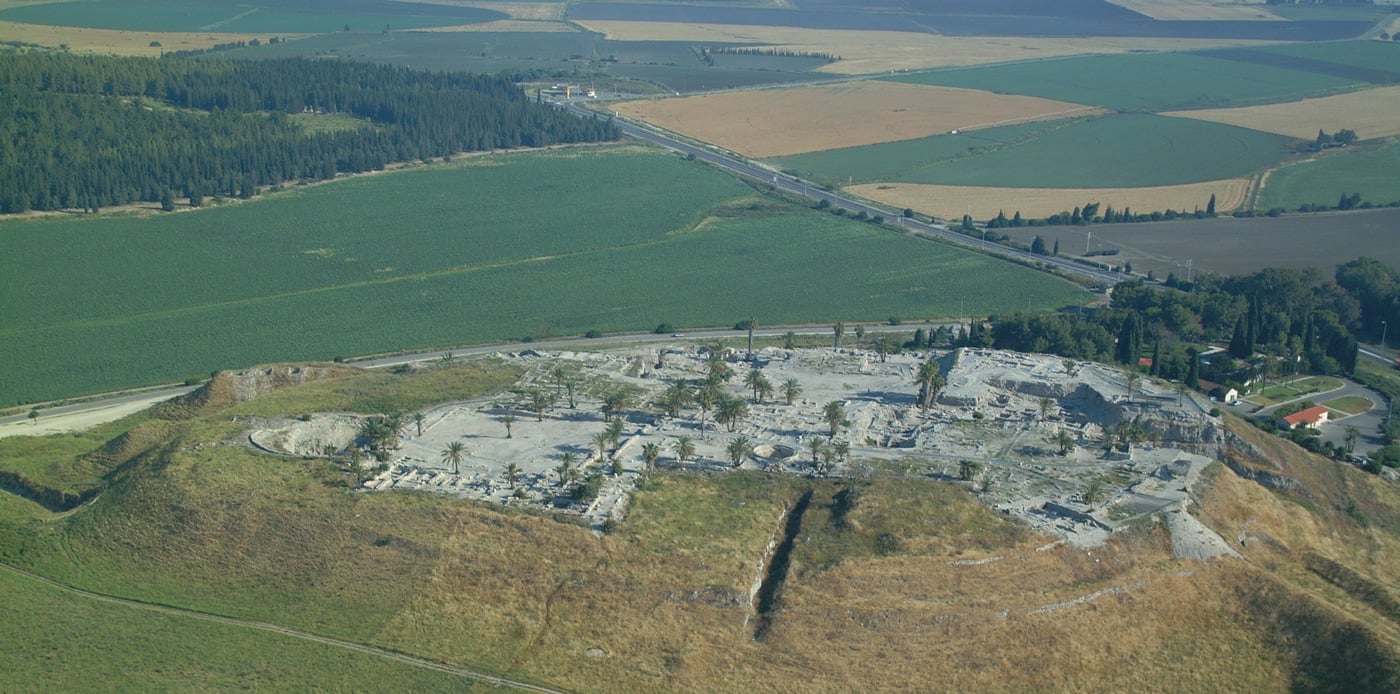
Aerial view of the tell (archaeological mound) at Megiddo, with the Jezreel Valley spreading out beyond it in the background. This is the site that Revelation 16:16 refers to as Armageddon.
The seventh bowl (16:17–21) is an intensification of the seventh Egyptian plague, thunder and hail (Exod. 9:22–26). These hailstones are gigantic and weigh a talent each (about one hundred pounds). A tremendous earthquake (16:19–20) splits “the great city,” that is, Babylon, into three parts. There is no place where anyone can hide. God’s epiphany is a recapitulation of the Sinai theophany (cf. Exod. 19:16–25). Just by showing up, God has passed judgment. No sinner can stand in his presence. God’s voice from the throne room of the temple cries out, “It is done!” (16:17). At last God exacts justice, but with a finality that is both welcoming and terrifying at the same time.
From the seals to the bowls (Revelation 6–16), the faithful begin to distinguish a divine purpose behind suffering. Until the seventh bowl, God does not cancel out evil, for to do so would mean the instantaneous condemnation of all sinners. All creation would be destroyed, since it too is tainted with sin. Instead, God maximizes the possibility for all people to repent by delaying his final justice until the very end of human history. In the interim, the church is called to endure, trust, pray, witness, and worship their God.
F. The end of the empire (17:1–19:10). 17:1–18: The Babylonian whore. The next three chapters (Revelation 17–19) are an expansion of the sixth and seventh bowl judgments against “Babylon,” which has stood for Rome throughout Revelation (14:8; 16:19; 17:5; 18:2, 10, 21). The dissolution of Roman power, which was anticipated in 14:8 (“Fallen is Babylon the Great!”) and 16:19 (God “gave her [Babylon] the cup filled with the wine of the fury of his wrath”), is elaborated on in 17:1–19:10, as Rome’s entire domination system of military might, economic exploitation, and religious idolatry crumbles under the justice of God.
In the first of two metaphors of Roman power (the other being “the great city”; 18:1–24), a great whore sits like a queen on the waters (18:7), riding a scarlet beast having seven heads and ten horns and covered with blasphemous names (17:1, 3). On her forehead is the title “Babylon the Great” (17:5), whose mystery will be unveiled and interpreted by one of the angels from the bowl judgments (17:1, 7; cf. Dan. 4:9–28; 5:24–30). The angel divides his interpretation into three parts. First, the beast (of the sea; Revelation 13) represents the Roman Empire but especially its political and military power base (17:8–14). Second, the waters on which the prostitute sits are the many nations that follow Roman rule (17:15–17). Last, the great whore is herself unveiled as the city of Rome, the epitome of wealth and luxury, which has seduced the world at large (17:18).
From a distance, the woman seated on the beast’s seven heads (which represent seven mountains or hills; 17:9) looks like a royal figure. She is dressed in purple and scarlet clothing and adorned with gold, precious stones, and pearls (17:4). She is a parody of Dea Roma, the patron goddess of the city of Rome, featured on imperial coins as sitting on Rome’s seven hills (Suetonius, Domitian 4.5; Strabo, Geography 5.3.7; cf. Rev. 17:9). But seen up close, the woman is actually a drunken courtesan sporting gaudy jewelry and clothes exacted from the kings of the earth with whom she has sexual relations (17:2). These suitors will later ravage her, strip her naked, murder her, consume her flesh, and burn her remains with fire (17:16–17). So gruesome is this scene that feminist commentators have called Revelation 17 the “ultimate misogynist fantasy” because this woman becomes the scapegoat for all that is evil in the world. (See Pippin, 57–58, for a now classic feminist reading of Revelation 17.) However, the Babylonian whore is a corporate personality and represents both men and women. The prostitute as a symbol of vice and moral decadence was familiar among Greco-Roman moralists (Seneca, On the Good Life 7.3.1–3; Plutarch, Pericles 12.2) and Jewish readers alike (Isa. 23:15–18; Nah. 3:4–5). It is a familiar caricature (despite its patriarchal origins) and illustrates the exploitive nature of Rome’s relations with her vassal states.
The empire’s success was dependent on the patron-client relationships between Rome and the major urban centers of the empire. Cities received emergency funds from Rome to rebuild in times of crisis (e.g., Philadelphia; see commentary on Rev. 3:7–13), lobbied for wardenship of the imperial cult to sponsor festivals, which brought prestige and income to their local guilds (e.g., the Pergamum games; Rev. 2:12–17), and bid competitively to establish lucrative trading routes (e.g., the seaport of Ephesus; Rev. 2:1–7). In return for political favors from Rome, these cities and others around the world paid annual taxes and worshiped the emperor. Rome plays the harlot: she is given tribute from her client kings only because she services them (17:2). But as soon as the whore has nothing more to offer, the multitudes will unite to dismember her and consume any remaining resources for themselves (17:15–16). The entire set of relations between Rome and her clients is idolatrous. The empire seduces people with its power and wealth, and the people give their loyalty and worship to Caesar (cf. Isa. 23:15–18; Ezek. 16:1–36; Hos. 4:11–12).
The description that the beast “was and is not and is to come” (17:8 RSV) mocks God “who is, and who was, and who is to come” (1:4, 8; 4:8) and is a false claim to permanence. Only God is eternal. Rome will fall from its own internal violence and moral decadence. There is also an echo of the revival of Nero myth from the epitaph, but only in a corporate sense (see the commentary on 13:1–18). Just as the head was slaughtered but the entire beast was healed (13:3), there was a time when the empire was (the golden age of Augustus; The Deeds of the Divine Augustus 34), was almost not (the year of four emperors; Tacitus, Histories 1–3), and was to come (the Flavian dynasty; Suetonius, Domitian 13.2).
There has been endless speculation on the identity of the beast’s seven heads, which are seven kings or Roman emperors (17:9); five have fallen, one is currently reigning, and the other has not yet come (17:10). With reasonable certainty, the living emperor is Domitian (Irenaeus, Against Heresies 5.30.4; see the introduction), but beyond this identification, caution is urged. Rather than searching through the annals of past emperors in an attempt to discover which of them are the preceding five (there are eleven from Augustus to Domitian), it is best to see the five kings as representative of all previous Roman rulers. The seventh king following Domitian (whose reign is cut short) and the succeeding eighth king (17:11) could be another allusion to the revival of Nero, but it is more likely a reminder that there will always be those in power who oppose the kingdom of God. Emperors rise, fall, and rise again, but it is God’s will that prevails in the end (17:14).
The ten horns on the heads of the beast (cf. Dan. 7:23–24) are allies of Rome who give their support and power to the empire (17:13) within the same network of exploitive relationships as the whore and the kings of the earth. They foolishly join the war against the Lamb (17:14). Unlike them, Christians are called to resist the temptations of empire, its wealth and luxury (17:2). We are called to stand faithful to the Lamb despite the violence of the beast (17:6). We are reminded that any system based on the abuse of power, the exploitation of human beings, and the false ideologies of prosperity and peace should be directly opposed by the church and will inevitably self-destruct by God’s providential hand (17:14).
18:1–24: Roman economy. Revelation 18 continues narrating the destruction of the Roman Empire due to its own political corruption, economic injustice, moral decadence, and idolatrous values. In the second of two complex metaphors on Roman power, the once-great city of Babylon is in complete ruin. The readers are not told exactly how the city falls, only that it does (“She fell! Babylon the Great fell!” [18:2, author’s translation]; cf. 14:8; Isa. 21:9), and what follows is a detailed description of the grisly aftermath of Rome’s collapse.
The scene opens with the words of an unidentified angel (18:1; cf. Ezek. 43:1–3) whose speech against Rome resembles the taunt songs of Isaiah 23–24, Jeremiah 50–51, and Ezekiel 26–28 against the historic cities of Babylon and Tyre. The angel describes Rome as a completely desolate and empty place, uninhabitable to human beings (18:22–23), a lair for demons, and a haunt for unclean animals (i.e., scavengers who eat carrion, like ravens, vultures, and jackals; cf. Lev. 11:1–47; Zeph. 2:13–15; Luke 11:24–26). Rome has been judged (18:8). Its past sins have not gone unnoticed by God (18:5). Since widows in ancient times were considered weak, helpless, and completely dependent on God (Deut. 10:18; Ps. 146:9), the city’s boast, “I sit enthroned as queen; I am not a widow” (18:7; cf. Isa. 47:7–8), is a shameless claim to self-sufficiency. To say one does not need God is the ultimate form of idolatry (cf. Isa. 14:4, 12–15; Dan. 4:29–32). In the Old Testament, the city was often a false source of security for the person who has left the domain of God (e.g., Cain in Gen. 4:16–17).
In luring the nations away from God and to herself as the source of material security, Rome has played the spiritual harlot (18:3, 7, 9; cf. Isa. 23:13–18; Nah. 3:1–7). Because she has intoxicated the kings of the earth with the wine of her immoral passion and merchants with the power of luxury (18:3), God has mixed a doubly potent cup filled with the wine of his wrath, poured it out against the city, stripped her of all wealth, sent a cycle of plagues, and judged her with fire (18:6–8; cf. 16:1–21). The double payment for her sins is neither vindictive nor unjust but rather a statement that the painful consequences of sin always outweigh its fleeting pleasures.
In 18:9–19, we hear the terrified lament of kings, merchants, and sailors for Rome (18:10, 15). They are stunned by the sudden collapse of the economic system that made them rich (18:4, 15). Rome was the center of international trade across the Mediterranean and a ravenous consumer of exotic goods from around the world. Of the twenty-eight types of merchandise listed in 18:12–13 (cf. Ezek. 27:12–24), most are luxury items that were imported by Rome from Spain, Greece, Asia Minor, Arabia, Egypt, Africa, Parthia, and even China. These included precious metals (gold, silver, high-quality bronze, and iron), jewels and rare materials for elaborate furnishings (pearls, precious stones, ivory, scented wood, and marble), expensive textiles (fine linens, purple and scarlet cloths, silk), spices and perfumes (cinnamon, amomum, myrrh, frankincense), high-quality foods or breeders’ livestock (fine flour, cattle, sheep, horses), and chariots. Trade on even one luxury item could mean large profits for both the merchants who sold it and the sailors who delivered it. On the import of silk alone, Rome spent an estimated one hundred million sestertii per year for trade with India, China, and Arabia (Pliny the Elder, Natural History 12.41.84), which is roughly the amount needed to pay the annual salaries for eighty-five thousand Roman legionnaires. The remaining nonluxury items in the list—wine, olive oil, and wheat—were traded in bulk. Rome, for example, consumed some eighty thousand tons of grain annually and required a thousand ships to import it. The scope of John’s cargo list for Rome speaks to the greed, consumption, excess, and waste of the city.
Worst yet is the final item of cargo: slaves. This industry received its stock in the most dehumanizing way: from prisoners of war, criminals, children sold by poor families, the indebted, piracy, and kidnapping. Beneath the veneer of dainty luxuries and glittering trinkets (18:14) lies the stark reality that the empire’s economy was fueled by exploitive slave labor. John reminds his readers that slaves are not just bodies but living human souls (18:13).
How then are the people of God to respond? The voice from heaven (presumably God from his throne room; 16:1) says simply: “Come out of her, my people” (18:4a; cf. Jer. 51:45). This is not a command to withdraw from urban life (cf. 1 Cor. 5:10) or from our suffering witness in places like Rome, but a call to holiness, a commitment “not to be yoked with her sins” (18:4b, author’s translation; cf. 2 Cor. 6:14–18), and a mission to dismantle the structures of evil, which enslave others, even at the cost of our own blood (18:24). In contrast to those who mourn, we are invited to rejoice that Babylon is falling (18:20). The stumbling block of the world has been thrown into the sea like a millstone (18:21; cf. Jer. 51:63–64; Mark 9:42) to make room for God’s just kingdom. Rejoice!
19:1–10: Hymns and wedding song. The stunned silence from Rome’s musicians at the sight of the burning city (18:22) is broken with the roar of “Hallelujah!” from heaven above (19:1). Hallelujah (transliterated into Greek as hallēlouia or into Latin as alleluia) means “Praise the Lord” in Hebrew and is used four times throughout two separate hymns in 19:1–8. (These hymns, incidentally, later became an inspiration for Handel’s Messiah.) The first hymn is from a vast angelic assembly (19:1–4; cf. 5:11–12) and attributes salvation, glory, and power to God alone (19:2). It lauds God’s judgment over the great whore, insists his ways are always just and true, and affirms his sovereign power by evoking a response of “Amen! Hallelujah” from the twenty-four elders and the four cherubim who encircle his throne (19:4).
The second hymn (19:5–8) begins with a call to worship for the entire church on earth. Though the empire seemed invincible, and though our world is still fraught with suffering and injustice, the angelic chorus nevertheless challenges all servants of Christ, small and great, to “praise our God” (19:5). Hymns in the book of Revelation (there are nine: 4:8–11; 5:9–14; 7:9–12; 11:5–8; 11:17–18; 15:3–4; 16:4–6; 19:1–4; 19:5–8) do more than just ratify the events in the narrative. They are acts of resistance, in worship to a transcendent God, against immanent evil. In the same way that African American slaves interpreted biblical texts on the exodus liberation, set them to music as spirituals, and “sang about the ways they could endure oppression, escape it, or even . . . fight against it” (Blount, 94), the hymns sung by the early church were weapons of worship against their Roman oppressors. Hymns enable worshipers to express—with the full range of human emotions, volume of voice, mental acuity, and spiritual freedom—theological truths that speak to the reality of God in a sinful world. No matter how much Rome or any other power wants to stop the church’s witness, a church that sings out resistance to evil and absolute faith in Christ cannot be silenced (cf. Acts 16:25). Our joy is unstoppable because we anticipate a day when Jesus returns as the bridegroom and welcomes us as his bride (19:7–8; 21:2, 9; cf. Isa. 61:10; Matt. 25:1–12; 2 Cor. 11:2).
G. The return of the king (19:11–21). From this point onward (19:11–22:5), John narrates eschatological events surrounding the parousia of Jesus Christ. The Greek term parousia can be translated “return” but literally means “coming” or “advent” (see Matt. 24:36–42; 1 Cor. 15:21–28; 1 Thess. 4:14–17). In 19:11–16, John focuses on a particular aspect of the parousia, that is, the final defeat of God’s enemies.
When the skies split apart and heaven opens up (19:11; cf. 4:1), a glorious rider appears on a white horse. This rider, with eyes “like a fiery flame” (19:12 HCSB; cf. 1:14), who is “Faithful and True” (19:11; cf. 3:14), who judges with justice (19:11; cf. 1:7; Dan. 7:13), who is called the “Word of God” (cf. John 1:1–14), from whose mouth extends the sword (of God’s word) and who wears his name like a sword on his thigh (19:13, 15–16; cf. 1:17; Exod. 32:27; Ps. 45:3) is none other than Jesus, the Davidic Messiah who has come to rule the nations (1:15; cf. Ps. 2:9) and execute God’s wrath (1:16; cf. 15:19–20). John catalogs titles upon titles so that the readers know beyond doubt that the white rider of Revelation 19 (who is nothing like the pale demonic parody of Rev. 6:2) is Christ, our king and Lord (1:16; 17:14).
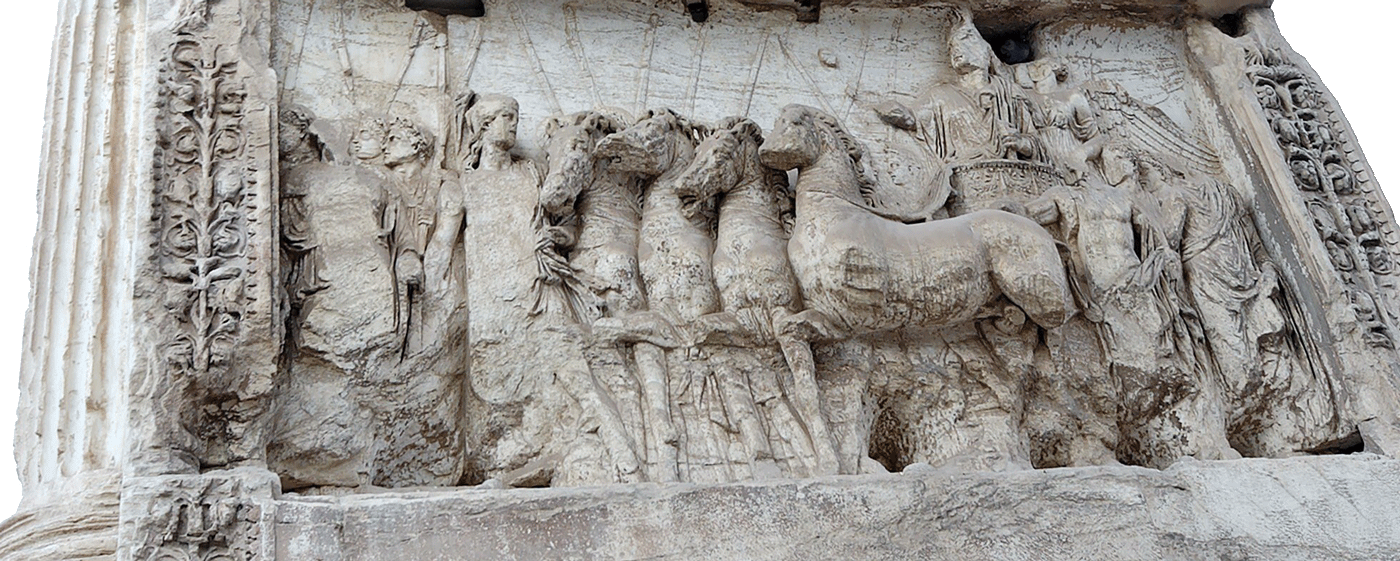
Constructed by Domitian around AD 82, the Arch of Titus commemorates Titus’s military victories. This panel shows his triumphal procession, with Titus wearing his toga and riding in his chariot. Revelation 19 depicts Jesus returning as a triumphant king.
Jesus returns with all the power, majesty, and splendor of a triumphant Roman emperor (Latin triumphator). On the occasion of a major victory, kings would often enter the capital city in a triumphal procession wearing a decorated white tunic and toga with gold-threaded designs, a golden crown (cf. the diadems of Christ, which signify his royal identity; 19:12), and riding on a chariot drawn by white horses (19:11). The king was accompanied by his armies, magistrates, senators, captive prisoners of war, and the spoils of his victory (19:14). He was greeted with the shouts of praise and divine accolades (19:16) from the citizens of the city. This triumphator tradition has been adapted by John to describe Christ’s complete victory over the beast and his allies (19:19), but with some important (theological) differences.
The clothes of Christ are not the ceremonially elaborate royal tunic and toga but the ritually clean, fine priestly linens (19:8, 13; cf. the Son of Man in glorious linens in 1:12–16; Dan. 10:5–9). Priests would sprinkle the blood of the sacrifice on their own clothes for ritual purity (Exod. 29:21; Lev. 8:30), but the blood on Christ’s priestly robes is his own (19:13; cf. 5:12; Heb. 9:20–28). The only weapons of war Christ uses to judge the nations and defeat the beast (cf. Isa. 63:2–4) are his own atoning blood and the sword of God’s word (19:13, 15; cf. Isa. 49:2). He expects his church to use the same weapons as he.
The next scene borrows its savage imagery from the judgment oracles of Ezekiel, who spoke against Gog, Magog, and other enemy nations who mocked Israel during her exile. In Ezekiel 39:17–20, God invites the birds and wild animals to eat the flesh and drink the blood of Gog’s armies. In Revelation 19, we are shown an equally gory feast, when God invites the birds that fly in mid-heaven (either vultures, hawks, or eagles; Rev. 8:13) to consume the flesh of all wicked people (19:17–18; 20:8). The gory feast is a bloodcurdling inversion of the wedding banquet of the Lamb (18:7–8; 21:1–2). Those who have refused the invitation to join the eschatological wedding celebration (9:20–21; 16:9; 16:11; cf. Matt. 22:2–8) are seen here experiencing the consequences of their refusal. The grisly menu of flesh from kings to slaves, from great to small, demonstrates that final judgment is a state of torment from which no unrepentant person can escape. The scene ends with the beast and the false prophet being thrown into a “fiery lake of burning sulfur” (19:20). The fiery lake (cf. the “river of fire” in Dan. 7:9–11), or hell, is the final destination for the unrepentant. It is a place of eternal suffering and punishment for the godless (Rev. 20:14).
3. Heaven as a New City and the Earth as a New Eden (20:1–22:21)
In Revelation 20–22, John journeys outside the temple and discovers a glorious city, the New Jerusalem, within a new heaven and new earth (21:1–2). There is no sea, no sun, and no temple in this new created realm (21:22–27), because the presence of God and the Lamb dwells with the community of faith permanently and gloriously. The vision concludes with the assurance of Christ’s return and a benediction of grace (22:6–21).
A. The vindication of God and his people (20:1–15). 20:1–10: The millennium. In Revelation 20, the narrative spotlight on the defeat of Satan is a reminder that Rome is not the chief enemy but rather the powers of sin and death (cf. 1 Cor. 15:25, 55–57). An angel of the Lord has bound the dragon and sealed it in the abyss (20:1–3) for a thousand years, during which Christ and his risen saints reign together over the earth (20:4–5). Then, Satan is unexpectedly loosed again and, attempting one last coup d’état against God, is defeated. He is then thrown into the fiery lake forever (20:7–10; cf. 19:20).
The thousand-year (Latin millennium) interim reign is just one of five major end-time events described in the New Testament that interpreters have struggled to sequence: the rapture (not mentioned in Revelation but in 1 Thess. 4:13–18, though some dispensationalists argue that the command, “Come up here,” in Rev. 4:1 refers to the rapture; see Walvoord, 103), the tribulation (Rev. 3:10; 7:14), the millennium (Rev. 20:2–7), the return of Christ (Rev. 19:11–21), and the new heaven and new earth (Rev. 21:1–2). Three major schemes have emerged, the most popular among American evangelicals being premillennialism. (For further discussion on each millennial scheme, see Grenz.)
Premillennialism argues that Christ returns before the millennium. Dispensational premillennialists argue that when Christ returns, he raptures (or “snatches up”) living Christians into heaven before they die. Meanwhile, a world dictator (the beast or antichrist) rises to power and heavily persecutes the few who convert to Christianity (mostly ethnic Jews) for seven years (Rev. 4:1–19:10). After this tribulation, Christ returns a second time to conquer the beast and its armies (19:11–21), bind Satan in the abyss (20:1–3), resurrect believers (20:4–5), and begin a literal one-thousand-year reign of peace on earth (20:6).
Postmillennialism insists that Christ’s return will happen only after the church establishes the millennium, defined as an ideal political state that the church achieves over time. The triumphal procession of Christ on a white horse (19:11–21), therefore, is a symbol of his victorious presence within the church. Proclaiming the gospel binds Satan (20:1–3). When the gospel has reached every nation (cf. John 12:31–32), the millennium is realized and Satan becomes completely bound (20:4–6). When the millennium has ended, Christ returns to stop the devil decisively (20:7–10) and launch eternity (21:1–2).
Amillennialism, as adopted by this commentary, argues that the millennium (like almost all numbers in Revelation) is symbolic. Ten is the number of power and authority (2:10; 12:3; 13:1; 17:3; cf. Dan. 7:7, 20, 24), and multiples of ten symbolize an immeasurable amount (5:11; 7:4; cf. Dan. 7:10). A thousand years refers to an indefinite period of time when the church lives under the agency of the Spirit (cf. Rom. 8:37). The millennium began when Jesus was raised from the dead (20:1–3; cf. 12:7–11), which is the first resurrection (20:5–6; cf. 1 Cor. 15:20), and continues today. When Christians remain faithful, Satan is bound (12:1–6; cf. Mark 3:23–28; Matt. 16:16–19; Luke 10:17–19); but when they compromise, Satan is loosed (20:7–9; cf. 2 Cor. 4:3–4; Eph. 2:2). The tribulation is not a future event but a present call for Christians to endure suffering and persecution (13:10; 14:12; cf. 2 Tim. 3:12). Satan seeks to destroy the city of God (20:9; cf. Matt. 5:14–16) by deceiving human agents like Gog and Magog (representative of all nations) into doing his evil work (20:8–9; cf. 19:17–21; Ezek. 38:22; 39:6). But because believers share in the life and power of the first resurrection (i.e., Christ’s), they overcome (20:6; cf. 2 Tim. 2:12; Heb. 12:23). The millennium continues until Christ’s return, when the wicked are judged (20:9–10; cf. Gen. 19:24; 2 Kings 1:9–12; Zeph. 3:8) and death and Hades give way to a new eternal age (20:14–21:1).
20:11–15: The resurrection. Regardless of the millennial scheme, all advocate the reality of final judgment and the resurrection of the dead (20:11–12; cf. Isa. 26:19–21; Dan. 12:2; John 5:28–29). The “great white throne” in Rev. 20:11 borrows its imagery from the throne occupied by the Ancient of Days in Daniel 7:9. At the resurrection of the dead, both believers and nonbelievers will be called to account (Matt. 16:27; 1 Cor. 3:12; 2 Cor. 5:10) as their works are read from the ledgers of the king (20:12; Esther 6:1; 1 Enoch 90:20; 4 Ezra 6:20). Final judgment is a corporate event. Our earthly life will be eternally present before God and the whole community of faith. All our sin will be exposed, yet forgiveness is also given. Christ has already made atonement (Rev. 5:9; 14:4) for those whose names are in the “book of life” (20:12, 15; cf. Exod. 32:32; Ps. 69:28; Dan. 12:1). Tragically, the unrepentant must face eternal torment or the “second death” (20:14). Hades, the temporary abode for the dead, is no longer needed after judgment is passed, and so it and death are thrown in the lake of fire forever (20:15).
B. Eternity (21:1–22:5). 21:1–8: The new genesis. In Isaiah 64:17–19, God uses the language of a new heaven and a new earth to assure the Jewish exiles in the Babylonian captivity that he will bring them home to the land of their ancestral birth. He promises to restore the city of Jerusalem, rebuild the ruined temple, and reestablish Israel as a sovereign nation. Creation language and Israel’s restoration as the people of God are combined in Isaiah’s prophecy to give a message of hope to the exiles. Likewise, the text of Revelation speaks of the eternal realm after the general resurrection as both a new genesis and a New Jerusalem (21:1–2).
Creation is renewed not by destroying the old and starting over but by transforming the old into something different, better, and transcendent (21:15; cf. Isa. 65:27). Creation’s renewal is modeled after the transformation and resurrection of believers (1 Cor. 15:35–53). In the same way that sinners become a “new creation” because the old “has passed away” (NIV “has gone”) and the new has come (2 Cor. 5:17), the first heaven and first earth “have passed away” (the Greek verb parēlthon [“passed away”] in 2 Cor. 5:17 is virtually identical to the term apēlthon [“passed away”] used in Rev. 21:1)—that is, they have discontinued in their current condition because God is restructuring the old created order into a new state of glory (cf. Rom. 8:19–22; Gal. 6:15; Col. 1:15–18). Creation changes without losing its former identity and becomes “a new heaven and a new earth” (21:1). God has not abandoned this world, and neither should we. Because God plans on transforming the old created order, the church should be faithful stewards of the planet and not exploit its resources.
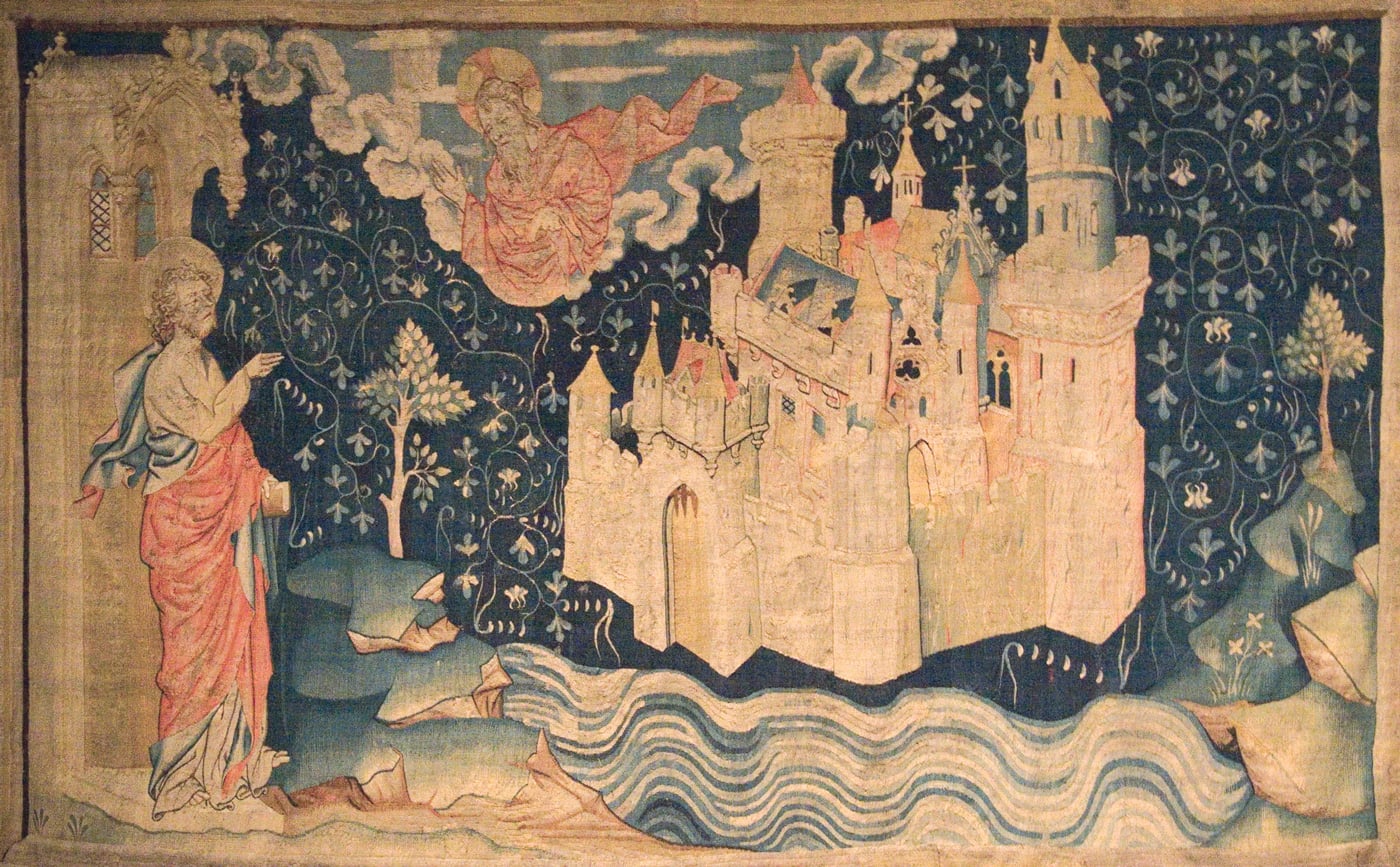
Woven in the fourteenth century AD, the Apocalypse Tapestries illustrate scenes from the book of Revelation. This tapestry shows the New Jerusalem coming down out of heaven (Revelation 21).
In earlier visions, John saw “a sea of glass” as a part of God’s heavenly court (Rev. 4:6; 15:2). Since the sea was a symbol of chaos and sin in the Old Testament (Ps. 74:13–17), its calm state before God’s throne meant that he restrained sin (cf. Gen. 1:8; Ezek. 1:22). In the new heaven and new earth, the sea is not subdued; rather, it is no longer there (21:1). The very existence of sin has been completely extinguished by God. Without the chaos of the sea, the new heaven and new earth become the perfect environment to receive the resurrected saints (21:7).
The New Jerusalem descending from heaven is the community of faith (21:2; see commentary on 21:9–22:5). The promises that God gave to Israel in Isaiah 25:8 to wipe away her tears, protect her from suffering, and keep her safe from death find a deeper fulfillment in an eternal home where there is no death at all, pain is gone, the old rule of sin is broken, and God himself will comfort his people with his tabernacling presence (21:3–4; cf. Lev. 26:11; Ezek. 37:27; 43:7). Joy will abound for the bride of Christ! (cf. Isa. 49:18; 52:1; 61:10; Eph. 5:22–27). The Alpha and Omega, the one who governs history from beginning to end, assures the reader, “It is done!” and promises the faithful that a sinless new world shall be their inheritance (21:6–7).
21:9–22:5: The New Jerusalem. Glimpses of the New Jerusalem have been shown to John throughout his heavenly tour (3:12; 21:2), but no detailed exposition of the city’s import and meaning has been given until now. The epiphany of God’s city has three major movements: (1) the initial descent of the city and its summary description (21:9–14), (2) the measurements and materials of the city (21:15–21), and (3) the internal content and landscape of the city (21:22–22:5).
John the seer is taken up in his spirit to an unidentified mountain. If the old Jerusalem rests on Mount Zion, the New Jerusalem arrives at a locale of a grander height to signify its superiority to the older city (Isa. 2:2–3; 4:1–5; Mic. 4:1–2; Ezek. 40:2). As John witnesses the descent of a new and more glorious Jerusalem on the earth, he is reminded by the angelic intermediary that the city is the bride of the Lamb. Despite the complexity of the building metaphors used to describe the New Jerusalem, it is not a place but a people (21:9–10; cf. Isa. 64:17–19). John’s panoramic overview of the whole city has one central theme: the deep and permanent communion of God with the church.
The dimensions of the city are an allusion to Ezekiel’s vision of a restored temple in which God’s glory is manifested as rivers of living water flowing from the sanctuary’s foundation and each of its twelve gates is named after one of the twelve tribes of Israel (21:15–17; cf. Ezek. 40:1–4; 43:1–5; 47:1–12; 48:30–35). Just as Ezekiel’s dimensions make the temple a perfect cube, so do the bowl angel’s measurements of the New Jerusalem make it a cube. Yet everything about the New Jerusalem surpasses the eschatological temple, which Ezekiel surveys. The New Jerusalem is twelve thousand stadia in length, height, and width (about fifteen hundred miles), while the dimensions of the Ezekiel temple only amount to approximately one and a half miles. Since twelve is the number of God’s apostles and his tribes, and one thousand is a multiple of ten (i.e., the number of power and vastness), the dimensions of the New Jerusalem are a spatial metaphor for a numberless multitude, the entire people of God from both Testaments, believers from every nation, tribe, and language (7:9) gathered around in perfect communion with each other and with God, whose glory the city reflects.
The material description of the city (21:18–21) focuses on its jewels (e.g., jasper, sapphire, chalcedony, emerald, sardonyx, carnelian, chrysolite, beryl, topaz, chrysoprase, jacinth, amethyst, pearls, and other precious materials). The stones have a twofold function. First, they highlight the glorified and transcendent nature (cf. Isa. 54:11) of the church at the resurrection. Second, they indicate the priestly role of the community since Jerusalem is dressed like a high priest. The listed jewels on the breastplate of the high priest (Exod. 28:17–20) resemble those embedded on the city walls, foundations, and gates. Each stone in the Exodus text represents a tribe of Israel. The stones in the New Jerusalem, therefore, could be another way of signifying the diverse membership of God’s people in the same way that the different names around the city signify it (cf. Isa. 54:11–12; Josephus, Jewish Antiquities 3.8–9, 216–17).
In 21:22–27, John catalogs the content and occupants of the city. But the question, What is in the city? is not as important as, What is not in the city? or rather, What is no longer needed? There is no temple (22:22). There is no sun or moon (22:23). The Lord God Almighty and the Lamb have become the temple of the New Jerusalem; and their glory, abiding presence, and splendor so fill every corner, street, room, gate, wall, and quarter that there is no part of the universe a person can travel without basking in the light of God. The reach of the Lamb’s lamp knows no bounds. This is a universal theophany of epic proportions (Isa. 6:1–10; Ezek. 1:28–2:3; Dan. 8:15–18; 10:4–21).
John’s attention turns to the surroundings and landscape of the city (22:1–5). He beholds a glorious paradise of overflowing streams and fruit-bearing trees where there is no longer any curse. Like the Garden of Eden (Gen. 2:5–6) prior to the fall of Adam, this new Eden is unblemished by sin or the curse of suffering, toil, and death (Gen. 3:4–19). Yet the new Eden is much more than a return to a prefall state; it exceeds the old garden in glory and splendor.
The rivers of life are not only an echo of the Pishon, Havilah, Tigris, and Euphrates rivers of old Eden (Gen. 2:10–14); they are also an allusion to Ezekiel’s temple vision of the waters that flowed from the foundation of the inner sanctuary (Ezek. 47:1–5). At first the water level rises to Ezekiel’s knees, then his waist, and finally so high that he could swim in it. These living waters are a metaphor for the work and ministry of the Holy Spirit. Ezekiel envisions a time when the Spirit will flood human reality to such an extent as to take full control of God’s people. That moment described by Ezekiel is now an eternal reality for those who reside in the city of God.
C. Benediction (22:6–21). Appropriately, the Apocalypse of John ends with worship. John is commissioned one last time to record a final benediction given by Jesus Christ himself, as the heavenly liturgy that began in 4:1 draws to a close. The structure of the liturgical elements in the vision focuses on the aspect of promise. Is it enough that God gives us his word? Will we trust in the promises of God even when we might not see God at work in our midst? On center stage is Jesus, who gives us the ultimate promise: “Look, I am coming soon!” (22:7; 22:12). With the assurance that the Son of Man will one day bring God’s people home into glory, beatitudes are also given: “Blessed is the one who keeps the words of the prophecy written in this scroll” (22:7), and “Blessed are those who wash their robes” (22:14). From promise to blessing, the focus of these liturgical elements is to inspire commitment. We are challenged to obey God’s prophetic word (22:7), to live righteously in an idolatrous world (22:11), and to serve as priests even if our blood is spilled in the name of ministering to others (22:14). We are invited to the table of presence to receive the Spirit’s sustaining gifts. “Come!” says the Spirit and the bride. The Spirit is ready to flood, empower, and guide the life of the church (22:16–17). Once again Christ our king promises, “Yes, I am coming soon” (22:20). Like the faithful bride who awaits the coming of the Lamb, we respond, “Amen. Come, Lord Jesus” (22:20). As the liturgy ends, God’s grace remains with John, the churches, and all those who have journeyed with them through Revelation (22:21).
Select Bibliography
Aune, David. Revelation. 3 vols. Word Biblical Commentary. Nashville: Thomas Nelson, 1997–98.
Bauckham, Richard. The Climax of Prophecy. Edinburgh: T. & T. Clark, 1993.
———. The Theology of the Book of Revelation. Cambridge: Cambridge University Press, 1993.
Beale, G. K. The Book of Revelation. New International Greek Testament Commentary. Grand Rapids: Eerdmans, 1999.
Blount, Brian. Can I Get a Witness? Reading Revelation through African American Culture. Louisville: Westminster John Knox, 2005.
Boxall, Ian. The Revelation of Saint John. Black’s New Testament Commentary. Peabody, MA: Hendrickson, 2006.
Caird, G. B. A Commentary on the Revelation of St. John the Divine. New York: Harper & Row, 1966.
Collins, Adela Yarbro. The Combat Myth in the Book of Revelation. Missoula, MT: Scholars Press, 1976.
Grenz, Stanley. The Millennial Maze. Downers Grove, IL: InterVarsity, 1992.
Hemer, Colin. The Letters to the Seven Churches of Asia in Their Local Setting. Sheffield: JSOT Press, 1986.
Keener, Craig. Revelation. NIV Application Commentary. Grand Rapids: Zondervan, 2000.
Osbourne, Grant. Revelation. Baker Exegetical Commentary on the New Testament. Grand Rapids: Baker Academic, 2002.
Pippin, Tina. Death and Desire: The Rhetoric of Gender in the Apocalypse of John. Louisville: Westminster John Knox, 1992.
Reddish, Mitchell. Revelation. Smyth & Helwys Bible Commentary. Macon, GA: Smyth & Helwys, 2001.
Walvoord, John. The Revelation of Jesus Christ. Chicago: Moody, 1966.