Jude
A. Opening: Reason for Writing (3–4)
B. Main Discussion: Denunciation of the Intruding Teachers (5–16)
C. Conclusion: Response of the Believers (17–23)
Introduction
Author
The Letter of Jude identifies the author as “Jude . . . brother of James.” The Jude (or Judah or Judas, which are all transliterations of the same name) intended here is the younger brother of the James (Jacob) to whom the Letter of James is attributed. This James in turn was the leader of the followers of Jesus in Jerusalem from at least AD 44 to 61 and the James whom Mark 6:3 identifies as a younger brother of Jesus himself. That would make Jude Jesus’s youngest (Matt. 13:55) or second-youngest (Mark 6:3) brother. Much later, the canonical arrangement of the seven Catholic Epistles, or General Letters, put James as the first letter in the collection and Jude, written by the brother of James, as the last, bracketing the works of the others with letters attributed to brothers of Jesus.
We know nothing about Jude’s life or his role in the Jesus movement after Jesus’s resurrection. It is clear, though, that the writer believes he has authority to speak to those whom he addresses, not least because he is the brother of James, but also because he is “a servant [slave] of Jesus Christ.” Thus, as a servant, while not having any rank of his own, he speaks with the authority of his master, as Moses did for God and slaves of Caesar did for Caesar.
A number of scholars question whether the traditional author did write Jude. In reality, there is no way to prove or disprove whether or not Jude the brother of James wrote this work or whether it was written in his name, for we know nothing of his education (the author of the letter has at least a good Greek primary education), nor do we have other work by him to indicate his writing style and theology. All one can say about the author is that he is very familiar with Second Temple Jewish literature, that he has an excellent Greek vocabulary and decent Hellenistic education, and that it is not clear whether or not he knows either Hebrew or Aramaic—Richard Bauckham believes he does, while others question this. If one doubts that this author is Jude, then one must ask why someone would write in the name of such an “unknown” rather than pick the name of a more famous leader in the Jesus movement.

Audience and Date
No information is given about either those to whom the letter is addressed or the historical circumstances of Jude’s composition, except that the author expects the recipients to be familiar with Second Temple Jewish literature. Furthermore, any extrabiblical traditions we have about the brothers of Jesus connect their lives and descendants with Palestine, so that would be consistent with a Palestinian provenance for the letter and would perhaps indicate that the addressees were not too far away (although far enough from the author that a letter was needed). It is also clear that the letter is not really a “general,” or “catholic,” epistle since it is clearly written to a specific group of followers of Jesus whom the author knows and who know the author (e.g., he refers to them as “dear friends”; v. 3). The author views his addressees as at risk because of a group of others (they are never given a name) who have entered the community and are introducing destructive practices, probably on the authority of their prophetic dreams (they are called “dreamers”; v. 8 KJV, NRSV).
We therefore do not know when Jude was written. If it had a Palestinian origin, then it was probably written before 66, the outbreak of the war against Rome, although a date a decade or so later—when life was becoming more normal after the destruction of Jerusalem—is possible. Knowing that 2 Peter made use of Jude’s letter only helps to place Jude in the first century, for 2 Peter has been variously dated from 64 to 90 (though sometimes much later). Given the reference to James, who was martyred in 61, a date after James’s death and before the war with Rome may be as likely as any.
Jude was valued early in its history, because, as noted above, it was used as the basis of 2 Peter 2:1–3:3; the fact that the same topics are discussed in the same order, that some phrases and illustrations are identical, and that the issues addressed are similar indicates that this conclusion is well established. But after that we do not hear of Jude for over a century. In the third and fourth centuries, the work was disputed, but we are not told the reasons, although it is speculated that Jude’s use of noncanonical literature may have been part of the reason. Jude does appear in fourth-century biblical collections, and by the end of the century it is included in canon lists. However, despite official acceptance, the work has been neglected for much of its history.
Structure and Content
The structure of the work is relatively clear. The letter opens with a salutation (vv. 1–2), then the body consists of an opening to the main topic (vv. 3–4), a discussion of the intruding teachers (vv. 5–16), and a conclusion (vv. 17–23). A benediction closes the letter (vv. 24–25).
The short letter is a contrast between those “dear friends” who are faithful (“kept for/by” [cf. NIV note] or “kept safe” [NRSV], v. 1), whose job it is to build themselves up in the faith (v. 20), and those others who have left the faith, their departure meaning that by word and action they are living in opposition to the ethical teaching of Jesus.
Commentary
The salutation is brief, identifying the author, as we have noted, and then identifying the recipients as people who have been “called,” “loved,” and “kept” by God the Father and Jesus Christ. There is no criticism of these “dear friends” stated anywhere in the letter.
A. Opening: Reason for writing (3–4). After the salutation comes the reason for writing. While about to write in another vein, Jude has received information that means he must instead exhort the community he addresses to “contend for the faith,” which will be defined in 22–23 as holding fast to what they are committed to and rescuing those who are deceived (i.e., the others and any they have influenced). The reason this is necessary is that these others have entered the congregation and are presently functioning within the community (Jude 12). Jude makes two related charges: they pervert grace into “a license for immorality” and they thereby deny “Jesus Christ our only Sovereign and Lord” (v. 4). In other words, living in disobedience to Jesus is a form of apostasy.
B. Main discussion: Denunciation of the intruding teachers (5–16). In the main section of the letter body, the author denounces the others, using groups-of-three illustrations originally from the Old Testament but now read through the lens of Second Temple Jewish literature. The first group (vv. 5–7) is the people saved in the exodus, the angels of Genesis 6:1–8, and Sodom and Gomorrah. Two of the three were once saved or had a dwelling with God, while all three were finally destroyed. The Genesis 6 story, read through the lens of 1 Enoch, and Sodom are put last because each refers to sexual relations across a forbidden boundary (i.e., angel/human; in Jude 7 literally “strange flesh”). The others in the community are apparently crossing some type of sexual boundary, doing things that were not approved of even in the culture surrounding the believing community (perhaps like the man in 1 Cor. 5:1).
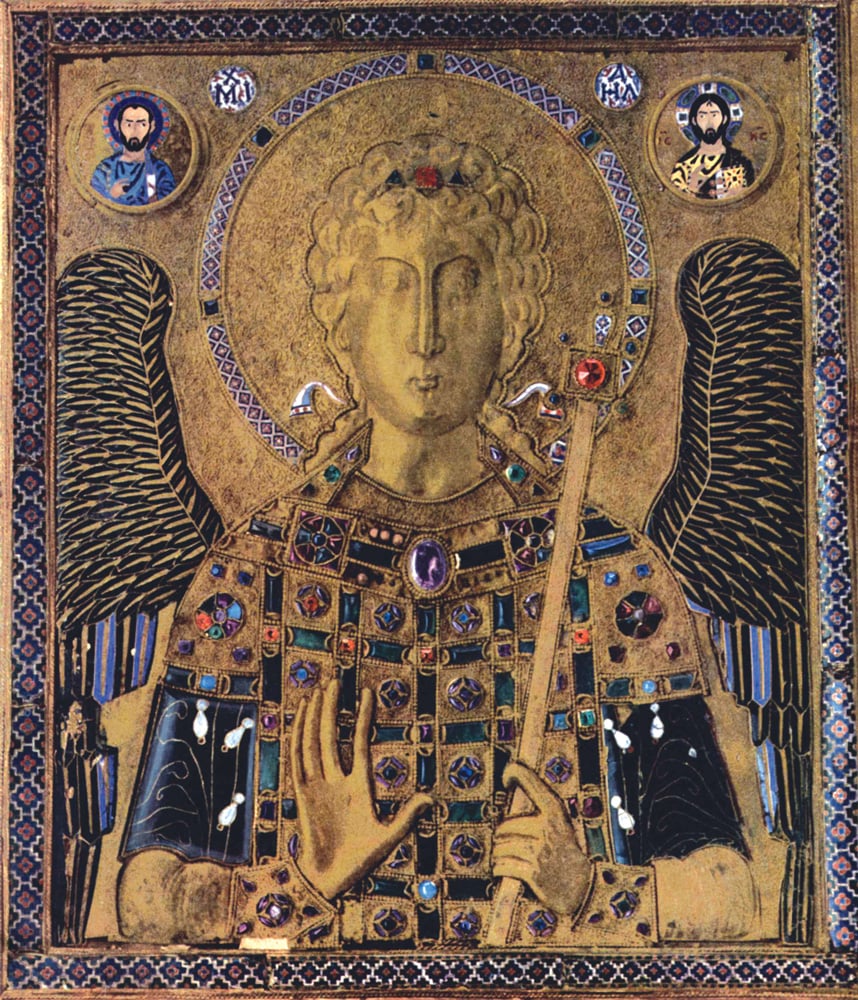
Icon of the archangel Michael (tenth century). Jude 9 holds up Michael as an example, referring to an account from the Testament of Moses.
These “dreamers” (possibly indicating the source of their “revelation” [v. 8]; NIV “on the strength of their dreams these ungodly people”) not only cross such boundaries but they also “reject authority,” slandering the good angels (“celestial beings” or “the glorious ones”), perhaps those who were thought to have brought the law (and thereby ethical rules) to Moses (vv. 8–10). Unlike the archangel Michael, who in the Testament of Moses argued respectfully with the devil over whether or not Moses deserved burial (the devil accused Moses of having been a murderer in Egypt) and who left judgment to God (“The Lord rebuke you!”), these others, lacking the propriety of Michael, are like animals in that they do not understand what they slander. They are also like animals in that they follow their instincts, not realizing that these impulses will in the end destroy them.
The reference to the Testament of Moses, then, gives way to the second group of three: Cain, Balaam, and Korah (v. 11). This woe oracle sounds like it was pulled out of Old Testament prophecy. While the first and last of the group were rebels, all three were viewed in Jewish tradition as having taught evil. There is a crescendo in the descriptions: “taken the way of,” “rushed for profit into,” “been destroyed in.” Only the spiritually suicidal would emulate them.
These others are a part of the local community of believers (vv. 12–13), for they participate in the Lord’s Supper, which in that period was a full meal, a “love feast.” Yet they are a defilement of that meal. Furthermore, they are there for their own gain, not for worship or building up others. Thus they are like Balaam or like the shepherds of Ezekiel 34:2. Four images create a vivid warning about them: (1) waterless clouds and (2) fruitless autumn trees indicate they promise much but do not deliver; (3) waves seem impressive, but these stir up “shame”; and (4) stars (believed by ancients to be angelic powers) that are wandering rather than in their proper courses (which parallels the clouds being “blown along”) are doomed. Such stars will be destroyed, as was the case with the angels of Genesis 6:1–8.
The message of destruction is underlined by the quotation from 1 Enoch 1:9 (vv. 14–17). As we noted above, our author is familiar with Second Temple Jewish literature such as the Testament of Moses and 1 Enoch. Furthermore, the way he refers to a number of Old Testament stories shows that he is influenced by how these stories were retold in Second Temple literature. Here we find the only quotation of a “scripture” in the whole work, and it is the quotation of a “prophecy” that Jude attributes to Enoch (just as Matt. 13:14 refers to the “prophecy” of Isaiah and Matt. 15:7 says, “Isaiah . . . prophesied”). We now know the quotation as part of the opening chapter of 1 Enoch (which is probably a composite book). Jude cites this work in an unself-conscious manner. He is, of course, not aware that there would later be canonical discussions and that 1 Enoch would not form part of the eventual canon. For him it is simply an authoritative prophecy that he knows is appropriate for his topic, and he cites it as freely as he might have cited other prophets such as Isaiah or Jeremiah. The point of the prophecy is straightforward: final judgment is coming. Those for whom this judgment is a danger include not just the “sinners” named in the prophecy but also the others in the community, who are accused of grumbling (a term found only here, but the idea is also in James 5:9), being driven by their desires, and buttering up others. These sins were important to Jude but are sometimes forgotten about or downplayed today.
C. Conclusion: Response of the believers (17–23). The final section of the letter counsels the readers what to do about this situation. It is here that Jude surprises the modern reader the most, for he does not instruct them to throw the others out.
First, the “dear friends” are not to be surprised but rather to remember apostolic predictions (which were not passed down beyond that age, for they are not found elsewhere in the New Testament or church tradition) that this rejection of Jesus’s morality is precisely what would happen in “the last times” (or “at the end of time”). Such people are members of the community of believers in which they cause divisions, but in fact they are totally of this age (“follow mere natural instincts” or “are soulish”) and “do not have the Spirit.”
Second, in contrast to such people, the dear friends are to strengthen themselves in their holy commitment (NIV “holy faith”; but it is not doctrine but commitment that is intended), to pray in the Spirit (which they clearly have and which the others, who do not have it, claim is leading them), and especially to look expectantly toward the final judgment, when they will receive mercy from “our Lord Jesus Christ.” Thus they are to keep on being faithful as they have been doing.
Third, they are to rescue everyone they can from the false teaching, exercising mercy rather than judgment yet being careful that in the process they themselves are not sucked in. In fact, a better translation of Jude 22 is, “Be merciful to those who dispute,” that is, the others. There is not a word about attacking and expelling the others who have come into the community; rather, the faithful are to live the truth themselves and rescue those trapped in desire. Verse 23 probably speaks of two actions toward one group: snatch them from the fire and show them mercy—but do so in a manner in which you are not yourselves contaminated.
The benediction is an elaborate blessing of God, who is first described as the one who can keep the readers stable and bring them successfully to his presence, which should relieve any fear that may have been engendered by this letter, including fear of being contaminated in the course of trying to rescue the others. Thus, he is “God our Savior,” an unusual expression for God, although his saving acts are frequently celebrated in Scripture. This is done through Jesus Christ our Lord, for the believer (unlike the others) lives under the lordship of Jesus, and it is only in this way that he or she is related to “God our Savior.” Finally, this culminates in ascribing eternal honor and authority to this God, as would be fitting in the court of such a king.
Select Bibliography
Bauckham, Richard J. Jude, 2 Peter. Word Biblical Commentary. Waco: Word, 1983.
———. Jude and the Relatives of Jesus in the Early Church. Edinburgh: T. & T. Clark, 1990.
Davids, Peter H. The Letters of 2 Peter and Jude. Pillar New Testament Commentary. Grand Rapids: Eerdmans, 2006.
Davids, Peter H., and Robert L. Webb, eds. Reading Jude with New Eyes: Methodological Reassessments of the Letter of Jude. Library of New Testament Studies. London: T. & T. Clark, 2007.
Green, Gene L. Jude and 2 Peter. Baker Exegetical Commentary on the New Testament. Grand Rapids: Baker Academic, 2008.
Neyrey, Jerome H. 2 Peter, Jude: A New Translation with Introduction and Commentary. Anchor Bible. New York: Doubleday, 1993.
Reese, Ruth Anne. 2 Peter and Jude. Two Horizons New Testament Commentary. Grand Rapids: Eerdmans, 2007.