Gospels and Acts
Amy-Jill Levine and Marc Zvi Brettler
Definition
The term “Gospel” derives from the Old English “gōdspel,” “good news,” a translation of the Greek term eu (“good”) + angelion (“message,” “news,” “tidings”); Yiddish speakers might think of “gospel” in light of the linguistic cognate gut [“good”] s[h]piel (“news,” “speech,” or “story” intended to have persuasive elements). As the English language developed, people mistook the original “good” for “God,” and so the term “gospel” came to mean “God’s story.”
The Greek term euangelion was part of Rome’s political vocabulary: “good news” was typically something the Emperor did for the population, such as promote the Pax Romana, the “peace of Rome,” or declare a tax holiday. A famous inscription from 9 bce found in Priene (not too far from Ephesus, in southern Turkey) speaks of Augustus Caesar as having “… exceeded the hopes of all former good messages [Gk euangelia] … for the world the birthday of the god [Caesar] was the beginning of his good messages [Gk euangelion].” Gabriel’s well-known message to the shepherds in Lk 2.10, “I am bringing you good news (Gk euangelidzomai) of great joy for all the people,” shows how Jesus’ followers used this political term to talk about their gospel, their “good news.”
Jesus’ followers also recognized the connection of the “gospel” to the “good news” proclaimed by Israel’s prophets according to the Septuagint translation, such as Isa 40.9b: “O Jerusalem, herald of good tidings (Heb mevaseret; Gk euangelion), lift it up, do not fear; say to the cities of Judah, ‘Here is your God!’” Lk 4.18, part of Jesus’ synagogue sermon, quotes Isa 61.1–2: “The Spirit of the Lord is upon me, because he has anointed me to bring good news (Gk euangelidzo; Heb levaser) to the poor.”
This more specific meaning of “gospel” as “good news that Jesus brings” appears, for example, in Mk 1.14, “Now after John was arrested, Jesus came to Galilee, proclaiming the good news (Gk participle euangelidzomenos) of God.” The Gospel narrative then describes the content of this good news, which ranges from Jesus’ healings and teachings to his redemptive death and his resurrection.
From this connotation comes a second: gospel comes to mean “the narrative about Jesus.” For example, Mk 1.1 states, “The beginning of the good news (Gk euangelion) of Jesus Christ”; here the term euangelion can refer not only to the message about Jesus and the message he proclaims, but also to the book of Mark. The first definitive use of euangelion to refer to the written texts comes from Justin Martyr, the second-century Church Father, who wrote in his First Apology 66 of “the apostles, in the memoirs composed by them, which are called Gospels (Gk euangelia).” The term “evangelist,” which derives from the Latin version of the Greek “euangelion,” similarly developed around the twelfth century to refer to anyone who proclaims the “good news” of Jesus (hence, by the nineteenth century, e.g., “Evangelical Christianity”); “Evangelist” also refers specifically to the authors of the four canonical Gospels.
Authorship and Date
Although more than four Gospels, in the sense of narratives about Jesus, existed in antiquity, all churches recognize only four as having canonical status (see “The Canon of the NT,” p. 695). Two are preserved in the names of Matthew and John, two of Jesus’ Twelve Apostles (e.g., Mt 10.2–3; Mk 3.17–18; Lk 6.14; Acts 1.13). Mark is traditionally understood to have been Peter’s disciple as well as Paul’s companion (see Acts 12.12–14,25; 15.36–40; Col 4.10–11; Philem 23–24; 2 Tim 4.11; 1 Pet 5.12–13). The author of both the third Gospel and Acts of the Apostles, Luke is seen as connected to the circles around Paul (see Col 4.10–11,14; 2 Tim 4.11; Philem 23–24). Questions of authorship remain debated: Did the historical figures Matthew, Mark, Luke, and John, actually write the Gospels attributed to them? Are the Gospels rather records of the memories of these four figures, but written by their later disciples? (Jn 21.20–24 conveys hints of such a process in its raising the question of the death of the Beloved Disciple, on whose authority the Gospel rests.) Are the Gospels pseudonymous, that is, written in the name of an ancient worthy, as is likely the case with the Pastoral Epistles 1–2 Timothy and Titus, written in Paul’s name, and such noncanonical texts as the Gospel of Philip, the Gospel of Mary, 3 Corinthians, and the Acts of Thomas?
None of the canonical Gospels provides an explicit date of composition. Paul, who likely died during Nero’s persecution of Christians in Rome in 64 ce, never mentions the Gospels, and most scholars agree that the canonical Gospels postdate him. Although oral accounts of Jesus’ life and teachings must have circulated even before Jesus died, and although some of these accounts likely were committed to writing (perhaps a list of Jesus’ “signs” upon which the Gospel of John may have drawn; perhaps a list of Jesus’ sayings known to Matthew and Luke), we have no complete narrative of Jesus’ life that existed at the time of Paul, and there may have been none. Thus, Paul’s epistles demonstrate some knowledge of what Jesus said and did, and Paul did have contact with some of Jesus’ original followers such as Peter and John (see Gal 2), but Paul does not appear to know the Gospels.
As time passed, the need for narratives about Jesus would have intensified. The first disciples were dying, different groups were debating issues of Christology (how to understand Jesus: Fully human? Fully divine? Both? Neither?—see “Christology,” p. 754), eschatology (was the end-time coming sooner or later?), legal issues (e.g., could one divorce or not? How should the Sabbath be observed if at all?), relationships with local Jews and pagans, and so on. The Gospels formed a type of constitution for late-first and early second-century Christians: they were diverse enough to represent and appeal to different constituencies, and they were similar enough that they were not likely to provoke sectarian disputes.
Traditionally, Mark, considered to be the earliest Gospel, is dated soon after 70, as Mk 13.1–2 suggests the Evangelist knew of Rome’s destruction of the Jerusalem Temple in 70 ce. However, if Jesus had in fact predicted this calamity (see also Mt 24.1–2; Lk 19.41–44; 21.20), just as Jeremiah had predicted the Babylonian destruction of the First Temple in 586 bce, Mark’s Gospel could predate 70.
Most scholars regard Mark as providing a source for the Gospels of Matthew and Luke, so these Gospels must have been written later than 70, with dates in the 80s and 90s usually suggested. John is typically dated to the 90s, reflecting a time when Jesus’ Jewish followers are finding themselves increasingly separated from the broader Jewish community. The earliest actual fragment of Gospel material we have is called P52 (P stands for “papyrus”). This scrap of papyrus, measuring 3.5 x 2.5 inches and containing parts of Jn 18.31–33,37–38, is on display at the John Rylands University Library in Manchester, UK. Dates of P52 by handwriting analysis (paleography) range from ca. 120 to the late third century. Even if we could determine the date of the earliest extant manuscript, that would not tell us what the earliest text in the New Testament is. Date of copy is not the same thing as date of composition.
The Gospels that are not found in the canon likely postdate and are substantially dependent on the canonical texts. The “Apocryphal Gospels” include accounts of Jesus’ childhood (e.g., The Infancy Gospel of Thomas), of Mary’s life prior to the birth of Jesus (The Protevangelium of James), and of miracles surrounding the crucifixion and resurrection (The Gospel of Peter). These texts might be viewed as Christian midrash; just as rabbinic sources fleshed out the Tanakh’s stories of Abraham’s and Moses’ childhoods, so do these Apocryphal Gospels add to the stories of Jesus and his followers. Others texts, usually known by the catch-all term “Gnostic Gospels,” such as the Gospels attributed to Thomas, Philip, Judas, and Mary, consist substantially of sayings, often of an esoteric sort, rather than narrative materials. Preserved primarily in a cache of documents found in Nag Hammadi in Egypt and written in the Coptic language (a late form of Egyptian), although likely originally composed in Greek, these texts may include small amounts of material that go back to Jesus himself. Generally, however, with the possible exception of the Gospel of Thomas, they are comparably late and pseudonymously ascribed to Jesus’ followers rather than written by them.
Literary Relationship among the Canonical Gospels
Given that the four Gospels contain narrative, thematic, and in some cases phraseological similarities, it is likely that some are dependent on others. The exact relationship among the four Gospels is a matter of scholarly debate. The first three Gospels, which basically tell the same story in the same order, are known as the “Synoptic (for ‘together’ + ‘see’) Gospels.” Attempts to explain the literary relationship among these Synoptic Gospels address what is technically called “the Synoptic Problem”: Who used which text?
Mark is usually regarded as the first extant Gospel composed and as serving as a source for Matthew, Luke, and possibly John. Mark, the shortest of the four Gospels, lacks both a nativity (birth) story and resurrection accounts; it focuses on Jesus as the suffering servant who dies as a ransom for humanity (Mk 10.45; cf. Mt 20.38). Some early Church Fathers as well as some biblical scholars understand Mark as carrying Paul’s legacy in negating practice of Torah (e.g., Mk 7.19).
Matthew, likely using Mark as a source, has a different emphasis: Matthew’s Gospel stresses Jesus’ teaching role and debates with Pharisees over proper interpretation of Torah. Matthew adds to Mark a nativity story including Joseph’s dream, a quotation from the Greek translation of Isaiah to explain the virginal conception of Jesus (Mt 1.18–25), the visit of the Magi and the Slaughter of the Innocents (Mt 2); to Mark’s empty tomb narrative, Matthew adds the appearance of Jesus to a few of his women followers (Mt 28.1–11) as well as the Great Commission (Mt 28.16–20) to the eleven remaining disciples. Matthew can also be seen as correcting Mark’s presumed antinomianism by declaring the permanence of Torah (Mt 5.17–19) as well as negating Paul’s mission (e.g., Matthew makes Peter and the other disciples the evangelists to the Gentiles [Mt 28.19], whereas Paul takes this to be his role [Gal 1.16; 2.2]).
Luke is also generally regarded as dependent on Mark. Luke’s Gospel adds to Mark nativity account material and resurrection materials that are quite distinct from those in Matthew’s text. The third Gospel includes details on the conception and birth of John the Baptist, the angel Gabriel’s annunciation to Mary that she would be the mother of the Messiah (hence the “Ave Maria” or “Hail/Greetings [Mary]” of Lk 1.28), the universal census, the birth of Jesus in the stable, and the visit of the shepherds. To the resurrection accounts, Luke adds the well-known appearance of Jesus to the two disciples on the road to Emmaus (Lk 24.13–33) as well as the narrative of Jesus’ ascension into heaven (Lk 24.50–51). The familiar parables of the Good Samaritan (Lk 10.30–38) and Prodigal Son (Lk 15.11–32) are also unique to Luke.
Matthew and Luke also contain common material that is not present in Mark’s Gospel, such as the “Beatitudes” (Mt 5.3–12 || Lk 6.20–22) and the “Our Father” or “Lord’s Prayer” (Mt 6.9–13 || Lk 11.1–4). At times, Matthew and Luke recount the same stories as Mark does, but they share details lacking in Mark, such as the expanded version of Jesus’ temptation by Satan (cf. Mt 4.1–11 and Lk 4.1–13 to the more limited Mk 1.13). To explain material shared by Matthew and Luke but absent from Mark, many scholars suggest that Luke and Matthew had access to a written text consisting primarily of Jesus’ sayings. This (hypothetical) source is known as Q (from the German word Quelle, meaning “source”). Matthew and Luke also likely had their own sources, which are labeled “M” for the special Matthean material and “L” for Luke’s distinct contributions. The distinct nativity and resurrection accounts may derive from these sources.
The standard solution to the Synoptic Problem is known as the Four-Source Hypothesis. Diagrammed, it looks like this:
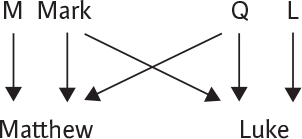
This solution, while logical, may also in part be motivated by Christian theological concerns. The idea of Q developed in the late nineteenth century in Germany, where Protestants and Catholics needed to find unity in their newly emerging nation-state, and the Jewishness of Jesus was increasingly being negated by the forerunners of Nazi theology. The theory of Mark’s priority emphasizes Jesus’ apparent rejection of Torah (7.19) and Jerusalem (the resurrection appearances are set in Galilee; see Mk 16.1–8) and suggests a historical Jesus less interested in Jewish practice than Matthew, with its insistence on Torah observance, and Luke, with its accounts of the circumcisions of both John (Lk 1.59) and Jesus (Lk 2.21).
Other scholars doubt the existence of Q; some argue that Luke used Matthew’s text, and that Mark, as the latest Gospel, summarized the two. This theory, known as the Griesbach Hypothesis, after Johann Jakob Griesbach (1745–1812), looks like this:

A more recent school of thought known as the Farrer (or Farrer-Goulder) Hypothesis argues for Markan priority solution, Matthew’s use of Mark, and then Luke’s use of both Matthew and Mark.

Still others suggest that Matthew used both Mark and Luke. Consequently, although all of these reconstructions, based on evidence, agree that Mark, Matthew, and Luke are somehow related, any claim based on the priority of one text over another must remain speculative.
It is also difficult to distinguish between what the Evangelists received from earlier sources and what they added themselves; “redaction criticism” focuses on the Gospel writers as editors or redactors. For example, did Matthew deliberately omit Mark’s comment about Jesus’ declaring all foods clean (Mk 7.19), or did Mark add it to Matthew’s narrative (Mt 15.1–20)? When Matthew quotes Jesus as saying, “Do not think that I have come to abolish the law or the prophets” (Mt 5.17), is the Evangelist recording an actual saying, or is Matthew extrapolating details from received traditions? Is the stress on “righteousness” (Gk dikaiosyne) in Matthew (3.15; 5.6,10,20; 6.1 [the NRSV reads “piety” here]; 6.33; 21.32) from material Matthew received, or does it reflect the Evangelist’s own theology? Did Luke invent the infancy accounts of Jesus and John in order to show Jesus’ superiority to John, and so the superiority of the Jesus movement to the followers of the Baptist, or did Luke inherit these traditions? The Evangelists are creative authors and not merely conveyers of received material; what they record may well be, if not a verbatim quote (impossible in any case, since Jesus spoke Aramaic and the Gospels are written in Greek), the sense of what Jesus said.
John presents numerous passages that are absent in the Synoptic Gospels, such as the story of Jesus’ turning water into wine at Cana (ch 2), the detailed encounters with the Pharisaic leader Nicodemus (ch 3) and the Samaritan woman (ch 4), the raising of Lazarus (ch 11), as well as distinct emphases such as “light,” “truth” and “glory.” Whereas the Synoptics depict Jesus primarily proclaiming the arrival of the Kingdom of God and speaking in parables, John’s Gospel contains no parables and only one brief parable-like comparison (12.24), two references to the kingdom of God (3.3,5) and brief mention of “my kingdom” (18.36), and Jesus primarily proclaims himself with statements beginning “I am” (the bread of life [Jn 6.35], the true vine [Jn 15.1], the way and the truth and the life [Jn 14.6]), echoing God’s statement to Moses at the burning bush (Ex 3.14). Yet, John contains some major similarities to the Synoptics, such as references to John the Baptist, Jesus’ feeding of the 5,000 (Mt 14.21; Mk 6.44; Lk 9.14; Jn 6.10), and a significant Last Supper. Overlaps in the Passion Narrative are also present, although distinctions appear here as well, such as different dates (see “Time, Calendars, and Festivals,” p. 669) and events at the Last Supper (in the Synoptics, Jesus institutes the Eucharist, while in John, Jesus washes the disciples’ feet). Thus, whether John is independent of any or all of the Synoptics remains a debated issue.
Understanding the literary relationship among the Gospels influences how we understand the historicity of the narratives, and how we separate tradition (what Jesus said and did) from redaction (what particular Gospel writers attributed to him). The early proponents of Marcan priority (i.e., that Mark was the first Gospel written) and of Q thought that these sources, earlier than Matthew and Luke, had greater claims to historical fact. However, it is not the case that the earlier the source, the more historical material it contains. Mark and Q (if Q exists) have their own agendas, and an early date is no guarantee of accuracy. Later material, especially utilizing different sources or traditions, may have more factual content.
It is also unclear how the Evangelists themselves understood their compositions in relation to previous sources. Luke acknowledges that “many have undertaken to set down an orderly account of the events that have been fulfilled among us” (1.1) and that he, “after investigating everything carefully from the very first,” plans “to write an orderly account” (1.3). Did Luke intend to replace other accounts such as Matthew and Mark? In general, were Gospels written to supplant earlier sources, to correct them, or to complement them?
Furthermore, it is unknown which communities each Gospel addressed, if indeed they did address specific groups rather than being intended for all of Jesus’ followers. Mark is generally held to have been written to a predominantly Gentile community in Rome, although some scholars see Mark as a product of the Upper Galilee where Jews and Gentiles together comprised the church. Luke is regarded as a Gentile writing to a predominantly Gentile readership, but even here, some scholars regard Luke as a Jew or as a God-fearer, a Gentile affiliate of the Jewish community. Matthew, the literate tax collector (see Mt 10.3), is usually seen as writing to a predominantly Jewish audience because of the Gospel’s emphasis on Torah, Jesus’ intensive debates with Pharisees, and its particular affinities to later rabbinic literature. These various understandings of the Gospel settings substantially rely on a circular argument: on the basis of the narrative, we determine the agenda of the author and the identity of the audience. Then we interpret the text on the basis of what we have concluded from internal evidence.
The literary relationships among the Gospels, their sociological contexts, and the distinction between what the Evangelists received from sources (tradition) and what they added from their own imagination (redaction) are essential elements of classical New Testament scholarship. These issues, which cannot be resolved with certainty, are also essential in interpreting the Gospels in relation to Jews and Judaism: How we understand the history of the composition of each Gospel setting will necessarily influence how we understand its contents, including its relationship to Jews who did not accept Jesus as messiah.
It is also difficult to determine the relationship of the Evangelists and their early readers to non-messianic Judaism. Citations from the Septuagint indicate neither a Jewish author nor a Jewish audience, since this text was also held to be sacred by the Gentile churches, as Paul’s letters demonstrate. Matthew and John are popularly understood to have been composed for a beleaguered minority rejected by the larger Jewish society. That hypothetical context then serves to explain why Mt 27.25 assigns full communal guilt to the Jewish community for Jesus’ death by having “all the people” say, “His blood be on us and our own children,” and why in Jn 8.44, Jesus says to the Jews (Gk Ioudaioi), “You are from your father the devil.” Literary polemic, however, does not necessarily reveal external social situations. Claims that the Gospels were written in response to a presumed gathering of rabbis ca. 90 in Jamnia (Yavneh), who themselves had determined that Jesus’ followers were heretics deserving of expulsion from synagogues, receive no support from the Jewish sources (see “Birkat ha-Minim,” p. 653).
Genre
New Testament scholars debate to what extent the canonical Gospels should be considered biographies. They are not biographies in the modern sense of the term: they do not present a complete life-story, ignoring, for example, Jesus’ childhood, what happened to Mary’s husband, Joseph, whether Jesus was married, or what sort of formal education he received. Nor do they explore issues of psychological motivation or pretend to any sort of objectivity. Instead, they are written for a purpose; John (20.31) is explicit, “But these are written so that you may come to believe [or ‘continue to believe’] that Jesus is the Messiah.”
The Gospels are, however, close in literary form to ancient biographies (Gk bioi; Lat vitae, narrative “lives”). These narrative accounts, usually a single scroll measuring 30–35 feet, comprised of 10–20,000 words, include Plutarch’s first-century ce Life of Alexander (the Great), Suetonius’s early second-century ce Lives of the Caesars, and the Life of Apollonius of Tyana, a first-century teacher and miracle worker, by the Greek philosopher Philostratus (ca. 170–ca. 247). These biographies offer information on the protagonist’s family and the circumstances of his birth, his public activities, and his (usually heroic) death. The texts were designed to provoke readers to imitate the virtues of the heroes.
But the Gospels differ from these ancient biographies in several central ways. The primary difference is the Gospels’ evocation of the Scriptures of Israel (usually in their Greek translation, the Septuagint). These references—e.g., Matthew’s opening genealogy connecting Jesus to Abraham and Moses; Mark’s opening connection of John the Baptist to Isaiah’s prophecy; Luke’s presentation of the parents of John the Baptist in the mold of biblical couples who faced infertility; the Johannine prologue with its magnificent recreation of Gen 1.1–2—make clear that the Gospels are part of a larger story, and indeed are written as the fulfillment of that story.
Late Second Temple sources contain other examples of biographies, including Josephus’s autobiographical Life and Philo’s Life of Moses, but the genre is not found in rabbinic sources. No rabbinic books on the lives of Abraham, Moses or David, Hillel or R. Akiva or R. Judah the Prince, exist. This is one of several important differences between the Gospels and later Jewish texts. In addition, Jewish texts were, compared to those produced by the followers of Jesus, comparably more communal. Thus in rabbinic commentary multiple sages engage in conversation, whereas Christian literature tends to be from one writer (such as Paul, Ignatius of Antioch, Justin Martyr, Augustine); rabbinic commentary tells the story of the people of Israel, whereas Christian writers primarily tell the story not of the church, but of individual figures within it (e.g., Martyrdom of Polycarp, Life of Saint Anthony). No single figure, not even Moses, is as exalted in Jewish literature as Jesus is in the Gospels and later Christian literature.
The extent to which the Gospels record “what really happened” cannot be resolved. Although the texts are based on the memories of Jesus’ followers, as those memories were passed down from Jesus’ original Aramaic teachings to the Greek of the Gospels, teachers and storytellers would have adapted them to fit both the needs of their intended audiences and their own sense of who Jesus was and what he sought to accomplish. Places where Jesus’ actions either explicitly or implicitly evoke the Scriptures of Israel are especially problematic for the historian attempting to reconstruct the life of Jesus. Did Jesus himself, or events in this life, follow models in these texts, or did later authors pattern his story after them? For example, the Synoptic account of Jesus’ death draws heavily from and even quotes parts of Ps 22. Scholars query: did the Evangelists compose the Passion narrative in light of the Psalm, or did the events at the cross themselves replay the Psalm’s verses?
The Gospels reflect communal memory influenced by Israel’s Scriptures, the oral development of stories about Jesus over the first several decades following his death, and the needs of the Evangelists and readers. The fact that different sources in the New Testament disagree on even as basic an issue as what Jesus said at his Last Supper (the words of institution) demonstrates that the followers were more concerned with the general substance or import of his teaching rather than verbatim transcripts of his words (see Mt 26.26–29; Mk 14.22–25; Lk 22.19–20; 1 Cor 11.23–26, and for similar comments outside the context of the Last Supper, Jn 6.48–60).
Not only Jesus’ words, but also his deeds are presented in different ways, and again the question of what is historical fact is complex and disputed. For example, were there two demon-possessed men at a place called Gadara, where the drowning of a herd of pigs is attributed to an exorcism Jesus performed (Mt 8.28–34), or is the setting Gerasa, where a single possessed man is healed (Mk 5.1–20)? To complicate matters further: Was the latter story composed as an allegory, given that gerash in Hebrew means “expel,” the demons are named “Legion” in an evocation of the Roman Empire, and that one of the symbols of the Roman troops (Legio X Fretensis) that conquered Jerusalem in the First Revolt was the boar? Scholars interested in reconstructing the actual life of Jesus similarly ask: Did Jesus disrupt Temple activities early in his ministry (Jn 2.15–16) or at the beginning of his last week in Jerusalem (so the Synoptics—see Mt 21.12–13 || Mk 11.15–17 || Lk 19.45–46), or did he perform this action twice, saying different things on each occasion?
Whether to understand the Gospels as “history” often depends on the religious outlook of the commentator. Some readers argue that miracles attributed to Jesus and to his followers occurred as the Gospels and Acts describe them, while others see these accounts as moral or theological stories rather than historical reports. These same questions of history can be applied to various Jewish sources: Should the creation story at the beginning of Genesis be understood literally, including creation in six literal days? Did Abraham, as a child, work in his father’s idol-making shop (Gen. Rab. 38), or is this midrash designed to promote the patriarch’s early wisdom?
How to Read a Gospel
Each Gospel has its own story to tell, and therefore each should be appreciated individually; after that, accounts can be compared (the annotations provide parallel passages). Such comparisons both reinforce the distinct approaches of each Evangelist as well as show how the same story, told in different ways, can convey different messages. Some readers will want to savor each section of the Gospel, narrative unit by narrative unit (the Greek term for such units is pericopē, meaning “to cut around”); others will want to read the entire text in one sitting. Some may wish to read the text first and then return to the annotations and cross-referenced essays; others may wish to read comprehensively, checking each note and reference.
Some readers might be more interested in characters and themes, rather than the consecutive Gospel texts. They might focus on the depictions of the Apostles (also known as the Twelve), Mary the mother of Jesus, the various minor characters (e.g., Nicodemus of Jn 3, the Samaritan woman of Jn 4, Mary and Martha of Lk 10 and Jn 11–12, Joseph of Arimathea), and the political figures (Herod the Great, Herod Antipas, Pontius Pilate, Caiaphas and Annas).
Given the focus of this volume on the Jewish contexts and contents of the New Testament, other readers may wish to study depictions of Jewish festivals (the Sabbath, Passover, Shavuot, Hanukkah), practices (e.g., dietary regulations, synagogue attendance and Torah reading, purity laws, pilgrimage), and groups (Pharisees, Sadducees, the followers of John the Baptist).
All readers would also do well to consider how the narrative context of the Gospels influences how they understand Jesus of Nazareth. Jesus likely engaged in polemics against fellow Jews: so did Moses and Elijah, Isaiah and Jeremiah, Hillel and Shammai, and on through the centuries. But when the words of Jesus are placed in the Gospel texts and those texts become the Scriptures of the predominantly Gentile Church, inner-Jewish debates all too frequently are taken out of their original historical context and become read as external condemnations. Whether the Gospels themselves are anti-Jewish remains a matter of scholarly debate; what we can state, however, is that they have certainly been read in anti-Jewish ways. It is our hope that this book will contribute to greater sensitivity on the part of all readers to how the texts have functioned, both negatively and positively, through history. It is our hope as well that in reading the Gospels, all readers, of whatever religious background, can recover the Jewish history embedded in them as well as the Jewish roots of the movement that became the Church.
Acts
Acts is the companion volume to the third Gospel, as the author of both, Luke the Evangelist, makes clear in prologues to each text. Acts also, in some ways, follows the model of the Gospel: as the annotations indicate, Peter and Paul recapitulate the activities of Jesus, and like him, they serve as role models for Jesus’ followers. But Acts is not a Gospel; it is a separate genre with its own influential sources, and one that also has connections with other literature of antiquity.
Acts can be classified as a form of ancient historiography in which Luke can be understood as reporting “what happened,” and thus Acts can be compared to other ancient historiographical works, such as the writings of Herodotus and Thucydides. This view receives support from the Prologue of the Gospel wherein Luke mentions using sources to compile an “orderly account” (Lk 1.3). Elements in Acts match material in the Pauline Epistles (e.g., meetings between Paul and the leaders of the movement in Jerusalem [Gal 2 || Acts 15]), which suggests to some scholars that each source confirms the other, and thus both are accurate history. This position is problematic; these similarities may be based on literary dependence rather than independent confirmation. Furthermore, the analogy to Herodotus and Thucydides does not indicate any objective view of the past, since most classical scholars now recognize that these ancient historians told the stories that they wanted their readers to hear. The same view holds for Luke’s contemporaries, such as the historian Josephus.
Unlike the Classical Greek historians, Luke is writing in the context of the Septuagint. Luke views the events described in the Gospel and Acts as part of what might be called “Salvation history”: the account of how God saves the covenant community. Thus, Acts also has generic connections with the historical books of Israel’s Scripture, such as 1–2 Samuel, 1–2 Kings, 1–2 Chronicles, Ezra and Nehemiah. Scholars of the Tanakh acknowledge that these books also do not reflect straightforward history. Furthermore, even though Acts gives the impression of providing a partial eyewitness account in the so-called “we passages,” in which the author appears to be traveling with Paul (see Acts 16.10–17; 20.5–21.18; 21.19–26.32; 27.1–28.16), it is uncertain if Luke is recording personal experience, had access to an itinerary, or has included the first-person plural as an attempt at verisimilitude.
No external sources confirm Luke’s depiction of the early utopian years of the community in Jerusalem. Luke does write with knowledge of Paul, although Acts does not mention the Epistles and scholars debate whether Luke had access to them. Just as the Gospel of Luke promotes a particular Christology (view of Jesus), which is distinct from that found in Matthew, Mark, and John, so Acts promotes a particular view of Paul. This characterization of Paul can be seen as distinct from his self-presentation in his letters. In particular, given that Paul had developed a reputation for speaking against Torah (See “Paul in Jewish Thought,” p. 741), Acts “rehabilitates” Paul by presenting him as a loyal Jew who promotes circumcision and participates in rituals in the Jerusalem Temple (e.g., Acts 16.1–3; 21.26).
A more recent controversial suggestion concerning the genre of Acts is that it is partly inspired by the ancient Hellenistic Romance novels such as Chariton’s Chaereas and Callirhoe and Xenephon’s An Ephesian Tale, and thus that Acts records not history (what happened) but is entertaining fiction with a moral import. This generic classification easily fits the Apocryphal Acts, which, like the Apocryphal Gospels mentioned above, provide more details, both entertaining and edificatory, about the figures and events in the canonical materials. For example, the Acts of Paul and Thecla, an early second-century text, recounts the adventures of Thecla, a beautiful pagan woman who eschews marriage in order to follow Paul. The Acts of Thomas, similarly invested in a message of celibacy, describes the Apostle Thomas’s conversion of India.
Like these later texts, which by their names (“Acts of …”) claim some relationship to the canonical work, Acts of the Apostles does have numerous entertaining vignettes. For example, Acts 14.8–18 recounts the missionary trip Paul and Barnabas make to Lystra, where they are mistaken for, respectively, Zeus and Hermes; Luke’s readers will recognize here allusion to Ovid’s tale of Baucis and Philemon (Metamorphosis), also set in Phrygia. Acts 20.7–12 describes a young man named Eutychus (Gk “good fortune” or “lucky”), who falls asleep during Paul’s sermon, tumbles out an upper-story window and dies, only to be resuscitated by Paul, who then lectures on until morning (Acts 20.7–12). Yet these similarities should not imply that all of Acts is fiction.
The issue of the historicity of Acts is similar to that of the historicity of the Gospels. The reader who believes in miracles is more likely to take the miraculous accounts in Acts—from the Ascension of Jesus into heaven (1.9) to the numerous healings (e.g., 3.1–8; 5.15–16; 8.6–7; 9.17–18,32–45; 10.38; 14.7–10; 16.16–18; 19.11–12; 20.9–12; 28.3–19); to the angelic jail-breaks (5.22–23; 12.6–11; 16.26–27)—as history. Others might see the stories as designed to promote theological messages, such as “Christ frees one from all shackles” or “Christ heals/saves.” Others still will understand these passages as legends that developed within the early Jesus-believing community, disconnected from or at best tenuously connected to actual events.
Helpful here is a comparison with Josephus, who also purports to be writing history. In his Antiquities of the Jews (to which, some scholars claim, Luke had access), Josephus states that he will recount his people’s history. In comparing Josephus to his sources, however, we see that he changes details, adds material, and otherwise modifies traditional material for his own apologetic purposes. Luke likely does the same: both the Gospels and Acts rest on historical testimony, but the author, like any good author in antiquity, tells the story in the way it can best promote his purpose. The speeches in Acts, like the speeches recorded in other ancient “histories,” are Luke’s compositions, just as the famous, stirring speech made by Elazar ben Yair at Masada, just before the Romans attacked, was written by Josephus (J.W. 7.339–88). Thucydides himself recognized the need for composing such speeches, appropriate to what would have been said (Hist. 1.22.1).
How much of the Gospels and Acts record “what actually happened” will remain matters of debate—just as whether traditions recorded in the Scriptures of Israel, such as the Creation Narrative and Garden of Eden story (Gen 1–3), the Exodus, or the miracles experienced by Daniel and his fellow Jews in Babylon are debatable. But these materials—whether found in the Tanakh or the New Testament—are more than simple annals of details. They are designed to inspire readers to remain firm in their theological commitments; they offer programmatic examples of how to act, and how not to act; they entertain and they inform.