Introduction to the Essays
The fifty-four essays in this section nearly double the number found in the first edition, and the original essays have been substantially enhanced and updated. These essays not only locate the New Testament within a wide variety of historical, cultural, and religious contexts, but they also comment on aspects of the afterlife of the New Testament. They both offer a substantial amount of material not easily available elsewhere and reflect the most up-to-date information and debates regarding the study of the New Testament and the emergence of Christianity. Some of the materials in the essays overlap, and on occasion the discussions contradict each other or the annotations. We view this diversity as a positive opportunity to share with our readers a range of scholarly views.
These essays can serve to clarify the annotations, although they may be read as freestanding discussions. Readers who prefer a more textual approach may decide to start with the New Testament texts and then refer to the essays for more expansive explorations of topics noted in annotations. Others who favor a more synthetic approach may decide to begin with the essays. We have kept both models in mind as we compiled and edited the essays.
The first group of essays, “History,” focuses on the New Testament period and the two centuries or so preceding it. The historical-critical model of reading biblical materials insists on locating each text within its original context, as best as this context can be determined, as one primary means of understanding its meaning. Given that much of this book addresses the question of how Christianity emerged within Judaism at a particular point in time—the time of the Roman Empire and of late Second Temple Judaism—this focus on history is especially relevant.
While the first set of essays looks principally at political contexts, the second set addresses other aspects of Jewish society in the first centuries bce and ce. Topics include discussions of (Jewish) movements in this period; Jews who followed Jesus were participants in one such movement. They were influenced by, and in some cases reacted against, other groups. The next section, “Jews and Gentiles,” looks at boundaries, which often were porous. Discussions here develop not only the historical context of Jews, and later Christians, living as minority groups in the Roman Empire; they also show the general openness to Gentiles expressed by Jews in both Diaspora synagogues and the Jerusalem Temple.
The NT, while focused on Jesus of Nazareth, reflects a wide variety of religious practices and beliefs among his followers. Often these are identical to practices and beliefs known in the late Second Temple Jewish community; at points they differ, or represent minority views within the Jewish community. The essays that fall into the categories of “Religious Practice” and “Religious Belief” explicate these connections as well as distinctions.
We know of such practices and beliefs, and more generally about the political and social history of this period, from a broad range of texts preserved from the late Second Temple period and beyond. This textual legacy is delineated in the essays on “Literature,” which also discuss particular problems that each source presents.
“Responses to the New Testament” differs from the others in its focus on the period after, rather than before or during, New Testament times. The majority of the essays offer comprehensive explorations of Jewish reactions to the New Testament. Several contributions explore some Christian responses to the New Testament, and the final essay, “The New Testament and Jewish-Christian Relations,” looks at both sides of these relations. The essays as a whole reflect our belief that more serious engagement with the type of scholarship reflected in this volume may play a role in improving such relations.
The final section of this second edition offers, in non-essay form, additional information for our readers’ benefit. “Translations of Ancient Texts” provides a basic English bibliography of many of the primary sources mentioned in annotations and essays. A careful look at these sources will often uncover differences among modern translations of these ancient texts as well as highlight academic debates and the problems involved in attempting to recover the past. The “Glossary” explains a wide variety of Hebrew, Aramaic, and Greek terms, as well as technical vocabulary of modern biblical and historical scholarship. Other items in the back, including names, dates, weights, calendars, and maps, should also serve to enhance appreciation of the New Testament as well as other literature of the time.
Marc Zvi Brettler and Amy-Jill Levine
The Greco-Roman Background of the New Testament
A long-standing conception located Judaism and Hellenism at opposite poles. In a famous formulation, the third-century North African church father Tertullian asked, “what does Athens have to do with Jerusalem?” The bifurcation became enshrined in Matthew Arnold’s mid-nineteenth century celebrated contrast of “Hebraism and Hellenism.” In his conceptualization, “Hebraism” represented a precursor of contemporary Puritanism, with its moral rigidity and inflexible adherence to Scripture, while “Hellenism” signified rationality, critical thinking, and openness to the wider world. Much of the scholarship of the nineteenth and twentieth centuries viewed the overcoming of this opposition and the fusion of Hellenism and Judaism as necessary precursors to the emergence of Christianity.
The terms “Hellenism” and “Judaism” rarely surface in ancient texts, let alone as competing categories. The terms occur together for the first time in 2 Maccabees in the later second century bce, in conjunction with the Maccabean upheaval. But the relevant passages are exceptional rather than representative, and none of them sets up the terms as opposites. A distinction between “Hellenists” and “Hebrews” does occur in Acts 6.1, and that solitary passage has spurred efforts to discern a discordance between “Hellenizing” Jews (seen as comparably more open the world and less dedicated to Torah and Temple) and “Hebrews” (seen as parochial and legalistic). But such attempts place undue weight on a single problematic passage. The composition of the groups Acts references remains a matter of dispute: the distinction may be linguistic (one group spoke Aramaic and the other Greek), or point of origin (one group was from Galilee or Judea and the other from the Diaspora). On any reckoning, however, the passage does not suggest conflict between them. Indeed, much of the presumed distinction between Judaism and Hellenism requires dismantling.
The conquests of Alexander the Great in the late fourth century bce sparked momentous cultural reverberations. The capitulation of the vast empire of Persia cleared a path for extensive migration and settlement by Greek and Macedonian veterans, colonists, merchants, farmers, and traders in new or expanded sites throughout the Near East. Greek language, institutions, products, and culture spread from Anatolia (Turkey) to Afghanistan. This was not the first time that Hellenic influences reached parts of that world. But the dramatic boost created a new constellation to which the term “Hellenistic” is conventionally applied.
The Greeks did not come to the Near East to spread “Hellenism.” Nor is it obvious that use by (some) non-Greeks of the Greek language or Greek names, the importation of Greek artifacts, or the adoption of Greek institutions such as theaters or gymnasia amounts to “Hellenization.” Greeks were no more interested in proselytizing than Jews were in converting (there being nothing for them to convert to). The “Hellenism” that Jews encountered was, in any case, a hybrid. After Alexander’s conquests, Hellenic features intermingled with Phoenician, Egyptian, Mesopotamian, Anatolian, and indeed Roman elements. Moreover, the Greek ingredient had become part of indigenous communities in Galilee, Idumaea, and even in Jerusalem. Indeed Judaism itself was no simple entity with a uniform definition. It encompassed a variety of manifestations ranging in diversity from the Qumran community to the Jews of Rome.
The influx of Hellas—that is, Greek people and culture—had a significant impact on the Jews in two major directions. First, in terms of culture, Greek language, education, ideas, and literature gradually infiltrated into Judaea and, to a lesser extent, in lower Galilee. Second, in terms of demographics, the Jewish Diaspora received a dramatic population increase with movements into Hellenistic cities such as Antioch, Alexandria, Ephesus, and Seleucia. Synagogues sprang up in Anatolia, Middle and Lower Egypt, North Africa, Cyrenaica, the Black Sea, Greece, the Aegean, and Italy in the three or four centuries after Alexander, as abundant literary and archaeological evidence attests. Testimony is sparser for Hellenic penetration into Judea. But the tale in the Letter of Aristeas of seventy two sages from Jerusalem whose command of Greek in the third century bce allowed them to translate the Torah into that language, however fictitious, must have some basis. And the building of a gymnasium in Jerusalem in the second century bce, as recorded by 2 Maccabees, presupposes a significant level of Greek education (even if only among some Jewish elites).
In the Diaspora, Jews participated in the social scenes of Greek cities. Documents from third and second centuries Egypt, for example, show dedications of synagogues or their appurtenances to the reigning Ptolemies (Hellenistic rulers) and thereby announce that the Jewish institution belonged to the larger society. Evidence exists for the enrollment of young Jews into Greek gymnasia in Cyrene, Caria (southwestern Asia Minor), Alexandria, and elsewhere. Jews also enjoyed civic privileges that allowed them to participate in the political life of Alexandria, Cyrenaica, Antioch, and various cities of Asia Minor, and many Jews even possessed Roman citizenship. It is no coincidence that Paul, devout Jew though he was, had exposure to Greek learning in Tarsus and, if Acts 21.39 is historically credible, held Roman citizenship.
Integration did not however mean assimilation in the sense of compromising Jewish traditions or principles. Those Jews who paid homage to the Greek royal house in Egypt signaled that their people belonged in a Ptolemaic context—and also that the Ptolemies had a part to play in a Jewish context. The ruler provided benefits to the synagogue, while the synagogue connected the ruler to its own supreme being. The influence of Greek literature and philosophy on Jewish writing was considerable. Jewish intellectuals adapted Hellenic genres and themes in almost every variety. Jews composed epic poetry, tragic drama, philosophical treatises, and historical narratives in Greek and on Greek models. But this was no mere borrowing or imitation. These Jewish poets and historians, although adapting Hellenic precedents, refrained from celebrating figures like Apollo, Herakles, or Achilles. Their heroes were instead Abraham, Joseph, or Moses. The second-century bce Jewish philosopher Aristobulus composed an extended commentary on the Torah in Greek: highlighting close connections between Greek philosophy and Hebrew learning, he clearly prioritized the latter. He adjudged Moses’ law-code as the inspiration for Hellenic philosophical and poetic traditions, and he claimed that Pythagoras, Socrates, and Plato were all beneficiaries of Jewish learning. The great Jewish philosopher and exegete, Philo of Alexandria, writing in the first half of the first century ce, also claimed Hebraic priority for the pre-Socratic thinker Heraclitus, the verses of the epic poet Hesiod, the teachings of Socrates, and the Stoic doctrines of Zeno. Philo and his later contemporary Josephus the Jewish historian both depicted Moses as outstripping the greatest of Greek legislators, the Spartan Lycurgus and the Athenian Solon, for, as they insisted, Moses created a system and a society that endured unshaken and authoritative through the ages. Jewish thinkers, in short, owed much to the Hellenic intellectual framework. But they utilized it to enhance their own identity.
Neither confrontation nor syncretism provides the proper image. For Jews raised in the Greek-speaking Mediterranean, especially in the Diaspora (where the vast majority of Jews lived) and, to a significant degree, even those in Judea and Galilee, Hellenic culture was far from an alien entity to which adjustment was necessary. It was a significant part of their lives. Embrace of that culture need not represent a dilution of their traditions. Rather, it was a mode whereby they expressed those traditions.
Once regarded as a falling off from the peak of classical Greece, the post-Alexander period has been rightly reassessed as an era of great cultural energy. It spawned considerable creativity and intellectual productivity upon which Roman thinkers and writers, as well as Jews, drew. Such energy also influenced at least some of the authors of the New Testament.
Two major and interconnected realms of discourse serve as useful illustrations of this convergence: historiography and rhetoric. The Greeks not only wrote history, but unlike biblical and other Near Eastern writes, they also theorized about the writing of history. The great historian Polybius, writing in the mid-second century bce, responded to the expanded horizons of the Hellenistic world by composing a work encompassing the Hellenistic states and the rise of Rome throughout the Mediterranean world. The vast canvas on which he worked is comparable to that of the fifth-century bce Greek historian and ethnographer from Asia Minor, Herodotus. But Polybius also paid due tribute to Herodotus’s younger contemporary, the more rigorous and rationalistic Thucydides, by claiming the pragmatic value of a serious history that eschewed sensationalism, myth, diverting stories, local bias, and a probing into the distant and unknowable past. This rigorous approach, however, did not preclude inventiveness. Composition of speeches by historians, a long-standing tradition dating back at least to Herodotus, could blur the boundaries between historiography and rhetoric. Such composition was an important feature of Greek education (paideia). Rhetorical handbooks proliferated, and rhetorical training was vital for those having literary pretensions. The emphasis on rhetoric moved seamlessly into the Roman period. A prime example is Dionysius of Halicarnassus, a Greek intellectual writing in the late first century bce, who was both an historian and an astute student of rhetoric and who recognized the blending of the two was required for effective exposition of the past.
The practices of Greco-Roman historiography and rhetoric find some echoes in the New Testament. The author of Luke-Acts was clearly familiar with the conventions of classical historiography. The author of the Gospels declares the aim of producing a narrative of deeds as attested by eyewitnesses and by ministers of the word, and assures readers of the accuracy and thoroughness of the account (Lk 1.1–4). The declaration, corresponding to standard openings by Greek and Roman historians such as Polybius, Livy, and Tacitus, establishes that the work will both inform and edify. The speeches the author puts into the mouths of Peter (Acts 2.14–36) and of Paul (Acts 17.22–31) follow the principles articulated by Thucydides (Hist. 1.22.1) on composing the words and sentiments that would be most appropriate for the speaker. The speeches are also marked by the rhetorical techniques such as demonstrative arguments, appeals to audience, and structure of presentation provided in classical handbooks and available first-hand in contemporary speeches. Yet Luke had a goal distinct from those of classical historians, namely, as in the Jewish tradition, to show the divine hand in the determination of events. Luke worked also in the tradition of Jewish historiography represented by Hellenistic Jewish writers such as Demetrius, Eupolemus, and Artapanus, who reshaped biblical narratives for the edification of their audiences. And he was a contemporary of Josephus who, like his biblical sources, presented the history of the Jewish people from their origins to his own day as governed by divine will.
Classical rhetoric had no small effect upon New Testament authors. Even if they did not have actual rhetorical education in the gymnasia, they were exposed to public oratory and had access to the widely circulated rhetorical handbooks. Examples of the classic Aristotelian categories of deliberative, judicial, and epideictic rhetoric can be discerned in various parts of the New Testament. For instance, elements of the deliberative form, seeking to persuade the audience to take action in their own interests, appear in Jesus’ Sermon on the Mount (Mt 5–7); classical judicial rhetoric underlies much of 2 Corinthians (esp. 10–13), in which Paul defends his ministry against critics and detractors; epideictic rhetoric, which can be a showpiece, a panegyric, or praise for values that the speaker instills in the audience, is illustrated by Jesus’ speech to his disciples at the Last Supper (Jn 13–17). Paul’s famed address to the Athenians on the Areopagus in Athens is in the style expected by Greek intellectuals (Acts 17.22–31). The Book of Acts is filled with speeches whose techniques of persuasion suggest acquaintance with the principles and tactics of Greek and Roman orators.
None of this means that New Testament authors relied exclusively upon Hellenistic rhetoricians. The Hebrew Bible, with which those authors were well acquainted (at least in its Septuagint version), also contains numerous speeches, as did the writings of other Hellenistic Jews. Most notably, Josephus’s historical works included a number of potent speeches, such as those of Agrippa (Josephus, J.W. 2.345–401) and of Josephus himself (Josephus, J.W. 5.362–419), seeking to prevent fruitless resistance to Rome; these stand in the best tradition of the rhetorical schools. The New Testament authors lived in a cultural world not only suffused by classical traditions but also by the learned treatises of Hellenistic Jews.
A potential obstacle to any cultural convergence, however, would seem to lie in the sphere of religion where one might expect to find the starkest of contrasts between pagan practice and Jewish or Christian attitudes, and specifically between polytheism and monotheism. A closer look suggests that the contrast was less stark than normally imagined. A plethora of gods and cults featured in the Hellenistic era. Individual Greek cities constructed their own modes of worship and reckoned particular divinities as their protectors and benefactors. Even gods who spanned many communities received particular attributes and epithets geared to the needs or desires of individual locations. Such practices constituted not so much competition as a means of singling out the special identity of each city. That adoption and adaptation of gods to fit local concerns had long been true in the Greek world. But the process accelerated and considerably expanded after the conquests of Alexander. Near Eastern divinities came increasingly into the consciousness of the Greeks, who were perfectly happy to add or incorporate them into their own cults. This matter was less one of syncretism or synthesis than it was an appropriation or institution of a parallel worship. Indigenous gods received a Greek veneer, and Greeks could be drawn to the shrines of Cybele, Isis, Serapis, even of Buddha. That form of laisser-faire existed in equal measure among the Romans. Indeed, the Romans imported foreign cults and divinities including the Great Mother from Anatolia, Asclepius from Greece, and Venus Erycina from Sicily, and they established shrines of these gods in prominent places in the city. The Romans also welcomed the adherents of Isis, Mithras, and others. To label their attitude as “toleration” would be inadequate. It was an integral part of the Roman mind-set.
Was this multiplication of divine beings incompatible with the inclusion of monotheists in Roman society? Not at all. Jewish communities existed in Rome in significant numbers, enough even to exercise some political influence, just as they did in numerous Greek cities of the eastern Mediterranean under Roman hegemony. Nor did the Jews segregate themselves into isolated ghettoes and thereby shun pagan ways and practices. Jewish participation in the civic life of their communities included the acknowledgment of other gods and the adoption of pagan formulas in their epitaphs, as in reference to dis minibus (divine spirits of the deceased), and dedicatory inscriptions and manumission declarations involving Zeus, Earth, and Sun. It did not compromise the God of Israel to recognize that other peoples had their own divinities worthy of respect and tribute. Jews suffered no systematic persecution in the Roman Empire, nor did Christians for that matter, until the mid-third century ce. Religion in the Greco-Roman world was a widely varied, diverse, and multi-faceted set of practices, without an orthodoxy or an establishment empowered to issue universal rules and regulations. These circumstances allowed for a generally comfortable exercise of religious prerogatives by the Jews. The fledgling sect of Christ-worshippers would have expected much the same. Their struggles in the early days were largely internal ones, within and among the Jewish communities, rather than with the Roman authorities. In short, even the Hellenistic and Roman conceptions of the gods, with their flexibility and liberality, did not hamper in any significant way the sprouting of Christianity from its Jewish roots.
The impact of Jewish contributions to the formation of early Christian thinking is obvious and vital. But it bears emphasis that those contributions are part and parcel of the “Greco-Roman background.” Once one breaks down the false dichotomy between “Hellenism” and “Judaism,” the rich cultural environment in which New Testament writers worked comes more clearly into focus. This was no blend or amalgam that diluted the characteristic features of Jewish tradition or poured them into a melting pot. But the overlappings and interconnections enhanced the cultural landscape within which the New Testament emerged. The confluence of Hellenism and Judaism provided an augmented, more complex, multi-faceted cultural scene that situated, in diverse ways, the various authors of the books of the New Testament.
Jewish History, 331 bce–135 ce
From Alexander the Great to the Maccabean Revolt
Alexander of Macedon, known as “the Great,” conquered the Near East in a rapid series of campaigns beginning in 331 bce and so wrested the land of Israel from the Persians; by the time of his death in 323, he had gained control not only of parts of Europe, but also of Syria, Egypt, Mesopotamia, and the entire Persian Empire. In his wake, the Jewish populations in the land of Israel and in the Diaspora, like other peoples whom Alexander ruled, came firmly under the influence of Greek thought and the Greek language. Scholars have given the name “Hellenism” to the synthesis Alexander encouraged between the indigenous cultures of his empire and his Greek-Macedonian ethos. In Judea and Galilee, Aramaic and Hebrew remained in general use, but in most Diaspora communities apart from Babylon, Greek came to be the preferred language and Hebrew was in some cases unknown.
In Alexander’s time, the only large Jewish Diaspora population was in Babylon; this population was descended from the Judahites taken into exile by the Babylonians in the sixth century bce. But by the first century bce Jewish communities existed far beyond Judea’s borders: from Rome and Greece to Cyrene in Libya, to the Anatolian plateau in Western Asia Minor (now Turkey), and to Syria and Egypt. The largest Diaspora communities were in Alexandria in Egypt and in Syrian Antioch. Some of these Jews were descendants of slaves taken captive in the numerous wars following Alexander’s death; others were the heirs of Jews employed by various Hellenistic rulers as soldiers for hire. Some Jews relocated from Judea because of overpopulation. Jewish numbers also increased in the Diaspora because of proselytes: while Jews did not actively campaign to gain converts, they did welcome Gentile affiliates.
Following Alexander’s death, his generals divided the conquered lands. Of the dynasties these generals formed, two—the Ptolemies of Egypt and the Seleucids of Syria-Mesopotamia—would determine the fate of the land of Israel for the next 200 years. From 301 to 198, the land formed part of the Ptolemaic state, although Seleucid authorities continued to dispute Jerusalem’s ownership. After six unsuccessful attempts at seizing the land of Israel from Ptolemaic control, the Seleucid king Antiochus III at the battle of Paneas in 198 annexed the Jewish homeland to his empire.
This shift in state control signaled more than the direction in which taxes would flow; it also created new cultural and political opportunities. The Ptolemaic government had the structure of a large bureaucracy, in part necessitated by Egypt’s reliance on state-controlled irrigation for agriculture. When Egypt gained colonial conquests, it extended its bureaucratic governmental system as well. Thus there was little room for local populations to exercise extensive political power. The Seleucids, on the other hand, substantially ruled through cooperation with elite members of the conquered populations, to whom they provided financial and political incentives. Consequently, under the Seleucid system, there was greater room for political advancement provided that non-Greek elites were completely loyal to the Syrian rulers and were sufficiently Hellenized. While some members of Jerusalem’s ruling elite, which consisted principally of the high priestly families, did not embrace Hellenistic culture, others did. The first quarter of the second century bce witnessed Jewish high priests with Greek names such as Menelaus and Jason, and soon after 175 evidence emerges for the occasional practice of epispasm (the removal, or attempt to remove, the mark of circumcision through surgery), and Jews undergoing a gymnasium education.
In 167 bce, the Seleucid ruler Antiochus IV Epiphanes, with the collaboration of some of the Hellenized ruling elite in Jerusalem, ordered the conversion of the Jerusalem Temple into a pagan shrine. According to 1 Maccabees, the Hellenization program encompassed more than the Temple system; it was also designed to eradicate distinct Jewish practice.
Then the king wrote to his whole kingdom that all should be one people, and that all should give up their particular customs. All the Gentiles accepted the command of the king. Many even from Israel gladly adopted his religion; they sacrificed to idols and profaned the Sabbath… . They were to make themselves abominable by everything unclean and profane, so that they would forget the law and change all the ordinances. He added, “And whoever does not obey the command of the king shall die.” (1 Macc 1.41–50)
Such a move to dismantle the ancestral religion of a conquered nation was unprecedented in either Ptolemaic or Seleucid history. The main sources describing this policy, 1 and 2 Maccabees, suggest that factionalism within the Jewish ruling class and, especially, the attempt by some within the high priestly circles to gain power via Hellenization, prompted the innovation, but only in these books does an explicit contrast between Judaism and Hellenism surface. It is also possible that Antiochus, who had attempted to lay siege to Egypt but had been forced by the Romans to withdraw, was either seeking a firmer consolidation of his holdings or simply looting wealth from the Temple treasury.
The Hasmonean Dynasty
Opposing this enforced transgression of Jewish practice, Mattathias, a priest from Modiin northwest of Jerusalem, together with his five sons, led a guerrilla-style revolt against Seleucid rule. In 164, under the leadership of Mattathias’s son Judah (Gk Judas) Maccabaeus (“hammer”), they defeated the Syrian-Greek forces and purified and rededicated the Temple. This is the origin of the festival of Hanukkah, whose name means “dedication” (see Jn 10.22). First Macc 4.56–59 describes the eight-day celebration; the story of the miraculous cruse of oil that lasted for eight days does not appear until many centuries later, in the Babylonian Talmud (b. Shabb. 21a). Judah took over the government, but he did not become high priest. Instead, a new high priest, Alcimus, who had been an associate of the previous priestly regime, served the restored Temple system. The Syrian military defeat did not create peace in the area since Judah had to repel Syrian-Greek attacks on Jewish communities in the Transjordan and Galilee. He also faced opposition from Alcimus, who sought and received support from the Syrian government.
In 161 bce Judah was killed in battle against Syrian-Greek forces; his brother Jonathan replaced him as political and military leader. Alcimus died in 159, and in 152 Jonathan arranged with his Seleucid allies to be appointed to the high priesthood. From 152 until 37 bce, when Herod the Great gained control over Judea, all the high priests as well as the kings came from the family of Mattathias. Their dynasty took the name “Hasmonean,” from an ancestor of Mattathias.
The early Hasmoneans were clients of the Syrian-Greek government. The Seleucids kept a garrison in Jerusalem until ca. 129 bce, and the Seleucid dynasty continued to interfere in local governance. But the internal disintegration of the Seleucid state and external pressure from the Romans, who had taken an increasing interest in the Eastern Mediterranean during the second century bce, allowed the Hasmoneans greater autonomy. Jonathan took Ashkelon peacefully and Gaza by force, while his brother Simon, who received from the Seleucids vassal control over the coastal regions from Tyre to the Egyptian frontier, conquered the fortress of Beth-Zur.
It is in the context of Jonathan’s high priesthood, ca. 145, that Josephus describes the “schools of thought” (Gk haireseis) of the Pharisees, Sadducees, and Essenes (Ant. 13.171–73). Some have argued that it was at this time, if not earlier, that a group of Jews, led by the “Teacher of Righteousness” mentioned in some of the Dead Sea Scrolls, rejected both the Temple and Jerusalem and eventually settled at Qumran, by the Dead Sea.
In 143/142, when the Seleucid general Diodotus Tryphon captured Jonathan and his children, Simon paid the ransom, but he also blocked the general from further movement. Diodotus Tryphon then executed Jonathan, and Simon became both “prince” (ethnarch) of Israel and high priest (1 Macc 15.1). The fate of Jonathan’s children is not recorded, although one of his daughters was the ancestor of the first-century Jewish military leader and historian Josephus (Josephus, Life 2).
Simon ruled until 135 bce, when his son-in-law Ptolemy attempted a coup, arranging for Simon and two of his sons to be assassinated. Ptolemy’s coup was unsuccessful, and Simon’s third son, John Hyrcanus, took both the throne and the high priesthood from 135 until 104. By the 120s, Hyrcanus had sufficient autonomy to expand the borders of his kingdom: in ca. 112 he brought the region of Idumea, south of Judea, under his control (Josephus, Ant. 13.257–58), requiring the inhabitants to adopt Jewish customs. Included in Hyrcanus’s expansion were Galilee, Samaria (where he destroyed the Samaritan Temple on Mt. Gerizim), and the Transjordan. Hyrcanus’s son Aristobulus, who ruled 104–103, brought the Ituraeans in Galilee under Judean control as well, again forcing them to convert to Jewish practices.
But under Aristobulus, known as philhellene (“lover of Greek culture”) (Josephus, Ant. 13.318), Hasmonean power took a new step. Whereas his father held the title of “ethnarch” (lit., “ruler of a nation”; the term indicates a status below that of a king), Aristobulus declared himself “king” (Gk basileus) (Josephus, Ant. 13.310). He and his successor, Alexander Jannaeus (103–76), then ruled as did other Hellenistic kings: they used mercenary soldiers to secure their rule and continued their expansionist policies. Jannaeus conquered the independent city of Gaza and took the Golan Heights from the Nabateans. Internally, Jannaeus, who received support from the Sadducees, faced a rebellion from Pharisees and others for reasons impossible now to discover from the ancient narratives. According to Josephus, who derived the lurid narrative from Nicolaus of Damascus, court historian of Herod the Great, while Jannaeus “was feasting with his concubines, in the sight of all the city, he ordered about eight hundred of [his opponents] to be crucified; and while they were living, he ordered the throats of their children and wives to be cut before their eyes” (Ant. 13.380). The dynasty that began as a defense of Judaism against Hellenism came to epitomize Hellenistic rule. When Jannaeus died, his wife Alexandra Jannaea Salome became queen (76–67); this type of inheritance was found elsewhere in the Hellenistic world, but having a legitimately recognized queen (in contrast to Athalya, the ninth-century bce queen of Judah, who was seen as lacking legitimacy) was an innovation for Jews.
Roman Rule
The Hasmonean dynasty declined because of a combination of internal dissent and Roman ambition. In 67 bce, Salome Alexandra’s sons, Hyrcanus II and Aristobulus, vied for political control; Rome, which had in the 70s gained control of the remnants of the Seleucid empire, stepped into the politics of Judea. In 63, the Roman general Pompey intervened, ostensibly on behalf of Hyrcanus, but he then put Jerusalem under siege and, appalling the Jewish population, entered the Temple’s Holy of Holies (Josephus, Ant. 14.71–72). His motive was probably curiosity regarding the (true) rumor that the sanctuary contained no cult object (Cassius Dio, Roman History 37.17.2). For the Jews, however, the act was the height of transgression. Pompey took control over the Hasmonean areas of Judea, Galilee, Idumea, and Perea.
Typically, Rome utilized client kings for provincial rule, but this policy proved impossible in Judea in 40 because of Parthian intervention. The Parthians—rulers of an empire based east of the boundaries of the Roman empire, originating from a region roughly where modern Iran is located—took advantage of civil war in the Roman world to invade the eastern regions under Roman control, including Judea. They imprisoned Hyrcanus and replaced him with his nephew Antigonus. Antigonus then made sure that Hyrcanus would no longer serve as high priest by mutilating his ears (cf. Lev 21.17). The Romans—lacking both political control in Judea and their own suitable Hasmonean candidate for the throne—opted to back Herod. The young man had powerful political connections. His grandfather, Antipater, was an Idumean and convert to Judaism whom Alexander Jannaeus had appointed strategos (in effect, military governor) over the recently incorporated Idumea. His father, also called Antipater, had sided with Pompey in the Roman capture of Jerusalem and then aided Hyrcanus II to regain the throne under Roman auspices. When Julius Caesar defeated Pompey in 48 bce, he appointed Antipater the procurator of Judea and granted him Roman citizenship. In 47, Antipater in turn appointed Herod governor of Jerusalem.
Herod thus knew the political system and how to maintain it, but because he was of Idumean background and hence not of priestly descent, he could not hold the high priesthood. To gain Hasmonean support, in 42 he became betrothed to Mariamme I, the granddaughter of both Hyrcanus II and Aristobulus, and in 37 he married her. However, the popularity of the Hasmoneans was itself a threat. Bowing to popular pressure, in 36 he appointed Mariamme’s brother, Aristobulus III, to the high priesthood, but in 35 he had Aristobulus drowned, and in 27 he executed Mariamme herself. Aristobulus was the last high priest of Hasmonean descent. Herod appointed subsequent high priests from families of limited social clout to retain control of the Temple and prevent the high priesthood from becoming a source of revolt.
The main base of Herod’s power was always the support of Rome. Upon being proclaimed “king of Judea, Galilee, and Perea” in 40 bce in Rome by the Roman Senate, and with the support of both Mark Antony and Octavian (Augustus), Herod chose as his first act to offer a sacrifice to Jupiter. In 37, the Roman legions, with only marginal help from Herod, defeated the Parthians troops that were backing Antigonus and captured Jerusalem. Herod’s main achievement in this campaign was to dissuade the Roman soldiers from looting the city.
Herod reigned until 4 bce with a combination of repression, paranoia (some of which was justified), and skillful international negotiation. Enlarging Judea to the size it had during the Hasmonean expansion, he turned the country into a regional power. For defense, he built fortresses at Masada, Machaerus, and Herodium; for glory, his renovations to the Jerusalem Temple made it one of the most magnificent buildings of antiquity. Herod also rebuilt the Tomb of the Patriarchs in Hebron, constructed the city of Caesarea Maritima, including its new harbor, and rebuilt the capital of Samaria, which he named Sebaste. He increased Jerusalem’s water supply and boosted the local economy by encouraging international pilgrimage to the city, much facilitated by the ease of travel possible under the Pax Romana.
While presenting himself as loyal to Judaism and apparently encouraging circulation of a false genealogy that depicted him as a descendant of a Judahite family taken into Babylonian exile (Josephus, Ant. 14.9), Herod also supported numerous Hellenized projects such as constructing a theatre, amphitheatre, and hippodrome in Jerusalem, and serving as patron of the Olympic games. According to Josephus, he felt “closer to the Greeks than to the Jews” (Ant. 19.329), and he built temples to pagan gods in Gentile areas under his control.
Dependent on Roman support, Herod imposed on his subjects a loyalty oath to Augustus and maintained order in his kingdom through iron control, and therefore his rule was much resented. According to Josephus, Jewish representatives in Rome complained to the emperor that “the miseries which Herod, in the course of a few years, had inflicted on the Jews surpassed all that their ancestors had suffered during all the time since they left Babylon to return to their own country” (J.W. 2.86). Although the “slaughter of the innocents” described in Mt 2.1–18 is not confirmed by external sources, the report is consistent with Herod’s reputation.
In 7 bce, Herod arranged for the execution of Alexander and Aristobulus, his sons by Mariamme I; the ease with which he executed members of his family prompted a punning joke attributed to Augustus, “Better to be Herod’s pig (Gk hus) than his son (Gk huios)” (Macrobius, Saturnalia 2.4.11). In other words, the king kept Jewish dietary practices, but he did not hesitate to murder. The son of this Aristobulus, Marcus Julius Agrippa, would three decades later become the Judean king Agrippa I.
When Herod died in 4 bce, a number of small revolts broke out; these Varus, the governor of Syria, quickly suppressed, but they were harbingers of difficulties to come. Herod had changed his will so often that the final version was disputed, so Rome determined his heirs. Augustus appointed Archelaus, son of Herod and his Samaritan wife Malthace, ethnarch of Judea; his brother Antipas became the tetrarch (lit., “ruler of a quarter”; like “ethnarch,” the title signals a status below that of “king”) of Galilee. A third son, Herod Philip—whose mother was Herod’s fifth wife (of ten), Cleopatra of Jerusalem—became the tetrarch of the predominantly Gentile region of Iturea and part of the Transjordan (4 bce–34 ce). He built Caesarea Philippi, famous for the site of Peter’s confession of Jesus’ messianic status (see Mt 16.13–28; Mk 8.22–26).
Archelaus was unable to impose the same repressive rule as his father, although he utilized similar techniques, such as deposing and appointing high priests (Josephus, Ant. 17.33). In 6 ce Rome banished Archelaus to Vienne in southern Gaul. Even the Gospel of Matthew (2.20–23) explains that Joseph was afraid to live under Archelaus’s rule. Instead of finding another client king, Rome placed a praefectus (prefect) of equestrian rank over Judea. The most famous of these, the fifth, is Pontius Pilate, who ruled from 26 to 36. By 44 if not before, the formal status of the governor changed to “procurator,” but this does not seem to have entailed any change in function.
Josephus states that Pilate “removed the army from Caesarea to Jerusalem, to take their winter quarters there, in order to abolish the Jewish laws. So he introduced Caesar’s effigies, which were upon the ensigns, and brought them into the city; whereas our law forbids us the very making of images” (Ant. 18.55). When the Jews protested this transgression, Pilate first threatened the crowds with death but then relented and removed the offending ensigns. Josephus also recounts that Pilate raided the Temple treasury for funds to construct an aqueduct; when the population again protested, Pilate arranged for his soldiers to mingle among the crowds and then, at an appointed signal, massacre them (Ant. 18.60–62). According to Philo, who also describes the incident of the shields, Pilate was “a man of a very inflexible disposition, and very merciless as well as very obstinate … in respect of his corruption, and his acts of insolence, and his rapine, and his habit of insulting people, and his cruelty, and his continual murders of people untried and uncondemned, and his never ending, and gratuitous, and most grievous inhumanity” (Gaius, Inst. 301–2).
In Galilee, Antipas rebuilt Sepphoris, which had been destroyed in the disturbances following Herod’s death (Josephus, Ant. 17.289; 18.27), and constructed alongside the Sea of Galilee a new capital, Tiberias. Although Sepphoris and Tiberias were the two largest cities in Galilee, strikingly the New Testament never mentions them. Josephus (Ant. 18.118–19) records that Antipas engaged in a preemptive strike against John the Baptist, whose popularity he feared. The Gospels attribute this execution to John’s condemnation of Antipas’s marriage to his niece (and sister-in-law) Herodias (Mt 14.3; Mk 6.7; Lk 3.19). According to Lk 23.6–12, Antipas heard Jesus speak and became friendly with Pilate.
This Herodian heir lost his throne because of his own greed. When the Roman emperor Gaius Caligula appointed Agrippa I king of Judea in 37, Antipas and his wife Herodias, who was Agrippa I’s sister, went to Rome to request that Antipas also be appointed king. Agrippa I brought charges against his brother-in-law, so Caligula exiled Antipas to Gaul. Learning that Herodias was Agrippa’s sister, Caligula offered her back her property and her freedom, but Herodias accompanied her husband into exile.
Philip had died in 33/34, and in 41, the emperor Claudius confirmed Agrippa’s rule over Philip’s land as well as over Judea and Samaria. According to Luke (Acts 12.1–2), Agrippa was responsible for the execution of James, the son of Zebedee, and the arrest of Peter. By the time of Agrippa’s death in 44 (described in Acts 12.22–23 and by Josephus in Ant. 19.343–50), the borders of his kingdom matched those of his grandfather Herod.
Because Agrippa’s son, Agrippa II, was only 16 at this time, Claudius returned the region to provincial status and Judea came back into direct Roman rule. The next series of Roman governors had to deal with a sometimes tense relationship between Judea and Rome (see “Messianic Movements,” p. 622). Fadus (44–46) faced a disturbance led by someone called Theudas; Tiberius Julius Alexander (46–48), Philo’s nephew, executed the descendants of Judas the Galilean, leader of a revolt over the census in 6 ce; Cumanus (48–52), who ignored growing enmity between Galileans and Samaritans, was removed by Claudius at Agrippa II’s insistence.
The emperor’s positive relationship with Agrippa II did not extend to the Jewish population in Rome. According to Suetonius (Claud. 25.4; see Acts 18.2), Claudius expelled the Jews from Rome because they “were constantly causing disturbances at the instigation of Chrestus.” Theories that “Chrestus” stands for “Christ” and that the expulsion reflects something to do with Christian claims remain speculative.
In 50, Claudius gave Agrippa II the kingdom of Chalcis. Nero, in 54, granted him Tiberias and Tarichaeae and some further territory. Agrippa II also gained the right to appoint the high priest for the Jerusalem Temple. Josephus reports that Agrippa II deposed the Sadducee high priest Ananus when “leading men” protested his execution of Jesus’ brother James (Ant. 20.197–203). According to Acts 25.13–26.32, Agrippa II and his sister Berenice, who would later have an affair with the emperor Titus, heard Paul testify in Jerusalem. When Agrippa II died (either ca. 93 or ca. 100), Rome incorporated his holdings into the province of Syria and placed them under direct Roman rule.
Rome never restored Judea to the Herodian household, and during Agrippa’s life, Roman governors still controlled Judea. Felix (52–60), whose relationship to Agrippa II’s sister Drusilla is recorded both in Acts 24.24 and by Josephus (Ant. 20.141–44), faced several revolts including that of a messianic pretender called “the Egyptian.” Festus (60–62), mentioned in Acts 25.12, by doing his best to assist Agrippa in the removal of a wall that had been built by the priests to block activities in the Temple from Agrippa’s view, did not endear himself to the population either.
The First Revolt
In 6 ce, when Rome imposed a census on Judea as part of its provincial organization, portions of the population had rebelled. The Jewish population again threatened a revolt in 40, when Gaius Caligula, one of Rome’s less adept emperors, mandated that his statue be erected in the Jerusalem Temple. Josephus states: “Many tens of thousands of Jews with their wives and children came” to the Syrian governor “with petitions not to use force to make them transgress and violate their ancestral code”; they stated that, “on no account would we fight … but we will sooner die than violate our laws” (Ant. 18.269–72). Caligula’s assassination rescinded the order.
Yet Rome did not place numerous troops in Judea and did not, until 66, consider the population threatening. Josephus, who is admittedly prone to demographic exaggeration, asserts (J.W. 6.423–27) that in 65, over 2,700,000 men (the number then must be increased to include women and children) participated in the Passover celebration in Jerusalem; there is much debate about the real size of the population of Judea and the number of pilgrims, and the actual figures were probably much smaller, but it is clear that no one appeared to expect a revolt. The military garrison of Judea, housed in Caesarea, consisted of only five cohorts and one cavalry unit.
Even in 66, Rome first entered battle less to subdue a national revolt than to force the Jews to reinstate Temple sacrifice offered on behalf of the emperor. The anomaly that Jews, unlike others in the Roman Empire, refused to offer sacrifices to the emperor as a god was accepted by the Roman state, but the Jerusalem Temple had traditionally permitted sacrifices to be made to the Jewish God for the welfare of Gentiles, including the Roman ruler. Josephus, upper-class priest and military commander of the Jewish troops in the Galilee, blamed the revolt on incompetent Roman officials and lower-class Jews, including “the Sicarii [dagger-men], who left no word unspoken, no deed untried, to insult and destroy the objects of their foul plots” (J.W. 7.269). At fault however were also the very elites that Josephus represented, as his own involvement in the revolt demonstrates. A variety of economic and other factors led to the war. A shortage of public works after the completion of Herod’s Temple in 64 left Jerusalem with a problem of unemployment. A surplus of funds brought to Jerusalem by pilgrims from throughout the Roman world prompted impoverished peasants to relocate to the city. Jews did not traditionally practice contraception, abortion, or infanticide, and demographic pressure created competition for limited resources in the countryside. Strife between Jews and Gentiles in Caesarea increased local tensions.
The upper class, weakened initially by Herod’s manipulation of the priesthood and then by Roman rule, lacked sufficient prestige in the eyes of the general population to control the volatile political situation. Thus in 66 it was the priest Eleazar, son of Ananias, the captain (strategos [Josephus, J.W. 2.409], probably equivalent to Heb segan) of the Temple, who was responsible for the cessation of sacrifices offered to the emperor. Eleazar was reacting to the incompetence of the Roman procurator, Gessius Florus, whose own reaction to the failure of the local elite to control the urban mob was to punish the elite. Rome’s initial response to the stopping of the loyal sacrifices was a march on Jerusalem by the governor of Syria, Cestius Gallus. After a successful initial incursion, Gallus, while withdrawing from Jerusalem, was dramatically defeated by Jewish forces. In 67, Nero sent a new general, Vespasian, to stop the revolt. Vespasian entered Galilee, where Josephus not only surrendered but also (or so he later claimed) predicted, against all likelihood, the general’s rise to supreme power in Rome as emperor. By 68, Vespasian took the area around Qumran. Following Nero’s suicide in June of 68, a series of three Roman generals seized power one after another. Finally, in July of 69, Rome’s army in the east declared Vespasian emperor. While Vespasian then concentrated on consolidating his control over the empire, his son Titus took control of the troops in Judea.
It is possible that neither Rome nor the Jews initially expected the siege of Jerusalem to be as intense as it was. Large numbers of pilgrims still came to Jerusalem in the spring of 70 to celebrate the Passover. Moreover, the Jews in the city were divided into three factions led by Simon bar Gioras, John of Gischala, and the priest Eleazar ben Simon. When Roman troops surrounded the city, the factions combined under the command of bar Gioras. Late Rabbinic accounts (b. Git. 56b; Avot de R. Natan A.4) suggest that Yohanan ben Zakkai received Vespasian’s permission to establish a school in Jamnia (Yavneh), and so he escaped the city. Eusebius (Hist. eccl. 3.5) states that the Jerusalem-based church fled to Pella, across the Jordan, but this tradition has been doubted by many historians.
In August of 70, the Romans, engaging in military action of exceptional violence, burned down the Temple and reduced much of the city to rubble. By 73, they erased all pockets of resistance, including Masada. It is likely that Roman political needs prompted the strategy: Titus sought to gain the empire’s respect for himself and his father, Vespasian, since the latter needed evidence of military success to be able to portray himself as a benefactor of the Roman people. This need for popular acclaim accounts for Titus’s victory parade with its several hundred prisoners, the numerous monuments to Rome’s victory in Judea, including the famous Arch of Titus in Rome with its depiction of the Temple menorah and altar table, and the Judea Capta (“Captured Judea”) coins with the vanquished country depicted as a mourning woman. Hundreds of thousands of Jews were killed or sold as slaves; members of the ruling class disappeared from history. Rome transformed the annual half-shekel/two denarii Temple contribution that had been paid by adult Jewish males into a special penal tax to be paid to the Fiscus Judaicus, the “Jewish treasury,” to be paid by all Jews, men and women, initially for the rebuilding of the temple of Jupiter in Rome (J.W. 7.218). To prevent further revolt, Rome stationed a legion in Jerusalem.
The destruction of the Temple, while a catastrophe, did not create universal Jewish despair. The Babylonians had destroyed Solomon’s Temple in 586 bce, and that was rebuilt, so there was every reason to expect a new Temple to be erected, especially since it was standard Roman policy to allow temples to be rebuilt. The Jewish case became exceptional: most likely Rome refused to allow the Temple to be rebuilt because they did not want the population to have another rallying cry or centralized gathering point. As a result, the high priesthood was now defunct, and Rome saw no need to appoint a new high-priestly leader. (For more on this and the following revolts, see “Revolts against Rome,” p. 589.)
Diaspora Revolt
The years 115–117 witnessed an uprising of the Jewish populations in Cyprus, Cyrene, Asia Minor, and Egypt. It is possible that the Diaspora Jews, at least in part, rose up because their hope for the rebuilding of the Temple had collapsed. In 96, the elderly emperor Nerva, who succeeded the last of the Flavians, Domitian, may have planned to allow the rebuilding of the Temple. If so, the plan was stopped by Nerva’s successor, Trajan, whose father had, two decades earlier, fought under Vespasian from 67 to 69 in the war against the Jews.
More than religious reasons may have motivated the revolt. Trajan himself, who expanded Rome’s borders in 115 by conquering Armenia and the western fringes of the Parthian empire, had overstretched his army on Rome’s eastern frontiers, thus making revolts in Rome’s older provinces possible.
According to the fourth-century church historian Eusebius, the revolt started in Egypt and Cyrene. In Cyrene, the Jews destroyed the temples dedicated to Apollo, Artemis, Demeter, Zeus, and Isis. The Roman historian Cassius Dio, who like most ancient historians cannot be fully trusted with statistics, reports that the Jews killed 240,000 Greeks (Roman History 68.32.1–3). The Roman general Lusius Quietus stopped revolts from breaking out in sympathy in Mesopotamia (hence probably the designation used in rabbinic texts for this uprising, the “War of Quietus” [e.g., m. Sot. 9.14]). Cyprus enacted legislation prohibiting Jews from living on the island, even in case of shipwreck. All record of the sizeable Egyptian Jewish community comes to an end after 117 ce.
Second Judean Revolt
In 132, revolt broke out again in Judea, once more prompted by Roman action. In 130, Hadrian decided to rebuild Jerusalem as a Roman colony. The name “Jerusalem” would be replaced by “Aelia Capitolina” (Cassius Dio, Roman History 69.12.1–2). It is uncertain whether prohibition of circumcision by the emperor, attested around this time, was also a cause. With coinage inscribed “For the Freedom of Jerusalem,” the Jews rebelled under the leadership of Simon ben Kosiba. That some of the coinage ben Kosiba had minted records the name “Eleazar the priest” may suggest that he had appointed a new “high priest,” although the evidence is too scant for a definitive answer. Ben Kosiba became known in some later rabbinic traditions as “bar Kochba,” “son of a star,” based on a messianic interpretation of Num 24.17. Some of his letters, preserved in a cache discovered in the Judean desert, reveal his religious fidelity; one Aramaic papyrus describes preparations for the celebration of the holiday of Sukkot (Tabernacles, Booths).
Ben Kosiba’s military strategy, according to Cassius Dio (Roman History 69.12.3) was to use underground hiding complexes; some of these have been excavated. Although ben Kosiba, like his predecessors in 66–70, minted coinage featuring Jerusalem, it is not clear if he ever captured the city.
The revolt was eventually suppressed by Julius Severus. Cassius Dio reports, “by intercepting small groups … and by depriving them of food and shutting them up he was able, rather slowly, to be sure, but with comparatively little danger, to crush, exhaust and exterminate them. Very few Jews in fact survived. Fifty of their most important outposts and 985 better known villages were razed to the ground; 580,000 were killed in the various engagements or battles. As for the numbers who perished from starvation, disease or fire, that was impossible to establish” (Roman History 69.13.2–3). The numbers given by Cassius Dio are to be treated with suspicion, but the extent of the devastation in Judea as a result of the war is clear.
Hadrian renamed Judea “Syria Palaestina,” taking the unusual step of banishing Jews from what had once been the city of Jerusalem, and Galilee became the new center of Jewish life in the homeland.
Revolts against Rome
Revolts against Roman authority were not uncommon, although not all receive as much attention today as the revolts in Judaea in 66–73 ce and 132–135 ce or the Diaspora revolt of 115–117 ce. Often these revolts occurred when Roman acculturation or direct control was increasing and thus threatening local social structures. One characteristic of these rebellions is the appearance of a charismatic leader who provided a focal point for the resistance, such as other (non-Jewish) rebellions led by Arminius in Germany (9 ce) or Boudicca in Britain (60–61 ce). Religious elements sometimes offered support for the revolt, either directly in the form of a prophet-figure such as the Germanic Veleda (69–70 ce) or indirectly by providing mechanisms that helped unify the society against Rome.
Judaea came under direct Roman control in 63 bce, and the Romans governed the province in various ways: through client kings such as Herod the Great, through tetrarchs such as Herod Antipas, and through Roman prefects or procurators such as Pontius Pilate, Felix, and Festus. Both Roman sources such as Tacitus (Tacitus, Ann. 12.54) and Josephus the Jewish historian (passim) highlight the incompetence of the procurators who, for instance, arbitrarily replaced the High Priest or deployed soldiers in the Temple area on Passover. These actions further destabilized the authority of the local elite on whom the Romans typically relied to keep provincial order, and in Judea that group was already significantly weakened by Herod the Great’s challenging of local elites and interfering with the high priestly office. Rome’s government of Judaea thus existed in turmoil for decades prior to the Revolt (see “Jewish History, 331 bce – 135 ce,” p. 583).
The First Judaean Revolt (66–73 ce)
In all provinces, Rome levied taxes on the local population; these may have placed financial strains on some segments of society, although there is little evidence that economic complaints led directly to the rebellion. They may, however, have contributed to a nationalistic agenda, as some segments of Judean society, notably a group known as the Zealots (Josephus, Ant. 18.1), saw Roman taxation as marking the end to Judaean autonomy or even mounting a challenge to God’s authority. Yet the revolt itself was sparked by one of the numerous and recurring conflicts between Greeks and Jews residing in Caesarea, the provincial capital. When a Greek provoked the Jews of the city by sacrificing birds on the doorstep of the synagogue (Josephus, J.W. 2.14), neither the Roman officials nor the Judaean elite could defuse the situation.
In one significant way, the First Revolt does not conform to the pattern seen elsewhere in the Empire: no single charismatic figure emerges clearly in the accounts. Instead we see several competing figures: Eliezar ben Hanania, who convinced the Temple priests to cease the customary sacrifices on behalf of the Roman emperor (Josephus, J.W. 2.17); John of Gischala, a Galilean rebel (Josephus, J.W. 4.2–3ff.); Simon Bar Giora, a peasant leader who challenged John for command in Jerusalem (Josephus, J.W. 4.9ff.). Indeed, the First Revolt contains elements of a civil war among Judaean factions, and this may be reflected in the Talmudic tradition (Yoma 9b) that explains the Revolt as the result of sinat chinam (“baseless hatred”) rather than a struggle for freedom. These internal conflicts made it easier first for the Roman general (later emperor) Vespasian and then his son Titus to defeat the rebels, capture Jerusalem, and, after a long siege at the fortress of Masada, stamp out in 73 ce the last remnants of opposition.
The destruction of the Second Temple in 70 ce during Titus’s siege of Jerusalem was the most significant outcome of the rebellion for the development of Judaism. Because so much Jewish ritual at the time centered upon Temple pilgrimage and sacrifice, the destruction forced changes in practice even as it decreased priestly authority. Initially Yavneh (Jamnia), on the coast south of Jaffa, emerged as the center for Jewish leadership; the third century Tosefta (t. Ber. 2.6) indicates that Rabban Gamaliel constituted a “Beit Din” (a court; literally, “house of judgment”) there. According to rabbinic sources, the Yavneh court made important decisions such as announcing the intercalation of months. The Mishnah (m. Yad. 3.5) records a debate there about whether the Song of Songs and Ecclesiastes should be considered sacred texts, although the theory that a formal “Council of Yavneh” determined a final canon of the Bible has been discredited.
The Temple’s destruction also impacted Jesus’ followers, especially those who saw themselves as Jews. In Mk 13.2, Jesus prophesies, “not one stone (of these great buildings) will be left here” (see also Lk 21; Mt 26), and Rev 19–21 may also refer to the destruction of the Temple. Matthew 24.16 || Mk 13.14 || Lk 21.21 quote Jesus as stating that when “the desolating sacrilege” (an allusion to Dan 12.11) occurs, the inhabitants of Judaea must flee to the mountains. Later Christian authors (Eusebius, Hist. eccl., 3.5.3; Epiphanius, Panarion 29.7.7) preserve a record of the flight of Jesus’ followers from Jerusalem to Pella in the Decapolis. Whether church members did take flight, or whether the Pella account is an explication for the disappearance of Jesus’ followers from Jerusalem and the establishment of the church in the Decapolis, remains debated.
The Diaspora Revolt (115–117 ce)
Only a handful of ancient texts mention this revolt, so we know very little about its causes and course. The third century historian Dio Cassius reported (68.32) that Jews of Cyrene (in modern day Libya), Egypt, and Cyprus attacked local Greeks and Romans; the fourth century Christian historian Orosius preserves a similar account (Historiarum Adversum Paganos 7.12). Another source known as the Historia Augusta—a notoriously unreliable text dating perhaps to the fourth century—in its biography of Hadrian (14.2) claimed that “at this time also the Jews began war, because they were forbidden to practice circumcision.” It is unclear whether this reference is to the Diaspora revolt or the subsequent Bar Kochba revolt (see below), since both took place during Hadrian’s reign; because there is no other evidence for such a ban on circumcision in 115–117, most scholars discount this motive.
The failure of these revolts led in many cases to the destruction of the Jewish communities involved; for example, Dio reports that Jews were not permitted to live on Cyprus after the revolt was suppressed, though inscriptions from the third and fourth centuries ce attest that some Jews did return. While these revolts in multiple areas suggest some understanding of a shared identity, the inhabitants of Judaea did not support the Diaspora rebellions; nor did Diaspora Jews support either Judaean revolt.
The Second Judaean Revolt (132–135 ce)
The Second Revolt is a more typical revolt against Roman authority, with its focus on Simon ben/bar Kosiva, known as Bar Kochba (“son of a star”). The name Bar Kokhba, appearing in Christian sources (Justin, 1 Apol. 31.6; Eusebius, Eccl. Hist. 4.6), apparently refers to the fact that some of bar Kosiva’s followers viewed him as the Messiah. The Jerusalem Talmud (Ta’an 4.8) indicates that Rabbi Akiva, bar Kosiva’s contemporary, interpreted “a star shall step forth from Jacob” (Num 24.17) as a reference to Kosiva as the Messiah, which may have led to the adoption of this name; however the name Bar Kochba itself does not appear in Jewish literature until the Sixteenth century. Rabbinic sources portray the defeated rebellion as the result of following a false Messiah. A Midrashic text (Lam. Rab. 2.5) suggests reading kozav (“liar”) instead of kokhav (“star”) in Num 24 and so implies that bar Kosiva was the “son of a lie,” and according to the Jerusalem Talmud, Rabbi Yochanan ben Torta is said to have retorted to Akiva that “grass will grow from your cheeks and still the son of David will not come” (y. Ta’an 4.5). It is difficult to determine whether messianic interest contributed to the outbreak of the revolt, was a result of the revolt’s initial success, or served as a way to rally support for the Judaean forces. According to the second-century Christian Justin Martyr (Tertullian, Apol., 2.71), and later Eusebius (4.6) and Orosius (7.13), no Christians supported the revolt and Bar Kochba punished Christians for failure to support his efforts, which seems unlikely since there were Jews who did not support the revolt and were not punished.
The origins of the Second Revolt are usually found in the Emperor Hadrian’s decision to rebuild Jerusalem as a Roman colony, Aelia Capitolina, during his visit to the region in 130 ce; such is the report from the late second century historian Dio Cassius (69.12–14). Continued unrest stemming from the Diaspora rebellion fifteen years earlier, or even from the First Revolt, may also have contributed to an imperial decision to erase a Jewish focal point. Claims that the revolt was prompted by the emperor’s ban on circumcision, found in the untrusworthy Historia Augustua, cannot be confirmed from any contemporary evidence. The Judaean forces achieved some initial successes, even minting their own coins as a way of demonstrating autonomy. The coins proclaim the freedom of Israel or of Jerusalem and describe bar Kosiva as Nasi (“prince”); the latter is the term used by the Hasmonean dynasty following the successful revolt of the Maccabees against Antiochus IV Epiphanes in 167 bce. They may therefore indicate that Bar Kosiva saw himself as the inheritor of Hasmonean rule as part of his attempt to restore Judaea as an independent kingdom.
After suppressing the revolt, which included the deaths of both bar Kosiva (in battle) and Rabbi Akiva (Jewish tradition views Akiva as a martyr, tortured to death by the Romans), the Romans completed the building of Aelia Capitolina on Jerusalem’s ruins. Hadrian changed the name of the province from Judaea to Syria Palaestina in order to erase Jewish connection to the land.
Dio Cassius suggests that a temple to Capitoline Jupiter was built on the Temple site, but no archaeological evidence supports the claim and many scholars regard the claim as unlikely. Jews do seem to have been banned from Jerusalem; according to Gregory Nazianzus (Orat. 6.18) they were permitted to visit only on Tisha BʾAv (the ninth day of the Hebrew month of Av), the day that commemorates the destruction of both the First and Second Temples. Archaeological evidence does support Dio’s assertion that villages throughout Judea were razed. Perhaps because the Galilee was not part of Bar Kokhba’s “state” (no coins of the regime have been found anywhere in the region), the Galilee seems to have been spared and became the center of Jewish life after the destruction of Yavneh.
The failure of the Bar Kochba revolt and its resulting ban on Jews from living in Jerusalem became a critical element of the Christian discourse known as the contra Judaeos tradition that emerged in the second century. For example, Justin and Origen viewed the ban as divine punishment of the Jews for rejecting Jesus, or even because they were held responsible for his death. Justin wrote that these destructions occurred “in fairness and justice, for you have slain the Just One” (Dial. 16).
Rabbinic sources also saw the failure of the revolts and subsequent punishments as part of the divine plan, but in a different light. As noted above, one response was to declare the result as punishment for following a false messiah. This argument formed part of the more general rabbinic move away from militarism and messianism as the answer to the problem of oppression. The rabbis also pointed to a variety of sins that Jews had committed as explanations for the punishment, some major (Lam. Rab. 1.1—denying the Decalogue, circumcision, and the Pentateuch) and some less so (m. Avot 5.9—neglecting the sabbatical year or Gen Rab. 36.4—drunkenness). Genesis Rabbah several times suggests that the exile from Jerusalem was prefigured in Scripture and thus that the defeats were neither arbitrary nor lacking divine will: Gen. Rab 19.9 interprets Adam’s banishment from Eden as the model for subsequent exiles; Gen. Rab. 92.3 describes how Rabbi Joshua interpreted Jacob’s words to his children in Gen. 43.14 as referring to the exiles. Other rabbinic traditions (e.g., Lam. Rab. 1.32) emphasize divine sympathy and suffering alongside the exiles or assert that the divine presence accompanies Jews wherever they are located. These texts anticipate the messianic redemption when the exiles would be regathered to Jerusalem.
The Judaean revolts also contributed to the eventual separation of the Jewish followers of Jesus from the Jewish community. Were Judaeans to be perceived as a relentlessly rebellious ethnic group, then association with them would endanger Jesus-followers. Thus, disassociation from Judaea, and so from Jews, was politically advantageous. It was also economically advantageous, as it removed from Jesus’ followers the responsibility of paying the fiscus Judaicus, the “Jewish tax” Titus imposed on the population; this tax of two denarii per person was designed to replace the half-shekel that Jews had formerly contributed to the upkeep of Jerusalem Temple (Mt 17.24–27). This strategy of distancing, however, had its disadvantages: while Jewish ritual practice was generally tolerated by Rome because of its antiquity, the Roman suspicion of novelty left adherents of the “new” religion subject to sporadic local and ultimately, in 303–312, empire-wide persecutions.
Judaism and Jewishness
Greek-speaking Jews in antiquity regularly referred to themselves as Ioudaioi. This term has both an ethnic and a geographical meaning (see “Ioudaios,” p. 596). As an ethnic term it designates the members of the descent group that inhabits the district of Judea, or their descendants, wherever they may be. This group descended from, or believed that they descended from, the “children of Israel” who figure prominently in the narratives of the Torah, and who, in turn, traced descent from the patriarchs Abraham, Isaac and Jacob, the protagonists of the book of Genesis. The term Ioudaioi also has a geographical component, attesting to an intimate link between the ethnic group, the Judeans, and their land, the district of Judea. The Greek term Ioudaioi with its double focus on ethnicity and geography derives from the Hebrew term yehudim, which appears in the Tanakh in books of the exilic period (e.g., 2 Kings 16.6; 25.25; Jer 32.12; 38.19; Esth 2.5; 3.6,13; Neh 2.16; 3.33,), and is always translated Ioudaioi in the LXX. In some of these texts, the term refers to those who traced descent to tribes other than Judah (see esp. Esth 2.5). In texts of the early Hellenistic period, the Greek is best translated “Judeans.”
In the course of the last centuries bce the ethno-geographical meaning of Ioudaioi was supplemented, and occasionally replaced, by a new meaning. As a cultural-religious term, best translated “Jews,” it designates people of whatever ethnic or geographical origins who follow the ways and manners of the Jews, in particular, those who worship the God whose Temple is (or, after 70 ce, had been) in Jerusalem. This usage is first attested in 2 Maccabees, which has the villain of the story, King Antiochus IV Epiphanes, who is lying on his death-bed and stricken with remorse, pledging to “become a Jew” in order to “visit every inhabited place to proclaim the power of God” (2 Macc 9.17). (This issue of conversion, the process by which a Gentile becomes a Jew, is treated below.).
Modern translations of the New Testament, including the one used in this volume, usually translate Ioudaioi as “Jews.” Scholars continue to debate whether this translation is to be preferred to “Judeans,” and whether the term, each time it appears, should be understood primarily in its ethno-geographical sense rather than its cultural-religious sense.
In contrast with all this, Hebrew- and Aramaic-speaking Jews in the last centuries bce and first centuries ce did not usually call themselves yehudim (e.g., the term never appears in the Qumran scrolls as a self-designation for the group; in rabbinic literature it appears seldom, and then almost always in the mouths of Gentiles, e.g., Gen. Rab. 76.8, y. B. Metz. 2.4 8c, y. Avod. Zar. 5.3,44d). As a self-designation, both the Qumranites and the rabbis preferred the term “Israel” (e.g., m. Bikk. 1.4).
The author of 2 Maccabees, a Diaspora Jew writing in Greek ca. 100 bce, is the first to use the term Ioudaïsmos. Broader than our English word “Judaism,” the Greek term Ioudaïsmos designates all the ways and manners, beliefs and mores, that make the Ioudaioi distinctive. In his introduction to the book, that author says that his story is about “those who fought bravely for Judaism” (2.21). At a dramatic moment Judah the Maccabee recruited for his army “those who had remained in Judaism,” that is, those who remained loyal to the ancestral ways and manners (8.1). (The NRSV translation “who had continued in the Jewish faith” is inaccurate.) For 2 Maccabees the conflict between the Hasmoneans and the Seleucids was a conflict between adherence to Jewish ways and beliefs (“Judaism”) and adherence to Gentile ways and beliefs, whether of the Greeks specifically (“Hellenism”) or of foreigners generally (2 Macc 4.13, “There was such an extreme of Hellenization and increase in the adoption of foreign ways …”). The word Ioudaïsmos did not catch on—indeed, outside of 2 Maccabees and Paul’s letter to the Galatians (1.13–14) it does not recur anywhere else in the Jewish Greek of antiquity, and the Hebrew equivalent yahadut does not appear until the Middle Ages. Nevertheless, the idea that Jewish distinctiveness is a function of Jewish ways and beliefs did catch on. (The Torah already adumbrates a similar view in Deut 4.6.) The main theme, explicit or not, of all of Graeco-Jewish literature is Ioudaïsmos, the distinctiveness of Jewish ways and manners, beliefs and mores, within the context of the Hellenistic world.
Perhaps the finest exemplar of this idea in Graeco-Jewish literature is Josephus’s Against Apion, completed around 100 ce. This short work, a kind of supplement to his Jewish Antiquities, is a defense of Judaism and Jewish history (Ag. Ap. 2.147). In the first three-quarters of the book, Josephus proves the falsehood of various slanders spread by Graeco-Egyptian writers against the Jews in general and against the Jews of Alexandria in particular. These anti-Jewish writers had claimed, for example, that the Jews hate the rest of humanity, that the Exodus of the Israelites from Egypt was really an expulsion on account of leprosy, that Antiochus Epiphanes was justified in attacking the Temple of Jerusalem, that the Jews of Alexandria were not loyal citizens of Alexandria. After rebutting these attacks, Josephus devotes the last quarter of the book to a panegyric on the way of life established by Moses, emphasizing its beauty, harmony, and perfection (Ag. Ap. 2.145–296). This panegyric is the only work of Jewish antiquity that aims to give a comprehensive précis of (what we would call) Judaism and Jewishness.
In this text Judaism first and foremost is a system of laws. The laws cover all aspects of life (2.173) and have endured unchanged since they were given by Moses (2.156); all Jews everywhere know and observe the laws (2.175–78); the laws inculcate the virtues of justice, temperance, endurance, and concord (2.170); the point of the laws is the worship of God (2.164–67,188–90); in fact, the political system established by Moses might rightly be called a theocracy (a word that Josephus may have coined), a polity governed by God (2.165). Second, Judaism is a philosophy teaching that God knows all, governs all, and has created all; God is uncreated and immutable; God cannot be represented in any material form; God is the beginning, middle, and end of all things (2.190–92). Third, at the heart of Jewish worship is the Temple: “one Temple for the one God” (2.193). Fourth, the laws teach kindness to foreigners so that “all who desire to come and live under the same laws with us” are to receive a gracious welcome, because affinity is established “not only by birth but also by choice in the manner of life” (2.210). In other words, the laws permit what we would call conversion to Judaism.
For all of its rhetorical and apologetic exaggerations, the portrait of Judaism in this text coheres with the portraits that emerge from other Graeco-Jewish texts (e.g., Ep. Arist.; 2 Macc; 4 Macc; Philo, Hypoth.) and from references to Jews and Judaism in the writings of Greek and Latin authors. So on the one hand Josephus has given a faithful portrait of “Judaism” even if he does not use the word. But on the other hand, he is so eager to emphasize Jewish unanimity and concord that he omits evidence for Jewish diversity in theology and practice.
The ancient understanding of Judaism is best understood by looking at these four points: laws, philosophy, temple, and conversion.
Laws
The observance of three laws in particular characterized the Jews of antiquity: circumcision, abstention from work on the Sabbath, and abstention from eating pork. Anyone in antiquity who knew anything about the Jews knew that Jewish men are circumcised (e.g., Diodorus in Greek and Latin Authors on Jews and Judaism (GLAJJ) by Stern Menahem, no. 55). The Jews were not the only people in the ancient world who practiced male circumcision, but beginning in the second century bce, circumcision became particularly associated with them, probably because the Jews themselves began to see circumcision as a sign of difference vis-à-vis the Greeks (1 Macc 1.60; 2 Macc 6.10; Josephus, Ant. 12.41) just as they once had seen it as a sign of difference vis-à-vis the Philistines (e.g., 2 Sam 1.20). No Jewish community in antiquity, aside from communities of believers in Jesus, admitted males to membership unless they were circumcised.
Anyone in antiquity who knew anything about the Jews knew that they do not do any work every seventh day (e.g., Agatharchides in GLAJJ no. 30a). Ancient cultures had holidays and festivals, good-luck days and bad-luck days, but no one else had a regularly recurring holy day like the Jewish Sabbath. Outsiders were contemptuous that the Jews devoted one-seventh of their lives to what, in Gentile eyes, suggested idleness (e.g., Seneca in GLAJJ no. 186). If a general wanted to attack Jerusalem, for instance, all he had to do was to attack on the seventh day, when the foolish Jews would not fight—or at least so ran a historiographical commonplace (e.g., Frontinus in GLAJJ no. 229).
Anyone in antiquity who knew anything about the Jews knew that they do not eat pork. (Greeks and Romans ignored the other food prohibitions of Lev 11 and Deut 14. Pliny the Elder claimed that the Jews use a sauce made from fish lacking scales, but we may presume that Pliny was confused, since according to the prohibitions in Leviticus and Deuteronomy, the absence of scales makes a fish non-kosher. See Pliny in GLAJJ no. 223.) Every people and society had (and has) its own food taboos, but the Jewish abstention from pork struck outsiders as particularly odd. In the first century ce the essayist Plutarch (GLAJJ no. 258) records a conversation of scholars debating why the Jews abstain from pork: Is it because they venerate the pig or detest it? Plutarch leaves the matter open.
Some outsiders knew that the Jews believed that their distinctive laws derive from a sacred book attributed to Moses (e.g., Juvenal in GLAJJ no. 301). Josephus is not the only Jewish writer to claim that the Jews regularly study their laws; the Dead Sea sectarians ordained continuous study of sacred texts (e.g., 1QS 6.6–7), and non-sectarian sources attest to the reading of the Torah in synagogue every Sabbath (e.g., Acts 15.21; Philo, Life of Moses 2.216). Prayer to God was also a regular part of these services. (See “The Synagogue,” p. 662.)
Josephus would have his readers believe that all Jews everywhere observe the laws with unanimity and concord, but this is an obvious exaggeration. Elsewhere Josephus himself notes that the Pharisees uphold the “ancestral laws,” whose authority and authenticity are denied by the Sadducees (Ant. 13.297). Josephus also notes the peculiar and distinctive way of life of the Essenes (J.W. 2.120–61). The sectarians of the Dead Sea Scrolls, whose way of life resembles that attributed by Josephus to the Essenes, and whose legal rulings resemble the rulings attributed by the Mishnah to the Sadducees (m. Yad. 4.6–7), followed a calendar that differed from the one followed in the Jerusalem temple. As a result, the “Wicked Priest” of the Jerusalem Temple was able to attack the sectarian group on Yom Kippur, because the day they celebrated as Yom Kippur was not Yom Kippur in the Temple (1QpHab 11.6–8).
Diaspora Jews too were not uniform in their observance of the laws of the Torah. In his On the Contemplative Life, Philo describes a group that existed in Egypt in his time, the “Therapeutae,” or “Worshippers.” They seem to have been a group of pietists, superficially similar to the Essenes, but different in ethos from them, in that the Therapeutae did not engage in pointed separation from society at large. Philo is also our sole source about the extreme allegorizers, Jews who argued that the laws of circumcision, food, and Sabbath did not need to be observed literally as long as they were observed allegorically, that is, as long as one internalized and observed their “inner” meaning (Philo, Migr. 89). The spiritual descendants of these Jews would find their home in Christianity.
Philosophy
The Jews worshipped God, whether in the Temple of Jerusalem or in synagogues, without the use of images. This practice was highly unusual in the ancient world, and although it gained the approval of some philosophers (e.g., Varro in GLAJJ no. 72a), the aniconic worship of one God exclusively was seen as very odd. Even the emperor had to recognize that the Jews would pray for him but not to him, because the Jews could not acknowledge the emperor as a god (Philo, Leg. All. 357). Only a mad emperor like Caligula would try to erect a statue of himself in the Temple (Philo, Leg. All. 188). The net effect of this theological exclusivity was the complete separation from idols and idolatry. Many Jews refused to eat meat that was distributed at civic festivals, what the Jews called “meat sacrificed to idols” (cf. 4 Macc 5.2; Acts 15.29; 1 Cor 8.1–13). They avoided this meat not because of food taboos related to keeping kosher, but because the meat had been contaminated by being dedicated to idolatry. The separation from the gods of the Gentiles was of a piece with separation from the Gentiles themselves.
While it is safe to assume that virtually all ancient Jews, apostates aside (see below), professed belief in the One God, who created heaven and earth and gave Israel his Torah, the variety of ideas found in texts from the early postbiblical period suggests that ancient Jews debated numerous theological matters such as: the place of angels and other intermediaries in the divine administration of the cosmos (see “Supernatural Beings,” p. 682); oppositional figures like the devil or Satan; anthropomorphic conceptions of God; the nature of divine providence; reward and punishment in the hereafter; resurrection of the dead; the identity, number, and career of the messiah or messiahs; and sin and atonement. Jewish literature of the late Second Temple and rabbinic periods attests a rich diversity of beliefs on all these matters. For example, Josephus himself says that the Pharisees, Sadducees, and Essenes dispute with each other the doctrines of fate, free will, and resurrection (Ant. 18.1.2–5,11–22).
Temple
“One Temple for the one God,” says Josephus (Ag. Ap. 2.193), was perhaps inspired by the book of Deuteronomy (esp. Deut 12). Jews throughout the ancient world venerated the Temple of Jerusalem. They sent half-shekel donations each year. After Herod extensively renovated the Temple, providing it with a large forecourt and plaza, thousands of pilgrims would come at each of the three pilgrimage festivals (Passover [Pesaḥ], Pentecost [Shavuot or Atzeret], and Tabernacles [Sukkot]). Diaspora Jews did not build competing temples, although beginning in the third century bce they built synagogues. (Only one competing temple is known in this period, built in Leontopolis in Egypt by Onias, a high priest fleeing from the persecution of Antiochus IV in the 160s bce. But this temple seems not to have had any impact upon, or following among, the Jews of Egypt; Philo never mentions it.) Some Diaspora Jews even went to Jerusalem to help protect the Temple against the Romans in the great war of 66–70 ce (Cassius Dio in GLAJJ no. 430).
Josephus emphasizes the centrality of the Temple but not of the land; in his Jewish Antiquities he downplays biblical covenant theology, which posits a connection between God, the people Israel, and the land of Israel. This de-emphasis likely reflects the perspective of a Diaspora apologist writing in Rome after the Temple’s destruction. Similarly, although Philo refers (Flaccus 46) to Jerusalem as the “mother city” (Gk mētropolis) of the Jews, and although he went on pilgrimage to the Jerusalem Temple at least once (Providence 2.64), he too, as a Diaspora Jew living in Alexandria, does not attribute any theological advantage to the holy land. The Babylonian Talmud debates the merits of living in Israel (e.g., b. Ketub. 110b–111a); those who lived in the Jewish Diaspora did not feel that they were in exile. On the other hand, Jews living in the land of Israel, for whom the holiness of the land was palpable (e.g., Zech 2.16, the only appearance of the phrase “holy land” in the Tanakh, but cf. Wis 2.3 and 2 Macc 1.7), and other Diaspora Jews, who dreamed of a restoration to Zion (e.g., Tob 14.5), presumably saw the land as a key link between God and his people.
Conversion
The emphasis in the Against Apion on Judaism’s openness to outsiders is Josephus’s response to the charge that the Jews are hostile to the rest of humanity (the charge of misanthropy). Josephus’s near-contemporary, the Roman historian Tacitus, says in a memorable passage:
The customs of the Jews are base and abominable, and owe their persistence to their depravity: for the worst rascals among other peoples, renouncing their ancestral religions, always kept sending tribute and contributing to Jerusalem...again, the Jews are extremely loyal toward one another, and always ready to show compassion, but toward every other people they feel only hate and enmity. They sit apart at meals and they sleep apart, and although as a race they are prone to lust, they abstain from intercourse with foreign women; yet among themselves nothing is unlawful. They adopted circumcision to distinguish themselves from other peoples by this difference. Those who are converted to their ways follow the same practice, and the earliest lesson they receive is to despise the gods, to disown their country, and to regard their parents, children, and brothers as of little account (Hist. 5.5.1–2; GLAJJ no. 281).
According to Tacitus, a hostile outsider, the Jews form boundaried communities with a clear sense of who is in and who is out, marked by social separation from general society: no sharing of food, no mixed marriage, and an attitude of hostility. Josephus does not deny that Jewish communities are marked by social separation, but he denies the charge of hostility.
While Tacitus sees converts to Judaism as an expression of social hostility, Josephus sees converts as proof of Judaism’s openness and tolerance. Josephus explains (Ag. Ap. 2.210) that Gentiles can convert to Judaism because affinity is established “not only by birth but also by choice in the manner of life.” In other words, culture or religion can be changed even if birth cannot; achievement (changing one’s beliefs and practices) trumps ascription (birth). This is an important principle that will become central to later Jewish thinking about conversion. Some scholars have argued that priestly conceptions of identity, which emphasized birth above all else, militated against the possibility of conversion in this period (see “Jewish Movements of the NT Period,” p. 614), but Josephus, although a priest himself, represents the viewpoint that would triumph. Within the Jewish communities of the Diaspora and the land of Israel, converts were accepted as members. How numerous converts were, is not known. Many scholars have argued that male converts will have been outnumbered by female converts and by “God-Fearers” (see below) of either gender, for the simple reason that circumcision was a painful and dangerous barrier for male converts.
Tacitus knows and Josephus elsewhere confirms that the act of circumcision is the act of male conversion; when a Gentile man is circumcised, he has converted to Judaism. This is exactly the attitude of Paul in his letter to the Galatians. Whether any other rituals marked the conversion of a Gentile to Judaism in the Second Temple period is not clear. In rabbinic texts (e.g., b. Ker. 9a; b. Yebam. 46a) the conversion of men is marked not only by circumcision but also by immersion in water, and the conversion of women is marked just by immersion in water. No text of the Second Temple period describes or prescribes immersion as part of a conversion ritual for either men or women; consequently scholars continue to debate whether the rabbinic immersion of converts pre-dates or post-dates the institution of Christian baptism. If immersion was not yet a ritual marker of conversion in the Second Temple period, women converts, it seems, would have had no ritual to mark their conversion. According to later sources, the first step of conversion among both men and women was receiving instruction in the commandments of the Torah (b. Yebam. 47a-b).
Even without converting to Judaism some Gentiles befriended Jews (e.g., Acts 10.2), were benefactors of local Jewish communities (e.g., Lk 7.5; t. Meg. 2.16), or participated in some aspect or another of communal life (e.g., Philo, Life of Moses 2.41; Josephus, J.W. 6.427). Jews sometimes called such Gentiles “venerators of God” (e.g., Acts 13) or “fearers of Heaven” (e.g., Mek. Neziqin 18, Lev. Rab. 3.2) or similar locutions. We cannot be certain that these Gentiles were motivated primarily by “fear of Heaven”; Gentiles, ancient and modern, might have all sorts of reasons to provide benefactions to the Jewish community or to befriend Jews. Scholars debate the role of these “God-fearers” in the formation of earliest Christianity. These “God-Fearers” were not members of the Jewish community, as opposed to converts, who were full members of the community.
Josephus, as an apologist, does not address apostasy, the mirror image of conversion. Just as some Gentiles were willing, even eager to join the Jewish community, some Jews were willing, even eager, to leave. There are only three named examples in the Second Temple period: Dositheus son of Drimylus, “a Jew by birth, who subsequently changed his religion and became estranged from his ancestral laws” (3 Macc 1.3); Tiberius Julius Alexander, the governor of Judea as well as the nephew of Philo, “who did not abide by the ancestral practices” (Josephus, Ant. 20.5.2; 100); and Antiochus of Ascalon, who publicly gave evidence of his “changeover [to the Greeks] and his hatred of the Jewish customs” (Josephus, J.W. 7.3.3; 50). This may suggest that the incidence of apostasy was relatively rare.
Although rabbinic law from approximately the second century ce on determined the status of the offspring of mixed marriage matrilineally (that is, the religious status of the offspring of a union between a Jew and a Gentile follows the status of the mother; see b. Qidd. 68b), this was not the accepted rule in either the biblical period or the Second Temple period. Josephus, Philo, the Qumran scrolls, the New Testament—none of these knows that rabbinic law. The Bible usually assumes that the status of the father determines the status of the child (e.g., Gen 41.45; Ex 2.21). In Second Temple times the biblical assumption still holds sway (e.g., Josephus, Ant. 16.225; 18.109,139,141). Even the circumcision of Timothy in Acts 16.3 can be understood as consistent with the biblical perspective: as the offspring of a gentile (“Greek”) father and a Jewish mother, Timothy will have been regarded as a Gentile. Paul circumcised him because he wanted Timothy as a traveling companion in his journeys to the Jews of Asia Minor. The rabbis of the Mishnah departed from this biblical legacy and created the matrilineal principle; why they did so is not certain.
Ioudaios
Ioudaios (feminine Ioudaia, pl. Ioudaioi) is the Greek word for “Jew” or “Judean.” English translators usually prefer to render Ioudaios as “Jew” when it designates anyone adhering to Judaism, that is, the laws, customs, rituals, or beliefs associated with the God and the Scriptures of Israel, while they use “Judean” when the term refers in a strictly political or geographical sense to one living in or originating from the region of Judea. As the following discussion indicates, however, the translation of Ioudaios is contentious.
When Alexander the Great conquered the Persian Empire in the late fourth century bce, one of the many lands he obtained was a small province, centered upon Jerusalem, called Yehud in Aramaic (Ezra 5.1,8; 7.14). This name stemmed from “Judah” (Heb Yehudah), the “southern” kingdom ruled, according to tradition, by the descendants of King David after its separation from the “northern” kingdom of Israel in the late tenth century bce. This area was later ruled by the Babylonians, who deposed the last Judean king and destroyed the Jerusalem Temple in 586; the Persians displaced the Babylonians in 539, and ruled Yehud until Alexander’s conquest in 333. Greek-speakers such as Clearchus of Soli (ca. 300 bce) soon thereafter began referring to this region as Ioudaia, “Judea,” and its inhabitants as Ioudaioi, “Judeans.” This correspondence between the name of a city or a region and its resident “people” (Gk ethnos) was common in the Greek language: Athenians lived in Athens, Egyptians in Egypt, and so, Judeans in Judea.
Such ethno-geographic labels were maintained even when one resided abroad. People who were descended from Ioudaioi and lived according to their laws and customs would be known as Ioudaioi even if their families had lived in Alexandria or Antioch for generations. Ioudaios was rarely, if ever, a preferred self-designation, however. Among themselves, Ioudaioi favored the terms Israel, Israelites (huioi Israel, “children of Israel” in LXX), or Hebrews (Hebraioi).
As with any term of identity, dispute and/or confusion emerged over who properly should be called an Ioudaios. The problems concerning who was a Ioudaios were accentuated in the second century bce, when the Hasmonean kings expanded Judean hegemony by conquering regions to the north and south of Judea—Samaria, Galilee, and Idumea—and they imposed their laws upon the native populations. As a result, many who previously had no ethnic or geographic connection to Judea became Ioudaioi, inasmuch as they resided on lands controlled by Judea and obeyed its laws. Yet, opinions varied regarding the extent to which one actually became an Ioudaios through such incorporation.
The Idumeans to the south provide a good example. In 125 bce, the Hasmonean king John Hyrcanus conquered Idumea and allowed the population to stay on their land provided they adopt the laws of the Ioudaioi. According to first-century ce historian Josephus (Ant. 13.257–258), those who did so became Ioudaioi. In contrast, the contemporary historian Ptolemy (Ammonius, De Adfinium Vocabulorum Differentia, no. 243) stated that even though the Idumeans came to be called Ioudaioi once they submitted to the new way of life, they were nevertheless different from Ioudaioi because they constituted a separate ethnic group. This explains, in part, why Herod the Great, a descendant of Idumeans, faced objections to the legitimacy of his kingship over the Ioudaioi. Josephus (Ant. 14.403) reports that one of Herod’s early rivals disputed his right to rule because, being an Idumean, he was only a hemiioudaios, a half- or partial-Ioudaios. Political incorporation of outsiders under the Hasmoneans thus broadened and complicated the parameters of the term Ioudaios. Individuals might consider themselves Ioudaioi, but others might disagree.
A second problem was created by the emergence of conversion, a practice that came about possibly as early as the second century bce (Jdt 14.12; 2 Macc 9.17), but certainly by the first century ce (Josephus, Ant 20.17–48; Philo, Virtues 102–103). The beliefs and way of life of the Ioudaios appeared attractive to many Gentiles, who affiliated with the Ioudaioi to one degree or another. Some expressed their affection through benefactions to communities of Ioudaioi; others adopted certain of their rituals or beliefs; still others became proselytes, which meant confessing allegiance to the God of Israel, supporting God’s Temple in Jerusalem, participating in a local synagogue, and living in accordance with the ancestral laws and customs of the Ioudaioi. It remains unclear, however, to what extent proselytes became full-fledged Ioudaioi as a result of their conversion. Rabbinic literature suggests that they did not. Even the most generous estimation of converts declares them to be “like an Israelite in all respects” (b. Yebam. 47b)—like an Israelite, but not a native Israelite, a distinction with ramifications in certain legal and liturgical contexts. For example, the Mishnah instructs proselytes not to say “our forefathers” when offering first fruits at the Temple or when praying in a synagogue (m. Bik. 1.4).
Evidence from non-rabbinic environments is more difficult to construe. Outsiders such as Dio Cassius (Roman History 37.17.1) believed that proselytes became Ioudaioi. Certain Dead Sea Scrolls (e.g., 4Q174 1–3.i.4; 11Q19 xl.6), conversely, distinguish proselytes from Israelites and state that proselytes were either forbidden from entering the Temple or allowed to pass only as far as the outer court. This evidence from Qumran, alongside an inscription from the Temple mount barring entrance to the “foreign born,” and a dispute, reported by Josephus (Ant. 19.332–4), between King Herod Agrippa (r. 41–44 ce) and a certain Simon, has led some to suppose that certain priestly circles believed native Ioudaioi should be distinguished from proselytes when it came to participation in sacrificial worship. Philo calls for legal equality for proselytes and praises their resolve, but he never says they become Ioudaioi (e.g., Life of Moses 1.147; Virtues 102–3). Josephus, on the other hand, does use the term Ioudaios when reporting the conversion of Queen Helena of Adiabene (Ant. 20.2–4), and the book of Judith says that Achior the Ammonite “joined the house of Israel” (Jdt 14.10). Thus, whether a proselyte was considered a Ioudaios seems to have depended on the proselyte in question and the perspective of the observer.
The rise in the importance of conversion might point to a transformation in the meaning of the term Ioudaios, and that transformation in turn explains its traditional translation into English. If conversion is understood to be a religious act in which a change in belief prompts changes in lifestyle, there must have arisen by the first century bce a distinct cultural and religious aspect to the word Ioudaios. This development may be correlated with a parallel shift in the Greek term Hellēn, “Hellene,” which in the centuries after Alexander came to signify not only a resident of or descendant from Greece, but also anyone committed to Greek culture, Hellenismos or “Hellenism.” Ioudaios likewise came to describe anyone devoted to the beliefs and practices of the Ioudaioi, Ioudaismos or “Judaism.” Assuming that the word “Jew” captures this religious aspect better than does “Judean,” most translators since the sixteenth century have preferred it as a rendering of Ioudaios whenever the religious connotation appears primary; they reserve “Judean” only for cases in which context demands emphasis on the ethno-geographic sense. When an author refers only to the Ioudaioi inhabiting Judea, for example, a translator would choose “Judean” instead of “Jew” (e.g., Ant. 11.173).
In recent years, some scholars have argued that translating Ioudaios with two terms—“Jew” for the religious connotation and “Judean” for the ethno-geographic one —is anachronistic. Only in the third or fourth century ce, these scholars maintain, did it become viable to speak of religion or religious identity as a discrete realm of human experience, separable from ethnicity or place of origin. What we understand to be “religion”—belief in God(s), customs associated with the worship of that God, and so on—were thought by the ancients to be integral to one’s ethno-geographic affiliation. By and large, people worshipped the god or gods associated with their place of origin. The term Ioudaios thus designated a person who was from or whose ancestors were from Judea, and for that reason worshipped the God of Judea. It was thoroughly an ethno-geographic term and thus, according to this scholarly view, should always be translated “Judean.” Likewise, Ioudaismos should not be rendered as “Judaism,” which conveys anachronistically the notion of a discrete religion, but rather as “Judeanism,” “Judeanness,” “Judean ways,” or some other expression that captures the basic connection of the term to the land of Judea and its people. Conversion, on this view, was not a change in religion as we might understand it, but the adoption of beliefs, laws, and customs of a different people or ethnos. Proselytes did not accept “Judaism,” a religion, but rather the conventions of the people inhabiting Judea. These scholars posit that speaking of Ioudaioi with the religious terms “Jew” and “Judaism” becomes appropriate only with the demise of Judean nationhood in the wake of the Roman wars, and with the flourishing of Christianity, which described itself and others in terms of beliefs and practices irrespective of ethnic or national affiliation (i.e., as a religion).
Other scholars insist that Ioudaios indeed possesses a uniquely religious connotation in antiquity, which at times prevails over its ethno-geographic counterpart. They point to Acts 2, for example, where Luke says the Ioudaioi gathered in Jerusalem at Pentecost derive from “every nations (Gk ethnos) under heaven” (v 5) and subsequently identifies them with explicit ethno-geographic labels: Parthian, Elamite, Cretan, Arab, and so on. Ioudaios there looks like a religious label, “Jew” rather than “Judean,” in the modern sense. So too when Josephus refers to a certain Atomos as “a Ioudaios, but a Cyprian by birth” (Ant. 20.142), the former sounds like the designation of a religious identity, the latter his ethnicity or place of origin.
The issue of how to translate Ioudaios is not entirely academic. It holds ramifications for contemporary Jewish identity and Jewish-Christian relations as well. Translators of the term, particularly in New Testament texts, often justify their choice with moral, as well as intellectual, arguments. Some advocates for “Judean” claim that applying the term “Jew” to the Ioudaioi of antiquity might lead to anti-Jewish prejudice, since readers may associate today’s Jews with the Ioudaioi described as being of “the devil” (Jn 8.44) or of having “killed both the Lord Jesus and the prophets” (1 Thess 2.15). The word “Judean” disassociates contemporary Jews from such harsh New Testament passages and makes it more difficult for anti-Judaism to find a scriptural foothold.
Those who prefer “Jew” are concerned that replacing “Jews” with “Judeans” in passages like Jn 8.44 erases the role interpretations of these texts has played in promoting Christian degradation of Jews over the centuries. Moreover, the purging of “Jews” from the New Testament, even if well-intentioned, too eerily resembles the efforts of antisemites, both past and present, who have tried to erase the Jewish origins of Jesus and Christianity. Much European scholarship in the nineteenth and early twentieth century held that since Jesus was from Galilee, rather than Judea, he was not a “Jew” but a “Galilean.” This trend climaxed in Nazi propaganda that depicted Jesus as an Aryan who opposed Judaism. In this view, Jesus and Christianity were thus entirely free of Jewish taint.
The removal of “Jews” from ancient texts also undermines the Jews’ own sense of continuity. Some historians think that disrupting that sense of continuity is important, since only by distinguishing antiquity from modern perspectives is it possible to understand properly how the ancients understood their own world. But most Jews do not consider themselves so estranged from the past. Jews traditionally do not trace their roots only as far as the rabbinic period, as if this were the time when they ceased being ethno-geographic “Judeans” and became religious “Jews.” Rather, they understand themselves to be the latest link in an unbroken chain of tradition originating in the age of the Tanakh and, with several obvious exceptions (e.g., Temple sacrifice and pilgrimage to Jerusalem for Passover, Shavuot [Weeks/Pentecost], and Sukkot [Booths]), the characteristic practices of ancient Ioudaioi are still those kept by observant Jews today: Sabbath, circumcision, festivals, dietary laws, synagogue affiliation, and so on. To suggest by way of terminology that contemporary “Jews” differ essentially from ancient “Judeans” disregards these crucial similarities. Moreover, even today the term “Jew” is not bereft of ethno-geographic content. Many Jews pray regularly for a return to the land of Israel and/or the rebuilding of the Temple, pray facing Jerusalem, send their children to the land of Israel on “birthright” trips, and conclude the Passover Seder with the proclamation, “next year in Jerusalem.” They also reckon their identity according to birth and routinely speak of “peoplehood.” In this respect, “Jew” might capture the connection between the ancient Ioudaios and his or her ancestral homeland just as well as “Judean.”
In the end, it is prudent to be circumspect when reading in translation any ancient Greek text that mentions “Jews” or “Judeans.” Underlying both terms is the Greek Ioudaios, and the translator’s preference invariably reflects certain aims and assumptions.
Archaeology of the Land of Israel at the time of Jesus
Many literary sources provide information on life in Galilee and Judea in the first century ce: the works of the Jewish historian Flavius Josephus, the Roman naturalist Pliny the Elder, Philo, the Alexandrian Jewish philosopher, the Dead Sea Scrolls, the New Testament Gospels and the Book of Acts, and—if used with caution—some rabbinic and pseudepigraphical literature. Archaeology as well is crucial for this purpose. Excavated sites include Qumran and Jerusalem, Jericho, Masada, Herodium, Caesarea Maritima, Sepphoris, and Gamla. Archaeology sheds light on such matters as the impact of Hellenism and of Rome, the daily lives of elites and peasants, and the markers of identity that distinguished the Jewish population from their gentile neighbors in terms of diet and dining, ritual purity, concern for graven images, and burial customs.
Houses
Excavations of Jerusalem’s Upper City and of Mount Zion reveal the wealth and the Hellenistic acculturation of the city’s elite members. Mansions, two- to three-stories high, contained numerous rooms built around a central courtyard. These luxury villas feature mosaic floors and frescoed walls following Roman style, carved stone tables, imported glassware, Italian pans designed for preparing Roman cuisine such as patinae and patellae (comparable to frittatas), and amphorae containing imported wine. Family and guests feasted at spacious triclinea, dining tables with couches along three sides, in typical Roman fashion.
Yet evidence of both wealth and acculturation is complemented by distinct indications of Jewish identity, including miqva’ot (ritual bathing pools) and fine lathe-turned vessels made of stone so that they would not convey ritual impurity. No images appear in the mansions of the Jewish Quarter, but the wall paintings discovered in the Mount Zion homes depict birds. To date, only one home from late Second-Temple period Jerusalem, south and west of the Temple Mount, has yielded more images, including a lion, a rabbit and a pig. Jason’s Tomb in Jerusalem (a Hasmonean period tomb probably belonging to a priestly family) has graffiti on the porch walls including depictions of ships with people and stags.
Roman-style wall paintings dating from the late Second Temple period have been excavated in Jotapata (Yodefat) and Gamla. The port of Caesarea Maritima, built by Herod the Great, and from 6 ce onward the capital of Judea and the seat of the Roman governor, displays a much greater degree of Hellenization/Romanization, as would be expected given its substantial Gentile population. Among its finds directly related to the Gospels is an 82 cm x 65 cm limestone block inscribed in Latin “To the Divine Augusti [this] Tiberieum [a temple dedicated to the emperor Tiberius]...Pontius Pilate...prefect of Judea...has dedicated [this].”
The rest of Judea, as well as Galilee, reveals comparably little evidence of Romanization. A small number of Greek or Latin inscriptions, a few pig bones, limited evidence of human pictorial depictions, together with locally produced pottery, stone vessels, miqva’ot, and possible synagogues, suggest a Jewish environment.
The date of the Greek-style theatre in Sepphoris, which could seat 4,500 spectators, remains in dispute, with scholarly consensus now placing its construction in the early second century. The famous “Mona Lisa of the Galilee,” part of the floor of a Roman villa, dates from the third century ce. While Jesus may have visited the city, which is located approximately six miles from Nazareth, no literary evidence supports this; neither Sepphoris nor Tiberias, the two larger cities of the Galilee, is mentioned in the Gospels. Therefore, claims that Jesus encountered Greek plays and Cynic sages in Sepphoris, are at best speculation. Indeed, we have little archaeological evidence concerning life in Sepphoris in the early first century ce.
Capernaum, a small village of about twelve acres, consisted of houses, built of local basalt arranged around a courtyard. Family life took place in the courtyard: ovens for cooking, staircases to the roof (sometimes used for sleeping in warm weather), and an exit to the street. Chorazin had similar homes, with several miqva’ot as well as olive presses. Almost nothing remains of first-century Nazareth, save for a small home discovered in 2009 near today’s Basilica of the Annunciation. Archaeologists estimate that first-century Nazareth comprised about four acres and had approximately fifty houses.
The Galilee boat (“Jesus boat”) discovered in 1986 when a drought caused the shoreline of the Sea of Galilee to recede, is constructed from scraps of wood and numerous repairs. Likely when it was no longer seaworthy, usable parts were stripped and the hull consigned to the waters. A single boat, therefore, does not support the conclusion that it represents the poverty of the time. To the contrary, the development of local pottery, the export of fish products, and the relative peace of the region suggests a relatively robust economy at the time of Jesus.
Excavations at Qumran have revealed a settlement with exceptional features. No homes are evident, and it is likely that members slept in tents, huts, and/or the surrounding caves where the Dead Sea Scrolls would be discovered two millennia later. The life of the residents appears to have revolved around rooms designed for communal purposes. The size of the communal dining room suggests a population of 100–150, although membership numbers likely fluctuated over the century and a half of the settlement’s existence, until 68 ce. Notable features include a large room identified as a scriptorium; inkwells were found along with long narrow table and benches. A pantry with hundreds of pottery dishes indicates the practice of communal meals.
The animal bones found at Qumran are from kosher animals: sheep, cows, and goats. No pig bones were found and, inexplicably, no chicken bones either. The bones were discovered outside the buildings; they were either covered with pieces of broken pottery or placed inside pots. Scholars disagree on whether these are remains of sacrifices or ritual meals.
The Qumran cemetery of approximately 1,100 graves, located east of the settlement, contained individuals wrapped in a shroud and sometimes placed in a wooden coffin, buried in six-foot deep trenches. The excavated graves are almost all of men.
Most distinctive, a series of pools fed by an aqueduct traverses the settlement. Some were used for water storage, but at least ten, which have steps along the length of the pool, appear to have served as miqva’ot.
Purity
New pottery workshops and new native ceramic types appeared in Galilee and Judea in the late first century bce. When villagers gathered for common meals—the menu typically consisted of soup, beans, lentils and either a meat or a chicken stew—they used locally produced, undecorated pottery. Perhaps this new focus on locally produced goods developed because of increased attention to the susceptibility of clay pottery to impurity. Some scholars speculate that Jews began to see pottery produced by Gentiles as impure or associated with idolatry, or perhaps their increasing concern for ritual purity was a reaction against Roman colonization.
Concurrently, a new type of oil lamp begins to appear in Judea and Galilee. These wheel-made clay lamps, with rounded bodies, a large filling hole, and a knife-pared short nozzle may be contrasted with decorated Roman mold-made lamps.
Miqva’ot begin to appear in the archaeological record in the late first century bce; over 700, widely distributed in Galilee and Judea have been discovered to date. The largest concentration is in the environs of the Jerusalem Temple, where worshippers would immerse prior to entering the outer court. Recent excavations have located the Pool of Siloam (not to be confused with the First Temple Siloam tunnel, constructed according to the Hebrew Bible by King Hezekiah in the late eighth century) mentioned in Jn 9.7; the enormous pool could have accommodated the number of pilgrims and worshippers the Gospel suggests were present. Other sites, such as Jericho and Qumran, have yielded numerous miqva’ot, and archaeologists estimate that villages in the late first century bce and early first century ce would have had between one and seven miqva’ot. No such pools have yet surfaced in Capernaum; perhaps the nearby Sea of Galilee served the purpose of ritual immersion.
Along with full body immersion, various texts suggest that ritual handwashing practices developed in this period (Jub. 21.16, Mk 7.1–5 and the Mishah [Hag. 2.5; Berim 8.2, Kel. 25.7, etc.]). Plastered basins, such as the thirty water basins discovered at Masada, may reflect this ritual.
Coinage
Coins were not only useful for financial transactions, they also served as easily seen propaganda. Figures and inscriptions reminded the users of their government, their cultural identity, and their religious practices. John Hyrcanus (164–104 bce) and his Hasmonean successors minted coins, but they all eschewed depicting humans, gods, or animals. Their coinage, inscribed in Greek and paleo-Hebrew (recalling Israel’s past), depict diadems (a symbol of royalty), wreaths (representing victory), cornucopias (for prosperity), and anchors (which may represent either naval victories or the conquering of port cities). Mattathias Antigonus (d. 37 bce), the last Hasmonean king, minted coins depicting a seven-branched candelabrum, or menorah, a symbol of the Jerusalem Temple. Along with the depictions on the walls of the Hasmonean tomb of Jason in Jerusalem and, recently, the discovery of a synagogue in Magdala, this is the earliest pictorial representation we have of this prominent Jewish symbol, best known from its presence on the Arch of Titus, erected in Rome in 82 ce.
Herod minted bronze coins with the familiar wreaths, cornucopias, and anchors, but his coinage also depicts what may be an altar or a table with a cap and a star; these may be symbols of the Dioscuri, the sons of Zeus. Distribution may have been limited to Sebaste, which had a substantial Gentile population. Herod’s grandson Agrippa I and his son Agrippa II, both known from the Book of Acts, minted coins with human figures (showing themselves, family members, and the emperors), for circulation in non-Jewish territories.
During the First Revolt in 66–70, Jews in Jerusalem minted both bronze and silver coinage to proclaim their independence from Rome. Inscribed in paleo-Hebrew, they read “Jerusalem the holy” and “For the freedom of Zion.” Designated “shekels”—the term comes from ancient weights (see Gen 23.15 and over fifty additional references in the Tanakh)—also attests the pronouncement of independence. The coins are dated from “year 1” to “year 5”; symbolically, they suggest that a new era has begun.
Conversely, coins minted in Sepphoris during the same time depict cornucopias and the caduceus and are inscribed “In the time of Vespasian, City of Peace (Eirenopolis), Neronias Sepphoris.” The term “Neronias” indicates the city’s honoring of the Emperor Nero.
When Rome conquered Jerusalem, it minted its own coins. The well-known “Judea Capta” coins, named for their inscription (“conquered Judea”), depict the emperor on the obverse and, on the reverse, a young woman, mourning, beneath a date-palm tree and a man with his hands bound behind his back.
The Temple
Herod the Great, known for his construction of numerous palaces, also substantially expanded the Temple complex to create one of antiquity’s largest sacred sites. Approximately 140,000 square meters (34 acres), the Temple Jesus and Paul visited was destroyed by Rome in 70 ce, although parts remain. The arches of the cryptoporticus (a series of underground arches that supported the pavement) survived the war; they are now mislabeled as Solomon’s Stables, a designated originating with the Knights Templar, who used the area in the Middle Ages as a stable. The Western Wall or Kotel was part of the “temenos” (a Greek term indicating a sacred area) that Herod build to enclose and support the expanded esplanade on the Temple Mount. Thus it was not part of the Temple building itself (that location is approximately where the Dome of the Rock now stands). Several gates of the temenos wall, today known as Wilson’s Arch, Barclay’s Gate, Robinson’s Arch, and the Hulda Gates, remain.
Synagogues
For archaeological evidence concerning synagogues, please see “The Synagogue,” p. 662.
Burial
Numerous rock-cut tombs used by wealthy families have been discovered on the immediate outskirts of Jerusalem’s walls; their placement outside of the walled city likely reflects concerns of purity. Around 20–15 bce, during the reign of Herod I, ossuaries—rectangular boxes made of stone used to contain bones—begin appearing in tombs. Some are plain, and others decorated by carving or painting, and a number have inscriptions in Aramaic, Hebrew, Greek, or sometimes several languages. The use of ossuaries stops, according to the archaeological record, after the destruction of the Jerusalem Temple in 70 ce, with the exception of a few later examples in southern Judea and the Galilee; the shift in usage appears to correlate with the displacement of the upper-class in Jerusalem, who migrated to the north and south.
Ossuary discoveries have at least four direct connections to the New Testament.
First, in 1990, a limestone ossuary inscribed “Joseph son of Caiaphas” was discovered in a rock-cut tomb in Jerusalem; it held the bones of a man estimated to be in his 60s. Likely this is the tomb and ossuary of the High Priest known from the Gospel narratives.
Second, scholars continue to debate whether the inscription on an ossuary presented to the public in 2002, “Jacob, son of Joseph, brother of Jesus,” is authentic and therefore whether the ossuary is that of James (Gk Iakov, or Jacob), Jesus’ brother and the leader of the Jerusalem church. In 2004, the Israeli Antiquities Authority charged the owner of the ossuary with fraud; in 2012, the owner was acquitted of the charge.
Third, one ossuary, found in the Jerusalem suburb of Givʿat ha-Mivtar, contained the remains of a crucified man named Yochanan; the nail penetrated his heel bones. Because this is the only crucified body discovered, some scholars have claimed that Jews would have denied the victims an honorable burial. Neither archaeological evidence nor literary sources, however, support this view. Rock-cut tombs with ossuaries belonged to the elite, who generally did not run afoul of the Roman administration, so the number of victims of crucifixion interred in tombs would be limited. Crucifixion, however, was normally reserved for slaves and rebels, who could not afford rock-cut tombs or ossuaries. Some victims of crucifixion were tied rather than nailed to crosses, and their remains thus would not necessarily attest the cause of death. Finally, nails were removed before burial; the nail in this case is preserved only because it could not be removed without amputating the victim’s feet. The apocryphal Gospel of Peter 6.21 notes that “They drew the nails from the hands of the Lord and placed him on the earth”; m. Shabb. 6.10 mentions “a nail from the gallows of an impaled convict, for purposes of healing,” and both Pliny (Nat. 28.46) and Lucan (543–547) similarly attest that such nails were regarded as having what we today would consider “magical” properties. Thus, it is the discovery of Yochanan that is exceptional, not his burial.
Fourth, the Gospel accounts of Joseph of Arimathea interring Jesus in a rock-cut tomb conform to what we know about burial practices, including the notice that a rich individual would have a rock-cut family tomb in Jerusalem. Without this intercession, Jesus’ body would likely have been placed in either a pit or a trench grave, such as suggested by the “potter’s field” of Mt 27.7–8. (See “The Burial of Jesus,” p. 677.)
Like the James ossuary, the connection to personages in the Gospels of the so-called “Talpiot tomb,” discovered in 1980 in Jerusalem, remains a matter of debate. The tomb contained ten ossuaries, of which several bear inscriptions containing the names Yeshua, Mariamene Mara, Yose, and Matya as well as Judah son of Yeshua. Although some of the names match members of Jesus’ family, these names are common, and it is unlikely that the family of Jesus, from an artisan class in the Galilee, could afford such a tomb. Moreover, archaeological evidence of other ossuaries indicates that when the deceased was not native to Jerusalem, the place of birth was typically included in the inscription.
Archaeological artifacts continue to be excavated, increasing our knowledge of early Judaism, and early Christianity. In all cases, the facts on the ground will need to be put into conversation with textual records. At the same time, sensationalism, unprovenanced finds, and forgeries will compete with careful and credible work. A fishhook found in a house in Capernaum does not indicate that Peter’s house has been found; a papyrus fragment in Coptic and likely dating to the fourth century with the words “Jesus’ wife” does not prove that Jesus was married. All artifacts require both scientific authentication and careful interpretation.
The Sanhedrin
Sanhedrin is a loan word, from the Greek syn-hedrion (“seat with,” that is, sit together in council; see below for fuller discussion), used in rabbinic literature for an institution of Judaean self-government that many believe appears in the New Testament. The earliest documents of rabbinic literature, from the third century, also call this institution by the Hebrew term, bet din (lit., “house of judgment” = “court”); it is likely that the two names describe the same institution. Combining early rabbinic materials that use both terms suggests a two-tiered judicial/administrative system: every town with a certain minimum population could establish a “small sanhedrin” or bet din of 23 scholars that was competent to try even capital cases, while a “great sanhedrin” or bet din of 71 members met in the Jerusalem Temple (m. Sanh. 1.5–6; t. Sanh. 3.7,9; m. Makk. 1.10; cf. Num 11.16). Issues that a local court could not resolve (the sources do not provide examples) were referred to the great court in Jerusalem, which decided them on the basis of precedent or tradition, or when this was impossible, by a majority vote. Service on a lower court was a prerequisite for service on the great court (m. Sanh. 1.6; t. Hag. 2.9, cf. Num 11.16). Neither rabbinic nor Greek sources inform us who appointed members of these institutions.
The Great Sanhedrin/Court of 71 described in rabbinic texts was the supreme authority for matters both civil, such as appointing kings and authorizing offensive wars, and religious, such as punishing idolatry and teaching Torah. This description presents an idealized picture of an institution functioning in a fully independent Israelite polity still comprised of tribes and administering biblical laws. It is very unlikely to be historical. Rabbinic references to functioning sanhedrins concern the biblical era, from the time of Moses to the Babylonian Exile—but no biblical text ever refers to such an institution.
Surprisingly, very few rabbinic references locate a sanhedrin in the late Second Temple period, that is, in the time of Jesus and Paul. The source on how the Court of 71 resolved all disputes (t. Hag. 2.9) implies that the system broke down around the turn of the millennium due to the inadequacies of the disciples of Hillel and Shammai, two masters commonly dated to the time of Herod, who ruled 37–4 bce. Hillel and Shammai were also the last of the “pairs,” Heb zugot. The opening chapter of m. Avot presents a chain of tradition from Moses to the first-century ce master Simeon son of Gamaliel. The middle part of the list (1.4–15) consists of five pairs of scholars, assumed by most to be Pharisees, who appear to span the last 150 years bce. The same five pairs appear in m. Hag. 2.2 where each set adopts opposing positions on a matter of sacrificial procedure. The passage concludes with the assertion that the first named in each pair served as nasiʾ (“prince, chief”) while the second named served as av bet din, “father of the court.” Unfortunately the source does not explain the meaning of these titles or the identity of the court in question. Moreover only one of the pairs may appear outside rabbinic literature. The pair Shemaʾyah and Avtalyon may be the Samaias and Pollion mentioned by Josephus (Josephus, Ant. 14.3–4,158–184,370), but neither of these is described as head of the court, which is led by Hyrcanus II.
Finally, the institutions existent in (nominally) independent Judaea, including the institutions of pairs, all dating from the Greek period, may not have survived the Roman annexation of 6 ce. B. Shabb. 15a asserts that 40 years before the destruction of the Temple (that is, around 30 ce) the Great Sanhedrin relocated from the Temple to another site in Jerusalem. It is difficult to use this source as straightforward historical information; although it is attributed to a second century Palestinian master, it only appears in the Babylonian Talmud. A parallel in the earlier Palestinian Talmud does not mention the Sanhedrin; it instead refers to the removal of capital jurisdiction “from Israel” at this time (y. Sanh. 7.1,24b; cf. Jn 18.31).
The New Testament may reveal information about the reality behind the rabbis’ idealized Sanhedrin, though it is important to remember that that most, if not all, New Testament texts were written after this institution ceased to exist. Thus the evidence in the writings of Flavius Josephus, the first-century Jewish historian, must also be considered. These Greek sources mention synedrions, whence the Hebrew Sanhedrin. The Greek word is a common noun whose semantic range includes “meeting” and “session” as well as “council”; in other words, the Greek is not a technical term for a body that meets regularly and has a determinate membership. The term may be used that way, as when authors such as Posidonius, Diodorus of Sicily, and Nicolaus of Damascus used synedrion to refer to the Roman Senate. More typically, the term refers to temporary associations and gatherings. In fact, the most frequent meaning of synedrion in the writings of Josephus is an ad hoc assembly, usually of the friends and relatives of a ruler, to assist in making decisions or trying a case. Such synedrions were convened frequently during the reign of Herod (Josephus, J.W. 1.534–51 || Ant. 16.356–72; Josephus, J.W. 1.571 || Ant. 17.46–51; Josephus, J.W. 1.620–40 || Ant. 17.93–133). Writing about a later period (the 60s ce), Josephus reports how the High Priest Ananus “seated a synedrion of judges” to try James, the brother of Jesus, how King Agrippa II seated “a synedrion” to resolve a dispute between the Temple priests and the Levites, and how he himself convened “a synedrion of friends” to advise him while he served as rebel commander in Galilee (Josephus, Ant. 20.197–203,216–18; Josephus, Life 66.368—all uses of the term synedrion without a definite article).
On only three occasions does Josephus use the term to name an ongoing institution of determinate membership: regional councils imposed by the Romans in 57 bce (Josephus, Ant. 14.91; cf. Livy, Hist. 45.32, but see Josephus, J.W. 1.170); the tribunal that tried Herod in 47–6 bce (Josephus, Ant. 14.158–84, but contrast Josephus, J.W. 1.204–15 and b. Sanh. 19a-b) and the rebel leadership in Jerusalem in 66 ce (uniquely at Josephus, Life 12.62). Only the second instance looks anything like the sanhedrin described in rabbinic literature. Strikingly, Josephus makes no mention of a national council in Jerusalem in the intervening decades. In Antiquities, he interprets Deut 17.8–9 as requiring local courts of seven and a supreme court in Jerusalem consisting of “the high priest, and the prophet and the body of elders (gerousia)” (Josephus, Ant. 4.214); he claims to have followed this model while he served as rebel commander in Galilee, with the supreme (regional) court numbering 70 (Josephus, J.W. 2.569–71, cf. Josephus, Life 14.79). In neither case, however, does he use the term synedrion, nor does he use that term when recounting how the rebels ruling in Jerusalem summoned 70 leading citizens to serve as judges/jurors at the trial of Zachariah son of Baris in 67–68 (Josephus, J.W. 4.334–54).
Josephus thus supplies no evidence of a regularly meeting national council of fixed membership at the time of Jesus or the apostles. Yet many believe such a council played a role in New Testament history. While Mk 13.9 || Mt 10.17 speaks of apparently local synedrions, in the plural (cf. Mt 5.22, in the singular), the synedrion that meets in Mk 14 looks like a national body. Mk appears to describe a formal trial, with testimony, examination of witnesses, verdict, and sentencing, before “the chief priests and the whole synedrion” (Mk 14.55 || Mt 26.59) on the night of Jesus’ arrest. The following morning “the chief priests with the elders and the scribes and/that is (Gk kai) the whole synedrion” consult and deliver Jesus to Pilate (Mk 15.1). Matthew follows Mark fairly closely (with some omissions), but Luke and John give a different account.
Luke, who also used Mark as a source, omits the nighttime trial. Instead, on the morning after the arrest “the assembly of elders (Gk presbyterion) of the people gathered together, both chief priests and scribes, and they led [Jesus] away to their synedrion” (Lk 22.66). What transpires there lacks the formalities in Mark’s account, suggesting that this synedrion is not the national council, so that we might translate, “they brought him into their meeting/session.” It is also unclear if the term presbyterion, which also appears at Acts 22.5 (attributed to the same author), is an alternative name for the national council or a collective term such as “aristocracy.” Luke (23.1,4,10,13) also refers to the Jews who bring and accuse Jesus before Pilate without mentioning a council.
Moving outside the Synoptics, John not only lacks a formal trial but even any group meeting. The only collective action mentioned by John occurs following the raising of Lazarus. In response to Jesus’ success, “the chief priests and the Pharisees synegagon...synedrion” (Jn 11.47, without a definite article). This is the only occurrence of synedrion in John. The NRSV translates “called a meeting of the council.” This translation is possible, but so is the literal “convened a meeting,” namely the leaders assembled an ad hoc gathering to discuss what to do. In any case, in John’s Gospel no council or assembly gathers after Jesus’ arrest. Instead, Annas, the former high priest and father-in-law of the current high priest Caiaphas, interrogates Jesus, and in the morning Jesus is led before Pilate (Jn 18.12–31). Pilate notes that “your own nation (Gk ethnos) and the chief priests handed you over to me” (Jn 18.35)—with no mention of a council.
In sum, only Mark and Matthew have a formal trial before a regular Jewish institution. Luke, despite his use of Mark, omits the trial, though he does involve what he calls “the assembly of elders.” John lacks any collective dealing with Jesus after his arrest, and it is unclear whether Jn 11.47 describes a formal institution. New Testament scholarship is well aware of all these points, and some suggest that the trial is Mark’s invention, designed to implicate all the Jewish leaders in Jesus’ execution. Even if historical, the trial could have been before an ad hoc jury of leading men, like those of James the brother of Jesus and Zachariah son of Baris a generation later, noted above.
In sum, the evidence in the Gospels for a permanent national council, especially one involved in the trial of Jesus, is less compelling than often thought. Stronger evidence comes from the account of the trials of the apostles in Acts. Granted, Acts 4.5–6,8 is vague, and “the synedrion” in 4.15 could simply mean “their meeting.” However, subsequent passages appear to refer to a permanent body chaired by the high priest, consisting of lay notables (leader/rulers, elders), chief priests, and a professional class of legal experts (scribes) with representatives of both the Sadducean and Pharisaic parties (Acts 5.21,27–28; 6.12–7.1; 22.30 and 4.5–6 read in the light of the other verses just cited).
Various theories seek to explain the discrepancies between the aristocratic synedrion chaired by the high priest in Acts and the Great Sanhedrin described in rabbinic literature. Most historians find that the former model is closer to historical reality since Josephus also describes Judean leadership as aristocratic rather than a meritocracy of sages. None of these theories, however, adequately explains the absence of a national council in the writings of Josephus. Josephus was born in Jerusalem within a decade of the arrests of Jesus, Peter and Stephen. He was a young adult in Jerusalem at the time of Paul’s difficulties. Yet he says nothing on the existence of any great court. Even when conceding the role of Judean leaders in the death of Jesus, he does not mention a council (Josephus, Ant. 18.64, assuming Josephus actually wrote this passage; see “Josephus,” p. 717).
Where the New Testament and Josephus agree is likely to reflect the historical reality of the early first century, namely, that the Judean leadership consisted of priestly and lay aristocracies and a class of legal experts. These groups cooperated and consulted on issues of public concern. This does not require a formally organized and regularly meeting national council. The New Testament and Josephus also attest to a municipal council (Gk boule) in Jerusalem, which likely enjoyed country-wide prestige (Josephus, J.W. 2.331,336,405; 5.144,532; 6.354; Mk 15.43; Lk 23.50). Finally, Josephus describes courts/juries numbering several dozen people, a common feature in the Greco-Roman world. These well-attested phenomena are probably the building blocks from which the author of Acts and the rabbis constructed their image of a national council or Great Sanhedrin.
Jewish Family Life in the First Century CE
The topic “Jewish Family Life” is likely to strike many readers as straightforward and unproblematic. Yet what, exactly, was a “family” in the first century? Was Jewish family life homogeneous? Was it distinctive from the surrounding cultures? And perhaps most important, are our sources sufficient to answer these questions?
In recent years, scholars of the ancient Mediterranean world have drawn on a rich collection of law codes, personal correspondence, histories, biographies of illustrious men, epigrams, epitaphs, legal documents, and representations of families in plays and novels, all of which offer persuasive portraits of families and family life, both idealized and actual. For families in the land of Israel and environs, we have much less evidence: the writings of Josephus and Philo of Alexandria, some personal papyri from Egypt and the Judean desert (of which the Babatha archive—a trove of documents from the life of a second-century Jewish woman, Babatha, deposited in a cave around the time of the Bar Kochba revolt in 135 ce—is the richest), some burial inscriptions, and the depictions of families in late Hellenistic Jewish writings such as the books of Tobit, Susanna (an addition to the book of Daniel), and Judith. Finally, we have some of the New Testament, especially the Gospels. Each type of evidence presents particular challenges as we try to reconstruct the reality that lay behind it. Virtually all of the literary evidence comes from elite male authors: the voices of others, including elite women, are perceptible only in some of the documentary evidence.
Judean families in this period, including the first century ce, were similar in many ways to those of the larger Greco-Roman Mediterranean culture. (I use the term “Judean” here, rather than the more common “Jewish,” to emphasize that like other ancient populations—Romans, Greeks, Egyptians, and others—Judeans were characterized not just by their religious practices, but also by a sense of common ancestors and ancestral land, history, language and customs.) With complex arrangements that might have seemed more familiar a century ago, many Judean households consisted of several generations: an older, free adult male, his wife, their grown sons, the wives of those sons, and the minor children of the second generation. Grown daughters of the older generation typically became part of the households of their own husbands and lived elsewhere; this could be as close as another courtyard in the same village or town, or much farther away. High maternal mortality rates also meant that households might consist of a free man, his children by one or more prior wives, one or more daughters-in-law, and grandchildren, one or more current wives, their children from a prior marriage, and the children of the most recent marriage.
The domestic arrangements depicted in the Tanakh, while rooted in earlier practices, illuminate various features of ancient Judean families, including polygyny (one man married to two or more women) and slavery. By the first century ce, few men were able to afford more than one wife and the attendant children, but polygynous marriage remained permissible under Mosaic Law and in rabbinic thinking, and seems to have been practiced at least occasionally. The Mishnaic tractate on marriage contracts contains a lengthy consideration of the potential problems that might be incurred when a man leaves two, three, or four widows (m. Ketub. 10.1–6; see also m. Git. 3.1). Some members of the Herodian royal family may have participated in such marriages, and the early-second-century personal papers of Babatha of Maʾoza indicate that her second marriage was polygynous (see P. Yad. 26).
Slavery was licit throughout the ancient Mediterranean and widely practiced in the first century (and far beyond): Jews participated in these systems both as slaveholders and enslaved persons. Josephus was briefly enslaved and then freed by Vespasian at the end of the first Judean revolt (Life 411–13; J.W. 4.622–29). Burial and manumission inscriptions also document these practices, which continue at least through the end of late antiquity, as evidenced by late Roman legislation and other sources. Rabbinic traditions contain numerous stories about Rabbi Gamaliel (mentioned in Acts 5.34–39; 22.3 [where he is said to have been Paul’s teacher]) and his male slave, Tabi (e.g., m. Ber. 2.7; m. Pesah. 7.2; m. Sukk. 2.1).
The multigenerational, patriarchal household would regularly have included some enslaved persons. These enslaved persons often had families, but in all applicable ancient legal systems, their own biological relationships had no social significance or legal consequence. Considered part of the households of their owners, slaves lacked the legal capacity and agency to form their own families. Children born to enslaved women had no licit fathers, and their mothers had no rights to them (even free women had little if any legal control over their children). Enslaved children could be separated from their mothers and sold by their owners. Male slave-owners had the legal right to have sex with the persons they owned, both male and female, children and adults. A child born to an enslaved woman was automatically enslaved, even when, as often seems to have been the case, the child’s father was the mother’s owner. Male slave-owners did sometimes free female slaves with whom they wished to have licit children.
The demographics of ancient Jewish families seem to have been fairly similar to those of non-Jews. Documentary evidence suggests that free women married for the first time between the ages of about twelve and twenty, to men who were typically ten or even fifteen years older. Although rabbinic sources such as Mishnah Ketubbot envision regular early first marriage for girls, the available demographic evidence (mostly from burial inscriptions, occasional personal documents that survive on papyrus, and infrequent literary accounts) suggest that this is an idealized construction. The Herodian princess Berenice was about sixteen when she was married to her paternal uncle, a second marriage, after a very brief first marriage (Josephus, Ant. 19.277) Berenice makes a brief appearance in Acts 25.13–26.32, where she and her brother, Agrippa II, preside at a hearing where Paul pleads his case. A burial inscription from Egypt in the second century bce (CPJ 1513; JIGRE 36) memorializes a young Jewish woman of twenty who died on the eve of her marriage.
First marriages were regularly a matter of family arrangements, often negotiated between the couple’s fathers, or between the bride’s father and her future husband (e.g., Tob 7.9–13). Subsequent marriage arrangements might often involve more active participation by the woman herself, particularly when her own father was no longer alive. Many if not most free persons were married more than once, facilitated by the substantial age differential for many marriages and high maternal mortality rates.
Some marriages terminated in divorce. Later rabbinic law, from the Mishnah (generally thought to be collated around 200 ce) and later sources, presumes that only husbands initiate divorce proceedings (e.g., m. Git., with its many discussions of men writing and sending a divorce decree, and women receiving them, but never writing or sending one), but evidence shows that Jewish women did occasionally initiate divorce proceedings in the first century. The wealth, Roman citizenship, and elite status of women in the royal Herodian family, for instance, may have enabled them to take actions unavailable to ordinary women. Josephus says (Ant. 15.259–60) that Salome, the sister of Herod the Great, gave her husband Castobarus a divorce decree, although he represents this as transgressive. Particularly intriguing is a controversial document from the Judean desert (P. Seʾelim 13, dated to the second century ce) that some scholars read to be a “get” (a divorce decree) from a woman named Shelamzion to her husband, Eleazar. Additional evidence may come from the Gospel of Mark (10.12; see also 1 Cor 7.13, addressed to a Gentile audience), which presumes that Jewish women could divorce their husbands (but see Mt 5.21–32, where only the man issues a bill of divorce).
In the absence of other factors such as illness, diet, and infertility, women who were sexually active could expect to continue to become pregnant every two to three years. Women who did not die in childbirth, and who remained married throughout their childbearing years, might thus expect to give birth to as many as eight children (not to mention miscarriages), several of whom would die either as infants or as young children. An optimally fertile family, then, might produce four or five children who lived to be adults.
In the ancient Mediterranean generally (as in many modern societies), much ordinary social life was family life: that is, social relations took place within kinship networks. Many men continued to live in close proximity to their parents, grown brothers, and younger siblings. Women, by contrast, regularly moved away from their natal families when they married, whether to the next courtyard, the next village, or a far distant town. Such practices also likely differed for those living in cities like Alexandria, Jerusalem, Antioch, or Rome, all places with substantial Jewish populations in the first century, and for those from elite families as opposed to those eking out a living.
Many ancient sources, Jewish and otherwise, idealize the love between parents and children; often these envision father-son relationships, and to a lesser extent, mother-son relationships. The realities, as always, were more complex. Although many families may have had an older patriarch at their head, the tendency of men to marry late, and remarry even later, often meant that sons (and daughters) lost their fathers at an early age. Jewish literature from this period says little about mother-daughter relationships, idealized or otherwise.
As in many cultures, sons were generally more desired than daughters, a reality reinforced by marital practices that required potentially expensive dowries for daughters, and removed girls from their natal households at a relatively early age. Many daughters would have been closer in age to their mothers than sons (and daughters) to their fathers, although it is hard to know how, if at all, this would have affected mother-daughter relationships.
Many children may have had strong affective ties to their wet nurses, and perhaps others who raised them. Wet-nurse contracts apparently employing Jewish women survive in small numbers from Egypt in this period.
Demographic realities had other likely consequences, for Jews and non-Jews alike. A first-century wedding with four grandparents in attendance would have been a very rare event. While some men lived to see their grandchildren born, and even reach adulthood, most did not. Women had the best chance of seeing grandchildren from daughters but also from sons, especially sons they had borne relatively early. Men had a better chance of seeing grandchildren from daughters than from sons.
Sibling relationships might often have had the greatest social weight, especially those between sons of the same father, though significant evidence concerning this important question is largely lacking.
Demographics played a significant role in marital relationships. First marriages between girls in their early to late teens and men thirty or older would have been highly asymmetrical, even were both husband and wife from families of similar standing. Marriages, especially first ones, were often contracted with little regard for the affection between, or even acquaintance of, the prospective spouses. How much power daughters (or even sons) had to refuse these matches is difficult to determine. Nevertheless, Jewish (e.g., Tob 4.3–4) and non-Jewish (e.g., Plutarch, Mor. 138a–146a, “Advice to the Bride and Groom”) sources from the early Roman period idealize harmonious relations between husbands and wives, although frequently a harmonious marriage was taken to mean one in which the wife acquiesced to her husband’s judgments, tastes, and values, deferred to his authority, and comported herself with modesty.
Ancient Mediterranean family life, Jewish and otherwise, was frequently gender-segregated, with men and women spending much of their time in various daily tasks with others of the same sex. Among the more elite classes, though, this may have been somewhat less the case—husbands and wives dined together on some occasions. For instance, the Jewish philosopher Philo of Alexandria commends the seclusion of respectable girls and women (Spec. Laws 3.169,171), even as he elsewhere acknowledges their presence in public places such as the market and the theatre (Flaccus 95). Daughters were rarely educated, although elite women were sometimes highly educated. The women of the Herodian family, some of them raised in the imperial court at Rome, were almost certainly well-educated, and multilingual. Philo represents the women of a monastic community of contemplative philosophers as highly literate, able to spend their days reading allegorical treatises, and skilled at composition, although whether this is Philo’s imagining of an ideal community (like Plato’s Republic in some respects) or an actual group, is unclear (Philo, Cont. Life, esp. 68). Musonius Rufus, a first-century ce Roman Stoic writer, appears to have written at least two short treatises arguing that training women in philosophy makes them better wives and mothers (and defending counter-claims that educating women masculinizes them). Some philosophical groups, such as the “Garden” of Epicurus, included women (Diogenes Laertius, Life of Epicurus). Early rabbinic texts have very little to say about teaching women Torah: one of the only instances is actually a more narrow discussion of whether teaching women that meritorious deeds offset the effects of the punishment of the woman accused of adultery in Num 5.11–31 is a good idea, or encourages illicit sexuality (m. Sot. 3.4). Highly educated Jewish women are rare in rabbinic representation. A prominent exception is the figure of Beruriah, said in the Babylonian Talmud (b. Ber 10a; b. Eruv. 53b–54a; b. Pesah 62b) to have been the brilliant wife of Rabbi Meir (late first-early second centuries ce), but there is no way to know whether Beruriah was a historical person, a rabbinic fiction, or some combination of the two. In any case, it is unwise to extrapolate from later rabbinic sources to the social realities of the first century.
In a few areas, at least, Jewish “family life” might have been distinctive. We do not have any real evidence for how many married couples observed the biblical restrictions on marital intercourse during and shortly after menstruation (e.g., Lev 15.19–30; 18.19, let alone their elaboration and extension in later rabbinic texts, such as m. Nidd. and b. Nidd.), but if these were widely practiced, they would have had some effect on marital relationships, and perhaps also on fertility rates. Tacitus claimed that Jews were unusual in that they raised all their children (Hist. 5.5), rather than abandoning unwanted babies at birth, or aborting unwanted pregnancies. If polygynous marriage, which was illegal under Roman law, was practiced by more than a few Jews, it would have been distinctive in the ancient Mediterranean, where serial marriage was the norm.
Some of the most evocative evidence for Jewish family life in the first century comes from the New Testament Gospels. Their often incidental vignettes of household life in the Galilee and Judea feature a widow engaged in a legal battle (Lk 18.1–8), a household of unmarried, or possibly widowed, sisters (Lk 10.38–42; Jn 11–12), the occasional village wedding (Jn 2.1–10), a mother-in-law silently serving her son-in-law and his male guests (Mk 1.31), fathers and widowed or otherwise husbandless women desperately seeking healing for ill children (Mt 9.18–26 || Mk 5.21–43 || Lk 8.40–56; Mt 15.21–28 || Mk 7.24–30; Mt 17.14–21 || Mk; 9.14–29; Lk 7.11–17). Jewish concern for children is also displayed by parents or care-givers who seek to bring their children to Jesus for blessing or healing (Mt 19.13 || Mk 10.13 || Lk 18.15; see also Mt 7.9–10 || Lk 11.11–12 for the support of fathers). They also depict relations between siblings, especially brothers, and strong mother-son ties (e.g., Mt 20.20–21). Adult fathers are generally absent from the Gospel narratives, as are grandparents and mother-daughter relationships; depictions of marital relations are also minimal. Peter, for instance, has a mother-in-law (Mk 1.30 and parallels), but there is never any mention of his wife, let alone any representation of interactions between them.
Many followers of Jesus are depicted in ways that seem to detach them from larger family relationships. Mary of Magdala, to take just one prominent example, lacks parents, siblings, spouse or children. Some writings of the New Testament regularly construct the relationships between early Christians in terms of reconfigured kinship, especially that of siblings, although this language is more common in the letters of Paul (it is pervasive in Rom: in 1 Cor particularly instructive are its uses in 7.12–15; 15.6) and in Acts (e.g., 11.1,12) than it is in the Gospels, where sibling terminology often seems to designate persons with shared parents.
Stories about Jesus and parables attributed to him might not reliably reflect the usual familial relations of the first century. For instance, by depicting individuals as detached from family ties, or at least by not presenting such ties, these stories and texts may authorize the kinds of new family arrangements associated with some of the teachings attributed to Jesus, which critique families based on ordinary kinship ties, and authorize, instead, new familial relations based on loyalty to Jesus. The synoptic Gospels all contain a story in which Jesus is told that his mother and siblings are waiting to see him, and he replies that those who are present with him are his mother and siblings (Mt 12.45–50; Mk 3.31–35; Lk 8.19–21).
One of the best exemplars of Jewish family demographics is the birth family of Jesus himself, at least as represented in the Synoptic Gospels of Matthew, Mark, and Luke. These portray Jesus in a large family, with perhaps four other brothers (sometimes named as James [i.e., Jacob], Joses or Joseph, Simon, and Judas [Mt 13.55]) and two or more unnamed sisters. The age difference between Jesus’ mother, Mary, and her husband, Joseph, is never explicitly stated, but one way to understand the lack of any references to Joseph in the Gospel narratives, apart from the stories of Jesus’ birth and childhood, is that Joseph died before Jesus’ public career, consistent with the demographic pattern noted earlier. Neither Jesus nor any of his siblings appears to have been married or to have had children. We might, perhaps, imagine them all to be too young to be married yet, but this may also be another instance where the Gospel writers portray the family of Jesus in accord with their other interests.
Marriage and Divorce
In antiquity, marriage was rarely seen as the formal recognition of the love between two people who wished to spend their lives together. Rather, its primary purpose was to create a household, the fundamental unit of economic production as well as family reproduction and preservation. The upper classes (who had more of a vested interest in marriage and the household) widely assumed that the new couple would manage the family landholdings and raise children and thus create a household.
Jewish marriages were little different from those of non-Jews within the Greco-Roman world. In upper-class families, Jewish men typically married around the age of thirty, when they would take control of the family landholdings. (Firm demographic data for almost anything in antiquity is largely out of reach, so such reconstructions are based on comparisons to other pre-modern societies and a small number of scattered sources, such as inscriptions that mention ages, literary references, and Egyptian census returns.) They would marry women in their late-teens or early twenties, although rabbinic sources typically assume that women would marry (or at least betroth) close to puberty, which might reflect the practice in limited circles (t. Ketub. 1.3). There is thus little reason to believe that the New Testament account (Mk 5.41) of the resurrection of twelve-years old girl has anything to do with her being of marital age. Jews had the reputation of marrying within their ethnic group, although we can never know the intermarriage rate (Tacitus, Hist. 5.2). Otherwise, matches were likely made according to familiar criteria (e.g., social status, physical attraction). In the ideal world of the upper classes, fathers would arrange these marriages (Josephus, Ant. 2.263); in practice there was undoubtedly a more complex dynamic that involved the opinions of both mothers and the prospective couple (m. Ta’an 4.8; b. Qidd. 41a). We have no ancient evidence for independent matchmakers, but it is not impossible that some existed.
Once a couple and their families agreed to a match, they would negotiate primarily over economic issues. In contrast to the Hebrew Bible, which assumes that the primary marital payment is a brideprice (mohar) made by the prospective groom to the family of the prospective bride, by the Roman period Jews in Judea and the Galilee put more weight on the dowry, which came from the bride’s family. The dowry ordinarily consisted of moveable property and cash (y. Qidd. 3.10). While the husband could use the dowry during the marriage, it remained the wife’s property, which she could recover upon dissolution of the marriage (or it devolves to her heirs). The rabbis also required that the groom pledge an amount of money (ordinarily 200 zuz [a small silver coin]) due to the woman or her heirs on dissolution of the marriage (m. Ketub. 1.1). This pledge is known as the ketubah payment, a word that would later come also to denote the written wedding contract that formalizes these economic terms. In the first and second centuries, most Jews apparently preferred dowries to ketubah payments.
In addition to maintaining rights to their dowry and ketubah, married Jewish women could also own their own property. If, for example, a woman received a gift of moveable or immoveable property from her parents after she married, she had the right to use and dispose of that property in any way she saw fit (m. Ketub. 6.1; 8.1–2); if the extant papyri contracts from the Judean Desert are representative, the strategy of transferring property to married daughters through gifts rather than dowries or inheritance was well known. Rabbinic law (which was probably in many respects stricter than what was actually practiced) subordinates a wife to her husband in certain respects (e.g., sexuality and oaths) but assumes (as with the HB) that all adult women, married or not, are fully-independent economic agents.
According to the rabbis, two legal procedures constituted a full marriage. The first is known as qiddushin (m. Qidd. 1.1). The etymology of this term is obscure; the Babylonian Talmud connects it to the process of “sanctification” (from the root q-d-sh, “to be holy, sanctified”), in this case by making a wife forbidden to other men just as the sanctified offerings are forbidden to non-priests. Whether the Talmud is correct, it is worth noting that the term never appears in the Hebrew Bible, which instead often uses the term ʾerusin to denote a similar legal institution of a binding betrothal (e.g., Ex 22.15). In rabbinic law qiddushin—legally effected through the transfer of an object of value from the prospective groom to the bride with a declaration of intent in front of witnesses—is the formative act that creates the marital bond. There is some evidence that most Jews in antiquity preferred to view betrothal as a loose economic contract rather than as qiddushin (y. Qidd. 3.2).
In fact, the single piece of evidence that points to the continuing practice of qiddushin in the first century comes from the New Testament. Mary is said to have become pregnant with Jesus after she “had been engaged to Joseph, but before they had lived together” (Mt 1.18; Lk 2.5 seems not to understand the practice). Whether this is an accurate account or just the view of the author of the Gospel of Matthew (presumably a Jew), this suggests the existence of some kind of binding betrothal. Joseph and Mary are portrayed as legally married through their betrothal but have not yet celebrated their wedding to begin their life together when she becomes pregnant. It is intriguing to note that the New Testament does not record any kind of later marriage between Mary and Joseph, even though they will go on to have several other children (Mk 6.3; Mt 13.55–56—later Christian commentators understand this to refer to other kinds of relationships, from half brothers and sisters to cousins). We have no idea how old Mary and Joseph would have been when they were “engaged” or betrothed.
The two primary ramifications of a binding marriage at this stage involve devolution of property (less of an issue since presumably she owns little independent property and they have no children) and the possibility of adultery. The Hebrew Bible forbids adultery—defined as intercourse between a man, regardless of his marital status, and another man’s wife—and condemns the adulterers to death by stoning (Lev 18.20; 20.10; Deut 22.22,24). (Curiously, the author of the book of Susannah assumes a penalty of decapitation [55,61]). The author of John (8.4–5) and the rabbis follow the biblical account. It is unlikely, however, that this law was followed in any formal or institutional way; elsewhere the rabbis assume that the appropriate penalty for an adulteress is for her to be divorced with forfeit of her ketubah (m. Sot. 1.5). This also plausibly reflects the historical context, in which only Roman authorities had the right to impose a death sentence.
The relationship between adultery and divorce was also a contentious topic among Jews in antiquity that is reflected in the New Testament. According to Mark (10.2–12, and see 1 Cor 7.10–11), Jesus prohibited divorce and justified this prohibition on the basis of Gen 1.27 (“God made them male and female” [Mk 10.6]) and 2.24 (“For this reason a man shall leave his father and mother and be joined to his wife, and the two shall become one flesh” [Mk 10.7–8]): “Therefore,” Jesus says, “what God has joined together, let no one separate” (Mk 10.9). Matthew (19.3–12) cites the same verses from Genesis as proof-texts, but changes the question from whether divorce is permitted at all to its appropriate grounds. In response, Jesus states that only porneia (v 9) can serve as legitimate grounds for divorce. Porneia is a Greek word with a general and broad meaning of “unchaste,” “licentiousness,” or “wantonness.” The use of porneia here reflects a Jewish interpretation of Deut 24.1, which says that a man might divorce his wife on account of “something objectionable.” The rabbis debate the meaning of the vague term “something objectionable,” with the School of Shammai (and also in the DSS: CD-A IV.20–V.8; 11QSTemple LVII, 17–18) interpreting it much as Jesus (m. Git. 9.10), although other rabbis understand it as permitting divorce for any reason.
Although Romans were monogamous by law and in practice, Jewish men, following the Hebrew Bible, had the legal right to take more than one wife. (In the early Middle Ages, this right was revoked for Ashkenazic Jews.) They appear, however, to have done so rarely, although second-century ce papyri from the Dead Sea region show two Jewish widows wrangling in Roman law courts over the possessions of their common husband. All other rabbinic documents (except for the Babylonian Talmud), however, assume monogamy as the norm.
After a period of time, the betrothal would have been followed by the wedding, celebrated with some kind of banquet (Jos. Asen. 21.8–9). God would have been invoked at some point during this public celebration for protection and blessing of the new couple, but it is unlikely that there was any set liturgy in the first and second centuries (m. Meg. 4.3). Marriage was seen as a social arrangement encouraged and protected by God; it was not a “religious” act in itself. During the celebration the couple would retire to a wedding hut (ḥuppah) to consummate their marriage. (Only at a later time did the ḥuppah come to refer to the wedding canopy, under which the wedding was performed.)
Such practice is also reflected in the story of the wedding celebration at Cana (Jn 2.1–11). When Jesus arrives at the celebration he finds that there was no longer any wine and transformed water in jars into wine. While the story is crafted to emphasize Jesus’ miraculous power, it also plausibly reflects Galilean wedding customs.
Due both to the perceived purpose of marriage and the absence of reliable contraception, we should imagine both a high rate of fertility and infant mortality, estimated by some at 50 percent. The rabbis say that a man has an obligation to father at least two children, with one opinion also obligating women to procreate (m. Yebam. 6.6). In Roman law and the law of many Greek cities, the legal status of children was dependent on whether their parents were married. This is not true in rabbinic law, according to which one’s status as a Jew is dependent on the status of one’s mother, but her marital state is immaterial (m. Qidd. 3.12). At the same time, children born out of wedlock might encounter a social stigma (m. Yebam. 4.13).
Some scholars have suggested that Jesus was a mamzer, an obscure term that appears only twice in the Hebrew Bible (Deut 23.2; Zech 9.6). Would Jesus have been socially stigmatized as an illegitimate child? It is possible but not likely. Under rabbinic law, Jesus was not really borne “out of wedlock”; his parents already appear to have been legally married through qiddushin. The rabbis debate the exact definition of a mamzer, but Jesus would fall under none of the possible definitions, all of which limit the status to a child of a legally forbidden (such as incestuous or adulterous) sexual union (Sifre Deut. 248; t. Yebam. 1.10). Ordinary non-incestuous out of wedlock sexual unions would not have been included in any of these definitions. Throughout the classical world, though, children born out of wedlock did occasionally encounter social discrimination, particularly among the upper classes.
Marriages were inherently unstable primarily because of high death rates, particularly among birthing mothers but also among husbands who could have been more than a decade older than their wives. Although frowned upon and the issue of some debate, noted above, there is no reason to think that divorce was less common among Jews than it was among Romans. According to rabbinic law (m. Git.), only men have a formal right to initiate a divorce and Josephus mentions that Herodias, of New Testament infamy (Mk 6.17–29), acted against Jewish custom in divorcing her husband (Ant. 15.7.10). Nevertheless, at least one Jewish papyrus from the second century (P. Se’elim 13) might attest to a practice of women also divorcing their husbands. Jewish sources amply attest to independent women, usually widows and divorcees, as is seen also in the story of the Samaritan woman who went through five husbands before taking a lover (Jn 4.7–26).
The instability of all marriages in antiquity, Jewish or not, led to frequent remarriage and blended families, a fact that might help us to better contextualize Paul’s warnings about incest (1 Cor 5.1). Moreover, the institution of levirate marriage, whereby a childless widow is supposed to marry her dead husband’s brother (Deut 25.5–6), created the potential for a variety of complicated scenarios, from polygyny (if the brother is already married) to incest (if he is married to the widow’s sister or mother). In the Synoptic Gospels (Mt 22.23–33 || Mk 12.18–27 || Lk 20.27–38), Sadducees are depicted as mocking the idea of resurrection (or perhaps attempts to sort out all of the legal ramifications of levirate marriage) by posing to Jesus an absurd question about the case of a woman who sequentially married seven brothers: Whose wife would she be in the World-to-Come? Such a hypothetical question would have seemed odd to the rabbis and most other Jews.
For Jews, Greeks, and Romans the primary purpose of marriage was to create a family, which was seen as the fundamental building block of society. It is here that the New Testament most clearly departs from Jewish marital norms. In Mt 19.10–12 Jesus appears to support celibacy (“eunuchs for the sake of the kingdom of heaven”), a position supported by Paul (1Cor 7.6–9; see Rev 14.4). Jesus and Paul’s support of celibacy might best be understood in relation to eschatology. Refraining from marriage and sex was less about sexuality and more about withdrawal from all societal institutions in preparation for an imminent End. There may be some resonance between the support of celibacy and the practice of the Essenes and Therapeutae (a shadowy group known only through Philo’s Cont. Life), although their practice of celibacy is uncertain. The Dead Sea Scrolls never explicitly advocate celibacy and in several places assume normal marital relationships (e.g., 4QMMT), but archaeological evidence might suggest that Qumran was an all-male community.
Whereas Paul prefers celibacy, the Deutero-Pauline letters offer a more familiar ideal of marriage and gender hierarchy. Women are to marry, bear children (in order to be saved!), and remain subordinate to their husbands (Eph 5.22–33; 1 Tim 2.8–15). Aside from the linkage between bearing children and salvation, these were standard tropes in antiquity.
The social institution of marriage provides a powerful, although erratically used, metaphor for Jews and Christians in the first through third centuries ce. In the Hebrew Bible, it is sometimes used to denote the relationship between God and Israel: God is compared to the husband or lover; Israel to the wife (e.g., Isa 62.5; Ezek 16; Hos 2.18). The metaphor sometimes denotes God’s love for and protection of Israel; at times it describes Israel’s straying from her rightful “husband” and God’s resulting punishment. To our knowledge, Jews in antiquity did not see in this metaphor a model (whether positive or negative) for their own marital relationships. The New Testament sparingly uses marital metaphors. When the Gospels call Jesus the “bridegroom,” they are drawing on this imagery (in Jn 3.9; see also Mt 9.15 || Mk 2.19–20 || Lk 5.34–35). Paul imagines his community as “a chaste virgin” that he presents to Christ (2 Cor 11.2). Nuptial imagery, in which the relationship between the Christ and his followers is portrayed as a marriage, appears in Eph 5.32 (see also Rev 19.7–8 and the parable of the ten virgins in Mt 25.1–14). The metaphor continued in Jewish literature but was never prominent.
Gender
The New Testament provides evidence for the presence of many women both among Jesus’ followers and in the movement that developed after his death. The vast majority of these women were Jewish. Thus, the New Testament is a document of major importance for understanding Jewish women in the first century.
The Gospels narrate stories about many Jewish women, such as the women Jesus healed (Mk 1.30–31 || Mt 8.14–15 || Lk 4.38–39; Mk 5.25–34 || Mt 9.20–22 || Lk 8.43–48; Mk 7.20–30 || Mt 15.21–28; Lk 13.10–17), a Samaritan woman he met at a well (Jn 4), a widow he saw contributing to the Temple (Mk 12.41–44 || Lk 21.1–4), a mother whose son he raised from the dead (Lk 7.11–15), and more. Several Jewish women followers also served as Jesus’ patrons, as noted explicitly in Lk 8.1–3: “… the twelve were with him, as well as some women who had been cured of evil spirits and infirmities: Mary, called Magdalene, from whom seven demons had gone out, and Joanna, the wife of Herod’s steward Chuza, and Susanna, and many others, who provided for them out of their resources.” Elsewhere, the Gospels also suggest that Jesus had many women followers. For example, we are informed that when Jesus was crucified, “many women were also there, looking on from a distance; they had followed Jesus from Galilee and had provided for him. Among them were Mary Magdalene, and Mary the mother of James and Joseph, and the mother of the sons of Zebedee” (Mt 27.55–56; cf. Mk 15.40–41; Lk 23.49; Jn 19.25). These women are variously named, but all lists include Mary Magdalene as chief among them. Acts 9.36 also mentions a woman named Tabitha (Aram)/Dorcas (Gk), who is explicitly described as a “disciple” (mathetria).
All these women were certainly Jewish. This is demonstrated not just by the general fact that Jesus was Jewish, lived in a land that was thickly populated by Jews, taught and healed Jews, and at one point concedes that he would heal a Gentile woman’s daughter although he was not sent to the Gentiles (Mt 15.21–28; cf. Mk 7.24–30), but also explicitly by the women’s names. Six of them—about a quarter of the named women in the New Testament—are named Mary: (1)the Virgin Mary, e.g., Mt 1.6; (2)Mary Magdalene, e.g., Mt 27.56; (3)the mother of Jacob and Joseph, Mt 27.56; (4)Martha’s sister, e.g., Lk 10.39; (5)Cleopas’s wife, Jn 19.25; (6)John Mark’s mother, Acts 12.12. Paul mentions another Mary (Rom 16.6) but we cannot be sure from context if she too came from Judea or the Galilee. All this “Mary-naming” suggests that these are real, first-century Marys. An author who is writing fiction, and who wants to create memorable characters, would have chosen a variety of names for the heroes and heroines. However, as epigraphic and additional literary evidence suggests, in Jewish society at the time a quarter of the female population bore the name Mary. The New Testament fits into this historical pattern perfectly, indicating how deeply embedded it is in Jewish society at the time.
In addition to describing women who joined Jesus as he taught and healed, Luke and John, in completely different contexts, mention two other women followers—Mary and Martha—who hosted Jesus in their house (Lk 10.38–42; Jn 11.1–43; 12.1–8). Some scholars suggest that they are best understood as literary representations of the sort of women who served in patronage and teaching capacities within Pauline circles. Such women include Priscilla in Corinth (Acts 18.1–4), Lydia in Thyatira (Acts 16.14–15), and Junia (Rom 16.7), whom Paul names as an apostle, i.e., a travelling messenger of Jesus. However, it is more likely that this Mary and Martha were famous, real women, because no one specific story became attached to them. (In Luke they host Jesus in Galilee, and Mary learns from him while Martha serves; in John, who locates Mary and Martha in Bethany in Judea, they are Lazarus’s sisters. According to John, Martha proclaims Jesus the savior, while Mary anoints his feet.) They were thus not modeled after later historical (and perhaps non-Jewish) women associated with Paul and his mission.
After the emergence of second-wave feminism in the 1960s, which saw as its objective the critiquing of society’s patriarchal and androcentric structures, a major dispute arose between Jewish and Christian feminist scholars about the representations and roles of Jewish women in the Jesus movement and early Christianity. Some Christian feminists argued that Jewish society of the time was exceptionally patriarchal and thus Jesus should be understood as liberating women from oppression by offering them equality. According to these scholars, the removal of gender segregation motivated Jewish women to flock to this new movement. “Jesus was a feminist” became a major claim, still often heard today in Christian contexts. Jewish scholars, foremost among them Judith Plaskow (1947–), described this approach as a new form of anti-Judaism, for it pits good feminist Christianity against “evil” chauvinist, misogynist, patriarchal, androcentric Judaism. Other scholars attempted to bridge this chasm, especially by pointing out that Jesus was Jewish and that the Jesus movement was a renewal movement within Judaism.
The claim that Jesus, unlike other Jewish leaders and movements of the time, legislated in favor of women is problematic. One text often cited in the debate is Mt 10.34–37: “Do not think that I have come to bring peace to the earth; I have not come to bring peace, but a sword. For I have come to set a man against his father, and a daughter against her mother, and a daughter-in-law against her mother-in-law; and one’s foes will be members of one’s own household. Whoever loves father or mother more than me is not worthy of me; and whoever loves son or daughter more than me is not worthy of me” (see also Lk 12.51–53). Instead of noting the disturbing call to hate family members, some Christian feminists identified father and mother, even children, as oppressive actors in the patriarchal machine from which Jesus seeks to free the women. This interpretation ignores the saying’s obvious intertext—Mic 7.5–6—which reads: “Trust no friend, rely on no intimate, be guarded in speech with her who lies in your bosom; for son spurns father, daughter rises up against mother, daughter-in-law against mother-in-law—a man’s own household are his enemies.” Micah is bemoaning rather than applauding this family breakdown. If this picture of disaster was ironically employed by the Gospel authors to celebrate the dissolution of the family, it is certainly doing a disservice to the prophet and his vision, and not helping women.
The only New Testament law that touches on women relates to divorce, and Jesus is certainly not depicted here as a champion of women’s rights. According to Mark and Luke, and once according to Matthew, Jesus forbids divorce under any circumstances (Mt 19.3–9; Mk 10.2–12; Lk 16.18). Elsewhere in Matthew (5.31), Jesus allows divorce only in cases of porneia, sexual trangression, meaning a wife’s sexual infidelity to her husband (but not vice versa). This legislation on divorce, even with Matthew’s reservations, may appear to be fairer than the law that permits only the husband to initiate divorce, which may have been the Pharisaic norm, as reflected in the Mishnah in the name of the House of Hillel and Rabbi Akiva (m. Git. 9.10; the House of Shammai’s approach is identical to the one voiced by Matthew). However, outlawing divorce does not in reality improve the situation of women. It does not make for happier marriages, for in an unhappy marriage, a woman might prefer to be divorced by her husband rather than to stay with the man who makes her unhappy. Neither the Pharisees nor Jesus were thinking about the plight of unhappy women; both are instead disputing a practice of that time, of Jewish women divorcing their husbands, as Mk 10.11–12 says explicitly: “Whosoever divorces his wife and marries another commits adultery against her and if she divorces her husband and marries another, she commits adultery.” Historical documentation indicates that this was indeed a Jewish practice; Josephus informs us that King Herod’s sister, Salome, divorced her husband (Ant. 15.259) and a Judaean Desert divorce document was found (P. Seʾelim 13) written by a woman (Shelamzion daughter of Joseph Qebshan) to her husband (Eleazar son of Hananiah).
Instead of contrasting the Jesus movement with Second Temple Judaism, it should be seen within its framework, with its tolerance, and perhaps also encouragement, of women to become disciples, or members of particular movements. The Pharisee movement was, according to both Josephus (Ant. 17.41) and rabbinic literature (t. Nidd. 5.2–3), strongly supported by women, occasionally against their husbands’ wishes. King Herod (the Great)’s sister-in-law supported the Pharisees financially, against Herod’s explicit wish (Ant. 17.42–43). We can imagine that Jesus’ disciple Joanna, the wife of Chuza, Herod (Antipas)’s steward (Lk 8.3), similarly followed Jesus to the consternation of her husband. The Jewish Queen Salome Alexandra (76–67 bce) supported the Pharisees and established laws according to their teaching (Josephus, J.W. 1.107–19; Ant. 13.398–432). Even the writings of the Dead Sea sect provided laws for women as well as men, including a law that women in the sect could give evidence in court against their own husbands (1QSa 1.11–12); the sect also instituted special titles for women leaders, such as “mothers” (4Q270) and “elders” (4Q502). Josephus even notes that one of the factions who participated in the revolt against Rome in 70 ce, led by Shimeon bar Giora, had a following of women (Josephus, J.W. 4.505).
Yet, the place of women in the early Jesus movement is not totally identical to that in other contemporaneous Jewish movements; this is because of the unique role of one woman in it. According to all four Gospels, the early Jesus movement was transformed by one Jewish woman, Mary Magdalene, who proclaimed Jesus as raised from the dead. This, in my opinion, does not fall short of viewing her as the real founder of Christianity. Because of this major position she held as a woman, Christian tradition over the centuries has attempted to downgrade her achievements and denigrate her. Paul does not mention her, even in a passage where she clearly belongs (1 Cor 15.3–8). The Western Christian tradition, since the time of Pope Gregory the Great in the sixth century, has often regarded her as a repentant sinner (even a prostitute), although nothing in the New Testament suggests this. Dan Brown, in his recent Da Vinci Code, noting how important she was, suggested that she had been merely Jesus’ wife, instead of an independent leader in her own right.
In light of these observations, the way gender works in the New Testament’s latter writings is informative. Sociologists note that young, revolutionary movements often attract women because they are anti-establishment, and that these movements search for and accept followers wherever they can find them. The Jesus movement is such a movement. On the way to becoming an established religion, however, such sects often shed either their female following or at least leadership roles accorded to women, in favor of becoming more acceptable to the ruling patriarchal ethos of the broader society. Paul, who is the hero of a second-phase in the New Testament (the second part of Acts and the Pauline epistles), which can already be described as Christianity and is populated by an increasing number of non-Jews, represents this approach.
Yet, even Paul’s position is complex and does not completely relegate women to the second rank. In many respects, Paul is still seeking discipleship where he can —Acts 16.14–15 suggests he is evangelizing in synagogues and among women, although in his own letters Paul describes himself as the “apostle to the Gentiles” (Rom 11.13; cf. Gal 2.8). Nevertheless, he is already focusing on a largely male, non-Jewish audience. While Luke emphasizes that Paul’s female (and male) disciples (or fellow-workers) were Jews, such as Priscilla in Corinth (Acts 18.1–4), Eunice in Lystra (Acts 16.1; cf. 2 Tim 1.5), and Lydia in Thyatira (Acts 16.14–15), it is uncertain if the women mentioned in Rom 16—Phoebe, Junia, Tryphina, Tryphosa, Persis, Julia, Olympas—were Jewish or Gentile. This list indicates that Paul was still depending on female fellowship, but he was no longer reaching out to Jews.
Side by side with this move to Gentile discipleship, we also see Paul’s double-edged approach to female followers. In Gal 3.28 he maintains that “there is no longer Jew or Greek, there is no longer slave or free, there is no longer male and female [emphasis added], for all of you are one in Christ Jesus.” This statement has often been taken as evidence for Paul’s “discipleship of equals” and as indicating his positive approach toward women. Yet when he reformulates this statement in 1 Cor 12.13 (“For in the one Spirit we were all baptized into one body—whether Jews or Greeks, slaves or free;”) and then again in Rom 10.12 (“For there is no distinction between Jew and Greek—the same Lord is Lord of all”), the equality between male and female is not mentioned.
The claim that Paul created a discipleship of equals is also strongly emphasized by Christian scholars in relation to 1 Cor 7, where Paul formulates most fully his views on gender. Here equality is fully asserted: “each man should have his own wife and each woman her own husband” (7.2); “the wife does not have authority over her own body, but the husband does; likewise the husband does not have authority over his own body, but the wife does” (7.4); “To the married I give this command—not I but the Lord—that the wife should not separate from her husband, (but if she does separate, let her remain unmarried or else be reconciled to her husband,) and that the husband should not divorce his wife” (7.10–11), etc. This approach has often been understood as a dramatic deviation from Judaism, perhaps indicating Paul’s indebtedness to Hellenistic culture and his concurrent rejection of “rabbinic” thought. However, at least one demand often seen as the apex of the “discipleship of equals” is actually consistent with, and perhaps dependent on, Pharisaic practice. The words “if any believer has a wife who is an unbeliever, and she consents to live with him, he should not divorce her. And if any woman has a husband who is an unbeliever, and he consents to live with her, she should not divorce him” (1 Cor 7.12–13) find a strong parallel in a rabbinic text concerning Pharisees (haverim) and non-Pharisees (t. Demai. 2.16–17). Paul, the Pharisee, probably derived some of his instructions, including those related to marriage and gender roles, from, rather than in opposition to, Pharisaic teaching.
Despite the apparent discipleship of equals expressed in 1 Cor 7, in chapter 11 of the same Epistle, Paul describes an explicit gender division: “Christ is the head of every man, and the husband is the head of his wife” (11.3); “For a man … is the image and reflection of God; but woman is the reflection of man. Indeed, man was not made from woman, but woman from man” (11.7–8). In 1 Cor 14.34–35, Paul even translates this gendered hierarchy into specific instructions: “women should be silent in the churches. For they are not permitted to speak, but should be subordinate, as the law also says. If there is anything they desire to know, let them ask their husbands at home. For it is shameful for a woman to speak in church.”
The New Testament includes a post-Pauline layer that is even more blatantly patriarchal. Paul’s “neither Jew nor Gentile” is repeated in Col 3.1, also without the women. This chapter presents for the first time in the New Testament the household code (haustafeln), which instructs men and women how to behave in a male-headed household: “Wives, be subject to your husbands, as is fitting in the Lord. Husbands, love your wives and never treat them harshly” (Col 3.18–19). This is what is sometimes described as “benevolent patriarchy,” but the subordinate position of the wife is unmistakable. The commandment is repeated in Eph 5.22–23, but without the “love clause”: “Wives, be subject to your husbands as you are to the Lord. For the husband is the head of the wife just as Christ is the head of the church, the body of which he is the Savior” (see also 1 Pet 3.1–6).
The many voices arising from Christian circles, which praise feminist Christianity over and against misogynist Judaism, are misplaced historically. While it is true that Judaism was basically a patriarchal system, Second Temple Judaism, in which Jesus grew and gained his inspiration, recognized options for women to join sectarian and renewal movements, and the Jesus movement similarly enjoyed the discipleship of many women. In the process of becoming an established religion—Christianity, which became the world’s ruling religion in the fourth century—practices that allowed for women’s leadership were silenced in favor of an institution that conformed to the gender concepts and hierarchies of its day. Jewish women in the Jesus movement (and perhaps also in very early Christianity) had more freedom and leadership rolls than women in the established Christianity that followed. The New Testament serves as testimony to this development.
Jewish Movements of the New Testament Period
When early Judaism emerges from the fourth and third centuries bce, for which we have sparse documentation, into the second century, the sources become abundant in the wake of the Hasmonean (“Maccabean”) revolt. These texts frequently refer to groups of Jews that bear distinct names and seem, therefore, to have had their own identities. Such groups include the Asidaioi (“pious people, religious ones,” a Gk form of Heb ḥasidim) mentioned in 1 Macc 7.13 and 2 Macc 14.6, and the three schools of thought or “philosophies” (Gk heireseis)—Pharisees, Sadducees, and Essenes—that Josephus (Ant. 13.171) says existed around the middle of the second century bce. These groups may be defined as “sects,” since they differed from one another in issues of religious doctrine and practice, and they were relatively small; none of them represented a majority or near-majority of Jews living at the time.
The Asidaioi remain elusive, but more evidence about the other groups was supplied by the discovery, beginning in 1947, of a settlement at Qumran, near the Dead Sea. Scrolls found at the settlement testify to an ascetic separatist group that called itself “the yaḥad” (Heb “togetherness”); the group referred to rival groups by such non-complimentary biblical sobriquets as “Ephraim,” “Manasseh,” and “Seekers of Smooth Things” (cf. Isa 30.10; see esp. Pesher Nahum). Probably those names refer to the Sadducees and the Pharisees: the Qumran community condemned the Sadducees by comparing them to the northern upstarts who rebelled against the Davidic kingdom and set up a rival cult (1 Kings 12.25–33), and it condemned the Pharisees by accusing them of having overly lenient and self-serving positions on Jewish Law. The scroll’s “Seekers of Smooth Things” (Heb doreshei ḥalaqot—see 1QpHab 10.17,34) was probably meant to mock a Pharisaic self-understanding as doreshei halakhot, “those who seek [to determine] halakhot (religious laws).” The Qumran yaḥad itself is apparently to be identified with a sect that Josephus, Philo, and others called “Essenes,” a term of uncertain derivation. The fact that Pliny, a Roman scholar of the first century, refers to an Essene settlement near the Dead Sea (Nat. 5.73), offers strong support for that identification.
The New Testament never mentions the Essenes, but the Gospels and Acts refer to Pharisees and Sadducees, and Paul, in Phil 3.5, claims that he himself was a Pharisee, a claim that Luke too imputes to him at Acts 23.6 and 26.5. The New Testament additionally testifies to circles that formed around John the Baptist and Jesus, and it supplies references to yet another group: anti-Roman rebels known as Sicarii (Acts 21.38 [the NRSV reads “assassins” for Gk sicarioi]; see also 5.37). That Latin name means “dagger-men” and thus designates them as terrorists, reflecting a Roman point of view. Josephus, who denounces the Sicarii for their violence and role in bringing about the final rebellion and destruction of the Temple (in 70 ce; see esp. J.W. 2.254–56 and 7.262; Ant. 18.6–8), nonetheless terms them a “fourth philosophy” alongside his main triad of Pharisees, Sadducees, and Essenes (Ant. 18.9,23).
The various sources that mention these groups, to which we may add the evidence of rabbinic literature, although it is later and so must be used with caution, are sporadic and often tantalizingly brief or ambiguous. Moreover, many of the sources were written by outsiders, and their comments may well reflect their own interests. Thus, for example, when speaking about the Pharisees and Sadducees, Luke focuses on their respective belief and disbelief concerning resurrection (Lk 20.27–40; Acts 23.6–8). Although Josephus and rabbinic literature confirm, with whatever differences of formulation, there was such a dispute (e.g., J.W. 2.163,165; Ant. 18.14,16; b. Sanh. 90b), because Luke’s focus corresponds so well to the interests of Christian readers we must wonder how central the issue was for the sects themselves. Similarly, although Josephus presents the three sects as differing concerning free will vs. determinism, with the Sadducees denying fate, the Essenes ascribing everything to it, and the Pharisees in the middle (see Ant. 13.171–73 and J.W. 2.162–65), this neat depiction, although admittedly it does have some basis, is both consistent with his tendency to present balanced triads and part of his apologetic attempt to portray the Jews as having philosophical schools, which were so respectable in the Greco-Roman world.
Even when we turn from doctrinal issues to practice, we may suspect that Josephus skewed his account of the Essenes to encourage Roman readers to view them with admiration as strict disciplinarians in their own image. Similarly, it is likely that his explanations that the Essenes were celibate because they thought women could not be faithful (J.W. 2.121), or because they thought marriage only led to quarrels (Ant. 18.21), had more to do with his own experience with women, which included two divorces (Life 415,426), than with the Essenes’ own considerations, which probably had more to do with purity and asceticism. Finally, the little we know about the Sadducees’ legal views is from the writings of their opponents, the Pharisees/rabbis, and often we must suspect that the Sadducees would have presented things quite differently, whether in contents or in formulation.
Such difficulties notwithstanding, the following discussion attempts to summarize what we know about these sects and to explain how they responded to the challenges the Hellenistic and Roman periods posed to Jewish life: Could, and should, being Jewish remain natural, a product of one’s birth—something most appropriate to life in Judea? Or was it, rather, to be something undertaken deliberately—an orientation more appropriate to a Diaspora situation, in which the geographical, social, cultural, and linguistic contexts do not define an individual as Jewish?
From Three Sects to Two Orientations
Although the sects are often analyzed in terms of their social parameters, contrasting ascetic separatists (Essenes) to Jerusalemite aristocracy (Sadducees) and leaving the Pharisees somewhere between those poles, it is more fruitful to analyze them according to their basic values.
The various sources, including the New Testament, refer to the Pharisees primarily in connection with their orientation towards Jewish law. For example, Mt 12 recounts the Pharisees’ insistence upon the Sabbath laws and Acts 5.34 mentions a “teacher as to the law” named Gamaliel as one of their leaders, just as Josephus mentions Gamaliel’s son Simeon as a leader of the Pharisees in a passage that reports that the Pharisees were noted for their precision in matters of Jewish law (Life 191). So too, when Paul identifies himself as a Pharisee, he specifies “as to the law, a Pharisee” (Phil 3.5). Early rabbinic literature focuses on knowledge of the Torah and presents Gamaliel and his son Simeon as heroes of the rabbinic movement (e.g., m. Avot 1.16–18; m. Yebam. 16.7; m. Ker. 1.7). Thus, although there were certainly differences between the Pharisees and the later rabbis (such as the rabbis’ growing concern for the biblical text), given the later rabbis’ focus on law, the Pharisees should be understood as a proto-rabbinic movement. This conclusion is supported by the simple fact that rabbinic texts about sectarian disputes regularly portray the Pharisees as winning them. The name “Pharisees” probably derives from the Hebrew root p-r-sh (in the sense of “specify”), which refers to their striving to “be accurate” about the law. That sense of their name is apparently reflected in such passages as Josephus, Life 191 (mentioned above), Acts 22.3 (Paul was educated accurately in the law at Gamaliel’s feet), and Acts 26.5 (the Pharisees are the strictest Jewish sect). (For an alternative derivation, see “Pharisees,” p. 619.)
The Sadducees, in contrast, are often treated in connection with the high priesthood. At Acts 5.17, Luke glosses “the high priest...and all who were with him” with “that is, the sect of the Sadducees,” and Acts 23.2–9 as well makes it evident that the high priest was a Sadducee. That identification connects well with the fact that the name “Sadducee” derives from “Zadok,” the name of the high priest in the days of David and Solomon, whose descendants were high priests after him for many generations (1 Chr 6.1–15; Ezra 3.2; and Neh 12.10–11,22; cf. Ant. 20.234). Even in the second century, the high priests were believed to have been descendants of Zadok, as reflected in the Heb hymn following Sir 51.1, “Give thanks to Him who has chosen the sons of Zadok to be priests.” Although by the middle of the second century bce the Hasmoneans took over the high priesthood, the Zadokites/Sadducees nonetheless remained prominent. That they were typically linked with the high-priestly aristocracy is also assumed in rabbinic literature (e.g., b. Yoma 19b, where a high priest tells his son “Although we are Sadducees …”), and by Josephus, who reports that James, the brother of Jesus, was executed at the instigation of a Sadducean high priest (Ant. 20.199–200).
Recognition of the Sadducees’ high-priestly orientation suggests that Josephus’s triad of sects should be collapsed into two basic orientations. Just as the Pharisees’ focus upon law aligns them with the later rabbis, the Sadducees’ priestly orientation suggests a basic commonality with the Qumran sect, which ascribed great authority to priests and was very occupied by ritual purity and with priestly matters, such as the architecture of the Temple and the laws of sacrifice (see 11QSTemple and 4QMMT). Further, the sect’s founder (called the “Teacher of Righteousness”) was a priest who competed with another priest, called in the Scrolls “the wicked priest” (see esp. 1QpHab cols. 11–12); according to their rulebook, “only the sons of Aaron shall rule with regard to law and property, and according to them shall decisions be made concerning all issues of the people of the yaḥad” (1QS 9.7). Moreover, in several legal issues the views propounded by Qumran texts agree, against the Pharisees, with those held by the Sadducees as reported by rabbinic literature. For example, while the Bible (Num 19.16) says only human bones are impure, the Mishnah (Yad. 4.6) reports that the Sadducees held animal bones to be impure as well, and, at Qumran, 11QSTemple (col. 51) and, apparently, 4QMMT (B21), hold the same position. Thus, although there were certainly differences, and at times even hostility, between the Sadducees and the Qumran sectarians, both should be viewed as priestly sects. Just as we may meaningfully contrast modern Protestants to Catholics although there are differences among Protestant denominations, so too should we view the Sadducees and the Qumran sect as “denominations” of priestly Judaism, and we should see their basic orientation as in conflict with that of the Pharisaic/proto-rabbinic Judaism.
Priests vs. Rabbis: Inherited Roles and Chosen Roles
In asking what was at the bottom of that conflict, we must remember that, among Jews (from the biblical times until today), priests (Heb kohanim) are born, as sons of priests (Aaronites). That is, a man is a priest if his father is a priest; priesthood is carried on the paternal line. Among Pharisees and rabbinic Jews, in contrast, those who excel in the study of the Torah became sages or rabbis if and when their teachers and their communities decided to recognize them as such; eventually this process would be formalized in a ceremony of ordination (Heb semikhah, “authorization”). Priests thus are products of nature; rabbis are products of decision and declaration. This suggests that priestly Jews, such as Sadducees and Qumranites, would hold that the rules dealing with the sacred and with binding obligations are established by nature, whereas Pharisaic and rabbinic Jews would hold that human decisions play a much more important role.
This distinction was reinforced by the institutions within which priests and rabbis usually worked, and which granted them their status. For the priests, religious life centered on the one Temple in Jerusalem, and the Bible and tradition invested them with a monopoly of all important Temple functions, of which the foremost was the offering of sacrifices (e.g., Num 3.6–10; 2 Sam 6.6–7, as explained by Josephus, Ant. 7.81; see also Ant. 3.136). The location of the Temple was determined and fixed, according to the Bible, by God (see, e.g., Deut 12, Ps 132.13–14, and Solomon’s speech in 2 Chr 6.5–6). Pharisees and rabbis, in contrast, even before the destruction of the Second Temple and all the more so after it, had, in a way reminiscent of Diaspora Judaism, a type of religion that tended not to be associated with any particular place. Indeed, their Judaism would later survive (as the Sadducees’ religion did not) in a Jewish world that featured houses of study and synagogues that were founded at will by Jewish individuals and communities, whenever and wherever they decided to do so. (See “The Synagogue,” p. 662.)
This distinction—between roles acquired by birth or otherwise taken to be given, and those that are chosen—had significant implications. Thus, for example, people who believe that religious status derives primarily from birth would have doubted the possibility of conversion to Judaism. Indeed, several priestly texts suggest that although Gentiles might associate themselves with the community, they cannot become Jews. Thus, Greek inscriptions on the Temple Mount, presumably formulated by the Temple’s priestly authorities, declared that it was forbidden for an allogenēs (the Gk term indicates a person of non-Jewish birth [genos]) to enter the inner courtyard, just as cols. 39–40 of the Qumran Temple Scroll deny converts entry into the Temple’s inner courts, and 4QFlor asserts that entry of a proselyte into the Temple defiles it. Similarly, the Qumran sect’s Damascus Document treats proselytes (Heb gerim [the term in the Tanakh originally referred to “strangers” or “resident aliens,” but it later came to mean “proselyte”]) as a fourth caste alongside priests, Levites, and “Israel” (CD 14), and 1QS 6.13 assumes that only Israelites can become members of the sect. Further, since belief in immortality or resurrection entails believing in a soul independent of the body, it is no surprise that the Sadducees denied life after death, as is reported by Josephus (Ant. 18.16) and the New Testament (e.g., Mk 12.18–27 and parallels; Acts 4.1–2; 23.6–8), since they focused on birth status with no regard to anything pertaining to their souls.
Some scholars suppose that the Sadducees did not believe in resurrection because the Torah does not support such a belief. This view, however, reflects in large measure traditional Jewish confusion between Sadducees and the medieval Karaites.
Priests tended to adhere to the notion of a natural law, that is, the notion that values inherent in nature (“written on their hearts … conscience,” as Paul would put it in Rom 2.15) are binding. Pharisees and rabbis, in contrast, preferred to hold that, just as with regard to the making of religious leaders and location of religious institutions, it is decisions that endow things with their legal status. Thus, for example, a central Qumran text insists that the calendar must be the way it has been predetermined, with “no moving times up or moving holidays back” and with “no deviation right or left” (1QS 1.14–15), alluding to Deut 17.11. The rabbis, in contrast, insisted that once the appropriate court declares the new month (the renewal of the moon’s monthly cycle), that declaration must be followed even if it is wrong astronomically (m. Rosh Ha-Shanah 2.8); on the basis of the same verse in Deuteronomy they argued that a court’s decision must be followed even if it declares the right to be left or the left to be right. In like manner, the rabbis insisted that even when something is naturally true, it is not legally valid until it is declared by the appropriate authority. Thus, if the court did not declare a day to be the first of a new month it is not, even if everyone recognizes that it was such according to nature (m. Rosh Ha-Shanah 3.1). Similarly, if a neighbor supported a woman in her husband’s absence, the rabbis held that the husband, upon his return, is not required to return the money if the neighbor did not formulate it as a loan (m. Ketub. 13.2); in contrast, “the sons of the high priests” held that since it was a loan by nature (i.e., we feel that it is unfair not to reimburse the neighbor), it was enforceable. Pharisees and rabbis held that months and debts are like rabbis: they are not natural. Rather, they are created by human decision and declaration. Priests, in contrast, held that months and the obligatory nature of debts are facts of nature, just as they themselves are.
The Other Groups: Filling out the Extremes
The other sects are best understood in relation to the Pharisees and Sadducees. The Sadducees, who depended upon the values of sacred birth and sacred place (that centered, respectively, around the priesthood and the Temple), represent the nationalist position that reflects those basic parameters of identity—the conjunction of common descent and common borders—of a people living in its land. Even more devoted to those values than the Sadducees, so somewhat to their “right,” was the Qumran sect. They were more consistent than were the Sadducees: while the Sadducees remained in cosmopolitan Jerusalem, which inevitably entailed various compromises demanded by life in the big city alongside Gentiles and Jews who were not of their ilk, the Qumran sectarians, considering the Temple mismanaged and the (Sadducean) priesthood corrupt, chose self-imposed exile and accepted members only after a long novitiate.
Still more consistent, as far as nationalist ideals (the conjunction of land and people) are concerned, and thus yet further to the “right,” were other groups: anti-Roman rebels, called “Sicarii” or “Zealots” or by some other name, whose rebelliousness derived from their uncompromising devotion to the Holy Land. That too was based on the Temple, for “the house of God” (as the Bible frequently terms the Temple) was taken to be the palace of the land’s only legitimate monarch. The Roman demand that Judea be ruled from Rome (via its branch office in Caesarea), not from Jerusalem, contradicted that biblical notion, and the Sicarii and other rebels were willing to risk all to terminate that anomaly. Their rebellion did in fact terminate the anomaly, although not by putting an end to Roman rule, but, instead, by engendering the destruction of the Temple in 70 and their own mass suicide in Masada a few years later (the concluding episodes of Books 6 and 7 of Josephus’s War, respectively). See “Revolts against Rome,” p. 589.
The basic orientation of the Pharisees and proto-rabbis, namely, the ascription of importance to things as decided upon rather than as natural givens, was, in contrast to those nationalist groups, the basic principle of Diaspora existence: Jews who were born and lived in the Diaspora were Jews only if they decided to be Jews. It is natural for people in Judea to be Judeans and to act like Judeans (e.g., to live according to a Judean week and calendar and to eat a Judean diet), just as it is natural to act in Rome like the Romans; but there is nothing natural about being Judean or acting like Judeans in Rome. The only way Judeans in Rome (or elsewhere in the Diaspora) could go on doing what Judeans do was for them to decide to do what was unnatural: to adhere to Judaism outside of Judea, that is, to be Jews.
The willingness to do so was reinforced by their encounter with Hellenistic civilization—a universalist movement that allowed people everywhere to become “Greeks” by virtue of their education and culture. The premise of Hellenism was that culture makes people what they are, i.e., identity is determined by values and commitments, not birth or geographical location. Greek gymnasia around the East turned barbarians into Greeks, and the Jews of the Hellenistic world needed to decide whether to accept the Greeks’ invitation to do that or, rather, to choose to commit themselves to Judaism. Those who made this commitment did something analogous to the processes that could turn Gentiles into Jews, run-of-the-mill Jews into rabbis, and a profane site into a “holy place” because a community decided to build a synagogue upon it. Thus, the premises of Pharisaism and of Hellenistic culture were basically the same, but they were felt more intensely in the Hellenistic Diaspora.
For the purposes of this schematic survey, the important point is that the Hellenistic Jews of the Diaspora were to the “left” of the Pharisees, since they were even more willing than the Pharisees to place a premium upon choice rather than birth. Second Maccabees, a work of the Hellenistic Diaspora, for example, is happy to point to good Gentiles as sharing, with God (8.4) and with an exemplary Jewish high priest (3.1), the same universal value of “hating evil” (4.36,49). If the Qumran sect and Sicarii were more Sadducean than the Sadducees, Jews of the Hellenistic Diaspora were more Pharisaic than the Pharisees.
That Hellenistic Diaspora was the context that produced Paul, in Tarsus, which was “no mean (Gk) polis” (Acts 21.39)—and it was Paul, who proclaimed so insistently that “there is no distinction [in Christ] between Jew and Greek” (Rom 10.12; so too Gal 3.28, echoed in Col 3.11). For Paul, God’s presence was not limited to people of any particular pedigree or of any particular place like the Jerusalem Temple, but it is rather found within the heart of every believer and within every believing community (1 Cor 3.16; 6.19; 2 Cor 6.16; so too in a letter by one of Paul’s disciples: Eph 2.19–22). These views, which are quite non-priestly, are paralleled by equally demonstrative statements in Jewish Hellenistic and early rabbinic literature (such as Philo, Dreams 2.250–51; m. Avot 3.6). Indeed, if we had to guess with whom someone like Paul would study upon coming to Jerusalem, it would in fact be, as Luke tells us, a Pharisaic teacher—Gamaliel (Acts 22.3).
The conceptual scheme suggested here must be nuanced, however, in at least two main ways. Despite the basic similarity of Pharisaic Judaism in Judea and Hellenistic Judaism in the Diaspora, the Pharisaic emphasis on observance of the Law was harder to maintain in the societal conditions of the Hellenistic Diaspora, and as a result there the Law was often interpreted allegorically, as it is in the Letter of Aristeas and in the writings of Philo, who both engaged in such interpretation and complained about other Jews who drew practical conclusions from it. Thus, for example, although he agrees that circumcision is meant to symbolize the excision of passions and of the impious notion that the mind can procreate all by itself, he denounces those who think that once its meaning is known the practice need not be observe (Migr. 92). Second, because of basic differences between life in Jerusalem and life in the desert, the Essenes, despite their priestly connections, developed some non-priestly characteristics reminiscent of those of Diaspora Judaism. A prime example: various Qumran texts downplay the division of people in this world among Gentiles, Israelites, and priests, substituting that between Sons of Light and Sons of Darkness, which are universalistic categories (see esp. 1QS 3.13–4.26). This reconceptualization stood in serious tension with the sect’s basic priestly stance.
Finally, if—as is often assumed, for good reason (such as his priestly family [Lk 1.5], his location in the Judean desert [3.3], his call upon his disciples to share property [3.11] and to be baptized [3.7], and the application to him of Isa 40.3 [3.4, cf. 1QS 8.14])—there is a link between John the Baptist and the Qumran community, probably he was someone who took the sect’s universalistic message to its logical conclusion, rejecting its priestly message: he preached a message of salvation for “all flesh” (Lk 3.6, quoting Isa 40.5) and polemically belittled the importance of Jewish descent, arguing that God can turn even stones into sons of Abraham (Mt 3.9 || Lk 3.6–8).
The following chart summarizes in schematic form the groups discussed above:
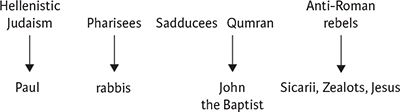
Conclusion
The successful rise of Christianity may be understood as the transformation of a charismatic teacher and miracle-worker, Jesus of Nazareth, who came from an environment that was generally favorable to a nationalist movement (as is shown by numerous passages in Josephus about anti-Roman violence in the Galilee, as well as such passages in the New Testament as Lk 13.1 and Acts 5.37)—and who Pontius Pilate, the Roman governor, took to be the leader of such a movement, and handled accordingly—into the personification of a universalist mission to all of humankind. Whatever social and ethical messages Jesus preached, his disciples understood him to be announcing the coming restoration of the Kingdom of Israel (Lk 24.21; Acts 1.6–8), which of course entailed the end of Roman rule in Judea, and that is what brought Pilate to crucify Jesus. What made Christianity succeed was its ability to transform the belief that a “Son of David” would restore the Kingdom of Israel into the belief that a “Son of Man” had inaugurated the Kingdom of God. Thus, he who failed tragically at one end of the spectrum of Jewish movements was, eventually, hugely successful when adopted by the other.
Pharisees
The name “Pharisees” is derived from the Aramaic perish, pl. parishaya, Hebrew parush, pl. perushim, “separate,” or, in this usage, “separatists.” The Greek form, pharisaios, most likely is based on the Aramaic. This designation most probably refers to their separation from ritually impure food and from the tables of the common people, later termed the ʿam ha-ʾaretz (“people of the land”) in rabbinic sources, who were not scrupulous regarding the laws of levitical purity and tithes (t. Avod. Zar. 3.10; b. Ber. 47b; b. Git. 61a). [For an alternative derivation, see “Jewish Movements,” p. 614.] For some Pharisees, strict observance of purity and tithing laws characterized the religious elite, but this distinction was in no way connected to economic class distinctions. Tannaitic sources describe those who observed the laws of purity as ḥaverim, “associates” (m. Demai 2.3; t. Demai chs 2–3) and groups of such people as ḥavurot (sing. ḥavurah, t. Demai 2.14). The sources, however, never connect the terms “Pharisee” and ḥaver. In rabbinic sources (m. Makk. 1.6 in MSS Kaufmann, De Rossi 138 and Paris), the Pharisees are sometimes designated as “the sages” (Heb ḥakhamim), an anachronism resulting from the view of the rabbis that they were the direct continuators of the Pharisaic tradition (m. Avot 1). Although the influence of the Pharisees grew steadily during the Hasmonean and Herodian periods until they came to dominate the religious life of the Jewish people, Josephus informs us that they numbered only six thousand in Herodian times (Josephus, Ant. 17.42).
The Pharisees had three major characteristics. First, they represented primarily artisans and small farmers. Second, and perhaps as a consequence of their social status, they were only moderately Hellenized, using Greek technical vocabulary and exegetical practices, and partaking of Hellensitic material culture, but for the most part their religious ideas were not influenced by Greek thought. Third, they accepted what they termed “traditions of the fathers” (Gk paradosis ton presbuteron), nonbiblical laws and customs said to have been passed down through the generations (Mt 15.2; Mk 7.5; cf. Gal 1.13). These teachings supplemented the written Torah and were a part of what the rabbis would later call the Oral Law. Josephus reports that they were extremely scrupulous in observing the Law and they were expert in its interpretation (Josephus, Ant. 18.12; J. W. 2.162).
Many views espoused by the Pharisees were later incorporated into the rabbinic tradition as is clear from comparison of specific anti-Pharisaic polemics in Qumran documents with tannaitic sources. The Pharisees accepted the notions of the immortality of the soul and of reward and punishment after death (Josephus, Ant. 18.14; J.W. 2.163), and believed in angels (Acts 23.8), all of which the Sadducees denied (Josephus, Ant. 18.16; J.W. 2.165; Acts 23.8). (Their belief in resurrection of the body at the End of Days appears only in tannaitic sources [m. Sanh. 10.1].) In contrast to the Sadducees, for whom free will was complete and inviolable (Josephus, Ant. 13.173; 18.16; J.W. 2.163–4), the Pharisees accepted the idea of divine providence, believing that God allowed human beings free will but could play a role in human affairs (Josephus, Ant. 13.172; 18.13; J.W. 2.162–3). (The Essenes maintained a belief in absolute predestination, as did the sect of the Dead Sea Scrolls.) Because these views are recounted in Greek philosophical garb by Josephus, our only contemporary source for the theological disputes between the Pharisees and Sadducees, some have disputed their historical accuracy. After all, the Dead Sea Scrolls strongly indicate that sectarian differences in the Second Temple period resulted to a great extent from differing interpretations of the Hebrew Scriptures. However, since the actual points of view taken by each group do indeed emerge from varying interpretations of the biblical tradition, it is likely that the basic outlines of the controversy provided by Josephus are an accurate reflection of the disputes of the earlier Hasmonean period.
After the Roman conquest (63 bce), the Pharisees were divided over one of the most burning issues of the period. Some advocated an accommodationist policy toward the government so long as it allowed them to practice Jewish traditions in the manner required by the Pharisaic view. For this reason, Pharisees argued against revolting against Rome (Josephus, J.W. 2.417), clearly the position of Yoḥanan ben Zakkai (b. Git. 66a-b). During the Revolt, the Pharisee Simeon ben Gamliel (I) served in the provisional government and appears to have been a moderate supporter of the Revolt (Josephus, Life 192; 216; J.W. 4.159–60). Others maintained that no government was acceptable, whether controlled by non-Jews or by nonobservant Jews, so long as it was not built on the Pharisaic notion of Torah observance, and they called upon their compatriots to rise in revolt. Among them were some of the earliest rebels against Rome (Josephus, Ant. 18.23). This dispute can be traced throughout the history of Pharisaism and, after the Great Revolt of 66–73 ce, continued in rabbinic Judaism, expressing itself again in the dispute among the tannaim regarding support for the Bar Kochba Revolt (132–135 ce) and the messianic character of its leader (y. Taʾan. 4.6,68d).
The Pharisees first appear by name in the writings of Josephus, in his description of the reign of Jonathan (152–143 bce), brother of Judah the Maccabee (Josephus, Ant. 13.171). Many scholars have therefore attempted to identify them with or to locate their origins in the Ḥasidim who were at one time allies of Judah in the Maccabean Revolt (1 Macc 2.41). This theory, however, cannot be substantiated.
Rabbinic sources trace the Pharisees back to the “Men of the Great Assembly” (ʾanshei kenesset ha-Gedolah) who, the tannaim (m. Avot 1.1) believed, provided Israel’s religious leadership in the Persian and early Hellenistic periods (from ca. 400–ca. 250 bce). Some modern scholars have associated the Soferim (“scribes”) mentioned in rabbinic sources with the Men of the Great Assembly and assume that they were forerunners of the Pharisaic movement. They may be connected with the “scribes” associated closely with the Pharisees in the Gospels (e.g., Mt 5.20; Mk 7.5; Lk 5.21). Unfortunately, the historical evidence does not allow any definite conclusions here; indeed, many scholars doubt the reliability of the later rabbinic sources about the rulings of the Men of the Great Assembly (e.g., b. Ber. 33a; y. Meg. 3.7 [11c]; b. Meg. 2a). All that can be said is that the Pharisees could not have emerged suddenly, full-blown, in the Hasmonean period. Their theology has significant continuity with certain parts of the Tanakh, such as their belief in free will and reward and punishment. Their organization must have been in formation somewhat earlier than the Hasmonean period. How much earlier and in what form, we cannot say.
The Pharisees appear in Hasmonean times (152–63 bce) as part of the Gerousia, the “council of elders,” in coalition with the Sadducees and other elements of society (1 Macc 7.33; 14.20,28 [presbuteroi]; see “The Sanhedrin,” p. 602). Under the Hasmonean priestly rulers John Hyrcanus (134–104 bce) and Alexander Janneus (103–76 bce), the turn of the Hasmoneans toward increased Hellenization and alliance with the Sadducees led the Pharisees further and further into the political arena, resulting in confrontation with the Hasmoneans (b. Qidd. 66a and Josephus, Ant. 13.288–96, which probably refer to the same event). As the Hasmoneans became increasingly Hellenized, the Pharisees expressed greater opposition to them, not because the Pharisees totally eschewed all Hellenistic influence, but because they saw the Hasmoneans as having gone too far with their internecine struggles and their imitation of non-Jewish Hellenistic kings. Under John Hyrcanus (134–104 bce), there was a decisive Hasmonean tilt toward the Sadducees, a kind of realignment of old overlapping elites. In the time of Alexander Janneus (103–76 bce) the Pharisees encouraged an invasion of Judea by Seleucid Syria because of their strong opposition to the king who, as a result, was defeated by the Seleucid Demetrius III Eukairos in 89 bce. During the reign of Salome Alexandra (76–67 bce) the Pharisees were the dominant element in the Gerousia (Josephus, Ant. 14.408–9). However, the extent of their influence over society as a whole has been exaggerated by many scholars who retrojected the Talmud’s picture, according to which later Jewish life was dominated by the rabbinic establishment, itself a matter of scholarly debate.
According to rabbinic sources, the Pharisees dominated the ritual of the Jerusalem Temple in much of Hasmonean and Roman times (e.g., m. Yoma 1.5–6, but contrast m. Sukk. 4.8; Josephus, Ant. 13.372 probably refers to the same event). The Dead Sea Scrolls (e.g., in 4Q169 3–4ii2) refer to the Pharisees as “Ephraim,” “lying interpreters” (lit., “seekers after smooth things”), and by other designations. A number of polemical statements against the Pharisees indicate that the views assigned to the Pharisees in several mishnaic disputes, especially regarding sacrificial and purity laws, are precisely those that were in practice in the Jerusalem Temple (see 4Q MMT section B). Whether the dominance of the Pharisaic view was due to the political power of the Pharisees, or whether their positions were indeed commonly held views in the Hasmonean period, cannot be determined with certainty. Dead Sea Scrolls texts condemn the Pharisees for false legal exegesis, calling them doreshe ḥalaqot, “lying interpreters” (e.g., CD 1.18; 1QHa 10.32) and bonei ha-ḥayyitz “builders of the wall” (CD 4.19). These texts include numerous polemics against Pharisaic legal rulings such as that which allowed polygyny (CD 4.20–5.2) and marriage of uncles to nieces (CD 5.7–11).
Like the Scrolls, the New Testament supplies additional information about the Pharisees in the context of a sustained polemic against them—and this polemic needs to be considered before using the New Testament as a historical source for reconstructing actual Pharisaic practices and attitudes in the first century ce. Clearly, those seeking to establish a historical picture of the Pharisees, to which the New Testament can make an important contribution, must correct for anti-Pharisaic and anti-Jewish animus that attaches to much of the information about the Pharisees. To some extent the negative portrayal of the Pharisees may stem from early debates between the followers of Jesus and Pharisaic sages. However, the strong antipathy to the Pharisees in the New Testament is no doubt a reflection and retrojection backwards of the ongoing rejection of emergent Christianity by the Pharisees and the Jewish community as a whole.
In the Gospels, the Pharisees appear to be numerous in Jesus’ world and are portrayed most often in opposition to Jesus, often disagreeing about issues of Jewish Law (e.g., Sabbath Law; see Mt 12.14 || Mk 2.23–3.6 || Lk 6.1–11). The belief in an afterlife, immortality of the soul (Mt 10.28, cf. Lk 12.4) and the hope for imminent redemption (“the kingdom of God,” Mt 24.3–44 || Mk 13.3–37 || Lk 21.7–33) attributed to Jesus in the Gospels are also points of agreement with his Pharisaic background. Paul identifies himself as a Pharisee, even after he came to believe in the messiahship of Jesus (Acts 23.6; 26.5). Further, he describes himself as blameless under the law (Phil 3.5), meaning that he maintained his halakhic observance.
Like the rabbinic sources mentioned above, the New Testament attributes to the Pharisees the practices of purity and tithing and, like Josephus, a predilection for legal interpretation (Mk 2.1–3.6; Mt 23.5,23). The Gospels regard the Pharisees as a table-fellowship sect (see “Food and Table Fellowship,” p. 650) who ate their private, non-sacral meals in a state of purity usually only reserved for the Temple, washed before meals (Mk 7.1–4; Mt 15.1–2,23.25–26 || Lk 11.39–41), and stressed the proper tithing of produce (Lk 18.12; Mt 23.23–24 || Lk 11.42). This portrait is in agreement with the tannaitic prescriptions for the ḥaverim (m. Demai 2.2, t. Demai 2.2). Mt 23.5 notes that like many other Jews they wore tefillin (phylacteries) and had ritual fringes on their garments. Even when some Pharisees accepted belief in the messiahship of Jesus, they retained their staunch observance of Torah (Acts 15.5; 22.3; 26.5).
Luke portrays them as teachers of the common people who address Jesus with respect (Lk 5.17; 9.39), invite him to dine with them (Lk 7.36; 11.37; 14.1), and offer him help when he is in trouble (Lk 13.31). Gamaliel, a member of the Sanhedrin, saves the apostles from death for preaching in the name of Jesus (Acts 5.33–39).
The Gospels overwhelmingly portray the Pharisees in a negative light. They are often pictured as ready to challenge Jesus, entrap him, or test him (e.g., Mt 12.38; 16.1; Mk 8.11; Lk 11.53–54). While a simple reading of the New Testament would attribute these controversies to Jesus himself, many scholars view them as reflecting post-crucifixion disagreements between Pharisaic sages and early followers of Jesus. Jesus’ approach to ethics and his teachings of love are in actuality derived from and shared with Pharisaic teachings. Despite this affinity, Jesus rejects many of the Pharisaic interpretations that were part of their legal tradition, which combined the biblical commandments with extrabiblical traditions. Rather, he often accepted more lenient interpretations, rejecting Pharisaic stringencies that went further than that which had been commanded in the Bible itself (Mk 7.5–8). Further, Jesus is portrayed as criticizing them as hypocritical (Lk 11.39–44), greedy (Lk 12.2; 16.14–15), and unwilling to undertake repentance (18.9–14). These complaints no doubt reflect the later hostility engendered by Jewish rejection of Jesus’ messiahship. It is striking that Jesus’ complaints throughout the Gospels are mostly directed at the Pharisees, yet his ethical preaching most resembles that of this group and can be contrasted with that of other groups, most notably the Qumran sect that preached hatred of outsiders (e.g., 1QS 1.10–11).
Jesus also criticizes specific Pharisaic practices such as the prohibition of harvesting grain (Mt 12.1–2) or healing (Jn 9.13–17) on the Sabbath, and the refusal to eat with sinners and tax collectors (Mk 2.15–16), the latter not actually a Pharisaic-rabbinic prohibition. Contrary to some claims, the Pharisees did not disdain or reject the poor. Their opposition was to transgression of the Torah’s commands and to collaboration with the Roman authorities. In Matthew, Jesus disdains the teachings of the Pharisees and Sadducees (Mt 15.14; 16.11–12) but then encourages following Pharisaic teachings while rejecting their actual practices (Mt 23.2). This suggests that Jesus’ problem lies not with what they preach, but with their neglect of their own teachings, and so he labels them hypocrites, who want only to appear pious so as to gain deference and be called by honorific titles (Mt 23.4–7).
The picture of the Pharisees in the New Testament is somewhat clouded by several texts that lump together the Pharisees and the Sadducees, especially in Matthew. Here they are both representatives of Jewish leadership, along with the scribes and priests (Mt 3.7; 16.1–6), from whom the kingdom will be taken away (Mt 8.12; 21.43–45).
Josephus stresses the popularity of the Pharisees among the people (Josephus, Ant. 13.298; 18.15). This must certainly have been the case in the last years of the Second Temple period, for which Josephus had first-hand experience. Their popularity, together with their particular approach to Jewish Law, combining a fixed written Law with an evolving and adapting Oral Law, laid the groundwork for the eventual ascendancy of the Pharisees in Jewish political and religious life. This approach provided Judaism with the ability to adapt to the new and varied circumstances it would face in Talmudic times and later, and was a major factor in ensuring the preservation of Judaism.
Messianic Movements
Jesus of Nazareth and his followers belonged to an early Jewish movement centered on a charismatic figure who proclaimed an ideal future in which the power of the God of Israel would be dramatically manifested and universally recognized. Their movement was not, however, the only one of its kind in the first century bce through the second century ce. Similar movements during this period promised a sudden end of the present age, which they regarded as evil and corrupt, and the inauguration of a new age in which the wicked would be punished and the world ruled in righteousness.
The Messiah in Early Jewish Thought
Evidence for these movements is sparse and mostly derives from unsympathetic witnesses. The concept of a divinely appointed deliverer, however, is widely attested in early Jewish apocalyptic literature. Although no apocalyptic texts can be directly connected to these movements, the eschatology they present provides an important context for understanding both such charismatic leaders and their followers.
An ideal Davidic king is one of the most prominent types of eschatological redeemer. The mid-first century bce Psalms of Solomon (17.21–24,26–27; 18.6–7) provides a classic description:
Behold, O Lord, and raise up for them their king,
the son of David, at the time which you choose, O God,
to rule over Israel your servant.
And gird him with strength, to shatter unjust rulers,
to purge Jerusalem from nations that trample (her) down to destruction;
in the wisdom of righteousness to thrust out
sinners from the inheritance …
to crush all their substance with a rod of iron;
to destroy the lawless nations with the word of his mouth …
And he will gather together a holy people,
whom he will lead in righteousness...
And he will not allow injustice to lodge any more in their midst,
and no one knowing evil will dwell with them …
Blessed are the ones in those days,
in that they will see the good things of the Lord,
which he will perform for the generation that is to come,
under the rod of discipline of the Lord’s anointed.
Here the future ideal Davidic king is called the Lord’s “anointed one,” a designation also used for the figure who will conquer the nations and judge the world in 2 Baruch and 4 Ezra (2 Esd 3–14), two lengthy apocalypses composed after the destruction of the Second Temple in 70 ce (2 Bar. 29–30; 39–40; 72; 4 Ezra 7; 11–13). Notably, this king conquers not by military might; his weapon is “the rod of his mouth,” based on Isa 11.4.
The term “anointed one” translates the Hebrew mashiaḥ (Gk christos). The Tanakh refers to human kings as “the Lord’s anointed” (e.g., 1 Sam 12.3; Ps 2.2), because they were “anointed” (Heb m-sh-ḥ) with oil when they began their reigns (Judg 9.8–15; 2 Sam 5.3; 1 Kings 1.39). Psalms of Solomon and 4 Ezra also call the “anointed one” a descendant of David, reflecting the biblical tradition of God’s promise to David that his descendants would rule forever (2 Sam 7.13; 22.51; Ps 89.4–5,29–37). Connected with this promise to David is the hope that the Davidic king with the support of God will defeat the enemies of Israel (e.g., Ps 2.8–9) and will rule over a period marked by peace, prosperity, and justice (e.g., Isa 9.5–6; 11.1–10). After the conquest of Jerusalem by the Babylonians in 586 bce, hope for some centered on an ideal ruler from David’s line who would restore Israel’s fortunes and the Temple. This figure is designated with a number of terms, such terms as “branch” (Heb tzemah: Jer 23.5; 33.15; Zech 3.8; 6.12) and “prince” (Heb nasi: the characteristic designation of the ideal ruler in the book of Ezekiel [e.g., Ezek 34.23; 37.25]). Zech 3.8 and 6.12 explicitly identify “the branch” as the Davidic descendent Zerubbabel (cf. Hag 2.4–9,21–24). “The Messiah” (ha-Mashiaḥ), with one possible exception (Dan 9.25–26), is not used in the Tanakh for this future ideal king.
After Davidic kingship did not succeed in reestablishing itself in the Persian period, expectation of an ideal Davidic ruler was eventually projected into a future culmination of history. This hope intensified in apocalyptic circles, likely comprised of scribes intimately familiar with the rich resources of Israel’s literature; these writers saw foreign rulers such as the Hellenistic king Antiochus IV (ruled 175–164 bce), best known today in relation to the festival of Hanukkah, and the succession of Roman rulers beginning in the first century bce as oppressors of God’s people, unjustly claiming for themselves the land of Israel. Some writers also condemned Jewish rulers such as the Hasmonean kings (142–63 bce) and Herod the Great (40–4 bce) and anticipated that God’s agents would end their reigns. In these circles many of the passages from the prophets and Psalms, as well as such poetic verses such as Gen 49.10 and Num 24.17, were interpreted eschatologically in relation to the Davidic king.
One major function of the Messiah is to defeat all agents of oppression, human and superhuman (Pss. Sol. 17.24; 4 Ezra [2 Esd] 13.38). However, following the Tanakh, the focus of the texts is less on the messianic figure than on the messianic age, the time when God’s justice, rather than cosmic and earthly evil rulers, would prevail. Apocalyptic texts such as 2 Baruch (32.4) and 4 Ezra (7.26) provide ample evidence of the supernatural character of the messianic age, such as a new Jerusalem descending from heaven (see also Rev 21.2) and the resurrection of the dead (4 Ezra 7; 2 Bar. 50–51). 4 Ezra 7.29–32 also reports that the Messiah son of David will die seven days before the resurrection of the dead, the final judgment, and the beginning of the new age.
Not only kings were anointed in ancient Israel, and therefore not all “anointed ones” were Davidic kings. Elijah is instructed to “anoint Elisha...as prophet in your place” (1 Kings 19.16); in Isa 61.1 the prophet refers to himself as “anointed.” Anointing was also part of ordination to priesthood (e.g., Ex 29.7), and the high priest is sometimes called the “anointed priest” (Heb ha-kohen ha-mashiaḥ, Lev 4.3,5,16; 6.15 [Heb v 7]). These texts undergird the development of prophetic and priestly eschatological messianic figures discussed below.
Finally, not all messianic figures—defined as agents of redemption and not necessarily as “anointed”—were human. In Dan 12.1, the angel Michael delivers the righteous at the end-time when the wicked king of the north (Antiochus IV) is about to attack Jerusalem (Michael might also be identified with the “the one like a son of man” [i.e., human being] in Dan 7.13–14). In the Similitudes of Enoch (1 En. 37–71; first century ce), a preexisting heavenly Son of Man, reflecting the figure described in Dan 7 (cf. 4 Ezra 13.26), also called the “Chosen One,” “Righteous One,” and “Messiah,” executes the final judgment (1 En. 46–53), punishing the wicked and rewarding the righteous (1 En. 62). Thus there was no single “messianic” template in either the Tanakh or Second Temple Judaism. Nor can we determine from the literature alone how extensively messianic speculation permeated the Jewish world in these periods.
As an apocalyptic Jewish movement, the earliest followers of Jesus of Nazareth in different times and places adopted and developed the wide variety of diverse messianic ideas current in ancient Judaism. Jesus as Davidic king, for example, is emphasized in the Gospel of Matthew and in Luke-Acts, but it is much less prominent in the Gospels of Mark and John. Jesus as high priest is featured in Hebrews. Jesus’ prophetic role is seen both in the revelatory discourses attributed to him that employ language and images derived from Daniel and the biblical prophets (e.g., Mk 13; Mt 24; Lk 21), and in the accounts of his miracles, recalling Elijah and Elisha (e.g., Lk 7.11–17 [cf. 1 Kings 17.17–24; 2 Kings 4.32–37; Lk 4.25–26]; Mk 6.30–44 // Mt 14.15–21 // Lk 9.12–17 // Jn 6.5–14 [cf. 2 Kings 4.43–44]). Jesus as a heavenly divine being pervades the entire New Testament. In each of these cases Jesus is presented as superseding all earlier Jewish kings, priests, prophets, and heavenly beings. Nowhere, however, do Jewish messianic expectations reflect parallels to such ideas as the Messiah’s death as expiation for sins, or the distinctive message of the Gospel of John, equating the Messiah with God.
Messianic Leaders and Their Followers
The term “messiah” only rarely appears in the texts that describe “messianic” leaders and their movements. Scholars often designate these leaders and movements as “messianic” because they proclaim a radical transformation of the world and the restoration of Israel’s independence under the leadership of charismatic figures, often claiming to be agents of divine deliverance. These figures fit into the three main categories of prophets, kings, and priests.
Prophetic Figures
Josephus is the chief source for “messianic” figures. Whereas many Jews regarded these men as prophets, Josephus consistently calls them deceivers and goētes (Gk “charlatans, enchanters”), and he associates them with political rebels, the chief villains in his history.
Josephus provides tantalizingly brief reports for six such individuals: (1)Under the Roman procurator Fadus (44–46 ce), a certain Theudas led a large multitude, who brought their possessions, to the Jordan River, which he promised they could cross after the waters parted at his command. Many were massacred by a cavalry squadron sent by Fadus. Theudas was killed and his head was brought to Jerusalem (Ant. 20.97–99; cf. Acts 5.36). (2)In the time of Felix (52–60 ce), a man from Egypt led several thousand followers through the wilderness to the Mount of Olives; he promised them that at his command the walls of the city would fall and that they would enter the city where he would be installed as ruler. Roman soldiers killed 400 and took 200 prisoners, but their leader escaped (J.W. 2.261–63; Ant. 20.169–72; cf. “the Egyptian” in Acts 21.38). (3)Roman troops sent by Festus (60–62 ce) killed a man (whom Josephus does not name) and those who followed him into the wilderness, where he promised that they would find “salvation and rest from troubles” (Ant. 20.188). (4)In the last days of the Temple, a prophet proclaimed that God had commanded the people to go up to the Temple court to receive “the signs of their deliverance.” Instead 6,000 were killed when the portico where they had taken refuge caught fire (J.W. 6.285). (5)In the period immediately after the destruction of Temple, a weaver named Jonathan, whom Josephus associates with the Sicarii (Gk “dagger men,” rebels who assassinated those whom they saw as enemies of the Jews [J.W. 2.435; 7.432]), led a multitude of what Josephus describes as “the poor” of Cyrene into the wilderness, where he promised to show them “signs and apparitions.” Although the provincial governor initially spared Jonathan and used his testimony to accuse the local Jewish aristocracy of sedition and confiscate their wealth, he was executed after an inquiry ordered by Vespasian (J.W. 7.437–50). (6)A Samaritan, perhaps connected with the expectation of an eschatological Mosaic prophet (the “taheb”) attested in later Samaritan texts, organized an armed multitude for an ascent of Mount Gerizim (see Jn 4.20–21), promising them he would show them the sacred vessels that Moses had buried there. Their slaughter by troops sent by Pilate (26–36 ce) was the occasion for the prefect’s being recalled to Rome to face accusations the Samaritans leveled against him (Ant. 18.85–87).
Josephus’s hostile reports tell us little about the content of these prophets’ messages. They likely condemned the present situation and promised blessings for the elect who followed them. Some probably claimed the role of the prophet like Moses who, according to an interpretation of Deut 18.15–19 (cf. 1 Macc 14.41), they understood would arise at some future time. The wilderness recalls the place where the Israelites encountered God directly and from which they conquered the Promised Land. It was therefore an appropriate location from which to launch a new conquest that would purify the land from idolatrous foreign oppressors and corrupt Jewish leaders. (For the idea of the wilderness as a site for the righteous preparing the way of the Lord, see the interpretation of Isa 40.3 by the group who wrote the Dead Sea Scrolls [1QS 8.13–14]). The extent to which these figures planned or engaged in military action is hard to gauge. Josephus claims several did, and Rome’s swift and brutal response might support such a conclusion. But caution is required; governments are quite capable of suppressing groups critical of present systems and anticipating a new age, and yet who demonstrate their faith not by military means but by relying on the imminent arrival of supernatural change.
Another example of a nonviolent prophetic figure executed by political authorities is John the Baptist. According to Josephus, John
exhorted the Jews, training themselves in virtue and practicing righteousness toward one another and piety toward God, to join in baptism. For he said in this way indeed baptism would appear acceptable to God, not by using it to gain pardon for some sins, but for the purification of the body, since the soul had already been thoroughly cleansed in advance by righteousness. (Ant. 18.116–17)
In Josephus’s present ation of John’s teaching, baptism was a ritual of purification (e.g., Lev 15; 16.4) that signified but did not effect forgiveness (see “Baptism and Eucharist,” p. 674). The forgiveness of God followed from the cleansing of the inner life by the practice of virtue. But Josephus’s benign portrait of John as a teacher of ethics, like his description of the Essenes and the other Jewish movements, is meant to appeal to an educated Roman audience. More historically probable is the Gospels’ version of a prophetic Elijah-like figure demanding that Israel repent before the imminent judgment. Together with repentance, John’s distinctive rite of baptism, with which he is most prominently identified (both Josephus and the Gospels call him “the Baptist,” a title otherwise unknown in the first century), is apparently essential for the forgiveness of sins and protection from divine punishment.
Like several of the other prophets Josephus mentions, John attracted a following in the wilderness where he performed an action associated with deliverance. That he had disciples suggests that he founded a movement composed of those who had undergone the rite, though not necessarily of an organized community.
According to Josephus (Ant. 18.118–19), Herod Antipas executed John because he feared that John’s influence over the people might lead to sedition. The Gospel accounts state that John was executed for denouncing Herod’s marriage to his brother’s wife (Mt 13.4–6; Mk 6.17–18). The two motivations do not necessarily conflict.
The Gospels show John subordinating himself to Jesus. Historically, this is unlikely, given that John baptized Jesus and that John’s followers remained loyal to him even after Jesus began to gather his own disciples (cf. Mk 2.18; Acts 19.3). Had John thought Jesus to be the Messiah, he would not have retained his own disciples. The connection of John to Elijah also suggests that John was not, historically, Jesus’ “forerunner.” In the Tanakh, Elijah is viewed as the one to announce “the day of the Lord” (Mal 4.5 [HB 3.23]) because he never died (2 Kings 2.11). His role is not, however, to announce another agent of God.
Josephus mentions several individuals, including himself, who make predictions but who do not have followers (cf. J.W. 2.112–13; 6.300–09; Ant. 15.373–79; 17.345–48). Although he never directly calls himself a prophet, Josephus presents himself as having a prophetic mission and as being a divinely guided interpreter of the ancient prophets. He was convinced that he, like Jeremiah, understood that God decreed the destruction of the Temple for the people’s sins and that those who claimed to be prophets promising security for God’s people and Temple were offering false hopes (J.W. 5.391–93; Ant. 10.79–80; cf. Jer 7). Josephus also insists that he recognized, through divine inspiration, that God chose Vespasian to rule the world (J.W. 3.351–54, 400–402; cf. Suetonius, Vesp. 4.5; 5.6; Tacitus, Hist. 5.13.2).
Royal Figures
From the death of Herod the Great in 4 bce to the Second Revolt against the Romans in 132–135 ce, a number of popular figures with substantial followings presented themselves as Jewish kings. Among all these royal figures, however, there is no explicit claim to Davidic ancestry. The nature of the evidence and the short-lived and unsuccessful character of these movements also prevent us from getting any specific sense of the sort of world they hoped would replace the present age.
Describing the political instability following Herod’s death, Josephus mentions in succession three individuals who claimed kingship. Judas, the son of Ezechias, attacked the royal palace at Sepphoris, captured arms and possessions, and proceeded to plunder the wealth of the countryside in his zeal for “royal rank” (see Acts 5.37). Herod’s slave Simon of Perea, noted for his size and strength, “dared to put on the diadem,” and with his followers pillaged the royal palace in Jericho and “many other royal residences in many parts of the country.” Finally, Athronges, a shepherd, like Simon “distinguished by great stature and feats of strength,” ruled as a king, setting up a council and putting each of his four brothers, also known for their size and acts of valor, in charge of a band of fighters. Their targets were both Romans and Herodian troops (J.W. 2.56–65; Ant. 17.271–84).
For Josephus, these are all “brigands” who had neither the character nor the background to claim royal status. Yet these figures may represent a continuation of a biblical tradition of charismatic leaders such as the judges, Saul, and especially David, men who reach power through their physical stature and bravery and who act against their enemies. Since David is the most prominent example of this type and since Josephus’s account suggests the figures had some Davidic features (e.g., shepherd turned guerilla fighter), it is possible these charismatic figures identified with David, and that their supporters accepted that identification.
According to Josephus, two of the leaders of the First Revolt also claimed royal honors. At the beginning of the war, Menahem, the leader of the Sicarii, raided Masada to capture weapons, then entered Jerusalem “like a king” (J.W. 2.433–34). Soon thereafter, supporters of the Temple captain Eleazar, one of the revolt’s first leaders, and the son of the high priest Ananias whom Menahem’s men had murdered, attacked and killed Menahem in the Temple, where he had gone to worship “arrayed in royal garments” (J.W. 2.443–48).
A religious background to Menahem’s royal claims can be inferred from the report that his father, Judas the Galilean, called for a revolt sixty years before. Judas declared that agreeing to a census, the Roman assessment of Jewish property, meant rejecting God as sole master (see Ex 30.12; 2 Sam 24) and that the people could expect divine help if they rebelled (Josephus, J.W. 2.118, 443; Ant. 18.4,23; cf. Lk 2.1–5; Acts 5.37).
Of all the warriors claiming kingship Josephus mentions, the most important was Simon bar Giora. A hero in the earlier stages of the war, he left Jerusalem as others took charge of the revolt, gathered a large force with which he returned to the city, and established himself as one of the leaders of the Jewish rebels. His execution at the climax of the Roman victory celebration indicates that the Romans regarded him as the most prominent enemy general (J.W. 7.153–54). His royal self-understanding can be seen in his dramatic surrender: from the site where the Temple stood, he emerged dressed in white tunics and a purple mantle (J.W. 7.29–31).
The names of the leaders are among the few details recorded for the Jewish revolts that swept through Cyrenaica, Egypt, and Cyprus in 115–117 ce during the reign of the emperor Trajan and that resulted in the annihilation of the well-established Jewish communities of these regions. The Roman historian Cassius Dio says that a certain Andreas led the revolt in Cyrenaica and Egypt and that Artemion led the revolt in Cyprus (Roman History 68.32). According to Eusebius, the leader of the revolt in Cyrenaica and Egypt was named Lukuas; Eusebius ascribes to him the title king (Hist. eccl. 4.2). The extent of the revolt and the number of Jews participating in it, the attacks on Greek and Egyptian religious sites, and the title “king,” all raise the possibility that the leader(s) were viewed as agents of God.
According to rabbinic tradition, Akiva ben Joseph (ca. 50–135 ce), the most prominent rabbi of his generation, declared Simon Bar Kosiba (Kochba), the leader of the Second Revolt against the Romans in 132–135 ce, to be the Messiah (y. Taʾan. 4.8 [68d]; Lam. Rab. 2.4); Cassius Dio (Roman History 69.12.1–14.3) and Eusebius (Hist. eccl. 4.6.1–4) provide the most extensive non-Jewish sources for the revolt. Rabbinic comments on Bar Kosiba, however, are generally hostile, exemplified by the usual reference to him as Bar Koziba (“son of a liar”) and by Rabbi Yoḥanan ben Torta’s retort to Akiva: “Grass will grow between your cheeks and he [the Messiah] still will not have come” (y. Taʾan. 4.8 [68d]; Lam. Rab. 2.4). An association of Bar Kosiba with Num 24.17 (“A star [Heb “kokhav”] shall go forth out of Jacob”), said to have been made by R. Akiva (y. Taʾan. 4.8 [68d]; Lam. Rab. 2.4), gave rise to the nickname bar Kochba (“son of a star”), which is also found in the Christian writer Justin (1 Apol. 1.31.6), who wrote shortly after the revolt concluded.
Letters discovered in caves in the Judean desert establish that his actual name was Simon Bar Kosiba and that he bore the title Nasi of Israel, a word that can mean “leader” or “prince” but that refers to the future Davidic king in the latter part of Ezekiel (e.g., 34.23–24) and is a common designation of a Davidic Messiah in the Dead Sea Scrolls (see below). The letters, though brief and fragmentary, present a person projecting great authority, who enforces strict military discipline, dispenses justice, and is extremely concerned about religious observance, even in the midst of difficult circumstances. Coins struck by the rebels with the image of the Temple, and some with the name “Eleazar the Priest,” suggest that one of their goals was capturing Jerusalem and rebuilding the Temple. Although the rebels inflicted heavy casualties on the Roman army, the war ended with a decisive defeat at Bethar. Rome permitted Jews to set foot in Jerusalem, refounded and renamed Aelia Capitolina, only on the ninth of Av to mourn the destruction of the Temple.
Priests
For much of the Second Temple period, the high priest served as the political as well as the religious leader of the Judean Jewish community. It is not surprising then that an ideal future might feature an ideal high priest who would serve in a purified Temple. Zechariah views the high priest Joshua and the Davidic king Zerubbabel in idealized roles (Zech 3–4), calling them in 4.14, “the two anointed ones.” It is possible that the priest Eleazar, associated with the royal messiah Simon Bar Kosiba, played such a role.
The best-documented group that viewed the ideal high priest as the most authoritative figure in the new age is the community reflected by the Dead Sea Scrolls. In the first-century ce, they looked back on their idealized priestly founder and leader, the Teacher of Righteousness (second or first century bce), who transmitted inspired interpretations of the Torah and Prophets that formed the basis for their theology and practice (1QpHab 7.4–5). They also looked to an idealized future priest, sometimes designated “Messiah of Aaron” (1QS 9.11; CD A 12.23; 14.19; CD B 19.10–11), who would stand at the head of the Children of Light in their final battle against the Children of Darkness (1QM 15.4) and would have precedence in the community council of the messianic age (1QSa 2.12–14,19–20).
The scrolls also suggest an important place for a Davidic Messiah designated “Prince of the Congregation (nesi ha-ʿedah: 1QSb 5.20; 1QM 5.1; 4Q161 2.15; 4Q285 frags 6+4, 2; 4Q285 5.4), “Branch of David” (tzemaḥ david [see above on Jer 23.5 and 33.15]: 4Q161 3.18; 7.10; 4Q174 1.11; 4Q 252 5.3–4 [identified with the “Messiah of Righteousness]; 4Q285 3–4,5), and “Messiah of Israel” (1QS 9.11; 1QSa 2.14; CD A 14.19; CD B 19.10–11). Several texts mention a priestly and a royal Messiah together (see esp. the phrase “Messiah[s] of Aaron and Israel”: 1QS 9.11; CD A 14.19; CD B 19.10–11; CD A 7.20 and 4Q171 1.11 pair the “Interpreter of the Law,” probably a priestly figure, with a royal Messiah). An eschatological prophet appears together with the Messiahs of Aaron and Israel in 1QS 9.11. (See “The Dead Sea Scrolls,” p. 710.)
Rabbinic Traditions
Many of the themes found in the apocalyptic writings, including the lack of any consistent or systematic understanding of the Messiah or messianic age, also appear in rabbinic texts and in the liturgy the rabbis shaped. For example, they are brought together in the weekday Amidah prayer (Shemonah Esrei or “Eighteen Benedictions”), composed by the end of the first or beginning of the second century ce. Still recited three times a day by traditional Jews (although the words and order of blessings have undergone changes), this prayer praises God who resurrects the dead (Blessing 2) and brings a redeemer to Israel (1). It also contains petitions for the return of the dispersed exiles to the land of Israel (10), restoration of judges and counselors (11), rebuilding of Jerusalem and the Temple (14), restoration of the Temple service (17), and the establishment of the throne of David (15). The petition requesting the coming of the Messiah has been transmitted in two versions. In the Babylonian tradition, still recited today, blessing 15 reads: “May you swiftly cause the branch of David your servant to flourish, and may his horn be raised through your deliverance” (cf. Isa 11.1 and Jer 33.15). The fourteenth blessing in Palestinian tradition (corresponding to blessings 14 and 15 in the Babylonian tradition), found in fragments from the Cairo Geniza, mentions the term Messiah explicitly: “Have mercy, Lord our God...on the kingdom of the house of David, the Messiah of your righteousness (meshiaḥ tzidqekha; cf. meshiaḥ ha-tzedeq in 4Q252 5.3)” The prayer thus reinforces the constellation of ideas associated with the Messiah and the messianic age.
Rabbinic literature also mentions final battles against the nations of the world and against Gog and Magog, identified on the basis of an interpretation of Ezek 38–39 as eschatological enemies of God and God’s people (e.g., m. Ed. 2.10; b. Shabb. 118b; cf. Rev 20.8–9; 1QM 11.16; Sib. Or. 3.319–49), eschatological timetables culminating in the Messiah’s coming (e.g., b. Sanh. 97a; cf. 2 Bar. 26–30), travails leading up to the messianic age (e.g., m. Sot. 9.15; Mek., Vayassa 5 [end]; b. Sanh. 98b; cf. Mk 13.8; 4 Ezra [2 Esd] 6.17–28; 2 Bar. 70.2–8;), spectacular prosperity during the age to come (e.g., b. Ketub. 111b; cf. 2 Bar. 29), and a distinction in some texts between the “Days of the Messiah” (Heb yemot ha-mashiaḥ) and a subsequent eternal “Age to Come” (Heb ʿolam ha-ba ) (e.g., b. Sanh. 99a; cf. Rev 20–22; 4 Ezra [2 Esd] 7.29–33;).
At the same time, rabbinic works include alternative traditions absent from both Jewish apocalyptic texts and the New Testament, such as the ideas that the Messiah will come in a generation that is either completely righteous or completely sinful (b. Sanh. 98a), or that the Messiah will come in glory on the clouds of heaven (Dan 7.13–14) if Israel has been faithful, but humbly riding on an ass (Zech 9.9), if it has not (b. Sanh. 98a; see also Mt 21.5; Jn 12.15). Playful and ingenious biblical interpretations characterize several traditions, such as the debate in which rabbis compete with each other in producing biblical verses that would identify the name of the Messiah with the name of their teachers (b. Sanh. 98b). The last voice identifies the Messiah as “the leper scholar,” citing Isa 53.4, “Surely he has borne our infirmities and carried our diseases; yet we accounted him stricken [with disease], struck down by God, and afflicted” (cf. b. Sanh. 93b, which interprets Isa 11.3 to mean that the Messiah will be loaded with good deeds and suffering). The connection of the Messiah with leprosy is also reported in b. Sanh. 98a, where R. Joshua b. Levi is said to have been told by Elijah that the Messiah is present in the world, bandaging the sores of people with leprosy, yet ready for his mission at any moment. These passages could be a response to Christian associations of Jesus with the “suffering servant” of Isa 53 (see Mt 8.17; 1 Pet 2.22). In addition to the Messiah son of David, a passage in the Babylonian Talmud mentions a Messiah son of Joseph, who probably represents the revival of the ten northern tribes exiled by the Assyrians in 722/721 bce (cf. y. Sukk. 5.2). The brief report states only that the Messiah son of David will ask God to restore to life this figure who preceded him and was killed (b. Sukk. 52a; cf. Zech 12.10–12). This Messiah son of Joseph, however, is never identified as a suffering Messiah, and no text speaks about his suffering or death in relation to the salvation of others. In a related tradition, Pesiqta Rabbati, an early medieval text possibly influenced by Christianity, gives the name Ephraim (a son of Joseph) to the Messiah, who suffers for the sins of Israel. Yet this figure does not die, and no additional messiahs are mentioned (chs 36 and 37).
Critiques of messianic speculation are also voiced, such as the traditions attributed to R. Samuel b. R. Nahmani on the authority of R. Jonathan, “Blasted be the bones of those who calculate the end” (b. Sanh. 97b), or the saying of R. Yoḥanan b. Zakkai, “If you have a sapling in your hand, and it is said to you, ‘Behold, there is the Messiah’—go on with your planting, and afterward go out and receive him (Avot de R. Natan B.11). One rabbinic view even states that there will be no future Messiah, “since Israel enjoyed him in the days of Hezekiah” (b. Sanh. 99a), a tradition the medieval commentator Rashi (1040–1105) explains as derived from the idea that God alone will redeem Israel.
In evaluating rabbinic evidence, it is important to keep in mind several things: (1)messianic themes represent only a small fraction of rabbinic literature, and much of the messianic material is concentrated in one lengthy passage (b. Sanh. 96b–99a); (2)all of these statements are from non-legal material (aggadah), in which multiple traditions are often cited for the purpose of edification and even entertainment, with no interest in producing a single authoritative opinion; (3)while expectations of future redemption, resurrection of the dead, and a final accounting are fundamental rabbinic principles, most rabbinic literature focuses on sanctifying this world by studying and keeping the commandments and repenting for sin by deeds of mercy and piety; b. B. Bat. 10a, b. Shabb. 118b, and b. Sanh. 97b state that these, and not supernatural intervention, are the acts that will bring redemption.
Messianic Movements in Jewish History
Although intense interest in messianism has not been the norm in Jewish history, times of suffering have given rise to messianic literature and movements. The wars among Byzantine, Persian, and Islamic armies in the Near East in the early seventh century promoted messianic speculations in the Hebrew apocalypses Sefer Eliyyahu (Elijah) and Sefer Zerubbabel, which combine classical apocalyptic themes with rabbinic traditions. Massacres of Jews by Christians in seventeenth-century Europe were a major factor in the rise and rapid expansion throughout the Jewish world of the movement centered on the messianic claims of Shabbetai Tzvi (1626–1676). In our own times, intense messianic speculation has attracted a small minority of Jews, such as some adherents of the Chabad (Lubavitch) movement who believe their late leader (rebbe) Menahem Schneerson (1902–1994) is the Messiah and will return soon. The vast majority of Jews, however, if they hold messianic concerns at all, project them into a distant idealized future. Since the nineteenth century, the Reform Movement, which represents a large percentage of American Jews, has rejected the concept of an individual Messiah and other features of traditional Jewish eschatology in favor of the idea found in the Tanakh (see Isa 2.1–5; Mic 4.1–5) of an age of peace and justice achieved through human efforts.
The Historical Jesus
Most scholars agree that Jesus, a Jew, was born between 6 and 4 bce, toward the end of the kingship of Herod the Great (ca. 74–4 bce). His hometown was Nazareth, a small village in the Galilee. Following his baptism by John “the Baptist,” he gathered around him male and female followers. He debated fellow Jews on how best to interpret Torah. He taught about God’s kingdom, performed healings and exorcisms, and used parables to provoke and illustrate. He was crucified by Roman soldiers under the Roman provincial governor, Pontius Pilate, between 26 and 36 ce. Shortly after his death, his followers proclaimed him alive again. The difficulty comes when we try to add flesh to this skeletal outline.
We have no first-hand records of anything Jesus wrote, and nor have we archaeological evidence attesting even to his existence. The earliest reports of him, from Paul’s Epistles and then from the Gospels, are either traditions handed down (1 Cor 15.3, “For I handed on to you as of first importance what I in turn had received…”), reports stemming from oral tradition, or selective memories whether direct or second-hand.
Another problem in reconstructing the historical Jesus involves balancing the fact that Jesus remained a Jew, with another fact, that a new religion eventually grew out of the memory of what he said and did. On the one hand, it is unlikely that so much would have been written about him and that a new religion would have grown out of his memory had he not said or done some things that were startling and distinctive. On the other hand, it is equally inconceivable that what he said and did would have made him unrecognizable and incomprehensible as a Jew within the first century Jewish context in which he and his followers lived.
A small number of scholars have denied the existence of Jesus entirely, but this claim is unduly skeptical. The better questions concern not his existence, but how much of the early material about him can be assessed historically and how can we understand him as a first-century Jew within a first-century Jewish context.
The Sources
Our sources for understanding who the historical Jesus was, for thinking about him in his own context, and for considering how he might have understood himself, present numerous problems. Jesus is not mentioned in any records from his lifetime. Aside from New Testament materials, which post-date Jesus himself, external attestations come from decades or even centuries after his death. Further, these texts, like ancient sources on other matters, reflect the issues and ideas of their own time and place rather than simply those of Jesus’ day.
The most important of such early Jewish sources is from the historian Josephus (37–95/96 ce), who was a general during the first Jewish revolt against Rome and then moved to Rome under the patronage of the emperor Vespasian (see “Josephus,” p. 717). His description of Jesus appears in Ant. 18.63–64, the so-called “Testimonium Flavianum” (i.e., the witness of Flavius [the name of the Roman imperial family which Josephus took]), in which he relates events occurring during the turbulent years under the governorship of Pontius Pilate:
About this time there appeared Jesus, a wise man, if one should even call him a man. For he was one who did surprising deeds and a teacher of such people as accept the truth gladly. He gained a following both among many Jews and among many of the Greeks. He was the Messiah [Gk Christ]. When Pilate. upon hearing him accused by leading men among us. had condemned him to be crucified. those who had in the first place come to love him did not give up their affection for him. On the third day he appeared to them. living again. for the prophets of God had prophesied these and countless other marvelous things about him. And the tribe of Christians, so called after him, still to this day has not disappeared.
This passage is controversial for at least five reasons. First, Josephus wrote the Antiquities in the 90s, but the earliest extant Greek manuscripts date from the eleventh century and were preserved by the church; therefore many scholars wonder whether Christian copyists added the italicized material above to the original text. Second, Arabic versions of the Antiquities lack this passage in its entirety: did Muslim copyists remove it, or is this evidence that the passage was added by Christian scribes? Third, prior to the fourth century, early church fathers who make extensive use of Josephus’s Antiquities do not include this passage. In fact, Origen (ca. 185–254 ce) states outright that Josephus “did not accept that our Jesus is Christ” (Comm. Matt. to Mt 10.17). Fourth, nowhere else in his writings, not even in his autobiography, does Josephus confess Christian faith. Finally, later in Antiquities (20.200), in describing the death of James, Josephus speaks of “the brother of Jesus, the so-called Christ.” This passage implies that Josephus was skeptical about Christian claims for Jesus and was not himself a member of the movement. Most scholars choose a middle position (typically accepting as authentic what is not italicized in the quote), acknowledging that while Josephus wrote about Jesus, Christian copyists in varying degrees have supplemented what he wrote.
Another Jewish source bearing on the historical Jesus is the account of his death in Tractate Sanhedrin (43a) from the Babylonian Talmud (edited after 500 ce; see “Jesus in Rabbinic Tradition,” p. 734).
On the eve of Passover they hanged Yeshu of Nazareth. And the herald went before him forty days, saying “Yeshu of Nazareth is going forth to be stoned, since he has practiced sorcery and cheated and led people astray. Let everyone knowing anything in his defense come and plead for him.” But they found no one in his defense, and they hanged him on the eve of Passover.
This confusing passage (was Jesus hanged on the cross or was he stoned in accordance with Lev 24.14 as a penalty for blasphemy?) appears to be a defense against Christian claims that Jesus was unfairly condemned in a Sanhedrin trial (as reported in the Synoptic Gospels [Mk 14.53–65; Mt 26.57–68; Lk 22.66–71] but not in John; the Fourth Gospel, which depicts only a brief hearing before Annas [Jn 18.19–24], may well have the greater historical claim). Rather than denying Christian claims that the Jews were responsible for the death of Jesus (such denial may have been futile, given the Christian domination of the Empire), the passage argues that the process was fair: there were forty days in which someone might have come to Jesus’ defense and in which he might have been released had someone been found. B. Sanh. 43 thus may not be used to reconstruct first century historical events.
The Roman historian Tacitus (56 – after 117 ce), writing in his Annals (15.44) about the terrible fire that ravaged Rome in 64, mentions Jesus’ death at the hands of Pilate:
Nero fastened the guilt and inflicted the most exquisite tortures on a class hated for their abominations, called Christians by the populace. Christus, from whom the name had its origin, suffered the extreme penalty during the reign of Tiberius at the hands of one of our procurators, Pontius Pilatus, and a most mischievous superstition thus checked for the moment, again broke out not only in Judea, the first source of the evil, but even in Rome, where all things hideous and shameful from every part of the world find their center and become popular.
Clearly Tacitus did not hold either Jews or Christians in high regard. He confirms what we know from other sources about Jesus’ death, but he offers no additional details. In sum, it is unlikely Josephus, the Talmud, or Tacitus represents an independent witness; they would all have heard about Jesus, possibly from his followers, but none attests to knowing Jesus directly.
Among the New Testament sources for the historical Jesus are Paul’s letters (40s through perhaps early 60s ce). Although they antedate the Gospels, the letters focus on the meaning of Jesus’ death and resurrection for believers rather than on his sayings and deeds. Historians uphold the most basic information contained in these letters: that Jesus was a Jew who observed Torah and addressed his fellow Jews (Gal 4.4–5), that he had a brother named James (Gal 1.19), that he was crucified (Phil 2.8), and that his followers claimed that they saw him alive again shortly after his death (1 Cor 15.3–8).
The four canonical Gospels present us with most of what was written about the life and death of Jesus in the first century. Until the beginning of the Enlightenment (seventeenth century), interpreters understood the Gospels to be accurate historical accounts of Jesus, and any discrepancies among the texts were harmonized or read as allegories. Then scholars began to analyze the Gospels in light of both new discoveries, including several texts written by Jews during the early Roman period, and the development of modern ideas about history as well as science. This resulted in a continuum of views. At one end are those who regard the Gospels as mostly accurate reports; at the other end are those who read the Gospels as presenting not the Jesus of history, but rather the Christ of faith. For the former, the burden of proof falls on those who claim that something the Gospels report is not historical. The latter seek to strip away the layers (what the Gospel writers have added, what developed as part of the oral tradition, etc.) to locate what Jesus actually said and did.
Several factors complicate our use of the Gospels as sources. One is the relationship among them. The first three Gospels (Matthew, Mark and Luke) share enough similarities to be called the Synoptic (from Gk seen together) Gospels, and they exhibit a literary dependency of some sort; the Gospel of John is quite distinct from the other three (e.g., there are no parables and no exorcisms in John’s Gospel), and the few similarities (e.g., the feeding of the 5,000) may well be based on commonly held oral tradition. Because we cannot determine exactly the literary relationship among the Gospels—did John write with knowledge of the Synoptics? Was there a Q source (a hypothetical source providing the material that is common to Matthew and Luke but not Mark; see “Gospels and Acts” p. 1)—we have difficulty determining any independent confirmation of their details.
Six other factors further complicate the use of the Gospels as sources for the historical Jesus. First is the role of oral tradition. Oral story telling accounts for both the preservation and the fluidity of the materials that eventually became the Gospels. As stories are told and retold, materials are both added and omitted depending on the interests of the teller and the needs of the audience. Second, the Gospels have their own agendas. The Gospels were written from the stance of faith and designed to proclaim religious truth. Each tells the story of Jesus in a distinctive way in order to reach believers facing the challenges of their particular social contexts. Third, the Scriptures of Israel (Tanakh/Septuagint) shaped the Gospels’ portraits. In Jesus’ time, the Scriptures were understood as speaking about the time and situation of their communities and not simply about the past. So, for example, some Dead Sea Scrolls (third century bce–first century ce) regard the Teacher of Righteousness as the interpreter of Torah (e.g., CD, The Damascus Document 1.9–11; 3.12–15 and 1QpHab [the Habakkuk Pesher] 8.4–5) to whom its true meaning has been revealed. The community interprets the books of some prophets (e.g., the Pesharim [Heb interpretation] on Habakkuk, Nahum and Psalms) line-by-line to demonstrate how their prophecies are being fulfilled in their sectarian setting. Similarly, the Gospel of Matthew understands Jesus both to be the authoritative interpreter of Torah (e.g., 5.17–48) and the “fulfillment” of the writings of the prophets (e.g., 1.22–23; 2.5–6; 17–18). The Gospels variously portray Jesus as a Moses-like figure, a miracle-working prophet like Elijah and Elisha, a descendent of Abraham, Isaiah’s suffering servant, the son of David, and the Danielic apocalyptic Son of Man. It is difficult to determine whether these ancient figures reflect the way that Jesus conceived of himself, are the product of his followers who wanted to demonstrate that he fulfilled or even exceeded all scriptural expectations, or derive from the imaginations of the Evangelists. In other words, in many cases the depiction of Jesus may have been patterned after these figures, and thus the Gospels cannot be used as straightforward reports about the historical Jesus.
Fourth, we have no original manuscripts of any part of the New Testament. All we have are copies of copies—thousands of fragments and manuscripts—and they do not agree fully. The earliest manuscripts of complete canonical Gospels only date to the third century, and these do not fully agree with one another. Fifth, until fairly recently, outside of theologically conservative settings, many scholars have avoided the Gospel of John in reconstructing the historical Jesus. They have tended to dismiss it because of its comparably more overt theological agenda, but that observation fails to notice that all of the Gospels have theological agendas. Today, John’s Gospel is back into consideration of how to understand Jesus, and at the same time, the question of John’s familiarity with the Synoptics has been reopened. Given the extensive differences between John and the Synoptics, historical reconstructions are very significantly complicated. Sixth, some scholars privilege certain non-canonical texts in historical Jesus study. such as the Gospel of Thomas. Although Thomas is likely from the second century, scholars have speculated that some of its unique sayings go back to the historical Jesus (e.g., “[What] the kingdom of the [father] resembles [is] a woman who was conveying a [jar] full of meal. When she had traveled far [along] the road, the handle of the jar broke and the meal spilled out after her [along] the road. She was not aware of the fact; she had not understood how to toil. When she reached home she put down the jar and found it empty”) and that some of the sayings in Thomas that are found in the canonical Gospels (e.g., “There was a rich man who had considerable wealth. He said, ‘I shall invest my wealth so as to sow, reap, plant, and fill my barns with crops, lest I run short of something.’ These things are what he was thinking in his heart, and that very night the man died.” Cf. Lk. 12.16–21) may be preserved in a more original form in Thomas. Other non-canonical texts that are considered in historical Jesus conversations include the Gospel of Peter (which presents a dramatic account of the resurrection and in which the blame for the death of Jesus is shifted even more onto the Jews and away from Pilate and the Romans) and the Gospel of Mary (which portrays Mary Magdalene as receiving a special revelation from Jesus and as having a unique role among the disciples). While the Gospel of Thomas was found in 1945 near Nag Hammadi in Upper Egypt along with a significant number of other Gnostic texts, the first non-canonical Gospel to be discovered was actually the Gospel of Peter (1886). The Gospel of Peter and the Gospel of Mary (both also discovered in Egypt) are more fragmentary than the relatively complete Gospel of Thomas.
The Quest of the Historical Jesus
The movement associated with the explicit quest of the historical Jesus began formally with H. S. Reimarus (1694–1768) and primarily other German scholars in the eighteenth century. The foundation for their work goes back to the questioning of religious authority and traditional dogma by seventeenth century English deists such as Matthew Tindal (1657–1730), who thought that one could not trust the accuracy of the Gospels because they included “perversions” introduced by priests that had obscured the real Jesus. In the U.S., Thomas Jefferson began to explore these issues in his The Life and Morals of Jesus of Nazareth. popularly called The Jefferson Bible (1821). In preparation for that book, he wrote to John Adams: “We must reduce our volume to the simple evangelists, select even from them, the very words only of Jesus...by cutting verse by verse out of the printed book, and by arranging the matter which is evidently his, and which is as distinguishable as diamonds in a dunghill.” The history of the Quest, however, has demonstrated that this selection is not such an easy task, and its path is littered with diverse reconstructions of the Jesus of history. The German theologian D. F. Strauss, writing in 1835, found that even though historical fact was the foundation for the Gospels, those facts had been so enhanced by Christian teaching as to make it impossible to write a true life of the historical Jesus.
The so-called “Old Quest” (nineteenth to early twentieth centuries) was driven by a conviction that a truly historical reconstruction of Jesus was vital to Christianity. It began with the hope that Mark, typically recognized to be the earliest Gospel, and Q might provide the basis for such a reconstruction, but in time its conclusions became much less optimistic. Wilhelm Wrede (1901) demonstrated that Mark was no more reliable as a source for the historical Jesus than Matthew or Luke, and he also concluded that Jesus had never claimed messianic status for himself. Albert Schweitzer’s Quest of the Historical Jesus: From Reimarus to Wrede (German 1906; English 1910) ended this phase of the quest on a pessimistic note: “each successive epoch of theology found its own thoughts in Jesus; that was, indeed, the only way in which it could make him live. But it was not only each epoch that found its reflection in Jesus; each individual created Jesus in accordance with his own character. There is no historical task which so reveals a man’s true self as the writing of a Life of Jesus.” Many of the early historians Schweitzer studied were liberal Protestants, and their reconstructions of Jesus tended to portray him as a liberal Protestant. Along the way, they also “de-Judaized” Jesus, stripping him of his Jewish identity and context.
The period between Schweitzer’s publication and the Second World War is called the “No Quest” period. But this nomenclature does not do the period justice. While not focusing specifically on the life of Jesus, Martin Dibelius (1883–1947) and other German scholars analyzed the Gospels’ smaller narrative units such as sayings, miracle stories, parables, and controversy stories in order to understand what might have been their original setting—apart from the literary context of the Gospels—and what they might have looked like when they circulated orally. This approach, known as “form criticism,” also considered how contemporaneous literary conventions might have shaped the narratives. This kind of interpretation opened the search for the historical Jesus to his cultural and literary world, even as it shifted attention away from the figure of Jesus himself.
During the Nazi regime, some Nazi and Nazi-influenced scholars, led by Walter Grundmann (1906–1976), the director of the Institute for the Study and Eradication of Jewish Influence on German Church Life, and Gerhard Kittel (1888–1948), editor of the Theological Dictionary of the New Testament, a major resource still used by students and scholars today, brought the “de-judaizing” of the historical Jesus to its most extreme form. They proclaimed an Aryan Jesus, divorced entirely from Judaism, whose entire mission was directed against the Jewish people and Judaism.
After the Second World War, a “New Quest” or “Second Quest” began with Ernst Käsemann’s essay, “The Problem with the Historical Jesus” (1953). Käsemann argued that the Church needed to be concerned with the Jesus of history; otherwise it would be resting on a shaky foundation that ignored Jesus’ humanity and engagement in history. Käsemann described several “criteria of authenticity” by which scholars could separate the teachings of Jesus himself from added tradition and the editing (or “redaction”) of the Gospel writers. At first there was optimism about the use of these criteria, but scholars have increasingly recognized their limits as well as the problematic assumptions underlying them. These criteria are essentially three. The criterion of multiple attestation proposes that if material appears in two or more “independent” sources, then that bolsters the argument that it is authentic and goes back to Jesus. For example, Paul (1 Cor 7.10–11), Mark (10.2–12), and Q (Mt 5.31–32 // Lk 16.18) all point to Jesus making a pronouncement against divorce—so this must be historically accurate. The main problem with this criterion is that we cannot be sure that these three sources are independent of each other. Nor can we be certain that Q exists.
The criterion of dissimilarity, also called the criterion of embarrassment, proposes that material that does not fit closely with first-century Jewish thought (e.g., it makes Jesus distinctive from early Judaism) or that goes against the interests of Jesus’ early followers (e.g., that Jesus had to be baptized by John the Baptist, or that Judas, one of his own followers, betrayed him), is likely to be authentic. The criterion of dissimilarity is problematic for two reasons. First, there is still much that we do not know about early Judaism or the early Jesus movement, so that it is often problematic to label something as “dissimilar.” Second, this criterion implausibly removes Jesus from his Jewish identity and context (continuing the “de-Judaizing” of Jesus), and it similarly threatens his connection with those who followed him.
The criterion of coherence or consistency finds that where sayings or actions attributed to Jesus in the Gospels are similar to material isolated by the previous two criteria, then they too may be authentic. Obvious problems with this criterion include its dependence on the reliability of the two previous criteria as well as the question of how one decides what is “similar.” Other problems with this criterion include the recognition that it was common in the ancient world to attribute the sayings or deeds of a disciple to the master (e.g., the Pastoral Epistles are attributed to Paul), and that it would not have been unusual for the followers of Jesus to add new stories based on previous ones.
Other aspects of the Quest have changed as scholars outside of Germany became increasingly engaged with the question of what we can know about the Jesus of history, the figure behind the one proclaimed in the Gospels. For example, non-canonical texts (both Christian and Jewish) have received more attention as have advances in understanding the Jewish context of Jesus’ teaching and the use of a broader array of methods, many of them from the Social Sciences. Starting in 1985, the “Jesus Seminar,” a group of scholars gathered together under the leadership of Robert Funk (1926–2005), studied closely the sayings and deeds of Jesus in order to determine which of these should be considered authentic. They operated on a case-by-case model, voted on the likely historicity of each saying or event, and produced new translations to use as textual sources. Their work has been controversial, often critiqued for a flawed voting system, a bias in favor of non-canonical texts, and placing too much value on the criterion of dissimilarity and thus, severing Jesus from his Jewish context as well as his connection to later Christian proclamation.
The “Third Quest” includes the work of scholars writing in the last quarter of the twentieth century and those writing today. A main feature that unifies this Quest is a “re-Judaizing” of the historical Jesus (though this is not true of every reconstruction). So many different reconstructions of the historical Jesus have emerged from this Quest, leaving us to ponder, for example: Was Jesus a pacifist telling followers to turn the other cheek, or was he a revolutionary urging his advisers to buy swords, or was he a non-violent resister of the Roman imperial system? Was he a rabbi who cared passionately about Torah, the commandments, the Sabbath, synagogue worship, and the Temple? Did he extend Torah by building a fence around it (e.g., Mt 5.27–28, forbidding not just adultery but lust) in order to prepare his people for the coming of God’s kingdom? Was he alternatively a breaker of Jewish food laws and dismissive of Torah and Temple as outdated and irrelevant? Was he a Cynic type of philosopher challenging social proprieties and offering subversive wisdom? Did he take up the mantle of the prophets by seeking social reforms and economic justice, or, perhaps was he an apocalyptic prophet, dividing the world into the saved and the damned? Was he a universalist, teaching and healing Gentiles and Samaritans? Or was he a nationalist, restricting his work to his own people, “the lost sheep of the house of Israel” (Mt 10.6; 15.24)? Was he celibate and an extoller of those who practiced similar values, or was he an affirmer of marriage and the traditional family? Was he zealous for God and God’s Temple and therefore he had to be put to death as a threat to the Romans and the priests who ran the Temple? Was he a miracle worker in the mold of Elijah and Elisha and certain Jewish miracle workers who could heal and control nature (e.g., Haninah ben Dosa and Honi the Circle-maker)? Was he a magician, using spells and incantations?
It is unlikely that we will find the historical Jesus, but there are reasons to keep doing this work. It challenges those who would read the Gospels as historically accurate, without considering their historical and social world contexts, and those who would take away from the Gospels one harmonized portrait of Jesus—often a Jesus who stands over against Judaism. It reminds us to keep balancing what might have been distinctive about Jesus by insisting that he must have been recognizable within a first-century Jewish context. Finally, it pushes us to keep learning more about that historical context in which Jesus and his followers lived and taught, and to imagine what a historically plausible Jewish Jesus might have once said and done.
Paul and Judaism
Paul was a Pharisee, a gifted student of Jewish law and tradition (Gal 1.14; Phil 3.5–6), and a tireless emissary of the gospel. For more than nineteen centuries, he has also been understood as the champion of Gentile Christianity over-against Judaism. But when modern scholars began to appreciate the vigorous variety of late Second Temple Judaism, the polarizing power of Paul’s highly charged rhetoric, and the implications of Paul’s apocalyptic commitments (which allowed for no extended future), conflicting views emerged about Paul’s relation to Judaism. Current interpretations now run the full gamut from “Paul against Judaism,” to “Paul and Judaism,” to “Paul within Judaism.”
Paul against Judaism
This traditional—and therefore familiar—view sees Paul both as a convert to Christianity and as one of its main architects. Paul seems to have first encountered the new movement a few years after Jesus’ crucifixion, through a synagogue community in Damascus (Gal 1.14–17, ca. 34 ce Acts 9.1–26, which sets Paul in Jerusalem, is contradicted by Paul’s own statements in Galatians). His initial response was hostile: presumably on the authority of his community, he “persecuted” these other Jewish apostles, though he does not say why or how (1 Cor 15.9; Gal 1.13; Phil 3.6. Again, Acts’ framing of this initiative with the high priest’s letter extending “persecution” to Damascus [Acts 9.1–2] finds no support in Paul’s letters). But at some point shortly thereafter, Paul had a vision of the risen Christ. This event (Paul’s “conversion”) turned him from persecutor to apostle (1 Cor 15.8–10; Gal 1.14–16).
But why did the Jesus movement evoke this initial hostile reaction? Some scholars answer that Jews would have been offended by the idea of a messiah dying a death “cursed of God,” that is, by crucifixion (Gal 3.13, quoting Deut 21.23: “Cursed of God is every man hanged from a tree”), and so would repudiate those broadcasting such a message. Others propose that the apostles whom Paul initially encountered were themselves lax in Torah-observance, as evinced by the fact that they allowed Gentiles, too, into their meetings, without the requirement of circumcision for males (thus, full conversion to Judaism). In this reconstruction, pious Jews are imagined as living lives completely isolated from their Diaspora environment. Such a breach of Jewish conduct—Jews’ mixing with Gentiles—so goes the argument, would have incensed synagogue authorities, who then moved to punish the offenders. (Paul provides no details on what such punishments would have entailed.)
The post-conversion Paul, in this view, became the champion of those positions that he had earlier resisted. He now proudly proclaimed Christ crucified (1 Cor 1.23). He now realized that it was the Law that was a curse (Gal 3.13), a dispensation of death (2 Cor 3.7). The Law is slavery to the flesh; Christ brings freedom in the Spirit (Gal 4 passim). Law cannot save: rather, it only brings wrath, condemnation, and knowledge of sin (Rom 4.15; 7.5–25). Ceasing his own prior Jewish observance, rejected himself by the synagogue (2 Cor 11.25), Paul thus took his “Law-free” gospel to Gentiles, vigorously contesting against any other apostles (“Judaizers,” cf. Gal 2.14) who advocated circumcision as a requirement for Gentile admission into the church. Salvation is the gift of grace; it cannot be earned through the “works of the Law.”
This theologically inflected, high-contrast picture of “Judaism” versus “Christianity” has dominated Christian interpretations of Paul from the second century through the Reformation and indeed, with various nuances, it still dominates today. Even those scholars of the so-called “New Perspective on Paul” continue to present an apostle who moves from a lesser religious community (legalist and spiritually deadening, in the older vocabulary; marked and marred by exclusivist “ethnic pride” in the language of New Perspectivists) to a religious community better both morally and spiritually (characterized by grace and freedom from the Law, according to the older school; or by a post-ethnic inclusivism, according to the newer). Paul the Apostle is Paul the ex-Jew, even Paul the anti-Jew.
This traditional construction of Paul’s relationship with Judaism as embodying the hostility toward the older religion marked later Gentile Christianities from the second century onward. It rests on an exaggerated view of Hellenistic and Roman Jews living lives segregated and separated from their neighbors—a view that current historical work on ancient Jewish inscriptions from the Diaspora has fatally undermined. (Jews were evidently thoroughly at home in their Diaspora cities of residence.) And it retrojects later Christian theologies backward into the formative decades of what would only eventually become a new religion. Scholars trained in history and in religious studies have therefore challenged this traditional “reconstruction,” Paul “against” Judaism.
Paul and Judaism
This reconstruction attends to the audience of all of Paul’s letters. Paul’s seven extant letters are all addressed to non-Jews, that is, to exclusively Gentile assemblies. As he writes, the community in Thessalonica had “turned to God from idols, to serve the living and true God” (1 Thess 1.9). In Corinth, Christ-followers were much concerned about close relations with still-pagan family members (1 Cor 7). The Galatians “formerly did not know God” (4.8); now—much to Paul’s fury—they were listening to Judaizing apostles, as were believers in Philippi (Phil 3.2; only non-Jews would be candidates for adult circumcision). Finally, writing ahead to a group that he had not yet visited in Rome, Paul addressed his letter specifically to “you ethnē,” that is, “you Gentiles” (Rom 1.6; 11.13).
Taking seriously the ethnicity of Paul’s addressees, some scholars have proposed that Paul actually held to a two-covenant or Sonderweg (German for “special path”) model of redemption: Torah for Jews, Christ for Gentiles. When Paul speaks against circumcision, he speaks not against Judaism, but against Judaizing, a non-Jew’s assumption of Jewish practices. When Paul speaks against circumcision, he speaks specifically only against Gentile Christ-followers being circumcised. When Paul speaks of “justification,” that is, the ability to act rightly and righteously apart from the Law, he speaks to and about Gentile justification. His allegory in Gal 4.21–31 does not contrast his Law-free mission (“we, like Isaac, are children of the promise,” 4.28) to Judaism, but to the Judaizing mission of his Christian competitors (who desire to put Gentiles “under the Law,” 4.21). What seems like anti-Jewish rhetoric in Paul’s letters actually indexes the heat of intra-Christian polemic; Paul’s contestations are against other apostles with a gospel different from his own, a gospel that advocated Gentile integration into Christ-assemblies through circumcision and thus complete conversion to Judaism.
Correspondingly, where Paul speaks highly and positively of Jewish observance, he speaks for Jews. Jews, unlike Gentiles, can attain righteousness under the Law, and Paul credits himself with having done so (Phil 3.5, “as to righteousness under the Law I was blameless”). He contrasts “the law of sin and death,” specifically with the Law of God, i.e., the Torah (Rom 7.22–24). Only the Jewish Scriptures are God’s “oracles” (Rom 3.2); only Israel’s is a “true and living God” (1 Thess 1.9). His “kinsmen by race” are God’s “sons;” the temple, the covenants, the Law, and the “sacrificial cult” (Gk latreia, weakly translated as “worship” in the NRSV) are all marks of the Jewish people’s God-given special status (Rom 9.4–5). “The gifts and the call of God” to Israel are “irrevocable” (Rom 11.30); and, at the End, “all Israel will be saved” (Rom 11.26).
This interpretation takes seriously Paul’s positive statements about the Law as well as his negative ones. Acknowledging and then apportioning his positive statements to Jews and to Judaism, his negative ones to Gentile Judaizing—the “Paul and Judaism” model—rehabilitates Paul theologically, creating an attractively ecumenical apostle.
This reconstruction, however, creates its own historical problems. It obviates the need or reason for a mission to Jews, an effort that Paul endorsed (Gal 2.7–10). Paul holds Christ to be the Messiah descended from David’s line (Rom 1.3; 15.12): such a figure must be relevant to Israel. Paul speaks of the success of the Gentile mission as making Israel “jealous,” which means that he envisages Jewish allegiance too (Rom 11.11). Gentile Christ-followers have been grafted into the olive tree of Israel, but some of the native branches, because of their apistia (“lack of steadfastness,” cf. the NRSV’s “unbelief” in Rom 11.23), have been “cut off”: this is not the language of “two covenants.” Thus the Paul and Judaism model does not seem adequately to describe Paul’s thought.
Paul within Judaism
A third school of interpretation holds that Paul, in becoming an apostle of Christ, never thought of himself as leaving Judaism and never conceived of his Gentile mission as establishing a community intrinsically separate from Judaism. This school best explains the authentic Pauline epistles. Its first proposition, that Paul never thought of himself as leaving Judaism, rests on taking Paul at his word; its second rests on interpreting his polarizing rhetoric within the social context of mid-first century Diaspora synagogues.
Paul nowhere speaks of or conceives of his transition from “persecutor” to apostle as a “conversion.” He did not move from one religion to another. Rather, through his vision of the risen Christ, Paul came to two convictions, ones that shaped the rest of his life. The first conviction was that history’s final days had dawned, thus that God was about to establish his kingdom (a belief that Paul shared with Jesus of Nazareth, cf. Mk 1.14–15). The second was that this vision served in fact as a prophetic call to him, to prepare pagans for the coming Kingdom by turning them to the exclusive worship of Israel’s God through “his son,” that is, the Messiah (Gal 1.15–16).
Paul’s commitments must have been initially shaped through those followers of Jesus whom he initially persecuted. They proclaimed the risen Christ. The significance of Jesus’ being raised was communal, not individual. His resurrection vindicated his prophecy: the Kingdom truly must be at hand, thus Jesus’ resurrection indicated the nearness of the general resurrection of all the dead (cf.1 Cor 15.3 and passim; 1 Thess 4.15 “by the word of the Lord”). Once Christ returned—an event that Paul expected to live to see (1 Thess 4.15)—the final End-time events could unwind: the defeat of death, of evil, and of false gods; the ingathering of all Israel, and the turning of the nations to Israel’s God (Rom 11; 15). Several texts indicate that Paul expected these events very soon: “The appointed time has grown short...the form of this world is passing away” (1 Cor 7.29,31). It is upon us, he tells his Corinthian community that “the ends of the ages have come” (1 Cor 10.11).“Salvation is nearer to us now than when we became believers; the night is far gone; the day is near” (Rom 13.11–12).
But why take this very Jewish message to Gentiles? And, if evangelizing these Gentiles, why not convert them to Judaism, insisting that male Gentiles-in-Christ should be circumcised?
Here both social history and the biblical and postbiblical apocalyptic traditions become relevant. Both the Jerusalem Temple and synagogues throughout the Diaspora accommodated pagans who wished to show respect to the Jewish God. Acts calls such pagans “god-fearing” (e.g., Acts 17.4 NIV). In concentrating his efforts on pagans, Paul need not have ventured outside these synagogues: a penumbra of interested Gentiles was already there. His being disciplined by Jewish authorities “five times” supports the view that Paul did, indeed, work within synagogue communities (2 Cor 11.24).
But Paul did not encourage these Gentiles to accept circumcision. To the contrary, he bitterly fought those apostles who did promote Gentile circumcision (Phil 3.2). He even threatened that “Christ will be of no benefit to you” (Gal 5.2) if his community heeded these others. On this question, Paul is the one who represents Jewish tradition. As a point of normal social practice, Jews in general did not hold non-Jews responsible to and for Jewish law (hence the presence of pagans qua pagans in Jewish institutions). The Torah was given for “Israel” and not the Gentile nations (see, e.g., the refrain in the Torah, “Tell the Israelites [lit., Children of Israel] …”). Further, those Jews who thought in apocalyptic terms did not expect the Gentiles to convert to Judaism at the end of time, only to cease worshipping false gods and to acknowledge the “true God” (as, e.g., at Isa 2.2–4). To put this thought in the language of Christian theology: a Gentile did not need to become a Jew to be “saved.” The catena of scriptural quotations with which Paul concludes his letter to the Romans makes this point: together with Israel, the ethnê—the Greek word translates both “pagans” and “Gentiles”—are redeemed as ethnê (Rom 15.9–12). “Rejoice O ethnê with his people [that is, with Israel]” (15.10).
What was Paul teaching to his Gentiles? First and foremost, he insisted that they stop worshipping their own gods and that they make an exclusive commitment to his God, the God of Israel, through that God’s son. In other words, Paul demanded that, once baptized, these Gentiles had to adopt a mode of public behavior—avoidance of public cult—that both pagans and Jews universally and exclusively associated with Jews themselves. “You turned to God from idols,” he says to his Gentile assembly in Thessalonica (1 Thess 1.9). “I am writing you not to associate with anyone who bears the name of brother [i.e., is a baptized Gentile]...or is an idolator.... Do not even eat with such a one” (1 Cor 5.11).
No other gods, and no idols: Paul’s insistence on such conduct exactly recapitulated the laws of the Sinai covenant as encapsulated in the beginning of the Decalogue (Ex 20.1–2). And Paul further urged Christ-following Gentiles to live according to the commandments of the Law’s Second Table, the second five of the Ten Commandments: “The one who loves another has fulfilled the law. The commandments, ‘You shall not commit adultery; You shall not murder; You shall not steal; You shall not covet;’ and any other commandment, are summed up in this word (Gk logos) ‘Love your neighbor as yourself’” (Rom 13.8–9, citing Lev 19.18). “Obeying the commandments of God is everything” (1 Cor 7.19).
Notwithstanding his own polarizing rhetoric against Judaizing (Gal 2.14) and the equally polarizing rhetoric of traditional Christian theological discourse, then, we see that Paul’s gospel was hardly “Law-free.” On the contrary: Paul urged on his Gentiles a radical degree of Judaizing—the adoption by non-Jews of Jewish public practices—never required or even requested by Diaspora synagogues, much less by Temple authorities. In many ways—and especially with regard to public sacrifices—Paul insisted that his Gentiles conform their behavior to the standards of Jewish law.
Nor was Paul himself “law free.” In 1 Cor 9.20, Paul says, “To the Jews I became as a Jew, in order to win Jews.” The traditional interpretation of Paul against Judaism takes this verse as indicating that Paul only acted the part of a Jew. But in the same passage Paul continues, “To those outside the law I became as one outside the law” (9.21). This could hardly mean that Paul sacrificed to idols in order to win those who were sacrificing to idols. More likely, these sentences mean that Paul the Pharisee, expert in his ancestral traditions, would argue with Jews on the basis of Jewish Scripture and practices (“to the Jews as a Jew”); while with non-Jews, he would act as one “not under the law,” but rather preaching “not with plausible words of wisdom, but with a demonstration of the Spirit and of power” (1 Cor 2.4)—mighty acts, exorcisms, speaking in tongues, prophesying (charismata that Paul lists frequently, e.g., 1 Cor 12.8–11; Gal 3.5, said there with specific contrast to proceeding Jewishly, that is, by works of the Law).
So to the question, how Law-observant were the original apostles? And thus, how Law-observant was Paul? We have to ask first, How can we know? The presence of pagans in the Jerusalem Temple tells us nothing about the level of Torah observance by Jews also present in the Temple. The presence of pagans in Diaspora synagogues tells us nothing about the level of Torah observance by Jews also present in those synagogues. So too the presence of Christ-following Gentiles in the assemblies (Gk ekklesiai, translated by the NRSV as “churches”) of the Diaspora—Paul’s or anyone else’s—tells us nothing about the level of Torah observance by Jews in those same ekklesiai.
Here too we should recall that, then as now, different Jews had different interpretations of Jewish observance. Paul’s advice to his Gentile congregations to eat whatever is served to them unless someone else in the community might be offended (1 Cor 8–10; Rom 14) could very well reflect a Diaspora Jewish modus operandi. And that in turn accounts for why apostles from Jerusalem (“men from James”) might be less comfortable eating in Gentile households in the Diaspora than in Jewish ones (the so-called “food fight in Antioch,” Gal 2.10–14).
The main point is this: we have no reason to infer that Paul’s Gentile mission field determined his own personal level of Torah observance. We might very well flip the question: Why wouldn’t Paul have continued in his ancestral practices?
If the Jewish apostles to Gentiles remained Torah-observant, why then did Paul himself receive “thirty-nine lashes,” a specifically Jewish disciplinary practice? And why, earlier, did he as an agent of the Damascus community “persecute the assembly (NRSV “church”) of God excessively (Gk kath’hyperbolên [NRSV “violently”])” (Gal 1.13)? For Paul, whether on the giving or on the receiving end of this practice, what was the problem?
“Apostasy”—the public disavowal of Jewish practices—could never have been at issue. Jewish practice varied tremendously at all times, and especially in the Diaspora: no single standard of observance, then as now, ever prevailed. The ekklesia’s mix of Jews and Gentiles could not have been the problem, since Jews welcomed pagans both into the Temple precincts and into Diaspora synagogues routinely. But turning these Gentiles from their native gods without formal conversion to Judaism would have destabilized the synagogue’s place within the larger pagan city. Alienating the gods—the result of failure to worship them publicly—could in principle put the whole city at risk, and anxious pagans might then target the synagogue, the obvious source of such a message (“Worship only the God of Israel!”). Disciplinary lashing, which Paul both gave and got, was the synagogue’s effort to contain the spread of this gospel message to pagans.
But for an apocalyptic movement, such a message and a mission was compelling. Like the biblical prophets whose words he cites, Paul expected God’s kingdom to contain two populations: Israel and “the nations” (hence Paul’s citations from Isaiah, with which he closes his letter to the Romans, Isa 11.10/Rom 15.11–12). This meant that Gentiles needed to remain Gentiles, which in turn accounts for Paul’s resistance to proselyte circumcision. In the brief span between the resurrection and Christ’s second coming, fortified by Spirit, these Gentiles-in-Christ were to act like eschatological Gentiles—which, in Paul’s view, they were. This meant no idols. It also meant no circumcision.
This prophetic vision meant as well that Israel would need to remain Israel—that family-group, God’s “sons” and Paul’s blood relatives (Gk sungenê)—who were united by the covenants, the Law, the glorious divine presence in the Jerusalem Temple (NRSV’s “glory”), the sacrificial cult (Gk latreia), the promises, the patriarchs and—again the family, “flesh” connection—by Christ, the son of David (Rom 9.4–5; cf. 1.3).
Currently, only a remnant of Israel—as exemplified by Paul—had been chosen by God to know what time it is on God’s clock (Rom 11.1–5). The majority of Israel was temporarily and providentially turned from the gospel, Paul explains, to give more time for the gospel to spread to the nations. But ultimately, once the “fullness” of the nations came in—an event, again, that Paul expected to live to see, perhaps as a result of his own efforts (Rom 1.5–6; 11.13–15)—then “all Israel” would also be saved (Rom 11.25–26). “For I tell you that Christ became a servant of the circumcised [that is, of the Jews] to show God’s truthfulness, in order to confirm the promises given to the patriarchs, and in order that the ethnê might glorify God for his mercy” (Rom 15.8–9). The nations, in short, would be caught up in the redemption promised to Israel.
For Paul, “being saved” did not mean “becoming Christian”—a word and, likely, a concept, that did not exist in his lifetime. “Being saved” meant “coming into God’s kingdom.” Israel had been promised that kingdom, and God would not break his own word, “for the gifts and the call of God are irrevocable” (Rom 11.29); the nations, through the Davidic Christ “who rises to rule the ethnê” would be mercifully included (15.12).
Paul did not think—and he certainly never says—that Jews should stop living according to Jewish practices. But he also nowhere implies that they are “saved”—brought into God’s kingdom—apart from the agency of God’s messiah (as the “two-covenant” interpretation sketched above, “Paul and Judaism,” insists). Christ as the eschatological messiah would be the one fully to inaugurate the Kingdom; proleptically, his resurrection already had. The turning of the nations to Israel’s God through the gospel would convince his Jewish contemporaries, Paul firmly believed, of the cardinal points of that gospel: that the messiah had come once, and been crucified; that he had been raised; and that he would return very soon to transform the living and to raise the dead. Nothing in this mission or this message places Paul outside the bounds of late Second Temple Judaism.
Judaizers, Jewish Christians, and Others
In 386 ce, John Chrysostom, at the time presbyter in Antioch (near Antakya, Turkey) on the Orontes, wrote and presumably preached his sermons “against the Jews” (Adversus Judaeos), in the manuscript tradition subtitled as “Pronounced against Judaizers.” In these sermons Chrysostom thunders at his Christian audience about the dangers of attending synagogues and succumbing to “the evils” of the Jewish holiday observances. His vitriolic attack is a clear indication that members of Antioch’s Christian communities were attracted to and frequented Jewish synagogues. While Chrysostom would have liked his flock to consider such activities as a dangerous blurring of boundaries, his audience—for all we know—may have considered the attendance of synagogue as perfectly compatible with their Christian beliefs. Apparently, at the end of the fourth century ce clear boundaries between “Judaism” and “Christianity” had not been established.
In recent years the so-called “parting of the ways” question—when and how “Judaism” and “Christianity” turned into two distinct and separate phenomena—has been approached in new ways. We have learned to recognize more clearly how ancient Christian and Jewish authorities were trying to secure clearer boundaries between the two traditions. We have also learned to differentiate such official or supposedly authoritative positions from what people may actually have believed and practiced. We also understand better that not all people or groups would have agreed about a particular individual’s identity: a person might have considered herself to belong to one category, but not all those inside or outside that group might have agreed. A more careful reading of the ancient texts has moved the supposed date of the parting between “Judaism” and “Christianity” from a precise earlier setting at the end of the first century ce to a more vague time period much later in the late antique period. Not even as remarkable an event as the Roman Emperor Constantine’s conversion to Christianity in 325 ce signals the end of the deep entanglement of Jews and Christians, or “Judaism” and “Christianity.” A good sixty years later Chrysostom’s Christians in Antioch still flocked to the synagogues. The Christianization of the Empire and the institutional boundaries between church and synagogue that this produced would take centuries.
In this discussion of the separation, so-called hybrid groups play a central role; these are variously labeled “Jewish Christians,” “Christian Jews,” “Judaizers,” and in early rabbinic texts minim (a generic Hebrew term for “sectarians”). Such groups appear, in retrospect, to have blurred the boundaries between what only slowly emerges as two distinct religious traditions, much like the Antiochean Christian synagogue-goers that so enraged Chrysostom. The persisting problem with such labels, however, is that in all likelihood none of the people to whom they are applied would have recognized them or chosen them. In most cases, such terminology is used either by early Christian and Jewish polemic writers, declaring those who do not follow their particular vision to be heretics, or by modern scholars who seek to clarify, often over-precisely, the story of Jewish and Christian identity formation. In many cases we cannot even be sure whether a given practice defined the identity of a particular group or groups. Ancient authors may have construed such identities in order to shore up their control over their own presumed authentic and pure version of Christianity or Judaism. In other words, the terms “Jewish Christians,” “Christian Jews,” “Judaizers,” and minim may ultimately obscure more than they clarify.
In modern scholarship, the category of Jewish Christian is used often in the effort to understand the impact of Paul’s mission to the Gentiles (Gk ethne, lit., “nations”; cf. Heb goyyim, which in biblical Hebrew means “nations,” but in later Hebrew means “non-Jews”). Paul is substantially responsible for the Jesus movement’s not ending up as a movement of Jews only, not much different from, say, Jews who followed the Jewish messianic pretender Sabbatai Zvi (1626–1676), or other messiah figures in later Jewish history.
Paul himself did not use the term “Christian”; “Christian” did not exist as a distinct category for him. Acts 11.26 (see also Acts 26.28) suggests that it was in Antioch that the category “Christian” was first applied, but Acts postdates Paul by several decades. Paul himself uses different terminology; he differentiates between the “gospel for the circumcised” for which Peter, the “apostle to the circumcision” (Gal 2.8) is in charge, and the “gospel for the uncircumcision” (Gal 2.7), his own mission. In such terms circumcision clearly functions as a boundary marker between Jews and Gentiles in the early Jesus movement. Similarly, in the Acts of the Apostles, the leaders of the earliest community of Jesus’ followers in Jerusalem, James and his colleagues, address the newly established community of Antioch with its many non-Jewish members as “brothers from among the nations in Antioch and Syria” (Acts 15.23, my emphasis), versus the “circumcised believers” (Acts 10.45; 11.2, etc.). The Petrine (i.e., related to Peter) mission, the “gospel for the circumcised,” would then appear to be for Jews who come to “believe in” Jesus (and who may still have understood themselves to be Jews). Those people whom Paul evangelizes are former pagans who have become followers of Christ. Modern scholars subsequently restate this distinction by referring to the two types of early believers as “Jewish Christians” and “Gentile Christians.” However, no New Testament author uses either of these labels.
Things become messy, however, as the two groups merge to form one community, as was the case in Antioch as Paul reports in Gal 2. Initially, Peter and his “Jewish Christians” appear to get along just fine with Paul and his “Gentile Christians,” sharing meals together. But, according to Paul, James, the leader of the community in Jerusalem, sends emissaries to Antioch, and they convince Peter and his fellow Jews to withdraw from the common meals. Enraged, Paul accuses Peter of wanting Paul’s “Gentile Christians” to “Judaize” (Gk iouda-izein; Gal 2.14; the NRSV translates “to live like Jews”). This is the only time in the New Testament that the term “Judaizing” is used. The precise meaning of the term is hotly debated, although it likely means “behaving” or “living like” Jews or Judeans, according to Jewish custom, though without thereby “becoming Jewish.” Thus Paul appears to be charging Peter with wanting Gentiles in the movement to follow Jewish customs, such as the dietary laws and circumcision. The term “Judaizing” is used similarly in the Septuagint (Esth 8.17), in Josephus ( J. W. 2.454,462–63), and in Plutarch (Cic. 7.6). Later Christian writers also used the term in this way. For example, Ignatius, the Antiochean bishop at the end of the first century ce, provides a whole list of Sabbath observances that would be considered “Judaizing” (Magn. 9), and later John Chrysostom labels the attendance or veneration of synagogues by his flock “Judaizing.” “Judaizing” and similar verb forms may not have sounded entirely neutral, since they indicate people behaving not in accordance with their ancestral custom. But it is clear that it applies to Gentiles who follow Jewish practices. Thus Paul would not call Peter, or for that matter James, Judaizers, since they were Jews.
By contrast, when contemporary scholars describe either James or Peter as “Judaizers,” they use it with a different meaning, namely, as a description of a behavior that is to be considered inappropriately “Jewish” on principle, a behavior, in other words, that makes their movement appear too Jewish. This meaning reflects the polemical use of the term in later Christian literature, as a label for people who inappropriately propagate Jewish behavior. Thus, by the time we get to Chrysostom’s sermons “against the ‘Jews’” about the Christian Judaizers who frequent synagogues, he describes them with military metaphors such as enemy infiltrators, or alternately with metaphors of disease, as people who infect the entire community with some Judaizing “virus.” This polemical usage renders the term potentially offensive, and it cannot operate as a culturally neutral term or a useful historical category.
Compared to “Judaizer” and “Judaizing,” the term “Jewish Christian” may seem more straightforward and less polemical. Yet, it too is problematic, since the “Jewish” part in “Jewish Christian” is not so easy to define. If it is intended to serve as an ethnic term, how is this ethnic identity determined? A mere reference to birth seems insufficient, since at least in the Diaspora, birth is not a self-evident means of establishing identity, especially when the parents stem from different countries or ethnicities. The case of Paul’s disciple Timothy, who was “the son of a Jewish woman, who was a believer; but [his] father was a Greek” (Acts 16.1) illustrates this issue. That text claims that Paul had Timothy circumcised as an adult, “because of the Jews” (Acts 16.3) in the places they went to missionize, because “they all knew that [Timothy’s] father was a Greek.” According to the author of Acts, Timothy’s birth identity was complicated, and in spite of his birth to a Jewish mother, Paul’s Jewish audience did not consider him Jewish, or not Jewish enough. (The matrilineal principle as an indicator of Jewish identity became law in rabbinic communities only later.) How then are we to describe this Timothy’s ethnic identity? Although Paul, as Acts describes him, did not use the term “Jewish-Christian” for Timothy, should we use it?
Alternately, would the “Jewish” in “Jewish Christian” refer to practice, to a certain level of observance of Jewish laws such as submitting to circumcision? Here also a host of follow-up questions emerges: is circumcision sufficient to establish “Jewishness”? Is a circumcised man unquestionably Jewish, regardless of other observances? What about observant (circumcised) Jews who believed that Jesus was the messiah, the Son of God, or the like? Does their observance keep them within the category “Jewish”? Or are they now something other than Jewish? Is the criterion for determining Jewish identity recognition by other Jews, and if so by which Jews?
Finally, the term “Jewish Christian” has been used to describe the character of certain texts, such as the Gospel of Matthew or the Didache, and interpretive practices, such as midrash. This particular use is perhaps the most fraught one, as it tends to make assumptions about an essentially Jewish way of thinking or writing or acting. If an early Christian text uses a particular strategy that we assume might have appealed to a supposedly more Jewish-oriented ancient audience, such a text is frequently characterized by scholars as a Jewish-Christian one. For instance, it is often suggested that the early audience of the Gospel of Matthew consisted of, or at least contained, “Jewish Christians,” because (for example) this Gospel’s author, more than the others, emphasizes that Jesus has come to fulfill prophecies found in Israel’s Scriptures: Matthew frequently quotes (the Greek version of) prophetic texts and explains how Jesus and his story came to fulfill them. Thus Mary conceives Jesus, a “child from the Holy Spirit” (Mt 1.18) before having consummated her betrothal to Joseph, “to fulfill what has been spoken by the Lord through the prophet: ‘Look, the virgin shall conceive and bear a son’” (Mt 1.22–23), famously quoting Isa 7.14. Joseph takes Mary and the baby and flees to Egypt from Herod’s persecution to fulfill “what has been spoken by the Lord through the prophet, ‘Out of Egypt I have called my son’” (Mt 2.15, referring to Hos 11.1). Is this Gospel therefore a Jewish-Christian text because it is aimed at Jewish Christians, following the assumption that such biblical quotations are for Jews who became Jesus followers (and of course—so this argument goes—all Jews knew their Tanakh!)? Can we extrapolate from a text to the social make-up of its audience or the identity of its writer? These kinds of arguments are also applied again and again to other early Christian texts such as the Didache (end of first/early second century), and the Didascalia Apostolorum (third century). Since Jewish culture, so the argument goes, has a predisposition towards Law, the audience for these writings or the authors of such texts must have been Jewish Christian. Alternatively, should such texts be characterized as Christian texts, or for that matter, as Jewish texts?
The point is not that identifying texts or practices as Jewish Christian is necessarily wrong; it is that we have to be aware of the assumptions when using such terms for the study of Christian origins. We should at least imagine that Gentile followers of Jesus, for whom also the Septuagint served as their foundational text, may well have found practices such as circumcision and Sabbath observance not only theologically appropriate, but also meaningful (as apparently some did in the Galatian community that Paul founded, given that Paul has to argue against their willingness to be circumcised; see e.g., Gal 5.2). They may have had just as much knowledge of such texts as those who were raised in Jewish households. Indeed, Matthew was—as can be determined by citation and manuscript copies—the most popular Gospel in the Gentile-majority churches in the second and third centuries. It is therefore extremely difficult to extrapolate from the character of a text to the supposed ethnic make-up of its author or early audience, and thus to reconstruct two clearly delineated characters, Christianity and Judaism, and then a third one, “Jewish Christianity,” that falls somewhere in between.
Even more problematic is the oft-repeated assumption that this social group of Jewish-Christians had its own history and literature that eventually atrophied, especially as its members were declared heretics by “pure” Jews or Christians. The rabbis’ minim (e.g., famously in the Birkat ha-Minim or benediction concerning heretics discussed in both the Palestinian and Babylonian Talmud in later centuries; see “Birkat ha-Minim,” p. 653), the Ebionites mentioned by Irenaeus (at the end of the second century ce, in his catalogue of heretics, Adv. Haer. 1.26.2), and others who lived later, such as Epiphanius’s Nazarenes (Panarion 29.3.3; see also Jerome, Epistle 79, concerning those who believe in Jesus in some way “but do not cease to observe the old law”), are often considered part of that one “Jewish Christianity”—but no such group existed.
Ultimately, it is only possible to speak of Judaism and Christianity as mutually exclusive entities in the second half of the first millennium ce, with the church on one side and synagogue or rabbinic study houses, where the rabbinic sages would formulate the Talmud, on the other. This process of institutionalization allowed for certain versions of Judaism and Christianity to win out, and it enabled structures of authority necessary to produce and enforce canons of authoritative texts which in turn shored up stronger boundaries between Judaism and Christianity as two very different religious traditions. In the earlier centuries of the Common Era it is not prudent to speak of Jews, Christian, and Jewish Christians as distinct groups, with distinct identities. Nor did the process of institutionalization that began in the middle of the first millennium ce prevent some migration across the increasingly pronounced separation.
The struggle to find a better vocabulary to describe the early debates among Jews, Christ followers, rabbinic sages, church theologians, and all those many others is a strong indication for how deeply entwined Jewish and Christian traditions remain to this day. Indeed, the current usage of the term “Judaeo-Christian” speaks to this difficulty. For some, it serves to stress the common biblical heritage (the Jewish Tanakh/Christian Old Testament) and ethical systems of Judaism and Christianity. Yet Christians by-and-large are not particularly “Jewish” or “Judaeo” if we define the adjective in relation to ethnicity or distinct practice. For others, it lumps Jews and Christians together, signals a biblically-based Christian ethos, and defines these two groups over-and-against practitioners of other religions.
Jewish Views of Gentiles
According to Acts, one of the pivotal moments in the history of the early Christian church takes place in Caesarea, 30 miles north of modern Tel Aviv. Cornelius, an Italian centurion who “feared God … gave alms generously to the people and prayed constantly to God” (10.2), receives a dream instructing him to send for Peter the apostle. Peter himself then has a dream in which all species of animals descend from heaven in a sheet. Peter is commanded to consume the animals, but he refuses, stating, “By no means, Lord; for I have never eaten anything that is profane or unclean” (Acts 10.14). Later, the chapter moves from the topic of eating unclean food to the topic of Jews associating with Gentiles. When Peter arrives at Cornelius’s home, he tells those assembled: “You yourselves know that it is unlawful for a Jew to associate with or to visit a Gentile; but God has shown me that I should not call anyone profane or unclean” (Acts 10.28). May we glean from this passage that Jews in this period had little interaction with Gentiles?
Peter’s negative view of Jewish-Gentile relations contrasts sharply with the Tanakh and Second Temple period sources that recognize non-Israelites, Heb gerim (“sojourners”) in the midst of the Israelite community, quite positively. The Torah prohibits their abuse (Num 9.14; Deut 24.14), mandates providing for their welfare (Ex 20.10; Deut 14.26), and permits them to participate in divine worship (Ex 12; 48; Num 15.14–16). Some Torah texts, however, suggest that interacting with certain Gentiles might promote the abandonment of the God of Israel in favor of foreign deities: in reference to the Canaanite populations comes the warning, “Take care not to make a covenant with the inhabitants of the land to which you are going, or it will become a snare in among you a snare” (Ex 34.12, see also Ex 23.32–33 and esp. Deut 7.1–6; 20.15–18). It is thus not surprising that diverse and sometimes contradictory attitudes towards Gentiles characterize Second Temple Judaism.
Universalism vs. Separatism
Many scholars speak of two fundamentally different approaches towards non-Jews in the Tanakh: universalism vs. separatism. Some prophets paint a picture of the future in which “many peoples shall come and say; ‘Come, let us go up to the Mount of the Lord, to the house of the God of Jacob; that he may instruct us his ways and that we may walk in his paths’” (Isa 2.3; Mic 4.2). A postexilic oracle promised “the foreigners who join themselves to the Lord, to minister to him,” that “their burnt offerings and their sacrifices will be accepted on my altar” (Isa 56.6–7), a view also found in Hag 8.20–22. The premise for this universalism is the assumption of the Gentiles’ future acknowledgement of the God of Israel as Lord of the universe and their abandonment of their false gods. However, none of these biblical texts suggests that the Gentiles accept the Torah’s commandments. The Gentiles will come to worship Israel’s God, but they are not expected to become members of Israel or, for later periods, convert to Judaism.
A separatist stance is seen, e.g., in Ezek 44.9: “No foreigner, uncircumcised in heart and flesh, shall enter my sanctuary.” This conception, also upheld by Ezra and Nehemiah, was based on an understanding of the exiled Jewish community in Babylon as a “holy seed” (Ezra 9.2)—a distinct ethnic-biological group, accessible only by birth (see “Jewish Movements of the New Testament Period,” p. 614).
Reality of course was more complicated than either one of these conceptions, which are best seen as poles on a continuum rather than as the only two attitudes about Jewish-Gentile relations in the postexilic period. Attitudes were influenced by the exigencies of life, by Jewish-Gentile coexistence inside and outside of the Land of Israel, and by political events. Throughout the Second Temple period, Jews had economic dealings with Gentiles. Thus, despite his isolationist stance, Nehemiah recognized the indispensability of such economic ties and insisted only on the suspension of trade on the Sabbath (Neh 10.32; 13.14–22). Economic ties even included Jewish-Gentile partnerships, as illustrated from the recently published Al-Yahudu tablets from southern Iraq (ancient Babylonia), and dated to sixth to fifth centuries bce (Al-Yahudu, 32); later rabbinic rulings also reveal close economic ties that transcended religious or ethnic boundaries, such as co-ownership of real estate (t. Ter. 2.10) and cattle (t. Hul. 9.5) and trade relations between Jews and gentiles (e.g., m. Bek. 1.1).
Ties were not relegated to the economic sphere. Even the book of Ezra-Nehemiah, which adopts a separatist stance, stresses the Persian kings’ involvement in the Temple’s construction (Ezra 1.1–11; 7.11–23). Josephus writes that Antiochus III (223–187 bce) undertook to fund the Temple’s activities (Ant. 12.140). Gentile rulers brought their sacrifices to the Temple. For example, Josephus relates that Marcus Agrippa, Augustus’s son in-law and advisor to Herod the Great, visited the Temple in 15 bce and sacrificed 100 bulls there—it is unimportant for our purposes whether this actually occurred (Ant. 16.14; see also 13.242–243; 14.488; 18.122; 3 Macc 3.35). Philo records that Augustus funded daily sacrifices to safeguard the Roman emperor’s health (Philo, Leg. Gai. 157, 291, 317), and indeed the cancellation of this sacrifice was, in effect, a declaration of rebellion by the Jews against Rome (Josephus, J.W. 2.409–417; cf. b. Git. 55b–56a).
Social Contacts and Legal Boundaries
Commensality and marriage illustrate the social ties between Jews and others. While the Bible speaks explicitly to the topic of intermarriage between Jews and non-Jews (see below), it does not address the question of “who is coming to dinner?” (See also “Food and Table Fellowship,” p. 650.) Sources from the Persian and early Hellenistic periods do not record adherence to dietary strictures. Nehemiah, who endorsed a separatist approach regarding matrimony (discussed below), permitted the sale of food by a Gentile to a Jew except on the Sabbath (Neh 13.14–18). Dietary prohibitions are nowhere mentioned in Nehemiah’s Covenant (Neh 10.30–40). In the story of Joseph of the House of Tobias, from the third century bce, Joseph dines alongside the Ptolemaic king a number of times (Ant. 12.173,187), as does his son Hyrcanus (Ant. 12.210–11).
Jewish dietary laws—once they were in place and widely observed—severely impeded potential ties between Jews and non-Jews. Late in the Second Temple period, the commitment to dietary laws became the hallmark of Jewish separatism among many Jewish groups. In the Hebrew version of Esther, Esther unreservedly joins the king and Haman’s wine party (Add. Esth 5.4–6; 6.1; 7–14) while in Greek Esther, from the mid-second century bce, Esther’s prayer underscores that she refrained from eating with Haman and Ahasuerus and abstained from drinking wine (Add Esth 4.18). The book of Daniel similarly records with approbation Daniel, Azariah, and Mishael’s abstinence from foods that were perceived as impure (Dan 1.8–17). The Letter of Aristeas (Egypt, second century bce) relates that the seventy sages who translated the Pentateuch attended a feast sponsored by Ptolemy Philopater II in Egypt only after they were assured that the food would be prepared and served in accordance with their observances (Ep. Arist. 181–82). Second Maccabees tells of a scribe, Elazar, who preferred to die rather than appearing to have eaten pork (2 Macc 6.18–31). The Greco-Roman world, from its perspective, perceived the Jews as different because of their avoidance of commensality with Gentiles. Caligula’s first question when receiving the deputation of Egyptian Jews headed by Philo was, “Why do you loathe the meat of pigs?” (Philo, Leg. Gai. 361).
Given the significance of dietary prohibitions by the time of the destruction of the Second Temple in 70 ce it is not surprising that the meal as a symbol of social intimacy stood at the heart of a controversy that plagued the early followers of Jesus. According to Paul, Peter would eat with the Gentiles at Antioch but with the arrival of the emissaries from James, he “drew back and kept himself separate for fear of the circumcision faction” (Gal 2.12–14). Though it is uncertain if Paul himself would have eaten prohibited foods, he objected to taking dietary and other Jewish laws as social boundaries (Gal 2.3–10).
Prohibited Relationships
The Torah’s concern that social influences might be detrimental to the worship of God led to Deuteronomy’s prohibition against intermarriage with the inhabitants of the Land: “Do not intermarry with them; giving your daughters to their sons or taking their daughters for your sons; for that would will turn away your children from following me to serve other gods” (Deut 7.3–4). In biblical literature, this prohibition pertains solely to the seven nations of Canaan: indeed, many biblical figures such as Joseph (Gen 41.50) and Moses (Ex 2.21–22) have non-Israelite wives, and the kings of Judah commonly wed the daughters of kings of the surrounding kingdoms. Such marriages likely reflected the patriarchal assumption that a wife will follow her husband’s religious practice. The Bible confines its criticism chiefly to the fact that these foreign wives introduced Gentile practices that exerted undue influence over the king (e.g., 1 Kings 11.3–4). During the early Second Temple period, Ezra and Nehemiah advocated a separatist ideology according to which the people who returned from Babylonian exile alone constituted the “holy seed” in the Land. In keeping with this policy, Ezra extracted the returning exiles’ commitment to divorce their foreign wives (Ezra 10.2–14), and Nehemiah instituted this prohibition as the first provision of his covenant (Neh 9.31). Similarly, Tobit instructs his son to take a wife “from among the descendants of your ancestors” (Tob 4.12). However, this mandate was not a universal norm: Ezra-Nehemiah suggests that some public leaders, including members of the high priestly family, did marry non-Jewish wives (e.g., Ezra 9.2; Neh 13.28). Furthermore, it is uncertain how widespread this ideology was; the book of Ruth depicts marriage between an Israelite man and a Moabite woman. The book of Esther is also unperturbed by the marriage between a Jewish woman and the Gentile king.
By the Hellenistic period (fourth to first centuries bce), the separatist approach that prohibited marriage outside of the Jewish community was becoming entrenched. Philo, certainly no advocate of the separatism, extended the biblical prohibition against marrying women from the seven nations of Canaan to any Gentile woman (Philo, Spec. Laws 3.29). Apparently, this exegetical conception was widespread; Josephus, in detailing Solomon’s transgressions, cites the prohibition against marrying non-Jewish women as an obvious fact (Ant. 8.191). However, neither Josephus nor Philo goes as far as the Book of Jubilees (second century bce), according to which a woman who marries a Gentile should be sentenced to death by burning, while a father who consents to such a marriage should be stoned to death (Jub. 30.7).
The problem of intermarriage spoke more to the higher classes of Jewish society who rubbed shoulders with the Greco-Roman elite than to the villagers whose social world was more confined. Nevertheless, based on Josephus’s stories about the Hellenistic era in the Land of Israel, especially his account of the Herodian family (see below), it seems that the higher classes by and large did not marry Gentiles. The following story is illustrative: Josephus relates how Joseph from the Tobiad family (third century bce), a Jerusalem noble, asked his brother to arrange an intimate encounter with a Gentile dancer with whom he had fallen in love. His brother, in an attempt to save him from sinning, presented Joseph with his own daughter, and thereby won his gratitude (Ant. 12.186–89).
The stricture against intermarriage with Gentiles was manifested in the history of the Herodian dynasty. Herod himself forbade his sister to marry the Arabian prince Sylleus since he refused to adopt Jewish practices (Ant. 16.225). Three generations later, Agrippa I acceded to his daughter Drusilla’s marriage to Aziz, the king of Hamath, only after the latter underwent circumcision (Ant. 20.139). Berenice, another of Agrippa’s daughters, required Polemon, the king of Cilicia to convert as a pre-condition for their marriage (Ant. 20.145–46). Nevertheless, some Jews married Gentiles. For example, Berenice, later in life, became Titus’s lover, and Timothy who accompanied Paul was born to a Jewish woman and a Greek father (Acts 16.1).
The Impurity of Gentiles
The Torah devotes numerous verses to defining states of impurity and to methods of ritual cleansing (see “The Law,” p. 655). A ritually impure person is barred from the Wilderness Tabernacle and so the Temple (Lev 15.31; Num 5.1–4; 19.13,20) and thus from eating foods offered as sacrifices (Num 9.6). A person is made impure by various genital discharges (Lev 15) or through contact with unclean objects, chiefly human corpses (Num 20.11), animal carcasses (Lev 11.24–47), and various unclean liquids or objects (15.4–11,21–23). These impurities are part of normal life, and they are removed through various rituals.
Both the Torah and some prophets employ concepts of purity and impurity to characterize Gentiles (Lev 18.24–28) and their pagan cults (Lev 20.3; Jer 2.23; Ezek 20; 2 Chr 29.16–18; 34.3–5). However, the Torah never states that ritual impurity can be contracted through contact with Gentiles or their cult objects. In view of this, it is best to view these biblical passages as metaphorical, where immorality, especially sexual immorality, is compared to “impurity.”
In contrast, a number of rabbinic sources suggest that a Gentile who converts to Judaism must undergo a process of purification (m. Pesah. 8.8; y. Qidd. 3.12,64d; b. Yebam. 41a). Some scholars suggest that these sources believe that Gentiles are inherently impure. Others, however contend that at most, the rabbinic view of Gentiles’ uncleanness derives from the impurity of defiling emissions (t. Zavim 2.1), which would impact Jews as well. Modern scholars have also wondered if any evidence exists for the conception of Gentile impurity in the pre-rabbinic period, when the New Testament writings were composed. Some evidence may support this view. For example, Nehemiah removes Tobiah the Ammonite’s belongings from a room in the Temple court before its subsequent purification (Neh 13.8–9)—this reflects both Gentile participation in the Temple early in the Persian Period, as well as its limitation to the Court of the Gentiles at a later period. In addition, when Judah Maccabee and his cohorts ascend to the Temple (164 bce), the narrator emphasizes that the altar had been defiled by pagan rites and that it was beyond purification; therefore, Judah and his warriors purified the Temple and built another altar (1 Macc 4.44–47; cf. 2 Macc 10.2–3). Although these two examples refer to the impurity of objects, some scholars have suggested that this impurity was later expanded and attributed to the Gentiles themselves, as idolaters.
This contention is corroborated by a limited number of sources that convey the idea that Gentiles themselves are impure. The Essenes stipulated ritual immersion for any sect member who touched a Gentile (Josephus, J.W. 2.150). The term employed by Josephus (Gk allophylos) is ambiguous: it might pertain to Gentiles or, alternately, to anyone who is not a member of the sect, including Gentiles. The Qumran documents confirm that sect members regarded as unclean Gentiles’ vessels (4Q271 2.8–12), their food, and their Temple sacrifices (4QMMT 2.3–9)—but this evidence from the scrolls and Josephus may not automatically be generalized to those outside of the sect. A later story suggests a broader understanding of Gentile impurity; according to t. Yoma 4.20, a High Priest who engaged in a discussion with an Arab king on the eve of the Day of Atonement was removed from office for contracting impurity from the Gentile’s saliva. Josephus relates that inscriptions in Greek and Latin were embedded in a low wall built upon the Temple Mount plaza warning Gentiles not to step beyond the balustrade or chancel screen (see also m. Midd. 2.3, (“Inside it [the Temple mount] is a latticed railing [Heb soreg], ten handbreadths high”). Josephus calls this law the “purity law” (Josephus, J.W. 5.194). (Two of these inscriptions were unearthed in excavations conducted at the foot of the Temple Mount.) Elsewhere according to Josephus, Titus equates the impurity of the Temple, defiled by numerous corpses of slain soldiers, with the prohibition against Gentiles entering the Temple (J.W. 6.124–26). Josephus also discusses the impurity attributed to Gentiles’ foods. He notes that with the outbreak of the Great Revolt, the Jews of Caesarea Philippi sought “pure oil” so as not to resort to Greek oil (Josephus, Life 74). In sum, it is difficult to put together a clear picture of whether or not Gentiles were considered impure in the New Testament period, and if their status changed in the early rabbinic period, perhaps as a result of Jewish resentment of the Gentiles after the failures of the great Jewish revolts. (See below and “Revolts against Rome,” p. 589.)
Conversion
No formal process of conversion is attested in the Tanakh; it seems that non-Israelite women were integrated into their husband’s family; exactly how men might have become integrated into the community is less certain. Although Ruth’s famous words to Naomi, “your people shall be my people, and your God my God” (Ruth 1.16), became a source for the laws of conversion in rabbinic literature (b. Yebam. 47b), they do not reflect conversion—Ruth is called a Moabite and a foreigner even after she utters them (e.g., 2.10; 4.5). Yet in a later period, Hasmonean kings forcibly converted some of the Gentile populations (Ant. 13.257–258,318). These conversions —whether achieved forcibly or the outcome of more complex processes of acculturation to the dominant culture—were not motivated by a drive to proselytize but rather derived from the Hasmonean kings’ need to achieve religious homogeneity throughout their kingdom. The book of Judith, likely composed after the Maccabean revolt, details the voluntary circumcision of the Ammonite general, Achior (Jdt 14.10); this looks like an early depiction of what we would call “conversion.”
Reports of Gentiles from various parts of the Roman Empire and beyond who expressed a freely chosen interest in Judaism, and who even mulled conversion, are found in the late Second Temple period. Josephus provides one such detailed account of the lengthy conversion of Queen Helena of Adiabene and her son Izates. Late in life Helena moved to Jerusalem and built her palace there (Ant. 20.17–96). (The conversions of Gentile princes who sought to marry into the Herodian royal family bears reiterating here [Josephus, Ant. 20.139].) Josephus recounts a proselyte named Fulvia, married to a member of the emperor Tiberias’s entourage, who wished to send expensive gifts to the Temple (Ant. 20.82–83). The Roman elite’s interest in Judaism intensified, at least in later periods. A third to fourth century mortuary inscription from the city of Rome commemorating a proselyte named Veturia Paula who took the name Sarah upon her conversion and who headed two synagogues (Frey, 523; Noy, 577) eloquently illustrates this interest.
Alongside full-fledged proselytes, others accepted Judaism on a partial basis. The relatively abstract nature of the Jewish concept of divinity—one, invisible God— appealed to some Gentiles who found polytheism philosophically problematic. Philo writes that it is possible that Patronius, the Roman governor in the East, refrained from executing Caligula’s order to introduce a statue of himself into the Jerusalem Temple because he concurred with the fundamentals of the Jewish faith (Philo, Leg. Gai. 245). Others even took upon themselves observance of the practical commandments, much to the dismay of the Roman satirist Juvenal, writing at the end of the first century ce: “Some happen to have been dealt a father who respects the Sabbath...They think there is no difference between pork, which their fathers abstained from, and human flesh. In time, they get rid of their foreskins” (Juvenal, Sat. 14.96–100). What for Juvenal was a source of sorrow was a source of delight for Josephus who noted, with ill-concealed pride: “there is not one city of the Greeks, nor a single barbarian nation, where the custom of the seventh day, on which we rest, has not permeated and where our fasts and lighting lamps and many of our prohibitions with regard to food have not been observed” (Josephus, Ag. Ap. 2.282). This contention is supported by archaeological findings of a number of mortuary inscriptions and dedications in which people are depicted as (in Gk) theosebeis, “God-worshippers” (lit., “God-fearers”).
On the other hand, some Greek and Roman authors condemned the Jews’ separation from the non-Jews. In late fourth century bce the Greek Hecateus insisted that Moses purposely dictated a different life style for the Jews, which diverged from that of other nations, in order to alienate Jews from the rest of human society and to instill within them a hatred of strangers (Gk misoxenon) (Diodorus, 40.3.4(. Later authors were also convinced that Jewish law bespoke misanthropy (e.g., Tacitus, Hist. 5.4.1). Some Jewish works from that period exude hostility towards nations that hurt the Jewish people in one way or another (e.g., Ben Sira 50.25–26), yet there is no trace of the generic animosity towards Gentiles that later appears in rabbinic literature (see below). Even a separatist group like the Qumran Yahad sect, that prohibited trade with Gentiles (CD 12.8–12), had rules against inflicting physical or financial harm against them (CD 12.6–8). Philo certainly approved of closer ties between Jews and Gentiles: from his perspective, the translation of the Torah into Greek was a cause for celebration for both Jews and Gentiles (Philo, Life of Moses 2.41–42) and he anticipated that in the future the laws of the Torah would be universally binding (ibid. 43–44). As noted above, Josephus speaks with pride of the dissemination of Jewish customs among non-Jews. Although through casual social contact Jews and non-Jews would have exchanged religious ideas (Josephus, Ant. 20.34–48), there is no evidence of a Jewish organized effort to encourage conversion.
After the destruction of the Second Temple, a different picture emerges, and rabbinic literature expresses more negative opinions concerning Gentiles—though these are sometimes tempered by countervailing views. The Mishnah, for example, prohibits Jewish women from being alone with Gentiles for fear of rape, and it prohibits all Jews from being alone with Gentiles for fear that they might be murdered (m. Avod. Zar. 2.1). The intensified dread and distrust of Gentiles informed R. Meir’s ruling against frequenting a Gentile barber for fear that the latter would use his razor to harm the Jew (m. Avod. Zar. 2.2). This attitude was not universal; other rabbis prohibited it only in the private domain (ibid.). It is important to emphasize that the Rabbis did not forbid contacts with Gentiles, and they permitted a Gentile woman to nurse the child of a Jewish woman if she were under the supervision of the Jewish woman (m. Avod. Zar. 2.1).
Deep hostility is even reflected in several sayings and laws. A few rabbinic sages prohibited restoring lost property to a Gentile (b. B. Kamma 113b). R. Shimon Bar Y ohai (second century ce) reputedly said, “The best of Gentiles should be killed” (y. Qidd. 4.11,66b). This is not a universal rabbinic attitude; for example, t. Git. 3.13–14 obliges Jews to act in concert with Gentiles: “One provides support for the poor of the Gentiles along with the poor of Israel, for the sake of peace. One makes a lament for, and buries Gentile dead for the sake of peace. One expresses condolences to Gentile mourners for the sake of peace.” Elsewhere, the Tosefta determines that on Gentile holidays too, holidays that are naturally overtly pagan, Jews should “ask after the welfare of Gentiles on their festivals for the sake of peace” (t. Avod. Zar. 1.3).
The Noahide Commandments
At some point, Jews believed that Gentiles have certain general religious obligations—these are discussed in rabbinic sources as “the seven Noahide laws” (see esp. t. Avod. Zar. 8.4; b. Sanh. 56a). Already in the Torah, the pre-Abrahamic covenant between God and Noah after the flood prohibits both eating an animal still alive (Gen 9.4) and homicide (Gen 9.6). Jubilees, elaborating upon Genesis, added more commandments, including honoring parents, sacrificing the fruits of the fourth year, and prohibitions against eating animals’ blood and prostitution (Jub. 7.20–39). Jubilees and other sources (e.g., CD 3.1) demonstrate that even if the formula “the seven Noahide laws” is rabbinic—it is not attested in Philo or Josephus—several earlier Jewish sources indicate that all people—not just Jews—have certain, limited obligations. (See also “The Concept of Neighbor,” p. 645.)
The rabbis viewed the Noahide laws in a variety of different ways. Some, like the author of Jubilees, regarded the Noahide laws as part of the sacred history of Israel (e.g., Sifre Deut. 343), and some taught: “that even if the [Gentiles] fulfil [the seven Noahide commandments] they do not receive reward” (b. Avod. Zar. 3a). On the other hand, R. Meir claimed: “even an idol worshipper who is occupied in Torah is like a high priest” (b. Sanh. 59a); the Talmud interprets this comment in reference an individual who observed “their seven commandments.” Not surprisingly, the different attitudes noted above about Jews toward Gentiles also informed the debates concerning the seven Noahide laws.
Possibly, Acts recognizes the general idea of Noahide laws. Acts 15 reflects the debate in the early church over the obligation to keep the Torah by non-Jewish believers in Jesus. James decided that non-Jewish believers should not keep the Torah but they have “to abstain only from things polluted by idols and from fornication and from whatever has been strangled and from blood” (Acts 15.20; cf. 21.25). This requirement shows vague affinity to the Jubilees’ list, but Acts depicts, for the first time, special laws that non-Jews are expected to heed. The mandate may also be designed to keep Gentiles out of pagan temples. It is not prudent, however, to argue that the seven Noahide commandments, only recorded in rabbinic texts that postdate Acts, were in force for the community of Acts. Further, the letter of Acts 15 may be designed less to evoke Noachide laws (or not only to do so), and more to keep formerly pagan Christians out of pagan temples and away from pagan sacrifices.
Conclusion
All of this evidence suggests that Jewish views of Gentiles changed over time, and varied from extremely positive to highly hostile. It is likely that historical factors, such as the Roman destruction of the Temple in 70 ce, and their violent suppression of the Bar Kochba revolt in 132–135, tipped the balance, encouraging some of the negative attitudes that existed earlier to gain sway. But as the evidence indicates, at all times positive and hostile attitudes—and many in between—existed within the Jewish community. Furthermore, it is important to remember that the New Testament texts that reflect on Jewish-Gentile relationships were part of a complex attempt at self-definition, and not straightforward history; therefore one must read the New Testament bearing in mind the full complexity of how Jews evaluated Gentiles, and how Gentiles evaluated Jews.
The Concept of Neighbor in Jewish and Christian Ethics
The commandment to “love your neighbor as yourself” (Lev 19.18) plays a central role in both Jewish and Christian ethics, yet it has also been the subject of Christian misapprehension of Judaism. Two misunderstandings are paramount.
First, some Christian readers, influenced by the Parable of the Good Samaritan (Lk 10.25–38) and Jesus’ exhortation to “love your enemies” (Mt 5.44; Lk 6.27–35), accuse Judaism of having an exclusivist ethic: Jews only love fellow Jews, whereas Christianity expands the definition of neighbor and enjoins Christians to love everyone, Jew and Gentile, friend and enemy. This view of ancient Judaism and Christianity is based on a misconception of the role of Lev 19.18, “You shall not take vengeance or bear a grudge against any of your people, but you shall love your neighbor as yourself: I am the Lord,” in biblical thought whilst paying insufficient attention to the significance of Lev 19.34, “The alien who resides with you shall be to you as the citizen among you; you shall love the alien as yourself, for you were aliens in the land of Egypt: I am the Lord your God.”
Second, some of Jesus’ followers understood his citation of the commandment to love the neighbor, in conjunction with the commandment from Deut 4.6 to love God, as a substitute for the entire law. The understanding comes from Jesus’ response to the question: “Which commandment is the first of all?” He replied, “The first is, ‘Hear, O Israel: the Lord our God, the Lord is one; you shall love the Lord your God with all your heart, and with all your soul, and with all your mind, and with all your strength.’ The second is this, ‘You shall love your neighbor as yourself.’ There is no other commandment greater than these” (Mk 12.28–31; see also Mt 22.34–40; and Lk 10.25–27, where the vv are cited by “a lawyer”). Earlier, pre-Christian Jewish sources already combined the two commandments of love of God and neighbor (T. Iss. 5.2; T. Benj. 3.3). Many early Christians, however, took this combination to mean that Jesus abrogated all the other commandments, and church fathers like John Chrysostom (Homilies on Genesis 55.11) explicitly advocated this interpretation. By contrast, in tannaitic times, Jews regarded the commandment of Lev 19.18 broadly, as a guiding principle by which to interpret other laws. For early rabbinic Jews, to “love your neighbor as yourself” meant that one should apply the halakhah charitably, so that those “neighbors” to whom the law applies will not suffer on account of stringent, unforgiving interpretations of it. In other words, Lev 19.18 was a meta-halakhic principle or guideline for the interpretation of specific laws, as we will see below in the case of Rabbi Akiva’s view. In respect to both the definition of the “neighbor” as referring to a fellow Jew and the relation of Lev 19.18 to the rest of the law, Jesus was probably closer to a Jewish position than to the interpretation advanced by later Christians.
The range of the Tanakh’s Hebrew term reaʿ (“neighbor”) is remarkably wide, like the English “fellow.” It can designate any human being (Gen 11.3; Ex 11.2), or denote a person with whom one has an intimate relationship, such as a friend (e.g., Ex 33.11; 1 Chr 27.33) or lover (e.g., Hos 3.1; Song 5.16). Often reaʿ refers to a person encountered in everyday life: Prov 3.28–29 explains that “your reaʿ” is someone who “lives trustingly beside you”; Jeremiah berates his people for the widespread deception among neighbors (Jer 9.1–5); and in Deut 19.14 and 27.17, reaʿ refers to a landowner with whom one shares a boundary.
It is therefore not surprising that the term “neighbor” figures prominently in the Tanakh’s legal literature, for neighbors of all sorts rely on laws to regulate their relationships. In the context of biblical law the term refers to a person with whom one has a legal relationship (e.g., Ex 22.25; Deut 4.42). Here it is perhaps analogous to “compatriot” or even “citizen.” In its literary context, as in later Jewish interpretations, the “neighbor” of Lev 19.18 refers to fellow Israelites, members of the covenant community, who are to be “loved,” which is to say, treated kindly, charitably or favorably, as one treats oneself.
The commandment to “love your neighbor” appears within a set of laws aimed at regulating judicial impartiality and cultivating fraternal relations among Israelites. These are this nation’s particular laws rather than a set of universal guidelines; in this context “neighbor” (reaʿ) refers to a person encountered within the framework of covenantal relationships. Leviticus 19 opens with an imperative addressed “to all the congregation of the people of Israel and say to them: You shall be holy, for I the Lord your God am holy” (19.2). It then proceeds to address this specific audience through various synonyms that reinforce Israel’s covenantal fellowship: “your kinsfolk” (ʿaḥikha), “your people” (benei ʿamekha), “your compatriot” (ʾamitkha), and “your neighbor” (reaʿkha). The Greek term plesion, by which the Septuagint translates reaʿ (as in Lev 19.18) also refers to someone encountered nearby. Like Hebrew reaʿ, Greek plesion can refer to any other human being and not only to fellow members of the covenant; however there is no evidence that pre-Christian Hellenistic Jews understood Lev 19.18 in this broader sense.
Early rabbinic literature retains this view of Lev 19 as a national charter. Sifra, a halakhic midrash on Leviticus from approximately the third century, states that Lev 19 was recited at hāqhel, a national assembly held every seven years (see Deut 31.10–13). The rabbis accord this special status to Lev 19 because it commands “all...of Israel” to “be holy” and then enumerates laws that “most of the essentials of the Torah depend (lit., “hang”) on” (Parasha ʾAleph). Medieval Jewish commentators took this for granted and invariably understood Lev 19.18 as referring to fellow Jews. Yet charging Jews with failing to interpret “the neighbor” of Lev 19.18 in a universal sense would amount to charging them with failing to misinterpret the language of their own Scriptures.
Moreover, the fact that Jewish tradition understood Lev 19.18 in the context of national law rather than as a universal moral principle does not imply that Jews are legally obliged to treat only each another morally. This view of ancient Judaism as restrictive ironically restricts Jewish ethics to one verse and neglects the full charter of Lev 19. The chapter goes on, in v 34 (cf. Deut 10.19) to mandate: “The alien who resides with you shall be to you as the citizen among you; you shall love the alien (Heb gēr) as yourself, for you were aliens (Heb gērȋm) in the land of Egypt: I am the Lord your God.” By using the same language as Lev 19.18, verse 34 equates the love prescribed to one’s fellow Israelite with love for the gēr, the non-Israelite alien or the stranger.
Lev 19.34 thereby confirms both aspects of the interpretation of Lev. 19.18 proposed above. It implies that the commandment to “love your neighbor” must, in its literary context, refer to fellow Israelites, for if it referred to all people then the commandment to love the resident alien, appearing in verse 34 of the same chapter, would be redundant. At the same time, it confirms that loving one’s own “fellows” is compatible with loving “others,” for that is precisely the point of the commandment to love the stranger “as oneself.”
Conversion into a “faith” or “religion” was unknown in the Tanakh. Associating the resident alien with the formative national story of redemption from slavery, and deliberately echoing the commandment to love one’s neighbor, as occurs again in Deut 10.19, was clearly a way of honoring, safeguarding, and fostering solidarity with outsiders who may have married into the covenantal community, as is said of Ruth or the family of Moses (Judg 1.16), or those who settled in the land from elsewhere (cf. Isa 14.1; 56.3–8; 2 Chr 30.25). Resident aliens were distinguished from foreigners (Heb sing. nōkrȋ ), who come from afar (e.g., Deut 29.21; 2 Sam 15.19) for a short period of time, and enjoy minimal status under the law, for example protection of life (Ex 21.20; Lev 24.17). A foreigner is a temporary resident, perhaps a foreign worker (1 Kings 9.27) or a traveling merchant (1 Kings 20.34). In contrast, resident aliens (Heb sing. gēr), who lived in an ongoing basis among ancient Israelites, integrated slowly to their adopted ethnic context through marriage or the acceptance of local customs, a process that often took several generations to complete (e.g., Deut 23.8; Ezek 47.22). During this process they shared in many of the protections and civil obligations of ancient Israelite law. On several occasions the Tanakh, or rather, the Priestly sources in the Tanakh, prescribes “one law for you and for the resident alien” (Num 15.15; cf. Ex 12.49; Lev 24.22; Num 9.14; 35.15).
Although resident aliens were protected under civil law, their obligations vis-à-vis religious law, which also marked native Israelite identity, are not entirely clear, and different biblical books reflect differing attitudes. Yet the Torah’s predominant approach seems to grant full civil equality to resident aliens without imposing total religious uniformity on them. According to Priestly texts promulgating religious laws, a gēr was required to abide by most of the prohibitions (or “negative commandments”) of the covenant between Israel and God, in particular bans on worshipping other gods, consuming blood, and other acts that “defile the land” (Lev 4; 17.7–16; 18.27–28; 20.3; Num 15.30–31; 19.13,20; 35.34–35); but a gēr was not required to fulfill obligatory acts (or “positive commandments”) such as those of circumcision, the festivals (Ex 12.47–48; Lev 23.42; Num 9.13–14) or those relating to the sacrificial cult (Lev 22.17–25; Num 15.14–16). A male gēr who opted to participate in the Passover sacrifice was required to be circumcised (Ex 12.48; Num 9.14), thus expressing solidarity with the Israelite community.
During the Second Temple period, the meaning of gēr underwent a significant modification. Conversion into a religious system, and not merely integration into an ethnicity, became a possibility, and with it the meaning of gēr changed from “resident alien” to “convert.” The change in identification goes back at least to the Septuagint, which invents a new word, “proselyte” (Gk prosēlutos), to translate gēr in its legal contexts (e.g., Lev 19.34). Thus Jews of Jesus’ time and thereafter the rabbis of the Talmud understood gēr as referring to a “convert” rather than a “resident alien.” But this was a later development, irrelevant for what gēr originally meant in the Tanakh.
This later reinterpretation of gēr is another source of the standard Christian view that the love commandment as enjoining them to love everyone, whereas Jews understand it to mean that they should only love their fellow Jews—whether born Jewish or converted to Judaism. However, this later reinterpretation must be understood within its own broader context.
The standard view hastily and falsely concludes that the interpretation of gēr as “convert” deprives rabbinic Jewish ethics of moral regard for non-Jews. In truth, however, Jewish ethics cultivates moral regard for non-Jews, but does so under different scriptural authorities. For example, Gen 1.27; 5.1–2; and 9.6 insist that all humanity is created in the image of God. The Noahide laws, fundamental principles that the rabbis regard as binding upon all people, include renouncing idolatry, establishing judicial systems, and prohibiting murder and theft (t. Avod. Zar. 8.4; b. Sanh. 56a). The first-century Jewish historian Josephus remarks that the purpose of Jewish law includes “mutual communion” among Jews as well as “a general love of mankind” (Josephus, Ag. Ap. 2.15). Ancient Jews understood the Torah as containing not only laws for Israel but also universal moral precepts (e.g., Gen 9.6; 26.10; Job 31.13–15) and standards for the nations at large (e.g., Deut 9.4; Am 1; 2). When the rabbis adopted this universal moral regard for all humans they simply did not derive it from Lev 19.18 or Lev 19.34. A more cautious conclusion should therefore be ventured: pre-modern rabbinic interpretations of the commandment to love the neighbor and the stranger extend only as far as the legal boundaries of the community, but this does not mark the limit of Jewish ethics, which extends beyond that boundary to include all human beings.
The standard view is wrong for another reason—it assumes incorrectly that pre-modern Christians, unlike pre-modern Jews, applied the love commandment universally. In fact it is only in recent decades that Christian doctrine has extended Christian love beyond the boundaries of the Christian community, and indeed centuries of Christian missionizing suggests that even “strangers” were to be loved by converting them into fellow Christians. Thus Christians, no less than Jews, have defined “neighbor” as one of their own and loved “strangers” only insofar as they have been made into converts.
The real difference between Jewish and Christian interpretations of the Love Command seems to be based not on the interpretation of the terms “neighbor” (Lev 19.18) or “stranger” (Lev 19.34) but on the legal or doctrinal boundaries of the faith community that authorizes their application. For Jews, these boundaries are marked by a legal covenant with God; for Christians, they are marked by a covenant of faith through Christ. Until the twentieth century, however, the commandments to love the “neighbor” and the “stranger” were both overwhelmingly understood to apply only within the covenantal community, to one’s fellow in law or faith, or to a convert who has entered the sacred community. This point can be corroborated by closer examination of the role of Lev 19.18 in rabbinic and early Christian literature.
The great Rabbi Akiva, who lived in the land of Israel a century after Jesus, and was, like Jesus, executed by the Roman state, interprets the Love Command of Lev 19.18 as a “great principle [Heb klal] of the Torah” (Gen. Rab. 24.27; Sifra Kedoshim 4.12; y. Ned. 9.4)—in other words, not just a single, self-standing law but a superlative commandment in light of which all other commandments are to be interpreted. It was, for him, a meta-halakhic guideline for interpreting other laws rather than a discrete prescription that could be checked off a “To Do” list. Rabbi Meir, Akiva’s student, invokes Lev 19.18 to justify releasing a man from a vow when it has unforeseen consequences (m. Ned. 9.4). He reasons that had the man known that the oath would require him to transgress Lev 19.18, he never would have taken it. Another of Akiva’s students, Rabbi Judah, cites Lev 19.18 in a discussion of capital punishment. Opposing the view that execution by fire means burning the convicted felon alive, Rabbi Judah insists: “It says love your neighbor as yourself—select for him a good death” (t. Sanh. 9.1). As with Rabbi Meir, for Rabbi Judah the obligation to love the neighbor implies that one should interpret another law, in this case the law of execution, charitably. While modern readers might regard “a good death [sentence]” as cruel and unusual punishment rather than an expression of “love your neighbor,” in a context where resurrection of the body was a fundamental belief (see “Afterlife and Resurrection,” p. 691), it was indeed an act of charity to ensure that the body’s integrity was maintained at death. Moreover, in this case the person to whom love is rendered has been convicted of a capital offense and is therefore a clear contender for an “enemy” who is being loved by means of a charitable interpretation of the law.
These observations help us to understand several New Testament passages. It is possible to see Jesus’ command, “Love your enemies,” as belonging to the same tradition as Rabbi Judah’s later ruling. If so, when Jesus states, “You have heard that it was said, ‘You shall love your neighbor and hate your enemy’” (Mt 5.43), he is not referring to a Pharisaic or proto-rabbinic view. More likely, he is referring to the composers of certain Dead Sea Scrolls, or other contemporaries of similar outlook, who divide the world into those who follow “the path for the wise” and therefore merit love, and those other “men of the pit” who deserve “eternal hatred” (1QS 9.21).
Further evidence points to this common ground between Jesus and the Pharisaic and later rabbinic tradition. While it is often thought that Jesus and his followers rejected the “restrictive” Jewish notion of the neighbor, here again it is more accurate to say that the followers of Jesus redefined the term in their own “restrictive” sense, as referring to the community of early Christ believers. As in the Jewish sources, Matthew’s Gospel glosses the broader context of Lev 19.18 to instruct its particular community, the early church. Immediately before “You shall love your neighbor as yourself,” Leviticus exhorts: “You shall not hate in your heart anyone of your kin; you shall reprove your neighbor, or you will incur guilt yourself. You shall not take vengeance or bear a grudge against any of your people” (19.17–18a). Mt 18.15–17 states:
If another member of the church [lit., “your brother”] sins against you, go and point out the fault when the two of you are alone. If the member [lit., “he”] listens to you, you have regained that one. But if you are not listened to, take one or two others along with you, so that every word may be confirmed by the evidence of two or three witnesses. If the member [lit., “he”] refuses to listen to them, tell it to the church; and if the offender [lit., “he”] refuses to listen even to the church, let such a one be to you as a Gentile and a tax collector.
Matthew’s gloss on Lev 19.15–18 concerns reproach. But the neighbor is a “brother” who belongs to Matthew’s community. The Johannine community likewise understood Jesus’ commandment to love as applying to fellow community members (Jn 13.34–35; 1 Jn 3.11–17). While the commandment to love is at the center of Johannine theology, the evangelist never uses the term “neighbor” but consistently concentrates on love among those in the new community created by Jesus.
Jewish perspectives on Lev 19.18 can also help to elucidate Luke’s parable of the Good Samaritan. Jesus’ interlocutor, the Jewish lawyer, holds a restrictive definition of “neighbor”; his question, “Who is my neighbor?” presupposes that some people are not neighbors. Contrary to many interpretations, however, the parable neither redefines the term “neighbor” nor abolishes the distinction between Jew and Gentile. Although there was certainly longstanding enmity between Samaritans and Jews—the two nations claimed different locations for the Temple, different versions of the Torah, and alternative lines of priests (2 Kings 17; Josephus, Ant. 9.277–291)—Jews did not regard Samaritans as Gentiles. Despite this mutual enmity, to which Josephus and the Gospels both attest (Lk 9.52–53; Jn 4.9; Josephus, Ant.18.2.6–7; 20.6.1–3; J.W. 2.232–37), Jews in Galilee and Judea lived next door to Samaritans. More significantly, early tannaitic rabbis consider Samaritans to be Israelites (b. Qidd. 75b; y. Ket. 3, 1, 27a; minor tractate Kutim 1.1), and it is only later amoraic rabbis who regard them as Gentiles. The parable of the Good Samaritan should therefore not be understood as redefining the category of “neighbor” to include Gentiles, for the parable makes no reference to Gentiles. The Samaritans were Israelites with entrenched opposition to the Jewish ways of understanding their shared tradition. A subtle but decisive shift at the end of the story confirms that Jesus’ point was not to redefine the category of “neighbor” to include Gentiles but to emphasize that neighbors are those who show love:
“Which of these three, do you think, was a neighbor to the man who fell into the hands of the robbers? [The lawyer] said, “The one who showed him mercy.” Jesus said to him, “Go and do likewise.” (Lk 10.36–37)
In the end, the parable does not answer the lawyer’s question “Who is the neighbor?” but illustrates how to love. It shows the Jewish questioner what a neighbor does; it does not redefine who a neighbor is.
The matter of how to act as neighbor relates to what is often called the “golden rule.” This was a common teaching expressed in a wide array of pre-Christian texts ranging from Confucian to Greek (e.g., Herodotus 3.142; Isocrates, To Nicocles; To Demonicus) and Jewish (e.g., Tob 4.15 and Ep. Arist. 207), although Jesus may have been the first to connect the golden rule to Leviticus’s love commandment. Matthew, who records Jesus as saying that “the Law and the Prophets” “hang” or “depend” on Lev 19.18 (Mt 22.40), elsewhere quotes Jesus as making an analogous remark about the golden rule: “In everything, therefore, treat people the same way you want them to treat you, for this is the Law and the Prophets” (7.12). Luke cites the golden rule and then explains it with what seems to be an allusion to the love commandment (6.31–36). The Didache, another early Christian text, opens with a gloss on the two Great Commandments (Deut 6.5 and Lev 19.18) explained in terms of the golden rule (Did. 1.2). Paul may be combining the love commandment and the golden rule in Rom 13.10, “Love does no wrong to a neighbor; therefore love is the fulfilling of the law” (cf. Gal 5.14). James likewise seems to allude to the golden rule, called “the royal law,” when citing the love command (Jas 2.8). None of this conflicts with Jewish teaching, and indeed canonical translators and commentators gloss Lev. 19.18 with the Golden Rule (e.g., Tg. Ps–J. ad loc.; Seforno ad loc; Maimonides, Laws of Mourning 14.1).
As Jesus’ followers continued their expansion into the Gentile world, the connotations they gave to the love command began to change. Lev 19.18 (along with Deut 6.5) became a substitute for—rather than an interpretative principle for understanding—the laws of the Torah. They redefined “neighbor” to include those believers in Christ who would have been outside the old covenantal community of Israel. Perhaps this transformation of the notion of “neighbor” was facilitated by the connection of the commandment to love your neighbor as yourself with the golden rule. When preaching to Gentiles, Jesus’ followers needed to express biblical injunctions in familiar language: Gentiles would have been familiar with the golden rule, but not necessarily with Lev 19. Paul’s view became decisive: “the whole law is summed up in a single commandment, ‘You shall love your neighbor as yourself’” (Gal 5.14). Here Lev 19.18 replaces the rest of the law and the term “neighbor” has been redefined to include Gentiles, though Paul also acknowledges that working “for the good of all” is not incompatible with giving priority to “those of the family of faith” (Gal 6.10).
Jewish sages cited the golden rule in similar circumstances. According to the Talmud, when Hillel the elder, Jesus’ contemporary, was confronted by a would-be convert who audaciously demanded to be taught the whole Torah while standing on one foot, the sage answered with the famous words: “What is hateful to you, do not do to your fellow. That is the whole Torah. The rest is commentary” (b. Shabb. 31a). Philo likewise calls on the golden rule in seeking to explain the rationality of biblical law to Gentiles (Hypoth. 7.6). But whereas for Paul, or at least Paul’s later Christian interpreters, the golden rule and the love command came to substitute for the rest of Torah law, in Judaism it remained an interpretative guideline for understanding other laws of the Torah. Augustine ingeniously adopted both views. He follows Paul in reading Lev 19.18 as a substitute for the law, and he agrees with the rabbis that love of neighbor is an interpretative principle—the principle of charity—by which all Scripture should be understood (Doctr. chr. 1.36.40).
Ben-Azzai disagrees explicitly with the great Rabbi Akiva’s view that the commandment to love the neighbor was “a great principle of the Torah,” claiming that there was “a greater principle” (y. Ned. 9.4; Sifra Kedoshim 2.4): “this is the list of the generations of Adam: When God created humanity, He made them in the image of God” (Gen 5.1). His reasoning is not explicit. Possibly, he believes that the Golden Rule interpretation of Lev 19.18 leaves open the possibility of mistreating the neighbor “as” one mistreats oneself or has been mistreated. Alternatively, he believes that Lev 19.18 only refers to how Jews should be treated, and he proposes a verse from early in Genesis, before the Abrahamic covenant, which suggests that all people must be treated equally well, since all people were created in the divine image. In either case, Ben-Azzai’s position affords a cautionary perspective on the valorization of the Golden Rule and Lev 19.18.
If we think of the historical Jesus as having kept Torah law (Mt 5.17–19), and as having been concerned with a mission to Israel (Mt 10.5–6; 15.24), then his use of Lev 19.18 appears to be quite similar to Akiva’s and quite dissimilar to the way it was understood by the later Christians. Like both his Pharisaic contemporaries and later rabbinic Jews, Jesus neither redefined the category of the neighbor to include Gentiles nor replaced all the laws of Judaism with one or two commandments. Like Akiva and his students, he regarded Lev 19.18 as the greatest of the commandments in the sense that it is a superlative commandment that should be used to interpret the rest of the law. Only later, during the Gentile mission, did his followers revise this position.
Food and Table Fellowship
Food and table fellowship figure prominently in the New Testament. Many of Jesus’ parables draw on food imagery such as yeast, mustard seeds, and banquets, and he speaks of bread and wine as his body and blood. The Gospels—especially Luke—describe several of Jesus’ meals as well as occasions on which Jesus miraculously feeds large crowds. Leaders within the Jesus movements use table fellowship to unite believers and promote a sense of collective distinctiveness. Familiarity with Jewish food practices deepens our understanding of the New Testament and, by extension, the nascent Christian community.
Food Restrictions
Every culture classifies certain items as unacceptable in a civilized diet, and communities often identify themselves, or are caricatured by others, in terms of what they do or do not eat. The Torah prohibits its followers from consuming various types of meat, seafood, and crawling creatures (Lev 11; Deut 14). Within Hellenistic and Roman society, abstention from pork in particular marked Jews as different from others and drew the scorn of Gentiles (e.g., Tacitus, Hist. 5.4.2).
Jews who embraced Hellenistic culture developed allegorical interpretations in which biblical dietary laws represented moral virtues. For example, the Letter of Aristeas, a Jewish text probably written during the second century bce, explains that the requirement for animals to have split hoofs “is a symbol to discriminate in each of our actions with a view to what is right” and that chewing the cud “signifies memory, as rumination is nothing but the recalling of life and its subsistence” (Ep. Arist. 150, 153–54; cf. Lev 11.3). Such allegorical interpretations, however, do not supplant the literal sense of the laws: Philo of Alexandria, a first-century ce philosopher, pairs his allegorical interpretations of these laws with sharp admonitions about the importance of obeying them (Spec. Laws 4.95–131). Adherence to biblical dietary laws remains an important element of rabbinic Judaism: the tractate devoted to this subject, Hullin (“slaughtering” [animals for food]), is among the longest in the Mishnah and the Babylonian Talmud.
Jesus and his disciples also adhered to these norms. Although Mark reports that Jesus “declared all foods clean” (7.19), it is clear from context and parallel passages (Mt 15.1–20; Lk 11.37–44) that this phrase constitutes a late and historically inaccurate interpretation of Jesus’ lesson. In these narratives, Jesus does not reject the dietary laws of the Torah but rather dismisses the Pharisaic requirement that food be consumed in a ritually pure fashion. The Hebrew term for “impure,” ameʾ, refers both to ritual defilement of the type that concerned the Pharisees and also to moral defilement caused by sinful behaviors such as those listed in Mk 7.21–22; Jesus teaches that one should worry primarily about the latter.
Jesus also dismisses the observance of frequent fasts, a practice ascribed to Pharisees and disciples of John the Baptist (Mt 9.14–15; Mk 2.18–20; Lk 5.33–35). Jesus was not opposed to fasting as such, however, and the cited passages suggest that fasting became a regularized practice among Jesus’ followers (cf. Acts 13.2–3). In the Tanakh, fasting is primarily understood as a means of eliciting divine mercy by arousing God’s pity (e.g., 2 Sam 12.16–23); by the Second Temple period, Jews also regarded fasting as a form of repentance and thus a means of obtaining divine forgiveness (e.g., Joel 2.12–13; Jon 3.4–10; Neh 9.1–2). Jesus, who endorses the latter conception of fasting, objects not only to what he regards as excessive fasting but also to ostentatiousness: as the true merits of fasting accrue in heaven, he teaches, it is best that God alone should notice one’s self-affliction (Mt 6.16–18). This perspective on how one ought to fast contrasts with earlier yet persistent notions of fasting as a form of public humiliation that arouses the pity of others (e.g., Ps 69.11–13; Esth 4.1–3). Jesus’ critiques of certain contemporaneous practices, however, in no way indicate that he rejected the food restrictions and fasts enjoined by the Torah.
In a letter sometimes referred to as the “Apostolic Decree” (Acts 15.23–29), James the brother of Jesus, the leader of the Jerusalem Church, enjoins Gentile believers to “abstain from what has been sacrificed to idols and from blood and from what is strangled and from fornication.” (Condemnation of fornication and eating food sacrificed to idols also appears in Rev 2.14,20.) The Apostolic Decree’s prohibition of “what is strangled” refers to meat from animals slaughtered in a manner that does not allow their blood to drain out. Various passages in the Torah and Prophets compare consumption of blood to murder and declare that all people, or all in the covenant community, must abstain from such activity (Gen 9.3–6; Lev 17.10–12; Ezek 33.25–26). Jews of the Second Temple period regarded consumption of food offered to idols as tantamount to idolatrous worship, and some embraced martyrdom rather than consume such meat (1 Macc 1.62–63; 2 Macc 6–7; cf. 4 Macc). The Apostolic Decree thus draws upon norms Jews regarded as universal to establish basic markers that distinguish Christ-believers from non-believing Gentiles. Early Christian interpreters of the New Testament uniformly interpret the Decree’s food restrictions literally: the argument that Christians need not abstain from blood and meat containing blood was first made by Augustine (ca. 400) and never took hold in the Eastern Churches.
A faction within the Corinthian community saw nothing wrong with eating meat offered to idols (1 Cor 8). Paul, in contrast, declares, “You cannot drink the cup of the Lord and the cup of demons. You cannot partake of the table of the Lord and the table of demons” (1 Cor 10.21). Nonetheless, Paul permits Christ-believers to eat food purchased in the marketplace—where much of the meat available came from sacrifices in local temples—as well as food served in pagan homes so long as the believers do not know that it had been offered to idols (1 Cor 10.25–29; cf. 5.9–10). Paul’s permissive stance regarding meat of unknown provenance finds parallels within early rabbinic literature (t. Hul. 2.20).
Unlike Jesus, Paul declares that “nothing is unclean in itself; but it is unclean for anyone who thinks it unclean” (Rom 14.14, perhaps an inspiration for the gloss in Mk 7.19). In other words, Gentile believers in Christ need not adhere to the Torah’s dietary laws, but those who regard these norms as binding, likely Jewish believers, should continue to obey them. To promote “peace and … mutual upbuilding,” Paul encourages those who eat all foods to accommodate those who follow the Torah’s laws (Rom 14.19). A later letter pseudonymously ascribed to Paul, however, condemns abstinence from particular foods (1 Tim 4.3–4). Christian writers of the second and third centuries polemicize against Jews and those who would follow Jewish practice for their literal adherence to the Torah’s dietary laws: these statements, they insist, are purely allegorical. According to the Letter of Barnabas (ca. 130), for example, Moses conveyed “spiritual” messages, “but because of their fleshly desires the people accepted them as though they referred to actual food” (10.9).
The Lord’s Supper
The most significant meal in the New Testament is the “Lord’s Supper,” also known as the Last Supper, the final meal that Jesus shared with his disciples. Paul’s letters make clear that the commemorative reenactment of this event constitutes the central ritual of the Christ-believing community. Indeed, the importance of this commemorative meal within the Jesus movements may help to explain why the New Testament, especially Luke and Acts, contain so many stories about meals. Unlike the present-day celebration also known as the Eucharist (from the Gk for “thanksgiving”), Holy Communion, the Mass, or the Divine Liturgy, the practice in the New Testament period was to serve a full dinner, a Christian version of the Greco-Roman banquet. Paul emphasizes, however, that the ritual is designed not to satisfy physical hunger, but to unite believers in remembrance of Jesus’ death through the communal worship that occurred in the course of the meal (1 Cor 11.17–34). See “Baptism and Eucharist,” p. 674.
Paul treats bread and wine, staples in Mediterranean antiquity, as the primary elements of this meal. He reports that Jesus himself associated the bread with his body and the wine with his blood (1 Cor 11.24–25). This association is further developed in the Synoptic Gospels (Mt 26.26–29; Mk 14.22–25; Lk 22.17–20). In Jn 6.53–54, Jesus declares that “unless you eat of the flesh of the Son of Man and drink his blood, you have no life in you. Those who eat my flesh and drink my blood have eternal life.” This statement both emphasizes the significance of the Lord’s Supper and alludes to the biblical motif of ingesting God’s words (e.g., Ezek 3.1–3; Prov 24.13–14; see also Rev 10.8–10); John declares explicitly that Jesus is the Word incarnate (Jn 1.14). New Testament depictions of the Lord’s Supper and some of Jesus’ other meals and meal-related parables draw upon Jewish traditions about a messianic banquet in which the consumption of sacred foods in the presence of God or the Messiah symbolizes the joys of the end-time (e.g., Isa 25.6–8; 1 En. 62.12–14). Rabbinic visions of the messianic era include a banquet for the righteous that God will prepare with the meat of mythical beasts (e.g., b. Pesah. 119b; b. B. Bat. 74b).
New Testament authors differ regarding when Jesus’ Last Supper occurred. Paul, who provides the oldest reference to this meal, does not address this issue. The Gospel of John depicts Jesus himself as the sacrificial lamb, crucified at the time the Passover lambs were slaughtered (Jn 19.14; cf. 19.36). According to John, therefore, the Lord’s Supper occurred before Passover began. Matthew, Mark, and Luke, in contrast, associate the Lord’s Supper with the Passover meal in which Jews gathered to consume the paschal sacrifice. It is anachronistic to call that meal a seder, that is, the Passover meal consisting of special foods and readings: the practices distinctive to the seder developed after the destruction of the Temple, when the paschal sacrifice was no longer offered. The seder and the meals of Jesus and his followers do, however, all contain elements common to Greco-Roman banquets, including the practices of reclining while eating (e.g., Mk 2.15), reciting prayers and hymns, and sharing copious wine.
Table Fellowship
The Greco-Roman banquet constituted an especially important means of strengthening bonds within social groups, including Jewish groups. Members of the Qumran community were expected to “eat in common and bless in common and deliberate in common” (1QS 6.2–3); non-members and those expelled from the community were barred from participating in such gatherings. Given the interest of Pharisees and Essenes in food purity, scholars generally presume that the sharing of meals also figured prominently in the life of these groups.
It is no surprise, therefore, that early leaders of the Jesus movements also devote particular attention to table fellowship. Paul employs exclusion from such fellowship as a means of disciplining Christ-believers (1 Cor 5.11). He and other leaders of the Jesus movements debate whether to include Gentile believers in their table fellowship because they regard participation in commemorations of the Lord’s Supper as a sign that one belongs to the community.
Paul insists that membership in assemblies of Jesus’ followers be open to Jews and Gentiles without distinction. For that reason, he sharply rebukes Peter (called Cephas) for withdrawing from commensality with Gentile believers “for fear of the circumcision faction” (Gal 2.11–14). Paul tolerates continued observance of Jewish food practices (Rom 14), but he insists that all Christ-believers, Jewish and Gentile, can and ought to eat together as equals. Others within the church, the “circumcision faction” which Paul derides, object to such commensality between Jewish and Gentile members. In Acts, it is Peter who alludes to—and rejects—this practice of refusing to eat with Gentiles (10.28). Numerous Jewish works from the Second Temple period teach that Jews ought not share meals with Gentiles or eat food prepared by them (Dan 1.8–12; Tob 1.10–11; Jdt 10–12; Add Esth C 26; Jub. 22.16; 11QSTemple 63.14–15). According to Josephus, a noteworthy number of Jews in Judea and Syria abstained from Gentile olive oil (Josephus, Ant. 12.119–20; J.W. 2.591–92). Rabbinic sources uniformly forbid consumption of certain foods prepared by Gentiles but differ over whether Jews may eat with Gentiles (e.g., m. Avod. Zar. 2.3–7; 5.5; t. Hul. 1.1; y. Shabb. 1.4,3c; b. Avod. Zar. 8a–b).
Jesus as well reportedly adhered to these traditional norms. Jesus eats with “tax collectors and sinners” and compares this behavior to a physician’s focus on the sick (Mt 9.10–13; Mk 2.15–18; Lk 5.29–32); he also offers parables about a messianic banquet open to all, “both good and bad” (Mt 22.10; cf. Lk 14.21). No Gospel, however, depicts Jesus eating with Gentiles. Matthew reports that Jesus envisions a time when the faithful, likely including Gentiles, will eat with Abraham, Isaac, and Jacob in the kingdom of heaven (8.11; cf. Lk. 13.29), but the fact that no early followers invoked Jesus’ own practice in support of their inclusion of Gentiles in communal meals suggests that they had no such tradition on which to draw.
Acts, which portrays “the breaking of bread” as a paradigmatic activity of Christ-believers (2.42), uses stories about shared meals to trace the process through which the community opened to Gentile participation. Peter, criticized by “circumcised believers” for his decision to “go to uncircumcised men and eat with them” (11.2–3), justifies his willingness to convert the centurion Cornelius and his Gentile household on the basis of a vision he experienced (11.4–12). (The vision itself, in which Peter is instructed to eat animals forbidden by the Torah, suggests that Peter should no longer distinguish between permitted and prohibited meat, but the message Peter takes from it is that he ought not distinguish between Jews and Gentiles.) When the church leaders meet to consider whether Gentile Christ-believers must adhere to the Torah, Peter reminds them that God bestowed the Holy Spirit upon the Gentile Cornelius and his household. The leaders consequently rule that Gentiles may become full members of the Christ-believing community so long as they adhere to the conditions listed in the Apostolic Decree (15.1–29; see above).
The following chapters of Acts recount Paul’s outreach efforts toward Gentiles, work that regularly involves shared meals (16.15,34). One incident epitomizes the growing estrangement of Christ-believers from the Jewish community: when the Jews of Corinth spurn Paul’s message, he leaves the synagogue and accepts the hospitality of a neighboring Gentile (18.6–7). Later, on board a ship, Paul takes bread, gives thanks, and shares food with his fellow passengers (27.33–37). Paul’s actions allude to those of Jesus, who fed the multitudes in the same manner (Lk 9.16); unlike Jesus, however, Paul breaks bread with—and spreads the gospel to—Gentiles.
Birkat Ha-Minim
Jewish Curse of Christians?
The birkat ha-minim (lit., “blessing concerning the sectarians”) is a short prayer that functioned for much of its history as a curse of Christians. In its medieval central-European version it read:
May there be no hope for apostates;
And may all the minim immediately perish;
And may all the enemies of Your people Israel speedily be cut off;
And may You speedily uproot, smash, and defeat the empire of arrogance; and humble all our enemies speedily in our day.
Blessed are You, Eternal, who breaks enemies and humbles the arrogant.
The Babylonian Talmud (Ber. 28b) relates that, in the late first century ce, more or less contemporary with the writing of the Gospels, Rabban Gamaliel II, the patriarch of the rabbinic court at Yavneh (Jamnia), called for adding this curse of heretics to what was called the “eighteen benedictions” (Heb Shemoneh Esreh, or “eighteen”), thereby creating a prayer of nineteen benedictions. The little-known but pious Samuel the Little performed the task then, but some time later forgot the new blessing’s text. Only because he had formulated the prayer was he not replaced as prayer leader.
The Shemoneh Ereh, also called “The Prayer” (Heb Tephillah) in early texts, and later the Amidah (“standing”) for the posture in which it is recited, was and remains the central element of rabbinic liturgy, recited at every service. It consists of three introductory and three concluding benedictions that are recited daily, and a central section of twelve (or thirteen) petitions. On the Sabbath and other holy days, these petitions are replaced by a single blessing acknowledging the holiness of the day, since disturbing God’s rest by such petitions is considered inappropriate.
The birkat ha-minim is one of these intermediate petitions. The earlier petitions address the needs of the individual for things such as knowledge, repentance, healing, and sustenance. The latter ones focus on the key communal need by imploring God to inaugurate the messianic age and thereby bring about its various necessary components, including the ingathering of the exiles and the restoration of Jewish sovereignty and just governance in the Land of Israel. In this context, the birkat ha-minim makes sense; it seeks the elimination of those who would undermine the restored community.
Historical problems suggest that this story of Rabban Gamaliel and the petition’s origin does not reflect actual first-century events. The account of the gathering at Yavneh and the associated institution of the petition then and there are not supported by other evidence. The Talmud’s discussion of the birkat ha-minim contains many elements more characteristic of later Babylonian reality than that of the supposed time and place of the narrative: the image of an authoritative rabbinic court; its presumption that prayer texts were composed verbatim, and that error in reciting a prayer required not correction but removal of the precentor. While some late-first or early-second century rabbis may have included the birkat ha-minim in their prayers, its successful spread beyond their circles cannot be dated to this early period. The talmudic account is more likely a legendary explanation of how the Babylonian “eighteen benedictions” came to contain nineteen.
In the name of the prayer, birkat means “blessing of/concerning,” the prefix ha means “the,” and minim simply means “kinds” or “sorts.” Therefore, the specific meaning of minim has to be determined from context. As used in the benediction, minim likely referred originally to Jews whom the rabbis considered sectarians or heretics, for example, those who believed in “two powers in heaven” or followers of Jesus; other minim may simply have been Jews who did not accept rabbinic authority. The rabbis appear to have paid little attention initially to Gentile Christians; that they were not Jews and so not subject to rabbinic authority takes them out of the “Jewish heretic” category. Yet after the Christianization of the Roman Empire and its attendant persecution of Jews, minim came to apply also to gentile Christians. This shift in connotation appears first in the Babylonian Talmud, redacted after 600 ce.
We have no early texts of the birkat ha-minim; indeed, Jews did not write prayer books until the ninth century. The earliest rabbinic text to mention the prayer is the third-century Tosefta Berakhot 3.25, and it instructs only to include minim in a blessing about separatists (Heb paroshim; a repurposed version of the word “Pharisee”). When this tradition appears in the Jerusalem Talmud (Ber. 4.3, 8a; Taʾan. 2.2, 65c) two centuries later, the term minim is dropped in favor of the more general term “sinners” (posheʾim); here the prayer is called “who humbles the arrogant.” There is no positive evidence from these sparse clues to the prayer’s language that it applied to Christians at all.
The earliest explicit evidence that the birkat ha-minim was used by Jews to curse believers in Jesus comes from the church fathers Epiphanius (d. 403. Panarion 29.9) and Jerome (d. 420. Letter to Augustine [404]; Comm. Am; Lib. I, on Amos 1.11–12; Comm. Isa., Lib. II, on Isa. 5.18–18; Lib XIII, on Isa. 49.7; Lib. XIV, on Isa. 52.5). Both men, who had lived in Roman Palestine, accuse Jews of cursing Christians three times a day with words that are cognates of the Hebrew notzerim (i.e., Nazarenes, probably a sect of Jewish-Christians) and minim. The only prayer Jews recite three times a day is the eighteen benedictions. Many wrongly look even earlier, to Justin Martyr’s (mid-second century) accusations that Jews were cursing Christians. Four references in Justin’s Dialogue with Trypho (16.4; 47.4; 96.2; 137.2) place this cursing in the synagogue, but there is no evidence that he knew of this specific prayer. Indeed, his most specific reference is to a curse that follows the prayers, not one embedded in them (137.2).
The birkat ha-minim’s earliest surviving full texts come from ca. 1000 or later. Those from the Muslim world explicitly curse notzerim together with minim, with the two terms likely functioning as synonyms. Eventually, especially with the Christianization of the Roman Empire and the gentile Church’s suppression of Judaizers (see “Judaizers,” p. 637), the word notzerim became the general Hebrew word for Christians. However, the term notzerim does not appear in any surviving manuscripts of the birkat ha-minim produced for use in Christian Europe. For Jews living under Christian dominion, minim became a general term for “Christians.”
The medieval form of the birkat ha-minim that most influenced subsequent liturgy, including the central European version cited above, was that which the leading Babylonian rabbi, Rav Amram Gaon (ca. 875) included in the prayer book he sent to Spain. This text consists of five components. The first line asks that “apostates” (meshummadim) should lose hope. Judeo-Arabic evidence suggests that “apostates” probably originally intended to refer to baptized Jews, not Islamic converts. “Losing hope” consequently preemptively counters Christian promises of salvation. Under church-imposed censorship that became widespread in the sixteenth century, this line was changed to a curse of informers (malshinim), another category of traitors to the community. One preserved early medieval version of the birkat ha-minim, from the Land of Israel, begins, “May there be no hope for apostates if they do not return to Your Torah.” Jews who crossed the boundary were welcome back.
The second line originally cursed notzerim and minim with the petition that they speedily be lost, again a category with eschatological implications. Notzerim had already dropped out of European versions; censors replaced minim with “evildoers” (ʾosei rishʿah), and that term was later emended to the abstract “evil” (rishʾah).
The third line curses Israel’s enemies; the fourth curses, in some versions vehemently, the arrogant empire, i.e., local governing powers. Censorship often shifted this line to a curse of God’s enemies and of the arrogant in general, rather than of the governing powers. The prayer concludes with its benediction formula. It is this transformed version, mostly a malediction against abstract evil and not a curse of Christians, that traditional Jews recite today.
Given the late date of the text, the originally generic meaning of minim, problems determining the extent of rabbinic authority, and especially the likely ahistorical nature of the rabbinic account of the prayer’s composition, it appears that the birkat ha-minim has little relevance for understanding the New Testament itself. Thus the chronological overlap suggested by some scholars between Yavneh and the Gospel of John’s references to Christians being evicted from the synagogue (9.22; 12.42; 16.2) is not supported by any of the data. Nor again does John say anything about “cursing” Jesus’ followers in synagogues. Not only did the prayer probably not emerge at the same time as the Gospel of John, but also it is unlikely that diaspora synagogues followed rabbinic norms this early. That some Jews did curse or otherwise reject fellow Jews who proclaimed the divinity of Jesus is not in doubt, as Paul himself tells us (e.g., Gal 1.13). It would, however, be misreading the evidence to suggest that a formalized benediction against Jesus’ followers, recited as part of the daily synagogue liturgy, lies behind Paul’s activities or anything else in the New Testament.
The Law
Regarding understanding the New Testament in its Jewish context, few topics are as controversial, confusing, or complicated as “the Law.” The topic is controversial because Jews and Christians have argued among themselves and against each other regarding the validity and force of biblical law. Some Jews continue to practice many biblical laws, as developed in the Talmud and later sources, pertaining to purity or diet, even as many other Jews reject these laws partially or completely. Paul insisted that gentile followers of Jesus did not need to practice circumcision (Gen 17.9–14; cf. Gal 5.2); Mark’s Gospel rejects the dietary restrictions (Lev 11.1–47; Deut 14.3–21; cf. Mk 7.19b); and many modern Christians have difficulty understanding why Jews still practice such laws at all. Indeed, the stereotypically negative charge of Jewish legalism—superstitious adherence to ancient rituals mixed with a misguided fascination with legal minutiae—has not fully evaporated from Christian critiques of Judaism, whether popular or scholarly. Yet the Ten Commandments (Ex 20.1–17; Deut 5.6–21), perhaps the most famous of the Torah’s legal passages, remain binding for many Christians.
These controversies are further complicated by terminological confusion. The term “the Law” (Gk: nomos) appears nearly two hundred times in the New Testament, but no single understanding applies in all instances. Sometimes, the term refers to the (written) Torah—the Pentateuch—(e.g., Mt 5.17), while in other instances it denotes Jewish laws or customs (e.g., Gal 2.16). This ambiguity results naturally from the fact that the Torah includes extensive legal passages and serves as the basis for Jewish practice. So “the Law”—like “Torah”—can signify the text of the Pentateuch or the body of laws inspired by it. Yet the New Testament uses other terms to speak of Jewish laws, including “commandment” (entolē, “charge, order, command”; e.g., Mt 5.19) and “tradition” (paradosis, “handing over, transmission”; e.g., Mk 7.9). Curiously the Gospel of Mark never mentions the term “law,” despite its numerous depictions of Jesus arguing with Pharisees about biblical commandments and ritual practices (e.g., Mk 7.1–23). Adding to the confusion: laws concerning matters such as purity and diet were both subject to dispute and undergoing dramatic development in different Jewish circles throughout the New Testament period. The law was not static. Yet even so, some striking agreements appear among Jews and Christians when it comes to the Law—depending, however, on how the term is understood.
To bring some clarity to the situation, we begin with the first (though not necessarily earliest) New Testament passage mentioning the Law: Matthew’s Sermon on the Mount, where Jesus proclaims, “Do not think that I have come to abolish the law or the prophets; I have come not to abolish but to fulfill” (5.17). Here “law” and “prophets” likely refers to the first two sections of the Hebrew Bible: the Torah (Pentateuch) and Nevi’im (Prophets).
The term “law” remains uncapitalized in the quotation above, as is frequently the case throughout the New Revised Standard Version (NRSV) translation of the New Testament (but compare the prologue to Sirach, where the term is capitalized). Jewish translators often prefer to capitalize the words used to translate torah. In 1 Kings 2.3, for instance, the NRSV renders the Hebrew torat moshe as “the law of Moses.” The New Jewish Publication Society (NJPS) translation reads: “the Teaching of Moses.” The NJPS translation of torah appropriately reflects the fact that the Pentateuch contains not only laws but also non-legal materials (e.g., Genesis, the beginnings of Exodus and Deuteronomy), which instruct through narratives. At the same time, the capital ‘T’ in the translation—Teaching—signifies the traditional Jewish reverence for the Pentateuch as the most holy text in Judaism.
While the NRSV’s use of the lower-case in its translation for torah reflects non-Jewish sensibilities, the word employed in the translation itself—“law” rather than “teaching” or “instruction”—can be traced back to ancient Jewish authorities. With nearly perfect consistency, Jewish translations of the Hebrew Bible into Greek (produced piecemeal throughout the Hellenistic period and collectively known as the Septuagint [LXX]; see “Septuagint,” p. 703) render torah as nomos, “law.” At times, the word torah does mean “law” (e.g., Lev 11.46). Further, the Torah, though it has important narrative components, is replete with “laws, statutes, and ordinances” (cf. 1 Kings 2.3). Consequently, Greek-speaking Jews likely adopted the name Nomos (“Law”) for the Torah.
Ancient Jews did not, however, see the Pentateuch as the only source of law. As the Gospels (e.g., Mk 7.1–23) and other writers (e.g., Josephus, Ant. 13.297) indicate, first-century Pharisaic Jews in particular also followed nonbiblical traditions, such as hand-washing before meals. Early on, the rabbinic sages, tracing a chain of tradition from Moses to their own day, demonstrated how the Torah expanded over time as sages from each generation contributed their own wisdom to it (m. Avot 1.1–2.1).
Rabbinic sages also extrapolated many laws from biblical texts. For example, Sifra Kedoshim on Lev 19.14 understands the biblical prohibition against putting a stumbling block before the blind as prohibiting deception by word or deed. Eventually, Rabbinic Judaism comes to believe that divine revelation occurred in both written and oral forms. The written Torah is the Pentateuch; the oral Torah is what comes to be recorded in rabbinic literature. According to a famous Talmudic story (b. Shabb. 31a), a gentile once sought to convert to Judaism, provided he could accept only the written Torah but not the oral one. Rebuffed by the rabbinic sage Shammai, the would-be proselyte approached the more patient sage Hillel. Accepting the new student, Hillel began teaching him the letters of the Hebrew alphabet, so that he could read the written Torah for himself. But during the second lesson, Hillel switched the names of the letters (so that he referred, say, to the letter-form A as a D). Noticing the difference, Hillel’s pupil objected. But Hillel’s point, according to the story, was then established: the written Torah is unreadable without oral instruction. This belief in an independent oral revelation permits entire realms of Jewish practice, including laws concerning food and the Sabbath, to develop with little basis in Scripture. We might compare the development of the legal codes of many nations from their founding documents to their present practice; all law develops and adapts to changing circumstances. While some cultures may deny development or downplay the authority of non-written traditions, rabbinic culture recognized both.
Because “the Law” (i.e., the written Torah) is not the only or final word on what Jews deem authoritative, it becomes clear why Jesus asserts that he comes to “fulfill the law” and simultaneously asserts the written Torah’s insufficiency. Jesus states: “You have heard that it was said, ‘An eye for an eye and a tooth for a tooth’ (cf. Ex 21.23–25; Lev 24.17–23; Deut 19.21). But I say to you, Do not resist an evildoer” (Mt 5.38–19). Jesus then changes the topic from physical injury to a slap on the right cheek. Rabbinic law similarly controverts the Pentateuch’s mandating of corporal punishment in equal measure by instead requiring the payment of fines commensurate with the injured party’s pain, suffering, and lost abilities (m. B. Kamma 8.1; Mekhilta de-Rabbi Ishmael, Nezikin 8, on Ex 21.24–25). In Mt 5.31–32, Jesus states: “It was also said, ‘Whoever divorces his wife, let him give her a certificate of divorce’ [cf. Deut 24.1]. But I say to you that anyone who divorces his wife, except on the ground of unchastity (Gk: porneia), causes her to commit adultery.” The Dead Sea Scrolls (CD 4.19–5.6) also suggest that divorce results in adultery. Both traditions similarly reject the plain sense of Deut 24.1–3, which explicitly permits divorce. These examples illustrate that the Torah’s literal sense does not define Jewish law, whether for the rabbis, the Dead Sea sectarians, or for Jesus and his followers.
Consequently, virtually all of the statements attributed to Jesus on “the law” specifically, or matters of Jewish rituals or ethics in general, fit within ancient Jewish thought and practice. Some passages depict Jesus as adhering to the law, such as his instruction to the man he healed of leprosy: “Go, show yourself to the priest, and offer for your cleansing what Moses commanded, as a testimony to them” (Mk 1.44; Mt 8.4; Lk 5.14). This passage depicts Jesus as mandating the performance of cultic rites of purification (Lev 14.2–32). According to Luke, Mary and Joseph followed similar laws to the letter: Jesus was circumcised on the eighth day (Lk 2.21; cf. Gen 17.12), and Joseph and Mary sacrificed a pair of birds at the Temple as part of Mary’s purification from the impurity caused by birth (Lk 2.22–24; cf. Lev 12.2–8).
Fidelity to the law appears also in Jesus’ enigmatic statement, “there is nothing outside a person that by going in can defile, but the things that come out are what defile” (Mk 7.15; cf. Mt 15.11). While this comment may sound like a generalized rejection of purity laws, the context suggests that the issue is not purity laws in general (or even dietary laws, despite the gloss in Mk 7.19b), but the particular question of eating with unwashed hands (Mk 7.2; Mt. 15.2). Handwashing was a distinctly Pharisaic practice, one without scriptural justification—and therefore it was likely rejected by other law-observant Jews, such as Sadducees. Furthermore, Jesus’ assertion that sinful words and deeds (“the things that come out”; cf. Mk 7.20–23) defile finds analogues in the Dead Sea Scrolls (1QS 4.10–11) and precedents in earlier biblical sources (Lev 18.24–25).
This assessment of Jesus as located within contemporary Jewish legal discourse also holds for his declaration to a would-be disciple: “Let the dead bury their own dead” (Mt 8.22; Lk 9.60) as well as for the narrative concerning plucking grain on the Sabbath (Mt 12.1–8; Mk 2.23–28; Lk 6.1–5). Burial of deceased parents is an important facet of Jewish piety (Gen 25.8–9; Tob 4.3), and the Gospels themselves suggest that plucking grain on the Sabbath apparently violated Pharisaic traditions (cf. b. Shabb. 73b). But neither of these pronouncements constitutes an unambiguous, generalized rejection of Jewish law.
The reasons for this assessment are twofold. First, given our paucity of sources contemporaneous with the Gospels, we cannot always reconstruct what various groups of Jews thought about specific legal practices. We know little about first-century Jewish mourning rites; we know less about how non-Pharisaic Jews viewed plucking grain on the Sabbath, and we cannot read back into the time of Jesus rabbinic practices attested from third century sources. But we do know that ancient Jewish sources attest to a great variety of approaches to Torah interpretation. Along with disputes between Pharisees (who accepted the “traditions of the fathers” [Mk 7.5]) and the Sadducees, who did not, the Dead Sea Scrolls (e.g., 4QMMT) present a list of legal disputes, apparently between the Qumran sect and the Temple authorities. And Qumran’s Temple Scroll (11QSTemple) rewrites the written Torah by suggesting that God revealed the architectural plans of a future temple directly to the people of Israel long ago. Legal treatises and biblical summaries by authors such as Philo and Josephus diverge from Scripture without agreeing with the scrolls, rabbinic sources, or any other known writer or group. We also know of Jews in antiquity who rejected much or even all of Jewish law while nevertheless maintaining their identity as Jews. The “extreme allegorizers” Philo describes (Philo, Migr. 89) are one example; the radical reformers who played key roles in the events leading to the Maccabean revolt (1 Macc 1.10–15; 2 Macc 4.7–17) were another. According to Mark 7.19b, “thus declaring all foods clean,” Jesus would be a third example. However, scholars are nearly unanimous in rejecting this passage’s authenticity: had Jesus abrogated food laws, it is difficult to explain why dietary issues remained controversial among his early followers (e.g., Acts 10.9–16; Gal 2.11–14). Nor is Jesus ever depicted as violating the dietary commandments. While it is possible that he did so, it is more likely that his followers extrapolated a legal interpretation rejecting dietary restrictions from his generalized statement on sinful words (that come out of the mouth) as what are truly defiling.
The situation is more complicated when it comes to Paul and the Law (see, “Paul in Jewish Thought,” p. 741). Certainly Paul did not reject “the Law,” that is, the “Pentateuch.” Paul’s arguments are frequently rooted in biblical tradition; the covenant of Abraham remains eternally valid (e.g., Gal 3.15–18; 4.21–5.1). But Paul clearly objects when his baptized gentile followers seek to undergo the rite of circumcision (Gal 5.2–3; cf. 3.1–5). For Paul, salvation is by faith in Jesus and “not by works of the law” (Gal 2.16).
Paul affirms that he himself was “as to the law, a Pharisee” (Phil 3.5). Luke depicts Paul as claiming to have studied “at the feet of Gamaliel” (Acts 22.3; cf. 5.34 for Acts’ description of this Pharisaic sage) and to have lived according to Pharisaic law (26.5). Yet Paul also asserts that he “died to the law” so that he “might live to God” (Gal 2.19). Some scholars believe, largely on the basis of such statements in Galatians (cf. Gal 5.1–4), that Paul rejected Jewish law. But this apparently rejectionist stance is softened elsewhere: “Do we then overthrow the law by means of this faith? By no means! On the contrary, we uphold the law” (Rom 3.31).
Two distinctions help make sense of Paul’s comments. The first, prominent especially in Paul’s discussion of the law in Romans (2.12–3.31), is the contrast between Jews and gentiles, with Jews remaining obligated to Jewish law, while gentiles remain exempt. This distinction operates similarly in rabbinic law. Building on passages such as Gen 9.1–17 (and possibly postbiblical traditions such as Jub. 7.20), the rabbis developed a list of seven “Noachide Laws” that constitute the minimal legal obligations imposed on gentiles. According to one Talmudic listing (b. Sanh. 56a), gentiles are prohibited from cursing God, idolatry, sexual immorality, bloodshed, robbery, and eating a limb of a living animal; they are obligated to establish and maintain courts of law. This concept may shed light on Paul’s assertion that some “gentiles, who do not possess the law, do instinctively what the law requires” (Rom 2.14; cf. 2.21–24). What came naturally to gentiles was not keeping kosher, but avoiding bloodshed, robbery, and perhaps even idolatry. By this understanding, Jews would (or could) continue to follow laws concerning purity and diet that would (or could) keep them distinct from gentiles. Yet the thrust of Paul’s thought moves in another direction: “There is no longer Jew or Greek … all of you are one in Christ Jesus” (Gal 3.28). Did Paul really envision that Jews and Gentiles would remain socially segregated by means of laws concerning body and diet?
A second distinction—between ritual and moral laws—has also been adduced to explain Paul’s position. Some scholars believe that Paul rejected the Torah’s ritual or ceremonial laws but maintained its ethical laws. The value of this position is that it focuses on Paul’s strenuous rejection of circumcision and dietary regulations (e.g., Gal 5.2; Rom 14.14) while making sense of his insistence on moral and sexual ethics (e.g., Rom 6.1–23; 1 Cor 5.1–13). This position also allows for Jews and gentiles to behave similarly, as one new community (Gal 3.28). But Paul does not explicitly distinguish between ritual and ethics; neither does rabbinic literature, nor any other Second-Temple Jewish legal source. Moreover, it is not clear that Paul’s ethical advice is entirely rooted in Scripture. While Paul recites four of the Ten Commandments in one passage (Rom 13.8–10), elsewhere he offers ritual and ethical advice without quoting Scripture (e.g., Rom 14.13–23). Understanding Paul’s view of the Law proves difficult. Yet we can say that the apostle was troubled when gentiles practiced some “works of the law,” especially concerning food and the body.
In the generations following Jesus and Paul, Judaism and Christianity moved in very different directions with regard to many of the observances at issue during the Second Temple period. Rabbinic Jews maintained circumcision and purity practices, and laws concerning diet and Sabbath proliferated. Rabbinic Judaism also developed fuller legal systems to address marriage, civil and criminal matters, and Jewish/Gentile relations. The sages also continued to discuss laws concerning purity and sacrifice that were no longer practiced following the Temple’s destruction. All these laws come to be recorded in rabbinic Judaism’s first great literary monument, the Mishnah (ca. 200 ce). Christianity, conversely, moved in the direction of Gal 5.2 and Mk 7.19b: foods were declared clean, circumcision was disregarded, and Jewish holy days, Sabbaths, and other observances were replaced by distinctive Christian rites such as baptism, Eucharist, and the celebration of Easter. The writings of the early church thinkers take on a tone entirely different from the legal style of the Mishnah. Judaism comes to be seen by some Christians—unfairly—as legalistic; in turn, some Jews have come to see Christianity—unfairly—as having no demands for good works. Both religions make demands of belief and practice; in reality, adherents inevitably fall short of any mandated ideals.
Yet regarding “the Law,” understood to mean the Pentateuch (the Torah), Christianity and rabbinic Judaism share a great deal. Christians include the Torah as part of the “Old Testament”—the first covenant. It is a divine teaching that finds fulfilment in the New Testament, even while select passages such as the Ten Commandments maintain their original significance. Jews too supplemented the Pentateuch with oral traditions and exegetical explanations, such that the Written Torah finds its completion in the Oral Torah preserved in the Mishnah, Talmud, and other rabbinic writings. Rabbinic Judaism teaches that the Oral Torah is co-eternal with the Written, while Christianity considers the Old Testament fulfilled by something New. Yet both groups agree on one very important matter regarding what Greek-speaking Jews long ago called “the Law”: the Pentateuch does not stand on its own, and indeed is often insufficient in its plain sense. Traditionally, Christians and Jews have fulfilled the Torah/Pentateuch by finding its deeper meanings elsewhere, be it the New Testament for Christians, or the Oral Torah for Jews.
Sacrifice and the Temple
The Ancient Israelite Sacrificial System: An Outline
Pentateuchal law, primarily in the Priestly texts in Exodus, Leviticus, and Numbers, prescribes the offering of specific materials (cows, sheep, goats, pigeons, turtledoves; wheat, barley, wine, oil, salt, and frankincense). These texts, which elaborate on ritual detail, are reticent with regard to theological matters; these develop later (e.g., the allegorical interpretations of Philo in Spec. Laws 1.162–295, which map specific sacrificial details onto a spiritual plane). These Torah texts suggest that the tabernacle (a portable shrine) functions much like a long-term hotel room where YHWH dwells as long as conditions are suitable. The ark inside the inner chamber, with its cover and cherubim, provides a seat; a veil between the inner and outer chambers provides privacy; the golden incense altar serves as an air-freshener; the seven-branched candelabra functions as a nightlight; and a small table serves as a snack-bar (Heb 9.1–5, notwithstanding the apparent misplacement of the incense altar, v 4). Uniformed maintenance staff—priests—regularly use blood obtained from sacrificial animals as a detergent for removing pollutants (see below, primarily with regard to purification or sin offerings), thus ensuring that the sanctuary remains suitable for YHWH’s continued presence. Meals are served outside, in the courtyard, upon the bronze altar. Some of the sacrifices, such as whole-burnt offerings, were perceived as sweet-smelling offerings to YHWH, and were termed “My food” (Num 28.2).
Although some details of the Israelite sacrificial system changed from the biblical model of the portable Tabernacle to the practices of the permanent Jerusalem Temple (see the biblical tradition regarding its construction in 1 Kings 6), and additional differences existed between the period of pre-exilic Judah (“First Temple,” destroyed by the Babylonians in 586 bce) and the Persian (538–331 bce) and Hellenistic (beginning 331 bce) eras (“Second Temple,” see the tradition regarding its initial construction in Ezra 3), other ritual details remained relatively stable. The description below reflects the broad contours of the system known to first- and early second-century ce authors with first- or second-hand familiarity with the Jerusalem Temple expanded by King Herod (37–4 bce) as part of his extensive architectural projects in Judea (Jn 2.20), and destroyed in 70 ce by the Romans. The description is reconstructed from Pseudepigraphic, Qumran, Hellenistic, and early rabbinic literary sources (e.g., Aramaic Document of Levi, Philo, Josephus, 11QTemple, m. Zeb., and the NT itself), as well as a handful of archeological findings.
Main Sacrificial Types
Some sacrifices were required of Jewish individuals or of the community on specified occasions, such as feast or fast days, or to remove impurities that had accrued in the sanctuary due to physical situations, such as death or childbirth, or specific transgressions. Animal and vegetable offerings were also brought voluntarily by individuals in order to celebrate a fortunate event or in fulfillment of a vow; both Jewish and Gentile women and men brought these offerings, though there is some evidence of controversy at the time of the first revolt against Rome regarding whether Gentiles might bring them (e.g., Josephus, J.W. 2.409–11).
Following Lev 1–5, animal sacrifice can be grouped into four major types. However, the biblical picture is more complex and extensive than this summary suggests. (a) Whole-burnt offerings (Heb ʿôlâ) are flayed and burnt in their entirety upon the altar, and the blood is dashed upon the altar. The hides belong to the officiating priests. (b) Well-being offerings (zebaḥ šelāmîm or šelāmîm) are eaten by the individuals who offer them, after the blood is dashed on the altar and small portions are set aside for YHWH and for the officiating priests. Thanksgiving offerings (Heb tôdâ), accompanied by leavened loaves (unique in sacrificial contexts), are sometimes considered a subtype of well-being offerings; the Hebrew term tôdâ denotes both “praise/thanksgiving” and “confession” (see the double usage in Heb 13.15: “Let us...offer a ‘sacrifice of praise’ [Gk thusían ainéseōs] to God, that is, the fruit of lips that ‘confess’ [Gk homologoúntōn] his name”). (c) Purification offerings or sin offerings (Heb ḥaā’t denotes both “purification” and “sin”) constituted a small portion of the Temple sacrifices. Some purification offerings were brought by individuals following certain morally neutral physical situations, whether fortunate or unfortunate, avoidable or unavoidable (e.g., giving birth, contact with a corpse, or scale-disease, commonly termed “leprosy”). Others were brought by individuals who had inadvertently transgressed the Law (Lev 4). For the most part, the Levitical system of purification offerings does not apply to one who transgresses intentionally, though exceptions exist (Lev 5.20–26; 16.15–16,21; Heb 9.7 seems to limit the efficacy of the ritual in Lev 16 to unintentional transgressions [Gk agnoēmátōn]). Although most purification offerings were to be eaten by priests after the animal’s blood had been applied to the “horns” at the upper corners of the bronze altar and poured on its base, a small set of “deep clean” purification offerings—those brought for transgressions committed by the entire community or by the High Priest—were to be burnt outside the camp after their blood had been applied within the sanctuary (Lev 4.3–21). (d) Reparation (Heb āšām) offerings were brought for a small subset of transgressions, such as illicit use of sancta (holy materials). The flesh was eaten by priests, and the blood was dashed on the altar. Philo oddly classifies these as a subcategory of purification offerings (Spec. Laws 1.226–243, esp. 234; see also Lev 5[LXX]).
Different New Testament passages speak of Jesus’ death in terms of all four types of offerings, as well as other sacrificial subtypes.
Whole-burnt offering: Jesus’ crucifixion is associated with the binding of Isaac (note the language of Rom 8.32, “He who did not spare his own son,” using the same verb found in the Greek of Gen 22.12,16), who was intended as a whole-burnt offering (Gen 22.2). There is no explicit association of Jesus with the regular whole-burnt offering, the tāmîd, which was offered twice daily—in the morning and at the “ninth hour” (roughly three hours after midday, Josephus, Ant. 14.65, cf. m. Pes. 5.1). However, Mk 15.33–37 relates that Jesus’ death occurred precisely at the ninth hour, possibly echoing traditions about the tāmîd. Moreover, the appellation “the Lamb of God” (Gk amnós [Jn 1.29; Rev passim]) evokes the tāmîd, which is always a lamb. Other sacrifices with which Jesus is associated are not usually offered in the form of a lamb, and even the Paschal offering (see below) is not exclusively a lamb, as it could be a kid-goat as well. (The association of Jesus with a lamb may also suggest a connection to Isa 53.7 [LXX], which does not involve a whole-burnt offering, and in which the Hebrew term for “ewe” [rāḥēl] seems to be mistranslated in the LXX as amnós, lamb.)
Well-being offering: The perception of Jesus’ life as ransom (Mt 20.28 || Mk 10.45, cf. Lev 17.11) and the connection to communal meals reflect a christological reading of the well-being sacrifice, which is eaten communally. Thus, in 1 Cor 10.18 (“Consider the people of Israel; are not those who eat the sacrifices partners in the altar?”), Paul appears to refer to well-being offerings. Similarly, Heb 9.20 evokes Moses’ well-being offerings in Ex 24.5–8. The Paschal offering, similar to well-being offerings in that it is consumed by the offerers and their guests, became a key metaphor for Jesus’ crucifixion, though the offering is not related to atonement in Pentateuchal law. The Paschal offering is to be consumed in a single meal on the eve of Passover (Jn 19.14, in which the crucifixion coincides with the slaughtering of the paschal offerings; Mk 14.12; Jn 12–13; 1 Cor 5.6–7). Special rules pertain to the consumption of its flesh, including a prohibition against breaking any of its bones (Ex 12.46; Num. 9.12; Jn 19.36).
Purification offering: Jesus’ death is most often discussed in terms of a sin (Heb ḥaā’t) offering (Rom 8.3; 2 Cor 5.21; 1 Jn 1.7; 2.2); according to Heb 9–10 (which draws heavily on the Day of Atonement ritual described in Lev 16), it relates to the most powerful type of ḥaā’t, whose blood is brought into the inner sanctum and whose flesh is disposed of outside the camp—as Jesus’ crucifixion took place outside the walls of Jerusalem (Heb 13.11).
Reparation offering: Jesus is often identified with the figure likened to a sheep led to the slaughter in Isa 53 (e.g., Jn 1.29; Acts 8.32–35; 1 Pet 2.22). To readers acquainted with the Hebrew original (particularly Mt 8.17, which does not reflect LXX), Isa 53.10 likely suggested that Jesus was an ʾāšām, a reparation offering—though this is never explicitly stated—since the Masoretic Text reads, “If you place his life as an ʾāšām.” The ʾ’āšām offerings are always ovine (e.g., Lev 5.15,18; 14.12), and the animal in question (Heb śeh, originally “member of the flock”) by this point came to refer to sheep only. However, for audiences acquainted with the Septuagint’s “[offering] for sin … (Gk perì hamartías),” it is rather a purification offering that is evoked.
In sum, various New Testament authors made use of all major sacrificial types in depicting Jesus’ crucifixion. Metaphorically speaking, therefore, Jesus’ crucifixion is not merely depicted in the New Testament as a sacrificial act that obviates the need for traditional sacrifices (see below); it is also depicted as the ultimate sacrificial type, embodying all major types of animal sacrifice available in ancient Jewish practice.
The Temple as Template
The Herodian Temple figures prominently in many New Testament narratives as both a physical edifice and a major social institution. Mary and Joseph, Jesus, and his followers frequented the Temple, sometimes on a daily basis (Lk 19.47; Acts 2.46; 5.42), and particularly on festivals (Jn 10.22–23; 12.12), for the sake of sacrifice (Lk 2.41–42; Acts 21.26), prayer (Acts 3.1), and teaching (Mk 12.35; Jn 8.2; Acts 5.21). Lk 2.22–24 suggests that the Nazarene family, as practicing Jews, adhered to the ritual laws of purity and impurity, which in the case of a birth in the family entailed a sacrificial offering as well. The family opted for Leviticus’s special concession for the poor—two birds rather than the standard offering, a lamb and a bird (Lev 12.8; note that Jesus’ treatment of the merchants selling pigeons in Jn 2.16 is slightly less violent than his treatment of merchants selling the more expensive animals in 2.15). According to Mk 13.1–2, Jesus spoke of the Temple’s impending destruction in violent terms (Mk 13.1–2, Gos. Thom. 71).
The relevance of the Temple and its sacrificial system, however, like the relevance of Jesus himself, did not end with their violent physical destruction by the Romans. Reflecting on the crucifixion, some of Jesus’ followers began to consider him the sacrificial offering par excellence. For the Jesus movement, the Jerusalem Temple, along with its rituals, would serve as a template—a model whose specific features are mapped onto a new system of beliefs and practices.
Even before the destruction of the Temple in 70 ce, some Jewish texts described non-sacrificial acts such as prayer and piety in sacrificial terms (e.g., 1QS 9.3–5; Philo, Cher., 99–100; Life of Moses 2.108, echoing biblical passages such as Ps 51.17). However, in texts composed after the loss of the central Jewish institution for divine worship, it is even more common to find prayer, fasting, and Torah-learning reconceived as apposite substitutions for sacrifice (b. Ber. 26b; Tanh. 96.14), and atonement is said to be attained by means of repentance, suffering and death, and through the power of the Day of Atonement (b. Yoma 86a). Prayers on weekdays, Sabbaths, and festivals were understood to be modeled after the calendric patterns of sacrificial rituals in the Temple (b. Ber. 32b; Gen. Rab. 68.9). Nevertheless, hopes for the reestablishment of the Temple continued to be expressed in Jewish prayer and in the study of legal ritual texts pertaining to Temple sacrifice.
Like other Jewish movements before and after 70 ce, the Jesus movement, too, described as sacrifices acts that were not strictly sacrificial—e.g., gifts to an apostle (Phil 4.18), confessing Jesus’ name, good deeds, fellowship (Heb 13.15–16), and prayer (Rev 8.4). Paul spoke of the Gentiles who followed Jesus (Rom 15.16), and of Jesus’ followers more broadly (2 Cor 2.14–16), in sacrificial terms.
The reinterpretation of sacrificial ritual is most elaborately worked out in Hebrews 9, where Jesus figures as both officiating High Priest and sacrificial victim. This reinterpretation entailed the restructuring of some of the sacrificial system’s building blocks. First, the victim’s death, a relatively insignificant—though functionally necessary—component of the ritual (e.g., Lev 1.5), is highlighted as a crucial moment in the process of atonement. The interpretation of Jesus’ death in light of Isa 53 (which in its original context is non-sacrificial) shifts the crucial aspect of atoning sacrifice from the technical uses of the blood, as described in Levitical texts, to the moment of death, as in the crucifixion.
Second, in the Jerusalem Temple, the blood of some animal victims was designed to cleanse the sanctuary on a regular basis, but the bloodshed involved in Jesus’ death atoned for the transgressions of all humanity once and for all. Here, the ancient idea of bloodshed as ransom—whereby the death of an animal or a person absolves other individuals from death or punishment (cf. Lev 17.11)—is artfully combined with the idea of blood-application as cleansing, as some passages play on both meanings. Thus, the Greek terms used with regard to blood-spilling in Mk 14.24 (“This is my blood of the covenant, which is poured out—Gk ekchunnómenon—for many,” and Mt 26.28) and in Heb 9.22 (“without the shedding of blood—Gk haimatekchusía—there is no forgiveness of sins”) could denote both bloodshed in the sense of killing and blood-spilling in the literal sense. The concept that bloodshed, in the sense of sacrifice, is necessary for the remission of at least some sins was shared by many Jews in antiquity (e.g., Sifra Ned. 4; b. Yoma 5a, “atonement is achieved only by means of blood,” though the context is quite different from Heb 9.22, and the comment pertains to the use of blood as opposed to other sacrificial ritual acts), though substitutions for sacrifice did exist, as discussed above.
Flesh and Blood as Bread and Wine
The narrative of the Last Supper reflects two major shifts in the sacrificial system. First, Mt 26.26–28 reflects a transformation of individual components, blood → wine, and flesh → bread, which necessarily evokes human sacrifice. Though absent from Priestly sacrificial rituals, human sacrifice is noted as a theoretical, if illicit, option in the Tanakh (Ex 13.13, Ezek 20.26,31; Ex 22.28–29 is ambiguous; Num 35.25,32–33 may be interpreted as evidence of the atoning power of the death of another human agent in a non-sacrificial context, where the person dying a natural death is the High Priest).
The second shift, less conspicuous but no less radical, is structural. Ancient Israelite sacrifices involving animals (e.g., Num 15.1–16) are structured as a primary meat offering (“A”) with two subordinate offerings—a cereal sub-offering, flour mixed with oil (“B”) and an alcoholic sub-offering, wine (“C”). While an offering-combination may be a stand-alone A, a stand-alone B, a stand-alone C, a pair AB, or a pair AC, the combination “BC,” comprising a flour product and wine that are not subordinate to a common flesh offering, is never attested. However, the ritual that would evolve into the traditional Eucharist (1 Cor 10.16; 11.24–26) uses this previously unknown combination—BC—a flour product (though here perceived as flesh), and wine (here perceived as blood; cf. Mt 26.26–28 and parallels).
Criticism of the Temple and Its Sacrificial System
Some of the earliest evidence of ancient Israelite sacrificial rituals comes from texts that are harshly critical of these practices (Hos 4.8; Am 5.21–25), and many Second Temple and early rabbinic texts criticize Temple practices and the priesthood (e.g., 1QpHab 11.2–11 depicts the Wicked Priest persecuting the Teacher of Righteousness; m. Yoma 1.3–6 insinuates that the High Priest might be embarrassingly unlearned). Despite the vehemence of some of these polemics, the vast majority of the evidence suggests that the authors objected not to the idea of sacrificial rituals—an extreme position in the ancient Mediterranean (though not unparalleled, e.g., among Pythagoreans), where sacrifice was considered an indispensable part of worship. Rather, the accusations were usually leveled by one group who objected to the specifics of accepted sacrificial rituals or to the priests who performed them (Ezek 44; 11QTemple), or by critics who found sacrificial offerings repugnant when offered in the context of social injustice or other morally offensive settings (Hosea; Amos; Isa 1).
Several Gospel narratives similarly present the sacrificial system without denying that it is appropriate and valuable, even if their primary innovation relates to other values, such as trust in Jesus’ healing power (Mk 1.44) or the importance of reconciliation with one’s fellow (Mt 5.23–24). Other passages reflect stronger dissatisfaction with Temple practices (Mk 11.12–19 and parallels) and with rituals originally associated with the Temple, such as purity laws, but which had also been adopted outside Temple settings (Mk 7.1–23 || Mt 15.1–20; 23.24–25; Lk 11.37–38). However, even the most vehement accusations (e.g., Stephen’s speech in Acts 7.42,48–49, cf. Ezek 20) are in line with a long tradition found in the Tanakh of condemning ritual acts when coupled with moral bankruptcy.
A more fundamental and innovative way of rejecting the Jerusalem Temple system (or any temple—see Jn 4.21) is related to the perception of the Temple as a template, as discussed above. Some New Testament texts, drawing on Platonic imagery, describe the earthly Temple as a mere shadow of an ideal Temple (Heb 8.5). Condensing the totality of sacrificial rituals into Jesus’ death obviates the need for any more traditional sacrifices, and the interpretation of the Temple itself as Jesus’ body (Jn 2.19–22; specifically with regard to the veil, Mk 15.38; Heb 10.20), or even as the body of his followers (1 Cor 3.16–17; 1 Pet 2.5–6), obviates the need for the original edifice. Accordingly, in Revelation, heaven itself is described in terms of a Temple (Rev 4–5); and the New Jerusalem, though described using Temple terminology and imagery (Rev 22.1; cf. Ezek 47.1), and functioning as a Temple-city (cf. 21.27 and 11QTemple 45.11–18), is devoid of a specific Temple edifice (21.22)—its Temple is the Lord and the Lamb.
The New Testament as a Source of Information on the Temple System
The New Testament itself is also a source of information about early Judaism and its Temple practices, as the following selective examples illustrate:
A number of Second Temple sources (Jub. 6.2–3; 21.7–9, Aramaic Levi Document 8.6) reflect a practice of offering wine libations upon the flesh rather than at the base of the altar (contra Sir 50.15; Josephus, Ant. 3.234–35, and most rabbinic sources, see b. Zeb. 91b). Phil 2.17, though speaking figuratively, suggests that the same ritual practice might have been known in the Jerusalem Temple in the mid-first century ce (the offerings Paul has in mind are not pagan offerings, as the immediate context speaks of “the service of your faith” in a positive sense).
Mk 9.49, though textually problematic and likely secondary, may reflect an inclusive reading of Lev 2.13, suggesting that all offerings must be salted. The author, or interpolator, took a radical stand on an issue that was of concern to many other Jewish sources as well (see LXX on Lev 24.7; Aramaic Levi Document 9.6–9; Josephus, Ant. 3.227, Sifra [Weiss] 12a-b).
Lk 2.22–24 also describes Joseph and Mary bringing the newborn Jesus to the Temple in order to offer a purification offering, as required of every parturient (Lev 12). The syntax of Lk 2.22–24 suggests that not only the parturient (Mary), but also Joseph and quite possibly Jesus, became ritually impure due to the birth. Since this legal detail appears unlikely at first sight—Lev 12 implies that only the mother ought to be ritually impure—Luke’s depiction is often considered an error arising from the author’s imperfect knowledge of ancient Jewish practice. However, there is reason to trust Luke’s tradition in this case. First, an adjacent passage (2.21, also 1.59–60) refers to the Jewish practice of naming a male child upon circumcision—a tradition attested in Jewish sources only from a later period (Pirke D’Rabbi Eliezer 48). It is therefore plausible that Luke would contain references to other relatively unknown ancient Jewish practices as well. Moreover, with regard to the impurity following childbirth, a second century bce Jewish tradition (Jub. 3.8–14, cf. 4Q265 7.11–17) implies that the newborn baby is as impure as its mother. Luke’s assumption that the husband as well is impure may similarly reflect ancient Jewish practice.
Summary
Knowledge of the broad contours and many of the specifics of the ancient Israelite and early Jewish sacrificial systems is essential for understanding the New Testament. Jesus and his followers were active participants in the Temple and in its sacrificial system, as many of the Gospel narratives suggest—even if they, like some of their predecessors, often criticized the very system of which they were part. Moreover, particular passages become clear only when read against the backdrop of their literary and historical relation to ancient Jewish ritual practices. Finally, one of the most innovative features of the New Testament is the mapping of specific features of the Jerusalem Temple (and of the Tabernacle) onto a new system of beliefs and practices, represented in the Gospels, the Epistles and Revelation. The perception of Jesus as the ultimate sacrifice and the use of the Temple as a template for Jesus and for his followers are all distinctive features of the early Jesus movement that reflect an embracement—and at the same time a transformation—of the ancient Jewish sacrificial system.
The Synagogue
The synagogue (Gk synagōgē, originally referring to a gathering of people and later to a “meeting house”) is a unique and innovative institution that played a central role in Jewish life in antiquity, and it left an indelible mark on Christianity and Islam as well. It was the most prominent public space in Jewish communities throughout the Greco-Roman world (excluding pre-70 ce Jerusalem and perhaps several Jewish cities in the Galilee) and therefore was always the largest and most monumental building, often located in the center of a town or village. After 70 ce, the synagogue replaced the Jerusalem Temple as the central religious institution in Jewish life. As such, it was revolutionary in a number of ways:
The Judaean synagogue in the Late Second Temple Period
The synagogue in Judaea is first attested archaeologically in the first century bce, and in one case (Modi‘i ʿn) perhaps as early as the second century bce. From its inception, the communal dimension was the institution’s most prominent feature, and the early buildings excavated to date reflect an architectural plan befitting a community-oriented institution. Synagogue structures in Gamla (in the Golan), Magdala (Migdal; in the Galilee), Masada and Herodium (in the Judaean Desert), as well as Qiryat Sefer and Modi‘in (in the western Judaean foothills) were all square or rectangular spaces with columns and benches on four sides (Qiryat Sefer had benches on only three sides), an arrangement that facilitated communal participation in political, religious, and social activities. The model chosen for these settings approximated the Hellenistic bouleutērion (“council house”) or ecclesiastērion (“place of assembly”), which likewise catered to groups gathering for multiple purposes.
The Galilee is particularly rich in first century synagogue remains. The canonical Gospels, which tell us about Jesus’ activity in synagogues on the Sabbath, not only confirm what we know from elsewhere but also enhance our information regarding this institution. The centrality of the Torah, prophetic readings, and sermon are attested in other sources as well (e.g., Josephus, Ag. Ap. 2.175; see below), but the performance of healing miracles is emphasized only in the Gospels. The 2009 excavation of a synagogue in Magdala in the Galilee revealed an exceptional rectangular limestone block (0.3 m high and a half meter-or-so on each side [0.4 and 0.6 m]) with short legs; it was found in the middle of the synagogue’s floor, but its function remains unclear. Suggestions include a platform for a chair, a lectern for reading the Torah, or a table for the worship leader. It is decorated on all four sides and on top with geometric, architectural, and floral patterns; one short side features a seven-branched menorah with a triangular base resting on a square platform and flanked by two amphoras (Gk amphoreus, a two-handled jar). It has been assumed that the stone’s decorations, especially the motifs of the menorah and amphora, are reminiscent of the Jerusalem Temple. This is the only instance from the pre-70 era in which the menorah, a ubiquitous Late Antique Jewish symbol, is displayed in a synagogue setting.
The religious dimension was a significant component on the synagogue’s agenda in this early period, although it should be placed in proper perspective given the natural propensity of both Jewish and Christian literary sources to highlight this particular aspect of the synagogue’s activities. Archaeological remains provide an important corrective to this proclivity. The first-century synagogue buildings were architecturally devoid of any notable religious components, such as inscriptions, artistic representations (Magdala excepted), or a permanent place for a Torah shrine. Scrolls appear to have been introduced into the synagogue hall on an ad hoc basis expressly for the Torah-reading ceremony and were then removed. These early synagogues lacked the decidedly religious profile of synagogues in Late Antiquity. Constituting the Jewish public space par excellence throughout the Roman empire, synagogues fulfilled a wide range of communal functions: a place for public gatherings, communal meals, the storage of monies and sacred scrolls, the administration of justice (trials, punishments, as in Matt. 10.17–18; Acts 22.19), manumission procedures, charitable activities, and a range of educational functions. The social-communal aspects of the synagogue, together with its religious-educational dimensions, are clearly attested in the Theodotos inscription from first-century ce Jerusalem:
Theodotos, the son of Vettenos, priest and archisynagōgos, grandson of an archisynagōgos, built this synagogue for the reading of the Law (= Torah) and the study of the commandments, and a guesthouse and rooms and water installations for hosting those in need from abroad, it (= the synagogue) having been founded by his fathers, the presbyters, and Simonides.
This inscription, with its Greek language and Greek names and its reference to a guesthouse and water facilities, suggests that these buildings also served as places where Jewish pilgrims were accommodated. The suggestion that the inscription is related to the “synagogue of the Freedmen” mentioned in Acts 6.9, however, is questionable.
Synagogue leadership at this time included a wide variety of titles applied to the officials of this institution. Clearly, there was no universally accepted nomenclature, and we may safely conclude that local communities exercised a high degree of autonomy in this area, a fact further evidenced by the absence in Jewish life of any kind of overriding sacerdotal or communal authority in Judaea, the Galilee, or the Diaspora in this era. This locally based authority seems to be modeled after Roman social and pagan religious patterns, and it stands in contrast to those characteristic of later Christianity where a dominant ecclesiastical framework eventually created a relatively homogeneous hierarchy.
Indeed, the Jewish communities borrowed from its Greco-Roman surroundings in choosing their leadership titles. Yet, while some titles may have been translations of well-known terms in earlier Jewish society (e.g., presbyter for zaqen [elder] or grammateus for sofer [scribe]), others were adopted from wider Roman usage, as was probably the case with the titles archon (head, ruler, cf. Mt 9.18,23) and archsynagōgos (head of the synagogue, cf. Mk 5.22,35–36; Lk 8.49; 13.13–15; Acts 13.15; 18.8,17).
Pre-70 Diaspora Synagogues
The Diaspora synagogue is known to us not only from archaeological, and epigraphic sources but also from literary works from third-century bce Hellenistic Egypt onward. Literary material includes references in Philo’s commentaries and treatises (e.g., Philo, Life of Moses 3.27), edicts cited by Josephus (that of Augustus concerning a “Sabbath house” [Josephus, Ant. 16.6.2]), and Acts’ accounts of Paul’s visits to synagogues in Asia Minor and Greece (e.g., 14.1; 17.1–2; 18.4,7), all attest to the presence of synagogues throughout the Mediterranean world, from Italy eastward to Greece, Asia Minor, and Syria, as well as Egypt and North Africa.
This wide range of primary sources attests to a number of features shared by the pre-70 Diaspora synagōgē or proseuchē (“place of prayer”; e.g., Acts 16.13)—both widely used terms at this time. The synagogue, essential in Diaspora Jewry’s quest to preserve its identity, set Jews apart from the surrounding society by providing a place for answering their communal religious, educational, social, political, and economic needs. The centrality of this institution among far-flung Jewish communities is reinforced by the fact that only on very rare occasions is another term used for any Jewish communal institution or building.
Although linked by a distinct (though not always easily defined) religious and ethnic heritage, Diaspora communities exhibited a striking degree of diversity stemming primarily from the fact that the Jews had no earlier models of communal facilities. In addition, Diaspora communities were influenced by the patterns and models of neighboring cultures. For instance, synagogue inscriptions often imitated those from the surrounding area. The donation of a synagogue building in Acmonia in Phrygia (modern Turkey) by Julia Severa, a prominent pagan aristocrat, reflects a type of patronage that was typical of this region; the organization and operation of the Jewish politeuma (“government”) in Berenice (Cyrenaica, modern Libya) seems to derive, at least in part, from local Cyrenian models; the type of building used by the Jews of Delos (Greece) bears similarities to other buildings on that island; and the formulary components of synagogue manumission decrees (documents freeing slaves) from Bosporus are not uncommon in that particular region.
Pagan interest in the synagogue indicates the institution’s centrality to the Jewish community. Evidence of pagan sympathizers (God-fearers or sebomenoi ) and converts throughout the Diaspora is ample (e.g., Acts 17.4), and many of these people were involved in the local Jewish community. Also noteworthy is the attraction of women to Judaism, a phenomenon attested throughout the Roman world (see Acts 17.10–12). While pre-70 sources focus primarily on women’s synagogue attendance, post-70 material also addresses the issue of mixed seating and significant leadership roles in the synagogue, such as female synagogue benefactors and office holders. Evidence for these latter roles is not profuse, but there is considerable testimony—especially in inscriptions from Asia Minor and its surroundings—that Jewish women participated in such activities in areas where their pagan and Christian counterparts were likewise active.
The Diaspora synagogue was a creative synthesis of Jewish tradition, the specific requirements of each community, and the influence of the surrounding culture. Far from constituting an isolated and insulated minority—or the opposite, a people on the threshold of assimilation—the Jews succeeded in creating an institution that answered their needs, both as individuals and as a community, and they did so within the confines of the cultural and social contexts in which they found themselves.
For all its borrowing and diversity, the Diaspora synagogue remained quintessentially Jewish, serving that community and housing its rites and observances, which were influenced first and foremost (though far from exclusively) by a common Jewish past and present. The Jews brought to the Diaspora their own patria, i.e., cultural and religious traditions that pagans could respect, resent, or ignore. These Jews were committed to honoring and perpetuating this heritage, and Roman society was, for the most part, supportive of safeguarding and transmitting an ethnic or religious group’s traditional customs. On the communal level, the synagogue was the main conduit for achieving these goals.
Synagogue Liturgy in the First Century
The fundamental form of worship in synagogues at this time, the Torah-reading, is mentioned in almost every type of source from the first century ce. Josephus makes this point clearly:
He [Moses] appointed the Law to be the most excellent and necessary form of instruction, ordaining not that it should be heard once for all or twice or on several occasions, but that every week people should abandon their other occupations and assemble to listen to the Law and to obtain a thorough and accurate knowledge of it, a practice that all other legislators seem to have neglected. (Josephus, Ag. Ap. 2.175)
The New Testament preserves several accounts of first-century synagogue liturgy as well:
When he [Jesus] came to Nazareth, where he had been brought up, he went to the synagogue on the sabbath day, as was his custom. He stood up to read, and the scroll of the prophet Isaiah was given to him. He unrolled the scroll and found the place where it was written. (Lk 4.16–17)
But they [Paul and his companions] went on from Perga and came to Antioch in Pisidia. And on the sabbath day they went into the synagogue and sat down. After the reading of the Law and the Prophets, the officials of the synagogue sent them a message. (Acts 13.14–15)
By the first century ce Torah reading had become the core of synagogue worship, with several related liturgical features accompanying it. For example, both the Gospel of Luke and the book of Acts refer to readings from the Prophets (Heb haftaroth [sg. haftarah, “ending, completion”]) which are appended to the Torah reading as well as sermons that follow the readings. Unlike later Jewish practice, however, the Torah and prophetic portions were not fixed or identical in every synagogue.
This type of liturgy was unique to the ancient world. No such form of worship featuring the recitation and study of a sacred text by an entire community on a regular basis was in evidence at this time; we know only of certain mystery cults in the Hellenistic-Roman world that produced sacred texts, which were read on occasion, and then only to initiates. The self-laudatory tone of the Jewish sources in this respect may well reflect their authors’ desire to trumpet this unique form of worship.
Aside from the Torah reading in pre-70 Jewish worship, at least in Judaea, no mention is ever made regarding public prayer. There may be some truth in the rabbinic reports that what eventually became the core of Jewish worship was first created by the sages in Yavneh (Jamnia) following 70 ce. However, whatever the truth of these traditions, it is not at all clear when Jewish communities generally adopted these particular prayer forms as normative. Indeed, many aspects of synagogue life in Late Antiquity did not march in sync with rabbinic wishes, and this may well have been the case with regard to rabbinic prayer liturgy as well. We do not know how authoritative and effective rabbinic legislation was in shaping Jewish liturgical practice in the synagogues of the late Roman and early Byzantine periods. It is well known that the rabbinically inspired ʿAmidah (see “Birkat ha-Minim” p. 653) became standardized in Jewish life, but this development may have occurred only much later, perhaps as late as the eighth to tenth centuries. This may well have occurred under the aegis of the Bawbylonian geonim who took up residence in Baghdad, the capital of an Islamic caliphate and, at that time, home to some 90 percent of the Jewish population.
The Synagogue in Late Antiquity (Third to Seventh Centuries)
In the centuries leading up to the end of Late Antiquity, Jewish society underwent many transformations, and there is no more illustrative an example of these far-reaching changes than the ancient synagogue. While continuing to function as a communal center, the synagogue of Late Antiquity began to acquire a significantly enhanced measure of sanctity, expressed, among other things, by its physical orientation toward Jerusalem, the permanent presence of a Torah shrine, and its expanded liturgy, although each community utilized these components differently.
The appearance of a flourishing Jewish art in Palestine (as the area was now called by the Roman authorities) at this time is a remarkable phenomenon, as such expression was virtually unknown earlier, particularly within synagogue buildings. This art includes three aspects: (1)the widespread use of Jewish symbols, appearing either individually (e.g., the menorah) or in clusters (e.g., pairs of menorahs, shofars [rams’ horns], lulavs [palm, myrtle, and willow branches] and etrogs [citrons]; cf. Lev 23.40) flanking a Torah shrine or Temple facade); (2)a number of biblical scenes (e.g., the ʿAqedah [Genesis 22: the “binding” of Isaac]) and biblical figures (David, Daniel, Noah, Samson); and (3)pagan motifs such as the zodiac and the sun god Helios. The first two categories were clearly stimulated by late Roman and especially Christian usage. It is not surprising, then, that the menorah became ubiquitous in Jewish settings at about the same time that the cross did in Christian ones, and the same holds true in large part with regard to biblical motifs. Regarding the third category, however, the most stunning artistic innovation in a synagogue context was the appearance of the zodiac and Helios, both blatantly pagan in origin: this motif occupied the largest and most central panel in six synagogues throughout Byzantine Palestine (fourth through seventh centuries), in rural as well as urban settings. What is no less intriguing is that for some 300 years the Jews were the only religious group using this motif; it does not appear in Samaritan, Christian, or pagan religious settings. Scholars are divided as to the reasons for this design, and the absence of any contemporary literary sources that address this phenomenon prevents secure explanations. Suggestions include, among others, astrological significance, a symbol of God or His control of nature and history, and a concern for the calendar.
Although, until recently, virtually all scholars had assumed that this motif bore the same meaning for each and every community in which it appeared, such an assumption is gratuitous. The plethora of explanations of the zodiac in earlier pagan contexts, the cultural and religious diversity among contemporary Jewish communities, and the very notion of symbol as multifaceted presupposes that more than one meaning was always associated with it. Rather, when the fourth-century Tiberian community at Ḥammat Tiberias, dominated by Patriarchal circles of the Byzantine Christians and the local aristocracy, decided to introduce this motif into their synagogue for the first time (together with a panel featuring a cluster of religious symbols, which from then on continued to accompany it), little did they know that other Jewish communities in years to come would transform this motif into the central design of their synagogues as well. The zodiac motif is a profound example of Jewish resilience under Byzantine Christianity and of a recognized cultural expression resulting from a symbiosis of Jewish art with the wider cultural matrix.
The ancient synagogue combined two complementary factors: the religious dimension, stimulated in part by the non-Jewish social and religious milieux (especially with the rise of Christianity in the fourth century and thereafter), and the communal dimension, which remained the central factor in determining how the synagogue, as a local institution par excellence, looked and functioned. The tastes and proclivities of each community determined the physical, functional, cultural, and religious aspects of the local synagogue.
The historical significance of the synagogue was that it constituted the central institution for Jews everywhere in Late Antiquity. Despite its geographical, linguistic, and cultural diversity, this institution and the ongoing expansion of its religious component provided a common framework for all Jewish communities. In a sense, the function fulfilled by the central and unique Jerusalem Temple in the pre-70 era was now carried out, mutatis mutandis, by the synagogue. It was indeed a “diminished sanctuary” (Ezek 11.16; b. Meg. 29a), one that served Jewish communal and religious needs throughout Late Antiquity and beyond.
Jewish society of late Second Temple-period Judaea and the Diaspora witnessed two contrasting yet complementary developments. On the one hand, the Temple assumed an ever-more central role in Jewish religious life generally while, on the other, the synagogue was evolving into a distinct and defined center of local communal activity. Although the Temple was recognized as the central institution in Jewish life prior to its destruction in 70 ce, the emerging synagogue later became the pivotal institution in almost every Jewish community. This parallel though ostensibly contradictory development of centralization and decentralization in the first centuries bce and ce was indeed fortuitous, and although no one could have foreseen the tragedy of 70, the fact remains that the seeds of Jewish communal and religious continuity had already been sown beforehand.
A Note on Modern Terminology
Over the centuries, synagogues have continued to adopt and adapt new architectural, artistic, and liturgical forms, although they have retained the consistent concern for the Torah reading, biblical study and interpretation, and communal activities. Today, the term “synagogue” itself is retained primarily by Jews within the Orthodox and Conservative branches of Judaism. In Orthodoxy, with Eastern European roots (Ashkenazic Judaism), the synagogue is often called “shul” (Yiddish; cf. German Schule, “school”). The re-use of the term “temple” emerged with the beginnings of the Reform movement in the nineteenth century and signaled, in part, the distinction of the Reform movement from Orthodoxy; the use of “temple” also suggested that the central institution of ancient Judaism could be found anywhere Jews lived.
Whether called “synagogue,” “shul,” or “temple,” these institutions are distinct frameworks that reveal Judaism’s dynamic history and diversity, art and liturgy, theology and community.
Prayer
While there is no doubt about the existence of meeting-places known as synagogues (see “The Synagogue,” p. 662) for fulfilling various communal and religious duties in the century before and after the turn of the era, we have little information about the actual forms and contents of large parts of the activities that took place in those institutions, either in the land of Israel or in the Diaspora. Literary sources from that period—such as the Apocrypha and Pseudepigrapha, the New Testament, or the writings of Philo and Josephus and other Jewish-Hellenistic authors—portray a very partial and somewhat inconsistent picture of their liturgical world. The extensive literature of the rabbis, which began to be written down only at the beginning of the third century ce, sheds a pale light on the liturgical world that preceded its time—it is not always a reliable source for earlier practices, and it often assumes anachronistically that the practices it knows date from hoary antiquity. Only from the third century ce onward does the picture of the actual liturgy become clearer.
While the Temple stood, the main way of fulfilling religious obligations, aside from personal piety, was connected with this center of worship in Jerusalem, including a pilgrimage to the Holy City and the bringing of various offerings as described in the Tanakh (see “Sacrifice and the Temple,” p. 658). The liturgy of the Temple, performed by the priests and the Levites, is described in the Mishnah (e.g., m. Tamid 5.1). As noted, this source must be used with caution, and in any case, there is hardly any evidence of formal, mandatory, and regulated activity (performed daily or on special occasions) that was carried on outside of the Temple. People gathered in the synagogues already in the pre-70 era to fulfill religious duties such as reading from Scriptures, translating them into various languages (such as Greek and later into Aramaic), listening to sermons delivered by their religious leaders, and from time to time, chanting biblical hymns (see “The Synagogue,” p. 662); these might have included the Hallel (see below), which later evidence suggests was comprised of Ps 113–118. If some communal prayers were already in use—as opposed to personal, individual, spontaneous prayers in times of despair or joy—they were not yet shaped into any obligatory forms, and they were not yet subjected to any rules regarding their content or exact wordings. The sect at Qumran is the exception: they had structured and well-phrased liturgical manuals and works. This was because they were a secluded, small group who willingly removed themselves from the Temple; their practices in this and most other matters did not represent broader Jewish practice.
Side by side with the liturgy of the Temple, sporadic evidence suggests that personal and spontaneous prayers were offered, as demonstrated already in the Tanakh (e.g., Num 12.13; 1 Sam 1.11). It is likely that when sacrifices were offered, prayers were recited by the priests in the Temple, and that this was considered a suitable time for private devotion as well (Jdt 9.1; later, t. Ber. 3.1). Such prayers were likely formulated by each person according to his or her needs and abilities (e.g., Jdt 9; Gen. Apocryphon 19.12–15; Josephus, Ant. 2.211). Mary’s prayer, the Magnificat (Lk 1.46–55), which is closely modeled on the biblical prayer of Hannah (1 Sam 2.1–10), offers an example of a personal, spontaneous, one-time prayer, thanking God for His grace; the prayers of the Pharisee and tax collector in Jesus’ parable (Lk 18.10–14) are similar.
Yet, some sources can shed partial light on sporadic communal liturgical activity in the pre-70 ce period. The custom of Ma’amadot (lit., “stands” or “posts,” a system of priestly rotation) as described by the Mishnah (m. Taʾan. 4.2–3; cf. t. Taʾan 2.3) likely reflects Second Temple practice (1 Chr 23–26). The priests in the Land of Israel at that time came from twenty-four families, representing twenty-four geographical regions; they took turns in serving at the Temple, two weeks a year each. In the weeks when the priests from one region served, the non-priests gathered each day in their synagogues and read one part of the creation story (Gen 1.1–2.4). No prayers are mentioned in this context, even when this matter is discussed in the later Babylonian Talmud (b. Taʾan. 27b). We might locate the activity of Zechariah, the father of John the Baptist, in this context (Lk 1.5–10).
The New Testament enriches our knowledge of synagogue activities. The introduction to the “Our Father” or “Lord’s Prayer” (Mt 6.5–6; Lk 11.1) and the short story about Paul and his companions in Pisidian Antioch (Acts 13.14–16) offer glimpses into early synagogue practice.
In the first passage Jesus clearly speaks about “hypocrites” (Gk hypocritai), people who “love to stand and pray in the synagogues and at the street corners so that they may be seen by others.” Jesus here frowns upon those who offer such prayers in public, recommending instead a private environment as the preferred setting for this religious act: “But whenever you pray, go into your room and shut the door …” (Mt 6.5). He offers one example of the wording of a private devotion (“Our Father in Heaven,” etc.). It is probable that sectarian leaders, such as Jesus, John the Baptist, and the Qumran Teacher of Righteousness, guided their followers in prayer formulations, for Luke has Jesus’ disciples ask, “Lord, teach us to pray, as John taught his disciples” (Lk 11.1). However, the passage offers no information regarding the prayers of those “hypocrites,” though these too likely had no fixed form or content. The Gospels frequently depict Jesus as praying alone, which should also be seen as a standard practice rather than a unique form of piety.
The “Our Father” includes phrases that clearly resemble the Kaddish—an Aramaic text that acquired in time different functions in Jewish liturgy, most famously, but not exclusively, and only in the middle ages, as a prayer recited by mourners. It begins, “Glorified and sanctified be His great name throughout the world which He has created according to His will” and mentions later God as “Father in heaven”—an uncommon attribute in the prayer book. Nonetheless, Heb av (“father”), is a frequent component of Tanakh names, where it refers to God (e.g., Absalom, “Father [God] is salvation/peace”), and God is sometimes called “father” in the Tanakh (e.g., Deut 32.6; Mal 1.6); this title become much more common in rabbinic literature (e.g., m. Sotah 9.15; “… Upon whom shall we depend? Upon our Father in heaven”). It seems that Jesus composed this prayer by drawing on liturgical phrases common elsewhere in his context, and that these independently trickled down, and became part of later Jewish prayers, including the Kaddish.
The episode regarding Paul and his adherents in Antioch clearly testifies to the main—if not the only—activity of the synagogue at his time: “On the Sabbath day they went into the synagogue and sat down. After the reading of the Law and the Prophets the officials of the synagogue sent them a message,” inviting them to give a speech, an invitation that Paul willingly accepted (Acts 13.16–47). Lk 4.16–17 describes a similar episode: Jesus visits the synagogue of Nazareth on the Sabbath day, reads from the Prophets, and delivers a sermon.
Such sources for pre-70 synagogues include the Theodotus inscription, found south of the Temple Mount. This Greek text reads, “Theodotus son of Vettenus, priest and synagogue leader, son of a synagogue leader, grandson of a synagogue leader, rebuilt this synagogue for the reading of the Law and the teaching of the commandments, and the hostelry, rooms and baths, for the lodging of those who have need from abroad. It was established by his forefathers, the elders and Simonides.” References to synagogue leaders appear in the New Testament as well (Mk 5.22–38; Lk 8.49; 13.14; Acts 13.15; 18.8,17); these were not “rabbis” in the modern sense of ordained clergy; they were generally patrons. Notably, the inscription does not mention prayer in relation to the synagogue. Thus the evidence suggests that only after the destruction of the Temple did fixed and obligatory prayers (at home and in the synagogue) gradually begin to serve as substitutes for the Temple service. This happened over a long period of time, and establishing a precise liturgy was debated over many centuries.
The destruction of the Temple in 70 ce marks an important new phase in the history of prayer and liturgy. The Mishnah – composed at the beginning of the third century ce – is the prime source for reconstructing this early Jewish liturgy, and tractate Berahkot (Heb blessings) is especially important in this regard. Mishnah Berakhot opens with a discussion regarding the twice-daily obligation to recite the biblical Shema passages (Deut 6.4–9; 11.13–21; Num 16.37–41). Flavius Josephus (Josephus, Ant. 4.212) is most probably also aware of this custom: “Let everyone commemorate before God the benefits which He bestowed upon them at their deliverance out of the land of Egypt, and this twice every day, both when the day begins and when the hour of sleep comes on.” It may also be reflected in the so-called Nash Papyrus—a second century bce parchment that was found in Egypt and includes the Decalogue with the beginning of the Shema. The Mishnah does not demand reciting the Shema in public (m. Ber. 1–2); on the contrary, it seems that this obligation was to be performed mainly in the home or at work. This recitation should be accompanied with blessings, although the Mishnah only describes their structure and number, but not their exact content. It is impossible to know if this discussion assumes an established, well-known text, or (more likely) to the contrary, reflects just the first phase in the development of these blessings. Only in the second half of the ninth century would the first prayer book be issued—the gaonic work, Seder Rav Amran—and thus the wording of the benedictions surrounding the Shema would become more-or-less fixed. Until that time, people who recited the Shema likely formulated their own blessings, according to personal need, knowledge or tradition, as long as their number, order and basic themes such as praising God for creation, mentioning the importance of fulfilling God’s commandments, and thanking God for the favors granted the people Israel, were included.
M. Berakot also devotes significant discussion to private benedictions that should be recited around the consumption of all types of food, and on other occasions such as hearing good news, as well as the communal grace after meal (m. Ber. 6–9). None of these was part of the synagogue activity. The various opinions of the rabbis regarding these issues testify again and again to the slow and complicated process required for arriving at agreed-upon customs or texts.
The other two chapters of tractate Berakhot (4–5) concern a prayer that was said privately or, preferably, in a communal setting on a daily basis: the Amidah (Heb for “standing”), known also as Tefillah (Heb for “the prayer”). This text, which originally included 18 benedictions (and so is also called the Shemonah ʿEsreh [Heb for “eighteen”]), was recited—in full or in an abridged form—three times every weekday: evening, morning and in the afternoon; on other occasions, such as Sabbaths and festivals, it was recited (in an abridged form) four times daily. The Mishnah assumes that the custom of reciting the Amidah in public was already known, since it speaks of the prayer-leader and the need to supervise his work. Scholars, however, differ sharply in reconstructing the origin of this prayer and its development over time. The central story about the establishment of the Amidah is found in the much later Babylonian Talmud, which attributes its origins to the first generation after the destruction of the Temple in 70 (b. Meg. 17b–18a). Elsewhere, rabbinic tradition attributes this prayer to sages of the Second Temple period (b. Ber. 33a), but this should be seen only as an attempt to grant it special importance by claiming its antiquity. This is certainly the case concerning the aggadic tradition claiming that Abraham and the other forefathers established this daily custom (b. Ber. 26b).
The Mishnah does not supply the text of the Amidah or a list of the subjects of its eighteen benedictions; this is only explicit in later sources (esp. b. Meg. 17b). Even the above-mentioned story about the composition of the Amidah does not supply its text, but it at least clearly states that one of the benedictions aimed at removing heretics (called Minim—a common use for various sectarian groups [see “Birkat ha-Minim,” p. 653]) from the synagogue. Since many people could not, so it seems, recite this long prayer from memory (there were no prayer books available, and literacy rates were low), the institution of the prayer leader was established. He would recite the prayer out loud and the congregation would respond by saying “Amen” at the end of each benediction.
Other tractates of the Mishnah deal with texts recited on Passover evening in the circle of family and friends (m. Pesah. 10; t. Pesah. 10) and the liturgy of the Day of Atonement as performed in the Temple (m. Yoma). Among the few public prayer activities mentioned in the Mishnah are the chanting the Psalms-based Hallel (“praise”) on holidays (m. Sukk. 3.9), special additions to the Amidah on fast days (m. Taʾan. 2.4), and the prayers accompanying the blowing of the shofar (m. Rosh Ha-Shanah 4.9). All of these practices are associated with rabbis who lived in the land of Israel after the destruction of the Second Temple.
The exact wording of the Amidah or the blessings surrounding the Shema is not attested, as noted above, until the second half of the first millennium ce. The same is true regarding other prayers, such as the grace after meal (Heb birkhat ha-mazon). The only prayer whose precise wording is discussed earlier is the seven blessings recited at wedding ceremonies (b. Ket. 8a)—a public affair but not part of the synagogue life. Thus, the evidence suggests that for hundreds of years the prayers were transmitted and performed orally—in various phrasing and customs, until they were put into writing in the ninth and the tenth centuries. The rich finds in the Cairo Genizah—thousands of texts discovered in a storage room of a synagogue in Old Cairo—shed much light on how the precise language of prayers was established in this later period, but this has little bearing on prayer in the New Testament.
Time, Calendars, and Festivals
Time
For first century Jews, time was defined by divisions of the day, the seven-day week and Sabbath, the Jewish calendar and its annual festivals. Time was also perceived as long-term history, stretching from the creation through the biblical past to some eschatological end; this very long duration was sometimes divided into jubilees (50-year periods), weeks (7-year periods) (Jub; 1 En. 93; T. Levi 17), or generations (Mt 1.17; m. Avot 5.2).
These time structures were employed by Jesus and his followers. They are, indeed, the only ones known to the New Testament. The New Testament makes no mention of the festivals of Easter, Christmas, or any other day that would later characterize the Christian calendar. Events are not dated by the Roman or any other calendar; pagan festivals are never mentioned. Time markers, instead, are only the Sabbath and the Jewish festivals (e.g., Acts 20.6–7; 27.9). Time periods, when mentioned, tend to be charged with biblical allusion: Jesus’ forty days and nights fasting in the wilderness (Mt 4.2; cf. Mk 1.13) like Moses (Ex 34.28) and Elijah (1 Kings 19.8), and his resurrection after three days as in Hos 6.2.
The New Testament uses three words for time: chronos, the general word for time; kairos, which includes the connotation “right time, appointed time”; and aiōn, which means “era” or “eternity.” These words are normal in the Greek language, and should not be invested with special theological meaning whether Christian or Jewish. Thus “fulfilment of time (kairos)” (Mk 1.15) or “fullness of time (chronos)” (Gal 4.4) just means that the right time for something had arrived, not that time itself had been somehow divinely fulfilled. The New Testament sometimes uses these terms to translate specifically Hebrew terms. Already in the Septuagint, aiōn is the standard translation of the Hebrew oʿlaʾm (“forever,” “eternity”; e.g., Gen 3.22). This is taken one step further in Mt 12.32, where “this age and the age to come” is an identical rendition of the later, rabbinic expressions oʿlaʾm ha-zeh and oʿlaʾm ha-ba (e.g., m. B. Metz. 2.11; cf. Lk 20.35).
The Day
The Jewish day, i.e., the day-night period, formally began (and still does today) in the evening. This is evident from several biblical and related sources (Lev 23.32; CD 10.14–17) that associate the beginning of the Sabbath, in particular, with sunset and/or night fall. The end of Sabbath, similarly, is indicated in Mk 1.32 by sunset. In practical terms, however, sunrise marked the beginning of the active part of the day (Mk 16.2). As in all ancient societies, there were multiple ideas, depending on context, of when the day began.
In the New Testament, daytime is divided into twelve hours, reckoned from sunrise to sunset. The mid-afternoon prayers were thus held, in the Temple and elsewhere, at the 9th hour (= 3 p.m.; Acts 3.1; 10.2–3,30)—a daily prayer time that finds echoes later in rabbinic literature as the minḥah service (e.g., m. Ber. 4.1)—but Peter also prayed at the 6th hour (i.e., noon; Acts 10.9). The Crucifixion took place at the third hour (i.e., mid–morning; Mk 15.25), followed by a period of darkness at midday, in the sixth–ninth hours, whereupon Jesus cried out his last words (Mt 27.45–46; Mk 15.33–34; Lk 23.44). According to Jn 19.14, Jesus was crucified at the sixth hour. English translations, including the NRSV, convert these times into modern clock hours or phrases such as “midday.”
The twelve-hour division of the day, as well as the division of the night into four “watches” (three-hour periods dividing the time from sunset or dusk to dawn or sunrise; see Mt 14.25, Mk 6.48; Lk 12.38), were widely used in the Hellenistic and Roman world (the twelve hours are probably of Egyptian origin). This time division is also attested in the Mishnah (third century ce) and in later rabbinic literature (e.g., m. Sanh. 5.3), but in the first century, its use was far from established in Jewish culture. The New Testament, in fact, is among the earliest known Jewish sources to mention it. Even in the New Testament, the 12-hour division is only, in practice, a division of the day into four quarters, as only the third, sixth, and ninth hour are ever mentioned – except for the now proverbial eleventh hour in the parable of the landowner in Mt 20.1–16.
The Week and Sabbath
The seven-day week, an arbitrary cycle without any basis in astronomical reality, draws its origin from the account of Creation (Gen 1.1–2.3) and the commandment of the Sabbath (e.g., Ex 20.8–11), but it is otherwise rarely mentioned in the Tanakh. Its first extensive use appears in second- and first-century bce Qumran calendar texts (e.g., 4Q320, 321, 321a), but it is only from the first century ce onwards that days of the week were used by Jews for dating documents and historical events. Around the same time, and probably independently from the Jewish week, a new, seven-day cycle based on the planets became popular in the Roman world. Both traditions appear to have merged by the second century ce, with for example, the Sabbath as the day of Saturn, Saturday.
The Jewish seven-day week was centered in antiquity on its last day, the Sabbath. This is evident from the New Testament’s rarely mentioning other days of the week, with the exception of Friday, which is prominent in the Passion narrative. The Gospels refer to Friday as paraskeue, “preparation” (Mk 15.42; Lk 23.54; Jn 19.31,42), as if its entire identity were to prepare for the Sabbath. In rabbinic culture, Friday preparations for the Sabbath consisted of cooking food, lighting lamps, washing, etc. (m. Shabb. 1–4).
Later Christian observance of first day of the week (Sunday) as the “Lord’s Day” is hardly evident in the New Testament. Acts 20.7 states that Paul and his companions once met on this day to break bread, and John had his vision on the Lord’s Day (Rev 1.10). Paul’s instruction to the Corinthians to make their weekly collection on the first of the week (1 Cor 16.1) is not associated with a time of worship; it is likely that donations that were pledged on the Sabbath in the synagogue, when payments could not be made, were normally collected the day after.
The Sabbath was a day of rest, but first-century Jews debated what constituted rest and what types of work were forbidden. The Gospels depict the Pharisees as opposed to Jesus’ healing on the Sabbath (Mk 3.1–6; Mt 12.9–14; Lk 6.6–11; 14.1–6), with or without a physical procedure such as laying hands or applying mud (as in Lk 13.10–17; Jn 9.13–16); for Jesus. However, healing was not a breach of the Sabbath. The Pharisees also opposed Jesus’ disciples picking grain on the Sabbath (Mt 12.1–8; Mk 2.23–28; Lk 6.1–5), which arguably could have been forbidden as a form of harvesting (Ex 34.21); but Jesus cited other biblical sources in justification, and Mt adds the significant detail that his disciples were hungry, which adds weight to Jesus’ argument. When Jesus commanded a paralytic to carry his mat on the Sabbath, according to the Fourth Gospel’s version of the story (5.9–18), the evangelist interprets this command as a rejection of the Sabbath. But Jesus could well have argued that only heavy, commercial loads were forbidden for carrying on the Sabbath (cf. Neh 13.15–21; Philo, Migr. 16.91). Jesus’ motto, “the Sabbath was made for humankind, and not humankind for the Sabbath” (Mk 2.27), could also pass as sound rabbinic doctrine (it has a close parallel in Mekhilta on Ex 31.13); this was not a rejection of Sabbath, but only an interpretation of it.
According to the Synoptic Gospels, at least, it is clear that Jesus and his followers rested on the Sabbath “according to the commandment” (Lk 23.56; cf. Mt 16.1). The Sabbath was also a day of meeting in the synagogue, where the Prophets or “Moses” (i.e., the Pentateuch) were publicly read (Acts 13.27; 15.21; cf. Philo, Good Person 81–82). Jesus attended the synagogue on the Sabbath (Mt 12.9–10; Mk 3.1–2), most often teaching there himself (Mk 1.21,6.2; Lk 6.6,13.10), as did Paul (in Antioch in Pisidia, Acts 13.14,42–44, and Corinth, 18.4), and as might have been expected of any learned Jewish man. The Sabbath was also the occasion for convivial meals, which Jesus attends, on one occasion, with Pharisees (Lk 14.1).
Calendar and Festivals
The Jewish calendar was predominantly lunar, with months beginning when the new moon was first sighted, and with years counting twelve or thirteen months. How exactly the calendar was reckoned varied among communities, especially in the Diaspora; but in Jerusalem and its surrounding country, the same calendar was probably used, as it governed the liturgical practices of the Jerusalem Temple. Alternative, non-lunar calendars may also have been used in marginal communities (perhaps the 364-day calendar at Qumran). In first century Judea, the Jewish calendar functioned as the local official calendar, and it was used for cultic but also legal, commercial, and administrative purposes, as attested in a wide variety of documents; in the Diaspora, the almost sole function of the calendar was to determine the dates of the Jewish festivals and fasts.
As the New Testament makes clear, the celebration of the festivals was largely centered in the Jerusalem Temple, although festivals could be and were also celebrated elsewhere, presumably without resort to sacrifices. In accordance with Deut 16.16, the three main festivals of Passover and Unleavened Bread, Pentecost (Heb Shavuot), and Booths (Heb Sukkot) were the occasion of pilgrimage to Jerusalem, for participating in Temple sacrifice and worship. The New Testament suggests that pilgrimage to Jerusalem was common practice (e.g., Jn 6.4), and Josephus confirms the point (e.g., Josephus, J.W. 2.232). But Jesus’ initial reluctance to go to Jerusalem for Booths (Jn 7.2–9), and his apparent failure to join the pilgrims at the preceding Passover (Jn 6.4), indicate that pilgrimage was optional. Josephus suggests that regular and large–scale pilgrimage did not come from further than Galilee and other surrounding regions. But still, the “Hellenists” of Acts 6, i.e., Greek–speaking Jews from Syria, Asia Minor, Alexandria, and Cyrene, are likely to have come to Jerusalem originally through pilgrimage; according to Acts 20.16, Paul travelled from the western coast of Asia Minor to Jerusalem for Pentecost.
Passover was particularly popular for pilgrimage. The large numbers gathering for Passover in Jerusalem (according to Josephus, J.W. 6.422–26, in the millions, although he likely exaggerated), could lead to social unrest and crowd control problems (e.g., Josephus, J.W. 2.10–13,223–27). It is in this context that on one Passover, when one such riot threatened to break out, the Romans took swift but panicky action, and Jesus was crucified.
According to Lk 2.41, Jesus’ parents travelled to Jerusalem every year for Passover, and John locates Jesus there for Passover (Jn 2.13,12–20), Booths (Jn 7), and the mid–winter festival of Dedication (Hanukkah—Jn 10.22–23), a Temple-related festival, although not one of the pilgrimage festivals. Paul and his companions observed the festivals of Unleavened Bread (Acts 20.6) and Pentecost (1 Cor 16.8) in the Diaspora, and Pentecost again in Jerusalem, with all the required purifications and sacrifices associated with the Temple (Acts 21.26). They observed these festivals as other Jews did; the texts give no indication of any additional rites or prayers with a christological component. This is true even if by the time of Paul (and probably much earlier), the crucified Jesus became identified with the Passover lamb (1 Cor 5.7), and the Passover festival was invested with the additional meaning of commemorating the Crucifixion. The Christian Easter, a separate festival on the Sunday following Passover, is not attested before the mid-second century (Melito of Sardis, Peri Pascha). There is no evidence, likewise, that in the first century Pentecost was celebrated differently by Jesus’ followers (as it was later to become) because of the eventful glossolalia that took hold of the Apostles at the festival on one occasion (Acts 2).
At Passover, on the fourteenth of the first Jewish month (Nisan), individuals or groups in Jerusalem offered a sacrificial lamb in the Temple in the afternoon, and they ate it in the evening. Passover is distinguished in the Tanakh and Philo from the festival of Unleavened Bread (15th–21st Nisan; e.g., Num 28.16–17; Philo, Spec. Laws 2.41), but they were frequently conflated (Mk 14.12; Lk 22.1,7; Acts 12.3–4; Josephus, J.W. 2.10; and much rabbinic literature, e.g. m. Pesah. 2.2, and passim). The account of people taking palm branches to greet Jesus in Jerusalem before Passover (Jn 12.13) is possibly an error, as the palm (in rabbinic Heb, lulav) was only associated with the festival of Booths (Lev 23.40, Neh 8.15; the parallels in the other Gospels omit this detail).
The Gospel descriptions of preparations for the Passover sacrifice and Passover meal (Mt 26.17–30; Mk 14.12–26; Lk 22.7–20), following purification procedures (Jn 11.55; 18.28) give us a vivid but perhaps somewhat contrived view of how the festival was observed by Jews in real life. Just as the Passover meal (on the night after the sacrifice) is described later in rabbinic literature (m. Pesah. 10), Jesus’ meal was highly structured, including bread (presumably unleavened [Heb matzah]), several cups of wine, and the actual meat of the sacrifice; it was also accompanied by some liturgy and hymns. This ritual meal was preserved after the destruction of the Temple in 70 ce, although the sacrifice of the lamb was discontinued some time shortly after.
Fast days were also designated in the Jewish calendar, but they are barely mentioned in the New Testament (although the practice of fasting is frequently noted). There is one fleeting reference to Yom Kippur, the fast day par excellence, in Acts 27.9. A Pharisee refers to fasting twice a week (Lk 18.12), probably a Pharisaic sectarian practice. The Didache, 8 (ca. 100 ce) specifies that the fast days of the “hypocrites” (an apparent reference to the same Pharisees) are Monday and Thursday—as is echoed later in rabbinic sources, e.g., m. Taʾan. 2.9—and enjoins Christians to fast instead on Wednesday and Friday. The calendar thus served as a platform for conflict and identity.
Chronology: Jesus’ Birth and Passion
Much to the frustration of historians, the New Testament has little interest in situating the events of its narratives in a chronological frame. “In those days”—a deliberately vague, Tanakh phrase (Heb bayamim ha-hem, e.g., Ex 2.11)—is often all that it bothers to state (Mt 3.1; Mk 1.9). The dates of Jesus’ birth and death, in particular, are unknown and obscured by inconsistencies in the Gospels’ narratives. Even assuming, for example, that Passover of the time of Jesus’ death occurred on a Friday (so the Synoptic Gospels), not enough is known about the Jewish calendar and how exactly the lunar months were determined in this period to enable anyone to confirm in which year, within the term of Pontius Pilate’s governorship (26–36 ce), this could have been.
Inconsistencies within and between the Gospels create further confusion. According to Lk 2.1–7, Jesus was born at the time of the census that was imposed by the emperor Augustus, which made Joseph travel to Bethlehem where Mary gave birth; we know that this census transpired in 6 ce. Aside from the historical implausibility of the narrative, this date clashes with Lk 3.1, according to which John the Baptist’s ministry began in year 15 of Tiberius, i.e., 28/29 ce, when Jesus was “about 30” (Lk 1.23). Furthermore, according to Mt 2.1, Jesus was born in the reign of Herod, who died in 4 bce. Few have ever accepted the late antique dating of Christmas in 1 ce as historically correct, even though this became the basis, from the early Middle Ages, of the ad count of years that is still in use today.
Even more vexing are the inconsistencies regarding the date of the Passion. According to the Synoptic Gospels (Mt 26; Mk 14; Lk 22), the Passover sacrifice was on Thursday, the Last Supper—a Passover meal—on Thursday night, and the trial of Jesus and his Crucifixion on Friday. But although the identification of the Last Supper with the Passover meal seems essential to the narrative (as it follows preparations for Passover) and lies at the foundation of the ritual of the Eucharist (as the latter evokes the eating of the Paschal lamb), this timing is problematic. It is unlikely that the priests and Sanhedrin arrested and tried Jesus on the Friday (Mt 26.47–68; Mk 14.43–64; Lk 22.66), which would have been the first day of Unleavened Bread, when as on Sabbath, all work was forbidden. According to Jn 19.14,31, in contrast, the Friday of the Crucifixion was the day of “Preparation of Passover,” i.e., the day when the Passover sacrifice was offered, and when work would not have been forbidden. This context fits better the identification of the crucified Jesus with the Passover lamb, but it means demoting the Last Supper (on Thursday night) to an ordinary meal, which, indeed, Jn refers to only briefly as “supper” (13.2).
The inconsistency between these Gospels eventually led to the eleventh century schism between Orthodox and Catholic Christianity, the former favouring Jn and arguing that leavened bread should be used for the Eucharist, the latter favoring the Synoptics and insisting on unleavened bread. Many scholarly attempts, ancient and modern, have been made to reconcile the Gospels’ chronology of the Passion. Most prominent has been the suggestion that the priests deliberately postponed Passover from its true Thursday date, which Jesus persisted in celebrating in private, or that Jesus celebrated Passover one day earlier on Thursday because he had reckoned the calendar differently, either sighting the new moon one day before everyone else, or using a totally different calendar such as the 364-day Qumran scheme. None of these explanations is plausible, because the deliberate postponement of a festival is unknown in Jewish tradition, and because it would have been very difficult, if not impossible, for someone to offer a Passover sacrifice in the Temple on another, unofficial date. Furthermore, no early Christian tradition supports Jesus advocating or observing a different calendar. The purpose of these sources was to convey a religious message; there is no need to attempt their reconciliation in order to produce a factual historical narrative.
Circumcision
With rare exceptions (e.g., matters of health), Judaism requires circumcision for all male children on their eighth day of birth. The procedure entails a surgical incision, stripping away the foreskin to uncover the crown (or tip) of the penis, stanching the minor flow of blood, and bandaging the wound. Known in Hebrew as brit milah, “the covenant of circumcision,” circumcision has become for Jews the quintessential act of affirming the Abrahamic covenant with God.
Male converts also require circumcision. If already circumcised, a symbolic drop of blood is drawn instead.
Few matters of Jewish religious practice have occasioned the depth or persistence of controversy that circumcision has. Controversy goes back to late antiquity. 2 Maccabees, a book extolling the 167 bce Hasmonean revolt (that produced the festival of Hanukkah), eulogizes two mothers who were martyred for circumcising their sons (6.10). The roughly contemporaneous Book of Jubilees (second century bce) polemicizes against Jews who refuse circumcision (15.33). At stake was the Hellenistic disgust with circumcision (as an affront to the proper male body and a sign also, it was believed, of lasciviousness), a critique known to first-century ce authors Josephus (Josephus, Ag. Ap. 2.14) and Philo (QG III, 48ff.), who justified circumcision as preventing disease, a matter of symbolic cleanliness proper to those consecrated to God, and a powerful aid in guaranteeing procreation.
That was not how Jewish circumcision began. Circumcision was already practiced by the third millennium bce in the area of upper Syria whence Genesis 11 traces Abraham—whose covenant with God is marked by circumcision (Gen 17.10–14). Circumcision then appears regularly in the Torah. The Torah is a composite document made up of many sources, however, and circumcision appears most prominently in the Priestly source that most scholars see as coalescing during the Babylonian Exile (sixth century bce). Only in this source is circumcision linked to Abraham’s covenant with God.
Another account of Abraham’s covenant knows nothing of circumcision. The covenant in Gen 15 entirely concerns God’s gift of the Land of Israel. The later Deuteronomic author (ca. late seventh century and beyond) also knows no connection between circumcision and the covenant. Metaphorically speaking, Deut 30.6 predicts, “God will circumcise your heart,” and Jer 4.4 accuses Israel of being uncircumcised in heart—in rebellion against God (since the heart was considered the seat of understanding, Israel must lack a perfectly working heart).
Circumcision too is originally seen as an attempt to enhance the performance of a bodily part—not the heart (as in these Deuteronomic sources) but the penis, the male generative organ. The belief that circumcised men were more likely to succeed in fathering children underlies Gen 17 as well. In this retelling, Abraham (still Abram), now ninety-nine years old (v 1), wonders how he can “be the ancestor of a multitude of nations” (v 4), to which the answer is that he and his male heirs will require circumcision (v 11). The issue arises obliquely in the first verse, where God orders Abram to appear before him and be “blameless” (Heb tamim). Tamim usually connotes “wholeness”; in order to be “whole,” Abram will need to undergo circumcision—without which the promise of progeny cannot be fulfilled. Any uncircumcised male will be “cut off from his people” (v 14) because he will not father heirs.
Genesis 17 labels circumcision an ʿot brit, “a sign of the covenant” (v 11), an iconic sign because of the visible parallelism of the penis to a tree. Biblical horticulture calls the first three years of fruit from a tree ʿorlah—literally, “uncircumcised.” For these first three years, the tree’s fruit must be stripped away before ripening (Lev 19.23), a practice that diverts a young tree’s energy into its roots and guarantees abundant harvests thereafter. So, too, the foreskin of the penis is called the ʿorlah (e.g., Gen 17.11), and gets stripped away to guarantee future fertility.
But circumcision in the Priestly conception is not just an antidote to childlessness. It is also the sign of the covenant, a covenant not just of land but of fathering an entire people, all of whose males will carry the same sign (Gen 17.12). Males without that sign (the Priestly author holds) cannot partake in the paschal sacrifice (Ex 12.44–48; Josh 5.2–12)—they are not, that is, full members of the covenanted community.
Josephus seems to attribute saving efficacy to circumcision: King Izates of Adiabene, he says, underwent circumcision despite the objection of his subjects; as a consequence, God “preserved both Izates himself and his sons when they fell into many dangers, and procured their deliverance” (Josephus, Ant. 20.2–4). The rabbis too thought circumcision saves, but they reinterpreted “salvation” primarily to mean life after death. It is this claim that Acts 15.1 rejects when it contends against “certain individuals … [who] were teaching … ‘Unless you are circumcised … you cannot be saved’” (see Rom 4; Gal 6.11–15).
The rabbis’ promise of salvation included women, to whom the commandment of circumcision did not apply, but who were fully Jewish nonetheless, and whose full covenantal status was guaranteed through their fathers and husbands or, for converts, through conversion.
The description of John the Baptist’s circumcision in Lk 1.59–66 notes people assembling and hearing the child being named, but without accompanying liturgy. By the end of the second century (t. Ber. 6.13; cf. b. Shabb. 137b, y. Ber. 9.3), however, the rabbis had added the essentials of a liturgy that then expanded through time (see the first extant Jewish prayer book, Seder Rav Amram, §145, ninth century). These “essentials” are:
Two matters deserve particular attention as indications of theological issues already evident in first- and second-century Christian and Jewish sources: Jewish-Christian debates about salvation, and the view of blood as salvific. The rabbis came to view circumcision as an act that produces salvation through the shedding of male blood; the church came to claim that the blood of Jesus, spilled on the cross, is what saves.
As Josephus’s narrative about Izates indicates, many Jews followed Hellenistic models that identified “salvation” (or “deliverance”) simply as protection from harm. Similarly, the New Testament occasionally uses the term “to save” (Gk sozo) in describing a healing (e.g., Lk 7.50; 18.42). The rabbis sometimes agreed—an early second-century stratum of a later midrash (Eccl. Rab. 3.3) tells of a baby boy slated to be carried away by the angel of death, but who was spared by circumcision (cf. the enigmatic Ex 4.24–26). Simultaneously, however, the rabbis shared with Christians a belief in salvation as resurrection and life after death, but they held that it comes primarily through acts (fulfilling God’s commandments), not faith—an early Midrash (Mek. Bo, 5), for instance, says expressly, “One cannot obtain rewards except by acts.” The circumcision liturgy (t. Ber 6.13; b. Shabb. 137b; y. Ber. 9.3) considers circumcision the quintessential saving act, “by virtue of which the beloved of our flesh shall be delivered from the pit.”
The Mekhilta (Bʾshalach 4) stipulates the role of Abraham specifically: “Why did God split the Red Sea? Because of the merit of Abraham’s act, the commandment of circumcision.” For Paul, by contrast (Rom 4.9–25), what mattered was not Abraham’s act of circumcising, in Gen 17, but the claim from Gen 15.6 that “Abraham [already] had faith in the Lord, who reckoned it to his merit.”
Notably, the particular aspect of circumcision that saves is said to be the blood that is shed. The liturgy for circumcising converts (b. Shabb. 137b) praises God for commanding “the drawing of covenantal blood from them, because if not for covenantal blood, neither heaven nor earth would survive”—hence, the demand of drawing at least a drop of blood from those already circumcised. Also, in the rite for children, precisely when removal of the foreskin occasions bleeding, the circumciser cites Ezek 16.6, “As you lay in your blood...live.” Ezekiel was portraying Israel as an abandoned, bloody, newborn, discovered and saved by God. The liturgy imagines Ezekiel to have meant, “Because of your [circumcision] blood, you shall live.”
Genesis 49.11 calls wine “the blood of grapes,” and that symbolism becomes central to the Christian Eucharist—as in Mk 14.24, where wine is the “blood of the covenant.” Similar symbolism appears in the circumcision ritual, which calls for wine to be placed on the child’s lips, precisely while the circumiser says, “In your blood live.”
Midrashic sources (Mek. Bo, 5; Pirqe R. El., 29) link Ezek 16.6 also to the blood of the paschal lamb that was placed on the lintels of the Israelites’ homes to ward off the angel of death preceding the first Passover (Ex 12.7)—a second instance of blood that saves. Both Jews and Christians inherited these two paradigmatic instances of blood that saves. Christians eliminated the need for circumcision but made blood of the paschal lamb (via Christ as the newly sacrificed pascha or Passover offering) central. Jewish ritual deemphasized paschal blood but made circumcision blood fundamental.
Baptism and Eucharist
From before the first century ce to this day, traditional Jews have immersed themselves in water in order to purify their bodies. Immersion could be performed in a ritual pool (Heb mikveh) or in natural bodies of water such as rivers and lakes. Hundreds of ritual pools dating from the Second Temple period have been discovered in Judea and Galilee, underscoring the prominence of ritual immersion at this time.
Jews immerse to remove what may be called “ritual impurity.” Ritual impurity is external; it affects the body. Ritual impurity is also temporal rather than permanent (unless one has a chronic condition, such as leprosy or ongoing uterine or vaginal hemorrhages [see Mt 9.20 || Mk 5.24 || Lk 8.43]). It stems from contact with certain natural sources. For example, ritual impurity can result from genital discharges such as menstrual fluid (Lev 15.19) and ejaculate (Lev 15.2,18), touching a human corpse (Num 19.11) or carcasses of certain animals (Lev 11.8,24–31), or giving birth (Lev 12.2–7). It is not sinful to acquire ritual impurity, although leprosy is occasionally viewed as a punishment from God (Num 12.10). Becoming ritually impure is more or less inevitable: menstruating is an inescapable part of the biological cycle, sexual intercourse is a normal part of married life, and Jewish custom mandates that one should bury the dead (Josephus, J.W. 4.317; cf. Tob 1.17–18). Indeed, most Jews were ritually impure most of the time, since impurity did not impede daily life. Ritual impurity mainly impedes interaction with the sacred: a Second Temple Jew could not enter the precincts of the Temple of Jerusalem or handle holy things while impure (Lev 15.31). Thus, issues of ritual impurity were of particular importance to the priests who served in the Temple. Certain procedures, however, including ritual immersion, enabled one to become ritually pure again (Num 19.12).
The Tanakh views certain acts such as sexual sins (Lev 18.24–30), idolatry (Lev 19.31; 20.1–3), and bloodshed (Num 35.33–34) as defiling. But committing these transgressions brings about an impurity that is “morally” defiling, which is different than ritual impurity. Moral impurity is not contagious through contact. It affects the sinner and also the land (Lev 18.24–25). Moral impurity cannot be removed through rites of purification such as immersion. Only punishment or atonement can do away with moral impurity.
By the first century, the practice of immersion in relation to ritual purity gained other associations. Josephus mentions a first-century Jew named Bannus who lived in the Judean desert, ate only food that grew on its own, and routinely bathed in cold water for purification (Life 11). Better known is another figure Josephus mentions: John, called the “Baptist” (from a Greek term meaning “to dip” or “to immerse”), who transformed this Jewish ritual concerning purity into a practice related to sin and atonement. For John, ritual immersion was a means for becoming morally pure. To become pure again, a person had to repent and be immersed. According to Josephus, John expected that his followers would first demonstrate a change in their inner disposition (Josephus, Ant. 18.117); the baptism then becomes a sign and a confirmation of this new way of life. Put another way, those who were to be baptized were to “bear fruit worthy of repentance” (Mt 3.8; Lk 3.8,13–14). Immersion purified the sinner, who had been defiled by sin, and served as a public testimony that the individual had repented (Ant. 18.117). A similar view on immersion appears in the “Community Rule” (1QS) found among the Dead Sea Scrolls. Those joining the group standing behind the Community Rule immersed themselves in cleansing waters, which were thought to have purifying and sanctifying powers. This purification was also made possible through the outpouring of a holy spirit that cleansed one from all iniquities (1QS 2.26–3.6; 3.8–9).
John’s baptism also bore, according to the Gospels, although not according to Josephus, an eschatological stamp: Jews were to turn from sins and be immersed in preparation for God’s impending judgment (Mt 3.2,10; Lk 3.9). Thus, John’s baptism was a “baptism of repentance for the forgiveness of sins” (Mk 1.4; Lk 3.3), necessary because of the imminent change in history. Moreover, John immersed people in the Jordan River, perhaps symbolically replicating the ancient Israelites’ crossing over from the wilderness into the Promised Land (Josh 3.11–17). Finally, John declared that Israel would be baptized with water and spirit (Mk 1.8). The reference likely alludes to Ezek 36.25–27, which prophesied that Israel would be purified with water from “all” its “uncleanesses” and receive a new spirit enabling it to keep God’s commandments. For the early followers of Jesus, such immersion related to the bestowal of the Holy Spirit (Mt 3.11 || Mk 1.8 || Lk 3.16 and cf. Jn 1.33; Acts 1.5; 2.18; 8.16; 1 Cor 12.13).
According to Mk 1.9 (cf. Mt 3.15; Lk 3.21), Jesus was baptized by John. Jesus also may have practiced baptism with a similar sense of eschatological urgency (Jn 3.22; 4.1). After his crucifixion, his Jewish followers continued to practice baptism but again they reinterpreted its meaning: for them, Jesus’ death represented a “baptism” of some sort on behalf of Israel and the world (Mk 10.38; Lk 12.50). In other words, Jesus’ death was understood as providing atonement from sins, much like John’s baptism was performed to remove the defilement resulting from sin. Henceforth, baptism would be performed with the conviction that Jesus’ death atoned for the sins of the believer (1 Pet 3.18–21). Thus baptism came to serve as the initiation rite for entering the community of Jesus’ followers. Because some first-century Jews deemed Gentiles impure because they were idolaters who engaged in sexual and other immoral practices (Lev 18.24–25; Ezra 9.10–15; Jub. 20.5–8; 22.16–22), baptism became a means for these Gentiles not only formally to join the Jesus movement but also to become morally pure. Gentiles additionally received a “baptism” of the spirit, whose outpouring the Jewish followers of Jesus also enjoyed (cf. Acts 10.44–48; 15.7–9; 1 Cor 6.11).
Paul links baptism with Jesus’ death and resurrection. For Paul, Jesus’ followers “die” with him when they are baptized (Rom 6.3–4). These followers are no longer slaves to sin but, in a real sense, new creatures whose older selves have been crucified (Rom 6.6). Some Christians today say they are “born again” in order to describe this spiritual regeneration. They believe that their sins have been removed as the result of Jesus’ sacrifice and that, when they are baptized, which symbolically represents this sacrifice, they are new spiritual creatures. The imagery of “new birth” stems from John’s Gospel, which claims that in order to enter God’s kingdom one must be “born again” (the Greek is better translated either “born anew” or “born from above”) by water and spirit (3.3–6). Although this passage does not explicitly mention baptism, many Christians infer that its reference to water and spirit describes baptism as a rite symbolizing new birth.
In antiquity, some household members (e.g., wives, children, slaves) were probably baptized under pressure by their master rather than out of sincere personal choice, as exemplified by the case of Cornelius’s household (Acts 10.47; 11.14; cf. Acts 16.15; 18.8; 1 Cor 1.16). The reference to the baptisms of entire households may imply that children and infants were baptized too, although there is no explicit reference to infant baptism in the New Testament. Tertullian (ca. 155–230) is one of the first Christian authors to mention infant baptism, but he prefers the rite be postponed until the time when the child is competent enough to know Christ (Bapt. 18.5). Augustine (354–450) played a central role in universalizing infant baptism in the West by stressing that infants bear the taint of original sin; that is, they are born in a sinful state because of Adam’s sin, which is transmitted to all humans, making all humans upon their conception responsible for sin and therefore risking condemnation if they die unbaptized (Epistle 186.29; Merits and Remission 1.16.21). Because Augustine’s assertion clashes with claims in the New Testament that state one must believe or repent to be baptized (Mk 16.16; Acts 2.38; 19.4)—how can an infant “believe”?—some Protestant Christians object to infant baptism. The issue of belief was not, however, foreign to Augustine. He asserted that the faith of the sponsors of the infant’s baptism (e.g., the parents) was effective: the infants believed, as it were, in the hearts of others who confessed on their behalf (Sermon 176.2).
The first Protestant Reformers affirmed infant baptism along similar grounds. Martin Luther (1483–1546) even thought that infants could have faith at the moment of baptism because the kingdom of heaven belongs to children (Mt 19.14), and he notes that John the Baptist showed faith in his mother’s womb (Lk 1.41; Luther, Concerning Rebaptism). John Calvin (1509–1564), another important Reformer, justified infant baptism by comparing it with Jewish circumcision, a covenantal rite performed on male Jewish infants marking their official membership among the chosen people (Institutes 4.16.11).
Baptism has often been compared to Jewish proselyte immersion. According to traditional Jewish law to this day, conversion to Judaism includes immersion in water for men and women. However, no reliable evidence supports the practice of Jewish proselyte immersion in the first century ce. The first references to Jewish proselyte immersion stem from rabbinic sources (e.g., b. Yebam. 47a-b), which were written after the books of the New Testament. Circumcision, rather, was the standard procedure in the first century ce for (male) Gentiles who wished to become Jewish (Jdt 14.10; Josephus, Ant. 11.285; 13.257–58,318–19; 20.36–46,139,145–46; J. W. 2.454; Life 113).
According to the Didache, a Christian text dating to the early second century if not earlier, only baptized members of the churches can partake of the bread and wine of what it calls the “Eucharist,” a Greek word that literally means “thanksgiving” (Did. 9.5). The early followers of Jesus regularly held meals together (1 Cor 11.20–34; Acts 2.42,46). These meals were sometimes referred to as “agape feasts,” that is, “love-feasts,” apparently because they were meant to strengthen the bonds of love through sharing (Jude 12). Around these meals developed certain rituals, including the offering of prayers of thanksgiving over bread and a cup. The Eucharist would eventually become a rite separate from meals and focused exclusively on the significance of the bread and wine. Paul claims that the “Lord Jesus” instituted the practice during a last meal he shared with his disciples (1 Cor 11.23–34; cf. Mt 26.19–20; Mk 14.16–17; Lk 22.13–15). Hence, the Eucharist is also sometimes called the “Lord’s Supper,” a term Paul employs once in 1 Cor 11.20.
Partaking in bread and wine was not significant in and of itself in antiquity (for more on food see “Food and Table Fellowship,” p. 650). Bread and wine were staple food items, and some Second Temple Jews pronounced blessings over bread and wine in communal settings (1QSa 2.17–22). What is remarkable about the Eucharist is the symbolism the New Testament attributes to its elements. According to Paul, Jesus took bread at the last supper, gave thanks, and declared: “this is my body that is for you” (1 Cor 11.24). Likewise, Jesus associated the cup with a new covenant made possible through his blood (1 Cor 11.25). According to the Synoptic Gospels, the cup was Jesus’ blood poured on behalf of others, and Matthew specifies that Jesus’ blood provided forgiveness of sins (Mt 26.28, cf. Mk 14.24; Lk 22.20). Such language recalls the moment at Sinai when Moses dashed the blood of sacrifices on the Israelites to finalize the covenant made with God (Ex 24.5–8) as well as the place of blood in the purification (others: sin) offerings mandated by Leviticus (see esp. Lev 16). Some Targums add that Moses dashed blood to atone for Israel (Tg. Onq. and Tg. Ps.-J., Ex 24.8). Thus, for Paul and the Synoptic Gospels, the Eucharist celebrated a renewed covenant that provided forgiveness of sins, made possible through Jesus’ sacrificial death.
For Paul, the Eucharist may have signified more than just a commemoration of Jesus’ salvific death. To drink from the cup and to break the bread involved sharing in the blood and body of Christ. Paul says: “The cup of blessing that we bless, is it not a sharing in the blood of Christ? The bread that we break, is it not a sharing in the body of Christ ?” (1 Cor 10.16). In the Synoptic Gospels, Jesus claims that the bread is his body, that the cup containing wine is his blood (Mt 26.28; Mk 14.24). The Gospel of John is even more vivid, although the words are delivered in a non-Eucharistic setting: Jesus claims that whosoever eats his flesh and drinks his blood will have eternal life (6.51–58). Many followers of Jesus, especially from the second century onward, came to identify the bread and wine with the flesh and blood of Jesus in very real terms. For example, a letter purportedly written by Ignatius, bishop of Antioch, condemns those who deny that the Eucharist is the actual flesh of Jesus Christ (Smyrn. 7.1–2). Some Christians would come to claim that each time the Eucharist was celebrated, the elements of bread and wine actually transformed into the blood and flesh of Jesus Christ. This belief, upheld by Roman Catholic doctrine, is known as transubstantiation (i.e., the substance of the Eucharistic elements change in their nature and become the body of Christ). Eastern Orthodoxy also maintains that the bread and wine are transformed into the body and blood of Christ, although it emphasizes that this mystery cannot be fully explained in human terms. Martin Luther preferred to speak of Christ’s real bodily presence during the Eucharist: Christ was not just spiritually but really present during the Eucharist through a sacred union that occurred between Christ’s body and the bread and the wine. This idea is sometimes called “consubstantiation”: Christ’s body exists together with the substance of the Eucharistic bread and wine. Other Protestants prefer to speak of Christ as being only spiritually present. Still others commemorate the Eucharist simply as a memorial, viewing the bread and wine simply as symbols of what Jesus has done on their behalf. They recall the words Jesus reportedly pronounced at the last supper: “Do this in remembrance of me” (Lk 22.19; cf. 1 Cor 11.25).
From a Jewish standpoint, consuming someone’s flesh and blood would be cannibalistic and therefore forbidden. Indeed, many followers of Jesus abstained from eating blood, as Acts 15.20–21 makes clear (cf., e.g., Gen 9.4; Lev 17.10–14; Deut 12.16). Probably, the notion of consuming Jesus’ body stems partly from the associations made between the elements of the Eucharist and Jewish sacrifices. The linking of blood with covenant shows that Paul views Jesus’ death as a sacrifice (1 Cor 11.25). Blood sacrifices were often used to seal covenants (Gen 15.10–18; Ex 24.8; Ps 50.5). For Paul, Jesus’ sacrificial death establishes a new covenant by atoning for human sins (Rom 3.25; 8.3; 1 Cor 5.7; 2 Cor 3.6). Paul further solicits sacrificial imagery when comparing the partaking the bread and cup with the consumption of sacrifices offered on the altar in the Temple of Jerusalem (1 Cor 10.18). Eating the bread and wine representing Jesus’ body was comparable in some way to eating the flesh of an animal sacrifice.
The first followers of Jesus drew from their rich Jewish heritage to formulate and understand these rituals. Jewish notions of purity, eschatology, covenant, and sacrifice all informed the creation of the rites of baptism and Eucharist. In fact, both John and Jesus were working within and for Israel when they promoted baptism as a necessary act of repentance that would prepare Israel for God’s impending judgment. Likewise, the first Jewish followers of Jesus viewed baptism and the Eucharist as Jewish rites that could provide purification, forgiveness of sins, and restoration, thanks to Jesus’ sacrificial death, which renewed the covenant for Israel. Almost two millennia later, the Jewish elements of baptism and the Eucharist are still recognizable.
The Burial of Jesus: Between Texts and Archaeology
No first-century Jewish death and burial is more famous than that of Jesus of Nazareth (d. ca. 34 ce). Accounts of Jesus’ burial, which appear in each of the canonical Gospels, reflect funerary practices that are generally known from ancient Jewish literary and archaeological sources.
The Gospel accounts of Jesus’ tomb and the preparation of his body for burial reflect a level of intensification from the earliest Gospel, Mark, to the latest, John. In Mk 15.46–47, Joseph of Arimathea wrapped the body in a fine cloth (Gk sindon), usually translated as “linen cloth,” and he “rolled over a stone against the door of the tomb.” Both Mary Magdalene and Mary of Joses, the text tells us, “observed where the body had been placed” (NRSV “saw where the body was laid”); most likely they were concerned that Jesus’ body might later be difficult to locate in Jerusalem’s extensive necropolis (cemetery). Mt 27.59–61 specifies the cloth as “a clean fine cloth” (Gk sindoni kithara) and that Jesus was buried in Joseph’s own “new” tomb. For Mark, the women are too late, as Jesus has already been anointed (Mk 14.8) and the tomb already sealed; for Matthew, the women more logically come to “see” the tomb (Mt 28.1).
Luke’s Gospel (23.53) places Jesus in a “fine cloth” (Gk sindon; NRSV “linen cloth”) in “a rock-hewn tomb where no one had ever been placed,” making explicit that the cave is artificial, that is, “hewn.” The women inspected the interior of the tomb; they “saw the tomb and how the body was placed.” Additionally, upon returning to the city, they “prepared aromatic herbs” (Gk aromata; NRSV “spices”) and unguents (Gk myron; NRSV “ointments”) for the burial. In Jn 19.38b–42, Nicodemus met Joseph at the cross to collect the body. Nicodemus came “bringing a mixture of myrrh and aloes, weighing about a hundred pounds.” John is explicit regarding the preparation of the body: “they bound it with linen together with aromatic herbs, as was the custom of the Jews for burial.” Finally, according to Jn 19.41, the “new tomb in which no one had ever been laid” was in a garden, a prestigious location. The tomb used by Joseph of Arimathea seems to have transformed from a more modest, though still elite, burial site to John’s luxury garden tomb.
Jewish burial in first century ce Jerusalem and its environs is well attested. Thousands of burials from Jerusalem and elsewhere in Judaea have been documented. Flavius Josephus describes in detail, for example, the lavish funeral procession and burial of Herod the Great (Josephus, Ant. 17.196–99), in which Herod was carried on a golden bier studded with precious stones from Jerusalem to his burial place on Herodion (Heb Herodium) and was wrapped in purple robes, with “five hundred servants carrying aromatic herbs (Gk aromatophoroi).” The later rabbis discuss burial practices that closely resemble Second Temple era building practices, as well as the practice of secondary burial (e.g., m. Moed Qat. 1.5; m. B. Bat. 6.8) and the use of aromatic herbs, (Heb besamim shelametim) in regard to the dead (m. Ber. 8.10). These texts may be supplemented by a wealth of archaeological evidence of burial practices in the larger Roman world. Most deaths in this region of the Roman Empire resulted in the burial of the deceased in simple shaft tombs, or in communal burial pits. The Qumran community, for example, buried in “pit tombs” in an open field, marked with piles of stone. Commemorative tomb markers came later, as in Jewish burials from the fifth century ce at nearby Zoar/Zoora on the south-eastern Dead Sea. Slaves, the poor, and executed prisoners were generally buried in communal pits.
The more well-to-do in first century Judaea were buried in family burial tombs, likely of the sort the Gospels mention. Rabbis refer to these graves as “maʿarot,” a word typically used in Hebrew for “caves,” both natural and artificial. The most elite of these complexes were highly ornate, with large monuments topped with conical or angular “pyramids” (Josephus, Ant. 211–13), large forecourts, and gabled, and often beautifully carved, architectural façades. The most famous of these is the Tomb of the Hasmonean Kings in Modiʾin, described in 1 Macc 13.27–29 (and Josephus, Ant. 13.211–13). According to these sources, this complex, which has not yet been unearthed, contained seven pyramids. The “Tomb of the Kings,” north of today’s Damascus Gate in Jerusalem, is actually of the royal family of Adiabene who had converted to Judaism; three conical “pyramids” originally rested upon this monument. Individual monuments, notably the so-called the Tomb of Zechariah (late first century bce) and the Tomb of Absalom (first century ce, before 66 ce) in the Kidron Valley, and the apparent monument of King Herod on Herodion, bear single “pyramids.” All share most features with elite tombs found in the Hellenistic and Roman east, though they avoid decorative figurative imagery and religious images; such avoidance was a hallmark of Jewish identity in the Greco-Roman world.
More than a thousand burial complexes of various sizes have been discovered in Jerusalem and vicinity, and a major necropolis has been excavated near Jericho. These complexes contained ample place for multiple interments. They were built by the local elite, by Jews from elsewhere in Judea and Galilee, and by Diaspora Jews who were either resident in the Holy City or maintained burial plots there. Members of the elite, people like Joseph of Arimathea, would have had access to such tombs.
The interiors of cave tombs often included an entrance hall, and then square rooms. One rabbinic reference to these “caves” (m. B. Bat. 6.8) suggests a measurement of roughly 6 x 8 cubits (approx. 3 x 4 meters). Niches (Lat loculi), where the body would be set to decompose, were typically carved into the walls. In the same Mishnaic text, several rabbis debate the ideal number of such loculi (Heb kokhim), and the last opinion cited observes: “all depend upon the [characteristics of the] stone.”
Burial in niches within larger burial caves (loculus burial), is well known within the eastern Mediterranean region and is first known in Judaea from a tomb built by Sidonians from Phoenicia who migrated to Marasha in southern Judaea, dating to the second century bce. It was later adopted for Jewish elite burial. Approximately a hundred Jerusalem tombs of the Roman/latter Second Temple period contain burial benches (Gk arcosolia) on the chamber walls. During the Hasmonean period and almost through the turn of the era, bones were gathered in a pile or pit, as in the tomb of Jason, in western Jerusalem.
During the 20s bce, use of individual (or shared) bone boxes—called by a Greek loan word in Hebrew, geluskamot by the rabbis, and today called ossuaries (from a Latin term) in English—became widespread. Jewish ossuaries were often highly decorated to recall wooden chests that were used in daily life, mostly with geometric patterns, trees, amphorae, and images of the large funerary monuments topped with “pyramids” that were built over the most elite tombs. Many, but far from all, were inscribed with names or other identifying terms (“mother,” “father,” and the like) in Aramaic and Hebrew. Wealthy Jews were interred in these boxes. In fact, the ossuary of Joseph Kaifa, the high priest Caiaphas famous from the New Testament, has been identified among recent discoveries. Among other famous individuals whose tombs have been found in Jerusalem are Queen Helena of Adiabene (Josephus, Ant. 20.95; J. W. 5.55,119,147), “the sons of Nicanor of Alexandria, who gave the Gates” of the Temple (m. Yoma 3.10; t. Kippurim 24; see Josephus, J. W. 5.204), Caiaphas, and likely Herod.
No tombs relating to Jesus or his family members have been discovered, and no inscriptions on ossuaries refer to them. The name “Jacob, son of Joseph, the brother of Jesus” appears on one ossuary, and a minority of scholars and some popular media have identified this Jacob with James (also known as Jacob), the brother of Jesus of Nazareth. Other scholars believe that these names were inscribed in modern times on an ancient ossuary. If authentic, this inscription reflects common Jewish naming practices, since these three names were very common in this period, and is important for the general context of Jesus’ life. It is unrelated, however, to the historical Jesus. In general, Jewish names in the New Testament are also known from archaeological and literary sources of the first century, including ossuaries (see “Archaeology,” p. 599).
Secondary burial has been incorrectly identified by some scholars with Pharisaic beliefs in the resurrection of the dead. This new burial procedure was adapted from practices known in Asia Minor and made possible by the booming stone carving industry of Herodian Jerusalem. It reflects greater individuation in burial than the charnel pit, in which the bones of deceased were literally “gathered unto their fathers (Judg 2.10),” and space made available for more recent burials within the tomb. The most elite individuals, including apparently Herod and Helena of Adiabene, were interred in decorated stone coffins, and were not reinterred. Wooden coffins were sometimes used, and examples were preserved in the dry climates of Jericho and Ein Gedi.
Most tombs were sealed with rectangular stones that would be set into their opening. Very few elite tombs from late Hasmonean/Herodian complexes were closed with moveable stones, sometimes placed using complicated mechanisms (e.g., the complex west of the Jerusalem walls, once known as “Herod’s Tomb,” and the so-called “Tomb of the Kings” north of the city). Some have connected Mark’s description of Joseph having “rolled over a stone against the door of the tomb” and Matthew’s “large stone” with the rolling stones of these monumental tombs. Yet, neither Luke nor John makes mention of the sealing stone. More likely, the stones mentioned by Mark and Matthew reflect a rushed attempt to close the burial cave before the Sabbath, rather than a reference to monumental round sealing stones.
We only have partial archeological evidence about the treatment of the bodies of the deceased. No full shroud from first century ce Judaea has been uncovered, though fragments of a linen shroud were found in a loculus of the Akeldama complex, remains of textiles were found at Ein Gedi, and the imprint of woven material, presumably a shroud, was found on a bone and a skull from Jericho. Rabbinic literature assumes the use of burial in cloth, and specific use of linen cloth became a sign of modesty (e.g., b. Moed Qat. 27b). In fact, the term used for a large cloth (Heb sadin) is a Greek loan word and the same term used for Jesus’ cloth shroud in the Gospels, sindon (e.g., y. Kil. 9.4; b. Kil. 32a).
The “aromatic herbs and unguents” mentioned by Luke and Nicodemus’s hundred pounds “mixture of myrrh and aloes” in Jn 19, find considerable parallels elsewhere, though the sheer quantity in John seems exaggerated as an expression of piety. Ceramic and glass bottles are commonly discovered in burial caves; these contained fragrant oils and unguents for preparation of the bodies. The use of fragrant herbs was later mentioned by rabbis (Sem. 12.9). The scent of decomposing bodies must have been horrific for those who entered the tombs to inter other bodies or to collect bones for secondary burial. John’s note (Jn 19.40) that the binding of Jesus’ corpse with “aromatic herbs” was a “burial custom of the Jews,” though not recorded elsewhere, makes sense within the context of communal cave burial and funerary rituals practiced in Judaea during this period.
The remains of a Jew who had been crucified, like Jesus, were discovered in 1968 in a tomb complex northeast of Jerusalem, at today’s Givat Hamivtar (Ammunition Hill). This tomb, described by its excavator as “rather carelessly hewn,” is the closest parallel to the accounts of Jesus’ burial. A man in his twenties, Yehohanan son of Hakol, according the inscription on his ossuary, was crucified and his body retrieved and placed, most likely by his family, on one of the nine loculi in this tomb. The tomb contained sixteen ossuaries, including one inscribed repeatedly with the Hebrew name “Shalom,” and others with names such as “Martha,” “Yehonatan the potter (or, perhaps, ‘the pot’ bellied),” and “Simon the Temple builder.” The Jewish family interred in this somewhat modest tomb did not find crucifixion by Rome an impediment to a dignified burial. Yehohanan’s bones were collected after decomposition. He was interred in his ossuary together with a small child, 3–4 years old, and the partial remains of another adult—not an uncommon practice. In fact, a second, more lightly scratched inscription on the ossuary may suggest that a second “Yehohanan” (the child?) was apparently added later. Forensic evidence of Yehohanan’s crucifixion is preserved as the nail (11.5 cm in length) was lodged in his right heel bone (calcaneum), bent in a wood knot of the olive-wood cross, and thus was not removed. No other nails used to execute this prisoner are preserved, and no similar physical evidence of this practice has been discovered in Judaea.
One prominent rabbi from the second century believed that crucifixion nails might be worn on the Sabbath (and by implication at all other times), because they were believed to have healing power. Others questioned the value of this remedy and branded it idolatrous (Heb darkhei ha-Emori, lit., “the practices of the Amorites”; cf. the discussion in m. Shabb. 6.10). The power of such nails is known from non-Jewish sources as well, and one could imagine that such nails would have been a sought-after commodity.
Jewish Miracle Workers and Magic in the Late Second Temple Period
Gideon Bohak (original article by Geza Vermes, of blessed memory)
In Antiquity, many Jews firmly believed that miracles—that is, events that are inconsistent with the ordinary workings of nature—did occur. The terms used for such events often stress that such events are not just “wonders” (e.g., Heb nifla’ot, Gk thaumasia), but also a “sign” (e.g., Heb ness, ʾot, mophet; Gk sêmeion). In some instances, God worked miracles; in many others, it was men and—much less frequently—women, who were the miracle-workers. Our information about these miracle-workers comes from the stories told about them by their admirers, and less often by their detractors. Such stories in turn raise multiple questions about how first-century people in the broader Mediterranean world understood miracles. For example, do the miracle workers’ special abilities stem from innate capabilities or from external sources, be they God’s gift, the knowledge of special techniques, or the use of specific professional training and tools? Second, who receives the credit for the miracle: God, the miracle worker, the special techniques employed and their original producers, or the implements employed in performing the miracle? Third, who profits from the miracle: the miracle worker, an individual beneficiary, or a whole community? Finally, we must also assess the miracle’s results, since not all miracles are benevolent: miracle workers can make food appear, can heal illnesses, and can raise the dead, but they can also blight, blind, and kill.
Stories about Jewish miracle workers abound in ancient Jewish and in early Christian literature. Already in Ex 7–12, Moses and Aaron, as well as magicians in the Egyptian court, perform great deeds, especially of an aggressive, and even vindictive, nature. But the two Israelites achieve far greater miracles than their Egyptian counterparts, and they do so at God’s command, so that the credit for their successes helps build their stature (e.g., Ex 9.11; 11.3) and that of their God (e.g., Ex 8.15; 9.27). The victims of Moses and Aaron’s miracles are the Egyptians, who are repeatedly plagued by horrible afflictions (see esp. Ex 12.30), and the indirect beneficiaries are the entire Israelite nation (Ex 12.31–32). After the Exodus from Egypt, Moses, according to the Bible, performs many miracles to save the people from starvation, and also to help him solidify his own status (see, e.g., Ex 17.1–7; Num 20.1–13). As such, Moses serves as a model for a charismatic prophet, a “man of God” (Heb ʾish ʾelohim—see Deut 33.1), whose special charismatic endowment allows him to perform miracles.
Another model is offered by Elijah and Elisha, men endowed with superhuman power, but whose miracles are on a much smaller scale and often are not even instigated by God. Elijah bested the prophets of Baal by calling down fire from heaven (1 Kings 18; see also 1 Chr 21.26) and eliminated two companies of soldiers sent to arrest him (2 Kings 1.9–12). Elisha routed the Syrian army that besieged Samaria (2 Kings 7.6). However, these prophets were mostly remembered for their beneficial miracles: healing (2 Kings 5.1–19), resuscitating the dead (1 Kings 17.17–24; 2 Kings 4.11–37), bringing rain (1 Kings 18.41–46), wondrous feeding of the hungry (1 Kings 17.8–16; 2 Kings 4.1–7), stopping the Jordan river (2 Kings 2.8,14), and other prodigies, often performed for the benefit of individuals, or of the miracle worker himself. These miracles serve primarily to enhance the miracle worker’s status (e.g., 1 Kings 17.24; 2 Kings 2.15). While the miracles of Elijah and Elisha are generally benevolent they can be very harmful, as when Elijah instigates a two-and-a-half-year drought that causes the entire population to suffer severe hunger (1 Kings 17.1) or when Elisha sends two bears to attack forty-two children (2 Kings 2.23–24).
Elsewhere the Tanakh describes Israelite priests—when equipped with their sacred accoutrements, and especially the Ark of the Covenant—working great miracles, such as stopping the Jordan river for as long as it takes the entire Israelite nation to cross it on foot (Josh 3.15–17; 4.7,18), destroying the walls of Jericho (Josh 6.12–20), and helping the Israelite armies (see 1 Sam 4.3–11; 14.18; 2 Sam 11.11). Moreover, the Tanakh speaks of professional miracle workers, such as the necromancer of Endor, who raises Samuel’s ghost from the dead (1 Sam 28.7–19).
The retelling of biblical narratives in postbiblical Jewish texts indicates that magic and miracles permeated the world of Jews in the Second Temple period. Ben Sira in the second century bce (Sir 48.1–14) recalls the “zeal,” “wondrous deeds,” “glory,” and “marvels” of Elijah and Elisha. Josephus depicts Elisha as a doer of “paradoxical deeds” (Ant. 9.182), an expression used also in the Testimonium Flavianum, the passage about Jesus (Ant. 18.63), whose partial authenticity is recognized by many scholars. Josephus also retells the story of how David healed the moody Saul: if in 1 Sam 16.14–23, the account sounds like an exercise in music therapy, Josephus depicts a successful exorcism performed by David with the help not only of his musical instrument, but also by special psalms (Ant. 6.166–68). Pseudo-Philo’s Biblical Antiquities (L.A.B. 60) even quotes the entire psalm David supposedly used on that occasion, a psalm that may well have been in use among Second Temple Jewish exorcists.
Josephus proudly details the activities of such exorcists, including those of a certain Eleazar, who performed miracles of exorcism in front of Vespasian, Titus, and Domitian (Ant. 8.45–49). Josephus notes that Eleazar’s exorcistic psalms were composed by King Solomon, and so credits the wise Jewish king for the miracle. Other exorcistic psalms appear among the Dead Sea Scrolls, and especially in 11Q11, where some psalms are pseudepigraphically attributed to King Solomon, and perhaps to his father David as well.
One famous miracle worker in the age of Jesus was Honi, surnamed (Heb) ha-Meʿagel, “the Circle Drawer” (because on one occasion when he prayed for rain and it did not commence, he drew a circle and stood inside it, swearing by God’s great Name and saying he would not move until the rains came; see Ant. 14.22; m. Taʾan. 3.8). Not surprisingly, traditionalists were critical of such behavior, and Simeon ben Shetah—head of the Sanhedrin and perhaps also brother to Queen Salome Alexandra (76–67 bce)—reproached Honi for showing lack of respect for God and wanted to, but dared not excommunicate him (m. Taʾan. 3.8). Josephus mentions Honi under the Greek name of Onias, and states that he was stoned to death by supporters of Hyrcanus II when he refused to use his miraculous powers to curse the rival leader Aristobulus during the bloody civil war that raged at the end of the Hasmonean period, shortly before Pompey’s conquest of Jerusalem in 63 bce (Ant. 14.22–24). Rabbinic literature never mentions Honi’s fate.
Hanina ben Dosa, probably a younger contemporary of Jesus, is described in the Talmud (b. Ber. 34b) as a disciple of Yohanan ben Zakkai and is linked to Rabban Gamaliel, possibly Gamaliel the Elder (Acts 5.34–39). He was renowned for curing the sick, even curing the son of Rabban Gamaliel from a distance (y. Ber. 9d) as Jesus healed the servant of the Roman centurion (Mt 8.5–13; Lk 7.1–10; cf. Jn 4.46–54). One legend (m. Ber. 5.1; see also b. Ber. 33a) uses Hanina’s piety to illustrate the importance of the Amidah prayer: “Once while he was reciting the Prayer, a poisonous lizard bit him, but he did not interrupt [his prayer]. His students went and found it dead at the entrance to its hole. They said, ‘Woe to the man who is bitten by a lizard. Woe to the lizard that bit Ben Dosa.’” He is also celebrated as a saintly exorcist who controlled Igrat, the queen of the demons (b. Pesah. 112b), and he appears frequently in the Aramaic incantation bowls from Babylonia, which seek to make use of his anti-demonic powers.
Other miracle workers of the age of Jesus include Honi’s grandchildren, Abba Hilkiah and Hanan “the hider” so-called because he would hide when people came to ask him to make it rain. B. Taʾan. 23a-b reports how Abba Hilkiah and his wife prayed for rain, and it indeed came, and the rabbis told him: “We know that this rain has come through you.” The same talmudic passage also reports that when the world needed rain, the sages would send schoolchildren to Hanan: the children would plead, “Abba, abba [father, father], give us rain,” and Hanan would pray, “Master of the Universe, act for the sake of those who cannot distinguish between the Abba who gives rain and the abba who does not give rain.”
Jewish miracle workers did not disappear after the rise of Christianity. Miracles are even attributed to such central rabbinic figures as Rabbi Yehoshua (e.g., y. Sanh. 7.11 [25d]), Rabbi Eliezer (e.g., b. Sanh. 68a), and Rabbi Shimeon bar Yohai (e.g., Ex. Rab. 52.3), all of whom flourished in the early second century ce. We also learn about the miracles performed by less central rabbinic figures like Pinhas ben Yair, who was active in the late-second century ce (e.g., b. Hul. 7a). Sometimes, rabbis turn to non-rabbinic figures, as when Rabbi Abbahu, in fourth-century Caesarea, sees in a dream that he should ask a lowlife pimp named Pentekaka (Greek for “five sins”) to pray for rain. Questioning Pentekaka, he learns that this sinner had once committed a great act of righteousness, and it is this act that makes him worthy in God’s eyes to perform the requested rain-making miracle (y. Taʾan. 1.4 [64b]). And, as in earlier periods, rabbinic miracles workers sometimes struggle with powerful magicians and witches, and beat them at their own games (e.g., y. Sanh. 7.11 [25d]); in other cases magicians and witches teach the rabbis some powerful spells (b. Pesah. 110a-b).
The stories about the miracles Jesus and his followers perform fit well into the context we can reconstruct from Josephus and rabbinic sources. Jesus too was said by his admirers to have exorcized demons, healed the sick, resuscitated dead persons, multiplied food supplies, and so on, and the Gospels repeatedly stress his connections to Moses, David, Solomon and Elijah. Like other contemporary miracle workers, he was loved by some Jews, but hated, and feared, by others. And, as often is the case, the stories are ambivalent regarding the question of whose power he was using, and who therefore should receive the credit for his successes. Some of his detractors are quoted as claiming that he enlisted demonic powers (e.g., Mt 12.24 || Mk 3.22 || Lk 11.15), while his admirers insisted that his successful exorcisms were by the spirit (Mt 12.28) or by the finger (Lk 11.20) of God. Some accounts stress his growing fame (e.g., Mk 1.28), and others have him say that he was greater than King Solomon (Mt 12.42). While one story insists that he refused to let his disciples curse a Samaritan village (Lk 9.51–56), others record his cursing of a fig-tree that quickly withered (Mk 11.12–14,20–21 || Mt 21.18–19).
The accounts of Jesus’ miracle working (Matthew, Mark, and Luke) or “signs” (John) should also be seen in the context of the Roman Empire. Roman authorities feared the political implications of some so-called miracle workers, and the sheer danger inherent in the popularity around charismatic figures. In one instance, a certain Theudas convinced many Jews to take their possessions and follow him to the Jordan river, whose flow he would stop for them to pass through. The Romans sent the cavalry against them, killed many of his soldiers, and had him beheaded (Josephus, Ant. 20.97–98; Acts 5.36; for other examples, see J.W. 2.258–63; Ant. 20.169–71; Acts 21.38). From this perspective, the fact that some Jews wanted Jesus dead (just as some Jews stoned Honi the Circle Maker a century earlier), and that the Romans had him crucified, fits the contemporary setting. So does the persecution of his miracle-working followers, especially Peter and Paul, by Jews and non-Jews alike.
Some rabbis, and the late-antique Jewish text Toledoth Yeshu (see “Jesus in Medieval Jewish Tradition, p. 735) conceded that Jesus performed many miracles, but insisted that he did so through his extensive knowledge of magic (b. Sanh. 107b; b. Sot. 47a). They also admitted that the followers of Jesus can perform great miracles, but insisted that one is better off dead than being healed in the name of Jesus (t. Hul. 2.22–23; b. Avod. Zar. 27b). Only rarely do we find clear admissions that miracles are no longer as common—or as easy to perform—as they used to be (b. Sanh. 106a), and only in the Middle Ages do some Jews begin seriously to doubt whether miracles are at all possible; for example, in the early eleventh century Samuel ben Hofni insisted that the necromancer of Endor never raised Samuel’s ghost from the dead, since such feats are a priori impossible. It is crucial not to project these later attitudes backwards to the first century ce.
Supernatural Beings
Jews and Christians in the biblical period and late antiquity believed in a panoply of supernatural beings—both those who partook in divine power and glory as well as evil forces who challenged God and his angels. Evidence from the Jewish Bible (Tanakh), early post-biblical Jewish literature, and the New Testament demonstrates that a portion of divine identity and power was found not only in the creator of the universe, but also in a host of other beings known by various names: sons of God, the angel who bore God’s name, Wisdom, named angels like Gabriel or Michael, unnamed angels, the Son of Man, the divine Glory, and the Logos (“Word”; see “Logos,” p. 688). Christians came to believe that Jesus, identified in the New Testament as the Son of Man, the Son of God, and the Logos, had a status equal to that of God; for example Jn 1.1 says: “In the beginning was the Word (Gk Logos), and the Word was with God, and the Word was God.” Jews and Christians also believed in many evil powers, ranging from the enemy of God, known as (the) Satan or the devil, to individual demons who caused illness or madness, to cosmic powers of evil who ruled the universe. (The) Satan is known from the book of Job, from pseudepigraphic Jewish works such as 1 En., and from the New Testament, and his individual character becomes especially vivid in his contests with Jesus over the dominion of the world.
God
In the Tanakh, the God identified by the tetragrammaton YHWH and other names is the creator and ruler of the universe who has made a covenant with the people of Israel, his special treasure (Ex 19.6). He appears to individuals (for example, Abraham in Gen 15) and to the people of Israel at Mt. Sinai (Ex 19–20,24; Deut 4–5). He bestows both reward and punishment on individuals and on nations. In the Tanakh God is male; female imagery is rarely applied to him, and his grammatical gender is always male. However, both male and female are made in the divine image (Gen 1.27). The Tanakh occasionally refers to the gods of other nations, but typically as objects of scorn, and many prophets strongly denounce Israelites who worship them. By the time of the Babylonian Exile, the teaching develops that there is only one God, and that the deities whom other nations worship do not exist (Isa 40–55).
Divine Glory
In the Tanakh, the Glory (Heb kavod) of YHWH is the manifestation of God to human beings, sometimes in a cloud or in fire, and at other times in human form. The Glory appears as the pillar of cloud or fire that led the Israelites in the desert (e.g., Ex 13.21–22). In Ex 16.10, the Glory of the Lord appeared in a cloud to the people. In Ex 33.18, Moses asked God to permit him to behold his Glory, his anthropomorphic form, but God told him that he could only see his back, and not his face, “for no one shall see me and live” (Ex 33.20; but contrast Judg 13.20–21). The anthropomorphic form of the Glory is also found elsewhere in Tanakh. In Ezek 1, the prophet sees the “likeness as the appearance of a human form” on the divine throne, which is the “appearance of the likeness of the Glory of the Lord” (vvv 26–28). Above “what appeared like the loins,” he sees something that looks like “gleaming amber” and below, he sees “something like looked like fire.” This vision of the Glory on the throne is then taken up in Jewish literature of the Second Temple period and the New Testament. For example, 1 En. 14.18–21 depicts the “Great Glory” upon the throne in the celestial temple. New Testament texts apply the term “Glory” to refer to Jesus; for example, Jn 1.14 says that “we have seen his glory, the glory as of a father’s only son, full of grace and truth.” Phil 3.21 uses similar language: “He will transform the body of our humiliation that it may be conformed to the body of glory.” These and other passages from the New Testament seem to equate Jesus with the divine Glory, thus making him the visible manifestation of God upon earth.
Wisdom
The figure of Wisdom in the book of Proverbs (whose date is disputed) and in Second Temple Jewish literature is the only female figure that comes close to divine status. In Proverbs, Wisdom speaks about herself in the first person (8.22–23): “The Lord created me at the beginning of his work, the first of his acts of long ago. Ages ago I was set up, at the first, before the beginning of the earth.” Moreover, she participated in creation (8.30): “then I was beside him, like a master worker; and I was daily his delight, rejoicing before him always.” The first-century bce deutero-canonical work, the Wisdom of Solomon, exalts her status even more: she is the “fashioner of all things” (7.22), “a breath of the power of God, and a pure emanation of the glory of the Almighty” (7.25). She sits by the throne of God’s Glory (9.4,10) and is closely linked with the “all powerful Word” (Gk logos), who leaps from the royal throne to destroy the firstborn of the Egyptians (18.15). In a review of biblical events (Wis 10), she is the protector and guide of human beings from the beginnings of human history, playing a role the Tanakh gives to God or angels. Wisdom thus has a share in God’s creative powers and guidance of human beings, but does not act independently of God.
Divine Council
Genesis 6 and Job 1–2, among other Tanakh texts, refer to the “sons of God” (Heb bnei [ha-]Elohim). The expression refers to a council of divine beings who advise God and carry out his commands. The people of Israel, both individually and collectively, are also called God’s sons/children (e.g., Ex 4.22–23; Deut 14.1), but this meaning of the term is distinct from the divine council. The divine council also appears in Ps 82.1, where its members, before they are demoted, are called “gods” (Heb elohim). The Adversary (Heb ha-Satan) in the book of Job is also a member, and it is his task to spy upon human beings. In 1 Kings 19, the prophet Micaiah is privileged to observe the meeting of the divine council. Daniel 7 calls the members of the divine council “the holy ones of the Most High.” The “sons of God” also appear in Deut 32.8, according to 4QDeutj, one of the Dead Sea Scrolls: “He fixed the boundaries of the peoples according to the number of the sons of God (Heb bnai Elohim). The Septuagint has “the angels of God” (Gk angelon theou), while the Masoretic Text has “according to the numbers of Israel,” likely a pious correction. The bnei ha-Elohim of Gen 6.2 are understood by 1 En. 6–16 to be rebel angels who descend to earth to mate with human women and beget giants, while the second century ce rabbi, Shimon b. Yoḥai understood them to be the sons of the judges (Elohim may possibly have this meaning rarely elsewhere in the Tanakh), and “cursed everyone who called them the sons of God,” which seems to indicate that he knew of the angelic interpretation and deliberately rejected it (Gen. Rab. 26.5).
Angels
The English word “angel” translates both the Heb mal ʾakh and the Gk angelos (used in the LXX and the New Testament). Both the Hebrew and the Greek have the basic meaning of “messenger.” In the Tanakh, such messengers or angels bring messages from God to humans (e.g., 1 Kings 13.18), save the righteous from evil (for example, the two angels who are sent to protect Lot in Gen 19), interpret visions from God (e.g., Zech 1.9; Dan 10), and possess divine authority (e.g., Ex 23.20–22). These divine messengers often appear in human form (e.g., the angels who come to Lot), and they are not always given the title of mal ʾakh; they may simply be called “a man” or “men” (Gen 18). The distinction between God and an angel is not always clear. When three “men” (angels) visit Abraham (Gen 18.2), it is not obvious at first that one of them is God, but eventually, when he replies to Sarah’s laughter at the news she will bear a son in her old age, his identity becomes clear (Gen 18.10,13–15).
In addition to the single word mal’akh, the phrase “angel of the Lord” (Heb mal’akh YHWH) is frequently used, often in passages where it seems confusingly interchangeable with “a man,” “a man of God,” “an angel,” “an (or the) angel of the Lord,” “an (or the) “angel of God,” and God. For example, in Judg 13.1, the narrator says that “an angel of the Lord” appears to the wife of Manoah. When she tells her husband of his visit (Judg 13.6), she calls the angel “a man of God,” whose “appearance was like that of an angel of God, most awe-inspiring.” Manoah prays for God to send the “man of God” back to them, and “the angel of God came again to the woman” (Judg 13.8–9). The narrator again calls him the “angel of the Lord” in Judg 13.15–18. He tells Manoah to prepare a burnt offering to the Lord, and then “the angel of the Lord ascended in the flame of the altar” while Manoah and his wife watched (Judg 13.20). Manoah then realized that the “man” was actually the “angel of the Lord,” and he said to his wife, “We shall surely die, for we have seen God” (Judg 13.22). The different terms all refer to the same being, but from three different perspectives: the narrator of the story, Manoah’s wife, and Manoah. The narrator calls him “the angel of the Lord” or “the angel of God.” Manoah’s wife calls him “a man of God” but says clearly that he looked like an “angel of God.” Manoah does not realize that the being is the angel of the Lord until he ascends in the flame of the altar. He then thinks that he has seen God, and for this reason he is convinced that he and his wife will die because they have seen God (cf. Ex 33.20). This one passage illustrates the difficulty in determining the difference between God and the angels.
The Tanakh names only two angels, and only in Daniel, its latest book: Gabriel (Dan 8.15–26; 9.21) and Michael, the protector of Israel (Dan 10.13; 12.1). While Gabriel is called a “man,” and appears in human form, he also appears to Daniel as a fearful fiery angel (Dan 10.5–6): “a man clothed in linen, with a belt of gold from Uphaz around his waist. His body was like beryl, his face like lightning, his eyes like flaming torches, his arms and legs like the gleam of burnished bronze, and the sound of his words like the roar of a multitude.” Many named angels appear in other Jewish texts of the second half of the Second Temple period, such as the book of Tobit, where the angel Raphael assists Tobias in ridding his wife Sarah of the demon who killed her previous husbands. In the Book of the Watchers, the first part of 1 Enoch (third century bce), Raphael, together with Michael, Gabriel, and Uriel, punish the rebel angels who have descended to earth and mated with human women (cf. Gen 6.1–4).
Angels are also responsible for transmitting divine revelation to human beings. In the second-century bce book of Jub., the “angel of the presence” is the mediator of God’s words to Moses. In Acts 7.53 and Gal 3.19, Paul says that the Torah is revealed by angels: “it was ordained through angels by a mediator” (Gal 3.19). In Rev 1.1, John of Patmos received the “revelation of Jesus Christ” which was sent to him by an angel; in this same text, Jesus also sends messages to the angels of each of seven churches in Asia Minor.
One important role of angels in both the Tanakh and the New Testament is to announce the conception and/or birth of important sons. In addition to the three “men” who announced that Sarah would have a son (Gen 18), the angel of the Lord informs Hagar, Abraham’s second wife, that she will have a son whom she should name Ishmael (Gen 16.11). In Judg 13.3, an angel of the Lord tells the wife of Manaoh that she will “conceive and bear a son” (Samson); this text may even suggest that the angel impregnated her (see Gen 6.1–4). In Lk 1.11, “an angel of the Lord” appears in the Temple to the priest Zechariah to tell him that his wife Elizabeth, although previously infertile, will bear a son (John the Baptist). The angel is Gabriel (Lk 1.19), “who stand[s] in the presence of God.” Gabriel also tells Mary that she will bear a child, whom she will name Jesus (Lk 1.31).
In the Tanakh there are occasional references to an angel who has a more exalted status than the other angels—the name-bearing angel, the angel of the Lord, and the captain of the Lord’s host. Some Second Temple and later Jewish texts build on these references to develop the figure of a high angel who is second only to God and superior to all the other angels. Ex 23.20–21 presents an unnamed angel in exalted terms: “I am going to send an angel in front of you, to guard you on the way and to bring you to the place that I have prepared. Be attentive to him and listen to his voice; do not rebel against him, for he will not pardon your transgression; for my Name is in him.” This angel bears God’s essence, his name, and even though he is distinct from God, he possesses divine authority. The angel of the Lord in Zech 1–3 also possesses a high status. In 1.11, he patrols the earth and cries out to God to have mercy on Jerusalem after seventy years of exile. In 3.1, the scene shifts to the divine council, where the high priest Joshua stands before the angel of the Lord, with Satan at his right hand ready to accuse him. After God rebukes Satan, the angel of the Lord reassures Joshua that he will rule God’s house. It is likely that the figure in Josh 5.13–15, called “the captain of the Lord’s host” and who appears as a “man” with an unsheathed sword, is another manifestation of this figure.
What does it mean that the angel of Ex 23 has God’s name in him? In the first-century ce Apocalypse of Abraham 10.3,8, Yahoel is the angel whom God sends to Abraham after he rejects the idol-worship of his father; he ultimately guides his ascent to heaven. The name Yahoel combines the first three letters of the four-letter name of God and the word El, meaning “YHWH is God.” In Apoc. Abr. 10.8 the angel says of himself that he is “a power through the medium of his ineffable name.” The development that transforms the occasional references to God’s exalted angel in Tanakh into God’s principal angel is one component in the fashioning of early Christian ideas about the divinity of Jesus. Paul’s letters identify Christ as the “Power,” “Wisdom,” the “Heavenly Man,” and the “Glory,” and in one passage, an angel. In Gal 4.14, Paul states that the congregation welcomed him “as an angel of God, as Jesus Christ.” Paul seems here to refer to himself as an angel (a messenger) sent by God to bring Christ to the Galatians, and simultaneously to Christ himself as the angel of God who brings salvation.
Metatron
Metatron is the exalted angel who stands next to God in power and authority in some rabbinic texts and especially in the Hekhalot literature (early Jewish mystical literature dated from the fourth–seventh centuries ce). Some scholars have argued that he is relevant to the New Testament, even though the texts in which he appears cannot be dated earlier than the fourth century ce, because he, like Jesus, is a human figure who is exalted to near divine or divine status. In the Hekhalot literature Metatron is identified as the Prince of the divine Presence (Heb Sar ha-Panim), and in 3 En., one of Metatron’s names is the “lesser YHWH,” thus emphasizing his exalted status. In b. Sanh. 38b, Metatron is identified with the angel who bears God’s name; it says of him that his “name is like that of his Master, for it is written, ‘For my name is in him’ (referring to Ex 23.21)” (the text may be equating Metatron with Yahoel, whose name explicitly contain the divine name). Third Enoch (sixth century ce) identifies Metatron with Enoch, who, in Gen 5.24, “walked with God and then was not, for God took him”. When Enoch enters the divine realm, he is challenged by the angels because of his human origin, but God transforms him into an enormous fiery heavenly being with many wings and eyes whose status is higher than any of the other angels. Metatron can, however, be mistaken for God by human beings. In the Babylonian Talmud’s version of the rabbinic story of the four who entered the pardes (Paradise), a story first attested in the third and fourth century Tosefta (t. Hag. 2.2), Elisha ben Avuyah (a second century scholar) sees Metatron sitting in judgment of the world, and cries out that there are “two powers” in heaven (b. Hag. 15a). For this, the talmudic story judged Elisha ben Avuyah a heretic, and Metatron himself was punished for not making clear to a human observer that he was not God.
Angels in Later Jewish and Christian Tradition
Later rabbinic and Jewish mystical literature continued to develop earlier concepts about angels and lesser divine beings, ranging from the midrashic idea that God consulted the ministering angels when deciding whether to create human beings (b. Sanh. 38b), to the portrayal in 3 En. 14 of a vast host of angels, organized in a hierarchy, who are responsible for all aspects of the world. Postbiblical Christian writers also continued to elaborate ideas about angels. In the early sixth century, a Christian writer known as Pseudo-Dionysius wrote The Celestial Hierarchy, which presents the angels in a three-fold hierarchy, using terms known both from the Tanakh and the New Testament. The highest order includes seraphim, cherubim, and thrones, the second order consists of dominions, authorities, and powers, while the third order encompasses principalities, archangels, and angels. Later in the Middle Ages, the Jewish philosopher Maimonides also organized the angels into a hierarchy containing ten levels (Mishneh Torah, Hilchot Yesodei ha-Torah 2.7).
Son of Man
A major figure for developing messianic views appears in Dan 7.9–14. Daniel saw that “thrones were set in place, and an Ancient One [lit., “Ancient of Days,” a title of God that appears only in this Tanakh text] took his throne.” Daniel then saw “one like a human being [lit., “son of man”] coming with the clouds of heaven,” to the “Ancient One and was presented before him.” (The Heb ben and Aram bar—son—may refer to a biological male child, or to a member of a class, and thus “son of man” and “human being” are both possible translations.) To this “son of man” was given “dominion and glory and kingship, that all peoples, nations, and languages should serve him.” This text distinguishes between “the son of man/the one like a human being” and God. For Daniel, this figure was likely a divine being subordinate to YHWH, perhaps Michael, the leader of the heavenly host of angels, who is called “the great prince, the protector of your people” (Dan 12.1).
The exalted “son of man” appears in the first century ce pseudepigraphic Jewish work the Similitudes of Enoch (1 En. 37–71), in the Gospels, and in the book of Revelation. The Similitudes further developed the image of the “one like a human being” by depicting him as a heavenly figure who existed before creation: “even before the sun and the constellations were created, before the stars of heaven were made, his name was named before the Lord of Spirits” (1 En. 48.3); “from the beginning the Son of Man was hidden, and the Most High kept him in the presence of his power and revealed him only to the chosen” (1 En. 62.8). The Son of Man is the one “who would remove the kings and the mighty ones from their comfortable seats, and the strong ones from their thrones” (1 En. 46.4).
In the New Testament, “Son of Man” is Jesus’ preferred self-designation, which he also uses cryptically to refer to himself as the eschatological heavenly judge and advocate. For example, in a discussion with skeptical scribes, Jesus states, “but so that you may know that the Son of Man has authority on earth to forgive sins”; but he said to the paralytic “I say to you, stand up, take your mat, and go to your home” (Mk 2.9–11). Jesus thus identifies himself with the Son of Man who has the divine authority to forgive sins. In Mk 14.61–62, the high priest asks him, “Are you the Messiah, the Son of the Blessed One?” Jesus answers, “I am,” “you will see the Son of Man seated at the right hand of the Power,” and “coming with the clouds of heaven.” (Parallels in Mt 26.64 and Lk 22.70 have Jesus say, “You say [that I am]” in response to the question.) Jesus here quotes from Dan 7.13 to imply that his future role will be as ruler, seated at the right hand of God. John’s Gospel uses “Son of Man” twice (1.51 and 3.13) in sayings of Jesus to refer to the preexistent Christ (3.13): “No one has ascended into heaven except the one who descended from heaven, the Son of Man.” In the book of Revelation (1.12–20), John of Patmos has a vision of Jesus, whom he calls the Son of Man, but which uses the imagery of the Ancient of Days known from Dan 7.9–14. In Revelation (1.13 and 2.18), Jesus is identified both as the Son of Man and as the Son of God.
Satan, the Forces of Evil, and Hades
The figure of Satan develops from references in the Tanakh, where he is a member of the divine council (see above), into the enemy of God and all humanity. Early biblical appearances of Satan present an ambiguous figure who is a servant of God. In Job, “the accuser” (Heb ha-Satan) is the member of the divine council who tests Job to see if he will remain loyal to God despite the loss of his children, his wealth, and his health. “Satan” is here a title, not a personal name. In a vision of the sixth-century bce prophet Zechariah, “the Satan” (Heb ha-Satan), as a member of the divine council, accuses the high priest Joshua, but he is opposed by the angel of the Lord (Zech 3.1–2). In 1 Chronicles, likely from the fourth century bce, “Satan” first appears as a proper name (21.1): “Satan stood up against Israel, and incited David to count the people of Israel.” Satan is distinguished from God, who opposed the census, and “struck Israel” (1 Chr 21.7).
Later Second Temple period texts present an array of evil figures (the fallen angels, Mastema, Satan) who go much further in opposing the divine will. According to the Book of Watchers (1 En. 6–16), evil originates when Shemihazah and Asael lead two hundred angels to earth to mate with human women (cf. Gen 6.1–4), resulting in the birth of giants who ravage the earth, with evil spirits coming out of their bodies. In Jubilees, the evil Prince Mastema (equivalent to Satan) requests from God (10.7–9) that a tenth of the evil spirits remain as his servants, and, like the Satan in Job, he also tells God (17.16) to test Abraham by commanding him to sacrifice his son Isaac. Another tradition blames Satan for causing the first humans to sin in the Garden of Eden; Wis 2.34 states that “through the devil’s envy, death entered the world.” The Life of Adam and Eve 12–16 elaborates on this idea. After the creation of Adam, the angel Michael ordered all the other angels to bow down to him. The devil alone refused to do so, and for this, he and his angels were expelled from heaven. In retaliation, the devil tempted Eve, and she and Adam were expelled from the Garden.
Beliefs about Satan in some of the Qumran texts from the Dead Sea (the Damascus Document [CD] and the Scroll of the War of the Sons of Light against the Sons of Darkness [1QM]) are echoed in the New Testament. These texts teach that the world is convulsed by the battle between angelic forces led by the Prince of Light, and demonic forces led by the Prince of Darkness (also called Belial, Satan, or Mastema). In the eschatological battle, members of the Qumran sect will fight on the side of the Prince of Light, while their opponents (for the most part, other Jews) are identified with the Prince of Darkness. In the New Testament, Satan is likewise arrayed against the kingdom of God. He is known by many names: devil, Beelzebul (a name unique to the New Testament), the “ruler of demons,” (Mt 12.24), “the tempter” (Mt 4.3), “the ruler of this world” (Jn 21.31—this term is common in John), the “prince of demons” (Mt 9.34), and Beliar (2 Cor 6.14–15; Beliar is also known from the DSS and Jub.). According to Mt 4.8–10 (see Lk 4.6), Satan tempts Jesus with “all the kingdoms of the world” which he will receive “if you will fall down and worship me.” The Gospels do not question whether his offer is legitimate and thus whether he has control over these kingdoms.
The struggle against Satan is more vivid in the New Testament than in other contemporaneous Jewish sources (with the exception of the first-century ce Testament of Job, which also grapples with the question of Satan’s power to destroy human beings, and where Job ultimately defeats Satan). This may be because many of the New Testament authors conceived of themselves as living in the time just before the return of Christ and the end of days, when the conflict between God and Satan has reached its height before the final salvation. In the Gospels, Jesus fights Satan’s power by casting out demons who afflict people with insanity and sickness. In one incident (Mk 5.1–20; see Mt 8.28–34), he expels a multitude of demons by sending them into a herd of swine which then rush into the Sea of Galilee and drown. Jesus also gives the power to expel demons to his disciples and other followers. In Lk 10, he sends out seventy disciples, who return rejoicing, “Lord, in your name even the demons submit to us!” He replied to them, “I watched Satan fall from heaven like a flash of lightning” (10.18), perhaps a hint to the story of Satan from the Life of Adam and Eve. Some have connected Satan’s fall in Luke with Isa 14.12, where the king of Babylon is taunted with these words: “How are you fallen from heaven, O Day Star (Heb Helel), son of Dawn!” In the Vulgate, the Latin translation of the Bible, Helel is translated as “Lucifer”, lit., “light bringer.” In the early third century ce, the Christian theologian Origen understood Lucifer to be a reference to Satan (De principiis 1.5.5).
Satan also plays a crucial role in events leading up to the crucifixion. Lk 22.3 states that Satan possessed Judas Iscariot, and John develops the point. The ascription of the betrayal to Judas is presaged first in Jn 6.70, when Jesus says to the disciples, “one of you is a devil.” Then, in Jn 13.2, “The devil had already put it into the heart of Judas son of Simon Iscariot to betray him.” While eating with the disciples after this, Jesus tells them that one of them will betray him. He gives Judas a piece of bread, and “Satan entered into him” (Jn 13.27). Satan thus acts directly through Judas to bring about Jesus’ death. John emphasizes that “the Jews” who oppose Jesus have taken the side of Satan: Jesus says to “the Jews” who had previously followed him (8.44), “You are from your father the devil, and you choose to do your father’s desires.” This demonic characterization of “the Jews” has long been a staple of anti-Semitism (see the introduction to the Gospel of John).
The Pauline tradition also speaks of Satan/the devil and other evil figures connected to him. Eph 6.11 calls upon believers to “put on the whole armor of God, so that you may be able to stand against the wiles of the devil.” The next verse lists the enemies of God as the “rulers,” the “authorities,” the “cosmic powers of this present darkness,” and the “spiritual forces of evil in the heavenly places” (Eph 6.12). These cosmic rulers and authorities are not mere humans, but are connected in some way with the devil. The “lawless one, the man of destruction” in 2 Thess 2.3–12 is the earliest description of a figure who will come to be identified as the “Antichrist.” The term itself first appears in 1 and 2 John, where it is also used in the plural (“antichrists,” 1 Jn 2.18), and where it refers to rival teachers whom the author of the Epistles condemns. For example, 2 Jn 7 states, “Many deceivers have gone out into the world, those who do not confess that Jesus Christ has come in the flesh; any such person is the deceiver and the antichrist!” The supernatural figure who opposes Jesus in an eschatological setting only later acquired the name “Antichrist,” although his description, minus the name, appears in 2 Thess, where the lawless man “takes his seat in the temple of God, declaring himself to be God” (2 Thess 2.4; cf. Isa 14.13–14). He will work by the power of Satan, for the “coming of the lawless one is apparent in the work of Satan, who uses all power, signs, lying wonders, and every kind of wicked deception for those who are perishing,” who “refused to love the truth” (2.9). Thus Satan works behind the scenes to support the lawless man in his fight against Christ in the last days.
Rabbinic literature does not put nearly as much emphasis on Satan (or Samaʾel, another name for the principle of evil) as do the New Testament and later Christian literature. He is not the cosmic enemy of God, but rather an accuser, a tempter, and a troublemaker, as in the Tanakh. On Yom Kippur, Satan comes to accuse Israel of sins, but God hides the sins that he has found so that Israel does not suffer punishment (Pesiq. Rab. 45.2). In the story of the binding of Isaac (Gen 22), Satan initiates the test of Abraham and tries to prevent Abraham and Isaac from obeying God (b. Sanh. 89b). In the Babylonian Talmud, Satan frequently disguises himself in order to tempt people (e.g., b. Qidd 81a). One passage equates Satan with the Angel of Death (b. B. Bat 16a): “A Tanna taught: [Satan] comes down to earth and seduces, then ascends to heaven and awakens wrath; permission is granted to him and he takes away the soul.” Even in this passage Satan is clearly subordinate to God. It is only in medieval Judaism that Satan develops into a semi–independent principle of evil.
In the New Testament, those who fall prey to Satan’s temptations are condemned to Hades or Gehenna. The term Greek term “Hades,” the underworld, is found in the Septuagint as the translation of the Heb Sheʾol, also a name for the abode of the dead. For example, in Gen 37.35, when Jacob hears of Joseph’s death, he says, according to the LXX: “I shall go down to Hades to my son, mourning”; here “Hades” translates the Heb sheʾol. In the New Testament, Hades is both the name of the place where sinners are tormented after death (Lk 16.23), and a personified figure. In Revelation, Death and Hades “were given authority over a fourth of the earth, to kill” (6.8) and at the end of time, they, along with the devil, will be cast into the “lake of fire,” which is the “second death” (20.10,14). A more common name for hell in the New Testament is Gehenna (Gk geʾenna, from Heb Gehinnom, the Valley of Hinnom, where, according to 2 Chr 23.3 and 33.6, parents sacrificed their children). Gehenna is the destination of sinners, and it is more fearful than dying: “Fear him who, after he has killed, has authority to cast into hell (Gehenna)” (Lk 12.5).
Conclusion
An important question arises at the end of this survey of supernatural beings: given the plethora of divine beings known from the Tanakh and Second Temple Jewish literature, does God remain a wholly distinct and unique figure, transcendentally separated from all other powers? There are several indications that he does not. The Divine Glory is the manifestation of God to human beings, yet it is difficult to discern if there is a real separation between God and his Glory. Ezek 1.26–28 uses distancing language to imply that the anthropomorphic Glory is not God, but the Glory sits on the throne, above the holy creatures who carry it, just where one would expect God to sit. Compare this to Ex 24.9–11, when Moses and the elders of Israel saw God sitting above “a pavement of sapphire stone.” Wisdom sits at the side of the Great Glory in Wis 9.4,10, and performs many of the acts that the Tanakh attributes to God himself. There is a great deal of confusion in the descriptions of divine-human encounters in Tanakh over whether humans are encountering “a man of God,” “the angel of the Lord,” or God. The name-bearing angel of Exodus derives his power from possessing God’s name—what, then, differentiates him from God?
The empowerment of various beings in Second Temple Judaism to a position beside God makes comprehensible how some Jews in the first century, followers of Jesus, came to believe that he also was a divine figure (see also “Logos,” p. 688). The letters of Paul and the Gospels show how preexisting conceptions of the Glory and the Son of Man were applied to Jesus, transforming him from a human being to a power exalted to the throne of God. In contrast, later rabbinic literature heightens the distinction between God and other exalted figures, as is shown in the story that Metatron, the “Little YHWH,” is punished for appearing so similar to God that Elisha ben Avuyah mistakes him for a second God.
Logos, A Jewish Word
John’s Prologue as Midrash
In the first centuries of the Christian era, some Greek philosophical circles regarded the idea of the Word (Gk Logos) as a link connecting the Transcendent/the Divine with humanity/the terrestrial. The idea of this link between heaven and earth, whether called by the Greek Logos or Sophia (“Wisdom”) or by the Aramaic Memra (“Word”), also came to permeate first- and second-century Jewish thought. This was facilitated by the Jewish belief in the existence of other supernatural beings who communicated the divine will to humans. The use of the Logos in John’s Gospel (“In the beginning was the Word/Logos, and the Word was with God, and the Word was God” [Jn 1.1]) is thus thoroughly Jewish. It is even possible that the idea of the Trinity began to develop precisely in pre-Christian Jewish conceptions of the second and visible divine being who played a mediating role between the heavenly and earthly sphere.
Philo, writing in first-century ce Alexandria for a Jewish audience, presents the idea of the Logos as if it were a commonplace. His writings make apparent that at least for some pre-Christian Jews, there was nothing strange about a doctrine of a manifestation of God, even as a “second God”; the Logos did not conflict with Philo’s idea of monotheism.
Philo and his Alexandrian Jewish community would have found the idea of the divine word/Logos (e.g., Num 11.23) and even the expression “word of God” (Jer 1.2, Logos tou Theou) in the Septuagint, where the “word” creates, reveals, and redeems. Picking up on this usage, speaking of the revelation at Sinai, where unexpectedly the Voice is seen, Philo writes:
whereas the voice of mortals is judged by hearing, the sacred oracles intimate that the words of God (logoi, the plural) are seen as light is seen, for we are told that all of the people saw the Voice [Ex 20.18], not that they heard it; for what was happening was not an impact of air made by the organs of mouth and tongue, but the radiating splendor of virtue indistinguishable from a fountain of reason....But the voice of God which is not that of verbs and names yet seen by the eye of the soul, he [Moses] rightly introduces as “visible.” (Migr. 47–48)
This text draws a close connection between the Logos and light similarly to Jn 1.4–5: “in him was life, and the life was the light of all people. The light shines in the darkness, and the darkness did not overcome it.”
Further, for Philo as for the Gospel of John, the Logos is both a part of God and also a separate being:
To His Word (Logos), His chief messenger (archangelos), highest in age and honor, the Father (Pater) of all has given the special prerogative, to stand on the border and separate the creature from the Creator. This same [i.e., the Logos] both pleads with the immortal as suppliant for afflicted mortality and acts as ambassador of the ruler to the subject. He glories in this prerogative and proudly proclaims, “and I stood between the Lord and you” [Deut 5.5], that is neither uncreated by God, nor created as you, but midway between the two extremes, a surety to both sides. (Heir 205–6)
Philo oscillates between presenting a separate existence of the Logos and depicting it as totally incorporated within the godhead. Philo’s Logos draws upon the figure of Wisdom (Gk Sophia; Heb Ḥokhmah) in the Bible, and upon the Stoic Logos, the active reason pervading and animating the universe, and upon the divine Word (Heb Davar), but he combines these elements into a new synthesis.
Philo develops this novel synthesis, as is his wont, by biblical allegories:
The Divine Word (Theios Logos) descends from the fountain of wisdom (Sophia) like a river to lave and water the olympian and celestial shoots and plants of virtue-loving souls which are as a garden. And this Holy Word (Hieros Logos) is separated into four heads, which means that it is split up into the four virtues....It is this Word (Logos) which one of Moses’ company compared to a river, when he said in the Psalms: “the river of God is full of water” (Ps 65.10); where surely it were absurd to use that word literally with reference to rivers of the earth. Instead, as it seems, he represents the Divine Word (Theios Logos) as full of the stream of wisdom (Sophia), with no part empty or devoid of itself...inundated through and through and lifted up on high by the continuity and unbroken sequence from that ever-flowing fountain. (Dreams 2.242–45)
Other versions of Logos theology, namely notions of the second god as the personified Word or Wisdom of God, also were present among Aramaic-, Hebrew-, and Syriac-speaking Jews. Hints of this idea appear in late biblical texts describing Wisdom, such as Prov 8.22–31 and Job 28.12–28; they appear as well in apocryphal/deuterocanonical books such as Sir 24.1–34, Wis 7.22–10.21, and Bar 3.9–4.4. Especially common is the Aramaic word Memra (“Word”) of God, which appears in the targumim, the early Aramaic translations and paraphrases of the Bible (e.g., Tg. Onq.; Tg. Neof. [ca. second-third centuries ce]); in the targumim, Memra is used in contexts that are frequently identical to ones where the Logos has its home among Greek-speaking Jews.
Although official rabbinic theology sought to suppress all talk of the Memra or Logos, before the rabbis, contemporaneously with them, and even among them, many Jews held a version of monotheism that accommodated this divine figure linking heaven and earth. Whereas Maimonides (1135–1204) and his followers, a millennium after the flourishing of Memra theology, understood the Memra, along with the Shekhinah (“Presence”; see “Mary in Jewish Tradition” p. 744), as a means of avoiding anthropomorphisms in speaking of God, historical investigation suggests that in the first two centuries ce, the Memra was not a mere name, but an actual divine entity functioning as a mediator.
The following examples from the Targumim show that the Memra performs many, if not all, of the functions of the Logos of Christian theology (as well as of Wisdom):
In the targumic tradition, the translation of Ex 3.12–14, the theophany of the burning bush, offers an instructive illustration of the Memra’s essence. The Hebrew text reads, “God said to Moses: ‘I am that I am,’ and he said: ‘Thus shall you say to them, I am has sent me to you.’” “I am,” Hebrew ehyeh, is here a name of God, playing on the tetragrammaton, YHWH. The Palestinian Targum translates: “And the Memra of H’ said to Moses: He who said to the world from the beginning, Be there, and it was there, and who is to say [to it Be there, and it will be there]; and he said, Thus shall you say to the Israelites, He has sent me to you.” The Targum here glosses the name “I am” by a reference to Gen 1.3, “And God said: Let there be”: the Word by which God brought the universe into being is the Memra.
In the next verse in the Palestinian Targum, this name for God, “He who said to the world ‘Be there,’” is transformed into a divine being in its own right: “I, My Memra, will be with you: I, My Memra, will be a support for you.”
Targum Neofiti (ms 1) confirms this connection between God and the Memra. In Ex 3.13, in answer to Moses’ fear that he is not up to the task of persuading or forcing Pharaoh to free the Israelites, God states: “I will be with you.” Neofiti reads: “I, My Memra, will be with you.” The other targumim maintain this interpretation but add the element of the Memra as supporter, thus: “And he said: Because my Memra will be for your support.” Here this Memra, revealed to Moses in the declaration “I am,” supports Moses and redeems the Israelites. In the Targum, as in the Logos theology, the Word is hypostasized, that is, viewed as an actual divine being.
The conclusive evidence for the connection of the targumic Memra and John’s Logos appears in the Palestinian Targum’s poetic homily on the “Four Nights,” probably a liturgical text that delineates four special nights in sacred history:
Four nights are written in the Book of Memories: The first night: when the Lord was revealed above the world to create it. The world was unformed and void and darkness was spread over the surface of the deep; and through his Memra there was light and illumination [italics added], and he called it the first night.
This text matches the first verses of John’s Prologue, with its association of Logos, the Word, and light. The midrash of the “four nights” culminates in the coming of the Messiah, which draws even closer the connections between the Targum heard in the synagogue and John’s Gospel. Moreover, this midrash is most likely a fragment of Paschal liturgy, suggesting even more palpably its appropriateness for comparison with John’s Gospel, where Jesus is compared to the Paschal offering.
In order to see this connection fully, however, we must pay attention to the formal characteristics of Midrash as a mode of reading Scripture (see “Midrash and Parables,” p. 707). One of the most characteristic forms of midrash is a homily on a passage from the Torah that invokes, explicitly or implicitly, texts from either the Prophets or the Writings (very frequently Psalms, Song of Songs, or Wisdom literature) as the framework for interpreting that initial passage. This interpretive practice is founded on a notion of the oneness of Scripture as a self-interpreting text, and especially that the latter books are a form of interpretation of the Torah. Perceived gaps in the Torah are not filled with philosophical ideas but with allusions to or citations of other biblical texts from outside the Torah.
The first five verses of John’s Prologue match this midrashic form nearly perfectly. The verses being preached are the opening verses of Genesis, and the extra-Torah text serving as the interpretive framework is Prov 8.22–31. Because Genesis is interpreted, however, John uses Logos and not the term Proverbs uses, “Wisdom/Sophia.” The preacher of the Prologue had to speak of Logos, because his homiletical effort is directed at the opening verses of Genesis, with their majestic: “Then God said, let there be light; and there was light.” It is God’s “saying,” God’s Logos, that produces the light, and indeed through this Word, everything was made that was made.
As Philo and others identified Sophia and the Logos as a single entity, so the composer of the Johannine Prologue draws from Proverbs the figure, epithets, and qualities of the second God (second person), the companion of God and agent of God in creation. For the purposes of interpreting Genesis, however, this preacher focuses on the Logos, which is alone mentioned explicitly in Genesis:
1. In the beginning was the Word,
and the Word was with God,
and the Word was God.
2. He was in the beginning with God.
3. All things came into being through him,
and without him not one thing came into being.
What has come into being
4. in him was life, and the life was the light of all people.
5. The light shines in the darkness, and the darkness did not overcome it.
The assertion that the Word was “with” God relates to Prov 8.30, “Then I [Wisdom] was beside him,” and even to Wis 9.9, “With you is wisdom.” As is frequently the case in rabbinic midrash, the gloss on the verse being interpreted is dependent on a later biblical text—in this case Prov 8—that is alluded to but not explicitly cited. Later Jewish texts show that Prov 8 had become commonplace in the Jewish interpretive tradition of Gen 1 (e.g., Gen. Rab. 1.1). Although Jn 1.1–5 is our earliest extant example of this tradition, this idea is so abundant in late antique Jewish writing that it is best be read as the product of a common tradition shared by (some) messianic Jews and (some) non-messianic Jews. For example, the Palestinian Targum renders Gen 1.1, “In the beginning” by “With Wisdom God created,” clearly also alluding to the Proverbs passage.
In light of this evidence, the Fourth Gospel’s Logos theology is not a new creation in the history of Judaism; its innovation is only, if even this, in its incarnational Christology, namely the taking on of flesh by the Logos in v 14. John 1.1–5 is not a hymn or a poem, but a midrash, that is, a homily, on Gen 1.1–5. The very phrase that opens the Gospel, “In the beginning,” shows that creation is the focus of the text. The rest of the Prologue applies the midrash of the Logos to the appearance of Jesus. Only from Jn 1.14, which announces that the “Word became flesh,” does the narrative begins to diverge from synagogue teaching. Until v 14, John’s Prologue is a piece of perfectly unexceptional Jewish thought that has been seamlessly woven into the christological narrative of the Gospel.
Afterlife and Resurrection
Writing toward the end of the first century ce, the Jewish historian Josephus reports that two of the three Jewish “philosophies” of the day embraced the idea of postmortem reward and punishment. The Essenes believed that immortal souls would enjoy reward or endure punishment according to their deeds in life without any role for the body (Josephus, J. W. 2.154–58; see also Josephus, Ant., 18.18), but the Pharisees held that “the soul of the good alone passes into another body, while the souls of the wicked suffer eternal punishment” (Josephus, J. W. 2.163, see also Josephus, Ant. 18.14).
Josephus wrote in Greek, and as his description of Jewish groups as philosophical schools indicates, he was concerned to describe Jews and Judaism in terms he thought his Roman audience would understand. The immortality of the soul, including its existence before entering the body as well as its survival after death, is a central element of Plato’s philosophy; in fact, the description of the Pharisees’ view of the fate of good souls as reincarnation recalls the myth of Er at the conclusion of Plato’s Republic. But while long after Josephus’s time some kabbalists would embrace the idea of the transmigration of souls, as we shall see, the Pharisees and many of their Jewish contemporaries expected the righteous to enjoy not reincarnation but resurrection, the return of souls to their own bodies, in the eschatological future. Josephus’s allusion instead to the idea of metempsychosis is presumably an attempt to present resurrection in a form more familiar to his audience.
The earlier writings of the Tanakh do not make the clear distinction between body and soul as does the Greek and especially the Platonic tradition. The Greek psykhē, soul, used by Plato and Josephus has no obvious equivalent in the Tanakh; the biblical Hebrew nefesh, often translated by psykhē in the Greek Bible (Septuagint), sometime refers to the whole person. Even when understood as distinct from the body it means “life force” rather than soul, and it is closely associated with blood (Gen 9.4–6). When the idea of an immaterial and immortal soul takes hold among Jews, it is usually referred to with a different Hebrew word, neshamah; this word appears occasionally in the Tanakh, where it means “breath” and by extension, living being (e.g., Ps 150.6), but never “soul” in the Platonic sense.
According to Josephus, the only Jewish philosophy to reject the idea of the immortality of the soul and post-mortem reward and punishment was that of the Sadducees (J.W. 2.165; Ant. 18.16). Though they were in the minority, the Sadducees would have been right to remind other Jews that with a very few exceptions, of which the most important will be discussed below, the writings that eventually became part of the Tanakh say nothing about reward and punishment after death. Rather, they envision the dead, righteous and wicked together, enduring a shadowy existence in Sheol, an inhospitable underground place often described as a miry pit (e.g., Isa 38.18), a widespread idea in the ancient Near East, similar to Hades in the Homeric poems. The blessings and curses that attach to Israel’s covenant with God play a central role in the Torah and prophetic writings, but they are typically experienced collectively by the people of Israel as a group, and they take place in this world. The same is true of individual reward and punishment, as expressed for example, in Ezek 18.
Within the Tanakh, wisdom literature in particular emphasizes the reward and punishment of the individual, but wisdom texts locate rewards and punishments in this life. The book of Proverbs, which may contain more ancient material but which probably reached its final form early in the Second Temple period, presents the optimistic side of the wisdom tradition: “Long life is in [Wisdom’s] right hand; in her left hand are riches and honor” (Prov 3.16). Human experience has always offered observers abundant evidence to the contrary, however, and other wisdom works criticize the view that wise and righteous behavior always leads to reward. The book of Job launches a frontal attack as the pious Job demands to know why God has inflicted so much suffering on him. The divine response appears in the final chapters of the book, where the Lord answers Job from a whirlwind with a poetic invocation of his awesome creative powers and rejects the message of the friends who insist that Job must have done something wrong to merit the evils that have befallen him. Nowhere does the book even hint at the possibility that Job may suffer in this world but receive recompense in the world to come. Ecclesiastes (Qohelet), likely written around the fourth century bce, takes a less direct but perhaps even more subversive approach to the problem of why the righteous suffer and the wicked prosper: it juxtaposes sayings that describe the rewards of wisdom to sayings that claim that the wicked and righteous share a single fate (e.g., 2.13–15; 8.1–8). (It may, however, be aware that some other sages were starting to believe in the immortality of the soul; see 3.21: “Who knows whether the human spirit [Heb “ruaḥ,” lit., “wind”] goes upward and the spirit of animal goes downward to the earth?”)
The first Jewish text to depict in detail an afterlife as a venue for righting earthly wrongs is the Book of the Watchers, as scholars call the work preserved as 1 En. 1–36. This work, which reached its final form by the end of the third century bce, was extremely influential during the Second Temple period, as the many apocalypses and other works indebted to it indicate. In the last portion of the Book of the Watchers, the patriarch Enoch, mentioned briefly in Gen 5.21–24, is taken on a tour of the earth in the company of the archangels. After seeing the fiery abyss in which the watchers of the title of the work, angels who descended to earth to marry women (see Gen 6.1–4), are imprisoned (1 En. 21), Enoch comes to a mountain with four chambers. Three of the chambers are dark, but the fourth is light and has a fountain in its midst (1 En. 22). Although difficult, the passage suggests that the chambers house the souls of the dead, with the souls of the wicked consigned to the dark chambers while the souls of the righteous enjoy light and the fountain as they await their final disposition on the Day of Judgment. In at least one of the dark chambers the wicked souls are already undergoing punishment.
A little later in the tour Enoch arrives at the mountain throne of God, where he finds the tree of life (1 En. 24–25). In time to come, he is told, the tree will be transplanted to the Jerusalem Temple and the righteous will eat its fruit, a picture that clearly requires bodies; thus, unless the righteous in question are only those righteous alive at the time of the eschaton, the picture requires a belief in the resurrection of the dead. Next Enoch comes to the center of the earth, where he sees a holy mountain and an accursed valley (1 En. 26–27). In keeping with the setting of the Book of the Watchers in the period before the flood, the place is not named as Jerusalem. Yet the holy mountain is clearly Mount Zion, on which the Temple later stood, while the valley is the valley of Hinnom (Heb Gehinnom; Gk Gehenna), where Jerusalemites are said to have sacrificed their children as burnt offerings to the god Moloch (e.g., Jer 7.31–32). The angelic guide tells Enoch that at the last judgment, those who have cursed God will be gathered there, cursed forever. Later Jewish as well as Christian texts will detach Gehinnom/Gehenna from its geographical associations and use the designation as a name for hell.
By the end of the third century bce, then, we have clear evidence that some Jews imagined the survival of the soul after death as an opportunity to reward the righteous and punish the wicked, as well as hints of the belief in the resurrection of the body. It is possible that exposure to Greek culture, with its idea of the immortality of the soul, contributed to these developments. But there is nothing in the Book of the Watchers to suggest the strong body/soul dualism found in some strands of Greek thought, especially if we are correct to see in it the idea of resurrection.
It is difficult to gauge how quickly the new picture of the afterlife became widespread among Jews. It is not prominent among the sectarian writings of the Dead Sea community. There is no hint of it in the Wisdom of ben Sira (Ecclesiasticus), written in the early second century bce, not long after the composition of the Book of the Watchers. A little later the book of Daniel promises that at the last judgment
Many of those who sleep in the dust of the earth shall awake, some to everlasting life, and some to shame and everlasting contempt. Those who are wise shall shine like the brightness of the sky, and those who lead many to righteousness, like the stars forever and ever. (Dan 12.2–3)
This picture differs significantly from that of the Book of the Watchers. Reward and punishment are administered only after the last judgment, and in the meantime the dead “sleep.” Furthermore, not everyone will receive reward or punishment: “many” will awake, but not all. Finally, unlike the Book of the Watchers, Daniel describes the righteous who enjoy eternal life as like the stars, that is, the heavenly host; in other words, the righteous have become like angels.
Daniel’s picture probably reflects concern for the deaths of some of the “wise,” as the book calls the pious elite to which its author belonged (Dan 11.33–35), in the course of the Maccabean Revolt (167–163 bce). The martyrs who died for observing the Torah in the face of prohibitions by Antiochus IV, the Seleucid king to whose empire Judea belonged, posed the problem of the suffering of the righteous in a new and acute way. They suffered and died not despite their righteousness but because of it. The many who awake are, presumably, the martyrs, the righteous who suffered in this life, and the wicked who flourished. Those righteous who lived out the full measure of their days in peace and those wicked who received their just desserts in this world are not in need of postmortem redress; they apparently will continue their sleep.
The expectation of reward after death also plays a central role in the story of the mother and her seven sons martyred by Antiochus, recounted in 2 Maccabees (ch 7), a text written in Greek in the decades following the revolt. Because they refused the king’s order to violate Torah by eating pig, the sons are tortured and put to death together with their mother, who urges them on in defying the king. Both mother and sons express the certainty that God will reward them by returning them to their bodies for eternal life (7.23,36). Here we find a clear statement of the belief of bodily resurrection, which stands in contrast to Daniel’s picture of the righteous dead as stars. Two centuries later Paul’s picture of spiritual bodies at the resurrection (1 Cor 15.44) stands somewhere between these two poles, with a body that is transformed from matter to spirit. By the time Paul wrote, belief in reward and punishment after death had become the dominant view among Jews, although the Sadducees, and perhaps others as well, did not accept it. But the Gospel accounts’ assumption of a receptive audience when Jesus insists to the Sadducees that the Torah’s identification of God as the God of Abraham, Isaac, and Jacob implies the resurrection of the patriarchs (Mk 12.18–27 and parallels) seems plausible based on the texts just considered.
Expectation of post-mortem reward and punishment is a central aspect of the worldview of rabbinic Judaism, which emerged in the aftermath of the destruction of the Second Temple in 70 ce. The Mishnah, the earliest document of rabbinic Judaism, completed early in the third century ce, reports a saying of R. Jacob: “This world is like an antechamber before the world to come; prepare yourself in the antechamber so that you may enter the banquet hall” (m. Avot 4.16). The Mishnah also insists that all Jews have a portion in the world to come as long as they do not forfeit it through particular forbidden beliefs and practices (m. Sanh. 10.1), while other texts claim that intermediate souls will endure a year of chastisement in hell before ascending to join the righteous in eternal life (t. Sanh. 3.3, b. Rosh Ha-Shanah 16b–17a). The Mishnah’s insistence that the default mode for Jews, so to speak, is enjoyment of the world to come, leaves open the question of the post-mortem fate of Gentiles, and the single direct discussion of this question in rabbinic literature (t. Sanh. 13.1–2) offers opposing opinions. Eventually Maimonides, the great philosopher and legal authority of the twelfth century, ruled that pious Gentiles too have a share in the world to come (Mishneh Torah, Hilkhot Teshuvah 3.5).
It is noteworthy that among the things that exclude Jews from the world to come according to m. Sanh. 10.1 is the belief that the resurrection of the dead cannot be derived from the Torah. The insistence, against the plain sense of the text, that the Torah asserts the resurrection of the dead, is an indication of the importance the rabbis attach to the belief, while the threat of losing one’s portion in the world to come for rejecting not the belief itself, but rather the claim that it comes from the Torah, presumably reflects some anxiety about its derivation. The Mekhilta, an early rabbinic midrash on sections of Exodus, manages to find resurrection in the Torah by means of a clever reading of the opening words of the song of Moses: “Then sang Moses” (Ex 15.1). The verb translated here as “sang” is an imperfect verb, which usually has a future meaning (although when used with the adverb “then,” it typically indicates the past). But, the Mek. argues, if the Torah had wanted to say “Then sang Moses,” it would have used a perfect or past verb. We must therefore understand the verb in Ex 15.1 as a future: “Then will Moses sing,” namely, at the time of the resurrection. Thus, the midrash concludes, “we have derived the resurrection of the dead from the Torah” (Mek., Shirata, ch 1). The focus on those who deny not the resurrection but its derivation from the Torah may suggest that the belief itself was no longer controversial.
The widespread embrace of the belief in reward and punishment in the afterlife by Jews around the turn of the era helps to explain why the New Testament takes the belief for granted. Indeed, there is considerable continuity between Jewish and Christian ideas about the afterlife. For example, the parable of Lazarus and the rich man (Lk 16.19–31) emphasizes post-mortem reversal: after death Lazarus, the poor man who suffered in this world, lies in the bosom of Abraham, while the rich man, who enjoyed this world and ignored Lazarus’s need, suffers the torments of hell. The book of Daniel’s rather limited conception of the afterlife was similarly concerned to address the unfairness of this world, but a closer parallel to the parable of Lazarus appears in the Talmud Yerushalmi (y. Ḥag. 2.2; y. Sanh. 6.6), completed perhaps three centuries after the Gospel of Luke was composed. The protagonist is distressed when his pious friend dies unnoticed on the same day that the city mourns the death of a tax collector. His distress is relieved by a dream in which he sees his friend enjoying the delights of paradise even as the tax collector attempts to drink from a river that he cannot reach. The public mourning for the tax collector repaid the single good deed of his life, thus leaving him to unbroken punishment in the afterlife; the lack of attention to the pious man was punishment for a single, quite minor sin, permitting him to enjoy paradise to the fullest.
The surviving texts of the Second Temple period offer rather few specifics about paradise and hell, but it may be possible to detect some elements of the ways Jews at the turn of the era pictured them by comparing the Apocalypse of Peter, the earliest Christian vision of the afterlife, to Jewish visions of hell from the rabbinic era and later. The Apocalypse, which dates to the first half of the second century, a period from which virtually no Jewish literature is preserved, recounts a vision granted to the apostle Peter of the rewards and punishments the dead will experience after the Day of Judgment. The timing of the punishments is unusual since later Christian apocalypses imagine reward and punishment to begin immediately after death. The elaborate description of hell pictures the wicked enduring terrible punishments, including fire, boiling mud, and wild beasts, as angels of torment supervise. Some of the punishments are appropriate for specific sins. For example, some sinners hang by the sinful limb: the tongue for blasphemers, the hair for women who engaged in sexual sins, and the thigh for men who did so. Similar but not identical hanging punishments play an important role in the later Jewish visions of hell, and a careful examination of the similarities and differences suggests that the later Jewish works drew not on the Apocalypse of Peter but on more ancient Jewish traditions known to the author of the Apocalypse of Peter as well.
The picture of paradise in the Apocalypse of Peter is not as detailed as the depiction of hell: the righteous inhabit a garden filled with beautiful, fruit-bearing trees and fragrant spices. This picture is ultimately indebted to the biblical picture of the Garden of Eden (Gen 2), Ezekiel’s reuse of that imagery for his picture of the eschatological Jerusalem and environs (Ezek 47.1–12), and perhaps the Book of the Watchers as well (1 En. 24–25). The passage from Ezekiel also makes an important contribution to the picture of the eschatological Jerusalem in the book of Revelation (22.1–2); the association with Jerusalem is no longer evident in the Apocalypse of Peter’s picture of the future home of the righteous.
The Apocalypse of Paul, another Christian apocalypse devoted to post-mortem reward and punishment, from perhaps the end of the fourth century, offers a more developed picture of paradise as a heavenly Jerusalem, modeled on the eschatological Jerusalem of the books of Isaiah (54.11–12), Ezekiel (40–48), and Revelation (21.10–22.5), adorned with precious stones and encircled by rivers of honey, milk, oil, and wine. Just as hell offers different types of punishment depending on the sin, this paradise offers different types of reward corresponding to the level and type of piety of its inhabitants. So too rabbinic and other late antique Jewish texts picture paradise either as a garden or as a heavenly city modeled on Jerusalem. Early Christian descriptions of the afterlife draw on imagery from the Tanakh and Jewish texts of the Second Temple period, and post-Christian Jewish works were heir to the same texts and traditions. But at least in some cases, such as the picture of the heavenly Jerusalem descending to earth at the eschaton in the early seventh-century Sefer Eliyyahu (Book of Elijah), Jewish works appear to have made use of imagery developed in Christian texts, in this case the book of Revelation (see Rev 21.2).
Along with wide agreement that souls would be assigned to paradise or hell after death, many classical rabbinic and medieval Jewish texts, such as Sefer Eliyyahu and Sefer Zerubbabel (Book of Zerubbabel), also expect the bodily resurrection of the dead in the messianic era, perhaps a reflection of the ongoing importance of the biblical understanding of body and soul as inextricably joined. The two types of expectations—paradise or hell upon death, and resurrection at some future time—are not mutually exclusive, but the texts tend to focus on one or the other and rarely integrate them.
By the rabbinic era, then, the expectation of reward and punishment in the afterlife and the resurrection of the dead had become central elements of Judaism. The opening paragraphs of the Amidah, the central prayer in the rabbinic liturgy, praise God for bringing the dead back to life, and the passage from m. Sanhedrin promising all Israel a portion in the world to come is recited before each chapter of m. Avot when it is read in the synagogue on Sabbath afternoons between Passover and Rosh Ha-Shanah. Maimonides included reward and punishment and the resurrection of the dead among his thirteen articles of faith, of which a summary was incorporated into the liturgy in the Yigdal (“may He be magnified”) hymn. Thus the traditional liturgy keeps ancient Jewish ideas about post-mortem reward and punishment and the resurrection of the dead very much alive.
For many modern Jews, however, these beliefs are difficult to maintain, and their discomfort with them has been reflected in the liturgical practices of the non-Orthodox movements in the United States. The Conservative prayerbook, which generally follows the traditional liturgy, retains the traditional Yizkor (memorial) service, which asks God to bind the up the souls of the departed in the bundle of life. But alongside the traditional prayers it introduces passages written by Conservative rabbis which make no mention of life after death, focusing instead on gratitude to God for the lives of the departed. The prayerbooks of both the Reform and Reconstructionist movements at one time attempted to remove or recast, in different ways, the traditional liturgy’s references to the afterlife. In the most recent editions of their prayerbooks, however, both movements have begun to reintroduce some traditional language, a decision they explain as a recognition of the enduring evocative power of this language even for those who do not believe in life after death or resurrection in literal terms.
The Canon of the New Testament
The collection of documents that we today call “The New Testament” came into being over a prolonged period that extended from the second through the fourth centuries ce in the West of the Roman Empire and through the sixth century in the East. The word “canon” itself derives from a Greek word meaning “measuring rod,” “rule,” or “standard”; however, when applied to the Christian Bible, it has, since the fourth century ce, come to mean a list of books sanctioned by the majority Christian church as having divine authority and in which each book is understood in light of all of the others.
Although many Christians assume that the 27 books that now comprise the New Testament were always the New Testament, both the collection of documents that we today call “The New Testament” and the text of those documents developed over a prolonged period that began in the first and second centuries ce and, in some respects, continues until today. Even the current list of 27 books did not appear until the fourth century, and it was not stabilized throughout orthodox Christendom until the sixth. For most of the period since that time, even though Christian churches still differ about the contents of their Old Testament canons, the canon of the New Testament has been the same in every Christian tradition, though different communities order these books differently. During the Protestant Reformation, the canon even of the New Testament was called into question and today, there are some who would like to add the Gospel of Thomas.
The earliest collections of Christian documents were very probably small collections of Paul’s epistles in various places in the Roman Empire. Clement of Rome (ca. 96) certainly had Romans, 1 Corinthians (which he cites in 1 Clem. 47), and probably Ephesians. He also had the so-called “epistle” (actually more an exhortation or sermon) to the Hebrews, but he shows no clear indication of having used any other specifically Christian documents. Similarly, Ignatius of Antioch (ca. 110–117), in his Letter to the Ephesians (Ignatius, Eph. 12.2) says, “Paul … mentions you in Christ in all his epistles.” Our extant letters of Paul mention the Ephesians only in the Epistle to the Ephesians (a possible pseudepigraphical document). Either Ignatius is being courteously hyperbolic or he has a collection of Pauline letters quite different from what is attested only forty years later. However, neither Clement nor Ignatius ascribes scriptural authority to these quotations. The authority of their letters is that of their own person or of their office.
The second letter of Peter, probably the latest document in the New Testament (possibly as late as the second quarter of the second century), in what is almost certainly the first reference to Christian documents as “Scripture,” says, “the ignorant and unstable twist [the Epistles of Paul] to their own destruction as they do the other scriptures (Gk graphas)” (2 Pet 3.16b), thereby attesting to a collection of Paul’s epistles, albeit of unknown scope, that is now being accorded the status of “Scripture,” that is, equal to the Tanakh (or, for the author of 2 Peter, technically the Septuagint). Beyond this statement in 2 Peter, the first significant collection of Christian documents for which we have evidence is that of Marcion, who flourished in Rome ca. 140. Marcion rejected Christian use of the Tanakh/Septuagint; in its place, he offered an abbreviated version of Luke’s Gospel and a collection of ten Pauline epistles identical to our current collection minus Ephesians and the Pastoral Epistles (1 and 2 Timothy and Titus). In place of Ephesians, Marcion included an epistle to the Laodiceans, which the African Church Father Tertullian (late second/early third century) identified as our Ephesians.
Collections or even clear references to the Gospels begin to appear somewhat later. Our earliest actual fragment of New Testament writing is a small papyrus (P52) containing John 18.31–33,37–38. The text is traditionally dated to ca.125–150 on the basis of paleography (handwriting analysis), but this early date has recently been disputed. Papias (fl. ca. 125–150), an early bishop of Hierapolis, mentions Mark and Matthew in what the church historian Eusebius (ca. 325) says is a reference to the Gospels (Hist. eccl. 3.39.15–16). But Papias also says that he regards the authority of the words of Jesus as transmitted orally by the elders from the apostles themselves to be greater than that of any information from books (Hist. eccl. 3.39.4). Eusebius further states unambiguously that Papias “used quotations” from 1 John and I Peter (Hist. eccl. 3.39.17).
Ignatius of Antioch may show some familiarity with the same tradition that generated Matthew (compare his letter to Polycarp [Ignatius, Pol.] 2.2 with Mt 10.16 and his letter to the Ephesians [Ignatius, Eph.] 14.2 with Mt. 12.33), but he shows no evidence of familiarity with the Gospel itself. He is much more likely to have used a collection of the sayings of Jesus as the authors of the Gospels themselves perhaps did. Similarly, Polycarp of Smyrna, in his Epistle to the Philippians (ca. 117–140), may allude to passages now found in Matthew and Luke, but as with Ignatius, it is possible that he too used a collection of Jesus’ sayings. It is only after Polycarp that we begin to see introductory formulae like “as it is written,” which heretofore had been used to introduce passages from the Tanakh/Septuagint (see “The NT between the Tanakh and Rabbinic Literature,” p. 721), now being used to introduce quotations from Christian documents.
The earliest direct evidence for a collection of the Gospels comes from Justin Martyr (also the first to mention the Revelation to John, see Dial. 81.15), ca. 160, who makes explicit reference to Matthew, Mark, Luke, and possibly John, and says that he permits the reading of “memoirs of the apostles or apostolic men” (1 Apol. 66–67) in worship, one sign that the Gospels too might now be considered Christian Scripture. If Justin did in fact have John’s Gospel, this is also the first indication of a collection of the four Gospels. But the multiplicity of Gospels became a problem for the Church: was not one Gospel sufficient, and how should apparent contradictions be resolved? Justin’s student Tatian (ca. 175) attempted to solve this problem by combining the four Gospels into a single narrative that we call the Diatessaron (Gk “through the four”), a text used as Scripture by the Syrian church into the fifth century.
The first Christian to argue for limiting the number of Gospels to four (for many more existed that are not included in our present canon) was Irenaeus of Lyons (ca. 180). Irenaeus argues further that certain other gospels may not be read because they are heretical. Although he argues for the limited number of four gospels because there are “four districts (Gk klimata) of the world … and four universal winds (Gk katholika pneumata) … it is reasonable that [the Church] have four pillars (Gk stylous)” (Adv. Haer. 3.11.8), it is more likely that he chooses these four because they conform to his “rule of faith” (regula fidei). This, coupled with the fact that he uses the term “heresies” to refer to opposing theological positions, implies that there is already developing in the majority Church in the late second century an orthodoxy that must not be violated. His implied “New Testament” (a term that he uses, but not clearly referring to texts) includes the four Gospels, Acts of the Apostles (the first evidence of its use), the thirteen Epistles attributed to Paul, 1 Peter, 1 and 2 John, the Revelation to John, and also the Shepherd of Hermas, a work no longer part of the New Testament canon (e.g., Adv. Haer. 3.21.3–4).
By the beginning of the third century, the contours of a “New Testament” as we know it have begun to emerge. Clement of Alexandria and Tertullian in Carthage treat as authoritative a collection of Christian documents similar to that of Irenaeus. Both approve of Hebrews (Eusebius says that Irenaeus also used Hebrews, but that cannot be demonstrated from his surviving work), and both utilize the Epistle of Jude. Tertullian treats as Scripture both the Shepherd of Hermas and the Epistle of Barnabas, another work no longer part of the New Testament. He is, furthermore, the first to use the term “New Testament” in clear reference to a collection of texts (Prax. 15). Clement of Alexandria includes the Revelation of Peter and calls 1 Clement, the Shepherd of Hermas, the Epistle of Barnabas, and a late first/early second century work called the Didache “inspired.” Furthermore, the Muratorian Fragment (composed some time in either the second or fourth century ce) included originally four Gospels (Matthew and Mark are missing, but this is a clear defect in the text), Acts, thirteen epistles of Paul, 1 and 2 John, Jude, the Revelation of John, and curiously, the Wisdom of Solomon (a Jewish-Hellenistic text now found in the Deuterocanonical or Old Testament Apocryphal collection). The author also hesitatingly accepts the Revelation (or Apocalypse) of Peter but rejects the Shepherd of Hermas as being too recent and the epistles to the Laodiceans and Alexandrians as forgeries written in the name of Paul. Hebrews is absent as is the otherwise early-attested 1 Peter. While this list of documents is roughly congruent to usage at the end of the second century, and the heresies that it mentions are second-century heresies, it is, in form, somewhat similar to fourth-century canon lists. On the other hand, unlike the fourth-century lists, the Muratorian Fragment contains considerable narrative; it is not a book-list.
Origen (ca. 185–254), whose words are preserved by Eusebius, stated that there are “four Gospels, which alone are unquestionable” (Hist. eccl. 6.25.4): Matthew, Mark, Luke, and John. According to Eusebius, Origen also stated that Peter “left one acknowledged epistle, and it may be, a second also, for it is doubted,” and that the author of the Fourth Gospel also wrote Revelation and at least one epistle (Hist. eccl. 6.25.8–10). Origen considers Acts and Hebrews to be Scripture, although by this time the authorship of Hebrews was a matter of debate within the Church; Origen, though usually content to attribute Hebrews to Paul, at one point says, “But who the writer of the epistle was, in truth, God knows” (Hist. eccl. 6.25.14, citing Origen’s Homilies). Origen is unclear, apparently deliberately so, concerning the status of James and Jude.
By the fourth century, the accepted list of books comprising the New Testament had not changed much, as we can see from Eusebius’s Ecclesiastical History. Eusebius lists those books that everyone recognizes as Scripture (homologoumena): four Gospels, Acts of the Apostles, fourteen Epistles of Paul (the thirteen ascribed to him as well as Hebrews), 1 John, 1 Peter, and Revelation. Concerning Revelation, he acknowledges “some reject it, but others count it among the recognized books.” Next are the “disputed books” (antilegomena): the Epistles of James, Jude, 2 and 3 John, and 2 Peter (which he elsewhere rejects as not genuine [Hist. eccl. 3.3.4]). Then come the “illegitimate” or “not recognized” books (nothoi): the Acts of Paul, the Shepherd of Hermas, the Revelation of Peter, the Epistle of Barnabas, the Didache, and perhaps also the Revelation of John, which he now says that some count among the recognized books. Finally, he lists those works that he considers “entirely wicked and impious” (atopa pante(i) kai dyssebe) because they are “forgeries of heretics.” Among these he includes gospels under the names of Peter, Thomas, and Matthias, and Acts under the names of “Andrew, John, and the other apostle” (Hist. eccl. 3.25.1–7).
The Emperor Constantine asked Eusebius to produce fifty copies of the Christian Bible. Unfortunately, none of these copies has survived, but Eusebius must have made decisions as to what texts to include. Two biblical codices (singular “codex”) from the fourth century have survived. One, called Sinaiticus because it was discovered in St. Catherine’s Monastery on Mt. Sinai, is the oldest complete Old (Greek only) and New Testament. Its New Testament contains all the books of the modern New Testament plus the Shepherd of Hermas and the Epistle of Barnabas. The second codex, called Vaticanus because it was discovered in the Vatican library, is of nearly equal age, but it is complete only through Heb 9.14 (the Epistles of Paul come at the end). The remainder of Hebrews is missing, as are Philemon, the Pastoral Epistles, and Revelation.
After Eusebius, canon lists, some using the term “canon,” are drawn up in various places by various bishops or church synods. These list the New Testament books for the express purpose of saying “these books and no others.” One of these lists, the Thirty-ninth Festal Letter of the Bishop Athanasius of Alexandria, composed in 367, presents for the first time the twenty-seven books that are included in the modern New Testament. However many of the canon lists drawn up subsequently do not follow Athanasius’s list. Into the fifth century, Western churches continued to challenge the canonicity of Hebrews, and Eastern churches continued to challenge James, 2 Peter, 2 and 3 John, and Revelation. Yet late in the fourth century Augustine of Hippo accepted Athanasius’s canon list and, save for occasional challenges to Hebrews or the minor catholic epistles, or rare attempts to add the “Epistle to the Laodiceans,” that list would, in the Western church and a century later in the Eastern churches, stand as the canon of the New Testament until the Protestant Reformation a thousand years later.
Yet through this entire period, the church never adopted a formal set of criteria by which to determine canonicity. Although unstated, the most significant criteria for inclusion were usage, dissemination, and orthodoxy (conformity to the rule of faith). Col 4.16, for example, speaks of forwarding letters from church to church. The earliest of the church fathers, the aforementioned Clement of Rome (fl. 90–100), by referring to 1 Corinthians in his letter to the church at Corinth, shows that he has in Rome a copy of Paul’s letter.
Also important was the criterion of apostolicity, that is, whether the document emanated from an apostle or was connected to an apostolic authority (e.g., Luke and Acts were associated with Paul; Mark with Peter). On the other hand, many of the now non-canonical documents were written in the names of apostles: usage (or lack of it) thus took priority over ascription to an apostle.
As already made explicit by Eusebius, numerous documents failed the test of orthodoxy. The Gospel of Peter failed on this point, possibly because it could be read to support a Gnostic view that the divine aspect of Jesus abandoned him before death (v 19). Permission to use it was withdrawn. A similar fate was shared by the Gospel of Thomas (a sayings gospel), the Gospel of Philip, the Gospel of Mary, and the recently discovered Gospel of Judas, as well as many others.
Finally, the document also had to be sufficiently “catholic,” meaning that it had to be understood as applying to the church as a whole. This criterion was most problematic for Epistles of Paul, which had indeed been sent to specific communities or individuals for specific reasons, and perhaps for some of the catholic epistles as well. To overcome this apparent “defect,” these documents were thus interpreted by the Church as messages applying to the entire Christian world.
“Divine inspiration” was not a criterion for acknowledging a text as Scripture at this early stage. The concept itself was developing only during the second century ce: works were considered “divinely inspired” because all works of Scripture were understood to be divinely inspired, but divine inspiration was never a limiting factor in the establishment of the New Testament. Many documents were thought to be “inspired” without simultaneously being considered “Scripture.” Thus acknowledgement by Clement of Alexandria that the Shepherd of Hermas and the Epistle of Barnabas were “inspired” cannot be taken to demonstrate that he also considered them to be “Scripture.”
Early Reformers, particularly Martin Luther (1483–1546), began to challenge the same books that had been questioned in the last decades of the formation of the canon. The issue finally came to a head in 1522 when Luther relegated Hebrews, James, Jude, and Revelation to the end of the New Testament and left them without a sequence number as he had given to the other twenty-three books. He thereby implied that these books had a lower status. Luther’s practice was followed by William Tyndale’s first English translation in 1525. In response to these Reformers, in 1546 at the Council of Trent, the Roman Catholic Church for the first time formally declared as an article of faith “all of the books the Old and New Testament … with an equal sense” to be “canonical” and that anyone who said otherwise was to “be anathema.”
As far as the New Testament canon was concerned, over the next decades, several Protestant churches, including the Church of England and the French and Belgic Confessions, followed suit. The Presbyterians followed nearly a century later in the Westminster Confession. But some Protestants, most notably the Lutherans, have never declared the canon closed, and thus the question of the canon persists to this day. There are current attempts in some academic circles such as The Jesus Seminar, for example, to include in the canon the Gospel of Thomas, which some modern scholars believe to be as old as the canonical Gospels themselves.
Protestant theologians have, from time to time, asked whether there is a principle behind the collection that serves to determine what is truly canonical, that is, a “canon within the canon.” If such a principle exists, Luther’s relegation of Hebrews, James, Jude, and Revelation to the back of the New Testament with diminished status becomes understandable from a Protestant perspective, as does the current conversation about the possible inclusion of the Gospel of Thomas. However, since Roman Catholic churches recognize the authority of the Church to determine the principle by which the canon is established, these are not issues for them.
These questions of canon lead to the question of what text of the New Testament is canonical. The originals (“autographs”) of all of the books of the New Testament have been lost, but modern research has shown that the text of each document remained fluid for some decades. As the books of the New Testament were disseminated, variations in the “original” Greek text appeared, either deliberately or inadvertently, as scribes hand-copied the manuscripts. These texts differ to such an extent that families or “types” of texts arose in different parts of the Empire. Thus texts that were copied in Alexandria, for example, had more in common with each other than texts written in the Western part of the Empire. The problem became further complicated when, to suit the needs of the Western part of the Empire, texts were translated into Latin. Though Origen attempted to reconcile various versions of the Tanakh in Hebrew and Greek, it was only with these Latin translations that the first attempt was made to standardize the texts of the Tanakh and the New Testament. This task was delegated to St. Jerome, who completed his work on the Tanakh at the beginning of the fifth century ce, having earlier completed a standardized Latin version of the Gospels. In addition to reference to the Septuagint (the Greek translation of the Tanakh), Jerome was careful to learn Hebrew from Jews and to use the Hebrew text in his version of the Old Testament. His final synthesized text of the Tanakh plus his version of the Gospels together with inclusion of the later synthesized New Testament, became the “Vulgate,” the translation into the “common” (Lat vulgaris) language; it remains the official Latin version of the Roman Catholic Church.
The most important of these text-types was, for many centuries, the so-called Byzantine or Koiné text. This text probably originated in Syria in the fourth century and represents a conflated text. It is this text that provides the majority of surviving manuscripts of the New Testament (hence the alternative name, the Majority Text) and that formed the basis for Erasmus’s (a Dutch humanist scholar, frequently living in England and later in Basel) hastily prepared 1516 printed Greek New Testament, the first of its kind to be marketed commercially. This printed version, though filled with errors and despite three revisions by Erasmus himself, became known as the Textus Receptus, the Received Text, and the third edition (1522) served as the basis for the 1611 King James Version (KJV) in English. This English version was the Authorized Version of the Church of England and remains a widely used version in many Protestant churches today.
By the nineteenth century, with the discovery of the major fourth-century uncials (texts written in Greek capital letters) Sinaiticus and Vaticanus, as well as the discovery of other ancient manuscripts, the inadequacy of the King James Version became increasingly obvious. Several revisions have been authorized by the Church of England and the World Council of Churches, producing the Revised Version, the Revised Standard Version, and the New Revised Standard Version, the text used in this volume. As new documents are discovered, new analyses offered, and new methods of text criticism (the study of the manuscripts and history of the text), are brought to bear, the revision of the Greek text of the New Testament continues. The twenty-eighth and most recent edition of the Nestlé-Aland Greek New Testament, the edition used by New Testament scholars, was published in December 2012.
The Language of the New Testament and the Translation of the Bible
The New Testament is written in a dialect of Greek called koinē, the lingua franca of the Mediterranean and Middle East in the centuries following the conquest by Alexander the Great (356–323 bce). This is not surprising, given that the New Testament aimed for a readership living in Greek-speaking communities. While the New Testament is bound with the antecedent Jewish Scripture (what became the Christian “Old Testament”), it is also the case that the text in the background of the New Testament is, by and large, not the Hebrew Bible, but rather its Greek translation, the Septuagint (a term that originally referred to a translation of the Pentateuch, but eventually came to refer to a Greek translation of a much larger corpus of texts).
The connection between the Greek of the New Testament and the Hebrew and Aramaic of the Tanakh is not limited to issues of translation. While the New Testament was composed in Greek, Jesus and many other figures in the Gospels spoke Aramaic (the vernacular in the Galilee in the first century, a Semitic language closely related to Hebrew). The New Testament preserves several Aramaic (or mixed Hebrew-Aramaic) phrases for especially charged situations. When Jesus raises a little girl from the dead, he uses the Aramaic command, “‘Talitha cum,’ which means, ‘Little girl, get up!’” (Mk 5.41 NRSV); in Mk 14.36 Jesus calls God “Abba” (“father”); in Mk 15.34 (and see Mt 27.46), “Jesus cried out with a loud voice, ‘Eʾloi, Eʾloi, lema sabachthani?’” which means, ‘My God, my God, why have you forsaken me?’ The New Testament here performs an act of Hebrew/Aramaic-Greek translation, rendering Jesus’ “hidden” language world momentarily visible.
Given these tantalizing glimpses of Jesus’ Aramaic, the notion that some or all of the Gospels were originally written in Hebrew or Aramaic has occasionally surfaced; indeed, the first suggestion that the New Testament is in part already a translation appeared in the second century, when Papias of Hierapolis wrote that “Matthew collected the sayings of (or about) Jesus in the Hebrew language (Gk hebraidi dialektō) and each one [Evangelist] interpreted (Gk hērmēneusen—or “translated”) them as best he could.” Claims have long been put forward that the Greek of Mark or Matthew reflects an underlying Semitic language structure; while we have no evidence of a Hebrew or Aramaic original for any Gospel, the lure of discovering Jesus’ “original words” continues to shape translations of the New Testament into Jewish languages. The “Shem Tov Matthew,” a complete Hebrew translation of Matthew interspersed with anti-Catholic commentary, seems to have been translated for the purposes of Jewish-Christian polemic in the fourteenth century by Shem Tov ben Isaac ibn Shaprut, and it should not be connected to any putative original Hebrew Matthew.
The use of the Septuagint (LXX) or alternative Greek translations circulating in the period shaped the New Testament text in ways that quickly became a subject of intense Jewish-Christian dispute. For example, in linking the conception of Jesus to Isa 7.14, Mt 1.18–25 quotes not from the Hebrew but rather from the Septuagint or a similar Greek translation. Matthew quotes a text similar but not identical to what we now identify as the Septuagint, perhaps modifying it slightly, misremembering it, or quoting a no longer extant version. After the angel urges Joseph to take Mary into his home, “for the child conceived in her is from the Holy Spirit,” the narrator continues:
All this took place to fulfill what had been spoken by the Lord through the prophet: Look, the virgin [Gk parthenos] shall conceive and bear a son, and they shall name him Emmanuel, which means, “God is with us.”
The Christian reading, as it crystallized in the first few centuries, viewed Matthew as saying that Isaiah had prophesied the miraculous conception of Jesus through “the virgin” (Gk parthenos). A Jewish response can be gleaned from the debate between the Christian writer Justin Martyr (d. ca. 160) and his fictionalized interlocutor in Dialogue with Trypho the Jew (ca. 150). In what became the standard Jewish position, Trypho argued that no virgin appears in Isaiah’s Hebrew text; Isaiah spoke rather of “haʿalmah,” the young woman; this prophecy was fulfilled, moreover, in Isaiah’s own time since it involved an imminent political and military threat facing Judah and so had nothing to do with events occurring some 700 years later. Justin defended the translation of the Seventy (as the Septuagint was called in the debate), and suggested that texts circulating among the Jews had been tampered with to avoid lending legitimacy to Christian claims, a claim now disproved by the Qumran Isaiah scrolls. Trypho, on the other hand, implied that the Septuagint translation Matthew cites was simply wrong, and that, unlike Justin, Jews could look to Isaiah’s Hebrew for understanding the text. Trypho’s reluctance to follow the Septuagint on this verse was complicated by the awkward fact that the Septuagint was widely used by Jews, indeed praised as uniquely perfect by such Jewish writers as Philo (Philo, Life of Moses 2.25–44). Rabbinic sources on the Greek translation by the Seventy are more ambivalent: b. Meg. 9a-b affirms the permissibility of using the Greek translation of the Pentateuch, which alone was “inspired,” but lists a number of changes made by the translators to the Greek text; a post-Talmudic text declared that the day that the translation was completed was “as ominous for Israel as the day the golden calf was made” (Masekhet Soferim 1.7). Some historians surmise that it was precisely the Christian embrace of the Septuagint that led Jewish communities to view the Septuagint negatively and adopt new Greek translations in the second and third centuries ce, particularly the hyper–literal translation of Aquila, which renders Isaiah’s haʿalmah as hē neanis, “the young girl.”
Jewish Bible translations after the Septuagint have invariably rendered Isaiah’s haʿalmah as “the girl,” or “the young woman,” while translations produced by and for Christians rendered in Isaiah’s prophecy, until very recently, “virgin,” to signal that she is the same virgin who appears in Matthew. Thus, the King James Version (KJV, 1611) reads “Behold, a virgin shall conceive, and bear a son” for Isa 7.14. Not until the Revised Standard Version (RSV) appeared in 1952 did a mainline Christian Bible translation allow Isaiah to speak of a young woman; Christian fundamentalists burned the RSV for this heresy, and perhaps also for the not-unrelated “sin” of including on the translation committee the well-known Jewish Bible scholar and translator, Harry Orlinsky. The RSV’s daring rendering of Isa 7.14 was among the reasons for the emergence of more conservative translations such as the New American Standard Bible (NASB, 1971) and the New International Version (NIV, 1978), both of which retain the older reading of “virgin,” while appending a footnote reading “or maiden” in the case of the NASB, and “or young woman” in the case of the NIV.
The involvement of Jews in Christian translations of the Hebrew Bible did not begin with Orlinsky. The rarity of Hebrew knowledge in Christian circles often compelled theologians to defer to Jews on questions of what the Hebrew Bible actually said. When the Christian translator Jerome (ca. 347–420) departed from the practice of translating the Christian Old Testament into Latin from the Greek LXX, and announced that he would base his new translation (later called the Vulgate) on the hebraica veritas, the “Hebrew truth,” he was compelled to study Hebrew and Aramaic with a number of Jewish teachers, which earned him criticism from Christian colleagues; nevertheless, he succeeded, through these efforts, in constructing a direct Christian channel to the Hebrew Bible. The Vulgate did, however, perpetuate the Christian practice of reading back from Matthew to Isaiah: Jerome translated Isa 7.14 using the Latin virgo for virgin. But while earlier Christian commentators had based their understanding of Isaiah on the LXX rendering, Jerome relied on what has been called a midrashic reading of Isaiah’s Hebrew.
Jerome’s Vulgate created its own controversy. Augustine (354–430), the Christian theologian, had argued against Jerome that the established translation, the Septuagint, should be preferred to any new version. Jerome’s translation into the “vulgar” tongue carried the day, and eventually it, too, became a canonical translation as the Septuagint had once been, protected by church authority long after Latin had ceased to be a spoken language. Indeed, the Vulgate was the definitive edition of the most influential text in Western European society for a millennium, the only version of the Bible most Christians ever encountered. In the Eastern Orthodox Church, however, the Septuagint continued to be the basis for the Old Testament part of the Bible.
Martin Luther (1483–1546), who began the Protestant Reformation in 1517, produced a German translation of the Bible (NT 1522, OT/HB 1534). His lively and accessible translation was based directly on the Hebrew of the Old Testament and Greek of the New Testament, rather than on the Vulgate. Luther thus repeated the innovative character of Jerome’s enterprise even while challenging the supremacy that Jerome’s translation had achieved. Luther translated Isa 7.14 by the German Jungfrau, whose literal meaning, “young woman,” reflects the underlying Hebrew, although it was used in that period to refer to “a virgin.” This reading is similar to the English word “maiden,” which can mean “virgin”—and metaphorically any entity that is about to have its first trial, as a ship’s maiden voyage—but which also can simply mean “young female,” whether sexually experienced or not.
In response to the Protestant reformers, the Catholic Church convened a council of bishops that met in the city of Trent (Trento, in northeastern Italy) from 1545–1563. The session that met in 1546 awarded the Vulgate canonical status in response to Luther’s bold new translation—meaning that it asserted the authority of the Latin of Jerome’s translation and rejected Luther’s view of the canonicity of the Greek and Hebrew texts of the Bible. Another distinction between Catholic and Protestant canons emerged at this period concerning the canonicity of such books of the Old Testament as Tobit, Judith, Esdras, and Maccabees, which appeared in the Septuagint but are missing from the Jewish Tanakh: while the Council of Trent included these books, which it termed “Deuterocanonical,” on a par with the rest of the Old Testament, Luther removed these books from the Old Testament and placed them in the separate category of “Apocrypha, that are books which are not considered equal to the Holy Scriptures, but are useful and good to read.” Luther also accepted only the shorter Hebrew forms of the books of Esther and Daniel found in the Tanakh as authoritative, considering the longer versions apocryphal. As time went on, Reformation-era translations—for instance, Luther’s in Germany and the series of English translations beginning in the sixteenth century and culminating in the early seventeenth century with the King James Version (1611)—acquired their own quasi-canonical status; the “King James Only Movement,” for instance, is a group of loosely affiliated Christians who view the KJV as uniquely authorized. The history of Christian Bible translation thus moves between innovation and institutionalization, between the Bible as universal message to be spread in every language and the Bible as untouchable sacred text.
Although such tensions may characterize all traditions with sacred texts, it is particularly acute for Christianity, given its beginnings as a movement that sought to cross ethnic and linguistic lines. The imperative of translation is addressed in the New Testament itself. According to the Acts 2.8–10, Jesus’ followers gathered in Jerusalem, and on Shavuot (the Gk term is Pentecost), the first pilgrimage festival after his death, the Holy Spirit (ruaḥ hakodesh in its familiar Hebrew designation) descends upon them in tongues of fire. They begin to speak in languages understood by the multi-ethnic and multilingual gathering of Jewish pilgrims, “each...in our own native language...we hear them speaking about God’s deeds of power.”
The process of translating Jesus’ Jewish–identified Aramaic into Greek sometimes extends to an erasing of Jesus’ Jewish context. Thus, while Jn 1.38 refers to Jesus as “Rabbi” (followed by a parenthetical explanation, “which translated means Teacher”), nearly everywhere else in the New Testament Jesus is addressed with Greek terms that obscure his Jewish identity. In Mt 9.20, when the woman with a bloody discharge comes up behind Jesus and touches the “hem of his garment” (KJV) or “the edge of his cloak” (NIV) [Gk tou kraspedou tou himatiou autou], she is touching his tsitsit, the ritual fringes mandated in Num 15.38 and Deut 22.12, which is similarly (mis)translated in the Septuagint as kraspedon, meaning hem, edge, or border. On this point, the NRSV (New Revised Standard Version) correctly reads: “the fringe of his cloak.” In other cases, the Greek term is more reflective of Jesus’ Jewish context, but the English versions manage to obscure what should have been a ready translation. Thus, the Greek text for Jas 2.2 speaks of a man entering your synagogue (sunagōgēn humōn), but the KJV and NRSV render the phrase as “your assembly,” while the NIV has “your meeting.”
As the example of kraspedon demonstrates, however, the transformation of the Hebrew Bible into Greek sometimes begins not with the New Testament or its translations but rather with the Jewish Septuagint, which already obscures the Jewish specificity of a number of key biblical terms. Most significant is the Septuagint’s translation of “Torah” (the Hebrew is best translated as “instruction”) as nomos. While nomos has a relatively wide range of significations, including “usage,” “custom,” and “convention,” its narrower meaning of “law” seems to underlie Paul’s dichotomy between nomos (law) and pistis (faith), a narrowing that in turn underlies the common Christian view that Judaism is legalistic and interested in the “letter of the Law” rather than in faith and grace. More recently, translations have begun to adjust this translation at least as far as the Hebrew Bible is concerned. The NRSV, for example, translates Isa 51.4, “Torah will go out from me,” as “teaching,” not “law” as in the RSV and previous translations. (See also “The Law,” p. 655.)
The Jewish languages (Hebrew or Aramaic spoken in Jesus’ Galilee) “behind” the New Testament Greek have been a particular source of fascination to New Testament translators. Unlike Mongolian, for instance, which lacks words not only for Sabbath but also for palm tree and pomegranate, Jewish languages possessed many words and concepts that a New Testament translator could use, given the conceptual overlaps between Old and New Testaments, and the Jewish context of the New Testament. In the case of Hebrew, translators sometimes reported that their experiences were less of finding equivalent words than of uncovering a lost precursor text. When the Protestant Hebraist Sebastian Münster produced the first printed edition of the Gospel of Matthew in Hebrew, entitled Torat ha-Mashiah [The Teachings of the Messiah] (Basel, 1537), he signaled not only his hopes of impressing Jews with the Jewishness of the New Testament but also of capturing the “mother tongue of the evangelist” Matthew. Robert Lindsey, working on a Hebrew translation of the Gospel of Mark in the 1960s, similarly wrote that his work gave him the “frightening feeling that I was as much in the process of ‘restoring’ an original Hebrew work as in that of creating a new one,” and spoke of “the tantalizing possibility” that he was discovering “the exact words of Jesus himself.” For Matthew, this effect could be even more apparent: Mt 1.21 (“And she shall bring forth a son, and thou shalt call his name JESUS: for he shall save his people from their sins,” KJV) makes sense only in Hebrew translation, where the etymology of the child’s name, the connection between the name Jesus (Heb Yeshua) and his role as savior (Heb ki hu yoshia), becomes clear.
The New Testament has been translated not only into Hebrew and Aramaic but also Yiddish, Judeo-German, Ladino, Judeo-Arabic, and Judeo-Persian; Bible societies aiming to reach Jews (and impress them with the “Jewishness” of the New Testament) also published a number of parallel editions with a Hebrew New Testament on the right and German, French, Hungarian, Italian, Russian, Polish, Turkish, English, Romanian, Yiddish or Judeo-German on the left-facing page. The greatest share of these translations were part of the much broader project of translating the Bible into every tongue, a project that dates back to the founding of the British and Foreign Bible Society in 1804 and that has continued since then. The earliest known Yiddish translation of the New Testament, however, was by the convert Paul Helic and it appeared in Cracow in 1540, only eighteen years after Luther’s 1522 German version and closely following its formulations. Yiddish translations of the New Testament designed for missionary work among Yiddish-speaking Jews continued to appear through the seventeenth and, especially, eighteenth centuries, but the most sustained efforts to proselytize Jews through New Testament translations occurred in the context of the much broader phenomenon of the nineteenth and twentieth century Protestant (but ecumenical) Bible societies that grew out of the London-based British and Foreign Bible Society, with their aim of disseminating the Bible first to the poor, in inexpensive editions, and then in every language spoken throughout the world.
Yiddish, via its Hebrew components, could also provide a sense of recovering a lost Jewish original of the NT, as translators willing to leave behind the familiar language of Luther’s Bible and mobilize a more “Jewish” Yiddish would eventually discover. This embrace of the Hebrew component of Yiddish was fully realized in the mid-twentieth century, with the 1941 publication of Der bris khadoshe by Henry (Chayim) Einspruch in Baltimore. His translation, unlike earlier versions, left German far behind; it took not Luther or his Judeo-German and Yiddish revisers as its model, but rather the norms of literary Yiddish and, more specifically, the great modernist translation of the Hebrew Bible by Yehoash (Solomon Blumgarten), which appeared in 1926.
Developments in the sociology of Jewish conversion to Christianity—in which more hybrid Jewish-Christian identities were becoming available—also played a part in his linguistic choices. It is probably no coincidence that Einspruch was a leader of the “Lutheran Jewish Mission”; he preached in Yiddish on soapboxes in front of Baltimore synagogues, but he never officially converted to Christianity, feeling his adoption of Christian beliefs to be a fulfillment rather than negation of his Jewish identity. His translation choices differ from those of his predecessors, who were less likely to stress Jesus’ Jewishness. Thus, M. Sh. Bergman’s widely circulated and much revised Dos Neye Testament (London, 1887 and 1912) generally hewed closely to German usage: Bergman’s disciples address Jesus as lerer (“teacher”) in Jn 8.4 (Gk didaskale) and elsewhere (Luther has Meister), and his title for The Acts of the Apostles (Gk prakseis apostololōn), following Luther, is “Di apostolgeshikhte.” Einspruch, on the other hand, has the disciples call Jesus “rebe” in Jn 8.4; 11.8 and elsewhere, and he calls the Book of Acts, Di maysim fun di shlikhim (“The Tales of the Messengers”), a title with significantly more Jewish resonance in Hasidic discourse and elsewhere. In these and other decisions, Bible translators for Jews considered not only the ubiquitous issues of linguistic equivalence and biblical interpretation but ultimately also the relationship between Jews and Christians, Judaism and Christianity.
Such attempts to produce a more Jewish New Testament are not limited to Hebrew or Yiddish. Missionary or Messianic Jewish New Testament translations have sometimes attempted to translate the Greek into an English version that “sounds Jewish” and thus to quell the sense among potential Jewish readers that they are encountering an alien text. David Stern’s Complete Jewish Bible, a 1998 Messianic-Jewish translation of both testaments, is in English sprinkled with Yiddishisms, as if to reinforce the point that the characters of the New Testament are authentic Jews. For example, in Lk 10.4, the apostles are warned: “Don’t carry a money-belt or a pack, and don’t stop to shmoose with people on the road.”
Alongside the translational questions surrounding the Jewishness of Jesus and his first followers are those that involve the Jewishness of those who opposed Jesus. The term hoi Ioudaioi, generally translated as “the Jews,” occurs more than 180 times in the New Testament, 150 of them in John and Acts, usually in describing Jesus’ adversaries. As scholars have pointed out, the term emerges not from the events of Jesus’ own day, in which nearly all the major protagonists were Jews, but rather from the enmity and separation of Jesus’ followers from fellow Jews coupled with the increasing Gentile presence in the movement. This anachronistic labeling of Jesus’ enemies—but not his family or friends—as “the Jews” has contributed to the Christian persecution of Jews. Barclay M. Newman’s Holy Bible: Contemporary English Version (CEV; New York, 1995) was heavily promoted by the American Bible Society for combating Christian anti-Judaism by translating John’s references to hoi Ioudaioi as, variously, “the Jewish authorities,” “the leaders,” or “the crowd.” Such attempts have not been universally lauded: the CEV has been attacked, and not only by fundamentalists, on the grounds that it mistranslated the clear words of the New Testament, even if the intent was the presumably laudable one of avoiding giving offense to Jews. (See “Ioudaios,” p. 596.)
The inclusion of one Jewish scholar on the RSV and NRSV translation committees, the impulse of the CEV to combat Christian anti-Judaism through translation, the production of New Testament translations that seek to transcend religious affiliations, and indeed the publication of the present volume suggest that translation has now also become a productive site of Jewish-Christian dialogue. Nevertheless, controversies continue, as perhaps is inevitable. Translation, which seeks equivalence, is also a confrontation with difference, in the Jewish-Christian case as elsewhere.
The Septuagint
Acts 15 narrates a pivotal moment in which disciples of Jesus debated whether “unless you are circumcised according to the custom of Moses, you cannot be saved” (15.1). During this debate, James cites “the words of the prophets, as it is written” (15.15–18). The first part of his citation, “I will rebuild the dwelling of David, which has fallen,” matches Am 9.11 in the traditional Hebrew text (or Masoretic text [MT]), translated in NRSV as, “I will raise up the booth of David that is fallen.” The next line in Acts, “so that all other peoples may seek the Lord,” is very different from MT, which reads, “in order that they may possess the remnant of Edom.” But the wording in Acts agrees with the Greek version of Tanakh known as the Septuagint (LXX), which must have been the source of Acts’ quotation. This is one of many examples demonstrating that anyone who seeks to understand the New Testament must take into account its considerable debt to the Septuagint.
The Letter of Aristeas traces the Septuagint’s origins to Alexandria, Egypt, in the first third of the third century bce, during the reign of Ptolemy II Philadelphus (283–246 bce). Dating to at least a century after the event, the Letter is the earliest account of this translation’s composition. The document purports to be an eyewitness account of the events it narrates in the form of a letter from an individual who identifies himself as Aristeas to his “brother,” Philocrates. It tells how the high priest in Jerusalem, at the request of Ptolemy, sent seventy-two Jewish elders, skilled in languages and unblemished in morality, to the royal court at Alexandria in order to provide a Greek translation of the Torah (Pentateuch).
The number of translators, conventionally tallied as “seventy” (Lat septuaginta), gave the translation its name and its standard abbreviation (LXX, the Roman numeral for 70). The Latin name “Septuagint,” abbreviated “LXX,” replaced the usual Greek name for the translation, kata tous ebdomekonta, “according to the seventy.”
According to Aristeas, the resultant version was read aloud to the acclaim of Ptolemy and the Jewish community. The Alexandrian Jewish community went so far as to put a curse on anyone who would make even the slightest change to this Greek text (for a similar curse, see Rev 22.18–19).
The Greek translation of the Torah—the first section translated, and the original extent of the LXX—is, in fact, only a minor element in the Letter of Aristeas; it is relegated to a relatively few verses—8–11,28–50,301–317—out of total of 322. Until the period of the early Renaissance, the Letter was taken as an essentially factual account. Yet owing to inconsistencies between the Letter and Egyptian records, modern scholars have cast considerable doubt on its value as a historical source for the Septuagint’s origins.
Stylistic evidence suggests that a different individual or committee produced each book of the Torah (with two translators for the book of Exodus), rather than the Greek Pentateuch being the result of a single collaborate project. Moreover, many modern scholars see the origins of the Septuagint in terms of the internal needs of the Greek-speaking Jewish community of Alexandria rather than as a result of any “external” initiative on the part of Ptolemy (as the Letter narrates). This ongoing debate between advocates of “internal” or “external” factors as decisive for Septuagintal origins is best resolved by the use of a both/and formulation rather than an either/or stipulation. Finally, today it is widely held that the anathema or curse on anyone who would change the Greek text is a product of the second-century bce context in which the Letter was written, rather than the third century when the Septuagint originated.
However, as Josephus, among others, demonstrates (Josephus, Ant. Preface), the general contours of the Letter were held in high esteem in the first century ce. It is even likely that some embellishments had been introduced by then to support the claim that the Greek translators were in some way divinely inspired. Such embellishments took the restrained narrative of the Letter itself, where the translators worked together in fashioning the Greek text (much like a translation committee operates today), and added to it what we might term “miraculous” elements (see below). The mid-first century ce Jewish philosopher Philo, himself a resident of Alexandria, even spoke of those responsible for the Septuagint as prophets, not just translators (Philo, Life of Moses 2.37). Philo states, “Therefore, being settled in a secret place... they, like men inspired, prophesied, not one saying one thing and another another, but every one of them employed the self-same nouns and verbs, as if some unseen prompter had suggested all their language to them.” Similarly, b. Meg. 9a states: “It is taught, an incident occurred with Ptolemy the king that he gathered seventy-two elders and put them into seventy-two houses and he did not reveal to them why he had gathered them. He went in to each one of them and told him, ‘Write for me the Torah of Moses your teacher.’ The Holy One, blessed be He, gave counsel to the heart of every one of them and they all came to the same opinion and they wrote for him, ‘God created in the beginning … .’” And early Christian users of the Septuagint also claimed that each translator or pair of translators working in isolation produced identical Greek texts (Augustine, Doctr. chr., 2.15.22).
In this light we can understand the teachings of the Greek Orthodox and other Eastern churches about the authority of the Septuagint, which constitutes (in Greek or in translation) the Old Testament for members of these churches. Where LXX differs from MT, Orthodox believe that those who composed this Greek text operated under the inspiration of the Holy Spirit as part of the process of God’s continuing revelation. In essence, the composers were, as Philo maintained, authentic prophets rather than (mere) translators.
Jewish attitudes to biblical translation, especially but not limited to Greek-language versions, differ widely in classical sources. While m. Sot. 9.14 advises, “A man should not teach Greek to his son,” according to m. Meg. 1.8, “Rabban Simeon b. Gamaliel says, ‘in the case of sacred scrolls: they have been permitted to be written only in Greek [if not in Hebrew].’” Rabban Simeon’s counsel reflected the realities of life during this period, when some Jews could read and understand Greek better than Hebrew. The reference in Acts 13.15 to reading “the Law and the Prophets” at Pisidian Antioch almost certainly witnesses to the practice of the liturgical use of Greek biblical scrolls in Diaspora synagogues. The same practice can be inferred from a decree by Julius Caesar to halt the theft of “holy books” in Cyrene (Josephus, Ant. 16.164). Another passage from Josephus (Josephus, J.W. 2.291–292) probably also speaks of Greek biblical scrolls, in this instance in Caesarea. In sum, much evidence points to the existence of liturgical Greek Torah scrolls in antiquity.
In comparably later sources, some rabbis argued passionately that the day on which the Septuagint was produced constituted as tragic a time as any in Israel’s history. The post-Talmudic work Mesechet Sofrim 1.8 describes it “as difficult for Israel as the day that the [golden] calf was made.” Differing chronological, geographical, and ideological contexts caution against any facile attempt to arrange such divergent viewpoints in a simple developmental framework.
By the first century ce, the expression kata tous ebdomekonta, and later, the term “Septuagint,” encompassed the Greek rendering of all of the books that constituted the Tanakh, not only the Torah. These terms also came to include other Hebrew compositions—e.g., 1 Maccabees and Tobit—and longer forms of the books of Daniel and Esther, compositions later called by Protestants “Apocrypha,” which are part of the Catholic and Orthodox (but not the later Protestant or Jewish) canon. Even some writings originally composed in Greek were included under the rubric Septuagint, such as the Wisdom of Solomon and 2 Maccabees. While detailed evidence for the production of the Septuagint after the Torah is scarce, the corpus was completed by the first century ce.
No evidence remains for a collection of all of the books of the Septuagint in a single volume until the third and fourth centuries ce. Such collections are contained in the famous Vaticanus, Alexandrinus, and Sinaiticus manuscripts, which were written in all capital letters (and therefore called uncial codices). These three manuscripts disagree on the order and number of books that made up the Septuagint, and thus on what comprised the Old Testament for the different scribes and their communities. They predate by more than half a millennium the earliest copies of the Tanakh in Hebrew in a single volume.
Septuagint specialists sometimes refer to the earliest Greek renderings of the Tanakh as the “Old Greek”; these renderings, no longer extant, undergird LXX without being identical to it. In spite of the anathema recorded in the Letter of Aristeas, the earliest Greek translations were frequently revised. Some scribes sought to accommodate the Greek text to the Hebrew wording but, since the exact Hebrew wording was not standardized before the second century ce, earlier revisers were not all aiming at the same fixed target. Other translators were motivated by perceived theological or other needs within their communities. Still others, such as Aquila (see below), preferred a more literal translation of the Hebrew original than LXX presented. Attempting to determine whether distinctive LXX readings are the result of wording in the translator’s Hebrew text (what scholars call the Vorlage, from German “to lie in front of”) or of conscious intervention by the translators themselves, is as much art as science. Each reading must be handled on a case-by-case basis.
Some of the Hebrew biblical manuscripts from the Dead Sea Scrolls (see esp. Qumran fragments from the books of Samuel and of Jeremiah) provide ancient evidence for what the oldest Greek translators probably read in their Vorlage. Such evidence cannot be generalized across the entire LXX corpus, but it does constitute a needed corrective for those who envision the translators as regularly (and recklessly?) departing from their Hebrew texts.
An important collection of ancient Greek revisions or translations is the Hexapla (Gk “six fold”), the work of the Christian scholar and theologian Origen (Alexandria and Ceasarea; 185–254). This compilation consists of the Hebrew text, a transliteration into Greek letters of the Hebrew, and four Greek versions: the Septuagint, Aquila, Symmachus, and Theodotion. Additional, anonymous texts, known only as quinta or sexta (fifth or sixth [column of Greek]), exist for some biblical books, such as the Psalter.
Ancient sources, as well as modern scholars, have disagreed on the dates of Aquila, Symmachus, and Theodotion. Some distinctive readings attributed to Theodotion (a large number of which derive from the book of Daniel) appear in the New Testament, making it certain that either this version or one of its major sources antedated the first century ce. In sum, books of the Greek Scriptures circulated in a variety of forms, differing a little or a lot from each other, at the time of the composition of the New Testament.
Despite clear evidence for the existence of numerous Greek versions of the Hebrew texts, much New Testament scholarship prior to the mid-twentieth century (and even some since) spoke of a “Septuagintal” origin for almost all New Testament citations that differed from the consonantal Hebrew of MT. However, for at least two reasons, the use of the term “Septuagint” or “Septuagintal” is inexact, if not improper, in such contexts: (1)all Greek translations and revisions should not be subsumed under the term “LXX,” and (2)LXX itself did not exist as a single canonized, fixed text. The latter point is supported by the variety found in the small number of Greek Bible manuscripts among the Dead Sea Scrolls.
This brief history raises a number of issues about how New Testament authors might have proceeded when they cite what we now call the Hebrew Bible. Did they know that various blocks of Scripture were available in different forms? If so, did they cite the form that best suited their argument? Were they able to cite the Greek from memory, or did they consult manuscripts as they wrote? (In antiquity, few people owned books or scrolls, and typically biblical passages would have been known and transmitted orally.) In some cases did they have lists of passages that had already been compiled for evangelistic or other purposes? Did they compare the Greek text with the Hebrew? Indeed, could some or all of these authors read Hebrew? If so, did they sometimes translate the Hebrew themselves? Did all New Testament authors use the same methods when they cited Scripture? Was each New Testament author consistent in translation practices? What follows are examples of the various phenomena with which New Testament specialists wrestle and that all readers of the New Testament should consider.
We return to the introductory passage of this essay, from Amos quoted in Acts. When English readers are faced with “so that all other peoples may seek the Lord” (Acts and LXX) in place of “in order that they may possess the remnant of Edom” (MT), the connection between the respective wording is tenuous at best. What appears distant in one language may, however, be far closer in another. In the unvocalized Hebrew that was used in this period, the word for “peoples” (ʾ-d-m, ʾadam, “humankind”) and “ʾEdom” (ʾ-d[-w]-m, ʾEdōm, “[the land of] Edom”) could have been the same or at most separated by a single Hebrew letter, vav, here represented as “w.” Although context suggests that the initial author of Amos intended “Edom,” a later translator may have seen things differently, moved “Edom”/“peoples” from being the object of the verb to its subject, and read the Hebrew verb meaning “possess” (yarshu) as “seek” (darshu). (In some scripts, the Hebrew letters representing “y” and “d” are similar.)
This example shows that in some cases the New Testament author used LXX or a similar translation. In other cases, however, we cannot be sure if the source of a scriptural citation is from the Hebrew or the Greek. For example, in Mt 21.13, Jesus enters the Temple and exclaims, based on Isa 56.7, “It is written, ‘My house shall become a house of prayer.’” Here, LXX is a literal rendering of MT. Although Matthew uses the same Greek as does LXX (with one slight exception), the Greek wording and sentence structure that LXX and Matthew share are unremarkable. Therefore, although the evangelist may have drawn this citation from LXX, it is also possible that we have here an independent translation from the Hebrew (if, in fact, that author knew Hebrew), or from a different Greek translation.
Gal 3.6 states, based on Gen 15.6, “Just as Abraham ‘believed the Lord, and it was reckoned to him as righteousness.’” Both LXX and Paul add the subject Abraham (“Abraham ‘believed God’”), which is lacking in the Hebrew (“he believed”), where the subject is implicit, though clear from the context. Moreover, the second verb of the verse is passive in the Greek of LXX and Paul (“it was reckoned”), while active (again, with implicit subject) in the vocalized Hebrew text (“and the Lord reckoned it”). Yet, it remains unclear here as well if Paul consulted the Hebrew text and independently arrived at a Greek translation similar to the one now found in LXX, or if he relied on LXX for this passage.
Prior to the twentieth century, scholars regularly asserted that the language of the Septuagint, in following Hebrew syntax and idiom, displayed numerous unique features with the result that Greek readers unfamiliar with Hebrew or Aramaic biblical literature would not have understood it. Subsequent research, however, has demonstrated that is incorrect, and many of the features that separate LXX from classical Greek are shared with other early Hellenistic literature. In general, this Greek is now referred to as koinē, the “common” Greek of the Hellenistic period.
But Septuagint Greek is not fully identical with the broader koinē. Much of this distinctiveness is a direct result of the fact that LXX is at heart a translation of Semitic originals. Its distinctive features include vocabulary, such as neologisms (words coined by LXX translators) and idiosyncratic translations of Hebrew terms into already existing Greek words. For example, throughout the NT, as in LXX, there are standard ways to express “the Lord” (Gk kyrios), “glory” (Gk doxa), “angel” (Gk angelos), “covenant” (Gk diathēkē), and “Gentiles” (Gk ethnoi), among other terms. In other instances, LXX vocabulary is adapted by the New Testament writers to reflect their needs, as with the term for “gospel,” Gk euangelion (used in LXX for “good tidings,” as in a positive report from a battle; see, e.g., 2 Sam 18.27), but appropriated in the New Testament to mean the message of Jesus and the preaching about him. New Testament authors expected their original audience to understand such key words, especially relating to theology, within a context that had been developed earlier by LXX. Nonetheless, Gentiles who were unfamiliar with LXX would also have been able to understand the New Testament writings, although passages redolent with theological terminology were probably hard going when initially encountered.
The most broadly discussed example of the influence of LXX translation on the New Testament is the citation of Isa 7.14 in Mt 1.23 (see “The Language of the NT,” p. 699; “Scripture Fulfillment,” p. 727). Isaiah’s statement to King Ahaz, “The young woman is with child,” in its Hebrew Bible context refers to a birth that signals the imminent end of a threat to the kingdom of Judah (within two or three years, the point at which a child will be weaned and able to eat solid food). LXX translates the Hebrew ʿalmah, “young woman,” with the Greek parthenos, which can have the broader meaning of “young woman” but also the narrower meaning of a female who has had no sexual relations, which is equivalent to “virgin.” (Elsewhere in LXX, e.g., in Gen 34.3, the Greek translator rendered the Heb naʿarah, “young woman, girl”—the word used for Dinah after she has been raped—with parthenos, indicating that its semantic range extended beyond the meaning of “virgin” to that of “young woman.”) When Matthew quotes Isaiah, parthenos serves as a divine affirmation that Mary’s conception of Jesus occurred without human sexual intercourse: she was a “virgin.” This choice of parthenos by the LXX translators, rather than another Greek term that would refer to a young woman without any immediate implications of virginity, led to an assertion of one of Christianity’s teachings and a fundamental difference between Christians and Jews.
Two of the LXX revisers mentioned above, Theodotion and Aquila, read neanis where LXX has parthenos. Aquila, here as elsewhere, probably relied on Theodotion for the wording of his text. There is no reason to doubt that Theodotion deliberately changed parthenos, which he would have found in the Greek he was revising, to neanis, a term that relates solely to age rather than (lack of) sexual experience. Through Aquila, whose text continued to be used among Greek-speaking Jews for several centuries, the “virgin” disappeared from the text. In English language versions of the Bible, the “virgin” was not dislodged from the book of Isaiah until the early part of the twentieth century. Thus the Septuagint has far-reaching consequences.
Midrash and Parables
No topic touches more directly on the “Jewishness” of the New Testament than the place of midrash—classical Jewish biblical interpretation—and few topics are more fraught with complications. The term “midrash” refers primarily to biblical interpretation pursued by rabbinic sages in the first five centuries ce. It is derived from the Hebrew root d-r-sh, which carries the primary meaning of “inquire, investigate”; by extension it came to mean both “explicate” and “study.”
By further extension, midrash also refers to the specific interpretations produced by that activity (thus, a “midrash” of a specific verse), and thus also to the collections of rabbinic literature that record these originally orally transmitted interpretations. Those collections—our earliest documentation for midrash—began to be compiled near the end of the third century, that is, two centuries after the Gospels were composed. The earliest collections were the Mekhilta (on Exodus), Sifra (on Leviticus) and Sifre (on Numbers and Deuteronomy). During the fourth through sixth centuries, other collections were compiled, some of which were later included in the sixteenth-century edition of Midrash Rabbah (“the great [large] midrash,” e.g., Bereishit [Genesis] Rabbah and Vayikra [Leviticus] Rabbah). The extent to which any of this material can be traced back to the periods before the compositions has to be determined on a case-by-case basis.
In the development of biblical criticism during the second half of the twentieth century, the term “midrash” came to be used to describe a method of reading the Bible, whether exemplified in the Hebrew Bible, the New Testament writings, or the rabbinic collections. This usage coincided with a wider recognition that biblical interpretation was among the most pervasive activities pursued by all Jews, including the followers of Jesus, throughout the Second Temple period and well into Late Antiquity.
These Jews, as well as most early Gentile Christians, accepted the core of the Hebrew Bible or its Greek versions (even if the precise text remained in flux); further, they believed that these texts comprised a sacred, authoritative document, without inconsistency, contradiction, and superfluity; close and intense study of its words and verses were regarded as revealing divine will for their present time. That meaning, however, was not immediately evident. The biblical text has an obvious or plain sense, but its deeper meaning was there to be discovered.
That biblical readers shared these assumptions about the Bible and its meaningfulness by no means meant that their interpretations were identical. All readers also read the biblical text through the lens of their times, using their own theological beliefs and ideological tenets. Nonetheless, there is often a strong resemblance among these early Jewish, Christian, and even Muslim interpretations, partly due to the fact that many of these readers shared a common fund of extra-biblical legends (like the story of Abraham exemplifying his belief in one God by smashing the images in his father’s idol shop [Ber. Ram. 38.13]) that developed in the Hellenistic and Late Antiquity periods. The New Testament scholars who used the term “midrash” to describe their biblical interpretations correctly recognized this family resemblance even if they did not always account for the profound differences between how a midrashic interpretation expresses itself in the New Testament and in early Jewish sources.
For example, New Testament passages and rabbinic midrash both contain a form of interpretation called a “fulfillment narrative” or “fulfillment citation” in which a scriptural verse, typically a prophecy, is represented as having been “fulfilled,” or realized, in a specific occurrence (see “Scripture Fulfillment,” p. 727). Matthew regularly recounts episodes in Jesus’ life, which are said to have “fulfilled” (plērōthein) scriptural prophecies: after describing how Joseph is told in a dream that Herod will attempt to kill the baby Jesus, and that he should take Mary and the child and flee to Egypt, Mt 2.15 announces that this happened “to fulfill what had been spoken by the Lord through the prophet, ‘Out of Egypt I have called my son.’” The citation is to Hos 11.1. In other words, the family fled to Egypt not solely out of fear of Herod but also so that Hosea’s prophecy could be fulfilled (thereby also confirming, in the process, that Jesus was God’s son). Similarly, Mt 1.22–23 states that the virginal conception of Jesus by Mary through the Holy Spirit “took place to fulfill what had been spoken by the Lord through the prophet: ‘Look, the virgin shall conceive and bear a son, and they shall name him Emmanuel, which means God is with us.’” (Here, the quotation seems to be based on the Septuagint [LXX], which translates the Hebrew ʿalmah [“unmarried young woman”] as Greek parthenos, a word meaning either “unmarried young woman” or “virgin.”) In both examples, the scripture quoted does double if not triple duty. On the one hand, Matthew reads the episode in Jesus’ life as a realization of the scriptural prophecy whose meaning is thereby exemplified or exhausted. At the same time, by interpreting the verses in an almost literal fashion, the evangelist both confirms the validity of the prophecy and suggests that every detail in Jesus’ life is part of the divine plan.
Rabbinic midrash uses the same form but for different purposes. The following passage is from a fourth or fifth century collection of interpretations of the Scroll of Lamentations in reference to Lam 2.12, a verse describing the children of Zion: “They cry to their mothers, ‘Where is bread and wine?’ as they faint like the wounded in the streets of the city, as their life is poured out on their mothers’ bosom”:
It happened to a certain woman who told her husband: This money is not doing me any good. Take it, and go to the marketplace and buy me something to eat so that we won’t die. He did this. He took money from her and went to the market and tried to buy something, but he could not find anything to buy, and he fainted and died. They came and said to her elder son: Aren’t you going to see what happened to your father? The son went, and he found his father dead in the marketplace. He began to weep over him, and then he too fainted and died. The youngest child wished to be suckled, but he found nothing in his mother’s breast, and he too fainted and died.
[All this happened] in order to fulfill what is said, “...‘as they faint like the wounded in the streets of the city, as their life is poured out in their mothers’ bosom.” (Midr. Eikhah [Lamentations] Rab.)
Even though Lamentations was compiled in the aftermath of the destruction of the First Temple in 586 bce, the rabbis viewed the text as a prophecy concerning the much later destruction of the Second Temple in 70 ce. As in Matthew, Lamentations Rabbah reads the verse hyperliterally (part of the novelty of the midrashic reading is seeing each separate phrase as referring to a different type of death suffered by each member of the hapless family). And, as in Matthew, a verse that was not originally prophetic is both read as prophesy and is shown to be both fulfilled and exhausted in the historical event.
This example of rabbinic interpretation also points to the difference between New Testament fulfillment-narratives and rabbinic midrash. Matthew uses the form to authorize Jesus as the prophesied Messiah and divine Son. For Matthew’s audience, the fulfillment-narrative served to authorize their theology and their understanding of scripture. In contrast, the function of the midrash is both belated and apologetic: it shows that the catastrophes suffered by the Jews were neither arbitrary nor meaningless but, as prophesied, part of a larger divine plan that continues to govern Israel’s destiny.
Of the four Gospels, Matthew is the one most suffused with interpretations that resemble rabbinic midrash as well as other modes of early Jewish exegesis. In addition to the fulfillment-narratives, Matthew’s genealogy (1.1–17) is reminiscent of other “pseudo-genealogies” found in late biblical and early postbiblical documents (e.g., Mordecai’s ancestry in Esth 2.5). Stories of the Magi (Mt 2.1–6) and Jesus’ infancy (Mt 2.7–12) are reminiscent of pseudepigraphic and rabbinic tales about the birth of figures like Noah and Moses, which also contain miraculous details. The escape to Egypt (2.13–23) re-enacts in midrashic fashion the descent and exodus of the Israelites from Egypt. Jesus’ temptation in the desert (4.1–11) is a virtual exegetical battle, with Jesus’ parrying each of Satan’s challenges with a scriptural verse, often in its interpreted sense. Comparable exegetical duels between rabbis and heretics are found throughout rabbinic literature (see Ber. R. 8.9; 25.1; Koh. R. 1.8.4; b. Sanh. 38b).
Of all the New Testament literary forms with rabbinic parallels, none has been more controversial than the parables that Jesus delivers in the Synoptic Gospels. Virtually since the beginnings of modern New Testament scholarship in the nineteenth century, scholars have heatedly debated the relationship between the New Testament parables and the more than a thousand examples of the parable (Hebrew mashal; pl. meshalim) found in rabbinic midrash. One reason for this interest is that New Testament scholars have long considered the Gospel parables as providing access to Jesus’ own words. But part of the debate has also been semantic. “Parable” (Gk parabole, “thrown or placed alongside,” and by extension “talking about one thing in terms of another”) is the usual Septuagint translation of mashal. But mashal and its verbal root have a wide range of meaning in the Hebrew Bible from “proverb” (as in the plural form mishlei shlomo, “proverbs of Solomon” in Prov 1.1) to “byword” (Deut 28.37), allegory (Ezek 24.3), simile (Ps 49.13), and fable (Ezek 17.2). In rabbinic literature, the word continues to carry nearly all these senses, but it also comes to be a generic marker for the narrative parable. Curiously, the one narrative parable in the Bible that anticipates the parabolic narratives found in both the Gospels and rabbinic literature, Nathan’s parable in 2 Sam 12.1–6, is not called a mashal.
Neither Jesus nor the rabbis invented the parable. Both drew upon a widespread genre of oral teaching that goes back to the Bible (e.g., Nathan’s parable in 2 Sam 12.1–14 and that of the woman of Tekoa in 2 Sam 14.1–20) and in even earlier Near Eastern literature. Related are Aesop’s fables. Because of their common roots, it is not surprising that both New Testament and rabbinic parables share common language patterns, narrative motifs, character types, and rhetorical strategies, albeit with important differences between them. These differences are especially evident in the way the rabbis and the Gospels use parabolic narratives in their respective literary contexts.
No New Testament parable exemplifies these similarities and differences better than that of the wicked tenants (Mt 21.33; Mk 12.1–12; Lk 20.9–19). This parable describes a man who plants a vineyard and then lets it out to tenants; the owner sends his servants and, finally, his own beloved son to collect fruit from the vineyard, but the tenants beat and kill the messengers and the son. “What then will the owner of the vineyard do? He will come and destroy the tenants and give the vineyard to others” (Mk 12.9). This parable is clearly a reworking of Isaiah’s “Song of the Vineyard” (Isa 5.1–6) and its application in vv 7–10.
Jesus tells the parable against the “chief priests, the scribes, and the elders” (Mk 11.27) who question his authority he acts as he does. To their interrogation, Jesus responds with his own question: “Did the baptism of John”—who had been executed by Herod Antipas (Mk 6.17–29)—“come from heaven, or was it of human origin?” (Mk 11.30). The authorities refuse to answer—they understand that the question is loaded—and Jesus responds, “Neither will I tell you by what authority I am doing these things” (Mk 11.33). Instead, he tells them the parable.
New Testament scholars debate whether the Gospels present the parable’s original narrative context, whether the original parable contained a reference to a son, whether Jesus used this parable to explain his own divinely mandated fate, and even whether Jesus himself told this parable. However, within its narrative context, the parable’s “meaning” is an attack upon the Jewish leaders—represented as the wicked tenants—for killing the owner’s son. The precise identity of the person whom the son represents is not made explicit in the Gospel texts, but all three contain the prediction that the owner will destroy the tenants and hand the vineyard over to others. The next passage quotes Ps 118.22–23:
Have you not read this scripture, “The stone that the builders rejected has become the cornerstone; this was the Lord’s doing, and it is amazing in our eyes.”
(Mk 12.10–11; Mt 21.42; Lk 20.17)
Matthew adds the following elaboration:
Therefore I tell you, the kingdom of God will be taken away from you and given to a people that produces the fruits of the kingdom. The one who falls on this stone will be broken to pieces; and it will crush anyone on whom it falls.
(21.43–44)
By citing Ps 118.22–23, Matthew specifies that the Jewish leaders who confront Jesus (the “you” in the passage) are the tenants who will be destroyed for killing “the son,” i.e., Jesus. In Christian tradition this text became a primary source for the claim that Jesus’ death caused God’s rejection of the Jews and their replacement by the church.
Comparison of this parable with a rabbinic mashal may prove helpful in understanding its literary strategies and perhaps even offer an alternative path for interpreting it.
Most rabbinic meshalim are preserved as parts of biblical exegeses rather than in narrative contexts. The following is recorded in a third-century collection as a midrash on Deut 32.9, “the Lord’s own portion was his people, Jacob his allotted share.”
It is like a king who owned a field and gave it to tenant-farmers. The tenant-farmers began to plunder the field. So he took it away from them, and gave the field to their children, but they were more wicked than their parents. So he took the field away from the children, and gave it to their children, but soon they too proved even more wicked. [Finally,] a son was born to the king. He said to the tenant-farmers: Get off my property. I do not want you on it. Give me back my portion that I may make it known as mine.
(Sifre Deut. 312)
This is first part of the mashal, the narrative proper. The obvious resemblances between its stock characters and motifs to those in the New Testament parable confirm the view that both parables belonged to the same popular tradition of parable-telling. In most rabbinic meshalim, however, the narrative proper is typically followed by an explanatory paragraph, the nimshal (Heb for “explanation”), which provides the information needed to apply the narrative to the verse that serves as its exegetical occasion. Here is this mashal’s nimshal:
Likewise: when Abraham came into the world, there issued from him inferior progeny—Ishmael and all the children of Keturah. When Isaac came into the world, there issued from him inferior progeny—Esau and all the chiefs of Edom. They were more wicked than their predecessors. But when Jacob came, the progeny that issued forth were not inferior; all his sons were upright persons. As the matter is stated: “Jacob was a perfect man, dwelling in tents” [Gen 25.27]. Now from what point does God make known His portion? From Jacob, as it is said, “For the Lord’s portion is His people Jacob, the lot of His inheritance” [Deut. 32.9].
The nimshal is clearly polemical: condemnation of Ishmael and Esau, the rabbinic code names for the Arab and Roman nations, and praise for Jacob’s children, the people of Israel, who, according to the nimshal’s interpretation of Deut 32.9, alone are God’s chosen people, “the lot of His inheritance.”
Such a rhetorical function of comparative blame and praise—with some measure of contempt included—is reminiscent of the message that the Gospels saw in Jesus’ parable with its bitter condemnation of the Jewish leaders and implied praise of those whom God chose to replace them. Indeed, the rhetorical resemblance between the two parables increases the likelihood that Matthew’s interpretation was a plausible one to its early audience. Although we will never know for certain what Jesus originally intended by his parable, within its narrative context, the parable as presented in the Gospels may very well have been directed against the Jewish leaders for their presumed future responsibility for Jesus’ crucifixion.
The resemblance between the Gospel parable and the later rabbinic mashal may go even farther. Most rabbinic meshalim are preserved in an exegetical context that is highlighted in the nimshal. The parable of the tenants is the only New Testament one that appends a verse (Ps 118.22–23): “The stone that the builders rejected has become the cornerstone. This is the Lord’s doing, and it is amazing in our eyes” (Mt 21.42). As cited, the verse may have been understood in a midrashic sense, with the Hebrew words rosh pinah, translated in the NRSV as “cornerstone,” meaning the central capstone in an arch (which must be irregularly shaped to fit its strategic position)—an interpretation favored by some modern biblical scholars. So, too, the Hebrew for “builders,” ha-bonim, may have been understood not as deriving from the root b-n-h (“to build”) but from the root b-y-n, “to understand,” meaning “those who understand,” or think they understand, namely, the priests and scribes. (Other midrashim play on the similarity of these two roots.) In this interpreted sense, then, the verse would have been read as: “The ‘stone’ that the Jewish leaders rejected as misshapen turned out to be the capstone. How unpredictable is the Lord’s doing!” Such messages of unexpected reversal—the last becoming first; the least turning out to be the best—are typical of Jesus’ other teachings.
This text may be, ironically, our earliest example of the literary-exegetical form that becomes so prevalent in rabbinic midrash. Understanding the larger ancient Jewish context for the parable does not change its anti-Jewish message in Christian interpretation. What it does show is that, for all their profound theological differences, early Christianity and rabbinic Judaism spoke much the same language. Even when they disagreed, they did so in remarkably similar ways.
The Dead Sea Scrolls*
The Dead Sea Scrolls are one of the major archeological discoveries of the twentieth century. Most were discovered at Qumran, near the north-western shore of the Dead Sea, a site that was destroyed in 68 ce by the Romans in the great revolt. The scrolls first came to light in 1947. Only a few scrolls were preserved intact; most of the material consists of many thousands of fragments of hundreds of scrolls, and quite often, only tiny fragments remain from lengthy scrolls. Now virtually all the material has been published. The scrolls were written on animal skin (or less frequently papyrus), mostly between the second century bce and the first century ce. They comprise many religious texts of different genres, texts that we know from the Hebrew Bible (though not always exactly the same wording), nonbiblical works current in Judaism in that period, and sectarian works. Some of the sectarian texts may have originated at Qumran, while others were written elsewhere.
The findings in Qumran should be sharply distinguished from the legal documents, letters, and biblical scrolls from the Bar Kochba rebellion, which was quelled in 135 ce. Found in a variety of sites in the Judaean desert, they represent a different period and characteristics. This essay focuses on the Qumran texts only.
Most scholars agree that the sect of the Qumran texts should be identified with Essenes, known to us especially through the description of Josephus (see J.W. 2.119–161). The sect was established in the second century bce by a leader whose name is unknown but who was called the Teacher of Righteousness. This leader taught a stringent form of Torah observance and offered his followers eschatological interpretations of the words of the Prophets, called pesher (see below).
Many of the Qumran scrolls predate the New Testament; some of them may have been written or copied in the lifetime of Jesus and even Paul, but no scroll refers to or shows any awareness of Jesus, John the Baptist or any other New Testament personality. Nor do the scrolls offer much clear evidence concerning the historical events of their time. What they do offer is insight into Jewish practice and belief—as well as Hebrew and Aramaic vocabulary and phraseology—within the context in which earliest Christianity developed. It should be always be borne in mind that some of the ideas of the Qumran texts can be better construed when seen in a wider context: of the Hebrew Bible and its interpretation in the Second Temple period, of other Jewish writings of that period (especially the Apocrypha and Pseudepigrapha), as well as of rabbinic literature.
An important example of such an insight is the eschatological interpretation—or rather application to the present—of prophecies from the Hebrew Bible (and by extension the whole Hebrew Bible). This method of interpretation is called in the scrolls pesher (pl. pesharim), a Hebrew word meaning “interpretation.” Several scrolls comment on verses from Habakkuk, Nahum, Psalms, and other texts as referring to events in the life of the sect and the Teacher of Righteousness in their own time, which was considered the beginning of the eschatological period. This method is well known from the New Testament where it is exemplified in Jesus’ statement “that everything written about me in the law of Moses and the prophets and the psalms must be fulfilled” and when he teaches his disciples to understand scripture as referring to him (Lk 24.44–45; also Acts 8.30–35). More specific examples include the description of the meeting between Herod and Pontius Pilate as the realization of Ps 2.1–2 (Acts 4.25–27). The frequent interpretation of events in Jesus’ life throughout the Gospel of Matthew as “fulfilling scripture” is also a sort of pesher (see “Scripture Fulfillment”, p. 727). The literary genre of pesher is known only from Qumran, but the application of biblical verses to the present is much wider, and it can be located in other works of Second Temple literature as well as in sporadic passages of rabbinic literature (e.g., the well-known of utterance of Rabbi Akiva that Balaam’s prophecy in Num 24.17 applies to Bar Kochba; y. Taʾan. 4.5).
The scrolls help us understand the complex relationship between early Christianity and Second Temple Judaism. While the scrolls show few similarities with the sayings attributed to Jesus, they contain strong parallels to the epistles of Paul. The Qumran community was not an entirely closed sect, and broader circles—including nascent Christianity—had the ability to be in touch with its thought. Moreover, the sect was part of a broader stream of thought. Ideas similar to those of the Qumran writings—not least the sectarian writings—have striking counterparts in early Christian thinking, although the channels of transmission are unknown, and may not have been direct.
As the Israeli Jewish scholar of early Christianity, David Flusser (1917–2000), noted long ago, the sayings of Jesus are much closer in their content and form to classical rabbinic literature than to the Qumran scrolls. This judgment has stood the test of time. Rabbinic literature often sheds light on the sayings attributed to Jesus, and it suggests that Jesus was closer to the Pharisees, the precursors of the rabbinic movement, than to the authors of the scrolls.
Luke 16.1–9 offers an example of the complex relation between the scrolls and the Gospels. The parable of the dishonest manager, who learns that he is about to be fired and thus forgives much of the money owed by debtors so that they will help him, concludes (vv 8–9) with the praise of the dishonest manager because he had acted shrewdly; “for the children of this age,” Jesus states, “are more shrewd in dealing with their own generation than are the children of light. And I tell you, make friends for yourselves by means of dishonest wealth (literally. money of unrighteousness) so that when it is gone, they may welcome you into the eternal homes.”
The passage makes use of two terms known from the Qumran texts: (1)“children of light” as an appellation of the members of the sect (1QS 1.9–10; 3.19; 1QM 1.1–13; see also 4Q548 1 ii 16; 1 En. 108.11–14), and (2)“wealth (or “money”) of unrighteousness,” the wealth of outsiders, with whom members of the sect must have no contact (CD 6.14–15,8.5; cf. 1QS 9.8–9), “Their wealth is not to be admixed with that of rebellious men, who have failed to cleanse their path by separating from perversity and walking blamelessly;” (1QS 10.19) “I shall not lust for wealth of unrighteousness.” In Luke’s passage, Jesus does not, contrary to the sect, mandate that contact with the “wealth of wickedness” be totally avoided; according to Luke, such money should instead be used for good deeds that will lead to “eternal homes” in the world to come. Similarly, the term “children of light” is used in a somewhat critical manner by Jesus in this passage. Since Jesus’ utterance includes two key terms of the sect, namely “the children of light” and “the wealth of wickedness,” it likely reflects an early tradition of Jesus’ critique of this group through his ironic use of the term “children of light.”
The use of the expression “children of light,” however, outside of Luke’s Gospel, is quite positive. In the Pauline epistles, it is used for the believers (1 Thess 5.5); the pseudo-Pauline epistles (Eph 5.5) as well as the Gospel of John (12.36) use the phrase in a similar manner. The opposing expression, “children of darkness,” which is well attested in the scrolls as a designation for the wicked (see above), never appears in the New Testament though the dualistic worldview is part of the theology of Paul, the deutero-Pauline letters, and John (see 1 Thess 5.4–5; Eph 5.8; Jn 1.5). This worldview is especially striking in 2 Cor 6.14–17:
Do not be mismatched with unbelievers. For what partnership is there between righteousness and lawlessness? Or what fellowship is there between light and darkness? What agreement does Christ have with Beliar? Or what does a believer share with an unbeliever? What agreement has the temple of God with idols? For we are the temple of the living God...Therefore come out from them, and be separate from them, says the Lord, and touch nothing unclean… .
This passage, which may not be authentically Pauline, is tightly connected to Qumran literature. First, “Beliar” is a postbiblical name of the Devil, and is well attested in Qumran as well as in pseudepigraphical works such as the Book of Jubilees. Further strong similarities include the absolute dichotomy between light and darkness, the insistence on complete separation from the surrounding society, and the self-image of the ideal community as a “temple.”
The Scrolls are especially helpful in understanding the messianic expectations that surrounded Jesus. The following fragment from 4Q Messianic Apocalypse (=4Q521 f2ii+4.1, ll. 1–13) describes the wonders of the messianic age:
[...For the hea]vens and the earth shall listen to His messiah…
For He will honor the pious upon the th[ro]ne of eternal kingdom,
setting prisoners free, opening the eyes of the blind, straightening out those who are bent…
and the Lord shall do glorious things which have not been done, just as He s[aid].
For He shall heal the terminally ill, He shall revive the dead, He shall send good news to the poor/downtrodden,
He shall [ ], guide the uprooted, He shall make the hungry rich
The Gospels report that John the Baptist sends to ask Jesus: “Are you the one who is to come, or are we to wait for another?” (Mt 11.3 = Lk 7.19). Jesus answers John’s emissaries: “Go and tell John what you hear and see: the blind receive their sight, the lame walk, the lepers are cleansed [=healed from leprosy], the deaf hear, the dead are raised, and the poor have good news brought to them. And blessed is anyone who takes no offense at me” (Mt 11.4–6 = Lk 7.22; “the poor” probably has here the same sense as in the Hebrew parallel, of poor and/or downtrodden). Although several of the elements in these verses appear in passages about miracles in the Hebrew Bible, their specific combination is unique to this Qumran fragment and the Jesus tradition in the Gospels.
Other Second Temple writings probably also narrated the wonders of the eschatological age in language similar to this Qumran fragment. This is clear from a parallel found in the pseudepigraphical work, The Testament of the Twelve Patriarchs. The Testament of Judah 25.4 describes the end-time, after Beliar is thrown into the fire; the following marks its strong correspondences with the Qumran fragment: “And those that died in grief will rise again in joy, and those in poverty for the Lord’s sake will be made rich, and those in hunger will be fed, those who were in weakness will be strong, and those put to death for the LORD’s sake will awaken in life [again].” (Kugel in Outside the Bible, 2.1771) Yet in the Qumran fragment, God (rather than the messiah) performs these “glorious things which have not been done” in the messianic age. The passage from the Testament of Judah corroborates that this list was originally part of list of the wonders of God rather than the messiah, and thus that the Qumran fragment was broadly representative of late Second Temple ideas.
In the Gospels, Pharisees test Jesus by asking him if a man may divorce his wife; Jesus answers that divorce is fundamentally unlawful (Mk 10.2–12 = Mt 19.3–12). According to Mark, Jesus states that Deut 24.1, the verse that suggests that divorce was permissible, was written only because of “your hardness of heart” (v 5), “but from the beginning of creation, ‘God made them male and female’” (v 6). This saying of Jesus comports with the complaint of the sect against the Pharisees in the Damascus Document 4.20–21: “they [i.e., the Pharisees] are caught in...fornication, by taking two wives in their lifetimes, although the foundation of creation is ‘male and female He created them.’” Even if we assume that the Damascus Document here is speaking of polygyny and not divorce, the topic is similar: if divorce is undesirable or illegitimate, remarriage would be considered polygamy. Furthermore, the use of similar phraseology closely ties the two texts together. The Hebrew phrase in the Damascus Document, “the foundation of creation” (quoting Gen 1.27), is similar to Mark’s Greek, “from the beginning of creation”; in Hebrew (or Aramaic), the phraseology might have been even closer. Other texts from Qumran show additional similarities to Jesus’ assertion that a man and woman who married have been joined together by God and are “one flesh”; the saying of Jesus as well as the Qumran parallel are both midrashic interpretations of Gen 2.24: “Therefore a man leaves his father and his mother and clings to his wife, and they become one flesh.”
Paul wrote in Greek and utilized Hellenistic concepts and rhetoric and the Greek rendering of the Hebrew Scriptures, while the Qumran writings are in Hebrew and Aramaic, reflect the cultural world of the land of Israel, and naturally refer to the original Hebrew and Aramaic text of what eventually became the Bible. The Qumran world is particularistic, and it highlights observance of the Torah, while Paul’s world is universalistic, removed from Torah obligations. A leader of the sect summarizes his perspective: “Now, we have written to you some of the works of the Law, those which we determined would be beneficial for you and your people...and it will be reckoned to you as righteousness, when you will do what is right and good before Him” (MT 3.26–31), while Paul emphasizes in Rom 3.28: “For we hold that a person is justified by faith apart from works of the law.” A few verses later, in 4.1, Paul exposits Gen 15.6, “and the Lord reckoned it to him as righteousness,” which is very similar to MMT’s “and it will be reckoned to you as righteousness.” Even if Paul here is not directly polemicizing against this Qumran text, these two passages clearly express the decisive difference between the world-view of the sect and Paul, alongside the similar terminology that stands at the very basis of their thought.
Despite the significant differences between Paul and Qumran, certain common features and phrases suggest that some ideas expressed in the scrolls played a major role in shaping Paul’s thinking. (To be sure, precedents to these ideas can be traced sometimes to verses in the HB as it was interpreted in Jewish texts of the Second Temple period; yet, the complex of ideas and terms is known to us particularly from the Qumran scrolls.) These common features include the concepts of flesh and spirit, the necessity for divine grace for personal redemption, predestination, and the phrase “God’s righteousness.” The use of these common ideas and terms within the larger Pauline system, however, deviates in significant ways from that of the sect.
Early Christian communal life was similar in some ways to the Qumran sect. A noteworthy parallel is the similar treatment of communal property in Qumran and the early Christian community in Jerusalem, as noted in Acts 2.44–45. Other regulations are also common to these communities. For example, several Qumran texts outline how members of the community should rebuke each other. 1QS 5.20–6.1 (the Rule of the Community) reads:
They shall investigate his spiritual qualities in the community, to differentiate between each member according to his understanding and works of the Torah … They [the members] are to be enrolled by rank, one man higher than his fellow—as the case may be—graded according to the understanding and works of each member … . Each man is to reprove his fellow in truth, humility and loving-kindness. He should not speak to his brother in anger, with grumbling, with a [stiff] neck or with a [quarrelsome] spirit of wickedness. He must not hate him because of his own [uncircumcised] heart. Instead he is to rebuke him on that (very) day so as not to incur a sin because of him. Also, no man is to bring a charge against his fellow before the general membership unless he has previously rebuked that man before witnesses.
Matthew 18.15–17 depicts a similar procedure:
If your brother sins against you, go and reprove him when the two of you are alone. If he listens to you, you have regained your brother. But if you are not listened to, take one or two others along with you, so that every word may be confirmed by the evidence of two or three witnesses. If he refuses to listen to them, tell it to the congregation [Gk ekklesia, also “church”]; and if he refuses to listen even to the congregation [or church], let him be to you as a gentile and a tax collector.
Both of these rules describe a similar process, where the rebuke is initially brought before witnesses, and only later to the broader community. One manuscript of the Damascus Document from Qumran (4Q720) explicitly alludes to Deut 19.15 (“Only on the evidence of two or three witnesses shall a charge be sustained”), which is the basis for Matthew here. The stages of rebuke explained in Matthew help to better understand the stages and the development of the similar institution at Qumran, allowing us to see how Matthew uses a pre-Christian Jewish (probably sectarian) ruling virtually without change.
A process similar to the rebuke of Qumran, though with different particulars, is found in the deutero-Pauline Epistle to the Ephesians (which shows several other similarities to Qumran literature), which derives from very different circles than Matthew. Like the Qumran documents, Eph 4.25–31 contains a combination of theology and behavioral norms:
So then, putting away falsehood, let all of us speak the truth to our neighbors, for we are members of one another. Be angry but do not sin; do not let the sun go down on your anger, and do not make room for the devil… . Put away from you all bitterness and wrath and anger and wrangling and slander, together with all malice, and be kind to one another, tenderhearted, forgiving one another… .
Just as in Ephesians, the Community Rule (1QS 5.2–26) speaks first of the hierarchy, and then of rebuke. The knowledge of each person of his place in such a hierarchical community ensures proper behavior between its members.
According to both of these compositions, divine grace determines the individual’s place in the community. The first concern in both communities is proper and especially “true” relations between their members, expressed at Qumran through “Each man is to reprove his fellow in truth” and in Ephesians through “let all of us speak the truth to our neighbors.” The key to proper control of the members’ anger, assuring that they will forgive one another, is in both cases that each person knows his proper place and role in larger, organic community, and commitment to group solidarity. Furthermore, according to Ephesians, if a person is angry, he must confront his friend on the very same day: “Be angry but do not sin; do not let the sun go down on your anger” (based on Ps 4.5), while the Qumran regulations state: “he is to rebuke him on that very day.” Both the Qumran texts and the epistle warn against uncontrollable interpersonal anger, and establish similar rules for regulating such anger. Additionally, both see the anger as deriving from a similar source: a wicked spirit or the devil.
The Gospel of John and the Epistle to the Hebrews have been judged by some eminent scholars as having particularly strong connections to the Dead Sea Scrolls. The dualism of John was compared to that found in the Scrolls, but in this case specific phraseological connections between John and the scrolls are less striking. The Epistle to the Hebrews emphasizes the image of Melchizedek, who is an important figure in a fragmentary text from Qumran (11QMelch). In the case of Hebrews as well, however, it is difficult to pinpoint specific similarities.
This brief survey can only begin to highlight the different ways that the Dead Sea Scrolls have shed light on the New Testament. The scrolls offer broad background for understanding the early Jesus movement, its roots, its ideology, its organization, its exegetical approach and the phraseology it used. Passages from the scrolls help us understand the Jewish world of the Jesus tradition and the Gospels, and they are the backdrop to some central theological notions of Paul. The Scrolls are no doubt one of the most important corpora of ancient texts for the elucidation of the New Tesyament and its background. They should not be studied in isolation; rather, an integrative study of the Hebrew Bible, various Jewish works of Second Temple Judaism—including the Dead Sea scrolls and the New Testament—and rabbinic Judaism is most instructive for all these fields of research.
Philo of Alexandria
Life
Although Philo (ca. 20 bce–ca. 50 ce) was a contemporary of Jesus, the immediate circle of his disciples and the apostle Paul, his writings disclose no direct knowledge of the emergent Christian movement. From the fourth century ce on, however, the church fathers would not hesitate to turn to Philo in their accounts of the origins of Christianity. Following mention of Philo’s background and his embassy to the emperor Gaius Caligula in Rome (39 ce) on behalf of the civil and religious rights of the Jews of Alexandria (Hist. eccl. 2.5), Eusebius proceeds to cite at length from Philo’s work On the Contemplative Life as a testimony to the foundations of Christianity in Alexandria (Hist. eccl. 2.16–17). Later Christian authors claimed that Philo himself was involved in the founding of Alexandrian Christianity and elevated him to the role of a Christian theologian.
We have relatively few secure details of Philo’s life, but it is certain that he belonged to a prominent and influential family. His own works (see below) and the testimony of Josephus (Ant. 18.8.1) provide ample evidence both of his stature and his involvement in matters of communal welfare. Trained in the highest standards of Greco-Roman paideia (education) and highly proficient in both rhetorical theory and philosophical inquiry, Philo is a strong proponent of the welfare of the Jewish community and its religious observances. His loyalty to the demands of the Hebrew Bible (through its Greek translation) combined with his commitment to central tenets of Greco-Roman thought foreshadow the medieval religious effort—whether Jewish, Christian, or Islamic—to achieve a harmonious accommodation between Scripture and philosophy.
Works
A prolific writer, Philo produced dozens of works of varying length. Central in number and significance are texts of biblical exegesis, both of an introductory (e.g., The Life of Moses; The Decalogue; The Special Laws) and more advanced nature (e.g., Allegorical Interpretation of the Laws; The Sacrifices of Abel and Cain; The Migration of Abraham; Questions and Answers on Genesis and Exodus). Notable as well are his apologetic and historical works (e.g., Every Good Person Is Free; On the Contemplative Life; The Embassy to Gaius).
At the very heart of Philo’s exegetical enterprise lies the unparalleled stature of the Pentateuch: from the account of the opening chapters of Genesis we learn that:
The world [Gk kosmos] is in harmony with the Law [Gk nomos = Heb Torah], and the Law with the world. The individual who observes the Law, therefore, is thus constituted a loyal citizen of the world [kosmopolitēs], regulating his actions by the will of Nature [physis], according to which the entire world is governed (On the Creation 3).
Philo links Torah with the natural order (kosmos and physis), thereby asserting that the moral or spiritual order and the natural order are not in opposition but arise from the same source. This philosophical position creates a complex equation where the Torah, as both legal system and document, is revealed as the blueprint for cosmic and political harmony. God is similarly seen in rabbinic writings as ordering the created cosmos, and a famous metaphor in the opening of Genesis Rabbah (1.1), often compared with Philo’s vision, describes the Torah as a form of “blueprint” for the creation of the world. Despite differing emphases, Philo and the rabbis thus establish Torah to be a text of universal significance.
Thought
Philo was an important figure in the philosophical tradition known as “Middle Platonism,” a crucial stage in the transmission of Plato’s thought, which also reveals strong influences from the Aristotelian and Stoic traditions. Philo’s philosophy, however, is in a sense the underpinnings of his larger agenda. The center of his intellectual project and the overwhelming bulk of his literary output are dedicated to biblical presentation and explication. Dependent on the Septuagint [LXX]—accepted by Alexandrian Jews as no less accurate or even inspired than the Hebrew text—Philo explicated scriptural characters and themes in terms that could be grasped not only by Jews with a Hellenistic education but also by non-Jews. Philo also undertook a painstakingly detailed explication of the books of Genesis and Exodus. His interpretive labors, which anticipate aspects of both rabbinic midrash and early Christian commentary, were predicated on the dual assumption of the absolute significance of every aspect of the scriptural text and the unfailing correspondence between biblical precept and philosophical truth.
A corollary of the supreme status of the Law (Gk nomos; Heb Torah) in Philo’s thought is the unique standing of Moses, who represents a fourfold perfection: philosopher-king, lawgiver, priest, and prophet (Life of Moses 2). For Philo a wide variety of biblical figures embody and symbolize a broad range of intellectual and moral virtues. The patriarchs demonstrate varied aspects of the Platonic or Stoic sage, with Abraham, for example, in his departure from his country and kindred, representing the mind leaving behind the senses and bodily inclinations to meditate on that which is imperishable and incorporeal (Migr. 7–13). Yet Moses exceeds the patriarchs in his achievement of a superhuman degree of perfection. Philo presents Moses as a supreme example of an ideal in Hellenistic thought, the theios anēr or “divine man,” the human being who by ascetic practice and concentration on the divine realm becomes a participant in that realm (Life of Moses 1.156–59; 2.66–70). By thus depicting Moses, Philo understands the Pentateuch as “the books of Moses” both in terms of authorship and in the sense that Moses alone embodies the very principles innate in the Law and necessary for its full comprehension (Life of Moses 2.10).
This philosophical view, that the “divine man” or exceptional individual can participate to some extent in the divine realm, as well as the broader theme of divine-human interaction, is but one aspect of a central concern of Philo’s thought: the relationship between this-worldly physical existence and the realm of a higher spiritual reality. Philo’s Platonic outlook assumes a sharp distinction between these two planes, and he explores afresh the anthropological, ethical, and cosmological implications of this earthly-heavenly divide within a scriptural perspective. Scholars have asked whether early Christian views of Jesus, particularly those emphasizing his divine status, might have drawn on the same Hellenistic currents that underlie Philo’s approach to Moses. Further, still under debate is the extent to which subsequent rabbinic delimitation of the role of Moses—most dramatically, his absence from the Passover Hagaddah—reflects a sensitivity and reaction to this Jewish-Hellenistic model.
Central to Philo’s religious-philosophical worldview is the creative and tireless reading of Scripture. No aspect or feature of the biblical text, however small, is devoid of an inner meaning, which needs to be recovered through the careful extraction (exegesis) of its added significance. For example, Philo’s extended explication (Posterity 132–41) of the passage in which Rebekah gives water to Abraham’s servant (Gen 24.15–18) finds an inner significance in which the teacher who has accumulated wisdom (as she has drawn water from the well) offers it to students according to their capacity to take it in (as she gives the servant water to the extent that he wants or needs it). These exegetical modes of allegory and typology (in which persons, events, or ideas in earlier Scripture are seen as types, or models, that pre-figure later persons, events, and ideas), present as well at Qumran and in early rabbinic literature, were to play a fundamental role in early Christian understanding of their scriptural heritage. Though independent of Philo’s direct influence (see discussion below), Paul’s location of Christ in the Exodus narrative (1 Cor 10.4) is one example that later Christian exegetes, who had absorbed these Jewish methods of interpretation, would apply to show that the Christian Old Testament foreshadowed the teaching of the New Testament and the life of Jesus.
Allegorical interpretation, in Philo’s view, reveals Scripture’s hidden truth and allows the appreciation of its full philosophical depth and scope, but it can often mislead people to focus only on the hidden truth. He expresses the dangers of allegorical interpretation when abused by those who behave
as though they were living alone by themselves in a wilderness, or as though they had become disembodied souls, and knew neither city nor village nor household nor any company of human beings at all, overlooking all that the mass of people regard, they explore reality in its naked absoluteness....Why, we shall be ignoring the sanctity of the Temple and a thousand other things, if we are going to pay heed to nothing except what is shown us by the inner meaning of things. No, we should look on all these outward observances as resembling the body, and their inner meanings as resembling the soul. It follows that, exactly as we have to take thought for the body, because it is the abode of the soul, so we must pay heed to the letter of the laws. (Migr. 90–93)
Philo writes this statement and others in direct opposition to those whose radical spiritualization of the biblical account led them to disregard or reject the practice of the commandments found in the Torah. Dietary laws, circumcision, Sabbath observance, Temple sacrifice—the inner philosophical significance of these mitzvot (Heb for “commandments” or “religious obligations”) in Philo’s mind does not mitigate at all his commitment to their actual fulfillment in practice. This search for the Torah’s spiritual meaning combined with a deep concern for its practical observance is Philo’s goal: the spiritual meaning (that is, the inner philosophical truth) of Scripture should be made plain; but at the same time, the moral and legal precepts of Scripture were to be obeyed.
To provide an indication of what a life lived according to Torah might entail, Philo includes in his On the Contemplative Life an idealized (and perhaps fictionalized) depiction of a group of celibate Jews, (male) Therapeutae and (female) Therapeutrides, living on the shores of Lake Mareotis near Alexandria. Their name appears to derive from the Gk term for “healers,” and the connection of that name with a possible derivation of the word “Essene” from the Aramaic word for “healers” has led some to discern a connection between this Egyptian group and those sectarians mentioned by Pliny the Elder and Josephus (see “Jewish Movements of the New Testament Period,” p. 614). According to Philo, the Therapeutae and Therapeutrides studied Torah through allegorical interpretation, recited the Psalms and composed hymns, engaged in ascetic practices such as fasting, prayed at sunrise and sunset, and joined together on the Sabbath for communal meals. They rejected the idea of slavery, and rather than have children of their own, they cared for orphans.
Connections may be drawn between Philo’s description and a number of portraits of idealized communal associations from that period, notably the Hellenizing account of the lives of Egyptian priests by the Egyptian philosopher Chaeremon (as preserved in Porphyry, On Abstinence 4.6–8). Another significant parallel is Luke’s presentation of Jesus’ followers in Jerusalem who “were constantly devoting themselves to prayer, together with certain women, including Mary the mother of Jesus, as well as his brothers” (Acts 1.14), who “devoted themselves to the apostles’ teaching and fellowship, to the breaking of bread and the prayers” (Acts 2.42) and who “had all things in common” (Acts 2.44). In his Ecclesiastical History (2.16–17), noted above, Eusebius suggests that the Therapeutae were early Christian monks, but this is part of the anachronizing attempt to bring Philo and his writings within the fold of the early Church.
Influence
There are numerous parallels between Philo and various New Testament authors, and varied features of Philo’s worldview have been compared fruitfully with aspects of a number of New Testament writings, particularly the Gospel of John, the Epistle to the Hebrews, and certain letters of Paul and his school. Despite a number of broadly suggestive similarities—e.g., an emphasis on a “spiritual” reading of the biblical record (Gal 4.21–5.1; 2 Cor 3.1–18) or the idea of heavenly citizenship (Heb 11.1–16; 12.22–28)—it is doubtful whether any of these authors had firsthand knowledge of Philo and his writings, as the similarities are not specific enough and the ideas found in Philo are known elsewhere as well. The most famous illustration is afforded by the concept of the Logos, the mediating principle between the divine mind and human reason, which appears prominently both in Philo’s theological system and so dramatically in the Christological prologue (1.1–18) to the Gospel of John (see “Logos,” p. 688). While it is virtually certain that John’s Gospel introduces this term without any direct knowledge of Philo, subsequent discussions of the Logos, e.g., in the writings of the great Alexandrian theologians Clement (throughout the Strom., a guide to Christian life; see e.g., 1.31.1; 1.72.4; 1.152.3) and Origen (Cels. 6.21; 6.61–63), are clearly indebted to Philo.
Philo’s influence, therefore, is not a direct one for the New Testament. He is crucially important, nevertheless, in demonstrating the prevalence of certain ideas and philosophical approaches that are also present in the New Testament. In addition, Philo’s influence on later Christian writers, and particularly on their exegesis of the Septuagint, helped to establish spiritual modes of reading those Jewish writings which were greatly influential in the development of normative Christianity. Philo’s Hellenistic Judaism, therefore, is very much the world in which subsequent generations of the new faith were to find the exegetical and theological tools useful in forging their new identity. At the same time, Philo affords us views of Scripture—through allegorical interpretation and philosophical meditation—that were not generally carried into the rabbinic tradition.
Josephus
Josephus is the preeminent source for the history of Second Temple Judaism, an era that includes the period described in the New Testament. Born to an aristocratic priestly family in Jerusalem in 37 ce, he died ca. 100 ce in Rome. He came to prominence as the commander of the Jewish rebel forces in the Galilee during the Great Revolt against Rome (66–70 ce). Captured by the Romans at the fall of the city of Yodfat (Jotapata), he was brought before the Roman commander Vespasian (Titus Flavius Sabinus Vespasianus) and predicted that he would accede to the rank of Emperor. Although at the time he was placed in fetters, Josephus’s “prediction” materialized in 68 ce during the upheavals attendant on Nero’s overthrow and death. Vespasian was acclaimed Emperor by the Roman legions of the East and began the dynasty of emperors named “Flavian.” Consequent to Josephus’s “prophecy,” Vespasian released him from his status as a prisoner and bestowed upon him the Roman name “Flavius.” Josephus then served as translator and advisor to the Roman forces and so witnessed the destruction of Jerusalem in 70 ce.
After the war, Josephus accompanied Titus (Titus Flavius Vespasianus), Vespasian’s eldest son and his successor to the command of Roman forces in the Judean war. Arriving in Rome, he produced histories and apologetic literature serving the Flavian dynasty. Four of his books are extant: The War of the Jews against the Romans ( J. W.), the Antiquities of the Jews (Ant.), the Life of Josephus (Life), and Against Apion (Ag. Ap.), all written in Greek. In these works, Josephus tried to demonstrate to his readers, both Gentiles and Jews, that the Jews are an ancient and honorable people who live by a divinely given code of laws. To present his case, Josephus gives an expansive view of a broad range of topics including descriptions of the Land of Israel, explanations of Jewish belief and practice, and above all, the history of the Jews from their biblical origins to his own lifetime. His works provide an invaluable resource for understanding the milieu of the New Testament. Josephus’s writings were preserved and quoted by various patristic authors such as Hegesippus (110–80), Hippolytus of Rome (170–235), Eusebius, Bishop of Caesarea (ca. 260–340), and they were also translated into Latin (probably in the fifth century) and later into Arabic. His works were preserved by copyists in monasteries through the Medieval Age and were among the first works ever printed (1470). The earliest extant manuscripts of the works date to the eleventh to twelfth centuries.
While much of the research regarding Josephus and the New Testament focuses on references to Jesus and his disciples that are found in the Antiquities (see “The Historical Jesus,” p. 628), his contribution to the understanding of the New Testament is far broader. Most important, he mentions Jesus, John the Baptist, and James the Just (the brother of Jesus; see Gal 1.19; Acts 15). He is also an independent source regarding other prominent New Testament figures and events, including Herod the Great, Pontius Pilate the Prefect of Judea, the High Priest Caiaphas, the Tetrarch Herod Antipas, and the execution of James.
Josephus also advances our understanding of the religious background of the Christian movement. He deals with the Jewish sects, the Pharisees, the Sadducees, and the Essenes, describing their belief system and customs (see “Jewish Movements of the NT Period,” p. 614). Josephus mentions religious personalities such as Honi the Circle Maker, a wise man and miracle worker also appearing in the Mishnah: “Now there was a certain Onias, who, being a righteous man and dear to God, had once in a rainless period prayed to God to end the drought and God had heard his prayer and sent rain …” (Ant. 14.22; cf. m. Taʾan. 3.8; see “Jewish Miracle Workers,” p. 680).
Josephus claims that while he searched for his own religious path he studied with Bannus, a teacher who lived in the desert (Life 11). The experience of the desert as the proper environment for purification and communication with the divine is a recurring theme in Judaism and Christianity. Moses, the forty years of wandering of the tribes of Israel, the Dead Sea sectarians, all passed through a desert experience. Moreover, during the Second Temple period, retreating to the desert is a recurring motif. Other than Bannus, Josephus mentions “deceivers and imposters who led people into the desert … under the belief that God would there give them tokens of deliverance” (J.W. 2.259). Apocalyptic literature also recounts the search for revelation and escape from urban lawlessness in the desert (e.g., Asc. Isa. 2.7–12). The description of Bannus faintly echoes that of John the Baptist. Bannus lived in the desert, subsisted on a diet of food that grew by itself, clothed himself in leaves and/or bark, and frequently bathed in cold water to purify himself. Finally, Josephus describes a pervasive messianic tension in Judea. For example:
[I]mposters and deceivers called upon the mob to follow them into the desert. For they said that they would show them unmistakable marvels and signs that would be wrought in harmony with God’s design....At this time there came to Jerusalem from Egypt a man who declared that he was a prophet and advised the masses of the common people to go out with him to the mountain called the Mount of Olives...he asserted that he wished to demonstrate from there that at his command Jerusalem’s walls would fall down…” (Ant. 20.167–172).
The “Egyptian” is mentioned in the New Testament (Acts 21.38). Theudas, another messianic figure, also appears both in Josephus and in the New Testament (Acts 5.36): “a certain imposter named Theudas persuaded the majority of the masses to take up their possessions and to follow him to the Jordan River. He stated that he was a prophet and that at his command the river would be parted and would provide them an easy passage. With this talk he deceived many” (Ant. 20.97). While some scholars suggest that the Evangelist called Luke, the author of Acts, had access to Josephus’s writing, the case remains speculative.
Other messianic characters figure in Josephus’s narrative, but are not known to the New Testament; for example he refers to “A certain imposter who had promised them [people Josephus simply calls ‘dupes’] salvation and rest from troubles, if they chose to follow him into the wilderness” (Ant. 20.188). At the time of the destruction of the Temple Josephus relates: “Numerous prophets, indeed, were at this period suborned by the tyrants [Gk zealots] to delude the people …” (J.W. 6.286).
The specific references in Josephus to Jesus and his movement are problematic. The best-known is the Testimonium Flavianum (Ant. 18.63), so named because it has been considered testimony by Josephus Flavius confirming as fact Jesus’ existence and mission:
About this time there lived Jesus, a wise man, if indeed one ought to call him a man. For he was one who wrought surprising feats and was a teacher of such people as accept the truth gladly. He won over many Jews and many of the Greeks. He was the Messiah. When Pilate, upon hearing him accused by men of the highest standing amongst us, had condemned him to be crucified, those who had in in the first place come to love him did not give up their affection for him. On the third day he appeared to them restored to life, for the prophets of God had prophesied these and countless other marvelous things about him. And the tribe of the Christians, so called after him, has still to this day not disappeared.
This ostensible testimony is mentioned by Eusebius (Hist. eccl. 1.11), but the Church Father Origen (ca. 184–254) clearly states that Josephus was not a Christian (Cels. 1.47). If the Testimonium had existed at the time, Origen surely would have used it in his apologia to the Gentiles for Christianity.
Over the centuries three positions have been articulated about this testimony: it was wholly written by Josephus; it was fabricated completely and interpolated later, most probably by one of the monks who recopied the text; or Josephus wrote something brief about Jesus, but the text has been filled in to fit the beliefs of later Christian editors. After Eusebius, and apparently throughout the Middle Ages and the Renaissance, the Testimonium was accepted as genuine. From the sixteenth century on, however, scholars began to question its authenticity. In the last two centuries many scholars have argued, correctly to my mind, that some of the text was in fact original Josephus, while the more explicitly Christian parts, including, “He was the Messiah,” were later additions. How much, if any of this Testimonium is original to Josephus continues to be debated (see “The Historical Jesus,” p. 628).
In his autobiography, Josephus never indicates any Christian belief. In Life 12, he states that after his return from the desert, he “began to conduct [himself] according to the rules of the sect of the Pharisees, which is of kin to the sect of the Stoics, as the Greeks call them.” While most scholars believe that Josephus thus was, or at least became, a Pharisee, some suggest that he simply followed Pharisaic teachings without actually joining any Pharisaic movement.
Josephus’s affiliation with the Pharisees and his lack of mention of any Christian leanings strengthen the view that the words in the Testimonium, “He was the Messiah,” and the reference to restoration on the third day are Christian interpolations. On the other hand, Josephus’s comments concerning John the Baptist and James the Just (see below), which are neutral, are likely authentic, and they offer important evidence of how these figures were perceived in the first century ce. Moreover, although Josephus was not a member of the early Jesus movement, he evinces no specific rejection or criticism of Jesus or his followers. This too strengthens the viewpoint that his serendipitous mentions of individuals known also from the Gospels and Acts are as reliable as any of the information found in his works.
John the Baptist appears in the Antiquities (18.117–19), though without any connection to Jesus:
But to some of the Jews the destruction of Herod’s (Herod Antipas, see below) seemed to be divine vengeance, and certainly a just vengeance, for his treatment of John, surnamed the Baptist. For Herod had put him to death, though he was a good man and had exhorted the Jews to lead righteous lives, to practice justice towards their fellows and piety towards God, and so doing to join in baptism. In his view this was a necessary preliminary if baptism was to be acceptable to God. They must employ it to gain pardon for whatever sins they committed, but as a consecration of the body implying that the soul was already thoroughly cleansed by right behavior. When others too joined the crowds about him, because they were aroused to the highest degree by his sermons, Herod (Antipas) became alarmed. Eloquence that had so great an effect on mankind might lead to some form of sedition, for it looked as if they would be guided by John in everything that they did. Herod (Antipas) decided therefore that it would be much better to strike first and be rid of him before his work led to an uprising, than to wait for an upheaval, get involved in a difficult situation and see his mistake. Though John, because of Herod’s suspicions, was brought in chains to Machaerus, the stronghold … , and there put to death, yet the verdict of the Jews was that the destruction visited upon Herod’s (Antipas) army was a vindication of John, since God saw fit to inflict such a blow on Herod.
This account differs significantly with the specifics from Mk 6.17–29 on the reasons for John’s execution. Mark suggests that Herod had the Baptist arrested “on account of Herodias, his brother Philip’s wife, because Herod had married her. For John had been telling Herod, ‘It is not lawful for you to have your brother’s wife.’” The well-known story follows, that Herodias had her daughter, whose dancing pleased the ruler, to ask for the head of John the Baptist. Viewed together, the accounts of Josephus and the New Testament indicate that John existed, that he was popular with the Jewish masses, and that he was executed by Herod Antipas. Moreover, the reasons for his execution, John’s preaching of righteousness vs. John’s criticism of a marriage that conflicted with the Torah (Lev 18.16), are not mutually exclusive.
Josephus mentions James (called Jacob in the Greek both in the New Testament and in Josephus—the name “James” reflects that name via Latin and Old French) the Just, brother of Jesus, in connection with the Sadducean High Priest Ananus son of Ananus who convened a Sanhedrin (see “The Sanhedrin,” p. 602) to judge him and others, for having violated the Law, and then had him stoned to death (Ant. 20.200–01):
And so he convened the judges of the Sanhedrin and brought before them a man named James, the brother of Jesus who was called Christ, and certain others. He accused them of having transgressed the law and delivered them up to be stoned. Those of the inhabitants of the city who were considered the most fair-minded and who were strict in observance of the law were offended at this.
Josephus called James, “the brother of Jesus who was called Christ” (Ant. 20.200). Had Josephus himself been a follower of Jesus, he would not have written “called” Christ. Josephus does not expand on which violations of the Law angered Ananus, but he does stress that strictly observant people in Jerusalem found no fault in James, but rather accused Ananus of high-handedness. This rather pro-James report strengthens the evidence for the existence of James and, more significantly, a nascent group of Jesus’ followers in Jerusalem.
Of other historical personages common to the New Testament and Josephus, Pontius Pilate receives substantial treatment. Although the Gospels (Mt 26.3–4,57–59,65–66; 27.1–2,12,20; Mk 14.55–63; 15.1–3,11; Jn 18.12–14,24) blame the crucifixion on the High Priest Caiaphas and his coterie, the Testimonium Flavianum makes clear that Pilate was more than just complicit in executing Jesus (Ant. 18.55–62). Pilate was the only one who had the authority to carry out the execution. Luke 13.1 briefly reveals the cruel nature of Pilate’s administration, but Josephus is far more detailed on this subject. He relates repeated instances in which Pilate threatened and carried out violent measures against the Judean and the Samaritan populations. Upon his arrival at his post in Judea he brought Roman army standards into Jerusalem in contravention of a long-held policy of avoiding bringing into the city pagan symbols that would have offended Jews. When the Jewish population protested this act, he had the protestors surrounded by troops and threatened to kill them (Ant. 18.55–59). Jewish protests against Pilate’s construction of an aqueduct were met by violent repression that led to riot with many casualties (Ant. 18.60–62). In the end, after massacring a large group of Samaritans who, listening to one of their own charismatic (or messianic) leaders, were attempting to go to their holy site on Mount Gerizim to see sacred vessels they believed to have been buried by Moses, he was relieved of his post by the Roman Governor of Syria (Ant. 18.85–88).
On the other hand, Josephus offers little information regarding the High Priest Caiaphas (Ant. 18.35,95), although he offers a very gloomy picture of the corruption and oppression practiced by several of the high priests. He relates that at one point the high priest sent his servants to seize the tithes that belonged to the lower priests (Ant. 20.180–81,213), and that the High Priest Ananias plied the Roman governor with daily gifts. On the other hand, he does not report that the Temple authorities ever stole from or exploited the population; nor does he mention popular hatred of them.
The Temple is a major focus of Josephus’s writing, conforming the picture of the Temple’s importance in the New Testament. He is a crucial source for the physical layout of the building and its precincts (Ant. 15.380–402,410–19; J.W. 5.184–237; 6.310). He also elevates the Temple as the physical heart of pre-destruction Judaism, lamenting repeatedly the misguided actions of the rebels that brought about its destruction ( J. W. 1.10; 5.19). Josephus describes the importance of the three pilgrimage festivals of Passover, Shavuot, Sukkot ( J. W. 2.232; 6.290,423; Ant. 18.214), and he relates that even after the war broke out pilgrims continued to go up to Jerusalem. For example a Roman task force found the town of Lydda deserted “for the whole population had gone up to Jerusalem for the Feast of Tabernacles” (J.W. 2.515). Not coincidentally, many of the anti-Roman riots occurred when Jerusalem was filled with the pilgrims for these holidays (J.W. 2.10,42–44,224).
Herod the Great, King of Judea (40–4 bce) appears in the Gospels only in connection with the birth of Jesus and the flight to Egypt (Mt 2.1–15; Lk 1.5). He is, however, a major subject in Josephus’s works, especially in the Antiquities, where he dominates books 14–17. Although for much of his story Josephus leaned heavily on the work of the pro-Herodian Nicolaus of Damascus, a Hellenistic historian and philosopher who had served Herod, his own evaluation of Herod is damning: “He was a man who was cruel to all alike and one who easily gave in to anger and was contemptuous of justice” (Ant. 17.191). Nevertheless one cannot ignore the astuteness with which Herod managed the challenges of a client king in the Roman Empire, nor the impressive achievements in building and settlement that are still visible today in Israel.
In Judea, Herod was succeeded by his son Archelaus, mentioned in the New Testament only in Mt 2.22. Josephus makes it clear that Archelaus was not successful: he accumulated so many complaints of cruelty that Augustus deposed him and exiled him to Gaul ( J. W. 2.111; Ant. 17.342). His reputation for cruelty might explain why Matthew writes, “But when he (Joseph) heard that Archelaus was ruling over Judea in place of his father Herod, he was afraid to go there” (2.22).
Matthew goes on to state that Joseph decided to return to the Galilee, which was ruled by Archelaus’s brother Antipas. Antipas is a recurring figure in the New Testament: in addition to the Baptist’s execution by Antipas, noted above, Josephus states that he rebuilt Sepphoris (Ant. 18.27), founded Tiberias (Ant. 36–38), married a Nabatean princess (Ant. 109), and helped broker a peace treaty between the Romans and the Parthian Kingdom (Ant. 102–103). Yet nothing in his writings confirms Luke’s story (23.6–12) that Pilate sent Jesus to Antipas because as a Galilean he was a subject of the Tetrarch (Antipas’s legal title).
Antipas was deposed by Caligula, who appointed Agrippa I in his place. Agrippa is discussed extensively by Josephus (Ant. 19.343–50). He was the grandson of Herod the Great, raised in Rome, and a close friend of the imperial family. He lobbied Caligula to prevent that mad Caesar’s plan to place his statue in the Temple in Jerusalem (Caligula’s death put an end to this plan). Acts 12.19–23 relates that Agrippa died as punishment for his hubris in accepting acclamation as a god by the crowd in Caesarea Maritima, an account Josephus closely echoes.
The next scion of the Herodian line encountered in the New Testament is Agrippa II, son of Agrippa I, a contemporary of Josephus, who was acquainted with him (Life 362–67). According to Acts 25.13–26.28, Agrippa was involved in judging Paul and even discussed questions of belief with him. This is not mentioned in Josephus, who does however note that the Jews who were angered by the execution of James appealed to Agrippa II (Ant. 20.201,203).
Agrippa II’s two sisters Drusilla and Berenice also appear both in the New Testament and in Josephus. Drusilla, a Jew, was married to Felix (a pagan) the governor of Judea; she is mentioned in a meeting with Paul (Acts 24.24). Josephus confirms the story of this unusual union (Ant. 20.141–144). According to Josephus, Berenice was in Jerusalem during the events that set off the revolt of 66–70, and she did her best to prevent it (J.W. 2.310–314,333–334,344,402); in the New Testament she is mentioned only in passing (Acts 25.13).
Festus is the last Roman governor of Judea mentioned in the New Testament, where he is a part of the story of Paul’s incarceration in Caesarea, the examination of his guilt, and the transfer to the emperor’s justice (Acts 25). In Josephus’s account of the descent into revolt, Festus plays a more significant role (Ant. 20.182–96). During his administration he tried, but failed, to put a stop to the activities of the Sicarii, a revolutionary group known for their violence against all those who practiced accommodation with the Romans (see “Jewish Movements of the NT Period,” p. 614). During his time in office he sided with Agrippa II in a quarrel with the high priests that ultimately had to be resolved by the emperor. The good relations between Festus and Agrippa II, manifest in Acts, are here corroborated.
Neither a Roman nor a Herodian, Queen Helena from the kingdom of Adiabene (including parts of modern-day Iraq, Iran, and Turkey) is praised by Josephus both for her sincere conversion to Judaism (Ant. 20.35,38,49), and mostly because of her noteworthy assistance during one of the recurring famines in Judea (Ant. 51,101). Although not mentioned in the New Testament, it is likely that the famine Josephus mentions is the same one cited in Acts 11.27–28.
Josephus also offers important information about the Samaritans. Various New Testament texts reflect the mutual antipathy between Jews and Samaritans (e.g., Lk 9.51–53; 10.30–37; Jn 4.9; 8.48). Josephus states that the Samaritans do not belong to the Jewish people but are totally foreign (Ant. 9.279,288–89). When a scion of a Jerusalem priestly family married a Samaritan woman, Josephus refers to it as marrying a Gentile (Ant.11.306). His narratives of the decades of direct Roman rule contain several incidents that demonstrate the animosity between Samaritans and Jews; he recounts Samaritan attacks upon Jews making pilgrimage to Jerusalem ( J. W. 2.232) and even accuses them of trying to defile the Temple (Ant. 18.29–30). One such incident was ultimately adjudicated in front of the Emperor Claudius (Ant. 20.118–136). On the other hand, Josephus also notes that Malthace, wife of Herod the Great and mother of Herod Antipas and Herod Archelaus, was a Samaritan (J.W. 1.562).
Josephus also adds to our understanding of the New Testament is his descriptions of the Galilee, to which he devotes much space (J.W. 3.35–43,506–21). The importance of agriculture and the fishing industry comes to the fore in his narrative of the Great Revolt, but it is suggested as well in his account of the establishment of the city of Tiberias that necessitated gifts of land and providing houses for poor new settlers (Ant. 18.338). Class issues regarding Galilee arise as well in Josephus’s description of the First Revolt. The contest between Josephus as the ostensible commander in the Revolt and his major rivals Justus of Tiberius and John of Gischala reflected considerable class conflict, as the farmers, the people engaged in fishing, and the urban poor had to choose whom to support (Life 33–40). Josephus mentions revolutionary leaders who arose from the lowest classes, such as Simon bar Giora (J.W. 2.652) and Joseph the midwife’s son (Life 185; J.W. 4.18).
The New Testament between the Tanakh (Hebrew Bible) and Rabbinic Literature
Tanakh is an acronym for Torah (the Pentateuch), Neviʾim (Prophets), and Ketuvim (Writings), the books that comprise what is sometimes also called the “Hebrew [or Jewish] Bible”; this is identical in content, though not in the order of the books, to the Protestant “Old Testament.” Although the Tanakh was not yet fully canonized by the time of Jesus, its contents are crucial for understanding much of the New Testament. Most of the books that comprise the New Testament presume the background of some form of that collection of writings—usually in its Greek translation, the Septuagint (see “The Septuagint,” p. 703); New Testament authors quote it, allude to it, use its thought forms and concepts, and in general rely upon it as a source of ideas, history, and religious meaning. Of the approximately 8,000 verses in the New Testament, more than 250 quote the Tanakh, and perhaps twice as many directly allude to it; if verses with more distant allusions are included, the number is far greater. Thus, reading the New Testament without knowledge of the Tanakh is starting in the middle of a story, with volume two, rather than “in the beginning.”
Informed reading of the New Testament must also take account of the development of postbiblical Jewish thought, including Jewish biblical interpretation, through the time of Jesus of Nazareth and his early followers. For example, in Mt 2.2, the Magis’ question—“Where is the child who has been born king of the Jews? For we observed his star at its rising, and have come to pay him homage”—likely alludes to Num 24.17, “a star shall come out of Jacob, and a scepter shall rise out of Israel,” a verse interpreted in relation to the messiah in early Jewish texts (e.g., y. Ta’an. 4.8). Jewish-Hellenistic literature (see “The Greco-Roman Background of the NT”, p. 580) similarly provides necessary background to the New Testament. For example, the concept of the martyr, put to death by the state and whose sacrifice has salvific meaning for fellow Jews, begins to be developed in 2 Maccabees (a book in the Roman Catholic and Orthodox but not the Protestant versions of the Old Testament). The shift of Satan from a member of the heavenly court to a personification of evil likewise developed in the Hellenistic milieu.
New Testament authors also insist upon continuity between the early stories of Israel and the story of Jesus. The story of Jesus is dependent on the accounts in Genesis (Heb breishit) of creation and of Adam and Eve (e.g., Jn 1.1; Rom 5; 1 Tim 2.13). Matthew 2–7 portrays Jesus as a new Moses: both savior figures are rescued when children around them are slaughtered by royal decree; both descend to Egypt, cross water, endure temptation in the wilderness, ascend a mountain, and deliver a law. The depiction of the crucified Jesus as an offering whose blood atones (Heb 9.11–28; cf. Mk 10.45) evokes the Priestly writings, in particular, the Temple sacrificial system (e.g., Lev 16.1–19; Num 19.1–10). Gospel accounts of the multiplication of loaves and fish (e.g., Mk 6.30–44) or bringing a child back to life (Mk 5.22–24,35–43) recall the prophetic stories of Elijah (1 Kings 17.8–16,17–24); similar multiplication of food, and cleansing from leprosy (Mk 1.40–42) bring to mind those of Elisha (2 Kings 4.1–7,5.1–19). (Similar miracle stories are also recounted about a small number of rabbinic sages, such as Ḥoni the Circle Drawer [see b. Ta’an. 19a]; see “Jewish Miracle Workers,” p. 680.)
The New Testament frequently quotes or alludes to Israel’s laws (e.g., Lev 19.18 and Deut 6.5 in Lk 10.25–28, where Jesus elicits the references from a lawyer; in Mk 12.28–31 and Mt 13.16–17, Jesus quotes the verses himself). Whereas one common view today is that the “Old Testament” is about law and the “New Testament” is about grace, close reading shows both a substantial amount of grace in the Scriptures of Israel, and a substantial number of commandments in the New Testament.
The Christian texts frequently appeal to the book of Psalms, and sometimes regard them, as do some Dead Sea Scrolls, as prophecies (e.g., Ps 16.8–11 in Acts 2.25–28; Ps 2.7,104.4,45.6–7,102.25–27,110.1; in Heb 1.5,7,8,10–12,13). Much of the description of Jesus’ crucifixion, especially as presented in the Gospels of Matthew and Mark, draws upon Ps 22. Some of Jesus’ aphorisms (e.g., Mt 6.27,34) are continuous with Israel’s wisdom tradition in Proverbs 10–31, and the Prologue to the Gospel of John (1.1–5,10–18) is based on the idea of wisdom personified at the beginning of Proverbs (1.19–20; 8.22–31; see “Logos,” p. 688). The Apocalypse of John, also known as the book of Revelation, the last book of the New Testament, depends on the similarly apocalyptic Daniel, to which it frequently alludes (cf. e.g., Rev 2.18 with Dan 10.6). Revelation has hundreds of allusions to many books found in the Tanakh, although with no exact direct quotations.
Both the Tanakh and New Testament, like other ancient writings, incorporate multiple, contradictory traditions. The same story is narrated differently in Kings and Chronicles, and the four canonical Gospels offer differing, even contradictory accounts of Jesus. The Tanakh offers a variety of opinions on crucial ideas: Is God corporeal? Are people essentially good? Is there intergenerational punishment? So too, the New Testament offers various answers to crucial questions: Is the new age marked by the return of Jesus (the “second coming”) imminent or has it been delayed? Should Jesus’ followers marry or live singly? Is Jesus an incarnate divine being or an adopted son of God? How many of the laws of the Tanakh should Gentile followers of Jesus keep? Neither the Tanakh nor the New Testament participates in the either/or world of the twenty-first century.
And yet there is much in the New Testament that is not anticipated in the Tanakh, such as the seminal idea of a divine messiah who brings redemption by dying for Israel’s sins. These ideas exist separately in the Tanakh: a messiah, though that term is never used there of the future ideal Davidic king; a future ideal king who has some supernatural or at least hyperbolically described characteristics (Isa 11.1–5), although he is never called divine; a suffering servant (see esp. Isa 53), although never identified with the messiah, and it is uncertain if the prophet intended an individual or a group (Isaiah frequently speaks of “Israel my servant” and “Jacob my servant,” in reference to all Israel), or if this servant lives in the past, present, or future.
In terms of genre as well, the New Testament contains material that is not anticipated in the Tanakh. The best examples of this are the epistles, letters written to individuals or to congregations. Nor does the Tanakh offer “Gospels” in the sense of a focused biography of an individual, although the stories of Moses and David are developed in some detail. Furthermore, the Hebrew materials tend to point out the flaws of even the principal figures discussed; no figure in the Tanakh is depicted as perfect or sinless.
Much of what is new in the New Testament when compared to the Tanakah is also found in the Jewish texts from approximately the same period of the New Testament. For example, the formula the New Testament uses to introduce many citations from the Scriptures of Israel is “(as) it is written” (e.g., Mk 1.2). This formula is similar to the rabbinic expression kakatuv (see, e.g., the Aleinu prayer, where kakatuv introduces the citation of Deut 4.39). Kakatuv appears as well in some of the latest texts in the Hebrew Bible, such as Ezra 3.4, which are closer in time to the New Testament. The New Testament also uses forms of argument well attested in rabbinic texts (see the seven principles of Hillel, found at the beginning of the rabbinic midrash Sifra), such as the qal va-ḥomer (lit., “light and heavy”) introduced by the phrase “how much more so …?” (e.g., Mt 12.12).
Rabbinic readings of the biblical text are often fanciful and decontextualize the text from its original historical setting, and the New Testament similarly takes texts out of their original contexts. For example, Mt 13.14–15 and its parallels quote Isa 6.9–10, which in its original context is about Isaiah’s generation in the eighth century bce, yet the Gospels understand these verses as being fulfilled in the period of Jesus. This is no different from the way rabbinic texts (e.g., R. Akiva’s understanding that Num 24.17 was fulfilled with Bar Kochba [y. Taʾan. 4.8] and the Dead Sea Scrolls; see especially the “Pesher” commentaries) understand prophetic texts: they saw the ancient words as being fulfilled centuries after they were first recorded.
Reflecting on how rabbinic Judaism appropriates and interprets the Tanakh can also help readers understand more deeply the relation between the New Testament and the Tanakh. A Jewish reader might say the suffering servant passage in Isa 53, emphasized by a variety of New Testament texts (e.g., Mk 10.45 in relation to Isa 53.12), is peripheral to the Tanakh, which generally emphasizes personal responsibility rather than vicarious punishment. Thus, the New Testament reading of this passage of the Tanakh could be seen as a distortion. But in the same way, rabbinic Judaism does not represent the Tanakh in a proportionate fashion, and it can emphasize what in their own contexts are relatively marginal passages. For example, the notion of “chastisement of love,” that righteous people are punished as a sign of divine love and should accept this punishment with love, appears rarely in the Tanakh (most clearly Prov 3.12, “for the Lord reproves the one he loves, as a father the son in whom he delights”). Yet within rabbinic Judaism, it becomes much more central, probably as a result of the Hadrianic persecutions of 132–35 ce (the Bar Kochba revolt), in which many Jews were killed for observing the Torah (e.g., b. Sanh. 101a). Thus, for both rabbinic Judaism and the New Testament, the Tanakh served as a sourcebook, where the later traditions choose particular themes or ideas to emphasize and interpret, and consequently they deemphasize others.
Nor do the rabbis and the New Testament authors interpret their respective texts (the Tanakh for the rabbis; the Septuagint, usually, for the NT authors) in a straightforward fashion. The casual reader of the Tanakh would not imagine that the phrase “You shall not boil a kid in its mother’s milk” (Ex 23.19,34.26; Deut 14.21) suggests that no milk and meat products may be eaten or cooked together, as the rabbis adduced (b. Hul. 115b). Nor would the casual reader of Jeremiah assume that his prophecy
The days are surely coming, says the Lord, when I will make a new covenant with the house of Israel and the house of Judah. It will not be like the covenant that I made with their ancestors when I took them by the hand to bring them out of the land of Egypt—a covenant that they broke, though I was their husband, says the Lord. But this is the covenant that I will make with the house of Israel after those days, says the Lord: I will put my law within them, and I will write it on their hearts; and I will be their God, and they shall be my people. (Jer 31.31–33)
refers to an entirely new revelation that replaces the old, as suggested in Hebrews:
But Jesus has now obtained a more excellent ministry, and to that degree he is the mediator of a better covenant, which has been enacted through better promises. For if that first covenant had been faultless, there would have been no need to look for a second one.
God finds fault with them when he says:
“The days are surely coming, says the Lord,
when I will establish a new covenant with the house of Israel
and with the house of Judah;
not like the covenant that I made with their ancestors,
on the day when I took them by the hand to lead them out of the land of Egypt;
for they did not continue in my covenant,
and so I had no concern for them, says the Lord.
This is the covenant that I will make with the house of Israel
after those days, says the Lord:
I will put my laws in their minds,
and write them on their hearts,
and I will be their God,
and they shall be my people.
And they shall not teach one another
or say to each other, ‘Know the Lord,’
for they shall all know me,
from the least of them to the greatest.
For I will be merciful toward their iniquities,
and I will remember their sins no more.”
In speaking of “a new covenant,” he has made the first one obsolete. And what is obsolete and growing old will soon disappear. (Heb 8.6–13)
The latest books of the Hebrew Bible, including Daniel, are usually understood to have been written in the second century bce, although biblical ideas continued to flourish, while the first rabbinic book, the Mishnah, is dated to soon after 200 ce, although it incorporates earlier traditions. From a chronological perspective, these two collections—the Tanakh and rabbinic literature—form bookends around the New Testament and offer much context that clarifies its meaning. The New Testament is a Christian book—the final part of a Scripture of a community that had come, by the time these books were regarded as a distinct collection, to view itself as separate from the Jewish community. Nevertheless, the Tanakh and rabbinic literature, as well as the non-canonical Jewish literature contemporaneous with the New Testament, offer an important context for any reader who is trying to understand it. In turn, reading the New Testament provides additional lenses by which we might understand the lives, the ideas, and the practices of many Jews, both those who chose to follow Jesus of Nazareth and those who chose the various other paths that comprised late Second Temple Judaism. In that sense, the New Testament, although a Christian book, is very much a part of Jewish history.
A Jewish Reflection on Christian Claims
In 1993 I published a short volume, A Rabbi Talks with Jesus (New York: Doubleday; reprint Montreal: McGill-Queen’s University Press, 2000). The book was designed to explain why I, an heir to the Judaism of the dual Torah (the Tanakh and the rabbinic tradition through which traditional Judaism understands the Tanakh), would not have followed Jesus of Nazareth. In 2007, Joseph Ratzinger, Pope Benedict XVI, published a longer volume, Jesus of Nazareth: From the Baptism in the Jordan to the Transfiguration (New York: Doubleday), in which he engaged my study. It is through taking each other’s tradition seriously and respectfully that dialogue, and so understanding, can take place.
The study was not an attempt to use rabbinic literature as “background” to the New Testament, a venture fraught with difficulty. All preserved rabbinic texts postdate the composition and canonization of the New Testament, and our earliest manuscripts of rabbinic texts are centuries later than early New Testament manuscripts. Yet, rabbinic sources refer to Jewish scholars (not yet called rabbis) from the period of the New Testament, and rabbinic culture emphasizes the importance of correct transmission of tradition, so that material found in later texts may reflect much earlier times, or may contain early traditions. Such connection can only be determined, if at all, on a case-by-case basis. Some rabbinic material reflects late Second Temple period practices, and some may indicate specific practices found in the Galilee or Judea. But also, texts ascribed to particular rabbis may be later attributions rather than direct quotes, just as the followers of Jesus and Paul attributed to them comments decades or even centuries after they lived. Nor did the rabbis write what we would call history, and their works must be used with great care when reconstructing history. Finally, rabbinic literature was initially prescriptive rather than descriptive. It tells us what different rabbis thought that Jews should do, and not necessarily what Jews did, and thus it may not be used uncritically to reconstruct Jewish practices.
Nevertheless, the voluminous rabbinic corpus and the New Testament can, and should, be put into conversation. This conversation reveals both the problematics of comparison and the distinctions between what eventually come to be called “Judaism” and “Christianity.” The Judaism of the dual Torah and the Christianity of the New Testament and its patristic followers both spring from common roots in Second Temple Judaism. However, they are two different systems, expressed in different genres, presenting different theologies, anthropologies, and ethics, grounded in different teachers and even in different languages.
On Distinctions between Judaism and Christianity
The Jewish Annotated New Testament reveals the numerous ways in which Jesus, Paul, and their early followers fit within first- and early second-century Jewish contexts. It also shows how, over the centuries, Synagogue and Church parted company, sometimes acrimoniously, sometimes tragically. The followers of Jesus, eventually called and then calling themselves “Christians,” came to focus on the good news (Gk Euangelion) of Jesus and the salvation offered in his name. Jews, who followed the Torah attributed to Moshe Rabbenu (Moses our Rabbi), retained their focus not on an individual man but on the covenant community of Israel. Rather than emphasize life in the world to come, they emphasized life in the here and now, to be lived as a priestly kingdom and holy nation (Ex 19.6).
This distinction between the Christian emphasis on salvation in the kingdom of heaven and Jewish emphasis on sanctification in the present world is a matter of emphasis rather than dichotomy. Christianity retains a strong concern for correct action, as Paul’s numerous ethical exhortations and Jesus’ demand that “In everything do to others as you would have them do to you; for this is the law and the prophets” (Mt 7.12) demonstrate. In turn, the Judaism of the Dual Torah retains a belief in resurrection of the dead; this is emphasized in m. Sanh. 10.1, “all Israel has a share in the world to come.” One does not do works in order to “earn” this share; the share is a free gift. The good works are done because that is what Jews are commanded to do.
The Christian focus on salvation finds a corollary in the story of Jesus of Nazareth. It is his dying as a ransom for the sins of humanity and his being raised from the dead that both frees his followers from sin and promises them eternal life. He is the incarnation of the divine word, and through him, one understands God. Judaism has no parallel to this central New Testament story; it contains no Gospels, no human being who is also God, and no human being who is to be worshipped. Indeed, rabbinic Judaism has no biographies of any of its major figures, such as Hillel or Akiva; unlike the Alexandrian philosopher Philo, it has no biographies of Abraham or Moses either.
For rabbinic Judaism, God is instead incarnate in the Torah. It is through the words of the written Torah, understood together with the Oral Torah, that divine will, and divine presence is made manifest. That is why Jews, interpreting Prov 3.18, refer to the Torah as the “tree of life” (Heb etz chayim), in the sense of the books whose study and observance lead to immortality.
For a third distinction, the Christian emphasis on faith over works and on the individual, indeed unique, man who is also God yields a different cultural ethos. For Christianity, the emphasis is on the individual worshipper. Each individual Christian enters into the Church individually, through baptism. Election is a personal matter. Even Jesus’ Sermon on the Mount is not addressed to the people as a whole (although they listen in), but to his disciples (Mt 5.1–2). From the biological family to the ethnic group, markers of personal identity are subsumed through being “born of water and Spirit” (Jn 3.1–10). The church thus becomes a universal institution in which every individual is a member of God’s people, “destined … for adoption as his children through Jesus Christ” (Eph 1.5).
Jews, instead, celebrate communal distinctiveness. Election for Jews is a communal matter. Jews are a people, tracing an ancestry back to Abraham and Sarah, Isaac and Rebekah, and Jacob and his wives. Jacob, whose name was changed to Israel, is the father of the people Israel. And, like other peoples, the people Israel has a homeland, the land of Israel. The church, with its de-emphasis on human parentage and ethnicity, displayed until Constantine, a similar lack of interest in what is now sometimes called the “Holy Land.”
Torah
According to Matthew’s Gospel (5.17), Jesus insists, “Do not think that I have come to abolish the law or the prophets; I have come not to abolish but to fulfill.” He does this by adding his view to the tradition that began with Moses on Mt. Sinai. By combining ancient text with present commentary, by both receiving and handing on, he does what the rabbis do. The Mishnaic tractate Pirke Avot (“The Ethics of the Fathers”) begins, “Moses received Torah at Sinai and handed it on to Joshua, Joshua to elders, and elders to prophets. And prophets handed it on to the men of the great assembly. They said three things: ‘Be prudent in judgment. Raise up many disciples. Make a fence for the Torah.’” Thus the Jewish tradition adds to the heritage of Sinai.
It is such handing on that Jesus, too contributes. In glossing the Decalogue, he builds a fence; “You have heard that it was said … . ‘You shall not murder … .’ But I say to you that if you are is angry with a brother or sister, you will be liable” (Mt 5.21–22). The fence he constructs provides the instruction: conduct yourself so that you avoid not only the sin itself, but also the prompts that might lead to the sin.
Although the approach to Torah is familiar, the rhetoric is not. Jesus speaks on his own authority—as Matthew notes at the end of the Sermon on the Mount, “the crowds were astounded at his teaching, for he taught them as one having authority, and not as their scribes” (7.28b–29). Moreover, he appears to be claiming that he is improving on what the Torah says. Moses and the prophets generally speak in God’s name; Jesus speaks in his own name, and so sets himself up as not simply apart from Moses and Torah, but above them. The message so far is within the Judaism of the dual Torah; the messenger is removed from it.
As the Sermon on the Mount continues, distinctions from the teachings of Torah increase. Jesus insists, “But I say to you, Do not resist an evildoer” (Mt 5.39). This is not a gloss on the Torah, but a contradiction of it. The Sermon has gone well beyond “a soft answer turns away wrath” (Prov 15.1) and “if your enemy is hungry, give him bread to eat” (Prov 25.21). Torah demands that evil be resisted; thus Torah is substantially a law code that addresses consequences for sins against the neighbor.
Family
The election of the individual, rebirth through baptism, and the promotion of the universal over the particular are all reemphasized in the family values Jesus proclaims. Whereas Torah states, “Honor your father and your mother, so that your days may be long in the land that the Lord your God is giving you” (Ex 20.12), Jesus states instead, “I have come to set a man against his father, and a daughter against her mother…” (Mt 10.35). This comment likely alludes to Mic 7.6, but the prophet speaks of the evil that people do, not what should be done. Jesus confirms this denial of the natal family by “pointing to his disciples [and saying], ‘Here are my mother and my brothers! For whoever does the will of my Father in heaven is my brother and sister and mother’” (Mt 12.49–50). To follow Jesus, as I understand it, means to abandon parents and wife and children (Lk 18.29).
Although these passages have some precedents in Jewish Scriptures, especially in relation to Elijah and Elisha, after whom Jesus’ relation with his disciples is patterned (see esp. 1 Kings 19.20), within the rabbinic system, parents are of great importance, though subsidiary to teachers. M. Bava Metzia 2.11 mandates that if a sage’s “father and his master [rabbi] were taken captive, he ransoms his master, and afterward he ransoms his father” for “his father brought him into the world, but his master, who taught him wisdom, will bring him into the life of the world to come.” However, if one’s father is also a sage—that is, someone who guides others in Torah—then one ransoms the father first. A number of stories recount how rabbis would leave their wives to study Torah, with the account of Rabbi Akiva, with his wife’s permission, spending decades away from her (b. Ketub. 62b–63a). But precedence is not the same thing as denial or hatred; for the Judaism of the Dual Torah, the family remains in place.
Holiness
The rhythm of life of Judaism is marked by the Sabbath. In the Hebrew Bible, Moses exhorted the people Israel, “Observe the Sabbath day and keep it holy … . Remember that you were a slave in the land of Egypt, and the Lord your God brought you out from there with a mighty hand and an outstretched arm; therefore the Lord your God commanded you to keep the Sabbath day” (Deut 5.12,15). The Sabbath is in Deuteronomy a weekly festival of freedom. It is also a reminder that humanity is in the image and likeness of God: to be holy is to be like God, and as Ex 20.11 states, “For in six days the Lord made heaven and earth, the sea, and all that is in them but rested the seventh day; therefore the Lord blessed the Sabbath day and consecrated it.” Celebrating the Sabbath according to the Torah is thus a celebration of both freedom and God as creator. And one does so in the context of one’s home and family, a point seen in the limitations put on how far one can travel, or what one can carry, on the Sabbath.
Jesus too honors the Sabbath, and he also speaks of providing rest (Mt 11.27–30; 12.9–12). Again, however, the emphasis changes. For Jesus, the Sabbath is about ethics; he states, “Is it lawful to do good on the Sabbath?” (Mt 12.12). For the Judaism of the dual Torah, the Sabbath is not about doing, or not doing, good; the Sabbath is about holiness, of being holy like God is holy. For Jesus, the major point is that he, as the “Son of Man is Lord of the Sabbath” (Mt 12.8 || Mk 2.28 || Lk 6.5); for other Jews, the major point is “Remember the Sabbath Day to keep it holy.” For Jesus and his followers, one heals, one plucks grain, one even leaves one’s home and one’s table; for other Jews, Sabbath rest and holiness are found in the home, among one’s family.
Perfection
Twice the Gospels promote the ideal of perfection. The Sermon on the Mount exhorts, “Be perfect, therefore, as your heavenly Father is perfect” (Mt 5.48). To the young man who had followed all the commandments but who sought more, Jesus responds, “If you wish to be perfect, go, sell your possessions, and give the money to the poor, and you will have treasure in heaven; then come, follow me” (Mt 19.21). To seek to be perfect is to seek not only to imitate the divine, but to be divine, for only God is perfect. One conclusion that can be drawn from this focus was expressed by Athanasius of Alexandria (296–373 ce): “God became man so that man might become a god” (De Incarnatione 54.3; the point is reiterated in the Catechism of the Catholic Church (para. 460).
To be like God is to imitate those aspects of the divine for which humans have capability. We rest on the Sabbath, and thus imitate the divine, but do not seek to be divine. Abba Saul states, according to the Mekhilta d’Rabbi Ishmael 58.2.3, “Just as He is gracious and merciful, you too be gracious and merciful” (the citation is to Ex 34.6). In another explication of divine imitation, Rabbi Hama ben Hanina said, “What is the meaning of the following verse of Scripture, ‘You shall walk after the Lord your God’? [Deut 13.5]. ‘Now, is it possible for a person to walk after the presence of God? And has it not been said, ‘For the Lord your God is a consuming fire’? [Deut 4.24].” The passage from b. Sot. 14a continues:
But the meaning is that one must walk after the traits of the Holy One, blessed be He.
Just as He clothes the naked, as it is written, ‘And the Lord God made for Adam and for his wife coats of skin and clothed them’ [Gen 3.21], so should you clothe the naked.
[Just as] the Holy One, blessed be He, visited the sick, as it is written, ‘And the Lord appeared to him by the oaks of Mamre’ [Gen 18.1], so should you visit the sick.[Just as] the Holy One, blessed be He, comforted the mourners, as it is written, ‘And it came to pass after the death of Abraham that God blessed Isaac his son’ [Gen 25.11], so should you comfort the mourners.
[Just as] the Holy One, blessed be He, buried the dead, as it is written, ‘And he buried him in the valley’ [Deut 34.6], so should you bury the dead.”
In the words of Deut 18.13, “You must remain completely loyal to the Lord your God.”
Jesus again locates himself as more important than the Torah. The young man had followed Torah; Jesus advises him to divest of everything and to follow him, which Torah does not require, indeed could not require: since such divesting, and such discipleship, would make it impossible for the young man to care for his parents or his wife and children (if he had them). He would become homeless rather than make his home among the people Israel. Perhaps he would resemble the sectarians at Qumran, and like them, he would be apart from, rather than a part of, Israel. His focus would be on Jesus; it would not be on Torah.
According to the rabbinic enumeration, the Torah has 613 commandments. The Babylonian Talmud (Makk. 24a-b) then parses them to determine which are preeminent: “Six hundred and thirteen commandments were given to Moses, three hundred and sixty-five negative ones, corresponding to the number of the days of the solar year, and two hundred forty-eight positive commandments, corresponding to the parts of man’s body. David came and reduced them to eleven...Isaiah came and reduced them to six...Micah came and reduced them to three...Isaiah again came and reduced them to two...Amos came and reduced them to a single one, as it is said, ‘For thus says the Lord to the house of Israel. Seek Me and live.’...Habakkuk further came and based them on one, as it is said, ‘But the righteous shall live by his faith’ (Hab 2.4)”. For Jews, that faith is based in Torah.
For Jesus and for Paul, however, that faith is based in Jesus himself. And it is this replacement of Torah with Jesus—as incarnation, as authority, and as the word of God—where the Church and the Synagogue, Christianity and Judaism, part.
Scripture Fulfillment
Like other Jewish postbiblical writings as well as the later rabbinic literature, the New Testament evinces direct quotations of and allusions to Israel’s Scriptures. The most familiar form of New Testament reference is through “fulfillment citations” or “fulfillment quotations.” In these instances, most common in the Gospels of Matthew and John (usually considered the “most Jewish” of the Gospels), Jesus is said to “fulfill” what had been prophesied. Such texts typically serve as “proofs” of the legitimacy of claims being made by and about Jesus. Thus the quotations are sometimes called “proof-texts.” It is possible, given that some of these quotations recur in different New Testament books, that the authors drew from a list designed to show the connections between Jesus and Israel’s Scriptures; the technical term for such lists is testimonia.
Matthew’s narrative of Jesus’ conception, birth, and infancy furnishes several examples. Joseph, troubled by his betrothed’s pregnancy, receives a message from an “angel of the Lord” that the child has been “conceived... from the Holy Spirit” (1.19–20). Matthew then employs the signature formula: “all this took place to fulfill (Gk plēroō) what had been spoken by the Lord through the prophet” (Mt 1.22) and cites Isa 7.14 (LXX), “Behold, the virgin shall conceive and bear a son, and they shall call his name Immanuel,” which Matthew translates as “God with us” (Mt 2.23). Whereas the Hebrew of Isa 7.14 reads ʿalmah (“young woman”) and anticipates nothing miraculous about this pregnancy, the Septuagint reads parthenos, which could be translated “virgin.” Matthew thus understands the texts from centuries earlier to refer to events related to Jesus. Matthew then reinforces the import of the quotation with the Gospel’s last line, where the resurrected Jesus tells his disciples (and so the Gospel’s readers), “behold I am with you until the end of the age” (28.20).
Matthew employs this same fulfillment formula regarding the infant Jesus’ escape from Herod’s attempt to kill him (itself an allusion to Moses’ escape from Pharaoh in Ex 1–2). Mt 2.15 states that Joseph, Mary, and Jesus remained in Egypt until Herod’s death “to fulfill what had been spoken by the Lord through the prophet, ‘Out of Egypt I have called my son.’” This verse cites Hos 11.1, but where the prophet originally spoke of Israel’s Exodus, for Matthew Jesus both is a new Moses and reenacts ancient Israel’s history. A third fulfillment citation appears a few verses later, following the description of the slaughter of Bethlehem’s children. Mt 2.17–18 reads: “Then was fulfilled what had been spoken through the prophet Jeremiah, ‘A voice was heard in Ramah, wailing and loud lamentation, Rachel weeping for her children; she refused to be consoled, because they are no more.’” The citation is to Jer 31.15; the original concerned the tragedy of the Babylonian exile of 586, and in the next verses, Jeremiah proclaims the good news that the “children will return to their own country.” How readers interpret Matthew’s citations will depend on whether they read them in light of their original narrative context, or whether they read them as detached from it.
A fourth fulfillment citation appears at the end of the infancy account, where Matthew explains the implications of Joseph’s relocation from his home in Bethlehem to Nazareth: “so that what had been spoken through the prophets might be fulfilled, ‘He will be called a Nazorean’” (2.23). No such quotation exists in any extant copy we have of Israel’s Scripture. Various explanations—connections to Nazirites (e.g., Jdg 13.5; 16.17); to the “branch” (Heb netzer) of Isa 11.1; to the claim that the prophets predicted the Messiah would be despised and Jn 1.46 intimates a negative reputation for Nazareth—have been proposed as underlying the quotation.
The infancy materials also present fulfillment citations or allusions without the fulfillment formula. Jesus’ birth in Bethlehem is seen as a fulfillment of the prediction in Mic 5.2 that a ruling Davidic descendant will come from Bethlehem. The cumulative effect of these quotations, especially when read together with the genealogy and the numerous allusions to Moses, is to anchor Jesus firmly into Israel’s Scriptures. Thus, when Jesus states at the beginning of the Sermon on the Mount that he has come “not to abolish the law or the prophets...but to fulfill” (Mt 5.17), readers will recall the various “fulfilled prophecies.”
The fulfillment formula recurs at Jesus’ entry into Jerusalem for Passover (Mt 21.5 citing Zech 9.9): “Tell the daughter of Zion, Look, your king is coming to you, humble, and mounted on a donkey, and on a colt, the foal of a donkey.” The quotation formula next appears on Jesus’ lips in Mt 26.56, but this time to point to how “all this” (namely, Jesus’ arrest, interrogation, and possibly his impending execution) has taken place “that the Scriptures of the prophets might be fulfilled.” No specific citation is introduced; rather, the entire prophetic record is invoked as now fulfilled in the events of Jesus’ life and death.
The Gospel of John also frequently employs fulfillment language. In the narrative of Jesus’ public ministry (1.19–12.15), John introduces quotations with formulae that pertain to the Scriptures: “that it was written” (2.17); “as it is written” (6.31,12.14); “it is written in the prophets …” (6.45); “as the Scripture has said …” (7.38); “is it not written in your law?” (7.4). Such citations have a direct connection with John’s portrayal of “the Jews” as obstinate recipients of the Scriptural testimony. In the Gospel’s second half (13.1–20.31, the narrative of Jesus’ passion and resurrection), citations are introduced with some variation on the formula “so that...it be fulfilled” (Gk hina...plērōthē; cf. 13.18,15.25,19.24,36,37). No longer set out as arguments with “the Jews,” the citations are now Jesus’ teachings to his disciples.
The transition into the Gospel’s second half is prefaced by two fulfillment citations from Isaiah (53.1; 6.10) that serve to explain the Jews’ rejection of Jesus: “Although he had performed so many signs in their presence, they did not believe in him. This was to fulfill the word spoken by the prophet Isaiah: ‘Lord, who has believed our message, and to whom has the arm of the Lord been revealed?’ And so they could not believe, because Isaiah also said, ‘He has blinded their eyes and hardened their heart, so that they might not look with their eyes, and understand with their heart and turn—and I would heal them’” (Jn 12.37–40). The first quotation is derived from the opening of one of Isaiah’s famous Suffering Servant Songs (Isa 53.1–12), a frequently cited New Testament proof-text for Jesus’ atoning suffering and death (e.g., Lk 24.26; Acts 2.23,3.18,8.30–35; Rom 10.16,15.21; 1 Pet 2.24–25) or, in Mt 8.17, to refer to his healings. John connects Isa 53.1 (which deals with the topic of unbelief) with Isa 6.10, another common New Testament proof-text used to describe perceived Jewish unbelief. John’s tone is decidedly polemical: “the Jews” could not believe the gospel message (12.37) because God had blinded their eyes and hardened their hearts to prevent their “healing” (12.38; cf. Jn 5.44–45). John’s editing and combining of these two passages is one of several instances where the New Testament citations do not always correspond verbatim to a known form of the likely antecedent text. Sometimes an explicit citation introduced by a formula appears to be a conflation of two or more scriptural passages (e.g., Jn 6.31, citing Ps 78.24 LXX || Ex 16.4). It is possible either that the authors are citing from memory, or that they have different versions of the text, or that they are citing texts that are no longer extant, or that they are deliberately changing a known text.
The frequent use of proof-texts such as Isa 6.9–10 and 53.1–12 suggests that Jesus’ followers searched the Scripture to find both messianic predictions that Jesus was then seen to fulfill as well as materials that would explain why so many Jews did not accept his messianic role. Isa 6.9–10, for example, is used to explain both the Jewish “no” as well as the gentile “yes” at the conclusion of the Book of Acts (28.23–31). In Mt 13.14, Isa 6.9–10 is placed in the mouth of Jesus as a scripture “fulfilled” by the crowds’ dull understanding of Jesus’ elusive parables (cf. Mt 13.10–17).
One of the New Testament’s most common formulae for introducing a scriptural citation uses the verb for “speaking” or “saying.” Jesus introduces stipulations from the Torah, especially the Decalogue (Ten Commandments) with the formula, “You have heard that it was said …” (Gk errethē, e.g. Mt 5.21,27,31,33,38,43). In each case, Jesus then adds, “But [or “and”] I say to you...”(Gk egō de legō humin), and then offering an even more stringent stipulation: not only should one refrain from murder, but one should refrain even from anger (Mt 5.22), and so on. This formula also appears apart from the context of “fulfillment.” For example, in Lk 4.12, Jesus replies to the devil who is tempting him, “It is said, ‘Do not put the Lord your God to the test’” (Deut 6.16). The author of Hebrews introduces a quotation from Ps 94.7–8 (LXX) with the simple formula “As it is said …” (Heb 3.15; cf. Rom 4.18).
In some cases, Scripture is personified as speaking; one common formula is “the Scripture says” (Gk hē graphē legei or legei hē graphē), with proof-text following (cf. Jn 7.38; Rom 4.3,10.11; Gal 4.30; Jas 4.5–6; Rom 7.7 reads “the law says”). In one case, Paul—who consistently quotes or alludes to Scripture, presents the ancient texts as predicting the future: “And the Scripture, foreseeing that God would justify the Gentiles by faith, declared the gospel beforehand to Abraham, saying, ‘All the Gentiles shall be blessed in you”’ (Gal 3.8, citing Gen 12.3). Related formula include: Moses “speaks” or “says” (Mt 22.24; Acts 3.22; Rom 10.19;); Isaiah “speaks” or “cries out” (Jn 1.23; 12.39; Rom 9.27; 10.16,20); Hosea “speaks” (Rom 9.25); David (as the presumed author of the Psalms) is said to “speak” frequently (Mk 12.36; Lk 20.42; Rom 11.9); “the prophets” also “speak” (Acts 7.48); the “prophet Joel” utters a long oracle about the outpouring of God’s “spirit,” which Acts deems to be taking place in the “end-times” as Jesus’ followers gather for “the day of Pentecost” (Acts 2.16–21; the festival in question is, in Hebrew, Shavuot, the Feast of Weeks that celebrates the giving of the Torah on Mt. Sinai).
Many of these citation formulae have parallels in the Dead Sea Scrolls and early rabbinic literature. The Scrolls offer a pesher (pl: pesharim; from the Hebrew root meaning “interpretation”) approach in which a scriptural verse is explicated with the simple word pesharo (‘its interpretation [is]...) and then with an elucidation of how the verse pertains to the lives of its present-day readers—just as verses from Israel’s Scriptures written centuries earlier are applied to Jesus in the NT. For example, 1QpHab 2.10–12, citing Hab 1.6, reads: “For see, I will mobilize the Chaldeans, a cruel [and deter]mined people,” adding “its interpretation (Heb pesharo) concerns the Kittim, wh[o ar]e swift and powerful in battle...” This text illustrates how the pesher hermeneutic operated on the understanding that the past scriptural texts were wholly relevant to, and often coded, present realities. Similarly, CD 7.15 states, “The books of the Law, they are the tabernacle of the King, as he said: ‘I will raise up the fallen tabernacle of David that is fallen’”; the citation is to Am 9.11). In 4QFlor 1.11–14, the same verse from Amos is introduced with the formula “as it is written” (Heb kakatuv) to make a point about community members who fall aside from the “way” (see “Dead Sea Scrolls”, p. 710).
The Mishnah (the code of Jewish law that scholars date, at the latest, to the mid-third century ce, but which has earlier roots in oral traditions) also displays quotation formulae. Most commonly, the Mishnah introduces quotations with a form of the verb “ʾamar” (Heb “say”), thus attributing the power of speech to Scripture—or to God as its author: e.g., “it/He says …” (m. Taʾan. 4.8; m. Ned. 9.10; m. Qidd 4.1); “because it is said” (m. Bikk. 1.2). It also contains numerous scriptural quotations introduced by a variation on the root k-t-v, meaning “written,” to suggest Scripture as a body of writings that speaks in the present as in “the Scripture says” (m. Yebam. 4.4). M. Yoma 3.8 utilizes the introductory formula, “as it is written in the law of your servant Moses, saying...”
For the authors of the New Testament, the Dead Sea Scrolls, the Mishnah, and other literature of the period, the Scriptures of Israel were not meant only or even primarily for their original audiences; they had on-going meaning. The same is the case today for many Jews and Christians who hold the texts sacred. Every generation, every reader, finds a way to make the text relevant.
Jewish Responses to Believers in Jesus
Contemporary Jews and Christians have a stake in understanding the relations of Jesus and his early followers to other Jews in the first two centuries ce, but only a few tendentious sources shed light on this issue. The majority of sources are Christian: the New Testament, The Martyrdom of Polycarp (a late-second-century account of the death of Polycarp [ca. 69–155], Bishop of Smyrna, at the hands of the Roman authorities), the pseudepigraphical Gospel of Peter (second ce), and the Dialogue with Trypho by the apologist Justin Martyr (ca. 100–165 ce). Origen (ca. 185–254) records in his Contra Celsum [Against Celsus] extensive portions of the pagan Celsus’s critique of Christianity, True Discourse (ca. 178). Two comments by the Jewish historian Josephus are also preserved, alongside a handful of rabbinic references from the third century and later, which may or may not reflect earlier Jewish attitudes.
Complicating the study is the question of how to read each source: is it stylized rhetoric or a reflection of lived reality? Were divisions between groups apparent in the second century, or were they erected and retrojected backward by later thinkers who sought to construct boundaries? Earlier scholarship that approached ancient texts as windows to events has yielded to increased skepticism about our ability to reconstruct history. The existence of a “Johannine community,” for example, that in the past had a central role in recreating the history of this period, cannot be proven, much less the idea that it was at odds with the local synagogue (See Introduction to John’s Gospel, p. 168).
Nor are matters of identity simple—then, as now, Jews, although they claimed a common descent from Abraham and Sarah and a connection to the land of Israel, embraced multiple ethnicities and geographical origins. “Christian” is not a term earliest believers used for themselves; it appears only in the latest documents of the New Testament (Acts 11.26; 26.28; 1 Pet 4.16). It is more prudent to use the term “Christ-followers,” and these people, both Jew and Gentile, must have had different kinds of relationships with different kinds of Jews in different places and times. Finally, associations within the ancient world formed on many bases, including shared vocation, assurance of a proper burial, even a shared fondness for drinking. Christ-followers and other Jews may have united for some common concerns that had nothing to do with what we would call religious affiliation. Community leaders may have stressed the need for separation while neighbors, and families, found reasons to maintain connections.
Verbal Polemic
The vast majority of references in these early sources are to Jews saying things to or about believers in Jesus. Scattered New Testament references allude to criticism over observance of Jewish Law, particularly extra-biblical laws such as the particulars of what constitutes labor on the Sabbath: not plucking grain (Mt. 12.1–8; Mk 2.23–24) and not healing (Mt. 12.9–14; Mk 3.1–6). Other points of contention include hand-washing before eating (Mt 15.1–20; Mk 7.1–4), and some instances of fasting (Mk 2.18–20; Mt 9.14–17). According to Acts (e.g., 13.45,50; 14.1–2), Jews stir up opposition to Paul and Barnabas in order to get the missionaries expelled from the area. Though set in Jesus’ time, these events more likely represent the period of the redaction of the Gospels from 70s to the 90s; the Acts incidents are second-century imaginings of church origins, probably a mix of memory and invention. Celsus mentions conflict between Jews and Christians over the meaning of Scripture and over Jesus’ identity, calling it bickering over “the shadow of an ass” (Origen, Cels. 3.1–4). He adds that Jews resent Christians stirring up the Jewish community and inviting the attention of the Romans.
According to Justin Martyr, writing in Rome ca. 160, Jews slander, ridicule, and even curse Christians in the synagogue (Dial. 96), although no Jewish evidence corroborates such practices. Justin also says both that Jews deny Jesus’ resurrection and, repeating a charge from Matthew’s Gospel (28.13–15) and the Gospel of Peter (8.29–31), that Jews claim Jesus’ tomb was empty because his disciples stole his body (Dial. 32.3–6; 106–108). Matthew notes: “this story is still told among the Jews to this day” (28.15). This debate about the empty tomb is attested also by Celsus (Origen, Cels. 2.55).
Similarly, Jesus’ death by crucifixion led to disputes between his followers and other Jews. Paul notes that Christ crucified is “a stumbling block to Jews” (1 Cor 1.23). A century later, Justin (Dial. 89, 94, 96, etc.) attributes to the Jew Trypho the same view: a messiah cannot be crucified. Paul suggests (Gal 3.13) that one element of the debate surrounded Deut 21.23, which states (in relation to execution for a capital crime): “anyone hung on a tree is under God’s curse.” Whether this verse troubled most Jews whose loved ones were victims of Rome’s ultimate punishment, we do not know. But Paul effectively neutralized the verse for those who might use it to argue against Jesus’ messianic status.
Another tenet for many Christians, Jesus’ virginal conception, was linked by some Jews to questions of Jesus’ legitimacy and pedigree. In Jn 8.41, when “the Jews” tell Jesus, “we be not born of fornication,” (KJV) they may be implying that Jesus was conceived illegitimately. For Justin, the virginal conception is a full-blown controversy (Dial. 66, 68, 71, 77) over whether the word “virgin” appears in Isa 7.14 (the Hebrew text reads ʾalmah, typically understood as “young woman of marriageable age”), and whether it refers to the mother of King Hezekiah, Isaiah’s contemporary, or to the mother of Jesus. Celsus, who affirms the virginal conception to be a point of Jewish attack, is also the earliest source to indicate that some Jews call Jesus “ben Panthera” (Pantera, Pandera, Pantiri)—that is, “son of Panthera” (purported name of a Roman legionary)—and suggest he was the illegitimate son of a Roman soldier (Origen, Cels. 1.28, 32, 69; see also, inter alia, t. Hul. 2.22–24; y. Avod. Zar. 2.2; 12; Eccl. Rab. 1.8[3]). The North African Christian Tertullian, at the end of the second century, says Jews call Jesus the son of a prostitute (Spect. 30.3).
In the Gospel of John, written at the end of the first century, Jesus claims equality with God (5.18; 10.24–25,33,38; 19.7) and applies many “I am” sayings (evoking God’s name [see Ex 3.14]) to himself (8.24,28,58; 13.19). To some Jews, these would sound suspiciously like ditheism, claims to be a second God. In fact, later rabbis will reject a rabbi who asserts that there are “two powers in heaven” (b. Hag. 15a-b) as an apostate.
The broader argument between some Jews and believers in Jesus, Jewish and Gentile, surrounds the questions; “Whose Bible is it?” Who inherits and rightly understands the Scriptures of Israel? Such an argument is inevitable, since the New Testament predicates claims about Jesus on statements from what would later be called the Tanakh. Scripture was source of guidance and a unifying symbol that reminded Jews of God’s continuing care, one of the few things left to the Jewish people after two disastrous revolts and the destruction of the Temple. The understanding of the Tanakh and the authority to interpret it were fundamental to the development of both Judaism and Christianity. The idea that it might belong to Jews and Christians, mentioned in the pseudonymous Epistle of Barnabas (4.6; 13.1), did not gain much traction. Justin’s Dialogue with Trypho shows the urgency of defeating Jewish claims to interpret Scripture. The Jewish Platonist Philo, in spite of his own allegorizing the text, implies others go too far in their interpretations (Migr. 89–93) and Josephus’ paraphrase of biblical history claims to tell the story “as I find it in the sacred book’” (Ant. 1.5). Early rabbinic midrash and targums (Aramaic translations of the Scriptures) depart considerably from the Bible’s plain meaning. In spite of the wide latitude in interpretation they extend to themselves, these writers assume others can get it wrong.
Physical Actions
Paul relates that he received the 39 lashes five times (2 Cor 11.24), the maximum penalty of flogging imposed by a Jewish court (see Deut 25.1–3 and the later m. Makk. 3.10–11) for a variety of offenses (e.g., prohibited marriages, stealing, consuming what is offered in the Temple, or entering the Temple while ritually impure [m. Makk. 3.1–9]). This discipline sought to keep recalcitrant Jews in good standing in the community. Whether the rabbis are reflecting what happened or what they thought should happen—given that they are writing well past the destruction of the Temple in 70 ce—remains a debated issue. That Paul submitted to synagogue discipline indicates that both he and the synagogue regarded him as a Jew. Similarly, Matthew’s Gospel, written at least a generation after Paul, puts in Jesus’ mouth the prediction, “they will...flog you in their synagogues” (10.17).
Paul says that before he became a follower of Jesus, he violently persecuted the church (1 Cor 15.9; Gal 1.13–14,22–23; Phil 3.5–6). He does not, however, provide reasons for this persecution. Perhaps Jesus’ followers, especially in the Diaspora, created problems for Jewish communities by hailing as king one executed by Rome, by evangelizing Gentiles and alienating them from the gods of their family and state, by promoting celibacy rather than the Roman family, or by proclaiming an imminent eschatology that disrupted people’s plans for the future.
Acts 7.57–60 depicts the stoning of Stephen, in what—if the story is historically credible—is spontaneous mob violence. Paul refers to the disciples in Judea suffering some kind of persecution from the Jews (1 Thess 2.14–16), and Paul says he is in danger from “unbelievers in Judea” (Rom 15.31).
In Jn 16.2, Jesus predicts, “an hour is coming when those who kill you [i.e., Jesus’ disciples] will think that by doing so they are offering worship to God.” Justin likewise claims (e.g., Dial. 123, 131) that Jews contribute to the deaths of Christians, such as “you curse Christians in your synagogues, and other nations carry out the curse, putting to death those who simply confess themselves Christians” (Dial. 96.2). Justin further says that Bar Kochba (who headed the Second Revolt against Rome, 132–135) ordered terrible punishments for Christians (Justin, 1 Apol. 31.6). No other reference supports this claim (an ambiguous mention of “Galileans” in a Bar Kochba letter preserved in the Judean desert does not seem to mean “Christians”), but during a siege, military leaders might see anyone loyal to another “messiah” as a threat.
According to John’s Gospel, “the Jews” fear Jesus will create trouble with the Romans (11.48–50; 18.13–14; 19.12; cf. Acts 5.28). Rome did attend to charges of “atheism”: to reject the Roman gods was to be disloyal to the empire protected by those gods. Such charges were leveled against Jews by the Roman historian Tacitus, ca. 110 ce (Hist. 5.5). The Martyrdom of Polycarp implicates Jews as secondary participants in the bishop’s execution (they gather sticks for the fire) and as part of the crowd that called him an atheist. These references may simply be imitating the Gospels. Just as the Gospels implicate Jews in Jesus’ death, so too they play a part in Polycarp’s execution.
Believers in Jesus were not routinely expelled from synagogues, despite reports in John’s Gospel that those who confessed Jesus as Messiah were to be put out of the synagogue (9.22; 12.42–43; 16.2–3). Some scholars have linked John’s comment to a Talmudic statement (b. Ber. 28b) that one who falters while reciting the Birchat ha-Minim (“Blessing of the heretics,” a euphemism for cursing heretics [see “Birkat ha-Minim,” p. 653]; the prayer is part of the Shemoneh Esreh), is to be “removed.” Versions of this prayer from the early medieval period, found in the Cairo geniza (reflecting the end of the first millenium), are the earliest to target both Notzerim, Nazoreans (Christians?) and minim (sectarians, heretics).” Many questions dog the theory that John’s Gospel reflects either common practice in general, or this prayer in particular, including the connotations of the term “minim,” whether the word “Nazoreans” refers to people who accepted Jesus as the messiah as well as proclaimed him to be divine, and the vagueness of the Talmudic reference. The Talmudic statement does not clarify whether the offender was removed from the temporary position of praying on behalf of the community, or taken out of the synagogue, nor does it state whether this removal was temporary or permanent.
Justin says (Dial. 17.1; 108.2) that Jews send emissaries to warn their communities of the Christian hairesis (a Gk term for “group” or “party,” whence the English “heresy”; Josephus applies the term hairesis to Pharisees and Sadducees), but his examples show these measures are more prescriptive than descriptive, not unlike urging the members of one’s group to avoid associating with members of another group.
Tolerance
People who generally accept others with differing beliefs and practices usually leave little evidence of their activities. Given the range of people, Jew and Gentile, accommodated in ancient synagogues, and the variety of attitudes apparent among the rabbis, tolerance likely was the most common Jewish response to early Jesus-followers.
Josephus, from the Jewish elite, writing in the 90s under Roman patronage, makes two references to Christians. The famous comment about Jesus and his followers, the Testimonium Flavianum, which was preserved by the church, contains many Christian interpolations (Ant. 18.3.3). The core of the passage is probably authentic, and it suggests Josephus found Christians gullible but inoffensive. More telling is his information about the execution of James, Jesus’ brother and the leader of Jesus’ Jerusalem-based followers, at the hands of a Sadducean high priest (Ant. 20.197–203), who accused James and perhaps fellow believers “as breakers of the law,” and then “delivered them to be stoned” (see “Josephus,” p. 717). Josephus speaks approvingly of the “reasonable ones” (perhaps Pharisees), prominent Jews who meet the incoming Roman governor, Albinus, to protest the injustice against James; other Jews brought their protest on James’s behalf to King Agrippa II.
In Acts, a variety of Jews defend Jesus’ followers or promote a policy of benign neglect, including Gamaliel (5.34–39), Pharisaic scribes (23.6–9), and Roman leaders (28.21–25). While these scenes are not necessarily historical, Luke assumes his audience could imagine benevolent Jews who tolerated the followers of Jesus and urged fellow Jews to treat them with respect. In John’s Gospel, not calculated to flatter Jews, “the Jews” comfort Mary and Martha in their grief at their brother’s death (11.19). Justin’s Trypho emerges as a courtly, fair-minded person, an intellectual Jewish friend to the Christian Justin, even as Justin complains about Jewish treatment of Christians. If, as seems likely, Trypho is a type rather than a specific historical character (although some interpretations suggest that he may be based on Rabbi Tarphon), that would make this depiction an even stronger witness to perceived Jewish benevolence.
Rabbinic references, relatively few in number and in materials redacted at the beginning of the third century at the earliest, if anything show that from the Jewish perspective, Jewish believers in Jesus did not impinge much on the rabbinic consciousness. Some stories are playful, some cryptic, and some probably fold Christians in with other groups. Jacob of Kʾfar Siknin, for example, wants to heal another rabbi of snakebite, probably by pronouncing a spell in the name of Yeshu ben Pandera (Jesus), but a debate breaks out between rabbis about its permissibility, and the rabbi dies before it is settled. Jacob also shares some insight from his teacher Yeshu, which leads Rabbi Eliezer, who found the teaching pleasing, into being charged with minut, or heresy (t. Hul. 2.22–24). Rabbinic Jews worried more about other community members, like those attracted to Epicureanism or those who rejected belief in resurrection (m. Sanh.10.1). (See “Jesus in Rabbinic Tradition,” p. 734.)
Jews who did not believe in Jesus continued to see Jesus-believers as part of their community for some time. If Israel’s core identity revolved around God, Torah, and Temple, Christians also made those things central, but with a peculiar (to others) slant. Believers in Jesus may have been a source of anxiety, or in need of discipline, but they still belonged to the community. Other Jews seemed to hold out hope of their return to the right path, long after Jesus followers saw themselves as a separate group, with their own practices and identity. Our sources indicate friction, but not outright rejection.
Relationships changed profoundly as Jews and Christians separated into distinct communities, and especially after the Roman Empire became Christian. Jewish liturgy came to respond both to Christian censorship and to Christian persecution. Laments recited within the service for the Ninth of Av (a day of mourning the destruction of the Temple), would much later recall the massacres of Jewish communities in the Rhineland by Crusaders in 1096 and the burning of the Talmud in Paris in 1242. The medieval period is also the time when a prayer beginning with Ps 79.6, “Pour out your fury, O Lord, on the nations that do not know you” appears in the Passover Haggadah. In its place, some Jews substitute the call for Elijah to bring redemption. Our current version of the Aleinu (“It is our duty [to praise]”) prayer in Orthodox and Conservative congregations includes, “he [God] has not made us like the nations of the world, and has not placed us like the families of the earth; who has not designed our destiny to be like theirs, nor our lot like that of all their multitude. We bend the knee and bow and acknowledge that it is he who stretched forth the heavens and founded the earth.” An earlier version included the line, “for they worship and bow before idols and vanity and pray to that which cannot save (the Heb for ‘cannot save’ could be heard as suggesting the name ‘Jesus’),” which Christian censors, aided by a Jewish convert to Christianity, understood to refer to Christians. Although the Jews pointed to the prayer’s attribution to a Babylonian sage who lived among non-Christians, the line was removed from prayerbooks from the mid-sixteenth century on.
In the twentieth century, in the wake of the Shoah (Holocaust) and of Vatican II (1962–65), many conferences, institutes, and programs in Europe, North America, and Australia sought to re-frame relations between Jews and Christians. These meetings often focused on ridding Christian teachings of anti-Semitism and anti-Judaism. From the Jewish side, a public statement titled Dabru Emet [Speak Truth] attempted to reframe Jewish attitudes to Christians and invited public discussion. The document, published in the New York Times on September 10, 2000 and signed by more than 150 rabbis and Jewish academics, affirmed, among other points, a shared monotheism, allegiance to the Hebrew Bible, and commitment to social justice. Not all in the Jewish world were pleased; some objected to the assertion that Nazism was not a Christian phenomenon, which they felt too easily absolved Christians of their role in creating a climate of anti-Semitism through teaching of traditional anti-Jewish religious motifs.
Relations between Jews and believers in Jesus in the twenty-first century reflect both past concerns and new issues. Among today’s issues, Jewish communities are debating the role of messianic Jews (e.g., should they be welcomed in synagogues; should their children be permitted to enroll in Jewish day schools?); the role of Christian Zionism as well as, conversely, the initiatives of some Christian denominations to engage in boycott/divest/sanction policies against the state of Israel; questions of intermarriage; and alliances based on political and social issues.
Jesus in Rabbinic Tradition
The New Testament refers to Jesus as “rabbi,” transliterating the Hebrew title into Greek and defining it as “teacher” (Jn 1.38; 20.16). Ironically, this makes Jesus the earliest attested person in literature to bear the title “Rabbi.” Despite this identification, less than one-half of one percent of rabbinic literature concerns Jesus or Christianity, and even within these very few passages, attitudes vary depending upon the era and provenance of each text’s composition.
The earliest rabbinic texts originate in Roman Galilee, from the late-first century through their editing in the early- to mid-third century. These texts largely ignore Jesus and Christianity. The rabbis were largely indifferent to Jesus, who was not seen as a threat to rabbinic Judaism. One text (t. Hul. 2.24) reports on Jesus’ teaching within the context of Roman persecution of Christianity as seen in the letter (X 96) of Pliny the Younger to the Emperor Trajan. The rabbinic text calls Jesus the son of the Panther (Panteros, a nick-name for a Roman soldier, known from graffiti and papyri of the period), deriding the New Testament’s emphasis on Jesus’ divine parentage. But Jesus’ teaching there, regarding the permissibility of using funds in the Temple that were derived from sinful activities, is admired by a prominent rabbi.
One of the few other early rabbinic texts referring to Christianity (t. Shabb. 13 14.5) opines that Christian works that contain the divine name, if caught in a fire, should not be saved on the Sabbath due to the prohibitions of carrying and extinguishing on that day, even though Jewish texts were to be saved. The Hebrew (reading with manuscripts of b. Shabb. 116a ) refers to the New Testament as ʿAwon Gilayon, which sounds like Evangelium, the Greek term for the Gospels. Yet the literal meaning of the Hebrew is “the Scroll of Sin.”
After the Roman Empire became Christian (post-312 ce), rabbinic attitudes toward Jesus and Christianity began to change as apparent references to it increased. While careful to speak in allegory or thinly veiled code to prevent Christian governmental backlash (which makes absolute identification of anti-Christian material notoriously difficult), rabbinic literature from the land of Israel engages with inner-Christian debates, weighing in negatively on questions of virgin birth (e.g., Lev. Rab. 14.5 which parodies the idea) and the resurrection of Jesus (see Lev. Rab. 6.6, which presumes Jesus is still buried). The Yerushalmi (the Jerusalem Talmud, edited in fifth century Galilee) contains a series of texts refuting the idea of the Trinity and the efficacy of invoking Jesus as a patron for protection (y. Ber. 12.9). Yet in their commentaries on Genesis, the rabbis share some attitudes with the Church Fathers as they explicate Adam and Eve’s sin in the Garden of Eden (e.g., Gen. Rab. 16.6; 19.6, on Adam bringing death into the world). The rabbis also employ many of the same methods as the Church Fathers when interpreting the Old Testament. These interpretative methods—such as reasoning from minor to major, geomatria or assigning numerical value to letters, notarikon or reading words as though they are shorthand for other words, or the “equation of equals” wherein meanings of a word learned in one context are transferred to other contexts where that word appears—were learned by both the rabbis and the Church Fathers from the broader Hellenistic milieu.
The majority of anti-Christian materials in this latter period (third to sixth centuries) are in the Bavli, the Babylonian Talmud. These passages are about the trial and crucifixion of Jesus (b. Sanh. 43a), Jesus’ repudiation by his disciples (ibid.), Jesus’ punishment in hell (b. Git. 57a), and the dishonesty of Christian judges (b. Shabb. 116a-b; parodying Mt 5.14–17). Many of these anti-Christian passages were removed from Jewish texts by Christian censors in the Middle Ages. They have been restored by reference to manuscripts and texts printed in non-Christian countries.
Christianity was known as the oppressive Empire to the West, yet it remained a minority religion in the Zoroastrian East of Babylonia. Consequently, the rabbis could critique Christianity with impunity. Midrash Ecclesiastes Rabbah (sixth to seventh centuries), contains a collection of anti-Christian texts deriding the efficacy and authenticity of Christian conversions of Jews by attributing sexual misconduct to the Christian missionaries (Eccl. Rab. I 1.8).
No rabbinic text, including the earliest, offers any contemporary historic evidence regarding Jesus or first-century Christianity. This means that rabbinic texts about Jesus and Christianity date from at least two centuries after the death of Jesus. Further, it is highly unlikely that rabbis read the New Testament; thus, rabbinic texts reflect views of the New Testament offered by the various local Christians.
Because imperial Christianity oppressed Judaism by systematically excluding Jews from communal governance over time, and Byzantine legal codes proscribed aspects of Jewish religious practices, rabbinic texts from those periods reflect Jewish subjugation under Church hegemony. These texts often are quoted today without any historic context or recognition of how minuscule a portion of rabbinic literature they occupy. In fact, Jesus plays a very minor role in rabbinic traditions.
Jesus in Medieval Jewish Tradition
The medieval period is typically understood to begin with the fall of Rome in 476 ce, and to extend to the beginnings of the Renaissance in the fifteenth century. The conclusion of the formation of the Babylonian Talmud, in the sixth or seventh century ce, is typically identified as the beginning of the Jewish middle ages.
The earliest extant medieval Jewish work criticizing Jesus originated in the ninth century in the Muslim rather than the Christian world. This work exists in two different forms: an Arabic version (Qiṣṣat mujādalat al-usquf), and a Hebrew version titled the Book of Nestor the Priest. The work contends that Christian claims of Jesus’ divinity cannot be supported from the New Testament and are also contradicted by the events of Jesus’ life: gestation and birth (considered unbecoming for a divine being), Jesus’ prayers to God (why, if he were divine, would he pray?), and particularly a shameful death (crucifixion seen as disproving divine status). Within Christendom, only beginning in the late twelfth century did Jewish writers criticize the character of Jesus in similar ways or point out the disparity between select descriptions of Jesus in the Gospels and common Christian dogma.
These writers in the Christian orbit also argued that claims about Jesus as the second person of the Trinity are not philosophically tenable. For example, Joseph Albo (1380–1444) wrote that the belief that there are three “distinct” persons of the Trinity “and that they should nevertheless be one is impossible, unless two contradictories can be true at the same time, which is opposed to the primary [philosophical] axioms and inconceivable by the mind” (Sefer ha-iqqarim 3.25). The most sustained criticism of Jesus is found in the late fourteenth-century work Be Not Like Your Fathers (Hebrew title al tehi kaʾavotekha) by Profiat Duran (ca. 1350–ca. 1414), a Catalan Jew. It is a satiric letter purportedly commending Christian beliefs while actually undermining them. Duran turns to a real or imaginary Jewish convert to Christianity and ostensibly praises him for not being like his pious ancestors who followed God’s laws. But you, he says, are much advanced beyond them and eat and drink on the Day of Atonement and eat all manners of food including pork even though, Duran claims, Acts 15.29 and Mt 5.17–20 seem to promote law observance.
Medieval Jewish polemicists often concentrate their criticism of Jesus and Christianity on the tension between being human and divine. For example, the anonymous author of the thirteenth-century German Jewish work, Nitstsahon Yashan (= the Old Book of Polemic) notes that Christians often apply to Jesus the verse, “O Lord, our Soverign, how majestic is your name in all the earth” (Ps 8.1). But he argues that a later verse in that psalm would be more appropriately applied to Jesus, “What are human beings that you are mindful of them, mortals that you care for them?” (Ps 8.4), since, he says, Christians “say that Jesus was a man; indeed throughout the Gospels he is called son of man, fili homini.” Another very common Jewish argument was that Jesus failed the most elementary test of being the messiah: bringing world peace. For example, Moses Nahmanides (1194–1270) argued in the Barcelona Disputation of 1263, a public debate organized by the local Christian monarch, that the messianic prophecies of Isa 2 could not have been fulfilled by Jesus since we all see that the stability of the Spanish government depends on war.
Jews in medieval Christian countries in the early years of the Middle Ages did talk about Jesus, but without showing clear acquaintance with or knowledge of Jesus of the Gospels. The most important source of Jewish (mis-)information about Jesus was the scurrilous Hebrew biography Toledot Yeshu (The Chronicle of Yeshu). “Yeshu” was the preferred form of Jesus’ name for most medieval Jews, probably because the more accurate name, Yeshua, is associated with the Hebrew root that means salvation. Furthermore, a folk etymology connected the name Yeshu (spelled y-sh-v) to the insulting Hebrew phrase “may his name and memory be obliterated” (yimah shemo vezikhro). Other (insulting) terms for Jesus included ha-talui, the hanged one (see, e.g., R. Eliezer ben R. Yoel Halevi [twelfth/thirteenth centuries Germany], Sefer Raavyah 1051).
The provenance of Toledot Yeshu is unclear. Recent scholarship has established that all the existing versions cannot be traced to one original text. For obvious reasons, the book is rarely mentioned explicitly by Jewish writers: it would have been dangerous for a Jew to own or perhaps even mention an insulting biography of Jesus. The work survived in part because it was disseminated by Christians who wished to rouse animosity against Jews.
The most common version of the story depicts a Jewish woman named Miriam engaged to a Jewish man named Yohanan. A villainous character, Joseph Pandera, disguised himself as Yohanan and raped Miriam when she was menstrually impure (see “Mary in Jewish Tradition,” p. 744). The child thus conceived, Yeshu, was intelligent but impertinent. Learning in a deceitful manner how to pronounce God’s Name (YHWH), he performed supernatural deeds and thus seduced people into following him and seeing him as divine. After many twists of the plot, the rabbis contemporaneous with Yeshu put him to death by hanging him on a cabbage plant (!). Toledot Yeshu was meant to make Jews, oppressed by medieval Christendom, feel better by satirizing their oppressors. Because some Jews felt that it would be methodologically difficult to deny Jesus’ miracles and affirm Jewish miracles, Toledot Yeshu had the added benefit of providing an alternate narrative/explanation to the New Testament miracle stories.
The Jewish idea that Jesus was a sorcerer is based on Talmudic texts (e.g., b. Sanh. 43a; 107b) (see “Jesus in Rabbinic Tradition,” p. 734); the New Testament (e.g., Mt 12.24) reports that the charge was leveled against Jesus by his contemporaries. But Toledot Yeshu greatly expands this theme, explaining in detail how Jesus illegitimately acquired and used sorcery talents. Other medieval Jews alluded to Jesus as the paradigmatic false prophet described in Deut 13.2–6. For example, Joseph Bekhor Shor (late twelfth-century Northern France) states in his Bible commentary: “How much more so [is a false prophet dangerous] if he performs miracles through sorcery, as Yeshu did, bringing [back to the Holy Land] sorcery [that he learned] from Egypt” (see b. Sanh. 107b).
The image of Jesus as a false prophet and false messiah appears in the uncensored versions of Moses Maimonides’s Mishneh Torah (written ca. 1175), his code of Jewish law. After detailing how to recognize the true messiah, Maimonides adds:
So also Jesus of Nazareth who imagined that he was the messiah and was put to death by a Jewish court, was prophesied about by Daniel, who said (11.14), “the lawless sons of your people shall assert themselves to establish the vision; but they shall stumble.” Could there be a greater stumbling block than this [episode of Jesus]? All the prophets had said that the messiah would save Israel and redeem them, would gather their exiles and strengthen the commandments [of the Torah]. But he [Jesus] caused Israel to be put to the sword, caused their remnant to be exiled and degraded, switched their Torah [for another one] and led much of the world to worship someone other than God.
It is striking that after this scathing attack, Maimonides concludes with what may be the most liberal Jewish statement about Jesus from the High Middle Ages. He says that despite the many evil outcomes of Jesus’ life, it also promoted some aspects of correct theology:
All the actions of Jesus...[and Mohammed]....only serve to pave the way for the coming of the [true] messianic king, and to improve our world [by leading all of humanity, eventually] to worship God together, as it is written (Zeph 3.9), “For then I will make the peoples pure of speech so that they all invoke the Lord by name and serve Him with one accord.”
Maimonides concludes that even if the preparation has been inadvertent, when the true messiah comes, his mission will have been prepared for by Jesus. It will result in good, because great numbers of those outside the Jewish community are now aware of the messiah’s coming. Christian belief thus can be seen, from the Jewish perspective, as beneficial for non-Jews, even though Christianity is still seen as avodah zarah (“idolatry” or polytheism) by Maimonides and many medieval Jewish authorities in Jewish law. The wider questions raised by this approach then become: Is Christianity the means by which non-Jews can come to worship the God of Israel? Is it possible that Judaism sees the belief in a divine Jesus, as a belief that, while forbidden for Jews, is permitted and perhaps of value to non-Jews?
Jesus in Modern Jewish Thought
During the modern era, many Christian historians and theologians shifted away from supernatural claims about Christ, his divinity and his miracles, toward the reconstruction of the historical life and teachings of Jesus. Liberal Protestant rationalists of the eighteenth century, such as Hermann Samuel Reimarus and Gotthold Lessing, initiated a claim that Christianity should recover the faith of Jesus, rather than the religion (and dogma) about Jesus; his teachings, not his miracles or divinity, defined Christianity, wrote Adolf von Harnack, in his classic 1901 Essence of Christianity. Jewish historians joined the discussion: they depicted Jesus as a pious and loyal Jew who had no intention of founding a new religion, and they insisted that knowledge of the first-century Jewish context was essential for understanding the New Testament.
Many modern Jewish thinkers optimistically believed that uncovering the historical figure of Jesus would both reveal a pious Jew and, consequently, overcome Christianity’s anti-Jewish prejudices. In late eighteenth-century Germany, the distinguished Jewish philosopher Moses Mendelssohn (1729–1786) wrote in his book, Jerusalem (1783), that “Jesus of Nazareth himself observed not only the law of Moses, but also the ordinances of the rabbis; whatever seems to contradict this depiction in the speeches and acts ascribed to him appears to do so only at first glance. Closely examined, everything is in complete agreement not only with Scripture, but also with the tradition.” His contemporary, the leading Orthodox rabbi in Germany, Jacob Emden (1697–1776), argued similarly in his polemical work, Sefer Shimmush (1760): “And the writers of the Gospels did not claim that the Nazarene came to abolish the Jewish faith. Rather, he came to establish a faith for the Gentiles from that day onward. And even this faith was not new, but old: it was [based on] the Seven Noahide commandments that had been forgotten and reinstated by the apostles.”
The Wissenschaft des Judentums, the historical study of Judaism, which began in mid-nineteenth-century Europe, was even more dramatic in its claims regarding Jesus’ Jewishness. Emphasizing historical scholarship on the Second Temple period, Jewish historians insisted that Christian origins could only be understood with reference to Jewish sources, particularly rabbinic texts. Scholars representing this movement, including Abraham Geiger (1810–1874), Joseph Salvador (1796–1873), Heinrich Graetz (1817–1891), Levi Herzfeld (1810–1884), and Joseph Derenbourg (1811–1895), reversed the conventional gaze: instead of Judaism being scrutinized by Christian scholars, these Jewish historians now examined Jesus and the New Testament from the perspective of Jewish history. In arguing that Jesus can best be understood by studying the Gospel texts in the context of Jewish sources, these scholars sought to change the prevailing Christian views of Jewish history. Whereas the general Christian view portrayed late Second Temple Judaism as moribund, ossified, heartless and spiritless, or simply a “dead” religion, Jewish scholars presented a Judaism of depth and vitality; moreover, they located at the heart of Western civilization not classical Greece or Rome, not Aryan culture, and not the New Testament, but a unique Jewish biblical and rabbinic monotheism and ethics. These Jewish historians argued that even Enlightenment thought, with its claims to secularized, scientific forms of reason and its insistence on tolerance and diversity, was the product of Judaism, not Christianity: whereas Christians were required to believe in non-rational doctrines, such as Virgin Birth, Incarnation, and miracles, argued Moritz Lazarus, Hermann Cohen, Leo Baeck, among others, Judaism permitted freedom of belief and required only ethical behavior, not adherence to dogma. This view is exemplified in Baeck’s comment in his 1905 Wesen des Judentums (Essence of Judaism), where he characterizes Judaism as a religion of “ethical monotheism...that affirms the relationship between man and the world in an ethical manner through the will and through the deed.”
The initial step taken by Jewish historians was to redefine the nature of Judaism during the era when Christianity developed. In 1829, the German-Jewish scholar Isaac M. Jost (1793–1860) published the first extensive history of the Jewish people since Josephus wrote his Antiquities of the Jews in the first century. Jost followed the New Testament narrative depicting the Pharisees as narrow-minded and hypocritical, responsible for what Jost saw as a desiccation of Judaism into the legalism of Talmudic Judaism and so as motivating many Jews to turn to Christianity. By contrast, thirty years later, Abraham Geiger, one of the founders of Reform Judaism, inaugurated a new era of scholarship in 1857 with his Urschrift und Übersetzungen der Bibel (The Original Text and Versions of the Bible), one of the nineteenth century’s most important works of Jewish scholarship. Geiger defined two conflicting groups in early Judaism: the liberal, progressive pharisees, interpreters of Scripture who came to compose rabbinic literature, and the conservative Sadducees, priests who ran the Jerusalem Temple. His Pharisees, far from being the figures of hypocrisy depicted in the New Testament, attempted to liberalize and democratize halakhah, Jewish religious law. Their antagonists were the Sadducees, representing according to Geiger the aristocratic elite who sought to preserve priestly privileges with their own, conservative halakhah.
Even though the Gospels are frequently critical of the Pharisees, Geiger suggested both that Jesus himself was part of the liberalizing Pharisaic movement of his day, and that his teachings were nothing new or original; consequently, they attracted few Jewish adherents. In his Das Judentum und seine Geschichte (Judaism and its History, 1863), Geiger declared in a passage that became notorious among Protestant theologians that Jesus “was a Jew, a Pharisaic Jew with Galilean coloring—a man who shared the hopes of his time and who believed that these hopes were fulfilled in him. He did not utter a new thought, nor did he break down the barriers of nationality....He did not abolish any part of Judaism; he was a Pharisee who walked in the way of Hillel.” Geiger further argued that Christianity was not founded by Jesus, but by Paul, who brought the pure Jewish monotheism taught by Jesus to the pagan world. There it became corrupted by pagan thought, leading to non-Jewish doctrines such as the Trinity. Geiger suggested that Christians find the actual liberal faith of Jesus, Pharisaic Judaism, in Geiger’s own Reform Judaism.
Important to Geiger’s argument is his claim that Jesus was a pious, liberal Pharisee, while Paul was the real founder of Christianity. Only after the temple was destroyed by the Romans in 70 ce, and the priests could no longer serve their religious function, did many Sadducees join the nascent Jesus movement. Motifs of sacrifice and priesthood entered the New Testament, Geiger argued, only then, under the influence of the Sadducees, the priests of the Jewish Temple in Jerusalem; they also brought their antagonism toward the Pharisees into the New Testament, in passages such as Mt 23.
Some of Geiger’s colleagues brought his arguments to other countries. Joseph Derenbourg, a German Jew who became professor of Semitics at the College de France in Paris, published a history of Second Temple Judaism that emphasized parallels between Jesus and Hillel. The Italian rabbi and kabbalist, Elijah Benamozegh (1822–1900) also argued that Jesus’ teachings were Pharisaic: “When Jesus spoke these words he was in no way abandoning his Judaism. He preaches no strange or unfamiliar doctrine but aligns himself squarely with the two leading Pharisaic schools.” Kaufmann Kohler (1843–1926), a German educated liberal rabbi and friend of Geiger’s, carried the arguments to the United States when he emigrated in 1869 and reproduced most of Geiger’s approach in the several articles he wrote on Christianity for the Jewish Encyclopedia, published between 1901–06. Geiger’s contemporary, Heinrich Graetz, was a dissenting voice who presented Jesus in his History of the Jews as an Essene who appealed to the ignorant Jews of the Galilee, who were susceptible to apocalyptic fantasies.
The next generation of Jewish scholars, including Leo Baeck (1873–1956), Joseph Eschelbacher (1884–1916), and Felix Perles (1874–1933), extended Geiger’s arguments about Jesus as a liberal Pharisee. By the early twentieth century, a cottage industry had developed of Jewish writers who adduced parallels between rabbinic literature and the Gospels, and who placed Jesus within the context of Jewish religious life. For example, the Reform theologian Samuel Cohon (1888–1959) argued in a 1928 article published in the prestigious Journal of Biblical Literature that Jesus should be seen as a hasid (pietist) of the amei ha-aretz, the simple peoples of the land, rather than as a Pharisee or Essene.
In arguing that Jesus can best be understood by studying the Gospel texts in the context of Jewish sources, these scholars were claiming, each in his own way, that knowledge of Judaism was essential to understanding Christian origins. Christians searching for the historical figure of Jesus were discovering a first-century Galilean Jew who worshipped at the synagogue and Jerusalem Temple, studied Torah, disputed interpretations of religious practice with other Jewish scholars, and never repudiated Judaism or spoke of himself as a Christian.
Following Emden, many subsequent Orthodox Jews embraced Jesus as a Jew who accomplished good deeds. Elias Soloweyczyk (1801–1885), a member of a distinguished Lithuanian rabbinical family, published a Hebrew translation of the Gospel of Matthew in 1869, later translated into French, German, and English, presenting verse-by-verse parallels with rabbinic literature and proclaiming: “Jesus had no other end in view than to animate men with faith in the one God and to urge them on to the practice of all the neighborly virtues and love for everyone, even enemies. May God grant us all, Jews and Christians, that we may follow the teaching of Jesus and his shining example, for our well-being in this world and our salvation in the next.”
By the twentieth century, many Jewish thinkers followed Geiger in asserting that Jesus was a typical liberal rabbi of his day who said nothing new or original. Martin Buber, for example, proclaimed (in his 1951 Two Types of Faith), “From my youth onwards I have found in Jesus my great brother.” In his 1929 autobiography, the American Reform rabbi Stephen Wise declared, “Jesus was a Jew, Hebrew of Hebrews.... Jesus did not teach or wish to teach a new religion”; his claims prompted enormous controversy within the Jewish community, but his conclusions were supported by a number of other Jewish scholars. The Hungarian Semitics scholar, later professor in England, Arthur Marmorstein (1882–1946), published in 1908, Talmud und Neues Testament (Talmud and the New Testament), a book comparing the New Testament with rabbinic texts; he concluded his study, like Geiger, by claiming that Jesus said nothing new. Claude Montefiore (1858–1938), a British scholar who served as one of the leaders of England’s liberal Jewish community, argued that Jesus may well not have said anything new or original, but that he brought to the fore the prophetic teachings of Judaism that had been neglected by other Jews, and thus he served as a forerunner of liberal Jewish religious practice, which emphasized prophetic, rather than Torah religion. The Austrian biblical scholar and Zionist leader Hirsch Perez Chajes wrote in 1919, “You have to be a rabbinical Jew, to know Midrash, if you wish to fathom the spirit of Christianity in its earliest years. Above all, you must read the Gospels in the Hebrew translation.” Daniel Chwolson (1819–1911), a Jewish convert to Christianity who became a noted scholar of early Judaism and a professor in Russia, echoed these sentiments in his 1892 book on the Last Supper, Das letzte Passahmahl Christi: “A Jew reading the gospels feels at home.”
Jesus also played a significant role in Zionist writings. Christian commentators had long argued that Jesus rejected the nationalist confines of Jewishness as well as the strictures of Jewish law, but Zionists embraced Jesus as a symbol of Jewish peoplehood. Joseph Klausner (1874–1958), who taught at the Hebrew University in Jerusalem, translated Geiger’s work into Hebrew, and in 1922 published the first scholarly book on Jesus written in modern Hebrew. He presented Jesus as a pious Pharisee, a Galilean poet, and a miracle worker with apocalyptic expectations. Klausner’s Jesus departed the boundaries of Jewish nationhood, implying that Jews who reject Zionism end up like Jesus, as Christians. In contrast to Klausner, the liberal theologian and chief rabbi of Stockholm Gottlieb Klein wrote in 1910 that Jesus never abandoned his nationality; in Jesus, “a Jew is speaking, no cult hero, but a Jew with a marked national consciousness.” Other Zionist thinkers also claimed Jesus as a member of a self-conscious Jewish nationality, often as a rebel against religious piety.
Some post-Holocaust Jewish theologians have continued to regard Jesus as a pious Jew rather than as the founder of Christianity, a role they ascribe to Paul, and some even make divine incarnation central to Jewish experience. Michael Wyschogrod (1928–2015), while insisting that Christians abandon supersessionism and recognize the continued validity of Judaism, argues that Christianity is simply a transfer of Judaism’s belief in the incarnation of God within the Jewish people to an incarnation of God in one Jew, Jesus. Jews as a people are not inherently divine, but become so by preserving their existence as a people, a task Wyschogrod considers the central Jewish obligation. Other contemporary Jewish thinkers find incarnation elsewhere: Elliot Wolfson (1956–) points to traditional Jewish understandings of divinely revealed Torah as God incarnate in the word. Shaul Magid (1958–) argues that Hasidism’s view of the rebbe or Zaddik as an intercessor in prayer and as embodying the divine presence revives ancient Jewish beliefs in incarnation.
Other Jews attempted to bring historical precision to studies of Jesus’ crucifixion. Solomon Zeitlin (1886–1976), whose 1967 Rise and Fall of the Judean State was one of the first modern comprehensive studies of the late Second Temple Period, published in the 1940s several studies asking Who Crucified Jesus? His answer includes not only Pilate, but also the high priests, whom he saw as complicit in Roman rule.
In the 1960s and 1970s, the era of the “new quest” of the historical Jesus, the dominant approach was reconciliatory and optimistic; Jewish writers approached Jesus as a fraternal figure, seeing in him a Jew who represented much that was good about early Judaism. In 1967 Schalom ben Chorin (1913–1999), who was very active in Jewish-Christian dialogue in postwar Germany, drew upon rabbinic literature, Jewish folk-tradition, and studies of Semitic languages to write Bruder Jesus. Mensch—Nicht Messias (Brother Jesus—Human, not Messiah). He suggested that Jews and Christians could affirm a deeply humane, love-filled Jesus who saw himself not as a messiah, but as the Suffering Servant of God. Pinchas Lapide (1922–1997) argued in his 1970 Der Jude Jesus: Thesen eines Juden. Antworten eines Christen (The Jew Jesus: Theses of a Jew; Answers of a Christian) and in several other publications both that Jesus was Torah-observant and that the Jews did not reject Jesus. He also claimed that Jesus’ resurrection was a physical occurrence, a miracle whose purpose was to bring Gentiles to belief in Israel’s God. Together with Martin Buber, Ben Chorin and Lapide were important figures in post-war West Germany, urging Protestant theologians to understand the Jewishness of Jesus.
Within Israel, David Flusser (1917–2000), professor of New Testament and Early Christianity at Hebrew University, became Israel’s expert on early Christianity. His 1968 Jesus in Selbstzeugnissen und Bilddokumenten (Jesus in Self-Portrayals and Picture-Documents) and his article, “Jesus,” in the Encyclopedia Judaica, depict Jesus as an observant Jew concerned with purity of heart, humility, and caring for the poor. Flusser found evidence that Jesus considered himself the messiah to be unclear, and, like Geiger, he contended that despite Jesus’ arguments with the Pharisees, his teachings were similar to those of the liberal Pharisaic school of Hillel. Samuel Sandmel (1911–1979), a Reform rabbi who earned a PhD in New Testament from Yale and who became professor at Hebrew Union College in Cincinnati, introduced Jesus to English speaking Jewish audiences with books such as We Jews and Jesus (1965) and A Jewish Understanding of the New Testament (1956). He also urged an end to what he called “parallelomania,” the constant search for parallels between the New Testament and rabbinic writings. Both Flusser and Sandmel became mentors to Christian as well as Jewish scholars. Other Jewish scholars of this generation include Hans Joachim Schoeps (1909–1980), Yitzhak (Fritz) Baer (1888–1980), Ben-Zion Bokser (1907–1984), Haim (Hugo) Mantel (1908–) and Haim Cohen (1911–2002).
In more recent years, a so-called “Third Quest” of the historical Jesus has emerged that includes a more historical-critical approach to the rabbinic sources and greater attention to other Jewish material from the late Second Temple period (e.g., the Dead Sea Scrolls, Josephus and Philo, the Pseudepigrapha, archaeological remains). What Third Quest Jewish scholars accomplished was to expand the sources with which Jesus’ teachings could be compared. In several major studies starting with Jesus the Jew (1973), Geza Vermes (1924–2013) points to Jewish charismatic miracle workers, such as Honi the Circle-Maker and Hanina ben Dosa, and in his 1974 book, Jesus the Jew, he compares Jesus to them as a comparable charismatic healer. Vermes sees Jesus’ elevation to messianic status as the invention of the Gentile churches and, especially, of Paul of Tarsus. Asking similar questions, Shmuel Safrai (1919–2003) similarly located Jesus among the Galilean Hasidim, but he also saw Jesus as close to the Pharisees in his legal opinions. Hyam Maccoby (1924–2004) placed Jesus among apocalyptically inclined Jews who were expecting divine intervention to end Roman occupation; he controversially claimed that Judas Iscariot was not a historical figure, but a mythic invention of the Church. Like Geiger, Maccoby argued that Paul, not Jesus, founded Christianity.
Jacob Neusner (1932–) has written numerous volumes on Second Temple and Rabbinic Judaism, but it was his A Rabbi Talks with Jesus (1993) that engaged Pope Benedict XVI’s own study of the man from Nazareth. Neusner explains that had he been a first-century rabbi listening to Jesus, he would have rejected Jesus’ command to leave his family and become his disciple, rejected Jesus’ focus on himself as opposed to the community, and concluded that instead of following Jesus, he would follow the Torah.
Paula Fredriksen (1951–), in From Jesus to Christ (1988) explains the development of images of Jesus in the church. Her Jesus of Nazareth: King of the Jews (1999) calls into historical question the famous Gospel scene in which Jesus “cleanses” the Temple. Combining historical-critical analysis with attention to how popular negative stereotypes of Jews and Judaism infect Christian teaching and preaching, The Misunderstood Jew: The Church and the Scandal of the Jewish Jesus (2006) by Amy-Jill Levine (1956–) seeks both to locate Jesus within his diverse Jewish context and to show how the historical Jesus has benefits for Jewish-Christian dialogue. The Historical Jesus in Context (2006), her collection of studies co-edited with Dale C. Allison, Jr, (a Protestant) and John Dominic Crossan (a Catholic), situates Jesus and the Gospel writers in both their Jewish and Roman worlds. Her Short Stories by Jesus: The Enigmatic Parables of a Controversial Rabbi (2014) both seeks to set the parables in their original Jewish contexts and notes the extensive anti-Jewish stereotypes that across the centuries accompanied Christian understandings of Jesus’ teaching.
A number of Jewish authors, including Amy-Jill Levine as well as Judith Plaskow, Susannah Heschel, Ross S. Kraemer, Adele Reinhartz, Tal Ilan, and Pnina Navé Levison have specifically attended to Jesus’ relations with women and to the erroneous Christian stereotype that sees early Judaism as oppressive to women or Jesus as an early feminist (see “Gender,” p. 611). Heschel has also been sharply critical of Nazi German theologians who defined Jesus as an Aryan seeking the destruction of Judaism, a perspective that she believes continues to influence some postwar efforts distancing Jesus from Judaism. Today, Israeli scholars such as Eyal Regev, Uriel Rappaport, Joshua Efron, and Israel Knohl are making contributions both in archaeologically situating Jesus and using increasingly sophisticated methods of textual analysis to see how he fits into a Jewish context.
While Jews have long rejected messianic claims about Jesus as well as claims that he was divinely incarnate on the grounds that Jesus did not fulfill Jewish messianic expectations, and that incarnation violates Jewish principles, some recent Jewish scholars have questioned that rejection. In an echo of Geiger’s arguments, Daniel Boyarin (1946–), in The Jewish Gospels (2012), portrays both Jesus and the Gospel authors as Jews engaged in intra-Pharisaic debate, but Boyarin goes further, arguing that Jesus fulfilled Jewish messianic expectations, which he claims included anticipation of a suffering messiah, and that Trinitarian doctrines find their impetus in an ancient Jewish belief in a duality of divinity. Conversely, in 2012, an American Orthodox rabbi, Shmuly Boteach, tried to invent a “Kosher Jesus” by dismissing much of what the Gospels do say about Jesus and by portraying him as a Jewish military hero whom the Romans crucified for opposing their occupation of Judea.
Rabbi Shlomo Riskin, the Orthodox chief rabbi of Efrat, has spoken of Jesus as a “rabbi” who presented “the fundamental truths of the Bible to the world,” particularly concerning messianism, a teaching, which according to Riskin, unites Jews and Christians. Riskin and a group of Orthodox rabbis issued a formal “Orthodox Rabbinic Statement on Christianity” in December 2015 in which they quote Emden’s affirmation that “Jesus brought a double goodness to the world”: He “strengthened the Torah” and “removed the idols from the nations.” Other Orthodox rabbis have criticized both Riskin and Boteach for presenting a positive image of Jesus and thereby implying an affirmation of Christianity.
At the outset of the modern era, Jews still felt the conversionary pressures of Christians who believed Christianity was the sole path to salvation and the highest embodiment of religious truth. Jewish theologians such as Moses Mendelssohn and Abraham Geiger recognized that it is not Jews who desire Christianity, but Christian theologians who required a myth of Jewish desire in order to legitimate Christianity. Yet Geiger’s own historical scholarship awakened a Jewish desire for Jesus as a pious, loyal Jew, and that desire, inchoate in his own work, eventually came to be a dominant mode of expressing modern Jewish identity in the writings of numerous theologians, writers, and artists. Some claimed Jesus as a pious Jew out of a hope of building bridges between Jews and Christians, while others insisted on Jesus’ Jewishness in order to deny any originality or singularity to Christianity.
Insisting on the Jewish nature of Jesus’ teachings and even of the subsequent claims made about him (messianism, incarnation) open the question of how and when the division between Judaism and Christianity arose. Earlier scholarship attributed the break to Paul, while recent scholars increasingly look even later, to the fourth century, and highlight political rather than theological causes. Yet the concern that Geiger articulated remains a factor in Jewish/Christian dialogue today: if Jesus were simply a typical Jewish preacher of his era, whom were Christians worshipping? Had they misunderstood Jesus’ role—not a messiah, but a rabbi?
In the second half of the twentieth century, as Jewish and Christian historians and theologians engaged in dialogue and joint research projects, and as the aftermath of the Holocaust pressured Jews and Christians into interfaith relations, the figure of Jesus as a pious Jew seemed to overcome animosities between the two communities. Orthodox rabbis as well as liberal rabbis have joined historians in affirming the Jewishness of Jesus. Now the religious nationalism and messianism that increasingly shape Zionism and the State of Israel are fostering closer relationships between Jews and conservative Christians, and the twenty-first century may well see a shift in Jewish interest from the historical figure of Jesus to a divine figure with a messianic message affirming Jewish national redemption.
Paul in Jewish Thought
Jewish interest in the apostle Paul is largely a modern phenomenon. Generally speaking, Jews have regarded the apostle to the Gentiles suspiciously as a kind of self-hating Jew and as the “real” founder of the Christian religion. In particular, he has commonly been held responsible for Christianity’s traditional antagonism toward the Law.
Rabbinic literature never mentions Paul by name, though a small number of rabbinic texts may refer to him. Paul may be the background for the following statements: “[He who] profanes the Hallowed Things and despises the set feasts and puts his fellow to shame publicly and makes void the covenant of Abraham our father, and discloses meanings in the Law which are not according to the Halakhah” (m. Avot 3.12); “This man...estranged himself from circumcision and the commandments of the Torah” (Ruth Rab. Petikha 3); a pupil of Gamaliel who “scoffed” at his master’s teachings and who exhibited “impudence in matters of learning” (b. Shabb. 30b; Acts 22.3). All of these texts postdate 200 ce and, if they refer to Paul, reflect vague knowledge of Christian teaching rather than specific knowledge concerning Paul himself.
In a similar vein, one might hope to find early Jewish views of Paul among the Ebionites, Jewish followers of Jesus in the first few centuries of the common era who accepted the messiahship of Jesus but not his divinity. These were reported by the fourth-century bishop Epiphanius to have believed that Paul, a Gentile convert from Tarsus, was a disappointed lover of the daughter of the High Priest, who, “when he failed to get the girl, flew into a rage and wrote against the circumcision and against the Sabbath and against the Law” (Panarion 30.16.6–9). But such scraps of propaganda are hardly to be trusted as historical accurate, and, in any case, there is no evidence of influence on Jewish thought more generally.
Nor does Paul feature in medieval Jewish refutations of Christianity, despite his importance for Christian theology. This might reflect simple ignorance, a deliberate policy to ignore a dangerous opponent, or, more likely, an awareness of the political danger of engaging with such an authoritative Christian figure. Those few authors that do make brief mention tended to be Karaites (i.e., Jews who rejected rabbinic authority and law, such as the tenth- century Iraqi Jacob Kirkisani, or Judah ben Elijah Hadassi of twelfth- Constantinople, or the sixteenth-century Lithuanian Isaac Troki), or minor figures living in the relative safety of Muslim lands (e.g., Ibn Kammuna in thirteenth-century Baghdad), or converts (e.g., the ninth-century Iraqi Al-Mukammis, who converted to Christianity before returning to Judaism, or the fourteenth-century Spanish forced convert to Christianity Profiat Duran). One exception is a brief, confused reference in the anonymous Toledot Yeshu or Story of Jesus, a notorious, popular polemic composed sometime in Late Antiquity on the basis of earlier traditions, some of which may go back to the second century ce. (See “Jesus in Medieval Jewish Tradition,” p. 735.) Versions of the Toledot dating from the thirteenth century record that the Jewish sages “desired to separate from Israel those who followed Yeshu as the Messiah, and that they called upon a learned man, Simeon Kepha, for help.” Simeon Kepha is Simon, called Peter, Jesus’ apostle. Claiming to speak on behalf of Yeshu, Simeon Kepha introduced new festivals, and rejected circumcision and the dietary laws. The Toledot here confuses Peter with Paul: “All these new ordinances which Simeon Kepha (or Paul, as he was known to the Nazarenes) taught them were really meant to separate these Nazarenes from the people of Israel and to bring the internal strife to an end.”
A rough, composite image of the minimal and highly fragmentary premodern Jewish traditions concerning Paul finds him portrayed as the innovator of non-Jewish teachings such as the Trinitarian conception of God, the atoning death of Christ, and celibacy, who had modified the calendar, and whose antinomian (anti-Torah) misreading of Scripture had led him to set aside practices that traditionally separated the Jews from the other nations. But such an image was by no means widespread.
In contrast, early Enlightenment Jewish discussions of Paul were remarkably positive. The Dutch philosopher Baruch Spinoza (1632–77) in his Theological-Political Treatise stressed that Paul spoke from reason rather than revelation and regarded him as the most philosophical of the apostles; Spinoza wrote as a philosopher, not as a theologian. Although he had been expelled from the Amsterdam Jewish community in 1656, Spinoza did not convert to Christianity, and it is reasonable to see his views on Paul as reflecting at least one possible Jewish assessment. The German rabbi Jacob Emden (1697–1776) argued in his Seder olam rabbah vezutai that Paul had not sought to denigrate Judaism, had “never dreamed of destroying the Torah,” and was in reality “well-versed in the laws of the Torah.” While Spinoza wrote for a Gentile readership, and Emden wrote to advise the Polish Jewish authorities, both appreciations of this key Christian figure can be seen as strategic in terms of connecting with the wider Gentile world.
In the nineteenth century, German Protestant biblical criticism increasingly viewed Christianity as brought about by Paul’s universalistic teaching. As the cliché states, Paul turned the religion of Jesus into the religion about Jesus. Among the earliest Jewish proponents of this view was the German scholar Heinrich Graetz (1817–91), whose immensely influential History of the Jews (1853–76 [English translation 1891–98]) presented Paul as the “inventor” of Christianity, distinguished Paul’s superficial Jewish learning from Jesus’ high-mindedness and moral purity, and argued that Paul’s antinomian theology made him “the destroyer of Judaism.”
As German Christian scholarship emphasized Paul’s role in injecting pagan elements into the religion of Jesus, it comes as no surprise that the prominent American Reform rabbi, Kaufman Kohler (1843–1926), in his Jewish Encyclopedia (1901–16) article on “Saul of Tarsus,” found Gnostic influences and Hellenistic mystery religions to account for many of Paul’s teachings. Even the German philosopher Martin Buber (1878–1965), whose credentials in interfaith relations were impeccable, contrasted the faith (Heb ʾemunah) of Jesus, a Jewish faith that implied relation with and trust in God, with the faith (Gk pistis) of Paul, a Christian faith that was premised upon belief in a proposition.
Insofar as it is legitimate to speak of a popular modern Jewish view of Paul—for he barely registers on the Jewish cultural radar—the apostle is regarded not only as the creator of Christianity but also as a Jewish self-hater. In 2012, the North American Orthodox rabbi and broadcaster, Shmuley Boteach (1966–), denounced Paul in his popular book Kosher Jesus as “a probable convert to Judaism ignorant of the Torah, who even preaches the Torah’s abolishment and does not preach the teachings of Jesus,” whom Boteach regards as a wise and learned rabbi. More substantial criticism can be found in the writings of the former Chief Rabbi of the United Synagogue in the United Kingdom, Jonathan Sacks (1948–). In Not in God’s Name (2015) he observes that when a Jew reads certain passages in Paul’s writings, such as the discussion of Abraham’s sons by Sarah and Hagar and the claim that Paul’s own followers are the children of the free woman while those under the law are children of the slave woman (Gal 4.21–31), then, as a Jew, “It feels like being disinherited, violated, robbed of an identity. This is my past, my ancestry, my story, and here Paul is saying that it is not mine at all, it is his and all who travel with him.” Worse still, what Paul writes about the Law in Rom 9–10,13 suggests to Sacks that Paul not only believed that Jews who remained true to their faith were rejected by God, but that they were hated by him. Sacks’s strongest condemnation, however, was to identify a genocidal ring to the apostle’s teachings in his 1993 One People?: Tradition, Modernity, and Jewish Unity, in which he describes Paul as “the architect of a Christian theology which deemed that the covenant between God and his people was now broken....Pauline theology demonstrates to the full how remote from and catastrophic to Judaism is the doctrine of a second choice, a new election. No doctrine has cost more Jewish lives” [Italics added].
Until recently the majority of Jewish commentators, influenced by the traditional Lutheran teaching that Paul taught freedom from the oppressive yoke of the Law through faith in the Messiah’s redemptive sacrifice, denounced Paul’s apparent derogation and abrogation of the Torah as reflected in statements such as “the power of sin is the law” (1 Cor 15.56) and “For all who rely on the works of the law are under a curse” (Gal 3.10). The Rumanian scholar and leader of North American Conservative Judaism, Solomon Schechter (1847–1915), captured perfectly in his Some Aspects of Rabbinic Theology (1909) the Jewish puzzlement at Paul’s apparent hostility toward the Law: “Either the theology of the Rabbis must be wrong, its conception of God debasing, its leading motives materialistic and coarse, and its teachings lacking in enthusiasm and spirituality, or the Apostle to the Gentiles is quite unintelligible.” Jewish scholars understood Paul’s antinomian stance as either an opportunistic strategy to convert Gentiles (Graetz and Joseph Klausner), or the result of embittered conflict with contemporary Jews (Kohler), or a mistaken reaction against legalism or “works-righteousness” (Buber and Claude Montefiore), or a consequence of Paul’s own frustrated inability to observe its commandments (Hyam Maccoby, Emil Hirsch, Samuel Sandmel).
A few, however, including the German Reform rabbi Leo Baeck (1873–1956), argued that Paul remained authentically Jewish. In his 1952 article “The Faith of Paul,” Baeck suggested that like many of his contemporaries, Paul had expected the Law to be transcended (not abrogated) when the messianic age began; the only difference was that this new age had arrived with Jesus. Thus it had not been un-Jewish for him to exclaim, “All things are lawful for me” (1 Cor 6.12) since this closely paralleled the rabbinic teaching that in the “Days of the Messiah...there will be no merit or guilt” (b. Shabb. 151a). Many noted that Paul’s apparent readiness to prioritize a universal dimension at the expense of the more particularistic elements of the halakhah (religious law) was somewhat similar to the attitude of nineteenth century Reform Judaism. While Traditionalists were condemnatory (in 1925, the Anglo-Orthodox Chief Rabbi Joseph Hertz denounced the Reform movement as “an echo of Paul, the Christian apostle to the Gentiles”), some Progressives such as Montefiore, Hans Joachim Schoeps, Samson Raphael Hirsch, Joseph Krauskopf, and Isaac Mayer Wise argued that Paul’s concern to bring the essential teachings of Judaism to the Gentiles was a profoundly Jewish concern, and, admiring his success, they speculated whether there were lessons to be learned from his methods.
Modern scholars have also been interested in issues relating to gender and Paul’s attitude toward women. Against Christian feminists who see the apostle as placing restrictions on women as a result of his rabbinic training, Amy-Jill Levine (1956–) points out the anachronism of the charge; Paul belonged to no rabbinic school, and the rabbinic literature cited to buttress this claim is of a much later date. She further suggests that Paul would have been familiar with women leaders in Diaspora synagogues, and thus recognized women leaders in his churches (e.g., Phoebe the deacon and Junia the apostle [Rom 16]). One might even begin to talk of a sort of Jewish reclamation of the Jewish Paul. Daniel Boyarin (1946–) maintains that despite the fact that Paul had found the Law problematic, his letters (“the spiritual autobiography of a first-century Jew”) show him to be a Jew facing many of the same kinds of challenges that Jews face today; furthermore, as a fellow “cultural critic” Paul had asked the right questions (regarding universalist and gender issues in particular) in terms of how Jews should relate to the non-Jewish world. This scholarly tendency finds its logical conclusion in Pamela Eisenbaum (1961–), who maintains in her book, Paul was not a Christian (2009), that “Paul was unambiguously Jewish—ethnically, culturally, religiously, morally, and theologically.” She even suggests that the “two-ways salvation” that she sees Paul as having taught—a process promoting distinct paths to God for Jews and Gentiles—offers important implications for thinking about religious pluralism, since he implies a kind of universal salvation where there is no need for “conversion” from one religion to another.
The classic, negative view of Paul tends to emphasize Paul’s Diaspora roots and to locate him within an essentially pagan environment. Kohler and Buber, among others, locate “Paulinism” (i.e., the pessimistic exaggeration of the power of sin and the belief in enslavement of the cosmos) in a heathen world of idolatrous sacrifice, mysteries, and demonic forces. This perspective found its final expression in the eccentric theory of the Ukrainian Zionist writer Micah Berdichevsky (1865–1921), who, determined to expose the essentially non-Jewish origins of the apostle and hence of Christianity itself, argued that Saul and Paul were different people, one a Jew and the other a pagan priest from Damascus. The Anglo-Orthodox scholar Hyam Maccoby (1924–2004) also argued for the Gentile origins of the “inventor of Christianity,” maintaining that his poor emulation of rabbinic arguments (e.g., in Rom 7.1–6, where he discusses the limits of the Law) showed that he could not have been a Jew, and certainly not a Pharisee.
Others have had less difficulty placing Paul in an explicitly Jewish context. Among those who regarded him as a Hellenistic Jew, for example, were the founder of Anglo-Liberal Judaism, Claude Montefiore (1858–1938) and the American leading scholar of Jewish-Christian relations, Samuel Sandmel (1911–79). Montefiore suggested that Paul’s apparent complaints concerning Judaism and the Law had reflected his experiences of this inferior form of Judaism; thus Paul should not be regarded as an enemy of rabbinic Judaism. Others, from Wise in 1883 to the American scholar Alan Segal (1945–2011) in 1990, attending to Paul’s vision of paradise in 2 Corinthians 12.2 (“I know a person in Christ who fourteen years ago was caught up to the third heaven—whether in the body or out of the body I do not know”), attribute to Paul an education in Jewish mysticism. Hugh Schonfield even argued in his 1946 The Jew of Tarsus: An Unorthodox Portrait of Paul, that Paul’s Letter to the Romans parallels parts of the Jewish liturgy.
More recently, mainstream New Testament scholarship has questioned the assumed antinomian character of Paul’s thought. A number of Jewish scholars are associated with this trend. For example, Mark Nanos (1954–) has gone so far as to claim that Paul was entirely Torah-observant and that he expected other Jewish followers of Jesus to be so as well. Nanos interprets the apostle’s negative remarks about the Law in Romans as expressing the right of Gentiles to follow Jesus without observing the Law, rather than expressive of dissatisfaction with the Law per se, although, in the apostle’s schema, righteous Gentiles would be expected to observe the stipulations of Acts 15, which approximate the Noachide laws. Paula Fredriksen (1951–) likewise points out that Paul speaks against circumcision to Gentiles (Galatians), against sacrifice to Gentile gods (1 Cor. 10), and that he writes of justification apart from the Law to and for Gentiles (Galatians). At the same time, he cites the Torah as God’s “oracles” (Rom 3.2) and that the God of Israel is the only living and true God (1 Thess 1.9). The proper context for understanding Paul, Fredriksen suggests, is to recognize that the Jesus movement was simply one of many varieties of late Second Temple Judaism; thus the apostle’s conviction that Gentiles-in-Christ are not required to become Jews by no means negates the possibility that he himself was Torah observant, and his Law-free mission to the Gentiles can be reconciled with Jewish apocalyptic hopes for Gentiles to enter the Kingdom of God as Gentiles.
Broadly speaking, the Jewish relationship with the apostle to the Gentiles has been, and remains, a bitter one. He was largely ignored until the Enlightenment, with Jewish interest gathering real momentum only in the nineteenth century, in tandem with the growth of Protestant biblical scholarship. Thereafter Paul was frequently lambasted as the real founder of Gentile Christianity, under whose influence the lachrymose history of the Jews unfolded. In contrast to the figure of Jesus, who has, in the main, been reclaimed as a good Jew of one sort or another, Paul typically remains an object of hostility and suspicion. While there have been a number of scholarly exceptions to this rule, one should not expect Paul, whose likening of the Law to “sin” and “death” still echo down the centuries, to enjoy a more general Jewish reclamation any time soon.
Mary in Jewish Tradition
In the 1240 Disputation of Paris, which effectively put the Talmud on trial in anticipation of its subsequent public burning, the former Jew who initiated the debate, Nicolas Donin, cited a Talmudic passage (b. Shabb. 104b [cf. b. Sanh. 67a, in uncensored editions]) claiming that Miriam, i.e., Mary, the mother of Jesus, was unfaithful to her husband. Catholic priests reacted sharply; the Jewish account of the disputation quotes them as saying: “Why have you spoken this way about Miriam? What did she ever do to you?” This exchange encapsulates a seemingly deep and unbridgeable chasm: Christians regarded Mary as the perfect woman and mother of God; Jews saw her as an adulteress.
The assumption that Mary became pregnant naturally, and illicitly, has long been part of Jewish tradition. The New Testament does not portray Jews as explicitly questioning Jesus’ paternity in the same manner as they doubt his salvific powers (Mt 27.42) or resurrection (28.11–15), and it quotes Jews referring to Jesus as the carpenter’s son (Mt 13.55), Joseph’s son (Lk 4.22), and Mary’s son (Mk 6.2), with no assumption of sexual impropriety. According to Jn 8.41, however, “the Jews” (Gk oudaioi ) say to Jesus, “We are not illegitimate (Gk ek porneias; lit., “out of sexual immorality”) children … .” This verse might hint at a charge of illegitimacy. Whether the nativity stories in Matthew and Luke were meant to deflect Jewish accusations that Jesus was conceived in a forbidden manner by asserting that he was the son of God conceived without sexual intercourse, or whether the nativity stories gave rise to the charge of illegitimacy, remains a matter of debate.
Later Jewish texts, implicitly in rabbinic literature and explicitly in the various versions of Toledot Yeshu (“The Generations of Jesus,” a medieval acerbic parody on the New Testament of unclear authorship and date; see “Jesus in Medieval Jewish Tradition,” p. 735), reconstruct Mary’s adultery and her son’s tainted paternity. The Talmud (in the passages cited above) calls the mother of Jesus “Miriam the [hair] dresser of women” (Aram Miriam megaddela [sei ʾar] neshaiya), indicating a confusion of the mother of Jesus with Mary Magdalene (this appellation appears as well in Hag. 4b, without reference to Jesus; the author may have been aware of Mary Magdalene’s reputation as a prostitute).
In Toledot Yeshu, Mary’s husband is named not “Joseph” but Pappos ben Judah; Jesus is called the “Son of Pandera,” or the “Son of Stada.” (The Christian scholar and theologian Origen notes that the second-century pagan writer Celsus attributes the charge of illegitimacy and the name Pandera to Jewish sources [Cels. 1.28,32,69]). The meaning of these names is unclear despite various conjectures, e.g., Pandera is a mocking play on the Greek “parthenos,” the Gospel of Matthew’s term for Mary’s virginity (see Mt 1.23; Isa 7.14 [LXX]); Stada is a deviant woman (based on the sotah, a woman accused of adultery in Num 5). None of the conjectures is fully satisfying. Although there is an implication of impropriety in the accounts of Jesus’ conception, and Talmudic references to Jesus with the different names of his father are derogatory, the details of his conception are left opaque.
In Toledot Yeshu the accusation of adultery is unambiguous, although the specifics differ according to the work’s various recensions, with discrepancies in the names of both Mary’s fiancé and her paramour. The Toledot describes Mary as an engaged woman, which in Jewish law is tantamount to being married, so that intercourse with a man other than her future husband is considered adultery (e.g., b. Yebam. 69b; cf. Mt 1.19). Any child who is conceived as a result of such relations is considered a mamzer (the product of an incestuous or adulterous relation who cannot marry another Jew who is not a mamzer). Despite her engagement, Mary has sexual relations with a Roman soldier named Pandera or Joseph ben Pandera, either wittingly or in the mistaken belief that he was her fiancé. In some versions she is also in a state of menstrual impurity, in violation of Lev 15, adding further opprobrium to Jesus’ conception.
In the popular Jewish imagination, therefore, the possibility that Mary became pregnant without normal sexual intercourse is dismissed. Yet some Jewish authors, such as the Italian scholar Abraham Farissol (ca. 1451–1525) were willing to entertain the possibility that she had become pregnant by means of a divine activity. Thus, Mary’s virginity ante partum (before birth, at conception) was not rejected on the grounds that such conception is beyond the means of an omnipotent God. Even a miraculous pregnancy, however, would not mean that the child born could be God incarnate; such incarnation, either of the entire divinity or one Person of the Trinity, was disallowed for other philosophical reasons relating to God’s incorporeality and immutability. Similarly, the claim of Mary’s virginity post partum (after the birth of Jesus), first suggested by the second-century Protevangelium of James, was excluded by the late fourteenth-century Spanish philosopher Profiat Duran and other polemicists as incompatible with New Testament verses, such as Mt 1.25, which suggest that Joseph had sexual relations with Mary after the birth of Jesus.
Rather than concentrating on Mary’s virginity ante partum or post partum, Jewish polemicists, such as Duran and his contemporary Hasdai Crescas (1340–1410/11), focused on questioning claims of Mary’s virginity in partu (during birth), namely, that the birth of Jesus did not cause the physical cessation of Mary’s virginity. This claim had become normative Catholic belief in the Middle Ages: Mary was seen as a new Eve, just as Jesus was the new Adam (cf. Rom 5); just as Jesus redeems humanity from Adam’s original sin, so Mary reverses Eve’s pain in childbirth (Gen 3.16). Consequently, although Jesus physically passed through Mary’s birth canal, this did not cause a rupture of her virginity. Further, Mary’s virginity post partum would lose its significance if it were lost in partu. Christian theologians themselves discussed how it was possible for Jesus’ birth to be both natural, like any other baby’s, and miraculous, since it did not bring about the loss of Mary’s virginity, which, in their view, was a state in which the womb was closed (“utero clauso”). Thomas Aquinas (1225–1274), for instance, posited that God can cause two bodies, namely the baby Jesus and Mary’s closed womb, to coexist simultaneously in one place. Others, such as Pope Innocent III (1161–1216), suggested that Jesus had what was called a “glorious body,” namely, a body that does not have standard physical properties, and hence did not cause pain or damage to his mother’s closed womb, i.e., her virginity, as he passed through the birth canal.
The Jewish polemicists, including Crescas and Duran as well as others, rejected the possibilities of the interpenetrability of real bodies or of a glorified body. Although a miraculous violation of the laws of nature was theoretically possible, such as fertilization in the absence of sexual intercourse, the coexistence of two bodies in the same place and time (Jesus’ body and Mary closed womb) is logically impossible in light of the definition of what a body is. Nor did these Jewish scholars find as a satisfactory answer the “glorified body,” postulated by some Christians as a solution to the simultaneous presence of Jesus’ body in multiple pieces of the Eucharist, as well as to the problem of virginity in partu. If it is “glorious,” it is not a body, and if it is a “body,” it is not glorious, they claimed. Christians were aware of these objections to their doctrine, and, eventually, some Protestant denominations abandoned the belief in Mary’s perpetual virginity. Another aspect of Roman Catholic Marian doctrine, namely that Mary was not tainted by original sin inherited from Adam because her parents produced her through a miraculous, sinless “Immaculate Conception,” seems to have been unknown to Jewish authors.
Occasionally Jews mocked the figure of Mary by referring to her not as Maria, but by the rhyming Aramaic haria, an indelicate term for excrement (other insulting word plays, such as calling the apostle Peter the first-born of the ass [Heb peter rehem], were particularly popular in thirteenth-century north European Jewish polemics). Some eighteenth-century Italian Jews ridiculed a number of aspects of Marian devotion. Jonah Rappa (writing approximately in the second decade of the eighteenth century) provides an Atlas Marianus (a map of Marian shrines) as part of his mocking of Christian practices. A contemporary anonymous author records the Christian folk belief, intended, in his opinion, for weak-minded, gullible people, that Mary’s home was moved many times until it ended up in Loreto in Italy, where it served as a place of pilgrimage. Some Jews also questioned the authenticity of reports that statues and portraits of Mary performed miracles.
Even before these Jewish responses to Mary and Marian devotion, some Christians had accused Jews of poor treatment of Mary, such as putative Jewish interference in her “dormition” (“falling asleep” in death, resurrection, and bodily ascent to heaven), accounts of which date from the fifth or sixth centuries. Building upon these earlier anti-Jewish narratives, medieval Christians saw Jews, despite their powerlessness, as oppressors not only of Jesus but also of his mother. This explains why a number of Christian texts, such as Marian miracula collections that recount miracles performed by Mary and that began circulating in Europe from the twelfth century, and artistic sources, such as the thirteenth-century illustrated Cantigas de Santa Maria, portray Mary as protecting Jewish converts to Christianity from their former co-religionists who wished to punish those they saw as apostates. In some narratives, Mary’s intercession is related to alleged Jewish attempts at desecrating the host (the wafer of the Eucharist), meaning she was also defending what Christians believed is her son’s body. Alternately, a number of medieval Christians report that in the moments of great pain, some birthing Jewish women would call out to Mary for protection or would even actually convert upon beholding a revelation of Mary during labor.
As Christians incorporated more acts of devotion to Mary as part of their normative practices, Jews reacted in a different ways. Some engaged in polemic; others developed within Judaism a semi-divine female role model with Marian overtones. This can be seen in a number of different contexts. One of these is a salvific role assigned to the mother of the Jewish messiah. The seventh-century Apocalypse of Zerubbavel, written in the Land of Israel under Byzantine control, depicts the mother of the Messiah’s arch-enemy (an Anti-Christ figure named Armilus) as a virgin, albeit made of stone and impregnated by Satan (and, thus, an Anti-Mary), while portraying the Messiah’s mother, Hefzibah, as joining her son in fighting his enemies and resurrecting the fallen Messiah son of Joseph.
A more significant and lasting Jewish innovation, possibly influenced by Marian devotion, is the Kabbalistic transformation of the Shekhinah, the divine presence, into the female aspect of divinity. In rabbinic literature, the Shekhinah is the indwelling or manifestation of God (e.g., b. B. Bat. 25a; b. Sanh. 39a), but it has little or no female connotation despite the word’s feminine grammatical form. By the thirteenth century, however, the Shekhinah is identified in the Kabbalah with the last of ten divine realms, known as Sefirot, into which the Godhead is divided (the Sefirot also may have Christian antecedents in Trinitarian doctrine). The Shekhinah’s characteristics are decidedly female: mother, nurturer, lover of male aspects of the Godhead, and the like.
A number of the descriptions of the Shekhinah, especially in the late thirteenth-century Zohar, composed in Spain, may have direct parallels in Western European Christian commentaries on the Song of Solomon, such as those of Bernard of Clairvaux (1090–1153) and Honorius Augustodinensis (1090–1156). In this Christian exegesis, the female protagonist of the Song is interpreted as Mary and her beloved as Jesus, who functioned as both her son and her lover. Although there is no direct evidence of Christian influence on this development in Kabbalah, the chronological and geographical proximity between the two sets of beliefs likely rule out pure coincidence. Similarly, the importance the Kabbalah assigns to the demonic figures Samael and Lilith may reflect polemics against their possible stand-ins, Jesus and Mary.
Medieval Jewish art also evinces a Jewish appropriation of Marian imagery. As Christians began interpreting the Song of Solomon as a love poem between Jesus and Mary, they produced artistic representations of Mary as a bride symbolizing the Church (Gk ecclesia), often as triumphant over a vanquished synagogue (Gk synagoga). A number of Jewish artists then adapted Christian images in their manuscript illuminations of religious poetry based on the Jewish interpretation of the Song symbolizing the relation between God and Israel. Medieval Hebrew codices contain illustrations of brides and grooms that are mirror images of Christian representations of Mary and Jesus, with similarities in dress and posture.
An additional Marian influence seems to be connected to another woman who shares Mary’s name: Miriam, sister of Moses and Aaron. Jewish tradition connects the death of Miriam and the immediate need for water in the desert (Num 20), and it postulates a special well that accompanied the children of Israel as long as Miriam was alive. As medieval Jews searched for a nurturing female prototype, perhaps in competition with the Christian Mary, Miriam came to play that role, and various ritual practices concerning water were associated with her. Judah the Pious (1150–1217) even attributed to Miriam an expiatory function in his Book of Gematriyot, parallel to Christian beliefs about Mary.
An examination of Jewish reactions to Mary reveals a combination of repulsion because of the crimes against Jews committed in her name and in the name of her son, such as massacres, expulsions, forced conversions, discrimination, pillaging, etc., but also a kind of fascination with the positive aspects of her character as understood by the Jews’ Christian neighbors. That fascination may very well have been appropriated by Jews in subtle and diverse ways.
Jesus and the New Testament in Modern Yiddish and Hebrew Culture
Beginning with the Jewish Enlightenment (Haskalah) and religious reform in the late eighteenth and early nineteenth centuries, Jews started to reject traditionally negative views of Jesus in favor of increasingly positive depictions. Concurrently, Jewish writers also began to reevaluate the New Testament as a whole: many stressed the Jewishness of this Christian text as well as of its core figures such as Mary and Paul. This trend has come to be known as the Jewish reclamation of Jesus. The new era of reclamation, which persisted well into the twentieth century, is characterized by the central themes of reconciliation and appropriation, with Jews reclaiming Jesus as a Jewish brother as well as stressing the common ground between Judaism and Christianity.
The reclamation of Jesus undertaken in modern Yiddish and Hebrew literature in the first half of the twentieth century, especially until the Holocaust, is an important manifestation of this larger trend, marked by Jewish intellectuals, revolutionaries, and writers. The phenomenon of modern Jews reclaiming Jesus as a fellow Jew was firmly rooted in Jewish intellectual and literary circles by the beginning of the twentieth century, thereby rendering the figure of Jesus a powerfully alluring symbol for many Jewish writers, especially those of an avant-garde bent. These Jewish writers found in Jesus a malleable cultural symbol that could serve as the paradigm for a variety of literary, political, and cultural positions. The creation of Jewish literature with Jesus and Christ-like figures along with Christian symbolism at its center was simultaneously an explicit act of cultural appropriation and a bold declaration of Jewish cultural autonomy. Embracing Jesus provided these writers with a means of engaging with the Western canon even as it allowed them to rebel against that canon by depicting Jesus in a way that separated him from Christianity and reinscribed him into Jewish history, not as the Christian Lord and Savior, but as their ancient Jewish brother. Their messages, whether explicit or implicit, were that Christians had misunderstood Jesus’ intrinsically Jewish teachings and that Jesus the Jew now had to be returned home.
For a great number of Jewish writers in the early twentieth century, such as the Yiddish novelist Sholem Asch (1880–1957), and the Yiddish and Hebrew poet Uri Zvi Greenberg (1896–1981), depicting Jesus as intrinsically Jewish and using Christological themes to express aspects of the modern Jewish experience were part of the boundary crossing and taboo shattering at the heart of modern secular Jewish culture. These writers were not primarily interested in Jesus as a historical or theological figure; they were instead fascinated with the image of the crucified Jesus as emblematic of martyrdom, failed redemption, tragedy, and suffering, both Jewish and universal. By depicting Jesus as an inherently Jewish cultural symbol, and the Jews as the quintessential Christ-like victims of Christian violence and persecution, these authors turned the Jewish Jesus into a critique of Christian anti-Semitism and cultural dominance.
One of the first serious, modern Jewish literary attempts at reclaiming Jesus was Sholem Asch’s 1909 Yiddish short story, “In a karnival nakht” (“The Carnival Legend”). Asch’s story is a quasi-historical tale, set in medieval Rome, in which Jesus, miraculously revived from his place on the cross in the Church of St. Peter, stands in solidarity with his fellow Jewish martyrs whom local Christians and the Catholic Church are persecuting. Upon descending from the cross, Asch’s Jesus rejects the Christians’ worship of him, and he begs forgiveness for all of the atrocities his followers have committed against Jews in his name. In “The Carnival Legend,” as throughout his later writings, Asch depicts Jesus as unmistakably Jewish, referring to him as “the Jew from the town of Nazareth.” Asch himself would later proclaim, “I have never separated Christ from the Jewish people.”
Asch’s Jewish Jesus standing in solidarity with, and suffering with, his fellow Jews, soon became a prevailing trope among many East European Jewish writers. Especially in the bloody years of World War I, the Bolshevik Revolution, and the Russian civil war, as well as the accompanying Ukrainian pogroms (1919–1921), Jesus figures and Christian motifs pervaded modern Yiddish and Hebrew writing. Some authors portrayed Jesus as representative of the suffering Jews were experiencing; others saw him as an emblem of the universal human tragedy. Many writers also depicted Jesus as a failed prophet or messiah, who, like the writers themselves, was unable to save the world from bloodshed. Especially notable for their repeated use of such Jesus imagery were Yiddish and Hebrew modernist poets including M. L. Halpern (1886–1932), H. Leivick (1888–1962), Itzik Manger (1901–1969), Peretz Markish (1895–1952), Abraham Shlonsky (1900–1973), and Zalman Shneour (1887–1959).
Among all of these writers, Uri Zvi Greenberg perhaps best exemplifies this new-found fascination with the figure of Jesus and Christian symbols. In his apocalyptic poem, “Golgota” (“Golgotha,” 1920), a reference to the site of Jesus’ crucifixion, Greenberg inserts the poem’s narrator into the historical setting of Jesus’ last days. The narrator encounters a worn and emaciated man who carries a black cross-beam on his shoulder and addresses the woeful figure: “where are you going!? –I asked / –To Golgotha to Pilate.” A mysterious transformation then takes place in which the narrator assumes the identity of the man with the cross, as if the poet himself now becomes Jesus carrying his cross: “The man in my likeness disappeared in an instant. / I stand all alone with the black cross-pole. / I don’t know where Bethlehem is. All around, to the four ends of the world is red flame. / A violent sunset burns all around. / There is no other city on the earth, everything is Golgotha... / I stand in Golgotha with a black cross and wait for Pilate.” Here, Greenberg powerfully employs the symbols of Jesus’ Passion to present the narrator on the edge of the apocalyptic abyss; the Gospels’ site of Jesus’ crucifixion, Golgotha, the “place of the skull,” becomes the ultimate universal symbol for the modern apocalypse. The narrator’s fate is shared by the entire world: all—Jew and Gentile—will meet their end at Golgotha, hanging on the cross. Greenberg, like many of his modernist contemporaries, utilizes the symbolism of the Passion (Jesus, the cross, Golgotha, Pilate) as the most potent means of expressing the dire plight of his entire generation.
In his poem, “Uri Tsvi farn tseylem INRI,” (“Uri Tsvi in Front of the Cross INRI,” 1922), sensationally typeset in the shape of a cross, Greenberg appropriates the symbols of Jesus’ Passion to represent Jewish suffering in particular, especially in terms of anti-Jewish violence. (The letters INRI represent the Latin inscription, which in English reads as “Jesus the Nazarene, King of the Jews,” and is often found inscribed at the top of crucifixes.) The poem consists entirely of a monologue spoken by the narrator to his “brother Jesus” as he hangs on the cross. The narrator wonders why he, himself, does not join the crucified Jesus at some rural crossroad. He implores Jesus to look at him—his brother—and see how much he suffers. Not only does the speaker establish an intimate relationship with his brother Jesus, but in many ways, he asserts that his own suffering, that of a “skin and bone Jew,” surpasses that of Jesus. This stress on Jewish suffering in relation to Jesus is a recurrent theme in Greenberg’s work and in that of many Jewish writers in the early decades of the twentieth century.
While Sholem Asch had continued to incorporate Christian motifs and sympathetic appraisals of Jesus in his writings, his epic, nearly 700-page novel, The Nazarene (1939), was his most sustained literary attempt at rendering a Jewish pseudo-Gospel. By structuring the novel’s narrative as a recovery of historical, eyewitness accounts of Jesus’ life, in this case, the fictional lost Gospel of Judas Iscariot, Asch lent an air of authenticity and immediacy to his glowing account of Jesus’ teachings. He affectionately depicts Jesus as a wonder-working rabbi and pious Jewish patriot. Asch wrote two more epic novels based on the New Testament accounts of Paul and Mary, The Apostle (1943), and Mary (1949), in which he caringly embellishes the New Testament accounts. Perhaps most strikingly, during the Holocaust itself, Asch wrote a short story, “Christ in the Ghetto” (1943), in which he depicted Jesus reviving from the cross in a Warsaw church to take the form of a rabbi murdered by the Gestapo at the foot of the cross. For Asch, both the historical Jesus—the rabbi from Nazareth—and the supernatural Jesus—the crucified “martyr of the ages”—were relevant.
As these literary reclamations of Christian imagery and New Testament settings became so pervasive, they often provoked controversial debates in both Hebrew and Yiddish literary and intellectual circles. The controversies frequently involved leading Jewish intellectuals and authors, including Chaim Zhitlovsky (1865–1943) and S. Ansky (1863–1920) in the Yiddish press, and Aḥad Ha-Am (1856–1927) and Yosef Chaim Brenner (1881–1921) in the Hebrew press. The questions in all cases revolved around whether or not Jesus and the New Testament were appropriate topics for Jewish writers and to what extent Jews could or should reclaim Jesus and the Gospels as their own. In Yiddish circles, Zhitlovsky and Ansky, two important writers and cultural figures, sparred over Asch’s 1909 publication of “The Carnival Legend.” Zhitlovsky saw Asch’s attempt to reclaim Jesus as a vital step for Jews who wanted to integrate into the larger Christian world, while Ansky viewed it as an unnecessary betrayal of Jewish culture.
These questions occasionally erupted into widespread controversy, such as the so-called “Brenner Affair,” which roiled the Hebrew Zionist intelligentsia for several years beginning in 1910. This “affair” stemmed from a debate between Hebrew essayist and founder of cultural Zionism, Aḥad Ha-Am and the acclaimed, young Hebrew fiction writer, Brenner, about how to view Jesus and Christianity. Writing in response to C. G. Montefiore’s scholarly book, Some Elements of the Religious Teaching of Jesus: According to the Synoptic Gospels (1910), which included an exhaustive and highly sympathetic account of Jesus’ life and teachings, Aḥad Ha-Am attacked liberal British Jews like Montefiore (1858–1938) and others who had expressed favorable views of Jesus. Furthermore, Aḥad Ha-Am rejected the viewpoint that Jesus and the Gospels were important parts of Judaism, as some had argued; rather, he argued that the teachings of Jesus focused too much on the individual and were not geared towards a national religious life in the same way as Judaism. Rebuffing Aḥad Ha-Am’s position, Brenner declared that he viewed the New Testament in a similar light as the Hebrew Bible, as “our book, bone of our bone and flesh of our flesh … part of our spiritual inheritance.” While Brenner was an ardent secularist, he looked at the New Testament and Jesus as part of a Jewish cultural patrimony that Zionists like himself should embrace. Likewise, one of Brenner’s supporters, the young Hebrew writer with the pen-name Ben Israel (son of Israel), saw the Gospels as “part of the literature of Israel and a fruit of the Hebrew spirit of the previous hundreds of years.” While some Hebrew Zionist writers, like Aḥad Ha-Am, disavowed this position, it was quite a common one among Zionist intellectuals in the early twentieth century and led to ongoing debates within the Zionist press.
In the 1920s and beyond, prominent Zionist scholars, writers, and poets began to depict Jesus as a “native son” of Israel and looked to the New Testament, as well as the Hebrew Bible, as a source of modern literature. Joseph Klausner (1874–1958), a leading figure of the Zionist intelligentsia and Hebrew literary scene since the beginning of the twentieth century, and as a well-regarded scholar of Jewish history and literature, wrote Jesus of Nazareth: His Life, Times, and Teaching (1925), the first modern book-length history of Jesus in Hebrew. Klausner stressed the Jewish character of Jesus and his teachings, and he also showed where Jesus’ teachings departed from Judaism, especially in terms of his position on the ceremonial laws. More than other previous Jewish writers, Klausner emphasized Jesus’ national identity as a native son of Israel in a way that had strong Zionist overtones. In the book’s conclusion, Klausner maintained that Jesus was “the most Jewish of all Jews … if ever the day should come and this ethical code be stripped of its wrappings of miracles and mysticism, the Book of the Ethics of Jesus will be one of the choicest treasures in the literature of Israel for all time.”
While many criticized Klausner’s scholarship on Jesus, the volume influenced other contemporary and later Hebrew writers in pre-state Palestine and later Israel, who depicted Jesus in a positive light with a strong connection to the land of Israel. In his popular Hebrew novel, The Narrow Path (1937), Aaron Abraham Kabak (1883–1944) portrayed in sympathetic terms a national, Jewish Jesus depicted in his historical Galilean setting. While Kabak and Klausner to some degree differed in their assessments of Jesus’ spiritual and religious legacy, they and many other Hebrew writers depicted him as a proud Jew, loyal to his people. This trend also persisted among Israeli writers decades later, with authors such as Avot Yeshrun (1904–1992), Yoel Hoffmann (born 1937), as well as others, continuing to engage with the figure of Jesus in a variety of meaningful and affirming ways.
The widespread interest in the figure of Jesus among Yiddish and Hebrew writers addressed in this essay was a particular manifestation of a broader cultural trend: the Jewish reclamation of Jesus. As Yiddish and Hebrew literature began to develop and flourish in the tumultuous first decades of the twentieth century, the newfound appreciation for Jesus the Jew gained new forms of cultural expression. Like the Jewish scholarly and theological writings on Jesus of the nineteenth century, this literary interest in Jesus was part of the larger process of Jews engaging with and integrating into the Christian-dominant culture of the Western societies in which they lived. In this sense, the “Jesus question”—how do modern Jews relate to the figure of Jesus?—is really a microcosm of the “Jewish question”—how do modern Jews define themselves in relation to the general non-Jewish environment? If we understand the “Jewish question” to encompass the difficult challenges posed by the Enlightenment and the emancipation of the Jews in Europe, including their integration into modern European society and culture, and the search for new forms of Jewish identity, then we can look at the various stands on the “Jesus question” as strategies for negotiating these challenges.
Still, this reclamation of Jesus was primarily limited to the cultural and intellectual elite of Jewish life, and by no means represented a widespread popular shift among ordinary Jews, especially Orthodox Jews, in terms of traditional views of Jesus and the New Testament. This was also a limited cultural moment that was curtailed by the widespread destruction of east European Jewry during the Holocaust. Many of the Jewish writers who were so fascinated with the figure of Jesus in the early decades of the twentieth century reversed course in the years after the Holocaust. With the exception of Asch and a few others, most of the Yiddish writers who had incorporated Jesus and Christian themes in their earlier work ceased to do so after the war. Yiddish literature itself waned considerably in the post-Holocaust years on account of the decimation of Yiddish-speaking Jews in Europe and the linguistic assimilation of Jewish immigrants in America. Thus after the Holocaust, it was mostly Israeli-born Hebrew authors who continued to employ Jesus as a literary figure with whom they identified strongly as a brother.
The New Testament in the Jewish Arts
The art historian Bernard Berenson (1865–1959) wrote that “the Jews, like their Ishmaelite cousins, the Arabs have displayed little talent for the visual, and almost none for the figurative arts...to the Jews belonged the splendors and raptures of the word.” This notion, commonly voiced by others, is incorrect for most periods of Jewish history. In fact, looking at Jewish art, we are challenged by the fact that it can incorporate uncomfortable ideas, such as revenge fantasies empowering Jews and dominating Gentiles, or “foreign” elements, such as nudity, personifications of Graeco-Roman gods, or the depiction of God or angels in human or semi-human form. But this makes sense; the devaluation of the visual arts in the wider scheme of Jewish culture made art an undefended border, a semi-porous membrane through which such depictions might enter. Thus, themes and events from the New Testament—a text deemed so problematic and off-limits by so many Jews until recently—made their way into Jewish art.
Although Graeco-Roman themes appear in Jewish art from the fifth century onwards, the incorporation of Christian motifs into Jewish art is only well attested in the medieval period. The fourteenth century was a time when manuscript production moved from monastic workshops to shops in the main streets of most major European towns. Now not only monks, but laypeople, including Jews, could commission beautifully illuminated books for home and synagogue use. These works were often created by Christian artists, but always under the direct and careful supervision of Jewish patrons. Various examples of illuminated manuscripts made for Jews beginning in the fourteenth century depict angelic beings described in the first chapter of Ezekiel as bearers of the Divine Throne-Chariot. The images generally accompany the initial word of the Book of Ezekiel, or other liturgical or mystical works related to Ezekiel. But rather than depicting Ezekiel’s wild and disorderly vision, the creatures of the Chariot are presented in the form of the symbols of the Evangelists—the lion of Mark, the human of Matthew, the ox of Luke, and the eagle of John—deriving from Rev 4.6–9, and prevalent in art made for Christians.
The path of the transmission of this motif is complex, since the creatures in Revelation derive from the book of Ezekiel. So here a Jewish patron, seeking a mode of depicting Ezekiel’s vision in a rational manner appropriate for a liturgical book, turns to images from Christian iconography, symbols of the Evangelists, which originate in Revelation, but whose ultimate source is Ezekiel, from the Jewish Bible.
Even the figure of the Christ is circuitously appropriated into medieval manuscripts made for Jewish patrons in the fourteenth century. Christian exegesis such as Origen’s Commentary on the Song of Songs associates Christ with the male lover of the Song of Songs; Mary, the Church, or the Christian believer is linked with the female lover. In this allegory, the culmination of the relationship is Christ’s coronation of his mother/sister/bride, which is described in Christian apocryphal literature as occurring after the Virgin has died and has been assumed bodily into heaven. This postbiblical idea is then read back into Rev 12.1–7 and linked with the image of “a woman clothed with the sun, with the moon under her feet, and on her head a crown of twelve stars.” To complicate matters, this figure finds her antithesis in the Christian iconography of Synagoga, the symbol of the Jewish religion and the Jewish people, who is depicted as a swooning female figure with a crown falling off her head, or over her eyes, blinding her, following Lam 5.16.
The male Lover and his female Beloved are also depicted in fourteenth century manuscripts illuminated for Jews which contain liturgical poetry based on the Song of Songs. These manuscripts typically appropriated the iconography of the Coronation of the Virgin, wherein Mary and Jesus often sit side by side on a wide throne. But in a Jewish context, this hybrid of the crowned Mary in the postbiblical texts and the crowned woman in Rev 12.1–7 now also evokes a sort of “restored” or reclaimed Synagoga. Sitting erect, with her crown firmly upon her head (but occasionally also wearing the identifying badge that Jews were required to wear in the years after the Fourth Lateran Council of 1215), she is closer to the woman in Heaven than the abject and earthly Synagoga. She is a sort of “Synagoga Triumphans”—symbol of a Jewish people that has shrugged off an iconographic stereotype and achieved a sort of special or exalted status.
Completing the Jewish appropriation of Christian imagery, the Christ-figure is also sometimes depicted with a Jewish badge, to indicate that he represents the covenant community of Israel. Even so (because Jewish viewers would have been familiar with the image of the Coronation of the Virgin which was commonly carved above the side door of many medieval churches in cities in which Jews lived), iconographic echoes of the figure’s Christ-nature remain, and that allowed medieval Jews to experience a glimmer of what later Jewish artists would foreground in depicting Christ as representative of collective Jewish suffering. But in the Jewish context, except for the fact that the figure sits across from a crowned female figure on a wide bench, he is not recognizably Christ. He has been divested of all but the subtlest echoes of his Christ-nature so that viewers may assimilate his appropriation as the Jewish Everyman. Nor is he associated with suffering: connected with the redeemed Synagoga, he is, in fact, exalted (e.g., the Leipzig Mahzor, Franco-Germany, Leipzig, Universitätsbibliothek, Cod. V. 1102/1, fol. 64v, and the Levi Mahzor, Hamburg, Staats- und Universitätsbibliothek, Lev. 37, fol. 169v).
Although pre-modern Jews would have had difficulty assimilating the idea of Christ’s Passion as being somehow “their” passion, they could certainly relate to the general idea of communal suffering. Such an idea could not fail to strike a note of familiarity even when it occurred in the text of the New Testament, a text so alien to them. Thus, sixteenth century illustrated printed Haggadot—books of the home service for the eve of Passover—appropriate the episode described as Herod’s “Massacre of the Innocents” (Mt 2.16–18) for depictions of Pharaoh’s massacre of the male Israelite newborns (Ex 1.15–22.) Although Exodus describes the drowning of the infants with minimal pathos, medieval and early modern Jews, tragically, often found themselves in situations where the visual depictions of the “Massacre of the Innocents” resonated deeply with historical experiences such as the martyrdom of Jews during the Crusades or campaigns of forced baptism throughout the Middle Ages, replete as they were with images of babies snatched from weeping mothers by merciless soldiers as a cruel tyrant stands by gloating. Adoptions of such depictions from the Matthean to the Exodus context thus form a natural progression. (See e.g., the Yahuda Haggadah. Jerusalem, Israel Museum MS108/50, fol. 13, and the Hammburg Miscellany. Hamburg, Staats-und Universitaitsbibliothek, Cod. Hebr. 37, fols 28,27, both of the fourteenth century, as well as in printed books like the Prague Haggadah of 1526, the Mantua Haggadah of 1560, the undated Prague Haggadah of the last decades of the sixteenth century, and the Venice Haggadah of 1609.)
Even the image of Jesus’ crucifixion is present in pre-modern Jewish arts in an intriguingly veiled manner. Crucifixion, a pervasive form of capital punishment in antiquity which to Jews in the Land of Israel would have been heartbreakingly recognizable as a “Jewish way to die,” came to be regarded as strongly and ineluctably associated with Christianity for medieval Jews. In their visual culture, crucifixion was thus the fitting mode of execution for enemies of the Jewish people; at the same time, Jewish artists appropriated it as a symbol par excellence of a martyr’s death—of which Jesus was neither the only, nor even the most important, example.
Medieval Jewish polemics described Jesus as an enemy of the Jews who was “hung as a criminal.” (See Deut 21.23; Nizzahon Vetus 25,50 || Justin, Dial. 96; Hermanus 170.822; Milkhamot HaShem 100, and the Crusade Chronicle of Solomon bar Shimshon, ed. Habermann, 33–34.) While he himself is not depicted explicitly in Jewish medieval art, other villains who called him to mind and were believed to have foreshadowed him were depicted as suffering a similar fate. In the book of Esther (7.9; 9.25), the genocidal villain Haman and his ten sons are “hung” on a gallows. Medieval Jewish commentators understood them to have been either been impaled on stakes or crucified as a foreshadowing of Jesus’ crucifixion. The various treatments of the subject in manuscripts made for medieval Jews evoke and invert a number of New Testament tropes, including a sort of parody of the genealogy of Jesus in the form of the Tree of Jesse (Mt 1.1–17), Judas’s suicide, where he hangs himself from a tree (Mt 27.3–10), and, of course, the crucifixion itself. The figures of Haman and his sons are arranged like the ancestors of Jesus in tree form, but instead of “growing” out of the branches in organic fashion, they are blindfolded and hanging from the tree as from a gallows. (See e.g., Worms Mahzor, Franconia [Würzburg?], 1272, Jerusalem, National Library of Israel, MS 4°781/1, f. 57r; Dresden-Wrocłav Mahzor, Southern Germany, before 1290, Dresden, Sachsische Landesbibliothek, Ms. A 46a, f. 82; Leipzig Mahzor, Southern Germany, ca. 1310, Leipzig, Universitatsbibliothek, Ms. V 1022, vol. I, f. 51v; Hammelburg Mahzor, Hammelburg, 1348, Darmstadt, Hessische Landes-und Hochschulbibliothek, cod. Or. 13, f. 53v.)
On the other hand, from at least the sixth century, there appears to be an active concern on the part of Jews to appropriate the centrality of the crucifixion as a martyr’s death while simultaneously asserting that Jesus was not its only victim. Seeming to borrow and reverse Christian ways of looking at the stories from the Tanakh where characters and events were understood to foreshadow characters and events from the life of Jesus, Genesis Rabbah 56.3 describes Isaac, walking to Mount Moriah, as laden with the wood for the sacrifice “like one who bears his cross.” This may help explain the very strange image in the depiction of the Binding of Isaac in the Beit Alpha mosaics (sixth century Byzantine rule of the Land of Israel), where the ram, the substitutional sacrifice, is depicted as hanging down from above in an upright position, supported on its hind legs as it is “caught in the brush with its horns” (Gen 22.13). It appears like a hanged or crucified figure. A dramatically similar image appears in the treatment of Gen 22 in the Golden Haggadah (Northern Spain, probably Barcelona, ca. 1320 British Library Add. MS. 27210, fol. 4vb), although this image is so markedly separated by time and geography—not to mention multiple geological strata—from the Beit Alpha synagogue that it seems highly unlikely that there is any influence. Both cases present an oblique polemical response to Jesus’ death—an assertion that the Jewish people have been martyring themselves since Isaac, and that God has always granted them forgiveness of sins, even before—and without recourse to—Jesus. (Although Islamic images show the ram lowered from Heaven by an angel, which serves as the substitutional sacrifice in the case of Ishmael [Quran 37.100–111], the Quran is too late to have influenced the mosaics at Beit Alpha.)
In art made by and for Christians, Christ as the ultimate salvific sacrifice (Jn 1.29), particularly Christ as the Passover sacrifice (1 Cor 5.7) is commonly represented by a literal image of Christ as a lamb, white and gentle (see Jn 1.29,36; Acts 8.32; 1 Cor 5.7; 1 Pet 1.19; Rev 5.6, etc.). In a medieval Jewish answer to this ubiquitous Christian image, the Griffins’ Head Haggadah (South Germany [Mainz?], ca. 1300 Jerusalem, Israel Museum, MS 180/57, fols. 21r, 23r, 26v) argues visually that the Passover Sacrifice was not in any way about Jesus. In the scenes of the original Egyptian Passover, the Passover established for all future generations at Mt. Sinai in Num 9.5, and the Passover of the Messianic Era, no lamb is shown. Instead, the Haggadah most definitely depicts a ram, colored and configured (black in in one instance, red in the others—with twisted golden horns), to assure viewers that what is being depicted is not the lamb associated with Jesus.
Explicit depictions of Jesus as the suffering Jew, or as a metaphor for collective Jewish suffering, do not appear in Jewish art of the Middle Ages; that would have been excessively shocking. A rather dramatic leap of the imagination was required to allow Jesus—untransformed and yet simultaneously representing the collectivity (and suffering) of Israel—to become a prominent theme in the Jewish art, and this only transpired in the nineteenth and twentieth centuries. Such depictions evolved as the most common use of the New Testament narrative in the Jewish arts since the mid-nineteenth century, as art itself has aimed increasing to shock and disrupt and as Jews began to appropriate the Jewishness of Jesus. (See “Jesus and the NT in Modern Yiddish and Hebrew Culture,” p. 747.) What was initially shocking about these images was the theological/perspectival change in key, so to speak, that they displayed: Jesus’ suffering was long ascribed to the Jews, who had been charged with killing God. But a century before Vatican II exonerated the Jews across the centuries of deicide, Jewish artists were already emphasizing that Jesus suffered as a Jew, and attenuating and generalizing his suffering to represent the suffering of his own people at the hands of Empire, whether the historical Roman Empire, or more usually—and ironically—Christendom itself. The claim was that Christians had appropriated Jesus’ suffering, and now Jews would reclaim it. In the words of Lamentations (often applied to Jesus by Christian commentators and liturgists, for instance, in the Catholic Good Friday liturgy), “Look about and see: Is there any agony like mine?” (1.12).
In the nineteenth century, Jewish artists recast Christian images of Jesus in remarkable ways. For example, in earlier Christian art, subjects such as “Christ Among the Doctors in the Temple” (Lk 2.41–52) or “Christ Preaching at Capernaum (Lk 4.31–36; cf. Mk 1.21–28) always depicted priests/rabbis/scholars/teachers as exemplars of “traditional” Jewish authority, often dressed and accoutered as shifty, dark, power-mongering contemporary Jews in contrast to their usually blonde, typically innocent interlocutor—whether the boy Jesus, or the young firebrand preacher. The authority exemplified by the Jewish figures was most often scholarly or legal authority, and for the Christian artists it represented Jewish blindness, obscurantism, or stubbornness. The boy Jesus and the fiery young preacher is the New Man, the one whose fresh answers and solutions supersede representatives of the Old Law: “And all that heard him were astonished at his understanding and answers” (Lk 2.47). Yet, in appropriating the subjects of “Christ Among the Doctors in the Temple” or “Christ Preaching at Capernaum” as worthy of depiction by a Jew, artists like the Pole Maurycy Gottlieb (1856–1879) and the German Max Liebermann (1847–1935) were able to advance an identical but purely internal critique of Jewish blindness and obscurantism. Pogroms in Russia beginning in 1871, and rising global antisemitism, led Gottlieb to depict Jesus preaching in the synagogue in Capernaum wearing a tallit (prayer garment) in 1878–79, and Liebermann to depict the twelve-year-old Jesus in the Temple (see Lk 2.41–50), surrounded by Jews dressed in a contemporary garb (1879). In response to public criticism, Liebermann reworked the figure of the boy Jesus to make him less stereotypically Jewish than he had done originally, lightening his hair and complexion and making his features more regular.
Just as Christians associated Jesus, the New Man, with themselves, Jewish artists were able to do so as well. These Jewish artists—who, in spite of being, in most cases, less than a generation away from Orthodox ideology and observance—were free-thinking enough to depict New Testament scenes in spite of the traditional horror and avoidance of such themes. This meant that they were also quite capable of viewing their own contemporary “scribes and Pharisees” in the same unenlightened way as Christian artists had imagined “the Jews” and “the rabbis.” For them, the Doctors in the Temple or the retrograde crowd at Capernaum represented the entrenched Jewish gatekeepers of traditional ways of knowing—whose regressive outlook was signified by the very fact that they could not accept truth from wherever it came. This entrenched perspective was signaled, among many other things, by their denigration of the New Testament narrative. By depicting that narrative in a manner explicit and unafraid, and by casting themselves in the role of the Savior, over and against the crude and unsophisticated representatives of pre-enlightenment Judaism, the progressive artists—the New Men—boldly declared their intention to redeem the world—and the Jews themselves—in paint.
The most famous nineteenth and twentieth century expositors of the suffering Jewish Jesus were Mark Antokolsky (1843–1902) and Marc Chagall (1887–1985). In his 1873 work, “Jesus Before His Judges,” Antokolsky, a Russian Jewish sculptor of racial and ethnic “types” who worked in Rome, highlights Jesus’ Jewish physiognomy—his high forehead and aquiline nose, as well as his sidecurls—by way of emphasizing to his Russian Orthodox patrons that attacks on Jews were in reality attacks on the people (and person) of Jesus himself. In this work and others, Antokolsky also depicts Jesus as defending the Jews against latter-day enemies as he once defended himself against “scribes and Pharisees” of his time.
Chagall etched, painted, and drew perhaps one hundred crucifixion scenes. In his famous “White Crucifixion” of 1938, now hanging in the Art Institute of Chicago, Jesus appears in a loincloth evoking a tallit. Jewish symbols—menorahs, synagogues, Torah scrolls, the High Priest of the Temple—surround him, and he is depicted in the midst of historical events, including the Red Army coming not to liberate, but to persecute Jews, Nazis burning a synagogue, and Jews drowning as they sink with the doomed refugee ship, the Struma. In 1939, after the Nazi destruction of his hometown of Vitebsk, Chagall explicitly depicted Jews, dressed in contemporary clothing, as crucified in the streets. Much more forthright than the medieval artists who hinted at Jewish martyrdom through the appropriation of New Testament narratives and themes, Chagall asserted, “My Christ, as I depict him, is always the type of the Jewish martyr, in pogroms and in our other troubles, and not otherwise.”
The twentieth century saw many other Jewish artists engaging the suffering Jewish Jesus. During the Second World War, artists like Emmanuel Mané-Katz (1894–1962) and Josef Foshko (1891–1971) equated the Jewish victims of the Nazis with the suffering Jesus, and after the Shoah, a coterie of artists working internationally depicted Jesus in a variety of ways as a concentration camp victim. Many artists, including Samuel Bak (b. 1933), Adolph Gottlieb (1903–1974), Emmanuel Levy (1900–1986), Barnett Newman (1905–1970), and Abraham Rattner (1893–1978) used the image of Jesus to reference the Second World War and the Shoah. Mark Rothko (1903–1970) created a series of variations on the Crucifixion (1942–43), which served to multiply and dismember the body of Jesus. Holocaust commemorative art often evokes the suffering Jesus as a face in the crowd. In his “The Holocaust” (1982–83), George Segal (1924–2000) depicted one of many corpses behind a barbed-wire barrier as splayed in cruciform fashion. Because the figure is but one among many, the painting deemphasizes the uniqueness of Jesus’ suffering, claiming instead that it is integrated into, and in fact dwarfed by, the hugeness of the Shoah.
Following such dramatic use of the crucified Jewish Jesus during the war years and in Holocaust commemorative art, post-war evocations of the New Testament narrative in art made by and for Jews are few and far between. Perhaps this is because, shocking as they were initially, after their heavy-handed use in art reflecting the Shoah, they became cliché and lost some of their power to disturb and disrupt. Nonetheless, some late twentieth century and early twenty-first century Jewish artists have evoked New Testament figures. American artist Audrey Flack (b. 1931), for instance, spent two years of her career in the 1970s exploring Catholic subjects as a way of working out her Jewishness. Flack’s position as a woman and a Jew inflected her portrayals of Mary with both feminist awareness and Jewishness, without the need to turn Mary into a stereotypical shtetl [Eastern European village] mama or immigrant grandma. Israeli photographer Adi Nes (b. 1966) has created biblical tableaux with a twist—often political, sometimes homoerotic. His Untitled, often called Last Supper Before Going Out to Battle, is based on Da Vinci’s famous mural painting of the Last Supper (see Mt 26.17–30; Mk 14.12–26; Lk 22.7–39; Jn 13.1–17.26), but peopled by Israeli soldiers. In describing his photograph Nes noted, “The moment you serve as a soldier, you choose to give yourself over to the society, to the army, to someone else. You have to take the possibility you’re going to die. Here, I tried to incorporate the idea that this supper may be the last for any of them, not just Jesus. All of them are Jesus, all of them are Judas.” Nes here points to the pervasive and underlying theme that runs through the Jewish artistic uses of the New Testament narratives and personalities: the idea that these characters and situations are Jewish at the core. While they may have particular and parochial meanings in a Christian context, they can reflect back upon Jewish identity in complex and significant ways.
Christology
Christology, literally “words about the Christ,” refers to the understanding of Jesus of Nazareth, and it involves the following:
The New Testament, which reflects a wide variety of beliefs of different early Jesus-believing communities and authors, provides no single answer to any of these questions. The Church, through various councils in the centuries following the New Testament writings, attempted to bring order to these various impressions. It is through study of the Scriptures, combined with insights provided by Greek philosophy regarding the nature of the divine, that doctrines such as the Trinity took shape.
The Nature of the Christ
Modern scholars have coined the terms “low Christology” to express those texts that emphasize Jesus’ humanity, and “high Christology” for those texts that emphasize Jesus’ divine nature. Examples of low Christology include Gospel accounts that suggest Jesus lacks omnipotence. For example, Mk 6.5 states that Jesus “could do no deed of power [in Nazareth], except that he laid his hands on a few sick people and cured them.” Matthew (13.58) changes this lack of capability to a lack of volition (“he did not do many deeds of power” [emphasis added]), and thereby moves to a higher Christology. Yet even in Mark, where the Christology can be seen as low, some aspects of Jesus’ divine nature appear. For example, in Mk 6.48, Jesus walks on the water (cf. Mt 14.25; Jn 6.19); the Transfiguration (Mt 17.2; Mk 9.2) as well hints at Jesus’ divine nature.
A similar distinction between low and high Christology is seen in the comparison of Mark’s Gospel to John’s. Mark lacks a birth narrative, and the Gospel can suggest that Jesus is designated “son of God” only at his baptism (Mk 1.11). Conversely, in the famous prologue, John proclaims, “In the beginning was the Word and the Word was with God and the Word was God”; this “Word became flesh and lived among us” (Jn 1.1,14; see “Logos,” p. 688). For Mark, Jesus on the cross is bereft; he cries out, “My God, my God, why have you forsaken me” (Mk 15.34; see also Mt 27.46). Whereas this opening line of Ps 22 anticipates the end of the Psalm, where the psalmist realizes, “he did not hide his face from me, but heard when I cried to him” (v 24) Mark places the emphasis on Jesus’ suffering. Conversely, John, displaying a high Christology, does not depict Jesus’ suffering but rather emphasizes the cross as the hour of his glorification. The Johannine Jesus carries his own cross rather than requiring help from Simon of Cyrene; he states, “I am thirsty,” not because of need, but “in order to fulfill the scripture” (Jn 19.28); he does not cry out at death, but stoically declares, “It is finished” (Jn 19.30) and willingly gives “up his spirit” (Jn 19.30).
Examples of both low Christology (with its emphasis on Jesus’ humanity) and high Christology (with its emphasis on his divinity) appear also outside the Gospels. Paul states that Jesus “was descended from David according to the flesh and was declared to be Son of God with power according to the spirit of holiness by resurrection from the dead …” (Rom 1.3–4). Thereby, Paul appears to be noting that Jesus was born human and then declared divine. Yet in Phil 2.6–11, Paul—perhaps citing an earlier hymn—states that the Christ “was in the form of God,” emptied himself (Gk knenosis) to take on human form, died on a cross, and then was exalted by God to universal rule. The Epistle to the Hebrews states, “For we do not have a high priest who is unable to sympathize with our weaknesses, but we have one who in every respect has been tested as we are, yet without sin” (Heb 4.15). That is, Jesus is fully human, save that he did not sin.
The New Testament does not have a formal doctrine of the Trinity (see below). Hints at such a formulation appear in the “Great Commission” at the end of Matthew’s Gospel, where the resurrected Jesus commands his disciples to evangelize the Gentiles/nations (Gk ethnē), “baptizing them in the name of the Father and of the Son and of the Holy Spirit” (Mt 28.19). The relationship of the Logos to God in Jn 1.1 combined with the reference to the Advocate (Gk Paraclete) or “Holy Spirit” in Jn 14.16,26; 15.26; 16.7) further moves in a Trinitarian direction.
Councils and Creeds
As the postbiblical Christian tradition began to develop, different opinions began to emerge regarding the precise character of the relationship between Jesus’ divinity and humanity. Promulgating a high Christology, Docetists—named from the Greek dokeō, meaning “to seem” or “to appear”—taught that Jesus only appeared to be human (see, e.g., Gos. Pet. and Clement, Strom. 3.13; 7.17). Another movement developed in the third century, known variously as Patripassionism (Lat “suffering of the Father”), Modalism, and Sabellianism (after Sabellius, the priest who advanced this doctrine), which insisted that God the Father suffered on the cross, and thus denied the distinct persons in the Trinity (see below).
The most well-known movement that promulgated a high Christology is actually a “Gnosticism,” a catch-all term from the Greek gnōsis, meaning “knowledge.” Gnostic thinkers like Marcion, Valentinus, and Basilides held to a strict metaphysical dualism distinguishing the spiritual realm from the material realm and applied this dualistic notion to a high Christology that viewed Jesus’ assumption of the flesh as apparent only and not real. From the Gnostic point of view, Jesus the human being is different from Christ the spirit. The spirit preexists the human Jesus and leaves him at his death.
Competing movements emphasized a very low Christology. One group, following a teacher named Cerinthus (early second century), denied the crucifixion entirely; others suggested that on the cross, the divine Christ departed from the human Jesus, and thus the human Jesus cried out, “My God, my God, why have you forsaken me” (Mt 27.46; Mk 15.34; cf. Ps 22.1). Yet another group, known as the Ebionites (the name probably derives from the Hebrew evyonim, meaning the “poor”) and mentioned by Church Fathers such as Irenaeus (Adv. Haer. 1.26.2) and Tertullian (Praescr. 23; Carn Chr. 14.18), denied Jesus’ virginal conception.
Arius (ca. 250–336), a priest from Alexandria in Egypt, played an especially important role in these controversies. He asked: What could it mean to say that Jesus is God? How could the Word be both “with” God and “God” (Jn 1.1) at the same time? Arius therefore concluded that there must be a difference between God and his Word, between the Father and the Son such that only the Father could rightfully be called God. As Son, Jesus had to be “subordinate” to God: Jesus served the perfect and unchanging God to bring about redemption in this world. Arius’s teachings gave rise to a movement known as Arianism.
Arius’s position sent shock waves through fourth-century churches. Christian theologians holding the view that Jesus is fully divine as well as fully human, equal to rather than subordinate to God (the Father)—most likely the majority opinion at that point—contended directly with the Arian challenge in the year 325. In that year, the Emperor Constantine called the Council of Nicaea, the first of many ecumenical councils or official church assemblies whose purpose was to gather high-ranking members of the church hierarchy and theological experts to clarify matters of Christian belief. There, Athanasius of Alexandria (ca. 296–373) argued that only a true God could save persons from sin; at the same time, if salvation transpires through Jesus’ sacrificial death, this can only mean that Jesus was also human. Thus, Jesus must be both human and divine. He must be divine in order to redeem humanity from sin; he must be human in order to die. In their efforts to articulate the identity of both Jesus and God, the bishops at Nicea composed the creedal formulation maintaining that Jesus and God share the same “substance” (Gk homoousios) but that they are separate persons. This idea is reflected in the Nicene Creed, still recited today in many churches, which states that Jesus is “the only begotten Son of God, begotten from the Father before all ages, light from light, true God from true God...one substance with the Father....”
The Council of Nicea in 325 did not end all debate concerning the nature of Jesus. In 451, the Council of Chalcedon confronted a new challenge presented by the Monophysites or Miaphysites, theologians who maintained that Jesus had an eternal “single nature”; they asserted that after his incarnation, no distinction could be made between his divinity and his humanity. The bishops at Chalcedon argued instead that that Jesus had two natures which are both distinct and “without separation” in the “union” of the “one person” of Christ. Stated differently, if Christ is of one substance with the Father, and if he is one person, he is nonetheless a person whose nature consists in both his humanity and his divinity when these two natures work together to effect salvation.
The Trinity
Along with formalizing the relationship between Jesus’ humanity and divinity, his postbiblical followers also required clarity on how the Logos or the Word of God (Jn 1.1; see “Logos,” p. 688) is related to the Trinity, which includes God the Father, Christ the Son or Word, and the Holy Spirit.
The Nicene Creed states
We believe in one God, the Father, the Almighty, Maker ofall that is, seen and unseen...We believe in one Lord, Jesus Christ, the only Son of God...We believe in the Holy Spirit, the Lord, the giver of life, who proceeds from the Father and the Son. With the Father and the Son he is worshipped and glorified. We believe in one Lord, Jesus Christ, the only Son of God, eternally begotten of the Father...[who] by the power of the Holy Spirit...was born of the Virgin Mary and became man.
The Hebrew word for “spirit” is ruaḥ, which also means breath. It comes into Greek, with the same connotations, as “pneuma” (Lat is “spiritus). According to classical Christian thought, the Holy Spirit can be understood as the divine breath that animates God the Father who creates and God the Son who, made flesh, redeems persons from sin. The original form of the Nicene Creed states therefore, “we believe in the Holy Spirit...who proceeds from the Father.” As the Nicene Creed also states that the Father and the Son and the Holy Spirit all share the same substance, some Christians claimed it would be more accurate to say that the Holy Spirit proceeds from both the Father and the Son. A number of Christian churches in the West, as early as the sixth century, therefore added the phrase “and the Son” (Lat filioque) to the creed. Eastern Orthodox Christians, opposing this addition, argued that the Father is the sole source of being in the Trinity. Disagreement over the filioque clause constituted one of several causes for what would be an eventual division in Christianity between the Eastern (Byzantine) and Western (Roman) churches, finalized in the Great Schism in 1054.
Throughout their history, Christians have disagreed on christological details, and these disagreements continue today. The Trinity, in its classical formulation of “essences” and “persons,” remains difficult to comprehend, so alternative formulations have been offered. One modern way of thinking about Trinity is to describe its members as having different job descriptions: God the Father is the Creator; God the Son is the Redeemer, and God the Spirit is the Sustainer. In turn, the Church of the Latter-day Saints or Mormons categorically rejects the classical doctrine of the trinity. In Mormon teaching, the Trinity consists of three distinct beings, with the Father and the Son having separate, tangible bodies. Unitarians, on the other hand, traditionally regard Jesus as the “son” or “child” of God (like every other human being), but not as God.
For centuries, Christological questions surrounding Jesus’ humanity, his divinity, the nature and meaning of his death and of eternal life, have drawn Christians into deep theological reflection. The great fourth-century Christian theologian St. Jerome said, “the springs that water the church are the mystery of the Trinity [and] the mystery of Christology” (sermon on Ps 41). The ongoing attempt to understand the meaning of these mysteries presents Christians the opportunity to continue to ponder the wisdom of God’s ways.
Messianic Judaism
Messianic Judaism is a new religious movement that combines faith in Jesus as Lord and Savior with Jewish identity and culture. There had been earlier attempts in the late modern era at creating communities of Jewish-Christians, such as the Hope of Israel in the Lower East Side of New York in the 1890s–1900s. But while cherishing such forerunners, today’s Messianic Jews see themselves as more daring and independent and therefore taking the Jewish-Christian experiment a few steps forward. The term “Messianic Judaism,” coined by members of Protestant communions, originated at the turn of the twentieth century to designate those Jews who had embraced Protestant Christianity but wished to maintain some Jewish customs and rites, such as observance of the Sabbath on Friday night-Saturday night, the wearing of prayer shawls, dietary regulations, and circumcision for sons. As a rule, Jewish converts at that time joined Protestant communities, and even those few who organized into separate “Hebrew Christian” congregations retained some Jewish customs while rejecting the Messianic Jewish agenda of fully claiming a Jewish identity.
Missionaries and communities of Hebrew Christians in Israel revived the term “messianic Judaism” in the mid-twentieth century. They noted that for Israeli Jews, the term nozrim (Heb for “Christians”) meant an alien, often hostile, religion, so they sought a neutral term that did not arouse negative feelings. Meshichiyim, namely “messianists,” held an aura of a new, innovative religion, emphasizing the messianic element of the faith. In Israel, Messianic Jews often identify themselves with the Hebrew term maʾaminim, that is, “believers.”
The term “Messianic Jew” resurfaced in America in the early 1970s with the formation of a vigorous and more independent movement that has taken over as the preferred choice for persons joining communities of Christian Jews. The movement of Messianic Judaism suited members of the Baby Boom generation who acquired unprecedented freedoms to choose and select at will, creating cultural amalgamations from elements that were considered by previous generations to be far removed from each other. This was also an era where many religious and ethnic groups were taking pride in their roots. Evangelical Christianity, where Messianic Judaism found its home, was beginning to offer more space for ethnic, cultural, and linguistic differences, and many Evangelical churches were willing to accept Jewish symbols and customs. The Israeli victory over its Arab neighbors in June 1967 also strongly affected Evangelical Christians, who began to appreciate more the special role that they believed Jews were to play in world history, leading to Jesus’ Second Coming. Likewise, the 1967 War boosted the desire of Jews who joined churches to maintain many elements of their identity and culture. The attempt to combine the two traditions offered Messianic Jews a sense of mission, as many Messianic Jews and their Evangelical Christian supporters felt that they were working to heal old wounds and bring together two religious traditions that they believed should have never been at odds.
Messianic Jews generally promote the conservative lifestyle associated with Evangelical Christianity, including abstinence from drugs, alcohol, and premarital sex, and encouraging hard work and obeying the secular law.
Perhaps the most well known of the groups emerging in early 1970s is Jews for Jesus, another Evangelical-Jewish group that should not be confused with Messianic Judaism, despite some similarities between these groups. Both appeal to members of the counterculture and both have made extensive use of Jewish symbols and language. Jews for Jesus, however, has been a missionary organization whose founder, Moishe Rosen (1932–2010), related skeptically to the Messianic Jewish movement. He asked his missionaries to join non-Jewish churches and to direct inquirers and converts to such churches.
Another movement that carries resemblance to Messianic Judaism is that of the Hebrew Catholics. The movement, which operates within the confines of the Catholic Church, is much smaller; it does not operate parish churches outside of Israel, and the community makes itself known through publications, the internet, and periodical conferences. In Israel, Hebrew Catholic congregations include Jewish Israeli converts as well as non-Jews who have joined those congregations, at times as spouses of Jewish members. Hebrew Catholics follow Catholic liturgy, but they also have written their own prayers that bring Catholic elements of faith together with Israeli culture, such as Hebrew hymns for Miriam HaMevurahat, “the blessed Miriam [Mary].” Recognizing the movement, the Vatican created in 2011 the Vicariate of St. James to offer Hebrew congregations in Israel a friendly Catholic hierarchal presence.
The appearance of an energetic and fast-growing movement that promised to combine Judaism and Christianity stirred strong reactions from the mainstream Jewish and Christian establishments. Most Jews did not accept the claim that one could embrace Jesus as Lord and savior and still remain within Judaism. Some considered the new movement to be a missionary ploy intended to lure Jews away from their ancestral faith. Others looked upon Messianic Judaism as a harmful cult. On rare occasions Jews turned to violence against Messianic Jews by defacing their sanctuaries or by “rescuing” Torah scrolls from their congregations. At the turn of the twenty-first century, many Jews continue to feel negatively about Messianic Jews, with a small number of leaders and writers, such as the author and Reform Rabbi Dan Cohn-Sherbok, who call upon Jews to accept Messianic Jews as part of the larger Jewish community. The Israeli Ministry of the Interior has, at times, made it difficult for Messianic Jewish immigrants, or their spouses, to become residents or citizens of the state.
Liberal Protestants generally have also expressed reservations about Messianic Judaism. By the late twentieth century they had adopted a new agenda consisting of interfaith dialogue and of understanding Judaism as a sister faith; therefore, they did not promote the evangelization of Jews. Reflecting their dissatisfaction with certain conservative Evangelical tenets, they similarly objected to Messianic Judaism’s theology, interpretation of Scripture, and support for right-wing politics.
For the most part, Evangelical Christians accept and support Messianic Jews. As a rule, Evangelicals do not promote interfaith dialogue, and their acceptance of Messianic Judaism points to an alternative measure of recognition of the Jewish tradition. Messianic Judaism turned, in effect, into a Jewish wing of Evangelical Christianity. Similarly, Evangelicals began to allow other hybrids in their midst, most notably Evangelical Greek Orthodoxy and an amalgamation of evangelicalism with Native American traditions. When the Evangelical group, the Promise Keepers, launched a major rally in Washington, D.C., in 1997, two groups of Evangelicals who participated in the rally were particularly visible: Messianic Jews dressed with talitot (prayer shawls) and holding shofarot (rams’ horns), and a Native American group dressed in traditional attire decorated with Native American symbols.
Most Messianic Jews embrace the major premises of Evangelical theology, first and foremost the tenet that all people need to undergo a personal experience of conversion and accept Jesus as their personal Savior. Non-supersessionist and believing that the Jewish people can be redeemed as a nation, they generally see special merit in sharing the Gospel with fellow Jews, instructing them in how to read the Bible and decipher God’s plans for Jews, including their coming to belief in Jesus. Messianic Jews study both the Old and New Testaments, which they regard as both historically accurate and prophetically revealing. Sharing the premillennialist-Evangelical view that prior to the return of Jesus to establish the kingdom of God on earth, the Jewish people (that is, the chosen people) are destined to play a dominant role in the events of the End Times, and that the country Israel has a purpose in history, they have served within the larger conservative Christian community as advocates of good will toward the Jews.
While the founders of Messianic Judaism adhered to Evangelical principles, it was also important for them to establish congregations independent of Christian denominations or missionary societies, such as the American Board of Missions to the Jews, aimed at converting Jews to Protestant denominations. Coming to appreciate the success of such communities in promoting conversions of Jews to Evangelical Christianity, missionary societies have helped, since the 1980s, to create self-standing Messianic Jewish congregations. Such congregations serve as natural centers of evangelism as members invite friends to attend services, and curious observers also come by. Ironically, Messianic congregations have served not only as centers of evangelism for Jews, but for non-Jews as well. For the non-Jews, the spiritual journey has been toward Judaism, or, as has also been the case for many of the Jews in Messianic communities, toward Judaism and Christianity at the same time. By the turn of the twenty-first century, the majority of Messianic Jews had not grown up in Jewish homes, even if many of them claim some Jewish ancestry or are married to persons of Jewish descent.
Opening their doors to inquirers of all backgrounds, the movement has grown significantly. The turn of the twenty-first century saw more than 400 Messianic communities in America and over 100 in Israel, with dozens more in Europe, Latin America, South Africa, and Australia. Tens of thousands of people are members of Messianic congregations, and tens of thousands more consider themselves Messianic Jews, or Jewish believers in Jesus, even if they are members of mainstream, non-Messianic churches. In contrast to the demographics of traditional Jewish synagogues, the Messianic communities have consisted mostly of persons of the Baby Boom generation and younger, who came of age in the 1960s and later. A second generation of Messianic Jews is beginning to make an impact in a growing number of congregations.
Despite common features, the movement is neither united nor uniform. As is the case among Evangelicals in general, one of the major divisions is between Charismatics, who advocate a direct personal encounter with the divine, and practice more expressive modes of worship (for instance, being “slain in the spirit,” and services for miraculous healing), and non-Charismatics. Most of the early congregations chose to become Charismatic, but many of the ones established by the primarily non-Charismatic missionary societies shy away from such practices. Messianic congregations also reflect a broad spectrum in terms of Jewish traditional observance. Different Messianic congregations have different amalgams of Jewish and Christian liturgical elements. Messianic Haggadot (Passover services) and siddurim (prayer books) include some elements of the traditional Jewish liturgy, making up for omitted passages, such as the traditional haftarah (prophetic reading), or Musaf (the supplementary morning prayer), with prayers that give expression to faith in Jesus as the Redeemer. The Birkat ha-Minim (the twelfth benediction of the Amidah), which has often been interpreted as relating unfavorably to Christians (see “Birkat ha-Minim,” p. 653), is also omitted.
The movement has increasingly incorporated Jewish rites, artifacts, and symbols. Messianic congregations conduct their weekly prayer meetings on Friday nights or Saturday mornings, and they often ask their male members and guests to wear yarmulkes during the services. More and more congregations have installed Arks with Torah Scrolls, and they read each week a passage from the parasha, the Jewish lectionary. Messianic Jews have also incorporated Israeli motifs into their services, including Israeli songs and the usage of Modern Hebrew. Their attachment to Israel indicates both their devotion to Jewish causes and the premillennialist-Evangelical understanding of the role of that country and land in God’s plans.
While struggling to be accepted as both genuinely Jewish and Christian, Messianic Judaism built its own subculture, complete with national organizations, youth movements, conferences and retreats, prayer books and hymnals, publications and periodicals, including Messianic Jewish theological, apologetic and evangelistic treatises. Many Messianic hymns resemble contemporary Evangelical ones, and the music is unmistakably rock-influenced new Christian music; most hymns written and composed by Messianic Jews refer to Jesus as the Savior of Israel. Small but significant changes differentiate Messianic hymns from contemporary Evangelical hymns, such as the use of Yeshua (the Heb name for Jesus) instead of “Jesus.”
Messianic Bar Mitzvahs have become very popular. Embracing this major Jewish social institution has served as a statement that Messianic Jews practice Jewish culture. The ceremonies follow traditional Jewish rites such as chanting the parasha according to traditional melodies, but instead of the conventional haftarah (prophetic reading), the Bar-Mitzvah boys often read from the New Testament. The drasha, the customary sermon, is turned into a public declaration that affirms Messianic Jewish faith and identity.
Messianic Jewish thinkers have produced a series of theological tracts that define the movement’s path. In accordance with the plurality of communal and liturgical options within the movement, their work has given voice to a large spectrum of opinions. Most writers are unified in claiming the antiquity of their movement, and they note that the earliest Christians were Jews; thus, in their view Messianic Judaism is the more authentic form of Christianity. David Stern, a leader in the Messianic Jewish movement in America and Israel, edited a Messianic Jewish New Testament. He changed the title of the Epistle to the Hebrews to Letter to the Messianic Jews. In his Messianic Jewish Manifesto, Stern asserts that Messianic Jews are not fifty percent Jewish and fifty percent Christian, but rather hundred percent Jewish and hundred percent Christian.
The early twenty-first century is seeing a new generation of Messianic Jewish intellectuals with new interpretations of the movement. Completing doctoral degrees in prestigious American, British, or Israeli universities, and acting in increasingly pluralistic Evangelical environments, they have developed a more daring theology. For example, Gershon Nerel in Israel is advocating relying solely on the Bible (both “Old” and “New Testament”) as a source of authority, instead of Protestant theological constructions or declarations of faith. In a movement called Post-Missionary Messianic Judaism, Mark Kinzer advocates cutting the cord that has tied Messianic Judaism to the missionary community, and moving from Protestant theology to Jewish postbiblical sources. Unlike the more familiar Jews for Jesus, some members of Post-Missionary Messianic Judaism do not insist that one needs to believe in Jesus as Lord in order to be saved or in a right relationship with God. Kinzer and his group, Hashivenu (Heb “Bring us Back”), have created an on-line Yeshiva to offer Messianic Jewish education as well as a series of publications and yearly conferences. While committed to the basic elements of Evangelical theology and devoted to Jewish identity and heritage, Messianic Jews are now becoming more autonomous, creating theological and communal spaces of their own.
Bearing False Witness
Common Errors Made about Early Judaism
Amy-Jill Levine
There are numerous ecclesial guidelines for Christian clergy and teachers on how to present Jews and Judaism. These include the Commission for Religious Relations with the Jews, “Notes on the Correct Way to Present the Jews and Judaism in Preaching and Catechesis in the Roman Catholic Church” (1985); US Catholic Bishops and the Anti-Defamation League, “Within Context: Guidelines for the Catechetical Presentation of Jews and Judaism in the New Testament (1986, updated 1993); National Conference of Catholic Bishops, “God’s Mercy Endures Forever: Guidelines on the Presentation of Jews and Judaism in Catholic Preaching” (1988); European Lutheran Commission on the Church and the Jewish People, “Recommendations for the Liturgy” (2003); United Church of Canada, “Bearing Faithful Witness” (2003); and “Jews and Judaism: A Statement by the Uniting Church in Australia” (2009). However, out of ignorance many pastors and religious educators strip Jesus and Paul from their Jewish context and depict that context in false and noxious stereotypes. The Jewish Annotated New Testament represents an effort to redress this problem.
There are five major reasons depictions of Jews and Judaism become distorted in Christian preaching and teaching. First, most Christian seminaries and divinity schools do not offer detailed education about Judaism, whether at the time of Jesus or subsequently, and thus their graduates are not sufficiently prepared either to correct stereotypes or to avoid inculcating them. The Association of Theological Schools in the United States and Canada, the accrediting organization for more than 270 graduate schools of theology, insists, “Theological scholarship … requires a consciousness of racial, ethnic, gender, and global diversities,” but does not as of 2016 recommend that candidates studying for the Christian ministry receive formal instruction in how to avoid anti-Jewish preaching and teaching.
Second, whereas a number of churches have guidelines on the presentation of Jews and Judaism, not all clergy know these guidelines. Even clergy who receive some education about Judaism need refresher courses: people forget what they have learned in graduate and professional schools, understandings change as research progresses, and new resources become available. But few church bodies sponsor continuing education programs on Judaism, on Jewish-Christian relations, and specifically on anti-Jewish biblical interpretation, and too few clergy attend the programs that are offered.
Third, as church demographics shift increasingly to Asia and Africa, anti-Jewish biblical interpretation finds new homes. Negative stereotypes flourish more easily when churches have a legacy of missionaries who imported standard European anti-Jewish tropes, when there are no personal contacts to combat it, when there is limited access to Jews and Jewish resources, and when the challenge to anti-Jewish teaching—such as might be raised by a Jewish Board of Deputies or the Anti-Defamation League—is not part of the culture. Studies of anti-Jewish New Testament readings from Africa and Asia indicate that indigenous churches show almost no anti-Jewish teachings, whereas churches with European roots do.
Fourth, biblical studies does, appropriately, speak to contemporary issues. In the effort to deploy the biblical text for purposes of liberation, interpreters insensitive to anti-Jewish teaching sometimes present Jesus as the liberator from his social context, namely Judaism, which they depict as analogous to present-day social ills. The motivations of such politicized readings are profound and laudable: social justice, alleviation of poverty, cessation of ethnic strife, and the like; the real difficulties facing these interpreters must be acknowledged. However, the means by which their argument is made are sometimes unintentionally anti-Jewish.
Fifth, and perhaps most pernicious, the problem of ahistorical, anti-Jewish interpretation is not always acknowledged. Fortunately, most ministers and religious educators take care in addressing the obviously difficult passages (e.g., the “blood cry” of Mt 27.25 that depicts “the people as a whole” [Gk pas ho laos] saying, “His blood be on us and on our children!”; Jn 8.44a, where Jesus accuses the “Jews”: “You are from your father the devil, and you choose to do your father’s desires”). But problems enter when homilists or teachers do not know Jewish history or theology and out of ignorance construct a negative Judaism over and against which they position Jesus, or when they presume that Jesus’ inspirational comments (on love of God [Deut 6.5], love of neighbor [Lev 29.18], the meek inheriting the land [Ps 37], the concern for the poor [e.g., Deut 15.11], and so on) are original to him rather than part of his Jewish identity.
Anti-Jewish stereotypes remain in some Christian preaching and teaching in the following ten areas. (For additional details, see annotations to the New Testament passages that this essay references.) First, as part of a broader theological view that contrasts Jewish “law” with Christian “grace,” some Christians conclude that the Law (Torah) is impossible to follow, “a yoke that neither our ancestors nor we have been able to bear” (Acts 15.10), as opposed to Jesus’ “easy yoke” (see Mt 11.29–30). In actuality, Jews, then and now, did not find Torah observance any more burdensome than citizens in most countries find their country’s laws today. As Deut 30.11a states, “surely, this commandment that I am commanding you today is not too hard for you.” To follow Torah is not a burden but a blessing.
Jesus himself sometimes makes observance more stringent: Torah forbids murder (Ex 20.13; Deut 5.17), but Jesus forbids anger (Mt 5.22); Torah forbids adultery (Ex 20.14; Deut 5.18), and Jesus expands the definition of adultery to encompass both lust (Mt 5.28) and remarriage after divorce (Mt 19.9; Mk 10.11–12; Lk 16.18). Although Jesus disagreed with fellow Jews about how to follow certain laws—such as particular Sabbath observances or dining in states of ritual purity—he remained halakhically obedient: he wears fringes (Heb tzitzit—see Num 15.38–39; Deut 22.12) to remind him of the Torah’s commandments (Mt 9.20; 14.36; Mk 6.56; Lk 8.44); he honors the Sabbath and keeps it holy; he argues with fellow Jews about appropriate observance (one does not debate something in which one has no investment). Paul too considered the Torah “holy and just and good” (Rom 7.12). His concern was not denigrating either the Law or Jews who follow it; rather, his concern was to insure that his Gentile congregations did not convert to Judaism (see “Paul and Judaism,” p. 633).
A second misconception, and correlate to the first, is the view that Jews follow Torah in order to earn God’s love or a place in heaven. Therefore, Judaism is a religion of “works righteousness” rather than of grace, wherein salvation is granted freely by God and not on the basis of any work an individual performs. This view fails to observe that the election of Israel is based on grace, not merit or works. Divine love is already present; it is not earned. Jews do not follow Torah in order to “earn” divine love or salvation; the Mishnah (m. Sanh. 10.1) states that “all Israel has a share in the world to come”—it is part of the covenant. Some texts contemporaneous with the New Testament (e.g., the DSS text 4QMMT) can be read to suggest a works-righteousness model, but this is by no means the majority view. The Qumran texts themselves insist that righteousness is not earned, and salvation depends on divine mercy rather than human effort. As 1QS 11.11–15 states, “If I stumble, God’s lovingkindness forever shall save me...By his righteousness shall he cleanse me …”
A third misconception connected to Torah is the view that purity laws were both burdensome and unjust. For example, numerous commentators explain that the priest and the Levite of the parable of the good Samaritan (Lk 10.30–37) bypass a wounded traveler because Jewish law commands them to avoid touching a corpse. Jewish listeners would not have drawn this conclusion, and the parable presents numerous details that speak against it (see “Parable of the Good Samaritan,” p. 136). The parable mentions priest and Levite for rhetorical, not ritual reasons: it leads listeners to expect to hear “Israelite,” the typical third member of the priest-Levite-Israelite trio, and thus listeners are shocked again when the third person is revealed to be a Samaritan.
Similarly, many contemporary sermons claim that by touching a woman suffering from hemorrhages (Mt 9.20–22; Mk 5.25–34; Lk 8.43–48) and a corpse (Mt 9.23–26; Mk 5.35–43; Lk 8.49–56), Jesus violates purity laws. This is incorrect; no law prohibits such contact. Being ritually impure at different times was part of the reality of human existence. Furthermore, Jesus does not touch the woman; she touches him. The point of the healing is that Jesus, by stopping the woman’s bleeding, restores her to health (and so to ritual purity). Although corpses convey the most serious ritual impurity, again, no law forbids touching a corpse. To the contrary, attending to a corpse is an important mitzvah (commandment), noted in the book of Tobit (2.1–7), in rabbinic literature (e.g., m. Shabb. 23.5; m. Naz. 6.7; 7.1; b. Ber. 17b–19b), and in the New Testament, as we see, for example, when the disciples of John the Baptist claim their teacher’s body (Mt 14.12; Mk 6.29), when Joseph of Arimathea claims Jesus’ body (Mk 15.43–46), and when the women visit the tomb (Mk 16.1; Lk 24.1). Women who have just given birth are ritually impure, but Elizabeth, the mother of John the Baptist, and Mary, the mother of Jesus, were not marginalized or demeaned following parturition. Ritual purity along with Sabbath observance, avoiding certain foods, making sure meat was slaughtered in an appropriate manner, and tithing certain agricultural products also helped Jews resist assimilation, served as a sign of Jewish identity, helped support the poor, and otherwise reminded them that they were Israel, the covenant community. For additional details, see “The Law,” p. 655.
The fourth misconception is the view that early Judaism epitomized misogyny, and that Jesus liberated women from this oppressive, repressive system. This idea of a “feminist” Jesus amidst a retrograde Judaism serves several expedient purposes. Since Jesus is not proactive concerning women (e.g., he appoints no women among the twelve apostles; no women are explicitly mentioned as present at the Transfiguration, the Last Supper, or Gethsemane), then if Jewish women could be depicted as no better than property, any interaction Jesus had with a woman would be seen as progressive. To make the case that Judaism oppressed women, some Christian commentators then offered very selective citations from rabbinic literature, took them out of their historical and literary contexts, and made them normative for the late Second Temple period. In the process, they omitted internal rabbinic debate, failed to distinguish between prescriptive (what a rabbi thought should happen) from descriptive (what actually was happening) statements, and ignored both significant rabbinic counterexamples (e.g., Beruriah, the well-educated wife of Rabbi Meir, whose legal rulings are authoritative) and indications of Jewish women’s extensive social roles as attested in the New Testament itself.
The New Testament, as well as other Jewish literature of the period, from the deuterocanonical texts to Josephus and Philo to inscriptional evidence to early rabbinic sources, tells us that while the system was patriarchal, it offered opportunities for women in society, economics, and religious activities (see “Gender,” p. 611). For example, Jewish women could own their own homes (see Lk 10.38 [Martha]; Acts 12.12 [Mary the mother of John called Mark]); serve as patrons (Lk 8.1–3); worship in the Temple (which had a dedicated “Court of the Women”) and in synagogues; had use of their own property (from the poor widow who puts her coins in the Temple treasury [Mk 12.42; Lk 21.2] to the rich woman who anoints Jesus, whether on the head [Mt 26.6–13 || Mk 14.3–9] or on his feet [Lk 7.36–50; Jn 12.1–3]); had freedom of travel (as with the women from Galilee who accompany Jesus to Judea); appear in public; and so on. Thus it was not because of Jewish oppression that women joined Jesus. Perhaps some women outside of marital situations (widows, single women, divorced women) were particularly attracted to Jesus’ movement given its approval of celibacy (see Mt 19.12; 1 Cor 7.7), nonprivileging of child-bearing (Lk 11.27–28), and kinship determined by loyalty to him rather than by marriage or biology (see Mt 12.50 || Mk 3.35).
Similarly, some commentators view Paul’s occasional restriction of women’s roles (e.g., 1 Cor 14.33b–36) as remnants of his “rabbinic” training, whereas they see his more generous statements (e.g., 1 Cor 7.3–4; 11.8–9) and his recognition of women as leaders in the assemblies (e.g., Rom 16.1) as products of a new “Christian” awareness. Such configurations are both inaccurate and anachronistic; they ignore Jewish women’s roles in the Diaspora as “synagogue rulers” (Gk archisynagoga) and patrons, postbiblical Jewish attestations of women prophets and teachers, and Paul’s own embeddedness within Jewish tradition.
The fifth misconception, related to the fourth, is that Jesus forbids divorce in order to protect women, because “the rabbis” stated that men would divorce their wives for the flimsiest of reasons (see m. Git.). This view fails to note that other rabbis, in the same context, restrict divorce to cases of adultery. It also fails to note that the Jewish wife had a marriage contract (Heb ketubah) that protected her financially in case of divorce; these are first attested as far back as the fifth century, in Elephantine, in Egypt. Jesus’ concern is not the protection of Jewish women (indeed, Mk 10.12 suggests that Jewish women could divorce their husbands, and Mk 6.17 suggests Herodias did exactly that), but theological. Mark 10.6–9 explains: “From the beginning of creation, ‘God made them male and female.’ ‘For this reason a man shall leave his father and mother and be joined to his wife, and the two shall become one flesh.’ So they are no longer two, but one flesh. Therefore what God has joined together, let no one separate.”
The sixth problem is a matter of vague rhetoric: the claim that Jesus ministers to the “outcasts” and “marginals.” Many pastors and teachers do not explain: Cast out by whom? Cast out from what? Marginal to what? For example, that Jesus eats with “sinners and tax collectors” (e.g., Mk 2.16) is seen as an example of his ministering to the “cast out.” Sinners and tax collectors are not “cast out”; rather, in violating the welfare of the community, they deliberately removed themselves from the common good. Nor are they “cast out” of anything: to the contrary, Lk 18.10 locates a “tax collector” and “sinner” in the Jerusalem Temple. Groups ranging from the sick, the women, and the Gentiles (such as centurions), to children and the poor are seen as “marginal.” Again, the terminology is incorrect. The majority of people suffering from diseases in the Gospels are part of larger familial or social groups. The Jewish tradition states that they must be cared for, not cast out, and according to the rabbis, visiting the sick (Heb bikkur Ḥolim) is a major commandment (b. Ned. 39b–40a; b. Shabb. 12a-b). Women are not cast out or marginal, and children are so loved that their parents and care-givers bring them to Jesus for healing or blessing (Mt 19.13). Nor are Gentiles “cast out”: Luke reports that a Gentile centurion built a synagogue in Capernaum, and depicts the Jewish elders as pleading on his behalf to Jesus (Lk 7.1–10). Gentiles were welcome in the Jerusalem Temple and in synagogues.
A particular manifestation of this approach is the equally false claim that Jews equated wealth with piety and poverty with sin (this view finds purchase in the stereotype still heard today that all Jews are wealthy—we should be so lucky). In stating, “Blessed are you who are poor, for yours is the kingdom of God” (Lk 6.20), Jesus is not turning Judaism on its head. He is rather echoing Jewish tradition from the Song of Hannah (1 Sam 2.8) to his mother’s Magnificat (Lk 1.51). He is echoing the Psalms (e.g., Ps 86.1) with their special concern for the poor. Judaism of this period was not an egalitarian or universalist utopia, but nor was it in general a system that “cast out” women, children, the poor and the sick.
The seventh misconception is that all Jews wanted a militant messiah and therefore rejected Jesus because he commanded love of enemies. First-century Judaism had no single messianic blueprint. Some Jews expected a priestly messiah, others a shepherd, still others thought John the Baptist was the messiah. Some expected at least two messiahs, and still others had no messianic expectations at all. The major eschatological concern was not political independence from Rome; Jews rather spoke about divine justice, the ingathering of the exiles, the resurrection of the dead, the conversion of the Gentiles to worship the God of Israel, and the end to poverty, hunger, disease, and death.
Eighth is the view that for early Judaism, God had become a transcendent, distant king, and that Jesus invented the idea of an intimate heavenly “father”; connected to this view is the still-heard claim that when Jesus addressed God as “abba” (Mk 14.36; see also Rom 8.15; Gal 4.6) that he used a term meaning “daddy” that would have been offensive to his fellow Jews. These claims miss the numerous biblical and postbiblical uses of “father” for the divine, including Ps 68.5 [Heb v 6]; 89.26 [Heb v 27]; Isa 64.8; Jer 31.9; Ant. 7.380, etc.; 1QH; b. Ta’an. 23b (on the grandson of Honi the Circle Drawer); and b. Taʾan. 25b (avinu malkeinu—“our father our king”).
Ninth is the insistence that Jesus objected to the “temple domination system” that overtaxed the population, forced upon them oppressive purity laws (see above), and functioned as an elitist institution in cooperation with Rome. Compounding this view is the stereotype that the “money changers” (erroneously, but with surprising frequency, called “money lenders” by some who mistake the “Merchant of Venice” for the Gospels) were overcharging pilgrims. Jesus never makes any such charges. Nor have we evidence that the Temple oppressed the peasants or overtaxed them. The vast majority of the Jewish people loved the Temple, visited it on pilgrimage festivals, protected it from Roman profanation, and mourned its destruction. According to the book of Acts, Jesus’ followers, including Paul, continued to worship there. When in the first revolt against Rome, the Zealot factions gained control of Jerusalem, they did burn the Temple debt records, but they also appointed their own high priest. The idea of the temple domination system substantially stems from Jesus’ comment about the “den of robbers” (Mt 21.13). Better translated “cave of thieves,” the expression is a quotation of Jer 7.11; it meant, for Jeremiah and for Jesus, not a place where people steal but where thieves go to feel safe.
Tenth is the claim that early Judaism was narrow, clannish, and exclusivistic and that Jesus invented universalism. For example, in Acts 10.28a, Peter states, “it is unlawful for a Jew to associate with or to visit a Gentile.” The claim is false, as the Gospel of Luke itself indicates (see Lk 7.1–10), as the Court of the Gentiles in the Temple proves, and as the presence of God-fearers and the conversion of pagans to Judaism in the first century all indicate. Yes, some Jews were narrow (the sectarian Qumran scroll 1QM, which divides the world into the “Sons of Light” and the “Sons of Darkness” is hardly a model of ecumenical and interfaith sensitivity); others were not. Universalism has important precedents in the Tanakh, especially in texts describing the ideal future (“the messianic age”; see, e.g., Isa 2.1–4; Zech 2.11; 8.22–23; 14.16), and such ideas continued in rabbinic texts as well.
These common stereotypes, and there are others, can be addressed by reading and teaching the entire New Testament carefully within its context. The message of Christian sermons should not be a negative one, such that the congregation concludes, “thank heaven we’re not like those Jews.” Christian Bible study should not consist of divorcing Jesus or Paul, or the other Jews of the New Testament, from their own community. When Jewish history is misunderstood, the “good news” of the New Testament is deformed.
The New Testament and Jewish-Christian Relations
The role of the New Testament (NT) in Jewish-Christian relations spans a polemical and even tragic history while presenting present-day potential for productive and irenic dialogue. The text began, substantially, in a Jewish context and most of its authors, including the apostle Paul, were Jews. It later moved entirely into the Gentile world as the church became detached from its Jewish origins; in the past few decades the NT has become, increasingly, recognized by Jews as a source of Jewish history.
Replacement Theology/Supersessionism
Relations between the NT and the anterior Scriptures of Judaism, what Jews call the Tanakh and here called the Old Testament (OT) to signal the first part of the Christian canon (which for Catholic and Orthodox communions includes the various Deuterocanonical or Old Testament Apocryphal volumes), necessarily involved the interaction between the followers of Jesus and those Jews who did not join this messianic movement. On the one hand, Jesus’ followers recognized the OT as sacred Scripture. According to 2 Tim 3.16, “all Scripture [by which the author means the Scriptures of Israel, probably here in its Greek, i.e., Septuagintal, form] is inspired by God and profitable for teaching.” Indeed, the NT’s use of the OT demonstrates a deep reluctance to posit any breach between nascent Christianity and the foundational document of Judaism. This reluctance is exemplified by Matthew’s use of fulfilment citations, with variations on the formula, “this took place in order to fulfil what had been spoken through the prophet” (see “Scripture Fulfillment,” p. 727). It is demonstrated as well by Jesus’ comment in Mt 5.17, “Do not think that I have come to abolish the law or the prophets; I have come not to abolish but to fulfill,” and by Paul’s assertion in Rom 7.12, “So the law [i.e., the Torah] is holy, and the commandment is holy and just and good.”
Jews and Christians share common texts, but they interpret them differently. This sharing of Scripture led not to mutual respect, but to claims of mutually exclusive understanding. The followers of Jesus in the Early Church offered two approaches to this shared Scripture: rejection, the model offered by Marcion, or co-optation, the model that led to the Replacement theology.
Representing the rejectionist approach, the second-century ce teacher Marcion of Sinope argued, unsuccessfully, that Christianity should reject the OT (as well as most of the Gospels) because, as he proclaimed, the God of the OT is different from, and inferior to, the God of the NT. He was opposed by Irenaeus, a bishop in Lyon (ca. 130 – ca. 202), who insisted on both the continuity and the discontinuity between the OT and the NT: continuity centered upon the claim that the God of the OT was the same as the God of Christ; discontinuity derived from the belief that the OT pointed to a future saving event—to Christ. Although Irenaeus’s position became mainstream, Marcion’s influence on Jewish-Christian relations continued. It is still seen when the God of the OT is depicted primarily in terms of wrath, violence or revenge, and when some Christians proclaim, falsely, that Jesus invented the notion of a merciful, father-God.
Conversely, Justin Martyr, in ch 138 of his Dialogue with Trypho (ca. 150 ce), claimed that numerous OT passages functioned as testimonia foretelling the coming of the Christ, e.g., Noah’s ark anticipated Jesus’ cross. Justin interprets other OT passages to condemn Jewish practices such as circumcision (often a synonym for Jewish observance as a whole), arguing that it was a punishment for the Jewish rejection of Christ (Justin, Dial. 16.2–4); he also argued that circumcision was unnecessary for Christians because Adam was not created circumcised (Justin, Dial. 19). (The rabbis responded in Gen. Rab. 11.6 that Adam was uncircumcised because just as nature needed finishing, so did man.)
Justin further argued that the Jews had lost the covenant because only Christians could correctly interpret the Scriptures; as he tells his Jewish interlocutor, “we obey them, but you, when you read, do not understand their sense” (Justin, Dial. 29). The claim follows from Paul’s assertion in 2 Cor 3.14–16, “But their minds were hardened. Indeed, to this very day, when they hear the reading of the old covenant, that same veil is still there, since only in Christ is it set aside. Indeed, to this very day, whenever Moses is read, a veil lies over their minds; but when one turns to the Lord, the veil is removed.” Following Paul, Justin argued that Jesus’ followers, unlike Jews, understood the true meaning of the OT. Justin’s appropriation of the OT, and the complementary teachings of many of the Church Fathers, provided the basis for what is known as “replacement theology,” “supersessionism” or “substitution theology,” the claim that Christianity has replaced Judaism as the True Israel (verus Israel).
The roots of this teaching appear in the NT. One strand depicts Judaism as an old and superseded covenant and claims that the “new covenant with God” or the “new testament” replaces the old (Heb 8.8–13). But a second strand describes Jesus as a fulfillment of what was prophesied; the old material was a first draft or “type” (as in prototype), with the new, full remaining found in the New Testament and therefore, for some interpreters, actually replacing the Old (one possible interpretation of 1 Cor 10.1–11). In this second strand, associated with an interpretive method known as “typology,” Jesus is both the fulfilment of the Old Covenant (e.g., Jesus is a new Adam [Rom 5.12–21]) and the template through which the Old was to be interpreted. This approach is especially prominent in the Epistle to the Hebrews, which depicts the Levitical priesthood and the sacrificial practices of Judaism as templates or types, which Jesus fulfils and surpasses.
Adversus Iudaeos (Against the Jews) Teachings
The condemnation of Judaism by Justin and other Church Fathers and their successors, sometimes called the Adversus Iudaeos (“Against the Jews”) tradition or the “teaching of contempt,” continued to proliferate as Constantine gained control of the Roman Empire and later Christian rulers began their systematic condemnation of Judaism and their frequent, systematic persecution of Jews. Such teaching included supersessionism, but it also included polemics against Jewish teachings and indeed against the very nature of the Jewish people.
Jesus was born, lived and died a Jew, and his earliest followers were Jews. As far as the Jewish majority was concerned, Jesus was simply one of a number of self-proclaimed and false messiahs. He had not ushered in the messianic age: there was no general resurrection of the dead; Jews in the Diaspora had not returned to the Land of Israel; there was no final judgment; there was no peace on earth. Jesus’ followers therefore needed to explain why the Jewish people, in general, did not accept their proclamation. From the estrangement of the two groups, and prompted also by the increasing Gentile membership of the church, comes much of the NT’s polemic.
The NT shares an intrinsic problem that is common to all Sacred Scriptures: polemic against a named other, once enshrined in venerated documents, is available for later use or abuse to justify the most appalling actions in the name of God. The very existence of NT texts that negatively depict “the Jews” or Jewish practices is and remains problematic for Jewish-Christian relations because these texts cannot simply be expurgated or interpreted out of existence. Therefore, people who preach and teach these texts must be vigilant lest the NT be used to inculcate or justify anti-Jewish attitudes.
Certain passages in the Gospels seem to promote hatred of Jews, such as at Jesus’s condemnation of the Scribes and Pharisees in Mt 23, and his accusation against Jews that their father is the devil in Jn 8.44. Much of NT scholarship today acknowledges that such passages are not accurate historical reminiscences, but rather theological reflection written as the followers of Jesus became increasingly estranged from their Jewish roots. It also acknowledges that such polemics should not be taken as excoriating all Jews, but rather as condemning only certain factions within the broader Jewish population.
In the second century, Bishop Melito of Sardis offered an Easter homily, Peri Pascha, which marked a new low in anti-Jewish teaching: Melito directly accused the Jews of being responsible for the death of Jesus, which he takes also to indicate the death of God. The idea develops from NT passages (e.g., Mt 27.25; Acts 3.15; 1 Thess 2.14–16), but from the second century onward, the charge against Jews as being the killers of Christ became accentuated. With good justification, the Jewish scholar Eric Werner called Melito the “first poet of deicide.”
Coupled with the charge of Jews as “Christ-killers” or “God-killers” was the church’s proclamation that not only had God replaced Jews with Gentiles (now Christians) as the elect people (e.g., 1 Pet 2.9), but also that Jews were to be punished for a long history of rebellion. John Chrysostom (349–407), the archbishop of Constantinople, applied biblical curses to Jews and biblical blessings to Christians. For example, in his Adversus Iudaeos (I.7.4), he interprets the reference to the destruction of the Temple in Jer 7.4 as a sign of the Jewish people’s permanent rejection. Simply put, in the eyes of the Church authorities, while Judaism languished, Christianity flourished.
The impact of Chrysostom’s sermons, Melito’s homily, and the Adversus Iudeaos tradition was felt by later generations. Sections of Chrysostom’s sermons, for example, were excerpted into the Byzantine liturgy for Holy Week. They were translated into Russian in the eleventh century and were read in medieval Europe, in Byzantium, and in Russia when Christianity was the dominant religion and Jews were subject to repressive laws. The accusation of deicide remains in place in the Holy Thursday liturgy of the Orthodox Church, still recited in many, though not all Orthodox churches: “the murderers of God, the lawless nation of the Jews.”
Just as the Church was explicit in its condemnation of Judaism, so rabbinic interpretations were generally condemnatory of Jesus and the NT, though such texts are few in number (see “Jesus in Rabbinic Tradition,” p. 734 and “Jewish Responses to Believers,” p. 730). Although there is no comparable Adversus Christianos in the rabbinic writings to match the Adversus Iudaeos tradition, and while the rabbis were careful to avoid, as much as was possible, direct mention of Christianity, they do engage in some anti-Christian polemic.
For example, the third century ce Rabbi Abahu is quoted as saying, “If a man says to you ‘I am God,’ he is a liar; if he says, ‘I am the son of man,’ in the end people will laugh at him; if he says ‘I will go up to heaven,’ he says, but shall not perform it” (y. Taʾan. 65b). Similarly, Rabbi Meir made a pun on the Greek term for Gospel (euangelion) calling it instead aven gilyon, “the sheet of falsehood,” while Rabbi Johanan spoke of it as avon gilyon, “the sheet of sin” (b. Shabb. 116a). Reinforced by centuries of marginalization and anti-Jewish treatment, anti-Christian traditions continued for many hundreds of years, such as the early modern practice of Nittel Nacht (Christmas Eve) when some Jews avoided Torah study, a tradition that continues today in some ultra-Orthodox Jewish communities.
Jewish-Christian Dialogue
The supersessionist view prevailed in most Christian settings until the aftermath of the Shoah (also called the Holocaust, the murder of millions of Jews by the Nazis and their allies during World War II). Reflecting on a history of anti-Jewish teaching and preaching, coupled with the complicity of Catholic, Protestant, and Orthodox Christians in the atrocities of World War II, a number of Christians came to repudiate the teaching of contempt. The process of repudiation was accompanied by a reawakening among Christians to the Jewish origins of Christianity. The 1965 document from Vatican II, Nostra Aetate (Lat “In Our Time”) states, “from the Jewish people sprang the apostles,” the foundation stones and pillars of the Church who “draw sustenance from the root of that good olive tree onto which have been grafted the wild olive branches of the Gentiles” (the reference is to Rom 11). Nostra Aetate also insisted that the Jewish people as a whole, through the generations, should not be held responsible for the death of Jesus (cf. Mt 27.25):
“The Jewish authorities and those who followed their lead pressed for the death of Christ; still, what happened in His passion cannot be charged against all the Jews, without distinction, then alive, nor against the Jews of today. Although the Church is the new people of God, the Jews should not be presented as rejected or accursed by God, as if this followed from the Holy Scriptures. All should see to it, then, that in catechetical work or in the preaching of the word of God they do not teach anything that does not conform to the truth of the Gospel and the spirit of Christ.
Furthermore, in her rejection of every persecution against any man, the Church, mindful of the patrimony she shares with the Jews and moved not by political reasons but by the Gospel’s spiritual love, decries hatred, persecutions, displays of anti-Semitism, directed against Jews at any time and by anyone” (Nostra Aetate No. 4).
As a result of a sea change prompted by Nostra Aetate, which was followed by similar statements from a number of Protestant denominations, many Christian churches shifted from what was, for the most part, the condemning of Judaism to the condemning of Christian anti-Judaism and the whole Adversus Iudaeos tradition. This shift led to a closer relationship between the church and what Pope John Paul II called in his 1986 address at a Rome synagogue “our elder brother.” One key feature of Nostra Aetate was its assertion that “Jews remain most dear to God” who “does not repent of the gifts He makes nor of the calls He issues.” In other words, it stated that God’s covenant with the Jewish people was eternally valid and had never been broken because God did not renege on his promises (Rom 11.29: “The gifts and the calling of God are irrevocable”).
Before Nostra Aetate, the World Council of Churches (which excluded the Roman Catholic Church), in its inaugural meeting (1948), acknowledged Christian anti-Semitism and openly accepted the fact that “the churches in the past have helped to foster an image of Jews as the sole enemies of Christ, which has contributed to anti-Semitism in the secular world” (The Message and Reports of the First Assembly of the World Council of Churches [London: SPCK, 1948], p. 77). This report marked an admission that certain Christian teaching was one of the causes of anti-Semitism.
Since then, many Protestant churches tackled the legacy of the Adversus Iudaeos tradition. For example, the virulently anti-Jewish teachings of Martin Luther were repudiated by the Lutheran World Federation, and the 1994 Declaration of the Evangelical Lutheran Church in America rejected “Luther’s violent invective against the Jews and expresses deep and abiding sorrow over its tragic effects on subsequent generations.”
The 1988 Anglican guidelines, “Jews, Christians, Muslims: the Way of Dialogue,” also delivered a scathing denunciation of anti-Semitism and of the Christian teaching of contempt: “Through catechism, teaching of school children, and Christian preaching, the Jewish people have been misrepresented and caricatured.... In order to combat centuries of anti-Jewish teaching and practice, Christians must develop programmes of teaching, preaching, and common social action which eradicate prejudice and promote dialogue and sharing among biblical peoples” (The Truth Shall Set You Free: The Lambeth Conference 1988 [London: Church House Publishing, 1988], p. 303). No previous document had so explicitly advocated such a fundamental change in Christian approach to Judaism.
Five decades after Nostra Aetate, the Vatican issued a new document, The Gifts and Calling of God are Irrevocable (the title derives from Rom 11.29). The document states that “Jews, who believe in the one God,” should be approached “in a different manner from that to people of other religions and world views...In concrete terms this means that the Catholic Church neither conducts nor supports any specific institutional mission work directed towards Jews.” This remarkable assertion marks the end of an institutional “missions to the Jews,” though individual Catholics are not asked to renounce the right to “bear witness” to their own beliefs to Jews, and the Catholic Church still proclaims that it is only through the Christ that salvation is granted. While sections within Evangelical churches, such as the Southern Baptist Convention, the Assemblies of God, and the Presbyterian Church USA have maintained targeted missions to Jews and/or funded the efforts of Messianic Jews, other churches and individual Christians regard Jews as still under covenant with God and therefore not in need of baptism.
Just as many Christians have come to recognize the common roots of Judaism and Christianity, and have also recognized the harm that anti-Jewish biblical interpretation can cause, so too Jews are increasingly developing a more sympathetic understanding of the New Testament and their Christian neighbors who hold this text sacred. The twenty-first century has seen the publication of two significant Jewish theological statements on Christianity: Dabru Emet (2000) and To Do the Will of Our Father in Heaven: Toward a Partnership between Jews and Christians (2015). Dabru Emet, “Speak truth” was issued by four North American Jewish scholars and a broad range of signatories, including several Orthodox rabbis. It was the first detailed, modern, cross-denominational statement published in the name of Jews and Judaism. Although it does not mention the NT, it does recognize that Jews and Christians share a common Scripture (the OT of the Church and the Tanakh of the Synagogue).
In 2015, a few days before the Vatican issued The Gifts and Calling of God are Irrevocable, a group of Orthodox rabbis issued To Do the Will of Our Father in Heaven: Toward a Partnership between Jews and Christians. This stated: “We acknowledge that Christianity is neither an accident nor an error, but the willed divine outcome and gift to the nations. In separating Judaism and Christianity, God willed a separation between partners with significant theological differences, not a separation between enemies.”
In the twenty-first century, knowledge of Christianity’s formative book, the NT, is beginning to become more widespread among the Jewish community, and its importance is more broadly appreciated for the knowledge it sheds on Jewish history in the first century ce. Many Jews are beginning view Christianity as a valid religion in its own terms, and Christians are becoming more aware of the Jewish background of Christianity, and are beginning to view Judaism as a valid religion in its own terms.
The first edition of the Jewish Annotated New Testament has been formative in developing this respectful dialogue between Jews and Christians. From the USA and Canada to England and Australia, Jews and Christians are studying the NT together; in the process, both groups are learning not only about what views they share, but also about how and why the ways came to part.
Yet much work remains, especially in how religious positions of Jewish and Christian clergy and academics might become more widely known among the laity. And many unanswered questions remain. These include both: What are the implications for Jews that as a result of the Jew Jesus and his early Jewish followers, two billion Christians now worship the God of Israel and read the Scriptures of Israel? and What are the implications for Christians that their sacred texts took shape within Jewish environments and proclaim Jesus, a Jew, Messiah and Lord? These are central questions for Jewish-Christian relations in the next generation.