Title
This is the first of the twelve historical books, and it gained its name from the exploits of Joshua, the understudy whom Moses prayed for and commissioned as a leader in Israel (Num. 27:12–23). Joshua means “Jehovah saves,” or “the LORD is salvation,” and corresponds to the NT name Jesus. God delivered Israel in Joshua’s day when He was personally present as the saving commander who fought on Israel’s behalf (5:14–6:2; 10:42; 23:3, 5; Acts 7:45).
Author and Date
Although the author is not named, the most probable candidate is Joshua, who was the key eyewitness to the events recorded (cf. 18:9; 24:26). An assistant whom Joshua groomed could have finished the book by attaching such comments as those concerning Joshua’s death (24:29–33). Some have even suggested that this section was written by the high priest Eleazar or his son, Phinehas. Rahab was still living at the time Joshua 6:25 was penned. The book was completed before David’s reign (15:63; cf. 2 Sam. 5:5–9). The most likely writing period is c. 1405–1385 B.C.
Joshua was born in Egyptian slavery, trained under Moses, and by God’s choice rose to his key position of leading Israel into Canaan. Distinguishing features of his life include: (1) service (Ex. 17:10; 24:13; 33:11; Num. 11:28); (2) soldiering (Ex. 17:9–13); (3) scouting (Num. 13; 14); (4) supplication by Moses (Num. 27:15–17); (5) the sovereignty of God (Num. 27:18ff.); (6) the Spirit’s presence (Num. 27:18; Deut. 34:9); (7) separation by Moses (Num. 27:18–23; Deut. 31:7, 8, 13–15); and (8) selflessness in following the Lord (Num. 32:12).
Background and Setting
When Moses passed the baton of leadership on to Joshua before he died (Deut. 34), Israel was at the end of its forty-year wilderness wandering period c. 1405 B.C. Joshua was approaching ninety years of age when he became Israel’s leader. He later died at the age of 110 (24:29), having led Israel to drive out most of the Canaanites and having divided the land among the twelve tribes. Poised on the plains of Moab, east of the Jordan River and the land that God had promised (Gen. 12:7; 15:18–21), the Israelites awaited God’s direction to conquer the land.
They faced peoples on the western side of the Jordan River who had become so steeped in iniquity that God would cause the land, so to speak, to spew out these inhabitants (Lev. 18:24, 25). He would give Israel the land by conquest, primarily to fulfill the covenant He had pledged to Abraham and his descendants, but also to pass just judgment on the sinful inhabitants (cf. Gen. 15:16). Long possession of different parts of the land by various peoples had predated even Abraham’s day (Gen. 10:15–19; 12:6; 13:7). Its inhabitants had continued on a moral decline in the worship of many gods up to Joshua’s time.
Historical and Theological Themes
A keynote feature is God’s faithfulness to fulfill His promise of giving the land to Abraham’s descendants (Gen. 12:7; 15:18–21; 17:8). By His leading (cf. 5:14–6:2), they inhabited the territories east and west of the Jordan River, and so the word possess appears nearly twenty times.
Related to this theme is Israel’s failure to press their conquest to every part of the land (13:1). Judges 1 and 2 later describes the tragic results from this sin. Key verses focus on: (1) God’s promise of possession of the land (1:3, 6); (2) meditation on God’s Law, which was strategic for His people (1:8); and (3) Israel’s actual possession of the land in part (11:23; 21:45; 22:4).
Specific allotment of distinct portions in the land was Joshua’s task, as recorded in chapters 13—22. Levites were placed strategically in forty-eight towns so God’s spiritual services through them would be reasonably within reach of the Israelites, wherever they lived.
God wanted His people to possess the land: (1) to keep His promise (Gen. 12:7); (2) to set the stage for later developments in His kingdom plan (cf. Gen. 17:8; 49:8–12), e.g., positioning Israel for events in the periods of the kings and prophets; (3) to punish peoples that were an affront to Him because of extreme sinfulness (Lev. 18:25); and (4) to be a testimony to other peoples (Josh. 2:9–11), as God’s covenant heart reached out to all nations (Gen. 12:1–3).
Interpretive Challenges
Miracles always challenge readers either to believe that the God who created heaven and earth (Gen. 1:1) can do other mighty works, too, or to explain them away. As in Moses’ day, miracles in this book were a part of God’s purpose, such as: (1) His holding back the Jordan’s waters (Josh. 3:7–17); (2) the fall of Jericho’s walls (Josh. 6:1–27); (3) the hailstones (Josh. 10:1–11); and (4) the long day (Josh. 10:12–15).
Other challenges include: (1) How did God’s blessing on the harlot Rahab, who responded to Him in faith, relate to her telling a lie (Josh. 2)? (2) Why were Achan’s family members executed with him (Josh. 7)? (3) Why was Ai, with fewer men than Israel, hard to conquer (Josh. 7; 8)? (4) What does God’s “sending the hornet” before Israel mean (Josh. 24:12)? These questions will be addressed in the notes.
I. ENTERING THE PROMISED LAND (1:1–5:15)
1:2 the land which I am giving. This is the land God promised in His covenant with Abraham and often reaffirmed later (Gen. 12:7; 13:14, 15; 15:18–21).
1:4 Borders of the Promised Land are: west, the Mediterranean seacoast; east, Euphrates River far to the east; south, the wilderness over to the Nile of Egypt; north, Lebanon.
1:5 The promise of divine power for Joshua’s task.
1:6 I swore to their fathers. Cf. Genesis 12:7; 15:18–21; 17:8; 26:3; 28:13; 35:12 to Abraham, Isaac, and Jacob.
1:7 strong and very courageous. See note on Deuteronomy 31:6–8.
1:8 This Book of the Law. A reference to Scripture, specifically Genesis through Deuteronomy, written by Moses (cf. Ex. 17:14; Deut. 31:9–11, 24). meditate in it. To read with thoughtfulness, to linger over God’s Word. The parts of Scripture they possessed have always been the main spiritual food of those who served Him, e.g., Job (Job 23:12); the psalmist (Ps. 1:1–3); Jeremiah (Jer. 15:16); and Jesus (John 4:34). prosperous . . . good success. The promise of God’s blessing on the great responsibility God has given Joshua. The principle here is central to all spiritual effort and enterprise, namely, the deep understanding and application of Scripture at all times.
1:9 the LORD . . . is with you. This assurance has always been the staying sufficiency for God’s servants such as: Abraham (Gen. 15:1); Moses and his people (Ex. 14:13); Isaiah (Is. 41:10); Jeremiah (Jer. 1:7, 8); and Christians through the centuries (Matt. 28:20; Heb. 13:5).
1:11 within three days. In some cases, events that took place before this announcement and these three days (cf. 3:2) are described later on, e.g., Joshua’s sending two scouts to check out the land (2:22).
1:12 half the tribe of Manasseh. In Genesis 48, Jacob blessed both sons of Joseph, Ephraim and Manasseh, so Joseph actually received a double blessing (Gen. 48:22). This allowed for twelve allotments of the land, with Levi being excluded because of priestly function.
| 1. Exodus 17:9, 10, 13 -14 | Joshua led the victorious battle against the Amalekites. |
| 2. Exodus 24:13 | Joshua, the servant of Moses, accompanied the Jewish leader to the mountain of God (cf. 32:17). |
| 3. Numbers 11:28 | Joshua was the attendant of Moses from his youth. |
| 4. Numbers 13:16 | Moses changed his name from Hosea (“salvation”) to Joshua (“the Lord saves”). |
| 5. Numbers 14:6-10, 30, 38 | Joshua, along with Caleb, spied out the land of Canaan 10 others. Only Joshua and Caleb urged the nation to possess the land and, thus, only they of the 12 actually entered Canaan. |
| 6. Numbers 27:18 | Joshua was indwelt by the Holy Spirit. |
| 7. Numbers 27:18-23 | Joshua was commissioned for spiritual service for the first time, to assist Moses. |
| 8. Numbers 32:12 | Joshua followed the Lord fully. |
| 9. Deuteronomy 31:23 | Joshua was commissioned a second time, to replace Moses. |
| 10. Deuteronomy 34:9 | Joshua was filled with the spirit of wisdom. |
1:13–18 The LORD . . . is giving you this land. God gave these tribes the lands directly across the Jordan River on the east (cf. Num. 32). Yet, it was their duty to assist the other tribes of Israel to invade and conquer their allotted land to the west.
2:1 two men . . . to spy. These scouts would inform Joshua about various features of the topography, food, drinking water, and defenses to be overcome in the invasion. Acacia Grove . . . Jericho. The grove (cf. 3:1) was situated in foothills about seven miles east of the Jordan River, and Jericho lay seven miles west of the river. house of a harlot. Their purpose was not impure; rather, the spies sought a place where they would not be conspicuous. Resorting to such a house would be a good cover, from where they might learn something of Jericho. Also, a house on the city wall (v. 15) would allow a quick getaway. In spite of this precaution, their presence became known (vv. 2, 3). God, in His sovereign providence, wanted them there for the salvation of the prostitute. She would provide an example of His saving, by faith, a woman at the bottom of social strata, as He saved Abraham at the top (cf. James 2:18–25). Most importantly, by God’s grace she was in the Messianic line (Matt. 1:5).
2:2 the king. He was not over a broad domain, but only the city-state. Kings over other city areas appear later during this conquest (cf. 8:23; 12:24).
2:4, 5 Cf. verses 9–11. Lying is sin to God (Ex. 20:16), for He cannot lie (Titus 1:2). God commended Rahab’s faith (Heb. 11:31; James 2:25) as expressed in verses 9–16, not her lie. He never condones any sin; yet, none of us are without some sin (cf. Rom. 3:23), thus the need for forgiveness. But He also honors true faith, small as it is, and imparts saving grace (Ex. 34:7).
2:6 stalks of flax. These fibers, used for making linen, were stems about three feet long, left to sit in water, then piled in the sun or on a level roof to dry.
2:11 God in heaven above and on earth beneath. Rahab confessed the realization that God is the sovereign Creator and sustainer of all that exists (cf. Deut. 4:39; Acts 14:15; 17:23–28), thus the supreme one.
2:15, 16 Her home was on the city wall, with the Jordan River (v. 7) to the east. The rugged mountains to the west provided many hiding places.
2:18 cord. A different word from rope (v. 15). Scarlet, unlike drab green, brown, or gray, is more visible to mark the house for protection. The color also is fitting for those whose blood (v. 19) was under God’s pledge of safety.
3:3 the ark. This symbolized God’s presence going before His people. Kohathites customarily carried the ark (Num. 4:15; 7:9) but, in this unusual case, the Levitical priests transported it, as in Joshua 6:6; 1 Kings 8:3–6.
3:4 two thousand cubits. 1,000 yards.
3:8 stand in the Jordan. The priests were to stand there to permit time for God’s words (v. 9) to stimulate reflection on the greatness of God’s eminent action in giving the land as He showed His presence (v. 10). Also, it was a preparation to allow the people following to get set for God’s miracle which stopped the waters for a crossing (vv. 13–17).
3:10 Canaanite people to be killed or defeated were sinful to the point of extreme (cf. Gen. 15:16; Lev. 18:24, 25). God, as moral judge, has the right to deal with all people, as at the end (Rev. 20:11–15) or any other time when He deems it appropriate for His purposes. The question is not why God chose to destroy these sinners, but why He had let them live so long, and why all sinners are not destroyed far sooner than they are. It is grace that allows any sinner to draw one more breath of life (cf. Gen. 2:17; Ezek. 18:20; Rom. 6:23).
| 1. AMALEKITES | The descendants of Amalek, the fistborn of Esau (Gen. 36:12), who dwelt S of Palestine in the Negev. |
| 2. AMMONITES | The descendants of Ammon, the grandson of Lot by his youngest daughter (Gen. 19:38), who lived E of the Jordan River and N of Moab. |
| 3. AMORITES | A general term for the inhabitants of the Land, but especially for the descendants of Canaan who inhabited the hill country on both sides of the Jordan. |
| 4. CANAANITES | Broadly speaking, these are the descendants of Canaan, son of Ham, son of Noah (cf. Gen. 10:15-18), and included many of the other groups named here. |
| 5. EDOMITES | The descendants of Esau who settled SE of Palestine (cf. Gen. 25:30) in the land of Seir. |
| 6. GEBALITES | People of the ancient seaport later known as Byblos, about 20 mi. N of modern Beirut (Josh. 13:5). |
| 7. GESHURITES | The inhabitants of Geshur, E of the Jordan and to the S or Syria (Josh. 12:5). |
| 8. GIBEONITES | The inhabitants of Gibeon and surrounding area (Josh. 9:17). |
| 9. GIRGASHITES | A tribe descended from Canaan, which was included among the general population of the land without specific geographical identity. |
| 10. GIRZITES | An obscure group which lived in the NW part of the Negev, before they were destroyed by David (1 Sam. 27:8, 9). |
| 11. HITTITES | Immigrants from the Hittite Empire (in the region of Syria) to the central region of the Land (cf. 23:10; 2 Sam. 11:3). |
| 12. HIVITES | Descendants of Canaan who lived in the northern reaches of the Land. |
| 13. HORITES | Ancient residents of Edom from an unknown origin who were destroyed by Esau’s descendants (Deut. 2:22). |
| 14. JEBUSITES | Descendants of Canaan who dwelt in the hill country around Jerusalem (cf.Gen. 15:21; Ex. 3:8). |
| 15. KENITES | A Midianite tribe that originally dwelt in the Gulf of Aqabah region (1 Sam.27:10). |
| 16. MOABITES | The descendants of Moab, the grandson of Lot by his eldest daughter (Gen.19:37), who lived E of the Dead Sea. |
| 17. PERIZZITES | People included among the general population of the Land who do not trace their lineage to Canaan. Their exact identity is uncertain. |
3:16 rose in a heap. The God of all power, who created heaven, earth, and all else according to Genesis 1, worked miracles here. The waters were supernaturally dammed up at Adam, a city fifteen miles north of the crossing, and also in tributary creeks. Once the miracle was completed, God permitted waters to flow again (4:18) after the people had walked to the other side on dry ground (3:17). As the Exodus had begun (cf. Ex. 14), so it ended.
4:1–8 Twelve stones picked up from the riverbed became a memorial to God’s faithfulness. They were set up at Gilgal (about one and one-fourth miles from Jericho), which was Israel’s first campsite in the invaded land (vv. 19, 20). Placing twelve stones in the riverbed itself commemorated the place that God dried up, where His ark had been held, and where He showed by a miracle His mighty presence and worthiness of respect (vv. 9–11, 21–24).
4:19 tenth day . . . first month. March–April. Abib was the term used by pre-exilic Jews; Nisan later came to be used by post-exilic Israel.
5:1 heard. Reports of God’s supernaturally opening a crossing struck fear into the Canaanites. The miracle was all the more incredible and shocking since God performed it when the Jordan River was swollen to flood height (3:15). To the people in the land, this miracle was a powerful demonstration proving that God is mighty (4:24). This came on top of reports about the Red Sea miracle (2:10).
5:2 circumcise. God commanded Joshua to see that this was done to all males under forty. These were sons of the generation who died in the wilderness, survivors (cf. vv. 6, 7) from the new generation God spared in Numbers 13 and 14. This surgical sign of a faith commitment to the Abrahamic covenant (see Gen. 17:9–14) had been ignored during the wilderness trek. Now God wanted it reinstated, so the Israelites would start out right in the land they were possessing. See note on Jeremiah 4:4.
5:8 they were healed. This speaks of the time needed to recover from such a painful and potentially infected wound.
5:9 rolled away the reproach. By His miracle of bringing the people into the land, God removed (rolled away) the ridicule that the Egyptians had heaped on them.
5:10 Passover. This commemorated God’s deliverance from Egypt, recorded in Exodus 7–12. Such a remembrance was a strengthening preparation for trusting God to work in possessing the new land.
5:12 manna ceased. God had begun to provide this food from the time of Exodus 16 and did so for forty years (Ex. 16:35). Since food was plentiful in the land of Canaan, they could provide for themselves with produce such as dates, barley, and olives.
5:13–15 Commander. The Lord Jesus Christ (6:2; cf. 5:15 with Ex. 3:2, 5) in a preincarnate appearance (Christophany). He came as the Angel (Messenger) of the Lord, as if He were a man (cf. the one of three “angels,” Gen. 18). Joshua fittingly was reverent in worship. The commander, sword drawn, showed a posture indicating He was set to give Israel victory over the Canaanites (6:2; cf. 1:3).
II. CONQUERING THE PROMISED LAND (6:1–12:24)
A. The Central Campaign (6:1–8:35)
6:1 Jericho. The city was fortified by a double ring of walls, the outer six feet thick and the inner twelve feet thick; timbers were laid across these, supporting houses on the walls. Since Jericho was built on a hill, it could be taken only by mounting a steep incline, which put the Israelites at a great disadvantage. Attackers of such a fortress often used a siege of several months to force surrender through starvation.
6:3–21 The bizarre military strategy of marching around Jericho gave occasion for the Israelites to take God at His promise (v. 2). They would also heighten the defenders’ uneasiness. Seven is sometimes a number used to signify completeness (cf. 2 Kin. 5:10, 14).
6:5 God assured Israel of an astounding miracle, just as He had done at the Jordan.
6:16 The loud shout in unison expressed an expectation of God’s action to fulfill His guaranteed promise (vv. 2, 5, 16).
6:17 doomed. The Hebrew term means “utterly destroyed,” as in verse 21, i.e., to ban or devote as spoil for a deity. Here, it is required to be retained for God’s possession, a tribute belonging to Him for the purpose of destruction.
6:22–25 Joshua honored the promise of safety to the household of Rahab. The part of the wall securing this house must not have fallen, and all possessions in the dwelling were safe.
6:26 God put a curse on whoever would rebuild Jericho. While the area around it was later occupied to some extent (2 Sam. 10:5), in Ahab’s reign Hiel rebuilt Jericho and experienced the curse by losing his eldest and youngest sons (1 Kin. 16:34).
6:27 God kept His pledge that He would be with Joshua (1:5–9).
7:1–5 Israel’s defeat is similar to an earlier setback against the Amalekites (Num. 14:39–45).
7:2 Ai. A town situated west of the Jordan, in the hills east of Bethel (cf. Gen. 12:8).
7:3 few. The few inhabitants of Ai are numbered at 12,000 in 8:25 (cf. 8:3).
7:9 what will You do for Your great name? The main issue is the glory of God (cf. Daniel’s prayer in Dan. 9:16–19).
7:15, 24, 25 Achan’s family faced execution with him. They were regarded as coconspirators in what he did. They helped cover up his guilt and withheld information from others. Similarly, family members died in Korah’s rebellion (Num. 16:25–34), Haman’s fall (Esth. 9:13, 14), and after Daniel’s escape (Dan. 6:24).
7:21 I saw. There are four steps in the progress of Achan’s sin: “I saw . . . I coveted . . . I took . . . I concealed.” David’s sin with Bathsheba followed the same path (2 Sam. 11; cf. James 1:14, 15). a beautiful Babylonian garment. A costly, ornate robe of Shinar adorned with colored figures of men or animals, woven or done in needlework, and perhaps, trimmed with jewels. This same word is used for a king’s robe in Jonah 3:6.
7:24 Achor. Lit. “trouble” (cf. Is. 65:10; Hos. 2:15).
8:3 thirty thousand . . . men. Joshua’s elite force was far superior to that of Ai, with a mere 12,000 total population (8:25). This time Joshua took no small force presumptuously (cf. 7:3, 4), but had 30,000 to sack and burn Ai, a decoy group to lure defenders out of the city (vv. 5, 6), and a third detachment of about 5,000 to prevent Bethel from helping Ai (v. 12).
8:7 God will deliver it into your hand. God had sovereignly caused Israel’s defeat earlier due to Achan’s disobedience (7:1–5). Yet, this time, despite Israel’s overwhelming numbers, God was still the sovereign power behind this victory (8:7).
8:18 the spear. Joshua’s hoisted javelin represented the go-ahead indicator to occupy Ai. Possibly the raised weapon was even a signal of confidence in God: “For I will give it into your hand.” Earlier, Moses’ uplifted rod and arms probably signified trust in God for victory over Amalek (Ex. 17:8–13).
8:29 the king of Ai. The execution of Ai’s populace included hanging the king. This wise move prevented later efforts to muster a Canaanite army. Further, as a wicked king, he was worthy of punishment according to biblical standards (Deut. 21:22; Josh. 10:26, 27). This carried out the vengeance of God on His enemies.
8:30–35 This ceremony took place in obedience to Deuteronomy 27:1–26 at the conclusion of Joshua’s central campaign (cf. 6:1–8:35).
8:30, 31 Thanks is offered to God for giving victory. The altar, in obedience to the instruction of Exodus 20:24–26, was built of uncut stones, thus keeping worship simple and untainted by human showmanship. Joshua gave God’s Word a detailed and central place.
B. The Southern Campaign (9:1–10:43)
9:3 inhabitants. Gibeon of the Hivites (v. 7), or Horites (cf. Gen. 36:2, 20), was northwest of Jerusalem and about seven miles from Ai. It was a strong city with capable fighting men (10:2). Three other towns were in league with it (9:17).
9:4–15 The Gibeonite plot to trick Israel worked. Israel’s sinful failure occurred because they were not vigilant in prayer to assure that they acted by God’s counsel (v. 14; cf. Prov. 3:5, 6).
9:15 Israel precipitously made peace with the Gibeonites (11:19) who lived nearby, even though God had instructed them to eliminate the people of cities in the land (Deut. 7:1, 2). God permitted peace with cities outside (Deut. 20:11–15).
9:21–23 While honoring the pledge of peace with the Gibeonites (v. 19), Joshua made them woodcutters and water carriers because of the deception. This curse extended the perpetual part (v. 23) of “cursed be Canaan” (Gen. 9:26). Gibeon became a part of Benjamin’s land area (Josh. 18:25). Later, Joshua consigned Gibeon as one of the Levite towns (21:17). Nehemiah had help from some Gibeonites in rebuilding the walls of Jerusalem (Neh. 3:7).
| City | Scripture |
| Achshaph | 12:20 |
| Adullam | 12.15 |
| Ai | 12.9 |
| Aphek | 12.18 |
| Arad | 12.14 |
| Beeroth | 9.17 |
| Bethel | 12.16 |
| Chephirah | 9.17 |
| Debir | 12.13 |
| Dor | 12.23 |
| Eglon | 12.12 |
| Geder | 12.13 |
| Gezer | 10:33; 12:12 |
| Gibeon | 9.17 |
| Gilgal | 12.23 |
| Hazor | 12.19 |
| Hebron | 12.10 |
| Hepher | 12.17 |
| City | Scripture |
| Hormah | 12.14 |
| Jarmuth | 12.11 |
| Jericho | 12.9 |
| Jerusalem | 12.10 |
| Jokneam | 12.22 |
| Kedesh | 12.22 |
| Kiriath-jearim | 9.17 |
| Lachish | 12.11 |
| Lasharon | 12.18 |
| Libnah | 12.15 |
| Madon | 12.19 |
| Makkedah | 10:16, 17, 28; 12:16 |
| Megiddo | 12.21 |
| Shimron | 12.20 |
| Taanach | 12.21 |
| Tappuah | 12.17 |
| Tirzah | 12.24 |
10:1–11 Gibeon and three other towns (9:17) were attacked by a coalition of five cities. Israel came to the rescue, with God giving the victory (v. 10).
10:11 large hailstones. The hailstones were miraculous. Note their: (1) source, God; (2) size, large; (3) slaughter, more by stones than by sword; (4) selectivity, only on the enemy; (5) swath, “as far as Azekah”; (6) situation, during a trek down a slope and while God caused the sun to stand still; and (7) similarity, to miraculous stones God will fling down during the future wrath (Rev. 16:21).
10:12–14 sun stood still, and the moon stopped. Some say an eclipse hid the sun, keeping its heat from Joshua’s tired soldiers, allowing the temperature to cool for battle. Others suppose that it was caused by a local (not universal) refraction of the sun’s rays such as the local darkness in Egypt (Ex. 10:21–23). Another view explains it as only language of observation, i.e., it only seemed to Joshua’s men that the sun and moon stopped as God helped them do in one, literal, twenty-four-hour day what would normally take longer. Others view it as lavish poetic description, not literal fact. However, such ideas fail to do justice to 10:12–14, and needlessly question God’s power as Creator. This is best accepted as an outright, monumental miracle. Joshua, moved by the Lord’s will, commanded the sun to delay (Heb., “be still, silent, leave off ”). Possibly, the earth actually stopped revolving or, more likely, the sun moved in the same way to keep perfect pace with the battlefield. The moon also temporarily ceased its orbiting. This permitted Joshua’s troops time to finish the battle with complete victory (v. 11).
10:13–15 Book of Jasher? Jasher means “upright.” It may be the same as the book called Wars of the Lord (Num. 21:14). The book of Jasher is mentioned again in 2 Samuel 1:18, and a portion is recorded in 1:19–27. The book appears to have been a compilation of Hebrew songs in honor of Israel’s leaders and exploits in battle.
10:24 feet on the necks. This gesture (1) symbolized victory and (2) promised assurance of future conquest (v. 25).
10:40–43 A summary of Joshua’s southern campaign (cf. 9:1–10:43).
10:42 Tribute belongs to the Lord for all the victories, as “in everything give thanks” (1 Thess. 5:18).
C. The Northern Campaign (11:1–15)
11:1 Hazor. A city five miles southwest of Lake Huleh, ten miles north of the Sea of Galilee. King Jabin led a coalition of kings from several city-states in Galilee and to the west against Joshua, whose victory reports in the south had spread northward.
The Central and Southern Campaigns
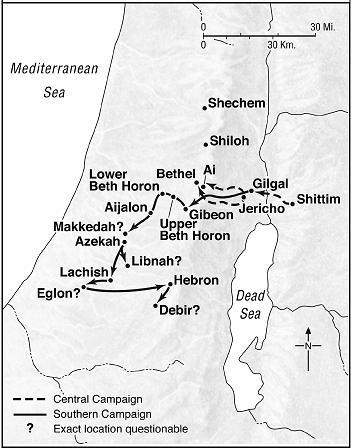
The MacArthur Study Bible, by John MacArthur (Nashville: Word Publishing, 1997) 316. © 1993 by Thomas Nelson, Inc.
11:2 south . . . in the lowland. This refers to the deep rift of the Jordan River valley to the south of the Lake of Chinneroth (12:3), later called the Sea of Galilee. Chinneroth was probably a town not far north of the lake. The lowland or foothills are an area somewhat west of the Jordan River, toward the Mediterranean Sea. Here also is the plain of Sharon and the heights of Dor, i.e., foothills extending to Mt. Carmel, nearer the Mediterranean coast and Dor, a seaport city.
11:5 Merom. These copious springs, located a few miles southwest of Lake Huleh and about thirteen miles north from the Lake of Chinneroth, provided the northern armies a rendezvous point.
11:6 hamstring. They cut the large sinew or ligament at the back of the hock on the rear leg, crippling the horses and making them useless.
11:8 Greater Sidon. A city on the Phoenician coast, north of Hazor. Greater may refer to surrounding areas along with the city itself. Misrephoth. This location lay west of Hazor, also on the Mediterranean.
11:12–15 A summary of Joshua’s northern campaign (11:1–15).
D. The Summary of Conquests (11:16–12:24)
11:16, 17 Joshua took all this land. The sweeping conquest covered much of Palestine. mountain country. In the south, in Judah. South. South of the Dead Sea. Goshen. Probably the land between Gaza and Gibeon. lowland. Or foothills; this refers to an area between the Mediterranean coastal plain and the hills of Judah. Jordan plain. The rift valley running south of the Dead Sea all the way to the Red Sea’s Gulf of Aqabah. The hill country of Israel is distinct from that in 11:16, lying in the northern part of Palestine. The conquest reached from Mt. Halak, about six miles south of the Dead Sea, to Mt. Hermon about forty miles northeast from the Lake of Chinneroth.
11:18 war a long time. The conquest took approximately seven years—c. 1405–1398 B.C. (cf. 14:10). Only Gibeon submitted without a fight (v. 19).
11:20 it was of the LORD to harden their hearts. God turned the Canaanites’ hearts to fight in order that Israel might be His instrument of judgment to destroy them. They were willfully guilty of rejecting the true God with consequent wickedness, and were as unfit to remain in the land as vomit spewed out of the mouth (Lev. 18:24, 25).
11:21 Anakim. Enemies who lived in the southern area that Joshua had defeated. They descended from Anak (“long-necked”), and were related to the giants who made Israel’s spies feel small as grasshoppers by comparison (Num. 13:28–33). Cf. Deuteronomy 2:10, 11, 21. Their territory was later given to Caleb as a reward for his loyalty (14:6–15).
11:22 Anakim . . . Gath. Some of the Anakim remained in Philistine territory, most notably those who preceded Goliath (cf. 1 Sam. 17:4).
11:23 the whole land. Here is a key summary verse for the whole book, which also sums up 11:16–22. How does this relate to 13:1, where God tells Joshua that he did not take the whole land? It may mean that the major battles had been fought and supremacy demonstrated, even if further incidents would occur and not every last pocket of potential resistance had yet been rooted out.
12:1–24 the kings . . . defeated. The actual list of thirty-one kings conquered (v. 24) follows and fills out the summary of “the whole land” in 11:16, 17, 23. The roster shows (1) the kings whom “Moses defeated” east of the Jordan River earlier (vv. 1–6; cf. Num. 21; Deut. 2:24–3:17); then (2) those whom Joshua conquered west of the Jordan River—a summary (7; 8); central kings (9); southern kings (10–16); and northern kings (17–24).
12:24 The conquest of all these kings, covering areas up and down the “whole land” (11:23), was caused by the Lord’s faithful help, which fulfilled His Word. God promised the land in His covenant with Abraham (Gen. 12:7), and reaffirmed that He would give victory in conquest (Josh. 1:3, 6).
III. DISTRIBUTING PORTIONS IN THE PROMISED LAND (13:1–22:34)
A. Summary of Instructions (13:1–33)
13:1 Joshua was old. By this time he was about 95, in comparison to Caleb’s 85 years (14:10). In 23:1, he was 110 and near death (24:29).
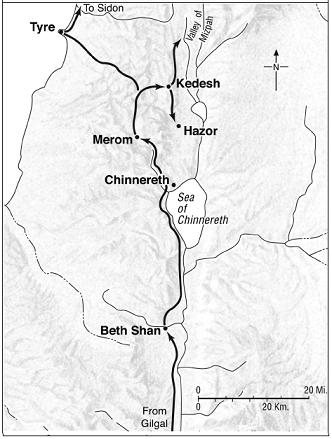
The MacArthur Study Bible, by John MacArthur (Nashville: Word Publishing, 1997) 318. © 1993 by Thomas Nelson, Inc.
13:1, 2 very much land. Some land had not yet actually been occupied by the Israelites through the previous general victories. Pockets of land in 13:2–6 still lay untouched by specific invasion and occupation (see note on 11:23 ). When Joshua allotted areas to individuals and tribes, they assumed the challenge to drive out lingering resisters; if not, they would disobey God’s mandate to be resolute in conquest (Deut. 11:22, 23). Failure to do this thoroughly is a tragic theme in Judges 1.
13:3 Sihor. Probably related to the Nile River (Is. 23:3; Jer. 2:18), and possibly a name for that river or an eastern tributary of it. The name could also refer to a seasonal rain trough which runs to the Mediterranean, the Wadi-el-Arish in the desert south of Palestine, northeast of Egypt.
13:7 divide this land. God commanded Joshua to devise allotments within boundaries for inheritances as He had prepared for earlier (Num. 32–34). Joshua announced divisions made clear by lot to tribes east of the Jordan (13:8–33), tribes west of the Jordan (Josh. 14–19), Caleb (14:6–15; cf. 15:13–19), his own area (19:49–51), cities of refuge (20:1–9), and Levite towns (ch. 21).
13:22 Israel also killed . . . Balaam. This Israelite slaying of the infamous false prophet occurred at an unidentified point during the conquest (cf. 24:9, 10; Num. 21–25; 31:16; 2 Pet. 2:15, 16; Jude 11; Rev. 2:14).
13:33 to . . . Levi . . . no inheritance. God did not give this tribe a normal allotment of land. This suited His choice of Levites for the special ministry of the tabernacle service (18:7). God did assign them cities and adjacent lands (14:4; Num. 35:2, 4, 5), scattered at forty-eight places (21:41) throughout all the tribes. This made these religious servants accessible to all the people (cf. ch. 21).
B. West of the Jordan (14:1–19:51)
14:1 the land of Canaan. The name for the land west of the Jordan River.
14:5 so the children of Israel did. They obeyed in some things, but not in all (see note on 13:1, 2 ).
14:6–9 Caleb. This passage reviews what is also recounted in Numbers 13 and 14. This includes a celebration of God’s faithfulness (vv. 7–11), and Caleb’s specific inheritance (vv. 12–15). Later, he conquered the area (15:13, 14) and conferred blessings on Othniel and his daughter (15:15–19).
14:10 eighty-five years old. Given that: (1) Caleb was forty at Kadesh Barnea, (2) the Israelites had wandered in the wilderness thirty-eight years, and (3) the conquering of the land took seven years (c. 1405–1398 B.C.), Caleb was now eighty-five years old.
14:12–14 Based on His promise (v. 9), God granted Caleb’s desire for Hebron because of his faithfulness to believe that God would give the land to the Israelites as He promised.
14:15 Anakim. See 15:13; see note on 11:21.
15:1–12 the lot of . . . Judah. The tribe’s southern boundary (v. 1) ran from the lower tip of the Salt Sea or Dead Sea in a sweep through the desert over to the wadi, the brook of Egypt (see note on 13:3 ), and along it to the Mediterranean Sea. The eastern limit (v. 5) ran the length of the Salt Sea itself. On the north, it extended from the north end of the Salt Sea by various lines working to the Mediterranean (vv. 5–11). The Mediterranean coastline served as the western border (v. 12).
15:17 Othniel. A conqueror like Caleb, who was his father-in-law, he would later be a judge in Israel (Judg. 3:9–11).
15:18, 19 Caleb’s daughter sought blessing and exercised faith for it—like father, like daughter.
15:20–62 the inheritance of . . . Judah. Judah’s cities are grouped in four areas: south (vv. 20–32); lowland or foothills over near the Mediterranean (vv. 33–47); hilly central region (vv. 48–60); Judean wilderness dropping eastward down to the Dead Sea (vv. 61, 62).
15:63 Jebusites. The inhabitants of Jerusalem were descendants from the third son of Canaan (Gen. 10:15, 16; 15:21). Joshua killed their king, who had joined a pact against Gibeon (Josh. 10). Israelites called the area “ Jebus” until David ordered Joab and his soldiers to capture the city (2 Sam. 5:6, 7) and made it his capital. Judges 1:8, 21 show that the Israelites conquered Jebus and burned it, but the Jebusites later regained control until David’s day. Melchizedek had been a very early king (Gen. 14), a believer in the true God, when the site was “Salem” (cf. Ps. 76:2, “Salem” is “Jerusalem”).
16:1–4 children of Joseph. Joseph’s territory was double as it was given to his two sons Manasseh and Ephraim, who had inheritances stretching over a large portion of the central area in the Promised Land.
16:5–9 border of . . . Ephraim. The description is of the land north of Judah’s territory, from the Jordan River west to the Mediterranean Sea. There was the inclusion of some cities in the territory of Manasseh, since Ephraim’s land was small compared to its population.
16:10 Ephraim did not drive the Canaanites from their area. This is the first mention of neglecting to exterminate the idolaters (cf. Deut. 20:16).
17:1–18 Manasseh. The other half-tribe of Manasseh, distinct from the half in 16:4, received its portion of the split inheritance west of the Jordan River to the north and east near the Lake of Chinneroth (Galilee).
17:3–6 Zelophehad. In Manasseh’s tribe, this man had no sons as heirs, but his five daughters received the inheritance. God directed Moses to give this right to women (Num. 27:1–11, cited in v. 4).
17:12–18 children of Manasseh. Tribesmen of Manasseh complained that Joshua did not allot them sufficient land for their numbers and that the Canaanites were too tough for them to drive out altogether. He permitted them extra land in forested hills that they could clear. Joshua told them that they could drive out the Canaanites because God had promised to be with them in victory against chariots (Deut. 20:1).
18:1 Shiloh. Israel as a whole, having had their first camp at Gilgal (4:20; 5:9), converged on Shiloh for worship at the tabernacle. Shiloh, about nine miles north of Bethel and twenty miles north of Jerusalem, remained the center of spiritual attention, as in Judges 18:31 and 1 Samuel 1:3. Due to Israel’s sin, God would later let the Philistines devastate Israel at Shiloh and capture the ark (1 Sam. 4:10, 17). He would also later use Shiloh as an example of judgment (Jer. 7:12).
18:8, 10. Seven tribes were still to receive land (v. 2). Joshua obtained from their twenty-one surveyor scouts (vv. 2–4) descriptions of the seven areas of land, then cast lots to decide the choices. The high priest Eleazar served him, seeking God’s will by casting lots (19:51). This was not some act of mere chance, but a means God used to reveal His will (see note on Prov. 16:33 ).
18:11–28 the lot of . . . Benjamin. This inheritance lay between Judah’s allotment and Ephraim’s, and embraced Jerusalem (v. 28).
19:1–9 Simeon. This area was a southern portion of Judah’s territory, since that allotment was more than Judah needed (v. 9).
19:10–16 Zebulun. This allotment lay west of the Lake of Chinneroth (Sea of Galilee) and ran to the Mediterranean Sea.
19:17–23 Issachar. Basically, the area ran just below the Sea of Galilee from the Jordan River west over to Mt. Tabor, circling southwest almost to Megiddo, north of Manasseh’s portion.
Division of Land Among the Tribes
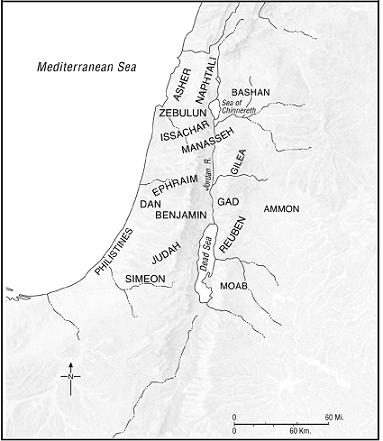
The MacArthur Study Bible, by John MacArthur (Nashville: Word Publishing, 1997) 320. © 1993 by Thomas Nelson, Inc.
19:24–31 Asher. This territory was a long, broad strip flanking the Mediterranean Sea on the west, then Naphtali’s and Zebulun’s claims on the east, running south to Manasseh’s. It reached from Mt. Carmel in the south to the area of Tyre in the north.
19:32–39 Naphtali. This region took in a long stretch of land with a border at the northern edge of all the Israelite inheritances, a line on the west dividing it from Asher, southward to follow Zebulun’s northern border. Then it struck eastward toward the Sea of Galilee with land to the west alongside that sea and down to Issachar’s claim, over to the Jordan River. The eastern line ran northward, including the city of Hazor and also Dan, then swung north of Dan. Jesus’ Galilean ministry would take place largely in this area (Is. 9:1, 2; Matt. 4:13–17).
19:33 terebinth tree. This was an oak tree (or an oak forest if taken in a collective sense, as the word possibly means in Gen. 12:6) near Kedesh and northwest of the waters at Merom. According to Judges 4:11, it was the site where Jael killed Sisera with a tent peg (4:21).
19:40–48 Dan. The tribal allotment was a narrow, roughly U-shaped strip just north of Judah’s claim and south of Ephraim’s. The Mediterranean coast lay on the western arm of the “U.” Joppa was on the coast near the north end. Later, the Danites, failing to possess their original claim (Judg. 1:34–36), migrated northeastward to a territory by Laish or Leshem (Josh. 19:47). They conquered this area north of the Sea of Galilee and Hazor, and renamed it Dan (Josh. 19:47, 48; Judg. 18:27–29).
19:49, 50 Joshua received his own inheritance from the children of Israel, an area he preferred in the hills of his tribe, Ephraim (Num. 13:8). He built a city, Timnath Serah, about sixteen miles southwest of Shechem. His inheritance was an intrinsic part of God’s promise to him, as was also Caleb’s inheritance (Num. 14:30).
20:2–9 cities of refuge. Moses had spoken God’s Word to name six cities in Israel as refuge centers. A person who inadvertently killed another person could flee to the nearest of these for protection (cf. Num. 35:9–34). Three cities of refuge lay west of the Jordan River, and three lay to the east, each reachable in a day for those in its area. The slayer could flee there to escape pursuit by a family member seeking to exact private justice. Authorities at the refuge protected him and escorted him to a trial. If found innocent, he was guarded at the refuge until the death of the current high priest, a kind of statute of limitations (Josh. 20:6). He could then return home. If found guilty of murder, he suffered appropriate punishment.
D. Cities of the Levites (21:1–45)
21:1–3 cities to dwell in. God had given Moses His direction to provide forty-eight cities for the Levites, dotted throughout Israel’s tribal allotments (Num. 35:1–8). Six were to be the cities of refuge (Num. 35:6).
21:3–42 the children of Israel gave to the Levites. These forty-eight cities (v. 41) were for various branches of the Levite people to live in and have pasture for their livestock (v. 42). People of the other tribes donated the areas, each site giving the Levites a vantage point from which to minister spiritually to the people nearby. In fairness, larger tribes devoted more land, smaller ones less (Num. 35:8). Only the Kohathites were priests, with other branches of Levites assisting in various roles of ritual worship and manual labors.
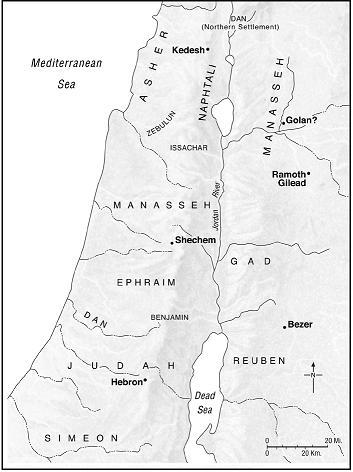
The MacArthur Study Bible, by John MacArthur (Nashville: Word Publishing, 1997) 327. © 1993 by Thomas Nelson, Inc.
21:4 Kohathites. Under God’s guiding wisdom, these received thirteen city areas in the vicinity of Jerusalem or at a reasonable distance within allotments of Judah, Benjamin, and Simeon. This would give them access to carry out priestly functions where God would later have the ark moved and the temple situated (2 Sam. 6).
21:43–45 So the LORD gave to Israel all the land. This sums up God’s fulfillment of His covenant promise to give Abraham’s people the land (Gen. 12:7; Josh. 1:2, 5–9). God also kept His Word in giving the people rest (Deut. 12:9, 10). In a valid sense, the Canaanites were in check, under military conquest as God had pledged (Josh. 1:5), not posing an immediate threat. Not every enemy had been driven out, however, leaving some to stir up trouble later. God’s people failed to exercise their responsibility and possess their land to the full degree in various areas.
E. East of the Jordan (22:1–34)
22:1 Reubenites . . . Gadites . . . Manasseh. The tribes from east of the Jordan River had helped their people conquer the land west of the river. Now, they were ready to go back to their families to the east.
22:4 Moses . . . gave you. Clearance from Moses and Joshua for these tribes to possess land east of the Jordan was of God (v. 9; 24:8; Num. 32:30–33).
22:10–34 an altar . . . by the Jordan. The special altar built by the two and one-half tribes near the river, though well-meant, aroused suspicions among the western tribes. They feared rebellion against the Shiloh altar that served all the tribes in unity. When challenged, men of the eastern tribes explained their motives to follow the true God, be in unity with the rest of Israel, and not be regarded as outsiders. The explanation met with the other Israelites’ approval.
IV. RETAINING THE PROMISED LAND (23:1–24:28)
A. The First Speech by Joshua (23:1–16)
23:1 Joshua was old. A long time had passed since he led the conquest c. 1405–1398 B.C.; Joshua had grown old, and was 110 when he died (24:29), c. 1383 B.C. (see note on 13:1 ).
23:5 the LORD . . . will expel them. God was ready to help His people drive the remaining Canaanites out so they could possess their claims fully. Such moves needed to be gradual (Deut. 7:22), but determined, in obedience to God.
23:7, 8 The dangers from being incomplete about possessing all the land included that of intermingling with the godless, as in marriages (v. 12), and adopting their gods, thus drifting from worshiping the true God. The Canaanites would become snares, traps, scourges, and thorns, causing the Israelites to lose the land eventually (vv. 13, 15, 16).
23:15, 16 This actually occurred 800 years later, when Babylon exiled the Israelites c. 605–586 B.C. (cf. 2 Kin. 24; 25).
B. The Second Speech by Joshua (24:1–28)
24:1–25 It was time for worship and thanksgiving because of all God had done leading up to and including the conquest of Canaan.
24:1–5 Joshua reviewed the history recorded in Genesis 11 to Exodus 15.
24:2 the River. The Euphrates, where Abraham’s family had previously lived. It is clear here that God’s calling of Abraham out to Himself was also a call out of idolatry, as He does with others (cf. 1 Thess. 1:9).
24:6–13 Joshua reviewed the history recorded in Exodus 12 to Joshua 22.
24:8, 15 Amorites. Sometimes, this is used as a general term for the entire pagan populace (cf. v. 11) in Canaan, as elsewhere (Gen. 15:16; Judg. 1:34, 35). At other times, the name has a narrower reference to people of the hill country (Num. 13:29), distinct from others.
24:9, 10 Balaam. See note on Joshua 13:22 about the unsavory nature of Balaam in Numbers 21–25.
24:12 I sent the hornet before you. This description, as in Exodus 23:28, is a picturesque figure (cf. 23:13) portraying God’s own fighting to assist Israel (23:3, 5, 10, 18). This awesome force put the enemy to flight, as the feared hornets literally can do (Deut. 7:20, 21).
24:15 choose . . . this day whom you will serve. Joshua’s fatherly model (reminiscent of Abraham’s, Gen. 18:19) was for himself and his family to serve the Lord, not false gods. He called others in Israel to this, and they committed themselves to serve the Lord also (vv. 21, 24).
24:18 The population joined Joshua in claiming total commitment to serve the Lord (cf. Ex. 19:8).
24:26 Book of the Law. Joshua expands the five books of Moses, as the canon of revealed Scripture develops. by the sanctuary. God’s tabernacle, including the ark of the covenant, was at Shiloh (21:2). The stone of witness by the holy place (sanctuary) was at Shechem (24:1). This holy place is not a formal tent or building, but a sacred place by a tree (cf. Gen. 12:6; 35:4), just as other places had significance in the past for worship of God (Gen. 21:33).
24:29–33 Joshua . . . Eleazar. Three prominent leaders were buried as the conquering generation was passing on: Joseph, Joshua, and the high priest Eleazar.
24:29 one hundred and ten years old. This was c. 1383 B.C.(cf. 14:7–10).
24:31 Faithfulness to God extended only one generation (cf. Judg. 2:6–13).
24:32 The bones of Joseph. These remains had been carried by the Israelites in the Exodus (Ex. 13:19) as Joseph had made them promise (Gen. 50:25). He wanted his bones to lie in the land of covenant pledge. So now his people laid them to rest at Shechem, in the land God had promised to Abraham (Gen. 12:7).
Further Study
Campbell, Donald. Joshua, in The Bible Knowledge Commentary—OT. Wheaton, Ill.: Victor, 1985.
Davis, John J. and John C. Whitcomb. A History of Israel from Conquest to Exile. Grand Rapids: Baker, 1980.
Woudstra, M. H. The Book of Joshua. Grand Rapids: Eerdmans, 1981.