Title
The book bears the fitting name Judges, which refers to unique leaders God gave to His people for preservation against their enemies (2:16–19). The Hebrew title means “deliverers” or “saviors,” as well as judges (cf. Deut. 16:18; 17:9; 19:17). Twelve such judges arose before Samuel; then Eli and Samuel increased the count to fourteen. God Himself is the higher Judge (11:27). Judges spans about 350 years from Joshua’s successful conquest (c. 1398 B.C.) until Eli and Samuel judged prior to the establishment of the monarchy (c. 1051 B.C.).
Author and Date
No author is named in the book, but the Jewish Talmud identifies Samuel, a key prophet who lived at the time these events took place and could have personally summed up the era (cf. 1 Sam. 10:25). The time was earlier than David’s capture of Jerusalem c. 1004 B.C. (2 Sam. 5:6, 7) since Jebusites still controlled the site (Judg. 1:21). Also, the writer deals with a time before a king ruled (17:6; 18:1; 21:25). Since Saul began his reign c. 1051 B.C., a time shortly after his rule began is probably when Judges was written.
Background and Setting
Judges is a tragic sequel to Joshua. In Joshua, the people were obedient to God in conquering the land. In Judges, they were disobedient, idolatrous, and often defeated. Judges 1:1–3:6 focuses on the closing days of the Book of Joshua. Judges 2:6–9 gives a review of Joshua’s death (cf. Josh. 24:28–31). The account describes seven distinct cycles of Israel’s drifting away from the Lord, starting even before Joshua’s death and with a full departure into apostasy afterward.
Five basic reasons are evident for these cycles of Israel’s moral and spiritual decline: (1) disobedience toward God in failing to drive the Canaanites out of the land (Judg. 1:19, 21, 35); (2) idolatry (2:12); (3) intermarriage with wicked Canaanites (3:5, 6); (4) not obeying the judges (2:17); and (5) turning away from God after the death of the judges (2:19).
A four-part sequence repeatedly occurred in this phase of Israel’s history: (1) Israel’s departure from God; (2) God’s chastisement in permitting military defeat and subjugation; (3) Israel’s prayer for deliverance; and (4) God raising up “judges,” either civil or sometimes local military champions, who led in shaking off the oppressors. Fourteen judges arose, six of them military judges (Othniel, Ehud, Deborah, Gideon, Jephthah, and Samson). Two men were of special significance for contrast in spiritual leadership: (1) Eli, judge and high priest (not a good example) and (2) Samuel, judge, priest, and prophet (a good example).
Historical and Theological Themes
Judges is thematic rather than chronological; foremost among its themes is God’s power and covenant mercy in graciously delivering the Israelites from the consequences of their failures, which were suffered for sinful compromise (cf. 2:18, 19; 21:25). In seven historical periods of sin to salvation (cf. Introduction: Outline), God compassionately delivered His people throughout the different geographical areas of tribal inheritances which He had earlier given through Joshua (Josh. 13–22). The apostasy covered the whole land, as indicated by the fact that each area is specifically identified: southern (3:7–31); northern (4:1–5:31); central (6:1–10:5); eastern (10:6–12:15); and western (13:1–16:31).
God’s power to rescue shines brightly against the dark backdrop of pitiful human compromise and sometimes bizarre twists of sin, as in the final summary (Judg. 17–21). The last verse (21:25) sums up the account: “In those days there was no king in Israel; everyone did what was right in his own eyes.”
Interpretive Challenges
The most stimulating challenges are: (1) how to view men’s violent acts against enemies or fellow countrymen, whether with God’s approval or without it; (2) God’s use of leaders who, at times, do His will and, at times, follow their own sinful impulses (Gideon, Eli, Jephthah, Samson); (3) how to view Jephthah’s vow and offering of his daughter (11:30–40); and (4) how to resolve God’s sovereign will with His providential working in spite of human sin (cf. 14:4).
The chronology of the various judges in different sectors of the land raises questions about how much time passed and how the time totals can fit into the entire time span from the Exodus (c. 1445 B.C.) to Solomon’s fourth year, c. 967/966 B.C., which is said to be 480 years (1 Kin. 6:1; see note on Judg. 11:26 ). A reasonable explanation is that the deliverances and years of rest under the judges in distinct parts of the land included overlaps, so that some of them did not run consecutively, but rather concurrently during the 480 years. Paul’s estimate of “about 450” years in Acts 13:20 is an approximation.
I. INTRODUCTION AND SUMMARY: THE DISOBEDIENCE OF ISRAEL (1:1–3:6)
A. Incomplete Conquest over the Canaanites (1:1–36)
1:1 after the death of Joshua. C. 1383 B.C. (cf. Josh. 14:7–10 with Josh. 24:29). Descriptions of the book’s setting in Judges 1 and 2 vary between times after Joshua’s death and flashbacks summarizing conditions while he was alive (e.g. 2:2–6). Compare Joshua 1:1, “After the death of Moses.”
1:2 Judah shall go up. This tribe received God’s first go-ahead to push for a more thorough conquest of its territory. The reason probably rested in God’s choice that Judah be the leader among the tribes (Gen. 49:8–12; 1 Chr. 5:1, 2) and set the example for them in the other territories.
1:6, 7 cut off his thumbs and big toes. Removing the king’s thumbs hampered effective use of a weapon; taking off his big toes rendered footing unreliable in battle. Thus, the king was rendered unable to fight or rule effectively in the future. The Lord Himself is nowhere said to endorse this tactic, but it was an act of retributive justice for what Adoni-Bezek had done to others. It appears from his confession that he was acknowledging that he deserved it.
1:12–15 Caleb said. This repeats the account of Caleb and his family (cf. Josh. 15:13–19)
1:16 the City of Palms. Since Jericho was destroyed in the invasion, this refers to the area around Jericho, an oasis of springs and palms (Deut. 34:3).
1:19 they could not drive out. They of Judah could not. They had been promised by Joshua that they could conquer the lowland (Josh. 17:16, 18) and should have remembered Joshua 11:4–9. This is a recurring failure among the tribes to rise to full trust and obedience for victory by God’s power. Settling for less than what God was able to give (Josh. 1:6–9) began even in Joshua’s day (Judg. 2:2–6) and earlier (Num. 13; 14). In another sense, God permitted Israel’s enemies to hold out as a test to display whether His people would obey Him (2:20–23; 3:1, 4). Another factor involved keeping the wild animal count from rising too fast (Deut. 7:22).
1:20 sons of Anak. Anak was an early inhabitant of central Canaan near Hebron from whom came an entire group of unusually tall people called the Anakim (Deut. 2:10). They frightened the ten spies (Num. 13:33; Deut. 9:2), but were finally driven out of the land by Caleb (Josh. 14:12–15; 15:13, 14; 21:11) with the exception of some who resettled with the Philistines (Josh. 11:22). “The sons of Anak” was used as a term equivalent to “the Anakim.”
1:34 Amorites forced . . . Dan. Like all other tribes, Dan had a territory given to them, but they failed to claim the power of God to conquer that territory. Later, they capitulated even more by accepting defeat and migrating to another territory in the north, becoming idolatrous (Judg. 18).
B. The Decline and Judgment of Israel (2:1–3:6)
2:1 the Angel of the LORD. One of three preincarnate theophanies by the Lord Jesus Christ in Judges (cf. 6:11–18; 13:3–23). This same divine messenger had earlier led Israel out of Egypt (cf. Ex. 14:19). See note on Exodus 3:2. I will never break My covenant with you. God would be faithful until the end, but the people would forfeit blessing for trouble, due to their disobedience (cf. v. 3).
2:10 another generation . . . did not know. The first people in the land had vivid recollections of all the miracles and judgments and were devoted to faith, duty, and purity. The new generation of Israelites were ignorant of the experiences of their parents and yielded more easily to corruption. To a marked degree, the people of this new generation were not true believers, and were not obedient to the God of miracles and victory. Still, many of the judges did genuinely know the Lord, and some who did not live by faith eventually threw themselves on God’s mercy during oppressions.
2:12 they followed other gods. Idol worship, such as the golden calf in the wilderness (Ex. 32), flared up again. Spurious gods of Canaan were plentiful. El was the supreme Canaanite deity, a god of uncontrolled lust and a bloody tyrant, as shown in writings found at Ras Shamra in north Syria. His name means “strong, powerful.” Baal, son and successor of El, was “lord of heaven,” a farm god of rain and storm; his name means “lord, possessor.” His cult at Phoenicia included animal sacrifices, ritual meals, and licentious dances. Chambers catered to sacred prostitution by men and women (cf. 1 Kin. 14:23, 24; 2 Kin. 23:7). Anath, sister-wife of Baal, also called Ashtoreth (Astarte), patroness of sex and war, was called “virgin” and “holy” but was actually a “sacred prostitute.” Many other gods besides these also attracted worship.
2:14 the anger of the LORD was hot. Calamities designed as chastisement brought discipline intended to lead the people to repentance.
2:16 the LORD raised up judges. A judge or deliverer was distinct from a judge in the English world today. Such a leader guided military expeditions against foes (as here) and arbitrated judicial matters (cf. 4:5). There was no succession or national rule. They were local deliverers, lifted up to leadership by God when the deplorable condition of Israel in the region around them prompted God to rescue the people.
3:1 nations . . . left. The purpose was to use them to test (cf. v. 4) and discipline the sinful Israelites, as well as to aid the young in learning the art of war.
3:5 See notes on 1:1–20.
3:6 See note on 1:19. The Israelites failed God’s test, being enticed into (1) marriages with Canaanites and (2) worship of their gods. Disobedience was repeated frequently through the centuries, and led God to use the Assyrians (2 Kin. 17) and Babylonians (2 Kin. 24; 25) to expel them from the land gained here.
II. A SELECTED HISTORY OF THE JUDGES: THE DELIVERANCE OF ISRAEL (3:7–16:31)
A. First Period: Othniel vs. Mesopotamians (3:7–11)
3:10 The Spirit of the LORD came. Certain judges were expressly said to have the Spirit of the Lord come upon them (6:34; 11:29; 13:25; 14:6, 19; 15:14); others, apparently, also had this experience. This is a common OT expression signifying a unique act of God which conferred power and wisdom for victory. But this did not guarantee that the will of God would be done in absolutely all details, as is apparent with Gideon (8:24–27, 30), Jephthah (11:34–40), and Samson (16:1).
B. Second Period: Ehud and Shamgar vs. Moabites (3:12–31)
3:20 I have a message from God for you. Ehud claimed he came to do God’s will in answer to prayer (v. 15). Calmly and confidently, Ehud acted and, later, credited the defeat of the wicked king to God (v. 28; cf. Ps. 75:6, 7, 10; Dan. 4:25), though it was by the human means of Ehud, just as Jael used a hammer and tent peg (4:21), and Israel’s armies used the sword (4:16). By God’s power, Ehud’s army would kill a greater number (v. 29). Men’s evil provokes God’s judgment (Lev. 18:25).
3:24 He is . . . attending to his needs. The dead king’s servants guessed he was indisposed in privacy, literally “covering his feet,” a euphemism for bathroom functions.
3:31 Shamgar. His extraordinary exploit causes one to think of Samson (15:16). an ox goad. This was a stout stick about eight to ten feet long and six inches around, with a sharp metal tip to prod or turn oxen. The other end was a flat, curved blade for cleaning a plow.
C. Third Period: Deborah vs. Canaanites (4:1–5:31)
4:4 Deborah, a prophetess. She was an unusual woman of wisdom and influence who did the tasks of a judge, except for military leadership. God can use women mightily for civil, religious, or other tasks, e.g., Huldah the prophetess (2 Kin. 22:14), Philip’s daughters in prophesying (Acts 21:8, 9), and Phoebe a deaconess (Rom. 16:1). Deborah’s rise to such a role is the exception in the book because of Barak’s failure to show the courage to lead courageously (vv. 8, 14). God rebuked his cowardice by the pledge that a woman would kill Sisera (v. 9).
4:19, 20 she . . . gave him a drink, and covered him. Usually, this was the strongest pledge of protection possible.
4:21 a tent peg and . . . a hammer. Jael’s bold stroke in a tent rather than on a battlefield draws Deborah’s and Barak’s praise (5:24–27). Her strength and skill had no doubt been toughened by a common Bedouin duty of hammering down pegs to secure tents, or striking them loose to take down tents.
5:1 sang on that day. The song (vv. 1–31) was in tribute to God for victory in Judges 4:13–25. Various songs praise God for His help, e.g., Moses’ (Ex. 15), David’s (2 Sam. 23:1–7), and the Lamb’s (Rev. 15:3, 4).
5:10 white donkeys. Because of this unusual color, they were a prize of kings and the rich.
5:11 Far from the noise of the archers, among the watering places. The wells were at a little distance from towns in the east, away from the battles and often places for pleasant reflection.
5:14 roots were in Amalek. Currently, Ephraim as a tribe took the central hill area, which the Amalekites had once held tenaciously.
5:17 why did Dan remain on ships? Danites migrated from their territory to Laish north of the Lake of Chinneroth (Sea of Galilee) before the Israelite triumph of Judges 4, though details of it are not given until Judges 18. They became involved with Phoenicians of the northwest in ship commerce (cf. Joppa as a coastal city, Josh. 19:46). As with some other tribes, they failed to make the trek to assist in the battle of Judges 4.
| Judge and Tribe | Scripture References | Period of Oppressors | Oppression/Rest |
| (1) Othniel (Judah) Son of Kenaz, younger brotherof Caleb | Judg. 1:11-15; 3:1-11; Josh. 15:16-19; | Cushan-Rishathaim, king of Mesopotamia | 8 years/40 years |
| (2) Ehud (Benjamin) Son of Gera | Judg. 3:12-4:1 | Eglon, king of Moab; Ammonites; Amalekites | 18 years/80 years |
| (3) Shamgar (Perhaps foreign) Son of Anath | Judg. 3:31; 5:6 | Philistines | Not given/Not given |
| (4) Deborah (Ephraim), Barak (Naphtali) Son of Abinoam | Judg. 4:1-5:31 Heb. 11:32 | Jabin, king of Canaan;Sisera commander the army | 20 years/40 years |
| (5) Gideon (Manasseh) Son of Joash the Abiezrite. Also called: Jerubbaal (6:32; 7:1); Jerubbesheth (2 Sam. 11:21) | Judg. 6:1-8:32 Heb. 11:32 | Midianites; Amalekites “People of the East” | 7 years/40 years |
| (6) Abimelech (Manasseh) Son of Gideon by a concubine | Judg. 8:33-9:57 | Civil war | Abimelech ruled over Israel 3 years |
| (7) Tola (Issachar) Son of Puah | Judg. 10:1, 2 | Judged Israel 23 years | |
| (8) Jair (Gilead-Manasseh) | Judg. 10:3-5 | Judged Israel 22 years | |
| (9) Jephthah (Gilead-Manasseh) Son of Gilead by a harlot | Judg. 10:6-12:7 Heb. 11:32 | Philistines; Ammonites Civil war with the Ephraimites | 18 years/ Judged Israel 6 years |
| (10) Ibzan (Judah or Zebulun) (Bethlehem-Zebulun; cf. Josh. 19:15) | Judg. 12:8-10 | Judged Israel 7 years | |
| (11) Elon (Zebulun) | Judg. 12:11, 12 | Judged Israel 10 years | |
| (12) Abdon (Ephraim) Son of Hillel | Judg. 12:13-15 | Judges Israel 8 years | |
| (13) Samson (Dan) Son of Manoah | Judg. 13:1-16:31 Heb. 11:32 | Philistines | 40 years/Judged Israel 20 years |
5:20 stars . . . fought. A poetic way to say that God used these heavenly bodies to help Israel. They are bodies representing and synonymous with the heavens, the sky from which He sent a powerful storm and flood (cf. “torrent” of the Kishon River, v. 21) that swept Syrians from their chariots. God also hid the stars by clouds, decreasing Syrian effectiveness due to darkness.
5:24–27 Though this act was murder and a breach of honor, likely motivated by Jael’s desire for favor with the conquering Israelites, and though it was without regard for God on her part, God’s overruling providence caused great blessing to flow from it. Thus, the words of verses 24–27 are in the victory song.
5:31 The intercessory prayer committed to God’s will ends a song that has other aspects: (1) blessing God (v. 2); (2) praise (v. 3); (3) affirming God’s work in tribute (vv. 4, 20); and (4) voicing God’s curse (v. 23).
D. Fourth Period: Gideon vs. Midianites (6:1–8:32)
6:1 Midian. These wandering herdsmen from east of the Red Sea had been dealt a severe blow in Moses’ time (Num. 31:1–18) and still resented the Israelites. They became the worst scourge yet to afflict Israel.
6:8 the LORD sent a prophet. He used (1) prophets in isolated cases before Samuel, (2) the band of prophets Samuel probably founded (1 Sam. 10:5), and, later, (3) such prophets as Elijah, Elisha, and the writing prophets—major and minor. Here, the prophet is sent to bring the divine curse because of their infidelity (v. 10).
6:11 the Angel. This angel (lit. “messenger”) of the Lord is identified as “the LORD” Himself (vv. 14, 16, 23, 25, 27). Cf. Genesis 16:7–14; 18:1; 32:24–30 for other appearances. See note on Exodus 3:2 ). Gideon threshed wheat in the winepress . . . to hide it. This indicated a situation of serious distress; also, it indicated a small amount of grain. This is clear because he is doing it rather than having cattle tread it. It is on bare ground or in the winepress rather than on a threshing floor made of wood, and is done remotely under a tree out of view. The fear of the Midianites caused this.
6:13 Gideon’s language indicates a weak theology. The very chastisements of God were proof of His care for and presence with Israel. Cf. Hebrews 12:3–11.
6:17 Like Moses (Ex. 33), Gideon desired a sign; in both incidents, revelation was so rare and wickedness so prevalent that they desired full assurance. God graciously gave it.
6:18–23 In the realization of the presence of God, the sensitive sinner is conscious of great guilt. Fire from God further filled Gideon with awe and even the fear of death. When he saw the Lord, he knew the Lord had also seen him in his fallenness. Thus, he feared the death that sinners should die before Holy God. But God graciously promised life (v. 23). For a similar reaction to the presence of God, see Manoah in 13:22, 23 (cf. Ezek. 1:26–28; Is. 6:1–9; Rev. 1:17).
6:27 he feared. Very real human fear and wise precaution interplays with trust in an all-sufficient God.
6:32 Jerubaal (lit. “let Baal contend”) became a fitting and honorable second name for Gideon (7:1; 8:29; 9:1, 2). This was a bold rebuke to the non-existent deity, who was utterly unable to respond.
6:36–40 Gideon’s two requests for signs in the fleece should be viewed as weak faith; even Gideon recognized this when he said “Do not be angry with me” (v. 39) since God had already specifically promised His presence and victory (vv. 12, 14, 16). But they were also legitimate requests for confirmation of victory against seemingly impossible odds (6:5; 7:2, 12). God nowhere reprimanded Gideon, but was very compassionate in giving what his inadequacy requested. In 7:10–15, God volunteered a sign to boost Gideon’s faith. He should have believed God’s promise in 7:9, but he needed bolstering, so God graciously gave it without chastisement.
7:2 The people . . . are too many. Those of faith, though inadequate by human weakness, gain victory only through God’s power (cf. 2 Cor. 3:5; 4:7; 12:7–9). Three hundred men win against an incredible Midianite host (Judg. 7:7, 16–25). God gains the glory by making the outcome conspicuously His act and, thus, no sinful pride is cultivated.
7:5 Everyone who laps. Soldiers who lapped as a dog, scooping water with their hands as a dog uses its tongue, were chosen; in contrast, those who sank to their knees to drink were rejected. No reason for such distinction is given, so that it showed nothing about their ability as soldiers. It was merely a way to divide the crowd. Their abilities as soldiers had no bearing on the victory anyway, since the enemy soldiers killed themselves and fled without engaging Gideon’s men at all.
7:10 if you are afraid. God recognized Gideon’s normal fear since he was the commander. God encouraged him to take his servant as protection. See note on 6:36–40.
7:15 Arise. God said this in 7:9. Newly infused with courage, Gideon is now in step with the Lord.
7:16 Trumpets and torches, at first concealed within clay pitchers, were suddenly displayed at the most startling moment. The shocking impression, caused by blaring noise from the always terrible shouts of Israel (cf. Num. 28:21), and sudden lights surrounding the sleeping hosts, shattered the stillness of the night and conveyed one idea: Each light could mean a legion behind it; thus, they believed an incredible host had moved in to catch the awaking army in a death trap.
7:18 The sword of the LORD and of Gideon! Here was a demonstration of the power of God in harmony with the obedience of man. Such shouts reminded the enemies that the threat of the sword of Gideon and of God was for real. The impression was one of doom and terror, shock and awe.
7:19 beginning . . . middle watch. About 10 P.M.
7:22 every man’s sword against his companion. Panic followed shock. Every soldier was on his own, in desperate retreat. In the darkness and crash of sounds, the soldiers were unable to distinguish friend from enemy; and with their swords, they slashed a path of escape through their own men.
8:2 gleaning of the grapes of Ephraim. Ephraim resented being slighted in the call to battle, but was placated by Gideon’s compliment. His figures of speech implied that Ephraimite capital punishment of the two fleeing Midianite leaders (7:25) was “the vintage of Ephraim,” to use an image drawn from their grape horticulture. It played a more strategic role than taking part in “the vintage of Abiezer,” the suicide of the enemy under Gideon’s leadership (cf. v. 3).
8:7 thorns. Gideon’s threatened discipline of Succoth’s leaders for refusing to help their brothers came due. He had them dragged under heavy weights over thorns and briers, which painfully tore their bodies. This was a cruel torture to which ancient captives were often subjected. He did it on his return, not wanting to delay the pursuit (v. 16).
8:9 tower. They probably had defiantly boasted of their strength and defensibility because of the tower. He kept his promise and more (v. 17).
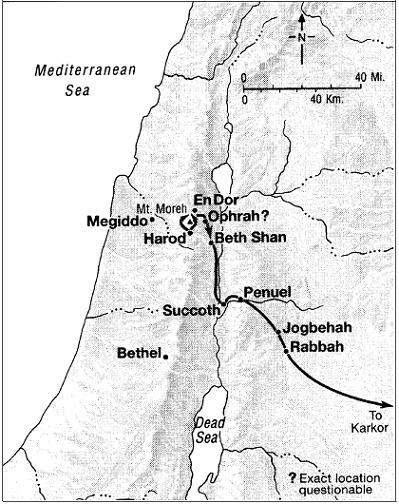
Nelson’s Complete Book of Bible Maps & Charts (Nashville: Thomas Nelson Publishers, 1996) 79. © 1993 by Thomas Nelson, Inc.
8:20 Jether . . . kill them! Gideon desired to place a great honor on his son by killing the enemies of Israel and of God.
8:21 killed Zebah and Zalmunna. The earlier Midianite scourge inflicted on Israel was the worst, so this victory lived long in their minds (cf. Ps. 83:11).
8:22, 23 Rule over us. Israelites sinned by the misguided motive and request that Gideon reign as king. To his credit, the leader declined, insisting that God alone rule (cf. Ex. 19:5, 6).
8:24 Ishmaelites. Synonymous with Midianites (cf. Gen. 37:25, 28).
8:24–27 Gideon made . . . an ephod. This was certainly a sad end to Gideon’s influence as he, perhaps in an expression of pride, sought to lift himself up in the eyes of the people. Gideon intended nothing more than to make a breastplate as David later did (1 Chr. 15:27) to indicate civil rule, not priestly rule. It was never intended to set up idolatrous worship, but to be a symbol of civil power. That no evil was intended can be noted from the subduing of Midian (v. 28), quietness from wars (v. 28), the fact that idolatry came only after Gideon’s death (v. 33), as well as the commendation of Gideon (v. 35).
8:26 the weight of the gold. The total was about forty-two pounds.
8:30, 31 many wives. Gideon fell into the sin of polygamy, an iniquity tolerated by many but which never was God’s blueprint for marriage (Gen. 2:24). Abimelech, a son by yet another illicit relationship, grew up to be the wretched king in Judges 9. Polygamy always resulted in trouble.
E. Fifth Period: Tola and Jair vs. Abimelech’s Efforts (8:33–10:5)
9:5 killed . . . brothers. This atrocity, common in ancient times, eliminated the greatest threat in the revolution—all the legitimate competitors.
9:6 Beth Millo. Lit. “house of the fortress.” This was a section of Shechem, probably involving the tower stronghold of verse 46.
9:14 ‘You come and reign over us!’ In Jotham’s parable of trees asking for a king (vv. 7–15), the olive, fig, and vine decline. They do not represent specific men who declined; rather, they build the suspense and heighten the idea that the bramble (thorn-bush) is inferior and unsuitable. The bush represents Abimelech (vv. 6, 16).
9:23 God sent a spirit of ill will. In the course of God’s providence, there appeared jealousy, distrust, and hate. God allowed it to work as punishment for the idolatry and mass murder.
9:26–45 This narrative describes a failed coup against Abimelech.
9:37 Diviners’ Terebinth Tree. A tree regarded superstitiously where mystical ceremonies and soothsaying were conducted.
9:45 sowed it with salt. An act polluting soil and water, as well as symbolizing a verdict of permanent barrenness (Deut. 29:23; Jer. 17:6). Abimelech’s intent was finally nullified when Jeroboam I rebuilt the city as his capital (1 Kin. 12:25), c. 930–910 B.C.
9:57 That curse was pronounced in 9:20 for the pervasive idolatry.
10:3–5 Most likely, the judgeship of Jair coincided with the time period of Ruth.
F. Sixth Period: Jephtha, Ibzan, Elon, and Abdon vs. Philistines and Ammonites (10:6–12:15)
10:10 We have sinned. Confession is followed by true repentance (vv. 15, 16).
10:13, 14 Here is the form of God’s wrath, in which He abandons persistent, willful sinners to the consequences of their sins. This aspect of divine judgment is referred to in the case of Samson (16:20), as well as the warnings of Proverbs 1:20–31; Romans 1:24–28. It is a pattern of rejection seen throughout history (cf. Acts 14:15, 16) even among the Jews (cf. Hos. 4:17; Matt. 15:14).
10:15 Do to us whatever seems best. Genuine repentance acknowledges God’s right to chasten, so His punishment is seen as just and He is thereby glorified. It also seeks the remediation that chastening brings, because genuine contrition pursues holiness.
11:1 mighty man of valor. In a military situation, this means a strong, adept warrior, such as Gideon (6:12). In response to their repentance, God raised up Jephthah to lead the Israelites to freedom from the eighteen years of oppression (v. 8).
11:3 raiding. Such attacks would be against the Ammonites and other pagan peoples and brought fame to Jephthah.
11:11 spoke . . . before the LORD. This refers to confirming the agreement in a solemn public meeting with prayer invoking God as witness (v. 10).
11:13 Israel took away my land. The Ammonite ruler was claiming rights to the lands occupied by the Israelites. Jephthah’s answer was direct: (1) those lands were not in the possession of Ammonites when Israel took them, but were Amorite lands; (2) Israel had been there 300 years in undisputed possession; and (3) God had chosen to give them the lands. Thus, they were entitled to them, just as the Ammonites felt they received their lands from their god (cf. v. 24).
11:15 Israel did not take away the land. These people initiated the hostility and, being at fault, invited loss of possession (vv. 16–22). This fit perfectly the will of God, who has ultimate rights (cf. Gen. 1:1; Ps. 24:1) to give the land to Israel. God said, “The land is Mine” (Lev. 25:23; cf. Ezek. 36:5).
11:26 three hundred years. With an early Exodus from Egypt (c. 1445 B.C.), one can approximate the 480 years covered in Judges to 1 Kings 6:1 (see note there ), Solomon’s fourth year 967/966 B.C.: 38 years from the Exodus to Heshbon; 300 from Heshbon to Jephthah in 11:26; possibly 7 more years for Jephthah; 40 years for Samson, 20 years for Eli, 20 years for Samuel, 15 or 16 years beyond Samuel for Saul, 40 years for David, and 4 years for Solomon, which totals about 480 years. It is quite possible that 300 has been rounded off.
11:29 the Spirit . . . came upon Jephthah. That the Lord graciously empowered Jephthah for war on behalf of his people does not mean that all of the warrior’s decisions were of God’s wisdom. The rash vow (vv. 30, 31) is an example.
11:30 made a vow to the LORD. This was a custom among generals to promise the god of their worship something of great value as a reward for that god’s giving them victory.
11:31 I will offer it. Some interpreters reason that Jephthah offered his daughter as a living sacrifice in perpetual virginity. With this idea, verse 31 would mean “shall surely be the LORD’s” or “I will offer it up as a burnt offering.” The view sees only perpetual virginity in verses 37–40, and rejects his offering a human sacrifice as being against God’s revealed will (Deut. 12:31). On the other hand, since he was (1) beyond the Jordan River, (2) far from the tabernacle, (3) a hypocrite in religious devotion, (4) familiar with human sacrifice among other nations, (5) influenced by such superstition, and (6) wanting victory badly, he most likely meant a literal, human burnt offering. The translation in verse 31 is “and,” not “or.” His act came in an era of bizarre things, even inconsistency by leaders whom God otherwise empowered (cf. Gideon in 8:27).
11:34 his daughter, coming out to meet him. She was thus to be the sacrificed pledge.
11:35 Alas. Jephthah indicated the pain felt by her father in having to take the life of his only daughter to satisfy his pious but unwise pledge.
12:1 Why did you . . . not call us? Ephraim’s newest threat (cf. 8:1) was their jealousy of Jephthah’s success and, possibly, a lust to share in his spoils. The threat was not only to burn the house, but to burn him.
12:4 fugitives. This involved a mockery, referring to the Gileadites as low lifes, the outcasts of Ephraim. They retaliated with battle.
12:6 Shibboleth! The method used for discovering an Ephraimite was the way in which they pronounced this word. If they mispronounced it with an “s” rather than an “sh” sound, it gave them away, being a unique indicator of their dialect.
12:9, 14 thirty sons . . . grandsons. Very large families suggest the fathers’ marriage to several wives, a part of life tolerated but never matching God’s blueprint of one wife at a time (Gen. 2:24). To have many children had the lure of extending a person’s human power and influence.
G. Seventh Period: Samson vs. Philistines (13:1–16:31)
13:3 the Angel of the LORD. In this case, it was a preincarnate appearance of the Lord Himself (vv. 6–22), as elsewhere (see note on 6:11 ). See note on Exodus 3:2.
13:5 Nazirite. The word is from the Hebrew “to separate.” For rigid Nazirite restrictions, such as here in Samson’s case, see note on Numbers 6:2. God gave three restrictions: (1) no wine (vv. 3, 4); (2) no razor cutting the hair (v. 5); and (3) no touching a dead body, thus being defiled (v. 6). Such outward actions indicated an inner dedication to God.
13:16 offer it to the LORD. Manoah needed this explanation because he was going to offer this to Him, not as the Lord, or even an angel, but just a human messenger. The instruction is intended to emphasize that this visitor is indeed the Lord.
13:17 What is Your name? This secret name is again indicative that the angel is the Lord.
13:18 Why do you ask My name? That the angel would not divulge His name reminds one of the angel (God) whom Jacob encountered (Gen. 32:24–30), who likewise did not give His name.
13:20 flame went up toward heaven. This miraculous act points to divine acceptance of the offering.
13:22 We shall surely die. This reaction of the fear of death is familiar with those who come into God’s presence. Many did die when facing God, as the OT records. It is the terror in the heart of the sinner when in the presence of holy God. Cf. Ezekiel (Ezek. 1:28), Isaiah (Is. 6:5), the Twelve (Mark 4:35–41), Peter (Luke 5:8), and John (Rev. 1:17, 18).
14:1–4 she pleases me well. The Philistines were not among the seven nations of Canaan which Israel was specifically forbidden to marry. Nonetheless, Samson’s choice was misdirected (cf. v. 3). Samson sins here, although God is sovereign and was able to turn the situation to please Him (v. 4). He was not at a loss, but used the opportunity to work against the wicked Philistines and provided gracious help to His people. He achieved destruction of these people, not by an army, but by the miraculous power of one man.
14:7 talked. Such conversation was not acceptable in the east, unless a couple was betrothed.
14:8 to get her. It was usually a year until the wedding.
14:9 He took some . . . in his hands. Some scholars suggest that Samson violated his Nazirite standard by coming in contact with a dead body (see note on 13:5 ). Others reason that Numbers 6 specifies the body of a person, not an animal. Whether or not he sinned here, the context does show instances of him sinning.
14:10 feast. The wedding feast usually lasted a week.
14:15 seventh. Some ancient authorities read “fourth.” The number may be “fourth” (four days starting after the three in v. 14), totaling seven days as in verse 17. Or verse 15 may mean “fourth,” and verse 17 that the woman wept for the rest of the seven-day period of verse 12, after the three days of verse 14.
14:16–18 Samson’s wife wept. She cheated and manipulated, working against Samson’s expectations that the men must come up with the answer. The men also cheated and threatened, having murder in their hearts (v. 15) and putting pressure on the woman.
14:19 his anger. God blesses the one who had been wronged. Samson’s anger may be legitimate—righteous indignation against deceit (cf. Mark 3:5). The battle with the men at Ashkelon, about twenty-three miles away, was a part of the war between Israel and Philistia.
14:20 Samson’s wife was given. Another act of treachery was done. The Philistine father had no reason to assume that Samson would not be back, nor had Samson given word about not returning. The father, as a Philistine, did not want his daughter marrying the enemy.
15:1 wheat harvest. Samson tactfully made his move when wheat harvest kept men busy. This would have been in May/ June. A token of reconciliation was offered as he brought a young goat, showing the father and the daughter that they had nothing to fear.
15:2 I . . . thought. This flimsy excuse by the father was an effort to escape the trap that he faced. He feared the Philistines if he turned on the new husband, yet he also feared Samson; so, he offered his second daughter as a way out. This was insulting and unlawful (cf. Lev. 18:18).
15:3 The cycle of retaliation began here, and it ends in 16:30, 31.
15:4 caught three hundred foxes. Samson, insulted and provoked to fleshly resentment, took vengeance on the Philistines. It must have taken a while to catch so many foxes or jackals and to keep them penned and fed until the number reached 300. Apparently, he tied them in pairs with a slow-burning torch, sending the pairs down the hills into fields thrashing with fire, igniting all the standing grain so dry at harvest. This was a loss of great proportion to the Philistine farmers.
15:6 the Philistines . . . burned her and her father. The general principle of reaping what is sown is apropos here (cf. Gal. 6:7).
15:8 he attacked them hip and thigh. This is proverbial for a ruthless slaughter.
15:15 killed a thousand men. Cf. 3:31. God gave miraculous power to Samson for destruction, but also to show fearful Israelites (v. 11) that He was with them, in spite of their lack of trust.
15:19 water came out. God worked a miracle of supplying a spring in response to Samson’s prayerful cry in thirst. He called the place “the spring of him that called” (cf. Jer. 33:3).
16:1–3 God was merciful in allowing Samson to be delivered from this iniquity, but his chastening was only postponed. Sin blinds and later grinds (v. 21).
16:3 hill that faces Hebron. This place was about thirty-eight miles from Gaza.
16:4 loved . . . Delilah. Samson’s weakness for women of low character and Philistine loyalty reappeared (cf. Prov. 6:27, 28). He erred continually by going to her daily (v. 16), allowing himself to be trapped by her deceptions.
16:5 eleven hundred pieces of silver. Since there were five rulers of the Philistines, each giving that amount, this was a large sum.
16:7 And Samson said. Samson played a lying game and gave away his manhood, here a little, there a little. He also played with giving away his secret—and finally gave it up, i.e., “told her all” (v. 17). He could be bought for a price, and Delilah paid it. Compare Esau selling his birthright (Gen. 25:29–33) and Judas denying Jesus (Matt. 26:14–16).
16:11 new ropes. Cf. 15:13.
16:17 If I am shaven. His strength came from his unique relation to God, based on his Nazirite pledge. His long hair was only a sign of it. When Delilah became more important to him than God, his strength was removed.
16:20 he did not know that the Lord had departed from him. Here was the tragedy of the wrath of abandonment. His sin had caused him to forfeit the power of God’s presence. This principle is seen in Genesis 6:3; Proverbs 1:24–31; Matthew 15:14; Romans 1:24–32. See note on 10:13, 14.
16:21 Gaza. This would be the last town encountered in southwest Palestine as a traveler went from Jerusalem toward Egypt, near the coast. It was nearly forty miles from Samson’s birthplace, Zorah. There, he was humiliated.
16:22 hair . . . began to grow. His hair grew with his repentance, and his strength with his hair.
16:23 Dagon. He was an idol with the head of a man and the body of a fish (see note on 1 Sam. 5:2 ).
16:24 they praised their god. It is tragic when a person’s sin contributes to the giving of praise to a false god, because God alone is worthy of praise.
16:28 remember me, I pray! A prayer of repentance and trust pours forth from Samson.
16:29, 30 Some Philistine temples had roofs overlooking a courtyard, above wooden columns planted on stone foundations. The central pillars were set close together to furnish extra support for the roof. Here the victory celebration and taunts flung at the prisoner below drew a big crowd. The full strength of Samson, renewed by God, enabled him to buckle the columns. As a result, the roof collapsed and the victory was Israel’s, not Philistia’s. He died for the cause of his country and his God. He was not committing suicide, but rather bringing God’s judgment on His enemies and willing to leave his own life or death to God. He was the greatest champion of all Israel, yet a man of passion capable of severe sin. Still, he is in the list of the faithful (cf. Heb. 11:32).
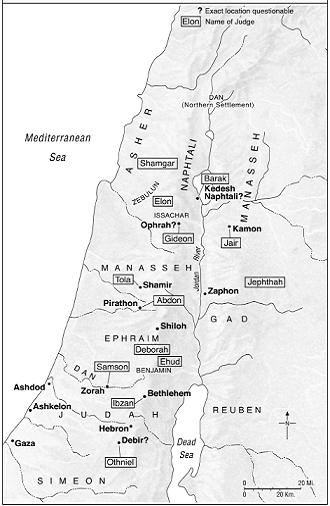
The MacArthur Study Bible, by John MacArthur (Nashville: Word Publishing, 1997) 354. © 1993 by Thomas Nelson, Inc.
III. EPILOGUE: THE DERELICTION OF ISRAEL (17:1–21:25)
A. The Idolatry of Micah and the Danites (17:1–18:31)
17:1 Chapters 17–21 give miscellaneous appendixes to illustrate the pervasively depraved conditions in the era of the judges.
17:5 Micah had a shrine. A counterfeit shrine and personal idols with a private priest is set up within the tribe of Ephraim (v. 1), whereas God’s priests were of the tribe of Levi (cf. v. 13). The defection is one example of personal and family idolatry.
17:6 everyone did . . . own eyes. This is a general characterization of the time, and of sinful behavior in all times. This attitude had been mentioned much earlier in Israel’s history (cf. 21:25; Deut. 12:8).
17:7–13 a Levite. This Levite compromised in departing from one of the forty-eight cities God gave for Levite service to Israel (Josh. 21). Then he sinned grossly by prostituting himself as a priest in a private idolatry.
18:2 On the migration by the tribe of Dan to a new territory, see note on 1:34. Dan was an example of tribal idolatry.
18:5 Please inquire of God. The passage does not say if the Levite did in fact seek God’s counsel before giving reassurance (v. 6); the Danites should have prayed to seek God’s counsel before (1) making this trip and (2) consulting a disobedient priest as one would an oracle.
18:7 Laish. Known also as Leshem (cf. Josh. 19:47), this was a secluded, rich land.
18:14–26 The Danites seized the idols of Micah by force, probably because they believed those false idols were the source of power to give them the land they had found. The apostate Levite who had served Micah as priest sold out again to be a priest for the Danites (vv. 18–20, 30), who were not bothered by his defection, but rather believed in his spiritual power.
18:29 name of the city Dan. This was in the northernmost extremity of the land of Canaan, hence the origin of the phrase, “from Dan to Beersheba,” as indicating the land from north to south (cf. 20:1).
18:30 the son of Manasseh. Some manuscripts say “son of Manasseh,” others “son of Moses,” which may be more probable as Gershom was a son of Moses (Ex. 2:22; 18:3). This idolatrous priestly service continued until the captivity. This is most likely (1) the captivity of Israel by Assyria in 722 B.C. (2 Kin. 15:29; 17:1–6) or, if not, (2) the Philistine captivity of the ark from Shiloh (see Judg. 18:31) in 1 Samuel 4:11.
18:31 the house of God was in Shiloh. The ark of God was far away from them, so they justified their idolatry by their distance from the rest of Israel. This caused perpetual idolatry for many generations.
B. The Crime at Gibeah and War Against Benjamin (19:1—21:25)
19:1–10 Here is an example of the kind of personal immorality that went on during this era.
19:1 concubine. Priests could marry (Lev. 21:7, 13, 14). Though a concubine wife (usually a slave) was culturally legal, the practice was not acceptable to God (Gen. 2:24).
19:2 played the harlot. She should have been killed as the law required and could have been, if there was a devotion to holiness and obedience to Scripture (cf. Lev. 20:10). A priest was not allowed to marry a harlot (Lev. 21:14), so his ministry was greatly tainted. Yet, he made little of her sin and separation and sought her back sympathetically (v. 3).
19:10 Jebus. An early title for Jerusalem because of Jebusite control (Judg. 1:21) until David wrested it away to become his capital (2 Sam. 5:6–9). Another early name for the city was Salem (Gen. 14:18; cf. Ps. 76:2).
19:12 Gibeah. Jerusalem was still partially out of the control of Israelites. Gibeah was under Israelite control and presumably safer.
19:15 People of the Benjamite town of Gibeah failed to extend the expected courtesy of a lodging. This opened the door to immorality.
19:18 going to the house of the LORD. He was headed for Shiloh to return to priestly duty.
19:20 night in the open square. The old man knew the danger of such a place at night.
19:22 perverted men. Lit. “sons of Belial,” i.e., worthless men, who desired to commit sodomy against the Levite. The phrase elsewhere is used for idolaters (Deut. 13:13), neglecters of the poor (Deut. 15:9), drunks (1 Sam. 1:16), immoral people (1 Sam. 2:12), and rebels against the civil authority (2 Sam. 20:1; Prov. 19:28). Belial can be traced to the false god Baal, and is also a term for yoke (they cast off the yoke of decency), and a term for entangling or injuring. It is used in the NT of Satan (2 Cor. 6:15).
19:24 let me bring them out. The host showed a disgraceful compromise in his exaggerated desire to extend hospitality to his male guest. He should have protected all in his house, and so should have the Levite, even at the risk of their own lives in guarding the women. His sad view of women was demonstrated by his willingness to hand his daughter or the guest concubine over to indecent men. Lot’s plunge from decency was similar (Gen. 19:8). Here, repeated rape and finally murder were the pitiful sequel.
19:25 the man took his concubine . . . to them. This is unthinkable weakness and cowardice for any man, especially a priest of God. Apparently, he even slept through the night, or stayed in bed out of fear, since he didn’t see her again until he awakened and prepared to leave (cf. v. 28).
19:29 divided her into twelve pieces. The Levite’s bizarre butchery to divide the woman’s body into twelve parts was his shocking summons for aroused Israelite redress. No doubt a message went with each part, and the fact that he “sent” assumes messengers (cf. 1 Sam. 11:7). As he calculated, many Israelites were incensed and desired to avenge the atrocity (cf. 20:30). Nothing could have aroused universal indignation and horror more than this radical summons from the Levite.
20:1 all the children of Israel came out. As a result of this tragedy, a national assembly was convened with people coming from the north (Dan) and the south (Beersheba). as one man before the LORD. This indicated a humble attitude and desire to seek help from God for the nation.
20:13 the children of Benjamin would not listen. They hardened their hearts against the justice and decency of turning over the criminals. Even greatly outnumbered in war, they would not yield to what was right (cf. vv. 15–17), so civil war resulted.
20:18 to inquire of God. The Lord gave His counsel from the location of the ark at Shiloh, probably through the Urim and Thummim (vv. 27, 28). The tribe of Judah was responsible to lead in battle since God had chosen a leadership role for that tribe (Gen. 49:8–12; 1 Chr. 5:1, 2). See note on Exodus 28:30.
20:22–25 The Lord twice allowed great defeat and death to Israel to bring them to their spiritual senses regarding the cost of tolerating apostasy. Also, while they sought counsel, they placed too much reliance on their own prowess and on satisfying their own outrage. Finally, when desperate enough, they fasted and offered sacrifices (v. 26). The Lord then gave victory with a strategy similar to that at Ai (Josh. 8).
20:32 Here was a battle strategy that lured the Benjamite army into a disastrous ambush (cf. vv. 36–46).
20:46 twenty-five thousand. The text employs a rounded number for the more exact 25,100 (cf. v. 35).
20:47 The number of Benjamites adds up to the 26,700 (v. 15) in a reasonable way: 18,100 killed (rounded to 18,000 here, v. 44); 5,000 (v. 45); 2,000 (v. 45); 600 survived (v. 47); leaving an estimated 1,000 lost during the final days (v. 48).
21:1 an oath at Mizpah. The Israelites made an oath not to “give” their daughters to the 600 surviving Benjamites (20:47). But they realized that the latter would fade as a tribe unless they had wives (cf. 21:6, 7), since the Benjamite women had died in the sack of Gibeah (20:37). Cf. verse 9.
21:8 No one had come from Jabesh Gilead, so the Israelites conquered Jabesh Gilead, which did not help against the Benjamites, and gave 400 virgins from there to the tribe (vv. 12–14).
21:8–16 Jabesh Gilead. Israelites placed such a premium on the unity of their tribes that they saw this city’s non-cooperation in battle as worthy of widespread death. The passage does not give God’s approval to this destruction of men, women, and children (vv. 10, 11). It is another of the bizarre actions of people when they do what is right in their own eyes, which is the point that both begins and ends this dark final section (17:6; 21:25).
21:16 wives for those who remain. Having recognized that the 200 others needed wives (vv. 17, 18), they decided to allow them to snatch brides on their own at a dance in Shiloh (vv. 16–22), not believing that this violated their oath of not directly “giving” their daughters.
21:25 Judges 17–21 vividly demonstrates how bizarre and deep sin can become when people throw off the authority of God as mediated through the king (cf. 17:6). This was the expected but tragic conclusion to a bleak period of Israelite history (cf. Deut. 12:8).
Further Study
Davis, John J. and John C. Whitcomb. A History of Israel from Conquest to Exile. Grand Rapids: Baker, 1980.
Inrig, Gary. Hearts of Iron, Feet of Clay. Chicago: Moody, 1979.
Phillips, W. Gary. Judges and Ruth. Nashville: Broadman & Holman, 2004.
Wood, Leon. Distressing Days of the Judges. Grand Rapids: Zondervan, 1975.