Title
First and Second Samuel were considered as one book in the earliest Hebrew manuscripts. They were later divided into the two books by the translators of the Greek version, the Septuagint (LXX), a division also followed by the Latin Vulgate, English translations, and modern Hebrew Bibles. The earliest Hebrew manuscripts entitled the one book Samuel after the man God used to establish the kingship in Israel. Later Hebrew texts and the English versions call the divided book 1 and 2 Samuel. The LXX designated them the First and Second Books of Kingdoms and the Vulgate, First and Second Kings, with the English translation of 1 and 2 Kings being titled Third and Fourth Kings in the LXX and Vulgate.
Author and Date
Jewish tradition ascribed the writing of Samuel to Samuel himself or to Samuel, Nathan, and Gad (based on 1 Chr. 29:29). But Samuel cannot be the writer because his death is recorded in 1 Samuel 25:1, before the events associated with David’s reign even took place. Further, Nathan and Gad were prophets of the Lord during David’s lifetime and would not have been alive when the Book of Samuel was written. Though the written records of these three prophets could have been used for information in the writing of 1 and 2 Samuel, the human author of these books is unknown. The work comes to the reader as an anonymous writing, i.e., the human author speaks for the Lord and gives the divine interpretation of the events narrated.
The Books of Samuel contain no clear indication of the date of composition. That the author wrote after the division of the kingdom between Israel and Judah in 931 B.C. is clear, due to the many references to Israel and Judah as distinct entities (1 Sam. 11:8; 17:52; 18:16; 2 Sam. 5:5; 11:11; 12:8; 19:42–43; 24:1, 9). Also, the statement concerning Ziklag’s belonging “to the kings of Judah to this day” in 1 Samuel 27:6 gives clear evidence of a post-Solomonic date of writing. There is no such clarity concerning how late the date of writing could be.
However, 1 and 2 Samuel are included in the Former Prophets in the Hebrew canon, along with Joshua, Judges, and 1 and 2 Kings. If the Former Prophets were composed as a unit, then Samuel would have been written during the Babylonian captivity (c. 560–540 B.C.), since 2 Kings concludes during the Exile (2 Kin. 25:27–30). However, since Samuel has a different literary style than Kings, it was most likely penned before the Exile during the period of the divided kingdom (c. 931–722 B.C.) and later made an integral part of the Former Prophets.
Background and Setting
The majority of the action recorded in 1 and 2 Samuel took place in and around the central highlands in the land of Israel. The nation of Israel was largely concentrated in an area that ran about ninety miles from the hill country of Ephraim in the north (1 Sam. 1:1; 9:4) to the hill country of Judah in the south (Josh. 20:7; 21:11) and between fifteen to thirty-five miles east to west. This central spine ranges in height from 1,500 feet to 3,300 feet above sea level. The major cities of 1 and 2 Samuel are to be found in these central highlands: Shiloh, the residence of Eli and the tabernacle; Ramah, the hometown of Samuel; Gibeah, the headquarters of Saul; Bethlehem, the birthplace of David; Hebron, David’s capital when he ruled over Judah; and Jerusalem, the ultimate “city of David.”
The events of 1 and 2 Samuel took place between the years c. 1105 B.C., the birth of Samuel (1 Sam. 1:1–28), to c. 971 B.C., the last words of David (2 Sam. 23:1–7). Thus, the books span about 135 years of history. During those years, Israel was transformed from a loosely knit group of tribes under judges to a united nation under the reign of a centralized monarchy. They look primarily at Samuel (c. 1105–1030 B.C.), Saul who reigned c. 1051–1011 B.C., and David who was king of the united monarchy c. 1011–971 B.C.
Historical and Theological Themes
As 1 Samuel begins, Israel was at a low point spiritually. The priesthood was corrupt (1 Sam. 2:12–17, 22–26), the ark of the covenant was not at the tabernacle (1 Sam. 4:3–7:2), idolatry was practiced (1 Sam. 7:3, 4), and the judges were dishonest (1 Sam. 8:2, 3). Through the influence of godly Samuel (1 Sam. 12:23) and David (1 Sam. 13:14), these conditions were reversed. Second Samuel concludes with the anger of the Lord being withdrawn from Israel (2 Sam. 24:25).
During the years narrated in 1 and 2 Samuel, the great empires of the ancient world were in a state of weakness. Neither Egypt nor the Mesopotamian powers, Babylon and Assyria, were threats to Israel at that time. The two nations most hostile to the Israelites were the Philistines (1 Sam. 4; 7; 13; 14; 17; 23; 31; 2 Sam. 5) to the west and the Ammonites (1 Sam. 11; 2 Sam. 10–12) to the east. The major contingent of the Philistines had migrated from the Aegean islands and Asia Minor in the twelfth century B.C. After being denied access to Egypt, they settled among other preexisting Philistines along the Mediterranean coast of Palestine.
The Philistines controlled the use of iron, which gave them a decided military and economic advantage over Israel (1 Sam. 13:19–22). The Ammonites were descendants of Lot (Gen. 19:38) who lived on the Transjordan plateau. David conquered the Philistines (2 Sam. 8:1) and the Ammonites (2 Sam. 12:29–31), along with other nations that surrounded Israel (2 Sam. 8:2–14).
There are four predominant theological themes in 1 and 2 Samuel. The first is the Davidic covenant. The books are literarily framed by two references to the “anointed” king in the prayer of Hannah (1 Sam. 2:10) and the song of David (2 Sam. 22:51). This is a reference to the Messiah, the King who will triumph over the nations who are opposed to God (see Gen. 49:8–12; Num. 24:7–9, 17–19). According to the Lord’s promise, this Messiah will come through the line of David and establish David’s throne forever (2 Sam. 7:12–16). The events of David’s life recorded in Samuel foreshadow the actions of David’s greater Son (i.e., Christ) in the future.
A second theme is the sovereignty of God, clearly seen in these books. One example is the birth of Samuel in response to Hannah’s prayer (1 Sam. 9:17; 16:12, 13). Also, in relation to David, it is particularly evident that nothing can frustrate God’s plan to have him rule over Israel (1 Sam. 24:20).
Third, the work of the Holy Spirit in empowering people for divinely appointed tasks is evident. The Spirit of the Lord came upon both Saul and David after their anointing as king (1 Sam. 10:10; 16:13). The power of the Holy Spirit brought forth prophecy (1 Sam. 10:6) and victory in battle (1 Sam. 11:6).
Fourth, the Books of Samuel demonstrate the personal and national effects of sin. The sins of Eli and his sons resulted in their deaths (1 Sam. 2:12–17, 22–25; 3:10–14; 4:17, 18). The lack of reverence for the ark of the covenant led to the death of a number of Israelites (1 Sam. 6:19; 2 Sam. 6:6, 7). Saul’s disobedience resulted in the Lord’s judgment, and he was rejected as king over Israel (1 Sam. 13:9, 13, 14; 15:8, 9, 20–23). Although David was forgiven for his sin of adultery and murder after his confession (2 Sam. 12:13), he still suffered the inevitable and devastating consequences of his sin (2 Sam. 12:14).
Interpretive Challenges
The Books of Samuel contain a number of interpretive issues that have been widely discussed:
(1) Which of the ancient manuscripts is closest to the original autograph? The standard Hebrew (Masoretic) text has been relatively poorly preserved, and the LXX often differs from it. Thus, the exact reading of the original autograph of the text is in places hard to determine (see 1 Sam. 13:1). The Masoretic text will be assumed to represent the original text unless there is a grammatical or contextual impossibility. This accounts for many of the numerical discrepancies.
(2) Is Samuel ambivalent to the establishment of the human kingship in Israel? It is claimed that while 1 Samuel 9–11 presents a positive view of the kingship, 1 Samuel 8 and 12 are strongly anti-monarchial. It is preferable, however, to see the book as presenting a balanced perspective of the human kingship. While the desire of Israel for a king was acceptable (Deut. 17:15), their reason for wanting a king showed a lack of faith in the Lord (see notes on 1 Sam. 8:5, 20 ).
(3) How does one explain the bizarre behavior of the prophets? It is commonly held that 1 and 2 Samuel present the prophets as ecstatic speakers with bizarre behavior, just like the pagan prophets of the other nations. But there is nothing in the text which is inconsistent with seeing the prophets as communicators of divine revelation, at times prophesying with musical accompaniment (see notes on 1 Sam. 10:5; 19:23, 24 ).
(4) How did the Holy Spirit minister before Pentecost? The ministry of the Holy Spirit in 1 Samuel 10:6, 10; 11:6; 16:13, 14; 19:20, 23; 2 Samuel 23:2 was not describing salvation in the NT sense, but an empowering by the Lord for His service (see also Judg. 3:10; 6:34; 11:29; 13:25; 14:6, 19; 15:14).
(5) What was the identity of the “distressing spirit from the Lord”? Is it a personal being, i.e., a demon, or a spirit of discontent created by God in the heart (cf. Judg. 9:23)? Traditionally, it has been viewed as a demon (see note on 1 Sam. 16:14 ).
(6) How did Samuel appear in 1 Samuel 28:3–5? It seems best to understand the appearance of Samuel as the Lord allowing the dead Samuel to speak with Saul.
(7) What is the identity of David’s seed in 2 Samuel 7:12–15? It is usually taken as Solomon. However, the NT refers the words to Jesus, God’s Son in Hebrews 1:5 (see notes on 2 Sam. 7:12–15 ).
I. SAMUEL: PROPHET AND JUDGE TO ISRAEL (1:1–7:17)
1:1–7:17 This first major division of the book begins and ends in Samuel’s hometown of Ramah (v.1; 7:17). The focus of these chapters is on the life and ministry of Samuel. First Samuel 1:1–4:1a concentrates on Samuel as a prophet of the Lord (see the concluding statement of 4:1a, “and the word of Samuel came to all Israel”). The text in 4:1b–7:17 emphasizes Samuel as judge (see 7:17, “there he judged Israel”).
A. Samuel the Prophet (1:1–4:1a)
1. The birth of Samuel (1:1–28)
1:1 a certain man. This verse resembles the introduction to the birth of Samson in Judges 13:2. The strong comparison also highlights the similarities between the lives of Samson and Samuel. Both men were judges over Israel, fighters of the Philistines, and lifelong Nazirites. Ramathaim. Possibly meaning “two heights,” the name occurs only here in the OT. Elsewhere, the town is simply called Ramah. It was located about five miles north of Jerusalem. Elkanah. Meaning “God has created,” he was the father of Samuel. Zuph. Zuph is both a place (9:5) and a personal name (1 Chr. 6:35), as here. Ephraimite. First Chronicles 6:27 identifies Elkanah as a member of the Kohathite branch of the tribe of Levi. The Levites lived among the other tribes (Josh. 21:20–22). Ephraim was the tribal area where this Levite lived.
1:2 two wives. Although polygamy was not God’s intention for mankind (Gen. 2:24), it was tolerated, but never endorsed in Israel (see Deut. 21:15–17). Elkanah probably married Peninnah because Hannah was barren. Hannah. Meaning “grace,” she was probably Elkanah’s first wife. Peninnah. Meaning “ruby,” she was Elkanah’s second wife and the bearer of his first children.
1:3 This man went up . . . yearly. All Israelite men were required to attend three annual feasts at the central sanctuary (Deut. 16:1–17). Elkanah regularly attended these festivals with his wives. The festival referred to here was probably the Feast of Tabernacles (September/October) because of the feasting mentioned in 1:9. the LORD of hosts. This is the first OT occurrence of hosts being added to the divine name. Hosts can refer to human armies (Ex. 7:4), celestial bodies (Deut. 4:19), or heavenly creatures (Josh. 5:14). This title emphasizes the Lord as sovereign over all of the powers in heaven and on earth, especially over the armies of Israel. Shiloh. Located about twenty miles north of Jerusalem in Ephraim, the tabernacle and ark of the covenant resided here (Josh. 18:1; Judg. 18:31). Eli. Meaning “exalted is the LORD,” he was the high priest at Shiloh. Hophni and Phinehas. Each of Eli’s two priestly sons had an Egyptian name: Hophni (“tadpole”) and Phinehas (“nubian”).
1:4 an offering. This was a peace offering since the worshipers ate a portion of the offering (see Lev. 7:11–18).
1:5 the LORD had closed her womb. Hannah’s barrenness was the result of divine providence like Sarah’s (Gen. 16:2) and Rachel’s (Gen. 30:2).
1:6 her rival. The other wife was an adversary. provoked her. Lit. “to thunder against” her; see 2:10 for the same word.
1:7 did not eat. Hannah fasted because of the provocation of Peninnah. She did not eat of the peace offerings.
1:8 your heart grieved? The idiom used reflects anger, not sadness (see Deut. 15:10 for the same idiom).
1:9 tabernacle. The mention of sleeping quarters (3:2, 3) and doors (3:15) implies that at this time the tabernacle was part of a larger, more permanent building complex.
1:11 vow. Hannah pledged to give the Lord her son in return for God’s favor in giving her that son. A married woman’s vow could be confirmed or nullified by her husband according to Numbers 30:6–15. Your maidservant. A humble, submissive way of referring to herself in the presence of her superior, sovereign God. remember me. Hannah requested special attention and care from the Lord. all the days of his life. A contrast to the normal Nazirite vow, which was only for a specified period of time (see Num. 6:4, 5, 8). no razor. Though not specified as such in this chapter, the Nazirite vow is certainly presupposed. The nonshaving of the hair on one’s head is one of the three requirements of the vow (Num. 6:5). This expression was used elsewhere only of the Nazirite Samson (Judg. 13:5; 16:17).
1:13 drunk. Public prayer in Israel was usually audible. However, Hannah was praying silently, leaving Eli to surmise that she was drunk.
1:16 wicked. Lit. “daughter of Belial.” Cf. 2:12.
1:20 Samuel. The name literally meant “name of God,” but sounded like “heard by God.” For Hannah, the assonance was most important, because God had heard her prayer.
| Name | Description | Biblical Reference |
| Bathsheba | Wife of David; mother of Solomon | 2 Sam. 11:3, 27 |
| Deborah | Judge who defeated the Canaanites | Judg. 4:4 |
| Delilah | Philistine who tricked Samson | Judg. 16:4, 5 |
| Dinah | Only daughter of Jacob | Gen. 30:21 |
| Esther | Jewish queen of Persia who saved her people from destruction | Esther 2–9 |
| Eve | First woman | Gen. 3:20 |
| Gomer | Prophet Hosea’s unfaithful wife | Hos. 1:2, 3 |
| Hagar | Sarah’s maid; mother of Ishmael | Gen. 16:3–16 |
| Hannah | Mother of Samuel | 1 Sam. 1 |
| Jezebel | Wicked wife of King Ahab | 1 Kin. 16:30, 31 |
| Jochebed | Mother of Moses | Ex. 6:20 |
| Miriam | Sister of Moses; a prophetess | Ex. 15:20 |
| Naomi | Ruth’s mother-in-law | Ruth 1:2, 4 |
| Orpah | Ruth’s sister-in-law | Ruth 1:4 |
| Rachel | Wife of Jacob | Gen. 29:28 |
| Rahab | Harlot who harbored Israel’s spies; ancestor of Jesus | Josh. 2:3–1; Matt. 1:5 |
| Ruth | Wife of Boaz and mother of Obed; ancestor of Jesus | Ruth 4:13, 17; Matt. 1:5 |
| Sarah | Wife of Abraham; mother of Isaac | Gen. 11:29; 21:2, 3 |
| Tamar | A daughter of David | 2 Sam. 13:1 |
| Zipporah | Wife of Moses | Ex. 2:21 |
1:21 his vow. Elkanah supported and joined with his wife in her vow to the Lord. With the birth of Samuel, he brought his votive offering to the Lord (Lev. 7:16).
1:22 weaned. As was customary in the ancient world, Samuel was probably breast fed for two to three years. Then he was left to serve the Lord at the tabernacle for the rest of his life.
1:23 His word. Probably an earlier word of the Lord not recorded in the text.
1:24 three bulls . . . ephah of flour . . . skin of wine. According to Numbers 15:8–10, a bull, flour, and wine were to be sacrificed in fulfillment of a vow. Hannah brought all three in larger measure than required. An ephah was about three-fourths of a bushel.
1:26 As your soul lives. Lit. “by the light of your soul,” a common oath formula.
1:27, 28 asked . . . lent. These terms are from the same Hebrew root used four times in these two verses. Twice in verse 27 it has the usual meaning of “asked.” Twice in verse 28 it bears the derived meaning “lent on request.” God had given the son Hannah requested, and she gives her gift back to the Giver.
2. The prayer of Hannah (2:1–10)
2:1–10 In contrast to the prayer that came from her bitterness (1:10), Hannah prayed from joy in these verses. The prominent idea in Hannah’s prayer is that the Lord is a righteous judge. He had brought down the proud (Peninnah) and exalted the humble (Hannah). The prayer has four sections: (1) Hannah prays to the Lord for His salvation (vv. 1, 2); (2) Hannah warned the proud of the Lord’s humbling (vv. 3–8d); (3) Hannah affirmed the Lord’s faithful care for His saints (vv. 8e–9b); (4) Hannah petitioned the Lord to judge the world and to prosper His anointed king (vv. 9c–10e).This prayer has a number of striking verbal similarities with David’s song of 2 Samuel 22:2–51: “horn” (2:1; 22:3), “rock” (2:2; 22:2, 3), salvation/ deliverance (2:1, 2; 22:2, 3), grave/Sheol (2:6; 22:6), “thunder” (2:10; 22:14), “king” (2:10; 22:51), and “anointed” (2:10; 22:51).
2:1 horn. A symbol of strength and power (see Deut. 33:17).
2:2 rock. A metaphor for God stressing His strength and the security of those who trust in Him (see Deut. 32:4; Ps. 18:1, 2).
2:3 proudly . . . arrogance. The majestic and powerful God humbles all those who vaunt themselves against Him. The idea of God’s humbling of the proud is shown throughout 1 and 2 Samuel, toward Peninnah, Eli’s sons, the Philistines, Goliath, Saul, Nabal, Absalom, Shimei, Sheba, and even David.
2:4–7 Seven contrasts are found in these four verses: (1) mighty and weak; (2) full and hungry; (3) barren and fertile; (4) dead and alive; (5) sick and well; (6) poor and rich; and (7) humbled and exalted.
2:5 has borne seven. This is not a personal testimony since Hannah bore only six children (2:21). Seven here is a general reference to women whom God blesses.
2:8 pillars of the earth. A figure of speech which pictures the earth’s stability (cf. Pss. 75:3; 82:5; 104:5).
2:10 The LORD will judge the ends of the earth. The Lord will impose His righteous rule on all the nations and peoples (see Is. 2:2–4). His king. Moses had already predicted the coming of a king who would exercise God’s rule over all the nations of the earth (Gen. 49:8–12; Num. 24:7–9, 17–19). It was this future, victorious king whom Hannah anticipated and Saul and David prefigured. His anointed. Previously in the OT, both the tabernacle and its utensils along with the priests (Aaron and his sons) had been anointed with oil. This pictured their consecrated and holy status before the Lord (Ex. 30:26–30). In Samuel, first Saul (10:1), and then David (16:13; 2 Sam. 2:4; 5:3) were anointed as they were inaugurated for the kingship. From this point in the OT, it is usually the king who is referred as “the anointed (of the LORD)” (12:3; 24:6; 26:9, 11, 16; 2 Sam. 1:14, 16; 19:21).
The kings of Israel, particularly David, foreshadowed the Lord’s ultimate anointed king. The English word Messiah represents the Hebrew word used here meaning “anointed.” Thus, this ultimate King who would rule over the nations of the earth came to be referred to as “the Messiah,” as here and 2:35; cf. 2 Samuel 22:51.
3. The growth of Samuel (2:11–26)
2:11 ministered to the LORD. As a Levite, the boy Samuel performed services that assisted Eli, the high priest.
2:12 corrupt. Cf. 1:16. “Sons of Belial” was a Hebrew way of saying base, worthless, or wicked men. See 2 Corinthians 6:15, where it is used as a name for Satan. Eli had falsely considered Hannah a wicked woman (1:16). Eli’s sons were, in fact, wicked men. they did not know the LORD. Eli’s sons had no personal experience of, nor fellowship with the Lord. The boy Samuel came to “know the LORD” when the Lord revealed Himself to him (see 3:7).
2:13 the priests’ custom. Not content with the specified portions of the sacrifices given to the priests (Deut. 18:3), Eli’s sons would take for themselves whatever meat a three-pronged fork would collect from a boiling pot.
2:15 before they burned the fat. The law mandated that the fat of the sacrificial animal was to be burned on the altar to the Lord (Lev. 7:31). In contrast, Eli’s sons demanded raw meat, including the fat, from the worshipers.
2:18 But Samuel. The faithful ministry of Samuel before the Lord was in sharp contrast to the disobedience of Eli’s sons. linen ephod. A close fitting, sleeveless outer vest extending to the hips and worn by priests, especially when officiating before the altar (Ex. 28:6–14).
2:19 little robe. A sleeveless garment reaching to the knees, worn under the ephod (Ex. 28:31).
2:20 the loan. This is the same word used in 1:27, 28 translated there “granted,” “asked,” “lent.” Here, it is a reminder of Hannah’s faithfulness to her vow to the Lord. By providing Hannah with additional children, the Lord continued to be gracious to her.
2:22 lay with the women. Eli’s sons included in their vile behavior having sexual relationships with the women who served at the tabernacle (see Ex. 38:8). Such religious prostitution was common among Israel’s Canaanite neighbors.
2:25 God will judge. Eli’s point to his sons was that if God would surely judge when one sinned against another man, how much more would He bring judgment against those who sinned against Him. the LORD desired to kill them. Because Eli’s sons had persisted in their evil ways, God had already determined to judge them. This divine, judicial hardening, the result of defiant refusal to repent in the past, was the reason Hophni and Phinehas refused to heed Eli’s warnings.
2:26 grew in stature, and in favor. In contrast to the apostate sons of Eli, Samuel was maturing both spiritually and socially (cf. Luke 2:52).
4. The oracle against Eli’s house (2:27–36)
2:27 man of God. This phrase is usually used as a synonym for “prophet” (see 9:9, 10). house of your father . . . in Egypt. Although Eli’s genealogy was not recorded in the OT, he was a descendant of Aaron. The Lord had revealed Himself to Aaron in Egypt before the Exodus (see Ex. 4:4–16). Aaron had been divinely chosen to serve the Lord as the first in a long line of priests (Ex. 28:1–4).
Locations of Samuel’s Ministry
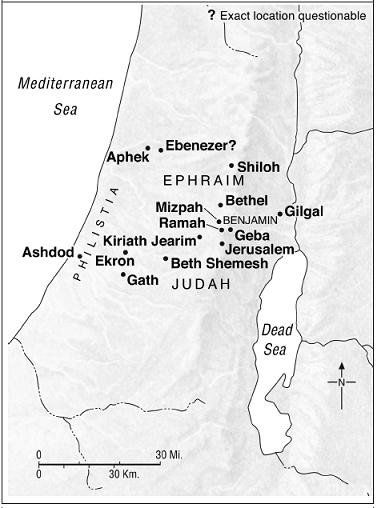
The MacArthur Study Bible, by John MacArthur (Nashville: Word Publishing, 1997) 380. © 1993 by Thomas Nelson, Inc.
2:28 to be My priest. The chief duties of the priests were: (1) to place the offerings on the altar; (2) to burn the incense in the holy place; and (3) to wear the linen ephod (see v. 18).
2:29 My offering. In recognition of their service to God and His people, the priests were allocated specific parts of the offering which were brought to the sanctuary (see Lev. 2:3, 10; 7:31–36). honor. By condoning the sin of Hophni and Phinehas, Eli had shown preference for his sons above the Lord. Therefore, Eli was unworthy of the Lord’s blessing.
2:30 I said indeed. The Lord had promised that Aaron’s descendants would always be priests (Ex. 29:9), and He had confirmed that promise by oath (Num. 25:13). Because of flagrant disobedience, the house of Eli would forfeit their priesthood. Although the Aaronic priesthood was perpetual, priests could forfeit their position by their sin.
2:31 will not be an old man in your house. The judgment of untimely death followed Eli’s descendants. Eli’s sons died in the flower of their manhood (4:11). Later, Saul massacred the priests at Nob (22:16–19). Ultimately, Solomon removed Abiathar from the priesthood (1 Kin. 2:26, 27), and the priestly line of Eleazar prevailed, as God promised (cf. Num. 25:12, 13).
2:32 an enemy in My dwelling place. This probably referred to the desecration of the tabernacle, where the Lord dwelt, at Shiloh by the Philistines (see Jer. 7:12–14).
2:34 a sign to you. The death of Eli’s two sons on the same day validated the prophecy (cf. 4:11, 17).
2:35 I will raise up for Myself a faithful priest. Although some have identified this priest as Samuel and others Christ, it is better to view the prophecy as fulfilled in the accession of Zadok and his family to the priestly office in the time of Solomon (see 1 Kin. 1:7, 8; 2:26, 27, 35). This reestablished the office of high priest in the line of Eleazar and Phinehas (cf. Num. 25:10–13). I will build him a sure house. The sons of Zadok will also serve in the millennial temple (see Ezek. 44:15; 48:11). My anointed. This refers to the Messiah, who will defeat God’s enemies and establish His rule in the Millennium (see v. 10).
2:36 a morsel of bread. The judgment corresponded to the sin. Those who had gorged themselves on the sacrifices (vv. 12–17) were reduced to begging for a morsel of food.
5. The Word of the Lord through Samuel (3:1–4:1a)
3:1 the boy Samuel. Samuel was no longer a child (2:21, 26). While the Jewish historian Josephus suggested he was twelve years of age, he was probably a teenager at this time. The same Hebrew term translated here “boy” was used of David when he killed Goliath (17:33). the word of the LORD was rare. The time of the judges was a period of extremely limited prophetic activity. The few visions that God did give were not widely known. revelation. Lit. “vision.” A divine revelation mediated through an auditory or visual encounter.
3:3 before the lamp of God went out. The golden lampstand, located in the Holy Place of the tabernacle, was filled with olive oil and lit at twilight (Ex. 30:8). The lamp was kept burning from evening until morning (Ex. 27:20, 21). Just before dawn, while the golden lampstand was still burning, Samuel was called to his prophetic ministry. ark of God. See Exodus 25:10–22.
3:7 Samuel did not yet know the LORD. Samuel had not yet encountered the Lord in a personal way, nor had he received God’s Word by divine revelation (see 2:12).
3:8 Then Eli perceived. Eli was slow to recognize that God was calling Samuel. This indicates that Eli’s spiritual perception was not what it should have been as the priest and judge of Israel (see also 1:12–16).
3:10 hears. “To hear with interest,” or “to hear so as to obey.”
3:11 ears . . . will tingle. A message of impending destruction, referring here to Eli’s house (see 2 Kin. 21:12; Jer.19:3).
3:12 all that I have spoken. See 2:27–36. The repetition of the oracle against Eli to Samuel confirmed the word spoken by the man of God.
3:13 made themselves vile. The LXX reads “his sons blasphemed God.” Cursing God was an offense worthy of death (see Lev. 24:11–16, 23). did not restrain them. Eli was implicated in the sins of his sons because he did not intervene with judgment. If his sons were blaspheming God, they should have been stoned (see Lev. 24:15, 16).
3:14 not be atoned for . . . forever. Eli’s family was apparently guilty of presumptuous sin. For such defiant sin, there was no atonement and the death penalty could be immediately applied (see Num. 15:30, 31).
3:15 the doors of the house of the LORD. The doors of the tabernacle compound (see 1:9).
3:17 God do so to you, and more also. This is an oath of imprecation. Eli called down God’s judgment on Samuel if he refused to tell everything he knew.
3:18 Let Him do what seems good to Him. Eli resigned himself to divine sovereignty, without reluctance.
3:19 the LORD was with him. The Lord’s presence was with Samuel, as it would be later with David (16:18; 18:12). The Lord’s presence validated His choice of a man for His service. let none of his words fall to the ground. Everything Samuel said with divine authorization came true. This fulfillment of Samuel’s word proved that he was a true prophet of God (see Deut. 18:21, 22).
3:20 Dan to Beersheba. The traditional limits of the land of Israel from the north to the south. prophet of the LORD. Samuel’s status as a spokesman of God’s message was acknowledged by all throughout Israel.
4:1a the word of Samuel came to all Israel. The text of 1:1–3:21 climaxes with the establishment of Samuel as God’s spokesman/ representative. Observe that “the word of the Lord” (3:21) has become equivalent to “the word of Samuel.”
B. Samuel the Judge (4:1b–7:17)
1. The saga of the ark (4:1b–7:1)
4:1b Philistines. From the period of the judges through the end of David’s reign, the Philistines (“Sea Peoples”) were an everpresent enemy of Israel. They were non-Semitic immigrants (see Gen. 10:14; 1 Chr. 1:12; Jer. 47:4, 5; Amos 9:7) who settled along the coastal regions of southern Canaan, organizing their power in five chief cities: Ashdod, Ashkelon, Ekron, Gath, and Gaza (6:17; Judg. 3:13). The introduction of the Philistines into the narrative provides a link between the judgeship of Samuel and the judgeship which Samson was not able to complete (Judg. 13–16). Ebenezer. The location of this site has not been specifically identified. Opposite Aphek in Israelite territory, it is possibly modern Izbet Sarteh on the road to Shiloh. When translated, it means “stone of help,” and its mention here (and 5:1) and again in 7:12 of another location mark this section as a literary unit. Aphek. This site is located near the source of the Yarkon River, at the southern end of the coastal plain of Sharon, approximately five miles east of the Mediterranean Sea. This city marked the northeastern edge of Philistine territory.
4:3 Why has the LORD defeated us? The question of the elders reflected their knowledge that the Lord both fought their battles (2:10; 17:47) and allowed their defeat. To be defeated clearly meant that God was not “with” them (Num. 14:42; Deut. 1:42). Instead of inquiring of the Lord for direction, they proceeded to take the matter into their own hands. Let us bring the ark. The ark symbolized the presence and power of the Lord. Yet, Israel treated it like a good-luck charm, which would ensure them victory over the Philistines. Knowing that victory or defeat depended on the Lord’s presence, they confused the symbol of His presence with His actual presence. In this way, their understanding of God resembled that of the Philistines (4:8).
4:4 dwells between the cherubim. A repeated phrase used to describe the Lord (see 2 Sam. 6:2; 2 Kin. 19:15; 1 Chr. 13:6; Pss. 80:1; 99:1; Is. 37:16). It spoke of His sovereign majesty. Hophni and Phinehas. These were the two wicked sons of Eli (2:12–17, 27–37), of whom it was said that they “did not know the LORD” (2:12). The fact that they were mentioned together recalls the prophecy that they would die together (2:34).
4:6 Hebrews. In Genesis 14:13, the name Hebrew was applied to Abram. Consequently, the name came to refer to the physical descendants of Abraham. It was used to distinguish them as a class of people distinct from the foreigners around them. It means that Abram was a descendant of Eber in the line of Shem (cf. 10:25; 11:14–16).
4:7 God has come into the camp! The idol, to the Philistine, was thought to be the actual dwelling place of his deity. Hence, when Israel brought the ark into the camp, the Philistines concluded that God was present, an exclamation that reflected a knowledge of God’s power.
4:8 the gods who struck the Egyptians. Evidently, the news of God’s victory over the Egyptians was common knowledge to the Philistines.
4:9 servants . . . as they have been to you. Israel’s failure to uproot all the inhabitants of Canaan (see Judg. 1:28) caused them to fall under the judgment of God. As a consequence of this judgment, Israel was enslaved to Philistine oppression (see Judg. 10; 13–16). The Philistines feared that they would become servants of the Hebrews.
4:11 the ark of God was captured. In spite of their hopes to manipulate God into giving them the victory, Israel was defeated and the ark fell into the hands of the Philistines. The view of having the ark of God being equivalent to having control of God, embraced both by Israel and then the Philistines, is to be contrasted with the power and providence of God in the remaining narrative. Hophni and Phinehas died. In fulfillment of 2:34 and 3:12, Eli’s sons died together.
4:12 his clothes torn and dirt on his head. The actions of the man of Benjamin were considered to be universal signs of mourning for the dead and of national calamity (cf. 2 Sam. 15:32).
4:13 his heart trembled for the ark of God. Eli’s concern for the ark stands in stark contrast to his earlier actions of honoring his two sons over honoring the Lord (2:29, 30; cf. 4:17, 18).
4:18 Eli . . . died. As was the case with Hophni and Phinehas, Eli died. Thus, in fulfillment of the word of the Lord, all of the priestly line through Eli had been wiped out (2:29–34). See note on 2:31. he had judged Israel forty years. Over that time, Eli fulfilled the office of both priest and judge in Israel.
4:21 Ichabod . . . The glory has departed! Due primarily to the loss of the ark, the symbol of God’s presence, Phinehas’s wife names her child Ichabod, meaning either “Where is the glory?” or “No glory.” To the Hebrew, glory was often used to refer to God’s presence; hence, the text means “Where is God?” The word departed carries the idea of having gone into exile. Thus, to the people of Israel, the capturing of the ark was a symbol that God had gone into exile. Although this was the mind-set of Israel, the text narrative will reveal that God was present, even when He disciplined His people. See note on Ezekiel 10:18, 19.
5:1 Ashdod. One of the five chief Philistine cities, inland from the coast (three miles) and approximately thirty-three miles west of Jerusalem.
5:2 Dagon. Ancient literature identifies this deity as a fish god, whose image had the lower body of a fish and the upper body of a man. Dagon seems to have been the leader of the Philistine pantheon (Judg. 16:23) and is noted to be the father of Baal. The placing of the ark of God in the temple of Dagon was supposed to be a sign of Dagon’s power and Yahweh’s inferiority, a visual representation that the god of the Philistines was victorious over the God of the Hebrews. In addition, the textual connection of Dagon reinforces the affinity between the events written her and those in the life of Samson (cf. Judg. 13–16).
Locations of the Ark’s Journey
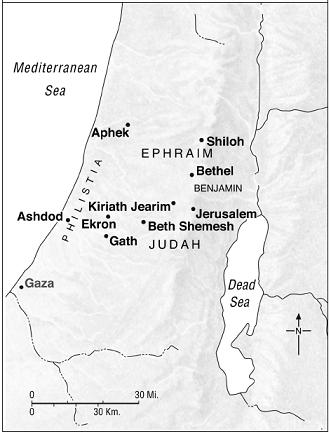
The MacArthur Study Bible, by John MacArthur (Nashville: Word Publishing, 1997) 382. © 1993 by Thomas Nelson, Inc.
5:3 fallen on its face. Ironically, God Himself overturned the supposed supremacy of Dagon by causing Dagon to fall over, as if paying homage to the Lord.
5:4 head . . . hands were broken off. The first display of God’s authority over Dagon was not perceived. God’s second display of authority, the cutting off of Dagon’s head and hands, was a common sign that the enemy was dead (17:54; 31:9; Judg. 7:25; 8:6; 2 Sam. 4:12), and was to be understood as God’s divine judgment on the false idol.
5:5 tread on the threshold. Because the head and hands of Dagon fell on the threshold, superstition developed that it was cursed; therefore, the Philistines would not tread on it. to this day. This phrase supports the claim that the writer was living at a time removed from the actual event itself (see Introduction: Author and Date). This phrase and phrases equivalent to it are found throughout 1 and 2 Samuel (6:18; 26:6; 30:25; 2 Sam. 4:3; 6:8; 18:18).
5:6 the hand of the LORD was heavy. In contrast to the hands of Dagon being cut off, symbolizing his helplessness against the power of Yahweh, the Lord was pictured to be actively involved in judging the Philistines. The imagery of God’s hand is found throughout the ark narrative (4:8; 5:6, 7, 9, 11; 6:3, 5, 9). tumors. It has been suggested that this word refers to the sores or boils caused by an epidemic of the bubonic plague carried by rats (6:4, 5). The spread of the disease and its deadly effect (5:6, 9, 12; 6:11, 17) make this a likely view.
5:8 lords of the Philistines. Those men who ruled the chief Philistine cities as kings (see note on 4:1 ). Gath. Another main Philistine city, located about twelve miles east of Ashdod (cf. 5:1).
5:10 Ekron. With judgment on Gath, the Philistines sent the ark away to the next main city to see if God was behind their calamity. Located about six miles north of Gath, it was the closest major Philistine city to Israel’s border. the ark . . . to kill us. The cry of the Ekronites was an admission that the Philistines had gotten the message that God was the source of their troubles. It is curious that the Philistines knew of God’s power to strike the Egyptians (4:8), yet they proudly believed themselves stronger than Egypt. The severity of the plagues grew increasingly worse in verses 6–12, corresponding with the failure of the Philistines to humble themselves before God. Their actions were similar to those of the Egyptians (Ex. 5–14).
Locations of the Philistine Threats
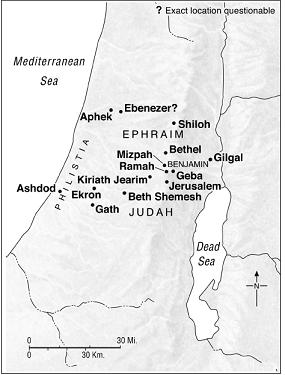
The MacArthur Study Bible, by John MacArthur (Nashville: Word Publishing, 1997) 384. © 1993 by Thomas Nelson, Inc.
6:2 the priests and the diviners. These men of the Philistines, specifically identified in Scripture as having notable fame (Is. 2:6), were summoned to figure out how to appease God so He would stop the plague. send it to its place. The Philistines understood that they had offended God. Their diviners decided to appease His wrath by sending the ark back to Israel.
6:3 trespass offering. The purpose behind this offering was to both acknowledge and compensate for their trespass of dishonoring the God of Israel. These pagans recognized their sin and the need for manifest repentance, which they did according to their religious tradition by means of votive trespass offerings.
6:4 Five golden tumors and five golden rats. It was their custom to make models of their sores (and the rats which brought the plague), in hopes that the deity would recognize that they knew why he was angry and remove the evil which had fallen upon them. The context of verse 17 suggests that the items were in the writer’s presence at the time the account was recorded. The number five represents each of the Philistine cities and lords affected by God’s judgment.
6:5 give glory to the God of Israel . . . He will lighten His hand. While sympathetic magic was the Philistine custom, this statement expressly affirms the intention behind the offerings: they were to halt the dishonor, confess their sin, and give glory to the God of Israel by acknowledging who it was that they had offended and who was the supreme deity.
6:6 Why then do you harden your hearts? The diviners correlate the Philistines’ actions of not recognizing God with those of Pharaoh and the Egyptians. This is the same word harden that was used in Exodus 7:14; 8:15, 32. It is an interesting correlation, because the dominant purpose in Exodus 5–14 was that the Egyptians might “know that I am the LORD” (Ex. 7:5).
6:7 never been yoked. To know without a doubt that the God of Israel was behind all of their troubles, the diviners devised a plan that would reveal whether God was the One responsible. Using cows which had “never been yoked” meant using animals that were untrained to pull a cart and probably would not go anywhere. take their calves . . . away from them. The second element in their plan was to use nursing cows taken away from their calves. For the cows unnaturally to head off in the opposite direction from their calves would be a clear sign that the cause of their judgment was supernatural.
6:9 Beth Shemesh. Named “house of the sun” and located in the Sorek Valley, this was a Levitical city about fifteen miles west of Jerusalem. Originally designated for the descendants of Aaron (Josh. 21:16), it was chosen to be the destination of the cows pulling the cart.
6:12 lowing as they went. With the moaning from instinctive unwillingness to leave their calves behind, the cows went straight to Beth Shemesh, not turning to the right or left, leaving the inescapable conclusion that God had judged them.
6:13 reaping their wheat harvest. Sometime in June. These harvests were accomplished with the whole city participating.
6:14 Joshua of Beth Shemesh. The cows stopped in the field of Joshua, where there was a large stone which was verifiable to the writer at the time the account was written. burnt offering. Because the cows and cart were used for sacred purposes, they could not be used for normal, everyday purposes. Therefore, the men of Beth Shemesh sacrificed the cows, using the cart for the fire.
6:15 Levites. The men of Beth Shemesh, being Levites, were qualified to move the ark. put them on the large stone. The stone mentioned was used as a pedestal for both the items of gold and the ark. At the time the account was written, it stood as a witness that God had returned to the land.
6:16 five lords of the Philistines. The lords of the Philistines, upon seeing that the ark arrived safely, returned to Ekron.
6:19 looked into the ark. This action on the part of the men of Beth Shemesh constituted the sin of presumption. This is first addressed in Numbers 4:20 and is mentioned again in 2 Samuel 6:6, 7. fifty thousand and seventy men. Some debate whether this figure is too large. However, retaining the larger number is more consistent with the context of “a great slaughter,” and the reference to 30,000 in 4:10 (cf. 11:8). However, a scribal error could have occurred, in which case the number would omit the 50,000 and likely be “seventy,” as in Josephus.
6:20 Who is able to stand? This question climaxes the narrative of the ark. No one is able to stand against God’s judgment. This applied to the people outside the covenant as well as those under the covenant. Presumption before God is unacceptable. to whom shall it go? The expression was used to denote the desire to take the ark away from them.
6:21 Kirjath Jearim. A city located approximately ten miles northeast of Beth Shemesh. It would remain the resting place of the ark until David brought it to Jerusalem (2 Sam. 6:1–19). This location had long been associated with Baal worship (cf. Josh. 15:9, 60; 18:14).
2. Israel’s victory over the Philistines and the judgeship of Samuel (7:2–17)
7:2 twenty years. Coupled with verse 3, the twenty years designated the period Israel neglected God and chased after foreign gods. After those twenty years, Israel returned to the Lord.
7:3 prepare your hearts for the Lord . . . and He will deliver you. This statement recalls the cycle in the Book of Judges: apostasy, oppression, repentance, and deliverance. It previews the contents of this chapter.
7:4 the Baals and the Ashtoreths. Most dominant of the Canaanite pantheon, these deities were the fertility gods which plagued Israel. Baal and Ashtoreth are plurals of majesty, which signify their supreme authority over other Canaanite deities. Ashtoreth represented the female goddess, while Baal represented the male, sky god who fertilized the land.
7:5 Mizpah. This city was located eight miles northeast of Kirjath Jearim in Benjamin. It became one of the cities of Samuel’s circuit (v. 16). I will pray. Samuel was a man of prayer (7:8, 9; 8:6; 12:19, 23; 15:11).
7:6 drew water, and poured it out before the LORD. The pouring out of water before the Lord was a sign of repentance. This act is repeated in 2 Samuel 23:16. We have sinned against the LORD. The symbol of Samuel pouring out the water and the acknowledgment of the people reveal a situation where true repentance had taken place. The condition of the heart superseded the importance or righteousness of the ritual. Samuel judged. At this point, Samuel is introduced as the judge of Israel. His judgeship encompassed both domestic leadership and the conduct of war. The word links the text back to the last comment about Eli who judged forty years (4:18). Samuel is shown to be the one taking over Eli’s judgeship. He served as the last judge before the first king (cf. 1 Sam. 8:5).
7:7 Israel . . . afraid of the Philistines. When Israel heard that the Philistines had come up against them for war, they were afraid.
7:10 the LORD thundered . . . upon the Philistines. In a literal manner, the Lord did to His enemies what was said by Hannah in her prayer (2:10).
7:11 Beth Car. The location is unknown.
7:12 Ebenezer. A different location from the one mentioned in 4:1 and 5:1. The name functions as the literary knot for the two ends of this unit (see note on 4:1 ). Thus far the Lord has helped us. This expression means that the Lord was the One responsible for getting Israel to this point. He was Israel’s Sovereign One in times of both faithfulness and rebellion. He fought the battles and provided the blessings.
7:13 did not come anymore into the territory of Israel. The Lord gave Israel the victory over the Philistines, discontinuing their threat for the immediate future during Samuel’s judgeship. all the days of Samuel. As the section opened in 4:1 with Samuel pictured as God’s agent, so here the section closed with the Lord working powerfully through all the days of Samuel.
7:14 Ekron to Gath. These two cities, mentioned earlier as chief Philistine cities (5:8, 10), became the eastern border of the Philistines. The territory to the east of these cities was freed from Philistine control and returned to Israel. Amorites. Whereas the Philistines resided in the coastal plains, the Amorites resided in the hills west of Israel between the Jordan Valley and the coastal plain. As with the Philistines, Israel was at peace with the Amorites.
7:16 a circuit. The circuit was an annual trip made by Samuel; he would travel to Bethel, Gilgal, Mizpah, and return once again to Ramah, which allowed him to manage the affairs of the people.
7:17 Ramah. The first major division of the book (1:1–7:17) ends with Samuel returning to Ramah to judge the people.
II. SAUL: THE FIRST KING OVER ISRAEL (8:1–15:35)
8:1–15:35 This division of the book concentrates on the interaction between Israel, Samuel, and Saul. These chapters begin with the elders of Israel coming to Samuel at Ramah (8:4) and conclude with Samuel’s leaving Saul and returning to Ramah (15:34). First Samuel 8:1–12:25 describes the establishment of the kingship over the nation of Israel and the advent of Saul as the first king. These chapters are linked by reference to Samuel’s being old (8:1; 12:2) and “heeding the voice” of the people (8:7, 9, 19, 22; 12:1, 14, 15). Chapters 13:1–15:35 recount the failures of Saul as king over Israel. The events of these chapters are bracketed by two interactions between Saul and Samuel that take place in Gilgal (13:4, 7, 8, 12, 15; 15:12, 21, 33).
A. The Rise of Saul to the Kingship (8:1–12:25)
1. The demand of Israel for a king (8:1–22)
8:1 Samuel was old. Samuel was about sixty years of age (1043 B.C.). He appointed his two sons to serve as judges in Beersheba, a city about fifty-seven miles south of Ramah.
8:2 Joel. The name means “the LORD is God.” Abijah. The name means “my Father is the LORD.”
8:3 his sons did not walk in his ways. The perverted desire for riches led Samuel’s sons to take bribes and, thereby, pervert justice. These actions were strictly forbidden for judges in Deuteronomy 16:19. The sins of Samuel’s sons became the pretext for Israel’s demand for a king (vv. 4, 5).
8:5 Now make us a king . . . like all the nations. When Israel entered the land, they encountered Canaanite city-states that were led by kings (see Josh. 12:7–24). Additionally, during the period of the judges, Israel was enslaved by nations that were led by kings (Judg. 3:8, 12; 4:2; 8:5; 11:12). However, at the time of the judges, there was no king in Israel (Judg. 17:6; 18:1; 19:1; 21:25). As Israel lived in the land surrounded by nations that had kings, the desire arose for a king in Israel also. According to Deuteronomy 17:14, God knew this would be their desire and He would allow it to occur. However, verse 20 revealed a motive which was definitely counter to the Lord’s will. See note on 8:20.
8:7 Heed the voice of the people. The Lord had predicted that there would be kings over Israel (Gen. 35:11; 36:31; 49:10; Num. 24:7–9, 17; Deut. 17:14; 28:36). Here, the Lord told Samuel to obey the request of the people and give them a king. they have not rejected you, but . . . Me. The nature of this rejection of the Lord by Israel is explained in verses 19 and 20.
The Life and Ministry of Samuel
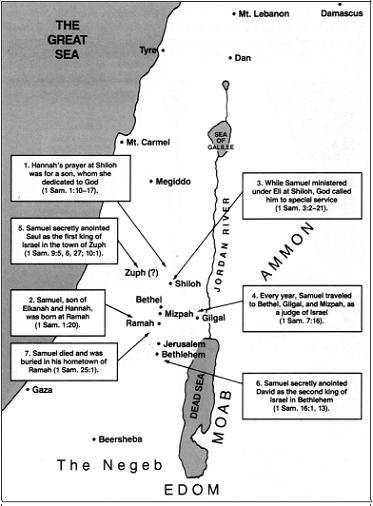
Nelson’s Complete Book of Bible Maps & Charts (Nashville: Thomas Nelson Publishers, 1996) 95. © 1993 by Thomas Nelson, Inc.
8:9 you shall solemnly forewarn them. Samuel obeyed the Lord by describing the behavior of a human king in verses 10–18. A king would: (1) draft young men and women for his service (vv. 11–13); (2) tax the people’s crops and flocks (vv. 14, 15, 17a); (3) appropriate the best of their animals and servants (v. 16); and (4) place limitations on their personal freedom (v. 17b).
8:10 who asked him for a king. Just as Hannah asked for a son (1:20), Israel asked for a king. See note on 9:2.
8:18 you will cry out . . . because of your king whom you have chosen. Samuel warned the people that they would live to regret their decision for a king and would later cry out for freedom from his rule (1 Kin. 12:4). the LORD will not hear you. In contrast to the Lord’s response to Israel during the period of the judges (Judg. 2:18), the Lord would not be moved to pity and, therefore, would refuse to deliver the people out of the hand of their king who oppressed them.
8:19 we will have a king over us. In spite of Samuel’s warnings, the people demanded a king.
8:20 fight our battles. Up until this point, the Lord Himself had fought the battles for Israel and given continual victory (7:10; Josh. 10:14). Israel no longer wanted the Lord to be their warrior; replacing Him with a human king was their desire. It was in this way that Israel rejected the Lord (see v. 7). The problem was not in having a king, but rather, the reason the people wanted a king, i.e., to be like other nations. They also foolishly assumed there would be some greater power in a king leading them in battle.
2. The process of Saul becoming king (9:1–11:13)
9:1 a mighty man of power. I.e., “a man of wealth,” confirmed by the reference to donkeys and servants in verse 3 (cf. Boaz in Ruth 2:1).
9:2 a choice and handsome son. Emphasis was placed on the external appearance of leaders (cf. David in 16:18). Saul. Son of Kish, a Benjamite, he was Israel’s first king. The Hebrew root for Saul means “asked (of God).” In 8:10, the people “asked . . . for a king.” Although God appointed Saul, he was really the people’s choice, given by the Lord in answer to their request. The Lord’s choice would be from the tribe of Judah (cf. Gen. 49:10).
9:3 the donkeys . . . were lost. Lost donkeys meant lost wealth. Kish had servants who could have gone looking, but Saul was chosen to oversee this important task.
9:4 Shalisha . . . Shaalim. The locations are geographically unknown.
9:6 a man of God. A description of the prophet and judge, Samuel. Man of God referred to a prophet (see 2:27). See note on Deuteronomy 33:1.
9:7 no present to bring. A gift expressed gratitude and thankfulness for the service of the man of God. Gifts were offered to prophets in 1 Kings 14:3; 2 Kings 4:42; 5:15, 16; 8:8, 9.
9:8 one-fourth of a shekel. About one-tenth of an ounce.
9:9 a prophet was formerly called a seer. Due to the God-given ability to know or see the future, the seer was so named in close relationship with what he did. The person called a prophet, by the time this book was written, had been termed a seer in the earlier time of Saul.
9:12 high place. This is essentially Canaanite in background (cf. Deut. 12:2–5). Before the temple was built, the high place was used for worship and sacrifice because it provided the best vantage point for the participation of the people in worship and allowed them to see the sacrifice being made for them.
9:13 he must bless the sacrifice. The sacrifice was offered to the Lord as an act of worship by the man of God.
9:16 anoint him. This represents a setting apart for service to the Lord, which occurs in 10:1. See note on 2:10. commander. Lit. “one given prominence, one placed in front.” The title referred to “one designated to rule” (cf. 1 Kin. 1:35; 2 Chr. 11:22). their cry has come to Me. The people had been crying out for deliverance from the Philistines, their longtime rivals, just as they did for liberation from Egypt (cf. Ex. 2:25; 3:9).
9:17 This one shall reign over My people. God identified Saul to Samuel, assuring there was no mistaking whom God was choosing to be king.
9:18 where is the seer’s house? A reference to Samuel’s house.
9:20 all the desire of Israel? Saul was to become the focus of Israel’s hope for military victories over her enemies (cf. 8:19, 20).
9:21 a Benjamite . . . the least of all the families. Saul’s humility and timidity was expressed by his proper assessment of his tribe and a humble estimation of his family.
9:22 the hall. The place where those who were invited ate with Samuel after the offering of the sacrifice on the high place (cf. vv. 12, 13).
9:24 the thigh . . . set apart for you. Samuel was following Leviticus 7:28–36. Samuel received the thigh, the portion of the sacrifice reserved for the priest. Samuel’s giving of this choice piece of meat to Saul was a distinct honor and reflected Saul’s new status as the designated king.
9:25 the top of the house. The roof of Samuel’s house provided a place for Saul and his servant to sleep for the night.
9:27 the word of God. Special revelation from God, given to Samuel and intended for Saul. See note on 3:1.
10:1 the LORD has anointed you commander. The Lord chose Saul to be the leader of Israel and communicated His choice through the private anointing by Samuel, signifying a setting aside for God’s service (see 2:10). His inheritance? The inheritance was God’s nation, Israel, in the sense that she uniquely belonged to Him (Deut. 4:20; 9:26).
10:2 Zelzah. Only mentioned here, Zelzah was probably near Ramah, located between Bethel and Bethlehem, where Rachel died (Gen. 35:19; 48:7).
10:3 Tabor. This is not the far-distant Mt. Tabor, but a location unknown, probably near Bethel.
10:5 the Philistine garrison. Most likely the garrison in Geba in Benjamin, about five miles north of Jerusalem. a group of prophets. Lit. “sons of the prophets.” They were young men being trained by Samuel for the prophetic ministry (see 19:18–20). prophesying. The prophet, as God’s messenger, declared the Word of the Lord (2 Sam. 7:5; 12:1), sometimes accompanied by music (1 Chr. 25:1). Here, prophesying connotes praising God and instructing the people with musical accompaniment.
10:6 the Spirit of the LORD will come upon you. The Holy Spirit would enable Saul to declare the Word of the Lord with the prophets. turned into another man. With this empowerment by the Holy Spirit, Saul would emerge as another man (cf. 10:9), equipped in the manner of Gideon and Jepthah for deeds of valor (cf. v. 9; Judg. 6:34; 11:29).
The MacArthur Bible Handbook, by John MacArthur (Nashville: Thomas Nelson Publishers, 2003) 99. © 2003 by Thomas Nelson Publishers.
10:7 signs. The three signs of verses 2–6: (1) the report of the found donkeys; (2) the encounter of the three men going to Bethel; and (3) the encounter with the prophets. do as the occasion demands. Saul was to do what his hand found to do (Eccl. 9:10).
10:8 Gilgal. The town where Saul eventually would (1) be declared king by Samuel (11:14, 15), and (2) offer sacrifice before the Lord without the prophet Samuel (13:12), also where Samuel killed King Agag (15:33). Gilgal was east of Jericho, but west of the Jordan River. burnt offerings and . . . peace offerings. See notes on Leviticus 1:3–17; 3:1–17. Seven days. The appointed time Saul was to wait for Samuel to come and tell him what to do (see 13:8).
10:9 God gave him another heart. Lit. “God changed him for another heart,” i.e., God prepared Saul for the kingship by having the Holy Spirit come upon him (cf. v. 6).
10:12 who is their father? A question asked to find out the identity of the leader of the prophetic band that now included Saul. a proverb. A saying of common occurrence.
10:16 the matter of the kingdom. He did not tell his uncle the information Samuel gave Saul about becoming king. This might reflect Saul’s humility (cf. v. 22).
10:17 Samuel called the people. The Lord’s choice of Saul was made public at Mizpah, the place of the spiritual revival before Israel’s victory over the Philistines (7:5–8).
10:18, 19 the LORD God of Israel . . . delivered you. Despite the past faithfulness of God to His people, they still desired a human king to deliver them from the hands of their enemies.
10:20, 21 chosen. Probably Saul was selected by the casting of lots (cf. Lev. 16:8–10; Josh. 7:15–18). See note on Proverbs 16:33.
10:22 hidden among the equipment. Overwhelmed, Saul had hidden himself in the military supplies.
10:23 taller . . . from his shoulders upward. Saul’s physical stature was impressive; being head and shoulders above the othe people gave Saul a kingly presence.
10:25 the behavior of royalty. Samuel reminded the people of the regulations governing the conduct of kings according to Deuteronomy 17:14–20.
10:26 whose hearts God had touched. Valiant men who were eager to affirm God’s choice of Saul and, in response to a divine impulse, joined him.
10:27 rebels. Lit. “sons of Belial” (see note on 2:12 ). Those who did not recognize Saul with the respect befitting a king.
11:1 Nahash the Ammonite. Nahash, meaning “snake,” was king of the Ammonites, the descendants of Lot (cf. Gen. 19:36–38) who lived east of the Jordan River. Jabesh Gilead. A town east of the Jordan River, about twenty-two miles south of the Sea of Galilee, in the tribal territory of Manasseh (cf. Judg. 21:8–14).
11:2 put out all your right eyes. This barbarous mutilation was a common punishment of usurpers in the ancient Near East which would disable the warriors’ depth perception and peripheral vision, rendering them useless in battle.
11:3 seven days. The elders at Jabesh were hoping for deliverance from the Israelites west of the Jordan River.
11:4 Gibeah of Saul. Saul’s home and the first capital city of the monarchy, about three miles north of Jerusalem (cf. 10:26).
11:5 from the field. Saul continued to work as a farmer while waiting for the time to answer Israel’s expectations of him as the king.
11:6 the Spirit of God came upon Saul. This was to fill him with divine indignation and to empower him to deliver the citizens of Jabesh Gilead (cf. 10:6).
11:7 cut them in pieces. Saul divided the oxen in sections to be taken throughout Israel to rouse the people for battle (see a similar action in Judg. 19:29; 20:6).
11:8 Bezek. A city thirteen miles north of Shechem and seventeen miles west of Jabesh Gilead. children of Israel . . . men of Judah. This distinction made between Israel and Judah before the kingdom was divided indicates the book was written after 931 B.C. when the kingdom had been divided. See Introduction: Author and Date.
11:11 three companies. A military strategy of dividing up forces, it lessened the possibility of losing everyone to a sneak attack while giving greater military options. in the morning watch. The last of the three watches (2:00–6:00 A.M.), this surprise attack was before dawn, before the Ammonites were prepared for battle.
11:13 the LORD has accomplished salvation in Israel. Saul recognized the deliverance of the Lord and refused to kill those who had rebelled against his kingship (10:27).
3. The exhortation of Samuel to Israel concerning the king (11:14–12:25)
11:14 Gilgal. See note on 10:8. renew the kingdom. The reaffirmation of Saul’s kingship by public acclamation.
11:15 they made Saul king before the LORD. All the people came to crown Saul king that day. The process of entering the kingship was the same for both Saul and David: (1) commissioned by the Lord (9:1–10:16; 16:1–13); (2) confirmed by military victory (10:17–11:11; 16:14–2 Sam. 1:27); and (3) crowned (11:12–15; 2 Sam. 2:4; 5:3). peace offerings. Sacrifices of thanksgiving (cf. Lev. 7:13). rejoiced greatly. Along with the victory over the Ammonites, there was a great celebration over the nation being united.
12:1 I have heeded your voice. Samuel, obeying the will of the Lord and the people, set the king of God’s choice over them, though he had personal reservations about the monarchy.
12:3 Here I am. These familiar words for Samuel throughout his entire life (cf. 3:4, 5, 6, 8, 16) emphasized his availability to God and the people. Witness. Samuel requested the people to “testify against” any covenant stipulations that he had violated.
12:7 I may reason with you before the LORD. Despite the nation being unified under the new king, Samuel still wanted to rebuke the nation for ignoring and rejecting what God had done without a king.
12:11 the LORD sent . . . and delivered you. It was the Lord who delivered them through the hands of the judges, not themselves.
12:12 when you saw that Nahash king of the Ammonites came against you. According to the Dead Sea Scrolls and Josephus, Nahash was campaigning over a large area. It was that Ammonite threat that seemingly provoked Israel to demand a human king (8:1–20). the LORD your God was your king. The clearest indictment of Israel for choosing a mere man to fight for her instead of the Lord God (cf. 8:20).
12:13 the king whom you have chosen . . . desired. The Lord gave them their request (cf. Ps. 106:15).
12:14 fear the LORD. A reminder of Joshua 24:14. Israel was to stand in awe of the Lord and submit to Him (cf. Deut. 10:12). you and the king . . . following the LORD your God. Both the people and the king were given the same command. The standard was the same—obedience to God’s commands.
12:15 rebel. “Disobey, not heed, forsake.” Echoing the promises of Deuteronomy 28, there would be blessings for obeying and curses for disobeying the commands of the Lord.
12:16 this great thing. Though rain during the wheat harvest (late May to early June) was unusual, the Lord sent the rain and thunder to authenticate Samuel’s words to the people.
12:19 Pray for your servants. The people’s response to the power of God was their recognition of their sinful motives in asking for a king. They needed Samuel’s prayers to intercede for them.
12:20 serve the LORD with all your heart. An often-expressed covenant requirement (Deut. 10:12, 13; 11:13, 14).
12:21 empty things. “Futile things” (i.e., idols).
B. The Decline of Saul in the Kingship (13:1–15:35)
1. The rebuke of Saul (13:1–15)
13:1 one year . . . two years. The original numbers have not been preserved in this text. It literally reads, “Saul was one year old when he became king and ruled two years over Israel.” Acts 13:21 states that Saul ruled Israel forty years, but his age at his accession is recorded nowhere in Scripture. Probably the best reconstruction of verses 1 and 2 is, “Saul was one and (perhaps) thirty years old when he began to reign, and when he had reigned two years over Israel, then Saul chose for himself three thousand men of Israel.”
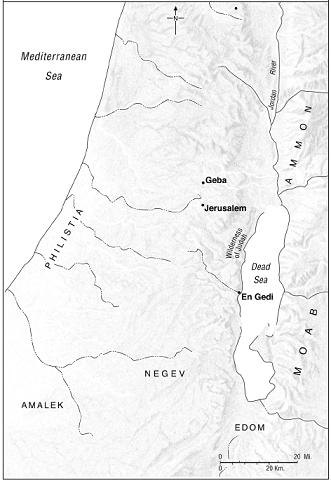
13:2 Michmash. This area was located about seven miles northeast of Jerusalem. Jonathan. “The LORD has given.” Saul’s firstborn son and heir apparent to the throne was evidently old enough to serve as a commander in Israel’s army at this time, much like David when he killed Goliath (1 Sam. 17:32–37). Gibeah of Benjamin. This city was located three miles north of Jerusalem. It was called Gibeah of Saul in 11:4.
13:3 Geba. This outpost was located about five miles north-northeast of Jerusalem, one and one-half miles southwest of Michmash. blew the trumpet. Saul used the trumpet to summon additional troops for battle.
13:4 an abomination. Israel could expect retaliation from the Philistines for Jonathan’s raid. Gilgal. This is the town of Saul’s confirmation as king by Samuel and the people (11:14, 15). Saul chose Gilgal because of Samuel’s word in 10:8.
13:5 thirty thousand chariots. This is probably a scribal error, since the number is too large for the corresponding horsemen. Three thousand is more reasonable and is found in some OT manuscripts. Michmash. See note on 13:2. Beth Aven. Lit. “house of nothingness.” It was less than one miles southwest of Michmash.
13:7 Gad and Gilead. Areas east of the Jordan River. all the people followed him trembling. The people were in fear over probable Philistine retaliation.
13:8 seven days . . . the time set by the people were scattered. Saul’s men were deserting him because of anxiety and fear over the coming battle.
Locations of Saul’s Military Campaigns
The MacArthur Study Bible, by John MacArthur (Nashville: Word Publishing, 1997) 395. © 1993 by Thomas Nelson, Inc.
Samuel. This is a direct reference to Samuel’s word in 10:8. Saul was commanded to wait seven days to meet Samuel in Gilgal.
13:9 he offered the burnt offering. Saul’s sin was not specifically that he made a sacrifice (cf. 2 Sam. 24:25; 1 Kin. 8:62–64), but that he did not wait for priestly assistance from Samuel. See 10:8. He wished to rule as an autocrat who possessed absolute power in civil and sacred matters. Samuel had wanted the seven days as a test of Saul’s character and obedience to God, but Saul failed it by invading the priestly office himself.
13:11 When I saw. Saul reacted disobediently based upon what he saw, not by faith. He feared losing his men and did not properly consider what God wanted him to do.
13:13 You have not kept the commandment. Saul’s disobedience was a direct violation of the command from Samuel in 10:8. your kingdom . . . forever. How could this be in light of God’s promise that the king would descend from Judah (Gen. 49:10)? This pronouncement would correct the potential contradiction of Saul being from Benjamin, not Judah (cf. v. 14).
13:14 a man after His own heart. Instead of Saul, God was going to choose one whose heart was like His own, i.e., one who had a will to obey God. Paul quotes this passage in Acts 13:22 of David (cf. 16:7). commander. Someone else, namely David, had already been chosen to be God’s leader over His people.
13:15 from Gilgal to Gibeah. This was about a ten-mile trip westward. Samuel left Saul, realizing that Saul’s kingship was doomed. six hundred men. This indicates the mass departure of the Israelites (v. 6) and gives a perspective on what Saul saw (v. 5).
2. The wars of Saul (13:16–14:52)
13:17 raiders . . . in three companies. Lit. these were “destroyers” in the Philistine army, divided into three groups.
13:19 no blacksmith. The Philistines had superior iron and metal-working craftsmen until David’s time (cf. 1 Chr. 22:3), accounting for their formidable military force.
13:20 mattock. A pickax to work the ground by hand.
13:21 The Philistines charged a high price to sharpen instruments that potentially could be used against them.
13:22 neither sword nor spear. The Philistines had a distinct military advantage over Israel since they had a monopoly on iron weapons.
13:23 the pass of Michmash. Some of the Philistines had moved out to a pass leading to Michmash.
14:1 the other side. Jonathan and his armorbearer left the Israelite camp to approach the Philistine outpost.
14:2 pomegranate tree. These trees are common to Israel’s landscape, normally growing as low shrubs with spreading branches. This may have been a particularly large one.
14:3 Ahijah. “Brother of the LORD.” He was the great-grandson of Eli the high priest, another house which had been rejected of the Lord (2:22–36). wearing an ephod. The ephod was a white garment worn by the priests that was attached to the body by a belt. A breastplate worn over the ephod had pouches that were used by the priests to carry certain devices used in determining the will of God, i.e., the Urim and Thummim, or sacred lots. See note on Exodus 28:5–13. Apparently, Saul chose not to use it for seeking the Lord’s will.
14:4 Bozez . . . Seneh. Hebrew terms. Bozez may mean “slippery.” Seneh means “thorny.”
14:6 uncircumcised. This was a derogatory term used by the Israelites to describe the Philistines. by many or by few. Jonathan demonstrated the great faith that should have been demonstrated by the king (cf. 13:11).
14:10 a sign to us. This was an unusual manner for determining the will of the Lord, but not without precedent, e.g., Gideon’s fleece (Judg. 6:36–40). Jonathan was allowed to determine the will of God by the reaction of his enemies.
14:11 Hebrews. The oldest term used by Gentile nations to refer to the people of Israel. the holes where they have hidden. Many of the Israelites were hiding in fear over the battle. Apparently, they thought Jonathan and his armorbearer were Israelite deserters coming to the Philistine side.
14:15 the earth quaked. The earthquake affirms the fact that divine intervention aided Jonathan and his armorbearer in their raid. The earthquake caused a panic among the Philistines. God would have intervened on Saul’s behalf in such a manner had he chosen to be faithfully patient (cf. 13:9).
14:18 ark of God. The LXX reads “ephod” instead of “ark,” and this seems more likely since the ark was at Kirjath Jearim and the language of verse 19 better fits the ephod (v. 3) than the ark.
14:19 Withdraw your hand. Saul, in a hurry, ordered the priest to stop the inquiry into the will of the Lord.
14:21 Hebrews. This is a reference to Israelite deserters or mercenaries.
14:22 the mountains of Ephraim. A large and partially wooded area north and west of Michmash.
14:23 So the LORD saved Israel. The writer uses language similar to that of the Exodus. In spite of their disobedient king, God was faithful to deliver Israel from her enemies. Beth Aven. See note on 13:2.
14:24 were distressed. Saul’s inept leadership failed to provide for the physical needs of his men, leaving them weak and fatigued. Cursed. Saul’s first foolish oath pronounced a curse upon anyone tasting food until the battle was over. The scene fits chronologically after Jonathan’s departure.
14:25 honey on the ground. This was a reference to honeycombs found in the forest (v. 27).
14:27 Jonathan had not heard. Jonathan apparently had departed before Saul made his oath.
14:29 My father has troubled the land. Jonathan saw the foolishness of Saul’s oath and how it actually hurt Israel’s cause instead of helping it.
14:31 Aijalon. This area is located fifteen miles west of Michmash. This would have been a normal path back to the land of the Philistines.
14:32 ate them with the blood. The people were so severely hungry because of the oath (v. 24) that they disobeyed the law by eating the meat raw and not draining the blood (cf. Lev. 17:10–14).
14:35 the first altar. The first and only altar built by Saul mentioned in Scripture.
14:36 Let us draw near to God. Ahijah the priest requested that they first seek the Lord about their course of action.
14:37 Saul asked counsel of God. At the request of Ahijah, Saul inquired of the Lord about his battle plan. He did not answer him. Because of the sin that Saul had caused in his army, God did not answer his inquiry. This would not be the last time that the Lord would refuse to respond to sinful Saul (cf. 28:6).
14:39 as the LORD lives. As an encore to his previous oath, Saul followed with another foolish oath, unknowingly jeopardizing his own son’s life.
14:41 taken. The practice of casting lots was used to distinguish one person or group from another. Jonathan was indicated as the guilty party, though he acted innocently (v. 27).
14:44 God do so and more also. Saul, proud and concerned with his own authority and honor, was intent on fulfilling his vow.
14:45 worked with God this day. Jonathan, in stark contrast to his father the king, understood the sufficiency of God for the task and relied on Him for the victory.
14:46 the Philistines went to their own place. The Philistines were left to continue their retreat unhindered.
14:47, 48 Saul’s military accomplishments were significant and expanded Israel’s borders in all directions: to the south (Edom), east (Ammon and Moab), north (Zobah), and west (Philistia). The defeat of the Amalekites is recorded in chapter 15.
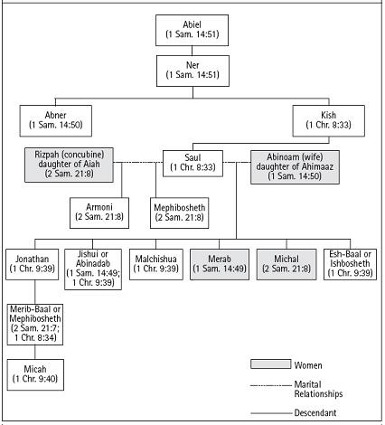
14:49–51 Saul’s children, Jonathan and Michal, would both play significant roles in the life of the next king, David. Nothing further is known of Saul’s wife or other children mentioned here.
14:50 Abner. A cousin of Saul who commanded his army (cf. 1 Sam. 17:55, 59; 20:25; 26:14, 15).
14:52 fierce war. The Philistines’ opposition to Israel was persistent and continual to the very last day of Saul’s life (1 Sam. 31:1–3). strong . . . valiant man. Saul looked for the good warriors and attached them to his personal force. David was one such man who would also continue this practice under his rule (2 Sam. 23:8–39).
3. The rejection of Saul (15:1–35)
15:2 Amalek. The Amalekites, a nomadic people of the desert and descendants of Esau (Gen. 36:12), became a marked people when they attacked Israel in the wilderness after leaving Egypt (see notes on Ex. 17:8–16; cf. Num. 24:20; Deut. 25:17–19; Judg. 6:3–5).
15:3 utterly destroy. God gave Saul an opportunity to redeem himself with obedience. The judgment was to be a complete and total annihilation of anything that breathed. God’s judgment was severe on those who would destroy His people. It was equally severe to those who disobeyed (cf. Achan in Josh. 7:10–26).
15:4 Telaim. The precise location of this area is unknown, but it may be a reference to Telem found in Joshua 15:24.
15:5 a city of Amalek. This was possibly modern-day Tel Masos, located about seven miles east-southeast of Beersheba.
15:6 the Kenites. Moses’ father-in-law was a Kenite (cf. Judg. 1:16), a people friendly to the Israelites.
15:7 from Havilah . . . to Shur. Saul’s victory was extensive, covering much of the Amalekite territory. However, the Amalekites were not completely destroyed (cf. 27:8; 30:1).
15:8 Agag. Another example of Saul’s incomplete obedience, in the case of Agag, is recorded because it had such far-reaching implications. Over five centuries later an Agagite named Haman attempted to exterminate the Jewish race from his power base in Persia (cf. Esth. 3:1ff.). all the people. The Israelites killed everyone they came across, except for the king.
15:9 Saul and the people spared. Motivated by covetousness, both Saul and the people greedily spared the choice spoil of the land, disobeying God’s Word and demonstrating their faithlessness.
15:11 grieved Samuel. Samuel’s role as priest over the people gave him great concern over the poor performance of the king, who was like the kings of other nations (1 Sam. 6:19, 20), i.e., self-centered, self-willed, and disobedient to the things of God.
15:12 Carmel. This is not Mt. Carmel of Elijah’s exploits (1 Kin. 18:20ff.), but a Carmel located seven miles south of Hebron. monument for himself. Saul, apparently taking credit for the victory, established a monument to himself (cf. Absalom in 2 Sam. 18:18). This foolish act of contemptible pride was Saul’s expression of self-worship rather than true worship of God and another evidence of his spiritual weakness. Gilgal. The site of Samuel’s first confrontation with Saul (13:7b–15) became the site of this pronouncement of judgment.
15:13 I have performed the commandment of the LORD. Saul, either ignorantly or deceitfully, maintained that he did what was commanded (15:20).
15:15 the people spared the best . . . to sacrifice. Saul began to place blame on others, making room for his own excuses just as he had done earlier (cf. 13:11, 12). Then he tried to justify his sin by saying that the animals would be used to sacrifice to the God of Samuel. Saul’s disobedience at least pained his conscience so that he could not claim God as his God.
15:17 little in your own eyes. Saul’s status before he became king was as a humble and lowly Benjamite (cf. 9:21).
15:19 swoop down on the spoil. Saul and the people greedily took the spoil like a bird of prey diving on its victim.
15:20, 21 I have obeyed the voice of the LORD. Instead of confessing his sin and repenting, Saul continued to justify himself.
15:22 to obey is better than sacrifice. This is an essential OT truth. Samuel stated that God desires heart obedience over the ritual sacrifice of animals (cf. Ps. 51:16, 17; Is. 1:10–17). The sacrificial system was never intended to function in place of living an obedient life, but was rather to be an expression of it (cf. Hos. 6:6; Amos 5:21–27; Mic. 6:6–8).
15:23 rebellion . . . stubbornness. Saul needed to see that his real worship was indicated by his behavior and not by his sacrifices. He demonstrated himself to be an idolater whose idol was himself. He had failed the conditions (12:13–15) which would have brought blessing on the nation. His disobedience here was on the same level as witchcraft and idolatry, sins worthy of death. Because you have rejected . . . He also has rejected. A universal principle is given here that those who continually reject God will one day be rejected by Him. The sins of Saul caused God to immediately depose Saul and his descendants forever from the throne of Israel.
15:24 I have sinned. This overdue confession appears to be generated more by a concern over consequences (regret) than by sorrow over having offended his holy God (repentance). Saul bypasses his personal responsibility by shifting blame to the people.
15:25 return with me. Saul was concerned about having Samuel’s visible presence as a show of support in front of the people (cf. 15:30).
15:28 torn the kingdom. Saul’s judgment was a settled matter on the day of his disobedience with the Amalekites. Samuel used the illustration as it vividly portrayed how God would take the kingdom from Saul as he had just torn Samuel’s robe. a neighbor of yours. This was a reference to David (cf. 28:17).
15:29 the Strength of Israel. This was a unique title of God. It could also be translated “the glory of Israel” (cf. Mic. 1:15). will not lie nor relent. Samuel emphasized God’s attribute of immutability in regard to the judgment upon Saul.
15:30 honor me. Saul was still thinking of himself and how he could best salvage the situation for self-gain.
15:31 Samuel turned back. Samuel agreed to follow Saul, perhaps seeing this as the wisest course of action for the nation at that time.
15:33 hacked Agag in pieces. This was an act of divine judgment to show the holy wrath of God against wanton sin. Sadly, the Israelites did not exterminate the wicked Amalekites, so they came back later to raid the southern territory and take women and children captive, including David’s family (see ch. 30).
15:35 Samuel went no more . . . mourned. Samuel never went to visit the rejected King Saul again in his life (cf. 1 Sam. 28:11–19). On at least one further occasion, Saul sought Samuel (cf. 19:24).
III. DAVID AND SAUL’S TRANSFER OF THE KINGSHIP IN ISRAEL (16:1–31:13)
16:1–31:13 The third major division of Samuel recounts the steady demise of Saul and the selection and preparation of David for the kingship. Chapter 16 begins with Samuel mourning for Saul as one would mourn for the dead. The death of Saul (31:1–13) concludes this last division of the book.
A. The Introduction of David (16:1–17:58)
1. The anointing of David (16:1–13)
16:1 Jesse the Bethlehemite. God’s new king of Israel (and ultimately the Messiah; Gen. 3:15; Num. 24:17; 1 Sam. 2:10; Ps. 2) would come from the tribe of Judah (Jesse; cf. Ruth 4:12, 22; Gen. 49:10) and from Bethlehem of Judah (cf. Mic. 5:2; Matt. 2:2–6). I have provided Myself. The king was chosen and provided by God (Deut. 17:15), who orders all things according to the counsel of His own will (Is. 40:14), not according to human desires (8:5, 6; 2 Sam. 2:8, 9).
16:2 Saul . . . will kill me. Saul’s unbalanced emotional state was already known in Israel. It is ironic that Samuel’s initial reaction to the word of the Lord was fear of Saul instead of rejoicing at God’s provision to Israel (and ultimately to all the nations; e.g., 1 Kin. 8:41–43). The route from Ramah to Bethlehem would take Samuel through Gibeah of Saul (cf. 10:26; 11:14). I have come to sacrifice. The place of sacrifice could be in any town until the establishment of the house of God in Jerusalem (Deut. 12:11).
16:3 anoint. David’s first anointing was performed by Samuel, symbolizing God’s recognition/ordination (cf. 2:10). The following two anointings (2 Sam. 2:7; 5:3) were to establish David as king publicly for the benefit of Judah and Israel, respectively.
16:4 the elders of the town trembled. The elders, and no doubt all Israel, had heard of Samuel’s execution of Agag (15:33). Israel still closely associated the “seer,” or prophet, with the not-so-distant past office of judge.
16:5 Sanctify yourselves. Worship of Yahweh was always preceded by cleansing or washing, both of the outward garments and the inner man (Ex. 19:10, 14; 1 John 1:9).
16:6 Eliab. Lit. “My God is Father.” Since Eliab was the first of Jesse’s sons to catch Samuel’s eye, he must have been an impressive young man by outward appearance.
16:7 his appearance . . . physical stature. Samuel needed to be reminded that God’s anointed was not chosen because of physical attributes. This was initially a difficult concept for Samuel as he was accustomed to a king whose only positive attributes were physical. the LORD looks at the heart. The Hebrew concept of heart embodies emotions, will, intellect, and desires. The life of the person will reflect his heart (cf. Matt. 12:34, 35).
16:8 Abinadab. Lit. “My Father is noble.” Samuel, now more sensitive to the leading of God’s Spirit, quickly discerned that Abinadab was not God’s anointed.
16:9 Shammah. Lit. “Yahweh hears (or heard).” See 16:8.
16:10 seven . . . sons. With David, Jesse had eight sons. The fact that 1 Chronicles 2:13 indicates seven sons must mean that one of the eight died afterward, and this is not considered in the Chronicles account.
16:11 the youngest . . . keeping the sheep. God’s favor/choice often fell on the younger and the least (cf. Jacob, Joseph, Gideon). David, although the youngest, was the firstborn over Israel (Ps. 89:27) whose humble beginnings as a shepherd, and later rule as king, typify Jesus, the ultimate Shepherd and King of Israel.
16:12 ruddy . . . bright eyes . . . good-looking. God’s chosen king was handsome to look at, although that was not the reason for his selection by God. His appearance was, perhaps, enhanced by a genuine faith and joy in Yahweh. See also 17:42.
16:13 anointed him in the midst of his brothers. David’s first anointing is before his family/house. His second anointing would be before the assembly of his tribe, Judah; and his third anointing would be before the nation Israel. (See note on 16:3. ) the Spirit of the LORD came upon David. This familiar OT expression relates to empowerment for some God-given task (cf. 10:6, 11; 11:6; 19:20, 23; 2 Sam. 23:2; 2 Chr. 20:14; Is. 11:2; 61:1; Ezek. 11:5; 37:1). David’s anointing was an external symbol of an inward work of God. The operation of the Holy Spirit in this case was not for regeneration, but for empowerment to perform his (David’s) role in God’s program for Israel (cf. Saul, 10:6). After David sinned with Bathsheba (2 Sam. 11, 12), he prayed, “Do not take Your Holy Spirit from me” (Ps. 51:11).
2. David in the court of Saul (16:14–23)
16:14 the Spirit of the LORD departed from Saul. When David’s ascent to the throne began, Saul’s slow and painful descent began also (cf. 18:12). Without God’s empowering Holy Spirit, Saul was effectively no longer king over Israel (15:28), although his physical removal from the throne, and his death, happened many years later. a distressing spirit. God, in His sovereignty, allowed an evil spirit to torment Saul (cf. Judg. 9:23; 1 Kin. 22:19–23; Job 1:6–12) for His purpose of establishing the throne of David. This spirit, a messenger from Satan, is to be distinguished from a troubled emotional state brought on by indwelling sin, or the harmful consequences of the sinful acts of others (e.g., spirit of jealousy, Num. 5:14). This demon spirit attacked Saul from without, for there is no evidence that the demon indwelt Saul. troubled him. Saul, whose inward constitution was already prone to questionable judgment and the fear of men, began to experience God’s judgment in the form of severe bouts of depression, anger, and delusion, initiated and aggravated by the evil spirit assigned to him. There are several NT occasions where God turned people over to demons or Satan for judgment (see Acts 5:1–3; 1 Cor. 5:1–7; 1 Tim. 1:18–20). He also used Satan or demons for the strengthening of the saints. See Job 1:1–2:6; Matthew 4:1ff.; Luke 22:31, 32; 2 Corinthians 12:7–10.
16:16 he will play . . . you shall be well. God used the evil that had befallen Saul to introduce David into the court of the king and to the watching eyes of Israel.
16:18 skillful in playing . . . a handsome person. The writer of Samuel introduces David, the sweet psalmist of Israel (2 Sam. 23:1), before introducing David the warrior. Later proven so skillful in the art of war and killing, David was also a tender musician of exceptional skill and reputation. the LORD is with him. The saints of God, OT and NT, are recognized by their fruit (2:26; Luke 2:40). God’s approval of David was already recognized by certain people in Israel.
16:19 Send me your son David. This is a verbal link with 16:1, “I have provided myself a king among his (Jesse’s) sons.” David’s lineage was of importance to Saul in the near future when he arranged a marriage between Michal, his daughter, and David. with the sheep. David’s lowly, humble occupation is emphasized. He gave evidence of that humility and patience as he returned faithfully to his duty following Samuel’s anointing.
16:21 he loved him greatly. Saul loved David for his abilities, but later grew to hate him because he knew he was blessed by the Lord (cf. 18:29). his armorbearer. David was most likely one of many such young men assigned to Saul’s barracks.
3. David, the warrior of the Lord (17:1–58)
17:1 Sochoh . . . Azekah . . . Ephes Dammim. Following the anointing of David and his installation into the court of the king, there is this update on the situation of Israel in regard to Israel’s enemies. Sochoh and Azekah were towns of Judah (Josh. 15:20, 35; Jer. 34:7) approximately fifteen miles west and seventeen miles northwest (respectively) of Bethlehem. Ephes Dammim (1 Chr. 11:12, 13; cf., 2 Sam. 23:9), the camp of the Philistines, probably lay one mile south of Azekah.
17:2 Valley of Elah. Where the camp of Israel was, approximately three miles east of Ephes Dammin.
17:4–7 In human terms alone, Goliath was invincible. However, David counted on the Lord being with him and making the difference (17:34–37).
17:4 champion. Lit. “the man between two.” An appropriate appellation as Goliath stood between the two armies of the Philistines and Israel, and offered his challenge to a “duel” of hand-to-hand combat, the outcome of which would settle the battle for both sides. Gath. One of the five chief, Philistine cities, located five miles west of Azekah. six cubits and a span. One cubit measures approximately eighteen inches and one span about nine inches, making Goliath about nine feet nine inches in height (cf. “Egyptian,” 1 Chr. 11:23, and “Og of Bashan,” Deut. 3:11).
17:5 five thousand shekels. 125 pounds.
17:7 six hundred shekels. Fifteen pounds.
17:11 Saul . . . dismayed and greatly afraid. Saul and Israel had proven themselves to be greatly concerned with outward appearances (10:23, 24; 15:30) and able to be influenced by the fear of men (12:12; 15:24). It is only natural that Goliath would be their worst nightmare come true.
17:12 Ephrathite. Ephrath(ah), another name for the Bethlehem in Judah (cf. Ruth 4:11; Mic. 5:2).
17:15 David occasionally went and returned from Saul. David’s duties were divided between his billet with Saul as one of many armorbearers (16:21), and tending his father’s sheep in Bethlehem. Doubtless, David learned important lessons about the weight of responsibility during this time, lessons that were later put to use in ruling over Israel.
17:17 ephah. About three-quarters of a bushel.
17:23 the same words. Goliath continued to offer the challenge of 17:10, as he had been doing for forty mornings and evenings (17:16).
17:25 great riches . . . his daughter. The reward of a daughter in marriage for a great victory over an enemy of Israel was not unusual (cf. Josh. 15:13–17).
17:26 the reproach from Israel? David knew that, although Goliath’s challenge had been issued to (any) individual of the camp of Israel, Goliath’s defiant attitude was a reproach to all Israel.
17:28 Eliab’s anger. Eliab, perhaps still feeling the sting/rejection of having his “little” brother chosen over him by God/Samuel (16:6, 7), expressed his jealousy in anger (cf. Gen. 37:4, 5, 8, 11).
17:32 Let no man’s heart fail. Joshua and Caleb exhorted Israel in the same fashion regarding the giant Anakim 400 years before (cf. Num. 13:30; 14:8, 9). The heathens’ hearts fail at the name of the Lord God of Israel (cf. Rahab, Josh. 2:11).
17:33 You are not able. David’s faith, like that of Joshua and Caleb, was met with disbelief on the part of Saul. By all outward appearances, Saul was correct in his assessment, but he failed to consider the Lord’s presence in David’s life.
17:36 lion and bear. Just as David tended his flock of sheep and protected them from the lion and bear, his new responsibility as shepherd over Israel required him to eliminate the threat of Goliath.
17:37 The LORD . . . He will deliver me. Just as Jonathan believed earlier (14:6), David had a wholehearted faith in the God of Israel. the LORD be with you. One of the first explicit indications in the text that Saul knew that the Lord was with David (cf. 15:28).
17:40 staff . . . stones . . . sling. The tools of the shepherd proved to be appropriate weapons also for Israel’s shepherd. One of David’s honorable and chief men of battle, Benaiah, the son of Jehoiada, killed a formidable Egyptian warrior (2 Sam. 23:20, 21) with a staff like the one David carried toward Goliath.
17:43 dog. Goliath uttered a statement of ironic truth about himself of which even he was unaware. As a wild dog can be a threat to the flock and must be chased away or killed, so must Goliath.
17:45 in the name of the LORD of Hosts. Goliath came out to battle in his own name; David came to battle in the name of the Lord of all the hosts (armies). Cf. Deuteronomy 20:1–5.
17:46 all the earth may know. David fought in the name of the Lord and for the glory of the Lord, whose name and glory will extend to the uttermost parts of the earth, to all nations (cf. Josh. 4:24; 2 Sam. 22:50; Ps. 2).
17:47 the battle is the LORD’s. Cf. Deuteronomy 31:6; Judges 7:18. David fully understood the chief issue, i.e., the Philistines were in effect challenging the Lord by confronting the Lord’s people.
17:50 no sword. Iron weapons were scarce in Israel (13:19).
17:51 cut off his head. David completed his promise given to Goliath in verse 46a. The Philistines would later do the same with Saul’s head (1 Sam. 31:9). fled. David’s exclamation that there is a God in Israel (v. 46) was proven before the Philistines, who were no strangers to the wrath of Yahweh (1 Sam. 5–7). They fled in terror, but did not honor the terms of Goliath if he lost (17:6–9).
17:54 to Jerusalem. The Jebusites, who were the inhabitants of Jerusalem, were a stubborn, resistant people (cf. Josh. 15:63; Judg. 1:21; 19:10, 11), particularly to the tribe of Judah. They doubtless began to feel some anxiety about the victory of this Bethlehemite. The head of Goliath was a constant warning to them over the ensuing days about their future (cf. 2 Sam. 5:6–10).
17:55 Abner. See note on 14:50. whose son. David’s lineage was of the utmost importance to Saul at this point, since the victor over Goliath would marry into his family (cf. 17:25; 18:18).
B. David Driven from the Court of Saul (18:1–20:42)
1. The anger and fear of Saul toward David (18:1–30)
18:1 Jonathan loved him. Jonathan loved David with a loyalty and devotion indicative of covenantal love (18:3). Hiram of Tyre had much the same covenantal love for David (cf. 2 Sam. 5:11; 1 Kin. 5:1; 9:11). David’s later reign from Jerusalem is marked by loyalty to his covenant with Jonathan (2 Sam. 9:1).
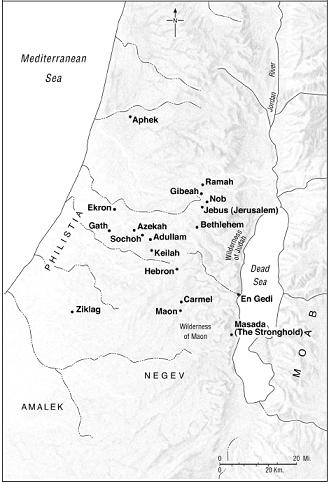
The MacArthur Study Bible, by John MacArthur (Nashville: Word Publishing, 1997) 404. © 1993 by Thomas Nelson, Inc.
18:2 would not let him go home. Saul’s interest in keeping David in his household was more self-serving than a token of generous hospitality. Saul was aware of his promise of wife and wealth (17:25) and, no doubt, the stirrings of anxiety/fear were in his heart toward David, who appeared as a threat. Saul preferred to have David in the court to keep a watchful eye on the young upstart.
18:3 covenant. See verse 1. Further mention of this honorable relationship is made in 19:1; 20:8, 13–17, 42; 22:8; 23:18.
18:4 robe . . . belt. Jonathan willingly and subserviently relinquished the outer garments and instruments that signified his position as prince of Israel and heir to the throne. Jonathan, a godly worshiper of Yahweh, quickly discerned that David was God’s anointed and, without reservation, offered the robe of succession to the true king of Israel.
18:7 David his ten thousands. This is a song that Saul grew to hate (cf. 21:11; 28:5) because it exalted David over him.
18:8 the kingdom? Saul’s jealousy and malice toward David were now explicit. By his own statement, Saul acknowledged that David was the rightful heir to the throne and the one of whom Samuel spoke in Gilgal (15:28).
18:10 the distressing spirit. The painful descent and eventual demise of Saul was marked by the persistent vexing of this spirit. See 16:14. prophesied. This means to speak before people, not predict the future. Saul’s speeches in the midst of the house were the ravings of a person troubled by an evil spirit like other false prophets (cf. 1 Kin. 22:19–23).
18:11 David escaped . . . twice. As Saul’s behavior was becoming increasingly violent, he made more than one attempt on David’s life with the javelin. It was evident that God was with David, as it would be no small feat to dodge a javelin cast by such an experienced warrior as Saul.
18:12 Saul was afraid of David. Saul, faced with the same conclusion reached by Jonathan in verses 1–4, reacted with fear. Saul, a man who viewed life from a human perspective rather than a divine viewpoint, could see David only as a personal threat, rather than a blessing to Israel.
18:13 captain over a thousand. Saul gave David a military commission, intended as kind of honorable exile. But this duty only served to give David opportunity to display his remarkable character and to strengthen his hold on the people’s affections.
18:16 loved David. The writer of Samuel, inspired by the Holy Spirit, offers an editorial comment full of truth.
18:17 Merab. Lit. “compensation” or “substitute” (cf. 14:49). Saul’s later retraction of the betrothal to Merab (v. 19) was similar to Laban’s trickery with Jacob and Rachel (Gen. 29:25). fight the LORD’s battles. A phrase Saul knew would appeal to David. Saul made the offer out of a treacherous heart, desiring evil and calamity for David. Notice the similarity between Saul’s treachery and that of David with Uriah (2 Sam. 11:15).
18:18 son-in-law. The familial lineage was crucial when marrying into the king’s family. David asked, “Who am I . . . or my father’s family in Israel, that I should be son-in-law to the king?” Saul had asked of David’s lineage three times previously (17:55, 56, 58).
18:19 Adriel the Meholathite. Merab married this man and bore children, five of whom were sons later executed by David as punishment for Saul’s disregard of Joshua’s covenant with the Gibeonites (2 Sam. 21:8; cf. Josh. 9:20).
18:20 Michal. Lit. “Who is like God?” Michal sincerely loved David and perhaps was aware, as Jonathan, of his certain ascent (and right) to the throne. Ironically, Saul offered her to David, not from a benevolent heart, but as a “snare” (v. 21).
18:25 dowry. Lit. “price.” Saul resorted to the same treachery in his offer of betrothal to Merab, plotting to eliminate David by placing him in jeopardy with the Philistines. David, already having proved himself wise in many things (16:18), was aware, to some extent, of Saul’s intent and acted obediently, valiantly, and wisely.
18:25, 27 foreskins. Such mutilation of the bodies of slain enemies was commonly practiced in ancient warfare. The number indicated the extent of the victory. Saul’s intent was to expose David to deadly danger by engaging in such an extensive and hazardous task.
18:27 his men. Cf. 22:2; 25:12, 13; 2 Samuel 23:8–39.
18:29 Saul became David’s enemy. All of Saul’s plans came to naught. Saul asked for 100 Philistine foreskins; David brought 200. Saul offered Michal as a “snare”; Michal loved David as did Saul’s own son, Jonathan. There remained nothing else for Saul to contrive except open hatred toward David.
2. The defense of David by Jonathan and Michal (19:1–20:42)
19:1 kill David. Saul no longer tried to disguise or cover his evil intent toward David, but made known his intent to those who held David in the highest esteem (cf. 16:18; 18:1–4). God, in His mercy, made sure that David had sympathetic ears within Saul’s court to inform him of Saul’s evil plans (e.g., 19:7; 20:2).
19:4 Jonathan spoke well of David. Jonathan attempted to persuade his father with calm reason. Jonathan’s reason was tempered by a godly attitude centered on a remembrance of the Torah (14:6, cf. Num. 11:23; 14:9) and a covenantal loyalty toward and faithfulness for David.
19:4, 5 he has not sinned. Jonathan reminded Saul that David had done nothing to deserve death; in fact, he was worthy of honor for his good works toward the king and Israel. Jonathan knew that the spilling of innocent blood would affect all Israel, not just the house of Saul (Deut. 21:8, 9).
19:6 he shall not be killed. Saul temporarily responded to reason and conviction in his heart. His mental capacity was so unbalanced, however, that this response would not last for long.
19:9 the distressing spirit. Jealousy, rage, and anger once again dominated Saul, who was enraged by David’s success against the Philistines. See 6:14; 18:10.
19:10 pin David . . . with the spear. Saul’s already diminished capacity for reason was once again clouded by anger, and he responded toward David with murderous intent (cf. 18:10, 11).
19:11 Michal . . . told him. Michal, far from being a “snare” (18:21) to David, was instrumental in saving his life. Michal, at this time in her relationship with David, displayed a covenantal love and faithfulness similar to that of Jonathan. See the title of Psalm 59.
19:13 an image. Hebrew teraphim. The writer of Samuel draws a parallel between David/Michal/Saul and Jacob/Rachel/Laban (see note on 18:17 ), in that both Rachel and Michal employed the use of household gods (“teraphim”) in trickery and out of loyalty for their husbands rather than their fathers (cf. Gen. 31:30–35).
19:17 He said to me. Michal lied in telling Saul the exact opposite of what she said to David (v. 11).
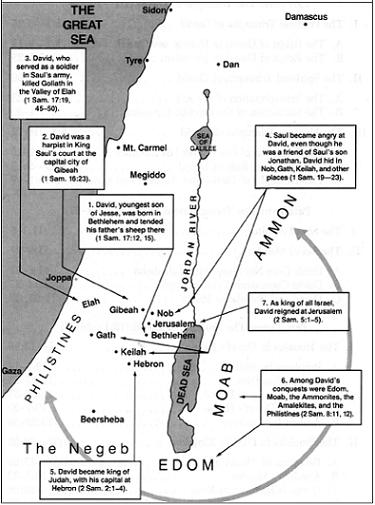
Nelson’s Complete Book of Bible Maps & Charts (Nashville: Thomas Nelson Publishers, 1996) 106. © 1993 by Thomas Nelson, Inc.
19:18 Ramah. With the mention of Samuel’s birthplace, the author establishes a verbal link with 1:1, and also reminds the reader of Saul’s first encounter with Samuel the seer in Zuph (Ramathaim Zophim). Naioth. Perhaps dwellings or quarters within the town limits of Ramah, where Samuel and his company of prophets-disciples met for training, prayer, and fellowship (cf. Elisha at Gilgal, 2 Kin. 6:1, 2).
19:20 group of prophets prophesying. These prophets were declaring the Word of God, probably with musical accompaniment. Saul’s messengers could not fulfill their task of taking David captive because they were irresistibly led to join the prophets and speak for and praise God.
19:22 great well . . . at Sechu. The exact location is unknown; the probable location was approximately two miles north of Ramah.
19:23 the Spirit of God was upon him. This was the last time the Spirit of the Lord would rest on Saul. God turned Saul’s heart to prophesy and not to harm David. See note on 16:13.
19:24 stripped off his clothes. Saul removed his armor and royal garments (cf. Jonathan, 18:4), prompted by the Spirit of God, thus signifying God’s rejection of Saul as king over Israel. lay down naked. Without the royal garments, Saul was figuratively “naked,” perhaps so overwhelmed by the Spirit of God as to be in a deep sleep. Other than Saul’s utter despair and pitiful state at the home of the witch at Endor (28:20) and his end at Mount Gilboa (31:4–6), this episode represents one of the most severe humblings in Saul’s life. “Is Saul also among the prophets?” This is a final editorial comment tying together the Spirit of God’s presence at Saul’s inauguration (10:10, 11), and the final departure of the same at his rejection (19:24).
20:1 Naioth in Ramah. See note on 19:18.
20:2 my father hide this thing from me? Although Jonathan expressed his certainty that Saul was not seeking David’s life, he may have been unaware of the most recent attempts on David’s life (19:9–24) and was trusting in his father’s oath not to harm David (19:6). Jonathan expected to be informed by Saul of any change in his plans.
20:5 the New Moon. The first day of the month, referred to as “the New Moon,” was celebrated with a sacrificial meal (cf. 2 Kin. 4:23; Is. 1:13; Amos 8:5) and served as both a religious and civil festival (Num. 10:10; 28:11–15). hide in the field. As in 19:2, 3, David hid from Saul in a secret place.
20:6 a yearly sacrifice. Apparently, David’s family held an annual family reunion that coincided with one of the monthly new moon celebrations (cf. vv. 28, 29).
20:8 covenant. Cf. 18:1, 3. Jonathan and David had solemnly pledged their friendship and loyalty to each other before the Lord. Their covenant is further amplified in verses 13–17, 42; 23:17, 18. kill me yourself. As his covenant friend, David asked Jonathan to kill him, if he was deserving of death because of his possible sin.
20:14 the kindness of the LORD. Jonathan acknowledged that David would one day be Israel’s king. With that in mind, Jonathan requested protection for him and his family when David took the throne.
20:16 the house of David. This covenant was not only binding on Jonathan and David, but also on the descendants of each. See 2 Samuel 9:1–8 for the account of David’s kindness to a descendant of Jonathan in fulfillment of this covenant. David’s enemies. Jonathan perceived that among David’s adversaries who would be cut off when he became king was his own father, Saul (cf. 18:29; 19:17).
20:17 vow. In response to Jonathan’s words, David solemnly pledged to fulfill the covenant between himself and Jonathan. loved him as . . . his own soul. A deep concern and affection was the basis of the covenantal relationship between Jonathan and David. This is the affection commanded by God when He said, “Love your neighbor as yourself” (Lev. 19:18; Matt. 22:39).
20:19 stone Ezel. Ezel may mean “departure stone.” The location of this stone is unknown, but it was a well-known landmark in the field where David was hiding.
20:25 Abner. Saul’s cousin and commander of his army (see note on 14:50 ).
20:26 unclean. At first, Saul did not question David’s absence at the feast, assuming that he was ritually unclean and, thus, could not participate in the meal (cf. Lev. 7:20, 21; 15:16).
20:30 son of a perverse, rebellious woman! With a vile epithet, Saul was cursing Jonathan, not Jonathan’s mother, for having sided with David to his own shame and the shame of the mother who birthed him.
20:41 bowed down three times. David’s bowing down more than once acknowledged Jonathan as the prince, and expressed humble affection for him.
20:42 sworn. See note on 20:17. the city. I.e., Gibeah, the home of Saul. From this point until Saul’s death, David was an outcast from the royal court.
C. David’s Flight from Saul’s Pursuit (21:1–28:2)
1. Saul’s killing of the priests at Nob (21:1–22:23)
21:1 Nob. “The city of the priests” (22:19). The priests dwelt on Mt. Scopus, about one mile northeast of Jerusalem. David went there for necessary supplies and for comfort and counsel. Ahimelech. A great grandson of Eli (1:9), who is possibly the brother of Ahijah (14:3; 22:11), or Abimelech may be another name for Ahijah. Not only is there a rejected king on the throne (15:26–29) but also a disqualified priest (2:30–36). See note on Mark 2:26.
21:2 The king has ordered me. David, fearing someone might tell Saul where he was, deceived Ahimelech the priest into thinking that he was on official business for the king. He supposed, as many do, that it is excusable to lie for the purpose of saving one’s life. But what is essentially sinful can never, because of circumstances, change its immoral character (cf. Ps. 119:29). David’s lying led tragically to the deaths of the priests (22:9–18).
21:4 holy bread. Consecrated bread was set apart for use in the tabernacle to be eaten only by the priests (Ex. 25:30; Lev. 24:5–9). Ahimelech sought the Lord and received approval (22:10) when he recognized that his spiritual obligation to preserve David’s life superseded the ceremonial regulation concerning who could eat the consecrated bread (see Matt. 12:3, 4; Mark 2:25, 26). kept themselves from women. Though this was not a spiritual mission or religious journey, David and his men were ceremonially clean (see Ex. 19:15).
21:5 the vessels. A euphemism for the bodies of the young men, as in 1 Thessalonians 4:4.
21:5, 6 bread . . . common. Since that bread was no longer on the Lord’s table, having been replaced by hot bread, it was to be eaten by the priests and in these exigencies, by David under the law of necessity and mercy. See note on 21:4. The removal of the old bread and the replacing with new was done on the Sabbath (Lev. 24:8).
21:7 Doeg, an Edomite. The head shepherd of Saul’s herd, who witnessed the encounter between David and Ahimelech and told Saul (cf. 22:9, 10), had embraced the Hebrew religion and was at the tabernacle, perhaps detained because it was the Sabbath and he could not travel.
21:9 The sword of Goliath. The sword which David had used to behead Goliath in the valley of Elah (17:51) was kept in the place for storing the sacred vestments (“the ephod”), deposited there as a memorial to divine goodness in the deliverance of Israel. the ephod. See notes on 2:28; 14:3.
21:10 Achish the king of Gath. One of the kings or lords of the Philistines. See notes on 4:1; 5:8 for Gath. This seemed to be a dangerous place to go, since David was their greatest enemy and carried Goliath’s sword into the giant’s hometown.
21:13 changed his behavior. David feared for his life, lacked trust in God to deliver him, and feigned insanity to persuade Achish to send him away. See the titles of Psalms 34; 56. Drooling in one’s beard was considered in the East an intolerable indignity, as was spitting in another’s beard.
22:1 cave of Adullam. A cave near Adullam was David’s refuge. Adullam, which may mean “refuge,” was located in the western foothills of Judah (Josh. 15:33), about seventeen miles southwest of Jerusalem and ten miles southeast of Gath. See titles of Psalms 57; 142, which could possibly refer to 1 Samuel 24:3. brothers and all his father’s house. David’s family members went down from Bethlehem to join David in Adullam, a journey of about twelve miles.
22:2 captain over . . . four hundred men. David became the leader of a formidable force of men united by adverse circumstances. This personal army would soon grow to 600 (23:13).
22:3 Mizpah of Moab. Mizpah means “watch tower,” or “place that overlooks.” Located on one of the heights of the tableland east of the Dead Sea, this site cannot be exactly identified. king of Moab. This ruler was probably a mutual enemy of King Saul. David had Moabite blood from his great-grandmother Ruth, and thus sought refuge for his father and mother in Moab (see Ruth 1:4–18; 4:13–22).
22:4 the stronghold. Transliterated mesudah, this may refer to Masada, the mountain fortress above the shores of the Dead Sea, or some unknown location.
22:5 prophet Gad. As the prophet Samuel had helped and advised Saul, so now Gad performed the same functions for David (cf. 2 Sam 24:11, where Gad is called “David’s seer”). forest of Hereth. Location in Judah unknown.
| 1. 1 Sam. 19:11 | When Saul sent men to watch the house in order to kill David. | Ps. 59 |
| 2. 1 Sam. 21:10, 11 | When the Philistines captured David in Gath | Ps. 56 |
| 3. 1 Sam. 21:10–15 | When David pretended madness before Abimelech | Ps. 34 |
| 4. 1 Sam. 22:1; 24:3 | When David fled from Saul into the cave | Ps. 57 |
| 5. 1 Sam. 22:1; 24:3 | When David was in a cave | Ps. 142 |
| 6. 1 Sam. 22:9, 10 | When Doeg the Edomite warned Saul about David | Ps. 52 |
| 7. 1 Sam. 23:14 (or 2 Sam. 15:23–28) | When David was in the wilderness of Judea | Ps. 63 |
| 8. 1 Sam. 23:19 | When the Ziphites warned Saul about David | Ps. 54 |
22:6 tamarisk tree. Possibly located on a hill outside Gibeah which had been given over to pagan worship (cf. Ezek. 16:24, 25, 31, 39). spear. A reminder of the threat that Saul was to friend and foe alike (cf. 18:10, 11; 19:9, 10; 20:3).
22:7 Benjamites! Saul asked those of his own tribe whether associating themselves with David would provide for them more possessions and privileges than they already had from Saul.
22:8 my son has made a covenant. See note on 20:8.
22:8–13 to lie in wait. Saul insinuated that David was plotting his death. This was not true, as David would later spare Saul’s life (vv. 24, 26).
22:9, 10 Doeg the Edomite. See note on 21:7 and the title of Psalm 52.
22:13 conspired against me. Saul insisted falsely that Ahimelech was in league with his enemy, David.
22:14 your bidding. Ahimelech responded to Saul by defending David’s character as loyal to Saul.
22:16–19 This fulfills the curse on Eli’s house (see note on 2:31 ), with the exception of Abiathar, who was later dismissed from the priesthood by Solomon (1 Kin. 2:26–29).
22:17 would not . . . strike the priests. Although Saul condemned Ahimelech and the priests to death, his servants knew better than to raise their weapons against the priests of the Lord.
22:18 linen ephod. See notes on 2:18; 14:3.
22:19 Nob, the city of the priests. See note on 21:1.What Saul failed to do righteously to the Amalekites (15:3, 8, 9), he unrighteously did to the citizens of Nob.
22:20 Abiathar. Lit. “The father is excellent.” A son of Ahimelech (cf. 21:1) who escaped the slaughter and joined David’s company, he performed priestly functions for David for the rest of David’s life (cf. 23:6, 9; 30:7; 2 Sam. 8:17). See note on 22:16–19.
22:22 I have caused. David recognized his responsibility for causing the deaths of the priests’ families and animals, acknowledging the devastating consequences of his lie to Ahimelech (cf. 21:1, 2).
2. Saul’s life spared twice by David (23:1–26:25)
23:1 Keilah. A city located in the western foothills of Judah (see Josh. 15:44), about eighteen miles southwest of Jerusalem and three miles southeast of Abdullam.
23:2 inquired of the LORD. Such inquiries were made using the sacred lots, the Urim and Thummim, stored in the priestly ephod which Abiathar had brought to David (v. 6). See note on Exodus 28:30.
23:7 gates and bars. Lit. “two doors and a bar.” Keilah perhaps had only one gateway in its wall. Its two reinforced wooden doors had hinged posts at the sides of the entrance, meeting in the center and secured with a heavy bar spanning the entrance horizontally. Since there was only this one way in and out of the city, Saul believed he had David trapped.
23:11 deliver me. David inquired of the Lord again, using the ephod with the Urim and Thummim by which God revealed His will. David wanted to know whether the men of Keilah would be disloyal and surrender him into the hands of Saul. The Lord answered in the affirmative in verse 12.
23:13 men, about six hundred. See note on 22:2 when David had only 400 men.
23:14 strongholds in the wilderness. The wilderness of Judah is the barren desert area between the hill country and the Dead Sea. Many ravines and caves are found in this rugged region which David used as a place of refuge from Saul. The title of Psalm 63 may refer to this incident or to 2 Samuel 15:23–28. Wilderness of Ziph. The wilderness surrounding Ziph, four miles south of Hebron. God did not deliver him. God sovereignly protected David from Saul for the fulfilling of His own divine purposes (cf. Is. 46:9–11).
23:16, 17 strengthened his hand in God. Jonathan encouraged David by reminding him of the Lord’s promise to him and concern for him, by emphatically assuring him that the Lord would make him the next king over Israel, as Saul well knew (see 20:30, 31).
23:18 covenant. See notes on 18:3; 20:8.
23:19 hill of Hachilah. Location unknown, somewhere between Ziph and the Dead Sea. See the title of Psalm 54. Jeshimon? Another name for the wilderness of Judea.
23:24 Wilderness of Maon. The barren territory in the vicinity of Maon (see Josh. 15:48, 55), about five miles south of Ziph.
23:25 the rock. A landmark in the wilderness of Maon, soon to be given a name (v. 28).
23:26 encircling David. Saul probably divided his forces into two groups and so surrounded David.
23:27 Philistines have invaded the land! Providentially, a messenger came to Saul telling him that the Philistines were invading the land so that he had no choice but to withdraw and postpone his pursuit of David.
23:28 the Rock of Escape. The timely retreat of Saul’s men from David’s men led to this name.
23:29 En Gedi. An oasis on the western shore of the Dead Sea fourteen miles east of Ziph, where there is a fresh water spring and lush vineyards (Song 1:14), standing in stark contrast to the surrounding wilderness. The limestone that dominates this region is permeated with caves, which provided good hiding places for David.
24:2 three thousand chosen men. See 26:2. These were the most skilled soldiers. Rocks of the Wild Goats. The location of this cave is unknown, although “wild goats” emphasizes the inaccessibility of the cave (cf. Job 39:1). See the titles of Psalms 57; 142, which could also possibly refer to 1 Samuel 22:1.
24:3 attend to his needs. Lit. “to cover his feet.” This is a euphemism for having a bowel movement, as the person would crouch with his inner garment dropped to his feet.
24:4 the day of which the LORD said to you. David’s men, perhaps, believed that God had providentially placed Saul in the same cave where they were hiding so David could kill the king. However, nothing revelatory had previously been said by the Lord that indicated He wanted David to lift a hand against Saul.
24:5 David’s heart troubled him. David was able to cut off a piece of Saul’s robe undetected. However, touching Saul’s clothing was tantamount to touching his person, and David’s conscience troubled him on this account.
24:6 LORD’s anointed. David recognized that the Lord Himself had placed Saul in the kingship. Thus, the judgment and removal of Saul had to be left to the Lord.
24:11 neither evil nor rebellion. If David were a wicked rebel against the rule of Saul, as Saul had said (22:8, 13), he would have killed Saul when given this opportunity. The corner of the robe was proof to Saul that David was not his enemy.
24:12 Let the LORD judge. David called for the Lord Himself, the only fair and impartial Judge (cf. Judg. 11:27), to decide the fate of David and Saul (also v. 15).
24:13 proverb. A traditional pithy statement that evil deeds are perpetrated only by evil men. A similar point is made by Jesus in Matthew 7:16, 20.
24:14 A dead dog? A flea? David hereby expresses his lowliness and entire committal of his cause to God, who alone is the Judge and to whom alone belongs vengeance.
24:17 You are more righteous than I. Upon hearing David’s testimony, Saul was moved with emotion and acknowledged that David was more righteous than he was. His testimony to David’s righteousness recognized David’s right to the kingship.
24:20 you shall surely be king. Saul emphatically acknowledged that David would be the ruler over the kingdom of Israel. Saul had already been told by Samuel that God would take the kingdom away from him and give it to a man after his own heart (13:14; 15:28). Jonathan had testified that Saul already knew that David would be king (23:17). However, this recognition did not mean that Saul was ready to give up the kingdom.
24:22 David swore to Saul. By solemn oath, David agreed to preserve Saul’s family and family name. While most of Saul’s family was later killed (2 Sam. 21:8, 9), this pledge was fulfilled in the life of Mephibosheth (see note on 2 Sam. 21:7 ).
25:1 the Israelites . . . lamented for him. The death of Samuel, the last of the judges, brought Israel to the end of an era. So widespread was Samuel’s influence among the people, that all Israel gathered to lament his death. Wilderness of Paran. A desert area in the northeast region of the Sinai Peninsula.
25:2 Carmel. “Vineyard land,” “garden spot.” About seven miles south of Hebron and one miles north of Maon. This was the same spot where Saul erected a monument in his own honor (15:12).
25:3 Nabal. “Fool.” An appropriate name in view of his foolish behavior (v. 25). Abigail. “My father is joy.” The wife of Nabal, who was intelligent and beautiful in contrast to her evil husband. the house of Caleb. Nabal was a descendant of Caleb and lived in Caleb’s tribal holdings (Josh. 14:13; 15:13), but did not possess the spiritual qualities of his illustrious forefather.
25:4, 5 shearing his sheep. While hiding out in the wilderness, David and his men took the job of protecting the flocks of Nabal (vv. 7, 15, 16). Upon hearing that Nabal was shearing his sheep, David sent ten of his men to collect their rightful compensation for the good they had done (v. 8).
25:8 a feast day. A special day of rejoicing over the abundance of sheared wool from the sheep (cf. v. 11).
25:10, 11 This pretended ignorance of David was surely a sham. The knowledge of the young king-elect was widespread. Nabal pretended not to know to excuse his unwillingness to do what was right.
25:14 reviled. David sent his messengers to “greet” (lit. “bless”) Nabal, but David’s men were viciously rebuffed by Nabal. This term emphasized the wickedness of Nabal’s action.
25:15, 16 The testimony of one of Nabal’s men affirmed the value of David’s protection. It was like a fortress wall enclosing a city, providing total security.
25:17 one cannot speak to him. Nabal was a “son of Belial,” a worthless fellow (see note on 2:12 ). Nabal’s situation was the product of his own wickedness. His unwillingness to seek the counsel of others ultimately led to his demise.
25:18 five seahs. Slightly more than one bushel.
25:19 did not tell her husband. Abigail knew that Nabal would disagree with her actions, but knowing the Lord’s choice of David (v. 28), she recognized the consequences involved in Nabal’s cursing of David. By her actions, she chose to obey God rather than man (see Acts 5:29), as a wife may sometimes need to do.
25:22 May God do so. A strong oath of self-imprecation. David swore that he would kill every male in Nabal’s household by daybreak.
25:25 this scoundrel. I.e., “troublemaker.” as his name is, so is he. A name was not simply a label to distinguish one thing from another, but a profound insight into the character of the one named. “Fool” has the connotation of one who is “morally deficient.”
25:28 an enduring house. Abigail’s perceptive insight fit an essential feature of the Davidic covenant (see 2 Sam. 7:11–16). fights the battles of the LORD. Unlike the king previously desired by the people (8:20), David was a man who fought the Lord’s battles. He was truly God’s king.
25:29 bound in the bundle of the living. A metaphor that reflects the custom of binding valuables in a bundle to protect them from injury. The point here was that God cared for His own as a man would his valuable treasure. David, she said, enjoyed the protection of divine providence which destined him for great things. On the other hand, God would fling his enemies away like a stone in a sling.
25:30 ruler over Israel. Abigail was certain that David would exercise effective rule over Israel after Saul’s death. In the meantime, however, she did not want him to do anything to jeopardize his future, endanger his throne, or violate God’s will by seeking personal vengeance in anger (vv. 33, 34).
25:37, 38 heart died . . . became like a stone. Intoxicated, Nabal apparently suffered a stroke and became paralyzed until he died.
25:43 Ahinoam of Jezreel. David’s third wife, joining Michal and Abigail. For Jezreel, see note on 29:1.
25:44 Palti . . . from Gallim. Palti means “my deliverance.” The location of Gallim is unknown, but was probably a few miles north of Jerusalem. See 2 Samuel 3:13–16 for Michal’s return to David.
26:1 hill of Hachilah . . . Jeshimon. See notes on 23:19.
26:2 three thousand chosen men. See 24:2.
26:5 Saul lay. Saul was sleeping in an apparently invulnerable place. He had his commander beside him, inside the camp, surrounded by his entire army. Abner. See note on 14:50.
26:6 Ahimelech the Hittite. Mentioned only here, he was one of the many mercenaries who formed a part of David’s army. Abishai the son of Zeruiah, brother of Joab. See note on 2 Samuel 2:18. He joined with Ahimelech in going down with David into the camp of Saul.
26:9 the LORD’s anointed. See note on 24:6.
26:10 As the LORD lives. An oath usually associated with life-or-death matters. The sovereign God would decide when, where, and how Saul would perish, not David.
26:12 spear and the jug. Like the corner of Saul’s robe (24:4), these were taken as proof that David had Saul’s life in his hand (cf. v. 16). a deep sleep from the LORD. As with Adam in Genesis 2:21 and Abraham in Genesis 15:12, the Lord caused Saul to be unaware of what was taking place around him.
26:19 If the LORD . . . the children of men. David set forth two possibilities for why Saul was pursuing him. First, David had sinned against the Lord. If that were the case, he was willing to offer a sacrifice for atonement. Second, evil men had caused Saul’s hostility toward David. If that were the case, these men should be judged. the inheritance of the LORD. I.e., the land of Israel (cf. 2 Sam. 20:19; 21:3). Go, serve other gods. David’s exile from the land was virtually equivalent to forcing him to abandon the worship of the Lord, because there were no sanctuaries devoted to worship of the Lord outside of Israelite territory.
26:20 flea . . . partridge. The flea represents something that was worthless and the partridge something that was impossible to catch. Saul was wasting his time with his pursuit of David.
26:21 I have sinned. As in 24:17, Saul confessed his sin and wrongdoing. Although Saul may have been sincere, he could not be trusted and David wisely did not accept his invitation to return with him. I have played the fool. Saul had been foolish in his actions toward David, as had Nabal.
26:25 still prevail. Saul recognized the certain success of David’s future as Israel’s king (cf. 24:20).
3. David’s despair and Philistine refuge (27:1–28:2)
27:1 by the hand of Saul. In direct contrast to Saul’s word that David would prevail (26:25), David thought that Saul would ultimately kill him. This anxious thinking and the fear that fell upon him explain David’s actions in this chapter. God had told him to stay in Judah (22:5), but he was afraid and sought protection again among the Philistine enemies of Israel (cf. 21:10–15).
27:3 two wives. His third wife, Michal, had been temporarily given to another man by Saul (cf. 25:44).
27:4 sought him no more. Saul was no longer able to pursue David since he was out of the land of Israel.
27:5 the royal city. I.e., Gath. David requested a city of his own in the country so he could be free from the constant surveillance to which he was exposed in Gath, and so he could avoid the pagan influence of that Philistine city.
27:6 Ziklag. This was a city located about thirteen miles northwest of Beersheba that had been an Israelite possession (Josh. 15:31; 19:5), but was then under Philistine control. to this day. Ziklag became a part of Judah and was still so at the time of the writing of Samuel, which is clearly in the post-Solomonic, divided kingdom era. See Introduction: Author and Date.
27:7 one full year and four months. For sixteen months David was able to deceive Achish about his actions. He remained there until after Saul’s death when he moved to Hebron (2 Sam. 1:1; 2:1, 2).
27:8 Geshurites . . . Girzites . . . Amalekites. These peoples lived in southern Canaan and northern Sinai. Shur . . . Egypt. See note on 15:7.
27:9 he left neither man nor woman alive. David left no survivors from his raids in order that Achish might not learn the true nature of his desert exploits (see v. 11).
27:10 Judah . . . Jerahmeelites . . . Kenites. The regions south of the hill country centering around Beersheba. This region was far enough away from Gath so that Achish would be ignorant of David’s movements. David implied to Achish that the hostility of Judah toward David was increasing, while in fact he was gaining the appreciation and loyalty of Judah toward himself by raiding their wilderness neighbors. Achish thought David was more securely his servant as his own people turned against him (vv. 2–4), but just the opposite was true.
28:1 You assuredly know. The kindness shown to David and his men by Achish in Gath was not without expectation of reciprocation. This phrase seems to presuppose an understanding of this expectation.
28:2 what your servant can do. Being a man of honor, David would not fail to help those who had shown him kindness. David was drawing attention to the fact that he had proven himself as a valiant and successful warrior and was assuring Achish of his fidelity and ability. chief guardians. In light of David’s victory over Goliath (17:49–54) and imagined bad reputation among the Israelites, Achish was expressing considerable trust in David’s loyalty and ability, because chief guardian literally means “keeper of my head.”
D. The Death of Saul (28:3–31:13)
1. Saul’s final night (28:3–25)
28:3–13 Having deprived himself of every legitimate means of spiritual input as a result of his own disobedience and rebellion, Saul walked in foolishness again by seeking out the very resource (a medium) he had previously removed from the land. Saul swore to the medium an oath of safety by the very God whom he was disobeying. Yet, the inexorable curiosity of Saul to consult Samuel, in spite of Samuel’s death, was satisfied by the medium’s willingness to “bring up” Samuel.
28:3 mediums and the spiritists. By divine law, they were banned from Israel (Deut. 18:11), and Israel was not to be defiled by them (Lev. 19:31). Turning to them was tantamount to playing the harlot and would result in God setting His face against the offender and cutting him off from among His people (Lev. 20:6). Mediums and spiritists were to be put to death by stoning (Lev. 20:27). Even Saul understood this and had previously dealt with the issue (see v. 9).
28:4 Shunem. Situated southwest of the hill of Moreh and sixteen miles southwest of the Sea of Galilee; the Philistines designated it as their camp site. Gilboa. The mountain range beginning five miles south of Shunem and extending southward along the eastern edge of the plain of Jezreel. See note on 31:1.
28:5 his heart trembled greatly. Saul had hidden himself when he was chosen by lot to be king (10:22). When the Spirit of the Lord came upon him, he was changed (10:6), but after the Spirit had departed (16:14), he was afraid and dismayed by Goliath (17:11, 24). He feared at Gilgal when faced by the overwhelming size of the Philistine army (13:11, 12). Saul was also afraid of David because he knew that the Lord was with David (18:12, 29). But Saul was to fear God (12:24), not people.
28:6 dreams . . . Urim . . . prophets. These were the three basic ways through which God revealed His Word and His will. Dreams and visions were the common manner through which the Lord revealed Himself and His will during the time of Moses (Num. 12:6). The Urim was used by the priest as a means of inquiring of the Lord (Num. 27:21). It was originally put in the breastpiece of judgment with the Thummim and worn over Aaron’s heart when he went in before the Lord (see note on Ex. 28:30 ). Somehow, unknown to us, God revealed His will by it. Prophets were formerly called seers (9:9) and were used as a reference for inquiring of the Lord. God also used prophets to declare His Word when people were not interested in it (Amos 7:12, 13). Since Saul had rejected the Lord, God had rejected him (15:23). Saul appears to have had no court prophet in the manner that Gad and Nathan were to David (22:5; 2 Sam. 12); and, by this time, the ephod with the Urim was in David’s possession by virtue of Abiathar the priest (23:6).
28:7 Find me . . . a medium. In Saul’s desperation, he sought the very source that he had formerly removed from the land (28:3). In spite of the ban, Saul’s servant knew exactly where to find a medium. En Dor. Located less than four miles northwest of Shunem between Mt. Tabor and the hill of Moreh. Saul risked his life by venturing into the Philistine-held territory to seek out the counsel of the medium; thus, he went in disguise by night (v. 8).
28:10 swore to her by the LORD. Though blatantly walking in disobedience to God, it is ironic that Saul would swear by the very existence of the Lord as a means of assuring his credibility to the medium. Even more, Saul swore that no punishment would come upon her when the Levitical law required her to be stoned to death (Lev. 20:27).
28:12 the woman saw Samuel. Though questions have arisen as to the nature of Samuel’s appearance, the text clearly indicates that Samuel, not an apparition, was evident to the eyes of the medium. God miraculously permitted the actual spirit of Samuel to speak (vv. 16–19). Because she understood her inability to raise the dead in this manner, she immediately knew (1) that it must have been by the power of God and (2) that her disguised inquirer must be Saul.
28:13 a spirit ascending out of the earth. The word translated “spirit” is actually the Hebrew word meaning “God, gods, angel, ruler, or judge.” It can also be used to designate a likeness to one of these. From the medium’s perspective, Samuel appeared to be “like a spirit” ascending out of the earth. There is no other such miracle as this in all of Scripture.
28:14 old man . . . with a mantle. Obviously, age and clothing do not exist in the realm of the spirits of those who have died, but God miraculously gave such appearances so Saul was able to perceive that the spirit was Samuel. The question arises whether all believers will remain in the form they were in when they died. Samuel may have been as such simply for the benefit of Saul, or he might be in this state until he receives his resurrection body. Since Scripture teaches that the resurrection of OT saints is yet future (see Dan. 12:1, 2), Samuel must have temporarily been in this condition solely for the benefit of Saul.
| Causes | Results |
| A presumptuous sacrifice | Loss of kingdom foretold (13:14) |
| A foolish curse | Curse falls on Jonathan (14:24, 44) |
| Spared Agag and flocks | Loss of kingdom (15:28) |
| Lost fellowship with God | Unanswered prayer (28:6) |
| Visits a medium | Doom predicted (28:19) |
| Takes his own life | End of dynasty (31:4, 6) |
28:15 disturbed me. Samuel’s comment expresses agitation caused by Saul’s efforts to contact him, since living humanity was not allowed to seek out discussions with the dead (Deut. 18:11; Lev. 20:6). Witchcraft puts the seeker in contact with demons impersonating those who are being sought, since the dead person cannot ordinarily be contacted, except in this unique case.
28:16, 18 your enemy? See 15:26–35.
28:19 will be with me. This could mean with him in “the abode of the righteous.” There is no doubt that Samuel meant this to serve as a premonition of Saul’s approaching death.
28:20 no strength in him. Already afraid with a heart that “trembled greatly” because of the Philistines (v. 5), Saul’s fear was so heightened by the words of Samuel that he was completely deprived of strength and vigor, which was reinforced by a lack of nourishment. The woman met his physical needs, and he returned to his camp to await his doom (vv. 21–25).
2. David’s dismissal by the Philistines (29:1–11)
29:1 gathered . . . encamped. The Philistines were assembling for battle while the Israelites were still camping by the spring. This picks up the story line originally started in 28:1, but which was sidelined to communicate Saul’s encounter with the medium. Aphek. Located about twenty-four miles north of Gath (cf. 4:1). Jezreel. Only a few miles south of Shunem, and forty miles northeast of Aphek, Jezreel was north of Mt. Gilboa.
29:3 no fault. David had proven himself as an honorable and righteous man before Achish, who knew that he could trust David.
29:4 he become our adversary. The Philistine lords were not as willing as Achish to give favor and trust to David. Being very shrewd in their estimation of potential hazards, they realized that he might be feigning loyalty to the Philistines in order to seize a strategic moment in the battle when he could betray and fight against them.
29:5 David, of whom they sang. The fame of David had spread throughout the land. The Philistine lords were no stranger to the skill and the victories that God had given to mighty David.
29:6 as the LORD lives. When seeking the highest standard by which to assure David of his credibility, Achish swore by the existence of David’s God. It is evident that the pagan world knows of God, but the irony is that their knowledge does not necessarily lead to repentance.
29:8 the enemies of my lord the king? David’s fidelity to Achish seemed to be at its climax in this expression of loyalty. David appears to have been fully prepared to do battle on behalf of Achish against his enemies, namely, Israel. In light of David’s former refusal to stretch out his hand against the Lord’s anointed (24:6, 10; 26:9, 11, 21), David might have been capitulating and compromising. He did not inquire of the Lord before going to live with Achish, nor did he inquire of the Lord as to whether he should go out to battle with Achish. On the other hand, it could be that while David gave the appearance of loyalty, he actually believed the Philistines would not let him go out to battle, just as it actually happened (cf. 27:8–12). The providence of God kept David from fighting against the Lord’s anointed and his own countrymen.
29:9 an angel of God. The degree to which Achish praised David has led some to believe that his eulogy was merely a formal attempt at flattery.
29:11 Jezreel. This was used to designate both a city about fifty-six miles north of Jerusalem as well as the plain of Jezreel, which served as a major battlefield for many nations. The city was situated in the territory of Issachar (Josh. 19:18). It was bounded on the north and south by Megiddo and Beth Shean (1 Kin. 4:12) and on the west and east by Mt. Carmel and Mt. Gilboa.
3. David’s destruction of the Amalekites (30:1–31)
30:1 Ziklag. Serving as a temporary place of residence for David and his 600 men, Ziklag was located in the Negev and given to David by Achish, king of Gath (27:6). David used it as the base where he would make raids on the neighboring tribes (27:8–11). Amalekites. Reaping the consequences of Saul’s failure to utterly destroy the Amalekites (1 Sam. 15) and David’s raids against them (27:8), David and his men were the victims of a successful raid in which the Amalekites took all of their wives and livestock captive before burning Ziklag, their city.
30:6 distressed . . . grieved. Arriving home to the reality of their great tragedy caused David immense distress and provoked the wickedness of his men to entertain the treasonous idea of stoning him. Having not inquired of the Lord before his departure to support Achish in battle, David desperately needed for God to get his attention. strengthened himself in the LORD his God. This was the key to David being a man after God’s heart (cf. 1 Sam. 13:14; Acts 13:22).
30:7 Abiathar brought the ephod. Serving as a source through which one could make direct and specific inquiry into the will of God, the high priest’s ephod, which contained the Urim and Thummim, was sought by David. The distress of the moment drew his focus away from the treasonous thoughts of his men and back to God in his desperation to know what God would have him do.
30:9, 10 Brook Besor. David, most likely, encountered the brook about thirteen miles south of Ziklag. It consisted of seasonal rivers from the area of Beersheba which ran northwest and emptied into the Mediterranean Sea. Likely, this was during the latter rains (January–April), and the brook was filled with a rampaging runoff that would account for the soldiers who were unable to cross over.
30:14 southern area of the Cherethites. Benaiah the son of Jehoiada was over the Cherethites and the Pelethites (2 Sam. 8:18), who are almost always mentioned together. They fled Jerusalem as allies with David (2 Sam. 15:18), and pursued Sheba the son of Bichri with Joab (2 Sam. 20:7). They were hand-picked by David to be present at Solomon’s anointing as king. The Cherethites appear to have come from Crete, and to have been a part of the king’s bodyguard (2 Sam. 23:20, 23). southern area of Caleb. Caleb, the son of Jephunneh, was one of twelve spies chosen to check out the land, and one of only two spies who gave a favorable report (Num. 13:6–30). This was the land assigned to his family (Josh. 14:13, 14).
30:16 all the great spoil. The Amalekites had not only what they took from Ziklag, but much more plunder from all their raids. After David conquered the Amalekites (vv. 17, 18), he returned what belonged to Ziklag (vv. 19, 26) and spread the rest all over Judah (vv. 26–31).
30:17 four hundred young men. It is obvious from Moses’ encounter (Ex. 17:8–16), Saul’s failure (1 Sam. 15), and Mordecai’s opposition (Esth. 3:1, 10–13) that the Amalekites were wicked people who hated God’s people.
30:19 nothing . . . was lacking. In spite of David’s previous failures, God showed Himself to be more than gracious and abundant in His stewardship of the wives, children, livestock, and possessions of David and his men.
30:22 worthless men. From the beginning of David’s flight from Saul, he became captain of those who were in distress, discontent, and in debt (22:2), the least likely to exercise kindness and grace to others. This same expression was used of the sons of Eli (2:12), of those who doubted Saul’s ability as king (10:27), of Nabal the fool by his servant (25:17), of Nabal the fool by his wife (25:25), of David when he was cursed by Shimei (2 Sam. 16:7), of Sheba the son of Bichri who led a revolt against David (2 Sam. 20:1), and of those who would be thrust away like thorns by David (2 Sam. 23:6).
30:25 a statute and an ordinance. In spite of the opposition David received from the worthless men among him, he legislated his practice of kindness and equity into law for the people.
30:26–31 Being no stranger to adversity and a life lived on the run, David realized the important role that so many others had played in his safety and welfare. Being the recipient of such kindness, David missed no opportunity to reciprocate kindness and generosity. It would be presumptuous to think that David was merely paying off debts or buying support; rather, he was giving back as he had received, expressing his debt of gratitude for the kindness and support shown him. See note on 30:16.
31:1–13 See 2 Samuel 1:4–12; 1 Chronicles 10:1–12.
31:1 Mount Gilboa. Formerly the site of the Israelite camp, it was turned into the sight of the Israelite massacre. Saul and his sons lost their lives on Mount Gilboa. See note on 28:4.
31:2 Jonathan, Abinadab, and Malchishua. Three of the four sons of Saul were killed the same day in battle. The fourth son, Eshbaal, would later be referred to as Ishbosheth, meaning “man of shame,” an appropriate designation in light of his apparent absence from the battlefield (cf. 2 Sam. 2:8ff.). Jonathan, Ishvi, and Malchishua were named as Saul’s sons in 14:49, but Jonathan, Abinadab, and Malchishua are named here; Ishvi and Abinadab are thus one and the same. First Chronicles 8:33 and 9:39 are the only verses naming all four sons.
31:4 uncircumcised men. A common term of derision used among Israelites to designate non-Israelites. Circumcision was given as the sign of the Abrahamic covenant in Genesis 17:10–14. See note on 14:6. abuse. Having engaged in several battles against the Philistines, Saul had succeeded in provoking their hatred and resentment. As the king, Saul had certainly received especially cruel treatment from the hands of his enemies, who would have likely made sport of him and tortured him before his death. Saul took a sword and fell on it. Though Saul’s suicide is considered by some to be an act of heroism, Saul should have found his strength and courage in God as David did in 23:16 and 30:6 to fight to the end or to surrender. Saul’s suicide is the ultimate expression of his faithlessness towards God at this moment in his life.
31:6 all his men. The question is whether all was used in a qualified sense or in an absolute sense. In consideration of the context, the meaning was most likely intended to be qualified, not absolute. It is not necessary to conclude that every single one of Saul’s 3,000 men died that day and that none escaped. Where such a meaning is intended, the text usually provides more reinforcement, as in Joshua 8:22 where the author specifically states, “And they slew them until no one was left of those who survived or escaped.” In fact, Abner the general of Saul’s army survived (2 Sam. 2:8). All here means those who were personally assigned to Saul’s special guard (cf. 31:7).
31:9 cut off his head. There is a parallelism between the death of Saul and the death of Goliath. The giant champion of the Philistines had his head cut off by David and the Philistines fled (17:51). The Philistines had taken revenge and done likewise to the giant champion of Israel, King Saul, who was “taller than any of the people from his shoulders upward” (10:23).
31:10 the Ashtoreths. These were the fertility goddesses of the Canaanites, to whom the Philistines gave homage by placing the weapons of their defeated foe in the temple of the Ashtoreths. As the sword of Goliath was put in the house of the Lord behind the ephod (1 Sam. 21:9), so the weapons of Saul were taken by the Philistines and put in the temple of the Ashtoreths. Military victory was attributed to the gods, since the belief was that military encounters were battles between the deities of rival nations. Beth Shan. Located in the Jordan Valley about sixteen miles south of the Sea of Galilee.
31:11 Jabesh Gilead. Located east of the Jordan River, its people stayed out of the war against Benjamin and suffered severe consequences as a result (Judg. 21). The men of Jabesh Gilead showed kindness and respect to Saul, a Benjamite, by rescuing his body from the wall of Beth Shan because Saul and his sons had saved Jabesh Gilead from the Ammonites (11:9–12) just after he had been chosen as king of Israel. By this act, they honored Saul for his faithfulness to them.
31:12 bodies . . . burned. In light of Saul’s head having been cut off and the mutilation that had taken place, it is thought that the citizens of Jabesh Gilead burned his body to hide the damage.
31:13 bones . . . buried. It was considered disrespectful not to bury the dead. Abraham went to great lengths to bury Sarah (Gen. 23:4–15), and Jacob made Joseph swear that he would not bury him in Egypt (Gen. 47:29, 30). Fasted seven days. In relation to death, fasting was oftentimes associated with mourning in the Hebrew culture. It was a sign of respect, seriousness, and grief. First Samuel began with the ark of the covenant being captured by the Philistines (1 Sam. 4:11), and in the end Israel’s king had been killed by them. Second Samuel will recount how God vindicated His honor by David’s defeating the Philistines (2 Sam. 5:17–25), establishing an uncontested kingdom (1 Kin. 2:12), and safely bringing
Further Study
Davis, John J. and John C. Whitcomb. A History of Israel from Conquest to Exile. Grand Rapids: Baker, 1980.
Merrill, Eugene. I and II Samuel, in The Bible Knowledge Commentary—OT. Wheaton, Ill.: Victor, 1985.
Youngblood, Ronald F. 1, 2 Samuel, in the Expositor’s Bible Commentary. Grand Rapids: Zondervan, 1992.