Title
Ancient versions and modern translations consistently entitle this book after Ruth the Moabitess heroine, who is mentioned by name twelve times (1:4 to 4:13). Only two OT books receive their names from women—Ruth and Esther. The OT does not again refer to Ruth, while the NT mentions her just once—in the context of Christ’s genealogy (Matt. 1:5; cf. 4:18–22). Ruth most likely comes from a Moabite and/or Hebrew word meaning “friendship.” Ruth arrived in Bethlehem as a foreigner (2:10), became a maidservant (2:13), married wealthy Boaz (4:13), and discovered herself in the physical lineage of Christ (Matt. 1:5).
Author and Date
Jewish tradition credits Samuel as the author, which is plausible since he did not die (1 Sam. 25:1) until after he had anointed David as God’s chosen king (1 Sam. 16:6–13). However, neither internal features nor external testimony conclusively identifies the writer. This exquisite story most likely appeared shortly before or during David’s reign of Israel (1011–971 B.C.), since David is mentioned (4:17, 22) but not Solomon. Goethe reportedly labeled this piece of anonymous but unexcelled literature as “the loveliest, complete work on a small scale.” What Venus is to statuary and the Mona Lisa is to paintings, Ruth is to literature.
Background and Setting
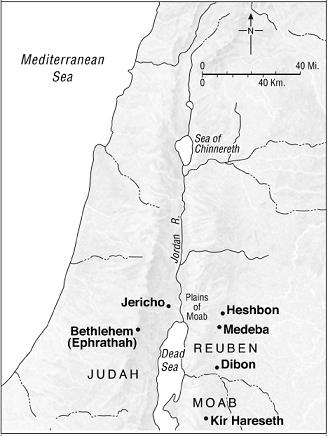
Aside from Bethlehem (1:1), Moab (the perennial enemy of Israel which was east of the Dead Sea), stands as the only other mentioned geographic/national entity (1:1, 2). This country originated when Lot fathered Moab by an incestuous union with his oldest daughter (Gen. 19:37). Centuries later the Jews encountered opposition from Balak, king of Moab, through the prophet Balaam (Num. 22–25). For eighteen years Moab oppressed Israel during the judges (Judg. 3:12–30). Saul defeated the Moabites (1 Sam. 14:47) while David seemed to enjoy a peaceful relationship with them (1 Sam. 22:3, 4). Later, Moab again troubled Israel (2 Kin. 3:5–27; Ezra 9:1). Because of Moab’s idolatrous worship of Chemosh (1 Kin. 11:7, 33; 2 Kin. 23:13) and its opposition to Israel, God cursed Moab (Is. 15; 16; Jer. 48; Ezek. 25:8–11; Amos 2:1–3).
The story of Ruth occurred in the days “when the judges ruled” Israel (1:1), c. 1370 to 1041 B.C. (Judg. 2:16–19) and thus bridges time from the judges to Israel’s monarchy. God used “a famine in the land” of Judah (1:1) to set in motion this beautiful drama, although the famine does not receive mention in Judges, which causes difficulty in dating the events of Ruth. However, by working backward in time from the well-known date of David’s reign (1011–971 B.C.), the time period of Ruth would most likely be during the judgeship of Jair, c. 1126–1105 B.C. (Judg. 10:3–5).
Ruth covers about eleven to twelve years according to the following scenario: (1) 1:1–18, ten years in Moab (1:4); (2) 1:19–2:23, several months (mid-April to mid-June) in Boaz’s field (1:22; 2:23); (3) 3:1–18, one day in Bethlehem and one night at the threshing floor; and (4) 4:1–22, about one year in Bethlehem.
Historical and Theological Themes
All eighty-five verses of Ruth have been accepted as canonical by the Jews. Along with Song of Solomon, Esther, Ecclesiastes, and Lamentations, Ruth stands with the OT books of the Megilloth or “five scrolls.” Rabbis read these books in the synagogue on five special occasions during the year—Ruth being read at Pentecost due to the harvest scenes of Ruth 2 and 3.
Genealogically, Ruth looks back almost 900 years to events in the time of Jacob (4:11) and forward about 100 years to the coming reign of David (4:17, 22). While Joshua and Judges emphasize the legacy of the nation and their land of promise, Ruth focuses on the lineage of David back to the patriarchal era.
At least seven major theological themes emerge in Ruth. First, Ruth the Moabitess illustrates that God’s redemptive plan extended beyond the Jews to Gentiles (2:12). Second, Ruth demonstrates that women are coheirs with men of God’s salvation grace. Third, Ruth portrays the virtuous woman of Proverbs 31:10 (cf. 3:11). Fourth, Ruth describes God’s sovereign (1:6; 4:13) and providential care (2:3) of seemingly unimportant people at apparently insignificant times which later prove to be monumentally crucial to accomplishing God’s will. Fifth, Ruth along with Tamar (Gen. 38), Rahab (Josh. 2), and Bathsheba (2 Sam. 11, 12) stand in the genealogy of the messianic line (4:17, 22; cf. Matt. 1:5). Sixth, Boaz, as a type of Christ, becomes Ruth’s kinsmanredeemer (4:1–12). Finally, David’s right (and thus Christ’s right) to the throne of Israel is traced back to Judah (4:18–22; cf. Gen. 49:8–12).
Interpretive Challenges
Ruth should be understood as a true historical account. The reliable facts surrounding Ruth, in addition to its complete compatibility with Judges plus 1 and 2 Samuel, confirm Ruth’s authenticity. However, some individual difficulties require careful attention. First, how could Ruth worship at the tabernacle then in Shiloh (1 Sam. 4:4), since Deuteronomy 23:3 expressly forbids Moabites from entering the assembly for ten generations? Since the Jews entered the land c. 1405 B.C. and Ruth was not born until c. 1150 B.C., she then represented at least the eleventh generation (probably later) if the time limitation ended at ten generations. If “ten generations” was an idiom meaning “forever” as Nehemiah 13:1 implies, then Ruth would be like the foreigner of Isaiah 56:1–8 who joined himself to the Lord (1:16), thus gaining entrance to the assembly.
Second, are there not immoral overtones to Boaz and Ruth spending the night together before marriage (3:3–18)? Ruth engaged in a common ancient Near Eastern custom by asking Boaz to take her for his wife as symbolically pictured by throwing a garment of love and care over the intended woman (3:9), just as Jehovah spread His garment over Israel (Ezek. 16:8). The text does not even hint at the slightest moral impropriety, noting that Ruth slept at his feet (3:8, 14). Thus, Boaz became God’s answer to his own earlier prayer for Ruth (2:12).
Third, would not the levirate principle of Deuteronomy 25:5, 6 lead to incest and/or polygamy if the nearest relative was already married? God would not design a good plan to involve the grossest of immoralities punishable by death. Implementation of Deuteronomy 25:5, 6 could involve only the nearest relative who was eligible for marriage as qualified by other stipulations of the law.
Fourth, was not marriage to a Moabitess strictly forbidden by the law? The nations or people to whom marriage was prohibited were those possessing the land that Israel would enter (Ex. 34:16; Deut. 7:1–3; Josh. 23:12) which did not include Moab (cf. Deut. 7:1). Further, Boaz married Ruth, a devout proselyte to Jehovah (1:16, 17), not a pagan worshiper of Chemosh—Moab’s chief deity (cf. later problems in Ezra 9:1, 2 and Neh. 13:23–25).
I. ELIMELECH AND NAOMI’S RUIN IN MOAB (1:1–5)
1:1–5 This introduction to Ruth sets in motion the following events (1:6–4:22), which culminate in Obed’s birth and his relationship to the Davidic line of Christ. See Introduction: Background and Setting.
1:1 famine. This disaster sounds similar to the days of Abraham (Gen. 12), Isaac (Gen. 26), and Jacob (Gen. 46). The text does not specify whether or not this famine was God’s judgment (cf. 1 Kin. 17, 18, esp. 18:2). Bethlehem, Judah. Bethlehem (“house of bread”) lies in the territory given to the tribe of Judah (Josh. 15) about six miles south of Jerusalem. Rachel, the wife of Jacob, was buried nearby (Gen. 35:19; cf. 4:11). Bethlehem eventually received the title, “city of David” (Luke 2:4, 11). Later, Mary delivered Christ (Luke 2:4–7; cf. Mic. 5:2) and Herod slaughtered the infants here (Matt. 2:16). This title (Judg. 17:7, 9; 19:1, 2, 18) serves to distinguish it from Bethlehem of Zebulun (Josh. 19:15). dwell. Elimelech intended to live temporarily in Moab as a resident alien until the famine passed. Moab. See Introduction: Background and Setting.
1:2 Elimelech. His name means “my God is king,” signifying a devout commitment to the God of Israel. Most likely, he was a prominent man in the community whose brothers might have included the unnamed close relative and Boaz (cf. 4:3). Naomi. Her name means “pleasant.” Mahlon and Chilion. Their names mean “sick” and “pining,” respectively. Ephrathites. A title used of people who lived in the area more anciently known as Ephrath (Gen. 35:16, 19; 48:7) or Ephrathah (4:11; Mic. 5:2), but later more prominently called Bethlehem (1:1). Jesse, father of David, is called “an Ephrathite of Bethlehem” (1 Sam. 17:12) and “Jesse the Bethlehemite” (1 Sam. 16:1, 18; 17:58).
1:4 the women of Moab. See Introduction: Interpretive Challenges. Orpah. Her name means “stubborn.” Ruth. Her name means “friendship.” about ten years. This period would seem to include the entire time of Naomi’s residency in Moab.
1:5 the woman survived. Naomi, a widow in Moab whose two sons have died also, believed that the Lord had afflicted her with bitter days until she would die (1:13, 20, 21). No reason for the death of these three men in her life is given. Ruth married Mahlon, and Orpah united with Chilion (cf. 4:10).
The MacArthur Study Bible, by John MacArthur (Nashville: Word Publishing, 1997) 366. © 1993 by Thomas Nelson, Inc.
II. NAOMI AND RUTH RETURN TO BETHLEHEM (1:6–22)
1:6–22 The death of Elimelech and his two sons (1:3, 5) prepared the way for Naomi and Ruth to leave Orpah in Moab (1:6–14), and they returned together to Bethlehem (1:15–22).
1:6 the LORD had visited His people. Obviously the Lord had sent rain to break the famine. The sovereignty of Jehovah on behalf of Israel permeates the pages of Ruth in several ways: (1) God actually worked for good (2:12; 4:12–14), (2) in circumstances perceived by Naomi for bad (1:13, 21), and (3) in the context of prayer/blessing (1:8, 9, 17; 2:4, 12, 20; 3:10, 13; 4:11). The return of physical prosperity only shadowed the reality of a coming spiritual prosperity through the line of David in the person of Christ.
1:7 she went out. Naomi had friends (1:19), family (2:1), and prosperity (4:3) awaiting her in Bethlehem.
1:8–10 Naomi graciously encouraged her two daughters-in-law to return to their homes (1:8) and to remarry (1:9), but they insisted on going to Jerusalem (1:10).
1:11–13 Naomi selflessly reasoned a second time for their return, because she would be unable to provide them with new husbands (possibly in the spirit of a levirate marriage as described in Deut. 25:5, 6). If Orpah and Ruth waited, they would most likely have become as old as Naomi was then before they could remarry (cf. Gen. 38:11).
1:12 I am too old. Naomi was probably over fifty.
1:13 the hand of the LORD. This is a figure of speech which describes the Lord’s work. The Lord is spirit (John 4:24) and therefore does not have a literal hand.
1:14, 15 At the second plea to return, Orpah turned back. Naomi pleaded with Ruth a third time to return.
1:15 her gods. This refers to Chemosh, the chief Moabite deity, who required child sacrifice (2 Kin. 3:27).
1:16–18 Ruth recited her hallmark expression of loyalty to Naomi and commitment to the family into which she married.
1:16 And your God, my God. This testimony evidenced Ruth’s conversion from worshiping Chemosh to Jehovah of Israel (cf. 1 Thess. 1:9, 10).
1:17 The LORD do so to me. Ruth’s vow bore further testimony to her conversion. She followed the path first blazed by Abraham (Josh. 24:2).
1:19 they came to Bethlehem. A trip from Moab (at least 60–75 miles) would have taken about 7–10 days. Having descended about 4,500 feet from Moab into the Jordan Valley, they then ascended 3,750 feet through the hills of Judea. all the city. Naomi had been well known in her prior residency (cf. Ephrathites of Bethlehem, 1:2). The question “Is this Naomi?” most likely reflected the hard life of the last decade and the toll that it had taken on her appearance.
1:20, 21 Naomi . . . Mara; full . . . empty. Naomi’s outlook on life, although grounded in God’s sovereignty, was not hopeful; thus she asked to be renamed Mara, which means “bitter.” Her experiences were not unlike Job (Job 1; 2), but her perspective resembled that of Job’s wife (Job 2:10). In reality, Naomi had (1) a full harvest prospect, (2) Ruth plus Boaz, not to mention (3) the hope of God’s future blessing.
1:22 Ruth, the Moabitess. This title also appears at 2:2, 21; 4:5, 10. Ruth stands out as a foretaste of future Gentile conversions (cf. Rom. 11). at the beginning of barley harvest. Normally the middle to the end of April.
III. BOAZ RECEIVES RUTH IN HIS FIELD (2:1–23)
2:1–23 Two widows, newly at home in Bethlehem after Naomi’s ten-year absence, needed the basics of life. Ruth volunteered to go out and glean the fields for food (cf. James 1:27). In so doing, she unintentionally went to the field of Boaz, a close family relative, where she found great favor in his sight.
2:1 relative . . . of the family. This man was possibly as close as a brother of Elimelech (cf. 4:3), but if not, certainly within the tribe or clan. a man of great wealth. Lit. “a man of valor” (cf. Judg. 6:12; 11:1) who had unusual capacity to obtain and protect his property. Boaz. His name means “in him is strength.” He had never married or was a widower (cf. 1 Chr. 2:11, 12; Matt. 1:5; Luke 3:32).
2:2 glean. The Mosaic Law commanded that the harvest should not be reaped to the corners nor the gleanings picked up (Lev. 19:9, 10). Gleanings were stalks of grain left after the first cutting (cf. 2:3, 7, 8, 15, 17). These were dedicated to the needy, especially widows, orphans, and strangers (Lev. 23:22; Deut. 24:19–21).
2:3 she happened to come. Here was a classic example of God’s providence at work. part of the field. This was possibly a large community field in which Boaz had a plot.
2:4–17 Note throughout how Boaz manifested the spirit of the law in going beyond what the Mosaic legislation required by (1) feeding Ruth (2:14), (2) letting Ruth glean among the sheaves (2:15), and (3) leaving extra grain for her to glean (2:16).
2:4 The LORD be with you. This unusual labor practice speaks to the exceptional godliness of Boaz and his workers.
2:7 sheaves. These were bundles of grain stalks tied together for transport to the threshing floor.
| O.T. Qualification | Christ’s Fulfillment |
| 1. Blood Relationship | Gal. 4:4, 5; Heb. 2:16, 17 |
| 2. Necessary Resources | 1 Cor. 6:20; 1 Pet. 1:18, 19 |
| 3. Willingness to Buy | John 10:15-18; 1 John 3:16 |
2:7, 17 morning . . . evening. Ruth proved to be diligent in her care for Naomi.
2:7 the house. Most likely, this was a temporary shelter built with branches by the side of the field.
2:8 my daughter. Boaz was about forty-five to fifty-five years old as a contemporary of Elimelech and Naomi. He would naturally see Ruth as a daughter (3:10, 11), much like Naomi did also (cf. 2:2, 22; 3:1, 16, 18). Boaz contrasted himself with younger men (3:10). my young women. These were the ones who tied up the sheaves.
2:9 young men. The ones who cut the grain with hand sickles (cf. 2:21).
2:10 a foreigner. Ruth remained ever mindful that she was an alien and as such must conduct herself humbly. Possibly she had knowledge of Deuteronomy 23:3, 4. She acknowledged the grace (lit. favor) of Boaz.
2:11 fully reported to me. This indicates Naomi’s quickness to speak kindly of Ruth and Boaz’s network of influence in Bethlehem. Ruth remained true to her promise (1:16, 17).
2:12 wings . . . refuge. Scripture pictures God as catching Israel up on His wings in the Exodus (Ex. 19:4; Deut. 32:11). God is here portrayed as a mother bird sheltering the young and fragile with her wings (cf. Pss. 17:8; 36:7; 57:1; 61:4; 63:7; 91:1, 4). Boaz blessed Ruth in light of her new found commitment to and dependence on the Lord. Later, he would become God’s answer to this prayer (cf. 3:9).
2:14 vinegar. Sour wine mixed with a little oil was used to quench thirst.
2:15 among the sheaves. Boaz granted her request (2:7) to go beyond the law.
2:17 ephah. This amounts to over one-half bushel, weighing about thirty to forty pounds.
2:18 what she had kept back. This was not the gleaned grain, but rather the lunch ration which Ruth did not eat (cf. 2:14).
2:20 His kindness. Naomi began to understand God’s sovereign working, covenant loyalty, lovingkindness, and mercy toward her because Ruth, without human direction (2:3), found the near relative Boaz. one of our close relatives. The great kinsman-redeemer theme of Ruth begins here (cf. 3:9, 12; 4:1, 3, 6, 8, 14). A close relative could redeem (1) a family member sold into slavery (Lev. 25:47–49), (2) land which needed to be sold under economic hardship (Lev. 25:23–28), and/or (3) the family name by virtue of a levirate marriage (Deut. 25:5–10). This earthly custom pictures the reality of God the Redeemer doing a greater work (Pss. 19:14; 78:35; Is. 41:14; 43:14) by reclaiming those who needed to be spiritually redeemed out of slavery to sin (Ps. 107:2; Is. 62:12). Thus, Boaz pictures Christ who, as a Brother (Heb. 2:17), redeemed those who (1) were slaves to sin (Rom. 6:15–18), (2) had lost all earthly possessions/privilege in the Fall (Gen. 3:17–19), and (3) had been alienated by sin from God (2 Cor. 5:18–21). Boaz stands in the direct line of Christ (Matt. 1:5; Luke 3:32). This turn of events marks the point where Naomi’s human emptiness (1:21) begins to be refilled by the Lord. Her night of earthly doubt has been broken by the dawning of new hope (cf. Rom. 8:28–39).
2:22 do not meet you. Ruth the Moabitess would not be treated with such mercy and grace by strangers outside of the family.
2:23 the end of . . . harvest. Barley harvest usually began about mid-April and wheat harvest extended to mid-June—a period of intense labor for about two months. This generally coincided with the seven weeks between Passover and the Feast of Weeks, i.e., Pentecost (cf. Lev. 23:15, 16; Deut. 16:9–12).
IV. RUTH’S ROMANCE WITH BOAZ (3:1–18)
3:1–18 Encouraged by Ruth’s day in Boaz’s field, Naomi instructed Ruth in the way she should go to insure a brighter future. Ruth carefully followed Naomi’s directions to solicit redemption by Boaz, while the Lord had prepared Boaz to redeem Ruth. Only one potential obstacle remained—a relative nearer than Boaz.
3:1 security. Naomi felt responsible, just as she did in 1:9, for Ruth’s future husband and home.
3:2 tonight. Winnowing (tossing grain into the air to finish separating the grain from the chaff) normally occurred in late afternoon when the Mediterranean winds prevailed. Sifting and bagging the grain would have carried over past dark, and Boaz may have remained all night to guard the grain from theft. threshing floor. Usually a large, hard area of earth or stone on the downwind (east) side of the village where threshing took place (loosening the grain from the straw and winnowing).
3:3, 4 Naomi instructed Ruth (1) to put on her best appearance and (2) to propose marriage to Boaz by utilizing an ancient Near Eastern custom. Since Boaz is a generation older than Ruth (2:8), this overture would indicate Ruth’s desire to marry Boaz which the older, gracious Boaz would not have initiated with a younger woman.
3:7 his heart was cheerful. Using the same language of 3:1 (“security . . . be well”), Boaz is described as having a sense of wellbeing, which is most readily explained by the full harvest in contrast to previous years of famine (cf. Judg. 18:20; 1 Kin. 21:7).
3:9 Take your maidservant. Ruth righteously appealed to Boaz, using the language of Boaz’s earlier prayer (2:12), to marry her according to the levirate custom (Deut. 25:5–10). See Introduction: Interpretive Challenges.
3:10 kindness. Ruth’s loyalty to Naomi, the Lord, and even Boaz is commended by Boaz. go after young men. Ruth demonstrated moral excellence in that (1) she did not engage in immorality, (2) she did not remarry outside the family, and (3) she had appealed for levirate redemption to an older, godly man.
3:11 virtuous. In all respects, Ruth personifies excellence (cf. Prov. 31:10). This same language has been used of Boaz (“a man of great wealth” or more likely “a man of valor” in 2:1), thus making them the perfectly matched couple for an exemplary marriage.
3:12 a relative closer than I. Boaz righteously deferred to someone else who was nearer in relationship to Elimelech. The nearer relative may have been Boaz’s older brother (cf. 4:3) or Boaz may have been his cousin. The fact that the neighbor women said, “There is a son born to Naomi” at Obed’s birth would suggest the brother or cousin relationship to Elimelech (4:17).
3:13 I will perform the duty. Boaz willingly accepted Ruth’s proposal, if the nearer relative was unable or unwilling to exercise his levirate duty. as the LORD lives. This is the most solemn, binding oath an Israelite could vow.
3:14 lay at his feet. According to the text, no immorality occurred. Boaz even insisted on no appearance of evil.
3:15 six ephahs. The Hebrew text gives no standard of measurement; ephah has been inserted by the translators only as a possibility. However, six ephahs would weigh about 200 pounds, which was far too much for Ruth to carry home in her shawl. Therefore, deemed most reasonable is six seahs (60–80 pounds), which would have been twice the amount Ruth had previously gleaned (see 2:17).
3:18 this day. Naomi knew that Boaz was a man of integrity and would fulfill his promise with a sense of urgency. They needed to wait on the Lord to work through Boaz.
4:1–22 God’s divine plan fully blossomed as Boaz redeemed Naomi’s land and Ruth’s hand in marriage. Naomi, once empty (1:21), is full; Ruth, once a widow (1:5), is married; but most importantly, the Lord has prepared Christ’s line of descent in David, through Boaz and Obed, back to Judah (Gen. 49:10) to fulfill the proper messianic lineage.
4:1 went up. Apparently the threshing floor was below the level of the gate. Compare Ruth 3:3, “go down to the threshing floor.” the gate. This was the normal public place to transact business in ancient times (cf. 2 Sam. 15:2; Job 29:7; Lam. 5:14). friend. The Hebrew text is not clear whether Boaz called him directly by name (which is then not mentioned by the author) or indirectly.
4:2 ten men. This number apparently comprised a quorum to officially transact business, although only two or three witnesses were needed for judicial proceedings (cf. Deut. 17:6; 19:15).
4:3 Naomi . . . sold. This phrase could possibly be translated, “Naomi is about to sell” (cf. Jer. 32:6–15). As a widow, she needed the money for living expenses, knowing that the land would ultimately be returned at Jubilee (Lev. 25:28). our brother Elimelech. Boaz and the unnamed relative were most likely either brothers or cousins.
4:4 Buy it back. This was authorized by the Mosaic Law (Lev. 25:23–28).
4:5 you must also buy. Redeeming both Ruth and the land would not have been required by the letter of the levirate law (Deut. 25:5, 6). Perhaps this exemplified Boaz’s desire to obey the spirit of the law (see note on 2:4–17 ), or maybe the redemption of land and marriage had been combined by local tradition. The levirate principle appears first in Scripture at Genesis 38:8 (cf. Matt. 22:23–28).
4:6 lest I ruin my own inheritance. He was unwilling to have the family portfolio split between his existing children and the potential offspring of a union with Ruth. You redeem. The closer relative relinquished his legal right to the land and Ruth. This cleared the way for Boaz to redeem both.
4:7 took off his sandal. The Scripture writer explained to his own generation what had been a custom in former generations. This kind of tradition appears in Deuteronomy 25:5–10 and apparently continued at least to the time of Amos (cf. 2:6; 8:6). The closer relative legally transferred his right to the property as symbolized by the sandal, most likely that of the nearer relative.
4:9 I have bought. Boaz exercised his legal option to redeem both the land and Ruth before appropriate witnesses.
4:10 the widow of Mahlon. Only here is Ruth’s former husband identified (cf. 1:5). Therefore, it can also be assumed that Chilion married Orpah. I have acquired as my wife. Boaz exercised the spirit of the law and became Ruth’s kinsman-redeemer (Deut. 25:5, 6). the name of the dead. Perpetuation of the family name (1 Sam. 24:21) was an important feature that the levirate process provided (cf. Deut. 25:6).
4:11 We are witnesses. This affirmation signaled the strong approval of the city. like Rachel and Leah. Rachel, the most beloved wife of Jacob, was buried nearby (Gen. 35:19); Leah was the mother of Judah (by Jacob), their namesake descendant (Gen. 29:35). This remembrance went back almost 900 years to c. 1915 B.C. Ephrathah . . . Bethlehem. This was the ancient name of Bethlehem (Gen. 35:19; 48:7). See note on Ephrathites; 1:2. Micah later prophetically wrote that this city would be the birthplace of Messiah (5:2).
4:12 Perez . . . Tamar . . . Judah. Read Genesis 38:1–30 for the background to these three. Tamar, the widow of Judah’s first son Er, when denied a levirate marriage to Judah’s remaining son Shelah (38:14), took matters into her own hands and immorally consorted with her father-in-law Judah (38:18). Perez, the first born of twins by Tamar, became the main ancestor of the Ephrathites and Bethlehemites (1 Chr. 2:3–5, 19, 50, 51; 4:4). See note on 4:18. offspring. The firstborn son would be considered the son of Mahlon. Additional sons would legally be the offspring of Boaz (Deut. 25:6).
VI. GOD REWARDS BOAZ AND RUTH WITH A SON (4:13–17)
4:13 he went in to her. This is an OT euphemism for sexual intercourse. the LORD gave her conception. As with Rachel (Gen. 30:22) and Leah (Gen. 29:31), so it was also with Ruth (cf. Ps. 127:3).
4:14 the LORD . . . has not left you. This is in contrast to Naomi’s worst moments of despair (1:20, 21). a close relative . . . his name. This refers to Obed, not Boaz (cf. 4:11), who cared for Naomi in her latter years.
4:15 better . . . than seven sons. Seven represented the number of perfection and thus seven sons would make the complete family (cf. 1 Sam. 2:5). However, Ruth exceeded this standard all by herself.
4:16 a nurse to him. This expresses the natural affection of a godly grandmother for her God-given grandson.
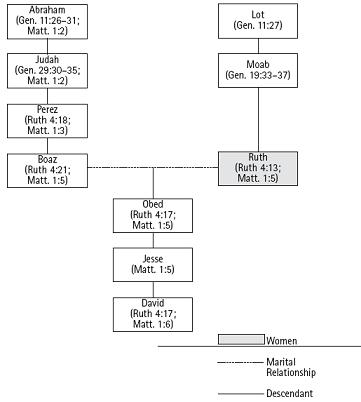
4:17 the neighbor women gave him a name. Here is the only place in the OT where a child was named by someone other than the immediate family. a son born to Naomi. Ruth vicariously bore the son who would restore the family name of Naomi’s deceased son Mahlon (cf. 4:1). Obed . . . Jesse . . . David. This complete genealogy appears identically in four other biblical texts (4:21, 22; 1 Chr. 2:12–15; Matt. 1:5, 6; Luke 3:31, 32). Boaz and Ruth were the great-grandparents of David.
The MacArthur Bible Handbook, by John MacArthur (Nashville: Thomas Nelson Publishers, 2003) 73. © 2003 by Thomas Nelson Publishers.
VII. DAVID’S RIGHT TO THE THRONE OF JUDAH (4:18–22)
4:18–22 Perez . . . David. This representative genealogy, which spans nine centuries from Perez (c. 1885 B.C.) to David (c. 1040 B.C.), specifically names ten generations. The first five (Perez to Nashon) cover the patriarchal times to the Exodus and wilderness wanderings. Salmon to David covers Joshua’s lifetime and the judges to the monarchy. This genealogical compression by omission does not signal faulty records, because in Jewish thinking “son” could mean “descendant” (cf. Matt. 1:1). The purpose of a family record did not necessarily include every generation, but rather established incontestable succession by way of the more notable ancestors.
4:18 Perez. See note on verse 12. Although this genealogy only goes back to Perez, it conclusively establishes that David’s lineage extends further back through Judah (Gen. 49:8–12), Jacob (Gen. 28:10–17), and Isaac (Gen. 26:24) to Abraham (Gen. 12:1–3).
4:18, 19 Hezron. Cf. Genesis 46:12.
4:19 Ram. He is listed as Arni in some Greek texts of Luke 3:33.
4:19, 20 Amminadab. He is the father-in-law of Aaron (Ex. 6:23), who does not appear in 1 Chronicles 2:10, but is cited in Matthew 1:4 and Luke 3:33. Some Hebrew manuscripts also include Admin between Ram and Amminadab in Luke 3:33.
4:20 Nahshon. He is the leader of Judah in the Exodus (Num. 1:7; 2:3; 7:12, 17; 10:14).
4:20, 21 Salmon. He is the husband of Rahab the harlot (cf. Matt. 1:5).
4:21 Salmon begot Boaz. Since Matthew 1:5 lists Rahab the harlot, who lived c. 1425–1350 B.C. as Salmon’s wife, it indicates that some generations have been selectively omitted between Salmon and Boaz (c. 1160–1090 B.C.).
4:22 David. Looking back at Ruth from a NT perspective, latent messianic implications become more apparent (cf. Matt. 1:1). The fruit which is promised later on in the Davidic covenant (2 Sam. 7:1–17) finds its seedbed here. The hope of a messianic king and kingdom (2 Sam. 7:12–14) will be fulfilled in the Lord Jesus Christ (Rev. 19; 20) through the lineage of David’s grandfather Obed, who was born to Boaz and Ruth the Moabitess.
Further Study
Huey, F. B. Ruth, in The Expositor’s Bible Commentary. Grand Rapids: Zondervan, 1992.
Morris, Leon, Ruth, in “Judges and Ruth,” Tyndale Old Testament Commentaries. Downers Grove, Ill.: IVP, 1968.
Phillips, W. Gary. Judges and Ruth. Nashville: Broadman & Holman, 2004.