THE FOURTH BOOK OF MOSES CALLED
NUMBERS
Title
The English title Numbers comes from the Greek (LXX) and Latin (Vulgate) versions. This designation is based on the numberings that are a major focus of chapters 1–4; 26. The most common Hebrew title comes from the fifth word in the Hebrew text of 1:1, “in the wilderness [of].” This name is much more descriptive of the total contents of the book, which recount the history of Israel during almost thirty-nine years of wandering in the wilderness. Another Hebrew title, favored by some early church fathers, is based on the first word of the Hebrew text of 1:1, “and He spoke.” This designation emphasizes that the book records the Word of God to Israel.
Author and Date
The first five books of the Bible, called the Law, of which Numbers is the fourth, are ascribed to Moses throughout Scripture (Josh. 8:31; 2 Kin. 14:6; Neh. 8:1; Mark 12:26; John 7:19). The Book of Numbers itself refers to the writing of Moses in 33:2; 36:13.
Numbers was written in the final year of Moses’ life. The events from 20:1 to the end occur in the fortieth year after the Exodus. The account ends with Israel poised on the eastern side of the Jordan River across from Jericho (36:13), which is where the conquest of the land of Canaan began (Josh. 3–6). The Book of Numbers must be dated c. 1405 B.C., since it is foundational to the Book of Deuteronomy, and Deuteronomy is dated in the eleventh month of the fortieth year after the Exodus (Deut. 1:3).
Background and Setting
Most of the events of the book are set “in the wilderness.” The word wilderness is used forty-eight times in Numbers. This term refers to land that contains little vegetation or trees and, because of a sparsity of rainfall, it cannot be cultivated. This land is best used for tending flocks of animals. In 1:1–10:10, Israel encamped in “the wilderness in Sinai.” It was at Sinai that the Lord had entered into the Mosaic covenant with them (Ex. 19–24). From 10:11–12:16, Israel traveled from Sinai to Kadesh. In 13:1–20:13, the events took place in and around Kadesh, which was located in “the wilderness of Paran” (12:16; 13:3, 26), “the wilderness of Zin” (13:21; 20:1). From 20:14–22:1, Israel traveled from Kadesh to the “plains of Moab.” All the events of 22:2–36:13 occurred while Israel was encamped in the plain to the north of Moab. That plain was a flat and fertile piece of land in the middle of the wasteland (21:20; 23:28; 24:1).
The Book of Numbers concentrates on events that take place in the second and fortieth years after the Exodus. All incidents recorded in 1:1–14:45 occur in 1444 B.C., the year after the Exodus. Everything referred to after 20:1 is dated c. 1406/1405 B.C., the fortieth year after the Exodus. The laws and events found in 15:1–19:22 are undated but, probably, all should be dated c. 1443 to 1407 B.C. The lack of material devoted to this thirty-seven-year period, in comparison with the other years of the journey from Egypt to Canaan, communicates how wasted these years were because of Israel’s rebellion against the Lord and His consequent judgment.
Historical and Theological Themes
Numbers chronicles the experiences of two generations of the nation of Israel. The first generation participated in the Exodus from Egypt. Their story begins in Exodus 2:23 and continues through Leviticus and into the first fourteen chapters of Numbers. This generation was numbered for the war of conquest in Canaan (1:1–46). However, when the people arrived at the southern edge of Canaan, they refused to enter the land (14:1–10). Because of their rebellion against the Lord, all the adults twenty and over (except Caleb and Joshua) were sentenced to die in the wilderness (14:26–38).
In chapters 15–25, the first and second generations overlap; the first died out as the second grew to adulthood. A second numbering of the people began the history of this second generation (26:1–56). These Israelites did go to war (26:2) and inherited the land (26:52–56). The story of this second generation, beginning in Numbers 26:1, continues through the books of Deuteronomy and Joshua.
Three theological themes permeate Numbers. First, the Lord Himself communicated to Israel through Moses (1:1; 7:89; 12:6–8), so the words of Moses had divine authority. Israel’s response to Moses mirrored her obedience or disobedience to the Lord. Numbers contains three distinct divisions based on Israel’s response to the word of the Lord: obedience (chs. 1–10), disobedience (chs. 11–25), and renewed obedience (chs. 26–36). The second theme is that the Lord is the God of judgment. Throughout Numbers, the “anger” of the Lord was aroused in response to Israel’s sin (11:1, 10, 33; 12:9; 14:18; 25:3, 4; 32:10, 13, 14). Third, the faithfulness of the Lord to keep His promise to give the seed of Abraham the land of Canaan is emphasized (15:2; 26:52–56; 27:12; 33:50–56; 34:1–29).
Interpretive Challenges
Four major interpretive challenges face the reader of Numbers. First, is the Book of Numbers a separate book, or is it a part of a larger literary whole, the Pentateuch? The biblical books of Genesis, Exodus, Leviticus, Numbers, and Deuteronomy form the Torah. The remainder of the Scripture always views these five books as a unit. The ultimate meaning of Numbers cannot be divorced from its context in the Pentateuch. The first verse of the book speaks of the Lord, Moses, the tabernacle, and the Exodus from Egypt. This assumes that the reader is familiar with the three books that precede Numbers.
Still, every Hebrew manuscript available divides the Pentateuch in exactly the same way as the present text. In them, the Book of Numbers is a well-defined unit, with a structural integrity of its own. The book has its own beginning, middle, and ending, even as it functions within a larger whole. Thus, the Book of Numbers is also to be viewed with singular identity.
The second interpretive question asks, “Is there a sense of coherence in the Book of Numbers?” It is readily evident that Numbers contains a wide variety of literary materials and forms? Census lists, genealogies, laws, historical narratives, poetry, prophecy, and travel lists are found in this book. Nevertheless, they are all blended to tell the story of Israel’s journey from Mt. Sinai to the plains of Moab. The coherence of Numbers is reflected in the outline that follows.
A third issue deals with the large numbers given for the tribes of Israel in 1:46 and 26:51. These two lists of Israel’s men of war, taken thirty-nine years apart, both put the number over 600,000. These numbers demand a total population for Israel in the wilderness of around two and one-half million at any one time. From a natural perspective, this total seems too high for the wilderness conditions to sustain. However, it must be recognized that the Lord supernaturally took care of Israel for forty years (Deut. 8:1–5). Therefore, the large numbers must be accepted at face value (see note on 1:46 ).
The fourth interpretive challenge concerns the heathen prophet Balaam, whose story is recorded in 22:2–24:25. Even though Balaam claimed to know the Lord (22:18), Scripture consistently refers to him as a false prophet (2 Pet. 2:15, 16, Jude 11). The Lord used Balaam as His mouthpiece to speak the true words He put in his mouth (see notes on 22:2–24:25 ).
I. ISRAEL’S FIRST GENERATION IN THE WILDERNESS: THE RECORD (1:1–25:18)
A. The Obedience of Israel Toward the Lord (1:1–10:36)
1:1–10:36 The first ten chapters of Numbers record the final preparations of Israel necessary for their conquest of the land of Canaan. In this section, the Lord spoke to Israel through Moses (1:1; 2:1; 3:1, 5, 11, 14, 44; 4:1, 17, 21; 5:1, 5, 11; 6:1, 22; 7:4; 8:1, 5, 23; 9:1, 9; 10:1), and Moses and Israel responded with obedience (1:19, 54; 2:33, 34; 3:16, 42, 51; 4:49; 7:2, 3; 8:3; 9:5, 18, 23; 10:13, 14–28 [in accordance with 2:34]). These chapters divide into two parts (1:1–6:27 and 7:1–10:36), which both end with an invocation of the Lord’s blessing on Israel (6:22–27 and 10:35, 36).
1. The organization of Israel around the tabernacle (1:1–6:27)
1:1–6:27 These six chapters chronologically follow the events recorded in 7:1–10:10. The ordering of Israel around the tabernacle (1:1–4:49) and the purity of the camp of Israel (5:1–6:27) were the final results of the Lord’s commands that began in Exodus 25:1. Obeying God’s instructions transformed an impure (Ex. 32:7, 8) and disorderly (Ex. 32:25) Israel into a people ready to march into Canaan.
1:1 Now the LORD spoke to Moses. This connects the revelation given here by the Lord with Exodus 25:1ff. and Leviticus 1:1ff. The Word from God directed everything that was done by Israel. the Wilderness of Sinai. Israel had been encamped there for eleven months. See Exodus 19:1. the tabernacle of meeting. The tabernacle, where the Lord’s glory resided in the cloud, had been erected one month earlier (Ex. 40:17). This was God’s dwelling place in the midst of his people. In Numbers 1:1–6:27, Israel was organized with the tabernacle as the central feature. the second year. Numbers begins in the fourteenth month (377 days) after the Exodus from Egypt.
1:2 a census. In Exodus 30:11–16, the Lord had commanded that a census of the males in Israel over twenty (excluding the Levites) be taken for the purpose of determining the ransom money for the service of the tabernacle. The result of that census is recorded in Exodus 38:25–28. The total number, 603, 550 (Ex. 38:26), equals the number in 1:46.
1:3 go to war. The purpose of this census was to form a roster of fighting men. The Book of Numbers looks ahead to the invasion of the land promised to Abraham (cf. Gen. 12:1–3).
1:4 a man. One leader from each of the twelve tribes was to assist Moses and Aaron in the numbering of the men. These same leaders are mentioned in Numbers 2:1–34 and 10:14–28 as the heads of tribes; in 7:1–88 they bring gifts to the tabernacle.
1:17–46 The tribal order follows the pattern of Jacob’s wives: first, the sons of Leah; second, the sons of Rachel; and third, the sons of the maids, except Gad (born of Leah’s maid), who replaced Levi in the third-born position (cf. Gen. 29:31–30:24; 35:16–20).
1:46 six hundred and three thousand five hundred and fifty. This number, combined with the twenty-two thousand Levite males a month old and above (3:39), allows for a total population of over two million Israelites. Since this number seems too high for the wilderness conditions and relatively few firstborn sons (3:43), some have reinterpreted the plain meaning of the text by (1) saying thousand means “clan” or “chief ” here, or (2) stating that the numbers are symbolic. However, if thousand is not the meaning in this chapter, 1:46 would read 598 “clans” or “chiefs” with only 5,500 individuals. Thus, the meaning thousand must be retained. Further, there is no textual indication that these numbers are symbolic. The only conclusion is that God took care of over two million people in the wilderness during the period of forty years (cf. Deut. 8:3, 4). Tampering with the number is tampering with God’s purpose for these numbers—to show His power in behalf of Israel.
| Exodus 38:26; | Numbers 1:17–46 |
| Reuben | 46,500 (v. 21) |
| Simeon | 59,300 (v. 23) |
| Gad | 45,650 (v. 25) |
| Judah | 74,600 (v. 27) |
| Issachar | 54,400 (v. 29) |
| Zebulun | 57,400 (v. 31) |
| Ephraim | 40,500 (v. 33) |
| Manasseh | 32,200 (v. 35) |
| Benjamin | 35,400 (v. 37) |
| Dan | 62,700 (v. 39) |
| Asher | 41,500 (v. 41) |
| Naphtali | 53,400 (v. 43) |
| Total | 603,550 (v. 46) |
1:50 appoint the Levites. The tribe of Levi, including Moses and Aaron, was not included in this census because it was exempt from military service. The Levites were to serve the Lord by carrying and attending to the tabernacle (cf. 3:5–13; 4:1–33, 46–49).
1:51 The outsider. This word often refers to the “alien” or “stranger.” The non-Levite Israelite was like a “foreigner” to the transporting of the tabernacle and had to keep his distance lest he die.
1:53 no wrath. The purpose of setting the Levites apart and arranging them around the tabernacle was to keep the wrath of the Lord from consuming Israel (cf. Ex. 32:10, 25–29).
2:2 standard . . . emblems. The emblems were flags identifying the individual tribes (probably with some sort of insignia). The standards were flags marking each of the four encampments of three tribes each. tabernacle of meeting. For details, see Exodus 25–30.
2:3 On the east side . . . Judah. Judah occupied the place of honor to the east. Genesis 49:8–12 highlights the role and centrality Judah would have in the defeat of Israel’s enemies. Judah was the tribe through which the Messiah would be born. Nahshon. Nahshon appears in the later genealogies of the messianic line (cf. Ruth 4:20; Matt. 1:4).
2:14 Reuel. In 1:14; 7:42, this name appears as Deuel. The letters R and D are similar in Hebrew and were easily confused by the scribes who copied the text.
2:17 move out. As the tribes marched, the tabernacle was transported in the middle of the tribes of Israel, six in front and six behind.
2:32 See note on 1:46.
3:1 Aaron and Moses. Because Aaron and his sons are emphasized in this chapter, Aaron is named first. Mount Sinai. The Lord had first communicated to Moses His choice of Aaron and his sons as priests in Exodus 28:1–29:46 while he was in the midst of the cloud on Mount Sinai (Ex. 24:18).
3:3 the anointed priests. Of all the tribe of Levi, only the sons of Aaron were priests. Only priests could offer the sacrifices; the rest of the Levites aided them in the work of the tabernacle (cf. vv. 7–9). consecrated. The setting apart of Aaron and his sons to the priesthood is recorded in Leviticus 8:1–9:24.
3:4 Eleazar and Ithamar. All of the future priests of Israel under the Mosaic covenant were descendants of these two sons of Aaron. Eleazar and his descendants would later be singled out for great blessing (cf. Num. 25:10–13).
The Placement of Israel’s Tribes
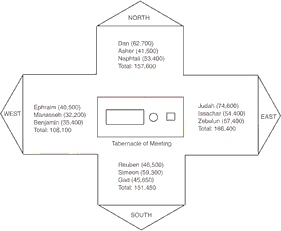
The MacArthur Study Bible, by John MacArthur (Nashville: Word Publishing, 1997) 199. © 1993 by Thomas Nelson, Inc.
3:6 the tribe of Levi. The specific task of the Levites was to serve Aaron, his sons, and all of Israel by doing the work of the tabernacle, further defined in verses 25, 26, 31, 36, 37; 4:4–33.
3:10 the outsider. Laymen or strangers (cf. 1:51) would die if they participated in priestly activities (cf. v. 38; 16:40).
3:12 firstborn. At the Exodus, the Lord claimed for Himself the firstborn of Israel’s males (cf. Ex. 13:1, 2). The firstborn was to act as the family priest. But when the full ministry of the Mosaic economy came in, God transferred the priestly duties to the Levites, perhaps partly because of their holy zeal in the golden calf incident (cf. Ex. 32:29). The Levites substituted for the firstborn.
3:15 Number. Moses took a census of every Levite male who was at least one month old. This included Moses, Aaron, and their sons, because they descended from Amram (v. 19; cf. Ex. 6:20).
3:21–26 Gershon. The Gershonites numbered 7,500 males and were responsible for the coverings of the tabernacle. They were to camp west of the tabernacle.
3:27–32 Kohath. The Kohathites probably numbered 8,300 males. The addition of one Hebrew letter changes the “six” to a “three.” This letter was dropped very early in the copying of the text. They were responsible for the holy objects of the tabernacle (including transporting the ark) and were to camp south of the tabernacle.
3:33–37 Merari. The Merarites numbered 6,200 males and were responsible for the wooden framework of the tabernacle. They were to camp north of the tabernacle.
3:38 Moses, Aaron. Moses, Aaron, and his sons were given the place of honor on the east of the tabernacle and gave overall supervision to the Levites. Eleazar oversaw the Kohathites (v. 32), and Ithamar oversaw the Gershonites and Merarites (4:28, 33).
3:43 twenty-two thousand two hundred and seventy-three. This was the total number of Gershonite, Kohathite, and Merarite males born in the twelve and one-half months since the Exodus. The Levites took the place of the first 22,000 firstborns and the rest (273) were redeemed with 1,365 silver shekels (about 170 pounds).
4:1–49 For a discussion of the tabernacle and contents, see notes on Exodus 25–30.
4:3 thirty . . . to fifty. This second census of the Levites determined those who would carry the tabernacle on the coming journey to Canaan. Only those between the ages of thirty and fifty were called by the Lord for this task (see note on 8:24 ).
4:4–16 Kohath. The Kohathites carried the furnishings of the tabernacle only after they had been covered by Aaron and his sons. If the Kohathites touched (v. 15) or saw (v. 20) any of the holy things, they would die.
4:21–28 Gershon. See note on 3:21–26.
4:29–33 Merari. See note on 3:33–37.
4:34–49 numbered. The Kohathites totaled 2,750 (v. 36), the Gershonites 2,630 (v. 40), the Merarites 3,200 (v. 44). All the Levites from thirty to fifty years old in service added up to 8,580 (v. 48).
5:1–4 These verses deal with outward, visible defects.
5:2 leper. One having an infectious skin disease (cf. Lev. 13:1–14:57). discharge. A bodily emission indicative of disease, primarily from the sex organs (cf. Lev. 15:1–33).
5:2 corpse. Physical contact with a dead body (cf. Lev. 21:11). All of these prohibitions had sensible health benefits as well as serving to illustrate the need for moral cleanliness when approaching God.
5:3 outside the camp . . . in the midst of which I dwell. God’s holy presence in the cloud in the tabernacle demanded cleanness. Therefore, all the unclean were barred from the encampment of Israel.
5:5–10 These verses deal with personal sins, which are not as outwardly visible as the uncleanness of verses 1–4.
5:6 against the LORD. A sin committed against God’s people was considered a sin committed against God Himself. There was a need for confession and restitution in addition to the trespass offering (cf. Lev. 5:14–6:7).
5:8 no relative. A supplement to Leviticus 6:1–7. If the injured party had died and there was no family member to receive the restitution called for in verse 7, it was to go to the priest as the Lord’s representative.
5:11–31 These verses deal with the most intimate of human relationships and the most secret of sins. Adultery was to be determined and dealt with to maintain the purity of the camp. To accomplish that purity, God called for a very elaborate and public trial. If adultery was proven, it was punished with death, and this ceremony made guilt or innocence very apparent. It was not a trial with normal judicial process, since such sins are secret and lack witnesses, but it was effective. The ceremony was designed to be so terrifying and convicting that the very tendencies of human nature would make it clear if the person was guilty.
5:14 the spirit of jealousy. A mood of suspicion came over the husband that his wife had defiled herself with another man. The accuracy of the suspicion was determined to be right or wrong.
5:15 for bringing iniquity to remembrance. The purpose of the husband’s offering was to bring the secret iniquity (if it was present) to light. How this was done is explained in verses 18, 25–26.
5:18 before the LORD. The woman was brought to a priest at the tabernacle. There she was in the presence of the Lord, who knew her guilt or innocence. uncover the woman’s head. Lit. “unbind the head.” In Leviticus 10:6; 13:45; 21:10, this phrase signifies mourning. This seems to signify the expectation of judgment and consequent mourning if the woman was proven to be guilty. the bitter water. This water included dust from the tabernacle floor (v. 17) and the ink used to write the curses (v. 23). The woman was to drink the water (v. 26). If the woman was guilty, the water would make her life bitter by carrying out the curse of making her thigh rot and her belly swell (vv. 21, 27). The public, frightening nature of this test could not fail to make guilt or innocence appear when the conscience was so assaulted.
5:28 conceive children. The penalty for the guilty wife was obvious, since the death penalty was called for. In contrast, the innocent wife was assured she would live to bring forth children.
6:1–21 Whereas 5:1–31 dealt with the cleansing of the camp by dealing with the unclean and sinful, 6:1–21 showed how consecration to the Lord was possible for every Israelite. Although only the family of Aaron could be priests, any man or woman could be “priestly” (i.e., dedicated to God’s service) for a time (from a month to a lifetime) by means of the vow of a Nazirite. Such a vow was made by people unusually devout toward God and dedicated to His service.
6:2 the vow of a Nazirite. The word vow here is related to the word wonder, which signifies something out of the ordinary. Nazirite transliterates a Hebrew term meaning “dedication by separation.” The Nazirite separated himself to the Lord by separating himself from (1) grape products (vv. 3, 4), (2) the cutting of one’s hair (6:5), and (3) contact with a dead body (vv. 6, 7). The high priest was also forbidden (1) to drink wine while serving in the tabernacle (Lev. 10:9) and (2) to touch dead bodies (Lev. 21:11). Further, both the high priest’s crown (Ex. 29:6; 39:30; Lev. 8:9) and the Nazirite’s head (vv. 9, 18) are referred to by the same Hebrew word. The Nazirite’s hair was like the high priest’s crown. Like the high priest, the Nazirite was holy to the Lord (v. 8; cf: Ex. 28:36) all the days (vv. 4, 5, 6, 8) of his vow.
6:9 dies . . . suddenly. If the Nazirite inadvertently came in contact with a dead body, he was to shave his head, on the eighth day bring the prescribed offerings, and begin the days of his vow again. This is a good illustration of the fact that sin can become mingled with the best intentions, and is not always premeditated. When sin is mixed with the holiest actions, it calls for a renewed cleansing.
6:13 fulfilled. At the end of the determined time, the Nazirite was released from his vow through offerings and the shaving of his head. His hair was to be brought to the sanctuary at the time of those offerings (cf. Acts 18:18).
6:22–27 Obedient Israel, organized before and consecrated to the Lord, was the recipient of God’s blessing (i.e., His favor) pronounced by the priests.
6:24 bless. The Lord’s blessing was described as His face (i.e., His presence) shining on His people (v. 25) and looking at them (v. 26). God shone forth in benevolence on Israel and looked on them for good. keep. The results of the Lord’s blessing were His preservation of Israel (“keep”), His kindness toward her (“be gracious,” v. 25), and her total well-being (“peace,” v. 26).
6:27 put My name. The name of the Lord represented His person and character. The priests were to call for God to dwell among His people and meet all their needs.
2. The orientation of Israel toward the tabernacle (7:1–10:36)
7:1–10:36 These four chapters show how the Lord spoke to Moses (7:89) and led Israel (9:22; 10:11, 12) from the tabernacle. As Israel was properly oriented toward the Lord and obeyed His word, God gave them victory over their enemies (10:35).
7:1–89 As the people of Israel had been generous in giving to the construction of the tabernacle (see Ex. 35:4–29), they showed the same generosity in its dedication.
7:1 finished setting up the tabernacle. According to Exodus 40:17, the tabernacle was raised up on the first day of the first month of the second year. Thus the tabernacle was set up eleven and one-half months after the Exodus from Egypt.
7:2 the leaders of Israel. The leaders of the twelve tribes were those named in 1:5–15 who oversaw the numbering of the people. The order of the presentation by tribe of their offerings to the tabernacle was the same as the order of march given in 2:3–32.
7:6 the carts and the oxen. These were to be used in the transportation of the tabernacle. According to verse 9, the sons of Kohath did not receive a cart because they were to carry the holy things of the tabernacle on their shoulders.
7:12 the first day. I.e., the first day of the first month. The gifts of the leaders to the tabernacle were given over twelve successive days.
7:84–88 Each of the leaders gave the same offerings to the tabernacle. Here, the total of all the gifts was given.
7:89 He spoke to him. With the completion of the tabernacle, the Lord communicated His Word to Moses from the mercy seat in the Holy of Holies (see Lev. 1:1; Num. 1:1).
8:1–4 Exodus 25:32–40 recorded the instructions for the making of the golden lampstand and Exodus 37:17–24 reported its completion.
8:5–26 This ceremony set apart the Levites to the service of the Lord. Their dedication was a feature of the overall description of the dedication of the tabernacle.
8:6 cleanse. In contrast to the priests who were consecrated (Ex. 29:1, 9), the Levites were cleansed. According to verse 7, this cleansing was accomplished by first, the sprinkling of water; second, the shaving of the body; and third, the washing of the clothes. This cleansing of the Levites made them pure so they might come into contact with the holy objects of the tabernacle. Similar requirements were given for the cleansing of the leper in Leviticus 14:8, 9.
8:9 the whole congregation. Since the Levites took the place of the firstborn, who had acted as family priests among the people of Israel (see vv. 16–18), all the congregation of Israel showed their identification with the Levites by the laying on of their hands.
8:19 a gift to Aaron. The Levites were given by God to assist the priests.
8:19 no plague. See note on 1:53.
8:24 twenty-five years old. The Levites were to begin their service in helping the priests at age twenty-five. However, in 4:3 the age of commencement is thirty. A rabbinic suggestion was that the Levites were to serve a five-year apprenticeship. A better solution can be discovered by noting the differing tasks in the two chapters. Numbers 4 dealt with the carrying of the tabernacle, while here they helped in the service in the tabernacle. A Levite began serving in the tabernacle at twenty-five and carrying the tabernacle at thirty. In both cases, his service ended at age fifty. David later lowered the age for beginning service to twenty (see 1 Chr. 23:24, 27; cf. Ezra 3:8).
9:1–14 The call from the Lord to keep the Passover led to an inquiry from those whose uncleanness kept them from obeying. This request led to an amplification of the requirement by the Lord. This was the second Passover.
9:1 the first month. The events recorded in these verses precede the beginning of the census in chapter 1, but follow the dedication of the tabernacle in chapter 7.
9:3 twilight. The time between the end of one day and the beginning of the next. See Exodus 12:6.
9:6 defiled. They were ceremonially unclean because of contact with a dead body. See note on 5:2.
9:10 posterity. This word from the Lord was not only for the current situation, but it was a continuing ordinance for Israel. If a person was unable to eat the Passover because of uncleanness or because he was away from the land, he could partake of the Passover on the fourteenth day of the second month.
9:12 This text is alluded to in John 19:36.
9:13 cut off. If any Israelite did not keep the Passover at the appointed time and was not unclean or away from the land, he was to be “cut off,” which implies that he was to be killed.
9:14 one ordinance. A non-Israelite who wished to participate in the Passover would be required to be circumcised.
9:15–23 See Exodus 40:34–38. The cloud, the visible symbol of the Lord’s presence, was continually sitting above the tabernacle. The movement of the cloud was the signal to Israel that they were to travel on their journey.
9:15 tabernacle . . . raised up. The presence of the Lord arrived when the tabernacle was completed and erected on the first day of the first month of the second year after they had come out of Egypt.
9:16 cloud . . . fire. The presence of the Lord which was seen in the cloud by day became a fire that was seen at night (cf. Lev. 16:2).
9:23 command . . . command. The text emphasizes that Israel obeyed the Lord at this point in her experience. Throughout the wilderness wanderings, the Israelites could only journey as the cloud led them. When it did not move, they stayed encamped where they were.
10:1–10 Israel was also to be guided by the blowing of the two silver trumpets made by Moses. Both a call to gather and a call to march were communicated with the trumpets.
10:2 trumpets. According to a Jewish tradition, these instruments were between twelve and twenty inches long and had a narrow tube that was flared at the end. hammered work. The same description is given concerning the cherubim above the mercy seat. See Exodus 25:18; 37:7.
10:3, 4 both . . . one. The first function of the trumpets was to gather the people to the tabernacle. When both trumpets were blown, all adult males of the congregation were to gather. If only one trumpet was blown, the leaders were to come.
10:5 advance. The second purpose of the trumpets was to give a signal indicating that the tribes were to set out on their march. The exact difference between the blowing for the gathering at the tabernacle and for the march is not known. Jewish tradition said the convocation sound was a long steady blast, while the advance signal was a succession of three shorter notes.
10:8 an ordinance forever. The blowing of the horns was to be a perpetual ordinance in Israel, calling the people to worship or to war.
10:11–36 Finally, in an orderly and obedient fashion, Israel departed from Sinai as the Lord commanded through Moses.
10:11 day . . . month . . . year. Only thirteen months after the Exodus from Egypt and eleven months after the arrival at Sinai, Israel began to march toward Canaan.
10:12 the Wilderness of Paran. According to 13:26, Kadesh was in the wilderness of Paran, probably at its northern border. This verse gives a summary of God’s leading from Sinai to Kadesh.
10:14–28 The order of march followed by Israel in these verses is in exact conformity to the details given in 2:1–34.
10:14 standard. See note on 2:2. Nahshon. For the fourth, and final time in the Book of Numbers, the twelve leaders of the first generation of Israel were noted (see chs. 1; 2; 7). In accordance with Genesis 49:8–12, the tribe of Judah was given preeminence as the ruling tribe. It led the march into the Promised Land.
10:29 Hobab. As the son of Reuel, Hobab was Moses’ brother-in-law. Reuel. Reuel was the father-in-law of Moses (see Ex. 2:18). Come with us. Moses sought Hobab’s help in leading Israel through the wilderness. He promised Hobab a portion of the inheritance of Israel within the land if he would come. The text of Numbers does not explicitly state whether Hobab responded to Moses or not. But Judges 1:16 implies that Hobab agreed to Moses’ request. Later, he joined with Judah in the conquest of the land and did receive the blessing of dwelling in the land.
10:33 journey . . . three days. The Israelites traveled for three days from Sinai before they encamped for more than one night.
10:35, 36 As Israel traveled and camped, Moses prayed that the Lord would give victory and that His presence would be among her.
B. The Disobedience of Israel Toward the Lord (11:1–25:18)
11:1–25:18 In contrast to Numbers 1–10, a major change takes place at 11:1. Obedient Israel became complaining (11:1; 14:2, 27, 29, 36; 16:1–3, 41; 17:5) and rebellious (14:9; 17:10) Israel. Ultimately, Moses and Aaron rebelled against the Lord as well (20:10, 24). In response to Israel’s disobedience, the Lord’s anger was aroused (11:1, 10, 33; 12:9; 14:18; 25:3, 4) and He plagued His people (14:37; 16:46, 47, 48, 49, 50; 25:8, 9, 18) as He had Pharaoh and the Egyptians (Ex. 9:14; 12:13; 30:12). Nevertheless, even though God judged that generation of Israel, He will still fulfill His promises to Abraham in the future (23:5–24:24).
1. The complaining of Israel on the journey (11:1–12:16)
11:1–12:16 The complaining of the people and leaders began on the journey from Sinai to Kadesh.
11:1 the LORD heard it. Their complaining was outward and loud. the outskirts of the camp. God, in His grace, consumed only those who were on the very edges of the encampment of Israel.
11:4 the mixed multitude. The word occurs only here in the OT. However, another word, “mixed company,” was used in Exodus 12:38. The “mixed multitude” here are non-Israelites who left Egypt with Israel in the Exodus. meat. After over a year of eating manna in the wilderness, the mixed multitude wanted the spicy food of Egypt once again.
11:7 manna. See Exodus 16:14. bdellium. This refers more to appearance than color, i.e., it had the appearance of a pale resin.
11:13, 14 Moses confessed to God that he was not able to provide meat for the people as they demanded. Their complaining was discouraging him so that because of this great burden, Moses desired death from the hand of the Lord.
11:16–30 In response to Moses’ despair in leading the people, the Lord gave him seventy men to help.
11:16 seventy men. These aides to Moses might be the same seventy referred to in Exodus 18:21–26.
11:17 the Spirit. This refers to the Spirit of God. It was by means of the Holy Spirit that Moses was able to lead Israel. In verse 25, the Lord gave the Spirit to the seventy men in fulfillment of the Word He gave to Moses.
11:21 six hundred thousand. Moses rounded off the 603,550 of 1:46; 2:32.
11:23 Has the LORD’s arm been shortened? A figure of speech indicating that the Lord was able to do as He had said and provide meat for the 600,000 men of Israel and their families for one month.
11:25 prophesied. Here, the prophesying refers to the giving of praise and similar expressions of worship to the Lord without prior training. The text is clear that this was a one-time event as far as these men were concerned.
11:29 that the LORD would put His Spirit upon them! Moses desired and anticipated the day when all of God’s people would have His Spirit within them. By this, he looked forward to the New Covenant. See Ezekiel 36:22–27; Jeremiah 31:31ff.; Joel 2:28.
11:31 a day’s journey. The Lord, using a wind, brought a great quantity of quail that surrounded the encampment within one day’s journey. about two cubits above the . . . ground. The birds flew at a height of about three feet where they were able to be easily captured or clubbed to the ground by the people.
11:32 ten homers. About sixty to seventy bushels.
12:1–16 The brother and sister of Moses opposed his leadership. The immediate occasion was the prophesying of the elders. Moses’ position as the spokesman for God to Israel was called into question.
12:1 Ethiopian. Ethiopia, south of Egypt, was inhabited by the descendants of Cush, the firstborn son of Ham (Gen. 10:6, 7). Although the term Ethiopian could have been used concerning Zipporah, Moses’ first wife, it seems more likely that Moses had remarried after the death of Zipporah. The marriage to the Ethiopian woman had been recent and furnished the pretext for the attack of Miriam and Aaron. Since Miriam is mentioned first, she probably was the instigator of the attack against Moses.
12:2 spoken only through Moses? Miriam and Aaron asserted that God had spoken to them in the same way that He had spoken to Moses.
12:3 very humble. This statement is often cited as evidence that Moses could not have written the Book of Numbers, for he would not have boasted in his own humility. However, the Holy Spirit certainly could inspire Moses to make an accurate statement about himself, probably against his own natural inclination. In this context, Moses was asserting there was nothing that he had done to provoke this attack by Miriam and Aaron. See note on 16:15.
12:5 the LORD came down. As in Genesis 11:5, this clause states that the Lord knows and deals with situations on earth. Here, the Lord came down and, in verse 10, departed. This was God’s answer to the attack against Moses.
12:7 My servant Moses. This phrase is also repeated in verse 9. A servant of the Lord in the OT is one who responded in faith by obedience to the Word of the Lord. faithful in all My house. A reference to Moses’ loyal performance of his role as covenant mediator between the Lord and Israel.
12:8 face to face. God spoke to Moses without mediation. Also, the Lord did not speak to Moses through visions and dreams, but plainly. It was not that Moses saw the full glory of God (cf. John 1:18), but rather that he had the most explicit, intimate encounters (cf. Deut. 34:10). the form of the LORD. This is the likeness or representation of the Lord which Moses was privileged to see. See Exodus 33:23.
12:10 leprous. In judgment of Miriam’s opposition to Moses, the Lord struck her with leprosy. For the treatment of a leper, see Leviticus 13 and 14. A public sin required a public response from the Lord.
12:16 Wilderness of Paran. See note on 10:12.
2. The rebellion of Israel (13:1–19:22)
13:1–14:45 These chapters record the failure of Israel at Kadesh. The people failed to believe the Lord (14:11) and take the Promised Land. Their lack of faith was open rebellion against the Lord (14:9). The NT looks back to these times as an illustration of apostasy (cf. 1 Cor. 10:5; Heb. 3:16–19).
13:1 the LORD spoke to Moses. According to Deuteronomy 1:22, 23, the people had first requested the spies be sent out after Moses challenged them to take the land. Here, the Lord affirmed the peoples’ desire and commanded Moses to send them.
13:2 spy out the land of Canaan. The spies were specifically called to explore the land that God had promised to Israel. This exploration gave valuable information to Moses for the conquest of the land.
13:3 heads of the children of Israel. These leaders were different than those mentioned in Numbers 1; 2; 7; 10. Presumably, the tribal leaders in the four earlier lists were older men. The task for the spies called for some leaders who were younger, probably about forty years of age, based on the ages of Caleb and Joshua.
13:16 Hoshea . . . Joshua. For reasons not made clear, Moses changed the name of Hoshea, meaning “desire for salvation,” to Joshua, meaning “the Lord is salvation.”
13:17–20 The spies were to determine the nature of the land itself, as well as the strengths and weaknesses of the people.
13:20 the season of the first ripe grapes. Mid-summer (mid to late July).
13:21 from the Wilderness of Zin as far as Rehob. These were the southernmost and northernmost borders of the land.
13:22 Hebron. This was the first major city the spies came to in Canaan. Abram had earlier built an altar to the Lord here (cf. Gen. 13:18). Abraham and Isaac were buried here (Gen. 49:31). The city had been fortified c. 1730 B.C., seven years before the building of Zoan in Egypt, and later became the inheritance of Caleb (Josh. 14:13–15) and then David’s capital when he reigned over Judah (2 Sam. 2:1–4). the descendants of Anak. Cf. verse 28. Anak was probably the ancestor of Ahiman, Sheshiai, and Talmai, who were living at Hebron. They were noted for their height (Deut. 2:21; 9:2).
13:23 the Valley of Eshcol. Eshcol means “cluster.”
13:28 the people . . . are strong. The spies reported that the land was good; however, the people were too strong to be conquered.
13:30 Caleb quieted the people. The verb quieted usually occurs in the form of the interjection, Hush! This implies that the report of the spies evoked a vocal reaction from the people. Caleb concurred with the report of the other spies, but called the people to go up and take the land, knowing that with God’s help they were able to overcome the strong people.
13:32 a bad report. The report of the ten spies was evil because it exaggerated the dangers of the people in the land, it sought to stir up and instill fear in the people of Israel and, most importantly, it expressed their faithless attitude toward God and His promises.
13:33 giants. This term was used in Genesis 6:4 for a group of strong men who lived on the earth before the flood. The descendants of Anak were, in exaggeration, compared to these giants, which led the spies to view themselves as grasshoppers before them.
14:1 all the congregation . . . wept. All of Israel bewailed the circumstances.
14:2 complained. The term means “to murmur.” Specifically, they wished they had died in Egypt or the wilderness.
14:4 select a leader and return to Egypt. The faithless people were ready to reject God’s leader, Moses.
14:6 tore their clothes. This was an indication of distress (see Gen. 37:29).
14:7–9 Joshua and Caleb reaffirmed their appraisal that the land was good and their confidence that the Lord would deliver it and its people into their hands.
14:10 the glory of the LORD appeared. In response to the people’s violent rejection of Joshua and Caleb’s challenge, God appeared.
14:11 reject . . . not believe Me. They had refused to trust or rely on God and His power to give them the land of Canaan in spite of the signs that He had done in their midst.
14:12 I will make of you a nation. As in Exodus 32:9, 10, God threatened to wipe out the people and start over again with Moses’ “son.” This justifiable threat showed the seriousness with which God took the rebellion on the part of His people.
14:13–19 As in Exodus 32:11–13, Moses interceded for Israel to protect the Lord’s reputation with the Egyptians, who would charge the Lord with inability to complete His deliverance of Israel and, thus, deny His power. Second, the Lord’s loyal love was the basis on which the Lord could forgive His people.
14:22 ten times. Taken literally this includes: (1) Exodus 14:10–12; (2) Exodus 15:22–24; (3) Exodus 16:1–3; (4) Exodus 16:19, 20; (5) Exodus 16:27–30; (6) Exodus 17:1–4; (7) Exodus 32:1–35; (8) Numbers 11:1–3; (9) Numbers 11:4–34; (10) Numbers 14:3.
14:24 My servant Caleb. Since Caleb was recognized as one who feared and trusted the Lord, God later rewarded his faith (cf. Josh. 14).
14:25 turn and move out into the wilderness. Because of Israel’s refusal to enter the land, instead of continuing northward, God commanded them to move southward toward the Gulf of Aqabah.
14:26–35 The Lord granted the Israelites their wish, i.e., their judgment was that they would die in the wilderness (vv. 29, 35: cf. v. 2). Their children, however, whom they thought would become victims (v. 3), God would bring into the land of Canaan (vv. 30–32). The present generation of rebels would die in the wilderness until forty years were completed. The forty years were calculated as one year for each day the spies were in Canaan.
14:37 died by the plague. As an indication of the certainty of the coming judgment, the ten spies who undermined the people’s faith were struck by the plague and died.
14:44 they presumed to go up to the mountaintop.With characteristic obstinacy, the people rejected Moses’ counsel and the Lord’s command, and went to attack the Amalekites in the hill country. Since the Lord was not with them, they were defeated.
15:1–41 Even though the Israelites had rebelled against the Lord and were under his judgment, the Lord still planned to give the land of Canaan to them. These laws assumed Israel’s entrance into the land (15:2, 17).
15:1–16 The law of the grain offering, recorded here, differs from that given in Leviticus 2. The grain offerings in Leviticus were offered separately as a gift to the Lord. Here, for the first time, grain and drink offerings were allowed to be offered along with either a burnt or a peace offering.
15:4 ephah . . . hin. Measurements equal to four to six gallons and six to eight pints.
15:17–21 This regulation pertained to the offering of the firstfruits of the harvest. When the people entered the land of Canaan and began to enjoy its produce, they were to show their devotion to the Lord by presenting to Him a cake baked from the first cuttings of the grain.
15:22 sin unintentionally. Sin offerings were prescribed whenever any of the Lord’s commands were unwittingly disobeyed, i.e., by unintentional neglect or omission. In vv. 24–26, the offerings for the whole community were given. In verses 27–29, the offerings for the individual person who sinned unintentionally were stated.
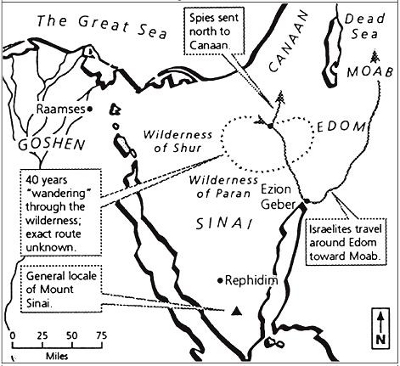
Nelson’s Complete Book of Bible Maps & Charts (Nashville: Thomas Nelson Publishers, 1996) 55. © 1993 by Thomas Nelson, Inc.
15:30 does anything presumptuously. Lit. “with a high hand.” These sins, committed knowingly and deliberately, were described as blasphemous because they were an arrogant act of insubordination against the Lord. Anyone guilty of presumptuous sin was to be excommunicated from Israel and put to death.
15:32–36 This was an illustration of defiant sin. When it was determined that there was a premeditated violation of the Sabbath law, death was required.
15:37, 38 tassels. These blue tassels were in the form of a flower or petal and were attached to the clothing of the Israelites to remind them of their need to trust and obey God’s commands.
15:41 the LORD. This reminder harkens back to Moses’ first encounter with the Lord in the desert (Ex. 3:13–22).
16:1–18:32 In 16:1–40, Korah (a Levite), allied with some Reubenites and other leaders of Israel, instigated an organized opposition to the authority of Aaron and the priests. Their argument against Moses and Aaron was that by claiming the unique right and responsibility to represent the people before God, they took “too much upon themselves” based on the promise that “all the congregation is holy, every one of them, and the LORD is among them” (16:3). The Lord dealt with these rebels (16:4–40) and reaffirmed His choice of Aaron (16:41–17:13). Finally, the Lord restated the duties and support of both the priests and Levites (18:1–32). These events took place at some unidentified place and time during Israel’s wilderness wanderings.
16:1 Korah. Korah was descended from Levi through Kohath. Being a son of Kohath, he already had significant duties at the tabernacle (see 4:1–20). However, he desired further to be a priest (see v. 10).
16:8 sons of Levi. Other Levites were involved in this rebellion with Korah.
16:12 Dathan and Abiram. These two men of the tribe of Reuben despised Moses, blaming him for taking Israel out of the land of Egypt and failing to bring them into the land of Canaan. Because of Moses’ perceived failure, they attacked him, joining with Korah in the rebellion against Moses and Aaron.
16:15 nor have I hurt one of them. Moses pled his innocence before the Lord, claiming to have been a true servant-leader. This confirms that Numbers 12:3 could have been written by Moses.
16:16–35 God judged those who rebelled against Moses and Aaron by putting them to death.
16:21 The Lord answered Moses’ intercession by calling the people to depart from the tents of the rebels so that only they would be judged.
16:22 the God of the spirits of all flesh. This phrase appears only here and in 27:16. Moses called on the omniscient God, who knows the heart of everyone, to judge those who had sinned, and those only.
16:30 a new thing. This supernatural opening of the earth to swallow the rebels was a sign of God’s wrath and the vindication of Moses and Aaron.
16:32 their households. Numbers 26:11 indicates that this did not include their children.
16:36–40 The 250 leaders of Israel had brought censers filled with fire before the Lord (16:17, 18). The censers were holy to the Lord since they had been used in the tabernacle. Therefore, Eleazar was commanded to hammer out the metal censers into a covering for the altar. That covering was to be a perpetual reminder that God had chosen Aaron and his descendants for the priesthood.
16:41–50 Instead of bringing about the repentance of the people, the Lord’s wrath only led to more complaining. Though the children of Israel held Moses and Aaron accountable for the people who had been killed by the Lord, it was the intervention of Moses and Aaron for the entire nation that saved them from destruction because of their opposition to God.
16:46 incense. Incense was symbolic of prayer. Aaron interceded in prayer and the plague stopped (v. 48).
16:49 fourteen thousand seven hundred. See 1 Corinthians 10:10.
17:2 twelve rods. These sticks of wood were to bear the names of the twelve tribes, with the tribe of Levi replaced by the name Aaron.
17:4 before the Testimony. The Testimony is the Ten Commandments written on two stone tablets kept in the ark of the covenant. The phrase “before the Testimony” is synonymous with “before the ark.”
17:8 the rod of Aaron. God had stated that the stick of the man He had chosen would blossom (17:5). The stick of Aaron had not only blossomed, but had yielded ripe almonds. Thus, God had exceeded the demands of the test, so there would be no uncertainty of the fact that Aaron had been chosen as high priest.
17:10 a sign. Aaron’s rod that blossomed and brought forth fruit was to be kept as an indication of God’s choice in order to permanently stop the murmuring of the rebellious Israelites.
17:12 Surely we die. Finally, the people realized their sin in challenging Aaron’s role.
17:13 comes near. The people’s fear of going near to God led to a reaffirmation of the priesthood of Aaron and his sons in chapter 18.
18:1–7 Only Aaron and his family could minister with the holy articles of the sanctuary of God.
18:1 the LORD said to Aaron. Only in verses 1–25 and in Leviticus 10:8 does the Lord speak directly to Aaron alone. bear the iniquity. Aaron and his sons, from this point forward, were responsible for any offense against the holiness of the tabernacle or violations of the rules of priesthood.
18:7 a gift for service. Even though the priesthood demanded much, the priests were to view it as a gift from the Lord.
18:8–20 In return for their service to the Lord, the priests were to receive a portion of the offerings which the people presented in worship. They could keep all of the parts of the sacrifices not consumed on the altar by fire. Also, the offerings of firstfruits and everything devoted to the Lord were theirs as well.
18:19 a covenant of salt forever. Salt, which does not burn, was a metaphor to speak of durability. As salt keeps its flavor, so the Lord’s covenant with the priesthood was durable. The Lord would provide through the offerings of His people for His priests forever.
18:21–24 The Levites received the tithes from the people. This was their source of income and compensation for their tabernacle service.
18:25–32 As the Levites themselves received the tithe, they were also required to present a tithe (a tenth) of what they received to the Lord.
19:1–22 Over a period exceeding thirty-eight years, more than 1,200,000 people died in the wilderness because of God’s judgment. The Israelites were continually coming into contact with dead bodies, which led to ceremonial uncleanness. Therefore, the Lord provided a means of purification so that those who came into contact with dead bodies might be cleansed.
19:1–10 The provision given for the preparation of the “water of purification” (cf. Lev. 12–15).
19:2 a red heifer. A reddish, brown cow, probably young since no yoke had been put on it. This cow was burned and its ashes were used as the agent of purification (see v. 9).
19:3 Eleazar. The son of Aaron was a deputy high priest who was in charge of the slaughter of the red cow. outside the camp. The red cow was killed outside the camp of Israel and its ashes were stored there as well (see v. 9). Hebrews 13:11–13 picks up the image of “outside the camp” as it relates to Christ’s death outside of Jerusalem.
19:6 cedar wood and hyssop and scarlet. The cow was totally consumed by the fire along with these three materials, which were also used in the ritual of purification of skin disease (Lev. 14:1–9). The ashes of all these and the cow were mixed to make the agent by which cleansing could take place.
19:11–22 A general statement regarding the use of the “water of purification” (vv. 11–13) is followed by a more detailed explanation of the procedure to be followed.
19:18 A clean person. Any clean person, not just priests, could sprinkle the unclean with the water of purification.
20:1–22:1 These chapters record the beginning of the transition from the old generation (represented by Miriam and Aaron) to the new generation (represented by Eleazar). Geographically, Israel moves from Kadesh (20:1) to the plains of Moab (22:1), from where the conquest of the land would be launched. There is an interval of thirty-seven years between 19:22 and 20:1.
3. The rebellion of Moses and Aaron (20:1–29)
20:1–13 Just as the children of Israel failed to trust in the Lord (14:11) and, thus, were not allowed to go into the Promised Land (14:30), Israel’s leaders, Moses and Aaron, would also not go into the land because of their failures to trust in the Lord.
20:1 the first month. The year is not stated. However, at the end of this chapter, there is a report of the death of Aaron. According to Numbers 33:38, Aaron died on the first day of the fifth month of the fortieth year after the Exodus from Egypt. Thus, the first month, here, must be of the fortieth year. Most of the older generation had died in the wilderness. Kadesh. As the people had begun their wilderness wanderings at Kadesh (13:26), so they ended them there. Kadesh was located on the northern boundary of the wilderness of Paran (13:26) and on the southeast border of the wilderness of Zin. Miriam died. Miriam, who led Israel in celebrating the victory over Egypt at the Red Sea (Ex. 15:20, 21), also led the attack against Moses recorded in Numbers 12:1–15. Her death served as a symbol that the old generation would not enter Canaan.
20:2 no water. During Israel’s forty years in the wilderness, water was their greatest physical need. The Lord had provided it continually, beginning at Horeb (Ex. 17:1–7). The present lack of water stirred the people to contend with Moses.
20:3 If only we had died when our brethren died. The situation was so desperate in the people’s mind that they wished they had been among those who died in Korah’s rebellion (16:41–50).
20:6 fell on their faces. As he had done in the past, Moses sought the Lord’s counsel (see 14:5; 16:4).
20:8 Speak to the rock. Though God told Moses to take his rod with which He had performed many wonders in the past (Ex. 4:1–5; 7:19–21; 14:16; 17:5, 6), he was only to speak to the rock in order for it to yield water.
20:10 you rebels. Instead of speaking to the rock, Moses spoke to the people, accusing them of being rebels against God. By his actions, Moses joined the people in rebellion against God (see 27:14).
20:12 you did not believe Me. The Lord’s evaluation of Moses was that he failed to take God at His Word and, thus, to treat Him as holy to the people. Moses failed in the same way as Israel had at Kadesh thirty-eight years previously (14:11). you shall not bring this assembly into the land. God’s judgment of Moses for his sin of striking the rock was that he would not take Israel into the land of Canaan. The inclusion of Aaron demonstrated his partnership with Moses in the action against the Lord.
20:13 Meribah. Lit. “contention, quarreling.” The same name was used earlier at the first occasion of bringing water from the rock (Ex. 17:7).
20:14–21 Moses’ attempt to pass through the territory of Edom was rejected by the king.
20:14 your brother Israel. The people of Edom were descended from Esau, the brother of Jacob (see Gen. 36:1).
20:17 the King’s Highway. The major north-south trade route from the Gulf of Aqabah north to Damascus, which passed through the Edomite city of Sela.
20:20 with many men and with a strong hand. The king of Edom sent out his army to intercept Israel. Since Israel was forbidden by the Lord to engage in warfare with Edom (Deut. 2:4–6), they turned away from Edom’s border.
20:22–29 Eleazar succeeded his father, Aaron, as high priest. Aaron’s death further marked the passing of the first generation.
20:22 Mount Hor. This is most likely a mountain northeast of Kadesh on the border of Edom.
20:24 because you rebelled against My word. Aaron had joined Moses in rebellion against God (v. 12). Aaron’s death foreshadowed the death of Moses.
20:29 mourned . . . thirty days. This was the same mourning period as for Moses (Deut. 34:8). Since the normal time for mourning was seven days (see Gen. 50:10), the length of this mourning showed the importance of Aaron and the loss to Israel.
4. The resumed complaining of Israel on the journey (21:1–22:1)
21:1–3 Israel’s first victory over the Canaanites occurred at Hormah, the place they had previously been defeated (see 14:45).
21:1 king of Arad. This raiding king came from a Canaanite city in the south, i.e., the Negev.
21:3 they utterly destroyed them. Israel vowed to the Lord that if He would give them victory over Arad, they would completely destroy them, not claiming the spoils of victory for themselves. The Lord responded to this vow and gave victory.
21:4–9 After their victory over Arad, Israel showed again their lack of obedience toward the Lord.
21:4 by the Way of the Red Sea. Cf. Deuteronomy 2:1. Since the way through Edom was barred, Moses turned to the south to take Israel around Edom. Thus, Israel journeyed toward Elath on the coast of the Gulf of Aqabah. This long, circuitous route led to impatience and frustration on the part of Israel.
21:5 this worthless bread. The people’s impatience led them to despise the manna (see 11:6).
21:6 fiery serpents. These snake bites inflicted a fiery inflammation.
21:7 We have sinned. The people confessed their iniquity and asked that they might be released from the judgment God had sent.
21:9 a bronze serpent. One had to fix his gaze upon this snake, a definite act of the will, if he wanted to be healed and live. Note the typological use of this incident in John 3:14, 15.
21:10–20 Israel circled around both Edom and Moab and camped on the north side of the Arnon River in the territory of the Amorites.
21:14 the Book of the Wars of the LORD. Apparently, this was a book of victory songs that was current at the time of Moses, possibly written by Moses or a contemporary. The work is cited as evidence that the Arnon River was the northern boundary of Moab.
21:16 Beer. Lit. “well.” Here, God provided water for Israel. In response, Israel praised the Lord with a song which might have also come from the Book of the Wars of the LORD (vv. 17, 18).
21:21–32 As with Edom (vv. 14–19), Israel requested passage through the land of Sihon, a king of the Amorites. Since there was no requirement from the Lord not to engage the Amorites in warfare, as there had been for Edom, when Sihon brought out his army, he was attacked and defeated by Israel. Israel, thus, took the land bounded by the Arnon River on the south, the Dead Sea and the Jordan River on the west, the Jabbok River on the north, and the land of the Ammonites on the east.
21:27 those who speak in proverbs say. These words came from the wise men, probably among the Amorites. The words of verses 27–30 describe the Amorites’ defeat of the Moabites north of the Arnon River. Ironically, as the Amorites had taken the land from the Moabites, the Israelites had taken the land from the Amorites. The purpose of these words cited by Moses was to substantiate Israel’s right to this land. According to God’s commandments, the territory belonging to the Moabites was not to be taken by Israel because the Moabites were descendants of Lot (Deut. 2:9). However, what belonged to the Amorites had been promised to Israel and was theirs for the taking.
21:33–35 The land north of the Jabbok River was under the control of Og, another Amorite king. Og attacked Israel and suffered a devastating defeat. Thus, all of the land in the Transjordan, from the Arnon River in the south to the heights of Bashan in the north, came under Israelite control.
22:1 With their control of Transjordan secured, Israel moved unimpeded to the plains of Moab in preparation for assaulting Canaan.
5. The blessing of Israel by Balaam (22:2–24:25)
22:2–24:25 The narrative changes to center on Balaam, a pagan prophet. His oracles reassert the faithfulness of the Lord to the Abrahamic covenant and His purpose to bless Israel. In verses 2–40, the events leading to Balaam’s words are recorded. This is followed in 22:41–24:24 with the words of his prophecies and the conclusion in 24:25.
22:3 Moab was exceedingly afraid. The Moabites were descendants of Lot (see Gen. 19:36, 37). Balak, their king, had seen how the Israelites destroyed the Amorites. Not knowing that Israel was forbidden by God to attack Moab, he was terrified that the same fate awaited him and his people (Deut. 2:9).
22:4 Midian. The Midianites were descendants of Abraham through Keturah (see Gen. 25:1–4). They lived south of Moab’s border. When Moab communicated to the elders of Midian that they were in danger of being destroyed by Israel as well, they joined with Moab in an alliance to defeat Israel.
22:5 Balaam. Balaam was from Pethor, a city on the Euphrates River, perhaps near Mari, where the existence of a cult of prophets whose activities resembled those of Balaam have been found. Balaam practiced magic and divination (24:1) and eventually led Israel into apostasy (31:16). Later, Scripture identifies Balaam as a false prophet (Deut. 23:3–6; Josh. 13:22; 24:9, 10; Neh. 13:1–3; Mic. 6:5; 2 Pet. 2:15, 16; Jude 11; Rev. 2:14).
22:6 curse this people. Knowing that Israel was too strong to defeat militarily, Balak called for Balaam to come and curse Israel. A curse was a spoken word that was believed to bring misfortune upon the one against whom the curse was pronounced. Balak acknowledged that Balaam had the reputation of pronouncing curses that actually worked.
22:8 as the LORD speaks to me. Throughout these chapters, Balaam himself used the name “LORD,” i.e., Israel’s God (vv. 13, 18, 19; 23:3, 12; 24:13). In verse 18, he even called the Lord, “the LORD my God.” In this verse, it must be assumed that Balaam expected the God of Israel to speak to him. As a pagan prophet, he would anticipate making contact with the gods of any people.
22:9 God came to Balaam. Israel’s God did communicate to Balaam. However, rather than using the term “LORD,” which indicates a covenant relationship, God consistently used the word “God” when He spoke to him (vv. 9, 12, 20). Though Balaam used the word “LORD,” the biblical text makes it clear that he did not have a saving relationship with Israel’s God.
22:12 they are blessed. Balaam could not curse Israel because the Lord had determined to give them blessing only.
22:20 only the word which I speak to you. Because of his great desire for the material wealth that would come to him, Balaam desired to go to Balak. He implored the Lord even after God had told him not to go. God acceded to Balaam’s request to let him go, but told him that he could speak only the true Word from God.
22:22 because he went. Even though God had given Balaam permission to go (v. 20), He knew that his motive was not right. Thus, the anger of the Lord burned against Balaam because God knew that he was not yet submissive to what He required. The result of God’s confrontation with Balaam was a reaffirmation of the word given in verse 20, repeated in verse 35, that he was to speak only the words that God wanted him to speak. That Balaam got the message is explicitly stated in verse 38. the Angel of the LORD. The Angel of the Lord was a manifestation of the presence of the Lord Himself. He was equated with deity (see Gen. 16:7; 18:1, 2; Ex. 3:1–6). See note on Exodus 3:2.
22:28 the LORD opened the mouth of the donkey. Balaam’s donkey was able to see the Angel of the Lord with His drawn sword (vv. 23, 25, 27). Realizing the danger to herself, she sought to avoid the angel. In doing this, she preserved Balaam as well. Miraculously, the donkey was able to communicate with Balaam.
22:31 the LORD opened Balaam’s eyes. The Lord allowed Balaam to see things as they really were, especially those things that are not ordinarily visible to humans and to be submissive to His will as he went to Balak.
22:41–23:12 Balaam’s first oracle emphatically stated that Israel could not be cursed (23:8). She was unlike all the other nations of the world (23:9). Balaam even wished to share in her blessing (23:10).
23:5 the LORD put a word in Balaam’s mouth. Even though Balak and Balaam offered sacrifices on pagan altars, it was the Lord who gave Balaam his oracle.
23:7 he took up his oracle. This statement introduces each of Balaam’s speeches (vv. 6, 18; 24:3, 20, 21, 23).
23:10 Who can count the dust of Jacob? Here is Oriental hyperbole signifying a very populous nation as Jacob’s posterity was to be (cf. Gen 13:16; 28:14). one-fourth of Israel. The camp was divided into four parts, one on each side of the tabernacle. If one could not count the part, certainly no one could count the whole.
23:13–26 Balaam’s second oracle reaffirmed the Lord’s determination to bless Israel. The iniquity in Israel was mercifully set aside by the Lord (v. 21) and, therefore, would not stop His plan. The God who supernaturally brought Israel out of Egypt (v. 22) would give victory over all her enemies (v. 24).
23:19 God is not a man. In contrast to the unreliability of man, so well seen in Balaam himself, God is reliable and immutable. He does not change; therefore, His Words always come to pass.
23:27–24:14 Balaam’s third oracle focused on the ultimate King (the “Messiah”), who would bring the blessings of the Abrahamic covenant both to Israel and the nations.
23:28 Peor. Also named Beth Peor (Deut. 3:29), it was the location of a temple to Baal (25:3).
24:2 the Spirit of God came upon him. This terminology was regularly used in the OT for those whom God uniquely prepared to do His work (see Judg. 3:10). Unlike the previous two oracles, Balaam does not involve himself in divination before giving this third oracle. He is empowered with the Holy Spirit to utter God’s Word accurately.
24:3 whose eyes are opened. His inner eye of understanding had been opened by God’s Spirit.
24:7 Agag. In 1 Samuel 15:32, 33, an Amalekite king bore this name. The Amalekites were the first people to attack Israel after they left Egypt (see Ex. 17:8–15). Agag may be a proper name or a title of Amalekite rulers, like Pharaoh in Egypt.
24:8 God brings him out of Egypt. Because of the verbal similarities between verses 8, 9 with 23:22, 24, the him in this verse is usually interpreted to be Israel. However, since the him is singilar and the closest reference in verse 7 is to the coming king, it is better to see verses 8 and 9 as referring to Israel’s king. Numbers 24:9 is a direct quote from Genesis 49:9, which speaks of the ultimate King who will come from Judah, the Messiah.
24:9 Blessed is he who blesses you. These words refer to Genesis 12:3. The ultimate fulfillment of the Abrahamic covenant centers around the coming Messiah. The one who blesses Israel will ultimately reap God’s blessing in the future.
24:14 in the latter days. Lit. “at the end of days.” This term is rightfully used in the OT for the distant future. Balaam’s fourth oracle takes the truth communicated in the third and applies it to Moab.
24:15–19 Balaam’s fourth oracle predicted the future coming of Israel’s king, who would literally “shatter the forehead of Moab” and conquer Edom. He will have total dominion.
24:20–24 Balaam’s final three oracles look at the future of the nations. First, Amalek will come to an end (24:20). Second, the Kenites, identical to or a part of the Midianites, will be carried away by Asshur, i.e., Assyria (24:21, 22). Third, Assyria and Eber, probably Israel herself (Gen. 10:21), will be afflicted by Cyprus (this name came to represent the Mediterranean region west of Pal estine and in Daniel 11:30 refers to Rome), until Cyprus comes to ruin.
6. The final rebellion of Israel with Baal of Peor (25:1–18)
25:1–18 The final failure of Israel before the conquest of Canaan occurred in the plains of Moab. According to 31:16, the incident was brought about by the counsel of Balaam. Failing to be able to curse Israel, he gave the Moabites and Midianites direction in how to provoke the Lord’s anger against His people.
25:1 Acacia Grove. This is the region across the Jordan River from Jericho where Israel invaded the land of Canaan (see Josh. 2:1).
25:3 joined to Baal of Peor. Israel engaged in acts of sexual immorality with the women of Moab. Since this was part of the pagan cult that was worshiped by the Moabites, the Israelites joined in these idolatrous practices. The Israelites yoked themselves to the false god of the Moabites and the Midianites, referred to as Baal of Peor. This was a violation of the first commandment.
25:6 Cf. verses 14, 15.
25:9 twenty-four thousand. This is to be differentiated from the plague involving the golden calf where 23,000 Israelites died (cf. Ex. 32:1–14, 28; 1 Cor. 10:8).
25:10–13 Because of Phinehas’s zeal for God’s holiness, the Lord made “a covenant of an everlasting priesthood” with him so that through his family line would come all future, legitimate high priests (cf. Ps. 106:30, 31). This promise will extend even into the millennial kingdom (cf. Ezek. 40:46; 44:10, 15; 48:11). This promise comprised the basis for the priestly covenant. See note on Genesis 9:16.
25:17 Harass the Midianites. Because the Midianites had attacked Israel by their schemes of sexual and idolatrous seduction, the Lord called Israel to attack them in return. This attack is recorded in 31:1–24.
II. ISRAEL’S SECOND GENERATION IN THE PLAINS OF MOAB: A RENEWED OBEDIENCE (26:1–36:13)
26:1–36:13 The final, major section of Numbers records the renewed obedience of Israel. God continued to speak (vv. 1, 2, 52; 27:6, 12, 18; 28:1; 31:1, 25; 33:50; 34:1, 16; 35:1, 9), and the second generation of Israel obeyed. Most of the commandments in this section related to Israel’s life after they entered the land.
A. The Preparations for the Conquest of the Land (26:1–32:42)
26:1–32:42 These chapters begin and end speaking of going to war (v. 2; 32:20, 29, 32) and the ensuing inheritance of Canaan (vv. 52–56; 32:32). Israel was being prepared for the conquest of the Promised Land.
26:1–51 This second census, like the first taken over thirty-eight years earlier (1:1–46), counted all the men twenty years of age and older, fit for military service. The great decline in the tribe of Simeon might be due to its participation in the sin of Baal of Peor (see 25:14).
26:9 Dathan and Abiram. These were singled out for special mention because of their part in the rebellion recorded in 16:1–40. Mention of them was a reminder of God’s judgment against rebellion. See note on 16:12.
26:11 the children of Korah. These sons of Korah were spared judgment because they separated themselves from their father’s house (see 16:26).
26:19 Er and Onan. These two sons of Judah did not receive an inheritance in the land because of their great evil (see Gen. 38:1–10).
26:33 Zelophehad. The mentioning of Zelophehad having no sons, but only daughters, laid the basis for the laws of inheritance stated in 27:1–11; 36:1–12.
26:52–56 These census numbers would be used to decide the size of each tribe’s inheritance in the land. The exact locations would be determined by lot (see Josh. 13:1–7; 14:1–19:51 for the outworking of these words).
26:57–65 As in the first census (3:14–39), the Levites were counted separately. The total number of Levites was 23,000 (v. 62), an increase of 1,000 over the previous census (see 3:39).
27:1–11 The coming distribution of the land of Canaan presented a dilemma for the family of Zelophehad since he had no sons. His five daughters boldly asked that they inherit their father’s name and his inheritance (vv. 1–4). The Lord’s decision that the daughters should receive his inheritance became the basis of a perpetual statute in Israel governing inheritances (vv. 5–11).
27:3 he died in his own sin. Zelophehad had not been involved in Korah’s rebellion. Instead, he had died under God’s judgment in the wilderness, like the rest of the faithless Exodus generation.
27:8–11 The following is the order of inheritance: son, daughter, brother, paternal uncle, and closest relative in the family. This same order (with the exception of the daughter) was followed in Leviticus 25:48, 49, dealing with the various cases of redemption of the land in the Jubilee year.
Numbers 26:5–51
| Reuben | 43,730 | (v. 7) | -2,770 |
| Simeon | 22,200 | (v. 14) | -37,100 |
| Gad | 40,500 | (v. 18) | -5,150 |
| Judah | 76,500 | (v. 22) | +1,900 |
| Issachar | 64,300 | (v. 25) | +9,900 |
| Zebulun | 60,500 | (v. 27) | +3,100 |
| Manasseh | 52,700 | (v. 34) | +20,500 |
| Ephraim | 32,500 | (v. 37) | -8,000 |
| Benjamin | 45,600 | (v. 41) | +10,200 |
| Dan | 64,400 | (v. 43) | +1,700 |
| Asher | 53,400 | (v. 47) | +11,900 |
| Naphtali | 45,400 | (v. 50) | -8,000 |
| Total | 601,730 | (v. 51) | -1,820 |
27:12–14 God reaffirmed that Moses could not enter the land of Canaan, although he was able to see it from Mt. Nebo, across from Jericho (see Deut. 32:49).
27:15–17 Moses’ greatest concern was that Israel have a good leader who was like a shepherd. The Lord answered his request in the man Joshua.
27:18 lay your hand on him. Joshua already had the inner endowment for leadership—he was empowered by the Holy Spirit. This inner endowment was to be recognized by an external ceremony when Moses publicly laid his hands on Joshua. This act signified the transfer of Moses’ leadership to Joshua. The laying on of hands can also accompany a dedication to an office (see Num. 8:10).
27:20 give some of your authority. Moses was to pass on some of the “honor” or “majesty” that he had to Joshua. See Joshua 3:7.
27:21 Eleazar . . . shall inquire before the Lord for him. Moses had been able to communicate directly with God (12:8), but Joshua would receive the Word from the Lord through the high priest. Urim. See note on Exodus 28:30 for this part of the high priest’s breastplate (Ex. 39:8–21) being used as a means of determining God’s will (cf. Deut. 33:8; 1 Sam. 28:6).
28:1–29:40 Instructions concerning regular celebrations in Israel’s worship calendar had been given previously. Now, poised to enter the land, Moses gave an orderly reiteration and summary of the regular offerings for each time of celebration, adding some additional offerings.
28:3–8 See Exodus 29:38–42.
28:9, 10 These were newly revealed offerings for the Sabbath.
28:11–15 These were newly revealed offerings for the “beginning of the month.”
28:16–25 See Leviticus 23:5–8.
28:26–31 See Leviticus 23:18.
29:1–6 See Leviticus 23:23–25.
29:7–11 See Leviticus 23:26–32.
29:12–38 See Leviticus 23:33–43.
30:1–16 This chapter added clarification to the laws regarding vows given in Leviticus 27:1–33. The basic principle for men is restated in verse 2. Then, it was asserted that a man was also responsible for the vows made by women in his household (vv. 3–16). A father or husband could overrule the vow of a daughter or wife, but a man’s silence, if he knew of the vow, meant it must be accomplished.
30:2 a vow . . . some agreement. A promise to do something or a promise not to do something. Christ could have had this text in mind in Matthew 5:33.
30:9 a widow or a divorced woman. These were not viewed as being under a man’s authority, so the word of the woman alone sufficed.
31:1–54 This chapter has many links with previous passages in Numbers: vengeance on Midian (vv. 2, 3; 10:2–10); Zur the Midianite (v. 8; 25:15); Balaam (vv. 8, 16; 22:2–24:25); Peor (v. 16; 25:1–9, 14, 15); purification after contact with the dead (vv. 19–24; 19:11–19); care for the priests and Levites (vv. 28–47; 18:8–32). This battle with the Midianites modeled God’s requirements for holy war when Israel took vengeance on His enemies (see Deut. 20:1–18).
31:1–11 Israel was commanded by the Lord to take vengeance on Midian because they were responsible for corrupting Israel at Peor (25:1–18).
31:2 gathered to your people. A euphemism for death (see Gen. 25:8, 17; 35:29).
| Opponent | Location | Scripture |
| Amalek | Rephidim | Ex. 17:8–16 |
| Amalek | Hormah | Num. 14:45 |
| and | ||
| Canaanites | ||
| Arad | Hormah | Num. 21:1–3 |
| Amorites | Jahaz | Num. 21:21–25 |
| Bashan | Edrei | Num. 21:33–35 |
| Midian | ___ | Num. 31:1–12 |
31:12–24 All the Midianites, except the virgin women, were to be put to death. Both the soldiers and the spoil needed to be cleansed.
31:17 The execution of all male children and women of childbearing age insured the extermination of the Midianites and prevented them from ever again seducing Israel to sin. Reference to Midianites later (Judg. 6:1–6) was to a different clan. It was the Midianites living in Moab who were destroyed here.
31:25–54 The plunder was divided equally between those who went and fought and those who stayed.
32:1–42 The tribes of Reuben and Gad desired to live in the land already conquered because they possessed many herds of livestock and the land was good for grazing. Moses gave them, along with the half tribe of Manasseh, portions of the land only on the condition that they would fully participate in the conquest of Canaan.
32:3 Ataroth . . . Beon. The places mentioned here cannot be identified, but all lie between the Arnon River to the south and the Jabbok River to the north.
32:8 Thus your fathers did. Moses feared that if these two tribes were comfortably settled (1) they would not join with the other ten tribes in conquering Canaan, and (2) that could be the beginning of a general revolt against entering the land. As the ten spies had dissuaded the people at Kadesh nearly forty years earlier from conquering the land (vv. 9–13; 13:26–14:4), the refusal of these two tribes could cause the people to fail again (v. 15).
32:23 your sin will find you out. The two tribes committed themselves to provide their warriors for the conquest of the land. This agreement satisfied Moses, although he added that non-participation would be sin and God would certainly find and judge the tribes for their sin.
32:33 half the tribe of Manasseh. Once the agreement was reached with Reuben and Gad concerning settlement on the east side of the Jordan, the half tribe of Manasseh, also rich with flocks, joined in seeking land in that territory. However, verses 39–42 indicate that Manasseh conquered cities not yet taken and settled in the northern area of Gilead.
B. The Summary of the Journey in the Wilderness (33:1–49)
33:1–49 The Lord commanded Moses to write a list of Israel’s encampments between Egypt and the plains of Moab. Significantly, forty places were mentioned (not including Rameses and the plains of Moab), reflecting the forty years spent in the wilderness. Some sites recorded earlier are not listed and other sites are only mentioned here. The God who would lead the Israelites in the conquest of Canaan (33:50–56) was the One who had led them through the wilderness.
C. The Anticipation of the Conquest of the Land (33:50–36:13)
33:50–36:13 Entering the Promised Land had been Israel’s goal at the beginning of Numbers. This last part of the book anticipated the settlement in Canaan.
From the Wilderness to the Jordan
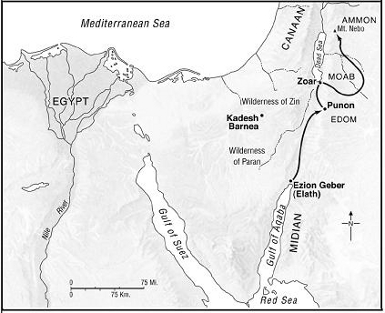
The MacArthur Study Bible, by John MacArthur (Nashville: Word Publishing, 1997) 242. © 1993 by Thomas Nelson, Inc.
33:50–56 God commanded that all of the Canaanites were to be exterminated, along with all their idolatrous symbols.
33:52 their high places. These are hills on which Canaanite altars and shrines were placed.
33:56 I will do to you as I thought to do to them. If Israel failed to obey God, she would be the object of God’s punishment in exactly the same way as the Canaanites were.
34:1–15 God gave precise instruction to Israel concerning the boundaries of the land of Canaan. Sadly, the actual conquest of the land fell far short of these boundaries.
34:13 give to the nine tribes and to the half-tribe. The land to be conquered was to be given to the nine and one-half tribes. The other two and one-half tribes already had their inheritance in Transjordan (32:1–42).
34:16–29 The Lord appointed the men who were to assign the portions of the land of Canaan: Eleazar the priest (20:25, 26), Joshua the commander (27:18–23), and the leaders of each of the ten tribes which were to receive an inheritance. None of these men were sons of the leaders listed in 1:5–15.
35:1–8 Forty-eight cities throughout the land were to be given to the Levites. The tribe of Levi did not receive a tribal allotment, but lived among the other tribes. Joshua 21:1–42 gives the list of these forty-eight cities.
35:2 from the inheritance of their possession. According to 18:23, the Levites were to have no land as an inheritance in Canaan, so the Levites did not inherit these towns; they only lived in them. common-land around the cities. The Levites were also given grazing land around the cities, so their animals might feed.
35:9–34 Six of the Levitical cities were to be established as “cities of refuge” (see Deut. 19:1–13). These cities were to be havens providing protection to any person who accidentally killed another person (manslaughter).
35:12 the avenger. The meaning of this term is “near of kin.” It refers to the person chosen by a family to deal with a loss suffered in that family. Here, the close relative of a homicide victim would seek to avenge his death, but not until proper judgment was made.
35:19 Swift retribution according to the law of Genesis 9:5, 6.
35:24 the congregation shall judge between the manslayer and the avenger. The congregation was called to decide the motive of the killer, whether it was with or without hostility. If there was evil intent, the killer was turned over to the avenger to be put to death. If, however, hostility could not be proven to exist between the killer and the victim, then the killer was allowed to remain in the city of refuge.
35:25 until the death of the high priest. The manslayer without evil intent was to remain in the city of refuge until the death of the high priest. The death of the high priest marked the end of an old era and the beginning of a new one for the manslayer.
35:30 witnesses. No one could be judged guilty of death on the testimony of only one witness. Two or more witnesses were required in all capital cases. See notes on Deuteronomy 17:6, 7; 19:15.
35:33 blood defiles the land. Though murder and inadvertent killing polluted the land, murder was atoned for by the death of the murderer. Failure to observe these principles would make the land unclean. If the whole land became unclean, then the Lord would no longer be able to dwell in their midst.
36:1–13 The issue raised here stemmed from a decision regarding female inheritance in 27:1–11. Since a tribe would lose an allotted inheritance in the year of Jubilee if an inheriting woman had married into another tribe, the woman of any tribe who inherited land must marry within her own tribe.
36:12 They were married into . . . Manasseh. The daughters of Zelophehad exemplified the obedience to God’s commandments that should have been practiced by all of Israel. Their inheritance was a direct result of their obedience to the Lord—a basic lesson emphasized throughout the Book of Numbers.
Further Study
Allen, Ronald B. Numbers, in Expositor’s Bible Commentary. Grand Rapids: Zondervan, 1990.
Harrison, R. K. Numbers. Chicago: Moody, 1990.