Title
This book gains its title from the human author, who begins with “The words of Jeremiah . . .” (1:1). Jeremiah recounts more of his own life than any other prophet, telling about his ministry, the reactions of his audiences, testings, and his personal feelings. His name means “Jehovah throws,” in the sense of laying down a foundation, or “Jehovah establishes, appoints, or sends.”
Seven other Jeremiahs appear in Scripture (2 Kin. 23:31; 1 Chr. 5:24; 12:4, 10, 13; Neh. 10:2; 12:1), and Jeremiah the prophet is named at least nine times outside of his book (cf. 2 Chr. 35:25; 36:12; 36:21, 22; Ezra 1:1; Dan. 9:2; Matt. 2:17; 16:14; 27:9). The Old and New Testaments quote Jeremiah at least seven times: (1) Daniel 9:2 (25:11, 12; 29:10); (2) Matthew 2:18 (31:15); (3) Matthew 27:9 (18:2; 19:2, 11; 32:6–9); (4) 1 Corinthians 1:31 (9:24); (5) 2 Corinthians 10:17 (9:24); (6) Hebrews 8:8–12 (31:31–34); and (7) Hebrews 10:16, 17 (31:33, 34).
Author and Date
Jeremiah, who served as both a priest and a prophet, was the son of a priest named Hilkiah (not the high priest of 2 Kin. 22:8 who discovered the Book of the Law). He was from the small village of Anathoth (1:1), today called Anata, about three miles northeast of Jerusalem in Benjamin’s tribal inheritance. As an object lesson to Judah, Jeremiah remained unmarried (16:1–4). He was assisted in ministry by a scribe named Baruch, to whom Jeremiah dictated and who copied and had custody over the writings compiled from the prophet’s messages (36:4, 32; 45:1).
Jeremiah has been known as “the weeping prophet” (cf. 9:1; 13:17; 14:17), living a life of conflict because of his predictions about judgment by the invading Babylonians. He was threatened, tried for his life, put in stocks, forced to flee from King Jehoiakim, publicly humiliated by a false prophet, and thrown into a pit.
Jeremiah carried out a ministry directed mostly to his own people in Judah, but which expanded to other nations at times. He appealed to his countrymen to repent and avoid God’s judgment via an invader (chs. 7; 26). Once invasion was certain after Judah refused to repent, he pled with them not to resist the Babylonian conqueror in order to prevent total destruction (ch. 27). He also called on delegates of other nations to heed his counsel and submit to Babylon (ch. 27), and he predicted judgments from God on various nations (25:12–38; chs. 46–51).
The dates of his ministry, which spanned five decades, are from the Judean king Josiah’s thirteenth year, noted in 1:2 (627 B.C.), to beyond the fall of Jerusalem to Babylon in 586 B.C. (Jer. 39; 40; 52). After 586 B.C., Jeremiah was forced to go with a fleeing remnant of Judah to Egypt (Jer. 43; 44). He was possibly still ministering in 570 B.C. (see note on 44:29, 30 ). A rabbinic note claims that when Babylon invaded Egypt in 568/67 B.C. Jeremiah was taken captive to Babylon. He could have lived even to pen the book’s closing scene c. 561 B.C. in Babylon, when Judah’s king Jehoiachin, captive in Babylon since 597 B.C., was allowed liberties in his last days (52:31–34). Jeremiah, if still alive at that time, was between eighty-five and ninety years old.
Background and Setting
Background details of Jeremiah’s times are portrayed in 2 Kings 22–25; 2 Chronicles 34–36. Jeremiah’s messages paint pictures of: (1) his people’s sin; (2) the invader God would send; (3) the rigors of siege; and (4) calamities of destruction. Jeremiah’s message of impending judgment for idolatry and other sins was preached over a period of forty years (c. 627–586 B.C. and beyond). His prophecy took place during the reigns of Judah’s final five kings (Josiah, 640–609 B.C.; Jehoahaz, 609 B.C.; Jehoiakim, 609–598 B.C.; Jehoiachin, 598–597 B.C.; and Zedekiah, 597–586 B.C.).
The spiritual condition of Judah was one of flagrant idol worship (cf. ch. 2). King Ahaz, preceding his son Hezekiah long before Jeremiah in Isaiah’s day, had set up a system of sacrificing children to the god Molech in the Valley of Hinnom just outside Jerusalem (735–715 B.C.). Hezekiah led in reforms and clean-up (Is. 36:7), but his son Manasseh continued to foster child sacrifice along with gross idolatry, which continued into Jeremiah’s time (7:31; 19:5; 32:35). Many people also worshiped the “queen of heaven” (7:18; 44:19). Josiah’s reforms, reaching their apex in 622 B.C., repressed the worst practices outwardly, but the deadly cancer of sin was deep and flourished quickly again after a shallow revival. Religious insincerity, dishonesty, adultery, injustice, tyranny against the helpless, and slander prevailed as the norm, not the exception.
Politically momentous events occurred in Jeremiah’s day. Assyria saw its power wane gradually; then Ashurbanipal died in 626 B.C. Assyria grew so feeble that in 612 B.C. her seemingly invincible capital, Nineveh, was destroyed (cf. the Book of Nahum). The Neo-Babylonian Empire under Nabopolassar (625–605 B.C.) became dominant militarily with victories against Assyria (612 B.C.), Egypt (609–605 B.C.), and Israel in three phases (605 B.C., as in Dan. 1; 597 B.C., as in 2 Kin. 24:10–16; and 586 B.C., as in Jer. 39; 40; 52).
While Joel and Micah had earlier prophesied of Judah’s judgment, during Josiah’s reign God’s leading prophets were Jeremiah, Habakkuk, and Zephaniah. Later, Jeremiah’s contemporaries, Ezekiel and Daniel, played prominent prophetic roles.
Historical and Theological Themes
The main theme of Jeremiah is judgment upon Judah (chs. 1–29) with future restoration in the messianic kingdom (23:3–8; 30–33). Whereas Isaiah devoted many chapters to a future glory for Israel (Is. 40–66), Jeremiah gave far less space to this subject. Since God’s judgment was imminent, he concentrated on current problems as he sought to turn the nation back from the point of no return.
A secondary theme is God’s willingness to spare and bless the nation only if the people repent. Though this is a frequent emphasis, it is most graphically portrayed at the potter’s shop (18:1–11). A further focus is God’s plan for Jeremiah’s life, both in his proclamation of God’s message and in his commitment to fulfill all of His will (1:5–19; 15:19–21).
Other themes include: (1) God’s longing for Israel to be tender toward Him, as in the days of first love (2:1–3); (2) Jeremiah’s servant tears, as “the weeping prophet” (9:1; 14:17); (3) the close, intimate relationship God had with Israel and that He yearned to keep (13:11); (4) suffering, as in Jeremiah’s trials (11:18–23; 20:1–18), and God’s sufficiency in all trouble (20:11–13); (5) the vital role that God’s Word can play in life (15:16); (6) the place of faith in expecting restoration from the God for whom nothing is too difficult (ch. 32, especially vv. 17, 27); and (7) prayer for the coordination of God’s will with God’s action in restoring Israel to its land (33:3, 6–18).
Interpretive Challenges
A number of questions arise, such as: (1) How can one explain why God forbade prayer for the Jews (7:16) and God saying that even Moses’ and Samuel’s advocacy could not avert judgment (15:1)? (2) Did Jeremiah make an actual trek of several hundred miles to the Euphrates River, or did he bury his loin cloth nearby (13:4–7)? (3) How could he utter such severe things about the man who announced his birth (20:14–18)? (4) Does the curse on Jeconiah’s kingly line relate to Christ (22:30)? (5) How is one to interpret the promises of Israel’s return to its ancient land (chs. 30–33)? (6) How will God fulfill the New Covenant in relation to Israel and the church (31:31–34)? The answers to these issues will be included in the study notes at the appropriate passages.
A frequent challenge is to understand the prophet’s messages in their right time setting, since the Book of Jeremiah is not always chronological, but often loosely arranged, moving back and forth in time for thematic effect. Ezekiel, by contrast, usually places his material in chronological order.
I. PREPARATION OF JEREMIAH (1:1–19)
A. The Context of Jeremiah (1:1–3)
1:1 Anathoth. A town in the territory of Benjamin, three miles north of Jerusalem, assigned to the Levites (cf. Josh. 21:18), and the place where Abiathar had once lived (1 Kin. 2:26).
1:2 in the days of. Jeremiah’s ministry spanned at least five decades—from Judah’s king Josiah (thirteenth year, 627 B.C.) to the final king, Zedekiah, in his last year (586 B.C.).
1:3 fifth month. Babylonian conquerors began deporting Judeans into captivity in the Hebrew month Ab (July–August) in 586 B.C. (52:12; 2 Kin. 25:8–11), shortly after entering Jerusalem on the fourth month and ninth day (39:2; 52:6).
B. The Choice of Jeremiah (1:4–10)
1:5 Before I formed you . . . This is not reincarnation; it is God’s all-knowing cognizance of Jeremiah and sovereign plan for him before he was conceived (cf. Paul’s similar realization, Gal. 1:15).
1:6 Jeremiah’s response points out his inability and his inexperience. If as a young man he was twenty to twenty-five years old in 626 B.C., he was sixty to sixty-five in 586 B.C. when Jerusalem fell (ch. 39), and eighty-five to ninety if he lived to the time of 52:31–34 (c. 561 B.C.).
1:7–10 The power backing Jeremiah’s service was God’s presence and provision (cf. 2 Cor. 3:5).
1:9 My words in your mouth. God used Jeremiah as His mouthpiece, speaking His message (15:19); thus, his fitting response was to receive God’s Word (15:16).
1:10 set you over. Because God spoke through Jeremiah, the message has divine authority.
C. The Charge to Jeremiah (1:11–19)
1:11–16 Illustrations of God’s charge were twofold. First, there was the sign of the almond rod. The almond tree was literally “the wakeful tree,” because it awakened from the sleep of winter earlier than the other trees, blooming in January. It was a symbol of God’s early judgment, as Jeremiah announced (605–586 B.C.). Second, the boiling cauldron pictured the Babylonian invaders bringing judgment on Judah (cf. 20:4).
1:17–19 Jeremiah’s part involved proclamation, as God’s mouthpiece (v. 17); God’s part was preservation in defending the prophet (vv. 18, 19). God did protect him often, e.g., 11:18–23; 20:1ff.; 38:7–13.
| Who? | The son of Hilkiah (1:1) |
| Where? | Anathoth in Benjamin (1:1) |
| When? | The reign of Josiah, 626 B.C. (1:2) |
| Why? | Ordained a prophet to the nations (1:5) |
| Origin? | Decided before his birth (1:5) |
| Jeremiah’s response | “I am a youth” (1:6) |
| God corrects him | “I am with you” (1:7,8) |
| God enables him | Given words of power (1:9, 10) |
II. PROCLAMATION TO JUDAH (2:1–45:5)
A. Condemnation of Judah (2:1–29:32)
2:1–3 Jerusalem . . . Israel. Jeremiah pointed to the sensitivity of the Lord and His care for them in their early history (v. 21). After centuries, many were: (1) far from God, whom they had forsaken (vv. 5, 31); (2) deep in idolatry (vv. 11, 27, 28); and (3) without true salvation (as v. 8; 5:10a).
2:3 firstfruits. Israel was first to worship the true God (Ex. 19:5, 6) through His covenant with Abraham (Gen. 12:1–3), which also assured His intent to bless peoples from all nations (16:19–21; Dan. 7:27).
2:8 priests . . . prophets. Leaders, who did not know the Lord, set the idolatrous pattern for others (cf. Hos. 4:6).
2:13 two evils. First, Israel had abandoned the Lord, the source of spiritual salvation and sustenance (cf. 17:8; Ps. 36:9; John 4:14). Second, Israel turned to idolatrous objects of trust; Jeremiah compared these with underground, water-storage devices for rainwater, which were broken and let water seep out, thus proving useless.
2:14 The people needed to ponder this question: “How is it that a people under God’s special care are left at the mercy of an enemy, like a worthless slave?”
2:15 young lions. The figure represents invading soldiers who burned cities (cf. 4:7); perhaps this is a reference to the disaster from the Babylonians during Jehoiakim’s fourth year, and again three years later when he relied on Egypt (cf. 20:4; 46:2; 2 Kin. 24:1, 2).
2:16 Noph . . . Tahpanhes. These two cities in Egypt stood for the country itself.
2:18 Dependence on alliances with Egypt and Assyria was part of Judah’s national undoing, a source of shame (vv. 36, 37). Sihor. This refers to the Nile River.
2:19 backslidings. Cf. 3:6, 8, 11, 12, 14, 22; 8:5; 31:22; 49:4; Isaiah 57:17; Hosea 11:7; 14:4. For clarification of the meaning, see note on Proverbs 14:14.
2:23 the Baals. An inclusive term referring collectively to false deities. dromedary. The nation, in chasing other idols, is depicted as a female camel pursuing its instinct, and as a wild ass in heat sniffing the wind to find a mate, craving to attract others of its kind. Other pictures of Israel are that of a thief, who is ashamed when exposed (v. 26), and that of a maid or a bride who forgets what beautifies her (v. 32).
3:1 If a man divorces. Such a man was not to take that woman as his wife again, for this would defile her (Deut. 24:4) and be a scandal. Jeremiah used this analogy to picture Israel as a harlot in the spiritual realm, with many lovers, i.e., nations (2:18, 25) and idols (2:23–25; 3:2, 6–9). Yet, the Lord would graciously receive Israel and/or Judah back as His wife if she would repent (3:12–14).
3:6 backsliding. Also 3:8, 11, 12, 14. See note on 2:19.
3:8 I had put her away and given her a certificate of divorce. Though God hates divorce (Mal. 2:16), it is tolerated for unrepentant adultery (see notes on Matt. 5:32; 19:8, 9 ), as indicated by this analogy of God’s divorcing Israel for that continual sin in the spiritual realm. God had divorced Israel, but not yet Judah (cf. Is. 50:1). Cf. Ezra 10:3, where divorce is the right action of God’s people to separate from idolatrous wives.
3:14 I am married to you. God pictured His covenant relationship with Israel as a marriage, and pleaded with mercy for Judah to repent and return. He will take her back. Cf. Hosea’s restoration of Gomer as a picture of God taking back His wicked, adulterous people.
3:15–18 it shall come to pass . . . in those days. When Israel repents (vv. 13, 14, 22), which has not happened, but will in the millennial era of God’s restoration that the prophets often describe (Jer. 23:5, 6; 30–33; Ezek. 36), God will bring these blessings: (1) shepherds to teach them the truth; (2) His own immediate presence on the throne in Jerusalem, not just the ark of His covenant; (3) allegiance even of Gentile nations; (4) righteousness; (5) genuineness in worship; (6) unity of Israel (north) and Judah (south) into one kingdom; and (7) reestablishment in their own Promised Land.
3:19 put you among the children. Here is a reference to adoption into God’s family, when the people turn back from idols to acknowledge Him as “Father.”
3:20 a wife treacherously departs. Hosea had earlier used this same imagery (c. 755–710 B.C.). Thus, God had given the divorce because the spiritual adultery was unrepentant. But when repentance comes, He will take Israel back (cf. 3:1). O . . . Israel. Since the irretrievable dispersion of Israel in the north (722 B.C.), Judah alone was left to be called by the name Israel, as Jeremiah sometimes chose to do (e.g., 3:20–23).
4:3 “Break up.” Jeremiah appealed for a spiritual turnabout from sinful, wasteful lives. He pictured this as the plowing of ground, formerly hard and unproductive because of weeds, in order to make it useful for sowing (cf. Matt. 13:18–23).
4:4 Circumcise. This surgery (Gen. 17:10–14) was designed to cut away flesh that could hold disease in its folds and could, therefore, pass the disease on to wives. It was important for the preservation of God’s people physically. But it was also a symbol of the need for the heart to be cleansed from sin’s deadly disease. The really essential surgery needed to happen on the inside, where God calls for taking away fleshly things that keep the heart from being spiritually devoted to Him and from true faith in Him and His will. Jeremiah later expanded on this theme (31:31–34; cf. Deut. 10:16; 30:6; Rom. 2:29). God selected the reproductive organ as the location of the symbol for man’s need for cleansing from sin, because it is the instrument most indicative of his depravity, since by it he reproduces generations of sinners.
4:6, 7 disaster from the north. This evil is Babylon’s army, which would invade from that direction. The “lion” on the prowl fit Babylon because of its conquering power, and Babylon was symbolized by the winged lions guarding its royal court. Babylon is later identified in 20:4. Many details in chapter 4 depict conquering warriors (vv. 7, 13, 29).
4:10 deceived. Like Habakkuk (1:12–17), Jeremiah was horrified at these words of judgment, contrasting the prevailing hope of peace. God is sometimes described as if doing a thing He merely permits, such as allowing false prophets who delude themselves to also deceive a sinful people into thinking peace would follow (cf. 6:14; 8:11; 1 Kin. 22:21–24). God sees how people insist on their delusions, and lets it happen.
4:14 wash. Jeremiah continued to appeal that the nation would deal with sin so that national destruction might be averted (v. 20), while there was still time to repent (cf. chs. 7; 26).
4:22 wise to do evil. Israelites were wise in doing evil but were dull in knowing to do good, i.e., God’s will. Paul, applying the principle but turning it to the positive, wanted the believers at Rome to be wise to do good but unlearned in the skill of doing evil (Rom. 16:19).
4:23 without form. Jeremiah may be borrowing the language, but the description, in its context, is not of creation as in Genesis 1:2, but of judgment on the land of Israel and its cities (v. 20). The invader left it desolate of the previous form and void of inhabitants because of slaying and flight (v. 25). The heavens gave no light, possibly due to smoke from fires that were destroying cities (vv. 7, 20).
5:1 find a man. The city was too sinful to have even one man who, by truth and justice, could qualify to be an advocate to secure pardon for Judah. Refusal to repent was the norm (v. 3) for the common people (v. 4) and for the leaders (v. 5).
5:6 lion. Three animals which tear and eat their victims represented the invader: the lion (see note on 4:6, 7 ), the wolf, and the leopard, picturing vicious judgment on both poor (v. 4) and rich (v. 5).
5:7 adultery. Often the idea of adultery is figurative of idolatry or political alliances (see note on 3:1 ), but the language here refers to physical adultery by men seeking out a harlot or going to their neighbors’ wives (v. 8), thus violating the seventh Commandment (Ex. 20:14).
5:10 not the LORD’s. The people, depicted as vine branches to be destroyed (cf. 11:16, 17), did not genuinely know the Lord in a saving relationship, but had forsaken Him and given allegiance to other gods. The description of having eyes but not seeing, and ears but not hearing (v. 21) is used by Isaiah (6:9) and Jesus Christ (Matt. 13:13) for such false professors as these branches. Jesus also referred to false branches in John 15:2, 6 which were burned.
5:14 My words . . . fire. The judgment on Judah prophesied in God’s Word by Jeremiah will bring destruction, but not elimination (v. 18), to the nation (cf. 23:29).
5:22 sand . . . of the sea. God’s providential acts in the natural world such as (1) creating the seashore to prevent flooding, (2) giving rain at the appropriate times (v. 24), and (3) providing time for harvest (v. 24) are witness to the Lord’s reality and grace. As the nation turns away from God, He will take these unappreciated, gracious gifts away (v. 25).
5:31 prophesy falsely. These included prophets with bogus messages, priests who asserted their own authority, and also followers who indulged such misrepresentations. All are guilty before God.
6:1 Tekoa . . . Beth Haccerem. Tekoa, the home of Amos, is six miles south of Bethlehem. The location of Beth Haccerem (“vineyard house”) is unknown, but probably near Tekoa. As the enemy came from the north, the people would flee south. north. See note on 4:6, 7.
6:3 shepherds. These were hostile leaders of the invading Babylonians, whose soldiers were compared with flocks.
6:6 Cut down trees. A siege tactic is described in which trees were used to build up ramps against the city walls.
6:9 thoroughly glean. Unlike the benevolent practice of leaving food in the field for the poor to glean (Lev. 19:9, 10; Ruth 2:5–18), the Babylonians will leave no one when they “harvest” Judah.
6:14 Peace, peace! Wicked leaders among the prophets and priests (v. 13) proclaimed peace falsely and gave weak and brief comfort. They provided no true healing from the spiritual wound, not having discernment to deal with the sin and its effects (v. 15). The need was to return to obedience (v. 16). Cf. 8:11; 1 Thessalonians 5:3.
6:16 Here is the image of travelers who are lost, stopping to inquire about the right way they once knew before they wandered so far away from it.
6:17 watchmen. Prophets.
6:20 not acceptable. Using imported fragrances in their offerings did not make them acceptable to God when the worshipers rejected His words (v. 19).
6:21 stumbling blocks. Cf. Isaiah 8:14; Matthew 21:44; 1 Peter 2:8.
6:22, 23 A description of the Babylonians.
6:27–30 I have set you. God placed Jeremiah as a kind of assayer to test the people’s obedience. He also was a “fortress,” meaning a “tester” who works with metals. Their sin prevented them from being pure silver; rather, they were bronze, iron, lead, even impure silver, so that they failed the test.
7:1 The word that came. This was Jeremiah’s first temple sermon (v. 2); another is found in chapter 26. God was aroused against the sins He names (vv. 6, 19), especially at His temple becoming a den of thieves (v. 11). The point of this message, however, was that if Israel would repent, even at this late hour, God would still keep the conqueror from coming (vv. 3, 7). They must reject lies such as the false hope that peace is certain, based on the reasoning that the Lord would never bring calamity on His own temple (v. 4). They must turn from their sins (vv. 3, 5, 9), and end their hy-pocrisy (v. 10).
7:7 the land . . . I gave . . . forever. God refers to the unconditional element of the land promise in the Abrahamic covenant (Gen. 12; 15; 17; 22).
7:12 go . . . to . . . Shiloh. God calls them to return to Shiloh where the tabernacle dwelt along with the ark of the covenant. He permitted the Philistines to devastate that place (1 Sam. 4), and He is ready to do similarly with Jerusalem, the place of His temple (vv. 13, 14).
7:13 rising up early. This refers to the daily ministry of the prophets (cf. v. 25).
7:15 as I have cast out . . . Ephraim. Ephraim represents the northern kingdom of Israel, since it was the leading tribe (cf. 2 Kin. 17:23). As God exiled them to Assyria (c. 722 B.C.), though they were more in number and power, so He will do to the southern kingdom.
7:16 do not pray. God told His spokesman not to pray for the people (cf. 11:14). He did not find Judah inclined to repent. Instead, He found the glib use of self-deluding slogans, such as in 7:4, and flagrant idol worship in verse 18 from a people insistent on not hearing (v. 27; 19:15). Cf. 1 John 5:16.
7:18 the queen of heaven. Cf. 44:17–19, 25. The Jews were worshiping Ishtar, an Assyrian and Babylonian goddess also called Ashtoreth and Astarte, the wife of Baal or Molech. Because these deities symbolized generative power, their worship involved prostitution.
7:22 I did not . . . command. Bible writers sometimes use apparent negation to make a comparative emphasis. What God commanded His people at the Exodus was not so much the offerings, as it was the heart obedience that prompted the offerings. See this comparative sense used elsewhere (Deut. 5:3; Hos. 6:6; 1 John 3:18).
7:22, 23 offerings . . . sacrifices . . . Obey. Here is a crucial emphasis on internal obedience. Cf. Joshua 1:8; 1 Samuel 15:22; Proverbs 15:8; 21:3; Isaiah 1:11–17; Hosea 6:6; Matthew 9:13.
7:25 Cf. verse 13.
7:29 Cut off your hair. This is a sign depicting God’s cutting the nation off and casting them into exile. Ezekiel used a similar illustration by cutting his hair (Ezek. 5:1–4). God never casts away the genuinely saved from spiritual salvation (John 6:37; 10:28, 29).
7:31 burn their sons. Though God forbade this atrocity (Lev. 18:21; 20:2–5; Deut. 12:31), Israelites still offered babies as sacrifices at the high places of idol worship (Tophet) in the valley of Hinnom (south end of Jerusalem). They offered them to the fire god Molech, under the delusion that this god would reward them. See note on 19:6.
7:32 Valley of Slaughter. God renamed the place because great carnage would be forthcoming in the Babylonian invasion.
8:1 bring out the bones. Conquerors would ransack all the tombs to gain treasures and then humiliate the Jews by scattering the bones of the rich and honored in open spaces as a tribute to the superiority of their gods (v. 2).
8:4 Jeremiah spoke of the natural instinct of a person who falls to get up, and of a person who leaves to return; but Judah did not possess this instinct.
8:5 backsliding. See note on 2:19.
8:7 The instinct of the migratory birds leads them with unfailing regularity to return every spring from their winter homes. But God’s people will not return, though the winter of divine wrath is arriving.
8:11 Cf. 4:10; 6:14.
8:16 Dan. The territory of this tribe was on the northern border of the land where the invasion would begin and sweep south.
8:17 send serpents. This is a figurative picture of the Babylonian victors.
8:19 far country. This is the cry of the exiled Jews that will come after they are taken captive into Babylon. They will wonder why God would let this happen to His land and people.
8:20–22 we are not saved. The coming devastation is compared with the hopeless anguish when harvest time has passed but people are still in desperate need. Jeremiah identified with his people’s suffering (v. 21) as a man of tears (cf. 9:1), but saw a doom so pronounced that there was no comforting remedy. There was no healing balm, the kind in abundance in Gilead (east of the Sea of Galilee), and no physician to cure (cf. Gen. 37:25; 43:11).
9:1 waters . . . tears. Jeremiah cared so greatly that he longed for the relief of flooding tears or a place of retreat to be temporarily free of the burden of Judah’s sins.
9:2 A lodging place for travelers. Simple square buildings with an open court were built in remote areas to accommodate caravans. Though it would be lonely and filthy in the wilderness, Jeremiah preferred it to Jerusalem in order to be removed from the moral pollution of the people, which he described in verses 3–8.
9:3 do not know Me. See note on 5:10.
9:15 wormwood. The Lord pictured the awful suffering of the judgment as wormwood, which had very bitter leaves. Their food would be bitterness, and their water as foul as gall, a poisonous herb.
9:22 Their carcasses will be trampled contemptuously, as worthless, by the enemy.
9:24 understands and knows Me. Nothing but a true knowledge of God can save the nation. Paul refers to this passage twice (cf. 1 Cor. 1:31; 2 Cor. 10:17).
9:26 Egypt . . . wilderness. A preview of God’s judgment of the nations which is detailed in chapters 46–51. uncircumcised . . . heart. See note on 4:4.
10:2 the signs of heaven. Gentiles worshiped celestial bodies, including the sun, moon, and stars.
10:4 decorate. Idols were often carved from wood (v. 3) and ornamented with gold or silver (cf. v. 9). Some were molded from clay (Judg. 18:17; Is. 42:17). The context points out the impossibility (vv. 3–5) of such non-existent gods punishing or rewarding humans.
10:7 King. God, who sovereignly created and controls all things (cf. vv. 12, 16; Deut. 4:35), is the eternal, living God (cf. Pss. 47; 145), who alone is worthy of trust. By contrast, earthly idols have to be fashioned by humans (v. 9), and will perish (v. 15).
10:9 Tarshish. Possibly a commercial port in southern Spain or on the island of Sardinia. Cf. Jonah 1:3. Uphaz. The location is uncertain.
10:11–16 The true and living Creator God is again contrasted with dead idols.
10:16 Portion of Jacob. God is the all-sufficient source for His people (Num. 18:20), and He will not fail them as idols do (11:12). Israel is the tribe of His inheritance. To this nation, God gave His inheritance in covenant love.
10:20 My tent is plundered. Jeremiah, using a nomadic metaphor, shifted into words that Israelites will speak when the invaders attack. They will feel “woe” due to their “wound,” and cry out over their homes being plundered and their children being killed or scattered to exile.
10:23 the way . . . is not in himself. Man is incapable of guiding his own life adequately. This prayer shifts to his need of God (Prov. 3:5, 6; 16:9), who had a plan for Jeremiah before he was even born (1:5).
10:24, 25 Jeremiah saw himself (“correct me”) associated with his people (cf. Dan. 9:1ff.) and understood the nation must be punished, but desired some mercy and moderation; he prayed that God’s full fury would be poured on the nations that induced the Jews into idolatry.
4. Fourth message (11:1–13:27)
11:2 this covenant. The reference is to God’s covenant, summarized in verses 3–5, which promised curses for disobeying and blessings for obeying (cf. Deut. 27:26–28:68).
11:4 the iron furnace. A metaphor for the hardship of Egyptian bondage, hundreds of years earlier (cf. Ex. 1:8–14).
11:9 A conspiracy. This refers to a deliberate resisting of God’s appeals for repentance and an insistence upon trusting their own “peace” message and idols.
11:13 Judah was so filled with idolatry that there were false deities for every city and a polluted altar on every street.
11:14 do not pray. Cf. 7:16; see note there. Their own prayers, as long as they rejected God, could not gain the answer they desired (v. 11; Ps. 66:18), and the same was true of another’s prayers for them.
11:15 My beloved. A phrase showing God’s sensitive regard for His relationship to Israel as a nation (cf. 2:2; 12:7). It does not carry the assumption, however, that every individual is spiritually saved (cf. 5:10a). lewd deeds. Shameful idolatry that defiled all that befits true temple worship, such as the examples in Ezekiel 8:6–13. These were gross violations of the first three commandments (cf. Ex. 20:2–7). holy flesh. In some way, they corrupted the animal sacrifices by committing sin which they enjoyed (cf. 7:10).
11:16, 17 Green Olive Tree. Israel was pictured as a grapevine (2:21), then an olive tree meant to bear good fruit. However, they produced fruit that calls only for the fire of judgment (as 5:10).
11:18–23 You showed me. Jeremiah’s fellow townsmen from Anathoth, one of the forty-eight cities throughout the land dedicated to the Levites, plotted his death. Their words, “Let us destroy the tree,” indicate their desire to silence Jeremiah by murder.
11:20 Let me see Your vengeance. Jeremiah pleaded for God’s defense on his behalf, actually guaranteed in 1:8, 18, 19.
12:1 Why. The issue of why the wicked escape unscathed for a time has often been raised by God’s people (cf. Ps. 73; Hab. 1:2–4).
12:3 Pull them out . . . for the slaughter. The prophet here turned from the sadness of pleading for his people to calling on God to punish them. Such imprecatory prayers are similar to prayers throughout the Psalms.
12:4 He will not see our final end. Here is the foolish idea that Jeremiah was wrong and didn’t know how things would happen.
12:5 If you have run. The Lord replied to Jeremiah, telling him that if he grew faint with lesser trials and felt like quitting, what would he do when the battle got even harder? floodplain of the Jordan? The Jordan River in flood stage overflowed its banks into a plain that grew up as a thicket. The point is that Jeremiah needed to be ready to deal with tougher testings, pictured by the invader’s overwhelming the land like a flood, or posing great danger as in the Jordan thicket where concealed wild animals could terrify a person.
12:6 even your brothers. Jeremiah met antagonism not only from fellow townsmen (cf. 11:18–23 and see note there ), but from his own family! He was separated from them (v. 7).
12:8 like a lion. Jeremiah’s own people collectively are like a lion acting ferociously against him.
12:9 a speckled vulture. God’s people, speckled with sin and compromise, are opposed by other vultures, i.e., enemy nations.
12:12 sword of the LORD. God’s strength can be used for defending (cf. 47:6; Judg. 7:20) or in this case, condemning. The Babylonians were God’s sword doing His will.
12:14 evil neighbors. Other nations which hurt Israel will, in their turn, also receive judgment from the Lord (cf. 9:26; 25:14–32; chs. 46–51).
12:15 bring them back. God will restore His people to the land of Israel in a future millennial day, as indicated in chapters 30–33.
13:1 a linen sash. One of several signs Jeremiah enacted to illustrate God’s message (cf. Introduction) involved putting a linen sash (generally the inner garment against the skin) around his waist. This depicted Israel’s close intimacy with God in the covenant, so that they could glorify Him (v. 11). do not put it in water. This signified the moral filth of the nation. Buried and allowed time to rot (v. 7), the sash pictured Israel as useless to God due to sin (v. 10). Hiding it by the Euphrates River (v. 6) pointed to the land of Babylon, where God would exile Israel to deal with her pride (cf. v. 9).
13:4 Euphrates. This refers literally to a site on the Euphrates River because: (1) the Euphrates is the area of the Exile (20:4); (2) “many days” fits the round trip of well over one thousand miles (v. 6); and (3) the ruining of the nation’s pride (v. 9) relates to judgment by Babylon (vv. 10, 11).
13:12–14 Every bottle. God pictured the inhabitants of Israel during Babylon’s invasion as bottles or skins of wine. As wine causes drunkenness, they will be dazed, stumbling in darkness (cf. v. 16), out of control, and victims of destruction (v. 14).
13:16 Give glory to the LORD. This means to show by repentance and obedience to God that the nation respects His majesty.
13:18 king . . . queen mother. Jehoiachin and Nehushta, c. 597 B.C. (cf. 22:24–26; 29:2; 2 Kin. 24:8–17). Because the king was only eighteen years old, she held the real power.
13:19 wholly carried away. All and wholly do not require absolutely every individual, for Jeremiah elsewhere explains that some people were to be killed and a remnant would be left in the land or fleeing to Egypt (chs. 39–44).
13:23 Ethiopian . . . leopard. The vivid analogy assumes that sinners cannot change their sinful natures (“incurably sick”). Only God can change the heart (31:18, 31–34).
13:26 uncover your skirts over your face. This was done to shame captive women and prostitutes (cf. Nah. 3:5).
13:27 lustful neighings. This refers to desire at an animal level, without conscience.
14:1 droughts. Jeremiah seems to actually give the prophecy of this chapter during a drought in Judah (vv. 2–6).
14:2 gates languish. The gates were the place of public concourse, which during drought and consequent famine were empty or occupied by mourners.
14:7 O LORD. Jeremiah pursues a series of prayers in which he dialogues with the Lord, who hears and responds (cf. 1:7; 12:5–17). Five rounds or exchanges occur (14:7–12; 14:13–18; 14:19–15:9; 15:10–14; 15:15–21).
14:7–9 our backslidings. The prophet confesses Judah’s guilt, but reminds God that His reputation is connected with what happens to His people (vv. 7, 9). He asks that the Lord not be indifferent as a foreigner or overnight visitor (v. 8).
14:10–12 God responded in this first exchange that (1) He must judge Judah for chronic sinfulness, (2) Jeremiah is not to pray for the sparing of Judah, and (3) He will not respond to their prayers since unrepentance must be punished (cf. 11:14, and see note there ).
14:13 the prophets say. Jeremiah seemed to put forth the excuse that the people cannot help themselves since the false prophets deluded them with lying assurances of peace.
14:14–18 The excuse was not valid. These were deceits spawned from the prophets’ lying hearts. The prophets would suffer for their own sins (vv. 14, 15), but so would the people for their wickedness (vv. 16–18; 5:31).
14:17 virgin daughter. Judah is so called, having never before been under foreign bondage.
14:18 a land they do not know. Babylon.
14:19, 20 Have You utterly rejected Judah? Lest the Lord be casting Judah off forever, the prophet in deep contrition confesses the nation’s sin (cf. Dan. 9:4ff.).
14:21 the throne of Your glory. Jerusalem, where the temple is located.
15:1–9 It was ineffective at this point to intercede for the nation. Even prayers by Moses (cf. Num. 14:11–25) and Samuel (cf. 1 Sam. 12:19–25), eminent in intercession, would not defer judgment where unrepentance persists (cf. 18:8; 26:3). Chief among issues provoking God’s judgment was the intense sin of King Manasseh (695–642 B.C.). Noted in verse 4, this provocation is recounted in 2 Kings 21:1–18 (cf. 2 Kin. 23:26) which says the Lord did not relent from His anger because of this (see also 2 Kin. 24:3, 4).
15:6 I am weary of relenting. God often withholds the judgment He threatens (cf. 26:19; Ex. 32:14; 1 Chr. 21:15), sparing people so His patience might lead them to repentance (cf. Rom. 2:4, 5; 3:25).
15:9 sun . . . gone down while . . . yet day. Young mothers die in youth and their children are killed.
15:10 Woe is me. Overcome by grief (cf. 9:1), Jeremiah wished that he had not been born (cf. 20:14–18). He had not been a bad or disagreeable creditor or debtor; yet, his people cursed him, and he felt the sting.
15:11–14 In the midst of judgment, the Lord promised protection for the obedient remnant in Judah (cf. Mal. 3:16, 17). The Babylonians permitted some people to stay in the land when they departed (40:5–7). Jeremiah personally received kind treatment from the invader (40:1–6); his enemies in Judah would later appeal to him (21:1–6; 37:3; 42:1–6). Ultimately, a band of renegade Judeans took Jeremiah to Egypt, against God’s will (cf. 43:1–7).
15:15–18 O LORD, You know. Jeremiah, in a mood of self-pity, reminded the Lord of his faithfulness in bearing reproach, his love for His Word, and his separation from evil people to stand alone.
15:18 an unreliable stream. Jeremiah asked that the Lord not fail him like a wadi that has dried up (v. 18). The answer to this concern is in 2:13 (the Lord is his fountain). Cf. 15:19–21; 17:5–8.
15:19 The Lord reprimanded the prophet for self-pity and impatience. He had to have the proper posture before God and repent. If he did so, he would be discerning (“take out the precious,” a figure drawn from removing pure metal from dross), and have the further privilege of being God’s mouthpiece. God urged him to let sinners change to his values, but never to compromise. As a man who was to assay and test others (6:27–30), he must first assay himself (cf. Moses, Ex. 4:22–26).
15:20, 21 When Jeremiah repents, God will protect him (vv. 20, 21; cf. 1:18, 19).
16:2 You shall not take a wife. Since destruction and exile are soon to fall on Judah, the prophet must not have a wife and family. God’s kindness will keep him from anxiety over them in the awful situation of suffering and death (v. 4). Cf. 15:9; 1 Corinthians 7:26.
16:5 house of mourning. This was a home where friends prepared a meal for a bereaved family. Don’t mourn with them or rejoice, he was told (cf. v. 8).
16:6 cut . . . bald. These acts indicated extreme grief.
16:10–13 Why? Jeremiah was to explain the reason for the judgment, i.e., their forsaking God and worshiping false gods (v. 11; 2:13). They would get their fill of idols in Babylon (v. 13).
16:14, 15 no more be said. In view of the Lord’s promise of restoration from Babylon, the proof of God’s redemptive power and faithfulness in delivering Israel from Egypt would give way to a greater demonstration in the deliverance of His people from Babylon. This bondage was to be so severe that deliverance from Babylon would be a greater relief than from Egypt.
16:15 all the lands. This reference is extensive enough to be fully realized only in the final gathering into Messiah’s earthly kingdom.
16:16 many fishermen . . . hunters. These are references to Babylonian soldiers, who were doing God’s judgment work (v. 17).
16:18 repay double. The word for double signified “full” or “complete,” a fitting punishment for such severe sins.
16:19–21 The result of God’s judgment on the Jews will be the end of idolatry; even some Gentiles, witnessing the severity, will renounce idols. After the return from Babylon, this was partly fulfilled as the Jews entirely and permanently renounced idols, and many Gentiles turned from their idols to Jehovah. However, the complete fulfillment will come in the final restoration of Israel (cf. Is. 2:1–4; 49:6; 60:3).
17:1 The sin of Judah. Reasons for the judgment (ch. 16) continue here: (1) idolatry (vv. 1–4), (2) relying on the flesh (v. 5), and (3) dishonesty in amassing wealth (v. 11). pen of iron. The names of idols were engraved on the horns of their altars with such a tool. The idea is that Judah’s sin was permanent, etched in them as if in stone. It was very different to have God’s word written on the heart (31:33).
17:3 My mountain in the field. Jerusalem in Judah.
17:4 land . . . you do not know. Babylon.
17:5–8 Cursed is the man. Jeremiah contrasted the person who experiences barrenness (vv. 5, 6) with the one who receives blessing (vv. 7, 8). The difference in attitude involves “trust” placed in man or “trust” vested in the Lord (vv. 5, 7). And the contrast in vitality is between being like a parched dwarf juniper in the desert (v. 6) or a tree drawing sustenance from a stream to bear fruit (v. 8; cf. Ps. 1:1–3).
17:10 I . . . search the heart. For the sin of man (vv. 1–4), for the barren man (vv. 5, 6), or the blessed man (vv. 7, 8), God is the final Judge and renders His judgment for their works (cf. Rev. 20:11–15). By Him, actions are weighed (1 Sam. 2:3).
17:11 a partridge. This referred to a sand grouse which invaded and brooded over a nest not its own, but was forced to leave before the eggs hatched. It depicted a person who unjustly took possession of things he had no right to take but couldn’t enjoy the benefits, despite all the effort.
17:14–18 Jeremiah voiced the prayerful cry that God would deliver him from his enemies (v. 14). Surrounded by ungodly people (vv. 1–6, 11, 13), he showed qualities of godliness: (1) God was his praise (v. 14); (2) he had a shepherd’s heart to follow God (v. 16); (3) he was a man of prayer, open to God’s examination (v. 16); (4) God was his hope (v. 17); and (5) he trusted God’s faithfulness to deliver, even in judgment (v. 18).
17:21–24 Sabbath day. Not only had the Jews failed to observe Sabbath days, but the required Sabbath year of rest for the land (Lev. 25:1–7) was regularly violated as well. God had warned that such disobedience would bring judgment (Lev. 26:34, 35, 43; 2 Chr. 36:20, 21). The seventy-year captivity was correlated to the 490 years from Saul to the captivity, which included seventy Sabbath years. When the Jews were restored from captivity, special emphasis was placed on Sabbath faithfulness (cf. Neh. 13:19).
17:25–27 For obedience, God would assure the dynasty of David perpetual rule in Jerusalem, safety for the city, and worship at the temple (vv. 25, 26). Continued disobedience would meet with destruction of the city (v. 27). See note on 22:2, 4.
7. Seventh message (18:1–20:18)
18:1–20:18 A close link exists between chapter 17 and chapters 18–20. Destruction is in view (ch. 17), but repentance can yet prevent that (18:7, 8). However, repentance was not forthcoming (18:12), so Jeremiah’s shattered earthen flask illustrated God’s violent judgment on Israel (ch. 19). Then, their rejection of God’s Word (cf. 19:15) led to persecution against God’s mouthpiece (ch. 20).
18:2–6 potter’s house. God sent Jeremiah to a potter, who gave him an illustration by shaping a vessel. The prophet secured a vessel and used it for his own illustration (19:1ff.). Jeremiah watched the potter at his wheel. The soft clay became misshapen, but the potter shaped it back into a good vessel. God will so do with Judah, if she repents.
18:8–10 Though He had announced impending judgment, the “marred” nation can be restored as a good vessel by God, who will hold off the judgment (vv. 8, 11). By contrast, if the nation continued in sin, He would not bring the blessing desired (vv. 9, 10).
18:12 That is hopeless! Jeremiah brought the people to the point where they actually stated their condition honestly. The prophet’s threats were useless because they were so far gone—abandoned to their sins and the penalty. All hypocrisy was abandoned in favor of honesty, but repentance was not in Israel (as v. 18; 19:15). This explains a seeming paradox, that Israel can repent and avert judgment, yet Jeremiah is not to pray for Israel (7:16; 11:14). It would do no good to pray for their change since they steeled themselves against any spiritual change.
18:13 virgin of Israel. That Israel was the virgin whom God had chosen (cf. 2 Kin. 19:21) only enhanced their guilt.
18:14 snow water . . . cold flowing waters. No reasonable person would forsake such for “the rock of the field,” perhaps a poetic term for Mt. Lebanon, from which the high mountain streams flowed. Yet, Israel forsook God, the fountain of living waters, for broken foreign cisterns (cf. 2:13).
18:18 plans against Jeremiah. Plans to indict the prophet with their “tongues” and then to kill him (v. 23) were based on the premise that his message of doom was not true. The business of the priests, the wise, and the prophets continued as usual since God made them lasting institutions (cf. Lev. 6:18; 10:11).
18:19–23 Give heed to me. This is one of many examples of human prayer aligning with God’s will as Jeremiah prays for God’s work of judgment to be done (vv. 11, 15–17).
18:22 dug a pit. Cf. 38:6.
19:1 elders of the people . . . the priests. These were chosen to be credible witnesses of the symbolic action with the “earthen flask,” so no one could plead ignorance of the prophecy. The seventy-two elders who made up the Sanhedrin were partly from the “priests” and the other tribes (“people”).
19:2 Valley . . . Hinnom. See note on 19:6. Potsherd Gate. The gate of “broken pottery” was on the south wall of Jerusalem where the potters formed pottery for use in the temple nearby.
19:6 Tophet. Hebrew uses the word toph for “drum.” This was another name for the Valley of Hinnom, an east-west valley at the south end of Jerusalem where, when children were burned as sacrifices to idols (cf. vv. 4, 5), drums were beaten to drown out their cries. Rubbish from Jerusalem was dumped there and continually burned (cf. 2 Kin. 23:10). The place became a symbol for the burning fires of hell, called Gehenna (Matt. 5:22). Cf. 7:30–32; Isaiah 30:33. It was to become a place of massacre. See note on 7:31.
19:9 eat the flesh. Desperate for food during a long siege, some would resort to cannibalism, eating family members and friends (Lam. 4:10).
19:10 Cf. verse 1.
19:13 defiled. Their houses were desecrated by idolatrous worship. incense to . . . host of heaven. This refers to worship of the sun, planets, and stars from flat housetops (cf. 32:29; 2 Kin. 23:11, 12; Zeph. 1:5).
20:1 Pashhur. The meaning is either “ease,” or “deliverance is round about,” both in contrast to the new name God assigns him in verse 3. He was one of several men so named (cf. 21:1; 38:1). Immer. He was one of the original “governors of the sanctuary” (cf. 1 Chr. 24:14). chief governor. He was not the high priest, but the chief official in charge of temple police, who were to maintain order.
20:2 struck Jeremiah. He or others acting on his authority, delivered forty lashes (see Deut. 25:3) to the prophet. put him in the stocks. Hands, feet, and neck were fastened in holes, bending the body to a distorted posture, causing excruciating pain. high gate. The northern gate of the upper temple court.
20:3 Magor-Missabib. “Terror on every side” is the fitting name which the Lord reckons for the leader. The details of that terror are outlined in verses 4 and 6 (cf. 6:25).
20:4 Babylon. This was Jeremiah’s direct identification of the conqueror who would come out of the “north” (1:13), from “a far country” (4:16).
20:8 derision daily. In verses 7–18, Jeremiah prayerfully lamented the ridicule he was experiencing because of God’s role for his life. His feelings wavered between quitting (v. 9a), being encouraged (vv. 9c, 11), petitioning for help (v. 12), praise (v. 13), and waves of depression (vv. 14–18; cf. 11:18–23; 15:10, 15–18).
20:9 I will not make mention. A surge of dejection swept over Jeremiah, making him long to say no more. But being compelled within (cf. Job 32:18, 19; Ps. 39:3; Acts 18:5; 1 Cor. 9:16, 17) because he did not want his enemies to see him fail (v. 10), he experienced the presence of the Lord (v. 11) and remembered God’s previous deliverances (v. 13).
20:14 Cursed be the day. Another tide of depression engulfed the prophet, perhaps when he was in the painful stocks (v. 2). His words are like Job’s (Job 3:3, 10, 11).
20:15 Let the man be cursed. The servant of God fell into sinful despair, and he questioned the wisdom and purpose of God, for which he should have been thankful.
20:16 the cities which the LORD overthrew. Sodom and Gomorrah (Gen. 19:25).
21:1 King Zedekiah. Cf. 2 Kings 24:17–25:7 for details of his reign c. 597–586 B.C. Pashhur. This priest was different from the man by this name in 20:1–6. Cf. 38:1.
21:2 war against us. This was during the last siege by Babylon (v. 4), c. 587/86 B.C., resulting in the third and final deportation of Jews. Zedekiah hoped for God’s intervention, such as Hezekiah received against Sennacherib (2 Kin. 19:35, 36).
21:4 turn back the weapons . . . assemble them. The Jews were already fighting the invaders by going outside the walls of the city to battle them on the hillsides and in the valleys as they approached. However, they would soon be driven back into the city where the enemy would collect all their weapons and execute many with those very weapons.
21:5 I Myself will fight. God used an invader as His instrument of judgment (v. 7). The Jews have not only the Babylonians as their enemy, but God.
21:7 strike them . . . sword. This was the fate of Zedekiah’s son and many nobles. Zedekiah died of grief (cf. 34:4; 2 Kin. 25:6–8).
21:8, 9 life and . . . death. Since a persistent lack of repentance had led to the conquest, Jeremiah urged the Jews to submit and surrender to the besieger so they would be treated as captives of war and live, rather than be killed.
21:12 O house of David! The royal family and all connected with it were called upon to enact justice and righteousness promptly (“morning”). There was still time for them to escape the destruction, if there was repentance.
21:13 inhabitant of the valley . . . rock of the plain. Jerusalem is personified as dwelling among rocks, hills, and valleys.
21:14 I will punish. During the siege, Jerusalem will be burned (v. 10), as will the land in general.
22:2, 4 throne of David. This refers to the Davidic covenant of 2 Samuel 7:3–17, in which God promised David that his heirs will rule over Israel. See notes on 2 Samuel 7:8–16.
22:6 Gilead . . . Lebanon. The beautiful high mountains of the land.
22:7 cut down . . . choice cedars. This could refer primarily to the palaces and great houses built from such timber (cf. Song 1:17).
22:10 the dead. This is probably a reference to Josiah, who died before the destruction (2 Kin. 22:20; Is. 57:1). Dying saints are to be envied, living sinners pitied. When Josiah died, and on each anniversary of his death, there was open public weeping in which Jeremiah participated (2 Chr. 35:24, 25).
22:11, 12 Shallum. This is another name for King Jehoahaz (three-month reign, 609 B.C.; 2 Kin. 23:31), the fourth son of Josiah (cf. 1 Chr. 3:15). It was given to him in irony, because the people called him Shalom (“peace”), but Shallum means “retribution.”
22:13–17 Woe to him. This message indicted Jehoahaz (vv. 13, 14, 17), who was unlike his father, the good king, Josiah (vv. 15, 16).
22:18, 19 Jehoiakim. Ruling from 609 to 598 B.C., he wickedly taxed the people (2 Kin. 23:35) and made them build his splendid palace without pay, violating God’s Law in Leviticus 19:13; Deuteronomy 24:14, 15 (cf. Mic. 3:10; Hab. 2:9; James 5:4). He was killed in Babylon’s second siege and his corpse dishonored, being left like a dead donkey on the ground for scavengers to feed on.
22:20 Go up to Lebanon. Sinners dwelling in the northwest in Lebanon’s cedar land and others to the northeast beyond the Sea of Galilee in Bashan will suffer in the invasion. The entire land will come under judgment as Abarim in the southeast.
22:24–26 Coniah. A short form of Jeconiah, perhaps used in contempt, who was also called Jehoiachin. He ruled only three months and ten days (2 Chr. 36:9) in 598–597 B.C., and was taken into captivity, where he lived out his life.
22:24 signet. A ring with a personal insignia on it (cf. Hag. 2:23).
22:28 Questions the people who idolized Jeconiah were asking.
22:30 Write . . . as childless. Jeconiah did have offspring (1 Chr. 3:17, 18), but he was reckoned childless in the sense that he had no sons who would reign (“Sitting on the throne”). The curse continued in his descendants down to Joseph, the husband of Mary. How could Jesus then be the Messiah when His father was under this curse? It was because Joseph was not involved in the bloodline of Jesus since He was virgin born (Matt. 1:12). Jesus’ blood right to the throne of David came through Mary from Nathan, Solomon’s brother, not Solomon (Jeconiah’s line), thus bypassing this curse (Luke 3:31, 32). Cf. 36:30; see note on 36:30, 31.
23:1, 2 Woe to the shepherds. These were false leaders who failed in their duty to assure the people’s welfare (cf. v. 2), starting with the kings in chapter 22 and other civil heads, as well as prophets and priests (cf. v. 11). They stood in contrast to the shepherds whom God would later give the nation (v. 4; 3:15). Other significant chapters which condemn evil shepherds and false prophets include: 14; 27; 28; Isaiah 28; Ezekiel 13, 34; Micah 3; Zechariah 11.
23:3, 4 I will gather. God pledged to restore exiled Israelites to their ancient soil. Cf. similar promises in 16:14, 15 and chapters 30–33. The land in view was literally Palestine, being contrasted with all the other countries (v. 3), thus assuring that the regathering would be as literal as the scattering. The restoration of Judah from Babylon is referred to in language which, in its fullness, can only refer to the final restoration of God’s people (“out of all countries,” cf. v. 8), under Messiah. “Neither shall they be lacking” indicates that no one will be missing or detached. These are prophecies yet to be fulfilled. Cf. 32:37, 38; Isaiah 60:21; Ezekiel 34:11–16.
23:4 shepherds . . . will feed them. Cf. Ezekiel 34:23–31. Zerubbabel, Ezra, Nehemiah, and others were small fulfillments compared to the consummate shepherding of the Messiah Jesus.
23:5 Branch. The Messiah is pictured as a branch (lit. “shoot”) out of David’s family tree (cf. 33:15, 16; Is. 4:2; 11:1–5; Zech. 3:8; 6:12, 13), who will rule over God’s people in the future. Cf. 33:14–17 where the same promise is repeated. See note on 22:2, 4.
23:6 The Lord Our Righteousness. This emphasis is stated three times in verses 5 and 6. Messiah’s shepherding is contrasted with that of the false shepherds (vv. 1, 2, 11, 14). Judah and Israel will be reunited (cf. Ezek. 37:15–23).
23:7, 8 See note on 16:14, 15.
23:13, 14 Jerusalem and Judah were worse than Samaria and Israel.
23:14 a horrible thing in the prophets. The false shepherds told lies, committed adultery, and declared vain dreams (vv. 25, 27). They became like chaff rather than grain (v. 28), while promising peace (v. 17) to those whose sins provoke God to bring calamity, not comfort. The scene was like Sodom and Gomorrah, whose sin so grieved God that He destroyed them by fire (cf. Gen. 19:13, 24, 25).
23:18 Here was the compelling reason not to listen to the false prophets (cf. v. 16)—they didn’t speak God’s Word.
23:20 latter days. They wouldn’t listen, but the day would come (v. 12) when the judgment would fall and, then, they would “understand.”
23:21, 22 According to the Mosaic Law, these false prophets should have been stoned (cf. Deut. 13:1–5; 18:20–22).
23:23, 24 God near . . . God afar off. The false prophets were not to think they could hide their devices from God, who declares Himself omnipresent and omniscient, in both an immanent and transcendent sense.
23:25 I have dreamed. Here was a claim to divine revelation through dreams (cf. Num. 12:6). But such claims were a deception (vv. 26, 27), unequal in power to God’s Word (vv. 28, 29).
23:29 like a fire . . . hammer. God’s Word has irresistible qualities to prevail over the deception in the shepherds’ false messages.
23:33 the oracle of the LORD . . . What oracle? The people asked, in mockery, for Jeremiah to give them his latest prophecy (“oracle”). This ridicule of Jeremiah’s faithful preaching demanded a response, so God told the prophet to repeat the question and reply simply, “I will even forsake you,” meaning judgment from God was certainly coming.
| Symbol | Reality | Texts | ||
| 1. Jesus Christ | Personification of the Word | John 1:1; Rev. 19:13 | ||
| 2. Valuable Metals | Incalculable worth | Ps. 12:6 (silver) Pss. 19:10; 119:27 (gold) | ||
| 3. Seed | Source of new life | Matt. 13:10-23; James 1:18; 1 Pet. 1:23 | ||
| 4. Water | Cleansing from sin | Eph. 5:25-27; Rev. 21:6; 22:17 | ||
| 5. Mirror | Self-examination | James 1:22-25 | ||
| 6. Food | Nourishment to the soul | 1 Cor. 3:3; 1 Pet. 2:1-3 (milk) Deut. 8:3; Matt. 4:4 (bread) 1 Cor. 3:3; Heb. 5:12-14 (meat) Ps. 19:10 (honey) |
||
| 7. Clothing | A life dressed in truth | Titus 2:10; 1 Pet. 3:5 | ||
| 8. Lamp | Light for direction | Ps. 119:105; Prov. 6:23; 2 Pet. 1:19 | ||
| 9. Sword | Spiritual weapon | Eph. 6:17 (outwardly) Heb. 4:12 (inwardly) | ||
| 10. Plumb line | Benchmark of spiritual reality | Amos 7:8 | ||
| 11. Hammer | Powerful judgment | Jer. 23:29 | ||
| 12. Fire | Painful judgment | Jer. 5:14; 20:9; 23:29 |
23:34–40 The oracle of the LORD! When a person falsely claimed to have a word from God, he would be punished for perverting God’s truth. Claiming to have prophecies from God, when not true, is dangerous to one’s well-being.
24:1 after Nebuchadnezzar . . . carried away. This refers to Babylon’s second deportation of Judeans in 597 B.C. (cf. 2 Kin. 24:10–17).
24:5 Like these good figs. The object lesson of verse 2 is explained. Deported Judeans, captive in Babylon, will have good treatment, not death as shown in 29:5–7, 10. They will be granted privileges as colonists, rather than being enslaved as captives.
24:6, 7 While it is true that a remnant returned to Judah in 538 B.C., this promise had greater overtones in regard to the ultimate fulfillment of the Abrahamic (Gen. 12), Davidic (2 Sam. 7), and new (Jer. 31) covenants in the day of Messiah’s coming and kingdom (cf. 32:41; 33:7). Their conversion (v. 7) from idolatry to the one true God is expressed in language which, in its fullness, applies to their complete conversion in the final kingdom after the present dispersion (cf. Rom. 11:1–5, 25–27).
24:8–10 as the bad figs. Those people remaining at Jerusalem during the eleven years (597–586 B.C.) of Zedekiah’s vassal reign would soon face hardship from further scattering to other countries, violent death, famine, and disease; cf. Jeremiah 29:17. Cf. 25:9 and see note there. These verses quote the curses of Deuteronomy 28:25, 37 (cf. 29:18, 22; Ps. 44:13, 14) and are also fulfilled in the history of the long dispersion until Messiah returns.
11. Eleventh message (25:1–38)
25:1 fourth year. The date is 605/04 B.C., as Jehoiakim reigned during 609–598 B.C. first year. Nebuchadnezzar reigned during 605–562 B.C.
25:3 thirteenth year. The time is c. 627/ 626 B.C. Josiah ruled in 640–609 B.C. twenty-third year. Jeremiah began his ministry in the thirteenth year of Josiah (cf. 1:2) and had been faithful to preach repentance and judgment for twenty-three years (c. 605/604 B.C.).
25:9 My servant. God used a pagan king, Nebuchadnezzar, to accomplish His will (cf. Cyrus in Is. 45:1).
25:10 Cf. 7:34; Revelation 18:23.
25:11 seventy years. Here is the first specific statement on the length of the Exile (cf. 29:10). This period probably began in the fourth year of Jehoiakim, when Jerusalem was first captured and the temple treasures were taken. It ends with the decree of Cyrus to let the Jews return, spanning from c. 605/04 B.C. to 536/35 B.C. The exact number of Sabbath years is 490 years, the period from Saul to the Babylonian captivity. This was retribution for their violation of the Sabbath law (cf. Lev. 26:34, 35; 2 Chr. 36:21).
25:13 all the nations. Jeremiah prophesied judgments on surrounding nations (cf. chs. 46–49), while Babylon is the focus of judgment in chapters 50 and 51.
25:14 be served by them. The Babylonians, who made other nations their slaves, would become the servants of nations.
25:15 this wine cup. A symbol for stupefying judgments (v. 16).
25:17 made all the nations drink. Obviously Jeremiah could not visit all the places listed from verses 18–26, but in this vision he acted as if representatives from all those nations were present so he could make them drink in the message of wrath (v. 27), and understand there was no escape (vv. 28, 29).
25:29 the city . . . called by My name. Jerusalem (cf. Dan. 9:18).
25:30–33 While embracing the judgments soon to come to Judah and other nations, this has end-time language (“one end of the earth . . . to the other”) and must be ultimately fulfilled in the time of tribulation described in Revelation 6–19.
26:1 In the beginning. The time was 609 B.C. The message occurred about four years earlier than that in 25:1 and about eleven years before 24:1.
26:2 Stand in the court. This was the largest public gathering place at the temple.
26:6 like Shiloh. The former dwelling place of God before Jerusalem. Cf. 7:12 and see note there.
26:11 Jeremiah was accused of treason. Cf. Paul’s arrest in Acts 21:27, 28.
26:12 Jeremiah spoke. Leaders and people threatened to kill him (v. 8). The prophet defended himself while in extreme danger. He did not compromise, but displayed great spiritual courage. He was ready to die (v. 14), yet warned the crowd that God would hold the guilty accountable (v. 15).
26:15 put me to death. Cf. Matthew 23:31–37.
26:17–19 elders . . . spoke. These spokesmen cited the prophet Micah (cf. Mic. 3:12), who before and during Hezekiah’s reign (c. 715–686 B.C.) prophesied the destruction of Jerusalem and its temple. They reasoned that because they didn’t kill Micah, God rescinded the judgment. They must not kill Jeremiah so God might change His mind. Micah’s prophecy and Jeremiah’s would come true in time.
26:20–22 also a man . . . prophesied. Urijah, like Micah and Jeremiah, had warned of doom on Jerusalem, speaking in Jehoiakim’s day only a bit earlier than Jeremiah’s present warning (609 B.C.). He was executed. The decision could have gone either way, since there was precedent for killing and for sparing.
26:22 Elnathan. A high-ranking official who, on another occasion, sided with Jeremiah (cf. 36:12, 25).
26:23 the graves. In the Kidron Valley, to the east of the temple (cf. 2 Kin. 23:6).
26:24 Ahikam. He used his strategic influence to spring Jeremiah free of the death threat. This civil leader under King Josiah (cf. 2 Kin. 22:12, 14) and father of Gedaliah, was appointed governor over Judah by the Babylonians after Jerusalem’s final fall in 586 B.C. (39:14; 40:13–41:3).
13. Thirteenth message (27:1–28:17)
27:1 reign of Jehoiakim. This may refer to Jehoiakim around 609/608 B.C. (as ch. 26). Or possibly, the correct reading is Zedekiah, as in verses 3, 12 and 28:1, which would put the date at the outset of his 597–586 B.C. reign.
27:2 Make . . . bonds and yokes. This object lesson symbolized bondage to Babylon. The yoke was placed on Jeremiah’s neck to picture Judah’s captivity (v. 12), then sent to six kings of nearby nations who would also be under Babylon’s power (v. 3). Cf. Jeremiah 28:10–12.
27:7 Cf. 25:13, 14.
27:8 yoke of . . . Babylon. The point of the object lesson is simple. Any nation that will serve Babylon willingly may stay in their own land, but nations that will not submit voluntarily to Babylon will suffer destruction. Consequently, Judah should submit and not be removed from the land (vv. 9–18).
27:18 make intercession. God would not answer such a prayer, as proven by verses 19–22. This revealed His indifference to the prayers of these false prophets.
27:20 C. 597 B.C.
27:21, 22 vessels. Jeremiah revealed that Judah’s temple vessels taken to Babylon (cf. 2 Kin. 24:13; Dan. 1:1, 2) would be restored to the temple. Fulfillment around 536 B.C. was spoken of in Ezra 5:13–15. About 516/515 B.C. these articles were placed in the rebuilt temple (Ezra 6:15).
28:1 reign of Zedekiah. Cf. 27:1; see note there. The fourth year would be about 593 B.C. Hananiah. This man was one of several by this name in Scripture; in this case, he was a foe of God’s true prophet, distinct from the loyal Hananiah of Dan. 1:6.
28:2, 3 I have broken the yoke. The false prophet, of the kind Jeremiah warned in 27:14–16, predicted victory over Babylon and the return of the temple vessels within two years. In actuality, Babylon achieved its third and conclusive victory in conquering Judah eleven years later (586 B.C.) as in chapters 39, 40, 52. As to the vessels, see note on 27:21, 22.
28:4 bring back . . . Jeconiah. This rash, false claim fell into ignominy. Jeconiah, soon taken to Babylon in 597 B.C., would live out his years there and not return to Jerusalem (52:31–34). Other captives either died in captivity, or didn’t return until sixty-one years later. Cf. 22:24–26.
28:10 took the yoke off. The phony prophet, in foolishness, removed the object lesson from the true spokesman and broke it as a sign of his own prediction coming true (cf. vv. 2–4, 11).
28:13 Go and tell Hananiah. Jeremiah apparently left the meeting; later, God sent him back to confront the liar, likely wearing yokes of iron (which Hananiah could not break!) to replace the wooden ones (v. 14) and to illustrate his message.
28:15–17 the LORD has not sent you. Jeremiah told Hananiah that (1) God had not approved his message; (2) he was guilty of encouraging the people to trust in a lie, even rebellion; and (3) God would require his life that very year, 597 B.C. The true prophet’s word was authenticated by Hananiah’s death two months later (cf. v. 17).
14. Fourteenth message (29:1–32)
29:1 the letter. Jeremiah, shortly after the 597 B.C. deportation of many countrymen (cf. v. 2), wrote to comfort them in exile.
29:4–10 Jeremiah’s counsel to Israelites in Babylon was to live as colonists, planning to be there for a long time (seventy years, 29:10, as 25:11). Further, they were to seek Babylon’s peace and intercede in prayer for it, their own welfare being bound with it (v. 7; cf. Ezra 6:10; 7:23).
29:11 thoughts of peace. This assured God’s intentions to bring about blessing in Israel’s future (cf. chs. 30–33).
29:12–14 you will call. What God planned, He also gave the people opportunity to participate in by sincere (v. 13) prayer. Cf. 1 John 5:14, 15.
29:14 I will be found by you. The Lord would answer their prayer by returning the Jews to their land. Cf. Daniel’s example and God’s response (Dan. 9:4–27). Fulfillment would occur in the era of Ezra and Nehemiah, and beyond this time in even fuller measure after the Second Advent of their Messiah (cf. Dan. 2:35, 45; 7:13, 14, 27; 12:1–3, 13).
29:15–19 Because you have said. Still rejecting God’s true message, Jewish captives listened to false prophets among them (cf. vv. 8, 9, 21–23). This was the very sin which would cause God to send a further deportation to those still in Judah (586 B.C.).
29:17 like rotten figs. Cf. the principle of Jeremiah 24. See note on 24:8–10.
29:21–23 Ahab . . . and Zedekiah. Two captive, false Israelite prophets, who had been misleading exiles in Babylon (v. 15), will stir up the wrath of their captor king, who will cast them into a furnace (as in Dan. 3). They aroused not only the Babylonian potentate’s enmity, but God’s also, because of prophecies against His word and physical adultery (cf. 5:7).
29:24–32 The judgment against Shemaiah, the otherwise unknown prophet, who opposed Jeremiah, was similar to that experienced by Hananiah (cf. 28:15–17).
29:28 This referred to Jeremiah’s letter mentioned in verse 5.
B. Consolation to Judah—New Covenant (30:1–33:26)
1. The forecast of restoration (30:1–31:40)
30:3 I will bring back. This theme verse gives in capsule form the pledge of chapters 30–33. God’s restoration of the nation to their own land (cf. 29:10; Amos 9:14, 15; Rom. 11:26) has in view a final regathering never to be removed again (see note on 16:15 ) and not just a return in the time of Ezra and Nehemiah (vv. 8, 9; 31:31ff.; 32:39, 40; 33:8, 9, 15, 16). This verse is a summary of the prophecy given in verses 4–9.
30:7 time of Jacob’s trouble. This period of unprecedented difficulty for Israel, as the verse defines, is set in a context of Israel’s final restoration. It is best equated with the time of tribulation (cf. vv. 8, 9) just before Christ’s Second Advent, mentioned elsewhere (Dan. 12:1; Matt. 24:21, 22) and described in detail (Rev. 6–19).
30:9 David their king. The Messiah, the greater David in David’s dynasty, ultimately fulfills this promise (2 Sam. 7:16). He is the great King often promised as Israel’s hope (23:5, 6; Is. 9:7; Ezek. 37:24, 25; Dan. 2:35, 45; 7:13, 14, 27; Matt. 25:34; 26:64; Luke 1:32; Rev. 17:14; 19:16). No king of David’s seed has held the scepter since the captivity. Zerubbabel, of David’s line, never claimed the title of king (cf. Hag. 2:2).
30:10, 11 not make a complete end of you. Israel will endure as a people until Messiah’s kingdom (cf. Rom 11:1–29).
30:12–15 Judah had no reason to complain because their own sins brought God’s judgment (v. 15).
30:16–24 These absolute and extensive promises have yet to be fulfilled in history; they look forward to the reign of Christ, the greater David, in the millennial kingdom of the “latter days.”
30:21 their governor. This refers to the Messiah, the King of verse 9 and 23:5, 6, springing up from within Israel (cf. Is. 11:1), able to approach God as a priest.
31:1 At the same time. A time to be equated with the latter days in 30:24. In this chapter, prophecies of the restoration of the nation are continued.
31:2–14 The Lord describes future, messianic kingdom conditions.
31:15 A voice . . . in Ramah. The reflection, for a moment, is on the distress of an Israelite mother for her children killed in the Babylonian invasion. This was a backdrop for the many contrasting promises of restoration to a joyful time (as vv. 12–14, 16, 17) in the messianic day. Matthew saw the same description of sadness as apt, in principle, to depict something of the similar weeping of Jewish mothers when King Herod had babies murdered at Bethlehem in a bid to destroy the Messiah as a child (Matt. 2:17, 18).
31:18–20 Restore me. Jeremiah wrote of Israel (the ten tribes called Ephraim) as finally recognizing, in humility, the need for the Lord to move them to repentance and forgiveness. Cf. Psalm 102:13–17 for the relation of Israel’s restoration to their prayers (see also 24:6, 7; Lam. 5:21; cf. John 6:44, 65).
31:22 backsliding. See note on 2:19. A woman shall encompass a man. Here is one of the most puzzling statements in Jeremiah. Some see the Virgin Birth of Christ, although “woman” means a woman, not a virgin, and “encompass” or “surround” does not suggest conceiving. Possibly, it refers to the formerly virgin Israel (v. 21), who is now a disgraced, divorced wife (v. 22; 3:8). She will one day in the future reembrace her former husband, the Lord, and He will receive her back, fully forgiven. That would be “a new thing on the earth.”
31:26 my sleep was sweet. The hope of Israel’s restoration brought a moment of peace in Jeremiah’s otherwise tumultuous ministry.
31:28 build and . . . plant. The Lord repeated what He at first told Jeremiah in 1:10 regarding His two works of judging and blessing. The latter is described with two images, architectural (building) and agricultural (planting).
31:29 eaten sour grapes. This was apparently a proverb, among the exiles’ children born in Babylon, to express the fact that they suffered the consequences of their fathers’ sins rather than their own (Lam. 5:7; Ezek. 18:2, 3).
31:31–34 a New Covenant. In contrast to the Mosaic covenant under which Israel failed, God promised a New Covenant with a spiritual, divine dynamic by which those who know Him would participate in the blessings of salvation. The fulfillment was to individuals, yet also to Israel as a nation (v. 36; Rom. 11:16–27). It is set (1) in the framework of a reestablishment of the nation in their land (e.g., chs. 30–33 and in vv. 38–40) and (2) in the time after the ultimate difficulty (30:7).
In principle, this covenant, also announced by Jesus Christ (Luke 22:20), begins to be fulfilled spiritually by Jewish and Gentile believers in the church era (1 Cor. 11:25; 2 Cor. 3:6; Heb. 8:7–13; 9:15; 10:14–17; 12:24; 13:20). It has already begun to take effect with “the remnant according to the election of grace” (Rom. 11:5). It will be also realized by the people of Israel in the last days, including the regathering to their ancient land, Palestine (chs. 30–33). The streams of the Abrahamic, Davidic, and New Covenants find their confluence in the millennial kingdom ruled by the Messiah.
31:35–37 These verses emphasize the certainty with which Israel can expect God to fulfill the New Covenant (cf. 33:17–22, 25, 26).
31:38–40 The tower was in the northeast corner of the city (cf. Neh. 3:1; 12:39). When New Covenant promises are ultimately fulfilled in Israel’s regathering to her land, rebuilt Jerusalem will meet certain specifications. The Corner Gate is at the northwest corner (2 Kin. 14:13; 2 Chr. 26:9). The “surveyor’s line” marks out the area for rebuilding. It will point over the hill Gareb and then toward Goath; both places are impossible to identify today. The “valley of . . . dead bodies” is the valley of Hinnom, a place of refuse and burning fires (cf. 7:31; see note there ). The Horse Gate was at the southeast corner of the temple courts (2 Kin. 11:16; Neh. 3:28).
2. The faith in restoration (32:1–44)
32:1 tenth year. The time is 587 B.C., the tenth year in Zedekiah’s reign (597–586 B.C.), the eighteenth of Nebuchadnezzar’s rule, during Babylon’s siege of Jerusalem.
32:2 Babylon’s army besieged. The siege, set up in the tenth month (January) of 588 B.C., lasted at least thirty months to the fourth month (July) of 586 B.C. (39:1, 2). Cf. 34:1; see note there. The events of the chapter occurred in this setting of Judah’s imminent loss of her land, only about a year before Babylon’s final takeover detailed in chapters 39; 40; and 52.
32:2–5 shut up in . . . prison. Judah’s final king put Jeremiah into prison on the charge of preaching treason against both nation and king, whereas Zedekiah savored positive talk to spark new resolve to hold out against the Babylonians.
32:8 the right of inheritance. A man facing hardship could sell property; and the right to redeem it until the Jubilee year belonged to the closest blood relative. If a stranger had taken it due to unpaid debt, the relative could redeem it as a family possession (Lev. 25:25). Levite land could be sold only to a Levite (Lev. 25:32–34), such as Jeremiah. He did as the Lord told him (vv. 9–12).
32:14 Take these deeds. Title deeds to the land, kept for security reasons in a pottery jar, would attest in a future day to one’s claim of possession. Men of Anathoth did return to Jerusalem from Babylon (Ezra 2:23). Also, some of the poor of the land, left by the Babylonians (ch. 39), could have included certain inhabitants of Anathoth. In a still future day, God will be able (vv. 17, 27) to return this land to a resurrected Jeremiah and confirm to the right people that they are the prophet/priest’s descendants.
32:16–25 With the immense sovereign power God has to do whatever He wishes in the present captivity and the future return, Jeremiah wondered why God had him redeem the field.
32:26–35 God reviewed Judah’s sins and affirmed to Jeremiah that the Babylonians would prevail over Jerusalem (cf. “this city” in v. 28).
32:36–41 However, one day God will restore Israel to the land and provide the blessing of salvation.
32:37 I will bring them back to this place. God pledged to restore Israelites to the very land of Israel (cf. v. 44). It is natural to expect His fulfillment of this blessing to be just as literal as the reverse—His scattering from the land (cf. v. 42).
32:38, 39 This speaks of spiritual salvation, i.e., the true knowledge and worship of God.
32:40 an everlasting covenant. The ultimate fulfillment of a future in the land was not fulfilled in the Ezra/Nehemiah return. This occurs in the time when God gives the people of Israel a new heart in eternal salvation along with their return to the ancient land (cf. 33:8, 9; Ezek. 36:26).
32:42–44 In the millennial kingdom, land will again be bought and sold in Israel.
3. The forecast of restoration—Part 2 (33:1–26)
33:3 Call . . . I will answer. God invited Jeremiah’s prayer, which appeals to Him to fulfill the aspects of His promises which He guarantees to keep (as 29:11–14; Dan. 9:4–19; cf. John 15:7). His answer to the prayer was assured in verses 4–26 (cf. v. 14).
33:8 Again, the Lord emphasized the individual spiritual salvation associated with the New Covenant restoration to the land.
33:11 Praise the LORD. These are the words of Psalm 136:1, actually used by the Jews on their return from Babylon (Ezra 3:11).
33:15 A Branch. This is the Messiah King in David’s lineage, as in 23:5, 6. He is the King whose reign immediately follows the Second Coming when He appears in power (Dan. 2:35, 45; 7:13, 14, 27; Matt. 16:27, 28; 24:30; 26:64).
33:17–22 God promised to fulfill the Davidic (2 Sam. 17) and priestly (Num. 25:10–13) covenants without exception. The promise was as certain as the sure appearance of night and day and the incalculable number of stars or sand grains (cf. 31:35–37; 33:25, 26).
33:24 two families. Judah and Israel. He has also cast them off. Many people, even today, believe Israel as a nation has no future. In verses 25, 26 God emphatically denies that notion (cf. 31:35, 36; Ps. 74:16, 17; Rom. 11:1, 2). God will restore the nation.
C. Calamity on Judah (34:1–45:5)
1. Before Judah’s fall (34:1–38:28)
34:1 when Nebuchadnezzar . . . fought. The siege began c. Jan. 15, 588 B.C. (39:1), and ended c. July 18, 586 (39:2; 52:5, 6). This chapter was set in Zedekiah’s reign, during the siege of 588–586 B.C., and was an amplification of 32:1–5, the message that resulted in Jeremiah’s incarceration. against Jerusalem. Babylon’s destruction of Jerusalem began August 14, 586 (2 Kin. 25:8, 9).
34:3 This prophecy about Zedekiah (cf. 32:1–5) was fulfilled as reported in 2 Kings 25:6, 7; Jeremiah 52:7–11.
34:8–10 a covenant . . . to proclaim liberty. Zedekiah’s pact to free slaves met with initial compliance. The covenant followed the law of release (Lev. 25:39–55; Deut. 15:12–18) in hopes of courting God’s favor and ending His judgment.
34:11 they changed their minds. Former slave masters went back on their agreement and recalled the slaves. Some suggest that this treachery came when the inhabitants believed that danger was past, because the Egyptian army approached and Babylon’s forces withdrew temporarily (37:5, 11).
34:12–16 Therefore the word . . . came. God reminded the unfaithful Jews of His own covenant, when He freed Israelites from Egyptian bondage (cf. Ex. 21:2; Deut. 15:12–15). He had commanded that Hebrew slaves should serve only six years, being set free in the seventh (vv. 13, 14).
34:17–22 You have not obeyed. Due to recent duplicity (v. 16), God promised only one kind of liberty to the offenders, liberty to judgment by sword, pestilence, and famine (v. 17).
34:18, 21 cut the calf in two. God will give the guilty over to death before the conqueror, for they denied the covenant ratified by blood (v. 21). In this custom, as in Genesis 15:8–17, two parties laid out parts of a sacrifice on two sides and, then, walked between the parts. By that symbolic action, each person pledged to fulfill his promise, agreeing in effect, “May my life (represented by the blood) be poured out if I fail to honor my part.”
35:1–19 This chapter provides a description of the commitment to obedience by a group of people to their father, in contrast to the Jews’ disobedience of God.
35:1 days of Jehoiakim. 609–597 B.C. This looks back to several years before 34:1, possibly for a thematic reason—to cite a case of obedience after the episode of treachery in chapter 34.
35:2 The Rechabites. These were a semi-nomadic, Kenite group, related to Moses’ father-in-law (Judg. 1:16; 4:11), descended from those in 1 Chronicles 2:55. The originator of their customs was Jonadab (35:6, 14; 2 Kin. 10:15, 23). They derived their name from Rechab (v. 8) and were not of Jacob’s seed, but “strangers” in Israel.
35:8 obeyed. What was commended here was not the father’s specific commands about nomadic life, but the steadfast obedience of the sons. Their obedience was unreserved in all aspects, at all times, on the part of all, without exception; in all these respects, Israel was lacking (v. 14).
35:13–17 The prophet indicted the Jews for flagrant disobedience.
35:18, 19 Because you have obeyed. God will bless the Rechabites not in spiritually saving them all, but in preserving a posterity in which some can have a place in His service. A Rechabite still has a role in Nehemiah 3:14. Also, the title over Psalm 71 in the LXX was addressed for use by the sons of Jonadab and the earliest captives.
36:1 fourth year of Jehoiakim. This chapter (see note on 35:1 ) goes back several years earlier than chapters 32–34, before or shortly after the first of three deportations from Jerusalem to Babylon in 605 B.C.
36:2 write on it. The command was to record in one volume all the messages since the outset of Jeremiah’s ministry in 627 B.C. (1:2) up to 605/604 B.C., to be read to the people in the temple (v. 6.).
36:4 Baruch wrote. Jeremiah’s recording secretary (cf. 32:12) wrote the prophet’s messages (cf. 45:1), and penned them a second time after the first scroll was burned (cf. 36:32). He also read the messages in the temple (v. 10) and in the palace (v. 15). Later, Jehudi read a small part of the first scroll before King Jehoiakim (vv. 21–23).
36:5 confined. The word means “restricted, hindered, shut up,” and is the same term used for imprisonment in 33:1; 39:15. The fact that princes allowed Jeremiah to depart into hiding (v. 19) may indicate that he was curtailed in some ways without being in prison. There is no record of his being imprisoned in Jehoiakim’s rule.
36:6 the day of fasting. Cf. verse 9. Here was a special fast day, appointed to avert the impending calamity, which would make the Jews more open to the message of the prophet (v. 7).
36:9 fifth year. This year (604 B.C.) was the following year after that of verse 1, which may suggest that it took some part of a year to repeat and record the long series of messages that had so far been given (cf. v. 18). ninth month. November/December (cf. vv. 22, 23).
36:10 chamber. On the north side, above the wall overlooking the temple court, where the people gathered, Baruch read from a window or balcony.
36:17, 18 They asked if Baruch had written these words from memory or actual dictation from the inspired prophet. The latter was true. They were concerned it might be God’s Word (cf. vv. 16, 25).
36:23 cut it. As often as Jehudi read “three or four columns,” the king cut it up, doing so all the way through the whole scroll because he rejected the message (cf. v. 29). Jehoiakim is the king who sent men to Egypt (ch. 26) to bring back God’s faithful prophet, Urijah, so he could execute him.
36:24 not afraid. The king’s servants were more hardened than the princes (v. 16).
36:26 the LORD hid them. God, who guides (cf. 1:8, 19; 10:23), provided Jeremiah and Baruch with safety (cf. 36:19; Ps. 32:8; Prov. 3:5, 6).
36:27 Cf. Isaiah 40:18; 55:11; Matthew 5:18.
36:30, 31 I will punish him. Consequences followed Jehoiakim’s defiance. In 598 B.C. he died (22:18, 19; 2 Kin. 23:36; 2 Chr. 36:5), but there were none to occupy the throne for long (v. 30). Jehoiachin or Jeconiah (Coniah in 22:24), his son, did succeed him, but with virtually no rule at all, lasting only three months and ten days in 597 B.C. (22:24–30; 2 Chr. 36:9, 10). Babylon deported him for the rest of his life (cf. 52:31–34) and none of his descendants ruled (cf. 22:30; see note there ).
37:1 Zedekiah . . . reigned. Zedekiah, an uncle of Jeconiah, was raised to the throne by Nebuchadnezzar in contempt for Jehoiakim and Jeconiah. His eleven-year vassal rule spanned from 597–586 B.C. The message of the king to Jeremiah in this chapter is somewhat earlier than that in chapter 21, when Zedekiah was afraid of the Chaldean’s (i.e., Babylonian’s) defeating Egypt and returning to besiege Jerusalem (vv. 3, 5).
37:4 The prophet was no longer in the prison court, as he had been (32:2; 33:1).
37:7–10 say to the king. Babylon, which temporarily ended the siege to deal with an Egyptian advance, would return and destroy Jerusalem.
37:12 Jeremiah went out. He returned to his hometown to claim the property he had purchased in 32:6–12.
37:13 Hananiah. Jeremiah had predicted his death (28:16) and, thus, the grandson took revenge with a false accusation (cf. 38:19; 52:15).
37:15 struck him. Jeremiah often absorbed blows, threats, or other mistreatment for proclaiming the truth from God (11:21; 20:2; 26:8; 36:26; 38:6, 25).
37:17 This showed Zedekiah’s willful rejection. He knew Jeremiah spoke for God.
37:19 prophets. Those prophets who said the “king of Babylon” would not come were shown to be liars. In fact, he had come and would return.
37:21 bread. The king showed a measure of kindness by returning Jeremiah to “the court of the prison” (cf. 32:2; 33:1), promising bread as long as it lasted in the siege (cf. 38:9). He remained there until Jerusalem was taken soon after the food was gone (38:28), with only a brief trip to a pit (38:6–13).
38:4 let this man be put to death. Cf. 26:11; see note there. he weakens the hands. They charged that Jeremiah’s urging to submit to Babylon (v. 2) undermined the defenders’ morale and will. By proclaiming Babylon’s victory, he was viewed as a traitor to Judah.
38:5 the king can do nothing. This represents the spineless evasion of his duty by a leader who rejected God’s Word.
38:6 no water, but mire. The murderous princes (cf. v. 4) would let God’s spokesman die of thirst, hunger, hypothermia, or suffocation if he sank too deeply into the bottom of the cistern. Cf. Psalm 69:2, 14, which is a reference to Messiah.
38:7–13 Ebed-Melech. An Ethiopian, Gentile stranger acted decisively to deliver Jeremiah from his own people who were seeking to kill him. Perhaps a keeper of the royal harem (“eunuch”), this man later received God’s deliverance of his own life and His tribute for his faith (39:15–18).
38:14–23 I will ask you. This is one of several queries; Zedekiah wanted to hear God’s Word, but rejected it. God’s Word was for him to surrender, and His answer for Zedekiah’s rejection was calamity for Jerusalem, capture of the king, and tragedy for his family plus others of the palace. For the fulfillment, cf. 39:4–8.
38:22 close friends have set upon you. Palace women, taken over by Babylonians, heaped ridicule on Zedekiah for listening to friends whose counsel failed him. The king was left helpless, like a person with his feet stuck in mire.
38:27 these words . . . the king . . . commanded. Jeremiah did not fall into lying deception here. What he said was true, though he did not divulge all details of the conversation to which the princes had no right.
2. During Judah’s fall (39:1–18)
39:1, 2 In the ninth year . . . the eleventh year. Cf. 34:1; see note there. Cf. 52:1–7; 2 Kings 25:1–4. This siege of thirty months involved the enemy’s surrounding the city walls, cutting off all entrances and exits, all food supplies, and as much water as possible, so that famine, thirst, and disease would eventually weaken the beleaguered city dwellers and they could easily be conquered.
39:3 sat in the Middle Gate. This expressed full military occupation of the city, since this gate was between the upper city (Mt. Zion) and the lower city to the north.
39:5 Riblah in . . . Hamath. Nebuchadnezzar’s command headquarters were 230 miles north of Jerusalem. pronounced judgment. He dealt with the king as a common criminal. The king had violated his oath (cf. 2 Chr. 36:13; Ezek. 17:13–19).
39:6–10 Cf. 52:12–16; 2 Kings 25:8–12.
39:7 put out Zedekiah’s eyes. This reconciles 32:4 with Ezekiel 12:13.
39:11, 12 Jeremiah’s prophecies were known to Nebuchadnezzar through defectors (v. 9; 38:19), and also through Jews taken to Babylon with Jeconiah (cf. 40:2).
39:14 take Jeremiah from the court. This was given as a general summary, whereas 40:1–6 contains more detail about the prophet who was first carried to Ramah (40:1) with the other captives before being released (40:2–5). Gedaliah, a former supporter of Jeremiah (26:24) and chief among the defectors loyal to Nebuchadnezzar, was made governor (40:5) over the remnant left in the land.
39:15–18 Cf. 38:7–13; see note there.
3. After Judah’s fall (40:1–45:5)
40:2, 3 The pagan captain understood the judgment of God better than the leaders of Judah.
40:4, 5 The captain did exactly as Nebuchadnezzar had told him in 39:12.
40:5, 6 Jeremiah chose to go to Gedaliah, the newly appointed governor at Mizpah several miles north of Jerusalem. Gedaliah was soon to be assassinated (cf. 41:1–3).
40:7 captains . . . in the fields. The leaders of Judah’s army scattered in fear.
40:9–12 God had tempered the severity of judgment by allowing a remnant to prosper.
40:13–16 Johanan. This man’s fair warning of Ishmael’s death plot to Gedaliah went unheeded.
41:1–4 In the second month after the city of Jerusalem had been burned, the careless governor entertained Ishmael’s group and invited a massacre.
41:5 eighty men. Most likely, this group had come in mourning over the destruction of Jerusalem, and so servants (v. 8) were led to slaughter. He did amazing damage with only ten men (v. 1). Eventually, they must have acquired more to do than what is described in verse 10.
41:9 Asa. He ruled Judah (c. 911–873 B.C.). Cf. 1 Kings 15:16–22.
41:12–15 went to fight with Ishmael. Johanan heard of Ishmael’s murders and taking people captive; thus, he brought men to stop him. They freed the captives (vv. 13, 14), but Ishmael and his men escaped (v. 15).
41:12 pool . . . Gibeon. Cf. 2 Samuel 2:13.
42:1, 2 Jeremiah. He probably was one carried off from Mizpah, freed, and dwelt with Johanan (41:16).
42:1–6 pray for us. The remnant in Judah asked Jeremiah to pray to God and find His will on what they should do. They promised to obey (v. 6).
42:7–12 After ten days of prayer, Jeremiah reported God’s word, telling them to remain in the land under God’s protection (v. 10).
42:10 I relent. By this, God means, “I am satisfied with the punishment inflicted if you do not add new offenses.”
42:13–19 The prophet gave explicit warning (v. 19) not to go to Egypt where they would be exposed to corrupting paganism.
42:20 Those who already desired to be in Egypt were hypocrites.
43:1–7 when Jeremiah . . . stopped speaking. The incorrigible, disobedient leaders accused him of deceit and forced Jeremiah and the remnant to go to Egypt, despite the fact that all his prophecies about Babylon had come to pass. In so doing, they went out of God’s protection into His judgment, as do all who are disobedient to His Word.
43:3, 6 Baruch. The faithful recorder of chapter 36 was still with Jeremiah, kept safe as God promised him at least twenty years earlier (45:5; cf. 605 B.C. in v. 1).
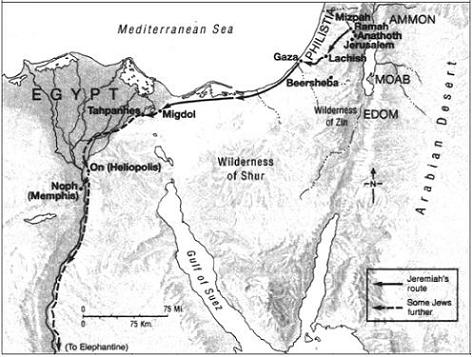
Nelson’s Complete Book of Bible Maps & Charts (Nashville: Thomas Nelson Publishers, 1996) 218. © 1993 by Thomas Nelson, Inc.
43:7 Tahpanhes. A location in the eastern delta region of Egypt.
43:9–13 Take large stones. Stones, placed in the mortar of the brick pavement in the courtyard entrance of the Pharaoh’s house, signaled the place where the conquering king of Babylon would bring devastation on Egypt and establish his throne. This was fulfilled in an invasion c. 568/67 B.C.
43:12 as a shepherd puts on his garment. A simple and easy task describes how quickly and easily Nebuchadnezzar will conquer Egypt.
43:13 sacred pillars of Beth Shemesh. Hebrew “house of the sun.” This refers to a temple for the worship of the sun. Located north of Memphis, east of the Nile River, these pillars were said to be sixty to one hundred feet high.
44:1 The word that came. The unrelenting iniquity of the Jews called for yet another prophecy of judgment on them in Egypt.
44:2–6 The prophet summarized what had occurred in Judah as a basis for what he predicted would be coming on the refugees in Egypt.
44:7, 9, 10 Incredibly, after being spared death in Judah, they pursued death by their idolatrous sin in Egypt.
44:11–14 Ironically, the Jews taken to Babylon were weaned from idolatry and restored to their land; those who went to Egypt and continued their obstinate idolatry perished there.
44:14 except those who escape. A small number (v. 28) who fled before the arrival of the Babylonian army were spared.
44:15 wives. The idolatry apparently began with the women.
44:17–19 queen of heaven. See note on 7:18. This is a title that Roman Catholicism erroneously attributes to Mary, the mother of Jesus, in a blending of Christianity with paganism. The Jews’ twisted thinking credits the idol with the prosperity of pre-captivity Judah, further mocking the goodness of God.
44:20–23 Jeremiah set the record straight, saying the idol was not the source of their prosperity, but it was the cause of their calamity.
44:24–28 Jeremiah repeated the doom stated in verses 11–14.
44:29, 30 sign. The sign of punishment was described in verse 30 as the strangulation of Pharaoh Hophra in 570 B.C. by Amasis, which paved the way for Nebuchadnezzar’s invasion in the twenty-third year of his reign (568/67 B.C.).
45:1 fourth year of Jehoiakim. The year was 605 B.C. (ch. 36), when the recording of God’s messages to Jeremiah was in view.
45:3 Woe is me now! Baruch felt anxious as his own cherished plans of a bright future were apparently dashed; even death became a darkening peril (cf. v. 5). Possibly, he was confused by God’s role in carrying through with such calamity (cf. v. 4). Jeremiah spoke to encourage him (v. 1).
45:4 say to him. God will judge this entire nation (the Jews).
45:5 you seek great things. Baruch set his expectations far too high, and this made the disasters hard to bear. He was to be content just to live. Jeremiah, who once also complained, learned by his own suffering to encourage complainers.
III. PROCLAMATIONS OF JUDGMENT ON THE NATIONS (46:1–51:64)
A. Introduction (46:1; cf. 25:15–26)
46:1 against the nations. Jeremiah had already proclaimed that all the nations at some time are to “drink the cup” of God’s wrath (25:15–26). In chapters 46–51, God selected certain nations and forecast their doom. Likely given to Jeremiah at different times, the prophecies were collected according to the nations, not the chronology.
46:2–26 Against Egypt. Cf. Isaiah 19; 20; Ezekiel 29–32. Verses 2–12 depict Pharaoh Necho’s overthrow by the Babylonians at Carchemish by the Euphrates River in 605 B.C., in which Egypt lost all its territory west of the river.
46:3–6 Here was a derisive call to Egypt to ready itself for defeat.
46:10 the day of the Lord. While this phrase often refers to an eschatological judgment on earth (such as in Zeph. 1:7; Mal. 4:5; 1 Thess. 5:2; 2 Pet. 3:10), it also may refer to a historical day. In this case, it refers to the Egyptian defeat (cf. Lam. 2:22). See notes on Isaiah 2:12; 1 Thessalonians 5:2.
46:11 Gilead. See note on 8:20–22.
46:13–26 Babylon’s invasion of Egypt, fifteen or sixteen years before the destruction of Jerusalem is detailed here (601 B.C.; cf. v. 13). Having spent thirteen years in a siege of Tyre, Nebuchadnezzar was promised Egypt as a reward for humbling Tyre (cf. Ezek. 29:17–20).
46:18 Tabor . . . Carmel. As those two mountains rise above the hills of Palestine, so Nebuchadnezzar will be superior.
46:20, 21 a very pretty heifer . . . fat bulls. Fat and untamed, ready to kill.
46:26 Afterward. Forty years after Nebuchadnezzar’s conquest of Egypt, it threw off the Babylonian yoke, but never regained its former glory (Ezek. 29:11–15).
46:27, 28 do not fear . . . Jacob. Though Israel has been scattered to the nations, the nations will still receive their judgments; and the Lord will restore Israel (repeated from 30:10, 11) from global dispersion to her own land (as in Jer. 23:5–8; 30–33). No matter what judgments fall on Israel, the people will not be destroyed, as Paul reiterates in Romans 11:1, 2, 15, 25–27.
47:1–5 against the Philistines. Cf. Isaiah 14:29–32; Ezekiel 25:15–17; Amos 1:6–8; Zephaniah 2:4–7. Although Egypt’s Pharaoh Hophra conquered the Philistines (who lived on the coastal plain of Palestine) in Gaza and Phoenicia around 587 B.C. (v. 1), Babylon appears to be the conqueror in this scene, (“out of the north”) at the same time as their invasion of Judah (588–586 B.C.; cf. 39:1, 2).
47:6, 7 sword of the LORD. Cf. Judges 7:18, 20.
48:1 Against Moab. Various sites of unknown location in Moab are to be destroyed (vv. 1–5). The judgment is framed in similar words, or even some of the same words, as in other prophetic passages (Is. 15:1–9; 16:6–14; 25:10–12; Ezek. 25:8–11; Amos 2:1–3; Zeph. 2:8–11). Desolation overtook different parts of Moab at various times, but Babylon in 588–586 B.C. or 582–581 B.C. is likely the main destroyer (cf. 48:40). The Moabites were Lot’s descendants (cf. Gen. 19:37), who lived east of the Dead Sea and often fought with Israel.
48:7 Chemosh. This was the leading god of Moab (cf. Num. 21:29; Judg. 11:24; 1 Kin. 11:7; 2 Kin. 23:13).
48:10 Cursed is he. God’s desire to judge Moab was so intense that He pronounced a curse on whatever instrument (army) He would use if they should carry it out “deceitfully,” i.e., “carelessly,” or “with slackness,” or “being remiss” (Prov. 10:4; cf. 12:24).
48:11, 12 This wine-making imagery is vivid. In the production of sweet wine, the juice was left in a wineskin until the sediment or dregs settled to the bottom. Then it was poured into another skin until more dregs were separated. This process continued until the dregs were all removed and a pure, sweet wine obtained. Moab was not taken from suffering to suffering so that her bitter dregs would be removed through the purging of sin. Thus, the nation was settled into the thickness and bitterness of its own sin. Judgment from God was coming to smash them.
48:18–20 Dibon . . . Aroer. These places were on the Arnon River, but would be thirsty.
48:24 Kerioth. This is likely the city of Judas Iscariot. Cf. Joshua 15:25.
48:25 horn . . . is cut off. An example of the OT use of horn as a symbol of military power, as an animal uses horns to hook, gouge, or ram. Moab is to be dehorned.
48:26 Here is a vivid picture of humiliation.
48:29 Suffering didn’t come and humble Moab (see note on vv. 11, 12 ), so she remained proud.
48:47 I will bring back. God will allow a remnant of Moab to return to the land (cf. 12:14–17; 46:26; 48:47; 49:6, 39), through their descendants in the messianic era (“the latter days”).
49:1–6 Against the Ammonites. Cf. Ezekiel 25:1–7; Amos 1:13–15; Zephaniah 2:8–11. These people descended from Lot (cf. Gen. 19:38) and lived north of Moab. Although Israel had people who were heirs to Transjordan, i.e., Gad, Reuben, and one-half of Manasseh (cf. Josh. 22:1–9), the Ammonites, whose god was Milcham or Molech, were chided for having inhabited the area (v. 1), when the northern kingdom was taken captive by Shalmaneser.
49:2 an alarm of war. Nebuchadnezzar defeated Ammon in the fifth year after the destruction of Jerusalem, around 582/81 B.C.
49:4 flowing valley. Flowing with the blood of the slain. backsliding. See note on Proverbs 14:14.
49:6 I will bring back. As with Moab (cf. 48:47; see note there ), God promised that captives would have an opportunity to return. This was partially fulfilled under Cyrus, but will be more complete in the coming kingdom of Messiah.
49:7–22 Against Edom. Cf. Isaiah 21:11, 12; Ezekiel 25:12–14; Amos 1:11, 12; Obadiah 1. This prophecy is closely related to Obadiah. These people descended from Esau (cf. Gen. 36:1–19) and lived south of the Dead Sea. Perpetual desolation is ahead for Edom (v. 13). God will make it bare (vv. 10, 18). The destroyer is probably Babylon in 588–586 B.C. or 582–581 B.C., since verse 19 has descriptions used of Babylon against Judah (lion, 4:7; flooding of the Jordan, 12:5). Also “fly like an eagle” (v. 22) is used of Babylon (Hab. 1:8). There is no prophecy of a future restoration.
49:8 Esau. He was cursed for his godlessness and his punishment was perpetuated in his descendants (cf. Heb. 12:11, 17).
49:9 See note on Obadiah 5, 6.
49:10 he is no more. Edom was politically extinct after the Roman conquest.
49:11 This was because no adult men will be left to care for them.
49:12 those . . . not to drink . . . have . . . drunk. This refers to the Jews who had a covenant relation to God. See what will happen to a nation that has no such pledge (v. 13).
49:16, 17 Edom, situated in high and rugged mountains, was convinced of its security and invincibility. But the ruin will come and be irreversible.
49:19–21 These words are repeated in 50:44–46, where they refer to Babylon.
49:20 the least of the flock. The weakest of the Chaldeans shall drag them away captive.
G. Against Damascus (49:23–27)
49:23–27 Against Damascus. Cf. Isaiah 17:1–3; Amos 1:3–5. Hamath, a city on the Orontes River that marked the northern limit of Solomon’s rule (2 Chr. 8:4), 110 miles north of Damascus in southern Syria, and Arpad, 105 miles southwest of the modern Aleppo in northern Syria, were to fall, as well as Damascus, Syria’s capital. Nebuchadnezzar conquered them in 605 B.C.
49:25 city of praise . . . My joy. This could also be translated, “the city of renown,” famous because of its location in a spacious oasis and its trade, as in Ezekiel 27:18.
49:27 palaces of Ben-Hadad. Here was the place where so many cruel evils against Israel were devised, thus the reason for its overthrow. The name is common among Syrian kings, meaning Son of Hadad, an idol, so it does not refer to the Ben-Hadad of 2 Kings 13:3 and Amos 1:4.
H. Against Kedar and Hazor [Arabia] (49:28–33)
49:28–33 Against Kedar . . . Hazor. Cf. Isaiah 21:13–17. These areas in the Arabian desert east of Judah were to be laid waste (a different Hazor was a few miles northwest of the Sea of Galilee). Kedar was an Ishmaelite tribe (cf. Gen. 25:13; Ezek. 27:21). The conqueror was Nebuchadnezzar in 599/98 B.C. as recounted in an ancient record, the Babylonian Chronicle. It was shortly after this that Babylon seized Jerusalem in 598/97 B.C.
49:31 neither gates nor bars. These nomads were out of the way of contending powers in Asia and Africa.
49:34–39 against Elam. As in 25:25, Elam (two hundred miles east of Babylon and west of the Tigris River) was to be subjugated. Babylon fulfilled this in 596 B.C. Later, Cyrus of Persia conquered Elam and incorporated Elamites into the Persian forces that conquered Babylon in 539 B.C. Its capital, Susa, was the residence of Darius and became the center of the Persian Empire (Neh. 1:1; Dan. 8:2).
49:34 reign of Zedekiah. Jeremiah speaks of this judgment in 597 B.C.
49:35 break the bow. Elamites were famous archers (cf. Is. 22:6).
49:39 I will bring back. As with certain other peoples in this region of nations, God would allow Elamites to return to their homeland. In Acts 2:9, Elamites were among the group present at the Pentecost event. This has eschatological implications as well.
J. Against Babylon (50:1–51:64)
50:1 against Babylon. Babylon is the subject of chapters 50 and 51 (cf. Is. 13:1–14:23; Hab. 2:6–17). Judgment focuses on Medo-Persia’s conquest of Babylon in 539 B.C. The prediction of violent overthrow, which was not the case when Cyrus conquered Babylon (there was not even a battle), points also to a greater fulfillment near the coming of Messiah in glory when those events more fully satisfy this description (cf. Rev. 17; 18).
50:2 idols. First, the idols of Babylon are discredited by Jeremiah’s using an unusual word for idols, meaning in Hebrew “dung pellets.”
50:3 no one shall dwell. The far view (see note on v. 1 ) sees this as not yet fulfilled in a sudden way (cf. 51:8). Medo-Persia came down from the north in 539 B.C. to conquer Babylon, but armies in the years that followed only gradually brought the historical Babylon to complete desolation (cf. vv. 12, 13).
50:4–10 children of Israel shall come. Jeremiah predicted a return for exiled Israel and Judah (vv. 17–20; cf. chs. 30–33) as the scattered and penitent people were given opportunity to escape Babylon’s doom and return to Jerusalem and the Lord in an eternal covenant (v. 5).
50:5 In a perpetual covenant. This is the New Covenant which is summarized in 31:31.
50:11–16 Judgment on Babylon represents the vengeance of God (v. 15) poured out for her treatment of His people.
50:17–20 This section summarizes the divine interpretation of Israel’s history: (1) suffering and judgment on her (v. 17); (2) judgment on those who afflicted Israel (v. 18); (3) her return in peace and plenty (v. 19); and (4) the pardon of her iniquity (v. 20) under Messiah.
50:21 Merathaim . . . Pekod. This was a dramatic play on words emphasizing cause and effect. The first means “double rebellion” and named a region in southern Babylon near the Persian Gulf; the latter, meaning “punishment,” was also in southern Babylon on the east bank of the Tigris River.
50:23 hammer of the whole earth. This described Babylon’s former, conquering force; but God broke the hammer He had once used. The fact that God used Babylon as His executioner was no commendation of that nation (cf. Hab. 1:6, 7).
50:28 vengeance of His temple. This refers to their burning the temple in the destruction of Jerusalem (cf. 51:11).
50:29 Repay her. God aimed to bless Israel and curse all who cursed her (cf. Gen. 12:1–3, Abrahamic covenant). The judgment on Babylon, as in Habakkuk 2, was a divine curse in view of Babylon’s wrongs (v. 34; 51:36, 56), particularly God’s vengeance on Babylon’s arrogance (“proud against the LORD” cf. vv. 31, 32).
50:34 Redeemer. The OT concept of kinsmen-redeemer included the protection of a relative’s person and property, the avenging of a relative’s murder, the purchase of former property, and even the marriage of his widow (cf. Lev. 25:25; Num. 35:21; Ruth 4:4).
50:35–38 The sword is mentioned five times here (cf. Ezek. 21).
50:40 As God overthrew Sodom. Cf. 50:1. What befell Sodom (cf. Gen. 19) was sudden and total destruction, not like the Medo-Persian takeover, but like the future devastation that will overtake the final Babylon (cf. Rev. 17, 18).
50:41 from the north. Medo-Persia in 539 B.C.
50:41–46 Cf. 6:22–24; 49:19–21. The “lion” is Cyrus.
51:1–4 the day of doom. The coming of the northern invader is in view.
51:5 Here is a reminder that God will not utterly forget or destroy His people. Cf. Romans 11:1, 2, 29.
51:8 suddenly fallen. The focus was first on Babylon’s sudden fall on one night in 539 B.C. (Dan. 5:30). The far view looks at the destruction of the final Babylon near the Second Advent when it will be sudden (Rev. 18).
51:11 kings of the Medes. The aggressor was specifically identified (cf. v. 28) as the leader of the Medes, assisted by Persia (539 B.C.).
51:15–19 He has made the earth. God’s almighty power and wisdom in creation are evidences of His superiority to all idols (vv. 17, 18), who along with their worshipers will all be destroyed by His mighty power (vv. 15, 16, 19), as in Babylon’s case.
51:20–23 You are My battle-ax. Cyrus of Persia was God’s war club. Here, the phrase “with you” is repeated ten times.
51:25 destroying mountain. Though Babylon existed on a plain, this phrase was meant to portray Babylon’s looming greatness and power in devastating nations (cf. 50:23; see note there ). a burnt mountain. Babylon will be like a volcano that is extinct, never to be rebuilt (v. 26).
51:27 The people north of Babylon who were conquered by the Medes early in the sixth century B.C. are listed here. They assisted the Medes against Babylon.
51:31 To show the king of Babylon. Couriers brought the report of the city’s fall. Since Belshazzar was killed in the city on the night of the fall (Dan. 5:30), this reference most likely refers to runners delivering the news to his co-ruler Nabonidus, who was away from Babylon at the time.
51:32 The method of capturing the city was to block off the Euphrates River, dry up the river bed under the city wall, and then march in. The “fire” was set to frighten, as it actually did.
51:39 drunk. The allusion is possibly to Belshazzar’s drunken feast, recorded in Dan. 5:1–4 (cf. v. 57).
51:41 Sheshach is taken! This is another name for Babylon (cf. 25:26).
51:45–50 Again the Lord’s people were warned to flee.
51:58 labor in vain. People from many nations enslaved in Babylon had built the wall, which proved useless.
51:59 Seraiah . . . the quartermaster. This man looked after the comfort of the king. He may have been the brother of Baruch, Jeremiah’s secretary (cf. 32:12).
51:60–63 This royal official carried the scroll (v. 60) to read (v. 61) in Babylon and then dramatically illustrated the coming destruction.
IV. THE FALL OF JERUSALEM (52:1–34)
A. The Destruction of Jerusalem (52:1–23)
52:1–34 This chapter is almost identical to 2 Kings 24:18–25:30, and it is a historical supplement detailing Jerusalem’s fall (as ch. 39). It fittingly opens with her last king and his sin (597–586 B.C.). The purpose of this chapter is to show how accurate Jeremiah’s prophecies were concerning Jerusalem and Judah.
52:1 Jeremiah. A different man from the author (cf. 1:1).
52:4–11 See note on 34:1. This narrative rehearses the account of the fall of Jerusalem. So crucial was this event that the OT records it four times (see also 39:1–14; 2 Kin. 25; 2 Chr. 36:11–21).
52:4 ninth year . . . tenth month. For verses 4–6, see notes on 34:1; 39:1, 2.
52:12 tenth day. The parallel phrase in 2 Kings 25:8 reads “seventh day.” Nebuzaradan (v. 12), “captain of the guard,” started from Riblah on the seventh day and arrived in Jerusalem on the tenth day. nineteenth year. 586 B.C.
52:18, 19 They also took. The conquerors plundered the magnificent Solomonic temple and took the articles to Babylon. First Kings 6–8 describes these articles. Later, Belshazzar would use some of these at his immoral banquet, gloating over the victory he attributed to his gods (Dan. 5; cf. Dan. 1:2).
52:22 five. Second Kings 25:17 reads “three.” There may have been two parts to the capitals, the lower part of two cubits and the upper part, carved ornately, of three cubits. The lower may be omitted in 2 Kings 25:17 as belonging to the shaft of the pillar.
B. The Deportation of Jews (52:24–30)
52:24–27 Babylon executed some Judean leaders as an act of power, from resentment over the eighteen-month resistance (cf. 52:4–6), and to intimidate the nation to prevent future plots.
52:25 seven. Second Kings 25:19 reads “five.” Perhaps these five were a part of the group of seven mentioned here.
52:28–30 carried away. The stages of deportation to Babylon include: (1) in 605 B.C. under Jehoiakim which marked the beginning of the seventy years of exile; (2) in 597 B.C. under Jehoiachin; (3) in 586 B.C. under Zedekiah; and (4) a mopping-up campaign in 582–81 B.C. The number may include only males.
C. The Deliverance of Jehoiachin (52:31–34)
52:31–34 captivity of Jehoiachin. A captive since 597 B.C., he appears here in 561 B.C., after Nebuchadnezzar’s death, when Evil-Merodach ruled Babylon. Though detained, the former king was freed to enjoy previously denied privileges. The Lord did not forget the Davidic line, even in exile.
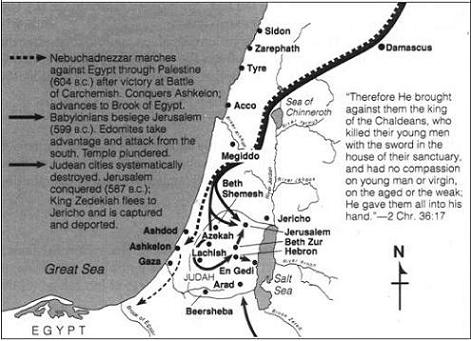
Nelson’s Complete Book of Bible Maps & Charts (Nashville: Thomas Nelson Publishers, 1996) 219. © 1993 by Thomas Nelson, Inc.
52:31 twenty-fifth. Second Kings 25:27 reads “twenty-seventh.” Probably the decree was on the twenty-fifth day and carried out on the twenty-seventh.
Further Study
Dyer, Charles H. Jeremiah, in The Bible Knowledge Commentary—OT. Wheaton, Ill.: Victor, 1985.
Feinberg, Charles L. Jeremiah, in Expositor’s Bible Commentary. Grand Rapids: Zondervan, 1986.