Title
According to Hebrew custom, the title is drawn from the prophet who throughout the book received revelations from God. Daniel bridges the entire seventy years of the Babylonian captivity (c. 605–536 B.C.; cf. 1:1; 9:1–3). Nine of the twelve chapters relate revelation through dreams and visions. Daniel was God’s mouthpiece to the Gentile and Jewish world, declaring God’s present and future plans. What Revelation is to the NT prophetically and apocalyptically, Daniel is to the OT.
Author and Date
Several verses indicate that the writer is Daniel (8:15, 27; 9:2; 10:2, 7; 12:4, 5), whose name means “God is my Judge.” He wrote in the autobiographical first person from 7:2 on, and is to be distinguished from the other three Daniels of the OT (cf. 1 Chr. 3:1; Ezra 8:2; Neh. 10:6). As a teenager, possibly about fifteen years old, Daniel was kidnaped from his noble family in Judah and deported to Babylon to be brainwashed into Babylonian culture for the task of assisting with the imported Jews. There, he spent the remainder of a long life (eighty-five years or more).
Daniel made the most of the Exile, successfully exalting God by his character and service. He quickly rose to the role of statesman by royal appointment and served as a confidante of kings, as well as a prophet, in two world empires, i.e., the Babylonian (2:48) and the Medo-Persian (6:1, 2). Christ confirmed Daniel as the author of this book (cf. Matt. 24:15).
Daniel lived beyond the time described in Daniel 10:1 (c. 536 B.C.). It seems most probable that he wrote the book shortly after this date but before c. 530 B.C. Daniel 2:4b–7:28, which prophetically describes the course of Gentile world history, was originally and appropriately written in Aramaic, the contemporary language of international business. Ezekiel, Habakkuk, Jeremiah, and Zephaniah were Daniel’s prophetic contemporaries.
Background and Setting
The book begins in 605 B.C. when Babylon conquered Jerusalem and exiled Daniel, his three friends, and others. It continues on to the eventual demise of Babylonian supremacy in 539 B.C., when Medo-Persian besiegers conquered Babylon (5:30, 31), and goes even beyond that to 536 B.C. (10:1). After Daniel was transported to Babylon, the victors conquered Jerusalem in two additional stages (597 B.C. and 586 B.C.). In both takeovers, they deported more Jewish captives. Daniel passionately remembered his home, particularly the temple at Jerusalem, almost seventy years after having been taken away from it (6:10).
Daniel’s background is alluded to in part by Jeremiah, who names three of the last five kings in Judah before the captivity (cf. Jer. 1:1–3): Josiah (c. 641–609 B.C.), Jehoiakim (c. 609–597 B.C.), and Zedekiah (597–586 B.C.). Jehoahaz (c. 609 B.C.) and Jehoiachin (c. 598–597 B.C.) are not mentioned (cf. Jeremiah Introduction: Background and Setting). Daniel is also mentioned by Ezekiel (cf. 14:14, 20; 28:3) as being righteous and wise. He is alluded to by the writer of Hebrews as one of “. . . the prophets: who through faith . . . stopped the mouths of lions” (Heb. 11:32, 33).
The long-continued sin of the Judeans, without national repentance, eventually led to God’s judgment for which Jeremiah, Habakkuk, and Zephaniah had given fair warning. Earlier, Isaiah and other faithful prophets of God had also sounded the alarm. When Assyrian power had ebbed by 625 B.C., the Neo-Babylonians conquered: (1) Assyria, along with its capital Nineveh in 612 B.C.; (2) Egypt in the following years; and (3) Judah in 605 B.C. when they overthrew Jerusalem in the first of three stages (also 597 B.C. and 586 B.C.). Daniel was among one of the first groups of deportees, and Ezekiel followed in 597 B.C.
Israel of the northern kingdom had earlier fallen to Assyria in 722 B.C. With Judah’s captivity, God’s judgment on His covenant people was complete. In Babylon, Daniel received God’s word concerning successive stages of Gentile world domination through the centuries until the greatest conqueror, Messiah, would put down all Gentile lordship. He then will defeat all foes and raise His covenant people to blessing in His glorious millennial kingdom.
Historical and Theological Themes
Daniel was written to encourage the exiled Jews by revealing God’s program for them, both during and after the time of Gentile power in the world. Prominent above every other theme in the book is God’s sovereign control over the affairs of all rulers and nations, and their final replacement with the true King. The key verses are 2:20–22, 44 (cf. 2:28, 37; 4:34, 35; 6:25–27). God had not suffered defeat in allowing Judah’s fall (Dan. 1), but was providentially working His sure purposes toward an eventual, full display of His King, the exalted Christ.
God sovereignly allowed Gentiles to dominate Israel, i.e., Babylon (605–539 B.C.), Medo-Persia (539–331 B.C.), Greece (331–146 B.C.), Rome (146 B.C.–A.D. 476), and all the way to the Second Advent of Christ. These stages of Gentile power are set forth in chapters 2 and 7. This same theme is repeated in chapters 8–12 (cf. 2:35, 45; 7:27).
A key aspect within the main theme of God’s kingly control is Messiah’s future coming to rule the world in glory over all people (2:35, 45; 7:13, 14, 27). He is like a stone in chapter 2, and like a son of man in chapter 7. In addition, He is the Anointed One (Messiah) in 9:26. Chapter 9 provides the chronological framework from Daniel’s time to Christ’s kingdom.
A second theme woven into the fabric of Daniel is the display of God’s sovereign power through miracles. Daniel’s era is one of six in the Bible with a major focus on miracles by which God accomplished His purposes. Other periods include: (1) the creation and flood (Gen. 1–11); (2) the patriarchs and Moses (Gen. 12–Deut.); (3) Elijah and Elisha (1 Kin. 17–2 Kin. 13); (4) Jesus and the apostles (Gospels, Acts); and (5) the time of the Second Advent (Revelation). God, who has everlasting dominion and ability to work according to His will (4:34, 35), is capable of miracles, all of which would be lesser displays of power than was exhibited when He acted as Creator in Genesis 1:1.
Daniel chronicles the God-enabled recounting and interpreting of dreams which God used to reveal His will (chs. 2; 4; 7). Other miracles included: (1) His protection of the three men in a blazing furnace (ch. 3); (2) His writing on the wall and Daniel’s interpretation of it (ch. 5); (3) His provision of safety for Daniel in a lions’ den (ch. 6); and (4) supernatural prophecies (chs. 2; 7; 8; 9:24–12:13).
Interpretive Challenges
The main challenges involve passages about future tribulation and kingdom promises. Though the use of imperial Aramaic and archeological discoveries have confirmed the early writing date, some skeptical interpreters, unwilling to acknowledge fulfilled, supernatural prophecies (there are over one hundred in ch. 11 alone), place these details in the intertestamental times. They see these prophecies, not as miraculously foretelling the future, but as simply the historical observations of a later writer, who is recording events of his own day. Thus, they date Daniel in the days of Antiochus IV Epiphanes (175–164 B.C., ch. 8; 11:21–45).
According to this scheme, the expectation of the Stone and Son of Man (chs. 2; 7) turned out either to be a mistaken opinion that did not actually come to pass, or to be that the writer was intentionally deceptive. Actually, (1) a future seven-year judgment period (cf. 7:21, 22; 11:36–45; 12:1) and (2) a literal one-thousand-year kingdom (cf. Rev. 20) after Christ’s Second Coming to reign over Israelites and Gentiles (7:27) are taught. This will be an era before and distinct from the final, absolutely perfect, ultimate state, i.e., the new heaven and the new earth with its capital, the New Jerusalem (Rev. 21; 22). The literal interpretation of prophecy, including Daniel, leads to the premillennial perspective.
Many other aspects of interpretation will also challenge readers: e.g., interpreting numbers (1:12, 20; 3:19; 9:24–27); identifying the one like a Son of Man (7:13, 14); determining whether Antiochus is historical or Antichrist of the far future is in 8:19–23; explaining the “seventy sevens” in 9:24–27; and deciding whether Antiochus of 11:21–35 continues in 11:36–45, or whether it is the future Antichrist.
I. THE PERSONAL BACKGROUND OF DANIEL (1:1–21)
A. Conquest of Jerusalem (1:1, 2)
1:1 third year. 606–605 B.C. It was the third year by Babylonian dating, which did not count a king’s initial (accession) year, but began with the following year. So the “third year” is in harmony with the same year labeled as “fourth” by the Judean system of dating (cf. Jer. 46:2). Jehoiakim. Son of Josiah who ruled (c. 609–597 B.C.) when Nebuchadnezzar first plundered Jerusalem. Nebuchadnezzar. Son of Nabopolassar who ruled Babylon (c. 605–562 B.C.).
1:2 Shinar. This is another name for Babylon. his god. Bel or Marduk (same as Merodach). Babylonian religion recognized other gods, too (see note on 1:7 ). To conquer another nation’s deities was thought to prove the superiority of the victor’s god.
B. Conscription of Jews for Training (1:3–7)
1:4. Qualifications for Jews to be trained in affairs of state included being: (1) physically free from bodily blemish or handicap and handsome, i.e., a pleasing appearance in the public eye; (2) mentally sharp; and (3) socially poised and polished for representing the leadership. The ages of the trainees was most likely fourteen to seventeen.
1:5 three years of training. Cf. 2:1 and see note there.
1:7 names. A key factor in the “brainwashing” process of the Babylonian training was a name switch. This was to link the inductees with local gods rather than let them continue to support their former religious loyalty. Daniel means “God is my judge,” but became Belteshazzar, or “Bel Protect the King.” Hananiah, “the Lord is Gracious,” was changed to Shadrach, “Command of Aku,” another Babylonian god. Mishael, meaning “Who is like the Lord?” was given the name Meshach, “Who is what Aku Is?” Finally, Azariah, “the Lord is my Helper,” became Abed-nego, “Servant of Nego,” also called Nebo, a god of vegetation (cf. Is. 46:1).
C. Courage of Four men in Trial (1:8–16)
1:8 Daniel purposed. The pagan food and drink was devoted to idols. To indulge was to be understood as honoring these deities. Daniel “purposed in his heart” (cf. Prov. 4:23) not to engage in compromise by being untrue to God’s call of commitment (cf. Ex. 34:14, 15). Also, foods that God’s Law prohibited (Lev. 1:1) were items that pagans consumed; to partake entailed compromise (cf. Dan. 1:12). Moses took this stand (Heb. 11:24–26), as did the psalmist (Ps. 119:115), and Jesus (Heb. 7:26). Cf. 2 Corinthians 6:14–18; 2 Timothy 2:20.
1:9. God honored Daniel’s trust and allegiance by sovereignly working in a favorable manner for him among the heathen leaders. In this instance, it prevented persecution and led to respect; whereas later on, God permitted opposition against Daniel which also elevated him (Dan. 3; 6). One way or another, God honors those who honor Him (1 Sam. 2:30; 2 Chr. 16:9).
1:12 vegetables. This Hebrew word appears in a plural form in the OT only here and in verse 16. It might refer to wheat or barley, or it could be fresh vegetables.
1:15 fatter in flesh. This indicates healthiness.
D. Choice of Four Men for Royal Positions (1:17–21)
1:20 ten times better. This probably uses the number qualitatively to signify fullness or completeness, i.e., they displayed incredible skill in answering, beyond the performance of other men who spoke without God’s help. Compare this with “ten days” (vv. 12–15) which is quantitative, since it refers to an actual passage of time.
1:21 first year. Cyrus of Persia conquered Babylon in 539 B.C. His third year, in 10:1, is the latest historical year that Daniel mentions (cf. Ezra 1:1–2:1).
II. THE PROPHETIC COURSE OF GENTILE DOMINION (2:1–7:28)
A. Dilemmas of Nebuchadnezzar (2:1–4:37)
2:1 second year. Promotion of the four Hebrews after three years (1:5, 18) agrees with the year of promotion after the dream in the “second year.” See note on 1:1. dreams. In the time of revelation, God spoke through the interpretation of dreams that He induced (cf. v. 29).
2:2 Chaldeans. This could refer to all people native to Chaldea, another name for Babylon (1:4; 3:8; see note on 1:2 ), or, as here, to a special" class of soothsayers who taught Chaldean culture.
2:4 Aramaic. This language, to which Daniel suddenly switches in verse 4b and retains through 7:28, was written with an alphabet like Hebrew, yet had distinctive differences. Aramaic was the popular language of the Babylonian, Assyrian, and Persian areas, and was useful in governmental and trade relations. Daniel 1:1–2:4a and 8:1–12:13 were written in Hebrew, possibly because the focus was more directly on Hebrew matters. Daniel 2:4b–7:28 switches to Aramaic because the subject matter is centered more on other nations and issues largely involving them.
2:5 My decision is firm. The king shrewdly withheld the dream, though he remembered it, to test his experts. He was anxious for an outright interpretation, with no deception.
2:7 Let the king tell. The worldly men of human skill failed (cf. the magicians in Pharaoh’s court, Exodus 8:16–19 with Joseph, Gen. 41:1ff.).
2:8–13 This demonstrates how impossible it is for humans to truly interpret dreams from God (cf. v. 27).
2:14–47 But Daniel, who trusted God in prayer (v. 18), received His supernatural interpretation (vv. 19, 30). He gave credit to God in his prayer (vv. 20–23) and his testimony before Nebuchadnezzar (vv. 23, 45). Later the king, too, gave God the glory (v. 47).
2:20–23 This praise to God sums up the theme of the whole book, namely that God is the One who controls all things and grants all wisdom and might.
2:28 God . . . reveals secrets. Just as He did during Joseph’s time in Egypt (cf. Gen. 40:8; 41:16).
2:36–45 we will tell the interpretation. Five empires in succession would rule over Israel, here pictured by parts of a statue (body). In Daniel 7, the same empires are represented by four great beasts. These empires are Babylon, Medo-Persia, Greece, Rome, and the later revived Rome (cf. Introduction: Background and Setting), each one differentiated from the previous as indicated by the declining quality of the metal. A stone, picturing Christ (Luke 20:18) at His Second Coming (as the Son of Man also does in Dan. 7:13, 14), will destroy the fourth empire in its final phase with catastrophic suddenness (2:34, 35, 44, 45). Christ’s total shattering of Gentile power will result in the establishment of His millennial kingdom, the ultimate empire, which then continues on eternally (2:44; 7:27).
An Overview of Daniel’s Kingdoms
I. Daniel 2/Daniel 7
| A. Babylon | 2:32, 37, 38; 7:4, 17 |
| B. Medo-Persia | 2:32, 39; 7:5, 17 |
| C. Greece | 2:32, 39; 7:6, 17 |
| D. Rome | 2:33, 40; 7:7, 17, 23 |
| E. Revived Rome | 2:33. 41–43; 7:7, 8, 11, 24, 25 |
| F. Millennium | 2:34, 35, 44, 45; 7:13, 14, 26, 27 |
II. Daniel 8/Daniel 11
| A. Medo-Persia | 8:3–8, 20, 21; 10:20, 21, 11:2–35 |
| B. Greece | 8:3–8. 20, 21; 10:20, 21; 11:2–35 |
| C. Revived Rome | 8:9–12, 23–26; 11:36–45 |
The MacArthur Study Bible, by John MacArthur (Nashville: Word Publishing, 1997) 1228. © 1993 by Thomas Nelson, Inc.
2:39 inferior. This probably means “lower” (lit. “earthward”) on the image of a man as Daniel guides Nebuchadnezzar’s thoughts downward on the body from his own empire (the head) to the one that would succeed it. Medo-Persia, though lacking the glory of Babylon (silver as compared to gold), was not inferior in strength to Babylon when its day of power came; it actually conquered Babylon (7:5). Also in the case of Greece, bronze is less glorious (valuable) than silver, but stronger. rule over all the earth. Alexander the Great became the ruler of the world, including Israel, from Europe to Egypt to India.
2:40 strong as iron. This metal fittingly represents the Roman Empire which would be characterized by the description predicted. It did have armies in iron armor known as the Iron Legions of Rome, and it had strength and invincibility.
2:41 toes. Ten toes represent the same kings as the ten horns in 7:24. They will rule in the final time of the Gentile empire, which Christ will destroy in violent abruptness at His Second Coming.
2:41–43 clay and . . . iron. The iron in the ten toes (kings) represents the Roman Empire in its revived form, prior to the Second Coming of Christ, as having iron-like strength for conquest (cf. Rev. 13:4, 5). But the clay mixed in depicts that the union (federation) of kings and nations would have fatal flaws of human weakness, so that it is inherently vulnerable.
2:44 stand forever. God’s kingdom ruled by Messiah is the final rule, never to be replaced. It has a millennial phase and an eternal future, but it is the same King who rules both.
2:45 stone . . . mountain. The stone is Messiah (cf. Ps. 118:22, 23; Is. 28:16; Rom. 9:33; 1 Pet. 2:6; esp. Luke 20:18). The mountain pictures God’s all-transcending government that looms over weak, earthly powers (4:17, 25; Pss. 47:8; 103:19; 145:13; Rev. 17:9). Messiah is “cut out” of this sovereign realm by God, which accords with the Son of Man coming (7:13, 14). without hands. This denotes that the Messiah comes from God and is not of human origin or power (cf. the same idea in 8:25). The Virgin Birth and the Resurrection, as well as the Second Coming, could be included in this reference to supernatural origin.
3:1 image of gold. The statue, which the king arrogantly made, represented himself as a grandiose expression of his greatness and glory and reflected the dream in which he was the head of gold (2:38). It was not necessarily made of solid gold, but more likely would have been overlaid with gold, like many objects found in the ruins of Babylon. The word for “image” usually means a human form. The height of the figure was about ninety feet and the width nine feet; it would have been comparable in height to date palms found in that area. The self-deifying statue of the king need not have been grotesquely thin in proportion to the height since a massive base could have contributed to the height. This established the worship of Nebuchadnezzar and the nation under his power, in addition to the other gods.
3:2 Leaders attending the “summit conference” for Nebuchadnezzar’s display are: satraps, i.e., leaders over regions; administrators, i.e., military chiefs; governors, i.e., civil administrators; counselors, i.e., lawyers; treasurers, judges, i.e., government arbiters; magistrates, i.e., judges in our sense today; officials, i.e., other civil leaders.
3:5 lyre. Like a harp, possibly square or rectangular, with strings to pluck with a plectrum (pick), producing high tones. psaltery. An instrument plucked with the fingers rather than a plectrum (pick), yielding low tones.
3:6 furnace. Some ancient kilns were found to have been shaped like a vertical tunnel open only at the top, with a dome supported by columns. Charcoal normally served as fuel.
3:8 certain Chaldeans. These are most likely the priests of Bel-Merodach who were envious of these young Jews, and sought their death.
3:12 They do not serve your gods or worship the gold image. Enemies of God’s servants witnessed such a clear-cut testimony that they were in no doubt about their rejection of idolatry and unshakeable allegiance to the God of Israel.
3:13 these men. Daniel is not mentioned as being part of the group who refused to worship, which was witnessed by the Chaldeans. If present, he certainly would have joined his friends in their faithfulness to God.
3:15 who is the god. The king’s challenge would return to embarrass him. The true God was able to deliver, just as He was able to reveal a dream and its meaning. Nebuchadnezzar had earlier called him “the God of gods” (2:47) but, having let that fade from his attention, he soon would be shocked and humiliated when God took up his challenge (3:28, 29).
3:16 we have no need to answer. The three men meant no disrespect. They did not have any defense, nor did they need to reconsider their commitment, since they stood fast for their God as the only true and living God. Their lives were in His hands as they indicated in verses 17, 18 (cf. Is. 43:1, 2).
3:19 seven times more. The king’s fury at being defied to his face led him to cry for an intensification of the heat. He was not literally requiring the fire to be seven times hotter as a gauge would indicate, or requiring seven times as long to heat, or seven times the amount of fuel (cf. v. 6, “cast immediately”). The angry king means “intensely hot,” using “seven” figuratively to denote completeness (as Lev. 26:18–28; Prov. 6:31; 24:16), similar to “ten” in Daniel 1:20. Cf. “exceedingly hot” (3:22). A stone or brick furnace with an air draft could be made hotter by more fuel and air.
3:22 took up. This refers to being taken upward on some kind of ramp to a spot near enough to the top to be thrown in (cf. v. 26). The fire was so hot it incinerated the king’s men.
3:23 fell down. A shaft directed them into the furnace bottom, on top of the fuel.
3:25 four men loose. The king seemed only to have known that the fourth person was a heavenly being. He called him a son of the gods (a pagan reference to one who appeared supernatural) and an “angel” (v. 28). The fourth person could possibly have been the second person of the Godhead (Jesus Christ) in a preincarnate appearance (see notes on Josh. 5:13–15; Judg. 6:11 ).
3:27 the fire had no power. When God enacts a miracle, He supernaturally controls all details so that His power is unmistakable and there is no other explanation.
3:28–30 The king was convinced and eager to add the God of these men to his panoply of deities. Soon, he learned that God was not one of many, but the only God (Dan. 4).
4:1–3 Nebuchadnezzar’s praise of God in 4:1–3 and 34b–37 brackets the experience the king reiterates in the first person (vv. 4–34). He began and ended the narrative with praise; in between, he told why he converted to such worship of the true God (cf. Rom. 11:33)!
4:6, 7 wise men of Babylon. The king gave them another try (cf. 2:2–13) and they were again unable.
4:8 at last Daniel came. Daniel alone interpreted the tree vision (v. 10), enabled by God. my god. As the story began, he depicted himself still as a worshiper of Bel-Merodach.
4:9 chief of the magicians. Here was the title the pagans gave Daniel (cf. 5:11). Spirit. The intended meaning here and in verse 18 (as well as 5:11, 14) is correctly reflected in the translation, “the Spirit of the Holy God.” Wording for the true God in the Hebrew of Joshua 24:19 is equivalent to the Aramaic here (see note on 2:4 ). Some believe he meant “a spirit of the holy gods.” This is unlikely, since no pagan worshipers claimed purity or holiness for their deities. In fact, just the opposite was believed. And since Nebuchadnezzar was rehearsing his conversion, he could genuinely identify the true Spirit of God.
4:10–17 A tree. This image pictures Nebuchadnezzar after 605 B.C. (cf. 4:20–22). The creatures in verse 12 represent people under his rule (v. 22). The fall of the tree represents the coming time of God’s judgment on him (cf. 4:23–25).
4:13 a watcher, a holy one. This was an angel (cf. v. 23), a servant of God, who controlled a nation’s rise or fall (cf. Dan. 10:13). Angels often have roles administering God’s judgment, as shown also in Genesis 18, Isaiah 37, and Revelation 16.
4:15 stump. The basis (nucleus) of the kingdom, still in existence in verse 26 (cf. Is. 6:13), will later sprout as in nature (Job 14:7–9). The band is a guarantee that God will protect what remains intact and preserve the king’s rule (v. 26).
4:16 heart of a beast. Some form of the disease called lycanthropy, in which a person thinks he is an animal and lives wildly, eating grass, having thick and unkept nails along with shaggy hair, and behaving inhumanly. seven times. (cf. also 4:23, 25, 32). Probably, “years” are meant, not “months” which is used in verse 29. Daniel uses the same term clearly to mean “years” in 7:25.
4:19 astonished. Daniel’s compassionate alarm at the coming calamity.
4:20–27 Daniel interprets the vision seen in 4:10–17.
4:26 Heaven rules. God is synonymous with His abode.
4:27 break off your sins. Daniel called for a recognition of sin and repentance (cf. Is. 55:7). He was not presenting a works salvation, but treating the issue of sin exactly as Jesus did with the rich young ruler in Matthew 19:16–23. The king failed to repent at this point (v. 30).
4:30 I have built. Nebuchadnezzar was known for his building projects, such as a mound (four hundred feet high) terraced with flowing water and hanging gardens for his wife (one of the seven wonders of the ancient world) as a place for cool refreshment. For such human pride, divine judgment fell (vv. 31–33).
4:34 lifted my eyes. God’s grace enables a person to do this (John 6:44, 65). “For those who honor Me I will honor” (1 Sam. 2:30); and “Surely He [God] scorns the scornful, but gives grace to the humble” (Prov. 3:34). The praise of verses 34b–37 and before in verses 1–3 came as a result (cf. Jer. 9:23, 24).
B. Debauchery and Demise of Belshazzar (5:1–31)
5:1 Belshazzar. These events occurred in 539 B.C., over two decades after Nebuchadnezzar’s death (c. 563/2 B.C.). This king, whose name (similar to Daniel’s, cf. 4:8), means “Bel, protect the king,” is about to be conquered by the Medo-Persian army.
5:2 vessels. The celebration was designed to boost morale and break the feelings of doom, because at this very time, armies of Medo-Persia (cf. v. 30) had Babylon helplessly under siege.
5:4 This exercise was a call for their deities to deliver them.
5:5 man’s hand. Babylonian hands had taken God’s vessels (mentioned twice) and held them in contempt to dishonor and challenge Him. Now, the hand that controls all people, and which none can restrain, challenged them (4:35). God’s answer to their challenge was clear, as in verses 23–28.
5:7–9 they could not. Without God’s help, the experts again failed (cf. chs. 2; 4), but God’s man Daniel would not.
5:10 The queen spoke. Possibly, she was a surviving wife or a daughter of Nebuchadnezzar. If the latter, she was a wife of Nabonidus who co-ruled with Belshazzar (cf. “third ruler,” v. 16). She, like Nebuchadnezzar in chapter 4, has confidence in Daniel (vv. 11, 12).
5:13 father. This term is used in the same sense of grandfather (cf. v. 18).
5:16 the third ruler. This trio included Daniel, along with Belshazzar, Nebuchadnezzar’s grandson (ruled 553–539 B.C.), and Nabonidus (ruled 556–539 B.C.). The prizes turned out to be short-lived in light of the city’s conquest that very night (vv. 29, 30).
5:25–29 Mene, Mene. This means “counted,” or “appointed,” and is doubled for stronger emphasis. Tekel means “weighed” or “assessed,” by the God who weighs actions (1 Sam. 2:3; Ps. 62:9). Peres denotes “divided,” i.e., to the Medes and Persians. Pharsin in verse 25 is the plural of peres, possibly emphasizing the parts in the division. The “U” prefix on pharsin has the idea of the English and.
5:30 That very night. One ancient account alleged that Persia’s General Ugbaru had troops dig a trench to divert and, thus, lower the waters of the Euphrates River. Since the river flowed through the city of Babylon, the lowered water enabled besiegers to unexpectedly invade via the waterway under the thick walls and reach the palace before the city was aware. The end then came quickly, as guards, Belshazzar, and others were killed on October 16, 539 B.C.
5:31 Darius the Mede. Possibly, Darius is not a name, but an honored title for Cyrus, who with his army entered Babylon October 29, 539 B.C. It is used in inscriptions for at least five Persian rulers. History mentions no specific man named Darius the Mede. In 6:28, it is possible to translate, “Darius even . . . Cyrus.” A less likely possibility is that Darius is a second name for Gubaru, Cyrus’s appointed king to head up the Babylonian sector of his empire. Gubaru (or Gobryas) is distinct from Ugbaru, the general, who died soon after conquering Babylon. As previously prophesied, Babylon met God’s judgment (cf. Is. 13; 47; Jer. 50; 51; Hab. 2:5–19).
C. Deliverance of Daniel (6:1–28)
6:1 satraps. Each is a provincial administrator under the king. Daniel’s eminent appointment was to a post as “governor” (v. 2), assisting the king as his vice-regent.
6:2 suffer no loss. They were responsible to prevent loss from military revolts, tax evasion, or fraud.
6:3 an excellent spirit. Daniel, over 80, had enjoyed God’s blessing throughout his life (cf. 1:20, 21; 2:49; 4:8; 5:12). over the whole realm. Daniel was the favorite of the king. He had experience, wisdom, a sense of history, leadership, a good reputation, ability, a servant’s attitude, and revelation from the God of heaven. Apparently, God wanted him in the place of influence to encourage and assist in the Jews’ return to Judah, since the return was made in Cyrus’s first year (539–537 B.C.), right before the lions’ den incident. From the record of Ezra 1 and 6, all the basic elements of the return appear: (1) the temple was to be rebuilt with the cost paid from Cyrus’s treasury; (2) all Jews who visited could return, and those who stayed were urged to assist financially; and (3) the gold and silver vessels stolen from the temple by Nebuchadnezzar were to be taken back. To account for such favor toward the Jews, it is easy to think of Daniel not only influencing Cyrus to write such a decree, but even formulating it for him (cf. Prov. 21:1).
6:4 charge against Daniel. The jealous plot, not unlike the effort against Daniel’s three friends in 3:8ff., was also similar to that by Joseph’s brothers (cf. Gen. 37:18–24).
6:7 except you, O king. A deceptive stroking of the king’s ego secured his injunction, which was designed to benefit Daniel’s peers. Ancient kings were frequently worshiped as gods. Pagans had such inferior views of their gods that homage like this was no problem.
6:8 law . . . which does not alter. Once enacted, Medo-Persian law could not be changed, even by the king (cf. 6:12, 15; Esth. 1:19; 8:8).
6:10 toward Jerusalem. Daniel’s uncompromising pattern of prayer toward God’s temple conformed to Solomon’s prayer that the Lord’s people would do so (1 Kin. 8:44, 45). Three times a day was also the pattern established by David (Ps. 55:16, 17).
6:13 one of the captives from Judah. Daniel had lived over sixty years in Babylon. His loyalty to the rulers was well known (5:13); in spite of that loyalty, his consistent faithfulness to God brought this threat.
6:14 The king went from a self-styled god to a fool in one day.
6:16 den of lions. The word den is related to the Hebrew term meaning “to dig,” so it refers to an underground pit which likely had (1) a hole at the top from which to drop food into the pit, and (2) a door at the foot of a ramp or on a hillside through which the lions could enter.
6:16, 20 God . . . you serve continually. The king knew and valued Daniel’s ultimate allegiance to the living God.
6:22 His angel. In this miracle, the angel was possibly the same person as the fourth person in the fiery furnace (cf. 3:25 and see note there ). innocent before Him. That is the supreme commendation of Daniel as blameless before God and unworthy of such a death.
6:23 no injury . . . on him. God openly honored Daniel’s faith for the purpose of showing His glory (cf. 3:26, 27). That is not always the case, as God may choose to be glorified by permitting a trusted servant to be martyred (cf. Daniel in Heb. 11:33 with others in 11:35–38).
6:24 the king gave the command. Like the sin of Achan (Josh. 7:20–26), this sin against God, Darius, and Daniel cost the men and their families their lives. This judgment of God was also an important detail in the miracle, lest some critic suggest the lions were tame or toothless or not hungry.
6:25–27 King Darius wrote. Impacted by Daniel and by the Lord, he expressed himself as if he had come to a point of personal trust in God for his salvation such as Nebuchadnezzar (cf. 4:1–3, 34–37). Daniel illustrated the evangelistic potency of a godly, uncompromising life. Cf. Matthew 5:48.
7:1 first year. This represented a flashback to 553 B.C., fourteen years before the feast of 5:1–3. Chapters 7 and 8 occur after chapter 4, but before chapter 5. The dream of Daniel 7 moves far beyond Daniel’s day to the coming of Israel’s king to end all Gentile kingdoms and to establish His eternal kingdom (7:13, 14, 27; cf. 2:35, 45).
7:2 Great Sea. This superlative refers to the Mediterranean Sea, much greater in size than other bodies of water in that area of the world. Here, this sea is used to represent nations and peoples (cf. Dan. 7:3, 17; Rev. 13:1).
7:3 four . . . beasts. These beasts represent the same empires as the individual parts of the image in chapter 2. Christ the King, the Son of Man from heaven (vv. 13, 14), corresponds to the Stone in 2:35, 45.
7:4 lion . . . wings. The vicious, powerful, and swift king of beasts represents Babylon. Winged lions guarded the gates of the royal palaces of Babylon. Daniel’s contemporaries, Jeremiah, Ezekiel, and Habakkuk, used animals to describe Nebuchadnezzar.
7:5 a bear. This is Medo-Persia, with the greater side being Persia and ribs referring to vanquished nations.
7:6 a leopard. This represents Greece with its fleetness in conquest under Alexander the Great (born in 356 B.C.). He ruled from Europe to Africa to India. The four heads represent the four generals who divided the kingdom after Alexander’s death at age thirty-three (323 B.C.). They ruled Macedonia, Asia Minor, Syria, and Egypt (cf. 8:8).
7:7 fourth beast. No such animal exists; rather, this is a unique beast pointing to the Roman Empire, already represented by iron in 2:40 and devastating in conquest. Roman dominion fell apart in A.D. 476, yet it lived on in a divided status (Europe), but will be revived and return to great unified strength near Christ’s Second Coming. Then it will be comprised of the ten parts under kings (vv. 7, 24), as well as an eleventh king, the Antichrist (vv. 8, 24; 2 Thess. 2:3–10; Rev. 13:1–10).
7:8 another horn. This describes the rise of Antichrist (cf. v. 20). This beast is human (“eyes like a man” and a “mouth speaking”) and is proud (cf. Rev. 13:5, 6).
7:9, 10 I watched. Daniel’s vision flashes forward to the divine throne from which judgment will come on the fourth kingdom (cf. Rev. 20:11–15).
7:11, 12 the beast was slain. This refers to the fourth beast (i.e., the Roman sphere), headed up by the “little horn” or Antichrist (vv. 7, 24). He will be destroyed at Christ’s Second Coming (cf. Rev. 19:20; 20:10); cf. the smashing by the Stone (Dan. 2:35, 45).
7:12 rest of the beasts. These are the three earlier beasts (empires of chs. 2 and 7). Each successively lost its chief dominance when it was conquered in history. Yet, each was amalgamated into the empire that gained ascendancy, and survived in its descendants. As the Second Advent draws near, all three empires in their descendants will be a part of the Roman phase in its final form (Rev. 13:2). Ultimate survival will not be possible for the final and revived phase of the fourth empire after Christ’s Second Coming, because catastrophic devastation (cf. 2:35) will utterly destroy it, and Christ’s kingdom will replace it.
7:13, 14 Son of Man. The Messiah (cf. 9:27), Christ is meant; He often designated Himself by this phrase (Matt. 16:26; 19:28; 26:64). “The clouds of heaven” are seen again in Revelation 1:7. Here, He is distinct from the Ancient of Days, or Eternal One, the Father, who will coronate Him for the kingdom (2:44). The picture of old age is not that of being feeble; rather, it highlights God’s eternality and divine wisdom to judge (cf. 7:9, 10).
7:14 all peoples, nations, and languages. These distinctions are earthly and speak of the promise of an earthly kingdom, ruled by Christ, that merges into the eternal kingdom (cf. vv. 18, 27; Rev. 20:1–4; 21; 22).
7:15 grieved in my spirit. Coming judgment made him sad, because it meant that history would always be a story of sin and judgment (cf. v. 28).
7:16 those who stood by. Angels helped Daniel understand God’s revelations (8:13–16; 9:22–27).
7:17 beasts . . . four. These empires depicted by the lion, bear, leopard, and bizarre animal (vv. 3–7) are Babylon, Medo-Persia, Greece, and Rome. The “kings” are the most notable leaders over these empires, such as Nebuchadnezzar (2:37, 38), Cyrus, Alexander the Great, and finally the “little horn” (Antichrist).
7:18, 22, 27 saints. These who trusted God possess the kingdom headed up by the Son of Man, the Messiah, of verses 13 and 14. All serve Him in verses 14 and 27; the latter verse clarifies that the one served is actually God the Most High. Just as the four Gentile empires have individuals as kings (cf. 2:38; 7:8; 8:8), so the final kingdom has Christ as King.
7:18 the Most High. God is referred to in this book as above all gods (2:47; 3:29; 4:35), just as He was for Melchizedek and Abraham (Gen. 14:19, 20, 22) as well as Naaman (2 Kin. 5:17).
7:19 fourth beast . . . different. This may refer to the empire’s far greater diversity than previous empires, and its breadth of conquest (v. 24). It branches out into two great divisions (cf. “legs,” 2:33, 40), then near the end into ten horns (a confederacy of ten nations), and even an eleventh horn (Antichrist’s kingdom) lasting until Christ’s Second Coming.
7:20 the other horn. The eleventh horn (ruler and his realm) is small and less powerful before its big rise (v. 8). Early in the future Tribulation period, it (he) grows to be “larger” or more powerful than any of the horns (rulers) in the group.
7:21 war against the saints. The final Antichrist will lead a great persecution of believers, especially in Israel (cf. Matt. 24:15–22; 2 Thess. 2:4; Rev. 12:13–17; 13:6, 7).
Correlation of Dreams and Visions in Daniel
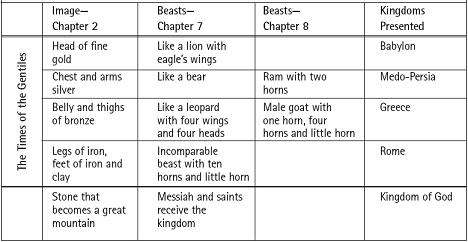
Nelson’s Complete Book of Bible Maps & Charts (Nashville: Thomas Nelson Publishers, 1996) 239. © 1993 by Thomas Nelson, Inc.
7:22 Ancient of Days. This refers to God the Eternal One, who confers the messianic kingdom on the Son to rule at His Second Coming and following (7:13, 14). Judgment is against the Antichrist, Satan who empowers him (Rev. 13:4; 20:1–3), and the unsaved who are not allowed into the kingdom at its outset, but are destroyed and await the final, Great White Throne resurrection and judgment (Rev. 20:11–15). saints to possess the kingdom. Believers enter the kingdom in its earthly, millennial phase (Rev. 20:1–4) following Christ’s Second Coming (Matt. 25:34), having life that continues forever into the eternal state (Rev. 21, 22), even after the thousand years.
7:24 another . . . after them. The “little horn” (Antichrist) blasts his way to the zenith of world rule.
7:25 time and times and half a time. This refers to the three and one-half years which comprise the last half of the seven-year period of Antichrist’s power (cf. 9:27), continuing on to Christ’s Second Coming as the Judgment Stone (2:35, 45) and glorious Son of Man (7:13, 14). Cf. Revelation 11:2, 3; 12:14; 13:5 for reference to this same period.
7:26 the court. God will have His court session to judge sinners and sin (vv. 9, 10). He will remove the Antichrist’s rule and destroy him and his empire in eternal, conscious hell (Rev. 19:20; 20:10).
7:27 the kingdom . . . given to . . . the saints. God’s kingdom in both its earthly (Rev. 20:4) and heavenly phases (Rev. 21:27; 22:3, 4, 14).
III. THE PROPHETIC COURSE OF ISRAEL’S DESTINY (8:1–12:13)
A. PROPHECY OF THE RAM AND MALE GOAT (8:1–27)
8:1 third year. C. 551 B.C., two years after the dream of chapter 7 but before chapter 5. the first time. This looks back to chapter 7.
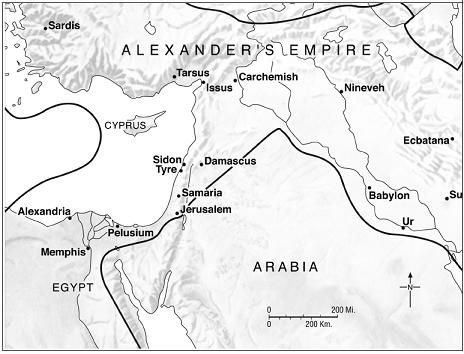
The MacArthur Study Bible, by John MacArthur (Nashville: Word Publishing, 1997) 1239. © 1993 by Thomas Nelson, Inc.
8:2 Shushan. Called Susa by the Greeks, this was a chief city of the Medo-Persian Empire, about 250 miles east of Babylon. Since Daniel saw himself in a vision, he may not have been bodily in that place (cf. Ezekiel’s vision of being at the Jerusalem temple, though bodily still with the elders in Babylon; Ezek. 8–11).
8:3–9 This imagery unfolded historically. The ram pictures the Medo-Persian Empire, as a whole, its two horns standing for the two groups (the Medes and the Persians) that merged into one. The history of this empire is briefly noted in verse 4, where it is seen conquering from the east to the west, south and north, under Cyrus, as predicted also by Isaiah 150 years earlier (Is. 45:1–7). The higher horn, which appeared last, represents Persia. The goat (v. 5) represents Greece and its great horn Alexander, who with his army of 35,000 moved at such speed that he is pictured as not even touching the ground. The broken horn is Alexander in his death; the four horns are generals who became kings over four sectors of the Grecian empire after Alexander (cf. 7:6). The small horn is Antiochus Epiphanes, who rose from the third empire to rule the Syrian division in 175–164 B.C. and is the same king dominant in 11:21–35. Cf. 7:8, 24–26 where a similar “little horn” clearly represents the final Antichrist. The reason both are described as “little horns” is because one prefigures the other. A far more detailed summary will come later in 11:2–35.
8:9 Glorious Land. Palestine. Cf. 11:16, 41.
8:10 host of heaven. Picturesque language portrays Antiochus’s persecution against Jewish people using the figure of stars (cf. Gen. 12:3; 15:5; 22:17; Ex. 12:41; Deut. 1:10). When defeated, the “stars” (Jewish people) will fall under the tyrant’s domination.
8:11 Prince. In addition to the desecration of the temple (cf. 1 Macc. 1:20–24, 41–50), Antiochus blasphemed Christ to whom ultimately the host of Jewish people sacrifice and to whom the sanctuary belongs. He is later called the “Prince of princes” (v. 25).
8:13 holy one. Angels are in view here.
8:14 two thousand three hundred days. These are 2,300 evenings/mornings, with no “and” in between, which refers to 2,300 total units or days. Genesis 1:5 does use “and,” i.e., “Evening and morning, one day.” The period runs to about six and one-third years of sacrificing a lamb twice a day, morning and evening (Ex. 29:38, 39). The prophecy was precise in identifying the time as that of Antiochus’s persecution, c. September 6, 171 B.C. to December 25, 165/4 B.C. After his death, Jews celebrated the cleansing of their holy place with the Feast of Lights, or Hanukkah, in celebration of the restoration led by Judas Maccabeus.
8:15 appearance of a man. The word for man, meaning “a mighty man,” is the linguistic framework for “Gabriel,” which means “mighty one of God.” This is the first mention of an angel by name in the Bible.
8:16 a man’s voice. God spoke with a human voice. the Ulai. A river east of the Persian city of Susa.
8:17 afraid and fell. Loss of consciousness is a common reaction to a heavenly visitation (cf. Ezek. 1; Is. 6; Rev. 1). time of the end. This term likely has a double sense of fulfillment. First, the end (cf. v. 19), latter time (vv. 19, 23), and appointed time (v. 19) refer to a time late in the specific span that the historical prophecy has in view. That time is the period defined by the empires in these verses, Persia (Ram) and Greece (Goat), when the Grecian land holdings will be divided into four parts (v. 8). One of these, the Syrian under Seleucus (see note on v. 22 ), will eventually lead to Antiochus Epiphanes (175–164 B.C.) as the “little horn” (cf. v. 9), who persecutes the people of Israel (v. 10) and defies God (v. 11). Cf. 11:21–35 and see notes there. Secondly, this “little horn” in verse 9, the Antichrist in the last days at the time of the eschatological fulfillment, portrays Antiochus as a preview of the Antichrist, who in many ways will be like him, though far greater in power, and will exercise his career in the end of the age just before Christ’s return.
8:21 male goat . . . large horn. This is the third Gentile world power, the kingdom of Greece, and specifically Alexander the Great, the notable and “first king” after conquering Medo-Persia. Cf. 11:3.
8:22 broken horn and . . . four. Alexander died at age 33 in 323 B.C., leaving no heir ready to reign. So four men, after twenty-two years of fighting, assumed rule over four Greek sectors: (1) Cassander, Macedonia; (2) Lysimachus, Thrace and Asia Minor; (3) Seleucus, Syria and Babylonia; (4) Ptolemy, Egypt and Arabia. These are the four referred to in “toward the four winds” (v. 8). The phrase “not with its power” indicates they did not have Alexander’s power or direct family lineage.
8:23–25 A king shall arise. The near fulfillment views Antiochus as the historical persecutor (cf. vv. 9–14). His career extending to 164 B.C. was “in the latter time of their kingdom,” that of the male goat in the Syrian territory. Rome conquered Greece by 146 B.C., only a few years later, and became the next dominant empire. Antiochus died, “broken without human means,” due to insanity and disease of the bowels. The far fulfillment sees Antiochus in verses 23–25 as prophetically illustrating the final tribulation period and the Antichrist. With such a view, the king here is also the “little horn,” as in 7:7; 8:9 and the willful king in 11:36–45.
8:25 Prince of princes. See note on 8:11.
8:26 seal up the vision. Since he told it here, this did not mean to shut it up to secrecy, but to preserve it as truth, even if it would not be fulfilled for a long time.
B. Prophecy of the Seventy Weeks (9:1–27)
9:1 the first year. C. 539 B.C. made king. This may mean that Darius (a title, not a proper name; see note on 5:31 ) refers to Cyrus, who was made king by God’s permission (cf. Ps. 75:6, 7). Since Cyrus was the first monarch of the Medo-Persian empire, this time note was also the first year after the death of Belshazzar, when Babylon fell.
9:2 seventy years. Daniel’s study of “the books” (OT scrolls) focused on the years prophesied for the captivity by Jeremiah in Jeremiah 25:11, 12 and 29:10. Since the end of that period was near, he prayed for God’s next intervention on behalf of Israel. Cf. 2 Chronicles 36:21, where it is indicated that the seventy years of exile were intended to restore the Sabbath rests that Israel had ignored for so many years (cf. Lev. 25:4, 5; 26:34–43).
9:4–19 I prayed. Various aspects of this passage give rich instruction regarding prayer. True prayer is: (1) in response to the Word (v. 2), (2) characterized by fervency and self-denial (v. 3), (3) identified unselfishly with God’s people (v. 5), (4) strengthened by confession (vv. 5–15), (5) dependent on God’s character (vv. 4, 7, 9, 15), and (6) focused on God’s glory (vv. 16–19).
9:11 the curse. This refers to the judgment that God brought to pass, as promised, for Israel’s disobedience in the land (Lev. 26:21–42; Deut. 28:15–68). This is in contrast to the blessings associated with faith and obedience (Lev. 26:3–20; Deut. 28:1–14). God had given the promise that even in a time of judgment, if Israel would confess their sin, He would bring blessing again (Lev. 26:40–42).
9:16. Daniel prayed for restoration in three respects. In effect, he asked God to bring back (1) “Your city” (vv. 16, 18), (2) “Your sanctuary (v. 17), and (3) “Your people”( v. 19). God’s answer embraced all three (v. 24).
9:21 the man Gabriel. This angel, called a “man” because he appeared in the form of a man, appeared also in 8:16. Cf. the angel Michael in 10:13, 21; 12:1. the evening offering. This was the second of two lambs offered daily (see note on 8:14 ), this one at 3:00 P.M., a common time for prayer (Ezra 9:5).
9:24–26 Seventy weeks . . . from . . . until. These are weeks of years, whereas weeks of days are described in a different way (10:2, 3). The time spans from Artaxerxes’s decree to rebuild Jerusalem, c. 445 B.C. (Neh. 2:1–8), to the Messiah’s kingdom. This panorama includes: (1) seven weeks or forty-nine years, possibly closing Nehemiah’s career in the rebuilding of the “street and wall,” as well as the end of the ministry of Malachi and the close of the OT; (2) sixty-two weeks or 434 more years for a total of 483 years to the First Advent of Messiah. This was fulfilled at the triumphal entry on 9 Nisan, A.D. 30 (see notes on Matt. 21:1–9 ). The Messiah will be “cut off,” (a common reference to death); and (3) the final seven years or seventieth week of the time of Antichrist (cf. v. 27). Roman people, from whom the Antichrist will come, will “destroy the city” of Jerusalem and its temple in A.D. 70.
9:24. This highly complex and amazingly accurate prophecy answers Daniel’s prayer, not with reference to near history, but by referencing the far future of Israel at the end of the age. God promises two sets of three accomplishments each. First, those related to sin are: (1) finish the transgression, i.e., restrain sin and Israel’s in particular during its long trend of apostasy, as in verse 11; (2) make an end of sins, i.e., to judge sin with finality (cf. Heb. 9:26); and (3) make reconciliation for iniquity, signifies to furnish the actual basis of covering sin by full atonement, the blood of the crucified Messiah who is “cut off” (v. 26), which affects the first two realities (cf. the fountain, Zech. 13:1).
Second, those accomplishments related to righteousness are: (1) bring in . . . righteousness, the eternal righteousness of Daniel’s people in their great change from centuries of apostasy; (2) seal up vision, i.e., no more revelation is needed and God will bring these anticipations to completion by their fulfillment in Israel’s blessing as a nation; and (3) anoint the Most Holy, consecrate the Holy Place in a future temple that will be the center of worship in the millennial kingdom (cf. Ezek. 40–48). Clearly, this must be understood as sweeping to the end of Gentile power and the time of Antichrist right before Christ’s return. Summing up, the first three are fulfilled in principle at Christ’s First Coming, in full at His return. The last three complete the plan at His Second Advent.
9:27 Then. This is surely the end of the age, the Second Advent judgment, because the bringing in of righteousness did not occur seven years after the death of the Messiah, nor did the destruction of Jerusalem fit the seven-year period (occurring thirty-seven years later). This is the future seven-year period which ends with sin’s final judgment and Christ’s reign of righteousness; i.e., the return of Christ and the establishment of His rule. These seven years constitute the seventieth week of Daniel. he shall confirm. He is the last-mentioned prince (v. 26), leader of the Roman sphere (cf. chs. 2; 7), the Antichrist who comes in the latter days. The time is in the future Tribulation period of “one week,” i.e., the final seven years of verse 24. He confirms (lit., causes to prevail) a seven-year covenant, his own pact with Israel, that will actually turn out to be for a shorter time. The leader in this covenant is the “little horn” of 7:7, 8, 20, 21, 24–26, and the evil leader found in NT prophecy (Mark 13:14; 2 Thess. 2:3–10; Rev. 13:1–10). That he is in the future, even after Christ’s First Advent, is shown by: (1) Matthew 24:15; (2) the time references that match (7:25; Rev. 11:2, 3; 12:14; 13:5); and (3) the end extending to the Second Advent, matching the duration elsewhere mentioned in Daniel (2:35, 45; 7:15ff.; 12:1–3) and Revelation 11:2; 12:14; 13:5. middle of the week. This is the halfway point of the seventieth week of years, i.e., seven years leading to Christ’s Second Coming. The Antichrist will break his covenant with Israel (v. 27a), which has resumed its ancient sacrificial system. Three and one-half years of Tribulation remain, agreeing with the time in other Scriptures (7:25; Rev. 11:2, 3; 12:14; 13:5, called “Great Tribulation,” cf. Matt. 24:21) as a period when God’s wrath intensifies. abominations . . . one who makes desolate. The Antichrist will cause abomination against Jewish religion. This violation will desolate or ruin what Jews regard as sacred, namely their holy temple and the honoring of God’s presence there (cf. 1 Kin. 9:3; 2 Thess. 2:4). Jesus refers directly to this text in His Olivet discourse (Matt. 24:15). See note on 11:31. the consummation. God permits this tribulation during the Antichrist’s persecutions and then ultimately triumphs by judging the sin and sinners in Israel (12:7) and in the world (cf. Jer. 25:31). This includes the Antichrist (11:45; Rev. 19:20), and all who deserve judgment (9:24; Matt. 13:41–43).
C. Prophecy of Israel’s Humiliation and Restoration (10:1–12:13)
10:1 third year. C. 536 B.C. Two years had passed since the first decree to let Israel return (cf. Ezra 1:1–2:1; 2:64–3:1).
10:6 His body . . . like beryl. The messenger whom Daniel sees in a vision (vv. 1, 7) was distinct from the angel Michael, from whom he needed assistance (v. 13). The description of such glory has led some to see him as Christ in a preincarnate appearance (cf. Josh. 5:13–15; 6:2; Judg. 6:11–23). He is described almost identically to Christ (Rev. 1:13, 14) and Daniel’s reaction is similar to John’s (Rev. 1:17).
10:10 a hand touched me. Most likely this was Gabriel, who interpreted other revelations for Daniel (cf. 8:16) and spoke similarly of Daniel’s being beloved in 9:20–23.
10:12 your words were heard. This was a great encouragement from God who was attentive to prayer and acted to answer it (cf. 9:20–27).
10:13 prince of . . . Persia. The three-week delay was due to an evil angel opposing Gabriel in heavenly warfare (cf. Rev. 16:12–14). This angel was specially anointed with Persian power in an effort to thwart the work of God. This tells us that Satan engages in heavenly warfare to influence generations and nations against God and His people (cf. Eph. 6:10ff.). Michael. This is the chief angel of heaven (cf. 10:21; 12:1; Jude 9; Rev. 12:7). Michael intervened to assure that the Jews would be free to return to their land.
10:14 many days yet to come. This refers to the future plan of God for His people, extending from Daniel’s time to that of the Antichrist.
10:19 I was strengthened. This was the third time (vv. 10, 16), showing the overwhelming trauma of divine presence and revelation.
10:20 prince of Greece. An evil angel contesting for the kingdom of Greece.
10:21 Scripture of Truth. God’s plan of certain and true designs for men and nations, which He can reveal according to His discretion (11:2; Is. 46:9–11). except Michael. The angel with Michael intended to handle the demons of Persia and Greece. This actually forms the heavenly basis for the unfolding of earth’s history in 11:2–35.
11:1 first year. C. 539 B.C. (cf. 6:1ff.; 9:1). Darius the Mede. See note on 5:31. I, stood up to . . . strengthen him. The messenger of 10:10ff. continues to speak of assisting Michael (even as Michael had strengthened him in the battle with demons in 10:21), confirming Darius (cf. 5:31) in decreeing Israel’s return.
11:2–45 As in 8:3–26, this prophecy sweeps all the way from the history of spiritual conflict in Israel (11:2–35) to the far-future tribulation (vv. 36–42) when Michael aids in fully delivering Israel (12:1). The detail of this history is so minute and accurate, so confirmed by history, that unbelieving critics have, without evidence, insisted that it was actually written four hundred years later than Daniel; this would be after it had happened which would then make the prophet a deceiver. The prophecy actually looks ahead from Daniel to the final Antichrist.
11:2–35 This section unfolds the near fulfillment of the Persian kingdom and the reign of Greece through Antiochus Epiphanes.
11:2 three more kings . . . and the fourth. The three in the Persian sphere, after Cyrus (10:1), were (1) Cambyses (c. 530–522 B.C.), (2) Psuedo-Smerdis (c. 522 B.C.), and (3) Darius I Hystaspes (c. 522–486 B.C.). The fourth is Xerxes I, called Ahasuerus in Esther (486–465 B.C.). Kings after Xerxes are not included, probably because Xerxes’s failed military campaign against the Greeks (481–479 B.C.) sounded the beginning of the end for Persia, which finally fell c. 331 B.C. to Alexander the Great.
11:3 a mighty king. Alexander the Great (cf. 8:5).
11:4 After Alexander’s death (c. 323 B.C.), four who were not of his posterity took sectors of his wide empire (see notes on 7:6; 8:3–9 ). The king of the South (Egypt) and king of the North (Syria), receive emphasis in verse 5ff. As time moved on, other leaders ruled, crossing and recrossing Palestine.
11:5, 6 king of the South . . . king of the North. King of the South represents the Ptolomies, the leaders of Egypt, contrasted often in verse 5ff. with the king of the North, the Seleucids, leaders of Syria (v. 6). South and North are in relation to Palestine, for which the angel Gabriel, speaking in this passage, is so concerned. Verses 5–20 cover almost two hundred years of wars between these bordering powers.
11:6 join forces. Berenice, daughter of Egypt’s Ptolemy II Philadelphus (285–246 B.C.), married Syria’s King Antiochus II Theos (261–246 B.C.). The latter part of the verse refers to the political advantage they hoped the alliance would produce. Antiochus divorced his wife to marry Berenice. Later that divorced wife murdered Berenice, her baby son, and even Antiochus by poisoning him. Thus, she brought her own son, Seleucus II Callinicus, to the throne.
11:7 from a branch of her roots. Berenice’s brother stood in his father’s place. His name was Ptolemy III Euergetes of Egypt (246–222 B.C.), and he conquered Syria, sacking their great treasure (v. 8).
11:9 king of the North shall come. Syria’s Callinicus attacked Egypt c. 240 B.C. but retreated, soundly beaten.
11:10 his sons. Seleucus’s sons (successors) kept up war against Egypt, as described in verses 11–35.
11:11 king of the South. Ptolemy IV Philopator (222–203 B.C.) devastated the Syrian army under Antiochus III the Great (223–187 B.C.). Egypt’s advantage would be brief (v. 12).
11:13–16 king of the North. Thirteen years later Antiochus returned with a great army, and in a series of strikes against Egypt brought Palestine (“the Glorious Land”) into his control as far south as Gaza.
11:14 violent men of your people. Violent Jews wanted Judean independence from Egypt, but failed in their revolt.
11:16 he who comes against him. Antiochus III the Great achieved enduring dominion over Israel. Glorious Land. Palestine (cf. 8:9).
11:17 give . . . the daughter. Antiochus, feeling pressure from Rome (fourth empire, 2:40; 7:7) to make peace with Egypt, offered his daughter Cleopatra to marry Ptolemy V Epiphanes (c. 192 B.C.). The Syrian thus hoped his daughter would spy to help him to “destroy” or weaken Egypt and bring it under his power. Cleopatra, instead of helping her father, favored her Egyptian mate.
11:18 a ruler. Antiochus had set his sights to conquer Greece, along the Mediterranean coastlands. But this brought him into conflict with Rome, so that a Roman, Lucius Scipio Asiaticus, repaid the Syrian aggression against Roman rights in the area with a resounding defeat (c. 191–190 B.C.).
11:19 fall. Antiochus returned from defeat to his own land compelled by Rome to relinquish all his territory west of the Taurus and to repay the costs of war. He was likely killed by defenders of a Persian temple he tried to plunder at night in Elymais (to get money to pay reparations required by Rome).
11:20 one who imposes taxes. Rome required Seleucus IV Philopator to render tribute, since Rome was increasingly powerful. The Syrian set out to tax his subjects heavily to raise the tribute. Soon, he died after being poisoned. The “glorious kingdom” possibly refers to Israel (see note on 11:16; “the Glorious Land”) with its splendid temple.
11:21 a vile person. In verses 21–35, the most cruel king of the North was a Seleucid, the Syrian persecutor of Israel named Antiochus IV Epiphanes (cf. 8:9–14, 23–25). He came to the throne when his brother Seleucus was murdered and while a son of the dead king who might succeed him, Demetrius I Soter, was held hostage in Rome. In the vacuum, Antiochus seized power in Syria.
11:22 they shall be swept away. Egypt’s armies were swept away by Antiochus’s invading forces as by a flood (cf. “flood” for military onslaught, 9:26). Israel’s “prince of the covenant,” Onias III, was murdered by his own defecting brother Menelaus at the request of Antiochus (171 B.C.).
11:23 the league. In an Egyptian struggle for the throne, Antiochus entered an alliance with Ptolemy VI Philometer over his rival Ptolemy VII Euergetes II (distinct from the leader in v. 7). By this union, Antiochus deceitfully plotted to gain greater power in Egypt. With a small force, he conquered Memphis and the rest of Egypt all the way to Alexandria.
11:24 enter peaceably. Antiochus, under the guise of friendship, plundered the richest Egyptian places he could strike. To gain support, he gave lavish gifts, possibly battle spoils. devise his plans against the strongholds. He developed a scheme to take over Egypt.
11:25 his power . . . against the . . . South. Antiochus attacked Philometer, who had become an enemy. The latter fell due to treachery by trusted supporters (v. 26a), and became Antiochus’s captive.
11:26 those who eat. Betraying counselors, whom Philometer fed, led him to attack Syria to secure his defeat and death for both him and his men.
11:27 shall speak lies. Antiochus feigned help to reinstate Ptolemy Philometer to Egypt’s throne, occupied then by Ptolemy Euergetes. Both kings lied at the conference, and Antiochus set Philometer up as king at Memphis, whereas Euergetes reigned at Alexandria. The two Egyptians soon agreed on a joint rule, frustrating the Syrian.
11:28 against the holy covenant. En route north through Israel to Syria with riches, Antiochus met a revolt, as sources outside Scripture mention. He struck Jerusalem’s temple, profaned the sacrificial system, massacred 80,000 men, took 40,000 prisoners, sold 40,000 as slaves, and squelched a Jewish bid to depose his own designated priest, Menelaus.
11:29 toward the south. Antiochus, for the third time, invaded Egypt against the joint rulership (c. 168 B.C.); however, he achieved much less success than before.
11:30 ships . . . come against him. A Roman fleet from Cyprus sided with Egypt, thwarting Antiochus’s attack. Backing down from engaging Rome in war, Antiochus left Egypt, taking out his rage on Israelites in his path. He opposed God’s Mosaic covenant that some Jews kept, despite Syrian policies and some Jewish compromise. Antiochus showed favors to Jewish apostates (“who forsake the holy covenant”) as non-biblical writings attest.
11:31 defile the sanctuary. Antiochus’s soldiers, no doubt working with apostate Jews, guarded the temple, halting all worship, while others attacked the city on the Sabbath, slaughtering men, women, and children. Soldiers desecrated Israel’s temple, banned circumcision and daily sacrifices (1 Macc. 1:44–54), and sacrificed a pig on the altar. The Syrians on Chislev (Dec. 15, 167 B.C.) even imposed an idol statue in honor of the Olympian god Zeus into the temple. Jews called it “the abomination that causes desolation,” i.e., emptying or ruining for Jewish worship. abomination of desolation. Antiochus’s soldiers profaned God’s temple by spreading sow’s broth on the altar and banning daily sacrifices (cf. 8:14 and see note there ) as described in 1 Maccabees 1:44–54. Both Daniel and Jesus said this atrocity was only a preview of the abomination that would happen later under the final Antichrist (9:27; Matt. 24:15).
11:32–34 Those who do wickedly. Compromisers (cf. v. 30) among the Jews were enticed by flattery to side with Antiochus and be corrupted (cf. 1 Macc. 1:11–15).
11:32 the people who know their God. Jews loyal to God (called Hasideans) stood with firm convictions, suffering death rather than compromising (v. 33; as also 1 Macc. 1:62, 63). Judas Maccabeus, helped by Rome, led them in a successful revolt.
11:33 instruct many. Jews who understand, that is, those who believe and know the truth, instructed others in the Scriptures, while also suffering continued persecution.
11:34 a little help. Many would fall away, and Jews committed to the covenant would have little help, humanly speaking. Some, fearing the faithful remnant’s dealing with apostates, pretended loyalty.
11:35 to refine them. Faced by persecution, some who remained true to God’s “understanding” (any true believers, 12:3) were to fall as martyrs. The gracious design of such suffering was to sanctify them. The persecution pattern continues until the final “end” that God appointed, at Christ’s Second Coming. Reference to this “end” prepares for a transition in verse 36 to final Tribulation times when the Antichrist, whom Antiochus prefigures, will be in power. time of the end . . . appointed time. These two eschatological terms point to a forward leap across thousands of years of history from Antiochus to a future similar trial when the willful king (vv. 36–45) rules. The willful king is the “little horn,” the Antichrist (7:7, 8, 20, 21, 24–26), the persecutor of 9:27 (see note there ).
11:36–45 This section is the far fulfillment of God’s prophetic plan. It summarizes details of Daniel’s seventieth week which are found nowhere else in Scripture. Antiochus Epiphanes, a type of Antichrist, is the perfect transition point to the actual Antichrist.
11:36 Then. This word points to the future “time of the end” mentioned in verse 35. Verses 36–45 discuss the career of the final Antichrist in the last seven years before Christ’s millennial kingdom. This willful king is the final Antichrist (see notes on 7:8, 11, 12, 25; 9:27; cf. Revelation 13:4–7).
11:37 God of his fathers. The word for God is Elohim, a word that has a plural ending; thus, in this context it probably refers to “gods.” Pagan Gentiles have had traditional gods passed down from their fathers, but this king has no regard for any of them. His only god is power (v. 38, “god of fortresses”). desire of women. This could mean that Antichrist will be a homosexual; but it surely means he has no normal desire for or interest in women, e.g., as one who is celibate.
11:38 god of fortresses. The term for fortress is used five other times in this chapter (vv. 7, 10, 19, 31, 39) and each time means “a strong place.” Power is to be his god, and he spends all his treasures to become powerful and to finance wars. With this power, he will attack every stronghold (v. 39).
11:40 king of . . . South . . . North. Here is the final north-south conflict. The south was Egypt in the earlier context. Here is the last great battle with the final army from the north retaliating against the attack of the final southern African power. Antichrist will not allow this without striking back and winning, defeating both as recorded in verse 41ff. The willful king, Antichrist, withstands onslaughts from both and prevails, entering Israel (“the Glorious Land”) and, perhaps, committing at that time the abomination of desolation (9:23; Matt. 24:15). With this victory, he will be established in power for a time.
11:44 news from . . . east and . . . north. Military bulletins alert the willful king, in his victories, of other sectors of the world deploying troops to the Palestinian theater (cf. Rev. 9:16; 16:12).
11:45 his end. To face the latest threats, the willful king sets up his command post between the Mediterranean Sea and the Dead Sea (and/or Sea of Galilee) and the holy mountain of Jerusalem, his troops filling the land (cf. Zech. 12:2, 3; 14:2, 3; Rev. 19:17–21). No one is able to help him against God, who, by the return of Christ, brings him to his end (cf. Rev. 19:20).
12:1 that time. This points back to 11:36–45, the time of the ascendancy of Antichrist during the final Tribulation period. During that period, Michael the archangel (cf. 10:13, 21; Jude 9) ministers with special attention to protecting Israel during that Gentile time (cf. Is. 26:20, 21; Jer. 30:7; Matt. 24:21). your people. This means Daniel’s Israelite people, who can have hope, even in the unprecedented distress of the Great Tribulation (Matt. 24:21; cf. Rev. 12:12–17; 13:7). The book is the book of the saved (Mal. 3:16–4:3; Luke 10:20; Rev. 13:8; 17:8; 20:12, 15; 21:27).
12:2 many . . . some . . . some. Two groups will arise from death; they constitute the “many,” meaning all, as in John 5:29. Those of faith will rise to eternal life, the rest of the unsaved to eternal torment. The souls of OT saints are already with the Lord; at that time, they will receive glorified bodies (cf. Rev. 20:4–6).
12:3 wise. Those having true knowledge, by faith in God’s Word, include not only leaders (as 11:33), but others also (11:35; 12:10). To shine in glory is a privilege of all the saved (cf. the principle in 1 Thess. 2:12; 1 Pet. 5:10). Any who influence others for righteousness shine like stars in varying capacities of light as their reward (as in 1 Cor. 3:8). The faithfulness of the believer’s witness will determine one’s eternal capacity to reflect God’s glory.
12:4 the time of the end. This refers to the seventieth week of Tribulation (cf. 11:35, 40). run to and fro. This Hebrew verb form always refers to the movement of a person searching for something. In the Tribulation, people will search for answers to the devastation and discover increased knowledge through Daniel’s preserved book.
12:5 two others. Two angels.
12:6 man . . . in linen. Cf. 10:5
12:7 a time, times, and half a time. This answers the question of verse 6. By adding these together (one, two, and one-half), one comes to the final three and one-half years of Daniel’s seventieth week (9:27), the time of trouble when the “little horn,” or willful king, persecutes the saints (7:25; cf. 11:36–39 and Rev. 12:14; the same span is described by other phrases in Rev. 11:2, 3; 13:5).
12:10 Many . . . purified. Salvation will come to many Jews during the Great Tribulation (cf. Zech. 13:8, 9, where the prophet speaks of one-third; Rom. 11:26; Rev. 11:13). The truly saved develop in godliness through trials. The unsaved pursue false values.
12:11 the daily sacrifice. This reference is to the end of daily temple sacrifice, previously allowed under a covenant which the Antichrist formed with Israel, which he later causes to cease in the middle of the final seven years (9:27). Then favorable relations give way to persecution. Even his abomination that desecrates the temple (as 9:27; Matt. 24:1; Mark. 13:14; 2 Thess. 2:3, 4) is accompanied with persecution. one thousand two hundred and ninety days. From the intrusion of the abomination, there follow 1,290 days, including 1,260 which make up the last three and one-half years of the final seven years (see note on v. 7 ), then thirty days more, possibly to allow for the judgment of the living subsequent to Christ’s return (cf. Matt. 24:29–31; 25:31–46), before millennial kingdom blessings begin.
12:12 Blessed. This is in the kingdom (2:35, 45; 7:13, 14, 27) that gives blessedness after the subjugation to Gentile empires in chapters 2; 7; 8. one thousand three hundred and thirty-five days. Forty-five more days, even beyond the 1,290 days, allows for transition between Israel’s time of being shattered (v. 7) and God’s setting up of His kingdom (cf. 7:13, 14, 27).
12:13 go. Daniel’s own career would soon involve death. will arise. In resurrection (cf. 12:2; John 5:28, 29). at the end of the days. The kingdom will ensue after the prophesied days of 9:24–27; 12:11, 12.
Further Study
Feinberg, Charles L. Daniel: The Kingdom of the Lord. Winona Lake, Ind.: BMH, 1984.
Walvoord, John F. Daniel: The Key to Prophetic Revelation. Chicago: Moody, 1971.
Whitcomb, John C. Daniel. Chicago: Moody, 1985.
Wood, Leon. A Commentary on Daniel. Eugene, Ore.: Wipf & Stock, 2000.