There were several literary purposes for the non-chronological arrangement of this section of the book. First, the narrative portion functions as a bridge from the previous oracles to the following oracles. Isaiah 36–37, with its emphasis on the Assyrian threat, provides closure to the first part of the book (chaps. 7–35), in which Assyria was prominent. Isaiah 38–39, with its emphasis on the Babylonian visit, anticipates the second part of the book (chaps. 40–66), in which Babylon is prominent.
A second structural purpose for the non-chronological arrangement is so that the historical narrative would end with Hezekiah’s great failure (showing the treasures of the temple to the Babylonian ruler) rather than his greatest act of faith. After reading the first part of the book, a reader might conclude that Hezekiah was the great king anticipated in 7:13-15; 9:6-7; and 11:1-16. Therefore, at the end of the narrative about Hezekiah, the author wanted to clarify that despite being a godly king with great faith, Hezekiah was not the messianic King anticipated earlier in the book.
A third purpose was to focus on the future rather than the past. Although linking the fulfillment of some of Isaiah’s prophecies to historical events (such as the Assyrian defeat), the narrative’s true focus is to look forward to Babylon, anticipating the coming Babylonian captivity. This focuses the book on the future rather than the past or the present. John Sailhamer states: “[A]s is suggested at numerous points in the prophecies themselves, their scope is messianic and eschatological. They look forward to a time after the exile in Babylon, when God would judge the nations and bring peace to Jerusalem by means of his promised King” (John H. Sailhamer, NIV Compact Bible Commentary [Grand Rapids, MI: Zondervan, 1994], 367).
1. Hezekiah and the Assyrians (36:1–37:38)
The first story about Hezekiah looks at the attack and defeat of the Assyrians. This brings closure to the first half of the book that emphasized Assyria.
a. The Attack of Assyria (36:1-22)
36:1-3. The first narrative of Hezekiah is dated as taking place in the fourteenth year of King Hezekiah. The dates of Hezekiah’s reign were 715–687 BC, assuming a ten-year co-regency with Manasseh (697–643 BC). The fixed date for Sennacherib’s invasion is 701 BC. The likely date for the visit of the Babylonian delegation (39:1) was 703 BC. Therefore, Hezekiah received his 15-year extension of life (38:1-8) shortly before the Babylonian delegation visited him. In 701 BC, the Assyrian king Sennacherib had captured several of Judah’s fortified cities (36:1) and placed Lachish under siege. The city, located approximately 30 miles southwest of Jerusalem, was used by Judah as a stronghold and a strategic military site. Anticipating success there, the Assyrian king sent Rabshakeh, literally “chief cupbearer” but a term that came to refer to the vizier or chief officer of the empire, with a large army (v. 2) to threaten and dishearten Jerusalem so that it would surrender without a fight. He gave his message by the conduit of the upper pool on the highway of the fuller’s field, the exact location that Isaiah gave his prophecy of Immanuel to Ahaz (7:3). Citing this location is designed to associate this narrative with the previous one. Hezekiah sent a high-level delegation of Eliakim and Shebna (who are mentioned in 22:15-25 as the present and future stewards of the royal household) and Joah … the recorder to negotiate with him.
36:4-10. The message delivered to Hezekiah via Sennacherib’s chief advisor is designed to highlight the weaknesses of Hezekiah’s resistance. He questions Hezekiah’s source of confidence, pointing to the weakness of Judah’s military potential and the total lack of allegiances that could actually save the kingdom from Assyria (vv. 5-6). His explicit reference to Egypt reminds the reader of Ahaz’s attempt at an alliance and confirms the weakness of the Egyptians.
The comments made by Sennacherib’s advisor in v. 7 get to the heart of the issue. The Assyrians do not fear or understand the Lord. Hezekiah’s reforms are viewed as a rejection of God. If Hezekiah had not honored Judah’s God, how can he trust in the Lord for salvation? Without the strength of a strong military, the support of other nations, and the backing of their God, the Israelites have no choice but to negotiate with the Assyrians. Continuing his argument, the advisor claims to have been sent against Israel by the Lord (v. 10).
36:11-22. The request of Eliakim, Shebna, and Joah for the messenger to speak to them in Aramaic rather than in Judean (i.e., Hebrew) in the hearing of the people who are on the wall (v. 11) is seemingly motivated by a desire to prevent panic among the people by excluding them from the discussion. The Assyrian response suggests that the message is intentionally designed to inspire unrest among the people of Judah. All of Judah, even those who are not making political decisions, will reap the consequences of what the Assyrians are portraying as the futile resistance of Judah to Assyria’s assault.
Instead, the Assyrian commander calls the people to make peace with Assyria and to experience the blessings of Sennacherib (v. 16). Under Sennacherib the people will be able to eat their own produce and drink from their own cisterns until they are whisked away to the wonderful land of grain and new wine, a land of bread and vineyards (v. 17). While Sennacherib and his messenger are to be commended for their ability to put a positive spin on national deportation and exile, his promise to the people is an empty one.
In a final attempt to convince the people to turn on Hezekiah, the Assyrian messenger calls upon a historical analogy (v. 18). The Assyrians had conquered numerous nations with little or no resistance. Pointing to these conquered nations, the Assyrians suggest that Judah and its God will not stand against them. If the gods of the other nations cannot oppose Assyria, then there is no reason to believe that the Lord can protect Judah. This reasoning does not result in the surrender of the people whose loyalty to Hezekiah held despite the apparent threat (vv. 21-22). Nevertheless, the threats had a fearful effect on the delegation, who returned to Hezekiah with their clothes torn in mourning to relay the message of Rabshekah.
b. The Defeat of Assyria (37:1-38)
37:1-7. In the face of a looming Assyrian threat, Hezekiah tore his clothes and covered himself with sackcloth in symbolic acts of mourning and sent Eliakim and Shebna to Isaiah (vv. 1-2). Hezekiah hopes that God has been listening to the Assyrian’s blasphemy and is ready to take action against them (v. 4). Already this response is far superior to that of Ahaz. Hezekiah sought the consultation of the prophet whereas Ahaz rejected the sign offered by the prophet.
The message sent from Hezekiah to Isaiah was an entreaty for the prophet to pray for Judah. Hezekiah’s words recognized the foolishness that the Assyrians had spoken against God. He saw the coming slaughter and hoped that the Lord would hear the words of the Assyrians and punish them for taunting the Lord (vv. 3-4). Isaiah’s response to Hezekiah is encouraging. The king of Assyria will be diverted by a report to return to Assyria and fall by the sword, while Judah will be spared (vv. 5-7).
37:8-13. The scene quickly shifts back to the chief advisor of the Assyrians who has received reports of Assyria’s departure from Lachish (v. 8). Despite learning that Ethiopian troops (from Cush, v. 9) were coming against him, the king of Assyria sends a second message, via letter, to Hezekiah calling him to remember the Assyrian victories over the gods of Gozan, Haran, Rezeph, and Eden. Surely if Assyria could defeat these nations and their gods, Judah and its God would not stand a chance (vv. 11-13).
37:14-20. After reading the letter, Hezekiah spread it out before the Lord and prayed. His prayer recognized God as the LORD of hosts and as the only God of all the earth. The reference to God as creator of heaven and earth underscores not only God’s uniqueness, but His control over all kingdoms (v. 16). He calls God to hear the insults of Sennacherib and to act so that the world may know that You alone, LORD, are God (v. 20). The emphasis of the prayer is upon God’s universal sovereignty. Hezekiah recognizes that the Assyrians have defeated other nations and their gods, but the Lord is stronger than all gods and nations combined. He cannot be defeated. Hezekiah calls God to prove His power against the Assyrians by delivering Judah from the seemingly invincible Assyrian army. The boldness and public nature of the Assyrian claims would make a Judean victory serve as a moment of humiliation for Assyria in which their claims to power would be shown to be false.
37:21-29. Isaiah’s message to Hezekiah provided confirmation that the Lord would respond to the Assyrians’ taunting. Hezekiah’s prayer, faithful response, and dependence upon God are cited as the impetus for God’s action against Sennacherib. Rather than an act of divine frustration against Assyria, the Lord’s response is to a faithful prayer (v. 21). Zion will mock the mighty Assyrians because Sennacherib has spoken falsely about the Holy One of Israel (vv. 22-23). The Assyrian faith in their military prowess and the memories of their past conquests and achievements skew their vision so that Judah’s God has become just another weak force that is easily overcome (vv. 24-25). Assyria’s success, however, was not of its own doing. Instead, their success is part of God’s sovereign plan. The rise and fall of all nations, not just Israel, is governed by the Lord (vv. 26-27). The Assyrians’ insults do not escape God either (v. 28). It is the raging of the Assyrians against the Lord that brings them to His attention and will ultimately be the Assyrians’ downfall (v. 29).
37:30-35. In v. 30, the Lord shifts from addressing Sennacherib and the Assyrians to addressing Hezekiah. He offers signs to Judah to serve as a reminder of what was previously spoken. The people will eat wild crops for two years and then they will plant and harvest their own crops and vineyards. This sign recalls the previous sign the Lord offered Ahaz through Isaiah (see the comments on chap. 7). The difference is that Ahaz rejected the offer but Hezekiah readily receives it. The sign promises that a remnant of Judah will be restored through the Lord’s zeal (vv. 37:31-32). The Hebrew word translated “zeal” is also often translated “jealousy.” In this context, however, it appears that the Lord’s unending devotion to His people is in mind.
Hezekiah need not fear Sennacherib because the Lord has declared that he will not attack Jerusalem or enter the city. Instead, he will go back to Assyria (vv. 33-34). The Lord will protect the city because of his promise to David (v. 35). This promise is surely a reference to the covenant that the Lord made with David when God installed him and assured him that he would have a descendant on the throne forever (see the comments on 2Sm 7:12-16).
37:36-38. Isaiah 36-38 concludes the narrated episode, describing the actions of the angel of the LORD who went out and fought against Assyria. He is mentioned numerous times throughout the OT (Gn 16:7, 9, 10-11; 22:11, 15; Ex 3:2; Nm 22:22-27; Jdg 2:1, 4; 1Kg 19:7; 2Kg 1:15; 1Ch 21:12, 15-16; Ps 34:8; 35:5-6; Hg 1:13; Zch 1:11-12; Mal 2:7) and the term generally refers to a theophany or christophany, a preincarnate appearance of the Messiah. Furthermore, the term translated angel could also be translated “messenger,” as it is rendered in Is 37:9. As indicated by the common usage of this phrase, this likely is a pre-incarnate appearance of Messiah, but it also may serve as something of a play on the use of “messenger” in 37:9. Assyria’s messenger brings an empty threat, whereas the Lord’s “messenger” kills 185,000 Assyrians.
These actions prompted Sennacherib’s retreat from Judah to Nineveh, thus fulfilling God’s word concerning the fate of Judah and Assyria. The story also relates the ultimate end of Sennacherib whose worship of Nisroch does not protect him from the assassination plot of his sons twenty years later (v. 38) in fulfillment of Isaiah’s prophecy in 37:7. The inclusion of this verse at the end of this episode has a ring of irony. Sennacherib’s god, whose power was going to destroy Judah, could not even protect one man who stood worshiping in his presence. This final description of Sennacherib’s death highlights the supremacy of the Lord and, ultimately, the futility of quests for power.
The Taylor Prism (a clay prism inscribed with the annals of Sennacherib, c. 691 BC) gives extrabiblical confirmation to this narrative. It states,
As to Hezekiah, the Jew, he did not submit to my yoke, I laid siege to 46 of his strong cities, walled forts and to the countless villages in their vicinity, and conquered (them) by means of well-stamped (earth-)ramps, and battering-rams brought (thus) near (to the walls) (combined with) the attack by foot soldiers, (using) mines, breeches as well as sapper work. I drove out (of them) 200,150 people, young and old, male and female, horses, mules, donkeys, camels, big and small cattle beyond counting, and considered (them) booty. Himself [i.e., Hezekiah] I made a prisoner in Jerusalem, his royal residence, like a bird in a cage. I surrounded him with earthwork in order to molest those who were leaving his city’s gate (J. B. Pritchard, ed., Ancient Near Eastern Texts, 2nd ed. [Princeton: Princeton University Press, 1968], 287-288).
Ancient Near Eastern despots would never admit or include their defeats in a victory monument such as this prism. Therefore, the text portrays this as a victory and makes no mention of the 185,000 dead. But there is a subtle admission that Hezekiah was not defeated but only besieged, a confirmation of the biblical history recorded in Is 37 and 2Kg 20.
2. Hezekiah and the Babylonians (38:1–39:8)
These stories describe events that preceded the ones described in the previous chapter. They are placed here out of chronological order for thematic purposes, namely, to point forward to the focus on Babylon in the second half of Isaiah.
a. Hezekiah Healed by the Lord (38:1-22)
38:1-8. After the deliverance of Jerusalem from the imminent threat of the Assyrians, the prophetic text shifts to a narrative of Hezekiah’s illness. Hezekiah contracts a terminal disease and receives a visit from Isaiah who tells Hezekiah to prepare for his impending death (v. 1). Rather than passively accepting the word of Isaiah, Hezekiah prays to the LORD (v. 2). The content of Hezekiah’s prayer calls God to remember Hezekiah’s faithfulness and devotion. Calls to remember in the OT are seldom simply requests to revisit information cognitively, but to act upon the memories that are summoned. In this case, Hezekiah is calling on God to act because of Hezekiah’s past faithfulness. Following on the heels of the narrative describing Hezekiah’s acts in relation to Assyria, such a request seems imminently justified, particularly in contrast to Ahaz. His example of faith in regard to Assyria is reflective of his character, even though those events actually took place after his illness and healing.
God is moved by Hezekiah’s prayer and sends a message through Isaiah granting Hezekiah an additional 15 years of life, as well as promising to defend the city from Assyria (vv. 4-6). The sign that the Lord will do as He has said is given in v. 8. The shadow on the steps of Ahaz will move back ten steps. The precise nature of these steps is not altogether clear. The stairway is also mentioned in the parallel narrative of Hezekiah’s illness in 2Kg 20:9-11, but no additional details are provided. Tadmor suggests that the steps functioned as a type of sundial, citing medieval translations that spoke of the “stairs of the sundial” (Hayim Tadmor and Mordechai Cogan, II Kings [New Haven: Yale University Press, 1988], 108). A similar interpretation is available in the Qumran scrolls translation of Is 38:8, which renders it “on the dial of the Ahaz roof chamber.” This function would make more sense of the sign offered by the Lord, as well as bringing an element of time into the prophecy, thereby resonating with the 15 years that Hezekiah is about to be granted. This miracle involved either reversing the earth’s rotation or refraction of the sun’s rays. In either case, this was a supernatural sign that Hezekiah received and believed, in contrast to Ahaz, who rejected Isaiah’s offer of a supernatural sign (7:11-12).
38:9-20. The prayer of King Hezekiah contained in vv. 9-20 depicts Hezekiah’s joy after his recovery from illness. Verses 10-15 describe the illness of Hezekiah and his grief over his impending death, while vv. 16-20 discuss God’s deliverance of Hezekiah. Whereas Hezekiah fears that his years will be cut short and that he will never again see the LORD in the land of the living (vv. 10-11), God’s deliverance brings with it new worship and celebration (v. 20). Hezekiah sees his bitterness transformed into joy. His suffering was for his benefit as he may now thank the Lord as a living human rather than an inhabitant of Sheol (vv. 18-19).
The focus on worship and thanksgiving is telling. Hezekiah is certainly concerned with his own loss of life, but this loss is not simply material. Instead, Hezekiah regrets that he will no longer be able to participate in the very human activity of worship and thanksgiving. As he is given over to Sheol, he sees that there is no longer a capacity to celebrate God. In the OT, Sheol is depicted as the abode of the dead, a place in which the blessing of God is not experienced and so there is no praise of Him. It is not equivalent to hell as developed in the NT (for an explanation of Sheol in the OT, see the comments on Ps 49:15). In any case, Hezekiah’s deliverance from death will allow him to continue to worship the Lord. His salvation will result in singing and celebration in the house of the Lord all the days of his life (38:20).
38:21-22. Isaiah 38:21-22 would appear to fit better at another point in the narrative. In the parallel passage in 2Kg 20, these phrases occur prior to the provision of a sign confirming the Lord’s promise (2Kg 20:7-8). This arrangement, if transferred to Is 38, would mean that Is 38:21-22 would be placed between 38:6 and 38:7. Such a view, while making sense of the verses in question and harmonizing the accounts found in 2 Kings and Isaiah, is difficult to sustain due to a lack of textual evidence. As the text stands, it is perhaps best to take these verses as a reference to the healing of Hezekiah’s boil, which would have precluded him from entering the temple. Hezekiah’s request for a sign is thus motivated by his newfound desire to worship in the Lord’s temple as was expressed in his prayer. Though the placement of Is 38:21-22 seems odd, it must also be read in relation to the events that follow in which Hezekiah gives the Babylonian delegation a tour of the temple. Hezekiah’s zeal to enter the temple once again is manifested in his willingness to showcase his wealth and the contents of the temple to the Babylonians.
b. Hezekiah Reveals His Treasures to the Babylonians (39:1-8)
39:1-2. Hezekiah’s interactions with his Babylonian visitors are narrated in this section. While this narrative is often understood as an act of pride on the part of Hezekiah, it is not clear from the narratives included in Isaiah, 2 Kings, or 2 Chronicles that Hezekiah was motivated by pride. The reference to the events related to the Babylonians in 2Ch 32:31 suggests that Hezekiah failed a test designed by God to know “all that was in his heart,” but, even here, pride is not mentioned explicitly. Given Hezekiah’s reaction to the prophetic proclamation recorded in Isaiah and 2 Kings, it may be better to identify Hezekiah’s failure as one of self-centeredness. He had only a concern for the prosperity of his reign rather than the ongoing prosperity of the people. In any case, it is not clear why Hezekiah decided to show his whole house to the Babylonians. Given the flow of Isaiah, it may be that such a gesture is motivated by Hezekiah’s joy at his recent deliverance.
39:3-8. Regardless of his reasons, Hezekiah’s act becomes the impetus for a prophetic proclamation. As Hezekiah showed all that was in his house to the Babylonians, so the Babylonians will eventually come and carry it all away. Even some of Hezekiah’s sons would be taken and become officials in the Babylonian king’s court (v. 7). The word officials is literally “eunuchs,” a word that may have meant only “royal official” or may have been intended literally as men who were castrated. If literal, then Isaiah’s pronouncement indicated a danger to the continuation of the Davidic line by a physical threat to the ability of the descendants of David to reproduce. Hezekiah’s reaction to this pronouncement is somewhat surprising given that it focuses solely on his own reign. The peace and security that will characterize Hezekiah’s lifetime seems to be Hezekiah’s primary concern (v. 8). His vision for God’s ongoing activity amongst the people and the continuation of the Davidic dynasty is overshadowed by present concerns.
Such a reading adds nuance to the interpretation of Hezekiah’s prayer in which he mourns his own loss of life and the capacity to worship God only to rejoice in his ability to worship again at the temple. Perhaps even in his praise of God after being healed from his illness, Hezekiah does not recognize the importance of the enduring worship of God throughout the generations of Israel. Instead, his own ability to worship God and to enjoy the blessings of God in his lifetime was enough.
Also, the Babylonian visit may not have been a simple social call. Interpreters as early as Josephus suggested that the Babylonians came to form an alliance between Babylon and Judah (Antiquities X.II.2). This suggestion is strengthened by similar episodes in 1Kg 15:16-20 and 2Kg 16:5-9 in which Asa and Ahaz respectively form alliances with foreign nations. If Hezekiah is portrayed as making an alliance with Babylon, the episode resonates with the dynamics between God and king that have been highlighted throughout Isaiah. When the human king trusts in God completely, God will bring peace and security. When the human king seeks to place his faith in the power of the nations, God will discipline the nation. In this case, the deportation of Israel and the stripping away of all the riches of the temple offer a vivid contrast between the fruits of God’s rule and that of Babylon. Babylon’s rule results in displacement and deprivation. God’s rule is one of prosperity and peace in which the Messiah will reign. Aligning the nation with any power except the Lord’s is a near-fatal misstep with far-reaching implications. Here, Hezekiah’s shortsightedness foreshadows Judah’s fall to the increasingly powerful Babylonian Empire.
B. The Oracles of Blessing (40:1–66:24)
Having completed the narrative of Hezekiah’s faith in the signs of deliverance granted him by God (chaps. 36–39), the prophet turns to oracles emphasizing God’s blessing for Israel and the world (chaps. 40–66). This is in contrast to the first major section of the book, consisting of a narrative wherein Ahaz refuses to have faith in the signs granted him by God (chaps. 7–12), followed by a series of oracles emphasizing judgment (chaps. 13–35).
The oracles of blessing have three major sections, each ending with a phrase emphasizing God’s judgment of the wicked (as opposed to the blessing of the righteous) (48:22; 57:21; 66:24). These function as markers, indicating the end of each section.
1. Deliverance from Babylon (40:1–48:22)
The first section in the oracles of blessing promises restoration to Israel. For the most part, this restoration pertains to God’s promise to restore Israel from captivity in Babylon, but occasionally looks beyond that to the messianic restoration.
a. God’s Comforting Message (40:1-31)
This section represents the first part of a broader prophetic message spanning chaps. 40–48 and offering comfort to God’s exiled people. Despite their current situation under Babylon, there is hope because Babylon will not determine the fate of God’s people. Instead, God lies behind Babylon, maintaining oversight of His people and their time in exile. Whereas Babylon cares nothing for the continuation of the Jews, God wants His people to survive and to thrive as a nation under His rule. This section provides comforting assurance to Israel (40:1-11) because God is incomparable (40:12-31).
40:1-2. Isaiah begins by bringing a word of comfort to Israel. The imperative comfort is likely directed by God to the prophet (v. 1). Targumim, ancient Aramaic rabbinic paraphrases of the OT, follow this interpretation by including “O, prophets” at the beginning of the verse. God calls Isaiah to deliver a message that will remind Israel and Judah of God’s commitment to His covenant and to the reestablishment of the Israelite nation. God will bring relief that is threefold (40:2): the nation’s warfare has ended (God will provide peace), her iniquity has been removed (God will forgive), and she has received … double for all her sins (God will end the national discipline and restore her). The repetition of comfort serves to highlight the coming consolation and reminds Israel and Judah that their God desires to soothe them and restore them. Isaiah is to speak kindly to Jerusalem and reveal that the entire nation’s suffering will come to an end and that the nation’s sin has been paid for (40:2). The reference to the double payment for all her sins at the end of the verse emphasizes the severity of Israel’s exile. Though the exile has been hard on the people, it will not last forever. The God who brought forth punishment will come to reveal His glory (40:5).
40:3-5. After a message of comfort, the prophet next brings words of hope, beginning with the proclamation of the coming of the Lord. Though it is tempting to identify the one whose voice is calling out (v. 3) as Isaiah, the prophet is not specifically identified. Isaiah 40:3 is utilized in the NT in a reference to John the Baptist (cf. Mt 3:3; Mk 1:3; Lk 3:4; Jn 1:23), but in a slightly different form. The Hebrew text suggests that the phrase in the wilderness modifies the verb clear. In this case, the way in question is to be prepared in the desert. The NT translation takes in the wilderness as modifying the verb calling, thus suggesting that the source of the voice is in the desert. In the NT, John the Baptist is identified as the fulfillment of Is 40:3. This identification need not control the understanding of the passage in its original context of Is 43 where it functions less as a piece of predictive prophecy and more as a description and guarantee of the coming glory of God. The predictive element is, however, implied insofar as the voice is never identified. The NT adoption of the passage then is designed to summon the picture first developed in the context of Isaiah. A smooth way should be prepared for the coming of the Lord and the revelation of His glory. All will see this glory because the Lord Himself has said it will be so (40:5).
Some hold that Isaiah 40:3-5 only refers to God coming to Israel and not to the return of the exiles. Such a view, however, appears to be at odds with Is 35:8-10 in which the ransomed of the Lord will return on the highway of the Lord. Therefore, the way in the wilderness will serve both as the way the Lord will come to Jerusalem and as the way the people will return from exile. This way will be characterized by the reunion of God and His people.
40:6-8. A second aspect of hope for Israel is that the word of God is eternal. Regarding the two voices (vv. 3 and 6), they are likely the same voice because of their similarity in position at the beginning of the verses. Regardless, the command to call out prompts Isaiah’s question concerning the topic of the cry. The answer given reinforces the certainty of the events in vv. 3-5 by underlining the permanence of the Lord’s word. While grass withers and flowers fade, the word of the Lord stands forever (v. 8). The imagery of grass drying up and falling flowers suggests the fragility of humanity. Grass and flowers have no permanence, but the Word of the Lord will never fail.
40:9-11. A third source of hope for Israel is that God will powerfully protect the nation. This is so important that Zion (Jerusalem) is called to proclaim the good news from a high mountain and tell the cities of Judah not to fear because God is about to deliver them. The herald is to announce the arrival of the Lord and present Him as the great protector to the people of Judah. The translation Lord GOD captures the strength and majesty of Israel’s God (v. 10). His arm is an image of His military power. Similar imagery is used elsewhere in Isaiah (51:9-10; 63:5), though the references are specifically to God’s right hand. God’s military might is also evident as He brings His reward with Him to Jerusalem (40:10), but such spoils are not the Lord’s true treasure. Instead, the Lord’s gain comes in His renewed embrace of His people (v. 11).
The use of shepherding imagery was commonly used to describe kings and deities in the ancient Near East and in the OT. There are a number of instances in which the image of a shepherd was employed as a royal title for Mesopotamian kings. The gods are also described in these terms. For instance, in the ancient lament over the destruction of Ur, the gods are described as shepherds who have abandoned their flocks. This more negative image is also present in the OT, but only with reference to earthly kings (cf. Jr 10:21; Ezk 34:2-3; Zch 11:3-17). The Lord is always pictured in positive terms (cf. Gn 49:24; Ps 8:2; 23:1; 78:52-55, 70-72). The image of Is 40:11 displays God’s care for His people as being like a shepherd who cares for His sheep.
40:12-17. The second half of the chapter presents the reason that Israel can trust God for the nation’s comfort and hope, depicting the Lord as incomparably superior to all creation. God is first described as incomparable as Creator (vv. 12-17). Through a series of questions, God is shown to be the meticulous and powerful Creator (v. 12), to have a mind that no human can understand or advise (v. 13), and to determine the course of the world through the manifestation of His own wisdom (v. 14). In vv. 15-17, God is compared to the nations that pale in comparison to His majesty. They are dust that does not even register on the Lord’s scale (v. 15). Even Lebanon, regarded for its massive cedars, offers nothing to God. The riches of the nations are insignificant to God (vv. 16-17).
40:18-20. Second, God is incomparable as the Eternal One. After comparing God to the nations, the conversation turns toward handmade idols (vv. 18-20). Idols were common in the ancient Near East. Though they varied depending on the culture in which they were produced as well as the god they were intended to represent, they were generally carved from wood (v. 20), overlaid with gold and silver (v. 19), and then, in some cases, dressed in fine clothes. Because idols represented the physical site in which a particular god manifested his or her presence in a special way, they were constructed with great care. They were a means of communicating with the gods and were, in many ways, revered. The comparison between God and idols, then, should not be taken lightly. While it seems difficult to believe that physical idols, which were made with human hands, would be viewed as having power and authority, the comparison between God and idols was not simply one between a trinket and a supernatural being in the eyes of the ancient world. Instead, from the perspective of the ancient Near East, it was a comparison between two providers.
40:21-24. God is incomparable in a third way—in His transcendence. Verse 21 challenges the people’s decision to create idols, suggesting that the knowledge of God has already been communicated to them. God is transcendent, standing far above the earth and its inhabitants. It is His creation (v. 22). His control over the world extends to its seemingly powerful rulers who, despite appearances, are sown, take root, wither away, and are swept off like chaff (v. 24), not unlike grass and flowers (see v. 8). No creature or man-made idol can truly be compared to the Lord. He has no equal (40:25).
40:25-26. Fourth, God is incomparable as ruler of the heavens. As proof of His incomparable superiority, He calls the people to examine the heavens and think of the One who created them. God here is pictured as being a powerful military leader (note the greatness of His might and the strength of His power), the one to whom even the stars show their obedience, who has the capacity to preserve Israel. No idol can make the same claim, and certainly no leader who is a mere mortal.
40:27-31. Having comforted Israel (vv. 1-11) by describing God’s incomparable superiority (vv. 12-26), the prophet seeks to apply this message of hope to the despondent state of Israel in captivity. They should know that God’s strength offers comfort to His people. Their difficulty does not correspond to some weakness in God or to His neglect of their cause (v. 27). Instead, God is inexhaustible. The depth of His understanding is beyond comprehension (v. 28). God will provide for Israel. He is a limitless source of strength that transcends even the energy of young men (vv. 29-30). Verse 31 concludes the chapter with a declaration that it is not those who have wasted their energy on idols, on plotting, or on developing their own strength that will win the day. Instead, those who wait for the Lord to take action will find additional strength. The imagery of being carried on the wings of eagles also appears in Ex 19:4 within a context of deliverance. Deuteronomy 32:11 also uses the imagery of the eagle to denote protection. In Is 40:31, the reference to the eagle’s wings appears to capture the effortless power of the eagle in flight in contrast to futile human efforts. The final two lines of v. 31 reinforce this understanding of the eagle’s wings. Those who trust in the Lord will be sustained by Him.
This section underscores the power and wisdom of God, offering these characteristics as a source of comfort for Israel. God’s unlimited control over His creation stands in contrast to the supposed sovereignty of earthly rulers or false idols. It is in this God that all of Israel’s hope rests. Israel’s plight cannot be solved through dependence on political or military power. Instead, Israel will be delivered by waiting for the Lord to act. They must trust that the all-powerful Lord of all things will ultimately bring salvation and vigor. God is the source of all things. He is the one in whom all men must trust. He is the Lord who brings rest and vitality to all those who faithfully endure as they wait for Him to save them.
b. God’s Powerful Deliverance (41:1-29)
The words of comfort to Israel conveyed in Is 40 shift to a challenge to the nations in Is 41:1-7 as God calls the nations to recognize His power, authority, and control over world events. Despite this turn, Is 41 supports the words of comfort spoken previously. God’s control over world events implicitly emphasizes His ability to bring about the good of His people Israel. By dismissing the seemingly evident power of the nations, it becomes clear that the people of Israel’s lives are not left to cruel human regimes, but are sustained and guided by the Lord.
Watts suggests that Is 41 is structured based on a chiastic arrangement with vv. 8-9 serving as the central pivot around which the rest of the chapter is arranged. (See chart in John D. W. Watts, Isaiah 34–66, WBC [Waco, TX: Word, 1987], 101.) This arrangement highlights Israel’s servanthood as a central concept within Isaiah’s message. Though the servanthood of Israel and the Messiah rises to greater prominence in later chapters, its appearance here offers a sense of consolation and comfort. Despite the scattering of God’s corporate servant Israel, they will be brought back. The nation has not been rejected (41:9).
41:1-7. This first unit of thought describes Cyrus, who in a sense functions as a political servant for God. To begin, the islands are to be silent and to listen to the argument that the Lord is mounting against the nations (v. 1). The judgment mentioned at the end of v. 1 could refer to the Lord’s pronouncement against the nations, but in this context could denote the conversation as a whole. Note also the contrast between the call to silence and the call to speak (v. 1). The nations are not excluded from the conversation, but will be engaged through a series of questions in vv. 2-4. The first set of questions calls the nations to consider who rouses the one from the east (v. 2). The one from the east is almost certainly a reference to Cyrus the Great, the Persian king who is the rising star on the ancient Near Eastern stage. This Persian nation led by Cyrus is certainly in mind in later texts within Isaiah (44:28–45:6; 46:11; 48:14-16). Persia and her emperor, regardless of military strength, has not become a superpower of its own accord. Instead, God has called Cyrus and the Persians and it is He who has made them successful (41:2-3). For more on Cyrus, see the comments on 44:24-28.
A new question is asked (41:4), which appears to broaden the scope of God’s activity from the contemporary conquests of the Persians to the entirety of world history. It is not simply that God has orchestrated Persia’s success in this generation, but that He has done so throughout the generations. God was with the first generation guiding and moving them toward His intended purposes (v. 4). He asserts Himself as the one who has controlled world events from the beginning. God is not simply the ruler of Israel, but the sovereign ruler over all nations.
After God makes Himself known as the one who rules over history, the prophet describes the reaction of the coastlands, a reference to the distant lands beyond the sea and the nations that live there (v. 5). The reaction of the nations could be construed as positive. Fear and trembling are not inappropriate responses to seeing the coming of the Lord. Yet their reaction to the Lord’s instrument, Cyrus, could more likely be construed as negative, driven by fearful panic. In vv. 6-7 the people of the coastlands do not depend on God but on one another for support and they turn to false idols. This shows that they are not repentant but fearful. Nailing down the idols so that they do not fall over suggests that the people are still loyal to their idols. Their efforts to keep the idols upright betray their continued trust in them (v. 7).
41:8-13. Next, the prophet describes Israel, God’s national servant (41:8-24), a nation with a different story than the coastlands. Verse 8 offers a rich description of Israel’s identity, specifically calling Israel God’s servant. The phrase My servant is also used of Isaiah (20:3), of Eliakim (22:20), of David (37:35), and of a distinctive redemptive Servant (42:1; 52:13). Israel is not identified as God’s servant until the second half of Isaiah. Using the patriarchal name Jacob for the nation, the prophet identifies the nation as God’s servant (cf. 44:1-12; 45:4; 48:20). Yet, Israel is only infrequently described as God’s servant in the rest of the OT (cf. Ps 136:22; Jr 30:10). The servant language here denotes Israel’s special position in relation to the Lord and in relation to the rest of the nations. It also suggests that Israel is God’s representative that will showcase His strength by obeying the Lord and trusting in Him.
Israel is special among all the people of the world because God has chosen them. Israel’s chosen status should be understood in relation to Abraham, who is called God’s friend—literally, “beloved one.” This friendship is seen at various other occasions in Scripture (cf. 2Ch 20:7; Jms 2:23). Friendship in this context suggests at least that there is a bond of mutual affection between God and Abraham. The close covenantal connection between God and Israel, as well as the reference to Israel’s chosen status in the near context, makes it likely that Abraham’s friendship signifies him as God’s covenantal partner. Abraham is God’s friend or “beloved” because of God’s choice of Abraham. In Scripture, the language of love and hate indicates choice and rejection (see Mal 1:2-5 and Rm 9:13 and the comments there). God’s unconditional election of Abraham and his descendants explains the promise that God will reconstitute the nation from the places where they have been scattered (Is 41:9). Israel’s identity is rooted in the Lord, His activity, His choosing, and His designation of the nation as His servant. It is this identity that has the potential to truly comfort Israel. God’s actions on behalf of Israel are intended to draw attention away from the military prowess of Israel’s enemies and Israel’s current subjugation to them. The promised regathering of Israel proves God’s capacity to care for the nation and showcases the benefits of servanthood to the Lord.
Israel has no reason to fear because the Lord is with the nation. The very presence of Israel’s God should drive out fear. Israel’s confidence is not rooted in its own ability, but in the Lord’s strength. This call not to be afraid is repeated several times in Isaiah (40:9; 41:13-14; 43:1, 5; 44:2, 8; 51:7; 54:4), but in this context the fear is not simply concerned with defeat by an enemy nation, but also with divine abandonment (41:9). God will remove all of Israel’s enemies and provide His chosen nation with safety and security. The Lord’s help will deliver and sustain Israel (vv. 11-13).
41:14-16. The prophet reiterates the call for Israel not to fear (v. 14). Israel, despite being despised and insignificant, as the designation worm implies, may take comfort in the Lord’s assistance. The term worm can refer to an actual creature (cf. Dt 28:39; Jnh 4:7), but often metaphorically refers to a person’s or humanity’s state of destitution or despised status (cf. Ps 22:7). It seems unlikely that God is calling Jacob a worm from His perspective, but rather that Jacob is a worm in the eyes of the world. Israel is not a privileged nation on the world stage, but God will still care for the nation even if, or perhaps because, it is not powerful enough to care for itself.
The Lord is called Israel’s Redeemer and the Holy One of Israel (v. 14). This is the first time in Isaiah that Redeemer has been applied to the Lord. Redeemer had a secular as well as a theological meaning. God’s redemption of Israel began in Ex 6:6 when God acted on behalf of Israel to protect the nation from the Egyptians. The term means “one who buys back” and is primarily associated with the concept of the kinsman-redeemer that is displayed in the interactions between Ruth and Boaz in the book of Ruth. The role of the kinsman-redeemer was to preserve and recover a particular Israelite tribe member’s losses. For more on the kinsman-redeemer, see the introduction to the commentary on Ruth.
God’s provision and distribution of tribal lands, as well as His concern for the continuation of the various tribal seed lines, provided the rationale for the practices related to the kinsman-redeemer. A family member was enlisted to protect the broader tribal interests. When used in reference to God, the term denotes His ongoing protection of Israel’s interests. The covenant that God established will be sustained and its provisions will come to pass. Israel’s exile and its inability to stand against its enemies do not constitute a rejection of the covenant. Israel’s situation does, however, require a redemptive act of God.
God will reverse Jacob’s status as a worm (41:15). Israel, which was once weak and helpless, will be made into a powerhouse, metaphorically described as a sharp threshing sledge with double edges. There were two types of sledges used for threshing in the ancient Near East. Oswalt states: “One was simply a frame of heavy timbers with sharp stones or pieces of metal driven into the underside. The other was a frame holding one or two heavy rollers into which the stones or metal was driven” (John N. Oswalt, The Book of Isaiah, Chapters 40–66 [Grand Rapids, MI: Eerdmans, 1998], 94). Whether the first or second threshing instrument is in view is largely inconsequential. The significance of the image is located in the implement’s function and quality. This new threshing implement will chew through the nations that then will be blown away by the wind (41:16).
41:17-20. Israel’s newfound strength will result in rejoicing as the nation will give God the glory for its success. Beyond military victory, the Lord will provide nourishment for the oppressed and the poor (v. 17). Though success in war and care for the downtrodden are not always mentioned together in this manner, their association in this case suggests that the reign of Israel will not be characterized by socioeconomic inequality or oppressive societal practices. God will answer the prayers of the people. He will not abandon those who need Him, but will supply them with great abundance (vv. 18-19). God’s acts, despite their humanitarian impact, are not done explicitly for humanitarian reasons. Instead, God’s work on Israel’s behalf is designed to proclaim His sovereignty and power to the world (v. 20). Taking Israel from insignificant worm to world power in the future millennium will showcase God’s power and let the nations know that it is Israel’s God who controls the course of history.
41:21-23. Following on the heels of God’s acts on Israel’s behalf, the Lord calls the pagan gods to defend themselves and their legitimacy (v. 21). These gods have no evidence of their power, no proof of their sovereignty or their ability to deliver and sustain (v. 22). They do not control world history. They do not even have the capacity to act (v. 23). The inability of the gods stands in stark contrast to the power of the Lord that will be made manifest in the exaltation of Israel whose strength is only to be found in the faithfulness of their God.
41:24. The critique of the gods leads to the condemnation of the worshiper. The gods do nothing. They have no proof of their power or authority. This lack of evidence will cause those who worship these gods to be an abomination. These detestable gods are mere idols. The pagan gods cannot sustain those who worship them from the onslaught that God Himself will bring upon them. Israel will be preserved and will prosper, but those who trust in false idols will fall.
41:25-29. The prophet returns to the servant described at the outset of the chapter, Cyrus the Great, the Lord’s political servant. The one from the north, referring to Cyrus, will bring devastation as he treads on rulers (v. 25). The coming of Cyrus should not have come as a surprise. The Lord had previously spoken of it (vv. 1-7). Foretelling Cyrus’s impending encroachment will ultimately prove that God is right (v. 26). The pagan gods failed to warn those who worship them. Instead, God was the first to speak it and to proclaim it in Zion (v. 27). Jerusalem was given a messenger and warned of the coming destruction by their God, unlike the other nations whose gods failed to give them the news. The absence of counsel and warning offers additional proof of their falsehood (v. 28). These gods are not present with their people. Worshiping these idols amounts to vanity. It has no value. Trusting in those gods results in vanity and confusion (v. 29). In contrast to the Lord, the shortcomings of other gods become painfully obvious. They do not stand up to scrutiny.
c. God’s Chosen Servant (42:1-25)
Though God has designated Israel as His servant in chap. 41, 42:1-9 represents the first of Isaiah’s so-called “Servant Songs.” The other songs appear later in the book (cf. 49:1-13; 50:4-11; 52:13–53:12). These songs describe the ministry of God’s servant whose unique functions set Him apart to accomplish God’s work. The Servant Songs have received a great deal of attention in the history of scholarship related to the book of Isaiah, with the identification of the servant being a central concern. Earlier commentators such as Gerhard von Rad suggested that the Servant Songs recalled the ministry of Moses (Gerhard von Rad, Old Testament Theology: The Theology of Israel’s Historical Traditions [Louisville, KY: Westminster John Knox, 2001], 238–262). Others have questioned whether the servant is a single individual or a group of people. Those who see the servant as an individual have identified men as diverse as Hezekiah, Isaiah, Cyrus, or the coming Messiah. Israel, or a segment thereof, is most commonly identified with the servant (Shalom M. Paul, Isaiah 40–66, Eerdmans Critical Commentary [Grand Rapids, MI: Eerdmans, 2012], 18).
Despite these potential options, it appears best to identify the servant in the Servant Songs of the book of Isaiah as a prediction of the Messiah. As such, the NT identifies Jesus of Nazareth as the referent to these passages. The NT’s acknowledgement of Jesus as Messiah and, thus, as the Servant of the Lord, makes clear that He is the true referent of the Servant Songs (cf. Mt 8:14-17; Lk 22:37; Ac 8:30-35; 1Pt 2:21-25). The chart below shows the development of the message of the Servant Songs.
42:1-4. For this passage, see also the comments on Mt 3:15-16 and Mt 12:15-21. The message of the first Servant Song (42:1-9) is that the Servant is God’s chosen agent to establish justice in all the earth and deliver both Jew and Gentile from darkness and bondage. Just as in the fourth Servant Song (52:13–53:12), this Song is written in the third person. The first part of the Song (42:1-4) declares that the Lord has chosen the Servant to provide justice for Israel and the nations (v. 1). The Song’s first four verses move from designation to mission. Verse 1 designates the Servant as God’s chosen, describes God’s equipping Him for service, and declares His mission. Verse 1 begins by presenting the Servant as the special agent of the Lord, His chosen one. The Servant is sustained by God. He is not delivered by His own strength, but by the power of the Lord. He, like Israel, has been chosen. The mention of the Spirit suggests anointing, though the specific language of anointing is not used in this context (cf. Is 11:1; 61:1). The Servant is given the Spirit in order to bring forth justice for the nations.
The Message of the Servant Songs
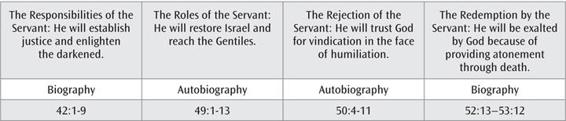
Isaiah 42:2-3 addresses the activity and behavior of the Servant. Despite the power He has been given, the Servant will not flaunt his strength (v. 2). His reign will not be characterized by oppression. Instead, He will be gentle enough to care for the bruised reed and the dimly burning wick among the people. These groups symbolize the downtrodden in Israel who suffer under unjust rule. The Servant’s reign will be characterized by His gentle care for the oppressed (v. 3). This clearly distinguishes the Servant from Cyrus the Great, whom Isaiah describes as crushing others with weapons (41:2-3).
Verse 4 speaks to the justice resulting from the Servant’s rule. Justice is a characteristic task of royal figures throughout the OT (cf. 1Sm 8:5, 20; Ps 72:1-2, 4; Is 9:6; Jr 21:11; 22:3, 15; 23:5). Bringing justice will also bring peace as even the nations (the coastlands) will wait to hear the Servant’s instruction. The Servant will persevere until He completes His mission. He will establish justice on the earth and the nations will no longer set their own rules. Instead, they will align themselves with the law of the Servant.
42:5-7. The second part of the Song declares that the Lord calls the Servant to enlighten and liberate Israel and the nations (42:5-9). These verses underscore the Lord’s commissioning of the Servant and amplify the expectations of the Servant. The description of God in v. 5 focuses on God’s position in relation to creation. This focus is designed to support the word of God proclaimed concerning the Servant. God has created all things. He gives and sustains all life. Therefore, His word is to be trusted. In v. 6, the Lord commissions the Servant. His appointment is twofold—as a covenant to the people and as a light to the nations. The phrase covenant to the people has three possible interpretations. First, those who take the Servant as referring to the people of Israel give it the sense of “a covenant people.” This is unlikely because the Hebrew word order is wrong for this translation. It would have to read “a people of the covenant” (‘am berith), not as it does, lit., “a covenant of the people” (berith ‘am). A second view is that this phrase describes the Servant as a covenant representative for the nations. This is doubtful because the word people is singular, and as such it is generally a reference to the people of Israel. This is clearly the case when the same phrase is used in the next Servant song (49:8). The third and most likely interpretation is to see the Servant as a covenant mediator for Israel. The phrase a covenant to the people is a figure of speech, a metonymy of effect (covenant) for cause (mediator), and means a “covenant mediator for the people.” Like Moses, the Servant will mediate a covenant for Israel’s benefit, specifically the “new covenant” for the messianic age (cf. Jr 31:31-34). Since the Servant is the mediator of the covenant for Israel, the Servant clearly cannot be Israel.
The second aspect of the Servant’s commission is as a light to the nations (v. 6). Messianic expectation always anticipated the nations coming to know the true God of Israel. The Servant Messiah will be the one to bring this light to the Gentiles. This concept is developed further in the second Servant Song (49:1-13).
Verse 7 continues to list the results of the Servant’s commissioning. Not only will He serve as covenant mediator for Israel and be a light to the Gentiles, He will also open blind eyes, liberate captives, and free those who are imprisoned in darkness. Though each of these may be understood to refer to physical conditions, the metaphorical value of these actions should not be dismissed. Blindness is often utilized to denote spiritual blindness (cf. Is 29:18; 35:5; 42:16). The darkness mentioned in the final line of v. 7 refers to the darkness of spiritual bondage.
42:8-9. As a conclusion to the first Servant Song, there is a declaration of God’s power. God will disrupt the human praise of idols who steal His praise. The references to fulfilled prophecy echo the declarations of chaps. 40–41, connecting the Servant Song to its context. God can do what the idols cannot, so He will not share His glory with them. God calls again on His predictive oracles as a proof of His ability to see what will come to pass and to support what He has just foretold (42:9). The readers of Isaiah can trust this prophecy because the God of glory has predicted Messiah’s coming.
42:10-13. Having described the Servant-Messiah (vv. 1-9), the next section offers a song of praise (vv. 10-13) followed by a depiction of the Servant’s ministry to Israel. The call to praise (vv. 10-12) directs all the inhabitants of the earth and sea to sing praises to the Lord. The new song (v. 10) is prompted by the new oracles that will be fulfilled by God’s continued work. The call expands beyond the nation of Israel and encompasses all who go down to the sea (v. 10). This likely refers to people at the end of the earth (John Goldingay, The Message of Isaiah 40–55: A Literary-Theological Commentary [New York: T & T Clark, 2005], 169). The islands that were previously called upon to listen to the Lord (41:1) are now called to respond to what they have heard (42:10). All the world is called to give glory to the Lord (vv. 11-12). God is then depicted as a warrior, indicating His great power (42:13).
42:14-17. This section shifts from the previous call to praise to a description of the Lord and His activity. This image of the Lord depicts God as an unstoppable soldier prepared for battle. God contrasts His seeming silence in the past (v. 14) to the powerful actions He will take in the future (vv. 15-16). The imagery of the woman in labor suggests that the Lord’s silence will not continue. His eagerness to fight will not be held back for long. His inactivity should not lull the world into a false sense of security because the Lord will come and overturn nature’s strength (v. 15).
The reference to the blind (v. 16) harkens back to v. 7 in which the blind will see and those in darkness will be released. God proclaims that He will lead the blind down new paths. The blind will not be left helpless as God comes in fury, but will be led to safety. The blind here could refer to Israel, or to the nations who will now be led by God’s light. Though the previous context focused on all the earth’s inhabitants, it is significant that the perspective of 42:18-25 shifts to Israel, referring to God’s people as deaf and blind. Verse 17 reveals the reaction of idol worshipers who will see the actions of the Lord and be ashamed that they ever bowed down to a lifeless piece of wood.
42:18-25. Next, God reasons with His people Israel. The blind and deaf are identified as God’s servant. Whereas the previous mention of a servant in 42:1-4 seemed to refer to an individual figure, the servant in this case is the nation of Israel. Far from being triumphant and like the coming servant of the Lord described in 42:1-4, the servant described here is the epitome of deafness and blindness. The rhetorical questions in this case assume that no one is more deaf or blind than this servant of the Lord. The word translated at peace (v. 19) is problematic as the specific verbal form only occurs here in the OT. Oswalt suggests rightly that the term should be translated “one in covenant peace” (Oswalt, Isaiah 40–66, 128). The servant’s senses are not gone, but they are of no real use. Though the servant’s eyes can see and their ears can hear, there is no understanding, no faithfulness, and no obedience (v. 20).
Israel’s sluggish response to the Lord’s revelation stands in conflict with the great and glorious law that God has provided for His righteousness’ sake (v. 21). The law was given to display God’s justice to the world through the obedience of God’s people. The servant was meant to prosper by obeying God’s law. Instead, Israel has been imprisoned, pillaged, and plundered (v. 22). Their unwillingness to act on what they have seen and heard has resulted in their degradation. They appear to have been abandoned with no one calling out to rescue them (v. 22).
Having spoken the truth, the Lord steps back to question who among the Israelites will actually heed His warnings and listen to His instruction (v. 23). The question is legitimate as those to whom God is speaking have already heard the message. They have already refused to follow the ways of the Lord, prompting God to turn them over to their enemies (v. 24). Even as He poured out His anger on His people, they remained ignorant, confused, and blind so that they did not recognize or respond to the work of God (v. 25).
d. God’s Comforting Assurance (43:1–44:23)
The stark picture painted at the end of chap. 42 leaves Israel’s future in a moment of ambiguity. Isaiah 43 and 44 addresses this ambiguity by assuring Israel that God will protect His people.
43:1-4. At the outset, the prophet grants Israel assurance of God’s continued loving presence. God is Jacob’s Creator and Redeemer. His actions against Israel are not permanent. The nation will not be imprisoned in exile forever because no one may steal God’s possession (v. 1). The reference to Israel’s redemption in v. 1 may be intended to recall the exodus from Egypt. Moreover, the imagery of passing through waters is reminiscent of the exodus (v. 2). The Targumim make specific reference to the Exodus: “When you first passed through the Red Sea my word sustained you, Pharaoh and the Egyptians, who were like the waters of the river, did not stand against you.” Though the Targum’s paraphrase is not definitive, it does suggest that certain segments of the broader interpretive community understood v. 2 as referring to the exodus.
While it is tempting to agree with the Targum, other factors must be taken into account. For instance, the second half of the verse does not refer to water, but to walking through fire, which does not appear to have any particular connection to the exodus from Egypt. The reference to Egypt in v. 3 is not related specifically to the exodus, either. Instead, Egypt is given as ransom for Israel. In addition neither Cush (Ethiopia) nor Seba (modern Yemen) appear in the Exodus narrative. It may be best to recognize that the exodus from Egypt, which would be ingrained in Israel’s memory, is difficult to avoid in this context. Activating this memory, however, does not require that the entire verse be connected to the exodus. Instead, the passage brings to mind the ongoing protection of the Lord with an echo from the exodus reinforcing the point. God promises to redeem Israel because the nation is precious to God (v. 4). The word “precious” describes that which has great value either because of rarity or intrinsic worth. Since there are many nations, likely here, Israel is precious to God because of the nation’s value to Him. Nevertheless, it was God’s choice of Israel that gave the nation its intrinsic value (Dt 7:7-8). God considers Israel so precious, honored, and loved that He will sacrifice other nations, namely Egypt, in its stead.
43:5-7. God’s comforting assurance includes the promise of Israel’s regathering. The call not to fear appears once again (v. 5) and is associated with the Lord’s promise to regather Israel from across the world. The mention of east and west (v. 5) and of north and south (v. 6) underscores the completeness of the return. God’s scattered people will be reconstituted from the four corners of the earth. They will be rescued because they are God’s special possession, His creation formed for the glory of God (v. 7). Surely they will not remain hidden as prisoners of the nations but will be reconstituted as an independent nation.
43:8-13. God’s comforting assurance also promises that He will not change Israel’s calling. This section begins with the familiar imagery of those who have eyes and ears, but cannot see or hear. Though this description has previously been used of Israel (42:19), it appears that all the nations are in view in this case (43:9). The nations are again pictured as incapable of predicting what has happened to them. They could not have foreseen their fate. The nations cannot produce witnesses to prove they were right about the way things would turn out. Their means did not produce the expected ends, so they cannot claim that they were right.
Though the nations have no witness to defend them, God calls His servant Israel as His witness. Service as God’s witness was part of Israel’s mission. As Kaiser notes, “ … Israel herself was a standing witness to the power and reality of who Yahweh was and what he had done in their history” (Walter C. Kaiser, Jr., Mission in the Old Testament: Israel as a Light to the Nations [Grand Rapids, MI: Baker, 2012], 54). The obedience and ultimate success of Israel stands as the testimony to God’s uniqueness. God is not only the God of Israel, but the only God in existence, period. This testimony becomes clear in the assertion that no god was formed before the Lord and none will be formed after (v. 10). Verse 11 sharpens God’s uniqueness. He is not simply the only God, but also the only savior. Israel’s calling stands as witness that the Lord alone has declared and saved and proclaimed (v. 12), in contrast to the so-called gods of the foreign nations. God is the ruler of all and there is nothing that can stand against Him. His will is irresistible (v. 13).
43:14-15. Israel is further assured of God’s promise of redemption. Having proven and proclaimed His sovereignty, the Lord now proclaims the next events He will orchestrate on the world stage. For the sake of Israel, God will bring the Babylonians low. Babylon’s rejoicing will turn to mourning as the powerful nation is subjected to the hand of the Lord (v. 14). Furthermore, God declares both His position as Lord, as well as His special relationship to Israel (v. 15). Though it is not explicitly stated, God’s position as Lord gives power to His position in Israel. The LORD in this context is God’s covenant name, but it is also a proclamation of His universal sovereignty. This God, who has committed Himself to Israel through the covenant and stands above all supposed gods, is also Israel’s Holy One, Creator, and King. He will protect His people as proven by His actions against Babylon.
43:16-21. The references to making a pathway through the sea, the chariots and horses, and the army (vv. 16-17), allude to the exodus from Egypt. This powerful event holds a special place in the narrative of Israel’s history as the nation’s defining moment. At the exodus, Israel was delivered from slavery in order to fulfill its destiny and dwell with God in the land forever. The exodus was crucial for Israel, yet God calls Israel not to dwell on the former things (v. 18). Rather than looking to the past at what the Lord has done, Israel is called to see what God is doing now and will do in the future (v. 19).
The implication is that the exodus, a defining event in the life of Israel, will be overshadowed by something new (v. 19) that God is planning for the present. This new thing effectively reverses the exodus. Whereas God caused the sea to turn to dry land to save His people from the Egyptians, now He will make paths and streams in the desert to deliver His people (vv. 19-20). God does not wish Israel to miss the present while they are looking to the past. Instead, He wants Israel to praise Him in the present for His coming provision of streams in the desert (v. 20-21). God’s sovereign control of nature stands in stark contrast to the inability of the idols.
43:22-24. God additionally grants Israel the comforting assurance of His total forgiveness. The tone of this section shifts from a proclamation of God’s sovereignty to an indictment of Israel’s sin. Beginning with a contrastive yet (v. 22), the prophet signals the turn from the blessings that God will bring to Israel to Israel’s failure to respond to God despite His actions on their behalf. The nation did not seek God. While it may appear that Israel did not provide the appropriate sacrifices to the Lord, such a view is difficult to maintain given Israel’s exile. The exile would have precluded religious ritual, making it difficult to expect that Israel could perform appropriate sacrifices. Since other passages suggest that Israel offered excessive sacrifice prior to the exile (Is 1:11-14; Jr 6:20; Am 4:4-5; 5:21-23), it seems best to understand this verse as a comment on the worthlessness of Israel’s religious expressions (Christopher R. North, The Second Isaiah: Introduction, Translation and Commentary to Chapters XL–LV [Eugene, OR: Wipf and Stock, 2005], 127). God’s people did not honor the Lord with sacrifices and gifts. Instead, they burdened Him with transgression (43:24).
43:25-28. God describes Himself as the God who wipes out your transgressions for My own sake (v. 25). Israel is not forgiven based on its own merit or for its own sake, but for the sake of the Lord. God has been good to Israel, forgetting their sins and bearing the nation’s iniquity (v. 25). Israel is called to bring evidence of its faithfulness. The nation is asked to review the past and to prove its innocence (v. 26). Before the nation can answer and bring evidence, God declares that Israel has been sinful from the beginning (v. 27). The NASB translation of first forefather (v. 27) suggests that the text is referring to one of the patriarchs. It is unlikely, however, that the text intends to indicate Abraham as the first forefather since he is presented positively at other points in Isaiah (29:22; 41:8; 63:16). Given that Jacob is referred to as the father of the nation (58:14) and is, at times, portrayed in a negative light, it is likely that Jacob should be identified as the first forefather. But it was not only the patriarch who sinned against the Lord. The nation’s spokesmen have also rebelled. Israel’s leadership has failed to remain faithful to God, resulting in the downfall of these leaders and the destruction of the nation (v. 28).
44:1-5. God further grants comfort and assurance to Israel with the promise of His bountiful Spirit. This section announces the renewal of Israel. Jacob is used in parallel with Israel in v. 1, identifying the nation with its patriarch, as well as playing off the two names given to Jacob (cf. Gn 32:28). Again we see the use of servant language in reference to the nation of Israel, as well as the identification of Israel as God’s chosen people. Each description underscores the special relationship between God and Israel. Servant, as has been mentioned in previous sections, designates Israel as God’s representative whose purpose is to display God’s glory and to adhere to His wisdom as an example to the nations. As God’s chosen one, Israel has been uniquely selected for this task and will experience the protective hand of God even as they are subjected to God’s discipline.
God’s choice of Israel is emphasized using the poetic term Jeshurun in parallel with Jacob (v. 2). Jeshurun is only used here in Isaiah. The other three occurrences of the term are found in poetic portions of Deuteronomy (32:15; 33:5; 33:26). The Septuagint translates Jeshurun as “beloved” or “one who is loved,” whereas most of the Targumim and the Peshitta (a fourth- or fifth-century Syriac translation of the Bible) translate it “Israel.” Only the Targum Yerushalmi translates Jeshurun in Dt 32:15. Regardless of the translation, most commentators agree that Jeshurun should be identified with Israel. This identification is clear from the term’s parallelism with Jacob (44:2).
Aside from the reference to Israel’s chosen status, the prophet identifies the Lord as Israel’s creator: the LORD who made you and formed you from the womb, who will help you (v. 2). Israel has no need to fear because God has created and helps Israel. He will provide for the people of Israel and ensure the nation’s continuance across its generations. One way God will provide is by pouring water on the thirsty land (v. 3). Though it is certainly possible to understand this as a metaphor, introducing the coming offspring promised to Israel in the second half of the verse (v. 3) and in v. 4, it may be best to view the reference as a literal restoration of the land. The metaphoric interpretation is difficult to sustain given the similarity with the other depictions of God’s transformation of the land of Israel (41:17-20; 43:19-21).
Regardless, a connection is made between the water and God’s Spirit through the repetition of the verb pour out (v. 3). Just as God will bring water and life to the barren, dry ground, so He will make Israel fertile throughout the nation’s generations. Israel’s descendants are compared to trees that sprout up in the grass and to poplars near streams, suggesting both posterity and number. The NASB translation does not refer to trees, rendering the verse as they will spring up among the grass (v. 4). This rendering is based on the Masoretic Text of the OT that reads among. Yet, the text of 1QIsaa, which was found along with the other Dead Sea Scrolls at Qumran, has a different Hebrew word suggesting the translation “like a binu-tree.” The two phrases, while strikingly different in English, are similar in Hebrew and could have easily been confused by one or the other textual tradition. Though it is possible to argue for either rendering of the verse, retaining the translation of “like a binu-tree” forms a parallel with the poplars in the following line, suggesting that it may be the correct reading since poplars were a type of willow tree, which grew next to flowing bodies of water.
Next the prophet describes the words of this one (v. 5). The identity of this one has been the focus of considerable scholarly attention with some suggesting that the individual referred to is not an Israelite, but a foreign proselyte who has believed in the God of Israel (Roger N. Whybray, Isaiah 40–66 [Grand Rapids, MI: Zondervan, 1981], 95). Others suggest that this one is a reference to the nation of Israel as God’s servant. Given the contextual mention of the offspring of Israel in the near context, however, it seems best to identify this one as referring to future Israelites collectively who will affirm their allegiance to the Lord. This collective group ultimately chooses to identify as the Lord’s people and as part of the remnant of Israel. The practice of writing on one’s hand has precedence among slaves in the ancient Near East, denoting a sense of permanence and loyalty to a particular master.
This paragraph has underscored the coming refreshment of the land and restoration of Israel by God’s Spirit (v. 3). God, who has chosen and formed Israel to be His servant will not abandon His people, but will pour out His Spirit on them. Future generations will experience God’s blessing and proudly identify themselves as belonging to the Lord and as members of Israel.
e. God’s Sovereign Authority (44:6-23)
On the heels of God’s promise to restore Israel in Is 44:1-5 comes a statement of God’s sovereignty, and with it, a condemnation of idolatry. According to Smith (Gary V. Smith, Isaiah 40–66, NAC [Nashville, Broadman & Holman, 2007], 224), this section of the prophecy may be divided into four major sections: (1) God declares His uniqueness (44:6-8); (2) satire on trusting in useless idols (44:9-20); (3) admonition to remember and return to God (44:21-22); and (4) concluding hymnic praise of God (44:23).
(1) God’s Declaration of His Unique Sovereignty (44:6-8)
44:6-8. Verse 6 depicts God as Israel’s King and Redeemer, as well as the LORD of hosts, or Lord of armies. Each of these titles recognizes God’s sovereign position over Israel. God’s authoritative statement at the end of the verse underscores God’s position as the only sovereign. God is the first and the last of divine beings. There are no other gods.
If the statements in 44:6 reflect God’s sovereignty and separation from any other so-called “gods,” the question Who is like Me? (44:7) emphasizes God’s incomparability. Though false idols may claim to be like God, they cannot predict the future nor determine the events that will take place. God, in comparison, governs the events of history and sets life in order. Once again, the idols are shown to be powerless to aid those who serve them. The idols cannot offer sure advice or security to their followers because the idols do not know or control the future.
In contrast, God may give comfort to His people. Isaiah 44:8 encourages Israel not to fear. They have God’s declarations from times past. The verb translated do not tremble (v. 8) is generally used to describe the fear that results from divine action (cf. Ex 15:6; Is 19:16; 33:14). The verb translated do not be afraid is used only in v. 8, though its meaning can be deduced through its connection to the other verb translated do not tremble. There is no need to fear because God has foretold what will happen to Israel. God’s declaration cannot be threatened because God is the only Rock. Not only is God capable of proclaiming what will come about in the course of history, He is also incapable of being thwarted as He conforms world events to His will. God is, like a rock, a source of stability and strength. He is Israel’s immovable foundation (cf. Dt 32:3, 15, 18, 30, 37; 1Sm 2:2; Ps 18:31). God is not one foundation among many, but the only foundation period. There is no other rock.
(2) Satire on Trusting in Useless Idols (44:9-20)
Despite God’s incomparability, humanity insists on trusting in the gods that are formed with human hands. Isaiah 44:9-20 represents a condemnation of those who trust in handmade idols.
44:9-11. At the outset, the prophet declares in no uncertain terms the worthlessness of idols and the folly of trusting in them. The question in v. 10 should be taken as a moment of satire since no one who forms idols profits. The idol makers and their associates cannot benefit from building their own god because the makers themselves are only human (v. 11). As Brueggemann notes, “These gods have no inherent power or force but are manufactured. As a consequence, they can have no more power or force than their ‘makers’ can bestow upon them, which is nil” (Walter Brueggemann, Isaiah 40–66 [Louisville: Westminster John Knox, 1998], 68). In the end, anything that these human idol makers create will be beset with human limitations that cannot provide comfort. Unlike the Lord, who forms and sustains Israel throughout its generations (cf. v. 2), the humans who form idols cannot hope to see their work last. They will be brought together to display their humiliation.
44:12. The satire about idols continues by describing the construction of idols and highlighting their manufactured nature. The detail provided concerning the production of the idols emphasizes the inherent weakness and worthlessness of the gods. While the powerful iron tools, the heat of the coals, and the strength of the maker’s arm are undeniable, the text also notes the frailty of the builder whose strength fails because of hunger and thirst. Rather than bringing strength, the idol weakens the one who builds it so that even in its construction the idol reveals its inability to sustain those who trust in it.
44:13-17. The description of the construction of a wooden idol is steeped with irony. Whereas the man who makes the idol of metal is weakened by his efforts, the man who makes an idol of wood is sustained by the same material that he uses to create his god. The wood worker measures and designs the idol to look like a man. Concerning the woodworker’s process, Smith notes: “Although the author makes no comparison with God, any Hebrew person in the audience would see the dramatic contrasts. In 40:12 and 22 God stretches out a line to mark off the breadth of the heavens, but in this text the idols are made by a man who stretches out a short line to make the outline of the idol (Smith, Isaiah 40–66, 232).
The idol is made in the likeness of a human so that it may sit in a house (v. 13). The NASB translation of house as opposed to the NIV translation of “shrine” suggests a more profane understanding of the underlying Hebrew term. This profane understanding, however, may obscure the sacred nature of the idol. As such, it seems better to translate “shrine” in this instance. That the idol is made in the likeness of a human (when in fact humanity is made in the image of God) in order to sit in a shrine speaks to the underlying self-worship that characterizes idolatry. God, unlike the idol, is holy. He is unique and incomparable. His presence in a mundane environment would be readily noticed and, as was evident in Isaiah’s vision of God in 6:1-13, awe-inspiring. Humans could not bear to stand in His presence without terror. The wooden idol, however, is crafted in a manner that is familiar to humankind. It brings no dread or terror, but a sense of complacency that does not challenge its maker. Instead, the idol reaffirms its maker and whatever lifestyle he chooses to live.
The process for creating a manmade idol demonstrates the impotence of the idol and the self-sufficiency of humankind. Rain caused the trees to grow (v. 14). After the trees have grown the woodworker cuts them down. He uses some of the wood to build a fire for warmth and baking and the rest to form an idol (v. 15). The man cares for his own needs and then fashions his god and cries out to it for salvation (v. 17).
This depiction of the idol’s construction highlights a paradox in the life of the idol’s creator. He is capable of supplying his own needs from the trees that grow because of the rain that falls upon them. This reference to the rain in v. 14 suggests that God, who is identified as the source of rain throughout Scripture (cf. Gn 2:5; 7:4; Lv 26:4; Dt 11:14; 28:12; 1Sm 12:17-18; Jb 5:10; Is 30:23; Zch 10:1), lies behind the growth of the tree that is used to sustain the woodworker and to form his idol. The idol does not provide sustenance, but is drawn from the very material that gives warmth and heat for baking bread.
44:18-20. Those who form idols, however, are blind and do not see or understand the foolishness that comes with the making of idols (v. 18). The irony of the idol’s formation goes unnoticed. Smith suggests that this blindness is a condition of the people’s participation within a particular culture. He notes, “The prophet does not attribute this blindness to any specific factor, but if these people were raised to believe these things by their parents and religious leaders, they would naturally be somewhat bound by that culture’s false interpretation of reality” (Smith, Isaiah 40–66, 235).
Regardless of the reason, the people are incapable of recognizing that the idol is made of the same material as that used to keep warm and to cook food (v. 19). Idol worshipers are unable to form the sort of questions that would free them from the deceptive trap of idolatry. The practice of idolatry ensnares those who participate in it by deceiving them so well that they are no longer able to ask, is there not a lie in my right hand? (v. 20).
(3) Admonition to Remember and Return to God (44:21-22)
44:21-22. Jacob (i.e., the nation of Israel) is called to remember both God’s formation of Israel and humanity’s formation of idols. The juxtaposition between God’s relationship to Israel and that of the idol to its maker is one that Israel cannot afford to forget. The Lord is the only God. He is incomparable. The call to remembrance is reinforced by God’s assurance that He will not forget His special servant, His chosen nation. The Lord summons Israel to return to Me, for I have redeemed you and wiped out your transgressions like a thick cloud (v. 22).
(4) Concluding Hymnic Praise of God (44:23)
44:23. As a response to the satirical portrayal of idolatry, Israel is not simply called to remember, but to rejoice along with the whole of God’s creation. The reason is that the one, true God, has redeemed Jacob and in Israel He shows forth His glory.
f. God’s Human Agent (44:24–45:25)
In the oracles that continue to describe Israel’s deliverance from Babylon, this section identifies the human agent God will use for that deliverance. He is Cyrus the Great, the emperor of Medo-Persia. The point in this section is that although Israel will suffer loss at the hands of the Babylonians, God’s people must remember that the power of Babylon will only last as long as the Lord allows. The coming of Persia is far from a coincidence. It is the will of God made manifest in the ongoing events of human history. Isaiah 44:24–45:25 may be divided into several smaller units. The first major section begins at 44:25 and ends at 45:13, emphasizing God’s use of the foreign king Cyrus. The second major section describes the effect of Cyrus on Israel—he is a harbinger of happier times in the future. The description of those times foreshadows the messianic kingdom, a time in which both Israel and the nations will worship the Lord (45:14-25).
(1) The Description of Cyrus (44:24–45:13)
44:24-28. The description of Cyrus begins with a paragraph that is structured through a series of descriptive statements that clarify God’s identity as Israel’s Redeemer. The redemption of Israel from Egypt was a foundational event in Israel’s past, but it also reminded Israel that God could act as the nation’s Redeemer again. In these five verses God’s identity is expressed in a series of relative clauses. The first relative clause, the one who formed you from the womb (v. 24), occurs outside of the Lord’s speech which constitutes the bulk of the content in 44:24-28. The emphasis on formation reminds Israel once again that God has been with His people from the beginning.
God’s proclamation begins with the assertion I, the LORD, am the maker of all things and continues with the declaration identifying God’s activities as including stretching out the heavens by Myself and spreading out the earth all alone. God’s position as Creator implies His capacity to maintain order within creation. God’s acts of creation were comprehensive, meaning that no other god created anything. God created alone. He needed no help in stretching out the heavens or spreading out the earth. He brought it about by His power alone. No god stood before God, against God, or with God in the formation of the world.
Moving from creation to the fulfillment of prophecy, the Lord demonstrates His sovereignty through His control of history. The false words spoken by false prophets are revealed as deceptions. God reveals the foolishness of those who are considered wise. He disrupts human logic (v. 25). Not only does He undermine the musings and predictions of humanity, but also He confirms the word of His servant (the prophet Isaiah) and performs the purpose of His messengers (v. 26), i.e., the prophets. God will protect and prove true those who speak for God and live in accordance with God’s wisdom.
God is also the one who confirms the fate of Jerusalem. The Creator of the world and the One who controls history proclaims that Jerusalem will one day be inhabited and that the ruins of Judah will be restored (v. 26). The declaration that Jerusalem will be restored carries with it an undeniable sense of certainty because it is connected to God’s identity. God has committed Himself to the renewal of Israel.
God is presented as the one who says to the depth of the sea, Be dried up! And I will make your rivers dry (v. 27). There are several possible ways to understand the reference to the depth of the sea. The most obvious possibility is to identify it as the waters of creation, which were drawn together to form the dry land. It is also possible to view this as an allusion to Noah’s flood or to the Red Sea that swallowed up the Egyptians. The watery deep might also be a veiled reference to Cyrus’ diversion of the Euphrates to capture the Babylonians (Goldingay, Message of Isaiah 40–55, 259). Symbolic references should not be discounted, as Assyria, too, is referred to as a flood that comes against God’s people (Is 8:7-8; 17:12-13; 28:2; 30:28). It may be that the depth of the sea represents a coming military attack that will be dried up by the Lord.
The more likely view is that it refers to Cyrus’ defeat of Babylon, because he is the central figure in this entire section and is mentioned by name in the very next verse. Moreover, these verses describe what specifically happened in Cyrus’ defeat of Babylon. So v. 27 is saying that the God who gathered the waters to make the dry land will also dry the river and make Cyrus’s conquest possible. In v. 28, God is described as the one who says of Cyrus, He is My shepherd! And he will perform all My desire. Part of God’s pleasure includes Cyrus’s declaration that both Jerusalem and the temple will be rebuilt. The identification of Cyrus as God’s shepherd identifies Cyrus as a royal figure who will serve God and care for God’s people. Cyrus’s rule, in this sense, will not be his own, but will belong to and be guided by the Lord and His purposes.
45:1-7. The description of Cyrus continues with a surprising title for the pagan emperor. It may indeed seem strange to apply the title of “My shepherd” (44:28) to Cyrus, but it is even more unexpected to identify him as the Lord’s anointed (45:1), or the Lord’s messiah. The English term “messiah” is a transliteration of the underlying Hebrew word. It is used of priests (Lv 4:3, 5, 16; 6:15), kings (1Sm 2:10, 35; 12:3, 5; 16:6; 2Sm 1:14, 16; 19:22; Ps 2:2; 18:51; 132:10) and prophets (Ps 105:15). The title of anointed is used only here (45:1) in Isaiah, although the verbal form is used later to speak of the Lord’s anointing of the herald who preaches good news to the poor (61:1). In general, the title is given to someone of Israelite origin, but in Is 45:1 a Persian is identified as God’s anointed. Though this strategy might be employed as an affront against Israel (cf. comments on Is 2:6-22 above), it seems best to view the identification of Cyrus as His anointed as a sign of God’s universal sovereignty over the nations. Even the foreign rulers of the world are conscripted for service to God (cf. Is 10:5).
Westermann suggests that this passage represents the commissioning of Cyrus as ruler over Israel (Claus Westermann, Isaiah 40–66 [London: SCM, 1969], 157). Commissioning, however, does not appear to be in mind, since God is simply conveying what He plans to do with Cyrus. Instead, the passage presents Israel with a picture of a hopeful future that will come through the rule of the Persian Empire. It points beyond the earthly rule to the sovereign God who truly controls the course of history. As Smith notes, “The name or identity of this ruler is not the focus of these verses (it is mentioned only once); instead, the main emphasis of this paragraph is on God’s sovereign work of accomplishing his will through this king” (Smith, Isaiah 40–66, 254-255).
The oracle concerning Cyrus (vv. 1-7) reveals that Cyrus will be God’s tool for restoring Jerusalem (44:28). The Lord addresses Cyrus directly, while the Israelite readers see God speaking to His anointed Gentile king by whom He will deliver kings and nations and Israel. Cyrus will experience the protection of the Lord who will clear the way for Cyrus, providing him with open doors, moving mountains, and breaking gates of bronze and bars of iron (45:1-2). The treasures of darkness (v. 3) likely refer to the spoils of war that God will give to Cyrus so that you may know that it is I, the LORD, the God of Israel, who call you by your name.
Concerning this purpose, Brueggemann notes, “The daring expectation of this poetry is that Cyrus may come to acknowledge that the move west by the Persian Empire is not just imperial policy but belongs to the larger purpose of the real Governor of international politics” (Brueggemann, Isaiah 40–66, 76). Though the Lord expresses his intention to Cyrus, the oracle in which it is included is meant for Israel. Acknowledging God as Lord, then, is not simply God’s intention for Cyrus, but also His intention for Israel as the nation watches the events of world history unfold.
Cyrus has been summoned for the sake of Israel even though Cyrus does not know God (v. 4). God declares I am the LORD, and there is no other; besides Me there is no God (v. 5). This statement of exclusivity highlights that it is God alone who will strengthen Cyrus even if Cyrus does not acknowledge God. That God alone is the Lord and there are no other gods must cause Israel to recognize that Cyrus’s activities are superintended by God for the sake of Israel, Even if Cyrus claims to have been given victory by one of the gods in the Persian pantheon, the Israelites will see that it is the Lord who enabled Cyrus to conquer. Isaiah’s message expands the original intention of God’s activity on Cyrus’s behalf to include the men from all corners of the earth (v. 6). The Lord is the creator of light and darkness, well-being and calamity (v. 7). The Hebrew word for calamity is literally “evil.” As a result, some translations state that God creates evil, and as a result, some identify the Lord as the author of evil. But the NASB correctly translates the word as calamity, since the Hebrew can mean both “moral evil” as well as “disaster,” “calamity.” God is not the author of moral evil, nor is he held morally culpable for it (cf. Jms 1:13-14).
This is a declaration of God’s sovereignty—He conforms all things, good and bad, to His will. This section ends by emphasizing God’s control over all aspects of creation (v. 8). In language reminiscent of the fertility described in Dt 28:11-12, God calls for rain showers of deliverance and the growth of salvation. Oswalt summarizes the force of Is 45:8 well, stating, “[J]ust as the sky that God has created cannot help but pour forth rain, and the earth that God has created cannot help but bring forth plants, so God the Creator can only pour out on his people right dealing and mighty deliverance in all his relations with them” (Oswalt, Isaiah 40–66, 206).
45:8-13. After the extended description of Cyrus, a warning is given to those who would attempt to oppose the Lord. Using the imagery of the pot and the potter, the prophet describes the foolishness and futility of arguing with the Lord. The NASB translation of earthenware vessel (v. 9) might be better rendered as “shard” to make clear that what is in mind is a fragment of pottery. These shards are not unique, and no one shard is more significant than another. Those who quarrel with their maker will only find anguish and grief. After all, the clay does not have a right to question the potter’s intentions or question his skills (He has no hands, v. 9; see the comments on Rm 9:19-21).
Shifting from the image of the potter and the clay to that of the parents and the child (v. 10), the prophet reiterates his point. Children have no right to question their parents for giving birth to them. God’s speech applies the principle to Himself, expressing His own disapproval of those who question what He is doing with His creation (vv. 11-13). As Creator, He may choose what to do with His creation. As if He is answering an unspoken objection against His use of Cyrus, God defends His decision to appoint Cyrus to deliver Israel (v. 13). God will use whomever or whatever He desires to accomplish His purposes. In this case, He has chosen Cyrus whom He will empower to rebuild Jerusalem (My city) and to free the Israelites from Babylon. Cyrus will not be paid nor rewarded—he will simply serve as God wills.
(2) The Effect of Cyrus (45:14-25)
Having described Cyrus as the Lord’s shepherd and anointed, chosen to deliver Israel from Babylon, the prophet next turns to the effect of Cyrus’s work. The Persian ruler is a harbinger of better times. In the description of those better times, clearly the impact of his work is far greater than what actually happened for Israel. Here the return from captivity is depicted as a foreshadowing of the future messianic kingdom.
45:14-19. As a result of God’s redemption, the Gentile nations will acknowledge (bow down to, v. 14) Israel. This prophecy begins with the depiction of three nations, the Egyptians, Cushites (modern Ethiopia), and Sabeans (modern Yemen), that will bring their tributes to the people of Israel. They follow behind the Israelites in chains and will bow down before the people of Israel. The image of people in chains suggests that Israel, like other ancient Near Eastern powers, will receive both the tribute and the loyalty of subservient nations. Israel is viewed as a mediator between the nations and God receiving the prayer of the nations which recognize that God is with you (v. 14) and that God is incomparable.
God is next presented as Israel’s deliverer who hides Himself (v. 15). Though God’s hiddenness has often been construed as a complaint against God for His inaction (cf. Ps 10:1, 11; 13:1; 27:9; 30:7; 55:1; 69:17; 88:14; 89:46; 102:2; 143:7), it does not appear that the nations’ statement here is designed as a critique against God. Instead, it seems to be an insight concerning the unexpected nature of ways of God, who hides Himself (v. 15). The Egyptians, Cushites, and Sabeans have come to humble themselves before Israel, while others, specifically those who fashion idols, will go away together in humiliation (v. 16). Taken with the statement in v. 17 that the Israelites will be delivered and never again be ashamed, the mention of the idol makers in v. 16 suggests again that the idols of the nations will ultimately fail those who worship them.
God, the Creator of the heavens and the earth, declares that His creative work was not done on a whim or without purpose (vv. 18-19). Using one of the terms employed to describe the “formless” world of Genesis 1:1-2 (here translated a waste place), the text asserts that God did not create the world to exist without order, but to be inhabited. God’s statement in v. 19 returns to the previous mention of His hiddenness in v. 15. God has not kept His will from Israel. He did not create the world and then stand in the shadows as if He were a clockmaker who, having completed a new timepiece, leaves it to run on its own. Instead, God has maintained a hand in the history of His creation to bring about order. He has spoken to Israel with righteousness and reliability (v. 19).
45:20-25. Not only will the nations acknowledge Israel (v. 14), but a second, more important consequence of God’s redemption is that the nations will acknowledge (bow, v. 23) and revere the God of Israel. God calls to those who worship idols and have no guidance, telling them that they have no god to call upon for deliverance (v. 20). The true God, the God of Israel, is unique (v. 21). The foreign idols cannot predict the future or deliver people from destruction. God is the only righteous Savior. As such, He calls the ends of the earth to come to Him for salvation. He is the only God and the only shelter for all people (v. 22). God’s irresistible, irrevocable word proclaims that every knee will bow before the Lord (cf. v. 14) and that every tongue will swear allegiance (v. 23).
This is the basis of Paul’s eschatological expectation that every knee will bow before the Lord Jesus, either in worship or submission (see comments on Rm 14:10-12 and Php 2:10-11). Bowing the knee and swearing allegiance are both acts of fidelity to the Lord, as is suggested by the words that the people will speak when God has asserted His authority: Only in the LORD are righteousness and strength (v. 24). The content of the people’s confession is not simply related to power, but to the correctness of God’s judgments. When those who were angry with him stand in His presence, they will be humiliated. But all of Israel living in the messianic kingdom will be declared righteous and will worship and will glory in the Lord for His great deliverance (v. 25).
Isaiah 45:13-25 ultimately provides a source of comfort for those who choose to follow the Lord. Recognizing that God is the Creator, and that He has not left His creation to determine its own path, emphasizes and explains God’s continued activity within creation. Though the events, powers, and strategies of the world may hide God’s work, God has made promises to His chosen people Israel to remind them that God has not abandoned them. Turning to idols in an attempt to order the world is a futile exercise. Deaf and dumb gods have no control of history, nor did they have any hand in creation. Even when it appears that the powers of the world are in flux, this passage recognizes that God uses the world’s superpowers to bring about deliverance for those who remain faithful to Him.
g. God’s Righteous Judgment (46:1–47:15)
This section of Isaiah stresses once again the sovereignty of the Lord, His ability to deliver Israel and judge the nations. The references to Bel and Nebo in 46:1, as well as the explicit mention of Babylon in 47:1, 48:14, and 48:20, suggest that at this point God is dealing with the Babylonian Empire, which had taken Israel into exile. Chapters 46 and 47 resemble the oracles against the nations that appeared in Isaiah 13–23 (Chris A. Franke, “Reversals of Fortune in the Ancient Near East,” In New Visions of Isaiah, ed. R. F. Melugin and M. A. Sweeney [Sheffield: Sheffield Academic, 1996], 104-23). As with the oracles against the nations, the critique of Babylon in chaps. 46 and 47 is provided for the benefit of Israel. Babylon is not the indestructible power that it appears to be. Instead, its idolatrous, unjust practices are an affront to the Lord, practices that will ultimately bring about the nation’s downfall. The first part demonstrates God’s righteous judgment by defending His authority over idols (46:1-13).
46:1-7. Bel was a Babylonian title ascribed to various Babylonian gods including Enlil, the father of the gods, and Marduk, the head god of the city of Babylon. Marduk was depicted as defeating Tiamat, the Babylonian goddess representing primordial chaos, and was subsequently named king of the gods. Though Marduk is never mentioned explicitly, it seems likely that Bel is a reference to this Babylonian god. That Marduk is in mind is suggested by the reference to Nebo, Marduk’s son, in the parallel line. Nebo, or Nabu, was “god of the scribe and of intellectual pursuits” and was head over the city of Borsippa south of Babylon (Oswalt, Isaiah 40–66, 228).
These prominent gods of Babylon are now bent low. Their images are carried off by animals and, rather than empowering the people, they burden those who carry them (v. 1). Their inability to remove the burden results in captivity. Those who once took captives are now brought into captivity (v. 2). In contrast to these idols, God is capable of upholding His people. Israel (Jacob) is also called to remember that it is the Lord who has sustained Israel from their youth and into their old age (vv. 3-4). The so-called gods of Babylon do not compare to the Lord (v. 5). Whereas God carries His people from age to age, those who commission the construction of idols with gold and silver must carry their gods (v. 7). The precious god that was skillfully formed by the blacksmith is inanimate and cannot move or speak. The idol cannot respond to the prayers of those who cry out to it. The idol’s inability to act should serve as a warning to those who seek to rebel against the active God of Israel.
46:8-13. God, on the other hand, is supremely powerful. God’s past actions demonstrate that He is God Almighty. He has exercised His will without opposition. His will and His purposes will come to pass (vv. 8-10). His capacity to predict future events showcases His ability to bring about whatever He chooses (vv. 10-11). As Hanson notes, “The principle underlying this interpretation of history and enabling the prophet to discern a creative, redemptive pattern is theological. It revolves around faith in the divine promise, ‘I have planned, and I will do it’” (Paul D. Hanson, Isaiah 40-66 [Louisville: John Knox, 1995], 115). God will summon a bird of prey, or the man of My purpose from a far country (v. 11). The identity of this bird is not stated in the text. Though Cyrus is the likely explanation, ancient sources, specifically the Targum (ancient rabbinic paraphrase), suggest that the call of the bird of prey refers to the call of Abram and to the ingathering of the exiles. In light of the frequent mentions of Cyrus being raised up to accomplish God’s purposes in restoring Israel (41:2, 44:28, 45:1) this makes the most sense in context. Regardless, the point of the text is clear. God does not issue empty threats but instead will execute His plans (v. 11).
The stubborn-minded people of v. 12 should be identified with the Babylonians, the idolatrous rebels in 46:6-8. Their paganism led them to believe that God’s perceived inactivity had resulted in disbelief in God’s ability to deliver Israel. This rebuke, although addressed to Babylon in the text, was included to give hope to the readers of this book, the remnant of Israel. Despite Babylon’s skepticism, God’s deliverance was near and would come to pass. Zion will be saved and God’s glory will be displayed in Israel (v. 13).
47:1-7. Having defended that God is righteous in judgment because of His authority over Babylonian idols (46:1-13), the next section announces God’s righteous judgment of Babylon, indicating that the empire’s fall was imminent (47:1-15). At the outset, the reasons for Babylon’s judgment are described (47:1-17). Babylon is presented as an arrogant woman of great beauty whose status in the upper echelon of society is revoked. This beautiful, pretentious woman must now take the place of a slave. In v. 1, the virgin daughter (Babylon) is commanded to abandon her throne and to get down in the dust. Sitting in the dust is a sign of Babylon’s humiliation and, potentially, mourning (3:26; 25:12; 26:5). In any case, the image of Babylon sitting in the dust communicates the nation’s imminent lowly status.
Identifying Babylon as a virgin does not speak to the nation’s innocence, but to the nation’s delicate beauty. Smith suggests, “The title ‘Virgin Daughter of Babylon’ and ‘Daughter of the Babylon [Chaldeans]’ are honorific titles which do not refer to the young age of Babylon but draw on the image of a virgin as someone who is beautiful, desirable, and unconquered” (Smith, Isaiah 40–66, 301). No longer will Babylon be beautiful and unconquered. Instead, Babylon’s beauty will fade as the nation is forced to work as slave. The circumstances that allowed Babylon to remain tender and delicate will be removed (v. 1).
The prophet foretells that this “delicate daughter” will participate in the hard labor of grinding flour with the millstone (v. 2). This labor is not conducive to the prominence to which Babylon has become accustomed. As such, she is commanded to remove her veil and to lift her skirts. She has become profane to the point that her nakedness will be uncovered, indicating that once proud Babylon will be shamed (v. 3). In the ancient world, appearing naked was a sign of shame and could refer to an act of sexual violation (cf. Lv 18:6-19). The point is that Babylon’s nakedness refers to her ultimate humiliation.
God’s vengeance on Babylon will be complete (v. 3). The NASB’s translation of I will … not spare a man interprets the literal Hebrew “I will not meet a man.” The Hebrew verb for “meet” carries the nuance of “meet with mercy” or “meet with kindness” (cf. Is 64:5). God will show no pity when He encounters Babylon. Verse 4 does not appear to have any specific connection to v. 3. The Septuagint adds the verb “says” before our Redeemer in v. 4, clarifying that it is God speaking in v. 3. Though the verb for “say” is not included in the Hebrew text, there is evidence to suggest that the verb could have been omitted through the process of transmission because the presence of a similar looking word at the end of v. 3. Inserting “says” at the beginning of v. 4 identifies the Lord as speaker. This verse could also be an outburst of joy by the prophet, celebrating that God will redeem Israel and punish the nation’s oppressor, Babylon.
God is characterized as Israel’s Redeemer, as the LORD of hosts (Lord of armies), and as the Holy One of Israel (v. 4). The God who redeemed Israel from Egypt is the same God who will redeem Israel from Babylon. The designation of LORD of hosts depicts God as the unstoppable general who leads heaven’s army. God’s titles reinforce His ability to save His people.
Returning to the message of judgment on Babylon, next God condemns the arrogant, unreflective activities of Babylon. The Lord commands Babylon to sit (as in v. 1), but also to be silent and to go into darkness (v. 5). Though some commentators (see Christopher R. North, Isaiah 40–55 [London: SCM, 1964], 99) have suggested that imprisonment is implied by these phrases, the lack of specificity in the text does not demand such an interpretation. In any case, Babylon will lose its prominent place among the nations and the moniker of queen of kingdoms will be taken away (v. 5). What follows are the events that led to Babylon’s rise to power and fall from grace (v. 6). God’s anger prompted Him to hand His people over to Babylon.
Presumably, Babylon was to serve as an agent of divine justice, but Babylon refused to temper its level of punishment inflicted on the nations it subdued. Babylon did not show mercy even to the aged, but laid a very heavy yoke on them (v. 6). Babylon’s hubris grew to the point that the nation boasted about its permanence (v. 7). The nation, however, neglected to evaluate the consequences of their actions against God’s people. They did not recognize that Israel was God’s special possession and that even in punishment Israel was to be treated with respect.
47:8-15. Having given the reasons for Bab-ylon’s downfall, the prophet describes the specifics of God’s judgment against her. Babylon did not weigh the consequences of their actions, so they will now experience the results of treating Israel harshly. God tells Babylon, the sensual one, to listen. He mocks Babylon’s delusion of security, treating them like any other nation. Despite Babylon’s boasting to the contrary, the nation will gain widows and lose children in a single day (vv. 8-9). The magical resources so crucial to the Babylonian religion will prove useless. Smith describes the various magical practices as occurring in conjunction with divination, or the attempt to determine the future (Smith, Isaiah 40–66, 306). Young notes, “The certainty of the coming calamities cannot be denied. Though there is an abundance (possibly referring to inherent strength) of magic and a vast array of spells, these cannot help, for the coming will be strong” (Young, The Book of Isaiah, 3:238-239).
Rather than trusting God, Babylon has trusted in its own wicked practices (v. 10). These practices likely include the sorceries mentioned in v. 9, as well as the oppression of God’s people and the harsh practices associated with Babylon’s rule. Koole suggests that the wickedness is related to Babylon’s arrogance described in vv. 6-8, noting the quotation of v. 8—I am, and there is no one besides me—in v. 10 (Jan L. Koole, Isaiah III [Leuven: Peeters, 1998], 540). The assumption that no one sees me (v. 10) does not necessarily suggest that the Babylonians believed that their activities would never be noticed, but that no one existed who could judge those activities. Yet again, Babylon wrongly asserts its sovereignty. Babylon’s folly is rooted in its inability to recognize that its wisdom and knowledge are actually foolishness. The nation believed itself to be unique, incomparable, and eternal, but such thoughts are deceptive. They cultivated arrogance and blinded Babylon to the coming destruction (v. 11).
Babylon is challenged, with a fair bit of irony, to continue its worthless pagan and occult practices so that, perhaps, one day those practices will become effective (v. 12). Oswalt notes, “The city that has made itself the equal of God has no alternative—it must trust its vaunted intelligence, there is nothing else. It has invested too much hard, exhausting labor for too many years … to abandon the effort now” (Oswalt, Isaiah 40–66, 253). The challenge to maintain its current course “seems to mock or taunt the Babylonian effort to try to avert God’s judgment” (Smith, Isaiah 40–66, 308).
The many counsels referred to in v. 13 likely come from inside Babylon. It may refer to the continued activities related to the Babylonian cult as suggested by Young (Young, The Book of Isaiah, 3:242). This counsel has resulted in nothing but expended energy. Mistaking foolishness for wisdom is not unique to Babylon, but is a deception to which others have also fallen prey (cf. Is 5:18-19; 8:10; 16:3; 19:3, 11; 23:8-9; 29:15; 30:1; 32:7-8; 36:5; 40:13-14; 41:28; 44:26; 45:21). The Babylonians are called to trust in the astrologers … who predict by the new moons for salvation (v. 13).
This message to the Babylonians was given for the benefit of the nation of Israel. It also appears to reinforce the previous discourses related to idolatry. Israel should not believe that the Babylonians’ cultic efforts will deliver this vicious nation. Instead, Israel must again recognize that their God will come in vengeance. This vengeance is described in v. 14 as an all-consuming fire from which Babylon’s religious officials will not even be able to deliver themselves. Instead, the magicians of Babylon will fuel the fire (cf. 30:30; 31:9; 33:14; 66:16, 24).
The mention of the coal at the end of v. 14 likely refers back to the discourse concerning idol makers in 44:15-19. In that passage the idol maker uses part of his wood to construct his idol and the other part to build a fire. In Is 47:14, however, there are no coals to warm food because the material that is burning is so worthless that it cannot even be used to bake bread. Stubble, which represents the Babylonian astrologers and magicians, has less use than the wood used to build false idols. In the end, the only gift that the religious men of Babylon will provide is a fire that gives no heat and has no usefulness—they cannot save (v. 15). The fate of Babylon is tragic. The entire existence of the Babylonian people and everything that they had done to safeguard their nation and to ensure its security has been an exercise in futility. When God’s judgment comes, the wise advisors of Babylon will fall into terror and be unable to save the people of Babylon.
Despite its rich history and its fervent religious activities, Babylon will fall. Its traditions, prayers, counselors, and rituals only appeared to be connected to the nation’s success. Babylon, however, failed to recognize that it was God who had given them power over Israel. It is God who will punish Babylon for its harsh treatment of His people. For Israel, this message clarifies God’s control over Babylon. The success of the nation could have easily validated the nation’s beliefs and practices as effective. God’s declaration against the nation, however, reveals that the nation survives only by the grace of God. It was God who handed Israel over to the Babylonians and it is God who will deliver His people from their hand.
h. God’s Predicted Restoration (48:1-22)
After addressing the Babylonians in Is 47, the prophet turns to address the people of Israel in exile. Despite God’s anger toward Babylon and the imminent judgment that will be unleashed on that nation, Israel also must answer to God. Yet despite’s Israel’s spiritual obstinacy, God predicts deliverance and restoration.
48:1-11. This first paragraph reminds Israel of the certainty of God’s Word. At the outset, with a blunt description of the exilic audience’s spiritual hypocrisy (v. 1), the prophet commands for Israel to hear, calling the people to attention. The verb translated hear is repeated ten times in the next sixteen verses, suggesting that the people should be paying close attention to God’s message. The people are portrayed in ways that emphasize their genealogical descent (who came forth from the loins of Judah), as well as their present devotion (who swear by the name of the LORD, v. 1) and identity (for they call themselves after the holy city, v. 2). The people have every reason to believe that they are part of God’s family and that they may rely on the God of Israel. This belief, however, is undermined by their own lack of truth and righteousness. There is no authenticity in their claims.
Though it should not be assumed that all the exiles were insincere in their faith, the charge levied against them is a solemn reminder that one’s ethnicity and claims to religious devotion do not guarantee deliverance. Instead, there must be a correspondence between word, heart, and action. The claims and practices of the exilic community must be sincere. The Israelites must recognize that God is the Almighty. Oswalt suggests that the final statement of 48:2 represents an “implicit charge” noting, “although the people profess to depend on the God of Israel, they have not truly recognized the he is the Lord of Hosts, the Almighty God … They are not living out the implications of their monotheism” (Oswalt, Isaiah 40-66, 261).
Verse 3 returns to the recurring claim that God foretells and controls the course of history. This control is evident in his announcement of former things that have come to pass. In this context, God’s ability to predict future events is not designed as a comment on God’s omniscience, but a statement of His sovereign mastery over His creation. God reveals the way that things will come to pass despite the stiff neck and bronze forehead of the Israelites (v. 4). The image of the stiff neck is used several times in the OT in relation to Israel (cf. Ex 32:9; Dt 9:6, 13; Ps 75:5). The stubbornness of the nation has been a perennial problem for Israel despite God’s actions on the nation’s behalf and His prediction of the events that have come to pass.
God gives two reasons for His predictions of the return from Babylon. The first reason God announces these events beforehand is so that Israel will not credit their idols for deliverance from Babylon (v. 5). Only the God in control of history could foretell an event like the return from captivity. Had God not predicted this, Israel might be tempted to give their idols credit. The word of the Lord continues to be confirmed in the fall of Babylon and, ultimately, in the ingathering of Israel. The evidence is clear. All Israel needs to do is affirm its truthfulness (v. 6). God, however, is not finished declaring what is to come. He will prophesy new things and hidden things to Israel (v. 6).
The second reason God gives prophecies of the return from captivity (new things, v. 6) is so Israel could not boast that they knew of this all along (v. 8). Oswalt suggests, “Just as prophecy was given so as to refute the claims of idols, so not all prophecy was given at once in order to refute the claims of human omniscience” (Oswalt, Isaiah 40–66, 268).
Now God declares not only why He predicted the restoration from captivity, but also why He would even bring Israel back at all. Despite the nation’s rebellion against God (v. 8b), Israel has been spared because of God’s concern for His own reputation (v. 9). Instead of destroying Israel, God has chosen to refine and test the nation through affliction. Refinement through affliction is a common occurrence throughout the OT (cf. Ps 66:10; Jr 9:7; Zch 13:9; Mal 3:3). This refinement process is designed to purify the people of Israel and to strengthen their faith in the Lord. God does not do this for Israel but rather for His own sake and for His own reputation (v. 11). God does not want His name to be defiled by Israel in rebellion or by the nations in their disdain. He will not share His glory with another (v. 11; cf. 42:8).
48:12-16. Having been reminded of the certainty of God’s Word (48:1-11), Israel is next challenged to recall the nature of their Redeemer (vv. 12-16). Israel’s Redeemer is the Eternal One, the first and the last (v. 12). The mention that God has called Israel reminds the reader that Israel does not enjoy its relationship with the Lord of its own volition, but by the hand of God. The God who was there in the beginning (the first) and will continue till the end (the last) has summoned Israel to be His special possession.
Building on the assertions of His own nature and identity, God points again to His role as Creator (v. 13). As such, the God of all creation calls everyone to listen to His word and to recognize that He has declared these things (v. 14). The rhetorical question includes a reference to them, referring to false gods who are unable to declare the future. But the Lord controls the course of history. It is because of God’s nature that He can predict Israel’s deliverance and will accomplish it through the one He loves, or, the more preferable translation in the NIV, through His “chosen ally.” It is likely that the “ally” in question refers to the Persian Cyrus (cf. 41:2, 44:28, 45:1) who will fulfill God’s desire to judge Babylon (v. 14). God empowers the one who carries out His will against Babylon so any success that the individual has should be attributed to God (v. 15).
As a result of God’s prediction of Israel’s deliverance through His instrument Cyrus, He now calls Israel to draw near and listen to Him (v. 16a). God again asserts the clarity of His message. He has not hidden His plans from His people. Having stated this, the second half of the v. 16 describes one sent by God and His Spirit. Commentators differ in identifying the speaker. Possibilities include Isaiah, Israel, Cyrus, and the Messiah. The first two possibilities have nothing in the context to support them. Cyrus, just mentioned as God’s chosen ally, is possible. But the mention of the Spirit of God makes it more likely that the Servant-Messiah is the speaker here. God and His Spirit will send Him, reminding of the Messiah’s sevenfold anointing by the Spirit (11:1) and the Spirit’s anointing of the Servant to ministry (61:1-3). This anointing assures that the Servant-Messiah will succeed in the task that God gives Him (52:13). It also functions as preparation for the second Servant Song in the next chapter (49:1-7).
48:17-19. This Servant-Messenger reminds Israel of the need to obey God’s counsel. The message offered emphasizes that God offers Israel wisdom (v. 17). If Israel had taken God’s counsel to heart, they would have experienced peace and righteousness (v. 18). The descendants of Israel would have multiplied and experienced God’s continual blessing (v. 19). The comparison of Israel’s children to the sand recalls God’s promise to Abraham (Gn 22:17), highlighting the connection between the covenant and the blessing. Instead, Israel rejected God’s counsel and went their own way. Unfortunately, Israel’s “wisdom” led them to Babylon.
48:20-22. The final part of the chapter represents a moment of hope for Israel. While their unwillingness to trust the Lord has resulted in the nation’s exile in Babylon, they will not stay there forever. Instead, God calls them to flee from the Babylonians and to leave Babylon (v. 20). The Lord’s redemption of Israel from Babylon is to be proclaimed with joy over the whole earth. Israel may not remain silent about God’s acts on their behalf, but must rejoice before all the nations to witness to God’s preservation and deliverance of His people. Such actions are more necessary when it is remembered that God will use the Persian Empire and its ruler Cyrus to free Israel. Israel must not stay silent, but must proclaim to the world that the God of Israel is the master of history. He is the one who has rescued Israel and redeemed the people once again from the hands of foreign powers. The linking of the return from Babylon to God’s previous redemption of Israel from Egypt and the subsequent wilderness wanderings is deliberate. The reference to the provision of water from the rock is an inner-biblical link to that earlier redemption (Ex 17:6) when God commanded Moses to strike a rock so that the people may drink.
The NASB translation of the verbs in v. 21 in the past tense suggests that the verse is referring to the events that occurred when the Israelites were brought out of Egypt. In the context of this passage, however, it seems best to translate v. 21 in the present tense so that it refers to the coming redemption from Babylon noted in v. 20. The present tense should be read not as what was happening at the moment, but as what will come to pass, what is as good as done. Though past events are certainly in mind, the passage should be read as describing God’s provision of water for those returning from Babylon and redeeming Israel (40:20). In other passages the English versions translate the same Hebrew construction with the English future tense (cf. Jdg 1:2; 1Sm 2:16; Is 6:5). Though none of the major English versions translate these verbs in the present tense, the Septuagint translation begins with a condition (“If they thirst …”) that is followed by a series of verbs in the future tense. Goldingay follows this interpretation suggesting that the verb in cf. 21 is an “instantaneous or prophetic perfect” and translates the verse: “Yahweh is restoring his servant Jacob; they are not thirsty as he leads them through the wastes. He is making water flow from a rock for them; he is splitting rock and water is gushing” (Goldingay, The Message of Isaiah 40–55, 360).