Author. The writer of this epistle identifies himself as John (1:1, 4), and the early church was nearly unanimous in its understanding that this refers to the apostle. This identification is strengthened by John’s name appearing without explanation or defense. In addition, the author has a good understanding of the OT and is likely Jewish. He also was intimately acquainted with the seven churches to which the epistle is written and unapologetically exercises authority over them. Critics of Johannine authorship have offered no convincing alternatives.
John wrote from the island of Patmos, 37 miles from Miletus, in the Ikarian Sea. This Roman penal colony was a place of exile for political enemies of the state. Its stark landscape consisted of hills and rocky ground formed by volcanoes. Early church tradition says that John was forced to work in its mines.
Date. Two dates have been proposed for the time of writing. The early one is AD 54–68, during the reign of Nero. The text’s heavy emphasis on persecution and its failure to mention the AD 70 destruction of the temple and Jerusalem support this position, as does the external testimony of the Muratorian Fragment (AD 170–190), which states that John wrote Revelation during the reign of Nero. The consensus view, however, points to a later date during the reign of Domitian (AD 95). This is supported by the testimony of the Church father Irenaeus (AD 185) and the belief that the serious spiritual degeneration evident in the seven churches would increase in likelihood as more time passed. This view sees no need for a mention of the localized judgment on Jerusalem in a book describing worldwide retribution.
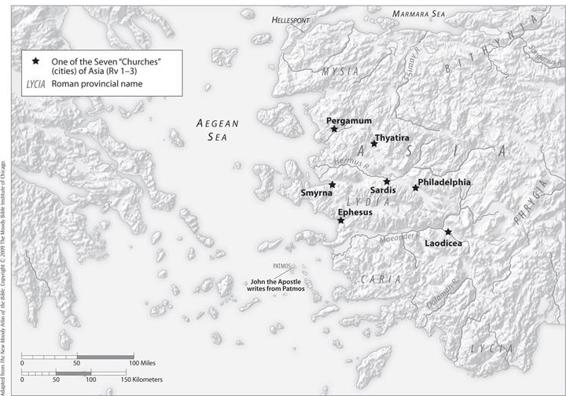
Recipients. John wrote to seven historic churches in Asia Minor, now known as Turkey (see map). The members of these churches are addressed in a counterclockwise order in chaps. 2:1–3:22: Ephesus, Smyrna, Pergamum, Thyatira, Sardis, Philadelphia, and Laodicea. This is the likely order in which they were visited by the courier who delivered the letter to them. While these fellowships may have been chosen only because of a burden on the apostle’s heart, some suppose that the choice was motivated by their relatively easy accessibility along main thoroughfares.
These believers were probably a mixture of Jews and Gentiles. They likely hailed from different socioeconomic backgrounds, including business owners, artisans, public officials, homemakers, and slaves. They lived among pagans who engaged in gross immorality and idolatry. The superpowers of Greece and Rome had dominated their cities for several centuries, taxing them heavily and setting up military garrisons within them.
Purpose. The purpose of the book is to comfort persecuted Christians, while exhorting them to persevere in faith, in light of Christ’s ultimate victory over the satanically motivated people of the earth. This thesis is supported by the prevalence of the overcomer (victor, conqueror) theme. Each of the seven churches is encouraged to seek the reward of those who overcome the temptation to apostatize under persecution (2:7, 11, 17, 26; 3:5, 12, 21). In addition, the Lamb Himself overcomes (5:5; 17:14), as do those who resist Satan (12:11) and the beast (15:2) during the last days. Overcomers will inherit eternal life (21:7). Understanding this emphasis is essential for a proper interpretation of the book. While Revelation provides much insight into events yet to transpire on earth, it was originally written to people in desperate need of faith and encouragement. All prophetic information is given in support of the main theme. In the end, the original readers would be vindicated if they remained in the faith, resisting idolatrous worship of the Roman emperor. Those who rightly understand that Revelation is essentially about the end of days need to be careful not to lose track of this emphasis in their justifiable interest in the details of events yet to come.
Seven Churches of Asia
Themes. While Revelation is written out of pastoral concern, it is also theologically rich. Its Christology pictures Christ as the ruler of heaven and earth (1:5, 14-20; 5:7-14; 11:15-16; 14:1; 15:2-4; 19:11-16; 20:1-6; 21:14; 22:3), the wrathful Lamb who destroys His enemies (6:1-8, 15-17) but saves those of faith (6:9-10; 7:10; 21:27; 22:17), and the kind shepherd and central focus of His people (7:17; 21:22-23; 22:3-5). The wrath of God the Father is also prominent (11:13, 19; 15:2, 7-8; 16:5-20; 18:4-8, 20; 20:11-15). The terror of the Great Tribulation (6:1–18:24) and the physical nature and spiritual activities of heaven (4:1–5:14; 7:9-17; 14:1-5; 19:1-10; 21:1–22:5) are spoken of more in this book than anywhere else in Scripture. There are also implications for social and economic justice (17:1–18:24). Abuses of power and economic advantage will be judged. Continuity with John’s gospel and epistles is also evident in such shared themes as the shepherd (Jn 10:10-11; Rv 7:17), the dangers and ultimate destruction of the world system (Jn 16:33; 1Jn 2:15-17; Rv 17:1–18:24), the demise of Satan (Jn 12:31; Rv 12:7-9), and the tabernacle of God among men (Jn 1:14; Rv 21:3).
The letter has certain characteristics of apocalyptic literature, such as symbolism and predictions concerning a cataclysmic end to the world. However, the author is identified, which is uncommon in such writings. More important is John’s own identification of the material as prophecy (22:7, 19). It is clearly not purely symbolic. It should be understood as prophetic narrative, which includes apocalyptic and epistolary elements.
There is no scholarly consensus as to the structure of the material. Plausible suggestions can be found in Blaising (cf. Craig A. Blaising, et al., Three Views of the Millennium and Beyond [Grand Rapids, MI, Zondervan, 1999], 206; Alan Johnson, Revelation, vol. 7, EBC, ed. Frank E. Gaebelein [Grand Rapids, MI: Zondervan, 1981], 414–15; and Mark Wilson, Charts on the Book of Revelation: Literary, Historical and Theological Perspectives [Grand Rapids, MI: Kregel, 2007], 31). This commentary will follow the outline implied by 1:19.
There are five enduring grids for interpreting the book:
The exclusively preterist view is that many of the events described in the book took place during John’s lifetime, and thus provided a contemporary description of events that the churches were facing. Typically, its adherents hold to an early date of writing and thus see the events described as coming to pass during the turbulent reign of Nero, although some see fulfillment still taking place as late as the fifth century. Thus, the images related to the enemies of God’s people, such as the beast (chap. 13) and the seven hills (chap. 17), are aligned with Rome and its pagan worship. Some extreme adherents believe that Christ came for the second time when Titus invaded Jerusalem in AD 70. This view was developed in the early seventeenth century and has enjoyed a resurgence of popularity in recent years.
The historicist view sees the events described in the book as a panorama of history from the time of John until the present. A form of this approach understands the seven churches of chaps. 2 and 3 as descriptive of the devolution of the fervent NT church (Ephesus, Smyrna) into the apostasy of the present day (Laodicea). A significant weakness of this position is its Eurocentric view of Church history as well as the constant need to reinterpret data in light of new developments.
The idealist view takes the details of the book as a general description of the battle between good and evil as it continues into the present Church Age. There is little attempt to associate the details of the book with any specific events of the past or future. This spiritualizing approach simply focuses on the ultimate triumph of Christ over the forces that oppose Him and His kingdom.
The preterist/futurist view (also known as the “eclectic” view) interprets Revelation as being especially pertinent to John and his readers while at the same time showing how their first-century setting has parallels with the future. One of the difficulties with this approach is the need for seeing multiple referents in virtually every part of Revelation after chap. 4 (a first-century fulfillment and a future, eschatological fulfillment). If this is John’s approach, he gives few clues to indicate he expected his readers to look for multiple temporal and referential layers in his book. This approach also tends to confuse the book’s meaning and its significance (the relevance of Revelation for John’s original readers and the Church in any generation).
The futurist view, while focusing on the purpose of the book for the original audience, still holds that chaps. 6–22 will be fulfilled literally in the future. Thus, the details of these chapters will be worked out in real events yet to come. It is the view adopted in this commentary.
For a survey of some contemporary approaches see C. Marvin Pate, et al., Four Views on the Book of Revelation, Grand Rapids, MI: Zondervan, 1998, 17–34.
COMMENTARY ON REVELATION
I. The Things That Were (1:1-20)
A. The Greeting to the Seven Churches (1:1-8)
1:1-3. The content of the book was revealed by Jesus Christ (v. 1). The transmission of the material began with God the Father and was given progressively to Jesus, an angel, the apostle himself, and finally the seven churches of Asia Minor. Blessings were promised for the one who would read the prophetic scroll to the various congregations, as well as to those who would hear and obey its teachings. For the time is near (v. 3) gives the motivation for living in obedience: Christ may return at any time and when He does, He will hold men accountable for the lives that they have lived. There are no events that must transpire before the rapture of the Church, which introduces the last phase of earth’s history.
1:4-8. John issued a greeting to the churches in the name of the triune God. The words from Him who is and who was and who is to come (v. 4) describe the eternality of the Father. He is everlastingly existent, unbounded by time. The phrase the seven Spirits may refer to angels, but it more likely describes His spiritual perfection, or perhaps that of the Holy Spirit. The number seven appears 54 times in the book and has to do with what is flawless or complete. Some take this as an allusion to Is 11:2, but only six attributes are present there. It more likely refers to His intense interest in, and ministry through the Holy Spirit to the seven churches. Jesus is said to be the faithful witness, the firstborn of the dead, and the ruler of the kings of the earth (v. 5). He can be trusted as He reveals the things to come. The second phrase refers to the priority of His resurrection (1Co 15:23), which anticipates that of all Christians in the rapture (1Th 4:13-18). That He presently rules over the world from heaven may have been a comfort to the first-century church, which was so mistreated by Domitian and other Roman officials. He had not lost control. He had freed them from their sins by shedding His blood on the cross (a description of redemption). He had also made them a kingdom, priests to His God (v. 6). Although the Church and Israel are distinct peoples of God, there are yet similarities. OT Israel was a physical people of God, a kingdom of priests (Ex 19:5-6), whereas the Church is a spiritual kingdom of believer-priests who offer spiritual sacrifices to God. Perhaps their notable status in God’s eyes encouraged early believers surrounded by pagan worship and false priests. It certainly elicited praise from John, who pens a mini-doxology to the One who reigns forever. BEHOLD, HE IS COMING (v. 7) begins a quotation that combines elements of Dn 7:13-14 and Zch 12:10. This cannot, as some claim, be narrowed to the Roman invasion of Jerusalem in AD 70, as John conceives of the “tribes” in a universal sense (5:9; 7:9; 11:9; 13:7). When Jesus the Messiah returns, He will cause great consternation for both Jews and Gentiles who have rebelled against Him. This paragraph ends as it began with God’s statement of His own greatness. The Alpha and the Omega are the first and last letters in the Greek alphabet and emphasize both His sovereignty (Is 44:6-7) and eternality.
B. John’s Vision from Patmos (1:9-20)
1:9-11. John comforted the churches by recognizing them as fellow sufferers. Like them, he had paid a price for speaking the truth about Jesus (v. 9). Writing from the stark environs of Patmos (see introduction) he was in the Spirit (v. 10), referring to the divinely induced state of the prophet as he received his vision from Jesus. The phrase the Lord’s day is commonly understood to mean Sunday. More likely here it refers to John being carried by vision to see “the day of the Lord” or perhaps, since the word for Lord is an adjective, it may refer to a “Lordly day” or a day characterized by being filled with the Lord’s presence. Nevertheless, the vision came with instructions to record it in writing for delivery to the seven churches.
1:12-16. John’s vision next focused on supreme majesty. Jesus Christ appeared in His heavenly splendor. He stood in the midst of the seven golden lampstands (v. 12), the seven churches who were to be light to their world (v. 20). The apostle recorded numerous aspects of His appearance. He was dressed in a manner worthy of royalty and priesthood as He tended the living lamps. As Messiah, He has now been glorified with the Father (Jn 17:4-5). White hair (v. 14) signifies His wisdom and commands respect, and blazing eyes suggest purity and judgment. His bronze feet (v. 15) were ready to trample His enemies should they not be devoured by the sword in His mouth (Is 11:4).
The description of the exalted Jesus here is similar to the description of the Ancient of Days in Dn 7. Perhaps the Son is described as possessing the Father’s glory here because He has been glorified in answer to His own prayer in Jn 17:4-5: “Glorify Me together with Yourself, with the glory which I had with You before the world was.” His face shone with the glory of His perfections, and He spoke with overwhelming power. Different parts of this description are reiterated in the letters to the churches (e.g., for His flaming eyes, cf. 2:18), probably to encourage them with a different aspect of His authority and power based upon the church’s needs. Most comforting was the picture of the seven stars (v. 16) in His hand. These stars were “angels” as seen in v. 20. Another permissible translation here could be “messengers.” This is preferred as the word most likely refers to responsible human leaders of these churches as held in the hand of God during perilous times (Dn 12:3), rather than to spirits. These messengers appeared to have responsibility for the spiritual oversight of the church, making it unlikely that these are angels, and it is equally unlikely that God would use a human agent (John) to communicate with angelic beings. In addition, the imagery may be a polemic against the seven stars of the Imperial cult, which appeared on Domitian’s coins.
1:17-18. John was momentarily paralyzed before the majestic presence. However, Christ assured him with a touch. Referring to His eternal resurrection life, He asserted His sovereignty over death and destinies.
1:19-20. Jesus gave John the outline of what He was about to reveal, along with a general interpretation of the symbols of vv. 12 through 16.
II. The Things That Are (2:1–3:22)
The seven churches are addressed here. They have a common structure that includes: (1) a greeting, (2) commendations, (3) corrections, (4) an exhortation to repent, and (5) a promise of reward for those who overcome. Most are also encouraged by some aspect of Christ’s character from 1:4-20.
A. The Message to Ephesus (2:1-7)
2:1-7. The church at Ephesus had a rich spiritual heritage, as a host of people had repented of occult practices at the time of their conversion under the preaching of the apostle Paul (Ac 19–21). The city itself was past its prime, its once bustling harbor having become filled with silt as a result of deforestation. To compensate for the lost business, the city had turned to religious tourism that involved fertility rituals and cult prostitution at the temple of the goddess Artemis. Jesus commended this church for its enduring service in such an environment. In 1:16 Jesus was described as holding the seven stars in His right hand and walking among the seven lampstands, a description reiterated here. This description implies His intimacy with the Ephesian church, an intimacy that they, however, had abandoned (v. 4). They had maintained doctrinal integrity, refusing to tolerate false teachers whom they put to the test with Scripture. They had also rejected the deeds of the Nicolaitans (v. 6). This may refer to an early clerical hierarchy, but should more likely be understood as a group that promoted sexual promiscuity. Church fathers such as Irenaeus and Tertullian equated them with antinomian gnostics. Despite maintaining doctrinal purity the church had lost its heartfelt love for the Lord. If this coldness did not change, they faced the potential end of ministry usefulness. A wonderful future in heaven, the Paradise of God (v. 7), awaited those who would overcome temptation to leave the faith.
B. The Message to Smyrna (2:8-11)
2:8-11. Smyrna was a beautiful and important seaport boasting a population of about 200,000, quite large for its time. It was a center for science and medicine, and the birthplace of the noted author Homer. It was also a regional center for emperor worship in the first century, whose citizens were expected to burn incense to Zeus once a year. As the one who conquered death (the description of Jesus in 1:17-18 is reiterated here), Christ would enable them to conquer death that might come to them through persecution and receive the crown of life (eternal life, v. 10). The church itself was commended for its deep spirituality (you are rich) (v. 9) in the context of persecution and financial loss. Perhaps they had lost opportunities for income because of their faith. Antagonistic Jews, the synagogue of Satan, had made life difficult for them, and the Devil had instigated the imprisonment of some. This church is the only one of the seven not to receive correction. Be faithful until death (v. 10) indicates the extent to which the believers were expected to persevere. Under no circumstances could apostasy be excused. This should be a sobering lesson for modern believers tempted to leave the faith. The Smyrnans who persevered in their professions of faith would receive eternal life, symbolized by the crown of life. Such overcomers would not experience the second death (v. 11), that is, hell.
C. The Message to Pergamum (2:12-17)
2:12-17. Pergamum was an important buffer state for Rome, and had thus contributed to the Roman victory at the battle of Magnesia several centuries earlier. The people worshiped Caesar and the spirit of Rome, earning the distinction from Jesus as a place where Satan dwells (v. 13). As the One who has the sharp two-edged sword (see this description in 1:16), Jesus Christ will judge those who killed His people (v. 13; cf. the sword by which He judges His enemies in 19:15), a point that would encourage these believers. The church in the city received a commendation for ultimate bravery in the face of potential martyrdom, following the model of Antipas’s endurance during the days of persecution under Domitian (AD 89–96). According to Christian tradition, John ordained Antipas as bishop of Pergamum, after which Antipas was burned to death on a pagan altar in AD 92. Yet they had compromised significantly by allowing false teaching and immorality among them. On Balaam (v. 14), see the comments on Nm 22:1–25:16; 31:15-16. John parallels this instruction with the perverted doctrine of the Nicolaitans among the Pergamese. Jesus commanded the believers to repent of sexual immorality and idolatry (for Christian involvement in idolatry, see the comments on 1Co 8 and 10), which were bound together in pagan rites, lest He come against them with a sword (v. 16). Overcomers would receive hidden manna (v. 17), that is, spiritual blessing. The parallel with the wilderness account continues here. As the people of Moses’ generation received food from heaven, which sustained them, so Christians receive spiritual sustenance from on high. Those who persevered were promised a white stone, which is perhaps an invitation to a banquet in heaven, and a new name, known only to God and themselves. The modern church should consider why its orthodoxy has not resulted in more consistent sexual ethics among its members. Followers of Christ should live in the fear of God and in anticipation of a glorious future.
D. The Message to Thyatira (2:18-29)
2:18-29. Thyatira was an important communication center that had been founded after the death of Alexander the Great by one of his generals, Seleucus. Macedonian military garrisons were subsequently stationed there, leading to the worship of a local patron warrior by the populace. Its vigorous commerce was founded on bronze and a valuable purple dye culled from plant roots. A devout businesswoman, Lydia, was from this city, and had been instrumental in the founding of the church (Ac 16:11-15, 40). The description of Jesus in 1:14-15 is recapped here, with the eyes like a flame of fire (emphasizing His ability to search the minds and hearts [v. 23] of all and to see the secret immoral deeds of Jezebel and those she misled) and feet … like burnished bronze (which may suggest both His strength and purity—like refined metal—whereby He judges His enemies). This description would motivate the believers in Thyatira to reconsider their sinful actions. He commended them for their overall spiritual growth and mentioned several fine attributes that they possessed. His attention turned quickly to their unacceptable toleration of Jezebel (v. 20), a false prophetess who had led them into sins similar to those being committed at Pergamum. This false teacher is named symbolically after the notorious Sidonian princess who incited Israel to worship Baal and Asherah after her marriage to King Ahab of Israel (1Kg 16:30-33; 21:25-26). The Lord threatened a bed of sickness and great tribulation for her and her followers should they not repent (v. 22). God knows all and promised to be gracious to those who did not partake of the deep things of Satan (v. 24). Those not dabbling in the occult would overcome and receive authority over nations (vv. 26-27). This reference to Ps 2 revealed an exhilarating truth. Believers who persevered in faith would be co-rulers with Christ in the millennial kingdom. They would also know Jesus intimately, the morning star (Rv 22:16). He is the brightest star in the entire galaxy (cf. the comments on Nm 24:17) and will cause His faithful followers to shine brightly in the messianic kingdom as in Dn 12:3 (Robert L. Thomas, Revelation 1–7: An Exegetical Commentary [Chicago: Moody, 1992], 2:510, 1:235). Neither ancient Rome, nor any other power would have ultimate victory over the people of God.
E. The Message to Sardis (3:1-6)
3:1-6. Mints for gold and silver provided significant revenue for Sardis, a city otherwise past its commercial prime. Rebuke characterized the address to this church. Its spiritual reputation exceeded reality, as its members were showing no sign of spiritual life (v. 1). As possessor of the seven Spirits (1:4), probably a reference to His spiritual completeness, Jesus is displeased with their spiritual deeds, which had not been completed (v. 2). Should they not repent, Jesus would come upon them suddenly (v. 3), as had Cyrus the Persian who conquered the city in 549 BC by scaling its rear wall. Some believers were commended, though, for not polluting themselves (v. 4), presumably a reference to their maintenance of moral and doctrinal integrity. Overcomers (v. 5) were promised fellowship with Jesus and white garments, visible rewards for faithfulness. The book of life is best understood figuratively. Genuine believers are known to the mind of God. This figure should not be pressed to suggest that every person starts out in a positive relationship with God, losing such status only in the event of heinous sin. Rather, it emphasizes the security of the faithful, with whom Jesus will gladly identify before the Father and the heavenly host.
F. The Message to Philadelphia (3:7-13)
3:7-13. Attalus II Philadelphus founded Philadelphia in 159 BC during his reign as the king of Pergamum. The citizenry changed the name for a short time to Neocaesarea after Rome sent financial aid following an earthquake in 17 BC. It was considered the cultural gateway to Asia. Jesus uses this gateway status, referring to Himself as the One who opens and no one will shut, and who shuts and no one opens (v. 7). He is sovereign over who is admitted to His kingdom. He holds the key of David, an allusion to Is 22:22. The OT context records God’s assurance to faithful Eliakim that Shebna would not be able to usurp his place in Israel. Similarly, the synagogue of Satan (v. 9) would not be able to frustrate God’s intended blessing of this church. It is difficult to identify the synagogue of Satan. It may be a harsh reference to unbelieving Jews who, by their opposition to the gospel, had become unknowing servants of Satan. But they may have been Gentiles who had been circumcised (who say that they are Jews and are not) and now are trying to force this teaching on other Gentiles. It is important to read this without the grid of 2,000 years of the Church’s anti-Semitism. The writer himself was Jewish and sees a glorious future for his fellow Jews. Whatever their precise identity might be, the phrase who say that they are Jews and are not refers to their failure to be spiritually fulfilled in Messiah (Rm 2:28-29). Tragically, their only connection to Jesus was a shared bloodline.
At some future point all who reject Christ, Jew and Gentile, will bow at the feet of God’s children and acknowledge the believers’ victory. This may be at the judgment of the sheep and goats prior to inauguration of the millennial kingdom (Mt 25:31-46). The faithful Philadelphian church had followed Scripture and refused to deny Christ. I also will keep you from the hour of testing (v. 10) is His promise to them. The meaning of this phrase has been extensively debated, giving rise to three major interpretations: (1) This is a promise specific to the Philadelphians and thus has no broad future application, a view rendered unlikely by the presence of the phrase the whole world. (2) It assures believers that they will be preserved while going through the great tribulation, a view supported by parallel grammar in Jn 17:15. Then (it is argued by posttribulationists) believers remain in the world but are kept from the evil one, just as believers remain on earth during the tribulation but are kept from, or will not be the objects of, God’s wrath. While Jn 17:15a does indicate that believers are not “removed from [“out of,” ek] the world” after Christ’s ascension, they are however “kept [i.e., “preserved”] from [“out of,” ek] the evil one” (Jn 17:15b). John 17:15 indicates that believers are “in Christ” but never “in the evil one.” Judging from the similar wording in Rv 3:10, Christians will likewise not be “in the hour of testing,” i.e., they will not be present on earth during the future tribulation. (3) It provides assurance that no Christian will be present during the future tribulation. This is the most natural interpretation and the simplest translation of the word ek, although it requires that there be a different set of new converts during said tribulation. There was no rebuke for this faithful church, which was encouraged to persevere and receive the crown as a reward (v. 11). Each would also become a pillar in the temple (v. 12), a phrase suggestive of eternal life with God. Pillars were often the last part of a temple left standing during the frequent earthquakes in the city. The new Jerusalem, a literal heavenly city, would be their ultimate destiny.
G. The Message to Laodicea (3:14-22)
3:14-22. Laodicea was on the south bank of the Lychus River, 100 feet above the water. It had a weigh station related to extensive Roman shipping to Syro-Palestine, and was also known for the production of eye medicine and wool. There was a significant Jewish population among the Greeks, as 2,000 families had been settled there centuries earlier following deportation from Babylon. The One who was a faithful and true Witness (1:5) wanted to see more followers like Himself in the city. Jesus spoke to the congregation as the Beginning of the creation of God (v. 14). While false teachers through the centuries have taken this as proof of a beginning point for the existence of the Second Person of the Trinity, such understanding is ruled out by the assertion of His eternality in 1:8 and 1:18. The phrase means that Jesus is preeminent. Beginning (Gk. arche) means “originator,” “initiator” (cf. Rv 22:13; Col 1:27), and refers to one who constitutes an initial cause and thus is preeminent. He is the Lord of all creation. No commendations were given to this church. Instead, they were censured for being lukewarm (v. 16). Christ wanted them to be either cold or hot. Both words are positive in context. Like the healing hot springs near Hieropolis, and the refreshing cool springs in Colossae, their testimony was to demonstrate positive attributes. Their spiritual apathy instead mirrored the tepid water of their city. Verse 17 is an ironic rebuke to those whose confidence in money and medicine had left them bankrupt and blind spiritually. They did not recognize their deepest needs. This should be a correction to contemporary ministries that focus only on the surface needs of people and not their deeper spiritual needs as well. The Laodiceans were encouraged to return to the Lord, who would direct them into keen insight and works worthy of reward. They needed to see Jesus’ rebukes as an act of loving concern. If anyone hears My voice and opens the door (v. 20) is not best understood as an evangelistic invitation. The Laodicean congregation, like all the churches addressed, consisted of Christians. Only intimates shared meals in the ancient culture, so the appeal was for deeper spiritual fellowship. An amazing promise was given to the one who overcomes. Like the faithful in Thyatira, he would be given co-regency with the Son in the messianic kingdom (v. 21). Rather than being dominated by Roman rulers, persevering believers would enjoy royal status.
III. The Things That Will Be (4:1–22:21)
A. The Father and the Lamb in Heaven (4:1–5:14)
These chapters look to the future for the first time in the book and contain John’s initial description of heaven. He was caught up in a vision where he saw the Father and the Son in the midst of a host of angels. The Father received praise for His creation of the world, and the Son for His redeeming work on the cross. The original readers would have been comforted by understanding that, while their world was most uncertain, heaven was properly focused and stable.
1. The Vision of the Throne (4:1-11)
4:1. Some see Come up here as a reference to a pretribulational rapture of the Church. It is better understood as God’s call to John to behold the next vision (see 6:1, 3, 5, 7). He was invited to look through a door in heaven to see events that were yet future.
4:2-3. While in the Spirit (see 1:10), he saw a throne. Seated there was a theophany, a veiled appearance of God the Father. John describes His beauty and majesty without ever mentioning His name. He likens his appearance to jasper (a translucent, diamond-like stone) and a carnelian (a fiery red stone). The emerald rainbow (Gn 9) may suggest that God will not depart from His faithfulness to Israel in the coming tribulation.
4:4-11. Twelves, or multiples thereof, in Scripture (e.g., elders, tribes of Israel, and disciples of Jesus) often indicate order or administration. These twenty-four beings (v. 4) recognized God’s sovereignty. Some scholars have understood them to be representatives of the Church in heaven, as the term elders is often used of church leaders who may also receive crowns for service (1Pt 5:1-4). In addition, saints may be rewarded with white garments for the same (Rv 19:8). Others see the beings as angels, a position supported from Johannine literature, which describes angels in white garments (Jn 20:12), and angels (albeit evil), who wear crowns (9:7). The second interpretation is supported by the parallel between the explanatory work of an elder in 7:13-14 and that of angels elsewhere (e.g., 10:8-11; 17:1), John calling an elder “my lord” in 7:14 (making it likely that this is a supernatural being, not a redeemed human), and the apparent distinction between the elders and the bride of Christ (the Church) in 19:4-10. These elders are probably angelic beings.
Terrifying sounds (lightning, thunder, and rumbling, v. 5) coexisted with the complete tranquility suggested by a crystal sea (v. 6). About the throne of God appeared angels of the cherubic order (v. 6; see Ezk 1:4-24; 10:10-22). They each had four different faces, six wings, and eyes all around, perhaps signifying their unceasing attention to the throne. In the center suggests that these angels surrounded it, front and back. Praise was on their lips as they spoke the familiar refrain, acknowledging God’s eternality (1:8), while also praising His holiness. They called Him ALMIGHTY (v. 8). This name of God appears only nine times in the NT, eight in Revelation (1:8; 4:8; 11:17; 15:3; 16:7; 16:14; 19:15; 21:22; and 2Co 6:18). These various kinds of angels shared a most expressive adoration for their maker. Having praised Him with their lips, they fell before the throne of the Eternal One, yielding their sovereignty to His in the casting of their crowns (v. 10). Their focus was on one particular work of God, His creation. They recognized that because God had made everything in the universe, it was rightfully His. Because all creation existed via the exercise of His will, God was hailed as worthy of the honor due eternal majesty (v. 11). He was constantly praised. Believers are created beings that have no right to act independently but should rather humbly submit themselves to their Maker.
2. The Vision of the Lamb (5:1-14)
5:1. The new chapter moves from the focus on John’s vision of the enthroned Father to his vision of the Lamb. Here, the Father held an opisthograph, a document with writing on both sides. Its seven seals may communicate authority and importance. Seals were normally lines of clay or wax that secured a scroll at certain places, and warned those without authority not to access the contents. The wills of both Augustus Caesar and Vespasian were marked in such fashion according to Roman law.
5:2-4. A mighty angel called attention to a problem. It would take a special person to open the document. He would need to be worthy (v. 2), bearing the requisite authority. The reference to opening continues the theme of 4:1. God was revealing the secrets of the inner sanctum: Himself, His dwelling place, and His plans. However, it appeared at first that no one in all creation could open the scroll (v. 3), which caused the apostle to weep profusely (v. 4). His deep desire for insight was frustrated by the inability of anyone to unseal, much less decipher, the letter.
5:5-6. John was soon comforted by one of the angelic elders who pointed him to a heroic figure, One who has overcome (v. 5), having earned the right to break the seals. This One, the second person of the Godhead, was described under the metaphors of Lion … from the tribe of Judah, and Root of David. The first term pictures Him as a Hebrew and the fiercest of a fierce and royal tribe (Gn 49:9-10). The second reiterates this physical and royal descent while connecting Him with David, himself a royal offspring of Judah, and recipient of a covenant ultimately fulfilled by the Root who now appeared (2Sm 7:12-16). His victory connected Him with His followers among the seven churches who had been charged to overcome in the midst of great difficulty. John’s attention was riveted on the one who appeared as a slaughtered lamb. The form of the word Lamb (v. 6) used here suggests smallness, but does not imply cuteness, a concept foreign to the Greek mind. Perhaps it is employed to inspire awe in Christ who is at once both immensely powerful and uncommonly gentle. The presence of horns on the lamb may have suggested messianic character, since horns often describe dominion (cf. the comments on Dn 7:7-24). But reference to the Paschal Lamb may also be implied (Jn 1:29; 19:14, 31-46; 1Co 5:7). Seven eyes indicate omniscience, by which He kept track of all events transpiring on earth, and read the attitudes of the human heart.
5:7-10. These verses constitute the structural center of the chapter. They stress the Lamb’s authority, demonstrated as He came from the midst of the angelic throng to receive the scroll from the Father’s hand (v. 7). The angels, having fallen prostrate in worship, each possessed a harp and golden bowls full of incense (v. 8). The former suggests their inclination to musical worship. This is affirmed by the number twenty-four, which parallels the orders of worshiping Levites in 1Ch 25:6-31. The bowls likely held not general prayers, but cries for justice from the mouths of brutally martyred saints (6:9-11). In time they would be emptied, as God’s righteous wrath was expressed against their tormentors. The redemption of which the host sang implies a purchase made, in this case at the cost of the Lamb’s blood shed on the cross. Every tribe (v. 9) does not guarantee universal salvation, but does imply that a vast spectrum of people will benefit eternally from the work of the cross. These will represent the Lamb as a kingdom and as priests (v. 10). The words reign upon the earth make an important point. Believers will reign for and with the Lamb not only in heaven, but also on earth during the millennial kingdom (3:21; 20:4; 21:1-3).
5:11-14. Since a myriad is equal to ten thousand, it was literally millions of angels who proclaimed the worthiness of the Lamb to receive boundless praise (v. 11). Every created thing (v. 13) indicates that even the lost will be compelled to praise the Lord (Php 2:9-11). The focus is shared by the Creator Father and the Redeemer Son. Modern believers should understand that the doctrines of creation and salvation are inseparably connected. It is theologically inconsistent to embrace the latter while failing to fully embrace the biblical teaching on the former as well. The God who created all things in a perfect and mature state (Gn 1:25, 31) is the same One who provides for the redemption of that creation after the fall (see the comments on Rm 5:12-21; 1Co 15:45-49).
B. The Seal Judgments (6:1–8:5)
These chapters are part of a larger section (6:1–18:24) that describes the tribulation, during which God will exercise His wrath toward rebellious sinners, and work to bring Israel to repentance. This section assured first-century believers that persecutors of God’s people would not ultimately escape justice. Seals, trumpets, and bowls are labels John used to describe the judgments of this time period.
Their sequence is debated. Some scholars hold to a recapitulation, or reiteration, theory, that is, that there is one set of judgments, which is described three different ways. Others believe that there are three separate and consecutive sets of judgments. Insofar as the seventh seal contains the trumpets (8:1-6), and the seventh trumpet anticipates the bowls (11:15-19; 16:1), there is some reiteration. Yet, for the most part, the plagues unfold in a consecutive manner and intensify as they progress (see the reference to one-fourth of the population dying in 6:8, while the fraction is one-third in 9:15). This understanding of the arrangement parallels OT judgments (e.g., Ex 7–11). This chronological progression is interrupted, however, by a number of interludes that describe events without reference to time (7:1-17; 10:1–11:14; 12:1–14:8). John’s description of the seal judgments appears to parallel the teaching of Jesus in the Olivet Discourse (Mt 24:4-31).
1. The First Six Seal Judgments (6:1-17)
a. The First Seal—Conquest (6:1-2)
6:1-2. The Lamb now exerted His authority in opening the first seal. Some see a white horse, and he who sat on it (v. 2) as a reference to the conquering Christ, which is consistent with the overcomer theme. Nevertheless, given the negativity associated with all of the other riders, this one is best understood as the conquering beast, the evil ruler of the tribulation period (Dn 9:26-27) who is a wicked parody of Jesus. He would establish sovereignty by force.
b. The Second Seal—War (6:3-4)
6:3-4. The opening of the second seal revealed a red horse (v. 4), suggesting the bloodshed of war. The people of the world turned on one another as peace was removed. The size of the sword suggests great human loss.
c. The Third Seal—Inflation and Famine (6:5-6)
6:5-6. The black horse is emblematic of death. The scales could represent either judgment in general, or the instrument used to weigh the terribly scarce food. The second view is rendered likely by the voice from among the angels that announced vastly inflated prices. Although estimating such inflation across millennia is difficult, it is probably at least 1,000 percent. Barley was filler, mixed with other foods by the poor. Common staples such as oil and wine are pictured as far beyond the financial reach of most people. A universal famine would come upon the earth.
d. The Fourth Seal—Death (6:7-8)
6:7-8. Death is personified as a rider upon the fourth horse. Hades was on his heels. These terms are often coupled in Revelation (1:18; 6:8; 20:13-14). While the latter is sometimes used in Scripture for the place of the dead in general, its use elsewhere in the book suggests eternal loss (for this, see the comments on 20:13-15). The ashen color of the steed suggests putrefaction of human flesh. It could be that the horrific magnitude of human loss, one quarter of the earth’s population, will render timely burial impossible. Sword, famine, and pestilence summarize the second, third, and fourth plagues. The destruction caused by wild beasts may point to the complete upheaval of creation order that will characterize the time period.
e. The Fifth Seal—Martyrdom (6:9-11)
6:9-11. The fifth seal calls for special attention because its focus is not on judgment but on martyrs. These had been slain (see 5:6) for their faithfulness to God and His Word (v. 9). Their imprecatory prayer (v. 10), a cry to God for vengeance against their adversaries, is strategic to John’s theme, and the book indicates that one of the reasons for God’s judgment against the world during the tribulation is the murder of tribulation saints (see 8:3-5; 16:7; 18:20). While God delayed in the execution of judgment, it would come in due time. Those who remained faithful until death would receive white garments in heaven as a reward (v. 11), and their prayers would be answered. These verses must have been a great comfort to the churches of the first century who suffered under Roman tyranny.
f. The Sixth Seal—Cosmic Upheaval (6:12-17)
6:12-17. The sixth seal anticipates cosmic upheaval. Exhaustive metaphors describe the disturbance of the heavenly bodies (vv. 12-14). The rebels of the earth, small and great, would be terrified by these events, which the prophets foretold (v. 15; see Is 2:19-21; Jl 2:30-31). There would be nowhere to hide from the righteous Father and the wrathful Lamb. The prayers of the martyrs would indeed be answered. Pre-wrath rapture proponents find the rapture here, just before the manifestation of God’s wrath in 6:17. This is unlikely for a number of reasons: (1) The church is said to be altogether exempt from the time period (see the comments on 3:10). (2) A fine distinction between the impact of God in the earlier and later seals cannot be sustained since Christ is the author of all of them (6:1, 3, 5, 7, 9, 12). The whole period is a period of God’s wrath. (3) It is very unlikely that the broad language of v. 15 allows for the exclusion of all believers. (4) The chronology of the seal judgments appears to place them in the first half of the tribulation, thus indicating that the entire tribulation contains God’s wrath, not simply the latter portions of it as required by the midtribulational, pre-wrath, and posttribulational approaches. While John often emphasized love in his writings, he did not hesitate to mention the severity of God toward the rebellious. Many modern believers should develop a more balanced view of their Lord.
2. The Interlude about the Faithful of the Tribulation (7:1-17)
The first interlude of the book develops the contrast between the peril of the godless inhabitants of the earth and God’s faithful. The former would experience desperation and destruction, while the latter would enjoy protection on earth and exhilarating worship in heaven.
a. The 144,000 Jewish Believers Serving on the Earth (7:1-8)
7:1-3. Four angels were commissioned to delay the winds of judgment until God’s bond-servants could be sealed for protection. The seal indicates God’s ownership and thus protection by God. No more judgment would be exacted against the earth until their safety was assured. They seem to be the answer to the critical question posed in 6:17. These can withstand the wrath of the Lamb because they are rightly related to the Father and bear His seal upon their foreheads. They appear in stark contrast to those who are later seen as identifying with the beast by accepting his mark (13:16).
7:4-8. The number of the bond-servants was 144,000, representing 12,000 persons from each of the twelve tribes of Israel (v. 4). There are notable differences in this tribal list when compared to 18 others found in Scripture. Judah is placed first, perhaps because the Messiah is descended from it. Dan and Ephraim, present in Gn 49, are omitted. Levi, absent from some later lists, is included. It may be that Dan and Ephraim are excluded for having participated in idolatry (Dt 29:18-21; Jdg 18:30-31), while Levi is included since its inheritance has always been to minister before the Lord. Attempts to interpret the numbers in this paragraph as symbolic of the Church are unjustifiably arbitrary. For example, one approach is to view the 144,000 as derived from the numbers 12 × 12 × 10 × 10 × 10, expressing the completeness of salvation and thus, of necessity, referring to the Church (see Christopher R. Smith, “The Tribes of Revelation 7 and the Literary Competence of John,” Journal of the Evangelical Theological Society 38 [1995]: 215). But this fails to draw the clues from the text of Rv 7 itself regarding the constituency of the 144,000. A more natural reading is that literal Israel is in view (John does specify 12 tribes × 12,000 from each tribe—tribes that he explicitly names), in literal numbers, even as Dan, Ephraim, and Levi are assumed to be literal.
b. The Nations Worshiping in Heaven (7:9-17)
7:9-12. The meaning of after these things (v. 9) is not clear. It may connect the innumerable persons gathered before the Father with the bond-servants above. Were the 144,000 evangelists who had witnessed to the great throng? Perhaps it is better to take the words as simply shifting the focus to a new scene in heaven. Their white robes may indicate martyrdom (6:11). Palm branches were often instruments of praise (see the comments on Mt 21:4-9). Their song blessed and thanked God for His perfections.
7:13-17. A rhetorical question leads to the identification of the multitude (v. 13). Their white garments identify them as beneficiaries of redemption through the shed blood of the Lamb (v. 14). Assuming that the rapture of the Church occurs before the tribulation (see 3:10), these must be converted after its onset. Their sudden appearance in heaven suggests that they are martyrs. They would never suffer again. Rather, they would enjoy eternity with the One who sits on the throne (v. 15). Every physical and spiritual need would be met by God the Father who will shelter them. The very center of their existence would be the Lamb, their shepherd (v. 17). He would tenderly lead them to ultimate refreshment (Ps 23:1-2; Jn 10:1-8) and wipe every tear from their eyes, bringing relief from the terrors that they had suffered for Him on the earth. The persecuted believers of the seven churches no doubt took great comfort from this passage. Should they suffer at the hand of Domitian, they too would one day experience ultimate blessing with the Lamb. Until then, they would have to persevere. Modern believers should take note that suffering in this life, be it physical, emotional, or spiritual, will one day yield to unfathomable bliss. What an encouragement!
3. The Seventh Seal Judgment (8:1-5)
8:1. This verse connects the first two series of judgments. The silence in heaven is striking, considering the extraordinary activity and noise in the previous heavenly scenes. Silence in Scripture indicates respect, submission, and anticipation (Hab 2:20; Zch 2:13; 1Co 14:34). Here it is, according to Alan Johnson, “silence before the great storm of God’s wrath” (Revelation, 488). The seventh seal has no content of its own. Rather, it contains and serves to introduce the trumpet judgments.
8:2-5. Seven angels were given trumpets to announce the outpouring of God’s anger. The prayers of the saints were mixed with incense before the throne of God (vv. 3-4; see Ex 30:1-5). These were prayers for vindication before their enemies (6:10), used to stoke the wrath of the First Person. God responded with a fearsome display of anger, through lightning and an earthquake (v. 5).
C. The Trumpet Judgments (8:6–11:19)
8:6. The seven angels now prepared … to sound them, each indicating another set of judgments, each with increasing intensity. These judgments take place after the seal judgments (Rv 6–7), probably in the last half of the tribulation. The events associated with the trumpets strongly parallel those of the exodus, albeit on a vastly wider scale.
1. The First Six Trumpets (8:7–9:21)
a. The First Trumpet—Earthly Destruction (8:7)
8:7. The first trumpet (Ex 9:17-26) consisted of a horrifying mixture of elements that were cast upon the earth. These destroyed one-third of the remaining vegetation, intensifying the famine.
b. The Second Trumpet—Aquatic Destruction (8:8-9)
8:8-9. The sea was struck next (Ex 7:20-25), wrecking havoc with marine life and human commerce. A great mountain burning with fire likely describes a colossal meteor hurled into the sea by God. Fully one-third of all life in the sea would be lost, and a region bearing one-third of the world’s saltwater bodies would be affected. The extinction of aquatic life would be so extensive as to taint the sea red with its blood. A major food source would vanish, and untold numbers of ships would perish along with their crews. The latter may have borne particular significance to early believers dominated by a great naval power like Rome.
c. The Third Trumpet—Water Pollution (8:10-11)
8:10-11. The third trumpet announced the pollution of earth’s fresh water supply by the star Wormwood. Like the embittering tree bearing its name, it would foul the taste and purity of the world’s most essential resource. Many fatalities would follow.
d. The Fourth Trumpet—Light Destroyed (8:12)
8:12. As an angel blew the fourth trumpet, John saw cataclysmic damage taking place among the heavenly bodies. The natural result of such an occurrence would be unprecedented darkness day and night, as well as unbearable cold. The believers in the seven churches may have thought of the ancient Egyptians who suffered greatly for resisting God’s command to free His people Israel (Ex 10:21-29).
e. The Fifth Trumpet—Demonic Affliction (8:13–9:12)
8:13. A soaring eagle then pronounced triple woe upon the earth, an anticipation of the last three trumpet blasts. The eagle may symbolize an angel (4:7; 14:6, where an angel is said to be flying in midheaven), the comparison coming perhaps from flight and from eagles hunting their prey (as this angel may participate in judgment against the world). This added emphasis, along with pregnant statements in 9:12 and 11:14, signaled that the worst of the judgments were yet to come. The parallel wording of 8:13 and 3:10 may be meant to contrast the fortunes of God’s friends and enemies as judgment visits the planet.
9:1-12. The apostle next turned his attention to a star from heaven … fallen to the earth (v. 1), a probable reference to an angel (Jb 38:7) cast out of God’s presence. This wicked angel was allowed to release the inhabitants of an abyss who are identified as locusts (v. 3). This is but a figurative description of the innumerable swarm of demons that rose from the smoky pit, destroying everything in their midst. Some scholars have associated them with the rebellious angels of 2Pt 2:4-6. They did not target a crop, but instead those humans who did not identify themselves with Christ. Their grotesque appearance was terrifying. For five horrible months they would subject the rebels to torturous bites, a figurative description of physical and psychological torment worse than death. God would give them over to the satanic hordes. The ruler of the fiendish horde bore two names, one in each of the two primary languages of Scripture: the Hebrew Abaddon (v. 11), and the Greek Apollyon, both suggesting destruction. God the Father will use the evil spirit world for His glory in the destruction of the rebellious humanity so adamantly opposed to His will. Such rebels persecute God’s twenty-first-century people in many regions of the world, just as they did in the first century AD. What assurance it is for modern Christians to know that God has not forgotten their suffering. He will one day exercise fierce vengeance on the persecutors of His people. The words two woes are still coming (v. 12) anticipate the remaining trumpet judgments.
f. The Sixth Trumpet—Death (9:13-21)
9:13-21. The sixth judgment describes the worst destruction yet in John’s vision. A voice sounded from the altar (v. 13), a place of worship in heaven. Perhaps it is intended to call to mind the former pleas of the martyrs (6:9-10; 8:3). An unidentified source commanded the angel to release four other angels for more mayhem (v. 14). These will likely be demons cast from God’s presence to incite the actions that followed. The remaining activity originated from the Euphrates River. Verse 15 identifies the terrific scope of this judgment: one third of remaining humanity would die. The army of two hundred million in the next verse has occasioned much discussion, principally around two questions: (1) Are the riders on the horses men or demons? (2) Should their numbers be understood figuratively or literally? Those who believe that a human army is meant cite the numerous times in Scripture when God uses such units as instruments of His chastening. Walvoord, while not holding the position himself, cites the size of the modern Chinese army as evidence for the plausibility of the numbers (John Walvoord, The Revelation of Jesus Christ [Chicago: Moody, 1966], 166 n. 13). If this most literal interpretation is maintained, then vv. 17-19 represent John’s best attempt to describe modern, mechanical warfare given the experience and vocabulary at his disposal. Those who see demons as the principals cite that it is actually the horses and not the riders who inflict the harm, suggesting a more figurative approach (Robert L. Thomas, Revelation 8–22: An Exegetical Commentary [Chicago: Moody, 1995], 46). This view has in its favor the connection between the locust-like demons in 9:2-10 and the two hundred million in 9:16-19 (both groups resembling horses, having breastplates, pain-inflicting tails, the features of lions). If the two groups are not identical, they are closely related, supporting the demonic identity of the two hundred million in 9:16. Others question whether the number is intended literally (Gregory Beale, The Book of Revelation [Grand Rapids, MI: Eerdmans, 1999], 509), or if such a massive corps, if literal, could be mobilized. These latter objections are no impediment to the second, preferred view, as such numbers of angels are present earlier in the book (5:11). Innumerable hordes of demons would torment the rebels. The chapter closes with yet another indictment of humankind’s hard-heartedness. Rather than being moved to repentance by the ghastly events taking place, the inhabitants of earth would persist in multifaceted idolatry. Modern Christ-followers should gain an appreciation for the ingrained rebelliousness of the human race and the righteousness of their God in addressing it.
2. The Digression about the Little Book and the Two Witnesses (10:1–11:14)
These verses belong to a section (10:1–11:14) that does not advance the narrative chronologically but rather enhances it with more detail. John also switches scenes back and forth between heaven and earth. This literary device, called alternation, is meant to intensify reader (or listener) interest.
a. The Little Book (10:1-11)
10:1-3. I saw calls attention to a new movement in the book. A messenger in the vision came from God bearing a little book. Some believe this to be Christ, as his appearance in the clouds is reminiscent of the Son of Man (Dn 7:13-14), and he exercises dominion. However, such a descent seems most unlikely before the second coming. In addition there are no other Christophanies in Scripture after the incarnation. Finally, the wording of the passage suggests that this is another angel of the same kind (cf. angel in vv. 5, 8, 11), presumably, as the one mentioned in 9:1. The book that was open in the angel’s hand was different from the scroll of 5:1-2, and its content was not yet revealed. Instead, God spoke through seven peals of thunder.
10:4-7. John was commanded to stop writing and to keep what he had heard in the thunder to himself (v. 4). This secret revelation may have been another series of judgments or some other aspect of prophecy that John was not allowed to reveal for reasons known only to God (Jn 21:25; 2Co 12:1-4). The angel swore an oath to God by raising his right hand (vv. 5-6; see Dn 12:7), acknowledging His sovereignty (Neh 9:6). The phrase at the beginning of v. 7 is best rendered “but that in the days of the trumpet call to be sounded” (ESV). The end would not come before the trumpet sounded, but in association with it. Such a future cataclysm was revealed by God to the prophets of old (Is 24–27).
10:8-11. Finally, John was allowed to deal with the little book (v. 9). The voice from heaven (v. 4) commanded him to take it from the angel who, in turn, instructed him to eat it. The results paralleled the bittersweet experience of the aforementioned prophets (Jr 15:15-18; Ezk 2:8–3:3). The joy of representing God and His Word would be accompanied by the overwhelming shock and sorrow related to the coming judgments. As modern believers study God’s Word, they should at once rejoice in God’s righteousness, while not neglecting to meditate upon its terrible consequences for rebellious humanity.
b. The Two Witnesses (11:1-14)
The interpretation of these verses is disputed. Many commentators take the description of the temple to be symbolic for the Church, but the details of the text preclude this view. The specifics mentioned in connection with the temple, the altar, the court which is outside the temple, the holy city, and the oppression from the Gentile nations (note that the nations here are not worshiping, which would likely be the case if John were symbolically describing the Church), make it unlikely that the Church is in view.
11:1-2. The building of the tribulational temple will be one of the signs of the last days and may be the same one that Ezekiel places in the millennium (Ezk 40–48). The apostle was given a hollow reed, indigenous to southern Israel, by which to measure the building. Only the Holy Place and Holy of Holies were included, not the court of the Gentiles who would be dominating Israel during the last three and one-half years of the tribulation. The measuring of the human populace is enigmatic, but may refer to a spiritual checkup (Ezk 43:10). If it is related to the measuring of Zch 2:1-13, chastening will be due Israel before unprecedented blessing.
11:3-4. John saw two witnesses, ministering for 42 months. This will probably take place during the second half of the tribulation since witnessing is presumably unopposed in the first half. Their sackcloth symbolizes their mourning for the sins of the rebellious world. They are called olive trees and lampstands. This imagery brings to mind Zch 4:9, 13-14 where two other anointed witnesses (Zerubbabel and Joshua; cf. the comments on Zch 4:11) are associated with another literal rebuilding of the temple in Jerusalem after the Babylonian captivity. Olive oil was a common source of fuel, and lamps shed light. Perhaps these two will spread the light of God’s Word in the power of the Spirit. They will be at the beck and call of their Lord.
11:5-6. The staying power of these individuals was due to their extraordinary ability to protect themselves. If anyone tried to harm them, he was destroyed with flames issuing from their mouths! Like Elijah and Moses before them, they, with God’s enablement, controlled the forces of nature (1Kg 17:1; Ex 7:20).
11:7-8. The words when they have finished their testimony are crucial to this chapter. These faithful witnesses would be kept untouched by God until their service for Him was complete. Sinners would hear from God one more time. Only then would the beast have his way with them. The use of the word overcome in association with his victory is most significant. In all but two places in Revelation the word is reserved for the victory of the Lamb or the perseverance of His followers. But at this point in the vision, the outlook seemed dismal for the faithful. As John looked on, he saw the witnesses lying dead on the streets of Jerusalem, the same place that Jesus had been executed by crucifixion. The figurative references to the city as Sodom and Egypt depict the utter depravity into which this once faithful city had sunk. Once again, prophets of God were martyred.
11:9-10. People of every ethnicity gave approval to this horrible act (see 5:9 for parallel wording describing the followers of the Lamb in heaven). This mass of God-haters further desecrated the bodies of the prophets by denying them even the decent burial accorded criminals (Dt 21:22-23). It is sheer irony that here the only earthly celebration of the entire tribulation breaks out. The whole world would rejoice that the prophets who stung them with relentless rebukes were out of the way.
11:11-14. What John saw next would be a source of rejoicing for the righteous. God breathed life into the dead prophets, striking fear into their killers (v. 11). The prophets were snatched away into heaven (v. 12). Although the words come up here are reminiscent of 4:1, these representatives of the Lord would be taken physically into His presence rather than beholding a vision. God would avenge their mistreatment by causing an earthquake that would kill 7,000 people (v. 13). The remainder would give glory to the God of heaven. This most likely refers to a legitimate, although localized, conversion of people who were previously antagonistic to Christ (see 16:9 for the contrary response).
The vision of the witnesses is instructive to modern believers as it was to their first-century counterparts. First, no believer will be taken from the earth before God’s purpose for him is complete. This is true not only in outreach ministry, but in any sphere of influence to which one has been called. Second, those who suffer will be satisfied with God’s righteous punishment of their tormentors. Third, God’s mercy is so great as to break through to some of the most hardened sinners.
3. The Seventh Trumpet (11:15-19)
11:15. From this verse on, John is brought to the cusp of the second coming. For the first time plural voices are heard, announcing the transition of power. The visible rule of earth would soon take place through the co-regency of the Father and His Anointed One, the Lord Jesus. The seventh trumpet contains the bowl judgments, and it, along with them, terminates at the second coming (see the comments on 12:1-6). Some midtribulationists place the rapture of the Church here based on the assumptions that the ascension of the two witnesses (v. 12) is representative of the rapture of the Church, and that the blowing of the last trumpet is to be associated with the trumpet of 1Th 4:16. Yet it is difficult to view Moses and Elijah as symbolic for a much larger group (the Church) since they appear to be presented as actual individuals throughout this chapter. Neither is the simple presence of trumpets in two passages sufficient reason for equating them (see also the comments on 1Co 15:51-58). And the conditions following the seventh trumpet fit better with the second coming of Jesus to the earth than with the rapture of the Church (note the reign of Christ over the world in 11:15-17, and the rage of the nations in 11:18).
11:16-17. The angelic host in heaven again broke into praise (4:4), acknowledging the eternality and omnipotence of the new rulers.
11:18. This verse provides an overview of the events yet to come. While some see a chronological progression here, it is best understood as a broad summary set in triplets: the enemies of God were wrathful, God was wrathful, the enemies of God were judged and destroyed; the prophets were rewarded, the saints were rewarded, those who feared the name of God were rewarded. Johnson (Revelation, 509) points out the strong emphasis on faithful prophets throughout the book (16:6; 18:20, 24; 22:6, 9).
11:19. The open heavenly temple indicates that faithful Jewish believers will have access to God despite the adverse circumstances of the tribulation period. The ark, a symbol of forgiveness, will assure them of their redemption. First-century believers may have taken similar comfort from the vision (Heb 10:19-22). The lightning and thunder signified the presence of God as in 4:5.
D. The Seven Signs (12:1–14:20)
These signs are not explicitly associated with either the trumpet judgments or the bowl judgments. Since the bowl judgments are near the end of the tribulation and are associated with the return of Messiah, so these seven signs are evident during the time of the trumpet judgments, probably during the second half of the tribulation (the 1,260 days of 11:3; 12:6). They are roughly concurrent with the trumpet judgments, and seem to provide a survey of the last half of the tribulation (Thomas, Revelation, 2:115).
1. The First Sign—The Woman (12:1-6)
12:1-6. The first sign is that of a woman clothed with the sun, and the moon and the stars (v. 1). Some have understood her to be the Virgin Mary, but a symbolic meaning, as is clearly intended with the harlot of chap. 17, is more likely. Others think that the Church is in view, but it did not, in any sense, bring forth Jesus. The best understanding is that these luminaries identify the woman as symbolic of Israel. This interpretation fits well with the symbols in Joseph’s dream in Gn 37:9-10. The sun and the moon stood for Joseph’s parents, Jacob and Leah (Gn 37:10), and the eleven stars (Joseph was the twelfth) were Joseph’s brothers, here representing the 12 tribes of Israel. The more likely understanding of the woman is that she symbolizes Israel. The child she bore is Jesus the Messiah (v. 2), who is of Jewish descent (Rm 9:5). While she was in labor, a great dragon (Satan) appeared to destroy her child (v. 4). The seven heads most likely symbolize the seven consecutive world empires of Rv 17:10 (see the comments on 17:3-4), with the ten horns resting on the seventh head and representing a rebellious confederacy aligned with the Devil and the antichrist (13:2; and see the comments on Dn 7:7-8, 24). The diadems refer to his political clout. The stars of heaven that were swept away (v. 4) probably represent fallen angels choosing to follow Satan (see the mention of angels being cast out of heaven in 12:7-8, and “star” used in reference to an angel in 9:1), and not martyred Jewish believers. One third of the Jewish tribes did not cease to exist. The imagery depicts the seductive power and influence of the dragon. Verse 5 overviews various features of the Messiah’s kingdom (birth, rule, ascension) although the events are not in order. Finally, it was revealed that Satan would pursue Israel into the wilderness, where God would give her special protection for the final three-and-one-half years (one thousand two hundred and sixty days) of the tribulation period (v. 6).
2. The Second Sign—War in Heaven (12:7-12)
12:7-12. The second sign is a war in heaven, further accentuating the age-old battle that would continue through the tribulation period. This pitched conflict featured Michael (the leader of God’s faithful angels) versus Satan (the leader of the demonic foes) (v. 7), with Michael’s followers prevailing (v. 8). Apparently, Satan will have access to heaven until this time. John’s overall handling of this conflict may be understood in the following sequence. (1) Satan has many human followers on the earth (Jn 8:42-44) over which he now rules with God’s permission (1Jn 5:19). (2) His ultimate defeat is assured by Christ’s death on the cross (Jn 12:31-32). (3) During the great tribulation he will be cast out of heaven (Rv 12:8) to earth where he will seduce the world (13:4). (4) After the tribulation, he will be bound by God and unable to oppose believers until near the end of the millennium (Rv 20:2). (5) Then he will be released to foster one final rebellion (Rv 20:7-8). (6) After that he is cast finally into the lake of fire where he will experience eternal torment (Rv 20:10). The vision describes this fiend as the serpent (v. 9; see Gn 3:1), the devil (“the slanderer”), and Satan (“the adversary”). During his vision the apostle heard a loud voice praise God for His sovereign deliverance of His people from the accuser of our brethren (v. 10). No railing slander against a believer would ever again be heard in heaven. As this portion of the vision concluded, John heard testimony that these believers in the tribulation had overcome the accuser (v. 11). Although Satan would do serious damage to God’s people, they would prevail in the end. The verses above may well be the theological center of the book as they emphasize the certainty of Satan’s defeat, and the perseverance of the saints. While the vision assured ultimate victory, it was still distant. The Devil would pour out his wrath during the short time he had left (v. 12). The defeated rebel would destroy as long as he was allowed to operate.
First-century believers suffering under Roman rule would have been greatly heartened by such good news. If future generations of believers could make it through the tribulation, they could faithfully endure as well. Present-day believers may also rejoice that ultimate victory has been assured through Christ’s work on the cross and that no accusation of Satan will ever be received against them!
3. The Third Sign—Israel Attacked and Preserved (12:13–13:1a)
12:13–13:1a. In the third sign, the dragon turned his wrath against the woman Israel. The nation, however, was supernaturally preserved by God who granted it sanctuary in a wilderness location. A time and times and half a time (v. 14) (Dn 7:25) is a reference to a three-and-one-half-year period during the great tribulation in which God will meet all of Israel’s needs. Wings of the great eagle is a metaphor of deliverance that was used regarding Israel’s exodus from Egypt (Ex 19:4-6). Perhaps it is employed here to suggest that Israel will once again be delivered from oppression. God would frustrate Satan’s attempt to destroy Israel with a flood by opening a crevice in the earth that drinks in the water (vv. 15-16). While the possibility of a literal flood cannot be disproved, the term is more likely a metaphor for enemies of Israel (Ps 144:7-8; Dn 11:40) whose efforts God will thwart. The earth (v. 16) is also probably a metaphor for supernatural deliverance by God. In Ex 15:12, Moses said, “The earth swallowed them [the Egyptians at the exodus],” when in reality it was the sea—or more precisely, “the right hand” and “lovingkindness” of God (Ex 15:11, 13). The rest of her children, whom the Devil hotly pursued, is best understood as a believing remnant of Jewish people who come to faith in Messiah Jesus during the tribulation period. And the dragon stood translates the most trustworthy Greek manuscripts, and refers to Satan who summoned the foul character that followed.
4. The Fourth Sign—The Beast from the Sea (13:1b-10)
13:1b-10. The fourth sign depicted a beast coming up out of the sea (v. 1b). The symbolic use of beast represents the cruel nature of the human being who will rule the world by the power of Satan. This beast is distinct from the dragon in chap. 12, also called a beast, though the beast of chap. 13 is closely connected to the dragon and derives his authority from the dragon (13:2). Johannine writings use the familiar term “antichrist” to refer to any individual or attitude that is contrary to apostolic doctrine (1Jn 2:18, 22; 4:3), but reserve the term beast for this individual, or the group that he leads. The sea is often used in Scripture as a symbol for opposition to God (Ps 74:13-14; Is 57:20-21). Sea monsters (Jb 26:12-13) in the OT consistently stand for nations that persecute God’s people (Beale, Revelation, 683). The beast, therefore, will be the epitome of the enemies of God. Ten horns are emblematic for countries, or rulers, that will follow him in a confederacy (Dn 7:7-8). Since Daniel identified this beast as arising from the world’s fourth great empire (Rome), this is understood by many to refer to a revived Roman empire (see the comments on Dn 7). Seven heads represent a number of past Gentile dynasties, and diadems (crowns) stand for his political power. He and his final evil empire are both a continuation, and the apex, of this line of rebellious kingdoms. He had blasphemies against the God of heaven boldly displayed. John no doubt recognized him as the “little horn” of Daniel’s prophecy (Dn 7:7-8, 20-25), and the worst of a long line of Gentile sovereigns who had oppressed Israel. His fatal wound was healed (Rv 13:3) describes his feigned death and resurrection, a counterfeit of Christ’s, which would will result in worldwide worship of both him and Satan (v. 4; 2Th 2:3-12). The zenith of his power would last forty-two months (v. 5; cf. Dn 9:27; Rv 11:2), the second half of the tribulation, and would issue in the domination of God’s people. Verse 7 says that he would overcome them for a while, only the second time the word is used of the forces of evil in Revelation (see also 11:7). Perhaps John uses it here to heighten the tension of the narrative. Who would win in the end? The victory of the beast would appear so complete that the whole world would worship him, everyone whose name has not been written … in the book of life (v. 8). No unbeliever’s name can remain in God’s record book (Ex 32:32; Ps 69:28). The word order of the Greek text may seem to favor associating from the foundation of the world with the death of Christ, but the parallel construction of 17:8 warrants a connection with the names written in the book. The world would turn to wholesale idolatry. None of this had escaped the providence of God, however, and He would expect His saints to persevere. This aspect of the vision no doubt encouraged first-century believers in the midst of Domitian’s aggression. Faithfulness was expected of them too.
5. The Fifth Sign—The Beast from the Earth (13:11-18)
13:11-18. Another beast (of a similar sort) describes the assistant to the beast in chap. 13, a false prophet who will share the antichrist’s evil attributes. He was out of the earth (or land) (v. 11), in contrast to the beast who was out of the sea. The greater contrast, however, is with the heavenly lamb (5:6). This one was earthly, worldly, and unholy. The phrase is symbolic. Therefore, the theory that this person is from the land of Israel, and thus Jewish, finds no support here. He is described as having two horns like a lamb, indicating his superficial gentleness. But he spoke as a dragon (v. 11), describing his intimidating threats. He exercises all the authority of the first beast, while in the presence of the first beast (v. 12), demonstrating his subordination to the first. This false prophet would perform many miracles by the power of Satan (2Th 2:9-11) and enforce worship of a talking idol of the first beast through universal economic leverage. Those who did not have a mark on their bodies showing such allegiance would be denied food or, in some cases, be killed (vv. 13-17). The first beast would be known by his number six hundred and sixty-six (v. 18). Some have associated this number with the base six numerical system of Babylon (implied in Dn 3:1), concluding that this individual is the perfect representation of humanism. In the ancient world, letters of an alphabet were sometimes assigned numerical coefficients so that a specific person came to be associated with a number equal to the value of his name. No conclusive identification of an individual has ever been made for the number 666, and attempts to do so based on modern alphabets are far-fetched and impossible. It may be best to accept the general sense of the number as suggested above. Believers should not fixate on minor prophetic details, but should instead concentrate on consistent faithfulness to God during perilous times.
6. The Sixth Sign—The Lamb on Mount Zion (14:1-5)
14:1-5. The sixth sign featured the Lamb … standing on Mount Zion, a reference to a prophetic vision of the ultimate triumph of the Lamb following His second coming, when He joins the 144,000 on literal Mount Zion at the beginning of His millennial reign. In support of this understanding, the 144,000 were guaranteed preservation throughout the tribulation (7:3-4) with that preservation demonstrated here. Zion is typically understood as earthly Jerusalem, even in the NT (cf. Mt 21:5; Jn 12:15; Rm 9:33; 11:26; 1Pt 2:6). Hebrews 12:22 is the lone exception, but Heb 12:23 gives a clear indication of “Zion” there being heavenly Zion; see the comments there. Finally, the Lamb standing on Mount Zion (v. 1) parallels the actions of some other major players in Revelation (the dragon, 13:1; the beast out of the sea, 13:1; and the second beast out of the earth, 13:11). These are presumably the same group mentioned in 7:1-8. God’s own mighty and melodic voice was heard. Along with various orders of angels (5:8), they sang a new song to God (v. 3) that only they were able to learn. These, who bore the brunt of the horrors of the tribulation, would be the special focus of His attention. They would enjoy special fellowship with Him. The most likely meaning of not being defiled with women and keeping chaste is that they have not engaged in false worship. In the OT, frequently Israel’s idolatry was described as spiritual adultery (Ex 34:11-17; Nm 25:1-9; Hs 1:2; 2:2). The unflagging attention of these faithful servants was on the Lamb, whom they constantly followed around heaven. Their witness for Christ showed that they were also truth tellers, unlike some in the early church (2:9; 3:9). As first fruits (v. 4), their presence anticipated a great influx of Israelites into God’s family during the great tribulation.
7. The Seventh Sign—Judgment against the Rebellious (14:6-20)
14:6-11. The last sign associated with the trumpets featured both the temporal and eternal judgment of those who rebelled against the God of heaven. The content of the eternal gospel (better “good news,” euangelion, v. 6) centers on judgment, and probably does not denote here the positive message of Christ’s death on the cross. The “good news” here relates to the impending judgment of God purging the world of all evil. While doom is threatened for those who stay fixed against God, mercy will be extended to those who repent, even during the tribulation period. A reverent response to such grace will be expected. Unbelieving humankind was commanded to fear God and give Him glory (v. 7). The fear of God may be defined as a wholesome dread of displeasing Him. Giving Him glory means to see Him as utterly significant. Their time would be short, as Babylon the great (v. 8) would soon meet its doom.
A definitive interpretation of Babylon has proven elusive. Attempts have generally followed one of four lines. (1) It is a cryptic reference to Rome used by the early church to keep certain truths secret from its persecutors (1 Pt 5:13). A variation of this view is that it stands for Rome, either in John’s day or in the future, as the center of worldwide apostasy. This view has enjoyed acceptance in some form by a broad spectrum of scholars ranging from preterists to premillennial dispensationalists. It handles many details well. (2) It refers to Jerusalem as a city set against God and the object of judgment. But Scripture generally aligns Jerusalem with God and Babylon against Him. (3) It stands figuratively for the entire world system set against God, including major cities like Rome, Babylon, or Sodom. This view understands option 2 as too narrow. (4) The term stands for a literally rebuilt city of Babylon on the banks of the Euphrates River. This position has the advantage of a more consistently literal approach. Opponents of this view insist that prophecies of its final destruction (Is 13:19-22; Jr 51:24-26) were fulfilled during the sixth century BC, thus precluding a rebuilt city. Proponents respond that the details of these prophecies have never been fulfilled, and thus still look forward to the future (Charles Dyer, “The Identity of Babylon in Revelation 17–18,” BibSac 144 [July–September 1987] 305–316; and [October–December 1987] 433–449). In addition, Zch 5:5-11, written about 20 years after the fall of Belshazzar’s Babylon (539 BC), looks for a future building of an idolatrous shrine in Shinar, which is Babylon (Gn 10:10). The late twentieth-century building project of Saddam Hussein on the very foundations of the ancient city is not the fulfillment, but demonstrates the plausibility of a literal rebuilding of the city. If this approach is correct, then there was a judgment in Gn 11:1-9, a second under Belshazzar, with the final destruction to take place during the great tribulation (Is 14:1-4, 7). This is the best choice. Babylon will be rebuilt and destroyed again.
The words, fallen, fallen (Rv 14:8) are proleptic, anticipating the details of the destruction in 17:1–18:24. A third angel proclaimed a different message, one of doom, for all who worshiped the beast (vv. 9-10). God would sentence anyone who took his mark (13:16) to eternal damnation. John piles up terms to accentuate the terrors of hell. It is a place where the wrath of God and the cup of His anger (v. 10) are fully expressed toward unrelenting rebels who turn from Him to idolatry. God’s wrath is never capricious, but is always a response to the violation of His justice. Hell is a place where fire and brimstone (Gn 19:24) will rain down on hopelessly lost sinners. The Lamb of God and the holy angels will be present and will approve of such punishment. The apostle uses the phrases forever and ever, and no rest day and night, to remove even the faintest hope of escape or relief. This verse also indicates that their torment is eternal in duration. They will not be “annihilated” at some time in the future (forever and ever is used for the length of God’s life [15:7], and for the reign of God’s bond-servants with Him [22:5]).
14:12-13. People in the tribulation will be faced with an exceedingly difficult but abundantly clear option: persevere through faith in the Lord Jesus, even unto death, or take the mark of the beast and be sentenced to unfathomable suffering at the hand of the Father and the Lamb. Those martyred by the beast for refusing his mark will be taken to heaven to rest from their labors (on earth) (v. 13). Such is the testimony of the Holy Spirit Himself. The early church would have been encouraged to continue in faith by such a passage. They would have seen their own need to stay the course with Christ rather than apostatizing in emperor worship. Modern believers should take heed as well. Perseverance is essential. Those who claim Christ should demonstrate such allegiance with steady faith. They should also unquestionably embrace the doctrine of hell and its eternal punishment. To deny such is to deny the very gospel itself.
14:14-20. The vision of a sharp sickle followed (v. 14). The view that the reaping in vv. 14-16 describes the midtribulational rapture ignores the context of the following verses, which is one of gathering for judgment (14:19-20), not a joyful gathering as the rapture would be, and should be rejected. John saw the son of man (Dn 7:13-14) ready to judge the nations (Jl 3:13). As an angel cried out his agreement, the judgment began, assisted by the angelic host. The great wine press (v. 19) describes the destructive fury of God the Father, as administered through His Messiah-Son. Here the vision took an unexpected turn. The judgment would take place outside the city of Jerusalem (v. 20) as rebellious armies were destroyed (19:15-19). The phrase up to the horses’ bridles describes the extent of splashing, as military steeds ran over the blood-saturated region. The first-century church could rejoice in the midst of its trials, for the forces of evil would ultimately be ruined. Modern believers may also have their understanding of Christ enhanced. He is not only a savior, but also a destroyer of His enemies.
E. The Interlude in Heaven (15:1-8)
15:1. This verse forms a superscription for chaps. 15 and 16 (Johnson, Revelation, 546), introducing the final phase of retribution. The seal and trumpet judgments had now passed. The bowl judgments remained and were called the seven [last] plagues. The wrath of God would be quickly consummated in these.
15:2-4. Many would die for refusing to take the mark of the beast. By such faithfulness, they would glorify God and be victorious (v. 2). The sea of glass depicts the holiness and splendor of God. The beast, his image, and the number of his name, are all included to emphatically demonstrate the victory of the saints. The martyrs sang the song of Moses (v. 3; Ex 15:1-18), which the Israelites sang after they were delivered from Egypt and passed through the Red Sea. It is composed from various lines of the Psalms and Prophets, extolling God for His attributes. John continues to develop his overcomer (victor) theme here. He wants his readers to be very clear that to persevere is to win. If they should die for resisting Domitian, they would join the throng singing the victory song. Believers’ perspectives on this present life should be molded by their anticipation of a future with the Lord.
15:5-8. In the second part of this scene, John saw the heavenly tabernacle of testimony opened, out of which came angels (v. 6). Their linen garments and golden sashes represent the righteousness of God and, perhaps, His glory (v. 6). Their full bowls (5:8; 8:1-5) stand for God’s intent to vent His righteous wrath. These vessels may be intended to bring to mind those in the OT tabernacle (1Kg 7:50). No one in the vision could stand to be in the presence of the omnipotent and glorious First Person whose anger was fierce, and ready to be expressed again.
F. The Seven Bowl Judgments (16:1-21)
While the bowl judgments bear similarities to the trumpet judgments there are also significant differences in scope and detail. The trumpet judgments, for instance, impact one-third of the affected entities (8:7-8) while the effect of the bowl judgments is universal (16:3-4, 18). In addition, the response to the bowl judgments is more venomous—blaspheming and satanic opposition are present (16:9, 13-14). An air of finality is also unique to the bowls (16:17). Thus, they are best seen as two separate groups of retributions. They also bear some resemblance to the plagues of the book of Exodus. The brief description of the first six bowls may be intended to accentuate the nearness of the end of time, or the importance of the seventh bowl.
1. The First Bowl—Painful Sores (16:1-2)
16:1-2. This series of punishments was initiated by a command from heaven. These were divinely planned and orchestrated events, not natural disasters or haphazard environmental catastrophes. The pouring out of the first vessel resulted in ulcerated sores (Ex 9:9-11) breaking out on the idolaters who had taken the beast’s mark (v. 2). Such identification with His enemies was intolerable to the God of heaven.
2. The Second Bowl—The Sea Turned to Blood (16:3)
16:3. The second bowl resulted in the obliteration of all sea animals (Ex 7:17-21). The substance poured out by the angel turned the seas into thick, semicoagulated blood, resulting in the death of all marine life (the second trumpet in 8:8-9 saw only one-third die).
3. The Third Bowl—Fresh Water Turned to Blood (16:4-7)
16:4-7. The next bowl affected freshwater life (Ex 7:17-21), with a result similar to what happened with the sea. However, John heard impressive words associated with this bowl. God was praised as eternal (who are and who were), holy, and righteous (v. 7). This last attribute was directly related to His decision to judge the persecutors of His people. They had poured out the blood of saints and prophets (v. 6) (Eph 4:11-12) and would thus be destroyed. The penalty would be blood for blood. John also returns to the themes of the altar (6:9-10) and an Almighty God (see 4:4-11) who takes vengeance on the enemies of His loved ones. The phrase they deserve it (v. 6) suggests an important literary and theological point. The perspective of Revelation toward those who resist and rebel against the Lord is not at all sympathetic. They are seldom pictured as the beneficiaries of evangelism, and never of prayer, apparently because their longstanding resistance to God has hardened them to the gospel. Rather, they are consistently presented as rejecting God, and destroying His people. They will therefore be destroyed themselves, and rightly so.
4. The Fourth Bowl—A Scorched Earth (16:8-9)
16:8-9. The fourth bowl made the sun burn with inordinate heat and scorch the earth. The rebels did not repent, that is, they did not change their heart in any way toward God. Blaspheme means “to ruin one’s reputation by speaking slanderously about him.” Repent means “to have a significant change of mind, and as a result, of life, due to comprehending the debilitating consequences of sin.”
5. The Fifth Bowl—Darkness (16:10-11)
16:10-11. The next bowl afflicted the throne of the beast (2:13), thus darkening his kingdom. The beast had been granted some temporary authority over the earth (see 2Co 4:4; Col 1:13 on Satan), which was now removed. John saw God assaulting this domain with darkness. Exactly how this would cause pain is not evident. At the least, it would increase anxiety and fear. Combined with the sores from the previous plague, it would make life miserable.
6. The Sixth Bowl—Demonic Assault (16:12-16)
16:12-16. The sixth bowl caused the Euphrates River to dry up, facilitating the movement of a massive, eastern army. John saw demons, in the form of frogs, coming from the members of the satanic trinity (16:13). Frogs were symbolically related to the Egyptian goddess Heqt during the bondage, and may be used here to recall those dark days of oppression. These seducing spirits led military units from around the world to rally at a place called, in Hebrew, Armageddon (Dn 11:40-45). This “mount” and its accompanying plain are an extension of the Great Plain of Esdraelon, an enormous, largely flat fertile area southwest of the Sea of Galilee. The plain encompasses Megiddo and extends from the coast north of Mt. Carmel southeast to the Jordan River. It is the perfect location for staging the armies that will participate in the campaign of Armageddon. Verse 15 is a parenthetical digression that reinforces the argument of the book. Addressed to the seven churches of 2:1–3:22, it urged steadfast perseverance in the face of persecution. If they stayed pure in their devotion to Christ, they would be rewarded.
7. The Seventh Bowl—Worldwide Devastation (16:17-21)
16:17-21. The words it is done (v. 17), associated with the seventh bowl, indicate that there would be no more judgments once this one was complete, and the coming of the kingdom was near. An earthquake of unparalleled magnitude shook the great city (vv. 18-19). Some understand this to be Babylon, and the words the great may seem to support this view. A better view is to see it as Jerusalem. This fits the exact word order used to describe it in 11:8, as well as the topographical changes described in Zch 14:4. The significance of the division of the city into three parts is not clear. The words Babylon the great was remembered signal a transition to the consideration of that literal city’s judgment. God would keep track of her sins and punish them. God never acts capriciously. His wrath is exercised when His justice is offended. The phrases every island fled away and the mountains were not found (v. 20) are hyperboles for the absolute chaos brought to the city itself, as well as everything associated with it. God would use the forces of nature against the city by hurling down inordinately large hailstones. These phenomena would have no positive effect at all on the rebels who would continue to curse their Maker.
G. The Destruction of Babylon the Great 17:1–18:24
This part of John’s vision described the end for the city of Babylon on the Euphrates, and the world of people that followed her ways. It highlighted the truth of the apostle’s earlier writing (1Jn 2:15-17). All who loved the power, idolatry, and riches of the world so exemplified by the city would see their dreams destroyed before their eyes. This section does not describe more judgments beyond the seals, trumpets, and bowls but highlights certain aspects of them.
1. The Destruction Detailed (17:1-18)
17:1-2. John was invited to witness the future destruction of the literal, rebuilt, city of Babylon (v. 1) (see the comments at 14:6-20). Its moral destitution is depicted by the symbol of a harlot (Is 1:21) and its despicable character juxtaposed with the lovely holiness of the new Jerusalem (21:1–22:5). Although the historic city was literally on many waters (Jr 51:13), John’s meaning is made clear in v. 15. Many waters stands for people groups from around the world that are influenced or dominated by the city. Exactly what the harlot represents in this chapter is debated. Many interpret the symbol as a reference to idolatry in the form of false religion (Hs 2:5-8; Jr 3:8-9). For them, the harlot represents a worldwide religious system that will hold sway over the beast for a period of time. They also see major distinctions between chaps. 17 (religious Babylon) and 18 (commercial Babylon). Others believe that the harlot consistently represents commercial idolatry in both chapters. Structural features favor such an understanding. In both, the city is named (17:5; 18:2), indicted (17:6; 18:3), linked with godless kings (17:12; 18:9), and sentenced to doom (17:14-16; 18:8-9). Since the term harlot can also be used figuratively of commercial idolatry (Is 23:7-8, 17), and chap. 18 clearly describes commercial enterprise, it stands to reason that the symbol represents a commercial entity in chap. 17 as well (see Thomas R. Edgar, “Babylon: Ecclesiastical, Political, or What?” JETS 25:3 [September 1982] 333–341). If this view is correct, the idolatry of Babylon is commercial and not that of a strictly religious nature. There is an idolatrous spirituality of bold independence from God associated with it, but not in the sense of organized religion.
17:3-4. John saw the harlot sitting on a beast that had seven heads (v. 3; see 13:1-10), whose scarlet color stood for sin (Is 1:18). She was in the Babylonian wilderness (Is 21:1), filthy rich and besotted with immorality. The figure of the woman on the scarlet beast suggests the strong influence of Babylon. Although the beast will have military and economic power (13:1-7, 16-17) the harlot city will still possess significant economic leverage for a time. The meaning of the seven heads and ten horns is uncertain. One suggestion is that the heads stand for six successive Gentile empires (Egypt, Assyria, Babylon, Medo-Persia, Greece, Rome), with the seventh being the ten horns that constitute a final, yet unknown, cooperative of rulers taking their cues from the restored city.
17:5-6. The word mystery describes the city. It is not “mysterious,” suggesting a symbolic interpretation, but rather is something that was not known previously. MOTHER OF HARLOTS indicates that restored Babylon would be the worst of all unfaithful cities in history, and the spiritual progenitor of others. She would be a wanton murderer of faithful believers who refused to participate in her deeds.
17:7-8. The beast would successfully deceive the nations into believing his feigned resurrection from the dead (13:3, 14) but his doom would come swiftly. Is not means that he was defeated in the plan of God, though he would be allowed to act freely for a time. The phrase was, and is not is also a parody of the One “who is and who was and who is to come” (1:8), indicating the intention of the antichrist to project himself as one who is divine.
17:9-10. These verses are critical to the theory that the harlot is some form of the Roman Empire, either past or revived. It posits that the seven mountains are those outside of the city of Rome, and the kings refer to seven successive Roman emperors. Roman coins, literature, and official documents from the time period do refer to such hills. But since the hills in the vision belong to the beast and not the woman, and the hills are both geographical and political, this interpretation breaks down. Others suggest that the hills are references to the Rome of John’s day, but that the city represents only one of seven successive empires. The stronger explanation is that the seven hills stand for the Gentile leaders of seven successive kingdoms (see vv. 3-4). John uses the word “king” in Revelation to speak of a king representatively for his kingdom. This appears to be the case in Rv 16:12, 14, where the “kings from the east” gather for war, which suggests that more than just a handful of royals is in view. In Rv 18:3, the kings who have been involved in the spiritual immorality with the harlot are paralleled with the nations who have done the same. This suggests that “king” in some cases in Revelation is used by metonymy for their empires, supporting the interpretation that sees the seven kings in 17:10 as seven successive world empires. In addition, the phrase they are seven kings (v. 10) is not likely to refer to the emperors of Rome, for there were 11 of them from Augustus to Domitian, not ten (even Galba, AD 68, Otho, AD 69, and Vitellius, AD 69, were accorded full emperor status). The first five empires had already fallen. One is refers to the Roman Empire of John’s readers. When he comes (v. 10) refers to the advent of the future beast.
17:11-13. The beast would be like the other world rulers, similar to them in his character and influence. Thus he has continuity with the previous seven empires and their leaders (he is one of the seven, v. 11) before his supposed death (see the comments on 13:3). He would also be the head of the eighth empire, after his feigned resurrection. The ten kings would be contemporaneous rulers appointed by the beast who would use their influence to promote his agenda.
17:14-18. The beast and the ten kings would wage an ultimately unsuccessful war against the Lamb and His faithful followers (v. 14; 16:14-16; 19:19-21). Toward the end of the tribulation they would violently break with Babylon, shaking off its influence and destroying its authority. Their common purpose (v. 17) would be carried out according to the decree of God (Ps 75:6-7). He would use their selfish intent to execute judgment against idolatry. Verse 18 emphasizes this turning of the tables. This lesson was no doubt a comfort to the early church. God, who is always in ultimate control, would destroy the harlot whose idolatrous mind-set was shared by their persecutors. Believers should take heart that God causes even human evil to be used for His glory (Gn 50:20).
2. The Destruction Mourned (18:1-24)
18:1-3. The glory (v. 1) emanating from God’s avenging angel contrasts with the fate of the once vibrant city. Fallen, fallen (v. 2) points to the fulfillment of the ruination anticipated earlier (14:8). Demons and detestably unclean … birds would make a home there. To describe the dwelling of the birds as a prison does not make sense here. It is better to see it as their “haunt,” or “watch.” They hovered over it. Verse 3 explains why. The city had engaged in so much covetous and idolatrous behavior, that no semblance of decency remained. Evil had taken over completely.
18:4-8. These verses contain clear allusions to ancient Babylon. The voice that spoke called to mind words formerly used to exhort Israelites to remain pure after their exile there was completed (Is 52:11). They had been expected to leave the moral filth of that country far behind. Such would also be expected of future believers in and around the harlot city. They were to separate themselves from its values and activities as well. The city of John’s vision was then likened to ancient Shinar, whose inhabitants had pridefully constructed a ziggurat. Brick after brick had been laid in wholesale rebellion against God (Gn 11:4-5). As in the ancient account, God would also come down to judge the city that John saw. I SIT AS A QUEEN (v. 7; cf. Is 47:7-9) are the words that the angel tauntingly put in her mouth. Her doom was certain, as God would mix double strength in His cup the retribution due her. One day (v. 8) describes the suddenness with which the city and its system would come crashing down. God will judge the boastful pride of life (1Jn 2:16), and His people are to avoid it at all cost.
18:9-10. Specific stakeholders would suffer loss. The first group consisted of kings (v. 9). Perhaps they will gain political influence in association with the harlot. These rulers are not the same as the ten horns who had attacked her (17:10), and will no doubt exercise less political leverage. Their remorse was shown through the phrases woe, woe, one hour, and they stood at a distance (vv. 10, cf. 15-16, 17, 19). These are recurrent structural markers that distinguish the kings (vv. 9-10) from the land merchants (vv. 11-17a) and sea merchants (vv. 17b-19) who follow. None of them would be able to handle emotionally what they saw.
18:11-17a. John saw land merchants who were shaken by their loss of customers. Cargoes (vv. 11, 12) usually describes products carried on the sea and is a good word choice here. The merchants were middlemen who sold a vast array of goods from around the world: expensive gems, materials for the finest clothing, furniture made of exquisite marble and wood, coveted spices, expensive food stuffs, animals, and chariots. The final terms, slaves and human lives (v. 13), describe the same entity, human beings in bondage, to be sold in the marketplace. In the ancient world, slaves were regarded as animals or implements. Some staffed the large households of the rich, while others filled their brothels and provided fodder for the beasts at the amphitheater (Henry B. Swete, The Apocalypse of St. John [Grand Rapids, MI: Eerdmans, n.d.], 234). These merchants had exercised no conscience whatever. Anything had been permissible for a profit. Their cry of distress (v. 16) was a bit different from that of the kings (v. 10), emphasizing not loss of power, but loss of sales. Many first-century Christians were among the slave population and would have taken great comfort in the ultimate ruin of all such despicable people. Babylon represents the corruption of human trafficking and idolatrous materialism—both of which will be judged.
18:17b-19. The sea merchants were universally devastated. Their response was different only in emphasizing their losses on the water.
18:20. This verse is a parenthetical encouragement to the original audience (see 16:15). They were called to wholesale celebration over the demise of the harlot. No sympathy whatever was extended. The judgment would be not only for God Himself, but for the satisfaction of His suffering saints as well (cf. 6:9-11; 8:3-5; 16:7).
18:21-24. A millstone (v. 21) was a part of the ancient mechanism used for grinding grain, and could weigh thousands of pounds. These allude to Jeremiah’s prophecy, which is fulfilled in this chapter (Jr 51:63-64). The stone would crush the city and everything associated with it. Family relationships, business, and the enjoyment of the arts would all cease (Rv 18:22). The merchants were conceited in their success and taken in by the harlot’s sorcery (v. 23). This term may mean that she had bewitched or seduced them. She had also spilled the blood of the saints. First-century AD believers could certainly relate to the circumstances in future Babylon. They were immersed in a Roman culture characterized by riches and saturated with false gods. They would have been greatly satisfied to know that perpetrators of such idolatry would ultimately meet their demise.
H. The Second Coming of Christ (19:1-21)
1. The Celebrations of God’s Servants (19:1-10)
Chapter 19 begins the description of the return of Christ. The first 10 verses refer to the celebrations taking place just prior to Christ’s return, and vv. 11-21 describe the details of the Messiah’s second advent in power.
19:1-5. After these things (v. 1) marks a return to time sequence in the vision and points to the celebrations that will take place after the destruction of Babylon and preceding the return of Christ. There are two celebrations—one for the destruction of Babylon (19:1-5) and one for the marriage supper of the Lamb (19:6-10) The fourfold use of hallelujah (vv. 1, 3, 4, 6) punctuates human and angelic celebration over the demise of the harlot. The word means “Praise Yah” (the contracted form of Yahweh, a name of God associated with His promise-keeping). He would be faithful to avenge cruelty toward His people (Dt 32:43). The Lord was praised for His attributes of grace, power, and glory.
19:6-10. The celebration would reach its apex as the Lamb prepared to take a pure bride in marriage (vv. 6-7). The Lamb was the focus of attention, but the bride was radiant in her beautiful dress. Its fine white linen, often used as a symbol for spiritual cleansing (Zch 3:1-5), stands for the faithful works of believers (v. 8). Although it is possible that the white garments represent imputed righteousness, they are more likely related to works flowing out of such righteousness. The bride has made herself ready for this day (v. 7). The exact identity of the bride, as well as the time and location of this event, is debated. It may be best to see the bride as the Church, with celebration initiated in heaven, but extending through the millennium on earth. Raptured believers will be joined later by converts from the tribulation and the millennial period. Believers should look forward with great anticipation to this celebration, and should be full of good works befitting their faith (Eph 2:8-10; Ti 2:11-14).
2. The Return of Christ (19:11-21)
The second coming is an essential Christian doctrine and the subject of extensive revelation (e.g., Ps 2:1-12; Is 34:1-9; Dn 7:13-14; Zch 14:1-8; Mt 25:31-46; 1Th 5:1-11).
19:11-12. John saw Jesus Christ seated on a white horse (v. 11) indicative of coming judgment. He wore a ruler’s crown and had eyes ablaze with purity. There is no ground for certainty regarding His name that is written (v. 12).
19:13-16. While it is possible to understand Christ’s bloody garments as looking back at His crucifixion, the context does not support the view. Instead, the stained garments look ahead to the bloodying of His clothes in the slaughter of these enemies (v. 13; cf. Is 63:1-6). His name, The Word of God, indicates that He is the ultimate revealer of God’s will (Jn 1:1, 14). The army that accompanies Him is probably His redeemed. The called and chosen and faithful (17:14) are with the Lamb when He wages war. They have clothes similar to His bride (cf. 19:8 and 14), and they are mounted on white horses like their Leader (19:14), suggesting that they are not angelic beings. These are raptured believers who were raptured prior to the tribulation, who subsequently return with Him to earth. The sword in His mouth (v. 15) symbolizes the spoken word by which He defeats His enemies. His fierce wrath would be expressed in fulfillment of Ps 2, and He would be proclaimed king of all. His title, KING OF KINGS, AND LORD OF LORDS, is placed on His thigh, where the sword was usually strapped (Ps 45:3). Mention of His thigh may be literal and intended to accentuate His great strength, as the quadriceps are one of the most powerful muscles in the body. But it is perhaps more likely that it appeared on the part of the garment that covered the thigh, thus making it highly visible. No Roman emperor or world dictator would be able to stand against Him. Believers in the early church were no doubt gratified when they heard these words read.
19:17-18. The supper of God (v. 17) forms a grotesque contrast with that of the supper of the Lamb (v. 9). Birds were summoned as a cleanup crew in anticipation of human carnage. Rebels from all walks of life would be judged (v. 18).
19:19-21. These verses summarize the campaign of Armageddon and its results (16:16). The vision pictured the beast and his allies, numbering ten (cf. 17:12-14), waiting to battle the descending King of Kings. Note that while they planned the battle of Armageddon, it will never actually transpire because Jesus’ second coming interrupts it. Their resistance will be to no avail. The beast and the false prophet will be thrown into the lake of fire (see 14:6-20). Their allies will be slaughtered next, and sent to their eternal doom as well (14:9-11). The terseness of the account may be intended to convey the effortlessness of the Messiah’s victory.
I. The Millennium (20:1-15)
The nature of the millennium is widely debated. Premillennialists believe that there will be a literal 1,000-year rule of Christ on the earth, following His second coming. Amillennialists believe that the millennium is figurative of the spiritual reign of Christ through the Church leading up to His second coming. Three claims amillennialists use in support of their position are: (1) The number 1,000 is used symbolically in the OT to signify completion (1Ch 16:15; Ps 50:10; 84:10). (2) The period of 1,000 years is mentioned only here in the entire NT. (3) Chapter 20 does not follow 19 sequentially, but is a recapitulation of it. Premillennialists reply that: (1) These symbolic uses do not preclude literal interpretation elsewhere. (2) There are numerous passages in the OT that point to a future, literal kingdom on earth (e.g., Ps 2:1-12; 72:8-11; Is 2:1-4; 9:6-7; 11:1-9; 35:1-10; Jr 23:5-6; Mc 4:1-8; Zch 14:9-11), so the mention of its specific length only at the end of Revelation demonstrates progressive revelation. (3) There are numerous structural clues in Rv 19–20 that suggest sequential progression. The imprisonment of Satan, and the millennial reign of Christ, for instance, both occur logically after the return of Christ to subject His enemies (cf. Blaising, Three Views, 212–227). The best interpretation of the data leads to the conclusion that there will be a literal kingdom on the earth, following the second coming and preceding the eternal state. Its length is mentioned six times in this chapter (vv. 2, 3, 4, 5, 6, 7).
20:1-3. The abyss is a place of confinement for certain demons prior to their eternal torment in the lake of fire. Satan would be bound there for a thousand years to keep him from deceiving the nations during the reign of Christ. The amillennialist claim that Satan is bound during a present, spiritual millennium is strained (Lk 8:12; 1Pt 5:8). The reference to the serpent of old is reminiscent of the ruin that he brought to Eden (Gn 3:1-19).
20:4-6. Verses 4a-b refer to Church saints resurrected at the rapture, who rule and reign with Jesus (thrones … they sat on them; cf. 3:21). After this, John saw the resurrection of another group, the tribulation saints, those who had been beheaded (martyred) during the tribulation for resisting idolatry. They came to life means that their bodies had now been joined, through resurrection, to their souls that were already in heaven (Php 1:21). They also reigned with Christ. This calls attention to the believer’s co-regency with Christ during the kingdom. The phrase this is the first resurrection (v. 5b) summarizes the experience of all believers, including those martyred in the tribulation (cf. v. 4). The first part of v. 5 is parenthetical, anticipating the resurrection of the wicked dead in v. 12 (the second resurrection). The believers spoken of here had overcome by not giving in to the demands of the harlot. The meaning of their service to God as priests (v. 6) is that they would minister before Him for the rest of eternity, commencing with the millennium. They would be free from fear of the second death (v. 12). First-century believers, under pressure to engage in emperor worship, must have been encouraged. If they had to give their lives for Christ, their reward awaited them. Believers of every generation can take courage as well. Whatever cost Christ calls His people to bear will be worth it in eternity.
20:7-10. Near the end of the millennium, God will release Satan to lead some of the inhabitants of earth in one final rebellion. The term Gog and Magog (v. 8) is symbolic for the nations from around the world that will gather, one last time, against the saints and Jerusalem. It is probably used here to remind readers of the terrible slaughter of God’s enemies in Ezk 38–39 (see the comments on those chapters), but the details vary too much to be the same event. There will be no need, in the millennial kingdom, for Christ to come to be known by Gentiles (Ezk 38:23) or Israel (Ezk 39:7) after reigning for close to 1,000 years. Nor does it make sense for there to be a seven-year cleanup on the threshold of eternity (Ezk 39:7). Here, as with the earlier militants, God will destroy these last rebels with fire. Not even experiencing the wonderful leadership of Christ and the ideal environment of the millennium will convince these insurgents to obey. After this, the devil (v. 10) will be cast into the lake of fire to join the beast and the false prophet. The worst enemies of God’s people in the history of the world will be tormented forever and ever. God’s faithful will overcome! The early Christians could look forward to reigning in a kingdom many times greater than that of their Roman persecutors.
Concerning the time of the rapture, posttribulationists maintain that all people saved during the tribulation will be raptured at the end of the great tribulation at the second coming of Christ. If unbelievers are subsequently judged following the second coming, who will be left in natural bodies to populate the millennial kingdom? Posttribulationists maintain that God will lift the hardening of Israel immediately following the rapture of tribulation believers, that Jesus will preach the gospel to the Jewish people while He is coming in the air, and they will trust Him, escape the judgment against the unbelieving world, and be alive in natural bodies to populate the kingdom (so says Robert Gundry, The Church and the Tribulation [Grand Rapids, MI: Zondervan, 1973], 82–83, 136, 169). The problem is that this does not fit the eschatological time table, which indicates that Israel is saved before the second coming, serving as a prerequisite for it (cf. the comments on Mt 23:37-39; Ac 3:19-21; Rm 11:25-27), nor does it adequately account for the presence of Gentile nations in the millennial kingdom. These factors make the posttribulational understanding of Israel’s salvation problematic. Israel will embrace Jesus as Messiah and Deliverer near the end tribulation period but prior to the second coming. Pretribulationists, on the other hand, posit that a vast number of Jewish people and Gentiles will be saved during the tribulation. Many of these will be alive in their natural bodies when Christ returns to earth, and they will be spared the judgment the rest of the Christ-rejecting world experiences at that time. They will enter and populate the millennial kingdom in their natural bodies, and unfortunately they will even produce some rebellious offspring (20:7-10).
20:11-15. John saw a figure from whom earth and heaven fled away (v. 11). This hyperbole communicates abject terror. The one from whom men will desperately wish to escape is Christ (Jn 5:22-23). The great white throne upon which He sat is one from which sentences of eternal separation from God will be issued. Every person ever born who sinned and had not trusted in God’s revelation to them was there. Whereas their spirits will go to hell immediately upon death, they will on this day stand before their Creator in resurrected bodies. He will judge them by His infinitely perfect knowledge according to their deeds (v. 12; cf. also Rm 2:6-11, 15-16). This should not be understood as teaching salvation by works. Rather, it means that one’s deeds indicate one’s spiritual state (1Jn 3:7-10). This second death (v. 14) indicates a lasting loss far beyond the extinction of life in this world. Christians should trust God to righteously address all evil done to them (Rm 12:17-21). The great white throne should not be confused with the judgment seat of Christ, where believers will have their service considered for reward (Rm 14:10-12; 1Co 3:10-16; 2Co 5:10).
J. The New Heaven and New Earth (21:1–22:5)
This section provides information not revealed in the other visions of heaven. The eternal state is pictured as a physical place. It includes land, buildings, trees, and water. Believers will interact with one another and engage in meaningful service for God. This corrects some long-held misconceptions. Heaven is not a place of passive rest, or endless, blissful contemplation of God.
21:1-2. John saw an eternal state in which a beautiful city was descending from heaven (v. 2). Some interpreters understand it to be suspended above the earth, while others say that its sturdy foundation argues for it being grounded. This is more likely. Each entity is described as new. The emphasis is not on time, but on freshness or better quality. This place superseded everything that had ever come before it. The city brings to mind Eden, and is set in contrast to Babylon (17:1–18:24). The absence of a sea indicates safety from enemies (12:18; 13:1; 17:2). It will bear the name Jerusalem (v. 2). Like the earthly one, it will be loved by God. Unlike its namesake, it will never rebel. It is the place that Jesus has prepared for His followers (Jn 14:2-3).
21:3-4. John’s tabernacle theme (Jn 1:1, 14) reaches its apex here. God will live in intimate, uninterrupted fellowship with His people, who will be completely free of emotional pain forever. What perspective this must have been for believers in the seven churches who had multiplied sorrows due to persecution. All believers should look forward to relief from various sorrows of life.
21:5-8. It is done (v. 6) indicates the end of all things temporal. Everything related to the old heaven and earth had run its course. God would bring about new conditions. The Alpha and the Omega again brings to mind the eternality of the Son who gave His life for sinners (1:18; 22:13). The apostle uses the offer of water symbolically as an invitation to salvation (Jn 4:10-14; 7:37-39). God wanted him to communicate this good news to the original audience before it was too late. The one who overcomes, who perseveres in faith, will receive the privileges due beloved sons. By contrast, all unbelievers, typified by the behaviors in v. 8, will be excluded from the new Jerusalem.
21:9-11. John was carried to a high mountain rather than the harlot’s wilderness (17:1). Wife of the Lamb (v. 9) indicates the faithful city, new Jerusalem, in contrast to the harlot (17:3). It reflected the glory of God (v. 11). God’s glory is intrinsic divine light that emanates from His person. Her brilliance (lit., shining star) was like top-grade jasper.
21:12-21. The high wall (v. 12) signifies its unchallenged safety. The names of the twelve tribes of … Israel on the gates bring to mind Ezekiel’s millennial temple (Ezk 48:30-35). Another parallel is drawn by the reference to the twelve apostles, whose names are on the foundation stones (v. 14). Some equate the twelve tribes with the Church, which is represented by the apostles, but it is better to see the apostles not only as the foundation stones of the Church (Eph 2:20), but also as distinct representatives of Israel and the leaders of the faithful remnant of Israel (Mt 19:28; Lk 22:30; Rm 11:1-6). It appears, therefore, that Israel and the Church maintain distinct identities throughout eternity, though together they comprise a unified people of God. Whether or not this suggests different functions for the two in heaven is not clear. Although some have envisioned the city as a pyramid, it will probably be a cube, extending 1,500 miles in each dimension (v. 16). Seventy-two yards (v. 17) is more likely the thickness of its wall than its height. Apparently angelic measurements are similar to those used by humans. The material of the wall was “like” a costly stone, and “as” jasper, which has been compared to clear quartz. The material was not jasper, but similar to the earthly stone with which John was familiar. Other materials listed in the passage should be probably be understood in a similar fashion. The street was “like” gold and the gates “like” pearls, and so on. The interior buildings were as pure gold (v. 18). The colors of the stones covering the wall spanned the spectrum of a rainbow, from yellow and green to fiery red, purple, and blue. Each gate consisted of a single pearl (v. 21). The street of gold was so free of impurities as to be clear.
21:22-27. The most glorious feature of the city was not, however, its beautiful architecture. Far more impressive were its rulers, the Lord God the Almighty and the Lamb (v. 22). The glory radiating from the two would provide all necessary light. The presence of light (v. 24) and absence of night are literal here, but still reminiscent of Johannine theology of purity and sin (Jn 1:4-5; 1Jn 1:5-7; 2:8-9). The Godhead dispels all negative influence. The nations were Gentiles who had persevered in resisting the beast and Babylon, finding their joy in serving the Lamb in the new city. The words nothing unclean (v. 27) introduce another set of exclusions (21:6). Unbelievers who lived in habitual sin while on earth would have no part in the new Jerusalem. What should most excite believers about heaven is not its admittedly astounding beauty and bliss. Instead, they should look forward to being with the wonderful Father and the Lamb forever, without sin or physical distance to limit fellowship.
22:1-5. Water is sometimes used figuratively for God, who brings peace from chaos (Is 8:6; 33:21-24), but that is not likely here. More to the point is a continuing parallel with Eden (Gn 2:10-17; 3:22-24). Paradise will be regained. It may be that the river will flow under a dual throne that straddles it. The presence of a healing tree (v. 2) has led some to place this paragraph back in the millennium, but this would ruin the clear sequence of the text. Better is the view that it symbolizes God’s work in maintaining the invulnerable state of the redeemed. Verses 3-5 reveal some of heaven’s wonderful blessings: absence of death through the removal of the Edenic curse (v. 3; see Gn 3:1-24), opportunity to serve God, and the privilege of ruling as had been intended originally (v. 5; see Gn 1:28). Believers in the new Jerusalem would be servant-kings, ever praising and serving God, yet reigning themselves for eternity.
K. The Concluding Message (22:6-21)
22:6-9. The referent of the words in v. 6 is not immediately clear. It could be that the phrase these words are faithful and true are spoken by the angel and what follows by John. Or the whole verse could be spoken by the angel. The former is more likely based on its parallel with 1:1. The words translated soon (v. 6) and quickly (v. 7) suggest imminence. The rapture of the Church would come suddenly and without preceding signs. Those who heeded the prophecy of this book (vv. 7, 10) would receive one of the seven blessings offered in the book (1:3; 14:13; 16:15; 19:9; 20:6; 22:7; 22:14). The angel rebuked the apostle’s inappropriate worship, identifying himself as a fellow servant (v. 9), and recognizing John’s own prophetic function (19:10). Believers should go beyond being curious about this book and obey its teachings. They should also reserve awe for God alone.
22:10-12. John was to share what he had seen with others so that they could heed God’s commandments (v. 10). There was no time to waste. When Jesus returns, eternal destinies will be finalized. The words of v. 11 are ironic. Of course, it is always best for sinful people to repent. But if not, the verse implies, so be it. Reward (v. 12) of one kind or another will be given at that time (see 20:11-15).
22:13-15. The Son of God’s final reference to His eternality introduced another encouragement to persevere. Those who wash their robes (v. 14) refers to first-century believers who would demonstrate saving faith by resisting the idolatry around them. They would experience the blessings of the tree of life (22:2) in the new Jerusalem. John again mentions those excluded from eternal life (21:8, 27). Dogs (v. 15) denotes those who refuse to repent and turn to Christ in faith. Sorcerers and liars are also targets of John elsewhere (1Jn 2:22-23; 5:21). They would miss the pleasures of the city from above.
22:16-17. The book nears its conclusion with various directives. The first sentence of v. 17 indicates the longing of the Holy Spirit and the Church as a whole for the return of Christ. The second invites agreement from the seven churches. The verse’s final two sentences offer salvation to anyone in the seven churches who may not yet have trusted in Christ when it was read. Jesus identifies Himself as the source of the message that the angels had mediated. Reference to Him as the root and the descendant of David (v. 16; see Is 11:2) marks Him both as an Israelite and the successor to His forefather’s throne. Bright morning star identifies Jesus as the one who would introduce the new day, that is the rule of Messiah. Verse 17 echoes the messianic thrust of Is 55:1-7. In both, the recipients are invited to drink freely of life-giving water and be in a lasting relationship with God through a connection with David. The openness of the invitation is emphasized by the threefold use of come. It was issued by the Spirit and the bride, that is, the Holy Spirit and the Church. There was to be no hesitation. All who wished to accept the offer were welcome. No payment would be required. Jesus offered everyone hearing the message of the book an opportunity to make sure of his salvation. Perhaps some among the seven churches were not yet believers. What motivation these verses provide for modern followers of Christ! They should look forward to the return of Christ and hold forth the gospel to whoever will listen. Salvation is a free gift of God’s grace. The wrath of God is coming against all who rebel against Him. Those who drink of the water of life will reign with masses of the redeemed in the millennial kingdom and, finally, in all eternity (5:8-9; 22:5).
22:18-19. John warned the recipients of the book not to add to what God had said. While such a warning could well pertain to Scripture as a whole, here it refers more narrowly to the book of Revelation. Some scholars take this to mean that the text of the book itself should not be tampered with in any fashion. Others see a somewhat different warning. If the present text is parallel to Dt 4:2 and 29:19-21, then the prohibition is against false prophecy that contradicted what John has said (Beale, Revelation, 1150–1151). This makes good sense in the context of the seven churches that were assaulted with idolatrous religious thought. Two severe penalties were attached to disobedience in this matter. First, the very plagues of the book itself would be sent against any violator (v. 18). False prophets would not be delivered from the great tribulation, but would instead be left to experience its full fury. Second, such persons would miss the blessings of salvation associated with the tree of life (v. 19; see 22:2). Each of the major so-called Christian cults has abused the text of the Bible, twisting its meaning to support their false doctrines. Their founders have also written works that their followers consider to be on par with Scripture. These false prophets and their disciples will experience eternal damnation. Believers should not associate with them in any way.
22:20-21. The letter ends on a positive note. The One whom the seven churches longed for would come and vindicate them (v. 20). The amen (v. 21) is a hearty invitation from John. Believers wait for the coming of Jesus, who will put an end to all of their troubles and bring them to their eternal home. The final words are a characteristic Christian benediction expressing the hope that the churches would continue to experience the favor of Jesus Christ in their lives until His blessed return.
BIBLIOGRAPHY
Alcorn, Randy. Heaven. Wheaton: Tyndale, 2004.
Archer, Gleason L., Paul D. Feinberg, Douglas J. Moo, and Richard R. Reiter. Three Views on the Rapture: Pre-, Mid-, or Post-Tribulational? rev. ed. Grand Rapids, MI: Zondervan, 1996.
Beale, Gregory. The Book of Revelation. Grand Rapids, MI: Eerdmans, 1999.
Blaising, Craig A., Kenneth L. Gentry Jr., and Robert B. Strimple. Three Views of the Millennium and Beyond. Grand Rapids, MI: Zondervan, 1999.
Constable, Thomas. Notes on Revelation. 2008 edition. www.soniclight.com/constable/notes.htm.
Dyer, Charles. “The Identity of Babylon in Revelation 17–18.” 2 parts. Bibliotheca Sacra 144 (July–September 1987): 305–316; (October–December 1987): 433–449.
Edgar, Thomas R. “Babylon: Ecclesiastical, Political, or What?” Journal of the Evangelical Theological Society 25:3 (September 1982): 333–341.
Johnson, Alan. “Revelation.” In vol. 7 of The Expositor’s Bible Commentary. Edited by Frank E. Gaebelein, et al. 399–603. Grand Rapids, MI: Zondervan, 1981.
MacArthur, John. Revelation. 2 vols. MacArthur New Testament Commentary. Chicago: Moody, 2000.
Michaels, J. Ramsey. Revelation. Downers Grove, IL: Tyndale, 1999.
Pate, C. Marvin, Kenneth L. Gentry, Sam Hamstra Jr., and Robert L. Thomas. Four Views on the Book of Revelation. Grand Rapids, MI: Zondervan, 1998.
Seiss, Joseph A. The Apocalypse. Grand Rapids, MI: Zondervan, 1957.
Swete, Henry B. The Apocalypse of St. John. Grand Rapids, MI: Eerdmans, n.d.
Thomas, Robert. Revelation 1–7: An Exegetical Commentary. Chicago: Moody, 1992.
_______________. Revelation 8–22: An Exegetical Commentary. Chicago: Moody, 1995.
Walvoord, John. The Revelation of Jesus Christ. Chicago: Moody, 1966.
Wilson, Mark. Charts on the Book of Revelation: Literary, Historical and Theological Perspectives. Grand Rapids, MI: Kregel, 2007.
