Original Meaning
Remembering Yahweh’s Return to Zion (126:1–3)
IN THE FIRST THREE VERSES OF PSALM 126, the community looks back and remembers when Yahweh returned to Zion. This remembrance provides the impetus for the plea in the latter half of the psalm.4
The LORD restored the fortunes of Zion. The opening phrase in verse 1, shub shibat (“restored the fortunes of”) has generated considerable debate among interpreters. In particular, the Hebrew word shibat has proven challenging to interpret. The word shibat does not appear elsewhere in the Old Testament, thus making its precise meaning even more difficult to determine.5
Translators have understood the term to derive from the Hebrew root shbh, “to take captive.” This move appears to have been the one made in the NIV’s 1984 translation, “When the LORD brought back the captives to Zion.” The NIV’s 2011 translation, however, reads noticeably differently: “When the LORD restored the fortunes of Zion.” The change in translating shibat from “brought back the captives to Zion” to “restored the fortunes of Zion” likely stems from two observations. First, an Aramaic contractual text from Sifre (eighth century BCE) has been found; it contains the two terms, shub and shibat. In this text, the deity is mentioned as the subject, and the context appears to be that of restoration, not captivity. The phrase is translated “the gods brought about the restoration of my father’s house.” This translation suggests that the term shibat need not be limited to the notion of captivity and may also include the larger meaning of “the restoration of a previous situation.”6
Second, the imperative phrase in verse 4a, shub shebut, “Restore our fortunes,” is the more expected form and normally refers to the returning of possessions (cf. Pss 14:7; 85:2).7
This same phrase in verse 4a (shub shebut, “Restore our fortunes”) appears in the prophetic literature associated with the exile (cf. Jer 32:44; 33:26; Ezek 16:53) and seems to refer to the restoration of Zion. Thus, the phrase in verse 1a, shub shibat, and the phrase in verse 4a, shub shebut, function synonymously and serve to introduce the two main sections of the psalm. The first section recalls when God did restore the fortunes of Zion, and the second pleads with Yahweh to act once more in Zion’s behalf.
We were like those who dreamed. In remembering when Yahweh restored the fortunes of Zion, the psalmist says the community was “like those who dream.” While the verb halam can mean “to dream,” there are occurrences in which the term can also mean “to be strong” (Job 39:4) or even “to restore to health” (Is 38:16).8
While the latter two definitions may be intriguing, the reference to dreaming seems most apparent. Hossfeld and Zenger are correct to caution that to refer to a group as “like those who dreamed” does not imply that they were “only” dreaming, or that they were deceiving themselves, or worse yet, that “they had experienced something that later proved to be a ‘mere dream.’ ”9
Rather, the idea of a dream in the ancient Near East was understood as a medium for divine revelation—a means for communicating what was about to happen or what was in fact already happening.10
Thus when the community declared that they were dreamers at that time, they were not invoking “pie-in-the-sky” language or some hoped for but yet unrealized expectation. To the contrary, as dreamers they were announcing that Yahweh’s work of restoration was at hand.
Our mouths were filled with laughter. Language of joy and celebration in light of God’s work of restoration appears repeatedly in Isaiah 40–55 and Jeremiah 30–33 (i.e., the Book of Consolation). In Isaiah 51:11, for example, those returning home to Zion shall come with “singing,” and they shall obtain “gladness and joy.” Perhaps more analogous to Psalm 126 is Jeremiah 30:19. In that context Yahweh announces that he will “restore the fortunes of his people” (shub shebut), and then the nation will return home with thanksgiving and with the “sound of rejoicing.” The word for rejoicing, tsahaq, in Jeremiah 30 is the same word in Psalm 126:2. Similarly, the word for joy, rinnah, in Psalm 126:2b (“our tongues with songs of joy”) also occurs in Isaiah 51:11. These intertextual references are not meant to suggest that the psalmist borrowed this language from one or both of the prophetic books but instead are meant to suggest that these references do signal a certain continuity of thought among those who had endured the exile. In Isaiah and Jeremiah, as well as in Psalm 126, the restoration of God’s people is always followed by joy, evidenced by laughter and singing.
The theme of joy or rejoicing (rinnah) occurs in both halves of Psalm 126 (vv. 2, 5, 6) and serves as the unifying theme of the psalm.11
In the first half of the psalm, rinnah appears in reference to God’s restorative work in the past; in the second half, the word follows God’s restorative work yet to come.
The LORD has done great things. God’s work of restoration yielded two confessions—one by the nations and the other by the community. Throughout the Psalter the nations stand in opposition to the people of God. Frequently this opposition comes in the form of mocking questions concerning the apparent absence of Israel’s God from the world stage. Following the exile, this kind of mockery no doubt became even more acute. According to the various psalmists the nations would ask derisively, “Where is your God?”12
In Psalm 126, however, the derisive and mocking tone of the nations gives way to their confession: “The LORD has done great things for them.” The community reports that God’s act of restoration proved so decisive that even the nations had to recognize Israel’s God as supreme. Prophetic texts from the exilic period connected God’s activity with the turning of the nations to God and his people. In Isaiah 49:7 the prophet clams that kings and princes alike will fall prostrate because of the faithfulness of Israel’s God (cf. Isa 49:23).
This confession was not reserved for the nations alone. The confession made by the nations in verse 2b now appears on the lips of the community in verse 3. In light of God’s work of restoration, and perhaps even in light of the confession by the nations, the community was filled with “joy.” The word “joy” appears in verses 2b and 3b, both times on the mouths of the community. Despite the translation’s use of the same English word, however, the Hebrew actually employs two different terms, rinnah and sameah. Strikingly, both terms appear in Isaiah 51:11. There the prophet announces that God will bring back his people to Zion with singing (rinnah) and everlasting joy (sameah). The prophet looked forward in announcing that joy would follow restoration; the community in Psalm 126 looked backward in confessing that restoration had begun because joy had filled their lives. The NIV translates the last phrase in verse 3 as “we are filled with joy,” but the perfect form of the Hebrew verb would imply that this final phrase should also be understood in the past—“we were filled with joy.”
Bridging Contexts
THE LANGUAGE OF PSALM 126 suggests something of the lingering trauma associated with the exile and the subsequent return. Not surprisingly, this psalm explicitly mentions the restoration of Zion, an event placed on par with the “great things” Yahweh has done for his people (vv. 2d, 3a). Contemporary readers of Scripture tend to think of the exile solely in political terms, and understandably so. Under the leadership of Nebuchadnezzar II the Babylonians laid siege to Jerusalem in 597 BCE and deported King Jehoiachin, his wives, the king’s mother, and a number of “officials and the prominent people” in the land (2 Kgs 24:15). Zedekiah was placed on the throne as a Babylonian puppet king, but after his attempts to create an alliance with the Egyptians failed, the Babylonians invaded Jerusalem in 586 BCE and laid waste the entire city. The walls were destroyed, the city plundered, and the temple razed to the ground.18
While the political implications are significant, the biblical witness also mentions the devastation this event brought upon the actual land of Israel itself. The events of 586 BCE were not limited to the city of Jerusalem—the countryside was also devastated, as were the surrounding towns and cities. Jeremiah refers to the utter destruction that would come upon the land itself as a result of the exile. In Jeremiah 4:23–26 he writes:
I looked at the earth,
and it was formless and empty;
And at the heavens,
and their light was gone.
I looked at the mountains,
and they were quaking;
all the hills were swaying.
I looked, and there were no people,
every bird in the sky had flown away.
I looked, and the fruitful land was a desert.
Because of the exile, Jeremiah explains that the created order would become “uncreated”—all that was once pronounced good would no longer be so. In summative fashion Yahweh announces that “the whole land will be ruined” (Jer 4:27). Walter Brueggemann opines that “the exile of Israel concerns not just geographical displacement, but the cessation of life possibilities, the withdrawal of fruitfulness.”19
In reading Psalm 126 we would do well to remember the fullness of the trauma associated with the exile. The deportation of the royal family and the officials to Babylon coupled with the destruction of Jerusalem and the temple would have removed any hope of a future for God’s people.
Despite the seeming impossibility of restoration, however, verses 1–3 recall how Yahweh had restored the fortunes of Zion through returning those in exile back to Jerusalem. Undoubtedly, this event was momentous, as the confession of both the nations and the community suggests. But beginning in verse 4 the reader is reminded that not all has been restored. In verse 1 the community speaks of the continuing need for the restoration of Zion’s fortunes. In verse 4 the community pleads for Yahweh to “restore our fortunes” (emphasis added). The images invoked in the second strophe of the psalm all have to do with the land—perhaps understandably so, given the devastation wrought upon the land as a result of the Babylonian occupation. Loren Crow suggests that the agricultural imagery reflects the concerns of “individual Israelite landowners whose fate is almost wholly determined by whether crops will be abundant or scarce.”20
For Crow, this psalm is focused on “concerns of a more mundane sort.”21
Without question, such mundane matters would have occupied the thoughts of the community, but the imagery in Psalm 126 suggests that they may also have had loftier thoughts in view.
A number of biblical texts refer to the “re-fructification” of the land following the exile; what was once a desert (Jer 4:26) will be restored to full life. This idea is seen most clearly in Isaiah 51:3, where the prophet announces that, upon Israel’s return to the land, Yahweh will “look with compassion on all her ruins; he will make her deserts like Eden, her wastelands like the garden of the LORD.” In similar fashion, Ezekiel reports that, following the exile and the return of the presence of God, the waters from the temple will flow, thereby turning the hyper-saline water of the Dead Sea into fresh water. There will be abundant aquatic life in it, and people will be able to feed off the fruit-bearing trees that will grow along its shores. Although these prophetic announcements have a certain hyperbolic ring to them, they are meant to suggest the life-giving, life-transforming impact of God’s restoration. The request in verse 4 for Yahweh to restore the fortunes of his people refers to agricultural prosperity, but not because agricultural prosperity is the ultimate good. Songs of joy and armloads of harvest signal the fullness of God’s restorative work among his people—they are signs of a much larger work among them. By confessing that Yahweh has restored the fortunes of Zion, the community understands that the restoration has started. By requesting that God “restore our fortunes,” they acknowledge that restoration has not come fully. The community leans into a proleptic sense of restoration—it is already here, but not yet.
Contemporary Significance
LIKE MANY OF THE Songs of Ascent, Psalm 126 is deceptive in its brevity. While only six verses in length, the language and imagery of the psalm speaks powerfully to our human condition and our divine hope.
Joy amid weeping. As noted above, the theme of joy pervades this psalm. The Hebrew terms rinnah (“songs of joy”) and sameah (“joy”) appear in verses 2 and 3, respectively, and rinnah appears again in verses 5 and 6. Yet the language of joy in this psalm must be heard amid the weeping, lest joy be mistaken for happiness. The first strophe (vv. 1–3) does not record weeping; it simply picks up the story once Zion has been restored. If one did not know the “backstory,” he or she might think the references to their mouths as filled with laughter (v. 2) and the repeated mentions of joy seem overdrawn and excessive. The book of Lamentations, however, provides a sobering backdrop to the jubilatory language in Psalm 126:1–3. In the opening verses of the book, the poet speaks of Daughter Zion: “Bitterly she weeps at night, tears are on her cheeks” (Lam 1:2). Later in the chapter Daughter Zion references her eyes that “overflow with tears” (v. 16). The celebratory language in the first part of Psalm 126 comes out of such weeping. The community remembers fondly that it was Yahweh who turned their mourning into dancing (Ps 30:11).
The second half of the psalm also serves as a reminder that joy must be heard amid weeping. The agricultural imagery of planting is coupled with tears and weeping. It is the harvest that will bring shouts of joy, but the harvest will come only if the seed has been planted—weeping and all. To plant anything is an act of faith. The end cannot be known, only trusted. The community in Psalm 126 trusted that the end was safely and securely in the hands of Yahweh, so they prayed, “Restore our fortunes, LORD.” As Henri Nouwen reminds us, “By inviting God into our difficulties we ground life—even in its sad moments—in joy and hope.”22
Weeping does not have the last word.
Memory and hope. The request to “Restore our fortunes, LORD” in verse 4 has a long history, or perhaps better stated, the request itself is the result of a long history between Yahweh and his people. Within the Psalter there are historical psalms (e.g., Pss 78; 105; 106) meant to recount the mighty deeds of God. More than simply preserving a historical record, these psalms are meant to prescribe a particular identity. They remind each generation that its identity is embedded in a story. But even more, these historical recollections remind people that, in their acts of faithful remembering, they discover the grounds for an expectant hope.
In the Christian calendar, Psalm 126 is read during the seasons of Advent and Lent. In these seasons memory and hope play a powerful role. We read and reread the birth narratives of Jesus, thus grounding our identity in a story and hearing the good news of an expectant hope. As we make our way through the season of Lent, we “sow with tears” and “go out weeping” as we are reminded of our own stories of frailty and waywardness. Yet in Lent we are also reminded that we are a people of hope because our tears will give way to an empty tomb. We remember that story so that we might hope, so that we too might return with songs of joy.
Original Meaning
Petition for God’s Work of Restoration (126:4–6)
THE FIRST HALF OF THE PSALM recalled when Yahweh returned the fortunes of the people to Zion. In the second half of the psalm the community pivots to request that Yahweh restore them once more. Whereas the first three verses suggest that Yahweh demonstrated his power on the “world stage” (i.e., the confession of the nations), the second half of the psalm concentrates solely “on the effective power and nearness of YHWH to be experienced in everyday life by the community.”13
The simple agricultural images prove powerfully rich metaphors of hope.
Restore our fortunes, LORD. The community’s petition in verse 4 nearly repeats the language used in verse 1. The opening words in verse 1a, shub shibat, are similar to the phrase in verse 4a, shub shebut, with both phrases suggesting “to restore the fortunes.”14
Allen proposes that the variation in terms may be understood as “a pointer to a new beginning at verse 4 and as a means of differentiating the changes of fortune as separate events.”15
While verses 1 and 4 refer to the restorative work of Yahweh, the community clearly envisions two separate moments in the life of Israel. In verse 1 the community recalls how Yahweh had restored the fortunes of Zion at some point in the past. The restoration at that moment was significant enough to warrant a confession by the nations (and the community of Israel) that what occurred should be listed among the “great things” or great deeds of Yahweh in behalf of his people. Despite this restoration and the celebratory singing that followed, full restoration apparently remained lacking.16
As a result, the community pleads in verse 4, “Restore our fortunes, LORD.”
Like streams in the Negev. During the summer months, the wadis (or riverbeds) of the Middle East become dry and appear as little more than gashes in the landscape. But with the winter rains these riverbeds fill quickly with water, and the once barren landscape comes to life. With the request in verse 4 the community acknowledges that they were experiencing a “dry season” and were in desperate need of the fructifying presence of God once more. The point of comparison is the suddenness with which the wadis swell during a rain, as well as the depth and power of these raging waters. In Psalm 124 the psalmist referred to the raging waters and lamented over their life-threatening power. In Psalm 126, however, the psalmist acknowledges their life-giving power. The community desires a sudden display of divine favor in which God overwhelms them with blessings.
Those who sow with tears. The agricultural metaphors continue in the final two verses of the psalm with a basic juxtaposition between planting and gathering. The former involves much weeping, the latter much joy. Most interpreters have noted the similarities between these verses and the religious myths in Ugarit and Egypt related to agriculture. In those cultures, the planting of seed in the ground was associated with burying the fertility god(s). As a sign of grief, sowing was equated with weeping and sorrow. According to these traditions, when the “dead” seed comes to life and when it has arrived at full stature, there is reason for joyful celebration at the harvest. While these myths circulated within the larger framework of ancient Near Eastern thought, they need not be pressed too far in the interpretation of Psalm 126. Mays is correct in saying that the images likely functioned as a cultural idiom associating sowing with weeping and harvesting with joy.17
While the original meaning of the phrase may have been applied strictly to agriculture, its use in this psalm has expanded—what began in weeping will end in rejoicing. God will come and restore the fortunes of his people such that a present moment defined by barrenness and sorrow will be transformed into a future filled with shouts of joy and arms full with the harvest.
Bridging Contexts
THE LANGUAGE OF PSALM 126 suggests something of the lingering trauma associated with the exile and the subsequent return. Not surprisingly, this psalm explicitly mentions the restoration of Zion, an event placed on par with the “great things” Yahweh has done for his people (vv. 2d, 3a). Contemporary readers of Scripture tend to think of the exile solely in political terms, and understandably so. Under the leadership of Nebuchadnezzar II the Babylonians laid siege to Jerusalem in 597 BCE and deported King Jehoiachin, his wives, the king’s mother, and a number of “officials and the prominent people” in the land (2 Kgs 24:15). Zedekiah was placed on the throne as a Babylonian puppet king, but after his attempts to create an alliance with the Egyptians failed, the Babylonians invaded Jerusalem in 586 BCE and laid waste the entire city. The walls were destroyed, the city plundered, and the temple razed to the ground.18
While the political implications are significant, the biblical witness also mentions the devastation this event brought upon the actual land of Israel itself. The events of 586 BCE were not limited to the city of Jerusalem—the countryside was also devastated, as were the surrounding towns and cities. Jeremiah refers to the utter destruction that would come upon the land itself as a result of the exile. In Jeremiah 4:23–26 he writes:
I looked at the earth,
and it was formless and empty;
And at the heavens,
and their light was gone.
I looked at the mountains,
and they were quaking;
all the hills were swaying.
I looked, and there were no people,
every bird in the sky had flown away.
I looked, and the fruitful land was a desert.
Because of the exile, Jeremiah explains that the created order would become “uncreated”—all that was once pronounced good would no longer be so. In summative fashion Yahweh announces that “the whole land will be ruined” (Jer 4:27). Walter Brueggemann opines that “the exile of Israel concerns not just geographical displacement, but the cessation of life possibilities, the withdrawal of fruitfulness.”19
In reading Psalm 126 we would do well to remember the fullness of the trauma associated with the exile. The deportation of the royal family and the officials to Babylon coupled with the destruction of Jerusalem and the temple would have removed any hope of a future for God’s people.
Despite the seeming impossibility of restoration, however, verses 1–3 recall how Yahweh had restored the fortunes of Zion through returning those in exile back to Jerusalem. Undoubtedly, this event was momentous, as the confession of both the nations and the community suggests. But beginning in verse 4 the reader is reminded that not all has been restored. In verse 1 the community speaks of the continuing need for the restoration of Zion’s fortunes. In verse 4 the community pleads for Yahweh to “restore our fortunes” (emphasis added). The images invoked in the second strophe of the psalm all have to do with the land—perhaps understandably so, given the devastation wrought upon the land as a result of the Babylonian occupation. Loren Crow suggests that the agricultural imagery reflects the concerns of “individual Israelite landowners whose fate is almost wholly determined by whether crops will be abundant or scarce.”20
For Crow, this psalm is focused on “concerns of a more mundane sort.”21
Without question, such mundane matters would have occupied the thoughts of the community, but the imagery in Psalm 126 suggests that they may also have had loftier thoughts in view.
A number of biblical texts refer to the “re-fructification” of the land following the exile; what was once a desert (Jer 4:26) will be restored to full life. This idea is seen most clearly in Isaiah 51:3, where the prophet announces that, upon Israel’s return to the land, Yahweh will “look with compassion on all her ruins; he will make her deserts like Eden, her wastelands like the garden of the LORD.” In similar fashion, Ezekiel reports that, following the exile and the return of the presence of God, the waters from the temple will flow, thereby turning the hyper-saline water of the Dead Sea into fresh water. There will be abundant aquatic life in it, and people will be able to feed off the fruit-bearing trees that will grow along its shores. Although these prophetic announcements have a certain hyperbolic ring to them, they are meant to suggest the life-giving, life-transforming impact of God’s restoration. The request in verse 4 for Yahweh to restore the fortunes of his people refers to agricultural prosperity, but not because agricultural prosperity is the ultimate good. Songs of joy and armloads of harvest signal the fullness of God’s restorative work among his people—they are signs of a much larger work among them. By confessing that Yahweh has restored the fortunes of Zion, the community understands that the restoration has started. By requesting that God “restore our fortunes,” they acknowledge that restoration has not come fully. The community leans into a proleptic sense of restoration—it is already here, but not yet.
Contemporary Significance
LIKE MANY OF THE Songs of Ascent, Psalm 126 is deceptive in its brevity. While only six verses in length, the language and imagery of the psalm speaks powerfully to our human condition and our divine hope.
Joy amid weeping. As noted above, the theme of joy pervades this psalm. The Hebrew terms rinnah (“songs of joy”) and sameah (“joy”) appear in verses 2 and 3, respectively, and rinnah appears again in verses 5 and 6. Yet the language of joy in this psalm must be heard amid the weeping, lest joy be mistaken for happiness. The first strophe (vv. 1–3) does not record weeping; it simply picks up the story once Zion has been restored. If one did not know the “backstory,” he or she might think the references to their mouths as filled with laughter (v. 2) and the repeated mentions of joy seem overdrawn and excessive. The book of Lamentations, however, provides a sobering backdrop to the jubilatory language in Psalm 126:1–3. In the opening verses of the book, the poet speaks of Daughter Zion: “Bitterly she weeps at night, tears are on her cheeks” (Lam 1:2). Later in the chapter Daughter Zion references her eyes that “overflow with tears” (v. 16). The celebratory language in the first part of Psalm 126 comes out of such weeping. The community remembers fondly that it was Yahweh who turned their mourning into dancing (Ps 30:11).
The second half of the psalm also serves as a reminder that joy must be heard amid weeping. The agricultural imagery of planting is coupled with tears and weeping. It is the harvest that will bring shouts of joy, but the harvest will come only if the seed has been planted—weeping and all. To plant anything is an act of faith. The end cannot be known, only trusted. The community in Psalm 126 trusted that the end was safely and securely in the hands of Yahweh, so they prayed, “Restore our fortunes, LORD.” As Henri Nouwen reminds us, “By inviting God into our difficulties we ground life—even in its sad moments—in joy and hope.”22
Weeping does not have the last word.
Memory and hope. The request to “Restore our fortunes, LORD” in verse 4 has a long history, or perhaps better stated, the request itself is the result of a long history between Yahweh and his people. Within the Psalter there are historical psalms (e.g., Pss 78; 105; 106) meant to recount the mighty deeds of God. More than simply preserving a historical record, these psalms are meant to prescribe a particular identity. They remind each generation that its identity is embedded in a story. But even more, these historical recollections remind people that, in their acts of faithful remembering, they discover the grounds for an expectant hope.
In the Christian calendar, Psalm 126 is read during the seasons of Advent and Lent. In these seasons memory and hope play a powerful role. We read and reread the birth narratives of Jesus, thus grounding our identity in a story and hearing the good news of an expectant hope. As we make our way through the season of Lent, we “sow with tears” and “go out weeping” as we are reminded of our own stories of frailty and waywardness. Yet in Lent we are also reminded that we are a people of hope because our tears will give way to an empty tomb. We remember that story so that we might hope, so that we too might return with songs of joy.

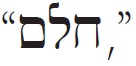 HALOT 1:320–21. The Septuagint obviously understood halam along the lines of the last definition in translating the term as parakeklēmenoi, “we became like people comforted.”