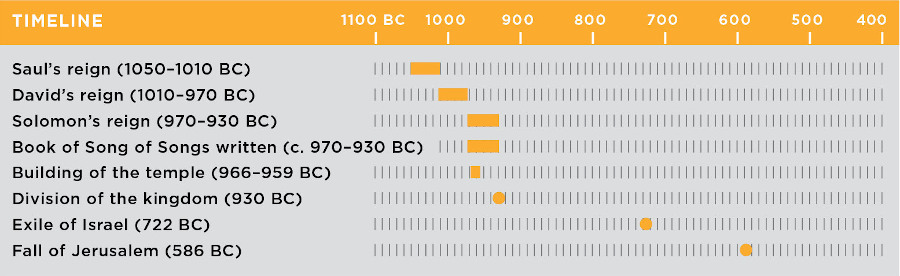

Author: Unknown; though traditionally King Solomon
Audience: The people of Israel
Date: Unknown, possibly as early as the tenth century bc
Theme: God, through the wisdom writer, celebrates intimate human love as a gift and also as a key to understanding God’s own love for his people.
Introduction
Title
The title in the Hebrew text is “Solomon’s Song of Songs,” meaning a “song by, for or about Solomon.” The phrase “Song of Songs” means “the greatest of songs” (cf. Dt 10:17, “God of gods and LORD of lords”; 1Ti 6:15, “King of kings”; Rev 19:16, “KING OF KINGS AND LORD OF LORDS”).
Author and Date
Verse 1 appears to ascribe authorship to Solomon (see note on 1:1; but see also Title above). Solomon is referred to seven times (1:1,5; 3:7,9,11; 8:11–12), and several verses speak of the “king” (1:4,12; 7:5), but whether he was the author remains an open question. The emphasis on the exclusivity of the love relationship in the book is difficult to reconcile with the size of Solomon’s harem. So it is probably better to envision the beloved as being described like one with Solomon’s royal splendor.
It is not impossible to date the Song in the tenth century bc during Solomon’s reign. In fact, mention of Tirzah and Jerusalem in one breath (6:4; see note there) has been used to prove a date prior to King Omri (885–874 bc; see 1Ki 16:23–24), though the reason for Tirzah’s mention is not clear. On the other hand, many have appealed to the language of the Song as proof of a much later date, but on present evidence the linguistic data are ambiguous.
Consistency of language, style, tone, perspective and recurring refrains seems to argue for a single author. However, many who have doubted that the Song came from one pen, or even from one time or place, explain this consistency by ascribing all the Song’s parts to a single literary tradition, since Near Eastern traditions were very careful to maintain stylistic uniformity.
Interpretation
 To find the key for unlocking the Song, interpreters have looked to prophetic, wisdom and apocalyptic passages of Scripture, as well as to ancient Egyptian and Babylonian love songs, traditional Semitic wedding songs, and songs related to ancient Mesopotamian fertility religions. The closest parallels appear to be those found in Proverbs (Pr 5:15–20; 6:24–29; 7:6–23). The description of love in 8:6–7 (cf. the descriptions of wisdom found in Pr 1–9 and Job 28) seems to confirm that the Song belongs to biblical wisdom literature and that it is wisdom’s description of an amorous relationship. The Bible speaks of both wisdom and love as gifts of God, to be received with gratitude and celebration.
This understanding of the Song contrasts with the long-held view that the Song is an allegory of the love relationship between God and Israel, or between Christ and the church, or between Christ and the soul (the NT nowhere quotes from or even alludes to the Song). It is also distinct from more modern interpretations of the Song, such as that which sees it as a poetic drama celebrating the triumph of a maiden’s pure, spontaneous love for her rustic shepherd lover over the courtly blandishments of Solomon, who sought to win her for his royal harem. Rather, it views the Song as a linked chain of lyrics depicting love in all its spontaneity, beauty, power and exclusiveness—experienced in its varied moments of separation and intimacy, anguish and ecstasy, tension and contentment. The Song shares with the love poetry of many cultures its extensive use of highly sensuous and suggestive imagery drawn from nature.
Theme and Theology
In ancient Israel everything human came to expression in words: reverence, gratitude, anger, sorrow, suffering, trust, friendship, commitment, loyalty, hope, wisdom, moral outrage, repentance, and more. In the Song, it is love that finds words—inspired words that disclose its exquisite charm and beauty as one of God’s choicest gifts. The voice of love in the Song, like that of wisdom in Pr 8:1—9:12, is most often a woman’s voice, suggesting that love and wisdom draw men powerfully. Well over half of the Song is told from the woman’s perspective and shows her initiating the romance at least as much as the man, and as an equal partner with him.
This feminine voice speaks profoundly of love. She portrays its beauty and delights. She claims its exclusiveness (“My beloved is mine and I am his,” 2:16) and insists on the necessity of its pure spontaneity (“Do not arouse or awaken love until it so desires,” 2:7). She also proclaims its overwhelming power—it rivals that of the fearsome enemy, death; it burns with the intensity of a blazing fire; it is unquenchable even by the ocean depths (8:6–7a). She affirms its preciousness: All that one possesses cannot purchase it, nor (alternatively) should it be exchanged for it (8:7b). She hints, without saying so explicitly (see the second NIV text note on 8:6), that it is the Lord’s gift.
God intends that such love—grossly distorted and abused by both ancient and modern people—be a normal part of marital life in his good creation (see Ge 1:26–31; 2:24). In the Song the faithful Israelite could ascertain how to live lovingly under the watchful reign of God. Such marital love is designed by the Creator to come to natural expression within his realm.
Literary Features
No one who reads the Song with care can question the artistry of the poet. The subtle delicacy with which the author evokes intense sensual awareness while avoiding crude titillation is truly remarkable. This is accomplished largely by indirection, by analogy and by bringing to the foreground the sensuous in the world of nature (or in food, drink, cosmetics and jewelry). To liken a “beloved’s” (1:13) enjoyment of his “darling” (1:9) to a gazelle browsing “among the lilies” (2:16), or her breasts to “twin fawns of a gazelle that browse among the lilies” (4:5), or his darling herself to a garden filled with choice fruits inviting the beloved to feast (4:12–16)—these combine exquisite artistry and fine sensitivity.
Whether the Song has the unity of a single dramatic line linking all the subunits into a continuing story is a matter of ongoing debate among interpreters. There do appear to be connected scenes in the love relationship (see Outline). Virtually all agree that the literary culmination of the Song is found in 8:5–7, where the unsurpassed power and value of love—the love that draws a man and a woman together—are finally expressly asserted. The literary resolution follows the intenseness of that declaration. A final expression of mutual desire between the lovers brings the Song to an end, suggesting that love goes on. This last segment (8:8–14) is in some sense also a return to the beginning, as references to the woman’s brothers, to her vineyard and to Solomon (the king) link 8:8–12 with 1:2–6. In this song of love the voice of the woman is predominant. It is her experience of love, both as the one who loves and as the one who is loved, that is most clearly expressed. The Song begins with her wish for the beloved’s kiss and ends with her urgent invitation to him for love’s intimacy.
In the Song, it is love that finds words—inspired words that disclose its exquisite charm and beauty as one of God’s choicest gifts.
Outline
I. Title (1:1)
II. The First Meeting (1:2—2:7)
III. The Second Meeting (2:8—3:5)
IV. The Third Meeting (3:6—5:1)
V. The Fourth Meeting (5:2—6:3)
VI. The Fifth Meeting (6:4—8:4)
VII. The Literary Culmination (8:5–7)
VIII. The Conclusion (8:8–14)