

Author: Zechariah
Audience: The postexilic Jews living in Judah
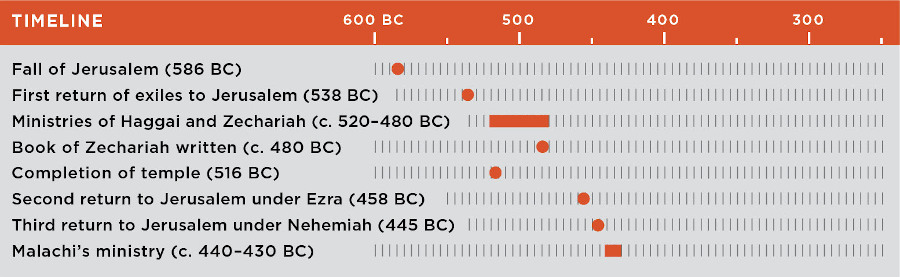
Date: 520 to about 480 bc
Theme: God, through the prophet Zechariah, using visions and symbols, encourages his people to complete the rebuilding of the temple, which foreshadows their glorious future.
Introduction
Background
Zechariah’s prophetic ministry took place in the postexilic period, the time of the Jewish restoration from Babylonian captivity. According to ancient sources, such as King Darius’s own Behistun inscription and Herodotus (3.66–69), most of the early rebellions against Darius (see 1:1 and note) had been quelled by Feb. 15, 519 bc (see note on 1:7). So at this point in history, Persia was generally “at rest and in peace” (1:11)—at least relatively speaking. Darius enjoyed a long reign (522–486). For additional historical details, see Introduction to Haggai: Background.
Author and Unity
 Like Jeremiah (1:1) and Ezekiel (1:3), Zechariah was not only a prophet (1:1) but also a member of a priestly family. He was born in Babylonia and was among those who returned to Judah in 538/537 bc under the leadership of Zerubbabel and Joshua (his grandfather Iddo is named among the returnees in Ne 12:4). At a later time, when Joiakim was high priest (see note on Ne 12:12–21), Zechariah apparently succeeded Iddo (1:1,7) as head of that priestly family (Ne 12:10–16). Since the grandson succeeded the grandfather, it has been suggested that the father (Berekiah, 1:1,7) died at an early age.
Zechariah was a contemporary of Haggai (Ezr 5:1; 6:14) but continued his ministry long after him (compare 1:1 and 7:1 with Hag 1:1; see also Ne 12:1–16). His young age (see 2:4 and note) in the early period of his ministry makes it possible that he ministered even into the reign of Artaxerxes I (465–424 bc).
Most likely Zechariah wrote the entire book that bears his name. Some have questioned his authorship of chs. 9–14, citing differences in style and genre (apocalyptic) and other compositional features and giving historical and chronological references that allegedly require a different date and author from those of chs. 1–8. All these objections, however, can be explained in other satisfactory ways. For example, both chs. 1–8 and 9–14 highlight the same themes of Israel’s leadership, the importance of Zion, and the purification of the people of God. Both sections also rely heavily on reference to prior OT texts, so there is no compelling reason to question the unity of the book.
Dates
The dates of Zechariah’s recorded messages are best correlated with those of Haggai and with other historical events as follows:
(1) Haggai’s first message (Hag 1:1–11; Ezr 5:1) | Aug. 29, 520 bc |
(2) Resumption of the building of the temple (Hag 1:12–15; Ezr 5:2) | Sept. 21, 520 |
(The rebuilding seems to have been hindered from 536 to c. 530 [Ezr 4:1–5], and the work ceased altogether from c. 530 to 520 [Ezr 4:24].) | |
(3) Haggai’s second message (Hag 2:1–9) | Oct. 17, 520 |
(4) Beginning of Zechariah’s preaching (1:1–6) | Oct. / Nov., 520 |
(5) Haggai’s third message (Hag 2:10–19) | Dec. 18, 520 |
(6) Haggai’s fourth message (Hag 2:20–23) | Dec. 18, 520 |
(7) Tattenai’s letter to Darius concerning the rebuilding of the temple (Ezr 5:3—6:14) | 519–518 |
(There must have been a lapse of time between the resumption of the building and Tattenai’s appearance.) | |
(8) Zechariah’s eight night visions (Zec 1:7—6:8) | Feb. 15, 519 |
(9) Joshua crowned (6:9–15) | Feb. 16 (?), 519 |
(10) Repentance urged, blessings promised (chs. 7–8) | Dec. 7, 518 |
(11) Dedication of the temple (Ezr 6:15–18) | Mar. 12, 516 |
(12) Zechariah’s final prophecies (chs. 9–14) | After 480 (?) |
Occasion and Purpose
The occasion is the same as that of the book of Haggai (see Background and Dates above). The chief purpose of Zechariah (and Haggai) was to encourage and motivate the returned exiles to complete the rebuilding of the temple (Zec 4:8–10; Hag 1–2), though both prophets were clearly interested in spiritual renewal as well (e.g., concern for restoration of justice and for purity). In addition, the purpose of the eight night visions (1:7—6:8) is explained in 1:3,5–6: The Lord said that if the people of Judea would return to him, he would return to them. Furthermore, his word would continue to be fulfilled.
Theological Teaching
The theology of Zechariah’s prophecy matches his name, which means “The LORD (Yahweh) remembers.” “The LORD” represents the personal, covenant name of God and is a perpetual testimony to his faithfulness to his promises (see articles here and here; see also notes on Ge 2:4; Ex 3:14–15; 6:6; Dt 28:58). He “remembers” his covenant promises and takes action to fulfill them. In the book of Zechariah God’s promised deliverance from Babylonian exile, including a restored kingdom community and a functioning temple, the location of the earthly throne of the divine King (see Introduction to Psalms: Theology: Major Themes), leads to even grander pictures of the salvation and restoration to come through the Messiah (see notes on 3:8–9; 4:3,14; 6:9–15; 9:9–10; 10:2,4; 11:4–14; 12:10—13:1; 13:7; 14:4–9).
The book as a whole also teaches the sovereignty of God in history, over people and nations—past, present and future (see, e.g., 1:10–11; 2:13; 4:10,14 and note; 6:5,7; 8:20–23; 9:10,13–14; 10:11; 12:1–5; 14:9,16–19). See also Literary Forms and Themes (next section).
Literary Forms and Themes
The book is primarily a mixture of exhortation (call to repentance, 1:2–6); prophetic visions (1:7—6:8); a prophetic message of instruction or exhortation involving a symbolic coronation scene (6:9–15); hortatory messages (mainly of rebuke and hope), prompted by a question about fasting (chs. 7–8); and judgment and salvation messages (chs. 9–14). The prophetic visions of 1:7—6:8 are called apocalyptic (revelatory) literature, which is essentially a literature of encouragement to God’s people. When the apocalyptic section is read along with the salvation (or deliverance) messages in chs. 9–14, it becomes obvious that the dominant emphasis of the book is encouragement because of the glorious future that awaits the people of God.
In fact, encouragement is the book’s central theme—primarily encouragement to complete the rebuilding of the temple. Various means are used to accomplish this end, and these function as subthemes. For example, great stress is laid on the coming of the Messiah and the overthrow of all anti-kingdom forces by him so that God’s rule can be finally and fully established on earth. The then-current local scene thus becomes the basis for contemplating the universal, eschatological picture.
Several interpreters have arranged the eight visions of 1:7—6:8 in a chiastic (or concentric) pattern of a—b—b—c / c’—b’—b’—a’:
a The Lord controls the events of history (1:7–17)
b Nations that devastated Israel will in turn be devastated (1:18–21)
b Israel will be fully restored (ch. 2)
c Israel will be restored as a priestly nation (ch. 3)
c’ Israel will be restored under royal and priestly leadership (ch. 4)
b’ Lawbreakers will be purged from Israel (5:1–4)
b’ The whole sinful system will be removed from the land (5:5–11)
a’ The Lord controls the events of history (6:1–8)
The dominant emphasis of Zechariah is encouragement because of the glorious future that awaits the people of God. In fact, encouragement is the book’s central theme—primarily encouragement to complete the rebuilding of the temple.
Outline
I. Visions About Cleansing From Sin and Rebuilding the Temple (chs. 1–8)
A. Introduction (1:1–6)
1. Date and author (1:1)
2. A call to repentance (1:2–6)
B. A Series of Eight Visions in One Night (1:7—6:8)
1. The horseman among the myrtle trees (1:7–17)
2. The four horns and the four craftsmen (1:18–21)
3. A man with a measuring line (ch. 2)
4. Clean garments for the high priest (ch. 3)
5. The gold lampstand and the two olive trees (ch. 4)
6. The flying scroll (5:1–4)
7. The woman in a basket (5:5–11)
8. The four chariots (6:1–8)
C. The Symbolic Crowning of Joshua, the High Priest (6:9–15)
D. The Problem of Fasting and the Promise of the Future (chs. 7–8)
1. The question by the delegation from Bethel (7:1–3)
2. The rebuke by the Lord (7:4–7)
3. The command to repent (7:8–14)
4. The restoration of Israel to God’s favor (8:1–17)
5. Kingdom joy and Jewish favor (8:18–23)
II. Two Prophetic Messages: The Great Messianic Future and the Full Realization of God’s Kingdom (chs. 9–14)
A. The First Message: The Coming and Rejection of the Messiah (chs. 9–11)
1. The coming of the Messianic King (chs. 9–10)
a. The destruction of surrounding nations but the preservation of Zion (9:1–8)
b. The coming of Zion’s King (9:9–10)
c. The deliverance and blessing of Zion’s people (9:11—10:1)
d. The leaders warned and the people encouraged (10:2–4)
e. Israel’s victory and restoration (10:5–12)
2. The rejection of the Messianic Shepherd-King (ch. 11)
a. The prologue (11:1–3)
b. The rejection of the Good Shepherd (11:4–14)
c. The rise and fall of the worthless shepherd (11:15–17)
B. The Second Message: The Coming and Reception of the Messiah (chs. 12–14)
1. The deliverance and conversion of Israel (chs. 12–13)
a. The siege of Jerusalem (12:1–3)
b. The divine deliverance (12:4–9)
c. Israel completely delivered from sin (12:10—13:9)
2. The Messiah’s coming and his kingdom (ch. 14)
a. The siege of Jerusalem (14:1–2)
b. The Messiah’s return and its effects (14:3–8)
c. The establishment of the Messianic kingdom (14:9–11)
d. The punishment of Israel’s enemies (14:12–15)
e. The universal worship of the holy King (14:16–21)

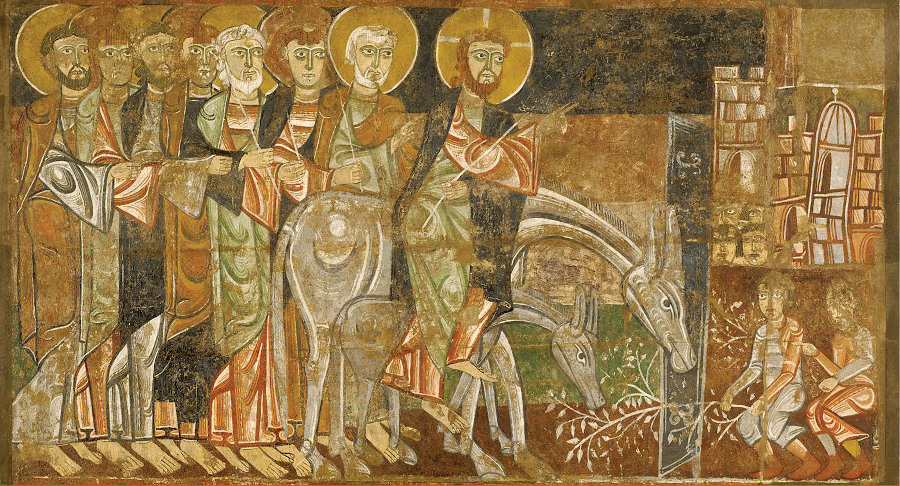
Twelfth-century fresco of Christ’s entry into Jerusalem. Zechariah 9:9 prophesies that the Messianic King would ride into Jerusalem on a donkey (Mt 21:5; Jn 12:15).
Courtesy of Indianapolis Museum of Art at Newfields