
Author: The apostle John
Audience: Primarily Gentile believers and seeking unbelievers
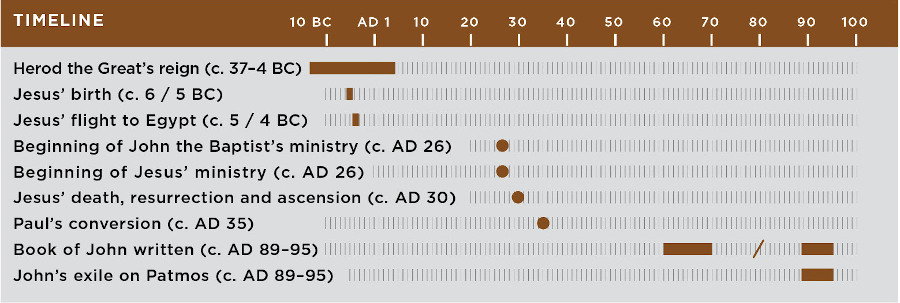
Date: Either the ad 60s or, more likely, the 80s or early 90s
Theme: John presents Jesus as the Word, the Messiah and the incarnate Son of God, who has come to reveal the Father and bring eternal life to all who believe in him.
Introduction
Author
 The author is the apostle John, “the disciple whom Jesus loved” (13:23 [see note there]; 19:26; 20:2; 21:7,20,24). He was prominent in the early church but is not mentioned by name in this Gospel—which would be natural if he wrote it, but hard to explain otherwise. The author knew Jewish life well, as seen from references to popular Messianic speculations (see, e.g., 1:21 and note; 7:40–42); to the hostility between Jews and Samaritans (see 4:9 and note); and to Jewish customs, such as the duty of circumcision on the eighth day taking precedence over the prohibition of working on the Sabbath (see note on 7:22). He knew the geography of the Holy Land, locating Bethany about two miles from Jerusalem (11:18) and mentioning Cana, a village not referred to in any earlier writing known to us (2:1 [see note there]; 21:2). The Gospel of John has many touches that appear to reflect the recollections of an eyewitness—such as the house at Bethany being filled with the fragrance of the broken perfume jar (see 12:3 and note). Early writers such as Irenaeus and Tertullian say that John wrote this Gospel, and other evidence agrees (see Introduction to 1 John: Author).
Date
In general, two views of the dating of this Gospel have been advocated:
(1) The traditional view places it toward the end of the first century, either the ad 60s or, more likely, the 80s or early 90s (see Introduction to 1 John: Date).
(2) More recently, some interpreters have suggested an earlier date, perhaps as early as the 60s before the destruction of Jerusalem.
The first view may be supported by reference to the statement of Clement of Alexandria (died between 211 and 216) that John wrote his Gospel to supplement the accounts found in the other Gospels (Eusebius, Ecclesiastical History, 6.14.7), and thus his Gospel is later than the first three. It has also been argued that the seemingly more developed theology of the fourth Gospel indicates that it originated later. The literary style of this witness of Jesus is unique among the Gospels; here focus is on the “signs” of Jesus’ identity and mission and on lengthy, theologically rich discourses.
The second view has found favor because it has been felt more recently that John wrote independently of the other Gospels (see article and chart). Those who hold this view point out that developed theology does not necessarily argue for a late origin. The theology of Romans (written c. 57) is every bit as developed as that in John. Further, the statement in 5:2 that there “is” (rather than “was”) a pool “near the Sheep Gate” may suggest a time before 70, when Jerusalem was destroyed. Others, however, observe that John elsewhere sometimes used the present tense when speaking of the past. And it seems that John could assume that his readers knew of at least the general content of the Synoptics.
Purpose and Emphases
John’s Gospel is rather different from the other three. Whether or not he knew them (or any one of them) continues to be debated. In any event, his witness to Jesus goes its own way, highlighting matters that in the other Gospels remain implicit and underdeveloped. The literary style of this witness of Jesus is also unique among the Gospels; here focus is on the “signs” of Jesus’ identity and mission (see note on 2:11) and on lengthy, theologically rich discourses. Some call chs. 1–12 the “Book of Signs” and chs. 13–21 the “Book of Glory” because these two key terms (“signs” and “glory”) appear in each part.
John begins with the profound announcement that Jesus is the divine “Word” of self-revelation—who existed with God from the beginning and through whom God created all things. Jesus the “Word” became embodied (incarnated) as a human being to be the light of life for the world. After this comes the proclamation that this Jesus is the Son of God sent from the Father to finish the Father’s work in the world (see 4:34 and note). God’s own glory is made visible in him (“Anyone who has seen me has seen the Father,” 14:9), and what he does glorifies the Father. In him the full grace and truth of God have shown themselves (cf. 1:17–18). Strikingly, a series of “I am” claims on Jesus’ lips echo God’s naming of himself in Ex 3:14, further strengthening the link between the Father and the Son (see 6:20, 35 [see also note there]; 8:12; 8:58 [see also note there]; 9:5; 10:7,9,14; 11:25; 14:6; 15:1,5; see also chart).
The words of 3:16 (see note there) nicely summarize this Gospel’s central theme: “For God so loved the world that he gave his one and only Son, that whoever believes in him shall not perish but have eternal life.” Although a variety of motivations for the composition of John’s Gospel have been posited by interpreters (such as to supplement the other Gospels, to combat some form of heresy, or to oppose the continuing followers of John the Baptist), the author himself states his main purpose clearly in 20:31: “that you may believe that Jesus is the Messiah, the Son of God, and that by believing you may have life in his name.”
For the main emphases of the book, see notes on 1:4,7,9,14,19,49; 2:4,11; 3:27; 4:34; 6:35; 13:1—17:26; 13:31; 17:1–2,5; 20:31.
The author himself clearly states his main purpose in writing this Gospel in Jn 20:31: “that you may believe that Jesus is the Messiah, the Son of God, and that by believing you may have life in his name.”
Outline
I. Prologue: The Word Became Flesh (1:1–18)
II. The Beginning of Jesus’ Ministry (1:19–51)
A. John the Baptist’s Testimony About Jesus (1:19–34)
B. John’s Disciples Follow Jesus (1:35–42)
C. Jesus Calls Philip and Nathanael (1:43–51)
III. Jesus’ Public Ministry: Signs and Discourses (chs. 2–11)
A. Changing Water Into Wine (2:1–11)
B. Clearing the Temple Courts (2:12–25)
C. Jesus Teaches Nicodemus (3:1–21)
D. John the Baptist’s Final Testimony About Jesus (3:22–36)
E. Jesus and the Samaritans (4:1–42)
F. Healing of the Official’s Son (4:43–54)
G. Jesus and the Jewish Festivals (chs. 5–10)
1. The Sabbath (ch. 5)
a. Healing at the pool of Bethesda (5:1–15)
b. Jesus explains his divine authority (5:16–30)
c. Testimonies about Jesus (5:31–47)
2. The Passover (ch. 6)
a. Jesus feeds the 5,000 (6:1–15)
b. Jesus walks on the water (6:16–24)
c. Jesus is the bread of life (6:25–59)
d. Many disciples desert Jesus (6:60–71)
3. The Festival of Tabernacles (7:1—10:21)
a. Jesus travels to Jerusalem for the festival (7:1–13)
b. Jesus teaches at the festival (7:14–24)
c. Debate over who Jesus is (7:25—8:59)
d. Jesus heals a man born blind (9:1—10:21)
4. The Festival of Dedication (10:22–42)
H. The Raising of Lazarus (ch. 11)
IV. The Passion Week (chs. 12–19)
A. Jesus Journeys to Jerusalem (ch. 12)
1. Anointed at Bethany (12:1–11)
2. Enters Jerusalem as King (12:12–19)
3. Predicts his death (12:20–36)
4. Belief and unbelief among the Jews (12:37–50)
B. Jesus’ Farewell Discourse and Prayer (chs. 13–17)
1. At the Last Supper (chs. 13–14)
a. Jesus washes the disciples’ feet (13:1–17)
b. Jesus predicts his betrayal (13:18–30)
c. Jesus predicts Peter’s denial (13:31–38)
d. Jesus comforts his disciples (14:1–4)
e. Jesus is the way to the Father (14:5–14)
f. Jesus promises the Holy Spirit (14:15–30)
2. On the way to Gethsemane (chs. 15–16)
a. The vine and the branches (15:1–17)
b. The world hates the disciples (15:18–25)
c. The work of the Holy Spirit (15:26—16:15)
d. The disciples’ grief will turn to joy (16:16–33)
3. Jesus’ prayer (ch. 17)
a. For himself—that he be glorified (17:1–5)
b. For his disciples (17:6–19)
c. For all believers (17:20–26)
C. Jesus’ Betrayal and Arrest (18:1–11)
D. Jesus’ Trials Before Jewish and Roman Officials (18:12–40)
E. Jesus’ Crucifixion (19:1–27)
F. Jesus’ Death and Burial (19:28–42)
V. Jesus’ Resurrection (20:1–29)
VI. Statement of the Gospel’s Purpose (20:30–31)
VII. Epilogue: Jesus’ Recommissioning of the Disciples (ch. 21)

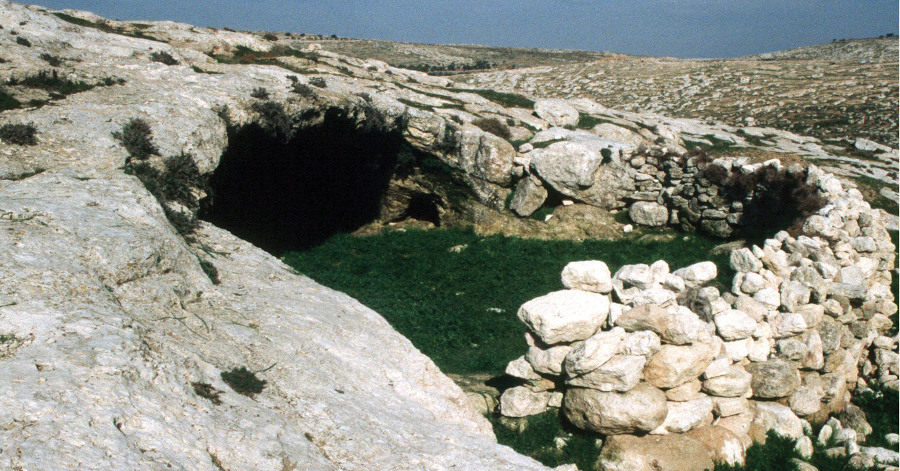
View of the interior of a typical sheep pen. Jesus said, “I am the gate; whoever enters through me will be saved” (Jn 10:9).
www.HolyLandPhotos.org
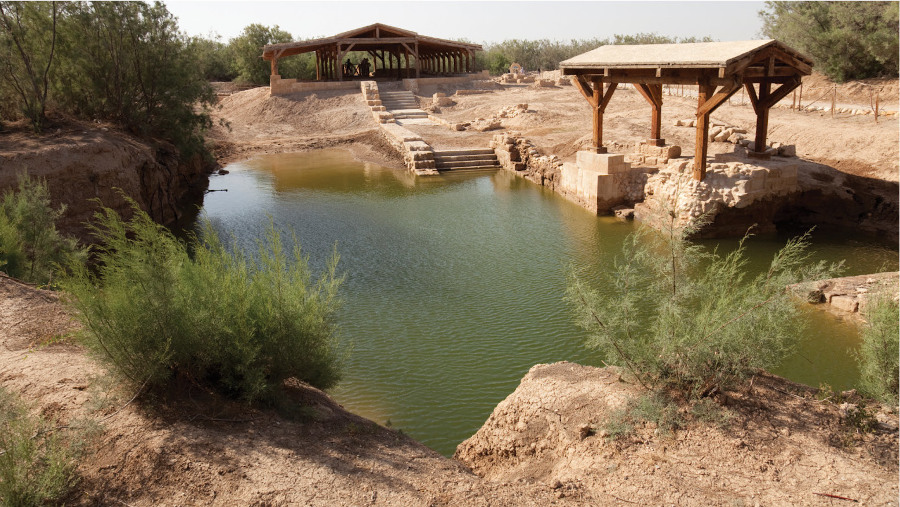
Chapels located at Bethany on the other side of the Jordan (Jn 1:28), one of the possible sites of Jesus’ baptism
© iStock.com/Torsten Stahlberg