Study Notes
 1:1 In the beginning. A deliberate echo of Ge 1:1 (see note there) to link God’s action in behalf of the world through Jesus Christ (cf. 3:16) with his first work, the creation of the world. Word. See article. with God. The Word was distinct from the Father. was God. Jesus was God in the fullest sense (see note on Ro 9:5). The prologue (vv. 1–18) begins and ends with a ringing affirmation of his deity (see note on v. 18).

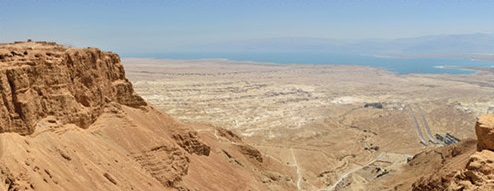
“Word” translates the Greek logos, a term Greeks used not only of the spoken word but also of the unspoken word—the reason. When they applied it to the universe, they meant the rational principle that governs all things. The Jews, however, used it to refer to the “word” of God by which he created the world and governs it (see the Septuagint [the pre-Christian Greek translation of the OT] rendering of Ps 33:6; 119:89; 147:15,18) and to refer to the law of God that he gave the Israelites to be their life (see Dt 32:47 and note on 30:20). The rabbis said the law was “created before the world,” that it “lay on God’s bosom while God sat on the throne of glory,” that it was divine, that it was God’s “firstborn” through whom he “created the heaven and the earth,” that it is “light” and “life” for the world and that it “is truth.”
This Jewish use of logos as that which comes from God to fulfill his purpose in and for the world lies behind John’s use of the term at the beginning of his Gospel. John asserts that the incarnate Word, Jesus Christ, is a new, clearer revelation from God and of God (vv. 14,18). It is this “true light” (v. 9) and life-giving presence (v. 4) of God who “made his dwelling among us” (v. 14) that John encourages his readers to believe in and so become children of God (v. 13).
Go to the Articles Index.
1:3 The Son as Creator (see Col 1:16–17; Heb 1:2; 11:3).
 1:4 life. One of the great concepts of this Gospel. The Greek word for “life” is found 36 times in John, while no other NT book uses it more than 17 times. Life is Christ’s gift (10:28), and he, in fact, is “the life” (14:6). light of all mankind. This Gospel also links light with Christ, from whom comes all spiritual illumination. He is the “light of the world,” who holds out wonderful hope for humanity (cf. 8:12; 1Jn 2:8 and notes) and for the creation (see 3:16 and note). For an OT link between life and light, see Ps 27:1; 36:9 and notes.
1:5 darkness. The stark contrast between light and darkness is a striking theme in this Gospel (see, e.g., 12:35–36).
1:6 John. Apart from the reference to Peter as “Simon son of John” in 1:42, in this Gospel the name John always refers to John the Baptist. Cf. Mal 3:1; Mt 3:1 and notes.
1:7 as a witness to testify. John the Baptist’s singular ministry was to testify about Jesus (10:41). “Witness” is another important concept in this Gospel. The Greek noun for “witness” or “testimony” is used 14 times (in Matthew not at all, in Mark three times, in Luke once) and the verb (“testify”) 33 times (found once each in Matthew and Luke and not at all in Mark)—in both cases more often than anywhere else in the NT. John (the author) thereby emphasizes that the truth about Jesus is amply attested. that through him all might believe. People were not to believe “in” John the Baptist but “through” him. Similarly, the writer’s purpose was to draw them to belief in Christ (20:31 [see note there]); he uses the Greek verb for “believe” about 100 times.
1:8 He himself was not the light. The greatness of John the Baptist caused some of his followers to have exaggerated ideas about him (v. 21), but while Jesus affirms John’s greatness (see Mt 11:11 and note), he also makes clear his limitations: John is “a lamp” (5:35) but not “the light.”
1:9 John is referring to the incarnation of Christ. world. Another common word in John’s writings, the Greek noun for “world” is found 78 times in this Gospel and 24 times in his letters (only 47 times in all of Paul’s writings). It can mean the universe, the earth, the people on earth, most people, people opposed to God, or the human system opposed to God’s purposes. John emphasizes the word by repetition and moves without explanation from one meaning to another (see, e.g., 17:5,14–15 and notes).
1:11 his own . . . his own. The Greek suggests that the first term refers to things (his homeland or perhaps all creation) while the second term refers to people.
1:12 believed. See v. 7; 20:31 and notes. he gave the right. Membership in God’s family is by grace alone—the gift of God (see Eph 2:8–9 and notes). It is never a human achievement, as v. 13 emphasizes; yet the imparting of the gift is dependent on human reception of it, as the words “did receive” and “believed” make clear.
1:13 born of God. The “children of God” (v. 12) have been given a new openness to and relationship with God that was not theirs as a result of their natural birth (see 3:3,5; 2Co 5:17; Gal 6:15; Titus 3:5 and notes).
1:14 flesh. A word that stresses the reality of Christ’s humanity. made his dwelling among us. We have seen his glory. Cf. 2Pe 1:16–18 and note on 1:16. The Greek verb translated “made his dwelling” is related to the Greek noun meaning “tent/tabernacle.” The verse may have been intended to reminded John’s Jewish readers of the tent of meeting, which was filled with the glory of God (Ex 40:34–35). Christ revealed his glory to his disciples by the miracles he performed (see 2:11 and note) and by his death and resurrection. grace and truth. The corresponding Hebrew terms are often translated “(unfailing) love and faithfulness” (see notes on Ps 26:3; Pr 16:6; see also article). grace. A significant Christian concept (see notes on Jnh 4:2; Ro 1:7; Gal 1:3; Eph 1:2), though John never uses the word after the prologue (vv. 1–18). truth. Corresponding with reality. John uses the Greek word for “truth” 25 times and links it closely with Jesus, who is the truth (see 14:6 and note).
1:15 John testified concerning him. Cf. Mal 3:1 and note. he was before me. In ancient times the older person was given respect and regarded as greater than the younger. People would normally have ranked Jesus lower in respect than John, who was older. John the Baptist explains that this is only apparent, since Jesus, as the divine Word, existed before he was born on earth.
1:16 grace in place of grace already given. To the blessing that came through Moses has been added the greater blessing that has come through Jesus (see v. 17; see also Heb 1:1–4 and notes). Another possible interpretation of the Greek phrase is “grace added to grace,” meaning an abundance of grace.
1:17 the law was given . . . grace and truth came. In the old covenant, God’s grace and truth had been revealed in his law, and were received by Moses (Ex 34:4–6). But in the new covenant, this divine grace and truth are unmediated; they are embodied in Jesus, who is God in the flesh (v. 18).
1:18 the one and only Son, who is himself God. An explicit declaration of Christ’s deity (see vv. 1,14; 3:16 and notes; see also note on Ro 9:5). has made him known. Sometimes in the OT people are said to have seen God (see, e.g., Ex 24:10 and note). But we are also told that no one can see God and live (Ex 33:20). Therefore, since no human being can see God as he really is, those who saw God saw him in a form he took upon himself temporarily for the occasion. Now, however, Christ “has made him known” (see 14:9; 2Co 4:4; Col 1:15, 19; 2:9 and notes).
1:19 Jewish leaders. See NIV text note. The Greek word traditionally translated “Jews” occurs about 70 times in this Gospel. It is used in a favorable sense (e.g., 4:22) and in a neutral sense (e.g., 2:6). But generally John used it of the Jewish leaders who were hostile to Jesus (e.g., here; 5:10,16; 7:1, etc.). Here it refers to the delegation sent by the Sanhedrin to look into the activities of an unauthorized teacher. Levites. Descendants of the tribe of Levi, who were assigned to specific duties in connection with the tabernacle (Nu 3:17–37) and temple. They also had teaching responsibilities (2Ch 35:3; Ne 8:7–9), and it was probably in this role that they were sent with the priests to John the Baptist.
1:20 I. Emphatic, contrasting John the Baptist with someone else. Throughout the following verses this emphatic “I” occurs frequently, and almost invariably there is an implied contrast with Jesus, who is always given the higher place.
1:21 Are you Elijah? . . . I am not. The Jews remembered that Elijah had not died (2Ki 2:11) and believed that he would come back to earth to announce the end time. In this sense, John properly denied that he was Elijah. In Matthew’s Gospel, when Jesus said the Baptist was Elijah (see Mt 11:14; 17:10 and notes), he meant it in the sense that John was a fulfillment of the prophecy of Mal 4:5 (see note there). the Prophet. The prophet of Dt 18:15 (see note there). The Jewish people expected a variety of persons to be associated with the coming of the Messiah. John the Baptist emphatically denies being “the Prophet.” He had come to testify about Jesus, yet the people kept asking him about himself. His answers became progressively more terse.
 1:23 John the Baptist applied the prophecy of Isa 40:3 (see note there) to his own ministry of calling people to repent in preparation for the coming of the Messiah. The Jews of Qumran (the community that produced the Dead Sea Scrolls; see article) applied the same words to themselves, but they prepared for the Lord’s coming by isolating themselves from the world to secure their own salvation. John concentrated on helping people come to the Messiah (the Christ).
1:24 Pharisees. Members of the conservative religious party, who probed more deeply than the rest of the delegation (v. 19). See notes on Mt 3:7; Mk 2:16; Lk 5:17; see also article and chart.
1:25 the Messiah. Means “the Anointed One.” In OT times anointing signified being set apart for service, particularly as king (cf. 1Sa 16:1,13) or priest (Ex 28:41; 29:7; 30:30; 40:13,15). But people were looking for not just an anointed one but the Anointed One, the Messiah (cf. Mt 16:16 and note).
1:27 whose sandals I am not worthy to untie. A menial task, fit for a slave. Disciples would perform all sorts of service for their rabbis (teachers), but untying sandal straps was expressly excluded.
1:28 Bethany. The Bethany mentioned elsewhere in the Gospels was only about two miles from Jerusalem (see note on Mt 21:17). The precise site of this other Bethany is not known, except that it was located on the east side of the Jordan (see maps here and here; see also photo).
1:29 Lamb of God. An expression found in the Bible only here and in v. 36. Many suggestions have been made as to which “lamb” John had in mind (e.g., the lamb offered at Passover or the lamb of Isa 53:7, of Jer 11:19, of Ge 22:8 or of Rev 5:6 [see note there]). It may be that John chose this unique way of referring to Jesus’ mission to point both to the sacrificial offering that Jesus would become and to his subsequent conquest of all evil powers (see Rev 17:14 and note)—the two ways by which he “takes away the sin of the world” (see 1Jn 2:2 and note).
1:31 I . . . did not know him. Although John the Baptist was related to Jesus (Lk 1:36), he “lived in the wilderness until he appeared publicly to Israel” (Lk 1:80) and may not have known Jesus personally. But the words probably mean only that he did not know that Jesus was the Messiah until he saw the sign mentioned in vv. 32–33.
1:32 Although John’s Gospel does not narrate the baptism of Jesus, John alludes to it here by speaking of the descent of the Spirit. For Jesus’ baptism, see Mt 3:13–17 and note on 3:15.
1:33 baptize with the Holy Spirit. John baptized with water, but Jesus would baptize with the Spirit—by which he would cause those who believe in him to participate in the power and grace of the new life he came to give (20:22; Ac 1:5; 2:4; 11:15–16; 19:4–6; 1Co 12–14; Gal 3:5, 14; 4:6; 5:16–25; Eph 1:13; 3:16; 5:18; Php 3:3; 1Th 4:8). Holy Spirit. The common way of referring to the Spirit in the NT, though it appears only here and in 14:26; 20:22 in this Gospel—emphasizing his holiness rather than his power or greatness.
1:34 God’s Chosen One. See NIV text note.
1:35 two. One was Andrew (v. 40). The other is not named, but from early times it has been thought that he was John, the author of this Gospel. his disciples. In the sense that they had been baptized by John and looked to him as their religious teacher.
1:36 Lamb of God. See note on v. 29.
1:40 Andrew. One of the 12 apostles (Mt 10:2). He was from Bethsaida (v. 44) but later lived with Peter at Capernaum (Mk 1:29), where they fished for a living (Mt 4:18).
1:41 the Messiah. See note on v. 25.
1:42 Simon son of John. See note on Mt 16:17. Cephas . . . Peter. See NIV text note. In the Gospels, Peter was anything but a rock; he was impulsive and unstable. In Acts, however, he was a pillar of the early church. Jesus named him not for what he was but for what, by God’s grace, he would become (see Mt 16:18 and note).
1:44 Bethsaida. See note on Mt 11:21.
1:45 the Law . . . the prophets. See note on Lk 24:44. son of Joseph. Joseph was Jesus’ legal, though not his natural, father (see Mt 1:18, 20,23,25 and note; Lk 1:26–35 and note).
1:46 Nazareth. See 7:52; see also note on Mt 2:23. Can anything good come from there? There are at least three possible reasons for Nathanael’s question: (1) Nazareth’s relative insignificance (it is not even mentioned in the OT or the extra-biblical literature of the day); (2) the widespread understanding that the Messiah would come from Judea; or (3) Nathanael’s pride in his own hometown (Cana; see 21:2) over Nazareth.
1:47 Nathanael. Perhaps the same person as Bartholomew (see Lk 6:14 and note; Ac 1:13). there is no deceit. See 2:24–25.
1:48 fig tree. Its shade was a favorite place for study and prayer in hot weather.
1:49 Rabbi. Hebrew word for “(my) teacher.” the Son of God. See vv. 14,18,34; 3:16 and note; 20:31. At the beginning of Jesus’ ministry Nathanael acknowledged him with this meaningful title; later it was used in mockery (Mt 27:40; cf. Jn 19:7). Andrew’s “the Messiah” (v. 41) and Nathanael’s “the Son of God” together match Peter’s “You are the Messiah, the Son of the living God” (Mt 16:16). king of Israel. See 12:13 and note. In Mk 15:32 “Messiah” and “king of Israel” are equated. At this stage, all these lofty titles may still mean merely an earthly Messiah—a political or military deliverer—in the minds of those who use them of Jesus.
1:51 Very truly I tell you. The Greek word translated “truly” is amen, from a Hebrew word that emphasized the truth and veracity of a statement (see note on Dt 27:15). In John, the word is doubled, amen amen, translated in the NIV as “very truly.” John’s Gospel alone uses this doubled expression (25 times). See note on Mk 3:28. heaven open. In Jesus’ ministry the disciples will see heaven’s (God’s) testimony about Jesus as plainly as if they heard an announcement from heaven concerning him. the angels of God ascending and descending. As in Jacob’s dream (see Ge 28:12 and note), thus marking Jesus, who is “the way and the truth and the life” (14:6), as God’s stairway between heaven and earth. He is God’s elect one through whom redemption comes to the world—perhaps identifying Jesus as “truly” the “Israelite” (v. 47). Son of Man. Jesus’ favorite self-designation (see note on Mk 8:31). It means one who belongs to the category of human. Thus, Jesus, God incarnate, is also the exalted Son of Man.
2:1 third day. Cf. Ge 22:4 and note. wedding. Little is known of how a wedding was performed in the Holy Land in the first century, but clearly the feast was very important and might go on for a week. To fail in proper hospitality was a serious offense. Cana. Mentioned only in John’s Gospel (v. 11; 4:46; 21:2). It was west of the Sea of Galilee, but the exact location is uncertain (see map).
The Seven Signs of John’s Gospel
Sign | Verses |
(1) Changing water into wine | |
(2) Healing an official’s son | |
(3) Healing a disabled man at the Bethesda pool | |
(4) Feeding the 5,000 | |
(5) Walking on water | |
(6) Healing the man born blind | |
(7) Raising Lazarus from the dead | |
Epilogue sign: the miraculous catch of fish |
Adapted from Four Portraits, One Jesus by Mark L. Strauss. Copyright © 2007 by Mark L. Strauss, p. 302. Used by permission of Zondervan.
Go to the Charts Index.
Healing Miracles | Matthew | Mark | Luke | John |
Man with leprosy | ||||
Roman centurion’s servant | ||||
Peter’s mother-in-law | ||||
Two men from Gadara | ||||
Paralyzed man | ||||
Woman with bleeding | ||||
Two blind men | ||||
Mute, demon-possessed man | ||||
Man with a shriveled hand | ||||
Blind, mute, demon-possessed man | ||||
Canaanite woman’s daughter | ||||
Demon-possessed boy | ||||
Two blind men (including Bartimaeus) | ||||
Deaf mute | ||||
Demon-possessed man in synagogue | ||||
Blind man at Bethsaida | ||||
Crippled woman | ||||
Man with abnormal swelling | ||||
Ten men with leprosy | ||||
The high priest’s servant | ||||
Official’s son at Capernaum | ||||
Sick man at pool of Bethesda | ||||
Man born blind | ||||
Miracles showing power over nature | ||||
Calming the storm | ||||
Walking on water | ||||
Feeding the 5,000 | ||||
Feeding the 4,000 | ||||
Coin in fish’s mouth | ||||
Fig tree withered | ||||
Large catch of fish | ||||
Water turned into wine | ||||
Another large catch of fish | ||||
Miracles of raising the dead | ||||
Jairus’s daughter | ||||
Widow’s son at Nain | ||||
Lazarus | ||||
Go to the Charts Index.
2:3 When the wine was gone. More than a minor social embarrassment, since the family had an obligation to provide a feast of the socially required standard. There was no great variety in beverages, and people normally drank water or wine.
2:4 Woman. See NIV text note. My hour has not yet come. Several similar expressions scattered through this Gospel (see 7:6,8,30; 8:20 and notes) picture Jesus moving inevitably toward the destiny for which he had come: the time of his sacrificial death on the cross and victorious resurrection from the dead (see 12:23,27 and notes; 13:1; 16:32; 17:1).
2:6 That John takes the time to describe these jars in an otherwise brief narrative suggests that Jesus may be contrasting the new “wine” of his ministry with the old “water” of Judaism (Mk 2:22). ceremonial washing. Jews became ceremonially defiled during the normal circumstances of daily life and were cleansed by, e.g., pouring water over their hands. For a lengthy feast with many guests a large amount of water was required for this purpose. holding. Refers to capacity, not to actual content.
2:8–9 master of the banquet. A function mentioned only here in the NT. Apparently he was one of the guests, charged with serving as master of ceremonies.
2:10 too much to drink . . . you have saved the best. Ordinarily, after the guests’ sensibilities were dulled, the “cheaper wine” was served.
2:11 signs. John always refers to Jesus’ miracles as “signs,” a word emphasizing the significance of the action rather than the marvel (see, e.g., 4:54; 6:14; 9:16; 11:47 and notes). There are seven (the number of completeness and perfection) such “signs” in the main body of this Gospel (see chart; see also chart); the large catch of fish in 21:1–11 is in the epilogue (see Introduction: Outline; cf. note on 6:35). They revealed Jesus’ glory (see 1:14 and note) and likely also pointed to the fullness of the salvation he came to effect. In his account of Jesus’ first display of “his glory” by providing an abundance of wine at a wedding feast, John probably was testifying that Christ’s saving mission would culminate in the redemption of the creation from all its distresses, so that the wine of joy would flow fully, as the prophets had announced (see Isa 35:1–2; Joel 3:18; Am 9:13 and notes; cf. Ge 49:11 and note). his disciples believed in him. See 1:7; 20:31 and notes.
2:12 went down. Situated on the shore of the lake, Capernaum was at a lower level than Cana. Capernaum. See notes on Mt 4:13; Lk 10:15; see also model and map. brothers. Or “brothers and sisters.” The Greek word can mean “siblings.” For the names of Jesus’ brothers, see Mk 6:3. See note on Lk 8:19.
2:13 Passover. See Ex 12 and notes on Ex 12:11–23; see also notes on Mt 26:17, 18–30; Mk 14:1,12; Lk 22:1 and chart. Passover was one of the annual festivals that all Jewish men were required to celebrate in Jerusalem. See notes on 5:1; Dt 16:16.
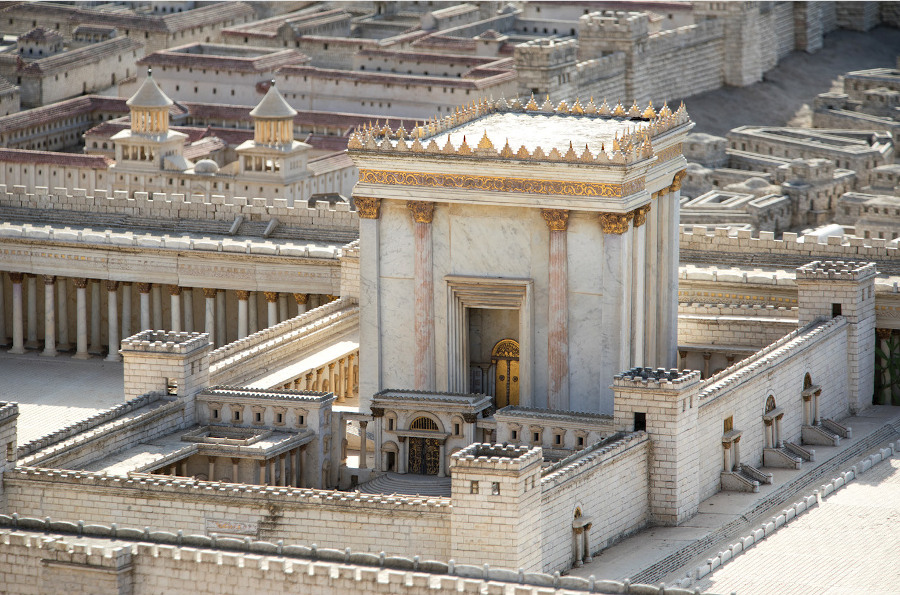
A model of Herod’s temple. The outer courts on either side are likely where Jesus found people selling cattle, sheep and doves, and others sitting at tables exchanging money (Jn 2:14).
© 2018 by Zondervan
Return to the main text.
2:14–17 Matthew, Mark and Luke record a clearing of the temple toward the end of Jesus’ ministry (see note on Mt 21:12–17).
2:14 cattle, sheep and doves. Required for sacrifices. Jews who came great distances had to be able to buy sacrificial animals near the temple. The merchants, however, were selling them in the outer court of the temple itself, the one place where Gentiles could come to pray. exchanging money. Many coins had to be changed into currency acceptable to the temple authorities, which made money changers necessary (see note on Mk 11:15). They should not, however, have been working in the temple itself. See model.
2:16 my Father’s house. See Mk 11:17 and note.
2:17 His disciples remembered. Probably after Jesus’ crucifixion (v. 22)—when Ps 69 struck them as a prophecy of his suffering at the hands of those his “zeal” for the true worship of God had deeply antagonized (see introduction to Ps 69).
2:19 temple. The Jews thought Jesus was referring to the literal temple, but John tells us that he was not (v. 21). Just a few years later Jesus was accused of saying that he would destroy the temple and raise it again (see Mt 26:61; Mk 14:58 and notes), and mockers repeated the charge as he hung on the cross (Mt 27:40; Mk 15:29). The same misunderstanding may have been behind the charge against Stephen (see Ac 6:13 and note).
2:20 forty-six years. The temple was not finally completed until ad 64. The meaning is that work had been going on for 46 years. Since it had begun c. 19 or 20 bc, the year of the event recorded here is c. ad 27 (see chart).
2:22 recalled what he had said. See 12:16; see also 14:26 and note. Then they believed the scripture. See 20:9 and note. It is not clear whether reference here is to a particular passage from the OT (see, e.g., Ps 16:10; 17:15 and notes) or to the OT in general (cf. 1Co 15:4).
2:23 Passover Festival. See note on v. 13. name. See notes on Ps 5:11; Eze 20:9.
3:1 Pharisee. A member of a separatistic group in Judaism (see article and chart; see also notes on Mt 3:7; Mk 2:16; Lk 5:17).
Contrasting Two of Jesus’ Conversations (Jn 3 and 4)
These two conversations share some similarities, especially early on, such as Jesus’ use of symbolism (new birth in 3:3 and living water in 4:10) and the initial misunderstanding of that symbolic language by both Nicodemus and the woman (3:4; 4:11). Yet as the two accounts progress, the contrasts become much more pronounced than the similarities.
Nicodemus (Jn 3) | Samaritan Woman (Jn 4) |
Jewish (the true faith) | Samaritan (worship what is not known; 4:22) |
Man | Woman |
Named | Unnamed |
Pharisee, member of ruling council (3:1) | Lesser status (draws her own water; 4:7) |
Comes to Jesus at night (3:2) | Meets Jesus at midday (4:6) |
Refers to Jesus as a teacher (3:2) | Refers to Jesus as a prophet (4:19) |
No arrival at understanding (3:9) |
Go to the Charts Index.
3:2 at night. Perhaps Nicodemus was afraid to come by day. Or he may have wanted a long talk, which would have been difficult in the daytime with the crowds around Jesus. Either way, John uses a nighttime setting metaphorically as well to indicate Nicodemus’s lack of understanding (cf. 9:4; 11:10; 13:30).
3:3,7 born again. The Greek likely also means “born from above” (see NIV text note on v. 3). Both meanings are consistent with Jesus’ redeeming work and both are important emphases in John’s Gospel (see 1:13 and note).
3:5 kingdom of God. See note on Mt 3:2. born of water and the Spirit. A phrase understood in various ways: (1) It means the cleansing power of the Spirit (v. 8; cf. 7:38–39; Eze 36:25–27; Titus 3:5 and notes). (2) Water refers to baptism—that of John (1:31) or that of Jesus and his disciples (see v. 22; 4:2 and notes). (3) Water refers to physical birth, specifically to the water of the amniotic sac (cf. vv. 4,6).
3:7 You must be born again. See NIV text note. This assertion applies to everyone, not just to Nicodemus. born again. See note on vv. 3,7.
3:8 The Holy Spirit is sovereign. He works as he pleases in his renewal of human hearts.
3:10 do you not understand . . . ? See 1Co 2:14 and note.
3:11 testimony. See note on 1:7.
3:13 Son of Man. Jesus’ favorite self-designation (see notes on Mk 8:31; Lk 19:10).
3:14 Moses lifted up the snake. See notes on Nu 21:8–9; 2Ki 18:4. the Son of Man must be lifted up. A wordplay. “Lifted up” means both the crucifixion and Jesus’ glorification that would follow (see 8:28; 12:32 and note; see also NIV text note).
3:15–16 believes. See note on 1:7. eternal life. Life in living fellowship with God—both now and forever.
3:16 See NIV text note on v. 15. God so loved the world. The great truth that motivated God’s plan of salvation (cf. 1Jn 4:9–10). “So” here means “in this way” rather than “so much.” world. All people on earth—and perhaps all creation (see notes on 1:4,9). gave his one and only Son. Cf. Isa 9:6 (“a son is given,” referring to the Messianic Son of David—who is also God’s Son [see 2Sa 7:14 and note]). See also 1:14,18 and notes; cf. Ge 22:2, 16; Ro 8:32 and notes. Although believers are also called children of God (1:12; 2Co 6:18; Gal 4:4–6), Jesus is God’s Son in a unique sense (see 20:31 and note).
3:18 believes . . . does not believe. John is not speaking of momentary beliefs and doubts but of continuing, settled convictions. name. See 2:23 and note.
3:22 baptized. According to 4:2 only the disciples actually baptized.
3:23 Aenon. Possibly about eight miles south of Scythopolis (Beth Shan), west of the Jordan (see map).
3:25 argument . . . over . . . ceremonial washing. See 2:6 and note. The Dead Sea (Qumran) Scrolls (see article) show that most Jews were deeply interested in the right way to achieve ceremonial purification.
3:26 testified. See note on 1:7. John’s disciples knew that he had testified about Jesus, but they loved their master and were apparently envious of Jesus’ success.
3:27 The words are true of both Jesus and John (and of everyone). Both had the mission God had given them, so there was no place for envy. given. The Greek verb is used about 75 times in this Gospel, especially of the things the Father gives the Son.
3:28 I am . . . sent ahead of him. See Mal 3:1 and note.
3:29 bridegroom. The most important man at a wedding, referring here to Jesus. “The friend who attends the bridegroom” (similar to the “best man”) is there only to help him, which describes the role of John the Baptist. full of joy. Not because he was on center stage but because the bridegroom was there. John’s joy was to hear of Jesus’ success.
3:30 John the Baptist’s pointed way of reaffirming his subordinate position.
3:31 The one who comes from above. Jesus, whose heavenly origin (see v. 13; 1Co 15:47) meant much to John. the one who is from the earth. A general expression that could apply to anyone, but here it particularly refers to John the Baptist.
3:32 what he has seen and heard. Jesus taught from divine experience. no one. Does not mean that no person accepted what he said (v. 33) but that people in general refused his teaching.
3:33 certified. When people accept Christ’s testimony, they accept the truth that Jesus came from heaven and that God was acting in him for the world’s salvation. They thereby testify that God is truthful.
3:34 the one whom God has sent. Jesus as the sent one is a key theme in John’s Gospel (e.g., 4:34; 17:3). without limit. A reference to Christ’s giving the Spirit without limit to believers. Others hold that it is only to Jesus that the Spirit is given without limit (but see NIV text note).
3:36 has. Eternal life is a present possession, not something the believer will only obtain later (see note on vv. 15–16). God’s wrath. A strong expression, meaning that God is actively opposed to everything evil (see note on Ro 1:18). remains. No one who persists in rejecting the Son of God as Savior and Lord can expect God’s wrath eventually to fade away. God’s opposition to evil is both total and permanent.
4:1 Pharisees. See note on 3:1. These religious leaders took a close interest in John the Baptist (see 1:24 and note) and then also in Jesus.
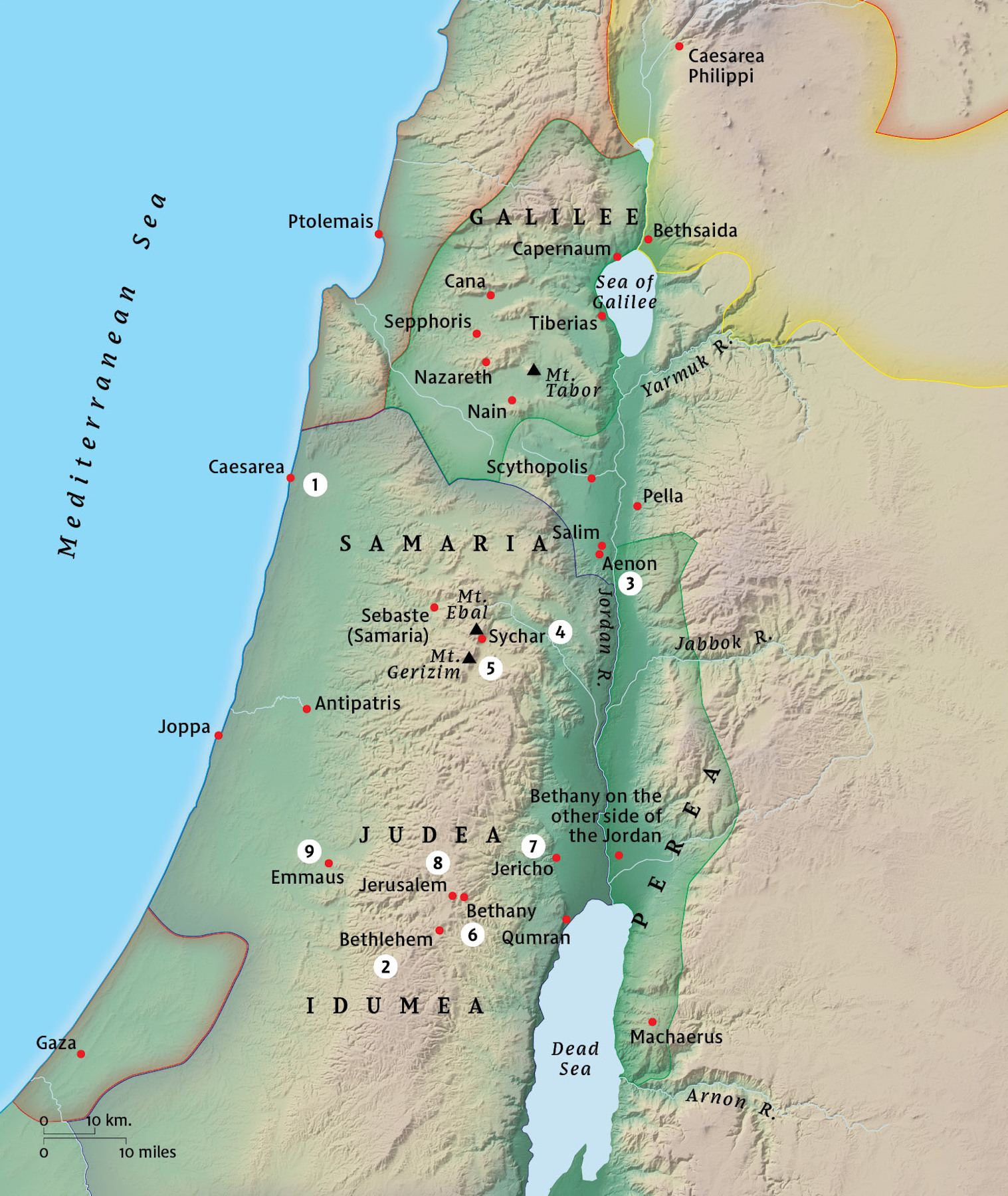
➊ The most important port in the Holy Land in NT times
➋ The birthplace of Jesus (Mt 2:1; Lk 2:4)
➌ John the Baptist baptized here (Jn 3:23). Aenon was also the probable location of John’s ministry.
➍ Here Jesus talked with a Samaritan woman at Jacob’s well (Jn 4:5).
➎ The mountain referred to by the Samaritan woman at the well as the worship center for the Samaritans (Jn 4:20–23)
➏ Jesus raised Lazarus from the dead (Jn 11:43–44). Here at Bethany Jesus was anointed in the house of Simon the Leper (Mt 26:6). It was also the scene of the ascension (Lk 24:50–51).
➐ Jesus healed a blind man here at Jericho (Mt 20:29) and called Zacchaeus down from a tree (Lk 19:1).
➑ Most important biblical city. Jesus was crucified at Jerusalem as predicted (Mt 16:21; Mk 10:33; Lk 18:31).
➒ The resurrected Jesus appeared to two people walking to Emmaus, and he ate with them there (Lk 24:13).
Go to the Maps Index.
4:2 The disciples did not baptize without Jesus’ approval (see 3:2 and note).
4:3 left Judea. Success (which aroused opposition; see note on 7:1—8:59), not failure, led Jesus to leave Judea.
4:4 had to go. Perhaps the necessity lay in Jesus’ mission rather than in geography. Samaria. Here the whole region, not simply the city. Jews often avoided Samaria by crossing the Jordan and traveling on the east side (see notes on Mt 10:5; Lk 9:52).
4:5 Sychar. A small village near Shechem. Jacob bought some land in the vicinity of Shechem (Ge 33:18–19), and it was apparently this land that he gave to Joseph (Ge 48:21–22). See map.
4:6 Jacob’s well. Mentioned nowhere else in Scripture (see v. 11 and note).
4:7 to draw water. People normally drew water at the end of the day rather than in the heat of midday (see v. 6; Ge 24:11 and note). But the practice is attested by Josephus, who says that the young ladies whom Moses helped (Ex 2:15–17) came to draw water at noon.
4:9 do not associate with. The point of the NIV text note (and probably of the text) is that Jews would become ceremonially unclean if they used a drinking vessel handled by a Samaritan, since they held that all Samaritans were “unclean.”
4:10 gift. Emphasizing God’s grace through Christ. Jesus gave life and gave it freely. living water. Not stagnant cistern water but fresh, flowing water, as of a spring or mountain stream, that revives and refreshes life. In 7:38–39 the term is explained as referring to the Holy Spirit, but here it refers to that which produces eternal life (v. 14).
4:11 deep. Christian pilgrim sources as early as the fourth century mention a well in this area that was about 100 feet deep. When the present well was cleaned out in 1935, it was found to be 138 feet deep.
4:12 our father Jacob. Deep regard for the past prevented her from seeing the great opportunity of the present.
4:14 welling up. The expression is a lively one, with a meaning like “leaping up.” Jesus was speaking of abundant life (cf. 10:10 and note), gushing forth from its spring.
4:15 Cf. the misunderstanding of Nicodemus (3:4). In both cases the way was opened for further instruction.
4:18 five husbands. Her multiple partners could indicate an immoral lifestyle or that she was the victim of exploitation by these men. Perhaps she was repeatedly widowed, and/or her husbands divorced her, potentially because of childlessness. She was not married to her present partner, which in her culture was considered immoral.
4:19 you are a prophet. Because of his special insight.
4:20 this mountain. Recognizing Jesus as a prophet, she asked him a theological question about the proper place of worship, a key point of debate between Jews and Samaritans. Samaritans held that “this mountain” (Mount Gerizim) was especially sacred. Abraham and Jacob had built altars in the general vicinity (Ge 12:6–7; 33:18–20), and the people had been blessed from this mountain (Dt 11:29; 27:12). In the Samaritan Scriptures, Mount Gerizim (rather than Mount Ebal) was the mountain on which Moses had commanded an altar to be built (Dt 27:4–6). The Samaritans had built a temple on Mount Gerizim c. 400 bc, which the Jews destroyed c. 128. Both actions, of course, increased hostility between the two groups. See map and photo.
4:22 worship what you do not know. The Samaritan Bible contained only the Pentateuch. Samaritans worshiped the true God, but their failure to accept much of his revelation meant that they knew little about him. salvation is from the Jews. The Messiah would come from God’s historic people (see notes on Ro 1:16; 11:18).
4:24 God is spirit . . . worship in the Spirit and in truth. The place of worship is irrelevant, because true worship must be in keeping with God’s nature, which is spirit. “True worshipers” (v. 23) must worship God in the power (enablement) of his Spirit and in accordance with truth. In John’s Gospel truth is associated with Christ (see notes on 1:14; 14:6), a fact that has great importance for the proper understanding of genuine Christian worship.
4:25 Messiah . . . will explain everything. The Samaritans expected a Messiah, but their rejection of all the inspired writings after the Pentateuch meant that they knew little about him. They thought of him mainly as a teacher.
4:26 I am he. The only occasion before his trial on which Jesus specifically said that he was the Messiah (but see Mk 9:41, “Messiah”). The term did not have the political overtones in Samaria that it had in Judea, which may be part of the reason Jesus used the designation here.
4:27 were surprised. Jewish religious teachers rarely spoke with women in public.
4:29 everything I ever did. An exaggeration, but it shows the impression Jesus made on her.
4:33 A misunderstanding similar to that of the woman (see v. 15 and note).
4:34 My food . . . is to do the will of him who sent me. John often mentions that Jesus depended on the Father and did the work the Father sent him to do (see, e.g., 3:34; 5:30 and notes; 6:38; 8:26; 9:4; 10:37–38; 12:50 and note; 14:31 and note; 15:10; 17:4; Mt 6:25 and note).
4:35 four months until harvest. Apparently a proverb that meant something like “Harvest cannot be rushed.” But, while the crops must take their time ripening, in the fields that Jesus referred to the harvest is already ripe (cf. Mt 9:36–38).
4:36 draws a wage. The work, or at least part of it, had been done, and others were working hard. The disciples were not to think that the harvest was far off. Jesus was not speaking of grain but of the “crop for eternal life.” There was urgency, for the crop would not wait. glad together. There is no competition among Christ’s faithful servants, and sower and reaper share in the joy of the crop.
4:38 Others. May refer to John the Baptist and his supporters, on whose work the apostles would build. Or perhaps Jesus was looking further back, to the prophets and other godly people of old. Either way, he expected the apostles to be reapers as well as sowers.
4:39 that town. Sychar (v. 5). because of the woman’s testimony. Highlighting the important theme of testimony or witness in John.
4:42 the Savior of the world. In the NT the expression occurs only here and in 1Jn 4:14. It points to the facts (1) that Jesus not only teaches but also saves and (2) that his salvation extends to the world (see note on 3:16).
4:44 his own country. It is unclear whether this refers to Galilee (v. 43) or Judea (a broad designation referring to all Jewish lands; cf. Ac 2:9 and note; cf. Lk 4:24).
4:45 welcomed him. The welcome of the Galileans was actually limited, for they were interested only in Jesus’ miracles. They were not welcoming the Messiah who could bring forgiveness of sins, but only a miracle worker who could meet all their physical needs and expectations. all that he had done. See 20:30 and note. Passover Festival. The one narrated in 2:13–25.
4:46 Cana. The first and second signs both occur in Cana, framing chs. 2–4 (see Introduction: Outline). royal official. Evidently an officer in Herod’s service.
4:48 Unless you . . . see signs and wonders . . . you will never believe. The general attitude of Galileans, not that of the official.
4:50 your son will live. Not simply a prophecy, but words of power. Jesus was healing the man’s son at a distance, not forecasting a happy ending (vv. 51,53).
4:53 believed. Cf. the aim of this Gospel (see 20:31 and note; see also Introduction: Purpose and Emphases).
4:54 second sign. This was the second time Jesus performed a sign after coming from Judea to Galilee (see 2:11 and note; see also chart). The fact that John is numbering the signs suggests that their number (7) is theologically significant, indicating completeness or perfection.
5:1 one of the Jewish festivals. Probably Passover, Pentecost or Tabernacles. The identity of this festival is significant for the attempt to ascertain the number of Passovers included in Jesus’ ministry, and thus the number of years his ministry lasted. John explicitly mentions at least three different Passovers: the first in 2:13,23 (see note on 2:13), the second in 6:4 and the third several times (e.g., in 11:55; 12:1), suggesting a public ministry lasting between two and three years. However, if the festival of 5:1 was a second Passover or assumes that a second Passover had come and gone, Jesus’ ministry would have lasted between three and four years. See chart.
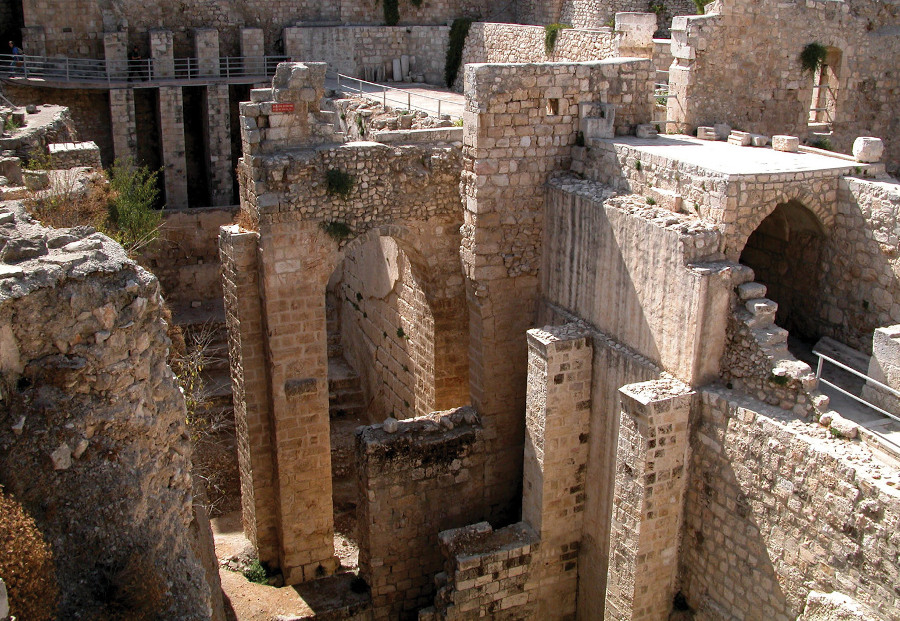
Excavation site for the pools of Bethesda. Two pools are surrounded on all four sides by a colonnade. There is an additional colonnade separating the pools, fitting the description from John 5:2.
Todd Bolen/BiblePlaces.com
Return to the main text.
5:6 Do you want to get well? The man had not asked Jesus for help.
5:7 when the water is stirred. The man did not see Jesus as a potential healer, and his mind was set on the supposed curative powers of the water.
5:9 the man was cured. This episode represents Jesus’ authority to heal rather than any faith the man might have. Sometimes, faith in Jesus was essential to the cure (e.g., Mk 5:34), but here the man did not even know who Jesus was (v. 13). So while Jesus sometimes healed in response to faith, he was not limited by a person’s lack of it.
5:10 the law forbids you to carry your mat. It was not the law of Moses itself but their traditional interpretation of it that prohibited carrying loads of any kind on the Sabbath. The Jews had very strict regulations on keeping the Sabbath but also had many curious loopholes that some of their teachers made full use of (cf. Mt 23:4).
5:12 this fellow. The Jews were contrasting the authority of the law of God, which in their view prohibited the action, and that of a mere man (as they considered Jesus to be) who permitted it.
5:14 Stop sinning. Might imply that the man’s sins had caused his disability. In 9:1 Jesus repudiates the idea that disabilities (such as blindness there) are always caused by sin, but he does not say they are never caused by sin. something worse. Jesus warns the man that to relapse into sin could result in even greater judgment.
5:16 was doing these things on the Sabbath. It is always lawful to do good and to save life—including on the Sabbath (see v. 17; 7:23; Lk 6:9; 13:15; 14:5 and notes). The continuous action points to more than one incident, and the Jews (see note on 1:19) apparently discerned a pattern. began to persecute him. John does not tell us what form the persecution took.
Possible Chronology of Jesus’ Ministry
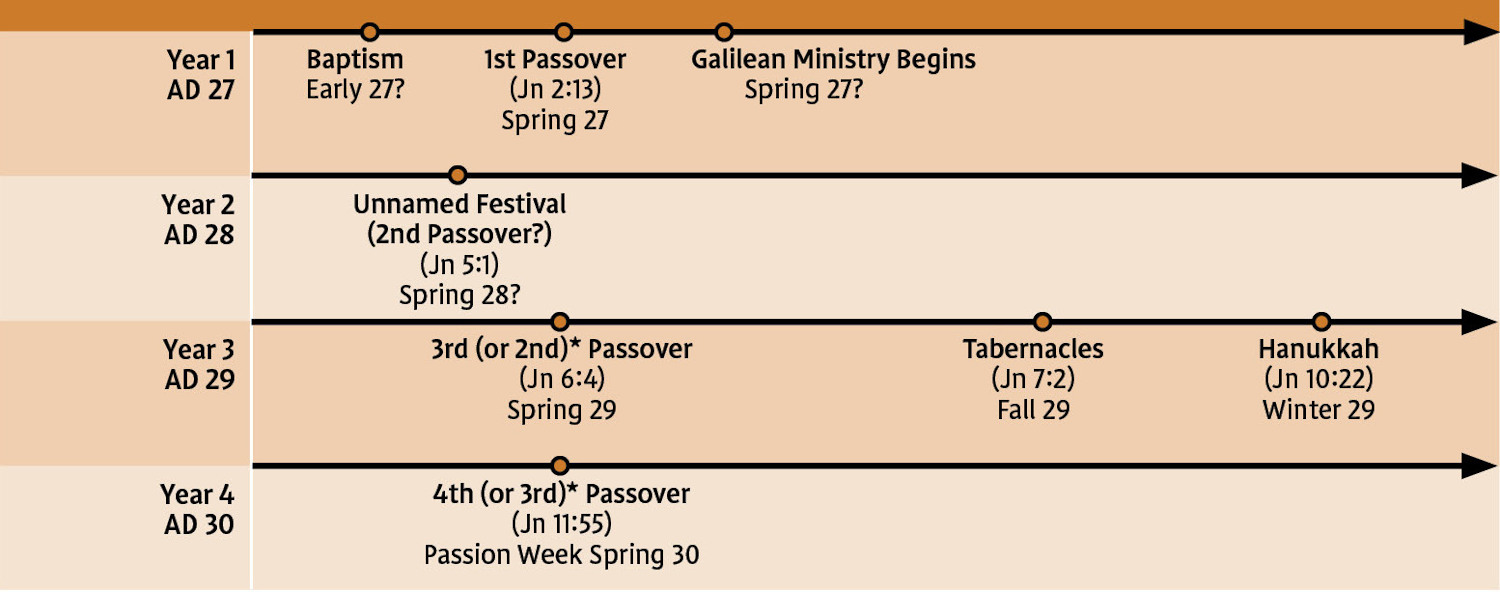
*Jesus’ ministry could be reduced by one year if the unnamed festival of John 5:1 occurred in the fall or winter of the first year rather than the spring of the second. This would make Jn 6:4 the second Passover and Jn 11:55 the third. In this case, the reference in Jn 4:35 (“four months before the harvest = Jan/Feb) would be merely proverbial and would not be indicating that Jesus is speaking in the winter of his second year of ministry.
Adapted from Four Portraits, One Jesus by Mark L. Strauss. Copyright © 2007 by Mark L. Strauss, p. 407. Used by permission of Zondervan.
Go to the Charts Index.
5:17 My Father is always at his work. Jesus’ justification for his action was his close relation to his Father. Since God alone is allowed to work on the Sabbath, Jesus is here claiming deity (v. 18).
5:18 his own Father. Referring to a special relationship. The Jews did not object to the idea that God is the Father of all, but they strongly objected to Jesus’ claim that he stood in a special relationship to the Father—a relationship so close as to make himself equal with God.
5:19 can do nothing by himself. Because of who and what he was, it was not possible for Jesus to act except in dependence on the Father (see 4:34 and note).
5:20 the Father loves the Son and shows him all he does. Love produces revelation. The Father revealed to the Son his plans and purposes, and the Son obediently carried them out (17:4). greater works. The Son’s activities in raising the dead and judging (see following verses).
5:21 the Father raises the dead. A firm belief among the Jews (except the Sadducees; see chart), who also held that the Father did not give this privilege to anyone else. Jesus claimed a prerogative that, according to his opponents, belonged only to God. the Son gives life. Probably refers to Christ’s gift of abundant life here and now (10:10), though possibly also to the future resurrection (see 11:25 and note).
5:22 entrusted all judgment to the Son. The Jews believed that God is Judge of the world, so this teaching seemed heretical to them. For other NT assertions that Jesus will be the eschatological Judge, see Mt 25:31–33; Ac 10:42; 17:31; 2Co 5:10; 2Ti 4:1; 1Pe 4:5 and note.
5:24 believes him . . . has eternal life. Faith and life are connected (see 20:31 and note). has eternal life. A present possession (see notes on 3:15,36). has crossed. The decisive action has taken place, and the believer belongs no longer to the realm where death reigns supreme but to the realm of life.
5:25 is coming and has now come. A reference not only to the future resurrection but also to the fact that Christ gives life now. The spiritually dead who hear him receive life from him.
5:26 has life in himself. Must be understood against the background of the OT, where life is spoken of as belonging to God and as being his gift (see Dt 30:20 and note; Job 10:12; 33:4; Ps 16:11; 27:1; 36:9 and note). The Son has been given the same kind of life the Father possesses.
5:27 authority to judge because he is the Son of Man. As predicted in Da 7:13–14, the exalted Son of Man has the authority to judge human beings because he alone became a perfect human being.
5:29 done what is good . . . live . . . done what is evil . . . condemned. As always in Scripture, judgment is based on what people have done in their lives (see Ro 2:6–8; Rev 20:12 and notes) demonstrated by their faith response to Jesus, the Son. Salvation, of course, is a gift from God in response to faith (see v. 24 and note), but true faith in Christ results in changed lives, lived in obedience to Christ as Lord (see Ro 10:9–10; Jas 2:14–26 and notes).
5:30 By myself I can do nothing. Jesus stresses his dependence on the Father (see note on v. 19). He judges only as he hears from the Father, which makes his judgment fair.
5:31–47 This section stresses the testimonies (see note on 1:7) of John the Baptist (v. 33), of the works of Jesus (v. 36), of God the Father (v. 37), of the Scriptures (v. 39) and of Moses (v. 46).
5:31 Jesus’ testimony about himself required the support of all God’s revelation. Otherwise, it would have been unacceptable.
5:32 another. The Father testifies concerning the Son. The Jews might not accept this testimony, but it was the testimony that mattered most.
5:33 You have sent to John. A reference to the delegation from the Jewish leaders to John the Baptist (see 1:19 and note). he has testified. The testimony of John was important, though not, of course, equal to the testimony of the Father. But if the Jews had believed John, they would have believed Christ and would have been saved.
5:34 Not that I accept human testimony. Probably meaning that he does not rely on human testimony—which is always fallible and often fickle (1Jn 5:9).
5:35 John was. The past tense may indicate that John was dead or at least imprisoned. In any case, his work was done. burned and gave light. John’s giving light was costly to him. for a time. The Jewish leaders never came to grips with John’s message, and their responses to him were always at best tentative and superficial.
5:36 works. The miracles of Jesus, which testified to what he is and to his divine mission (see 10:25 and note).
5:37 the Father . . . has himself testified . . . his voice. Probably a reference to God’s voice in the Scriptures (vv. 38–39). God had also given his voice of approval at Jesus’ baptism (see Mt 3:17 and note).
5:38 you do not believe. These Jewish leaders did not recognize what God was saying, as their failure to believe Jesus shows.
5:39 You study the Scriptures diligently. The Jewish leaders studied Scripture in minute detail. Despite their reverence for the very letter of Scripture (see notes on Mt 5:18–21), they did not recognize the one to whom Scripture bears supreme testimony (see Lk 24:44 and note).
5:41 Jesus did not accept the kind of human praise that his opponents prized (v. 44).
5:42 love of God. May mean God’s love for them or theirs for God. Probably it is the latter.
5:43–44 The individuals whom Jesus was addressing (v. 16) had their attention firmly fixed on people. Their emphasis on self-seeking and on human praise showed that they did not accept the one who came from God, and therefore they missed the praise that comes from God.
5:43 if someone else comes . . . you will accept him. See note on Zec 11:17.
5:45–47 The revelation God gave Moses is inseparable from the revelation God was giving through Jesus (see Lk 16:31; Ro 10:4 and note). Those who refused to believe the witness about Jesus in the earlier revelation would also reject the later revelation coming through him. To their surprise, he declared that his listeners had refused to believe both and should therefore be accused before God by Moses.
5:46 he wrote about me. The authors of the NT books sometimes expressly stressed and everywhere assumed that the OT, rightly read, pervasively points to Christ (see Lk 24:25–27,44–46 and note on 24:44). Here Jesus applies this truth specifically to the writings traditionally ascribed to Moses. He may have had Dt 18:15,18 especially in mind but probably was thinking more broadly of the whole scope of what the Pentateuch disclosed concerning God’s saving program in history, which Jesus the Messiah came to complete.
6:1–15 The feeding of the 5,000 is the one miracle, apart from the resurrection, found in all four Gospels. It shows Jesus as the supplier of human need and recalls God feeding Israel with manna in the wilderness, setting the stage for his testimony that he is the bread of life (v. 35). It also points forward to the great Messianic banquet described in Isa 25:6–9.
6:1 far shore. The northeast shore, probably near Bethsaida (see Lk 9:10 and map). Sea of Tiberias. Probably the official Roman name of the Sea of Galilee (see note on Mk 1:16). The name came from the town of Tiberias (named after the emperor Tiberius), founded c. ad 20.
6:4 Passover. The setting for ch. 6, with its key symbol of bread (see notes on 2:13; 5:1).
6:5 Philip. Since he came from nearby Bethsaida (see 1:44 and note), it was appropriate to ask him.
6:9 barley loaves. Cheap bread, the food of the poor.
6:10 about five thousand men. Women and children were not included in this number, and so the entire crowd was much larger (see Mt 14:21 and note).
6:12 Gather the pieces. See note on Mk 6:43.
6:13 twelve baskets . . . left over. See note on Mk 6:43.
6:14 sign . . . Prophet. It pointed people to the Son of Man and the food for eternal life that he gives (see v. 27 and note), but they thought only of the Prophet, i.e., the prophet of Dt 18:15,18 who would be like Moses (see 1:21 and note). Through Moses, God had provided food and water for the people in the wilderness, and they expected the Prophet to do more than this.
6:15 make him king by force. Jesus rejected the widely held Jewish view of the Messiah’s kingship characterized by exerting power to overthrow Rome (cf. notes on 18:36; Lk 24:21).
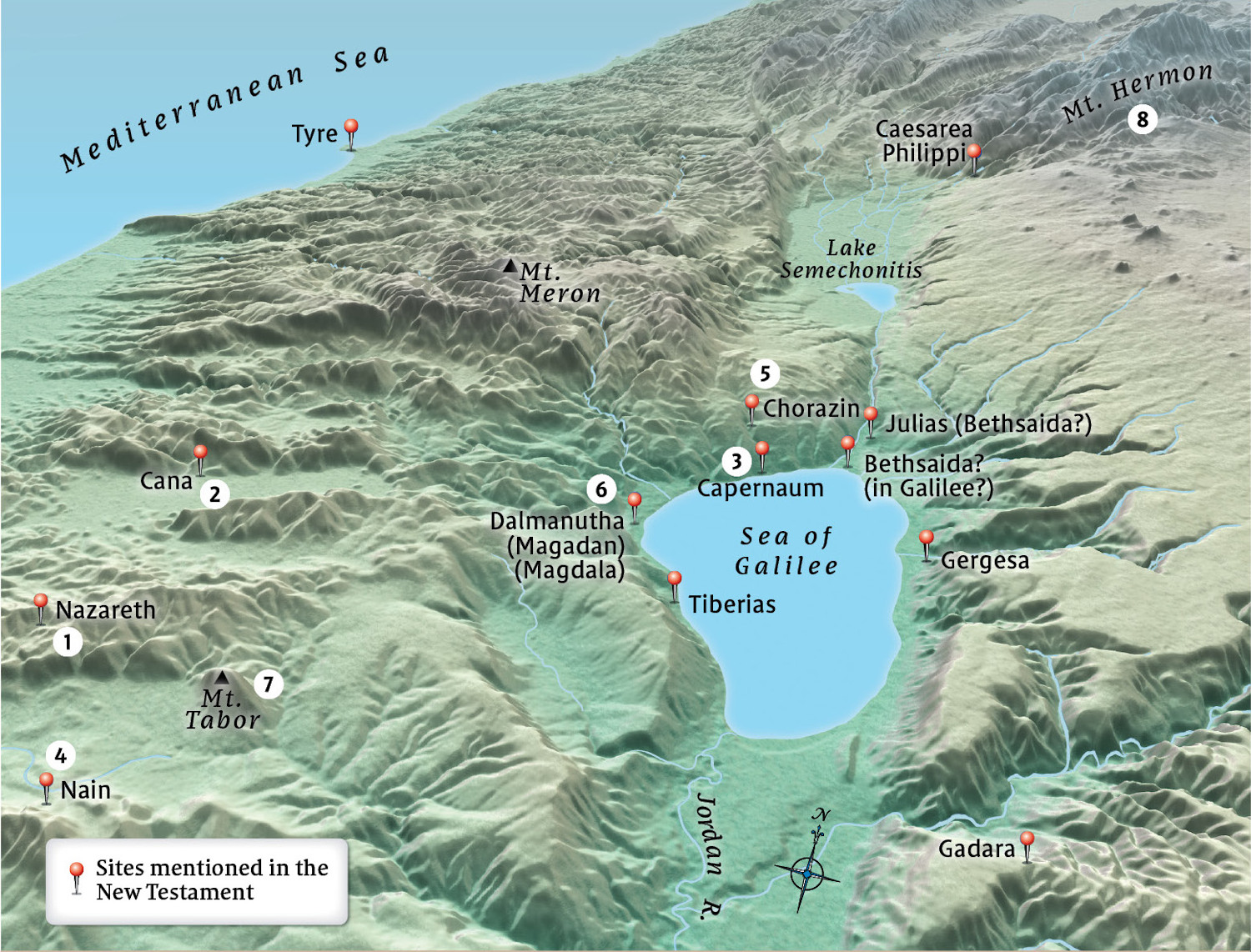
➊ Town where Jesus grew up. He was rejected in the synagogue here and people sought to kill him (Lk 4:16).
➋ Here at Cana Jesus performed his first miracle by turning water into wine at a wedding feast (Jn 2:1,11). Home of Nathanael (Jn 21:2).
➌ Site of many miracles of Jesus (Mt 8:5; Mk 2:1 and Lk 7:1; Mt 17:24; Mk 1:21 and Lk 4:31; Jn 4:46; 6:17). Jesus taught in the synagogue here at Capernaum (Jn 6:59).
➍ Here at Nain Jesus raised a widow’s son from the dead (Lk 7:11).
➎ One of the cities against which Jesus pronounced a woe (Mt 11:21; Lk 10:13).
➏ Fishing town and home of Mary Magdalene (Mt 15:39; Mk 8:10).
➐ Mount Tabor, the traditional Mount of Transfiguration (Mt 17:1–8; Mk 9:2–8; Lk 9:28–36). However, many scholars identify Mount Hermon as the most likely site of the transfiguration (see note on Lk 9:28).
➑ Mount Hermon is perhaps the more likely site of the transfiguration (see note on Lk 9:28).
Go to the Maps Index.
6:19 three or four miles. Mark says they were “in the middle of the lake” (Mk 6:47). frightened. They thought they were seeing a ghost (Mt 14:26).
6:20 It is I. This reassurance by Jesus may allude to God’s self-designation as “I AM” (see Ex 3:14; Jn 6:35 and notes; see also article).
6:21 immediately the boat reached the shore. Some think that this was another miracle. In any event, the boat’s safe arrival is implicitly credited to Jesus.
6:22–24 The crowd could not figure out what had happened to Jesus. But they wanted to see him again, so they looked for him in the most likely place, Capernaum (see note on 2:12; see also map).
6:27 eternal life. Not something to be achieved but to be received by faith in Christ (see vv. 28–29; 3:15 and notes). Son of Man. See note on Mk 8:31. Submission of the Son to the Father is one of John’s major themes (see note on 4:34).
6:28 What must we do . . . ? They missed the point that eternal life is Christ’s gift and were thinking in terms of achieving it by pious works (see Eph 2:8–9; Titus 3:5 and notes).
6:29 work of God. Believing in Jesus Christ is the indispensable “work” God calls for—the one that leads to eternal life (see 9:4 and note).
6:30 What will you do? They seek from Jesus a sign greater than the gift of manna that had accompanied Moses’ ministry.
6:31 manna. A popular Jewish expectation was that when the Messiah came he would renew the sending of manna. The crowd probably reasoned that Jesus had done little compared to Moses. He had fed 5,000; Moses had fed a nation. He did it once; Moses did it for 40 years. He gave ordinary bread (see note on vv. 1–15; see also note on v. 14); Moses gave “bread from heaven” (see notes on Ex 16:4; Nu 11:7).
6:32 Jesus corrected them, pointing out that the manna in the wilderness did not come from Moses but from God and that the Father still “gives” (the present tense is important) the true bread from heaven, the Son, who gives eternal life.
6:33 bread of God. Jesus moved the discussion to something (and Someone) much more important than manna. bread that comes down from heaven. This affirmation is repeated six times in this context (here and in vv. 38,41,50–51,58), emphasizing Jesus’ divine origin.
6:34 this bread. Probably another misunderstanding, like that by the woman at the well (see 4:15 and note; cf. also Nicodemus, 3:4). They were interpreting it physically rather than spiritually.
6:35 I am. The first of seven (the number of completeness and perfection) self-descriptions of Jesus introduced by “I am” (see 8:12; [9:5;] 10:7,9; 10:11,14; 11:25; 14:6; 15:1,5; see also chart). See note on 8:58 for Jesus’ use of “I AM” on its own. the bread of life. Meaning “the bread that gives life.” What is implied in v. 33 is now made explicit, and it is repeated with minor variations in vv. 41,48,51.
6:37 God’s action (see v. 44; 10:29; 17:6; 18:9 and notes), not ours (see v. 28 and note), is primary in salvation, and Christ’s mercy is unfailing (see vv. 31–40; 10:28; 17:9,12,15,19 and notes on 17:12 and 17:19; 18:9).
6:38 to do the will of him who sent me. See note on 4:34.
6:39 I shall lose none. True believers will persevere because of Christ’s firm hold on them (see 10:28–29; Php 1:6 and notes; cf. Heb 3:6,14 and notes; cf. also Introduction to Hebrews: Theme). the last day. An expression found only in John in the NT (vv. 40,44,54). Jesus probably refers to the resurrection of believers (v. 40) followed by judgment (cf. 5:25–30; 11:24; 12:48).
6:40 eternal life. See note on 3:15. raise them up at the last day. Death cannot destroy the life that Christ gives (see 11:25–26 and note on 11:25).
6:41 the Jews there. See note on 1:19.
6:44 draws. People do not come to Christ strictly on their own initiative; the Father draws them. But neither does he compel them against their will; the verb suggests a gentle persuasion.
6:45 the Prophets. The section of the OT from which the quotation is taken (see note on Mt 5:17).
6:49 they died. Jesus’ opponents had set their hearts (cf. v. 31 and note) on that which could neither give nor sustain spiritual life.
6:50 eat and not die. Jesus’ gift is in contrast; the life he gives is eternal (see 11:26 and note).
6:51 Whoever eats this bread. That is, whoever appropriates Jesus by faith as the sustenance of their life. my flesh, which I will give. Looking forward to Calvary. Providing eternal life would be costly to the Giver. for the life of the world. Pointing to the substitutionary character of Christ’s self-sacrifice. world. See notes on 1:9; 4:42.
6:53–58 “Flesh” and “blood” here point to Christ as the crucified one and the source of life. Jesus speaks of faith’s appropriation of himself as God’s appointed sacrifice.
6:54 eats my flesh . . . drinks my blood. In addition to any possible reference to the Lord’s Supper, the parallel with v. 40 suggests that these terms are metaphorical for believing in Jesus as the Son of God. the last day. See note on v. 39.
6:58 bread that came down from heaven. As in v. 49, the value of the manna is limited and is contrasted with the heavenly food Christ gives.
6:60 hard. Hard to understand, but even harder to accept. The thought of eating the flesh of the Son of Man and drinking his blood was doubtless shocking to most of Jesus’ Jewish hearers (see note on vv. 53–58).
6:62 Son of Man. See notes on Mk 8:31; Lk 6:5; 19:10. ascend. Probably refers to the series of events that began with the cross, where Jesus was glorified (see note on 7:39). where he was before. Referring to Jesus’ heavenly preexistence (see 8:58; 17:5 and note).
6:63 Cf. 3:5–6,8. words . . . full of the Spirit and life. The Spirit is at work producing life through Christ’s words (v. 68).
6:65 Coming to Christ for salvation is never a merely human achievement (see vv. 37,39,44–45 and notes). The verb “enabled” could also be translated “given” or “granted.”
6:66 From this time. May also mean “For this reason.” many . . . turned back. Jesus had already made clear what discipleship meant, and many were not ready to receive life in the way he taught (cf. Lk 9:62).
6:68 As in the other Gospels, Peter acts as spokesperson. This statement parallels his confession that Jesus is the Messiah in the Synpotic Gospels (Mt 16:15–16; Mk 8:29; Lk 9:20). words of eternal life. The expression is general. Peter was not speaking of a formula but of the thrust of Jesus’ teaching. He perceived the truth of v. 63 (see note there).
6:69 Holy One of God. Applied to Jesus in Mk 1:24 (see note there); Lk 4:34 (cf. Ac 2:27).
6:70 a devil. Judas (v. 71) would be used by Satan to oppose Christ.
6:71 Iscariot. Means “man from Kerioth” (in Judea; see Jos 15:25) and would apply equally to the father and the son (cf. 12:4). Judas seems to have been the only non-Galilean among the Twelve. one of the Twelve. Therefore one of the last persons likely to betray Jesus.
7:1—8:59 In chs. 7–8 John records strong opposition to Jesus, including repeated references to threats on his life (7:1,13,19,25,30,32,44; 8:37,40,59). John seems to have gathered the major arguments against the Messiahship of Jesus and here answers them.
7:1 After this. Since 6:4 refers to the Passover Festival and 7:2 to the Festival of Tabernacles, the interval was about six months.
7:2 Festival of Tabernacles. The great festival in the Jewish year, celebrating the completion of harvest and commemorating God’s goodness to the people during the wilderness wanderings (see Lev 23:33–43; Dt 16:13–15; Zec 14:16 and note). The name came from the leafy shelters in which people lived throughout the seven days of the festival. Its key symbols were water and light.
7:3 Jesus’ brothers. See note on Lk 8:19.
7:4 It is not clear whether the brothers claimed some knowledge of Jesus’ miracles that other people did not have or were suggesting that any claim to Messiahship must be decided in Jerusalem. Their advice was not given sincerely, for they did not yet believe in Jesus (v. 5).
7:6 My time is not yet here. Jesus moved in accordance with the will of God (see notes on 2:4; Ro 5:6).
7:7 The world. Either (1) people opposed to God or (2) the human system opposed to God’s purposes (see note on 1Jn 2:15). Jesus’ brothers belonged to the world and therefore could not be the objects of its hatred. Jesus, however, rebuked the world and was hated accordingly.
7:8 not. See NIV text note. Jesus was not refusing to go to the festival but refusing to go in the way his brothers suggested—as a pilgrim. When he went, it would be to deliver a prophetic message from God, for which he awaited the right time (see note on v. 6).
7:10 not publicly. Rejecting the brothers’ suggestion to show himself (v. 4).
7:12 whispering. Because it was not safe to speak openly (cf. v. 13).
7:14 halfway through the festival. When the crowds would be at their maximum. Teaching in the temple courts at such a time would reach many.
7:15 The Jews. Here distinct from “the crowds” (v. 12), who were also largely Jewish (see note on 1:19). without having been taught. By a rabbi. Jesus had never been the disciple of a recognized Jewish teacher (see Ac 4:13 and note).
7:16 not my own. The Father, from whom he came, had been his “rabbi” (see note on 4:34).
7:17 chooses to do the will of God. Reflecting a whole attitude of life. A person sincerely set on doing God’s will welcomes Jesus’ teaching and believes in him (see 6:29 and note). will find out. Augustine commented, “Understanding is the reward of faith . . . What is ‘If any man be willing to do his will’? It is the same thing as to believe.”
7:18 is a man of truth. Or “is true.” They should have recognized that Jesus was not self-seeking. In this Gospel, no one is spoken of as being “true” except God the Father (see 3:33 and note; 8:26) and Jesus (here). Once more John ranks Jesus with God.
7:19 the law. These Jews congratulated themselves on being the chosen recipients of the law, but Jesus told them that they all broke the law of which they were so proud (cf. Ro 2:17–29). trying to kill me. A striking example of their failure to keep the law (cf. 7:51).
7:20 You are demon-possessed. The accusation of demonic possession is made elsewhere in John (e.g., 8:48–52; 10:20–21; cf. Mt 12:24–32; Mk 3:22–30). crowd. Probably the pilgrims who had come up to Jerusalem for the festival—different from “the Jewish leaders” who were trying to kill Jesus (v. 1) and the group in Jerusalem who knew of the plot (see v. 25 and note).
7:21 one miracle. Evidently that of healing the lame man (5:1–9), as the discussion about the Sabbath shows.
7:22 circumcision. The requirement of circumcision was included in the law Moses gave (see Ex 12:44,48 and note; Lev 12:3), yet it did not originate with Moses but went back to Abraham (see Ge 17:10–12 and notes). The Jews took such regulations as that in Lev 12:3 to mean that circumcision must be performed on the eighth day even if it was the Sabbath. This exception is of critical importance in understanding the controversy (v. 23). Jesus was not saying that the Sabbath should not be observed or that the Jewish regulations were too harsh. He was saying that his opponents did not understand what the Sabbath meant. The command to circumcise showed not only that work might sometimes be done on the Sabbath but that it must sometimes be done then. Deeds of mercy are in this category (see notes on 5:10; Mk 3:2).
7:25 people of Jerusalem. An expression found only here and in Mk 1:5 in the NT, probably referring to the group in Jerusalem (see note on v. 20). They did not originate the plot against Jesus, but they knew about it.
7:26 Have the authorities really concluded . . . ? In Greek, the question is in a form that expects a negative answer. the Messiah. See note on 1:25.
7:27 no one will know where he is from. Some Jews held that the OT gave the origin of the Messiah (cf. v. 42; Mt 2:4–6), but others believed that it did not.
7:28 you know me. Irony, because in a sense they knew Jesus and that he came from Nazareth, but in a deeper sense they did not know Jesus or the Father (see 8:19 and note). Jesus mentioned again his dependence on the Father (see 4:34 and note) and went on to declare that he had real knowledge of God and that they did not. Both his origin and mission were from God.
7:30 they tried to seize him. Jesus’ enemies were powerless against him until his time came (see note on 2:4).
7:31 crowd. Of pilgrims (see note on v. 20). Many of them believed on the basis of the miraculous signs (cf. 6:26).
7:32 Pharisees. See note on Mt 3:7; see also article and chart. chief priests. This is the priestly aristocracy, the relatives of the high priest and other influential priests (see notes on Mt 2:4; Mk 8:31).
7:33 then I am going. Jesus changed the topic from his miracles to his death, to which he referred enigmatically (v. 34).
7:35 scattered among the Greeks. From the time of the exile, many Jews lived outside the Holy Land and could be found in most cities throughout the Roman Empire.
7:37 last . . . day of the festival. Either the seventh or the eighth day: The Festival of Tabernacles lasted seven days (Lev 23:34; Dt 16:13,15) but had a “closing special assembly” on the eighth day (Lev 23:36). See note on Mk 14:12. stood and said in a loud voice. Teachers usually sat, so Jesus drew special attention to his message. come to me and drink. Since the Festival of Tabernacles celebrated God’s provision of water in the wilderness, for Jesus to claim he is living water means he is the fulfillment of this festival. Jesus is worthy of worship.
7:38 See NIV text note. as Scripture has said. A general statement that may allude to such passages as Isa 44:3; 55:1; 58:11; Zec 14:8. living water. See note on 4:10.
7:39 the Spirit. Explaining the “living water” (v. 38). had not been given. In the manner in which he would be given at Pentecost (see Ac 2:1–2,4 and notes). glorified. Here probably refers to Jesus’ crucifixion, resurrection and exaltation (see note on 13:31). The fullness of the Spirit’s work depends on Jesus’ prior work of salvation.
7:40 people. The “crowd” of v. 20 (see note there). the Prophet. See 1:21 and note.
7:41 from Galilee. Typical irony by John. The crowd doubts that Jesus is the Messiah because he comes from Galilee instead of Bethlehem. Apparently they are not aware of his Bethlehem birth (see Mic 5:2; Mt 2:1; Lk 2:4 and notes).
7:42 the Messiah will come from David’s descendants and from Bethlehem. See 1Sa 20:6; 2Sa 7:12–16 and notes; Ps 89:3–4; Mic 5:2. from Bethlehem. There were different ideas about the Messiah’s place of origin (see v. 27 and note).
7:46 guards. They knew they would be in trouble for failing to make the arrest but did not mention the hostility of part of the crowd, which would have given them something of an excuse before the Pharisees. They were favorably impressed by the teaching of Jesus and were not inclined to cause him trouble.
7:47 Pharisees retorted. They must have been greatly irritated. Ordinarily the chief priests would have been the ones to rebuke the temple guards.
7:49 this mob. The Pharisees’ pejorative term for the pilgrim crowd (see note on v. 20). knows nothing. The Pharisees exaggerated the people’s ignorance of Scripture (cf. v. 42). But the average Jew paid little attention to the minutiae that mattered so much to the Pharisees. The “tradition of the elders” (Mk 7:3) was too great a burden for people who earned their living by hard physical work, and consequently these regulations were widely disregarded.
7:50–51 There is irony here. The Pharisees implied that no leader believed in Jesus, yet Nicodemus, “a member of the Jewish ruling council” (3:1), spoke up. They called for people to observe the law, but Nicodemus pointed to their own disregard for the law in this instance.
7:52 a prophet does not come out of Galilee. See 1:46; see also note on Mt 2:23. They were angry—and wrong. Jonah came from Galilee, and perhaps other prophets had as well. Moreover, the Pharisees overlooked the right of God to raise up prophets from wherever he chooses.
7:53—8:11 This story probably did not belong originally to the Gospel of John. It is absent from almost all the earliest manuscripts, and those that include it sometimes place it elsewhere (e.g., after Lk 21:38). But the story may well be an authentic account about Jesus.
7:53 This verse (along with 8:1) shows that the story was originally attached to another narrative, since Jesus was not present at the meeting of the Sanhedrin described in vv. 45–52.
8:1 Mount of Olives. See notes on Zec 14:4; Mk 11:1; Lk 19:29; Ac 1:12.
8:3 teachers of the law. See notes on Mt 2:4; Mk 2:16; Lk 5:17. a woman caught in adultery. This sin cannot be committed alone, so the question arises as to why only the female offender was brought. The incident may have been staged to trap Jesus (see v. 6 and note) and provision perhaps made for the man to escape. The woman’s accusers must have been especially eager to humiliate her, since they could have kept her in private custody while they spoke to Jesus.
8:4 caught in the act. Mere compromising circumstances were not sufficient evidence; Jewish law required witnesses who had seen the act.
8:5 to stone such women. They altered the law a little. The manner of execution was not prescribed unless the woman was a betrothed virgin (Dt 22:23–24). And the law required the execution of both parties (Lev 20:10; Dt 22:22), not just the woman.
8:6 using this question as a trap. The Romans did not allow the Jews to carry out death sentences (see 18:31 and note), so if Jesus had said to stone her he could have been in conflict with the Romans. If he had said not to stone her he could have been accused of being unsupportive of the law. write on the ground with his finger. Some suggest that Jesus was writing an accusation against his accusers. A few later manuscripts add that he wrote “the sins of each of them” on the ground. In any case, the action implies that Jesus will not participate in the woman’s condemnation or execution.
8:7 without sin. The phrase is quite general and means “without any sin,” not “without this sin.” be the first. Jesus’ answer disarmed them. Since he spoke of throwing a stone, he could not be accused of failure to uphold the law. But the qualification for throwing it prevented anyone from acting.
8:9 began to go away. Because they were not “without sin” (v. 7). older ones. They were the first to realize what was involved. But all the men were either conscience-stricken or afraid, and in the end only Jesus and the woman remained.
8:10 Woman. See NIV text note on 2:4.
8:11 Go now and leave your life of sin. Jesus did not condone what the woman had done.
8:12 I am the light of the world. See note on 6:35; see also chart. the light. See 1:4 and note; 9:5; 12:46. It is also true that “God is light” (1Jn 1:5). And as Jesus’ followers reflect the light that comes from him, they too are “the light of the world” (Mt 5:14 [see note there]; cf. Php 2:15 and note). darkness. Both the darkness of this world and that of Satan (cf. 3:19–21). light of life. “God is light” (1Jn 1:5), but Jesus is also the light from God that lights the way for life—as the pillar of fire lit the way for the Israelites (see Ex 13:21 and note; Ne 9:12). Cf. Ro 13:11–14; Eph 5:8–14; 1Th 5:4–8; 1Jn 1:5–7; 2:9–11.
8:13 Pharisees. See note on 7:32.
8:14 Jesus made two points: First, he was qualified to bear testimony, whereas the Pharisees were not; and he knew both his origin and his destination, whereas they knew neither. (See note on vv. 16–18 for the second point.)
8:15 The judgment of the Pharisees was limited and worldly. In the sense they meant, Jesus made it clear that he did not judge at all. In the proper sense, of course, he did judge (v. 26).
8:16–18 Jesus’ second point was that his testimony was not unsupported: The Father was with him, so he and the Father were the two witnesses required by the law (see Dt 17:6 and note; 19:15).
8:16 the Father, who sent me. Jesus was always aware of his mission (see note on 4:34).
8:19 If you knew me. John makes it clear that the Word (Jesus) was with God and was God (see 1:1 and note) and revealed God (see 1:18 and note). Jesus here stresses that the Father is known through the Son and that to know the one is to know the other (see 14:7,10–11 and notes).
8:20 his hour. See note on 2:4.
8:23 Things other than death divide people (cf., e.g., v. 47; 3:31; 15:19 and note; 1Jn 3:10). of. Here denotes origin. Jesus was certainly in the world, but he was not of the world. They belonged to “this world”—Satan’s domain (1Jn 5:19; cf. Jn 12:31; 14:30; 16:11).
8:24 believe. See note on 1:7. I am he. Jesus echoes God’s great affirmation about himself (see v. 58; 6:35; Ex 3:14 and notes; see also article).
8:28 lifted up. Normally used in the NT in the sense of “exalt” (see NIV text note), but John uses it of the whole salvation event: Jesus’ crucifixion, resurrection and exaltation (see 3:14; 12:32 and notes). Son of Man. See note on Mk 8:31. I am. See notes on vv. 24,58.
8:30 believed. See 1:7; 20:31 and notes.
8:31 believed. Here seems to mean made an outward profession of faith. Their words show that they were not true believers (vv. 33,37).
8:32 truth. Closely connected with Jesus (see v. 36; 14:6 and note), it is not mere mental assent but genuine trust, demonstrated by discipleship, that leads to salvation. free. Freedom from sin, not from ignorance (v. 36).
8:33 have never been slaves. Appears to be an amazing disregard of their Roman overlords—and their Egyptian, Assyrian, Babylonian, Persian and Syrian overlords as well. Perhaps they meant that they have always viewed themselves as the descendants of Abraham and heirs of the promises God made to him and so have never accepted servitude to others as their proper status.
8:34 slave to sin. Because sinners cannot break free by their own strength (see Ro 6:18 and note).
8:37 you are looking for a way to kill me. See note on 7:1—8:59.
8:38 Note the contrasts: “I . . . you”; “seen . . . heard”; “the Father . . . your father.” Not until later (see v. 44 and note) did Jesus say who their father was, but it is clear even at this point that it was neither God nor Abraham, as they claimed.
8:39–41 Their deeds revealed their parentage.
8:41 illegitimate. May have been a slander aimed at Jesus.
8:43 These descendants of Abraham (v. 33) were so convinced of their own preconceptions that they did not really hear and understand what Jesus was saying (cf. v. 47).
8:44 You belong to your father, the devil. Jesus warned his Jewish opponents of the reality of Satan’s murderous and deceitful influence. Since “salvation is from the Jews” (4:22; see note there), Jesus’ words do not apply to the Jewish people as a whole. His warning should caution both Gentiles and Jews to follow Abraham’s example (vv. 39–40; cf. Ro 4:16). you want. Points to determination of will. Their problem was basically spiritual, not intellectual. Being oriented toward Satan, they were bent on murder (v. 37) and eventually would succeed (v. 28). truth. Foreign to Satan and those who are his (see 14:6 and note).
8:46 Can . . . you prove me guilty of sin? The asking of the question was more significant than the opponents’ failure to answer, in that it showed that Jesus had a perfectly clear conscience.
8:47 hears what God says. See 10:3–4 and notes; 1Jn 4:6.
8:48 Samaritan. Possibly to suggest that he was lax in Jewish observances—“No better than a Samaritan”—or that he was a Samaritan by birth. demon-possessed. See 10:20 and note on 7:20.
8:51 my word. The whole of Jesus’ message which, when accepted, brings deliverance from death.
8:53 Are you greater . . . ? The question was framed to expect the answer “No.” This is ironic, since Jesus was indeed far greater than Abraham, even as he was greater than Moses (see 6:30–35 and notes).
8:56 my day. All that was involved in the incarnation. Jesus probably was not referring to any one occasion but to Abraham’s general joy in the fulfilling of the purposes of God in the Messiah, by which all nations on earth would receive blessing (see note on Ge 12:2–3). he saw it. In faith, from afar.
8:57 not yet fifty years old. A generous allowance for Jesus’ maximum possible age. Jesus was about 30 when he began his ministry (see Lk 3:23 and note).
8:58 Very truly I tell you. See note on Mk 3:28. I am! A solemnly emphatic declaration echoing God’s great affirmations in Ex 3:14 (see Jn 8:24,28; see also notes on Ex 3:12–15 and article). It also recalls the “I am he” statements in Isaiah (41:4; 43:10,13,25; 46:4; 47:8,10; 48:12; 51:12). Jesus did not say “I was” but “I am,” expressing the eternity of his being and his oneness with the Father (see 1:1). With this climactic statement Jesus concludes his speech that began with the related claim, “I am the light of the world” (v. 12; see note there).
8:59 to stone him. Those who heard Jesus could not interpret his claim as other than blasphemy, for which stoning was the proper penalty (Lev 24:16). When Jesus declares “I am,” there are only two possible responses: to reach for a rock or to fall at his feet. Unfortunately his enemies chose the former.
9:1–12 Jesus performed more miracles of this kind than of any other. Giving sight to the blind was predicted as a Messianic activity (see Isa 29:18; 35:5 and notes; 42:7). Thus these miracles were additional evidence that Jesus was the Messiah (see 20:31 and note).
9:2 who sinned . . . ? Some rabbis had developed the principle that “there is no death without sin, and there is no suffering without iniquity” (cf. Introduction to Job: Theological Theme and Message). These rabbis were not wrong that death and suffering have come as a result of sin. There would be no death or suffering in the world if Adam had not sinned. The rabbis’ mistake was in concluding that a person’s suffering must be the direct consequence of a particular sin of theirs or their parents. Jesus is not arguing against the premise, but against its incorrect application.
9:3 works of God might be displayed. Cf. 11:4,40 and note on 11:4.
9:4 we. Not Jesus only; his disciples share with him the responsibility of doing what God wants done. Night is coming. When Jesus, “the light of the world” (v. 5), will be taken away in death.
9:5 the light of the world. See note on 8:12; cf. Mt 5:14–16; Php 2:15 and notes.
9:6 Jesus used variety in his cures. He could turn even the dirt of the earth into a medium of restoration (cf. Mk 8:22–25).
9:7 Pool of Siloam. Until recent years the general site of the pool on the southern end of the main ridge on which Jerusalem was built was marked by a structure from the Byzantine period. In 2004, however, archaeologists identified nearby remains that proved to be the original Pool of Siloam of Jesus’ day. The aqueduct leading into the pool served as part of the major water system developed by King Hezekiah (see notes on 2Ki 20:20; Ne 2:14; Job 28:10; Isa 8:6; see also photo). Sent. Or “one who has been sent.”
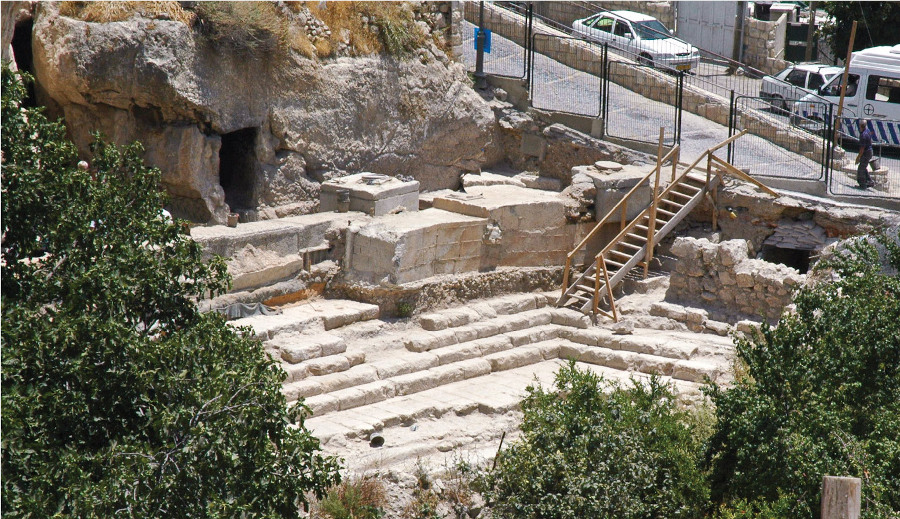
Steps surround the excavated Pool of Siloam, the place where Jesus said “wash in the Pool of Siloam” (Jn 9:7).
Todd Bolen/BiblePlaces.com
Return to the main text.
9:8 begging. About the only way people of that day who were blind could support themselves.
9:13 Pharisees. See note on 7:32.
9:14 Sabbath. Cf. 5:16 and the discussion that follows (see note on 5:10).
9:16 Some . . . others. The first group started from their entrenched position and ruled out the possibility of Jesus being from God. The second started from the fact of the “signs” and ruled out the possibility of his being a sinner (cf. vv. 30–33 and notes).
9:17 What have you to say about him? It is curious that they put such a question to one who had just met Jesus; their doing so reflected their perplexity. prophet. Probably the highest designation the man could think of.
9:18 They. The Pharisees (see vv. 13,15–16; see also note on 1:19). In their prejudice they did not learn from the sign but tried to discredit the miracle.
9:21 He is of age. Old enough to be considered an adult member of the Jewish community; i.e., at least thirteen years old. There was much to which the parents could not testify, but their emphasis on the son’s responsibility showed their fear of getting involved.
9:22 put out of the synagogue. Excommunication is reported as early as the time of Ezra (10:8), but there is practically no information about the way it was practiced in NT times. The synagogue was the center of Jewish community life (see note on 6:59), so excommunication cut a person off from many social relationships (though, in some of its forms, at least in later times, not from worship).
9:24 the truth. According to the Jewish leaders. They provide the content of the “truth” they desire to hear in their charge to the man. We. Emphatic in the Greek.
9:27 Do you want to become his disciples too? The man already counted himself a disciple. His question may be sarcastic.
9:29 We know . . . God spoke to Moses. See Dt 18:15 and note. we don’t . . . know where he comes from. Jesus was sent by his Father from heaven (see 8:14 and note; 9:4).
9:30–33 Good reasoning from an unschooled man.
9:31 God does not listen to sinners. Cf. the remark of some of the Pharisees in v. 16.
9:34 threw him out. May mean “expelled him from their assembly” or, more probably, “excommunicated him” (see note on v. 22; cf. note on 1Co 5:5).
9:35 when he found him. Jesus obviously had been looking for the man. Son of Man. See note on Mk 8:31.
9:36 The man was ready to follow any suggestion from his benefactor.
9:38 I believe. See notes on 1:7; 20:31. he worshiped him. The man who was healed has gradually gained greater insight into Jesus’ identity. First he recognized Jesus as simply a man (v. 11). Then he called him a prophet (v. 17). Now he acknowledges that Jesus is the Son of Man and worships him. Meanwhile the Pharisees who claim to see are in fact spiritually blind (vv. 40–41).
9:39 It is unlikely that the conversation of vv. 35–38 took place in the presence of the Pharisees. The incident of vv. 39–41, therefore, probably occurred a little later. For judgment. In a sense Jesus did not come for judgment (see 3:17; 12:47 and note), but his coming divides people, and this always brings a type of judgment. Those who reject his gift end up “blind.”
9:40 Pharisees. They found it incredible that anyone would consider them spiritually blind. See note on v. 13.
9:41 The Pharisees’ claim to sight showed their complete unawareness of their spiritual blindness and need. And, though they claimed to have sight, their actions were evidence of their blindness.
10:1–30 Should be understood in light of the OT (and ancient Near Eastern) concept of “shepherd,” symbolizing a royal caretaker of God’s people. God himself was called the “Shepherd of Israel” (Ps 80:1; see Ps 23:1 and note; Isa 40:10–11; Eze 34:11–16 and note on 34:2; Zec 10:2 and note), and he had given great responsibility to the leaders (“shepherds”) of Israel, which they failed to respect. God denounced these false shepherds (Isa 56:9–12; Eze 34) and promised to provide the true Shepherd, the Messiah, to care for the sheep (Eze 34:23).
10:1 Very truly I tell you. See note on Mk 3:28. sheep pen. An enclosure with only one entrance. Its walls kept the sheep from wandering away. See photo.
Seven “I Am” Statements of John’s Gospel
3. The Gate (10:7) |
5. The Resurrection and the Life (11:25) |
6. The Way and the Truth and the Life (14:6) |
7. The True Vine (15:1) |
Adapted from Four Portraits, One Jesus by Mark L. Strauss. Copyright © 2007 by Mark L. Strauss, p. 304. Used by permission of Zondervan.
Go to the Charts Index.
10:3 gatekeeper. Apparently in charge of a large sheep pen, where several flocks were kept. his voice. The sheep responded only to the voice of their own shepherd. his own sheep. Shepherds did not call sheep randomly, but only those that belonged to them.
10:4 he goes on ahead. Palestinian shepherds led their sheep (they did not drive them), and the sheep followed because they knew their own shepherd’s voice (see photos here and here).
10:6 did not understand. See 8:27; 12:16; Mk 8:16 and note; Lk 2:50; 9:45; 18:34.
10:8 All . . . before me. “False shepherds” like the Pharisees and the chief priests, not the true OT prophets (see note on vv. 1–30; cf. Zec 11:5,8 and notes).
10:9 the gate. The one way into salvation. Inside there is safety, and one is able to go out and find pasture, i.e., the supply of all needs.
10:10 thief. His interest is in himself. Christ’s interest is in his sheep, whom he enables to have life to the full (see note on 1:4). life . . . to the full. Salvation, which begins in this life, and is spiritually fulfilling and rewarding. There is no necessary promise here of a certain level of health or wealth or of a life free from persecution.
10:11 I am. See note on 6:35. lays down his life. Shepherds might risk danger for their sheep (see Ge 31:39; 1Sa 17:34–37). Jesus said that the good shepherd is willing even to die for his sheep (cf. 15:13 and note; Isa 53:6–7).
10:12 hired hand. Interested in wages, not in the sheep (v. 13).
10:14 I know . . . my sheep know. A deep mutual knowledge, like that of the Father and the Son.
10:15 I lay down my life. See v. 11 and note; the fact of central importance.
10:16 other sheep that are not of this sheep pen. Those outside Israel. Here is a glimpse of the future worldwide scope of the church. one flock and one shepherd. All God’s people have the same Shepherd (17:20–23) and are to be a unified community of believers (cf. Eph 2:14–18 and notes).
10:17–18 That Christ would die for his people runs through this section of John’s Gospel. Both the love and the plan of the Father are involved, as well as the authority he gave to the Son. Christ obediently and voluntarily chose to die; otherwise, no one would have had the power to kill him (cf. Lk 23:46).
10:19 divided. See 7:43; 9:16.
10:20 demon-possessed. A repeated accusation against Jesus (see note on 7:20).
10:22 Festival of Dedication. Known today as Hanukkah. The commemoration of the dedication (see NIV text note) of the temple by Judas Maccabeus in December, 165 bc, after it had been profaned by Antiochus IV Epiphanes (see article). This was the last great deliverance the Jews had experienced. It was winter. A reference for those unfamiliar with the Jewish calendar (see bottom of chart).
10:23 Solomon’s Colonnade. See Ac 3:11 and note; 5:12. It was a roofed structure—somewhat similar to a Greek stoa—with large columns on the east side of the temple courts commonly but erroneously thought to date back to Solomon’s time.
10:24 If you are the Messiah. Because of the different ideas about Messiahship then in vogue, it was not easy for Jews to resolve this critical issue. See notes on 1:25; 20:31.
10:25 I did tell you. Jesus had not specifically affirmed his Messiahship except to the Samaritan woman (see 4:26 and note). He may have meant here that the general thrust of his teaching made his claim clear or that such statements as that in 8:58 (see note there) were sufficient. Or he may have been referring to the evidence of his whole manner of life (including the miracles)—all he had done in the Father’s name (for the name, see note on 2:23).
10:27 voice. See v. 3 and note. I know them. See v. 14 and note. they follow. See v. 4 and note.
10:28 eternal life. Christ’s gift (see note on 3:15). never perish. The Greek construction here is a strong denial that the sheep will ever perish. The sheep’s security is in the power of the shepherd, who will let no one take them from him (3:16).
10:29 My Father. See note on 5:17. no one can snatch them. The Father’s power (“hand”) is greater than that of any enemy, making the sheep completely secure (cf. 17:11–12 and notes).
10:30 one. The Greek is neuter—“One thing,” not “one person.” The two are one in essence or nature, will and purpose, but they are not identical persons. This great truth is what warrants Jesus’ “I am” declarations (see 6:35; 8:24,58; 17:21–22 and notes).
10:31 his Jewish opponents. See note on 1:19. to stone him. They took Jesus’ words as blasphemy and therefore prepared to carry out the law (Lev 24:16), though without due process.
10:32 good works. See Mt 5:16; 1Ti 5:10, 25; 6:18. The good works are primarily but not exclusively Jesus’ miracles (see note on v. 38).
10:33 blasphemy. The Jewish leaders correctly understood the thrust of Jesus’ words, but their preconceptions and unbelief prevented them from accepting his claim as true.
10:34 your Law. In its strictest sense the term meant the Pentateuch, but it was often used, as here, of the whole OT. you are “gods.” The words Jesus quotes from Ps 82:6 (see note on 82:1) refer to the judges (or other leaders or rulers), whose tasks were divinely appointed (see Ex 22:28 and NIV text note; Dt 1:17; 16:18; 2Ch 19:6).
10:35 Scripture cannot be set aside. Jesus testified to the complete authority and reliability of the OT.
10:36 Jesus is making an argument from the lesser to the greater: If there is any sense in which humans can be spoken of as “gods” (as Ps 82:6 speaks of human rulers or judges), how much more may the term be used of him whom the Father set apart and sent!
10:37 the works of my Father. The kind of works of compassion that the Father himself does.
10:38 works. Miracles were only a part of Jesus’ works. It was Jesus’ quality of life, not people’s inability to explain his marvels, that he primarily spoke of here (see note on v. 32).
10:39 they tried to seize him. It is not clear whether this was to arrest him for trial or to take him out for stoning. he escaped. John does not say why they failed, but he often makes it clear that Jesus could not be killed before the appointed time (see note on 2:4; see also Lk 4:30 and note).
10:40 where John had been baptizing. See 1:28 and note.
10:41 all that John said. For John the Baptist as a witness, see 1:7 and note.
11:1–44 The raising of Lazarus is the seventh and greatest of the signs, pointing to Jesus’ resurrection (see chart and Introduction: Purpose and Emphases).
11:1 Lazarus. Mentioned only in chs. 11–12 of John’s Gospel (the name is found also in the parable of Lk 16:19–31). The sisters are also mentioned in Lk 10:38–42. Bethany. See map.
11:2 poured perfume. See 12:3 and note.
11:3 the one you love. The relationship must have been exceptionally close (v. 36).
11:4 Cf. 9:3 and note on 9:2. This sickness will not end in death. Thus predicting the raising of Lazarus (v. 44), since Jesus already knew of his death (v. 14). In fact, Lazarus must have died shortly after the messengers left Bethany, accounting for the “four days” of vv. 17,39: one day for the journey of the messengers, the two days when Jesus remained where he was (see v. 6 and note) and a day for Jesus’ journey to Bethany. But see note on v. 17. glory. See notes on 7:39; 12:41; 13:31. Here God’s Son would be glorified through what happened to Lazarus, partly because the miracle displays the glory of God (who alone can raise the dead; see 5:21 and note) in Jesus (v. 40) and partly because it would help initiate events leading to the cross (vv. 46–53).
11:5 Shows the special relationship Jesus had with this family.
11:6 he stayed. Jesus moved as the Father directed, not as people (here Mary and Martha) wished (cf. 2:4 and note). where he was. In Perea, east of the Jordan River (10:40).
11:8 the Jews there. See note on 1:19. tried to stone you. See note on 10:31. There was clear danger in going into Judea.
11:9–10 Jesus uses the images of day and night to describe the course of his ministry. The twelve hours of daylight represent the light Jesus had yet to give. The night represents the time when Jesus, the light of the world, would be taken away—when what the disciples feared would happen in Judea would indeed take place (cf. 9:4 and note).
11:11 fallen asleep. A euphemism for death, used by the unbelieving world as well as by Christians.
11:15 believe. See 1:7; 20:31 and notes.
11:16 Thomas . . . Didymus. The Aramaic word from which we get “Thomas” and the Greek word Didymus both mean “twin.” Usually remembered for his doubting (20:24–25), he was also capable of devotion and courage, as here.
11:17 four days. See note on v. 4. Many Jews believed that the soul remained near the body for three days after death in the hope of returning to it. If this idea was in the minds of these people, they obviously thought all hope was gone—Lazarus was irrevocably dead.
11:18 Bethany. See note on Mt 21:17.
11:19 to comfort them. Jewish custom provided for three days of very heavy mourning, then four of heavy mourning, followed by lighter mourning for the remainder of 30 days. It was usual for friends to visit the family to comfort them.
11:20 she went out to meet him. Perhaps because, as the older sister, Martha acted as host. Mary’s intense grief may have kept her from doing this.
11:21 Repeated by Mary in v. 32. Perhaps the sisters had said this to one another as they awaited Jesus’ arrival.
11:22 whatever you ask. Nothing is too difficult for God to do (see Ge 18:14; Jer 32:17,27 and notes).
11:25 I am. See note on 6:35; see also article. life. See note on 1:4. Jesus was saying more than that he gives resurrection and life. In some way these are identified with him, and his nature is such that final death is impossible for him. He is life (see 14:6 and note; Ac 3:15; Heb 7:16 and note). The one who believes in me will live. See note on 1:7. Jesus not only is life, but he also conveys life to believers so that death will never triumph over them (cf. 1Co 15:57 and note).
11:26 never die. Believers may die physically but, as those who have eternal life, their physical death is not their ultimate end (v. 25). Death cannot destroy the life Christ gives.
11:27 I believe. Martha is often remembered for her shortcoming recorded in Lk 10:40–41. But she was a woman of faith, as this magnificent declaration shows. The same declaration is part of the purpose statement of John’s Gospel: “that you may believe that Jesus is the Messiah, the Son of God” (20:31).
11:31 to mourn there. Wailing at a tomb was common, and the Jews immediately thought this was in Mary’s mind. Because they followed her, Jesus’ actions would have wider impact.
11:33 weeping. Both times the word denotes a loud expression of grief, i.e., “wailing.” deeply moved. Or “deeply indignant.” The verb (repeated in 11:38 and denoting strong emotion) suggests Jesus’ repugnance toward such a tragic manifestation of sin’s presence in the world. troubled. See notes on 12:27; 13:21.
11:37 Their position was like that of Martha (v. 21) and Mary (v. 32), but they based it on Jesus’ ability to give sight to the blind (cf. ch. 9).
11:38 once more deeply moved. See v. 33 and note. cave with a stone laid across the entrance. This type of burial place was not uncommon in the Holy Land at this time, especially for the wealthy (cf. 20:1 and notes on Mk 15:46; Lk 24:2).
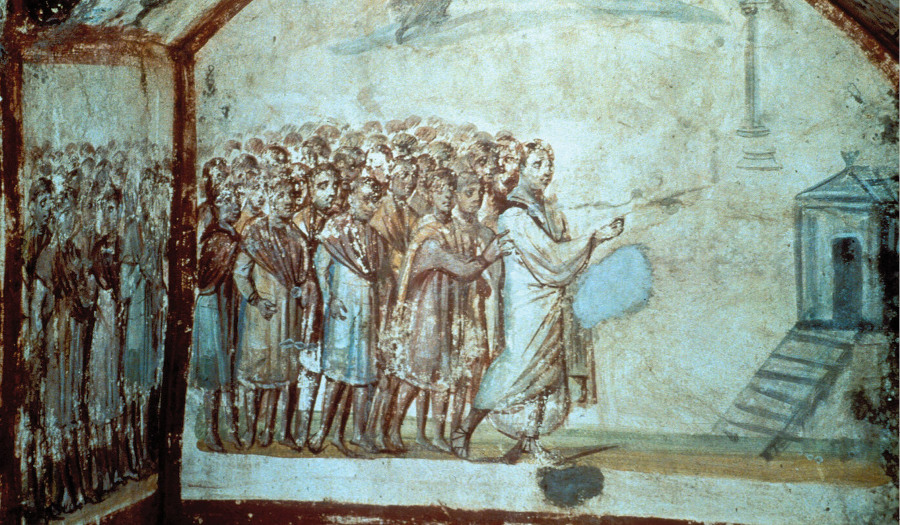
Roman catacomb fresco depicting the raising of Lazarus (Jn 11).
Z. Radovan/www.BibleLandPictures.com
Return to the main text.
11:39 four days. See notes on vv. 4,17.
11:40 glory. See note on v. 4.
11:43 Lazarus, come out! See photo.
11:44 strips of linen. Narrow strips, like bandages. Sometimes a shroud was used (see note on 19:40). a cloth. A separate item.
11:46 Pharisees. See note on 7:32.
11:47 the chief priests and the Pharisees. In all four Gospels the Pharisees appear as Jesus’ principal opponents throughout his public ministry. But they lacked political power, and it is the chief priests (see note on Mt 2:4) who were prominent in the events that led to Jesus’ crucifixion. Here both groups are associated in a meeting of the Sanhedrin (see note on Mk 14:55). They did not deny the reality of the miraculous signs (see note on 2:11), but they did not understand their meaning, for they failed to believe.
11:49 Caiaphas. High priest c. ad 18–36. He was the son-in-law of Annas (see 18:13; Mt 26:3; Lk 3:2 and notes), who had been deposed from the high priesthood by the Romans in ad 15. high priest that year. Could simply mean who the high priest was, or could mean “in that fateful year.” You know nothing at all! A remark typical of Sadducean rudeness (Caiaphas, as high priest, was a Sadducee). Josephus says that Sadducees “in their dealings with their peers are as rude as to foreigners.” For Sadducees, see note on Mt 3:7.
11:50 better. Caiaphas was concerned with political expediency, not with guilt and innocence. He believed that it was better for one man, no matter how innocent, to perish than for the whole nation to be put in jeopardy.
11:51 that year. See note on v. 49. prophesied. Although Caiaphas means that Jesus must be killed to avoid disaster for the whole nation, his words are taken by John in a second sense—as an inadvertent and ironic prophecy that Jesus will die for the sins of the nation.
11:52 for the scattered children of God. Jesus’ death would have effects far beyond the nation (cf. 1:29; 3:16; 4:42; 10:16 and notes).
11:54 he withdrew. Jesus was not to die before his “hour” (see note on 2:4), but he would not act imprudently. Knowing the attitude of his opponents, he withdrew. He would die for others, but in his own time, not that of his enemies. Ephraim. A place of uncertain location; perhaps to be identified with Ophrah (Jos 18:23) and the present town of Et-Taiyiba, 12–16 miles northeast of Jerusalem and about 4 miles northeast of Bethel.
11:55 Passover. See notes on 2:13; 5:1. ceremonial cleansing. Especially important at a time like Passover, because without it, it would not be possible to keep the festival (see 2:6; 18:28; 1Co 11:28 and notes).
11:56 Isn’t he coming . . . ? The question expected the answer “No.”
12:1–11 All four Gospels have an account of a woman anointing Jesus. John’s account seems to tell of the same incident recorded in Mt 26:6–13 and Mk 14:3–9, while that in Lk 7:36–50 is a different event (see notes on all these passages).
12:1 Bethany. See note on Mt 21:17.
12:3 nard. The name of both a plant and the fragrant oil it yielded. Since it was very expensive, Mary’s act of devotion was costly. It was also an unusual act, both because she poured the oil on Jesus’ feet (normally it was poured on the head) and because she used her hair to wipe them (a respectable woman did not ordinarily unbind her hair in public). Further, it showed her humility, for it was a servant’s work to attend to the feet (see notes on 1:27; 13:5).
12:4 Judas Iscariot. See notes on 6:71; 17:12.
12:5 money given to the poor. See note on Mk 14:5.
12:6 thief. The one passage from which we learn that Judas was dishonest. Yet he must have been thought to be a man of some reliability, for he was keeper of the money bag.
12:7 save. Probably the meaning is “save for this purpose.” Perfume was normally associated with festivity, but it was also used in burials (19:39–40), and Jesus links it with his burial, which Mary’s act anticipates.
12:8 You will always have the poor among you. See note on Mk 14:7.
12:10 The Jewish leaders previously had spoken of the death of one man (see 11:50 and note), but now they wanted another death. Sin grows (cf. Jas 1:15). There is, however, great irony in their thinking that killing someone just raised from the dead would solve the problem.
12:12 great crowd. Pilgrims who had gathered for the Passover Festival. Many of the pilgrims had doubtless seen and heard Jesus in Galilee, and they welcomed the opportunity to proclaim him as the Messiah.
12:13 palm branches. Only John mentions the palm branches, which were symbols of Jewish nationalism (but see note on Mk 11:8). Significantly, in the glimpse of heaven in Rev 7:9, palm branches are being waved by people of “every nation, tribe, people and language.” For believers, true nationalism is allegiance to the people of God everywhere. John saw a multitude with palm branches in heaven (Rev 7:9). Hosanna! See NIV text note; see also note on Mt 21:9. name. See note on 2:23. Blessed is the king of Israel! The people’s addition to the words of the psalm, which John alone records. It reflects his special interest in Jesus’ royalty, which he brings out throughout the passion narrative.
12:14 donkey. See notes on Zec 9:9; Mt 21:2, 7; Mk 11:2; Lk 19:30.
12:15 Daughter Zion. A personification of Jerusalem (see note on 2Ki 19:21).
12:16 An example of the meaning of 16:13. glorified. See notes on v. 41; 11:4; 13:31. Only after the crucifixion and the coming of the Holy Spirit did the disciples appreciate the meaning of the prophecy and its fulfillment.
12:19 Pharisees. See note on 7:32. whole world has gone after him! A good example of hyperbole in the Bible.
12:20 Greeks. Probably “God-fearers,” people attracted to Judaism by its monotheism and morality, but hesistant about circumcision. They worshiped in the synagogues but did not become converts to Judiasm (cf. note on Ac 16:14).
12:21 Philip. A Greek name, which may be why they came to this disciple (though he was not the only one of the Twelve to have a Greek name). Bethsaida. See note on Mt 11:21. to see. Here means “to have an interview with.” After v. 22 John records no more about these Greeks (yet see note on v. 32). He regarded their coming, but not their conversation with Jesus, as important. Jesus came to die for the world, and the coming of these Gentiles indicates the scope of the effectiveness of his approaching crucifixion. Now, however, he needs to focus all his attention on his upcoming ordeal.
12:22 Andrew. See note on 1:40.
12:23 The hour has come. The hour to which Jesus’ entire life and ministry have led (see note on 2:4). glorified. Jesus was speaking about his death on the cross and his subsequent resurrection and exaltation (see notes on v. 41; 11:4; 13:31).
12:24 if it dies, it produces. The principle of life through death is seen in the plant world. The kernel must appear to die when it is buried in the ground if it is to grow into a mature plant.
12:25 anyone who hates their life . . . will keep it. To love one’s life here and now—to focus solely on oneself—is to lose what truly matters (cf. Mk 8:34–35; Lk 9:23–24 and notes). Supremely, of course, the principle is seen in the cross of Jesus. hates. Love for God must be such that all other loves are, by comparison, hatred (see notes on Mal 1:3; Lk 14:26). eternal life. See note on 3:15.
12:27 troubled. John’s equivalent to the agony in Gethsemane described in the other Gospels (see Mt 26:38–39 and notes; Mk 14:34–36; Lk 22:42 and note). this hour. Jesus faced the prospect of becoming sin (or a sin offering) for sinful people (see 2Co 5:21 and note). He considered praying for God to save him from this death but refused to do so, because the very reason he had come was to die for sinners.
12:28 Father, glorify your name! His prayer was not for deliverance but for the Father to be glorified (cf. Mt 6:9 and note). The voice from heaven gave the answer. name. See note on 2:23.
12:31 judgment on this world. The cross was God’s judgment on the world. prince of this world. Satan (16:11). The cross would seem to be his triumph; in fact, it was his defeat. Out of it would flow the greatest good ever to come to the world.
12:32 lifted up. See NIV text note. Jesus refers here first of all to his crucifixion (v. 33), but he most likely refers also to his resurrection and ascension into heaven to reign at God’s right hand (see v. 41; 3:14 and notes; see also 8:28; cf. Ac 2:33; 5:31, where “exalted” renders the same Greek word). all people. Christ will draw people to himself, without regard for nationality, ethnic affiliation or status. It is significant that Greek Gentiles were present on this occasion (see v. 20 and note).
12:34 the Law. Here seems to mean OT Scripture in general (see note on 10:34), the reference being to passages such as Ps 89:30–37; 110:4; Isa 9:7 (see notes there; see also note on Lk 24:44). the Messiah. See note on 1:25. Son of Man. The only place in the Gospels where anyone other than Jesus used the expression, and even here Jesus is being quoted (see note on Mk 8:31).
12:35–36 light. Closely identified with Jesus, as seen from the call to believe in the light (see notes on 1:4; 8:12).
12:37 they still would not believe. God’s people should have responded when God sent his Messiah. They should have seen the significance of the signs he did.
12:39 could not believe. Does not mean that the people in question had no choice. They purposely rejected God and chose evil, and v. 40 explains that God in turn brought on them a judicial blinding of eyes and hardening of hearts. Yet many Jewish leaders did believe in Jesus as the Messiah (see v. 42 and note), and many others became believers after the resurrection (Ac 6:7).
12:40 These words from Isa 6:10 (see note there) are quoted by Jesus to explain Israel’s rejection of the gospel (Mt 13:13–14; Mk 4:12; Lk 8:10) and by Paul for the same reason (Ac 28:26–27; see note there; see also notes on Mk 4:12; Lk 8:11).
12:41 saw Jesus’ glory. Isaiah spoke primarily of the glory of God (Isa 6:3; see notes on Eze 1:28; 43:2). John spoke of the glory of Jesus and made no basic distinction between the two, attesting Jesus’ oneness with God (cf. Heb 1:6,10 and notes). The thought of glory here is complex. There is the idea of majesty, and there is also the idea (which meant so much to John) that Jesus’ death on the cross and his subsequent resurrection and exaltation show his real glory. Isaiah foresaw the rejection of the Messiah, as the passages quoted (Isa 53:1; 6:10) show. He spoke of the Messiah both in the words about blind eyes and hard hearts, on the one hand, and about healing, on the other. This is the cross and this is glory, for the cross, resurrection and exaltation portray both suffering and healing, rejection and triumph, humiliation and glory.
12:42 many . . . leaders believed. John does not give a picture of unrelieved gloom. Many Jewish leaders believed (see note on 1:7), though they remained secret believers for fear of excommunication (see note on 9:22). Two such cases in this Gospel are Nicodemus and Joseph of Arimathea (see 3:1–2; 19:38–39 and notes).
12:44 cried out. The words are given special emphasis by being spoken in a loud voice. believes in me. John ends his story of the public ministry of Jesus with an appeal for belief (see notes on 1:7; 20:31; see also Introduction: Purpose and Emphases). He does not say when Jesus spoke these words (they may have been uttered earlier), but they are a fitting close to this part of his account. the one who sent me. Jesus’ mission, as well as the inseparability of the Father and the Son, are stressed throughout this Gospel (see note on 4:34).
12:46 I have come into the world. Points to both Jesus’ preexistence and his mission. light. See vv. 35–36 and note.
12:47 to judge. Not the purpose of Jesus’ coming (3:17–18), but judgment is the other side of salvation. It is not the purpose of the sun’s shining to cast shadows, but when the sun shines, shadows are inevitable.
12:49 the Father . . . commanded me to say all that I have spoken. Jesus’ hearers have a great responsibility. His “words” (v. 48) are what the Father commanded him to say. To reject them, therefore, is to reject God.
12:50 eternal life. See note on 3:15. So. Jesus said what he did in order to fulfill the will of the Father—a wonderful note on which to end the account of Jesus’ public ministry (see v. 44 and note).
13:1—17:26 John has by far the longest account of the upper room, though curiously he says nothing about the institution of the Lord’s Supper. Still we owe to him most of our information about what our Lord said to his disciples on that fateful night. One feature of the farewell discourse is Jesus’ emphasis on love. The Greek noun agape (“love”) and the verb agapao (“love”) occur only 8 times in chs. 1–12 but 31 times in chs. 13–17. Chs. 13–14 take place at the Last Supper, while chs. 15–16 may have been uttered on the way to Gethsemane (note “let us leave” in 14:31 [see note there]).
13:1 Passover Festival. See notes on 2:13; 5:1; see also notes on Ex 12:11–26. the hour. See note on 2:4. he loved them to the end. See 10:11,15,17; 15:13 and note.