

Author: The apostle John
Audience: Believers in and around Ephesus
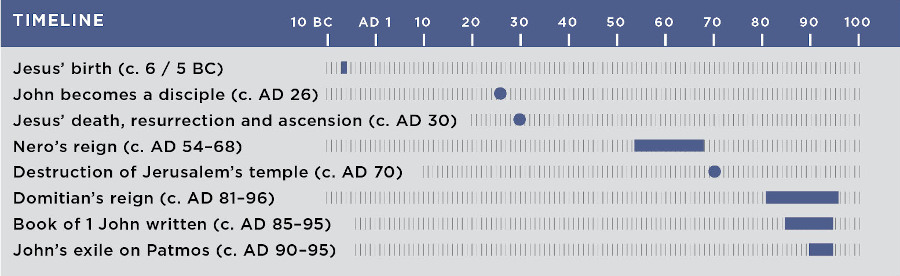
Date: Between ad 85 and 95
Theme: John writes to assure believers of the certainty of their faith and to refute heretical doctrines teaching that Jesus was not fully human and fully divine.
Introduction
Author
 The author is John, son of Zebedee (Mk 1:19–20)—the apostle and the author of the Gospel of John and Revelation (see Introduction to both books: Author). He was a fisherman, one of Jesus’ inner circle (together with James and Peter), and “the disciple whom Jesus loved” (Jn 13:23; see note there).
Unlike most NT letters, 1 John does not tell us who its author is. The earliest identification of him comes from the church fathers: Irenaeus (c. ad 140–203), Clement of Alexandria (c. 150–215), Tertullian (c. 155–222) and Origen (c. 185–253) all designated the writer as the apostle John. As far as we know, no one else was suggested by the early church.
This traditional identification is confirmed by evidence in the letter itself:
(1) The style of the Gospel of John is markedly similar to that of this letter. Both are written in simple Greek and use contrasting figures, such as light and darkness, life and death, truth and lies, love and hate.
(2) Similar phrases and expressions, such as those found in the following passages, are striking:
1 John | Topic | Gospel of John |
Word was God from beginning who became human | ||
making one’s joy complete | ||
living by truth / walking in light vs. darkness | ||
a new commandment to love one another | ||
those who sin and belong to the devil | ||
believers have crossed over from death to life | ||
those who listen to God / us belong to him; otherwise not | ||
God sent only Son so we might have eternal life in him | ||
the greater testimony of the Father to the Son | ||
whoever has Son has life; whoever rejects Son doesn’t have it |
(3) The mention of eyewitness testimony (1:1–4) harmonizes with the fact that John was a follower of Christ from the earliest days of his ministry.
(4) The suggestions of advanced age (addressing his readers as “children,” 2:1,28; 3:7) agree with early church tradition concerning John’s age when he wrote the books known to be his.
(5) The harsh description of the heretics as antichrists (2:18), liars (2:22) and children of the devil (3:10) is consistent with Jesus’ characterization of John as a son of thunder (see Mk 3:17 and note).
(6) The indications of a close relationship with the Lord (1:1; 2:5–6,24,27–28) fit the descriptions of “the disciple whom Jesus loved” and the one who reclined “next to him” (Jn 13:23), usually identified with the author of that Gospel.
Date
The letter is difficult to date with precision, but factors such as (1) evidence from early Christian writers (Irenaeus and Clement of Alexandria), (2) the early form of Gnosticism (see article) reflected in the letter’s denunciations and (3) indications of the advanced age of John suggest a date late in the first century. Since the author of 1 John seems to build on concepts and themes found in the fourth Gospel (1Jn 2:7–11), it is reasonable to date the letter somewhere between ad 85 and 95, after the writing of the Gospel (see Introduction to John: Date), and before the writing of Revelation, which may have been written c. 95 (see Introduction to Revelation: Date).
Recipients
1Jn 2:12–14, 19; 3:1; 5:13 make it clear that this letter was addressed to believers. But the letter itself does not indicate who they were or where they lived. The fact that it mentions no one by name suggests that it was a letter sent to Christians in a number of places. Evidence from early Christian writers places the apostle John in Ephesus during most of his later years (c. ad 70–100; see photos here, here, here, and here). The earliest confirmed use of 1 John was in the Roman province of Asia (in modern Turkey), where Ephesus was located. Clement of Alexandria indicates that John ministered in the various churches scattered throughout that province. It may be assumed, therefore, that 1 John was sent to the churches in and around Ephesus (see map).
Gnosticism
One of the most dangerous heresies of the first two centuries of the church was Gnosticism. Its central teaching was that spirit is good and matter is evil. From this unbiblical dualism flowed five influential errors:
(1) The human body, which is matter, is therefore evil. It is to be contrasted with God, who is wholly spirit and therefore good.
(2) Salvation is the escape from the body, achieved not by faith in Christ but by special knowledge (the Greek word for “knowledge” is gnōsis, hence Gnosticism).
(3) Christ’s true humanity was denied in two ways: (a) Some said that Christ only “seemed” to have a body, a view called Docetism, from the Greek dokeō (“to seem”), and (b) others said that the divine Christ joined the man Jesus at baptism and left him before he died, a view called Cerinthianism, after its most prominent spokesman, Cerinthus. This view may be the background of much of 1 John (see 1:1; 2:22; 4:2–3 and notes).
(4) Some said that since the body was considered evil, it was to be treated harshly. This ascetic form of early Gnosticism may be the background of part of the letter to the Colossians (see Col 2:21,23 and notes).
(5) Paradoxically, this dualism sometimes also led to licentiousness. The reasoning was that since matter—and not the breaking of God’s law (1Jn 3:4)—was considered evil, breaking God’s law was of no moral consequence. Alternatively, since matter, including the human body, was irredeemably corrupt and temporary, indulging it had no eternal consequence.
The Gnosticism addressed in the NT was an early form of the heresy, not the intricately developed system of the second and third centuries. In addition to that seen in Colossians and in John’s letters, acquaintance with early Gnosticism may be reflected in 1,2 Ti; Titus and 2Pe; and perhaps 1Co. See article.
Occasion and Purpose
Former members of John’s churches had abandoned the true faith (2:18–19), causing doubt in the churches and fear of further desertions. These false teachers were apparently following an early form of Gnostic teaching of the Cerinthian variety (see Gnosticism above). This heresy was also libertine, throwing off moral restraints.
Consequently, John wrote this letter with two basic purposes in mind: (1) to expose these false teachers (see 2:26 and note) and (2) to give believers assurance of salvation (see 5:13 and note). In keeping with his intention to combat Gnostic teachers, John specifically struck at their appalling lack of morality (3:8–10), and by giving eyewitness testimony to the incarnation he sought to confirm his readers’ belief in the incarnate Christ (1:3). John set forth several key tests of authentic Christian faith: (1) belief that Jesus is the Messiah, the Son of God, come in the flesh (2:18–28; 3:23—4:6; 4:14–15; 5:1,5); (2) obedience to Christ’s commands (1:5—2:6; 2:29—3:10; 3:22–24; 5:4–21); and (3) love for brothers and sisters in Christ (2:7–17; 3:10–24; 4:7—5:3). These are the indispensable hallmarks of true believers (cf. Jn 13:34–35 and notes). Seeing believers mature in these areas would give the writer joy (1:4).
John wrote this letter with two basic purposes in mind: (1) to expose the false teachers and (2) to give believers assurance of salvation.
Outline
I. Prologue (1:1–4)
II. The Tests of Life: Cycle One (1:5—2:27)
A. Sin vs. Obedience (1:5—2:6)
B. Love for One Another (2:7–17)
C. Correct Christology (2:18–27)
III. The Tests of Life: Cycle Two (2:28—4:6)
A. Sin vs. Righteousness (2:28—3:10)
B. Love for One Another (3:11–24)
C. Correct Christology (4:1–6)
IV. The Tests of Life: Cycle Three (4:7—5:21)
A. Love for One Another (4:7–21)
B. Correct Christology (5:1–15)
C. Sin vs. Life (5:16–21)

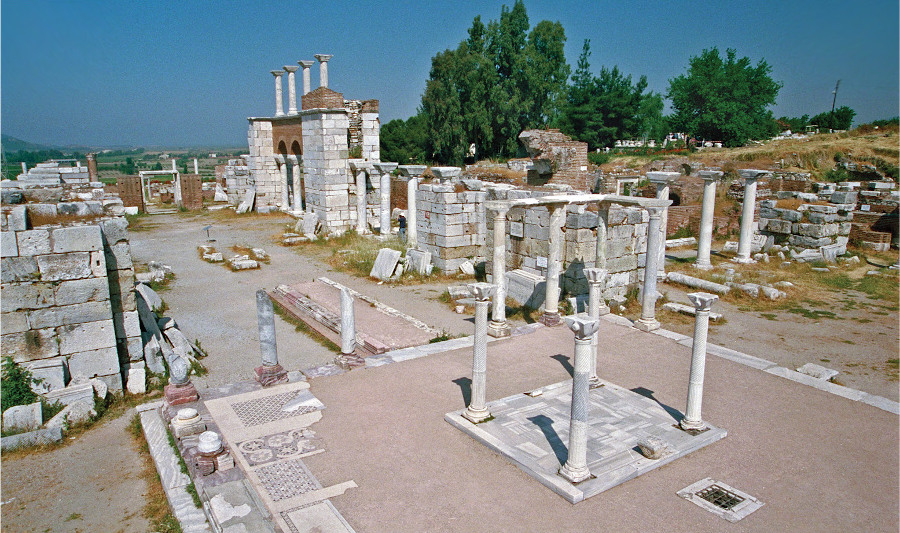
Ruins of the Basilica of St. John near Ephesus. The traditional grave of John is under the square slab at the bottom right.
© William D. Mounce
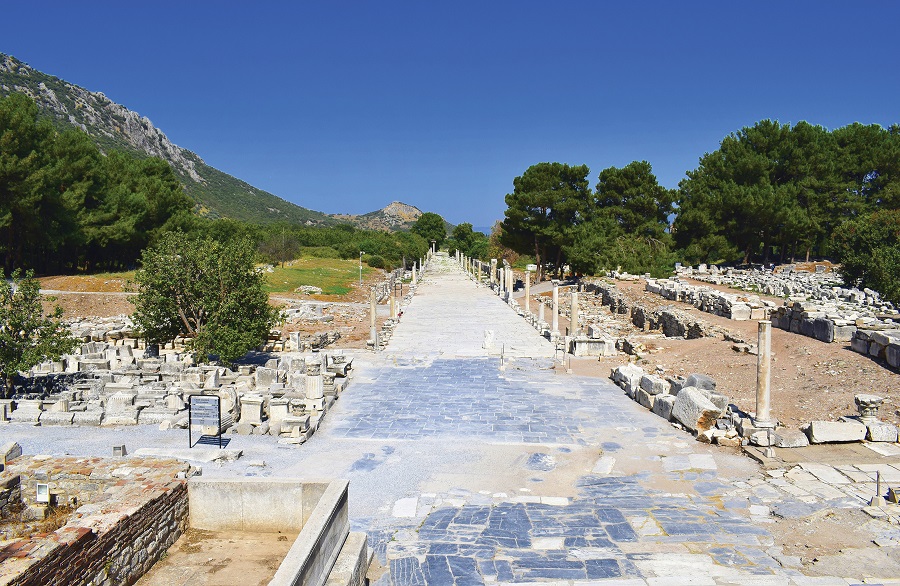
A view of the road from the Ephesus theater. John wrote his letters and spent most of his later years in Ephesus.
Kagan Kaya/Shutterstock