Study Notes
 1:1 Paul. See note on Ro 1:1. servant of God. Only here does Paul call himself a servant of God; elsewhere he says “servant of Christ” (Ro 1:1; Gal 1:10; Php 1:1). James uses both terms of himself (Jas 1:1). servant. See note on Ro 1:1. apostle. See note on 1Co 1:1. to further the faith . . . and their knowledge. Paul’s appointed mission as God’s servant and Christ’s apostle—further explained in v. 2 (Ac 9:15; 22:15; 26:16–18). godliness. See 1Ti 2:2 and note.

1:2 hope. See Col 1:5 and note. eternal life. See note on Jn 3:15. does not lie. In contrast to the Cretans (v. 12)—and the devil (Jn 8:44). before the beginning of time. See 2Ti 1:9 and note.
 1:3 appointed season. Crucial events in God’s program occur at his designated times in history (see 1Ti 2:6; 6:15 and notes). the preaching. The authoritative message that centers in Christ. God our Savior. Three times in the letter God the Father is called Savior (here; 2:10; 3:4; see also 1Ti 1:1; 2:3; 4:10), and three times Jesus is called Savior (v. 4; 2:13; 3:6; see also 2Ti 1:10).
1:4 my true son. Titus, like Timothy (1Ti 1:2), was a spiritual son, having been converted through Paul’s ministry. Onesimus was also called a son by Paul (Phm 10). Titus was a “true son” because of his loyalty to Paul and because his faith and life resembled that of his spiritual father, Paul. our common faith. The faith shared by all true believers. Grace and peace. See note on Ro 1:7. Savior. In all of Paul’s other greetings Jesus is called “Lord.” Paul uses “Savior” 12 times in all his letters, half of the references being in Titus.
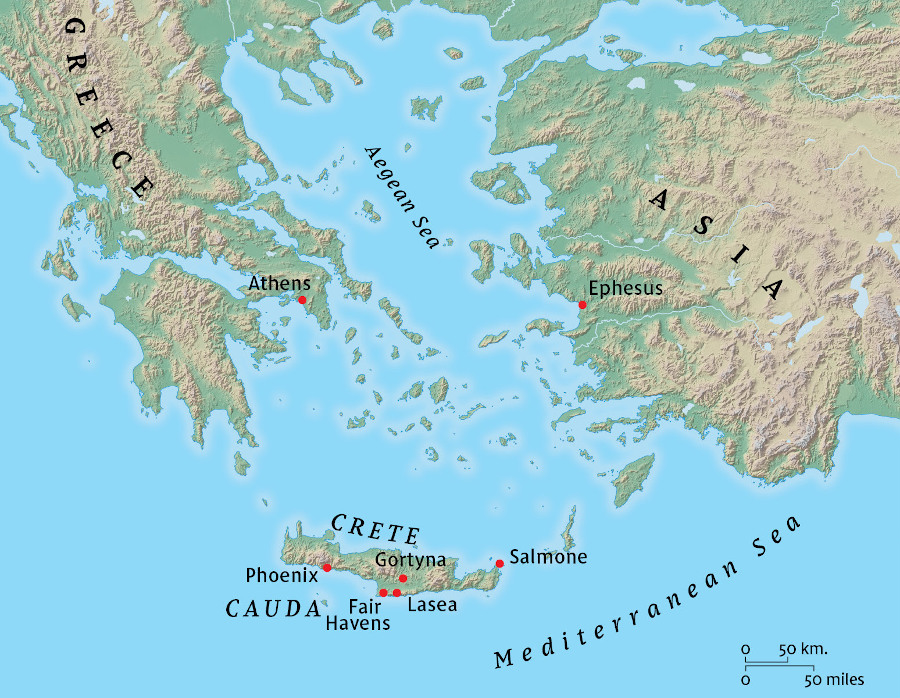
1:5 left you in Crete. Implies that Paul and Titus had been together in Crete, a ministry not mentioned in Acts. On his voyage to Rome, Paul visited Crete briefly as a prisoner (Ac 27:7–8), but now that he had been released from his first Roman imprisonment he was free to travel wherever he wished (see 3:12 and note). appoint elders. Though Paul and Titus may already have preached in Crete, they had not had time to organize churches. The appointing of elders is consistent with Paul’s usual practice (see Ac 14:23 and note).
1:6–9 1Ti 3:1–7 gives a parallel list of qualifications for elders, but the two lists reflect the different situations in which Timothy and Titus ministered. See chart. These qualifications stress the importance of setting an example for believers in living out the faith.
1:6 faithful to his wife. Since elders, by definition, were chosen from among the older men of the congregation, Paul assumed they already would be married and have children. A qualified unmarried man was not necessarily barred. It is also improbable that the standard forbids an elder to remarry if his wife dies (cf. Ro 7:2–3; 1Co 7:39). The most likely meaning is simply that a faithful, monogamous married life must be maintained. See note on 1Ti 3:2. whose children believe. Alternatively, this can be translated “whose children are trustworthy” (see NIV text note). One who would be a leader in the church should give evidence of leadership in their own family.
1:7 overseer. The use of “elder” in v. 5 and “overseer” (or “bishop”) in v. 7 indicates that the terms were used interchangeably (cf. Ac 20:17,28 and note on 20:28; see also note on 1Pe 5:2). “Elder” indicates qualification (maturity and experience), while “overseer” indicates responsibility (watching over God’s flock).
1:8 self-controlled. A virtue much needed in Crete (vv. 10–14); Paul refers to it five times in two chapters (here; 2:2,5,6,12). disciplined. Possessing the inner strength to control one’s desires and actions.
1:9 sound doctrine. Correct teaching, in keeping with that of the apostles (1Ti 1:10; 6:3; 2Ti 1:13; 4:3). The teaching is called “sound” not only because it builds up in the faith but also because it protects against the corrupting influence of false teachers. Soundness of doctrine, faith and speech is a basic concern in all the Pastoral Letters (1,2 Timothy; Titus). In them, this use of “sound” occurs eight times (here; v. 13; 2:1,2; 1Ti 1:10; 6:3; 2Ti 1:13; 4:3), but it is found nowhere else in Paul’s writings.
1:10 rebellious. Against the word of God and against Paul and Titus as the Lord’s authoritative ministers. These troublemakers had three main characteristics: (1) They belonged to the “circumcision group,” like the Judaizers of Gal 2:12, believing that, for salvation or sanctification or both, it was necessary to be circumcised and to keep all the Jewish law (see Introduction to Galatians: Occasion and Purpose). (2) They held to unscriptural “Jewish myths” (v. 14) and “genealogies” (3:9; see 1Ti 1:4 and note). (3) They were ascetics (vv. 14–15; cf. 1Ti 4:3), having scruples against things that God declared to be good. These characteristics parallel the false teaching in Ephesus (1 Timothy) and somewhat parallel the Colossian heresy (see Introduction to Colossians: The Colossian Heresy). full of meaningless talk. Paul used similar language in writing to Timothy about this kind of person (1Ti 1:6).
1:12 The quotation is from the poet Epimenides, a sixth-century bc native of Crete, who was held in high esteem by the Cretans. He was credited with several predictions that were fulfilled. For other uses of pagan sayings by Paul, see Ac 17:28; 1Co 15:33 and notes. In Greek literature “to Cretanize” meant to lie. The reference to “liars” came from their claim to have Zeus’s tomb, but Zeus, as the head of the Greek pantheon of gods, could not die.
1:13 the faith. See note on 1Ti 3:9.
1:14 Jewish myths. See note on v. 10.
1:15 To the pure, all things are pure. To Christians, who have been purified by the atoning death of Christ, “everything God created is good, and nothing is to be rejected if it is received with thanksgiving” (1Ti 4:4; see note there). to those who are corrupted and do not believe, nothing is pure. Unbelievers, especially ascetics with unbiblical scruples against certain foods, marriage and the like (cf. Col 2:21; 1Ti 4:3 and notes), do not enjoy the freedom of true Christians, who receive all God’s creation with thanksgiving. Instead, they set up arbitrary, human prohibitions against what they consider to be impure (Mt 15:10–11, 16–20; Ac 10:9–16; Ro 14:20). The principle of this verse does not conflict with the many NT teachings against practices that are morally and spiritually wrong. consciences. See 1Ti 4:2–3.
1:16 by their actions they deny him. The false teachers stood condemned by the test of personal conduct. “Actions speak louder than words.” good. See Introduction: Distinctive Characteristics. Right knowledge is extremely important because it “leads to godliness” (v. 1). Paul promoted a healthy integration of doctrine and practice (see vv. 11–14 and note).
2:1 You. Emphatic, contrasting the work of Titus with that of the false teachers just denounced (1:10–16). sound doctrine. See 1:9 and note.
2:2–10 Sound doctrine demands right conduct of all believers, regardless of age, gender or position.
2:2 Older men, many of whom would be leaders, were to be moral and spiritual examples. temperate. Instead of being “lazy gluttons,” as were Cretans in general (1:12), these older believers were to be responsible and sensible.
2:3 Likewise. The same moral standards applied to women as to men. not to be slanderers. Slanderous talk apparently was a common vice among Cretan women. addicted to much wine. Cf. 1:7; 1Ti 3:3,8.
2:4 love their husbands. Just as husbands are exhorted (Eph 5:25) to love their wives.
2:5 busy at home. This is not a requirement for women to restrict their work to the home (cf. Pr 31:14, 16,18,24), but rather that their work, wherever it is located, is directed toward the benefit of their households. subject to their husbands. See Eph 5:22 and note; Col 3:18; 1Pe 3:1 and note. no one will malign the word of God. Indicating Paul’s deep spiritual concern behind these ethical instructions. See also vv. 8,10, dealing with his concern that Christian living should help rather than hinder the spread of the gospel.
2:7–8 Perhaps Titus was still a young man and was not yet well respected by the Cretan churches. The demands on a leader are all-inclusive, involving not only his word but also his lifestyle (see Jas 3:1 and note).
2:7 good. See Introduction: Distinctive Characteristics.
2:9–10 Instructions for a distinct group in the churches. Slavery was a basic element of Roman society, and the impact of Christianity upon slaves was a vital concern. Guidance for the conduct of Christian slaves was essential (see Eph 6:5 and note; see also article).
2:9 masters. The Greek for this word, from which our English term “despot” is derived, indicates the owner’s absolute authority over his slave. Roman slaves had no legal rights, their fates being entirely in their masters’ hands (see note on Col 3:22—4:1). Cf. Phm 15–16.
2:10 make the teaching . . . attractive. Christian slaves could give a unique and powerful testimony to the gospel by their willing faithfulness and obedience to their masters.
2:11–14 A powerful statement that concisely describes the effect grace should have on believers. It encourages rejection of ungodliness and leads to holier living—in keeping with Paul’s repeated insistence that profession of Christ be accompanied by godly living (vv. 1–2, 4–5,10; 3:8).
2:11 For. Introduces the doctrinal basis for the ethical demands just stressed. Right conduct must be founded on right doctrine. grace of God. The undeserved love God showed us in Christ while we were still sinners and his enemies (Ro 5:6–10) and by which we are saved, apart from any moral achievements or religious acts on our part (see 3:5; Eph 2:8–9 and notes). But this same grace instructs us that our salvation should produce good works (see v. 14 and note; Eph 2:10).
2:12 teaches us. The word translated “teaches” refers to more than instruction; it includes the whole process of training a child—instruction, encouragement, correction and discipline. this present age. See 2Co 4:4 and note.
2:13 the blessed hope—the appearing of the glory. The second coming (see 1Ti 6:14; 2Ti 4:1; see also note on 2Ti 4:8). our great God and Savior, Jesus Christ. It is possible to translate this phrase “the great God and our Saviour, Jesus Christ” (KJV), but the NIV rendering better represents the Greek construction and is an explicit testimony to the deity of Christ (see Ro 9:5 and note).
2:14 Salvation involves the double work of redeeming us from guilt and judgment (see Ro 3:24 and note) and of producing moral purity and helpful service to others (see Introduction: Distinctive Characteristics).
2:15 A summary of Titus’s responsibility and authority. things. The content of the whole chapter.
3:1–2 Although believers are citizens of heaven (see Php 3:20 and note), they must also submit themselves to earthly government (see Ro 13:1–7; 1Pe 2:13–17 and notes) and help promote the well-being of the community.
3:1 rulers and authorities. The terms refer to all forms and levels of human government (cf. Eph 3:10; 6:12 for application to angels). good. See Introduction: Distinctive Characteristics.
3:4 kindness and love of God. The reasons why God did not simply banish fallen human beings but acted to save them (cf. 2:11).
3:5 saved us . . . because of his mercy. Salvation is not achieved by human effort or merit but comes through God’s mercy alone (see Da 9:18; Eph 2:8–9 and notes). washing of rebirth. A reference to new birth, of which baptism (among other things) is a sign. It cannot mean that baptism is necessary for regeneration, since the NT plainly teaches that the new birth is an act of God’s Spirit (see, e.g., Jn 3:5) and is not effected or achieved by works, even one as important as baptism. renewal by the Holy Spirit. The new birth and the indwelling of the Holy Spirit are central to the gospel message (see Lk 3:16; Ro 8:1–2 and note on 8:2).
3:6 whom he poured out on us generously. Cf. Ro 5:5.
3:7 justified by his grace. See Ro 3:24 and note. heirs. See Ro 8:17 and note. hope. See notes on Ro 5:5; Col 1:5.
3:8 trustworthy saying. See note on 1Ti 1:15. Here the phrase refers to the doctrinal summary in vv. 4–7. good. See Introduction: Distinctive Characteristics.
3:9 genealogies. See note on 1Ti 1:4. about the law. A reference to the situation described in 1:10–16. A similar problem existed in Ephesus (see 1Ti 1:3–7 and note on 1:3–11).
3:10–11 Stubborn refusal to listen to correction, especially when one is sowing seeds of discord, reveals spiritual callousness.
3:12 Tychicus. Paul’s trusted co-worker, who on various occasions traveled with or for Paul (see Ac 20:4; Eph 6:21 and notes). Nicopolis. Means “city of victory.” Several cities had this name, but the reference here is apparently to the city in Epirus on the western shore of Greece (see map). decided to winter there. Indicates that Paul had not arrived there when he wrote and that he was still free to travel at will, not yet having been imprisoned in Rome for the second time.
3:13 Zenas the lawyer. If he was a Jewish convert, “lawyer” means that he was an expert in the Mosaic law; if he was a Gentile convert, that he was a Roman jurist. Apollos. A native of Alexandria and one of Paul’s well-known co-workers (Ac 18:24–28; 19:1; 1Co 1:12; 3:4–6,22; 16:12). The two travelers apparently brought the letter from Paul.
3:14 good. See Introduction: Distinctive Characteristics. provide for urgent needs. See 1Ti 5:8; cf. 2Th 3:10–12.
3:15 Grace. See note on Ro 1:7. with you. See note on 2Co 13:14.