Study Notes
1:1 Paul. See note on Ro 1:1. apostle. One specially commissioned by Christ (see 1Co 1:1 and note). God our Savior. See Titus 1:3 and note. Christ Jesus our hope. See Col 1:27; Titus 2:13; Heb 6:18–19; 1Jn 3:3 and notes. hope. Expresses confident assurance, not a mere wish (see notes on Ro 5:5; Eph 1:18; 1Th 1:3; 1Pe 1:3).
1:2 true son in the faith. Spiritual son (1:18; 1Co 4:17; 2Ti 1:2; 2:1; Phm 10). Grace . . . peace. See note on Ro 1:7. mercy. See Ro 9:22–23 and note; included only here and in 2Ti 1:2 in the greetings of Paul’s letters.

 1:3–11 In this section, along with 4:1–8; 6:3–5,20–21, Paul warns against heretical teachers in the Ephesian church, some of whom may be elders who lead in their house churches. They are characterized by (1) teaching “false doctrines” (v. 3; see 6:3); (2) building up endless, far-fetched, fictitious stories based on obscure genealogical points (v. 4; 4:7); (3) being argumentative (v. 4; 6:4); (4) using talk that was “meaningless” (v. 6); (5) wanting to be teachers of the OT law (v. 7); (6) being conceited (v. 7; 6:4); (7) not knowing what they were talking about (v. 7; 6:4); (8) teaching ascetic practices (4:3); and (9) using their positions of religious leadership for “financial gain” (6:5). These heretics may have been forerunners of the Gnostics (see 6:20 and note).
1:3 I went into Macedonia. Since this incident is not recorded in Acts, it probably occurred after Ac 28, between Paul’s first and second Roman imprisonments (see Introduction: Recipient). Macedonia. See note on Php 4:15; see also map. stay there in Ephesus. And do the Lord’s work in the Ephesian church—which was well established by this time. Paul had an extensive ministry there on his third missionary journey about eight years earlier (Ac 19:1—20:1). Ephesus. See Introduction to Ephesians: The City of Ephesus; see also maps here and here.
1:4 myths. Perhaps mythical stories expanding on OT narratives (“genealogies”). See, for example, the Jewish intertestamental work, Jubilees.
1:5 pure heart. See 2Ti 2:22; Ps 24:4 and note; 51:10; cf. Mt 5:8.
1:8 the law is good. See Ro 7:7–12 and note on 7:12.
1:9–10 See note on Ro 1:29–31.
1:10 sound doctrine. See Titus 1:9 and note.
1:11 gospel. See Mk 1:1 and note. entrusted. See 6:20; 1Co 9:17; Gal 2:7; 1Th 2:4; 2Ti 1:14.
1:12 Christ . . . has given me strength. See 2Co 12:9–10; Php 4:13 and notes. appointing me to his service. See v. 1 and note.
1:13 a blasphemer and a persecutor and a violent man. See Ac 9:1; 22:4–5,19; 26:10–11 and note on 26:11. Paul may be sharing his dark past to encourage the false teachers to turn from their errors and embrace the truth.
1:14 faith and love . . . in Christ. See 2Ti 1:13 and note.
1:15 Here is a trustworthy saying. A clause found nowhere else in the NT but used five times in the Pastorals (here; 3:1; 4:9; 2Ti 2:11; Titus 3:8) to identify a key teaching. of whom I am the worst. The closer one gets to a holy God, the more the magnitude of one’s sin becomes evident (cf. Isa 6:5; see 1Co 15:9; Eph 3:8 and note).
1:16 eternal life. See Jn 3:15 and note.
1:17 invisible. See Col 1:15 and note.
1:18 son. See v. 2 and note. prophecies once made about you. In the early church God revealed his will in various matters through prophets (see Ac 13:1–3, where prophets had an active role in sending Paul and Barnabas on their mission to the Gentiles). In Timothy’s case a prophecy may have occurred at the time of or before his ordination (4:14), perhaps about 12 years earlier on Paul’s second missionary journey (Ac 16:1–3). fight the battle well. See 6:12; 2Ti 2:3; 4:7 and note.
1:19 suffered shipwreck with regard to the faith. The truths of the faith and the internal prodding of conscience (cf. Ro 2:15) are trustworthy guides for life. Rejecting these is like removing a rudder from a ship. Wreckage is likely.
1:20 Hymenaeus. See 2Ti 2:17–18. Alexander. Perhaps the Alexander of 2Ti 4:14. handed over to Satan. Such action would protect the church from false teaching and also discipline the offenders (see Mt 18:17 and note). Paul had excluded these two men from the church, which was considered a sanctuary from Satan’s power. Out in the world, away from the fellowship and care of the church, they would be “taught” (the Greek word means basically “to discipline”) “not to blaspheme.” The purpose of such drastic action was more remedial than punitive. For a similar situation, see 1Co 5:5,13 and note on 5:5.
2:1–2 prayers . . . for kings and all those in authority. See Jer 29:7; 1Pe 2:13 and note. The notorious Roman emperor Nero (ad 54–68) was in power when Paul wrote these words.

Paul’s Fourth Missionary Journey c. ad 62–68
It is clear from Ac 13:1—21:17 that Paul went on three missionary journeys. There is also reason to believe that he made a fourth journey after his release from the Roman imprisonment recorded in Ac 28. The conclusion that such a journey did indeed take place is based on: (1) Paul’s declared intention to go to Spain (Ro 15:24,28), (2) Eusebius’s implication that Paul was released following his first Roman imprisonment (Ecclesiastical History, 2.22.2–3) and (3) statements in early Christian literature that he took the gospel as far as Spain (Clement of Rome, Epistle to the Corinthians, ch. 5; Actus Petri Vercellenses, chs. 1–3; Muratorian Canon, lines 34–39).
The places Paul may have visited after his release from prison are indicated by statements of intention in his earlier writings and by subsequent mention in the Pastoral Letters. The order of his travel cannot be determined with certainty, but the itinerary below reflects one plausible option.
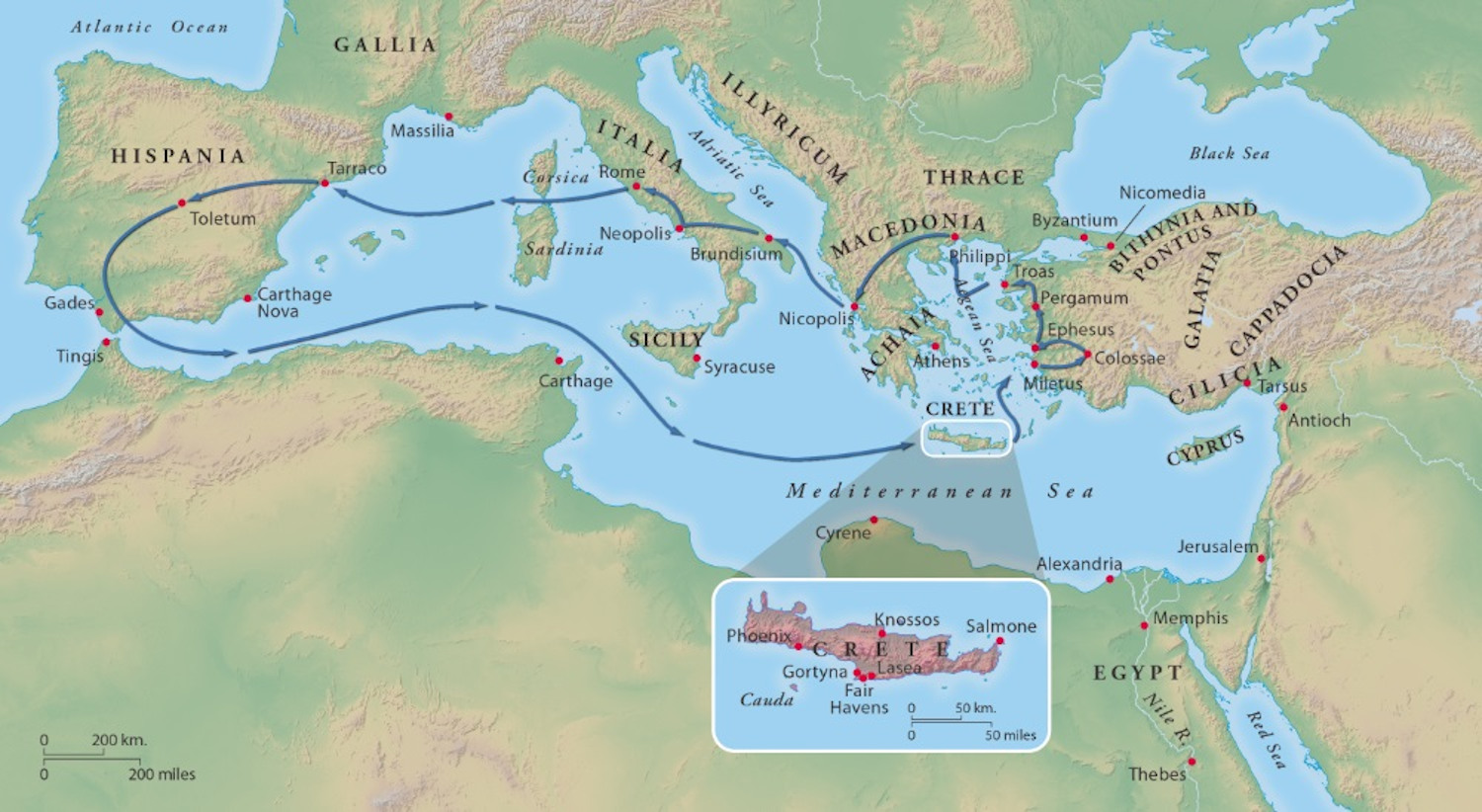
1. Rome—released from prison in ad 62
3. Crete—64–65 (Titus 1:5)
4. Miletus—65 (2Ti 4:20)
5. Colossae—66 (Phm 22)
6. Ephesus—66 (1Ti 1:3; 3:14; 4:13; 2Ti 4:20)
7. Philippi—66 (Php 2:23–24; 1Ti 1:3)
8. Nicopolis—66–67 (Titus 3:12)
9. Rome—67 (2Ti 1:17)
10. Martyrdom—67/68 (2Ti 4:6)
Go to the Maps Index.
2:2 godliness. A key word (along with “godly”) in the Pastorals, occurring ten times (here; 3:16; 4:7–8; 6:3,5–6,11; 2Ti 3:5; Titus 1:1), but nowhere else in the writings of Paul. It implies a good and holy life, with special emphasis on its source, a deep reverence for God.
2:3 God our Savior. See Titus 1:3 and note.
2:4 wants all people to be saved. God has provided salvation for all, but only those who receive it by faith are saved (see 4:10 and note; see also Ro 5:18; 2Co 5:14–15; 2Pe 3:9; 1Jn 2:2 and notes).

The view that all people, even unbelievers, will eventually be saved is called “universalism” and is contradicted by many passages of Scripture, which assert that salvation comes only through faith in Jesus Christ (cf., e.g., Jn 14:6; Ac 16:31; Ro 3:22, 26; Gal 2:16; 3:22; Eph 2:8; 2Ti 3:15), and by the biblical teaching regarding eternal judgment (cf., e.g., Mt 18:8; 25:41,46; Mk 9:43,48; 2Th 1:8–9), which would be pointless if every human being were ultimately saved.
So how are we to understand passages such as 1Ti 2:3–4 (see also Ro 5:18; 1Co 15:22; Titus 2:11; 2Pe 3:9; etc.), that seem to suggest that it is God’s will that “all people be saved and come to a knowledge of the truth”? One suggestion is that “all” in these passages doesn’t mean “every individual,” but rather “all groups or kinds of people” without exception (e.g., “kings and all in authority” in 1Ti 2:1–2). God wants his offer of salvation to be made to everyone (even the worst of sinners, 1Ti 1:15), not just a select few. The question that follows is: Why doesn’t God accomplish what he “wants” (1Ti 2:4)? Certainly he is not unable to do so. But to focus exclusively on God’s gracious and sovereign activity in salvation is to ignore human free will and responsibility.
How these two factors coexist is difficult to understand and perhaps ultimately beyond human comprehension (cf. Ro 9:19–20; 2Pe 3:15–16). What is clear, however, is that God does not show favoritism (Ac 10:34; Ro 2:11; Gal 2:6; Eph 6:9) and expects there to be no favoritism shown by his followers as well (1Ti 5:21; Jas 2:1, 9)—especially in the proclamation of the gospel.
Go to the Articles Index.
2:5 there is one God. The basic belief of Judaism (see Dt 6:4 and note), which every Jew confessed daily in the Shema (see Mk 12:29 and note). mediator. One who represents God to humans and humans to God—and who removes all alienation between them by offering himself as “a ransom for all” (v. 6). Cf. Jn 14:6; Heb 8:6 and notes.
2:6 ransom. See Mt 20:28 and note. witnessed. Refers to the apostolic testimony that Christ gave himself as the ransom. proper time. See Gal 4:4 and note.
2:7 for this purpose. To testify that, through his death, Christ has bridged the gap between God and human beings and made salvation available to all. herald. See 2Ti 1:11; one who with authority makes a public proclamation. apostle. See 1Co 1:1 and note.
2:8 men. The Greek for this word does not refer to humankind (as in vv. 5–6) but to males as distinct from females. Women also prayed in public, however (see 1Co 11:5 and note).
2:9–15 Some maintain that Paul’s teaching about women here is specific to the situation of false teaching in Ephesus and therefore not universal and timeless. Others view Paul’s teaching here as timeless and therefore applicable to every age. See also article.
2:9 not with elaborate hairstyles or gold or pearls. Or, more formally, “not with braided hair” and gold or pearls; hence, not a total ban on the wearing of jewelry or braided hair. Rather, Paul was expressing caution in a society where such things were signs of extravagant luxury and proud personal display. Wealthy Greek and Roman women often lavished hours of time on weaving costly gems into their hair.
Women and Authority in the Church
The prohibition in 1Ti 2:11–14 has been understood in different ways: (1) Paul does not allow a woman to be an official teacher in the assembled church and meant “assume authority over a man” to be an added restriction that prohibited women from functioning as an overseer (see note on 3:1). (2) Paul here prohibits teaching only by women not properly instructed, i.e., by the women at Ephesus, who were part of the problem of spreading of false teaching (see 5:11–15). (3) Paul refers to a kind of teaching that wields an inappropriate or domineering authority and so is prohibiting domineering teaching over men. Each of these positions is held by a segment of the church and claims Scriptural support.
Some, for example, understand Paul’s appeal to the creation account (Ge 2–3) to make the restrictions universal and permanent. Paul appeals first to the priority of Adam in creation (1Ti 2:13), which predates the fall. Thus Paul regards the man-woman relationship set forth in this passage as grounded in creation. Moreover, it is claimed, Paul appears to argue (1Ti 2:14) that since the woman was deceived (and then led Adam astray), she is not to be entrusted with the teaching function of an overseer (or elder) in the public worship services of the assembled church.
Alternatively, some understand the prohibition not as universal and permanent but restricted to this church’s particular situation (see Introduction: Background and Purpose). Under different circumstances the restrictions would not apply (e.g., 1Co 11:1–5). Another example in this same letter would be Paul’s prohibition against women worshiping with “elaborate hairstyles” or while wearing “gold or pearls or expensive clothes” (1Ti 2:9). Believers today recognize that such a prohibition does not apply in contexts where the problems Paul is addressing in the church at Ephesus do not exist. That is, they recognize the prohibition was never meant to be universal and permanent.
Therefore, while believers may agree on the divine inspiration and authority of Scripture, they sometimes disagree on its correct interpretation and application. Elsewhere the same apostle urges believers who are dealing with situations such as these not to judge others but to follow their own conscience as the Spirit leads them (Ro 14) and to “make every effort to do what leads to peace and to mutual edification” (Ro 14:9).
Go to the Articles Index.
2:10 See 1Pe 3:3–5 and note on 3:3.
2:11 should learn. The only Greek imperative (command) in all of vv. 11–15, and a countercultural one in a society where women were often not allowed to receive public religious instruction.
2:15 saved through childbearing. Three meanings have been proposed: (1) This speaks of the godly woman finding fulfillment in her role as wife and mother, thus being “saved” from the evils besetting the Ephesian church (see 5:11–14); (2) it refers to women being saved spiritually through the most significant birth of all, the incarnation of Christ; or (3) it refers to women being kept physically safe in childbirth, not in any absolute sense, but as an outgrowth of the Christian commitment to care for one another.
3:1 trustworthy saying. See note on 1:15. overseer. In Greek culture the word was used of a presiding official in a civic or religious organization. Here it refers to a man (see v. 2) who oversees a local congregation. The equivalent word from the Jewish background of Christianity is “elder.” The terms “overseer” and “elder” are often used interchangeably (see Ac 20:17, 28; Titus 1:5–7; see also note on 1Pe 5:2). The duties of an overseer were to teach and preach (3:2; 5:17), to direct the affairs of the church (3:5; 5:17), to shepherd (“pastor”) the flock of God (Ac 20:28; see note there) and to guard the church from error (Ac 20:28–31).
Qualifications for Elders/Overseers and Deacons
Self-controlled | ELDER | |
Hospitable | ELDER | |
Able to teach | ELDER | |
Not violent but gentle | ELDER | |
Not quarrelsome | ELDER | |
Not a lover of money | ELDER | |
Not a recent convert | ELDER | |
Has a good reputation with outsiders | ELDER | |
Not overbearing | ELDER | |
Not quick-tempered | ELDER | |
Loves what is good | ELDER | |
Upright, holy | ELDER | |
Disciplined | ELDER | |
Above reproach (blameless) | ELDER DEACON | |
Faithful to his wife | ELDER DEACON | |
Temperate | ELDER DEACON | |
Respectable | ELDER DEACON | |
Not given to drunkenness | ELDER DEACON | |
Manages his own family well | ELDER DEACON | |
Sees that his children obey him | ELDER DEACON | |
Does not pursue dishonest gain | ELDER DEACON | |
Holds to the truth | ELDER DEACON | |
Sincere | DEACON | |
Tested | DEACON |
Go to the Charts Index.
3:2 overseer is to be. See chart. faithful to his wife. A general principle that applies to any violation of God’s marriage law, whether in the form of polygamy or of marital unfaithfulness (see note on Titus 1:6).
3:5 church. See notes on Ac 9:31; 2Co 1:1.
3:7 devil’s trap. See 2Ti 2:26; cf. 1Pe 5:8.
3:8 deacons. In its nontechnical usage, the Greek for this word means simply “one who serves.” The men chosen in Ac 6:1–6 are not called deacons but seem to have fulfilled a similar role (see note on Ac 6:6). Generally, their service was meant to free the elders to give full attention to prayer and the ministry of the word (Ac 6:2,4). The only two local church offices mentioned in the NT are those of overseer (also called elder; see note on v. 1) and deacon (Php 1:1). See chart.
3:9 the faith. Apostolic teaching (see 4:1,6; 6:10,12,21; 2Ti 4:7 and note; Titus 1:13; cf. 1Co 15:3; 2Th 2:15 and notes).
3:10 be tested. Before individuals could serve as deacons, they had to demonstrate before the church the qualities described in vv. 8–9.
3:11 the women. Could refer to (1) deacons’ wives or (2) women deacons (see NIV text note). The fact that deacons are referred to again in vv. 12–13 seems to indicate that Paul refers to male deacons distinctly from women who might have fulfilled a similar role (see Ro 16:1 and note).
3:12 faithful to his wife. See v. 2 and note.
3:14 I am writing . . . so that. Here, in brief, Paul states his purpose for writing the letter—to give instructions concerning church conduct in a situation that sorely needed his correction (v. 15).
3:15 God’s household. The family of God, made up of believers. pillar and foundation of the truth. See 2Ti 2:19 and note.
3:16 mystery from which true godliness springs. See Ro 11:25; Col 1:26 and notes. The phrase means the “revealed secret of true piety,” i.e., the secret that produces piety in people. That secret, as the following words indicate, is none other than Jesus Christ. His incarnation, in all its aspects (particularly his saving work), is the source of genuine piety. The words are printed in poetic form and probably come from an early creedal hymn (see note on Col 3:16). godliness. See 2:2 and note. vindicated by the Spirit. The Holy Spirit enabled Jesus to drive out demons (Mt 12:28) and perform miracles. Most important, the Spirit raised Jesus from the dead (see Ro 1:4; cf. 1Pe 3:18 and note) and thereby vindicated him, showing that he was indeed the Son of God. seen by angels. At his resurrection (Mt 28:2) and ascension (Ac 1:10; see note there). taken up in glory. See Lk 24:51; Ac 1:9–12 and notes.
4:1,6 the faith. See note on 3:9.
4:1 The Spirit clearly says. As, e.g., in Mk 13:22; Ac 20:29–30; 2Th 2:3. Paul, however, is perhaps speaking here of a specific revelation made to him by the Spirit. later times. The time beginning with the first coming of the Messiah (see Jas 5:3 and note). That Paul is not referring only to the time immediately prior to Christ’s second coming is obvious from his assumption in v. 7 that the false teachings were already present at the time of his writing.
4:3–5 foods . . . received with thanksgiving . . . prayer. Cf. 1Sa 9:13; Mt 14:19; 26:26–27; Mk 14:22–23; Lk 9:16; 24:30; Ac 27:35 (note “in front of them all”); Ro 14:6; 1Co 10:16,30 and relevant notes on “saying grace [thanksgiving]” or blessing food.
4:3 This unbiblical asceticism arose out of the mistaken belief that the material world was evil—a central belief of the Gnostic heresy (see Introduction to 1 John: Gnosticism).
4:4 everything God created is good. See Ge 1:4, 10,12,18,21,25,31 and note on 1:4; see also Titus 1:15 and note. nothing is to be rejected. Paul is here not contradicting Scriptural teaching elsewhere (including his own; cf., e.g., Ro 6–8; Gal 5:13—6:10; Eph 4:17—6:9) regarding holy living, but is focusing primarily on misguided prohibitions against marriage and eating certain foods (v. 3).
4:6 brothers and sisters. See NIV text note. good teaching that you have followed. Even from early childhood (see 2Ti 3:15 and note).
4:7 myths. See 1:4 and note. train yourself to be godly. See 2:2 and note. Godliness requires self-discipline.
4:9 trustworthy saying. See note on 1:15. Here the expression probably refers back to the seemingly proverbial statement in v. 8. The words “labor and strive” in v. 10 may refer to the training mentioned in vv. 7b–8.
4:10 hope. See note on 1:1. Savior of all. Obviously this does not mean that God saves every person from eternal punishment, for such universalism would contradict the clear testimony of Scripture. God is, however, the Savior of all in that he offers salvation to all and saves all who come to him (all “who believe”).
4:12 because you are young. Cf. Jer 1:7 and note. Timothy was probably in his mid-30s or younger, and in that day such an influential position was not usually held by a man so young. For this reason his leadership may have been called into question. example. See Titus 2:7–8 and note.
4:13 Until I come. Paul’s journey had taken him from Ephesus to Macedonia (see map), but he hoped to rejoin Timothy soon at Ephesus (3:14).
4:14 through prophecy. See 1:18; 2Ti 1:6 and notes. laid their hands on you. As an act of commissioning to service (see Ac 6:6; Heb 6:1–2 and notes).
4:16 save both yourself and your hearers. Save from the errors and false teaching he described earlier (vv. 1–3,7). Timothy is to accomplish this by communicating truth by his “life and doctrine.” Such behavior and teaching would strengthen the church and point unbelievers toward faith in Jesus Christ.
5:3 Give proper recognition to those widows. Probably refers to respecting and taking care of them, including the giving of material support. Widows were particularly vulnerable in ancient societies because pensions, government assistance, life insurance and the like were not available to anyone.
5:4 put their religion into practice. See Jas 1:22–27; 2:14–26 and note.
5:5 For an example of such a widow, see Lk 2:36–38.
5:6 dead even while she lives. Dead spiritually, while living physically.
5:8 the faith. See note on 3:9. Apostolic teaching emphasized social responsibility. worse than an unbeliever. Even in the pagan world of that time, people generally took care of their family members. This verse teaches nothing about a man having to be the “breadwinner” for a family.
5:9 The church in Ephesus seems to have maintained a “list of widows” supported by the church. While there is no other evidence in the first century of an official position held by widows comparable to that of the overseers, one would develop in early church history and later be transformed into the role of a nun. The widows on the list were apparently expected to devote themselves to prayer (v. 5) and good deeds (v. 10).
5:10 washing the feet of the Lord’s people. A menial and demeaning task, but necessary in NT times because of dusty roads and the wearing of sandals (Jn 13:14–15 and notes). the Lord’s people. See note on Col 1:4.
5:12 broken their first pledge. Perhaps when a widow was added to the list she pledged special devotion to Christ, which would be diminished by remarriage. Or Paul may be referring to the believer’s basic trust in Christ, which a widow would compromise by marrying outside the faith. Most likely, she pledged to remain celibate so that remarriage would force her to break that vow.
5:13 busybodies. See 2Th 3:11 and note.
5:15 Satan. See notes on Job 1:6; Mt 16:23; 1Th 3:5; 1Jn 3:8; Rev 12:9–10.
5:17 All elders were to exercise leadership (3:4–5) and to teach and preach (3:2), and all were to receive honor. But those who excelled in leadership were to be counted “worthy of double honor.” This was especially true of those who labored at teaching and preaching. (The Greek word translated “work” refers to toil.) That such honor should include financial support is indicated by the two illustrations in v. 18.
5:18 Scripture. The use of this term for both an Old Testament (Dt 25:4) and a New Testament (Lk 10:7) passage, if it is referring to both, shows that by this time portions of the NT (or what ultimately became a part of the NT) were considered to be equal in authority to the OT Scriptures (see 2Pe 3:16 and note). Do not muzzle . . . grain. See 1Co 9:9–11 and notes on 9:9,11.
5:19 two or three witnesses. Cf. Dt 17:6 and note.
5:20 those elders who are sinning. The context indicates that Paul is speaking of the discipline of elders (cf. 1:3)
5:21 elect angels. Chosen angels, in contrast to Satan and the other fallen angels. do nothing out of favoritism. See Ex 23:3; Lev 19:15; Dt 1:17; 16:19; Job 13:10; Pr 18:5; 24:23; 28:21; Mal 2:9; Jas 2:1, 9; 3:7. Cf. note on Ac 10:34.
5:22 Do not be hasty in the laying on of hands. Paul is speaking about the appointing of elders (see 4:14 and note), which should not be done until candidates have had time to prove themselves. Given the probable situation of false teaching by elders in the Ephesian house churches, Timothy’s role of removing and appointing elders was central to his mission there. do not share in the sins of others. Do not appoint a person unworthy of the office of elder. Keep yourself pure. Probably refers here to refusal to become involved in the appointment of an unworthy person.
5:23 Stop drinking only water. A parenthetical comment in Paul’s discussion of elders. In view of Timothy’s physical ailments, and perhaps because safe drinking water was often difficult to find, Paul advised him to drink “a little wine.” Scripture does not forbid the moderate use of alcohol.
5:24–25 sins of some . . . good deeds. Paul advises being alert to hidden sins, as well as to good deeds, in the lives of those being considered for the office of elder.
5:24 The sins of some are obvious to all, even before being judged in eternity. The sins of others are hidden, though they will eventually be exposed and judged.
6:1 slavery. See notes on 1Co 7:21; Eph 6:5; Col 3:22—4:1; see also Phm 16.
6:2b These . . . things. Paul’s preceding instructions.
6:3–5 Paul returns to the subject of 1:3 (see note on 1:3–11).
6:3 sound instruction . . . godly. See article; see also Titus 1:9 and note.
6:5 robbed of the truth. They had once known the truth but had been led into error. who think that godliness is a means to financial gain. See notes on 2Co 2:17; 11:7.
6:7 take nothing out of it. See Ps 49:17.
6:8 On contentment, see Php 4:11–12 and notes.
6:9 Wealth by itself is not a mark of sinfulness. But when wealth becomes the primary goal of one’s life, it blinds its pursuers to its dangers (cf. v. 10) and to the greater contentment of godliness (vv. 6,17; see Lk 12:13–21 and note on 12:13).
6:10,12,21 the faith. See note on 3:9.
6:10 the love of money is a root of all kinds of evil. Three issues in translation or interpretation often lead to v. 10 being misunderstood: (1) It is “love of money” not “money” that is the problem; (2) it is “a root” not “the root;” and (3) it is “all kinds of evil,” not “all evil.” Still, Paul gives a strong warning against setting one’s affections on gaining or retaining material possessions in abundance.
6:12 Fight the good fight. The life of faith requires disciplined effort (see 1:18 and note). Take hold of . . . eternal life. Timothy had possessed eternal life since he had first been saved, but Paul urges him to claim its benefits in greater fullness (see vv. 17–19 and note on 4:16). when you made your good confession. Perhaps a reference to Timothy’s confession of faith at his baptism during Paul’s first missionary journey.
6:13 who while testifying before Pontius Pilate made the good confession. Probably a reference to Jesus’ statements recorded in Jn 18:34–37; 19:11.
6:14 this command. The preceding context seems to indicate that Paul uses the singular “command” to sum up the various commands listed in vv. 11–12. Alternatively, the command may refer to the whole charge given to Timothy to preach the gospel and care for the church (v. 20), which in turn points back to the original command in 1:3 to deal with false teaching.
6:15 in his own time. Just as Jesus’ first coming occurred at the precise time God wanted (Gal 4:4), so also his second coming will be at God’s appointed time. King of kings and Lord of lords. See Rev 17:14 and note; 19:16.
6:16 whom no one has seen or can see. See Jn 1:18 and note.
6:19 lay up treasure. See Mt 6:19–21 and note; 19:21; Lk 12:33 and note. life that is truly life. The fullest experience of human life as God intended it to be (cf. Jn 10:10).
6:20 what has been entrusted to your care. The gospel (see 2Ti 1:14). what is falsely called knowledge. Perhaps a reference to an early form of the heresy of Gnosticism, which taught that one may be saved by knowledge. (The term “Gnosticism” comes from the Greek word for knowledge; see Introduction to 1 John: Gnosticism.)
6:21 Grace. See note on Ro 1:7. with you. See note on 2Co 13:14. you all. The plural indicates that Paul expects his letter to Timothy to be read to the entire Ephesian congregation (see note on 2Ti 4:22).