
Author: The apostle Paul
Audience: The believers at Colossae, a church perhaps planted by Paul’s coworker, Epaphras
Date: About ad 60
Theme: Paul writes to demonstrate that Christ is supreme over every human philosophy and tradition.
Introduction
Author, Date and Place of Writing
 That Colossians is a genuine letter of Paul (1:1) is sometimes disputed. In the early church, however, all who speak on the subject of authorship ascribe it to Paul. In the nineteenth century, however, some thought that the heresy refuted in ch. 2 was second-century Gnosticism. But a careful analysis of ch. 2 shows that the heresy referred to there is noticeably less developed than the Gnosticism of leading Gnostic teachers of the second and third centuries. Also, the seeds of what later became the full-blown Gnosticism of the second century were present in the first century and already making inroads into the churches. Consequently, it is not necessary to date Colossians in the second century at a time too late for Paul to have written the letter. Today doubts center on a distinctive style of writing and certain distinctive theological emphases. But the role of Timothy (1:1) and / or the fact that this is the second church Paul writes to that he did not personally found (the first was Romans), may account for some of these distinctives.
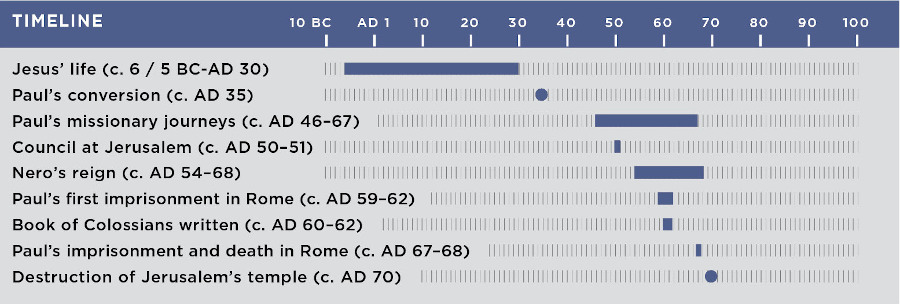
Colossians is to be dated probably during Paul’s first imprisonment in Rome, where he spent at least two years under house arrest (Ac 28:16–31). Some have argued that Paul wrote Colossians from Ephesus or Caesarea, but most of the evidence favors Rome as the place where he penned all the Prison Letters (Ephesians, Colossians, Philippians and Philemon). Colossians should then be dated c. ad 60, in the same year as Ephesians and Philemon (see chart), and sent out at the same time.
Colossae: The Town and the Church
Several hundred years before Paul’s day, Colossae had been a leading city in Asia Minor (present-day Turkey; see photo). It was located on the Lycus River and on the great east-west trade route leading from Ephesus on the Aegean Sea to the Euphrates River (see maps here and here). By the first century ad Colossae was diminished to a second-rate market town, which had been surpassed long before in power and importance by the neighboring towns of Laodicea and Hierapolis (4:13).
What gave Colossae NT importance, however, was the fact that during Paul’s three-year ministry in Ephesus, Epaphras had been converted and had carried the gospel to Colossae (cf. 1:7–8; Ac 19:10). The young church that resulted then became the target of heretical attack, which led to Epaphras’s visit to Paul in Rome and ultimately to the penning of the Colossian letter.
Perhaps as a result of the efforts of Epaphras or other converts of Paul, Christian churches had also been established in Laodicea and Hierapolis. Some of them were house churches (4:15; Phm 2). Most likely all of them were primarily Gentile.
The Colossian Heresy
In his Colossian letter, Paul never explicitly describes the false teaching he opposes. The nature of the heresy (or heresies) must be inferred from statements he made in opposition to the false teachers. An analysis of his refutation suggests that their teachings were diverse in nature. Some of the elements were:
(1) Ceremonialism. It held to strict rules: (a) about the kinds of food and drink that were permissible, (b) about religious festivals (2:16–17) and (c) about circumcision (2:11; 3:11).
(2) Asceticism. “Do not handle! Do not taste! Do not touch!” (2:21; cf. 2:23).
(3) Worship of (or with) angels. See 2:18 and note.
(4) Devaluing the person and work of Christ. This is implied in Paul’s emphasis on the supremacy of Christ (1:15–20; 2:2–3,9).
(5) Secret knowledge. The later Gnostics boasted of this (see 2:18 and Paul’s emphasis in 2:2–3 on Christ, “in whom are hidden all the treasures of wisdom”).
(6) Reliance on human wisdom and tradition. See 2:4,8.
These elements seem to fall into two categories, Jewish and Hellenistic. It is likely, therefore, that the false teaching at Colossae was a mixture of some form of Judaizing and either an early stage of Gnosticism (see Introduction to 1 John: Gnosticism; see also note on 2:23) or some other form of local Greek worship. See article.
Purpose and Theme
Paul’s purpose is to refute the Colossian heresy. To accomplish this goal, he exalts Christ as the very image of God (1:15), the Creator (1:16), the preexistent sustainer of all things (1:17), the head of the church (1:18), the first to be resurrected (1:18), the fullness of deity in bodily form (1:19; 2:9) and the one who reconciles all things to God (1:20–22). Thus Christ is completely adequate: “In Christ you have been brought to fullness” (2:10). At the same time, Paul exposes the false teachers’ view of Christ as altogether deficient. It was a hollow and deceptive philosophy (2:8), lacking any ability to restrain sinful desires (2:23).
The theme of Colossians is the complete adequacy of Christ, as contrasted with the emptiness of mere human philosophy and tradition.
Paul exalts Christ as the very image of God, the Creator, the preexistent sustainer of all things, the head of the church, the first to be resurrected, the fullness of deity in bodily form, and the one who reconciles all things to God.
Outline
I. Introduction (1:1–14)
A. Greetings (1:1–2)
B. Thanksgiving (1:3–8)
C. Prayer (1:9–14)
II. Theological Exposition (1:15—2:23)
A. The Supremacy of Christ (1:15–23)
B. Paul’s Labor for the Church (1:24—2:7)
1. His ministry for the sake of the church (1:24–29)
2. His concern for the spiritual welfare of his readers (2:1–7)
C. Freedom From Human Philosophy and Tradition (2:8–23)
1. Warning to guard against the false teachers (2:8–15)
2. Pleas to reject the false teachers (2:16–19)
3. An analysis of the heresy (2:20–23)
III. Ethical Implications (3:1—4:6)
A. The Old Self and the New Self (3:1–17)
B. Rules for Christian Households (3:18—4:1)
C. Further Instructions (4:2–6)
IV. Final Greetings and Benediction (4:7–18)

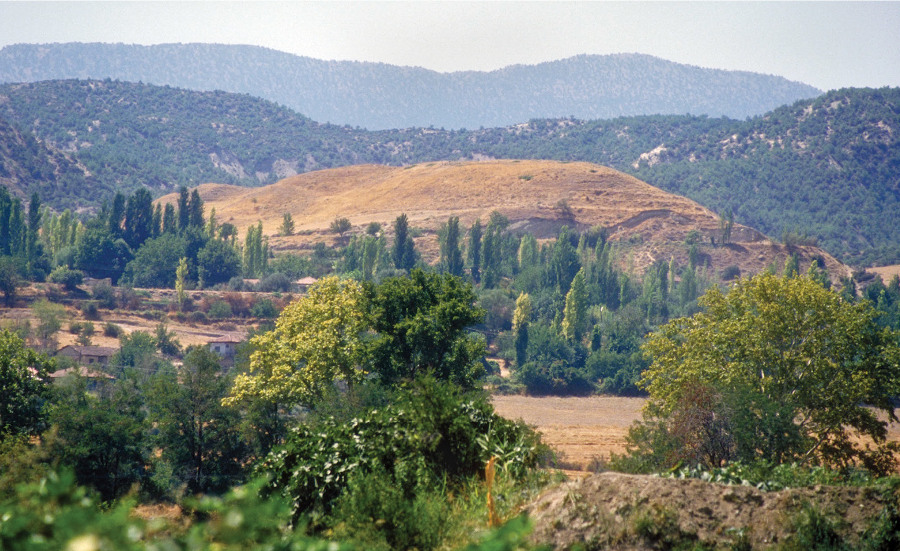
Unexcavated tell at Colossae. A tell is a mound of ancient ruins including several layers built over each other through time.
© Phoenix Data Systems