

Author: The apostle Paul
Audience: Philemon and the members of the church at Colossae
Date: About ad 60
Theme: Paul urges Philemon to show grace to Onesimus, his runaway slave, as a Christian brother.
Author, Date and Place of Writing
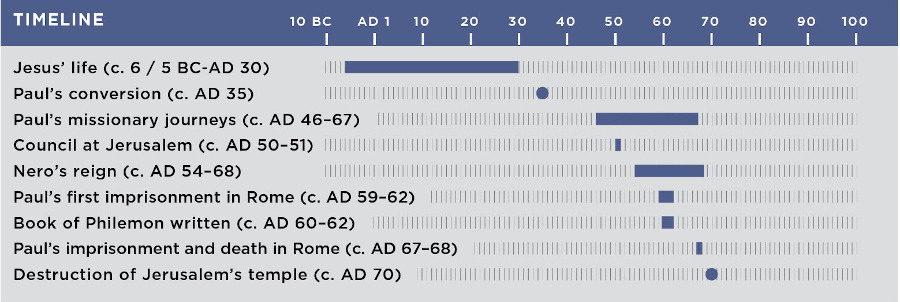
 Paul wrote this short letter (vv. 1,9,19) probably at the same time as Colossians (c. ad 60; see Introduction to Colossians: Author, Date and Place of Writing) and sent it to Colossae with the same travelers, Onesimus and Tychicus. He apparently wrote both letters from prison in Rome, though possibly from Ephesus (see Introduction to Philippians: Author, Date and Place of Writing; see also chart).
Recipient, Background and Purpose
Paul wrote this letter to Philemon, a believer in Colossae who, along with others, was a slave owner (cf. Col 4:1; for slavery in the NT, see note on Eph 6:5). One of his slaves, Onesimus, had apparently stolen from him (cf. v. 18) and then run away, which under Roman law was punishable by death. But Onesimus met Paul and through his ministry became a Christian (v. 10). Now he was willing to return to his master, and Paul writes this personal appeal to ask that he be accepted as a Christian brother (v. 16). It is also possible that Onesimus went to Paul because he was a friend of Philemon in the hope that Paul would help the other two settle some kind of dispute.
Approach and Structure
To win Philemon’s willing acceptance of Onesimus, Paul writes in a very tactful, persuasive, and warmhearted manner. The appeal (vv. 4–21) is organized in a way prescribed by ancient Greek and Roman teachers: to build rapport (vv. 4–10), to persuade the mind (vv. 11–19) and to move the emotions (vv. 20–21). The name Onesimus is not mentioned until the rapport has been built (v. 10), and the appeal itself is stated only near the end of the section to persuade the mind (v. 17).
Outline
I. Greetings (1–3)
II. Thanksgiving and Prayer (4–7)
III. Paul’s Plea for Onesimus (8–21)
IV. Final Request, Greetings and Benediction (22–25)

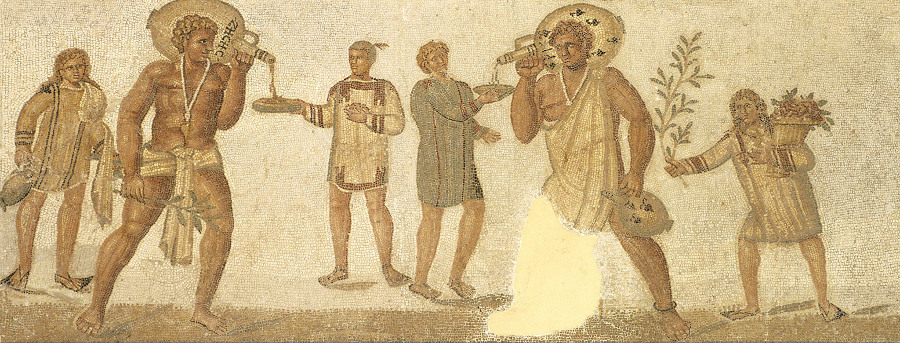
Mosaic of slaves pouring wine for guests at a banquet (3rd century ad). In his letter to Philemon, Paul makes a plea on behalf of Onesimus, Philemon’s slave.
Gianni Dagli Orti/Shutterstock