Study Notes
1:1 my former book. The Gospel of Luke. Acts was addressed to the same patron, Theophilus (see Introduction to Luke: Recipient and Purpose). began to do and to teach. An apt summation of Luke’s Gospel, implying that Jesus’ work continues in Acts through his own personal interventions (e.g., 16:7) and the ministry of the Holy Spirit (see note on Lk 24:53).
 1:2 taken up to heaven. Jesus’ ascent to heaven was the last scene of Luke’s Gospel (24:50–52) and is the opening scene of this second volume (vv. 6–11). The ascension occurred 40 days after the resurrection (v. 3). It represents the vindication of Jesus as the Messiah at the right hand of God and his authority to pour out the Spirit (2:33; 5:31; 7:55; Lk 22:69). through the Holy Spirit. Jesus’ postresurrection instruction of his apostles was carried on through the Holy Spirit, and succeeding statements make it clear that what the apostles were to accomplish was likewise to be done through the enablement of the Spirit (vv. 4–5,8; see Lk 24:49 and note; Jn 20:22; see also Introduction to Judges: Themes and Theology). Luke characteristically stresses the Holy Spirit’s work and enabling power (e.g., v. 8; 2:4,17; 4:8,31; 5:3; 6:3,5; 7:55; 8:16; 9:17,31; 10:44; 13:2,4; 15:28; 16:6; 19:2,6; see note on Lk 4:1).
1:3 many convincing proofs. See, e.g., the resurrection appearances (Mt 28:1–20; Lk 24:1–53; Jn 20:1–29; 1Co 15:3–8). kingdom of God. The heart of Jesus’ preaching (see notes on Mt 3:2; Lk 4:43; cf. Ex 15:18; Ps 103:19).
1:4 wait. Another ten days (see notes on v. 2; 2:1). the gift my Father promised. Luke views the coming of the Holy Spirit on the day of Pentecost as the birth of the church and the dawn of the new era of salvation through Jesus the Messiah (see Lk 3:16; 24:49 and notes; Jn 14:26; 15:26–27; 16:12–13).
1:5 John baptized with water. See Lk 3:16 and note. in a few days. The day of Pentecost came ten days later, when the baptism with the Holy Spirit occurred (2:1–4).
1:6 restore the kingdom to Israel? Like their fellow Jews, they were looking for the deliverance of the people of Israel from foreign domination and for the establishment of an earthly kingdom. The reference to the coming of the Spirit had caused them to wonder if the new age was about to dawn.
1:7 the times or dates. By using the two most common Greek words for time, Jesus emphatically rejects any speculation related to the time of his return (see Mk 13:32; 1Th 5:1 and notes).
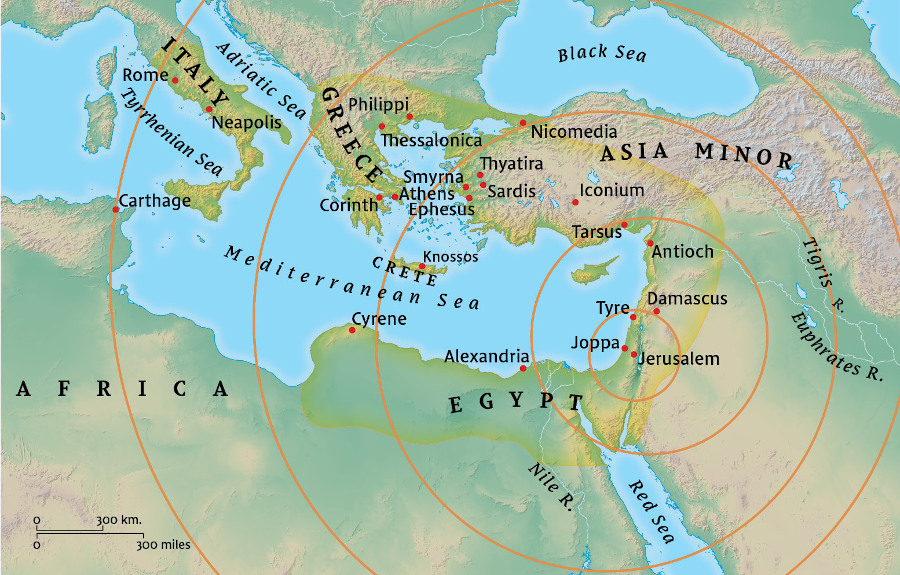
1:8 A virtual outline of Acts: The apostles were to be witnesses in Jerusalem (chs. 1–7), Judea and Samaria (chs. 8–9) and to the ends of the earth—including Caesarea, Antioch, Asia Minor, Greece and Rome (chs. 10–28). See photo. However, they were not to begin this staggering task until they had been equipped with the power of the Spirit (vv. 4–5; cf. Eph 5:18). my witnesses. An important theme throughout Acts (2:32; 3:15; 5:32; 10:39; 13:31; 22:15). Judea. The region in which Jerusalem was located. Samaria. The adjoining region to the north. The gospel reaches Samaria in Ac 8.
1:9 taken up. See v. 2; Ge 5:24 and notes. a cloud hid him. See Mt 17:5 and note.
1:10 two men dressed in white. Angels (cf. Jn 20:12).
1:11 Men of Galilee. All of the Twelve were from Galilee except Judas, and he was no longer present. in the same way. In the same resurrection body and in clouds and with “great glory” (Mt 24:30; see note there).
1:12 Mount of Olives. The ascension occurred on the eastern slope of the mount between Jerusalem and Bethany (Lk 19:28–29,37; see notes on Zec 14:4; Mk 11:1; Lk 19:29; 24:50). Sabbath day’s walk. See NIV text note. This distance was drawn from rabbinical reasoning based on several OT passages (Ex 16:29; Nu 35:5; Jos 3:4). A faithful Jew was to travel no farther on the Sabbath.
 1:13 room. Probably an upper room of a large house, such as the one where the Last Supper was held (Mk 14:15) or that of Mary, the mother of Mark (see note on 12:12). Bartholomew. Apparently John calls him Nathanael (see Jn 1:45–49; 21:2). James son of Alphaeus. The same as James the younger (Mk 15:40). Zealot. See note on Mt 10:4. Judas son of James. Not Judas Iscariot, but the same person as Thaddaeus (see note on Mt 10:3).
1:14 with the women. Those who followed Jesus in his ministry (Mt 27:55; Lk 8:2–3; 24:22), possibly including the wives of the apostles (cf. 1Co 9:5 and note) and those listed as ministering to Jesus. Mary the mother of Jesus. The last mention of her in Scripture. brothers. See notes on Mk 6:3; Lk 8:19. Although they did not believe in Jesus’ identity during his public ministry, evidently they had come to believe after the resurrection (cf. 1Co 15:7). These brothers would include James, who later became a leader in the Jerusalem church (12:17; 15:13; 21:18; Gal 1:19; 2:9; see Introduction to James: Author).
1:16 the Scripture had to be fulfilled. For the Scripture referred to, see NIV text notes on v. 20. Both before and after Christ came, numerous psalms were viewed as Messianic. What happened in the psalmist’s experience was typical of the experiences of the Messiah. No doubt Jesus’ instruction in Lk 24:27,45–47 included these Scriptures.
1:18 Judas bought a field. Judas bought the field indirectly: The money he returned to the priests (Mt 27:3) was used to purchase the potter’s field (Mt 27:7). fell headlong. Mt 27:5 reports that Judas hanged himself. It appears that when the body finally fell, either because of decay or because someone cut it down, it was in a decomposed condition and so broke open in the middle.
1:20 it is written. Two passages of Scripture (see NIV text notes) were put together and used typologically (see article) to suggest that Judas had left a vacancy that had to be filled (see notes on Ps 69:25; 109:8).
1:21 it is necessary. Preserving twelve apostles highlights the group as the symbolic restoration of the twelve tribes of Israel (see note on Mk 3:14–19).
1:22 a witness with us of his resurrection. Apparently several met this requirement. On this occasion, however, the believers were selecting someone to become an official witness to the resurrection, i.e., someone to help proclaim and oversee the apostles’ teaching about Jesus for the church—thus, a 12th apostle (v. 25).
1:23 Barsabbas. This name was used for two early Jewish Christians, possibly brothers. One was Joseph (here); the other was Judas, a prophet in Jerusalem who was sent to Antioch with Silas (15:22,32). Justus. Joseph’s Hellenistic name. Nothing more is known of him.
1:25 where he belongs. See Jn 17:12 and note.
1:26 cast lots. See Pr 16:33 and note. By casting lots they submitted the decision to the ascended Lord. The use of rocks or sticks to designate the choice was common (see 1Ch 26:13–16; see also notes on Ne 11:1; Jnh 1:7). This is the Bible’s last mention of casting lots. As appropriate as it was in OT times, the coming of the Spirit at Pentecost (ch. 2) would provide a much better means of guidance for believers.
2:1 day of Pentecost. The 50th day after the Sabbath of Passover week (Lev 23:15–16), thus the first day of the week. Pentecost is also called the Festival of Weeks (Dt 16:10) because it occurs seven weeks after the Passover, the Festival of Harvest (Ex 23:16) because it celebrated the end of the barley harvest and the beginning of the wheat harvest, and the day of firstfruits (Nu 28:26). See chart. In Judaism, Pentecost was traditionally seen as the day Moses received the law. Now it will be seen as the day the Spirit came to fulfill God’s promise as given in the Law and the Prophets. they were all together. Likely referring to all those mentioned in 1:13–15. in one place. Evidently not the upstairs room where they were staying (1:13) but perhaps some place in the temple precincts, for the apostles were “continually at the temple” when it was open (Lk 24:53; see note there).
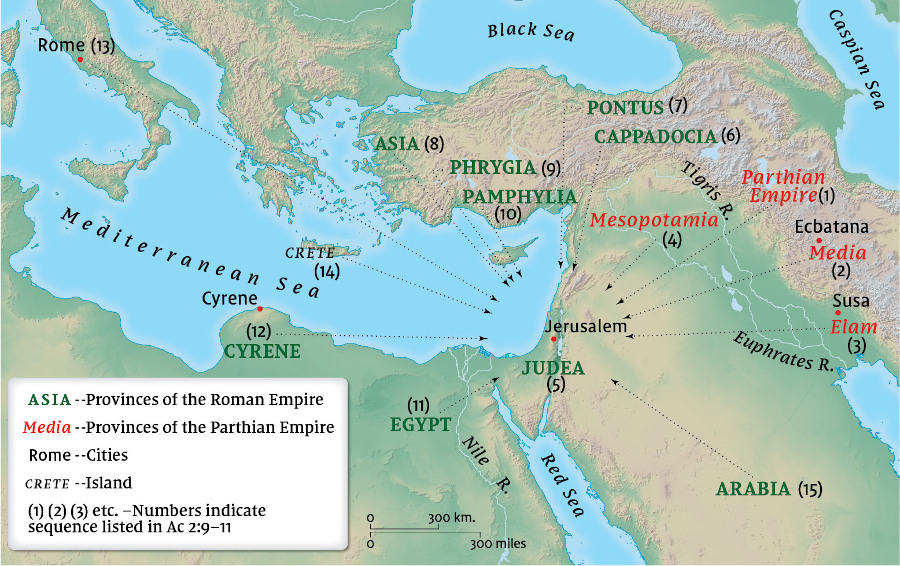
2:2 violent wind. Breath or wind is a symbol of the Spirit of God (Eze 37:9, 14; Jn 3:8). The coming of the Spirit is marked by audible (wind) and visible (fire) signs. whole house. Likely the house of 1:13. It could possibly refer to the temple (cf. 7:47).
2:3 tongues. A descriptive metaphor appropriate to the context, in which several languages are about to be spoken. fire. A symbol of the divine presence (see Ex 3:2 and note), it was also associated with judgment (see Mt 3:12 and note).
2:4 All of them. Likely referring to the 120, and pointing to the fulfillment of Joel’s prophecy (vv. 17–18). filled with the Holy Spirit. A fulfillment of 1:4–5,8; see also Jesus’ promise in Lk 24:49 and note there (cf. Jn 14:16–18; 20:22 and note). in other tongues. The Spirit enabled them to speak in languages they had not previously learned (see NIV text note). The gift had particular relevance here, where people of different nationalities and languages were gathered. Two other examples of speaking in tongues are found in Acts (see 10:46; 19:6 and note). One extended NT passage deals with this spiritual gift (1Co 12–14). Not all agree, however, that these other passages refer to speaking in known languages.
2:5 God-fearing Jews. Devout Jews from different parts of the world but assembled now in Jerusalem either as pilgrims attending the Festival of Pentecost or as current residents (cf. Lk 2:25).
2:6 heard their own language. These Jews heard the believers speak in languages native to the different places from which they had come (see map).
2:9 Parthians. Inhabitants of the territory from the Tigris River to India. Medes. Media lay east of Mesopotamia, northwest of Persia and south-southwest of the Caspian Sea. Elamites. Elam was north of the Persian Gulf, bounded on the west by the Tigris. Mesopotamia. Between the Euphrates and Tigris Rivers. Judea. The homeland of the Jews, perhaps used here in the OT sense “from the Wadi of Egypt to . . . the Euphrates” (Ge 15:18), including Galilee. Cappadocia, Pontus and Asia. Districts in Asia Minor. Asia. See note on 2Co 1:8.
2:10 Phrygia and Pamphylia. Districts in Asia Minor. Egypt. Jews had lived in Egypt since the sixth century bc. Two out of the five districts of Alexandria were Jewish. Libya. A region west of Egypt. Cyrene. The capital of a district of Libya called Cyrenaica. Rome. Thousands of Jews lived in Rome.
2:11 converts to Judaism. Gentiles who undertook the full observance of the Mosaic law were received into full fellowship with the Jews. Cretans. Represented an island lying south-southeast of Greece. Arabs. From the desert region in the east. The kingdom of the Nabatean Arabs lay between the Red Sea and the Euphrates, with Petra as its capital. we hear them declaring. The believers were declaring God’s wonders in the native languages of the various visiting Jews (see map).
2:14–40 The pattern and themes of the message that follows became common in the early church: (1) an explanation of events (vv. 14–21); (2) the gospel of Jesus Christ—his death, resurrection and exaltation (vv. 22–36); (3) an exhortation to repentance and baptism (vv. 37–40). The outline of this sermon is similar to those in chs. 3; 10; 13.
2:14 with the Eleven. The apostles had been “filled with the Holy Spirit” (v. 4) and had spoken in other languages to various groups. Now they stood with Peter, who served as their spokesman.
2:15 only nine in the morning! On a festival day such as Pentecost, Jews would not break their fast until at least 10:00 AM So it was extremely unlikely that people would be drunk at such an early hour.
2:17–18 all people . . . sons . . . daughters . . . young men . . . old men . . . men . . . women. The Spirit is bestowed on all, irrespective of gender, age and rank.
2:17 last days. See Isa 2:2 and note; Hos 3:5; Mic 4:1; see also notes on 1Ti 4:1; 2Ti 3:1; Heb 1:2; 1Pe 1:20; 1Jn 2:18. In the passage quoted from Joel, the Hebrew uses a word that means “afterward” and the Septuagint (the pre-Christian Greek translation of the OT) “after these things.” Peter interprets Joel 2:28–32 as referring specifically to the latter days of the new covenant (Isa 32:15; 44:3–4; Jer 31:33–34; Eze 36:26–27; 39:29), in contrast to the former days of the old covenant. The age of Messianic fulfillment has arrived. my Spirit. See note on 1:2.
2:18 they will prophesy. See 1Co 12:10 and note.
2:19–20 See notes on Joel 2:30–31; Mk 13:24–25.
2:21 everyone who calls. Cf. v. 39; includes faith and response rather than merely using words (Mt 7:21).

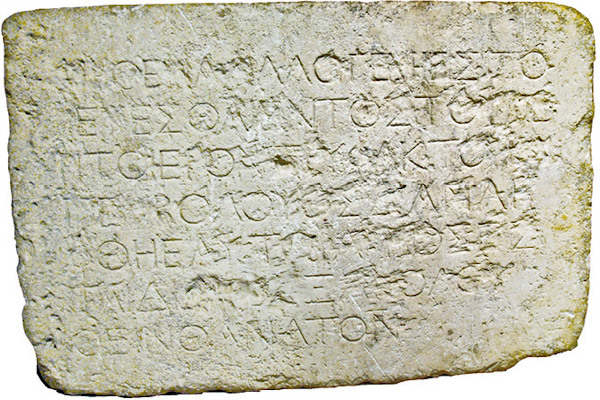
This Greek inscription, dated to the 1st century ad, was originally mounted on the balustrade (fence) separating the court of the Gentiles from the rest of the temple precincts. The inscription reads, “Foreigners must not enter inside the balustrade or into the forecourt around the sanctuary. Whoever is caught will have himself to blame for his ensuing death.” The good news of Jesus Christ challenged this exclusionary message. In Acts the gospel is proclaimed to the whole world.
Todd Bolen/BiblePlaces.com
Return to the main text.
2:22 accredited . . . by miracles, wonders and signs. The mighty works done by Jesus were signs that the Messiah had come.
2:23 God’s deliberate plan and foreknowledge. God’s purpose revealed through the prophets was that the Messiah must suffer and die (see 17:2–3; 26:22–23; Lk 24:25–26,45–46; cf. 1Pe 1:11 and note). wicked men. See NIV text note.
2:24 it was impossible for death to keep its hold on him. See v. 36; Ro 1:4 and note; 1Co 15:12–20.
2:27 not abandon me to the realm of the dead. David referred ultimately to the Messiah (v. 31). God would not allow his physical body to decompose. See note on Ps 16:9–11.
2:29 his tomb is here. The tomb of David could be seen in Jerusalem. It still contained the remains of David’s body. The words of Ps 16:8–11 did not fully apply to him.
2:30 one of his descendants on his throne. An allusion to Ps 132:11.
2:33 Exalted to the right hand of God. A vindication of Jesus’ claims and his enthronement as king (see notes on Lk 22:69; Heb 1:2–3). promised Holy Spirit. See note on 1:4. has poured out. See v. 17; Joel 2:28.
2:34 The Lord said to my Lord. The Lord (God) said to my Lord (the Son of David, the Messiah). According to Peter, David referred to his descendant with uncommon respect because he, through the inspiration of the Spirit, knew just how great he would be (Mt 22:41–45). Not only was he to be resurrected (vv. 31–32) but he was also to be exalted to God’s right hand (vv. 33–35). And his presence there was now being demonstrated by the sending of the Holy Spirit (v. 33; Jn 16:7). See Lk 20:42 and note on Ps 110:1; see also introduction to that psalm.
2:37 cut to the heart. Because they now realized the enormity of their guilt. what shall we do? See 16:30–31 and notes.
2:38 Repent and be baptized. Repentance was important in the message of the forerunner, John the Baptist (Mk 1:4; Lk 3:3), in the preaching of Jesus (Mk 1:15; Lk 13:3) and in the directions Jesus left just before his ascension (Lk 24:47). So also baptism was important to John the Baptist (Mk 1:4), in the instructions of Jesus (Mt 28:18–19) and in the preaching recorded in Acts—where it was associated with belief (8:12; 18:8), acceptance of the word (v. 41) and repentance (here). in the name of Jesus Christ. Not a contradiction to the fuller formula given in Mt 28:19. In Acts the abbreviated form emphasizes the distinctive quality of this baptism, for Jesus is now included in a way that he was not in John’s baptism (19:4–5). for the forgiveness of your sins. Not that baptism effects forgiveness. Rather, forgiveness comes through the rebirth symbolized by baptism (see Ro 6:3–4; 1Pe 3:21 and notes). Holy Spirit. Two gifts are now given: the forgiveness of sins (see also 22:16) and the Holy Spirit. The promise of the indwelling gift of the Holy Spirit is given to all Christians (cf. Ro 8:9–11 and note on 8:9; 1Co 12:13 and note).
2:41 their number. The number of believers (v. 47; 4:4).
2:42 apostles’ teaching. Included all that Jesus himself taught (Mt 28:20), especially the gospel, which was centered in his death, burial and resurrection (vv. 23–24; 3:15; 4:10; 28:31; 1Co 15:1–4). It was a unique teaching in that it came from God and was clothed with the authority conferred on the apostles (2Co 13:10; 1Th 4:2). fellowship. The corporate gathering and interaction of believers in worship. breaking of bread. Although this phrase is used of an ordinary meal in v. 46 (Lk 24:30,35), the Lord’s Supper seems to be indicated here (see note on 20:7; cf. 1Co 10:16; 11:20). In the early church the Lord’s Supper was often preceded by a shared meal called the “love feast” (see note on 1Co 11:21). prayer. Acts emphasizes the importance of prayer in the Christian life—private as well as public (1:14; 3:1; 6:4; 10:4,31; 12:5; 16:13,16).
2:43 wonders and signs. See, e.g., 3:1–10.
2:44 believers were together. The unity of the early church (see 4:32; Jn 17:11, 21–23; Ro 15:5; Eph 4:1–16; Php 2:1–4 and notes). everything in common. See 4:34–35. This was a voluntary sharing to provide for those who did not have enough for the essentials of living (see good and bad examples of sharing, 4:36—5:9).
2:46 temple courts. Probably Solomon’s Colonnade (see 3:11 and note; 5:12). broke bread in their homes. Here the daily life of Christians is described, distinguishing their activity in the temple from that in their homes, where they ate their meals with gladness and generosity. glad and sincere hearts. The fellowship, oneness and sharing enjoyed in the early church are fruits of the Spirit. Joy is to be the mood of the believer (see note on 16:34).
2:47 praising God. See 3:8–9; 4:21; 10:46; 11:18; 21:20; emphasized also in Luke’s Gospel (see notes on Lk 1:64; 24:53).
3:1 Peter and John. Among the foremost apostles (Gal 2:9). Along with John’s brother, James, they had been especially close to Jesus (Mk 9:2; 13:3; 14:33; Lk 22:8). Arrested together (4:3), they were also together in Samaria (8:14). time of prayer. The three stated times of prayer for later Judaism were mid-morning (the third hour, 9:00 AM), the time of the evening sacrifice (the ninth hour, 3:00 PM) and sunset.
3:2 gate called Beautiful. The favorite entrance to the temple court, it was probably the bronze-sheathed gate that is elsewhere called the Nicanor Gate. Apparently it led from the court of the Gentiles to the court of women, east of the temple.
3:6 In the name of Jesus Christ. Not by their own authority, but by the authority of the Messiah.
3:7 he helped him up. But he had faith to be healed (v. 16).
3:8 into the temple courts. From the outer court (for Gentiles also) into the court of women, containing the treasury (Mk 12:41–44), and then into the court of Israel (see map; see also photo and caption). From the outer court, nine gates led into the inner courts. walking and jumping. Cf. Isa 35:6 and note.
3:11 Solomon’s Colonnade. A porch along the inner side of the wall enclosing the outer court, with rows of 27-foot-high stone columns and a roof of cedar (see note on Jn 10:23).
3:13 his servant Jesus. A reminder of the suffering servant prophesied in Isa 52:13—53:12 (Mt 12:18; Ac 4:27,30). disowned him. Voted against Jesus, spurned him, denied him and refused to acknowledge him as the true Messiah. Pilate . . . had decided to let him go. See Jn 19:12.
3:14 Holy . . . One. See Lk 1:35 and note; cf. note on Lev 11:44. Righteous One. For this description of the Messiah elsewhere, see 7:52; 22:14; cf. 1Jn 2:1. murderer. Barabbas (see Lk 23:18 and note).
3:15 You killed . . . God raised . . . We are witnesses. A recurring theme in the speeches of Acts (see 2:23–24; 4:10; 5:30–32; 10:39–41; 13:28–29; cf. 1Co 15:1–4). author of life. See Jn 6:27, 50–51,63; 10:10; Php 1:21; 1Jn 5:12.
3:17 you acted in ignorance. They did not know that Jesus was the true Messiah (Lk 23:34). Nevertheless, God will be generous in his mercy if they only repent and turn to him in faith (see v. 19 and note).
3:18 foretold through all the prophets. Echoes what Jesus had said (Lk 24:26–27). The suffering was prophesied (compare Isa 53:7–8 with Ac 8:32–33; Ps 2:1–2 with Ac 4:25–26; Ps 22:1 with Mt 27:46; see also Lk 24:44; 1Pe 1:11 and notes).
3:19 Repent. Repentance is a change of mind and will that arises from sorrow for sin and leads to transformation of life (see notes on 2:38; Lk 3:3). turn to God. Subsequent to repentance and not completely identical with it. See 11:21 (“believed and turned”) and 26:20 (“repent and turn”; see also 9:35; 14:15; 15:19; 26:18; 28:27). Repentance is turning from sin, and faith is turning to God. Cf. 1Th 1:9–10 and note. your sins . . . wiped out. Your sins will be forgiven as a result of repentance.
3:21 time comes for God to restore everything. See 1Co 15:20–28; Eph 1:10 and note; Heb 10:12–13.
3:22,26 raise up . . . raised up. Christ is the fulfillment of prophecies made relative to Moses, David and Abraham. He was to be a prophet like Moses (vv. 22–23), he was foretold in Samuel’s declarations concerning David (v. 24; see note there) and he was to bring blessing to all people as promised to Abraham (vv. 25–26).
3:24 beginning with Samuel, all the prophets . . . foretold. Samuel anointed David to be king and spoke of the establishment of his kingdom (1Sa 16:13; cf. 13:14; 15:28; 28:17). Nathan’s prophecy (2Sa 7:12–16) was the foundation of the hope for a Messiah from the line of David (Ac 13:22–23, 34; Heb 1:5).
3:25 offspring. The word is singular, ultimately signifying Christ (Gal 3:16).
3:26 turning . . . from your wicked ways. See 1Th 1:9–10 and note.
4:1 priests. Those who were serving that week in the temple precincts (see note on Lk 1:23). captain of the temple guard. A member of one of the leading priestly families; next in rank to the high priest (5:24,26; Lk 22:4,52). Sadducees. A Jewish sect whose members came from the priestly line and controlled the temple. They did not believe in the resurrection or the coming Messiah. The high priest, one of their number, presided over the Sanhedrin (5:17; 23:6–8; Mt 22:23–33). See notes on Ezr 7:2; Mt 3:7; Mk 12:18; Lk 20:27; see also article and chart.
4:2 in Jesus. On the basis of Jesus’ resurrection.
4:3 evening. The evening sacrifices ended about 4:00 PM, and the temple gates would be closed at that time. Any judgments involving life and death must be begun and concluded in daylight hours.
4:4 men. Specifically numbering the men, assuming there were women and children included in this large group of converts. Or else this Greek word for “men” just means “people.” five thousand. A growth from the 3,000 at Pentecost (2:41); see later growth (5:14; 6:7).
4:5 rulers, the elders and the teachers of the law. The three groups making up the Sanhedrin, Israel’s supreme court (see Lk 22:66; see also notes on Mt 2:4; 15:2; Mk 2:16; 14:55; Lk 5:17).
4:6 Annas. High priest ad 6–15, but deposed by the Romans and succeeded by his son, Eleazar, then by his son-in-law, Caiaphas (18–36), who was also called Joseph. However, Annas was still recognized by the Jews as high priest (Lk 3:2; cf. Jn 18:13, 24). John. May be Jonathan, son of Annas, who was appointed high priest in ad 36. Others suggest that it was Johanan ben Zakkai, who became the president of the Great Synagogue after the fall of Jerusalem. Alexander. Not further identified.
4:8 filled with the Holy Spirit. See note on 2:4.
4:10 by the name of Jesus . . . this man stands before you healed. See Isa 35:6 and note. Jesus Christ of Nazareth. See Mt 2:23 and note.
4:11 the stone . . . rejected. Fulfillment of prophecy was an important element in early Christian sermons and defenses. Jesus had also used Ps 118:22 (Mt 21:42; see 1Pe 2:7 and cf. Ro 9:33; Isa 28:16). cornerstone. See note on Ps 118:22.
4:12 no other name. See 10:43; Jn 14:6; 1Ti 2:5; see also NIV text note on Mt 1:21.
4:13 courage. A certain boldness characterized by the assurance, authority and forthrightness of the apostles (2:29; 4:29; 28:31), and shared by the believers (4:31). unschooled, ordinary men. Peter and John had not been trained in the rabbinic schools, nor did they hold official positions in recognized religious circles. took note that these men had been with Jesus. Probably because they were displaying some of his power and authority (cf. Mk 1:22 and note; 3:14).
4:15 Sanhedrin. See notes on v. 5; 5:21; Mk 14:55.
4:20 cannot help speaking. See 5:29; cf. Jer 20:9 and note.
4:22 forty years old. Normally healing at such an advanced age (for that time) did not take place.
4:23 went back. Probably to the same upper room where the apostles had met before (see 1:13 and note) and where the congregation may have continued to meet (see 12:12 and note).
4:24 Sovereign Lord. See Lk 2:29.
4:27 Herod. Herod Antipas, tetrarch of Galilee and Perea (Lk 23:7–15; see chart;). Pontius Pilate. Roman governor of Judea (see Lk 3:1 and note).
4:28 decided beforehand. Not that God had compelled them to act as they did, but he willed to use them and their freely chosen acts to accomplish his saving purpose (2:23).
4:30 holy servant. See note on 3:13.
4:31 was shaken. An immediate sign that the prayers had been heard (16:26). filled with the Holy Spirit. See note on 2:4. spoke the word of God. They continued preaching the gospel despite the warnings of the council (see note on v. 13).
4:32 one in heart and mind. In complete accord, extending to their attitude toward personal possessions (see 2:44 and note).
4:33 testify to the resurrection. As significant as the death of Christ was, the most compelling event was the resurrection—an event about which the disciples could not keep silent.
4:34 those who owned land or houses sold them. See note on 2:44.
4:36 Levite. Although Levites owned no inherited land in the Holy Land, these regulations may not have applied to the Levites in other countries, such as Cyprus. So perhaps Barnabas sold land he owned in Cyprus and brought the proceeds to the apostles (v. 37). Or he may have been married, and the land sold may have been from his wife’s property. It is also possible that the prohibition against Levite ownership of land in the Holy Land was no longer observed. Cyprus. An island in the eastern part of the Mediterranean Sea. Jews had settled there from Maccabean times. Barnabas. Used here as a good example of giving. In this way Luke introduces the one who will become an important companion of Paul (13:1–4). For other significant contributions of this greathearted leader to the life and ministry of the early church, see 9:27; 11:22,25; 15:37–39. He was a cousin of Mark (Col 4:10). “son of encouragement.” That is, “encourager” (see 11:23 and note).
5:1 Ananias . . . Sapphira. Given as bad examples of sharing (Barnabas was the good example; see note on 4:36). Love of praise for (pretended) generosity and love for money led to the first recorded sin in the life of the church. It is a warning to the readers that “God cannot be mocked” (Gal 6:7). Compare this divine judgment at the beginning of the church era with God’s judgments on Nadab and Abihu (Lev 10:2), on Achan (Jos 7:25) and on Uzzah (2Sa 6:7).
5:2 kept back part. They had a right to keep back whatever they chose, but to make it appear that they had given all when they had not was sinful.
5:3 Satan has so filled your heart. Although this is probably not demon possesion, the continuing activity of Satan is noted. lied to the Holy Spirit. A comparison with v. 4 shows that the Holy Spirit is regarded as God himself present with his people.
5:9 test the Spirit of the Lord. If no dire consequences had followed this act of sin, the results among the believers would have been serious when the deceit became known. Not only would dishonesty appear profitable, but the conclusion that the Spirit could be deceived would follow. It was important to set the course properly at the outset in order to leave no doubt that God will not tolerate such hypocrisy and deceit (vv. 2,8).
5:11 See v. 5. church. The first use of the term in Acts. It can denote either the local congregation (8:1; 11:22; 13:1) or the universal church (20:28). The Greek word for “church” (ekklesia) was already being used for political and other assemblies (19:32,41) and, in the Septuagint (the pre-Christian Greek translation of the OT), for Israel when gathered in religious assembly.
5:12 Solomon’s Colonnade. See note on 3:11.
5:13 No one else dared join them. Because of the fate of Ananias and his wife, no pretenders or halfhearted followers risked identification with the believers, or perhaps no one tried to associate too closely with the Twelve. Luke cannot mean that no one joined the Christian community, since v. 14 indicates that many were coming to Christ.
5:14 more men and women believed. The specific mention of women here (and at 8:3,12; 9:2) prepares the reader for their future prominence in the Gentile mission (16:13–14; 17:4,12,34; 18:2; 21:5).
5:15 Peter’s shadow. Parallels such items as Paul’s handkerchiefs (19:12) and the edge of Jesus’ cloak (Mt 9:20)—not that any of these material objects had magical qualities, but the desire to be associated in some way with Jesus or his apostles expressed the faith of those who needed healing.
5:17 high priest. The official high priest recognized by Rome was Caiaphas, but many Jews considered Annas, Caiaphas’s father-in-law, to be the legitimate high priest since the high priesthood was to be held for life (see note on 4:6). his associates. Members of his priestly family. party of the Sadducees. See note on 4:1.
5:18 in the public jail. To await trial the next day.
5:19 angel of the Lord. This phrase is used four other times in Acts speaking of the activity of angels: (1) in Stephen’s speech (7:30–38); (2) in guiding Philip (8:26); (3) in liberating Peter (12:7–10); and (4) in striking down Herod (12:23). See also Mt 1:20–24; 2:13,19; 28:2; Lk 1:11–38; 2:9 and notes on Ge 16:7; 2Ki 1:3; Ps 34:7; Zec 1:8.
5:20 all about this new life. The good news of eternal life in all its fullness (see Jn 6:68; Ro 6:4; 2Co 5:17; Php 1:21 and notes).
5:21 Sanhedrin. The supreme Jewish court, about 70 men. They sat in a semicircle, backed by three rows of disciples of the learned men (cf. 4:13 and note), with the clerks of the court standing in front. See note on Mk 14:55.
5:24 captain of the temple guard. See note on 4:1.
5:28 orders not to teach in his name. See 4:18. make us guilty of this man’s blood. Probably a reference to the apostles’ repeated declaration that some of the Jews and some of their leaders had killed Jesus (2:23; 3:13–15; 4:10–11; cf. Mt 27:25).
5:30 cross. See Jn 19:17; 1Pe 2:24 and notes; see also Dt 21:22–23. Like its Hebrew counterpart, the Greek for this word could refer to a tree, a pole, a wooden beam (or “cross”) or some similar object.
5:31 God exalted him. See Heb 1:2–3 and note, item 7; 2:12 and note.
5:32 so is the Holy Spirit . . . given to those who obey him. See Jn 15:26–27. The disciples’ testimony was directed and confirmed by the Holy Spirit, who convicts the world through the word (Jn 16:8–11) and is given to those who respond to God with faith and obedience (Ro 1:5; see note on Ac 6:7).
5:34 a Pharisee named Gamaliel. The most famous Jewish teacher of his time and traditionally listed among the “heads of the schools.” Possibly he was the grandson of Hillel. Like Hillel (see note on Mt 19:3), he was moderate in his views, a characteristic that is apparent in his cautious recommendation on this occasion. Saul (Paul) was one of his students (22:3).
5:36 Theudas. Unknown, though Josephus mentions another man by this name who appeared about ten years later.
5:37 Judas the Galilean. The Jewish historian Josephus refers to him as a man from Gamala in Gaulanitis who refused to give tribute to Caesar. His revolt was crushed, but a movement, started in his time, may have lived on in the party of the Zealots (see 1:13 and note on Mt 10:4). days of the census. Not the first census of Quirinius, noted by Luke in his Gospel (see Lk 2:2 and note), but the one in ad 6.
5:39 not . . . stop these men. Gamaliel’s words proved prophetic and serve as thematic for Acts. Since nothing can stop the church throughout Acts, it is proven to be the work of God.
5:40 flogged. Beaten with the Jewish penalty of “forty lashes minus one” (2Co 11:24).
6:1 the number of disciples was increasing. A considerable length of time may have transpired since the end of ch. 5. The church continued to grow (5:14), but this gave rise to inevitable problems, both from within (6:1–7) and from without (6:8—7:60). At this stage of its development, the church was entirely Jewish in its composition. However, there were two groups of Jews within the fellowship: (1) Hellenistic Jews. Those born in lands other than Israel who spoke the Greek language and were more Greek than Hebrew in their attitudes and outlook (see NIV text note). (2) Hebraic Jews. Those who spoke Palestinian Aramaic and/or Hebrew and preserved Jewish culture and customs. daily distribution of food. Help was needed by widows who had no one to care for them and so became the church’s responsibility (cf. 4:35; 11:28–29; see also 1Ti 5:3–16; Jas 1:27 and note on Ex 22:21–27).
6:2 the Twelve. At this early stage, the apostles were responsible for church life in general, including the ministry of the word of God and the care of the needy. to wait on tables. To preside over the distribution of charitable gifts. The early church was concerned not only about a spiritual ministry (“ministry of the word” and “prayer”; see v. 4) but also about a material ministry.
6:3 choose seven men. The church selected them (v. 5), and the apostles ordained them (“laid their hands on them,” v. 6). In this way they were appointed to their work. full of the Spirit. See note on 2:4.
6:5 They chose Stephen . . . Nicolas. It is significant that all seven of the men chosen had Greek names. The murmuring had come from the Greek-speaking segment of the church; those selected to care for the work came from their number so as to represent their interests fairly. Only Stephen and Philip of the Seven receive further notice (Stephen, 6:8—7:60; Philip, 8:5–40; 21:8–9). Nicolas from Antioch, a convert to Judaism. It is significant that a convert to Judaism was included in the number and that Luke points out his place of origin as Antioch, the city to which the gospel was soon to be taken and which was to become the headquarters for the forthcoming Gentile missionary effort.
6:6 prayed and laid their hands on them. Laying on of hands was used in the OT period to confer blessing (Ge 48:13–20), to transfer guilt from sinner to sacrifice (Lev 1:4) and to commission a person for a new responsibility (Nu 27:23). In the NT period, laying on of hands was observed in healing (28:8; Mk 1:41), blessing (Mk 10:16), ordaining or commissioning (Ac 6:6; 13:3; 1Ti 5:22) and imparting of spiritual gifts (Ac 8:17; 19:6; 1Ti 4:14; 2Ti 1:6). These seven men were appointed to responsibilities turned over to them by the Twelve. The Greek word used to describe their responsibility (diakoneo, “wait on”) is the verb from which the noun “deacon” comes. Later one reads of deacons in Php 1:1; 1Ti 3:8–13. The Greek noun for “deacon” can also be translated “minister” or “servant.” The men appointed on this occasion were simply called the Seven (21:8), just as the apostles were called the Twelve. It is disputed whether the Seven were the first deacons or whether the office of deacon arose later (see note on 1Ti 3:8).
6:7 One of a series of progress reports given periodically throughout the book of Acts (1:15; 2:41; 4:4; 5:14; 6:7; 9:31; 12:24; 16:5; 19:20; 28:31). a large number of priests. Though involved by lineage and life service in the priestly observances of the old covenant, they accepted the preaching of the apostles, which proclaimed a sacrifice that made the old sacrifices unnecessary (see Heb 8:13 and note; 10:1–4, 11–14). became obedient to the faith. Responded to the commands of the gospel. To believe is to obey God. Faith itself is obedience, but faith also produces obedience (Ro 1:5; see Eph 2:8–10; Jas 2:14–26 and notes; Titus 3:8).
6:8 great wonders and signs. Until now, Acts told of only the apostles working miracles (2:43; 3:4–8; 5:12). But now, after the laying on of the apostles’ hands, Stephen too is reported as working miraculous signs. Philip also will soon do the same (8:6).
6:9 Synagogue of the Freedmen. Probably made up of persons who had been freed from slavery. They came from different Hellenistic areas. Cyrene. The chief city in Libya and north Africa (see notes on 2:10; Mk 15:21), halfway between Alexandria and Carthage. One of its ethnic groups was Jewish (11:19–21). Alexandria. Capital of Egypt and second only to Rome in the empire. Two out of five districts in Alexandria were Jewish. Cilicia. A Roman province in the southeast corner of Asia Minor, adjoining Syria. Tarsus, the birthplace of Saul, was one of its principal towns. Asia. A Roman province in the western part of Asia Minor. Ephesus, where Saul (Paul) later ministered for a few years, was its capital. began to argue. Since Saul was from Tarsus, this may have been the synagogue he attended, and he may have been among those who argued with Stephen. He was present when Stephen was stoned to death (7:58).
6:11 blasphemous words against Moses and against God. Since Stephen declared that the worship of God was no longer to be restricted to the temple (7:48–49), his opponents twisted these words to trump up an accusation that Stephen was attacking the temple, the law, Moses and, ultimately, God.
6:12 the elders and the teachers of the law. See notes on Mt 2:4; 15:2; Mk 2:16; Lk 5:17. Sanhedrin. See note on Mk 14:55.
6:13 speaking against this holy place and against the law. Similar to the charges brought against Christ (Mt 26:61). Stephen may have referred to Jesus’ words as recorded in Jn 2:19 (see note there), and the words may have been misunderstood or purposely misinterpreted (v. 14), as at the trial of Jesus. holy place. The temple in Jerusalem.
6:14 Jesus . . . will destroy this place. See Mk 14:58 and note.
7:1 high priest. Probably Caiaphas (Mt 26:57–66), but see note on 4:6; cf. Jn 18:19,24. Are these charges true? See notes on 6:11,13.
7:2–53 See Introduction: Characteristics, 5 (Effective use of speeches). Since the author of Acts gives more space to Stephen’s speech than to any other, it is safe to assume that he considered it particularly important. Broadly speaking, it is not meant to be a personal defense with the hope of conciliating Stephen’s accusers (vv. 51–52) but a history of Israel’s failures. It deals with the three great pillars of Jewish piety: (1) the land (vv. 2–36), (2) the law (vv. 37–43) and (3) the temple (vv. 44–50), and ends with a resounding denunciation of Stephen’s accusers (vv. 51–52). Stephen indicts Israel’s leaders for rejecting God’s messengers in the past and now rejecting Jesus, “the Righteous One” (v. 52).
7:2 Abraham . . . in Mesopotamia, before he lived in Harran. Stephen begins with the father of the Jewish nation, Abraham. God’s covenant with him promised the establishment of a great nation, Israel. Abraham’s call came in Ur, not Harran (cf. Ge 12:1 and note; 15:7; Ne 9:7). Or perhaps he was called first in Ur and then later his call was renewed in Harran (cf. note on Jer 15:19–21).
7:4 land of the Chaldeans. A district in southern Babylonia, the name was later applied to a region that included all of Babylonia (see map). After the death of his father. Ge 11:26 does not mean that all three sons—Abraham, Nahor and Haran—were born to Terah in the same year when he was 70 years old. See Ge 11:26—12:1. It may be that Haran was Terah’s firstborn and that Abraham was born 60 years later. Thus the death of Terah at 205 years of age could have occurred just before Abraham, at 75, left Harran.
7:6 four hundred years. A round number for the length of Israel’s stay in Egypt (Ex 12:40–41 has 430 years). That four generations would represent considerably less than 400 years is not a necessary conclusion (see note on Ge 15:16). Ex 6:16–20 makes Moses the great-grandson of Levi, son of Jacob and brother of Joseph. This would make four generations from Levi to Moses. But in 1Ch 7:22–27 a list of ten names represents the generations between Ephraim, the son of Joseph, and Joshua. The ten generations at 40 years each would equal 400 years, the same period of time noted as four generations. But one list is abbreviated and the other gives a fuller genealogy.
7:7 this place. Canaan.
7:8 covenant of circumcision. See notes on Ge 17:10–11. The essential conditions for the religion of the Israelites were already fulfilled long before the temple was built and their present religious customs began. twelve patriarchs. See Ge 35:23–26.
7:9 they sold him. Israel consistently rejected God’s favored individuals. Stephen builds his case about Jesus’ rejection by noting Joseph’s rejection by his brothers (Ge 37:12–36).
7:14 Jacob and his whole family, seventy-five in all. Although the Hebrew Bible uses the number 70 (see Ge 46:26–27 and note on 46:27; Ex 1:5; Dt 10:22), the Septuagint (the pre-Christian Greek translation of the OT) adds at Ge 46:20 the names of one son of Manasseh, two of Ephraim, and one grandson of each. This makes the number 75 and is the number that Stephen uses.
7:16 Stephen brings together OT accounts of two land purchases (by Abraham and Jacob) and two burial places (at Hebron and Shechem). According to the OT, Abraham purchased land at Hebron (Ge 23:17–18), where he (Ge 25:9–11), Isaac (Ge 35:29) and Jacob (Ge 50:13) were buried. Jacob bought land at Shechem (Ge 33:19), where Joseph was later buried (Jos 24:32). The Jewish historian Josephus preserves a tradition that Joseph’s brothers were buried at Hebron.
7:17 promise to Abraham. See note on v. 2; see also Ge 12:1–3; 15:4–6; 17:3–22; 22:15–18.
7:18 a new king, to whom Joseph meant nothing. See note on Ex 1:8.
7:21 Pharaoh’s daughter. See note on Ex 2:5.
7:22 Moses was educated in all the wisdom of the Egyptians. Not explicitly stated in the OT but to be expected if he grew up in the household of the pharaoh’s daughter. Both Philo and Josephus speak of Moses’ great learning. was powerful in speech. See Ex 4:10 and note.
7:23 Moses was forty. Moses was 80 years old when sent to speak before the pharaoh (Ex 7:7) and 120 years old when he died (Dt 34:7). Stephen’s words agree with a tradition that at Moses’ first departure from Egypt he was 40 years of age.
7:29 fled to Midian. Rejected by his own people, Moses feared that they would inform the Egyptians, and this led to his flight to Midian, the land flanking the Gulf of Aqaba on both sides (see Ex 2:15 and note). had two sons. Gershom and Eliezer (Ex 2:22; 18:3–4; 1Ch 23:15).
7:30 After forty years. Plus the 40 years of v. 23, making the 80 years of Ex 7:7. Mount Sinai. Called Horeb in Ex 3:1 (see note there).
7:32 did not dare to look. See Ex 33:20 and note.
7:35 the same Moses . . . sent to be their ruler and deliverer. The Israelites rejected Moses, their deliverer, just as the Jews of Stephen’s day were rejecting Jesus, their deliverer. Yet both were sent by God. angel who appeared to him in the bush. See Ex 3:2.
7:37 prophet like me. See 3:22–23; see also notes on Dt 18:15; 34:10,12.
7:38 assembly. The assembled Israelites. angel who spoke to him. According to Jewish interpretation at that time, the law was given to Moses by angelic mediation—after the manner of the original call of Moses (see Ex 3:2; see also v. 53; Gal 3:19; Heb 2:2). he received living words to pass on to us. Moses was the mediator between God and Israel on Mount Sinai.
7:39 refused to obey him. Another rejection of God’s representative and his commands.
7:40 Make us gods. While Moses was on Sinai receiving the law, the people made the golden calf, rejecting God and his representative (Ex 32:1). The people had not traveled far from the idolatry of Egypt.
7:41 See 1Co 10:6–7 and notes.
7:42 God . . . gave them over. See note on Ro 1:24. sun, moon and stars. See note on Jer 19:13.
7:43 Stephen quotes Am 5:25–27 as translated in the Septuagint, except that he replaces Damascus with Babylon in view of the fact that the final exile of Israel from the promised land was carried out by the Babylonians (Amos was speaking first of the Assyrian exile of the northern kingdom). Molek . . . Rephan. An astral deity associated with the planet Saturn (see NIV text note). Molek. See note on Lev 18:21.
7:44–50 Because he had been accused of “speaking against this holy place” (6:13), Stephen concludes his recital with a word about the sanctuary. Presumably, he had been preaching that the risen Christ had now replaced the temple as the mediation of God’s saving presence among his people and as the one (the “place”) through whom they (and “all nations,” Mk 11:17) could come to God in prayer (see note on 6:13).
7:44 tabernacle of the covenant law. So called by Stephen because the primary contents of the wilderness tabernacle were the ark of the covenant and the two covenant tablets it contained, which were called “the covenant law” (see Ex 25:16,21 and notes).
7:49 Isa 66:1–2 reminded Israel that all creation is the temple that God himself had made. Stephen recalls that word to remind his hearers that ultimately God builds his own temple.
7:51–52 The climax of the speech, as Stephen accuses Israel’s leaders of rejecting their Messiah.
7:51 stiff-necked people! See Ex 33:3; Dt 9:6 and notes. hearts and ears . . . uncircumcised. Although the men were physically circumcised, they were acting like the uncircumcised pagans of the nations around them. They were not truly consecrated to the Lord.
7:52 Righteous One. See 3:14 and note.
7:53 law that was given through angels. See note on v. 38.
7:55 full of the Holy Spirit. See note on 2:4; see also 6:5. glory of God. See note on Lk 2:9.
7:56 Son of Man. See note on Mk 8:31. standing at the right hand of God. Cf. Ps 110:1 and note; Mk 14:62; Lk 22:69; Heb 1:2–3 and note. The significance of Jesus’ “standing” is debated, though it may picture Stephen’s acceptance by the heavenly Judge and underscore the truth of his message.
7:58 stone him. Prohibited under the Romans, but this looks like spontaneous mob action (see Jn 18:31 and note). laid their coats at the feet of . . . Saul. Some have thought that this marked Saul as being in charge of the execution. In any case, it is Luke’s way of introducing the main character of the second section of the book (chs. 13–28).
7:60 do not hold this sin against them. Cf. Jesus’ words in Lk 23:34. fell asleep. See note on Jn 11:11.
8:1 approved. See 22:20 and note. all except the apostles. This suggests that it was primarily the Hellenistic Jewish Christian community that was affected by the persecution. The church now went underground. “All” is apparently hyperbole for “many” or “most,” for it seems clear from 9:26 that some “disciples” were still present in Jerusalem. See also 15:4–5,22. Saul (Paul) was the main persecutor (v. 3; see also Gal 1:13). scattered throughout Judea and Samaria. The beginning of the fulfillment of the commission in 1:8—not by the church’s plan, but by events beyond the believers’ control. See map.
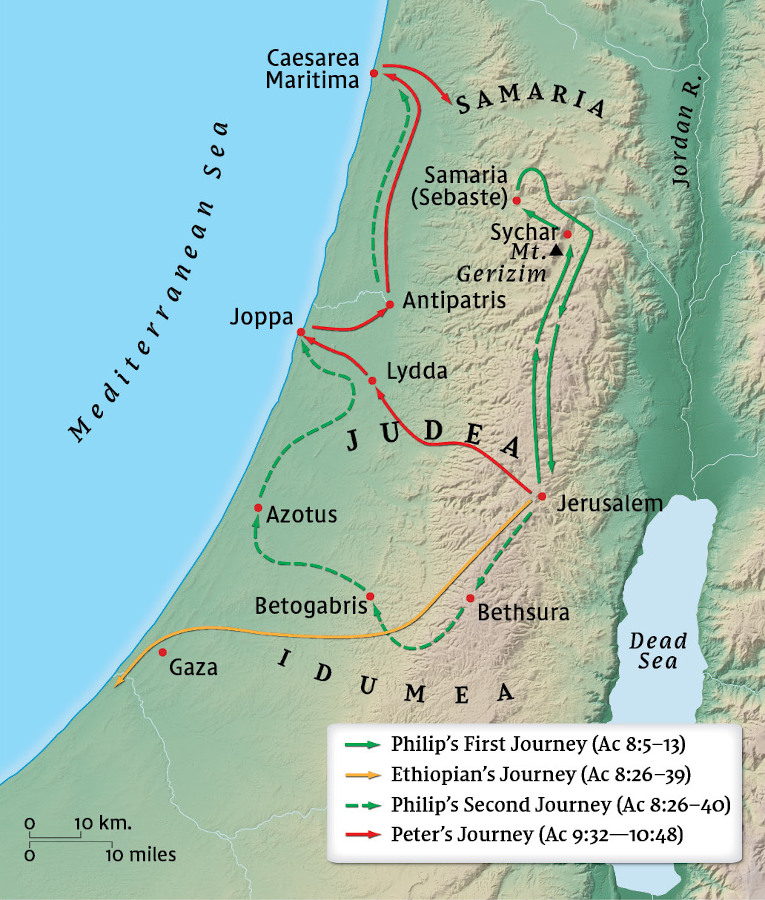
8:4 preached the word. Many witnesses to the gospel went everywhere proclaiming the good news. The number of witnesses multiplied, and the territory covered was expanded greatly (cf. 11:19–20).
8:5 Philip. One of the Seven in the Jerusalem church (6:3,5; see note on 6:6), who now becomes an evangelist, proclaiming the Christ (Messiah); see also 21:8. Philip is an example of one of those who were scattered. a city in Samaria. Some manuscripts have “the city of Samaria,” a reference to the old capital Samaria, renamed Sebaste or Neapolis (modern Nablus).
8:9 Simon. In early Christian literature the “sorcerer” (Simon Magus) is described as the arch-heretic of the church and the “father” of Gnostic teaching. sorcery. See notes on Dt 18:9; 2Ki 17:17.
8:10 the Great Power of God. Simon claimed to be either God himself or, more likely, his chief representative.
8:13 Simon himself believed and was baptized. It is difficult to know whether Simon’s faith was genuine. Even though Luke says Simon believed, Peter’s statement that Simon had no part in the apostles’ ministry because his heart was not “right before God” (v. 21) casts doubt on the authenticity of his faith.
8:14 Samaria. That is, some of its citizens. Cf. 1:8. had accepted the word of God. Were obedient to the gospel proclaimed by Philip. sent Peter and John. The Jerusalem church assumed the responsibility of overseeing new evangelistic efforts and the communities of believers they produced (see 11:22 and note).
8:16 not yet come on any of them. Since the day of Pentecost, those who “belong to Christ” (Ro 8:9) also have the Holy Spirit. But the Spirit had not yet been made manifest to the Christians in Samaria by the usual signs. This deficiency was now graciously supplied (v. 17).
8:17 placed their hands on them. See v. 18; 19:1–7; cf. 2Ti 1:6; see also note on 6:6.
8:18 he offered them money. Simon had boasted before of having great powers (see v. 10 and note), and now he tried to buy the magical power he believed the apostles possessed.
8:23 full of bitterness. See Dt 29:18. captive to sin. See Ro 6:20.
8:26 an angel of the Lord. Cf. v. 29; see note on 5:19. from Jerusalem to Gaza. A distance of about 50 miles (see map).
8:27 an Ethiopian. Ethiopia corresponded in this period to Nubia (Meroe), from the upper Nile region at the first cataract (Aswan) to Khartoum. eunuch. A castrated male who served in the royal court, or a royal courtier more generally (cf. notes on Isa 56:3; Mt 19:12). Kandake. The traditional title of the queen mother, responsible for performing the secular duties of the reigning king—who was thought to be too sacred for such activities. gone to Jerusalem to worship. If not a full-fledged convert to Judaism (Dt 23:1), the Ethiopian was a Gentile God-fearer (see note on 10:2).
8:30 heard the man reading. It was customary practice to read aloud.
8:34 who is the prophet talking about . . . ? Beginning with Isa 53 (v. 35), Philip may have identified the suffering servant with the Davidic Messiah of Isa 11 or with the Son of Man (Da 7:13).
8:35 good news. The way of salvation through Jesus Christ (see note on Mk 1:1).
8:36 they came to some water. There were several possibilities: a brook in the Valley of Elah (which David crossed to meet Goliath, 1Sa 17:40); the Wadi el-Hasi just north of Gaza; water from a spring or one of the many pools in the area.
8:39 rejoicing. Joy is associated with salvation in Acts (see note on 16:34). Both the Samaritans and the Ethiopian eunuch illustrate how the gospel is for outsiders (see Isa 56:3 and note).
8:40 Azotus. OT Ashdod (1Sa 5:1), one of the five Philistine cities (see map). It was about 19 miles from Gaza and 60 miles from Caesarea (see map). Caesarea. Rebuilt by Herod and with an excellent harbor, it served as the headquarters of the Roman governors. The account leaves Philip in Caesarea at this time; his next appearance is 20 years later, and he is still located in the same place (21:8).
9:1 Saul. Introduced at the stoning of Stephen (7:58), he was born in Tarsus and trained under Gamaliel (22:3). See notes on Ro 1:1; Php 3:4–14. murderous threats. We do not know that Saul was directly involved in the death of anyone other than Stephen (8:1), but there appear to have been similar cases (22:4; 26:10). high priest. Probably Caiaphas (see note on 4:6) and the members of the Sanhedrin, who had authority over Jews both in Judea and elsewhere.
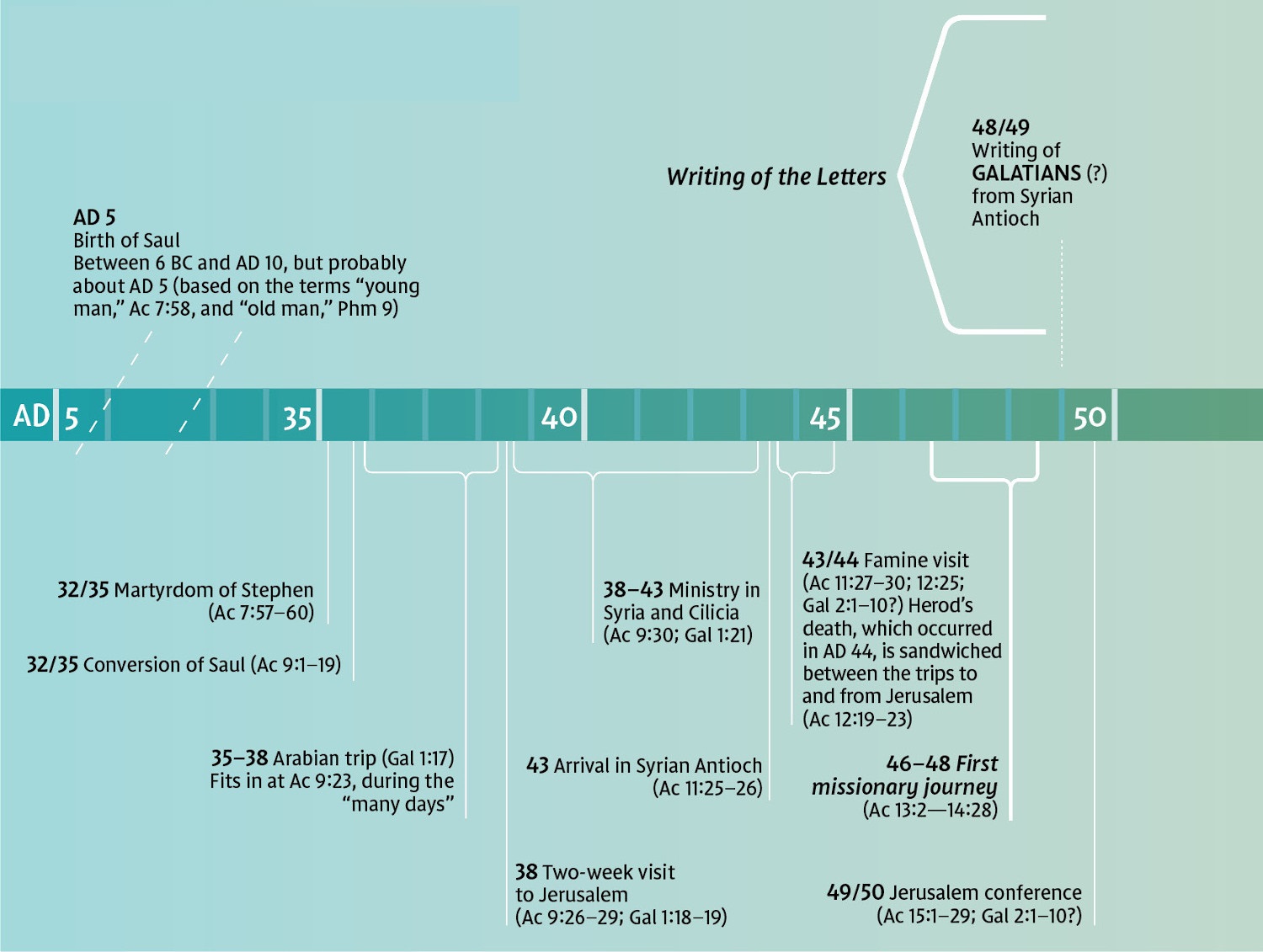
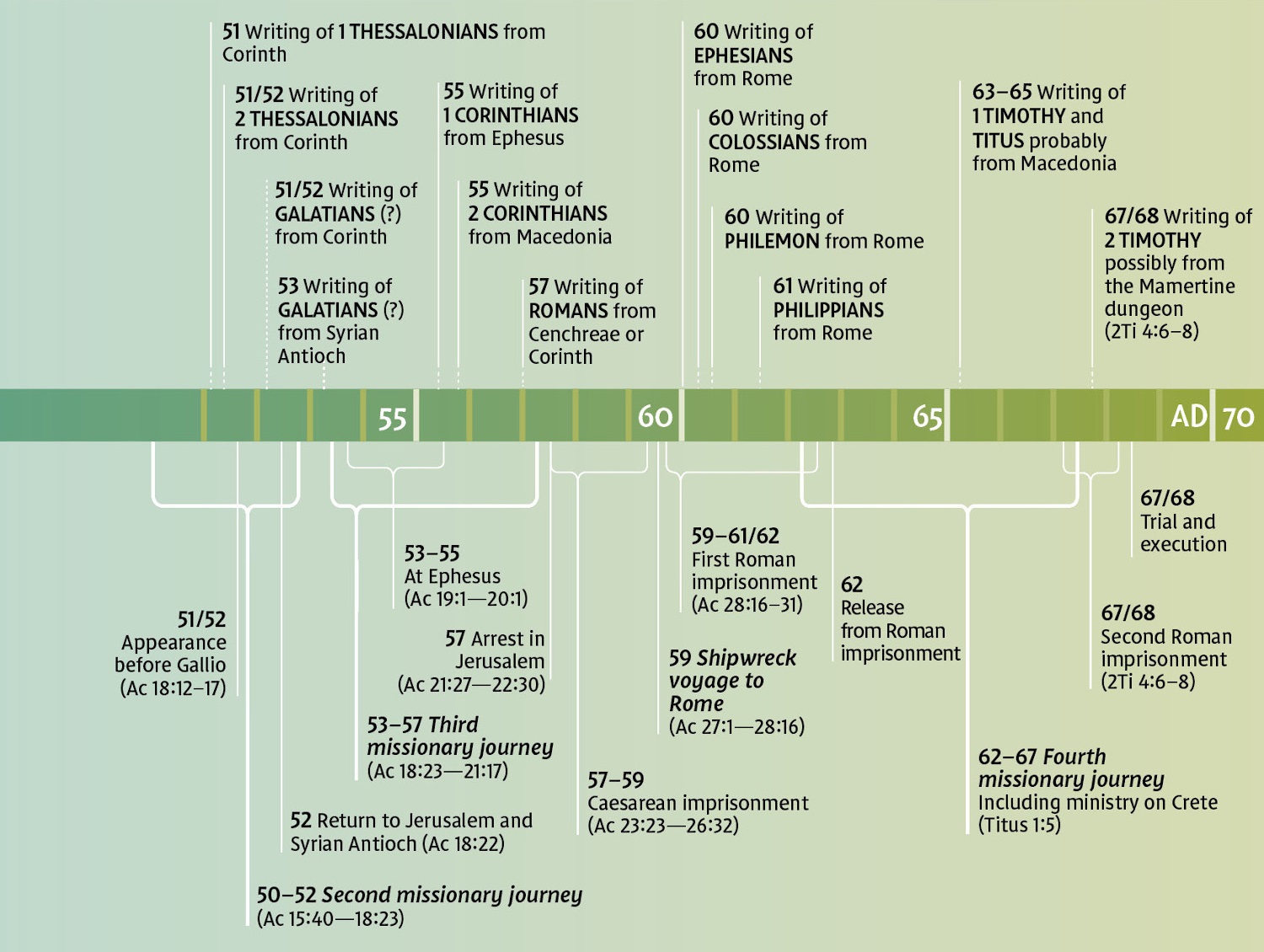
Lines, brackets and dotted lines help show sequence of events but are not meant to point to precise months or days within a given year, since exact dating is difficult.
Go to the Charts Index.
9:2 Damascus. See map. Located in the Roman province of Syria, it was the nearest important city outside Israel. It also had a large Jewish population. The distance from Jerusalem to Damascus was about 150 miles, four to six days’ travel. the Way. A name for Christianity occurring a number of times in Acts (16:17; 18:25–26; 19:9,23; 22:4; 24:14,22; see 2Pe 2:2). Jesus called himself “the way” (Jn 14:6). prisoners to Jerusalem. Where the full authority of the Sanhedrin could be exercised in trial for either acquittal or death.
9:3 a light from heaven. “About noon” (26:13).
9:4 why do you persecute me? To persecute the church is to persecute Christ, for the church is his body (1Co 12:27; Eph 1:22–23).
9:5 Who are you, Lord? Such a voice from heaven would have been understood as the voice of God himself. The solemn repetition of Saul’s name (v. 4) and the bright light (v. 3) suggested to him that he was in the presence of deity.
9:7 heard the sound. Those with Saul “heard the sound” but “did not understand” what the voice was saying (22:9; cf. Da 10:7).
9:10 Ananias. This Ananias is mentioned elsewhere only in 22:12. His was a common name (5:1; 23:2). The Greek form is derived from the Hebrew name Hananiah, meaning “The LORD is gracious/shows grace” (see Da 1:6 and note).
9:11 Straight Street. Probably followed the same route of the long, straight street that today runs through the city from east to west. It is a decided contrast to the numerous crooked streets of the city (see map). Tarsus. See 21:39 and note on 22:3. praying. Prayer is often associated with visions in Luke and Acts (10:9–11; Lk 1:10; 3:21; 9:28).
9:13 your holy people. See v. 32 and notes on Ro 1:7; Php 1:1.
9:15 to the Gentiles. Paul’s primary commission (22:21; 26:17; Ro 1:13–14). their kings. Agrippa (26:1) and Caesar at Rome (25:11–12; 28:19).
9:16 how much he must suffer. See 2Co 11:23–28 and notes.
9:17 Jesus, who appeared to you. The Damascus road experience was not merely a subjective experience for Saul but an external experience as well. The resurrected Christ actually appeared to Saul, and on this fact Saul based his qualification to be an apostle (see 1Co 9:1 and note; 15:8).
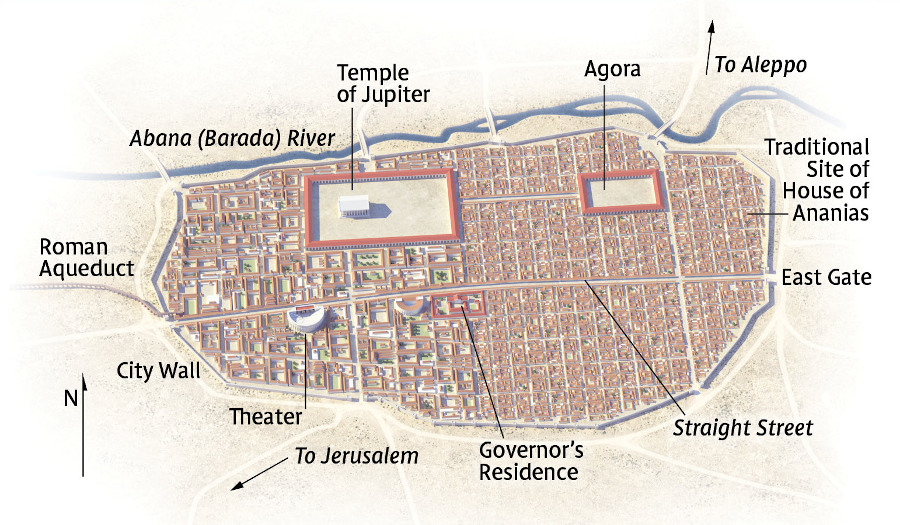
Damascus represented much more to Saul, the strict Pharisee, than any other stop on his campaign of repression. It was the hub of a vast commercial network with far-flung lines of caravan trade reaching into north Syria, Mesopotamia, Anatolia, Persia and Arabia. If the new “Way” of Christianity flourished in Damascus, it would quickly reach all these places. From the viewpoint of the Sanhedrin and of Saul, the archpersecutor, it had to be stopped in Damascus.
The dominant political figure at the time of Paul’s escape from Damascus (2Co 11:32–33) was Aretas IV, king of the Nabateans (9 bc–ad 40), though normally the Decapolis cities were attached to the province of Syria and were thus under the influence of Rome.
 The city itself was a veritable oasis, situated in a plain watered by the biblical rivers Abana and Pharpar (see note on 2Ki 5:12; see also map). Roman architecture overlaid the Hellenistic town plan with a great temple to Jupiter and a mile-long colonnaded street, the “Straight Street” of Ac 9:11. The city gates and a section of the town wall may still be seen today, as well as the lengthy bazaar that runs along the line of the ancient street.
Go to the Maps Index.
9:20 At once. Following his baptism (v. 18). synagogues. It became Saul’s regular practice to preach at every opportunity in the synagogues (13:5; 14:1; 17:1–2,10; 18:4,19; 19:8). Jesus is the Son of God. Saul’s message was a declaration of what he himself had become convinced of on the Damascus road: Christ’s deity and Messiahship.
9:22 Messiah. See second NIV text note on Mt 1:1.
9:23 After many days. Three years (Gal 1:17–18). It is probable that the major part of this period was spent in Arabia, away from Damascus, though the borders of Arabia extended to the environs of Damascus. conspiracy among the Jews to kill him. Upon Saul’s return to Damascus, the governor under Aretas gave orders for his arrest (2Co 11:32; see note there).
9:25 lowered him in a basket. See 2Co 11:33 (cf. Jos 2:15; 1Sa 19:12).
9:26 he came to Jerusalem. From Gal 1:19 we learn that the only apostles Paul met were Peter and James, the Lord’s brother. James was not one of the Twelve, but he held a position in Jerusalem comparable to that of an apostle (Gal 2:9).
9:27 Barnabas. As elsewhere in Acts, he is acting as a reconciler (see note on 4:36).
9:29 He talked and debated. Formerly Saul was arguing against Christ; now he is forcefully presenting Jesus as the Messiah.
9:30 Caesarea. See note on 8:40. Tarsus. Saul’s birthplace (see note on 22:3).
9:31 church. The whole Christian body, including Christians in the districts of Judea, Galilee and Samaria. The singular thus does not here refer to the various congregations but to the church as a whole (see note on 5:11). encouraged by the Holy Spirit. The work of the Spirit is particularly noted throughout the book of Acts (see 13:2 and note on 1:2). This is why the book is sometimes called the Acts of the Holy Spirit.
9:32 Lydda. A town two or three miles north of the road connecting Joppa and Jerusalem. Lydda is about 12 miles from Joppa.
9:33 Aeneas. Since Peter was there to visit the believers, Aeneas was probably one of the Christians.
9:35 Sharon. The fertile plain of Sharon runs about 50 miles along the Mediterranean coast, roughly from Joppa to Caesarea. The reference here, however, may be to a village in the neighborhood of Lydda instead of to a district (an Egyptian papyrus refers to a town by that name in the Holy Land).
9:36–43 With the raising of Tabitha, Luke here continues to present the apostles performing miracles that recall those of Jesus (see Lk 7:11–17; 8:49–56).
9:36 Joppa. About 38 miles from Jerusalem, the main seaport of Judea. Today it is known as Jaffa and is a suburb of Tel Aviv.
9:37 body was washed. In preparation for burial, a custom common to both Jews (Purification of the Dead; Mishnah, Shabbat 23.5) and Greeks. upstairs room. If burial was delayed, it was customary to lay the body in an upper room. In Jerusalem the body had to be buried the day the person died, but outside Jerusalem up to three days might be allowed for burial.
9:38 near Joppa. See note on v. 32. come at once! Whether for consolation or for a miracle, Peter was urged to hurry in order to arrive before the burial.
9:40 sent them all out. Cf. 1Ki 17:23; 2Ki 4:33. Peter had been present on all three occasions recorded in Scripture when Jesus raised individuals from the dead (Mt 9:25; Lk 7:11–17; Jn 11:1–44). As when Jesus raised Jairus’s daughter, the crowd in the room was told to leave. Unlike Jesus, however, Peter knelt and prayed.
9:42 many people believed. Cf. Jn 12:11.
9:43 a tanner. Occupations were frequently used with personal names to further identify individuals (16:14; 18:3; 19:24; 2Ti 4:14), but in this case it is especially significant. A tanner was involved in treating the skins of dead animals, thus contacting the unclean according to Jewish law, so Simon was despised by many. Peter’s decision to stay with him shows already a willingness to reject Jewish prejudice and helps to prepare the way for his coming vision and the mission to the Gentiles.
10:1 Caesarea. Located 30 miles north of Joppa and named in honor of Augustus Caesar, it was the headquarters for the Roman forces of occupation (see also note on 8:40). Cornelius. A Latin name made popular when Cornelius Sulla liberated some 10,000 slaves over 100 years earlier. These had all taken his family name, Cornelius. centurion. Commanded a military unit that normally numbered at least men (see note on Mt 8:5). The Roman legion (about 6,000 men) was divided into ten regiments, each of which had a designation. This was the “Italian” (another was the “Imperial,” or “Augustan,” 27:1). A centurion commanded about a sixth of a regiment. Centurions were carefully selected; all of them mentioned in the NT appear to have had noble qualities (e.g., Lk 7:5). The Roman centurions provided necessary stability to the entire Roman system.
10:2 devout. In spite of all his good deeds, Cornelius needed to hear the way of salvation from a human messenger. The role of the angel (v. 3) was to bring Cornelius and Peter together (cf. 8:26; 9:10). God-fearing. The term used of one who was not a full-fledged convert to Judaism but who believed in one God and respected the moral and ethical teachings of the Jews. These God-fearing Gentiles were among the most receptive to the gospel.
10:3 about three in the afternoon. Another indication that Cornelius followed Jewish religious practices. Three in the afternoon was a Jewish hour of prayer (3:1)—the hour of the evening incense. a vision. Not a dream or trance but a revelation through an angel to Cornelius while he was at prayer (see v. 30; see also note on 9:11).
10:4 have come up. Like the smoke of a sacrifice (see Ps 141:2; Php 4:18 and note; Heb 13:15–16). memorial offering. A portion of the grain offering burned on the altar was called a “memorial” (Lev 2:2).
10:5–6 Joppa . . . Simon the tanner. See notes on 9:36,43.
10:9 roof to pray. It was customary for eastern houses to have flat roofs with outside stairways. The roof was used as a convenient place for relaxation and privacy (see Mk 2:4 and note).
10:12 all kinds of four-footed animals. Including animals both clean and unclean, according to Lev 11.
10:14 Surely not, Lord! So deeply ingrained was the observance of the laws of clean and unclean that Peter refused to obey immediately. He might have thought this was a test of his faithfulness. impure or unclean. Anything common (impure) was forbidden by the law to be eaten (cf. Ezr 4:14).
10:15 God has made clean. Jesus had already laid the groundwork for not requiring adherence to the laws of clean and unclean food (see Mt 15:11; Mk 7:19 and note; see also 1Ti 4:3–5). The primary point here, however, is that the Gentiles should not be considered unclean.
10:16 three times. To make a strong impression on Peter.
10:23 invited the men into the house. By providing lodging for them, Peter was already taking the first step toward accepting Gentiles. Such intimate relationship with Gentiles was contrary to prescribed Jewish practice. The next day. It was too late in the day to start out on the long journey to Caesarea (see note on v. 1). some of the believers. Six in number (11:12), they were “circumcised believers” (10:45; see also note on 11:1).
10:26 I am only a man. Possibly Cornelius was only intending to honor Peter as one having a rank superior to his own, since he was God’s messenger. But Peter allowed no chance for misunderstanding—he was only a created being and so not to be worshiped (cf. 14:11–15).
10:28 God has shown me. Peter recognized that his vision had deeper significance than declaring invalid the distinction between clean and unclean meat; he saw that the barrier between Jew and Gentile had been removed (see Eph 2:11–22; see also photo and caption). Peter repeatedly affirms this point throughout the following narrative (see vv. 34–35, 47–48; 11:17).
10:30 a man in shining clothes. Common language to describe an angel when appearing in the form of a man (see 1:10 and note; Mt 28:3; Mk 16:5; Jn 20:12).
10:34 God does not show favoritism. God does not favor individuals because of their station in life, their nationality, their ethnicity or their material possessions (see Ro 2:11; Jas 2:1 and notes; see also Dt 10:17–19; 2Ch 19:7; Job 34:19; Eph 6:9; Col 3:25; 1Pe 1:17). He does, however, respect their character and judge their work. This is evident because God “accepts from every nation the one who fears him and does what is right” (v. 35). Cornelius already worshiped the true God, but this was not enough: He lacked faith in Christ (v. 36).
10:36 people of Israel. The first recipients of the “message,” but it was not restricted to them, as the phrase “Lord of all” indicates (see Jn 3:16; Ro 1:16 and notes). peace. Between God and humans (see Ro 5:1 and note). Lord of all. Lord of both Jew and Gentile (vv. 34–35), so the gospel is for all people.
10:37 after the baptism that John preached. Similar to the outline of Mark’s Gospel, Peter’s sermon begins with John’s baptism and continues to the resurrection of Jesus. This is significant since the early church fathers viewed Mark as the interpreter of Peter (see Introduction to Mark: Author). See previous summaries of Peter’s preaching (2:14–41; 3:12–26; 4:8–12; 5:29–32); see also note on 2:14–40.
10:38 how God anointed Jesus. See Isa 61:1–3; Lk 4:18–21.
10:39 hanging him on a cross. See note on 5:30.
10:41 who ate and drank. Those who ate with Jesus after he rose from the dead received unmistakable evidence of his bodily resurrection (Lk 24:42–43; Jn 21:12–15).
10:42 one whom God appointed as judge. See Jn 5:22,27 and note on 5:22.
10:43 All the prophets testify about him. See Lk 24:44 and note.
10:44 the Holy Spirit came on. See 8:16 and note.
10:45 astonished . . . even on Gentiles. Apparently the early Jewish Christians failed to understand that the gospel was now extending to Gentiles apart from their conversion to Judaism.
10:46 speaking in tongues. Similar to the experience the disciples had at Pentecost (2:4,11), as well as “some disciples” at Ephesus (19:1,6). But here no one is said to hear the speech in their own language. The purpose of the phenomenon is to validate the new believers’ experience, not to communicate a message to anyone.
10:47 no one can stand in the way of their being baptized with water. The Gentiles had received the same gift (11:17) as the Jewish believers; they spoke in tongues as did the Jewish Christians on the day of Pentecost. This was undeniable evidence that the invitation to the kingdom was open to Gentiles as well as to Jews.
11:1 believers. Or “brothers and sisters.” At times the Greek term adelphoi is used to refer to those of common Jewish lineage (2:29; 7:2), but in Christian contexts it denotes those united in Christ (6:3; 10:23; see note on Ro 1:13). In matters of deep concern, the “apostles” did not act alone. The Holy Spirit gave guidance, and the apostles interpreted and exhorted and the consent of the whole church was sought (“the whole group,” 6:5; “apostles and the believers,” here; “the church,” 11:22; “the church and the apostles and elders,” 15:4; cf. 15:22).
11:2 circumcised believers. Jewish Christians.
11:3 uncircumcised men. The Gentiles who would not observe the laws of clean and unclean food and would violate Jewish regulations concerning food preparation. ate with them. See Lk 15:2 and note; see also Gal 2:11–16.
11:4–17 See notes on 10:1–23,28–33. The repetition of the story as Peter explains himself confirms its importance.
11:14 you and all your household. Not only the family but also slaves and employed individuals under Cornelius’s authority (see note on Ge 6:18).
11:17 stand in God’s way. Peter could not deny the Gentiles the invitation to be baptized (10:47) and to enjoy full fellowship in Christ with all believers. The Jewish believers were compelled to recognize that God was going to save Gentiles on equal terms with Jews. By divine action rather than by human choice, the door was being opened to Gentiles.
11:18 repentance that leads to life. A change of one’s attitude toward sin, which leads to a turning from sin to God and results in eternal life (see note on 2:38).
11:19 persecution that broke out when Stephen was killed. See 8:1–4 and notes. Phoenicia. A country about 15 miles wide and 120 miles long, stretching along the northeastern Mediterranean coast (modern Lebanon). Its important cities were Tyre and Sidon. Cyprus. An island in the northeastern Mediterranean; the home of Barnabas (4:36). Antioch. The third largest city of the Roman Empire (after Rome and Alexandria). It was 15 miles inland from the northeast corner of the Mediterranean. The first largely Gentile local church was located here, and it was from this church that Paul’s three missionary journeys were launched (13:1–4; 15:40; 18:23). Its modern name is Antakya, located in southeastern Turkey.
11:20 Cyrene. See note on 2:10. Greeks. Not Greek-speaking Jews, but Gentiles.
11:21 Lord’s hand. Indicates the presence of the Lord’s power to assist and bless (see 4:30; Lk 1:16; but see also Ac 13:11), sometimes evidenced by signs and wonders (cf. Ex 8:19).
11:22 Barnabas. See notes on 4:36; 9:27. Antioch. See note on v. 19. The sending of Barnabas was apparently in keeping with the Jerusalem church’s policy of sending leaders to check on new ministries that came to their attention (see 8:14 and note).
11:23 he . . . encouraged them. His name means “son of encouragement” (4:36; see note there).
11:24 full of the Holy Spirit and faith. See the description of Stephen (6:5).
11:25 Tarsus. See 9:11,30 and note on 22:3.
11:26 whole year. Luke notes definite periods of time (18:11; 19:8,10; 24:27; 28:30). Christians. Whether adopted by believers or invented by enemies as a term of reproach, it is an apt title for those “belonging to Christ” (the meaning of the term). It occurs elsewhere in Scripture only in 26:28; 1Pe 4:16.
11:27 During this time. A vague reference that allows for vv. 27–30 to have happened before the preceding material about Antioch, which Luke may have grouped topically. prophets. The first mention of the gift of prophecy in Acts. Prophets preach, exhort, explain or, as in this case, foretell (see 13:1; 15:32; 19:6; 21:9–10; Ro 12:6; 1Co 12:10; 13:2,8; 14:3,6,29–37; see also notes on Jnh 3:2; Zec 1:1; Eph 4:11).
11:28 Agabus. Later foretells Paul’s imprisonment (21:10). In Acts, prophets are engaged in foretelling (v. 27; 21:10–11) at least as often as in forthtelling (15:32). Claudius. Emperor of Rome (ad 41–54).
11:29 as each one was able. Cf. 1Co 16:2; 2Co 8:3.
11:30 elders. First reference to them in Acts (see notes on 1Ti 3:1; 5:17). Since the apostles are not mentioned, they may have been absent from Jerusalem at this time, or the term “elders” may be broad enough to include them.
12:1 about this time. Some hold that the events recorded in ch. 12 group together matters concerning Herod Agrippa I (see below; see also chart) and may not be in strict chronological order. For example, the arrival of Barnabas and Saul in Jerusalem (11:30) may have followed Herod’s persecution and Peter’s release from prison. Since the date of Herod’s death was ad 44, these events would probably have occurred in 43. According to this view, the famine of 11:28 occurred c. 46, following Herod’s death (v. 23). Others hold that such juggling of events is unnecessary. Thus the relief gift of 11:30 came before Herod’s death in 44, and the return of Barnabas and Saul (v. 25) followed Herod’s death. According to the former view, the Jerusalem visit of Gal 2:1–10 was the famine visit of v. 25; 11:30. According to the latter view, the Gal 2:1 visit was the Jerusalem council visit of 15:1–29 (see chart). King Herod. Agrippa I, grandson of Herod the Great (see notes on Mt 2:1; 14:1) and son of Aristobulus. He was a nephew of Herod Antipas, who had beheaded John the Baptist (Mt 14:3–12) and had tried Jesus (Lk 23:8–12). When Antipas was exiled, Agrippa received his tetrarchy, as well as those of Philip and Lysanias (see Lk 3:1 and note). In ad 41 Judea and Samaria were added to his realm.
12:2 James. Brother of John the apostle and son of Zebedee (Mt 4:21). This event took place about ten years after Jesus’ death and resurrection. Jesus had warned of their coming suffering (Mt 20:20–23). death with the sword. Tradition holds that he was beheaded, like John the Baptist.
12:3 Festival of Unleavened Bread. See notes on Mk 14:1; Lk 22:1.
12:4 four squads. One company of four soldiers for each of the four Roman watches of the night (see note on Mt 14:25). Passover. Another way of referring to the whole week of the festival (see note on Lk 22:1).
12:7 angel of the Lord. See note on 5:19. a light shone. Reflecting the glory of the Lord (see 7:55 and note).
12:9 prison. Probably the Antonia Fortress, located at the northwest corner of the temple—the “barracks” where Paul was later held (21:34). See model.
12:12 Mary. The aunt of Barnabas (Col 4:10). Apparently her home was a gathering place for Christians. It may have been the location of the upper room where the Last Supper was held (see Mk 14:13–15; see also Ac 1:13 and note) and the place of prayer in 4:31. John . . . Mark. See note on v. 25.
12:13 Rhoda. A hired servant, but in sympathy with the family and the church.
12:15 his angel. Perhaps reflects the belief that everyone has a personal angel who ministers to them (cf. Mt 18:10 and note; Heb 1:14).
12:16 they were astonished. Though they had been “earnestly praying to God for him” (v. 5).
12:17 James. The Lord’s brother, a leader in the Jerusalem church (see Gal 1:19 and note). James, the brother of John, had been killed (v. 2).
12:19 Caesarea. Not only a headquarters for Roman governors, but Agrippa used it as his capital when no governors were assigned to Judea (see notes on 8:40; 10:1).
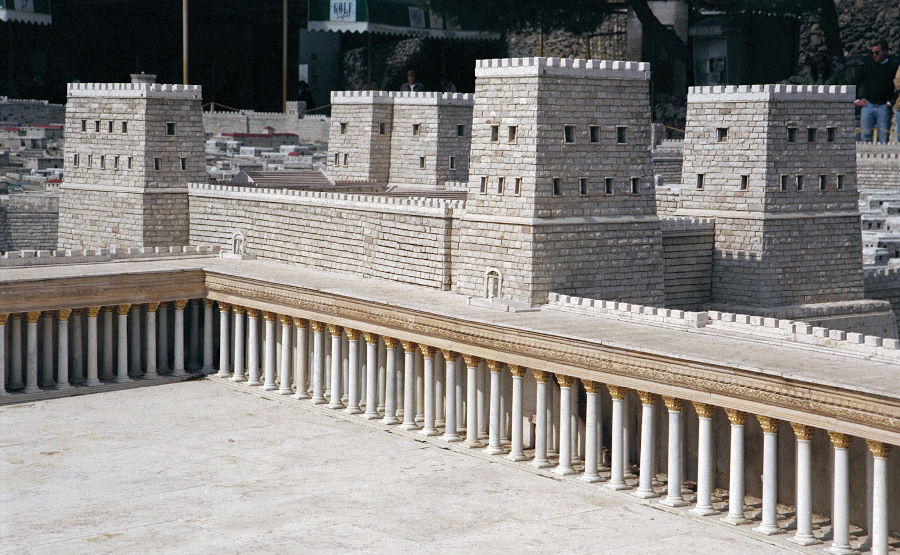
Built by Herod the Great (37–4 bc), the Antonia Fortress overlooked the northwest corner of the temple mount (cf. note on Ac 12:9). This, of course, is a scale model.
© William D. Mounce
Return to the main text.
12:20 Tyre and Sidon. The leading cities of Phoenicia (Lebanon today). They were dependent on the grainfields of Galilee for their food.
12:21 On the appointed day. A festival Herod Agrippa I was celebrating in honor of Claudius Caesar (Josephus, Antiquities, 19.8.2). wearing his royal robes. The historian Josephus describes a silver robe, dazzling bright, that Herod wore that day. When people acclaimed him a god, he did not deny it. He was seized with violent pains, was carried out and died five days later (Josephus, Antiquities, 19.8.2).
12:23 angel of the Lord. See note on v. 7. eaten by worms. A miserable death associated with Herod’s acceptance of acclaim for divinity, but may also be seen as divine retribution for his persecution of the church.
12:24 the word of God . . . flourish. Third summary report of progress (see 6:7; 9:31). Three more follow (16:5; 19:20; 28:31).
12:25 John . . . Mark. See v. 12. He was perhaps the young man who fled on the night of Jesus’ arrest (Mk 14:51–52). He wrote the second Gospel (see Introduction to Mark: Author; John Mark in the NT) and accompanied Barnabas and Saul on the first part of their first missionary journey (see notes on 15:38–39).
13:1 prophets. See note on 11:27. The special gift of inspiration experienced by OT prophets (Dt 18:18–20; 2Pe 1:21) was known in the NT as well (2:17–18; 1Co 14:29–32; Eph 3:5). The prophets are second to the apostles in Paul’s lists (1Co 12:28–29; Eph 2:20; 4:11; but cf. Lk 11:49; Ro 12:6; 1Co 12:10). teachers. See 11:26; 15:35; 18:11; 20:20; 28:31; 1Co 12:28–29; Eph 4:11. Barnabas . . . Saul. The church leaders at Antioch, perhaps listed in the order of their importance. Barnabas. See note on 4:36. He was sent originally to Antioch by the church in Jerusalem (11:22), had recently returned from taking alms to Jerusalem (12:25) and was a recognized leader in the church at Antioch. Simeon called Niger. “Simeon” suggests Jewish background; “Niger” (Latin for “black”) may indicate his dark complexion. Lucius of Cyrene. Lucius is a Latin name. In the second group of preachers coming to Antioch, some were from Cyrene (11:20), capital of Libya (see 6:9 and note). Manaen. In Hebrew, Menahem. He was the foster brother or intimate friend of Herod Antipas.
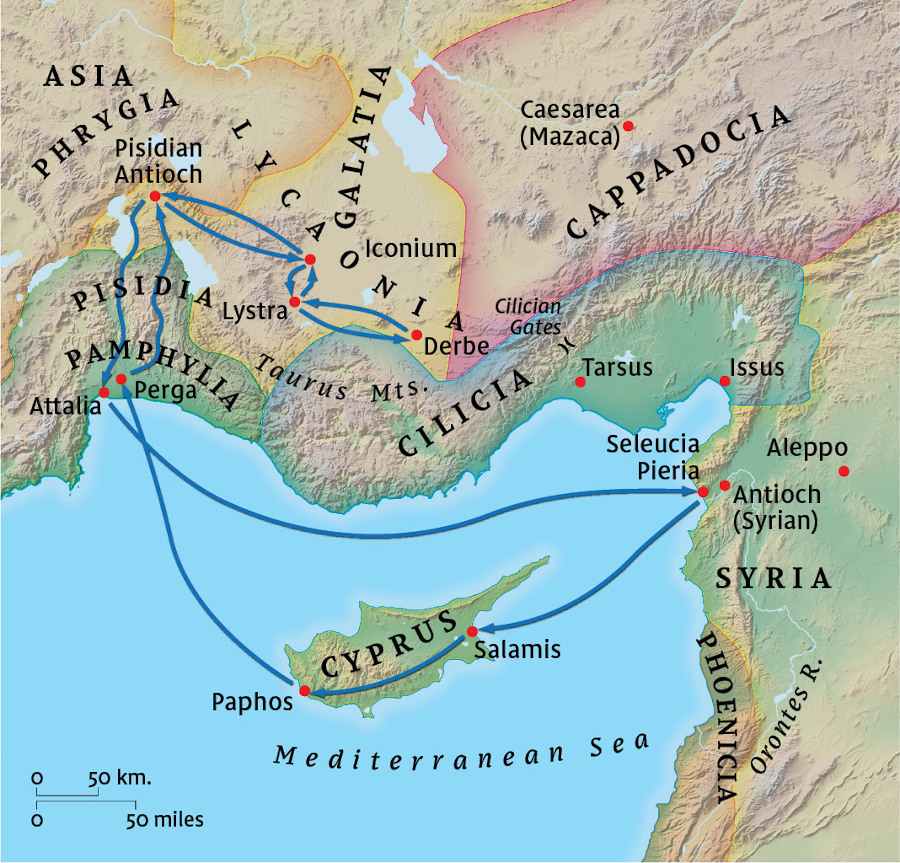
13:2 worshiping the Lord and fasting. Paul’s first missionary journey was initiated by the Spirit as the leaders worshiped (v. 4). The communication from the Holy Spirit may have come through the prophets.
13:3 placed their hands on them. For the purpose of separating the two for the designated work (see 14:26 for the completion of the mission). Fasting and prayer accompany this appointment (see 14:23; cf. Lk 2:37).
13:4—14:28 Paul’s first missionary journey (see map).
13:4 See map. Seleucia. The seaport of Antioch (16 miles to the west, and 5 miles upstream from the mouth of the Orontes River). Cyprus. Many Jews lived there, and the gospel had already been preached there (11:19–20; see note on 11:19).
13:5 Salamis. A town on the east coast of the central plain of Cyprus, near modern Famagusta. John. John Mark, a cousin of Barnabas (see 12:25; Col 4:10 and note). helper. In what way we are not told. Some hold that he served as a catechist for new converts, but Luke seems to use the term in a broader sense (see 26:16 [“servant”]; Lk 1:2 [“servants”]).
13:6 Paphos. At the western end of Cyprus, nearly 100 miles from Salamis. It was the headquarters for Roman rule. Bar-Jesus. “Bar” is Aramaic for “son of “; “Jesus” is derived from the Greek for “Joshua” (see NIV text note on Mt 1:21).
13:7 proconsul. A governor of a Roman province. Since Cyprus was a Roman senatorial province, a proconsul was assigned to it. Sergius Paulus. See chart.
13:8 Elymas the sorcerer. Or “magician” or “wise man”; cf. Peter’s confrontation with Simon the sorcerer: 8:9–13,18–24.
13:9 Saul . . . called Paul. The names mean “asked [of God]” and “little” respectively. Saul was his Jewish name. Paul was likely one of his three Roman names, given at birth. From now on Saul is called Paul in Acts. Paul’s growing prominence in the church’s mission to the Gentiles can be seen in the ordering of his and Barnabas’s names. In descriptions of their ministry to the Gentiles, their names are listed as “Paul and Barnabas.” Upon their return to the Jerusalem church, however, the order reverts to “Barnabas and Paul” (15:12).
13:11 hand of the Lord. See note on 11:21. You are going to be blind. Cf. Paul’s experience in 9:8–18.
13:12 he believed. He was convinced by the miracle and the message.
13:13 Perga in Pamphylia. Perga was the capital of Pamphylia, a coastal province of Asia Minor between the provinces of Lycia and Cilicia, and was 5 miles inland and 12 miles east of the important seaport Attalia (see map and photo). John left them. See 12:25 and note. Homesickness to get back to Jerusalem, an illness of Paul necessitating a change in plans and a trip to Galatia, and a change in leadership from Barnabas to Paul have all been suggested as reasons for John Mark’s return. Paul’s dissatisfaction with his departure is noted later (15:37–39).
13:14–41 Paul and Barnabas in the synagogue of Pisidian Antioch. Paul’s first recorded synagogue sermon in Acts sets the pattern for the rest of his ministry. When most of the Jews reject the gospel, he turns to the Gentiles (vv. 45–48; Ro 1:16). The sermon moves carefully through Israel’s history until David and then jumps one thousand years forward to the fulfillment in David’s greater Son, Jesus the Messiah. For another account of a synagogue service, see Lk 4:16–21.
13:14 Pisidian. See note on 14:24. Antioch. Named after Antiochus, king of Syria after the death of Alexander the Great. It was 110 miles from Perga, 3,600 feet above sea level and at the hub of good roads and trade. The city had a large Jewish population. It was a Roman colony, which meant that a contingent of retired military men was settled there. They were given free land and were made citizens of the city of Rome, with all the accompanying privileges. See photo. synagogue. Paul’s regular practice was to begin his preaching in the synagogue, as long as the Jews would allow it (v. 5; 14:1; 17:1,10,17; 18:4,19; 19:8). His reason for doing so was grounded in his understanding of God’s redemptive plan (see v. 46; Ro 1:16 and note; 2:9–10 and note on 2:9; see also Ro 9–11). He was not neglecting his Gentile mission, for the God-fearers (“Gentiles who worship God,” v. 16; see note on 10:2) were part of the audience. Moreover, the synagogue provided a ready-made preaching situation with a building, regularly scheduled meetings and a people who knew the OT Scriptures. It was customary to invite visitors, and especially visiting rabbis (such as Paul), to address the gathering.
13:15 the Law and the Prophets. Sections from the OT were read, followed by exposition and exhortation. leaders of the synagogue. See note on Mk 5:22. word of exhortation. See Introduction to Hebrews: Literary Form.
13:17 God . . . chose our ancestors. See Dt 7:6–9 and 4:37 and note.
13:20 about 450 years. The 400 years of the “stay in Egypt” (v. 17; see note on 7:6) plus the 40 years in the wilderness and the time between the crossing of the Jordan and the distribution of the land (Jos 14–19).
13:22 David . . . a man after my own heart. See 1Sa 13:14 and note.
13:23 as he promised. See, e.g., Isa 11:1–16.
13:25 John . . . said. See Mt 3:11; Mk 1:7; Lk 3:16; Jn 1:20,27.
13:26 God-fearing Gentiles. See note on v. 14.
13:27 fulfilled the words of the prophets. See Lk 24:44 and note.
13:28 no proper ground for a death sentence. Cf. Jn 19:4 and note.
13:29–31 cross . . . tomb . . . God raised . . . witnesses. See note on 3:15.
13:31 many days. Forty days (1:3).
13:33 today I have become your father. Here refers to the resurrection of Jesus (see NIV text note here and note on Ps 2:7–9; cf. Ro 1:4).
13:34 blessings promised to David. The covenant made with David, culminating in the Messiah (cf. 2Sa 7:11–16).
13:35 not let your holy one see decay. Quoted also in Peter’s sermon at Pentecost (see notes on 2:27; Ps 16:10).
13:39 justification. Combines two aspects: (1) the forgiveness of sins (here); (2) the gift of righteousness (see Ro 3:21–22 and note on 3:24). Cf. 2Co 5:21 and note.
13:42 leaving the synagogue. In Pisidian Antioch (v. 14; see note there).
13:43 continue in the grace of God. See Titus 2:11–12 and note on 2:12.
13:46 had to speak . . . to you first. Because the gospel came from and was directed to the Jews first, and because Paul was himself a Jew with great compassion for his people (Ro 1:16; 9:1–5; 10:1–3). See note on v. 14.
13:47 you. See NIV text note; see also 9:15–16; 22:14–15,21; 26:15–18. Paul extends the prophetic word concerning the Messianic “servant” (Isa 49:6) to those who continue that servant’s mission (cf. Isa 54:17 and note).
13:48 all who were appointed for eternal life believed. Possession of eternal life involves both human faith and divine appointment.
13:51 shook the dust. To show the severance of responsibility and the repudiation of those who had rejected their message and had brought suffering to the servants of the Lord (see note on Lk 9:5). Iconium. Modern Konya; it was an important crossroads and agricultural center in the central plain of the Roman province of Galatia (see map).
13:52 filled . . . with the Holy Spirit. See notes on 2:4; Eph 5:18.
14:1 went as usual into the . . . synagogue. See note on 13:14. great number. At first there was good success, then bitter opposition from the Jews (v. 2). But these evidently failed in their initial attempt to refute the message, for Paul and Barnabas remained there a considerable time (v. 3). A wave of persecution was planned, involving violence (v. 5).
14:3 confirmed . . . by . . . signs and wonders. A major purpose of miracles was to confirm the truth of the apostolic words and the approval of God (cf. 2:22 and note).
14:4 apostles. Both Paul and Barnabas are called apostles (see v. 14; see also note on Mk 6:30). Though Luke generally uses the term to refer to the Twelve, here and in v. 14 he applies it to Paul and Barnabas, as the mission expands to the Gentile world.
14:5 stone them. A Jewish mode of execution for blasphemy (see note on Jn 10:31). Probably mob action was planned here.
14:6 Lycaonian cities. See photo. Lycaonia was a district east of Pisidia, north of the Taurus Mountains. It was part of the Roman province of Galatia. Lystra. A Roman colony (see note on 13:14) and probable home of Timothy (see 16:1 and note—though he was known in Iconium as well [16:2]), it was about 20 miles from Iconium and 130 miles from Antioch. See photo. Derbe. About 60 miles from Lystra; home of Gaius (see 20:4 and note on 14:20).
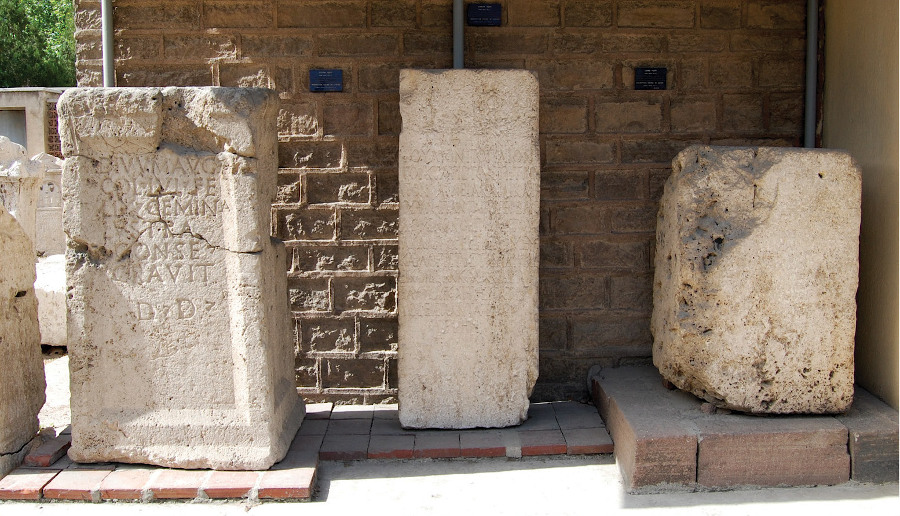
Stones at the Konya Museum have inscriptions with the cities mentioned in Acts 14:1–20. The stone on the left mentions Lystra, dating to the 1st century ad. The center stone is inscribed with the city of Iconium and dates to the 2nd century ad. The stone on the right mentions Derbe and dates to ad 156/157.
David Padfield/BiblePlaces.com
Return to the main text.
14:12 Zeus . . . Hermes. Zeus, the head of the Greek pantheon of gods, was also the patron god of Lystra, and a temple for him was there. People who had come to bring sacrifices to Zeus apparently decided to make an offering to Paul and Barnabas instead. The identification of Zeus with Barnabas may indicate that his appearance was more imposing, and Paul was identified as the messenger god Hermes (the Roman Mercury) because he was the spokesperson (28:6). This incident may have been occasioned by an ancient legend that told of a supposed visit to the same general area by Zeus and Hermes. The two were, however, not recognized by anyone except an old couple on the edge of town. In the legend, the gods destroyed the town, leaving only the one couple’s home standing. So the people of Lystra were determined not to allow such an oversight to happen again.
14:13 city gates. The Greek for this expression can refer to the temple gates, the city gates or house gates.
14:14 tore their clothes. A Jewish way of expressing great anguish (see Ge 37:29,34 and note on 37:34).
14:15 worthless things. Used in the OT to denote false gods (1Sa 12:21).
14:19 They stoned Paul. Inside the city rather than at the usual place of execution outside the walls (7:58; 2Co 11:25; see Gal 6:17 and note).
14:20 disciples had gathered around him. Young Timothy may have been present (see 2Ti 3:10–11 and note on 3:11). got up . . . next day . . . left. Luke’s description of Paul’s quick recovery from stoning suggests a miracle (cf. 28:5–6). Derbe. A border town in the southeastern part of the Lycaonian region of Galatia (see note on v. 6). An inscription naming the city has been discovered about 30 miles east of what was previously thought to be the city site. See photo.
14:21 they returned. Not by the shorter route through the Taurus Mountains but to the cities where they had established churches (v. 22).
14:22 many hardships. See Php 1:29 and note; see also Jas 1:2.
14:24 Pisidia. A district about 120 miles long and 50 miles wide, north of Pamphylia (13:13–14). Bandits frequented the region (see perhaps 2Co 11:26). Pamphylia. A district 80 miles long and 20 miles at the widest part, on the southern coast of Asia Minor. After ad 74 Pisidia was included in the Roman province of Pamphylia (13:13).
14:25 Perga. See note on 13:13. Attalia. The best harbor on the coast of Pamphylia (13:13). See photo.
14:26 Antioch. See 11:20; see also note on 11:19.
14:27 had opened a door of faith. God had brought Gentiles to faith; that is, he had opened the door for them to believe (cf. 11:18).
14:28 long time. Probably more than a year.
15:1 Certain people. Probably from “the party of the Pharisees” (v. 5). These were believers who insisted that before anyone could become a true Christian they must keep the law of Moses, and the test of such compliance was circumcision. from Judea. Although they came from Judea, these Judaizers did not represent the teaching of the apostles and elders of Jerusalem (cf. v. 24).
15:2 go up to Jerusalem. See notes on 12:1; Gal 2:1. Those who hold that Gal 2:1–10 refers to the famine visit of 11:27–30 and 12:25 argue that since Gal 2:2 says that the visit mentioned there was occasioned by a revelation, it must refer to Agabus’s prediction of the coming famine (11:27–28). Those who believe that Gal 2:1–10 refers to the Jerusalem council visit of 15:1–22 assert that the famine visit occurred at the time of Herod Agrippa’s death in ad 44 (11:27–30; 12:25) or a little afterward in ad 46 (see note on 11:27).
15:4–22 The council of Jerusalem represents a key turning point as the leaders of the Jerusalem church acknowledge that Gentile believers are saved by faith, not by circumcision or by obedience to the law. The sequence of meetings described in vv. 4–22 is: (1) a general meeting of welcome and report (vv. 4–5); (2) a meeting of the leaders (perhaps to one side) while the church was still assembled (vv. 6–11); (3) a meeting of the apostles, the elders and the whole assembly (vv. 12–22).
15:4 The first meeting was a report, cordially received, about the work done among the Gentiles.
15:5 believers who belonged to the party of the Pharisees. Some Pharisees became Christians and brought their Judaic beliefs with them. They believed that Gentiles must first become converts to Judaism and be circumcised, and then they would be eligible to be saved by faith. Perhaps some of them had gone to Antioch (v. 1) and now returned to present their case.
15:7 Peter got up. After a period of considerable discussion by the apostles and elders, Peter addressed them. This is the last reference to Peter in Acts. Gentiles might hear. Peter’s argument was his own experience: God had sent him to preach to the Gentiles (see 10:28–29 and note on 10:28).
15:8 giving the Holy Spirit to them. The irrefutable proof of God’s acceptance (see 8:15–17; 10:44,47 and notes; 11:17–18).
15:9 purified their hearts by faith. Peter’s way of saying what Paul affirmed (Ro 5:1; cf. Gal 2:15–16).
15:10 yoke. The law (see Gal 5:1 and note; cf. Mt 11:28–29 and notes).
15:11 through the grace of our Lord. No circumcision was required. we are saved, just as they are. See Ro 3:9; Eph 2:8–9.
15:12 assembly became silent. See note on vv. 4–22. Apparently the people had remained in place while the apostles and elders met. The assembly had not remained quiet during that time, but now it became silent to listen to the leaders. Barnabas and Paul. The order here (see also 13:7; 14:12,14) puts Barnabas first (perhaps reflecting his importance in Jerusalem), whereas in the account of the missionary journey the order was usually “Paul and Barnabas” after the events on the island of Cyprus (13:42–43,46,50; 14:1,3,20,23). signs and wonders. See 8:19–20; 14:3.
15:13 James. The Lord’s brother, who by this time had assumed senior leadership in the Jerusalem church (see note on 12:17; 21:18; see also Introduction to James: Author). His argument added proof from Scripture.
15:14 Simon. Peter (v. 7). James uses Peter’s Hebrew name in its Hebrew form (Simeon; see NIV text note). a people for his name. A new community largely made up of Gentiles but including Jews as well (see Jn 10:16 and note; cf. 1Pe 2:9–10).
15:15 prophets. Specifically Am 9:11–12 (see NIV text note on Am 9:12).
15:16 After this I will return. Some have taken this quotation from Amos as setting forth a sequence of the end times, including (1) the church age (taking out “a people for his name,” v. 14), (2) the restoration of Israel as a nation (v. 16) and (3) the final salvation of the Gentiles (vv. 17–18). Others believe the quotation merely confirms God’s intent to save Gentiles.
15:18 from long ago. Since OT times (see Ro 15:9 and note).
15:19 not make it difficult. Circumcision was not required, but four stipulations were laid down (see note on v. 20). These involved practices that frequently accompanied Gentile idolatry and by which Jews were particularly repulsed. It would help both the individual and the relationship between Gentile and Jew if these requirements were observed. They involved divine directives that the Jews believed were given before the Mosaic laws.
15:20 food polluted by idols. See v. 29; 1Co 8:7–13; Rev 2:14,20. sexual immorality. A sin taken too lightly by the Greeks and also associated with certain pagan religious festivals. meat of strangled animals. Thus retaining the blood that was forbidden to be eaten (Ge 9:4). blood. Expressly forbidden in Jewish law (Lev 17:10–12). Reference here may be to consuming blood apart from meat.
15:22 apostles and elders, with the whole church. Apparently there was unanimous agreement with the choice of messengers and with the contents of the letter (vv. 23–29). Judas (called Barsabbas). The same surname as that of Joseph Barsabbas (see 1:23 and note). The two may have been brothers. Silas. A leader in the Jerusalem church, a prophet (v. 32), a Roman citizen (16:37–38) and Paul’s companion on his second missionary journey (15:40).
15:23 in Antioch, Syria and Cilicia. Antioch was the leading city of the combined provinces of Syria and Cilicia.
15:26 risked their lives. See 13:15; 14:2,5,19.
15:28 seemed good to the Holy Spirit and to us. Prior credit is given to the Spirit (whose working in the assembly is thus claimed), but there was also agreement among the apostles, elders and brothers (vv. 22–23).
15:29 abstain from food . . . sexual immorality. See note on v. 20.
15:32 prophets. One of the primary functions of prophets in the early church was, as here indicated, to encourage and strengthen believers (see notes on 11:27; 1Co 14:3).
15:33 those who had sent them. The Jerusalem church (v. 22).
15:36 towns where we preached the word. Towns of the first missionary journey (13:4—14:26).
15:38 he had deserted them. Mark had turned back at Perga and did not go to Antioch, Iconium, Lystra and Derbe (see note on 13:13).
15:39—18:22 Paul’s second missionary journey (see map; see also map).
15:39–40 Barnabas took Mark . . . Paul chose Silas. Thus the end result of the disagreement between Paul and Barnabas was four missionaries instead of two. God uses even negative situations to accomplish his purposes (cf. Ge 50:20 and note; Ro 8:28).
15:39 they parted company. Barnabas and Mark do not appear again in Acts. However, in 1Co 9:6 Paul names Barnabas as setting a noble example in working to support himself. Also in Gal 2:11–13 another scene is described in Antioch that includes Barnabas. Mark evidently returned from his work with Barnabas and became associated with Peter (see 1Pe 5:13 and note). During Paul’s first imprisonment, Mark was included in Paul’s group (Col 4:10; Phm 24). By the end of Paul’s life he came to admire Mark so much that he requested him to come to be with him during his final days (see 2Ti 4:11 and note; see also Introduction to Mark: John Mark in the NT). Cyprus. The homeland of Barnabas (4:36).
15:40 Silas. Had returned to Jerusalem with Judas after delivering the Jerusalem letter (vv. 32–33). His presence in Antioch now indicates that, after reporting to those who had sent him, he came back to Antioch to participate in the church’s work there.
16:1 Derbe. See notes on 14:6,20. Paul had approached Derbe on the first trip from the opposite direction, so the order of towns is reversed here. Lystra. See note on 14:6. Timothy. See Introduction to 1 Timothy: Recipient. Since Paul addressed him as a young man some 15 years later (1Ti 4:12), he must have been in his teens at this time. father was a Greek. Statements concerning his mother’s faith (here and in 2Ti 1:5) and silence concerning any faith on his father’s part suggest that the father was neither a convert to Judaism nor a believer in Christ. Cf. 2Ti 3:15.
16:3 he circumcised him. As a matter of expediency so that his work among the Jews might be more effective. This was different from Titus’s case (Gal 2:3), where circumcision was refused because some were demanding it as necessary for salvation.
16:6 his companions. Silas and Timothy. Phrygia. The district was formerly the Hellenistic territory of Phrygia, but it had more recently been divided between the Roman provinces of Asia and Galatia. Iconium and Antioch were in Galatian Phrygia. Galatia. The name had been used to denote the Hellenistic kingdom, but in 25 bc it had been expanded considerably to become the Roman province of that name. Asia. This, too, had been a smaller area formerly but now was a Roman province including the Hellenistic districts of Mysia, Lydia, Caria and parts of Phrygia.
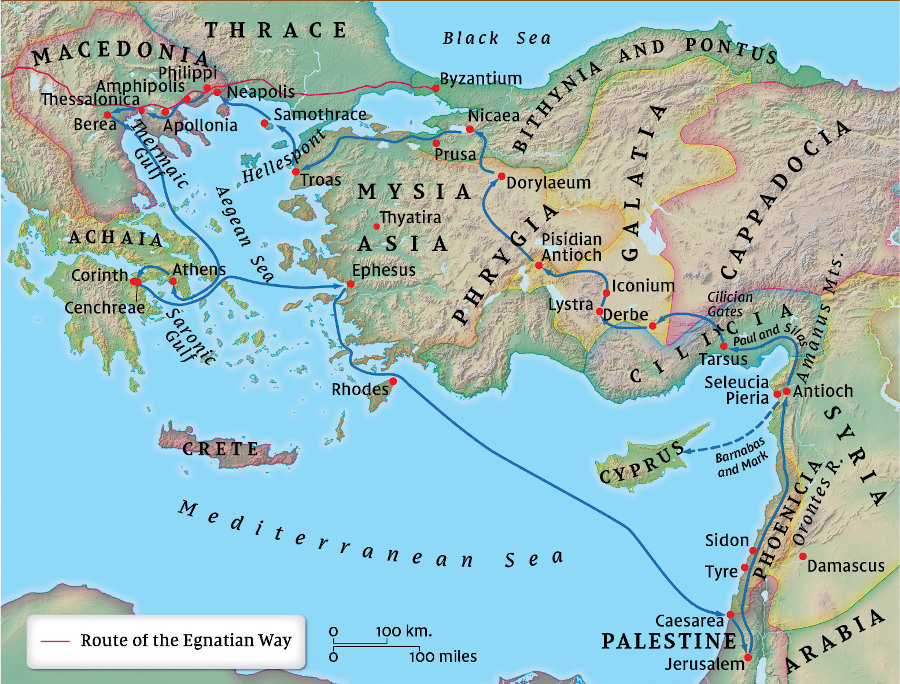
16:7 Mysia. In the northwest part of the province of Asia. Luke uses these old Hellenistic names, but Paul preferred the provincial (Roman) names. Bithynia. A senatorial province formed after 74 bc, it was east of Mysia. Spirit of Jesus. The identification of the “Spirit of Jesus” with the “Spirit of God” (“Holy Spirit,” v. 6) is a clear indication that Jesus is truly God. Cf. Ro 8:9. not allow. The Spirit may have led in any of a number of ways: vision, circumstances, good sense or use of the prophetic gift.
16:8 Troas. Located ten miles from ancient Troy (see map). Alexandria Troas (its full name) was a Roman colony and an important seaport for connections between Macedonia and Greece on the one hand and Asia Minor on the other. Paul returned to Troas following his work in Ephesus on his third journey (2Co 2:12). At some time—on Paul’s second journey or on his third—a church was started there, for Paul ministered to believers in Troas when he returned from his third journey on his way to Jerusalem (20:5–12).
16:9 vision. One of the ways God gave direction (cf. 10:3). man of Macedonia. Macedonia had become a Roman province in 148 bc. There is no indication that the man of the vision is Luke, as some have suggested, but Luke, the author of Acts, does join the group at this point.
16:10 we got ready. This is where the “we” passages of Acts begin (see Introduction: Author). The conclusion is that Luke is informing the reader that he had joined the party at Troas.
16:11 Samothrace. An island in the northeastern Aegean Sea. It was a convenient place for boats to anchor rather than risk sailing at night. Neapolis. The seaport for Philippi, ten miles away; modern Kavalla.
16:12 Philippi. A city in eastern Macedonia named after Philip II, father of Alexander the Great (see map). Since it was a Roman colony, it was independent of provincial administration and had a governmental organization modeled after that of Rome (see note on 13:14). Many retired legionnaires from the Roman army settled there, but few Jews. See Introduction to Philippians: Recipients. leading city. Thessalonica was the capital of Macedonia. But Macedonia had four districts, and Philippi was in the first of these. Amphipolis, however, was the first city of that district. Luke may have intended to say that Philippi was “a” leading city (there is no article in the Greek), or that it was the first city reached from the border, or that its fame and significance made it truly the leading city of the area. See photo. Eighty percent of the inscriptions archaeologists have found here are in Latin, indicating strong Roman influence.
16:13 place of prayer. There were so few Jews in Philippi that there was no synagogue (ten married men were required), so the Jews who were there met for prayer along the banks of the Gangites River (see map). It was customary for such places of prayer to be located outdoors near running water.
16:14 Thyatira. In the Roman province of Asia, 20 miles southeast of Pergamum (in the Hellenistic kingdom of Lydia; see map; see also map). It was famous for its dyeing works, and especially for its royal purple. See Rev 1:11 and note on Rev 2:18. Lydia. A businesswoman. Her name may be associated with her place of origin, the Hellenistic district of Lydia. worshiper of God. Lydia was a Gentile who, like Cornelius (10:2), believed in the true God and followed the moral teachings of Scripture. She had not, however, become a full convert to Judaism. opened her heart. After the resurrection the minds of the disciples were opened to understand the Scriptures (Lk 24:45); similarly, Lydia’s heart was opened to respond to the gospel message of Paul.
16:15 come and stay at my house. Cf. Lk 19:5.
16:16 spirit by which she predicted the future. Or, more formally, a “python” spirit. The python was a mythical snake worshiped at Delphi and associated with the Delphic oracle. The term came to be used of the persons through whom the python spirit supposedly spoke, but the power behind the process was demonic.
16:17 rest of us. The “we” section (see note on v. 10) ends here and begins again in 20:5. Most High God. A title used by the man possessed by an impure spirit (Mk 5:7). It was a common title among both Jews (Nu 24:16; Isa 14:14; Da 3:26) and Greeks (found in inscriptions). But the title is not used of God in the NT by Christians or Jews (though cf. Ac 7:48). As in the Gospels (e.g., Mk 1:24; 5:7,9), knowing and stating a spiritual opponent’s name was part of spiritual warfare designed to gain mastery over them.
16:20 magistrates. The Greek term strategos (Latin praetor), not the usual word but a term of courtesy used in some Roman colonies, such as Philippi.
16:23 flogged. See note on Mk 15:15.
16:24 inner cell . . . stocks. Used not only for extra security but also for torture.
16:27 about to kill himself. If a prisoner escaped, the life of the guard was demanded in his place (12:19). To take his own life would shorten the shame and distress.
16:30 what must I do to be saved? The jailer had heard that these were preachers of a way of salvation (v. 17). Now with the earthquake and his own impending death, he wanted to know about the way.
16:31 Believe in the Lord Jesus. A concise statement of the way of salvation (10:43).
16:32 word of the Lord. See 10:36. Paul and Silas explained the gospel more thoroughly to the jailer and to all the other members of his household, and they all believed in Christ and were saved (v. 34).
16:33 that hour of the night. “About midnight” (v. 25).
16:34 brought them into his house. Cf. v. 15. filled with joy. The consistent consequence of conversion, regardless of circumstances (see note on 8:39).
16:35 magistrates. See note on v. 20.
16:37 without a trial. Public beating for a Roman citizen (v. 38) would have been illegal, let alone beating without a trial (see 22:25 and note). Let them come themselves. Paul and Silas were not asking for an escort to salve their injured pride as much as they were establishing their innocence for the sake of the church in Philippi and its future.
17:1 Amphipolis . . . Thessalonica. The Egnatian Way crossed the whole of present-day northern Greece east-west and included Philippi, Amphipolis, Apollonia and Thessalonica on its route. At several locations, such as Neapolis (modern Kavalla), Philippi and Apollonia, the road is still visible today (see photo). If a person traveled about 30 miles a day, each city could be reached after one day’s journey. Thessalonica. Modern Salonika, about 100 miles from Philippi. It was the capital of the province of Macedonia and had a population of more than 200,000, including a colony of Jews (and a synagogue). All these contributed to Paul’s decision to preach there. See Introduction to 1 Thessalonians: Thessalonica: The City and the Church. See photo.
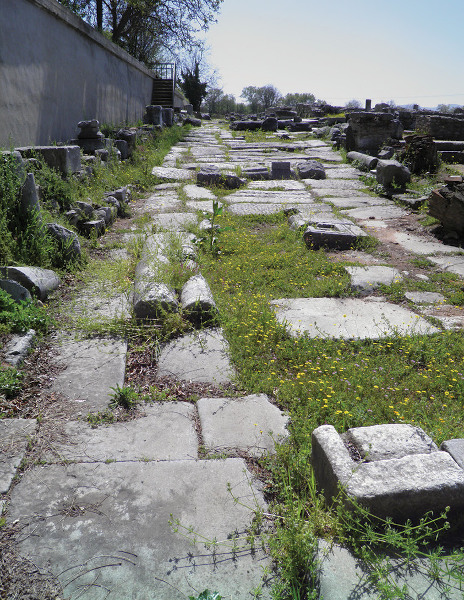
This is the Egnatian Way in Philippi, which Paul and his companions would have used.
Reproduced by permission from Carole Raddato
Return to the main text.
17:2 synagogue. See note on 13:14. three Sabbath days. These two weeks represent the time spent in the synagogue reasoning with the Jews, not Paul’s total time in Thessalonica. An analysis of the Thessalonian letters reveals that Paul had taught them much more doctrine than would have been possible in two or three weeks. Still, the chronology of the events inferable from Acts and 1-2 Thessalonians suggests that he did not stay more than a few months.
17:3 explaining. Lk 24:45 uses the same Greek verb (there translated “opened”) in describing Jesus’ making clear to two of his disciples the teaching of Scripture concerning his death and resurrection (see Lk 24:27,44 and note on 24:44).
17:4 God-fearing Greeks. See notes on 10:2; 16:14. prominent women. Women who deserve notice and position in their own right (see also v. 12). Wealthy women in the Greco-Roman world frequently were patrons of temples and synagogues. When these women transferred their patronage to the Christian mission, it was viewed as a threat by the Jewish community.
17:5 were jealous. Because of the large number of people (including some Jews, many God-fearing Gentiles and many prominent women) who responded to Paul’s ministry (cf. 13:45). Jason’s house. Paul had probably been staying there.
17:6 city officials. The Greek term used here and in v. 8 (plural of politarchēs) is found nowhere else in Greek literature, but it was discovered in 1835 in a Greek inscription on an arch that had spanned the Egnatian Way on the west side of Thessalonica. (The arch was destroyed in 1867, but the block with the inscription was rescued and is now in the British Museum in London; see photo.) The term has since been found in many other inscriptions in towns surrounding Macedonia, as well as elsewhere (see photo below).
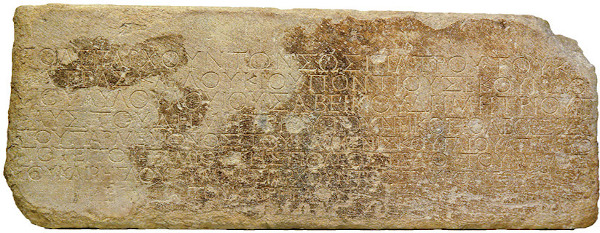
This inscription from the Vardar Gate in Thessalonica names the city officials (or politarchs). The politarchs are mentioned in Acts 17:6 and 8.
Todd Bolen/BiblePlaces.com
Return to the main text.
17:7 defying Caesar’s decrees. Blasphemy was the gravest accusation for a Jew, but treason—to support a rival king above Caesar—was the worst accusation for a Roman. Cf. the charge against Jesus that he claimed to be king (Jn 18:12).
17:9 post bond. Jason was forced to guarantee a peaceful, quiet community, or he would face the confiscation of his properties and perhaps even death.
17:10 Paul and Silas. Timothy was probably left at Philippi, later rejoining Paul and Silas at Berea (compare v. 10 with v. 14). Berea. Modern Verria, located about 50 miles from Thessalonica in another district of Macedonia. synagogue. See note on 13:14.
17:11 Berean Jews. Luke includes a Berean, Sopater, son of Pyrrhus, in the list of delegates who accompanied Paul to Jerusalem to deliver the contributions for the poor (see 20:4 and note).
17:14 coast. One might conclude that Paul went by boat to Athens. But the road to Athens is also a coastal road, and Paul may have walked the distance after having been escorted to the coast (some 20 miles). In any event, Christian companions stayed with him until reaching Athens.
17:15 Athens. Five centuries before Paul, Athens had been at the height of its glory in art, philosophy and literature. It had retained its reputation in philosophy through the years and still maintained a leading university in Paul’s day. See map.
17:17 synagogue. See note on 13:14. God-fearing Greeks. See note on 10:2.
17:18 Epicurean . . . philosophers. Originally they taught that the supreme good is happiness—but not mere momentary pleasure or temporary gratification. By Paul’s time, however, this philosophy had degenerated into a more sensual system of thought. (Epicurus lived from 341 to 270 bc.) Stoic philosophers. Stoics followed the teaching of Zeno, who emphasized reason and lived from 340 to 265 bc. Stoics were named after the stoa (colonnade) where Zeno taught. They taught that people should live in accord with nature, recognize their own self-sufficiency and independence, and suppress their desires. At its best, Stoicism had some admirable qualities, but, like Epicureanism, by Paul’s time it had degenerated into a system of pride. babbler. The Greek word referred to a bird picking up seeds here and there. It was used metaphorically to refer to someone who picked up miscellaneous bits of useless information and then repeated them in the vain attempt to appear intelligent.
17:19 Areopagus. Means “hill of Ares.” Ares was the Greek god of thunder and war (the Roman equivalent was Mars). The Areopagus was located just west of the acropolis and south of the Agora and had once been the site of the meeting of the Court or Council of the Areopagus. Earlier the Council governed a Greek city-state, but by NT times the Areopagus retained authority only in the areas of religion and morals and met in the Royal Portico at the northwest corner of the Agora. The Council members considered themselves the custodians of teachings that introduced new religions and foreign gods.
17:22 religious. Or “superstitious.” The Greek for this word could be used either to congratulate people or to criticize them, depending on whether those using it included themselves in the circle of individuals they were describing. The Athenians would not know which meaning to take until Paul continued. In this context it seems that Paul wanted to be complimentary in order to gain a hearing.
17:23 TO AN UNKNOWN GOD. The Greeks were fearful of offending any god by failing to give him or her attention; so they felt they could cover any omissions by the label “unknown gods.” Other Greek writers confirm that such altars (to “unknown gods”) could be seen in Athens—a striking point of contact for Paul.
17:24 The God who made the world. Thus a personal Creator (Ps 24:1–2), in contrast with the views of pantheistic Stoicism. does not live in temples built by human hands. Cf. Stephen’s similar declaration in his famous speech (7:28); cf. also 1Ki 8:27.
17:26 From one man he made all the nations. All people are of one family (whether Athenians or Romans, Greeks or barbarians, Jews or Gentiles). marked out their appointed times. He planned the exact times when nations should emerge and decline. boundaries of their lands. He also planned the specific area to be occupied by each nation. He is God, the Designer (things were not left to chance, as the Epicureans [see note on v. 18] thought).
17:28 some of your own poets. There are two quotations here: (1) “In him we live and move and have our being,” from the Cretan poet Epimenides (c. 600 bc) in his Cretica, and (2) “We are his offspring,” from the Cilician Stoic (see note on v. 18) poet Aratus (c. 315–240) in his Phaenomena, as well as from Cleanthes (331–233) in his Hymn to Zeus. Paul quotes Greek poets elsewhere as well (see 1Co 15:33; Titus 1:12 and notes).