Study Notes
 1:1 Paul. See notes on Ac 13:9; Ro 1:1. apostle of Christ Jesus. See notes on Mk 6:30; Heb 3:1. Paul uses this title in nine of his thirteen letters to establish his authority as Christ’s messenger—an authority that had been challenged (ch. 9; 2Co 11). He reinforces his authority by adding “by the will of God” (15:9–11; Ac 9:1–16; 13:2; 18:9–10; 22:6–21; 26:12–18). Sosthenes. Perhaps the synagogue ruler at Corinth who was assaulted by the Greeks (Ac 18:17). If so, he obviously became a Christian—possibly while Paul was preaching at Corinth (Ac 18:18) or during Apollos’s ministry there (Ac 19:1).
 1:2 church of God. Used only by Paul and only in Ac 20:28, here and in 2Co 1:1. Its OT counterpart is the expression “assembly (or community) of the LORD” (Dt 23:1; see Nu 16:3; 20:4; 1Ch 28:8). sanctified in Christ Jesus. Consecrated to the service of God through Christ’s saving action in their lives—as Jesus had “sanctified” himself (see Jn 17:19 and note; see also Jn 17:17 and NIV text note). Such consecration to God’s service marks them as “holy” (set apart for God; see Ex 3:5; 19:6; Ro 6:22 and notes) and requires that they be morally “holy” (see Lev 11:44 and note). everywhere. See note on 1Th 1:8.
1:3 Grace and peace. See Ro 1:7 and note. Lord Jesus Christ. See note on 1Th 1:1.
1:4 thank. Paul often began his letters with thanksgiving (see Ro 1:8; Eph 1:16; Php 1:3; Col 1:3; 1Th 1:2; 2Th 1:3; 2Ti 1:3; Phm 4).
1:5 speech and . . . knowledge. Gifts of the Spirit (see 12:8–10 and notes; see also 2Co 8:7).
1:6 confirming. Paul’s preaching about Christ had been accepted by the Corinthians, and their changed lives had proved it to be true.
1:7 any spiritual gift. Probably refers to the spiritual gifts of chs. 12–14. According to those chapters, a “spiritual” gift is some capability given through the Holy Spirit that enables one to minister to the needs of Christ’s body, the church (12:7–11; 14:3,12,17). The Greek word used here stresses that it is a gift of grace. Paul encourages the church for their many spiritual gifts, though he will later correct them for their misuse of these gifts (chs. 12,14). Like a good mentor, he commends before criticizing.
1:8 He. God the Father (v. 9). end. Of the age, when Christ comes again. on the day of our Lord Jesus Christ. When he returns (v. 7; see Php 1:6 and note).
1:9 God is faithful. He may be trusted to do what he has promised (see 1Th 5:24 and note), namely, to keep believers “firm to the end” (v. 8; see note there).
1:10—4:21 The first four chapters, the longest section in the letter, concern disunity and division in the church at Corinth.
1:10 brothers and sisters. See NIV text note. perfectly united. The solution to the division and quarrels plaguing the church is a spirit of true unity. On Christian unity, a pervasive theme in Paul’s letters, see 10:17 and note; Ro 15:5–6; Eph 4:3–6 and note on 4:3; Php 2:1–2 and notes. Jesus prayed for such unity (see Jn 17:11,21–23 and notes).
1:11 Chloe’s household. Likely a group of church members who met in that household. quarrels. See Gal 5:20; 2Ti 2:24; Jas 4:1–2; see also 1Co 3:17; Php 2:14 and notes.
1:12 Apollos. He had carried on a fruitful ministry in Corinth (see Ac 18:24—19:1 and notes). Cephas. See NIV text notes here and on Jn 1:42. Those who followed Cephas in Corinth may have been Jewish Christians. I follow Christ. This group probably tried to sound superior by claiming allegiance to Christ alone. But like the others, they did so in a contentious manner.
1:13 Is Christ divided? See 12:12–13 and notes. baptized. Cf. Ro 6:3–4 and note.
1:14 Crispus. Probably the synagogue ruler mentioned in Ac 18:8. Gaius. Probably the Gaius referred to in Ro 16:23.
1:16 household. Other examples of households being baptized are those of Cornelius (Ac 10:24,48), Lydia (Ac 16:15) and the Philippian jailer (Ac 16:33–34). The term may include family members, servants or anyone else who lived in the house (cf. Ge 17:12–13,23). household of Stephanas. See 16:15 and note.
1:17 not . . . to baptize. Paul is not minimizing baptism; rather, he is asserting that his God-given task was primarily to preach. Jesus (Jn 4:2) and Peter (Ac 10:48) also had others baptize for them. wisdom and eloquence. Or “words of wisdom”; or “impressive speech.” Paul’s mission was not to couch the gospel in the language of a trained orator, one who applied the special rhetorical techniques of persuasion that had been developed by the rabbis among the Jews and by the philosophers among the Greeks (in Corinth, especially the Sophists). emptied of its power. This does not mean that the authentic gospel message could ever lose its power, but that eloquent speech that distorts the message to flatter or persuade others will lose the transforming power of the scandalous message of the cross.
1:18 message of the cross . . . is the power of God. It has the power to transform lives (see Ro 1:16 and note).
1:19 Paul loosely quotes the Septuagint (pre-Christian Greek) translation of God’s word to Jerusalem in Isa 29:14 and applies these words again in a new context. the wise. Aristides said that on every street in Corinth one met a so-called wise man, who had his own solutions to humanity’s problems.
1:20 the wise person. Probably a reference to Gentile philosophers in general. teacher of the law. See note on Mt 2:4. philosopher of this age. Probably refers to the Greek Sophists, who engaged in long and rhetorically complex disputes. God made foolish the wisdom of the world. All merely humanly devised philosophical and ideological systems ultimately fail to satisfy because they have an inadequate concept of God and his revelation.
1:21 wisdom . . . foolishness. Jesus expresses a similar thought in Lk 10:21. It is God’s intention that worldly wisdom should not be the means of knowing him. foolishness of what was preached. Not that preaching is foolish, but that the message being preached (Christ crucified) is viewed by “the world” (both Jews and Greeks) as foolish.
1:22 Jews demand signs. They want to see a display of divine power effecting their deliverance (Mt 12:38; 16:1,4; Mk 8:11–12; Jn 2:18; 6:30). Greeks look for wisdom. Specifically, they look for the kind of insight into the workings of the world that would relieve humanity of its woes.
1:23 Christ crucified. See 2:2. stumbling block to Jews. They expected a triumphant, political Messiah (see Ac 1:6 and note), not a crucified one. For use of the metaphor “stumbling block” in reference to the Jews, see Ro 11:9; cf. Ro 9:32–33; 1Pe 2:8. foolishness to Gentiles. Greeks and Romans were sure that no reputable person would be crucified, so it was unthinkable that one who was crucified as a criminal could be the world’s Savior.
1:24 power. See Ro 1:4,16. wisdom. See v. 30. The crucified Christ is the power and the wisdom of God that saves. He provides true wisdom and saving power, the deepest longings of both Greeks and Jews (cf. “Jews and . . . Gentiles” in v. 23).
1:26–31 The Corinthian Christians were living proof that salvation does not depend on anything in themselves, so that those who are saved can only “boast in the Lord” (v. 31). Their salvation did not spring from the cleverness of human intellect or the centers of human power but from the free grace of God. Compare Paul’s elaboration of this theme with the song of Hannah (1Sa 2:1–10) and the song of Mary (Lk 1:46–55).
1:26–29 The handful of more well-to-do believers (1:26–29) and the pervasive practice of patronage may have been disproportionately responsible for the problems in Corinth. Divisions in the church (1:10—4:21) may have been exacerbated by the believers worshiping in multiple house churches in the large villas of those who could hold 30–50 people. Not disciplining the incestuous offender (5:1–13) is hard to understand unless he were a wealthy patron. Lawsuits (6:1–11) tended to be an activity reserved for the rich. Poor Corinthians ate meat only when it was free at the various pagan festivals each month (8:1–13; 10:1—11:1). Paul refused to accept money for ministry when he feared it might come with strings attached (9:1–18). The abuses of the Lord’s Supper are explicitly about the rich overeating at the expense of the poor (11:17–34). And the issues about women in leadership and exercising spiritual gifts may have stemmed from the cultural assumption that money and status led to visible leadership roles.
1:30 because of him . . . you are in Christ. It is God who has called you to union and communion with Christ. in Christ. See note on Eph 1:1. righteousness. It is by faith in Christ that we are justified (declared righteous); see Ro 3:24 and note; 5:19. holiness. See note on v. 2. redemption. Freedom from slavery to sin (see note on Ro 3:24 and article).


In the Bible, to redeem someone usually means to rescue them from some bad situation (e.g., Israel from Egyptian bondage [Ex 6:6; 15:13], the psalmist from the threat of death [Ps 26:11] or from enemies [Ps 31:5]). Often this comes at a cost to the one who redeems. In the Greco-Roman world slaves could be redeemed by the payment of a price, either by someone else or by the slaves themselves.
Jesus redeems believers (Ro 3:24; Titus 2:14) at the cost of his blood (Eph 1:7; 1Pe 1:19; Rev 5:9), i.e., his death (Mt 20:28; Gal 3:13; Heb 9:5). The result is the “forgiveness of sins” (Col 1:14) and justification (Ro 3:24). Some of the troubles the Lord redeems his people from include bondage or slavery (Ex 6:6), all their sins (Ps 130:8), the power of the enemy (Ps 106:10; 107:2), the curse of the law (Gal 3:13), all wickedness (Titus 2:14) and their empty way of life (1Pe 1:18). No wonder the Lord is called our Redeemer (Job 19:25; Ps 19:14; Isa 49:26; Jer 50:34)!
Go to the Articles Index.
2:1 brothers and sisters. See NIV text note on 1:10. When I came to you. On his initial trip to Corinth c. ad 51 (Ac 18). not . . . with eloquence or human wisdom. See note on 1:17.
2:2 know nothing . . . except Jesus Christ. Paul resolved to make Christ and the message of the cross the central theme of all his teaching and preaching while he was with them. Jesus Christ. See 1:30. him crucified. See 1:17–18,23.
2:3 I came to you in weakness with great fear and trembling. Paul may be referring here to an illness or other physical problem he experienced. Or, as in Athens, he may have been “greatly distressed” (Ac 17:16) by the idolatry and immorality of Corinth and overwhelmed by the task of evangelizing the city.
2:4 not with wise and persuasive words. This does not give preachers a license to neglect study and preparation. Paul’s letters reveal a great deal of knowledge in many areas of learning, and his eloquence is apparent in his address before the Areopagus (see Ac 17:22–31 and notes). Paul’s point is that unless the Holy Spirit works in a listener’s heart, the wisdom and eloquence of a preacher are ineffective. Paul’s confidence as a preacher did not rest on intellectual and oratorical ability, as did that of the Jewish rabbis and the Greek orators (see note on 1:17). demonstration. The Greek word is used of producing proofs in an argument in court. Paul’s preaching was marked by the convincing demonstration of the power of the Holy Spirit.
2:6–14 A contrast between Christians and non-Christians.
2:6 mature. A term used in some Greek religions for their initiates. The contrast here is not between mature and immature Christians, as in 3:1–4, but between all believers and unbelievers, represented by “the rulers of this age.”
2:7 mystery. Cf. Ro 11:25; Eph 3:3; 1Ti 3:16 and notes. The secret, or “mystery,” was once hidden but is now known because God has revealed it to his people (v. 10). To unbelievers it is still hidden. for our glory. God’s wisdom will cause every believer to share eventually in Christ’s glory (see Ro 8:17 and note). before time began. See Ro 8:29–30; Eph 1:4; 2Ti 1:9 and notes; see also Jn 17:24.
2:8 rulers of this age. Such as the chief priests (Lk 24:20), Pilate and Herod Antipas (cf. Ac 4:27). crucified the Lord of glory. The cross is here contrasted with the majesty of the victim.
2:9 things God has prepared. Probably not to be limited to either present or future blessing; both are involved (cf. vv. 7,12).
2:10 Spirit searches all things. Not in order to know them, for he knows all things. Instead, he comprehends the depth of God’s nature and his plans of grace, so that he is fully competent to make the revelation claimed here. deep things of God. See Ro 11:33–36 and note; cf. Rev 2:24.
2:11 no one knows the thoughts of God except the Spirit. See Ro 8:26–27 and notes.
2:12 spirit of the world. Cf. v. 6 (“wisdom of this age”); the spirit of human wisdom as alienated from God—the attitude of sinful humanity (see Ro 8:5–8 and note).
2:13 words taught by the Spirit. The message Paul proclaimed was expressed in words given by the Holy Spirit. Thus spiritual truth was aptly combined with Spirit-taught words (but see NIV text note for a different interpretation).
2:14 person without the Spirit. Described in Jude 19 as one who follows “mere natural instincts” (cf. Ro 8:9). The non-Christian is governed in thought and life by an unrenewed, worldly heart. Such persons are not yet transformed by the Holy Spirit and are not equipped to receive appreciatively truth that comes from the Spirit. They need the new birth (see Jn 3:8; Titus 3:5 and notes). foolishness. See 1:18.
2:15 person with the Spirit. Renewed by the Spirit (mature, v. 6). not subject to merely human judgments. One who does not have the Spirit is not qualified to judge anyone who has the Spirit.
3:1–4 Here the contrast shifts to two kinds of Christians. The Corinthians were still worldly believers (vv. 1–2), and the proof of their immaturity was their division over human leaders (vv. 3–4).
3:1 Brothers and sisters. See NIV text note on 1:10. people who live by the Spirit. Now Paul distinguishes the Spirit-filled Christians from those who at a given time are relying on the flesh; that is, living by their own power or wisdom. worldly. See note on 3:1–4. The worldly Christian here is not the nominal believer but one who is involved in dividing the church into rival factions.
3:2 milk, not solid food. See Heb 5:12–14 and notes.
3:3 like mere humans. Like people of the world instead of people of God. They were following merely human standards.
3:4 I follow Paul . . . Apollos. See 1:12.
3:6 I planted. See Ac 18:4–11. Paul’s work was of a pioneer nature, preaching where churches had not yet been planted (2Co 10:13–16; Ro 15:20–21). Apollos watered. See Ac 18:24–28. Apollos worked in the established church, teaching and encouraging the converts Paul had won.
3:9 God’s field. The people are God’s farmland. God’s building. They are also depicted more specifically as God’s temple (vv. 16–17). Paul’s choice of metaphors accords with the fact that in the ancient world planting the land and building a house (or city or temple) were traditionally the two basic focal points of human industry.
3:10 I laid a foundation. By preaching Christ and him crucified (2:2). someone else. Apollos—and possibly others.
3:12 gold, silver, costly stones. Precious, durable work that stands the test of divine judgment; symbolic of pure Christian doctrine and living. wood, hay or straw. Worthless work that has no spiritual or eternal value.
3:13 This is one of the few NT passages concerning the Christian’s rewards (see article). Cf. 4:5; 2Co 5:10 and note. the Day. When Christ returns. See 1:8 and note. fire. God’s judgment. The work of some believers will stand the test while that of others will disappear—emphasizing the importance of teaching the pure word of God.
3:15 loss. Of reward (v. 14). as one escaping through the flames. Perhaps a Greek proverbial phrase, meaning “by a narrow escape,” with one’s work burned up by the fire of God’s holy justice and judgment (cf. Zec 3:2 and note).
3:16 God’s temple. Here Paul speaks of the church as “God’s temple” (see Eph 2:21–22 and notes). He says, “You yourselves (plural) are God’s temple (singular),” and the “you” of v. 17 is also plural. In 6:19 he speaks of each Christian as a temple of the Holy Spirit.
3:17 If anyone destroys God’s temple. Or, “if anyone tries to destroy God’s temple.” The church worldwide cannot be destroyed (Mt 16:18–19) but individual congregations can be destroyed. God will destroy that person. Such a foolish laborer is not one of the Lord’s true servants and suffers a worse end than the “builder” of v. 15. In the context of chs. 1–4 Paul here refers to people who tear the local church apart by factions and quarrels concerning their understanding of the gospel (1:11–12). sacred. Holy, set apart for God’s use and glory (see note on 1:2); so do not desecrate the church by breaking it up into various factions.
3:18 become “fools.” Turn away from human wisdom (from being “wise by the standards of this age”) and accept the “foolish” message of the cross. Cf. 1:18. become wise. Cf. 1:21,24 and notes.
3:21 about human leaders. About being some particular “builder’s” disciple (see 1:12 and note; 3:4; cf. 1:31; 4:6). All things are yours. Because of their relationship to God through Christ (v. 23), they are heirs of all things (see Ro 8:17 and note)—heirs of the ministries of all those who faithfully promote the gospel, and also of everything over which God and Christ hold sovereign rule, namely, all those things that the philosophers of this world claim to have mastered by their wisdom.
3:23 you are of Christ. You are united with and belong to Christ (see 1:30 and note). Christ is of God. Christ is in union with God the Father and perfectly fulfills God’s will (see Jn 4:34; 10:30 and notes).
4:1 those entrusted. The Greek underlying this phrase means “house manager” or “steward.” mysteries. Things that human wisdom could not discover but that are now revealed by God to his people (see 2:7 and note).
4:5 appointed time. When God will judge believers (see 3:13 and note). expose the motives. Cf. 1Sa 16:7; 1Ki 8:39; 1Ch 28:9; Ps 139:23–24; Pr 16:2; 21:2; Lk 16:15; Heb 4:12–13.
4:6 brothers and sisters. See NIV text note on 1:10. these things. See 3:5—4:5. the saying. Perhaps a rabbinic proverb meaning not to go beyond the teaching of Scripture. what is written. This phrase in Paul always refers to the OT Scriptures and here may point back to the six OT quotations previously cited in the letter (1:19,31; 2:9,16; 3:19,20), most of which refer to boasting in human wisdom. The Corinthian believers should view even Paul and Apollos in light of what the OT has to say about human weakness and limitations. puffed up. Pride is one of the root causes of divisions. Paul uses the same term to discourage pride at 4:18–19; 5:2; 8:1; 13:4.
4:8 Paul uses irony and sarcasm here to get the Corinthians to see how poor they really are in comparison with apostles because of their haughtiness and spiritual immaturity. have become rich. Cf. 1:5; 2Co 9:11. have begun to reign. They think they already participate fully in Christ’s reign (see Ro 5:17 and note; 2Ti 2:12) and have no need of an apostle’s ministry.
4:9 apostles. See note on 1:1. spectacle. “Theater” is derived from the Greek word used here. Paul refers to the triumphal procession of a victorious Roman general with captives of war bringing up the rear—men condemned to die in the arena in mortal combat with gladiators or with ferocious beasts. He pictures all the world and even angels looking on while the apostles are brought in last to fight to the death.
4:10 you are so wise . . . strong. More irony and sarcasm.
4:11–13 A graphic description of Paul’s condition right up to the writing of this letter (cf. 2Co 11:23–28).
4:12 We work hard with our own hands. Paul was a tentmaker by trade (see Ac 18:3 and note; cf. 1Co 9:6, 18; Ac 20:34–35). we bless. See Mt 5:44; Lk 6:28; Ro 12:14 and note. endure it. Instead of retaliating (cf. 1Pe 2:20–23).
4:14 my dear children. See v. 15.
4:15 guardians. See Gal 3:24 and note. your father. Cf. 3:6,10.
4:16 imitate me. See 11:1 and note.
4:17 I have sent to you Timothy. Apparently Timothy had already begun his journey to Corinth by way of Macedonia (see 16:10 and note).
4:18 Some of you. Some of the Corinthians who were trying to undercut Paul’s authority (9:1–3) were teaching that he was unstable (see 2Co 1:17 and note) and that his ministry was worthless (see 2Co 10:10 and note; cf. 12:11–12 and notes).
4:19 arrogant. See 5:2 and note.
4:20 kingdom of God. God’s present reign in the lives of his people (cf. note on Mt 3:2)—that dynamic new life in Christ (see 2Co 5:17 and note), the power of the new birth (Jn 3:3–8), showing itself in a humble life, dedicated to Christ and his mission. not . . . of talk but of power. Empty talk is contrasted with the genuine power of the Holy Spirit. power. See 1:24 and note.
4:21 with a rod of discipline. Paul is speaking metaphorically. In OT wisdom literature, the “rod” is the instrument used by a father to drive folly out of children and so save them from worse consequences (Pr 22:15; 23:13–14). See 2Co 1:24; 2:1; 13:2,10 and notes.
5:1 even pagans do not tolerate. The Roman orator Cicero states that incest was practically unheard of in Roman society. his father’s wife. That this expression was used rather than “his mother” suggests that the woman was his stepmother. She may have been considerably younger than his father. The OT prohibited such sexual relations (see Lev 18:8; Dt 22:30 and notes).
5:2 proud. This could mean they were proud despite the man’s behavior (and so were tolerating sin) or they were proud because of the man’s behavior, in which case they were condoning it on the basis of their liberty in Christ—a distortion of grace (cf. Ro 6:1–2 and note on 6:1). put out of your fellowship. Excommunicated from the church (cf. Jn 9:22).
5:3 in the name of our Lord Jesus. By his authority.
5:4 the power of our Lord Jesus is present. Jesus’ power is present through his word and his Holy Spirit.
5:5 hand this man over to Satan. Abandon this sinful man to the devil by expelling him from the church (see v. 13; see also vv. 2,7,11). To expel him was to put him out in the devil’s territory, severed from regular Christian fellowship (cf. note on 1Ti 1:20). for the destruction of the flesh. So that being officially ostracized from the church will cause the man such anguish that he will repent and forsake his wicked way. For an alternative interpretation, see second NIV text note. In the latter view, Satan is allowed to bring physical affliction on the man, which would bring him to repentance. He might even be allowed to die, but as a Christian he would still be saved in eternity. his spirit . . . saved. Cf. 3:15. day of the Lord. When Christ returns (1:7).
5:6 a little yeast . . . the whole batch of dough. To illustrate Christian holiness and discipline, Paul alludes to the prohibition against the use of leaven (a lump of raw dough containing yeast) in the bread eaten in the Passover Festival (see Ex 12:15 and note). Leaven in Scripture usually symbolizes evil or sin (see Mk 8:15 and note), and the church here is called on to get rid of the leaven of sin (v. 8) because its members are an unleavened batch of dough—new creations in Christ (see 2Co 5:17 and note).
5:7 Get rid of the old yeast. Perhaps refers to the Passover custom of sweeping all the (leavened) bread crumbs out of one’s house before preparing the Passover meal. a new unleavened batch—as you really are. Already sanctified in God’s sight (see 1:2 and note; 6:11), Paul calls on them to become holy in conduct. Christ, our Passover lamb. In his death on the cross, Christ fulfilled the true meaning of the Jewish sacrifice of the Passover lamb (cf. Jn 1:29 and note). Christ, the Lamb of God, was crucified during Passover (cf. Ex 12:8).
5:8 let us keep the Festival. Keeping the Festival of Unleavened Bread (which followed Passover; see chart) symbolized living the Christian life in holy dedication to God and not getting involved in such sins as malice, wickedness and incestuous relations.
5:9 I wrote to you in my letter. Paul here clarifies a previous letter (one not preserved). Some in the Corinthian church mistook that letter to mean that on separating from sin, they should disassociate themselves from all immoral persons, including non-Christian people. Instead, Paul meant that they should separate from immoral persons who were within the church itself (vv. 10–11).
5:10–11 See note on Ro 1:29–31.
5:11 Do not even eat with such people. Eating with a person often implied approval of their beliefs or practices (cf. 11:27–34). Calling oneself a Christian while continuing to live an immoral life is reprehensible and degrading and gives a false testimony to Christ. If the true Christian has intimate association with someone who does this, the non-Christian world may assume that the church approves such immoral, ungodly living, and thus the name of Christ would be dishonored. Questions could arise concerning the true character of the Christian’s own testimony (cf. Ro 16:17–18; see also 2Th 3:6,14–15 and notes).
5:12 judge those inside. The church is to exercise spiritual discernment and discipline over the professing believers in the church (cf. Mt 18:15–18), but it is not to attempt to judge those outside its membership. There are governing authorities in place to judge them (see Ro 13:1–5 and notes), and their ultimate judge is God (v. 13; cf. Rev 20:11–15).
6:1 a dispute with another. Paul seems to be talking about various kinds of civil court cases here (cf. the phrase “rather be cheated,” v. 7), not criminal cases that should be handled by the state (Ro 13:3–4). ungodly. Meaning unbelievers as opposed to believers. It does not necessarily mean these judges are immoral or unjust. before the Lord’s people. The Corinthians should take their property and other civil cases before qualified Christians for settlement. In Paul’s day the Romans allowed the Jews to apply their own law in such matters, and since the Romans did not yet consider Christians as a separate class from the Jews, Christians no doubt had the same rights.
6:2 the Lord’s people will judge the world. As those who share in Christ’s reign (cf. Mt 19:28; 2Ti 2:12; Rev 20:4). competent to judge trivial cases. Paul views believers as fully competent to judge cases where Christians have claims against each other, because they view matters from a godly vantage point. In comparison with their future role in the judgment of the world and of angels (v. 3), judgments concerning things of this life are insignificant.
6:3 we will judge angels. Cf. 2Pe 2:4, 9; Jude 6.
6:4 those whose way of life is scorned in the church. The verse asks ironically whether believers should submit their cases to pagan judges, who really are not qualified to decide on cases between Christians.
6:7 completely defeated already. Most likely by greed, retaliation and hatred, instead of practicing unselfishness, forgiveness and love—even willingness to suffer loss.
6:9–10 See Ro 1:29–31 and note.
6:9 not inherit the kingdom of God. See Eph 5:5. sexually immoral. Paul uses a general term for immoral sexual behavior (pornos) then identifies two kinds of sexually immoral persons: “adulterers” and “men who have sex with men.” The latter in Greek is actually two words, referring to the active or male role (arsenokoitēs) and the passive (malakos = “soft”) or female role. People who engage in such practices, as well as the other offenders listed in vv. 9–10, are explicitly excluded from God’s kingdom (but see next note). For more of Paul’s teaching on homosexual activity, see Ro 1:26–27 and notes.
6:11 some of you were. But. While these sins (and any sin) are enough to exclude people from the kingdom of God (v. 10), God washes, sanctifies and justifies us “in the name of the Lord Jesus Christ” and “by the Spirit of our God” (vv. 9–10). “Washes” comes from an OT motif of purity rituals, whereby unclean people or things can become clean by washing with water. sanctified. Made holy or pure, as God is pure. See 1:2 and note. justified. Declared righteous or not guilty. See Ro 3:24 and note.
6:12 “I have the right to do anything.” Paul may be quoting some in the Corinthian congregation who boasted that they had a right to do anything they pleased because salvation came as a free gift (see v. 13; 7:1; 10:23 and notes). The apostle counters by observing that such “freedom” of action may not benefit the Christian. not be mastered by anything. One may become enslaved by those actions in which one “freely” chooses to indulge. See 2Pe 2:19 and note; see also chs. 8–10.
6:13 “Food for the stomach and the stomach for food, and God will destroy them both.” Paul quotes some Corinthians again who were claiming that as the physical acts of eating and digesting food have no bearing on one’s inner spiritual life, so the physical act of promiscuous sexual activity does not affect one’s spiritual life. The body . . . is not meant for sexual immorality but for the Lord. Some Corinthians claimed that there was no resurrection of the body (15:12), or that their resurrection had already occurred in a spiritual sense, so it did not matter what one did with one’s body. Paul here declares the dignity of the human body: It is intended for the Lord and will be raised. Although granting that food and the stomach are transitory, Paul denies that what one does with one’s body is unimportant (see v. 19 and note). This is particularly true of the use of sex (vv. 18–19), which the Lord has appointed for use in the man-woman relationship in marriage (see 7:2–5; cf. Heb 13:4).
6:14 God raised the Lord . . . us also. As an illustration of God’s high regard for the body, Paul cites the resurrection of Christ’s body and, eventually, of the believer’s body (15:51–53; 1Th 4:16–17). A body destined for resurrection should not be used for immorality.
6:15 members of Christ. See 12:27. It is not merely the spirit that is a member of Christ’s body; it is the whole person, consisting of spirit and body. This fact gives dignity to the human body.
6:16 one with her in body. Paul’s point is that a sexual relationship is more than just a physical act. It is also a spiritual union where a man and a woman become “one flesh” (cf. Ge 2:24; Mt 19:4–5). Sexual relations outside the marriage bond are a distortion of the divinely established marriage union.
6:17 one with him in spirit. There is a higher union than the marriage bond: the believer’s spiritual union with Christ, which is the perfect model for the kind of unity that should mark the marriage relationship (cf. Eph 5:21–33 and notes on 5:23,32).
6:18 Flee. The Greek for this imperative may suggest that one must continually run away from sexual sinning (advice particularly needed in Corinth). Cf. Ge 39:12; 2Ti 2:22. outside the body . . . against their own body. Numerous personal sins hurt one’s body—e.g., alcoholism, drug abuse, self-mutilation and, obviously, suicide. But the Greek for “body” (soma) can refer to someone in an intimate interpersonal relationship, which is precisely what sexual relations involve (Ge 2:24). See Introduction: City of Corinth: (4) Its immorality. whoever sins sexually, sins against their own body. The body is a temple of the Holy Spirit (v. 19); thus to use it in prostitution (see notes on Ge 20:9; Ex 34:15) disgraces God’s temple.
6:19 your bodies are temples of the Holy Spirit. Cf. note on 3:16. The body is therefore sacred and is to be treated as sacred (holy). Christians should also realize that by the Spirit’s presence and power they can be helped against such sins as sexual immorality (Ro 8:9). not your own. Cf. 1Pe 2:9 and note.
6:20 bought at a price. See 7:23 and note. honor God with your bodies. Cf. 10:31; Ro 6:12–13 and notes.
7:1 matters you wrote about. The Corinthians had written Paul, asking him about a number of vexing topics that Paul addresses in turn (8:1; 12:1; 16:1). “It is good for a man not to have sexual relations with a woman.” The best understanding of this statement is that Paul is again (see notes on 6:12–13,18) quoting a slogan of the Corinthians. He refutes this idea in v. 2 by stating that sexual relations have their proper expression in marriage.
7:3 fulfill . . . marital duty. Married couples should have regular sexual relations. Permanent abstention deprives the other partner of his or her natural right (v. 5).
7:4 In the same way. Both husband and wife have conjugal rights and exclusive possession of the other in this area. This was highly countercultural in the Greco-Roman world, where women were expected to be faithful to their spouses but men were not, often keeping mistresses and frequenting prostitutes.
7:5 Do not deprive each other. Of sexual fulfillment. Satan . . . not tempt you because of your lack of self-control. The Christian deprived of regular sexual activity with his or her marriage partner may be tempted by Satan to sexual immorality.
7:6 concession, not as a command. The concession is either (1) that Paul, though preferring singleness, allows for marriage (v. 2), or (2) that while encouraging regular sexual relations among married couples, he allows for abstinence for a certain period of time (v. 5).
7:7 as I am. Unmarried. Paul views his currently celibate lifestyle as a “gift from God” that made it possible for him to accept his unmarried state and use it in the service of his Lord.
7:8 A distinctively masculine form of the word for widow had not yet developed in first-century Greek, so Paul may be using this masculine form for “unmarried” to mean “widowers” (see NIV text note). After all, he addresses the never married later in v. 25. If this is the case, then Paul would here be acknowledging that he, too, was a widower.
7:10 I give this command (not I, but the Lord). Paul is citing a command from the Lord Jesus during his earthly ministry that marriage is a sacred covenant that should not be broken (Mt 5:32; 19:3–9; Mk 10:2–12; Lk 16:18). Paul probably learned Jesus’ teaching from the disciples who were present during Jesus’ ministry (cf. Gal 1:18–19).
7:11 But if she does, she must remain unmarried or else be reconciled. Paul argues that in the light of Christ’s command she (or he) is not to marry again. Rather, the separated or divorced couple ought to seek reconciliation. Clearly the ideal is the restoration and renewal of the marriage covenant.
7:12 I say this (I, not the Lord). Paul is not saying that his words do not carry divine authority (he is writing inspired Scripture), but only that Jesus did not directly address this issue (see v. 40 and note). any brother has a wife . . . not a believer. The apostle is talking here (and in v. 13) about couples already married, when one of them becomes a Christian. If at all possible, they should remain together, unless the unbeliever, whether man or woman, refuses to remain (v. 15).
7:14 sanctified through his wife . . . sanctified through her believing husband. Brought within the sphere of Christian blessings, not automatically saved. Paul here affirms that, within the marriage relationship, unbelieving marriage partners in some sense participate with their believing spouse in the quality of being consecrated to God (“sanctified”; see 1:2 and note)—so that the children born of their union are “holy” (consecrated to God).
7:15 The brother or the sister is not bound in such circumstances. The believer is not under obligation to try to continue living with the unbeliever. live in peace. If the unbeliever were forced to live with the believer, there would be no peace in the home.
7:17 live . . . in whatever situation the Lord has assigned to them. Christians are to live confidently for the Lord in whatever station in life God has placed them. See v. 18 for an example. No change of status that anyone brings about by their own action can advance their salvation.
7:18 circumcised . . . uncircumcised. Jew . . . Gentile. In the religious sphere, Christian Jews should not undo their circumcision, and Christian Gentiles should not yield to Jewish pressure for circumcision (cf. Ac 15:1–5; Gal 5:1–3).
7:19 become uncircumcised. An ancient Roman surgical procedure known as epispasm to recreate a foreskin. See Gal 5:6 and note.
7:21 Were you a slave . . . ? In the social and economic sphere, Christian slaves should live contentedly in their situation, realizing that they have become free in Christ (v. 22; Jn 8:32,36). if you can gain your freedom, do so. If Christian slaves have an opportunity to get their freedom, they should take advantage of it. In the Roman Empire slaves were sometimes freed by Roman patricians. Others were able to earn enough money to pay for their own freedom. There is nothing wrong with seeking to improve one’s social condition, and slavery should be escaped whenever possible, but this will have no bearing on one’s standing with God.
7:22 is the Lord’s freed person. Has been set free from bondage to sin (see Ro 6:18, 22; Heb 9:15 and notes; cf. Jn 8:34, 36; 1Pe 2:16) and is therefore free to serve Christ as his “slave”—just as the Israelites were set free from Egyptian bondage so that in freedom they could become the servant people of God (Ex 6:6–7; 19:4–6).
7:23 bought at a price . . . not . . . slaves of human beings. Christians in all stations of life should realize that their ultimate allegiance is to Christ, who bought them with his blood (see 6:20; 1Pe 1:18–19 and note on 1:18).
7:25 Now about virgins. Paul comments on another topic raised in the letter from the Corinthians (v. 1), about singleness. I give a judgment as one who . . . is trustworthy. Paul is not giving a direct command from Jesus here (as in v. 10; cf. Ac 20:35 and note). In this matter, which is not a question of right and wrong, Paul expresses his own judgment. Even though he puts it this way, he is certainly not denying that he wrote under the influence of divine inspiration (see v. 40 and note). And since he writes under inspiration, what he recommends is clearly the better course of action.
7:26 present crisis. Probably a reference to the pressures and trials in the Christian life in an immoral and particularly hostile environment (cf. vv. 2,28; 5:1; 2Ti 3:12)—trials characteristic of those upon whom “the culmination of the ages has come” (10:11; cf. vv. 29–31). Other interpreters think Paul may be referring to a famine provoked by severe grain shortages that occurred about that time. In this latter case, Paul’s recommendation here (see also v. 27) would not necessarily apply to all times and all situations.
7:28 many troubles. Times of suffering and persecution for Christ, when being married would mean even greater hardship in taking care of one’s family.
7:29–31 Christians already live under the foreshadowings of Christ’s return, when the world in its present form will pass away. For this reason, believers should not treat present realities as having ultimate significance.
7:29 brothers and sisters. See note on Ro 1:13.
7:31 this world . . . is passing away. Cf. 1Jn 2:17.
7:34 his interests are divided. He cannot give undistracted service to Christ (v. 35). This is particularly true in times of persecution.
7:36 not . . . acting honorably toward the virgin he is engaged to . . . passions are too strong . . . They should get married. A man might refrain from marrying his fiancée. But if he then realizes that his (or her) “passions are too strong” and the situation thus seems unfair, it is perfectly proper for them to get married (see also NIV text note on vv. 36–38).
7:37 has control over his own will . . . does the right thing. The man who determines that there is no need for him to marry his fiancée under the circumstances has made a good decision too (v. 38). Paul may be referring to a man who has control of his passions, as in v. 7 (cf. v. 9).
7:39 bound to her husband as long as he lives. Marriage is a lifelong union (yet see v. 12 and note, also the exception clause in Mt 19:9 and note on 19:3; cf. v. 15 above). if her husband dies. Death breaks the marriage bond, and a Christian is then free to marry another Christian (“but he must belong to the Lord”).
7:40 as she is. A widow. I think that I too have the Spirit of God. Paul writes as one convinced that he is guided by the Holy Spirit.
8:1—11:1 In this section Paul deals with another matter from the Corinthian letter (see 7:1 and note), the question of whether Christians should eat food that had been sacrificed to idols. Cf. Ro 14:1—15:13 and notes.
8:1 sacrificed to idols. Offered on pagan altars. Meat left over from a sacrifice might be eaten by the priests, eaten by the offerer and his friends at a feast in the temple (see note on v. 10), or sold in the public meat market. Some Christians felt that if they ate such meat they participated in pagan worship and thus compromised their testimony for Christ. Other Christians felt a greater freedom to eat sacrificial meats. knowledge. Explained in vv. 2–6. knowledge puffs up. It fills one with false pride. love builds up. Explained in vv. 7–13.
8:2 do not yet know. Even the wisest and most knowledgeable among Christians have only limited knowledge. God is the only one who knows all (cf. Ro 11:33–36).
8:3 whoever loves God is known by God. Not their knowledge as such but their love for God is what counts; their love is a manifestation that God has accepted them and has dealt with them as among his own (Gal 4:9). The background of Paul’s assertion is very likely the OT use of Hebrew yada’ (“to know”) in such passages as Ge 18:19 (“have chosen”); 2Sa 7:20; Ps 1:6 (“watches over”); Am 3:2 (“have I chosen”); Na 1:7 (“cares for”).
8:4 An idol is nothing. It represents no real god and possesses no power (Ps 115:4–7; 135:15–17; Isa 44:12–20). But there can be demons behind them (10:20).
8:5 so-called gods. The gods of Greek and Roman mythology and other religions.
8:6 one God. Paul alludes to the Shema, the great Jewish confession of faith (see Dt 6:4 and note). from whom all things came . . . through whom all things came. See Heb 2:10. God the Father is the ultimate source of all creation (Ac 4:24; Ro 11:36). God the Son is the dynamic one through whom, with the Father, all things came into existence (see Jn 1:3; Col 1:16 and note; Heb 1:2).
8:7 possesses this knowledge. Knows that an idol is an empty symbol, representing no real divine being. sacrificed to a god. Sacrificed to the god the idol represents. since their conscience is weak, it is defiled. They think that in eating meat sacrificed on pagan altars they have involved themselves in pagan worship and thus have sinned against Christ.
8:9 your rights. To eat meat sacrificed to idols because you know that an idol is nothing (v. 4). the weak. Those Christians whose consciences are weak, who think it is wrong to eat meat sacrificed to idols.
 8:10 your knowledge. See vv. 1,4,8. eating in an idol’s temple. At the site of ancient Corinth, archaeologists have discovered two temples containing rooms apparently used for pagan feasts where meat offered to idols was eaten. To such feasts Christians may have been invited by pagan friends. Social and business gatherings would have been held in these rooms, much like modern-day restaurants. See photo.
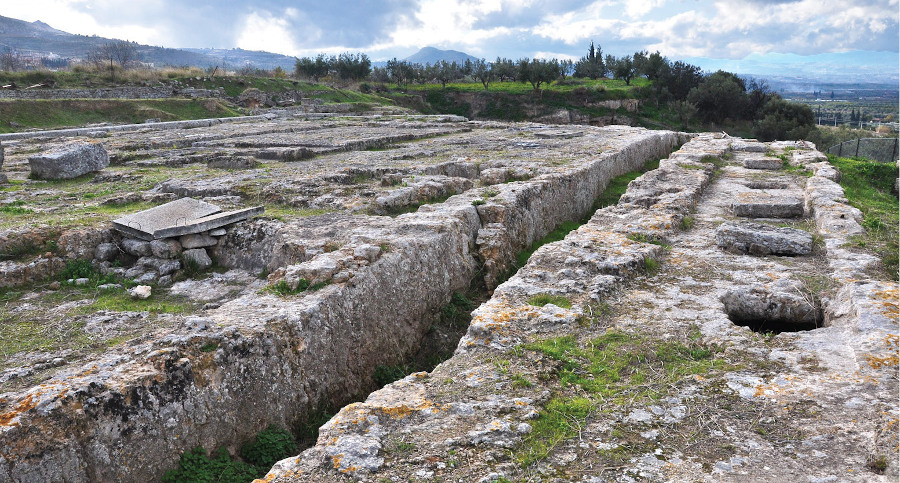
The foundation of the temple of Asclepius at Corinth. This complex included dining rooms, bathing facilities, dormitories, and other structures. It is uncertain whether these particular dining rooms were in use during Paul’s time, but places like this would have been used for pagan feasts as referred to in 1Co 8:10.
www.HolyLandPhotos.org
Return to the main text.
8:12 wound their weak conscience. Eating meat offered to idols when they feel it is wrong tends to blunt their consciences, so that doing what is wrong becomes much easier. The result may be moral tragedy. you sin against Christ. Cf. Mt 10:40; 18:5; Mk 9:37; Lk 9:48; Ro 14:15 and note; 14:19–20.
8:13 I will never eat meat again. Paul presents himself as an example for the church (cf. Ro 14:15,21). He goes so far as to say that he would never eat any meat again, sacrificial or otherwise, if it caused stumbling.
9:1–27 In this section Paul points to his own example of willingness to give up rights and privileges for the sake of the gospel (see v. 12 and note).
9:1 Am I not free? Do I not have the rights that any Christian has? Am I not an apostle? Some at Corinth (2Co 12:11–12) questioned Paul’s genuine apostleship. To certify his apostleship Paul gives this proof: that he has seen the Lord Jesus (Ac 9:1–9; 22:6–16; 26:12–18), as was true of the other apostles (Ac 1:21–22). Furthermore, he adds that his ministry has produced true spiritual fruit (the Corinthians) for the Lord, which should confirm to them that he is indeed an apostle.
9:4 right to food and drink. Paul and Barnabas, as God’s workers, have a right to have their food and other physical needs supplied at the church’s expense (cf. vv. 6,13–14 and note on v. 18).
9:5 take a believing wife along with us. Paul asserts his right to bring his wife on his missionary travels, if he were married. This does not necessarily mean that he was married, though he may have been a widower (see 7:7–8 and note). Other apostles, including Peter (Mk 1:30), had wives and it seems that they brought them along as they ministered. the Lord’s brothers. Jesus’ (half-)brothers: James, Joseph, Simon and Judas (see Mt 13:55; Mk 6:3).
9:9 Is it about oxen . . . ? See 1Ti 5:18. In the Mosaic law that Paul quotes (Dt 25:4), God was indeed concerned about oxen that labored for their owners (cf. Jnh 4:11 and note). But this law also illustrated a basic principle of justice that God was teaching Israel and “us” (v. 10), a principle with greater moral weight when persons rather than farm animals are involved.
9:11 material harvest. Food, lodging and pay supplied by the Corinthians (cf. Gal 6:6). Paul here sets forth the principle that those who serve the church should be supported by the church (cf. Php 4:14–19).
9:12 did not use this right. The point of Paul’s discussion in ch. 9. He had numerous rights that he did not claim because of his love for the Corinthians. Thus ch. 9 is an extended personal illustration of the practice advocated in ch. 8. Because of love for others, believers should be ready to surrender their rights (see Ro 14:15 and note). Love limits liberty.
9:13 those who serve in the temple. The Corinthian believers would understand this illustration not only from their knowledge of the OT (cf. Lev 7:28–36; Nu 18:8–20) but also from the practice in pagan temples in Greece and Rome.
9:15 this boast. That he had preached the gospel without charge, so that they could not say that they had paid him for it.
9:16 I am compelled to preach. The Lord had laid on Paul the necessity of preaching the gospel (Ac 9:1–16; 26:16–18; see also Jer 20:9 and note). Woe to me. Cf. v. 27 and note.
9:18 my reward . . . in preaching the gospel. Paul’s reward in preaching is not material things but the fact that he has preached to the Corinthians without charge and has not taken advantage of the rights he deserves: food and drink, shelter and pay (vv. 3–12). gospel . . . free of charge. See 2Co 2:17.
9:19 I have made myself a slave to everyone. Not only did Paul not use his right to material support in preaching the gospel but he also deprived himself—curtailed his personal privileges and social and religious rights—in dealing with different kinds of people. to win. To bring to Christ.
9:20 those under the law. Those under the OT law and religious practices (the Jews). I became like one under the law. For the Jews’ sake Paul conformed to the Jewish law (see Ac 16:3; 18:18 and notes; 21:20–26 and notes on 21:23–24).
9:21 those not having the law. Those who had not been raised under the OT law (the Gentiles). I became like one not having the law. Paul accommodated himself to Gentile culture when it did not violate his allegiance to Christ, though he still reckoned that he was under God’s law and Christ’s law. By God’s law Paul likely means the universal moral standards that are inherent to God’s character, such as prohibitions against lying, stealing, murder, etc. By “Christ’s law” Paul is probably referring to Christ’s teachings, though the term is not necessarily restricted to them. See note on Gal 6:2.
9:22 the weak. Those whose consciences are weak (8:9–12). I became weak. Paul did not exercise his Christian freedom in such things as eating meat sacrificed to idols in pagan temples (8:9,13), as if he shared the sensibilities of the weak.
9:23 share in its blessings. Paul’s hope concerning the manner of his own participation in the future glory of believers is linked with the faithfulness with which he carried out the apostolic mission Christ gave him (cf. v. 27 and note; see 2Co 3:1–3; 5:10; Php 2:16; 1Th 2:19–20 and notes).
9:24 race . . . runners. The Corinthians were familiar with the foot races in their own Isthmian games, which occurred every other year and were second only to the Olympic games in importance. prize. In ancient times the prize was a perishable wreath (v. 25). See photo.
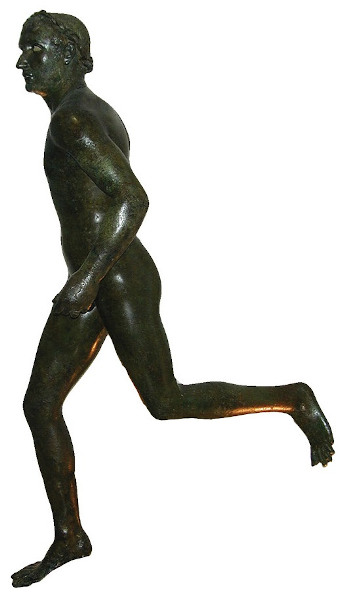
Late Hellenistic period statue of a running athlete. A victor’s crown can be seen on his head. Athletics were very popular during Paul’s lifetime and made an appropriate metaphor for the Christian life. “Do you not know that in a race all the runners run, but only one gets the prize? Run in such a way as to get the prize. Everyone who competes in the games goes into strict training. They do it to get a crown that will not last, but we do it to get a crown that will last forever” (1Co 9:24–25).
Todd Bolen/BiblePlaces.com
Return to the main text.
9:25 crown that will last forever. See 1Pe 5:4 and note; cf. 1Th 2:19 and note.
9:26 not . . . running aimlessly. See Php 3:14 and note.
9:27 I strike a blow to my body and make it my slave. Here Paul uses the figure of boxing to represent the Christian life. He does not aimlessly beat the air, but he severely disciplines his own body in serving Christ. not be disqualified for the prize. Paul realizes that he must with rigor serve the Lord and battle against sin. If he fails in this, he may be excluded from the reward (cf. 2Ti 4:8).
10:1 the cloud . . . the sea. These two watery entities had played a central role in God’s deliverance of Israel out of Egypt through his servant Moses (the cloud signifying God’s guidance [Ex 13:21; 40:36–37; Nu 9:17, 21; 10:11–12; 14:14; Ne 9:12, 19; Ps 78:14] and the sea signifying God’s climactic act of deliverance in which he brought his people safely through the sea but brought judgment on the Egyptians [Ex 14:1—15:20; Dt 11:4; Jos 2:10; Ne 9:9, 11; Ps 66:6; 77:16,19; 78:13,53; 106:9–11; 136:13–15; Isa 43:16–17; 51:10; 63:11–13]). The Israelites’ journey, guided by the cloud, and their safe passage through the sea under the ministry of Moses united them with God’s servant Moses in the working out of God’s redemptive program (see v. 2 and note).
10:2 baptized. The figurative language Paul used to depict Israel’s union with Moses in God’s redemptive program is analogous in important ways to the Christian’s union with Christ in his death and resurrection, as signified by Christian baptism (see Ro 6:3–4 and note).
10:3–4 spiritual food . . . spiritual drink. The manna and the water from the rock (Ex 16:2–36; 17:1–7; Nu 20:2–11; 21:16) are used as figures representing the spiritual sustenance that God continually provides for his people—as signified in the Lord’s Supper.
10:4 that rock was Christ. The rock, from which the water came, and the manna are here viewed by Paul as symbolic of the spiritual sustenance God’s people experienced already in the wilderness through Christ, the bread of life and the water of life (see Jn 4:14; 6:30–35 and notes). For Christ’s presence with God’s people already in the wilderness, cf. 8:6 and note.
10:5 God was not pleased with most of them. In spite of the remarkable privileges given to the Israelites (vv. 1–4), they failed to obey God, thus incurring his displeasure. Of the adults who came out of Egypt, only Caleb and Joshua were allowed to enter Canaan (Nu 14:22–24, 28–35; Dt 1:34–36; Jos 1:1–2; 14:6–14; Heb 3:16–19).
10:6 as they did. What Paul has in mind is described in vv. 7–10.
10:7 idolaters. Referring to the incident of the golden calf (Ex 32:1–6). The people ate a ritual meal sacrificed to an idol (cf. ch. 8).
10:8 Refers to Israel’s participation in the worship of the Baal of Peor and the sexual practices associated with that worship (Nu 25:1–9). twenty-three thousand. The Hebrew and Greek (Septuagint) texts of Nu 25:9 have 24,000. It is clear that Paul is not striving for exactness but is only speaking approximately.
10:10 do not grumble. As in Nu 16:41. destroying angel. Paul links the angel who brought the plague of Nu 16:46–50—because of the grumbling of the Israelites against Moses and Aaron (Nu 16:41)—with the destroying angel of Ex 12:23.
10:11 written down as warnings. See Ro 15:4 and note. culmination of the ages. The period of time inaugurated by Christ’s death and resurrection and continuing into the future until Christ’s second coming and beyond. It is the period of fulfillment when all that God has been doing for his people throughout all previous ages comes to its fruition in the Messiah in connection with both advents.
10:13 temptation. Temptation in itself is not sin. Jesus was tempted (Mt 4:1–11). Yielding to temptation is sin (see Mt 6:13 and note). endure it. Through God’s enablement to resist the temptation to sin or to endure the trial without falling.
10:14 flee from idolatry. Paul here calls eating meat in the temple idolatry. Corinthian Christians had come out of a background of paganism. Temples for the worship of Apollo, Asclepius, Demeter, Aphrodite and other pagan gods and goddesses were seen daily by the Corinthians as they engaged in the activities of everyday life. The worship of Aphrodite was a particularly strong temptation (see note on 6:18; cf. 1Jn 5:21 and note).
10:16 cup of thanksgiving. The cup of wine that Christians drink during the celebration of the Lord’s Supper (see Mt 26:27–28; Mk 14:23–24 and note; Lk 22:20). Drinking the wine of the Lord’s Supper as an act of faith is a claim of personal participation in the benefits of Christ’s shed blood. bread that we break. The loaf of bread that is broken and eaten during the Lord’s Supper (see Mt 26:26; Mk 14:22 and note; Lk 22:19 and note). participation in the body of Christ. The sense is similar to Paul’s statement concerning “participation in the blood of Christ.”
10:17 one loaf. Many believers partaking of one loaf of bread symbolizes and encourages the unity of the body of Christ, the church, which is nourished by the one bread of life (cf. Jn 6:33–58).
10:18 those who eat the sacrifices participate in the altar. When the people of Israel ate part of the sacrifice made at the altar (Lev 7:15; 8:31; Dt 12:17–18), they participated with the altar in consuming the sacrifices. What was consumed on the altar (with fire) was Yahweh’s portion.
10:19 Do I mean . . . that an idol is anything? See 8:4–6 and notes.
10:20 sacrifices of pagans. Paul forbids eating food sacrificed to idols in the context of pagan temple worship. For two other scenarios, see vv. 25–27. offered to demons. In reality, demons (not gods) were the objects of idol worship. God’s people are warned that if they do eat meat sacrificed to idols, they should not eat it with pagans in their temple feasts, for to do so is to become “participants with demons.”
10:22 arouse the Lord’s jealousy. By sharing in pagan idolatry and worship (cf. Ex 20:5 and note).
10:23 not everything is constructive. See 6:12 and note. Personal freedom and desire for one’s rights are not the only considerations. One must also consider “the good of others” (v. 24; cf. 8:1; Gal 6:2).
10:25 Eat anything sold in the meat market. The marketplace is a second scenario where idol meat might be encountered (see notes on vv. 20,27). Even if it has been sacrificed to an idol, food purchased in the public market may be eaten since it has lost its pagan religious significance. The food has no inherent connection to the idol since “the earth is the Lord’s, and everything in it” (v. 26).
10:26 A quotation from Ps 24:1 used at Jewish mealtimes as a blessing (cf. Ps 50:12; 89:11).
10:27 If an unbeliever invites you to a meal. This third scenario (see notes on vv. 20,25) shifts from the marketplace to a meal in a private residence. eat whatever is put before you. Whether or not it might be meat sacrificed to idols, ask no questions. As long as the subject has not been brought up, you are free to eat the meat.
10:28 for the sake of the one who told you. If the meat has been identified as meat sacrificed to idols and you eat it, the informant might think you condone or even are willing to participate in the worship of idols. for the sake of conscience. So as not to cause someone else (v. 29) to think it is all right to eat meat sacrificed to idols even though they have doubts about it.
10:29 my freedom. Cf. Ro 14:16 and note. The exercise of one’s personal freedom is to be governed by whether the action will bring glory to God, whether it will build up the church of God and whether it will encourage the unsaved to receive Christ as Savior and Lord (vv. 31–33). Verses 28–29a have been somewhat parenthetical; v. 29b resumes Paul’s line of thinking from v. 27.
10:30 something I thank God for. Paul could thank God for meat that had been sacrificed to idols, for the idol is nothing and the meat is a part of God’s created world.
10:31 all for the glory of God. The all-inclusive principle that governs the discussion in chs. 8–10 is that God should be glorified in everything the Christian does (see note on Ro 16:27).
10:32 Do not cause anyone to stumble. Living to glorify God will result in doing what is beneficial for others, whether non-Christians (“Jews, Greeks”), or Christians (“the church of God”).
10:33 please everyone in every way. Paul will do nothing that might hinder someone else from receiving the salvation proclaimed in his gospel. that they may be saved. See 9:22.
11:1 Notice the order: (1) Christ is the supreme example (cf. 1Pe 2:21); (2) Christ’s apostle follows his example (“as I follow”); (3) the Corinthians are to follow the apostle’s example. This sentence is a concise summary of the essence of discipleship.
11:3–16 The subject of this section is propriety in public worship. Paul is concerned with head coverings related to men and women in Corinthian worship; however, much remains uncertain. As in the previous section, he desires that all be done to the glory of God (10:31).
11:3 head. Some understand the term “head” as indicating origins. Thus God is the source of Christ (sometimes referred to as the doctrine of eternal generation); Christ is the source of man (see Ge 2:4–9; cf. 1Co 8:6); man is the source of woman (Ge 2:18–23), although Paul will point out that a woman can be regarded as the source of a man as well (vv. 8–9,11–12). Others understand “head” to refer primarily to the concept of honor, in that one’s physical head is the seat of one’s honor (cf. vv. 4–5). Thus as Christ honored God, each man is to honor Christ, and each woman is to honor her husband. Still others see in the word “head” the idea of authority (which would also include the concept of honor). They point out that Paul clearly uses the term in the sense of authority in Eph 1:21–22 (“under his feet”; “head over everything”), in Eph 5:22–23 (where headship is seen in a context of submission) and in Col 1:18; 2:10. Thus as Christ has authority over “every man” and is therefore to be honored by them, so the husband holds a position of authority and is therefore to be honored by his wife. See NIV text note; see also notes on vv. 5–6; 15:28.
11:4–7 See NIV text note for another interpretation of this passage related to hair length rather than head covering.
11:4 The first use of “head” in this verse refers to a man’s physical head; the second refers to his spiritual Head (Christ)—or perhaps is intended in a double sense. In the culture of Paul’s day, men uncovered their heads in worship to signify their respect for and submission to deity. When a man prayed or prophesied with his head covered, he failed to show the proper attitude toward Christ. prophesies. See 12:10 and note.
11:5–6 Paul’s message to women was: Show respect for and submission to your husband by covering your head during public worship. Some find a lasting principle in the passage requiring wives, in all ways, to show respect for husbands by submitting to their authority—not merely by a particular style of attire but by godly lives. Man, who was created first, is to have authority over his wife (1Ti 2:11–14), who was made out of his body (Ge 2:21–24) to be his helper and companion (Ge 2:20). She is to honor her husband by submitting herself to him as her head (v. 3).
Others see these verses not as a mandate for all marriages but as reflecting marriage relationships at that time in Corinth and therefore giving a reason why the women there should have covered their heads (v. 10). They point to vv. 11–12 as a contrast, emphasizing equality and mutual dependence between men and women who are “in the Lord” (v. 11; see Gal 3:28; 1Pe 3:7).
Paul’s Call for Head Coverings During Worship
The reasons for Paul’s insistence upon head coverings for women during worship are much debated. Some claim the head covering functioned as a sign of submission to one’s own husband. Others say it functioned as a symbol of the woman’s authority to pray and prophesy.
While it has usually been assumed that Paul is addressing women who are objecting to head coverings (perhaps to express their newfound Christian freedom), it may be that Christian women preferred to wear a head covering as protection against unwanted glances and advances, but that they were being encouraged by others (certain men) to worship with their heads uncovered as an expression of their freedom in Christ. If this is the case, the directive that a woman “have authority over her own head” (v. 10) would allow her to exercise her choice to wear a head covering.
This difficult passage has been applied in contemporary contexts in a variety of ways. Some understand Paul’s words to be a universal mandate that women in all cultures and times should wear a head covering in worship. Others see the head coverings as a particular cultural application of the principle that wives should submit to the authority of their husbands and to male leadership in the church (see 1Ti 2:11–14). In this case, while head coverings are not a universal mandate, submission is. Evidence for this view would be Paul’s reference to the order of creation of men and women in vv. 7–9.
Still others see these verses not as a universal mandate for either head coverings or female submission, but rather as a call for general propriety in worship, however that is expressed in a particular context. While in Corinth such reverence was to be expressed through head coverings, in other times and places it may be expressed differently. Evidence for this view is the fact that vv. 7–9 are balanced by vv. 11–12, emphasizing equality and mutual dependence between men and women who are “in the Lord” (v. 11; see Gal 3:28; 1Pe 3:7).
Go to the Articles Index.
11:7 Paul picks up his statement in verse 3 about headship to make a symbolic argument. Since the “head” of the man is Christ, the man’s head should be uncovered to reveal Christ’s glory. Since the “head” of the woman is the man, the glory of man (now meaning humanity) should be covered. See article.
God’s Image and Glory in Men and Women
1Co 11:7 has long puzzled readers. Is Paul claiming that women are not created in God’s image as men are? This is extraordinarily unlikely, because Paul was steeped in the OT and would have known Ge 1:27 well, which states that both male and female are made in God’s image. Indeed, the fact that Paul does not state that the woman is made in the image and glory of man shows that he understands this.
Some think that this verse supports the subordination of women (or wives) to men (or their husbands). Men reflecting God’s glory but women reflecting (only) the man’s glory is seen as pointing in this direction. Others think there is an explanation limited to the culture in and around Corinth: e.g., long wavy hair on men was often seen as effeminate, whereas on women it was considered beautiful. On this interpretation, Paul would be saying that women, rather than other men, are the man’s glory.
Perhaps the most common view is that Paul does not want people’s attention directed to women’s hair (commonly viewed as a key to her beauty) during Christian worship, when their attention should be directed toward God and his glory. Because a wife brings glory or honor to her husband when she is attractive, she potentially distracts from the honor to be given to God. This view is held both by many who see an implicit call for wives’ subordination here and by many who do not. Some in each group would add to this explanation the understanding that Paul does not want men or women to try to blur the differences between the genders by their outward appearance.
In cultures where hair and head coverings do not carry the significance they did in Paul’s culture, it is important to ask what forms of outward apparel or appearance of either men or women in a worship service do inappropriately deflect the worshipers’ attention from God.
Go to the Articles Index.
11:10 Paul’s meaning here is obscure. have authority over her own head. See NIV text note, which is understood by some to refer to the woman’s authority as co-ruler with man in the creation (Ge 1:26–27). In this case, Paul may be protecting a woman’s right to cover her head against pressure to remove her head covering. Others take the phrase to refer to the man’s authority as properly recognized by the woman in her head covering. Still others understand Paul as viewing the woman’s head covering as a symbol of protection against the influence of fallen angels. angels. Perhaps mentioned here because they are interested in all aspects of the Christian’s salvation and are sensitive to decorum in worship (cf. Eph 3:10 and note). But see previous note on this verse.
11:13–14 proper . . . the very nature of things. “Nature” here perhaps means “culture.” Believers must be conscious of how their actions appear in their culture, in light of what is considered to be honorable behavior.
11:16 In worship services, Paul and the churches in general followed the common custom of the men wearing short hair and the women long hair. Paul was basing his remarks, particularly in vv. 13–16, on common custom in the churches.
11:17 no praise. Contrast v. 2.
11:18 divisions. Paul had already dealt with one aspect of these divisions (1:10–17).
11:19 God’s approval. As deplorable as factions may be, they serve one good purpose: They distinguish those who are faithful and true in God’s sight.
11:20 not the Lord’s Supper you eat. Their intention was to eat the Lord’s Supper, but it was profaned by their gluttony and discrimination.
11:21 remains hungry . . . gets drunk. The early church held the agape (“love”) feast in connection with the Lord’s Supper (cf. 2Pe 2:13 and note; Jude 12). At Corinth the economic and social discrimination of the first century was having its effect. Banquets in the Greco-Roman world were rituals of social status, where a person’s status in the community would be demonstrated by their position at the table and the quality of the food they were served. People would hold banquets to honor influential people in the hopes of being invited back by the rich and famous to their banquets. Evidently, the rich people in the Corinthian church were arriving early to enjoy the best food, which was gone by the time the poor arrived. So the rich were drunk and the poor were left hungry. Paul is appalled. The gospel should bring equality, especially at the celebration of the Lord’s Supper, the most sacred time of worship for the church.
11:22 Shall I praise you? See v. 17.
11:23–26 Observe the similarity of Paul’s words here with Mt 26:26–29; Mk 14:22–25; and especially Lk 22:17–20.
11:23 I received from the Lord. Paul does not necessarily mean that he received the message about the Lord’s Supper directly from Christ. The information may have been passed on to him by others who had heard it from Jesus (see 15:3 and note; cf. 7:10 and note).
11:24 had given thanks. The Jewish practice at meals. This makes it a true Eucharist (“thanksgiving”). is. See note on Lk 22:19. my body. The bread is a symbol of Christ’s body “given” for sinners (Lk 22:19; see note there). for you. See note on Lk 22:19. in remembrance of me. As the Festival of Passover was a commemorative meal (Ex 12:14), so also the Lord’s Supper is a memorial supper, recalling and portraying Christ’s death for sinners.
11:25 after supper. After the Passover supper. The Lord’s Supper was first celebrated by Jesus in connection with the Passover meal (cf. Mt 26:18–30 and parallels in Mark and Luke). cup. A symbol of the new covenant in Jesus’ blood (see Mk 14:24 and note; Lk 22:20; cf. Jer 31:31–34 and note on Heb 8:8–12). (The old covenant was the Mosaic or Sinaitic covenant; see Ex 24:3–8 and notes on 24:6,8; see also articles here and here.) By the use of this covenant sign God signifies his bestowal of salvation upon his people, sealed and paid for by the shedding of Jesus’ blood.
11:26 whenever you eat . . . and drink. The Lord’s Supper should be held periodically, but there is no explicit instruction as to how often. you proclaim the Lord’s death. The Lord’s Supper is never celebrated apart from a proclamation of “Christ crucified” (1:23; cf. 2:2). until he comes. Cf. Mt 26:29; Lk 22:16 and notes.
11:27 in an unworthy manner. In the unloving and self-centered manner that characterized some of the Corinthians at their unruly agape supper (vv. 20–22; see note on v. 21).
11:28 examine themselves. All participants should test the attitude of their own hearts and actions and their awareness of the significance of the Supper, thus making the Supper, under God, a spiritual means of grace.
11:29 without discerning the body of Christ. The word “body” may refer to the Lord’s physical body, the church as the body of Christ (see 12:13,27 and notes), or both. The first view means that the person partakes of the Lord’s Supper without recognizing that it symbolizes Christ’s crucified body. The second view means that the participant is not aware of the nature of the church as the body of Christ and the importance of caring for its poorest members, resulting in the self-centered actions of vv. 20–21. judgment. Not God’s eternal judgment, which is to come on the unbeliever, but such disciplinary judgments as physical sickness and death (v. 30).
11:30 have fallen asleep. Have died. See Jn 11:11 and note.
11:32 disciplined. As God’s redeemed children we are disciplined—just as parents discipline their children (see Heb 12:5–11 and notes).
11:33 gather to eat. Another reference to the agape fellowship meal (see note on v. 21). Each person was to exercise restraint and wait to eat with the others. Those who are too hungry should satisfy their hunger at home and not bring selfish and discriminatory practices into the church (v. 34).
12:1 Now about. Suggests that Paul is answering another question raised by the Corinthians in their letter (cf. 7:1; 8:1; 16:1). gifts of the Spirit. See 1:7 and note.
12:2 led astray to mute idols. At one time the Corinthians had been led by various influences to worship idols that had no life (see 8:4–6 and notes), but now they are to be led by the living Holy Spirit.
12:3 “Jesus be cursed” . . . “Jesus is Lord.” Those who are regenerated by the Holy Spirit cannot pronounce a curse on Jesus; rather, they are the only ones who can confess from the heart, “Jesus is Lord” (cf. Jn 20:28; 1Jn 4:2–3). The Greek word for “Lord” here is used in the Septuagint (the pre-Christian Greek translation of the OT) to translate the Hebrew name Yahweh (“the LORD”). See note on Ro 10:9.
12:4–6 same Spirit . . . same Lord . . . same God. These verses, reflecting the Trinity (see note on Mt 28:19), show the diversity and unity of spiritual gifts.
12:4 gifts. Gifts of grace produced by the indwelling Holy Spirit. See note on v. 1.
12:5 service. The Greek word in its various forms is used to indicate service to the Christian community, such as serving meals (Ac 6:2–3); it is also the word used in the early church for the office of deacon (Php 1:1).
12:6 working. The Greek word indicates power in operation that produces visible results.
12:7 to each one the manifestation . . . given for the common good. Every member of the body of Christ has been given some spiritual gift that is an evidence of the Spirit’s working in their lives. All the gifts are intended to build up the members of the Christian community (1Pe 4:10–11). They are not to be used for selfish advantage, as some in the Corinthian community apparently were doing.
12:8 To one . . . to another. Not everyone has the same gift or all the gifts. message of wisdom . . . knowledge. Gifts that meet the need of the Christian community when knowledge or wisdom is required to make decisions or to choose proper courses of action.
12:9 faith. Not saving faith, which all Christians possess, but faith to meet a specific need within the body of Christ. gifts of healing. Or “gifts of healings.” The double plural may suggest different kinds of illnesses and the various ways God heals them.
12:10 miraculous powers. In Scripture, miracles are events that in the eyes of those who experienced and/or witnessed them clearly evidenced God’s power purposefully at work in a way beyond the usual or the expected. prophecy. A message imparted to a believer by the Holy Spirit. It may be a prediction (cf. Agabus, Ac 11:28 [see note there]; 21:10–11) or an indication of the will of God in a given situation (cf. 14:1–5,29–30 and notes; Ac 13:1–2 and note on 13:1). distinguishing between spirits. Since there can also be false prophecies that come from evil spirits, this gift is necessary in order for the church to distinguish the true from the false (cf. 1Jn 4:1–6). different kinds of tongues. Since the Greek word for “tongues” is elsewhere used to refer to “languages” or “dialects,” some understand this to refer here to the ability to speak in human languages not learned by other means, as the apostles did on the day of Pentecost (see Ac 2:4, 6,11 and notes; cf. also 1Co 14:9–10). Others believe that in chs. 12–14 the term “tongues” refers to both earthly and heavenly languages, including ecstatic languages of praise and prayer (see 13:1; 14:2,10 and notes). interpretation of tongues. The ability to make intelligible the sense of what is spoken in a tongue so that hearers can understand and be edified (cf. 14:5,13,27–28).
12:11 as he determines. The Holy Spirit sovereignly determines which gift or gifts each believer should have.
12:12 one . . . many parts. This example illustrates the unity and diversity of the different spiritual gifts exercised by God’s people, who are all members of the one body of Christ. with Christ. With Christ’s body, the church, of which he is the head (Eph 1:22–23; cf. Ro 12:4–8 and notes).
12:13 Cf. Ro 6:3–4 and note. all baptized by one Spirit so as to form one body. Regenerated by the Holy Spirit (Jn 3:3,5) and united with Christ as part of his body. The word “all” suggests that this happened to every Corinthian Christian at the moment of salvation. Jews or Gentiles. In Christ there is no ethnic or cultural distinction (see Gal 3:28 and note). slave or free. No social distinction. all given the one Spirit to drink. God has given all his people the Holy Spirit to indwell them (6:19) so that their lives may overflow with the fruit of the Spirit (Gal 5:22–23; cf. Jn 7:37–39).
12:14 See Ro 12:4–8. As the human body must have diversity to work effectively as a whole, so the members of Christ’s body have diverse gifts, the use of which can help bring about the accomplishment of Christ’s united purpose.
12:15–20 Addressed mainly to those who feel that their gifts are inferior and unimportant. Apparently the more spectacular gifts (such as tongues) had been glorified in the Corinthian church, making those who did not have them feel inferior.
12:18 Paul stresses the sovereign purpose of God in diversifying the parts of the body; by implication he is saying that God has arranged that different Christians in the body of Christ exercise different spiritual gifts, not the same gift. And this diversity is intended to accomplish God’s unified purpose. God’s method employs diversity to create unity.
12:21–26 Addressed mainly to those who feel that their gifts are superior and most important (see note on vv. 15–20). These verses provide another indication that some gifts, like tongues, had been magnified as being preeminent.
12:21 The principle here is the interdependence of the parts of the body in the one whole. Christians in the body of Christ are mutually dependent as they exercise their distinctive functions.
12:22 weaker are indispensable. Christians who seem to have less important functions in the body of Christ are actually indispensable.
12:23 Sometimes what we regard as not very important is, in fact, very important indeed. This is true for some of our less visible body parts and is true for some members of the church who have less visible gifts.
12:24 Persons with more spectacular gifts do not necessarily need to be given special honor.
12:25 no division. See 1:10–12.
12:26 every part suffers. In the body of Christ if one Christian suffers, all the Christians are affected (cf. Ac 12:1–5—the martyrdom of James and the imprisonment of Peter).
12:27 you are the body of Christ. Addressed to the local church at Corinth. Each local church is the body of Christ, just as the universal church is Christ’s body.
12:28 See chart. The list here differs somewhat from that in vv. 8–10 (see notes there). Paul notes three of the gifts of Eph 4:11 (see note there), then five of the spiritual gifts listed in vv. 8–10. The apostles and prophets were part of the foundation of the church (see Mt 16:18; Eph 2:20 and notes), and teaching was associated with the pastoral office (see Eph 4:11 and note; 1Ti 3:2). These three gifts are listed as “first,” “second” and “third,” indicating either their importance in the church or the sequence in which they are needed in church planting. The rest of the list is introduced with “then,” indicating the variety that follows. Paul’s lists of spiritual gifts seem to be largely random samples. Apart from v. 28a he does not rank them in importance since he has already insisted that all gifts are important (vv. 21–26). apostles. Those chosen by Christ during his earthly ministry to be with him and to go out and preach (Mk 3:14). They were also to be witnesses of the resurrection (Ac 1:21–22). The term was occasionally used in a broader sense (see Mk 6:30; Ac 14:4; Ro 16:7 and notes). miracles . . . healing . . . tongues. See notes on vv. 9–10. helping. Any act of helping others may be the product of a spiritual gift (see Ro 12:6–8 and notes), though the primary reference here is probably to a ministry to the poor, needy, sick and distressed (cf. Ac 6:1–6). guidance. Those with the gift of guidance (or administration) were enabled by the Holy Spirit to organize and project plans and spiritual programs in the church.
12:29–30 Are all apostles? Expects a negative answer. Christians have different gifts, and no one gift should be expected by everyone, nor should one person be expected to have all the gifts.
12:31 eagerly desire the greater gifts. See 14:1–5 and notes. the most excellent way. Paul now shows the right way to exercise all spiritual gifts—the way of love. He does not identify love as a gift; rather, it is a fruit of the Spirit (Gal 5:22).
13:1–3 tongues . . . prophecy . . . knowledge . . . faith . . . give. Paul selects five gifts as examples. He declares that even their most spectacular manifestations mean nothing unless motivated by love.
13:1 tongues of men or of angels. Based on this verse, some interpreters believe that the tongues here are angelic languages. But Paul here may be using hyperbole. Even if he could speak not only the various languages of human beings but even the languages used by angels—if he did not speak in love, it would be nothing but noise. love. The Greek for this word (agape) indicates a selfless concern for the welfare of others. It is like Christ’s love manifested on the cross (cf. Jn 3:16; 13:34–35; Eph 5:2,25; 1Jn 3:16).
13:2 all mysteries and all knowledge. Again Paul uses an extreme example to express the amount of understanding possessed. Even if he is gifted with unlimited knowledge—if he does not possess and exercise that knowledge in love, he is nothing. faith that can move mountains. A special capacity to trust God to remove or overcome overwhelming threats or insurmountable obstacles (cf. Zec 4:7; Mt 17:20 and notes). Again Paul uses hyperbole.
13:3 give over my body to hardship. A reference to bodily sufferings (cf. 2Co 11:23–29; 12:10 and notes; cf. also NIV text note). Even such suffering, if not motivated by love, accomplishes nothing.
13:4–7 Love is now described both positively and negatively.
13:4 not proud. See 8:1 and note.
13:5 It does not dishonor others. Perhaps an indirect reference to their unruly and dishonorable conduct in worship (11:18–22).
13:6 does not delight in evil. As they were doing in ch. 5.
13:8 never fails. Never comes to an end, is never replaced by anything else (see v. 13 and note). prophecies . . . will cease; . . . tongues . . . will be stilled; . . . knowledge . . . will pass away. These three will cease because such gifts of divine communication will be unnecessary when what is complete has come (v. 10) and we see the Lord face to face (v. 12).
13:10 completeness. The Greek for this word can mean “end,” “fulfillment,” “completeness” or “maturity.” In this context the contrast is between the partial and the complete. Verse 12 seems to indicate that Paul is here speaking of either Christ’s second coming or a believer’s death, when they will see Christ “face to face” (v. 12). Some interpreters translate this term “the perfect” and consider it to refer to the canon of Scripture, claiming tongues ceased when the canon was complete. This interpretation is unlikely, however, since the close of the canon did not result in perfect knowledge nor a face-to-face encounter with Christ (vv. 12–13). Cf. also 1:7, where believers have all the gifts until Christ returns.
13:12 we see only a reflection as in a mirror. The imagery is of a polished metal (probably bronze) mirror in which one could perceive only an imperfect reflection (cf. Jas 1:23)—in contrast to seeing the Lord directly and clearly in the new creation. know fully . . . fully known. The Christian will know the Lord to the fullest extent possible for a finite being. The believer’s understanding of the Lord and his gifts will approach the Lord’s understanding of the believer. This will not be true until the Lord returns or the believer sees him “face to face” at death.
13:13 remain. Now and forever. faith, hope and love. See 1Th 1:3 and note. the greatest of these is love. True because God is love (1Jn 4:8) and has communicated his love to us (1Jn 4:10,19) and commands us to love one another (Jn 13:34–35; cf. Ro 13:10; 1Co 8:1; Gal 5:6; Eph 4:16; 5:20; Php 1:9; Col 3:14; 1Pe 4:8). Love supersedes the gifts because it outlasts them all. Long after these sought-after gifts are no longer necessary, love will still be the governing principle that controls all that God and his redeemed people are and do.
14:1–5 The basic principle Paul insists on is that whatever is done in the church must contribute to the edification (building up) of the body. This is in keeping with the declaration in 12:7 that gifts are “given for the common good.” It also is in agreement with the principle of love (ch. 13). What is spoken in the church, then, must be intelligible—it must be spoken in the vernacular language or at least be interpreted in the vernacular. Prophecy is therefore more desirable than tongues (unless an interpreter is present) because prophecy is spoken in the native language of the listeners.
14:1 way of love . . . gifts of the Spirit. Love is the means by which such gifts are made effective. prophecy. See note on 12:10.
14:2 tongue. See NIV text note. The hearers cannot understand what those who speak in a tongue are saying. Therefore what they say is a mystery unless it is interpreted. Only God understands it.
14:3 In prophesying the speaker can strengthen, encourage and comfort others (see 12:7 and note).
14:4 edifies themselves. Since we were created to serve God, the use of our spiritual gifts naturally results in personal edification in the area of the emotions, of deepening conviction, of fuller commitment and greater love.
14:5 like . . . you to speak in tongues. Paul was not opposed to speaking in tongues if it was practiced properly. The one who prophesies is greater. Because those who prophesy serve the common good more effectively since what they say can be understood and thus edifies the church. unless someone interprets. If those speaking in tongues also have someone present with the gift of interpretation, their speaking is as beneficial as prophecy, for then it can be understood (v. 13).
14:6 what good will I be . . . ? It would be useless to speak in tongues unless, by interpretation, one brings the church something understandable and edifying.
14:7 distinction in the notes. For a person to recognize the tune and to understand and appreciate it, there must be a variety of notes so arranged as to create a meaningful tune. One note repeated monotonously cannot accomplish this.
14:8 trumpet . . . ready for battle. All Greeks would be acquainted with the use of the trumpet for battle signals (cf. Homer’s Iliad, 18.219), and the Jews would be familiar with the use of the ram’s horn (Nu 10:9; Jos 6:4,9). Again, the notes sounded must convey a message.
14:9 speak intelligible words. Speak in the vernacular language of the listeners rather than in a tongue (or else provide an interpretation).
14:10 all sorts of languages. Some see vv. 10–11 as an indication that the tongues of chs. 12–14 were languages otherwise unknown to the speakers; others do not.
14:12 excel in those that build up the church. The basic principle of ch. 14, as well as ch. 12.
14:14 mind is unfruitful. When a person speaks in tongues or prays in tongues, the human mind does not comprehend what is said.
14:15–17 pray . . . sing . . . praising God . . . say “Amen” . . . thanksgiving. Elements employed in OT (1Ch 16:36; Ne 5:13; 8:6; Ps 104:33; 136:1; 148:1) and NT (Ro 11:36; Eph 5:18–20) worship. “Amen,” meaning “It is true” or “So be it,” is the believer’s confession of agreement with and commitment to the words spoken (see Ro 1:25 and note). Thus it is important that a message in tongues be interpreted.
14:15 pray with my spirit . . . with my understanding . . . sing with my spirit . . . with my understanding. May mean that Paul will sometimes pray or sing with his spirit in a tongue; at other times he will pray or sing with his understanding in his own language. Others believe that Paul was declaring his intention to pray or sing with both understanding and spirit at the same time.
14:19 But in the church. Some believe that an interpretation is unnecessary when the gift of tongues is being used as a private prayer language. They base such a distinction on v. 18 (v. 14) when compared with the phrase “in the church.”
14:20 In regard to evil be infants. Behaving like an infant could mean either innocence or immaturity. Paul tells the Corinthians to act like infants (be innocent) when it comes to evil, but be adults (mature) when it comes to using their spiritual gifts.
14:21–22 The passage from Isa 28 indicates that the foreign language of the Assyrians was a sign to unbelieving Israel that judgment was coming on them. Paul deduced from this fact that tongues were intended to be a sign of judgment for unbelievers (cf. v. 22 and note), as, e.g., in Ac 2:4–12. Similarly, prophecy was for the benefit of believers (v. 22) since it communicated revealed truth to those disposed to receive it (cf. Mt 13:11–16).
14:21 the Law. See Jn 10:34; 12:34 and note; 15:25; Ro 3:19 and note.
14:22 Tongues . . . a sign . . . for unbelievers. A sign of God’s judgment because they cannot understand the tongues on their own and would leave the meeting unconverted.
14:23 inquirers. Perhaps those who had become “inquirers” concerning the gospel but as yet did not really understand (see v. 16 and NIV text note there). unbelievers. Those who have made no movement toward saving faith. The context is a meeting of the church in which everyone is speaking in tongues, with the result that general confusion reigns. out of your mind. The visitors will be repulsed by the confusion, and the phenomenon meant to be an impressive sign will have a negative effect on the unsaved.
14:24 everyone is prophesying. Prophecy, spoken in the vernacular language and intended for believers, turns out to have a positive effect on unbelievers because they hear and understand and are convicted of their sins. (Yet see restrictions on prophesying in vv. 29–32 and notes there.)
14:26–27 each of you . . . anyone . . . someone. The stress here is again on the diversity and yet complementary nature of spiritual gifts. It is also apparent that every member could participate in worship, not just certain leaders or officers.
14:26 a hymn, or a word of instruction, a revelation, a tongue or an interpretation. Elements that made up the worship service at Corinth (see note on vv. 15–17). Some of these elements (the hymn and the word of instruction) came from OT and synagogue worship (Lk 4:16–22). All parts of Christian worship should be edifying to the church (“that the church may be built up”).
14:27–28 Three restrictions are placed on speaking in a tongue “in the church” (v. 28): (1) Only two or three should do so in a meeting. (2) They should do so one at a time. (3) There must be interpretation.
14:28 the speaker should keep quiet. The implication seems to be that it was up to the one speaking in a tongue in the Corinthian church to make certain that there was in the audience someone to interpret his message.
14:29 Two or three prophets should speak. Apparently in turn (v. 31), as with those who speak in tongues (v. 27). weigh carefully. Judge. The prophets themselves, or perhaps the whole congregation, were to decide whether the messages were valid (see note on v. 32).
14:30 a revelation. Prophecies referred to in chs. 12–14 could come through any member of the church (vv. 26,29–31) and were intended for particular persons in particular circumstances; the “revelation” they contained could be a prediction (Agabus, Ac 11:28; 21:10–11), a divine directive (Ac 13:1–2) or a message designed to strengthen, encourage or comfort (v. 3).
14:32 control of prophets. Prophecy (and tongues as well) was not an uncontrollable emotional ecstasy. Paul insists that these gifts should be controlled by the recipients themselves (vv. 15,26–32). See notes on vv. 27–29.
14:33 God . . . of peace. See 1Th 5:23 and note. disorder. Paul was concerned that disorderly and unregulated worship at Corinth would bring discredit on the name of the God who had called them in Christ to peace and unity. in all the congregations of the Lord’s people. A unique expression in the NT that stresses the universality and commonality of the whole visible church of God on earth. All congregations are to seek peace and not be disorderly. But see NIV text note on vv. 33–34.
14:34–35 See note on 11:3–16. Some believe that in light of 11:3 there is a God-ordained order that is to be the basis for administration and authority. Women are to submit themselves to their husbands, both at home (Eph 5:22) and in the church (v. 34; 1Ti 2:11–12), regardless of their particular culture. According to this view, a timeless order was established at creation (see note on 11:5–6).
Others maintain that Paul’s concern here is that the church be strengthened (v. 26) by believers showing respect for others (vv. 30–31) and for God (see v. 33) as they exercise their spiritual gifts. Such respect must necessarily take account of accepted social practices. If within a particular social order it is considered disgraceful for a woman to speak in church—and it was in this case (v. 35)—then she shows disrespect by doing so and should remain silent. There were occasions, though—even in their culture—for women to speak in church. For example, in 11:5 Paul assumes that women pray and prophesy in public worship. Thus his purpose, according to this view, was not to define the role of women but to establish a fitting (vv. 34–35) and orderly (vv. 27–31) way of worship (v. 40).
Still others say that in this context Paul is discussing primarily the disruption of worship by uneducated women asking basic questions better dealt with elsewhere who became involved in noisy discussions surrounding tongues-speaking and prophecy. Instead of publicly clamoring for explanations, the wives were to discuss matters with their husbands at home (cf. v. 35). Paul does not altogether forbid women to speak in church (11:5). What he is forbidding is the disruptive speaking indicated in these verses. A final view notes that these verses are found in different locations in a few manuscripts of 1 Corinthians, which might indicate that they were not original to Paul but added by later copyists.
14:34 as the law says. This is a puzzling statement, since the OT law nowhere says this. Some interpreters have pointed to Ge 3:16 or 1Pe 3:6 (see note there).
Paul’s command in 1Co 14:34–35 for women to remain silent in the churches is surprising, since elsewhere he assumes women will be praying and prophesying during church services (11:5, 13; cf. Ac 2:17; 21:8–9). Almost everyone, therefore, assumes Paul cannot mean that women must never speak a single word within a given congregation.
What, then, are the main options that interpreters take to explain these verses? Some have argued that because these verses appear in a few manuscripts at the end of the chapter (after v. 40) that Paul did not originally write them at all, but that they were added later by scribes. But no manuscripts lack these verses altogether and it is easy to understand why scribes might move them, because they seem to disrupt Paul’s flow of thought in teaching about spiritual gifts. Some have thought they should be understood as a slogan of some of the Corinthians, rather than Paul’s own words. If this were the case, then they should be put in quotation marks (just as in 1Co 6:12 or 7:1), with vv. 36–38 forming Paul’s outraged response. Yet these verses seem too long and cumbersome for a slogan. Others have suggested that the women were disruptive, perhaps speaking among themselves in a portion of a Jewish synagogue segregated by gender. Still, the evidence for such segregation comes from later rather than NT times, so it is not likely that Christians would have had that kind of model to imitate.
The most likely explanations are two. On the one hand, because many women had not had opportunities for public religious instruction in their Jewish or Greco-Roman contexts, they may have been asking basic questions that disrupted the service in a different way and were better dealt with in private at home. In a world where almost all women came under the authority of a male figure, usually a father or a husband, this may have been workable. On the other hand, Paul’s commands to silence may be limited by the context of the various spiritual gifts Paul has been discussing—namely tongues, interpretation of tongues, and prophecy. In fact, the very last gift he has mentioned is prophecy (vv. 29–33). But, as he explains, prophecy must be evaluated and if there were dissenting evaluations, someone would have to decide if the message was from the Lord. It could be that this task fell to the elders or overseers of the church, since they were in charge of the teaching (1Ti 3:2; 5:17). It would then be silence in this one specific context that Paul was requesting, because he may have envisioned only male elders (based on one interpretation of 1Ti 2:12).
If Paul’s reason for silencing the women in this passage had to do with situation-specific matters that no longer exist in a particular subculture in our world today, then it would appear that Paul’s commands would apply today to any situation that caused a disruption to the worship service. His concern is to establish a fitting (vv. 34–35) and orderly (vv. 27–31) way of worship (v. 40). The church should be strengthened (v. 26) by believers showing respect for others (vv. 30–31) and for God (see v. 33) as they exercise their spiritual gifts. Such respect must necessarily take account of accepted social practices. If, on the other hand, within a particular social order it is considered disgraceful for a woman to speak in church (v. 35), then she shows disrespect by doing so and should remain silent. And if there was a certain leadership office that Paul believed was limited to men, then she should not seek to occupy it. But this last point will have to be determined based on other texts. There is not enough evidence in these two verses alone to narrow down the options any further.
Go to the Articles Index.
14:36 Paul asks these rhetorical questions sarcastically, suggesting that the Corinthians were following their own practice in these matters rather than conforming to God’s word.
14:37 the Lord’s command. Paul’s commands are the Lord’s commands and are to be followed. In a situation where so much stress was being placed on gifts, Paul insists that any genuinely gifted person will recognize the apostle’s God-given authority.
14:38 will themselves be ignored. By Paul and the churches, or by God.
14:39 brothers and sisters. See NIV text note on 1:10. do not forbid speaking in tongues. Paul’s solution to the tongues problem in the Corinthian church was not to forbid tongues but to correct the improper use of the gift.
14:40 a fitting and orderly way. As spelled out in vv. 26–35.
15:1–58 When Paul began this letter to the Corinthians, he foregrounded the cross of Christ (1:17–18)—“We preach Christ crucified” (1:23); “I resolved to know nothing while I was with you except Jesus Christ and him crucified” (2:2; cf. 15:3–4). Now, as he nears the end of his letter, he develops at length the essential truth of Christ’s resurrection, a reality assumed throughout the letter as a whole.
15:1,50 brothers and sisters. See NIV text note on 1:10.
15:1 gospel. See note on Mk 1:1.
15:2 if you hold firmly. See Heb 3:14 and note. believed in vain. The gospel Paul preached is the good news of victory over sin through the saving effects of Christ’s death by crucifixion and of his triumph over death in his resurrection. “Christ crucified” (1:23) and “raised from the dead” (15:20) is the only hope for sinful mortals to “inherit the kingdom of God” (v. 50; see vv. 53–57).
15:3 what I received I passed on to you as of first importance. Here Paul links himself with early Christian tradition. He was not its originator, nor did he receive it directly from the Lord. His source was other Christians. The verbs he uses are technical terms for receiving and transmitting tradition (see note on 11:23). What follows is the heart of the gospel: that Christ died for our sins (not for his own sins; cf. Heb 7:27), that he was buried (confirmation that he had really died) and that he was raised victorious from the dead (confirmation of all his claims about himself and his mission). according to the Scriptures. Paul may have had in mind Isa 53:5–6,11–12, as well as passages elsewhere cited with reference to the resurrection, such as Ps 110:1–2 (Ac 2:34) and Ps 16:9–10 (Ac 2:24–31). But he may also have been thinking of the Passover sacrifice and other sin offerings of the OT sacrificial system (see chart).
15:4 on the third day. Cf. Mt 12:40. The Jews counted parts of days as whole days. Thus the three days would include part of Friday afternoon, all of Saturday, and Sunday morning. A similar way of reckoning time is seen in Jn 20:26 (NIV “a week later” or, more formally, “after eight days”); two Sundays are implied, one at each end of the expression. according to the Scriptures. Here Paul may have had in mind passages like Ps 16:9–10 (Ac 2:24–31); Ps 110:1–2 (Ac 2:34); and Isa 53:10–12 (Lk 22:37); cf. Jnh 1:17; Lk 24:44 and note.
15:5–8 Six resurrection appearances of Christ are listed here. The Gospels tell of others (see chart).
15:5 Cephas . . . the Twelve. See NIV text note. The appearance to Peter is the one mentioned in Lk 24:34, which occurred on Easter Sunday. The appearance to the Twelve seems to have taken place on Sunday evening (Lk 24:36–43; Jn 20:19–23). “The Twelve” was a conventional way of referring to the group of original apostles, even though Judas was no longer with them.
15:6 some have fallen asleep. Died; see Jn 11:11; 1Th 4:13 and notes.
15:7 James. Since this James is listed in addition to the apostles, he is not James the son of Zebedee or James the son of Alphaeus (Mt 10:2–3). This is James, the half brother of Jesus (Mt 13:55), who did not believe in Christ before the resurrection (Jn 7:5) but afterward joined the apostolic band (Ac 1:14) and later became prominent in the Jerusalem church (Ac 15:13). It is not clear in Scripture when and where this appearance to James occurred. to all the apostles. Possibly the same as “the Twelve” in v. 5, but given the list-like nature of vv. 5–7, Paul could have a wider group in mind (see also Ac 1:6–11; Ro 16:7 and note).
15:8 last of all. See Ac 9:1–8. This appearance to Paul came several years after the resurrection (perhaps c. ad 33). one abnormally born. This word can refer to a premature birth, a miscarriage or an abortion. The emphasis is on its abnormal nature. Paul was not part of the original group of apostles. He had not lived with Christ as the others had. His entry into the apostolic office was thus not “normal.” Furthermore, at his conversion he was abruptly snatched from his former way of life (Ac 9:3–6).
15:9 I persecuted. See 1Ti 1:13 and note. church of God. In persecuting the church, he was actually persecuting Christ (see Ac 9:4 and note).
15:12–19 The various theological questions behind the discussion of the resurrection in chapter 15 now become clear. Probably because of their dualistic worldview, some at Corinth were saying that there was no resurrection of the body, and Paul draws out the implications of this false contention.
15:12 Christ has been raised. Paul uses the same verb form (that emphasizes Christ’s bodily resurrection) a total of seven times in this passage (vv. 4,12,13,14,16,17,20).
Gnosticism refers to a variety of related religious traditions that became prominent in the Roman Empire especially in the late first century and throughout the second and third centuries. Although its precise origins are unknown, Gnosticism likely arose from ideas associated with the dualistic worldview of the philosophy of Platonism. While we don’t see a full-blown Gnostic system yet developed in the New Testament period, we see early or incipient Gnosticism opposed in various NT letters, like 1 Corinthians, Colossians, and 1 John. There were two key worldview features of Gnosticism.
(1) Dualism between the physical and spiritual worlds. Gnostics drew a strict distinction between the inferior physical (material) world and the true spirit (immaterial) world. The material world was corrupt and illusory, created by a lesser god who had emanated from the one true spirit God. Among Gnostics, this dichotomy sometimes resulted in two opposite extremes: (a) antinomianism (or libertinism), which ignored all social restraints—anything was allowed since it did not affect one’s true spiritual self; or (b) asceticism (often legalistic), which denied physical pleasures since they were fleeting and illusory. The Corinthians were evidently struggling in both areas when Paul worked with them.
(2) Gnosis means “knowledge,” and Gnostics believed salvation came through secret knowledge of their true identity. This knowledge concerned one’s true heavenly origin and spiritual destiny. Gnosticism in general rejected the deity and true humanity of Jesus (since no god would take on an inferior physical body), his sacrificial death on the cross for our sins (since sin is not the problem, ignorance is), and the bodily resurrection (since only a spiritual resurrection would be valued).
Gnosticism was often syncretistic (combining a variety of religious ideas). In the second century, Christian forms of Gnosticism became the greatest rival and spiritual threat to the early church. A number of early church writers, including Justin Martyr, Irenaeus, Clement of Alexandria, Tertullian, and Origen, wrote against the heresy.
Go to the Articles Index.
15:19 If faith in Christ brings benefits only for the present life and not deliverance from the ultimate “wages of sin” (Ro 6:23), then believers are worse off (because they are deluded) than those who live “without hope and without God in the world” (Eph 2:12).
15:20 But Christ has indeed been raised. Paul’s categorical conclusion based on his evidence set forth in vv. 3–8. firstfruits. The first and best of the harvest given to the Lord as a token that all the harvest belonged to him and would be dedicated to him through dedicated lives (see Ex 23:19; Lev 2:12 and notes). So Christ, who has been raised, is the guarantee of the resurrection of all of God’s redeemed people (cf. 1Th 4:13–18 and notes).
15:21 death came through a man. Through Adam (see Ge 3:17–19; Ro 5:12 and note). the resurrection of the dead comes also through a man. Through Christ, the second Adam, “the last Adam” (v. 45; cf. Ro 5:12–21 and note).
15:22 in Adam all die. All who are “in Adam”—i.e., all human beings—suffer death. in Christ all will be made alive. All who are “in Christ”—i.e., who are related to him by faith—will be made alive at the resurrection (cf. Jn 5:25; Ro 5:17–18; 1Th 4:16–17 and note; Rev 20:6).
15:23 each in turn. Christ, the firstfruits, was raised in his own time in history (c. ad 30), and those who are identified with Christ by faith will be raised together at his second coming. His resurrection is the pledge that ours will follow.
15:24 the end. The second coming of Christ and all the events accompanying it. This includes his handing over the kingdom to the Father, following his destroying all dominion, authority and power of the persons and forces opposing him.
15:25 For he must reign. During this process of Christ’s destroying all dominion and handing over the kingdom to the Father, Christ must reign (Rev 20:1–6). Some take this to mean that Christ will literally reign with his people for 1,000 years on the earth (cf. Isa 2:2–4; Mic 4:1–5). Others believe that this refers to Christ’s reign over the course of history and in the lives of his people, who are spiritually raised, or born again. This reign is viewed as continuing throughout the present age. under his feet. An OT figure for complete conquest. Verse 25 is an allusion to Ps 110:1 (cf. Mt 22:44; Ac 2:34; Heb 1:13; 10:13 and notes).
15:26 last enemy. For death as enemy, see Ps 49:14; Jer 9:21; Heb 2:14–15 and notes. The final destruction of death (cf. 2Ti 1:10) will occur as the climax of events when Christ returns (Rev 20:14; 21:4).
15:27 everything under his feet. An allusion to Ps 8:6. For another reading of Ps 8 as ultimately a word about Jesus Christ, see Heb 2:5–9 and notes.
15:28 the Son himself will be made subject to him. The Son will be made subject to the Father in the sense that, administratively, after he subjects all things to his power he will then turn it all over to God the Father, the administrative head. This is not to suggest that the Son is in any way inferior to the Father. All three persons of the Trinity are equal in deity and in dignity. The subordination referred to is one of function (see Jn 4:34; 5:19; 7:16 and notes). so that God may be all in all. The triune God will be shown to be supreme and sovereign in all things (cf. 3:21 and note).
15:29 those . . . who are baptized for the dead. The present tense suggests that at Corinth people were currently being baptized for the dead. But because Paul does not give any more information about the practice, many attempts have been made to interpret the concept. Three of these are: (1) Living believers were being baptized for believers who died before they were baptized, so that they too, in this way, would not miss out on baptism. (2) Christians were being baptized in anticipation of the resurrection of the dead. (3) New converts were being baptized to fill the ranks of Christians who had died. At any rate, Paul mentions this custom almost in passing, using it in his arguments substantiating the resurrection of the dead but without necessarily approving the practice.
15:30 why do we endanger ourselves every hour? Cf. 2Co 11:23–29.
15:31 I face death every day. Paul faced the reality of death daily (cf. 2Co 4:8–12; 11:23–26), and he wanted the Corinthians to know it. boast about you. About their conversion and growth in grace—in spite of their failures (cf. 1Th 2:20).
15:32 I fought wild beasts in Ephesus. This statement can be taken literally or figuratively. But since Ac 19 makes no mention of Paul suffering imprisonment and having to face the lions in Ephesus, it is more likely that the expression means that the enemies in Ephesus were as ferocious as wild beasts. “Let us eat and drink, for tomorrow we die.” See Isa 22:13; an alternative philosophy of life if there is no resurrection.
15:33 A quotation from the Greek comedy Thais written by the Greek poet Menander, whose writings the Corinthians would know (see NIV text note). The contextual application of the quotation is that those who are teaching that there is no resurrection (v. 12) are the “bad company” and that they are corrupting the “good character” of those who hold to the correct doctrine. Cf. Ps 1:1; Pr 22:24–25 and notes.
15:34 stop sinning. Refers to the sin of denying that there is a resurrection and thus doubting even the resurrection of Christ, all of which had a negative effect on the lives they were living. some who are ignorant of God. Even in the Corinthian church. This, Paul says, is a shameful situation.
15:35–49 In discussing the nature of the resurrection body, Paul compares it to plant life (vv. 36–38), to fleshly beings (v. 39) and to celestial and earthly physical bodies (vv. 40–41).
15:36–38 Plant organisms, though organized similarly in their own order, are different; the seed sown is related to the new plant that sprouts, but the new sprout has a different and genuinely new body that God has given it.
15:39 Not all flesh is the same. Although there is much that is similar in the organizational character of fleshly beings, each species is different: humans, animals, birds, fish.
15:40–41 Here the analogy involves inanimate objects of creation: the sun, moon and stars with their differing splendor and the earthly bodies (possibly the great mountains, canyons and seas) with their splendor. In it all, God can take similar physical material and organize it differently to accomplish his purpose.
15:42–44 In applying these analogies, the apostle says that, in the case of the resurrection of the dead, God will take a perishable, dishonorable, weak (and sinful) body—“A natural body” characterized by sin—and in the resurrection make it an imperishable, glorious, powerful body, fit to live eternally with God. There is continuity, but there is also change.
15:44–49 The contrast here between the natural body and the spiritual body again follows from their two representatives (see notes on vv. 21–22). One is the first Adam, who had a natural body of the dust of the ground (Ge 2:7) and through whom a natural body is given to his descendants. The other is the last Adam, Christ, the life-giving spirit (cf. Jn 5:26) who through his death and resurrection will at the second coming give his redeemed people a spiritual body similar to his resurrected, glorified body (cf. Lk 24:36–43; Php 3:21 and notes; 1Jn 3:2).
15:45 a life-giving spirit. Just as the Spirit of God breathed life into the first Adam (Ge 2:7), so now Jesus, the second Adam, is the Spirit who breathes life into his people.
15:49 so shall we bear the image of the heavenly man. Our resurrection bodies will be like Jesus’ resurrection body (Php 3:21).
15:50 Paul’s final argument about the resurrection of the body: God’s redeemed people must have newly organized, imperishable bodies to live with him. “Flesh and blood” stands for the perishable, corrupt, weak, sinful state of human beings (see note on Gal 1:16). Cf. Lk 24:39.
15:51 mystery. Things about the resurrection body that were not understood but are now revealed (see note on Ro 11:25). We will not all sleep. Some believers will not experience death and the grave (see 1Th 4:15 and note).
15:52 in a flash. The change to an imperishable body will occur instantly at the great trumpet call that announces the consummation of redemption (Mt 24:31; 1Th 4:16–17).
15:53–54 clothe itself with . . . clothed with. See note on Ps 109:29.
15:56 The sting of death is sin. It was sin that brought humanity under death’s power (see Ro 5:12–21 and notes). the power of sin is the law. The law of God gives sin its power, for it reveals our sin and condemns us because of our sin (cf. Ro 7:7–12 and notes).
15:57 victory through our Lord Jesus Christ. Refers to victory over the condemnation for sin that the law brought (v. 56) and over death and the grave (vv. 54–55), through the death and resurrection of Christ (cf. Ro 4:25).
15:58 Therefore. Because of Christ’s resurrection and ours, we know that serving him is not empty, useless activity. your labor in the Lord is not in vain. All our efforts in service to Christ are invested in his winning cause. He will also reward us at his second coming (Mt 25:21; Lk 19:17; cf. 1Co 2:7; 2Co 4:17 and notes).
16:1 Now about. Again an answer to one of the matters raised in the letter from the Corinthians (cf. 7:1; 8:1; 12:1). collection. In all three of the letters Paul wrote on his third missionary journey, he discusses this collection for the poor Judean believers (cf. Ro 15:25–28; 2Co 8–9). the Lord’s people. His people at Jerusalem (cf. v. 3; Ro 15:26). Galatian churches. The fact that the Galatian and Macedonian churches (2Co 8:1; 9:1–4) are involved, along with the Corinthians, indicates that the collection of this offering was quite widespread. The Jerusalem believers may have become poverty-stricken because of the famine recorded in Ac 11:28 (c. ad 44 or 46) or because of the persecution of Jerusalem Christians (cf. Ac 8:1).
16:2 On the first day of every week, each one of you should set aside. Every Sunday believers were to bring what they had set aside for the Lord’s work—an amount proportionate to their income. Since it was to be brought on Sunday, the day when Christians gathered for worship (see Ac 20:7; Rev 1:10 and notes), it was probably collected at the worship service rather than at home. Justin Martyr indicates (in his Apology, 1.67–68) that in his time (c. ad 150) offerings were brought to the church on Sundays.
16:3 For proper financial accountability and responsibility these approved men would act as auditors and guardians of the funds the Corinthians gave (cf. Ro 15:26; 2Co 8:16–21 and notes).
16:4 If it seems advisable for me to go also. Possibly to take care of important missionary business or to be there to explain about the gift when it arrives.
16:5 After I go through Macedonia. After leaving Ephesus (v. 8), where he was when he wrote 1 Corinthians, Paul planned to go up to Macedonia, no doubt to visit the Philippians and others in northern Greece, and then to Corinth. He had originally planned to go to Corinth first and then to Macedonia but thought it best to change his plans (2Co 1:12—2:4).
16:6 even spend the winter. Probably the three-month stay in Greece mentioned in Ac 20:3 (see note there). help me on my journey. With supplies and equipment, and certainly with prayers and goodwill. However, Paul had indicated earlier in the letter (9:7–12) that he did not want to be a financial burden to them.
16:8 until Pentecost. The 50th day (Pentecost means “50”) after Passover, when the Jews celebrated the Festival of Firstfruits (Lev 23:10–16)—late spring.
16:9 many who oppose me. Probably a reference to the pagan craftsmen who made the silver shrines of Artemis and to the general populace whom they had stirred up (Ac 19:23–34).
16:10 When Timothy comes. In Ac 19:22 Paul sends Timothy (and Erastus) into Macedonia, after which Timothy was to go on to Corinth (1Co 4:17). see to it that he has nothing to fear. Timothy seems to have been somewhat timid (see 1Ti 4:12; 2Ti 1:7 and notes), and Paul wants the Corinthians to treat him kindly. The Corinthian church could be a divisive and rebellious group, as the events surrounding the writing of 2 Corinthians make clear. See 2 Corinthians: Occasion.
16:11,23 peace . . . grace. See note on Ro 1:7.
16:11 brothers. Possibly including Erastus (cf. Ac 19:22), who was a believer from Corinth and “the city’s director of public works” (Ro 16:23; see note there).
16:12 Now about . . . Apollos. The Corinthians had asked Paul about Apollos (cf. the similar words, “now about,” in 7:1 [“now for the matters”]; 8:1; 12:1; 16:1) and his coming to see them. For other words about Apollos, see 1:12; 3:4–6,22; 4:6; cf. Ac 18:24, 27; 19:1; Titus 3:13.
16:15 household of Stephanas. Some of the few people Paul baptized at Corinth (1:16). They were among the first converts in Achaia (Greece), along with the few individuals in Athens who had believed a short time earlier (Ac 17:34). service. The whole “household of Stephanas” served “the Lord’s people.”
16:17 These were probably the ones who had brought to the apostle the letter from the Corinthians referred to in 7:1. Their coming “supplied what was lacking” from the Corinthians, i.e., the affection of these three brothers supplied the affection Paul desired from the whole Corinthian church.
16:18 refreshed my spirit and yours. Perhaps through their willingness to come to get Paul’s advice and to bring it back to Corinth. At least a new relationship between Paul and the Corinthians was in the making.
16:19 province of Asia. The Roman province (in present-day western Turkey) in which Ephesus and the surrounding cities were located (see Ac 19:10 and note; see also map). During Paul’s long ministry in Ephesus, all in the province of Asia heard the word. The churches of Colossae, Laodicea and Hierapolis (cf. Col 4:13–16; Rev 1:11), which were located on the border of the province of Asia, may be included in the greetings, along with the other churches of Rev 2–3 (see map). Aquila and Priscilla. They had helped Paul found the church at Corinth (Ac 18:1–4). warmly in the Lord. Enthusiastically, as fellow believers. the church that meets at their house. Aquila and Priscilla had left Corinth with Paul and had gone to Ephesus (Ac 18:18–19). Evidently they were still there, and a church was meeting at their house; it now sends greetings. House churches were common in this early period (cf. Ro 16:3–5 and note on v. 5; Phm 2).
16:20 holy kiss. See notes on 2Co 13:12; Ro 16:16. The kiss of mutual respect and love in the Lord was evidently the public practice of early Christians—from a practice that was customary in the ancient Mediterranean world.
16:21 greeting in my own hand. Paul now signs this letter, as was his habit (Gal 6:11; Col 4:18; Phm 19), a mark of the authenticity of the letter (2Th 3:17). Someone else had been penning the letter for him up to this point (cf. Ro 16:22).
16:22 let that person be cursed! May those who have not come to love the Lord Jesus Christ in response to the preaching of the gospel experience God’s displeasure and wrath (see Jn 3:36 and note). Paul’s curse is based on God as witness to the unbelievers’ essential lack of love for the Lord Jesus and of obedience to God (cf. Gal 1:8–9; Ro 9:3 and note). Come, Lord! See NIV text note; an expression used by the early church as a cry that the second coming of Christ may soon take place (Rev 22:20).
16:23 The apostle’s usual benediction (Gal 6:18; Eph 6:24; Php 4:23); a longer Trinitarian benediction is found in 2Co 13:14 (see note there). grace. See note on vv. 11,23. with you. See note on 2Co 13:14.
16:24 Although he has been severe with the Corinthians, Paul wants them to know that he loves them as believers in Christ Jesus. in Christ Jesus. See note on Eph 1:1.