1 Peter
1. Suffering as a Christian (1:1–2:10)
A. The Hidden Inheritance, the Hidden Lord (1:1–9)
B. Preparation for Action (1:10–2:3)
C. The Hidden Spiritual House (2:4–10)
2. At Home, but Not in This World (2:11–3:12)
A. The Christian’s Inner Life (2:11–12)
B. A Life of Submission (2:13–3:7)
C. The Christian’s Corporate Life (3:8–12)
3. Suffering—The Road to Glory (3:13–4:19)
A. Suffering for Doing Good (3:13–22)
C. Sharing the Sufferings of Christ (4:12–19)
4. Final Exhortations and Greetings (5:1–14)
Introduction
Audience and Occasion
Peter’s first letter is called a “General Epistle” in that it was written not to one person or church but to all the churches greeted in 1:1. The precise regions listed are uncertain, for the terms could refer either to the Roman provinces so named or to the old ethnic groups and their associated areas, from which the Romans later adopted their official province names. It is most likely that the names are being used in their “official” sense, so the letter was probably addressed to all the churches in the northern half of Asia Minor (modern Turkey).
It is clear that Peter’s readers were facing persecution for their faith, and this has occasioned debate among scholars on several counts. Who instigated this persecution, and why? Was it official or unofficial? Was the persecution merely a threat, or was it already a reality? The answers to these questions are not easy to determine, but the following seems to be most likely. The persecution was probably unofficial and local, instigated by pagan neighbors of the Christian believers, perhaps with the support of minor local officials. It was certainly a present reality for some, if not all, of Peter’s readers. While the Roman Empire had an ambivalent attitude toward Christianity, and persecution was occasionally launched officially, this was rare compared with spasmodic local outbursts of hatred. And in this letter, the reasons given for the persecution are purely local. Peter mentions, for example, the annoyance caused by the Christians’ refusal to join in riotous festivals (4:4).
Because of this setting, 1 Peter has been called “the Job of the New Testament”—the New Testament book that handles the theme of suffering most directly and intensely.
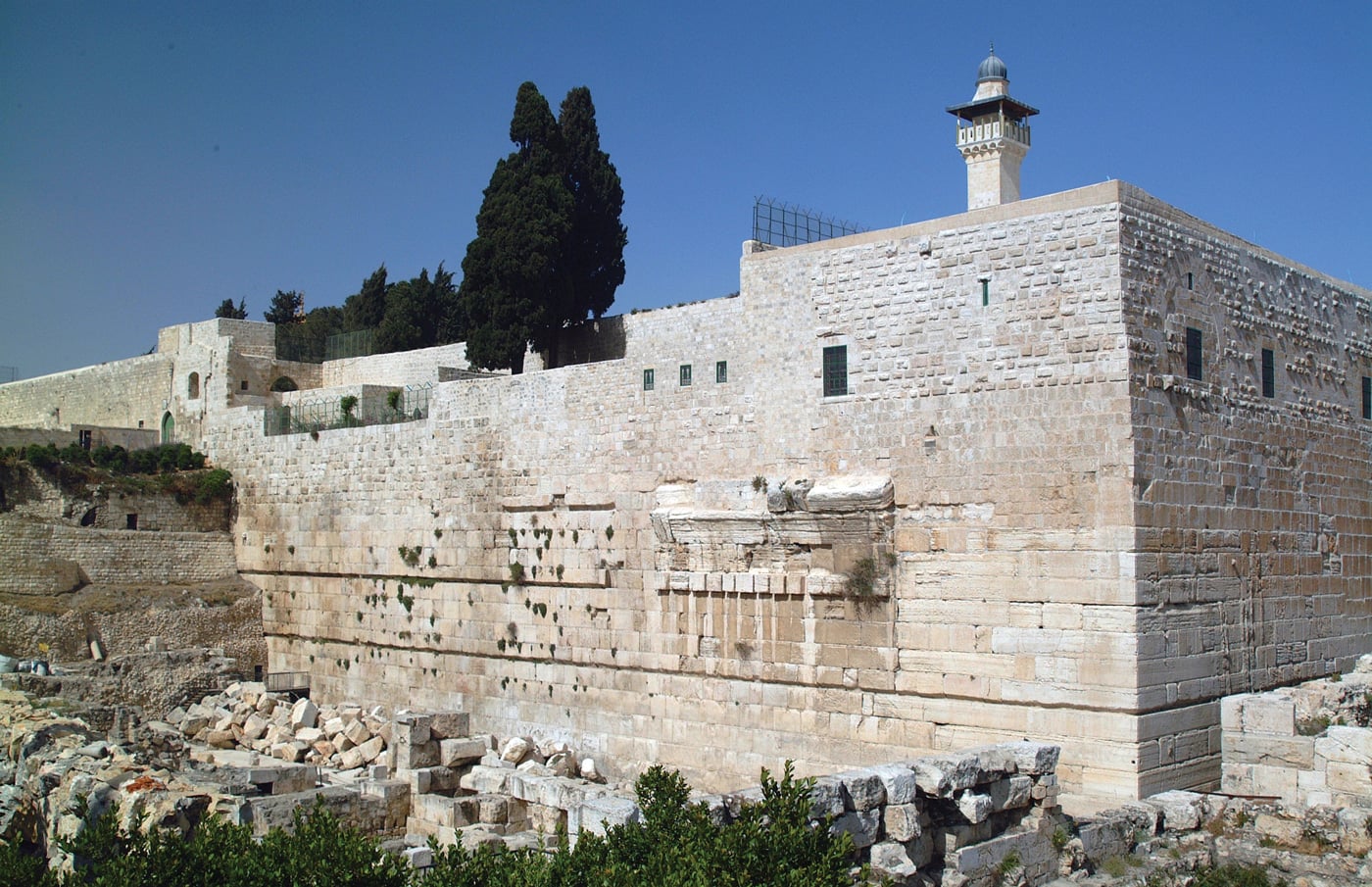
Authorship and Date
Few scholars today hold that the letter was actually written by the apostle Peter, largely on the grounds of style and language. First Peter is one of the finest examples of Greek prose in the New Testament, and scholars argue that Peter, who was an “unschooled” fisherman (Acts 4:13), could not possibly have produced such a work. In addition, the letter shows close affinities with Paul’s writings, particularly the Letter to the Romans, and this too weighs against Petrine authorship. Alternative suggestions are that Silas drafted it as Peter’s secretary (see 5:12), so that the style is his but the substance Peter’s, or that it was written by another individual after Peter’s death and then attributed to him out of respect for his memory.
Yet why should it have been impossible for Peter to compose a letter in Greek? Growing up in Galilee, Peter would have spoken both Greek and Aramaic. And if the letter was written from Rome, as 5:13 suggests, the influence of the Letter to the Romans is hardly surprising. The ascription to Peter is universal in the manuscript tradition and attested early by the church fathers.
Granted Peter’s authorship, this letter was probably written from Rome toward the end of his life, perhaps in AD 64–65, when the persecution under the emperor Nero was looming, or had already broken out.
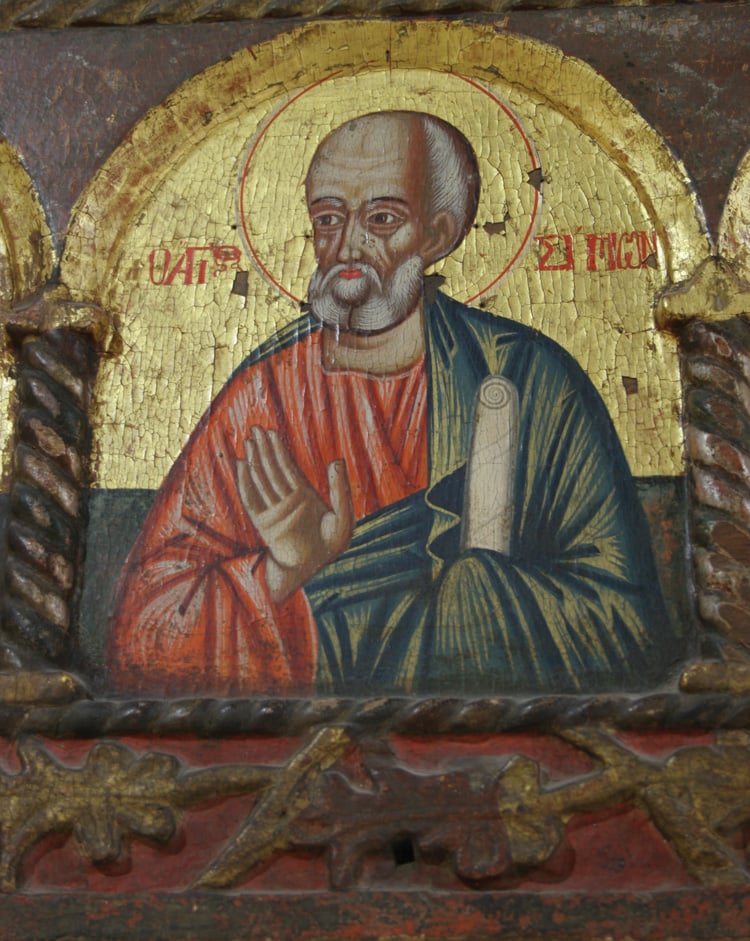
An icon of Peter from a larger piece entitled Christ and Twelve Apostles (Antalya, Turkey, nineteenth century AD)
Commentary
1. Suffering as a Christian (1:1–2:10)
A. The hidden inheritance, the hidden Lord (1:1–9). Peter begins his letter like any other in the world of his day, with a greeting, a prayer, and an expression of thanks. But his delight at the wonderful message he has to impart is so great that, like Paul, he fills out these bare, formal “bones” with the glories of the Christian gospel.
He is not simply Peter, but an apostle who writes with the authority of Jesus Christ. His recipients are not just the Christians of northern Asia Minor, but God’s elect, whose earthly address is only temporary. His prayer is not the usual “peace be yours in abundance” (see Dan. 4:1), but includes “grace.” Instead of the usual expression of thanks for something quite ordinary, like the good health of his recipients, Peter launches into a shout of thanks and praise to God for all the heavenly blessings he has stored up for those who are his.
The themes of this opening greeting and doxology set the tone for the whole letter. Peter brings up the three persons of the Trinity before us again in the very next section (1:10–21) and thus picks up the trinitarian blessing of verse 2. But this opening section is particularly balanced by 2:4–10, which brings to a close the first part of the letter. There Peter returns to the theme that above all thrills him here: the hidden things that are gloriously true of his readers even if all the world should shout a different message at them. Whether they feel like it or not, they are a royal priesthood, a holy nation (2:9).
Doubtless they felt more like his description of them in his greeting (1:1): “strangers in the world” (NIV 1984), “scattered,” tiny, persecuted congregations spread across the huge expanse of half of Asia Minor, struggling to keep their faith alive against the pressure of a vastly pagan environment. But Peter will not let them dwell on what they look like from the world’s point of view. He wants them to see how God looks at them. And from God’s viewpoint, their scatteredness is his election. God has plucked them out of their paganism to be his own (1:1). He has foreknown them (1:2). Before they ever existed, the Father knew and loved them and made them his. God has sent his Spirit to sanctify them—that is, precisely to create the distinction between them and the world that causes them so much trouble, by leading them into a life of obedience to Jesus Christ, sheltered under the forgiveness won by his blood.
At the moment they are facing all kinds of trials (1:6) and are tempted to hopelessness and despair. But here too Peter will not let them—or us—believe what the eye sees. The reality is unseen: there is an inheritance that can never perish, which is kept in heaven for us (1:4), as a result of Jesus’s resurrection and our new birth through him (1:3). And there is no possibility of losing it, for however weak we may feel, we are shielded by God’s power until the moment of salvation comes. Our present experiences are all preparatory, making us fit for glory. Jesus too is unseen: but even so, with our eyes fixed on hidden realities, we will love him and our hearts will sparkle with a joy that surpasses language and even now partakes of the glory that is yet to be (1:8). We already hear the strains of heavenly praise and share in heavenly joy, because we are already “receiving . . . the salvation of your souls” (1:9), even in the midst of suffering and pain.
These inspiring opening verses contain the whole message of 1 Peter in a nutshell. The rest of the letter unpacks and applies this vision in greater and more practical detail.
B. Preparation for action (1:10–2:3). The exhortation of 1:13 provides the keynote of this section, as Peter tackles the unspoken question, How can I have a faith like that? He mentions faith four times in 1:3–9, and it would be very possible for an oppressed, isolated believer to feel that the faith described is too high to attain. Peter sets out in this section to show what the roots of such a faith are—and it turns out that the way we think is absolutely vital.
Peter’s sudden introduction of “the prophets” (1:10–12)—probably shorthand for the whole Old Testament—is at first sight surprising. But there are two excellent reasons for their appearance. First, the prophets back up what Peter writes about the foreknowledge of God the Father in 1:2. God announced centuries ago his intention to save the followers of Jesus. It was in fact the Spirit of Christ who spoke in the prophets (1:11). Second, from the prophets we can learn the Christian faith, which Peter has just so eloquently and movingly summarized. Even though they wrote long before Christ came, they realized that they were writing about a grace to be given to someone else and eagerly sought to learn about the time and circumstances of its coming, the sufferings of the Christ, and his glories. The prophets became aware that they were writing for someone else, so that the gospel only needed to be “announced” (NIV “told,” 1:12) when the time came. The prophets had already testified to it. See how Paul puts the same idea in Romans 15:4 and 1 Corinthians 10:11.
This is tremendously important for Peter. His letter contains no fewer than twenty-five direct quotations from the Old Testament, and many allusions to it besides. It is the basis of the Christian gospel, for without it we would not understand Christ. And so, in practice, a mind well fed by the Scriptures is the basic prerequisite for the experience of joy in suffering described in 1:3–9.
The existence of such a prophetic word is a summons to prepare the mind for action (1:13–21). The proper response to the Scriptures is to get thinking. The Greek for “minds that are alert and fully sober” means “make sure you keep all your faculties fully operational” (Peter repeats the exhortation “be alert and of sober mind” in 4:7 and 5:8). The mind that is girded up, redirected by the Scriptures, will begin to think in a new way.
However threatening the present, the fully girded-up mind will set its hope “perfectly” or “fully” on God’s grace. The redirected mind will focus on God’s priority, holiness. At its heart holiness means separateness: God calls us to be different, because he is different. Peter’s readers must not worry about their distinctiveness that provokes such hostility from others. It is inevitable! If we are God’s, we will begin to bear his likeness in every aspect of life.
The renewed mind knows that life will end with judgment (1:17). We must therefore live each moment under the scrutiny of the judge. We may rejoice to know God as Father, but there must also be reverent fear. Every moment matters, eternally. The thought that we are to be judged according to our work could lead to despair; but our eternal salvation is not jeopardized by our moral feebleness. It rests on nothing that we can produce, not even on our silver and gold (1:18): even our best perishes before God’s judgment. But our salvation rests on “the precious blood of Christ” (1:19), just as the blood of the Passover lamb saved the Israelites. Christ was chosen (literally “foreknown”) before the foundation of the world (1:20): it was no sudden whim on God’s part that made him the sacrifice for sin. And as a result we may place sure faith and hope in God, who though our judge is also our Savior and Father. The resurrection seals the security of those who so believe and hope (1:21). In the midst of earthly insecurity, here is true confidence and security!
How may we be sure of knowing joy in suffering? In the next two paragraphs, Peter picks up what he wrote about the prophetic word in 1:10–12 and applies it practically: if our hearts and lives are truly being fed by the word of God, then we will be increasingly transformed within.
First, the word of God gives new life (1:22–25). When we obey God’s truth, love will be born in us. God’s word has a vital, life-giving power because of who speaks it. Peter quotes Isaiah 40:6–8, which contrasts the permanence of God’s word with the transitory nature of all earthly life. The gospel that Peter’s readers have heard, and the Scriptures they now read, are alike “the word of the living and lasting God” (1:23; in the Greek, “living and enduring” could also describe the word rather than God; see NIV).
Second, the word of God nourishes new life (2:1–3). Every newborn infant needs a healthy appetite and proper food or it will not grow. The pure “spiritual” milk that will produce healthy Christian growth is God’s own word.
C. The hidden spiritual house (2:4–10). Peter began his letter with the themes of God’s elect and his mercy (1:1, 3). He ends this first section on the same note (2:9–10). He also returns to his central theme of hiddenness, though his treatment is different here. In 1:3–9 his thought was angled entirely toward the future, to the coming inheritance and the coming Lord, both now veiled, yet objects of love and joy. But now Peter turns to the past and the present. The hidden but coming Lord was rejected by humankind (2:4), who did not see the estimation God placed on him. In their present rejection, therefore, Peter’s readers are sharing the fate of Jesus himself. He was like the stone the builders rejected (2:7).
Through this paragraph, Peter continues his focus on Scripture by quoting three “stone” passages that were applied to Jesus from a very early date (the tradition seems, in fact, to originate with Jesus himself; Matt. 21:42): Psalm 118:22–23; Isaiah 8:14; 28:16 (cf. Rom. 9:33). A stone can look most unimpressive—but it can perform a vital function if made the cornerstone of a large building; or it can bring a person tumbling to the ground if he or she trips over it. Jesus has become the cornerstone of God’s spiritual temple, and there are two possible responses. We can either take our own angle and position from the cornerstone and line ourselves up on him, or we can refuse to live by reference to him and stumble over him instead. It is a vivid picture.
Peter urges his readers to see that they are being built in line with Christ: sharing all the angles of his life, experiencing his rejection as well as his glory. His opponents stumble fatally, but those joined to Christ are a chosen people, a royal priesthood (2:9), contrary to all appearances. In verses 9 and 10 Peter piles up phrases from the Old Testament (Exod. 19:6; Isa. 42:12; 43:20; Hos. 1:10; 2:23) to show how all that is true of God’s chosen covenant people is true for those who believe in Jesus, however rejected and weak they may seem.
2. At Home, but Not in This World (2:11–3:12)
In the second section of his letter, Peter tackles the question that arises at the end of the first. If Christians must reckon themselves to be gloriously different from what they appear to be, if they must look beyond their scatteredness and suffering and see themselves as God’s chosen people, then what should their attitude be toward their earthly circumstances? Peter’s readers must have been tempted to respond to persecution by adopting an antiworld attitude and withdrawing as much as possible into the comforting warmth of Christian fellowship.
But Peter will not let them do this, even though he has underlined so powerfully their new and hidden status as God’s people and the life and love that binds them. Withdrawal from the world is not an option for Christians. Rather, their difference must be expressed through the distinctiveness of their life within their earthly callings.
A. The Christian’s inner life (2:11–12). In verse 11 Peter reaffirms the general attitude toward the world that ran through the first section of his letter. His readers are “foreigners and exiles” in the world; their home and their roots are elsewhere. It is natural, therefore, that he should go on to urge them to abstain from sinful (literally “fleshly”) desires. This world is not our true home, and the flesh seeks to stifle the life of the Spirit within us.
However, although we may be citizens of another world, we still have to “live . . . among the pagans” (2:12) and do so in a way that testifies clearly to the existence and power of that new world. Our declaration depends not so much on words (Peter is remarkably silent about verbal witnessing), as on behavior. Non-Christians watch what we do. The word translated “see” means to watch over a period of time, implying prolonged observation. We must see to it that, even though we may be mocked (or apparently disregarded), the evidence of our lives will speak so loudly that, on the day of judgment, non-Christians will glorify God because they will have to concede that the testimony was laid before them quite unambiguously, even if they failed to heed it. What we are on the inside (2:11) will become obvious on the outside (2:12).
B. A life of submission (2:13–3:7). Romans 13:1–7 is a close parallel to 2:13–17. Paul and Peter agree that respect for and obedience to worldly authority are important because they are an expression of God’s authority. Peter begins and ends by mentioning the Roman emperor as the one who embodies all the different forms of secular authority under which Christians find themselves.
In theory, worldly authorities exist “to punish those who do wrong and to commend those who do right” (2:14; cf. Rom. 13:3–4), but Peter is as aware as we are today of the possibility of corruption in high places. He even calls Rome “Babylon” in his closing greeting (5:13). Yet, just as we abstain from fleshly desires and still remain committed to ordinary human society (2:11–12), so we submit to worldly authority even though it is to pass away under the judgment of God. We know that God’s world is fallen, but we submit to his ordering of it, keen to testify by our lives to what is to come. Simply by doing good we might silence (literally “muzzle”) people inclined to revile us (2:15). Peter emphasizes this by the verbs he uses in verse 17. The proper attitudes are timely respect for all people (i.e., we are to take every opportunity to show honor to fellow men and women), love for fellow believers, fear of God (full devotion of heart, mind, and soul), and continuing respect for the emperor.
Peter next homes in on a group for whom a very particular application of the principle of submission to authority is necessary: slaves (2:18–25). Unrest among slaves was widespread at this time, and undoubtedly some Christian slaves believed that, having been “bought” by Christ, they had been set free from their earthly masters! Later on, there were actually Christian groups that encouraged slaves to run away from their masters on these very grounds. But Peter will not allow it. The same principle of nonwithdrawal from the world means that slaves must not stop being slaves but instead become better ones—even when their masters are harsh. If they suffer, they must make sure that they suffer unjustly, because it will not do their Lord credit if they deserve the beatings they get!
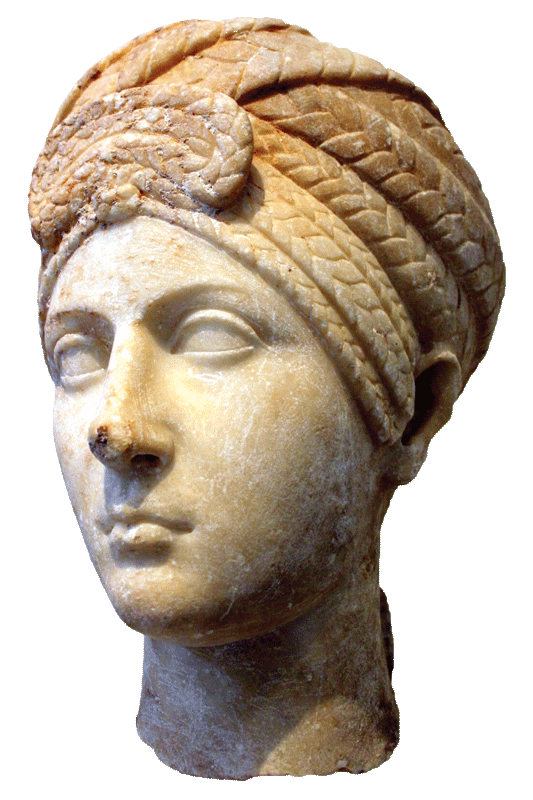
A Roman woman with braided hair (early second century AD). First Peter 3:3 exhorts women not to adorn themselves with such elaborate hairstyles, as do pagan women.
Then Peter attaches to this straightforward teaching a marvelous passage about the servant Jesus (2:21–25). In fact, it is likely that this is an adaptation of an early Christian hymn about Christ. It suits Peter’s theme beautifully as, in close dependence on Isaiah 53, it describes how Jesus, the Suffering Servant of the Lord, submitted to suffering in this world because of his obedience to his heavenly master. Belonging to his Lord did not deliver him from suffering but led him straight to it. And through his suffering we have found forgiveness (2:24). To suffer, therefore, is simply to walk in his footsteps (2:21), and we can be sure that, whatever happens, he is a caring shepherd (2:25).
Peter has deliberately placed this hymn in the middle of this section so that it has a central place: Jesus is our example, not just in the way he suffered, but in his obedient submission to the powers of this world.
The zoom lens now focuses in on another, still more intimate relationship from which Christians were tempted to withdraw because of their new, otherworldly faith: marriage (3:1–7). Should Christian husbands or wives leave their partners if they do not share their faith? Again, some Christians answered yes. But Peter insists that they should not. He devotes more space to wives (3:1–6) because they could more easily be made to suffer from their husbands than vice versa. He eloquently teaches that the greatest beauty is that of character and that the loveliness of Christian character speaks far more powerfully than a hundred sermons. The word “see” in verse 2 is the same as that in 2:12, implying extended observation. The incident in mind in verse 6 is probably that of Genesis 12:11–20, where Sarah submits to some very unkind treatment from her husband, and in that context her beauty is emphasized. Abraham tried the same trick again later (Genesis 20), insisting that Sarah must show her love for him in this improper way, and she again submits. (She calls him “lord” in Gen. 18:12.) The Christian calling is patient submission to suffering within the structures of this world.
What about the Christian husband with the unbelieving wife? Verse 7 summarizes it beautifully. No separation! Even if they cannot share on the deepest spiritual level, they are still together “heirs . . . of the gracious gift of life” (i.e., ordinary human existence). The husband must show all the respect and care due to a weaker partner; and in so doing his own bond with the Lord will not be weakened.
It is vital to bear in mind the first-century cultural setting of 3:1–7. The normal expectation was that, if the male head of a household changed his religion, the whole household would follow (see Acts 16:31–34). It was strongly against this culture for a wife to change her religion apart from her husband. This helps us to see that Peter is not telling wives to be all-accepting doormats here. They have already stepped out and become different by believing in Christ for themselves. Now they must show that their “rebellion” deepens their love.
Similarly, a man becoming a Christian would have a culturally endorsed right to expect his wife to believe too. But in verse 7 Peter remarkably tells Christian husbands not to insist on this. Their wives must have the freedom not to believe! That’s what honoring them demands.
C. The Christian’s corporate life (3:8–12). “Everyone will know that you are my disciples, if you love one another” (John 13:35): this is the principle underlying these verses, with which Peter summarizes the whole section. Christians treasure their fellowship with one another. When they are faced with persecution, their common joy in their Lord becomes all the more precious. But Peter wants to impress on them that their relationship with each other is not entirely inward-looking. People will notice what they say to each other about the injustices they suffer (3:9). Consequently, the Lord must be their model. The quotation from Psalm 34:12–16 in verses 10–12 contains the key word of this entire section: “Do good.” It also highlights the use of the tongue, just as the end of the last section did (2:9; see also 2:1): the way we speak will reveal the shape of our whole life.
3. Suffering—The Road to Glory (3:13–4:19)
In this section Peter focuses more precisely on the subject of suffering. The last section laid down the basic principle of submission to the structures of this world. Peter now shows how suffering fits into that submission. Once again, this section begins and ends on the same note: doing good (a favorite theme of Peter’s) and suffering for God’s sake or for what is right.
A. Suffering for doing good (3:13–22). These verses are among the most difficult in the whole New Testament, because Peter refers to traditions and stories obviously familiar to his readers, but unfortunately not to us. Yet the overall message is clear. Peter tells us that if we are called to suffer for what is right, we must look to Jesus, who suffered for our sins and through that suffering has come to a place of supreme authority, raised over all the powers of evil that seem so overwhelming to the persecuted Asian Christians. Jesus suffered, though he was righteous, and if we will now set apart Christ as Lord in our hearts and follow in his footsteps, we can be delivered from the fear of our persecutors, confident that through suffering we will share his victory. In the meantime we must bear witness to our hope by both word and deed, remembering that our baptism was our pledge to God, to live with good consciences before him.
Peter shares with Paul, and early Christians generally, the belief that authority and power in this world are earthly expressions of unseen fallen spiritual entities. Therefore, submission to secular authority as well as submission to all the constraints of earthly existence is a form of bondage to the powers of evil. Having told us to submit, Peter must touch on the spiritual implications of his teaching.
The “imprisoned spirits” (3:19) are not the souls of dead human beings but fallen angels (2 Pet. 2:4; Jude 6). According to Jewish tradition (1 Enoch 6–20), they deceived and corrupted the generation who lived before the flood, teaching them the arts of sin (see Gen. 6:1–4). As a result they were locked up in prison at the time of the flood, “to be held for judgment” (2 Pet. 2:4). They were the counterparts of the angels, authorities, and powers (3:22) still active today.
Jesus’s preaching to these spirits was not an offer of salvation but a proclamation of his victory—in fact, the announcement of the judgment hanging over them. The spiritual forces behind the greatest corruption the world has ever seen have received their final condemnation at Jesus’s hands! Having dealt with them, he finished his journey to heaven and took his place at God’s right hand, in full authority over the powers behind the suffering experienced by Peter’s readers. However much they may feel themselves to be victims, Christ is the victor!
The refusal of the angels to submit to their Creator was matched by the mockery of Noah’s contemporaries, who did not respond to God’s warning of impending judgment given by Noah’s preaching (cf. 2 Pet. 2:5) and by the slow construction of the ark miles from the sea (3:20). The water in which they died was, paradoxically, the very medium of Noah’s salvation. In this respect the flood foreshadows Christian baptism, for that too pictures death but leads to life. When they were baptized, Peter’s readers pledged themselves to live for God and embraced the hope of resurrection through Jesus Christ. But in so doing they actually brought suffering upon themselves, just as Noah did by his obedience to God’s command to build an ark and to warn his generation. Yet in their suffering, symbolized by their baptismal “death,” they follow the path already trodden by their Savior on the way to glory.
Peter thus seeks to minister to his suffering brethren in the deepest possible way: not by simply pointing them to compensation in the world to come, nor by painting vividly the judgment in store for their enemies, but by showing them that, precisely in their suffering, already pictured in the baptism that united them with Christ, they are sharing with their Lord in his victory over all the powers of evil in the universe.
B. Living for God (4:1–11). There is no break in the flow of thought at 4:1. Although Noah is not mentioned in 4:1–6, we will best grasp Peter’s meaning if we keep him in mind. For what Peter says in essence in verses 3–5 is, “You are in the same position as Noah, who refused to join in the profligate and licentious behavior of his contemporaries, even though they thought him peculiar for his refusal. Hold yourselves aloof from such practices, for God is about to act in judgment now as he did then.” Peter actually uses the word “flood” in verse 4, where a literal translation would be “they curse you when you don’t join the same flood of dissipation.” The outpourings of vice around them are horribly reminiscent of the flood of God’s wrath about to break.
It is especially helpful to read the difficult verse 6 with the story of Noah in mind. Noah was revered as a “preacher of righteousness” (2 Pet. 2:5), and by “the dead” Peter is probably referring to the people who died in the flood, the “dead” who ignored Noah’s passionate message about the coming judgment. Who knows what God’s purpose may have been? Yes, they died in the flood; but those waters symbolized baptism, because baptism is likewise about doing away with the flesh. Who knows whether their death in the flood might not have been a baptism for them, an entry into life?
Peter has his readers’ persecutors in mind as he writes this. They may heap abuse on the Christians (4:4), but no one is so far gone as to be beyond the reach of God’s life-giving power. They, too, could “live in the Spirit as God does” (4:6 NRSV) because of the faithful, suffering witness of the believers, who lovingly live and speak in God, as Noah did.
The basic principle holds true for all: “Whoever suffers in the body [literally “in the flesh”] is done with sin” (4:1). This was supremely true for Christ, who through death has conquered sin in all its manifestations; it is necessarily true for his followers, who through their suffering learn to dethrone evil desires and live for the will of God (4:2); and possibly it is even true for the persecutors of the church, who might come to life through the judgment of death and must therefore be the objects of patient testimony, in word and deed.
The flood was a partial judgment, a foreshadowing of the total winding up, which is now near. If Noah prepared with such diligence for the flood, how much more should we seek to be ready for the end (4:7–11)? Peter outlines the vital features of a life lived with an eye to the coming judgment.
In the privacy of heart and home, Christians need minds that think straight and hearts that pray straight. In ordinary social relationships, Christians must love one another and offer hospitality. In undertaking Christian ministry, each must put into active service whatever gift God’s grace has bestowed, whether it is teaching or more practical forms of service. The believer must draw on God’s resources and provision, and not for personal gain or glory. Rather, the object of life this side of the end must be the praise of God.
C. Sharing the sufferings of Christ (4:12–19). In this final subsection, Peter draws together the threads. His readers must not be surprised at the painful (literally “fiery”) trial they are experiencing, because suffering is not something foreign as far as Christians are concerned. Rather, it lies at the very heart of our existence. Peter gives three reasons why we should not be surprised.
First, we are participating in the sufferings of Christ (4:13). We must expect to receive the same treatment as our master, simply because we are his servants (John 15:20). Suffering is woven into human experience as part of a fallen creation, but Jesus has blasted a way through death to eternal life. And so we should rejoice as we participate in this great saving movement, looking ahead to glory!
Second, because Jesus is already victorious, our suffering is a foretaste of that coming glory, a blessedness that comes to us as God’s Spirit rests on us. What a revolutionary understanding!
Finally, our sufferings are the opening phase of God’s winding-up operation, the beginning of his judgment. Peter deliberately calls the tribulation “judgment,” partly for theological reasons (because he understands all suffering and death as part of the curse laid by God on a fallen world), but also because he will not let his readers relax their guard. Their suffering is a trial (4:12), and they must make sure that they do not suffer deservedly (4:15)! But if we suffer according to God’s will (4:19; i.e., with our hearts set on God’s will, even in the midst of our suffering), then God will uphold us.
4. Final Exhortations and Greetings (5:1–14)
The final chapter begins with a resounding “therefore,” which both NIV and NRSV have failed to translate. This makes the connection clear: in times of suffering and trial, special responsibility rests on the leaders of the churches to support and be shepherds of God’s flock (5:2). Peter turns to this vital practical concern to round off his letter. But in fact his concern is not just pastoral, for there remains a theological question, raised by what he has said about submission to earthly powers and Christ’s victory over them, which needs to be tackled as well. If, as he has told us, we must submit to earthly authorities even though Christ has proclaimed his victory over them, if we must continue to live as loyal citizens of Babylon (5:13) even though we know her satanic power has been broken, then what about authority structures within the church? What kinds of leadership and submission are appropriate for those who are already touched by the glory of the coming age?
Peter’s pastoral concern predominates in 5:1–5. His self-designation in verse 1 hints at this deeper concern. He is a “fellow elder” (NRSV omits this)—not an exalted apostle—and with them a witness of (better, “to”) Christ’s sufferings. He therefore enters into all that that means, sharing those sufferings himself and thus participating in the glory to be revealed. His readers are not alone in their suffering. Peter stands beside them.
He urges the elders to be aware of their special responsibility as shepherds. The imperative has an urgency about it—get on with the job! Then in three pairs of balancing phrases (“not . . . but,” 5:2–3) Peter tells them how they should exercise their pastoral care as far as inner motivation (“not because you must, but because you are willing”) and outward incentive (“not pursuing dishonest gain”) are concerned.
With the third “not . . . but” (5:3), Peter’s second theological concern surfaces clearly. He uses here the same word that Mark records Jesus as having used when discussing this very issue with his disciples (Mark 10:42–43). Even if the church seems to possess a conventional, earthly authority structure, it actually reverses the normal pattern, modeling its vertical relationships on the Son of Man, who “did not come to be served, but to serve, and to give his life” (Mark 10:45). This is the style of leadership that will bring the full realization of the glory known now but in part (5:4). Peter drives this point home beautifully in verse 5 by using the single word “likewise” (NIV “in the same way”). He implies that the young men must be submissive to the “elders” in the same way as the elders are submissive to the young men! On both sides there is a “submission” that recognizes the distinctive gifts and ministry of the other and seeks to serve for Christ’s sake. Verse 5b puts it in a nutshell: they must all tie humility around them like a robe, so that they may enjoy God’s grace in all their relationships. For God himself does not lord it over his creatures, but by his grace reaches out to us and suffers with us, in Christ.
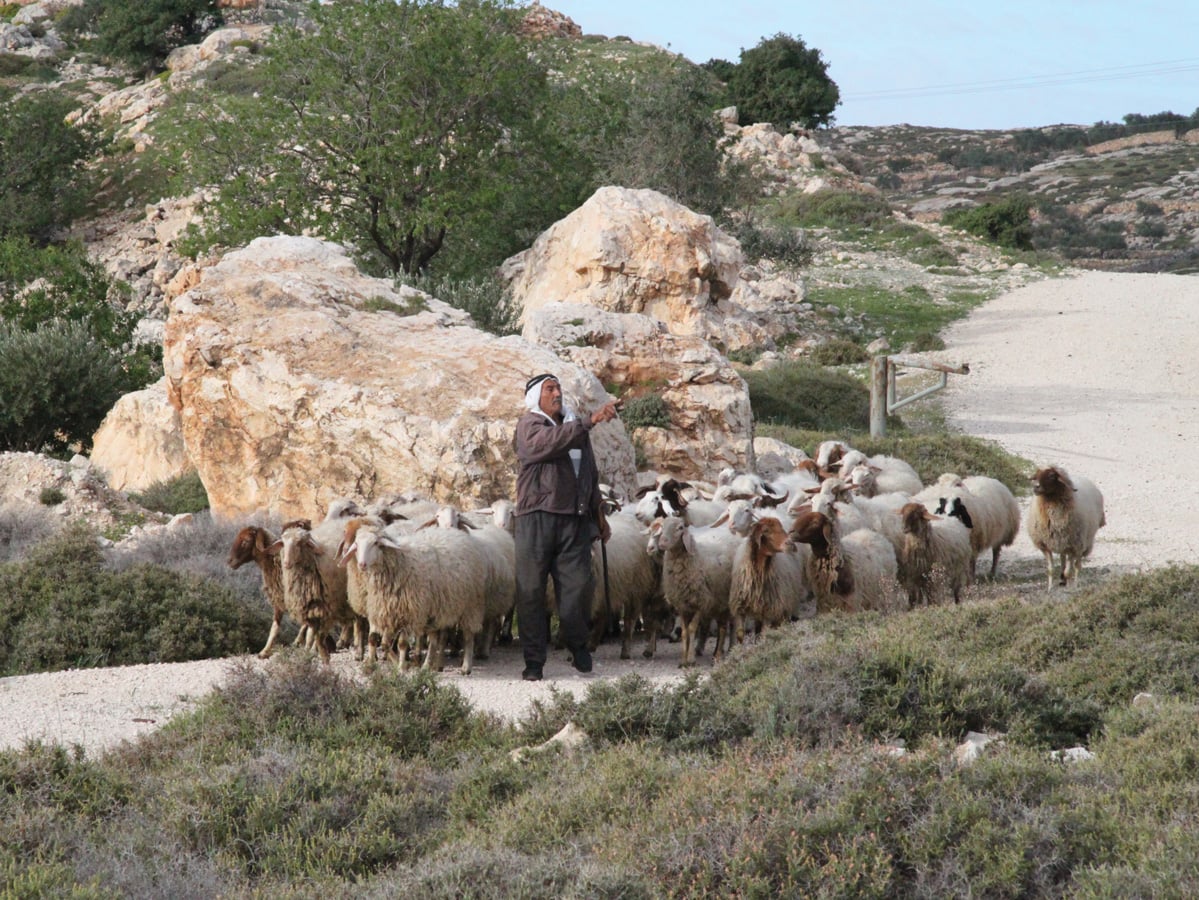
A modern Middle Eastern shepherd leading his sheep. First Peter 5:2 encourages the church elders to be “shepherds of God’s flock” so that they will be rewarded when the Chief Shepherd appears (5:4).
Now Peter summarizes everything that he desires for his readers (5:6–11). Here is the framework on which he wants the house of our Christian life to be founded. For all that he has urged us to submit to our earthly circumstances, however trying, it is really to God himself that we submit (5:6), in hope of his deliverance. We humble ourselves before him not as before an earthly master, awaiting instructions, but so as to feel the burden of anxiety lifted from our shoulders (5:7)!
His readers may be consumed with anxiety about their earthly enemies, but Peter tells them that the spiritual foe is far more deadly (5:8–9). And we feel his pressure on us not just through our earthly trials but especially through the temptation not to face those trials with faith.
For all our seeking of stability and strength in this life, Peter reminds us in his closing blessing (5:10–11) that these are things that God reserves for the age to come. After the suffering of this age, in which we already trace his grace, he will finally complete us, strengthen us, and set us on a sure foundation.
In his final greeting, Peter associates with himself not just his two closest helpers, Silas and Mark, but also the whole church to which he belongs. “Babylon” (5:13) is almost certainly a reference to Rome, which was increasingly called “Babylon” by both Jews and Christians at this time. Using this term here fits beautifully with Peter’s theme. It reminds us of the true (satanic) nature of secular power. Christ, however, has conquered it. But also—and more particularly, at this point—it reminds us of the place of Israel’s exile and of the fact that we too are aliens and strangers in the world. The letter thus ends on the same note with which it began, when Peter saluted his readers as God’s elect, strangers in the world, scattered. For though exiles, we are yet God’s chosen, his elect people, destined for glory.
Select Bibliography
Dalton, William J. Christ’s Proclamation to the Spirits. Analecta Biblica 23. Rome: Pontifical Biblical Institute, 1989.
Grudem, Wayne. 1 Peter. Tyndale New Testament Commentaries. Grand Rapids: Eerdmans, 1988.
Horrell, David G. The Epistles of Peter and Jude. Epworth Commentary. Peterborough: Epworth, 1998.
Jobes, Karen H. 1 Peter. Baker Exegetical Commentary on the New Testament. Grand Rapids: Baker Academic, 2005.
Marshall, I. Howard. 1 Peter. IVP New Testament Commentary. Downers Grove, IL: InterVarsity, 1991.
Michaels, J. Ramsey. 1 Peter. Word Biblical Commentary. Waco: Word, 1988.
Mounce, Robert H. A Living Hope: A Commentary on 1 and 2 Peter. Grand Rapids: Eerdmans, 1982.