James
2. Trials and Temptation (1:2–18)
B. The Source of Temptation (1:13–18)
3. Putting the Word into Practice (1:19–2:26)
A. Anger and the Tongue (1:19–20)
B. “Be Doers of the Word” (1:21–27)
C. The Sin of Favoritism (2:1–13)
D. True Christian Faith Seen in Its Works (2:14–26)
4. Worldliness in the Church (3:1–4:12)
A. The Taming of the Tongue (3:1–12)
B. Peaceable Relations among Christians (3:13–4:3)
C. A Call for Repentance (4:4–10)
D. Arrogance and the Critical Tongue (4:11–12)
5. Looking at Life from a Christian Perspective (4:13–5:11)
A. Recognizing Who We Are before God (4:13–17)
B. The Dangers of Wealth (5:1–6)
C. Waiting on the Lord (5:7–11)
6. Concluding Exhortations (5:12–20)
C. Responsibility for Fellow Believers (5:19–20)
Introduction
Author
The writer of the letter identifies himself simply as “James, a servant of God and of the Lord Jesus Christ” (1:1). Who is this James? Of the four men with this name mentioned in the New Testament, only two are significant enough to have identified themselves as simply as does the author of this letter: James the son of Zebedee, who was one of the twelve apostles (Mark 1:19), and James “the Lord’s brother” (Gal. 1:19), who early on became the leader of the Jerusalem church (cf. Acts 15:13; 21:18; Gal. 2:9). Although a few scholars have thought that the son of Zebedee could be the author, his early martyrdom (AD 44; cf. Acts 12:2) probably removes him from consideration. Still others think that the good, almost literary Greek of the letter, along with the way the author handles the topic of justification (2:14–26), makes it likely that someone toward the end of the first century wrote the letter and ascribed it to James. But this theory is unnecessary and calls into question the honesty of the writer. There is every reason to accept the widespread opinion of the early church that James the brother of the Lord wrote this letter.
Although this view is contested, it is probable that James was a younger brother of Jesus, born to Joseph and Mary after the birth of Jesus. Not a believer during Jesus’s earthly ministry (cf. John 7:5), James was probably converted as a result of a postresurrection appearance (1 Cor. 15:7). His wise leadership of the Jewish Christian church (see Acts 15:6–22), along with his piety and respect for ancestral traditions, earned him the title “the Just” in both Jewish and Christian history.

Audience, Date, and Occasion
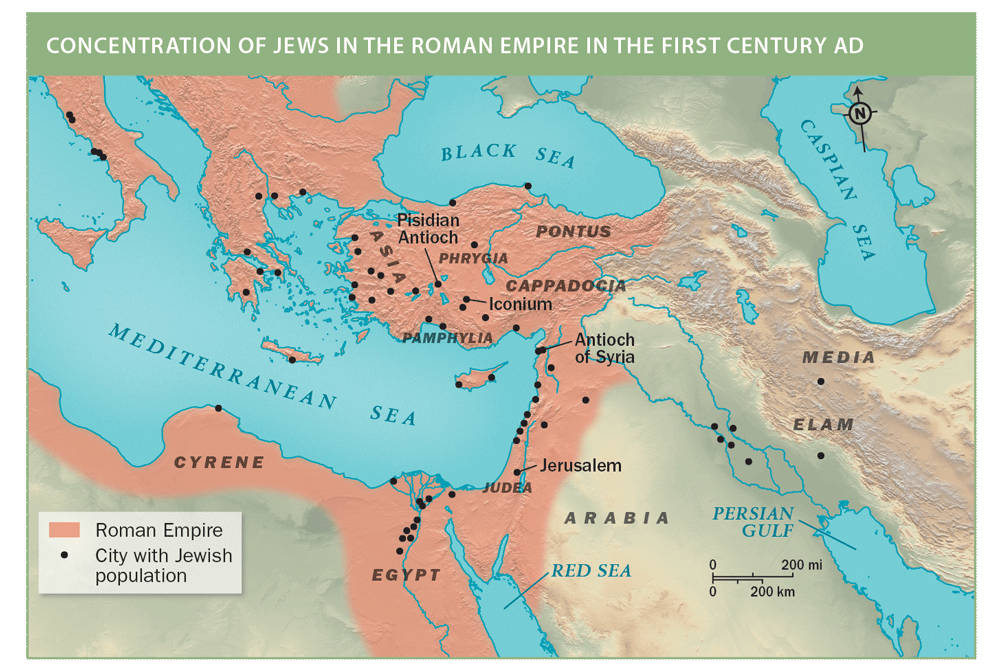
James is classed among the General Epistles of the New Testament, those letters that are not addressed to specific churches (e.g., 1 Corinthians) or individuals (e.g., 1 Timothy). But this does not mean that James had no definite readers in mind as he wrote. The letter is addressed to “the twelve tribes scattered among the nations” (1:1). From its original application, the phrase “twelve tribes” came to designate the complete regathering of God’s people that would take place in the messianic age (cf. Isa. 49:6; Ezek. 47:13). James, then, uses this title to remind his readers that they belong to that new creation, the church, that God has brought into being on the basis of faith in his Son (cf. Matt. 16:18). These “twelve tribes” have been “scattered” or “dispersed” among the nations. What is meant by this? In one sense, all God’s people, as aliens and exiles, living apart from our true heavenly home, have been “scattered” in this world (cf. 1 Pet. 1:1). But the word “scatter” and its noun form, “those scattered,” or “dispersion,” was often used to designate Jews living outside Palestine. It may be that James uses the word with this more specific meaning. Suggestive here is the reference in Acts 11:19 to those early Jewish Christians in Jerusalem who were forced to flee the city because of persecution and engaged in evangelism among Jews “as far as Phoenicia, Cyprus and Antioch.” Could this not furnish a plausible background for the circumstances of the Letter of James? Forced to live away from their home church, these scattered parishioners required exhortation and advice on issues they were facing. What is more natural than that their spiritual guide send them a pastoral letter?
If this reconstruction of the circumstances of the letter is accepted, it would make James probably the earliest New Testament book to be written—sometime in the middle 40s of the first century. Also suggestive of an early date are the reference to the synagogue as the place of meeting (2:2) and the fact that the sharp debates over the place of the law in Christianity, so prevalent from the latter 40s on, are not reflected in the letter. The way in which James deals with justification in 2:14–26 also fits nicely into this early time period: James’s teaching implies that he has heard of Paul’s slogan “justification by faith” but that he has no firsthand knowledge of what Paul really meant by it. Such a situation would exist only before the Jerusalem council of AD 48 or 49 (see Acts 15).
We understand James, then, to be a letter of pastoral encouragement and exhortation written to Jewish Christians living outside Palestine in the middle 40s of the first century.
Structure and Sources
As a pastoral letter, James reads like a sermon, or a series of sermonettes. The purpose of these homilies is almost always to command and exhort: it is indicative of the tone of the letter that James has a greater frequency of imperative verbs than any other New Testament book.
James has structured loosely his series of sermonic exhortations. The letter may be divided into five major sections (see the outline), but there is no clear logical progression from one section to another, and even within the sections James often jumps quickly and without explanation from one aspect of his topic to another. This manner of moving from topic to topic is reminiscent of the wisdom books of the Old Testament and Judaism (e.g., Proverbs, Sirach).
Another interesting feature of the letter is James’s habit of borrowing from other sources. Most prominent among these is the teaching of Jesus. Not only does James come close to quoting Jesus on one occasion (5:12; cf. Matt. 5:34–37); he also infuses his letter with themes, images, and emphases characteristic of Jesus. Other writings with which James has much in common are 1 Peter in the New Testament; Proverbs in the Old Testament; Sirach, the works of Philo, and the Testaments of the Twelve Patriarchs among Jewish literature; and the early Christian books the Shepherd of Hermas and 1 Clement. The parallels between James and these other sources do not, except in the case of the teaching of Jesus, suggest that James has borrowed directly from them. Rather, it would seem that some of the themes and language found in these books were known to James and he used them to make his own points.
Theological Themes
The Letter of James, it is sometimes said, has no theology. If by this it is meant that James does not present a systematic exposition of the faith or that his main intention is not to teach theology, then the statement is true enough. But in another sense, it is misleading. James approaches the practical issues he deals with from a profound knowledge of who God is and what he has done in Christ—theology indeed! And James also makes an important contribution to our understanding of several theological issues. Among these is theology proper—the doctrine of God. James emphasizes God’s generous nature (1:5, 17), his total separation from evil (1:13), his jealousy (4:5), and his grace (4:6). Eschatology receives attention in 5:1–11, where James sounds the characteristic New Testament note of fulfillment without consummation: the “last days” have come, and we must now live in that knowledge (5:3, 5); however, we also wait for that day when our Savior and judge will appear in glory (5:7–11). Also prominent in James is the problem of poverty and wealth. Most of James’s readers are poor, and they need to be encouraged to find solace in their spiritual wealth (1:9) and to be reminded that God will judge their wicked rich oppressors (5:1–6).
Of greatest interest theologically is James’s teaching on justification in 2:14–26—teaching that many think to be in conflict with Paul. Does not Paul stress that “a person is justified by faith apart from the works of the law” (Rom. 3:28)? How, then, can James assert that “a person is justified by what he does and not by faith alone” (2:24)? A careful study of the ways in which James and Paul use the crucial word “justify” will show that the conflict is only apparent. While Paul uses the word to designate the person’s initial acceptance before God, James uses it of the believer’s final vindication before God in the judgment. Thus Paul emphasizes, combating the typically Jewish emphasis on doing the law, that a person can “get right” with God only through faith in Jesus Christ. James, criticizing Christians who were neglecting to live out their faith, reminds them that God does take works into account when we stand before him in the judgment.
It is, of course, this plea for working faith, for a belief that is so deep and vital that it has to spill over into all our lives, that characterizes the message of James. He encourages his readers, both in the first century and today, to live out their faith, to abandon any spiritual doublemindedness, and to press on to full Christian maturity. John Wesley’s description in A Plain Account of Christian Perfection captures perfectly the goal that James encourages us to pursue: “In one view it is purity of intention, dedicating all the life to God. It is the giving God all our heart; it is one desire and design ruling all our tempers. It is the devoting, not a part, but all our soul, body, and substance to God.”
Commentary
Although James could claim to be a brother of the Lord and a leader in the early Jerusalem church, he is content to call himself a “servant.” Indeed, like Moses (Deut. 34:5) and David (Ezek. 37:24) before him, James recognizes that there is no higher honor than being called to serve the living God. James’s readers are also honored to belong to the people of God of the last day—“the twelve tribes.” As I suggested in the introduction, these readers are probably Jewish Christians who had to flee from Jerusalem and take up new lives in lands outside Palestine.
2. Trials and Temptation (1:2–18)
A. Overcoming trials (1:2–12). As James’s readers establish themselves in their new surroundings, they have to face many trials. Poverty and persecution appear to have been the biggest trials faced by these early Christians, but James has in mind all kinds of difficulties that can pose threats to our faith in God—sickness, the death of loved ones, a rebellious child, a hated job. Whatever the trial, James commands Christians to rejoice (1:2). How is this possible? By recognizing that God can use these problems and tribulations to produce Christians who are “mature and complete” (1:4). Trials, which test us as fire refines ore (see also 1 Pet. 1:7), lead to a more settled, stable Christian character; and as we continue taking a Christian viewpoint on trials, this perseverance will be able to finish its work of producing strong, mature, unshakable believers. Right at the beginning of his letter, James sounds a note that he will repeat throughout the letter in different ways: Christians must take a distinctively Christian perspective on life.
James sometimes links his topics by repeating a word: here he joins verses 4 and 5 with the verb “lack.” A more substantive link may also exist, however. Wisdom may be that quality that is needed if the believer is to face trials in the appropriate Christian manner. Wisdom in the Bible is a practical, down-to-earth virtue that provides its possessor with insight into the will and ways of God. Like the book of Proverbs, James emphasizes that wisdom can be gained only by asking God. And as an encouragement to ask, James reminds us that God gives “simply,” “with a single, unwavering intent” (the probable meaning of the Greek word here; NIV “generously”), and without holding our past failures against us (1:5). But not every asking, even if imploring and sincere, receives an answer from God. We must ask in faith, without doubting. In an expressive image, James compares the doubter to the constantly varied surface of the sea—forever in motion, never stable, up one day, down the next (1:6). Such a person is literally, James says, “double-souled”—divided at the very root of their being, a spiritual schizophrenic. That kind of person must not expect that God will respond to their prayers (1:7–8). What James criticizes in these verses is not the person who has occasional doubts about his or her faith, or lapses into sin now and again—few indeed would ever have prayers answered were that the case! Rather, James castigates the person who is basically insincere in seeking for things like wisdom from God, the person who is seeking to serve two different masters at the same time (see Matt. 6:24; James 4:4).
The discussion of poverty and wealth in verses 9–11 may be connected to verses 2–4 (if we recognize poverty as one of the most difficult of trials) or to verses 5–8 (considering that wealth has great potential for dividing our loyalties). James contrasts two people in these verses: poor Christians (1:9) and “the rich” (1:10–11). This latter phrase is ambiguous. If James has in mind rich non-Christians, then his contrast is between poor Christians, who are to rejoice in their heavenly calling, and rich unbelievers, who have nothing to boast about except their ultimate judgment for their wicked use of money. That James elsewhere uses “rich” to designate non-Christians (5:1) favors this interpretation. On the other hand, “the rich” could be Christians. In this case, James would be contrasting Christians from very different socioeconomic spheres and encouraging all believers to focus not on that worldly status but on their relationship to Christ. Poor believers should not despair because of their poverty but rejoice because they are “rich in faith and [heirs to] the kingdom” (2:5). Rich believers, on the other hand, must be careful not to take pride in their worldly possessions—for their wealth will quickly perish—but to boast in their “low position” (NIV “humiliation”), their relationship to Jesus, the servant who was “despised and rejected” (Isa. 53:3). Either interpretation makes sense of the verses, but the second alternative explains more naturally the order of the Greek words in verse 9 (literally “the brother, the humble one”).
James concludes the opening section of the letter by returning explicitly to the theme of trials (1:12). Remaining faithful to God during trials brings God’s blessing: the reward of life eternal that God has promised to those who belong to him. The risen Jesus similarly encouraged suffering Christians: “Be faithful, even to the point of death, and I will give you life as your victor’s crown” (Rev. 2:10).
B. The source of temptation (1:13–18). The connection between James’s discussion of trials in verses 2–12 and temptation in verses 13–15 is more explicit in the Greek text than in the English because a single Greek root does duty for both these concepts. In meaning, however, the two are to be carefully distinguished. A trial is an outward circumstance that can pose difficulties to our faith. A temptation is the inner enticement to sin. What James is concerned about is that his readers will confuse these two and attribute temptation to God. Scripture indicates that God does “test” or put his people through trials (cf. Gen. 22:1). But, James emphatically asserts, God never tempts his people (1:13). He never entices them to sin or desires that they fail in the trials he may bring. Believers must never excuse their sin by blaming God for the temptation. Rather, James points out, believers need look no further than within themselves for the problem. It is our own “evil desire” that is the real source of temptation (1:14). Like the bait that lures the fish and the hook that snares it, sin entices and seeks to entrap us. That James does not here mention Satan does not mean that he ignores the power of the tempter (see 4:7). His point is to lay responsibility for sin clearly at the door of each individual. And, as J. A. Bengel remarks, “Even the suggestions of the devil do not occasion danger, before they are made ‘our own’ ” (Bengel, 5:7). Shifting his imagery, James traces the terrible process by which temptation becomes spiritual death: the impulse to sin, alive in all of us, conceives sin when we succumb to temptation; if we do nothing to cut off the growth and maturation of sin, death is the inevitable result (1:15).
After issuing a warning not to be deceived (1:16), James provides a positive counterpart to verses 13–15: far from being responsible for temptation, or anything evil, God gives good gifts to his children. And that God will continue to do so can be depended on, for he is unchangeable. Unlike the sun, moon, stars, and planets (“the heavenly lights”; cf. Ps. 136:7–9), which regularly move and change their appearance, God never changes (1:17). As an outstanding example of God’s good gifts, James cites the new, spiritual birth that Christians have experienced (1:18). This “new birth,” or regeneration, is motivated solely by the will of God. It is accomplished through the instrument of “the word of truth,” the gospel (cf. 2 Cor. 6:7; Eph. 1:13; Col. 1:5; 2 Tim. 2:15), and it has as its purpose the bringing into being of “firstfruits,” the first harvest of the fruits produced by God’s eternal plan of redemption.
3. Putting the Word into Practice (1:19–2:26)
The mention of the “word of truth” in verse 18 leads James to devote a lengthy section to a matter close to his heart—the appropriate Christian response to God’s word. James stresses that the word’s purpose is to be obeyed (1:21–27), gives an example of how that word should be obeyed in practice (2:1–13), and ties that doing of the word inextricably to genuine faith (2:14–26).
A. Anger and the tongue (1:19–20). Before launching into this major topic, James interjects a warning about the misuse of the tongue—the first of several that occur in his letter (1:26; 3:1–12; 4:11–12; 5:12). James echoes a theme sounded often in Proverbs (see 10:19; 15:1; 17:27–28): the righteous will listen well and consider carefully before they speak and will restrain their anger lest it lead to hasty, nasty, irretrievable words (1:19). James does not prohibit all anger but exhorts his readers to be slow and careful about allowing anger to develop. Anger, James reminds us, “does not produce the righteousness that God desires” (1:20).
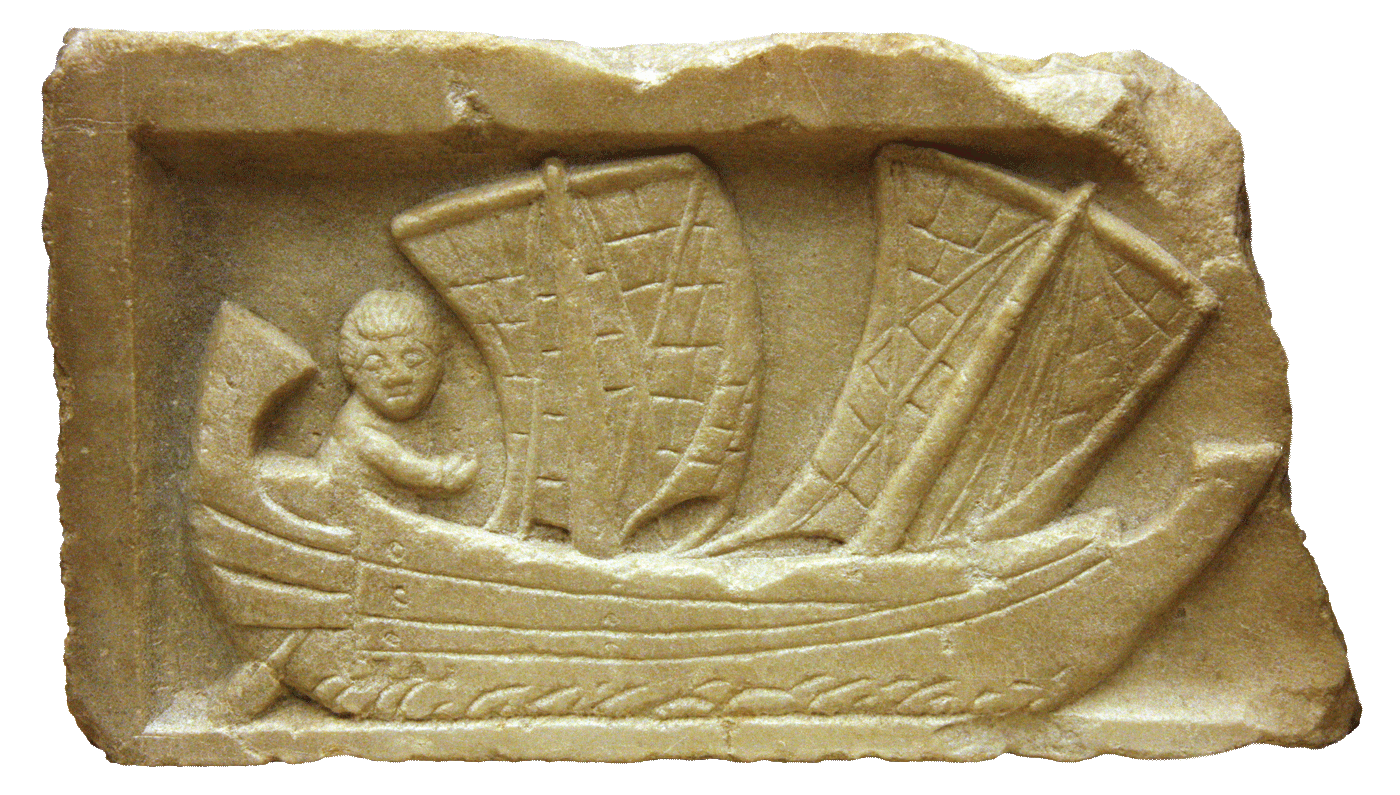
James talks about the tongue several times in his letter, beginning in 1:26 (see 1:19–20). Later, in James 3:4–5, he says that the tongue steers the whole body just as a small rudder steers a large ship. This marble relief (second century AD) shows a corbita, a two-masted trading vessel that sailed close to the coast as it traveled from port to port.
B.“Be doers of the word” (1:21–27). Many translations and commentaries take verse 21 with verses 19–20, but it really introduces the main topic of the next paragraph: the right response to God’s word. James commands us to receive the word (1:21). Elsewhere in the New Testament, this expression describes conversion, but this cannot be the meaning here, since James addresses people who already are Christian. What he means is well illustrated in Jesus’s parable of the sower (Mark 4:1–9): believers have to provide the right climate for the growth of God’s word in their lives—they have to be fertile soil. Thus there is need to clear out the weeds of moral filth and evil. James’s reference to the word as being “planted in” us may allude to Jesus’s parable but probably also hints at the fulfillment of Jeremiah’s famous prophecy about the new covenant, in which God promised to “put [his] law in their minds and write it on their hearts” (Jer. 31:33). Becoming more specific, James now tells us how we are to receive the word: by doing it (“Be doers of the word”; 1:22 RSV, NKJV). Hearing, or listening to, the word is absolutely essential; but if hearing does not lead to doing, if study does not result in obedience, if attendance at worship service does not lead to a righteous life—then the word of God has been mistreated and we are deceiving ourselves about the reality of our relationship to God (1:22). Jesus pronounced a blessing on “those who hear the word of God and obey it” (Luke 11:28). People who hear the word without doing it are compared to people who look into a mirror at their faces but immediately forget what they have seen (1:23–24). In other words, no lasting impression is made; the word has not really penetrated the heart and life of the person who has heard. But the person who carefully listens to God’s word and continues to put it into practice, not forgetting it—this person receives God’s approval (1:25). It should be noted that the “word” of verse 22 has become in verse 25 “the perfect law that gives freedom.” This is indicative of James’s holistic understanding of God’s word: the “word of truth” (1:18) that regenerates us is also God’s law that demands our heartfelt obedience. For James this “law” clearly involves some Old Testament commands (2:10–12), but only as they have been made a part of “the royal law” that Jesus proclaimed (2:8).
James becomes more specific still. What does it mean to “do” the word? Three areas of obedience are singled out by James: personal behavior, social concern, and inner values. James again shows his concern about sins of speech by highlighting careful speech habits as an example of the religion that God accepts (1:26). Another characteristic emphasis in James is mentioned in verse 27 for the first time: concern for the poor and needy. “Orphans and widows” became in the Old Testament a stock description of the helpless in the world. God himself is “a father to the fatherless, a defender of widows” (Ps. 68:5), and his people are to show the same concern (cf. Isa. 1:10–17). Finally, and lest obedience to God’s word seem entirely a matter of external behavior, James stresses the need for an inner attitude and value system distinct from that of the world in which we live.
C. The sin of favoritism (2:1–13). This section of the letter has one central purpose: to condemn any practice of favoritism in the church. “Favoritism” translates a rare word that is used by the New Testament writers to render the Old Testament Hebrew expression “receiving the face.” It connotes the treatment of any person on the basis of an external consideration—be it race, nationality, wealth, or manner of dress. Such favoritism is foreign to the nature of God (cf. Rom. 2:11) and should also be unknown among believers in Christ (2:1). James’s lofty description of Jesus as the Messiah of Israel (Christ), the Lord, and the glorious one (or, less probably, “the glory,” alluding to the Shekinah, the presence of God) shows just how exalted is his conception of Jesus. The illustration James uses in verses 2–3 need not refer to an actual situation but certainly implies that this kind of behavior was a real problem. Poor people were being discriminated against; and in doing so, James says, the believers manifest their evil thoughts (2:4). James’s use of the word “synagogue” (NIV “meeting,” 2:2) may imply that he is thinking of a nonworship gathering of the church (perhaps for the purpose of judging between believers; see Ward), but it is more likely that this is a primitive Jewish-Christian term for the church’s gathering for worship.
James gives several reasons for his condemnation of favoritism against the poor. The first is that it stands in contradiction to God’s own attitude and actions. He has chosen the poor in the world to receive the blessings of his kingdom (2:5). Note that James does not say that God has chosen all the poor or only the poor but that God has a special concern for the poor (cf. Luke 6:20). It seems to be the case that most of the early Christians were, in fact, poor (1 Cor. 1:26). The second reason James gives for condemning this favoritism has to do with the actual situation. The rich people were exploiting and persecuting the fledgling church. How ironic that the church should mistreat those from whom most of them were drawn in order to curry favor with the wealthy and powerful (2:6–7).
The third basis on which favoritism is criticized is also the most important: it violates the “royal law” of love for the neighbor. Jesus himself cited Leviticus 19:18, along with the requirement to love God, when asked to give a summary of the law (Matt. 22:34–40), and it is probably for this reason that James calls it the royal law: it was highlighted by Jesus, the king, as a crucial law for the kingdom of God (2:5). Favoritism, then, by mistreating “your neighbor,” involves a clear violation of the law (2:9). Significantly, favoritism at the expense of the poor is also condemned in the context of Leviticus 19:18 (cf. 19:15). Verses 10–11 support the conclusion reached in verse 9, that those who show favoritism are convicted as lawbreakers, by arguing that the infringement of any one law incurs the penalty for the breaking of the whole law. This is so because the law is the expression of God’s demand; ultimately, one either meets or fails to meet that demand—there can be no partial perfection. Therefore, James concludes, we had better speak and act with the realization that our conduct will be measured by the standard of “the law that gives freedom” (2:12). James’s Christian understanding of the law is implied here again by this description (see also James 1:25). There is law in the Christian life, but it is not identical with the Old Testament law, which itself was fulfilled by Christ (Matt. 5:17) and can no longer condemn the believer (Rom. 8:1–3). The “royal law” will, however, judge the believer in the sense that we will appear before Christ for an evaluation of our earthly behavior (cf. 2 Cor. 5:10). On that day, mercy will be an important evidence of the reality of our relationship to God, even as Jesus stressed in his parable of the unmerciful servant (2:13; cf. Matt. 18:21–35).
D. True Christian faith seen in its works (2:14–26). James has firmly upheld the doing of the word as absolutely essential to valid religion. He has even warned that what we do will be taken into account in the judgment (2:12–13). How, one might ask, does all this square with the crucial role given to faith throughout the New Testament (and by James himself; see 1:6–8)? Is James replacing faith with works? In this passage he answers that question with a decisive no by showing that true Christian faith necessarily and of its very nature produces those works pleasing to God.
In a teaching style James frequently uses, he broaches the issue with a question, or, to be more precise, two questions (2:14). In the Greek, it is clear that the assumed answer to these questions is no—this faith, the faith that certain people claim to have but that is without deeds, cannot save them from the judgment of God. The illustration in verses 15–16 drives home this point. What good have we done the fellow Christian who lacks the essentials of life if we simply dismiss him or her with words? Not that words are unimportant or that there will not be occasions when words are all we can offer. But the real test of our words is actions that back them up. Isaiah exhorted his contemporaries to put meaning into their religious rituals by sharing bread with the hungry and covering the naked (58:7–9), and Jesus promised the kingdom to those who feed and clothe “the least of these” (Matt. 25:31–46). Thus, James draws the conclusion (2:17): faith by itself is “dead”—not just in the sense that it is not doing what it should but that it is not even really what it claims to be.
In the ancient world, writers often used a sort of argumentative style to carry along their discussion. Paul uses it frequently in Romans, and James uses it here. He has an imaginary opponent object, “You have faith; I have deeds” (2:18a). The force of this objection has been understood in a great number of ways, but the simplest interpretation is to assume that the objector is arguing for the principle “different people, different gifts”: Why cannot one believer be especially gifted with faith while another has the ability to perform good deeds? James answers this objection with a challenge (2:18b–19, author’s translation): “Give me evidence, apart from deeds, that you have faith. You can’t do it, can you? But I can point to my deeds as the clear evidence of the reality of my faith. Why, faith without deeds is no better than the intellectual ‘faith’ of demons; they have a perfectly correct ‘theology’ but do not have the commitment to what they believe—their faith has affected their minds, but not their wills. So a faith without deeds is also a less than Christian faith, a bogus faith.”
This “foolish person” (2:20), the imaginary objector James uses to make his point, is now given evidence from the Old Testament that faith must be accompanied by works to be considered valid before God. James cites two very different people to make his point: Abraham, the honored father of the Jewish people, and Rahab, the immoral pagan. Abraham, James claims, illustrates the intimate relationship of faith and works. In going so far as to offer his son Isaac in obedience to the Lord (Genesis 22), Abraham showed that his faith was deep and strong (see also Heb. 11:17–19). His faith and his actions “were working together” in close partnership (2:22). Indeed, it was the exercise of his faith through works that brought his faith to full maturity. But James goes even further than this. It was on the basis of his works that Abraham was “considered righteous,” or “justified” (the two English words translate the same Greek root; 2:21). And although God declared Abraham righteous by faith (2:23; cf. Gen. 15:6), this pronouncement was itself brought to its fullness of meaning (“made complete”) when his works completed his faith.
These statements of James about being justified by works present a problem to the person who is aware that Paul claimed that a person “is justified by faith apart from observing the law [or “works of the law”]” (Rom. 3:28). Indeed, Paul even quotes the same passage that James has cited (Gen. 15:6) in favor of his point of view. To be sure, the problems being dealt with are quite different—Paul is attacking people who think that salvation is tied to doing the Jewish law; James addresses people who think that salvation brings no responsibility. But Paul’s “works of the law” is simply a subset of James’s “works,” and so a formal contradiction remains. To put it simply, Paul says, “justified by faith alone”; James says, “justified by faith plus works.” What is vital, then, is to see that Paul and James are using the key word “justify” with different meanings. When Paul uses the word “justify,” he designates the initial acceptance of the sinner before God—the solely gracious act whereby God, the judge of all the world, considers us “right” before him because of our identification with Christ (see Rom. 4:5). James, on the other hand, uses “justify,” as was typical in Judaism, of the ultimate verdict of acquittal rendered over our lives. Jesus used the term in this way when he said, “By your words you will be acquitted, and by your words you will be condemned” (Matt. 12:37). While Paul, then, asserts that a person is initially declared righteous only through faith, James insists that our ultimate acquittal in the judgment depends on the evidence of true faith—works. And, as James makes clear, true faith will, by its very nature, produce those works that will acquit us at the judgment. A careful theological balance is therefore needed: Paul insists that faith and works are different things and must be kept separate when we think about our standing before God; but James likewise insists that faith and works are inseparable.
In verse 24, James summarizes his position for his readers. Again, it is important to see that James’s “faith alone” is far from being genuine Christian faith: this “faith alone” is mere talk without action (2:15–16) or head knowledge without heart knowledge (2:19). This is not Christian faith. And with this Paul would have had no argument; he also stressed that it is faith “expressing itself through love” that counts (Gal. 5:6).
James’s second Old Testament example is set forth in close parallelism to the first (2:25; cf. 2:21). Rahab too was “considered righteous” because of her actions. On the basis of reports about the power of the Lord, she committed the fate of herself and her family to him by helping the Israelite spies (Joshua 2). In doing this, she manifested the reality of her faith (see Heb. 11:31).
The main point of the paragraph is reiterated in its concluding verse: just as a body without the invigorating spirit is dead, so faith without works is dead—barren and useless. Rather ironically, in light of his criticisms of James, Martin Luther in his preface to Romans describes this dynamic nature of Christian faith as well as anyone: “O it is a living, busy, active mighty thing, this faith. It is impossible for it not to be doing good things incessantly.”
4. Worldliness in the Church (3:1–4:12)
The heart of this section, and in many ways the heart of the whole letter, is 4:4–10, with its radical call for repentance from flirtation with the world. The worldliness plaguing the Christians to whom James writes has taken the form of a bitter jealousy and has led to quarrels (3:13–4:3) and harmful, critical speech (3:1–12; 4:11–12).
A. The taming of the tongue (3:1–12). The concern James has already shown about sins of speech (1:19, 26) is given full exposure in this paragraph. He introduces his topic by first warning people not to be too eager to become teachers (3:1). A particularly honored position among the Jews was occupied by the rabbi, and some of this prestige undoubtedly rubbed off on the teacher in the church. James does not want to discourage those who have the calling and the gift for teaching, but he does want to warn people about the heavy responsibility involved in teaching others about spiritual matters (see also Matt. 5:19; Acts 20:26–27). One of the reasons the teaching ministry is very difficult is that it makes use of the most dangerous, untamable member of the body: the tongue. So difficult is the tongue to control and subordinate to godly purposes that James calls the person “perfect” who is able to subdue it (3:2).
The power of the tongue may seem to be out of proportion to its size. But James reminds us with two pointed illustrations that small objects can have great power. The skillful rider uses a small piece of metal or leather to direct the motions of a powerful horse (3:3); the pilot controls the direction and speed of a huge sailing vessel with the touch of a hand on the rudder (3:4). So also the tongue, though a relatively small member of the body, possesses great potential for good or for evil. It can be used to encourage, evangelize, and endear; it can also be used to criticize, mock, and curse. The destructive potential of the tongue is highlighted in verses 5–6. Like a “spark” that sets ablaze a massive forest fire, the tongue can set on fire “the whole course” of a person’s life. (James shows his broad background here again by picking up a phrase, literally “the wheel of existence,” that was current in certain Greek religions.) The tongue, James says, is a veritable “world of evil,” the very sum and essence of the world as fallen and hostile to God, within a person’s life. A power so potentially destructive of the spiritual life can only be explained as having its origin in the influence of Satan himself.

This spring at Dan is one of the sources of the Jordan River. James notes that out of the same mouth praise of God and cursing of fellow people cannot coexist, just as fresh water and salt water cannot come from the same spring (James 3:9–12).
James has described the power and destructive potential of the tongue; now he reminds us how difficult it is to tame and how inconsistent is its nature. God gave to humankind dominion over the animal world at creation (Gen. 1:26; cf. Philo, On the Special Laws 4.110–16); but dominion over the tongue has been much more difficult to attain (3:7–8). In stressing that no one has been able to tame the tongue, James may imply that “when it is tamed we confess that this is brought about by the pity, the help, the grace of God” (Augustine, Of Nature and Grace 15). With a further allusion to Genesis, James highlights the “doubleness” of the tongue: we bless God with it, but we also curse people “made in God’s likeness” (3:9). This inconsistency in the tongue should not be (3:10)—any more than a single spring should pour forth good, sweet, drinkable water one day and foul, brackish water the next (3:11). Like Jesus before him (Matt. 7:16), James uses the image of the plant that produces according to its nature to demonstrate the fundamental incompatibility of a renewed, sanctified heart pouring forth harmful, filthy, evil words (3:12). Although James does not specify in this paragraph the particular forms of evil speech that he has in mind, he elsewhere singles out the kind of criticism of others that springs from a judgmental attitude (4:11–12). And perhaps James would include in his strictures all those manifold sins of speech that are cataloged in Proverbs: lying, gossiping, criticizing, thoughtless and careless speaking, too much speaking.
B. Peaceable relations among Christians (3:13–4:3). Although a chapter break occurs in the middle of this section, 3:13–18 and 4:1–3 are closely related. They both analyze and condemn the bickering that is apparently all too common among James’s readers. The first paragraph approaches the problem by contrasting two kinds of wisdom. There is, on the one hand, the “wisdom” that is “earthly, unspiritual, demonic” (3:15). It is characterized by “bitter envy” and “selfish ambition” (3:14). The word “envy” could also be translated “jealousy” and probably connotes here the prideful spirit of competition for favor and honor that so often disturbs our churches. “Selfish ambition” translates a single Greek word that can best be defined by noting its apparently only pre-Christian usage: Aristotle uses it to describe and condemn the selfishly motivated “party politics” in the Athens of his day (Politics 5.3.1302b4; 1303a14; cf. Rom. 2:8; 2 Cor. 12:20; Gal. 5:20; Phil. 1:17; 2:3). Where these attitudes exist, “disorder” and all kinds of evil will be the result (3:16). On the other hand, there is the wisdom from above. It is characterized not by a selfish desire to have one’s own way but by “humility” (3:13). And, like genuine faith, it manifests itself in deeds, producing a godly and loving lifestyle. Most of all, James suggests, true wisdom brings peace. This is the focus of the list of virtues attributed to true wisdom in verse 17. And verse 18, with its promise of “a harvest of righteousness” to those who are peacemakers, underscores the point. Jesus likewise commended the peacemakers and promised them that they would be called “children of God” (Matt. 5:9). People who have true biblical wisdom will not be proud, arrogant, or quarrelsome but humble, unselfish, and peaceable.
Continuing his analysis of the quarrels that have broken out among his readers, James now traces the source of these bitter disputes to evil “desires.” Sin, James has reminded us, comes from within, from our “own evil desire” (1:14); so too the specific sin of quarrelsomeness. These desires are fighting within us, waging “war against your soul,” as Peter puts it (1 Pet. 2:11), and this fighting within also results in fighting without (4:1). The precise meaning of verse 2 depends entirely on how we punctuate the verse. (The earliest copies of the New Testament had no punctuation at all.) Some versions (KJV and HCSB, for instance) separate the relevant words into three separate sentences:
- You want something but do not get it.
- You kill and covet, but you cannot have what you want.
- You quarrel and fight.
However, most contemporary versions (including the NIV and ESV) divide this material into two sentences:
- You desire and do not have; so you kill.
- And you covet and cannot obtain; so you fight and wage war.
Although the “and” beginning the second sentence is a bit of a problem, this second alternative should be accepted. It results in a neat parallelism, with each statement connecting an inner attitude to an outward consequence. Furthermore, this sequence fits a popular style of moral analysis in the ancient world (see Johnson 1983). But does James seriously mean to accuse his readers of committing murder? While it is possible that indeed he does (some of his readers may have been Jewish Zealots, who believed that violence should be used to usher in the kingdom of God), it is better to think that he is pointing to the ultimate consequence of unrestrained desire. Rather than becoming frustrated through the attempt to gain things on our own, we should ask God in prayer for what we need. If we still do not find ourselves receiving what we ask for, then we should check our motives: perhaps our prayers are oriented too much around our own selfish pleasures and not enough around the will of God and the needs of others (4:3).
C. A call for repentance (4:4–10). In a startling change of tone, James abandons his customary “my brothers and sisters” to address his readers as “you adulterous people.” This change signals a shift in focus. James has been analyzing the sin of envy and its resultant quarrelsomeness; now he calls for a radical departure from that sin. In the Greek, “adulterous people” is feminine because James is making use of the Old Testament tradition according to which God’s people are pictured as the “bride of the Lord” in the intimate spiritual union that he has brought into being through his electing love (see Isa. 54:1–6; Jer. 2:2; and esp. Hos. 1:1–3:5). To flirt with the world, then, is to commit spiritual adultery against the Lord (4:4). It is this background that provides the clue to the interpretation of verse 5. Many translations (NIV 1984, NET, NLT) take the scriptural quotation as a warning about the tendency of the human spirit to be envious. There is much to be said for this interpretation, since the word for “envy” or “jealousy” that James uses here has a negative nuance elsewhere. But the context suggests that James might rather be referring to the Old Testament teaching about God’s jealousy for his people (see NIV, ESV, NRSV): “he [God] jealously longs for the spirit he has caused to dwell in us” (cf. Exod. 20:5; 34:14; Zech. 8:2). Our tendency to succumb to the allure of the world (4:4) is so serious just because our God demands that we serve him and him alone (4:5).
But while God’s demand is all-encompassing, his grace is more than sufficient to meet the need. Proverbs 3:34 promises grace to those who are humble (4:6). Consequently, we need to “submit [ourselves] to God” (4:7) and “humble [ourselves] before the Lord” (4:10). These commands frame three pairs of imperatives in verses 7–9. First, we are to “resist the devil” and “come near to God.” Each is accompanied by a promise: the devil will flee and God will draw near to us (see also 1 Pet. 5:5–9, which has many parallels to James 4:6–10). Second, like Old Testament priests, we are to “wash [our] hands”—to seek forgiveness for, and put away from us, outward sins. And at the same time, the inner attitude must be made right—our hearts are to be purified. Third, using the language of the Old Testament prophets (see Joel 2:12), James commands us to mourn deeply and sincerely for the sin that separates us from God (4:9). True Christian joy comes not with the ignoring of sin but with the experience of the forgiveness of sin; and we have to see the serious effects of our sin before we can truly turn from it and find forgiveness. Jesus similarly pronounced a blessing on “those who mourn” (Matt. 5:4) and warned, “Woe to you who laugh now, for you will mourn and weep” (Luke 6:25).
D. Arrogance and the critical tongue (4:11–12). In a short paragraph, James turns once again to sins of speech. He condemns “slander,” a word used elsewhere in Scripture to denote rebellion against God’s authority (Num. 21:5), slandering people in secret (Ps. 101:5), and bringing false accusations against people (1 Pet. 2:12; 3:16). From the stress in verse 12 on judging, it is probable that James has particularly in mind the judgmental criticism of others that was doubtless accompanying the quarrels and arguments in the church. This kind of criticism is wrong because it assumes that we are in a position to render ultimate verdicts over people, a prerogative that is God’s alone (4:12). By criticizing others, we do not fulfill the law of love of neighbor (see James 2:8) but break it.
5. Looking at Life from a Christian Perspective (4:13–5:11)
The paragraphs in this section focus on the way we should look at ourselves (4:13–17), our material possessions (5:1–6), and our present difficulties (5:7–11) in the light of God’s person and purposes.
A. Recognizing who we are before God (4:13–17). James addresses self-confident businesspeople in 4:13—whether Christian or non-Christian is unclear. These businesspeople have decided where they are going, how long they will stay, what they will do there, and even what the outcome of their efforts will be. James has nothing against making plans, but he does condemn the arrogance of those who think they can make their plans without reference to God. We must recognize that we do not control what will happen tomorrow and that our very lives are nothing more than “a mist,” or smoke, that quickly vanishes (4:14). When we recognize who we are before God, we will see the need to consider the Lord’s will in everything we do. The very continuation of our lives depends on his will (4:15). When James encourages us to say, “if it is the Lord’s will,” he does not mean, of course, that the simple repetition of these words in our prayers takes care of the need. Rather, we are to consciously place all our plans and hopes under the lordship of Christ, recognizing that he is the one who prospers or brings to grief those plans. At heart, the sin these businesspeople are committing is the sin of arrogance, of thinking that they, rather than God, are in the driver’s seat (5:16). With a principle that has wide application, James concludes the paragraph by reminding us that sin consists not just in doing those things we should not but also in failing to do those things that we should. Similarly, James’s readers are now responsible for putting into practice the attitude he has just set forth.
B. The dangers of wealth (5:1–6). The “rich people” whom James addresses in this paragraph are clearly the wicked rich. The Old Testament often uses “poor” and “rich” almost as synonyms for the righteous and the wicked, respectively (see Prov. 10:15–16; 14:20; Ps. 37:1–40; and also the intertestamental book 1 Enoch 94–105). Jesus reflected this usage when he blessed the poor and condemned the rich (Luke 6:20, 24). Thus, while the people addressed in this passage are clearly materially wealthy, they are not condemned for their wealth per se but for their selfish accumulation and abuse of their wealth. Why does James send a denunciation of wicked, wealthy unbelievers to Christians? John Calvin pertinently isolates two main reasons: James “has a regard to the faithful, that they, hearing of the miserable end of the rich, might not envy their fortune, and also that knowing that God would be the avenger of the wrongs they suffered, they might with calm and resigned mind bear them” (342).
Weeping and wailing are typical ways of describing the reaction of evil people to the judgment of the day of the Lord (Isa. 13:6; 15:3; Amos 8:3). These rich people will suffer condemnation on that day for four specific sins. First, they have hoarded their wealth and failed to use it to help the poor (5:2–3). James pictures their wealth rotting and corroding—evidence that it has neither done them any good nor benefited the needy. They have failed to follow Jesus’s advice: “Sell your possessions and give to the poor. Provide purses for yourselves that will not wear out, a treasure in heaven that will never fail, where no thief comes near and no moth destroys” (Luke 12:33; see also, for the connection between the decay of wealth and failure to help the poor, Sirach 29:9–11). This selfish hoarding of wealth is all the worse in that it is being done “in the last days.” The New Testament consistently portrays the last days, the time of God’s intervention to save and to judge, as having begun with the work of Christ (Acts 2:17; 2 Tim. 3:1; Heb. 1:2; 2 Pet. 3:3; Jude 18). All the more reason to use wealth in a way that will please God!
The second reason for the condemnation of these rich people is their failure to pay their laborers what is owed them (5:4). The Old Testament singled out the prompt payment of wages as a prominent requirement of the law (Lev. 19:13; Deut. 24:14–24; Mal. 3:5). James assures the rich that God, “the Lord Almighty,” the judge, is well aware of their sin against those who depend on them for daily bread. A luxurious, self-indulgent lifestyle is the third basis for God’s judgment (5:5). Like the people of Sodom, who lived in prosperous ease while the “poor and needy” went without (Ezek. 16:49), the rich people of James’s day are preparing themselves for the judgment. James uses the image of cattle being fattened for the slaughter to illustrate this storing up of wrath for the day of judgment. Finally, James condemns the rich for using their influential social and political positions to condemn and murder the “innocent one” (5:6). Some interpreters think this is a reference to Jesus and that James has in mind the Jews’ complicity in the execution of Jesus. But it is more likely that the singular is generic and that James describes the combination of economic and religious persecution that many early Christians suffered at the hand of the upper classes. Such persecution had long been practiced in Israel (cf. Amos 2:6; 5:12; Mic. 2:2, 6–9) and was all the worse in that the innocent had little ability to resist the machinations of the rich.
C. Waiting on the Lord (5:7–11). Much as Psalm 37 both pronounces judgment on the wicked oppressors of the “poor” and godly and encourages the righteous to “be still before the Lord” while they wait for God’s vindication, James 5:1–11 encourages Christians to recognize that judgment will come upon the wicked rich and to wait patiently for the day of that judgment. Christians need to exhibit the patience of the farmer as they wait for “the Lord’s coming” (5:7–8). (The rains crucial to Palestinian agriculture fell in the late autumn and early spring [cf. Deut. 11:14].) This coming is “near.” Some people think that James must have been wrong to think that Jesus’s return could have been near; almost two thousand years have gone by since. But when the New Testament speaks of the nearness or the imminence of the Lord’s return, it does not mean that it has to take place within a short period of time. What is meant is that Christ’s coming (Greek parousia) is the very next event in God’s timetable of redemption and that it could take place within a short period of time. Every generation of believers lives in the eager expectancy of that return. As we wait, and as we suffer the difficulties of economic deprivation and other trials, we must be careful not to take out our frustrations on one another by grumbling against one another (5:9). The Lord who is coming to deliver us from sin and want is also coming to evaluate the lives of his people.
In their patient endurance of difficulties, Christians are to imitate the prophets and Job (5:10–11). At first glance, Job would seem to be a curious choice to hold up for imitation, for he frequently expressed his exasperation with the Lord. But what James wants us to emulate in Job is his perseverance: despite the disasters he faced, and the relentless attack of his “friends,” Job kept his faith and did not abandon his trust in God. As a result, the Lord “finally brought about” the restoration of Job’s fortune (Job 42:10–17).
6. Concluding Exhortations (5:12–20)
A. Oaths (5:12). James introduces his final section with a typical literary device: “above all” (cf. 1 Pet. 4:8 and Paul’s use of “finally” in this way). James’s prohibition of oaths is similar in wording and content to Jesus’s prohibition in Matthew 5:34–37. Many think that Jesus and James intended to forbid all oaths; hence some Christians will refuse to take an oath in a court of law, for instance. But it is doubtful that such a situation is envisaged. From the emphasis on telling the truth in both contexts, it is more likely that any oath that in any way compromises our absolute truthfulness is what is forbidden.

In James 5:14, those who are sick are to “call the elders of the church to pray over them and anoint them with oil.” The ointment bottles seen here were found in graves near Akko, Israel (first century AD).
B. Prayer (5:13–18). Prayer is often mentioned in the last section of New Testament letters: James is no exception. He begins by encouraging us to pray in any circumstance we might face. When “in trouble” we should turn to God for help; when things are going well, we should turn to God with praise (5:13). In the specific trouble of illness also, prayer is the main remedy. Here, however, James gives lengthier advice. He encourages the person who is sick to call for “the elders of the church,” who should come to “pray over” the individual and to “anoint them with oil.” The elders were the spiritual leaders in individual local churches (see Acts 14:23; 20:17; 1 Tim. 5:17; Titus 1:5; 1 Pet. 5:1). It is not at all surprising, then, that they should be called to pray for a believer who is sick. But why are they to anoint with oil (see also Mark 6:13)? Although some Roman Catholic theologians find the sacrament of extreme unction “promulgated” in this text (Council of Trent 15.1), there is no basis for the identification. Since oil was a well-known medicinal agent in the ancient world (as the ancient physician Galen recognized; and see Luke 10:34), the anointing may have a physical purpose. But it would be unusual to single out the use of oil as applicable for any illness and strange that the elders of the church should apply it. More likely, the anointing has a symbolic purpose. Anointing with oil is frequently mentioned in the Old Testament as a symbolic action according to which what is anointed is set apart for God’s service or blessing. (While the Greek word chriō was more often used for this, the word aleiphō, found here in James, also occurs [Exod. 40:15; Num. 3:3].) By anointing the sick person with oil, then, the elders are symbolically setting that person aside for the Lord’s special attention as they pray. And since it is prayer to which James returns in verse 15, it is clear that it, not the anointing, is the main agent of healing.
By stressing that the prayer of faith is what brings healing, James has carefully qualified the apparently absolute nature of the promise in verse 15. For only prayers that are offered in accordance with the will of God can truly be uttered in faith. When praying for the healing of a person, the elders will often not be sure whether their specific petition is in accord with God’s will. As another aspect of the healing process, the sick person is also encouraged to seek forgiveness for sins (5:15). The New Testament makes clear that some illnesses (1 Cor. 11:30), though by no means all (John 9), are the result of sin and that sin will need to be taken care of before healing can come. While James has focused on the role of the elders in healing, he makes clear in verse 16 that all believers can be active in the ministry of healing as we confess our sins to one another and pray for one another.
As an encouragement to pray, James stresses the great effect of the prayer offered by a “righteous person” (5:16). By this James does not mean to confine effective prayer to a select group of “super saints”; “righteous” designates anyone in a right relationship with God. And even Elijah is cited not because he was a prophet or because he had a special spiritual gift. He was “a human being, even as we are,” yet he was able to stop and start the rain by his prayers (5:17–18; cf. 1 Kings 17:1; 18:41–45).
C. Responsibility for fellow believers (5:19–20). In keeping with its literary, sermonic nature, the Letter of James closes not with a series of greetings or personal notes but with a call for action. James has given many commands in the course of his appeal. Now he encourages every reader to intervene to help others obey these commands. When we see a brother or sister who has “wander[ed] from the truth,” we are to “bring that person back” (5:19). In doing so, we will be saving that sinner from spiritual death, the ultimate destination on that road that the sinner has chosen to follow (see 1:15). We will also “cover over a multitude of sins” (cf. Prov. 10:12; 1 Pet. 4:8). It is possible that this phrase refers to the sins of the one who does the turning back—an idea that is not unbiblical. But it is more likely that this is a further description of the forgiveness of sins granted to the sinner who has turned back from their way.
Select Bibliography
Bengel, J. A. Gnomon of the New Testament. 5 vols. Edinburgh: T. & T. Clark, 1860.
Calvin, John. Commentaries on the Catholic Epistles. Translated by John Owen. Grand Rapids: Eerdmans, 1948.
Davids, Peter H. The Epistle of James. New International Greek Testament Commentary. Grand Rapids: Eerdmans, 1982.
Dibelius, Martin. A Commentary on the Epistle of James. Rev. ed. Hermeneia. Philadelphia: Fortress, 1976.
Johnson, Luke Timothy. “James 3:13–4:10 and the Topos Peri Phthonou.” Novum Testamentum 25 (1983): 327–47.
———. The Letter of James. Anchor Bible. New York: Doubleday, 1995.
Laws, Sophie. The Epistle of James. San Francisco: Harper & Row, 1981.
Martin, Ralph P. James. Word Biblical Commentary. Waco: Word, 1988.
Mitton, C. Leslie. The Epistle of James. Grand Rapids: Eerdmans, 1966.
Moo, Douglas J. James: An Introduction and Commentary. Tyndale New Testament Commentaries. Grand Rapids: Eerdmans, 1985.
________. The Letter of James. Pillar New Testament Commentary. Grand Rapids: Eerdmans, 2000.
Ropes, James Hardy. A Critical and Exegetical Commentary on the Epistle of St. James. Edinburgh: T. & T. Clark, 1916.
Tasker, R. V. G. The General Epistle of James. Grand Rapids: Eerdmans, 1956.
Ward, R. B. “Partiality in the Assembly; James 2:2–4.” Harvard Theological Review 62 (1969): 87–97.