2 Peter
3. Purpose Statement (1:12–15)
4. Arguments in Support of His Position (1:16–3:13)
A. Apostolic Eyewitness (1:16–18)
B. Prophetic Witness (1:19–21)
C. Certainty of Judgment (2:1–10a)
D. Denunciation of the False Teachers (2:10b–22)
E. Recapitulation and Introduction of the Second Part of the Argument (3:1–2)
F. Mockers Shown to Be Illogical (3:3–7)
G. Delay of the Still Certain Final Judgment (3:8–13)
5. Final Encouragement to Stability (3:14–18)
Introduction
Authorship, Audience, and Date
The Letter of 2 Peter had a more difficult time joining the canon than did any other New Testament letter. It was disputed into the fourth century, mainly due to its significant differences in style and methodology from 1 Peter, and perhaps due to its very Greek way of expressing ideas. Both issues made it difficult for third- and fourth-century church leaders to believe that 2 Peter was actually written by Peter.
Second Peter states that it was written by “Simon Peter” who is an “apostle of Jesus Christ,” Simon being Peter’s actual name and Peter, or “Rock,” being the nickname Jesus gave to him. Given that we have only one other letter attributed to Peter, that the authorship of this letter is also disputed (although not as hotly as that of 2 Peter), and that we do not know much about the early life and education of Peter, there is no body of literature against which we can test this claim of authorship nor sufficient information about Peter to indicate whether or not he could have written the letter. What we do have is what the letter reveals about the author, which is the data from which scholars draw their conclusions.

The author of 2 Peter is very much at home with the Greek language, for he has at least some secondary rhetorical education (the letter is written in the “grand style” associated with the rhetoric of Asia Minor rather than the simpler style of Attic rhetoric), and with Greek philosophy, for he appears to be opposing some type of Epicurean influence and he uses Greek concepts expertly (e.g., 2 Peter 1:3–11). The author is also very much at home with the Letter of Jude, for he incorporates an edited version of most of that letter into 2 Peter 2:1–3:7. This, of course, means that he is writing after Jude and is the first witness to the existence of Jude. Given his use of Jude, the author is also familiar with stories that originated in the Old Testament. Yet, like Jude, he does not show that he knows these stories directly from the Old Testament but rather in the form in which they circulated in Second Temple Jewish literature (e.g., the book of Jubilees).
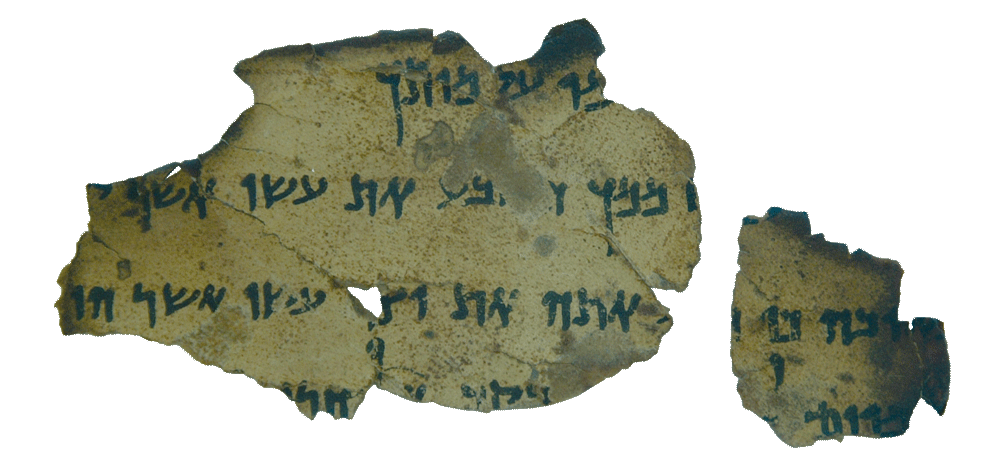
Extrabiblical stories referred to in 2 Peter were known to first-century Jews from texts like the book of Jubilees. The Hebrew version of Jubilees exists today only in fragments, such as the ones shown here (Qumran, second century BC).
Our author seems to be writing to Gentile believers in Jesus, not to Jewish believers. In this, 2 Peter is similar to 1 Peter. While these first recipients are familiar with stories that modern Christians know from the Old Testament, this group of ancient auditors (“auditors,” or “hearers,” because the majority of the recipients would never read the book but rather hear the book read to them as if it were a sermon) does not seem to have been as widely acquainted with Second Temple Jewish literature as that of Jude, for 2 Peter edits both the direct quotation of 1 Enoch and the story taken from the Testament of Moses out of the material he takes from Jude. We know that these recipients have received a previous letter from the same author (2 Pet. 3:1), but that letter is not necessarily 1 Peter. As Paul shows, New Testament authors could write numerous letters, many of which have not been preserved. The believing community that the auditors are members of is old enough that the missionaries who founded it (“your apostles”; 2 Pet. 3:2) are no longer there, having either moved on or died. It is also old enough that it was possible for believers to be taunted with the question, “Where is this ‘coming’ he [Jesus] promised?” (3:4).
Assuming that 1 Clement does in fact refer to 2 Peter (which can be debated), 2 Peter must have been written before AD 96. It had to be written before the Apocalypse of Peter (dated AD 110–40), for that work uses 2 Peter. Simon Peter was probably martyred before AD 68 (the death of Nero), so the question one must answer is whether the letter could have been written this early and, if so, whether it was the type of letter that a person like Simon Peter would have or could have written.
Structure and Occasion
The letter is structured as follows. It opens with a salutation (1:1–2) and opening argument (1:3–11). The body of the letter contains a series of arguments in support of the author’s position (1:16–3:13). The letter then closes with a final encouragement (3:14–18). Notice that the letter does not have a typical letter ending but merely a simple doxology in 3:18, leading some to believe that it is more a homily that was sent out with a letter opening (and an inserted resumptive address in 3:1) than an actual letter.
As noted above, the letter appears to have been written to oppose Epicurean influence. The Epicureans believed that everything (the world as a whole, including the gods) was made of atoms, that everything was heading toward final dissolution, that it followed that there was no individual future after death and certainly no final judgment, and that the best life was therefore lived for the present by maximizing pleasure. They were observant enough to realize that unbridled hedonism was not pleasant (as anyone who has eaten or drunk too much can testify), so they called for people to live according to the “golden mean,” that level of self-indulgence that maximized pleasure without leading to negative consequences. Some version of such teaching has apparently infiltrated the community of those who follow Jesus, and the author of 2 Peter is not impressed by this wisdom, for it means a life lived without regard to the imperial rule of Jesus and his coming judgment.
Commentary
The letter opens with the identification of the author as “Simeon Peter” (RSV; NIV: “Simon Peter”)—this work uses the more original form of the name, Simeon (as in Acts 15:14), rather than the shortened version Simon. He is writing to those with “a faith as precious as ours”—so, to faithful believers. The expression “our God and Savior Jesus Christ” is unusual and unlike similar expressions later in the letter. If our author is following the normal rules of Greek, he is talking about a single person, which makes this one of the clearer New Testament statements identifying Jesus as God.
The opening statement consists of two parts. The first part (1:3–4) uses Hellenistic concepts and unusual language to point out that Jesus took the initiative in delivering us and that this deliverance was accomplished through “our knowledge of” him (meaning personal knowledge and commitment, not just knowing about him). This enables us, on the one hand, to “participate in the divine nature” (a bold statement that we can become like Jesus/God) and, on the other, to “escape the corruption in the world” that is caused by desire. (“Evil” is not in the Greek text; for the Hellenistic world all desire was problematic and is the root of evil.) One cannot participate in the divine nature without escaping from the corruption in the world.
Therefore, the second part (1:5–11) is about the virtues (not listed in any particular order) that will make us more like Jesus. Pursuing these virtues (many of them community-preserving virtues) does not only make one’s commitment to Jesus better; it also makes it more secure, preventing one from falling away. If we are moving toward the center, Jesus, we are in no danger of slipping back into the pit from which we were rescued. Thus, this action will make sure not only that we are warmly welcomed when Jesus returns as emperor of this world (1:11) but also that we do not fall away and miss out on the rule of Jesus altogether, as the author of 2 Peter believes that some have done (1:9, picked up in 2:1–22).
3. Purpose Statement (1:12–15)
The purpose of the letter is testamental (similar to the purpose of other biblical [e.g., Gen. 49:1–28; Deut. 33:1–29] and extrabiblical testaments [e.g., the Testaments of the Twelve Patriarchs])—namely, that after his death the addressees will have a written record of Peter’s teaching and so always be able to remember it. The reason this is necessary is that (1) Peter is mortal (he refers to his mortal body as a tent, as Paul does in 2 Cor. 5:1, where the resurrection body is a “house”—in other words, permanent), and (2) he believes that his death (as predicted by Jesus in either John 13:36 or 21:18–19) is impending (although he does not tell us why he believes this). This letter is to “remind” his addressees and to “refresh [their] memory” since they are “firmly established in the truth” (1:12–13), which is a rhetorically polite statement that assumes the best about them. However, the fact that he is writing this letter indicates his fear that they could be vulnerable to the new teaching of those he labels “false teachers.”
4. Arguments in Support of His Position (1:16–3:13)
Given 2 Peter’s thesis (1) that God has intervened by means of Jesus to free human beings from the power of evil that is rooted in desire and (2) that in order to live in this deliverance one needs to pursue virtue, one would then expect support for this assertion. The author does this by means of a series of arguments, which he introduces by his polite assertion that his addressees know and are practicing all this but that, given his impending death, it is his duty to “remind” them (1:12). It is clear from what follows in chapter 2 that he believes they are under threat; but in the Hellenistic world it was polite to phrase your instruction as a reminder, so this is rhetorically effective. Furthermore, since his impending death casts this letter into the form of a final testament, this also lends weight to his arguments as the “last words” of a revered leader.
A. Apostolic eyewitness (1:16–18). The first argument refers to the transfiguration, also found in Mark 9:2–8 and its parallels. Second Peter presents this as an eyewitness account of the enthronement of Jesus, describing it by terms like “majesty” and “honor and glory” with a voice coming from the “Majestic Glory,” designating Jesus as God’s Son. Jesus’s reign has already been inaugurated, and if Jesus already reigns, trifling with his leadership and teaching and denying his “coming” are unwise indeed.
B. Prophetic witness (1:19–21). The experience of the transfiguration confirms what the prophets said. That is, Peter is not basing his argument on his religious experience alone but sees that experience as in continuity with the ancient prophets. We do not know which prophets he refers to (although there is an apparent allusion to Num. 24:17), but the author of 2 Peter wants to make clear that the prophets recorded in Scripture received not only the visions that they had from the Spirit but also the interpretation of those visions; so the prophets’ interpretation of their visions were not “the prophet’s own interpretation” but were just as directed by the Holy Spirit as were the visions. Did the teachers whom the author of 2 Peter opposes perhaps argue that, while inspired, the ancient prophets misinterpreted their visions and that they themselves had the right interpretation?
C. Certainty of judgment (2:1–10a). At this point our author reveals his central concern, as he incorporates the material he takes from Jude. There were false prophets in the past, and there are false teachers now. In Jude the others are outsiders, never named, and never said to be teachers. Here they are insiders (“among you”) who are “false teachers,” and it is only the new ideas that come from outside. (They “introduce” them.) The phrase “destructive heresies” means not so much false doctrine (the denial of the return of Jesus is a secondary issue and so left to last) as ideas that lead to divisions in the community. (“Heresy” indicates they separated into a party or sect.) It is also clear that these ideas lead to “depraved conduct” (some form of promiscuity) that even those in the larger pagan community around the believers would condemn (“bring the way of truth into disrepute”) and that these teachers based this teaching on “fabricated stories” (perhaps stories about spiritual experiences or visions), unlike the story of the transfiguration and the words of the prophets.
God, of course, is not fooled and will not be slow to judge them. The author gives a series of examples drawn from Jude, which he edits to stress that God can judge and at the same time save the righteous, rather than having to remove the righteous first or being prevented from judging because of the presence of the righteous. (Was this the teaching opposed by the author of 2 Peter?) The first example (2:4) is a reading of Genesis 6:1–8 through the lens of works like 1 Enoch, in which the sinning beings are angels who are subsequently imprisoned. (Second Peter uses the term “Tartarus” [see NIV note], the prison of the Titans in Greek mythology.) But while the “ungodly people” influenced by the angels perished, Noah, “a preacher of righteousness” (an idea drawn from extrabiblical Jewish stories about Noah), was saved. The same is true about Sodom and Gomorrah and the rescue of Lot (2:7), whose “tormented” soul is also an idea drawn from extrabiblical Jewish traditions, although his righteousness may be implied from Genesis 18. The author’s conclusion is that it is no problem for God to distinguish between the “godly” and the “unrighteous” in judgment (he does not have to remove the righteous first, and he does not worry that in judging the unrighteous he will accidentally harm the righteous) and that his judgment falls in particular on those following their natural desires (again, it is desire that is the culprit) and despising divine authority.
D. Denunciation of the false teachers (2:10b–22). The thesis that God distinguishes in judgment leads into a denunciation of the false teachers. Unlike the holy angels, these teachers slander celestial beings. (The clear reference found in Jude to the Testament of Moses has been removed.) But such behavior is simply emotional reaction and thus from what we would call the “animal brain”—so these teachers will die like animals.
The author charges these teachers with carousing (and not even trying to hide it) at the Lord’s Supper (“while they feast with you”), adultery, and greed (financially exploiting the community). The last charge makes them like Balaam (also mentioned in Jude), who prophesied or taught for money (both practices—especially prophecy for money—were rejected in the early church). Balaam’s action (and, by implication, that of the teachers) was so shameful that a dumb animal rebuked him verbally! (In Num. 22:30 the donkey speaks, but in 22:32–33 it is the angel who rebukes Balaam; however, in Second Temple Jewish literature the eloquent rebuke is in the donkey’s mouth.)
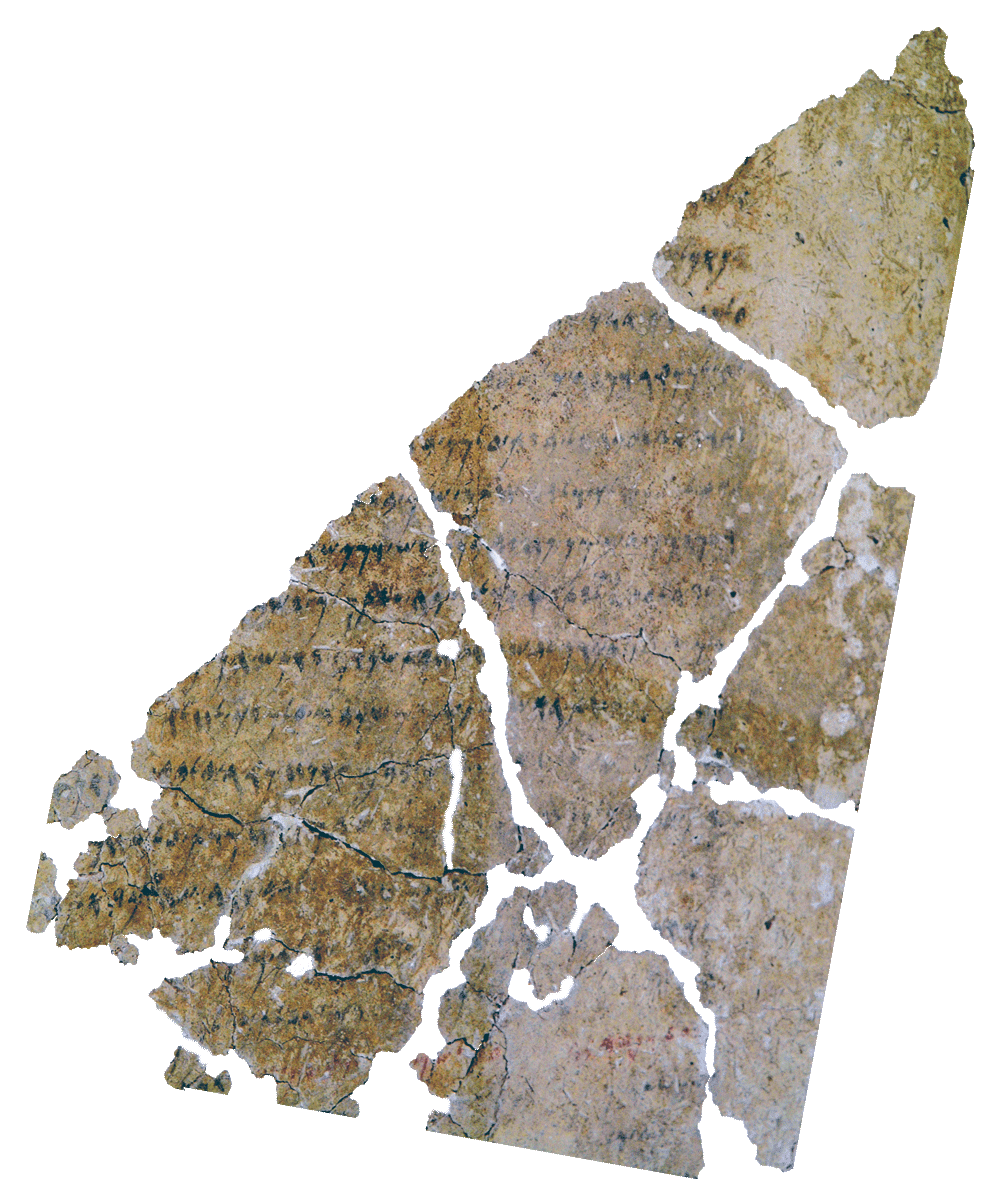
The “Balaam inscription” found at Deir ‘Alla (800 BC) is so named because it mentions Balaam son of Beor (see Numbers 22–24). In 2 Peter 2:15–16, the false teachers are accused of following the way of Balaam, who had to be rebuked by his donkey.
These teachers promise much but deliver little (2:17–18). They have been and still claim to be followers of Jesus and, as pointed out in 2 Peter 1:3–5, have therefore been delivered from the power of desire. But now they are enslaved to it again (so the “freedom” from conventional morality that they promise is a sham, since they are not truly free themselves). Therefore, they are worse off than if they had never become believers (2:20–21), presumably because they will receive harsher judgment than those who have never accepted the good news. This shocking conclusion is capped off with the citation of two proverbs, one Jewish and one pagan (2 Pet. 2:22).
E. Recapitulation and introduction of the second part of the argument (3:1–2). Our author pauses to recapitulate: this is a second letter (the first is not necessarily 1 Peter), and both simply remind the addressees what they already know from the Scriptures (“holy prophets”) and those evangelizing them (“your apostles”).
F. Mockers shown to be illogical (3:3–7). These teachers are the “scoffers” predicted to come in the “last days.” (Many in the early church believed they were in the “last days.”) Obviously, if one is living immorally, one can hardly believe in a judgment in which one will be called to account. These teachers therefore deny that there will be a “coming” of Jesus and that “he will judge the living and the dead” (to quote the later Apostles’ Creed). Perhaps they thought that all judgment had been taken care of on the cross or in the fall of Jerusalem, and so it was past. The world, so they argued, goes on steadily.
The author again points to Noah. The earth, pictured as rising in creation out of the seas and with waters in the firmament above it, was destroyed by that very water; God will do it again, but this time by fire rather than water. The idea that the world is indissoluble forgets biblical history.
G. Delay of the still certain final judgment (3:8–13). But what about that “coming”? Jesus manifestly had not returned, and it had been decades since his resurrection. The author argues that (1) God’s sense of time is not the human sense (which, although not his point, is the understanding of the psalmist in Ps. 90:4 and was a common Jewish understanding), (2) God is not slow, but patient, and (3) God will in fact bring judgment at an unexpected time. (The image of the thief is drawn from Jesus [Matt. 6:19; Luke 12:39] and used by Paul [1 Thess. 5:2].) Our author admits that God has delayed the return of Jesus but insists it is for a purpose: God does not want “anyone to perish, but everyone to come to repentance” (2 Pet. 3:9). Presumably, then, when the judgment comes, God will have decided that he cannot deliver any more people through continued delay.
The sudden judgment, when it comes, will mean the removal of heaven (the firmament that is between where God is and the earth) and the heavenly bodies (the “elements”—as the term is used in a number of ancient texts—that hang in or from the firmament and thus will be destroyed with it). This will leave the earth “laid bare” (not destroyed) so all is open to the divine eye and easily judged.
Since even the heavens above (thought by ancients to control life on earth) are impermanent, believers should be living for the permanent, the renewed earth, purged of all evil, with, of course, a new heaven (since the old was destroyed in the course of judgment), which God has promised. The way one lives for this is not by talking about it but by living “holy and godly lives” (3:11).
5. Final Encouragement to Stability (3:14–18)
Our author sums up. (1) Live holy lives (3:14). (2) Think of the delay in the coming of Jesus as “our Lord’s patience,” which means “salvation”—perhaps the recipients’ salvation, for Christ could have come before they came to know and commit to him. Then our author notes (3) that Paul agrees with this teaching in at least three of his letters (the Greek form indicates that the author of 2 Peter knows of more than two letters, but we do not know how many of Paul’s letters he knows), although, as was already clear in 1 Corinthians 5–6, some took Paul’s teaching on grace to mean that licentious living would not be punished. Such distortion of Paul would lead to the destruction of the distorters.
The final reminder (3:17) is to “be on your guard” and thus not to be deceived and fall themselves, for the holy lives they are now living in obedience to Jesus are a “secure position.” The letter (or perhaps sermon with a letter opening) ends with a blessing and doxology: the blessing is a summary of 2 Peter 1:5–8 and focuses on our imperial ruler and deliverer, Jesus, God’s anointed king (to put our author’s titles into more modern form). And certainly he will indeed have all honor (i.e., “glory”) now and forever.
Select Bibliography
Bauckham, Richard J. Jude, 2 Peter. Word Biblical Commentary. Waco: Word, 1983.
Davids, Peter H. The Letters of 2 Peter and Jude. Pillar New Testament Commentary. Grand Rapids: Eerdmans, 2006.
Green, Gene L. Jude and 2 Peter. Baker Exegetical Commentary on the New Testament. Grand Rapids: Baker Academic, 2008.
Neyrey, Jerome H. 2 Peter, Jude: A New Translation with Introduction and Commentary. Anchor Bible. New York: Doubleday, 1993.
Reese, Ruth Anne. 2 Peter and Jude. Two Horizons New Testament Commentary. Grand Rapids: Eerdmans, 2007.