1–2 Chronicles
1. The Genealogies of Israel (1 Chron. 1:1–9:44)
A. God’s Chosen People among the Nations (1:1–2:2)
D. Northern Transjordan Tribes (5:1–26)
F. Northern Cisjordan Tribes (7:1–40)
H. God’s Chosen Remnant from the Nations (9:1–44)
2. The Account of David (10:1–29:30)
A. The Defeat and Death of Saul (10:1–14)
B. Establishing David’s Rule (11:1–47)
C. Supporting David’s Rule (12:1–40)
D. Transferring the Ark: First Attempt (13:1–14)
F. Transferring the Ark: Second Attempt (15:1–29)
G. The Ark in Jerusalem and the Tabernacle in Gibeon (16:1–43)
H. Dynasty and Temple (17:1–27)
I. Victory over the Nations and Administration in Israel (18:1–17)
J. Victory over Ammon and Aram (19:1–19)
K. Victory over Ammon and Philistia (20:1–8)
M. Initial Provision and Commission to Build the Temple (22:1–19)
N. Personnel for Temple and Kingdom (23:1–27:34)
O. Commissioning Solomon (28:1–21)
P. Charging the Assembly (29:1–30)
3. The Account of Solomon (2 Chron. 1:1–9:31)
A. Ascending the Throne (1:1–17)
B. Preparing for the Temple Project (2:1–18)
C. Building the Temple Structure (3:1–17)
D. Creating the Temple Furnishings (4:1–22)
E. Transferring the Ark in Jerusalem (5:1–14)
F. Dedicating the Temple—Solomon’s Speech and Prayer (6:1–42)
G. Dedicating the Temple—Yahweh’s Response to Solomon (7:1–22)
4. The Post-Solomonic Accounts (10:1–36:23)
A. The Reign of Rehoboam (10:1–12:16)
B. The Reign of Abijah (13:1–22)
C. The Reign of Asa (14:1–16:14)
D. The Reign of Jehoshaphat (17:1–20:37)
E. The Account of Jehoram (21:1–20)
F. The Accounts of Ahaziah, Athaliah, and Joash (22:1–24:27)
G. The Account of Amaziah (25:1–28)
H. The Account of Uzziah (26:1–23)
I. The Account of Jotham (27:1–9)
J. The Account of Ahaz (28:1–27)
K. The Account of Hezekiah (29:1–32:33)
L. The Account of Manasseh (33:1–20)
M. The Account of Amon (33:21–25)
N. The Account of Josiah (34:1–35:27)
O. The Final Royal Accounts, Exile, and Restoration (36:1–23)
Introduction
Authorship and Date
By beginning with Adam and ending with Cyrus, 1–2 Chronicles provides an overview of history from the creation of the world until the foundation of the community to which it is addressed, in the Persian period. Mention of the figure Cyrus (2 Chron. 36:22–23, 539 BC), the coin “daric” (1 Chron. 29:7, ca. 515 BC), and Persian-period Davidic descendants (1 Chron. 3:17–24, ca. 450 BC) places the author of this book no sooner than the mid-fifth century BC. Allusions to Chronicles in books from the Second Temple period (1 Maccabees, Sirach, Dead Sea Scrolls) and its inclusion in the Old Greek translation suggest it was composed prior to the mid-third century BC. The community in and for which it was written was controlled largely by a group who had returned to Jerusalem after exile in Mesopotamia, rebuilt the temple, restored its services, yet remained under the hegemony of a foreign power, most likely the Persians (see Ezra-Nehemiah, Haggai, Zechariah, Malachi). The author is anonymous, but the emphasis placed on and familiarity with the practices of the nonpriestly Levites suggests someone within this guild.
Sources
The Chronicler responsible for this book constantly refers to sources from which further information could be culled and possibly from which he has drawn elements in his account. These sources range from records of various prophets (e.g., 1 Chron. 29:29; 2 Chron. 9:29) to the book of the kings of Judah and Israel (e.g., 2 Chron. 16:11; 25:26), none of which are extant. A close comparison of the accounts and lists in Chronicles and other Old Testament books reveals heavy reliance on the books of Samuel and Kings for narrative material (approximately 50 percent) and reliance on the Torah, Joshua, Psalms, Ruth, Ezra, and Nehemiah for many of the lists. A comparison between Chronicles and these sources offers insight into the historiographic intention of the Chronicler. It shows that the Chronicler is a master at gathering and combining sources as he constructs his history of Israel for his Persian-period audience.
Structure
Due to its length this work is typically divided into two parts (1 and 2 Chronicles), but it constitutes a single literary work. This composition is divided into four basic sections, beginning with an elongated review of the genealogies of Israel within the world (1 Chronicles 1–9), which not only depicts an ideal Israel united by Judah (David), Levi (temple), and Benjamin but also implicitly traces the story of Israel among the nations from Adam (1 Chron. 1:1) to Saul (1 Chron. 9:35–44). The narrative proper begins in chapter 10, with the death of Saul, designed to both contrast and prepare for the account of David in 1 Chronicles 10–29. The focus of this account is on David’s preparations for the temple, first by transporting the ark to Jerusalem and legislating worship at this site, second by identifying the site of the temple, and third by providing the materials and personnel necessary for Solomon’s construction of the temple. This is the focal point in the third major section of the book in 2 Chronicles 1–9, the account of Solomon. The idyllic rendition of Solomon’s reign provides a firm foundation and exemplary pattern for the second temple in the Chronicler’s day but also suggests an enduring hope for a future ideal royal figure. The post-Solomonic narratives in 2 Chronicles 10–36 trace the rise and fall of Judah’s various monarchs, each providing an example to warn or encourage the Chronicler’s audience. The book closes with a reminder of the divine hope expressed through the Persian-sponsored reconstruction of the temple and the divine challenge for others to return and join this worshiping community.
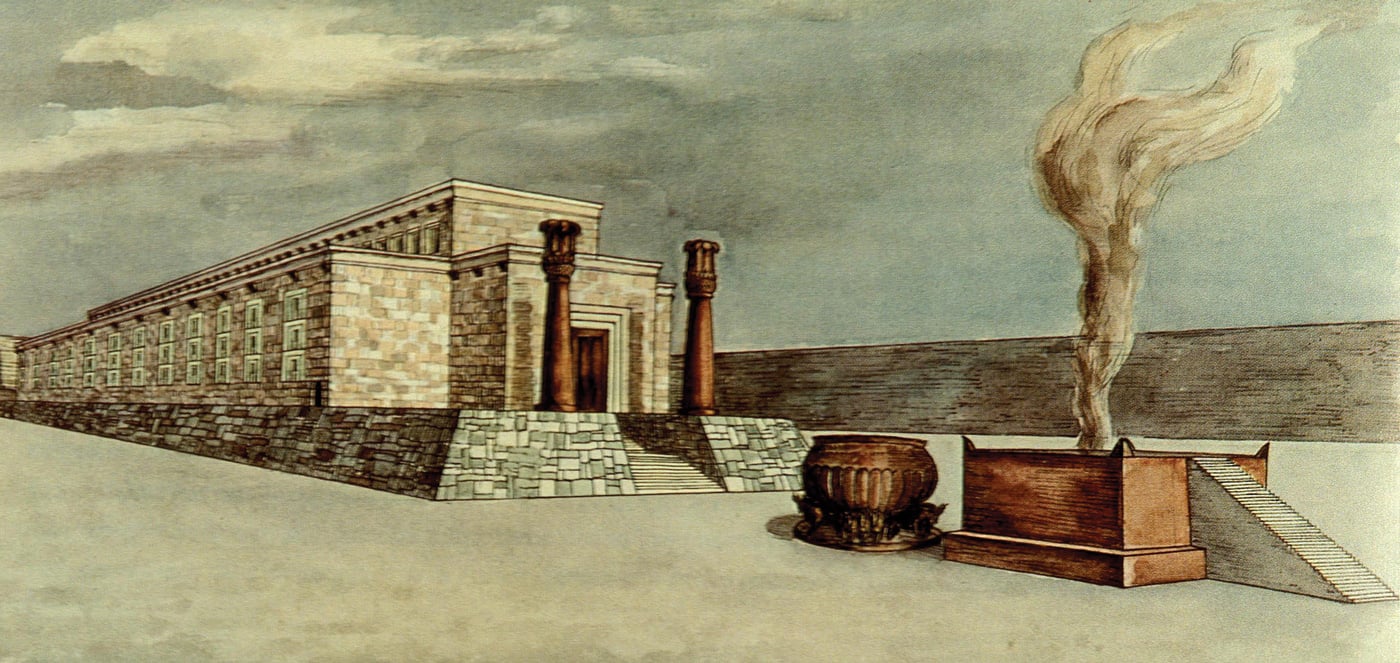
Artist’s rendering of Solomon’s temple
Theological Themes
The Chronicler expresses key theological principles through his rendition of the history of Israel. At the core of his theology is the proper worship of Yahweh at the temple in Jerusalem. While not ignoring the Torah legislation for worship revealed through Moses, in particular priestly sacrificial activity, the Chronicler consistently embraces Davidic innovations for the worship at the temple with focus on the verbal worship performed by the nonpriestly Levites. Faithfulness to covenant values expressed in the Torah, especially those related to exclusive worship of Yahweh at Jerusalem through legitimate means, is essential to the Chronicler’s depiction of the history of Israel. Programmatic is Solomon’s prayer at the dedication of the temple, which identifies the temple as the place of renewal for disobedient Israel (2 Chronicles 6). Key also is Yahweh’s subsequent response in 2 Chronicles 7:12–16, which identifies the path to renewal as seeking, humbling, praying, and repenting, activities that will result in the blessing of God. This blessing is depicted throughout Chronicles in terms of construction projects, military success, abundant progeny, popular support, and long rule. Those who act unfaithfully and abandon Yahweh lack these blessings and are cursed. The Chronicler gives much attention to the prophetic office, citing many figures of classical prophecy (Isaiah, Jeremiah) as well as depicting priestly, Levitical, and even imperial figures as functioning prophetically. One can also discern within the Chronicler’s history a vision for Israel beyond that of the Chronicler’s present community. Although the Chronicler does not see a place for the northern kingdom as a political structure independent from Davidic rule, he consistently embraces northerners who submit to Davidic rule and worship at the temple in Jerusalem. The depiction of an ideal David and Solomon and exemplary figures like Hezekiah and Josiah, the inclusion of an elongated Davidic genealogy in 1 Chronicles 3, and regular references to the enduring nature of the dynastic promise to David reveal the Chronicler’s hopeful agenda for the reemergence of Davidic rule for the restoration community. The close link between temple and kingship throughout Chronicles reveals that the reconstruction of the temple foreshadows the renewal of the Davidic dynasty.
For Christians 1–2 Chronicles reveals the spiritual posture of a community into which their messiah Jesus would come. The importance of the faithful gathered around the second temple to the recognition of Jesus after his birth (see Luke 1–2) and the preparation for Jesus’s ministry by the priestly prophet John’s call to repentance are part of the enduring legacy of the Chronicler, who looked for an ideal Davidic ruler. This book has enduring relevance for a church in need of penitential renewal, reminding the followers of the Messiah Jesus that God continues to act in history, as his eyes “range throughout the earth to strengthen those whose hearts are fully committed to him” (2 Chron. 16:9).
Commentary
1. The Genealogies of Israel (1 Chron. 1:1–9:44)
The book of 1–2 Chronicles begins with nine long chapters of genealogies. Through these genealogies the Chronicler lays the foundation for the story of Israel, which will shift to narrative form in 1 Chronicles 10, with the final scene of Saul’s life. The genealogy in 1 Chronicles 1 identifies Israel’s roots among the nations of the world, showing that the story of Israel is intertwined with that of other nations. Chapters 2–8 provide details on the various tribal lineages within Israel, arranged in chiastic fashion with the two key tribes that survived the exile, Judah (2:3–4:23) and Benjamin (8:1–40), bracketing the entire list and the priestly tribe, Levi, at its center (chap. 6). Between these tribes are placed the northern tribes (chaps. 5, 7).
Such genealogies are used for a variety of purposes in ancient literature. They define sociological functions (identifying military, priestly, and royal personnel), highlight relationships between various groups of people (here relationships with the broader world and between various tribes), initiate the narrative plot by using people’s names to summarize earlier phases of the story, and foreshadow key theological themes and literary structures used later in the work. Chapters 1–9 are thus not composed of irrelevant lists but rather lay the foundation for this book and the community that read it. This constitutes a genealogical tradition that will be continued in the books of Matthew and Luke, finding its culmination in the person of Jesus the Messiah, son of David, son of Abraham, son of Adam, son of God (Matt. 1; Luke 3).
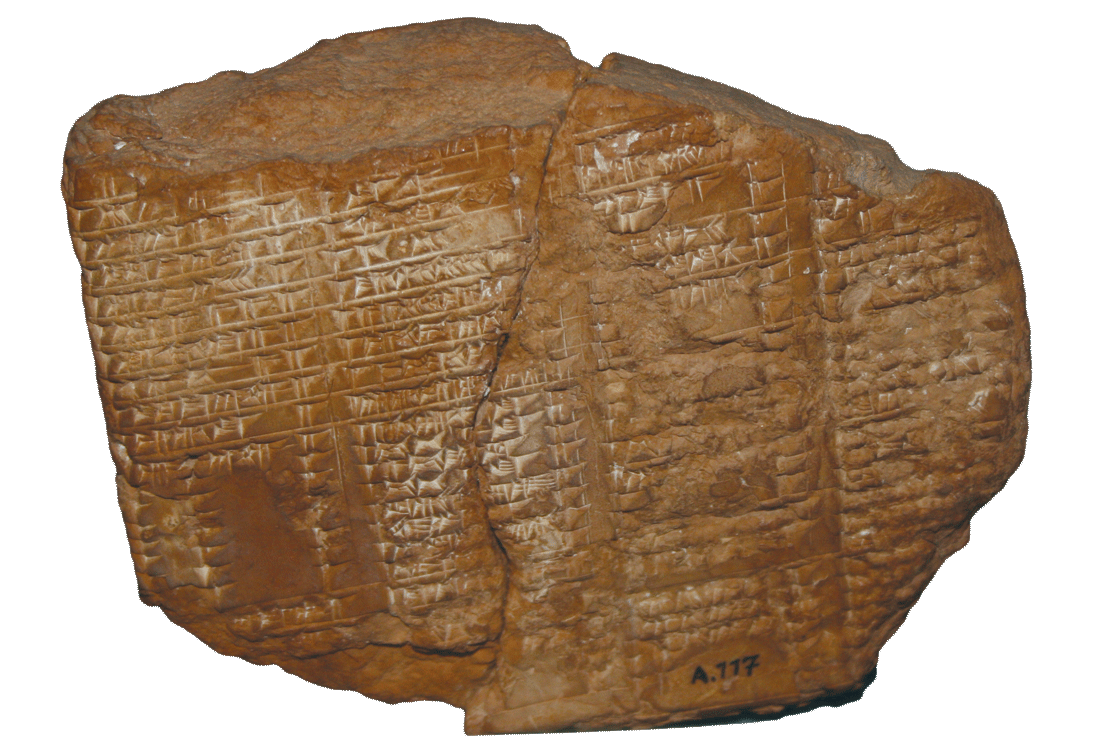
One genealogy from ancient literature is the Assyrian King List (seventh century BC), which records all the Assyrian kings down to Tiglath-Pileser I (1115–1076 BC).
A. God’s chosen people among the nations (1:1–2:2). The first genealogy begins with Adam (1:1) and ends with the family of Israel (2:1–2), laying the foundation for the core of this genealogical section in chapters 2–8, which will focus on the various tribes of Israel. The genealogy in 1:1–4 is linear; it traces a single line of descendants from Adam to Seth to Noah, ignoring the line of Cain. Beginning with verse 5, the genealogy shifts to a segmented genealogy, one that traces multiple lines emerging from the final character mentioned. Thus Noah has three sons (1:4), and so the genealogies of these sons are provided in reverse order: Japheth (1:5–7), Ham (1:8–16), and Shem (1:17–26). From these three, descendants related to the final genealogical group (Shem) become the focus of the next group of genealogies. Thus, Abram/Abraham’s line emerges from the line of Shem (1:24–28), and the lines of his two key sons, Isaac and Ishmael, are traced in reverse order with Ishmael first (1:29–31), followed by the sons of Abraham through Keturah (1:32–33), and finally and most importantly, Isaac (1:34). The chosen line of Isaac is then traced in reverse order of election, first Esau and related peoples (1:35–54), followed by Israel (2:1–2).
This opening genealogy is an important reminder that Israel has arisen out of the nations and that its destiny is to bring blessing to these nations. The Chronicler’s audience was well aware of the recent exilic experience among the nations. Although the return to the land was a signal of a new day for the nation (2 Chronicles 36), the postexilic community would continue to live under the hegemony of the nations. The restoration that Jesus inaugurated was not identified as a return to political independence but rather as a kingdom that would be spread by the gospel throughout all nations. In this way then, Israel’s identity here is a foreshadowing of Christian identity, that community of the Messiah who would take the blessing of Abraham to the Gentiles.
B. Judah (2:3–4:23). While the genealogies in chapter 1 traced the chosen line last, the genealogies of Israel in chapters 2–8 place the enduring chosen lines at the beginning (Judah), center (Levi), and end (Benjamin). Although fourth-born of Israel (2:1–2), Judah is given primacy among the tribes, placed in first position, with the longest list. This genealogy of Judah is bracketed by an introduction to all the sons of Judah in 2:3–9 and a short description of the nonelect clans in 4:17–23. Genesis 38 explains the origins of these various clans. Judah’s Canaanite wife Bathshua produced Er, Onan, and Shelah, with only the last surviving and having offspring. Judah’s unknowing tryst with his Canaanite daughter-in-law Tamar produces the twins Perez and Zerah. The short description in 4:17–23 quickly traces the descendants through the two insignificant Judahite lines of Zerah and Shelah, while the dominating central core of this genealogy in 2:10–4:16 lists the descendants of Perez through Hezron. The focus of this central genealogy is clearly the royal line of David from the family of Ram (2:10–17; 3:1–24), with David in the preferred seventh position from beginning and end of the list of Jesse’s children in 2:10–17. David’s royal descendants, provided in detail in 3:1–24, continue well after the fall of the kingdom to the time of the Chronicler, evidence of the Chronicler’s enduring royal hope.
The first and longest genealogy among the tribes is that of Judah, not surprising in light of the fact that descendants of this tribe formed the majority of the postexilic audience, for which Chronicles was written, and that royal descendants of this tribe (Davidic dynasty) functioned as the central characters of the book. This focus on Judah reminds the reader that Israel’s hope was tied especially to the small Judahite community that survived the exile, rebuilt the temple, and reestablished communal and spiritual rhythms. It is into this community that Jesus of Nazareth, son of David, would arise and fulfill the messianic hopes of old.
C. Simeon (4:24–43). It is not surprising to find a short genealogy of Simeon following the review of Judah. Simeon’s territory is closely associated with Judah’s inheritance throughout the book of Joshua (cf. Josh. 15:26–32; 19:1–9), and Judges 1 reveals how Judah and Simeon cooperated in their conquest of the land. Ultimately Simeon would be swallowed up by Judah, a reality foreshadowed by Jacob’s curse in Genesis 49:7 on Simeon for his violent treatment of the Shechemites in Genesis 34:25–30. The Chronicler uses Simeon as a foil against which one can see Judah’s blessing more vividly (1 Chron. 4:27).
D. Northern Transjordan tribes (5:1–26). Enclosed within the genealogical structure of the Chronicler’s present-day community (Judah, chaps. 2–4; Levi, chap. 6; Benjamin, chap. 8) are two genealogical sections devoted to the northern tribes (chaps. 5, 7). The first recounts the lines of the northern tribes Reuben and Gad and half the tribe of Manasseh, who settled in the Transjordan (that region east of the River Jordan; Josh. 1:10–18). While these genealogies are bracketed by reminders of the failures of these tribes (5:1–2; 5:25–26), the inclusion of their genealogies as well as accounts of faithful victory (see 5:18–22) reveals the Chronicler’s positive stance toward these tribes. For the Chronicler there is hope for a unified Israel, assembled around the Davidic monarch and his Levitical servants.
E. Levi (6:1–81). At the center of the genealogies in Chronicles is the tribe of Levi, those responsible for the temple and its worship, which will become the dominant theme of the narrative of 1–2 Chronicles. The Chronicler traces first the Aaronide priestly lines (6:1–15) then the nonpriestly Levitical clans (6:16–30). The respective duties of these two groupings are presented in reverse order, beginning with the nonpriestly Levites (6:31–48) and then the priests (6:49–53). Here the Chronicler lays out his vision for cooperation among all descendants of Levites in the worship at the temple, foreshadowing the innovations of David in 1 Chronicles 11–29. While the focus of the priests is on making atonement for Israel by offering sacrifice and incense (6:49), the focus of the nonpriestly Levites is to minister in music (6:31–32) and perform other duties (6:48). The territory for both priests and Levites is outlined in 6:54–81, revealing how the material needs of these clans were to be met, even as they provided spiritual service for the tribes throughout the land. The worship of Yahweh is the core calling of the people of Israel, and so the tribe of Levi is placed at the center of this genealogical review. It is Jesus who will assume and transcend the role of Levi in the new covenant (see Heb. 5, 7–10).
F. Northern Cisjordan tribes (7:1–40). The list of genealogies in 1 Chronicles 7 complements the list of northern tribes in 1 Chronicles 5, this time listing the genealogies of the Cisjordan (those tribes on the western side of the River Jordan), northern tribes, which included Issachar, Benjamin, Naphtali, Manasseh, Ephraim, and Asher. In light of the focus of chapter 8 on the tribe of Benjamin, it is odd that Benjamin is included here among the northern tribes. This suggests Benjamin’s identity as the tribe caught between the dominant northern (Ephraim) and southern (Judah) tribes. The absence of the tribes of Dan and Zebulun may be a painful reminder of the consequences of the disobedience of the northern tribes. However, the list of the other northern tribes reveals the Chronicler’s affirmation of these northern groups and hope for a unified Israel rallied around the temple (Levi, chap. 6) and led by a Davidic monarch (Judah, chaps. 2–4). Allusion to an Israel united around Jesus is seen in his calling of the Twelve and the fulfillment of the restoration vision of Joel 2:28–32 in Acts 2.
G. Benjamin (8:1–40). An elongated genealogy of Benjamin concludes the Israelite genealogies in chapters 2–8, forming with Judah (chaps. 2–4) a bracket around the entire complex at whose center is the tribe of Levi (chap. 6). Benjamin’s place here is related to the fact that it is descendants of Judah and Benjamin who will form the core of the restoration community after the exile (see Ezra 1:5) and that the narrative of Israel in 1 Chronicles 10–2 Chronicles 36 will begin with a focus on the fate of Israel’s first king, the Benjamite Saul (1 Chron. 10:1–14; cf. 8:29–40).
H. God’s chosen remnant from the nations (9:1–44). After providing a detailed genealogical vision of Israel in chapters 2–8, the Chronicler returns to the broader context of Israel’s place among the nations, complementing the introductory genealogy in chapter 1. In 1 Chronicles 9 Israel again emerges from the nations, this time as a restoration community after the exilic nightmare. It is this restoration community to which the Chronicler’s audience would trace itself. The Chronicler’s present Israel (chap. 9) has the same potential as the Israel of chapters 2–8, which emerged from the nations in chapter 1. Chapter 9 concludes with a repetition of 8:29–40, functioning here as a transition between the genealogies in chapters 1–9 and the narrative account in 1 Chronicles 10–2 Chronicles 36, which begins with the account of Saul’s death in 1 Chronicles 10.
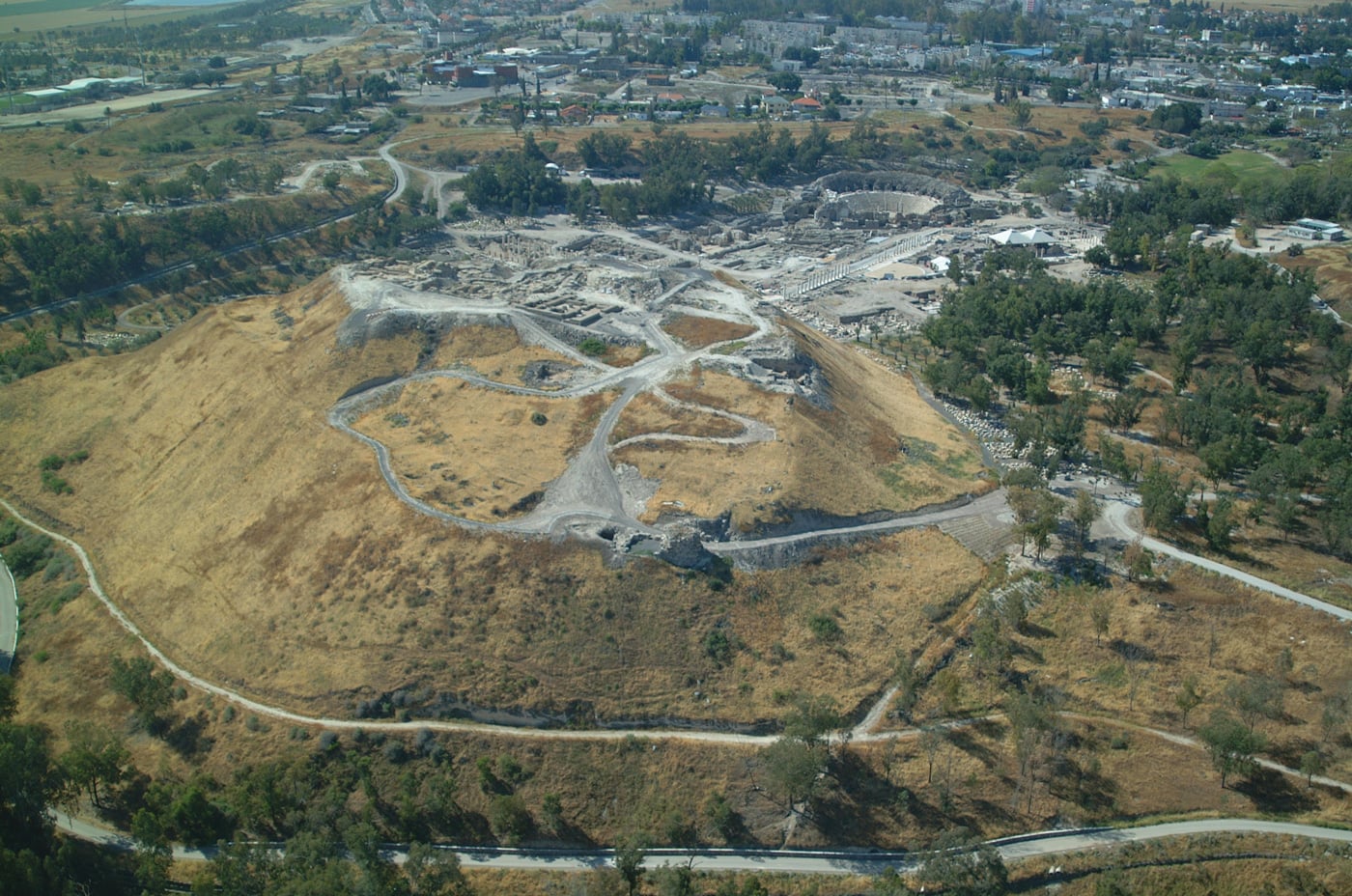
The ancient site of Beth Shan, where Saul’s body was taken by the Philistines and placed on public display to highlight the victory over Israel (1 Chron. 10:10; cf. 1 Sam. 31:10)
2. The Account of David (10:1–29:30)
With chapter 10, 1 Chronicles shifts from its genealogical introduction to the story of the Davidic monarchy. This story begins with the tragic death of Saul, revealing Saul’s role as a foil against which one may see the brilliance of David. The account of David comprises two main sections divided by the story in chapter 21, which reveals how the temple site was chosen. Driving the first main section (chaps. 10–20) is David’s passion for the centralization of worship in Jerusalem, while driving the second main section (chaps. 22–29) is David’s provision of personnel, support, and materials for the temple to be constructed by his son Solomon. Both sections give some attention to military matters, revealing David’s role in creating a secure kingdom where worship would be possible.
This section foreshadows the future role of David’s scion Jesus of Nazareth, the one who taught that the Father was seeking worshipers who would worship neither at Jerusalem nor Gerizim, but rather would worship in spirit and truth (John 4:24). Christ’s death and resurrection opened this way to the Father, the ultimate centralization of worship for the whole world.
A. The defeat and death of Saul (10:1–14). The genealogies ended in the previous chapter with the Benjamite Saul, revealing that one of the roles of genealogies was to provide a quick summary of the story of the world and Israel from Adam (1:1) to Saul (9:39). The chapter begins with the dramatic story of the defeat of Saul’s army on Mount Gilboa by the Philistines and his suicidal death (10:1–7). So powerless is this first king of Israel in his dying moments that when the king is wounded and facing imminent death, his armor bearer refuses to save him the dishonor of death by the Philistine archers. Reference to his whole house dying together (10:6) is a poignant reminder of the demise of Saul’s dynasty, setting the stage for the rise of David in the following chapter. First Chronicles 10:8–12 relates the aftermath of the battle, focusing on the shameful dishonoring of the body of Saul by the Philistines. The placement of Saul’s head and armor in Philistine shrines emphasizes the religious character of this victory and Saul’s association even in death with Canaanite spirituality. In the end Saul’s kin at Jabesh Gilead (see Judg. 21:1–25; 1 Sam. 11:1–11) retrieve the bodies of Saul’s family from the Philistines, observing proper mourning rites (cf. 2 Sam. 1:11–12, 17–27; 3:35; Ps. 35:13–14). This chapter closes with a theological reflection, in 10:13–14, that links his death to divine judgment due to Saul’s serious offenses against God, which included not following Yahweh’s instructions (cf. 1 Samuel 13; 15), consulting a medium (1 Sam. 28:1–25; cf. Deut. 18:9–14), and not inquiring of Yahweh through appropriate means. The priority of the Chronicler is thus the attentive seeking of Yahweh’s will through appropriate means followed by careful obedience to that revealed will. Saul’s negative example sets the stage for both positive and negative examples of later kings and their people. Important is the final sentence of the chapter, which signals the transition from Saul to David, identifying Yahweh as the instigator of this transition and creating expectation of a new and positive era for Israel.
B. Establishing David’s rule (11:1–47). In contrast to the writer of 1–2 Samuel, who depicts the civil war between those loyal to the dynasty of Saul and those loyal to David, in 11:1–3 the Chronicler immediately moves to the anointing of David by all the tribes of Israel, which followed that civil war. The absence of the depiction of David’s struggle for the throne is the first sign that the Chronicler is presenting a glorified image of David (and Solomon), one that functions to justify the present second temple activities and to inspire future royal hope. The people’s speech here highlights David’s early qualifications for kingship (11:2), referring to him as a shepherd, a common ancient Near Eastern royal image of one who cares for a vulnerable people (cf. Ps. 78:70–72), and as a ruler or leader, using the same Hebrew term often used by Yahweh to refer to his royal vice-regents (cf. 1 Sam. 9:16; 10:1; 13:14). Anointing and public confirmation here are the essential signs of the community’s recognition of Yahweh’s election of the royal figure. Oil was most likely used for the anointing, representative of Yahweh’s blessing on and presence in the leader.
David’s first action in Chronicles is to conquer and fortify Jerusalem (11:4–9), the first of a series of steps in 1 Chronicles 11–29 that highlight David’s fixation with temple worship in Jerusalem. Description of early building programs in the fortification of Jerusalem will become a typical sign in Chronicles of Yahweh’s blessing on a faithful king. Here this is made explicit with the reference to the presence of Yahweh Almighty at the end of 11:9.
Chapter 11 closes with a list of the names and exploits of David’s military heroes, who are depicted as indicative of the full support of “all Israel” (11:10). This focus on “all Israel” is important to the Chronicler’s vision for the nation, united around their Davidic ruler in worship of Yahweh at Jerusalem. The list of military men begins with the exploits of “the Three” (11:11–19). Each of these military figures is credited with a major military victory against incredible odds, the final one cast in language suggestive of sacrifice (blood, he poured it out before the Lord; cf. Num. 28:7). Verses 20–25 relate the exploits of two additional leaders: Abishai, the brother of Joab, David’s general, who rises to commander of possibly a second squad of “the Three” in 11:11–19; and Benaiah son of Jehoaida, who although not attaining to the level of “the Three” gains renown among “the Thirty” by killing two men, a lion, and a giant Egyptian. The list of mighty men in 11:26–47 most likely represents members of the Thirty, that faithful inner circle of warriors loyal to David who provided protection for the newly anointed king.
C. Supporting David’s rule (12:1–40). What follows in 1 Chronicles 12 is a depiction of David as a leader who attracts Israel’s loyalty long before the end of Saul’s life. In this the Chronicler has shifted to an earlier period of history than that depicted in 1 Chronicles 11.
The first section, 12:1–22, depicts those who supported David prior to his establishment of Hebron as his first capital. It is not accidental that the first group listed is linked to Saul’s own tribe of Benjamin and his hometown, Gibeah. Others who support David are not only from the expected southern tribe of Judah but also from the northern tribes of Gad and Manasseh. Locations listed here, Ziklag (1 Sam. 27:1–6) and his stronghold in the desert (see Adullam in 1 Sam. 22:1–5, En Gedi in 1 Sam. 23:29, unnamed ones in 1 Sam. 24:22; 2 Sam. 5:17), are typical of David’s experience while on the run from Saul and prior to his settlement in Hebron as his capital. This list and account are an important reminder of early support of David by all Israel. Amasai’s Spirit-inspired speech in 12:18 not only voices the loyalty of these defectors to David but also reminds the reader of divine blessing and presence within David.
Verses 23–38a provide further examples of support for David, now after the death of Saul. Again emphasis is placed on “all Israel” as evidence of support, with accompanying numerical values provided for all thirteen tribes of Israel (12:24–37) who affirm David’s kingship. The list moves geographically from south to north in the Cisjordan (Judah, Simeon, Levi; Benjamin, Ephraim, Manasseh, Issachar, Zebulun, Naphtali, Dan, Asher) and then the Transjordan (Reuben, Gad, Manasseh). The numbers used here most likely refer to military units, both large (thousand) and small (hundred).
Chapter 12 closes with a picture of the entire nation gathered around David at Hebron, unified and celebrating his ascension to the throne (12:38b–40). The accent on joy will become typical throughout the Chronicler’s account. The Chronicler’s depiction of Israelite support for David stands in stark contrast to the struggle depicted through 1–2 Samuel. Through this the Chronicler continues to offer an idealized portrait of David, one that legitimizes the second temple of his present day and creates expectations for the return of royal rule.
D. Transferring the ark: First attempt (13:1–14). First Chronicles 13 reveals that David’s military strength and popular support makes possible his main agenda of the worship of God at the temple in Jerusalem. This chapter represents the first of two attempts to move the ark from Kiriath Jearim (cf. 2 Samuel 6) to Jerusalem, the second successful attempt occurring in 1 Chronicles 15. The narrative begins with David’s consulting the people (13:1–4), continuing the motif of the entire nation (“all Israel”) unified around their monarch. David’s appeal to the assembly emphasizes the role of the people as a whole (“if it seems good to you”), but also of Yahweh (“if it is the will of the Lord our God”) in decision making. It is ironic that while in his speech David distances himself from his predecessor Saul, whose lack of inquiry led to his downfall (cf. 10:13–14), David does not properly inquire of Yahweh as to how to move the ark, which would place inquiry at the heart of the nation. Although he discerns the will of the people (13:4), he does not discern the will of Yahweh (cf. 1 Chron. 15:13).
Verses 5–8 then describe how David and all Israel proceeded to Kiriath Jearim to transport the ark to Jerusalem. According to Exodus 25:10–22 the ark was housed in the Most Holy Place in the tabernacle, represented either Yahweh’s royal throne or his footstool, and contained symbols of his miraculous provision (manna, Aaron’s rod) and covenant relationship with Israel. Its presence in Kiriath Jearim followed its loss to the Philistines (1 Samuel 4–6). David has arranged for its transport on a cart guided by the sons of Abinadab, Uzzah and Ahio, and accompanied by the worship of the people with musical instruments, a theme typical of the books of Chronicles.
In 13:9–12, however, tragedy strikes as Uzzah reaches out his hand to steady the ark when the oxen stumble. In this the commoner Uzzah violates a holy object, that is, one dedicated for Yahweh alone, which was to be approached only by sacred personnel. It is not accidental that the location of this event is at a threshing floor (13:9), a foreshadowing of a later threshing floor that will mark the site of the temple in which the ark will finally rest (1 Chron. 21:18). David’s anger and fear (vv. 11–12) reminds the reader of the mysterious character of Yahweh’s will and the need for God’s servants to make inquiry of and submit to that will. David’s searching question in verse 12 will be answered by the provision of the Levites in chapter 15.
The chapter ends in 13:13–14 with the ark resting in the home of Obed-Edom, where it brings divine blessing. This only increases the tension created by this incident, ensuring that the ark will eventually find its way into Jerusalem so as to bring blessing on the nation as a whole.
E. The world stage (14:1–17). Before resolving the tension introduced in chapter 13, the Chronicler reminds the reader of the divine blessing on David, expressed here as elsewhere in Chronicles through depictions of building activity, abundant progeny, and military victory. While chapters 11–12 focused on the support David enjoyed within the nation, chapter 14 begins and ends with notes on the respect he receives from surrounding nations (14:1, 17). In 14:1 David receives messengers and artisans from Hiram’s royal court at Tyre, signaling his newfound status among the kings of the ancient Near East. In light of this the Chronicler provides a summative note in 14:2, describing David’s realization that his new position was caused by Yahweh’s election and for the sake of his people. In this he truly functions as a mediatorial figure between Yahweh and his people, one who will be a conduit of divine blessing to the nation. In 14:3–7 the Chronicler lists the progeny born to David in his new capital at Jerusalem, here contrasting Saul, whose progeny was lost in 1 Chronicles 10:6.
First Chronicles 14:8–16 then comprises two accounts of David’s military victories over the Philistines, that force which had defeated Saul in 1 Chronicles 10. These two accounts accentuate the contrast between David and Saul, as David inquires of Yahweh for guidance (14:10, 14; cf. 10:13–14) and sees Yahweh go before him as divine warrior. David’s actions here also reveal the missing element in his unsuccessful attempt at moving the ark in chapter 13, which will soon be rectified in chapter 15. These episodes provide a normative pattern for royal leadership in the Chronicler’s Israel, one that seeks and obeys Yahweh’s will. First Chronicles 14:17 brings closure to the chapter, returning to the point at which chapter 14 began by reminding the reader of David’s international recognition caused by Yahweh. Throughout this chapter David’s success is explicitly linked to Yahweh’s election and action, an important reminder that apart from Yahweh, David has no significance or potential.
F. Transferring the ark: Second attempt (15:1–29). After the reminder of Yahweh’s blessing on David, exemplified in his newfound status among the nations, the Chronicler finally provides the resolution to the plot introduced in chapter 13. The majority of the chapter (15:1–24) describes David’s preparation to transport the ark from the home of Obed-Edom (see chap. 13) to Jerusalem. This time David prepares a place for the ark to be laid in Jerusalem (15:1) and assembles “all Israel” in Jerusalem (15:3). The account of the preparations is dominated by the identification of the Levites as the appropriate personnel for transporting the ark (15:2, 4–24), ignorance of which is explicitly identified as the cause of the failure in chapter 13. The Levitical role extends beyond merely carrying the ark to surrounding it with oral worship. This will be typical of the Chronicler’s account of Israel’s worship, showing how David sets in motion a new phase of worship in Israel, one that will employ musical voice and instrument alongside the sacrifices established by Moses (see 1 Chronicles 16).
At the end of the chapter (15:25–29) the Chronicler focuses on the laity of Israel, emphasizing the unity of Israel around this worship event but also David’s priestly role, akin to both that of the Levites (robe of fine linen) and that of the priests (linen ephod). The account closes, however, with the dark figure of the Saulide Michal accentuating the brightness of David as a normative character, dancing and celebrating before Yahweh. By bringing the ark into Jerusalem, David identifies this city as the capital of his nation and Yahweh as the king he serves. It also reveals that worship lies at the heart of David’s agenda for Israel and his capital city, an agenda that will quickly consume the Chronicler’s account (see 1 Chronicles 22–29).
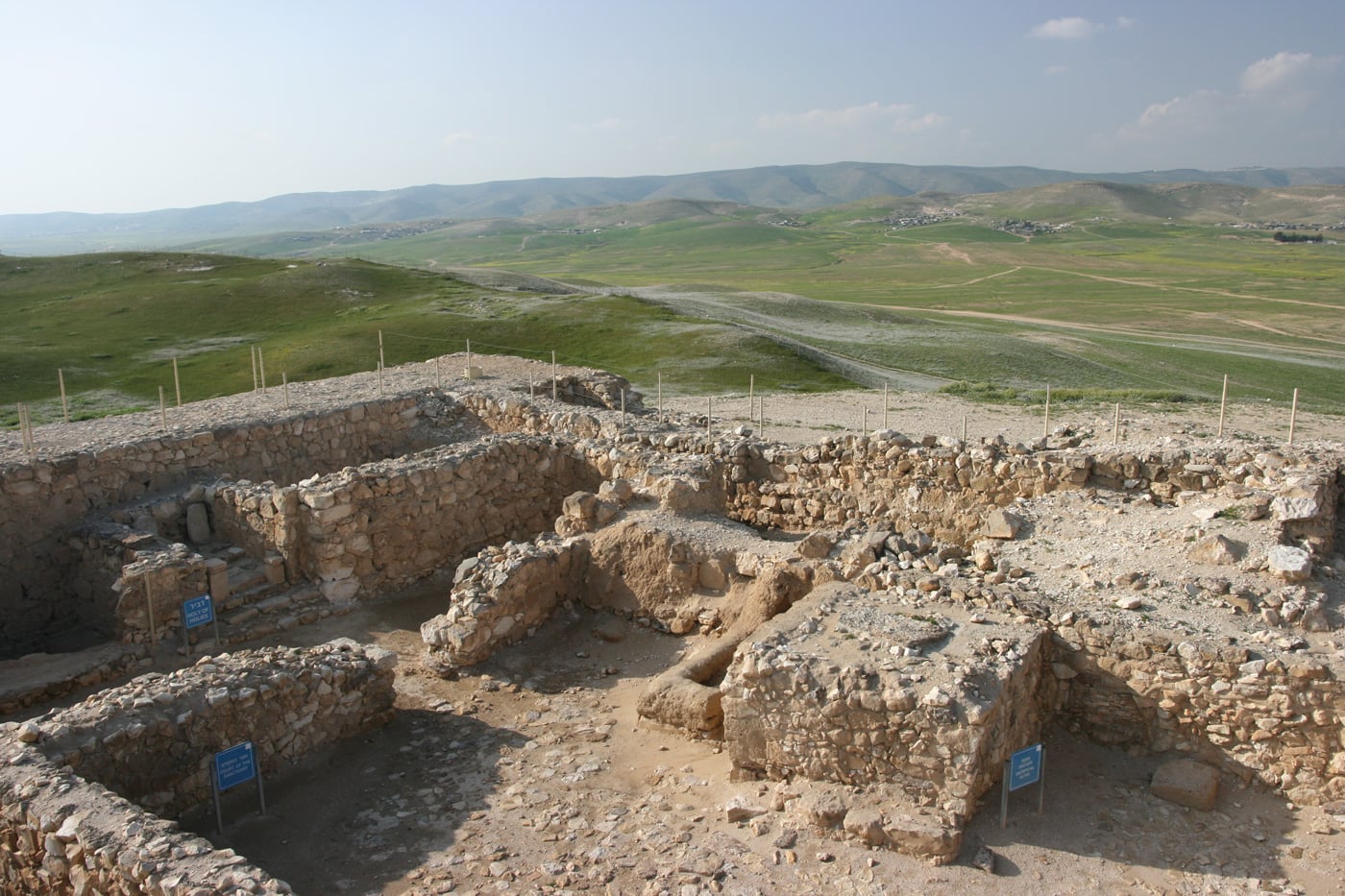
This Iron Age (tenth-century-BC) temple to Yahweh at Arad shows that other competing worship sites may have existed besides Jerusalem and Gibeon.
G. The ark in Jerusalem and the tabernacle in Gibeon (16:1–43). First Chronicles 16 continues the account in chapter 15, which traces the movement of the ark from the house of Obed-Edom (see 1 Chronicles 13) to the city of Jerusalem. By the end of chapter 15 the ark was entering the city accompanied by the music of the Levites, the joy of the people, and the dancing of David, the priestly Levitical king. In 16:1–3 the Chronicler traces how the ark is set inside the tent prepared by David in 15:1. This is followed by a celebration in which David worships Yahweh through two voluntary offerings described in the Torah: the burnt (Leviticus 1) and peace (Leviticus 3) offerings. He then blesses the people in word and deed. By these two acts David again functions in his mediatorial role, positioned between God and people to bless and bring blessing. First Chronicles 16:4–37 recounts David’s regularization of the aural worship so integral to the movement of the ark in chapter 15. With the Levitical function to transport the ark on the cusp of being rendered obsolete by a permanent shrine (temple), David reveals new roles for the Levites in relation to the ark, among which musical ministry is primary. For this next phase of history, the sacred shrine will have two locations, with the tabernacle remaining at Gibeon and the ark in a tent in Jerusalem. Of the Levitical clans appointed in 15:17 to transport the ark, Asaph is responsible for musical worship at the tent in Jerusalem (16:5, 37).
First Chronicles 16:4 outlines the three basic types of songs that David commissions the Asaphites to compose for praise at the ark: petition, thanksgiving, and praise. It is these three types of psalms that dominate the Psalter, and not surprisingly the psalm provided in 16:7–36 is an amalgamation of three psalms from the Psalter, each representative of a different type of psalm: 1 Chronicles 16:8–22 being a portion from Psalm 105, a psalm of thanksgiving; 1 Chronicles 16:23–33 being a portion of Psalm 96, a psalm of praise; and 1 Chronicles 16:34–36 being a portion of Psalm 106, a psalm of petition. While the Asaphites are responsible for verbal worship at the ark, of the Levitical clans appointed in 15:17 to transport the ark, according to 16:39–42 Heman and Jeduthun (Ethan) are responsible for the tabernacle in Gibeon (16:39, 41). There Zadok, descendant of the priest Aaron, will sacrifice the daily offerings (Exod. 29:38–43; Num. 28:1–8) alongside these musical Levitical clans. The content of their musical worship is cited in verse 41: “to give thanks to the Lord, ‘for his love endures forever.’” Ultimately this duality of worship centers would cease, but not until the temple was built by Solomon.
Chapter 16 ends with a focus on the community as a whole in 16:43, as both David and the people return to their own homes, David specifically to bless his family. This echoes the earlier blessing of Obed-Edom’s household in 13:14. The blessing that earlier eluded David is now a reality because of the presence of the ark within David’s capital.
H. Dynasty and temple (17:1–27). With the ark now safely in Jerusalem, David turns to the obvious contrast between his own house (palace) and Yahweh’s tent (17:1). Interestingly, the court prophet Nathan rashly affirms David’s intention (17:2), but immediately that night Yahweh appears to Nathan in a dream, overturning the prophet’s words.
What follows in 17:3–15 constitutes Yahweh’s revelation to Nathan, beginning in 17:4 and 7 with the introductory formula typical of prophetic speech. These introductory formulas divide the speech into two parts, with verses 4–6 questioning the necessity of a permanent house for Yahweh and verses 7–14 affirming the leadership of David. Interestingly, verses 4b and 10b form a complete sentence, the first verse claiming that David is “not the one to build me a house to dwell in,” and the second claiming that “the Lord will build a house for you.” In this lies the irony, formed by a play on the word “house,” which here in verse 4b means a temple and then in verse 10b a dynasty. Rather than David, the house (palace) builder, building a house (temple) for Yahweh, Yahweh will build a house (dynasty) for David, which will then build a house (temple) for Yahweh. In this David and Solomon’s destinies are made inseparable, as will be seen in the Chronicler’s presentation of David’s preparations for the temple in 1 Chronicles 22–29. Also significant in this prophetic speech is the covenantal promise in 17:13: “I will be his father, and he will be my son.” In this one can discern the reciprocity essential to all the covenants between God and humanity throughout the Old Testament, elsewhere expressed as “I will be your God and you will be my people” (cf. Gen. 17:7–8; Exod. 6:7; Jer. 31:33). In the New Testament this same promise will be applied not only to Jesus (Heb. 1:5) but also to the entire messianic community (2 Cor. 6:18). In 17:16–27 David responds to Yahweh’s covenantal invitation.
In 17:16–21 David humbly expresses his unworthiness at such an invitation from God. His reference to “servant” places himself at the service of Yahweh but also in company with other figures such as Moses, Joshua, and the prophets. In 17:20–22 David expresses the unique character of Yahweh among the gods and by extension the unique character of Israel among the nations. This uniqueness is highlighted by a rehearsal of the salvation story of Israel divided into the phases of exodus, conquest, and election. The prayer closes with David’s clear acceptance of the invitation to covenant in 17:23–27, which emphasizes the enduring nature of the covenant and the promises to his dynasty, both based on the eternal character of praise due Yahweh. Through both Nathan’s prophecy and David’s response, the Chronicler accentuates the endurance of the Davidic covenant, suggesting his future hope for the renewal of the Davidic line.
I. Victory over the nations and administration in Israel (18:1–17). First Chronicles 18–20 follows up on the statements made in the dynastic oracle in chapter 17, showcasing Yahweh’s fulfilling his promise to subdue all David’s enemies and make his name great on the earth (see 1 Chron. 17:8, 10) and revealing why David’s involvement in blood and war (1 Chron. 22:8–10) will make his son Solomon the candidate for building the temple (1 Chron. 17:11–12). David’s many victories will provide the peace essential for the building projects Solomon will undertake and also the wealth necessary for such projects. The first section of chapter 18, 18:1–6, focuses on David’s military victories over the Philistines (Gath), Moab, Zobah, and Damascus, groups representative of southwestern (Philistines), southeastern (Moab), and northern (Zobah/Damascus) powers outside traditional Israelite lands. Control of Philistia and Moab gave David the ability to tax the two great international trunk highways (Way of the Sea, King’s Highway), providing resources to sustain a royal court. Zobah and Damascus were centers of (at times) powerful Aramean kingdoms to the north of Israel. Damascus was key since both the international highways intersected at this geographical location. References to these nations becoming “subject” to David and offering him “tribute” (18:2, 6, 13) is suggestive of vassal relationships in the ancient world in which a royal overlord would allow a conquered people a measure of political autonomy as long as they sent tribute regularly to the overlord.
First Chronicles 18:7–11 provides a list of various spoils dedicated to Yahweh, from both the northern regions (Hadadezer of Zobah and Tou of Hamath) and the south (Edom, Moab, Ammon in the Transjordan, Philistia in the southwest, and Amalek, in the southern Transjordan). While the battles that result in the tribute from the northern region and from Philistia and Moab are recorded in 18:1–6, the battle with the Ammonites is recorded in 1 Chronicles 19 and with the Edomites in 18:12–13. Key to these various accounts are the Chronicler’s theological statements in 18:6 and 13, which remind the reader that Yahweh is the source of David’s universal victory. David is successful not only in conquering the regions lying outside of traditional Israelite lands but also in developing the internal administration of the kingdom (18:14–17). It is clear not only that it is important to have proper organization for this new kingdom (vv. 15–17) but also that a premium is placed on the quality of this rule, described in verse 14 as “just and right for all his people” (cf. Psalm 72).
J. Victory over Ammon and Aram (19:1–19). Chapter 19 continues the series of accounts in 1 Chronicles 18–20 that traces David’s victories over his enemies, which are a fulfillment of Yahweh’s promise to him in 1 Chronicles 17:8–10, as well as justification for why David as man of blood and war is not allowed to build the temple (1 Chron. 22:8–10). First Chronicles 19:1–5 highlights the incident that causes tension with the Ammonites. It appears that Ammon has been on friendly terms with David, possibly because David and the father Nahash shared a common enemy in Saul (see 1 Sam. 11:1–11; 12:12). The death of Nahash and accession of his son Hanun introduces ambiguity into the relationship between the two kingdoms, not surprising in times of leadership transition in the ancient world. Hanun’s suspicion of David’s intent leads to his shameful treatment of Israelite messengers, whose hair is shaved and nakedness revealed (cf. Isa. 47:2–3). Such treatment of messengers is a rebuff of the one who sent the messengers and in this case a cause for war.
In the first battle, in 19:6–15, David sends his general Joab. It appears that Hanun does not possess appropriate resources to challenge David, since he needs to hire mercenaries from Aramean states to the north (Aram Naharaim, Aram Maakah, Zobah). These mercenaries are placed out front, where their powerful chariots can take advantage of the open fields, while the Ammonites remain near the city. Joab’s strategy is to divide his army into two groups, the first of which he will lead against the Arameans, and the second of which his brother Abishai will lead against the Ammonites near the city. However, the battle is short-lived, as both Arameans and Ammonites retreat and the Israelites return to their land. The fighting is not yet over, as the Arameans decide to turn against David in 19:16–19. In this case David takes command of the Israelite army against an Aramean coalition led by Hadadezer of Zobah (see above on 18:1–6) and his general Shophak. The battle, which takes place at the River Jordan, is a decisive victory again for Israel.
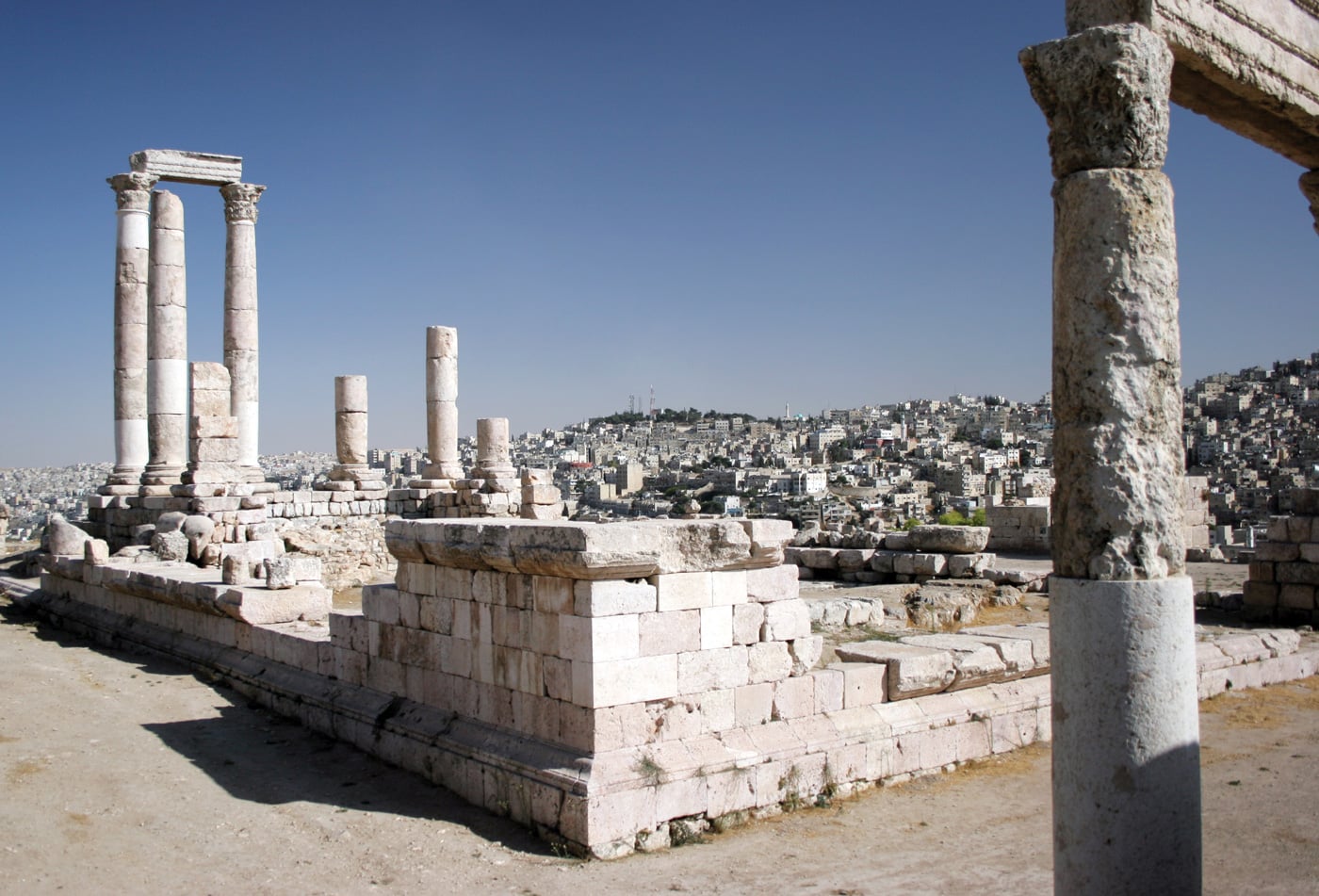
Remains of a second-century-AD Roman temple to Hercules mark the site of ancient Rabbah, the capital of the Ammonites during the time of David.
K. Victory over Ammon and Philistia (20:1–8). First Chronicles 20 contains the final two accounts of David’s military victories over the nations surrounding Israel, which compose 1 Chronicles 18–20. First Chronicles 20:1–3 brings closure to David’s battle against the Ammonites, which began in 19:1–15. Joab, David’s general, led the Israelite army on that occasion and, while putting Ammon to flight, decided not to besiege their city. The account turns first in 19:16–19 to describe David’s victory over the Arameans, some of whom had retreated with the Ammonites, and only now in 20:1–3 describes David’s defeat of the Ammonite capital city of Rabbah. It is interesting that here the Chronicler’s source introduces the tragic story of David and Bathsheba (see 2 Samuel 11–12), but the Chronicler makes no mention of Bathsheba—not surprising in light of the glorious presentation of David throughout Chronicles. The final section of 1 Chronicles 18–20, 20:4–8, focuses on the exploits of David’s men over a series of Philistine giants. This is an appropriate ending to this section on David’s exploits, since it began with David’s conquest of Gath (1 Chron. 18:1). This account closes the complex of stories devoted to David’s military victories, which are appropriate following the dynastic oracle in chapter 17. However, these stories also prepare the way for 1 Chronicles 21, where David’s foolish census for military purposes will prompt divine discipline.
L. The census (21:1–30). The Chronicler largely ignores the failings of the two founding figures of the Davidic dynasty, David and Solomon. While not a single failure is attached to Solomon, two of David’s failures are included in Chronicles. Interestingly, both of these failures are related to David’s naïveté in ritual matters, both are related to events key to Jerusalem’s new role as worship center in Israel, both result in the death of innocent figures, and in both David functions as a priestly leader offering sacrifices. Thus, through these failures David accomplishes a positive mission: the centralization of worship at Jerusalem.
Chapter 21 begins in 21:1–6 with the revelation that Satan has enticed David to count his people, contrasting the assertion in 2 Samuel 24:1 that it was Yahweh who incited/enticed David to do so. The Hebrew term satan, which means “adversary,” is used of both human (e.g., 1 Sam. 29:4) and heavenly (e.g., Job 1:6–9) beings, in both military (e.g., 1 Kings 5:18) and legal (Ps. 109:6) contexts. While it is clear that this is a military context, it is uncertain whether this is a human or heavenly figure. Evidence for a human figure is seen in the use of the phrase “rose up against” (2 Chron. 20:23) and the presence of other instances of human military opponents in chapters 18–20; but evidence for a heavenly figure occurs in Zechariah 3:1, which includes the same Hebrew phrase translated in 1 Chronicles 21:1 as “rose up against” (NIV “standing at”), as well as in Job 1–2, which uses “incited.” David’s error here lies not in the act of counting itself, since such counting occurs elsewhere in 1–2 Chronicles (cf. 1 Chron. 9:1; 11:11; 12:24), but in his failure to perform the rituals demanded by the Torah (Exod. 30:11–16), that is, payment of a half shekel for each person over twenty years old. Joab’s attempt to avoid guilt by not counting all the tribes reveals his lack of knowledge of the Torah legislation.
David’s foolish act prompts divine discipline in 21:7–14. No description is given of what prompted David’s admission of sin and request for absolution. Yahweh’s response with the choice of three deadly options (famine, military defeat, plague) is not inconsistent with David’s request for absolution. Each of these represents mitigated punishment, a judgment less than the sin deserves, which is typical in Old Testament approaches to sin (see Num. 14:17–23; Exod. 32:30–35). It is in 21:15–27 that this event takes on even greater significance. As the death angel is about to strike Jerusalem, David cries out for God’s mercy, admitting his culpability again and asking God to strike him and his family rather than the people. In response Yahweh demands that David build an altar and sacrifice offerings to avert judgment. The site for this altar belongs to a man named Araunah, a Jebusite, one of the pre-Davidic inhabitants of Jerusalem. The final section of chapter 21, 21:28–22:1, makes clear that through David’s failure Yahweh identifies the site of his temple, which will be a place of penitential prayer and sacrifice.
M. Initial provision and commission to build the temple (22:1–19). This chapter begins, in 22:1, with the reminder that David’s failure in chapter 21 in relation to counting the army resulted in the identification of the site of the temple and altar in Jerusalem. With this site identified, the remainder of the account of David is dominated by David’s preparations for the building of the temple. Chapters 22 and 28–29 form a bracket around an inner core in chapters 23–27, which comprises lists of personnel essential for the temple and its proper function.
First Chronicles 22:2–5 describes David’s provision of materials for the temple construction. The regular use of terms for large amounts throughout these verses accentuates the grandeur of the project. Reference is made to Solomon’s youth and inexperience, a reminder that David and Solomon together will build this sanctuary, with David providing the building materials, personnel, and services and Solomon guiding the construction and dedication after his father’s death.
The importance of Solomon’s role is made clear in 22:6–16, as David commissions him, rehearsing the encounter with God in 1 Chronicles 17, explaining why Solomon, the man of peace, will build the temple rather than David, the man of war, and then blessing his son in words reminiscent of Joshua’s commissioning in Deuteronomy 31:2–8 and Joshua 1:1–9. As Joshua fulfilled Moses’s ultimate goal of taking the people into the land, so Solomon will fulfill David’s ultimate goal of building the temple. Solomon, however, is not going to do this alone, but is to be supported by the people according to 22:17–19. In these closing verses of chapter 22, David commissions “all the leaders of Israel,” reminding the reader once again of the importance of the community as a whole to the support of the temple, a key value for the Chronicler as he addresses his own postexilic community gathered around the second temple. Here seeking Yahweh with one’s entire being (heart and soul) is equated with building the sanctuary. The stimulus for such support is the presence of God (“Is not the Lord your God with you?”), and the ultimate goal is the praise of the name of God.
N. Personnel for temple and kingdom (23:1–27:34). First Chronicles 23–27 is dominated by lists of personnel within the kingdom appointed by David for the support of the temple and its services after his death. While such lists are rarely appreciated by modern readers, they are as key to the Chronicler’s rhetorical strategy as his introductory genealogies in chapters 1–9. They accentuate David’s thorough preparation for the temple construction and worship by provision of personnel for both temple and state.
23:1–25:31. First Chronicles 23:1 sets these lists into the context of the final phase of David’s life. While chapters 22 and 28–29 focus on David’s provision of the necessary material resources, chapters 23–27 focus on the equally important provision of human resources for the proper operation of the temple. In this way the Chronicler depicts David and Solomon as a temple construction team. First Chronicles 23:2, with its use of the language of assembly (“gathered together”), introduces the many lists in chapters 23–27, the end of which will be signaled by the reference to David’s summons of the various groups in 28:1. First Chronicles 23:3–5 orients the reader to the many lists of Levites that will appear throughout chapters 23–27 (23:6–24; 24:20–31; 25:1–31; 26:1–19, 20–28, 29–32), identifying the age of those counted (thirty or older), the total number (thirty-eight thousand), and the various responsibilities (construction supervisors, officials, judges, gatekeepers, musicians).
The initial list that follows in 23:6–24 provides a basic orientation to the three foundational clans of Levites, each reviewed in order, with Gershon in 23:7–11, Kohath in verses 23:12–20, and Merari in 23:21–23; the list ends with a summary in 23:24. The roots of the priestly line of Aaron within the tribe of Levi are identified in 23:13, although a fuller account is not provided until chapter 24. First Chronicles 23:13 identifies four roles for the Aaronide priests: consecration of most holy things (Exod. 28:38; Lev. 22:2–3), offering of sacrifices (Lev. 6:8–7:38), ministry before Yahweh (Exod. 28:35), and blessing of the people (Num. 6:22–27). This allusion to Aaron and the priestly tasks in the midst of the Levitical lists prompts the orientation provided by 23:25–32, which explains the roles of nonpriestly Levites under the new circumstances of temple worship. They are to assist the priests in the temple by giving attention to courtyards and side rooms, purification rites, baking products, and measuring devices, as well as by offering verbal praise alongside the various sacrifices at the temple. There is thus a place for all members of the tribe of Levi at the temple, something that would have been helpful for shaping worship in the Chronicler’s own day.
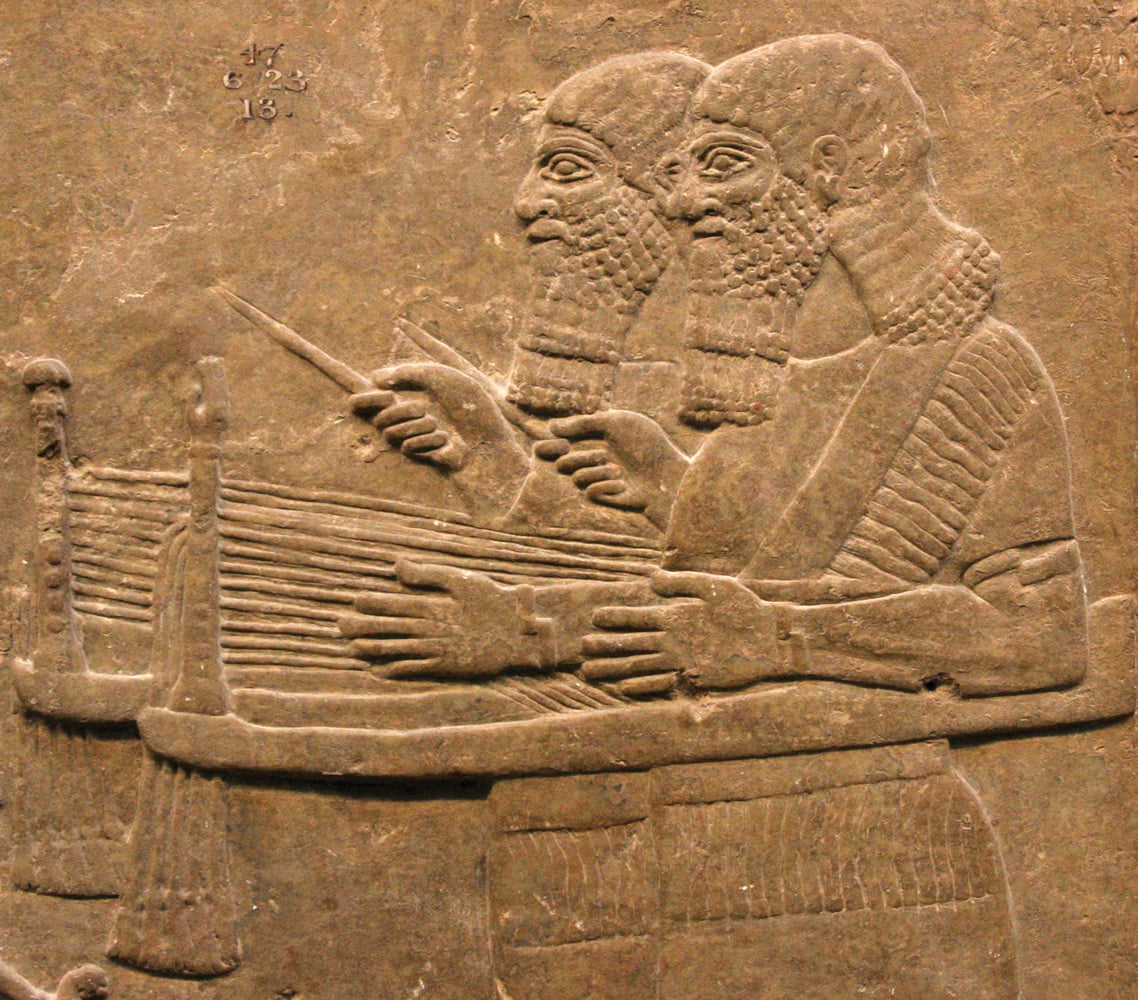
David appointed men to play cymbals, harps, and lyres at the house of God. Here are two harpists in a ninth-century-BC Assyrian relief from Ashurbanipal’s palace at Nimrud.
The list in 24:1–19 then focuses on the Aaronic priestly line in Israel. After referring in passing to the tragedy that befell Aaron’s sons Nadab and Abihu (Lev. 10:1–2; Num. 3:4), the list focuses on the two remaining clans established by Aaron’s other two sons, Eleazar and Ithamar. Two priestly figures assist David, the one Zadok from the clan of Eleazar and the other Ahimelek son of Abiathar from the clan of Ithamar (cf. 1 Chron. 15:11; 18:16). The ultimate dominance of the former (Eleazar) over the latter is recorded in 1–2 Kings, Ezekiel, Ezra, Haggai, and Zechariah and is evident in the larger numbers associated with Zadok’s clan here in chapter 24. There is, however, a role for the clan of Ithamar in the temple, and this is determined by sacred lot, which divides the responsibilities into twenty-four divisions—if on annual rotation, this would mean each clan covered half a month, or if biannual rotation, then a month each. Verse 19 emphasizes the need for these priestly clans to follow the regulations established by Yahweh through Aaron. Following this priestly list, the Chronicler returns to a list of a select group of nonpriestly Levitical clans from the lines of Kohath and Merari in 24:20–31. While this list expands the information found in the earlier list of 23:12–23, key here is the link to the priestly appointment seen in the casting of lots before David, Zadok, Ahimelek, and priestly and Levitical leaders (cf. 24:5–6).
First Chronicles 25:1–31 recounts the commissioning of Levitical musicians from the clans of Asaph, Heman, and Jeduthun, appointments foreshadowed by the account in chapters 15–16, which placed the Asaphites in the Jerusalem tent (16:37) and the Hemanites and Jeduthites in the Gibeonite tabernacle (16:41–42). According to 1 Chronicles 6:33–47, these three families were each from a different Levitical clan outlined in 23:6–24, with Heman from Kohath, Asaph from Gershon/-m, and Ethan/Jeduthun from Merari. Here in 25:1 Levitical music is explicitly identified as “prophesying,” and in 25:2–5 the various clan heads are associated with prophetic activity. This link between Levitical music and prophecy is seen elsewhere in the Chronicles (2 Chron. 20:21–22; 29:25, 30; 35:15). Here we see an expansion of the prophetic role into the worship of Israel. While prophetic communication in the Old Testament is typically delivered in nonmusical verbal form or action, here prophecy is delivered through musical media, as the Levites give thanks and praise to Yahweh (25:3), accompanied by musical instruments (25:1). There are, however, precedents for connection between prophetic utterance and music in 1 Samuel 10:5 and 2 Kings 3:15 (cf. 1 Sam. 16:23). As with the priestly appointments earlier, in chapter 24, so here the musicians are appointed by sacred lot and divided into twenty-four clans, suggesting a parallel Levitical ministry of music alongside the priestly ministry of sacrifice at the temple.
26:1–27:34. First Chronicles 26:1–19 traces David’s commissioning and organizing of the Levitical gatekeepers, whose lineage is traced to the clans of Kohath and Merari. The list in verses 1–11 is divided into three groups, followed (as in earlier lists) with a description of the selection process and vocational function in verses 12–19. The selection process here echoes that of earlier Levitical and priestly appointments in chapters 24–25 (sacred lot), and the gatekeepers’ responsibility was to protect the gateways into the temple precincts. According to 1 Chronicles 9:23, 27, this responsibility entailed guarding the entrance, patrolling at night, and opening the gates in the morning. Not surprisingly, the total number of gatekeepers adds up to twenty-four, but this time the number does not refer to rotation of duty as in earlier lists. Rotation according to 1 Chronicles 9:24–25 was every seven days.
Following the list of gatekeepers the Chronicler provides the list of Levitical treasurers in 26:20–28. The two Levitical groups responsible for the treasuries hailed from the line of Gershon (26:21–22) and Kohath (26:23–28). Two types of treasuries are defined here (26:20), the first relating to the house of God, and the other to dedicated gifts. The latter contains plunder dedicated to the temple from military victories (vv. 26–28). Not only Levitical treasurers but also Levitical administrators were commissioned by David according to 26:29–32. These administrators, drawn from the Levitical clan of Kohath, were not directly related to worship activities on the temple mount, functioning instead as “officers and judges” throughout the land (see Deut. 16:18–20) with responsibility for both “secular” and “sacred” matters (see 26:30, 32; cf. 2 Chron. 19:5–11). The list of these Levitical administrators functions as a segue to lists of other Davidic personnel not directly associated with the sacred duties at the temple in chapter 27.
First Chronicles 27:1–15 enumerates David’s military, including the various levels in the army’s chain of command. Verse 1 makes it clear that David’s army was not an ad hoc force but rather a standing army on defined rotation, able to defend Israel constantly. First Chronicles 27:16–22 lists the leaders of the tribes of Israel, leaving out the two tribes of Gad and Asher, separating Aaron from the rest of Levi, and dividing the Joseph tribes into three groups (Ephraim, half Manasseh, half Manasseh), to bring the total number to thirteen. By placing this list of tribal leaders at the end of his list of material in chapters 23–27, the Chronicler is foreshadowing their appearance in chapters 28–29 to pledge their support for Solomon and his temple project (cf. 28:1; 29:6). In a short note in 27:23–24 following the lists of army and tribal leaders, the Chronicler reveals that David’s sin in 1 Chronicles 21 was not related to breaking the prohibition of counting those over twenty years of age (cf. Num. 1:3, 45), a prohibition based here on Yahweh’s promise of innumerable descendants to Abraham (cf. Gen. 22:17), since Joab did not complete the count. (See above on 1 Chronicles 21:1–6 for the nature of David’s sin.) The list in 27:25–31 presents twelve overseers of David’s royal property throughout the land, ranging from those supervising treasuries (v. 25) to those supervising agricultural activity (vv. 26–31). Such resources were essential for the sustenance of an ancient royal court and army. The final list in chapters 23–27 (27:32–34) identifies the seven key advisors at the core of David’s court who would offer him wisdom to rule the kingdom.
O. Commissioning Solomon (28:1–21). After the long series of lists in chapters 23–27, which traces David’s provision of the support personnel for the temple, the Chronicler provides a second scene of commissioning, echoing the earlier one in chapter 22. While in 22:5 David speaks of his future preparations for the temple, in 29:19 he reflects over his past preparations. First Chronicles 28:1 introduces this second commissioning, noting how David has assembled the secular leadership just reviewed in chapter 27. What follows in 28:2–8 is David’s address to this gathered assembly of leaders, which echoes the themes and vocabulary of the earlier speech in 22:7–16. The majority of the speech (28:2–7a) focuses on the privileges enjoyed by Solomon, with greater emphasis placed in this speech on Yahweh’s choice of Solomon (28:5–6; cf. 28:10; 29:1). Verse 7b introduces the incredible responsibility laid on Solomon to carry out and follow God’s commands. Before turning to Solomon in verses 9–10, however, in verse 8 David first charges the leaders of Israel to fulfill the same demands imposed on Solomon, fulfillment of which will ensure the enduring possession of the land. David then turns to Solomon in 28:9–10, calling him to acknowledge and serve God with all his being and identifying the two possibilities before Solomon (seek or forsake) and their attendant results (finding God and being rejected by God). These two possibilities echo the “two ways” placed before Israel as they were poised to enter the promised land (Deut. 30:15). Yahweh’s omniscience discourages any hypocrisy and ensures a just divine response. Fundamental to the service Solomon will render Yahweh is the building of the temple (28:10).
David’s commission to Solomon is followed in 28:11–19 by David’s provision to Solomon of detailed written plans for the temple structure, work assignments, and worship articles. Verses 12 and 19 point to the divine source of these plans: the Spirit and the hand of Yahweh. After handing over these plans to Solomon, David delivers his final charge to his son in 28:20–21, using language of encouragement reminiscent of Moses’s commissioning of Joshua in Deuteronomy 31:7, 23; Joshua 1:6–7, 9, 18 and echoing the earlier commission of 1 Chronicles 22:6–16. David’s call to courage is not based primarily on the extensive resources that David has provided for the project (28:21) but first and foremost on the theological premises that God will be with Solomon and will not fail or forsake him as he pursues this massive task (28:20).
P. Charging the assembly (29:1–30). Having addressed Solomon in front of the assembled leaders in chapter 28, David now turns to the entire assembly in 29:1–5. Most of this speech expresses the reasons why the leadership needs to fully engage (29:5) in the temple project. These include the inexperience of his successor Solomon (29:1a), the magnitude of the task ahead (29:1b), and the generous example of David in the past (29:2) and present (29:3–5).
The response of the leadership in 29:6–9 is described as willing, wholehearted, and substantial, prompting the joy of both the people and the king. This joy prompts the response of David to God in 29:10–19, one that begins with general praise of Yahweh as Creator of all things (29:10–13), shifts to the unworthiness of David and his nation, who are merely returning to God what he first gave them (29:14–17), and concludes with requests for his people and Solomon that God may stir their inner affections to obedience to the law and completion of the temple project (29:18–19). This prayer then prompts from the assembly in 29:20–22a a response of praise to Yahweh and homage to the king followed by a sacrificial celebration in God’s presence. It is at this celebration that Solomon is then crowned king (29:22b–25) a second time. Solomon’s first coronation in 1 Chronicles 23:1 was a private affair enacted by David. This second event is performed by the people. Examples of a two-stage royal appointment with one private and the other public can be seen in the lives of Saul (1 Sam. 10:1; 11:12–14) and David (1 Sam. 16:13; 2 Sam. 2:1–7; 5:1–5). Reference is made here also to the anointing of Zadok as priest, something important to the Zadokite priests, who will serve as high priests in the second temple of the Chronicler’s day (see Zech. 3:1–10; 6:9–15). The embrace of Solomon by the people (29:23) and military (29:24) is explicitly linked to a divine act in 29:25.
The account of David’s reign concludes in 29:26–30 with a summary note, emphasizing that he ruled over a unified Israel (“all Israel”) and experienced exemplary blessing (long life, wealth, honor). The final verses recount various resources used by the Chronicler for his account, all linked to prophetic figures who served during the life of David. Such resources bolster the authenticity of this account to the Chronicler’s ancient audience.
3. The Account of Solomon (2 Chron. 1:1–9:31)
A substantial portion of the account of David (1 Chronicles 22–29) is devoted to a description of David’s preparations for the succession of his son. These preparations are focused almost exclusively on Solomon’s function as temple builder and patron. The Solomon who emerges after the death of David at the end of 1 Chronicles 29 is a Solomon without tarnish. While two failures of David are incorporated into his account, both events key to the creation of Jerusalem as the central place of worship in Israel (1 Chronicles 13; 21), not one failure is attributed to Solomon in 2 Chronicles 1–9. Like the transition from Saul to David in 1 Chronicles 10–11, the transition from David to Solomon is smooth and lacking conflict. This idyllic portrait of the past lays the foundation and provides direction for realities within the Chronicler’s present community, especially in relation to the second temple and its services. Furthermore, it engenders future hope for a community struggling under enduring imperial rule, which knows well the prophetic messianic hope.
A. Ascending the throne (1:1–17). The account of Solomon begins with a summary note in 1:1 stating that Solomon takes firm control of the kingdom. While Solomon has been largely passive throughout 1 Chronicles 22–29, he now leaps into action. His success in this shift is attributed by the Chronicler to the presence of Yahweh. In 1:2–12 Solomon convenes an assembly of all Israel and its leaders (military, officials, tribal and family heads), leading them to the tabernacle at Gibeon. While David brought the ark into Jerusalem, housing it in a tent where verbal worship was conducted (1 Chron. 16:1, 37–38), the rest of the tabernacle has remained in Gibeon, where both sacrificial and verbal worship are conducted (16:39–42). Although the ark is in Jerusalem, it is to Gibeon that Solomon goes with the people to inquire of Yahweh and sacrifice burnt offerings. Seeking Yahweh in proper ways is key to the presentation of proper kingship throughout 1 Chronicles, negatively portrayed in the life of Saul (1 Chron. 10:13–14), positively displayed in the life of David (1 Chron. 13:3), and expectantly encouraged in the life of Solomon (1 Chron. 22:19; 28:8–9). There in Gibeon, Yahweh appears to Solomon, inviting him to ask for anything as he begins his reign. Solomon chooses wisdom (1:8–10), which Yahweh promptly gives him, noting that such a choice will yield also wealth and fame (1:11–12). This interchange between Yahweh and the new king is followed by a summary statement in 1:13 that, together with 1:1, isolates verses 2–12 as foundational to the account of Solomon in chapters 1–9. In 1:14–17 the Chronicler immediately recounts the military and economic prosperity of Solomon. Similar material will recur at 2 Chronicles 9:25–28, forming a bracket around the entire Solomon account and reminding the reader of the fulfillment of Yahweh’s promises given at Gibeon.
B. Preparing for the temple project (2:1–18). While 1 Kings shows the impact of Solomon’s new divine gift of wisdom on the administration of the kingdom, especially in areas of justice, 2 Chronicles immediately shows its impact on what, for the Chronicler, is Solomon’s main purpose, the building of the temple. Second Chronicles 2:1 functions as a summary note, signaling the beginning of Solomon’s building projects, which include a royal dwelling for both Yahweh (temple) and himself (palace). In 2:2 Solomon organizes the workforce for the temple project, numbering the workers and separating them into three groups: carriers, stonecutters, and foremen. Solomon next sends a letter to Hiram in 2:3–10. Hiram is first introduced in Chronicles at 1 Chronicles 14:1–2, where this king of the Phoenician city of Tyre acknowledges the new reign of David. Tyre was located to the northwest of Israel along the Mediterranean coast. Its control of the forests of the Lebanon mountains to its east made it an important source for construction projects in the ancient Near East. As is typical of ancient political relationships, emphasis is placed on the past relationship between the two political states, and here Solomon uses this past relationship as the basis for his request for materials for his temple project. Solomon carefully identifies the purpose of this temple, emphasizing the incomparability of Yahweh among all gods, particularly important as he interacts with this foreign leader. Solomon asks for not only materials but also craftsmen who will train his workers in finer construction techniques.
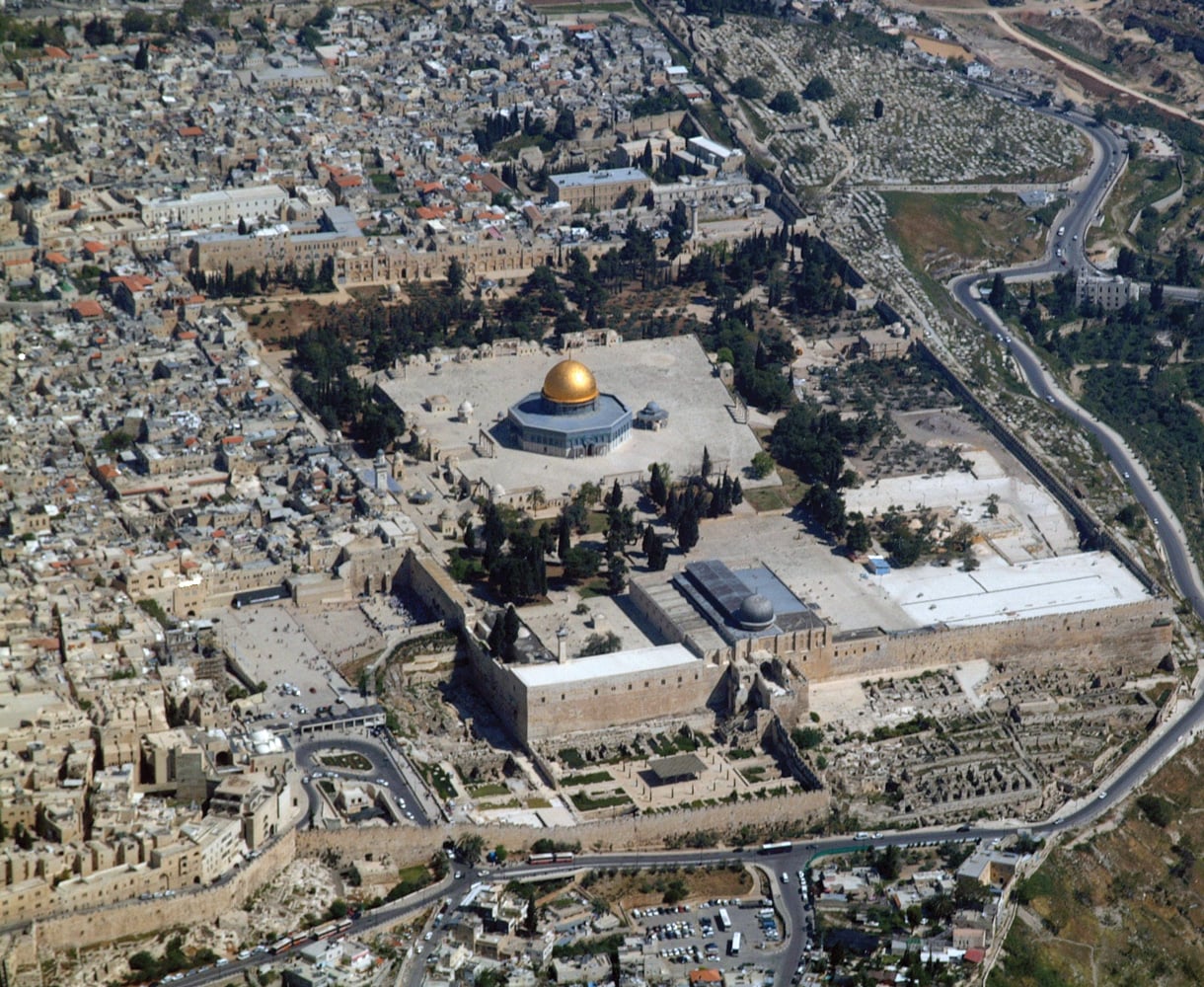
An aerial view of the Jerusalem Temple Mount, located on Mount Moriah, the site of Solomon’s temple
Hiram’s reply in 2:11–16 not only affirms that Solomon’s reign is being recognized and legitimated in similar ways to the reign of his father (cf. 1 Chron. 14:1–2) but also grants Solomon his requests for material and human resources. Particular emphasis is placed on the figure Huram-Abi, the description of whom is designed to link him to the craftsman Oholiab, who worked on the earlier tabernacle project in the wilderness (Exod. 35:31–36:1). More details of the enumeration mentioned in 2:2 are provided in 2:17–18, the two forming a bracket around the key interchange between Solomon and Hiram in 2:3–16.
C. Building the temple structure (3:1–17). Having made arrangements for materials and personnel for the temple project in chapter 2, Solomon now begins construction in chapters 3–4. Second Chronicles 3:1–2 is another of the many summary notes used throughout Chronicles. Here the note identifies the location of the temple with two earlier key sacrificial traditions, which involved the angel of the Lord: the provision of sacrifice to Abraham in order to save the life of young Isaac on Mount Moriah in Genesis 22 (see esp. 22:13–14) and the provision of sacrifice to David on the threshing floor of Araunah to save Jerusalem in 1 Chronicles 21.
Second Chronicles 3:3–17 traces the creation of the physical structures of the temple site. Laying the foundation (3:3) was an important stage in the construction of sacred shrines in the ancient Near East (see Ezra 3:1–13; Isa. 28:16; Hag. 2:15–19; Zech. 4:6–10), not only to ensure that the building endured, but also because the building needed to rest on undefiled ground. The use of pure gold in the entrance room (3:4) is a key signal to worshipers that they are approaching the presence of deity. The main room (3:5–7) is equivalent to the Holy Place in the earlier tabernacle structure (Exod. 26:33). The iconography of trees and angelic beings suggests a heavenly paradise. While the Holy Place of the tabernacle contained one lampstand and one table (for the bread of the Presence), according to chapter 4 this room contains ten gold lampstands, ten tables, and ten small basins. The Most Holy Place (3:8–14) is constructed in a perfect square, the use of fine gold appropriate for the place of God’s manifest presence. While the cherubim in the tabernacle were simply part of the ark (Exod. 25:10–21), the cherubim in the temple are standing side by side and facing the entrance to the main hall, guarding the throne room of Yahweh. A cherubim motif is woven into the curtain (3:14) that, along with doors (see 4:22), separates and protects this special room from the main hall (cf. Exod. 26:31–33). Two pillars stand in front of the temple, their names Jachin (“he will establish”) and Boaz (“in him is strength”), signifying the enduring quality of the temple and the kingdom of those who will worship there.
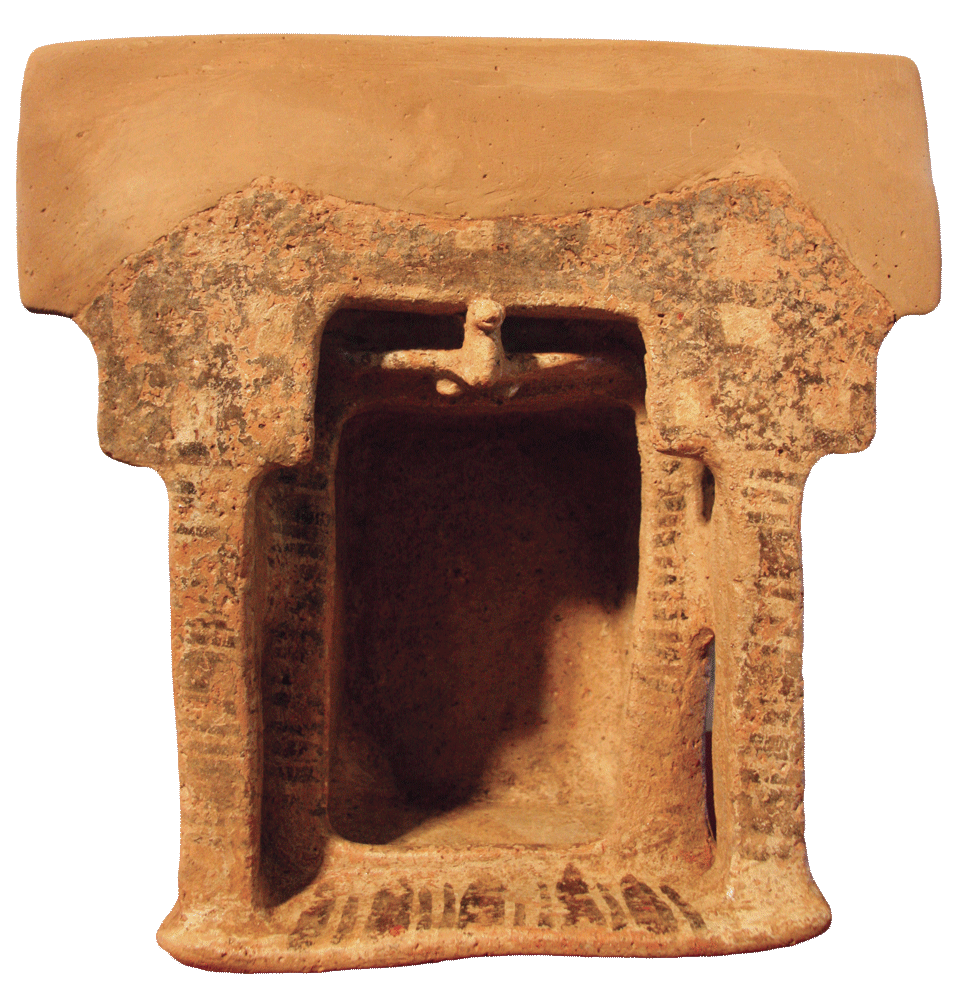
A shrine model from the tenth century BC. The two pillars bearing the roof are reminiscent of the central columns, Jakin and Boaz, in Solomon’s temple (2 Chron. 3:17).
D. Creating the temple furnishings (4:1–22). Having reviewed the construction of the building structure in chapter 3, the Chronicler now focuses attention on the creation of the various furnishings and utensils to be placed within the temple to facilitate worship. Second Chronicles 4:1–8 provides an account of the fashioning process. The bronze altar, which has sixteen times the surface area of the former altar in the tabernacle (Exod. 27:1–8), replaces David’s temporary altar at this site (1 Chron. 21:26). It is positioned in the inner court of the temple area. “The Sea,” replacing the large basin in the tabernacle (Exod. 30:17–21), is made of bronze and placed on a foundation of twelve oxen. It is used for ritual cleansing, key for approaching the holy presence of Yahweh. Ten smaller basins, placed within the main room of the temple, are for washing utensils used in the sacrificial process. Matching these ten basins are ten gold lampstands and ten tables, the former providing light inside the temple and the latter platforms for the bread of the Presence (cf. 4:19). Before providing lists of the items just described, the Chronicler describes the creation of the outer courtyard structures, which will hold the bronze altar and the Sea, in 4:9–10. Two courtyards are created, one inner courtyard for the priests and another, larger, outer courtyard supposedly for nonpriests (see 1 Kings 7:12).
The account concludes with lists of the furnishings and utensils created for the temple in 4:11–22. The lists are divided into two parts, tracing first the accomplishments of the Tyrian artisan Huram-Abi (see 2 Chron. 2:11–16 above) in 4:11–18 and then those of Solomon in 4:19–22. Huram-Abi’s items are all made of bronze and placed in areas outside the sanctuary proper, while Solomon’s are all made of gold and placed in the sanctuary itself. This distinction between these two figures identifies Solomon as the lead craftsman and Huram-Abi as his assistant (cf. 4:11).
E. Transferring the ark in Jerusalem (5:1–14). The summary note at the beginning of chapter 5 signals a new phase in the account of the temple-building process. Whereas chapter 2 traced the preparation phase, and chapters 3–4 the construction phase, chapters 5–7 trace the dedication phase. In 5:1 the Chronicler notes that the construction is finished, naming David’s gifts for the temple (1 Chron. 18:10–11; 26:26–27; 29:1–5) at this point to remind the reader of the role of both David and Solomon in making this possible. With everything in place, it is time now to transfer the ark from the tent David has provided in Jerusalem to the Most Holy Place, on the temple mount above the city (5:2–10). Solomon times this to coincide with the festival of the seventh month, most likely a reference to the Feast of Tabernacles, which was one of the mandatory feasts of Israel and was held from the fifteenth to the twenty-first of the month (Lev. 23:34, 39; Num. 29:12–34). With the leadership of the nation gathered in Jerusalem, the Chronicler depicts the Levites carrying the ark from Zion to the temple (5:4–5), Solomon in the midst of his people sacrificing animals (5:6), and the priests then carrying the ark into the Most Holy Place (5:7–10).
With the transfer complete (5:11–14), the Levites break into song, which prompts Yahweh to fill the temple with his presence and glory, making the work of the priests impossible. While this is strikingly reminiscent of the conclusion to the tabernacle account in Exodus 40:34–35, where Moses was unable to enter the tent of meeting, here David’s Levitical innovation of verbal worship (see 1 Chronicles 16) overshadows the traditional role of the priests, reminding readers that this is a new era of Israel’s relationship with Yahweh. God’s presence here reflects his pleasure not only in the praise of his people but also in the temple itself, which was made for him.
F. Dedicating the temple—Solomon’s speech and prayer (6:1–42). In response to the descent of God’s presence, in 6:1–2 Solomon states the significance of the present shift from the “dark cloud” to his “magnificent temple.” It is clear from the later statements in this chapter (6:18, 21, 25, 27, 30, 33, 35, 39) that, while Yahweh rules from heaven, the temple is now the place of his special manifest presence on earth, from which he exercises his rule on earth. Before addressing the people, Solomon blesses them (6:3), following the pattern established by his father in 1 Chronicles 16:2. The speech to the people that follows (6:4–11) sets the tone for the dedication of the temple. While mindful of the redemptive story of Israel (exodus), Solomon emphasizes God’s election of Jerusalem and David (6:4–6). Use of the term “leader” (6:5; cf. 1 Chron. 11:2) suggests David’s role as Yahweh’s vice-regent on earth. With this foundation in mind, Solomon then shifts to his own election by Yahweh to build the temple (6:7–9), concluding with a rehearsal of his own experience of the fulfillment of Yahweh’s promises in the events recounted throughout 2 Chronicles 1–5 (6:10–11).
Having rehearsed the narrative-theological foundation for this dedication, Solomon then expresses a long prayer to Yahweh in 6:12–42. The location of this prayer is identified as a bronze platform constructed in the outer courtyard of the temple area before the assembly. The first section of the prayer (6:14–17) again rehearses theology foundational to the temple, that is, the incomparability of Yahweh and his election of the Davidic dynasty. It is clear that the temple itself is proof of Yahweh’s faithfulness to David, but Solomon sees this day as confirmation that David’s dynasty will be perpetual. For the Chronicler’s audience, then, the temple engendered hope in God’s enduring promises to the royal house. The second part of the prayer (6:18–40) accentuates the role of the temple as a place of prayer, providing the many scenarios that will prompt the prayer of the people either at or toward the temple in Jerusalem. The accent on prayer in Solomon’s address to Yahweh here continues the emphasis on the innovation of verbal worship throughout the account of David (see 1 Chronicles 16). While the temple remains a place of sacrifice, administered by the priests, with David and Solomon there is a greater emphasis on verbal praise fostered by the nonpriestly Levites and prayer uttered by the people. Several of the scenarios in verses 18–40 focus on the necessity of penitential prayer as a disciplined people seek God’s favor. This sets the agenda for the prayers of later generations (e.g., Ezra 9; Nehemiah 1; 9; Daniel 9). Solomon’s prayer concludes in 6:41–42 with Solomon’s request for God’s enduring presence in the temple and perpetual acceptance of the Davidic dynasty. The Chronicler’s generation longed for both of these as much as did Solomon of old.
G. Dedicating the temple—Yahweh’s response to Solomon (7:1–22). In response to Solomon’s request for God’s manifest presence at the end of his prayer in 6:41–42, in 7:1–2 Yahweh fills the temple as he did in 2 Chronicles 5:13–14, again making impossible the ministry of the priests. The manifest presence of Yahweh triggers the reverential praise of the people in 7:3, who proclaim the same words that prompted the first filling of the temple in 5:13–14. Not only the Levites but also the people are caught up in the praise of Yahweh. The dedication festivities conclude with the sacrificial celebration of the Feast of Tabernacles in 7:4–10. In view here is the dedication of both the temple (7:5) and the altar (7:9). Again David’s name is mentioned by the Chronicler (7:6, 10), reminding the reader of his role together with Solomon in the creation of the temple. Hamath lay in the most northern region of Syria, with Lebo Hamath (entrance to Hamath) referring to its southern boundary. The Wadi of Egypt refers to the boundary river that lay between the Negev Desert, which began in southern Judah, and the Sinai region. For these two locations as indicative of the land of Israel see Numbers 13:21; 34:5–8; Joshua 13:5; 15:4, 47. The nation is united around both temple and monarch. Second Chronicles 7:11 represents a final summary for the temple building and dedication account, noting the completion of both temple and palace (cf. 2 Chron. 5:1).
The construction of Solomon’s palace receives little attention in Chronicles, although it is mentioned in passing in 2 Chronicles 2:1, 12. The mention here of the palace sets up the concluding divine speech in 7:12–22, which focuses on Yahweh’s acceptance of and vision for the temple (7:12–16) and dynasty (7:17–22). In his section on the temple (7:12–16), Yahweh articulates an agenda for renewal that sets the tone for the remainder of the presentation of the books of Chronicles. Yahweh warns that he will bring natural disaster (drought, locusts, plague) on the people if they are disobedient (7:13), but reveals that these are intended as discipline to turn the people back to himself (7:14). Such renewal will involve humility, prayer, seeking God’s face, and turning from wicked ways and will result in forgiveness of the people and healing of the land (that is, reversal of the natural disaster). This vocabulary will be repeated constantly throughout the remainder of 2 Chronicles, identifying both positive and negative exemplars of this agenda. On the negative side it will be those who abandon and are unfaithful toward Yahweh who will receive Yahweh’s discipline. In his section on the Davidic dynasty (7:17–22), Yahweh reminds Solomon of the need for faithfulness by the royal house and introduces the dark potential for those who do not embrace the agenda of renewal introduced in 7:13–14. Particular attention is given to the fate of the temple.
H. Other pursuits (8:1–9:31). Having completed his description of Solomon’s temple building (chaps. 2–7), the Chronicler now offers some insight into Solomon’s other activities, which reveal the ways Yahweh blesses Solomon for his faithfulness to the temple project. This new phase of the account begins with a summary note in 8:1, which identifies the period in view as after the completion of the temple. The first set of activities (8:2–11) is secular and includes construction projects and the organizing of human resources. Urban areas in view range from the north (8:2–4) to the south (8:5–6). Solomon is credited with completing the conquest of the land, left unfinished in Joshua and Judges (8:7–8), and conscripting some of these people groups to be his laborers; Israelites instead served as his military and officials (8:9–10). Although married to Pharaoh’s daughter, Solomon is careful not to defile Jerusalem by her presence (8:11). While most of chapters 8–9 is focused on Solomon’s nontemple activities, 8:12–16 is a reminder of the enduring significance of the sacred. This section traces Solomon’s sacred activities as patron of sacrifice (8:12–13) and verbal worship (8:14–15), fulfilling the ordinances laid out by Moses and David.
The remainder of the account in 8:17–9:28 returns to the earlier focus in 8:2–11 on Solomon’s secular activities, tracing his economic achievements, international fame, military resources, and border expansions. Solomon partners and interacts with foreign figures, from Hiram of Tyre in the north (see 2 Chronicles 2) to the Queen of Sheba and the kings of Arabia in the south. With Solomon partnering with the maritime Phoenician Hiram at Elath on the Gulf of Aqaba, it is not surprising then to see interest from Sheba and Arabia (Ps. 72:15; Isa. 60:6; Jer. 6:20; Ezek. 27:22; 38:13). Solomon’s stature among the nations is described in incomparable terms (9:9, 11, 19–20, 22, 27). The account of Solomon concludes in 9:29–31 with a summary note typical throughout 1 and 2 Chronicles. Reference to prophetic sources here and in David’s summary note in 1 Chronicles 29:29–30 bolsters the authority of this account. Absent from the end of the account of Solomon, however, is any reference to Solomon’s failure, which leads to the division of the nation. This flawless Solomon is being presented not merely as a past figure but as one who legitimates the present temple in the Chronicler’s day and foreshadows a future renewal of the dynasty.
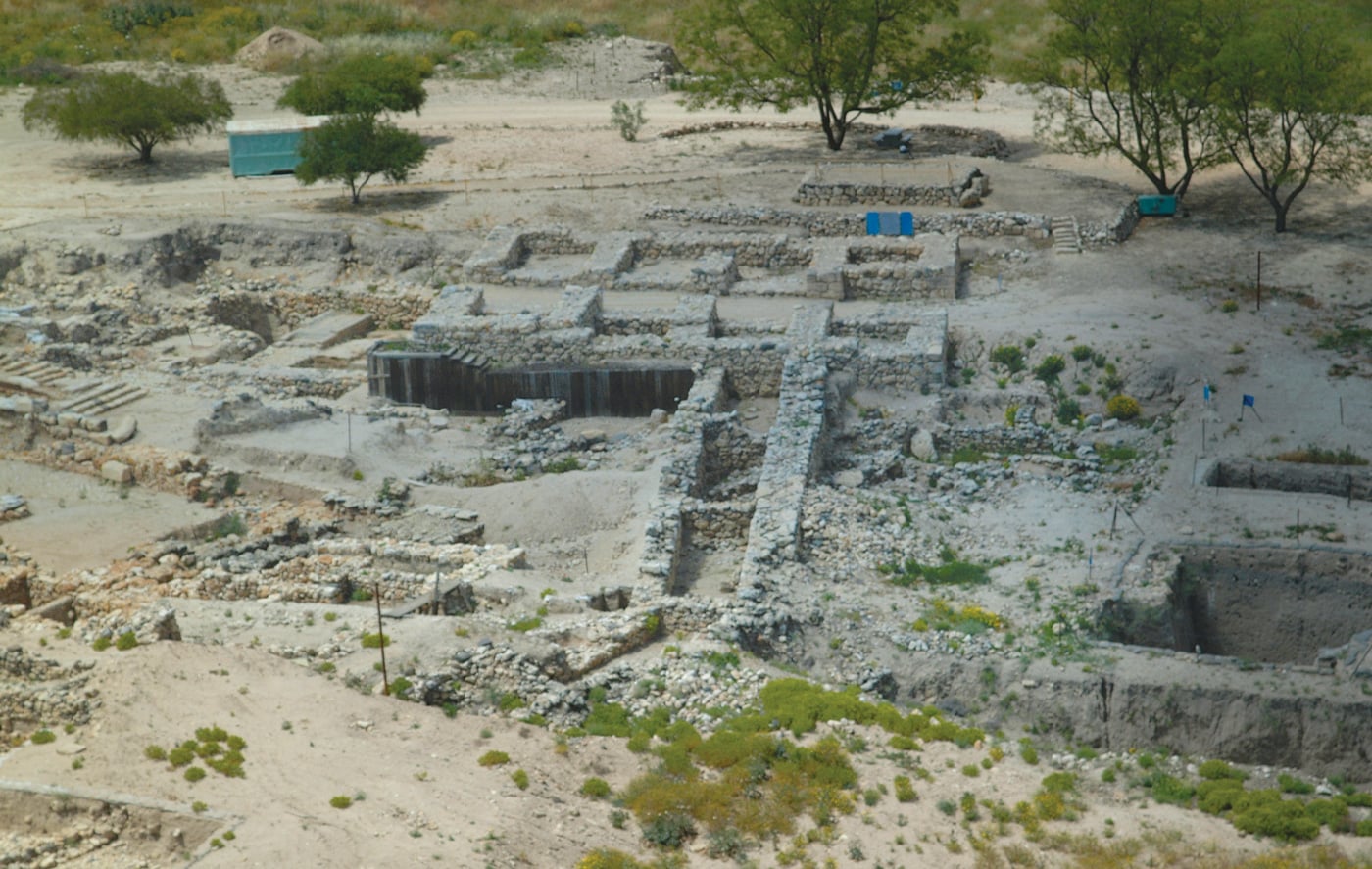
The remains of the six-chambered Solomonic gate at Hazor (tenth century BC), one of Solomon’s building projects focused on fortifying strategic cities
4. The Post-Solomonic Accounts (10:1–36:23)
With 2 Chronicles 10 the Chronicler’s positive ideal of the Davidic-Solomonic kingdom becomes the exemplar against which all future generations will be evaluated. In general the tone is negative, although there are several key positive examples that approximate the earlier ideal, especially Hezekiah (chaps. 29–32) and Josiah (chaps. 34–35). The northern kingdom is largely ignored as a political entity in the post-Solomonic account, although those northern Israelites who join the South are affirmed. While the accounts of Athaliah and especially Ahaz constitute the nadir of the post-Solomonic account, it is especially Hezekiah and secondarily Josiah who represent its high points. Ironically, though, after Josiah the nation enters a different phase in its political life, controlled now by foreign nations and so in a state of exile until the edict of Cyrus at the tail end of the book (35:20–36:23). The historiographic principles used to describe, evaluate, and explain the events in the post-Solomonic account were set out in the speech of Yahweh in 2 Chronicles 7:13–15. On the one hand, those who seek Yahweh, who humble themselves, pray, and repent, are those who experience Yahweh’s blessed success and prosperity exemplified in construction projects, military resources and success, abundant progeny, popular support, and long life. On the other hand, those who abandon and are unfaithful to Yahweh lack these blessings.
A. The reign of Rehoboam (10:1–12:16). It is in times of royal succession that there is the greatest danger of upheaval in the ancient Near East, in particular after a long and prosperous reign, and the transition from Solomon to his son Rehoboam is no exception. The first section of Rehoboam’s account, 10:1–11:4, traces the schism in the kingdom that follows Solomon’s death. Having traveled to Shechem for his coronation (cf. Judges 9), the Davidic heir Rehoboam is confronted by demands for reduction in royal taxation and labor burdens from the people, led by Solomon’s former nemesis, Jeroboam son of Nebat (cf. 1 Kings 11:26–40). The composition of this rebellious flank is depicted as “all Israel,” although it becomes clear by verse 17 that the tribe of Judah has remained faithful to Rehoboam. Ignoring the wise advice of Solomon’s advisors, Rehoboam follows the foolish advice of his young friends and gambles away the kingdom. Fearing for his life, Rehoboam flees south to Jerusalem to gather reinforcements but is dissuaded from retaliation by the prophetic figure Shemaiah. In 2 Chronicles 13:6–7 Abijah will blame this schism on Jeroboam and his followers for taking advantage of the young Rehoboam. But Shemaiah’s speech in 2 Chronicles 11:4 reminds the reader that this schism was rooted in the will of Yahweh, even if 11:19 suggests that their enduring revolt is an unacceptable circumstance.
Rehoboam’s obedience to the prophet in 11:4 foreshadows the second phase of his reign, one characterized by faithfulness, which follows in 11:5–23. Here Rehoboam becomes an exemplar of the Chronicler’s historical principle, showing that with obedience and religious reform (11:13–17) comes divine blessing in the form of military fortification (11:5–12) and abundant progeny (11:18–23). It is interesting that the religious reform is linked to the return of priests and Levites from the north who rejected Jeroboam’s illegitimate religious innovations (see further 1 Kings 12:25–33). This emphasis on the key role played by priestly and especially Levitical figures is typical of the Chronicler. Their return suggests that already in this second phase of Rehoboam’s reign, it is expected that the northern tribes will submit again to the Davidic rule. The list of sites in 11:6–10 suggests a kingdom limited to the Judean hill country and the foothills in the west, with only one site (Gath) on the coastal plain and nothing in the far south (Negev).
There is, however, a third phase to Rehoboam’s rule, depicted in 12:1–13a. Rehoboam’s success leads to his downfall as he “abandon[s]” and is “unfaithful” toward Yahweh, vocabulary typical of the Chronicler’s depiction of negative characters (see above on 2 Chron. 7:12–22). As expected, such disobedience leads to divine discipline in the form of an attack by Shishak king of Egypt (931–910 BC), whose campaign in western Asia is attested in Egyptian records (ANET 242–43, 263–64). This divine discipline prompts a penitential response from Rehoboam and his leaders, one in which they humble themselves and declare God’s justice. Such repentance is a positive model for the Chronicler (see 2 Chron. 7:12–22) and leads to a mitigated punishment for Rehoboam, as Yahweh promises not to destroy him and his kingdom entirely. The statement in 12:8 that foreign hegemony has a didactic role, to teach them “the difference between serving me and serving the kings of other lands,” suggests that the circumstances of the Chronicler’s audience under Persian rule were not seen as the nation’s final state. Rehoboam thus embodies three key models for the Chronicler: the positive model of obedience, which results in blessing, the negative model of disobedience, which results in discipline, and the positive model of repentance, which results in renewed blessing. These models will reappear constantly in the accounts to follow in 2 Chronicles 13–36. The account of Rehoboam ends with the summary note in 12:13b–16, typical of the reigns throughout 2 Chronicles 10–36. Although exemplifying certain positive values, in the end he is deemed an evil king, especially because he did not set his heart on seeking Yahweh (see commentary on 2 Chron. 7:12–22).
B. The reign of Abijah (13:1–22). As is typical throughout 2 Chronicles 10–36, the royal accounts begin with a summary note, signaling the accession of a new royal figure (13:1–2a). With the death of his father, Rehoboam, Abijah the crown prince becomes king. By dating the beginning of his reign to the reign of a northern king (something common in Kings but not in Chronicles), the Chronicler prepares the reader for the fundamental tension in his reign, his battle against the founder of the northern kingdom, Jeroboam, in 13:2b–19 (see 2 Chronicles 10).
In what may appear to be a suicidal act, the much weaker Abijah invades Jeroboam’s kingdom. However, Abijah’s speech in 13:4–12 reveals that this invasion is an act of faith, based on the theological foundation of the Davidic covenant. Jeroboam’s rebellion against Rehoboam is clearly treated as illegitimate, even if 2 Chronicles 11:4 does reveal that this act lay within the permissive will of Yahweh. Called a “covenant of salt,” possibly a reference to the quality of salt for preservation and purification and/or the use of the salt at covenant agreement meals (see Num. 18:19; cf. Gen. 26:30; 31:54; Lev. 2:13), the Davidic covenant is not an option for the nation. Abijah’s attack on Jeroboam focuses particularly on his creation of a countercult at Bethel and Dan, complete with golden calves and non-Aaronide priests to rival the worship at the legitimate shrine in Jerusalem sponsored by the Davidic house and administered properly by the Aaronic priesthood according to Yahweh’s requirements. Jeroboam’s quantitative advantage is soon bolstered by qualitative advantage through the use of clandestine military strategy.
Faced with such overwhelming odds, Abijah has no option but to trust in Yahweh (13:14, 18), who acts on behalf of his people (13:15–16). This battle is a turning point for both Jeroboam and Abijah (13:20–21), the former never regaining power and experiencing the fatal judgment of God and the latter increasing in power and experiencing the divine blessing of progeny. In 13:22–14:1 the short account of Abijah comes to a close with a summary note. Reference to a prophetic source for this reign reminds the reader of the authority of this account. While no explicit theological evaluation is offered for Abijah, his speech and the outcome of his reign confirm his status as a normative character in Chronicles. Abijah is a reminder that the division of the kingdom and rebellion against the Davidic house was not to be an enduring circumstance within Israel. Through this the Chronicler expresses a future hope for the Davidic house for his Persian period audience.
C. The reign of Asa (14:1–16:14). As is the trend throughout the post-Solomonic account in 2 Chronicles, the reign of Asa begins with a summary note, describing his accession after the death of his father Abijah in 14:1–2. Asa’s reign is divided into three basic phases, with an early phase of preliminary religious fidelity rewarded by military success (chap. 14), a middle phase of heightened religious renewal in response to the prophetic word (chap. 15), and a later phase of infidelity through foreign alliance and plundering of the Jerusalem temple that leads to prophetic attack and decline (chap. 16). Second Chronicles 14:3–8 depicts Asa’s early religious reforms (see 2 Chron. 17:3), described more generally as seeking (see 2 Chron. 7:12–22) and obeying God (14:4, 7) and specifically as removing illicit worship sites and objects (14:3, 5), which rival the centralized worship at the temple in Jerusalem. This normative activity prompts the blessing of God, exemplified in the fortification of the land (14:6–7), a large military force (14:8), and peace and rest (14:5, 7; cf. 14:1). This idyllic picture of peace and rest, however, is shattered in 14:9–15 as the Ethiopian king Zerah advances up the Way of the Sea—that key tributary that ran along the Philistine coast and connected Africa with Europe and Asia—getting as far as the Mareshah Valley, one of five key valleys that ran from the coastal plain to the Judean hill country. As his father Abijah’s speech in 2 Chronicles 13 highlighted the faith of a godly leader, so Asa’s prayer here reveals his faith in God’s resources. As in Abijah’s battle against the more powerful Jeroboam, Yahweh fights on behalf of Judah (cf. 2 Chron. 13:16), defeating the Ethiopian army, which retreats south past Gerar.
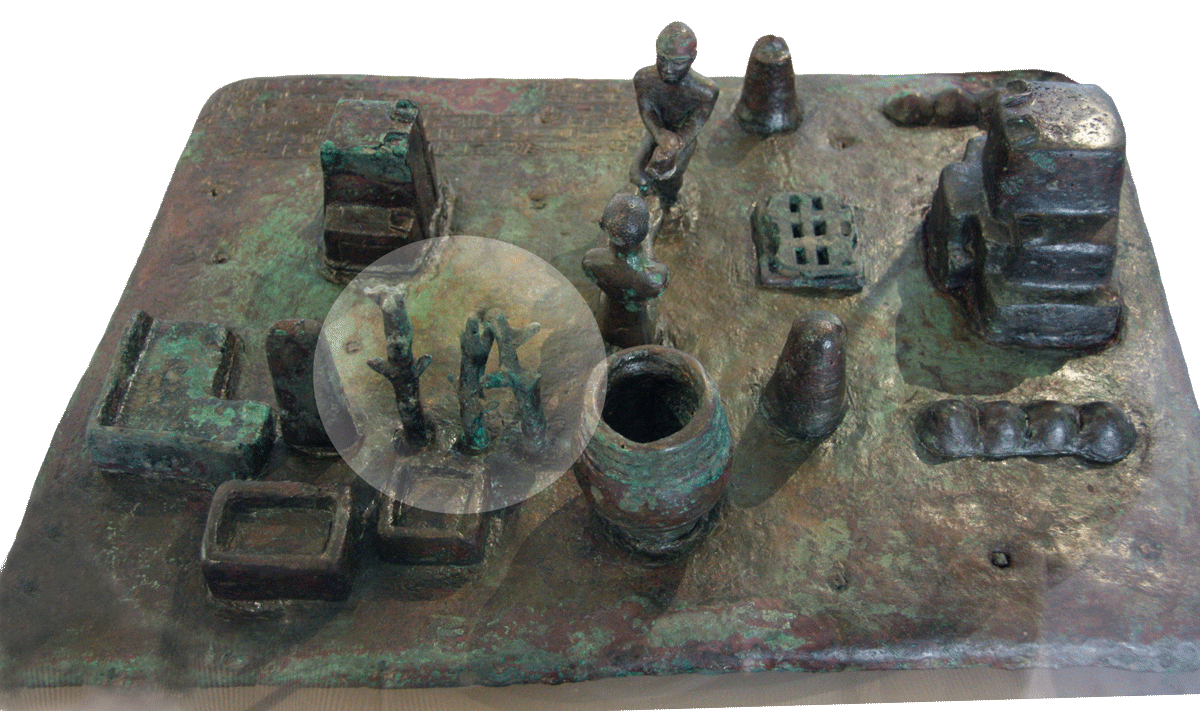
The stylized trees in this bronze model of a cultic site (Susa, twelfth century BC) are reminiscent of Asherah poles, one of the objects of false worship that faithful kings destroyed during religious reforms.
This Ethiopian attack on Judah does suggest that something may be amiss in Asa’s kingdom, and it is precisely this that comes to the fore in 15:1–19. Returning from his battle against the Ethiopians, Asa is confronted by the prophet Azariah, who reminds the king that the divine presence the nation has just experienced depends on the nation’s presence (covenant faithfulness) with Yahweh. In language typical of 1–2 Chronicles (see commentary on 2 Chron. 7:12–22), the king is presented with a choice between seeking and forsaking God. This prompts Asa to perform more extensive religious reforms, now removing idols from outlying areas and repairing the central shrine in Jerusalem, even though still certain high places (outlying shrines) are left standing. The festal celebration in 2 Chronicles 15:10–15 depicts in communal terms an appropriate response to the prophetic call to seek God, here identified as seeking “with all their heart and soul” expressed through an oath. As in the early phase of Asa’s reign (14:5, 7), the result is the divine blessing of “rest” (15:15).
The final phase of Asa’s reign in 16:1–10, however, is tragic. When Jeroboam’s son Baasha regains territory his father lost to Asa’s father Abijah (see 2 Chronicles 13), Asa responds by entering into a military alliance with the Syrian king Ben-Hadad, whose territory lay to the north of Baasha (thus Asa surrounded Baasha and forced him to fight on two fronts). The use of resources from the temple to entice Ben-Hadad into an agreement is despicable. Once again a prophet arises to confront Asa, and Hanani contrasts Yahweh’s faith during Asa’s early reign as he faced the great Ethiopian army (chap. 15) with Asa’s unbelief when facing the much smaller Israelite army (chap. 16). The words of promise, that Yahweh is searching the earth to strengthen those who are fully committed to him, are used to judge this king who has refused to trust Yahweh in his moment of need (16:9). The contrast between the early and late Asa is accentuated further by his conflicting treatment of the prophet who delivers the divine word. In 15:8 he took courage and responded positively, but in 16:10 he imprisons Hanani. Asa’s alliance with Ben-Hadad introduces a negative precedent that will escalate in frequency and negative results in the coming accounts of Judean kings. Judah is called to faith in Yahweh alone, who will fight on their behalf. In the face of much greater imperial forces in the Persian period, the Chronicler’s audience is called to trust Yahweh alone to establish his kingdom.
Second Chronicles 16:11–14 brings closure to the account of Asa with a typical summary note. The tragedy of Asa’s life is accentuated in his closing years, as the man whose name probably means “God is (my) physician” (HALOT 4:73) is plagued by diseased feet and yet refuses to seek help from Yahweh rather than physicians. This contrasts the young Asa who sought Yahweh’s help against the mighty Ethiopian army.
D. The reign of Jehoshaphat (17:1–20:37). 17:1–18:34. The account of Jehoshaphat begins with an abridged summary note in 17:1a, with more information provided in the concluding summary note in 20:31–34. Much as the reign of his father Asa (cf. 2 Chron. 17:3; 20:32; 21:12), Jehoshaphat’s reign begins on a high note (17:1b–19), with an initial phase of faithfulness (17:3–4) that is rewarded with the divine blessings of military, political, and economic success (17:5, 10–19). Jehoshaphat goes beyond merely removing false worship practices and sites from his nation (17:3–6) by positively facilitating instruction among the people (17:7–9). He commissions five officials, nine Levites, and two priests for itinerant teaching of the law throughout his kingdom. The account stresses the written character of their source for teaching, noting how they took with them “the Book of the Law of the Lord” to the various towns of Judah. Although the books of Chronicles stress the centralization of worship at the temple in Jerusalem and with it greater opportunities for the involvement of Levites in verbal worship alongside the sacrificial activity of the priests, here a decentralization of teaching reveals his desire to keep the people from returning to their former ways. The reference to the fear of Yahweh falling on the surrounding kingdoms reveals the power of such teaching. For the Chronicler’s audience this is a reminder of the importance of teaching the written word to ensure central and pure worship among his own generation.
Although initiating reforms that will ensure faithfulness among his people (teaching), Jehoshaphat makes a foolish mistake by entering into an alliance with Ahab king of Israel to the north in 18:1–34. This is ironic in light of the fact that Jehoshaphat spent his initial days fortifying his kingdom against this northern power (17:1–2). Little does he know the tragic outcome of this alliance, since it will be sealed by the marriage of his son Jehoram to Ahab’s daughter Athaliah (2 Chron. 18:1), whose bloody purge will nearly extinguish the Davidic line (22:10–12). A pact with Ahab’s kingdom would have been tempting, especially since Ahab’s marriage to the Phoenician princess Jezebel reveals that he had already developed an alliance with the Phoenician city-states. That Ahab is the more powerful partner is suggested by the fact that Jehoshaphat travels to Ahab’s capital, Samaria. Once there, he is pressured by his new ally to assist him in recovering Ramoth Gilead, one of Ahab’s fortress cities on the Transjordanian plateau south of the Golan region and overlooking the River Yarmuk. But Jehoshaphat displays his earlier spiritual sensibilities by exhorting Ahab to inquire of Yahweh.
Unsatisfied with the positive response of Ahab’s four hundred non-Yahwistic prophets (most likely prophets of Asherah or Baal; see 1 Kings 18:19), Jehoshaphat demands a prophet of Yahweh. Ahab reluctantly produces Micaiah son of Imlah, who has consistently spoken negatively of Ahab. Ahab knows something is amiss when Micaiah encourages him to enter battle, promising victory. In response to Ahab’s demand for the truth, Micaiah explains his experience in the divine council of Yahweh, a scene strikingly reminiscent of the prophetic commissioning scene in Isaiah 6. Prophets are the only human participants who are allowed into the divine council (Jer. 23:16–22), joining heavenly counterparts who also carry out tasks for Yahweh. In this context Micaiah listens in on a discussion in the divine council, as Yahweh asks for a volunteer to entice Ahab to enter battle. One heavenly participant agrees to prompt Ahab’s prophets to encourage Ahab into battle. Micaiah is thus truly speaking the word of the Lord when he encourages Ahab to enter the battle. After Ahab throws Micaiah into prison, Ahab and Jehoshaphat proceed to the battle for Ramoth Gilead. Ahab’s supremacy over Jehoshaphat is confirmed by his instruction that Jehoshaphat wear his royal robes while Ahab disguises himself. While this sets up Jehoshaphat as the only royal target, Ahab’s folly is in thinking he can thwart Yahweh’s will. As expected, the opposing army does target Jehoshaphat, but the Davidic king’s cry to God saves him (18:31). In contrast, Ahab, relying on his crafty strategy, is mortally wounded by a “random” arrow, confirming Micaiah’s earlier word of judgment (18:27).
19:1–20:37. As Jehoshaphat returns home from the battle at Ramoth Gilead he is confronted by the prophet Jehu son of Hanani (19:1–3). This is reminiscent of Azariah’s confrontation of Jehoshaphat’s father, Asa, upon his return from the battle against the Ethiopians in 15:2, a battle in which the earlier royal also cried out for help in the midst of overwhelming odds (2 Chron. 14:9–15). While the timing of the prophetic confrontation is similar to that in chapter 15, the content of Jehu’s prophetic message to Jehoshaphat is similar to the message delivered by Jehu’s father, Hanani, to Jehoshaphat’s father, Asa, in 16:7–10: both upbraid the Davidic king for entering into an inappropriate alliance. In contrast to his father, Asa, who throws Hanani into prison, Jehoshaphat responds appropriately. First, the king who sent his officials, Levites, and priests to teach the people about the Torah (chap. 17) goes himself through the breadth of the land, from furthest south (Beersheba) to furthest north (hill country of Ephraim), encouraging them to return to God (19:5). Second, the king whose name means “Yahweh judges” establishes an impartial judicial infrastructure (cf. Deut. 16:18–17:13) in the fortified cities and Jerusalem to encourage faithfulness to the Torah through accountability (19:6–11).
These reforms in chapter 19, however, do not spare Jehoshaphat from the serious military challenge that arises in 20:1–30, even though his victory is an example of God’s reward for those who obey and trust in him. Jehoshaphat’s enemy in this chapter is composed of people groups in the southern Transjordan: (from north to south) Ammon, Moab, and Edom (although see NIV note). Jehoshaphat is informed of this army’s advance when it reaches En Gedi, an oasis halfway up the western side of the Dead Sea. With this force within forty miles of Jerusalem, Jehoshaphat and his people (men, women, children, babies; see 20:13) gather together to seek Yahweh’s help through communal fasting (20:4) and prayer (20:5–12). Jehoshaphat founds his prayer on Yahweh’s omnipotent rule, then he recalls the vision of the temple as a place where Yahweh will hear prayer (a thought articulated by Solomon at the dedication of the temple in 2 Chronicles 6). Jehoshaphat then focuses on the inappropriateness of this attack by Ammon, Moab, and Edom, especially in light of Israel’s mercy toward them before the conquest of the land. The divine response to this prayer comes from a Levite who functions as a prophetic voice with the Spirit of the Lord descending on him. The trend of a prophetic role for Levites seen earlier in Chronicles (see 1 Chronicles 25) is developed further here. For a prophet to respond to such a prayer is appropriate, as God comforts his people and proclaims salvation, even offering a military strategy that will ensure victory.
In the following scene, the king plays an important role in encouraging the people before they go into battle. The victory is prompted here not by military action but rather by men (most likely Levites) singing praise. Yahweh miraculously intervenes, setting ambushes that provoke the combined forces of Ammon, Moab, and Edom to turn on one another. Jehoshaphat and his men only have to collect the plunder from the defeated armies (20:25), respond in praise to Yahweh (20:26), and return to Jerusalem with joy (20:27–28). The concluding summary note for Jehoshaphat is divided into two sections, 20:31–34 and 21:1, split by a short account in 20:35–37, which depicts Jehoshaphat’s inappropriate economic alliance with Ahab’s son Ahaziah of Israel, which ended in disaster with the destruction of their fleet of ships. This event shatters the idyllic later portrait of Jehoshaphat, reminding the reader again that foreign alliances are inappropriate. In so many ways Jehoshaphat is a powerful renewal figure in Judah, serving personally as a catalyst of repentance and trust among the people and creating institutions for instruction and justice. However, his proclivity for alliances with the northern kingdom brings him much tragedy, ultimately threatening the Davidic dynasty and the independence of the southern kingdom.
E. The account of Jehoram (21:1–20). The death of Jehoshaphat initiates a period of crisis that will endure for the next three reigns, beginning with Jehoram and Ahaziah and ending in the tragedy caused by the queen Athaliah. It is interesting that the names of the two kings here are also names of northern kings (Ahab’s son was Ahaziah and his grandson was Jehoram), clear indications of the influence of the northern kingdom introduced by Jehoshaphat’s alliance with Ahab and the marriage of Ahab’s daughter Athaliah to Jehoshaphat’s son Jehoram. The account of this son Jehoram begins in 21:1–7 with an expanded introductory summary note highlighting the evil behavior of Jehoram from the very beginning of his reign. By assassinating all contenders for the throne, Jehoram introduces the key motif of dynastic endangerment, which will reappear throughout chapters 21–22 (21:17; 22:8–9; 22:10–12). The Chronicler’s note in verse 7 is a careful reminder that the consistent survival of the dynasty through these tragedies can be traced to the covenantal promise of Yahweh to David of an enduring lamp, signifying permanence (cf. Job 18:5; Prov. 13:9; 24:20). In the end it will take this endangerment to purify the Davidic line from the religious influence of the northern Omride dynasty.
According to 21:8–11, Jehoram’s abandonment of Yahweh (21:10; see 2 Chron. 7:12–22), detailed in 21:11 as building high places and fostering inappropriate worship, is the cause of two revolts against Jehoram: by Edom, in the southern Transjordan, and by Libnah, a city in the southwestern territory of Judah. Jehoram even receives a prophetic word of judgment from the prophet Elijah in the form of a letter in 21:12–15. The appearance of the northern prophet Elijah is appropriate for a southern king so influenced by the north. The comparison to Ahab in verse 13 is a poignant reminder of the source of Jehoram’s infidelity, while the contrast to his grandfather Asa and his father, Jehoashaphat, is a reminder that Jehoram has squandered most of their accomplishments in terms of both territory gained and religious reforms enacted. Elijah prophesies an ominous end to Jehoram’s life (see 21:18–19). Verses 16–17 provide further description of the divine judgment on Jehoram, depicting the attack of a combined group of Philistines and Arabs, people groups living on the southwestern and southern borders of his kingdom. Their attack threatens the survival of the royal family, only the crown prince Ahaziah surviving, which is tragically similar to Jehoram’s purge of his own family at the outset of his reign in 21:1–7. As if this loss of life were not enough, finally the Chronicler depicts a crisis in Jehoram’s health (21:18–19), an event that constitutes the fulfillment of Elijah’s prophecy in 21:12–15. Jehoram’s account ends in typical fashion, with a concluding summary note in 21:20, repeating the information already supplied in 21:5. Jehoram is one of the darkest figures in the Chronicler’s account of the southern kingdom, exemplifying what awaits the king who abandons the Lord.
F. The accounts of Ahaziah, Athaliah, and Joash (22:1–24:27). 22:1–12. With the death of Jehoram, the Chronicler introduces the reign of his son Ahaziah (also known as Jehoahaz and Azariah; see NIV note on 21:17; 22:6), the only survivor of the bloody attack of the Philistine-Arab coalition in 2 Chronicles 21:17. This typical summary note (22:1–5a) makes clear the influence of Ahaziah’s mother, Athaliah, that daughter of Ahab (son of Omri) whose marriage to Jehoram represented an unhealthy alliance between the dominant and illegitimate northern kingdom of Israel and the legitimate southern kingdom of Judah. The Chronicler links Athaliah’s influence, as well as that of other counselors from Ahab’s northern kingdom, to the evil that Ahaziah did in the eyes of the Lord. As in the case of his grandfather Jehoshaphat, who forged the relationship with the northern kingdom, Ahaziah’s alliance with his northern cousins involves supporting them against King Hazael’s Aramean forces (22:5b–9a; cf. 2 Kings 8:7–15). Ironically, the site of the battle is Ramoth Gilead, the same site at which Ahab and Jehoshaphat fought together in 2 Chronicles 18:28–34. This time, however, the outcome of the battle will mean death for both northern and southern kings. The northern king Joram (son of Ahab) is wounded in the battle, and when his nephew the southern king Ahaziah comes to pay his respect, both kings are assassinated by Jehu: Joram at Jezreel and Ahaziah in Samaria.
In 22:7 the Chronicler links the downfall of Ahaziah to the will of God, who is responsible for the destruction of the house of Ahab. These two events are intricately linked, since the eradication of the house of Ahab means a significant purge of the royal house in Judah as well. In his abridged concluding summary note in 22:9b, the Chronicler ironically notes the positive qualities of Jehoshaphat (“who sought the Lord with all his heart”), even though it was Jehoshaphat who introduced the fateful alliance and intermarriage into the Davidic line. The final statement that no one is powerful enough to retain the kingdom can be explained by Jehu’s destruction of the “princes of Judah” and “the sons of Ahaziah’s relatives.” While the divinely affirmed Jehu thoroughly destroys the royal family of Ahab and strikes down all the adult males of the royal family of Ahaziah, it is the evil Athaliah who will nearly complete the job in 22:10–12, which is ironic since this aids the purification of the Davidic royal house of northern influences. The story here traces the efforts of two women, the first being Athaliah daughter of Ahab, who seeks to snuff out the lamp of David’s dynasty (cf. 21:7) and the second, Jehosheba, who as daughter of Jehoram and sister of Ahaziah (see 2 Kings 11:2) rescues the Davidic dynasty from extinction. Jehosheba is also the wife of the high priest Jehoiada and so is able for six years to provide sanctuary for the sole surviving Davidic heir, the young Joash son of Ahaziah.
23:1–21. After six years the high priest Jehoiada, husband of Jehosheba, finally makes his move to dethrone Athaliah and enthrone the legitimate and sole Davidic heir, Joash. It is Jehoiada who controls the plot from beginning to end, his success signaled by the closing note in 23:21 that the city is quiet because Athaliah has been slain. Jehoiada gathers help from sacred and secular groups to overthrow Athaliah at the time of the changing of the guard at the temple. It will be the weapons David gave to the temple treasury that will grant military resources to Jehoiada to preserve the Davidic dynasty. In this passage one can discern the rituals related to the inauguration of a king, which include gathering both sacred and secular leaders of the nation at a key location, anointing the royal individual with oil, sounding the trumpet, and chanting, “Long live the king.” Jehoiada carefully protects the sanctity of the sacred precincts, instructing his troops to avoid the temple precincts and even ensuring that Athaliah’s blood is not shed in the temple. With Athaliah dead, Jehoiada leads the people in a covenant renewal, which binds people and king together. Although a priest, Jehoiada affirms the role of the Levites in the temple services (23:18–19), further evidence for the Chronicler of the necessary role played by the Levites in his own day. Not only does Jehoiada ensure there is new leadership over the temple; he also guarantees in verse 20 that Joash is supported by the secular leadership of the land, as he, together with the military, royal, and family leaders, seats the young king on the royal throne in the palace. In this narrative, which depicts the renewal of a Davidic house on the brink of destruction, the Chronicler shows the key role played by the priestly house. In his own day priests would again have an opportunity to preserve the nation until the renewal of the royal house (see Zech. 3:1–10; 6:9–15).
24:1–27. Although Joash has already played a role in the narrative, it is in chapter 24 that the account of Joash begins properly, with his accession summary note in 24:1–3. Joash’s reign is divided into two phases: the first (24:4–16), during Jehoiada’s lifetime, is the righteous phase, and the second (24:17–22), after Jehoiada’s death, unrighteous. Second Chronicles 24:3 focuses particular attention on Jehoiada’s choice of wives for Joash, an important topic in light of the previous crisis created by Jehoshaphat’s unwise intermarriage with the northern royal house. Joash’s reforms during the lifetime of Jehoiada (24:4–14) are focused on the restoration of the temple, a necessity after the inattention and plundering (2 Chron. 24:7) of Athaliah’s reign. Joash devises a system for the collection of resources from throughout the land, but when no progress is made he is forced to confront his mentor Jehoiada. Alluding to a tax authorized by Moses (Exod. 30:11–16), Joash then changes his tack, creating instead a centralized system in which the resources are to be brought to Jerusalem. The initial phase of inaction, the confrontation between Joash and Jehoiada, and the involvement of both priestly and royal officials for counting and disbursing the collection (24:11–14) suggest some measure of tension between temple and palace, which is ultimately resolved. Both people and leaders respond with an abundance of resources.
Second Chronicles 24:15–16 constitutes a concluding summary note, in this case not for a royal figure, as usual, but rather for Jehoiada the high priest. This is key for the depiction of Joash, whose reign is divided into two phases, based on the presence and absence of Jehoiada. It also grants Jehoiada honor commensurate with that of the kings of Judah, so that he overshadows even his disciple Joash (see 24:25–27). Jehoiada provides a model for high priests who serve in the Chronicler’s generation, revealing the role that a high priest can play in the preservation and restoration of the Davidic line.
With Jehoiada’s death, however, there is a significant shift in the account of Joash, who reverses his early reforms in 24:17–22. In a scene reminiscent of Rehoboam earlier (2 Chronicles 10), Joash listens to the advice of unwise counselors, abandoning the temple and shifting allegiance to the goddess Asherah, consort of El, the chief god of the Canaanite pantheon. Before divine discipline falls on the nation, Yahweh graciously sends prophets to prompt repentance, culminating with Jehoiada’s son Zechariah. That an individual from sacred ranks plays a prophetic role is typical of the presentation in Chronicles (see 1 Chron. 25:1–31; 2 Chron. 20:1–37; 29:1–36; 34:30; 35:15), but there is great tragedy here in Joash’s murder of the son of the one who saved his life and also in the fact that the murderous act takes place in the holy space that Jehoiada so carefully protected when ridding the nation of Athaliah (2 Chron. 23:7, 14–16, 19). Second Chronicles 24:23–25a showcases the key principle in Chronicles that those who abandon Yahweh receive his retribution, in this case in the form of military defeat and assassination. Joash is defeated by much weaker Aram, from Damascus, a kingdom to the north of traditional Israelite lands. As is typical in the ancient Near East, this defeat is followed by the assassination of the king in his bed.
The account of Joash concludes in typical fashion, with a summary note in 24:25b–27. The brevity of this note, especially in comparison to that on Joash’s mentor Jehoiada in 24:15–16, and the comment that Joash is denied a proper royal burial are indications of the Chronicler’s low esteem for Joash. The emphasis on prophecy and temple restoration is an important reminder of the key agenda of the Chronicler for his own generation, who are called to care for the temple and to give careful heed to God’s word.
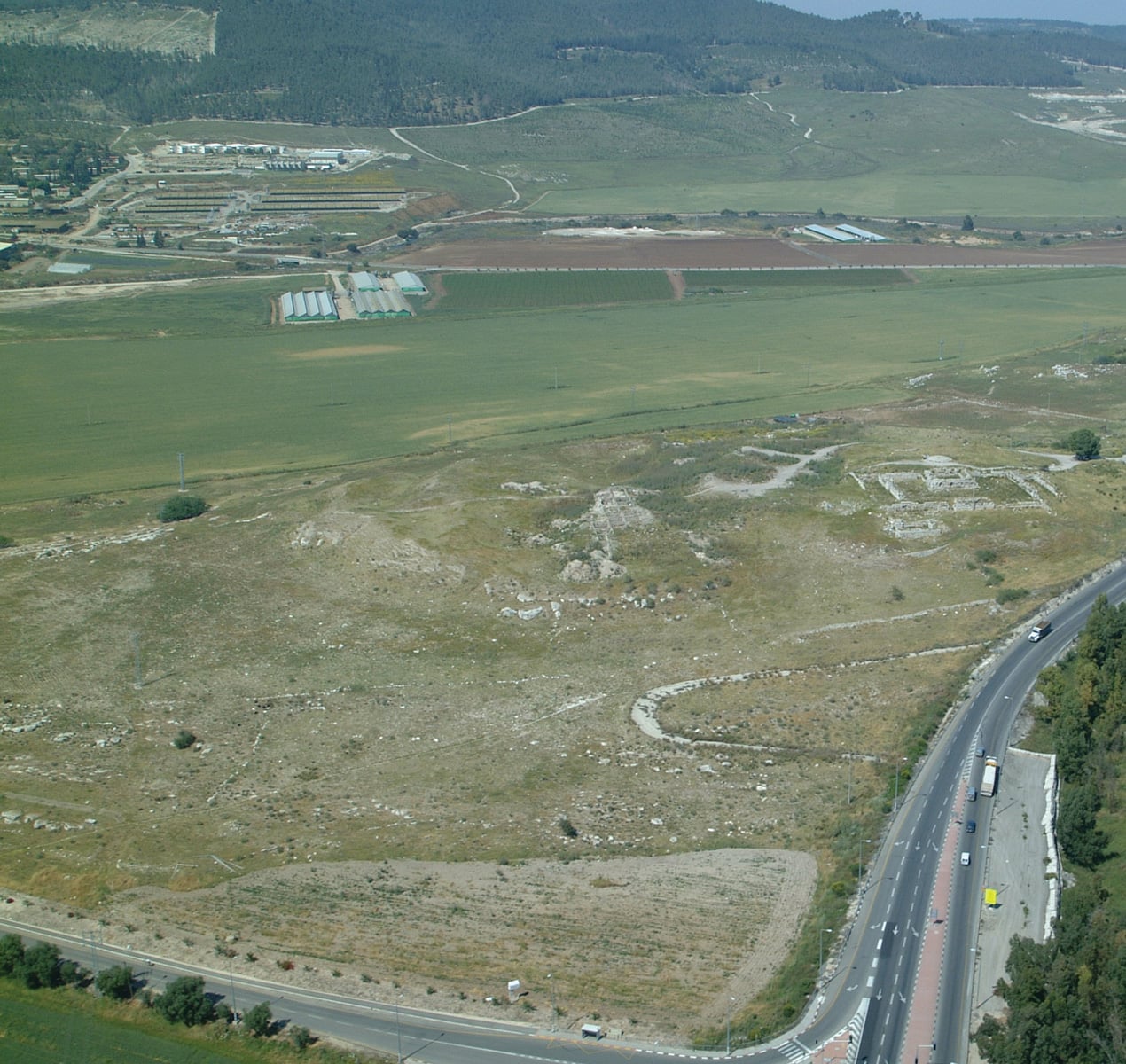
The ancient site of Beth Shemesh with the Sorek Valley in the background
G. The account of Amaziah (25:1–28). The assassination of Joash opens the way for the accession of his son Amaziah, whose reign is introduced by the summary note in 25:1–4. In contrast to his father, Joash, Amaziah’s doing “what was right in the eyes of the Lord” (25:2), yet not “wholeheartedly,” is suggestive of the two different phases of his reign, the first positive (25:5–12) and the second negative (25:13–24). Both phases are structured by the same pattern: (1) Amaziah arouses divine anger, (2) a prophetic figure confronts the king, (3) the king responds with a question, (4) the prophetic figure responds, (5) the king obeys or disobeys, and (6) a battle results in success or failure. In the first phase of 25:5–12 Amaziah prepares for battle against Edom but is confronted by “a man of God” (a term for a prophet or miracle worker; see 1 Sam. 2:27; 9:6–10; 1 Kings 12:22) who attacks the king for including mercenaries from the northern kingdom among his forces. Judah’s reliance on northern military resources (2 Chronicles 18) was what caused the near extinction of the Davidic line in 2 Chronicles 22. Although reluctant to lose his initial investment in these troops (25:9), Amaziah obeys and experiences victory against the Edomites, called here the sons of Seir, the mountain region traditionally associated with Edom. The Valley of Salt is in the lower Dead Sea region.
This victory over the Edomites, however, will lead to Amaziah’s downfall in the second phase of his reign in 25:13–24. Although Yahweh has given him the victory (see vv. 8–9), Amaziah bows down to the gods of his conquered foe. This arouses divine anger, and so again Yahweh sends a prophet to confront the king. This time, however, Amaziah ignores the divine warning and ensures divine judgment. Ironically, this judgment will come through the hand of the northern kingdom, whose mercenaries are rejected by Yahweh in 25:5–12 and will be prompted by Amaziah’s vengeful challenge of the northern king Joash. The fateful battle takes place at Beth Shemesh, which guarded Jerusalem from its vantage point in the Sorek Valley along the western boundary of traditional Judahite territory. Judah’s loss will lead to the capture of both king and capital, plundering of temple and palace, and destruction of city defenses. The concluding summary note in 25:25–28 not only brings closure to the account of Amaziah but also depicts his demise as judgment from God. The Chronicler traces the conspiracy against Amaziah to his apostasy from God. He flees from Jerusalem to another of the fortified cities to the southwest of Jerusalem, Lachish. There he is caught by the conspirators and killed. Amaziah showcases key theological principles developed throughout Chronicles. God brings judgment on the disobedient, but does offer warning through the prophetic word.
H. The account of Uzziah (26:1–23). With the assassination of his father in a palace coup, Uzziah comes to the throne at age sixteen (26:1–5). The Chronicler evaluates Uzziah (called Azariah in the book of Kings; cf. 2 Kings 14:21) positively, noting that he did right in the eyes of Yahweh, but qualifying this by reference to the mentoring influence of an otherwise unknown figure named Zechariah. In keeping with the Chronicler’s theological principles, such righteous behavior is rewarded with prosperity, exemplified in Uzziah’s signature achievement of rebuilding Elath, an Israelite southern seaport on the Gulf of Aqaba. Doing right is described here as seeking after God and is linked to the fear of God, that human response of awe and submission before almighty Yahweh Creator (cf. Deut. 5:5, 22–27, 29; 6:1–6; Prov. 1:7).
The initial phase of Uzziah’s reign in 26:6–15 is typified by offensive military success on all his borders, including the west (Philistines, 26:6–7), south and east (Arabs, 26:7), east (Transjordan, 26:8), and south (Negev, 26:8), success that gives him control of the two main international highways through which the trade of the ancient world flowed. There are also defensive fortifications within the land (26:9–10, 15) and the amassing of a large and efficient army (26:11–14). But this initial success, to be linked to the influence of the godly Zechariah (see similarly Jehoiada’s influence on Joash in 2 Chronicles 24), comes to an end in 26:16–21, when Uzziah’s pride corrupts him. Violating the clear laws governing the holy space in the temple and ignoring the priests’ concerns, Uzziah invades the holy place to burn his own incense. God’s judgment falls on the king as an unclean skin disease breaks out on his forehead (see Leviticus 13–14). This condition is the beginning of the end for Uzziah, who will live out the remainder of his reign isolated from the rest of the community, with his son Jotham as coregent. Loss of health is a sign of God’s displeasure with figures in Chronicles (e.g., 2 Chron. 21:18–20).
Second Chronicles 26:22–23 brings closure to the account of Uzziah, with a summary note that identifies prophetic works as the source of the information. Although he exemplified many good characteristics as he followed the lead of Zechariah, in the end his name would be associated with the judgment of Yahweh.
I. The account of Jotham (27:1–9). The account of Jotham is considerably brief, most likely reflecting the short period he reigns after his father Uzziah’s death. In the introductory summary note in 27:1–2, the Chronicler parallels Jotham with his father in terms of positive accomplishments while distancing him from his father’s breach of the sacred precincts of the temple (see 2 Chron. 26:16–21). Jotham is evaluated as doing right in Yahweh’s sight, even though the people act corruptly. The list of Jotham’s accomplishments in 27:3–6 reveals the blessings that accompany those who do right (see esp. 27:6). Special focus is placed on military defense through building activities in and outside Jerusalem and military offense in his campaign against the Ammonites. Control of Ammon meant the economic benefit for three years from taxes on goods moving along the King’s Highway between Asia, Arabia, Africa, and Europe. The closing summary note in 27:7–9 reminds the reader of the contrast between Jotham and his father Uzziah, the former’s account explicitly mentioning his burial in the city of David.
J. The account of Ahaz (28:1–27). With the accession of Jotham’s son Ahaz there is a radical shift in the evaluation of the Chronicler, who judges Ahaz as not doing what is right in Yahweh’s sight, in the introductory summary note in 28:1–2a. Ahaz represents a pregnant moment in the post-schism history of Israel, since during his reign the illicit northern kingdom comes to an end. Unfortunately, far from the ideal conditions established by his ancestor David (28:1), Ahaz’s kingdom continues the illicit ways of the northern kingdom. From the Chronicler’s perspective Ahaz takes the nation to its darkest level prior to the exile. The specific description of Ahaz’s evil activities is provided at the outset of 28:2b–7, as the Chronicler lists the violations of Yahweh’s demand that worship take place through appropriate means at the appropriate place. His offenses include the worship of Baal, one of the key gods in the Canaanite pantheon; child sacrifice, a practice prohibited in Deuteronomy 18:10–11 (cf. 2 Chron. 33:6); and burning incense at sites other than the temple. The Valley of Ben Hinnom bordered the south and west sides of Jerusalem and was not a designated location for worship activities. As is typical throughout 2 Chronicles, such illicit behavior is met with divine discipline, here in the form of military defeat, at the hands of first the Arameans and then Israel, both key threats from the north (see Isaiah 7).
Second Chronicles 28:8–15 represents one of the few times the Chronicler focuses on characters from the northern kingdom, but in this case a prophet (Oded) confronts the victorious northern army (with its capital at Samaria), calling them to care for their southern military captives in a merciful way (strikingly similar to the actions of the Good Samaritan in Jesus’s parable in Luke 10). Against the brightness of this northern response, the darkness of Ahaz’s behavior in the south in 28:16–25 will be seen even more clearly. Faced with further divine discipline through military attacks from the east (Edom) and west (Philistia), Ahaz will not only use treasures from the temple to try to enlist the great Mesopotamian imperial power Assyria for help to deal with his smaller enemies but also will sacrifice to the gods of the conquering Arameans. Trusting in such imperial and heavenly powers, however, only exacerbates Judah’s situation. It also leads to the closure of the temple and construction of altars throughout the kingdom. Identified as the worst leader of Judah, Ahaz is disqualified from burial in the royal tombs (28:26–27).
K. The account of Hezekiah (29:1–32:33). While Ahaz represented the lowest point in the history of Judah after Solomon and before the exile, Hezekiah represents the highest point. In the introductory summary note of 29:1–2 the Chronicler offers his theological evaluation of this great king, describing him unreservedly as doing right in the sight of Yahweh and comparing him to the ideal monarch, David.
The account proper begins with Hezekiah’s foundational achievement, the cleansing and rededication of the temple in 29:3–36. While his father Ahaz closed the temple and abandoned its services (2 Chron. 28:24), Hezekiah’s first move is to reopen the temple. His motivational speech in verses 4–11 identifies the important role played by the priests and Levites in such renewal of the temple and its worship, a message relevant to his own generation. Hezekiah places priority on making a covenant with Yahweh, that is, a relationship with expressed obligations by both partners (see especially the two foundational covenants with Abraham, Genesis 15; 17 and with Israel at Sinai, Exodus 20; 24). Levites and priests respond to Hezekiah’s call, purifying themselves and then the temple. The fact that it takes sixteen days to clean out the temple indicates the dysfunction of Ahaz’s reign. What follows in verses 20–36 is a detailed description of the rededication of the temple, all guided by Hezekiah (see 28:24). Music plays a role alongside sacrifice at this dedication, in line with the priorities of David and Solomon when first the ark and then the temple were dedicated.
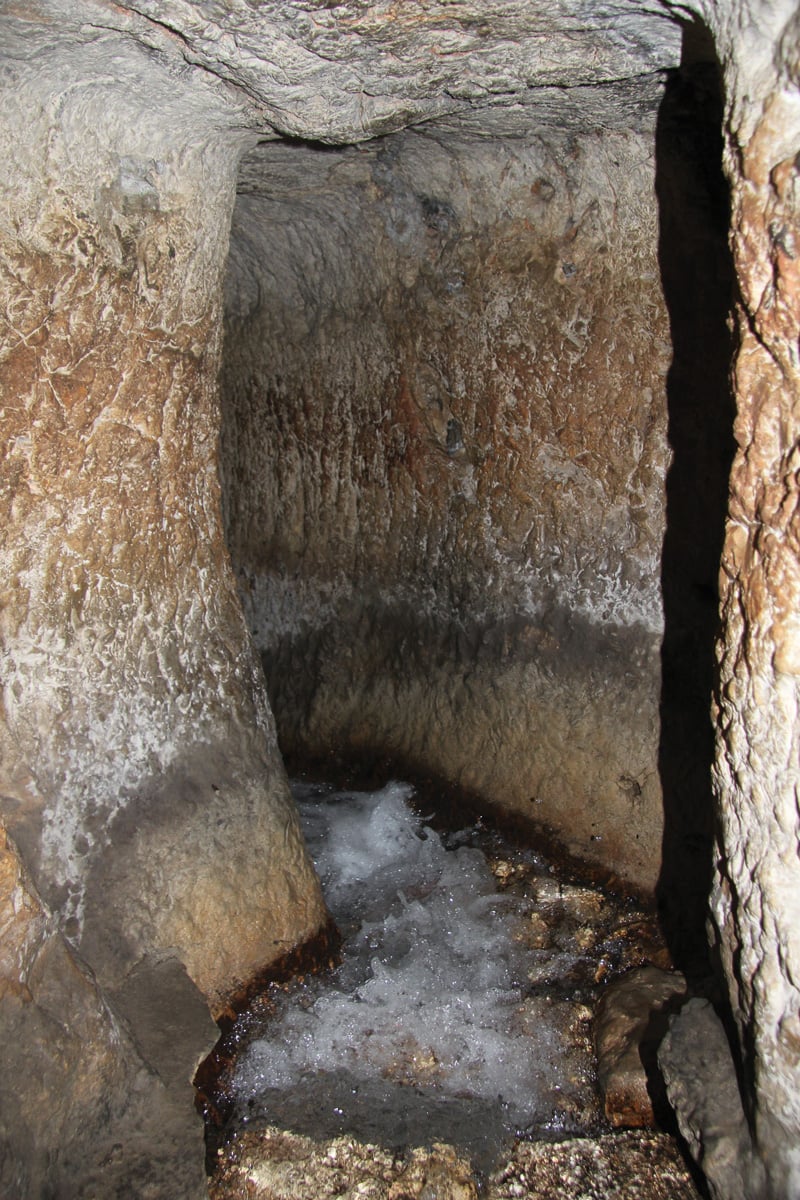
Water from the Gihon Spring gushes into Hezekiah’s tunnel (eighth century BC), carved as a protected means to bring water within the walls of Jerusalem (cf. 2 Chron. 32:4).
With the temple purified and rededicated, the Chronicler then depicts in 30:1–31:1 Hezekiah’s renewal of the festal rhythms of Israel. In view are the Feasts of Passover and Unleavened Bread. The condition of the temple inherited by Hezekiah from his father precludes celebration of these festivals at their legislated times (the fourteenth to the twenty-first days of the first month; Exod. 12:1–13:22; 23:14–17; 34:18–23; Lev. 23:1–44; Deut. 16:1–17), and so they are celebrated one month later (see the provision in Num. 9:1–14). Hezekiah initiates this celebration by sending a proclamation via couriers throughout the land from Beersheba in the far south to Dan in the far north. The extent of the land is indicative of the era after the fall of the northern kingdom, Hezekiah’s kingdom representing the first renewal of the united kingdom since the idyllic era of David and Solomon (1 Chronicles 10–2 Chronicles 9), to which Hezekiah’s reign is compared in 30:26. Hezekiah’s letter in 30:6–9 is a powerful call to repentance, identifying a return to faithful temple worship as a penitential act. So also Hezekiah’s prayer in 30:18–20 echoes the vocabulary of God’s earlier promise to Solomon in 2 Chronicles 7:14, reminding the people of God’s willingness to forgive and heal those who seek God.
After purifying and dedicating the temple (chap. 29) and celebrating the first festivals (chap. 30), in 31:2–21 the Chronicler details Hezekiah’s reformation of worship practices. Hezekiah reflects the priorities of David’s innovations in worship, providing both the sacrificial and verbal dimensions of worship at the temple, with the former facilitated by the priests and the latter by the Levites. In view is a festal calendar that demands daily, weekly, monthly, and yearly events (31:3). Prompted by the personal example of their king, the people give beyond Hezekiah’s expectations. These many gifts demand careful attention to a system for the distribution of the contributions among the priests and Levites of the land (31:11–20). According to 31:21 Hezekiah embodies the values of the Chronicler, as one who seeks God with all his heart and so enjoys success.
The presentation of Hezekiah in 2 Chronicles is dominated by his religious reforms related to the temple and its services. But the final phase of the account is largely devoted to a summarized version (cf. 2 Kings 18–20) of Yahweh’s rescue of Hezekiah’s kingdom from the clutches of the Assyrian Sennacherib (32:1–24), whose own versions of these events have been discovered (see COS 2.119B:302–3). That Judah would face the Assyrians was inevitable, especially after the incorporation of the Aramean and Israelite kingdoms, directly north of Judah, into the Assyrian Empire. The text depicts Hezekiah’s extensive preparations for this Assyrian challenge, including protecting water sources, refortifying wall structures, accumulating weaponry, and organizing the military. The voice of Hezekiah comes to the fore once again in 32:7–8, as he encourages his officers with the theological reality that Yahweh is greater than the Assyrian arm of flesh. This short speech is dwarfed by the long speeches of Sennacherib to Hezekiah and his people (32:10–19), designed to undermine their confidence. In the end the Chronicler simply records the fact that both Hezekiah and Isaiah cry out in prayer to heaven and God answers with his mighty angel, who defeats the Assyrian army.
According to 32:25–31 Hezekiah is not perfect; he struggles with pride. Although the account here does not provide details on this pride, the parallel account in 2 Kings 20 as well as 2 Chronicles 32:31 reveals that his pride leads him to show his royal accomplishments to envoys from a potential ally, the Babylonian king Marduk-Baladan, whose rebellion against the Assyrians is attested in ancient Near Eastern records (see COS 2.118J; 2.119A; cf. Verse Account of Nabonidus). The way Hezekiah deals with this flaw when facing divine discipline is, ironically, exemplary, as the southern king and his community humble themselves and repent. This opens the way for divine blessing in the form of economic success and construction projects. The account closes in 32:32–33 with the typical concluding summary note, which reports his burial among the kings of Judah amid the glorification of his people. Hezekiah was an exemplary figure for the Davidic house, one who reopened the temple in Jerusalem and reinstituted its service of worship.
L. The account of Manasseh (33:1–20). The Chronicler’s primary source, the book of Kings, depicts Manasseh as the worst character, that king who seals the fate of Judah (2 Kings 21:12–15; 23:26–27; 24:3–4; cf. 24:20). While not ignoring Manasseh’s disobedience, the Chronicler presents this king as a role model, one whose repentance after an exilic punishment to Babylon showcases the Chronicler’s agenda for renewal for his own generation. His account begins with the typical accession summary note in 33:1–2, where the Chronicler’s theological evaluation of him is extremely negative, with its link to the Canaanite nations that preceded Israel’s arrival. To be like these nations is to risk experiencing their fate (see 33:9).
The specifics of Manasseh’s evil are provided in 33:3–9, which first outlines his sponsorship of decentralized cult practices at the high places (sacred sites on higher ground, nearer the heavens), with their worship of the Canaanite deities Baal and Asherah. Second, it describes Manasseh’s despicable innovations in the Jerusalem temple cult of the worship of celestial bodies, complete with dedicated altars in the two courts (see 2 Chron. 4:9) and even a carved image. Like his grandfather Ahaz (2 Chron. 28:2), Manasseh reverts to various divinatory practices, including child sacrifice in the Valley of Ben Hinnom, the valley that formed the southern and western boundaries of Jerusalem. Reference at two points to God’s eternal choice of Jerusalem (33:4, 7) is a poignant reminder that ultimately it is not God who has failed Israel, but Israel who has failed God and so experiences exile (33:8). What follows in 33:10–17 is a classic depiction of repentance. After rejecting God’s gracious warning through his prophetic word (33:10), Manasseh is severely punished by Yahweh through the Assyrians, who take him off to Babylon, a region under their control (33:11). There, however, Manasseh has a change of heart, described by the Chronicler in his dominant theological idiom (33:12; see 2 Chron. 7:12–22). After restoring him to his kingdom, Yahweh blesses him with success in building projects and military fortifications (33:13–14). Manasseh’s repentance is depicted as more than just words. He removes his illicit innovations from the temple and city (33:15) and restores proper worship of Yahweh (33:16), even though the people fall short of exclusive central worship in Jerusalem (33:17). The closing summary in 33:18–20 balances the two sides of Manasseh’s reign, both his prayer and his sins.
M. The account of Amon (33:21–25). In a short account the Chronicler describes the evil of Manasseh’s son Amon, using the typical structure of introductory accession summary (33:21–22a), events of his reign (33:22b–23), and concluding summary note (33:24–25). Comparison between Amon and his father accentuates the penitential model of Manasseh so important to the Chronicler (see 2 Chron. 7:12–22; 33:10–17). As expected, Amon’s evil leads to his untimely assassination at the hands of palace officials.
N. The account of Josiah (34:1–35:27). The Chronicler’s high opinion of Josiah is evident from the opening accession summary note in 34:1–2, where he is compared to his ancestor David, an honor bestowed in 2 Chronicles 10–36 only on Hezekiah (2 Chron. 29:2). Rising to power in the final third of the seventh century BC, a period that saw the shift of imperial power from Assyria to Babylon, would give Josiah the political space to enact his key religious reforms (34:3–33) in three phases: his eighth (34:3a), twelfth (34:3b–7), and eighteenth (34:8–33) years. The last reform is initially focused on the reconstruction of the temple, supported through the contributions of a united Israel (34:8–13). This physical restoration, however, is soon eclipsed by the discovery of a law book (most likely the book of Deuteronomy), which prompts the deep contrition of Josiah, who seeks a prophetic word from God. This word is delivered by the prophetess Huldah, who, after delivering a word of judgment on Israel for its illicit worship of other gods, commends the penitential example of Josiah. Josiah leads the nation in a covenant renewal, in which they pledge their desire to follow God, but he also rids the nation, including also the tribal territories of the former northern kingdom, of its detestable idols.
This restoration of the temple and renewal of the people lays the foundation for the reinstatement of the festal calendar at the temple in 35:1–19. In focus are the closely related Festivals of Passover and Unleavened Bread. Josiah’s actions and speech in verses 1–6 highlight his careful attention to follow the Torah legislation established by Moses and the further legislation established by David and Solomon. Sacrificial animals are provided by Josiah (35:7), his officials (35:8), and Levites (35:9), and the sacrifices are offered in the prescribed way by the priests and Levites (35:10–14), accompanied by music (35:15). Comparisons to the time of Samuel raise the profile of Josiah considerably. What is surprising, however, is the quick downfall of Josiah in 35:20–24. On his way to support his Assyrian ally against the rival coalition of Babylon and Media, Pharaoh Necho II (609–594 BC) demands passage through Josiah’s land. Josiah foolishly challenges this more powerful, Egyptian monarch in the Valley of Jezreel, a large open plain immediately north of Megiddo. Interestingly, the Chronicler identifies Necho as one who delivers the word of God and Josiah’s death as the result of his disobedience. With the death of Josiah, Judah will no longer enjoy independent status, and the exilic nightmare has begun. Beginning with the demise of Josiah, foreign monarchs (Necho of Egypt, Nebuchadnezzar of Babylon, Cyrus of Persia) will control Judah’s destiny.
The account of Josiah concludes with a summary note in 35:25–27 that focuses on Israel’s grief over Josiah’s death and Josiah’s acts of devotion to Yahweh. Jeremiah’s “laments” for Josiah should not be confused with the biblical book of Lamentations, which focuses instead on the city of Jerusalem in a later era.
O. The final royal accounts, exile, and restoration (36:1–23). From the Chronicler’s perspective the death of Josiah seals the fate of Judah and for all intents and purposes the exile has begun. Foreign rulers now take political control over the nation, and more important the narrative, as Necho, Nebuchadnezzar, and Cyrus, along with prophetic figures, act and speak for Yahweh. Throughout the accounts in this chapter the Chronicler regularly depicts the kings going into exile with temple treasures and makes no mention of their deaths. The lack of death notice, typical of all these kings in chapter 36, suggests hope for the Davidic line to reemerge after the exile. The link of royal figure and temple treasures suggests an intertwining of their fates, so that the reemergence of the temple in 36:22–23 brings hope for the reemergence of the royal line.
Josiah’s death brings his son Jehoahaz to the throne (36:1–3), but his reign will last a mere three months. After heading north to assist the losing cause of the Assyrians (see 2 Chron. 35:20–24), Necho inherits the Levant, setting up his headquarters in Aramean territory just north of the traditional lands of Israel. From there (Riblah) Necho summons Jehoahaz to depose him and send him to exile in Egypt (cf. 2 Kings 23:33).
Necho replaces Jehoahaz with his brother Eliakim, changing his name to Jehoiakim and demanding heavy tribute (36:4–8). Jehoiakim will see his Egyptian master lose control of the Levant to the rising ancient Near Eastern power Babylon, led first by Nabopolassar and then by his son Nebuchadnezzar (see 2 Kings 24:1–7). Although at first submitting to this new eastern power, Jehoiakim soon rebels and faces the punishment of Nebuchadnezzar, implicitly linked by the Chronicler to the evil Jehoiakim does in the eyes of Yahweh. The term used for evil here is the same used to characterize Ahaz (2 Chron. 28:3) and Manasseh (33:2; 34:33), showing that Jehoiakim deserves this divine discipline.
With his father in exile Jehoiachin ascends to the throne (36:9–10), but his reign lasts only three months and ten days. He also is evaluated negatively by the Chronicler, who describes his divine discipline as exile to Babylon (for the fate of Jehoiachin see 2 Kings 25:27–30 and the record of his royal provisions in exile in ANET 308). Nebuchadnezzar appoints Zedekiah (36:11–20), Jehoiachin’s uncle, as puppet king of Judah (see COS 1.137:468). After eleven years of submission Zedekiah rebels against his overlord, an action paralleled by the apostasy of both Zedekiah and his people from Yahweh by following the detestable practices (same word used of Ahaz, Manasseh, and Jehoiakim in 2 Chron. 28:3; 33:2; 34:33; 36:8). The prophetic voice again breaks in as God’s last act of compassion to avoid discipline, but to no avail. The city falls to Nebuchadnezzar, who kills the people; despoils the royal and temple treasures; destroys the temple, wall, and palaces; and exiles the survivors.
In 36:21 the Chronicler notes how the exile provides an opportunity for the land to enjoy the Sabbath rest required in the Torah (Leviticus 25). The figure seventy often appears in reference to the exile (Jer. 25:12; 29:10; Dan. 9:2; Zech. 1:12; 7:5). Symbolic of a generation (Isa. 23:15–18; Ps. 90:10), it is linked in the ancient world to the length of destruction for a rebellious city. Although the period between the date of the final destruction of Jerusalem in 587–586 BC and that of Cyrus’s decree in 539 BC is shy of fifty years, as noted in the commentary on 35:20–24, the death of Josiah in 609 BC seems to mark the beginning of the exile in Chronicles, resulting in a period of seventy years.
The conclusion to 1–2 Chronicles, in 36:22–23, expresses both the Chronicler’s hope and his challenge in his own generation. In 539 BC, after amassing a large empire surrounding the Babylonian Empire, Cyrus will conquer Babylon and inherit the traditional lands of Judah and Israel and their exiles in Mesopotamia. God’s sovereign fulfillment of Jeremiah’s prophecy is seen in Cyrus’s proclamation that promises the rebuilding of the temple and invites the exilic community to return to the land. Similar policies of Cyrus toward his conquered nations can be seen in the famous Cyrus Cylinder, which describes his restoration of sanctuaries and their gods in southern Mesopotamia. Once again the Chronicler depicts a foreign emperor acting on behalf of Yahweh, here in fulfillment of earlier prophetic expectation (Jer. 25:12; 29:10; cf. Isa. 44:28; 45:1, 13; Jer. 51:11, 28).
Select Bibliography
Boda, Mark J. 1–2 Chronicles. Cornerstone Biblical Commentary. Wheaton: Tyndale, 2010.
Braun, Roddy L. 1 Chronicles. Word Biblical Commentary. Waco: Word, 1986.
Dillard, Raymond B. 2 Chronicles. Word Biblical Commentary. Waco: Word, 1987.
Hill, Andrew E. 1 & 2 Chronicles. NIV Application Commentary. Grand Rapids: Zondervan, 2003.
Japhet, Sara. I & II Chronicles. Old Testament Library. Louisville: Westminster John Knox, 1993.
Johnstone, William. 1 and 2 Chronicles. Journal for the Study of the Old Testament Supplements 253–54. Sheffield: Sheffield Academic Press, 1997.
Jones, Gwilym H. 1 & 2 Chronicles. Old Testament Guides. Sheffield: JSOT Press, 1993.
Klein, Ralph W. 1 Chronicles: A Commentary. Hermeneia. Minneapolis: Fortress, 2006.
Knoppers, Gary N. I Chronicles: A New Translation with Introduction and Commentary. 2 vols. Anchor Bible. New York: Doubleday, 2004.
McConville, J. G. I & II Chronicles. Daily Study Bible. Philadelphia: Westminster, 1984.
Selman, Martin J. 1 Chronicles. Tyndale Old Testament Commentaries. Downers Grove, IL: InterVarsity, 1994.
———. 2 Chronicles. Tyndale Old Testament Commentaries. Downers Grove, IL: InterVarsity, 1994.
Thompson, J. A. 1, 2 Chronicles. New American Commentary. Nashville: Broadman & Holman, 1994.
Tuell, Steven S. First and Second Chronicles. Interpretation. Louisville: Westminster John Knox, 2001.
Williamson, H. G. M. 1 and 2 Chronicles. New Century Bible Commentary. Grand Rapids: Eerdmans, 1982.