1–2 Kings
A. Accession of a Younger Son (1:1–53)
B. Security Clearance (2:1–46)
D. Constructive Criticism (4:1–10:29)
E. Divided Heart, Divided Nation (11:1–12:33)
F. Northern Exposure (13:1–16:34)
G. Prophetic Contests (17:1–22:53)
A. Chariots and Fire (1:1–2:25)
C. Jehu’s Ascendancy (9:1–10:36)
D. Twilight for Samaria (11:1–17:41)
E. Hezekiah’s Assyrian Crisis (18:1–20:21)
F. Babylon Rising (21:1–24:17)
G. Judah’s Captivity (24:18–25:30)
Introduction
The final line of the book of Judges—“In those days there was no king in Israel, each one did what was upright in his own eyes” (author’s translation)—might imply that a monarchy will usher in a new era of peace and stability for God’s people. Such an era is not reported in 1–2 Kings. Instead, some four hundred years of Israelite history are narrated, and at times the political landscape is even more chaotic than in the book of Judges, as if that were possible. Some of the most colorful, disturbing, inspiring, and theologically subtle material in all of Scripture is presented to the reader of 1–2 Kings, a long work that rewards careful study and reflection.
Literary Features
Like 1–2 Samuel, 1–2 Kings was originally a single volume that eventually was divided into two parts, which together recount and evaluate the story of Israel’s royal experiment. The customary title “Kings” might be slightly misleading since royal figures are only part of the cast of characters. To be sure, kings and their antics, rivalries, major feuds, minor squabbles, petty agendas, inspiring reforms, brave leadership decisions, and flawed pretensions form the backdrop and the necessary plotlines; but other characters also shape the story. Most prominent among these characters are the prophets, with a remarkable range of personalities and gifts. Nathan is instrumental in securing Solomon’s throne, while Ahijah of Shiloh pronounces its demise. Elijah confronts Ahab and hundreds of Baal prophets and later throws his mantle on Elisha of Abel-Meholah in the north. Micaiah speaks of Ahab’s last days, while Huldah speaks of the doom about to befall the southern kingdom of Judah. Along with an anonymous fraternity of prophets that often seems to be hovering in the background, this diverse group of spokespeople confronts the various kings and their times and brings a sense of accountability and historical memory to the table that might otherwise be lacking.
Whether it entails speaking a word in crisis (e.g., Isaiah in 2 Kings 19) or dispensing advice on policy (e.g., Elisha in 2 Kings 6:22), new contours of the prophetic office are detailed as the narrative progresses. Not only are we given insight as to how prophets operated during this stretch of history; there also are hints dropped along the way as to how things might work in the future. Moreover, there is a host of minor characters that populates the narrative, ranging from courtiers like Benaiah and Obadiah (who serve Solomon and Ahab, respectively), to the servant Gehazi (last seen testifying about Elisha’s word in 2 Kings 8) and the high priest Jehoiada (instrumental in bringing the tyrannical reign of Athaliah to an end). Towering above all these characters—whether royal, prophetic, or part of the supporting cast—is the ultimate king, the God of Israel. The real king in this story has rebellious subjects and global concerns, yet comes across as remarkably long-suffering and pastoral. Although there is a wealth of divine patience, as the story moves to a conclusion discipline is exacted and God’s people are humbled. Relentlessly faithful and more sovereign than readers might expect, in the pages of 1–2 Kings the Lord creatively refuses to be boxed in by anyone and resists easy labels or stereotyping.
Literary and Historical Context
Rather than read in isolation, the 1–2 Kings narrative is best studied as one chapter within a larger story. The collection of books beginning with Joshua and ending with 1–2 Kings—known in the Hebrew canon as the Former Prophets—represents a continuous narrative, the long story of Israel’s experience in the land of promise between entry and exile. These books are often referred to as the Deuteronomistic History, since the book of Deuteronomy provides the theological backbone of the narrative. As an address from Moses to the people of Israel on the borders of Moab looking into the land of promise, Deuteronomy articulates the parameters of covenant faithfulness, and it is this standard by which the various kings and leaders of the future are measured. For example, Deuteronomy 11:26–28 says, “See, I am setting before you today a blessing and a curse—the blessing if you obey the commands of the Lord your God that I am giving you today; the curse if you disobey the commands of the Lord your God and turn from the way that I command you today by following other gods, which you have not known.” There is, in other words, a consistent exhortation in Deuteronomy to “choose life” (cf. Deut. 30:19) and a summons to partake of the available blessings and the many advantages of not forsaking covenant relationship. A necessary corollary, as Deuteronomy also intones, is the possibility of cursing should the Israelites eschew such responsibilities.
Furthermore, Deuteronomy also anticipates the advent of kingship in Israel. Deuteronomy 17:18–20 lays out a number of criteria by which the king shall reign and concludes:
When he takes the throne of his kingdom, he is to write for himself on a scroll a copy of this law, taken from that of the priests, who are Levites. It is to be with him, and he is to read it all the days of his life so that he may learn to revere the Lord his God and follow carefully all the words of this law and these decrees and not consider himself better than his brothers and turn from the law to the right or to the left. Then he and his descendants will reign a long time over his kingdom in Israel.
It cannot be baldly asserted, therefore, that in principle Deuteronomy and the Deuteronomic History are against the notion of the monarchy. Instead, the institution can work if strictures are in place. Of course, kingship is intimated elsewhere in the Torah. In Genesis 17 both Abraham and Sarah are told that “kings” will issue from them, and the last words of Jacob include a reference to “the scepter” not departing from Judah (Gen. 49:10). Kingship also features in the Former Prophets. The book of Joshua foregrounds the prominence of the tribe of Judah, while Judges provides an introduction to the story of kingship on many levels (not least the account of Abimelek in chapter 9, and the final line of the book as quoted above). When the elders of Israel request a king in 1 Samuel 8, God himself condescends to the request and so begins the protracted royal struggle between Saul and David, culminating in the latter’s eventual coronation and subsequent enthronement in Jerusalem.
In terms of the overall composition, 1–2 Kings forms the last installment of the long story of Israel’s experience in the land. Indeed, the beginning of 1 Kings—with the aged David near the end of his tenure—seems to be something of a resumption from the narrative thread of 2 Samuel 20, the story of civil war that, save for the actions of Joab and the wise woman of Tekoa, could have been a disaster for the Davidic kingdom. Despite the rebellion’s suppression, seeds are planted that germinate when the northern tribes break away in 1 Kings 12. But prior to that, the Davidic torch is passed to Solomon, whose accession (in roughly 960 BC) and reign dominate the opening half of 1 Kings. The era of Solomon is certainly impressive on the outside, with the achievement of the temple and the glittering erection of his palace complex. Yet Solomon’s reign is darker than commonly thought, incorrigibly marred by a series of concessions (such as becoming a son-in-law to Pharaoh) and great apostasy. Solomon does not bequeath the best legacy to his son Rehoboam: within a week or so of Rehoboam’s accession, the kingdom is permanently divided into north and south (933 BC).
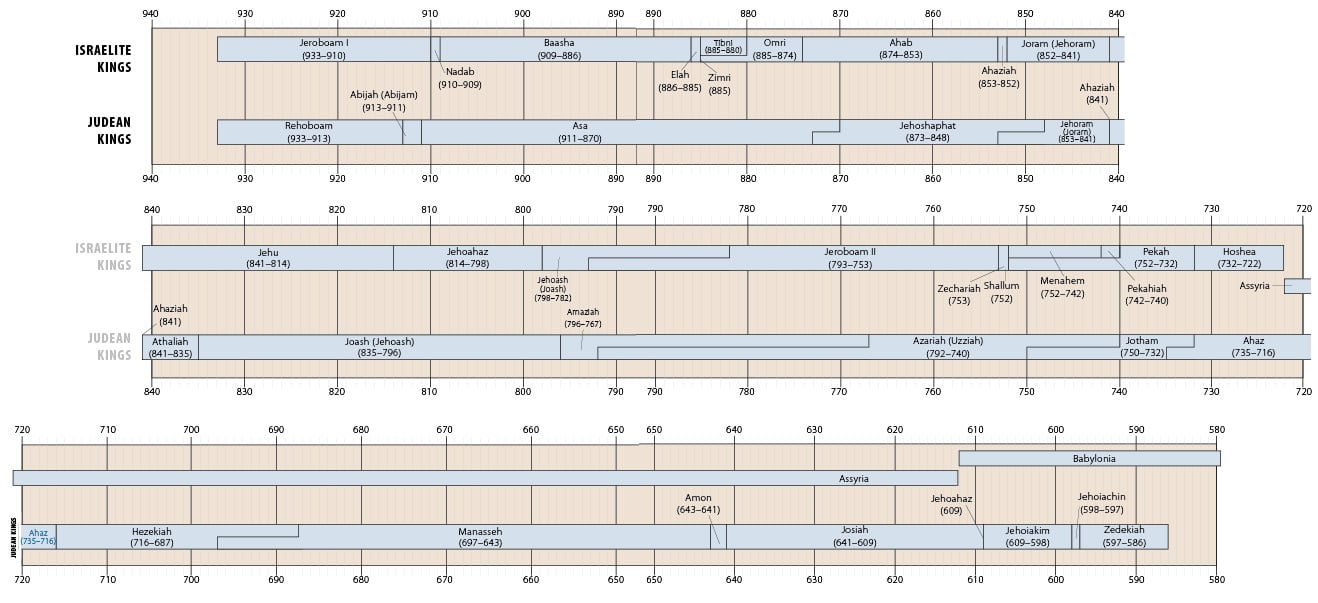
Although Rehoboam manages to reign in the south and retain Jerusalem as the capital of Judah, Jeroboam presides over a northern kingdom that increasingly drifts into idolatrous instability. One could argue that at times the south fares no better, yet there is comparatively more stability because of the divine promise to David in 2 Samuel 7, where God guarantees that a Davidic descendant will always be on the throne; much of the narrative in 1–2 Kings confirms that this promise is the difference between the north and the south. An acute rise in prophetic activity is particularly visible after the division of the kingdom, and correspondingly there also is a rise in international hostilities. Israel was plagued with plenty of foreign conflicts before—preeminently with the Philistines—but during the period of the divided monarchy the scale increases, with a number of Aramean and Assyrian offensives. Such antagonism, coupled with an increasingly syncretistic worship and a string of ineffective northern leaders, reaches a climax with a devastating Assyrian invasion that results in the fall of the northern kingdom and the pillaging of Samaria (722 BC). The miraculous survival of the south (with Jerusalem still intact) is slowly countered by a mounting Babylonian presence in the region, and the days of the southern kingdom as a viable political entity are numbered. Nebuchadnezzar’s sack of Jerusalem in 586 BC results in the demolition of the temple, and his deportation of a large number of Judeans inaugurates the period of exile.
When surveying the end of the book, we can discern an “envelope structure” between the start and finish of Kings. Just as 1 Kings begins with an aged king, so 2 Kings ends with an imprisoned king at the mercy of the Babylonians; therefore Kings begins and ends with the same issue: uncertainty about succession. The repetition of this issue is not arbitrary; it is, rather, part of the theology of hope central to the book, and to the Former Prophets as a whole. In other words, the future of Israel does not lie with a formal monarchy but rather with the promises and character of God, who out of this royal mess will bring forth a messiah.
Methods of Interpretation
In terms of method and approach, most commentaries of late combine three kinds of reading strategies for 1–2 Kings: historical, theological, and literary. Although there has been some recent controversy over matters of Israelite history, such epistemological matters lie beyond the scope of our inquiry here. With the crisis of modernity, it is not a bad thing that reading habits (since the Enlightenment) have changed and criteria for certainty now have different rules. Contemporary interpreters are far more aware that 1−2 Kings presents more than merely some banal quest for “objectivity,” as though that represents the highest standard of truth. On the contrary, 1–2 Kings is filled with the author’s assessment from start to finish (sometimes overt, at other times submerged just below the surface of the text). In this work we are dealing with theological narrative, which presents an intersection between human actions and divine sovereignty. In terms of theology, then, when reading this text the interpreter should attend to matters of theological significance, such as the role of prayer and the efficacy of the prophetic word. The best methodology incorporates the results of historical analysis with theological reflection.
That being said, there is little doubt 1–2 Kings is a sophisticated work of historiography, one that utilizes a number of different sources and archival materials and combines regnal formulas with other dating procedures. As mentioned above, 1–2 Kings is but one chapter in the larger Deuteronomistic History. In addition, Martin Noth and other scholars in his wake have affirmed that the author(s) of 1–2 Kings experienced the Babylonian exile and from this vantage point were inspired to produce a story of Israel and a history of the nation’s downfall. While Noth was fairly pessimistic in his conclusions, later redactors of this theory (such as Gerhard von Rad) were more positive, suggesting that the purpose of the author(s) was decidedly constructive: just as the nation was exiled because of disobedience, God has by no means given up on his people, and the examples of the past become a guide for the future. By any measure, a text with a high level of historical sophistication is presented here.
Even as matters of history continue to be debated, what is increasingly agreed on is the narrative artistry and literary sophistication of 1–2 Kings, with enhanced appreciation of the narrative dynamics at work in the story. It is this literary dimension (with issues of plot, characterization, point of view, irony, ambiguity, and spatial setting) that we will touch on during the course of our commentary. It would not be an overstatement to label 1–2 Kings as dramatically worthy of its regal subject matter, and all the vicissitudes of Israel’s four-hundred-year experiment with kingship are worth studying, pondering, and preaching. There is much for God’s people even today to hear in these pages. What is important is not that kings such as David, Solomon, and Hezekiah are flawless and worthy of emulation (because this is simply not the case—there are many shades of gray in these complex figures); instead what is continually stressed is the character of God, who keeps his promises and refuses to give up on a nation—even one on a passage to exile.
Commentary
A. Accession of a younger son (1:1–53). First Kings begins with a point of contrast: back in 1 Samuel the young David is introduced as a man of action and seemingly boundless energy; now, his aged condition creates a situation in which Israel’s king is more acted on than acting. The opening scene (1:1–4) reveals that the servants of David have implemented a search for a young maiden whose body heat will increase the king’s waning temperature. It is unlikely that the servants are proposing a medicinal remedy; on the contrary, this rather appears to be a cover story either to prove the aged king’s virility to a doubting constituency or to produce an heir to the throne. Despite a plethora of offspring, at this point in the story David has not explicitly named his successor. The servants’ political motivation is evident when Abishag is found, from the village of Shunem, in Issachar—a nice union of north and south. The servants’ plan, however, is foiled as the king (literally) “knows her not,” and thus the reader concludes that the successor to David’s throne can only be one of his (surviving) sons.
If there is a power vacuum, Adonijah is determined to step into it (1:5–10). As the oldest son of David—after the untimely deaths of his older brothers—Adonijah enlists the support of key allies (Joab the military commander, plus Abiathar the priest) and holds a feast for leading dignitaries. Like Absalom before him, Adonijah flaunts his royal pretensions with an entourage of chariots and runners, and also like Absalom he receives very little paternal discipline from David. Factions are apparent in the Davidic court: some officials are invited to join Adonijah, while others (including Nathan the prophet and the younger brother Solomon) are not. The comparison with Absalom—despite good looks and popularity—is an ominous sign for Adonijah’s stately ambitions.
One gets the feeling that this is a dangerous place of political maneuvering, an impression enhanced in the next scene (1:11–14), featuring Nathan’s conference with Bathsheba, the mother of Solomon. After outlining Adonijah’s recent activities—boldly stating that Adonijah has “become king”—Nathan instructs Bathsheba to pose a question to King David regarding Solomon’s accession: “My lord the king, did you not swear [an oath] to me your servant: ‘Surely Solomon your son shall be king after me . . . ’?” (1:13). No such oath is recorded in 2 Samuel, and a reader may have expected that such a momentous oath would have been mentioned if it was sworn. A slight irony will emerge here: Bathsheba is instructed to ask David about an (alleged) oath-swearing, and her own name means “daughter of swear an oath”! But still, the question remains as to why Nathan would counsel Bathsheba in this manner. We recall that Nathan has had dealings with David and Bathsheba before. In 2 Samuel 12:25, Nathan is sent by God to bring a new name for baby Solomon; in the book of Genesis a change of name involves a change of destiny, so Nathan may well infer—reasonably enough—that Solomon is destined to be his father’s successor. Time is of the essence, given that Adonijah is simultaneously hosting a feast with his powerful cadre of associates.
Bathsheba (1:15–21) is duly granted an audience in the king’s private chamber, with Abishag in the room, a presence that foregrounds the rivalry of succession. Yet instead of asking the king a question (as Nathan directs), she utters an emphatic statement (“you yourself swore [an oath],” 1:17) and explains about the feasting of Adonijah. While she is concluding her story, as if on cue, Nathan arrives (1:22–27) and asks a set of questions of his own about the succession. Whether or not David ever did swear an oath about Solomon now becomes immaterial: he claims that he did and gives orders that Solomon is to be crowned in his stead (1:28–31). The anointing ceremony (1:32–40) is supervised by the trio of Nathan, Benaiah, and Zadok, with Zadok deploying the horn of oil in the midst of considerable pomp—loud enough to make the earth quake.
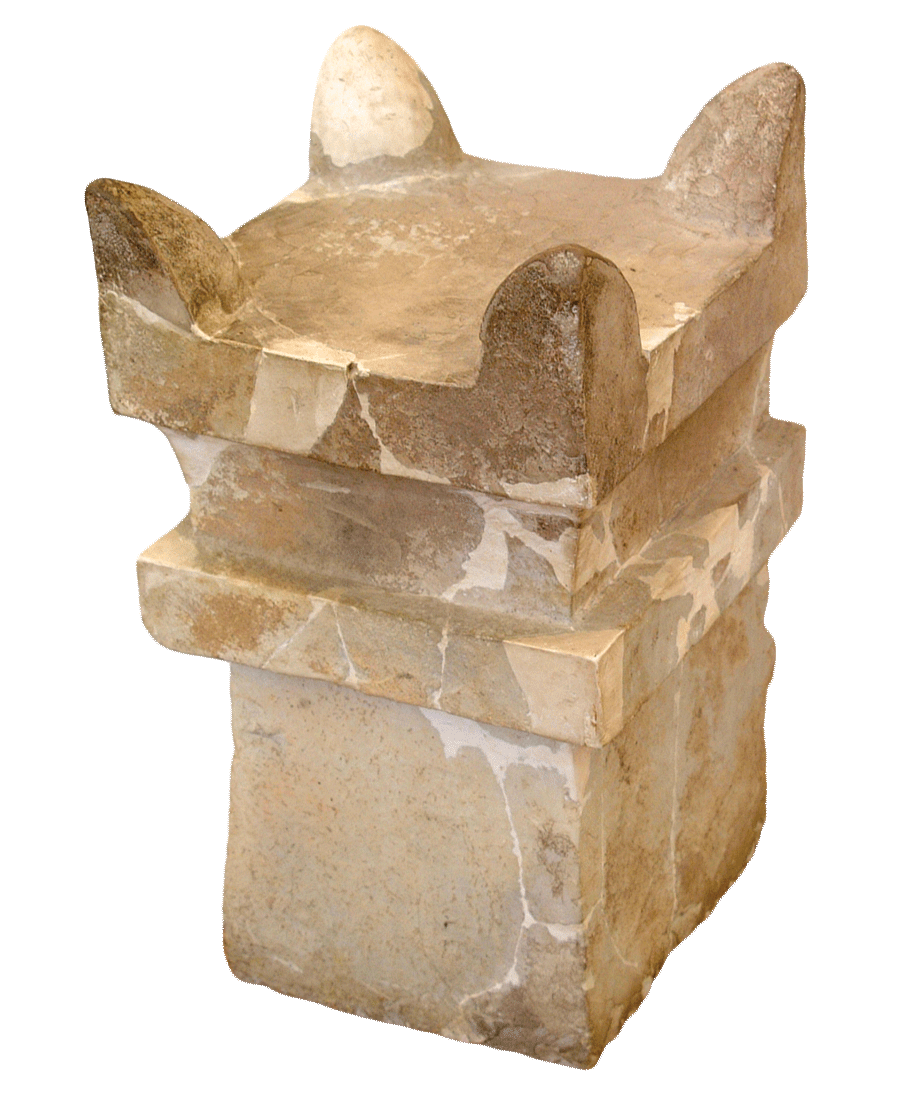
Four-horned incense altar from Megiddo (1000–586 BC). Clinging to the horns of the altar, as Adonijah did (1 Kings 1:50), indicated a wish for amnesty for those who feared retribution.
The tremors can be felt as far away as Adonijah’s banquet, an event taking place simultaneously with Solomon’s anointing ceremony. Jonathan son of Abiathar (of the line of Eli and thus acquainted with rejection!) brings the crushing news (1:41–48) to Adonijah, exhaustively detailing the accession of Solomon. This breathless report disperses the guests and sends Adonijah to the horns of the altar, setting the stage for a confrontation between the two brothers (1:49–53). Throughout the entire transaction leading up to his enthronement, Solomon has not lifted a finger, so to speak, and certainly has not been allocated any direct speech. In the final scene of the chapter, this is poised to change. With limited options, Adonijah asks for an oath of amnesty, rather ironic in light of the earlier “oath” issues with Nathan and Bathsheba. However, Solomon does not give any kind of oath to his older brother; instead, he offers conditional terms, to the effect that if Adonijah shows himself to be a worthy man all will be well (but if not, he will die). One assumes that the freshly crowned Solomon will be the judge of whether or not Adonijah acts in a worthy manner. Solomon’s first words are important for his characterization: the speech to Adonijah shows a glimpse of his wisdom, but one wonders to what ends this wisdom will be used.
B. Security clearance (2:1–46). David himself mentions Solomon’s “wisdom” during his long speech to his heir, the last words of David in the narrative (2:1–12). The speech has two parts, beginning with an injunction to walk in the ways of torah, reminiscent of great speeches of the Former Prophets such as Joshua 1. David also reiterates the divine promise he was given in 2 Samuel 7, but one notices that the language is slightly modified: the promise is unconditional when delivered to David, but here the king stresses that the promise is conditional upon his descendants’ faithfulness. On the one hand, David simply could be extending some hard-earned advice, since his own life could have been much easier had he always walked in torah. On the other hand, maybe it foreshadows that Solomon himself might have struggles with faithful obedience. Either way, the second part of the speech gets worse, as David provides a list of leaders Solomon should “deal with”: Joab, Barzillai, and Shimei. While Barzillai is to eat at the royal table, the other two are to be dispatched to Sheol, on rather dubious pretexts it must be said. The combination of keeping the commandments of the Lord and homicide creates a sense of uneasiness as David breathes his last, and Solomon takes sole possession of Israel’s throne. In verse 12 the narrator highlights that the kingdom is “firmly established,” perhaps undercutting any need for violence toward opponents.
The kingdom may be firmly established, but Adonijah appears to savor some further ambitions (2:13–18). Having been sentenced to virtual house arrest at the end of chapter 1, Adonijah takes a risk in deciding to confer with Bathsheba—but not nearly as great a risk as in requesting Abishag. The reader has already seen that any play on a member of the royal harem is tantamount to a claim on the throne itself, as the actions of Abner (2 Sam. 3:7) and Absalom (2 Sam. 16:22) grimly illustrate. Whether Adonijah is motivated by love or power, this must be perceived as a bizarre strategy that underestimates his younger brother: why would Solomon consent to such a marriage that strengthens his older brother’s claim? While Bathsheba agrees to take Adonijah’s suit to her son, we have just seen her execute an audacious undertaking on her son’s behalf, and surely she is not going to give up that easily. In her conference with Solomon (2:19–25) that takes place while both are seated on royal thrones, she undersells the “small” request of Adonijah (which is anything but). Solomon’s reaction is aggressive: he interprets the proposition as treasonous and unleashes a rare double oath toward Adonijah. The double oath is ironic. Adonijah previously wanted an oath from Solomon and was denied; now he gets a twofold portion. Benaiah—who did not attend Adonijah’s party in chapter 1—is summoned to carry out the death sentence, and he will have no shortage of contracts as the rest of the chapter unfolds.
Attention soon shifts to other foes. David did not mention Abiathar, but Solomon takes initiative (2:26–27) and banishes the priest to his hometown—though the king says he is worthy of death! While Abiathar’s “crime” is unstated, one guesses it is that he sided with Adonijah, despite a history of loyalty to David. At the same time, Solomon’s order intersects with a prophetic word spoken against the house of Eli (1 Sam. 2:27–36), reminding the reader that such utterances invariably find fulfillment in the narrative. Ironically, Solomon himself will be the subject of such a prophetic word later in the story.
Meanwhile, Joab hears about Abiathar’s treatment and flees to the horns of the altar (2:28–35). One recalls that David gave Solomon orders about Joab, but why is Joab worthy of death? After all, he has been a staunch ally of David, participating in the cover-up of Uriah, and his liquidation of dangerous challengers such as Abner and Amasa undoubtedly benefited David. A plausible reason is that Joab must die as a penalty for supporting a rival, sending a strong message to any other pretenders that this is how such miscreants are treated in the Solomonic administration. Knowing the game, Joab becomes the second character to cling to the horns of the altar in as many chapters. Joab does win a moment of reprieve when Benaiah hesitates to strike him down in the inner sanctum, but Benaiah’s conscience is assuaged by a lengthy speech from the king explaining that such a homicide is justifiable, considering Joab’s past conduct. With effective use of some royal hyperbole that cannot be taken at face value, the king’s speech is sufficient to militate against Benaiah’s ethical sensibilities: Joab is struck down, it would seem beside the altar, and for all his loyalty to David is buried “in the wilderness.” Fittingly enough, after Joab is buried there are two promotions for new labor, as Zadok is elevated over Abiathar and Benaiah is put in charge of the army, a position previously held by Joab.
David had also given instructions about Shimei, a member of the tribe of Benjamin and a supporter of the Saulide regime, one who made the politically incorrect decision to curse David and call him a “man of blood.” At the fords of the Jordan David swore an oath to Shimei (2 Sam. 19:23), but David also said that Solomon was a wise man and would know what to do (1 Kings 2:9). Solomon now addresses Shimei (2:36–46) and commands him to build a house and remain in Jerusalem, with a severe restriction on travel. In light of Adonijah’s demise, it might have been wise for Shimei to “hear” (a Hebrew wordplay on the name Shimei) Solomon’s injunction, but chasing some fugitives to Gath, Shimei temporarily leaves the city. It does not appear that Shimei was up to any malfeasance, but like Adonijah, he underestimates Solomon, who is informed of the trip to Gath and launches into another long speech denouncing an opponent and exalting the security of his own throne.
When Benaiah is dispatched once more, the reader knows the expected result. What is slightly unexpected is the final line of the chapter (2:47), echoing verse 12, “The king commanded Benaiah son of Jehoiada, and he marched out, reached out against him, and he died, and the kingdom was established in Solomon’s grip” (author’s translation). The repetition of the verb “establish” serves to reinforce a key truth: Solomon’s ruthless purge was unnecessary, as God had already established his kingdom. While figures like David and Solomon are often glorified in the popular imagination, in fact this narrative functions to draw attention to some of the murky ways in which Solomon uses his gifts. This account of Solomon is not best read as a set of tidy moral lessons; on the contrary, it is an honest and rigorous critique of Israel’s failed leadership.
C. Wise options (3:1–28). If there have been any lingering doubts with respect to Solomon’s decision making, then such doubts are not eradicated in the opening lines of the next chapter (3:1–2), as Solomon becomes a son-in-law to Pharaoh. In one respect it is obvious why an ancient Near Eastern king would desire such an alliance, as military and economic advantages would certainly accrue in an arrangement of this type. Yet a main purpose of the exodus is so Israel can be liberated from Egypt, not form partnerships where future ensnarement becomes a possibility. Moreover, the law of Moses—in which Solomon is enjoined to walk—counsels against such marriages (e.g., Deut. 7:3). The announcement of a marriage alliance with Pharaoh is thus not mere historical decoration; it is a programmatic statement about how Solomon’s kingship will operate. When the elders of Israel asked for a king “like other nations” back in 1 Samuel 8, they hardly conceived that they would be getting a player on the world stage. The notice about the people continuing to sacrifice on the high places—worship installations perched on hilltops originally having Canaanite roots—underlines the idea of Israel moving toward a kingship model that is indebted to the surrounding nations and stands in uneasy tension with torah.
To be sure, the next section of the chapter (3:3–9) begins with a notice that Solomon loves the Lord, although the announcement is slightly qualified since the king himself also frequents the high places. The way Solomon demonstrates his love is by walking in the “statutes of David his father,” but it will be Solomon’s other loves that prove problematic in due course. For now the king cannot be faulted for quantity of sacrifices, and at the great high place of Gibeon—a spatial setting first introduced in Joshua 9—he offers a vast amount. The dream at Gibeon, where God appears and invites Solomon to ask for anything he wants, has often been viewed positively by past interpreters. Indeed, Solomon’s response is effusive and correct: he asks for, literally, a “listening heart,” which could also be translated “obedient heart.” God’s response (3:10–15) is equally long, and on the surface, it looks like a commendation for Solomon’s choosing wisdom over riches, long life, or the death of his enemies (although there cannot be too many enemies left in Israel after the purge in chap. 2). But the fact that God gives him riches and honor anyway can be read in two ways: it might be a sign of approval for the king, or it might be a test. How will Solomon handle the gifts that God bestows? Will he stay faithful until the end of his long life?
Solomon’s wisdom is immediately put to the test, as two harlots bring a challenging suit before the king (3:16–28). In the absence of any witnesses or DNA testing, it is a matter for the king to decide between the two claimants. The ingenious solution of calling for the sword not only resolves the maternal mystery but also marks the first time in Solomon’s career that the sword will have been used for a positive purpose (as opposed to slaying political rivals). The public opinion poll at the end of the chapter is revealing: the people “fear” the king (NIV “held the king in awe”), aware that he has been given wisdom from God; and they no doubt hope that such responsibility will not be abused.
D. Constructive criticism (4:1–10:29). We assume this text is written for an audience that has experienced the crisis of Jerusalem’s collapse, as an unflinching narrative designed to rebuild the faith of Israel in exile and beyond. Up to this point in 1 Kings, Solomon has established his kingdom and been given tremendous gifts, though small seeds of doubt have also been planted.
4:1–34. The next major section of the narrative recounts the highlights of the reign. Amid great construction projects, a critical element will emerge as well. At first glance chapter 4 might appear to be just some mundane lists, but in fact there are some important components of the plot contained here. For instance, the opening list (4:1–6) provides a directory of the king’s administrative captains, and several names stick out. Abiathar the priest is still officially on the books (despite banishment), and there is a reminder that Benaiah has been promoted over the army (loyalty seems to be a common thread in the rest of Solomon’s council). Almost hidden at the end of the list is Adoniram, in charge of the forced labor (cf. 2 Sam. 20:24, a policy started under David). The term “forced labor” ominously appeared in Exodus 1:11 and will become a central grievance that precipitates the division of the kingdom in chapter 12. In terms of genre, scholars draw attention to similar lists of offices from Egyptian and Assyrian kings, a further indication that Solomon’s court is modeled on the surrounding nations.
The next itemization is of the twelve “district governors” whose designated tasks include providing daily bread for the burgeoning royal house (4:7–19) and collecting revenues. The stress on surnames and Solomon’s own family suggests a degree of patronage, and conspicuous by its absence is any mention of Judah. Recent commentators point out that the king overhauls the taxation system by restructuring the traditional tribal arrangement into new taxation districts. If there are going to be exciting building projects, someone has to pay for them. The political advantage of changing the boundaries is clear: old party lines and borders are shifted, and the king enjoys increased centralization and a streamlined method of ensuring monthly income. Regardless of one’s assessment of the ethical ramifications of Solomon’s highly organized system of taxation, the success of the scheme is beyond dispute (4:20–28). From the Euphrates to Egypt, there is sumptuous prosperity, a blossoming court, and an absence of foreign incursions, and the district governors are able to collect a vast amount of food. Still, there is a note slipped in about a vast number of horses, something warned against in Deuteronomy 17:16. The people are living “in security” (NIV “in safety”), but at what price, and for how long?
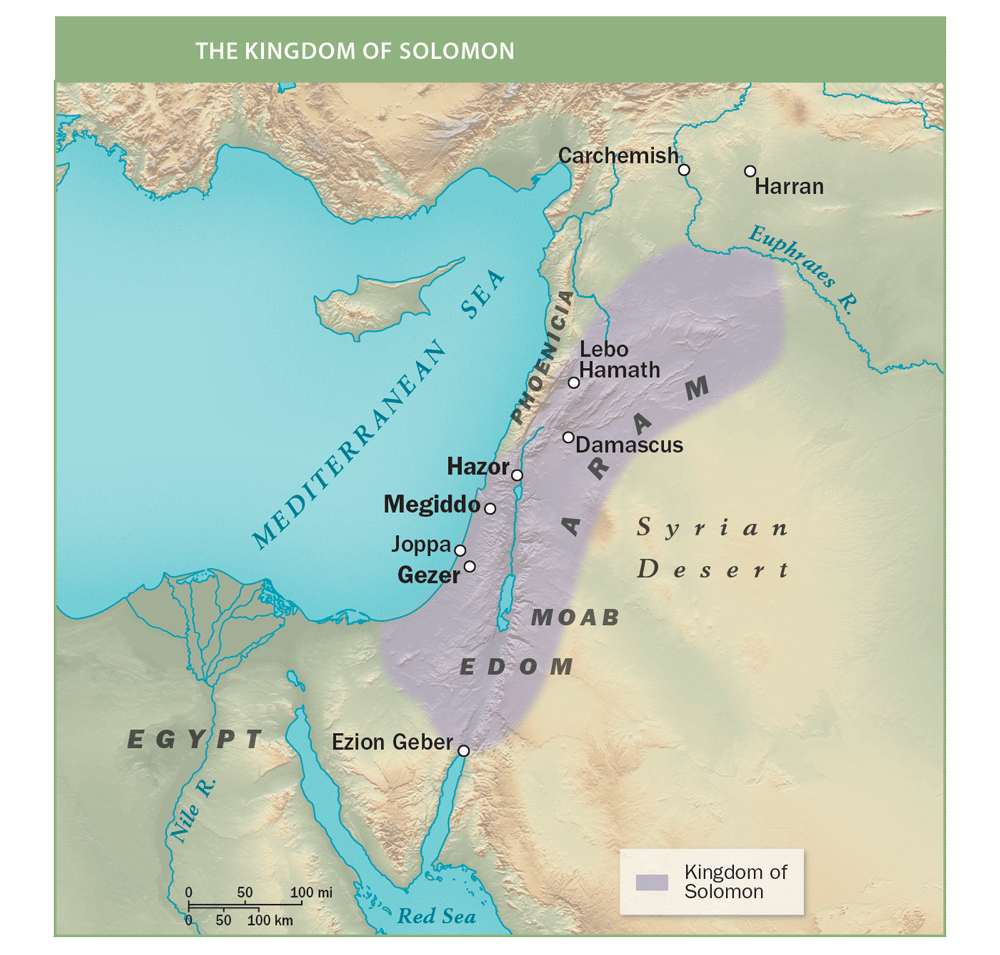
The cosmopolitan dimension of Solomon’s court is emphasized in the final section (4:29–34). The report underscores the king’s God-endowed wisdom, which exceeds the greatest sages of the day, and his far-reaching fame. Solomon’s intellectual authority extends even to matters of flora and fauna, with no shortage of audience. Even foreign kings journey to hear this original Renaissance man, a composer of songs and proverbs. A key question remains: how will these remarkable capabilities and the extraordinary gift of such wisdom be used? According to the NIV translation of 4:29, Solomon has “breadth of understanding,” a phrase that could literally be rendered “broadness of mind.” In Proverbs 21:4, ironically, the same phrase is translated “proud heart.” There is a short distance, it would seem, between broadness of mind and arrogance.
5:1–18. The next phase of the narrative outlines the construction projects (palace and temple), but amid all the architectural glory there will also be a subtle criticism of the royal administration. Without much background information, we learn that Hiram king of Tyre sends envoys to Solomon (5:1), having heard of his accession. The city of Tyre was a thriving commercial and colonial center; Joshua 19:29 refers to it as “fortified,” and Herodotus mentions a venerable ancient temple. This is not Hiram’s first appearance in the Former Prophets. Back in 2 Samuel 5, an unprompted Hiram sent timber and craftsmen to build a palace for David. Here he sends a delegation to Solomon, and the narrator informs us that he “loved” David (NIV “on friendly terms with”)—the same verb used to describe Solomon’s “love” for the Lord. Hiram does not verbalize any message, so the reader is left to infer what Hiram is really after. Solomon, however, does respond in his typically lengthy manner (5:2–6), and he starts by bringing up the temple. This is Solomon’s first explicit mention of the temple, and it is spoken to a foreign king. Solomon asserts that David was unable to build a temple because of besetting wars, and we have to refer back to 2 Samuel 7 to figure out if this is a valid claim. Regardless, Solomon is interested in the cedars of Lebanon and skilled workers. The cedars of Lebanon will shortly become a prophetic metaphor of towering pride (e.g., Isa. 2:13; Zech. 11:1).
Hiram’s initial response (5:7–12) is an outburst of praise, surprising in the mouth of a foreign monarch. Hiram then delineates what he will do (float the logs by sea) and finally mentions his own expectations in the transaction: food for his household. A number of commentators argue that Hiram gets the better of the deal, but Solomon is willing to make it because of the unique quality of timber. He wants, in other words, both the materials and the highly skilled artisans that Hiram could supply, and in return provides a huge quantity of produce for Hiram’s court. We have seen a marriage arrangement with Egypt; now there is a northern alliance. Pharaoh will prove a rather ruthless father-in-law, and while Hiram will never invade Israel, his presence will find its way into the very center of Israelite worship. In terms of Solomon’s preparations for building (5:13–18), the king gathers a workforce of “conscripted laborers”—slightly toned down in the NIV, but again the same word as Exodus 1:10, “forced labor.” But at least there are rotating crews, who have superintendents in charge. The king appears to be acting unilaterally, since there is no mention of prophets or priests. Israel certainly has a king like the other nations—hopefully Israel’s worship will be different.
6:1–37. Formal commencement of temple construction is prefaced with an important temporal notice (6:1). The project begins 480 years after the exodus, locating it at roughly the halfway point between the exodus from Egypt and exile to Babylon. How have the people of Israel fared in the promised land? Have they received a passing grade? The temple project thus becomes a type of midterm exam of Israel’s faithfulness. Further, construction begins in the month of “Ziv, the second month.” Here we have a conflation of two different calendars: the old Canaanite agricultural calendar (“Ziv”) and also Babylonian (“the second month”). The halfway point between (past) captivity in Egypt and (future) captivity in Babylon is brought to the fore just as the building begins.
Starting with the external structure, the size of the edifice is delineated (6:2–10). A careful sketch of the dimensions is given, including windows (for natural lighting or ventilation) and side chambers. There is also a note about tools not to be used in the temple precinct, creating a sacred ambiance even during construction. Yet even in this floor-to-ceiling description some scholars are uneasy, as they believe that aspects of the blueprints have been borrowed from architectural models of the surrounding nations, including Canaanite and Phoenician designs. Since Hiram’s workers are involved, this would not be overly surprising.
The pivot point of this section comes in the form of an unmediated divine word, an interruption of sorts directly from God to Solomon (6:11–13). In my view, the chapter is built around this theological utterance, where God furnishes the king with a careful warning by means of an “if . . . then” equation. If the king does not walk with God, it is possible that God will abandon his people, and therefore even the nicest temple does not grant immunity from obedience.
There is no recorded response from the normally loquacious Solomon to this divine word. Instead, the “tour” of the building site continues (6:14–36) with an almost bewildering degree of ornate specificity. While it is easy to get lost amid the details, at least “the ark” has considerable prominence and functions as a reminder of God’s provision, promise, and presence. One hopes that God’s word of caution is not lost in the midst of the tour, but it is possible that occasionally God’s people are more caught up with building programs than relationship and covenant. The concluding lines of the chapter (6:37–38), though, imply that there is much to admire in this project. The garden plants (flowers and palm trees) and cherubim remind us of the creation narrative, and the reference to “seven” years to “finish” the sanctuary is the same language used in the opening chapters of Genesis. If the fidelity of the king and the worshiping community is as pure as the gold used in the temple, then there is reason for optimism at this key point in Israel’s history.
7:1–51. The next section begins with another temporal notice (7:1), informing the reader that Solomon took thirteen years to build his own house. On the one hand, it might be a simple matter of practicality: the palace is vast, and therefore requires more time. On the other hand, there could be a subtle comment on the king’s priorities, and where his attention will eventually be diverted. The NIV recognizes the latter by capturing the contrastive element of the Hebrew text (“however”).
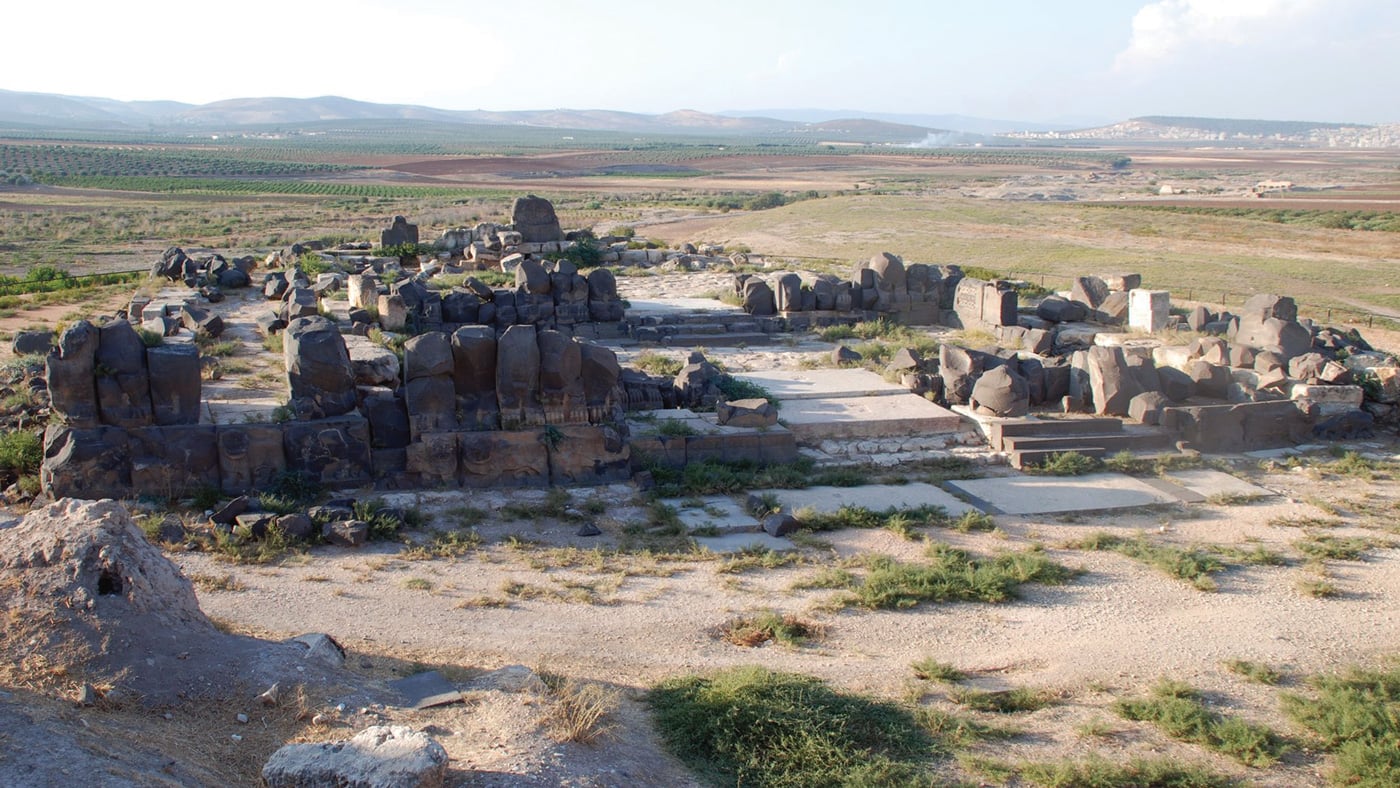
The Ain Dara temple in Syria (tenth–ninth century BC) is similar to Solomon’s temple in its architectural design.
What cannot be denied is the impressiveness of the palace (7:2–12). Named “The House of the Forest of Lebanon” (RSV; cf. KJV), the central palace is a massive structure that must have been quite a feat of engineering. The “palace” is not limited to a single building; included in this larger development are centers of public administration, with courtyards, the “Hall of Justice,” and a separate residence for Pharaoh’s daughter (a reminder of the marriage alliance with Egypt). Historians inform us that Egyptian monarchs were not quick to give their daughters in marriage, so perhaps Pharaoh’s daughter is worthy of special treatment in Solomon’s harem. Erecting the palace compound must have been a very expensive undertaking, since its size virtually dwarfs the temple. Is the temple the most noticeable structure in Jerusalem or more of an appendage in the royal facility?
After the palatial digression, the interior design of the temple becomes the focus (7:13–40). A signal moment is the arrival of Huram, expressly summoned by Solomon. Huram lays claim to an international pedigree: his mother is a “widow” from the northern tribe of Naphtali, while his father was a skilled artisan from Tyre—thus Huram can boast of having both Israelite and Phoenician roots. Huram may have had a hybrid genealogy, but there is no doubting his considerable talents, attested by the substantial catalog of his works: the central columns (emblematically named Jakin [“established”] and Boaz [“strength”]), the Sea (a water tank, perhaps symbolizing how chaos is subdued in the sanctuary), along with movable stands and equipment (ideally a celebration of the Lord’s kingship). During this guided tour of the temple furnishings it seems as if the reader is given the king’s perspective of these magnificent works. We trust that all is done with genuine piety and not with a desire to keep up with the other nations. Huram’s consultancy draws to a close with an inventory (7:41–51) of his aesthetically pleasing designs, along with a dedication of the objects collected during David’s (many) battles, suggesting that the treasuries are well stocked and the temple is a place of material prosperity.
8:1–66. Even though two long chapters describe the building and contents of the temple, nothing substantial has yet happened. That is poised to change in the next major unit of the narrative, a stretch of text that describes the first activities and ceremonies in the newly built house. The king summons the elders (8:1–11) during the month of “Ethanim” (seventh month). Coinciding with the Feast of Tabernacles, this is an ideal time to bring the ark into the temple due to the number of people in the city and the sense of occasion that the feast carries. Among the assembled dignitaries are representatives of the “tribes” of Israel—rather than the reorganized tax districts enumerated in chapter 4—as well as priests and Levites (a group that has not been prominent so far in Solomon’s reign). The temple is essentially publicized as the successor to the portable sanctuary and betokens that “place” described in Deuteronomy (e.g., 12:5). In the midst of the ceremony is a prompt from the narrator that the ark is empty except for the tablets of the law, reinforcing the obligation of obedience. As the sanctuary is filled with divine glory (echoing Exodus 40), there is a powerful reminder of God’s commitment to his people.
Despite a bevy of priests on hand, it is the king who presides as the master of ceremonies (8:12–21). Just before moving into his formal address, Solomon supplies a “quotation” (see Deut. 4:11) in response to the enveloping presence of God, followed by his own comment that God will reside in the temple “forever.” In light of the end of 2 Kings, God certainly will not dwell there forever, but it is an apt quotation for the occasion. Along with the requisite praise, Solomon’s address also features a considerable amount of emphasis on the electoral status of the Davidic line. Although the success of the ceremony cannot be refuted, the opportunity is also taken (in this very public setting) to promote Solomon’s kingship. It would probably be unfair to say that the king’s opening words are overtly political, but at the same time—given all the elders who are assembled, from a host of interest groups—the publicity cannot hurt.
Solomon’s exhaustive prayer (8:22–53) merits extensive analysis, but several facets can at least be noted: the mention of the conditional dynamic for the Davidic line is laudable; an almost “exilic” spirituality emerges, there is an inclusive embrace of the foreigner, and there is sizable reference to the necessity of individual and corporate forgiveness for crimes and misdemeanors. A number of commentators point out that when the prayer as a whole is surveyed, it is evident that Solomon’s public discourse features an impressive theological synthesis that must appease the various interest groups assembled. Even if there is a fair bit of promotion of the Davidic line, there is also an unambiguous recognition of God’s transcendence, and one guesses that the prayer must have had an overwhelmingly positive reception. The concluding stage of the ceremony (8:54–66) comprises a corporate blessing by the king (with a call for fully committed [Hebrew shalom] hearts), abundant sacrifices, and a joyful dismissal. If the nation can remain this united, then Solomon’s leadership will bequeath an enduring legacy.
9:1–28. After a chapter fraught with spectacle and discourse of great acclaim, a more forceful speech (9:1–9) occurs, as God again appears to Solomon, just as at Gibeon in chapter 3, where Solomon asked for a “listening heart” (see commentary on 3:1–28). God’s word here begins with a stunning acknowledgment that he has heard the king’s prayer, he has sanctified the temple, and his eyes will always be on it. But immediately the word continues with an intense admonition about the king’s personal conduct, with a rather ominous mention of serving and paying homage to “other gods.” The consequences of royal disobedience involve more than the king alone: there are implications for all Israel, and a dire warning of eviction from the land that houses the temple. Should exile occur, Israel will become a “proverb” (NIV “byword”), an ironic situation considering the superscription to the book of Proverbs. The glorious “house” that Solomon has just finished building will be desolate; and without theological vigilance, it could become a temple of gloom.
God’s speech makes it clear that the king’s office is a position of trust. Again, there is no response from Solomon, but it is not accidental that the next part of the chapter unfolds a series of transactions from the king’s reign. Indeed, this section looks like an abrupt switch to a collection of somewhat random miscellany, but this is far from the case; there is a common thread woven throughout. The first report is of further dealings with Hiram (9:10–23), without whose assistance there would have been a rather different temple. One immediately recalls that the portable tabernacle in the wilderness was built with freewill offerings of God’s people; by contrast, the permanent temple in Jerusalem was procured through international trade and forced labor. Hiram’s “payoff” in the end is a number of villages in northern Israel; from the exilic point of view, land for gold is not a good investment. Real estate deals are beyond the king’s purview. In addition to partnership with Hiram, Solomon has also made a marriage alliance with Pharaoh, who proves to be a meddlesome father-in-law. The plethora of royal building ventures is carried out by means of forced labor, with a range of projects. The final section of the chapter (9:24–28) notes the relocation of Pharaoh’s daughter, Solomon’s religious observances, and naval activities with Hiram. The foray into shipbuilding is a lucrative one, netting Solomon an enormous quantity of gold to deposit in his burgeoning coffer. Overall, however, one senses that this entire section of the text is designed to imply that the king—who has asked for a “listening heart”—might be acoustically challenged. It has taken twenty years for Solomon to build both temple and palace, but now, at the halfway point of his career, time is running out to avert a plague on both of the king’s houses.
10:1–29. The state visit of the iconic Queen of Sheba (10:1–13) is justly famous, although not much is known about her, and the location of Sheba—possibly in Arabia—is uncertain (mentioned in the gospels as “the ends of the earth,” e.g., Matt. 12:42). An exotic visitor of immense wealth and stature, the queen is almost an alter ego of Solomon himself. She comes to test Solomon with “riddles” (NIV “hard questions”), a term most recently seen in the Samson story; Israel’s urbane monarch passes the test with flying colors. Her theological affirmations on one level are astonishing, but on another level we wonder how much is standard courtly rhetoric, in the same manner as Hiram’s fulsome praise in chapter 5. Since Hiram is parenthetically mentioned in verse 11, the comparison is plausible. Solomon passes the test of the Queen of Sheba, but hers is not the only test that the king will face.
The amount of gold that the queen gives Solomon actually pales in comparison to Solomon’s yearly income, outlined in the next section of the chapter (10:14–25). With 666 talents per annum, the question quickly becomes: what on earth can he do with it all? Solomon does not lack creative ideas, as the gold is used for crafting shields, a massive throne, and household utensils, and as a commodity for international business. Despite all the sparkle, this section of the chapter cannot be properly understood apart from Deuteronomy 17:16–17, the so-called regulations of the king:
The king, moreover, must not acquire great numbers of horses for himself or make the people return to Egypt to get more of them, for the Lord has told you, “You are not to go back that way again.” He must not take many wives, or his heart will be led astray. He must not accumulate large amounts of silver and gold.
God has given assurance in chapter 3 that Solomon will be rich, and it is impossible to deny that reality here in the latter stages of chapter 10. Most likely a host of people would have been impressed by such riches and could well have pointed to such prosperity as sure signs of God’s blessing and favor. In just a few short years the nation of Israel has achieved a completely new position as a competitor on the worldwide stage. As I suggested earlier, however, Solomon’s enormous wealth has the elements of a test: how will the king handle these resources? Will these riches be used faithfully, or—as in the parable of the soils in Mark 4—will they prove to be a snare? Deuteronomy 17 advises against multiplying gold because of the sinister potential that causes so many to wander astray. That same text further proscribes the accumulation of horses, yet horses get a lot of attention in the closing stages of this chapter (10:26–29). Notably, the price for importing a horse from Egypt is given in silver, meaning the king could afford lavish numbers because of his gigantic income. In the book of Job the horse is symbolic of war and power. Here in 1 Kings 10 the horse has a similar symbolic dimension entailing military arrogance. Finally, Deuteronomy 17 also warns against the king’s multiplying of wives, a subject reserved for the final chapter on Solomon’s reign.
E. Divided heart, divided nation (11:1–12:33). It cannot be an accident that right after a lengthy description of Solomon’s stockpile of gold and horses, we are moved directly into the stage of the narrative commonly referred to as the king’s fall. In fact, “fall” might not be the most accurate term: in light of the warning signs throughout, we may have anticipated that the Solomonic enterprise would come crashing down before too long. Judgment is delayed—surely because of God’s forbearance—but the entire nation is implicated in Solomon’s apostasy.
11:1–43. The first installment (11:1–13) begins abruptly: “But Solomon loved many foreign women, and Pharaoh’s daughter” (author’s translation), once again in opposition to Deuteronomy 17. The number of wives is staggering and must be meant to reflect the vast network of political alliances formed by Solomon. The wives and concubines are only one element, however, as the section continues with a long chronicle of idolatry, mentioning a plethora of deities and installations for their worship that Solomon sponsors, including the spatial setting of the Mount of Olives. Solomon is negatively compared with his father David, who, for all his faults (and he had his share of wives), could not be impeached for idolatry, seemingly the thrust of verse 4. Once more God speaks to Solomon, but this time the warnings are over and a decision is announced: the king’s divided heart will lead to a divided nation. Reminiscent of the earlier conflict between Saul and David, an underling will arise to inherit the kingdom, yet one tribe will remain under the aegis of the Davidic house, on account of the promise articulated in 2 Samuel 7.
By means of a flashback (11:14–22) the audience is also informed that Solomon’s kingdom had some serious opposition. When the reader is told that the Lord raised up Hadad of Edom, we note that the specific Hebrew term satan (“adversary”) is used, a stunning contrast with Solomon’s earlier declaration to Hiram (5:18) that no satan can be found on any side. This is a graphic illustration that Solomon’s words can be hollow. In fact, Solomon’s adversaries may be more subtle, since Hadad—like Solomon himself—marries into the Egyptian royal family, and therefore Solomon and Hadad may well share the same father-in-law. Ironically, Hadad is willing to return to his homeland only after the death of the fearsome Joab, whom Benaiah executes under orders of the king. As it turns out, Hadad of Edom is not the only adversary, since Rezon of Damascus is also listed as a foe (11:23–25). Several commentators observe that neither Rezon nor Hadad is portrayed as actually doing anything but rather as creating general mischief. When read in tandem, the account of the careers of Rezon and Hadad anticipates that of the next adversary, Jeroboam. Furthermore, both Rezon and Hadad symbolize and foreshadow God’s use of the Assyrian and Babylonian leaders against the people of Israel.
Solomon’s opponents are not only external but internal as well. Jeroboam (11:26–40) is of northern provenance, and his industriousness captures the king’s attention, in such a way that he is rewarded with a key promotion over the northern labor force. But Solomon is not the only one to notice Jeroboam: for no specified reason, Jeroboam receives an oracle, delivered by Ahijah of Shiloh. Ahijah has no introduction and has not appeared previously in the narrative, but his hometown of Shiloh is certainly acquainted with rejected houses and divine judgment (see 1 Sam. 4:12–22; cf. Ps. 78:60; Jer. 7:12, 14). The crux of Ahijah’s oracle is transmitted by means of a wordplay, as he tears Jeroboam’s robe (Hebrew salmah) to underscore the tearing of the kingdom from Solomon (Hebrew shelomoh). One purpose of a wordplay in Hebrew is to signal a reversal of fortune. Like the kingdom of Saul (who is on the wrong end of a garment-tearing episode in 1 Samuel 15), Solomon’s kingdom—with all the building projects that impress a consumer culture—is about to be dismantled. We should bear in mind that Ahijah’s word makes clear that Jeroboam’s kingship is conditional from the outset, predicated on his “listening” (exactly what Solomon has not done). If he is obedient, he will have a lasting kingdom.
No response from Jeroboam is recorded, but Solomon reacts by trying to kill Jeroboam. It is a mystery how Solomon finds out, since verse 29 describes Jeroboam and Ahijah as “alone out in the country,” but the remark does foreground the conflict between the king’s power and the prophet’s word that will be with us until the end of 2 Kings. To save his life, Jeroboam—like others before him—flees to Egypt. The king of Egypt, as we have seen, has a habit of harboring Solomon’s opponents.
A short obituary for King Solomon closes the chapter (11:41–43), with mention of his deeds and wisdom, but no word about his negligible commitment to orthodoxy and his vacuous worship of the Lord. He is succeeded by his son Rehoboam, but the reader knows that the son has inherited a kingdom on the threshold of partition.
12:1–33. The story of the schism begins in Shechem (12:1–19), most recently the site where the rogue Abimelek was declared king back in Judges 9. For Rehoboam’s coronation ceremony, Jeroboam returns from Egypt and is present (as de facto leader?) along with a delegation, which lodges its principal complaint: the long hours and harsh working conditions under Solomon are making it difficult to happily dwell under fig and vine. The advice of the elders to Rehoboam indicates that the northerners’ claim is not unreasonable, and the elders’ advocacy of servant leadership—surely not something Solomon ever embodied—reveals their wisdom. That Rehoboam rejects their counsel and secures a second opinion from his cronies (described as “young men,” in contrast to the elders) does not speak well of his political acumen. The cronies are also crude, as it is more likely that the NIV’s “little finger” in verse 10 should be more coarsely understood as a reference to male genitalia. Rehoboam heeds most of their counsel, but verse 15 represents a powerful intersection of the divine will and human folly: it is the Lord’s will that the kingdom should divide, and simultaneously Rehoboam’s inept leadership is the vehicle for the fulfillment of the prophetic word spoken by Ahijah. Rehoboam’s obstinacy is met with a song, featuring recycled lyrics first sung by the leader of the rebel alliance in 2 Samuel 20, Sheba son of Bikri. Evidently the song has remained popular in the northern imagination during the reign of Solomon and now resurfaces with a vengeance, as it becomes the rallying cry whereby the kingdom is drastically reduced, just as Ahijah’s prophetic word declared. Sending Adoniram—first mentioned in 2 Samuel 20 as well, and the one under whose direction the people toiled in forced labor—to calm the cries of the madding crowd may not have been the brightest ploy, and Rehoboam barely escapes without being stoned himself.
In response to the crowning of Jeroboam, the gathering of a substantial host (12:20–24) is either a reflection on Rehoboam’s improved leadership abilities or, more likely, a declaration of loyalty by the south to the line of David. Only a prophetic word spoken by Shemaiah (mentioned only here) averts a civil war. This word is directed to Rehoboam and “the remnant” of the people (KJV), and the smartest thing Rehoboam does is to listen. As a virtual opposite, the policy initiatives of Jeroboam (12:25–33) are rather different. Jeroboam then fortifies Shechem and the northern town of Penuel (as though he is expecting trouble), and a glimpse into Jeroboam’s mind reveals that he is paranoid about southern loyalties. He takes counsel (like Rehoboam) and quickly builds alternative cultic objects and sites of worship. Golden calves may not be particularly original (see Exodus 32), but their installation at the extremities of the northern kingdom is designed to divert the populace from participating in temple worship at Jerusalem. For similar reasons, Jeroboam also changes the calendar of religious observance, erects high places, and opens up the priesthood to non-Levites.
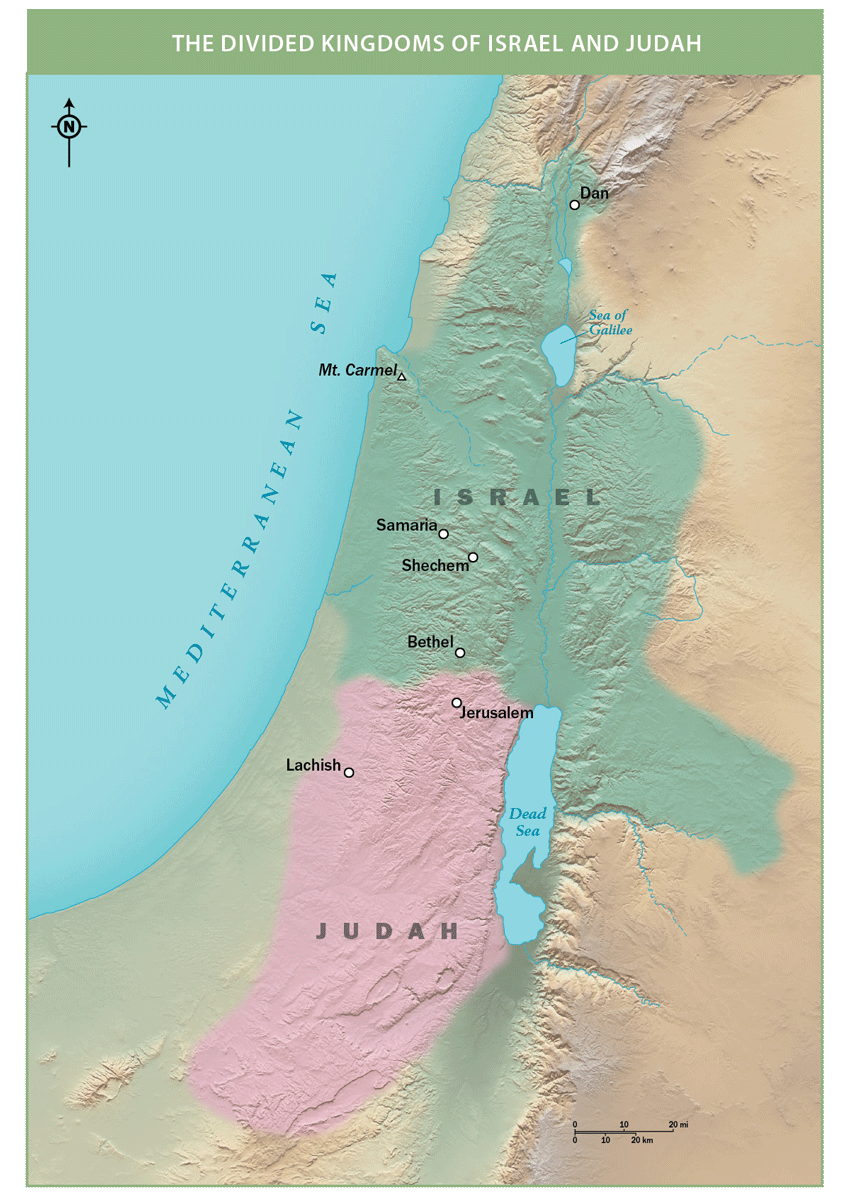
F. Northern exposure (13:1–16:34). 13:1–34. The main story line of 1 Kings 13 features an interlude on the prophetic word, an anomalous chapter that in various ways contributes to the overall plot of the narrative. The first scene (13:1–10) takes place at Bethel, probably in the shadow of the newly constructed golden calf. It features a confrontation between Jeroboam and an unnamed man of God from Judah. The unexpected interruption as the new king is paying homage at this alternative place of worship grabs the reader’s attention. More dramatic than withered hand and sign fulfilled is the mention of the proper name “Josiah,” a highly specific prediction and uncommon kind of prophetic utterance that speaks deep into the future. That it is spoken by a man from Judah would have the effect of further unsettling Jeroboam, who we know is paranoid about the people’s loyalty returning to the line of David. This utterance declares that the line of David will not only survive but also eventually produce a spiritual deliverer who will triumph over the very site of idolatrous installation where Jeroboam’s hand has been withered. Jeroboam’s motives for hospitality and the offer of a gift are not elaborated, but the man of God’s refusal on the grounds of divine commandment should be noted, since (not) eating and drinking is a common element in the next section of the chapter.
The enigmatic dialogue between the man of God from Judah and the old prophet from Bethel (13:11–32) yields at least two main points. First, one purpose of the conversation is to raise the issues of false prophecy and the motives of the northern prophet for lying. The motives are complicated by the seemingly legitimate word of the Lord announcing condemnation in verses 21–22, underscoring that God can even use dubious prophets to accomplish his purposes. Second, the animals in the story play an interesting role, as the lion (by not eating) and the donkey (by not bolting) exhibit more self-restraint than the man of God, resulting in a critique of the prophetic office, which will be scrutinized in the days ahead. The final lament of the old prophet—and his desire to be buried beside his southern counterpart—indicates that even the strange old prophet from Bethel understands the efficacy of the prophetic word spoken by the man of God from Judah, and the desire to have his bones next to the bones of the man of God reminds the reader of what will eventually happen to human bones on the altar of Bethel. By repeating the recalcitrance of Jeroboam in the denouement of this perplexing narrative (13:33–34), the writer alerts us to the ultimate fate of Jeroboam’s house, but even the scare of a withered hand is not enough to dissuade him from a heretical course of action.
14:1–31. From the account of two anonymous prophets we are taken back to a story about a more familiar figure, Ahijah of Shiloh, once more interacting with Jeroboam, although this time by proxy (14:1–16). Jeroboam’s scheme to disguise his wife fits into the motif of “royal disguise” that has been seen before (Saul in 1 Samuel 28) and will occur later (Ahab in 1 Kings 22), as kings clothe themselves in other raiment in an attempt to thwart a prophetic word. Despite blindness, Ahijah is able to see through the disguise because of a divine word; hence his surprise greeting of Jeroboam’s wife even before she enters the house. Jeroboam’s wife is welcomed with a long oracle of doom that resists an easy summary, but the capstone is that another king will be raised up in place of Jeroboam (who has not, as Ahijah first directed, been obedient), and the nation will be scattered “beyond the Euphrates River” (14:15). No sooner does the ineffectively disguised wife return home (14:17–20) than her son dies, and despite a proper funeral, it is a grim confirmation that it is hard to deceive a blind (true) prophet of the Lord. Jeroboam is succeeded by Nadab, who inherits a kingdom under judgment. Given the recent events surrounding the prophetic word, the reader knows it is just a matter of time before Jeroboam’s house goes the way of the house of Eli.
A narrative pattern of periodic switching back and forth between north and south leads to a return to Rehoboam (14:21–31); how does this southern king fare while his northern counterpart is on the wrong end of a prophetic utterance? The notice about Jerusalem as the chosen city prefaces a catalog of Judah’s transgressions. The southern kingdom does not appear much more virtuous than the north. Hence it must be the promise to the line of David that allows them to survive, even to the point of incursions by the king of Egypt. Rehoboam’s obituary includes another reference to his mother (one of his father’s many foreign wives), and the succession of Abijah evokes the recent memory of Jeroboam’s son of the same name, who dies because of the sin of his father.
15:1–32. The opening lines of chapter 15 indicate that time will now largely be measured by kings and their reigns. Abijah’s (also called Abijam) accession occurs in Jeroboam’s eighteenth year (15:1–8), and he quickly builds up a sinful résumé. Rather than being disqualified, however, his line is preserved because of God’s commitment to the line of David, with whom Abijah is unfavorably compared. Verse 5 is startling; in rhetorical terms, it has to be in the same category as David’s last words to Solomon, with the stress on the necessity of obedience. Constant conflict with his northern counterpart is the hallmark of Abijah’s three-year reign (one wonders what happened to the prophetic word of Shemaiah), until he is succeeded by his son Asa. More narrative space is allocated to the reign of Asa (15:9–24), probably because he has a longer and more fruitful reign.
There are some initial fears that Asa and Abijah share the same mother (Maakah), an incestuous tension that the NIV dispels by translating the Hebrew term normally rendered “mother” as “grandmother” in verses 10 and 13 (a plausible solution). Regardless, Maakah is dismissed from her position of “great lady” (NIV “queen mother”) when Asa implements a systematic reversal of his father’s policy by eliminating idolatrous paraphernalia. One blemish in an otherwise comprehensive purge is leaving the “high places” intact, sites that we will hear about again in due course.
The Asa narrative features introductions to two other characters. Baasha will formally enter the stage in the next section of 1 Kings 15 but here gets a brief cameo because of an aggressive campaign to control the key southern access point of Ramah. It is this aggression that leads to the introduction of Ben-Hadad, an official title for the Syrian kings, several of whom will appear in the story. Asa uses national resources of palace and temple to broker a “covenant” with Ben-Hadad; buying off the Syrian king enables Asa to shift the balance of power, and with his own conscripted labor he reallocates the building material of Ramah to his own defensive fortifications. There is no specific commendation or censure of Asa’s actions here, but such alliances will loom large throughout the narrative of the divided kingdom. Asa’s obituary in the closing lines of this section mentions, for the second time in 1 Kings, a document called “The book of the annals of the kings of Judah” (15:23), presumably some sort of record the author draws from. Finally, there is the curious note about Asa’s “diseased” feet, and commentators theorize everything from leprosy to venereal disease. After a long reign that spans seven northern kings, this is a painful way for Asa to exit the stage.
In the north, the house of Jeroboam is under a prophetic sentence, so when Nadab inherits the throne of Jeroboam his father, one has guarded expectations (15:25–32). A mere two years passes before the prophetic sentence announced by Ahijah of Shiloh is ruthlessly executed by Baasha, ironically the son of (another) Ahijah. Baasha is probably a mere agent in fulfilling the prophetic word, so the reader should be prepared for a similar dynamic unfolding later in the story. As it stands, Baasha is the general of the army when he usurps the throne during a siege, a common theme throughout the history of the northern kingdom. Lacking the same dynastic guarantee as Judah, northern kings will often be deposed by their senior underlings.
15:33–16:34. At some point during the twenty-four-year reign of the usurping Baasha (15:33–16:7), the prophet Jehu arrives with a strong denunciation. The fact that Baasha does a good imitation of Jeroboam is the initial reason for the prophetic word, as the hitherto unmentioned Jehu announces that the house of Baasha will experience an identical fate. Jehu’s confrontation certainly anticipates prophetic activity in the next major section of 1 Kings (chapters 17–22), and his phrase “from the dust” (16:2) evokes memories of Hannah’s song in 1 Samuel 2:8. Further, the dismal mention of dogs eating the royal corpse(s) will become a familiar refrain before long. After Baasha is buried in (yet another northern capital city) Tirzah, he is succeeded by Elah his son (16:8–14), whose two-year reign marks the end of the short-lived Baasha dynasty. Just as Baasha conspired against Nadab, so Zimri (one of Elah’s officials) conspires against Baasha’s son. But that is where the comparisons end: Nadab was occupied with a foreign conflict, but Elah meets his doom far closer to home, while getting drunk with a colleague. When Zimri assassinates Elah and reigns in his stead, it is a sober moment, as Jehu’s word about the house of Baasha finds its fulfillment.
The account of Zimri (16:15–20) is bizarre for a number of reasons. First, the length of time that he reigns is a meager seven days, and in that one week he somehow finds time to walk in all the sins of Jeroboam—an impressive execution of idolatry. Second, his dismissal begins with rumor, and when Omri (the commander of the military) is crowned, it appears for a moment that there are two kings in the north. Third, Zimri’s incendiary end is recorded from his own point of view (“when Zimri saw that the city was taken”), yielding a suicidal finish to the shortest reign in Israelite history. For more information on the conspiracy he wrought, we are referred to the northern annals, and primary attention turns to Omri. Although his reign is recorded in only a handful of verses, Omri (16:21–28) is the most influential northern king since Jeroboam. He achieves full control once the threat of the rival Tibni expires, after what seems to be a four-year struggle, with the death of Tibni himself. Most recent commentators note that Omri garners a couple of extrabiblical notices (in the Moabite stone and Assyrian records), but spiritually his legacy in Israel was decidedly negative. Otherwise, Omri’s reign is significant for two reasons. First, he purchases and builds the capital of Samaria, a strategic location; according to archaeologists, this impressive fortification lasts for the rest of the northern kingdom. Second, Omri sires a modest dynasty (a number of descendants will sit on the throne after him), a reasonable achievement considering the volatility of the north.
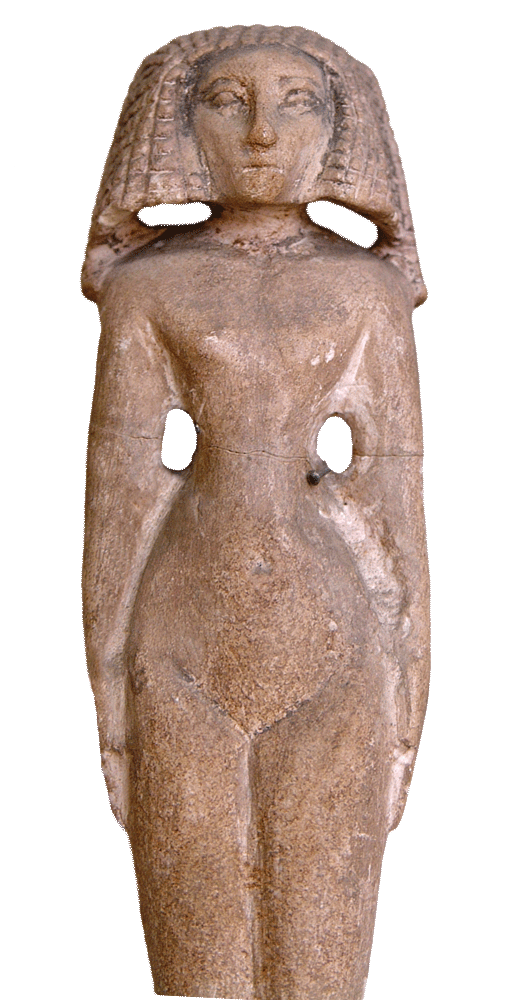
Asherah statuette
The first of Omri’s descendants is Ahab (16:29–34), whose initial claim to fame is that he exceeds in evil all who precede him—quite an accomplishment, given Jeroboam’s range of heterodoxies. The narrative cannot resist a piece of sarcasm: as though it were trivial to commit such atrocities, Ahab plunges even further by marrying Jezebel, the Sidonian princess. Under the leadership of this royal couple, the worship of Baal and Asherah (the Canaanite storm god and his female consort) flourishes. The manner of Ahab’s introduction sets the stage for the prophetic contest that follows, especially since the final lines of the chapter refer back to Joshua 6:26, where a curse is directed at one who attempts to rebuild Jericho. Thus during the preliminary account of Ahab’s reign, we are made aware of the ultimate power of the “word of the Lord,” as Hiel of Bethel belatedly discovers.
G. Prophetic contests (17:1–22:53). 17:1–24. After the report about Hiel of Bethel and the fulfillment of the word of the Lord spoken through Joshua many centuries before, Elijah the prophet bursts onto the scene (17:1) without much introduction (like Ahijah, Shemaiah, and Jehu before him), though he seems to originate from a settlement beyond the Jordan River. Elijah’s initial confrontation with Ahab consists of a single sentence about rain, an important narrative signal of a key theme in this stretch of text. As numerous scholars maintain, there is a theological confrontation in this text as well: where does ultimate power reside, in the word of a king or a foreign deity, or in God’s word? Thus the conflict between Ahab and Elijah is brought to the forefront in this struggle: who controls the rain, the Lord or Baal? This is the essence of the theological contest between king (whose name means “my father’s brother”) and prophet (whose name means “my God is the Lord”). That God immediately directs Elijah (17:2–6) to the Kerith Ravine (“Cutoff Creek”) has threefold significance: rain will be cut off until God speaks to Elijah, Elijah will be cut off from Ahab until prompted otherwise, and meanwhile Jezebel will be cutting off the Lord’s prophets in a purge of her own (see 1 Kings 18:4). During this famine, however, Elijah is supplied with food by ravens “morning and evening,” reminiscent of Israel’s wilderness experience, when there was no option but for God’s people to be fed by him. Ravens are unclean birds (Deut. 14:14) and are therefore a surprising instrument for sustaining the prophet, paving the way for other astonishing moments in this narrative. Compared with the last few chapters, there is a slightly different literary technique deployed here in 1 Kings 17, which comes after the lengthy parade of northern kings and their futilities.
When the water supply of Cutoff Creek is cut off, it creates an opportunity for a shift in spatial setting, and Elijah’s sojourn to the Sidonian widow dovetails with a number of broader themes in the story (17:7–16). The widow, vulnerable in the present, acquainted with grief and loss in the past, is gathering sticks for a last supper amid arid sterility. But she submits to the (counterintuitive) prophetic word and experiences life, as a substitute for death. Elijah’s journey deep into Sidonian territory demonstrates God’s sustaining power in a situation akin to “exile,” and the word of the Lord spoken in a distant land transfuses hope in perilous times. In fact, we see in this episode the power of God even beyond the borders of Israel, indeed, in the very backyard of Jezebel! Not only does Jezebel’s god(dess) lack efficacy, but there is some humor here: God hides his prophet deep in the queen’s territory (cf. Luke 4:25–26).
Such themes, however, are threatened when the widow’s son takes ill (17:17–24). Yet the son’s restoration is accomplished through prophetic mediation and thus encourages a rejection of the royal paradigm espoused by Ahab and Jezebel: what rulers (of any nation) are ultimately helpless to give, the prophetic word achieves. In this scene the reader hears the testimony of a non-Israelite about the God of Israel and his chosen prophet. It is the God of Israel who sends Elijah, just as it is the God of Israel who sends rain, who delivers from death, and whose word transcends any other authority. Elijah’s declaration to the widow (“your son lives” [RSV]) echoes his earlier word to Ahab (“as the Lord lives”) and underscores the theme of the God of life that continues throughout this narrative stretch.
18:1–46. By way of review, the first Hebrew word of 1 Kings 17 is “and he said,” centralizing the spoken word that is a key element of this section. Elijah has earlier said to Ahab that there will be no rain “these years,” a vague temporal indicator that suspends royal chronology and replaces it with prophetic time. Noticeably, the next installment of the story begins in the “third year” of prophetic time (18:1), as God announces that he will send rain. The next segment of the chapter (18:2–15) is best viewed through the lens of Obadiah, a figure whose actions and words glance back to the previous chapter and set the stage for the conflict on Mount Carmel. Obadiah is a high-standing member of Ahab’s court, but the meaning of his name (“servant of the Lord”) reflects a tension: on the one hand he is literally “over the house” of Ahab (NIV “his palace administrator,” 18:3), but behind the scenes he is aiding the prophets, surely against the wishes of his employers. Obadiah “hides” the prophets and “sustains” them with supplies (18:4), just as God earlier told Elijah to “hide” (17:3), and Elijah was “sustained” by the ravens. Enlisting the help of Obadiah, King Ahab searches for water to keep the animals alive so they do not have to be “cut off.” Obadiah must have been shocked to find the missing prophet during this quest for unwithered grass, and his long speech provides Elijah with a summary of the events that have taken place while he has been in hiding: Obadiah fears Ahab, but he also fears the Lord. By reciting his résumé to the prophet, Obadiah provides an instance of what literary critics refer to as “contrastive dialogue,” whereby his voluminous outpouring is answered by a terse command: announce to Ahab, “Behold, Elijah!” (NIV “Elijah is here,” 18:8). Rain will fall only at Elijah’s word, but to the long-suffering Obadiah he is a man of few words.
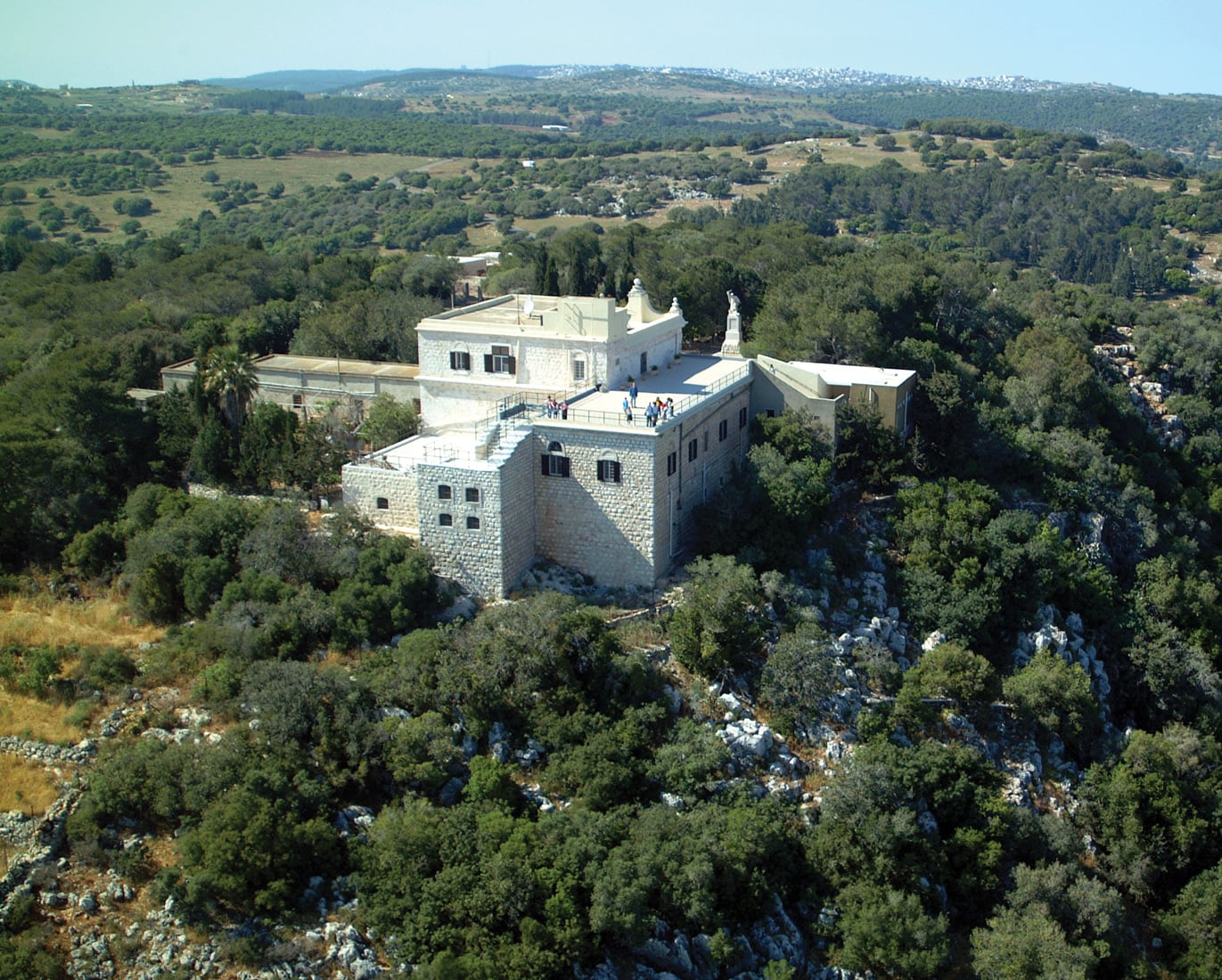
The Muhraqa Monastery, built to commemorate Elijah’s victory over the prophets of Baal (1 Kings 18), is located up the hill from the traditional site of the contest.
The confrontation between Elijah and the prophets of Baal on Mount Carmel (18:16–40) is a dramatic and well-known episode, and three aspects of Elijah’s words should be highlighted. First, the prophet’s accusation (literally, he asks the people, “how long will you hobble on two sticks?”) encapsulates the vacillating tendencies of the general population. Ahab and the prophets of Baal are not Elijah’s only opponents in this contest: also on trial is the spiritual paralysis that stems from a lack of real conviction. Obadiah at least shows that it is possible to have some faithfulness even in a brutal regime. By agreeing to the test of fire, the people tacitly agree that they have not been entirely loyal to God. Second, the mocking voice of Elijah (including pejorative remarks about Baal, such as “maybe he is sleeping”) is met with complete silence from the rival deity. This contest is about the power of speech, yet Baal has no voice here. When Elijah rebuilds the altar, the reader may think about the latter part of the book of Isaiah (e.g., chap. 44), where a satirical invective launched at various deities and competing worldviews is followed by a rebuilding of the faith of Israel. Third, the turning point of the episode is the intercessory prayer of the prophet, and for a community in exile, this surely speaks of the possibility of restoration. The final scene (18:41–46) features a slight ridicule in the warning to Ahab: the king needs to hurry up, because the long-awaited rain will cause his chariot to get stuck in the mud!
19:1–21. When Ahab’s chariot returns home, he reports the news (19:1–2) to his wife Jezebel, whose murderous threats reveal her destructive tendencies. After taking on Ahab, hundreds of false prophets, and the general population, why is Elijah so scared of Jezebel’s threat? Perhaps Jezebel is more scary than anything else Elijah has faced, or her intimidating message is the last straw. Either way, Elijah crosses the southern border (19:3–7) with an apparent case of prophetic depression, exclaiming to God, “Enough!” After the pyrotechnics of Mount Carmel, there is a movement from the prophet’s external conflict to an internal struggle, where he has become like the widow of Sidon and needs to be revived like the widow’s son in chapter 17. Some intriguing parallels begin here (and continue throughout the rest of the chapter) with the desert narratives and the career of Moses in Exodus and Numbers, with a constellation of shared images and words: forty days, the mountain of Horeb, visions, provisions of food by God, and a successor—suggesting that even great leaders need periodic renewal.
Once more Elijah is sustained by a meal, then sent on a journey (19:8–18) deep into the wilderness of Israel’s history. As a spatial setting, the mountain of Horeb was a site of revelation, evoking memories of God’s consuming presence. We are unsure how to understand Elijah’s complaint (“I am the only one left”) in light of Obadiah’s claim of hiding one hundred prophets in caves, but God now proposes to pass by the prophet in the cave at Horeb. Like Moses, Elijah experiences dramatic signs and a thunderous display. In Elijah’s case, however, they are followed by a “sound of sheer silence” (NIV “gentle whisper”) and a repetition of the question “What are you doing here?” The prophet’s feeling of isolation is countered by a task list for him—not only providing introductions to some characters who will follow in the story but comforting Elijah as well. The anointing of Elisha as successor, we will see, is vital for the dismantling of Ahab and Jezebel’s kingdom, and thus Elijah’s apprentice will be the prophetic catalyst for the fall of Ahab’s house. When passing the mantle to Elisha (19:19–21), the senior prophet appears almost gruff with his new protégé. It has been suggested that Elisha hails from a wealthy family (twelve pairs of oxen), and apart from the obvious symbolism of the number twelve and connections with the twelve stones of the previous chapter, this scene implies that Elisha leaves a relatively secure lifestyle for all the risks of the prophetic vocation. That the chapter ends with yet another meal is appropriate (given all the food in 1 Kings 19), but the sacrifice of the oxen confirms that for Elisha there is no going back.
20:1–43. Given the reinstatement of Elijah, it is noteworthy that neither he nor Elisha features in 1 Kings 20. Instead, we get a different kind of prophetic intervention in this chapter, prompted by the aggression of Ben-Hadad and his allies (20:1–12). The considerable demands of Ben-Hadad give the impression that he has some leverage; the backstory would be that Israel is experiencing foreign hostilities under Ahab, and therefore abandoning orthodoxy does not always bring socioeconomic benefits. Some witty repartee between the two kings indicates that Ahab has a sense of humor, but it really looks like he is about to get horsewhipped. Despite Elijah’s protest that he is the “only one left,” an anonymous prophet confronts Ahab (20:13–22) with an announcement of improbable victory. Although the NIV renders the instruments for victory as, “the junior officers of the provincial commanders,” another way of understanding the Hebrew text is captured by the NASB (“the young men of the rulers of the provinces”), thus enhancing the improbability of any victory, since we may not even be dealing with military personnel but rather regional administrators! Certainly Ben-Hadad is not overly stressed, as we infer from his drunken babble as he imbibes in his tent at high noon with his thirty-two royal allies. As predicted by the prophet, the purpose of Ahab’s subsequent victory is to acquaint the king with this reality, “I am the Lord,” and the same prophet alerts Ahab that Ben-Hadad will soon attack again.
As it turns out, the sequel has its own set of surprises (20:23–34), beginning with a snippet of a theological and strategic debate inside the Aramean camp, as the officials claim that Israel has “gods of the hills” and those drunken kings need to be replaced with some serious soldiers. Even though there is a narrative description of Israel’s army resembling “two small flocks of goats” (20:27) compared to the massive Aramean host, an announcement to Ahab from a man of God (probably different from the earlier prophet) again forecasts victory. Ben-Hadad has two lucky escapes despite losing the battle. First, he is not crushed by the wall (which falls like the one in Jericho many years ago), and second, he receives a pardon from Ahab. Normally, showing mercy to an opponent on the ropes is commendable, but here the unexpected release of the royal prisoner of war (after securing a favorable trade agreement) leads to a serious prophetic condemnation in the final scene of the chapter (20:35–43). As in 1 Kings 13, this episode features one prophet deceiving another and an attacking lion. The disguised prophet, unlike Jeroboam’s wife, is successful, eliciting a self-condemning sentence from Ahab, whose response (“resentful and sullen” [RSV]) prepares the reader for the next episode.
21:1–29. Ahab has wreaked havoc in Israel through apostasy and by marrying Jezebel; now he turns to appropriating his neighbor’s property (21:1–4). Naboth’s refusal to sell or barter his inheritance is consistent with torah (e.g., Lev. 25:23; Num. 27:8–11), yet the king’s reaction, as in the previous chapter, is to return home “resentful and sullen.” Ahab does not apply further pressure on Naboth—does he realize that Naboth is simply following the law?—but when he is met by Jezebel (21:5–7) we immediately realize that she is not beholden to Israelite law in the same way. Her reaction to the situation again shows her malevolence, but it is unclear whether Ahab expected this kind of response and that his Sidonian wife would concoct a scheme. Regardless, Jezebel’s plan of writing deadly letters (21:8–16) evokes poignant memories of David’s dispatching of Uriah back in 2 Samuel 11. This time, however, it is the queen who writes in the king’s name, with her request to employ a pair of “sons of Belial” (NIV “scoundrels,” 21:10) to liquidate Naboth. The false charge carries a death sentence, and Naboth is duly stoned—a murder, all because he refuses to sell out. Samuel the prophet warned that vineyards would be taken (see 1 Sam. 8:14) if Israel would choose the path of kingship, and such a warning is now a dreadful reality for Naboth.
The elders of the city might be fooled by Jezebel and Ahab, but not God’s prophet Elijah, who unexpectedly arrives (21:17–24) to deliver a judgment. The spatial setting for this confrontation is “Naboth’s vineyard,” the very place the crime is set in motion. Ahab is seemingly held liable for Jezebel’s atrocity, but the latter is not exempt; like her husband, Jezebel will suffer the ignominy of dogs consuming her remains. The scene is interrupted with a penetrating aside (21:25–26) about Ahab’s vile conduct, reinforcing a key moment from the start of the chapter: Naboth refuses to sell his property, but Ahab has sold himself to do evil, incited by his wife Jezebel. The concluding interaction between Elijah and Ahab (21:27–29) has a pair of incongruous moments. First, Ahab’s response appears humble, with clothing and deportment customary for those in mourning. Second, one might be skeptical about Ahab’s humility, but God remarks on the king’s contrition to Elijah—the object of Ahab’s wrath on more than one occasion—and actually expresses commendation. Is there a mitigation of divine wrath? The days of Ahab’s house are numbered, but God’s capacity to extend grace should not be underestimated.
22:1–53. After the interlude at Naboth’s vineyard, the narrative focus returns to the long-standing conflict with Aram (22:1–6), where the southern king Jehoshaphat—who will be formally introduced later in the chapter—appears as an ally of Ahab. Despite sparing Ben-Hadad’s life earlier, Ahab is now interested in launching a hostile offensive against the northern outpost of Ramoth Gilead. Jehoshaphat seems to be the weaker partner in this alliance with Ahab against the Arameans, but his abrupt request to first seek God’s counsel indicates that his voice is taken somewhat seriously. The reader knows that Ahab and Jezebel sponsor (false) prophets, and it is the compromised response of these employees that prompts Jehoshaphat (22:7–9) to request a genuine prophet of the Lord. Ahab’s depiction of Micaiah makes it clear that they have encountered one another in the past, and Micaiah is summoned (22:10–15) before an assembly that is aggressively pro-Ahab and obviously prepared to say or do anything to placate the king (e.g., the goring antics of Zedekiah in 22:11).
Evidently Ahab has been trumped by Micaiah’s sarcasm on previous occasions, and it is ironic that the king implores the prophet (22:16–28) to “tell me nothing but the truth in the name of the Lord” (22:16) in the midst of a plethora of false prophets on the royal payroll. By contrast, Micaiah’s bold oracle informs Ahab that a “deceiving spirit” has emanated from the divine council and spread falsehood (22:22–23), a rather dramatic theological idea to say the least. Micaiah’s presence must be destabilizing for the rest of the prophets, such that it garners a slap in the face, literally, from the iron-horned Zedekiah (22:24). Deuteronomy 18:21–22 outlines the test for a prophet, and Micaiah tacitly appeals to this tradition in his spar with Zedekiah, proclaiming that his word will be authenticated. Ahab—under a death sentence from Micaiah—does his best to thwart the prophetic word through disguise (like Jeroboam’s wife in chapter 14) but learns the hard way (22:29–40) that it is impossible to outmaneuver a true prophetic utterance. A seemingly random archer drawing his bow “in innocence” (NIV “at random”) sends a bleeding Ahab back to town, where the dogs partake of the fulfillment of Elijah’s earlier word and Micaiah’s recent oracle. Despite lacking a disguise, Jehoshaphat survives the battle, and several highlights of his reign are recounted (22:41–50), including his building of a fleet of trading ships and his failure to remove the high places. Meanwhile, Ahab’s death results in the accession of his son Ahaziah (22:51–53), who inherits his parents’ predilection for heterodoxy.
A. Chariots and fire (1:1–2:25). Although the first chapter of 2 Kings begins with a notice about Moab’s rebellion (1:1–2), this thread will not be picked up until chapter 3. More pressing for the moment is Ahaziah’s awkward nosedive that reveals something about his character: he is not willing to consult the God of Israel but rather opts for an alternative deity (literally “Baal the fly,” here located in the Philistine city of Ekron) to learn his prospects for recovery. The impotence of this god is further enhanced when Ahaziah’s messengers (1:3–12) are intercepted by a prophet with a memo of doom for the king, and since Ahaziah is able to recognize Elijah from their description, the two must have had prior dealings. Not only is the bedridden Ahaziah under a death sentence; he is singularly unsuccessful in bringing Elijah into custody: instead of apprehending the prophet, two successive groups are arrested by fire at the top of a mountain, much like the sacrifice was consumed by fire on Mount Carmel back in 1 Kings 18. The third captain has the sense to beg for mercy (1:13–18), and one gets the impression that if the angel of the Lord had not intervened, Elijah would have continued to call down fire. Ahaziah, like his father, tries in vain to nullify the prophetic word but discovers to his grave chagrin that such a task is beyond any earthly monarch. It is curious that Ahaziah has no son to succeed him, since the next chapter addresses the (formal) succession of Elijah by Elisha.
An extraordinary chapter narrates the stunning conclusion of Elijah’s career and the beginning of Elisha’s as a public figure. One aspect that emerges early in the narrative (2:1–8) is the tenacity of Elisha, in dealing with both his master and the persistent questions from the “company of the prophets” (literally “sons of the prophets”). Elijah’s upcoming experience is evidently common knowledge in prophetic circles, and yet Elisha’s tenacity early in the chapter foreshadows his difficult request in verse 10. Furthermore, the parting of the waters of the Jordan is reminiscent of the wilderness years, carrying the implication that Elisha (“God is salvation”) will be the new Joshua (“the Lord is salvation”) for these times. As Elijah and Elisha cross the river (2:9–18), the unexpected invitation for Elisha to “ask” for something evokes memories of Solomon in 1 Kings 3. A number of commentators understand the phrase translated literally “two mouthfuls of your spirit” (2:9) as a reference to inheritance (see Deut. 21:17), and perhaps Elisha wants a double portion to avoid prophetic burnout or a repeat of Elijah’s depression. He certainly witnesses Elijah’s departure, and tearing his clothes in two pieces is similar to sacrificing his oxen in 1 Kings 19 and anticipates his taking up of Elijah’s mantle in verse 13. Notably, like Elijah he too poses a question to God (“Where now . . . ?”), and his public profile begins with an answered prayer. All the while, the band of prophets have been watching, and their banal questions must function as comic relief after the unparalleled departure of Elijah; but also, this group observes firsthand the events of Elisha’s succession and stands in contrast to the “official” prophets of the Ahab court.
A couple of memorable events (2:19–25) mark the beginning of Elisha’s public activity, as he retraces the journey (Jordan River, Jericho, and Bethel, then on to Mount Carmel and Samaria) of Elijah at the beginning of the chapter. The healing of water with salt is somewhat offset by the bitter curses and bear-mauling of the forty-two youths from Bethel, yet both illustrate that a prophet’s response to “evil” can bring both healing and destruction. The entrance of the female bears as agents of judgment reminds us of the devouring lions earlier in the narrative.
B. Days of Elisha (3:1–8:29). 3:1–27. Because Ahaziah did not have a son, his brother Jehoram (Joram) succeeds him, with mixed results (3:1–3): he betters his parents by eliminating some vestiges of Baal worship but persists in the ways of Jeroboam—the negative standard by whom the rest of the northern monarchs are measured. The rebellion of the king of Moab was mentioned at the outset of chapter 1 but is now explained (3:4–12) as a failure to deliver the requisite sheep quota, prompting military action from Jehoram (aided by the kings of Judah and Edom). There are some immediate similarities with Ahab’s campaign in 1 Kings 22, including the summoning of Judah’s king Jehoshaphat, who once more volunteers his forces and—in response to Jehoram’s complaint about no water in the desert of Edom—requests the aid of a prophet. There is a state visit from this triumvirate of kings (3:13–19) to the prophet Elisha, who sounds every bit as gruff as his master upon catching sight of Jehoram, and just as sarcastic as Micaiah. Only the presence of Jehoshaphat (who describes Elisha as, literally, a “water pourer” [3:11]—exactly what he will become later in the chapter) assuages the prophet, whose request for a “harpist” is odd. Music has been connected with prophecy before (see 1 Samuel 10), and the request for a stringed instrument might be in the same vein—and none of the assembled kings seems to have a problem with it. Elisha ends up having an encouraging word: dig some ditches, for not only will there be water in the desert but Moab will be overthrown.
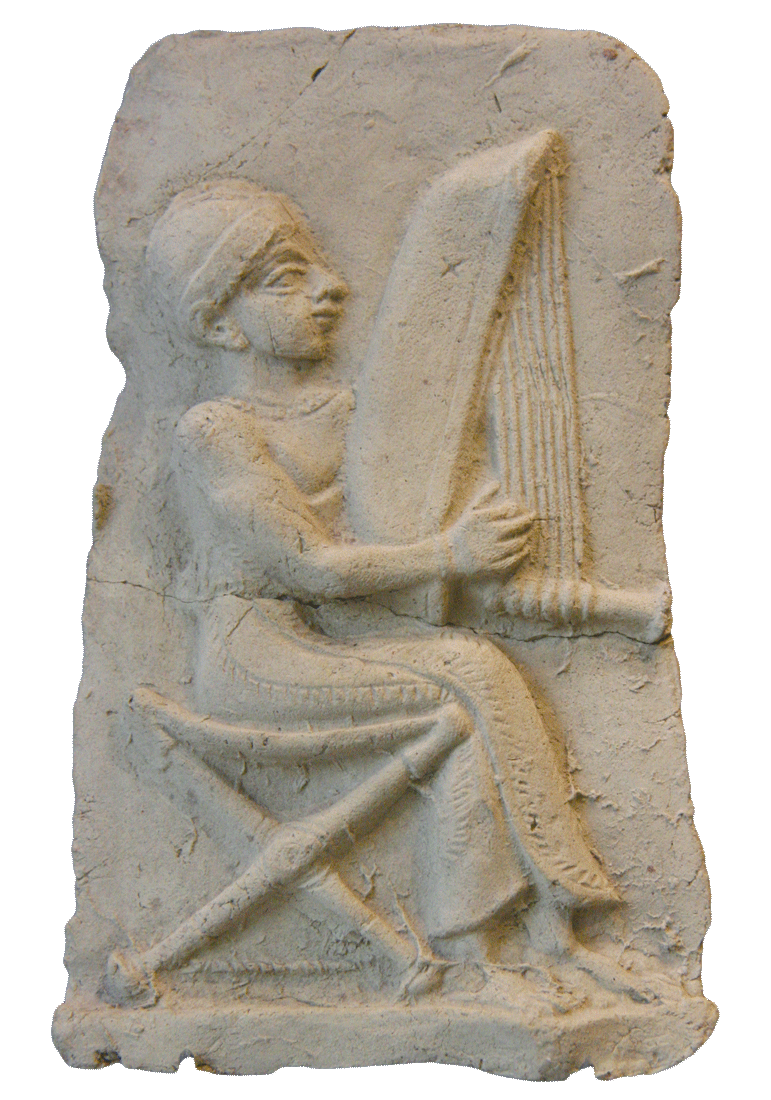
Plaque with a harpist (Mesopotamia, 2000 BC). Elisha requests a harpist in 2 Kings 3:15.
As Elisha forecasts (3:20–25), the land is miraculously filled with water, and the defeat of Moab begins at “the time for offering the sacrifice,” a description similar to the reference to Elijah’s actions at Mount Carmel back in 1 Kings 18:36. The water brings life for the three kings (Israel, Judah, and Edom), but brings death for Moab, as an optical illusion fools them into thinking the kings have slaughtered each other. The victory is tarnished, however, by an utterly baffling turn of events (3:26–27). While it comes as no shock that the king of Moab engages in child sacrifice after his last stand proves ineffective, the penultimate phrase, “and the fury against Israel was great,” defies easy interpretation. Two kinds of sacrifices are contrasted here: the sacrifice for God’s people outlined by torah (3:20), and the kind of abominable sacrifice practiced by certain foreign rulers. The king of Moab becomes like the injured Ahaziah in chapter 1, a king who lacks a successor—a not-so-subtle critique of the house of Ahab and its policy of imitating the surrounding nations.
4:1–44. Early in Elijah’s career a Sidonian widow is sustained during a famine through a supply of oil; Elisha is involved with something similar (4:1–7), except this time the widow of a deceased Israelite prophet is the beneficiary. Here, one guesses the oil is limited so as to facilitate trust in the prophetic word without fostering complacency, even as it delivers her from the immediate threat of her creditors—and thus the woman is not childless. Elisha’s care for the widow sets the tone for the rest of the chapter, as another female character features in the next episode (4:8–37). The two women are in different straits: the widow was in debt and stood to lose her offspring, while the next woman is married and affluent, yet has no children to lose. This finely crafted episode has three movements, beginning with the announcement and subsequent birth of a son. The reader is given a first glimpse of Elisha’s aide-de-camp, Gehazi (a supporting actor in the next chapter as well), and through dialogue with Gehazi, it becomes apparent that the woman has needs that material wealth cannot satisfy. Through the prophet’s intervention, this elderly couple now have an heir—unlike Ahaziah and the king of Moab. The second movement revolves around sickness and death. In the woman’s case, barrenness was replaced by fertility, but fertility has now (after the passage of some time) been routed by illness that leads to death. Earlier the woman pleaded, “Did I not say, ‘Do not deceive me’?” (4:28 KJV), and now surely she feels the victim of false hope. But the third movement of the episode involves intercession and revival, and the woman’s journey to Mount Carmel (recalling the God who answers by fire) is “Elisha-like” when she says she will not leave the prophet, just as Elisha once said to his master. Her perseverance is likewise rewarded with a double portion of rescue from death. Right after the account (3:27) about an appalling child sacrifice, we have a narrative about the prophet as a catalyst in the birth and “resurrection” of a promised son, against all odds. In some ways this mirrors the story of God’s people: death and exile are not the end of the story.
Two feeding anecdotes (4:38–44) round out the chapter, and while the accounts may seem randomly patched together, there are some organic connections to the chapter as a whole. In the first story there are two problems: not only is there a famine, but the one meal for the prophetic guild is laced with poison (“death in the pot”). Flour once more is used to bring life (see 1 Kings 17:12), and death is averted just as with the son (4:32–35). In the second story—presumably at the end of the famine—first fruits are brought to the community of prophets, and despite the incredulity of Elisha’s assistant, there is more than enough for everyone to partake of the crop.
5:1–27. There is a change of focus in the next episode (5:1–3) that begins with some role reversal: Naaman is the commander of the Aramean forces and a palpable foe of Israel, yet he has leprosy and is told of a (potential) cure by his wife’s servant girl who was kidnapped from Israel. As Naaman eventually visits Elisha (5:4–10), the overarching concerns of the story become evident. First, there is concern even for the non-Israelite—in this case Naaman, the military commander who was probably in charge of the raids (5:2). The word of Elisha begins to transcend traditional boundaries, paving the way for a rather more expansive view of salvation, and anticipating later prophetic oracles (e.g., Isaiah 49). Second, Elisha seems to have at least a functional relationship with the king of Israel, and despite the fact that both kings have a deficient view of the situation, the prophet’s intervention creates peace (shalom) instead of more war. Naaman’s initial frustration (5:11–18) eventually gives way to submission to the prophetic word, resulting in healing for the Aramean soldier. At first he is disappointed, wanting something akin to the fire of Carmel rather than a still small voice! But the healing journey elicits a spectacular confession from an inveterate enemy, and the reader cannot help but notice a discrepancy: while the nation of Israel is descending into a spiral of idolatry, here is a foreigner who pledges to honor God alone. Such commitment is only enhanced when the newly converted Naaman asks for a wheelbarrow of earth, since he has to—on official duty—enter the equivalent of a Baal temple but is determined that his allegiance will not waver.
Though Elisha refuses any recompense, his servant Gehazi has a rather different view of the matter (5:19–27), and Gehazi’s avaricious behavior begins with an oath (“as the Lord lives,” ironic in light of the healing of the boy in the previous chapter). After Gehazi secures a useful amount of material goods, the awkwardness of his interview with Elisha is captured in Gehazi’s words: (literally) “Your servant didn’t walk here and here” (5:25; NIV “Your servant didn’t go anywhere”). The chapter begins and ends with leprosy, but with startling reversal, as Gehazi and his descendants will forever embody the decision to pursue Naaman and hoodwink him for some silver and new clothes. A contrast emerges between Gehazi (a servant lad) and the captured Israelite at the beginning of the story (a servant girl). The girl in exile has deeper acquaintance with the prophetic word than the insider Gehazi, who spends day and night with the man of God. These two young people see Naaman differently, and it is the young girl in captivity who displays vastly more theological insight than her counterpart.
6:1–7:2. Elisha has enjoyed a fair bit of interaction with the band of prophets (literally “sons of the prophets”) to this point; further activity is the subject of the first episode of this chapter (6:1–7), recovering the borrowed (literally “asked for”) ax head. In this account, a miracle occurs when the man complies with the prophet’s directive, even if seemingly arbitrary (“When he showed him the place . . .”), just as with Naaman the Aramean. Even the sons of the prophets need such periodic reminders, as do foreign lepers and servants like Gehazi. Keeping such matters in mind, the narrative shifts to the court of the king of Aram (6:8–14), who suspects a mole in his camp because all of his secret locations are somehow known to Israel. Elisha’s growing fame is evident, since an officer of Aram understands that the prophet is responsible. As Gehazi can testify (see 5:26), the prophet often has inside information, and in this instance it is presented in an almost slapstick manner. A large posse having been sent to arrest the prophet, Elisha and his (unnamed) servant awake (6:15–23) to find the house surrounded. The reader observes that blindness and insight are key components of this scene, as the servant glimpses the matter from Elisha’s perspective (a vast multitude of the heavenly host surrounds them) while the Aramean troops are struck with blindness and led to Samaria by the very man they were sent to capture. If the captured Arameans are expecting the worst, such expectations are thwarted as the prophet orders hospitality for the prisoners and so transforms a situation of hostility into a season of peace.
The peace is temporary, however, as Ben-Hadad continues his offensive and besieges Samaria (6:24–7:2). A city under siege invariably faces scarcity and massive inflation, and here mothers are driven to contemplate cannibalism (see Deut. 28:53–57 for a warning). When the king of Israel is apprised of the situation, he directs his outrage at Elisha; no motive is stated, but one guesses that he wanted to destroy the captured Aramean soldiers earlier (6:21), while the prophet let them live. The king orders the death of Elisha, but as the king of Aram knows full well, Elisha is an elusive foe. Not only does Elisha avoid assassination, but he also speaks a radical word about reversal. However, as in the repartee between Micaiah and Zedekiah in 1 Kings 22:24–28, Elisha encounters some opposition. The supporting officer’s expression of incredulity is met with a retort from the prophet, namely, that the fulfillment of the prophetic word shortly will come back on him like a stampede.
7:3–20. If Elisha’s utterance is implausible, the instruments used for delivering such a word are even more unlikely (7:3–12), as four lepers have their march to surrender turned into a discovery of an empty Aramean camp. This group of outcasts must be as hungry as the mothers in 6:29, and so we can appreciate their joy at this find. Their pricks of conscience introduce an important word: good news (7:9). In the biblical economy, good news generally refers to big events such as rescue from captivity, the end of exile, and the reversal of oppression (see Isa. 40:9; 52:7–10). Reporting the news to the palace (7:13–20) launches an investigation team, confirming the empty camp and flooding the market with affordable food just as Elisha has forecast. In this case, the fulfillment of the prophetic word is yet another miracle in this stretch of text, where a divine interruption occurs in order to draw attention to particular facets of God’s character, and the prophetic word here turns apparent hopelessness into a moment of salvation. As for the skeptical officer (7:2), he is sadly trampled during the resulting pandemonium at the gate (7:17), a hard way to learn the benefits of submission to the prophet’s authority.
8:1–29. The next episode is introduced with a flashback to seven years earlier (8:1–6), when Elisha advises the Shunammite woman to sojourn outside of Israel during a famine. Because she has to reclaim her land from the king, one wonders if the king somehow appropriated the land in her absence. There is a miracle of timing: at the very moment the king is asking Gehazi about Elisha’s mighty deeds, the woman shows up with her (revived) son! Gehazi’s cameo is almost as astonishing, since he was last seen at the end of chapter 5 “white as snow”—it is not clear why he is in the king’s presence, but his animated testimony aids the restoration of her property. The prophet’s reputation continues to be a major theme (8:7–15), as Ben-Hadad consults him about his illness. The ensuing interaction between Elisha and Hazael of Damascus is significant for two reasons. First, it brings us back to the very outset of Elisha’s career in 1 Kings 19:15–17, when God informs Elijah that Hazael’s reign will be destructive. Now, closer to the end of Elisha’s career, that cryptic word is poised for fulfillment. Second, Elisha’s tears during the interview with Hazael become hauntingly appropriate when Hazael smothers Ben-Hadad’s face with a wet rag. The same prophet who knows about Aramean troop movements (2 Kings 6:8–10) knows that Hazael—like Shakespeare’s Macbeth—is about to become a murdering usurper.
After a lengthy hiatus, attention returns to the south with regnal summaries of two kings of Judah. The eight-year reign of Jehoram (8:16–24) represents a downturn, and marrying into the northern royal family does not look good on his résumé. However, a repetition of the Davidic guarantee ensures that the southern kingdom will continue; otherwise, the most noteworthy event in Jehoram’s tenure is the revolt of Edom. Jehoram is succeeded by his son Ahaziah (8:25–29), who does “evil in the eyes of the Lord” during his reign of a single year. Joining the northern king Joram in an offensive against Hazael in the final scene, Joram is injured. Ahaziah’s visit to the convalescing Joram sets the stage for a new chapter to unfold.
C. Jehu’s ascendancy (9:1–10:36). Without any prior notice, Elisha commissions an unnamed member of the prophetic guild to anoint Jehu king of Israel (9:1–13). The prophet is instructed to take a “flask” of oil. The only other king to be anointed with a flask is Saul; the allusion to his ill-starred reign may signal that Jehu’s term in office might be complicated. A brief comparison between Elisha’s instruction and the other prophet’s words to Jehu highlights a discrepancy: the prophet’s report to Jehu (9:6–10) is considerably longer. It is unclear whether such “additions,” including the command to massacre Ahab’s house for revenge, are authorized by Elisha. Does this prophet speak for Elisha or on his own initiative? Moreover, why is the assembled group so quick to proclaim Jehu as king? Were they plotting an overthrow? A storm is brewing on the horizon because Joram is still king over Israel and presently has a visitor, Ahaziah of Judah.
Jehu’s charioteering (9:14–29) is hall-of-fame caliber (“he drives like a maniac,” in the words of one eyewitness), and such driving cannot augur well for the rival house of Ahab. Recruiting allies over the course of his wild ride, Jehu finally confronts Joram, at Naboth’s vineyard of all places. This spatial setting reinforces the idea that judgment day has arrived for Ahab’s dynasty, just as Elijah spoke in 1 Kings 21:20–24. Jehu’s archery is above censure (as he hits the royal target “between the shoulders,” 9:24), but it is Jehu’s remarks after killing Joram that merit attention. Turning to Bidkar, he outlines justification for his actions in light of Elijah’s oracle—one that Jehu claims to have heard. This is not reported in 1 Kings 21, but due to the relative accuracy of the words, Jehu should probably be given the benefit of the doubt. Despite Joram’s warning (he shouts “Treachery!” in 9:23), Ahaziah is also killed by Jehu, making it a painfully effective day for regicide. Joram and Ahaziah are dead, but Jezebel still remains, and one senses that her demise is imminent (9:30–37). Characteristically, she exits the stage with a flourish, after one last stand in Jezreel. With freshly arranged hair, she includes in her greeting to Jehu the term “Zimri” (see 1 Kings 16:15–20). By alluding to Zimri and his one-week reign of terror, Jezebel invites Jehu to partner with her if he wants a longer kingship. Jehu categorically rejects her offer, and some eunuchs duly throw her out the window, and she is trampled by oncoming horses and chariotry. It almost seems an afterthought when Jehu finally gives orders to bury her, and only scant remains can be found, giving Jehu one more opportunity to point out the fulfillment of Elijah’s word.
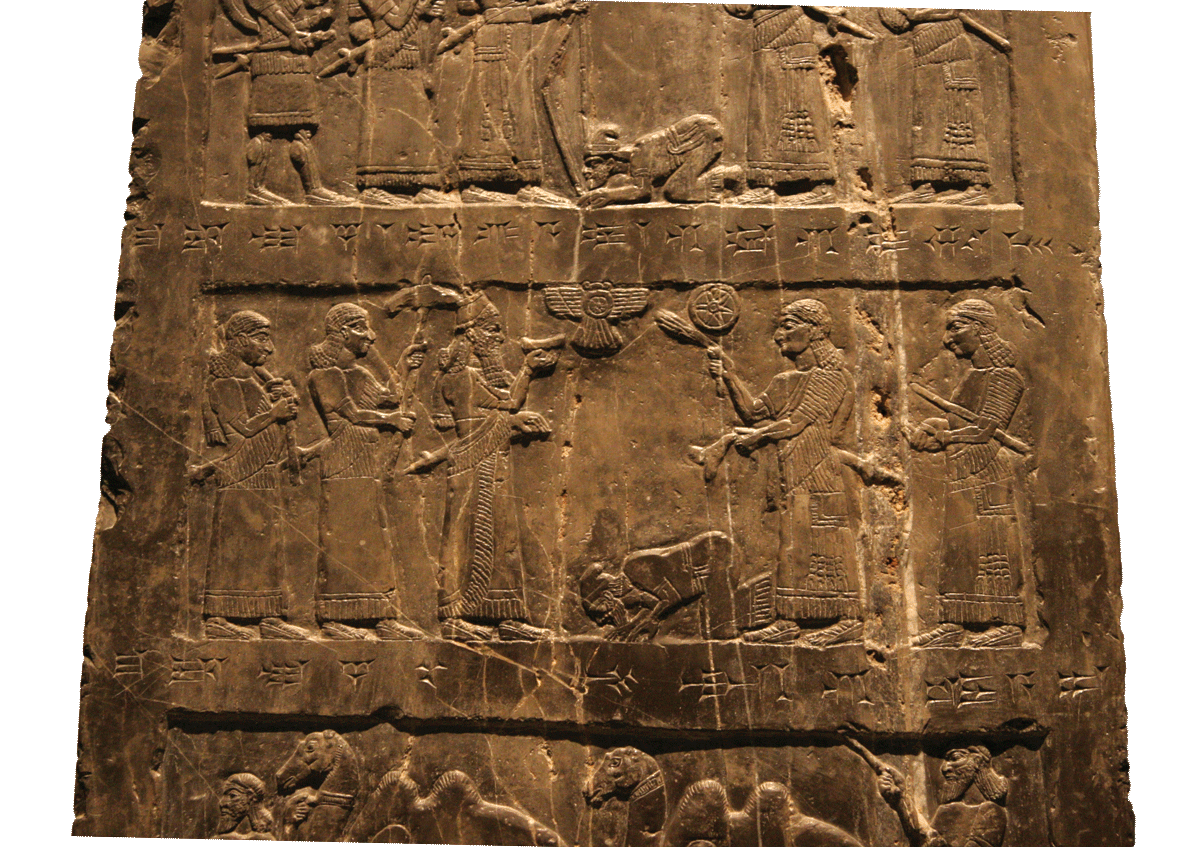
This panel from the Black Obelisk of Shalmaneser III (858–824 BC) shows Jehu kneeling before the Assyrian king and records the tribute paid by Israel.
To this point Jehu has not had much time for anything but rapid destruction. In the next episode (10:1–17) he appears more calculating. There is a grisly irony with Jehu’s letters: through a letter Jezebel secured the death of Naboth in Jezreel, and now by a similar means Jehu destroys Ahab’s offspring by sending correspondence to the same address. Jehu’s intimidating epistle—not dissimilar to Jezebel’s—does not leave much room for negotiation, and so for the second time in recent memory the leadership of Jezreel is purged, and the heads of Ahab’s seventy sons are delivered to Jehu in baskets. (It is unclear whether or not the number seventy is symbolic and if the word “sons” indicates direct descendants.) Jehu seizes the opportunity to once more cite the prophet Elijah and continue his purge of the Ahab administration. Ahaziah’s relatives are not exempt; they seem oblivious to recent events of destruction but are quickly apprised of Jehu’s policy of elimination. Jehu recruits one further character—Jehonadab son of Rekab—whose descendants feature prominently in Jeremiah 35. By all accounts the Rekabites are a conservative group of traditionalists, worth commandeering for their political capital.
If Jehu seemed deceptive in his letters, such inclinations are exponentially increased in the next scene (10:18–27). To be sure, there is no lack of drama in the episode: Jehu’s devious claim to worship Baal with great fervor, his threat that anyone who misses the event will be killed, everyone jammed into the temple literally “mouth to mouth” (10:21; NIV “until it was full from one end to the other”), and the end result of Baal’s temple becoming a public lavatory. It certainly looks like a revolution, but its effectiveness will have to be measured over the long haul. For all his undisputed zeal, Jehu does not achieve the best of grades when his reign is finally evaluated (10:28–36). While ridding the land of Baal worship earns divine approval (for this he is given a four-king dynasty, smaller than Omri!), the reader also learns that Jehu was involved in worship of the golden calves and did not offset the incursions of Hazael into Israelite territory. Several commentators note that Jehu’s eradication of idolatry did not go far enough: the reform does not seem to have penetrated his own life to the same degree.
D. Twilight for Samaria (11:1–17:41). 11:1–21. Ahaziah, we recall, was related by marriage to the house of Ahab and was assassinated by Jehu. Attention now turns to the southern kingdom (11:1–3), where Ahaziah’s mother Athaliah assumes power by destroying “the whole royal family.” Jehu has just purged the house of Ahab; now Athaliah (the daughter of Ahab and probably Jezebel) purges her own house. But the violent actions of one woman are counteracted by the resourceful actions of another (the otherwise unmentioned Jehosheba), and the fact that a young son (Joash) is hidden away in the temple precincts suggest a pocket of faithfulness within the inner circle of Judean leadership.
The anti-Athaliah conspiracy (11:4–16) reaches its zenith after seven years, and its careful choreography is rewarded with success. Her arrest takes place in the temple and is led by Jehoiada the priest, who arms the Carites with the ancient weapons of King David. We note the symbolism here, as the aged weapons of David are used to dislodge a pretender and secure the throne for a legitimate descendant of David. Jehoiada is labeled as the high priest in the next chapter. As for the prominent role played by the “Carites,” this is a group who make no other appearance in the story. One theory links them with the Kerethites of 2 Samuel 8:18, a foreign militia group hired for royal security. Regardless, the Carites facilitate the end of Athaliah, and the view of many citizens seems to be that Athaliah is not a legitimate monarch (hence their “rejoicing” in 11:14). She is given no regnal formula, and her own words (“Treachery! Treachery!”; NIV “Treason! Treason!”) ironically rebound on her. Like Jezebel, Athaliah finds her demise in a place where horses trample (see 1 Kings 9:33). The formal circumstances of coronation (11:17–21) for the seven-year-old Joash include a covenant ceremony (led by the priest) and eradication of Baal worship (the first and only mention of a Baal priest named Mattan—a foil for Jehoiada in this episode). The narrator’s comment that “the city was calm” has a useful parallel in Isaiah 14:7, and this episode hints at the possibilities for the temple and its personnel to create peace in the land.
12:1–21. During Joash’s reign (12:1–3) there is a reversal of Athaliah’s policies, as Joash “did what was right in the eyes of the Lord,” under the vigilant tutelage of Jehoiada. Part of his achievement might be credited to his mother from Beersheba, a city in the far south of Judah, as far as possible from northern corruption. The high places remain, however, and in this context the mention of incense burning and deviant sacrifices might serve as a bit of an ominous foreshadowing. A major undertaking during Joash’s reign is the restoration of the temple (12:4–16). Although no motive is stated, one suspects that this rebuilding project is part of the long road away from apostasy. It is curious, therefore, that the priests are apparently negligent in their appointed tasks of renovation, and for that matter, that it takes Joash twenty-three years to make inquiries. During the reign of Athaliah it is likely that the Baal priest Mattan got a better deal, so perhaps the priests are simply recouping past losses. Jehoiada’s solution of a voluntary offering chest—to be counted by representatives of both king and temple—is an effective one, and the proper accounting procedure results in everyone getting a fair share. It takes well over twenty years to combat a couple generations’ worth of corruption.
Elisha recently wept over the damage that Hazael of Damascus would inflict (2 Kings 8:12), and after Joash’s renovations of the temple, Hazael launches an offensive (12:17–21). While Joash buys him off and temporarily averts a crisis, he does so by emptying the temple, which had successively been restocked since the days of Asa (who also buys off the Aramean army in 1 Kings 15:18). The restoration of the temple under Joash was undoubtedly positive, but this action colors his reign with ambivalence. As for the end of Joash, it is a sad irony that he leaves the narrative because of “treachery” (12:20; NIV “conspired”), the same term used by Athaliah when she is ambushed in the temple (11:14). The motives of Joash’s assassins are not clear (2 Chronicles 24 gives another perspective), but the fact that the conspirators put Joash’s own son on the throne (unlike in northern rebellions) suggests a degree of disillusionment with his reign.
13:1–25. The reader knows that Jehu’s dynasty will last four generations, and the accession of Jehoahaz after his death (13:1–9) represents the next installment. Like the majority of his predecessors, Jehoahaz walks in the sins of Jeroboam. There is, though, one remarkable moment in Jehoahaz’s term of office that merits consideration: during a severe Aramean invasion, the king entreats the Lord, who responds favorably, much like during the turbulent times of the judges. A “savior” (RSV) or “deliverer” (NIV) of unspecified identity (Elisha?) is raised up (13:5), and if verse 7 describes the state of the armed forces when the king cried out, the divine intervention occurs when Israel’s defenses have been decimated. Even though the northern kingdom has been guilty of widespread apostasy, God still responds to earnest prayer, and one would think this reality gives hope to anyone in exile. The next generation, under Jehoash (13:10–13), does not fare much better, and there is no record of a royal prayer such as that in verse 4 (although Jehoash is triumphant over Judah in battle).
Jehoash’s sixteen-year reign does have one momentous event, and it is reported by means of a flashback (13:14–21) dealing with the prophet’s illness and a royal visitation. Jehoash’s words mirror what Elisha says when Elijah is taken up in 2 Kings 2, and his grief for the ailing prophet appears sincere. Even a recalcitrant king knows the power of a good prophet, and for a moment Jehoash seems to glimpse that Israel’s only chance lies with the power of God, not military force. Several commentators note that Elisha’s instructions to the king with the arrows might have a rough parallel with the actions of other prophets such as Ahijah in 1 Kings 12, where the prophetic signs function as a kind of test as well. Jehoash passes the test with shooting the arrows but fails when it comes to striking them on the ground. Whether his enthusiasm or spirituality is censured here is unclear, but unlike Elisha, Jehoash certainly does not get a double portion as the prophet leaves the stage. Elisha may not exit the narrative as dramatically as his master, Elijah, but his grave site is known, and even his bones can raise the dead. Near the beginning of the chapter God answers a prayer, and now near the end (13:22–25) the narrator comments on the Lord’s benevolence toward his people. As Elisha has forecast, Jehoash launches three winning assaults against Aram; things could have gone better, but the northern kingdom also could have fared much worse. There has been remarkable divine forbearance until this point, but one is unsure how long it will hold out.
14:1–29. Amaziah of Judah replaces his slain father (14:1–7) and is described as having something of a divided heart: some faithfulness mingled with compromise. Notably, he takes revenge for his father’s death, presumably on Jozabad son of Shimeath and Jehozabad son of Shomer for their role in 12:21. For some reason the king acts within limits prescribed by Deuteronomy 24:16, but he himself will be struck down later (14:19), possibly in retaliation. His most impressive achievement is his victory over the Edomites described in 14:7, where renaming the city—some identify Sela as “Petra”—is probably self-aggrandizing behavior that reinforces his victory, anticipating his royal pride in the next scene. In all likelihood fortified by this triumph over Edom, Amaziah proceeds to throw down the gauntlet to his northern counterpart Jehoash (14:8–14), perhaps eager to shake off the northern yoke now that he is in the ascendancy. Jehoash shows himself adept at prophetic satire and uses the metaphors of a scrub bush (Judah) versus a towering cedar (Israel) to tell the aggressive king to rest on his laurels and quit while he is ahead. Jehoash correctly predicts that this confrontation will not end well for the south. Amaziah’s hearing impairment proves very expensive, and the face-off at Beth Shemesh results in a major loss for Judah and a crippling of Jerusalem. Sadly, this is not the last time the city will be invaded and looted, with prisoners taken. The same royal pride will resurface in the Babylonian conquest in the days ahead.
The regnal notice for the northern king Jehoash may seem out of place or a duplication of the earlier note, but it does serve to effectively introduce the demise of Amaziah (14:15–22). Overall, Jehoash scores higher in terms of military and political effectiveness, especially when Amaziah dies as an embarrassed victim of an internal plot. The narrative does not spell out the identity of the conspirators, though it is possible that relatives of those liquidated in 14:6 are responsible, or perhaps a group that was upset with the recent debacle with the north. Amaziah is replaced, as in previous cases, by his son. The southern kingdom, because of God’s guarantee, always has a descendant of David on the throne. The north, by contrast, is subject to constant upheaval and dynastic instability, and hence the immediate consequence of Jeroboam II’s reign (14:23–29) is that Jehu’s dynasty is nearing its end. For the moment, however, Jeroboam II is not unsuccessful: despite an evil disposition, he does oversee an expansion of Israel’s landholdings to an extent not seen since the days of the Solomonic empire. This reclamation project is undertaken at the prompting of the prophet Jonah, whom the reader later meets in the book that bears his name. For the second time in as many chapters the narrator reflects on the quality of divine mercy (vv. 26–27), and so it is that Israel’s dominance during this period is due less to Jeroboam II’s acumen and more to God’s grace—to the point that he saves them through the king’s hand. It is as though the Lord is continually reaching out, as in the days of the judges.
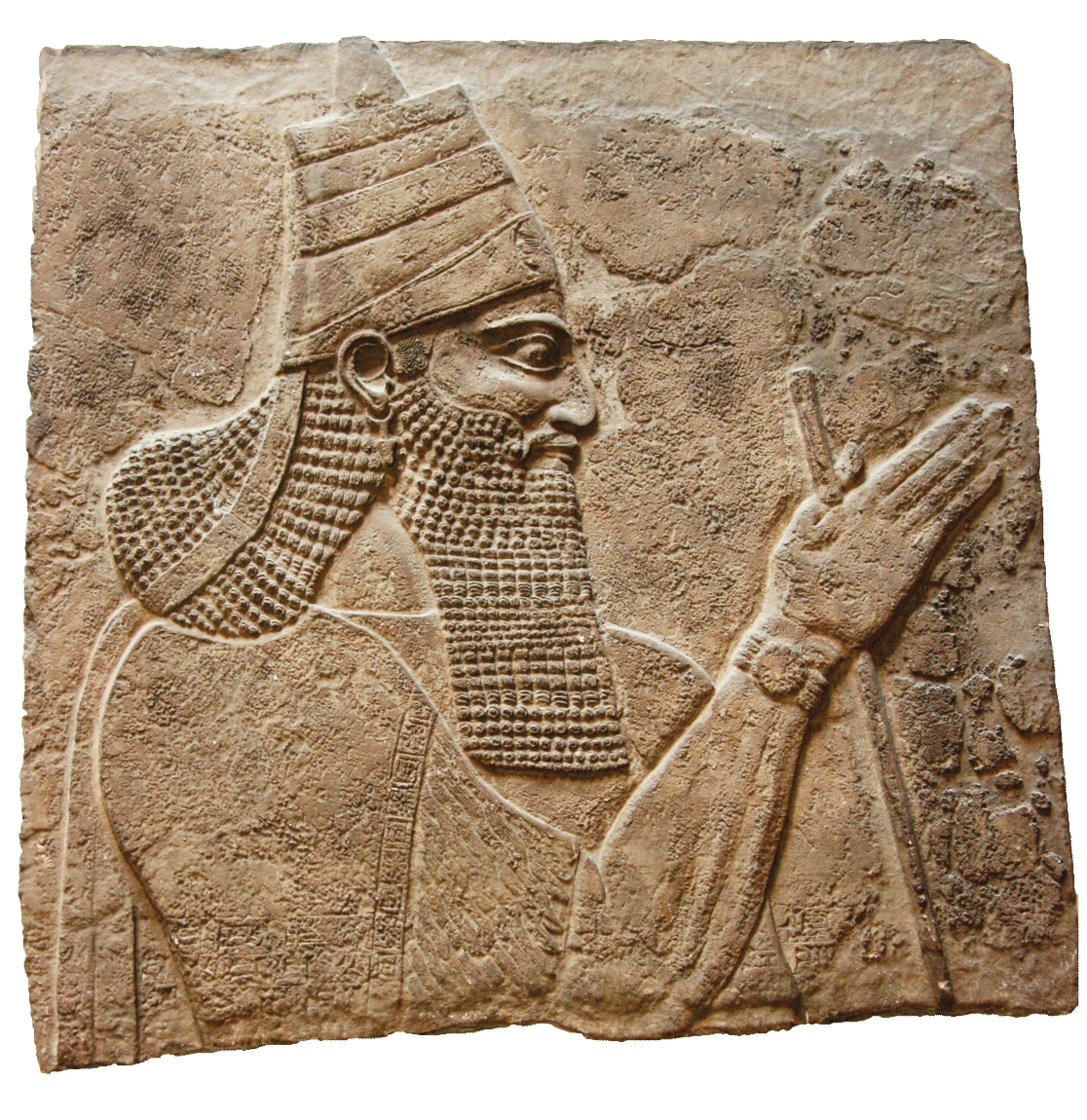
Relief of Tiglath-Pileser III (Nimrud, Assyria, ca. 728 BC), referred to as Pul in 2 Kings 15:19
15:1–38. The ignoble demise of Amaziah results in the succession of his son Azariah (also called Uzziah) to the throne of Judah (15:1–7), one of the better kings who enjoys a long reign, but one who also fails to do anything about the high places (whether because it was politically incorrect to do so, or because he lacked the requisite spiritual discernment). It is conspicuous that Azariah/Uzziah is struck with leprosy, with no precise explanation given except that “the Lord” is responsible. The affliction is severe enough to warrant confinement and limit his duties, and after his partition there is a coregency with his son Jotham.
A rapid parade of northern kings follows—few of whom are distinguished in any way, or particularly competent—beginning with Zechariah (15:8–12). The entire stretch of text is fraught with violent overthrows and coups, and Zechariah’s short tenure provides an overture. We suspected Jehu’s dynasty was nearing the end, and the king’s public assassination by Shallum brings to fulfillment the prophetic word spoken to Jehu. Shallum’s identity is obscure, and the report of his one-month reign gives little detail (15:13–16) other than his death at the hands of Menahem from Tirzah. Some scholars reconstruct a political background, suggesting that some leaders were interested in fostering ties with Aram while others were more enticed by an Assyrian alliance. Such a theory gains plausibility with the report of Menahem’s reign (15:17–22), as he gathers substantial revenues to pay off Pul (another name for the Assyrian king Tiglath-Pileser III) during what must have been a sizable invasion; the reader needs no reminder that making deals with foreign kings is always a perilous enterprise. It is almost surprising when Menahem’s son Pekahiah succeeds him on his death (15:23–26), but the familiar pattern of usurpation continues with Pekah’s treacherous takeover (15:27–31). The twenty-year reign of the penultimate king of Israel is dominated by an increasing Assyrian presence in the region. Reports that Assyrian incursions are gaining in frequency and scope does not bode well for Israel or Judah.
Indeed, Judah is not exempt from the growing Assyrian pressure. Jotham’s political career in Judah began with coregency in 15:5, but his formal reign commences when he accedes to the throne after the death of his father (15:32–38). Jotham manages to rebuild the “Upper Gate” of the temple, but this project is eclipsed by mounting anxiety over external matters, such as the northern alliance (Israel and Aram) against Judah. Yet there is a powerful assertion in verse 37 that even the growing maelstrom of international hostility is under the aegis of divine sovereignty.
16:1–20. Hostility toward Judah is not abated, and in fact it increases in the next segment of the story, the reign of Ahaz (16:1–20). The Ahaz administration has a bad start: previous kings were censured for not removing the high places, but Ahaz goes a step further by actually worshiping at these installations. Even worse, he adheres to the terrifying practice of child sacrifice, and such conduct presages a litany of compromises and surrenders in this chapter. Ahaz follows the ways of the nations that the Lord drove out, and his egregious conduct paves the way for such nations to return. Ahaz’s deal with Assyria is prompted by the so-called Syro-Ephraimite pact of aggression (see also Isaiah 7): the kings of Aram and Israel want Judah to join in against Assyria, and to signal their ambitions the port of Elath is seized. Ahaz resists the invitation by pilfering the treasury and pleading for Assyrian assistance. Ahaz opts for submission, and the king of Assyria is all too willing to fulfill his end of the bargain by decimating Damascus. In the aftermath of destruction Ahaz is invited to the humbled city of Damascus, and the reader now realizes that submission to Assyria comes at an even steeper price. In an attempt to ingratiate himself with his new master, Ahaz sends blueprints for the redesigned altar of the temple in Jerusalem after a foreign prototype, and thus the place of worship becomes corrupted as a place of political servitude. It is hard to determine the degree of complicity on the part of Uriah the priest, but he certainly does not appear to be a “Jehoiada” for these times. After sixteen years Ahaz dies and is succeeded by Hezekiah, a son who inherits a legacy of Assyrian accommodation.
17:1–41. A heightening sense of inevitability of the northern kingdom’s doom is poised for climax. In Deuteronomy 8:19 Moses warned, “If you ever forget the Lord your God and follow other gods and worship and bow down to them, I testify against you today that you will surely be destroyed.” Such a warning has not been sufficiently heeded and finds its grim realization during the truncated reign of the woeful Hoshea (17:1–6), who probably regrets attacking and usurping Pekah in 16:30. Curiously, Hoshea is described in better terms than previous kings of Israel, but his attempt to rebel against Assyria and seek assistance from Egypt is rewarded with incarceration and a three-year siege of Samaria by the new king, Shalmaneser. Once the city is captured, the population is deported to various outposts of the Assyrian Empire.
In the lengthy catalog of indictments against the northern kingdom (17:7–23), it is as though the author comes out from behind the curtain to address the audience directly. The catalog is self-explanatory and requires little commentary, and scholars agree that it constitutes a theological explanation for the fall of the north. It is not just the leaders who are guilty—although they are implicated beyond doubt—but there has been widespread collaboration of all the people in covenant unfaithfulness and chasing after what the NIV translates as “worthless idols” (or “vanities,” the same word that begins Ecclesiastes). Interlaced in the midst of the catalog is also an assessment of Judah, and the southern kingdom is just as guilty. Judah survives for the time being, however, because of the promise to David. But in this context is laced a profound sense of caution, as though Judah is given one more chance to avoid the disaster that has just engulfed the north.
The city of Samaria is hit hard by the Assyrians, but the deportation of the population is only half the story (17:24–41). By resettling different groups of Mesopotamian deportees in the “towns of Samaria,” the king of Assyria also introduces a cornucopia of new deities and attendant ideologies into the land. Lion attacks (see 1 Kings 13) only serve to bring back a local priest to conduct basic theological education; whether a priest of Samaria is to be understood as a pillar of orthodoxy is not under discussion, but what results is a hybrid syncretism. Samaria, as the epicenter of northern corruption, was a snare to Judah before the collapse, and there are hints that it will continue to be so in the future, albeit in a different guise with a different population. This religious threat may prove more trouble in the end than Assyria’s military, but for the moment, Judah has its hands full with that situation.
E. Hezekiah’s Assyrian crisis (18:1–20:21). 18:1–37. Although the destruction of Samaria has taken place, the Assyrian ambition is far from quenched. The accession of Hezekiah occurs in less than enviable circumstances, but the early report of his reign ushers in a spring of hope after a long winter of despair (18:1–8). Part of his comprehensive housecleaning includes pulverizing the bronze snake, a venerated object from the days of Moses. One recalls that Moses made the snake for healing, but now this great symbol has to be destroyed, as it has become irredeemably corrupted. Such actions earn Hezekiah the highest commendation from the narrator—even to the point that his rebellion against Assyria and defeat of the Philistines is praiseworthy. While Hezekiah is undertaking his reforms, we are reminded that the northern kingdom is dismantled by the Assyrians (18:9–16). Working their way south into Judah, they find that the “fortified cities” are no match for them; with Jerusalem firmly in the Assyrian sights, Hezekiah has little option except to grovel and pay a hefty fine.
The amount Hezekiah pays, scholars tell us, is ridiculously high, and to generate enough gold the temple has to be stripped right down to the baseboards. Although the fine is paid, it seems to avail little, as the highest-ranking officials of Assyria still show up in Jerusalem (18:17–25). The confrontation with the field commander happens at the “aqueduct,” a poignant spatial setting that strongly suggests a possible siege. With a long speech, he lampoons Hezekiah’s strategic initiatives with Egypt and the recent religious reforms. The Assyrian ambassador claims, boldly, to speak for the Lord! After Hezekiah’s representatives request Aramaic (18:26–37), the orator calls the bluff: not only does he respond in Hebrew, but he ups the rhetoric a notch, talking about the gloomy realities of a siege. As the reader knows, history is on his side (e.g., 2 Kings 6:24–29, and the cannibal mothers). The “war of the words” reaches a crescendo with a verbal assault on the person of the king, followed by lavish promises about peace and security, promises that must be more appealing than drinking urine. The speaker sounds like a passionate prophet talking about a land of milk and honey—and he intones that Assyria is like a juggernaut crushing every land and god! In light of this onslaught, the self-control of the people indicates the kind of respect they have for their leader.
19:1–37. To this point in the confrontation Hezekiah has been represented by proxy, through leading representatives within his circle of advisors. Now his personal response is detailed (19:1–4), and his impulse is to send a message to the prophet Isaiah—who makes his first appearance in the text at this point. Earlier we are told that Hezekiah “trusted” the Lord (18:5); the practical ramification is that he is willing to call on the prophet here rather than make an arrest (cf. 6:30–31). Dressed for a funeral and citing proverbial metaphors about difficult childbirth (meaning no hope for the future), the king pleads for prayer on behalf of “the remnant” against an infinitely superior and mocking oppressor. Isaiah’s response sets up a confrontation between two counselors, and he now appears as a counterpart to the king of Assyria’s representative (19:5–13). Isaiah’s message is unequivocal: the onslaught will not finally succeed. It is unlikely that the Assyrians are aware of this message, but they continue their southern offensive and send a further message to Hezekiah—rather more terse this time—about his certain defeat. On receiving this deadly epistle, Hezekiah visits the temple (19:14–19) and, presumably in the presence of the ark, utters an intense supplication. The relative postures of the two kings seem to be a point of issue: one is powerful and all about military hardware, whereas the other is powerless and all about prayer.
The Assyrian field commander scaled considerable rhetorical heights in his long speeches of the previous chapter. Isaiah also sends a message (19:20–34), seemingly unsolicited, and the field commander’s bravado pales before the oracle of Isaiah. In Isaiah’s poetic economy, the powerful king is mocked by a young lady, as he eventually returns with a hook in his nose. The words for the king of Assyria are highly personal, informing him that his sweeping victories are not because of his logistics but because of God’s foresight to use the Assyrians as part of his divine plan. Hezekiah is also given a sign (encouraging him to give patient leadership to the remnant who will survive), and the immediate crisis will be resolved as God will defend Jerusalem “for my sake and for the sake of David my servant” (19:34). While no response of Hezekiah is preserved, the resolution of the conflict surely provides some vindication for prophet and king (19:35–37). The same “angel of the Lord” who visits Elijah with bread in 1 Kings 19:7 now visits the vast Assyrian army with death. As for Sennacherib, he too spends time in a temple, like Hezekiah. But according to this text Nisrok does not undertake on behalf of his supplicant, as Sennacherib is cut down with the sword, courtesy of his own offspring.
20:1–21. Although the Assyrian threat has spectacularly subsided, Hezekiah’s struggles are the subject of a pair of episodes in 2 Kings 20 that pertain to the king’s person and his progeny. In the first (20:1–11), by means of a flashback the reader discovers that in the midst of the Assyrian attack, Hezekiah was gravely ill. A precise diagnosis of Hezekiah’s sickness is not the point; rather, this sophisticated literary technique allows Hezekiah’s illness to become a moment of parabolic reflection on the Assyrian invasion and its aftermath. Hezekiah is threatened with certain death, just like the city, yet he prays and is miraculously delivered. For the sake of God’s promise, Jerusalem too is delivered, but just as Hezekiah is given fifteen more years, Jerusalem’s time is ultimately limited. The purpose for the “shadow sign” is to demonstrate that God can turn back the time of judgment, should he be willing. It is entirely intentional, therefore, that the next episode about emissaries from the king of Babylon (20:12–19) follows the account of Hezekiah’s recovery. Ostensibly arriving to offer congratulations to the king, the Babylonian diplomats get an extensive tour of the royal precincts. The temporal note “at that time” implies that the visitors arrived while the Assyrian crisis was still going on and thus provides a clue as to the real motives: the Babylonians are seeking an ally in the west against Assyria. Their exact motives (and the motives of Hezekiah, for that matter) quickly become peripheral as the episode continues. Isaiah, having given a series of powerful words of hope, does not appear thrilled at the presence of the envoys, and his words are scathing. This is not, Isaiah declares, the last time the Babylonians will lay eyes on the treasures of Jerusalem, for the time is coming when the treasures will be forcibly exported there. Hezekiah’s reaction is staggeringly shortsighted: his own descendants will be emasculated, but he is happy that he will retire in peace. Some interpreters try to defend the king, but it is hard to deny that Hezekiah’s response puts a real damper on an otherwise remarkable reign. The chapter ends with a regnal summary (20:20–21), including the ingenious engineering feat still called “Hezekiah’s tunnel” to this day.
F. Babylon rising (21:1–24:17). 21:1–26. The visit of the Babylonian dignitaries is a prelude to the role Babylon plays through the end of 2 Kings. Hezekiah is succeeded by his son Manasseh, and a reader could be forgiven for expecting good things from this era. The fifty-five-year reign of Manasseh, though, is described in the worst possible terms (21:1–18), and under his leadership more evil is done than even in the dispossessed nations. It is hard to believe that such an all-inclusive program of idolatry can be implemented in light of the recent deliverance from the Assyrians, but it earns Manasseh a unique prophetic censure: a group of prophets, speaking with unanimity, condemns the king and forecasts disaster for the nation. Manasseh is likened to Ahab, and the fate of Jerusalem is likened to that of Samaria, hardly a flattering set of comparisons. It is also said that Manasseh filled Jerusalem with innocent blood literally from “mouth to mouth” (NIV “end to end”), a phrase that last occurred in 2 Kings 10:21, when Jehu purged the land of Baal worship. The shedding of innocent blood, as several commentators note, points to massive injustices alongside religious apostasy. When Manasseh dies, there is no sign of improvement under his son Amon (21:19–26), who engages in the same evil practices as his father. Amon falls victim to a conspiracy led by his officials, who are summarily executed by the “people of the land.” One recalls that the “people of the land” were active in the overthrow of Athaliah in 2 Kings 11, so it is most likely the same kind of popular uprising here. Furthermore, the installation of the eight-year-old Josiah is reminiscent of young Joash’s replacing Athaliah.
22:1–23:30. Josiah’s arrival has been long anticipated. Back in 1 Kings 13, the man of God from Judah arrived in Bethel, and with the highly unusual disclosure of a proper name hundreds of years ahead of time, prophesied that this son of David’s house would obliterate the altar of this northern shrine. Given such advance billing, there is a sense of great expectation when Josiah’s reign begins after he is installed by the people of the land (22:1–2). His father and grandfather were the worst royal tandem ever, and so it is against the odds that Josiah earns the unique commendation of not turning “to the right or to the left” (see Deut. 5:32) as he does what is upright in God’s sight.
Like Joash before him, Josiah sponsors renovations of the temple (22:3–10). Just after the halfway point of Josiah’s reign, during the routine duties of paying workers and supervising the project, a discovery is reportedly made by the high priest Hilkiah: the book of the law (“the Torah”). It is not hard to imagine how the book was eschewed during the reigns of Manasseh and Amon, and whether a cadre of priests kept it hidden or it was literally lost, the book is back on the radar after a long absence. The book is not only found, but it is also read in the king’s presence. Considerable scholarly energy has been expended on identifying the contents of this book, but most agree that Deuteronomy must form a significant portion of this scroll that is read aloud before the king. Josiah’s response (22:11–13) confirms as much: his actions (garment tearing) and his words (calling for a prophet) parallel the response of Hezekiah to the fearful oratory of the Assyrian field commander. Josiah understands these words to have a similar kind of present-tense reality, and a similar threat.
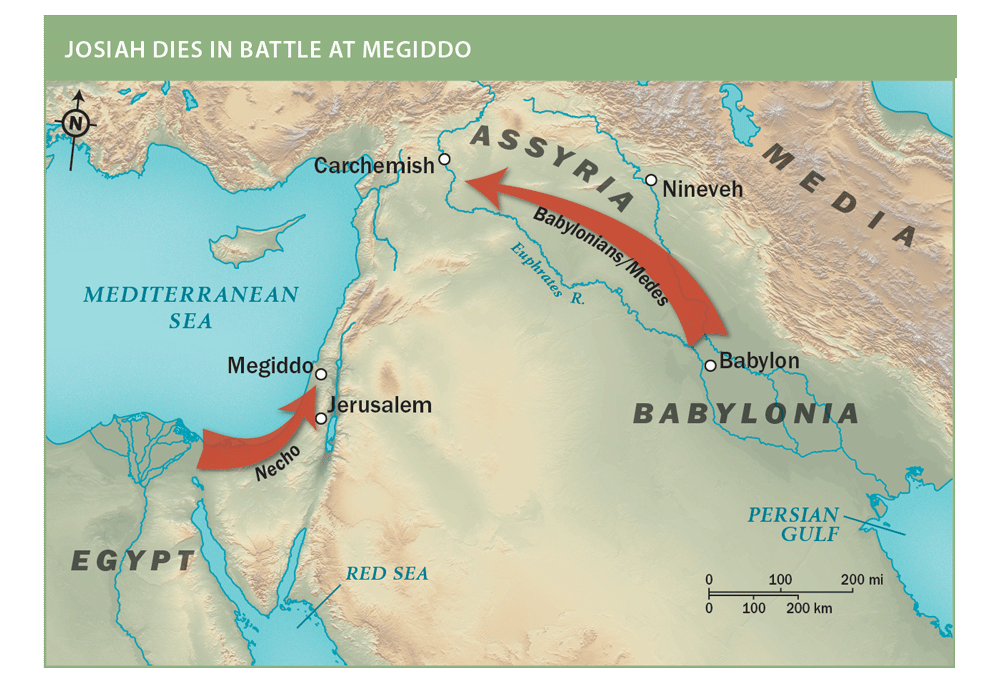
By calling for a prophetic interpretation, Josiah shows his immediate concern is to take a drastically new course of action. His officials are dispatched (22:14–20) to “inquire” of the Lord, the same request that Jehoshaphat made back in 1 Kings 22. The officials go to Huldah, who has not been mentioned in the story before; she resides in Jerusalem and is part of a prominent family circle. She addresses two different audiences: first the nation, then the king himself. As for Judah, the prognosis is dire: “disaster” (literally “evil”) is forecast. Huldah’s words are in line with the unified prophetic declaration of 21:10–15. As for the king, Huldah’s words affirm his personal piety and laudable reaction to the words read from the scroll. His reward is somewhat counterintuitive: he will journey to the grave in peace (Hebrew shalom) and not lay eyes on the evil that will befall Judah. Since Josiah dies rather violently at the end of the next chapter, some have pointed to inexact prophecy here. But on the contrary, the manner of Josiah’s death is “peaceful” when compared with Jerusalem’s invasion, which is now dead ahead on the horizon.
Although the prophetess Huldah has unequivocally announced certain doom, the king calls together Judah’s leadership for a public reading of the “Book of the Covenant” and a covenant renewal ceremony (23:1–14). Commentators often point to texts such as Joshua 24 as an analogue, or, more recently, to the ceremony led by Jehoiada (2 Kings 11:12). After the assembly, a host of idolatrous installations are removed, not just the typical Baal and Asherah equipment, but also all the paraphernalia associated with practices like child sacrifice, astral deities, and chariots dedicated to solar worship. From the highly detailed description of the removal one sees the vastness of the installations, here pictured with more specificity than at any other point (even chapter 17, with its catalog of northern abuses). Not only are these installations recent (as in the eras of Manasseh and Amon), but such activity goes as far back as the syncretism of Solomon as well.
There was an early hint in 23:4 that Bethel would not be exempt from the reforms, and singled out for special attention is the altar of Bethel (23:15–20) constructed by Jeroboam. Not only does the destruction of the altar fulfill the prophetic utterance spoken long ago; it also indicates Josiah’s willingness to travel outside of Judah, and even to Samaria. After Josiah’s return to Jerusalem, it is symbolically appropriate that the Passover is celebrated (23:21–25), as Deuteronomy 16:5–6 outlines that this most important feast—commemorating the saving events of the exodus from Egypt—needs to be held in the place that God “chooses.” It has been many days since the land has seen this celebration, maybe since the time of Joshua 5 (although see 2 Chronicles 30). But on the heels of another commendation of Josiah is a further reminder of imminent destruction (23:26–30), and even these extensive and far-reaching reforms are not enough to offset Josiah’s end or Judah’s invasion. The shadow of judgment does not move backward, as in the days of Hezekiah, and the story is marching inexorably toward exile. Josiah’s untimely death at Megiddo takes place, literally and figuratively, between two superpowers as he tries somehow to thwart the Egyptians who are coming to aid Assyria. His death resembles his reform movement in Judah; although brave and passionate, he is unable to stem the rising tide of Babylon.
23:31–24:17. A fair bit of narrative space is dedicated to Josiah’s kingship, but now there is a sense of narrative acceleration as we move more quickly to the end, beginning with the short and profoundly ineffective reign of Josiah’s son Jehoahaz (23:31–35). Under the control of Pharaoh Necho, Jehoahaz is transferred as a prisoner from Riblah in Syria to Egypt and has to pay a fine (although it is a pittance compared with Hezekiah’s fine, showing how economically crippled the nation is). Jehoahaz dies in Egypt, in a house of bondage, with an Egyptian king once more acting aggressively against God’s people. The brief reign of Jehoahaz will be typical, since there will be no political autonomy for Judah from now until the end. Instead, Judah’s affairs are seemingly determined by foreign superpowers. The reader is reminded, however, that these nations are not operating of their own volition, but are subject to “the Lord’s command.” This includes the first Babylonian invasion of the land during the reign of Jehoiakim (23:36–24:7), who is, like his predecessor, subservient to a more powerful king. Historians inform us that Jehoiakim made several alliances, bouncing back and forth before Babylon forcibly won the day. When Jehoiachin assumes the throne (24:8–17), Babylonian hostility has reached the point of a siege on Jerusalem. No doubt aware of the kind of exigencies created by a siege, the king and company surrender and are taken into exile. During the visit of the Babylonian envoys way back in 2 Kings 20, Isaiah warned that all the valuables would be taken from the treasury, and that word begins to be fulfilled during the days of Jehoiachin. With the king in Babylon, his uncle Mattaniah takes his place (I assume that Mattaniah changes his own name to Zedekiah, perhaps hoping for a change of destiny in the process).
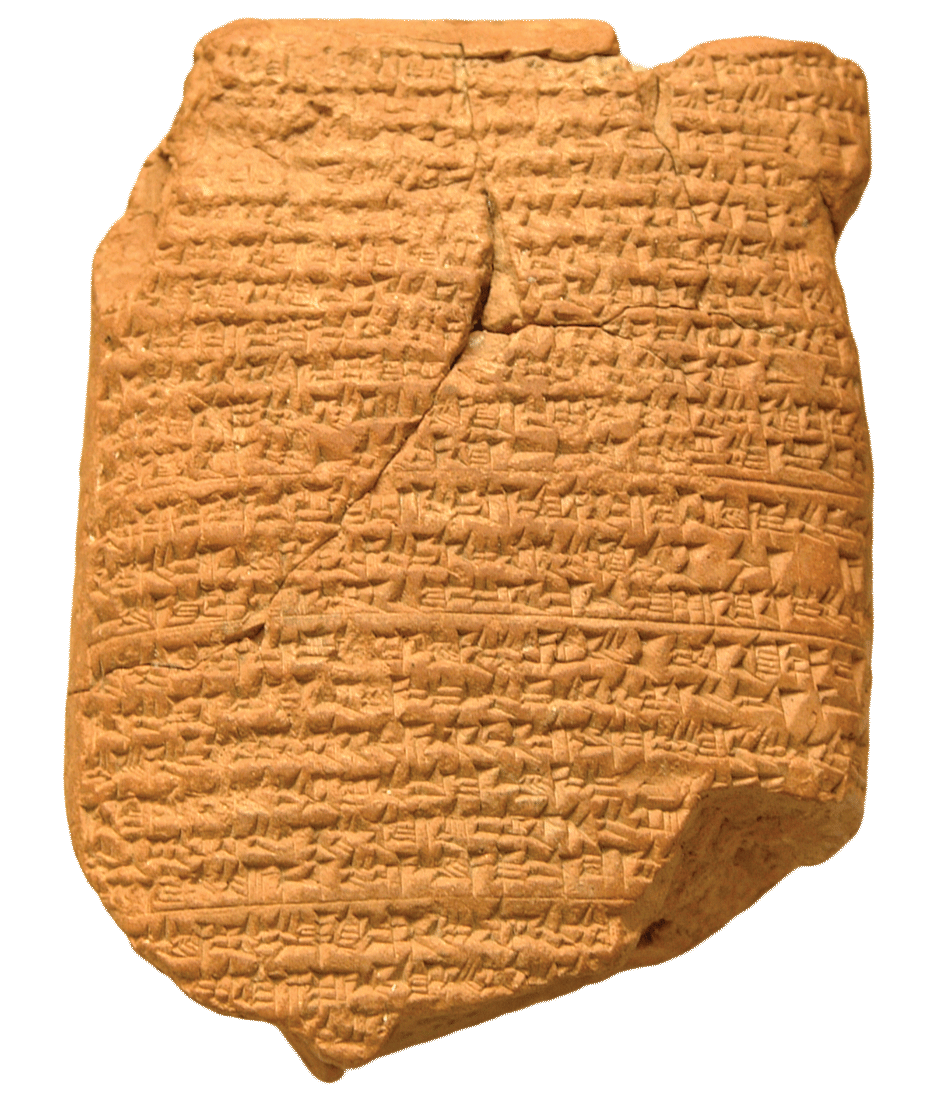
A Babylonian inscription (550−400 BC) recording Nebuchadnezzar’s attack on Jerusalem (see 2 Kings 25)
G. Judah’s captivity (24:18−25:30). Zedekiah may have changed his name, but he is powerless to change the times. It is under his leadership (24:18–25:12) that the kingdom of Judah reaches its end.
For some reason, Zedekiah rebels (or “acts audaciously”) against the king of Babylon, in all likelihood by siding once more with Egypt (25:1−12). Whatever Zedekiah was hoping to achieve through such a rebellion did not happen, and Nebuchadnezzar’s retribution is fierce: Jerusalem becomes a city under siege, and the siege is a long one. Finally, the wall is breached (historians point to a date of 586 BC for this event), resulting in the worst day in the history of God’s people. Rather than surrender like Jehoiachin ten years earlier, Zedekiah and his sycophants flee, but they are duly overtaken, and the last thing Zedekiah ever sees is the execution of his sons. Blinded, he is marched to Babylon; in retrospect, he should have changed his name to Ichabod, “where is the glory?” Meanwhile, the city of Jerusalem is looted, and a high percentage of the population is likewise sent into exile. A careful description is provided for the dismantling of the temple (25:13–21), but there is no mention of any idolatrous paraphernalia, only implements and vessels known from the blueprints of the Torah.
Judah is sent into captivity, but Nebuchadnezzar does install a provisional government for those who remain (25:22–26), with Gedaliah (grandson of Josiah’s official in chapter 22) as the superintendent in the town of Mizpah. His directive to settle down and serve the Babylonians does not sit well with a faction led by Ishmael, whose “royal” bloodline receives no elaboration (though some interpreters point to Elishama, David’s son in 2 Sam. 5:16). This faction is probably pro-Egypt, because Egypt is where they head after the assassination of Gedaliah, motivated by fear of Babylonian reprisal. One can immediately sense that this moment—with a remnant of the people in Egypt—functions as an important preface to the final scene of the chapter (25:27–30), indeed, of 1–2 Kings as a whole. God’s people are now in exile and needing an exodus, just like in the days of old. With the last king of Judah chained in Babylon, such hope looks slim. But Jehoiachin’s parole in the concluding lines of the book becomes a reminder that God’s promise to the house of David will endure. The promise will not end with a restoration of the monarchy but with a movement toward the messiah.
Select Bibliography
Brueggemann, Walter. 1 & 2 Kings. Smith & Helwys Bible Commentary. Macon, GA: Smyth & Helwys, 2000.
Fretheim, Terence E. First and Second Kings. Interpretation. Louisville: Westminster John Knox, 1999.
Hens-Piazza, Gina. 1–2 Kings. Abingdon Old Testament Commentaries. Nashville: Abingdon, 2006.
Long, B. O. 2 Kings. Forms of the Old Testament Literature. Grand Rapids: Eerdmans, 1991.
Provan, Iain W. 1 and 2 Kings. New International Biblical Commentary. Peabody, MA: Hendrickson, 1995.
Römer, Thomas C. The So-Called Deuteronomistic History: A Sociological, Historical, and Literary Introduction. New York: T. & T. Clark, 2005.
Seitz, Christopher R. Prophecy and Hermeneutics: Toward a New Introduction to the Prophets. Studies in Theological Interpretation. Grand Rapids: Baker Academic, 2007.
Seow, C. L. “1 & 2 Kings.” In The New Interpreter’s Bible. Edited by Leander E. Keck. Vol. 3. Nashville: Abingdon, 1999.
Sweeney, Marvin A. I & II Kings. Old Testament Library. Louisville: Westminster John Knox, 2007.
Walsh, J. T. 1 Kings. Berit Olam. Collegeville, MN: Liturgical Press, 1996.
Wray Beal, Lissa M. The Deuteronomist’s Prophet: Narrative Control of Approval and Disapproval in the Story of Jehu (2 Kings 9 and 10). Library of Hebrew Bible/Old Testament Studies 478. New York: T. & T. Clark, 2007.