Ezra-Nehemiah
1. The First Mission: The Return of the Jews to Judah (Ezra 1:1–6:22)
A. Cyrus’s Proclamation (1:1–4)
B. Preparations for the Return (1:5–11)
C. The List of Returnees (2:1–70)
E. Rebuilding the Temple (3:7–13)
F. Opposition to the Work (4:1–24)
G. Resolution: The Temple Building Continued and Finished (5:1–6:22)
2. The Second Mission: The Return under Ezra (7:1–10:44)
A. Introduction and Preparation (7:1–28)
B. The Return to Jerusalem (8:1–36)
C. Opposition from Within: The Crisis of Intermarriage (9:1–15)
D. Resolution: The Covenant to Change (10:1–44)
3. The Third Mission: Nehemiah Restores the Wall (Neh. 1:1–7:73a)
C. Opposition to Rebuilding the Wall (4:1–6:14)
D. Resolution: The Wall Completed; Community Consolidation Begun (6:15–7:73a)
4. The Consolidation of the Covenant Community (7:73b–13:31)
A. Spiritual Renewal according to the Torah (7:73b–12:26)
B. Celebration and Dedication (12:27–43)
C. Conservation of the Renewed Community (12:44–13:31)
Introduction
The combined book of Ezra-Nehemiah gives us a glimpse of the drama and struggles of the Israelites as they return to Judah from captivity in Babylon to reestablish their community centered on the worship of the one true God. But it is more than a simple chronicle of events; Ezra-Nehemiah uses narration to teach and guide the community in its faith and everyday life.
Many studies of the history of Israel give little attention to the postexilic community. However, in God’s redemptive plan, every period is important for the continuity and fulfillment of that plan. This small community of returned exiles was used by God to preserve and give to the world the inspired Scriptures of the Old Testament. These people kept alive the faith, worldview, and messianic hope that God had been progressively revealing for centuries. They prepared the way for the coming of the Messiah. Thus the work of Ezra, Nehemiah, and the people in restoring the temple worship (Ezra 1–6); in renewing emphasis on the Torah (Ezra 7–10); in the restoration of the wall and development of the community (Nehemiah 1–7); and in the cultural revitalization, the spiritual renewal, and the community consolidation (Nehemiah 8–13) all has strategic importance in God’s eternal redemptive plan.
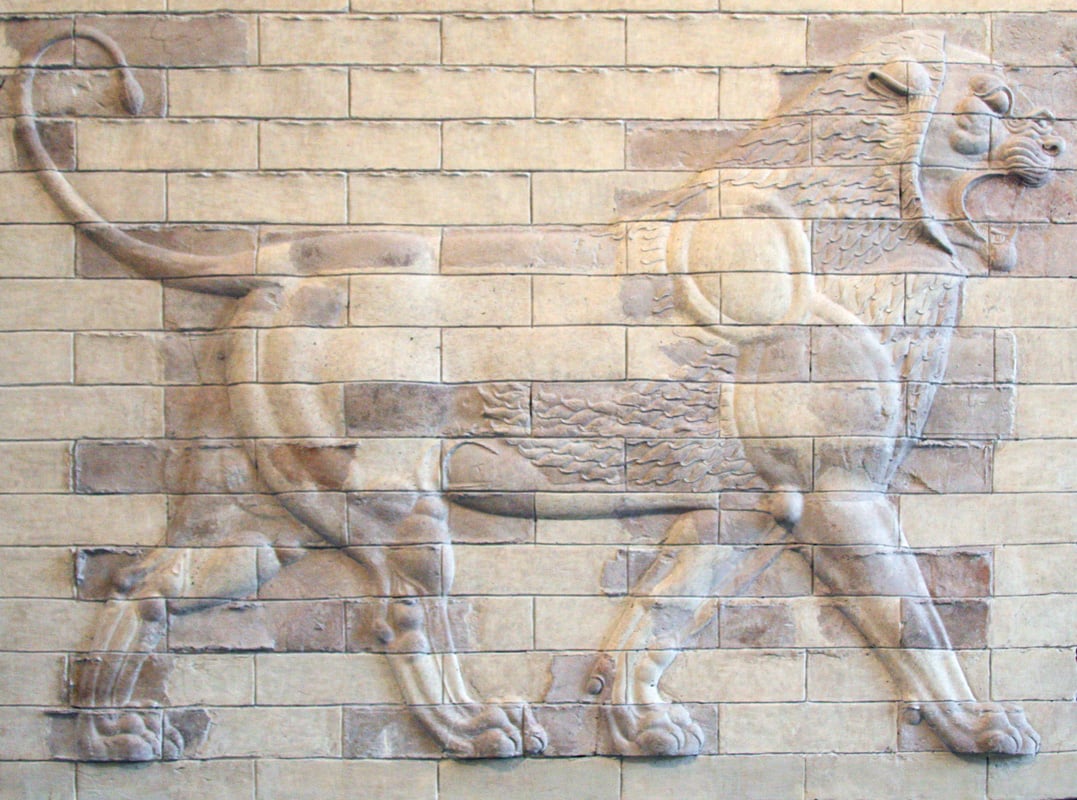
Historical Context
In regard to the historical setting, the narrative of both Ezra and Nehemiah concerns the small postexilic community of Jews in Judah. These Jewish people had a vital interest in their own history. They knew that they were descendants of Abraham and Jacob, with specific promises from God regarding his purpose for the Jewish people. At the same time, they were prone to discouragement because of their precarious position in the vast Persian Empire. They were also surrounded by hostile communities.
After the glorious reigns of David and Solomon, the Jewish kingdom was divided (931 BC) into the northern and southern kingdoms. Both 1–2 Kings and 1–2 Chronicles describe the struggle to maintain faith in Yahweh. God raised up prophets to warn the people of their sinful, rebellious ways and to prophesy that destruction and captivity would occur unless the people repented.
In 722–721 BC the Assyrian Empire conquered the northern kingdom, exiling much of the population to other parts of the empire. The southern kingdom, with the Davidic dynasty, continued until 587–586 BC, when it was conquered by the Babylonian Empire. Most of the surviving population was taken captive to Babylon.
Although the Babylonian conquerors were less brutal than the Assyrians, the Jews were still captives in a foreign land. They had not believed Jeremiah’s warnings about God’s judgment (e.g., Jer. 1:14–16; 4:15–18; 6:6–8), preferring to believe the false prophets who said God would never let Jerusalem fall.
The Jews faced a serious test of their faith during the captivity. Now they realized that Jeremiah was right since his prophecies were fulfilled (Jer. 29:10–14). This realization helped many to believe Jeremiah’s positive message that God still had a purpose for them and that they would return to Palestine. Largely through the messages of Jeremiah and Ezekiel, the faith of Israel survived the captivity.
However, after the people had waited nearly fifty years, the return seemed remote. Then, in 539 BC, the Persian king Cyrus I suddenly moved to capture Babylon. His army took the city practically without a struggle. Thus Cyrus controlled the whole Babylonian Empire, including Palestine.
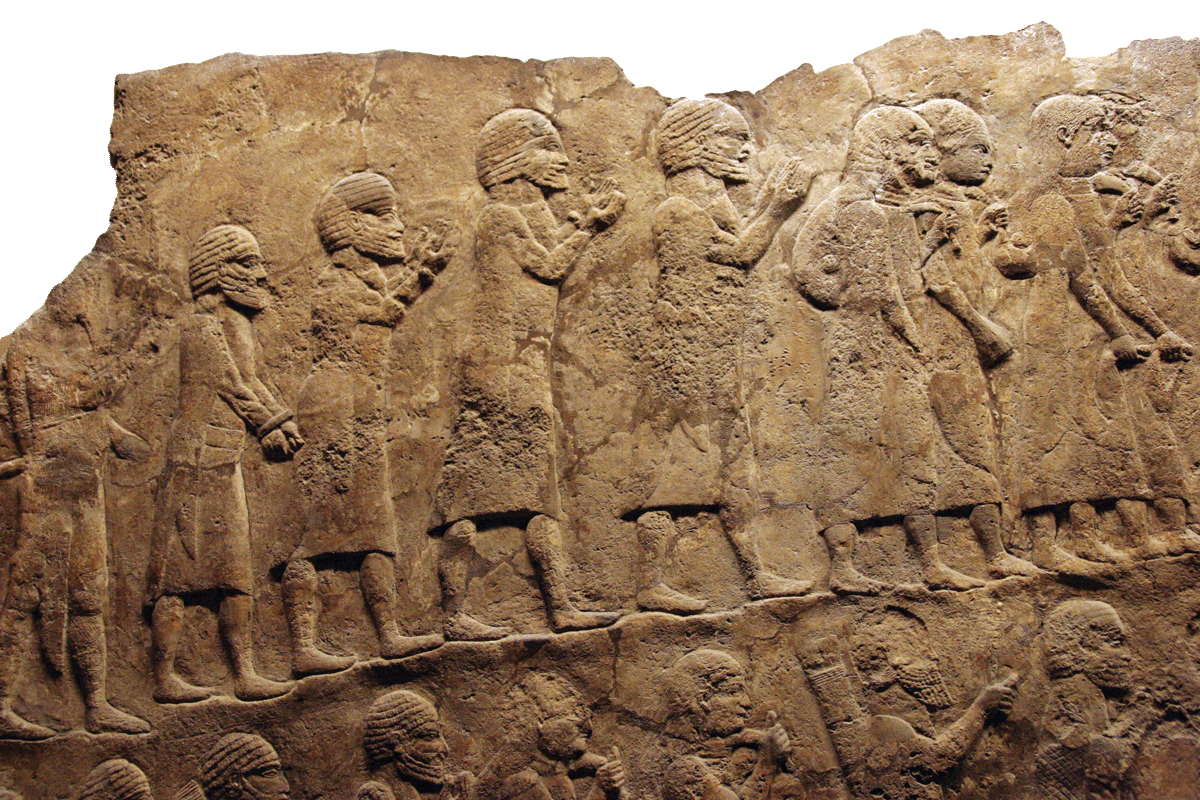
Assyrian relief from Sennacherib’s palace at Nineveh (700–692 BC) showing captives from one of Sennacherib’s military campaigns
The Assyrians had been brutal, transporting captives to different parts of the empire and massacring whole populations. The Babylonians were somewhat less cruel but followed the same practice of taking whole populations captive and deporting them. Cyrus, however, encouraged conquered peoples to continue their own religions and cultures. When he took over Babylon he allowed the Jews and other captive peoples to return to their homelands.
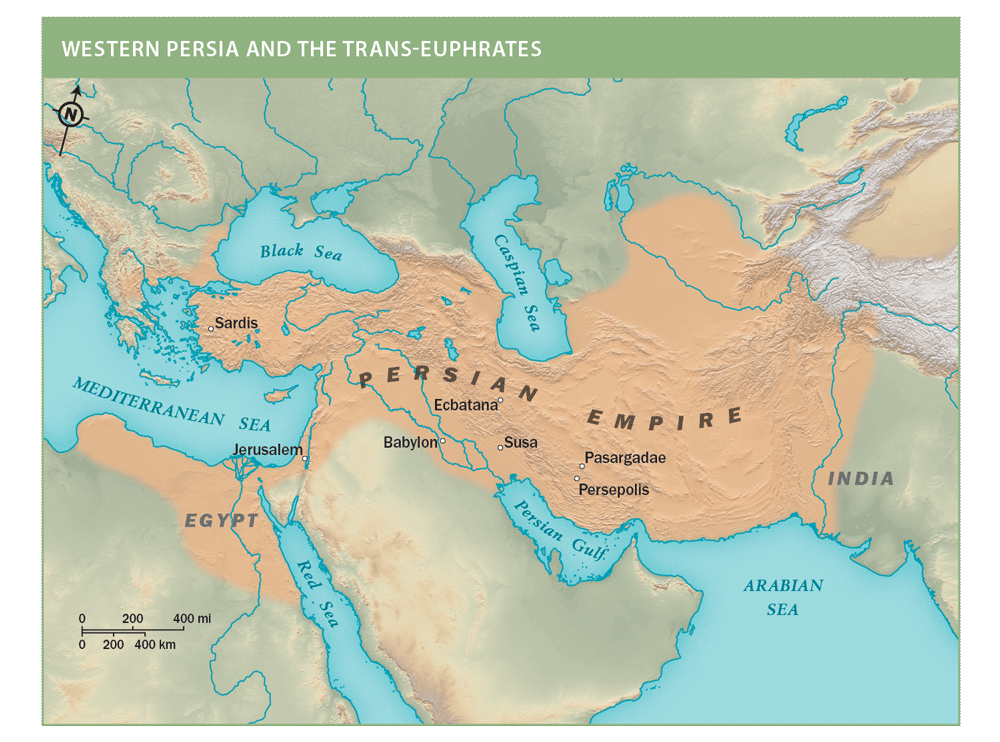
The Persian Empire dominated the political scene of the ancient Near East from its capture of Babylon in 539 BC until its defeat by Alexander the Great in 330 BC (see Table 1 for a chronological picture of the period). The Persian Empire reached its most developed organization and its greatest extent in the reign of Darius I (522–486 BC). It extended from Egypt, Thrace, and Macedonia in the west to the Indus Valley in the east. Under Darius the empire was divided into twenty satrapies, which were further divided into provinces. The Persian “satraps” were virtually kings over their huge satrapies. Their provinces were supervised by governors, normally from local descent. Thus, in Ezra and Nehemiah, Zerubbabel and Nehemiah are called governors.
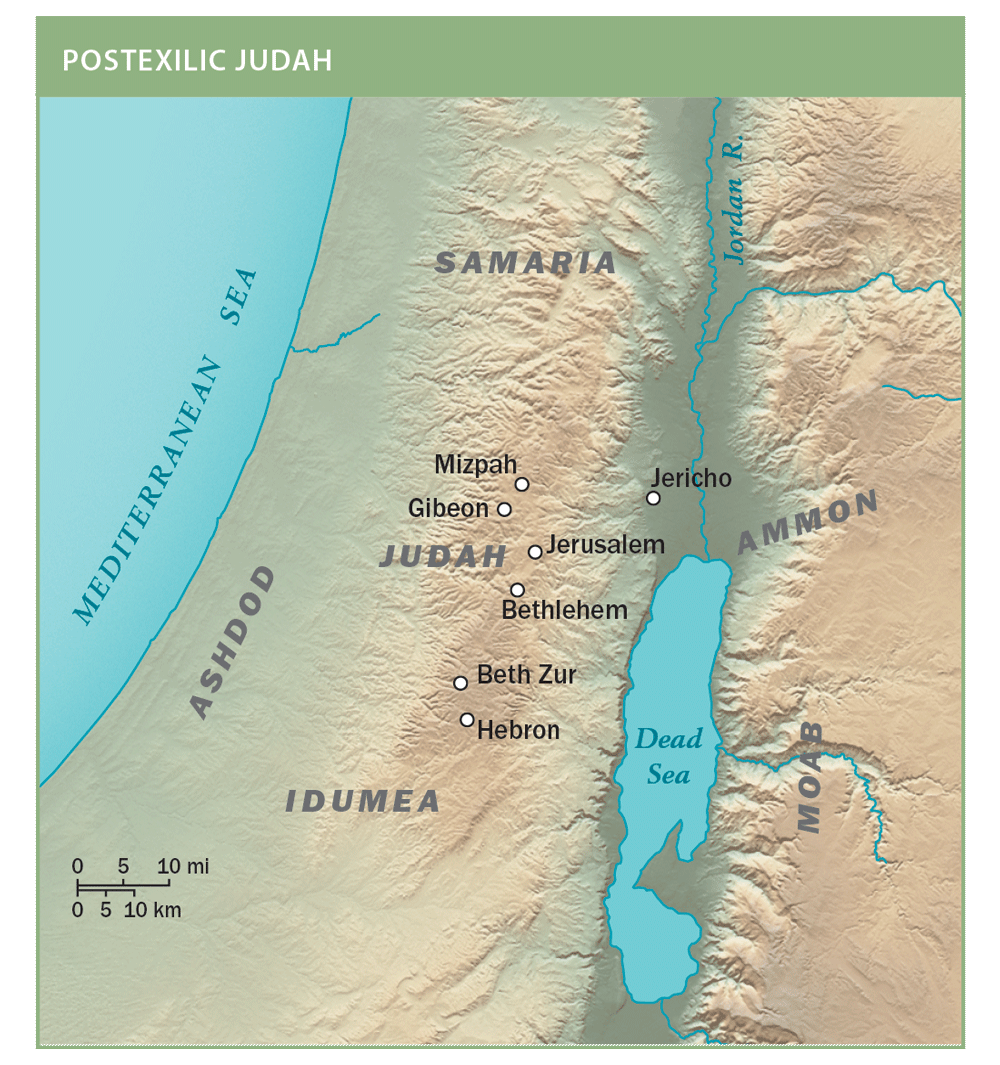
Judah was a small province; its area was between 950 and 1,150 square miles (compare to the state of Rhode Island, 1,214 square miles). The northern boundary passed through Mizpah and Gibeon and on to the Jordan River. The southern boundary was between Beth Zur and Hebron. During the time of the exile the Edomites took over much of southern Judah, since the Edomites were driven from their homeland by the Nabatean Arabs.
Archaeology indicates that Judah was sparsely populated and quite poor during this time. Although when Judah and Jerusalem fell in 587 BC most of the survivors were carried as captives to Babylon, a few Jews remained in the land. A group of them fled to Egypt (2 Kings 25; Jeremiah 41). Some Jews who had fled to neighboring areas returned to Judah, but the area remained poor. Nehemiah 11:25–35 mentions Jews from a number of towns in the Negev and Shephelah that were outside the boundaries of Judah mentioned above. There were also quite a few Jews in Galilee and other parts of Palestine in the time of the Maccabees (ca. 176 BC). This helps explain why some “people of the land” are mentioned in Ezra-Nehemiah (Ezra 9:11; Neh. 9:24; cf. 9:10).
Table 1: Chronological Overview
of the Persian Empire, 539–330 BC
| Persian Ruler | Key Historical and Biblical Events |
|---|---|
| Cyrus the Great, 550–530 BC | Captures Babylon in 539; Issues edict for Jews’ return to Judah in 538 |
| Cambyses II, 530–522 | Conquers Egypt |
| Darius I, 522–486 | Invades Greek mainland in 490, defeated at Marathon; Permits rebuilding of temple in Jerusalem, completed between 520 and 516 |
| Xerxes I, 486–465 | Attempts to conquer Greece, defeated at Salamis in 480; Book of Esther begins in 483; Esther becomes queen in 479 |
| Artaxerxes I, 464–424 | Ezra to Jerusalem in 458; Nehemiah, in 445 |
| Darius II, 423–404 | |
| Artaxerxes II, 404–359 | |
| Artaxerxes III, 359–338 | |
| Artaxerxes IV, 338–336 | |
| Darius III, 336–300 | Alexander burns Persepolis in 330 |
The Jewish community during the time of Ezra and Nehemiah was small and fragile. There were enemies on every side. Samaria was on the north, where Sanballat was governor. On the east was Ammon-Gilead, where Tobiah was governor. Geshem was governor of Arabia-Idumea on the south, and on the west was the Philistine province of Ashdod.
The Persian king Artaxerxes I commissioned both Ezra and Nehemiah to go “up to” Jerusalem to help the struggling community. The exact dates of Ezra’s and Nehemiah’s arrivals in Jerusalem have been disputed in biblical scholarship. The traditionally accepted date for Ezra’s arrival is 458 BC. This is based on Ezra 7:7–8, assuming the arrival occurred during the seventh year of Artaxerxes I (464–424 BC). Nehemiah was commissioned by Artaxerxes to restore the broken-down walls of Jerusalem and arrived there thirteen years later in 445 BC (Neh. 2:1). Some scholars disagree, questioning why Ezra would have waited thirteen years for the public reading of the law (Nehemiah 8), or why, after Ezra’s reforms, Nehemiah would still find mixed marriages. So it is suggested that perhaps Ezra arrived in the seventh year of Artaxerxes II, who reigned from 404 to 359, which places Ezra’s arrival in 398. This calls into question the two passages that put Ezra and Nehemiah together (Neh. 8:9; 12:36). It has also been suggested that the “seventh” year in Ezra 7:7–8 might be a textual error for the thirty-seventh year, 428. (Although there is virtually no manuscript support for this view, some scholars prefer it because this would require less time between Ezra’s arrival and the public reading of the law.)
Despite the problems encountered in reconciling the relationship of Ezra and Nehemiah as co-reformers, taking the biblical text as it stands has proven to be the best solution. Hence this commentary supports the traditional dates of 458 for Ezra’s arrival and 445 for Nehemiah’s arrival.
Ezra was commissioned by the Persian king to teach the people “the laws of your God” (Ezra 7:25). Ezra had a deep and long-lasting influence on the postexilic Jewish community. The Persian king recognized the distinctive religious faith of the Jews; yet they were part of the Persian Empire. This even affected their language. The Jews now spoke Aramaic, which had become the international language of the empire. Ezra changed the script of the Scriptures from the old rounded letters to the Aramaic square letters so the people could read it. He provided help for those who could not understand the Scriptures read in Hebrew at the public reading of the law in Nehemiah 8. Thus it is understandable that the correspondence with the Persian government in Ezra 4:7–6:18 and 7:12–16 is written in Aramaic. The remainder of Ezra-Nehemiah is written in Hebrew. Although the people spoke Aramaic, they considered Hebrew their native language.
In Ezra 1:3, 5; 7:28 the Jews are invited to “go up” to Jerusalem. The transition from Babylon to Jerusalem is evident throughout the narrative. The name Jerusalem occurs eighty-six times in Ezra-Nehemiah. It was of utmost importance to the Jews that they reestablish the “house of God” in Jerusalem.
Composition
In regard to the composition and construction of Ezra-Nehemiah, the books of Ezra and Nehemiah both receive their names from their principle characters. In the Hebrew Bible and in the Talmud the two books are considered one book in two parts. Since the time of Origen (AD 185–253) and throughout most of church history, Ezra and Nehemiah have been considered separate books. In modern times opinions have fluctuated; some scholars have considered them written as two separate books. Recent studies, however, tend to sustain the view that Ezra-Nehemiah was composed as one work.
Several blocks of material are evident in Ezra-Nehemiah: (1) the narrative of the first return (Ezra 1–6); (2) the Ezra memoirs, apparently written by Ezra (Ezra 7–10); and (3) the Nehemiah memoirs (Nehemiah 1–7 and much of 11–13). How then was this book composed? Although some details of the process remain unknown, apparently the author-editor used these three blocks of material, along with some other documents such as inventories, lists of returnees, and letters. With his own summary notations, he joined them into one work, the book of Ezra-Nehemiah.
Authorship
Who was the author of Ezra-Nehemiah? The most likely candidate seems to be Ezra himself. It has been suggested that Ezra-Nehemiah was written by the same author who compiled 1–2 Chronicles, since the two works have some points of view in common. However, the different context, focus, and structure of each would indicate different authors for Ezra-Nehemiah and 1–2 Chronicles.
When was Ezra-Nehemiah written? The memoirs of Ezra and those of Nehemiah certainly were written first, perhaps at different periods. Since there are no people or events mentioned in Nehemiah that require a date later than 400 BC, we can assume it was finished sometime before then. If Ezra was the final author, Ezra-Nehemiah must have been completed around 420 BC.
Literary Features and Structure
Most of Ezra-Nehemiah consists of narrative. Typical of biblical narrative, it combines three types of writing: historical, literary, and theological. Some contemporary writers have been skeptical of its historical value. These critics compare biblical history with ancient Greek historical writings, which were partially fictitious. Likewise, since biblical narrative teaches certain theological truths, these critics doubt its historical accuracy.
However, the fact that Ezra-Nehemiah uses literary techniques and teaches theological truths in no way implies that the events it describes did not actually occur. It is now generally understood that no historical writing can be completely objective. Every writer expresses some point of view. We should rather be thankful that God, in order to give us his revelation, used and inspired writers who could convey his point of view and could use narrative techniques to help us understand what they intended to communicate. As we read and study Ezra-Nehemiah we should recognize the various narrative techniques the author uses, along with the theological principles he wishes to convey.
History is important in the biblical perspective. Israel’s experiences with God (for example, the patriarchal narratives or the exodus event) as recorded in the Pentateuch left a permanent imprint on the Jews, resulting in two basic convictions: (1) that God acts in history and (2) that God communicates and interprets the meaning of these acts through Scripture. Much of the negative criticism of biblical history is based on a worldview, currently in vogue, that denies these basic convictions.
At least half of the Bible is historical narrative, normally presented in the form of stories. Ezra-Nehemiah is largely composed of stories. Story writers call attention to their viewpoints and purposes through structure and by literary techniques such as characterization, omission, repetition, key words, contrast, comparison, irony, climax, and resolution. Divine inspiration does not obliterate these techniques but guides the authors in their use.
Biblical narratives or stories normally include a recognizable plot, usually with (1) an introduction or exposition, which explains the background, the characters, and other necessary information; (2) a rising tension, often depicted through contrasts and conflicts; (3) a climax or breaking point in the tension; and (4) a solution or unraveling of the plot tension. The viewpoint or evaluation of the author can often be seen in how the solution to the tension in the plot is explained.
Does the structure of Ezra-Nehemiah fit this pattern? Recent studies have attempted to show that it does, helping the reader clearly see the author’s purpose.
The structure of Ezra-Nehemiah helps us discern its main emphases. The entire work can be divided into four main blocks: three principle “missions” and a fourth section, a “concluding resolution” to the entire plot.
- The first mission is the return of the Jews to Judah to reestablish themselves in the promised land and to build the house of worship under the leadership of Sheshbazzar and Zerubbabel (Ezra 1–6).
- The second mission is that of Ezra, teacher and scribe, to “appoint magistrates and judges to administer justice” and to teach “the law of your God and the law of the king” (Ezra 7–10; see 7:25–26).
- The third mission is that of Nehemiah to lead the people in restoring the wall around Jerusalem (Nehemiah 1–7).
- The fourth section, although it may be considered a continuation of Nehemiah’s mission, brings the whole narrative to a conclusion by highlighting the consolidation of the covenant community (Neh. 7:5–13:31).
These different sections are surprisingly similar in their construction, and through them we can see three basic themes: (1) the continuation of the people of God, with emphasis on the community rather than on powerful leaders; (2) the construction of the house of God, with its strong emphasis on worship; and (3) the importance of the authority of written texts, primarily the law of God, but also the law of the king and written resolutions of the community.
The book of Nehemiah also displays community development and renewal processes similar to those described in modern sociological studies. In Nehemiah 1–2 we can see an “innovation process.” A society begins to change when someone (or some group) is concerned about community problems, investigates their causes, finds solutions, and persuades the community to take action.
Theological Themes
An amazingly complete biblical theology is implicit throughout Ezra-Nehemiah, which includes all the basic Old Testament teachings about God: his creation (Neh. 9:5–6), his infinite knowledge and power (Neh. 1:6, 10; 4:14; 6:16; 9:10–11), his sovereignty over all the nations (Ezra 1:1; 5:5, 11; 7:27; 8:22; Neh. 2:8; 4:14, 20), his covenant with Israel (Ezra 9:6–15; Neh. 1:5–11; 9:5–37), his judgment (Ezra 9:7, 13–15; Neh. 13:18), and his mercy (Ezra 3:11; Neh. 9:9, 17, 19). Of special interest is how this theology is worked out in the restoration of the Jewish people both physically and spiritually, which is the basic theme of Ezra-Nehemiah.
As we notice several theological emphases in Ezra-Nehemiah, we should not miss their relevance for God’s people today.
The author highlights God’s sovereignty and providence in the continuity of his plan and his people. The text constantly emphasizes that God moved the Persian kings to allow the return, to allow the construction of the temple, and to favor the work of Ezra and of Nehemiah. In the events of their day, the Jews saw parallels to the manifestations of God’s sovereignty and providence in the exodus, the wilderness journey, the conquest of Canaan, and all their history. They commemorated these events in their annual feasts. All this deepened their conviction that they embodied the continuity of God’s people.
The author insists that God’s holiness requires his people’s separation from evil. Perhaps some of Ezra’s and Nehemiah’s actions seem too stringent to us; but we must remember how important it was to God for this community to maintain its identity as God’s people—if they failed, they might face another exile.
Ezra-Nehemiah underlines the centrality of God’s Word in the life of the community. God’s law is a recipe for a healthy society. Under Ezra’s and Nehemiah’s leadership the people recognize the law’s authority, repent of their disobedience, decide to obey, and confirm their decision in writing and by definite action.
Throughout Ezra-Nehemiah we see an emphasis on worshiping and glorifying God. The convictions in the people’s hearts lead to genuine worship. What we believe determines our priorities and our decisions. The first returning exiles build the altar to worship God before they build the temple. The emphasis on worship and God’s Word leads to renewal movements, with a focus on repentance, definite decisions for change, renewed worship, and specific follow-up. But that is not the end of the matter, for the people document their decisions and make special efforts to continue the changes.
The author artfully combines theology and history: a living faith based on a vital theology produces dynamic application. Here we will mention three significant themes in Ezra-Nehemiah that greatly affect their future history: prayer, renewal, and consolidation.
Prayer is emphasized throughout Ezra-Nehemiah. Ezra calls for a time of fasting and prayer before making the trip to Jerusalem. In Ezra 9, Ezra’s prayer marks a turning point in the community. Nehemiah spends four months in prayer before approaching the king with his request. The statement “because the gracious hand of my God was upon me, the king granted my requests” (Neh. 2:8) recognizes that response as an answer to prayer. Nehemiah constantly turns to God in prayer. Indeed, the whole Bible emphasizes prayer, yet most believers admit they do not pray enough. Jacques Ellul, a famous political philosopher, has stated that a Christian can have more political influence on their country in earnest prayer than by being a politician.
Renewal, while closely related to prayer, is also a distinct key factor in the history of Ezra-Nehemiah. Some historians have used the figure of the “hinges” of history, key events or turning points in the history of a nation. Many historians recognize the Wesleyan revivals in Britain and the Great Awakenings in the United States as such hinges or turning points. The renewals in the postexilic community were also hinges in the history of Israel. We see this in Ezra 9 and again in Nehemiah 8–10. These renewals made a difference in people’s attitudes and brought unity and purpose, which resulted in the people working together to build the temple and restore the wall.
Consolidation of the community through unity and mutual dedication is important in the last section of Ezra-Nehemiah (Nehemiah 8–13). In Nehemiah 8–10 the people renew their covenant with God and rededicate themselves to obedience to the Torah. This spiritual revival is also a revitalization of their Jewish culture (Neh. 9:38–10:39).
Consolidation of the restoration community also requires taking care of details. If Jerusalem is to be a vital religious center, more people will have to live there. So, many of the Jews voluntarily give up their preference to live in the suburbs outside Jerusalem in order to populate the city itself and thus consolidate the decisions they have just made.
Consolidation of the community is strengthened by celebration, a great and joyous dedication of the completion of the wall (Nehemiah 12). One wonders why this is not celebrated sooner. But it certainly fits the emphasis here on consolidation. Such celebrations, directed at honoring God for what he has done, enhance the unity and dedication of the people.
Consolidation of the restoration community is also achieved by discipline and caring for administrative details. The litany of reforms in Nehemiah 13 may seem to be an anticlimax to the story of Ezra-Nehemiah; however, even a renewed community includes human frailties. God uses consecrated leaders to address these details and lead the community forward to fulfill God’s purposes.
Commentary
1. The First Mission: The Return of the Jews to Judah (Ezra 1:1–6:22)
A. Cyrus’s proclamation (1:1–4). Ezra 1:1–4 provides a general introduction to Ezra-Nehemiah. The first verse sets the pace, beginning with a specific time in history: “In the first year of Cyrus king of Persia” (539 BC). The author purports to give us historical facts. While the book is historical narrative, it does not pretend to give a complete history of the period. Rather, the author selects the material that can best present his message.
Immediately the author indicates the basic premise of his message: “in order to fulfill the word of the Lord.” God is in charge of history; he has proclaimed his will through his prophets. He “moved the heart” of Cyrus to set forth the proclamation found in verses 2–4.
The proclamation itself also suggests certain theological themes: “The Lord, the God of heaven” (1:2), the emphasis on his people, and the stated purpose to “build the temple of the Lord, the God of Israel” (1:3). These elements give the impression that a Jew could have written the proclamation, although Cyrus may have consulted with the Jews prior to his pronouncement.
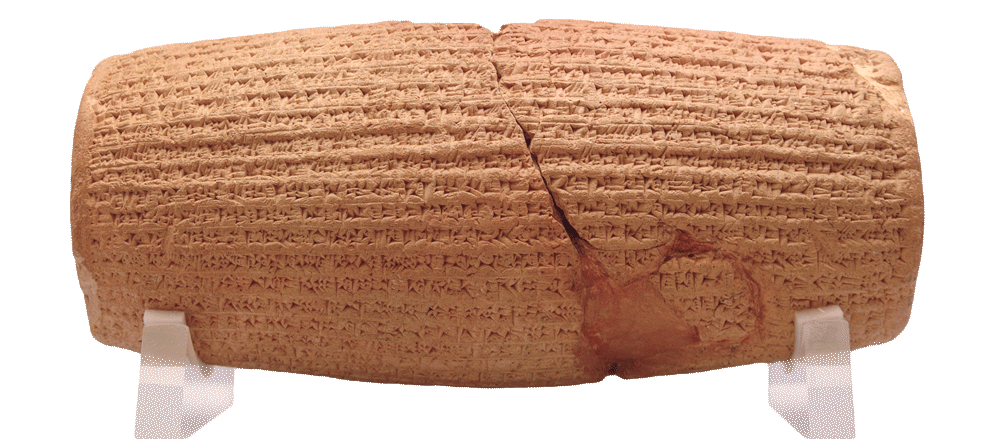
Cyrus Cylinder (Babylon, after 539 BC)
This introduction to the first mission is packed with theological premises. It takes for granted the providence of God, the emphasis on written law and prophecy, and the importance of written proclamations (cf. Exod. 36:6; 2 Chron. 30:5). Therefore, while this may be seen as an introduction to the first part of Ezra, it may also be understood as the introduction to the whole book.
The reference to Jeremiah in 1:1 no doubt is to Jeremiah 25:11 (cf. Jer. 29:10; 2 Chron. 36:21). It is not clear how we should calculate the seventy years mentioned in the Jeremiah passages (but not mentioned here). It could be from circa 606 BC, when the land was desolated, until the time of Cyrus, or it could apply to the time between the destruction of Jerusalem in 587–586 BC and the completion of the second temple in 516.
When the author says, “The Lord moved the heart of Cyrus” (1:1), he likely is alluding to the same expression used in Jeremiah 51:11 and Isaiah 41:2. He must have also known the more specific prophecies of Isaiah 44:28 and 45:1, 13. The author certainly emphasizes God’s sovereignty and fulfillment of prophecy. He attributes the great events about to be described to both the supernatural source—“the Lord moved” (literally “Yahweh stirred up”)—and the human instrument, “the heart of Cyrus.”
At the end of the first mission or stage of the work (Ezra 6:14), the author again repeats this emphasis on the divine and human instruments: “They finished building the temple according to the command of the God of Israel and the decrees of Cyrus, Darius and Artaxerxes, kings of Persia.” The same emphasis is reiterated in each of the three missions or stages of the work in Ezra-Nehemiah. In matters both divine and human, the focus is on the written documents: the decrees of the kings and the law of God. The author thus underlines the authority of the written Word of God.
The proclamation in 1:2–4 is the famous Edict of Cyrus. (Another record of it is found in Ezra 6:3–5.) It seems to give the impression that Cyrus believed in Yahweh, the God of Israel. However, inscriptions from that time indicate that Cyrus made similar proclamations to other ethnic captives, honoring their gods and returning the people and their idols to their homelands. The Cyrus Cylinder, a long inscription found in Babylon, states that the god Marduk chose Cyrus to free Babylon and restore the former worship to that god. This is a typical attitude in polytheistic culture, where many gods are worshiped. Cyrus wanted to secure the favor of them all.
The decree does not command the Jews to return to Jerusalem, but certainly it encourages them to do so. In verse 4 it is not altogether clear if “survivors” refers only to fellow Jews or also to other neighbors. Its primary focus may be on the fellow Jews, but in the light of verse 6, it is likely that others also participated in this generosity.
The Persian kings respected the religious convictions of their subject peoples. They supported their temples and religious activities as a means to keep peace throughout the empire. Likewise the Jews could expect help from the empire’s treasuries to provide silver, gold, and livestock for the sacrifices and offerings in their temple. What joy the returning Jews must have experienced as they realized that God was keeping his promises to bring them back to their land and to restore their house of worship!
B. Preparations for the return (1:5–11). The three divisions of Ezra-Nehemiah dealing with the three main missions of the people (Ezra 1:1–6:22; 7:1–10:44; Neh. 1:1–7:73) seem to have a parallel structure: preparation for the work, the beginning of the work, opposition to the work, resolution of the conflict or opposition, and the conclusion. Some of the elements are more prominent than others, but they all follow the same general order in each division.
This section on the preparation for the first mission begins with a summary statement (1:5–6). Again we notice the emphasis on God’s providence (“Everyone whose heart God had moved”) and on the purpose of the mission (“to build the house of the Lord”). The rebuilding of the worshiping community in Jerusalem is a noble mission. But not all the people are willing to return to Jerusalem. Many Jews have adapted to their context in Babylon and opt to stay there. They realize that to return is a hard and dangerous mission.
This was written to present teachings that are still valid today. In God’s work he takes the initiative; he moves in peoples’ hearts. But the people also have to “decide” to act, to obey God’s leading. In any mission or project, the people need a goal. For the returning Jews, their immediate objective is to build the house of God in Jerusalem.
The phrase “all their neighbors assisted them” (1:6) reminds us of the exodus experience, when the Egyptians gave generous gifts to the Israelites before they left Egypt (Exod. 12:35–36). Here it appears that those who give also included non-Jewish neighbors. No doubt the author had in mind the exodus parallel since throughout Ezra-Nehemiah there are exodus motifs. In Isaiah as well, the return from Babylonian exile is pictured as a second exodus. This must have encouraged the people as they prepared their long trip to Jerusalem, and later as they compared this event with the great work of God in the exodus from Egypt.
We see the king’s generosity in 1:7–8. Cyrus made it his policy to help support the practices of the local religions in the areas under the rule of the Persian Empire. In ancient times, when one country or king conquered another, the god of the conquering people was considered the victor over the conquered people’s gods. The ruling king took the subject’s idols and religious utensils as plunder and symbols of his own god’s supremacy and put them in his temple. This is what Nebuchadnezzar did with treasures and articles from the Jerusalem temple when he conquered Judah. Now Cyrus allows the Jews to take many of the vessels that Nebuchadnezzar carried off to Babylon and return them to the temple of God, which they have been commissioned to build. This is a significant act by Cyrus; it shows his sincere interest in the well-being of his subject peoples.
We see the author’s concern for detail in the list of articles that are returned to the temple in Jerusalem. They represent considerable value and were considered important, as seen in their mention again in Ezra 5:13–15. The inventory list does not pretend to list all the vessels, since it includes only 2,490 of the 5,400 articles mentioned in verse 11. The inventory list further attests God’s power to preserve and sustain—both people and temple artifacts are restored to the land of covenant promise.
Sheshbazzar is mentioned only in Ezra 1:8, 11 and 5:14, 16. Ezra 5:14 says Cyrus has appointed him as governor, and 5:16 says he lays the foundation of the temple. But we see no more of him; rather, in Haggai 1:1, Zerubbabel is called the governor of Judah, and he is also mentioned in Zechariah 4:6; Ezra 2:2; and Nehemiah 7:7.
In this first chapter several themes emphasized throughout Ezra-Nehemiah stand out: (1) the people of God—the restoration community is the continuation of God’s people from Abraham until the present (Ezra-Nehemiah tends to put the emphasis on the “people” rather than on outstanding leaders, shown by the fact that the author mentions the heads of families. It is true that Ezra and Nehemiah stand out as important leaders; however, the intent of the author is to emphasize even more the people as a whole.); (2) the “house of God,” with its focus on worship and a holy community; and (3) written documents and their function to guide the faith and life of the community.
The chapter ends with a statement that must have excited the first readers: “when the exiles came up from Babylon to Jerusalem” (1:11). In the news of the great cities of that day, this would not have received much attention. But as we look at God’s plan throughout the Bible, this event has great importance. For through this small, apparently weak community, God will continue to fulfill his plan to give to the entire world his revelation in Scripture and his salvation in Christ Jesus.
C. The list of returnees (2:1–70). The modern reader may wonder why this long list of names is included in the narrative. Why would the original readers be interested in this list? Since Israel, God’s covenant people, descended from Jacob, their family records were always important to them. Here their genealogy is especially important to show they are the continuation of the preexilic Jewish community. Each person wanted to confirm his or her identity as part of the covenant community, which also served to emphasize their separation from the Samaritans and other surrounding peoples. In many cases this identity and continuity was also important for land rights. Many of them realized that they were part of God’s continuing plan; notice their rejoicing: “Our mouths were filled with laughter, our tongues with songs of joy” (Ps. 126:2).
But today we do not put much emphasis on genealogies, so what value does this chapter have for us? First, it helps us to understand the context of Ezra. The list also confirms Jeremiah’s word that the exile would be limited to approximately seventy years and the people would return. Again it emphasizes the continuity of this people with the preexilic covenant community. Today we also need this emphasis on the common people, on our families, on our identity in Christ, on the fact that each member of the community is important in God’s work.
In Ezra 2:1, the reference to “province” probably means the province of Judah, which was far away from the administrative center of the Persian Empire. The people’s records also indicated where their family inheritance was located; thus they endeavored to return to the same place, “each to his own town.”
The list begins, in 2:2, with the names of eleven leaders. Virtually the same list in Nehemiah 7 includes twelve names (perhaps a conscious effort to create analogy with the twelve tribes of Israel).
It is interesting that Zerubbabel is mentioned instead of Sheshbazzar. Sheshbazzar disappears very quickly, and Zerubbabel, grandson of King Jehoiachin, continues as leader of the group. According to the curse on Jehoiachin (Jer. 22:28–30), no one of his line could ever sit on the throne of David. Zerubbabel led the first group of returnees but was not king. In fact no descendant of Solomon reigned in Judah during the period of the Second Commonwealth (538 BC–AD 70). The Nehemiah mentioned in 2:2 is apparently not the Nehemiah who will rebuild portions of the Jerusalem wall. However, we do not know when this list was compiled. It is quite possible that the final author copied the same list that was used in Nehemiah 7.
Although the leaders are mentioned, the real emphasis is on all the “people of Israel.” During the divided monarchy, the northern kingdom is usually referred to as Israel and the southern kingdom as Judah. The use of Israel here, however, emphasizes that this restoration community is heir to the biblical covenants rather than referring to the northern kingdom.
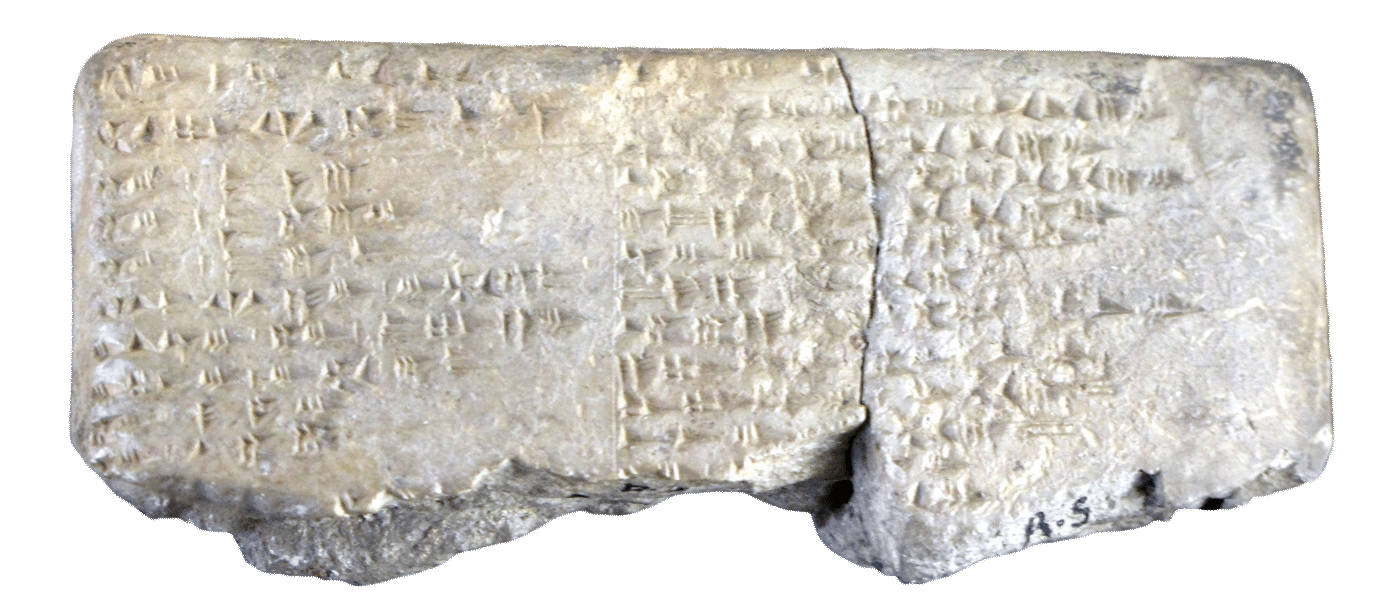
The list of temple officers inscribed on this Ugaritic tablet (Ras Shamra, thirteenth century BC) provides an example of ancient record keeping.
The names of many people are listed in 2:3–61, first the lay families, then the different groups of families with religious duties. Within the lay families, some are listed according to family names (2:3–20), while others are listed according to the place of their family inheritance (2:23–35).
Although some of these names occur elsewhere, as do eleven in Ezra 8, they are not necessarily the same persons. “Pahath-Moab” means “governor of Moab”; this ancestor might have governed part of the Moab area sometime during the monarchy. Instead of “Gibbar” (2:20), Nehemiah’s list has “Gibeon,” so the list of place names may start with verse 20.
The names of towns mentioned in 2:21–35 apparently indicate places where the families lived before the exile. Only Bethlehem and Netophah are south of Jerusalem; the others lie north of Jerusalem. Lod, Hadid, and Ono (1:33) are near Joppa on the coast.
The lists of temple ministers are given in 2:36–58. Although Ezra-Nehemiah emphasizes the worship, spiritual life, and holiness of the people, it is significant that the “lay” people are listed before the priests and their helpers. Before the exile there were twenty-four family groups of priests; here only four are mentioned, but the totals indicate more than four thousand persons. Thus the priests compose about 10 percent of those returning from exile.
In comparison, the number of Levites that return is very small. (Levites were descendants of the tribe of Levi but not from the priestly family of Aaron.) Later, when Ezra endeavors to bring more Levites back from Babylon, only thirty-eight will respond. Could the lack of interest be due to the fact that Levites did not inherit land, since the Lord was their inheritance (Josh. 13:33; 14:3–4; 18:7; 21:1–41)? It is interesting to note that in Numbers 18:21, 26, the tithe laws indicate that there were many more Levites than priests at that time.
The temple servants are named in 2:43–54. Who were they? The list includes many foreign names. In Ezra 8:20, some of those who return to Jerusalem are temple servants—“a body that David and the officials had established to assist the Levites.” We know that David’s bodyguard was composed of foreign men. In Numbers 31:47 Moses gives some of the Midianite captives to the Levites. So this group may have been at least partly composed of individuals from non-Israelite descent. Based on Joshua 9:27, Jewish rabbinic tradition says the temple servants are Gibeonites.
The “descendants of Solomon’s servants” (2:55–58) must have been a similar group. Solomon’s servants may have been temple workers recruited from the local non-Israelite population. The total (2:58) includes both groups of servants. From the 49 clans mentioned, there are only 392 persons.
Although Jewish families normally kept family registers (see Neh. 7:5; 1 Chron. 7:5), apparently some of the returnees have lost their records (2:59–63). Also, it is possible that some are proselytes, converts to Judaism. The Babylonian towns from which they have come are mentioned. Some of those lacking genealogical records are priests (2:62–63). Moses commanded that only descendants of Aaron could “burn incense before the Lord” (Num. 16:40). In the course of time some are able to find their credentials. The descendants of Hakkoz (2:61) apparently are accepted as priests some eighty years later, if “Meremoth son of Uriah, the priest” in 8:33 is the same “Meremoth son of Uriah, the son of Hakkoz” in Nehemiah 3:4, 21.
A Persian word is used for “governor” (2:63; also in Neh. 7:65, 70; 8:9; 10:1); here it probably refers to Sheshbazzar. The “Urim and Thummim” were small pebbles or precious stones that the high priest used as lots to determine God’s specific will in certain cases (Num. 27:21; 1 Sam. 14:37–42).
What can we learn from the totals mentioned in 2:64–69? The total listed, 42,360, is the same in Nehemiah 7 and 1 Esdras 5:41, so it appears to be correct. The itemized details listed add up to less; some persons and items were omitted in the catalogs. The large number of menservants and maidservants (a ratio of approximately one to six, 2:64–65) indicates that some returnees were wealthy. There are also quite a few horses, which were used by the wealthy. However, there are many more donkeys, which were used by the poor.
Just as is true today, the spiritual temperature of a community can be seen in their freewill offerings (2:68–69). The phrase “some of the heads of the families gave freewill offerings” would indicate that some others have a different attitude. As will be seen later, some of the returnees are more interested in their own fortunes than in God’s work in the community. However, the offering is relatively large, which indicates that there is a certain measure of wealth in the community. Some eighteen years later, when Haggai is preaching, there is apparently more poverty (Hag. 1:7–11).
The chapter ends on a positive note (2:70): the people and some of the temple personnel settle in their towns. Some of the priests and temple servants live in Jerusalem itself. Chapter 2 prepares us for the great work of building the temple in order that the covenant community can renew their worship of God as prescribed in the law of Moses.
D. The work begun (3:1–6). The returnees have their priorities correct; they first build the altar in order to offer sacrifices and worship to God. The author plunges quickly into the project at hand, and specifies the time (autumn of 537 BC). The seventh month, Tishri (our September–October), traditionally was important for its religious ceremonies. On the first of the month the New Year and Feast of Trumpets were celebrated (Lev. 23:23–25). Although not mentioned here, the Day of Atonement was the tenth day (Leviticus 16). From the fifteenth day until the twenty-first was the celebration of the Feast of Tabernacles, mentioned in verse 4.
There are several emphases here: (1) the unity and continuity of the community (“The people assembled as one man,” 3:1); (2) beginning by putting God first (worship); and (3) following the written law of Moses (3:2, 4). The people do not wait until the temple is rebuilt to build the altar and offer sacrifices to God. In 3:3, “despite” (NIV) could also be rendered “because of”; the people know they have enemies—they know they need God’s protection.
Although there is a noticeable emphasis on all the people, Joshua and Zerubbabel are mentioned as leaders. Some see a conflict with Ezra 5:16, where Tattenai’s letter to king Darius says Sheshbazzar laid the foundations of the temple. It may be that Sheshbazzar was named governor by Cyrus, but Zerubbabel was his assistant and soon was put in charge. Ezra-Nehemiah does not mention it, but Haggai 1 notes that Joshua is the high priest at this time, apparently the most important leader of the community.
Although Ezra is not yet in Jerusalem, the author repeats the emphasis on doing everything as written in the law of Moses (3:4–6). First they build the altar according to the instructions given by Moses (cf. Exod. 27:1–8; 31:2–5; 38:1–7). They are careful to celebrate the Feast of Tabernacles just as was written (Lev. 23:33–43). They not only are careful to celebrate Tabernacles; they also immediately begin to offer the regular burnt offerings as stipulated by Moses (Exod. 29:38–43), as well as the New Moon sacrifices and all the other regular sacrifices and “freewill offerings.”
The people are united in their desire to worship God, trust him, and obey him. They are eager to build the temple, but they put worshiping God first. Many times Christians allow even “God-ordained” projects to come before their genuine interest in God’s glory. We must remember that genuine worship is always first in God’s priorities. These Jews knew that only in God’s power could they survive in their precarious situation. Since then, God’s people have often rediscovered that worshiping and praying together is the best way to deal with difficult situations.
E. Rebuilding the temple (3:7–13). The temple project is well planned. The people have funds, both from the freewill offerings (2:68–69) and from the Persian treasury. The “authorization” by Cyrus (3:7) includes permission and expenses for securing and transporting the lumber from the mountains of Lebanon.
Again the continuity of this community with the preexilic community is emphasized, here by conscious parallels with the construction of Solomon’s temple. Just as Solomon did, the Jews send to Lebanon for lumber (cf. Ezra 3:7 with 2 Chron. 2:16); both constructions begin in the second month (3:8; 2 Chron. 3:2); both are overseen by Levites (3:9; 1 Chron. 23:4); and both temples are celebrated with songs, instruments, and thanksgiving (3:10–11; 2 Chron. 5:11–13). In this celebration the restoration community also follows what was “prescribed by David” (3:10).
Even though they have only built the altar and laid the foundation for the temple, the people rejoice and praise God. They give God the glory and look forward to what he will do in the future. Certainly this shows their faith in God, that he will continue to protect them and guide them. However, there are some who are not so happy (cf. Hag. 2:3). Apparently older people remember the splendor of Solomon’s temple in comparison with the simplicity of this temple. Haggai goes on to prophesy, “The latter glory of this house will be greater than the former” (Hag. 2:9 NASB), which was ultimately fulfilled when Jesus came to this second temple (cf. Luke 2:27, 32).
Ezra 3 has a wealth of teachings for God’s people today. We see the importance of the continuity of God’s people through whom God continues to fulfill his redemptive plan. We see the dedication of this small, seemingly insignificant community both in their enthusiasm to get on with God’s work and in their decision to make worship and obedience to God’s written word the foundation of their work and life.
Throughout Ezra-Nehemiah there is an emphasis on the authority of written documents, especially on God’s written word. This community accepted the authority of the Pentateuch, the five books of the Law. Some scholars suggest that they must have had only portions of the Pentateuch available to them. However, it is significant that in Ezra-Nehemiah stipulations from all parts of the Pentateuch are found.
F. Opposition to the work (4:1–24). 4:1–5. Following the preparation and beginning of the work in the first mission, the work faces opposition. In 4:1–3, the opposition begins as soon as the neighboring peoples hear that the Jews are “building a temple for the Lord.”
Even before they build the altar, the Jews fear “the people around them” (literally “the peoples of the lands”; 3:3). In earlier times, the phrase “people of the land” (singular) referred to the landowning families of the ruling class. Later it referred to the “poor people of the land” (Hag. 2:4). In Ezra (in plural form) it refers to the surrounding peoples (e.g., those from Samaria, Ammon, Ashdod, Edom, and Moab). They are persons mostly of foreign descent. Some are mixed Jews, whose ancestors intermarried with people brought in by the Assyrians (cf. 2 Kings 17:24–25). Some are Jews in Judah or nearby lands whose faith has become diluted with local religious beliefs.
But the author calls the peoples enemies. At first glance it appears that they want to help. They even claim that they worship the same God. But the rest of Ezra-Nehemiah shows their deep hatred of the Jews. The returned exiles reject their help. Are they too separatist? Should they have accepted help from these neighbors? This is a dilemma similar to that which Christians often face, and this issue is often a divisive factor in churches or denominations. Certainly there are many considerations involved in such complex decisions. From whom should Christian ministries and projects accept help? Will accepting this help compromise the unique gospel message of God’s grace? Will it limit our freedom to follow Christ? What resources does the church have in making such decisions?
In this case the Jewish leaders recognize that these neighbors are enemies. Perhaps the neighbors become more antagonistic because of this rejection, but the Jewish leaders recognize the stakes involved. The most intense opposition comes from Samaria, just north of Judah. These neighbors might have been offering sacrifices to Yahweh, but they were also worshiping other gods (2 Kings 17:33). They are a mixed people. Some Jews remained in the northern kingdom when the majority went into captivity to Assyria in 721 BC. They were mixed with other captive peoples whom the Assyrian king Esarhaddon (681–669 BC, cf. Ezra 4:2) had moved there. These are the ancestors of the Samaritans often mentioned in the New Testament. The Assyrian king Ashurbanipal (669–633 BC) also brought other captive peoples to Samaria (Ezra 4:10).
The Samaritans’ basic beliefs were quite different from those of the returned exiles. As polytheists they worshiped many gods, among whom was Jehovah. They did not give sole allegiance to the one true God; they did not submit to the authority of his Word. The Jewish leaders recognize that the Samaritans’ motives are subversive. The returned exiles, the “people of God,” are concerned to maintain their purity and the truth of God’s revelation. We can praise God that they did, for through this community all the world has received the Bible and God’s glorious message of salvation.
Ezra 4:4–5 is a résumé of the opposition during the reigns of the Persian kings Cyrus (550–530 BC), Cambyses II (530–522 BC), and Darius I (522–486 BC). As we continue to see, there are enemies on every side of this small community. Part of the enmity must have been the enemies’ envy of the Jews; also they feared that a rebuilt Jerusalem would take away from their own authority in the region. The word translated “hired” (4:5) also means “bribed.” The “counselors” they hire or bribe probably are Persian officials that have power to obstruct the work. The opposition continues through all the remainder of Cyrus’s reign, through the reign of Cambyses II, to the second year of Darius (520 BC). It is designed to discourage the Jews and prevent them from rebuilding the temple or the city of Jerusalem. The last phrase in verse 5 looks ahead to verse 24, after the parenthetic paragraphs of 4:6–23.
4:6–24. Ezra 4:6–23 is a parenthetic statement that tells how opposition to the Jews continued in the time of kings Xerxes I (486–465 BC) and Artaxerxes I (464–424 BC). Thus, this parenthesis must include a period of nearly eighty years, from the events of Ezra 5 (520 BC) until the early part of Artaxerxes’ reign, before Nehemiah is sent to Jerusalem (445 BC). Why does the author skip ahead chronologically? He apparently thought it important to emphasize the continuing opposition, possibly to justify the decision to reject the neighbors’ help and to emphasize the significance of the achievements recorded in chapters 5 and 6.
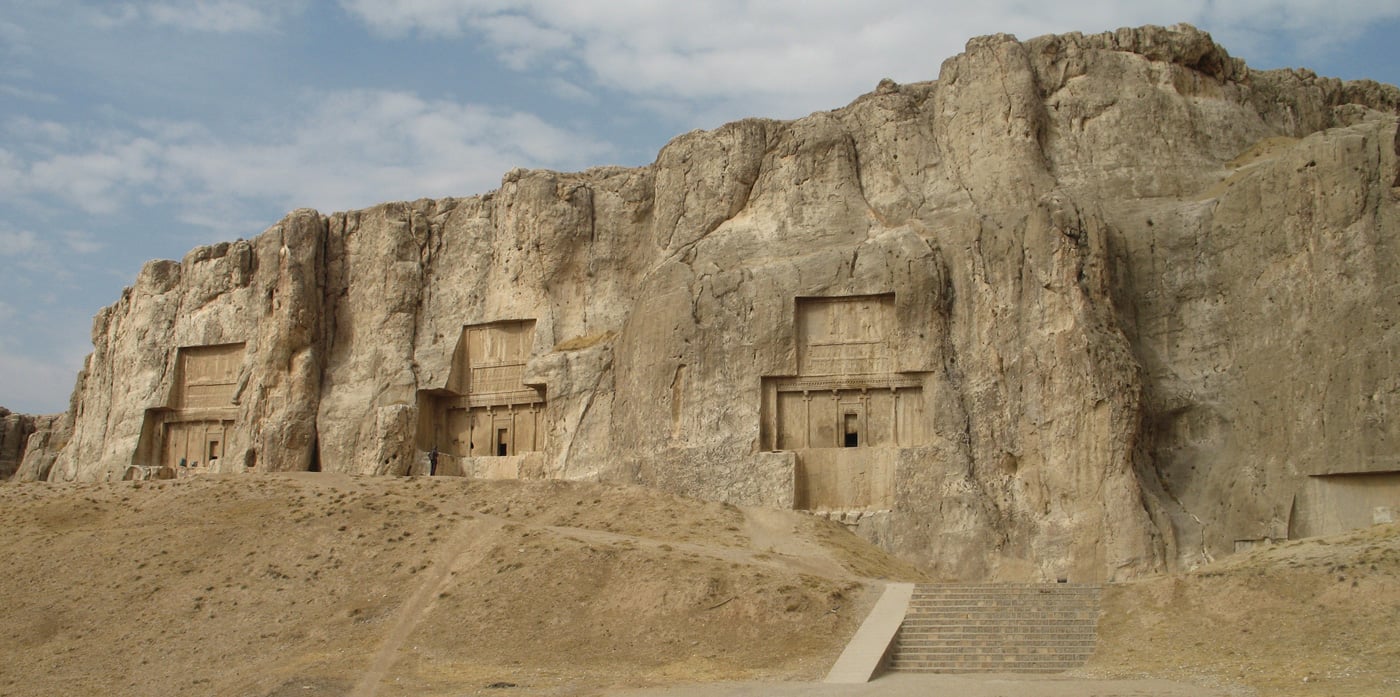
The Persian kings Darius I, Xerxes I, and Artaxerxes I were buried in these tombs at Naqsh-e Rustam, built during the sixth–fifth centuries BC.
The opposition described here is opposition to the building of the wall. But apart from verse 6, details of the activity during the reign of Xerxes are not given. Some building activity on the walls may have begun at that time, which could explain the reference to the wall “broken down” and the gates “burned” in Nehemiah 1:3.
The next part of Ezra, which describes Ezra’s mission to Jerusalem (Ezra 7–10), takes place in the reign of Artaxerxes I. So Ezra would have been familiar with these events.
The letter to Artaxerxes (4:7–16) was written and signed by important officials in Samaria and elsewhere in this western satrapy, “Trans-Euphrates” (literally “Beyond the River,” 4:10). Judah was one small area of this large satrapy. Since the officials of different areas in this satrapy allied themselves against the Jews, we cannot blame Artaxerxes for taking the letter seriously. In addition, the king was very concerned about Persian control in this part of the empire at this time, for an Egyptian revolt, supported by the Greeks, began in 460 BC.
Ezra 4:7 notes that the letter is written in Aramaic. The author of Ezra-Nehemiah apparently had copies of the letters and other documents in Aramaic, which is probably why Ezra 4:7–6:18 is written in that language.
The phrase “written in Aramaic script and in the Aramaic language” is literally “written Aramaic, translated Aramaic.” The NIV note gives an alternate rendering, “written in Aramaic and translated.” The first rendering would suggest that it was written in the Aramaic language (which became the diplomatic language in the Persian Empire) and in the Aramaic script (which refers to the “square” script in distinction from the “cursive” script, which was still in use for Hebrew). The alternate rendering probably means the letter was translated into Persian for the king. Both renderings fit the context.
The Jews learned to speak Aramaic during the Babylonian exile; thus Aramaic was the language of the returned exiles and continued to be the language of the Jews until the time of Christ. The two languages, Hebrew and Aramaic, are quite similar, so most Jews likely continued to use the Scriptures in Hebrew. But sometime in the period between the two Testaments it became necessary when the Hebrew Scriptures were read to also give an interpretation (or paraphrase) in Aramaic. This gave rise to the Targums, translations or paraphrases, in Aramaic, of the Hebrew Scriptures.
Ezra 4:12–16 quotes the letter to Artaxerxes. In Nehemiah 2 this same king authorizes Nehemiah to repair the walls of Jerusalem, so this must have been earlier in his reign. The letter is quite derogatory of the Jews and exaggerates their faults, for this small community did not pose any great threat to the empire. But given the precarious situation of this part of the Persian Empire, the king was sensitive to the possibility of any more rebellions. The three different words for royal revenue in 4:13 (“taxes, tribute or duty”) emphasize the importance of taxes in the Persian Empire. When Alexander the Great conquered Persia, he found huge storehouses of many tons of gold and silver.
The expression “in the archives of your predecessors” (4:15) refers to the records kept by former kings, including the Babylonian kings, since the Persian kings considered themselves the Babylonians’ successors. All these kings kept records of their governments and of transactions with their vassals.
Ezra 4:17–22 gives King Artaxerxes’ reply to the letter. Again, in 4:18, translation is mentioned. Apparently the king needed the Aramaic translated into his Persian language. The letter confirms that many times in the past Jerusalem has rebelled against the ruling kings. This must refer to the Babylonian kings and perhaps the Assyrian kings. The “powerful kings” (4:20) no doubt refers to David, Solomon, and some others who ruled areas beyond Judah.
The effects of the opposition are seen in 4:23–24. The neighboring officials do not lose any time in forcing the Jews to comply, to stop their building activities. If this refers to a time some years before Nehemiah’s coming to Jerusalem, it may again help to explain the broken walls and burned gates of Nehemiah 1:3. The clause “so that the city will not be rebuilt until I so order” (4:21) is significant, for it gives the king a possibility to change the policy in the future. Thus, in Nehemiah 2, he is free to specifically commission Nehemiah to rebuild the city. Certainly this shows God’s providence and the confidence that the king has in Nehemiah.
The theme of opposition and conflict is seen throughout the Bible, from Genesis 3 to Revelation 20. The New Testament makes it clear that anyone who follows Christ will confront opposition, from Satan and his emissaries and from human beings whom the devil uses. Throughout history there have been constant attempts to destroy God’s people, the Jews and later also the Christians.
Ezra-Nehemiah reminds us that as God’s people we are engaged in a struggle, a conflict with the forces of evil. Paul says, “In fact, everyone who wants to live a godly life in Christ Jesus will be persecuted . . .” (2 Tim. 3:12). Likewise, any work of God will confront opposition. But Ezra-Nehemiah also reminds us that God knows how to give the victory; he is faithful and will fulfill his purpose in our lives and in the work he gives us to do.
Ezra 4:24 appears to refer to verse 23, but in reality it refers back to Ezra 4:5, since verse 23 clearly refers to the time of Artaxerxes and is still part of the parenthesis. So 4:24 brings the account back to where it left off in 4:5, in the reign of Darius. It prepares the reader for chapter 5. The second year of King Darius was 520 BC, the same year that Haggai was preaching in Jerusalem (Hag. 1:1).
G. Resolution: The temple building continued and finished (5:1–6:22). 5:1–17. Ezra 5:1 takes up the account from 4:24. Sixteen years have passed since 4:1, when the neighboring “enemies” were able to halt the work. The people have good excuses for not trying to build the temple; after all, their neighbors stopped them when they tried to build. But according to Haggai (1:9–10), who was preaching in Jerusalem at that time (520 BC), they have become more interested in building their own houses and are guilty of putting their own comfort before their responsibility to God. God expects the people to put forth more initiative for his work.
Ezra 5 and 6 provide an amazing account of how God works everything together to fulfill his purposes. This marks an important year in Jerusalem: it is the first time since the days of Jeremiah that a prophet of God has preached in Jerusalem. God sends two prophets, Haggai and Zechariah, to inspire the Jews to get back to work on the temple. The first chapter of Haggai, which refers to these same events, is a wonderful example of how God uses the preaching of his messenger to stir up his people from their lethargy, in this case to renew their work on the temple construction. But what about the neighboring enemies and the Persian authorities? When the people take the initiative to renew the work, God also works in the Persian authorities. They question the activity but give the Jews a fair chance to state their case before the Persian king. Certainly God’s providence is evident in every detail, for the authorities find that Cyrus has decreed that the Jews should rebuild their temple. Now, Darius reconfirms the decree, including the stipulation that the government is to provide funds and supplies for the work and that anyone who changes this edict should be put to death. The whole episode should help Christians today to rely on God to open doors that seem closed and to work in the hearts of both leaders and all the people, to fulfill his purposes.
Haggai delivers his messages between August and December of 520 BC, and the temple construction is renewed in September. Zechariah gives his messages beginning in October of 520 (Zech. 1:1). Zerubbabel and Joshua are mentioned as leaders here, and many times in Haggai and Zechariah. However, Zerubbabel is not mentioned again in Ezra-Nehemiah, not even in the celebration at the completion of the temple. Some have suggested that he may have died before that event.
Who was Tattenai (5:3)? He is called “governor of Trans-Euphrates.” Apparently the area of Babylon and “Beyond the River” (referring to the Euphrates River) were two parts of one very large satrapy, and Tattenai was ruler of the part called “Beyond the River.” So he and the others mentioned were Persian officials in charge of keeping order in this part of the empire. Their request is legitimate. The author here calls attention to God’s providence: “But the eye of their God was watching over the elders of the Jews” (5:5). This explains why the officials allow the Jews to continue until they have an official reply from the king.
This positive attitude on the part of the Persian officials is further seen in the details they include in their letter to the king. The Jews’ answer is very honest and transparent, even acknowledging that Jerusalem was destroyed as punishment from God (5:12). It is surprising that the Persian officials include all these details, and their suggestion to the king (5:17) is quite reasonable.
The theological maturity seen in the Jews’ reply is noteworthy. They are not afraid to testify of their faith in God. They understand that God works in history, that their captivity was not due to God’s failure but to his discipline on them. The prophets have told them this would happen; now they believe them.
Cyrus is called “king of Babylon” (5:13); was he not the king of Persia? Yes, but Cyrus issued his decree as king of Babylon. Inscriptions have been found in which Cyrus is also called king of Babylon.
Sheshbazzar is named again in 5:14. He was the fourth son of king Jehoiachin; Zerubbabel was the son of Jehoiachin’s oldest son, Shealtiel (see Matt. 1:12). Here Sheshbazzar is credited with laying the foundation of the temple. In Ezra 3:10 it appears that Zerubbabel is in charge of the work. We cannot be sure of all the details, since the work was started in 536 BC and the present episode takes place in 520 BC. Perhaps Zerubbabel was working under Sheshbazzar’s authority, or there may have been a need to redo some of the work begun earlier.
6:1–12. King Darius does as Tattenai’s letter suggests: he orders a search to see if Cyrus really has issued such a decree (Ezra 6). We would expect the decree to be found in the archives at Babylon or in Susa, the Persian capital. However, the document is found in Ecbatana, the summer capital of the Persian kings. It is written on a scroll rather than on a tablet. Since they were now writing their official documents in Aramaic, they used parchment.
Darius’s reply first quotes a copy of the decree archived in the treasury. The variation in some details between Cyrus’s decree in Ezra 1 and this document means this copy was likely a résumé used for the records of the treasury.
Cyrus and Darius both were concerned that their subject peoples could correctly celebrate their religious rites. Cyrus put emphasis on the people’s traditions, so his decree emphasized building the temple on the original site. But the “ninety feet high” (sixty cubits) might be a mistake in the original decree or in this letter, for Solomon’s temple was ninety feet long but only forty-five feet high. In 1 Kings 6:36, “three courses of dressed stone and one course of trimmed cedar beams” are mentioned (see 6:4), but in regard to the inner courtyard.
Where did the Persians acquire all these specific details? It is possible that Cyrus received them from a Jewish scribe. This concern for detail and accuracy is also seen in the correspondence between this report (6:5) and the information the Jews have given to Tattenai (5:15).
The answer from King Darius (6:6–12) is very direct and very detailed. The phrase “stay away from there” (6:6) translates a legal term that indicates the accusations against the Jews have been rejected. Comparable documents from the Persian treasury to other subject peoples include similar details. However, the specific mention of the wheat, salt, wine, and oil to be used in the Jewish sacrifices (6:9) may suggest that a Jewish scribe helped with the details.
These details for the sacrifices are all specified in Leviticus 1–7. The people offered to God ingredients that make up part of everyday life. But how would these sacrifices represent praise and worship from the hearts of the people if the Persian king has paid for them? Notice the different reason for sacrifices in the hearts of non-Jews: to appease and supply food for the gods. But in the biblical perspective, God does not need these ingredients; the sacrifices expressed faith in God’s redemption and the people’s thankfulness, love, and dependence on God. There is no indication later that the Jews depend on the Persians to supply these sacrifices. We can be thankful that under the new covenant our Savior has fulfilled all these offerings (Heb. 10:10–14); thus in gratitude to him we submit wholeheartedly to his lordship in our lives (Rom. 12:1–2).
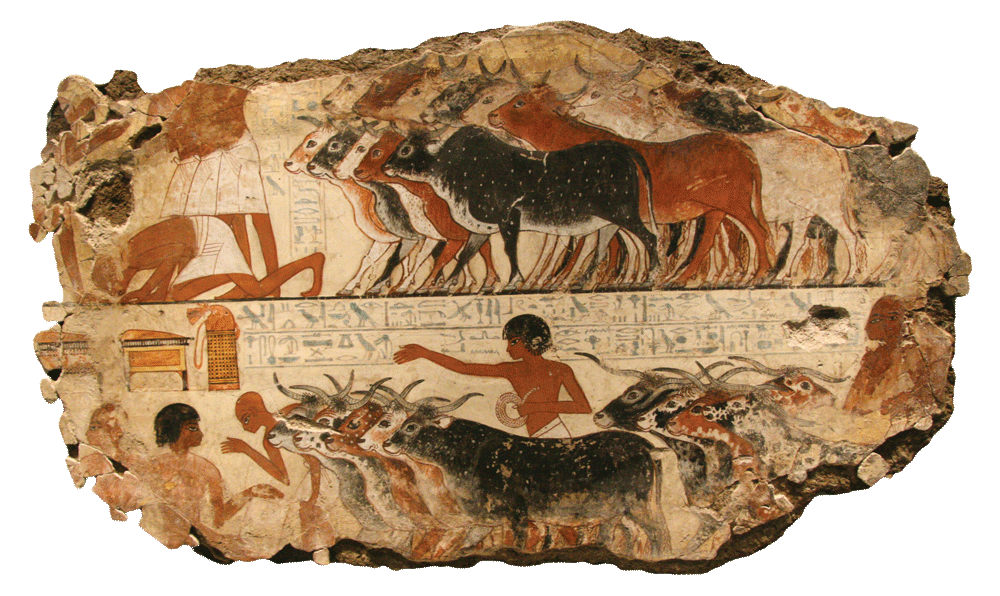
Cattle were used for offerings (e.g., Ezra 6:17) as well as food throughout the ancient Near East. This painting from the tomb-chapel of the Egyptian official Nebamun (ca. 1350 BC) depicts him inspecting a cattle herd.
The language of 6:11–12 reflects both Persian laws and Jewish theology. It was common to include very strong punishment for those who broke Persian laws (cf. Dan. 2:5; 3:29); the statement, “May God, who has caused his Name to dwell there,” may be another indication that a Jew helped prepare the decree.
6:13–22. The remainder of chapter 6 describes the completion and dedication of the temple.
6:13–18. Tattenai and the other officials immediately obey the king’s decree. This indicates the degree of order in the Persian Empire at the time. It is amazing how quickly the small community of Jews finishes the temple once they trust God and decide to do it with all their heart. It is less than four and a half years; they began in September of Darius’s second year (520 BC) and finish in March of his sixth year (516 BC).
Again, notice the emphasis on God’s providence in 6:14–15. God uses the preaching of the prophets Haggai and Zechariah, the command of God, the decrees of the Persian king, and the people to complete the work. Again we see an example of Romans 8:28, “In all things God works for the good of those who love him.” Certainly this group of returned exiles rejoiced in what God had done.
We might wonder why King Artaxerxes is included here if he comes on the scene only many years later. Again, the author looks ahead and includes the building project under Artaxerxes. The Aramaic text here does not include the word “temple”; literally it says, “And they finished building according to the command” (6:14).
The dedication of the temple is described in 6:16–18. There is a conscious comparison with Solomon’s dedication of the first temple in 1 Kings 8. The temple is called the house of God, and there is a large number of fellowship offerings. The one hundred bulls, two hundred rams, and four hundred male lambs here are much less than what is offered in 1 Kings, but this is a small group of people in comparison. These are fellowship offerings, in which only small portions were burned in sacrifice; the meat is eaten by the people in a joyous feast together before the Lord.
There is a conscious emphasis on the continuity of the people of God, not only in the parallels to the dedication of the first temple, but also in other details. The sin offering consists of twelve male goats, “one for each of the tribes of Israel,” even though most of the returned exiles are from the tribes of Judah and Benjamin. This continuity is also seen in the installation of the priests and Levites in their divisions and groups “according to what is written in the Book of Moses” (6:18). It is interesting that the author of 1 Chronicles emphasizes David’s work of organizing the priests and Levites (1 Chronicles 23–25), another indication that 1–2 Chronicles and Ezra-Nehemiah do not come from the same author. The emphasis on the Book of Moses and its accepted authority also indicates that the people must have had the Pentateuch long before this.
6:19–22. Soon after the dedication of the temple the people celebrate the Passover. Beginning in 6:19 the text is again written in Hebrew; the portion in Aramaic ends in verse 18. It is calculated, according to our calendar, that the temple was completed on March 12, 515 BC, and the Passover would have begun on April 21. So, only a few weeks after the dedication of the temple the Jews had another important celebration.
Celebrations were important in the life of the Jews. These gatherings gave them opportunity to worship together, to remember God’s great works throughout their history, to be taught from the law, and to have joyous times of fellowship. The Passover celebrated their deliverance from the bondage of Egypt. The events of the exodus from Egypt left a lasting effect on Israel. We can see it in three major areas of emphasis during Passover: (1) God’s acts in history; (2) redemption and the language of redemption throughout the Bible; and (3) justice and concern for the poor, the widows, and orphans, the unprotected persons in society.
Although the Jews celebrated the Passover every year, it is usually mentioned in relation to some important event in Israel’s life (Num. 9:5; Josh. 5:10; 2 Kings 23:21; 2 Chron. 30:1–27; 35:1–27). The revival movements under Hezekiah (2 Chronicles 30) and under Josiah (2 Chronicles 35) are both closely linked to the Passover celebration.
It was very important for the priests and Levites to be ceremonially clean to lead in the celebration of the Passover. As prescribed in Exodus 29 and Numbers 8, this involved a rather complicated process of washing, sacrifice, and anointing. In fact, in Hezekiah’s time the people had to delay the Passover a month because they lacked sufficient ceremonially pure priests (2 Chronicles 30).
The statement, “together with all who had separated themselves from the unclean practices of their Gentile neighbors in order to seek the Lord” (6:21), needs explanation. The returned exiles are not the only Jews in Judah at this time. Although the Babylonians carried most of the people away captive, some were left in Judah. Other Jews may have lived in the neighboring regions. No doubt many had accepted the customs of their neighbors. The zeal and dedication of the returned exiles draw them back to Judah and to the faith of their fathers.
The Jewish leaders at times seem very strict, but they are willing to accept these Jews who were not exiled to Babylon if these Jews definitely decide to follow the law of Moses. That means two basic decisions: (1) they must separate themselves from the unclean practices of their Gentile neighbors, and (2) they must seek the Lord, which implies a sincere attitude of worship and obedience to God.
These decisions are similar to those every Christian must make. Following Christ has ethical implications; it implies renouncing what is displeasing to God. It also means seeking God, walking with the Lord in obedience, and following where he leads.
This first section of Ezra-Nehemiah concludes on a note of victory and thanksgiving for what God has done (6:22). The people worship God with joy during this whole week of the Feast of Unleavened Bread. This was a separate feast from Passover, but the two were always celebrated together.
Worship is constantly associated with joy, because in worship the worshiper is conscious of God’s presence, his mercy, his love, and his work in the world. Here what the Jews have just experienced is a special motive for joy. The Lord has filled them with joy “by changing the attitude of the king of Assyria, so that he assisted them in the work of the house of God” (6:22). They are aware that all this has come about because God changed the king’s attitude. God works out all the details.
But why is Darius called the king of Assyria? Certainly the author of Ezra-Nehemiah gives very accurate details throughout the work. He must have a special purpose in calling Darius the king of Assyria. A glimpse at the history of that time indicates that, at least in the minds of many, there was continuity in the empires of Assyria, Babylon, and Persia, the times of Gentile domination. Herodotus once calls Babylon the capital of Assyria (Histories 1.178). Nehemiah, in his prayer, speaks of the hardships the Jews have had “from the days of the kings of Assyria until today” (Neh. 9:32). The author here likely had something similar in mind. Clearly there was a tremendous change of attitude between the Assyrian kings on the one hand and Cyrus and Darius on the other. So the Jews have reason to rejoice and praise God.
The events of this “mission” in Ezra 1–6 are important in God’s plan of redemption. Although Solomon’s temple was larger and more beautiful, it existed for a little less than four hundred years. This temple, of which Haggai says, “The glory of this present house will be greater than the glory of the former house” (Hag. 2:9), will be the scene of the presence of the coming Messiah, and will exist for some 585 years, until AD 70. (Although sometimes language about Herod’s embellishment of the temple gives the impression that it was a third temple, it was nevertheless still the second temple. In Jewish history the period of the second temple continues from 515 BC to AD 70.)
2. The Second Mission: The Return under Ezra (7:1–10:44)
A. Introduction and preparation (7:1–28). Chapter 7 begins the second stage of the rebuilding of the community in Ezra-Nehemiah. Fifty-seven years have passed since the accounts of chapters 5 and 6. The author does not pretend to give a complete history of the period; rather, he chooses the events that were significant for the continuation of the Jewish community. Here he introduces Ezra.
7:1–10. Ezra has all the necessary credentials for the mission assigned to him. The Jews have always emphasized their genealogy, but it was especially important for the priests and Levites, such as Ezra. The genealogy in 7:1–5 is similar to that of 1 Chronicles 6:3–14; however, it omits some names between Meraioth and Ezra. Seraiah was high priest in the time of King Zedekiah and was killed by the Babylonians (2 Kings 25:18–21). That was some one hundred thirty years before this time. “Son of Seraiah” can also mean “descendant of Seraiah.” Zadok was made high priest instead of Abiathar, the descendant of Eli (1 Kings 2:35).
The author continues to give Ezra’s credentials. He is a scribe and a teacher (7:6; the NIV translates the typical word for scribe as “teacher” here). God’s hand is on Ezra, and he has the king’s favor. Also, other Jews accompany him to Jerusalem, and there is special mention of the “Levites, singers, gatekeepers and temple servants.” Notice that these distinctions in the temple personnel have continued from before the exile.
This introduction of Ezra concludes with his arrival in Jerusalem (7:8–9). The date mentioned is, by our calendar, August 4, 458 BC, although we see later their departure from Babylon is delayed twelve days (8:31). There may be an intended parallel with the dates of the exodus (Exod. 12:2; Num. 33:3), since the return of the exiles is seen as a second exodus (cf. Isa. 11:11–16). The trip would have been some eight or nine hundred miles. It took just over three and a half months, an average of about ten miles a day. The author recognizes God’s providential protection on the dangerous trip, for the people travel without military escort—while carrying a considerable amount of silver and gold, on roads often infested with robbers. This small group of emigrants certainly has reason to praise the Lord.
The author calls attention to Ezra’s lifelong devotion to studying, obeying, and teaching “the Law of the Lord” (7:10). (See box, “Ezra, Example of an Effective Teacher.”) The law of the Lord must have included the whole Pentateuch, the five books of Moses. The Old Testament understands the law not as a heavy burden but as a recipe for a healthy society. The Decalogue, or Ten Commandments, gives in brief form an outline of biblical ethics. Each commandment represents a whole area of ethical behavior. For example, “You shall not commit murder” shows the sanctity of human life and our responsibility not only to avoid homicide but to help preserve life. These implications of the commandments are spelled out in the rest of the Old Testament and in Jesus’s Sermon on the Mount (Matthew 5–7).
Up until the time of the exile the priests were the guardians and teachers of the law. After the exile the scribes become more important. Ezra is both a priest and a scribe; according to Jewish tradition he had a lot to do with the transition. This scribal tradition was important for the preservation of the Scriptures. Unfortunately the scribal establishment later became too legalistic (see Matthew 23).
How can we maintain a correct balance between the “pharisaism” that Jesus criticized and the syncretism of our day, which dilutes the authority of Scripture, blurs the biblical worldview, and erodes the essence of the gospel? One answer is to follow Ezra’s example of seeking the Lord, putting emphasis on obeying God’s Word, and being a doer and not only a hearer of the Word. And just as in Ezra’s case, those who teach God’s Word need “the hand of the Lord on them” (7:28).
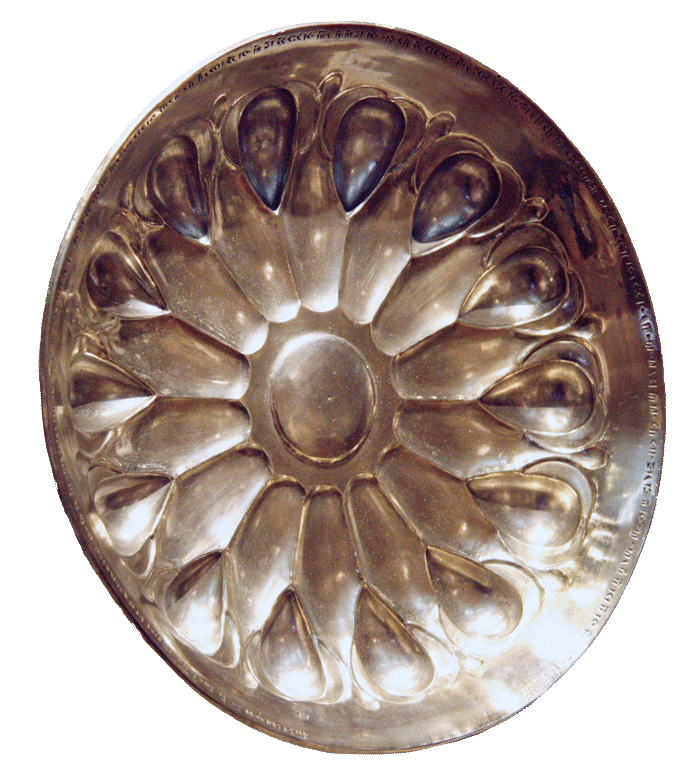
Persians referred to their king as the “king of kings,” as illustrated by the cuneiform inscription on this silver bowl of Artaxerxes I (fifth century BC), which reads in part: “Artaxerxes, the great king, king of kings, king of countries, son of Xerxes the king, son of Darius. . . .”
7:11–28. Ezra has received official recognition from the Persian king. The letter of Artaxerxes (7:12–26) is in Aramaic. Some wonder whether it could be from the Persian king, since it has many Jewish details. Again, the king would have had a Jewish advisor, maybe Ezra himself. The letter also includes many details with a distinctive Persian flavor, such as “king of kings” and “seven counselors.”
The letter presents five stipulations: (1) it authorizes Ezra to go to Jerusalem and to appoint magistrates and judges to administer justice (7:14, 25); (2) it provides funds to purchase sacrifices and temple vessels (7:15–19); (3) it requires the treasurers of Trans-Euphrates to give supplies to Ezra; (4) it prohibits charging taxes to temple personnel; and (5) it authorizes Ezra to teach and require obedience to “the law of your God and the law of the king” (7:25–26).
The Jews are free to go with Ezra or stay in Mesopotamia; many choose to stay, mainly in the Babylon area. The “seven advisors” (7:13) is reminiscent of the statement by Herodotus (Histories 1.14) that the king had an advisory council composed of the heads of the seven leading families in Persia.
The king entrusts to Ezra a surprising amount of silver and gold. This could have made the trip more dangerous because of robbers on the way. It certainly indicates that the king trusts Ezra. The articles to “deliver to the God of Israel” are those mentioned in 8:25, donated by the king and his officials.
Why does the king command the provinces to give so much support to the Jews (7:21–22)? The Persian kings wanted the favor of all the gods. In addition, it was important to Artaxerxes that there be peace in this area of his empire, for in 460 BC there was a revolt in Egypt, and in this same year, 458, he sent a Persian army to Egypt.
Ezra does not boast of what he has accomplished; rather, his heart immediately turns to praising God for his work in the heart of the king (7:27–28). Again, there is an emphasis on God’s providence. “To bring honor to the house of the Lord” (literally “to beautify”) could explain why Artaxerxes was included in 6:14. The fact that Ezra understands that God’s hand is on him gives him courage to invite others to join him in the mission to Jerusalem. Similarly, when a Christian knows they are in God’s will and God is working in their life and ministry, it provides courage to get others involved in the ministry.
B. The return to Jerusalem (8:1–36). Ezra 8 recounts the trip to Jerusalem but first mentions the family heads of those who accompany Ezra (8:1–14). This is not the same list as in Ezra 2, though the two lists have many names in common. Instead of starting with the lay families, then listing the priests, Levites, and temple personnel, as in chapter 2, here the list begins with the priestly families, followed by a descendant of David, and then concludes with twelve lay families. Throughout the chapter we see an emphasis on the number twelve, certainly to represent all Israel. In the Ezra material Israel is mentioned twenty-four times, but Judah only four. In this list only the men are listed; in Ezra 2, the women are included in the numbers. Here the men counted in the twelve families number fifteen hundred. Therefore, with women and children there may have been as many as five thousand in the caravan to Jerusalem.
All the family names in 8:3–14 are also in Ezra 2. That would indicate that those who return to Jerusalem now have relatives in Jerusalem from the first emigration. The phrase “the last ones” (8:13) may indicate that no others from that family have remained behind; the other families still have relatives in Babylon.
The preparation for the journey is described in detail in 8:15–30. If there were some five thousand people, we can see the wisdom of taking a few days to organize them. Ezra discovers there are no Levites who have offered to return to Jerusalem. Since his mission is centered on worship in the temple, the need for sufficient temple personnel is urgent. Ezra knows where to search for Levites: he sends helpers to “Kasiphia”—the Hebrew says “Kasiphia, the place” (8:17). That expression, “the place,” in the Old Testament sometimes designates a place of worship (Deut. 12:5; Jer. 7:3, 6–7). It has been suggested there may have been a school for training temple personnel in Kasiphia.
The numbers surprise us: only eighteen Levites, but two hundred and twenty temple servants, who were helpers for the Levites. Ezra sees this provision also as evidence of God’s hand on the mission.
Paramount in any preparation for ministry is the spiritual preparation, through prayer and fasting. Ezra and the people realize they are undertaking a very dangerous mission. The almost four-month journey is in itself a risky adventure. Life in the little community in Judah is still precarious. But they know God’s hand is on them; they know they have to depend completely on him. So, they begin with fasting and prayer (8:21–23).
This journey normally was dangerous, for there were bandits on the way. With the great amount of silver and gold they will be carrying, it will be doubly dangerous. In addition, after telling the king that God takes care of his people, Ezra cannot conscientiously ask for a military escort. We see here a tremendous example of faith, of absolute dependence on the Lord. Ezra’s example and teaching bring forth a similar response of faith in the people.
Ezra also understands the need for administrative preparation. As a good leader, he delegates responsibility to capable helpers. The value of the money and temple vessels they carry is staggering. As the notes in the NIV indicate, it included twenty-five tons of silver, three and three-quarters tons of gold, and many silver and gold vessels for the temple.
Ezra points out that all these riches as well as these men in charge of them are “consecrated to the Lord.” “Consecrated” is literally “holy” and demonstrates the basic meaning of “holy”: “set apart for God.” The men in charge are the priests and the heads of families. Consecration and holy lives are requirements for the material as well as the spiritual aspects of God’s work.
Responsible stewardship requires careful records as well as consecrated administrators. The money and articles have been carefully weighed and registered. The men in charge of the valuables are responsible to take care of the treasures on the trip, then weigh them out again before the priests, Levites, and family heads in the temple in Jerusalem (8:28–29). That this was done is recorded in 8:33–34.
The description of the trip to Jerusalem (8:31–36) is very brief. The trip officially was to begin on the first day of the first month (7:9), but they are delayed until the twelfth day due to the need to recruit Levites and temple servants (8:15–20). The nearly four-month trip must have been quite an adventure. But the only detail given is that God keeps them safe from “enemies and bandits,” for which they give God the glory. Of the many good examples we find in Ezra’s ministry, this is one we should remember every time we arrive safely from a trip. According to Ezra 7:9 they arrive on the first day of the fifth month (August 4).
The treasures are presented to Meremoth in the temple. It does not say he is a priest but that he is the son of Uriah the priest. Nehemiah 3:4 lists Uriah as the son of Hakkoz, but in Ezra 2:61 the sons of Hakkoz could not be installed as priests because their genealogical records were lacking. If this is the same family, possibly by this time they have been accepted in the priesthood.
The author again emphasizes the careful record that has been kept of the money and articles (8:34). Since the Persian government kept careful records, we can assume that Ezra sent a record back to the king.
The last paragraph (8:35–36) notes that these returned exiles give priority to worshiping the Lord. Again the author mentions “twelve bulls for all Israel”; this community represents the whole people of Israel. The documents with the “king’s orders” are delivered to the Persian authorities. These include the authority for Ezra to administer Jewish law to his fellow Jews.
C. Opposition from within: The crisis of intermarriage (9:1–15). In this second movement of the book (Ezra 7–10), the crisis or conflict is the problem of mixed marriages with pagan neighbors. It is an outright disobedience of God’s commands and threatens the future of the covenant community. This episode takes place four months after the events of chapter 8 (see Ezra 10:9). Ezra has been teaching God’s written word. He does not try to do everything himself; his policy is to prepare leaders through teaching the law of God. Throughout this chapter there are many allusions to and echoes of passages in the Law and the Prophets. Ezra’s teaching is bearing fruit; the leaders become conscious of the critical situation in regard to mixed marriages.
Ezra’s dismay and humility are seen in 9:1–5. There is a conscious allusion to passages in the Pentateuch that name these various inhabitants of Canaan (9:1; cf. Deut. 20:17). Although most of these people groups—all except the Ammonites, Moabites, and Egyptians—no longer existed in Ezra’s time, the inclusion of the entire list emphasizes Moses’s strong prohibition against intermarrying with the neighboring pagan peoples. “Holy race” (9:2) also alludes to the Pentateuch and points out the contrast between what God’s people should be and what they are in reality. They are unfaithful to their covenant with God. Intermarriage with these peoples involves compromising the covenant relationship with God, the acceptance of “detestable practices,” and opening the community to the influence of a pagan worldview.
All through the Bible God calls his people to be separate from the world (1 John 2:15–17). Sometimes they have gone to extremes in a legalistic fashion, which the prophets and Jesus condemn. But this chapter combines various passages from Moses and the Prophets to show that the basic commands are applicable to new situations. We need the Holy Spirit’s guidance and the sound teaching of God’s Word to correctly apply the Bible’s ethical principles. The New Testament commands believers not to marry unbelievers (2 Cor. 6:14). Any commitment that competes with our commitment to Christ makes us guilty of “unfaithfulness.” This can be applied to other areas of life, such as marrying Christian beliefs with current un-Christian philosophies. It often results in reducing the “Christian” message to a simple code of rules for good behavior and negates the power of Jesus’s gospel.
When Ezra realizes what is happening, he is horrified; he becomes very emotionally involved. His actions in 9:3 depict very deep consternation. The “tunic” refers to the undergarment and the “cloak” to a long outer garment. Tearing one’s garments was a sign of extreme grief.
“Everyone who trembled at the words of the God of Israel” (9:4) denotes readiness to obey God’s words. In the postexilic period “tremble” was used to describe those who strictly observed the law. If we “tremble” at God’s Word, we will also “tremble” at sin.
Ezra’s action shows the depth of his spiritual life; his first reaction is to fall on his knees and pray. Both Ezra and Nehemiah constantly turn to God in prayer and worship. They believe that God hears prayer and answers; they know that God’s work depends on the prayer of his people. Some of the Jewish leaders led the people into this practice of intermarriage; now, Ezra and his disciples lead the people in prayer, repentance, confession, and renewed obedience to God.
Ezra’s prayer of confession (9:6–15) gives further insight into his spiritual life. He begins his prayer with confession of sin (9:6–7). He starts out on a personal note and with a humble attitude toward God. Then he immediately changes to “we” and “our.” In other words, he does not take a proud, selfish attitude—“Look what they have done!” Rather, he identifies with the people. True, we are each individually responsible for our obedience to God. But each one is also a part of the community, the people of God. What affects one or a few members of the community in reality affects all. The Bible teaches that we are each other’s keepers. Some are guilty, but others have condoned or permitted the behavior of the guilty. So Ezra includes himself in this confession.
Due to the preaching of the prophets, especially Jeremiah and Ezekiel, the Jews now understand that their demise and captivity was a direct consequence of their nation’s disobedience and apostasy. This destruction and humiliation “at the hand of foreign kings” (9:7) must refer to their suffering under three empires: Assyria, Babylon, and Persia.
Ezra recognizes God’s goodness even in the midst of subjection to foreign rule (9:8–9). He recognizes that it is due to God’s mercy that the Jews can return to their land, build the temple, and count on God’s protection.
The “remnant” (9:8) refers to those who have returned from the Babylonian exile. The word “remnant” is used with several meanings in the Prophets. It refers to those who will return from exile (Jer. 42:2; Zech. 8:6, 11–12); to a “remnant” that will return to God (Isa. 10:21), at the time when Gentiles will participate in a return (Isa. 11:10–16); and to Israel in the messianic age (Jer. 23:3; 31:7; Zech. 14:2). Paul mentions a “remnant” of Jews “chosen by grace” (Romans 11).
“But now, O our God, what can we say after this?” again highlights Ezra’s recognition of disobedience (9:10–12). He repeats God’s commands that they have disobeyed, from several Old Testament books (Lev. 18:25–28; Deut. 4:5; 9:4; 1 Kings 14:24; and Ezek. 37:25), so Ezra and the people must have been familiar with these Scriptures.
The final paragraph of the prayer (9:13–15) represents Ezra’s plea for mercy, although not in the form of a direct petition to God. Rather, he recognizes before God how evil the people have been, how unreasonable their rejection of God’s commands. Ezra confesses that God has shown more mercy than the people deserve; what they really deserve is punishment for their present disobedience. Because of this, he throws himself and his people on God’s mercy.
D. Resolution: The covenant to change (10:1–44). Ezra is not ashamed to let his great emotional distress be seen and heard by the public. This is an example of how God can use the sincere emotional expression of a righteous person to bring conviction on the whole congregation. Ezra’s leadership is noteworthy; he does not force the people to submit to him. He trusts God to work among the people. Then, their representative, Shekaniah, comes to Ezra and urges him to lead the way in changing the situation.
The law required the people to put away their foreign wives. This seems like a very harsh remedy, but we must remember the urgency of maintaining the Jewish community. We also should understand that these foreign women would most surely be taken back into their own parents’ extended family. Also, in the light of Malachi (Mal. 2:14–16), who preached shortly before this time, it appears that some of these men had divorced their Jewish wives to marry the women from the surrounding pagan peoples.
The priestly leaders and the representatives of the Jewish families take “the oath” (10:5), which is really a renewal of their covenant with God. Again Ezra leaves the plans in the hands of others, while he withdraws alone to continue in fasting and prayer. He is a good leader, and he realizes that there can be no genuine change without God’s work in the hearts of the people.
The community leaders take very wise and definite action: they call an assembly to involve all the people (10:7–17). The province of Judah was small, so all could travel to Jerusalem within three days. The penalty for not appearing seems harsh, but it is within the authority the Persian king has given to Ezra. “To forfeit” one’s property here means to have it put under the ban; thus the property of those who fail to attend the assembly will be given to the temple treasury (Lev. 7:21).
This takes place some four and a half months after Ezra’s arrival in Jerusalem. It is the rainy season and probably quite cold, so although the people repent and agree they should correct the situation, they wisely decide to take time to treat each case in order. Only a few oppose the proposed solution.
Ezra again takes the lead in naming the commission to judge the cases. The judging process takes three months. Each one who is guilty must appear before the commission. They go with the elders and judges of their hometown, which indicates a concern that justice be done in each case.
Those guilty of intermarriage are named and called (10:18–44). The list names 111 men guilty of taking foreign wives (or 110 if the term translated as “Maknadebai” in 10:40 is not a proper name and is read instead as “from the descendants of Zakkai”). Seventeen are priests, ten are Levites—correcting community problems must start with the leaders. The other eighty-four are from the rest of the community. Some think this is a small number from a community of possibly thirty thousand people and suggest there must have been more who were guilty. But there is no evidence there were more. Ezra and the leaders are diligent in maintaining the identity of the covenant community in a pagan world.
What can we learn from this episode? In a different context the application of biblical principles may not be exactly the same. But like postexilic Israel, we must be aware of the danger of moral and spiritual apathy. Similarly, we face moral and spiritual crises in our time that require strong leadership and definitive community action on the part of God’s people.
3. The Third Mission: Nehemiah Restores the Wall (Neh. 1:1–7:73a)
The first seven chapters of Nehemiah and all or most of chapters 11–13 are considered part of the Nehemiah memoirs; they are written in first person. The name Nehemiah means “the Lord comforts,” a fitting name for one whom the Lord uses to encourage the discouraged exiles. Nehemiah is a very capable leader; he has a deep trust in God and is a careful organizer and a man of action.
A. Preparation (1:1–2:10). 1:1–11. The events in Nehemiah 1 take place in Susa, the winter residence of the Persian kings, 150 miles north of the Persian Gulf. The events of Esther and the vision of Daniel 8 also take place in Susa. Darius I built a palace there (during the years 518–512 BC). The time (Neh. 1:1) is November–December (the month Kislev), 445 BC (the twentieth year of Artaxerxes I). The previous years have been difficult for Artaxerxes I in the western part of his empire. A revolt in Egypt (460–455 BC) and a brief rebellion by the satrap of Trans-Euphrates (448 BC) have certainly made the king sensitive to happenings in Palestine.
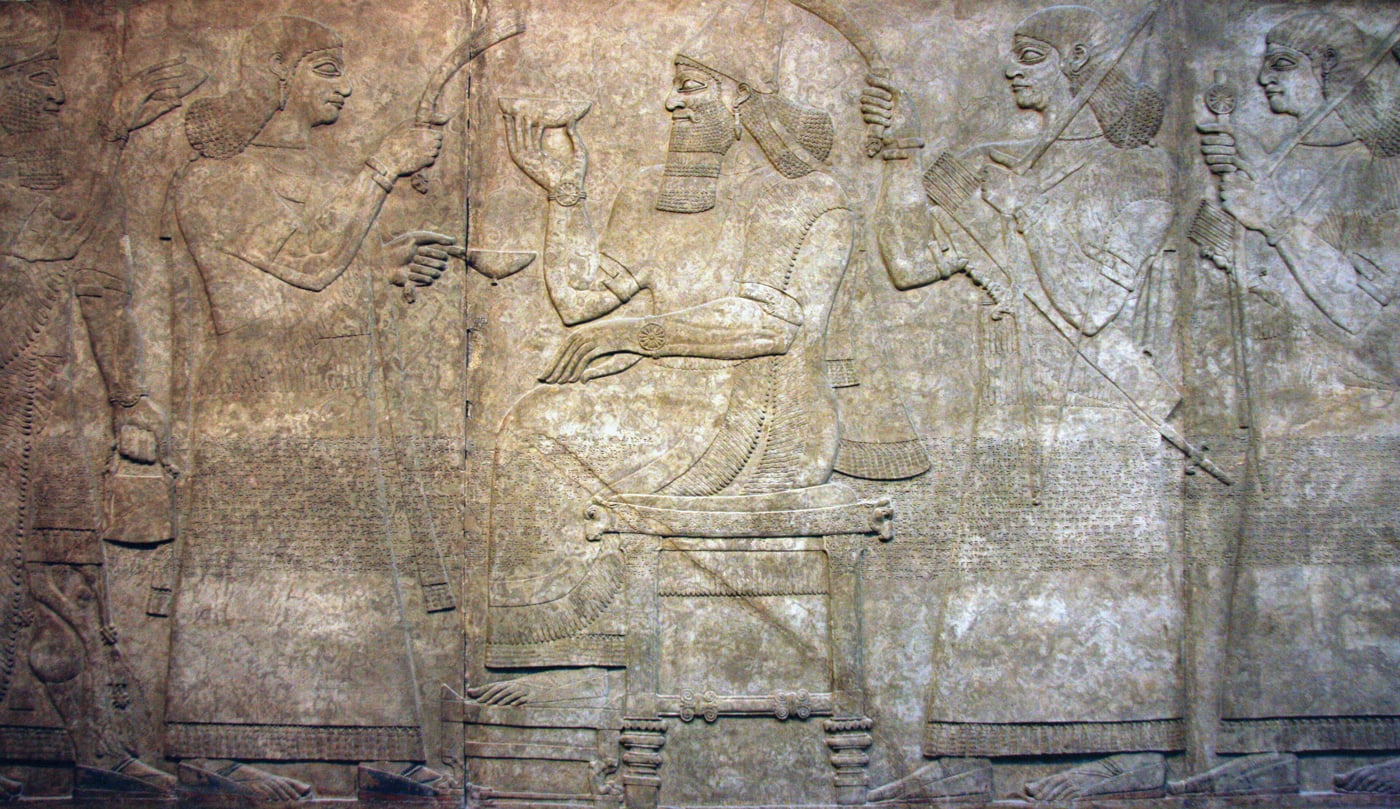
Assyrian relief showing a cupbearer (left) with King Ashurnasirpal (Nimrud, 865–860 BC). Nehemiah served as a cupbearer (Neh. 1:11).
The report Nehemiah receives from his brother, and others who come from Jerusalem, is not very encouraging. The reference to the broken-down wall and burned gates (1:3) may indicate damage still unrepaired from the earlier sack of Jerusalem by Nebuchadnezzar, or, more likely, may indicate the results of the opposition from the Jews’ enemies mentioned in Ezra 4:12. The news has a very deep impact on Nehemiah (1:4). He weeps and spends many days mourning, fasting, and praying. The following prayer must represent the content of his prayer during the next four months, for verses 1:11 and 2:1 indicate that four months pass between 1:1 and Nehemiah’s petition to the king in 2:1.
The content of Nehemiah’s prayer is noteworthy. It includes (1) a cry for God to hear (1:6), (2) an appeal to God’s covenant with Israel (1:5, 9), (3) confession of sin, (4) identification with the people (“we Israelites,” 1:6), (5) a recognition of the cause of their captivity (1:8), (6) an appeal to God’s promise (1:9), (7) a reminder to God that these returnees are his redeemed people (1:10), (8) a plea for God to answer (1:11), and (9) a petition for favor with the king (1:11). Many of these same themes appear in the prayers of Ezra 9, Nehemiah 9, and Daniel 9.
Nehemiah’s sensitivity to the people and his dedication to constant prayer indicate his godly character. He has a deep understanding of God and his word as revealed in the five books of the Pentateuch. Apparently, during this extended time of prayer, Nehemiah realizes that God is calling him to take action and to lead the project for revitalizing the struggling community in Judah. He is wise enough not to enter suddenly with a petition to the king. Rather, through extended times of prayer and careful planning, he awaits God’s timing to approach the king.
The fact that Nehemiah mentions here his position as “cupbearer to the king” (1:11) may indicate that he now understands God has put him in this strategic position for a purpose. The cupbearer had a high position in the Persian court. The king apparently cares for Nehemiah and recognizes his many abilities, for he is about to give him political power to help his people and even overturn official decrees against them. The Jews in Judah are not yet aware of it, but God is about to change their sorry situation.
2:1–10. Nehemiah finally presents his request to the king (2:1–8). The month Nisan (March–April) marks four months since Nehemiah received news of the difficult situation in Jerusalem. The account does not tell us if it is a special feast or perhaps a family or staff dinner; it does mention that the queen is sitting beside the king. Why has the king not noticed his cupbearer’s sadness before? The last sentence in Nehemiah’s prayer (1:11) suggests that prior to this he has hidden his sadness but now he senses that it is time to approach the king with his concerns. Although Nehemiah has prayed and planned, he is afraid (2:2), for he knows the danger of anything that might raise the king’s suspicion.
Nehemiah’s reply has been well planned. The king apparently understands that Nehemiah wants to make a request. The king’s question is so direct (2:4), and Nehemiah is so aware of the great importance of his answer, that he first, in his heart, prays to God before he answers. This prayer, like most of his nine prayers recorded in the book, is short. But such prayers are possible and effective because of his evident life of prayer and dependence on God.
Nehemiah’s answers to the king’s questions (2:4, 6) indicate that he has a growing realization that God is calling him to go to Jerusalem and has carefully planned even the details of this project. The king is immediately interested in the project and generously approves Nehemiah’s requests. Perhaps it is because of his confidence in Nehemiah and the strategic importance of Palestine, near the western limit of his empire. But Nehemiah himself gives the basic reason: “because the gracious hand of my God was upon me” (2:8). Throughout the book, Nehemiah emphasizes God’s providence, his working out details to fulfill his purpose.
The account gives very few details of Nehemiah’s trip to Jerusalem. He apparently has to visit the officials of Trans-Euphrates to make arrangements for the trip and the supplies he will need. The local rulers, Sanballat and Tobiah (2:10), are quite disturbed when they realize the intent of the trip.
These neighboring governors will very strongly oppose any projects to restore Jerusalem. Not only will they present opposition from without; their connections within the Jewish community will later cause opposition from within. A grandson of the high priest Eliashib is a son-in-law of Sanballat (Neh. 13:28). The family name of Tobiah, a Hebrew name, was prominent in Ammon during the Persian period. Tobiah may have been a descendant of Jews who fled to Ammon after the destruction of Jerusalem (Jer. 41:15). Both Tobiah and his son Jehohanan have connections with influential families in Judah through marriage (Neh. 6:17–19).
B. The work begun (2:11–3:32). 2:11–20. After arriving in Jerusalem and resting three days, the first thing Nehemiah does is survey the situation. No doubt, even in these three days, he is gathering information and getting acquainted with the leaders of the people. But he wisely does not yet tell them of his project. He needs time to survey the existing remains of the walls and their condition. He knows God has called him to this work but is careful to await the correct time to present the project to the leaders and all the people.
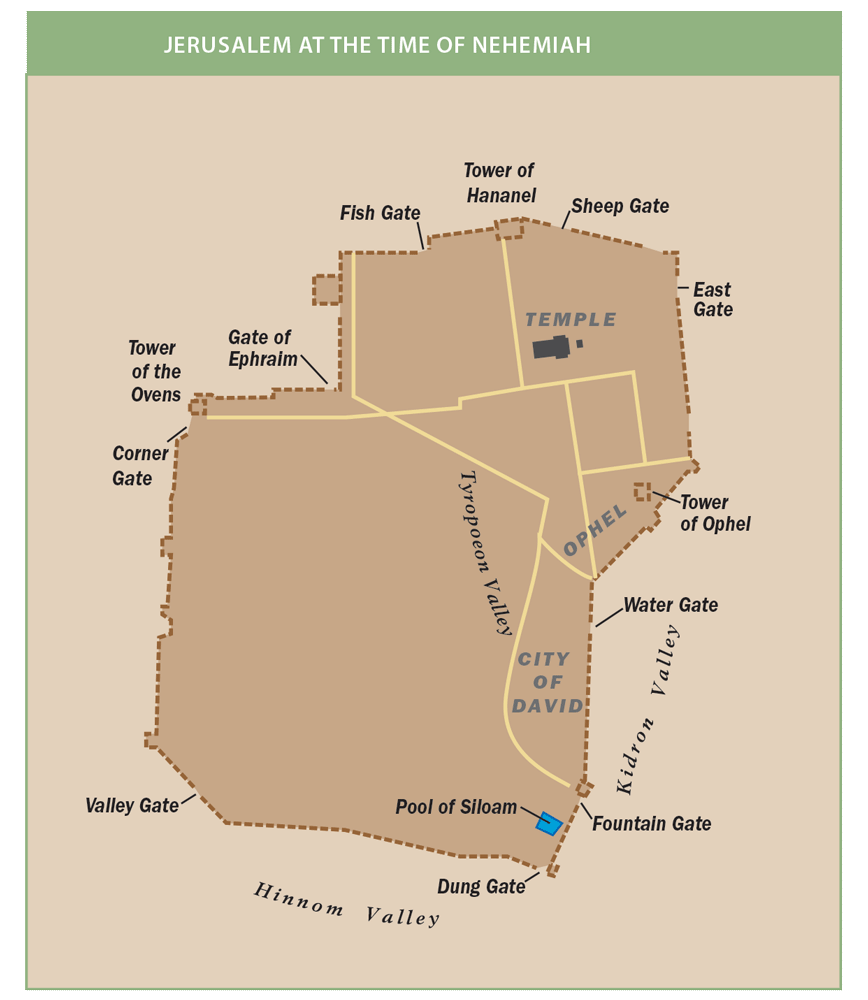
Nehemiah describes his secret (by night) inspection of the condition of the walls (2:13–16). The places he describes are in the southern part of the city, the part traditionally known as the City of David. He does not mention places around the northern parts of Jerusalem. The Valley Gate overlooks the Tyropoeon Valley on the west side of the city. The Dung Gate is near the southern end, where the Tyropoeon and Hinnom valleys meet. Nehemiah follows the wall turning north on the east side, to the Fountain Gate, overlooking the Kidron Valley. The “King’s Pool” may be a retaining pool for the overflow from the Pool of Siloam. From there, because of the debris from the destroyed wall, he goes by foot on up the valley. He does not say how far; if he went the entire distance it would be somewhat less than a mile.
Now Nehemiah is ready to present his project to the people (2:17–18). He is aware that the project cannot go forward without the wholehearted cooperation of the leaders and the people. As a good leader, he knows how to motivate them. He identifies himself with the people (2:17, “the trouble we are in”); he emphasizes their critical situation; he is committed to take action and participate with the people; and he shares his own testimony of “the gracious hand of my God upon me” for this project. Nehemiah shows us how a godly leader can influence the people to trust God and work together.
The author again mentions the neighboring enemies of Judah: Sanballat, Tobiah, and Geshem (2:19–20). They apparently fear that a revitalized Jerusalem and Judah will reduce their influence and power in the region. Their mocking and ridicule are designed to discourage the Jews from cooperating with Nehemiah. Nehemiah’s brief but meaningful answer puts the emphasis on God’s sovereignty and power; he reminds the neighbors that they do not share the same convictions, legal claims, or historical legacy as the returned Jews.
The roster of builders reveals a lot about the disposition of the people to work together and about Nehemiah’s abilities to organize the work (3:1–32). Although it is in the third person and includes details even to the finishing touches on the gates (6:1 and 7:1), it is likely part of the Nehemiah memoirs. It constitutes one of the most detailed biblical descriptions of Jerusalem.
3:1–32. The reconstruction of the northern and western walls is described in 3:1–15, starting at the Sheep Gate, near the northeastern corner of Jerusalem. Eliashib, grandson of Joshua (Neh. 12:10), who was the leader when the temple was rebuilt (Ezra 5:2), along with his fellow priests, rebuilds the Sheep Gate and the wall as far as the Tower of Hananel. There are two towers in the north wall; this is the only side of Jerusalem not defended by steep hills.
The fact that this part of the wall and the Tower of Hananel are the only parts dedicated here, apart from the entire dedication celebration (Nehemiah 12), may have theological significance. This tower is mentioned in only two Old Testament passages outside of Nehemiah (Jer. 31:38; Zech. 14:10), both in the context of the eschatological restoration of Jerusalem. Thus its prominence in Nehemiah and its dedication here by the priests may be seen as pointing to a theological vision that extends the sacredness of the temple, the house of God, to the entire “holy city” (cf. Neh. 11:1, 18) of Jerusalem.
The workers are sometimes identified by families and sometimes by their hometowns. The comment concerning the nobles of Tekoa (3:5) indicates that some Jews are not cooperating. Since Tekoa is near the area controlled by Geshem the Arab, this might be a factor. The Jeshanah Gate is also called the Old Gate.
Men and women from all walks of life share in the work; the account mentions goldsmiths and perfume makers (3:8), as well as sons of political rulers (3:9, 12). The small villages all over the area of Judah are represented. The work of restoration involves many different skills, as noted in 3:15.
The account continues with the construction of the eastern wall (3:16–32). The landmarks in this section are mostly houses and buildings instead of gates, since the wall on the east side did not follow the former wall but was built higher on the ridge. Nehemiah’s leadership skills are evident in his recognizing special effort by workers such as Baruch (3:20) and in his assigning workers to build the wall near their own houses (3:21–24, 26). “The hill of Ophel” (3:26) is part of the ridge between the City of David and the temple area (2 Chron. 27:3; 33:14). The East Gate (3:29) may be where the Golden Gate was located later. Meshullam (3:30) is related through marriage to Tobiah’s family and later is reprimanded by Nehemiah for giving Tobiah the use of one of the rooms in the temple construction.
Chapter 3 is more than a series of construction details; it has significance in the moral and religious life of the Jewish community. The wall is symbolic of separation from pagan influence (cf. Neh. 13:19–22). It gives the people a renewed sense of identity; it reverses their situation of shame, humiliation, and defeat. Also, it is symbolic of God’s presence and expands the sanctity of the temple, God’s house, to include the whole of Jerusalem.
The chapter also contains teaching for Christians today. The people’s willingness and enthusiasm to work together is a challenge for any church. Even those who live far from Jerusalem join in the work. It is an example of the Old Testament ideal of a community of brotherly love. The result is also a powerful testimony to their neighbors. Why does the work progress? Both the faith and decision of the whole community and the wise, godly leadership of Nehemiah are crucial. (See box, “Nehemiah, Example of a Godly Leader.”)
C. Opposition to rebuilding the wall (4:1–6:14). Any effective work for God can expect opposition, from either humans or evil powers, or both. The ability of a leader can be judged by how he or she confronts crises and reacts to opposition. We can learn from Nehemiah’s example as he faces different kinds of opposition. This lengthy section depicts the progress in reconstructing the wall in spite of and in response to opposition, both from without and within the community.
4:1–23. The first attack is in the form of ridicule (4:1–6). Sanballat is angry when he learns that the Jews are rebuilding the wall. The world’s response to God’s work is often anger, for it makes people uncomfortable by challenging their values and worldviews. In this case Sanballat also sees it as a threat to his influence in the area. So he attempts to make their efforts appear useless. Certainly the burned stones would be almost useless and the rubble would hinder the work. Tobiah joins the opposition by exaggerating the weakness of the wall. Together they attempt to stop the work. Psychological warfare often resorts to lies (as archaeologists have found that Nehemiah’s wall was nine feet thick).
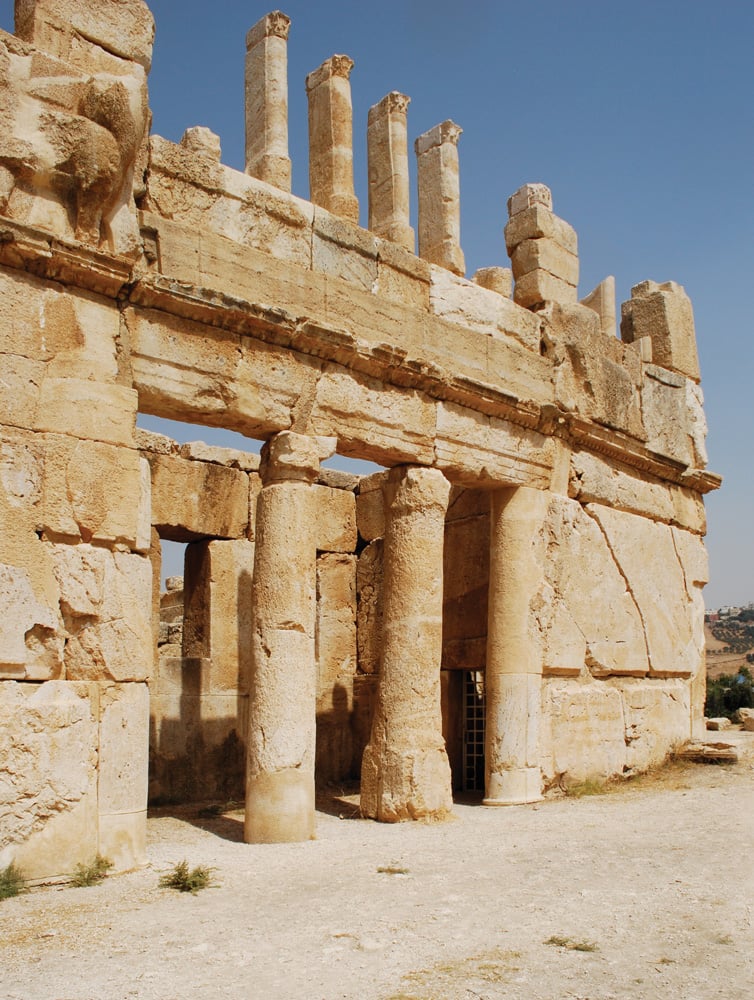
Aramaic inscriptions of the name Tobiah appear in two halls of the “castle of the slave” (Amman, Jordan, second century BC), indicating that it may have been built by a descendant of the Tobiah who opposed rebuilding Jerusalem’s walls (Neh. 4:7).
Nehemiah’s first response is to turn to God in prayer, a good example for us. He reminds God that his people are being despised. Then he asks God to judge and punish those who oppose his work. Apparently Nehemiah also motivates the people to work all the harder (4:6).
When Sanballat and Tobiah realize their ridicule is not working, they mobilize the other surrounding peoples to join them in a more aggressive plot. This includes Ashdod on the west, the Arabs on the south, and Ammon on the east. Again, Nehemiah, along with the people (4:9), responds immediately and clearly with prayer and precaution, trust and good management.
The next phase of the opposition adds the element of difficulties from within to the plot development (4:10–14). The continued intense labor, the massive amount of rubble from the former destruction, and now the threat of armed attack are causing the people to become discouraged. In addition, the Jews who live near the neighboring enemies are exaggerating the danger, creating more anxiety in the hearts of the workers.
Again, Nehemiah takes definite action. He posts guards with weapons at the weaker points in the wall. He wisely organizes the guards according to families for mutual encouragement. Then he calls the leaders and workers together and encourages them to trust God, who is powerful to deliver, and to defend their families (4:14). The enemies again realize their plans have failed; Nehemiah praises God for frustrating their plot (4:15).
Nehemiah understands the need for further precautions, so he divides the workforce, equipping half the men with armor and weapons and posting them at strategic points (4:16–23). Some keep their weapons in their hands even while they carry building materials. Nehemiah also prepares for mobilizing the defense at specific points if necessary (4:20). He asks the people from outside Jerusalem to stay in the city during the night while the crisis continues. Unfortunately opposition to God’s work today also requires precautions, delays, and increased resources (cf. Eph. 6:10–18), along with the same faith that we see in Nehemiah, who reminds the people that “our God will fight for us” (4:20).
5:1–19. Nehemiah not only must face opposition from without; now he has to face opposition from within the Jewish community (5:1–19). Christian leaders today find the same to be true, and it tests a leader’s character even more than opposition from without. In this case the nobles and officials, the powerful and the well-off in the community, are treating unjustly the underprivileged, the needy, and the poor.
This exploitation or oppression by one’s fellow human beings is one of the most detrimental evils in any society. It is one of the major themes of the prophets, who denounced Israelite society for condoning the injustice in their midst. According to the prophets, exploitation was one of the major causes for the exile (Isa. 1:15–17; 58:6; Jer. 7:5–7; 21:12–14; Amos 2:6–8; 5:11–12; Mic. 2:2). It was an indication that the people were becoming insensitive to God’s laws and principles revealed to them through Moses.
This problem must have been developing before Nehemiah arrives on the scene, since over ninety years have passed since the first return from exile in 538 BC. But now the intense work on the wall and the external opposition increase the strain on the economy. The need for workers to stay in Jerusalem adds to the hardship of the local workforce and finally brings forth their “outcry” (5:1). The same Hebrew word was used for the “[out]cry” of the Israelites under the Egyptian oppression in Exodus 3:9.
The law of Moses is part of God’s covenant with Israel as a people. The individual is important but is expected to act in benefit of the whole community. Therefore the individual’s relations to fellow Jews should never be purely business transactions; they should also be spiritual service pleasing to God. Thus, the Mosaic law provides regulations to maintain a respectable level of equality in the community and also provides ways to alleviate poverty when it exists: (1) Those in dire need can sell the crop value of their land until the next Jubilee year; then the land reverts to the original owner (Lev. 25:8–17). (2) Those with means are to help the poor. No interest is to be charged on loaned money, nor is food to be sold to the poor for profit (Lev. 25:35–38). (3) People in extreme poverty can sell themselves to one with means, to serve for six years. When Israelite servants are set free, their masters must give them liberal supplies of animals and food (Deut. 15:12–15). (4) All debts are to be canceled every seven years (Deut. 15:1–2).
The description of the problem (Neh. 5:1–5) and the reaction of Nehemiah (5:6–11) indicate that the community has been disobeying these laws. So Nehemiah becomes angry; but before acting, he wisely ponders the situation, its causes, and its possible solutions (5:7). His course of action to resolve this conflict between social classes serves as a good guide for resolving conflicts today. First, he separates the people from the problem. He sees the conflict as a community problem rather than a class conflict (5:8). Second, he shows that the wealthy leaders’ actions are hurting the whole community (5:9). He focuses on community interests rather than positions. Third, he proposes a solution that will benefit the whole community (5:10–12). A good leader considers a variety of possibilities before deciding what to do (cf. 5:7). Fourth, Nehemiah bases his solution on principles set forth in God’s law (5:10–13). Fortunately, the nobles and officials voice their agreement and promise to do as Nehemiah asks (5:12).
In this whole crisis Nehemiah shows courage, diplomacy, firmness, wisdom, and carefulness. He recognizes that oral promises are often forgotten, so he requires the nobles and officials, in the presence of the priests, to take an oath that they will do as they promised. Official oaths of this kind were put in writing and kept on record. The whole episode ends with praise to God for this happy resolution.
Nehemiah’s leadership style, alluded to in 5:10, is now further explained (5:14–19). The twelve years (5:14) include time after the events of these chapters but certainly indicate the unselfishness and generosity of his leadership at this time. His concern for the poor and needy and his decision to relinquish his income to alleviate the taxes on his fellow citizens serve as an example to all the leaders. Likewise, his trust in God, his moral integrity, and his wise leadership certainly have a lasting impact on the community.
6:1–14. Now that the internal crisis has been alleviated, the account turns again to the opposition from without, this time by trickery. Apparently Sanballat and his allies, having failed in their former tactics, decide the only way to stop the revitalizing of the Jewish community is to eliminate their leader. They are desperate, for now only the gates must be finished to complete the wall. Their first attempted “trick” is to entice Nehemiah to a diplomatic meeting. Nehemiah recognizes their attempt to trick him, so he firmly answers that he is occupied in more important matters (6:2–4).
The next tactic of the enemies is to publish an open letter to spread rumors of rebellion against Persia that will damage the work and perhaps cause the Persian king to stop it, as in Ezra 4 (Neh. 6:5–9). Such tactics are often used today to discredit Christian leaders. How should one respond? Nehemiah simply states clearly that their letter is full of lies and prays to God for strength to continue the work.
The final deception is very subtle. Shemaiah is a prophet, and apparently a priest (cf. Delaiah, 1 Chron. 24:18). He tries to cause Nehemiah to fear and shut himself in the temple. How is Nehemiah to know if this is a prophetic message from God or a false message? He discerns that it is not from God because (1) a leader should not fear, and (2) Nehemiah, a layman, is prohibited from entering the temple (6:11–13). He realizes that Sanballat and Tobiah are using their contacts within the community to either intimidate or kill him. There are also apparently other prophets who do not support the wall-building project.
D. Resolution: The wall completed; community consolidation begun (6:15–7:73a). Finally, the wall is completed (6:15–19)—what a note of victory! This is an important milestone, which greatly encourages the people. It testifies to what can be accomplished when the community works together under good leadership. The celebration for the wall’s completion is described in Nehemiah 12. Elul is the sixth month; the year starts with Nisan (Neh. 2:1), the first month in the religious calendar. But if the work is completed in fifty-two days, it is not clear exactly when the project was started. The twenty-fifth of Elul would be mid-September or the beginning of October.
The effect of this “victory” on the enemies is evident. They lose their self-confidence, and they fear (6:16). As long as they can convince themselves that this work is not legal and not of God, they can remain comfortable in their unbelief. However, when they realize that God has his hand in the project, they have reason to fear.
“In those days” means “throughout that period” (6:17), not only the present moment. It no doubt is included here to emphasize God’s power in what has been accomplished and also that the opposition may continue and will require continued diligence on the part of the community. This will not be easy, for Tobiah has influence on some of the important people in the community as well as on the priests. Tobiah’s name and that of his son Jehohanan (“The Lord has shown mercy”) may indicate that Tobiah considered himself a worshiper of the same God as this Israelite community.
Now that the wall-building project is completed, Nehemiah turns to the need to organize and consolidate the community (7:1–5). First on his agenda is the security of the city. The gatekeepers are normally assigned to the security of the temple. Why does Nehemiah assign them to the gate of the city and assign to work with them the Levites and singers? Certainly one reason is the lack of personnel and the great danger from the surrounding enemies. Another reason is that the whole purpose of the Jerusalem community is to worship God. As we have seen, Nehemiah considers the city an extension of the temple and therefore part of the house of God—thus, the city’s sanctity. The Hanani that Nehemiah puts in charge of the city is the same brother that first visited him in Susa and informed him of the sorry situation of Jerusalem (1:1–3).
The next step in the consolidation is to remedy the lack of population in Jerusalem (7:4–72). The people prefer to live in the villages out in the countryside. How can Nehemiah persuade some to live in Jerusalem? He seeks and receives God’s guidance, then plans to call a meeting of the leaders and all the people in order to take a census. He begins with a list of those who came from Babylon ninety-three years ago (in 538 BC). The list occupies the next sixty-seven verses (7:6–72).
The list apparently interrupts the flow of the Nehemiah memoirs at 7:5. That narrative continues again in 11:1—although Nehemiah 7:73 sounds like part of the memoirs and seems to fit between 7:4 and 11:1. Why did the author insert this list here? Why is a repetition needed? Studies in literary narrative technique indicate that such repetitions help to show the intentions of the author. Here the two appearances of the list (Ezra 2 and Nehemiah 7) form an “inclusio,” a kind of frame to bind together these three “missions” (Ezra 1–6; 7–10; Nehemiah 1–7). It also underlines the importance of the people, the whole community. The census itself must have gone on to include newer arrivals and family changes. So the list also helps tie together the past and the present of the community.
This list is almost exactly the same as the list in Ezra 2. There are differences in the spelling of some names and a few differences in verses 70–72. These verses appear to be summarized in Ezra 2:68–69; therefore some think the list of Ezra 2 is a copy of Nehemiah 7.
4. The Consolidation of the Covenant Community (7:73b–13:31)
This final section of Ezra-Nehemiah focuses on the reordering, revitalization, and consolidation of the covenant community. The other three sections lead up to this final time of renewal, victorious celebration, and dedication of what God has done in and through his people. The events may not be in exact chronological order but are arranged according to the author’s purpose. Some think the events of chapter 13 may well have occurred at an earlier time. Also, some think that chapters 8–10 were part of the Ezra memoirs and fit between the fifth month (Ezra 7:9) and ninth month (Ezra 10:9) of his account. They suggest that the phrase “Nehemiah the governor” (Neh. 8:9) is a later editorial addition to make it compatible with Nehemiah’s time. However, there may have been various times of reading the law; furthermore, it is unlikely that this large convocation and revival occurred immediately after Ezra’s arrival in Jerusalem. Even though Ezra and Nehemiah do not mention each other in their separate memoirs, there is no reason to conclude that the two of them were not active in Jerusalem at the same time.
A. Spiritual renewal according to the Torah (7:73b–12:26). Now that the reconstruction of the wall is finished, no time is wasted in making sure the community keeps its priorities in order. The people recognize the influence that times of spiritual renewal have had in their own past history under Asa (2 Chronicles 14–15), Hezekiah (2 Chronicles 29–31), and Josiah (2 Chronicles 34–35). The seventh month was an ideal time to seek another renewal, for the first day was the Feast of Trumpets, which later was also celebrated as the New Year. The Day of Atonement was celebrated on the tenth day, and the Feast of Tabernacles began on the fifteenth of this month. In the sabbatical year, the proclamation of the cancellation of debts was made during this feast (Deut. 31:11–13).
This spiritual renewal provides an excellent example of how such renewals revitalize a community. The same characteristics and ingredients of all genuine revivals are present here: (1) emphasis on God’s Word (8:1–5), (2) praise to God and celebration (8:6, 10), (3) the Holy Spirit’s humbling work in the hearts of the people (8:9), (4) confession of sin and repentance (9:2, 6–18), (5) reestablishing a meaningful prayer life (9:4–37) and (6) a new commitment to obey God (9:38–10:39).
7:73b–8:18. Ezra has not been mentioned since the events of Ezra 10 (458 BC or soon after). He must have been successfully teaching the law of Moses, because now, in 445, the people call on him to lead in making the word of the Lord the moral basis of their community. The initiative for this revival comes from the people, both men and women, young people and children (“all who were able to understand,” 8:2). We have seen the emphasis on “the people” throughout Ezra-Nehemiah; it is significant that the word “people” is used twelve times in this section (8:1–12).
Paul says in 2 Timothy 3:16 that all Scripture is inspired by God and profitable “for teaching, rebuking, correcting and training in righteousness.” Certainly Nehemiah 8 challenges Christians today to seek renewal through God’s Word. First, it emphasizes that all the people need to know and use God’s teachings, as Moses made clear (Deuteronomy 6). In later Judaism, the scribes and Pharisees gave the impression that the common people could not discern God’s will directly from Scripture. The early church returned to the Mosaic principle. Over time, the official church “experts” fell into the same error as the scribes and Pharisees. The Protestant Reformation again put emphasis on every believer’s use of the Bible. Again today there is a tendency to neglect this emphasis.
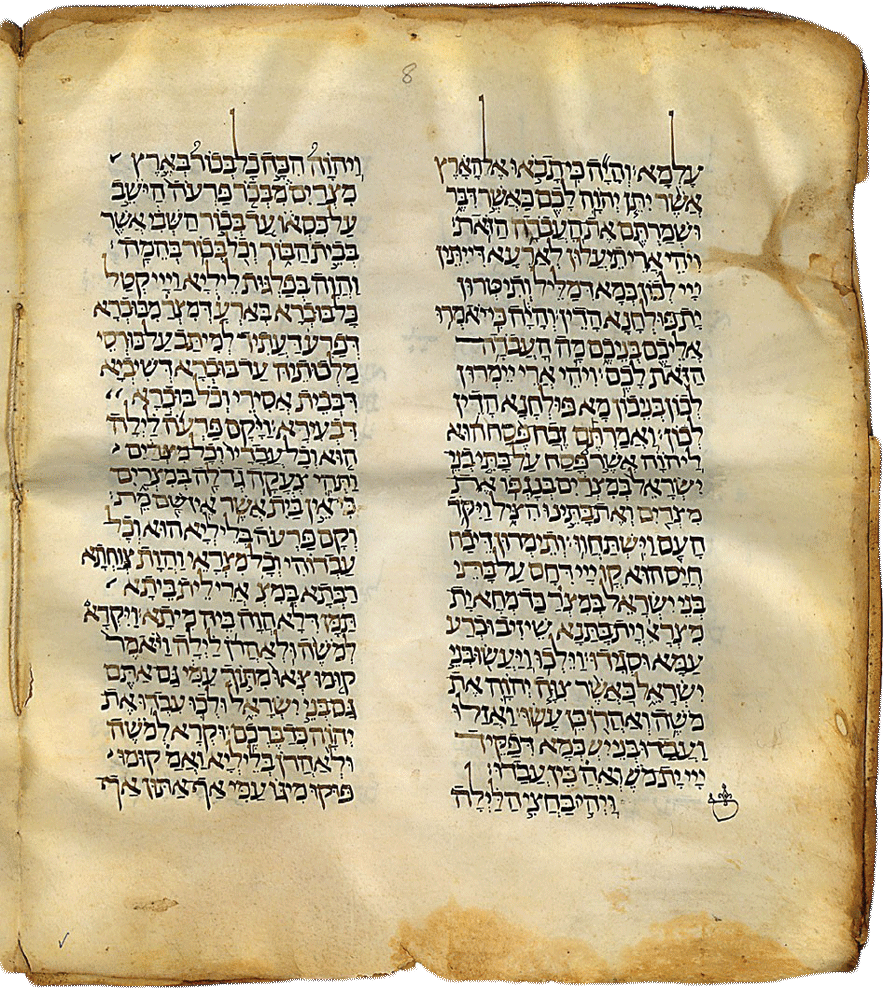
In this eleventh-century-AD Targum, the biblical text (here Exod. 12:25–31) is translated verse by verse, first presenting the Hebrew and then translating it into Aramaic. A similar technique may have been used in Nehemiah 8:8.
God’s work in the people’s hearts is evident in every verse. All the people are attentive to hear the reading of the scroll for some six hours (8:3). Their reverence and eagerness to hear what God says to them shows the Holy Spirit’s work in this renewal (8:7). They are eager to worship the Lord (8:6). Those who are prepared to teach instruct the people (8:7), so they can all understand (8:8). Since their everyday language now is Aramaic, some undoubtedly have difficulty understanding the Hebrew; this is thought to have been the beginning of the Targums (Aramaic paraphrases of the Hebrew Old Testament), if the help the teachers are giving is to explain the text in Aramaic.
Again, we see the Holy Spirit’s work in the people’s hearts as they weep when they recognize they have not been obeying God (8:9). True revival causes repentance but then results in joy (8:10). As Nehemiah says, “This day is sacred”; times of revival are always sacred times for God’s people. Although what happens here should happen in every worship service, throughout history God has also greatly used these special times of revival.
Chapter 8 emphasizes the need to continue the renewal. All the families are eager to “give attention to the words of the Law” (8:13). This leads to a renewed celebration of the Feast of Tabernacles (8:14–17) and continued reading of the law of God (8:18).
9:1–38. This revival continues with the people’s heartfelt confession of sin, praise, and petition to God (9:1–37). Their attitude reveals the depth of this renewal; instead of being eager to finish the Feast of Tabernacles and get back to normal life, they gather together for another reading of the law. Not only are they sorry for their past failures; they are serious about making a definite change. They spend at least half the day in hearing the law of God, confession, and praise (9:3). Then they dedicate time to prayer.
Apparently the Levites lead in the long prayer that follows (9:5–37). In form and content it is similar to the historical psalms (Psalms 78; 105–6; 135–36). The prayer is packed with theology. First the Lord (Yahweh) is recognized as the only God. He created everything and is worshiped by all the “multitudes of heaven” (9:6). The prayer emphasizes God’s grace in choosing Abraham, in making Israel his covenant people. God continues to shower on them his love and mercy through all their history: in miraculously redeeming them from bondage in Egypt, in leading them through the desert and providing their needs, and in giving them his revelation through Moses.
The prayer has a penitential emphasis; the people recognize that their nation has constantly failed (9:16–17, 26–30), that God has been just in punishing them, and that he has been merciful when they have again turned to him (9:17–25, 27–28, 30).
The last part of the prayer asks God to notice their present suffering. They again recognize that it is their just punishment for their failures (9:33–35). They emphasize their condition as subjects of foreigners. True, the Persians were not as cruel as the Assyrians and Babylonians, but their heavy taxation kept the people in poverty. Interestingly, the prayer does not end with a plea for God to show mercy. The people know God will be merciful if they really turn to him and obey his commands. Therefore they make a “binding agreement” (9:38), which is really a covenant. Not only do they make the agreement verbally, but they make and sign, with an oath, an official legal document stating they will obey carefully all God’s commands (10:29). They describe specific actions they will take to maintain their religious duties (10:30–39), summarizing with the promise, “We will not neglect the house of our God.”
10:1–39. The list of signers in 10:1–27 is similar to the lists of Ezra 2 and Nehemiah 7. There apparently were some others not in this list. The mention of those who “separated themselves from the neighboring peoples” (10:28) may indicate that some Jews who returned from the surrounding areas are included. The covenant includes not only the heads of families but also their wives and children “who are able to understand” (10:28).
The duties specified in 10:30–39 are based on the Pentateuch, but those laws are applied to this new situation. This illustrates early Jewish biblical exegesis. For example, the rule concerning intermarriage (Exod. 34:11–16; Deut. 7:1–4; 20:10–18) is slightly different here. The Sabbath laws must also be clarified. Originally the Jews would not have bought and sold among themselves on the Sabbath, but now non-Jewish neighbors are trying to sell them grain, even on the Sabbath. Hence, the laws pertaining to the Sabbath forbid buying and selling grain (10:31).
What can Christians today learn from this chapter? Certainly we are not under the law. But the laws of Moses teach the ethical principles that show God’s will for his people in all times. The Sabbath teaches us the importance of setting apart one day out of seven for worship and service to God. The sabbatical year indicates social principles for a healthy society: equality, justice, responsibility to the needy, and responsibility to the environment. The chapter teaches us to submit to the authority of God’s Word, to recognize the holiness of the Christian community, and to take seriously our commitment to Christ (cf. Rom. 12:1–2). It teaches us to be faithful in supporting those in full-time Christian service.
11:1–12:26. Nehemiah’s concern about the lack of population in Jerusalem (Neh. 7:4–5, 35) is taken up again in chapter 11. The author follows a very logical sequence in this final section (Nehemiah 8–13). First are the revival and the people’s covenant to be faithful to God. The next step in the consolidation of the community, as well as the community’s worship, is the repopulation of Jerusalem. After this we will see another emphasis on the genealogical list, then the dedication of the wall (Nehemiah 12).
11:1–36. Most of the people prefer to live in the villages outside of Jerusalem, including many priests, Levites, and temple servants. It is beneficial for those who serve in religious matters to live among the common people. But the parenthetical sentence in 11:3–4 suggests that it is an anomaly for them to live far away while other people live in Jerusalem. The whole community decides to choose by lots those who should live in Jerusalem. Some offer voluntarily to move to the city (11:2).
The list of those who move to Jerusalem (11:4–24) can be compared to a parallel list in 1 Chronicles 9. There are quite a few differences, so apparently neither is copied from the other. Both lists begin with the laypeople: the Chronicles list includes some families from tribes of the former northern kingdom; Nehemiah’s list, only Judah and Benjamin.
The families of priests are listed in 11:10–14. Some of their different tasks are mentioned. Good administration is needed to achieve harmony in the work with such a large number of priests. The Levites (11:15–18) also have many different duties. Only two are mentioned: the outside work of the house of God and the direction of praise and prayer. Mattaniah is the great-grandson of Asaph, who is mentioned in the titles to various psalms. The director of praise and prayer certainly has a great influence on the faith and life of any believing community. The surprisingly small number of Levites in comparison with the large number of priests reflects the situation described in Ezra 8:15–20.
The list of gatekeepers here is very brief (11:19); in 1 Chronicles 9:23–26 more details are given, and some of the gatekeepers are Levites. The remaining verses in this list give miscellaneous details. Some of the priests and Levites continue to live in the villages (11:20). The temple servants do not have to move; they already live in Jerusalem (11:21). Mattaniah must be of considerable age since his grandson Uzzi is the chief officer of the Levites (11:22).
The list of villages where the people lived (11:25–36) helps us to outline the area of Judah. It includes the area of Benjamin. However, it is possible that a few of the villages mentioned had a partially Jewish population and were outside the actual borders of Judah, such as Ono, near the northwest corner of Judah, and some villages in the south, where Geshem and the Arabs may also have lived.
12:1–26. Why, before describing the final celebration and dedication of the wall (Neh. 12:27–43), does the author present another list of priests and Levites (12:1–26)? He again emphasizes the covenant community’s historical continuity with preexilic Israel. He provides a way of dating specific events in their history, reverting to the method used before the monarchy, when successive periods were remembered by the lifetimes of the high priests (Num. 35:28). With the loss of Hebrew kingship, it is important to designate alternative historical markers. Also, by naming the priests and Levites, the author indicates the importance of each individual in God’s work (cf. Ephesians 4), even though throughout Ezra-Nehemiah he is careful to emphasize the whole people rather than one or two great leaders.
Twenty-two names are given in 12:1–7. Nearly all are seen again in 12:12–21 to show the continuity of the priestly houses. Fifteen of those who signed the special “binding” covenant in Nehemiah 10:2–8 had these family names, although there are some spelling differences. Since originally there were twenty-four priestly divisions (1 Chron. 24:7–19), and the same was true in later Judaism, two names may have dropped out of this list (12:1–7), or perhaps no representatives of those families were among the returnees.
The list in 12:8–9 provides additional information to Ezra 2:40–42, which includes only the names of Jeshua, Kadmiel, and Hodaviah. As the NIV note at Ezra 3:9 indicates, Judah (Yehudah) may be the same as Hodaviah.
The genealogy of the high priestly family is given in 12:10–11. Joshua was high priest at the time of the first return (538 BC) and at the time of Haggai and Zechariah (520 BC). Eliashib was high priest in Nehemiah’s time; therefore Joiakim was high priest between those two.
The priestly families in the time of the high priest Joshua were named in 12:1–7. Now the author gives the priestly families in the time of Joiakim’s high priesthood (12:12–21). Compared to the list of priests who signed the covenant (10:2–8, in Nehemiah’s time), this list contains six additional names. It may simply indicate that in 10:2–8 some priests did not sign the covenant.
Additional information concerning the Levites is given in 12:22–26. Some see a contradiction between verse 22, where Johanan is high priest after Joiada, and verse 23, where he is “son of Eliashib.” It has been suggested that he was a brother of Joiada; but more probably we should read “descendant of Eliashib” in 12:23. According to the Elephantine Papyri, a Johanan was high priest in 410 BC, in the reign of Darius II. Since names are often repeated in family lines, it may not be the same Johanan. These verses (12:22–23) indicate that careful records were kept by the Jewish leaders.
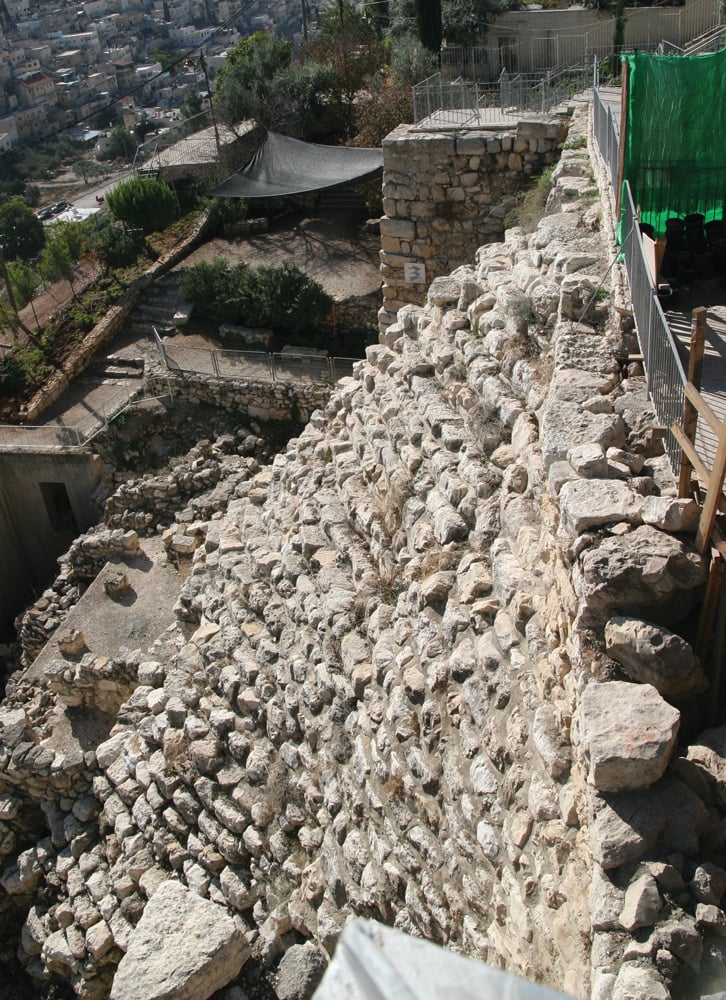
The top layers of stone (extending from the foreground to the tower) are thought to be remnants of Nehemiah’s wall, built in the middle of the fifth century BC.
The phrase “one section responding to the other” (12:24) refers to antiphonal singing, which David instituted. According to Nehemiah 11:17, Mattaniah, Bakbukiah, and Obadiah (12:25) were singers; thus they should be included in 12:24. The final note (12:26) again gives the impression that Ezra and Nehemiah worked together in Jerusalem, at least some of the time.
B. Celebration and dedication (12:27–43). The first-person account, which broke off at 7:5, resumes at 12:27. Nehemiah describes the dedication of the wall following the spiritual renewal and the people’s covenant to obey God. He understands the divine emphasis on celebrations. God calls his people to thankful worship and rejoicing (Deut. 12:7, 12, 18; 14:26; 16:11–15; 26:11; 27:7). Times of celebration and thankful worship unite the community, draw the people closer to God, and motivate them to rededicate their lives to the Lord.
The completion of the wall is the climax of a series of wonderful manifestations of God’s guidance and power: the decree of Cyrus (Ezra 1:1–4) has brought about freedom from captivity, the temple has been constructed, and the Jewish community has been revitalized and renewed. The restoration of the wall of Jerusalem has been completed, extending the sanctity of the temple to include the whole city. It is time to remember what God has done and unite in joyous praise to him.
Elaborate preparations are undertaken to make the celebration meaningful (12:27–30). Special effort is put forth to bring the Levitical singers and musicians from far and near to prepare for the great musical celebration. “Songs of thanksgiving” (12:27) signifies “thanksgiving choirs” and is translated “choirs” in verses 31, 38, and 40. Since this is a celebration centered on God, the priests and Levites first purify themselves through the prescribed ceremonies; then they sanctify, through sacrifices, the people, the gates, and the wall.
The dedication is quite impressive, and the sounds of singing, musical instruments, and rejoicing can be heard far and wide (12:43). There are two choirs that march on top of the wall and sing antiphonally. They begin the procession at the Valley Gate (cf. Neh. 2:13). Ezra leads the first choir proceeding south (to the right, counterclockwise) to the Dung Gate and the Fountain Gate, up the steps to the City of David, and on to the Water Gate on the east. The second choir proceeds in the opposite direction (clockwise), as Nehemiah and the other officials follow them. They go past the Tower of the Ovens, the Gate of Ephraim, the Jeshanah Gate, the Fish Gate, the Tower of Hananel, and the Tower of the Hundred, and on to the Sheep Gate, stopping at the Gate of the Guard. After this spectacular celebration they go into the temple and continue the rejoicing and worship with singing and “great sacrifices” (12:43). The sacrifices symbolize their dedication to God. Truly the whole city of Jerusalem has become sanctified.
C. Conservation of the renewed community (12:44–13:31). How does a revitalized community continue the renewal experience? Certainly the history of Israel and the church illustrates the human tendency to drift away from communion with God. Preserving and continuing renewal requires a constant vigil on the part of the community and its leaders. This may be the reason Ezra-Nehemiah ends with examples of actions to avoid such apostasy (13:4–31).
The phrases “on that day” (12:44 [NIV “at that time”]; 13:1) and “in those days” (13:15, 23) refer in general to a period of time, not necessarily to specific days. The author uses them as a narrative technique to unify the material from 12:44 to 13:31. Apparently he wishes to show the contrast between their promising beginning (12:44–13:3) after the renewal and dedication experiences and their later backsliding after Nehemiah’s absence (13:4–31).
12:44–13:3. After the dedication, the people begin well. The comments in 12:44–13:3 likely refer in general to the period after the covenant of Nehemiah 10 and the dedication of the wall (Nehemiah 12) and are added here before resuming the Nehemiah memoirs (13:4–30). These comments confirm that the community really is being faithful to the covenant they signed in chapter 10. They are bringing the tithes and offerings according to the law (12:44). They are not neglecting the house of God (cf. Neh. 10:39). The statement “for [because] Judah was pleased with the ministering priests and Levites” highlights an important truth: when worship and pastoral leaders serve according to Scripture and in order to please God, the “spiritual” level of the community remains high, and the people give generously for God’s work (12:47). Nehemiah and the leaders wisely organize the administration to correctly follow the law of God, as they promised in Nehemiah 10:29. Likewise, the next paragraph (13:1–3) indicates they are taking seriously their promise of separation in 10:30. This sounds like a harsh decision; however, foreigners could become part of Israel through conversion (Ruth 1:16–17).
13:4–31. The situation then changes. The practices condemned in this section all involve disobedience to God’s commands. The first is a failure to maintain the sanctity of the temple and to fulfill other religious responsibilities (13:4–14). The second is disobedience to God in regard to keeping the Sabbath holy (13:15–22), and the third is disobedience in regard to marriage with non-Jews (13:23–29).
The phrase “before this” (13:4) refers to a period prior to Nehemiah’s return to Jerusalem after he has been absent for a time. But it does not tell us how long before. Some suggest that the events of this chapter occurred earlier than the dedication ceremony; however, it is best to consider it later, during the time Nehemiah has returned to his service for King Artaxerxes (13:6). Why does Nehemiah call him “king of Babylon”? The Persian kings occasionally used this title (cf. Ezra 5:13), for they considered their empire the continuation of the Babylonian Empire. It is also possible the king was living in Babylon at this time.
The high priest is not in charge of the storerooms, so this “Eliashib the priest” (13:4) surely is not the Eliashib who was high priest. Earlier it was mentioned that Tobiah the Ammonite had a negative influence on some of the important people in Jerusalem. He is married to a Jew (Neh. 6:10). Eliashib certainly has betrayed his responsibility in allowing Tobiah to use a storeroom of the temple court for his own purposes. Since this was the place designated for storing the people’s offerings, it no doubt is one cause for the disruption in the Levites’ ministry (13:10–11).
Nehemiah resolves the problem by expelling the Ammonite, purifying the desecrated areas, and putting responsible, trustworthy men in charge of the storerooms (13:12–13). When order is restored, the people again are faithful in giving their support for the priests and Levites.
Nehemiah also notices the backslidden condition of the people in their failure to keep the Sabbath (13:15–22). When the people drift away from the Lord, they become lax in obeying God’s will. The Old Testament puts a lot of emphasis on keeping the Sabbath. The concept of a Sabbath was unknown in the ancient world outside of Israel. God instituted it as a means of keeping his people centered on his priorities; it emphasizes the sanctity of time and symbolizes that all our time belongs to God.
Although in the New Testament, believers are not under the law in a legalistic manner, the inclusion of the Sabbath in the Ten Commandments would indicate God’s will that one day a week be set aside and dedicated to worship and rest. Because of Jesus’s strong teaching against the legalistic observance of the Old Testament Sabbath, and his repeated postresurrection appearances on the first day of the week, the early Christians began to worship God together on the Lord’s Day (Sunday) to commemorate Jesus’s resurrection. It gradually took the place of gathering on the seventh day. Throughout the centuries of church history there has been much discussion concerning our responsibility in regard to the Lord’s Day. Christians throughout the world follow Jesus’s example of putting emphasis on “how to sanctify” the Lord’s Day, by making it a day of rest, worshiping together, and serving God.
Nehemiah warns the Jews that by desecrating the Sabbath they will again bring down God’s wrath on their nation. The initiative for the commercial activity has come from non-Jewish neighbors. Apparently many of the Jews are taking advantage of their offers. Even the Levites who have been assigned to guard the city gates are somehow neglecting their duty. Nehemiah takes specific action to completely stop all buying and selling on the Sabbath. He also finds it necessary to reassign the Levites to guard the gates.
The repetition of the phrase “in those days I saw . . .” (13:15, 23) underlines a characteristic of Nehemiah’s good leadership; he is aware of what is happening among the people throughout the whole region. He sees another area where the people are disobeying God’s standards: intermarriage with pagan neighbors. Even the family of the high priest has become involved (13:28). Like Ezra, who confronted the same problem earlier (Ezra 10), Nehemiah realizes the danger this poses to God’s purpose for the Jewish community. Again he takes definite action, including purifying the priests and Levites “of everything foreign” (13:30).
Although Nehemiah is best known for reconstructing the walls of Jerusalem, he concludes his memoirs, and the author concludes Ezra-Nehemiah, with this emphasis on maintaining the renewed Jewish community’s worship and commitment to God. Today we can be thankful that God used both Ezra and Nehemiah to reestablish and maintain this community through which he fulfilled his purpose in giving his revelation, the Bible, and the Savior to the entire world.
Select Bibliography
Blenkinsopp, Joseph. Ezra-Nehemiah. London: SCM, 1989.
Breneman, Mervin. Ezra, Nehemiah, Esther. New American Commentary. Nashville: Broadman & Holman, 1993.
Clines, David J. A. Ezra, Nehemiah, Esther. New Century Bible Commentary. Grand Rapids: Eerdmans, 1984.
Fensham, F. Charles. The Books of Ezra and Nehemiah. New International Commentary on the Old Testament. Grand Rapids: Eerdmans, 1982.
Holmgren, Fredrick Carlson. Ezra and Nehemiah: Israel Alive Again. International Theological Commentary. Grand Rapids: Eerdmans, 1987.
Kidner, Derek. Ezra and Nehemiah. Tyndale Old Testament Commentaries. Downers Grove, IL: InterVarsity, 1979.
Klein, Ralph W. “Ezra and Nehemiah.” In The New Interpreter’s Bible. Edited by Leander E. Keck. Vol. 3. Nashville: Abingdon, 1999.
Throntveit, Mark A. Ezra-Nehemiah. Interpretation. Atlanta: John Knox, 1992.
Williamson, H. G. M. Ezra, Nehemiah. Word Biblical Commentary. Waco: Word, 1985.