Colossians
1. Greetings from Paul and Timothy to the Colossians (1:1–2)
3. The Hymn to Christ (1:13–27)
A. The Father Rescues His People (1:13–14)
B. The Son Offers Reconciliation (1:15–20)
C. The Colossians Stand Firm in Faith and Hope (1:21–23)
D. The Example of Paul’s Suffering (1:24–27)
4. The Call to Christian Maturity (1:28–4:6)
A. Paul Contends for the Colossians (1:28–2:7)
B. Christ Is over Every Power and Authority (2:8–15)
C. Reject False Teachings (2:16–23)
D. Set Your Heart and Mind on Things Above (3:1–4:6)
Introduction
Located strategically in the Lycus Valley near the Meander River in western Anatolia (modern Turkey), Colossae facilitated trade with its two larger neighbors, Laodicea and Hierapolis. Though the city had seen grander days, in the first century AD it lived in the shadow of its nearby rivals. The wealth of Laodicea and Hierapolis no doubt helped the Colossian economy, which continued to be known for its wool industry. The prosperity of all three cities was severely shaken with a major earthquake in AD 60/61 (Tacitus, Annals 14.27.1). Laodicea rebuilt itself without help from Rome. Perhaps Colossae also regained some of its earlier strength, but evidence is sparse, and no excavations have been done of the city.
Even before Colossae was stirred up by the earthquake, not all was calm within the city’s young Christian community. The church was not in imminent danger of casting off their faith, but the situation was sufficiently worrisome that Paul dispatched a letter to address the brewing unrest. What exactly was the trouble? Paul’s letter reveals growing tensions caused by what he calls an errant “philosophy” (Col. 2:8). The term “philosophy” calls to modern minds ivory-tower ruminations about abstract theoretical principles of human existence and the cosmos. In the first century, however, philosophy was closely coupled with ethics; it promoted rational thought over superstitions and carried positive connotations of an educated person and a well-run society. The term’s use in Colossians probably carries the ironic sense that though its adherents see it as wisdom, Paul discounts it as mere human musing.
Paul warns the mostly Gentile church against the individualism underpinning this philosophy, which focuses on visions and asceticism and is rooted in their particular application of the law of Moses. Paul emphasizes two points: first, being in Christ means being in a community of which Christ is the head; and second, living in this community does not include, for Gentiles, following Jewish cultic practices or esoteric pursuits, such as a quest for visions.
The authorship and date of Colossians are both hotly contested and tied tightly to questions about the philosophy. Therefore, before we can address authorship questions, we must discover why the letter was written and what was involved in the philosophy. As we explore the reason for the letter’s existence, a strong case for Pauline authorship will emerge.

Content
Colossian philosophy as syncretistic. One theory about the philosophy Paul refers to is that it was a syncretistic movement that drew on folk religious beliefs and magic, as well as conventional Jewish thinking and practices, as a way to confront the supernatural powers controlling the world. In this view, the philosophy had not abandoned monotheism but lined up with certain pagan assessments about how to control the forces of nature and fate.
To support this theory, several pieces of data are put forth. One is a type of Jewish expression that emphasized magic and astrology. Colossians 2:8 uses the Greek term for “tradition,” which was also used in magical spells. The spells, it was believed, helped protect against hostile spirits, who influenced heavenly bodies and sought to dominate humans. Moreover, the philosophy’s preoccupation with festivals, New Moon celebrations, and Sabbath shows an interest in astrology. Astrology seems to have played a role in defining Sabbath celebrations among some Jewish communities.
The syncretistic position does not place Judaism at the center of the philosophy’s identity but puts it on equal footing with aspects of pagan religious beliefs and practices. Parallels to mystery cults are also discovered in a number of places, such as in the term translated as “goes into great detail” (2:18), which has connections with mystery cult initiations. Moreover, the emphasis on visions mirrors the mystery cults’ promises of a mystical union. The word “honor” (NIV “value”; 2:23) is said to carry “technical significance in local religions for privilege someone experienced of being chosen by a deity and going through a mystery initiation rite” (Arnold, 220).
In this view, the promoters of the philosophy came from within the church and were most likely Gentile, although a few might have been Jewish (Arnold, 228–32). They did not teach a different gospel as much as fail to give Christ his due. They focused on the present dangers created by spiritual forces and local gods and looked to angels for protection. They represented the general population, which drew on organized religion and folk beliefs to manage their precarious existence. The philosophy sought security in visions that served as initiation into a full Christian life.
Colossian philosophy as Jewish. As intriguing as these connections are between the Jewish and pagan worlds, many scholars are unconvinced by the syncretistic explanation. Some of the characteristics labeled as pagan, such as the interest in food and drink and religious festivals (2:16), could easily fit with Jewish practices. Again, the syncretistic theory fails to adequately account for the references to circumcision (2:11, 13; 3:11) and the written code (2:14). Circumcision is stressed as an important part of the Colossians’ self-identity in Christ, which implies that the philosophy addressed this rite.
While a few characteristics of the philosophy clearly speak of Judaism—for example, the mention of Sabbath (2:16)—other characteristics sound ambiguous. A primary question is whether Paul, or any Jew, would describe the law as part of the powers and principalities (2:20), as human tradition and “hollow and deceptive” (2:8). Paul connects the law to human tradition when describing his life before his call to be an apostle. He tells the Galatians that he was well advanced in Judaism and zealous for the traditions of his fathers (Gal. 1:14). Again, the Gospel of Mark (7:5, 8) places on the lips of Pharisees a question to Jesus concerning the traditions of the elders. Here the term is understood positively by the speakers, but it is judged insufficient by Jesus.
Perhaps more disturbing is the possible link made between the law and the basic principles of this world, or stoicheia (Col. 2:8, 20). The term can refer to the ordinary basic elements of the earth, such as water and air and fire (see 2 Pet. 3:10, 12). But it can also indicate those spirits that rule over the elements. Paul uses the term in Galatians 4:8–9 (see also 4:3), where he draws a parallel between those “who by nature are not gods” and “those weak and miserable forces [stoicheia].” He connects the law with stoicheia through the metaphor of slavery. He suggests both that the law played the same role of enslaving Gentiles as did their pagan idolatry and that for Jews it was the power set in charge over Israel. Interestingly, in both Galatians and Colossians, the stoicheia are mentioned next to comments about the attraction of special Jewish observances and festivals and interest in angels (Gal. 3:19; Col. 2:18). This intimates a common thought trajectory behind both the Galatian Judaizers and the Colossian philosophers.
Much of this discussion hinges on a historical situation that included Gentile-Jewish interaction. Asia Minor incorporated large numbers of Jews, such as the Jews from Asia and Phrygia who traveled to Jerusalem for Pentecost (Acts 2:9–10) and Philip the apostle (or evangelist; Acts 21:8–9) and his virgin daughters, who settled in Hierapolis (Eusebius, Ecclesiastical History 3.31.2–5). Is a robust, confident, and self-assured Jewish community the target of the letter’s argument? One view suggests that these Jews were neither actively seeking to undermine the Christian church nor attempting to convert them to Judaism; nevertheless, their argument was persuasive, and hence threatening, to the newly formed Christian community (Dunn, 35). This analysis, however, fails to explain adequately why these Gentiles would now be particularly vulnerable to Jewish influence, especially if the Jews are not actively seeking to bring them into the synagogue.
In conclusion, the philosophy is best understood as a Christian group that emphasized Gentiles must fulfill the Jewish law (i.e., be circumcised) to be full members of the community. The philosophy’s particular slant on obedience to the law included an ascetic component, with an interest in visions. To combat the philosophy, the Letter to the Colossians elevates Christ by speaking of creation, including all powers and authorities, as coming through the Son (1:16). The same language is used to describe the Colossians’ previous status as being uncircumcised and dead in their flesh but made alive when Christ on the cross “disarmed the powers and authorities” (2:13–15). At some level, then, these powers and authorities are connected to or synonyms for the Jewish law.
The philosophy and the hymn to Christ. While the philosophy is not mentioned directly until chapter 2, the “hymn” in Colossians 1:15–20 is often seen as a counterbalance to the philosophy. Those who see the philosophy as syncretistic suggest that the hymn presents Christ as above the astral powers, gods, and fate, which torment humans. The philosophy turned to folk remedies such as magic and astrology, while the hymn declares that Christ has the power to combat those cosmic forces. The syncretistic position interprets the hymn as a frontal assault on the philosophy’s inadequate understanding of Christ.
This approach, however, de-emphasizes the hymn’s concern with the church as Christ’s body and as God’s people sharing their inheritance of the kingdom of the Son (1:12–13). The hymn is rooted in the salvation story of God, it flows naturally from the liturgical language of 1:12–14, and its claims echo throughout the letter. The forgiveness of sins and the triumph over powers and authorities are repeated in 2:13–15, and themes of creation and new creation in 3:10. The exalted picture of the Son as the image of the invisible God champions the majesty of God’s plan of reconciling through Christ (1:23).
The imperial cult and the hymn to Christ. The hymn also reminds the Gentile Christians to resist another persistent voice: the imperial cult. The emperor and his military sought to convince all peoples of the omniscience and omnipotence of Rome. Coins, statues, military triumphal parades, and, not least, the imperial cult proclaimed loud and clear Caesar’s divine status as the savior of the world and Rome’s role as the keeper of moral order and goodness. The imperial cult’s tentacles reached deep into city life: “In Rome imperial images, painted and sculpted, were on display in almost every shop” (Price, 120). Imperial temples provided space to erect statues dedicated by local associations or people. Time itself was marked by the emperor, with Augustus’s birthday starting the new year. The imperial cult pervaded all life; it was not relegated to public lip service or privatized as individually chosen, personal piety. Therefore, any claim by Christians that Christ was the image of God and held full supremacy affected not simply an individual’s personal political views but also the very roots of his or her social network and worldview.
Authorship
Colossians announces its author as the apostle Paul (and Timothy; 1:1), but recent scholarship has called that into question. Many scholars conclude that the differing cadence, style, and language add up to a literary style that may imitate Paul. Here we see not the varying hand of the secretary but the deeper evidence of authorial (unconscious) mannerisms in speech and thought patterns. Absent is the acerbic tone of Galatians, the sharp dialogical style of Romans, or the sarcasm of the Corinthian correspondence (Dunn, 35).
If it were only at the literary level, however, many scholars would probably explain the unique qualities as a more developed Paul, a different secretary, or the influence of Timothy. But the differences extend to theological categories, which are said to stand at odds with Paul’s undisputed letters. For example, the Christology found in 1:15–20 and 2:9–10 is argued to be more fully developed than what would be expected in the first-generation church. Likewise, the ecclesiology seems further along the historical trajectory of the early church than what would be current in Paul’s time. This includes understanding Christ as the head of the church (1:18), which expands on the image of the church as the body of Christ (hands, feet, ears, eyes, and head; see 1 Cor. 12:15–27. “The problem is not that Colossians fails to treat a typically Pauline theme but that Colossians fails to treat this theme in a typically Pauline manner” (Thompson, 3).
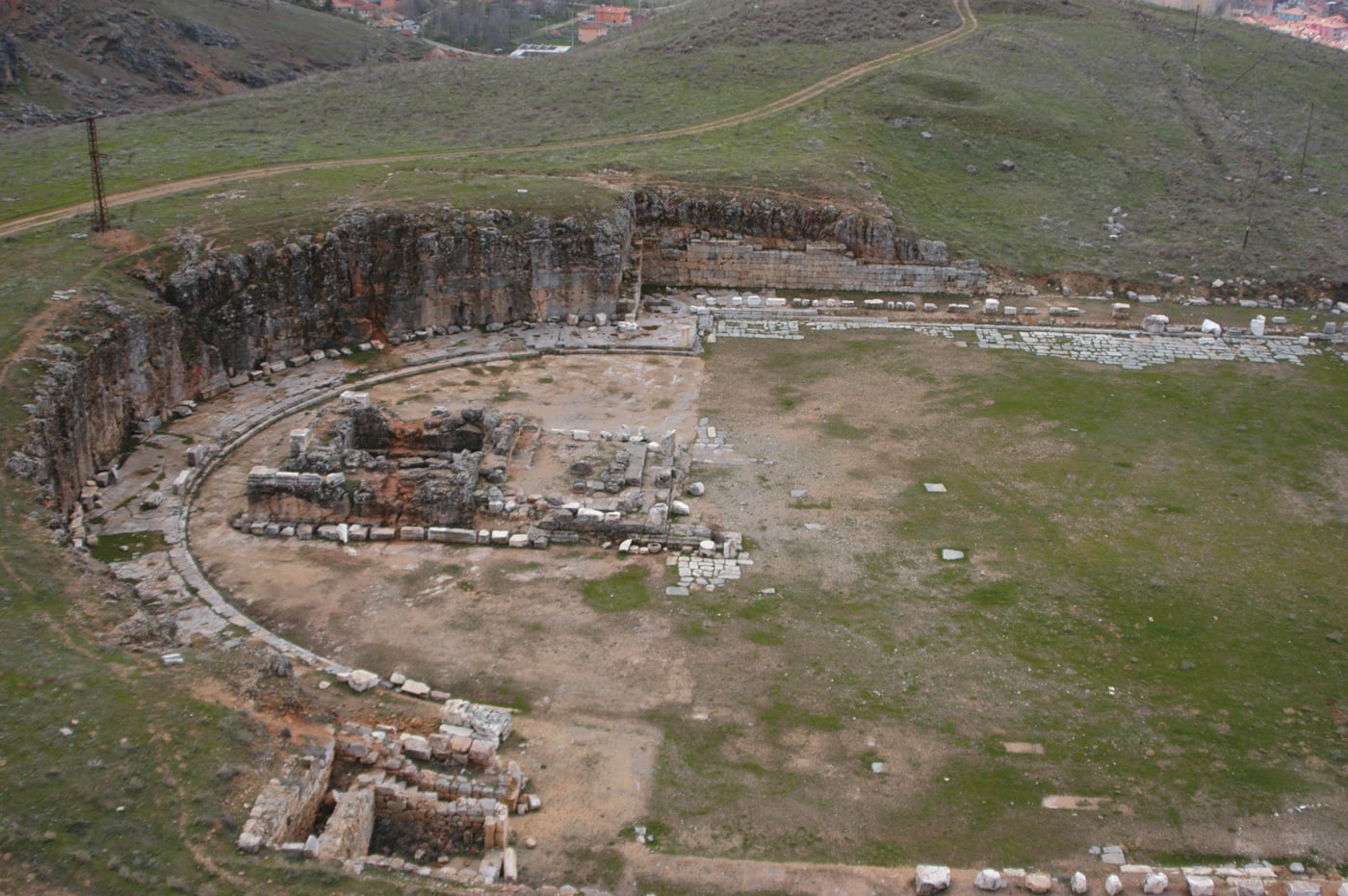
Imperial temples, such as this Temple of Augustus at Pisidian Antioch (early first century AD), were erected in many Roman cities for worship of Roman emperors upon their deification.
Moreover, some argue that standard Pauline topics are missing. For example, in the vision of the church there is no mention of the Spirit (as in Galatians 5), guiding and empowering believers in their lives of holiness. Instead, we have household codes (3:18–4:1), rules supporting the Greco-Roman social status quo. Absent is the eschatological stress on the future; instead, a strong realized eschatology permeates the letter. For example, in Colossians 2:11–12, the author speaks in the past tense of being raised with Christ through faith, in contrast to Romans 6:4, which concludes that believers were buried with Christ and now “may live a new life” (see also Rom. 8:11). Also missing is a robust use of the Old Testament as seen, for example, in 1 Corinthians 10 or Romans 3. Abraham and his example, so important in Romans and Galatians, are absent from Colossians. No mention is made of justification, the bedrock of Paul’s thought.
Finally, Colossians is remarkably similar to Ephesians, a letter many scholars consider post-Pauline. Some argue that Colossians served as a template for Ephesians, but even so, the fact that Colossians was used calls its own status as Pauline into question. That is, Colossians was appealing as a model for Ephesians precisely because it represented a step beyond the authentic Paul and could be a guide for how to interpret and configure Paul for the next generation of readers. Timothy has been put forward as a possible author. Some qualify this by surmising that Paul empowered Timothy to write Colossians and approved the finished product. In this case, the scholarly label “deutero-Pauline” is unhelpful, as the letter met with Paul’s approval. Complicating matters are the connections between Colossians and Philemon, a letter that most regard as genuinely Pauline.
A growing number of scholars are dissatisfied with this debate. They argue that the style, sentence structure, and theological outlook could well fit the range of Paul’s expressions. Moreover, they suggest that the personal details (4:7–18) make sense only if it were written by Paul. While the tone of the letter is softer and less direct, this is due to Paul’s “outsider” role; though Epaphras established the church directly, Paul felt an oversight responsibility toward the Colossian congregation because Epaphras was part of Paul’s team. Again, the letter’s structure matches what is found in the undisputed Pauline Letters: themes are briefly or poetically stated and then developed more deeply in subsequent paragraphs (for example, Philippians 2).
Those who believe Paul authored Colossians claim that theological differences are overstated. As is characteristic of Pauline authorship, allusions to the Old Testament abound (such as the “exodus” described in 1:12–13). Other Pauline themes appear. For example, Judaism is described as a potential snare for Gentile Christians (cf. Rom. 2:17–29; Galatians 3–4; 2 Corinthians 3). The church is presented as the people of God and the body of Christ (cf. 1 Corinthians 12). Although Paul varies the metaphor slightly in designating Christ as the head in Colossians, this does not change the underlying argument that the church is Christ’s body. Suffering is promoted as a key component of the Christian’s life (1:24; cf. 2 Cor. 1:3–11; 4:7–18; Rom. 8:17–25). The church is to put to death evil desires and passions (Col. 3:10–11; cf. Rom. 6:11–14; Gal. 3:26–28). The cross, which is central to Paul’s thought, is emphasized in Colossians 1:20 and 2:14 (cf. 1 Cor. 1:17–18; Rom. 6:6; Gal. 2:20).
Some scholars view the Christology and eschatology expressed in Colossians as well within the range of Paul’s thought (see, e.g., Still, 125–38). The hymn is matched by the Christology expressed in Philippians 2:6–11; 1 Corinthians 8:6; and 2 Corinthians 4:4; 8:9. The charge that Colossians expresses only realized eschatology also falls short of the mark. Colossians makes clear that future glory awaits the Christian when Christ appears (3:4). The intensity of the imminent expectation of the second coming is not as high as in 1 Thessalonians 4:15–5:4 or 1 Corinthians 15:51–52; instead, it is similar to the level in Philippians and Galatians. Central to Paul’s thought is the unity of Gentiles with Jews as the new people of God, inaugurating the new age of the Spirit (Col. 1:8, 20, 27; cf. Gal. 3:28; 1 Cor. 12:13; Phil. 1:27–28).
The personal material of 4:7–17 also is hard to explain in any other way than that Paul wrote it. The section contains not detached personal details but an intimate narrative suggesting direct and personal knowledge of the Colossians. One can hardly imagine any church receiving this letter in AD 70 or 75 being impressed with this level of personal detail, knowing all the while that Paul has been dead for a decade or so.
Two figures play an important role in this discussion: Philemon and Onesimus. Most scholars note the significant overlap between Colossians and Philemon. Both letters are sent from prison and claim to be from Paul and Timothy. Both contain an almost identical list of people, including three who traveled with Paul to Jerusalem before his arrest—Aristarchus, Timothy, and Mark—as well as Onesimus, Luke, Demas, and Epaphras (the founder of the Colossian church). Ironically, however, Philemon himself is not mentioned in Colossians. This seems odd if (as some suggest) the Letter to Philemon was used as a template for Colossians by a later imitator of Paul. Why not then mention Philemon? Why use such a short, personal letter as a template at all? The most reasonable explanation of the data is that Paul authored the letter.
Date
Of course, dating the letter depends on one’s decision about authorship. We have an added factor to consider when dating this epistle: Colossians is part of a group of four letters from Paul called the “prison epistles” because all refer to Paul as a prisoner of Jesus Christ (Phil. 1:12–14 describes in detail his imprisonment by the imperial guard). Scholars suggest three primary imprisonments as possible places and times for Paul’s communications. While it is possible that Paul wrote these four letters while languishing at Caesarea (see Acts 24:27), most scholars suggest either Ephesus (Dunn, 40; see also Wright, 34–39; an Ephesus setting for composing the epistle would date the letter to the early 50s [52–55 or 53–56]) or Rome as the most likely site.
Evidence pointing to a Roman imprisonment includes the direct documentation in Acts 28:13–31; we can be certain that Paul did indeed suffer imprisonment in Rome toward the end of his ministry. Second, the nuanced and distinctive style of the letter is better explained as coming at the end rather than the middle of Paul’s ministry. This is especially relevant when taking into account Colossians’ similarity to Ephesians, for most date Ephesians to the end of Paul’s ministry, if not considering it post-Pauline. Paul’s imprisonment in Rome detailed at the end of Acts probably occurred in the early 60s, placing Colossians about this time. But we can be even more specific. In AD 60–61, when the nearby cities of Laodicea and Hierapolis were destroyed by a severe earthquake, it is most likely that Colossae was also heavily damaged. Because Paul gives no hint in his letter of such devastation, we can assume that the calamity had yet to occur. Finally, in suggesting Colossians and Philemon were dispatched at the same time, we explain the fact that Philemon does not mention Tychicus, while Colossians does not mention Philemon—both men were present to deliver the letters. Probably Onesimus left Rome with the Letter to Philemon in the company of Tychicus, who carried the Letter to the Colossians. Paul indicates that Tychicus and Onesimus traveled together (Col. 4:9).
Commentary
1. Greetings from Paul and Timothy to the Colossians (1:1–2)
Colossians begins with Paul’s standard address, identifying himself as an apostle of Christ Jesus by the will of God. First Corinthians 1:1 and Romans 1:1 stipulate that Paul was “called” to be an apostle of Christ Jesus by the will of God, and 1 Corinthians includes the cosender and brother, Sosthenes. He includes the name of his coauthor, Timothy. Philippians is addressed by both Paul and Timothy, though here they are described not as apostle and brother but as servants (slaves) of Christ Jesus (see also Rom. 1:1). Paul usually identifies himself as an apostle, which in general means emissary or messenger but in the early church carried with it a special status of one especially chosen or gifted to speak authoritatively to the church. Paul greets the Colossians as “holy people” (or saints), a typical designation for believers in Paul’s letters. By identifying them as holy, Paul draws on the ancient Jewish conviction that God’s people are set apart and devoted wholly to him. Paul reinforces his conviction that, in Christ, Gentiles, too, are full members of God’s kingdom (see 1:12–13; 3:11). Moreover, Paul calls the Colossians “faithful,” a term rarely used by Paul to describe humans (though he identifies Timothy as such in 1 Cor. 4:17). His letter will continue to build on this identity by encouraging the Colossians to “continue in [their] faith” and hold fast to the “hope held out in the gospel” (1:23).

This tell, or archaeological mound, of the ancient city of Colossae has not yet been excavated.
In these nine verses, Paul begins and ends with thanksgiving for the Colossians’ being in Christ. The descriptions in 1:3–4 and 1:12 parallel each other, the latter expanding on the former to speak of their faith in terms of the inheritance of God’s kingdom and their love in terms of being part of God’s people. In a similar fashion, 1:9–11 builds on 1:5–6. After establishing their faith and love in Christ, Paul adds another of his favorite terms—“hope” (see 1 Cor. 13:13; 1 Thess. 1:3; 5:8). The terms “faith,” “love,” and “hope” are dynamic and active for Paul (see also 1 Thess. 1:3). Faith is rooted in Christ; it is not simply a strongly held religious belief. It involves personal trust and acts based on that trust. Love is not an emotional attachment to certain like-minded folk but a commitment to the well-being of all believers and then to the world. Hope is not merely the mental state of hopefulness (as in “I hope it does not rain for our picnic”) but the clear vision of that which is hoped for. In 1:27 we find the focus of hope, “Christ in you,” and its expected outcome, “glory.”
The center of this section introduces the term “gospel,” described here in organic terms—it is growing both within their community and throughout the entire world; it is bearing fruit in all places. In 1:21–23 Paul expands on what the gospel message is. He explains that Christ’s physical body was put to death, which results in humans being reconciled to God and being made holy. This gospel is accessed by faith held confidently to the end.
Paul offers high praise to Epaphras (a diminutive form of Epaphroditus, though we should not confuse Epaphras of Colossae with Epaphroditus of Philippi [Phil. 2:5; 4:18]), a fellow worker with Paul who faithfully presented the gospel of Christ to the Colossians (1:7–8). A native son of Colossae, he learned the gospel from Paul either during the latter’s first journey, perhaps meeting him in Pisidian Antioch, or during Paul’s stay in Ephesus on his third journey. Epaphras is with Paul when he writes the letter. In Philemon 23 (written at the same time as Colossians), he is identified as Paul’s fellow prisoner. In Colossians 4:10, Aristarchus is called “fellow prisoner.” The term is also used of Andronicus and Junia in Romans 16:7. This is probably not an honorific title, and it likely indicates that while Paul wrote Philemon, Epaphras stayed with him in prison, and when he wrote Colossians, Aristarchus was at his side (see Dunn, 347–48; Wright, 191). In Colossians 4:12–13, Paul describes Epaphras as wrestling or contending in prayer for the Colossians and those believers in Laodicea and Hierapolis. Paul uses the same verb when describing his own commitment to the Colossians in 1:29–2:1. Paul clearly had the utmost respect and admiration for Epaphras and considered the churches in the Lycus Valley to be well served by him.
3. The Hymn to Christ (1:13–27)
A. The Father rescues his people (1:13–14). Verse 12 prepares the reader for a further discussion of God’s kingdom with its insistence on the church’s rightful inheritance of it. (On the kingdom of God in Paul, see also Rom. 14:17; 1 Cor. 4:20; 6:9; 15:24–28.) Verses 13–14 explain how this inheritance has been accomplished. Paul makes clear that the Colossians had lived in darkness, that is, in sinfulness. God rescued them through his beloved Son, and now they are in the light (see Luke 16:8; John 12:36; 1 Thess. 5:15). Paul describes forgiveness in terms of release from captivity, a theme he will develop more fully later in the argument, when he speaks of Christ’s overcoming the powers and authorities (1:16; 2:10, 15).
B. The Son offers reconciliation (1:15–20). Verses 15–20 contain some of the most poignant and provocative Christology in the New Testament. The passage sounds like a poem or hymn, prompting scholars to wonder whether Paul authored this section (Wright, 64) or appropriated it from the church (Dunn, 83). Yet most agree that the hymn fits the context well and that Paul used it to expand on key themes of God’s kingdom, creation, and Christ’s power in reconciling humans to God. Christology informs cosmology by declaring that creation is going somewhere—the goal of creation is new creation rooted in Christ (Col. 3:10). Again, Christology validates soteriology (theology dealing with salvation), for the new people of God are reconciled to him and each other through the cross of Christ (Col. 2:13–14). Christology corroborates eschatology in its insistence that Christ’s resurrection is but the first fruits of a believer’s eternal life in glory (Col. 3:4).
In declaring that Christ is the image of the invisible God, Paul asserts that pagan idols are not representative of God, for God is invisible, except through the Son (see John 1:18). Moreover, as the image of God, Christ reflects the Godhead in its divine nature. Christ being the source of all things, Paul concludes that all things are held together and function for Christ. He is the firstborn—not only in terms of rank but also in a temporal sense, as indicated in 1:18 (“the firstborn from among the dead”). Paul does not mean that Christ is the first created being—in response to Arius, Athanasius writes, “But if all the creatures were created in him, he is other than the creatures, and is not a creature, but the Creator of the creatures” (Orations against the Arians 2.62)—but rather that Christ is the exalted preexistent one who was with God at creation, though he was not preexistent in his human form. These key ideas play out in Colossians 3:9–10, wherein Paul admonishes the Colossians to live in their new self, “which is being renewed in knowledge in the image of its Creator.” Christ is the means through which creation was made and is sustained. He brings the new creation into being; and the Colossians have entered into it, as their lives are now “hidden with Christ in God” (3:3).
In Christ all things were created, including thrones and powers and rulers and authorities. Paul may be thinking of magic, astrology, or the oppressive political powers holding sway in his day. He may be thinking of paganism and/or the Jewish law as it functioned within the Gentile church. Most likely, Paul is speaking in the broadest terms of anything that claims ultimate authority or precedence in a believer’s life—anything that is feared or honored above Christ.
The fact that Christ is preeminent over creation has consequences for humanity. Specifically, Christ is the head (kephalē) of the church, which Paul identifies as his body. And Christ is the beginning (archē). Both of the terms in Greek carry the sense of source, creative initiative, or first principle as well as leader. N. T. Wright (104) says, “The word ‘head’ was as flexible and evocative in Hebrew or Greek as it is in English, and we should not squeeze all Paul’s uses of it into exactly the same mould” (see also Wright, 74). In the ancient world, it was common to speak of the cosmos or the state as a body (Plato, Timaeus 31b, 32a; Livy, Histories 2.32.9–12; Epictetus, Discourses 2.10.4–5). Philo, a first-century Jew, declares that divine Reason (Logos) is the head of the cosmos (On Dreams 1.128; Questions and Answers on Exodus 2.117). Paul may be drawing on all these nuances when he expresses that Christ is the head of the church—Christ is the source, the leader, and the mind of the church.
It is Christ’s resurrection that secures his supremacy. Christ has always had preeminence in principle, but the resurrection made that supremacy actual in time by defeating sin on the cross. The reward is not only authority over all things but also the resurrection of his body (literally and figuratively as the church).
The purpose behind Christ’s death and resurrection, as 1:20 makes clear, is to reconcile all things to God. Christ is fully God (1:19) and as such is able to carry out the redemption plan, which redeems and reconciles all creation—his creation—to God. The cross made peace between God and his creation; it reconciled all things, which suggests that its power was not limited to human sin but covered the ramifications of sin throughout all creation. This reconciliation is available to all by faith. Paul is not claiming a universal salvation here; rather, he is emphasizing the scope of Christ’s redemptive work—all people can be reconciled, through faith (1:23; see also 2 Cor. 5:10).
C. The Colossians stand firm in faith and hope (1:21–23). After finishing the great hymn of praise to Christ, Paul now presents the implications of his Christology. He explains that in the past the Colossians were alienated from God. From God’s perspective, the situation that created their alienation has been fixed on the cross. Does Paul imply that this “fix” is conditional, when he adds “if you continue in your faith” (1:23)? He is not suggesting that every once in a while the cross is ineffectual in atoning for sin or declaring that God might decide at some point to reject the cross as sufficient remedy for all sin. Paul is not insinuating that the Colossians are to muddle along as best they can and hope that their faith manages in the end to carry them to heaven. The point Paul makes is that the Colossians must stay the course, both in mind and in behavior. They must remain connected to the head, Christ, for the body cannot live without its head. Paul gives no hint that he is worried they might not reach this goal.
D. The example of Paul’s suffering (1:24–27). Paul declared himself a servant of Christ in 1:23 and in the next few verses fleshes out what that means in terms of Christ’s sacrifice and the growth of the church. He uses terms such as “flesh” and “body” (1:24) that carry a range of meaning and impact. In 1:22, Paul declared that Christ conquered sin with his death (on the cross) in his fleshly body, and in verse 24, Paul expands the connotations of Christ’s body to include the church. He has both meanings in mind when he declares that he suffers physically (in his flesh) for the church, following Christ’s example for the church (metaphorically, Christ’s body).
Paul states that he rejoices in his sufferings. We might be tempted to tone down this claim by assuming Paul means that he rejoices in the midst of or in spite of his sufferings. But Paul probably expresses the Jewish conviction that, at the end of the present age, there will be terrible sufferings for the people of God, referred to as the messianic woes. Paul’s suffering is indicative of the end of the present evil age and the start of the new age in Christ, which will be consummated when Christ returns (Col. 3:4). The suffering is confirmation that Paul is part of the new people of God, and in that light he can rejoice.
What does Paul mean when he declares that his sufferings “fill up . . . what is still lacking” in terms of Christ’s afflictions? Given the magnificent hymn recounted a few verses earlier, Paul is certainly not implying that Christ’s death was somehow insufficient. Indeed, Paul never uses the term “affliction” to describe the suffering of Christ on the cross. Instead, Paul probably is referring to the ongoing work of Christ’s servants who are commissioned to preach the gospel and who, in doing so, encounter great struggles (Rom. 8:17). Writing from jail, Paul feels this truth brought home to him with great force. In another prison epistle, Paul declares that he desires to participate in Christ’s sufferings, “becoming like him in his death, and so, somehow, attaining to the resurrection from the dead” (Phil. 3:10–11). As an apostle, Paul knows well that tribulations are part of his work (see 1 Cor. 4:8–13; 2 Cor. 11:23–33). And he is convinced that the church, as Christ’s body, will experience suffering as it lives out the gospel’s truth. These sufferings might include overt physical afflictions or illness or painful broken relationships or the mental struggles against doubt and perceived failure that haunt the faithful. The list is long, but the sufficiency of Christ is greater.
Paul describes the gospel’s power as bearing fruit and expanding across the whole world (1:6, 23). Now he adds a new descriptor to the Word of God—mystery, which refers to the new activity of God in Christ in creating a new people for God (see also Rom. 11:25–26; 16:25–26; Eph. 3:3–6). The mystery revealed is that Gentiles are full members of God’s family through Christ. Now Jews and Gentiles equally partake of the riches of God through faith in Christ. The mystery is Christ himself (2:2) and his work on the cross creating a body (church) for himself. Mystery has the connotation of divine superabundance that the human mind cannot fathom (see also Rom. 9:23–24). Paul proclaims the future certain hope of glory enjoyed by all believers who participate in the mystery, that is, “Christ in you.” (The Greek could read “Christ among you,” as the “you” is plural. If so, then the verse would indicate the continued presence of Christ within the church; see also Rom. 8:10.)
4. The Call to Christian Maturity (1:28–4:6)
A. Paul contends for the Colossians (1:28–2:7). In 1:28, Paul reveals his overriding concern for the Colossians, namely, their maturity in Christ, which consists of discerning true wisdom (found in Christ alone) and then living that truth consistently to the end. The term “mature” carries the connotation of completeness and realized potential. It suggests an understanding of basic facts about God and his salvation plan as well as an ethical lifestyle. Jesus uses the same Greek term in the Sermon on the Mount: “Be perfect, therefore, as your heavenly Father is perfect” (Matt. 5:48).
Twice Paul uses an athletic image to stress his fervent efforts on behalf of the Colossians and their neighbors in Laodicea. He “contends” for them, using a term that draws on the rich imagery of the stadium games. Paul invites them to compare his diligence in serving the church with that of athletes who train fiercely for clan honor and pride.
The final two verses in this section summarize in more detail what Paul has in mind in encouraging them to full maturity. The foundation laid must be Christ Jesus as Lord. Paul speaks of the Colossians having received this truth, the verb here carrying a technical sense of tradition being passed on by a qualified teacher. Paul uses the same language in 1 Corinthians 11:23, when speaking about the Eucharist, and in 1 Corinthians 15:1, 3, when he summarizes the gospel message. In proclaiming Jesus as Lord, Paul draws on the church’s ancient claims about Christ, as evidenced in the baptismal confession of Romans 10:9 and the Christ hymn in Philippians 2:6–11. Paul enjoins them to gain a better understanding of their faith that they might live strong and with joyous thankfulness (see 1:12; 3:15). So armed, they will be well prepared to face down the “philosophy” that threatens (2:8).
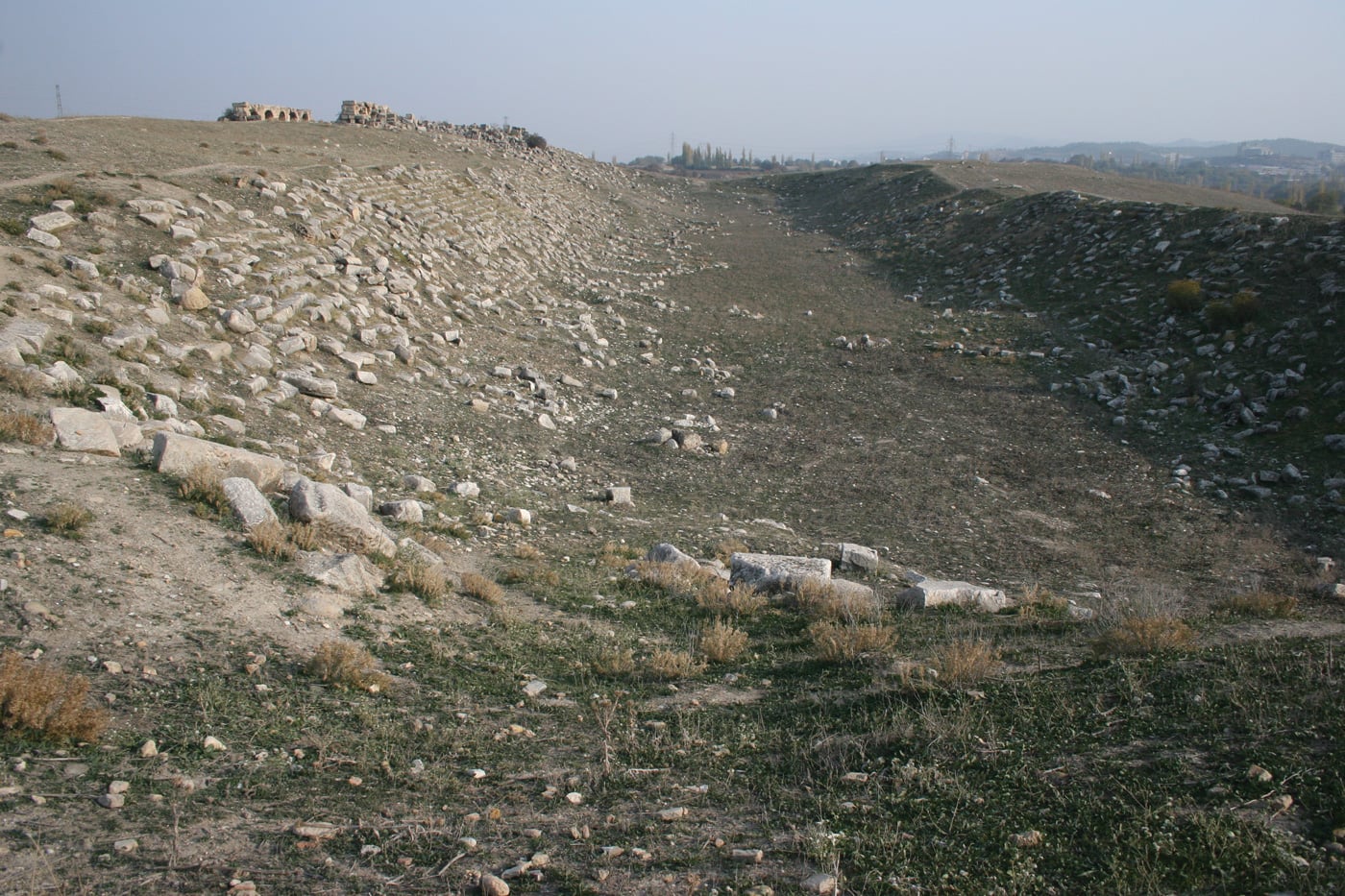
Paul says, “I am contending for you and for those at Laodicea” (Col. 2:1), as an athlete would contend in the stadium. These are the remains of the unexcavated stadium at Laodicea (built ca. AD 69–79). Paul’s letter was also meant to be read to the church at Laodicea (see Col. 4:16).
B. Christ is over every power and authority (2:8–15). The identity of this “philosophy” has been discussed extensively above, where I suggested that it encouraged Gentiles to take up the law in addition to their faith in Christ for full attainment of the Christian life. Paul warns the Colossians of this potential threat by using a rare verb, translated as “take captive,” found only here in the New Testament (though Paul uses a similar term in 2 Cor. 11:8). The dangerous teaching, which has yet to infect the community, is characterized by human tradition, not the wisdom of God. Moreover, it relies on the stoicheia (elemental forces, basic principles of the world, or the gods of this world; see also Gal. 4:3, 8–9) rather than Christ, who represents the fullness of God (2:9). Stoicheia is repeated in 2:20, in the context of specific piety or purity rules (2:21), suggesting that it refers primarily to the Jewish purity rites, which when applied to Gentiles lead them away from Christ.
Arguing against the philosophy, Paul stresses the fullness of God in Christ. Paul provides a strong defense for the incarnation: that in Jesus Christ’s life and death we see the fullness of God. This fullness lives on in the community because Christ has been raised and is alive and has made believers alive in him (2:13). The insistence that Christ is head over all powers and authorities anticipates Paul’s later charge that though the philosophy seeks visions (access to or control over powers of the cosmos perhaps), such pursuit severs them from Christ, the head (2:18–19).
The importance of circumcision in this section suggests we are on the right track in proposing that the philosophy is connected with synagogue teachings. Even as circumcision was the key identifier for Jews, so baptism served as the initiation for Christians. The central question becomes, Who makes up the people of God—those who are circumcised or those who are baptized in Christ? Paul declares that the Colossian Gentiles and Jews are made alive and have their sins forgiven through Christ. Paul uses past-tense verbs to describe both their burial in baptism and their having been raised with Christ. The significance of the past tense here is to emphasize the reality of their new life in Christ, the power of the resurrection that lives in them through Christ. It allows Paul to highlight the efficacy of the cross in the following verses.
Through the cross of Christ, God defeated sin, disarmed powers, and gave believers life. Through Christ’s death, God blotted off the page, so to speak, the condemning verdict. The canceled charge probably refers to the Mosaic law, judging by the qualifier “legal” (2:14 RSV, ESV; see also 2:20), referring to Jewish rites listed in 2:16–22. In canceling the debt of sin, God in Christ thereby rendered impotent those powers and authorities, including the Jewish law. When Paul speaks of these powers being made a public spectacle, he likely draws on the image of a triumphant general who has returned from battle displaying his conquered captives.
C. Reject false teachings (2:16–23). Having established the forgiven status of the believer in Christ and having shown Christ’s triumph over the powers and authorities, Paul warns the Colossians to resist the philosophy’s condemning influence (2:16, 18). In describing the discrete components of the philosophy, Paul highlights its Jewish character, including focus on Sabbath, New Moon celebrations, and food laws. (The relationship of Jewish law to the church created numerous debates and conflicts within the early church. See Acts 15:1–35; Gal. 2:1–12; 1 Cor. 8:1–13; 10:1–33; and Rom. 14:3–6, 17, where the language is similar to that found in Colossians.) The description “Do not handle! Do not taste! Do not touch!” (2:21) suggests Jewish piety, here relegated to the present age, which works off human tradition and its limited wisdom (see also Matt. 15:9, citing Isa. 29:13). Paul does not claim that Jews were legalistic. By observing the law, Jews expressed their status as God’s chosen people. Paul does not dismiss these practices outright but rather relegates them to a secondary status in light of the surpassing greatness of Christ. Paul is speaking from an eschatological perspective: in Christ the new age for Jews and Gentiles has begun. The law was part of the old age and as such is a precursor to the reality in Christ.
Paul speaks about the philosophy’s “worship of angels” (2:18), a difficult phrase to interpret. Some suggest that the phrase implies direct worship of spiritual beings, but it is difficult to imagine a first-century monotheistic Jew who followed Christ promoting the worship of created beings. Instead, Paul might be speaking ironically, implying that the philosophy was so interested in the law, mediated by angels (Gal. 3:19), that its devotion looked like actual worship of angels. However, the phrase probably refers to worship with angels, suggesting that the worshipers are taken up (perhaps in an ecstatic state) into the heavens and there worship God along with the angels. This interpretation is supported by Paul’s claim in the next sentence that these people describe their visions in detail. Such bragging further condemns them (see also 1 Cor. 4:6, 18–19; 5:2; 8:1; 13:4).
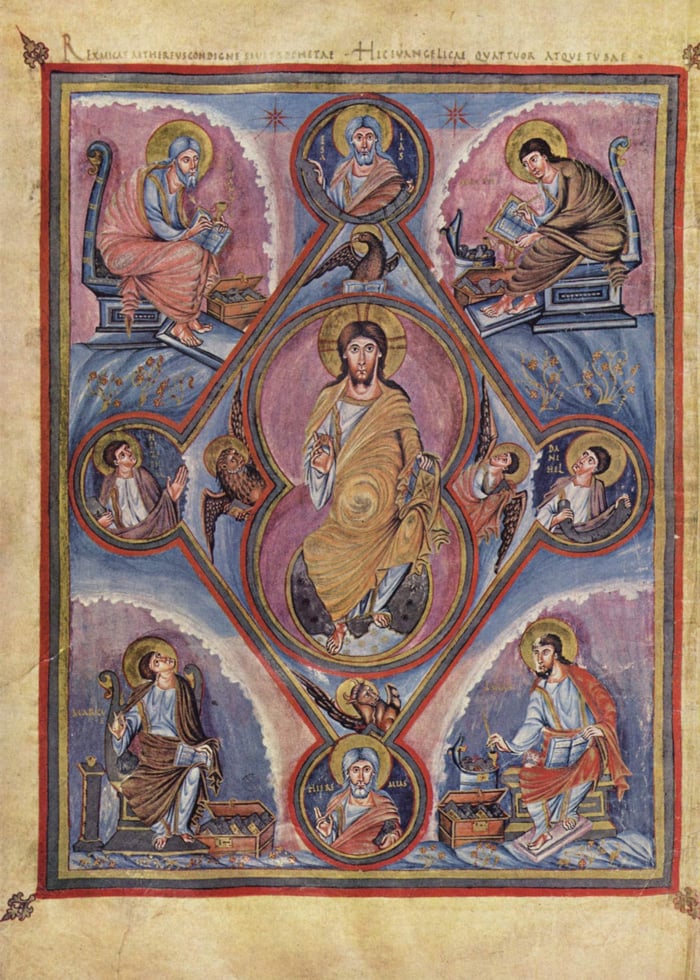
Colossians 3:1 describes Christ as “seated at the right hand of God,” enthroned in heaven. Early Christian art often depicted Christ on his throne ruling the world. This reproduction of a painting on parchment by Haregarius shows Christ in majesty (AD 844–51).
Paul labels their behavior as false humility, although the term “false” is not found in the Greek; it must be added to communicate the context. The word implies ascetic behavior, especially fasting. In both Judaism and paganism, fasting was often linked to obtaining visions. Paul declares that the philosophy’s detailed visions and ascetic fasts fail to bring its followers close to God. Paul condemns them as disconnected from Christ, the head of the body, the church. For Paul, the philosophy’s regulations fail to deliver a holy life.
Paul has no patience for such teachings—he enjoins the Colossians to resist. The Colossians must own their true selves: they have died to this world and now live in Christ (see also Rom. 6:8–11; 7:4–6; Gal. 2:19). The world’s traditions and expectations need no longer control them because they have entered into Christ’s new life through baptism (2:12–15). At this point in the letter, Paul leaves the discussion of the philosophy to explore what life in Christ should look like among the Colossians.
D. Set your heart and mind on things above (3:1–4:6). 3:1–4. Paul described the death and resurrection of Christ in 2:12, and in 2:20–23 he detailed the ramifications of Christ’s death for believers. Now in 3:1–4 he expands on the implications of Christ’s resurrection. Both 2:20 and 3:1 begin with the same Greek phrase translated “if” or “since,” suggesting that the instructions are two sides of the same coin. Just as the death of Christ demolished once and for all the world’s wisdom and values, so, too, the resurrection of Christ confirms the future glory awaiting the saints. The gospel message must embrace both aspects of the cross—its past victory over sin and the future glory when Christ returns. Flanked by these two realities, the believer perseveres faithfully. Paul now turns his attention to this present, in-between time with instructions on life as God’s chosen people (see 3:12).
Paul pushes the believers to make Christ’s return and future glory a beacon that guides their steps in the dark and depraved world. The vision that should capture the Colossians’ imagination is one of Christ now seated at God’s right hand. This picture has deep roots in earliest Christianity, drawing on Psalm 110:1: “The Lord says to my lord: ‘Sit at my right hand until I make your enemies a footstool for your feet.’ ” Mark 12:36 (and parallel passages); Acts 2:34–35; and Hebrews 1:13 cite it directly. Allusions to the verse are numerous. The force of the verb “to set” that Paul uses in 3:2 carries the sense of forging a perspective, permanently reshaping a mindset, and fixing a sustained opinion. The Colossians have died in Christ (in baptism 2:12) to the nonsense promoted by the philosophy and now must go forward daily living out that new reality. In Christ, believers have confidence that they will enjoy glory with Christ (see Col. 4:4; see also Rom. 8:18).
3:5–9. Paul exhorts the Colossians to “put to death” all that is connected to this world (3:5). Does this statement contradict what he insisted on in 3:3, that they have died, and their life is now hidden in Christ? No, for in 3:5 Paul elaborates how this death in Christ can be actualized in their daily lives. What died in Christ was the power of sin, the irresistibleness of it that hooks people like a fish on a line and then reels them in. Paul declares that as Christians, the Colossians no longer need take the bait of sin. Freed from that compulsion, believers can reject all those behaviors that alienate them from each other and from God.
The first grouping of sins (3:5) spotlights sexual improprieties, listed in order from the most to the least visible. He begins with public sexual immorality, rampant in the ancient pagan world. He moves from behaviors to attitudes, including greed, which focuses on satiating physical desires. Paul concludes that if you trace back from the behavior to the mindset that led to it, you will find idolatry at the core. Paul argues that the inward focus on satisfying physical passions amounts to placing oneself at the center instead of God. Paul insists that to effect a change at the public, behavioral level, one has to ultimately kill that which led to it all—idolatry. As with weeds in the garden, merely snapping off the shoots will not make permanent changes. The gardener must dig out the roots for any lasting results.
A second list of sins pivots on anger. Once again Paul moves from the most public demonstration of anger—rage—to the more subtle forms of anger, such as slander. In all cases, what comes from the mouth sullies the person. Paul is quite concerned about lying. We talk about “little white lies” not hurting anyone, but for Paul truth telling should be characteristic of those who live in Christ, who is God’s truth to us. Since we image Christ, the fully human being, we must be truthful. By following his charge against lying with the emphatic claim that social, racial, and ethnic differences should not divide the people of God, Paul reveals that lying is not simply a private matter but could infect the entire community. It denies the reality that believers have removed (a one-time act) their old self and put on (again, a one-time act) their new self. Paul is probably referring to their baptism (see Col. 2:12).
3:10–17. Paul promises that the believer’s new self is being renewed “in knowledge in the image of its Creator” (3:10). A similar sentiment is expressed in Romans 12:2, where the believers are to renounce this world and be transformed by renewing their minds (see also 2 Cor. 4:16). Genesis 1:26–27 speaks of humankind being made in God’s image, but later sin destroys that perfection (Gen. 3:6–19). Colossians 1:15 insists that Christ is the image of the invisible God, and Paul’s claim in 3:10 indicates that, in Christ, humanity has been restored to fullness and completeness. Today we tend to read such passages as referring primarily to the individual, but Paul was clearly thinking of the entire church, because he goes on to describe the body of Christ as one, not disparate ethnic and social groups. Unlike the philosophy, which stressed private visions and competitive asceticism, Paul stresses the unity of the Christian community.
3:18–4:1. After the eloquent charge to the church to live in peace and in knowledge of the gospel, this section looking at the ancient household seems a letdown to modern ears. The shift appears so abrupt to some scholars that they suggest this list was inserted later. Yet read in context, the passage supports and fills out Paul’s previous explanation of life in the church.
It might be possible to fool the public, but your family knows you well. Paul realizes this common human trait, and so after encouraging the Colossians to pursue peace in their community, he applies the truth of the gospel to the household. What one does in the privacy of one’s most intimate relationships will reveal whether the “new self” is living up to its full potential.
The family in the ancient world was highly structured and hierarchical. The husband/father was the undisputed lord of his family, including grown sons (and their wives). The wife/mother also had significant authority in the raising of the children, and if she had a substantial dowry, she wielded economic influence as well. Slaves fulfilled many occupations: some were quite learned; most did manual labor. They could earn their freedom or be freed by their master’s will. (Slaves made up about 10 percent of the total population, except in Rome, where slaves made up about 33 percent of the inhabitants.) It was possible for a household slave to have a better quality of life in terms of shelter, food, and clothing than a poor freeborn person.
A well-ordered home was sought by Gentiles and Jews alike. Aristotle’s views carried the day—the home was the foundation of the state, and the home must be organized hierarchically and harmoniously (Politics 1.5). The vested interests of those at the top of the hierarchy—husbands, fathers, slave owners—were protected and increased. A few dissenters, such as the Cynics and the Essenes at Qumran, called for a radical restructuring of society, or chose to isolate themselves from society altogether. But the church lived in the midst of the world and sought to redeem through Christ’s love the cultural structures that regulated social interaction.
Into this setting Paul applies the gospel message. We cannot conclude that Paul condoned the social and institutional structures of his day (patriarchy and slavery). Nor is Paul abandoning his claims about believers being hidden in Christ and having a new self. He is emphatic that essentialist categories such as race or ethnic identity—things a person cannot change—are completely unimportant within the household of God. No Gentile or Jew, no barbarian or Scythian—these cultural categories are de-emphasized in Christ. (Paul declares the gender category is made obsolete under Christ in a similar phrase in Gal. 3:28.) In his argument, Paul expresses a key outworking of the incarnation—Christ as the perfect, complete, fully human being offers to his body, the church, that same fullness. Such completeness comes, however, at a cultural price: one loses one’s cultural or ethnic (or gender) bragging rights to being better than another. Christ is now the focus, the “all” (3:11).
When Paul speaks about social roles and obligations, he does not jettison his previous emphatic stance that all are one in Christ. Rather, his aim is to discuss how certain common and important social roles, such as husband and wife, parent and child, master and slave, can be played in that culture with fidelity to Christ. Paul recognizes the legal and cultural power that husbands have over wives, fathers over children (of any age), and masters (male and female) over slaves. He wants those who have been given power through social norms to exercise that rule in Christ-honoring ways. And he wants those who are under such power to respect those wielding it but also to remember that such authority is mediated, for only Christ has ultimate authority. Paul is not concerned about social and legal codes but about relationships lived in the covenant of love in Christ.
Therefore, the wife is asked to submit herself to her husband, not because Caesar has mandated that wives submit but because submission is a Christian character trait that can be lived out in marriage. Notice that Paul does not forbid the wife from loving her husband! All the Christian character traits noted in the preceding verses—peace, wisdom, knowledge, forgiveness, compassion, and so on—should be part of her Christian behavior at home. The Colossians likely were aware of the picture of Christ preserved in the hymn of Philippians 2:6–11, which poignantly portrayed the submission of Christ to the Father. They probably knew of Jesus’s words on the Mount of Olives: “Father, if you are willing, take this cup from me; yet not my will, but yours be done” (Luke 22:42). Jesus Christ practiced perfect submission to the Father (1 Cor. 15:28); wives have a similar opportunity to practice this sort of submission. The phrase “fitting in the Lord” (3:18) is an important qualifier. The verb carries the sense of duty. For example, the Stoics used the term to describe a behavior that was in harmony with the natural order. But rather than tell the Colossians to follow what seems “natural,” Paul qualifies the verb with “in the Lord.” Some see this as establishing the “natural” hierarchy between husband and wife, but the phrase more likely means that the wife submits only to the degree that is countenanced in the Lord (see 1 Cor. 7:15).
Paul turns to husbands with the command to love their wives. Several points are worth noting. It appears at first reading that Paul did not mention the Lord’s example when speaking to the husbands (unlike in Eph. 5:25). However, Paul’s choice of verb, agapaō (related to agapē), alerted his readers that he was speaking of the type of love characterized by Christ’s self-giving on the cross (Rom. 8:37). Paul’s recipe for harmony in the marriage is that the powerful love which unites the church should be used to bind husband and wife. The Colossians might have expected him to say something like, “Husbands should rule their wives wisely and kindly.” Anticipating this, Paul speaks to husbands to resist bitterness. Translations often read, “Do not be harsh,” but that fails to do justice to the passive tense of the verb. It is the husbands who might feel cheated by having to love their wives sacrificially. The society taught that they were owed respect and devotion apart from their attitude or actions toward their wives. Paul insists that they resist becoming bitter against their wives if such cultural expectations are not met.
Paul’s charge to children echoes the fifth commandment (Exod. 20:12), which promises that those who honor parents will have a long life. In the ancient world (and in many cultures today) the child’s obedience and honor due his or her parents continued until the parents’ death. Given that, Paul is careful to warn fathers against abusing their authority. Perhaps Paul has in mind particularly his warnings against abusive speech in 3:8.
The most extensive discussion is left to last, that of slave and master. Even as children are to obey their parents in all things, so, too, slaves are to obey their masters. Of course, Paul would not expect either children or slaves to obey an order that contradicted God’s teachings (see Acts 5:29). Nor is Paul condoning the institution of slavery. Rather, he is explaining to slaves how they can be faithful in the midst of their servitude. Paul declares that they are slaves of Christ (3:24), a label he uses for himself. (In fact, Paul teaches that every person is a slave—either to sin or to God [Rom. 6:16].) Ironically, Christians are also truly free in Christ, no matter their social status. However, Paul is not unaware of the complexities of slave life. He enjoins them to work as though the Lord himself is their master, and such efforts will be rewarded with an inheritance, something no slave could expect from a human master. Moreover, justice will be meted out; the Lord (implied) will fairly judge situations and render appropriate rewards and punishment. This is comforting news to those whose situation might render them voiceless (1 Pet. 2:19–20; Gen. 39:11–20).
To conclude this section, Paul writes one verse to slave masters, who, it should be noted, could be male or female. Why only one verse? In part it may be that there were few slave owners among the congregation. Also, Paul has been speaking twice to the paterfamilias (the family head) as husband and father. As in those important roles, so here, the male slave owner must wield his responsibility mindful of the Lord’s own claims on his life. The master is enjoined to be just even as Christ will judge fairly. Finally, Paul is sending an entire letter to a slave owner, Philemon, in their midst, where he more fully expresses his opinions on Christians owning Christians. While there is no hint in Colossians that Paul expects Christian masters to free all their slaves or that Christians should denounce publicly the institution of slavery, Paul’s letter to Philemon makes clear that, in the long term, slave ownership is not compatible with the Christian life.
4:2–6. The remaining call to faithful prayer includes several key terms from Colossians. Paul repeats his concern that the Colossians continue to be thankful (1:12; 2:6; 3:15). He speaks again of the mystery of Christ, having explained God’s salvation plan in Christ to bring all people into the family of God (1:26; 2:2). Paul connects his imprisonment with his preaching, much as he did in 1:24. And he invites the Colossians to enter into that ministry by living and speaking the gospel to everyone.
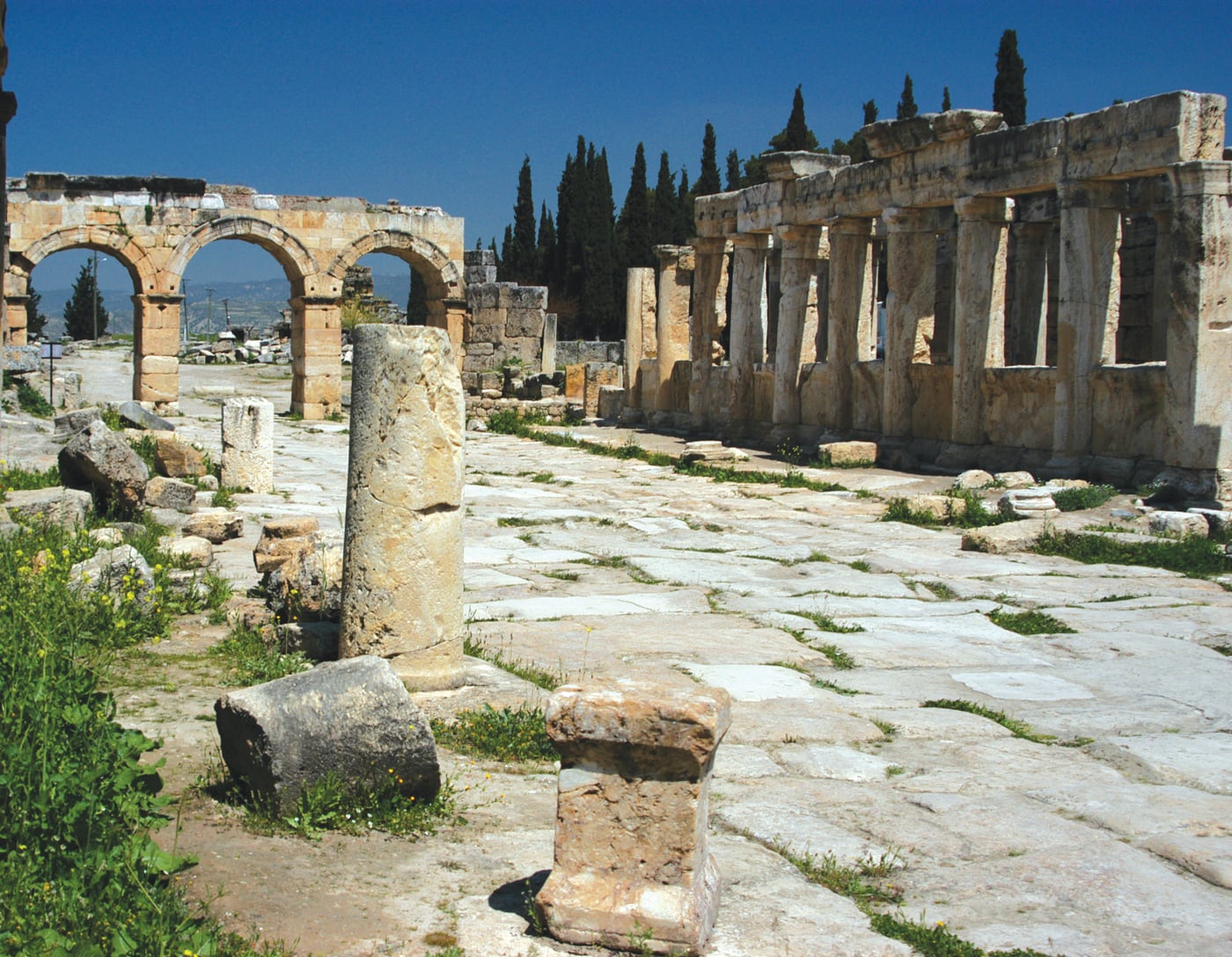
Epaphras, founder of the Colossian church (Col. 1:7; cf. 4:12), may have brought the gospel to the city of Hierapolis since it was closely connected to Colossae and Laodicea. Pictured here are a gate and city street from Hierapolis, built during the reconstruction of the city by Domitian (AD 84–85) after its destruction by an earthquake.
Paul mentions ten names at the end of his letter, all companions in the ministry of the gospel. Tychicus is the bearer of the letter; he is joined by Onesimus, the slave of Philemon. Most likely these two carried that letter as well. Paul depended on such messengers to communicate his personal greetings and encouragement to his churches (2 Cor. 7:6; 8:17). Paul mentions three Jewish believers, Aristarchus, Mark (cousin of Barnabas), and Jesus called Justus, who stood by him faithfully. Paul asks that the Colossians welcome Mark if he comes, implying that the Colossians knew of the fallout between Paul and Barnabas (Acts 15:36–40). Paul assures them that the rift has been mended. Paul sends greetings from two other (presumably Gentile) believers, Luke and Demas. He asks that a special greeting be given to Nympha and her house church; it is unclear whether this house is in Colossae or Laodicea. And he gives a message for Archippus to complete the work he began in the Lord. A special commendation is given to Epaphras, the founder of the Colossian church (cf. Col. 1:7). We find intriguing overlap in the names here and in Philemon. Both letters include greetings from Epaphras, Aristarchus, Mark, Demas, Luke, and Archippus. Both letters include Onesimus, in Colossians as Paul’s messenger, and in Philemon as the main subject of the letter.
Paul concludes with a signature statement explaining that he writes the final remarks in his own hand (1 Cor. 16:21; 2 Thess. 3:17). One has the sense that he is impeded from elaborating the final blessing, for normally he writes “the grace of the Lord Jesus Christ be with your spirit” (Phil. 4:23; Gal. 6:18) or even more expansive closings (2 Cor. 13:14; 1 Cor. 16:23–24; Rom. 16:25–27). He asks the Colossians to uphold him because of his chains (4:3). Not only does he desire their prayers but perhaps also their active (financial?) support. The Philippians, for example, sent Epaphroditus to help Paul in prison (Phil. 2:25–30; 4:18). As Paul closes, the Colossians are left in no doubt about his chains, nor his love for Christ and his church.
Select Bibliography
Arnold, Clinton E. The Colossian Syncretism. Grand Rapids: Baker Books, 1996.
Dunn, James D. G. The Epistles to the Colossians and to Philemon. New International Greek Testament Commentary. Grand Rapids: Eerdmans, 1996.
Martin, Troy W. By Philosophy and Empty Deceit: Colossians as Response to a Cynic Critique. Journal for the Study of the New Testament Supplement Series 118. Sheffield: Sheffield Academic Press, 1996.
Price, S. R. F. Rituals and Power: The Roman Imperial Cult in Asia Minor. Cambridge: Cambridge University Press, 1984.
Still, Todd D. “Eschatology in Colossians: How Realized Is It?” New Testament Studies 50 (2004): 125–38.
Thompson, Marianne Meye. Colossians and Philemon. Two Horizons New Testament Commentary. Grand Rapids: Eerdmans, 2005.
Wright, N. T. Colossians and Philemon. Tyndale New Testament Commentaries. Grand Rapids: Eerdmans, 1986.