1–2 Thessalonians
2. Opening Thanksgiving: The Coming of the Gospel and Its Reception (1:2–10)
A. Faith, Love, and Hope (1:2–3)
B. The Coming of the Gospel and Its Reception (1:4–10)
3. The Body of the Letter (2:1–5:22)
A. The Gospel Arrives in Thessalonica (2:1–3:13)
B. The Apostolic Instruction: The Life That Pleases God (4:1–5:22)
4. Final Prayer, Greetings, and Blessing (5:23–28)
A. Prayer for Sanctification (5:23–25)
B. Call to Greet and Read to One Another (5:26–27)
1. Epistolary Salutation (1:1–2)
A. The First Thanksgiving (1:3–5)
B. The Destiny of the Persecutors (1:6–10)
C. The Remembrance of Prayers (1:11–12)
3. The Body of the Letter (2:1–3:15)
A. The Time of the Day of the Lord (2:1–17)
B. The Final Instructions (3:1–15)
4. The Third Prayer and Final Greetings (3:16–18)
Introduction
Thessalonica
The history of Thessalonica. When Cassander the king of Macedonia founded the city of Thessalonica in 316 BC, he named it after his wife, Thessaloniki, the half sister of Alexander the Great. The kingdom of Macedonia needed a port on the Aegean Sea. Cassander established Thessalonica at the head of the Thermaic Gulf. The city’s location gave it excellent access to the cities of the wider Mediterranean world. Thessalonica’s situation also provided easy access to the surrounding territory in Macedonia and beyond, since it was located at the intersection of the main north-south and east-west routes. Thessalonica quickly became a hub for government and commerce. Antipater of Thessalonica called it “The Mother of Macedonia.”
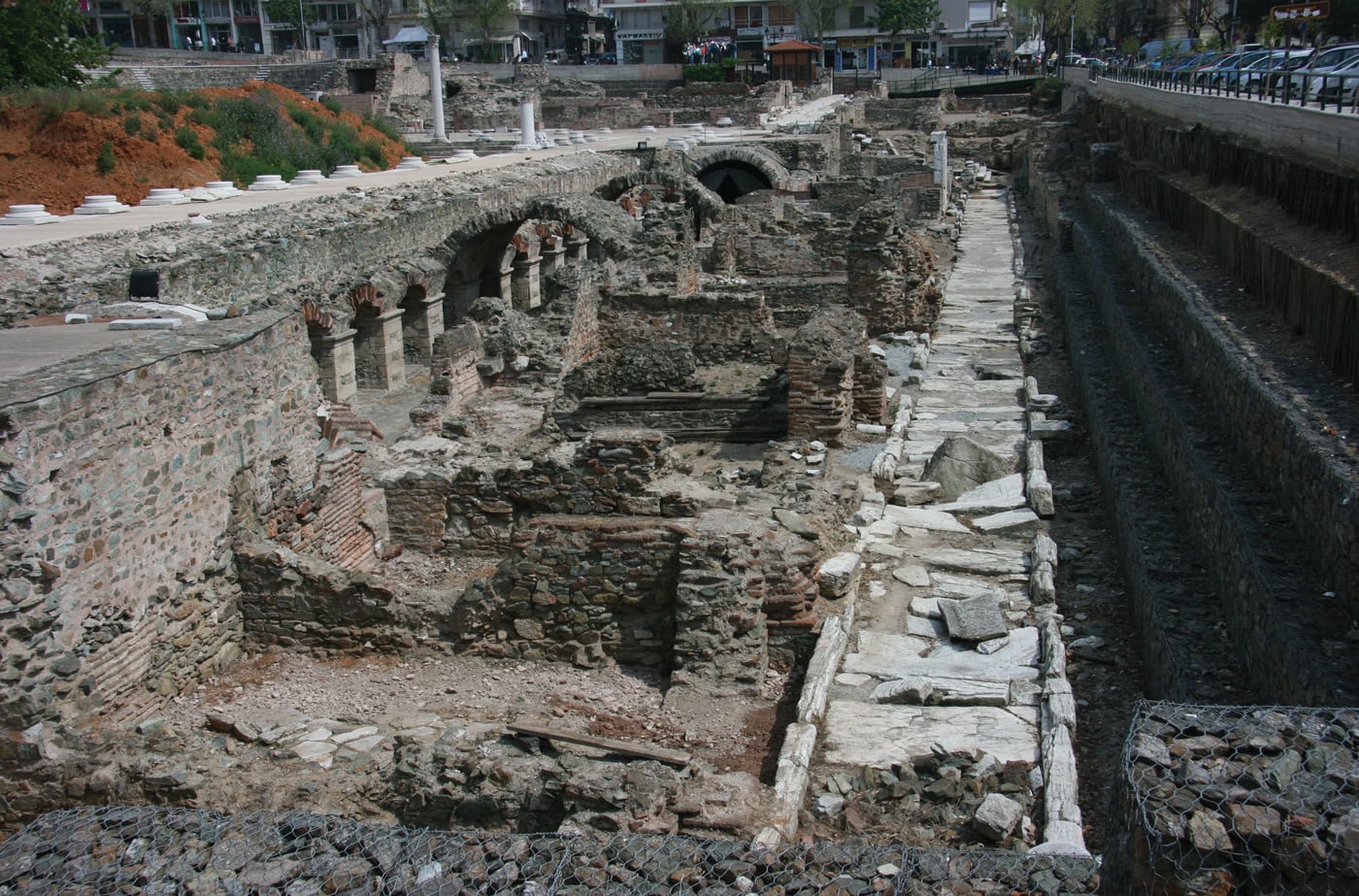
Rome began to expand as a world power beginning in the third century BC. Rome’s eastward expansion precipitated three Macedonian wars, fought between 214 and 168 BC. In the last of these conflicts, the Roman general Aemilius Paulus defeated the last king of Macedonia, Perseus, at the Battle of Pydna. Soon thereafter, the city of Thessalonica fell to the Roman army. Rome guaranteed that the Macedonian kingdom would never rise again.
Rome withdrew her troops and allowed Macedonia to continue as a vassal. At that time, Thessalonica became capital of the second district (some Greek manuscripts of Acts 16:12 note that Philippi was “of the first district”). A rebellion against Rome led to Macedonia’s being reconquered and organized into a Roman province in 148 BC. In 146 BC, the Romans named Thessalonica as the capital of the province, since the city had not joined the rebellion. Some twenty-five years later, the Romans built one of the great east-west highways, the Via Egnatia, which traversed Macedonia and extended from Dyrrachium in Illyricum on the Adriatic (Rom. 15:19) to Byzantium, passing through Thessalonica (Acts 17:1) and Philippi (Acts 16:11–12).
Thessalonica was at the heart of Roman power. During the wars between Julius Caesar and Pompey (49–48 BC), the city became a second Rome, as two hundred senators gathered there. A few years afterward, Julius Caesar was assassinated by Brutus and Cassius, who afterward fled to Macedonia. Mark Antony and Octavian (later titled “Augustus”) pursued them and defeated the assassins at the Battle of Philippi (42 BC). In this conflict, Thessalonica sided with Antony and Octavian. As a result, Antony granted Thessalonica the honor of being a “free city,” which meant exemption from taxation to Rome, freedom to mint coins, liberty to govern according to ancient custom, and exclusion of Roman troops garrisoned within the city walls. Later, when Antony struggled with Octavian for control of the empire, Thessalonica remained loyal to Octavian, who defeated Antony at the Battle of Actium (31 BC). The city erased Antony’s name from all honorary inscriptions previously dedicated to him.
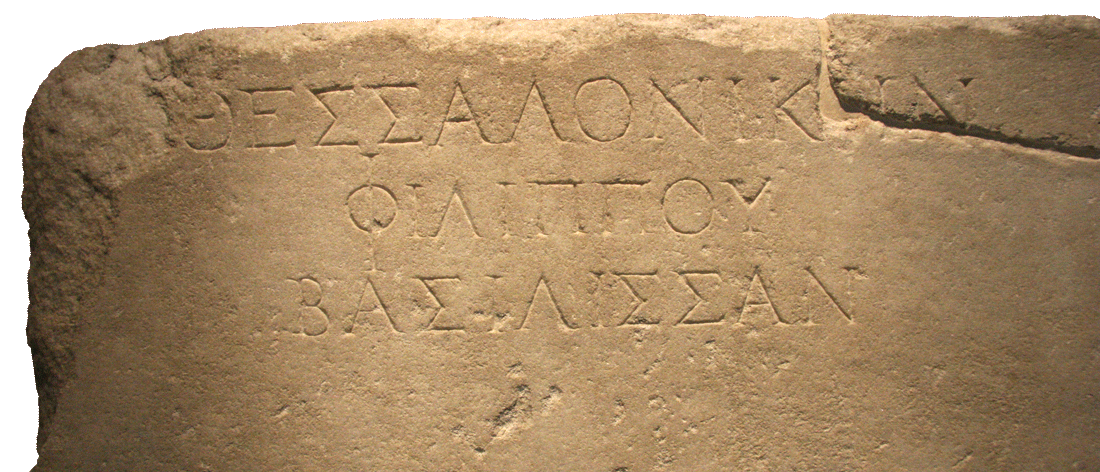
Thessalonica was named after Thessaloniki, daughter of Philip II. The inscription on this base, which once held her statue, reads: “Queen Thessaloniki, [daughter] of Philip.”
Rome remembered Thessalonica’s fidelity, and the city responded by honoring the Romans, even establishing a priesthood dedicated to Dea Roma (the goddess Rome) and the Roman benefactors. The city erected an imperial temple to honor Julius Caesar and Augustus, the adopted son of the “deified” Julius. Bilingual inscriptions from the city in Latin and Greek bear witness to the Roman presence. Moreover, an inscription from the Vardar Gate includes both Roman and Macedonian names among the principal “city officials,” the politarchs (Acts 17:6, 8). Thessalonica reaped economic and political benefits from its loyalty to Rome.
The gospel comes to Thessalonica. The Acts of the Apostles and Paul’s letters to the Thessalonians provide parts of the story of the evangelization of the city and Paul’s continuing relationship with the newly founded church. Some scholars question whether or not the accounts in Acts and the epistles can be harmonized. The underlying question is whether Luke is a faithful historian. However, the convergence of the stories in Acts 17–18 and 1 Thessalonians is strong enough to encourage a more positive assessment of Luke’s record at this point, despite the apparent tensions.
On his second missionary journey, Paul received his well-known “Macedonian call” (Acts 16:6–10). The first church he established was in Philippi (Acts 16:11–40), a congregation that later supported him (Phil. 4:16). Acts 17:1 suggests that Paul only spent the night in Amphipolis and Apollonia as he traveled the Via Egnatia to Thessalonica. Although Amphipolis was a significant city, there was no Jewish presence there as in Thessalonica. The gospel was “first to the Jew, then to the Gentile” (Rom. 1:16; cf. Acts 13:5, 14; 14:1; 18:5–6; 19:8–10). Not only Silas (Greek for the Latin name Silvanus; see 1 Pet. 5:12 and Acts 15:40) but also Timothy accompanied him (Acts 16:1, 3; 17:14–15; implied in 1 Thess. 1:1, 9; 2:1, 6). Despite having suffered in Philippi (1 Thess. 2:2; Acts 16:16–40), Paul and Silas boldly preached the gospel in Thessalonica. They spent three Sabbaths in the synagogue dialoguing about the gospel (Acts 17:2). Paul discussed Scripture with the Jews and “God-fearing Greeks” (Gentile sympathizers with Judaism; Acts 17:4), interpreting and presenting evidence from it to convince them of the core claims of the gospel: “The Messiah had to suffer and rise from the dead” (cf. Luke 24:45–46; 1 Cor. 1:23; 15:3–4), and “Jesus . . . is the Messiah” (Acts 17:2–3; cf. 9:22; 18:5, 28; Matt. 16:16).
The response among the Jews was very moderate, whereas the Gentile God-fearers, including many principal women, were eager to embrace the message (Acts 17:4). First and Second Thessalonians show little trace of a Jewish presence in the newly formed church. First Thessalonians 1:9 implies that Paul and his companions engaged in a wider mission to the Gentiles beyond that described in Acts.
Those from the synagogue who remained unpersuaded stirred up mob action against the preachers. The mob that formed was made up of day laborers who, when unemployed, gathered in the central plaza of town. The crowd went after Paul and Silas. Not finding them, they dragged out Jason (the messengers’ patron) and other new believers and accused them before the city’s chief magistrates (politarchs; 17:5–6; 18:14–15). The charge was that Paul and his associates had promoted civil unrest (17:6–7; 28:22). Later Roman opinion of Christians was similarly negative. Suetonius called the Christians “a class of people of a new and damaging superstition” (Life of Nero 16.2), and Tacitus spoke of them as a people who were “hated for their vices, which the multitude calls ‘Christians’ ” (Annals 15.44).
The accusation was heightened by the charge that “they are all defying Caesar’s decrees, saying that there is another king, one called Jesus” (Acts 17:7). Paul had proclaimed the kingdom of God wherever he went (see Acts 19:8; 20:25; 28:30–31), and unsurprisingly, his gospel was understood as a threat to Caesar’s rule. He heralded Jesus as the king, the one whose authority and glory surpassed that of any ruler. Moreover, imperial decrees emitted under Augustus and Tiberius had made it illegal to enquire about or predict by divination the death of anyone, especially the emperor. The apostolic prediction of the advent of another sovereign would have been regarded as an audacious violation of those decrees (1 Thess. 4:16; 5:2–3; 2 Thess. 2:3–8; also Luke 23:2; John 18:36–37). The accusation provoked an uproar, and Jason was obliged to give a security, likely as an assurance that he, the other believers, and Jason’s guests would cause no trouble (Acts 17:8–9). As a result, Paul and his companions were obliged to leave the city (Acts 17:10). They fled forty-five miles to Berea. The proclamation of Jesus as king had challenged the Roman imperial claims, and Thessalonica’s politarchs needed to take action in order to preserve the city’s favored status with Rome and their attendant economic security.
After the foreshortened ministry in Berea (Acts 17:10–15), Paul left for Athens, but Silas and Timothy stayed on in Macedonia. Apparently Silas and Timothy came to Athens, a trip that Acts does not record, and from there Timothy went back to Thessalonica (1 Thess. 3:1–2, 5). Paul prayed to be able to return to the city himself (3:10–11). He attempted repeatedly to travel to Thessalonica, but somehow Satan overturned his plans (2:17–18). The persecution that had started against the apostles poured over to the new converts (1:6; 2:14; 3:3–4), and Paul’s fear was that Satan had tempted the believers to apostatize (see 3:5 and comments). The wait for Timothy’s return must have been agonizing. The church, composed of recent converts, was left without leadership. Its members suffered for the faith and experienced the dishonor of social ostracism. Would they remain firm? What news would Timothy bring back?
During the time that Paul’s own plans to visit Thessalonica were blocked, he sent Timothy to the church, wrote two letters to encourage and instruct the congregation, and prayed for them over and over again. Later, on his third missionary journey, Paul was able to pass again through Macedonia (Acts 19:21–22; 20:1–6) and stop in Thessalonica, perhaps even twice (20:1–3).
Occasion and Purpose
The First Letter to the Thessalonians. After Paul had traveled onward from Athens to Corinth, Timothy rejoined him (Acts 18:1, 5), bringing good news about the church in Thessalonica (1 Thess. 3:6–8). The Thessalonians were indeed standing firm and exhibiting the virtues of genuine Christianity: faith, love, and steadfastness, the product of hope (1:3). Paul is unable to express adequately his gratefulness to God. The letter explodes with the thanksgiving and joy he experienced upon receiving this good news (3:9–10).
Paul wrote 1 Thessalonians at this point with a variety of purposes in mind, the first being to thank God for the faith of the Thessalonians (1:3; 2:13; 3:6–10). Paul was at a difficult point in his own ministry while in Corinth, so the good report about the Thessalonians encouraged him greatly (3:7; Acts 18:9–10; 1 Cor. 2:3).
Second, the document was a defense of Paul and his companions’ sincerity and pure motives and an explanation about why they did not return to the church after leaving so abruptly. As evidence of his genuine love, Paul explains his attempts to return (2:17–18), how Timothy was then sent and was prevented from reaching them (3:1–5), and how Paul desired to return to the congregation and prayed to that end (3:6, 10). Under this reading, 2:1–12 should be understood as a defense of the character of the apostles’ ministry. Other scholars, however, understand this section as showing their character as moral examples that the Thessalonians should imitate.
Third, the epistle encourages the Thessalonians as they face hostility from the other inhabitants of the city. The apostles explain that suffering is part of the Christian life (3:3–4) and that in their sufferings they “imitate” the churches of Judea (2:14–16), the apostles, and the Lord himself (1:6). Paul recognizes their firmness in faith (1:3; 3:8) and that in their sufferings the Thessalonians have even become an example for other congregations (1:7). At the same time, the letter emphasizes God’s wrath (1:10; 2:14–16; 5:9). The time of God’s judgment, the day of the Lord, will come, and those who assail the church will not escape (5:1–11).
Fourth, the letter responds to questions the Thessalonians put to Paul, possibly via a letter that Timothy conveyed (see 1 Cor. 7:1). The church had asked about fraternal love (4:9–12), the destiny of the dead in Christ (4:13–18), and when the day of the Lord would come (5:1–11).
Fifth, not all the news from the church was good. While the Thessalonians had learned basic Christian morality (4:1–2), there were serious lapses regarding sexual purity (4:3–8). In addition, some were not working, acting as dependent clients. The epistle addresses this issue, which needed to be emphasized more forcefully when Paul wrote 2 Thessalonians (1 Thess. 4:11–12; 5:14; 2 Thess. 3:6–15). Some had rejected prophetic utterances in the church (1 Thess. 5:19–20), and the Thessalonians were not responding properly to their new leadership (5:12–13).
The Second Letter to the Thessalonians. We do not know who carried the first letter to the Thessalonian church, nor do we have any indication regarding how Paul received further news about the congregation. Given the similarity of the themes in the two letters, we may assume that Paul wrote this second letter not long after the first, during his eighteen-month stay in Corinth (Acts 18:11) on his second missionary journey.
While 2 Thessalonians does not echo all the concerns that motivated Paul to write the first epistle, such as the apostolic defense (1 Thess. 2:1–3:13) and the admonishment regarding sexual immorality (1 Thess. 4:3–8), it does betray a heightened concern regarding other major issues previously addressed. After relating his thanks for and boasting about the church (1:3–5; 3:6–8), Paul returns to the issue of the believers’ suffering (1 Thess. 1:6; 2:14; 3:3–4). The persecution continued to be severe (2 Thess. 1:4–5; 2:14). He explains that their sufferings are intended to prove (note the translation) them “worthy of the kingdom of God” (1:5). Here, as in 1:10, he reminds them of the final destiny and vindication of the believers. He graphically describes the severity of the final judgment for unbelievers (1:8–9). In contrast, the Thessalonian Christians will be vindicated “because you believed our testimony to you” (1:10). The great event that separates those who believe from those who do not is the revelation and coming of our Lord Jesus (1:7, 10), which heralds the day of the Lord (2:1–3, 8).
Second Thessalonians also addresses the church’s understanding of the last things, or eschatology (as 1 Thess. 1:10; 3:13; 4:13–5:11, 23). A false and destabilizing teaching had infiltrated the church: the day of the Lord, some were saying, had already come or was at hand (2 Thess. 2:2). This deception (2:3) found fertile soil in the Thessalonian church because of their concerns about this day (1 Thess. 5:1–11) and the persecutions they endured (2 Thess. 1:5–12). Paul and his associates remind them that two events will precede the day of the Lord: (1) the rebellion and (2) the revelation of the “man of lawlessness” (2:3). Paul presents an extensive discourse about the coming of this figure and God’s judgment on him and his followers (2:4–12). While Paul’s argument was quite comprehensible to them due to this prior teaching (2:5), the middle section of chapter two remains difficult for us to interpret. What is the “rebellion,” who is this lawless one (2:3), what force “holds it back,” and who will be “taken out of the way” so that the “man of lawlessness” may be revealed (2:7–8)? What is clear to us is that the revelation of Christ will come soon after the revealing of the lawless one and Christ will destroy him.
The third chapter begins with a request for prayer (3:1–2) and the assurance that God will strengthen and guard them from the evil one, Satan himself (3:3–5). After this, Paul takes up the third major issue, regarding the conduct of certain disorderly members, a topic previously addressed (1 Thess. 4:11–12; 5:14). He warns those who are not working but have remained dependent clients of their patrons (2 Thess. 3:6–15). On the other hand, he calls the Thessalonians to continue practicing benefaction toward those who are in need (3:13). The problem surrounding work does not appear to be tied to their eschatological concerns, as some have supposed.
Authorship
In 1 Thessalonians 1:1 Paul appears as the author of the letter alongside his associates Silas and Timothy (see also 2:18). From antiquity, the church has regarded the letter as authentic and not pseudonymous. Eusebius (d. 341/342) included 1 Thessalonians among the authentic Pauline Letters. The Didache (late first or early second century), Ignatius (d. ca. 107), the Shepherd of Hermas (beginning of the second century), and Tertullian (207/208) use it, while even Marcion regarded it as authentic. The Muratorian Canon (second part of the second century) includes 1 Thessalonians, and Irenaeus (end of the second century) cites it as Paul’s work.
What role did Silvanus and Timothy play in composing the letter (1:1)? The letter uses the first-person plural instead of the singular throughout, save in three passages (2:18; 3:5; 5:27; 2 Thess. 2:5; 3:17) where Paul underscores his own perspective. Silvanus and Timothy helped found the church and may have served as joint authors. Writing with others was a known practice (Cicero, Letters to Atticus 11.5.1, speaks of letters that “you wrote in conjunction with others and the one you wrote in your own name”; cf. Acts 15:23–29).
Second Thessalonians 1:1 names Paul as the author, along with Silvanus and Timothy. Paul includes a final greeting at the end, written in his own hand (3:17), a common practice when an author employed the services of a scribe. However, first-person plural verbs dominate throughout the letter (singular verbs appear in 2:5; 3:17). Paul wrote the letter in collaboration with his associates, though he is the principal author.
The evidence from the ancient church for the authenticity of this letter is even stronger than for 1 Thessalonians. An impressive list of authors refer to it: Ignatius (d. ca. 107), Polycarp (d. 155/160), and Justin (d. 165). Irenaeus (end of the second century) and Clement of Alexandria (d. 220) attribute their quotes from this letter to Paul. Tertullian (d. 215/220) uses it and even refers to the author as “the apostle.” The Muratorian Canon classifies it as a book accepted by all.
Some contemporary scholars, however, have questioned the authenticity of 2 Thessalonians. For example, they point to the similarity of the vocabulary and style of 1 and 2 Thessalonians, saying this betrays the hand of a copyist. But why not understand this similarity as a mark of authenticity? In the same way, the form of the heading in 1 and 2 Thessalonians is nearly identical, something not found in other Pauline Letters. But could not Paul use the same opening in two letters written near the same time? The eschatology of the two letters appears distinct, since the joy and expectancy found in 1 Thessalonians are absent from the second letter. But the solemn tone of 2 Thessalonians is due to the acute persecution the Thessalonians were suffering (1:5–12) and the error that had entered the church regarding the day of the Lord. Major commentators on these letters discuss the arguments against authenticity but do not find them convincing.
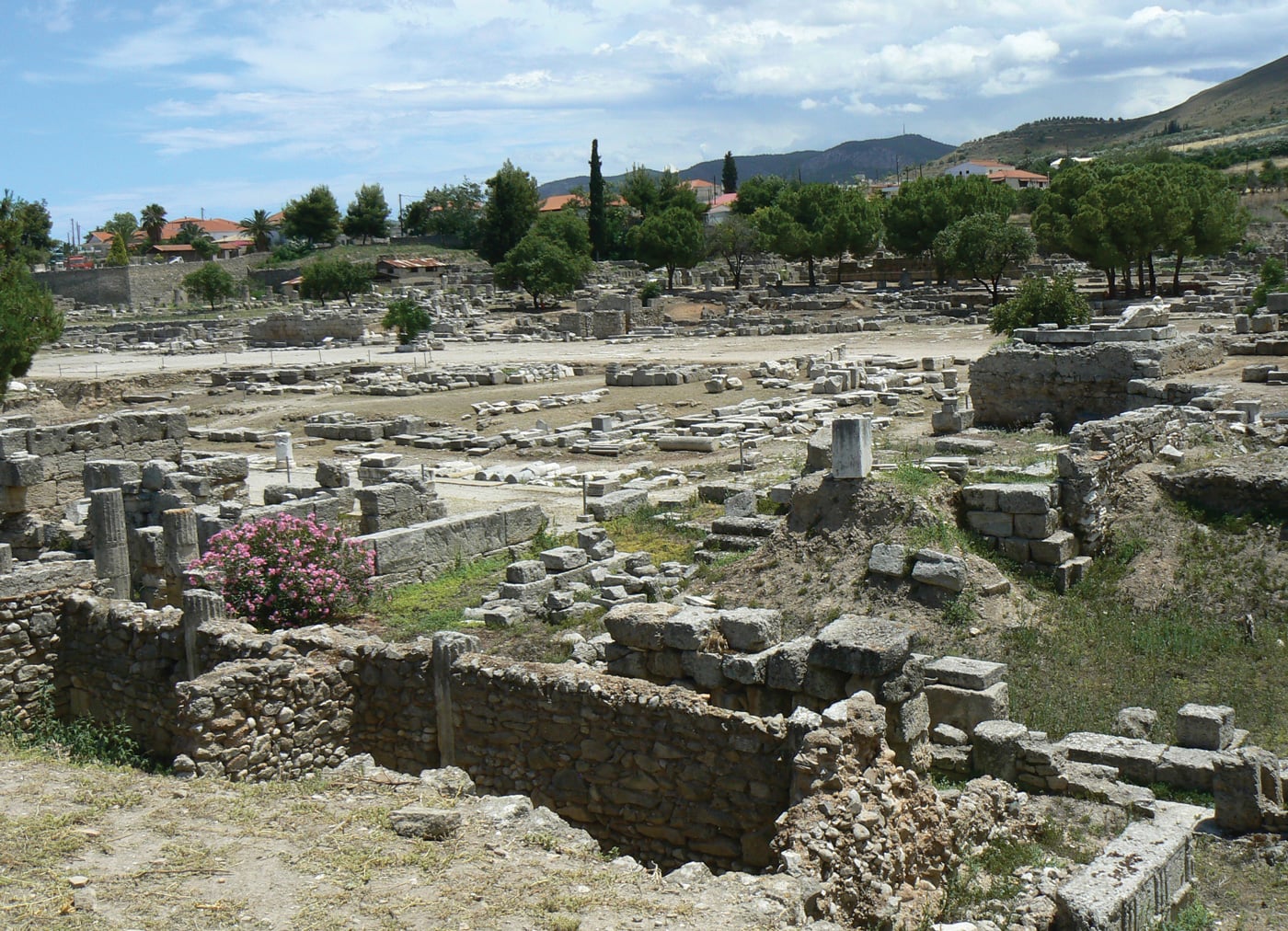
Paul wrote his two letters to the church at Thessalonica while he resided in Corinth. This view of Corinth shows the agora, the main marketplace of the city.
Date
Paul and his associates composed 1 Thessalonians when Timothy came to Corinth from Thessalonica (1 Thess. 3:2, 6; Acts 18:5). Paul was in Corinth during the reign of Claudius (AD 41–54; see Acts 18:1–2) and when Gallio was the proconsul (Roman governor) of Achaia (Acts 18:12–17). Gallio took his post on July 1 of AD 51 (as indicated in an inscription from Delphi) and stayed in the city for just under a year. Paul was tried before him and then remained in the city for some time (Acts 18:18). Paul’s total visit lasted eighteen months (Acts 18:11). If the movement against Paul began when Gallio was named proconsul, and if Paul left some time later around the end of AD 51, we estimate that he arrived in the city near the start of AD 50. Not long after that, Timothy arrived and Paul wrote 1 Thessalonians, making this one of the earliest of Paul’s letters that have survived.
We do not have the same historical markers for dating 2 Thessalonians. The problems addressed in this letter are similar to those addressed in 1 Thessalonians, which suggests that the second letter was written not long after the first. Taking into account the time needed to carry the first correspondence to Thessalonica and the travel time for news to arrive from Thessalonica to Corinth, the date of the letter might be as early as late AD 50.
Commentary for 1 Thessalonians
In the ancient world, people believed that letters brought one into the presence of an absent person. Seneca (Moral Epistles 75.1) said, “I never receive a letter from you without being forthwith in your presence.” First Thessalonians and other apostolic letters fill the gap left by the separation of the founders from the church (2:17–18; 3:6, 10–11). Greek letters began with the name of the author, followed by a greeting and a prayer or thanksgiving. Although the form of 1 Thessalonians is similar to that of ancient letters, it is substantially longer, as were Cicero’s letter-essays. Letters were commonly read aloud when received (1 Thess. 5:27).
The authors are “Paul, Silas and Timothy,” the founders of the church, whom Paul later identifies as “apostles” (2:6). The recipients of the letter were “the church of the Thessalonians.” An ekklēsia (“church”) was the assembly of free citizens in a Greek city (see Acts 19:32, 39, 41), although the Septuagint, the Greek translation of the Old Testament, also used it to translate Hebrew qahal, the assembly of the people of God (cf. Acts 7:38). To distinguish this ekklēsia from all the others in Greek cities, Paul clarifies that this one finds its source and identity “in God the Father and the Lord Jesus Christ.” The Father and Son are regarded as being on the same level, evidence of Paul’s high Christology. The opening verse defines the Christians’ identity in relation to God and each other.
Paul Christianizes the common greeting in Greek letters (chairein) by changing it to “grace” (charis), which summarizes the saving work of God through Jesus Christ (Rom. 3:24; 5:15; Eph. 2:8; 2 Thess. 2:16). To “grace” he adds “peace,” a common greeting among the Jews. This “peace” is not an emotional disposition but describes the relational status of a person or people reconciled with God (Rom. 5:1). The combined greeting is more than a formality; it is a blessing that embraces the totality of the divine benefits the authors desire for these believers.
2. Opening Thanksgiving: The Coming of the Gospel and Its Reception (1:2–10)
Ancient letters sometimes included a thanksgiving after the opening greeting. Giving thanks to one’s benefactors, whether human or divine, was a social obligation that the apostles observed. This thanksgiving anticipates the letter’s major topics, such as the coming of the gospel to Thessalonica (1:5a, 9), the character of the missionaries (1:5b), the conversion of the Thessalonians (1:6, 9–10), the results of their conversion (1:3, 7–8), the sufferings that they endured (1:6), the mission of the church (1:8), and the eschatological hope (1:10).
A. Faith, love, and hope (1:2–3). The apostles’ thanksgivings to God for the church (1:2) are frequent (“always”) and inclusive (“for all of you”). The context of these thank offerings was likely their corporate prayer times (“mention you in our prayers”). They also pray for the Thessalonians “continually” (see 5:17, where the same adverb appears). Paul commonly uses this adverb to describe the life of prayer (1 Thess. 5:17; Rom. 1:9; 2 Tim. 1:3) or thanksgiving (1 Thess. 2:13). “Continually” thus suggests their persistence in prayer for the Thessalonians (see Luke 18:1).
The motivation for their thanks is the Christian virtues that the Thessalonians exhibited (1:3). The apostles bring to mind and mention before God (“We remember”) the fundamental Christian virtues of “faith,” “love,” and “hope,” which the believers have demonstrated. The authors’ prayers are made in the presence of God: “before our God and Father” (1 Thess. 3:9–10). Although these words often speak of coming before God and Christ in the final consummation of all things (2 Cor. 5:10; 1 Thess. 2:19; 3:13), here that hope is a present reality in the prayers of the apostles. In the Greek, these words appear at the end of 1:3, which may imply that the Thessalonians lived out the virtues of faith, love, and hope “before our God and Father” (NKJV, NASB). However, the thought here is that their prayers are made before God, as in 3:9–10.
This trilogy of virtues characterizes true Christianity (1 Thess. 5:8; Rom. 5:1–5; 1 Cor. 13:13; Gal. 5:5–6; Col. 1:4–5; 1 Pet. 1:21–22; Heb. 10:22–24). Timothy has brought news to Paul of the church’s “faith and love” (1 Thess. 3:6) and their perseverance (3:8), the fruit of “hope” (1:3). Paul and the others also remember the Thessalonians’ “work produced by faith” (1:3; cf. Eph. 2:8–10; Gal. 5:6; 2 Thess. 1:11). Faith produces action, though the type of “work” is not specified. The word could indicate manual (1 Thess. 2:9; 4:11; 2 Thess. 3:8, 10) or ministerial labor (1 Thess. 5:12–13; Rom. 15:23). But here Paul likely refers to their “good works” (2 Thess. 1:11; 2 Cor. 9:8; Eph. 2:10). Among the Jewish people, acts of charity, visitation of the sick, hospitality toward strangers, and helping those who had been forsaken were considered to be good works. The Greek idea of “good works” embraced doing good to others without distinction, whoever the others might be (see 1 Thess. 3:12). It included any acts and donations that benefited a community.
The apostles also recalled the Thessalonians’ “labor prompted by love.” The objects of this love were the other members of the congregation (2 Thess. 1:3), their leadership (1 Thess. 5:13), other Christians in Macedonia (4:9–10), and even those outside the community (3:12). “Labor” implies hard and exhausting work. Love seeks the welfare of others and labors hard for their benefit.
Paul and his associates also recall the Thessalonians’ “endurance inspired by hope in our Lord Jesus Christ.” Endurance, one of the most highly valued virtues in the church, is the ability to stand firm and persevere in the face of suffering or temptation (Luke 21:19; Rom. 5:3–4; 2 Cor. 1:6; 6:4; Col. 1:11; 2 Thess. 1:4; 1 Tim. 6:11; Titus 2:2; Heb. 12:1; James 1:3–4; Rev. 2:2–3). In the face of persecution and the temptation to abandon the faith (1 Thess. 1:6; 2:14; 3:1–5; cf. 2 Tim. 2:11–12), the Thessalonians stood firm (3:8). The reason for this was their “hope in our Lord Jesus Christ,” that is, hope in the coming of the Lord (1 Thess. 1:10; 2:19; 3:13; 4:16; 5:23; 2 Thess. 1:7–10; 2:1; and see 1 Thess. 5:8). Hope was not a virtue that marked the Gentile world (1 Thess. 4:13; Eph. 2:12). According to Greek philosophy, the only ones who did not err in their hope were the gods, whereas people’s hopes were considered uncertain. The Christian perspective puts hope on a certain foundation since the object is sure: “our Lord Jesus Christ” in his coming.
B. The coming of the gospel and its reception (1:4–10). Paul now moves to the deepest motivation for their thanksgiving, the election of the believers: “For we know, brothers and sisters loved by God, that he has chosen you” (1:4). The Greek grammar connects this verse with the preceding thoughts, so there should be no paragraph break here (see NRSV, ESV). The source of the believers’ election is the love of God (“loved by God”; cf. Deut. 4:37; 7:7–8; 10:15; Ps. 47:4; 78:68; Isa. 42:1; Matt. 12:18; Rom. 11:28; Eph. 1:4; Col. 3:12). Whereas the placement of political or military leaders in Paul’s time had to do with the merit or character of those chosen, divine election finds its center in the one who chooses (Rom. 5:6–8). The implied result of election is the formation of the Christian community, the brothers and sisters “loved by God” (cf. 2 Thess. 2:13).
Having expressed confidence that the Thessalonians are elect, Paul underscores the first evidence of their election: “because our gospel came to you not simply with words but also with power, with the Holy Spirit and deep conviction” (1:5a). “Gospel” was a familiar term in the Roman world, often appearing in association with the imperial (ruler) cult. Announcements about significant moments in the emperor’s life as well as his decrees and discourse were published far and wide as his “gospel.” The apostolic announcement was about the true ruler, Jesus Christ, whose authority supersedes that of the emperor (cf. Mark 1:1). Also, in Israel the “gospel” was the culmination of the hopes of the people of God, which centered on God’s victory and sovereignty (Isa. 52:7; 61:1). The “gospel” has to do with the proclamation of those events that inaugurate this new era.
In 1 Corinthians 2:1–5 Paul contrasts persuasion via rhetorical methodology with the proclamation of the gospel. In 1 Thessalonians 1:5, however, Paul simply states that the message of the gospel (the “words” as in 1:6, 8; 2:13; 2 Thess. 3:1) came to the Thessalonians accompanied by divine power (cf. Rom. 15:18–19; 1 Cor. 1:6–7; 2 Cor. 6:7; 12:12; Heb. 2:3–4; and note the result in 1 Thess. 2:13). “Power” refers to the miracles God performed (Mark 6:5; Acts 2:22; 1 Cor. 2:4; 2 Cor. 12:12; Heb. 2:4). The Holy Spirit worked through the preaching and convicted the hearers of the truth of the message (Luke 24:46–49; Acts 1:8; 5:32; 1 Cor. 2:2–4; 1 Pet. 1:12). The “deep conviction” could refer to the apostles’ certainty about the message but likely points to the fullness or totality of God’s working. The proclamation was also powerful in that the gospel message was reinforced by the conduct of the messengers: “You know how we lived among you for your sake” (1:5b; see 1 Thess. 2:1–12). There was complete harmony between the character of the apostles and the message they preached.
The way the Thessalonians received the gospel was additional evidence of their election (1:6–10): “You became imitators of us and of the Lord, for you welcomed the message in the midst of severe suffering with the joy given by the Holy Spirit” (1:6). Imitation is not a well-recognized form of instruction today in the West, but the ancients appreciated the value of imitating people who served as models, as do people in other cultures today. The New Testament often calls believers to imitate Christian leadership (1 Cor. 4:16; 11:1; Gal. 4:12; Phil. 3:17; 4:9; 2 Thess. 3:7, 9; 1 Tim. 4:12; Titus 2:7; 1 Pet. 5:3), other members of the community (Phil. 3:17; Heb. 6:12; 13:7), and God the Father and Jesus Christ (Eph. 5:1; 1 Cor. 11:1). In 1:6 the focus is on how the Thessalonians followed the example of the apostles and the Lord in their intense or “severe” sufferings. Paul well understood that suffering was an element of the Christian life (see Acts 9:15–16; 14:21–22; Rom. 8:17; 2 Cor. 1:5; Phil. 3:10; 1 Pet. 2:21). The miracle of the Thessalonians’ conversion was that they received the message of Christ crucified amid the great hostility shown toward this new faith that had recently arrived in Thessalonica.
They also had “joy given by the Holy Spirit” in the midst of this suffering. Joy in suffering was a theme in Jewish literature that filtered into the church through Jesus’s teaching (Matt. 5:11–12; Luke 6:22–23; 21:28). The first Christians, like many believers today, suffered intensely but found joy in sharing in the sufferings and the shame of Christ (Acts 5:41; Rom. 12:12; 2 Cor. 4:8–10; 7:4; Phil. 2:17; 1 Pet. 1:6; 4:13–14). Their source of this joy was the Holy Spirit (cf. Gal. 5:22; Rom. 14:17; 1 Pet. 4:13–14). The ones who imitated Christ’s and the apostles’ model of suffering in turn became a model for other churches (1:7). The influence and ministry of this church, located in the city known as “The Mother of Macedonia,” spread far and wide (1:8; 4:10). Indeed, the church spread the gospel throughout the province of Macedonia and beyond (1:8). The Lord’s message or word is the gospel itself (2 Thess. 3:1), which “rang out,” a word elsewhere used to describe a loud noise like a clap of thunder, the cry of a multitude, the sound of the trumpet, or a rumor that runs everywhere. So great were their efforts to spread the gospel that Paul remarks, “Therefore we do not need to say anything about it.” The final words (“about it”) do not appear in the Greek text. The point is simply that Paul and his companions did not need to proclaim the gospel (the verb translated “say” appears again in 2:2, 4, 16) in certain parts due to the Thessalonians’ efforts.
Paul and his associates had received reports from others who had encountered the Thessalonian believers (1:9). The Greek for “reception,” which is the same word translated “visit” in 2:1, is best understood as an “entry.” The entry of an orator into an ancient city was an important event. Aristides spoke of his entry into Smyrna: “Before I even entered the city, there were people coming to meet me because they had heard about me, the most distinguished of the young men were giving themselves to me, and there was already a definite plan for a lecture” (Oration 51.29). In the following chapter (1 Thess. 2:1–12) Paul describes the character of his entry into the city. The effects of the apostles’ entry were impressive, evidenced by the Thessalonians’ conversion (1:9; Acts 14:11–18; 17:22–31; 19:23–41). The early church condemned idolatry, as people were called to turn to the only “living and true God” in contrast with the dead and false idols (Rom. 1:22–25; 1 Cor. 5:11; 6:9; 10:14–22; Gal. 5:20–21; Eph. 5:5; Col. 3:5; 1 John 5:21; Rev. 21:8; 22:15). Conversion to God not only entailed abandoning practices associated with idolatry (1 Pet. 4:3) but also included worship and moral service to God (Rom. 6:6, 16–19).
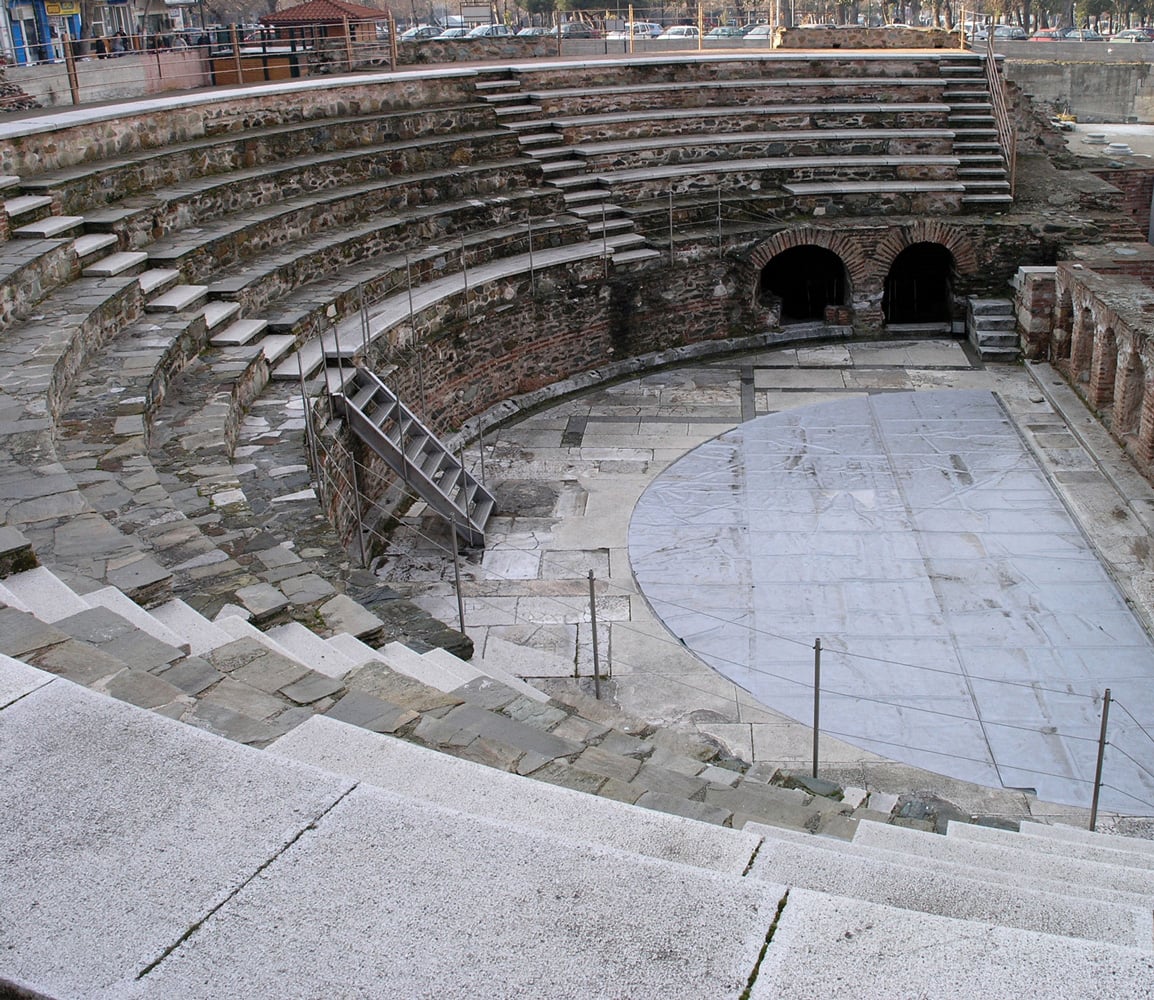
The odeum at Thessalonica (third century AD). Although primarily used for poetry contests and musical performances, an odeum could serve as a venue for visiting orators and philosophical debates. When Paul entered a new city, he preferred to begin his preaching at the local synagogue.
Turning to God included embracing the Christian expectation regarding the end, “to wait for his Son from heaven, whom he raised from the dead” (1:10). “To wait” was used in the Greek translation of the Old Testament to signify the hope God’s people held for divine salvation and mercy (Isa. 59:11; see also Ps. 25:3; 27:14). The object of this waiting is Jesus, the one risen and slated to return (1 Thess. 4:13–18). Among the Greeks there was no belief in a resurrection. Pliny the Elder even says there are some things the gods cannot do, such as raise the dead (Natural History 2.5.27). But God did indeed raise Christ from the dead, and the risen one will return as the one “who rescues us from the coming wrath” (1 Thess. 1:10; 5:9). The wrath of God is the execution of his judgment against sin (Matt. 3:7; Luke 3:7; Rom. 2:5; Eph. 5:6; Col. 3:6; Rev. 6:16–17; 11:18; 16:19; 19:15), not an outburst of emotion. It is an eschatological event directed toward those who do not know or obey God (2 Thess. 1:6–10; Rom. 1:18). Christ’s death and resurrection deliver the believer from this wrath (cf. Rom. 5:9).
3. The Body of the Letter (2:1–5:22)
A. The gospel arrives in Thessalonica (2:1–3:13). Having finished the initial thanksgiving (1:2–10), Paul now begins the body of the letter. The themes of the thanksgiving are now taken up again and elaborated, with 2:1–12 explaining the character of the apostles and their entry while 2:13–16 reminds the church of their reception of the gospel in the midst of great persecution. The following section (2:17–3:13) recalls the story of the apostles’ absence from the church and their continued care and concern for the Thessalonians.
2:1–12: The apostolic entrance. At first glance, this section appears to be a defense against criticisms levied against the character of the apostles. The critique of their character may have originated with the unconverted Thessalonians (2:14) or perhaps members of the church itself who questioned why the apostles came, left, but then did not return. What kind of people were these men? But the relationship with the church was warm and strong (3:6), and moreover, we have no indication that the critique came from outside the church. Some scholars, however, argue that this section is not a defense. Rather, the language is similar to that of Cynic philosophers who distinguished themselves from other, less honorable philosophers. On this reading, Paul presents himself as a moral example that others should follow, as did those philosophers. However, although philosophers used personal examples as a means to teach ethics, in 2:1–12 the apostles do not exhort the believers to imitate their character. What, then, motivated Paul to include this teaching? The most likely reason was that the situation itself called for it: the apostles left soon after the church was founded, and Paul had not returned. This explains the long discourse regarding Paul’s attempts to return in 2:17–20, the rehearsal of the motivations for sending Timothy in 3:1–6, and the notes about a future visit in 3:7–12. The question that arose was about the apostles’ character and concern for the church. First Thessalonians 2:1–12 is the beginning of a response that spans chapters 2 and 3.
In 2:1, Paul speaks about his coming to Thessalonica as his “entry” (NIV “visit”; see comments on 1:9). While Paul may refer either to the character of the apostolic mission or its results among the Thessalonians (as 1 Thess. 3:5), the emphasis in this section (2:1–12) is on the character of the ministers. However, character and results cannot be neatly separated.
Paul and Silas had suffered by being beaten and jailed before coming to Thessalonica (2:2a; see Acts 16:19–40; Phil. 1:30). Not only were they stripped, beaten with rods, and jailed, but they were also publicly dishonored and insulted by this treatment. Aristotle said of this type of dishonor, “The insult consists of the injury and pain by which the one who suffers is dishonored” (Rhetoric 2.2.5–6). Despite this socially weakened position, Paul says, “But with the help of our God we dared to tell you his gospel” (2:2b). The Cynics highly prized the ability to speak with boldness in spite of opposition and criticism, but the source of Paul’s boldness was God. Paul adds (2:2c) that when preaching in Thessalonica he and his companions faced continued opposition, yet they still preached the gospel.
The gospel proclamation was not simply a presentation of facts but a call to respond to the divine initiative (cf. Luke 3:18; Acts 2:40). The apostles’ exhortation or summons was not based on a false message (“error”), nor was it preached with impure or immoral motives such as greed or glory (2:3–6). Neither did they use deceitful methods, employing rhetorical trickery to persuade their audience (cf. 1 Cor. 2:4). Their character was such that they had been tested and approved by God for the mission of preaching the gospel (2:4a). Leadership in the church was to be examined and approved (Rom. 14:18; 2 Cor. 13:7; 1 Tim. 3:10), but the most important examination and approval comes from God (Rom. 16:10; 2 Cor. 10:18; 2 Tim. 2:15). Inscriptions from the era indicate that those who served in public office should be approved by others. Since the apostles were commissioned by God, they seek to please him (1 Thess. 2:4b; Gal. 1:10; 2 Tim. 2:4). The verb translated “please” appears in inscriptions to designate the good service of citizens and officials on behalf of a city or its people, communicating the idea of service rendered in the interests of others. The apostles served the Lord and were not seeking glory from people (2:6). God continued to test their character and motives.
In 2:5 Paul invokes two witnesses, the Thessalonians and God himself, to attest to the apostles’ character (see also 2:10; Deut. 17:6; 2 Cor. 13:1; 1 Tim. 5:19; Heb. 10:28). Aristotle, distinguishing between flatterers, who want something out of you, and true friends, said: “The man who always joins in the pleasures of his companions . . . [and] does so for the sake of getting something by it in the shape of money or money’s worth . . . is a Flatterer” (Nicomachean Ethics 1127a). The apostles were the Thessalonians’ true friends and not flatterers who sought their own gain. Nor were they out for glory (2:6a). “Praise” or “glory” is the honor, prestige, or fame that a person might receive, which was sought diligently by the sophists of the era. Epictetus (Discourse 3.23.23–24) caricatured those who wanted nothing more than to hear the praise of others: “ ‘But praise me.’ What do you mean by ‘praise’? ‘Cry out to me, “Bravo!” or “Marvelous!” ’ ” The apostles would have nothing of this public adulation.
On the contrary, the apostles’ care for the Thessalonians was like that of a nurse for a child (2:6b–7). Here Paul, Silas, and Timothy are “apostles.” Although the term “burden” could refer to a financial obligation placed on someone (as in 2:9), here as in other contexts it suggests a weight of authority that some important person exercises over others. They did not impose their apostolic authority when they ministered to the Thessalonians (see 2 Cor. 10:8; 13:10; 1 Pet. 5:3). Rather, they were “gentle among you,” as a wet nurse. (See NIV note; instead of “gentle,” some Greek manuscripts read: “infants” [NIV “young children”].) A wet nurse (Greek trophos; NIV “nursing mother”) was a woman hired under contract to breast-feed another person’s baby, but she could also be in charge of the child and his or her education. As such, she was a person of great confidence and affection. But here Paul compares his nurture of the Thessalonians with the tenderness of a wet nurse who feeds and cares for her own children, not those of another.
The apostles shared their lives with the Thessalonians because of their care for them (2:8). They longed deeply for the Thessalonians and committed themselves to them (cf. 3:1). They shared the gospel of God (see 1 Thess. 1:5; 2:2, 4, 9; 2 Thess. 2:14). Unlike those sophists who would come to town just for gain or glory, the apostles gave both the message and themselves to their hearers. Indeed, they made sure that their presence would not be a financial burden for these new believers: “Surely you remember, brothers and sisters, our toil and hardship; we worked night and day in order not to be a burden to anyone while we preached the gospel of God to you” (2:9). The apostles also received gifts from the Philippian church during this time (Phil. 4:15–16), although they worked to sustain themselves (2 Thess. 3:8–9). Paul’s trade was tentmaking (Acts 18:1–5), and he may have even been up before dawn working (“night and day” [2:9]). This verse may reflect the economic realities of the church (2 Cor. 8:1–2).
Paul once again invokes the Thessalonians and God as two witnesses (2:5) who can testify to the character of the apostles’ conduct (2:10). The messengers’ conduct had been holy or pure (the Greek word describes actions that conform to what is permitted or ordained by the divine). They had also behaved righteously or justly; that is, their conduct conformed to human and divine norms. Marcus Aurelius said that Socrates “could be satisfied with being just in his relationships with men and pious in his attitude towards the gods” (Meditations 7.66). The apostles acted in conformity with both divine and human law and fulfilled all their obligations to both (“blameless” [2:10]).
Paul’s care for them was like that of a wet nurse with her own children but also like that of a father (2:11). He and his associates acted as an ancient father would by training them in the moral life. Philo said the father should teach the law to his children and instruct them “concerning what they should choose and avoid, that is to say, to choose virtues and avoid vices and the activities to which these lead” (On the Special Laws 2.228). So Paul adds, “encouraging, comforting and urging you to live lives worthy of God, who calls you into his kingdom and glory” (2:12). “Encouraging” is a strong word, frequently used to refer to moral exhortation (Rom. 12:1; 1 Cor. 1:10; and 1 Thess. 3:2; 4:1, 10; 5:11, 14; 2 Thess. 3:12). “Comforting” can mean “consoling,” but also, as here, it can speak of encouraging and persuading a person to take a certain course of action. “Urging” is the strongest of the three, meaning “insisting” or “requiring.” The three together underscore the apostles’ insistence in their moral instruction. The goal was that the Thessalonians “live lives worthy of God” (2:12; cf. Eph. 4:1; Phil. 1:27; Col. 1:10). The idea of living a life worthy of God is found in Jewish moral instruction (Wisdom of Solomon 3:5; 7:15; Sirach 14:11) as well as Jesus’s teaching (Matt. 10:37–38). Greek inscriptions sometimes speak of those who lived lives worthy of a deity, the idea being that the person conducted him- or herself in conformity with the standards demanded by the relationship with the exalted figure. Here that figure is God himself, the one who called the person to his kingdom and glory. This calling was both an honor and an obligation.
2:13–16: Second thanksgiving. This section opens with the epistle’s second thanksgiving (cf. 1 Thess. 1:2–10). The apostles leave the explanation of the apostolic mission (2:1–12), focus on the Thessalonians’ response (2:13), and then move to reflect on their sufferings (2:14). This final note leads the authors to compare the sufferings of the Thessalonians with those of the churches of Judea at the hands of the Jewish community there. Paul follows with a severe critique of his Jewish contemporaries (2:15–16), which some have suggested is a non-Pauline addition to the epistle since it seems foreign to the rest of the letter and appears to contradict Paul’s positive attitude regarding his own people in Romans 9–11. But Paul’s critique stands within the Jewish prophetic tradition. God has not rejected his people (Rom. 11:1–5), and there is hope of a national salvation (Rom. 11:23–26). Far from being anti-Semitic, Paul loved his people (Rom. 9:1–5; 10:1; 11:13–16). The strong polemic in these verses stems from the repeated encounters Paul had with those of his people who opposed the gospel. These verses do not justify any form of anti-Semitic attitudes or actions.
The thanksgiving begins with the recognition that the Thessalonians received the gospel as a divine and not simply human message (2:13). To give thanks to one’s benefactor was one of the most important social obligations in antiquity, whether the benefactor was human or divine. The Thessalonians received the divine teaching as it truly is, the word of God (cf. Gal. 1:11–12), since it came in divine power (1 Thess. 1:5). God spoke to them and called them through this proclamation (2 Thess. 2:14; 2 Cor. 5:20), and their reception of that message was the moment of their conversion (Acts 8:14; 1 Thess. 1:5). Paul highlights the continued divine activity through this word—it “is indeed at work in you who believe” (2:13). The message of the gospel has the power to transform people’s lives.
Paul introduces one of the evidences that demonstrated their true reception of the gospel: their suffering persecution (2:14; 1 Thess. 3:3–4): “For you, brothers and sisters, became imitators of God’s churches in Judea, which are in Christ Jesus: You suffered from your own people the same things those churches suffered from the Jews” (2:14). While many early congregations suffered for their adherence to the gospel (Acts 14:22; 1 Pet. 5:9), the churches in Judea were recognized as the first fruits of God’s work in the new covenant (Rom. 15:26–27; Gal. 1:17–24; 2:1–10) and enjoyed high honor among the other churches (cf. the Jerusalem council in Acts 15). Paul at one time had been a perpetrator of the sufferings of those churches (Acts 8:3; Gal. 1:22–23; 1 Tim. 1:13). Persecution against them broke out with the death of Stephen (Acts 8:1–3; 9:1) and again under Herod Agrippa I (Acts 12:1–5). It is no surprise that those congregations are presented as a model for Christian suffering. Although the persecution was initiated by the Jewish community in Thessalonica, the Gentiles carried it out (Acts 17:5–9).
Paul begins the litany of the sins of his own people, saying that they “killed the Lord Jesus and the prophets and also drove us out” (2:15a). He passes over Roman responsibility for Jesus’s death (1 Tim. 6:13) as he focuses on his own people’s role (Acts 2:23, 36; 3:13–15; 4:10; 5:30; 7:52), since they acted as had their ancestors in slaying the prophets (1 Kings 19:10, 14; Matt. 23:31, 34, 37; Acts 7:52; Rom. 11:3). Paul understands the persecution of the Christian messengers within this same frame, since he and his associates were driven out of city after city, including Thessalonica. Paul sees the unbelieving Jews as in opposition to God and others: “They displease God and are hostile to everyone” (2:15b). Their rebellion against God (cf. Rom. 8:8) was evidenced by their opposition to the messengers of God (2:15a, 16a) and their sin (2:16b). Paul regards their opposition to the spread of the gospel as hostility to humanity “in their effort to keep us from speaking to the Gentiles” (2:16a; see Acts 13:48–51; 14:2, 19).
Paul’s final indictment is severe: “In this way they always heap up their sins to the limit. The wrath of God has come upon them at last” (2:16b). His claim is that his people have always resisted the divine initiative. The sentence echoes a familiar theme in the biblical and extracanonical literature concerning the sins of a people that come to their full measure before they are judged by God (Gen. 15:16; 6:11–13; Dan. 8:23; 2 Maccabees 6:14), though the direct source here is Jesus’s teaching (Matt. 23:32). Paul comments that the unbelieving Jews have already begun to experience God’s wrath (cf. Rom. 1:18), which may be an allusion to the multiple sufferings his people were already enduring. These denunciations resonate with themes already found within the prophets. This text does not justify anti-Semitism. God is the one who deals with all humanity and their sins (Romans 1–3) and offers to all the hope of salvation.
2:17–20: Exit of the founders. The founders of the church were torn away from the new converts in Thessalonica, an experience Luke describes in Acts 17:5–10 and Paul recalls here (2:17). The Greek text indicates that the apostles were “made orphans,” an expression that in Paul’s day could indicate a child’s loss of parents or the tragedy of losing one’s children. The separation, however, was only physical—not mental. The longing for the Thessalonians prompted great, even extreme, efforts to return. The desire was there to see the Thessalonians, and Paul expresses his own repeated attempts to do so: “For we wanted to come to you—certainly I, Paul, did, again and again” (2:18). The question on the table was why he had not returned to the church he founded. Paul explains, “but Satan blocked our way.” The verb comes from a military context. To hinder the advance of an enemy, soldiers would break up and destroy the highway to impede their progress. The one who did this was Satan (see 1 Thess. 3:5; 1 Pet. 5:8), who is in constant battle against the people of God (Rom. 16:20; 1 Cor. 7:5; 2 Cor. 2:11; 11:14; 12:7; 2 Thess. 2:9). Paul does not state how Satan accomplished this. It may have been through sickness (2 Cor. 12:7), by means of the opposition mentioned previously (1 Thess. 2:15–16), or possibly through the bond that Jason was forced to post (Acts 17:9). Eventually Timothy and then Paul himself returned.
So that there would be no question with regard to the sincerity of the apostles’ intentions, Paul explains in 2:19–20 the reasons why they wanted to return and see the Thessalonian believers. The church is the source of their joy not only in the present (2:20; 3:9) but also for the future when the Lord returns (2:19): “For what is our hope, our joy, or the crown in which we will glory in the presence of our Lord Jesus when he comes? Is it not you?” A crown or wreath of laurel, pine, or, in Macedonia, oak leaves was given to those who received great civic honors. Paul anticipates this joy and honor at Christ’s coming (Greek parousia). The term parousia was used to describe the coming of a deity (as the god Asclepius to a sick person) or the advent of a dignitary, especially the emperor, to a city. New eras were inaugurated, coins minted, special arches and buildings constructed to commemorate such occasions. The source of the apostles’ glory and honor is not the recognition of their accomplishments, however, but the Thessalonian converts themselves: “Is it not you?” They are the apostles’ source of honor and of the extreme joy that comes with it (2:20).

Paul asks, “What is . . . the crown in which we will glory?” (1 Thess. 2:19). In Rome, to receive an oak leaf wreath or crown was a high honor given to those who had saved the life of a Roman soldier in battle by an unusual act of courage. This gold oak wreath was found in Turkey (350–300 BC).
3:1–5: Timothy’s mission. This section should be read in the light of Paul’s painful separation from the Thessalonians and his unfruitful attempts to return to the church (2:17–18; Acts 17:5–10). When he and his companions could no longer bear the agony and the weight of worry, they took action, with Paul in the lead (3:1; cf. 3:5): “So when we could stand it no longer, we thought it best to be left by ourselves in Athens.” This verse presupposes an unknown visit of Timothy and Silas to Athens while Paul was preaching there. Acts only indicates that Silas and Timothy were left in Berea, with instructions to join Paul quickly, as Paul traveled on to Athens (Acts 17:14–15). Apparently Silas and Timothy did indeed meet up with Paul in that city, but then Timothy was sent to Thessalonica, and Silas was also sent to Macedonia (implied in Acts 18:5). Paul commonly worked with a team, and traveling with others provided extra security. In this case, however, Paul thought it better to be left alone than to leave the Thessalonians alone.
So, “We sent Timothy, our brother and God’s fellow worker in the gospel of Christ, to strengthen and encourage you as to your faith” (3:2 NASB). Timothy was later sent on missions to Corinth (1 Cor. 4:17; 16:10–11) and Philippi (Phil. 2:19–24), and then to pastor in Ephesus (1 Tim. 1:3). Paul underscores his confidence in Timothy in this brief note of commendation. Some scribes apparently balked at calling Timothy “God’s fellow worker” (3:2), and so readings such as “God’s servant” or “God’s servant and our fellow worker” are found in some Greek manuscripts (cf. NIV “co-worker in God’s service”). Timothy’s mission was to “strengthen” or establish the church. This verb appears frequently in contexts where someone is in danger of falling or being moved in one way or another (Sirach 13:21; 2 Clement 2.6). In the New Testament it refers to being established in the faith, especially in the face of persecution and possible apostasy (Luke 22:43; Acts 18:23; Rom. 16:25; 1 Thess. 3:13; 2 Thess. 3:3; 1 Pet. 5:10; 2 Pet. 1:12; Rev. 3:2; and with new converts in Acts 14:22; 15:32, 41). In the same way “encourage” appears in contexts where new converts are exhorted to persevere in the faith (Acts 14:22; and 11:23; 16:40; 20:1; and see 2 Thess. 2:17).
Timothy’s mission was prompted by concerns Paul had about the Thessalonians’ stability in the midst of persecution (3:3). “Unsettled” in 3:3 could mean a profound emotional agitation but also may suggest the idea of being “shaken” or “moved.” This latter concept is in mind, and for this reason Paul sent Timothy to “establish” or “strengthen” them (3:2). Paul’s concern was not their emotional well-being but rather their continuance in the faith. Apostasy was a real possibility (3:5). Paul adds that they were “destined” for persecution. The basic instruction given in the early church included a theology of suffering. Those who followed the crucified one would suffer as he did (Acts 14:22), and Paul repeated this teaching over and over again while he was with the Thessalonians (3:4). As the Messiah had to suffer (Luke 24:26; Acts 17:3; 1 Pet. 1:10–11), so too his disciples must suffer (Rom. 8:17; 2 Cor. 1:5; 1 Pet. 4:12; 1 Thess. 2:14). The promise of persecution appears in 2 Timothy 3:12, and Peter, as does Paul, highlights its necessity (1 Pet. 1:6).
In 3:5, as in 2:18, Paul lifts his own voice above that of his companions (note the first-person singular): “For this reason, when I could stand it no longer, I sent [Timothy] to find out about your faith.” He reveals an additional purpose for Timothy’s mission to the church (3:2). Paul always carried deep concern for the churches (see, e.g., 2 Cor. 11:28–29). Had some succumbed under the pressure of persecution and given up the faith? Paul also recognized that the opposition to the church was spiritual and not only social: “I was afraid that in some way the tempter had tempted you and that our labors might have been in vain.” The “tempter” is Satan, the demonic power behind this persecution (cf. Eph. 6:11–12) who also blocked the apostle’s attempts to return to the city (2:18). The purpose of the “tempter” was not simply to provoke the Thessalonians to sin but also to get them to embrace the sin—apostasy (Luke 8:12; 1 Pet. 5:8). Hence Paul’s concern for their stability and continuance in the faith (1 Thess. 3:2–3, 6, 8). Had his labors in establishing a church in the city been rendered futile, considering the persecution and satanic opposition these new believers faced? What would Timothy find when he arrived in Thessalonica?
3:6–10: Timothy’s return. The event that prompted Paul to pen this letter was Timothy’s return from his trip to Thessalonica (see 1 Thess. 3:1–2). He had departed from Athens, and upon his return from the Thessalonian church, he caught up with Paul in Corinth (Acts 18:5). We can only guess how he traveled (by road or sea?) and how long the trip and stay with the church lasted (up to a month or so?). The wait must have been agonizing for Paul. “But Timothy has just now come to us from you” and, contrary to fears, “has brought good news about your faith and love” (3:6). Timothy’s report was “good news,” with this being one of the few places in the New Testament where this verb is not used of the preaching of the gospel (cf. Luke 1:19). In his report, Timothy pointed out the Thessalonians’ “faith and love,” the distinctive virtues of those who are true members of the redeemed community (Gal. 5:6; Eph. 1:15; Col. 1:4–5; 1 Tim. 1:14; Philem. 5; 1 Thess. 1:3; 2 Thess. 1:3). Their relationship with God and with one another was intact. Presently Paul will comment on their steadfastness (3:8), which is the fruit of their hope (1 Thess. 1:3). Faith, love, and hope marked this church, and these virtues were proof positive that Paul’s labors among them had indeed not been in vain (3:5). But the Thessalonians also had “pleasant memories” of the apostles, and Timothy noted that they truly did “long to see us, just as we long to see you.” There were no hostile feelings or bad memories, but rather their memories of the apostles were “pleasant” in the sense of “good,” “friendly,” or “tender.” The longing for reunion was mutual. Friendly letters often included a comment that the separation was only physical and not emotional, and also expressed the desire to be reunited (1 Thess. 2:17; cf. 2 Cor. 1:16; Philem. 22; 2 John 12; 3 John 14). Such reciprocity marked true friendship.
The mutuality of friendship (cf. Rom. 1:10–11; 2 Cor. 1:7) finds expression in 3:7 as well: “Therefore, brothers and sisters, in all our distress and persecution we were encouraged about you because of your faith.” As Timothy was sent to encourage the believers (3:2), so now Paul is encouraged because of them (as we may understand “about you”) due to the report about their faith, love, and longing to see him (3:6). Paul was in Corinth at this time during a difficult stretch in his ministry. The sufferings, persecution, and mocking he endured in Philippi, Thessalonica, and Athens (Acts 17), plus the rough character of Corinth, left him with considerable fear (Acts 18:9–11; 1 Cor. 2:3). Paul speaks here of his “distress,” the afflictions and calamities he and his associates endured (2 Cor. 6:4; 12:10), and “persecution,” those direct attacks that came because of their proclamation of the gospel (Acts 14:22; Rom. 5:3; 8:35; 12:12). The Thessalonians’ faith, love, and steadfastness were like renewed life for Paul: “For now we really live, since you are standing firm in the Lord” (3:8). Paul uses “live,” perhaps suggesting “recover” (Mark 5:23; John 4:50–51, 53), in the figurative sense. Oppressed by circumstances, he and his associates “recovered” with hope and encouragement because of the Thessalonians’ firm stance in the gospel. But we should not lose sight of the way Paul was repeatedly in danger of death (1 Cor. 15:31; 2 Cor. 4:10–11, 16). Under such pressures we can well understand how the verb “live” would come to mind. “Standing firm” suggests constancy and stability in the faith (1 Cor. 16:13), in the community of faith (Phil. 1:27), in the received doctrine (2 Thess. 2:15), or, as here, “in the Lord” (Phil. 4:1). The Thessalonians maintained their solidarity with the Lord despite the persecution (1 Thess. 2:14) and satanic attacks to lead them into apostasy (3:5). This was the fruit of their hope (1 Thess. 1:3).
At this point the letter explodes into thanksgiving and joy: “How can we thank God enough for you in return for all the joy we have in the presence of our God because of you?” (3:9). This is the third thanksgiving in the letter (see 1 Thess. 1:2; 2:13). The thanksgiving implies that, though Timothy did his job (3:2) and the Thessalonians continued in faith, love, and hope (3:6, 8), God was the one who produced the believers’ stability in the face of adversity. The way Paul poses the question recalls Psalm 116:12. Here, as in the psalm, thanksgiving to God is regarded as a debt to be paid, yet one impossible to pay in full. The principle of reciprocity is at the heart of the thanksgiving: to return thanks for a benefit received was an essential social obligation. So here the apostles received a great gift from God—the continuance in the faith of the Thessalonians. In response they want to offer thanks, but they cannot find a way that is adequate or equal to the gift. Paul speaks of “the joy we have” or, as the Greek, “the joy with which we rejoice,” a rejoicing that exceeds measure. The joy is expressed “in the presence of our God,” likely at their times of prayer (1 Thess. 1:3). Prayer was not just for petitioning God (3:10).
Paul attempted to return to the church (2:17–18) and now prays to be reunited with them: “Night and day we pray most earnestly that we may see you again and supply what is lacking in your faith” (3:10). The prayers are constant, even reaching into the night hours. The verb “pray” means to implore, and their prayers are intense beyond measure (suggested by the term translated “earnestly”). Timothy’s visit and this letter were not enough (see 2 Cor. 1:16; Philem. 22; 2 John 12; 3 John 14). Paul was able to return later, in answer to these prayers (Acts 19:21–22; 20:1–6; 1 Cor. 16:5; 2 Cor. 1:16; 1 Tim. 1:3). The reason he wanted to return was to make their faith complete (“supply”; Luke 6:40; Heb. 13:21). The verb appears in educational contexts that refer to the process of training and completing the education a student receives. The Thessalonians were ignorant of certain fundamental theological tenets (1 Thess. 4:13) and had forgotten some teaching they had already received (5:1–2). They had not appropriated all of the apostles’ moral teaching (4:3–8). A visit would help put all this right.
3:11–13: Prayer to return to Thessalonica. The apostles now voice their prayer in the letter: “Now may our God and Father himself and our Lord Jesus clear the way for us to come to you” (3:11). The prayer is addressed to “our God and Father,” echoing Jesus when he taught the disciples to pray (Matt. 6:9; and see Rom. 8:15; Gal. 4:6). But the prayer is also directed to our Lord Jesus, who is elevated to the same level as the Father. Paul’s high Christology is evident here as in 2 Thessalonians 2:16–17, where the Lord Jesus Christ is addressed before God our Father. The prayer is that their Father and Lord will “clear the way” for them to return. The verb means “to make straight” and alludes to the few straight paths that one could traverse. The use is metaphorical, as in both Jewish (1 Sam. 6:12; Ps. 5:8; Prov. 4:26–27) and Greek literature and communicates the idea of heading straight on without diverting. Here they pray that God would facilitate their return to the city without any impediment or diversion (1 Thess. 2:18).
They follow with a petition regarding the church’s love: “May the Lord make your love increase and overflow for each other and for everyone else, just as ours does for you” (3:12). The Thessalonians are the objects of God’s love (1 Thess. 1:4; 2 Thess. 2:13, 16), and God himself has infused love into the community (1 Thess. 4:9). Their love for each other is noteworthy (3:6), and they express that love toward other congregations in Macedonia (4:9–10). Timothy had reported this love, and in this the Thessalonians became a model for other congregations (1:7; 2 Thess. 1:3–4). This mutual love was the counterpoint to the hostility and social ostracism that the church experienced from without. This “love” has to do with group attachment and solidarity. Love places the interests of the other first and is not the same as feelings of affection and emotional warmth. Even though the Thessalonians already show mutual love, the apostles pray that their love might increase abundantly and even overflow. And the prayer is answered (2 Thess. 1:3). The objects of this love are the other members of the Christian community. Here Paul echoes Jesus’s love command (John 13:34–35; 15:12, 17; Rom. 12:10; 13:8; 1 Pet. 1:22; 4:8; 1 John 3:11, 23; 4:7, 11–12). The prayer is also that their love would abound “for everyone else,” that is, those outside the community of faith (see 1 Thess. 5:15; cf. Gal. 6:10; 2 Tim. 2:24; Titus 3:2). The apostles are concerned about the relationships within the church but also about the church’s relationship with outsiders (4:12; Col. 4:5; cf. 1 Cor. 5:12–13). The roots here are embedded in Jesus’s teaching (Matt. 5:43–48; 22:39; Mark 12:31–33; Luke 10:27–37).
The final portion of the prayer focuses on the church’s existence in light of its eschatological hope: “May he strengthen your hearts so that you will be blameless and holy in the presence of our God and Father” (3:13). The prayer is that their hearts, or persons, be established (the same verb appears in 3:2) blameless in holiness. “Hearts” can refer to the inner life of a person (see 2:4, 17) but in other contexts, as here, may focus on the center of someone’s life and moral decisions (Matt. 5:8; Acts 15:9; Heb. 10:22). “Blameless” appears frequently with regard to the moral life of a person as well, especially focusing on the final outcome of one’s life. So it appears often in funeral epitaphs as well as in judicial contexts where the verdict is pronounced over the accused. The hope is that the Thessalonians will not be found guilty in any way. “Holiness” denotes the condition of sanctification, a principal concern of the apostles regarding this congregation (1 Thess. 4:3–4, 7; 5:23; 2 Thess. 2:13). The term has to do with the consecration of one’s life to God and the separation from sin that happens at the same time. The process of sanctification began at conversion (1 Thess. 1:9), was the will of God for their lives in the present (4:3a), included the separation from immoral practices that characterized their previous life (4:3b), and was enabled by the activity of God in their lives (5:23).
The prayer is that this moral purity will be theirs in the last judgment, “in the presence of our God and Father when our Lord Jesus comes” (3:13b). Their God and Father (3:11) is also their judge, and the prayer is that they be found blameless before him. In this last time, the Lord Jesus will come “with all his holy ones.” These may be deceased Christians (1 Thess. 4:16) or angels (2 Thess. 1:7). The verse is an allusion to Zechariah 14:5, where celestial beings are in view (see Deut. 33:2; Ps. 89:5, 7; Job 5:1; 15:15; Dan. 4:13; 8:13). The New Testament often speaks of the angels or the saints who will accompany the Lord in his coming (Matt. 13:41; Mark 8:38; 13:27; 2 Thess. 1:7; Jude 14–15).
B. The apostolic instruction: The life that pleases God (4:1–5:22). Paul, Silas, and Timothy here transition to the second section of the body of the letter, which addresses both ethical and theological concerns. The teaching they have delivered to the new church includes moral orientation, and now they stimulate the new converts to grow in what they know and put the teaching into practice. The section responds to concerns regarding the church’s sexual ethics (4:3–8) and the issue of labor (4:11–12). But it is also a response to the questions the church had put to Paul, perhaps via letter, about love among the members (4:9–10), the destiny of the dead in Christ (4:13–18), and the time of the day of the Lord (5:1–11). The section concludes with a series of exhortations centered on relationships with the church’s emerging leadership (5:12–13) and among members of the congregation (5:14–22).
4:1–2: Introduction. The first verses of the section on living to please God serve as an introduction to both the teaching on sexual ethics (4:3–8) and the rest of the moral teaching of the letter. Topics in this introduction appear in the following argument, such as the repetition of the principal verbs (“ask” and “urge” in 4:1; cf. 4:10; 5:12; see also 5:11, 14), the affirmation that the Thessalonians have, in part, put into practice the moral teaching (4:1; cf. 4:10; 5:11), the encouragement to grow in morality (4:2; cf. 4:10), and the exhortation to remember the moral teaching they have already received (4:2; cf. 4:9; 5:1–2).
The authors mark the transition to a new section saying, “As for other matters, brothers and sisters, we instructed you how to live in order to please God, as in fact you are living. Now we ask you and urge you in the Lord Jesus to do this more and more” (4:1). The principal verbs in the Greek are “ask” and “urge.” The first is not simply a request but, in moral contexts, should be understood as “beseech” (Phil. 4:3; 1 Thess. 5:12; 2 Thess. 2:1; 2 John 5). The second verb means “exhort” and is also found in moral contexts, at times with the first verb, “ask” (1 Thess. 5:12, 14). The way Paul structures this initial exhortation echoes official documents of the era that authorities sent to those who were subject to them. The apostles’ authority in these matters is derived from the Lord (“in the Lord Jesus”).
The exhortation proper is that the Thessalonians “do this more and more” (see 1 Thess. 3:12 and 4:10), that is, excel and be outstanding to an ever greater degree in that which they have learned and are doing. The apostles have “instructed” them, a word in the Greek that speaks of what the Thessalonians received from the apostles. The term appeared in contexts of receiving authoritative and sacred tradition. They received teaching regarding “how to live in order to please God” (see 1 Thess. 2:4; 2:15). The authors speak of the moral life as the way one must walk. They underscore the obligation to walk this way by including a Greek term that means, “it is necessary.” Paul and his associates leave no room for the Thessalonians to place the moral instruction to one side.
A commonplace in ancient letters was to remind the reader of what he or she already knew. In the same way, the apostles remind the Thessalonians of the fundamental teaching that has been handed over to them, which is not only doctrinal but moral: “For you know what instructions we gave you by the authority of the Lord Jesus” (4:2). “Instructions” should be translated “commandments” or “orders” and suggests the authoritative nature of the apostolic instruction. The authority behind this teaching is that of “the Lord Jesus.”
4:3–8: Sanctification. In the next verses, the apostles address the problem of sexual immorality. Evidently some church members who received the teaching regarding their sexuality (4:1–2, 6) have rejected it (4:8). They responded to their passions as those who were unconverted (4:5), and they have not separated themselves from sexual immorality (4:3). So the apostles remind them that sanctification, here understood as sexual purity, is the will of God (4:3–4, 7–8) and that God will judge those who hand themselves over to such passions (4:6). However, the Christian has the power, through the Holy Spirit, to live according to the will of God (4:8).
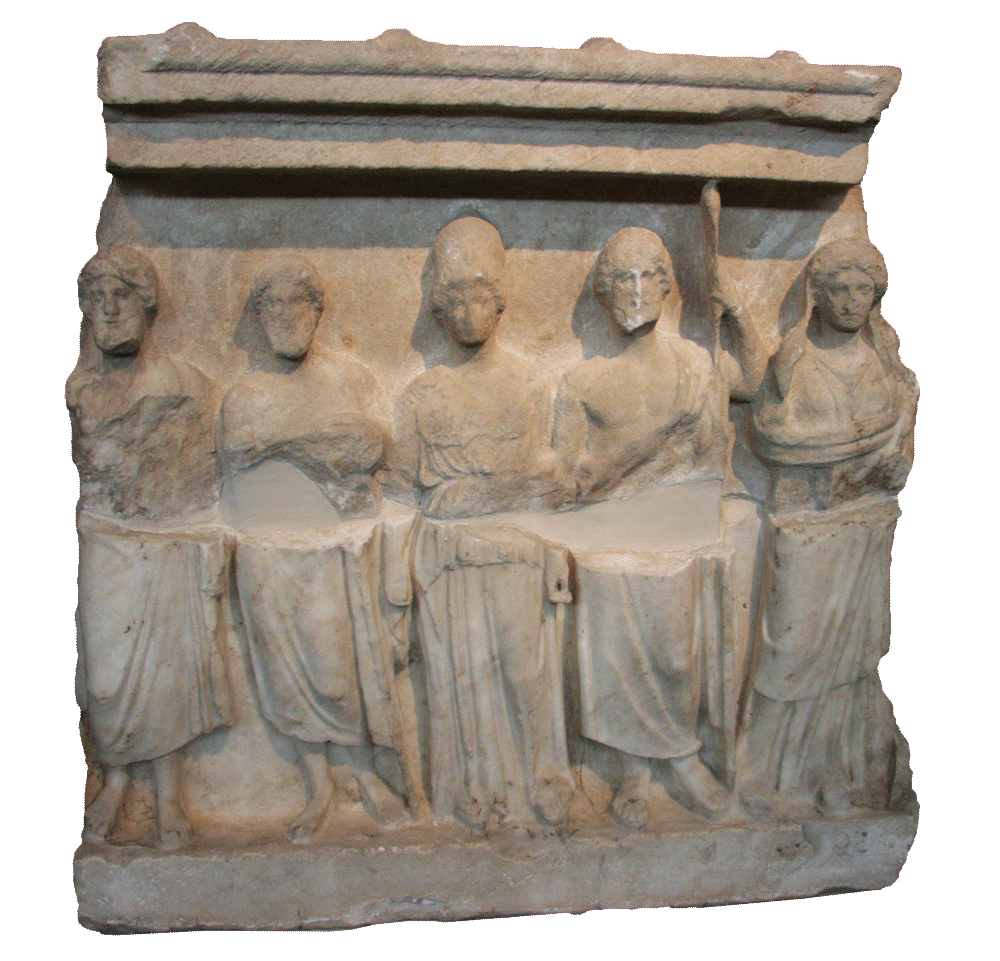
Paul encourages the Thessalonian believers to live holy lives in the midst of a pagan culture (1 Thess. 4:1–12). This votive relief (fourth century BC), possibly associated with the founding of Thessalonica, includes images of Athena, Zeus, and Hera and is a reminder of the city’s pagan heritage.
Not a few religions celebrated in Thessalonica promoted sexual immorality. It would therefore have been difficult for new converts to understand the connection between faith and ethics. Moreover, social norms of the day permitted that which was prohibited within the church. Cicero, for example, argued in favor of sexual liberty for the youth, saying, “Pleasures should not always be prohibited. . . . At times pleasure should triumph over reason” (In Defense of Caelius 18.42). The only concern was that the pleasures not harm others. When voices were raised against extramarital relationships, the concern centered on the possibility of begetting children from these unions. But the norms for men and women were different. Plutarch, the moralist, said that the wife should not be upset if her husband sought sexual pleasure with another woman (Morals 140B). What was condemned was entering into a sexual relationship with another man’s wife. On the other hand, the woman was prohibited from sexual encounters outside marriage. One marriage contract stipulated, “Isidora should not sleep apart nor be absent for a day from the house of Dionysus without his knowledge and should not ruin her house nor live with another man.” Such dissimilar norms existed in both Roman and Greek society.
Though his report about the church was good (3:6), Timothy brought other news about sexual misconduct in the church. Paul begins by affirming that “it is God’s will that you should be sanctified: that you should avoid sexual immorality” (4:3). While Greek ethics were organized around a collection of ideals or virtues, Christian and Jewish ethics centered on the will of God (Rom. 12:2; Eph. 6:6). The passage contrasts the life oriented around God’s will with that guided by passions (4:5). Here the will of God is their sanctification, or holy living (1 Pet. 1:15–16). Sanctification is the principal concern of this passage (4:3–4, 7), while the particular manifestation of it has to do with sexual purity (4:7). In language that echoes the Jerusalem decree (cf. Acts 15:20, 29), the apostles call the readers to avoid sexual immorality. “Sexual immorality” is a broad term that can include any sexual relationship outside marriage, including adultery, homosexuality, incest, prostitution, bestiality, and sexual relationships between singles. At times it is used in a more restricted sense (fornication, not adultery, as in Matt. 15:19; Mark 7:21), but here it indicates all forms of sexual immorality, including adultery (Matt. 5:32; 19:9).
The concern is “that each of you should learn to control his own body in a way that is holy and honorable” (4:4). The term translated “body” literally means “vessel” and may refer to the person’s own body or the person’s wife (see 1 Pet. 3:7 ESV). Some have suggested that it may even refer to male genitalia. The other problematic term is the verb. Does it mean “control” (oneself) or “obtain, acquire” (a spouse)? Most likely the NIV understands the passage correctly—the text is one of the many that call Christians to self-control (Acts 15:20, 29; 21:25; 1 Cor. 6:12–20; Eph. 5:3; Col. 3:5; and especially 2 Tim. 2:21–22, which also speaks of the body as a “vessel” [see ESV, NRSV] used in “honor” and “sanctification” instead of being dominated by passions). A person is to keep control of his or her body in holiness before God and honor before the community (Rom. 12:10) and God (Rom. 2:7; 9:21; 1 Pet. 1:7; 2:7). Paul starkly contrasts the life of sexual self-control that leads to honor and holiness with the life defined by passion due to ignorance of God: “not in passionate lust like the pagans, who do not know God” (4:5; see Rom. 1:18–32; Eph. 4:17–18). The implication for the readers of this letter is clear: you know God—don’t live that way! What determines the sexual conduct of the Christian is his or her relationship with God, not the passions that lead others in society.
The focus of this section is on adultery: “and that in this matter no one should wrong or take advantage of a brother or sister” (4:6). The first verb, “to wrong,” came to mean “transgress” or “infringe” laws or commandments and appears in various contexts in combination with the verb “to sin.” Some had transgressed the divine law by entering into a sexual relationship with a fellow Christian’s spouse. In this act, the person “takes advantage” of another believer, the verb suggesting a form of exploitation (in other contexts it refers to political, economic, and military, as well as sexual exploitation). Such acts are not casually dismissed. The apostles remind the church that “the Lord will punish all those who commit such sins, as we told you and warned you before.” They were not ignorant of what God required, nor were they unaware of the consequences. Paul refers to God as an “avenger” (KJV, RSV), a legal term used of officials and others who punished those who violated laws (Rom. 13:4). Elsewhere, as here, it was used to refer to God’s judgment (Deut. 32:35; Ps. 94:1; cf. 2 Thess. 1:8–9). God will not tolerate sexual immorality in his community (1 Cor. 6:9–10; 10:1–13).
Paul reminds the Thessalonians of God’s claim on their lives: “For God did not call us to be impure, but to live a holy life” (4:7). The believers in Thessalonica were chosen by God (1 Thess. 1:4) and called through the apostolic proclamation of the gospel to “share in the glory of our Lord Jesus Christ” (2 Thess. 2:14; see 1 Thess. 2:12). This election and calling included the call to sanctification (1 Pet. 1:15–16) and not impurity, here understood as sexual impurity (Rom. 1:24; 2 Cor. 12:21; Eph. 5:3). The Thessalonians were engaged by God to live according to his will with regard to their sexuality (4:7; cf. 4:1–3). Just as the gospel is a divine message (1 Thess. 1:5; 2:13), so too is the moral teaching that the apostles delivered. Paul therefore concludes, “anyone who rejects this instruction does not reject a human being but God” (4:8a). He adds that God “gives you his Holy Spirit” (4:8b), the one who enables them to live according to the will of God in sanctification (Rom. 8:4; Gal. 5:16; 1 John 3:24; 1 Thess. 5:23).
4:9–5:11: Responses to questions. Paul next appears to answer a series of questions put to him by the Thessalonians (see 4:9, 13; 5:1; cf. 1 Cor. 7:1, 25; 8:1; 12:1; 16:1), communicated orally or more likely by letter sent via Timothy. Likely the Thessalonians took advantage of the messenger at hand (there was no public postal system during this era). The questions they put to Paul were about fraternal love (4:9–10), the destiny of the dead in Christ (4:13–18), and the time of the day of the Lord (5:1–11).
4:9–12. If 4:9 is indeed a response to a query about familial love among the believers, what would have provoked the question? Perhaps the question arose from tensions generated by sexual misconduct, problems in accepting the emerging leadership (1 Thess. 5:12–13), and the way some refused to work (5:14). The social rejection the church experienced made the issue all the more important (2:14). Families, the fundamental unit of society, were affected by these believers who turned from community and familial deities (1:9). Building family bonds in the church similar to those that exist between brothers and sisters therefore became an urgent necessity.
The response begins, “Now about your love for one another we do not need to write to you, for you yourselves have been taught by God to love each other” (4:9). Various ancient authors spoke about love among siblings, emphasizing the way brothers and sisters collaborate and enjoy solidarity and harmony while also recognizing familial tensions. This love is the paradigm for the community known as “brothers and sisters.” The Thessalonians, however, needed no teaching on the matter. Paul recognizes that they have already been taught by God how to love one another, this being through God’s example in sending Christ (John 3:16; Rom. 5:8; Eph. 5:1–2), through the Holy Spirit (Gal. 5:22; Rom. 5:5), and through Jesus’s teaching (John 13:34–35; 15:12, 17), which the apostles echoed in their instruction (Rom. 12:10; Gal. 6:2; 1 Pet. 1:22). Indeed, the Thessalonians have already learned lessons of love, as demonstrated by their love for all the churches in Macedonia (such as Philippi and Berea; 4:10). This love is something they have demonstrated (see 1 Thess. 1:3), possibly through hospitality (Rom. 16:1–2) or acting as benefactors by helping those in need (2 Cor. 8:1–5, 8–11, 24). As in 4:1, he urges them to excel in what they are already doing.
Having touched on the issue of being benefactors for others (4:10), Paul now fixes his attention on those members of the church who are receiving aid from their patrons, whether inside or outside the church. This passage, like 2 Thessalonians 3:6–15, demonstrates that the apostles were opposed to the social and economic dependency that characterized the client-patron relationships, likely due to its social entailments. High-status patrons would have multiple clients who expected food, money, and public representation to protect their rights, while they reciprocated by giving patrons honor by supporting their causes in public assembly, following them through town, and showing up at their homes for the morning greeting. Paul exhorts the church, “Make it your ambition to lead a quiet life: You should mind your own business and work with your hands, just as we told you” (4:11). Ancient authors sometimes discussed those who led the “quiet life” as people who were respectable and did not cause problems in the community. These discussions sometimes include the note that such people mind their own business by not causing public disturbance. The exhortation to work with their hands not only indicates that the members of the church were of the artisan class but also suggests that some Thessalonians were clients of prominent patrons and supported the cause of the patrons in the popular assembly. Paul calls them to labor, following his example (1 Thess. 2:9; 2 Thess. 3:7–8), “so that your daily life may win the respect of outsiders and so that you will not be dependent on anybody” (4:12). The type of decent conduct Paul prescribes was admired by the Greeks. The language he uses describes those in a community who conducted themselves in a worthy and noble manner and who received public recognition for their conduct. Living in an orderly manner and with decorum was one of the highest ideals of life.
4:13–18. In this section the apostles respond to the second inquiry of the Thessalonian believers. They were ignorant about the destiny of believers who had died before the Lord’s advent. Verse 13 implies that between the time Paul left and Timothy’s visit some members of the church had passed away. The believers’ grief prompts Paul to orient them theologically and encourage them to comfort one another (4:18). This section picks up many of the themes found in ancient letters of consolation, such as the call to minimize grief (4:13), the discourse regarding the state of the dead (4:14–17), and the exhortation to comfort one another (4:18). Such ancient letters, however, focus on the way death is inevitable, the common fate of all, so one should not grieve too much in the face of fate’s dictates. Paul’s comfort, however, is firmly rooted in the resurrection of Christ (4:14). He offers hope where the rest offer none (4:13).
The exhortation begins, “Brothers and sisters, we do not want you to be uninformed about those who sleep in death, so that you do not grieve like the rest of mankind, who have no hope” (4:13). “Sleep,” a common euphemism for death (see 4:16, “the dead in Christ”) in both Jewish and Christian literature, implies nothing about the intermediate state between death and resurrection (cf. Luke 23:42–43; Acts 7:59–60; 2 Cor. 5:6–8; Phil. 1:20–23). However, at times “sleep” describes death in the light of the anticipated resurrection (Dan. 12:2; 1 Cor. 15:20). Paul seeks to minimize the grief of the church in the face of death, though he does not prohibit grief (John 16:6; Acts 8:2; Phil. 2:27). His and his companions’ concern is simply that the Christians’ grief not be like that of nonbelievers, who have no hope in the face of death (Eph. 2:12). Gentile hopelessness was expressed frequently in funeral epitaphs, some of which read, “I was not, I was, I am not, it doesn’t matter” (see Green, 218).
In response to the grief the Thessalonians experience in the face of death, Paul and his associates return to the creed of the church (cf. Acts 17:3): “We believe that Jesus died and rose again, and so we believe that God will bring with Jesus those who have fallen asleep in him” (4:14). Paul presents the resurrection of Jesus as the guarantee of the resurrection of the believers, a denial of which was, in Paul’s eyes, a virtual denial of the resurrection of Christ (1 Cor. 15:12–28). The resurrection is the focus of Christian hope, an emphasis often lacking in our reflections on death. Some have rightly argued that the verb translated “bring” should be understood as “take.” Paul draws the parallel between Christ’s experience of death and resurrection and the believer’s experience of death (“fallen asleep”) and resurrection (“take with Jesus”). The point is not that Jesus will return with the dead in Christ but that the dead in Christ will be raised as he was (see 4:16).
Paul traces his teaching back to Jesus: “According to the Lord’s word, we tell you that we who are still alive, who are left until the coming of the Lord, will certainly not precede those who have fallen asleep” (4:15). “The Lord’s word” does not here refer to a prophetic oracle (as Isa. 1:10), but either to the message of the gospel (1 Thess. 1:8; 2 Thess. 3:1) or, more likely here, to a teaching that came from the Lord Jesus (Acts 20:35). Since 4:15–17 conforms in many details to Matthew 24:29–31, 40–41, the source appears to be Jesus’s last-days discourse. Paul’s argument is simply that the dead in Christ will rise first and then, according to 4:17, the living and the resurrected dead will be taken up together to meet the Lord. The “coming of the Lord” is his parousia, a Greek term that was used to describe the glorious coming of a deity or the official visit of the emperor, himself honored as a god. An imperial visit was an event of great pomp and celebrations (1 Thess. 2:19), and the custom was for the officials of the city to go out to meet the coming sovereign and accompany him back to the city (4:17).
Verse 16 describes the dramatic events that occur at the Lord’s coming: “For the Lord himself will come down from heaven [see 1 Thess. 1:10], with a loud command, with the voice of the archangel and with the trumpet call of God, and the dead in Christ will rise first.” In a similar way, Philo of Alexandria spoke of the command of God by which he could bring together all the exiles of Israel from any part of the earth (On Rewards and Punishments 117; cf. Matt. 24:31). We may suppose that with this, God calls the dead to life. Christ also will come with the voice of the archangel (cf. Matt. 24:31) and the trumpet call of God. The trumpet was not a musical but a military instrument (1 Cor. 14:8) that was used in religious ceremonies and funeral processions as well. Here it not only is heard by the dead but also calls them forth (cf. 1 Cor. 15:52; Matt. 24:31; see also Isa. 27:13; Zech. 9:14–16). The result is that the dead in Christ will rise first, giving them the place of preeminence and honor.
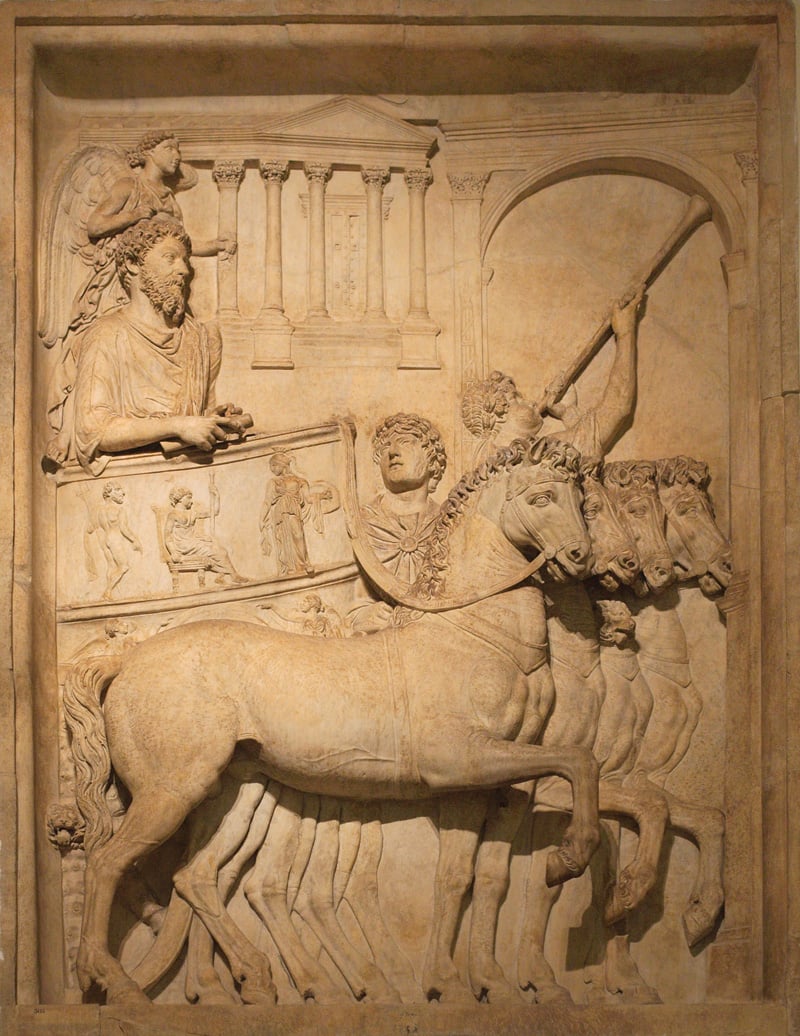
Paul says that a trumpet will accompany the coming of the Lord (1 Thess. 4:16). On this bas-relief from the Arch of Marcus Aurelius in Rome, a trumpet announces the triumphal return of the victorious emperor, Marcus Aurelius, in AD 176.
Then, “After that, we who are still alive and are left will be caught up together with them in the clouds to meet the Lord in the air” (4:17). This event is commonly referred to as the “rapture” of the church, which occurs at the time of Christ’s coming after the dead in Christ are raised. “Caught up” denotes taking something or someone by force or violence and at times is used of taking a person up to celestial places (Acts 8:39; 2 Cor. 12:2, 4; Rev. 12:5). Clouds often accompany times when God shows himself (Matt. 17:5), such as in Christ’s second coming (Matt. 24:30; 26:64). The purpose of this event is “to meet the Lord.” Paul uses a verb that describes the custom of sending an official delegation outside a city to meet a visiting dignitary (Acts 28:15). In formal receptions for dignitaries like the emperor, the leaders of the city, along with the whole population, would go out to meet him, and then upon his return to the city there would be a great reception with songs, cries, and sacrifices. The pomp and ceremony at Christ’s coming (parousia) is beyond compare. The end result is that we will be with the Lord forever. Paul does not state where we will be with the Lord, but the previous argument implies that the believers, living and resurrected, will return with him to this earth (cf. Matt. 6:10).
This embedded letter of consolation concludes, “Therefore encourage one another with these words” (4:18), a common topic in such ancient letters (see 4:13). This teaching was not just for the leadership but was to be used in the ministry each of the members exercised toward others (4:9; 5:11, 14–15).
5:1–11. This section constitutes a response to the third question of the Thessalonian believers (4:9, 13), which was about the time of the day of the Lord (5:1–2), a continuing concern of the church (2 Thess. 2:1–2). The persecution they suffered likely provoked the question. The response also suggests that they had questions regarding how to be prepared for that day (5:4–10). In response, the apostles affirm that maintaining a life characterized by faith, love, and hope will give them the assurance that the day of the Lord will not surprise them like a thief (5:4). While the unbelievers will not escape (5:3), the church will not experience divine wrath (5:9). The apostles’ focus, as in the previous section, is pastoral and not speculative (5:11).
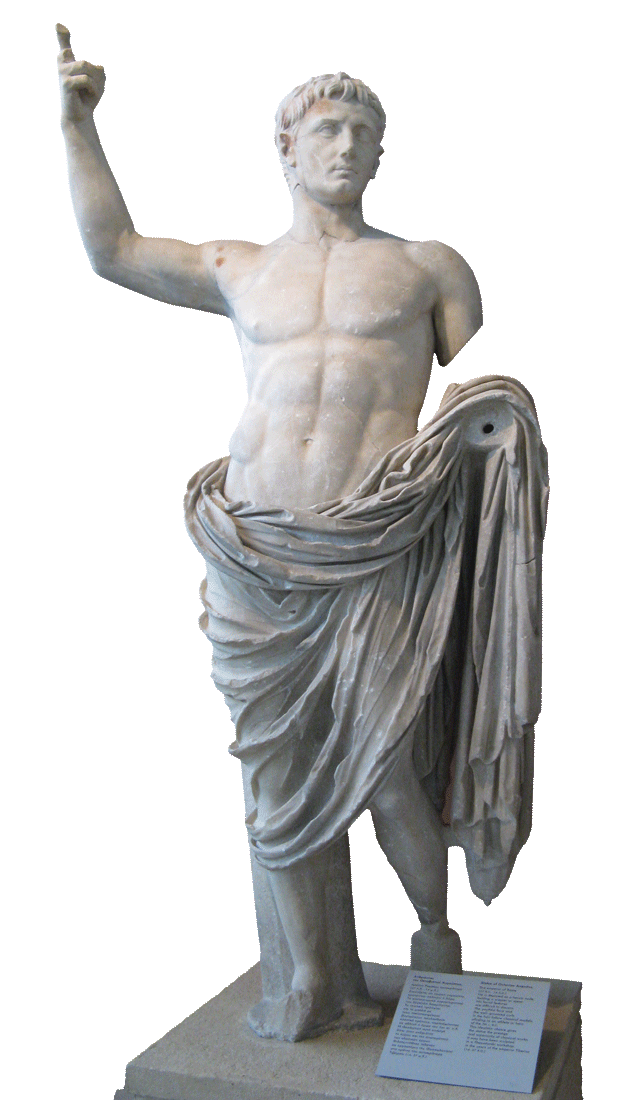
Reassembled statue of Augustus from Thessalonica (first century AD). Augustus initiated the idea of pax Romana, the peace and security of the Roman Empire. Paul warns, however, “While people are saying, ‘Peace and safety,’ destruction will come on them suddenly” (1 Thess. 5:3).
As in 4:9, Paul begins the section by reminding the Thessalonians about what they already know: “Now, brothers and sisters, about times and dates we do not need to write to you” (5:1). The question they had was about the time when the day of the Lord would arrive (5:2), an ancient query among God’s people (Hab. 2:1–4; Matt. 24:3; Acts 1:6; 1 Pet. 1:10–11; and note the common responses found in Matt. 24:36; Mark 13:32; Acts 1:7). He reminds them that “the day of the Lord will come like a thief in the night” (5:2). This day is not only the time when God will come to judge the inhabitants of the earth (Isa. 13:6, 9; Ezek. 13:5; Joel 1:15; 2:1, 11; 3:14) but also when God will deliver his people (Joel 2:21–32; 3:18; Obad. 15–21; Zech. 14:1–21). That day will come like a thief in the night, that is, suddenly and at a moment when it is not expected. Paul’s teaching is derived from Jesus (Matt. 24:43–44; cf. 2 Pet. 3:10; Rev. 3:3; 16:15).
Paul graphically describes how that day will come: “While people are saying, ‘Peace and safety,’ destruction will come on them suddenly, as labor pains on a pregnant woman, and they will not escape” (5:3). Once again, Paul draws from Jesus’s teaching (Luke 21:34–36). The Roman Empire and its rulers offered “peace and safety” or “security” since the establishment of the pax Romana (Roman peace) by the emperor Augustus. But at the very time of greatest political and social promise, divine judgment will come. This event will arrive like labor pains on a pregnant woman, from which there is no escape. Inscriptions from the era testify that many women died giving birth, making this an apt, though dreadful, metaphor.
Paul contrasts how believers will face that day: “But you, brothers and sisters, are not in darkness so that this day should surprise you like a thief” (5:4). While they do not know when the day of the Lord will come (5:2), they will be prepared for it since they are “not in darkness.” The association of “darkness” with the life of sin is common in the Old Testament and Jewish literature (as Ps. 74:20; 82:5). Christian salvation is a transition from the realm of moral darkness to light (Acts 26:18; Eph. 5:8; Col. 1:13; 1 Pet. 2:9; and see Heb. 6:4; 10:32). Paul’s point is that living the moral life in the light assures the believers that the day of the Lord will not surprise them, since they will be ready for it. Preparedness does not come by speculations about when that day will arrive. The believers are children of the light and day, not of the night and darkness (5:5). These participate in the light; that is, they belong to the sphere of light and are saved (Acts 26:18; Eph. 5:8; 1 Pet. 2:9). Being of the day means that they belong to the dawning new age (Rom. 13:12), which will shine completely when the Lord Jesus returns (1 Thess. 5:2, 8; 2 Thess. 1:10).
Paul exhorts them to act according to who they are: “So, then, let us not be like others, who are asleep [here in the moral sense, unlike 4:13], but let us be awake and sober” (5:6). To be “awake” signifies being spiritually and morally alert and vigilant (Matt. 24:42–44; 25:13) so that they do not enter into temptation (Matt. 26:40–41). To be “sober” means to avoid drunkenness, although here the meaning is figurative, denoting self-control (2 Tim. 4:5; 1 Pet. 1:13; 4:7; 5:8). So the believer does not embrace the night with its sin (5:7). Since there was little nighttime illumination during this era, nights were considered horrible and sinister (see Matt. 26:34; John 13:30). Paul urges his readers that since they are of the day, “let us be sober, putting on faith and love as a breastplate, and the hope of salvation as a helmet” (5:8). Paul occasionally employs military metaphors when describing Christian conduct (Rom. 13:12; 2 Cor. 6:7; 10:3–5; Eph. 6:11–17; Phil. 2:25; 2 Tim. 2:3–4). Here he draws from Isaiah 59:17, where God himself is compared to a soldier, as also in Ephesians 6:11–17. The symbolic references of the armament are not the same as in Ephesians 6. In Ephesians 6:14 the breastplate is justice, but here it is faith and love; and in Ephesians 6:17 the helmet is salvation, while here it is the hope of salvation. The trilogy of faith, love, and hope (see 1:3; 3:6–8) is the vital element of the armor, which will ensure that the Christian is prepared for that day, whenever it comes.
Up to this point the contrast has been between the character of the Christians and the character of the unbelievers in light of the coming day of the Lord. But in 5:9 the focus changes to their ultimate destiny: “For God did not appoint us to suffer wrath but to receive salvation through our Lord Jesus Christ.” Paul graphically describes God’s wrath in 2 Thessalonians 1:6–10 and 2:8–12. This is the lot of those who do not obey the gospel. Because of God’s election, the believers’ destiny is to obtain salvation (5:8), the liberation from the wrath of God (see 1 Thess. 1:10), which comes through Christ’s death. Paul links this salvation with Christ’s crucifixion by stating that “he died for us so that, whether we are awake or asleep, we may live together with him” (5:10). This is one of the few texts in the Thessalonian epistles that expressly speaks of the death of Christ (2:15; 4:14) and the only one in which the purpose of his death is expressly stated. His death was substitutionary (“for us”; cf. 1 Cor. 1:30). Both the living (“awake”) and deceased (“asleep,” as in 4:13–15) believers “live together with him,” an allusion to the resurrection of the dead and their rapture along with the living (4:16–17).
5:12–13: Community leadership. After responding to the Thessalonians’ questions (4:9–5:11), the apostles take up a variety of issues, starting with the church’s relationship with their emerging leadership: “Now we ask you, brothers and sisters, to acknowledge those who work hard among you, who care for you in the Lord and who admonish you” (5:12a). In calling the church to respect the new leaders, the apostles literally call the church “to know” them, which means they should “recognize” who the legitimate leaders are (cf. 1 Cor. 16:15–16). What legitimized the Thessalonian leadership was not their status or social rank, as was common in Greek and Roman society, but the hard work they undertook on behalf of the congregation (5:12b; see 1:3; 1 Cor. 3:8; 15:58; 2 Cor. 6:5; 11:23, 27). They are also those who “care for you,” a term that may mean “to lead” or “to direct” (1 Tim. 3:4–5, 12; 5:17) but also “to protect” and “to give aid” (Titus 3:8, 14). It was commonly used to speak of those who were leaders of communities, the guardians and leaders of groups. Those who led communities were often their benefactors (Rom. 12:8; 16:1–2), but these leaders’ authority was derived from the Lord. They also “admonish you,” correcting the congregation’s moral and doctrinal errors. Ministerial responsibility includes teaching but also changing conduct (5:14; 2 Thess. 3:15).
The following verse (5:13) calls the Thessalonians to honor their leaders and to live in harmony with one another. Leaders should be respected to the highest degree and loved, just as the members of the church love other believers (1 Thess. 4:9–10). They are not honored due to their high social rank but because of “their work.” There should also be community harmony among the believers, a teaching given by Jesus (Mark 9:50). This call to community harmony reverberates through the epistles, as the believers are called to live in peace with those both inside and outside the community of faith (Rom. 12:18; 2 Cor. 13:11; Heb. 12:14). To live in peace meant the absence of discord and the maintenance of harmony between people, a virtue of special importance as these new believers experienced social rejection (1 Thess. 2:14).
5:14: Life in community. Leaving the theme of community loyalty, the apostles now instruct the believers about their response to various groups within the church: “And we urge you, brothers and sisters, warn those who are idle and disruptive, encourage the disheartened, help the weak, be patient with everyone” (5:14). This ministerial responsibility is placed not on the leadership alone but on all (1 Thess. 4:18; 5:11). They should admonish (see 5:12) the “idle.” These are not “the lazy” but those who are “out of line” or “undisciplined.” The term is found in the gymnasiarch law of Berea, which, among other things, prescribes disciplinary measures that need to be taken to correct the conduct of those who do not follow the rules of the gymnasium. In Thessalonica, they are believers who have rejected the apostolic teaching by refusing to work and maintaining their position as dependent clients (see 2 Thess. 3:6–15). The “disheartened” in need of encouragement are the discouraged, those in danger of giving up. There were likely many in this category due to the persecutions that the church endured (1:6; 2:14; 3:3–4) and the deaths of beloved believers (4:13–18). The “weak” who needed help may have been the physically weak, perhaps due to illness (1 Cor. 11:30), or those who had no social status or power, such as slaves, freedmen/women, or others who had no economic and social power (1 Cor. 1:26–29). The Greeks despised weakness in any form, but God accomplishes his greatest works in the midst of weakness (2 Cor. 13:4; 12:5, 9). The church should therefore help, and not despise, the weak. Finally, they should exercise patience toward everyone, not being irritable due to others’ foibles. The diverse social mix in the church would provide innumerable opportunities to exercise this virtue.
5:15: Nonretaliation. Teaching about nonretaliation was part of the basic moral instruction for new Christians (Rom. 12:17–21; 1 Pet. 3:9), an important topic given the tensions with the surrounding community and the internal problems of the congregation: “Make sure that nobody pays back wrong for wrong, but always strive to do what is good for each other and for everyone else.” Everyone recognized vengeance as the common way to respond to evil. In fact, one could never hope to maintain their social status if vengeance did not follow some offense that dishonored the person. In this environment, Jesus’s teaching sounded exceedingly strange (Matt. 5:45, 48; Luke 6:35–36). Paul, like Jesus, counsels the church to do good to the one who has caused the offense (see 1 Thess. 3:12; Gal. 6:10).
5:16–18: Communion with God. In this group of three exhortations, the apostles move on to the characteristic traits of believers, joy (5:16), prayer (5:17), and thanksgiving (5:18), which should mark their lives at all times and in every situation. This is God’s will. Though the Thessalonians already have joy in suffering (1 Thess. 1:6), a fruit of the Spirit in their lives, they are called to a life of joy that is constant (5:16; Phil. 4:4; 3:1). In the midst of agonizing situations, the presence of God by the Spirit fills the soul with hope and the heart with joy. Paul also calls them to “pray continually” (5:17), not an exhortation to pray at every moment (see the word in 1:3) but consistently and without fail (Luke 18:1; Rom. 12:12; Eph. 6:18; Col. 4:2). Unlike pagan prayer, which was based on a system of exchange with the gods (“You do this for me and I’ll do that for you”), Christian prayer begins with the assumption that God, our Father, is disposed to hear and answer prayer (Matt. 6:9–13; 7:7–11).
The third exhortation of this trilogy is to “give thanks in all circumstances” (5:18a). Thanksgiving is offered to God, though the object of thanks is only implied, not stated. Giving thanks was an important social obligation, and deities were considered to be proper objects of thanksgiving because of the benefits they conferred. The call is not to give thanks for every situation but rather in every situation. Paul does not embrace fatalism, which says that what happens is what is supposed to happen. Rather, the Christian affirms that God can use any situation for his or her own good (Rom. 8:28) and that one can triumph in the midst of any circumstance, even adversity (Rom. 8:31–39). All the preceding exhortations are God’s will for them (5:18b).
5:19–22: Prophecy. This last group of exhortations has to do with the use and control of prophecy in the church: “Do not quench the Spirit. Do not treat prophecies with contempt” (5:19–20). Paul speaks of the “Spirit” as the agent in prophecy (Luke 1:67; Acts 2:17; 19:6; 28:25; Eph. 3:5; Rev. 22:6), and here he responds to attempts to curtail this gift. Occasionally in Israel prophetic utterances were questioned and prohibited (Num. 11:26–29; Amos 2:12; Mic. 2:6). During the New Testament era Epicurean questions about prophecy, based on a rejection of divine providence, were well known. Such influences likely entered the church. Some prophesied in the church, but others rejected and despised these prophetic oracles. While there were abuses of the gifts in the churches, the apostolic teaching was not to eliminate them but to use them under proper control (1 Cor. 12:10; 14:29; 1 John 4:1–3; cf. 1 Cor. 14:39).
The following verses are connected with the previous two: “Test them all; hold on to what is good, reject every kind of evil” (5:21–22). “Test” is the same verb found in 1 John 4:1, which likewise talks of testing prophecy. The presence of false prophecies made such testing necessary (Matt. 24:24; 1 John 4:1–3; 1 Cor. 12:3; 2 Thess. 2:2). The basis for testing was apostolic doctrine, which carried authority that superseded that of prophecies. Having examined all prophecies, the Thessalonians are to “hold on to what is good.” Those prophecies considered to be authentic should be retained and taken seriously. The verb “hold on” often refers to holding firm to received authoritative traditions (Luke 8:15; 1 Cor. 11:2; 15:2; Heb. 3:6, 14; 10:23). Finally, after examining all prophecies and holding firmly to that which is true revelation, the church should reject inauthentic revelations.
4. Final Prayer, Greetings, and Blessing (5:23–28)
A. Prayer for sanctification (5:23–25). The first part of the letter’s closing contains a blessing expressed in the form of a prayer (5:23), the assurance that God is faithful to complete the work of grace in the Thessalonians’ lives (5:24), and an appeal that they pray for the apostles (5:25). The apostles’ prayer for the church is, “May God himself, the God of peace, sanctify you through and through. May your whole spirit, soul and body be kept blameless at the coming of our Lord Jesus Christ” (5:23). God is the ultimate source of their sanctification (1 Thess. 3:13). They must conform to the will of God in their sanctification (4:3), but never are they left on their own to attain this goal. God is the one who has called them and accomplishes this work through the Holy Spirit (4:7–8; 5:24). God is here described as “the God of peace,” a name Paul uses frequently in benedictions (Rom. 15:33; 16:20; 2 Cor. 13:11; Phil. 4:9). “Peace” is practically a synonym for “salvation” (1 Thess. 1:1; Acts 10:36; Rom. 2:10; 5:1; 8:6; 14:17; Eph. 6:15).
The prayer is that God would “sanctify” (see 1 Thess. 3:13; 4:3–4, 7–8) them entirely, a thought clarified in the following clause. The apostles wish them to have complete health in spirit, soul, and body, which, according to the context, would mean moral health (blamelessness). So that the Thessalonians will understand that sanctification takes in all their being, the apostles include the terms “spirit, soul and body.” There was a debate going on in this era regarding whether a person had three or two parts. We should not, on the basis of this text, conclude that Paul had aligned himself with the tripartite position, for in 1 Corinthians 7:34 he summarizes the totality of human nature in the terms “body and spirit.” Jesus, on the other hand, spoke of human nature as body and soul (Matt. 10:28) but elsewhere as heart, soul, mind, and strength (Mark 12:30; Matt. 22:37; Luke 10:27). These terms describe different aspects of human nature, and in this present context the three simply strengthen the prayer that sanctification extend to the entirety of the Thessalonians’ being so that they might appear “blameless” before the Lord in his coming (1 Thess. 3:13). Paul affirms, “The one who calls you is faithful and he will do it” (5:24). What God began in the election and calling of the Thessalonians (1:4; 2:12; 4:7; 2 Thess. 2:13–14) will be brought to completion at the time of the coming of the Lord (Phil. 1:6).
Paul also calls the church to pray for him and its other founders: “Brothers and sisters, pray for us.” Paul frequently mentioned the reciprocity between him and churches, especially in prayers (Rom. 15:30–32; 2 Cor. 1:11; Eph. 6:19–20) but not limited to prayer (Rom. 1:11–12; 1 Thess. 3:8–9).
B. Call to greet and read to one another (5:26–27). This letter would have been read aloud in a gathering of the church where all, even the illiterate, could hear the message (Col. 4:16; 1 Tim. 4:13). After the reading, there would be time to greet each other “with a holy kiss” (5:26; cf. Rom. 16:16; 1 Cor. 16:20; 2 Cor. 13:12). The kiss signified a variety of things, such as the love between members of a family, honor and respect, and friendship (Mark 14:44–45; Luke 7:36–45; 15:20; Acts 20:37). Most well known was the kiss given on the forehead or cheek in greetings or departures between family members, friends, and respected persons.
C. Final blessing (5:28). As in all the Pauline Epistles, 1 Thessalonians ends with a blessing of grace. This blessing was a modification of the normal letter closing of the time, which said either “be strong” or “prosper.” The apostles do not want them simply to be strong but rather to have the grace that comes from the Lord Jesus Christ. This desire, sounded in the opening prayer of the letter (1:1), summarizes the heart of the faith, which the Thessalonians had received.
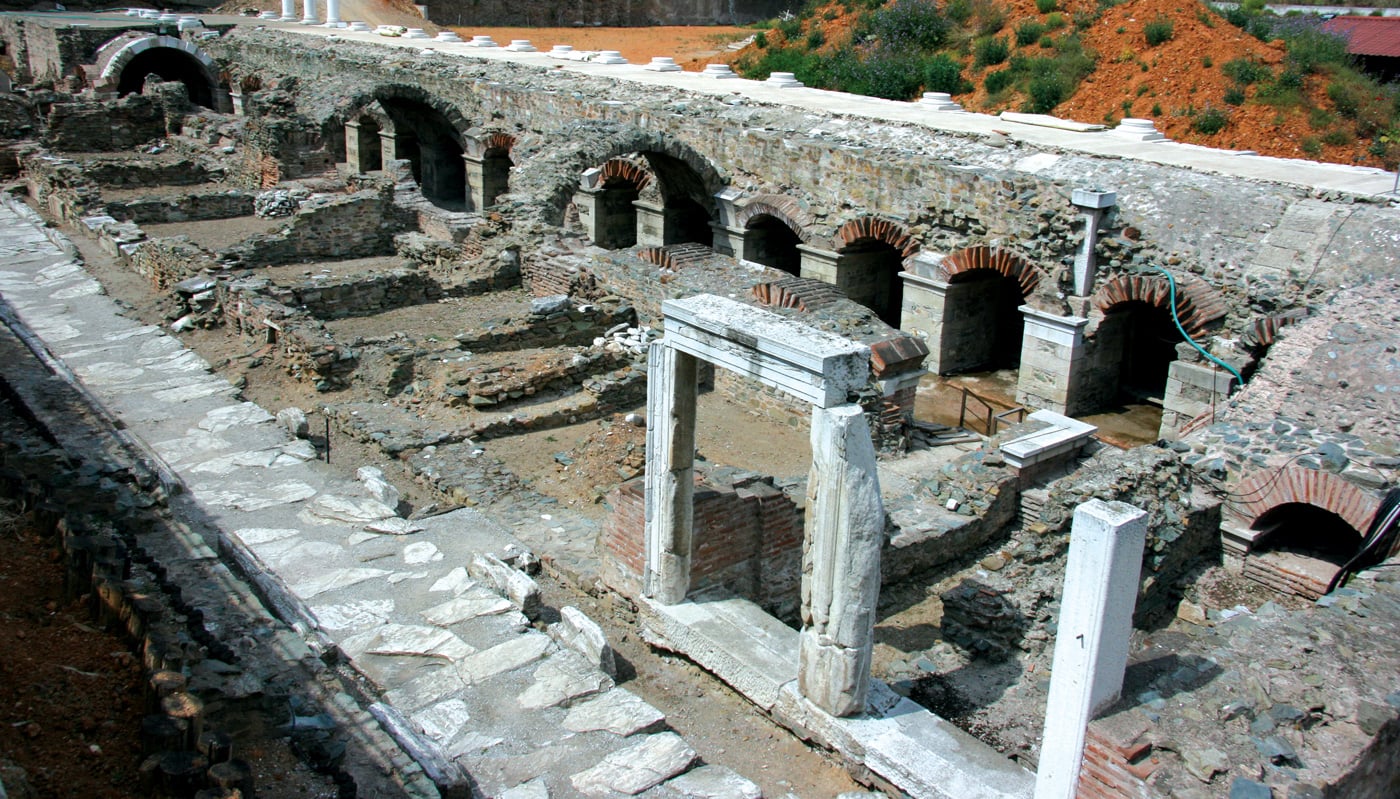
xUnderneath the remains of this second-century-AD agora in Thessalonica lies an earlier agora, the marketplace most likely used by the recipients of Paul’s letters to the Thessalonians.
Commentary for 2 Thessalonians
1. Epistolary Salutation (1:1–2)
This second epistle begins exactly as 1 Thessalonians did, using nearly identical wording. The only difference between this text and 1 Thessalonians 1:1 is that God is here called “our Father” (cf. Rom. 1:7; 1 Cor. 1:3; 2 Cor. 1:2; Gal. 1:3–4; Eph. 1:2; Phil. 1:2; 4:20; Col. 1:2; 1 Thess. 1:3; 3:11–12; 2 Thess. 2:16; Philem. 3), echoing the prayer Jesus taught the disciples (Matt. 6:9). Paul and his associates also add here that grace and peace come “from God the Father and the Lord Jesus Christ,” placing the Lord Jesus along with the Father as the agent of salvation.
The apostles begin the second epistle with a thanksgiving to God for the church (1:3–5), then discuss the final judgment of the persecutors and the relief the Lord will give to his afflicted (1:6–10). This introduction ends with a report regarding their prayers for the church (1:11–12).
A. The first thanksgiving (1:3–5). As in 1 Thessalonians, the second letter begins with a thanksgiving to God for the congregation (cf. 1 Thess. 1:3–10). The first words of this thanksgiving are almost identical to 1 Thessalonians 1:3. Here the authors see their thanksgiving as an obligation. The language echoes Jewish reflection on prayer. Philo, for example, spoke of the “necessary obligation” to offer to God “hymns and blessings and prayers and sacrifices and the other expressions of thanksgiving” (On the Special Laws 1.224). It is also “right” or “proper” as a duty. While we may affirm our rights, the emphasis here is on Christian duties. The reason the apostles thank God is that they understand him to be the agent in the Thessalonians’ moral growth: “because your faith is growing more and more, and the love all of you have for one another is increasing” (1:3). Paul mentions their progress in “faith” and “love” (cf. 1 Thess. 1:3), while their hope is implicit in their “perseverance” (2 Thess. 1:4; see 1 Thess. 1:3; 3:6, 8). The members of this church were noted for their active “faith” in the midst of persecutions (1 Thess. 1:3; 3:2, 5–7; 5:8; 2 Thess. 1:10–11), and “love” characterized the relations among the believers (1 Thess. 1:3; 3:6, 12; 4:9–10; 5:8, 13). However, the apostles had exhorted them to love each other more and more (1 Thess. 4:10) and had prayed for an increase of love among them (1 Thess. 3:12). Clearly the Thessalonians had responded to the exhortation, and God had answered the prayer. There was reciprocity in this love. No member was excluded from either giving or receiving love.
Paul comments on their growing faith and love among other congregations: “Therefore, among God’s churches we boast about your perseverance and faith in all the persecutions and trials you are enduring” (1:4). The news of this boasting would have given the Thessalonians much encouragement. Those who suffered dishonor in their town were being honored among the churches. They were tenacious, and their perseverance, or steadfastness, in the face of suffering and temptation flowed out of their firm hope in the coming of the Lord Jesus (1 Thess. 1:3; see Luke 21:19; Rom. 5:3–4; 2 Cor. 1:6; 6:4; Col. 1:11; 1 Tim. 6:11; Titus 2:2; Heb. 12:1; James 1:3–4; Rev. 2:2–3). Perseverance was one of the most valued virtues in the early church. The Thessalonians endured, but unlike Stoics whose creed was “endure and abstain” in the face of uncontrollable fate, they had an endurance that sprang from their faith in God.
The following verse (1:5) is a transition from the thanksgiving to the following exposition on the destiny of the persecutors and the Christians: “All this is evidence that God’s judgment is right, and as a result you will be counted worthy of the kingdom of God, for which you are suffering.” The evidence that God’s judgment is right can be found precisely in the persecutions themselves (1:4). According to Jewish literature, the judgments of God are just because God will change the fortunes of both his persecuted people and the oppressors. Persecution is not a sign of God’s rejection but rather of his acceptance (1 Pet. 4:17–19; Heb. 12:5–8). This type of perspective is the opposite of ancient history writing, which understood ill fortune as a sign of divine disfavor. God’s judgment is right (Ps. 19:9; 119:137; Rom. 2:5; 2 Tim. 4:8; 1 Pet. 2:23; Rev. 16:7; 19:2) because at the end he gives to each his or her due (2 Thess. 1:6–10). In the city of Thessalonica, the believers had suffered reproach and dishonor due to their faith (1 Thess. 2:14), but God counted them worthy of the kingdom of God, like those considered worthy to be citizens of a great city such as Alexandria in Egypt (3 Maccabees 3:21; Luke 20:35; Acts 5:41). The kingdom and sufferings were intimately connected. Paul taught new believers that sufferings were a necessary prelude to entrance into the kingdom (Acts 14:22).
B. The destiny of the persecutors (1:6–10). The authors add additional information about how God’s judgment is righteous, saying, “God is just: He will pay back trouble to those who trouble you” (1:6). In the eyes of God it is right to recompense the persecutors with affliction (1:6, 8–9) and give the Thessalonians relief (1:7). Scripture repeatedly affirms that God judges in accordance with his justice (Gen. 18:25; 1 Kings 8:31–32; 2 Chron. 6:22–23; Ps. 7:8–9; 2 Tim. 4:8; Rev. 18:6–7; 19:1–2). It would be unjust to allow the persecutors to escape the recompense for their actions (Ps. 137:8; Isa. 66:4, 6; Rom. 12:19; Heb. 10:30). God is not unmindful of his people or their persecutors.
Paul assures the church that God will “give relief to you who are troubled, and to us as well. This will happen when the Lord Jesus is revealed from heaven in blazing fire with his powerful angels” (1:7). The church will share relief (2 Cor. 8:13; 2:13; 7:5) with the apostles in the same way that they, like the apostles, have shared in suffering for Christ (1 Thess. 2:2, 16; 3:7; 2 Thess. 3:2). The relief in mind is the resurrection and rapture of the church (1 Thess. 4:13–18) and its glorification (2 Thess. 2:14). This will occur at the time of Christ’s revelation (1 Cor. 1:7; 1 Pet. 1:7, 13). The angels of his power (cf. 2 Pet. 2:11) will accompany him in this moment (Zech. 14:5; Matt. 16:27; 24:30–31; Mark 8:38; 1 Thess. 3:13). The words “in blazing fire” are part of 1:8 in the Greek (see NRSV), although they are linked grammatically with the preceding sentence, in 1:7. Flames were a sign of God’s presence (Exod. 3:2–3) but also repeatedly appear as a symbol of his judgment (Deut. 32:22; Isa. 29:6; 30:27, 30, 33; 33:14; 66:15–16). The crucified and despised Christ is God’s agent in both salvation and judgment.
Paul affirms that Christ “will punish those who do not know God and do not obey the gospel of our Lord Jesus” (1:8). The language, taken from the Greek translation of Isaiah 66:15 and 66:4, speaks of Christ’s vengeance, which is not an emotional outburst but the result of his righteous judgment (Luke 18:3, 5; 21:22; Acts 7:24; Rom. 12:19). Those who experience his vengeance are those who do not know God (Ps. 79:6; Jer. 10:25); they are not simply ignorant of him but have rejected him (Rom. 1:18–32; 1 Thess. 4:5). And as the knowledge of God results in obedience to his law (Ps. 36:10), so the ignorance of God is linked to disobedience to the call of the gospel (Rom. 2:8; 1 Pet. 4:17). Conversion is often described as an act of obedience to the gospel (Acts 6:7; Rom. 1:5; 6:17; 15:18; 16:26; Heb. 5:9; 1 Pet. 1:2, 14, 22).
Paul underscores the horrors of divine vengeance in 1:9. As the guilty party in judicial proceedings, the condemned will be punished “with everlasting destruction” (as 1 Thess. 5:3), “destruction” being a term that appears frequently with reference to eschatological ruin and loss (Jer. 25:31; 48:3; Hag. 2:22; 1 Tim. 6:9). This destruction is “eternal” (Matt. 18:8; 25:41, 46; Jude 7). This does not imply annihilation but rather that the chastisement will endure and will not end. The following statement, drawn from the Greek version of Isaiah 2:10, 19, 21, makes the association between God’s presence and judgment (Num. 16:46; Judg. 5:5; Ps. 34:16; 96:13; Jer. 4:26; Ezek. 38:20; Rev. 6:16; 20:11). The thought is not that they will be separated from the “presence” but that this judgment will come forth from God’s presence as well as from “the glory of his might.” The glory is his visible presence (Rom. 1:23; Jude 24), which is at times associated with God’s power or might (Rom. 6:4; Col. 1:11). The discussion about judgment aims to encourage the believers in their affliction (1:4), letting them know that God will act in justice in favor of the community and against their persecutors.
The time of this judgment will be “on the day he comes to be glorified in his holy people and to be marveled at among all those who have believed. This includes you, because you believed our testimony” (1:10). Not only will the Lord Jesus come to judge, but also in that day his people will glorify and honor this one who was despised and rejected. His people will marvel at him, meaning they will view him with astonishment and thereby admire or honor him (see Luke 8:25; 11:14; John 7:21; Acts 3:12; Rev. 13:3). The “day” (see Isa. 2:11, 17) is the “day of the Lord” (1 Thess. 5:2, 4; 2 Thess. 2:2), the time when God will be exalted and the idolaters will be humbled according to the prophecy of Isaiah. The Thessalonians will take part in honoring him because they believed the apostles’ testimony, the preaching of the gospel (Matt. 24:14; Luke 21:13; Acts 4:33; 1 Cor. 1:6; 2 Tim. 1:8). Their reaction to the divine message is in contrast with that of those who “do not obey the gospel” (1:8).
C. The remembrance of prayers (1:11–12). Having given thanks to God for the church at the start of the previous section (1:3–10), the apostles now offer up prayer for them (1:11–12). This prayer is linked specifically with the teaching in 1:6–10 concerning the revelation of the Lord Jesus and the implications of this event for the church and her persecutors. The future promise for the believers brings with it obligations in the present, and these become the theme of the prayer. Paul and his associates pray “that our God may make you worthy of his calling” (1:11a). The verb does not mean “make worthy” but rather “consider worthy” (Luke 7:7; 1 Tim. 5:17; Heb. 3:3; 10:29) and appears in texts that speak of those who are evaluated and found worthy of some kind of honor. In the end it is God who will make them worthy of the call, giving them the ability to do his will (1 Thess. 5:23–24), but the apostles have also exhorted them to live a life worthy of God, who called them (1 Thess. 2:12; cf. Eph. 4:1; Phil. 1:27; Col. 1:10). Paul anticipates that God will evaluate their conduct in light of his call (cf. 1 Thess. 2:12; 4:7; 5:24; 2 Thess. 2:13–14), which brings with it great responsibilities. The second part of the prayer is that God “by his power” will “bring to fruition your every desire for goodness and your every deed prompted by faith” (1:11b). “Desire for goodness” (Rom. 10:1), or “goodwill” (see Phil. 1:15), is their desire to do that which is good, or, alternately, the good may be the source of their desire or goodwill. This second interpretation is preferable, as it parallels the following phrase, “deed prompted by faith” (literally “work of faith”). The idea is then that the goodwill that the Thessalonians demonstrated to others is the fruit of the good that characterizes them as Christians (Rom. 15:14; Gal. 5:22; Eph. 5:9). Their faith produced good works (see 1 Thess. 1:3). The way that this goodwill and work come to fruition is through the enabling “power” of God (Rom. 15:13; Col. 1:29).
The prayer ends by emphasizing honor: “We pray this so that the name of our Lord Jesus may be glorified in you, and you in him, according to the grace of our God and the Lord Jesus Christ” (1:12). The first part of the prayer echoes Isaiah 66:5 (see 2 Thess. 1:8–9). The Lord Jesus had been rejected and dishonored by the unbelieving Thessalonians, but this very one will be glorified (see 1:10). Paul links this glorification to the conduct of the Thessalonian believers. The glorification of a deity was a theme that appeared in the literature of the era. In this sense, “glorified” means “to be honored or respected.” The worshiper honors the deity, and, in turn, the deity honors the worshiper. The worshipers of Jesus were despised, as was the Lord himself, but there is coming a time when both the Lord and his followers will be honored—and it will be mutual glorification, he in them and they in him. This glorification is the fruit of “the grace of our God and the Lord Jesus Christ.” This grace is the source of their salvation and hope (1:2; 2:16; 3:18; 1 Thess. 1:1; 5:28) as well as their glorification. The grammar of the final words may be understood as an ascription of “God and Lord” to “Jesus Christ” (“our God and Lord, Jesus Christ”).
3. The Body of the Letter (2:1–3:15)
The introduction of the letter included both a thanksgiving and digression concerning the revelation of the Lord (1:3–10) and a prayer for the church (1:11–12). The authors now introduce the eschatological and moral themes that constitute the body of the letter (2:1–3:15).
A. The time of the day of the Lord (2:1–17). The first section of the body (2:1–17) is a discourse concerning the time of the day of the Lord (2:1–12) and a thanksgiving for the divine election of the Thessalonians (2:13–14), followed by an exhortation and blessing centered on concerns regarding the stability of the congregation (2:15–17).
2:1–12: False teaching. Paul and his associates introduce the first section of the body of the letter with an exhortation not to “become easily unsettled or alarmed by the teaching allegedly from us—whether by a prophecy or by word of mouth or by letter—asserting that the day of the Lord has already come” (2:2). Paul links the day of the Lord with both Christ’s “coming” and “our being gathered to him” (2:1; as 1 Thess. 4:15–5:2). We may assume that the false teaching about the day of the Lord muddled the Thessalonians’ thinking about Christ’s coming and the believers’ gathering to him. This caused so much anxiety precisely because the teaching distorted their view of the second coming (Greek parousia) and the resurrection/rapture of the church. Christ’s parousia (1 Thess. 2:19; 3:13; 4:15; 5:23; 2 Thess. 2:8) is the counterpoint to the coming of “the lawless one” (2:9). A parousia was the glorious coming of a deity or the official visit of the sovereign (emperor), who himself was honored as a god, to a city (for example, one inscription is dated “the sixty-ninth year of the first parousia of the god Hadrian in Greece”). Such events pale in comparison to Christ’s royal parousia. The gathering of the believers, both the resurrected dead and the living, will occur at this time (1 Thess. 4:13–18). The gathering of the dispersed people of God was an eschatological hope (Ps. 106:47; 147:2; Isa. 52:12; Matt. 24:31; Mark 13:27). At Christ’s coming, the hope will be realized.
Bust of the Roman emperor Caligula, who reigned from AD 37 to 41. Paul says in 2 Thessalonians 2:4 that the man of lawlessness “sets himself up in God’s temple, proclaiming himself to be God,” similar to what Caligula attempted to do in the Jerusalem temple.
The Thessalonians had become shaken and terrified due to the false teaching that entered by some means unknown to Paul. It could have been by “prophecy” (literally “spirit”; 1 Cor. 12:10; 1 John 4:1–3) or by a “word,” that is, by a message preached or taught by someone (2:15; Luke 4:32; 10:39; John 4:41; 17:20; Acts 2:41; 4:4; 10:44; 15:32; 20:2). On the other hand, the teaching may have come via a pseudonymous letter (see Paul’s response in 3:17). However it came, the teaching was that “the day of the Lord has already come” (2:2; on the day of the Lord, see 1 Thess. 5:2, 4; 2 Thess. 1:10), a theology that affirmed that the end of all things had fully arrived (cf. Rom. 8:38; 1 Cor. 3:22; Gal. 1:4; Heb. 9:9; 2 Tim. 2:18). This teaching found fertile ground given the Thessalonians’ confusion about the time of this event (1 Thess. 5:1–11). However, the verb translated “has come” could also mean “has drawn near” (1 Cor. 7:26; 2 Tim. 3:1). In this case, the unsettling teaching would have been that the day of the Lord was right at hand.
In light of the false teaching, the apostles exhort the church, saying, “Don’t let anyone deceive you in any way” (2:3a), that is, by any of the means previously mentioned. The deception came through a source of supposed confidence. Certain events will precede the day of the Lord, and the fact that they have not happened is evidence that the Thessalonians are not at the very door of this event. The day of the Lord will not come “until the rebellion occurs and the man of lawlessness is revealed, the man doomed to destruction” (2:3b). “Rebellion” refers to the rejection of an established authority, whether political or religious. In this case, the rebellion is against God (as in 2 Chron. 29:19; 33:19; Acts 21:21; 1 Tim. 4:1; Heb. 3:12). As here, in 1 Timothy 4:1 Paul speaks of this desertion from God as one of the signs of the end times (Matt. 24:10–13). The apostles expect that the Thessalonian believers will not participate in this rebellion (2 Thess. 2:13–14). The other event that will occur before the day of the Lord is that the man of lawlessness is revealed (2:3b; see 2:6–8). The name is a variant of the title found in Psalm 89:22 and Isaiah 57:3–4. This person is characterized as one without law and whose character is therefore the personification of sin. “Lawlessness” could refer to a lack of the law or opposition to the law but became a synonym for “sin” or “iniquity” (Rom. 4:7; 2 Cor. 6:14; Titus 2:14; Heb. 1:9; 10:17). As soon as he is mentioned, Paul points to his end: “the man doomed to destruction” (literally “the son of destruction”; cf. John 17:12). The one who incarnates sin, powerful as he might be, will meet his end when the Lord comes (2:8). He is elsewhere identified as the antichrist (1 John 2:18, 22; 4:3).
Paul states that this figure “will oppose and will exalt himself over everything that is called God or is worshiped, so that he sets himself up in God’s temple, proclaiming himself to be God” (2:4). What captures the attention of the apostles is the unbridled pride of the lawless one. As an adversary (1 Tim. 5:14; 1 Pet. 5:8), he opposes every other deity (“called God,” a phrase that refers to those who are ascribed divinity but are not divine) (1 Cor. 8:4; see Dan. 11:36–37). The following phrase, “object of worship” (NRSV), refers to any sanctuary, idol, or person who receives adoration (Acts 17:23). In 27 BC, Octavian received the name Augustus, which is the Latin equivalent of the word here, a name replete with religious and divine associations. A temple in Thessalonica was built to honor him and his father, the (supposedly) divine Julius. The man of lawlessness is so audacious that he establishes his own cult, taking his place in the temple reserved for images of the deity, and declares himself divine (see Ezek. 28:2–10). The identification of “God’s temple” is problematic. It may be the Jerusalem temple. Paul may be echoing how Antiochus Epiphanes profaned it in 169 BC (Dan. 9:27; 11:31; 12:11; 1 Maccabees 1:54; see Matt. 24:15; Mark 13:14). He was proclaimed as divine (a tetradrachma bore the inscription, “of the king Antiochus, god manifest and victorious”). However, he never placed himself in the temple as a deity but only identified the God of Israel with Dionysus and sacrificed pigs on the altar. Caligula (Gaius) tried to put up his image in the Jerusalem temple in AD 40 (Josephus, Jewish Antiquities 18.261–309) and attempted to convert the temple in Jerusalem into a sanctuary of his own cult, having named himself “the new Zeus manifest.” He was assassinated in AD 41 before the image was erected. However, it is not necessary to identify “God’s temple” in 2:4 as the Jerusalem shrine. It is likely not the heavenly sanctuary of God or the church, as neither could be described as a place where this figure declares himself to be god over all other deities. Alternatively, Paul may have in mind the imperial cult that flourished in Thessalonica during this period and that served as the prototype for the event Paul describes in this passage. In this case, we could translate 2:4b “in the temple of the god,” that is, of the one who calls himself god. The Thessalonians should have remembered this teaching (2:5). Again and again the apostles have reminded the church of what they already knew (1 Thess. 2:9; 3:4; 4:1; 5:1–2; 2 Thess. 3:10) and affirmed the truths already learned (1 Thess. 1:5; 2:1–2, 5, 11; 3:3–4; 4:2; 5:2; 2 Thess. 3:7).
In 2:6, Paul and his associates again appeal to what the Thessalonians know: “And now you know what is holding him back, so that he may be revealed at the proper time.” Most interpreters understand that a power or personage (2:7a) opposes the man of lawlessness (2:4, 6–8). What is the identity of this person or power? The Roman Empire, some other institution that represents law and order in society, the emperor (Acts 18:12; 21:27–26:32; Rom. 13:1–7), the apostolic preaching, or the apostle Paul, God himself, or his Holy Spirit? The identification is not certain, but in any case this verse does not suggest that the church will be raptured before the man of lawlessness is revealed. However, the term translated “hold back” may also mean “lay hold of” or “seize,” being sometimes used of those possessed by a supernatural power, such as that of the god Dionysus (see 1 Cor. 12:2). This type of seizure may be exactly what Paul had in mind, and, understood this way, the one who seizes would be aligned with the lawless one rather than in opposition to him. This is “the secret power of lawlessness” that “is already at work” and therefore anticipates the revelation of the lawless one. As the Lord has his revelation (1:7), so too will the lawless one. The power that previews the coming of the lawless one will be “taken out of the way” (2:7b) as part of the final process of judgment (2:8).
As soon as the lawless one is revealed, he will meet his doom (2:8). Paul alludes to Isaiah 11:4 (11:1 predicts the coming ruler of the line of David). The conquest will occur at the time of Christ’s coming (2:1), the counterpoint to the coming of the lawless one (2:9). Christ’s “splendor” means doom for the lawless one (cf. Zeph. 2:11). The power of the lawless one is satanically inspired (2:9). The word “works” in 2:9 suggests supernatural activity (2:11; 1 Thess. 2:13; 2 Thess. 2:7) that comes from Satan (1 Thess. 2:18; 3:5) and accredits the lawless one in the eyes of many (2:10–11; cf. Mark 13:22; Rev. 13:13–15). Paul seeks to guard the Thessalonians from deception that can come when people see this figure’s “signs and wonders” (cf. Acts 2:22; 2 Cor. 12:12; Heb. 2:4), which are false (“that serve the lie”). False miracles were part of a number of religions, including the imperial cult (cf. Rev.13:13–14; 19:20).
The end goal of the lawless one is to deceive, and the counterpoint to his deception is the truth of the gospel. He comes using “all the ways that wickedness deceives those who are perishing. They perish because they refused to love the truth and so be saved” (2:10). Those who are perishing are those who have not been saved (1 Cor. 1:18; 2 Cor. 2:15; 4:3) since they did not respond in obedience to the summons of the gospel (2 Thess. 1:8), which is here called “the truth” (2:14; Eph. 1:13; Col. 1:5). Eternal destiny is dependent on one’s response to the gospel of Christ, and refusing this truth opens a person to deception. Paul adds, “For this reason God sends them a powerful delusion so that they will believe the lie” (2:11). “Powerful” is the same word translated “work” in 2:9 and again speaks of a supernatural activity that is satanic and, according to 2:10, deceives those who do not receive the truth of the gospel. God, in his judgment, sometimes gives people over to the very sin and error they embrace (Ps. 81:11–12; Rom. 1:24, 26, 28; 11:8; 2 Tim. 4:4). In a way similar to this verse, some Old Testament texts note how God may use malignant spirits in his judgment (2 Sam. 24:1; 1 Kings 22:19–23; 1 Chron. 21:1; Ezek. 14:9). The end result is “that all will be condemned who have not believed the truth but have delighted in wickedness” (2:12). The choice is between the truth of the gospel, with all its moral implications, and disobedience (Rom. 2:8; 1 Cor. 13:6; 2 Thess. 1:8). Paul has moved from speaking of the judgment of the lawless one in 2:8 to the judgment of those who have rejected the gospel and embraced the error.
2:13–14: The second thanksgiving. The second thanksgiving begins almost identically to 1:3: “But we ought always to thank God for you, brothers and sisters loved by the Lord” (2:13a). In this verse, Paul draws a sharp contrast between them and the ones who reject the truth and perish (2:10–12). The readers are “loved by the Lord,” the love of God being the foundation of their election (Deut. 4:37; 7:7–8; 10:15; Ps. 47:4; 78:68; Isa. 42:1; Matt. 12:18; Rom. 11:28; Eph. 1:4–5; Col. 3:12; 1 Thess. 1:4). The cause of the thanksgiving is this divine selection: “because God chose you as firstfruits to be saved through the sanctifying work of the Spirit and through belief in the truth” (2:13b). Calling them “firstfruits” alludes to the first portion of a harvest or the firstborn of animals, which were consecrated exclusively to God (Exod. 23:19; Num. 15:17–21; Deut. 12:6, 17). The election of God is that they might be saved instead of experiencing the divine wrath (1 Thess. 5:9) and perishing (2 Thess. 2:10, 12). God accomplishes his salvation through sanctifying them, a state differentiated from those who reject the truth of the gospel (2:12). The process of sanctification begins at conversion (1 Pet. 1:2) but continues throughout the life of the believer (Rom. 15:16; 1 Cor. 6:11; 1 Thess. 5:23). The Thessalonians became recipients of God’s salvation as they responded in faith to the truth (compare 2:10 with 2:13), that is, the gospel of Christ (2 Thess. 1:10; Eph. 1:13; Col. 1:5).
God’s election (2:13) is linked with his call (Rom. 9:12; Gal. 5:8; 1 Thess. 2:12; 4:7; 5:24), which came to the Thessalonians through the preaching of the gospel: “He called you to this through our gospel, that you might share in the glory of our Lord Jesus Christ” (2:14). The calling was not simply an invitation but rather a summons, to which they responded in obedient faith. This divine summons came via the proclamation of the gospel. God engaged them as they heard the message and responded to it as God’s word (1 Thess. 2:13). God’s purpose in this is that they might receive honor, or glory, which comes from the Lord Jesus Christ and which he possesses (cf. 1 Thess. 2:12). While glory is the final outcome of salvation (Rom. 8:17–21; 1 Cor. 2:7; Heb. 2:10; 1 Pet. 5:1, 4), this statement also has sociological implications. It is the fame, renown, or honor that a person receives, and for the Thessalonians this glory becomes the counterpoint to the dishonor they endure in their city.
2:15: Exhortation to be steadfast. The Thessalonians are called to “stand firm and hold fast to the teachings” they have received (2:15), through both the preaching they heard and the letter the apostles previously sent them (that is, 1 Thessalonians). The verse reflects a common exhortation given to new converts (see Rom. 14:4; 1 Cor. 16:13; Gal. 5:1; Phil. 1:27; 4:1) to stay stable and faithful to the Lord in the face of opposition (see 1 Thess. 3:8). The particular concern here is their continued adherence to the teaching they received (2:2, 5; cf. 1 Thess. 4:1–2). The teachings were the sacred apostolic tradition handed down to them in the gospel (Rom. 6:17; 1 Cor. 11:23; 15:3; Jude 3). These traditions were not of human but divine origin and, therefore, authoritative (1 Thess. 2:13).
2:16–17: The first prayer. These verses constitute the first prayer of the letter, directed equally to the Lord Jesus Christ and the Father (2 Thess. 1:2, 8, 12; 3:5): “May our Lord Jesus Christ himself and God our Father, who loved us and by his grace gave us eternal encouragement and good hope . . .” (2:16). They are loved (2:13) by Christ and the Father, the ones who give them comfort, or rather, encouragement in light of their persecutions (Acts 11:23; 14:22; 15:32; 16:40; 20:1; 1 Thess. 3:2). The aid God gives is not just for the moment but is eternal. The hope, a constant theme in these epistles (see 1 Thess. 1:3; 2:19; 5:8), is described as “good.” This was far from Greek hopes, which were often no more than foreboding about the future. The Christian’s hope is good.
The prayer is that the Lord Jesus Christ and the Father would “encourage your hearts and strengthen you in every good deed and word” (2:17; see 1 Thess. 3:13). The first verb, “encourage,” in combination with “strengthen,” describes the ministry to those facing opposition for their faith (Acts 15:32; 1 Thess. 3:2). God engages in this very ministry, which enables them “in every good deed and word” (2 Cor. 9:8; 2 Thess. 1:11). Their words and deeds are inspired by their encouragement and stability (Col. 3:17; cf. Luke 24:19; Rom. 15:18), the concern being for their mission as well as their continuance in the faith.
B. The final instructions (3:1–15). At the beginning of the final part of the letter, the apostles request prayer (3:1–2). Their concern is not simply for their personal needs but for the mission of the church. This and the following wish prayer (3:5) and intervening material (3:3–4) form the transition to the section of the letter containing Paul’s principal exhortations (3:6–15).
3:1–5: Request for prayer and the second prayer. The exhortation in 3:1 is the same as in 1 Thessalonians 5:25, but here with more specifics about the needs of the apostles. Paul frequently solicited such prayers from the churches (e.g., Rom. 15:30–32; 2 Cor. 1:11; Eph. 6:19–20). He and his companions ask for prayer “that the message of the Lord may spread rapidly and be honored, just as it was with you.” The message of the Lord is the gospel (see Acts 8:25; 13:44, 48–49; 15:35–36; 19:10; 1 Thess. 1:8), which they want to “run” (taken from Ps. 147:15), making rapid progress in its extension through the world. The prayer is also that this message might be held in honor (Acts 13:48) instead of being dishonored and despised, as it was in so many communities (Acts 28:22). To hold that message in honor would imply its acceptance, as it was received and honored by the Thessalonians (1 Thess. 1:6; 2:13). The imagery is drawn from a race where the athlete is victorious and is honored. Paul follows the prayer request for gospel victory with the request “that we may be delivered from wicked and evil people, for not everyone has faith” (3:2). In 1 Thessalonians Paul occasionally speaks of the sufferings that he has endured in his ministry (1 Thess. 1:6; 2:2, 15–16). He is looking for deliverance or rescue (2 Cor. 1:10; 2 Tim. 3:11; 4:17–18) from “wicked and evil” people (Luke 23:41; 1 Thess. 5:22; 2 Thess. 3:3). Their opposition to the apostles is a sign that they do not have faith.
Paul and his companions remember the Thessalonians’ sufferings: “But the Lord is faithful, and he will strengthen you and protect you from the evil one” (3:3). In the ancient world, patrons brought clients into their care, so to be “in the fides [Latin for “faith”]” of a patron meant to be under their protection. Here the Lord is viewed as the protecting patron who will strengthen his people in the face of opposition (see Luke 22:32; Acts 18:23; Rom. 16:25; 1 Thess. 3:2, 13; 1 Pet. 5:10; 2 Pet. 1:12; Rev. 3:2), which is satanically motivated. The verse echoes the Lord’s Prayer, in which Satan is called “the evil one” (Matt. 6:13; 13:19; John 17:15; Eph. 6:16; 1 John 2:13–14). As in 2:13–15, Paul follows the statement about God’s care with a word about their responsibility: “We have confidence in the Lord that you are doing and will continue to do the things we command” (3:4). Within this indicative sentence about God’s work of strengthening and guarding them, we find the implicit exhortation to carry on doing what they are already doing. Paul’s confidence is in the Lord (see 2 Cor. 2:3; 7:16; Gal. 5:10; Philem. 21), who enables them as they face grave danger.
Paul’s second prayer for them (see 2:16–17) says: “May the Lord direct your hearts into God’s love and Christ’s perseverance” (3:5; echoing 1 Chron. 29:18; Prov. 21:1). The idea is to lead or direct someone’s steps or way (1 Thess. 3:11) in divine moral guidance. These were loved by the Lord (2:13, 16). “The love of God” may be understood as either an objective genitive (“love for God”) or a possessive genitive (“God’s love,” as in NIV). The prayer is either that they, too, will love God (as John 5:42; 1 John 3:17) or that this love from God (Rom. 5:5; 8:39) would motivate them. “Christ’s perseverance” may be the steadfastness that looks to Christ (as opposed to turning away from him), or the prayer may be that they follow the example of Christ in his perseverance (Rom. 15:4–5; Heb. 12:2–3).
3:6–15: The disorderly. Some within the Thessalonian church were not working and had become dependent on others to sustain them (3:10–12). They were “disorderly” (KJV; NIV: “idle and disruptive”) in that they did not heed the apostles’ example (3:7–9) and verbal instruction (3:10). Some suggest that the reason the Thessalonians were not working to earn their bread was that they believed that the day of the Lord had come or was at hand (2 Thess. 2:1–2). Paul, however, does not directly link the present discussion with the church’s confusion about the end times. More likely, these believers had, from the beginning, resisted the apostolic instruction to abandon their status as dependent clients of rich patrons (see 1 Thess. 4:11–12; 5:14). Paul’s teaching here does not, however, absolve the church from its responsibilities toward those in true need (1 Thess. 4:9–10).
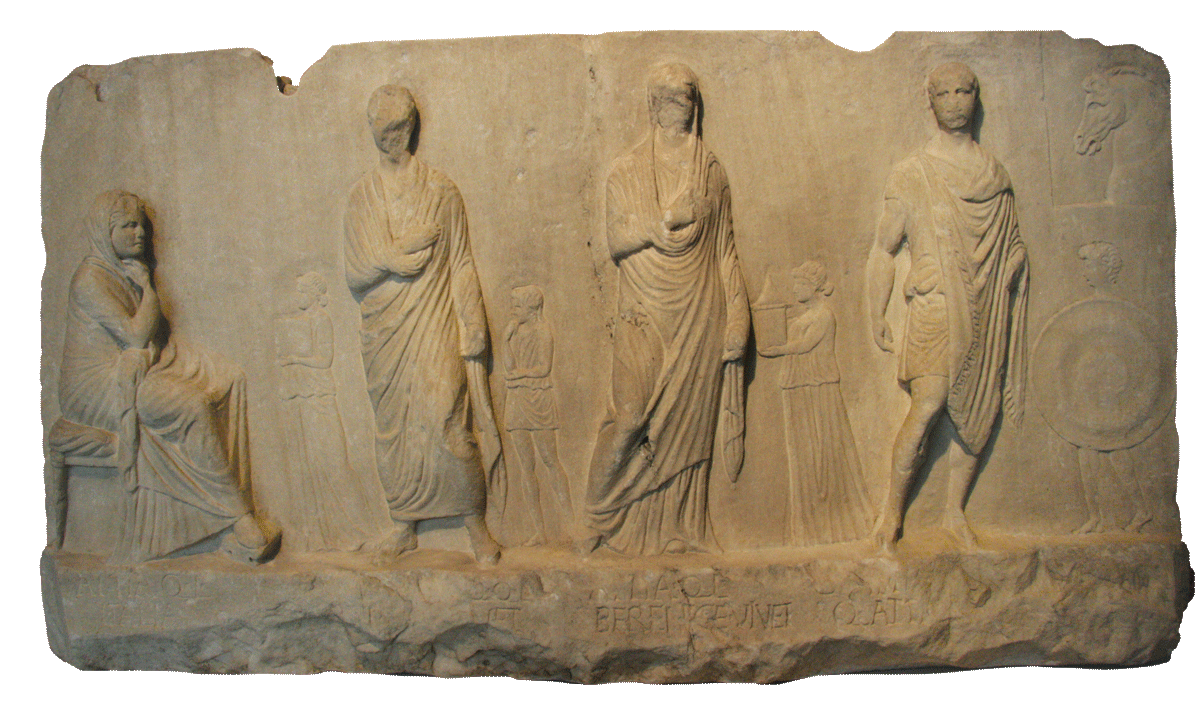
This relief from a funerary monument (50 BC) depicts the family prominently in the foreground while placing their slaves in the background, to show the difference in social status. These family members of high status may represent the type of wealthy patrons upon whom some believers in Thessalonica had become dependent (see 2 Thess. 3:6–15).
The first apostolic exhortation (3:6) echoes the weighty authority found in 1 Thessalonians 4:1–8: “In the name of the Lord Jesus Christ, we command you, brothers and sisters, to keep away from every believer who is idle and disruptive and does not live according to the teaching you received from us.” Separation from disobedient members was a principal form of church discipline (Matt. 18:17; Rom. 16:17; 1 Cor. 5:9–13), though here it is not exercised as excommunication (3:14–15). In a collectivist society where honor is bound up with membership in the group, separation from the group would be a source of great shame and motivation to correct one’s conduct. The exhortation regards those who are idle (as in 1 Thess. 5:14), a term that does not mean “lazy” but rather “out of line,” “disorderly,” or “undisciplined.” Certain Thessalonians did not live according to the apostolic teaching or tradition (see 2:15) given them through deed and word (3:7–10).
Here, as elsewhere, Paul calls the believers to imitate his and the others’ conduct (3:7). Learning by imitation was prescribed by the ancients, especially in the sphere of moral teaching about virtue and vice (3:9; Phil. 3:17; 1 Tim. 4:12; Titus 2:7; 1 Pet. 5:3). Examples were considered more persuasive than words. Paul reminds the church that he and his associates were not idle, that is, they did not lead a disorderly life with regard to work. As 3:8 says, “nor did we eat anyone’s food without paying for it. On the contrary, we worked night and day, laboring and toiling so that we would not be a burden to any of you.” Previously the apostles reminded the church that they were not greedy and did not place any financial burden on them (1 Thess. 2:7, 9). Paul also raised his voice against any who were motivated by greed (1 Tim. 3:3, 8; Titus 1:7; Acts 20:33; 1 Tim. 6:9–10; Heb. 13:5; 1 Pet. 5:2; 2 Pet. 2:3). Though the apostles labored hard (Acts 18:1–5; 1 Thess. 2:9) and paid for their own food, they also received support from the Philippian congregation (Phil. 4:15–16).
Paul taught that payment for Christian ministry was acceptable (1 Cor. 9:7–14; 1 Tim. 5:17–18; Gal. 6:6; see also Matt. 10:10), though in order to become a model for the church to follow he did not take advantage of that privilege (3:9; 1 Cor. 9:15). Paul distanced himself from the practices of many itinerant philosophers of the era whose public speaking was motivated by greed for gain. His example matched his repeated exhortation to the church, “For even when we were with you, we gave you this rule: ‘The one who is unwilling to work shall not eat’ ” (3:10). The rule given was an authoritative command (3:4, 12), backed by divine authority (3:6). Paul’s exhortation was about a person who is able to work and yet “is unwilling,” not those who, for whatever reason, could not work to earn their bread. Teaching about labor was part of the ethical instruction of the church (Eph. 4:28; 1 Thess. 4:11–12). Paul also absolves patrons of their obligations toward their clients. The teaching, however, does not absolve the church of its responsibility toward the needy (see also 1 John 3:17; James 2:14–17).
Next follows a second exhortation (3:11–12). Paul and his companions somehow heard that some members of the church were disorderly, not following the apostolic example and teaching (3:11a). They finally state how they were disorderly: “They are not busy; they are busybodies” (3:11b). “Not busy” is better translated “not working.” In a play on words in the Greek, Paul says they are busybodies, which suggests that they were meddlesome in other people’s affairs, perhaps as they took up the causes of their patrons (see 1 Thess. 4:11–12). Paul again buttresses his exhortation with an appeal to divine authority (as 3:6; 1 Thess. 4:1–8): “Such people we command and urge in the Lord Jesus Christ to settle down and earn the food they eat” (3:12). The call to quietness (“to settle down”) appears also in 1 Thessalonians 4:11. In the literature of the era it described people who were respectable and did not cause problems in the community, in contrast to those who were socially disruptive. Paul wants the believers to earn their own bread as he showed them in his example (3:7–8). This means of support causes no social scandal.
On the other hand, the church should continue to do good and support those in genuine need, never flagging in this responsibility. A third exhortation is thus offered: “And as for you, brothers and sisters, never tire of doing what is good” (3:13; cf. Gal. 6:9–10; 1 Thess. 4:9–10). Continuing to support those in need, as well as the mission, is what is good (Phil. 4:14–15). They should not become weary and abandon their efforts (Luke 18:1; 2 Cor. 4:1, 16; Gal. 6:9; Eph. 3:13) in helping these.
Finally, Paul calls on the community to take disciplinary action: “Take special note of anyone who does not obey our instruction in this letter. Do not associate with them, in order that they may feel ashamed” (3:14). The verb “take special note” suggests disapproval and not just recognition of the problem. Such disorderly members, who had received repeated instruction and warning, were to be excluded even from the common meal of the church. These would be fully disenfranchised, and in a collectivist society the impact would have been devastating. The hope was that they would experience social shame (1 Cor. 4:14; Titus 2:8), which, in a society that valued honor above all else, would have been a very effective means of social control. The church bears a responsibility to guide the conduct of its members as the group supports the common Christian virtues and helps each to avoid vice.
The situation here is not exactly parallel to 1 Corinthians 5:9–11. Here the disorderly person remains a member of the community of salvation: “Yet do not regard them as an enemy, but warn them as you would a fellow believer” (3:15). Enemies were not simply tolerated during this era but rather became the object of ill will and action. Unruly members should be admonished (1 Thess. 5:12, 14) as those who are part of the family of God. Such counsel and warning aims to change the conduct of a person (Acts 20:31; Rom. 15:14; 1 Cor. 4:14; Eph. 6:4; Col. 1:28). There was a corporate responsibility toward the errant member.
4. The Third Prayer and Final Greetings (3:16–18)
The letter closes with a prayer for the church: “Now may the Lord of peace himself give you peace at all times and in every way” (3:16a). The peace they pray for from the Lord of peace (John 14:27; Rom. 15:33; Phil. 4:9; 1 Thess. 5:23) is not an inward emotion but a social virtue that defines how they are to live together in community (2 Cor. 13:11; 1 Thess. 5:13) and how they are to live in relation to the unbelievers around them (Rom. 12:18; 1 Cor. 7:15; Heb. 12:14). This blessing flows from the character of God. The apostles also bless the church, saying, “The Lord be with all of you” (3:16b; Rom. 15:33; Phil. 4:9). The Lord is the one who is ever present with his people (Matt. 28:20; Acts 18:10). In the midst of their troubles and confusion, they are not left alone.
Though Paul wrote the letter with the collaboration of his companions, he gives a final greeting in his own handwriting (3:17). Ancient authors commonly used secretaries to write letters for them but then would add a final note in their own hand (1 Cor. 16:21; Gal. 6:11; Col. 4:18; Philem. 19). Some ancient letters include an obvious change in penmanship without there being any indication in the text that the pen has passed from scribe to author. Paul’s greeting would serve as a seal of authenticity (see 2:2).
The letter ends as did the first: “The grace of our Lord Jesus Christ be with you all” (3:18).
Select Bibliography
Beale, G. K. 1–2 Thessalonians. IVP New Testament Commentary. Downers Grove, IL: InterVarsity, 2003.
Bruce, F. F. 1 and 2 Thessalonians. Word Biblical Commentary. Nashville: Thomas Nelson, 1982.
Green, Gene L. 1 and 2 Thessalonians. Pillar Commentary. Grand Rapids: Eerdmans, 2002.
Holmes, Michael. 1 & 2 Thessalonians. NIV Application Commentary. Grand Rapids: Zondervan, 1998.
Malherbe, Abraham. 1 Thessalonians. Anchor Bible. New Haven: Yale University Press, 2004.
Marshall, I. Howard. 1 and 2 Thessalonians. New Century Bible Commentary. Grand Rapids: Eerdmans, 1983.
Morris, Leon. The First and Second Epistles to the Thessalonians. New International Commentary on the New Testament. Grand Rapids: Eerdmans, 1991.
Stott, John R. W. The Message of 1 and 2 Thessalonians. The Bible Speaks Today. Downers Grove, IL: InterVarsity, 1991.
Wanamaker, Charles. The Epistles to the Thessalonians. New International Greek Testament Commentary. Grand Rapids: Eerdmans, 1990.