1–2 Corinthians
1. Epistolary Introduction (1:1–9)
2. Paul’s Response to Reports about the Community at Corinth (1:10–6:20)
A. A Report of Factions within the Community (1:10–4:21)
B. A Report of Immorality, Arrogance, and Improper Judgments (5:1–6:20)
3. Paul’s Response to Questions from the Corinthians (7:1–16:9)
A. Questions about Marriage, Divorce, and Celibacy (7:1–40)
B. Questions about Food, Idolatry, and Freedom (8:1–11:1)
C. Questions about Worship, Gifts, and Order (11:2–14:40)
D. Questions about the Resurrection and Life in the Age to Come (15:1–58)
E. Questions about the Collection and Paul’s Plans (16:1–9)
4. The Recommendation of Others (16:10–18)
5. Final Greetings and Formal Closing (16:19–24)
1. Epistolary Introduction (1:1–11)
2. Paul’s Explanation of His Conduct in Recent Matters (1:12–2:13)
A. The Basis for Paul’s Behavior and an Appeal for Understanding (1:12–14)
B. The Cause for Paul’s Change of Plans (1:15–2:2)
C. The Purpose of Paul’s Last Letter (2:3–11)
D. The Motive for Paul’s Movement from Troas to Macedonia (2:12–13)
3. Paul’s Reflection on His Ministry (2:14–5:21)
A. The Source and Character of Paul’s Ministry (2:14–3:6a)
B. The Message of Paul’s Ministry (3:6b–4:6)
C. The Cost of Paul’s Ministry (4:7–5:10)
D. The Perspective of Paul’s Ministry (5:11–21)
4. Paul’s Appeal to the Corinthians (6:1–13:10)
A. An Appeal for Complete Reconciliation (6:1–7:4)
B. A New Basis for Appeal (7:5–16)
C. An Appeal for Full Response to the Collection (8:1–9:15)
D. An Appeal for Full Allegiance to Apostolic Authority (10:1–18)
E. Support for the Appeal (11:1–12:13)
F. The Conclusion of the Appeal (12:14–13:10)
5. Epistolary Conclusion (13:11–14)
Introduction
Among the letters of Paul, 1 and 2 Corinthians are perhaps most notable for their practical content and personal style. The first of these two features emerges as a consequence of the vital and often volatile nature of life in the church at Corinth. For it is certain that the practical questions that largely occupy the apostle in both epistles arise not at his initiative but rather at the insistence of his converts. It is in response to their circumstances and backgrounds that the practical and sometimes pointed counsel of these letters originates. The distinctly personal style of both is also largely, if not wholly, a product of the apostle’s relationship to the church, and so, for that matter, are many of the stylistic peculiarities that have raised questions about the unity and integrity of 2 Corinthians. Thus it is necessary for the interpreter of these epistles to come to know, insofar as that is possible, the history of the circumstances that form the background to Paul’s Corinthian correspondence.
Historical Background
The ancient history of the city of Corinth may, for the sake of convenience, be divided into four principal periods: the preclassical period (ca. 3500–1350 BC), the classical period (ca. 1350–338 BC), the Hellenistic period (338–146 BC), and the Roman period (146 BC–AD 395). For our purposes, we need concern ourselves with only a few of the major events in the last of these four historical periods. In 146 BC a Roman army burned the ancient city of Corinth to the ground for its participation and leadership in the rebellion of the Achaian League (a group composed of the principal city-states located in Achaia, the southern peninsula of Greece). At that time, many of the citizens of Corinth were either killed or sold into slavery, and for a century afterward the city lay derelict.
In the year 44 BC, however, the city was refounded on the order of Julius Caesar, who sought to redeem the strategic and economic potential of the site with a new colonial population made up of freedmen (manumitted Roman slaves), army veterans, and former residents. Because of its location, near the narrowest part of the isthmus connecting Macedonia (the northern mainland of Greece) and Achaia, and because of the hazards associated with sea travel, particularly in the winter, when the possibility of conveying cargo across the narrow isthmus must have appeared as an exceedingly attractive alternative, the city quickly regained its former prosperity. Under Augustus in 27 BC it was made the capital of the senatorial province of Achaia.
Renowned for its metallurgists, who specialized in bronzework, and for its sponsorship of the biennial Isthmian games, which were second in popularity and prestige only to those of Olympia, the city rapidly attracted a variety of new residents, creating a cosmopolitan atmosphere dominated by economic stratification, cultural diversity, and religious pluralism. The reputation given to Corinth as an especially immoral place seems to have been largely created by the envy of other Greek city-states, which attempted to buttress their slander by pointing to the presence of the cult of Aphrodite in Corinth as an indication of the low morals of the populace, grossly exaggerating both the cult’s size and its influence. The truth of the matter lies neither at this extreme (despite the repetition of such rumors in the literature of the time) nor at its opposite, but in the realization that Corinth was a large urban center, no richer or poorer in terms of morality than comparable cities, either ancient or modern.
Date
According to Acts 18:2, among the Jewish residents of Corinth in the middle of the first century AD were a husband and wife, Aquila, a native of Pontus (a Roman province in northeastern Asia Minor), and Priscilla (whose name suggests that she may have come from a Roman family). They had only recently come to Corinth as the result of a decree issued by the Roman emperor Claudius (AD 41–54) in which he expelled the Jewish population from Rome. Paul joined them shortly after his arrival in the city (Acts 18:3).
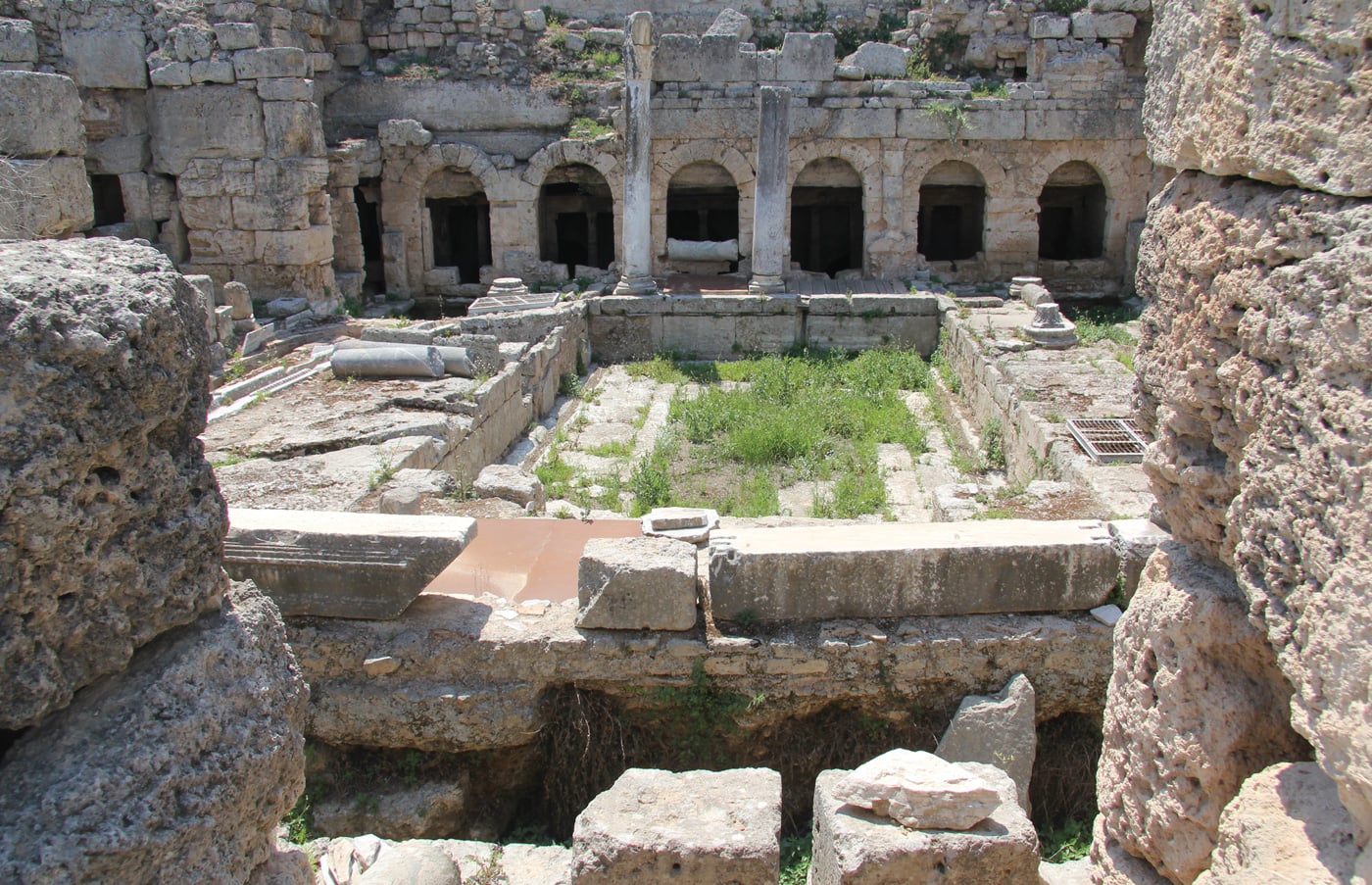
At the time of Paul, Corinth was a large and important city. Upon entering the city, visitors would have seen the Fountain of Peirene (shown here), which provided the city’s water supply.
According to Orosius, a fifth-century Christian writer, the decree of Claudius was issued in the ninth year of his reign (AD 49). The first- and second-century Roman historians Suetonius and Dio Cassius (respectively) provide confirmation for the issue of the decree. But their accounts lack any reference to the year of the decree, as do the extant works of Josephus, upon which Orosius claims to depend. As a consequence, there is some debate among scholars concerning the precise date of the decree, but none with respect to the certainty of its issue.
Fortunately, Luke provides two other reference points that enable us to speak with more certainty about the chronological framework of Paul’s initial ministry in Corinth. The first of these is his mention of a hearing granted by the proconsul Gallio to the Jews of Corinth in their attempt to prosecute Paul (Acts 18:12). The proconsular term of L. Junius Gallio to which Luke refers may be dated (with the help of an inscription discovered at Delphi in 1905 by the French archaeologist Emile Bourguet) as having occurred during AD 51–52. Thus, since Luke’s account also makes reference to a period of ministry for “a year and a half” (Acts 18:11), it would appear probable that Paul’s initial mission to Corinth began sometime early in AD 50 and finished in the latter half of AD 51.
The Church at Corinth
Thus, in a period that in duration exceeded all the other missions mentioned by Luke in conjunction with the apostle’s second journey, the church at Corinth was brought into being by the grace of God and the labors of a man whom he had called (1 Cor. 1:1). Several further features of this founding mission should also be mentioned.
First, it is important to note that Paul’s initial mission in the synagogue in Corinth seems to have lasted longer than his initial mission in many other cities and resulted in some significant conversions within the Jewish community (e.g., of “Crispus, the synagogue ruler” [Acts 18:8; see also 1 Cor. 1:14]; “his entire household” [Acts 18:8]; and perhaps of his successor Sosthenes [Acts 18:17; cf. 1 Cor. 1:1]). Thus, from the outset there was an important and influential Jewish Christian minority within the Corinthian church.
Second, though the truth of the apostle’s generalization in 1 Corinthians 1:26 must be given its full weight, the Corinthian Christian community that constituted the fruit of the Pauline mission seems nonetheless to have had a significant number of socially, educationally, and economically privileged members. Among them were Crispus (whose status has just been mentioned), Gaius (whose means were sufficient to provide hospitality for the whole church; cf. Rom. 16:23), and Erastus, “the city’s director of public works,” whose name has also been found on a dedicatory pavement at Corinth (cf. also Rom. 16:23).
Third, partially as a result of the success of the initial Pauline mission, the church that the apostle left was a church accustomed to persuasive preaching, to official tolerance, and to relative freedom from persecution (due no doubt to the reluctance of Gallio to consider Christianity a religion separate in any significant sense from the legally sanctioned Judaism [Acts 18:15]), and to the teaching of a variety of Christian leaders (one should consider, for example, the roles that may have been played by Silas and Timothy [2 Cor. 1:19] or by Aquila and Priscilla, whom Paul names as his co-workers [Rom. 16:3], as well, of course, as Apollos [1 Cor. 1:12; 3:4, 5, 6, 22; 4:6; 16:12]).
The Corinthian Correspondence
The book of Acts records in summary fashion that, following his departure from Corinth in the fall of AD 51, Paul returned to Antioch by way of Ephesus (where Priscilla and Aquila remained [Acts 18:26]) and Caesarea (Acts 18:18–22). However, after spending some time in Antioch, Paul decided to return to Ephesus and traveled overland back through Galatia and Phrygia, arriving in Ephesus again apparently toward the end of AD 52. According to Acts 19:1–10, 21–22, Paul subsequently spent more than two years in a mission to the Ephesians before deciding to return to Macedonia and Achaia to take up a collection for the church at Jerusalem. Linking this account of Paul’s movements with 1 Corinthians 16:8 indicates that 1 Corinthians was written toward the end of Paul’s stay in Ephesus, probably some months before Pentecost of AD 55.
First Corinthians itself, however, shows that there had been comparatively frequent communication between Paul and the church at Corinth for some time before the composition of this letter. From 1 Corinthians 5:9 one learns of an earlier letter from Paul to the Corinthians, from 1:11 of a report brought to Paul by members of Chloe’s household, and from 16:17 of a subsequent delegation probably bearing a letter from the church that Paul had only just received. Given the regular trade between the cities of Corinth and Ephesus, such frequent contact should occasion no surprise, but it does point clearly to the fact that 1 Corinthians is itself a product, at least in part, of an ongoing dialogue between Paul and the church. The information that Paul received most recently, then, by way of a report and a letter, prompted him to write, responding in turn to both in 1:10–6:20 and 7:1–16:4, respectively.
From the report, Paul learned that the church was becoming increasingly polarized by serious divisions among its members as they attempted to locate wisdom and leadership that would enable them to develop appropriate standards for Christian conduct and spiritual maturity (1:10, 26; 2:6; 3:1–4, 18; 4:4; 5:1; 6:1). The situation, however, was further complicated by a high regard at Corinth for eloquent speech (2:1–5, 13; 4:18–20). Accordingly, differences in eloquence between teachers were apparently being taken as indicative of different degrees of inspiration, and this had led, in turn, to painful and divisive comparisons (1:12; 3:5–9, 21–23).
It is not odd, in light of this, that the Corinthians’ letter should reflect their divergence of views even as they queried Paul about the propriety of marriage and divorce (7:1–40: Should one state be considered more spiritual than another?), the consumption of food sacrificed to idols (8:1–11:1: Should the practices of those with strong or weak consciences be followed?), the practice of authentic Christian worship (11:2–14:40: Should distinctions in gender, wealth, and gifts find expression, and if so, how?), the nature of the resurrection (15:1–58: Should one believe in an event that would involve the body as well as the spirit?), and the collection for God’s people (16:1–4: When and how should it be gathered?).
At the time 1 Corinthians was sent, Paul’s plan appears to have been to return within the year to Corinth as his final stop on a journey through Asia Minor, Macedonia, and Achaia (1 Cor. 4:18–21; 16:5–9). Shortly after 1 Corinthians was sent, however, the apostle changed his plans and decided to make his journey to Macedonia by beginning and ending with a visit to Corinth (2 Cor. 1:15–17). Intervening events made Paul modify his plans a third time following his visit to Corinth (the second visit of 2 Cor. 13:2), and on his subsequent journey through Macedonia, he did not return to Corinth as he had originally promised he would (2 Cor. 1:23).
At least two of the reasons for this final change of plans become apparent in 2 Corinthians. First, Paul’s second visit to Corinth was not at all as he had hoped it would be. Instead, it had involved him in a number of exceedingly painful (2 Cor. 2:1) confrontations in which, according to Paul, both the Corinthians (2:2) and he himself (2:5) suffered grief. As a result, from somewhere along the way through Macedonia, Paul wrote a letter to pointedly express his “distress” and anguish of heart at the distance that had developed between him and some of the Corinthians, and sent it off with Titus.
Second, upon reaching Asia at the close of his journey, Paul was beset by “hardships” and “pressure” associated with a peril so deadly that he “despaired even of life” (2 Cor. 1:8–10). In the midst of such an experience, it would have been impossible for him to return to Corinth, even if he had desired to do so. Nevertheless, having been rescued from death by God’s grace, and having reached Troas once more, Paul was anxious and without peace of mind apart from news of the Corinthian response to his last letter (2 Cor. 2:13). Accordingly, he pressed on into Macedonia, hoping to meet Titus. Their meeting took place a short time later, and, as its result, Paul wrote 2 Corinthians from somewhere in Macedonia (2 Cor. 7:5–7, 13–16).
The Literary Integrity of 2 Corinthians
Although the preceding reconstruction of events represents something of a consensus among interpreters, there is nonetheless a considerable diversity of opinion about the literary integrity of 2 Corinthians and the precise historical background that might have occasioned the composition of 2:14–7:4; 6:14–7:1; 8:1–9:15; and 10:1–13:14. Indications exist that suggest these texts may not have been written at the same time as the rest of 2 Corinthians.
With respect to 2 Corinthians 2:14–7:4 and 8:1–9:15, the evidence is slight. For while it is true to say that 2:14–7:4 represents something of an intrusion into the narrative account that begins with 1:8–2:13 and concludes with 7:5–16, such a parenthetical and digressive intrusion is not uncharacteristic of either Paul’s literary style or his Corinthian correspondence. (One may compare, for example, 1 Cor. 9:1–27, which intrudes into an apostolic reply that begins with 8:1–11 and concludes with 10:1–11:1.) Similarly, it has often been noted that there is an abrupt transition in the flow of the letter as one moves from 7:16 to 8:1 and a surprising reiteration of subject as one moves from 8:24 to 9:1. Upon further reflection, it may be seen that the abrupt transition is related to an important change of topic, and that reiteration of a principal subject, in this case the “service to the Lord’s people” (9:1), is once more a characteristic of Pauline literary style.
It is more difficult to make a definite decision about 2 Corinthians 6:14–7:1. The lack of any reference to the immediate historical situation, the logical and literary links—which are apparently restored when 7:2 is read immediately after 6:13—and the concepts and vocabulary that are used in the passage argue that this text may have been a part of the letter that Paul affirms he wrote to the church prior to 1 Corinthians in order to advise them “not to associate with sexually immoral people” (1 Cor. 5:9). If that is true, then perhaps an individual, unknown to us, collected and edited Paul’s Corinthian correspondence and inserted this section into 2 Corinthians. That person may have been unsure of its proper place in the sequence of Paul’s letters to Corinth, or perhaps it seemed appropriate, despite its historical origins, to read this text in conjunction with the message of 2 Corinthians. On the other hand, however, it is possible that Paul may himself have felt a need at this point in the letter to remind the Corinthians of his previous counsel, and in doing so, chose to make use of thoughts and perhaps even words drawn from his memory of the earlier letter.
A decision in favor of literary integrity becomes most difficult, however, when one considers the evidence with respect to 2 Corinthians 10:1–13:14. For while earlier parts of the letter show clear signs of having been written in a conciliatory spirit, at a moment when Paul sought to commend the Corinthian Christians and gratefully acknowledge their renewed affection for him (1:7; 2:5–11; 6:11; 7:2–4, 7, 13), the spirit of 10:1–13:14 is profoundly critical. This section contains numerous indications that these chapters were not occasioned by an effort to effect harmony between the apostle and his converts, but instead were written by Paul in an attempt to defend his rightful apostolic authority against all those in Corinth who might attempt to deny it (10:5–8; 11:4–6, 12–16; 12:11–13; 13:1–3). Furthermore, on two occasions in the latter part of the letter (i.e., 12:14 and 13:1), Paul speaks about a third visit he is about to make, but in the earlier portion of the letter he fails to mention it even where one would expect such a reference (i.e., 1:15–2:13). Finally, in 12:18 Paul writes as though the mission of Titus announced in 8:16–24 has already been completed.
Given such evidence, one could propose a set of circumstances that might still enable one to maintain that 2 Corinthians 10:1–13:14 was written at the same time as 2 Corinthians 1:1–9:14; or one could construct a different set of circumstances that might enable one to conceive of 2 Corinthians 10:1–13:14 as a part, if not the whole, of the letter written “out of great distress and anguish of heart and with many tears” (2:4) immediately prior to 2 Corinthians 1:1–9:14; however, the simplest explanation of the scriptural evidence points to the conclusion that 2 Corinthians 10:1–13:14 is a part of a letter written sometime after the composition and dispatch of 2 Corinthians 1:1–9:14. Of the letter’s reception, and of the subsequent relationship between Paul and the church at Corinth, we know far less than we might like. But, comparing Romans 16:23 with Acts 20:2–3 and 1 Corinthians 1:14, we may infer that once again the letter of the apostle had a salutary effect, enabling him to make his promised third visit to Corinth, at which time he composed his letter to the Romans while residing in the house of Gaius, his convert (Rom. 16:23).

The members of the church at Corinth lived in a city that was commercially prosperous due to the remarkable trade moving north-south as well as east-west. Ships could be pulled overland along a road called the Diolkos (shown here).
Commentary for 1 Corinthians
1. Epistolary Introduction (1:1–9)
As was customary, Paul opens his letter with a greeting, or salutation (1:1–3). This conforms to the normal compositional pattern for personal letters written during the Greco-Roman era. (For an excellent introduction to the pattern of Greco-Roman letters, see Doty.) A greeting of this type routinely contained the name of the sender(s) of the letter, joined on occasion by a short self-description; the name of the intended recipient(s) of the letter, again joined on occasion by some short descriptive comment; and a word of greeting.
In 1 Corinthians the senders are Paul, who describes himself as an apostle sent out by Christ Jesus and by the will of God (see also Rom. 1:1; 2 Cor. 1:1; Gal. 1:1), and Sosthenes (see Acts 18:17). The letter is addressed to the church at Corinth (that Paul addresses the church as a whole is significant; see 1:10–12).
There follows a threefold description emphasizing that the church has been set apart or sanctified to be in relationship to Christ, called within that relationship to the pursuit of holiness as saints, and united in these distinctives with all believers “in every place [who] call on the name of our Lord Jesus Christ” (1:2 RSV).
The normal Greek word of greeting, chairein, is, as in Paul’s other letters, transformed into the Christian greeting, charis (“grace”), and is joined with the Hebrew greeting shalom (Greek eirēnē, “peace”; 1:3).
Next, in 1:4–9, Paul includes a section in which he gives thanks to God for the whole of the church at Corinth (again as in letters of this era, which began by showing deference to the god/gods of the sender/recipient of the letter). Such thanksgiving is warranted, according to Paul, first and foremost because the grace of God, his unmerited love, has been given to them all in Christ Jesus. Furthermore, God’s initial gift of grace has led to an enrichment of the community in speaking and in knowledge, which has confirmed the apostolic testimony about Christ. Thus, at present, the church does “not lack any spiritual gift” as it eagerly waits with Paul “for our Lord Jesus Christ to be revealed” at his return (1:7).
The words that follow contain one of the strongest statements within Paul’s letters of his conviction that his converts would be enabled to persevere in their faith until the time of our Lord’s return. Paul does not base his confidence on the strength of his converts’ faith or on his own ability to pastorally maintain them in the faith, but rather on the sustaining and atoning power of Christ and the faithfulness of God, both of which are constantly available to those who have been called into fellowship with the Son (1:8–9).
2. Paul’s Response to Reports about the Community at Corinth (1:10–6:20)
A. A report of factions within the community (1:10–4:21). 1:10–2:5. Having given thanks to God for those things that characterize the church as a whole, Paul now appeals (1:10–17) to the church “so that there may be no divisions” (none having apparently taken place to this point, though the danger is clearly present) and so that they may be completely “united in mind and thought” (1:10). Paul’s appeal is more than a mere formality, as is shown by the fact that it is made “in the name of our Lord Jesus Christ,” and by the following verses, which demonstrate the need for the appeal by referring to a report Paul has received from members of Chloe’s “household” about actual conditions at Corinth. These people, sent probably on business by Chloe (a woman of apparent importance), had brought to Paul a report that disputes had broken out among various groups within the community (1:11).
The disputes seem to have revolved around two interrelated issues: (1) the search for wisdom (i.e., guidance about how one should live the Christian life after conversion—the term is used in a way that seems particularly analogous to the Old Testament concept of wisdom) and (2) comparisons that were being made between teachers with respect to their ability to impart such wisdom.
Three and perhaps four groups are mentioned (1:12). The first group has identified itself with Paul (though Paul does not reciprocate and identify himself with them, or distinguish them from the other parties). The second has aligned itself with Apollos. (See Acts 18:24–19:1, which reports a visit by Apollos, a Hellenized Jewish Christian, to Corinth, and characterizes his teaching as eloquent, based on the Old Testament Scriptures, bold, and powerful.) The third group looked to Peter for leadership, or to teachers who used his name (for though it is possible that Peter himself had been at Corinth, it is not necessary to think of this as being the only way a group associated with Peter’s Jewish Christian views may have come into existence at Corinth). The final slogan, “I follow Christ,” has always proved difficult to interpret. Although it seems to designate a fourth group (whose apparent claim was allegiance to Christ’s teaching alone), it could denote the common claim of each of the three groups (“I am of Christ,” “No, I am,” etc.), or Paul’s own retort to all (“You follow so and so, but I follow Christ”).
With a series of rhetorical questions issuing out of passion and conviction, Paul responds to these misplaced allegiances. Do the Corinthians really suppose that the presence of Christ is somehow divided among them? Do they really mean to suggest that their allegiance is due to someone other than the one who has been crucified for them? Have they really forgotten that they were all baptized in one name? The last question leads Paul to recall (though he admits his recollection is not complete) that he did baptize Crispus (1:14; Acts 18:8), Gaius (1:14; probably the Corinthian who together with Paul sends greetings in Rom. 16:23), and Stephanas (1:16; one of the Corinthians with Paul as he was writing [1 Cor. 16:17]). But neither these nor anyone else “can say that you were baptized into my name” (1:15).
The last verse of this section provides a bridge to the next (which criticizes the wisdom of the Corinthians and commends a different kind of wisdom [1:18–3:20]). The transition is accomplished through the denial that “words of human wisdom” have ever played a role in the preaching of the gospel. Indeed, such words and wisdom are the antithesis of preaching that concentrates on the cross of Christ and its power.
Paul’s criticism of the search for wisdom at Corinth (1:18–2:5) may be divided into three parts, in terms of its focus (1:18–25), its effects (1:26–31), and its claim to inspiration (2:1–5).
Paul begins with a corollary of the point made in the last verse. Those who are perishing because of their lack of perception may indeed regard the “message of the cross” as “foolishness” rather than wisdom. But for those who are being saved, the proclamation of the life, death, and resurrection of Christ with the cross as its focus is recognized as the central manifestation of God’s power and wisdom (see 1:24).
The implication is that the “message of the cross” has been neglected in the Corinthians’ search for wisdom in favor of a different focus. This focus Paul now begins to criticize, employing a quotation drawn from the prophetic critique of wisdom in Isaiah 29:14. In its context in the Septuagint (the Greek translation of the Old Testament, which Paul often quotes), the citation promises to “hide” (see RSV) and in that sense destroy or do away with the wisdom of the wise and understanding. These words in context appear to look to a time beyond their original historical setting when the wisdom of the Old Testament law will be superseded by God’s new action among his people. That this time has come is precisely Paul’s point.
The wisdom of this age/world, whether it be the wisdom of the scribal scholar or the pagan philosopher, the wisdom of the Jews (which seeks confirming signs of one’s knowledge of the Torah and of God’s plan) or the wisdom of the Greeks (which searches for truth in the abstract; 1:22), has been superseded. It has been frustrated in its attempt to grasp God’s plan by the revelation of a new part of the wisdom of God displayed in the life, death, and resurrection of Christ, and set forth in Paul’s preaching (1:21–22). Thus, paradoxically, while the events proclaimed in the gospel may seem to be manifestations of foolishness and weakness when evaluated with the wisdom heretofore known to Jews or Greeks, it is only through belief in the saving wisdom of such apparent foolishness and weakness that any shall be saved (1:21, 24–25).
In criticizing the effects of the Corinthian search for wisdom, Paul next urges his readers to consider the circumstances surrounding their conversion. God’s call came not because they possessed wisdom, influence, or noble birth. (Paul’s statement implies that one effect of the search for wisdom has been that some at Corinth do indeed lay claim to these attributes either literally or figuratively. Jewish wisdom writings often ascribed to the wise man all the attributes mentioned here and others like them.) It came, instead, on the basis of their willingness to identify with things considered foolish, weak, lowly, and despised in this world, things that characterize the life and death of “Christ Jesus, who has become for us wisdom from God” (1:30). This took place “so that no one may boast before him” (i.e., God), but instead might “boast in the Lord” (i.e., in Christ), who is the focus of the wisdom, righteousness, holiness, and redemption that have come to us from God (1:29–31; cf. Jer. 9:23–24). It is illegitimate, therefore, to search for wisdom and then to use it to boast before God and distinguish ourselves at the expense of our brothers or sisters.
Finally, Paul concludes his critique of wisdom by referring to the way in which he initially “proclaimed the testimony about God” (i.e., God’s activity in and through Jesus Christ and him crucified) among the Corinthians. Once more Paul draws a contrast, this time between the “demonstration of the Spirit’s power” (2:4) evident in Paul’s preaching despite his weakness, fear, and trembling (2:3), and eloquence, “persuasive words,” and wisdom (2:1, 4–5). The contrast implies that those searching for wisdom at Corinth have begun to view eloquence and persuasive words as authenticating signs of divine inspiration, perhaps even judging Paul’s teaching inferior on these criteria to that of others (see 1:12, 17). Paul, however, makes plain that the definitive “demonstration” (the word is a technical term used by both Jews and Greeks to denote a conclusive or compelling proof) of inspired speech lies not in its “form” but rather in its power to convince and convert (2:5; see 1 Thess. 1:5).
2:6–3:20. Having criticized the wisdom that some at Corinth value, Paul now turns to a wisdom he can commend. It is a wisdom that is different in focus (2:6–9), that differently authenticates itself and its possessors (2:10–3:4), and that is different in its purpose and effect within the Christian community (3:5–17). On the basis of these contrasts, Paul clearly differentiates the Christian wisdom he commends in this section from the wisdom that he has criticized in the preceding section.
This section begins with Paul’s claim to “speak a message of wisdom among the mature” (2:6). But he quickly and firmly asserts that such wisdom belongs to neither this age nor the rulers of this age who, in reliance on an obsolete understanding of God’s wisdom and will, crucified the Lord of glory (2:6, 8).
It has long been debated whether by “rulers of this age” Paul means human religious and/or political authorities (e.g., Luke 23:35; Acts 3:17; 4:26; 13:27), supernatural demonic “powers” who are said to dominate the present world order (e.g., Eph. 3:10; 6:12), or a combination of these two groups in which the influence of demonic “powers” is judged to lie behind the actions of human authorities (Col. 2:15). Since Paul uses the word “rulers” in the plural on only one other occasion, where it unambiguously refers to human beings (Rom. 13:3); since in the rest of the New Testament the plural likewise always refers to human “rulers”; and since this usage matches Luke’s account of early Christian preaching, it seems most likely that Paul is referring to those persons in authority, both Roman and Jewish, responsible for the crucifixion.
In contrast to the wisdom that guided their actions, Paul characterizes Christian wisdom as being God’s wisdom (i.e., it comes from and belongs to God). It is also secret, or mysterious, in the sense that it is “a wisdom that has been hidden” in events “that God destined for our glory before time began” (2:7). Christian wisdom may be said to find its focus in the meaning of the Christ-event as proclaimed in the gospel. Indeed, that event, properly and fully understood, points in a way that the law alone or Greek philosophy cannot; it points to the direction of God’s plan past, present, and future, to what God has prepared for those who love him.
Over against the demonstrated ignorance of the rulers with respect to true wisdom stands Paul’s assertion that “God has revealed it to us by his Spirit” (2:10). The remainder of the section enlarges on this remarkable claim. Verses 10 and 11 establish the Spirit of God as an adequate guide to such wisdom. For the Spirit is able to understand all the aspects of the wise plan of God, even its deepest secrets, just as the same capacity to understand our own plans and intentions belongs only to the spirit within us. Verses 12–13 describe the process by which the Spirit’s knowledge is communicated. As persons called into fellowship with God through faith in Christ, we have received “the Spirit who is from God” so that we may “understand what God has freely given us,” namely, a knowledge of the divine intent, God’s “thoughts” and plan for salvation, past, present, and future (2:12). This wisdom, says Paul, is “what we speak,” and even the words in which it is conveyed are a product of the Spirit’s inspiration (2:13; cf. 2:4).
The last and largest part of this section (2:14–3:4) carefully restricts Christian wisdom to the spiritual person, for the person without the Spirit cannot understand its importance or accept its validity, because it is spiritually discerned (2:14–15). However, the evaluation of the spiritual person’s grasp of Christian wisdom is “not subject to any man’s judgment” (2:15), for since no one has fully known the mind of the Lord, judgment can belong only to the Lord himself (2:16a; cf. 4:3–4). Nonetheless, as recipients of God’s Spirit, we have the assurance that we know at the very least the mind of Christ (2:16b).
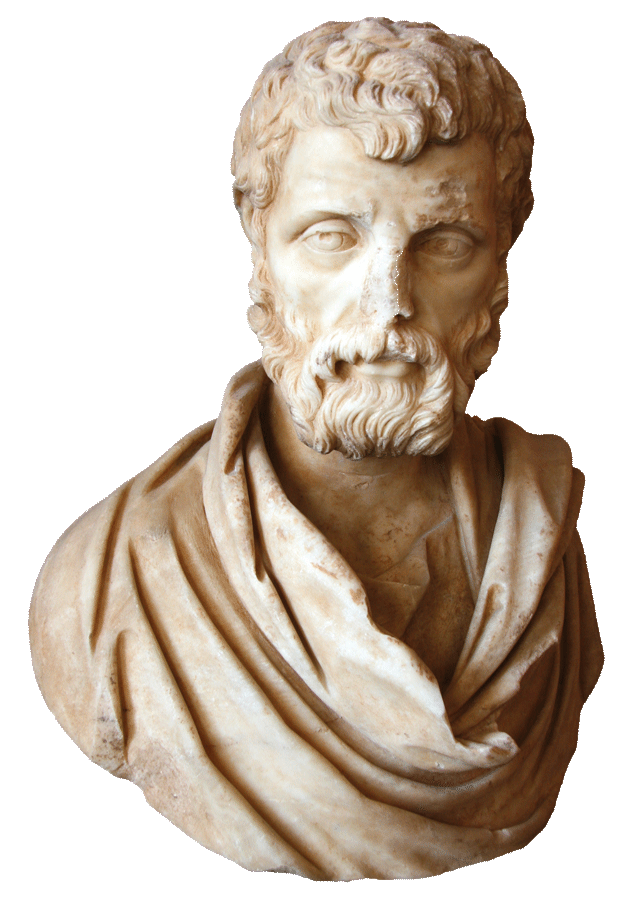
Bust of Herodes Atticus (AD 101–77), a wealthy and distinguished sophist who funded the building of a Corinthian theater and the remodeling of the Fountain of Peirene. The Corinthian church became enamored with Greco-Roman sophistry and rhetoric. Paul, on the other hand, speaks “not in words taught us by human wisdom” (1 Cor. 2:14) and resists proclaiming the message of the cross by any criteria of Greek rhetoric.
Yet even the possession of the Spirit and the mind of Christ does not necessarily ensure growth in our understanding of divine wisdom, as the next four verses show; for the Corinthians, still much as they were when Paul left them, are “mere infants in Christ” (3:1), unready for any wisdom that passes beyond milk (the proclamation of the gospel) to solid food (the attempt to explore the implications of God’s act in Christ for our present behavior, 3:2; cf. Heb. 5:12–14; 1 Pet. 2:2). Their “jealousy” and “quarreling” demonstrate that they are still under the influence of wisdom that is “worldly” (3:3–4).
Paul now uses three metaphors designed to illustrate the purpose and the effects of authentic Christian wisdom. In the first metaphor (3:5–9), using a familiar Old Testament image of the community as God’s field or vineyard, Paul compares his own ministry at Corinth (in which he “planted the seed” of wisdom through the proclamation of the gospel) and the ministry of Apollos (who watered it through further preaching and teaching [cf. Acts 18:27–28]) to the work of God (who made it grow). Such a comparison clearly shows that “neither he who plants nor he who waters is anything” as over against “God, who makes things grow” (3:7). It also shows that “the man who plants and the man who waters have one purpose” (3:8). They should not, therefore, be compared with one another by the community (though each “will be rewarded according to his own labor” by God’s ultimate judgment). They should be regarded in the same way, as “co-workers in God’s service,” at work side by side in God’s field, or on God’s building (3:9).
This last phrase leads to the second image, the community as God’s building (3:10–15). In this case, the metaphor further defines the Christian community that is growing in wisdom as one that has learned not only to value its teachers equally but also to see clearly that there is a need for continuity between the foundational proclamation of the gospel (laid, in this case, by Paul as an “expert builder”) and the subsequent teaching of others (who seek now to build on Paul’s initial preaching; 3:10). There can be no attempt to lay a new foundation. Instead, the superstructure must always be evaluated to see if its materials conform in kind to the original foundation. For on the “day” (a reference to the Old Testament day of the Lord), the quality of every builder’s work will be revealed with fire, and the builder either rewarded or singed with the flames that consume his or her work.
The final two verses (3:16–17) of this section reveal the reason for this severe judgment in a third vivid image. The building on which Paul and others are at work, the church at Corinth, is God’s temple (see 1 Pet. 2:5), for God’s Spirit is alive in its midst. In a solemn statement of lex talionis (the law of punishment in kind), destruction is promised to anyone who brings about the destruction of God’s temple by breaking it away from its foundation.
Paul’s criticism of the inadequacies of the “wisdom of this world” and his definition and commendation of the “wisdom of God” are now drawn together and the teaching applied to the tendencies of some at Corinth toward self-deception, self-centered comparisons, and self-aggrandizement.
“Do not deceive yourselves,” Paul writes, and then goes on to clarify the kind of self-deception that imperils the Christians at Corinth (3:18–20). His concern is the possibility of self-deception with respect to wisdom because some at Corinth tend to define wisdom and designate those who are wise “by the standards of this age.” In response, alluding to 1:18–31 and applying the contrast developed there between the wisdom of the world and the “foolishness” of the gospel, Paul advises all who are wise by such standards to throw away their “wisdom” and embrace what “the wisdom of this age” regards as “foolishness”; for in reality, “the wisdom of this world [has become] foolishness in God’s sight.” This development, surprising as it may be to those who trust in the continuity of wisdom, was nonetheless anticipated in the Old Testament Scriptures (Job 5:13; Ps. 94:11).
3:21–4:21. Paul then turns to the situation that gave rise to his remarks on wisdom, the tendency of some at Corinth to make comparisons between their teachers, to boost their favorite above the others, and to boast of their allegiances (1:12–17). Alluding to 3:5–9, Paul again asks the Corinthians to recognize that the truth lies in precisely the opposite direction. It is not the Corinthians who “belong” to Paul, Apollos, or Cephas; rather, along with all things, life and death, the present and the future (Rom. 8:38–39), Paul, Apollos, and Cephas “belong” to them, as servants of Christ and “as those entrusted with the secret things of God” (4:1).
The mention of the word “servant” leads Paul to allude to 3:10–15, and in 4:2–5 he applies the teaching of the former passage to himself and the church at Corinth. As a teaching servant of Christ, Paul has been “given a trust” and, in order to fulfill it, “must prove faithful” (4:2). Yet his faithfulness cannot be judged either by the Corinthians or by Paul himself, for the judgment of his faithfulness belongs to the one who gave the trust. It is the Lord, Paul writes, who judges him. It is best, therefore, for both Paul and the Corinthians to “judge nothing before the appointed time,” because faithfulness to the divine trust depends as much on “what is hidden” and imperceptible (including “the motives of men’s hearts”) as it does on that which is now in the light (4:5). Praise for Paul, Apollos, and the others who have taught the Corinthians will come not from them in the form of group allegiances but from God, who will give to each one the proper amount in reward for faithfulness to the divine commission.
Paul now concludes this section in which he has dealt with the tendency of the Corinthians to make self-centered comparisons between their teachers, and in particular between Paul and Apollos, with a saying that was probably in use at Corinth (4:6). Its reference to “what is written” is obscure, although most likely it is meant to allude to the Old Testament Scriptures, either in whole or in part. But its message is nonetheless generally clear, and the same as that of 3:5–9. The church is to learn “from us” (Paul and Apollos together) the “meaning of the saying” and is to apply it to their lives without taking “pride in one man over against another.” Indeed, pride, the desire to be different and better and boast of what wisdom one has come to possess, seems to Paul to lie at the root of all the church’s present difficulties.
“Already you have all you want! Already you have become rich! You have become kings—and that without us!” (4:8). The Corinthians in their willingness to attribute wisdom and honor to themselves and their readiness to discriminate between their teachers are acting as if the kingdom of Christ has already become complete (though whether this premise forms the actual basis for their actions or the hypothetical basis for Paul’s critique is unclear). However, it has not (1 Cor. 15:23–28), and this observation, so evident in the lives of the apostles, Paul now uses ironically to negate the tendency of the Corinthians toward self-aggrandizement at the expense of others (4:8–21).
Both Paul and the other apostles have been “put on display” and held up to ridicule, “like men condemned to die,” who indeed were brought into the arena “at the end of the procession” (4:9). Those to whom the apostles preach view them as a spectacle to be seen but not taken seriously. And so together they have become fools in the eyes of the world (but fools for Christ!), while the Corinthians prefer to be seen and regarded as wise. Similar contrasts are apparent between the apostles’ real “weakness” and the Corinthians’ self-designated “strength,” or between the apostles’ real “dishonor” and the Corinthians’ self-conferred “honor.”
In verse 11, however, Paul drops the ironic comparisons as he proceeds in his attempt to teach the Corinthians that “no servant is greater than his master, nor is a messenger greater than the one who sent him” (John 13:16). Like Christ, the apostles “go hungry and thirsty . . . [and] homeless” even now (4:11), and in obedience to his teaching, “when we are cursed, we bless; when we are persecuted, we endure it; when we are slandered, we answer kindly” (4:12; Matt. 5:11, 44). Thus, “to this moment,” the light of the world (Matt. 5:14; John 8:12) continues to be regarded as “the scum of the earth” (4:13).
Such words must have stung the Corinthians’ pride. But in spite of this, Paul’s intention is not to exalt himself or humiliate them. Rather, as one who “in Christ Jesus . . . became your father through the gospel” (4:15), he has written in a fatherly act of compassionate correction to warn them of the dangers inherent in their self-centered attitudes and to urge them, as his children, to grow out of their immaturity by imitating their father. In order that they might learn to imitate in the way their father intends, Paul says, “I am sending to you Timothy, my son whom I love, who is faithful in the Lord.” Like an older brother, he will remind his brothers and sisters of their father’s “way of life in Christ Jesus,” which agrees with the lifestyle he commends for all his children in every church that he teaches (4:17).
Lest the Corinthians interpret this action as reluctance to confront his children, Paul writes last of his own plans. He “will come again soon, if the Lord is willing” (cf. 16:5–7, where the timing of the visit is more thoroughly thought out). And when he comes, he will not be diverted by the Corinthians’ own verbal claims but will look instead for signs of God’s power evident in their midst. For the kingdom of God “is not a matter of talk but of power” (4:20; cf. 2:1–5). It is up to the Corinthians, therefore, to choose how they wish to see the love of their father expressed—through the corrective power of the “whip,” or in a more “gentle spirit” (4:21).
B. A report of immorality, arrogance, and improper judgments (5:1–6:20). 5:1–6:11. Up to this point in the letter, Paul has dealt with a report about different allegiances resulting from a search for wisdom that has involved a considerable manifestation of pride. But Paul has also heard that Corinthian pride has expressed itself in an even more damaging way. It is actually reported that there is “sexual immorality among you, and of a kind that does not occur even among pagans.” Clarification of the general term “sexual immorality” immediately follows: “A man has his father’s wife.” The words of the text indicate more than a single immoral act. In addition, we can perhaps infer, because Paul does not speak of adultery, that the man’s father is deceased; from the lack of reference to incest we can infer that the woman is this man’s stepmother; and from the failure to mention her in 5:5, we can infer that she is probably not a Christian (see also 5:12–13). Marriage or cohabitation with such a person was forbidden to Jews (Lev. 18:8; 20:11) and was also condemned by several prominent Greco-Roman moralists. Even before addressing himself to the question of proper discipline, however, Paul confronts the laissez-faire attitude of a prideful church that has failed, because of a self-centered and permissive individualism, to respond with appropriate grief and censure.
Then, counting on the Corinthians to act together with him when they “are assembled in the name of our Lord Jesus,” making the word and the power of Christ manifest in the church in exactly the way that he would if physically there, Paul prescribes judgment (5:3–5). The man is to be handed over to Satan by expulsion from the church (5:11), which will deliver him back into the kingdom of this world, which Satan rules (5:5; Eph. 2:2). The purpose of the action is not punitive, however, but in order that “the sinful nature [i.e., that which may be presumed to have fully taken over the man’s body and enslaved him in bondage for life] may be destroyed and his spirit saved on the day of the Lord” (5:5).
Again, however, Paul’s mind turns back to the church (5:6–8). A body of believers that can boast of its achievements and ignore its obvious failures clearly has not yet learned that “a little yeast works through the whole batch of dough.” Paul employs a proverb he has used before (Gal. 5:9), and one commonly used in Jewish circles to denote the way in which any moral evil eventually permeates its host. On this occasion, however, the proverb prompts Paul to some further analogies between the preparations for Passover (part of the ritual involved the removal of leaven from the household prior to the beginning of the festival [Exod. 12:15, 19; Deut. 16:3–4]) and Christian existence (which involves for Paul the continual call to “put off” the old sinful nature as well as to “put on” the new [Eph. 4:22–24]). In this sense Christians are indeed to “keep the Festival,” to “get rid of the old yeast . . . the yeast of malice and wickedness,” and to become what they “really are,” a “new batch without yeast . . . the bread of sincerity and truth” (5:7–8). Furthermore, this must be done quickly, for the festival is already in progress: Christ, “our Passover lamb,” has already been sacrificed.
In 5:9–6:11 Paul reminds the Corinthians he has written to them before that they should not associate with “sexually immoral people” (5:9). His counsel, however, has been misunderstood by the church, which took it to apply to the advisability of contact with the “people of this world” (5:10) and therefore neglected it as an impossibly rigorous and impractical standard. Adherence to such a standard would involve the Christian community’s complete withdrawal from the world, and this possibility Paul does not even pause to contemplate. Rather, he writes again, more fully and clearly, what he wrote before: “You must not associate with anyone who calls himself a brother but is,” as the Greek text and the specific case indicate, habitually “sexually immoral or greedy, an idolater, or a slanderer, a drunkard, or a swindler” (5:11). And then, lest someone say that his judgment is unbalanced in its selectivity, Paul reminds his readers that his refusal “to judge those outside the church,” while compelling judgment for those inside, stems from the sure promise that “God will judge those outside” and certainly impose on them a sentence that is both harsher and more permanent (2 Thess. 1:8–9) than that which he now imposes on his own.
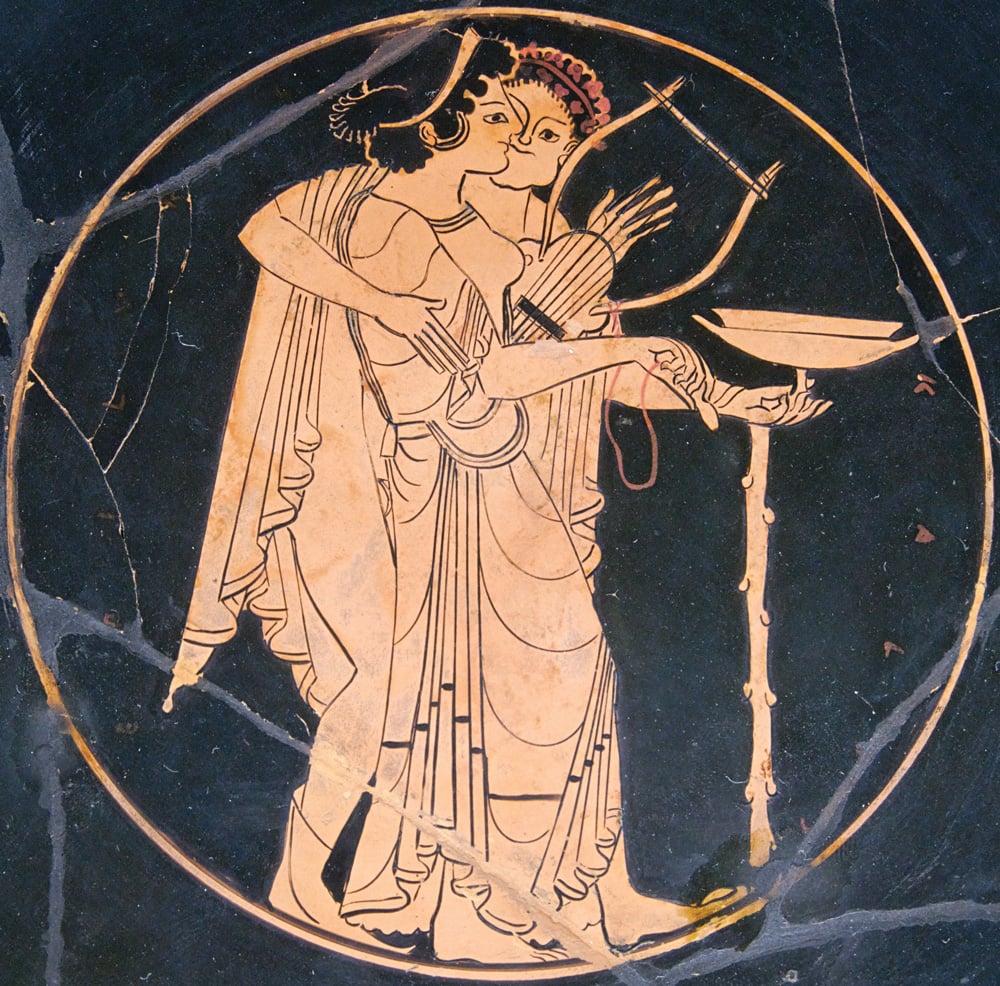
In 1 Corinthians 5:1, Paul refers to the kind of sexual immorality that not even the pagans would tolerate. Artwork on Greek pottery, such as this depiction of a drunken banqueter and a musician (Attica, 510 BC), often included portrayals of drunkenness and sexual promiscuity.
However, when one seeks to bring judgment against a Christian brother or sister, the secular law court is hardly the appropriate setting (6:6). The place for such disputes, if they arise at all (6:7), should be “before the saints” (6:1; NIV “Lord’s people”). Indeed, as before, the Corinthians have acted exactly contrary to what is true. The saints will judge the world and even the angels who have fallen (see also Matt. 19:28; 25:41; 2 Pet. 2:4; Rev. 20:4). Therefore, in light of their role in these ultimate judgments, they are certainly qualified to “judge” trivial cases that concern “the things of this life” (6:2–3) without recourse to secular courts.
That is exactly what Paul calls on them to do in the next two verses, though his advice is full of irony. If even those of “little account” in the church are better qualified to render judgments than those outside, then surely there must be someone wise enough among the Corinthians—who value their wisdom so highly—“to judge a dispute between believers” (6:4–5). To fail to do so prolongs disputes and provokes lawsuits that completely defeat both the ideal of Christian community and the Christian witness. The fact that these disputes have been prolonged, however, also points to the self-centered behavior of some who refuse to be wronged in any way without rushing to their own defense and to the willingness of some Corinthians to knowingly cheat and wrong fellow believers.
Some of the Corinthians appear to have forgotten that to engage in sin routinely is to place themselves back among the “wicked,” who will not inherit the kingdom of God. Paul urges them not to deceive themselves in this way. Neither those who are habitually sexually immoral (as Paul’s list makes clear, the general term includes behavior other than that which has provoked judgment [5:1–13]) nor thieves (once more the list expands beyond the specific behavior condemned in 6:8) will inherit the kingdom of God. Therefore, such behaviors, despite their routine place in the pasts of some, must be left behind through the constant remembrance that the believers have been cleansed from sin’s stain and set apart from its power so that they may live in relationship with the God who has justified them in the name of the Lord Jesus Christ and by the Spirit.
6:12–20. Having made clear again the reality of standards for Christian conduct, Paul now goes on to deal with the rationalizations that have led some of the Corinthians to standards of their own: “Everything is permissible for me” (6:12). Reasoning from the same axiomatic truths that Paul reiterates in verse 11, some at Corinth have concluded that their Christian faith gives them complete freedom to set their own standards according to their individual sense of propriety. Paul does not disagree in principle, but warns them of two dangers: that they may fall into conduct that is “beneficial” neither to themselves nor to others, and that they may become “mastered” again, this time by the very patterns of behavior that marked freedom for them initially. A more specific instance of the same kind of rationalization has produced among some of the Corinthians the saying, “Food for the stomach, and the stomach for food” (6:13). Again, Paul’s point is not so much that he disagrees in principle, but that they should remember that the freedom to eat whatever one desires is inconsequential in light of the coming destruction and transformation of our bodies, and therefore is not a freedom one should cling to or defend at all costs.
A final rationalization, unrepeated by Paul, probably underlies the words that follow these and returns us again to the subject of sexual morality. For some of the Corinthians, it followed from their freedom to eat that they were also free to indulge their sexual appetites in prostitution. For Paul, however, this action and the logical analogy that lies behind it are fundamentally wrong, because they involve the believer’s body as a physical, psychological, and spiritual whole in an action that unites the Christian (whose body in this sense belongs to the Lord [6:14] and, as such, is already “united” to Christ [6:15, 17; 12:27]) with the active presence and enslaving power of immorality.
Paul urges his converts to “flee” from this perilous rationalization and activity. All other sins are outside the body, in that they do not involve the entire personality (6:18). Our bodies are a temple of the Holy Spirit, who dwells within each of us, and we are, as a result, no longer free to use our bodies apart from a recognition of the presence of the Spirit within us. “Bought at a price,” which God did not hesitate to pay in and through his Son, we must respond in gratitude by giving “honor” to God with our whole being.
3. Paul’s Response to Questions from the Corinthians (7:1–16:9)
In the first verse of chapter 7, Paul moves from oral reports about the church and begins to address questions posed by the Corinthians themselves in a letter. The letter is now lost but originally was perhaps carried to Paul by the three Corinthians mentioned in 16:17. The recurring expression “now for” or “now about” introduces Corinthian questions throughout this section.
A. Questions about marriage, divorce, and celibacy (7:1–40). The questions to which Paul responds in 7:1–16 probably had something to do with the relative worth of marriage as compared to abstinence or celibacy. Furthermore, behind the questions probably lay the supposition that abstinence or celibacy promoted spiritual achievement.
In any case, in the first two verses Paul’s words strike a balance that is characteristic of his response as a whole. “It is good for a man not to marry,” but the benefit is not one that can be enjoyed apart from the constant temptations offered by a promiscuous society. As a result, it is better for each man (who has not been given the gift from God [7:7] to resist such temptation) to have one woman as wife and each woman to have one man as husband. That the command is given reciprocally to both sexes is remarkable, as it transcends cultural norms and prepares for things to come later in the letter (see 1 Cor. 11:11–12).
Moreover, within a marriage, sexual relations should not be suppressed except (Paul is making a concession, not giving a command) by “mutual consent” (again, the idea of mutuality is remarkable) “and for a time” (lest prolongation lead to temptation) “so that you may devote yourselves [together] to prayer” (7:5). For the wife no longer has “authority over her own body but yields it to her husband,” and (most remarkably of all), the husband “does not have authority over his own body but yields it to his wife” (7:4). Paul’s desire is thus for all to be free from temptation as he is, whether through the gift of marriage or the gift of celibacy. So his counsel to the unmarried and the widows is the same. It is good for them to remain unmarried, but advisable for those to marry who might otherwise be consumed with passion.
Another set of questions concerns separation and divorce. This set relates to the preceding questions: if, as is supposed, celibacy was considered preferable to marriage, this could give sufficient grounds for separation or divorce. Paul, however, relies here on a “command” of the Lord. The pursuit of celibacy is an insufficient reason for a wife to separate from her husband or for a husband to divorce his wife. It is noteworthy that Paul addresses the woman first (perhaps this is the initial clue to a tendency among some women at Corinth toward the exercise and defense of an absolute liberty that transgressed the boundaries established for true Christian freedom [see also 1 Cor. 11:5; 14:34]). As a realist and not a legalist, Paul also provides for situations where separation still occurs (advising a woman in that case to remain unmarried or to be reconciled to her husband).
Paul’s answers so far have been given to believers who are married to one another, but now he turns to the rest, and to questions (raised out of the same context of concern for a spiritual status) about mixed marriages. In doing so, Paul states openly that his instructions go beyond those of Jesus (see also 7:25). But this does not mean they lack inspiration (7:40) or authority (1 Cor. 1:1; 4:1). Again, the counsel is given to both the man and the woman whose spouse “is not a believer.” If the unbelieving spouse is “willing” to live with the believer, they are not to seek divorce. But will such a marriage not associate the believer too closely with the influence of the world? No, responds Paul, because the unbeliever is “sanctified,” set apart from the world’s influence (though not completely, as are those “sanctified in Christ Jesus” [1 Cor. 1:2; 6:11]), through the choice of constant association with a believing spouse. If this were not so, then (as some at Corinth had perhaps said) their children would be unclean. But, together with their mother and father, they too are holy. On the other hand, “if the unbeliever leaves,” choosing to abandon the association, then the believer is not bound to struggle to maintain the bond, because God has called us “to live in peace.” There is still one other possibility, so far unmentioned, and that is the best of all. Perhaps, though one cannot know, the association will serve to draw the unbeliever to faith and so to salvation.
As elsewhere in this second half of his letter, Paul’s response (7:17–27) now moves from ethics (7:1–16) to a statement of principles before turning back again to advice (7:28–40). Paul now states the basic conviction underlying his balanced counsel (the “rule I lay down in all the churches” [7:17]). Spiritual growth is not dependent on status (marital or otherwise) but on attention and obedience to God’s call. Accordingly, Christians should not ordinarily seek to change their status; rather, as far as possible, they should retain the status God has assigned to them.
Paul reiterates the principle with reference to circumcision. Those who were circumcised before their call should not now seek to erase the marks of circumcision, nor should those who before were uncircumcised seek its imposition (7:18; Acts 21:17–26; Gal. 5:2). Instead, each should remain as he was. For that which served before to promote a distinction in status, knowledge, and obedience between them has now been set aside; and both together will be enabled in Christ to know and obey God’s intentions for them as they walk in obedience to the leading of the Spirit (Gal. 5:25; 1 Cor. 2:6–16).
A final example concerns the slave and the freedman. Here, however, the analogy is incomplete, for Paul admits that the slave should use the chance to gain freedom whenever it comes. Nonetheless, the main point remains intact. The distinction in status between slave and free is irrelevant to those who belong to the Lord, who makes the slave his freedman (Gal. 5:1) and the free one Christ’s slave (Rom. 1:1).
All three categories now come back into the argument as the section is finished by way of summary. All, whether married or celibate, Jew or Gentile, slave or free, have been bought “at a price” and thus have been brought into the body of Christ, where distinctions of status have no place (7:23; 12:13; Gal. 3:28; Eph. 2:14–18; Col. 3:11). Therefore, Paul urges them not to become subject again to human standards that would make their status a basis for comparison, but to transcend those standards and find unity and equality in the body of Christ. Paul closes the section with a final repetition of the principle (7:24).
Chapter 7 began with words addressed to single persons and questions about the value of marriage. The subsequent discussion, however, has focused primarily on related questions posed by those already married. In 7:25–40 Paul completes his answer to the questions of the unmarried and the widowed.
The answer is made in light of the principles already given and reflects Paul’s considered “judgment,” which, though not binding as a command “from the Lord,” is worthy of trust. It is based, at the same time, on a conviction that the present, unsettled state of this world reflects that the time of its existence has been shortened; it is already beginning to pass away. Therefore, it is best if the unmarried remain, like the married, as they are. Not all, however, will reach this decision, and so Paul adds realistically that its opposite, a decision to marry, is no sin.
In light of the reality of the world’s demise, however, Christians should live not with reference to its expectations but rather as those who already have begun to live in God’s new kingdom. Those who have wives should remember that one day the caliber of fellowship to be enjoyed between everyone in the kingdom of God will match that which is now the exclusive possession of husbands and wives (Mark 12:25). Similarly, those who mourn should likewise recall that their mourning has already begun to call forth comfort (Matt. 5:4). And those who “are happy” in the present world should bear in mind that the age to come will reverse present fortunes (Luke 6:25). Finally, those who buy or “use the things of the world” must realize the transitory nature of their possessions and not become engrossed in the enterprise of attainment and use (Luke 12:16–21).
Those contemplating marriage must also consider a further factor, for their marriage will deservedly initiate a concern to give pleasure and comfort to the spouse in a present world full of pressure and trouble. This concern will be added to the valid concern they bear as individuals to please the Lord in response to the call to be about his business (see Mark 13:34–37; Acts 13:2; 1 Cor. 3:13; 15:58). All this Paul would have them consider “for [their] own good” before entering into marriage. This is said not to restrict those who would marry from doing so, but to remind all of the priority of devotion to the Lord.
A section of advice follows whose reference is obscure. In the NIV this gives rise to an extended footnote in which the Greek, which speaks about proper action by a man with respect to “his virgin,” is interpreted as referring to the way in which a father treats his daughter. It may more likely refer to the way in which a man treats his betrothed. In either case, though, the general point is clear and largely repetitive; if a man thinks he is “acting improperly” toward a woman in either of these relationships by unduly prolonging a condition that perpetuates singleness, then marriage is a legitimate choice. Conversely, if a man “has control over his own will” but decides not to marry, then this man also is doing the “right thing” and choosing what to Paul is the “better” of the two alternatives (7:37–38).
Last comes the apostle’s answer to widows who have asked about marriage. He reminds them that the unique loyalty of the marriage bond, though it is lifelong (with 7:15 as the exception, not the rule), is terminated by death. Accordingly, they are as “free to marry” as any others, or to choose not to do so, with this choice, in Paul’s judgment once again, the better.
B. Questions about food, idolatry, and freedom (8:1–11:1). 8:1–13. Paul introduces a second major topic with the words, “Now about food sacrificed to idols” (8:1). Under this topical heading, as in the previous chapter, Paul treats several different though related questions. Here they concern the propriety of Christians in their own homes eating food that may have previously passed before an idol (8:4–6; 10:23–26); of Christians eating such food in the home of an unbeliever (8:7–9; 10:27–29); and of Christians accepting an invitation to dine in a pagan temple (8:10–12; 10:14–22).
It would be hard, as all these issues indicate, for any Christian at Corinth not to ask questions. Invitations to dine at a temple were, as archaeology has shown, a common social convention among everyone except slaves, and virtually all the food sold in the marketplace would have passed through a pagan temple for symbolic purposes before its sale. But the questions here appear to have been asked by some in a way that defended their own conduct and challenged Paul’s (9:3) in this matter and others (9:4–6) as either too bold in its exercise of Christian and apostolic rights (9:4–12a) or too timid in its restraint (9:12b–27), and in any case inconsistent with what they had come to expect of an apostle (9:1–2). Paul’s reply alternates between instructions and his own example rather than between advice and principles.
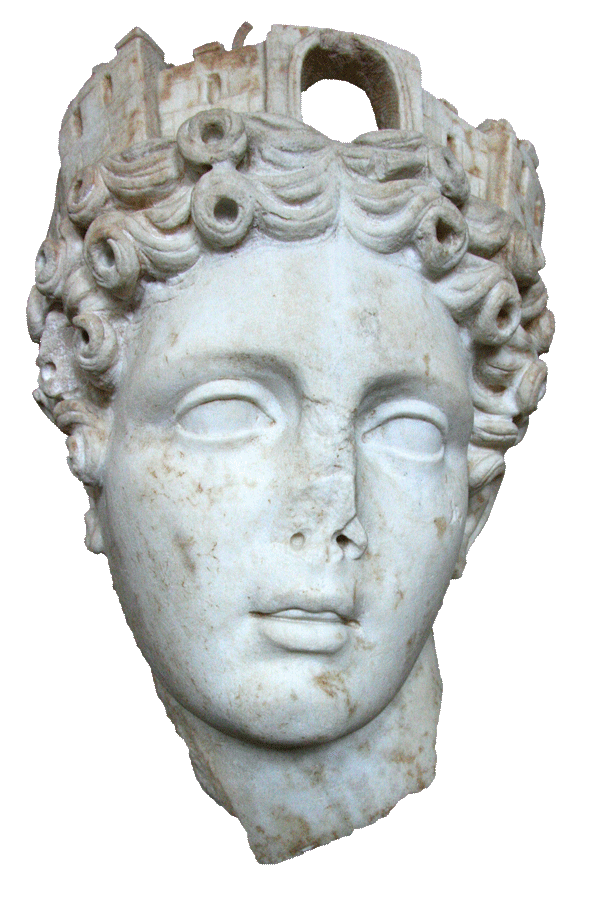
This head of the goddess Tyche was found at Corinth (late first century AD). Tyche, who was believed to control the fortune and prosperity of the city, was one of many deities worshiped in the various temples throughout Corinth. In 1 Corinthians 8, Paul addresses the food used in such pagan worship.
In 8:1–13, as in 6:12 (and perhaps in 7:1), Paul begins by giving assent to a guideline advanced by some at Corinth, in this case the principle that possession of knowledge justifies any conduct that is consistent with it. As before, however, Paul quickly qualifies the guideline with a reminder that knowledge can blind its possessor to its own importance and lead him or her in isolation from others toward a false assurance. Love, on the other hand, is a far more reliable guide, for it leads its possessor toward personal maturity in fellowship with others, and when turned toward heaven, to communion with God. Consequently, it is important both to know the truth and yet to speak it in love (Eph. 4:15).
Paul proceeds to review, for those who have need of it, the basic truths that undergird Christian monotheism. The first of these is that “an idol is nothing,” having no real existence in the world except in the minds and hearts of its worshipers, who nonetheless by their ignorant devotion open themselves to the influence of real beings with demonic power (10:14, 19–22). The second, on which the first is founded, is that there is no God but one, who is the source of all creation, service to whom gives life meaning, and who is the Father of the one Lord Jesus Christ, his agent in the beginning of life and in its continuation and renewal. (Similar ideas expressed in Eph. 4:5–6 and Col. 1:15–16 are probably a fragment from an early Christian confession.)
Next, Paul reminds his readers that some among them do not yet trust the substance of this truth enough to know its power in experience beyond simple assent. Therefore they continue to have doubts about the nature of the food that they eat and the implications of doing so. Because of this, fellow believers, in their words (8:8 probably paraphrases some of them) and actions, need to “be careful” lest the “exercise of . . . freedom” and knowledge lead them to ignore the effect of their behavior on the faith of the weak.
Finally, Paul applies what he has said to the situation in Corinth. Some have already accepted invitations to dine in pagan temples in public view and are in danger of leading those with a weak conscience to disregard it and act insincerely. Thus the weak, for whom Christ died, will be led to abandon action that matches their convictions and perhaps even to depart from any attempt at morality, a path that leads to destruction (see 1 Cor. 5:5). When this happens, those who have encouraged it will be found to have sinned against both the weak and Christ, who cares for even the weakest believer (Mark 9:42). Therefore, Paul chooses, for himself, to restrict the actions that he might legitimately take according to the criteria of love and concern for his fellow believer.
9:1–27. The mention of restraint prompts Paul to recall that some at Corinth have begun to interpret his reserve as an indication that he is not free to act, as they presume an apostle would, without reference to the beliefs of others. The rhetorical questions he poses in response are not so much concerned with his defense as they are with the fact that this false supposition may cause the Corinthians to neglect his advice (9:1–27). So he must reestablish his apostolic authority through reference to his experience of having seen the risen Lord and to the results of his initial mission, which brought the Corinthian church into existence through the preaching of the gospel. Thus, though outsiders may question his status, Paul expects his own to remember that their life in Christ is the continuing seal of its authenticity.
But does not a true apostle ask his converts to provide him with food and drink and the financial support to enable him to travel with a “believing wife” (9:4–5)? Do not the “other apostles and the Lord’s brothers and Cephas” request such things from those whom they serve (9:6)? Indeed they do, and so, too, can Paul, who now illustrates the legitimacy of this right by noting that a soldier has a recognized right to serve at the expense of others, that those who plant crops or tend livestock have a recognized right to share in the produce, and that this right of support is recognized not only in the sphere of human affairs but also in the law of Moses, which speaks (in Deut. 25:4) about the right of an ox that treads grain to do so without a muzzle, that he might eat as he works.
These last words Paul takes (employing a traditional rabbinic method; cf. Rom. 5:9–10, 15, 17) to refer just as much if not more to the reward deserved by himself and others like him (9:8–10). Confirmation is provided by the observation that those who have plowed or threshed the grain are also entitled to possess a “hope of sharing in the harvest.” Thus Paul and the others who have “sown spiritual seed” among the Christians at Corinth are also entitled to share in the harvest of their ministry through the provision of their continuing material needs (9:11–12).
But Paul has indeed, as they know, made no use of this right. Yet this is not, as his words have shown, because he is not entitled to do so. Rather, it is because he has decided to avoid any hindrance to the reception of the gospel of Christ. For despite the right of “those who preach the gospel” to “receive their living from the gospel” (9:14), which is analogous to the right of those who work “in the temple” and serve at the altar to “share in what is offered on the altar” (9:13), Paul has chosen not to make use of this or any of his rights, and he is not corresponding with the Corinthians for the purpose of requesting them. He has elected instead to make his boast in a ministry that disavows any dependence on another except the one who compels him to preach. Thus it is an almost involuntary obedience to God’s call, rather than a voluntary and carefully planned decision to take up a self-supporting career, that stands behind Paul’s attempt to “discharg[e] the trust committed to [him]” (9:17; see also 1 Cor. 4:1–2). And the reward he receives for such service is precisely the ability to make good on the terms of his boast, to preach the gospel free of charge.
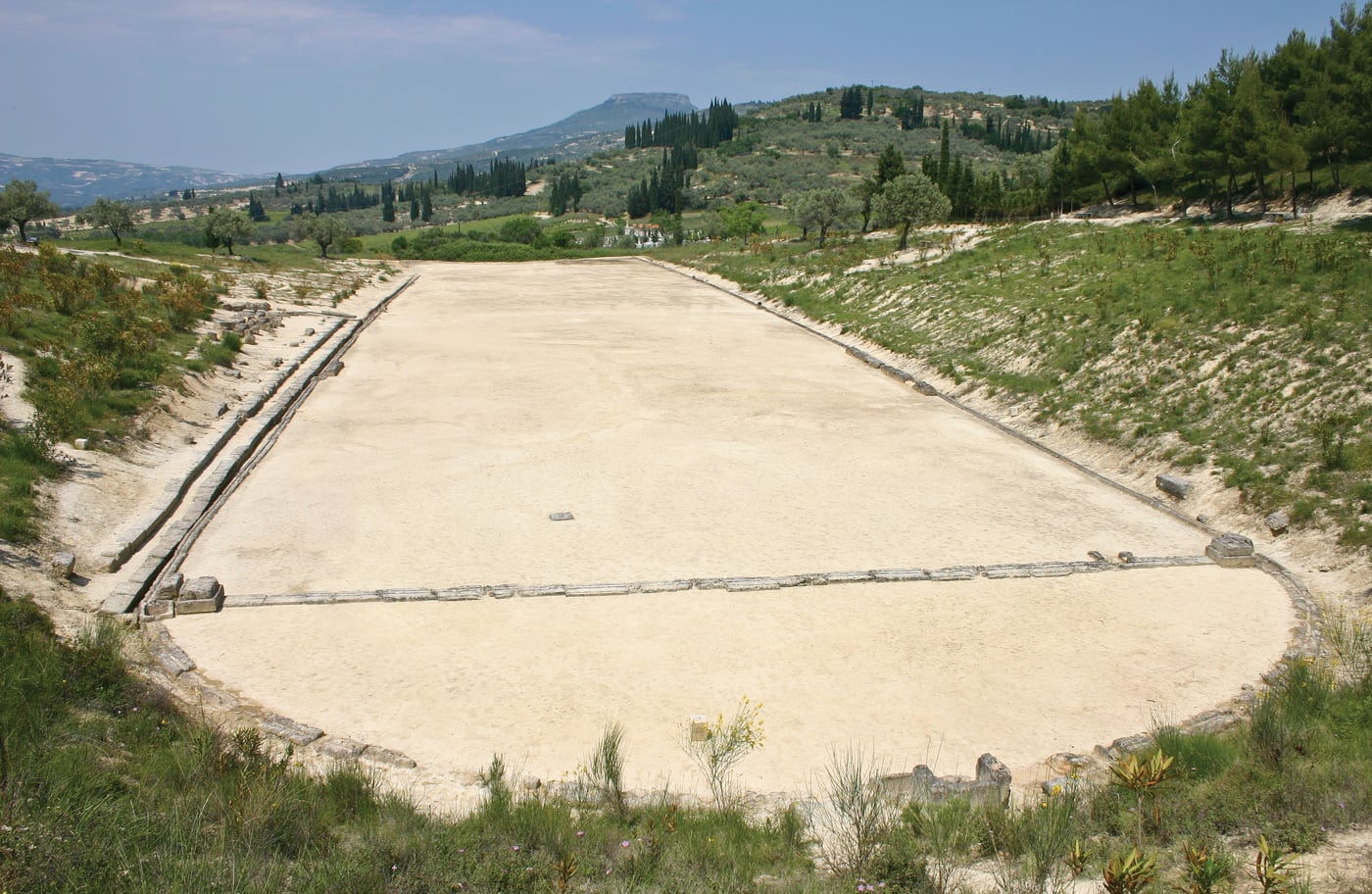
The stadiums in Greek cities hosted footraces and other athletic events. The stadium shown here at Nemea, about eleven miles from Corinth, was the site of the Nemean Games, part of the Panhellenic game cycle. Winners would receive a crown of celery leaves. Paul tells the Corinthians, “Run in such a way as to get the prize” (1 Cor. 9:24).
But given independence from all, Paul has freely subjugated himself again, not to their support but to their way of life, in order to win them to faith. Though no longer bound by the notion of the law as a covenant enabling maintenance of the righteousness necessary for fellowship with God, Paul is nonetheless willing to follow many of the customs that are indifferent to one justified by faith (see also Rom. 3:21–22; Acts 18:18; 21:26) when to do so means an opportunity to gain entrance for the gospel. Conversely, among those for whom the law was no guide, Paul is willing, to the extent permitted to him by “Christ’s law” (Mark 12:28–34; Luke 10:25–37; Gal. 6:2), to loose himself from divine law as a point of reference if this leads to the fulfillment of the gospel’s objective. And so, at length, his reasons now plain, Paul repeats his readiness to abide by the standards of the weak, or even to become all things to all people if, in this way, it becomes possible for him to bring about their continuing allegiance to the saving gospel of Jesus Christ. For Paul, as their apostle, also shares in the blessing of their entrance into a growing faith (9:23; see also Col. 2:5).
A last illustration allows Paul to compare his restraint with that of a runner who gives up much in “strict training” to attempt to gain the winner’s “crown” in “the games” (9:24–25). Paul does not renounce his rights to no purpose, like a halfhearted runner running aimlessly, or a casual boxer who is always punching the air. Rather, like the serious athlete, he beats back his physical needs until they conform with the priorities of his Christian ministry, lest after proclaiming to others Jesus’s call to abandon all and follow him, Paul himself should be found seeking to retain some personal prerogative and so be “disqualified for the prize” (9:27; see also Phil. 3:13–16).
The figure of the casual athlete allows Paul to make a transition from himself (9:1–27) to those at Corinth who have taken a casual attitude to their behavior with respect to food dedicated to idols (8:10–12). Their exercise of freedom without restraint, exemplified by a casual acceptance of invitations to dine in pagan temples, endangers both them and the weak if it fails to take seriously the influence of evil behind idolatry (chap. 10).
10:1–22. The people of Israel had made similar presumptions as those who together had been under the cloud and had passed through the sea (10:1; Exod. 13:17–14:31). Indeed, their experience suggests to Paul that all Israel underwent a baptism into Moses analogous to Christian baptism into Christ (1 Cor. 12:13; Gal. 3:27). Furthermore, they all ate “spiritual food” and drank “spiritual drink” (10:3–4; see also Exod. 16:1–17:7; Num. 20:1–13), experiences corresponding even more closely to the Christian (John 4:10; 7:37). For the “spiritual rock,” from which the drink came, continued to appear throughout their journey (according to a common Jewish understanding that interpreted Israel’s repeated ability to find water in the wilderness in this way). So Paul does not hesitate even to identify this saving action with the preincarnate work of God in Christ. Nevertheless, these experiences did not succeed in protecting most of the people from evil or from God’s judgment when they failed to take their actions seriously.
This should now serve as an example to dissuade Christians from stubbornly refusing to acknowledge and give up what is evil. The temptation (as one eats, drinks, and indulges in the “revelry” of any pagan occasion) to stubbornly ignore evil and acquiesce in an act of idolatry should be rejected (1 Cor. 8:10–12; 10:14–22) if the Christians at Corinth are not simply to repeat in their own experience the experience of Israel (Exod. 32:6). In the same way, the temptation to “commit sexual immorality as some of them did” (Num. 25:1–9; the difference in the exact number of those who died is insignificant to the point of the argument) should also be refused. Persistence in behavior that might “test the Lord” (in his resolve either to provide or to punish) should be eschewed, as should every temptation to grumble (10:10; Num. 16:41–50; 1 Cor. 1:11; 3:3).
Thus the past still serves to provide typical examples of divine judgment and, in this case, gives “warnings” to those who now participate in the “fulfillment” toward which all God’s action in the past was pointed (10:11). Christians who are entrenched in the firm defense of their conduct are especially urged to be careful. Yet no temptation, even of pride and stubbornness, is theirs alone. They are involved in something that has proved itself to be a common experience for all God’s people before and since. And God can be trusted not to allow temptation to go beyond their ability to resist if they will seek and do not ignore the way of escape he will provide (10:13).
In this case, as Paul urges his “dear friends” to recognize, the way of escape lies in a flight from the site of idolatry (10:14). He appeals without qualification to their ability to reason and form judgments based on what they know, for Christians are “sensible people.” Yet some of the Corinthians have failed to take into account all that needs to be considered before coming to a decision about how to respond when invited to a pagan temple. Paul has sketched out the potential implications of their conduct for others (8:9–12); now he invites them to consider the potentially harmful effects on themselves.
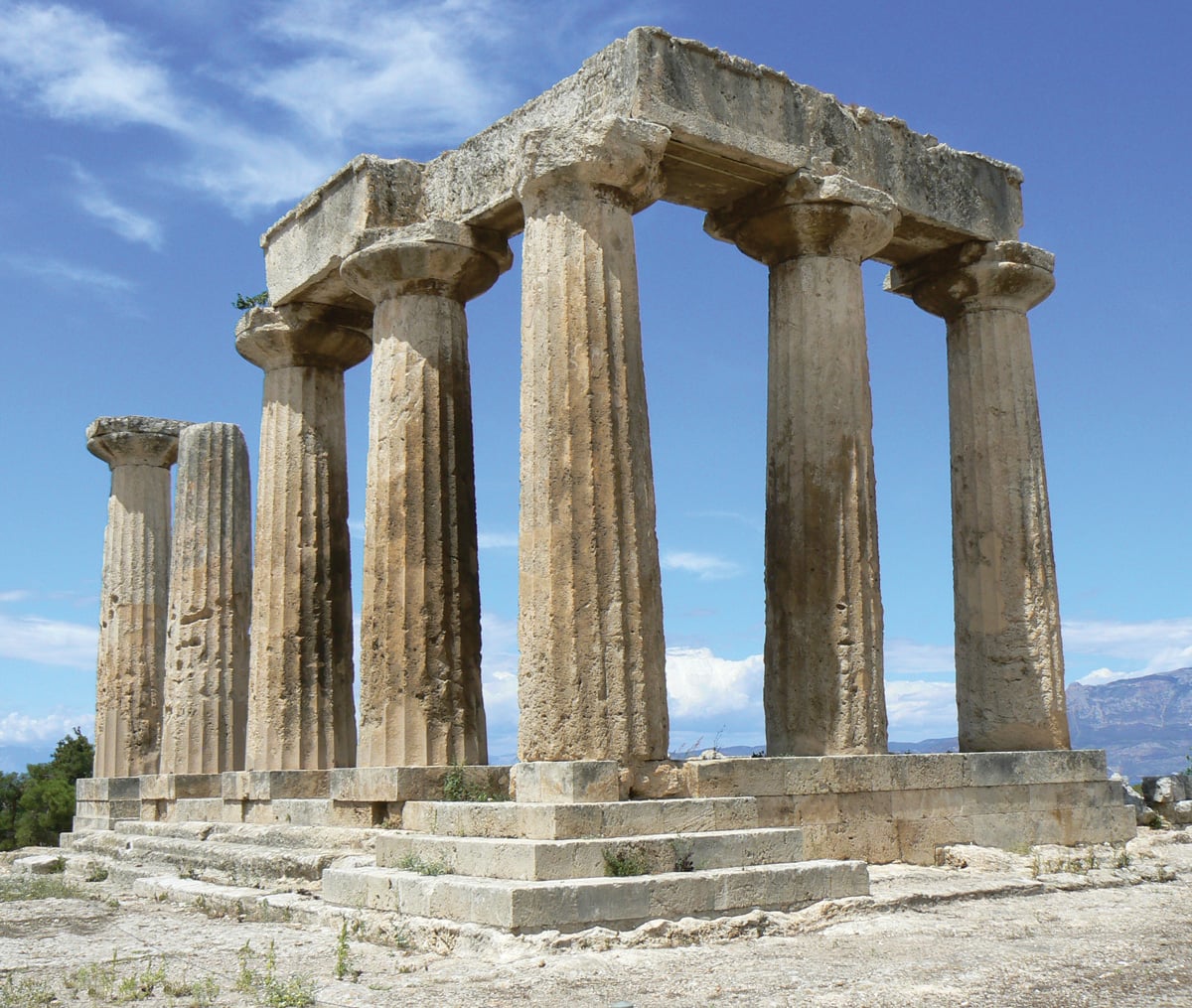
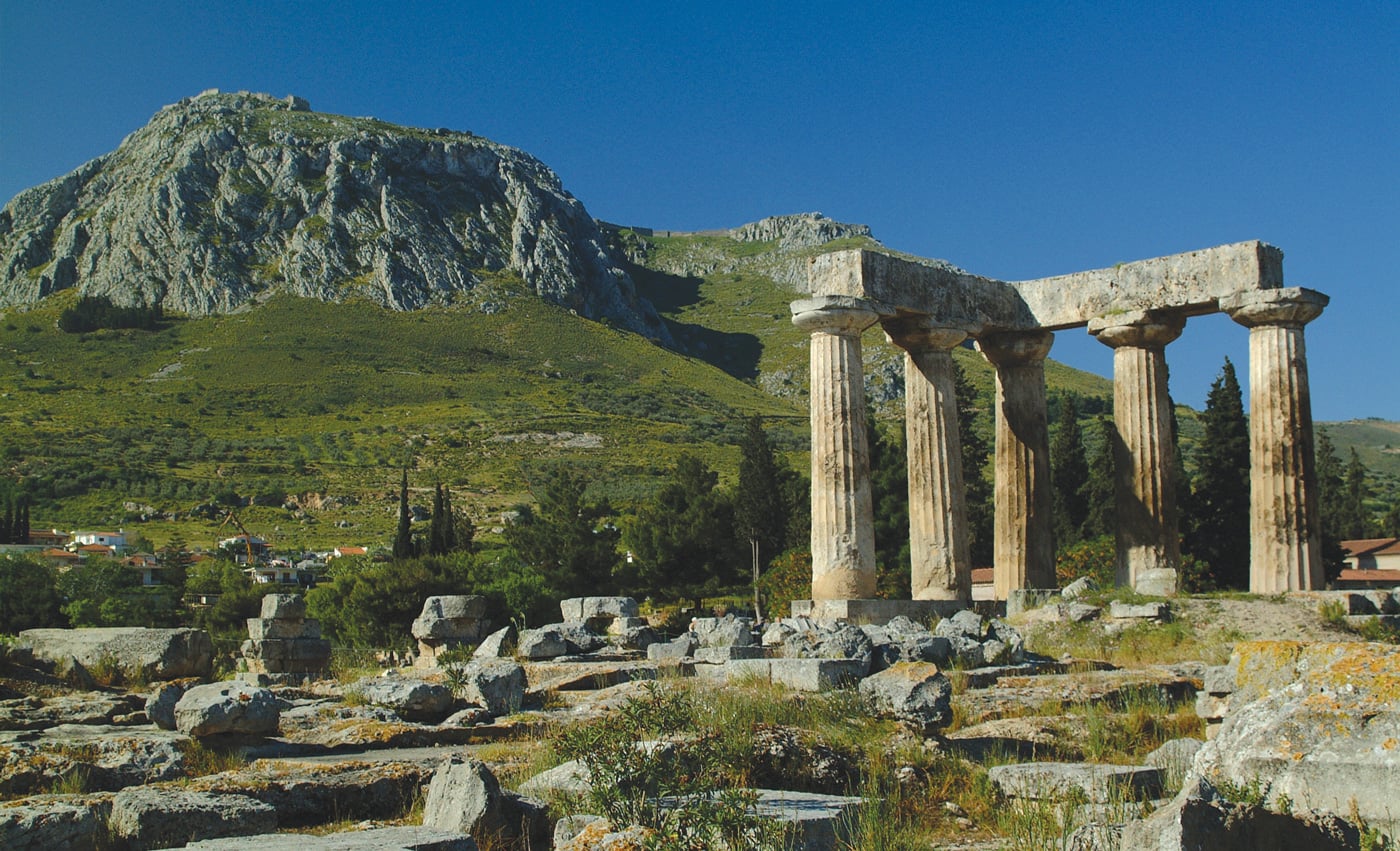
The last standing columns of the Temple of Apollo (sixth century BC), the largest temple in Corinth. Participation in temple activities, such as those Paul mentions in 1 Corinthians 10, was considered not merely a religious duty but a civic responsibility.
Once again the argument is by analogy. Just as the acceptance of the “cup of thanksgiving” and the “bread that we break” at the celebration of the Lord’s Supper enables a corporate and real participation or communion (Greek koinōnia) with Christ (10:16; because though many are present with individual thoughts, all “partake of the one loaf” and thus become one body [10:17]), and just as the same sense of participation or communion in the sacrificial worship going on at the altar is experienced in the life of the “people of Israel” by all those who eat the sacrifices (10:18), so the “sacrifices of pagans” (i.e., the food and drink present in a pagan temple) likewise draw all who eat or drink them into corporate communion in a sphere where demonic presence is genuine and demonic influence powerful (10:19–20). For despite the fact that an idol has no real or personal existence, neither the reality nor the personal character of the evil that perpetuates a false worship can ever be doubted. Thus a Christian cannot participate in a meal at a pagan temple. To do so disregards realities and the inherent contradiction of trying to drink the cups of both the Lord and demons. Such action can only provoke the Lord to a jealous defense of his own unique right to be worshiped (Exod. 20:3; Isa. 42:8; Rom. 1:18–31) or invite the ludicrous thought that we are somehow more able in our freedom than he in his holiness.
10:23–11:1. The discussion to this point has highlighted two principles, which Paul now summarizes. Paul has labored thus far to show that Christian freedom is not absolute. It must be qualified through the exclusion of any attitude or action that is not “beneficial” to the development of the individual (10:1–23), or not “constructive” with respect to the growth of the community (8:1–13). Moreover, the two are tied together, because the goal for the Christian is to seek not simply one’s own good but also the “good of others” (10:24; Phil. 2:4).
Abruptly Paul turns to those who have gone to the opposite extreme and placed more restrictions than necessary on their freedom of conscience and behavior. They should “eat anything sold in the meat market without raising questions of conscience” that are unnecessary outside the environs of a pagan temple. For beyond the confines where false worship is given and evil dwells, “the earth is the Lord’s and everything in it” (10:26; Ps. 24:1). They may also accept an invitation to a meal at the home of an unbeliever and eat whatever is “put before” them (10:27). When they do, they should not raise questions of their own conscience, although they must respond to “anyone” (a Christian or not) who feels obliged to inform them that others present who are consuming this food both know and accept that it has been offered in sacrifice (10:28–29).
The next two questions are obviously intended to reinforce this advice, but the flow of thought is difficult. It may be, however, that the questions are intended to draw attention back to the basic advice of verse 27. If so, then the sense is that there is no need for Paul or any Christian to exercise restraint in deference to “another’s conscience” unless that other person expresses his objections. For if he does not (given that our conduct should not rest on assumptions about another person’s conscience), then Christians should be free to eat any meal with thankfulness and without fear of denunciation (10:30; Gal. 2:11–16).
This action or any other, however, should be construed as an opportunity to glorify God rather than an occasion to express our freedom. And the praise of God can only be diminished if our action causes anyone inside or outside the church to doubt the moral integrity of the gospel. So the Corinthians should follow the example of Paul, who attempted to follow the “example of Christ” (11:1) by conforming as far as possible to different standards (1 Cor. 9:19–23; Matt. 9:10–13; Luke 7:36–50) and neglecting the pursuit of his own good in favor of the good of many (10:24; cf. Mark 10:45) in order that they might continue in faith and so be saved.
C. Questions about worship, gifts, and order (11:2–14:40). 11:2–34. A third topic provoking questions at Corinth concerned the proper expression and relative value of spiritual gifts, in particular the way in which certain gifts should be used in a worship service. Within this sphere of questions about worship, however, Paul takes time to deal first with two issues that have proved divisive in the worship of the church. These he has heard about, though the source of the report is not given.
The first issue is concerned with the different head coverings that appropriately distinguish women and men as they pray or prophesy in worship (11:2–16). The interpretation of the passage is complicated from the outset (so also to some extent is 11:17–34) by its dependence on prior teaching, which Paul has given to the church but which, of course, is unknown to us. However, by beginning with “praise,” Paul hints that the church has not departed significantly from the substance of what he has previously taught.
The discussion of the issue then begins with a call for the church to acknowledge (again or anew) that the “head of every man is Christ, and the head of the woman is man, and the head of Christ is God” (11:3). However, the word “head” (Greek kephalē), used here and repeatedly throughout this section, has various meanings. It may be used (as in 11:4–5) to speak of a physical head. But from this literal meaning come two metaphorical ones, which allow the same word to denote rule and authority (the head of the church being in authority over the body [Eph. 1:22]) or source and origin (the head of the church being the source of its existence [Col. 1:18]).
Of course, the precise meaning intended here will greatly influence the interpretation of the principle being expressed, not to mention any attempt to apply it to different, broader questions about the roles appropriate to men and women in contemporary worship. It may be helpful, therefore, to note first that either meaning enables these words to support the instructions that follow. But it is also significant to observe that the second has the advantage of according greater continuity to the section as a whole (see 11:8–11).
If the second of the metaphorical meanings is Paul’s here, then his principle will be a statement of the truth that the source of every man’s existence (or perhaps “person’s”; the Greek can be used generically) is Christ, “through whom all things were made” (the Nicene Creed; cf. John 1:3; Col. 1:16); the source of woman’s existence is “the man” (the definite article in Greek is used with the word “man,” not “woman” [see Gen. 2:22–23; 1 Tim. 2:13]); and the source of existence for the historical person of Christ is God (Luke 1:34–35; Gal. 4:4). Thus a man who prays or prophesies with his physical head covered (either, as the NIV text suggests, by some form of head covering or, as the footnote has it, with long hair) symbolically dishonors the source of his existence by obscuring that which was created in the image of God and designed to reflect that image to God’s glory (11:7; Gen. 1:26). Similarly, a woman who prays or prophesies (a practice Paul affirms apart from these comments on proper dress) with her physical head uncovered symbolically refuses to honor the source of her existence (i.e., by trying to obscure the distinctions between woman and man) and so brings dishonor on her own head as surely as if it “were shaved.” Thus, if a woman refuses to “cover her head,” she may as well “have her hair cut off,” for the latter state is no more or less dishonoring to her than the former.
The basis for this argument is now repeated and supplemented (11:9; Gen. 2:18) before Paul returns to the question of the woman’s appearance. For the “reason” he has given (11:7–9), and because of the angels (who were present with God at creation [Job 38:4–7] and at the time the law was given to reveal and preserve the created order [Acts 7:53; Gal. 3:19]), the woman who prays or prophesies must “have a sign of authority on her head.” This allows her to transcend her created distinction from man (without seeking to deny it) in the expression of her gift. For both now participate in worship in a new order in Christ (1 Cor. 12:13; 2 Cor. 5:17; Gal. 3:28; Col. 3:11). This does not mean, however, that in the Lord woman is free to disregard man, nor is man free to disregard woman. The truth is that they are dependent on each other, and both are dependent on God.
As before, the Corinthians are urged to form their own conclusions based on Paul’s presentation (11:13). But they are reminded as they do that nature reveals this same order as surely as scriptural argument. Thus, “if anyone wants to be contentious,” refusing to accept the evidence of either Scripture or nature, then Paul’s practice (see also 1 Cor. 11:1) will have to provide sufficient grounds for their conformity to these instructions.
In contrast to the previous section, Paul has no praise for what he has heard about the Corinthians’ demeanor when they gather in worship at the Lord’s Supper (11:17–34). Indeed, as it is, their behavior does “more harm than good.” For in the midst of a celebration of unity, there are divisions among fellow believers. And while some “differences” are needed to distinguish those who believe and act genuinely (receiving “God’s approval” as a result) from those who do not, other differences are unnecessary; and if stubbornly or pridefully maintained, they are liable to result in judgment (11:34).
The division between those who remain hungry and those who get drunk at the Lord’s table is one such unnecessary and dangerous difference. For when it exists, the disunity created means that “it is not the Lord’s Supper” that is being eaten. Homes are settings in which one may eat and drink freely according to his or her own means, but to do so in the midst of others who are hungry is to despise the new order of the church of God, in which people, both slave and free, are united in their status in Christ (12:13; Gal. 3:28; Col. 3:11) and to humiliate Christian brothers and sisters. Paul’s words imply that the Corinthian church celebrated the Lord’s Supper at the end of a communal meal, and there is just enough evidence about the members of the church (see Theissen) to suggest that the division of which Paul has heard is the product of differences in social and economic status, which were a prominent feature of life in the first century.
Since Paul cannot praise the Corinthians for remembering what he has taught them about the Lord’s Supper, he now reminds them of the words he received and “passed on” to them. (The two verbs are technical terms in Judaism for the deliberate preservation and careful transmission of a tradition as it was originally “received” from its source. Paul therefore provides what is probably the earliest account in the New Testament of this part of the tradition about Jesus’s words and actions; cf. Luke 1:1–3.) Paul’s testimony accords quite closely, though not exactly, with that of the Gospel records. Our Lord, on the night of his betrayal, took bread, gave thanks, broke it into pieces, and said, “This is my body, which is for you; do this in remembrance of me” (11:24). These words, precisely in contrast to their intent, have proven to be an abiding source of division among Christians. For whatever the relationship established between the body and the bread, both are given for the benefit of all (the “you” is plural in Greek), that all may share in one body and celebrate their unity together in this memorial. In the same way, Jesus took the cup at the end of the meal and said, “This cup is the new covenant [see Jer. 31:31–34] in my blood; do this, whenever you drink it, in remembrance of me” (11:25). Thus, whenever Christians together “eat this bread and drink this cup” (in contrast to common food and drink), they proclaim the Lord’s death, which is for all (2 Cor. 5:14–16), inaugurating the new age (2 Cor. 5:17; 10:11) that will be brought to its culmination when he returns.
Therefore, because of the significance invested in these elements, anyone who consumes them in a manner that is not in keeping with their purpose of uniting believers with each other and with their Lord “will be guilty of sinning against the body and blood of the Lord” (11:27). He will have failed to distinguish the consumption of these elements from that of ordinary food and drink. So all people, before they eat or drink, should examine their attitudes toward those with whom they are about to share in this most intimate fellowship. For if the Corinthians do not sense within themselves, or within their previous behavior toward those around them, a genuine affirmation of unity, or a willingness to affirm unity, then they have failed to “recognize the body of the Lord,” which is made present in order to unite and celebrate the unity of all with Christ, and they eat and drink judgment on themselves. Furthermore (as Paul discerns from what he has heard), judgment has already begun to manifest itself in the weakness, sickness, and death of some within the church (though one should not presume that any of these symptoms are always associated with divine judgment [John 9:3]). But such signs of judgment would be unnecessary if the Corinthians would judge themselves in the manner Paul has indicated (11:31).
The conclusion to be reached is brief. When the Corinthians gather in worship to celebrate the Lord’s Supper, they must “wait for each other” and come together to eat instead of going ahead as individuals with their own private provisions. If any are so hungry that they cannot wait, then they should eat at home first so as not to provoke judgment. Paul will provide more directions when he comes (11:34).
12:1–31. Paul passes on now to Corinthian questions about the spiritual gifts (12:1–14:40), for Christians should not be “ignorant” about them (12:1–3). Their pagan experience should show, however, how easy it is to get carried away in ecstatic worship and “influenced” toward speech, even speech uttered falsely in the name of a mute idol. Thus, it is important to realize that speech inspired by the Spirit of God will never produce the words “Jesus be cursed,” despite any sense of ecstasy (which, if it were false, might explain this strange utterance) or any temptation under persecution to apostasy (an alternative context in which this cry might be comprehensible). Conversely, no one can say “Jesus is Lord,” producing the content of the most basic Christian confession (Phil. 2:11), without openness to the inspiration of the Spirit.
In this section (12:4–31), the major topic of discussion comes more clearly into focus. It is the relative value of the various spiritual gifts that is at issue, and probably also speculation about the degree of inspiration (or the Spirit) associated with each gift. Since speech “in tongues” is mentioned repeatedly in this chapter and the next, becoming the main focus of discussion in chapter 14, it seems likely that this gift was highly regarded at Corinth and that its recipients tended to exercise a dominant role in worship.
In response to this situation, Paul stresses first (in an early expression of trinitarian thought) that all the “different gifts” are distributed by one Spirit, just as different services are allocated by the same Lord and different “kinds of working” are enabled by the same God. Thus in the same way that services and works are performed not primarily for the benefit of the individual but for that of others, “the manifestation of the Spirit is given for the common good” (12:7).
The list that follows is not intended to be exhaustive but is typical of the gifts that had been experienced at one time or another by Christians in Corinth (see also Rom. 12:6–8; Eph. 4:11). These gifts include the “message of wisdom” and “message of knowledge,” faith and the gifts of healing, “miraculous powers,” prophecy and “the ability to distinguish between spirits” (RSV), the ability to speak in “different kinds of tongues,” and the interpretation of tongues. It is then repeated that all these are the product of the same Spirit, who distributes them not necessarily one by one but to each person “as he determines” is best for the good of all (12:11).
Paul now illustrates the unity (12:12–13), diversity (12:14–20), and integrity (12:21–26) produced at the Spirit’s inspiration among those at Corinth who belong to the body of Christ. Though suggested by Jesus’s words on the road to Damascus (Acts 9:4) and by its use in the Greek philosophical traditions of Stoicism (with which Paul shows passing familiarity elsewhere), this figure is used casually in the Pauline Letters (1 Cor. 6:15; 10:17; 11:29), with the exception of these verses.
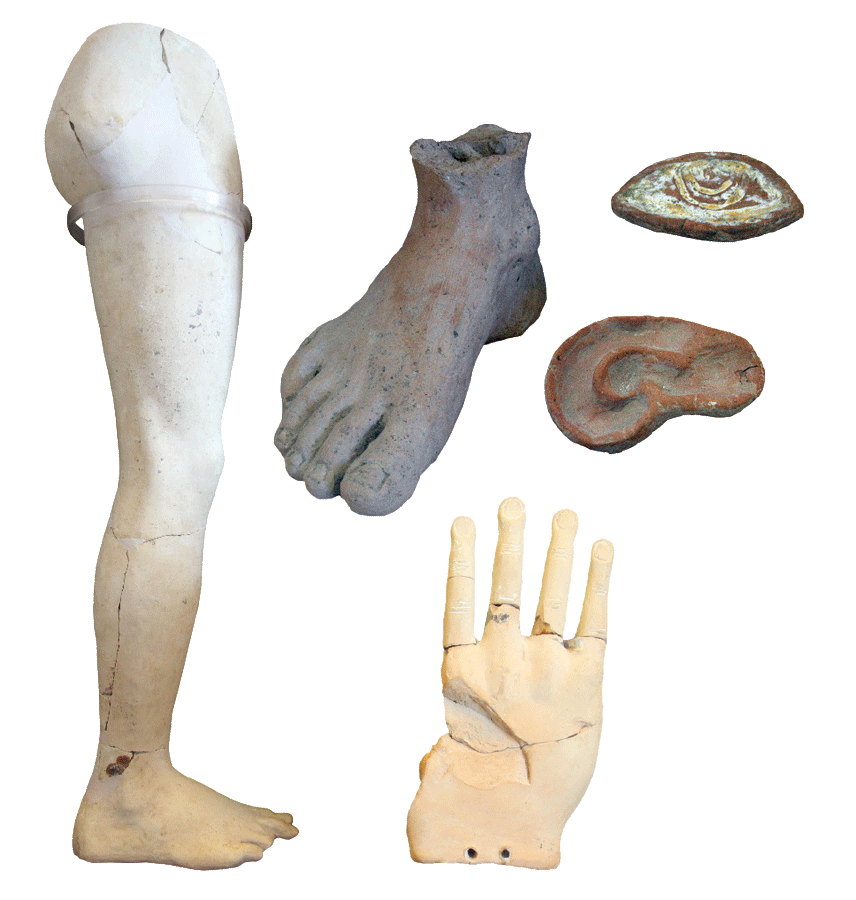
People would come to the Asclepion, built in honor of the deified Greek physician Asclepius, to be healed. Pictured here are votive offerings, usually representing the afflicted body part, given in gratitude to Asclepius.
Just as “the body is a unit though it is made up of many parts . . . so it is with Christ” (12:12). (The cult of Asclepius, the god of healing, and his daughter Hygeia was accorded a prominent place in Corinth, and those who sought healing for a part of the body would often leave a representation of it in the Asclepion. Perhaps Paul has this in mind as he reminds his readers that the body is a unit and not simply a collection of various parts.) The point is analogy, not identity. Christ dwells in the church after the resurrection but possesses his own body as well. The basis for comparison lies in the fact that all Christians, despite the inequities of their former existence, have now been brought into one body (see also Gal. 3:27–28) by a common experience of the Spirit in baptism.
This does not mean, however, that all will now be given exactly the same gifts, for a body is not constituted by a single part but by many. Thus the diversity among the parts of the body is no cause for concern about membership or status in the body. For, in fact, “God has arranged the parts in the body” with thought for the proper place and role of each, so that there are “many parts, but one body” (12:20).
Moreover, the unity of the body is not superficial but integral to its existence. Weaker parts of the body are indispensable, less honorable parts (i.e., those not usually receiving recognition) are given “special honor” (12:23), and “parts that are unpresentable” are accorded a modesty that witnesses to their importance. And all this is by design (12:18). For God has now given greater honor to those members who before their incorporation into the body of Christ had little honor outside it, so that no cause for a division of honor, attention, status, or concern might exist within the body. Thus, if any part of the body suffers in its ability to function within the body, “every part suffers with it,” and when one part is honored, all will rejoice in the recognition of its capability (12:26).
Repeating the affirmation with which he began the analogy, Paul now moves to his conclusion. The gifts may be differentiated, but not on the basis of supposition about the degree of inspiration. Rather, those who are given gifts are to be set in order on the basis of their ability (via God’s appointment) to serve and edify the body (1 Cor. 3:5–15). Thus apostles come first, prophets second, teachers third, then “miracle-workers,” healers, helpers, administrators, and last those “speaking in different kinds of tongues” (12:28). The point is reinforced by questions that treat the gifts in the same order. If all are not appointed and gifted to be apostles, it follows that all should not expect to receive any particular gift, including the ability to speak in tongues or interpret.
The discussion, however, is not allowed to conclude on this point. For neither the gifts nor the giver is static (12:11). Thus all may “eagerly desire” to someday sense the call and empowerment to use in service to the body those gifts that really are “greater” in the list Paul has outlined. But in the midst of this ambition (as they are encouraged to realize) they should know that these gifts are still not the “most excellent way” to serve (12:31).
13:1–13. Once more Paul pauses to insert a section that interrupts his direct reply in order to clarify the grounds on which his response rests. He has said that the gifts are given for the “common good” (12:7), but this goal will not be reached apart from a motive to guide and direct their exercise. Thus, if I speak in the tongues of men and of angels, and love does not motivate the control of my speech, “I am only a resounding gong or a clanging cymbal” (13:1; instruments used to produce a variety of sounds that command attention but only frustrate their audience unless accompanied by music or words that interpret their meaning). Similarly, to have “the gift of prophecy” (which conveys insight into the mysteries of God’s activity [1 Cor. 2:7] and knowledge about God himself [1 Cor. 8:4]) or a “faith that can move mountains” (Mark 11:23) is of no value unless these abilities are motivated by love as they are used within the body of Christ (13:2). So also the offering of “all I possess” in sacrificial service to “the poor” or the offering of “my body to the flames” in the sacrifice of martyrdom is of no lasting benefit apart from the motivation of love (13:3).
This love comes to expression in different ways at different times, through patience and kindness that elevate others. It does not express itself through the envy, boastfulness, or pride that keeps attention centered on self. On the same basis the rudeness, the pursuit of self-gain, the anger, and the vindictiveness that express themselves at the expense of others are never characteristic of love. For love cannot be identified with the enjoyment that is achieved for ourselves by such means. Its enjoyment consists in acknowledging the truth, of which our perception and interest are only a part. Such love always protects the interests of others, always trusts in their intentions, always hopes for their good, and always perseveres in its attempt to do these things.
Such love also “never fails” to express itself—whether in the past, the present, or the future—among those who belong to God. It will continue to do so even after prophecies, tongues, and knowledge cease (13:8; there is no indication here that Paul thought any of these events likely before the time when God’s kingdom is perfectly or completely manifested [13:10; 15:20–28]). For our knowledge of God and our words spoken in worship in the light of what we know (whether our knowledge is expressed in words of prophecy or in tongues) are only a part of what they should be, and when perfection in thought and expression arrives, the imperfect always “disappears” (13:9–10).
It is this way in our own experience, for childhood speech and thought inevitably give way to different patterns in adulthood. Similarly, the “poor reflection” of anything seen in a mirror (such as those manufactured in first-century Corinth) could not be compared to the experience of seeing the same thing face-to-face. For now, then, these analogies should caution us that our present knowledge of God (and, by implication, the worship such knowledge initiates) will change and pale when we come to know God as completely as he now knows us. In view of this, three things can be trusted to “remain” unaltered by the enlargement of our knowledge: “faith, hope, and love . . . but the greatest of these is love” (13:13).
14:1–40. If love motivates the exercise of the gifts, it should not be difficult, as Paul now shows (14:1–25), to determine which gift should be accorded priority in worship. For while all the gifts are desirable, the “gift of prophecy” builds up or edifies the church to a greater extent than any other, and, in contrast to some at Corinth who thought otherwise, on this basis it is to be given priority over the exercise of the gift of speech in tongues. For speech in tongues is not directed in the first instance toward those present in worship but toward God. Indeed, the conversation concerning divine mysteries is private to the extent that it is unintelligible to others apart from interpretation (14:2; also 14:5). But prophecy (whether it explains the significance of God’s actions and words for the present or reveals what God intends for the future) is given in language expressly to strengthen, encourage, and comfort other persons at worship. So the one who speaks in tongues edifies himself, but the one who prophesies edifies the church. Therefore, the ability to speak in tongues is not to be neglected, for it has value for everyone to whom the gift is given. But the exercise of prophecy in worship is preferable because it is of value not only to the individual but also to the church. This contrast holds unless the one who speaks in tongues also interprets, so that the church may be made aware of the contents of an otherwise private conversation.
Several illustrations reinforce the point. If Paul were to come to the Corinthians speaking in tongues, clearly his visit would do them no good unless he also communicated in the intelligible language associated with the other speaking gifts. Similarly, the sounds produced by musical instruments must be distinct and clear if they are intended to convey a tune or a message that is understandable. Language itself furnishes a final illustration. For even languages, all of which have meaning, cannot convey their meaning so long as the hearer remains a foreigner to the language of the one who speaks.
For the reason that has now been stated and illustrated, persons who speak in tongues in worship should pray that they may interpret this speech to the others present. This is true even when persons pray in tongues. For in such prayer, apart from interpretation, the individual may communicate with God in a way that brings satisfaction to the spirit without enabling the mind to comprehend its basis. However, prayer of this kind is not to be abandoned. Instead, it is to be supplemented by prayer that can be understood by the mind (just as the song that springs spontaneously from our spirit is to be supplemented by that which is composed purposefully by our mind), and recognized as a form of prayer that is less desirable in corporate worship because it does not allow others to join in its praise.
The weight of Paul’s own practice is now thrown behind the argument. For even though Paul himself can give thanks to God for the ability to speak in tongues, a gift he has received with greater frequency than any at Corinth, he nonetheless prefers “in the church” to speak words that are few but meaningful to all as opposed to words that may be numerous but do not promote corporate understanding or response (14:18–19).
The Corinthians are exhorted to have a mature evaluation of the gifts by keeping in view a passage from Isaiah (Paul uses the term “law” as it was used among the rabbis, to refer to any part of the Old Testament). In context (Isa. 28:11–12) these words come in response to the mocking of the form of speech used by the prophet to convey God’s message. In turn Isaiah promises that, since Israel will not listen to the Lord’s word in their own language, they will hear the message that his judgment has come upon them spoken by men of strange tongues, and even then they will not listen readily. In this sense “tongues, then, are a sign, not for believers but for unbelievers” (14:22), as a display of God’s power sent with the intention that when they are at last understood they may also convict. Prophecy’s true purpose, however, is to instruct and speedily convict those who believe in its words.
Paul then applies this interpretative insight to the exercise of tongues and prophecy in the Corinthian worship service. If the church gathers and “everyone speaks in tongues,” when others come in (whether they enter simply seeking an understanding of the faith or the confirmation of their disbelief), they will not readily listen to sounds they do not understand but attribute them instead to a temporary insanity (14:23; see also Acts 2:13–15). But if, in the same circumstances, prophecy is being exercised, then the message of conviction will be immediately understood and repentance, worship, and confession will surely follow.
In a series of instructions, Paul now spells out the practical consequences of all his teaching in this section (14:26–40). When the church gathers, “everyone” is to make the contribution that the Spirit inspires. Their ministries must be organized by their common commitment to structure the service of worship so as to promote the “strengthening of the church” (14:26). Thus, if those who have the ability to speak in tongues feel inspired to contribute, they must not be allowed to dominate the service. “Two—or at the most three—should speak, one at a time,” and someone should be able to interpret to all present (14:27). If such interpretation is not made available by the Spirit, those who speak in tongues “should keep quiet” enough in the church to enable their speech to function as a private prayer (14:28).
Prophecy likewise, despite its value, is not a gift to be exercised in excess. “Two or three prophets should speak,” and then there must be time allowed for the congregation to reflect on the significance of what it has heard (14:29). If a prophetic insight comes to a church member while another person is giving a prophetic message, the one who is speaking should give way temporarily to the other member. In this way all who are inspired can “prophesy in turn” and the church can receive the maximum amount of instruction and encouragement (14:31). Those with the gift of prophecy should not object that they cannot be interrupted, because it is within their control to remember and resume their message. In this way a peaceful order will be established that reflects God’s character and brings the worship of the church at Corinth into the form found “in all the congregations of the Lord’s people” (14:33; see also 1 Cor. 4:17; 7:17; 11:16). Verse 33 then probably forms the conclusion to this paragraph rather than the introduction to the next; note the otherwise unnecessary repetition of the phrase “in the churches” in verse 34.
To explain the meaning of the next two verses and remove any tension between them and the permission given (in 11:5) to women to pray and prophesy has always proved difficult. The difficulty might conceivably be removed by the observation that some early manuscripts of 1 Corinthians place these two verses after verse 40, indicating that they may have been added later to this letter (note how the words of verse 36 follow naturally those of verse 33), placed here by someone who failed to understand the different situations addressed by the two letters and who attempted to harmonize 1 Corinthians, at least in part, with the instructions found in 1 Timothy 2. Such observation and supposition, however, cannot be substantiated by the evidence available to us.
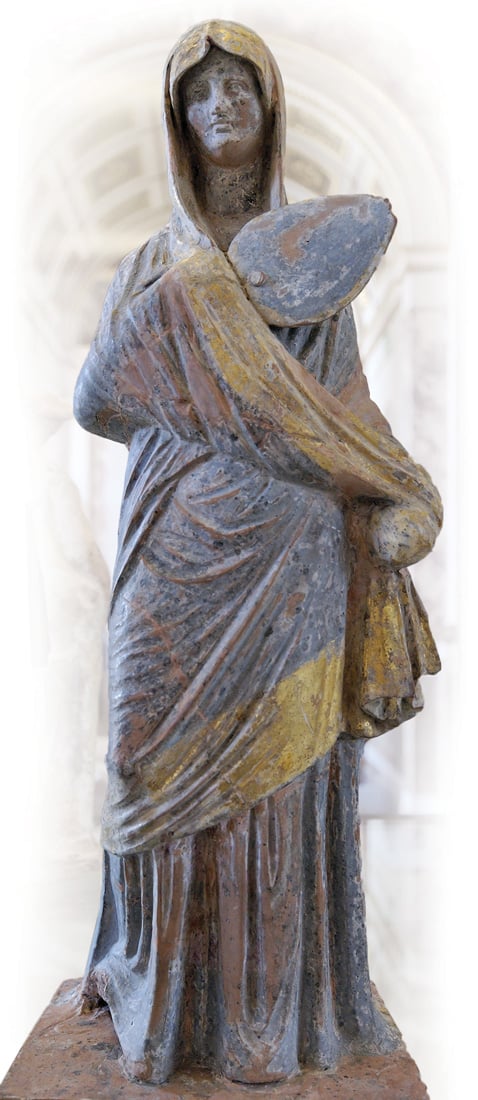
Paul wanted his churches to exhibit a modesty and propriety recognized by the surrounding culture, especially in worship (1 Corinthians 14). At Corinth he was particularly concerned about women’s reputation. For women, modest draped clothing with a head covering was common (see 1 Cor. 11:2–16), as seen here in a sculpture from 300 BC (Tanagra, Greece).
The explanation that seems most worthy of consideration takes its cue from the evidence of verse 35. The words “if they want to inquire about something” appear to point to a certain kind of speaking that was proving itself as disruptive within Corinthian worship as the unrestrained exercise of other kinds of speech and that was associated in this particular congregation with women. Perhaps it was simply the frustrated speech of wives whose soft-spoken questions were ignored by husbands, or the bolder speech of women who ignored their husbands entirely and interrupted to ask questions of the person who was speaking.
In any case, Paul’s instruction (14:34) is that such women “should remain silent in the churches.” (The Greek words here are more accurately translated “in the meetings of the church.”) “They are not allowed to speak” (in the disrespectful and disruptive way that they are doing), but “must be in submission” (to their husbands; the word “submission” is one that Paul defines for his own use in terms of respect [Eph. 5:21–33]), “as the Law says.” (Though there is no specific place in the Old Testament where such submission or obedience is commanded, this idea is indeed the presumption behind much of its content.) Instead “they should ask” their questions of their husbands at home (either before they disrupt the speaker, or before they distract their husbands and those around them). For “it is disgraceful” (see 1 Cor. 11:7, where the same Greek word is used of women who refuse to cover their heads as a sign of respect) “for a woman to speak [in this way] in the church” (14:35).
The whole section is now brought to a close with two rhetorical questions, a statement of the possibilities left open by the argument, and a final exhortation. The questions are designed to deflect the Corinthian tendency toward a sense of their own inspiration and the stubbornly prideful maintenance of unhelpful and idiosyncratic customs. The statement sets forth Paul’s expectation that any true “prophet” or “spiritually gifted” person will acknowledge the truth in what he has written (14:37). If stubborn ignorance is chosen, however, then it will also be safe to ignore the claims of such an individual to be led by the Spirit. The exhortation epitomizes Paul’s advice. The ability to prophesy should be sought eagerly, and speaking in tongues should not be forbidden. But whatever form the worship service takes as a result of adherence to these directions, “everything should be done in a fitting and orderly way” (14:40).
D. Questions about the resurrection and life in the age to come (15:1–58). Whether this final section comes in reply to reports (15:12) or tentative questions that are just beginning to be asked (15:35), its principal purpose is clear. Paul writes to defend, to clarify, and to broaden his teaching concerning the resurrection (15:1–11). From the content of the statement attributed to some of the Christians at Corinth (15:12), it seems that their attitude was being shaped by a skeptical aversion similar to that of the Athenians whose attentiveness to Paul’s preaching came to an end at his mention of the “resurrection of the dead” (Acts 17:32).
If this is so, then the crux of the issue was probably not a denial of the possibility of a life after death but an opposition (which was characteristic of Greeks and, on occasion, of Jews living in a Greek environment) to the notion of a bodily resurrection and the preference for an idea of immortality of the soul. Added to this was likely a remembrance that when Paul had originally spoken about the resurrection, he had done so with words about believers already being “raised with Christ” (Eph. 2:6; Col. 2:12; 3:1; in contrast, 2 Tim. 2:17–18). In response, Paul seeks to demonstrate the validity of the idea of bodily resurrection (15:1–11), its necessity (15:12–19, 29–34), its futurity (15:20–28, 51–58), and its nature (15:35–50).
Paul begins by reminding the Corinthians “of the gospel I preached to you,” which they received, in which they have placed their trust, and by which they are saved if they continue to “hold firmly” to their faith in its truth. For otherwise, if initial acceptance gives way to confirmed disbelief, they will “have believed in vain” (15:1–2).
The content of Paul’s preaching is now crystallized in a creedal form that is introduced with the same technical terms for the careful transmission of tradition as were used before to demonstrate a link between Paul and others who provided sure access as witnesses to the events that are now described. The contents of this very early creed are composed from the facts of Jesus’s death, interpreted (with probable reference to his teaching [Mark 10:45] and the scriptural figure of the Suffering Servant [Isa. 53:12]) as a death for our sins, burial (which meant he had actually died [Mark 15:44–46]), resurrection (which took place when God raised his Son in accordance with the Scriptures [Acts 2:24–32]), and appearance after death (“to Peter” [Luke 24:34]; then to the Twelve [as a group, not a number; Luke 24:36]).
The creed (whose elements are all joined to one another by the repetition of the word “that”) is now supplemented by additions. They provide evidence for an appearance of the risen Christ to more than five hundred (15:6; otherwise unmentioned in the New Testament), to James (15:7; accounting apparently for his conversion and rapid rise to leadership in the Jerusalem church [Mark 3:20–21; John 7:5; Acts 12:17; 15:13]), to all the apostles (an appearance distinguished here from that of 15:5; cf. Acts 1:3), and last of all (in time only, not in importance) to Paul (in an appearance so long after the others as to make Paul an apostle “abnormally born”; see also Acts 9:5).
Nonetheless, though least among the apostles and undeserving of the title because, unlike the others, he had persecuted the church of God (15:9; Acts 9:1–2), Paul was still called by divine grace, which is “not without effect,” to do the work of an apostle. In response, he expended more effort in travel and ministry and reaped more success (because of the “grace of God that was with me”) in the founding of churches than any other (15:10). So whether the Corinthians wish to view Paul’s preaching, or that of those whose witness formed the tradition behind his preaching, as the source for their knowledge of Jesus’s death and resurrection, it makes no difference to the content of the gospel or the substance of their faith.
Paul next points out the implications of unbelief (15:12–19). The Corinthians had been reminded that the resurrection lay at the heart of the gospel that was proclaimed to them. But was it necessarily the center, or did the call to a spiritual life in union with the risen Christ demonstrate that, unlike Christ, Christians were called to be those who pursued and received spiritual immortality rather than resurrection from the dead? Some such question appears to have led various persons within the church to deny any connection between the fact “that Christ has been raised from the dead” and their idea “that there is no resurrection of the dead” (in general; 15:12).
But the disjunction is a false one, for if in fact there is no such thing as a “resurrection of the righteous” (Luke 14:14; Acts 24:15), then there is no reason to believe in the anomaly of Jesus’s resurrection. But if he “has not been raised,” then both to preach and to believe the resurrection is “useless” (15:14). Worse, such preaching would be tantamount to bearing “false witness” about God’s actions. “For we have testified about God that he raised Christ from the dead,” and that cannot be true if “the dead are not raised” (15:15–16). Worse still, if Christ has not been raised, then apart from God’s vindication made evident by the resurrection, faith in Christ’s death as the sacrifice for our sins is futile, and those who have fallen asleep, or died, believing in Christ as their Savior “are lost” (15:18). Worst of all, if Christians have only a false hope in Christ for any life beyond the present, then “we are to be pitied more than all men” as self-deluded (15:19).
In fact, however, such consequences need be explored no more, as Paul gives the implications of a true understanding (15:20–28). “Christ has indeed been raised from the dead, the firstfruits of those who have fallen asleep” (15:20). By the term “firstfruits,” Paul means to signify the first produce of a harvest. Such produce possessed special representative significance as a sign of what might be expected from the crop and was to be presented to God in the temple (Exod. 23:19). The thought of Christ’s resurrection as a representative event triggers the comparisons that follow between Christ and Adam as representative persons. For just as death came into the world through a man whose actions were truly representative of the harvest of sin and death that has become characteristic of all who have come after him, so now the resurrection of the dead has come through a man whose destiny his progeny can also fully expect to share. For inasmuch as all who are united with Adam by birth and by sin die, all who are united with Christ by rebirth and faith will, like him, be made alive.
“But each [will be made alive] in turn”—first Christ, then “those who belong to him” at his coming (15:23; 15:52; 1 Thess. 4:14). Then “the end will come,” the time when Christ hands over to the Father his kingly rule over all those who believe in him (15:23–24). This will not happen, however (Ps. 110:1; Mark 12:36; Acts 2:34–35), until all the other forces that exercise an alien power over Christ’s people have been destroyed, including the last such enemy, which is death. But when all these have been destroyed, the God who has put them all under Christ’s feet (Ps. 110:1; cf. Ps. 8:6) by destroying their power must not be expected to subject himself to Christ. Rather, just the opposite will happen. “The Son himself will be made subject” (or perhaps, as is suggested by the Greek, he “will subject himself”) to the Father, who has given him his kingly authority so that God may be recognized as the true source of “all” that has happened “in all” these events (15:28).
A series of rhetorical questions presses home the practical implications of Paul’s argument (15:29–34). The first, however, certainly raises more questions for us than simply the one asked. It is surely relevant to point out that there is no value in being “baptized for the dead” if the dead are not raised (15:29). But when and where was such a baptism practiced, and why? Paul’s words most naturally suggest a baptism undertaken by Christians for Christians who died in faith without having been baptized, because of a deathbed conversion. Or perhaps they refer to some who converted and were baptized in order to be reunited with their dead Christian loved ones. In any event, Paul does not recommend the practice but only states that it takes place.
Paul’s own life is the subject of the next question. For if there is no resurrection, then to repeatedly “endanger” one’s life on behalf of the gospel is foolish (15:30). Why expend the effort that brings him unnecessarily closer to death every day? And what possible benefit could there have been in allowing himself to be put in the arena with “wild beasts” at Ephesus for the cause of Christ (an event otherwise unmentioned in the New Testament)? For if the dead are not raised, then it is much more prudent to enjoy the pleasures of life for as long as possible (15:32; Isa. 22:13).
As they reflect on their answers to these questions, the Corinthians are not to be “misled” by the opinions of those outside the church, for as even the pagan playwright Menander said, “Bad company corrupts good character” (15:33). Instead of a life lived in sin, which results from an excessive pursuit of the pleasures of the body, prompted perhaps by the notion that a spiritual union with Christ after the death of the body is assured, the Corinthians are called back from such shameful ignorance of the truth to the Christian use of right reason.
The argument could certainly have been ended at this point, but a question about the nature of the resurrection prompts further discussion (15:35–50). If there really is a resurrection, “How are the dead raised? With what kind of body will they come?” (15:35). The second question explains the sense of the first. The Corinthians are not asking about the way in which God’s power could make possible a resurrection but are questioning the implications of the idea. To ask the latter question, however, is foolish if the former is already answered with reference to God. The use of analogy will demonstrate this.
Paul begins with a biological analogy in common use among rabbis of the first century (John 12:24). A seed that is sown does not come to life in the form of a plant unless its first form, its bodily shell, dies. Furthermore, the form of the seed that is sown says nothing about the nature of the plant that will sprout.
The form of the seed and that of the plant differ because God gives the latter a bodily form according to his own plan, and that he is able to do this is demonstrated repeatedly in the present by his power to give each kind of seed its own body. Similarly, divine activity in the present also explains why “all flesh is not the same” (15:39). But just as “earthly bodies” now manifest God’s splendor differently than do “heavenly bodies” (15:40), “so will it be with the resurrection of the dead” (15:42).
The body that now displays God’s glory is perishable. The body that will be raised will display God’s glory in an imperishable form. The body whose glory is now partially obscured in the dishonor of sin and death will be raised to reflect fully and completely God’s glory. The body that dies in weakness will be raised to share in the power that comes from God himself. And finally, most comprehensively, the one who dies in a “natural body” will be raised to life in a spiritual body (15:44a; note, however, that it is still a body, which is both like and unlike ours).
Thus the plausibility of a spiritual body, and something of its nature, is demonstrated from the fact of a “natural body” (15:44b). It may also be demonstrated from Scripture. For in the same way that Adam as a living being represents the first of his species, so Christ, the last Adam, as a spiritual being, gives life to a new race of persons whose bodily form is now represented only by his own. The point, however, is that full spiritual existence in a glorified body does not come until natural existence in a physical body is ended. But when it does, we shall share in the same kind of spiritual existence as our Lord, as surely as we now share in the same kind of physical existence as Adam. And the resemblance will extend even to our appearance.
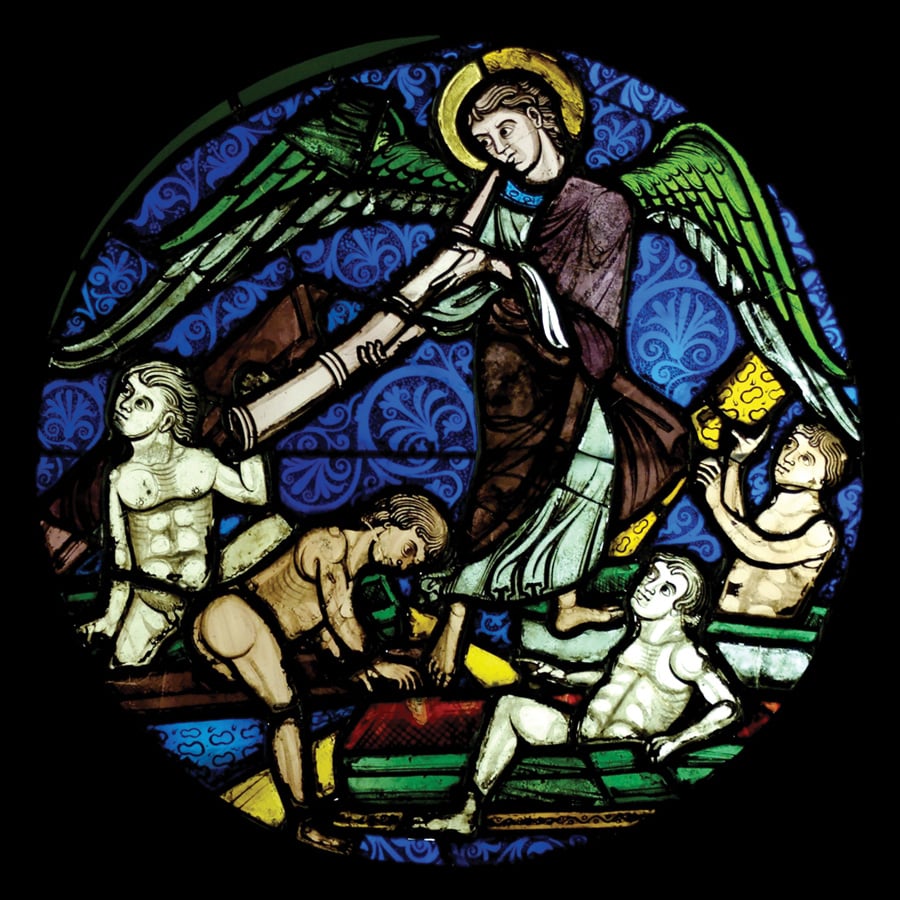
First Corinthians 15:52 says, “For the trumpet will sound, the dead will be raised imperishable, and we will be changed.” This stained glass window (Sainte-Chapelle, Paris, ca. 1200) portrays the resurrection of the dead at the trumpet’s sound.
But if the end of our natural life is a prerequisite to the transformation that allows our participation in the eternal kingdom of God, then what will happen to those who are left alive at the time of Christ’s coming and this world’s demise? The answer is part of the mysterious wisdom of God’s plan. “We will not all sleep, but we will all be changed” (15:51). In the same moment that the dead are raised, those who are alive will also be changed. Their perishable physical existence will be cloaked by the imperishable existence and immortality of a body transformed by God’s power, just as with those who have died and been resurrected.
And so the prophetic words of Isaiah 25:8 and Hosea 13:14 will be fulfilled. For, together with those who have been resurrected, those who have not passed through death and resurrection and yet have been transformed will also be able to celebrate their victory in Christ over the sting of death (15:54–55). For death’s power over a sinful humanity has been destroyed by Christ, and he gives to all his own, whether living or dead, his victory over death in which they may gratefully share. Consequently, Paul encourages the Corinthians to remain true to their trust in Christ’s promise to share with them his victory over death and to devote themselves fully and without fear to the work of the Lord (15:58).
E. Questions about the collection and Paul’s plans (16:1–9). A final Corinthian question remains about “the collection for God’s people” (see also Rom. 15:25–28; Gal. 2:10). From the content of Paul’s reply, their questions seem to have been more concerned with the nature and timing of their own participation than with the collection itself or the rationale behind it. The Corinthians are advised to do as Paul has already directed the “Galatian churches” to do. (Paul’s reference must be to a message sent orally or in writing; the Letter to the Galatians contains no explicit reference to the collection or directions for contributors.) Each person is to save up a weekly contribution “in keeping with his income.”
Paul neither specifies a level for the gift nor directs that it be collected and held by the church but asks simply that it be set aside weekly in order that he may not have to make a special appeal and so work a special hardship on any member of the church at the time of his arrival. When he arrives, he will give those appointed by the church the appropriate letters of introduction and “send them with your gift to Jerusalem” (16:3; Acts 20:4). Whether Paul will accompany them himself is uncertain as he writes this letter (though it seems almost certain that he did, and that the collection is the reason for a journey to Jerusalem [Acts 20–21]).
Paul now coordinates the instructions for the collection with his own plans. At this point (though as 2 Cor. 1:15–17 indicates, his plans were modified), Paul’s hope is to come to Corinth after passing through Macedonia, to stay at Corinth (perhaps even for the winter), and then to continue his journey wherever that may take him. But he does not intend to begin his journey or leave Ephesus (from where this letter is written) until Pentecost; the opportunity for ministry, despite opposition, is simply too great to be abandoned too quickly (16:8–9).
4. The Recommendation of Others (16:10–18)
Paul’s response to the Corinthians’ questions is now concluded, but his mention of his own plans leads him to relay to his readers what news he has of other persons with whom he and his readers are acquainted. They can expect a visit from Timothy, and when he arrives, they should give him no cause for fear to act and speak openly. Instead, they are to overcome his fears with their acceptance of his ministry and send him back to Paul in peace. (Whether “the brothers” mentioned here are traveling with Timothy or waiting for him with Paul is uncertain.)
Next Paul writes to the Corinthians about Apollos. Paul has indeed seen him and strongly urged him to visit them again (whether on his own initiative or at the Corinthians’ request is unclear). But, at least at the time Paul last saw him, “he was quite unwilling to go,” and so they must not expect him until a later opportunity presents itself. (Whether Apollos ever returned to Corinth is not known.) Perhaps, however, it is not too much to conjecture that the words of exhortation that immediately follow are meant to reflect Apollos’s agreement with the substance of Paul’s letter and his own greeting to the church.
Third, Paul commends to his readers those from the household of Stephanas, the first converts in Achaia. They have devoted themselves to the service of the Lord’s people and consequently deserve the same submissive respect as others from outside the church who function as teachers and leaders or anyone else who “joins in the work, and labors at it” (16:16).
Finally, Paul conveys to the church that Stephanas, Fortunatus, and Achaicus have arrived, and he gladly commends their service in supplying him with the information that has allowed him to respond more fully to the church’s needs. Such men “deserve recognition” for their ministry of keeping the apostle and the church in touch with one another (16:18).
5. Final Greetings and Formal Closing (16:19–24)
As in the opening of this letter, Paul now reverts to the elements that were customary in the closing of a letter in his era. First are closing greetings sent by Paul and by others. The others mentioned include “the churches in the province of Asia” (among which Paul is now working), Aquila and Priscilla (who earlier hosted Paul and worked alongside him in his initial mission in Corinth, departing and journeying with him to Ephesus, where they chose to remain), “the church [at Ephesus] that meets at their house,” and “all the brothers” (either the rest of the Ephesian believers or Paul’s fellow workers in the Ephesian ministry—in either case the word must be understood as a generic rather than a gender-specific term). The warmth of their greeting to the Corinthians is to be conveyed symbolically with the Corinthians embracing one another in the way that these others would embrace them if they were present. Paul’s final greeting in his own hand serves a double purpose: authenticating this letter as his own (Gal. 6:11; Col. 4:18; 2 Thess. 3:17) and indicating that it was probably composed, as was customary, by dictation (Rom. 16:22).
Next, again as was usual, one finds a final short message. Originating perhaps as part of an early Christian worship service (in which the response to the words found here may have been, “If anyone loves the Lord, let him be blessed”), these words seem meant to remind the readers that in the end “love for the Lord” (RSV) is the paramount quality of Christian faith and as such should unite all believers. Similarly the cry “Come, O Lord” (reflecting the Aramaic expression marana tha) is also probably cited from the liturgical context of worship that was meant to unite all believers.
Finally, as was normal, a formal closing concludes the letter. Paul’s closing ends the letter as it began—with the recognition of God’s grace given in Jesus and with the conveyance of his own abiding love for all in Christ.
Commentary for 2 Corinthians
1. Epistolary Introduction (1:1–11)
Paul again opens his letter with a customary greeting (see 1 Cor. 1:1–3). After naming himself as the sender of the letter together with Timothy, he describes himself to the church in words almost identical to those used in his earlier letter. The letter’s address indicates that Christians elsewhere in Achaia, probably principally at Cenchreae (Acts 18:18; Rom. 16:1) and Athens (Acts 17:34), have been affected by the recent affairs in the church at Corinth (likely the largest in Achaia). The salutation concludes with Paul’s usual Christian greeting.
Thanksgiving typically follows the greeting (see 1 Cor. 1:4–9), but Paul’s thanksgiving here is not given over to God for his grace and love at work in the church. Instead, Paul praises God for his comfort made manifest in a particular experience of suffering in Paul’s life. The experience itself, which he compares in kind to the “suffering of Christ” as one involving distress, “hardships,” “great pressure,” despair, the imminence of death, and “deadly peril” (1:5–10), remains unmentioned (perhaps indicating that the Corinthians knew the facts well enough, including the part their own failure to honor Paul and his gospel had played in the apostle’s sufferings). Paul chooses rather to extol the “Father of compassion and the God of all comfort” (1:3), from whom he has received the strength to sustain himself in suffering.
Furthermore, precisely because of his experience, which forced him to rely exclusively on God in a situation in which he had given himself up for dead, Paul has become uniquely equipped to minister to “those in any trouble,” bringing to them the “comfort we ourselves have received from God” (1:4). In the light of his own experience, Paul seeks to minister comfort and conciliation to the church at Corinth, and he begins by asking for their prayers.
2. Paul’s Explanation of His Conduct in Recent Matters (1:12–2:13)
A. The basis for Paul’s behavior and an appeal for understanding (1:12–14). Having asked for their prayers, Paul next appeals to the Corinthians in conciliation to reassess their estimation of him and his ministry. Boasting and the kind of criticism that belittles one in order to exalt another had consistently troubled the church and severely complicated its relationship with Paul (1 Cor. 3:21; 4:7; 5:6). Such boasting and criticism were also no doubt responsible in large measure for the pain that Paul had experienced on his last visit to Corinth, pain which led him, in turn, to compose a letter that struck back severely in anguished self-defense (2 Cor. 2:1–4).
But now Paul seeks to clear away the selfish boasting of the past and to make a boast in which he invites the Corinthians to share, a boast in the Lord. In conduct, Paul has always sought to relate to the church “in the holiness and sincerity that are from God” (1:12a). In speech and writing he has similarly shunned the attempt to present a wisdom that invites comparisons between his message and those of others, in favor of a simplicity of thought and advice rooted in “God’s grace” (1:12b–13). It is Paul’s hope, therefore, that the Corinthians will come to understand that the only boast to be made among Christians is a boast that unites them with their leaders, a mutual boast in God’s holiness, sincerity, and grace at work in their lives.
B. The cause for Paul’s change of plans (1:15–2:2). In 1 Corinthians 16:2–8 and at the beginning of this section (1:15–16) are found two different itineraries relating to Paul’s plans to revisit the Corinthian church. However, as 2:1 indicates, neither plan was carried through. Thus, it appeared as though Paul was at best not truly concerned with his relationship to the church and at worst a fickle person who made promises “lightly” (1:17) and constantly went back on his word.
Once more Paul meets this obstacle to reconciliation squarely and clarifies the reasons for his conduct by relating his actions to the conviction he shares with the Corinthians concerning God’s faithfulness. Paul, Silas, and Timothy preached Christ with consistency in such a way as to emphasize that all God’s promises were faithfully fulfilled in him. No matter their number or the length of time taken in mercy to bring them to fulfillment or the manner, expected or unexpected, in which they are fulfilled, the eventual fulfillment of God’s promises demonstrates his glorious faithfulness. Those who are in Christ place their hope for what is yet to come on this kind of faithfulness, demonstrated especially in the receipt of the Holy Spirit.
But it is also just this kind of faithfulness that has motivated Paul to change the manner in which his plans should come to pass. Not out of a faithless, fickle sense of self-importance, but out of a merciful desire not to grieve the church (2:2), Paul has changed his plans; his desire is to work with the Corinthians rather than to act based purely on his own original agenda (1:24). This goal has led Paul to set aside his previous plans and to work out a different schedule for their eventual fulfillment.
C. The purpose of Paul’s last letter (2:3–11). As a part of his altered agenda, Paul wrote a third letter to the church (for reference to the first, see 1 Cor. 5:9; the second is our canonical 1 Corinthians), the purpose of which he now seeks to explain. It was written so that on his next return to Corinth he might not “be distressed by those who ought to make me rejoice,” in confidence and trust that such distress could be avoided so as to produce a joyful visit for all (2:3). But in order to achieve its end, Paul’s letter had first to deal openly and honestly with the source of the problem. To write such a letter was certainly not easy, for its purpose was not simply to rebuke but to share with the church the anguish of an unrequited love.
The letter seems to have achieved its intent (2:9), and with reconciliation now possible, Paul hastens to make sure that it is accomplished. He urges the cessation of the punishment inflicted on the individual who opposed his authority, causing distress both for Paul and for the church, and counsels forgiveness, granting it freely himself in concert with the rest of the church (2:5, 7, 10). Then, with particular pastoral sensitivity to the needs of the offender as well as those of the body and himself, Paul encourages the community not only to forgive the offender but also to comfort him and to reaffirm its love for him. This they should do lest he be “overwhelmed with excessive sorrow” and the discipline that was meant to be remedial become simply retributive, thus allowing Satan yet another entrance into the situation (2:7–8, 11).
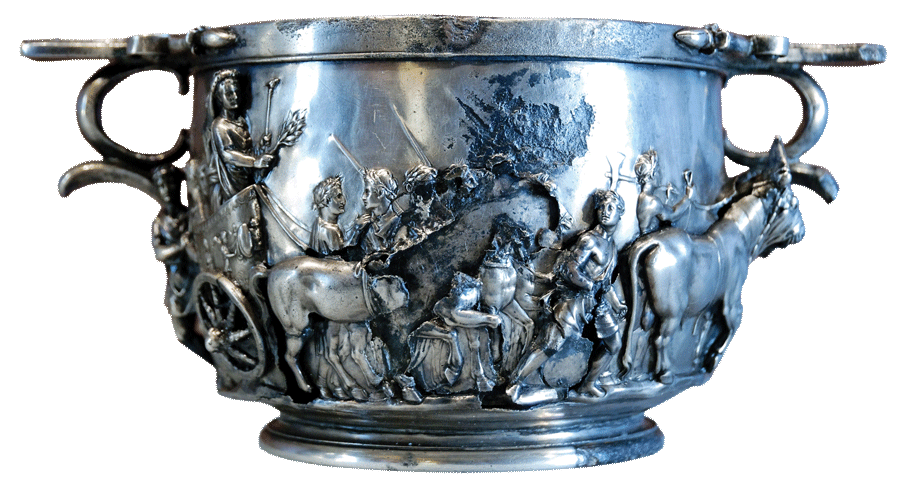
A “triumphal procession” (2 Cor. 2:14) was the conclusion to a military victory when the conquerors returned home. This first-century-AD chalice displays a procession by the emperor Tiberius.
D. The motive for Paul’s movement from Troas to Macedonia (2:12–13). In this, the final segment of Paul’s explanation of his recent conduct, he seeks to acquaint the church with events in his ministry from the time of his last letter until the present moment of composition. In all probability Paul’s “painful” letter had been dispatched to Corinth with Titus from Ephesus. But from there, before receiving a reply, Paul departed to Troas. Despite the open door for the gospel of Christ that presented itself to Paul in Troas, he had been unable to feel at peace without news from Titus, and so in an attempt to meet Titus on the route of his return, he had gone on to Macedonia.
3. Paul’s Reflection on His Ministry (2:14–5:21)
A. The source and character of Paul’s ministry (2:14–3:6a). Surprisingly, the conclusion to the account of Paul’s anxious attempt to meet the returning Titus is not immediately related. Instead, we are made to wait until 7:5 to receive the conclusion of the narrative. In the interim, Paul gives us the opportunity to share in some of his own reflections on the nature of his ministry. The catalyst for these reflections is clearly the relationship between Paul and the church at Corinth in general, and the return of Titus to Paul with news of his recent visit to Corinth in particular. But in their breadth and scope Paul’s words within this section describe, perhaps better than any other part of the Pauline correspondence, the apostle’s own sense of mission and ministry.
Paul begins his reflections, accordingly, by giving thanks to God, for in its essence his apostolic ministry is simply a part of “Christ’s triumphal procession,” which is directed and guided by God (2:14). The verbal imagery used here is intended to allude to a Roman triumph, a procession carefully orchestrated by a Roman military commander to display the results of a significant military victory. As a part of some of these processions, fragrant spices, perfumes, and incense were used along the way, and it may be that this inspires the description of Paul’s ministry as a conveyance for the aroma of Christ. The image, however, is mixed here with another drawn from the Old Testament (where a pleasing aroma is said to result from a ritual sacrifice [Lev. 1:9, 13, 17]). The aroma of Paul’s ministry, as a part of the aroma of Christ, can be said to ascend to God at the same time that it diffuses among men and women, both those who are being saved and those who are perishing (2:15–16a; 1 Cor. 1:18).
To be the bearer of an aroma so potent as to lead to life for its recipients and death for those who reject its fragrance is a heavy responsibility. To be “equal to such a task” seems overwhelming (2:16b). But, at the same time, it is important to Paul to note that, unlike many who “peddle the word of God for profit,” he has made a conscientious attempt to bring himself to the task with sincerity and a sense that the proclamation of the gospel is always made before God as well as a human audience (2:17).
His words, however, in the context of the competition for ecclesiastical leadership that had been going on at Corinth (1 Cor. 1:12; 2 Cor. 10:1–13:13), needed careful clarification on two counts. First, there was the possibility that they might be read by some as a purely subjective self-commendation, and second, there was the likelihood that they might prompt an immediate comparison between Paul and others who carried formal letters of recommendation.
Paul takes up the latter point by first claiming the Corinthians themselves as the recommendation for his ministry (3:2). And unlike a letter that Paul or anyone else might write, the testimony commending the faithful work of the apostle has been permanently written by the Spirit of the living God in their lives. Then, moving back to the former point, Paul reminds his readers that his confidence is a product not of self-analysis but of his relationship with God through Christ. Therefore, only God can give persons the competence that makes them equal to the task of functioning as ministers of a new covenant.
B. The message of Paul’s ministry (3:6b–4:6). But, as is so often the case in Paul’s writings, the terms that are used to conclude one argument lead inevitably to the opening of another. (This is also commonplace in Jewish literary style in general.) Here the mention of a new covenant (see Jer. 31:31–34) inspires a transition in thought from discussion about the source and character of Paul’s ministry to a consideration of its message. Paul presents it in terms of a comparison between the ministry that carried as its essence the written covenant “of the letter” (Exod. 24:3–8) and the ministry that proclaims the new covenant of the Spirit (the nature of the comparison suggests, as does 11:22, that the distress in the church at Corinth has come from some who pressured the whole of the church toward a strict allegiance to the law and customs of Judaism).
The comparison does not proceed, however, by way of deprecation, describing the latter ministry as glorious and the former as inglorious. Rather, Paul makes a comparison between the recognized and authentic “glory” of the former covenant (3:7, 9a, 11a) and the “surpassing glory” of the latter (3:8, 9b, 10, 11b). The argument is strengthened by allusion to the account of the gift of the law (Exod. 34:29–35). Paul provides an interpretative commentary on the meaning of this passage, inferring from the Septuagintal text that the glory radiating from Moses’s face when he brought the gift of the law down from the mount was a fading rather than a permanent possession, one perpetuated only by Moses’s frequent reentrance into God’s presence. The glory of Moses’s ministry in bringing to Israel the covenant of the law was therefore real but transitory. The glory of Christian ministry in proclaiming the new covenant is greater, for it “lasts” (3:11).
In this context of comparison Paul proceeds to set forth a contrast between the two ministries, a contrast between the effect of the “letter” and that of the Spirit (3:6). The contrast, however, is marked. For the letter, being lifeless, had no power to effect the way of life it commanded, and consequently it became that which “condemned” and “brought death” rather than life (3:7, 9). But the Spirit, a living and active part of God’s being, has precisely that power which the law lacked, the power that effectively “brings righteousness” (3:7; not only a knowledge of righteousness) and gives life. Thus the conclusion follows by contrast, as well as comparison, that a ministry in service of the new covenant surpasses one in service of the old.
This perspective on the value of Christian ministry then motivates Paul to bold proclamation. He has put no veil on his message in an attempt to shield the surpassing glory of the gospel from his fellow Jews (as had Moses, who had hidden the glow of God’s glory behind a veil [Exod. 34:33–35]). Instead, it was quite the other way around. If Paul’s message was veiled, that was only because the law and its traditional interpretation (given “when the old covenant is read”) had veiled and dulled Jewish minds to the truth of the gospel. But, as experience has shown, whenever they turn to the Lord, that veil “is taken away” (3:16; Exod. 34:34), and it is removed (according to Paul’s interpretation of Exod. 34:34) under the inspiration of the Spirit. For the Spirit brings freedom from the systematic adherence of Judaism to the law and its traditional interpretation; the Spirit actually enables the transformation of existence that was the intention behind the letter of the law (3:17–18).
And so, transformed “through God’s mercy,” Paul has been given the ministry of bearing the message that transforms its recipients. Because he has been sent from God, his proclamation can embrace neither “deception” nor the distortion of anything that God has said in the past (4:2). Thus, where the message remains obscure, one may be sure that such obscurity is not a result of the proclamation but a result of the work of the enemy, the god of this age (cf. John 12:31), who has blinded the minds of those who persist in unbelief to the light of the gospel. Neither can the proclamation promote its bearer but only its subject, Jesus Christ, the Lord who is the very image of God (and therefore the true and second Adam, the beginning of a new creation [see 2 Cor. 5:17]). Only through Christ can the full light of God’s glory become known.
C. The cost of Paul’s ministry (4:7–5:10). A change of metaphor signals the beginning of a new thought, though it is closely related to all that Paul has just said. For the light of the gospel may also be described as that which has been placed within the minds and hearts of its human bearers as a treasure placed within “jars of clay” (cf. Matt. 13:44). The power that transforms belongs to the treasure, not to its receptacle. But the receptacle, though remaining frail, is itself measurably changed by its contents.
Abandoning metaphorical language, Paul proceeds now to describe the change that has come about since the placement of the treasure within him. It is not a change in the conditions or circumstances of his life (for pressure and perplexity continue to be a part of his experience, together with persecution and physical beatings that have come more recently, since the beginning of his ministry). Instead it is a change in the attitude and fortitude of the apostle, which has enabled him to bear suffering and even to triumph in the midst of it.
For the power of the treasure is clearly “revealed” through the weakness and frailty of its mortal receptacle (4:10–11). So even while death is at work on Paul, “life is at work” through him for the “benefit” of those to whom he ministers, and this provides Paul with compensation for the cost of his ministry (4:12, 15). Moreover, a sure confidence provides Paul with further compensation. It is the confidence that even should death prevail, “the one who raised the Lord Jesus from the dead will also raise us with Jesus and present us with you in his presence” (4:14). Such compensatory thoughts, kept ever more securely in view because of the inexorable renewal of his inner self, prevent Paul from despair and provide him with a new perspective on his present afflictions.
Paul, of course, has spoken to the Corinthians before about the hope of resurrection, but now he sees an opportunity to develop his thoughts further. So, in a passage that has given rise to a wealth of interpretation, Paul proceeds to reveal what he expects for himself beyond death. He employs a metaphorical description of the body as an earthly tent (5:1), in terms of his own experience (Acts 18:3) and the cultural background of his audience (the physical body having been described as a “tent” in Greek literature since the time of Plato and Pythagoras).
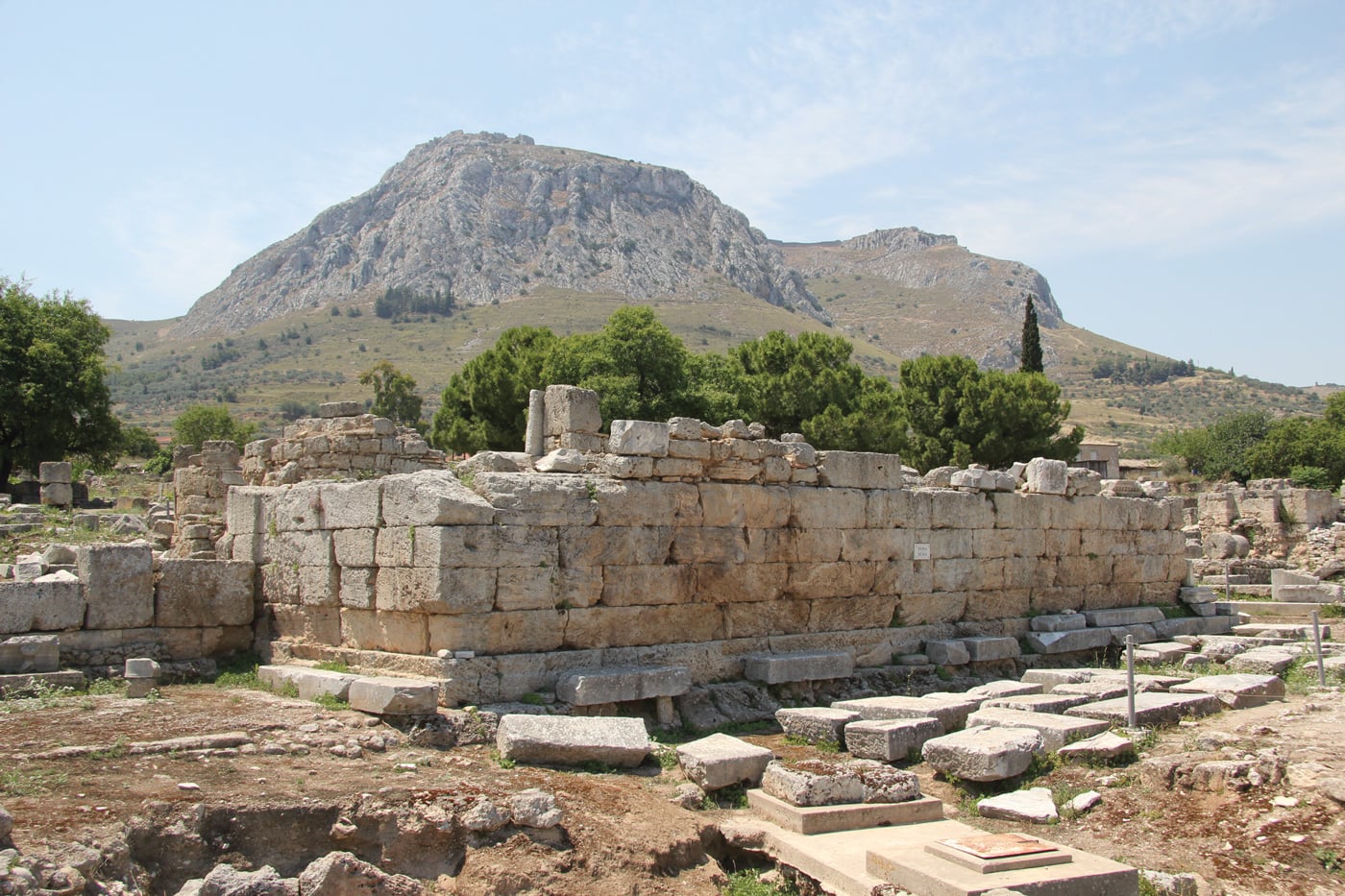
This stone structure found in Corinth was known as a bema, or speaker’s platform. It was where orators spoke and officials made their formal judicial rulings. When Paul refers to the “judgment seat” (Greek bēma) of Christ (2 Cor. 5:10), this may have been the image he held in mind.
Paul begins by restating his confidence (built on the experience of Christ) in the reality of the resurrection (5:1; cf. 4:14; 1 Cor. 15:4, 12–20). Then, taking his teaching one step beyond its formulation in 1 Corinthians 15:35–53, Paul attempts to explain more fully how our earthly tent will be transformed like that of our Lord into “an eternal house in heaven” (5:1; cf. John 2:19–22) to become “our heavenly dwelling” (5:4). The transformation will take place when our bodies receive a new “clothing” (5:2; see also 1 Cor. 15:53). But rather than suggest that such a “clothing” implies the death of the mortal body and the “unclothing” of the immortal soul (a view that appears to have been favored by some at Corinth [5:3; 1 Cor. 15:12, 35]), Paul asserts that the “clothing” process of resurrection takes place when our current “clothing” is “overclothed” “so that what is mortal may be swallowed up by life” (5:4). “For this very purpose” God created both the body and the soul: not for the destruction of either but for the redemption of both. For this reason also the Spirit of the immortal God has already entered our bodies, as a “deposit guaranteeing what is to come” (5:5).
Thus Paul is “confident,” as one who lives by faith and not by sight, that when at last he leaves his home in the body, he will be transformed in a way that will allow him to be at home with the Lord. But then as now the “goal” will be to give the pleasure of a returned love and service to the Lord who loved us and laid down his life for us. Against the standard of his love for us the adequacy of our response will be measured (5:6–10).
D. The perspective of Paul’s ministry (5:11–21). Paul’s mission proceeds with these expectations, and as they are known to God, so now they have been made known to God’s people at Corinth. In making his hopes and fears known, however, Paul is not “trying to commend” himself, but only sharing with the Corinthians in a way that will allow them to take the measure of his apostleship in truth apart from appearances. For all that Paul has done has been in response to the compulsion of Christ’s love, demonstrated in Christ’s willingness to die for all and include all in his death (5:14; cf. Rom. 6:5–11; 1 Cor. 15:22; Gal. 2:20; Col. 3:3). No longer then can those who belong to Christ live for themselves; they must live instead at the direction of “him who died for them and was raised again” (5:15).
Furthermore, if Christ has died for all, then a purely human perspective can no longer form the basis for judgments about the worth of his actions or the value in his plan for any man or woman. Anyone who is in Christ (i.e., who belongs to him through incorporation into his body) has already become a part of a new creation (i.e., a part of the transformation of human existence that has begun in Christ and will culminate in the re-creation of heaven and earth [Rom. 8:19–23; 1 Cor. 15:22; 2 Pet. 3:10, 13; Rev. 21:1]). They have passed beyond the point of living solely as a part of the old creation (though a part of that which is “old” has been left both within and without, in our bodies and our world) and have begun to live as a part of the new created order.
Moreover, the source of such new creation is God, whose work, as in the creation accounts of the Old Testament, forms the decisive beginning for it. For “God was reconciling the world to himself in Christ” (5:19; the order of words within this Greek clause is ambiguous and has produced a variety of translations). The achievement of the work, however, depended on Christ. For the new creation was allowed to proceed without counting the “sins” of the old only because “God made him who had no sin to be sin for us” (5:19, 21). And now the extension of the work rests on those to whom have been entrusted the ministry and the message of reconciliation. For God has chosen to extend his work in Christ through “Christ’s ambassadors,” through them making his appeal to be reconciled to God to those who do not yet participate in the new creation (5:20).
4. Paul’s Appeal to the Corinthians (6:1–13:10)
A. An appeal for complete reconciliation (6:1–7:4). As one of “God’s co-workers,” chosen to bear the message of reconciliation, Paul now presents the Corinthians with the first in a series of appeals, urging them “not to receive God’s grace” in vain (6:1). In context these words seem meant to spur the Corinthians to respond to Paul’s attempt at reconciliation with the church. The citation (from Isa. 49:8) and its interpretation may then be seen as reinforcement to the appeal, entreating the church to respond without delay. Paul reminds them of what he has already written in an attempt to remove any “stumbling block” that might impede the progress of reconciliation (6:3) and then seeks to persuade the church to look again at what he has done for them as one of the servants of God.
A statement summarizing the sufferings that the apostle has endured on behalf of the church now ensues. If one follows the suggestions of Murray J. Harris, the nine items are a list of general, humanly inflicted, and self-imposed trials that Paul associated with his apostleship (Harris 1976, 357). Under the first heading come “troubles, hardships and distresses” (6:4); under the second, “beatings, imprisonments and riots” (6:5a); and under the third, “hard work, sleepless nights and hunger” (6:5b).
Next comes a corresponding list of Christian virtues that have marked Paul’s apostolic ministry (6:6–7). These include “purity” (the moral uprightness that gave credence to the witness of Paul’s life and mission [1 Thess. 2:10–12]), “understanding” (which balanced the apostolic commitment to holiness among believers with a godly compassion and forgiveness [Eph. 4:32; 1 Thess. 2:7]), and the “patience” and “kindness” associated with a “sincere love” inspired by the Holy Spirit (1 Cor. 13:4). Also mentioned among the marks of Paul’s ministry are truthful speech (see also 2 Cor. 4:2; 11:31; 13:8), the power of God (Rom. 15:19; 1 Cor. 2:4; 4:20; Eph. 3:20; Jesus’s own ministry is characterized by the conjoining of proclamation and power [Luke 7:22–23]), and the weapons of righteousness (2 Cor. 10:4; Eph. 6:14).
Then, in a series of contrasts, Paul brings the paradoxical experience of the apostle fully and realistically into view. In external appearance Paul’s apostolic ministry may indeed at times have seemed to some, not the least of whom were Paul’s opponents, to be characterized by marks of ineffectiveness and failure. But Paul makes his appeal with the eye of faith, with a perspective that looks through appearances and perceives the realities of God’s power at work in his ministry.
Having “spoken freely” in an attempt to lay open his ministry before them and make himself fully vulnerable in love and “affection,” Paul brings his appeal for reconciliation to its legitimate close by entreating the Corinthians in “fair exchange” to open their hearts to his ministry (6:11–12). A part of such openness, however, entailed the church giving heed to his apostolic authority. Accordingly, in order to effect a full reconciliation, Paul urges the Corinthians not to “be yoked together with unbelievers” (6:14).
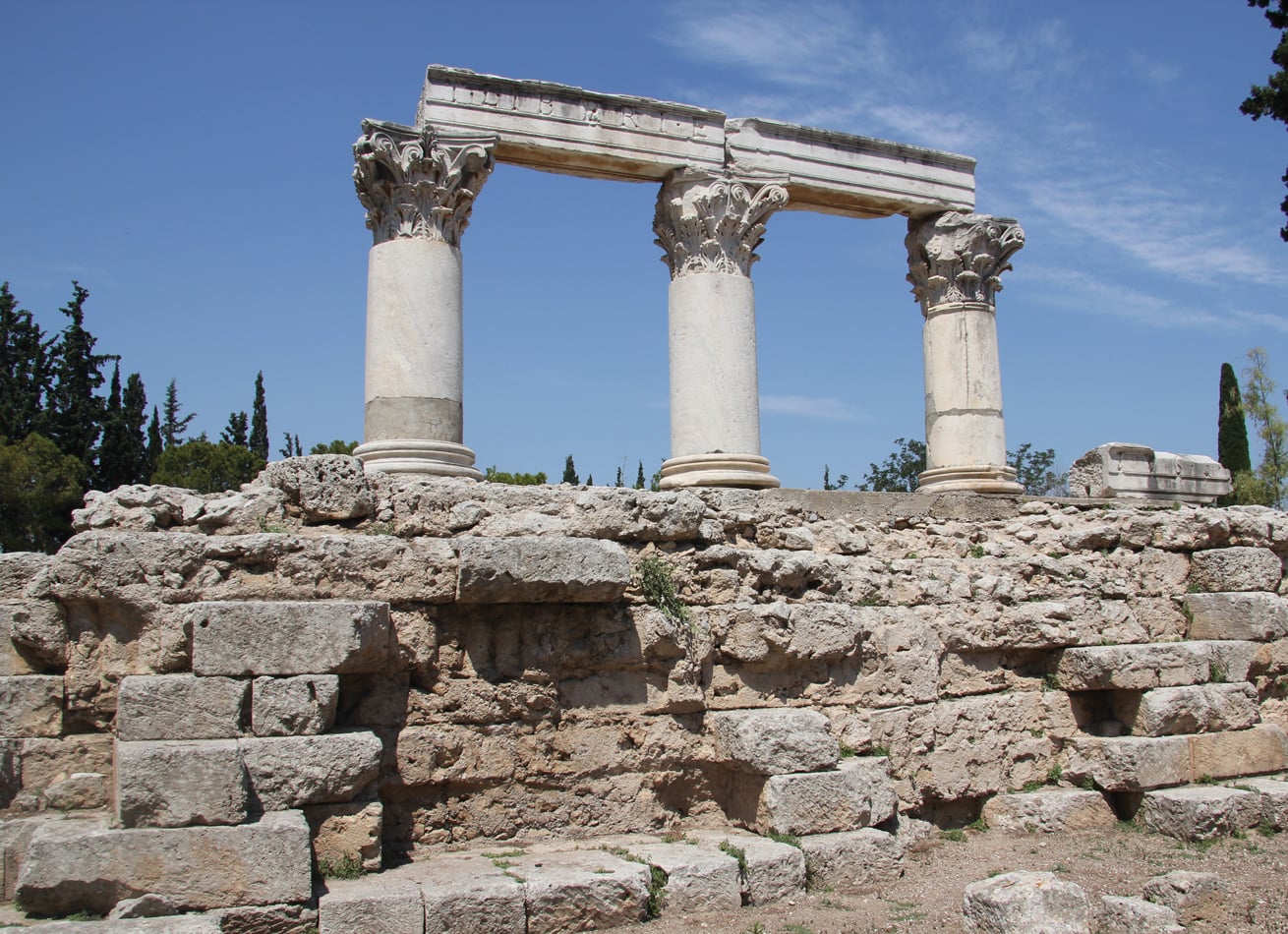
Participation in pagan idolatry was an ongoing problem in the Corinthian church (2 Cor. 6:14–7:1). The remains of the Temple of Octavia (shown here) indicate that the imperial cult had a strong foothold in Corinth.
The source for such metaphorical language is undoubtedly Deuteronomy 22:10, which prohibits the yoking together of an ox and a donkey for purposes of plowing, but the precise application intended by the apostle is elusive. Clearly all association is not forbidden, and so it is probably best to understand Paul’s injunction here to prohibit only those relationships in which the degree of association entails an inevitable compromise with Christian standards of conduct. The injunction is accordingly followed by a series of five rhetorical questions, all of which point to crucial differences between the believer and unbeliever. The fifth question epitomizes the contrast “between the temple of God and idols” (6:16), which is reminiscent of 1 Corinthians and probably represents the best clue to the apostle’s intent in this passage (see 1 Cor. 8:10–11; 10:14, 19–21).
This question also affords Paul the opportunity to reiterate that together Christians form the temple of the living God, a truth that has brought to fulfillment the divine vow that was made at various points throughout the history of Israel (Exod. 25:8; 29:45; Lev. 26:11–12; 1 Kings 6:13; Jer. 32:38; Ezek. 37:27). In light of this, Paul, adapting the words of Isaiah 52:11 and Ezekiel 20:34, 41, urges the Corinthians to separate themselves from unbelievers and from practices that involve the use of “unclean things” (6:17; his words do not refer to the separations inaugurated by Christians because of doctrinal differences). As a conclusion to this series of scriptural citations, Paul returns to the thought with which he began and underlines his principal point in personal terms. As sons and daughters (the reference to women here is noteworthy and probably reflects a deliberate attempt to speak to a congregation in which women played an active, vital, and respected part [1 Cor. 7:3–4; 11:5]), Christians belong in association with the Lord almighty, who has promised to be a Father to each of them. Simultaneously, it is necessary for all who possess such promises to keep both body and spirit free from those associations that undermine their central commitment to the holiness that shows their “reverence for God” (7:1).
Having urged upon the church actions appropriate to reconciliation, Paul concludes his appeal with a reiteration of his own readiness for reconciliation. What he has said has been to show, contrary apparently to the claims of his detractors, that no one has been wronged, corrupted, or “exploited” by Paul’s ministry (7:2). Furthermore, in making an attempt at reconciliation that urges a change in the associations of some within the church, it has not been Paul’s intent to condemn. Instead, as one devoted to their service, Paul has sought to convey his confidence and pride in their ability to conform themselves to his apostolic counsel.
B. A new basis for appeal (7:5–16). In this section Paul resumes the autobiographical narrative that was broken off in 2:13 to allow for the inclusion of the reflective apologetic of 2:14–5:19 and the appeals for reconciliation found in 5:20–7:4. The break in the narrative may reflect Paul’s desire, having heard the “comforting” news Titus brought back from Corinth, to convey to the church both his immediate and his considered reaction to their new attitude toward him. Furthermore, upon consideration, it may have seemed more important to present the latter before the former. In any case, he resumes the story as he left off, with himself in Macedonia struggling against external adversities and inner “fears” (7:5).
Within the context of such need and the humility imposed by it, God habitually acts to comfort the downcast (Isa. 40:1; Matt. 5:4; James 4:6–10; 1 Pet. 5:5–6). In his own case, therefore, Paul interpreted the coming of Titus, and the news he brought of the Corinthians’ renewed “concern” for their apostle, as a real and divinely wrought comfort (7:6–7). But it was not only Paul who had suffered through the events of the recent past. The church had also experienced remorse upon their receipt of his last letter. Thus, while it had not been Paul’s intention to inflict sorrow on those who had caused him to be sorrowful, in this instance, through God’s working, an unintended effect led to an unexpectedly quick and thorough “repentance,” leaving neither Paul nor the church with any sense of regret (7:9–10).
Quite to the contrary, the sorrow that was divinely inspired had produced an eagerness within the majority at Corinth to clear themselves and an eagerness within Paul to recognize the “innocence” that belonged to the majority of those within the church (7:11–13). Moreover, Titus himself had been uplifted and had become enthusiastic in his “affection” for the congregation (7:14–15). Such an unexpectedly rich outcome from a letter sent with such hesitation was indeed an occasion for gladness and for an expression of renewed confidence in the church’s ability to pay heed to future apostolic appeals.
C. An appeal for full response to the collection (8:1–9:15). Having expressed renewed confidence in the Corinthian church, Paul now proceeds to a further appeal concerning “service to the Lord’s people” (8:4). The service the apostle has in mind involves the collection of an offering intended to supply the “needs of God’s people” and to be a manifest “expression of thanks to God” (9:12). There seems no doubt that this is the same gift for Jerusalem that was first mentioned in 1 Corinthians 16:3 (see also Rom. 15:26–27). Obviously, in the period between the writing of our two canonical letters, the subject had been put aside because of the strained relationship between Paul and the church. But now it recurs, for the receipt of the collection is a project in which Paul is presently engaged among the “Macedonian churches” (8:1).
Indeed, it is the “rich generosity” (8:2) of the Macedonian Christians that Paul holds up as he urges the Corinthians to renew their involvement in this endeavor. The Macedonians’ generous giving (8:1–5), however, has not sprung from human nature. It is a tangible expression of the grace of God at work in the lives of those who have given themselves to the Lord. It has originated without effort by Paul, continued despite the “most severe trial” and extreme poverty (8:2), and produced joy among all those who have contributed “as much as they were able” (8:3; cf. Mark 12:41–44).

This inscription, which says, “Erastus, the city treasurer, greets you,” is likely speaking of the same person as Paul mentioned in Romans 16:23. A portion of the church in Corinth was quite wealthy, and Paul exhorted them to follow the lead of the poorer churches of Macedonia to give to the support of the Lord’s people (2 Cor. 8:1–15).
It is such giving, inspired by grace, that Paul seeks from the church at Corinth (8:6–15), and with good reason. Titus has already been able to report that a new beginning was made during his visit. However, in order that the church might be given full opportunity to excel in “this grace of giving” (8:7), Paul has urged Titus to return to Corinth and “bring also to completion this act of grace” (8:6). In accordance with the nature of the collection, giving is not commanded, but Paul does confess to an attempt to put the “sincerity” of the church’s love for others to the test of a comparison (8:8). To do this is only to recognize that the Corinthian church contains persons much more able to give than their Macedonian sisters and brothers. Accordingly, Paul urges the Corinthians to imitate Christ, who though he was rich yet agreed willingly to become poor “so that you through his poverty might become rich” (8:9; cf. Phil. 2:5–11).
Paul is unwilling, however, to conclude his appeal apart from the provision of some specific advice with respect to response. As this is now the third time an appeal is being made to the church (1 Cor. 16:1–4; 2 Cor. 8:6), Paul’s primary counsel to the church is to “finish the work,” so that the “willingness” to respond, which has been commendably evident from the inception of the collection, may at last be matched by the “completion” of a corporate gift that is “according to [their] means” (8:11). The principle behind Paul’s advice thus becomes clear. It is the free decision to give that renders the gift acceptable. Accordingly, one should give joyfully, “according to what one has,” and not attempt out of a sense of zeal or pious duty to give what one “does not have” (8:12).
Paul drives home the principle. His “desire” is not to pressure the Corinthians but instead to urge on them a uniquely biblical notion of equality that regards the “plenty” of one as that which exists to supply the “need” of another (8:13–14). The idea is then illustrated, in a fashion characteristic of the Corinthian letters, by an appeal to Scripture (8:15, based on Exod. 16:18).
Prior, however, to the use of gifts in an effort to “honor the Lord” and demonstrate an “eagerness to help” (8:19), there remained the problem of the actual collection at Corinth. Apparently, as Paul was pondering precisely how to handle this task, Titus took the “initiative” (8:16–17). Paul, in turn, seeks in this section to commend Titus to the church.
But Titus is not to be commended and sent on alone (8:16–24). So that no one may suspect Paul’s motives, and in order to avoid “criticism,” Titus is to be accompanied by an unnamed brother whose reputation is beyond reproach, and who has been “chosen” by the common consent of the churches (presumably all the churches associated with the collection) to “carry the offering” (8:18–21).
Moreover, Paul is sending a third brother (who is either a Corinthian or a man whose confidence in them derives from some other background [see 8:22]) in order, Paul implies, to inspire the church with his own zeal. Nonetheless, it is Titus whom Paul commends most warmly as his personal partner and co-worker in the ministry. The other brothers come as “representatives of the churches” and as an “honor to Christ” (8:23). It is therefore both to Paul and to the churches that the Corinthians are asked to demonstrate the “proof of [their] love” (8:24).
Though the appeal might naturally have been concluded at the end of the previous chapter, Paul again brings up the “eagerness” of the Corinthians “to help” (9:2), suggesting that the preceding section is somewhat parenthetical. The resumption of discussion about the Corinthians’ contribution to the collection, however, allows the apostle to stress to the Christians at Corinth that there is a need for their actual readiness to contribute as well as their willingness to do so (9:1–5), and affords him an opportunity to carry further his advice to the church about the way in which contributions should be decided on.
Once more Paul seeks to motivate the church by referring to the initial response to his appeal. Indeed, the apostle has been using the example of their readiness as a model in urging the Macedonians to give to the collection (9:2). Consequently, it is in the interest of both Paul’s integrity (“that our boasting about you . . . should not prove hollow” [9:3]) and the Corinthians’ honor that all who have promised to give be urged to bring the collection of their contributions to completion, lest they be “unprepared” for the arrival of any Macedonians who might accompany Paul, and be “ashamed” at their failure (9:4). A purpose for the parenthetical section in the previous chapter thus becomes clear. In order that the work might be finished and the contributions ready and waiting as an authentic gift, all the brothers, including Titus, are being sent.
Paul closes his appeal (9:6–15) by way of reminder, either seeking to recall his own previous teaching or perhaps referring to some portion of the Gospel tradition (Luke 6:38; 19:11–27). In either case, however, the saying about sowing and reaping serves to decisively correlate giving with a Christian’s financial welfare. Accordingly, each person should feel free to decide in faith on the amount of a gift. The emotion that accompanies a Christian’s gift should be one of joy rather than any sense of compulsion or reluctance.
This will be facilitated if the Corinthians will also remember that God has promised to care abundantly for their needs (Matt. 6:25–34). Thus at “all times” they may confidently step forward and contribute to every good work (9:8). For, in accordance with the Scripture (Ps. 112:9), the person who does so will acquire an enduring sense of having done what is right. Such a person may also rest assured that God will continually and generously resupply the resources that have been expended “so that [he or she] can be generous on every occasion,” enabling both righteousness and thanksgiving to increase (9:10–11).
Thus the service of giving may be seen not only as an offering to meet human “needs” but also as a way to make possible the increased worship of God. “Expressions of thanks” and “praise” will undoubtedly result, witness to the transforming power of the gospel of Christ will be eloquently and effectively rendered, and “prayers” will be offered in sincerity for the continued growth of the church in the grace that is part of God’s “indescribable” gift (9:12–15).
D. An appeal for full allegiance to apostolic authority (10:1–18). There is a perceptible change in the tone of Paul’s letter beginning at this point and continuing until its end. But the degree of difference, and the reasons for it, are much less clear. In any event, some continuity with the previous context is afforded by the repetition of a formal appeal (10:1–6); in this case, the appeal concerns apostolic authority.
The appeal is sounded in the midst of apparent doubt among some at Corinth about Paul’s ability to exercise apostolic authority in a clear and compelling way, especially when face-to-face with his audience, as over against his ability and willingness to write in a bold way from a distance. For his own part, Paul refuses, in imitation of the meekness and gentleness of Christ (see also 1 Cor. 4:12; 1 Pet. 2:23), to be moved to a demonstration of his authority simply by the challenge to do so (cf. Matt. 4:3, 6). Instead, before the necessity for authoritative action imposes itself, he chooses to beg that the challenge be withdrawn.
If it is not, then a demonstration will indeed take place. But it will not be a demonstration of Paul’s deficiencies, as his opponents anticipate. It will be instead a show of the divine power that operates through the Lord’s chosen apostles without regard to the criteria of authority that are recognized and accorded weight in this world (see Acts 4:13; 1 Cor. 2:1–5). For God has empowered those whom he has commissioned with weapons that “demolish arguments” about authority and “every pretension” of those who set their own perceptions about the ability to exercise power against the knowledge that comes from God (10:5). Accordingly, should it be necessary, Paul will not hesitate to take action that will “take captive every thought to make it obedient to Christ,” nor neglect the punishment due “every act of disobedience” once order and respect have been restored (10:5–6).
Paul’s appeal has been made necessary because of the appearance of some at Corinth who have tried to dissuade the church from continuing allegiance to Paul as a primary apostolic authority (10:7–18). Their attempt to undermine Paul’s rightful claim to authority has had two thrusts.
On the one hand, they seek to belittle Paul by drawing a distinction between the frightening authority with which he gave instructions to the church when absent and his inability to manifest a similar authority through speech and the power of his person when actually present. In reply, Paul reminds his readers that as long as they look simply at the “surface” of such an allegation it may seem to have the appearance of the truth, especially when promoted by Christians who confidently proclaim that in offering this observation they “belong to Christ” (10:7). But the claim of allegiance to Christ is not an exclusive possession, and if it legitimately belongs to anyone, it certainly belongs to Paul as much as his detractors. Consequently, though the apostle will admit to a more open use of the authority that the Lord has given to him when writing, he will permit no one to think that he is embarrassed to assert such authority when seeking to build up the body of Christ with either letters or “actions” (10:8–11).
On the other hand, those who oppose Paul attempt to elevate their own authority by making a boast that their credentials and associations commend them as persons who enjoy a higher status than Paul in the eyes of many other churches. Paul, however, refuses to respond to the challenge of comparison directly. Instead, he draws attention more subtly to the fact that the terms of measurement and comparison employed by his opponents are largely self-serving, allowing them only to “compare themselves with themselves” (10:12). Similarly, they refuse to recognize that the limits of Paul’s work and reputation are not due to any lack of eminence but rather to the fact that he has devoted himself exclusively to the field that “God has assigned” him, including the church at Corinth (10:13–14).
Accordingly, because he has received his own divine commission (Acts 9:6, 15; 26:16–18; Gal. 2:11–17), Paul does not attempt to bolster his authority by “boasting” of associations between his work and that “done by others” (10:15), as do his opponents. Instead, he simply expresses the hope that his labor in trying to build up the church at Corinth will eventually lead to the preaching of the gospel in “regions beyond” Corinth (10:16). For it is only through mission beyond the churches that are already established, and not through repeated incursions into territory that has already been evangelized, that the Lord’s commission will be accomplished (Matt. 28:19–20; Acts 1:8). Commendation, therefore, belongs not to the “one who commends himself” but to the one who answers the call of the Lord and makes his “boast” in the divine commission (10:17–18).
E. Support for the appeal (11:1–12:13). Having made his appeal, countering both the criticism and the self-commendation of his opponents, Paul proceeds to support it by pointing to several subsidiary issues (in 11:1–6, that of faithfulness to the gospel) at stake in this contest for authority. To do this, however, he must engage in the foolishness of an apology in defense of himself and his preaching. But because of his jealous love for the Corinthians, and his desire as their “father” to present the church to Christ as a “pure virgin” bride, untainted by the errors of others, Paul is willing to make his appeal on any terms (11:2).
Paul’s chief concern, however, is not his own status but the minds of his converts (men or women), which “may somehow be led astray” by arguments about authority and deceived about truth in this matter as effectively as was Eve (11:3; Gen. 3:1–7). The crux of his concern is the immaturity of the Corinthians’ faith and their consequent childlike acceptance of those who claim authority in the name of the Lord but whose views about Jesus, the nature of the gospel, and the experience of the Spirit are significantly different from those that were originally proclaimed at Corinth. Consequently, since the comprehension of the gospel is at issue, Paul will not permit the church to entertain even for a moment the idea that his credentials as an apostle are at all inferior to those of anyone his detractors put above him. And no one, Paul trusts, will be blinded to this by the fallacious argument that his knowledge about the faith is somehow inadequate because his self-expression is ineloquent.
Another issue in the contest for authority concerned proper apostolic practice with respect to the receipt of financial support (11:7–15). As was the case with the issue of faithfulness to the gospel, the Corinthians were apparently poised to accept a twisting of the truth that Paul had already taught them about the freedom of an apostle to make use, or not to make use, of financial support from his converts (see 1 Cor. 9:3–18). His opponents apparently charged that Paul’s stance demonstrated he had only an imperfect knowledge of the Lord’s will for an apostle and that his refusal to accept support from his converts during his initial mission at Corinth indicated lack of love for the church.
Paul, however, adamantly refuses to accept either that he has sinned against the Lord’s will by “preaching the gospel . . . free of charge” (11:7) or that his rejection of Corinthian support demonstrates any lack of love. He reminds them that he acted as he did not because of any lack of knowledge about the propriety of the principle of support (for while he was with them he was “receiving support” from “other churches”) but out of a pastoral desire not to burden his converts immediately with the necessity of his financial welfare (11:8–9). Thus he vows to continue his practice of not accepting support from his converts during an initial mission and to make such a practice a part of his distinctive apostolic boast.
As for those who have come to Corinth to contest his authority to act as he has, Paul charges that they themselves cannot make any truthful claim to be apostles. Insofar then as they have claimed apostolic authority for their mistaken teaching, they are deceitful workmen and servants of Satan, who characteristically promotes falsehood by “masquerading” as a bearer of the light of true knowledge (11:13–15a). If these people do not desist, “their end will be what their actions deserve” (11:15b).
A third issue raised in the struggle for authority at Corinth involved the respective credentials of Paul and his opponents (11:16–32). If an inspection were made, charged Paul’s detractors, then his inferiority to them, or if not to them then to those they claimed as sponsors, would be clearly seen. But contrary to his adversaries’ expectations, and perhaps to those of some of the Corinthians, Paul takes up the challenge to compare his background and service with his rivals’, refusing to be written off by anyone as a foolish inferior.
The real foolishness, he charges, belongs to those at Corinth who consider themselves wise enough to make decisions about the possessors of apostolic authority. In putting up with the boasting of Paul’s opponents and evaluating their claim according to “the way” of “the world,” they have ignored the truth that persons who resort to boasting to establish their authority are “not talking as the Lord would” (11:17–19). To such Corinthians also belongs (as Paul seeks to emphasize through ridicule) an illogical tolerance of teaching that aims to “enslave” or “exploit,” and a ludicrous willingness to accept as an authority anyone who attempts to dominate them (11:20). Accordingly, in words full of irony, Paul observes that with such criteria sensitivity may justly be construed as weakness, and he laments his lack of strength. Nevertheless, in an attempt to redeem his own, Paul is ready to descend to whatever type of comparison they might find persuasive and to match any kind of boast.
If some Corinthians are awed by the fact that Paul’s rivals are Hebrews, Israelites, or descendants of Abraham (whether there is a distinction between these terms is of little consequence), then Paul is equally entitled to such respect. If, on the other hand, the claim that has captured the Corinthians’ admiration is the boast that Paul’s opponents have been greater servants of Christ, then clearly the evidence should tip any scale of comparison in Paul’s favor (though it is truly senseless to think of making such comparative evaluations of the Lord’s servants [1 Cor. 3:5–7; 4:1–5]).
To substantiate his case, Paul now presents a summary (which goes beyond the record of Acts in completeness while demonstrating at the same time its essential trustworthiness) of his apostolic service. However, in laying claim to the title “servant of Christ,” as it has become necessary for Paul to do in the face of opposition, he submits for primary consideration incidents that display his moments of weakness and vulnerability rather than those that demonstrate accomplishments won as a result of his personal strengths.
In an effort to bear the gospel to the world, Paul has repeatedly suffered the lashes of the Jews, beatings inflicted by the “rods” of Gentiles (Acts 16:22), and the stones cast at him by both (Acts 14:19). He has been willing to expose himself to the physical dangers associated with travel on land and sea, and to the emotional stress of recurrent conflicts with “false brothers” (11:24–26). He has uncomplainingly endured countless personal deprivations, including nights “without sleep,” hunger and thirst, exposure to the cold without clothing, and the kind of hard labor and toil that might more naturally have been done by persons below his station in life. Finally, he has daily faced the inner “pressure of concern” for those in the churches he has left behind who have found their faith weak in moments of crisis or who have fallen away from faith and back into “sin” (11:27–29).

St. Paul’s Bay (seen here) is the site of Paul’s shipwreck in Malta (Acts 27). Paul refers to this shipwreck in 2 Corinthians 11:25 as one example of the high price he paid for representing Christ in his work.
To verify his testimony, Paul takes an oath, solemnly swearing its truth in the name of the God and Father of the Lord Jesus. Then, as a last example typifying much of what he has said about facing danger, opposition, and hardship, Paul relates how he was forced to flee the city of Damascus in secret (11:32–33; Acts 9:23–25). It is in demonstrations of divine power at work to support him in such moments of human vulnerability that Paul urges his audience to seek confirmation of his right to be called an apostle.
A final issue, closely related to the third, apparently pertained to the ability to recount previous personal experiences of revelatory visions (12:1–13). Once again, though there is really nothing to be gained by an attempt to supplement the record of divine support that he has already presented, Paul consents, as before, to “go on boasting” in an attempt to win the wayward Corinthians back to his side (12:1). But once more he does so in a way that shows his reticence to cooperate fully in any contest of credentials proposed by his opponents, speaking modestly of his own experience as only that of a man in Christ.
Proceeding, Paul relates an experience that happened to him some fourteen years earlier (placing it in the period between his first visit to Jerusalem following his conversion and his arrival in Antioch [Acts 9:23–30; 11:19–26]). During this experience, while completely unaware of the whereabouts of his body, Paul was nonetheless brought to a form of consciousness in paradise and enabled to see and hear “things that man is not permitted to tell” (12:4). From the point of view of Paul’s opponents, it is entirely proper for “a man like that” to boast about the privilege of receiving such a vision (12:5). But Paul is unwilling to take this view, or to allow the Corinthians to think that this experience constitutes the real basis for his claim to be an apostle. And so he continues to present a claim that offers a clearer indication of apostolic vocation, a boast in the weakness of what he has done and said in Christ’s service.
Furthermore, the Corinthians should know that following the experience of exaltation there came still further moments of weakness as “a thorn in my flesh, a messenger of Satan, to torment me” (12:7). Paul’s picturesque description has led to a wide range of interpretations concerning the nature of his thorn, but in the end, little more can be said with certainty than what Paul in fact tells us; namely, that the thorn began to affect him only after his experience, that it was painful for him, and that it had enabled Satan and the thought of sin to gain entrance to his mind. Paul had “pleaded with the Lord” to remove it (12:8). But in response, he received instead divine power that finds its perfect completion when it enables the overcoming of such weakness.
Paul’s experience itself then illustrates his message to the church. The true boast of an apostle, of one sent out by the Lord on a mission (for that is what the title truly means), is that in the course of such a mission, the Lord has faithfully provided power in moments of necessity so that the apostle may claim, “When I am weak, then I am strong” (12:10). Accordingly, though he regrets having “made a fool” of himself with a different boast, Paul has shown through it that he deserves to be commended rather than written off as the inferior of his opponents or those whose apostolic authority they might claim as superior to Paul’s. All the manifestations of divine power—“signs, wonders and miracles”—have been demonstrated at necessary points in the mission to Corinth, along with a kind of “perseverance” that convinced the Corinthians these were more than the tricks of a charlatan seeking some temporary converts (12:12). Indeed, they have received from Paul all that the other churches have except for the request that they share in the burden of his support.
F. The conclusion of the appeal (12:14–13:10). Paul concludes his appeal for Corinthian allegiance to his apostolic authority by informing the church that he is preparing to come to them a third time and urging them in advance to think over what he has said. If they do, they will surely see that his reluctance to accept their support is no more difficult to explain than the reluctance of parents to accept their children’s support or to give up the privilege of spending their resources on behalf of those whom they love. It is just this kind of parental love that Paul has lavished on the church. They can scarcely love him less for it, or for refusing for any reason to burden them with his support.
Nor can anyone seriously imagine (as Paul’s sarcasm is meant to show) that he has sought to “exploit” them belatedly by sending Titus and others (including a brother known to both the Corinthians and the apostle) to visit the church on his behalf (12:17). If they admit that “Titus did not exploit” them in any way after his arrival, then neither can the apostle who sent him be justly accused of motives or actions contrary to those of his emissary (12:18).
Paul reiterates, however, that his primary purpose is not his own defense. Instead, he has written in an attempt to bring the truth—which alone can be spoken in the sight of God—plainly into view, and to strengthen its hold on the minds of the Corinthians. The apostle’s fear is that upon his return, both he and his converts may find that the lies of his detractors have worked so well that neither of them will be happy to learn the truth. Indeed, for his part, Paul suspects that as a result of the work of his rivals, there may already be sufficient “quarreling, jealousy, outbursts of anger, factions, slander, gossip, arrogance and disorder” at Corinth to humble the apostolic pride that he previously took in the origins and growth of the church. As a result, he is afraid that he will grieve over many who have “indulged” in the kinds of sin about which he previously warned them and who have, as a sign of disbelief in Paul’s authority, made no attempt at repentance (12:21).
However, such people have already received a warning in person and now by letter (13:2). Paul’s “third visit” will be for them a time of confirmation of their sins “by the testimony of two or three witnesses” (Deut. 19:15) and fulfillment of Paul’s solemn promise not to spare any of those who have sinned from the authoritative apostolic judgment and discipline that will prove that Christ is speaking “through me” (13:1–2). For Christ, even though he once was crucified in weakness, now lives in and through “God’s power.” Consequently, as the Corinthians have had occasion to learn before, he is neither weak nor powerless to deal with those who stubbornly persist in sin (13:3–4). Indeed, he has given power to those who live with him so that, though they often find themselves weak in him, they may nonetheless have strength for discipline as a part of their faithful service to others in his name.
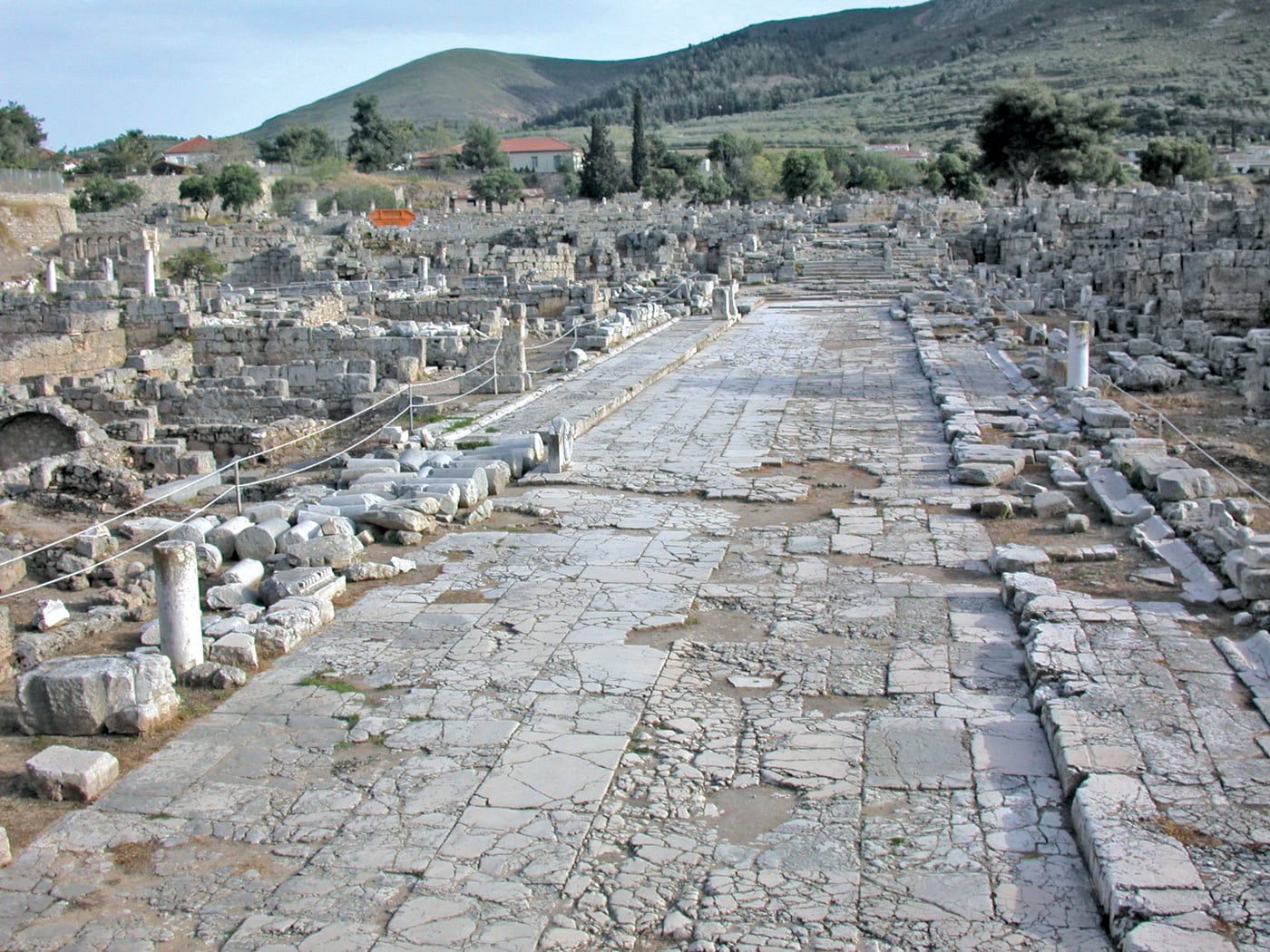
In 2 Corinthians 12:14; 13:1, Paul indicates that he is ready to make a third visit to Corinth. The Lechaion Road (shown here) was the main thoroughfare leading into the city and was likely the road Paul would have traveled to make that visit.
In light of this, Paul urges the Corinthians to sincerely examine themselves, to take a test designed to evaluate the degree to which their recent words and deeds witness to the presence of Christ as Lord within. Failure to note any degree of correlation would, of course, suggest the complete absence of faith. Much more likely is the discovery, despite Paul’s prayer to the contrary, of a relative or partial lack of correspondence between faith and action, of something that is wrong, indicating the need for repentance and a return to what is right. Paul confidently encourages his audience to apply the test to him as well as to themselves, so that they may not only reflect on the measure of their own recent faithfulness but also rediscover the measure of his. Yet his chief hope is not that the Corinthians “will see that we have stood the test,” but rather that they will come face-to-face with their need for repentance (13:7). For Paul is persuaded that neither he nor his converts will ultimately be able to continue doing anything against the truth if it is known within.
Furthermore, because his primary concern is for the Corinthians, Paul is glad to admit both his own weaknesses and their strengths. Indeed, his “prayer” is not primarily for himself but for the increasing “perfection” of his converts in actions that accord with the truth (13:9). And the same motive explains why he writes. For Paul would rather make timely use in a letter of the authority that the Lord has given him for “building up” if the alternative is to lose communication with his converts and to be forced to use his authority belatedly for “tearing down” (13:10 RSV).
5. Epistolary Conclusion (13:11–14)
The conclusion of the letter begins with an affectionate personal farewell, indicating that despite all that Paul has written, including some biting and pointed sarcasm, he nonetheless continues to regard his audience at Corinth with a genuine love as fellow members of the family of faith. Accordingly, as the father of their faith, he continues to urge them to “aim for perfection,” to “listen to [his] appeal,” to “be of one mind,” and to “live in peace” (13:11). He also encourages the Corinthians to imitate his love for them by openly manifesting a familial affection for one another.
Paul conveys the “greetings” of the remainder of the family and adds a closing prayer (as was also usual) for the welfare of those who will be receiving the letter. However, as might be expected, Paul’s closing prayer is distinctly Christian in content and comes intriguingly close to providing an affirmation of trinitarian theology in its form as it draws the name of the Lord Jesus Christ together with that of God and the Holy Spirit in a threefold petition for the continual outpouring of the divine blessings of grace, love, and fellowship in the lives of its readers.
Select Bibliography
Davis, James A. Wisdom and Spirit. Lanham, MD: University Press of America, 1984.
Doty, William G. Letters in Primitive Christianity. Philadelphia: Fortress, 1973.
Dunn, James D. G. 1 Corinthians. T. & T. Clark Study Guides. New York: T. & T. Clark, 2004.
Fee, Gordon D. I Corinthians. New International Commentary on the New Testament. Grand Rapids: Eerdmans, 1987.
Furnish, Victor P. II Corinthians. Anchor Bible. Garden City, NY: Doubleday, 1984.
Garland, David E. 1 Corinthians. Baker Exegetical Commentary on the New Testament. Grand Rapids: Baker Academic, 2003.
Harris, Murray J. “2 Corinthians.” In The Expositor’s Bible Commentary. Edited by Frank E. Gaebelein. Vol. 10. Grand Rapids: Zondervan, 1976.
———. The Second Epistle to the Corinthians. New International Greek Testament Commentary. Grand Rapids: Eerdmans, 2005.
Martin, Ralph P. 2 Corinthians. Word Biblical Commentary. Waco: Word, 1985.
Mitchell, Margaret M. Paul and the Rhetoric of Reconciliation: An Exegetical Investigation of the Language and Correspondence of 1 Corinthians. Louisville: Westminster John Knox, 1991.
Murphy-O’Connor, Jerome. St. Paul’s Corinth: Texts and Archaeology. Wilmington, DE: Michael Glazier, 1983.
Theissen, Gerd. The Social Setting of Pauline Christianity: Essays on Corinth. Edited and translated by John H. Schütz. Philadelphia: Fortress, 1982.
Thiselton, Anthony C. The First Epistle to the Corinthians. New International Greek Testament Commentary. Grand Rapids: Eerdmans, 2000.
Welborn, L. L. Politics and Rhetoric in the Corinthian Epistles. Macon, GA: Mercer University Press, 1997.
Witherington, Ben, III. Conflict and Community in Corinth: A Socio-Rhetorical Commentary on 1 and 2 Corinthians. Grand Rapids: Eerdmans, 1995.