Galatians
B. Occasion for Writing (1:6–9)
C. Review of Accusations (1:10)
2. Paul and the Nature of His Apostleship (1:11–2:21)
A. Preconversion Days (1:11–14)
C. First Meeting with Jerusalem Leadership (1:18–24)
D. Second Meeting with Jerusalem Leadership (2:1–10)
E. Correcting Cephas (2:11–21)
3. Treatise: The Efficacy of Grace over Law (3:1–4:7)
A. The Argument from Experience (3:1–5)
B. The Argument from Scripture (3:6–18)
C. The Purpose of the Law (3:19–25)
D. The Results of Faith (3:26–29)
E. Maturing into Sonship (4:1–7)
4. An Appeal to the Galatians (4:8–31)
A. An Appeal to Maturity (4:8–11)
B. An Appeal to Their Personal Relationship (4:12–20)
C. An Allegorical Appeal (4:21–31)
5. Freedom in Christ (5:1–6:10)
B. Warnings and Reproof (5:2–12)
C. Proof of One’s Grounding (5:13–26)
6. Conclusion with Personal Appeal (6:11–18)
Introduction
Authorship
The vast majority of scholarly opinion has affirmed the apostle Paul as the author of the Epistle to the Galatians. The characteristic opening line, which identifies his name and apostolic claim, the personal final greeting, and the theological focus all point to the historical Paul. Only a few scholars, mostly in the nineteenth century, have questioned this rather universal acceptance through two millennia of church tradition.
The majority of the letter (epistle) was likely generated through the process of dictation to an amanuensis (secretary), as was common in first-century letter writing of this size and importance. The appearance of two anacolutha (unfinished sentences) in 2:6 gives further credence to this view, while also displaying the emotional intensity of the words there. His reference to the “large letters” he writes “with my own hand” (6:11) points to where Paul personally took up the pen to provide his authenticating mark and final exhortations. (Compare 2 Thess. 3:17, ironically a widely disputed letter.)

Text
It should also be noted that the text of this epistle appears to have been copied and handed down with little variation. The relatively constant agreement between some of the most respected and diverse Greek manuscripts provides us great assurance as to the “purity” of the text we have received.
Occasion, Purpose, and Destination
While broad agreements exist on many of these questions, there are few more difficult issues for the student of the New Testament than those associated with fitting the actual writing of Galatians (and indeed many of Paul’s letters) into the historical outline supplied by the book of Acts. The occasion (the reasons why a letter was written when it was) and the purpose (what Paul sought to accomplish) of each letter are crucial components for proper interpretation of a letter’s meaning. We need to navigate through some of the discussion surrounding these issues before the reader can sufficiently weigh the evidence regarding the historical context of Galatians.
The difficulties begin even with the name of the epistle and the people Paul intends to address. The term “Galatia” referred to one of the Roman provinces of Asia Minor (modern-day Turkey). This province cut in a north-south direction across the middle of the peninsula, encompassing a number of diverse peoples, cultures, and languages.
Beyond reference to the territory, however, the term “Galatian” could be used to designate certain groups of ethnic people within that province. These people would be the descendants of the ancient Gauls, likely a barbaric tribal group from northwestern Europe. They settled in the northern part of the territory that would subsequently bear their name around 278 BC. The ancient cities of Ancyra (Ankara, the modern Turkish capital), Tavium, and Pessinus would be associated with the settled areas of the ethnic Gauls prior to, and at the time of, this letter. Once conquered by the Romans, after 189 BC this land, as well as more southern areas, was incorporated under the provincial name of Galatia.
Thus, when Paul uses the term “Galatians” (especially in a derogatory way in Gal. 3:1), it is difficult to know whether he has a provincial or ethnic designation in mind. Those who have attempted to answer this question often use their position as a starting point to adopt a view on the destination of the letter, usually calling it either a “northern Galatian” or a “southern Galatian” theory.
These theories are based on the premise that Galatians was written to a group Paul visited, among whom he also founded a church during one of his missionary journeys recorded in the book of Acts. The decision one makes regarding the destination of the letter governs one’s view of its date and, possibly, its purpose.
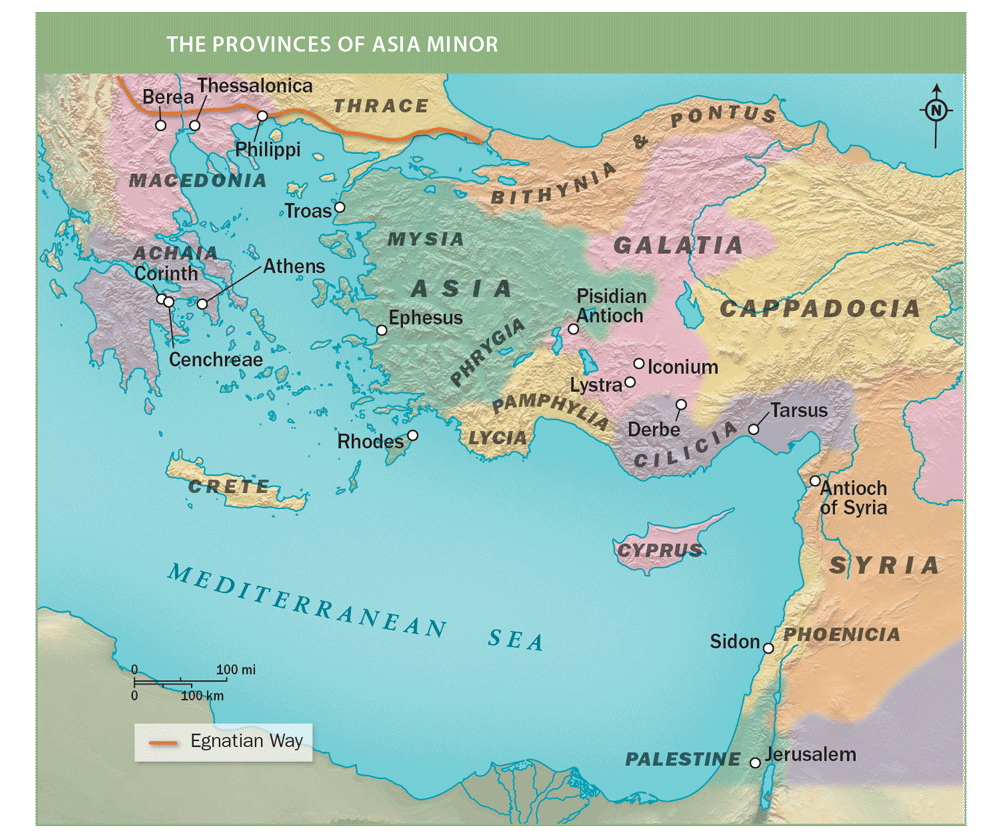
If Paul used the term “Galatia” to designate the Roman province, the first missionary journey recorded for Paul and Barnabas in Acts would likely be the time when he initially made contact with these Galatian people. This aligns with the southern Galatian theory. The destination of the letter is believed, then, to be the churches at Pisidian Antioch, Iconium, Lystra, and Derbe (Acts 13–14). Such a position allows for (but does not necessitate) Galatians to be one of the earliest written, if not the very first, of Paul’s letters.
The alternative, northern Galatian theory is now not generally as popular as the southern theory. Those who hold this position believe Paul would not refer to the church members of the south as “Galatians” if they were not racially associated with that tribe. The major difficulty of holding to this position is the lack of any specific mention in Acts of Paul’s travels in the northern part of the province. Possible visits could have been in this area on one of his journeys from Antioch to Ephesus (Acts 16:6; 19:1). However, the passages in view make no mention of the founding of churches during any presumed time in these areas. Holding this view forces the date of the letter’s writing to a much later time period than that of the southern theory.
Certainty on this issue is impossible, but there are a number of reasons to favor the southern Galatian theory: (1) the churches of the south became important and strong communities in apostolic times, though we know nothing about any northern churches (providing motivation for the preservation of the letter); (2) two of Paul’s major companions came from this area (Timothy and Gaius), and they appear to represent Galatia (1 Corinthians 16) in the collection taken for Jerusalem; (3) Galatians 4:13 may well imply more than one visit by Paul to these churches, a fact verified by the book of Acts (Acts 13–14; 16); (4) the repeated mention of Barnabas without further elaboration seems to suppose acquaintance with him—we know that Barnabas accompanied Paul to the cities in the south during the first missionary journey.
Date
A further major difficulty in harmonizing this letter with the book of Acts is Paul’s description of his contact with the church in Jerusalem, and its leadership, in the first section of the letter. While Paul records two visits to the city after his conversion experience, Acts records three.
Most scholars agree that Paul’s first postconversion visit (Gal. 1:18) is identical to the visit mentioned in Acts 9:26. Difficulties arise as to the alignment of the visit described in Galatians 2:1 with either Acts 11:30 or 15:1–4. The decision made on this issue brings with it some major implications for the determination of date, occasion, and destination of the letter.
The proposal that Acts 11 corresponds to Galatians 2 appears most natural since the book of Acts records one more visit than does Paul. It would seem likely, then, that Galatians was written after the second and prior to the third visit recorded in Acts.
This alignment is strengthened by the basic apologetic nature of the early chapters of Galatians. Principally the argument is that Paul, in defending his independent and equal apostolic status compared to that of the apostles in Jerusalem, must report on any and all interactions he has had with the church at Jerusalem.
Under this scheme, Galatians would have been written very early in Paul’s ministry, at least before the Jerusalem council of Acts 15 (AD 49–50), and very close to his return from the first missionary journey (Acts 13–14). This view helps place in perspective his surprise at his readers’ desertion from the gospel “so quickly” (1:6), since he would have been through the region of Galatia in the very recent past.
The evidence, however, seems to favor a different alignment. There is a noticeable similarity of style, vocabulary choice, theological development, and, most importantly, the type of opposition faced by Paul in this letter with that found in his letter to the Romans and the Corinthian correspondence. Thus, many scholars have made a strong case that Galatians belongs to the same time frame as do these others (AD 54–56). This would place the writing of Galatians after the Jerusalem council.
The decision on this matter turns on how much it is believed Paul would have felt it unnecessary to mention the famine relief visit of Acts 11 in recounting his past contact with Jerusalem. Scholars are divided as to how crucial it would be to Paul’s credibility if he did not mention every visit to Jerusalem.
This criticism is mitigated by pointing to Paul’s main purpose in recounting his visits to Jerusalem. It may not have been to cite every visit to the city but rather to indicate those occasions upon which he personally met with the main apostles in Jerusalem. Since the question at issue was how much he relied on their permission for his work, recounting a visit where he did not encounter the leaders there would be unnecessary. Thus, he would not need to mention the famine relief visit of Acts 11:30 since he apparently met with no apostles during his time there.
When all is considered, the alignment of Galatians 2 with Acts 15 appears to have more strength, and is the position adopted in this commentary.
Opponents
Throughout the letter, Paul makes reference to a group of opponents to his work in Galatia. Over the years, scholars have often used the term “Judaizers” to describe a group of conservative Jewish Christians who mandated that a Gentile must first obey the precepts of Judaism, particularly symbolized by submission to the rite of circumcision, prior to being accepted as a full member of the Christian church.
The conflict Paul had with these opponents represents a pivotal point in the history of the early Christian movement theologically as well as ecclesiastically. The outcome would determine whether the faith would retain the exclusivist character of orthodox Judaism or, as Jesus himself seemed to command (Matt. 28:19), would be made available to all of humankind with equal accessibility.
Both Paul’s letters and the book of Acts evidence a considerable difference of opinion among the Jewish members of the early Christian movement as to how to integrate the numbers of Gentiles who seemed attracted to the faith. This difference reflected a long-standing animosity between the Jewish and Gentile communities of the ancient world.
A principal issue of distinction between these believers was the practice of circumcision. This rite, performed on every male Jew shortly after birth, was seen to be both a loathsome rite for adult Gentile converts to follow and a culturally disdained practice in the Hellenistic world. It also had an implied retention of male privilege in the new community (compare Gal. 3:28). Perhaps because it revealed a strong measure of commitment, many Jewish followers in the early church were adamant about its continued practice for all those who followed Christ. While they recognized that the message of Jesus was not universally accepted among their own people, they did not consider the Christian movement to be outside orthodox Judaism.
Thus, the Epistle to the Galatians represents the collision of those two ideologies. We gain from the Pauline perspective an appreciation of the issues (as well as the personalities) involved. We also gain an understanding of the viewpoint that eventually won the day and went on to characterize the Christian church.
Inherent Limitations
Common to all the Pauline Letters is the fact that Paul is, first and foremost, a “task theologian.” His letters are primarily written to address certain concerns that were troubling the church(es) involved. Thus, we look in vain for any full systematic treatment of theological issues. Rather, we usually hear Paul give only as much theological material as is needed to correct a crisis situation or to maintain a church’s resolve until he can personally be on the scene.
This is quite evident when we look at Galatians, as he seems to touch on those issues at stake in the Judaizer controversy and little else. Yet what we can glean from the letter is the overall sense of how Paul emphasized the completely new reality inaugurated for each believer as he or she accepted Jesus Christ as the risen Lord and Savior.
New Life in Christ
Permeating the incredulity that Paul has at the behavior of the Galatians, who seem willing to submit to the circumcision “party,” is the sense that they have missed the most important aspect of their new life of following Christ. Whereas formerly, as Gentiles, they were often considered to be outside the realm of God’s covenant promises, they have now been, through God’s great initiative in Christ, fully embraced into the fullness of that covenant. Rather than joining an already existing “system” of proper approach to God (Judaism), the Galatians have been included in the reality that Judaism has longed for: life in the Spirit. This new reality was of a nature so superior to everything that had gone before that it completely changed all social and religious categories used to value human persons. The basis for acceptance before God was not found in ethnic, sexual, or social status but in an individual’s possession of God’s Holy Spirit.
Paul’s advocacy of this new reality struck at the very heart of established Judaism’s exclusivity. Paul portrays the Mosaic law (and its traditional interpretations) as the guardian against human immorality. It is the tutor that pointed toward the holiness of God while revealing the imperfect state of each person and their inability to achieve righteousness through it. In the new reality found in Christ, it has been superseded by the appropriation of God’s own Spirit into the life of each person aligned with Christ. Thus, rather than humans standing as an “outsider” to God’s will and ways, the new reality brought humankind into an “insider” position, where the Spirit would interact directly with each person’s own nature. This interaction called for no mediator or ceremonial signs of inclusion. In response to this new reality, followers are to “keep in step with the Spirit” (5:25) while they also continually “test” themselves (6:4) as to the constancy of their walk by comparing their actions and attitudes with both the “fruit of the Spirit” (5:22) and the “acts of the flesh” (5:19). Bearing spiritual “fruit,” not circumcising the flesh, has now become the tangible sign of one’s inclusion into this new reality of God’s kingdom.
Galatians, most likely written in the same time frame as 2 Corinthians, gives further explanation to that letter’s great proclamation in 5:17: “If anyone is in Christ, the new creation has come: The old has gone, the new is here!”
Commentary
A. Salutation (1:1–5). The apostle Paul followed the normal Greek letter-writing form in composing his letters. The normal form was characterized by an introduction that cited the name of the author and those addressed. This would normally be followed by a greeting varying in length and usually determined by the degree of warmth felt between the author and the recipients. We notice here, contrary to his other letters, that Paul gives only the briefest of greetings (1:3). His style is proper and a bit curt and immediately evidences a defense of his apostolic origin. Clearly, Paul perceives himself to be under attack as he writes. He wastes no time in rising to his own defense.
The attacks against him appear to have revolved around the origin of his apostleship and, with it, the basis of his authority in that role. Paul may have been the primary author to develop this otherwise common term in its verbal form, apostellō (“to send out,” as designating an ambassador), into an official noun of distinction apostolos. Accompanying authority claims would not come simply from the use of the term itself but from the overall understanding of who it was that had commissioned the apostle. Greater authority would be given to one sent out personally by Jesus (as Paul claims for himself) than to one who was sent out by church authorities. Unfortunately for him, his claim to the same apostolic authority as that of the original disciples of Jesus (Gal. 2:6–10; 1 Cor. 9:1–27) was one that could not be independently verified. (See Acts 9 for the story of his conversion.) Throughout Paul’s ministry, the uniqueness of his calling, with its lack of objective proofs, provided ammunition for those who disagreed with his positions (see, e.g., 1 Corinthians 5; 9; 2 Corinthians 10–13).
Here in the opening words of the letter, Paul defends the source of his apostolic calling (1:1). The key factor for him was viewing his apostleship as divinely appointed and not a product of human decision (“sent not with a human commission nor by human authority” [TNIV]). Paul appears to be referring to his conversion experience and his belief that Jesus appeared to him, then, personally. Thus, Paul lists “Jesus Christ” first as the one through whom the commissioning was made, with “God the Father” as the ultimate source of the appointment.
Though he acknowledges the greetings of others to the Galatians (1:2), Paul seems to have little time or desire for pleasantries. The brevity of his greeting is an unmistakable mark of his deep concern, perhaps even his anger at the present circumstances. His stock, yet sincere, wish for “grace and peace” to them leads him into a further enunciation of the good news of redemption found in Christ (1:3–5).

The region around Pisidian Antioch, part of the imperial province of Galatia
Paul briefly and effectively reminds the Galatians that redemption is solely the work of God in Jesus Christ. Jesus is the one who sacrificially gave himself “for our sins” (see Rom. 5:6, 8; 1 Cor. 15:3), resulting in our rescue from “the present evil age” (1:4). This rescue does not remove the recipient from the present world. Rather, the use of the term “age” is similar to other references Paul makes to the distinction between the wickedness of the fallen world and the newness of life afforded by redemption and the infusion of God’s presence into our lives (see 1 Cor. 1:20; Eph. 2:2; 6:12).
The effect of this opening review is to establish the ground on which Paul will argue his grace-focused gospel. The recognition of the completed work of God in redemption would be undermined by any claim to human activity in conjunction with it. The unusually early doxology found here (1:5) has the effect of placing his detractors in the precarious position of lessening the glory attributable to God if they affirm any human aspect to the redemption process.
B. Occasion for writing (1:6–9). Paul moves quickly to express condemnation for the Galatians’ recent actions in a paragraph that is noteworthy for its emotional intensity. He is “astonished” not only by the apparent departure of the Galatians from what he will argue is the core of the gospel but also by their lack of endurance with the truth (1:6). Such a desertion is understood not simply as a differing point of view but as a rejection of God himself (“the one who called you to live in the grace of Christ”; 1:6)! While the use of the term “so quickly” may relate to Paul’s recent visits there, he may also be referring to their desertion from the gospel upon its very first challenge since the establishment of their churches.
In describing this desertion, Paul uses two different terms to refer to the unwelcomed “gospel” to which the Galatians were attracted. The term translated as “different” (1:6) denotes a “difference in kind” (from one unrelated thing to another) rather than a difference between related things. To mark off this difference in kind, he uses a contrasting term, “another” (KJV, RSV; NIV: “no gospel at all”) indicating his is not simply a disagreement with a point of view or an equally possible approach to following Christ.
We receive our first hint that the difficulties are the results of a special interest group here (1:7). The agitators are described as those wishing to confuse the Galatians by perverting the gospel. Paul will provide further insight into their motives later in the letter (see 4:17; 6:12–13).
The seriousness of the situation is established by the two “curse” (Greek anathema) statements (1:8–9). There are few other terms that could be so reflective of the vehemence with which Paul opposes these false teachings. The use of anathema reflects the concept of eternal damnation. (Literally it referred to the dedication of an object, usually in pagan temples, for the purpose of its destruction.) Paul is not venting anger from the perspective of a wounded ego; he merely states the fact that those who are found to be advocating a false view of the work of Christ are not just mistaken; they are lost.
Quite simply, nothing and/or no one had the authority to override the truth of the gospel (including Paul himself or even angels; 1:8). Paul’s concern is to place the issue of authority and the discussion of apostolic origins into a proper perspective. Ultimately it is not to the messenger that one gives allegiance but to the message. There is only one gospel. Anything else, Paul asserts, is perverted and false.
C. Review of accusations (1:10). Because most of Paul’s letters were occasional letters (prompted in response to problems existing in the churches addressed), we are placed in a position similar to that of one who eavesdrops on one side of a telephone conversation. Often we must reconstruct the sense of the whole conversation with only a few clues on which to proceed. Such is the difficulty here. Paul asks a series of rhetorical questions, each (because of their construction in Greek) with an intended negative answer. They give us an indication of the types of accusations being made by those who discredited Paul’s view of the gospel and/or his apostolic authority.
The Greek grammar of verse 10, with the use of “for” (KJV, ESV) as a connection from the previous thought, indicates that Paul’s questions are prompted by his previous pronouncement of anathema. Paul appears to be reviewing accusations, presumably from the agitators (1:7), that his preaching of free grace was motivated by an attempt to win a vast following for his ministry. Those who held a view that gave an important place to a righteousness based on good works would quite understandably have believed such a “do-nothing” gospel to have been formulated by a desire to be popular among the Gentiles.
Paul’s previous anathemas (which could potentially include himself; 1:8) were designed to show that it was not popularity he sought but faithfulness to the gospel as he understood it. The final statement of the verse indicates that if pleasing humanity was his goal, being a “servant of Christ” would not be the most logical way to proceed (1:10). His words are reminiscent of the warning, spoken by Jesus, regarding the serving of two masters (see Matt. 6:24).
2. Paul and the Nature of His Apostleship (1:11–2:21)
Apparently part of the process used to sway the Galatians from Paul’s influence was to cast doubt on his credentials as an apostle (or at least as one “above” the authority of the agitators or the leaders they claimed to represent). The opponents of Paul seemed to claim for themselves a direct line of authority to someone, or some group, associated with the church in Jerusalem. While we have no way of evaluating the possibility that a countermission to Paul may have been authorized by an official or officials of that church, such a claim was apparently believed by the Galatians.
Paul’s defense of the mysterious conversion experience he claimed, then, had to center on the only objective evidence he had: his changed life from a persecutor of the church to an effective minister of the gospel. In order to reestablish his right to direct the Galatians in their spiritual affairs, Paul not only had to recount his own claim to apostleship, but he also had to establish that the apostles in Jerusalem recognized the equality of his apostolic standing with them.
A. Preconversion days (1:11–14). As when he denied human agency in his apostolic calling (1:1), Paul makes it clear that no one was involved in his own understanding of the gospel (1:11–12). This denial involves three specific areas that may have been alleged sources for the gospel Paul represented: (1) it was not “of human origin” (from him or anyone else); (2) it was not handed down by tradition; (3) he was not instructed in it.
What Paul appears to be saying is that the ultimate triumph of Jesus as Redeemer through an act of free grace (the core of the gospel as specified earlier; 1:4) came to him through the very revelation of Jesus’s presence during the Damascus Road postresurrection appearance (1:12; see Acts 9). Paul seems not to have specific declarations of doctrine in mind (see 1 Cor. 11:23–32; 15:1–8). Rather, the reality of the victory of Jesus over death, signifying God’s acceptance of his sacrifice, allowed everything Paul knew of God to fall into proper perspective. This, presumably, is what Paul means by “the gospel” in Galatians 1:11. The specifics of the history and doctrine were secondary to the reality revealed in him (1:16) at his conversion.
Paul appeals to their own knowledge of his former superior standing in Judaism and his own attempts to “destroy” the church (1:13–14). As a conscientious Pharisee, Paul was highly acclaimed among his peers and was able to name the revered rabbi Gamaliel as his mentor (revealed to us in Acts 22:3). He mentions his advancement in the “traditions of my fathers” (1:14), which would have involved intense study of the Scriptures and the teachings of the rabbinical sages.
B. Conversion (1:15–17). What becomes clear is Paul’s emphasis on the full agency of God in his conversion. Paul reflects his belief that though his change in life appeared dramatically abrupt to him and to all who heard of it, such was not the case with God, who had prepared this very step as early as his appearance in his mother’s womb (1:15). Paul expresses this calling in terms reminiscent of the callings of the prophets Isaiah (Isa. 49:1) and Jeremiah (Jer. 1:5). Such terminology would, no doubt, sting his Jewish-oriented opponents.
The revelation of God’s Son in Paul (1:16) had as its purpose the consecration of an individual to preach the gospel to the Gentiles. This is a decisive calling for Paul, one that allowed him to claim an equality of apostolic standing with the leader of the disciples, Peter, who in Paul’s view was specifically chosen to lead the mission to the Jews (2:8). Acts 26:17 fully records God’s commissioning of Paul to the Gentile mission.
His response to this dramatic change was not to seek counsel or explanation from Jerusalem or from anyone else (1:17). There was no need to interpret the experience as if it were unclear. Rather, Paul headed into the region of Arabia (a large kingdom similar to the area of Syria, Jordan, and Saudi Arabia today, ruled then by the Nabateans). The text does not specify what he did while in that area. The reason he mentions it is not to explain what he did as much as to show what he did not do (i.e., consult with Jerusalem). After a stay of some undetermined time, he returned to Damascus (1:17), where presumably the incident of escape from the city took place (see additional details in 2 Cor. 11:30–33).
C. First meeting with Jerusalem leadership (1:18–24). Paul’s desire was to show that he did not owe allegiance to Jerusalem (and thus would not have to agree with or submit to the opponents who claimed to be from there). Further, he wanted to show that it was the opponents who would have to submit to his authority in Galatia, since he had been recognized by the major Jerusalem apostles as holding the lead position over the Gentile missionary enterprise. To do this he needed to show that he owed nothing to Jerusalem for the authority he had received to proclaim the gospel.
His first visit to Jerusalem is said to have occurred “after three years” (1:18). This reference and the one in 2:1 to “fourteen years” have proved to be problematic in understanding Pauline chronology. The reference here could take either his conversion or his return to Damascus as its starting point. The time referred to in 2:1 may be subsequent to these three years, or could just as well be the time of his conversion. The grammar gives us very little aid in determining these issues conclusively. In general, many scholars prefer to see Paul’s conversion to be the operative starting point (with AD 32–33 as a likely date for it) and AD 35–36 as the date of the visit Paul mentions here. This occasion most likely aligns with the reference in Acts 9:26–30.
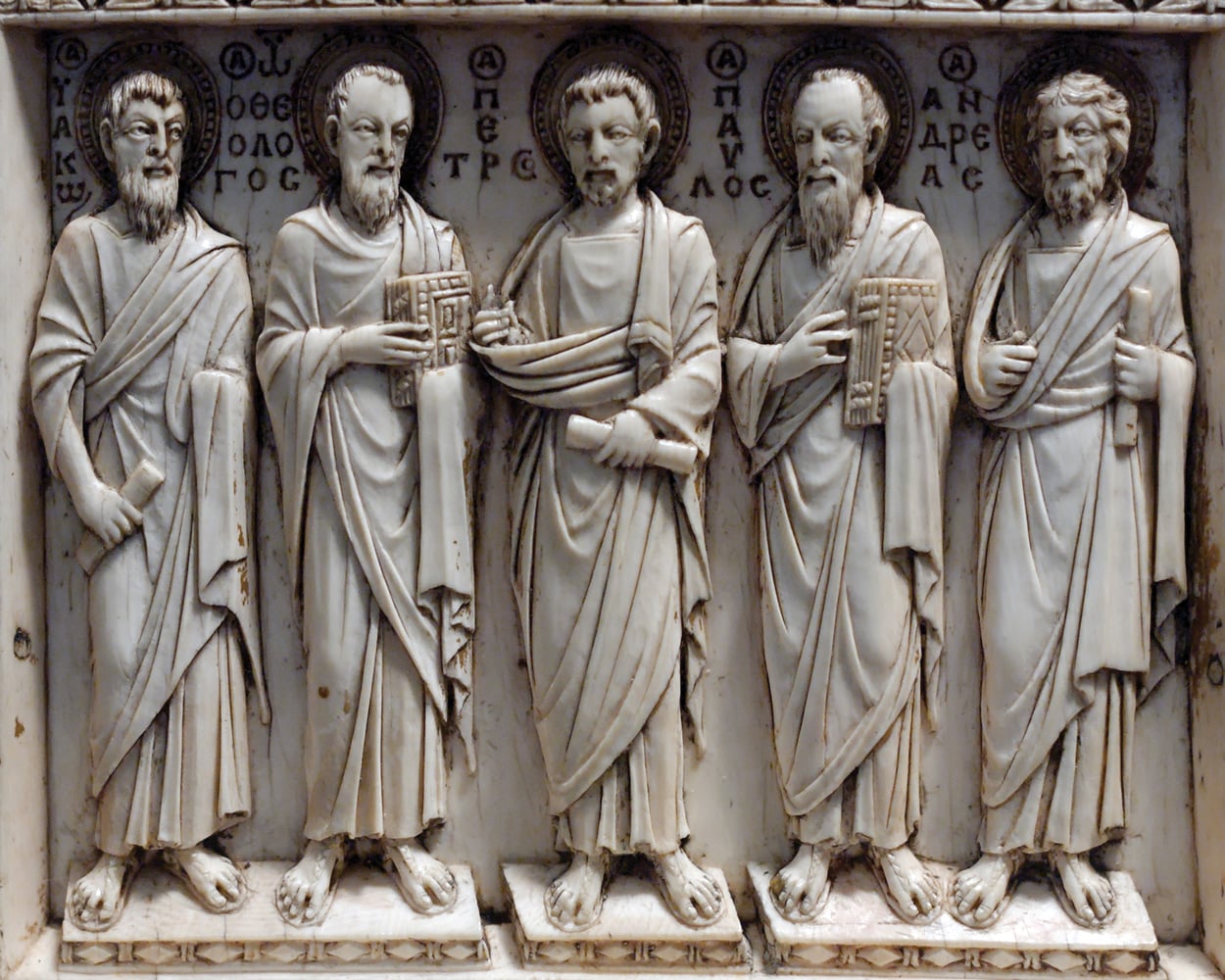
On this portion of the ivory carving known as the Harbaville Triptych (tenth century AD), Paul is pictured (second from the right) as one of the apostles, along with (from left to right) James, John, Peter, and Andrew. On his first visit to Jerusalem, Paul met with only Peter and James (Gal. 1:18–19).
The three years between his conversion and the meeting of any of the Jerusalem officials emphasizes the independent nature of Paul’s work. When he did go up to Jerusalem, he had the opportunity to visit (the Greek term means “to get to know”; 1:18) only Cephas (Aramaic name for Peter—likely the nickname Jesus actually used for him; see Matt. 16:18) and James (1:18–19). The visit did not last long (fifteen days; 1:18). No time of instruction or of commissioning is implied.
In stressing that he “saw none of the other apostles—only James” (1:19), Paul apparently counted the “Lord’s brother” (likely half brother, the son of Joseph and Mary after the birth of Jesus) among the apostles. While some scholars have sought to deny this, it does seem that the traditional designation of only the Twelve plus Paul as apostles is far too limited.
This seems to be a crucial point for Paul. In all this time of being a Christian, he had extremely limited contact with the Jerusalem leadership. He certainly makes it clear that he and Barnabas undertook the ambitious first missionary journey without being supervised in any way by Jerusalem. This display of independence would serve to so deflate the opponents’ accusations that Paul felt compelled to offer a guarantee of its truthfulness (1:20).
After Jerusalem, it was on to the regions of Syria and Cilicia (Antioch was in Syria, Tarsus in Cilicia), with no further contact with Jerusalem, or anywhere else in Judea (1:21). The good news about his changed life was known in Judea only by reputation (1:22–23). While that evoked glory to God (1:24), it brought no formal relationship between Paul and Jerusalem. Clearly, then, Paul was not serving under the leaders of Jerusalem in any way.
D. Second meeting with Jerusalem leadership (2:1–10). The second meeting with Jerusalem is fraught with far more problems for Paul, as he attempts to indicate his degree of independence from that power base of the early church (2:1–5). If we are correct in assuming that this section represents the same visit as that detailed in Acts 15 (which then causes us to understand “after fourteen years” [Gal. 2:1] as referring to a time period subsequent to the “three years” of 1:18), then Paul has the task of explaining why he went to Jerusalem at all if he did not need to appear for the purpose of defending his ministry before those who had the power to direct it.
Paul’s explanation emphasizes a few points concerning his encounter with Jerusalem on that occasion. He begins, not coincidentally, with the impression that his arrival had the air of one who was the leader of a delegation from the Gentile missionary enterprise (2:1). The mention of his fellow traveler Barnabas and the taking along of Titus (a representative of the harvest won in the Gentile lands) serve to place Paul in the position of one who arrives as an independent expert consultant on Jewish-Gentile relations. He adds that his coming also had an element of compulsion to it. His visit was initiated by revelation (2:2). Such an inclusion further proves that his directions come from his relationship to God and not from the authority of the Jerusalem leadership. (He was not “summoned.”)
Paul also indicates that he had his own purpose for attending the conference (2:2). It was imperative for the leader of the Gentile mission to have the trust and support of the Jerusalem church or to face the threat of continual schismatic strife. Though the early church seemed to be learning that the same Holy Spirit was given to all individuals upon their acceptance of Christ (see Acts 10:34–38; 11:18), the animosity characterizing Jewish-Gentile relations was not going to be eradicated easily. Paul must settle this issue early in the history of the Gentile outreach, or he would face ongoing feelings of prejudice throughout the areas in which he would be working.
Thus, when Paul mentions that he submitted the content of his preaching to “those esteemed as leaders,” he is not saying that he sought their correction. Rather, he explains that they met in private in order to be sure that they could bring a united front to the conference. It is unstated if Paul knew that the Jerusalem apostles would agree with him; he describes these things from hindsight. Through everything else he has written, however, it is evident that Jerusalem agreement was not a prerequisite to the continuance of his ministry. Disagreement on these issues, however, would certainly have led to a split and weakened church. This is likely what he had in mind when he added that he was concerned about “running . . . in vain” (2:2).
Paul uses the Greek term dokeō in verse 2 to describe the ones to whom he submitted his preaching (literally, the ones who “seem” or “have an appearance,” with the idea of holding a recognized position). Verses 6 and 9 will elaborate on the individuals he has in mind, including James, Cephas, and John.
Verses 3–5 have been difficult for interpreters to agree on. The Greek manuscripts vary slightly, but significantly, in verse 5. The difficulties are further complicated by the awkward grammatical connections of these verses. Obviously, the emotional tone of the moment is reflected in Paul’s recounting of it. Paul may have been so emotionally involved in describing the events that his secretary was hard pressed to put into written words the apostle’s swift-flowing descriptions.
The most likely meaning of the text, backed by the best manuscript evidence and the context of the passage, would appear to picture a confrontation precipitated by those demanding circumcision for Gentiles, which was further complicated by the presence of Titus. Paul firmly makes it known to his readers that there was no compromise of his position, either by himself or by Titus (2:3).
It is hard to know the identity of the “compeller” in verse 3. Though Paul goes on to state that the whole matter was initiated by those he describes as “false believers” (2:4), most likely they would not have had the authority to compel Titus to be circumcised. It is quite possible, then, that Paul has the Jerusalem leadership in mind here. Despite the arguments of the legalists, the leadership refused to compel Titus (and, by implication, any Gentile) to add any additional qualifications for Gentile fellowship in the church beyond an individual’s faith in Jesus Christ. Thus, Paul would seem to be describing, in remarkably little detail, the deliberations of the leadership on this issue. They are pictured as in full agreement with Paul’s position.
It is interesting to notice the final remark in verse 3, “even though he was a Greek” (i.e., Gentile). Is Paul simply informing the Galatians why it was significant that Titus was under discussion for circumcision? Doubtless they were well aware of his being a Gentile. Rather, it is likely that Paul is dramatically emphasizing the new status of Gentiles in Christ. Even though Titus was among a conference full of Jews, he was treated as having a fully legitimate right to fellowship among them by virtue of his faith alone. It is likely that the Galatians were struck by this. All those important Jewish believers, and they placed no further requirements on Titus? Why then are these others demanding more?
As if to answer such a question, Paul momentarily interrupts his narrative of the events of the conference, digressing to the type of opponents he encountered there (2:4). The Galatians are to see that the ones described as the infiltrating “false believers” who had come “to spy on the freedom we have in Christ Jesus” with the purpose “to make us slaves” (2:4) are the same type of characters troubling them. The Greek terms for “infiltrated” (see also 2 Pet. 2:1) and “spy” (see 2 Kings 10:3; 1 Chron. 19:3 in the Septuagint) are usually found in descriptions of secret military operations designed to conduct subversive activities to undermine an enemy’s defenses.
Are these opponents even Christians? Paul’s use of “false believers” in verse 4 and in a similar context in 2 Corinthians 11:26 suggests he is indicating that the nature of the doctrine taught by such opponents excludes their membership in the faith. This view is further enhanced by Paul’s disclaimer in Galatians 2:5 that his delegation (and, possibly, he is including the Jerusalem leadership here as well) never even gave a moment’s hesitation on the matter “so that the truth of the gospel might be preserved for you.” Surely Paul viewed the issue that plagued Jerusalem then, and is plaguing Galatia as Paul writes, to be pivotal in one’s inclusion or exclusion from the faith. Clearly, in Paul’s view, these opponents are at least in danger of exclusion.
While Paul was satisfied by the decision of the Jerusalem council, he is just as concerned to show the Galatians that the leadership in Jerusalem made a specific point of also recognizing the apostolic authority he possessed. The point is that Paul gave them no more recognition than they deserved, while they finally gave to him all the recognition that he deserved (2:6–10).
The use of the phrase “those who were held in high esteem” (2:6) recalls for Paul’s readers the individuals with whom he met prior to the confrontation with Titus (2:2). He repeats the vague reference to their authority four times (2:2, 6 [twice], 9). Each use of the term appears to refer to the same three leaders, James, Cephas, and John, who are also identified by the term “pillars” in verse 9.
Verse 6 has a curious mixture of Greek tenses. Paul uses the imperfect in referring to the pillars (“whatever they were”). Then he utilizes the present tense (“makes no difference”) in referring to his reaction to them. It seems clear that the imperfect is referring to their reputation as being part of Jesus’s inner circle. Yet Paul is making the point that no group’s past performance is going to dictate the direction of his ministry.
His digression about God’s not showing partiality (2:6), which reflects a Hebrew idiom of not “looking at the face” (i.e., looking on outward appearances; Deut. 10:17; 1 Sam. 16:7; James 2:1), provides a theologically based reason for his behavior. Presumably one would expect Paul to show some deference to these men (at least to Cephas and John), since they followed Jesus even before his resurrection. While such diplomatic niceties might avoid conflict, they could also be devastating, especially since, as Paul desires to show, such submission would cause him to follow men who may not be as correct as he on this important issue. When it is a question of either being consistent with the gospel or following the dictates of “church politics,” Paul leaves no doubt what he will do.
The results of this meeting with the “pillars” are important for Paul’s purposes, and he discusses them carefully. While Paul is pleased that these men recognized his authority, he wants to be very sure that such recognition does not appear as a type of commissioning. Paul arrived with the same status with which he departed; nothing was added (2:6) to him. The real change occurs in the minds of the pillars. The results are well worth noting: (1) They recognized that Paul was entrusted by God with the Gentile missionary enterprise (2:7). (2) The authority of Peter and Paul was equated, each in his own sphere of operation (2:8–9). This was as a consequence of their perception of the leading of God on the matter (2:8) and was not simply an administrative decision. (3) They parted as equal partners in the overall enterprise of evangelization (2:9). (4) The one additional comment made by the Jerusalem leaders, concerning sensitivity to the poor, really did not need to be stated since Paul already had that area of need in mind (2:10). Even on this rather trivial point, Paul does not waver from his previous statement in verse 6 that the “pillars” added nothing to his ministry!
Verses 7–8 could be regarded as a type of semiquotation of an official document, or of an oral agreement that was reached at the council. The recognition of various spheres of responsibility is stated in terms Paul probably would not use (see Gal. 1:7–9; he would likely avoid any implications that two gospels were being preached). Yet the statement would be, nonetheless, sufficient for the purpose of showing his equal status with Peter. The change in Peter’s name may reflect the fact that such an agreement would be framed both in Aramaic, the common language in Judea, and in Greek. In quoting the Greek for his readers, Paul utilizes the Greek translation for Cephas, which is Peter.
If this view is correct, it may be significant that the “quotation” uses the term “apostle” (2:8) in referring to Peter’s status, but the term is not repeated in reference to Paul. There is debate as to whether the parallel construction in the Greek implies the word’s presence or if it was consciously left out. It may well be that Paul assumed it and the “pillars” did not, for even with regard to the spheres of responsibility there may have been some ambiguity, since we know that Peter ministered in Rome and possibly elsewhere (Corinth? See 1 Cor. 1:12; 9:5).
E. Correcting Cephas (2:11–21). The incident related in this section (2:11–14) indicates that in spite of the basic agreement reached at the Jerusalem council, certain ambiguities continued to exist. The incident at Antioch is significant, for it moves us on to the next logical step in Paul’s argument regarding his authority on the matters troubling the Galatians. We need to take careful note of the situation as Paul has developed it. The authorities in Jerusalem had recognized Paul’s equal status relative to them, but in Paul’s view they also acknowledged his priority over matters dealing with Gentiles.
Thus, when Paul confronted the erring Peter at Antioch, he did so in rightful exercise of his authority in that sphere. Peter was wrong in regard to his treatment of Gentile believers in Antioch. The implication is clear for the Galatians. Those who are appealing to Jerusalem as the ground for their authority should recognize that Jerusalem has relinquished its authority over such matters to Paul, since, when they have dealt with the matter in the past, they have shown themselves (as represented by Peter) not to have the proper sensitivity or theological insight. All this, of course, is Paul’s own view of the matter. Unfortunately we do not have the reactions of Peter to the confrontation.
Placed as it is after the presentation of agreement on the issue of Gentile circumcision, this incident reveals what Paul believed was truly behind Jewish demands for continued segregation. For, as Paul shows, Peter theoretically agreed with the equal status of Gentiles, even to the point of eating with them (dining at the same table was a cultural sign of acceptance and fellowship). Verse 12 is skillfully constructed to indicate reactions of both acceptance and hesitancy by Peter to the practice of having full fellowship with the Gentile believers.

This is the rebuilt (1863) facade of Saint Peter’s Church in Syrian Antioch. The natural cave that forms the interior of the church was, according to tradition, the place where the first Christians met and prayed. In Galatians 2:11–21, Paul describes his confrontation with Peter at Antioch.
The inconsistency in Peter’s actions is blamed solely on the arrival of a group alternately described as “certain men . . . from James” and as “those who belonged to the circumcision group” (literally “those out of the circumcision”; v. 12). Clearly Peter gave in to the ethnic bias of the arriving Jewish contingent. It is doubtful that he actually changed his theological view as to the status of Gentiles before God. Obviously he had not fully thought through the implications of his theology for his relations with all persons, in spite of the continued bias of some. Peter, it seems, was not alone in this problem of integrating faith with living, since even Barnabas followed his example, as well as other Jews present (2:13).
From Paul’s description of the actions of the ones who deserted the table fellowship, it is clear that he places the blame squarely on the shoulders of Peter for initiating the response. The actions of the rest of the Jews and Barnabas, described in the passive voice, indicate how Peter’s action influenced their similar response. Paul describes their departure from the Gentile table fellowship with the term “hypocrisy” (Greek hypokrisis; 2:13).
Paul notes that his public rebuke (“in front of them all”; 2:14) of Peter came because Peter’s action appeared to have been the culmination of a series of indiscretions that indicated a continuing bias against Gentiles by the Jewish members of the church. (See the charge concerning Peter’s attempt to “force Gentiles to follow Jewish customs” in 2:14.) Paul’s statement has the ring of irony. We might do well to paraphrase Paul’s point: “If you, one of the sacred, live secularly, and not sacredly, how do you suppose the secular will become sacred?” Other terms might be inserted, but the idea is clear: Jews took great advantage of their heritage, yet they still had not understood that the new covenant did not allow for any human advantage.
Paul had not confronted Peter on a trivial issue. He describes Peter’s actions as “not acting in line [literally “walking straight”] with the truth of the gospel” (2:14). Peter’s indiscretion, then, was not just a diplomatic mistake but was related to the very heart of the good news itself. Paul often represented the uniqueness of the gospel he preached as contained in the new reality of equal status for all persons saved by Christ (cf. Gal. 3:28; Eph. 2:11–22; one wonders, after twenty centuries, have we learned this lesson even today?).
As Paul relates this story, it seems that he has concluded his personal apologetic. Is Paul an apostle? Yes. The Galatians have heard his testimony of seeing Jesus personally and having his status confirmed by the Jerusalem leadership. Does he have equal authority with Jerusalem? Yes. In fact, they recognize not only his equality but his primacy over matters concerning the Gentiles. Is it important that the Galatians follow him and not the opponents? Yes. Look what happened at Antioch. The lack of calling, knowledge, and sensitivity of the Jerusalem leadership in Gentile affairs has shown itself to be not only insulting to Gentile believers but also inconsistent with the full truth of the gospel. The opponents will only continue this practice.
In this section Paul has shown why the gospel is compromised through ethnic favoritism and that with his leadership the Galatians can progress in the gospel. Moving toward the opponents’ position is nothing more than a giant step backward.
Many commentators have debated where Paul ceases his address to the erring Peter (and the other Jews involved in the Antioch incident) and where he begins to address the Galatians once again. The present writer agrees with the NIV, which includes 2:15–21 with the rest of Paul’s Antioch address to Peter. This new section appears particularly directed to Jewish Christians yet provides the foundation on which Gentiles also find their place in God’s family: justification by faith. It provides the groundwork for Paul’s condemnation of the Galatians’ attraction to adding works of law to their Christian experience.
The argument here, and in the remainder of the letter, reminds one of the arguments found in Romans (esp. chaps. 3, 6–8). Such parallels have influenced many, including this writer, to view these two epistles as written at about the same time.
Paul uses terminology appropriate to a Jewish audience and reflects the universal division of the human race from a Jewish perspective: “Jews by birth” and “sinful Gentiles ” (2:15). This division will be seen to have an ironic ring to it, since Paul will show later in the letter that the work of Christ has destroyed all previously imagined divisions among humankind (see Gal. 3:28).
Paul acknowledges his own position among the “Jews by birth” but goes on to explain that this “advantage” (see Romans 2–3) only allows Jews to be even more sensitive to the need for God’s justification because of their own inability to perfectly follow the torah (i.e., the biblical law). Paul, then, has not denied the Jewish advantage; he only shows that the advantage in itself is not enough to provide a right standing with God.
The key verse of the section is verse 16. We find a repetitive treatment of the doctrine of justification by faith here. Paul logically progresses to the next step of a Jewish Christian’s understanding. At some point in time there had to be the realization that no one, not even the Jew who attempted it, was “justified by the works of the law, but [instead] by faith in Jesus Christ” (2:16). Jewish Christianity could not exist if it were not for the recognition of these facts. It is also the foundation on which Paul will build his argument for the equality of Jews and Gentiles in Christ (see Gal. 3:26–29; see also Rom. 3:9–18, 22–26).
Paul concludes verse 16 with a paraphrase of Psalm 143:2 (“by the works of the law no one will be justified”), giving what he sees to be a scriptural anticipation of the failure of works of the law to gain justification. Thus, both by experience and on the basis of Scripture, the act of placing one’s faith in Jesus Christ has become for the Jew the only proper way to obtain justification. Paul, not incidentally, has also introduced the two categories (experience and Scripture) that he will utilize in addressing the Galatians concerning their own basis of justification (3:1–18).
Verse 16 also introduces some powerful concepts to be considered. The idea of justification (Greek dikaiosynē) was utilized in legal proceedings in pronouncing someone innocent of the charges brought against him or her. In Paul’s twenty-two uses of the term in the New Testament, it has the dual effect of affirming that someone is not to be condemned (see Rom. 3:26; 8:1–4) and declaring that a person is viewed as righteous in God’s sight (Rom. 3:24). Both benefits are appropriated through faith in Jesus Christ.
In addition, Paul uses “faith” (Greek pistis) to denote the channel through which believers obtain justification by Christ. It is not described as the cause of justification, only the channel by which justification is appropriated. While pistis itself means simply “confidence” or “trust,” it always has specific content in the New Testament: confidence or trust in Christ (i.e., in the sacrificial act of Christ’s death on the cross; see Rom. 3:22, 26; Gal. 2:20; Phil. 3:9). This concept of faith in Christ, in Romans and Galatians especially, is contrasted with the ineffective works of law as vehicles to deliver the benefits of justification to humankind.
“Law” here is not the villain of the story. Rather, it is a person’s inappropriate use of the law that is in view. Paul, in the more elaborate argument found in Romans (esp. 2:12–15; 7:7–25), establishes the validity of the Mosaic law as a fundamental expression of the righteousness of God. Yet, too, the law displays itself as the accuser of persons (see Gal. 3:10–13) and the vehicle through which they recognize their own sin and sinful inclinations (Rom. 7:13–14). It is the works of law that are condemned by Paul (see Gal. 3:10) as insufficient. When opposing faith and law, Paul is indicating the difference between one’s acceptance of Christ’s death on his or her behalf and one’s determination to reject that death and seek self-justification.
For many, the problem with Paul’s radical justification doctrine was in pressing fully the implication that a believer no longer had to work to obey the Mosaic law. If Gentiles, who have no conception of righteous living (i.e., living according to the law), accept Christ and do as they please, does that then mean “that Christ promotes sin” (2:17; literally “Christ, servant of sin”; likely an opponent’s slogan)?
Paul strongly answers with his characteristic “Absolutely not!” (2:17). The reason is quite clear. If the law, as a standard for making one righteous, has been supplanted, its continued use as a measurement of personal righteousness is illegitimate. Thus, if Paul (note the change from the plural “we” to the singular “I” in 2:18–21, placing himself as representative of those following this position) were to reestablish the law’s legitimacy as a proper channel of justification after it has been annulled (literally “set aside”; NIV “destroyed,” 2:18) by Christ’s work, he could legitimately be viewed as a lawbreaker. But he is not doing this. Indeed, such a charge reflects a misunderstanding of the full reality of being “in Christ.” Rather than just being an additional piece of the theological puzzle, faith in Christ results in an entirely new realm of being for the believer (see 2 Cor. 5:17).
First, using a death-life scenario in verses 19–21, Paul sums up the effect of the law on his former life without Christ: “Through the law I died to the law” (2:19). Here we find the proper understanding of the function of the law. It points out the rightful condemnation of humanity by God (see Romans 7). This realization is the first step in one’s appreciation of the work of God through Christ. Thus, this death had to occur, “so that I might live for God” (2:19).
Second, by attaching the Greek preposition syn, “together,” to the verb stauroō, “crucify,” Paul effectively shows that in Christ the believer was also crucified in Jesus’s substitutionary death (2:20; the Greek New Testament and some modern translations include this expression at the beginning of 2:19; see also Gal. 5:24). Thus, Christ’s experience, when appropriated in faith, becomes the experience of the believer. The consequent benefits of Christ’s death and newness of life are also those of the believer.
Thus, the believer’s new life is forever wedded to that of Christ and characterized by the nature of Christ (2:20). Paul describes the mystical union of the believer with Christ, here and throughout the New Testament, by such expressions as “living in Christ” or “Christ living in me” (see, e.g., Rom. 6:4–8; 8:2–11; 2 Cor. 5:17; Col. 2:12–14). Life in Christ is not an identification of Christ and the believer to the exclusion of the individuality of either. It is, however, the acknowledgment of the source of life: Christ the living Lord. This is at once the reason for and the guarantee of the believer’s moral lifestyle. With the reality that “I no longer live, but Christ lives in me” (2:20), the power to live righteously resides in the believer. Further, the believer is no longer motivated by an external, accusing law but by an internal motivation to serve “the Son of God, who loved me and gave himself for me” (2:20; the verb tense refers to the decisive act of love and sacrifice at the cross).
Concluding this section, Paul appears to reflect a charge his opponents likely used against him. In viewing him as one who has rejected the law of God for a form of antinomianism (the belief that one is governed by no laws), they believe he has nullified the gracious acts of God in revealing himself to Israel through the law (see also Acts 21:20–26). However, as Paul indicates, their conclusion is based on the false assumption that righteousness comes through the vehicle of the law. In one of the most dramatic statements found in the New Testament, Paul carries their position to its logical—and devastating—conclusion: “If righteousness could be gained through the law, Christ died for nothing!” (2:21). Allowing legalistic restrictions or ethnic differences and customs to mix with grace results in a perversion of the grace offered at the cross and mocks the very death of Christ.
The Galatians have been made to see that those opponents who have been attempting to institute the law into their lives are actually in danger of nullifying the cross of Christ. The so-called Jewish advantage has actually become a hindrance to the full appreciation of the new life to be found in Christ.
3. Treatise: The Efficacy of Grace over Law (3:1–4:7)
A. The argument from experience (3:1–5). The transition from a recitation of Paul’s past activities to present circumstances seems abrupt, but actually it punctuates the incredible final assertion of chapter 2, which was the logical conclusion of the opponents’ “gospel”: “Christ died for nothing” (2:21). Paul refers to them as “You foolish Galatians!” (3:1), since the very idea of being attracted to a viewpoint that had as its ultimate result the utter rejection of the necessity of Christ’s death must be ridiculed as sheer folly. In verse 1 Paul uses the Greek term anoētos (NIV “foolish”) to denote the improper thinking of those who, otherwise, should be expected to perceive things correctly. They are not incapable of proper thought. Thus, their uncharacteristic foolishness must be the result of some “magical spell” (as indicated in the sarcastic rhetorical question, “Who has bewitched you?”).
Paul’s outburst is related to what he perceived to be a very successful initial ministry among them. He reminds them that “Jesus Christ was clearly portrayed as crucified” before their “very eyes” (3:1). It is also likely that he is being quite literal here, since it was not at all unusual for those who preached religious or philosophical messages to actually act them out in dramatic forms before their audiences.
The second rhetorical question of this section is a key to understanding Paul’s definition of authentic Christian experience. As to whether they have really attained the goal of being in Christ (see 2:20), Paul wants to hear from the Galatians just one thing: “Did you receive the Spirit by the works of the law, or by believing what you heard [literally “out of hearing faithfully”]?” (3:2).
Receiving the Spirit (i.e., the Spirit of Christ, the Holy Spirit) was the fundamental mark of authentic inclusion in the body of Christ (Rom. 8:9–11, where the verses following represent a very close parallel to Gal. 2:20). The reception of the Holy Spirit was an eschatological promise associated with the unique ministry of Jesus himself and a fulfillment of the covenantal promises of God made throughout the Old Testament (see also Joel 2:28–32; John 1:33; Acts 2:17). Jesus encouraged his disciples to look forward to the time of receiving the Spirit (John 20:22) and commanded them to remain in Jerusalem until they did receive the Spirit (Acts 1:5). The Spirit provides the new life of the believer (Rom. 8:9; Gal. 2:20), reveals the will of God (1 Cor. 2:10), and aids in prayer (Rom. 8:26; Gal. 4:6). Thus the Spirit is a necessity for one to become, and remain, a Christian.

The hill, or tell, in the background, Kerti Huyuk, is the location of ancient Derbe. Derbe was situated in the province of Galatia, so the church there was likely among the recipients of Paul’s letter to the Galatians.
In many ways the rhetorical question of verse 2 highlights the problem with the Galatians and, possibly, with Christian experience. So many other experiences of life are progressive and gradual. Even then, only a very few ever reach the highest goal. In many ways this was the Galatian (and Judaizer) misunderstanding. In contrast, immediately upon “believing what [they] heard,” people received the very presence of the Spirit of God in their lives. While growth would still be mandated, there was no higher level left to achieve. Paul’s unstated but nevertheless implied question throughout the remainder of the letter is simply, “After receiving the Spirit of God, what more is there to receive? What more could you want?”
Thus Paul launches into an elaboration as to why he calls them foolish. After receiving the goal (the Spirit) by faith, are the Galatians now going to attempt to receive it by their own effort (3:3)? The foolishness is, of course, in the folly of embarking on an impossible course that seeks as its goal something they have already received!
Verse 4 appears to relate to some experiences otherwise unknown to us. Asking if they have “experienced so much in vain” may well relate to the common opposition that believers in Christ received from their fellow countrymen and from non-Christian Jewish zealots (cf. Paul’s own persecutions during his first missionary journey, especially in southern Galatia; Acts 13:50; 14:5, 19). Paul’s hopeful addition to this question, “if it really was in vain,” indicates that under the present series of questions lies a questioner who would not even allow the possibility of failure to be the result of his work in Galatia (see Gal. 1:7).
Paul returns again to a contrast between the effectiveness of observing the law and that of believing what one hears (3:5). This time the effect of such belief is the outward manifestation of miracles, a visible sign of the Spirit’s reception. The book of Acts repeatedly calls our attention to the fact that certain visible manifestations of the Spirit’s presence were often given in order to indicate an authentic reception of the gospel in areas that were new to the message (see Gal. 8:6, 17; 10:44–46; 11:17; 19:6). Thus, when Paul asks questions (here, and 3:2) concerning the initial appearance of the Spirit in the Galatians’ experience, he is reminding them of a measurable event, undeniable by anyone who was present at that time.
B. The argument from Scripture (3:6–18). Paul links the undeniable experience of the Galatians with undeniable Scripture (3:6–9). Yet his turning to the example of Abraham was most likely not coincidental. Rather, it is probable that the Jewish opponents used Abraham as the prototypical saint of God, who received the Old Testament covenant, which had circumcision as its sign. Their argument surely was that if Gentiles wished to receive the benefits of that covenant, then they also must accept its accompanying sign and legal prescriptions.
Paul’s utilization of the Abraham story is basically designed to make two major points: (1) Abraham’s righteous standing before God occurred prior to the institution of circumcision and the Mosaic law; (2) Abraham’s righteous standing before God was made possible through a gracious declaration of God, in acceptance of Abraham’s belief. Thus, the prototypical Jew is to be viewed as one who received a place in sacred history by grace through faith.
Using a quotation from Genesis 15:6 (found in the Septuagint), Paul recites what he believes to be the most explicit statement concerning God’s means for justifying humankind: Abraham “believed God, and it was credited to him as righteousness” (3:6). The faith of Abraham is interpreted to be that which operated on the premise that God was who he said he was and was worthy of trust (see Rom. 4:17).
On the basis of the proposition in verse 6, Paul concludes that, contrary to the opponents’ views, the true children of Abraham must be those who enter into peace with God in the same way as Abraham (3:7). Abraham becomes the prime example of the effectiveness of faith since his justification occurred prior to the ceremonial rite of circumcision and centuries before the revealing of the law (see Gal. 3:17). In the old covenant as well as the new, it is faith in the promise of God that is the operative element (see Rom. 4:14, 16, 18–25). The implication for the Galatians is obvious: whoever is not among “those who have faith” (3:7; as opposed to those who observe the law, 3:2, 5) is neither a child of Abraham nor a child of God.
Finishing these thoughts, Paul uses an unusual expression, which personifies Scripture as being able to foresee the future when it declared concerning Abraham, “All nations will be blessed through you” (3:8). This quotation of the covenantal promise of Genesis 12:3 directs our attention to how closely Paul links the recorded words of Scripture with the actual words of God. God’s promise to Abraham, which included participation by more than merely those of his physical line, presents Paul with one of the major motivating factors to carry on with his mission to the Gentiles (Col. 1:25–27). Verse 9 summarizes the foregoing section showing that faith, not ethnic background, is humanity’s only way to appropriate the same covenantal blessings announced to Abraham.
To show the other side of the argument, Paul conducts a review of Scripture passages that deal specifically with the fallacy of pleasing God through legal obedience (3:10–14). It is interesting to consider whether this was only a review for the church or was the first time they had heard of these passages. Paul’s initial missionary preaching may not have dealt extensively with Old Testament concerns, possibly because of a lack of familiarity with them among most Gentiles.
It is Paul’s wish to indicate that the law (the Mosaic covenant) was a unified standard, no part of which could be violated (3:10). Thus, any believers finding themselves to be violators of that law would not be pleasing at all to God but would be under the curse contained in that covenant (3:10–12).
Thus, contrary to the opponents’ beliefs, Paul shows that Christ does not make a person able to obey the law but accepts the curse of the Mosaic covenant (and, in effect, removes it from the covenant) in his own death (3:13–14). Such a removal of the curse opens the way for all who have been released from the demands of the old Mosaic covenant to, in turn, receive the benefits of the promises for blessing, which were given in the older Abrahamic covenant (i.e., blessings that were made prior to the law and appropriated by faith, 3:14).
Now Paul attempts to show that one subsequent covenant cannot violate the provisions of a previous covenant (3:15–18). Specifically, another agreement, made some 430 years later (3:17), cannot alter the provisions of the covenant made earlier with Abraham. The NIV’s “let me take an example from everyday life” (3:15) is a rather free rendering of the Greek “I speak as a man”; yet the idea that Paul is drawing an illustration from human relationships is a valid description of these verses. Covenantal agreements were made under the most sober circumstances, calling for a life-and-death commitment from the participants. They were not easily entered into or easily altered.
Simply put, Paul is arguing that no one acquainted with the Abrahamic covenant could mistake the Mosaic law as its fulfillment. The very terminology of the older pact, “and to your seed” (3:16), precludes the idea that the Israelites, even if they had been capable of following the Mosaic law, would have been the earlier covenant’s fulfillment. (This is what Paul means when he points out that a multifaceted fulfillment was never in view as would be implied if the covenant had specified “and to seeds” [3:16].) The apostle is not being overly literal with the term “seed.” He only wishes to remind his readers of what they, and the opponents, have come to know, namely, that the Abrahamic covenant would be fulfilled by a personal deliverer and not by a legal code followed by many.
C. The purpose of the law (3:19–25). Paul proceeds with a characteristic style of arguing his case by presenting the presumed objections of a hypothetical opponent (see, e.g., Rom. 3:9, 27; 6:1, 15; 7:7; 11:1). Here he does not wish to imply that the Mosaic law was either unnecessary or without a place in salvation history. His arguments further call for an understanding of the proper place of the law as a vehicle for pointing to God’s grace, not as a path of righteousness in and of itself.
Verse 19 clearly points out the temporary and limited purpose of the law as an indicator of sin. Presumably, once this fact was pointed out, the need for the promised seed to come would be clear. Paul implies that once the seed had come, this function for the law would be ended.
Coming abruptly into the argument is the highly unusual expression of verse 20, which the NIV has tried to clarify with “a mediator, however, implies more than one party; but God is one.” Historically, this has been a most perplexing verse with many differing interpretations.
It appears that Paul is trying to make some distinction between the covenant of God with Abraham and the acceptance of the law by the people of Israel through the agency of angels (Acts 7:53) and Moses. While Abraham entered into a full covenant with God, Israel simply ratified an existing legal code accepted by their representative head, Moses. Thus, the superiority of the promise over the law may be in view as well as an additional support to the assertion of verse 17 that the law could not negate the promise. Further, the promised seed of verse 16, which was emphasized to be singular, may be in view here to show that only Christ, and not Moses, could be properly declared to be that “one party.”
Paul places the law in a position secondary to the promise, awaiting its fulfillment through that promise, with the rhetorical question of verse 21 (“Is the law, therefore, opposed to the promises of God?”). The grammar reveals the expectation of a negative answer. The effect of these questions places the law in right perspective as thoroughly God’s righteous standard, which, also thoroughly, reveals that all things (the Greek term means “the entire creation”) have fallen under the power of sin.
The point of the law, then, was to prepare humankind to receive the gift of Jesus Christ, the promised seed, with an attitude of need and gratitude. Paul seals such imagery with a short discussion of the role of the law as a “household attendant” (NIV “guardian”). At “the coming of this faith” (3:23, referring specifically to faith in Jesus Christ) the need and the appropriateness of the attendant’s task had ended (3:25). The attendant’s whole task was to point the way to faith in Christ (3:24).
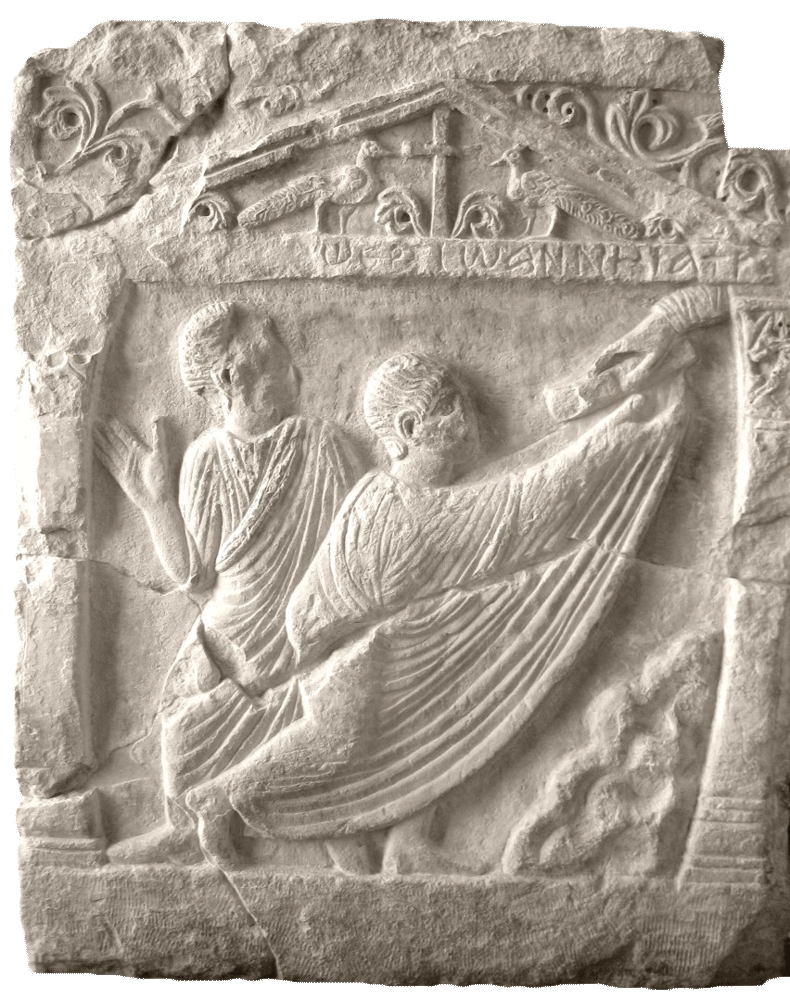
This relief from the sarcophagus of a physician named Ioannes shows God giving the law to Moses (Constantinople, fifth century AD).
D. The results of faith (3:26–29). No statements in the Pauline corpus reveal more readily than these the radical newness of human experience Paul believed to be a direct result of a personal encounter with Jesus Christ. In the cultural and religious context of first-century Galatia, where distinctions of national origin, gender, and economic status were the defining tools for human interaction, Paul’s words here declare the inauguration of a new paradigm of human value.
Paul switches back to the second-person plural from the first-person singular (3:15–25) to state his conclusion. If the Galatians are being pressured to become something more than they believe they already are, they should note with care the fact that once they have been joined to Christ (3:26), all temporal distinctions become meaningless; all of them are already “children of Abraham” (see 3:7). This is where the opponents have missed the radical nature of faith in Christ. Access to God through Christ is open to all, and once access has been appropriated, the unity of humanity that began prior to the fall is restored, with the resultant loss of distinctions, which were simply echoes of the fall.
It should be noted that the main emphasis of these statements is on the reality of kinship (or sonship) in the covenantal family of Abraham as a result of faith in Christ. Paul’s elaboration of this fact in verses 27–28 is a timeless truth, but in the context of a first-century Gentile church led to feel its experience is inferior to a Jewish experience in Christ, these words would make a far greater impact than we may be capable of imagining. Paul specifies the accompanying full rights of this new intimate relationship, showing that Gentiles in Christ are also “heirs according to the promise” (3:29). Such statements leave no doubt that the opponents’ position not only fails to add anything to the Galatians but in fact will negate that which they already have received.
While much has been made of the fact that Paul uses baptismal imagery here (see Betz, 181–85), it is too much to say with certainty that he reflects this wording from an existing ceremony. Nevertheless, with the image of being “clothed” in Christ, Paul might very well have a baptismal ceremony in mind. Many early Christian baptisms utilized white robes for the participants to display the overall newness of life in Christ (with the effect of also reducing any visible human distinctions of status or even gender).
The three couplets in verse 28 may reflect an ordering by Paul devised to contradict existing prayers found in Jewish and Gentile circles that gave thanks to God for an individual’s superiority over supposed inferiors (Betz, 184n26). In any case, Paul’s elaboration on the oneness found in Christ leaves no room for those in Galatia (or for modern readers) to allow for any prejudicial treatment of fellow believers in light of ethnic, economic, or gender particularities. Rather than an exhaustive list, the apostle provides enough elaboration to show that absolutely no distinction can be carried over into the Christ experience.
We should also note, as do many, that the couplets Jew/Greek and slave/free are not exactly like male/female. While the two former couplets eradicate any distinction whatsoever, the latter one, linked by the conjunction kai (“and”), indicates that while the complementarity of gender difference remains, such difference no longer represents any barrier to full participation in the newness of life found in Christ (see Snodgrass, 167).
E. Maturing into sonship (4:1–7). Paul builds on the dual images of kinship and covenantal inheritance from the previous climactic section (3:26–29) to point out an important truth in his view of salvation history. Just as the kinship of a child in a wealthy family is never in dispute, although that one must await the time of maturity to assume the control of the estate, so also the kinship of the Gentiles has never been in dispute. Though they were not God’s people until the coming of Christ, it was always God’s plan to include them (all of humankind) under God’s grace.
The use of the symbol of guardianship appears to be applicable to both Jews and Greeks (notice the first-person plural in 4:3, 5). Prior to Christ, Paul asserts, everyone is assessed as having been under the “basic principles” (Greek stoicheia; NIV “elemental spiritual forces”) of the world. While there has been much discussion as to what Paul includes under this term, it appears that he considers all religious expressions (including the law!) as having been only the basic foundation of that which was to come in Christ.
Verses 4–7 show clearly the redeeming work of God in securing the available kinship for humanity. In a repetition of the Greek verb, God is shown to have “sent his Son” (4:4) and “sent [his] Spirit” (4:6). Thus, it is totally a work of God that has occurred in the fullness of time (4:4), with the result that each Galatian follower of Christ is “no longer a slave, but God’s child” (4:7). As if to certify this fact of kinship as being received, Paul describes the Spirit as crying out through the heart of each redeemed person, “Abba” (4:6), which is literally the cry of a small child to a loving father.
While Paul’s presentation appears to be designed to show the Gentiles that they are positionally equal with the prejudiced opponents, he has moved far beyond just that fact. In addition, he has shown that, by the gracious work of God in Christ, they actually have received the type of intensely personal relationship that most religious Jews would never have dared to assert for themselves (see Boice, 474n6).
4. An Appeal to the Galatians (4:8–31)
A. An appeal to maturity (4:8–11). Appealing specifically to the Galatian Gentiles, Paul reminds them of their former enslavement to polytheism. He confronts them also with the inappropriateness of turning toward any other religious expressions designed to add to the saving work of Christ. His purpose seems to be to point out that whether they embrace Gentile religious notions or the ancient and holy traditions of Judaism, all of them are “weak and miserable forces [stoicheia; NIV note: “principles”]” (4:9; see 4:3), which have now been superseded by their position in Christ.
Referring to the fact that they have already begun to observe certain (presumably Jewish) regulations (4:10), Paul asserts that such actions threaten to negate all that he has done among them (4:11). Such actions suggest that they have made no progress since Paul’s visits. In their attempt to mature through legalism, the Galatians have actually indulged in a childish flirtation with danger.
B. An appeal to their personal relationship (4:12–20). The apostle turns to offer the Galatians an objective measure by which to judge his arguments and motives. He refers back to their first meeting (4:13; the Greek term for “first” would normally refer to the first in a series, possibly giving some weight to the southern Galatian theory). His tone is now more personal (use of “brothers and sisters,” 4:12, and “my dear children,” 4:19). He calls on them to imitate him, based on the integrity of his former work among them (4:12).
Because of some illness, which he does not pause to detail here (perhaps his “thorn in my flesh”; see 2 Cor. 12:7), Paul’s initial visit caused him to come under obligation to the Galatians. He recalls for them their former touching and sympathetic response (4:15) to his needs and appeals to the strong personal relationship (4:14) to press them to reject those who would attempt to drive a wedge between them and their founder (4:17).

In Galatians 4:14, Paul recalls how the Galatians “welcomed me as if I were an angel of God.” Acts 14:12 recounts that in Lystra, Paul was called Hermes, who was the messenger of the gods in Greek mythology. Hermes is depicted on this Greek pottery (480–470 BC), wearing the winged sandals of a divine messenger.
He applauds them for their concern to be zealous yet immediately asks them to be very careful to judge if the object of their zeal is worthy (4:17–18). Referring to them as his “children” (4:19), Paul takes the loving tack of a parent who wants to encourage the first steps of their child, stumbling though they may be. His wish is that his readers not only grow but also be capable of discerning which direction is appropriate for their growth (4:18).
Here Paul’s frustration becomes visible. He was thinking that his relationship with these churches was secure enough to withstand any adversity, but now he finds that he is treated with contempt. He wishes his tone could be less anxious and stern (4:20). The fact that he has had to deal roughly with them points out the severity of the situation.
C. An allegorical appeal (4:21–31). His final appeal has perplexed many commentators. The use of the historical narrative concerning Hagar and Sarah coupled with the prophetic utterance of Isaiah (Isa. 54:1) appears to make Paul guilty of some specious scriptural interpretation. This may be an instance when our lack of specific acquaintance with all the dynamics of the Galatian situation hinders our ability to understand. (Possibly Paul’s approach discredits interpretations offered by the opponents?)
The “allegory” (4:24; NIV “figuratively”) stresses the main points of Paul’s previous arguments and thus stands as a good, if somewhat ironic, summation of the opponents’ errors. Utilizing an incident revolving around Abraham (likely one of the opponents’ favorite figures because of the institution of circumcision), Paul shows that, like the covenants of law and grace, Hagar and Sarah can be compared (literally “stand in the same line”) yet have some very different characteristics:
| Hagar | Sarah |
|---|---|
| slave woman | free woman |
| son, physically born | son, born according to promise |
| Mount Sinai (old covenant) | (new covenant?) |
| present Jerusalem, enslaved | Jerusalem above, free |
The major difference between the two is of “kind,” not circumstance. Paul appears to be relying on the Galatians’ acquaintance with the historical narrative to point out the major factors in the story. One factor, which is unstated but certainly in view, is that the Hagar incident was not a necessary part of God’s plan and had not been included in the promise to Abraham (see Genesis 16). So also, the covenantal promises to Abraham had not included the law (which he already stated to have become necessary only because of human sin; see Gal. 3:19; Rom. 5:20).
Thus, rather than being discontinuous with the promises of Abraham, the gospel of grace is fully aligned with those original promises. As if to further enhance the point, Paul recites a prophecy of Isaiah concerning Israel’s restoration from the captivity of Babylon (Isa. 54:1). While the Israelites were few in number then (as the Gentile Christians are, relative to Jewish believers, at the time of writing), miraculous, God-ordained growth was promised.
Finally, then, as in their situation, the son under slavery persecuted the son of promise (Gal. 4:29). The opponents are clearly portrayed as operating outside the covenantal promises of God. Sarah’s statement in Genesis 21:10 conveniently allows Paul to imply not only that the opponents’ position should be rejected but also that the opponents themselves should be cast out (4:30), since the enslaved cannot inherit the promises with the free. Paul indicates that rather than being seen as second-class citizens of the Mosaic covenant, the Galatian Gentile Christians have been fully accepted as children and heirs (they are Isaac; 4:28; see Gal. 3:7) of the Abrahamic covenant.
5. Freedom in Christ (5:1–6:10)
A. Thesis (5:1). Grammatically, verse 1 of chapter 5 is related to the previous paragraph, yet it also provides both a summary and a transition point to the letter. While the manuscript evidence varies on points of grammatical connectives, the sense of the statement is not endangered. In fact, this statement provides the thesis for Paul’s insistence on the Galatians’ rejection of the opponents.
The NIV’s rendering of the verse into two sentences appears to be quite correct (against the KJV). The first sentence stands as the declaration of purpose for Christ’s redeeming work (literally “Christ set us free to freedom”), emphasizing the decisive event, which changed the believer’s condition from one of slavery (under the law and other elemental principles; see Gal. 4:3, 9) to freedom (see Gal. 2:4; John 8:32–36; Rom. 7:4, 6; 1 Cor. 9:1, 21; 11:29).
The second part of the verse encourages the Galatians to hold to their position against those who would return them again to slavery. This encouragement will be given practical substance in verses 13–26. But Paul digresses for a moment, providing specific warnings against any Galatian hesitancy on this point (5:2–12).
B. Warnings and reproof (5:2–12). This digression serves to provide the last and most pointed set of warnings concerning the seriousness of the Galatians’ consideration of the opponents’ position. Beginning with an emphatically personal appeal (literally “Behold, I, Paul, say to you”), he expands on the fact that the very act of circumcision, rather than being a safeguard for those who are unsure of which position is correct, actually serves to negate the power of Christ in their lives (5:2). The fact that Paul seems to restate this very same proposition in a slightly altered manner in verses 3–4 reminds us of his double curse against this teaching in Galatians 1:8–9.
The call from Paul is for them to declare their allegiance. To attempt to be justified through law is to forsake the grace offered in Christ and to forsake Christ himself (5:4). If they are under the power of faith, then they join him (note the switch from “you” [plural], 5:2–4, to “we,” 5:5) in awaiting the completion of the salvation begun in Christ. In this statement, one of the few about the end times, it is of crucial importance to note that the follower of the promise receives God’s declaration of righteousness (see Gal. 3:6), while the follower of the law is incessantly and futilely working to keep the law (5:4; see Gal. 3:10–12) in order to gain that declaration.
In summing up the ineffectiveness of the rite of circumcision, Paul needs to make the point that may well be an overriding consideration in the minds of the opponents and wavering Gentiles: without circumcision, or without the legal requirements, does the Christ follower fall hopelessly into antinomianism (thus believing they are governed by no laws)? Paul assures them in verse 6 that the physical act of circumcision, or even the lack of it, guarantees nothing as to the type of life one will lead. Rather, contrary to following legal requirements, proper faith will express a person’s relationship to God through loving action, motivated more by gratitude than obligation. Paul will pick up on this theme again in the next section of the letter (5:13–26).
An evident shift in tone takes place in verse 7 and continues throughout the rest of the letter as if to signal Paul’s satisfaction that his argument should have the effect of restoring his “founder’s status” among his readers. He now questions how the rift in their relationship could have taken place. The contrast now is clearly between Paul and the one (singular in 5:10) or ones who have been hindering the Galatians. Certainly God, “the one who calls you” (5:8; see Rom. 8:28, 30), is not the cause for their defection. The blame seems to sit squarely on the shoulders of the opponents among them. Paul’s expression of confidence in the Galatians for moving forward again arises from his professed knowledge of their shared faith in Christ (5:10).
The final, somewhat inconsequential objection to which he addresses his remarks apparently came from those opponents who knew that Paul had appeared at times to allow circumcision to coexist with his gospel of grace (5:11). This may be a reference to his actions relative to Timothy (Acts 16:3). If so, it lends further credence to a dating for this letter after the Jerusalem council (Acts 15). In any case, Paul makes it known that even his allowance of circumcision does not contradict his present position that the opponents are attempting to attribute to such rites (and the accompanying obligation to keep the law) something that Paul had never allowed. His action toward Timothy, for example, was one of simple expediency (cf. 1 Cor. 9:19–23). The opponents, on the contrary, make circumcision a necessity for covenantal inclusion.
He ridicules the opponents’ charge that he preached circumcision. Why then would he be attacked so vigorously? Instead, he points to such a charge as a mere distraction from the opponents’ real conflict with him. He represents the “offense” of the cross (5:11; Greek skandalon; literally a “trap” or “snare”), which overturns their entire human approach to righteousness.
Apparently the surfacing of such attacks against Paul’s ministry so frustrated him that he allowed a sarcastic remark to finalize his disgust with the opponents’ preoccupation with the outward rite of circumcision (5:12). While some commentators appear reluctant to believe Paul would utter such a condemnation, this would actually be a better fate for these opponents than the one he calls for in Galatians 1:8–9. (See Mark 9:43, where Jesus uses similar terminology in reference to something that is a skandalon.)
C. Proof of one’s grounding (5:13–26). Paul has now thoroughly analyzed the opponents’ position and has found it wanting. Paul has defended his position as an apostle and his rejection of the additional requirements of Jewish conversion for Gentiles who want to come into the covenantal relationship with God through faith in Christ. Yet one might ask, “What’s left? If you take away law, by what standard will a person live?”
In addressing this type of question, Paul reasserts his view of the purpose of redemption in Christ (see Gal. 5:1) with the emphatic “You, my brothers and sisters, were called to be free” (5:13). This freedom does not induce license (indulging the sinful nature, 5:13), since it is not the absence of law, but was the goal of the law (5:14; see Jer. 31:31–34). Paul shows that the proper expression of the law comes from a heart full of grateful love rather than anxious self-centeredness and is shown through mutual service (5:13; literally “becoming slaves to one another”) and the love of neighbor (5:13–18).
This is an especially attractive and pointed picture of the results of true freedom, since it appears to be in complete contrast to the character of their congregational relationships at that time (5:15). Rather than being the guarantor of righteous actions among these former pagans, the inclusion of the law into their lives has only given vent to competitiveness and lack of concern for each other. You can almost hear Paul say, “Precisely!” Their way shows that they use the law inappropriately, since they do not gain the results through it that all recognize to be crucial for those who desire to be found in God’s righteousness (5:14; see Lev. 19:18; Luke 10:27 and parallels).
As a counterbalance to the possibility of expressing one’s “sinful nature” or “flesh” (5:13) through freedom, Paul asserts that living “by the Spirit” (5:16) will characterize true freedom. The contrast of flesh (Greek sarx) and Spirit (Greek pneuma) is found throughout the Pauline Epistles, as well as other parts of the New Testament. Rather than pointing to two different parts of the same individual, the terminology relates to an orientation that motivates the course of life a person will take. These two orientations conflict in the most basic sense (5:17; see Rom. 7:15–23). Paul seems to assert that in spite of a person’s will to do right (i.e., follow the law), the flesh orientation makes that will ineffective and dooms the person to failure (5:17). This assertion reveals the utter fruitlessness of the righteousness-through-law approach.
The great emancipation for the Christ follower is to be “led by the Spirit” (5:18), a leading that takes away our subjugation to the law and to the sinful nature the law appeals to (see Rom. 6:11–14).
The next two sections (5:19–26) provide a practical contrast of attitudes and actions, which can be a personal test for the Galatians’ present orientation. By finding oneself on the list of either vices or virtues, one could also identify whether or not one was led by the Spirit.
Fifteen acts of the flesh are specified (5:19–21), with the insistence that the list is not exhaustive (“and the like,” 5:21; see other lists in 1 Cor. 6:9–10; Eph. 5:5; Rev. 22:15). While they may have been grouped according to various schemes, the list includes sins that many would expect (“sexual immorality, impurity and debauchery”; Gal. 5:19) and others that might be unexpected (“discord, . . . fits of rage, selfish ambition”; 5:20). Some of the sins appear to relate directly to the pagan lifestyles the readers once practiced (“idolatry and witchcraft; . . . orgies”; 5:20–21), while others could even be associated with the type of “biting and devouring” (5:15) that appeared to be a result of their new legalistic lifestyle (“jealousy, . . . dissensions, factions”; 5:20).
Paul asserts that it does not take great spiritual insight (“the acts of the flesh are obvious”; 5:19) to spot the inappropriateness of these activities and attitudes among believers. In fact, he reminds them that he spoke to them about this before (5:21) and told them that such acts revealed a person who would “not inherit the kingdom of God” (5:21).
In contrast to the multiple “acts” of the flesh, the singular “fruit” (likely denoting a harmonious unity) promotes a God-oriented expression of activities and attitudes that enhance one’s relationship to God and fellow men and women. The nine attributes found here (5:22–26) are clearly indicative of the Holy Spirit in the believer’s life, and come as a composite whole, not as individual items that some have and others do not (5:22–23; for other lists of virtues, see 2 Cor. 6:6; Eph. 4:2; 5:9; Col. 3:12–15).
Three sets are discernible in the list. The first, “love, joy, peace” (5:22), reflects the resultant attitude of one who has been endowed with the Spirit of the God, who is identified as love (1 John 4:8), who brings complete satisfaction (John 3:29), who is declared to bring “on earth peace” (Luke 2:14), and who is identified as the “Prince of Peace” (Isa. 9:6).
The second set, “forbearance, kindness, goodness” (5:22), reflects how a Spirit-led individual will conduct interpersonal relationships. The third set, “faithfulness, gentleness and self-control” (5:22–23), seems to focus primarily on a person’s inner life when under the control of the Spirit. (For a full treatment of such terms, see Barclay, 63–127.)
Paul concludes the list in verse 23 with the pronouncement, “Against such things there is no law.” Certainly his remarks are not just indicating that the foregoing list of “fruit” is permitted under the law. Rather, his point seems to answer those who feel that the call to move beyond the law would leave the Galatians without any foundation on which to measure their actions. Paul maintains that the work of the Spirit in one’s life provides an internal motivation and proper orientation to participate in the attitudes and actions that are consistent with the character of Christ. Thus, with the freedom afforded through Christ (5:1, 13), the believer crucifies the sinful nature and becomes a new person (5:24) who by nature is the righteousness demanded by the law and granted through the Spirit (see 2 Cor. 3:6).
The final exhortations of the chapter indicate that while the reality of the fruit is a gift from the Spirit, the believer’s responsibility is to actively “live by the Spirit” and “keep in step with the Spirit” (Gal. 5:25).
The follower of Jesus (and Paul includes himself here) does not sit idly by with the power of the Spirit within. We are, instead, called to active participation, in accordance with the new reality of our kinship. The tension of positional and experiential reality of the new creation is evident throughout all Paul’s letters (see especially Phil. 2:12).
The final statement of the chapter may introduce the next, more practical section of exhortations. In any case, Paul’s focus moves from theory (5:1, 13–25) to practice (5:26; 6:1–10). Possibly the particular statement of verse 26 is put in close proximity to the encouragement to live by the Spirit since some of the Galatians might begin to develop a new set of hierarchical stages related to their manifestation of fruit. This Paul will not allow.
D. Practical ethics (6:1–10). It is not unusual for Paul to conclude his letters with a section on practical living, which emphasizes some of the themes he addressed in the heart of the letter (see Rom. 12:9–21; 1 Cor. 16:13–14; 2 Cor. 13:5). A pervasive problem for the gospel of grace was for the attitude of hierarchy to invade the Spirit-led life (cf. Rom. 12:3–8; 1 Cor. 1:10–17; 2 Cor. 10:1–18, esp. v. 12). It may well be that this was the chief attraction of legalism—the opportunity to measure oneself relative to another and to appear superior. As Paul indicates, such an attitude is completely foreign to the gospel (Eph. 2:8–10).
In areas particularly open to the temptation of hierarchical appraisal (e.g., the awareness of another’s sin, 6:1, and the awareness of another’s burden, 6:2), Paul exhorts the Galatians to “live by the Spirit” (6:1, referring back to the previous chapter regarding the fruit that defines such a person). The Spirit-led individual will work toward restoration (6:1), which has the effect of obliterating the wrong that could be used to strengthen one’s claim of superiority against the erring sister or brother.
Paul completes these exhortations with an appeal for each person to seriously assess their own condition, as one whose only concern is to test their own level of responsibility in the Lord (6:3–5), without falling into an attitude of conceit (6:3). The Galatians are to see that their faithful actions in this area do fulfill a law, namely, the law of Christ (6:3). It is interesting to note that Paul seems to regard such practical areas of personal relationships among believers as the benchmark of which type of law they follow: the one leading to acts of the flesh or the one exhibiting the fruit of the Spirit.
In the area of financial responsibility, the Galatians are exhorted to share with those who instruct them “in the word” (6:6). Why Paul adds this concern here is open to interpretation. He may be including a concern that related to a particular injustice done to a fellow worker. However, the following statements (6:7–10) seem more than coincidentally related to issues discussed in 2 Corinthians 9:6–15, where this particular sowing-reaping proverb (see Job 4:8; Hos. 8:7) is stated in a similar context. Very likely, the same type of oppositional elements found in Galatia were present in Corinth as well (2 Cor. 11:22–23). The group there, as here, denounced Paul’s apostolic credentials (2 Cor. 10:2, 4, 10–15; 11:5, 7–8, 13, 15, 18). Given this interpreter’s position as to the dating of this epistle, it is also likely that these opponents attempted to discredit Paul’s collection for the church at Jerusalem (Rom. 15:25–27; 1 Cor. 16:1–4, especially v. 2; 2 Cor. 8:1–9:15).
Thus, this final section is provided in answer to the opponents’ objections that participation in Paul’s collection is unwise, giving a pretender the chance to defraud them (see 2 Cor. 11:8). Paul’s word is to appeal to God’s judgment of the matter (6:7). Their participation is called for as a manifestation of the Spirit in their lives, an active “doing good” (6:9), which is especially appropriate when it benefits the “family of believers” (i.e., the Jerusalem church; 6:10).
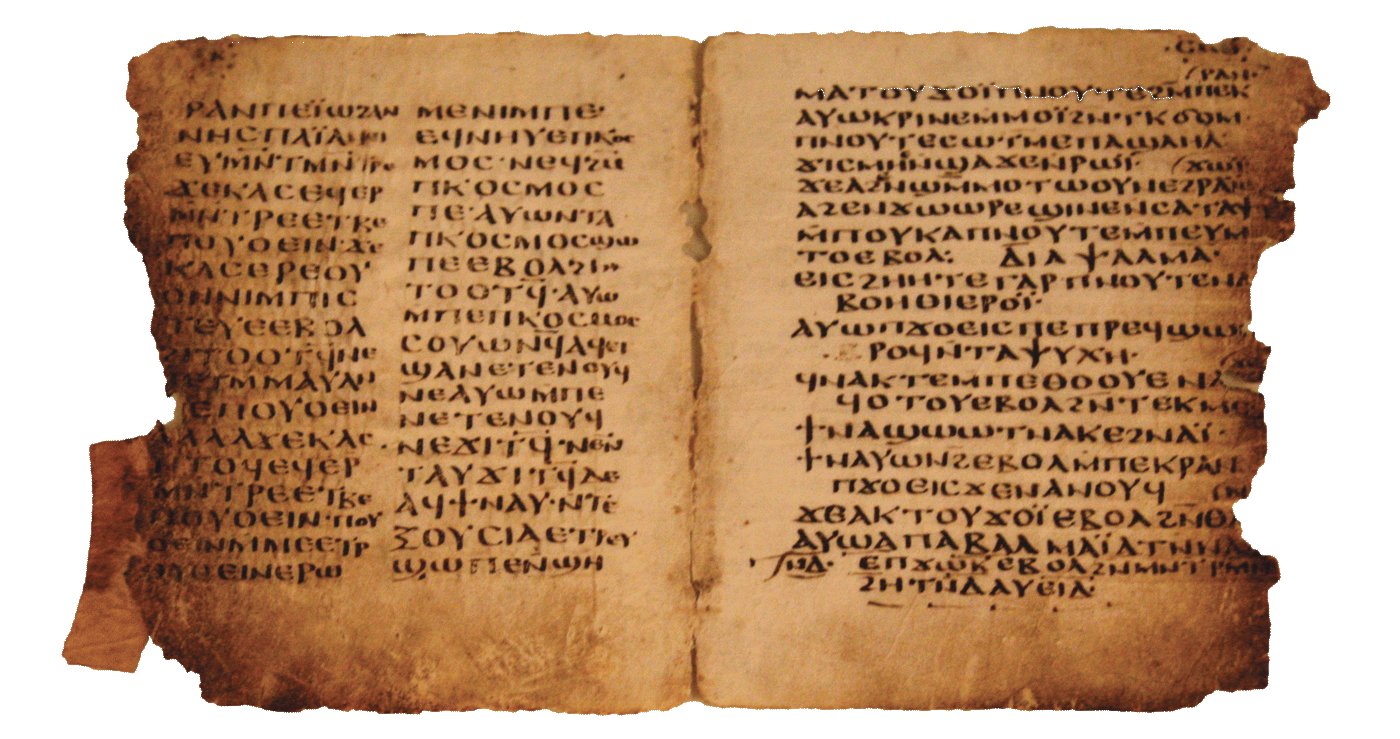
As was customary, Paul used an amanuensis (a secretary) to write his epistles. In Galatians 6:11, Paul picks up the pen and exclaims that he writes with “large letters.” The parchment pages shown here, from a Coptic codex containing portions of the Gospel of John and the Psalms, are an example of ancient writing (Upper Egypt, fifth century AD).
6. Conclusion with Personal Appeal (6:11–18)
Confirming the belief that most of the letter was dictated is the notification in verse 11 that Paul writes the remainder of the letter “with my own hand.” In drawing attention to the “large letters” with which he writes, Paul may give us the final clue as to why, upon his initial visit, the Galatians were willing to tear out their own eyes for him (4:15). The “thorn in my flesh” of 2 Corinthians 12:7 and the ailment that plagued him in Galatia may well be attributed to some form of eye disease. His handwriting may have been awkward, but it authenticated his letters. (See 2 Thess. 3:17, where the expression, “This is how I write,” may also be explained by such a theory.)
Here Paul takes the opportunity to personally emphasize the main point of his letter. The ones who trouble the Galatians are considered to be hypocritical opportunists, attempting to build their own misguided view of spirituality (6:12–13) by forcing the Galatians into a dependent relationship. The opponents’ motivation in all this is considered to be fear—a desire not to be persecuted (6:12), presumably by their own nonbelieving brethren (the same who have persecuted Paul).
In ridiculing his opponents’ motives, Paul sets forth his own motive. It is found in the pivotal experience of the “cross of our Lord Jesus Christ” (6:14). This event has the effect, for Paul, of causing the death of the world to him (6:14, referring to the world’s system, especially with regard to its values).
As if to leave them with one final, decisive word, he declares that the rite the opponents assert as being crucial becomes meaningless in relation to the gracious work of the Spirit in making a “new creation” (6:15; see 5:6; 2 Cor. 5:17). Even the benediction, so characteristic of the final words of the Pauline Epistles, carries this message. Peace and mercy are reserved only for those who “follow this rule.” Only these people can be properly identified as “the Israel of God” (6:16; see Rom. 9:6; 11:7; Eph. 3:6). Therefore, in Paul’s view, to be admitted as a member of the old covenant people of God, one must adhere to the provisions of the new covenant, which was promised as part of the old.
Paul’s last words alert us to the toll such battles exacted from him. The constant harassment concerning his apostolic credentials and the problem of legalism as an excuse for Jewish prejudice toward Gentiles were exhausting him. His authenticity was really not a matter of speculation; it should be a matter of evidence, the physical marks (Greek stigmata; literally a “brand mark” on an animal or slave) of a man scarred by a world that persecuted him as it did his Lord. Is there really any other, more convincing evidence they would need to see (see 2 Cor. 11:22–30)?
The benediction is characteristic of Paul, though unusually short (see Rom. 16:25–27). Particularly poignant for this epistle is the inclusion of the title “brothers and sisters” (6:18). He sends off the letter with a prayer that such a designation might still be appropriate.
Select Bibliography
Barclay, William. Flesh and Spirit. Grand Rapids: Baker, 1976.
Betz, Hans Dieter. Galatians. Hermeneia. Philadelphia: Fortress, 1979.
Boice, James Montgomery. “Galatians.” In Expositor’s Bible Commentary. Edited by Frank E. Gaebelein. Vol. 10. Grand Rapids: Zondervan, 1976.
Bruce, F. F. The Epistle to the Galatians. New International Greek Testament Commentary. Grand Rapids: Eerdmans, 1982.
Carson, D. A., Peter T. O’Brien, and Mark A. Seifrid, eds. The Paradoxes of Paul. Vol. 2 of Justification and Variegated Nomism. Grand Rapids: Baker Academic, 2004.
Guthrie, Donald. Galatians. New Century Bible Commentary. Greenwood, SC: Attic, 1977.
Jervis, L. Ann. Galatians. New International Biblical Commentary. Peabody, MA: Hendrickson, 1999.
Morris, Leon. Galatians: Paul’s Charter of Christian Freedom. Downers Grove, IL: InterVarsity, 1996.
Nanos, Mark D., ed. The Galatians Debate. Peabody, MA: Hendrickson, 2002.
Silva, Moisés. Interpreting Galatians: Explorations in Exegetical Method. 2nd ed. Grand Rapids: Baker Academic, 2001.
Snodgrass, Klyne R. “Galatians 3:28: Conundrum or Solution?” In Women, Authority and the Bible. Edited by Alvera Mickelson. Downers Grove, IL: InterVarsity, 1984.
Tenney, Merrill C. Galatians: The Charter of Christian Liberty. Grand Rapids: Eerdmans, 1950.
Witherington, Ben, III. Grace in Galatia: A Commentary on Paul’s Letter to the Galatians. Grand Rapids: Eerdmans, 1998.