Ephesians
1. Opening and Greetings (1:1–2)
2. Re-creating the Human Family: What God Has Done (1:3–3:21)
A. The Mystery of God’s Will and God’s Threefold Blessing (1:3–14)
B. Prayer for Enlightenment (1:15–23)
C. Redemption: Clearing the Ground (2:1–10)
D. Adoption: Removing the Barriers (2:11–22)
E. Digression: Paul, Outsiders, and God’s Glory (3:1–13)
F. Empowerment: Realizing the Future (3:14–19)
3. Re-creating the Human Family: What God Is Doing (4:1–6:20)
A. Therefore Walk in Unity (4:1–16)
B. Therefore Walk in Newness (4:17–32)
C. Therefore Walk in Love (5:1–6)
D. Therefore Walk as Light (5:7–14)
E. Therefore Walk in Wisdom (5:15–21)
F. Wisdom as Mutual Submission (5:21–6:9)
G. Holy War: Fighting Right the Right Fight (6:10–20)
Introduction
Authorship
Ephesians claims unambiguously to come from Paul’s hand, both in the very first word of the letter and in various other personal references. Yet doubts about this arise for several reasons. The author’s obviously limited acquaintance with his readers (1:15; 3:2) is highly puzzling if Paul is writing to his friends in Ephesus, where he spent nearly three years. Likewise, the literary relationship between Ephesians and Colossians shows that if the same person did not write both letters at the same time, then one was modeled on the other. But the letters differ markedly in vocabulary and style, suggesting that the same person did not author both documents. Furthermore, the teaching of Ephesians appears in some cases to reflect situations in the early church that postdate Paul’s death by several decades (see references to “apostles and prophets” in 2:20; 3:5). These factors add up to the possibility that Paul did not write Ephesians.
Still, if Paul did write Ephesians, it predates his death in Rome under Nero, around AD 65. References to chains and imprisonment would place composition in the early 60s, probably at Rome. But to whom was it written? Clearly, the author is not well acquainted with the intended readers, which would be strange if they were Paul’s congregation at Ephesus. Oddly, certain important and early Greek manuscripts lack the words “in Ephesus” (1:1), suggesting that the document was never meant for that congregation, but for some other or others that Paul had never visited. Perhaps it was a circular letter sent to several churches in Roman Asia, including Ephesus. At any rate, the real destination (if not Ephesus) and the origin of the insertion “in Ephesus” remain conjectural.
Taken one by one, the separate pieces of evidence against Pauline authorship can perhaps be explained away. Their cumulative effect is what carries the greatest weight against authenticity. The evidence is not airtight either way. Objections to the “inspired lie” perpetrated by another author’s calling himself “Paul” dismiss the idea that pseudepigraphy may have functioned in the first century like footnoting does today. We may then with good conscience treat Ephesians either as written by Paul or as written by one of his associates. Meanwhile, for simplicity’s sake, we can refer to the author as Paul.

Content
Central to the message of Ephesians is God’s re-creation of the human family according to his originally intended design. This new creation shatters the Jewish community’s long-standing opinion that God accepts Jews and rejects non-Jews. The traditional criterion of distinction between the Jew and the non-Jew is obedience to the law, but this criterion, fostering pride and exclusivism, was abolished in Christ’s sacrificial death. Consequently, nothing hinders reuniting all humanity as the people of God, with Christ as the head. The fact that even within the church, let alone outside the church, this reunification is not fully in effect is the result of the advance arrival of the new age of God’s rule. Even now God endows his new family with the power of the Spirit, enabling them to live out here and now their future new life. Thus Ephesians focuses on God’s people united in Christ through the power of the Spirit.
Commentary
1. Opening and Greetings (1:1–2)
The author identifies himself by name and calling and greets his readers in the manner typical in the Pauline Epistles, but without the usual companions. Whether the addressees live specifically in Ephesus is unclear.
2. Re-creating the Human Family: What God Has Done (1:3–3:21)
A. The mystery of God’s will and God’s threefold blessing (1:3–14). This opening section, setting the agenda for the rest of the letter, is itself opened in verses 3–6. God, who in Jesus Christ originated the solution to the dilemma of our sin, is praised (blessed) for blessing us in Christ with every spiritual blessing (1:3). The word “bless” carries here two different senses, depending on whether God or a human being is the one who blesses. “In the heavenly realms” implies that God’s blessings are secured in the very character of God and are not subject to the uncertainties of earthly life. This is repeatedly confirmed in this section by emphasis on God’s decision, will, and purpose.
God made his choice before the creation of the world: we, the human race, were created to be holy and blameless before him (1:4). Because he loved us and simply because it pleased him to do so, he predestined us to be his own adopted family (1:5), perhaps from among all other creatures. The purpose of this sovereignly independent choice was that we might praise the glorious grace God has freely given us (1:6). He is no egotistical God, but one who knows better than we do that if his creatures concentrate their praise and attention on him, all their creaturely potential will be realized.
This predestination applies to all humanity, not to some elect portion. It does not refer to Christians only but to the entire race. It was God’s plan for creation that we humans would be his special delight, able to commune with him and praise him forever. It is this original design, marred and corrupted by human rebellion, which God has now restored in Christ Jesus. The concept of predestination (or election) emphasizes God’s initiative, God’s choice in creating—and now in re-creating. There is no hint here of his choosing some people and rejecting others.
Threaded throughout this tone-setting passage is the key to the entire argument of the letter: all this is done for us “through Jesus Christ,” “in the One he loves,” “in Christ,” “in him” (1:3–6). The solution to the human dilemma resides in Christ the Lord, whose Father is none other than the blessed God.
In Christ three spiritual blessings are ours: redemption, adoption, and sealing with the Spirit (1:7, 11, 13). Together they amount to a whole new God-determined existence. Paul begins with redemption, made available to us through the payment of a price—the blood, or death, of Christ (1:7). It consists in the forgiveness of sins, the necessary first step toward the re-creation of a truly holy, blameless family. God’s blessing us with redemption implies that his original intentions (1:4–6) have been momentarily frustrated; sin has spoiled creation. Redemption then is the foundation of God’s re-creative work on behalf of humanity. Without redemption, nothing else could be done.
We have this redemption, this new standing with our Creator, not because of our own worthiness, but simply according to the wealth of his grace—another assurance of the security of God’s provision (1:7–8). He has heaped grace on us beyond measure (according to his own wise understanding), having made known to us what he wanted to do all along, something that gives him pleasure, something that he decided to accomplish at the proper time in Christ, namely, the “mystery of his will” (1:9). This mystery, hidden in God’s will but now revealed to us, is nothing less than that everything in creation, heavenly and earthly, human and nonhuman, will be gathered and united in Christ (1:10).
The first blessing’s negative orientation is balanced by the second blessing’s positive orientation. In Christ we have been appointed to participate (1:11). The purpose is that we may praise God’s glory and so be enabled to fulfill our proper destiny as those who belong to a holy God (1:12). The place we have been allotted was hinted at already in verses 5 and 10. It is a place in God’s new family, whose head is Christ. Again, God himself is the author, decider, planner, and accomplisher of this; he has desired it when we did not. And desiring it, he can and will do it. Indeed, he has already done it.
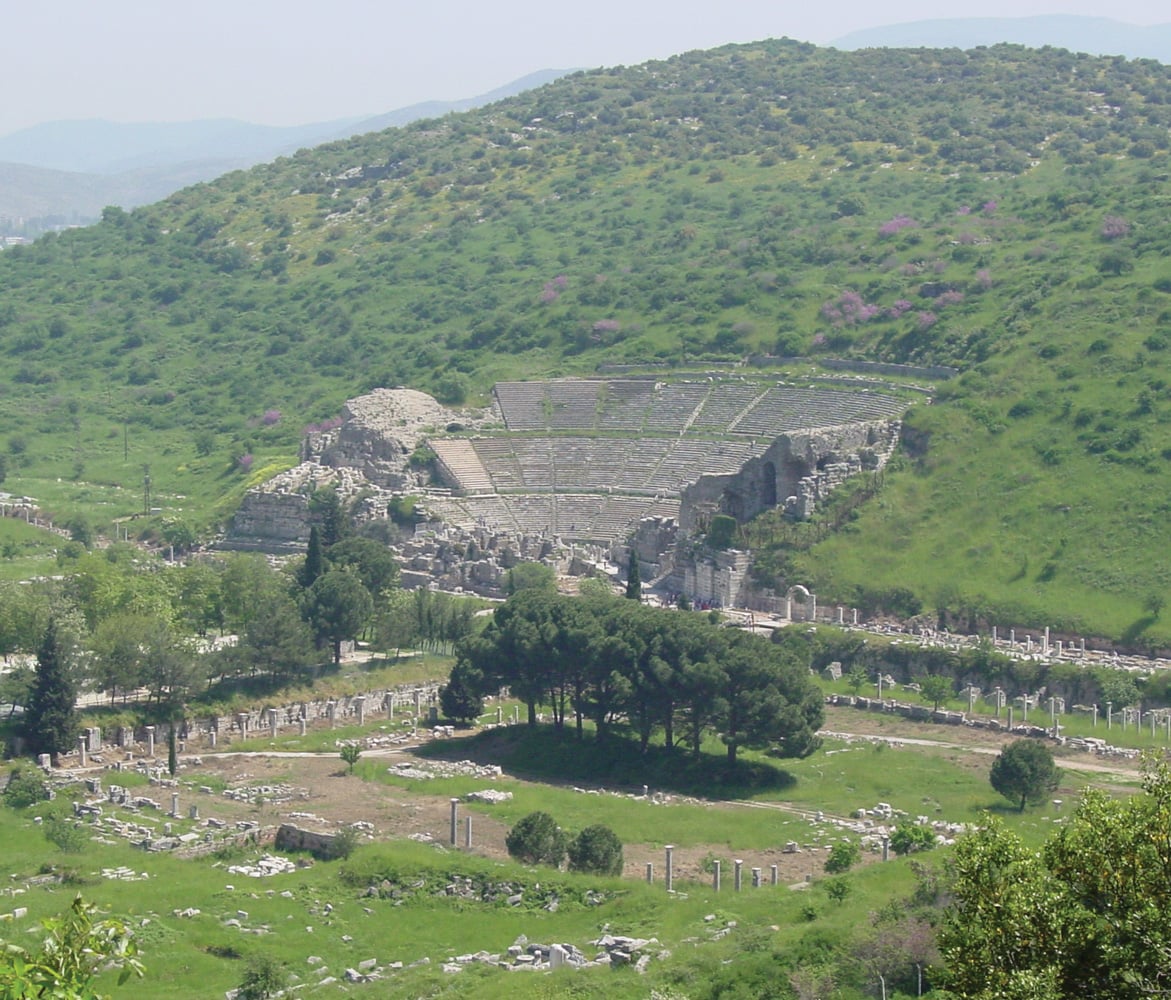
Ephesus was the major city of Asia Minor. This photograph of Ephesus shows the ancient columns ringing the agora, the commercial center of the city, and the theater just behind it. The church of Ephesus had high status throughout the first several centuries of the common era.
Up to this point, Paul has been speaking in the first person plural, meaning that he includes his readers—or possibly, contrasting them instead with some other group to which he himself belongs. This other group he has called “we, who were the first to put our hope in Christ” (1:12). Now he draws the readers into the picture by centering the third blessing on them. They have heard the “message of truth,” the true message, the gospel that brought them, too, into God’s salvation once they believed it (1:13). This gospel is the proclamation that Jesus of Nazareth, the Jewish messiah, has been declared king of all creation by his resurrection from the dead (Rom. 1:2–6), with the implication that all humanity, not just Israel, belongs to him.
Thus these Gentiles, too, are “in Christ” and in him have received the third blessing—the “seal, the promised Holy Spirit” (1:13). This at least portrays the Spirit as a down payment, a “deposit guaranteeing our inheritance” (1:14; the word translated “inheritance” is related to the word translated “chosen” in 1:11) while we await the full redemption of God’s possession. As will be seen in 3:14–19, however, the presence of the Spirit implies far more than a passive guarantee; it also means the power necessary to live out now in this doomed age the ethic of the new age to come, which in Christ has already entered the scene. This new ethic, good for us and for everyone else, is rooted in the praise of the glorious Creator.
B. Prayer for enlightenment (1:15–23). The immense significance of this threefold work of God on behalf of humanity makes it imperative that people understand it. For the more they do so, the greater their ability will be to live and grow in their new relationship with God and each other. Therefore (“for this reason”), Paul prays for his readers, whose faith he has heard about, that they may increase in understanding. Their two-dimensional faith encapsulates the sort of life the epistle promotes. It consists of faith in the Lord Jesus and love toward all the saints. In other words, it involves a confidence in God’s work through Christ, which then issues in loving concern for fellow members of the new family, no matter who they may be, acted out in attitudes and concrete deeds (1:15). The epistle in fact divides in half, treating these twin aspects of the faith. That Paul never stops giving thanks for this church or praying for it is not to be taken literally. He simply means that they are now a regular concern of his; he loves them this way, just as they love all the saints (1:16).
He prays for these people, that God would foster their understanding by giving them the Spirit of wisdom and revelation and enlightened hearts (1:17–18). The expression “glorious Father” (literally “Father of glory”) may allude to the indwelling Spirit as God’s Shekinah glory, as in the temple. Either way, it is unlikely that Paul contemplates here the readers’ need to receive the Holy Spirit, since in verse 13 he already declared that they do have the Spirit. What is meant, rather, is that they need to receive from the Spirit a revealing of the divine wisdom, so that they might themselves know God (or perhaps Christ). The phrase “eyes of your heart” refers to the spirit of the community—the mind, the inner soul—in its power to grasp ideas (1:18a). The implication is that if God does not give this illumination, it cannot be had. It is also important to keep in mind that the concern is for health of the entire community and not merely for the spirituality of individuals.
Paul specifies what he wants the believing community to understand with their enlightened heart: (1) the hope to which God has called them, (2) the glorious abundance of God’s inheritance, and (3) God’s more than sufficient power for those who believe (1:18b–19). These three concepts bear a striking similarity to the three spiritual blessings that Paul enumerated earlier. That they are not precisely parallel simply begins to unfold their significance. Paul’s prayer that the believers better understand these three concepts is not left dangling; in the course of the next two chapters, indeed over the remainder of the letter, Paul himself elaborates their meaning.
Before beginning to do so, however, he makes an important connection between these ethereal, abstract concepts (and blessings) on the one hand, and down-to-earth history on the other. The power that God has in such abundance for his people is the very same power he exercised in raising Christ from the dead (1:20). It may be difficult to grasp the truth of one’s membership in the redeemed, Spirit-sealed family of God, newly re-created on earth. Emotionally and mentally, perhaps, we are too weak to hold on to these things in the onslaught of reasons to doubt their reliability. But God has anchored them in a concrete historical event—the physical resurrection of Jesus from the tomb. These truths, then, are no less secure and reliable than the fact that Christ is no longer dead; indeed, they could not be true apart from that event.
Moreover, the exercise of this power that raised Christ from the dead and secured for us our hope and inheritance has also seated Christ at the place of supreme honor in the universe, the right hand of God (1:20); this is what the gospel is about. Consequently, whether viewed from below or above, Christ supersedes all competitors, potential or real, for power (1:21). Rule and authority, power and dominion, and titles upon titles are given both in this doomed evil age and in the glorious, unending age to come. But neither they nor their possessors take precedence over God’s Messiah. The fact that rebellious creatures (including all of us in our fallen natures) are permitted to compete with Christ and with each other is characteristic of this present age. The future age has already been initiated, however, in the life, death, resurrection, and exaltation of Jesus Christ, for all things have been subjected to him (1:22, a quotation from Ps. 8:6), whether they know it or not. Christ has already been made head over all things, uniting in himself the restored universe, for the sake of the church, his body, the new, all-encompassing family of God (1:23; see 1:10b).
C. Redemption: Clearing the ground (2:1–10). Returning to the first blessing, redemption, Paul elaborates what is implied in it. Through the work of Christ, by divine fiat, God has swept clear the ground on which he re-creates the spoiled creation. The word “redeem/redemption” does not occur in this portion of the letter, but the theme pervades it.
The human predicament is described first from the Gentiles’ perspective (2:1–2; cf. 2:3). They were formerly dead, in the estimation of God, since they previously lived in transgressions and sins. Their lifestyle conformed to this present worldly age, to the competitive values underlying all cultures and all political and economic systems. Behind that worldly system stands the satanic “ruler of the kingdom of the air” (“air” referring to the presumed dwelling place of the spirit world), who even now drives both groups and individuals to disobey God.

A statue of Ephesian Artemis (first century AD), who was worshiped as a fertility goddess. Ephesians 2:2 says that the recipients once “followed the ways of this world,” which likely included the worship of other gods, a common part of the world around them.
Among such disobedient people Paul now includes the Jews (2:3). Jews, too, live under the influence of their fleshly, sinful human desires. Existence on earth consists of a continual struggle to satisfy the selfish demands of body and soul. Consequently, the Jews are by nature under the wrath of God, just like the rest of humanity, namely, the Gentiles.
This is no insignificant remark! First, it clearly precludes any human beings from supposing that they are exempt from judgment. From a Jewish point of view, the entire human race is either Jewish or Gentile, and both groups are by nature condemned. Second, this statement of a redeemed Jew to Gentiles embodies the humility characteristic of the newly created family of God (see Eph. 2:11–22).
The human predicament is absolute; there is no escape. “Dead” people, already condemned, cannot avoid condemnation. Only from the outside can any effective solution come. Paul introduces that outside solution in 2:4: “But . . . God.” God’s character as one who is boundlessly merciful and who loves human beings with a “great love” has changed the picture. He remedied the hopeless situation in three ways with one sweeping act in Christ.
First, he brought these dead Jews and Gentiles back to life together with Christ (the “us/we” in 2:5 now includes the Gentile readers). Anticipating the sum of the matter (stated in 2:8–10), Paul suddenly asserts that this salvation from death is wholly God’s doing, an act of his grace (2:5). He then returns immediately to the point to state the two remaining ways in which God has interfered. Second, God raised us together with Christ, and third, he seated us together with Christ in that same heavenly place of honor that Christ himself now occupies (2:6). In other words, just as Christ is the manifestation of God to humanity, so Christ, as the head of his body, the church, is the manifestation of humanity to God. In Christ, God and humanity meet and are at peace.
God’s purpose in restoring and honoring humanity, in being kind to his rebellious creatures, is to demonstrate for all time the surpassing bounty of his forgiving grace (2:7). The point is not that God needs to flaunt it but that creation needs to see it.
Paul now draws the obvious conclusion: if we were dead and therefore helpless, and if God intervened and by his own will revived us in Christ, then it is an act of his grace alone, a gift (2:8). It is important to hear that the objects of God’s attention are all dead; their only qualification for his gracious favor is their hopelessly sinful rebellion. They need not clean up first; in fact, being dead, they cannot. The worst person imaginable is for that very reason eligible. We receive grace, says Paul, not by producing anything to exchange for it but simply by succumbing to God’s gracious mercy, by entrusting our fate to him. In short, we are saved by grace.
This free salvation has a twofold relation to human works. First, works have no part in the acquiring of salvation. Recent exegetical discussion suggests that by “works” Paul means the various marks of Judaism: circumcision, Sabbath keeping, kosher food, and the like, as if ethnicity were the issue. It is possible, however, that Ephesians broadens the idea to include any sort of self-aggrandizing behavior. Either way, our works cannot place God in our control; we would in fact destroy ourselves in our boasting (2:9). Second, however, truly good works realize our God-intended potential. God has prepared a way of life for which we as his creatures are ideally adapted. We were made to function best and to be happiest as a united community, living as God originally created us, and now is re-creating us, to live. Paul describes that lifestyle with detail in Ephesians 4–6.
Thus at the heart of redemption is a return to the pristine, predestined (1:4) relationship between God and humanity: total acceptance on the part of God and total dependence on the part of humanity, all embraced in a framework of love and community. On this cleared ground God now reestablishes his family.
D. Adoption: Removing the barriers (2:11–22). Paul turns next to the second spiritual blessing: adoption. Just as the word “redemption” does not occur in 2:1–10, although redemption is its theme, so now the words “adoption” and “inheritance” do not appear in this text, but those themes predominate.
One of the deepest yearnings of the human soul is to belong. We instinctively draw circles that include ourselves and exclude others, giving us coveted membership in a group others wish they belonged to. There can be no “inner ring,” in C. S. Lewis’s terms, unless there are despised outsiders. The Jewish nation, God’s “inner ring” in their own view, drew the circle at the law, epitomized in marks of Jewishness. Jews stigmatized Gentiles as the “uncircumcised,” often in self-exaltation (2:11). Without the despised Gentiles, Jews would have failed to be distinctive in their own nationalist perspective. Romans felt the same way toward non-Romans.
Paul reminds his Gentile readers that, under such circumstances, they were without Christ (who came through the Jewish nation); they had no part in the true family of God and thus no access to the promises God had made to that family; in short, they were hopelessly alienated from their Creator. Ironically, the particular people through whom God intended to show his grace to all humanity became the chief obstacle to that goal, erecting a barrier between themselves and their mission. The universal, natural (2:3) enmity toward God results in enmity between groups of human beings and indeed between individuals within groups (2:12).
But those outsiders, formerly excluded and far off, have now been brought near, within the circle, by the sacrificial death of Christ (2:13). Bringing the Gentiles “near” implies the establishment of peace, and Christ Jesus himself is the peace. By removing the criterion of judgment, the law, Christ has demolished the barrier separating the two groups, making the two into one united group (2:14). The allusion is to the balustrade or wall in the Jerusalem temple separating the inner Court of Jews from the outer Court of Gentiles. Inscriptions in the wall, warning of instant death to Gentiles crossing the barrier, have been recovered in the rubble from the destruction of Jerusalem in AD 70.
With his physical body Jesus removed the barrier, the law as used by its ancient guardians, the law understood as a list of individual commandments and ordinances distinguishing Jews from non-Jews. His death fully satisfied the law once and for all and thereby eliminated it as a means of separation between people (2:15).
Christ’s dual purpose in this was (1) to create in himself one new humanity out of the two hostile groups, making peace between them, and (2) to reconcile both groups to God in this one united body by obliterating in himself their hatred toward God and toward one another (2:16). Thus, not only Jews and Gentiles, but any two (or more) groups or individuals are deprived of all grounds for rejecting each other and are brought to peace both with each other and with God. This is precisely the two-directional restoration alluded to in 1:15.
So as not to let this grace go unknown to those it was intended to benefit, Christ preached peace both to the outsiders and to the insiders (Isa. 52:7; 57:19). Because the ground of the insiders’ security (namely, the law, the “wall”) had been taken away from them, they needed to have peace preached to them no less than the outsiders did (Eph. 2:17). Both Gentile and Jew have access to the Father, the goal of all human striving, only through Christ and by the same Spirit. Contrary to all expectation, God views the entire human race as one and deals with it all at one time, by grace, in one person.
In verse 19 Paul sums up: the Gentile Christians are no longer shut out from the family of God. They have been given a place within the ring. In fact, “ringism” has been abolished. Gentiles are part of the household, part of the citizenry of God’s own people; they belong. God hosts the premiere family reunion. In a metaphor echoing the allusion to the temple in 2:14, Paul describes the situation as the construction of a new temple (2:20–22), a new dwelling place for God on the earth among his people. Founded on the “apostles and prophets” (i.e., on the promises God has made), and with Christ himself as the cornerstone holding the whole structure together, this new building grows continually as people of all kinds are added to it. The fact that God lives in this new temple “by his Spirit” implies the Shekinah glory familiar from the Old Testament (Exodus 40; 1 Kings 8; Ezekiel 10; 44).
The whole message of Ephesians pivots on this passage. The re-creation of the family of God as the place where God dwells on the earth is part of the central purpose in Christ’s coming to reclaim creation. This new temple of humanity is rebuilt on the ground of redeemed men, women, and children, ground cleared in Christ by divine fiat. It is brought to concrete reality in the lives of real, everyday people by the power of God’s Spirit working in them. This working of the Spirit’s power, the third spiritual blessing, is the subject, after a digression, of the next stage in Paul’s argument.
Before moving on to the digression, however, it is important to observe the implication of this passage for contemporary churches. Paul spoke to a group of Gentile Christians who had been made to feel inferior by those who felt themselves religiously privileged because of their own relationship to God through the law. We who make up the church of Jesus Christ today must be ready to recognize ourselves as counterparts to the Jews of Paul’s day. Whenever we assume that our code of behavior, our heritage, our music, our habits (or lack of them), our attendance at one particular church rather than another, our work ethic, our political opinions, or any other distinction we may enjoy makes us more acceptable to God than other people are, we have taken upon ourselves the role, and the condemnation (Gal. 3:10), of the destroyers of God’s family, the family we are called to model.
E. Digression: Paul, outsiders, and God’s glory (3:1–13). Paul now takes up the third spiritual blessing, that of the Spirit’s influence on the church. Through Christ, God has renewed the human family “in the heavenly realms” (see Eph. 1:3) by eliminating all cause of division. This brings Paul to pray that the Spirit will bring about this new unity in the church’s life here and now (see Eph. 3:14–19). But first, having mentioned the Gentile mission, for which he suffers imprisonment, he stops midsentence to explain that mission more fully.
God has seen fit to entrust Paul with a message for the readers, the mystery of what God has done for them in Jesus Christ (3:2). Reviewing what Paul already mentioned (3:3; also Eph. 1:9–10?) will convince the readers of Paul’s grasp of this long-hidden plan, now made known by the Spirit to (and through) God’s chosen instruments, the apostles and prophets (3:4–5; see Eph. 2:20).
From the viewpoint of the mission to the Gentile world, the essence of the mystery is this: by virtue of Jesus Christ, non-Jews have a place among God’s people alongside Jews, partaking in every way in the inheritance, the unity, and the covenant promises (3:6; see Eph. 2:5–6 for three similar “together-with” descriptors). Astonishingly from the Jewish perspective, there is no mention of needing a proper relationship to the law for such participation. It is solely a matter of being “in Christ.” Neither moral effort nor ethnicity is any longer part of the prerequisites, if either ever was.
By the grace and power of God, in spite of his own sins, Paul became a servant of this gospel, this royal proclamation announcing Jesus as king of all creation (3:7). The honor came to him who in his own mind was the least (deserving?) of all God’s people—probably a reference to his former persecution of the very body to which he now belongs (3:8; of course, with grace, what one deserves is irrelevant!). It is now his privilege to announce to the Gentiles the news of the inexhaustible wealth in Christ the king and to make everyone possible aware that this mystery, hitherto concealed in the heart of God, is now available for all to know (3:9). Paul emphasizes the universality of the good news by highlighting God’s having “created all things”; it is not just about humanity.
God’s purpose in revealing the mystery is that, through the unlikely instrument of rebellious humanity now transformed into his own people in the form of the church, he might make known his multifaceted wisdom to the entire universe (3:10). This age-old, unanticipated plan he carried out in the person and work of Christ, Lord of the universe (3:11), in whom we have full confidence, by faith, to come freely and boldly into the presence of God (3:12).
In view of all this, Paul begs them not to be disheartened about his incarceration and other afflictions. As a servant of the gospel (3:7), he obeys its purposes whatever the cost. Moreover, it is for their benefit that he suffers; it leads to their glory (3:13) no less than, consequently, to God’s (3:21). Imprisonment is a small price to pay for such a prize.
F. Empowerment: Realizing the future (3:14–19). Paul resumes his prayer, interrupted in verse 2, addressing the Father (3:14), who himself unifies the new humanity and all creation. He is the universal God of family (3:15) and therefore is rightly petitioned to promote the present outworking of humanity’s new unity in Christ. Accordingly Paul asks his gloriously resourceful God to provide the readers with inward strength through the power of the Holy Spirit (3:16). This is the same Spirit of the third blessing (Eph. 1:13–14) and the same power that Paul connects with it in his earlier prayer (Eph. 1:18–19). The Spirit-provided inner power parallels (or realizes) Christ’s indwelling of human hearts open to him in trusting submission (3:17). The present, outward expression of this inward, heaven-based unity will be realized only through Christ’s progressive influence over the Christian community in its daily attitudes, decisions, and deeds, both private and communal.
Paul describes this unity as “being rooted and established in love” (3:17); the church’s solid foundation and nourishment for life together is found nowhere else than in the indwelling Christ. The consequence and indeed the purpose of this inward work of grace is that the readers be empowered to know and experience what otherwise cannot be known or experienced, namely, the love that Christ has for them. Paul wants these Gentile Christians as well as all other members of God’s family to grasp the full dimensions of this incomprehensible love (3:18).
Here is the final purpose of all the foregoing purposes, the supreme goal of the family-minded God: that the readers be filled with all the fullness of God (3:19). Redemption, adoption, and empowerment all aim at one and the same object: to have at last on the earth a race of human beings who truly love each other and their Creator, and not only in the future coming age (Eph. 1:21), but right now in this present evil age (“world”; Eph. 2:2). For with the coming of Christ and by the power of the Spirit, the new age has arrived, invading and overlapping with this doomed age of death and sin.
On the foundation of the profound change in the affairs of God and humanity, Paul now builds in the second half of the epistle a demanding ethic for the church to live by. Yet it is really God who builds it through Paul, and it is really Christ who lives it out in the church by the Spirit’s power. This ethic describes in fact what God is now doing, in Christ, on the basis of what God has already done, in Christ.
G. Doxology (3:20–21). On the message of this threefold work of God in Christ on creation’s behalf, Paul now pronounces a benediction. He glorifies the God who is able to do all this, who is in fact able to do far more than we would ever think of asking him to do, so small is our own vision of our need and so comprehensive and bountiful is his (3:20). Whatever he delights to do he does according to the same power that Paul knows is already at work within us. What God does so immeasurably is what Paul is now about to describe. To God, says Paul, be glory forever.
And God’s glory is forever found in the context of humanity: both in the church and in Jesus Christ, that form in which God himself assumed human shape (3:21).
3. Re-creating the Human Family: What God Is Doing (4:1–6:20)
The “imperative” second half of the letter is structured around five occurrences of some form of the phrase “therefore walk” (4:1, 17; 5:1–2, 7–8, 15). Each of the five presupposes the “indicative” first half of the letter (“therefore”) and specifies walking in a particular way. All five may relate individually to chapters 1–3, or perhaps the first is unpacked by the following four.
A. Therefore walk in unity (4:1–16). On the solid ground of God’s completed work in Christ, Paul urges readers to live a life of unity, worthy of their calling (4:1). As a prisoner himself, he knows what he is asking his readers to risk. The worthy life manifests (1) humility, proper self-estimate—both positive and negative; (2) gentleness, genuine concern for people’s need for love, acceptance, and respect; and (3) patience (4:2). Patience produces a loving tolerance of people’s weaknesses and foibles (including one’s own) but without encouraging such shortcomings. Patience also displays a strong desire to keep the unity of the Spirit in the bond of peace (4:3). This is not the same thing as keeping the peace, which often leads to complicity. Fostering true unity requires endless patience as insecure personalities come closer to Christ and therefore to each other.
The foundation of the unity of the new family of God lies in eternal realities (4:4–6). There is one body; the church is one church regardless of local manifestations (including traditions or, today, denominations). There is one Spirit of God and not a separate Spirit for every competing group. There is only one world future, now already here in part. There is only one Lord, Jesus Christ—no other lord or Caesar takes precedence over him (1:20–22)—one common message to be believed, and one common rite of initiation belonging to the entire church (4:5). And it all comes back to, and indeed issues from, the fact that there is only one God in the universe; he has created it all, and his presence and power pervade it all (4:6). Only on this monotheistic foundation can the unity of God’s family possibly come to reality.
By the same token, the members of the body, unified in theory but fragmented by nature, could never become one, as God wishes, without tools and enablement. But God has given grace to them all (4:7), endowing each one differently as Christ has liberally apportioned (no sense of stinginess here in the word “apportion”). Paul quotes Psalm 68:18 to make his point, oddly substituting the verb “gave” for the original “received” found in both the Hebrew Old Testament and the Septuagint. Such free treatment of a biblical text (and the following interpretation) may sound strange to modern readers, but Paul likely follows here an early Jewish Targum that applied it to Moses at Sinai. Taking the term “ascended” as key, Paul instead applies the whole passage to the ascending and (at Pentecost?) descending, gift-bearing Christ, the Christ who fills the universe (4:9–10; 1:23).
The gifts he has given his people (4:11) promote the unity of the church (4:13). They include apostles and prophets, those specially gifted and authoritative communicators of God’s message to humanity. The category of “apostle” may have been temporary, while that of prophet continues in God’s spokespersons to particular times, cultures, and situations. Evangelists traveled from place to place with the gospel, announcing like royal heralds the good news of Jesus’s accession. Pastors and teachers, or perhaps pastor-teachers, nurtured the flocks submitting to the evangelists’ message. These are not the only gifts Christ gives the church (cf., e.g., 1 Corinthians 12), nor are individuals necessarily excused from services for which they are “ungifted.” Some pastors, for example, could and presumably did do the work of evangelism (cf. 2 Tim. 4:5).
The purpose of endowing the church with these gifts of grace is to equip the individual members for service to all (4:12). Future, potential members are doubtless among those benefiting from such service. Christ’s goal clearly is to build up the church, so that the believers all attain to unity of faith and knowledge of God’s Son, which will make them truly mature, fully human—by God’s standard, not their own (4:13). That standard is the fullness of Christ, humanity perfected (see Eph. 3:19). In short, the goal is that we do what Christ himself does. The corresponding immaturity is susceptible to the cunning and appeal of human opinions, especially regarding relations between God and humanity (4:14). Instead, by living the truth in love—even when it hurts, but always with compassion—we are called in all things to grow into the likeness and person of Christ, who is the unifying head of the body (4:15).
This section closes with a metaphorical model of unity. Like the human body, held together by design, the church grows through the coordinated and cooperative work of its many members, who out of love for the whole contribute their individual efforts toward the good of the whole. But the plan and the energy are drawn from the head, which watches over and provides for his body. Indeed, he lives out his own life through it (4:16).
B. Therefore walk in newness (4:17–32). Efforts to walk in unity succeed to the degree to which they reflect the indwelling influence of Christ. Confident that he communicates the very counsel of the Lord, Paul negatively urges his Gentile readers to conduct their lives no longer as their fellow unconverted Gentiles do (4:17). This does not imply that Paul recommends a “Jewish” lifestyle; by “Gentile” here he means “pagan,” “Christless.” That is, he warns against living life apart from Christ, according to the old, or natural (2:3), walk. The contrast between the old and the new does not become explicit until 4:22–24, but Paul characterizes the old now in 4:17–19.
In 1:15–23 Paul stressed the importance of human thought for appropriating the message. Now he returns to the role of the mind, this time in regard to successfully (or unsuccessfully) living a life worthy of the calling inherent in that message. The unacceptable lifestyle he describes results from a futile, vain mind, focused on concerns that in the end come to nothing. Such a mind does not understand what God’s true values and standards are; it has no light from the mind of God. In matters of everlasting consequence, it is full of ignorance brought about by hardened refusal to acquiesce where the truth is available (4:18; there is no real distinction between “heart” and “mind” or “understanding” here, as if they refer to separate compartments in a human being). The natural result of such a state is alienation from the life of God. The progression is downward. Out of basic human need for sensitivity and tenderness, those with hardened minds turn to sensuality. Rejecting the one in favor of the other, and with calloused sensitivity, they practice incredibly inventive impurity, with neither end nor satisfaction in view (4:19).
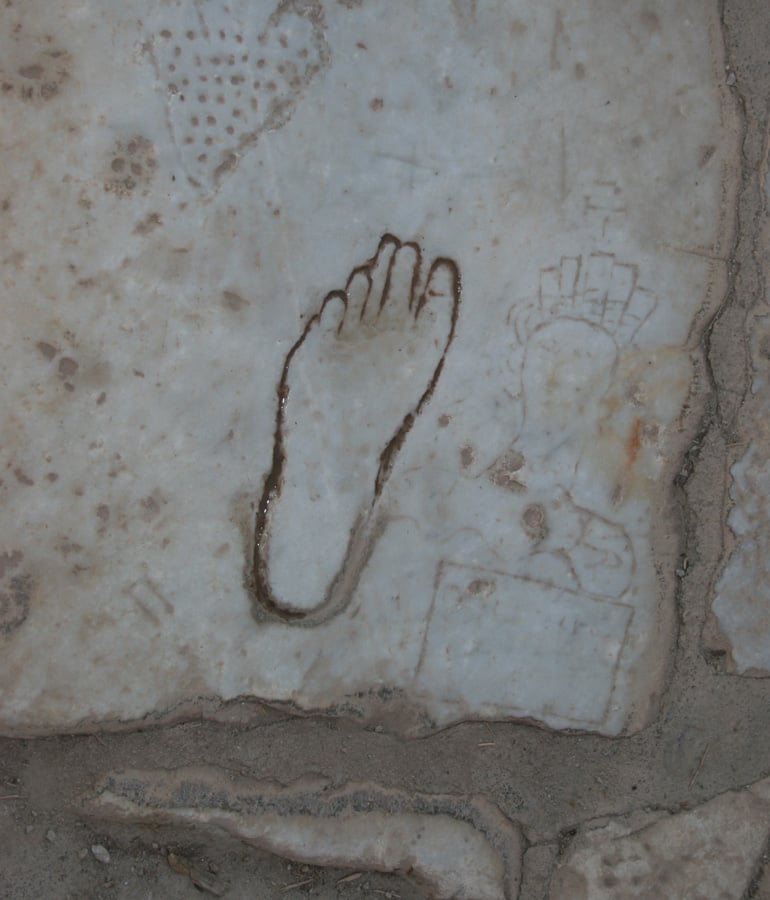
This footprint points the way to a brothel in Ephesus (first century AD). Ephesians 4:19 describes the Gentiles as giving “themselves over to sensuality so as to indulge in every kind of impurity.”
This pagan lifestyle formerly followed by the readers does not resemble the Christ they have learned to know (4:20). In saying this, Paul assumes that what they have heard and been taught about Jesus corresponds with what is actually the case (4:21). The “truth that is in Jesus,” as it concerns inward change, he sums up as a three-step progression, in which the focus is on newness.
First, with respect to their previous habits of life (4:17–19), they are to lay aside the “old self,” the ignorant, insecure, self-centered ego rotting away from entanglement in the deceitful (futile) values of this world (4:22). Removing the old, dying self is nothing less than the act of repentance, the death of the sinful nature, repeated again and again throughout life whenever conviction of sin is worked by the power of the Spirit through the message. Second, upon the (daily) death of the old nature, the mind is made new, furnished with the light of God’s mind, enabled to see as God sees and to make godly decisions (4:23). Third, to make such decisions and actually to live a Christlike lifestyle is to put on the new self, a creature not of one’s own making but designed by God according to true righteousness and genuine dedication to the purposes of his eternal will (4:24). Thus the ongoing change from a godless and selfish deathbound life to the Christlike, eternal life of God involves newness, renewal, an inward change of mind wrought by God himself in bringing the new creation to present reality.
Paul writes these things to believers, people who are already Christians. Thus, we must distinguish between becoming Christian and becoming a Christian, between what are sometimes called sanctification and justification. The implication is that justified believers are gradually transformed into Christlikeness, and this transformation consists of many “small” considerations.
Paul’s instructions for being transformed outwardly into the earthly family of God fall into five categories (4:25–32). First, he commands readers to “put off” falsehood (like the old self) and, quoting Zechariah 8:16, urges truthfulness with neighbors (4:25). “Neighbor” probably applies to members of the new covenant community, but it can also extend to nonbelievers. The startlingly practical reason for this is that members of Christ’s body injure themselves by lying to each other and conversely benefit the community by telling the truth. Second, citing Psalm 4:4, Paul warns against uncontrolled anger. While useful and appropriate (indeed commanded), anger must not be permitted to fester and thus to overpower the angry person (4:27). To “lose it” is to be diabolically selfish. Third, those accustomed to stealing should, as new creatures, do so no longer but by their own labor should make themselves useful (4:28). Remarkably, the reason for this admonishment is not a matter of independently earning one’s own living. The purpose for avoiding theft and for working with one’s own hands is to provide for the needs of other people, an entirely fitting purpose in a new community. Fourth, Paul cautions the readers against obscene and worthless talk, enjoining them instead to speak in ways that meet hurting people in their need, to speak words that ultimately encourage and strengthen the whole group (4:29). Fifth and finally, in this new life of Christlikeness believers must forgive one another in imitation of God’s having forgiven them in Christ (4:31–32). Forgiveness springs from kindness and compassion and has nothing to do with bitterness, anger (4:26), or malicious and vindictive cruelty. Cattiness and a vengeful spirit have no place in God’s new family.
Attending to these injunctions prevents grieving God’s Holy Spirit (4:30). This does not mean that the Spirit becomes sad at our failings. It means that an offense against any human being is an offense against the Father’s newly adopted community and against the Spirit, who has been set as a seal on that newly united humanity (Eph. 1:13). Attending to these injunctions is what it means to put on the new self, to walk in newness.
C. Therefore walk in love (5:1–6). Were it not for the intrusion of the phrase “therefore . . . walk” in 5:1–2, it would be natural to assume an unbroken connection between 4:32 and 5:1–2, in view of their shared emphasis on imitating God. The break, however, introduces a third way of walking, or perhaps a second way of promoting the unity of the Spirit in the bond of peace (4:3). Paul now directs readers to imitate God as children imitate their parents (5:1). They are loved by their Father; “therefore,” they can “walk in the way of love” toward one another. The definition of this lifestyle of love is the self-sacrificial love of Christ for us, says Paul. Because of Christ’s giving himself up in love for us, we are secure in our position and future with God. We are secure enough to sacrifice our own interests as an offering to God on behalf of the interests of other people (5:2). It is uncomfortably threatening both to forgive without guarantee of a favorable response and to give up personal anxieties without assurance of provision. But once we realize that our ultimate worth and final provision rest with a God who has been more than favorably disposed all along—and always will be—the threat evaporates (cf. John 13:3–5).
The loving lifestyle that fosters unity within the family can take any number of forms; for the moment, Paul focuses on what might be called “appropriate conversation,” both in the sense of interpersonal relations and in the usual sense of speech (5:3–6). Sexually immoral behavior and any sort of impurity of life are absolutely prohibited. The same is true of greed, classified here with “impurity.” Whereas in most modern congregations greed may be far less frowned on than sexual misbehavior, Paul prohibits them both in the same breath, as if they were identical at root: loveless. Likewise, incongruous with God’s new human family is any ugly coarseness in the form of foul-mouthed joking and foolish talk. Believers’ speech must instead be filled with the natural overflow of thankful hearts (5:4), something they can scarcely avoid when they keep their minds on what God has lovingly done for them.
Paul warns that those who practice such sins have no part in the kingdom of Christ and God (5:5; the lists in 5:3, 5 correspond); worshiping their own lusts, they cannot enjoy the peaceable rule of God. This of course includes all human beings in their fallen state, and that deceitful “old self” (4:22) misleads them even here. Because verse 5 is phrased somewhat elliptically, readers can get the impression that idolaters have no part in the kingdom because of their idolatry. Fallen nature instantly assumes the reverse as well, namely, that living a moral life guarantees participation in the kingdom. But participation in the kingdom, in the new family of God, is a free gift of God’s grace, bestowed on idolaters, on those who do not deserve it. That is the point of chapters 1–3.
Thus 5:5 means that persons having no part in God’s family are also idolaters, and for the same reason: they do not receive the grace of God in Christ but insist on worshiping and protecting the independent old nature. Yet putting to death the old nature, laying off the old self in repentance, is the only way by which people enter the life of God. Thinking otherwise, assuming that God is either obligated to reward morality or too gracious to mind about idolatry, is stupid. God’s wrath is real; whatever it is, the disobedient are promised it (5:6).
D. Therefore walk as light (5:7–14). Because of the serious dangers facing the disobedient, Paul warns his readers not to be led astray by worthless talk (5:6) into participation in the deeds of such persons (5:7). Disobedience works against God’s design for unity in his re-created family and is thus characterized as darkness, the opposite of the light of the Lord. Outside Christ, Paul’s readers “were once darkness,” but no longer. In the Lord, they now “are light” (5:8). The metaphor depicts human beings as bearing enormous influence in either direction. As light, they conduct themselves in correspondence to the goodness, righteousness, and truth of God’s nature (contrast 5:3), seeking to know what pleases Christ, which is indispensable for living this way (5:9–10).
In addition, enlightened living refuses to share in what does not please the Lord. In fact, avoiding participation in evil exposes it, both negatively by rejecting it and positively by doing what Christ would do. Enlightened living means being a light in dark places (5:11–12), which has the effect of transforming darkness into light. The light of Christ shining out from his light-filled followers exposes hidden dark deeds for what they are (5:13–14a).
Finally, living as light means continuously receiving the light. Quoting perhaps from an early Christian baptismal hymn, Paul states that the dispersing of darkness is an ongoing process even for the believer, analogous to the resurrection from the dead (5:14b). Death to one’s former, sinful self gives way each new “morning” to a new life of walking in the light of Christ. Likely these words are directed to the believing readers, but they describe exactly the process of divine initiative that wakens all those “dead in [their] transgressions and sin” (Eph. 2:1). Re-created life is response—to forgiveness (4:32), love (5:2), and now light. This hymn fragment encapsulates the “therefore walk” structure of the entire letter.

The Library of Celsus in Ephesus, built in AD 117 to honor the governor Gaius Julius Celsus Polemaeanus. Four statues representing Wisdom, Knowlege, Valor, and Intelligence—Celsus’s virtues—occupy the lower niches in the facade. Paul likewise instructs the Ephesians to be known for their virtues, to live “not as unwise but as wise” (Eph. 5:15).
E. Therefore walk in wisdom (5:15–21). In the fifth and final instruction on walking in unity, Paul enjoins wisdom-guided behavior. The contrasts between wise and unwise and between foolishness and understanding (5:15, 17) echo Old Testament wisdom literature, as does the reference to “evil” days (5:16). Psalm 37:19, for example, speaks of “evil times” (NIV “times of disaster”) in which God’s people foolishly fret over the prosperity of the wicked. Walking in wisdom, says Paul, implies understanding “what the Lord’s will is.” God will take care of the wicked; the readers need not worry about it. After all, as members of God’s new family in Christ, they are already members and representatives of the new age to come.
Instead, readers must be Spirit-filled, busy with what the Lord has given them to do and not forfeiting precious opportunities by wallowing in self-pity like those drunk with wine. It is the Spirit who, as God’s seal on the church, implements Christlike behavior in the lives of the family members (5:18). The Spirit-filled life manifests at least four representative characteristics (5:19–21; the list is not exhaustive). Various translations, including the NIV, obscure the original parallel structure that ties all four of these characteristics together. First, the Spirit-filled life fosters mutual encouragement and edification through believers speaking and singing to each other the promises of God and truths of the faith. Second, it includes spontaneous, heart-generated praise to the Lord Jesus. Third, Spirit-filled believers continually thank God the Father for everything he has given them in Christ. Fourth, mutual submission out of reverence for Christ marks the Spirit’s presence in the life of the new family. The personal security found in Christ frees believers to prefer one another in the daily affairs of living. In the following text, three sample situations explain what this means. The structural implication is that Eph. 5:15–6:9 constitutes one long section, parallel to the other four “therefore walk” texts. But because of the special significance of 5:21–6:9, it has its own section in the commentary.
F. Wisdom as mutual submission (5:21–6:9). Using the culturally familiar format of the household code (and Christianizing it in the process), Paul explains mutual submission in three domestic relationships as a mark of Spirit-filled living.
In each of the three parallel domestic relationships, the “weaker” party is addressed first. Thus in the first set (5:21–33), wives are instructed to submit to their (own) husbands in everything, as they would to the Lord Jesus (5:22). Paul’s rationale is that just as Christ is head and savior of the church, so the husband is head of the wife (5:23–24). There is nothing surprising here; it is standard cultural wisdom. Yet with tragic irony this text has served for centuries to sanctify the abuse of women within Christ’s church, a travesty occurring in part because interpreters stop interpreting at verse 24.
Paul Christianizes the marital section of the household code not only by introducing the model of Christ and the church but also through what he proceeds to say to husbands. His instructions to them (5:25–33) occupy three times the space he uses for wives, with obvious implications. The entire section is still governed by verse 21: husbands are to submit to their wives. As if that were not enough, the manner of submission, also modeled on Christ and the church, requires a husband to love his wife by giving himself up for her. How this self-sacrifice might look in a particular situation Paul leaves to the imagination.
He also describes the Christlike motivation for husbandly self-giving. As with Christ and the church, the purpose is to foster the wife’s full potential as God’s creation. The entire explanation (5:26–27) revolves around Christ’s plans for humanity’s perfection, but the principle applies equally to how husbands aim to enhance the humanly glory of the person to whom each has joined himself. It is as if a husband’s wife is an extension of his own body (5:28–29), again just as the church is Christ’s body (5:30). This bodily, dual-person identity is already anchored in Genesis 2:24, but Paul regards Christ’s identity with the church as superseding even the law (5:32). Correspondingly implicit in this is the perfecting of husbands: they become Christlike themselves when they, like Christ, die for another.
Whether women have been divinely programmed to submit to a self-denying husband, as if by natural default, is highly debatable. It is just as likely that Paul’s instructions in verses 22–24 are intended to make the best of the sin-warped culture he lived in. In terms of mutual submission, a husband is perhaps just as likely to submit willingly to a wife who genuinely “dies” for him as a wife is to a husband who loves her like this. However that may be, Paul has called for mutual submission (5:33), which at least implies that husbands die to themselves for the sake of their wives, and probably that wives die to themselves for the sake of respecting their husbands. There could hardly be a more profound way to express the home-based lifestyle that promotes “the unity of the Spirit through the bond of peace” (4:3).
The same call to mutual submission applies to the relationship between children and their parents (6:1–4). Once more, Paul speaks first to the dependent party in the matched pair: children are to obey their parents as their role in the call to mutual submission (6:1). And once more, this comes as no surprise; Paul’s appeal to Exodus 20:12 affirms the ancient expectation (6:2–3). His observation that this commandment is the first to incorporate a promise raises the question of why some obedient children die young. But this commandment belongs to a complex community ethic. Yahweh’s people are called to a lifestyle reflecting his will. If they obey, they will live long as his people in the land he will give them. The instruction to children to obey their parents is not simply a word to this or that specific child but a word to the entire nation about raising children among God’s people.
The idea of submissive parents probably sounded as bizarre to Paul’s readers as did the idea of submissive husbands. Nonetheless, he calls parents to submit to their children in two ways (6:4). First, they must treat their children with dignity and respect, avoiding unnecessarily provoking them to anger through capricious and unkind treatment. The point is not the children’s anger but the parents’ provocation. Children only gradually learn the meaning of mature behavior from loving and submissive parents; they learn it neither untaught nor badly taught. Second, parents submit to their children by carrying out the high privilege and frequently frustrating task of bringing up children in Christian discipline and instruction. It requires every bit as much self-denial as what Paul recommended for married couples toward each other. We could conceivably read this text to say that the parents themselves are to be disciplined and instructed in the Lord as they bring up their children. Even if that is not what Paul meant in this text, it is not difficult to imagine that he might have agreed.
Finally, Paul calls for mutual submission between slaves and masters (6:5–9). The dependent party is again addressed first, as is the pattern. Slaves submit to their masters by rendering sincere, honest work, without pretense and with all goodwill (6:5–7). Where this might seem unreasonable because of the abusive character of some masters, Paul recommends a kind of theological fiction. In three different ways (6:5, 6, 7), he recommends slaves regard their masters (or mistresses) as if each were actually Christ. It scarcely needs elaboration, although Paul does elaborate briefly. For it is the Lord ultimately who rewards good and faithful service (6:8). Evidently, the Lord himself rewards all good service, even what is offered to undeserving masters.
The usual surprising counterinstruction requires that masters submit to their slaves (6:9). Contrary to how he dealt with husbands (5:25–33) but similarly to how he dealt with parents (6:4), Paul now puts it to masters in as simple a form as he can: “Masters, do likewise to your slaves!” This can only mean that believing masters must entertain the appalling idea that Jesus himself is their slave. How would they treat him if he were? Ironically, he actually is their slave, as we see elsewhere in Scripture—in the hymn in Philippians 2:6–11, for example. In his many words about those who are first in the kingdom being slaves to all, Jesus hardly excluded himself.
On the other hand, Jesus the “slave” is also the master and impartial rewarder of both slave and free (6:8–9). The ironic interplay among the themes of Lord, master, and slave, in which all three categories exchange roles, eventually undermines all forms of the institution of slavery, of sweatshops, of enforced labor and crippling interest rates. In due time, it will utterly change the world, as it already is in the process of doing, if only haltingly. There is no reason that this teaching should not apply to all forms of labor relations.
G. Holy war: Fighting right the right fight (6:10–20). Paul’s argument has reached its final stage. God has redeemed, adopted, and sealed the readers as members of his new creation. They can now live together in unity, newness, love, light, and wisdom—essential characteristics of that new creation. Yet Paul is fully aware that believers in their current context face fierce resistance to living out this new lifestyle of God’s future. They are engaged in a holy war. As he closes the letter, Paul reassures the beleaguered readers that they are not left alone and unequipped to face their enemies. They have a dynamic leader, stout armor, and clear rules of engagement as their support in fighting right the right fight.
Paul begins by urging the readers to “be strong in the Lord and in his mighty power,” not in any other person or power (6:10). The text then falls into two main sections, one devoted to the armor that believers have for making a firm stand (6:11–17) and the other explaining what they should do in their new armor (6:18–20) in order to be strong in the Lord.
The resistance that the armored readers struggle against is from the devil and his schemes (6:11). The struggle is not against “flesh and blood” (Greek “blood and flesh”), that is, against other human beings. Paul emphasizes this because even believers readily identify their foes as other people who resist their schemes. The church is as prone to infighting as the world is, which perhaps implies that Paul’s reference to “blood and flesh” is not limited to Christians but extends to all humanity. The real enemy is the devil, active in the rulers, powers, and forces of darkness and wickedness he has at his disposal (6:12), human and inhuman.
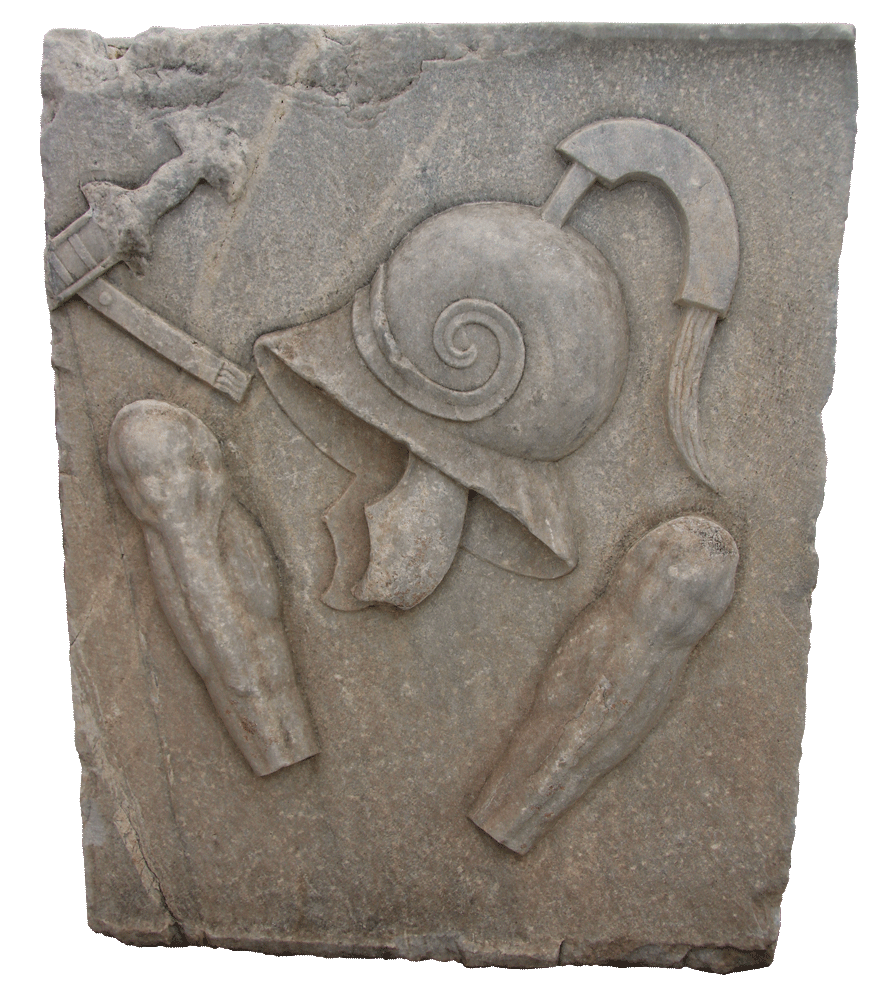
A carved relief from Ephesus of the equipment for a Roman soldier. In Ephesians 6:10–17, Paul uses the metaphor of Roman body armor to describe how Christians should arm themselves against the devil.
The earlier reference to “evil” days (Eph. 5:16) alludes apparently to despair over the prosperity of the wicked. In 6:13, however, the idea relates to any circumstance in which God’s people face resistance of the wicked against the new creation. Paul thus admonishes them to resist this resistance! Three times he urges them to “stand firm” (6:11, 13, 14), almost as a refrain in a battle hymn. Missing from his instruction, however, is any violent, offensive maneuver. There is another tactic.
Paul’s description of God’s armor is full of irony. The metaphor of military armor clashes with the qualities represented by the metaphor (6:14–17; the images come mostly from Isaiah 11; 52; 59). The equipment for struggling against the devil, his schemes, and his pawns reflects the very nature of God and his redeemed people: truth, righteousness, peace, faith, salvation, and the Spirit’s word. These are the unweapons with which believers stand firm. They amount to the new person Paul urges the readers to “put on” (Eph. 4:24); only now he speaks of it as “putting on” the full armor of God. The same verb appears in both cases. This is a holy war, a Christlike jihad. Jesus waged this same war against evil, standing firm in truth and righteousness, in peace, faith, salvation, and the word of God. It led him to crucifixion, and before he died he prayed that the Father would forgive his persecutors, for they were mere pawns. His struggle was not against other human beings.
Prayer constitutes the rule of engagement for this war (6:18–20), one lone tactic. What Paul evidently has in mind is diligent, persistent prayer for perseverance, for enduring strength, for the ability to stand firm no matter what comes. He asks believers to pray this way not just for themselves but also for all the saints, including Paul. Holy warfare is not a quest for individualized spirituality; it is a community matter. Of course, personal discipleship is entailed in the struggle for genuine unity and social justice. But individualized discipleship, even among Christians, is a means to an end and not an end in itself. God’s great plan is to sum up all humanity together in Christ into a divinely designed society (Eph. 1:9–10).
In an oxymoron, Paul refers to himself as “an ambassador in chains” (6:20), probably for effect. As an ambassador for the gospel, he proclaims the good news that by the resurrection from the dead, Jesus the Jewish Messiah has now been made king of the entire world, including Rome (Rom. 1:2–6). And this is why Paul asks for prayers on his own behalf, that he might speak boldly as an ambassador with a message from the king of creation. Yet Paul’s calling is really no different from the calling all followers of Jesus have received. Their very adherence to the lifestyle described so powerfully in the preceding three chapters loudly proclaims that a new king has arrived on the scene, establishing a new and permanent rule over humanity, establishing in fact a new humanity. The overhaul of broken creation is under way. Naturally, the resistance is fierce on the part of those who have no wish to abandon their power and presumed autonomy. They are capable of persecuting the new family of God even unto death, let alone putting them in chains. In the face of all that can and will be done against these ambassadors, Paul urges them to pray for one another to persevere, to stand firm, to resist the devil’s schemes in the evil day. And they will if they seek to be strong in the Lord and in the strength of his might, and in no one else’s, not even Paul’s.
Thus ends the sustained argument of Ephesians: God has already re-created humanity and all creation through what he has accomplished in Christ; yet God is also currently in the process of re-creating humanity and all creation through the good works he has prepared for his people to do. God has provided all they need for carrying out here and now their little part in his ongoing plan to sum up all creation in Christ. Thus, they may stand firmly obedient and faithful in the power of the Lord, no matter what happens, for they now know what will happen last: they shall be summed up in Christ together with all things, all things in heaven and all things on earth.
Except for three minor variations, the text of verses 21–22 is identical with that at Colossians 4:7–8. Paul deputizes his fellow worker Tychicus both to deliver news of Paul’s situation and to encourage the readers. He closes with a blessing of peace, love, and faith, as well as grace, which, as he is careful to point out, originates with God and Christ and is enjoyed by those who love the Lord Jesus (6:23–24).
Select Bibliography
Best, Ernest. Ephesians: A Shorter Commentary. New York: T. & T. Clark, 2003.
Bruce, F. F. The Epistles to the Colossians, to Philemon, and to the Ephesians. New International Commentary on the New Testament. Grand Rapids: Eerdmans, 1984.
Houlden, J. L. Paul’s Letters from Prison. Westminster Pelican Commentary. Philadelphia: Westminster, 1970.
Lincoln, Andrew T., and A. J. M. Wedderburn. “The Theology of Ephesians.” Part 2 of The Theology of the Later Pauline Letters. Cambridge: Cambridge University Press, 1993.
Mitton, C. Leslie. Ephesians. New Century Bible Commentary. Grand Rapids: Eerdmans, 1976.
Patzia, Arthur G. Colossians, Philemon, Ephesians. Good News Commentary. New York: Harper and Row, 1984.
Stott, John R. W. The Message of Ephesians: God’s New Society. The Bible Speaks Today. Downers Grove, IL: InterVarsity, 1979.