Habakkuk
1. The Prophet’s Perplexities and God’s Explanations (1:2–2:20)
C. Second Perplexity (1:12–17)
D. Second Explanation (2:1–20)
2. The Prophet’s Prayer and God’s Exaltation (3:1–19)
A. The Prophet’s Prayer (3:1–2)
B. The Prophet’s Praise (3:3–15)
C. The Prophet’s Pledge (3:16–19)
Introduction
Habakkuk the Prophet
Scholars largely agree that this prophecy was written by the man whose name serves as the title of the book—the prophet Habakkuk. Very little is known about Habakkuk except that he plainly calls himself a prophet (1:1) and presents for his readers an oracle or burden that the Lord has given him. The name Habakkuk has been associated either with a Hebrew word meaning “embrace” or with an Assyrian plant name hambaququ. Accordingly, some Bible scholars have suggested that Habakkuk was the son of the Shunammite woman to whom Elisha gave the promise, “You will hold [embrace] a son” (2 Kings 4:16). Others, following the second etymology of the name, reason that Habakkuk must have lived and been educated in Nineveh before coming to Judah. Still others put forward the idea that he was Isaiah’s successor by relating Habakkuk 2:1 with Isaiah 21:6. But none of these suggestions are certain. We do know that he was called of God to proclaim God’s word to Judah, which he delivered with fine literary ability, as evidenced in his use of graphic imagery and striking similes. The fact that he uses certain musical terms in chapter 3 and adds a note that the psalm of that chapter is to be sung to the accompaniment of stringed instruments may also point to his having been a Levite (see 1 Chronicles 25).
Date
Evangelical commentators have suggested three different dates for Habakkuk’s prophecy. Some suggest the time of Jehoiakim (609–597 BC), so that the conditions against which Habakkuk complains in the first chapter relate largely to the events of the first Neo-Babylonian invasion (ca. 605 BC; see 2 Kings 24:1–4; 2 Chron. 36:5–7). Others maintain that the desperate moral circumstances of chapter 1 reflect conditions that existed in Josiah’s time before the copy of the law was found (621 BC). Still others associate the details of Habakkuk’s prophecy with the time of Judah’s most wicked king, Manasseh (686–643 BC).
The third position is to be preferred, for the following reasons. First, the circumstances that Habakkuk decries reflect the debased spiritual atmosphere of Manasseh’s day (see 2 Kings 21:1–16; 2 Chron. 33:1–10), a time that was so evil that God promised he would bring a total “disaster on Jerusalem and Judah” (2 Kings 21:12). Second, the canonical position of Habakkuk between Nahum and Zephaniah, as well as the closeness of theological perspective among the three prophets, would favor the earlier date. Third, it may be that both Zephaniah and Jeremiah knew and utilized Habakkuk’s prophecy (cf. 1:8 with Jer. 4:13; 5:6; cf. 2:10 with Jer. 51:58; cf. 2:12 with Jer. 22:13–17; cf. 2:20 with Zeph. 1:7). Finally, because Manasseh was carried into captivity in the latter part of his reign and subsequently repented and initiated several religious reforms, a date shortly before or after the western campaign of Ashurbanipal of Assyria in 652 BC cannot be far from wrong.
The occasion of this prophecy is rooted in Habakkuk’s spiritual perplexities about God’s seeming indifference to great moral decay and outright spiritual apostasy. Habakkuk agonizes over the immorality, inequities, and inequalities rampant in the society of his day. He cannot reconcile such conditions with the presence of a holy and just God. Therefore, he takes his soul-searching concerns to God himself. His prophecy describes his dialogue with God—his questions and God’s assuring replies. God’s answers also reveal something as to the nature of his person and work in Israel and with all people, so that this short book contributes greatly to Old Testament theology.
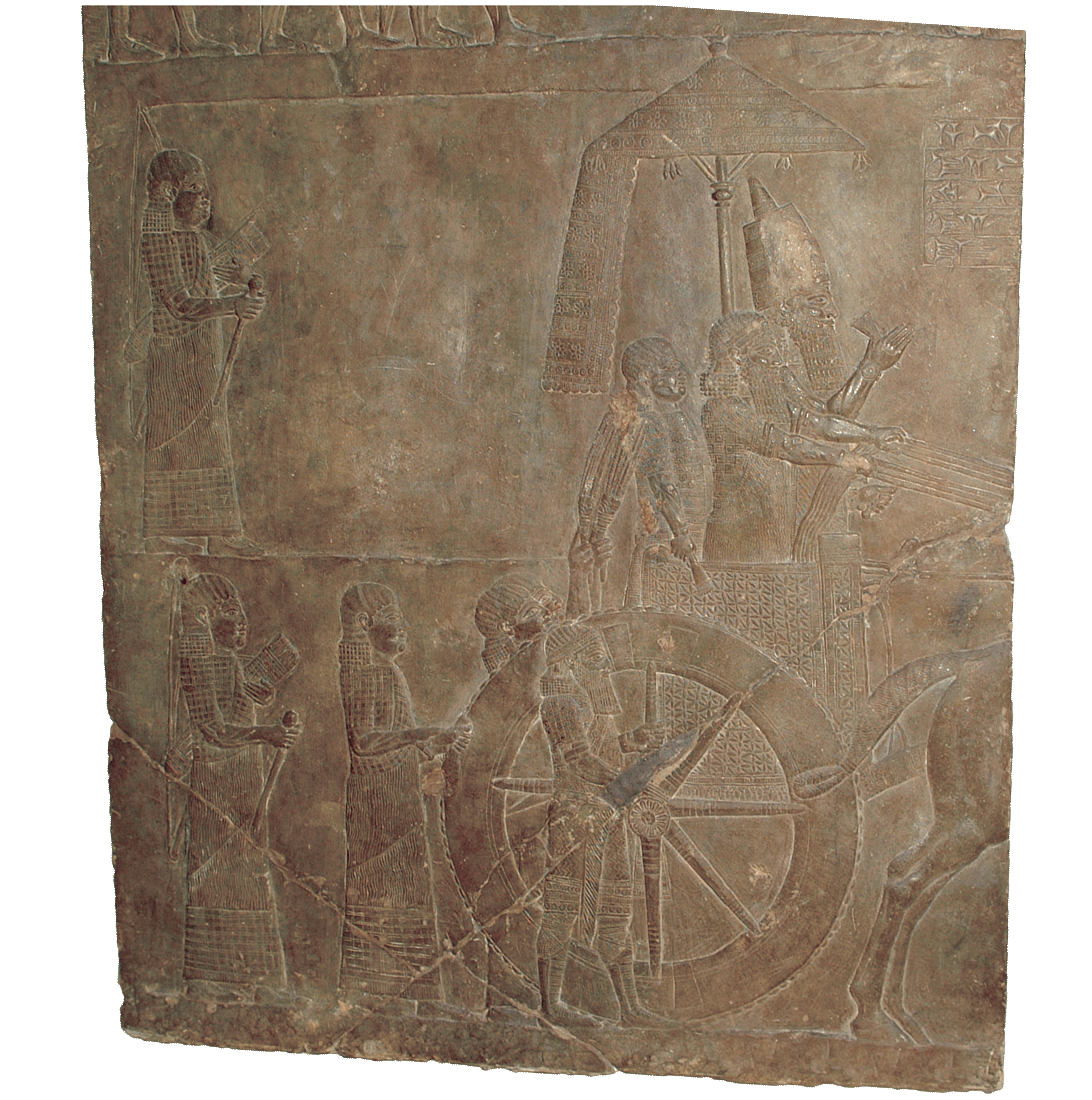
This portion of an Assyrian relief from Nineveh shows King Ashurbanipal in his chariot (ca. 645 BC).
Theological Themes
Theologically, the book of Habakkuk makes it clear that God is not only eternal and glorious but also sovereignly active in guiding all of earth’s history to his desired end. God is revealed in his Word as a God of justice and mercy who has provided for the salvation of the faithful and the deliverance of his people, Israel. Experientially, Habakkuk’s short prophecy reminds the believer of the possibility of intimate communion with God that can overcome the deepest depression and the darkest seasons of doubt.
Structure
Structurally, the third chapter of Habakkuk’s prophecy displays such stunning literary and thematic differences that critical scholars have often assigned it to independent origin. Some scholars even consider 3:16–19 to be a further independent unit.
It is evident that a basic difference in thematic emphasis exists between the first two chapters (Habakkuk’s perplexities and God’s answers) and chapter 3 (the prophet’s prayer and praise). Chapter 3 includes some old epic material (3:3–15) that had been passed down through generations of Israelites since Moses’s day. These two portions also evince distinct literary styles, the first two chapters being written in a familiar prophetic style that makes use of oracles, laments, and woes all in classical Hebrew, whereas the epic material of 3:3–15 is written in an older poetic style that contains some very difficult grammatical constructions and rare words. Nevertheless, the unity and single authorship of Habakkuk can be demonstrated from at least three conclusive facts. First, a common theme runs throughout the prophecy, namely, that God sovereignly controls the affairs of history. Second, demonstrable points of internal dependence and relation exist between the various portions, such as Habakkuk’s patient waiting on the Lord (2:1–3, 20; 3:2, 16–19), his consistent portrayal of the godless (1:4, 13; 3:13), his reception of the Lord’s answer to his perplexities (1:5; 2:2; 3:2, 16), and his confidence that the Lord will not utterly destroy his people (1:12; 3:1–2, 16–19). Finally, only with the closing verses of the third chapter is there a satisfactory answer to all of the prophet’s uncertainties. Accordingly, the prophecy must be viewed as the product of one author, Habakkuk.
Commentary
1. The Prophet’s Perplexities and God’s Explanations (1:2–2:20)
Habakkuk introduces his prophecy by reporting that the words he will share with his readers are an oracle, which God has placed on his heart. A similar superscription introduces Habakkuk’s great prayer and praise in 3:1.
A. First perplexity (1:2–4). Habakkuk cannot understand why God is ignoring the rampant corruption that Habukkuk sees all around him in Judah. He has often cried to God in anguish but has received no answer. Because the call-answer motif is used often in the Old Testament to express intimacy of communion between God and the believer, God’s failure to answer the prophet’s call may indicate Habakkuk’s fear that perhaps he is out of fellowship with God.
The Hebrew words for Judah’s sin that Habakkuk uses in verses 2–3 involve the ideas of malicious viciousness, utter wickedness, and perversity. They depict a general condition of oppression, strife, and contention. What little justice there is is perverted. The terrible conditions mentioned here are most applicable to the time of the wicked king Manasseh. According to 2 Kings 21:1–18 and 2 Chronicles 33:1–20, Manasseh plunged into every sort of Canaanite religious debauchery, including the worship of Baal and Asherah and the establishment of a state astral cult. Even the temple in Jerusalem was desecrated with Canaanite altars and symbols. The king himself not only practiced witchcraft but even involved his own son in the loathsome rites of infant sacrifice. Because Manasseh rejected God’s rightful sovereignty over his life, it is small wonder that Judah was filled with violence and immorality. For Judah’s law ultimately resided in the revealed teaching of God, whose standards were to permeate every area of the believer’s life. Accordingly, justice and righteousness, the twin expressions of God’s legal and judicial holiness, were openly perverted.
Manasseh would not accept God’s rebuke or instruction. Therefore, God brought judgment on him by allowing him to be carried off captive by the king of Assyria. This event probably is to be associated with the widespread revolts that plagued the reign of Ashurbanipal of Assyria in the mid-seventh century BC. Although 2 Chronicles 33:12–16 reports Manasseh’s repentance and subsequent restoration of true worship, it came too late to have any permanent effect on the spiritual tenor of the people of Judah. Indeed, when his son, Amon, succeeded Manasseh, he not only reintroduced all of his father’s wickedness but “increased his guilt” (2 Chron. 33:23). Because Zephaniah and Jeremiah appear to have used Habakkuk’s prophecy, and because the conditions described here must have occurred before Manasseh’s captivity, release, and repentance, Habakkuk probably penned his prophecy about 655–650 BC.
B. First explanation (1:5–11). God’s reply to Habakkuk’s perplexity is puzzling. He tells Habakkuk that he will punish wicked Judah by using the Babylonians (or Chaldeans). Since the Neo-Babylonian Empire would not be a force to be reckoned with until the latter part of the seventh century BC, such a threat seems totally unbelievable. In fact, although full judgment would not descend on Judah and Jerusalem for more than half a century, Habakkuk is being told that those forces that will spell their doom are already being set in motion. Whether Habakkuk lived to see the rise of the Chaldeans is not known, but Manasseh’s summons to Babylon (2 Chron. 33:11) would doubtless serve as a harbinger of Babylon’s later dealings with the people of God. The pronoun “your” with the noun “days” is plural and therefore does not indicate specifically Habakkuk’s lifetime. The words are to be taken in a general way.
Verses 7–11 contain a description of the coming Babylonian army. God gives a detailed description of Judah’s future foe so as to reinforce his dire pronouncement. They will be a formidable and fierce people who will be noted for both their cruelty and their arrogant spirit. Armed with a sizable cavalry, they will move swiftly across the land and with all the cunning of a ferocious wolf that uses the gathering twilight to attack the sheepfold.
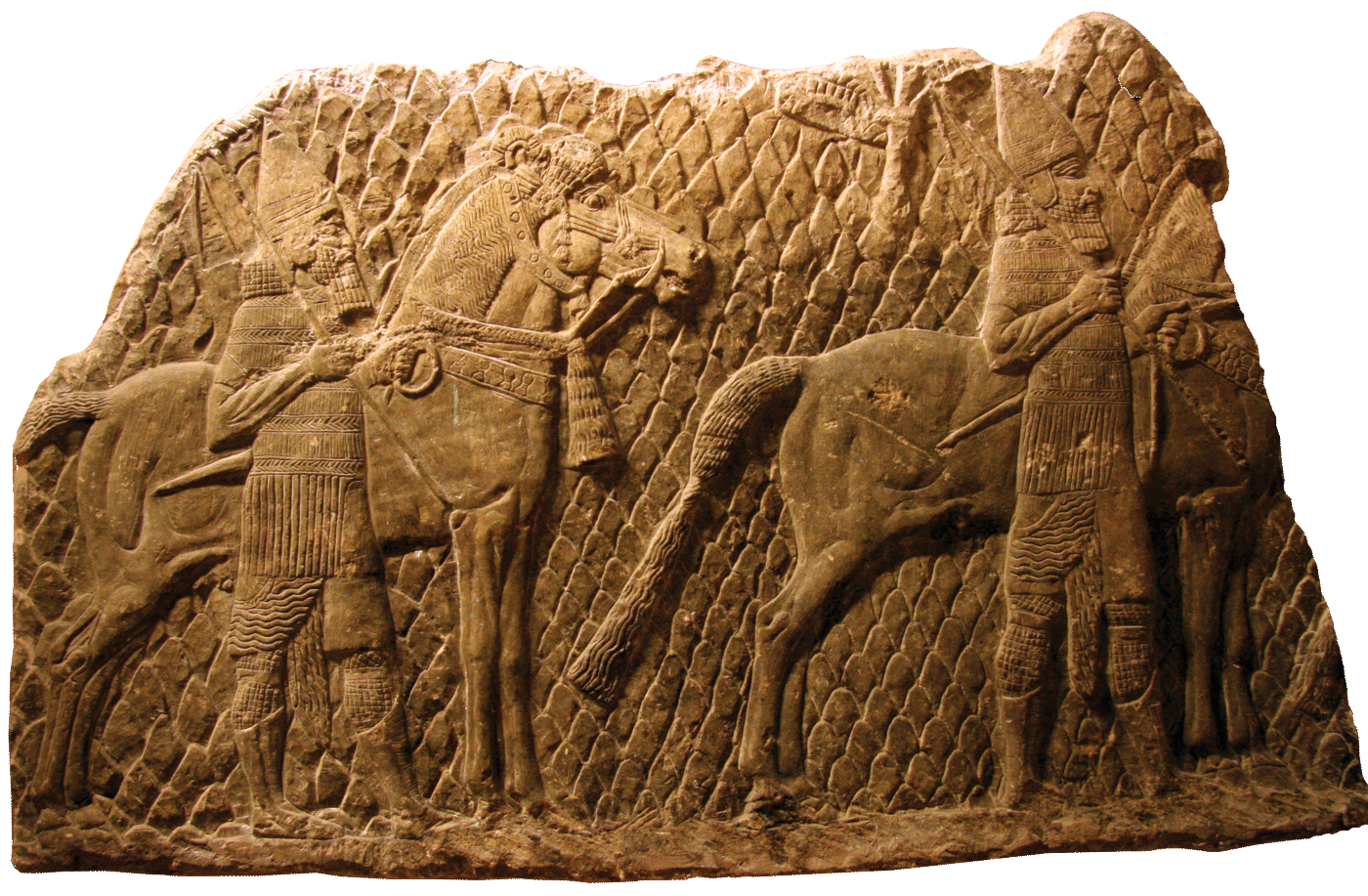
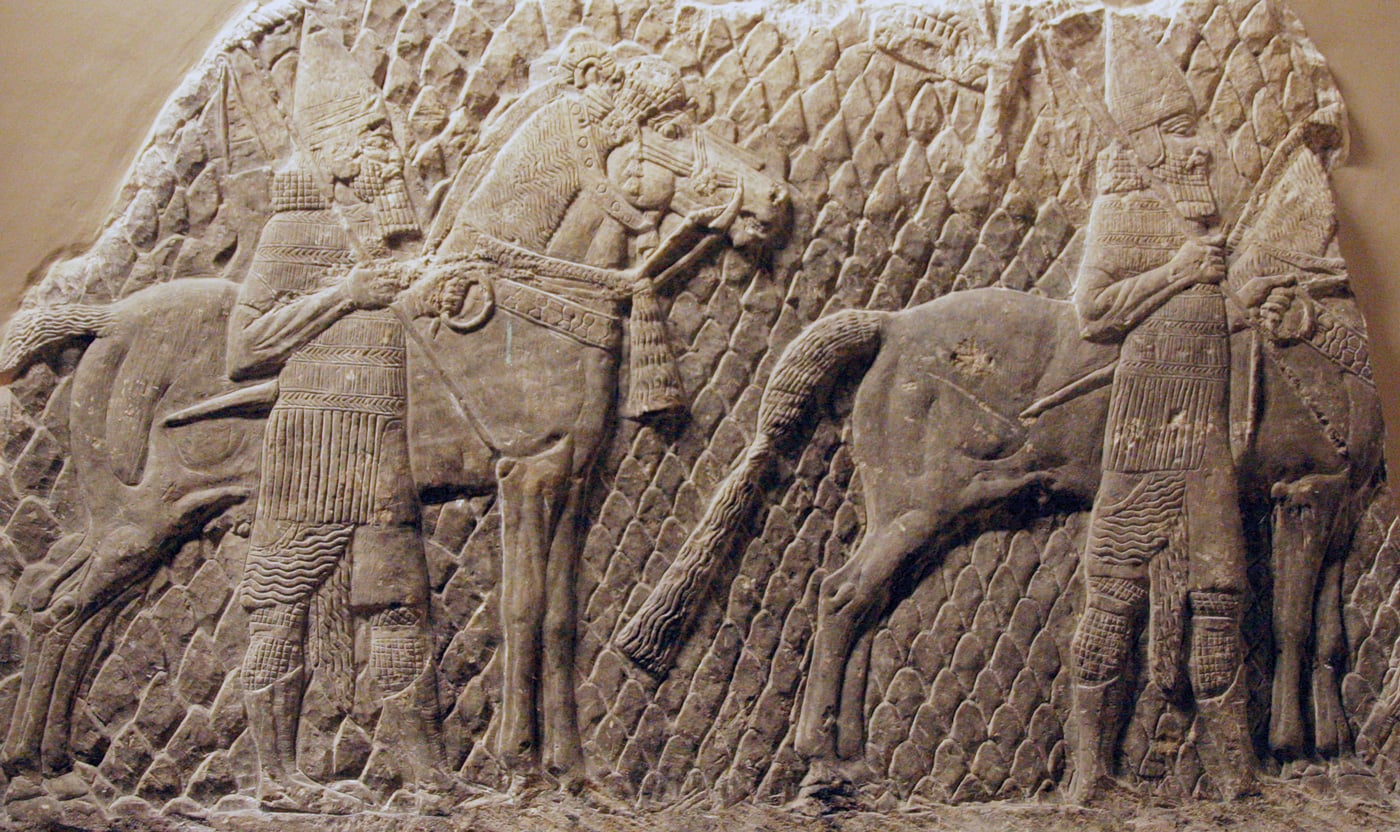
Habakkuk 1:8 describes the cavalry of the Babylonians. Members of the Assyrian cavalry are shown in this relief from Nineveh (700–692 BC).
The army covers vast distances with the speed of an eagle set for the prey. The image changes in verse 9 to depict the band of despoilers as a desert storm. Just as the east wind carried in its cyclonic winds untold amounts of sand, so the Chaldeans will gather numerous prisoners.
In verse 10 the audacity and rapacity of the coming Babylonian host are underscored. A description is given of the siege methods typically used by armies in the ancient Near East in capturing a fortified city (cf. 2 Sam. 20:15; 2 Kings 19:32; Jer. 32:24; Ezek. 17:17). In verse 11, Habakkuk turns his attention to the Babylonians’ unbridled conceit. Elated by their successes, they will throw away all sense of propriety, their reckless pride thereby sowing the seeds of their own destruction.
Thus, God’s reply to Habakkuk is one of assurance. He is already dealing with Judah’s sin, but the full realization of his activity will come in God’s own appointed time and way, however incredible his plan might seem to Habakkuk.
C. Second perplexity (1:12–17). Habakkuk has received God’s answer to his questioning remarks. God is right. Habakkuk does not fully understand what God has said. He can understand Judah’s coming punishment for sin, but he cannot reconcile the holiness of God with God’s determination to use such a wicked people as the Babylonians to destroy the people of God. Throughout chapters 1 and 2 there is not only an indication of the prophet’s perplexities with reconciling the nature of God and the circumstances of the world but a suggestion of presumption on Habakkuk’s part. His own theological system is unable to cope with life’s realities, so that rather than waiting patiently for God’s purposes to unfold, he actually presumes to instruct God. He has charged God with negligence and indifference (1:2–4); he will now charge God with using evil to overcome evil. In so doing, he reminds God that, as far as Habakkuk can see, a holy God could not carry out such a plan.
In laying out his consternation at God’s reply, Habakkuk diplomatically begins with the statement that he is sure Israel’s God must do that which is right (1:12). He reaffirms his belief in God, who is the everlasting Lord, the Holy One, Israel’s Rock, and his very own God.
Having made the point of his allegiance to God, Habakkuk quickly points out the paradox that a holy God could use such a wicked nation to execute his purposes (1:13–17). Yes, Judah is wicked, but the same can be said to an even greater degree of the people whom God himself has just described. In making his point Habakkuk utilizes some of the same Hebrew words used to describe Judah’s sin. Can God not see the danger of using such a treacherous and wicked nation as Babylon?
Habakkuk complains to God that his plan will render Judah and the surrounding nations as helpless as fish and sea creatures, which fishermen catch with hooks, nets, or a dragnet. Unchecked by any foe, these Babylonian “fishermen” will know no god but their own nets. Although some commentators have found allusions to reports of the Scythian practice of sacrificing to a sword or to Alexander the Great’s placing of a war machine in a Tyrian temple, the figure is probably not intended to refer to any literal sacrifice, for such is not known from the practices of the Babylonians. Simply put, the analogy is one of fish (the conquered peoples), fishermen (the Babylonians), and the means of taking the fish (the mighty military forces of the Babylonians). What Habakkuk fears, then, is that the great success of the Neo-Babylonian army will cause them to have such pride that the Babylonians will live recklessly and riotously, believing only in themselves and raw power.
Habakkuk ends his second questioning on a note of lament. He wonders whether such arrogance and ferociousness, once unleashed, will go on mercilessly unchecked by any hand, including that of God. God has asked Habakkuk to “look at the nations” (1:5); having done so and having heard God’s solution to his first perplexity, Habakkuk is only more deeply dismayed.
D. Second explanation (2:1–20). Having voiced his protest against God’s explanation, Habakkuk assumes the position of a prophetic watchman (cf. Isa. 21:8; Jer. 6:17; Ezek. 3:17; 33:2–3). Habakkuk will wait in earnest anticipation for what God will say in response to his latest complaint (2:1–3). Again the language is figurative. As a watchman stands ready at his post to receive news from afar, so Habakkuk will prepare his soul for God’s message to him.
The Lord’s reply is not long in coming. As a preliminary instruction, Habakkuk is told to write down God’s revelation. Just as men write important messages and information plainly on tablets or inscribe them on stelae so that passersby may read them, so the Lord’s prophet is to record God’s word for all to read. This is especially important because the fulfillment of the divine revelation will take some time. As the time approaches for its realization, however, it will be like a swift distance runner lunging with bursting lungs for the finish line. The Hebrew word translated here as “speaks” means literally to “blow out,” “puff,” or “pant.” The verb is often used in contexts involving the giving of testimony (e.g., Prov. 6:19; 14:5, 25; 19:5, 9). Regardless of how slowly the fulfillment of God’s word seems to move, it will truly come in God’s appointed time, and that with sudden finality. Therefore, the words that Habakkuk is to record will bear witness to God’s divine government truthfully: they “will not prove false.” It is God who has said it! That ought to be enough for the person of faith.
God now discloses a great and hidden purpose in his ordered government (2:4–5). Behind the ebb and flow of earth’s activities and the seemingly normal operations of human institutions, God is superintending the issues of the day. In doing so, he allows the two major classes of people, the righteous and the unrighteous, to be clearly distinguished. Despite the fact that God permits unrighteous people to thrive for a period and may even use them to execute his mysterious purposes, nonetheless the arrogance and self-will of the wicked will ultimately carry them to destruction. Habakkuk should see that the Babylonians certainly fit into this category. As is so often the case with the wicked, their success will produce an intellectual giddiness that will only be fed by the wine of their drink. The conquerors of Assyria will thus show themselves to be heedless of that which contributed so heavily to Nineveh’s downfall. The Babylonians’ riotous lifestyle will bring about an insatiable lust for power and plunder that will be as seemingly unquenchable as the thirst of death and the grave.
In clear distinction from the wicked are the righteous, for unlike the wicked, they are consumed by neither power nor greed nor pride. Rather, “the righteous person will live by his faithfulness” (2:4). The Hebrew noun translated “faithfulness” here is also often rendered as “faith” (see NIV note). It is based on a verbal root that means to “be firm,” “be permanent,” or “be secure,” hence “be faithful.” To the Hebrew mind no dichotomy existed between faith and faithfulness. The truly righteous person is the one whose faith is demonstrated in faithful deeds.
Habakkuk 2:4 is cited three times in the New Testament. Paul uses it in Galatians 3:11 to demonstrate that salvation is not achieved by keeping the works of the law but is entered into only on the basis of genuine faith. In Romans 1:17, Paul emphasizes the fact that the believer’s salvation, acquired by faith, must also be lived out totally in faith. The writer of Hebrews (10:35–38) points out that the sure coming of Christ for his faithful ones makes living by faith a categorical necessity.
Having made clear the reasons for his patience with humanity over the long course of history, God now tells Habakkuk plainly that, despite the fact that he will allow the Babylonians’ natural desires to be satisfied in order to bring Judah to judgment, the Babylonians will nevertheless reap the fruit of their unrighteousness (2:6–20). God presents the self-destruction of the Babylonians in a series of pithy taunt songs in the mouth of those whom they have oppressed. Five woes are pronounced, each consisting of three verses. Prophetic woe oracles were a type of announcement of judgment consisting of three elements: invective (or strong denunciation), threat, and reason(s) for the judgment.
In the first woe (2:6–8) God declares that the Babylonians will be despoiled. As the Babylonians plundered others, they too will be plundered. The long course of their rapacity will one day suddenly turn on them. Their accrued spoil will pile up like a debt they owe and that will surely and suddenly be recalled.
In the second woe (2:9–11) God reports that the Babylonians will be dishonored. Those who build their kingdoms by unjust gain will be brought to shame. Using the riches that the Babylonians had gained from the vast plunder that they had taken, Nebuchadnezzar would build up Babylon to be his own splendid city (cf. Dan. 4:29–30). The once-mighty Babylon would become a heap of ruins whose very stones bewail its former grandeur.
In the third woe (2:12–14) God states that the Babylonians will be devastated. The Babylonians had built their proud city with the blood-bought spoils of other nations. Although they gloated over the treasure hoards that they had gathered to aggrandize their capital, little did they realize that it would all be used eventually for their enemies’ siege fires. Worldly-wise Babylon stands as a representative of all nations who serve self rather than God. Surely all those who oppose him, as did Babylon, will one day be destroyed by the Lord at his coming to set up his universal and everlasting kingdom on earth.
In the fourth woe (2:15–17) God announces that the Babylonians will be disgraced. In these verses Babylon is likened to a man who gives his neighbors intoxicating wine in order to make sport of them by denuding them. Babylon has taken many lands and formed many alliances only to despoil its neighbors. All of this will turn back on them; the ones who have caused disgrace will in turn be disgraced. The Babylonians will drink to the full from their own stupefying wine and be exposed to open shame.
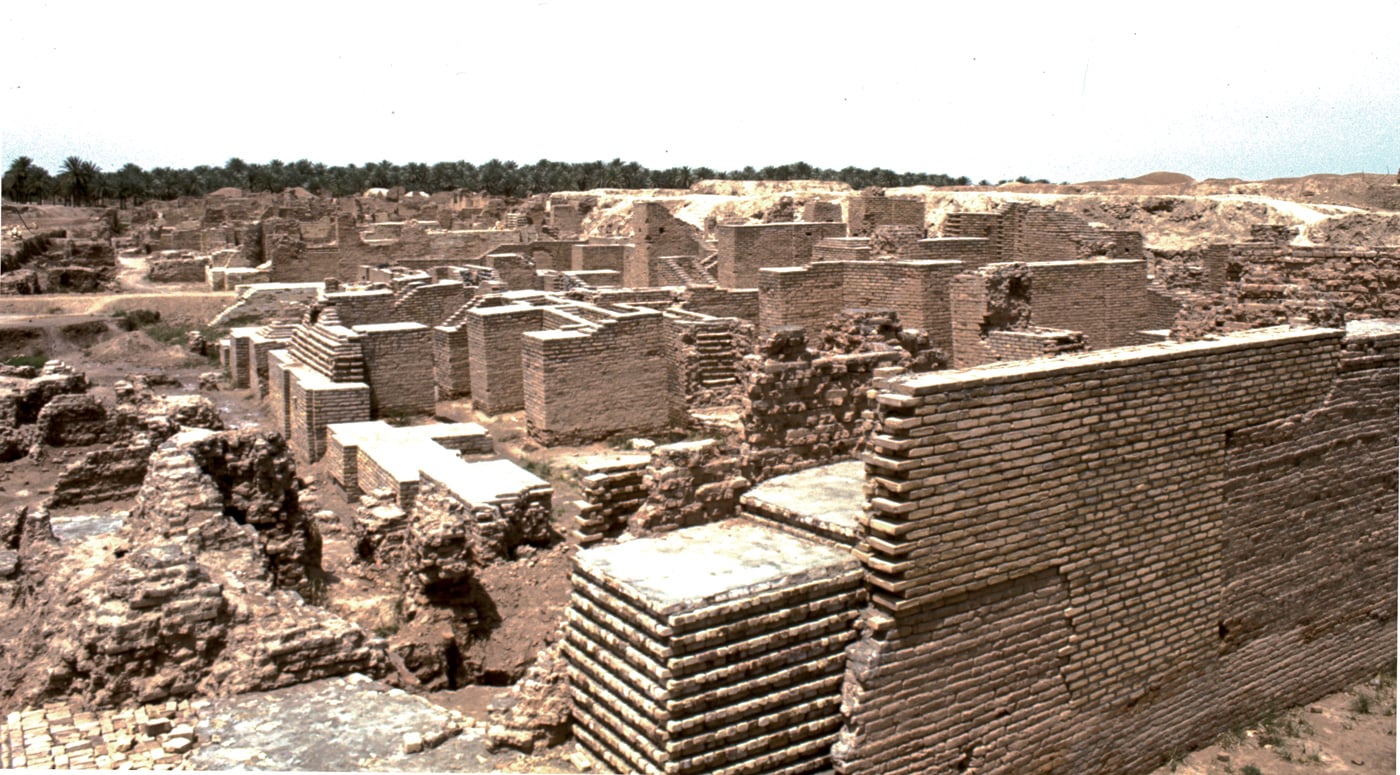
Ruins of the ancient city of Babylon
All of this is nothing less than the Lord’s judgment. For the wine will be found in a “cup from the Lord’s right hand” (2:16). The cup is often used as a figure of that which God appoints for humanity, be it a blessing (Ps. 16:5; 23:5; 116:13) or a judgment (Ps. 75:8; Isa. 51:17, 22; Jer. 25:15–17; 49:12; 51:7; Ezek. 23:31–34; Rev. 14:10; 16:19). The right-hand imagery is used in Scripture where distinct emphasis, honor, or definiteness of act is intended. Therefore, Babylon’s judgment is both certain and severe. Her vaunted glory will turn to disgrace. The force of the figure here yields a picture of one who is so overcome with drink that in his drunken stupor he lies naked in his own vomit.
Two further charges are laid against proud Babylon: she has greatly deforested Lebanon, whose cedars were prized in the ancient world, and has spilled the blood of man and animal alike in her insatiable thirst for world domination. Surely such violence will be repaid.
In the fifth woe (2:18–20) God proclaims that the Babylonians will be deserted. What little spiritual consciousness the Babylonians had was largely the result of thousands of years of pagan polytheism. They had foolishly followed their idolatrous predecessors in calling god that which was the product of their own hands. Worst of all, in the hour of God’s judgment, Babylon will be forsaken by her idols and perish with none to help her. Had Babylon only surrendered to the will of God rather than living for self and taking her endless plunder and numberless captives, how different it all might have been. Now she must learn forcibly the full truth of the next verse.
Verse 20 stands both as a final word to the fifth woe and as a word for all humanity. It is better to pay homage to the one who inhabits the heavens than to trust in gods that are no gods.
2. The Prophet’s Prayer and God’s Exaltation (3:1–19)
A. The prophet’s prayer (3:1–2). Habakkuk’s prayer in this chapter is actually a prayer psalm. The Hebrew word for prayer used here designates five psalms (Psalms 17; 86; 90; 102; 142) and is also used of the collected psalms of David (Ps. 72:20). Habakkuk’s prayer psalm is genuinely personal and yet designed for the sacred liturgy, as further indicated by the final footnote at the end of the chapter and the recurring use of the musical term selah, probably designating a musical interlude. The phrase “On shigionoth” is perhaps best understood as referring to a song that can be set to several tunes.
Habakkuk recalls God’s past mighty deeds on Israel’s behalf and pleads with God that, as he now brings Judah to judgment, he will nonetheless deal with his people in mercy.
B. The prophet’s praise (3:3–15). After laying bare his soul’s concerns before God, Habakkuk turns to praise the Lord as the only one who can meet that need. In so doing, he draws on a body of old (and exceedingly difficult) poetic material that had been handed down since the days of Moses. These epic poems told of God’s deliverance of his people from Egypt, his preservation of them in their wilderness wanderings, and his triumphant leading of them into the land of promise. Actually, two poems are to be found here, the first describing God’s leading of his redeemed people from the southland toward the place where they would cross the Jordan (3:3–7), and the second commemorating the exodus and early incidents within the promised land (3:8–15).
Habakkuk rehearses certain details concerned with the age-old account of God’s deliverance of his people out of Egypt, the journey to Mount Sinai, and the movement from Sinai to the Jordan River. Habakkuk’s first psalm joins the story at this latter stage. It may be that God gave to Habakkuk a vision of the things that he describes here.
The approach of God from the southland at the head of his people and in company with his heavenly train is detailed first. The two localities mentioned in verse 3 mark the Transjordanian southland. Teman is the name of the southernmost of Edom’s two chief cities. The name comes from a grandson of Esau (Gen. 36:11, 15, 42; Jer. 49:7, 20) whose descendants entered into the area. Paran designates not only a mountain range west and south of Edom and northeast of Mount Sinai but also a broad desert area in the Sinai peninsula. The event described here is given in similar words in Deuteronomy 33:1–2 and Judges 5:4, where the term “Seir” is used in parallelism with Mount Paran and Edom, and the importance of Mount Sinai is underscored.
Israel’s God comes filling heaven and earth with his radiant glory. Far greater than the brilliance of the rising sun or the glaring blaze of the sun at midday is the glory of the omnipotent God. This theophany of God’s awesome majesty was also accompanied by a manifestation of his power in plague and pestilence. It may be that these effects of God’s coming are here personified as though they are part of his heavenly army. However glorious God’s coming for his people might have been, it was horrible for his enemies.
The first poem closes with a further discussion of the effects of God’s powerful activity. A violent shaking convulsed the earth so that the mountains tumbled downward. God’s age-old paths collapsed before his power. Likewise, the inhabitants of the area were struck with terror at the presence of Israel’s delivering God.
In verses 8–15 a vivid description is given of God’s further victories involving his use of natural forces. Several incidents come to mind here, such as the crossing of the Red Sea (Exodus 14–15), the crossing of the Jordan River (Joshua 3–4), and the victories at the Wadi Kishon (Judges 4–5) and Gibeon (Joshua 10). The whole imagery of verses 8–11 is somewhat difficult, but the point appears to be that God is the mighty warrior who uses his celestial weapons on behalf of his earthly people.
In verses 12–14 the great victory of Israel’s almighty deliverer is portrayed. They focus on God’s redemption of his people out of Egypt at the time of the exodus. God is seen moving in great fury against the enemy, defeating him, disarming him, and destroying him with his own weapons. The poetic imagery implies that the evil leader of that enemy army was smashed with a blow to the head that crumpled him up like a heavy weight being delivered to the roof of a house and crushing it from top to bottom. Verse 14 is particularly picturesque. The enemy’s self-confidence is compared to that of certain brigands who, expecting to realize their nefarious ends, lurk with eager anticipation in dark, secret places so as to set upon unsuspecting passersby. Israel’s overconfident enemy, however, will be rudely disappointed.
In all of this God’s purpose is to be seen not so much in the fury of nature or in his ferocious assault against the enemy but in his desire to save his people. The term “your anointed” (3:13) has been taken to refer to Israel itself, Israel’s Davidic king, Moses, or the Messiah. The term is not used elsewhere of Israel, however, making those interpretations that take it to refer to some individual to be more likely. Since the setting of the psalm is the exodus, David does not seem a likely choice. Hence, a reference to Moses or to the Messiah seems to be the most likely possibility.
Habakkuk brings this psalm to a stinging close with a reminder that Pharaoh’s ambitions sank in the waters of the Red Sea (cf. Exod. 15:1–12). The point of the double psalm is clear. Just as God led his people victoriously out of mighty Egypt, through the Red Sea, and on to Sinai, up from Sinai and through the wilderness, through the Jordan River and into the promised land, so he can and will yet lead his people in triumph over their enemies—but in his appointed time, way, and strength. The exodus, therefore, forms an oft-repeated biblical motif testifying to God’s redemptive power, which reaches its culmination in a new spiritual exodus accomplished in Christ’s saving redemption and completed kingdom.
C. The prophet’s pledge (3:16–19). The prophet does not miss the point of the divinely delivered psalms. Having heard all of this (perhaps even having been shown the actual events in a supernatural vision), Habakkuk can feel his heart pounding (literally “my inward parts shook”). The further description in verse 16 makes it clear that such stark terror grips the prophet that he shakes convulsively, from quivering lips to trembling legs. The questioning prophet now stands silent before the Lord of all the earth (cf. Job 42:1–6). He will no longer question God’s purposes; he will merely wait quietly and patiently for those purposes to be realized. Though judgment must come because of Judah’s sin, though all of Judah’s produce fail, Habakkuk will trust in God. More than economic issues are in view in verse 17, for each of the commodities speaks of deep spiritual principles upon which the basic covenant between God and his people has been established.
Habakkuk’s closing words are vastly different than his opening ones. In contrast to his harsh questions and accusations, the prophet now surrenders to God’s purposes for Israel and the nations. God’s patient answers and the further revelation of God’s person and power have been sufficient to humble the prophet. In yet another striking simile Habakkuk declares that he will live triumphantly and faithfully through it all. He will rest secure in the strength that God alone can supply.
Select Bibliography
Andersen, Francis I. Habakkuk. Anchor Bible. New York: Doubleday, 2001.
Armerding, C. E. “Nahum–Habakkuk.” In The Expositor’s Bible Commentary. Edited by Frank E. Gaebelein. Vol. 7. Grand Rapids: Zondervan, 1985.
Baker, David W. Nahum, Habakkuk, Zephaniah. Tyndale Old Testament Commentaries. Downers Grove, IL: InterVarsity, 1988.
Barker, Kenneth L., and Waylon Bailey. Micah, Nahum, Habakkuk, Zephaniah. New American Commentary. Nashville: Broadman & Holman, 1998.
Bruce, F. F. “Habakkuk.” In The Minor Prophets: An Exegetical and Expository Commentary. Edited by Thomas Edward McComiskey. Grand Rapids: Baker Academic, 1992.
Keil, C. F. The Twelve Minor Prophets. 2 vols. Biblical Commentary on the Old Testament. Grand Rapids: Eerdmans, 1949.
Patterson, Richard D. “Habakkuk.” In Cornerstone Biblical Commentary. Edited by Philip W. Comfort. Vol. 10. Wheaton: Tyndale, 2008.
———. Nahum, Habakkuk, Zephaniah. Chicago: Moody, 1991.
Robertson, O. Palmer. The Books of Nahum, Habakkuk, and Zephaniah. New International Commentary on the Old Testament. Grand Rapids: Eerdmans, 1990.