Haggai
1. First Message: A Call to Action—Build the Temple (1:1–15)
A. Reproach: Their Priorities Are Wrong—Self before God (1:1–6)
B. Admonition: Get Priorities Right—God before Self (1:7–11)
C. Response: Obedience and the Will to Restart Building (1:12–15)
2. Second Message: A Word of Encouragement (2:1–9)
A. The Problem: The Inferiority of Zerubbabel’s Temple (2:1–3)
B. The Encouragement: A Greater Glory Yet to Come (2:4–9)
3. Third Message: Confirmation of Blessing (2:10–19)
4. Fourth Message: The Restoration of the Davidic Kingdom (2:20–23)
Introduction
Haggai the Prophet
The author of the book of Haggai is known simply as “the prophet Haggai.” Apart from this book he is mentioned in Ezra 5:1 and 6:14. His name is usually associated with Zechariah, his contemporary, and he is generally thought to have been older than Zechariah, because his name always appears before that of Zechariah, and because of the possible (but not necessary) inference from 2:3 that he himself might have been old enough to have seen Solomon’s temple.
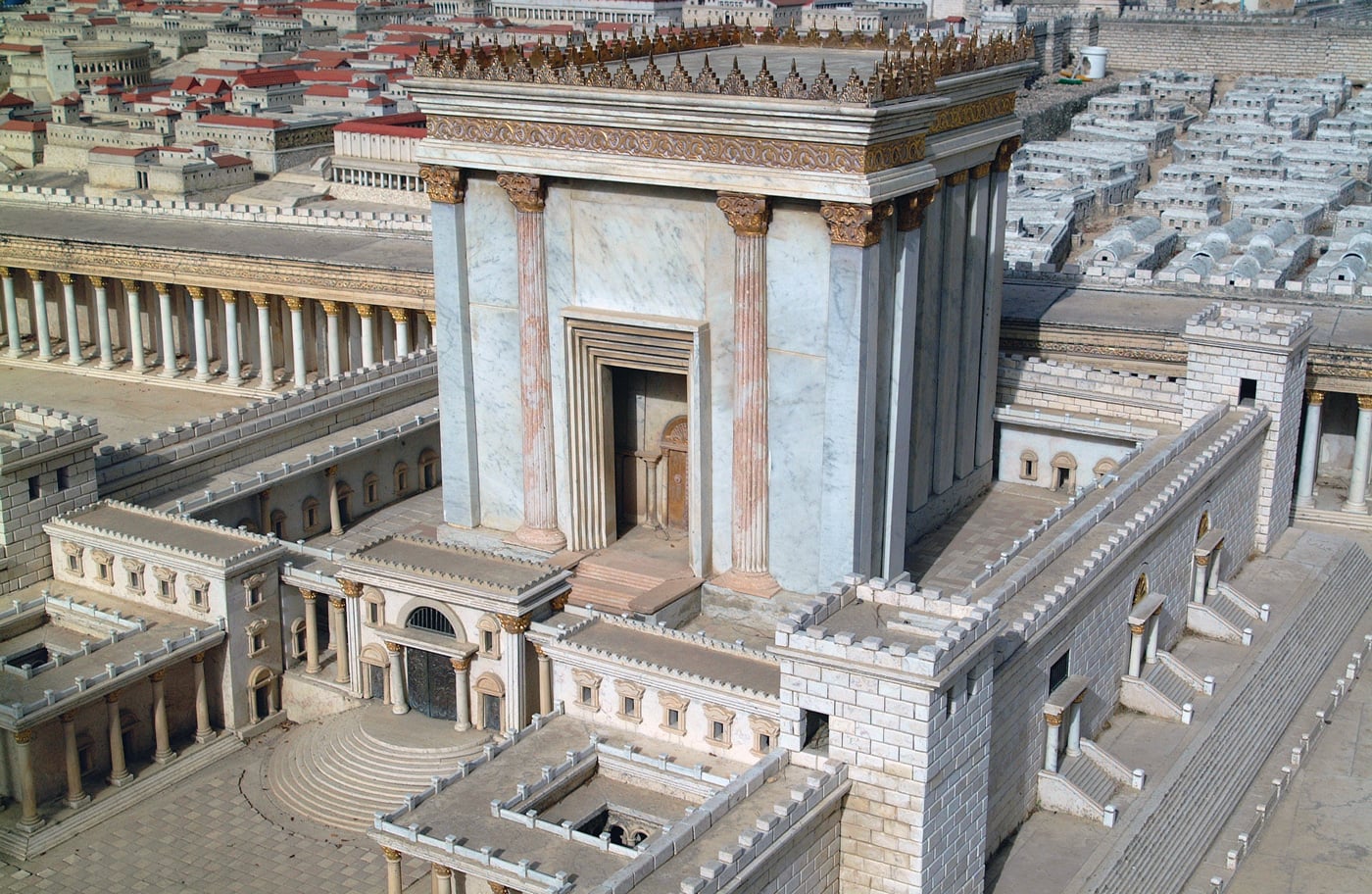
Soon after the first band of exiles had returned from Babylon to Jerusalem (539 BC), they began to rebuild the temple (Ezra 3). It was not long, however, before various hindrances and waning enthusiasm brought a halt to the project. Haggai’s mission was to rekindle the faith and courage of the people so that they would complete the temple. They responded almost immediately, and four years later (516 BC) the temple was completed and dedicated (Ezra 6:14–15).
Theological Themes
Haggai’s message is extremely practical and down to earth: Build the temple! Several truths become clear in this book:
- God’s people must put God and his work first in their lives. Only in this way is God honored. Then God provides them with his blessed and enabling presence.
- Putting personal or selfish interests ahead of God is self-defeating.
- God calls his people to put his interests before their own.
- The value of one’s work should be measured by its conformity to God’s will and purpose, not in comparison to the work of others.
- God is faithful. He will keep his promises to restore Davidic kingship and establish his sovereign rule of the nations through Messiah.
Commentary
1. First Message: A Call to Action—Build the Temple (1:1–15)
Each of Haggai’s messages is precisely dated, with the reign of Darius I as a reference point. The modern calendric equivalent of the first date is August 29, 520 BC. Haggai brings his first message on the day of the festival of the New Moon (Num. 10:10), when great numbers of worshipers regularly gathered in Jerusalem.
Darius here is Darius I (“the Great”), who reigned over the Persian Empire in 521–486 BC. Zerubbabel is the grandson of Jehoiachin, the king of Judah who was exiled to Babylon in 597 BC. As such he is of the royal line of David but holds an appointed office as governor of Judea under the generally benign Persians. The other person addressed is Joshua, the high priest. Joshua was among the first group to return from Babylon along with Zerubbabel (Ezra 2:1).
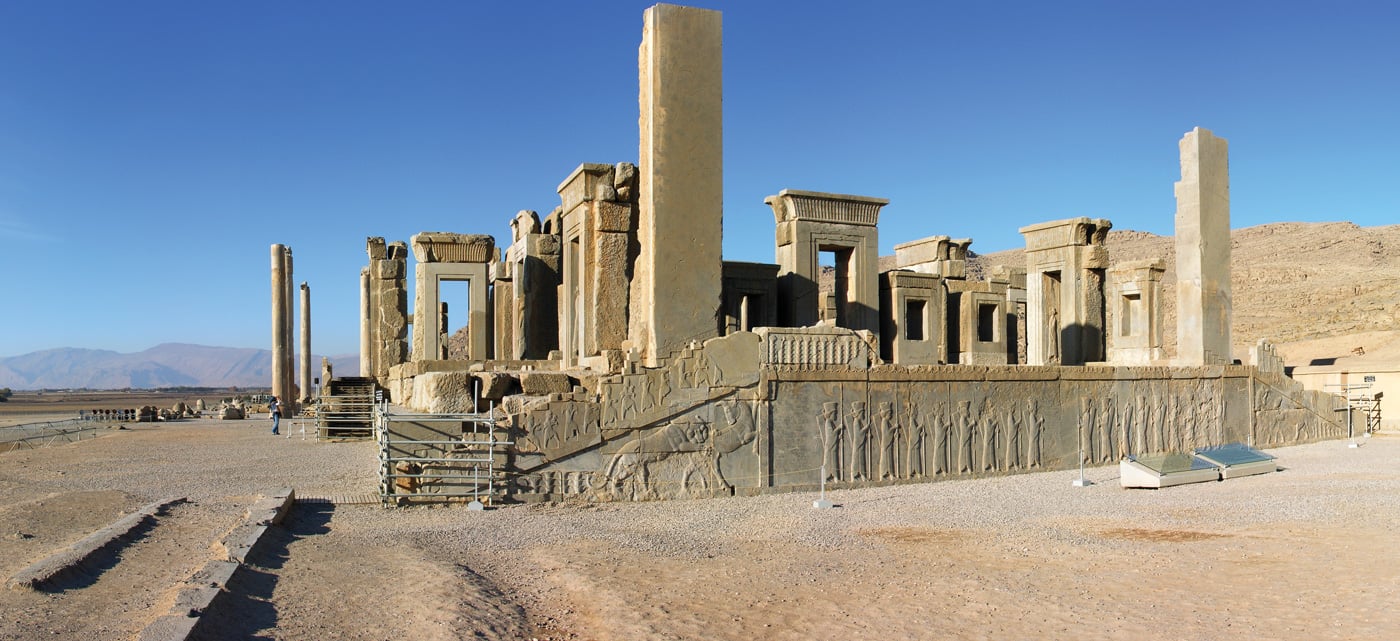
Haggai prophesies during “the second year of King Darius” (Hag. 1:1, 15; cf. 2:10). The ruins seen here are from Darius I’s palace at Persepolis.
A. Reproach: Their priorities are wrong—self before God (1:1–6). Haggai’s message is brief and to the point. It is also, more importantly, from the Lord, thus urgent and authoritative. “Lord Almighty” (1:2) is literally “Lord of Hosts.” This designation for God is found frequently in the prophetic books, but is especially common in Haggai, Zechariah, and Malachi. It is a reminder of the fact that, whatever one’s need, all the resources of heaven and earth are at God’s command. Thus for God’s people there can never be any cause to fear or hesitate when backed by God’s promise. But while there is great comfort for Israel in this name, there is in it as well the reminder that God is the Lord of Israel’s hosts. He is their commander in chief, and they are responsible to him.
The expression “these people” (1:2) instead of “my people” is used to draw attention to God’s displeasure with Israel’s spiritual apathy. Their attitude is summed up in the statement, “The time has not . . . come.” Haggai describes a people who have lost their vision and have come to comfortable terms with leaving God’s work undone. Contributing to this attitude are the following: (1) the fierce and persistent opposition of the Samaritans and other neighbors (Ezra 4); (2) the negative and disparaging reaction of the older priests at the laying of the foundations (Ezra 3:12–13); (3) a spirit of discouragement, making the people wonder if the end product will be worth all the difficulties and dangers; (4) a lack of vital trust in God; and (5) growing indifference and lukewarmness.
God’s statement in verse 4 points clearly and unequivocally to Israel’s wrong sense of values, a spirit diametrically opposed to that of David (2 Sam. 7:2; Ps. 132:1–5), who felt ill at ease in a luxurious house while the ark of God had only a tent as a covering. The term “paneled houses” (1:3) refers to the practice of laying wood paneling over the basic stone walls and indicates that the people had gone far beyond providing for their basic needs and were primarily concerned with personal luxury while totally neglecting the temple.
Haggai asks the people to give careful thought to the consequences of their misplaced priorities. This same admonition is given five times in the book (1:5, 7; 2:15, 18 [2×]) and is designed to shake the people out of their complacency. By taking careful stock of their physical situation they are led to realize how far they have strayed from the path of blessing. Verse 6 graphically draws attention to the realities of the situation. Though they have not been reduced to abject poverty, the fruit of their labor falls far short of expectation. On top of that, food, clothing, and money do not provide the normally expected benefits. The people bring in less than expected, and what they do bring in does not live up to expectations. God’s blessing is not there.
B. Admonition: Get priorities right—God before self (1:7–11). As Haggai again calls on the people to consider their sin in neglecting the temple and the consequences in lost blessings, he now tells them what they must do. It is simply a matter of obeying God and starting once again to build the temple. By this act of obedience they will both please God and bring him honor.
To make sure his hearers do not lose sight of the cause-effect relationship between their poverty and their neglect of the temple, Haggai reminds them of the fact that their harvests have been consistently much poorer than expected and that what they do harvest does not last as it should. The reason for this is simply that each is busy with their own house (1:9), while the house of God remains in ruins. Because of their behavior all of nature is affected, not only the three basic crops (grain, grapes, olive oil), but also the productivity of people and cattle. The productivity of the land depended very much on adequate and timely rain and dew. When God withheld this and sent drought and excessive heat, the land, cattle, and people all suffered. Haggai uses an appropriate wordplay in stressing the reason for the drought. The temple remains a ruin (Hebrew hareb, 1:9); therefore, God calls for a drought (horeb, 1:11). Only as the people put God first can they experience his richest blessing.
C. Response: Obedience and the will to restart building (1:12–15). Haggai’s message is simple and to the point. The response of the people is likewise prompt and unequivocal. They fear the Lord because they recognize the voice of God in Haggai’s words (1:12). Then they begin to work on the house of the Lord. God’s gracious working provokes both fear and obedience. As a result of their response, God can now promise renewed blessing: “I am with you” (1:13). These gracious words are repeated in 2:4 and, along with the other promises of blessing in 2:5 and 2:19, constitute a powerful source of encouragement. God’s presence and enablement guarantee the successful outcome of the project, no matter how severe the opposition and various difficulties might be. There is a period of twenty-three days between Haggai’s first message and the actual start of work. This time was no doubt required to organize work teams and to allow the workers to finish their harvesting activities.
2. Second Message: A Word of Encouragement (2:1–9)
A. The problem: The inferiority of Zerubbabel’s temple (2:1–3). Not quite a month after the work has begun (cf. 1:15), Haggai speaks again to encourage the people, assuring them that their labor is not in vain, that what they are doing is indeed meaningful and pleasing to God. The problem is addressed in 2:3: “Who of you is left who saw this house in its former glory?” Those who had seen Solomon’s temple sixty-five years prior to this disparaged the new temple now under construction. Ezra 3:10–13 recounts the laying of the foundation of the temple shortly after the return of the exiles. There was great rejoicing on this occasion by the younger people, but also loud weeping on the part of the older priests, Levites, and family heads. The reason for this weeping was that they had seen the glory of Solomon’s temple and knew that the present effort would not come close by comparison. This negative attitude still had a harmful impact on the people in Haggai’s time, making them wonder whether all their effort might not be in vain since the temple would be so poor by comparison to Solomon’s. Their temple seemed to be “like nothing” (2:3).
B. The encouragement: A greater glory yet to come (2:4–9). The phrase “be strong” (repeated three times here) is reminiscent of God’s admonition in other crucial situations (2:4–5). Joshua was encouraged with these words (Deut. 31:23; Josh. 1:6–9) when he faced the awesome responsibility of stepping into Moses’s shoes and leading Israel in the conquest of Canaan. Again, in 1 Chronicles 22:13 and 28:20, David encourages young Solomon with respect to the great task of building the temple. When God has ordered a job to be done, he always does his part. It is for his servants to be strong and work. This admonition is here grounded on two promises: (1) “I am with you” (2:4); and (2) “I will fill this house with glory” (2:7). The first promise is a link to the past, to the covenant made at Sinai built on the covenant made with Abraham (Genesis 12). God is not going to abandon his promises or his people. The second is linked to the future, the glory that is yet to come, as promised again and again by the prophets. The fact that God is present with his people means that he approves of the work and that he will support and protect them. To God’s people this makes all the difference between despair and rejoicing, defeat and victory.
The first reason they should not be discouraged at what seems so feeble an attempt to restore the temple to any semblance of its former glory is that God is with them in accordance with his promise. A second reason is now added. God relates their present activity to the coming surpassing glory of the temple (2:6–9). It was natural for the people to make comparisons between Solomon’s temple and Zerubbabel’s temple. But from God’s perspective these temples are both his house, singular. These buildings are merely visible representations of the fact that God has seen fit to dwell among his people, whether in the tabernacle, the temple of Solomon or of Zerubbabel, or the millennial temple (Ezekiel 40–44; 47). The second temple, though less splendid than that of Solomon, is nevertheless God’s house. Since God has acknowledged it and promised his presence, there is no reason for discouragement. Furthermore, the standard of excellence is not Solomon’s temple but the future temple. The people’s work, though seemingly insignificant, is nevertheless a part of God’s overall program of establishing his presence on earth in such a way that not only Israel but ultimately all nations will be affected.
The principle of this message serves as a powerful incentive to believers of today. As long as we are doing the work God has given us to do in accordance with his will, we are valued participants in God’s great program of making his salvation known to the lost, no matter how small our part may seem to be in comparison to the roles of others.
“In a little while” (2:6) is an expression sometimes used of eschatological events. It emphasizes imminency and perhaps the suddenness of the onset of the events described. As God has acted in mighty, earthshaking fashion in the past on behalf of his people, so will he do again. This future event is described as a shaking of “the heavens and the earth . . . and all nations” (2:6–7). Great upheavals, political, social, and cosmic, are in God’s program. All that is false and impure, all that is in opposition to God, will be removed in preparation for the establishment of his kingdom. Here the direct result of this shaking is the filling of God’s house with glory.
“What is desired of all nations will come” (2:7) has commonly been understood as a messianic reference. There are, however, compelling grammatical and contextual considerations that lead some translators and commentators to see this as a reference to the great wealth of the nations. That which they have highly treasured will be brought and will fill the temple. While other passages such as Ezekiel 43:1–5 stress the presence of the glory of God in the future temple, here its physical splendor is primarily in view. But the following words, “I will grant peace” (2:9), do point to the presence of God with his people (see Ezek. 34:25; 37:26–28). No more conflict, no more opposition. God will reign supreme.
3. Third Message: Confirmation of Blessing (2:10–19)
The legal question asked of the priests poses no difficulty for them. It is in two parts and makes the point that uncleanness defiles everything with which it comes into contact. The opposite, however, is not the case. If a priest were to carry a piece of consecrated meat in the folds of his robe, any item of food that came into contact with that fold would not thereby become ceremonially clean (though the garment itself would be clean, according to Lev. 6:27). On the other hand, a defiled person renders unclean anything he or she touches. Just so has the uncleanness of Judah’s disobedience in neglecting the temple vitiated everything they touched. All areas of life are affected.
The date of the message in 2:15–19 is December 18, 520 BC. The people have been at work on the temple project for some three months now, and there are no doubt many indications of God’s gracious presence. But they have not yet experienced the abundant harvests that result from God’s blessing. This is due to the fact that they are between harvests. The fields are plowed and the new seed planted in anticipation of a rich harvest, but their barns and wine vats still show the effects of their former disobedience. They contain only half of what might normally be expected.
Nevertheless, the people are to mark this day, December 18, as the beginning of a new era. Verse 18 picks up the thought of verse 15a. Verses 15b–17 are a reminder of the past. The barns are still empty and the vine has not yet borne fruit. But from this day on they will begin to see the visible results of their obedience unfolding before them as their experienced eyes observe the beginnings of a new and abundant harvest. To a certain extent they have obeyed in faith up to this point, but from now on the words “I will bless you” will become a tangible reality.
4. Fourth Message: The Restoration of the Davidic Kingdom (2:20–23)
This is the second message on this date and is directed to Zerubbabel. The events described here are clearly eschatological. The phrase “I am going to shake” is the same as in 2:6–7 and refers to the great upheavals that will precede the establishment of God’s kingdom. God will overturn royal thrones. The same Hebrew word is used of the destruction of Sodom and Gomorrah in such passages as Deuteronomy 29:23; Isaiah 13:19; Jeremiah 20:16; and Amos 4:11. As sudden and as final as Sodom’s ruin was, so will it be with the Gentile thrones. Reformation is not in view here, but utter destruction. This is the fate of the “world powers.” The overthrowing of chariots and their drivers is reminiscent of the description of the destruction of Pharaoh’s army in the sea (Exod. 15:1, 5). The terror and confusion will be so great that men will fall by the sword of their brothers. Just when the might of the world powers seems to be unassailable, God will shake and overthrow them and establish his own kingdom. (See, e.g., Zech. 12:1–5; 14:1–9.)
Zerubbabel was in the royal line, but he never reigned as king; nor were there any aspirations on Haggai’s part to make him king. The context is clearly eschatological, and Haggai uses Zerubbabel, the current representative of David’s royal line, to point to the Messiah. The reference to Zerubbabel as “my servant” and as the one whom God has chosen is reminiscent of the messianic “servant passages” of Isaiah 42, 49, 50, and 53. God’s Messiah will successfully accomplish the task for which he was sent. The term “signet ring” (2:23) refers to the authority given to the Messiah. He will be God’s personal representative. The designation is one of high honor and privilege. It is noteworthy that the curse on Zerubbabel’s grandfather Jehoiachin (Coniah) is couched in language involving the signet ring. Though he was the signet ring on God’s right hand, he was pulled off and cast to his enemies the Babylonians (Jer. 22:24). But now the Davidic line in the person of Messiah is restored to the place of authority and honor, God’s signet ring. Thus the book ends on a note of encouragement. The labor of Zerubbabel is not in vain. There will be immediate blessing, but also future glory in a temple of surpassing splendor and a king who rules as God’s personal representative on earth. There was every reason for Judah to be encouraged. Just as there is every reason for believers today to be encouraged in obeying and serving God.
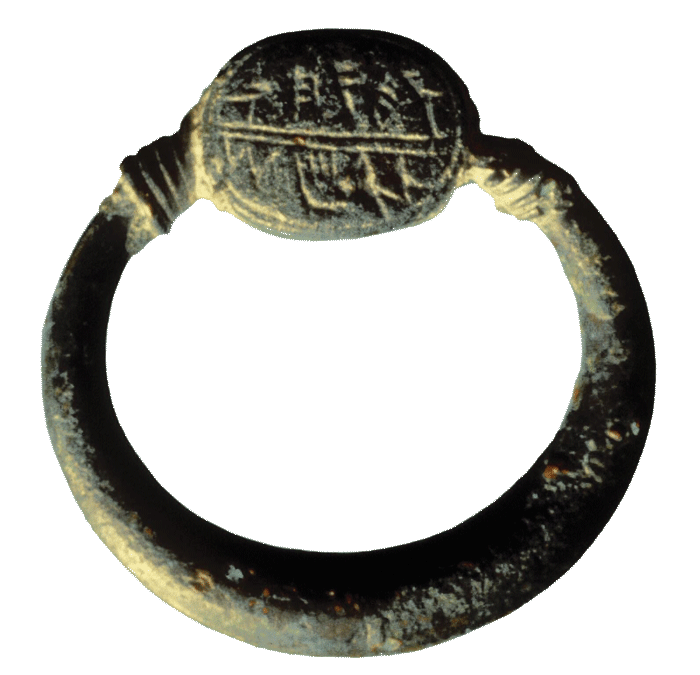
The Lord promises to make Zerubbabel “like my signet ring” (Hag. 2:23), similar to this seventh-century-BC signet ring, which is inscribed with a name in Hebrew.
Select Bibliography
Alden, Robert L. “Haggai.” In The Expositor’s Bible Commentary. Edited by Frank E. Gaebelein. Vol. 7. Grand Rapids: Zondervan, 1985.
Baldwin, Joyce G. Haggai, Zechariah, Malachi. Tyndale Old Testament Commentaries. Downers Grove, IL: InterVarsity, 1972.
Boda, Mark J. Haggai. NIV Application Commentary. Grand Rapids: Zondervan, 2004.
Chisholm, Robert B., Jr. Handbook on the Prophets. Grand Rapids: Baker Academic, 2002.
Merrill, Eugene H. Haggai, Zechariah, Malachi. Chicago: Moody, 1994.
Meyers, Carol, and Eric Meyers. Haggai, Zechariah 1–8. Anchor Bible. New York: Doubleday, 1987.
Motyer, J. Alec. “Haggai.” In The Minor Prophets: An Exegetical and Expository Commentary. Edited by Thomas Edward McComiskey. Grand Rapids: Baker Academic, 1992.
Orelli, C. von. The Twelve Minor Prophets. Reprint. Minneapolis: Klock & Klock, 1977.
Smith, Ralph L. Micah–Malachi. Word Biblical Commentary. Waco: Word, 1984.
Taylor, Richard A., and E. Ray Clendenen. Haggai, Malachi. New American Commentary. Nashville: Broadman & Holman, 2004.
Verhoef, Pieter A. The Books of Haggai and Malachi. New International Commentary on the Old Testament. Grand Rapids: Eerdmans, 1987.
Wolf, Herbert. Haggai–Malachi. Chicago: Moody, 1976.
Wolff, Richard. The Book of Haggai. Grand Rapids: Baker Books, 1967.