Zechariah
1. Call for a Return to the Lord (1:1–6)
2. The Eight Night Visions (1:7–6:8)
A. First Vision (a): Problem—Gentiles Prospering, Jerusalem Ailing (1:7–17)
B. Second Vision (b1): Gentile Oppressors Judged (1:18–21)
C. Third Vision (b2): Exiles to Leave Babylon for Jerusalem (2:1–13)
D. Fourth Vision (c1): Joshua Cleansed (3:1–10)
E. Fifth Vision (c2): Zerubbabel Empowered (4:1–14)
F. Sixth Vision (b1ʹ): Sinners in Jerusalem Judged (5:1–4)
G. Seventh Vision (b2ʹ): Sin Moved from Jerusalem to Babylon (5:5–11)
H. Eighth Vision (aʹ): Resolution—Gentiles Judged, God at Rest (6:1–8)
3. The Crowning of Joshua (6:9–15)
4. The Observance of Fasts (7:1–8:23)
5. The Coming of the Messiah (9:1–14:21)
A. The First Coming and Rejection (9:1–11:17)
B. The Second Coming and Reception (12:1–14:21)
Introduction
Zechariah the Prophet
Zechariah was the son of Berekiah and the grandson of Iddo. The latter is named in Nehemiah 12:4, 16 as one of the heads of priestly families returning from Babylon to Judea. Thus we have in Zechariah another example (with Jeremiah and Ezekiel) of a priest serving as a prophet. He was a contemporary of Haggai (Ezra 5:1).
Date
Zechariah began his written ministry in October–November 520 BC. Two other dates are given: February 15, 519 BC (1:7) and December 7, 518 BC (7:1). The oracles of chapters 9–14 came after the completion of the temple in 516 BC. These last chapters are commonly held to be as late as 480 BC, but it is difficult to be certain.
Structure
The book has three major parts. The first gives encouragement for the rebuilding of the temple. After an introductory admonition, it consists of a series of eight visions that relate the rebuilding of the temple to God’s overall program for Israel. The second part deals with questions about the practice of fasting and mourning for the destruction of the temple. The third, not directly related to the temple, consists of two oracles concerning the future of Israel and the nations.
Some scholars maintain that chapters 9–14 were composed by a different author (or authors) than chapters 1–8. They commonly point to differences in subject matter, style, and vocabulary as supporting evidence. By way of brief reply it should be noted: (1) Ancient Jewish and Christian tradition supports the book’s unity. (2) All existing manuscripts treat the book as a unified whole. (3) Though it is true that in part one the temple is of great concern, the whole book is truly eschatological in scope. In parts one and two current pressing needs and questions are dealt with in the light of the grand scope of God’s purpose. This is practical eschatology. There are many other similarities in themes, such as the centrality of Jerusalem (2:4–5; 14:11) and the importance of spiritual cleansing (3:1–6; 12:10–13:6). (4) It would be unreasonable to demand that a writer maintain the same method of presentation throughout his work, especially when the concerns and needs of the people are different. When all is considered, there is no valid reason to reject the unity of the book.
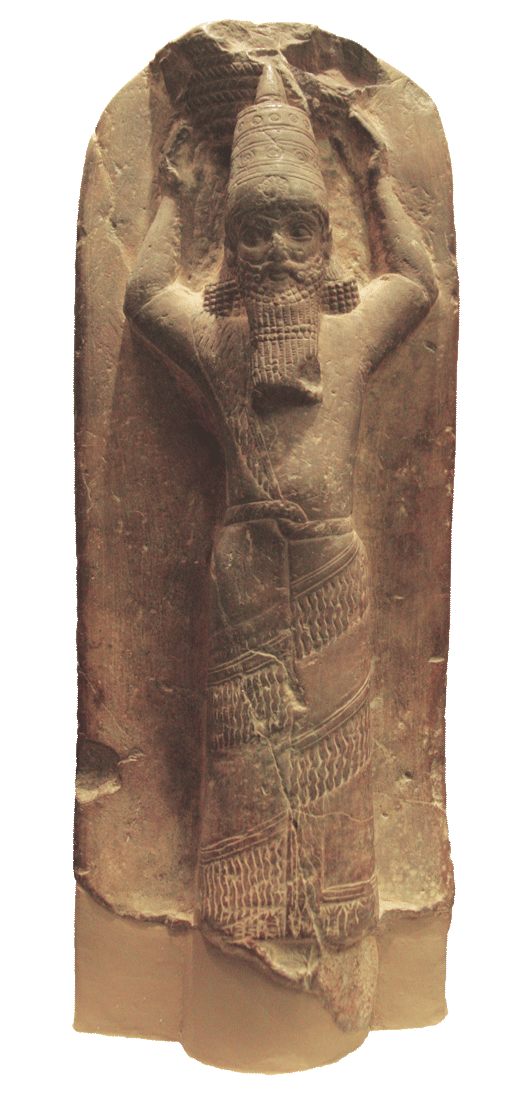
Temple building was an important activity in the ancient world. In this stele, Ashurbanipal is carrying a basket of earth for the first-brick ritual in the rebuilding of the temple to Nabu in Borsippa (668–655 BC).
Theological Themes
The scope of Zechariah’s theological and eschatological vision is among the grandest in the Old Testament. Zechariah relates the past, present, and coming circumstances of Israel to God’s great unfolding program for his people and to the fact that the Lord (identified with the coming king) will reign supreme over a chastened and cleansed world. Some of the dominant themes are (1) the destruction of Gentile world power; (2) the return of Israel to the land; (3) the future unity of Judah and Israel; (4) the necessity for repentance and cleansing; (5) the coming exaltation of Jerusalem and its people; (6) the joining of redeemed Gentiles in worship with Israel; (7) extensive descriptions of Messiah’s person and ministry, especially in chapters 9–14; and (8) the certainty of the fulfillment of God’s purpose.
Commentary
1. Call for a Return to the Lord (1:1–6)
The first message of Zechariah, coming during the eighth month of Darius’s second year (October–November, 520 BC), falls between Haggai’s second and third messages (Hag. 2:1–9 and 2:10–19, respectively). It adds a new dimension to Haggai’s message of practical obedience—that of a personal relationship with the Lord.
Zechariah’s opening message establishes a fitting foundation for the rest of the book, placing the matter of the rebuilding of the temple within the framework of God’s overall purpose with regard to Israel and Jerusalem. It provides solid encouragement with regard to the ultimate destiny of Jerusalem and its inhabitants. Even after addressing the immediate matter of temple concerns, Zechariah goes on to present a magnificent panorama of future redemptive history, leading to the grand climax in which God’s immutable purpose for Israel and the world, centered in his Messiah, is brought to a successful conclusion. Yet this brief introduction is a solemn reminder that the enjoyment of God’s blessing is dependent on one’s personal response to God. There are three major points: (1) their forefathers failed to respond to God’s word—thus the tragedy of the destruction of Jerusalem and the exile. (2) God’s purpose as declared in his word is unchanging. It has been, and will continue to be, fulfilled to the letter. (3) Therefore do not make the mistake your forefathers made. Turn to God with all your heart.
God was furious because of the way in which Israel’s forefathers had “mocked God’s messengers” and “despised his words” (2 Chron. 36:16). The inevitable result was that God’s word “overtook” them (Zech. 1:6) as a fleeing thief might be apprehended by justice in pursuit. God warns Zechariah’s audience against following the same tragic path, which involved outer conformity to prescribed ritual worship but lacked heart response to God. God desires that they should seek him. Even though the people have been at work on the temple for several months already, they need to be reminded that more than outward obedience is needed. The blessing of God’s personal presence and fellowship is for those who seek him from the heart. People, whether evildoers or prophets, are mortal. But God’s word stands forever. Whether threat or promise, that word will surely be fulfilled. God means what he says, and he has done exactly as he has said. This forms a warning to the current generation, lest they take God’s word lightly. It serves also as an encouragement to those who seek God: his promise will unfailingly come to pass.
2. The Eight Night Visions (1:7–6:8)
Zechariah’s visions relate the rebuilding of the temple to God’s overall purpose with respect to Jerusalem, giving the assurance that there is a bright future for both city and people. Despite current and future opposition, God is going to prevail. His promise will be carried out, as already pointed out in 1:6.
Before we discuss the individual visions, it will be helpful to see them as a cohesive unit. They are structured in a chiastic a-b1-b2-c1-c2-b1ʹ-b2ʹ-aʹ pattern. That is to say, visions 1 and 8 correspond, and visions 2 and 3 together correspond to 6 and 7 as a unit. Visions 4 and 5 form the central core, around which the rest are structured.
a First Vision: Problem—Gentiles Prospering, Jerusalem Ailing (1:7–17)
b1 Second Vision: Gentile Oppressors Judged (1:18–21)
b2 Third Vision: Exiles to Leave Babylon for Jerusalem (2:1–13)
c1 Fourth Vision: Joshua Cleansed (3:1–10)
c2 Fifth Vision: Zerubbabel Empowered (4:1–14)
b1ʹ Sixth Vision: Sinners in Jerusalem Judged (5:1–4)
b2ʹ Seventh Vision: Sin Moved from Jerusalem to Babylon (5:5–11)
aʹ Eighth Vision: Resolution—Gentiles Judged, God at Rest (6:1–8)
Visions 1 and 8 (the two a units) provide the frame. In vision 1 God is displeased with the state of affairs of the world (a world in which the nations are prospering at the expense of Jerusalem). In vision 8 God’s displeasure is resolved (6:8), because the nations that have opposed God and oppressed Israel have been appropriately dealt with, preliminary to the crowning of the Messiah (6:11–15).
Visions 2 and 3 correspond to 6 and 7 (the b units) and relate to Jerusalem’s preparation for the kingdom age. The former speak of the defeat of its enemies and the reoccupation of the city by Israel; the latter, of the cleansing of Jerusalem by judging the sinners within and transferring wickedness as a pervasive presence to Babylon, with which it is appropriately identified.
Visions 4 and 5 (the c unit) form the central and focal point of the visions. Here God is not only working on behalf of his people; he is working within the people, to cleanse and then to empower them for the task at hand.
The goal is the reestablishment and cleansing of Jerusalem, followed by the crowning of the promised Messiah.
A. First vision (a): Problem—Gentiles prospering, Jerusalem ailing (1:7–17). The visions come three months after Zechariah’s opening message and two months after Haggai’s last two messages. The first and the eighth visions have much in common. However, the first records the situation at the time of writing, with God’s promise of setting matters straight; the eighth records the actual carrying out of this promise.
The man riding a red horse (1:8) is identified in verse 11 as the angel of the Lord, who in turn is elsewhere identified as the Second Person of the Trinity. He has charge of the “fact-finding” patrol, receives its report, and then intercedes for Israel. He is to be distinguished from the angel who was talking with Zechariah (1:9, 13–14), who appears here and in other visions as an interpreter or spokesman for God. The significance of the various colors of the horses (1:8) is not given, though in Revelation 6 the red horse is associated with warfare and the white horse with victory. It is not until the eighth vision (6:1–8), however, that the horses go forth to battle. Here they do reconnaissance work. The report brought back (1:11) is that the whole world is at rest and in peace. The angel of the Lord’s response indicates that this is a situation in which the Gentile nations are prospering while God’s people (possibly represented by the myrtle trees in a ravine or low place, 1:8) are struggling under the dominion of foreign powers. The temple has not yet been rebuilt; consequently, full restoration from God’s anger has not yet been accomplished.
God responds with kind and comforting words through the interpreting angel. His response encourages a people whom God has seemingly forgotten. God’s zeal on behalf of Jerusalem will bring about the fulfillment of his promise of verses 16 and 17. At the same time the great anger that has been directed at Israel (1:2) is now (1:15) to be directed at the nations living in self-confident and smug security. This is a common prophetic theme: the wicked, who for a time are able to run roughshod over God’s people, will eventually be punished. The righteous, on the other hand, will ultimately be vindicated. The nations that were God’s tools or means of chastising Israel went beyond what was called for in their treatment of Israel. They were arrogant and self-sufficient, refusing to acknowledge the handiwork of God in what was taking place. God will, however, once again deal graciously with Jerusalem; the temple and the city will be rebuilt. God’s choice of Jerusalem as his dwelling place will once again be very evident.
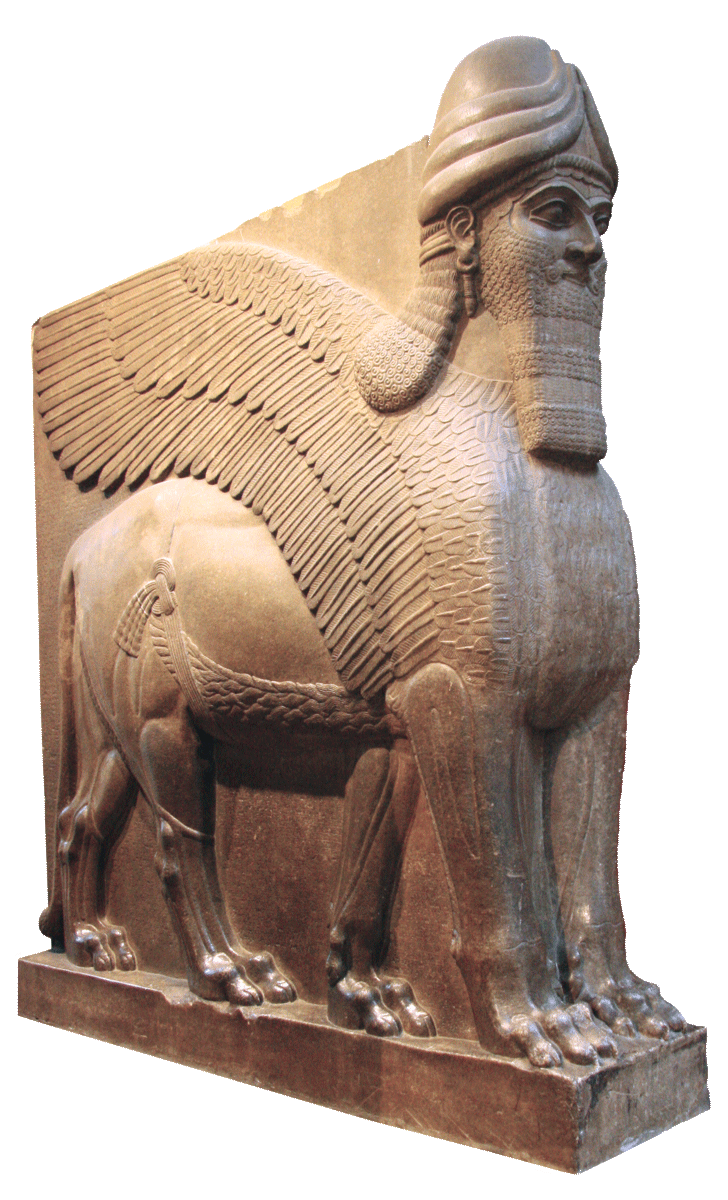
The horns that Zechariah views during his second vision (1:18–21) may resemble the horns on the helmet of this statue of a winged lion with a human head. A pair of these statues guarded the entrance to the throne room of the Assyrian king Ashurnasirpal (865–860 BC).
B. Second vision (b1): Gentile oppressors judged (1:18–21). Visions 2 and 3 describe the removal of external hindrances, whereas visions 6 and 7 describe the removal of internal, spiritual hindrances. These are the corresponding b units.
In Scripture horns symbolize kings or kingdoms in their exercise of royal might and authority. The horns of cattle, particularly of the wild ox, were used in the ancient world as symbols of invincible strength (cf. Deut. 33:17). The horns here described are kingdoms that scattered Judah, Israel, and Jerusalem (1:19). Judah has been at their mercy. But God will raise up craftsmen who will destroy the horns and the power they have over God’s people. The horns are not identified. It is, however, difficult to avoid some connection with the fourfold succession of world empires described in Daniel 2 and 7. Zechariah and his hearers would have been familiar with the book of Daniel and would most likely have made such a connection. Whether these horns represent Gentile world powers as a whole or whether they build on Daniel’s four kingdoms, the message is clear: these powers will be destroyed and then replaced by God’s own kingdom established in Jerusalem.
C. Third vision (b2): Exiles to leave Babylon for Jerusalem (2:1–13). With the destruction of the world empires (four horns) described in the second vision, the stage is set for a marvelously resurgent Jerusalem. Both visions together expand on the words of the Lord in 1:14–16. God’s zeal on behalf of Jerusalem is manifested first of all in his judging the nations that have oppressed Jerusalem (vision 2). The present vision enlarges on the statement of 1:16 with regard to the rebuilding of Jerusalem.
The man with the measuring line (2:1) answers to the statement in 1:16 that God will stretch out a measuring line over Jerusalem. A greatly enlarged city is in view here, grand in scope and glory since God himself is the architect and since it will be a place fit for the presence of his glory. There will be a great influx of people, necessitating a greatly enlarged city and making defensive walls impractical. This prophecy was not fulfilled in Zechariah’s time. Even in the days of Nehemiah, some eighty years later, the city was largely empty and had to be filled by casting lots to determine who should be required to live in it (Neh. 7:4; 11:1–2). The complete fulfillment will not be realized until the messianic age. The message of these visions was nonetheless an encouragement for Zerubbabel in that the work in which the people were presently engaged was part of God’s great program for Jerusalem and Israel.
Jerusalem will have no walls of defense, but God himself will be a wall of fire around it (2:5) and its glory within. The presence of the glory of God both guarantees the safety of Jerusalem (cf. Exod. 14:19–20, 24–25) and attests to the favored status of Jerusalem and the renewed fellowship of Israel with God. In view of this, he admonishes those who are still in Babylon to flee from there and to participate in the new life in Jerusalem. (See also Isa. 48:20 and Jer. 51:6–10.) The fact that the same message occurs in Revelation 18:4, just before the destruction of eschatological Babylon, indicates that these Old Testament admonitions point forward particularly to the latter days.
There is a threefold message implicit in these words in the light of the context: (1) It is Israel’s privilege to leave Babylon. They do not have to remain. Therefore, they should return and participate in that which God is doing in Jerusalem. (2) They are no longer to be identified with Babylon and its ways but with God and Jerusalem. (3) Babylon is doomed to terrible destruction (2:8–9; see Jeremiah 51 for a graphic description of Babylon’s coming downfall, with repeated admonitions to flee). Therefore, Israel must not get caught up in Babylon’s ways and in her fate. God is going to destroy those nations that have plundered Israel, of whom Babylon is the chief representative.
The speaker in 2:8–13 is the Lord Almighty (literally “the Lord of Hosts or Armies”). The natural reading of this passage is that the angel speaking to Zechariah calls himself the Lord of Hosts—yet he has been sent by God; while this may be puzzling from a purely Old Testament perspective, it becomes clear from the perspective of the New Testament teaching on the Trinity. Similar passages are found in Isaiah 48:16 and Zechariah 12:10.
The translation of the Hebrew underlying the words “after he has honored me” (2:8 NIV 1984; NIV “after the Glorious One”) has been much debated. A translation that fits both the Hebrew and the context is “with glory he has sent me.” That is, the Messiah’s mission is carried out in the presence of, or in association with, the glory of God.
The reason given here for Babylon’s destruction emphasizes the special status that Israel as the apple (or pupil) of his eye has before God. This knowledge certainly ought to put fresh spirit into a people who have experienced so many setbacks. With the fall of Babylon and the Gentile nations comes the rise of Israel. When all this has taken place, there can no longer be any doubt that God is in charge of the events that have transpired. Israel will then shout and be glad, for God will be at home in their midst. Not only Israel but many nations will be joined with the Lord, becoming God’s people and participating in the glories of the new age. Nonetheless, it will be abundantly clear that Judah is God’s portion, his special people (2:12). Jerusalem will once again be the place chosen by God for his presence on earth.
In visions 2 and 3 God judges the nations and prepares Jerusalem for his people and the presence of God. In visions 6 and 7 he judges sinners in Jerusalem and removes wickedness, as a pervasive presence, to Babylon, where it is enshrined. Thus these two sets of visions contrast.
The vision concludes with the striking admonition, “Be still before the Lord, all mankind, because he has roused himself from his holy dwelling” (2:13). Humans have had their say long enough, with complaints against God’s ways, with mockery, with threats against God and his people. But now God comes forth to take action. All will be utterly silenced.
D. Fourth vision (c1): Joshua cleansed (3:1–10). The first three visions had to do with God’s program regarding the establishment of Jerusalem as the center of God’s glory on earth. It will be filled to overflowing with a people living in the peace and security of God’s presence. Gentile dominion and oppression will have been removed. This is God’s work on behalf of his people. In the next two visions (the c units) the focus is on God’s ministry within the people themselves. In this vision he cleanses them, making them fit to enter his presence; in the fifth vision he empowers them, enabling them to do his work. These two visions form the focal point of the whole, emphasizing the fact that this internal ministry of the Spirit of God is essential to God’s purpose—a cleansed and empowered people.
Joshua the high priest (3:1) here serves as the representative of Israel. His cleansing symbolizes the future cleansing of Israel. God has called them to be a holy nation and a kingdom of priests (Exod. 19:6), a nation that has access to God and serves him in holiness. Here Joshua is seen standing before the angel of the Lord, ministering before God in his capacity as high priest (Deut. 10:8; Ezek. 44:15). But the place of worship, the temple, appointed by God as the means of access to him, is here invested with the characteristics of a courtroom.
Satan stands at Joshua’s right side (the place of the accuser). There are just grounds for Satan’s activity. Joshua’s sinful uncleanness (3:3) renders him unfit to come into God’s presence. The name Satan is in fact a transliteration of the Hebrew word meaning “the accuser, or adversary.” It describes a fundamental characteristic of this fallen angel who not only hates God but does all in his power to keep humanity from fellowship with God. He may represent himself as humankind’s friend and advocate, but his real character as opponent and accuser is here clearly seen. Job 1 and 2 record his cynical attempts to discredit Job before God and to cause Job to turn from God. The New Testament warns against his efforts to frustrate God’s purpose (cf. 1 Pet. 5:8; Rev. 12:10).
But God himself intervenes on behalf of Joshua and his people. This speaks powerfully to the infinite grace of God and also to his unfailing adherence to his purpose with regard to Israel. God silences Satan with a double rebuke, as he also gives a twofold affirmation of support for Israel: (1) Satan is reminded that God has chosen Jerusalem and will not be deterred from carrying through with his sovereign electing love. (2) The burning stick taken out of a fire refers to Israel’s recent deliverance from Babylon as well as to God’s continued preservation of his people. Verse 3 describes both Joshua’s unworthiness to stand before God and God’s cleansing of Joshua, making him fit to come into God’s presence and effectively stopping Satan’s objections. Note that Joshua is dressed in filthy clothes as he stands before the angel of the Lord. The high priest was required to be holy and to wear special garments when he came into God’s presence. But Joshua’s garments are not only dirty—they are befouled as with vomit or excrement. He is most worthy of condemnation. What Joshua/Israel cannot do for himself, God does: “See, I have taken away your sin, and I will put fine garments on you” (3:4). With these brief words God’s gracious saving activity is summarized. He replaces man’s feeble and inadequate attempts to produce the kind of righteousness that will stand before God with righteousness that is perfect and adequate in every way. In the same way, God graciously replaced unworthy Adam’s fig leaves with coats of skin (Gen. 3:7, 21; cf. also Isa. 61:10; Rev. 7:14; 22:14). The new garments are not only clean; they are rich, festal garments suitable to wear in God’s presence.
Zechariah seems to be so emotionally involved in the scene before him that he anticipates what is to come next, the putting on of the turban to complete the high priest’s attire. The word “turban” (3:5) here is closely related to the high-priestly “turban” in the Pentateuch (which had attached to it a plate engraved with the words “holy to the Lord”; Exod. 28:36–37). It is used in only two other passages, in figurative contexts. In Job 29:14, Job describes his righteousness: “I put on righteousness as my clothing; justice was . . . my turban.” In Isaiah 62:3, Israel, restored to a righteousness evident to all, is a “crown of splendor” and a royal turban (NIV “royal diadem”) in God’s hand. So here also the turban gives public testimony to Joshua’s new state of righteousness before God.
In verses 6 and 7 Joshua/Israel receives a twofold charge and a threefold promise. If he will now live a life of obedience and total commitment to God, consistent with his new righteous standing, he will have the privilege of an unhindered priestly ministry. As God’s representative on earth, he will govern (literally “execute justice, act as judge”) and have charge over the temple. He will also have totally unhindered access to God, as the angels have. Verse 8 continues to make it clear that Joshua’s cleansing is representative of a spiritually restored Israel. He and his associates are symbolic of things to come. A brief but important statement follows, pointing to the one through whom Israel’s cleansing and restoration will be made possible: “I am going to bring my servant, the Branch” (3:8). The term “servant” is a well-established designation of the Messiah in his capacity of successfully carrying out God’s program of salvation (Isa. 42:1–7; 49:1–9; 50:4–9; 52:13–53:12). The term “Branch” designates the Messiah as Lord (Isa. 4:2), king (Jer. 23:5; 33:15), and man (Zech. 6:12). As the Branch (literally “shoot from the root”), the Messiah both brings about a new beginning and epitomizes the ideal that God intends for Israel. The stone of verse 9 is no doubt another reference to the Messiah (cf. Ps. 118:22; Isa. 28:16, where he is the chief cornerstone). Joshua and Zerubbabel were engaged in rebuilding the kingdom of Israel. This chapter makes it clear that the only validity for Israel’s position as a royal priestly nation is through the cleansing ministry of the Messiah; and only as Joshua’s work is built on the stone that God has given can there be any lasting results.
The seven eyes (3:9) may foreshadow the sevenfold spirit of God (Rev. 5:6). The seven eyes of God range throughout the earth (Zech. 4:10). They symbolize God’s administrative activity in the affairs of his people.
The meaning of the inscription (literally “engraving”) on the stone (3:9) is uncertain. If our identification of the stone with the Messiah (cornerstone) is correct, then it is possible that the engraving is a special distinction placed on him by God. At any rate this engraving is related to redemption: “I will remove the sin of this land in a single day.” This verse summarizes the vision.
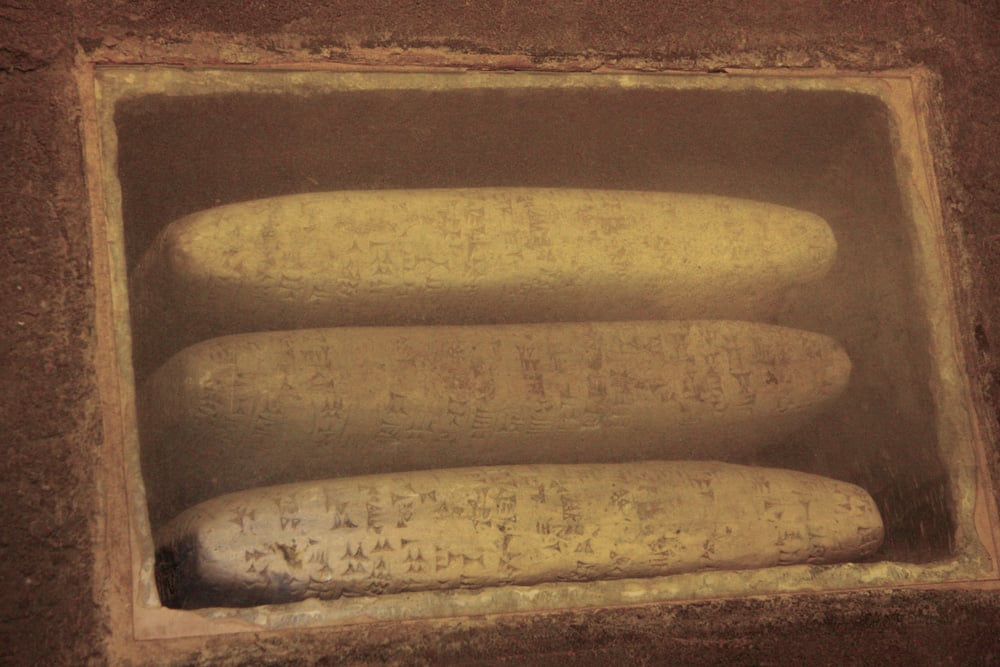
The foundation or cornerstone of buildings in antiquity often contained relics or records, such as these inscribed foundation tablets of Ashurnasirpal II, discovered in this limestone box, which record the building of the temple to Mamu (883–859 BC).
E. Fifth vision (c2): Zerubbabel empowered (4:1–14). This vision is linked to the previous vision as the focal point of God’s work of cleansing and empowering his people. The task before Zerubbabel and his associates must have seemed insurmountable, especially in view of God’s descriptions of the coming glory of Jerusalem and the temple. This fifth vision is given to show Zerubbabel that God gives divine enablement for the work that he has ordained.
The vision contains two major objects. The first is a solid gold lampstand (4:2). The lampstand no doubt is intended to symbolize the bearing of witness or testimony. Isaiah 60:1–3 speaks of restored Israel as being a light to which the nations, in a world of darkness, will come. This will be possible because the light of God in the person of the Messiah has first come on Israel (Isa. 9:2; 60:1–2). Next Zechariah sees two olive trees (4:3) next to the lampstand, one on either side. The fact that the olive trees supply the oil that fuels the lamps suggests that what is in view here is the source of supply for the testimony symbolized by the lamps. Zechariah’s question “What are these, my Lord?” (4:4) is a request regarding the significance of the lampstand and the trees. The answer is given to him in verse 6: “‘Not by might nor by power, but by my Spirit,’ says the Lord Almighty.” These oft-quoted words constitute the central and key message of the chapter and may be applied to anyone laboring for the Lord. This is universally true but is especially encouraging under seemingly impossible conditions.
These words are directed to Zerubbabel, who has been charged with leading the rebuilding program. There is here both encouragement and admonition. Zerubbabel need not fear the size or difficulty of the task. God’s supply of power is sufficient for any and every situation. But Zerubbabel needs to rely on God rather than on personal skill, strength, or ingenuity. The word translated “might” is frequently used of armies, wealth, or influence. But God’s work is accomplished by the power of his Spirit. This is symbolized by the oil of the olive trees that supplies the fuel for the lamps.
Verse 7 applies the truth of verse 6 to Zerubbabel’s situation. The mighty mountain might refer to the opposition of Gentile political power, since this symbolism was common in the Near East (cf. Dan. 2:44). But it may well refer to difficulties and obstacles of any kind, no matter how great. What an encouragement and comfort to Zerubbabel, and indeed to anyone engaged in the work of God, to realize that it is by God’s power, not by human strength, that impossibilities become actualities. No mountain is so solid and so huge that God cannot level it.
As to the specific matter at hand, the building of the temple, it will be completed. God will bring out the capstone, the last stone to be laid. This will be a particularly joyous occasion because of the difficulties and the length of time involved in the building. The joy will be so great that there will be spontaneous shouts of “God bless it! God bless it!” This is most likely an unqualified expression of approval, such as “Wonderful!” or “Bravo! Bravo!” It is also recognition of the fact that God’s favor rests on the temple and that its completion is due to the working of God’s power. This is to be compared to the mixed reaction of the people when the foundation was laid (Ezra 3:10–13).
Verses 8 and 9 give specific encouragement to Zerubbabel. The task is difficult, even mountainous, yet by God’s enablement he will carry it out. God finishes what he starts. Verse 10 carries on the thought that there will be joyful acknowledgment of God’s hand in the temple project, even by those who have despised “the day of small things.” Many have minimized the rebuilding efforts as insignificant and futile. But now this negativism will be replaced by rejoicing. The message is clear and unequivocal: God, whose omniscient interest in man’s activities spans the earth, has had his watchful and approving eyes on Zerubbabel’s efforts.
Verses 11–14 take up again the matter of the two olive trees. More detail is given through Zechariah’s questions. In addition to the olive trees, he wants to know about the two olive branches beside the two golden pipes that pour out golden oil. This question helps us see the connection between the trees and the lampstand. The oil flows from the trees through the branches to the pipes and through the pipes into the lampstand, supplying fuel for the lamps. The answer to the question as to what the two branches represent is given in verse 14. Both kings and priests were anointed; and Zerubbabel, in the kingly line, and Joshua the high priest were the current representatives of these two offices. The power and effectiveness of their ministries depended on the enabling power of the Holy Spirit. As they receive the empowering of the Spirit of God, the testimony and witness of God’s people to the true God can shine brightly. The ultimate responsibility of these two officials is to serve the God of all the earth. God’s lordship and sovereignty are thus affirmed, and the outworking of his program through his servants will demonstrate his absolute lordship. As most expositors recognize, there are clear messianic and eschatological implications in this chapter. In Jesus the Messiah the kingly and priestly offices are combined.
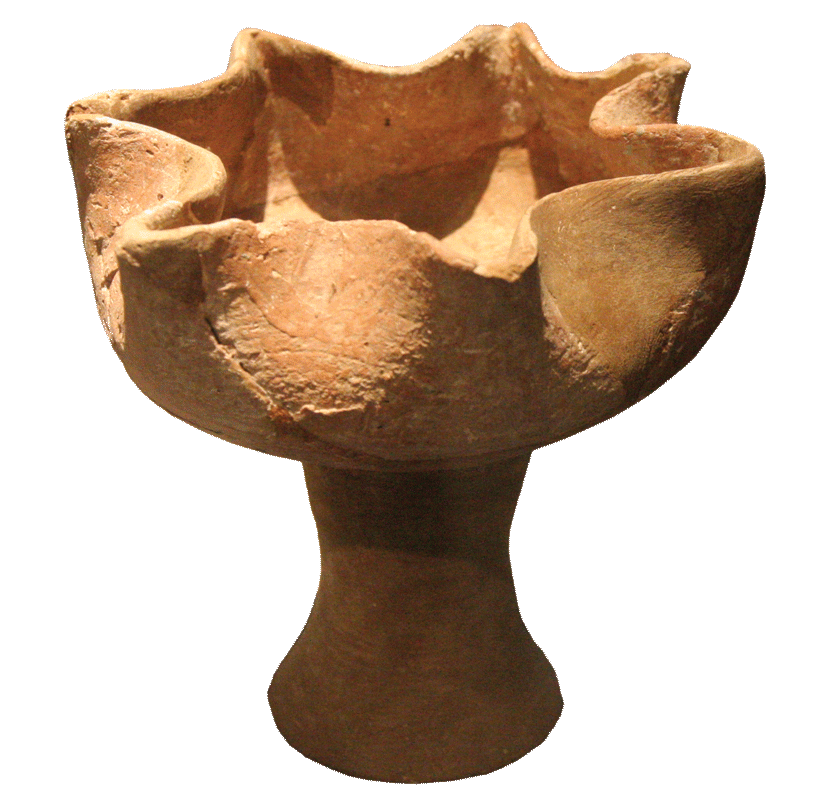
Seven-spouted lamp from the excavations at Dan (tenth–ninth centuries BC)
Chapters 3 and 4 form a unit in their emphasis on the internal work of God in his people. They also form a unit in looking forward to the Messiah, through whom the nation will be cleansed and restored, and through whom the kingdom and the temple of God will be rebuilt, thus reestablishing God’s people as an effective light to the nations and witness to the saving power and sovereignty of God.
F. Sixth vision (b1ʹ): Sinners in Jerusalem judged (5:1–4). The sixth and seventh visions have to do with God’s purging the land of sin. Here are internal obstacles to the building of the kingdom, that is, the unrepentant sinners within the land. (Visions 2 and 3 deal with external obstacles: the nations that stand in inimical opposition to God and his people.) Chapter 3 promised cleansing for a penitent and responsive people. This chapter promises judgment for impenitent lawbreakers. God is gracious and forgiving to those who repent, but there is no place in God’s kingdom for those who resist his grace. This vision, then, forms a contrast with that of chapter 3, which refers to the cleansing of those who truly seek God.
In the sixth vision Zechariah sees a flying scroll (5:1). The significance of the scroll is given in verse 3. It is a curse going out over the whole land. This curse brings together all the curses of the law. It is a flying scroll because it travels through the land seeking out unrepentant lawbreakers. Two sample transgressions are named in verses 3 and 4, thievery and swearing falsely. The first is a typical crime against one’s neighbor, the other a crime against the holiness of God. No transgressor will be able to evade the curse. It will seek him out even in his house, destroying it utterly while he himself is banished. Being the seed of Abraham only in the physical sense does not qualify a person for a place in the kingdom. Vision 4 ends in blessing. This one ends in judgment.
G. Seventh vision (b2ʹ): Sin moved from Jerusalem to Babylon (5:5–11). In the previous vision, unregenerate sinners are purged from the land. In this vision, wickedness as a pervasive principle is removed from the land and taken to Babylon, where it is enshrined.
The measuring basket of verse 6 is literally an ephah, a measure somewhat smaller than a bushel. The basket with the woman inside represents the iniquity of the people throughout the land. She is the personification of wickedness. The woman tries to escape, but the lid is placed firmly over the mouth of the basket. The two women of verse 9 are agents of God who whisk the basket away to the country of Babylonia. A house or temple is built for the basket and its contents, and it is placed there as an idol on a pedestal, to be worshiped by those who have rejected God. From the time of the building of its tower in defiance of God to its ultimate destruction, Babylon appears in Scripture as the center of opposition to God. This, then, is the appropriate home of wickedness. Note that in 2:6–7 God’s people are urged to flee from Babylon and to return to the “holy land,” where God will dwell in their midst. An appropriate exchange is taking place. All this is preliminary to the final events yet to transpire: Babylon with all its wickedness will be utterly destroyed.
H. Eighth vision (aʹ): Resolution—Gentiles judged, God at rest (6:1–8). This vision brings to a fitting conclusion the series of night visions outlining God’s program of rebuilding Jerusalem and revitalizing his people. It is clearly eschatological in scope, completing what was anticipated in the first vision. There are obvious similarities to the first vision in the presence of various colored horses being sent throughout the earth. There are some differences in the colors of the horses and in the fact that there are chariots in this last vision. But the most distinctive difference is that in the first vision the horses go out on reconnaissance, bringing back their report, whereas in this vision the horses go out to execute judgment. In the first vision the nations live in undisturbed quietness, and God is disturbed and angry with them. In this vision the nations are judged and the Spirit of God is satisfied and at rest because his purpose has been accomplished.
The vision opens with the appearance of four chariots (6:1). From the contents of this vision it becomes apparent that these are war chariots. Horses and chariots are logical symbols for the carrying out of divine judgment in war (Jer. 46:9–10; Joel 2:4–11; Nah. 3:1–7). These chariots come out from between two mountains of bronze, which are commonly identified with Mount Zion and Mount Olivet, with the Kidron Valley in between. What is important to recognize is that they come from the presence of God himself. Bronze is often associated with divine judgment (Num. 21:9), and this accords well with the symbolism of the passage.
The fact that there are four chariots relates to the universality of the judgment. All four corners of the earth (cf. Isa. 11:12) will be affected. Horses of varying colors are harnessed to the four chariots. The colors are not identical with those of chapter 1, nor are they explained. Whatever the individual colors might signify, these horses clearly mean terrible judgment on a rebellious and God-hating world. The horses with their chariots are identified in verse 5 as the four spirits (or “winds”) of heaven. These are angelic beings, agents of God’s justice, carrying out his sovereign purposes. The military defeats, the toppling of kingdoms, the plagues and “natural disasters,” are not happenstance; they have been ordered by a God who has long been silent, giving people every opportunity to respond and repent.
God’s title, “Lord of the whole world” (6:5), will no longer be questioned. Mesopotamian kings loved this and other similar grandiose titles. But now it will be clearly seen who is truly Lord. Note that this title is assumed by God in the last days, when he sets out to enforce his lordship (Ps. 97:5; Mic. 4:13; Zech. 4:14). The chariot with the black horses goes toward the north country (6:6). It is the north country again in verse 8 that is particularly singled out as the focal point of judgment. The reference is almost certainly to Babylon. Though it lay to the east of Jerusalem, the invasion route of Babylon (and Assyria) was always from the north (via the Fertile Crescent).
God’s angels are eager to carry out the program of judgment, to snuff out the blasphemous and boastful rebelliousness of the nations. But all is in God’s control, and judgment will take place only when he gives the command, not a moment before. If only people would realize that all their prideful achievements in opposition to God are due only to God’s patience and tolerance! This passage makes it clear that the whole earth, not only north and south, is under judgment. Nevertheless, it is the land of the north, or Babylon, that is at the center of the world’s opposition to God. The speaker is the angel of the Lord, the Lord of all the earth. The judgment on Babylon, the land of the north, has given rest to God’s Spirit. When God finished creating the world, he rested (Gen. 2:3), not from weariness but because what he had made was perfect and he was satisfied. But sin brought discord into the world, and God’s “rest” was disturbed. In Zechariah 1:14–15, God’s response to the world scene is one of strong emotion and anger. Now, with the destruction of Babylon along with the establishment of God’s kingdom on earth and the enthronement of God’s Messiah, all is right with the world and God’s Spirit is once again at rest.
3. The Crowning of Joshua (6:9–15)
The book of Haggai, after giving assurances of immediate blessing and of the future glory of the temple, closes with a prophecy of a victorious Messiah, who will reign over Jerusalem (Hag. 2:20–23). In a similar way Zechariah caps off the eight visions with a remarkable and memorable symbolic action—the crowning of Joshua as a foretoken of the Messiah. The fact of the crowning is significant; it is a reminder that when God has dealt with Babylon and the other nations, he will establish his own king on the throne. This king will flourish and be clothed with majesty. The manner of the crowning is significant in two ways: (1) It sets forth in the clearest possible way that in the Messiah the two offices of king and of priest will be united. (Note that Joshua the priest receives the crown of a king. See also Jer. 30:21, where the future king will also act as priest.) (2) It underscores the fact that the visions involving Joshua and Zerubbabel (chaps. 3 and 4) reach out beyond these men to the Messiah himself. The unusual plural form of the Hebrew word for “crown” may be a pointer to this twofold office. In verses 10 and 11 Zechariah is instructed to take the silver and gold that have been brought as a gift from Babylon and to go to the house of Josiah. There he is to make a crown and set it on the head of Joshua. The significance of this crowning is given in verses 12–15: “Here is the man whose name is the Branch.” Note that Joshua the priest is here the type of Christ, but it is the office of Zerubbabel that is primarily in view. (In chapter 4 it is Zerubbabel who will build and complete the temple. Here it is Joshua who does the same thing. Together they are a type of the Messiah to come.) This passage, which clearly has reference to the future, serves to illustrate the far reach of the visions in chapters 3 and 4. Zerubbabel finished the temple as promised in 4:9. But the completion of that project served as the illustration of a far greater fulfillment yet to come. The words “It is he who will build the temple” (6:13) stress the fact that Christ the Branch, and no other, will accomplish this task.
Throughout the eight visions, the rebuilding of the temple is inseparably related to the restoration of Jerusalem and to the spiritual as well as the physical restoration of Israel. He who has been despised is now universally acknowledged as the king of kings. He reigns now as both king and priest, and there will be no conflict of interests between the two offices. As king he is able to rule in righteousness without having to condemn a sinful populace, because as priest he has cleansed them of sin and brought them into fellowship with God.
Verse 15 adds that Gentiles who are far away will come and help build the temple. This comports with many Old Testament passages that speak of the help and wealth that the nations will bring (Isa. 60:4–9; Hag. 2:7; Zech. 14:14).
4. The Observance of Fasts (7:1–8:23)
A. The question (7:1–3). About two years after the temple rebuilding had recommenced, the question arose regarding the necessity of continuing the annual fasts that commemorated the destruction of the temple. The delegation comes from Bethel. The word “entreat” (7:2) indicates that these people are not merely asking for a judicial decision from the priests and prophets. They are seeking a favor from God. The fasts have obviously become wearisome to them. Except for the fast of the Day of Atonement, God had not prescribed fasting as an annual ritual. It was appropriate on special occasions such as when there was mourning for sin (cf. Joel 1:13–14). In the present case the fasts have become a burdensome ritual with no real spiritual motivation. God does not tell them what they want to hear, but rather what they need to hear. His answer is in four parts, each introduced by the expression, “And the word of the Lord came again to Zechariah.” Their question is not answered directly, but the answer in its first two parts goes right to the heart of their spiritual condition. The second two parts point to the blessings of God in a renewed Jerusalem and to the festivals that will replace the fasts.
B. The rebuke (7:4–14). The answer, with both rebuke and promise, is extended to all the people and the priests. “Was it really for me that you fasted?” This probing question goes right to the core of their problem: self-interest. Neither their fasting after the loss of the temple nor their former feasting while the temple stood were really for God’s sake. Thus God dismisses their fasts as self-serving and meaningless ritual. The prophets before the exile had also condemned the futility of ritual worship without a true change of heart. As the people ignored God’s wishes in prosperous times (7:7), so they ignore his wishes now, not mourning for their sin but for their loss.
The people are concerned about fasting—whether or not it should be continued. God’s concern is that they should truly listen to him for a change. What he says in these verses he has said many times in the past. His specific admonitions all relate to the essence of the commandment to “love your neighbor as yourself” (Lev. 19:18). These admonitions are stressed because they are tangible and more easily demonstrated than the admonition to “love God” (cf. 1 John 4:20–21).
Israel’s persistent, stubborn refusal to listen to God has caused God to turn a deaf ear to their entreaties and pleas for deliverance. The result is their scattering as “with a whirlwind” (7:14). The desolation of the land is not a capricious action on God’s part but a direct result of their disobedience. Thus God redirects their question from a concern about the observance of a ritual to the true need of their lives: a heart that responds to God’s call.
C. The promise (8:1–23). Chapter 7 ends with a description of the desolation of the land brought about by Israel’s disobedience. Now God takes it upon himself to bring about a change despite Israel’s failure. This is the outworking of God’s grace and his faithfulness to his promises.
The depth of God’s emotion is very evident here. In 1:14 his zeal is aroused by the sight of a Gentile world that is secure and prosperous while Israel is in distress. There his zeal brings about the destruction of the godless nations and a restored Jerusalem. Here his zeal is aroused by the words of 7:13–14, and it effects spiritual as well as physical restoration. The fact that God will dwell in Jerusalem is the supreme blessing, and if God is there, what purpose does fasting serve?
The two names given to Jerusalem are more than names. They are now for the first time accurate representations of the new character with which Jerusalem is invested, names that reflect the very presence of God. In the word translated “Truth” (8:3 KJV, NASB) the concept of faithfulness is present as well (cf. NIV “Faithful City”). A related word occurs in Isaiah 1:26, where Jerusalem is called both “Faithful City” and “City of Righteousness.” This latter name is paralleled by the term “Holy Mountain,” used here. What a change from its former condition! Verses 4 and 5 describe the peaceful living conditions in this city where truth, faithfulness, and holiness reign. Fear and unrest are absent. To say such a thing to Zechariah’s contemporaries seemed an incredible thing (8:6), but with God nothing is impossible.
Verse 7 describes a regathering of Israel from all countries of the world. The conditions described in these verses were certainly not realized to any large degree in Zechariah’s time. As is so often the case in prophetic Scripture, Zechariah sees the return from Babylon and the limited peace of his own day as simply a foretaste of the glory to come. In view of this, Israel’s self-imposed fasts keep them looking back at past defeats instead of forward to what God will do for them. They will be restored physically and spiritually, living in close fellowship with God under the new covenant. God has always been true, faithful, and righteous, but now under the new covenant these attributes are displayed in a new way, and he can justly receive a people whose sins have been forgiven.
Zechariah continues to encourage the people to keep building the temple in anticipation of the future. Verses 10 and 11 point to an upturn in economic prosperity and in the peace and safety of the people. Verse 12 promises a remarkable fertility for the land along with ideal weather conditions. All this God will provide as an inheritance to the remnant of his people. The word “remnant” refers not only to survivors of past judgments but to a people whose heart is right with God—a redeemed people. The wording of 8:13 (as well as 8:20–23) makes it clear that this whole passage still awaits its ultimate fulfillment.
It was Israel’s destiny according to the Abrahamic covenant not only to receive God’s blessing but to be a channel of blessing to the world in turn. Verses 14 and 15 give added assurance that the blessings described here will indeed come true. The previous destruction of Jerusalem by Babylon provides the assurance that, just as God has been true to his threats (see the warnings in Jeremiah), so will he also be true to his promises. The remnant can confidently rely on God to fulfill his purpose, no matter how impossible the obstacles might appear to be.
The message of 8:16–17 is similar to that of 7:9–10, but the setting is different. In chapter 7 the admonition went unheeded, and Jerusalem was destroyed. Here Jerusalem is destined to be restored; therefore, the people should now conduct their lives in anticipation of this. Jerusalem will be called the City of Truth and Holiness. They ought now to live a life of truth and holiness.
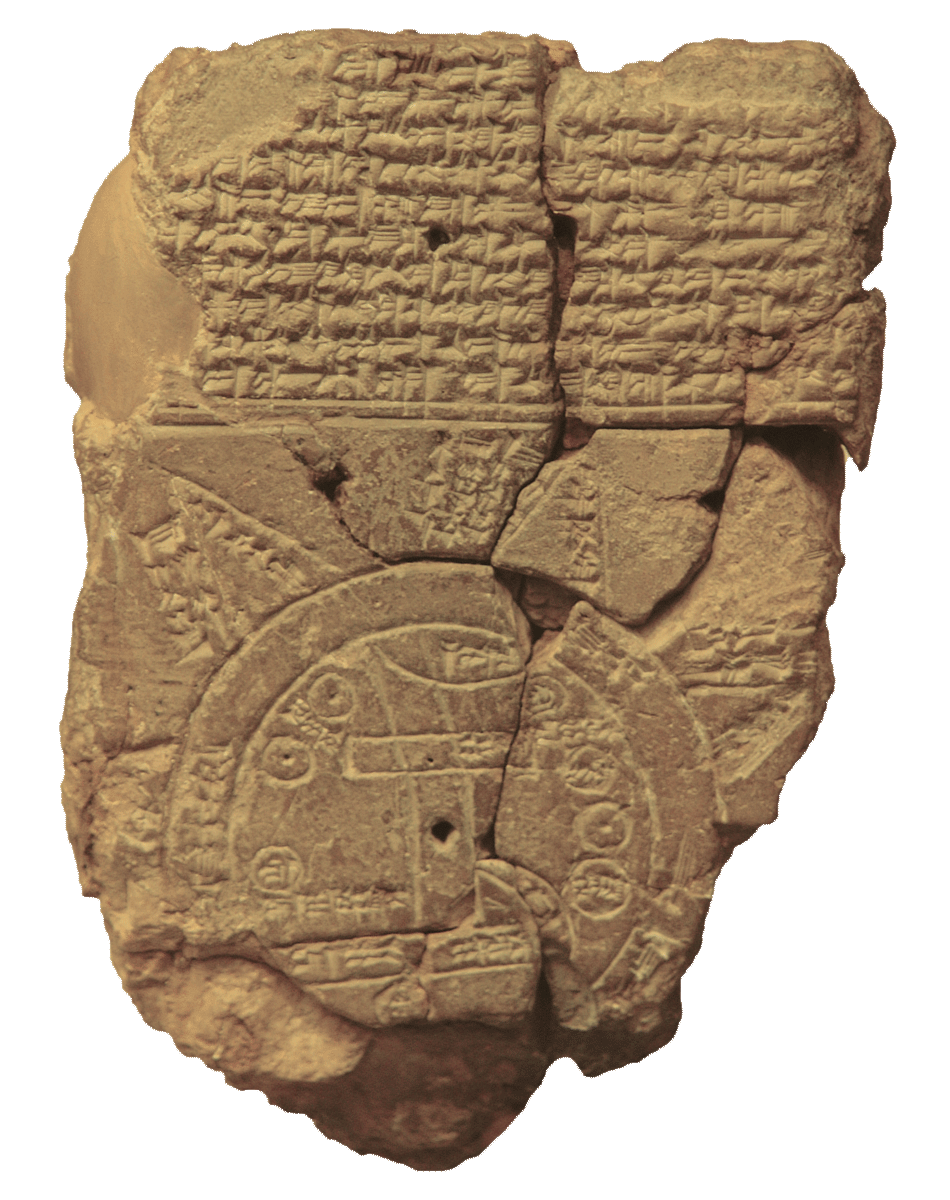
Similar to the view reflected in the prophets that Jerusalem was the center of the world (see Zech. 8:20–23), this ancient Babylonian map shows the world as a disc with Babylon at the center (700–500 BC).
In verses 18–23 the subject of fasting again comes to the foreground, though it has always been in view. Fasting will become passé, to be replaced by joyous festivals (8:19) because of the rich outpouring of God’s blessing on Jerusalem. The admonition to love truth and peace again urges them to let their present conduct be molded by future realities. Verses 20–23 build on Isaiah 2:1–5 and Micah 4:1–5, where Jerusalem is the focal point of the globe because the Lord is there to give direction to all peoples of the world. He will instruct multitudes of willing hearers who have come to learn his will and to do it. In the present passage the role of Israel is stressed. Contempt for and hatred of Jerusalem has been replaced by the recognition that it is a place of honor, where God dwells. The formerly small and despised nation will now be joined by “many peoples and powerful nations” in seeking God (8:22). The Jews also will be acknowledged to have special status with God. Taking hold of the edge of a robe is an act of supplication to a superior (cf. 1 Sam. 15:27). The testimony of God’s marvelous working on behalf of Israel will not fail to have its effect on a watching world.
Chapter 7 began with men entreating God from self-centered motives. Chapter 8 ends with multitudes of Gentiles joining Israel in entreating God with honest and responsive hearts. Not only is Israel blessed, but through Israel God reaches out to bless the Gentiles as well.
5. The Coming of the Messiah (9:1–14:21)
A. The first coming and rejection (9:1–11:17). For Zechariah, the coming of the Messiah is central. This is clear in two oracles (chaps. 9–11 and 12–14) celebrating God’s worldwide triumph through the king’s advent. The salvation of Israel and God’s judgment against the nations is clearly in view as well. The major thrust in both cases is the last days, often referred to elsewhere in Scripture as the day of the Lord. But there are also three major differences between the two oracles: (1) In the first, the Messiah is rejected; in the second, he is received by repentant hearts. (2) In the first, there is frequent alternation between near and far fulfillments, or telescoping, a frequent prophetic practice in which distant events are viewed from the standpoint of near events. The near and the far are often intermingled in such a way that they merge into one. The second oracle describes eschatological events almost entirely (13:7 being the exception, a “flashback” to the past, given as a reason for Israel’s trials). (3) The first oracle is against the nations (9:1); the second concerns Israel (12:1). In the first, God judges the nations, but always with an eye on Israel’s deliverance and blessing. In the second, God brings Israel to repentance and cleanses and protects her, while the nations are destroyed.
9:1–17. In the first oracle, the cities named are all north of Israel (9:1–8). Beginning with Hadrak and proceeding southward to Philistia, Zechariah portrays the defeat of these cities as a whirlwind military campaign (probably predicting Alexander’s march down the Palestinian coast as a “near” fulfillment). When God makes his power felt as described in these chapters, people will see that it is God’s hand at work, and many will turn to him. Zechariah provides a glimpse into the future with reference to various idolatrous and unclean customs practiced by the Philistines. God will effect a cleansing and transformation of these inveterate enemies of God’s people. Here is another of many Old Testament passages speaking of the conversion of Gentiles. Not only will they become part of God’s people; they will even become leaders in Judah, an indication of their complete acceptance by God and people alike. In this respect they will be like the Jebusites, the original inhabitants of Jerusalem, who were not destroyed when David captured their city. Rather, they were absorbed by Judah and became part of God’s people.
Jerusalem stands out by contrast to other cities because of God’s special care. In contrast to the fate of the other Palestinian cities, Jerusalem was unexpectedly spared. This fact brings about a natural telescoping into the future, when once again Jerusalem stands in contrast to other cities. It is clear that Jerusalem will later suffer defeat—Zechariah knows this (14:1–3). But when the final battle is over, when the smoke has cleared and city after city lies in ruins, Jerusalem will remain and will never again be overrun by an oppressor. No longer can Jerusalem say that God has forsaken her. Rather, his eyes are on her, to protect and provide for her. The word “now” signals a change to come through the advent of the Messiah.
Zechariah now directs Zion’s attention to the long-awaited king, the Savior (9:9–10). He is righteous, in contrast to the many wicked kings who have preceded him. There will be absolute justice in his reign. He also comes with salvation, deliverance for his people. These ideal requirements for kingship are met in Christ in a unique way. Through his substitutionary death at his first advent he provided salvation from sin and imputed righteousness to all who will receive him. As reigning king at his second advent he will redeem his people from their enemies and reign with righteousness.
The Messiah’s humility at his first advent stands in contrast to the pomp and arrogance usually associated with kings. He rides on a donkey instead of a horse (which is associated with warfare). He comes not as a human conqueror but as God’s servant. The removal of various instruments of war at his second advent is made possible by the Messiah’s reign of righteousness and peace (cf. Isa. 2:4; 11:1–9). His presence guarantees the peace and security, not only of Jerusalem, but of all nations.
Zechariah again turns to Israel (9:11–17). The deliverance and blessing described in these verses is on the basis of Israel’s covenant relationship with God, ratified by the blood of sacrifice. There is a place of refuge and security to which released prisoners may go, the fortress Zion, secured by God himself. The prisoners of hope are those who, though still in difficulty, hope in God and his promise. God promises to reward them abundantly. In verse 13 Judah and Ephraim are described as God’s weapons—means of defeating his enemies. The victory over Greece points to the Maccabean victories over the Greek Seleucids after Antiochus Epiphanes’ oppression and his desecration of the temple and is a foreshadowing of God’s deliverance of Israel in the end times.
Israel’s boundless joy, like a cup filled to overflowing, is compared to the bowl filled with the blood of sacrifice used in the sprinkling of the altar in worship. In their joy they recognize God as the author of their deliverance and the true object of praise. Verses 16–17 summarize their newly attained state of bliss and prosperity. They will be well cared for, as precious as jewels in God’s crown, shining forth with the joy and glory of their newfound prosperity and standing with God. In place of poverty and humiliation there is prosperity and glory. What a future and what a blessed hope for God’s people!
10:1–12. Zechariah 10:1 begins with an invitation and continues with a promise. The intent is to cause the reader’s eyes to focus on God as the author of blessing and deliverance. There are two major aspects to the promise. First, God will shepherd his flock, replacing the false shepherds (10:2–3). The shepherd/flock theme has already been introduced in 9:16 and forms the major theme of chapter 11. Second, God is going to bring about change on behalf of Israel. This change is first of all an internal transformation of a weak, disoriented, captive people to brave, strong, and victorious heroes. The change is also external—deliverance from the power of the enemy.
Verse 1 provides an effective transition from the picture of a vigorous and prosperous people thriving on the produce of fertile soil to the admonition to seek the Lord, who is the author of that fertility and prosperity. It is God who sends the rain, and it is God who brings comfort and deliverance to his people. The message is clear: seek God and trust him. He will prosper and deliver his people. By failing to heed this admonition and by trusting in deceitful idols and lying diviners, Israel has fallen on hard times. They have wandered like sheep without a shepherd. They have been led astray, away from God and into suffering and exile; but in verse 3 God steps in. He deals with the false shepherds and leaders who abuse their authority and strength at the expense of the weak. He has long been silent, but now he will judge the wicked leaders and will care for his flock, providing for all their needs, physical and spiritual, delivering and protecting them from their enemies, providing them with the right leadership and making them strong.
From the last line of verse 3 through the first line of verse 5, Zechariah describes the strength and the leadership God will provide for Judah. The Jewish Targums correctly see a reference to the Messiah here. As promised repeatedly in Old Testament prophecy, beginning with Genesis 49:10, from Judah will come the true king, the source of able, stable, and victorious leadership, the one who exemplifies all the highest qualities of leadership—God’s shepherd, the Messiah. Judah also will be transformed into a power to be reckoned with (10:3, 6), as will Ephraim (10:7).
The cornerstone metaphor of verse 4 is clearly messianic in Isaiah 28:16 and in Psalm 118:22. Not only is stability in view here, but the cornerstone is the one on whom the whole structure of the kingdom of God is built. The tent-peg metaphor symbolizes one who both is prominent and carries on his shoulders the affairs of state. (See Isa. 22:22–24, where he carries the royal keys as a symbol of great authority.) The battle-bow metaphor obviously has a military reference. It is not used specifically of the Messiah elsewhere, but it is clearly a metaphor of military victory. “Every ruler” in this context is used simply of one who imposes his will on others (as described in 10:5). Though the whole of Judah has such power over the foe, the Messiah himself is the true source of this new power. Once again Judah and the house of Joseph (i.e., Ephraim) will be united. God, in his great compassion, will restore them again as one nation and as God’s people in truth. In their newly exalted state it will be as though God has never rejected them. They will live in close fellowship with a responsive God, and there will be great rejoicing. God will signal for his people in the lands to which they have been exiled, will gather them in, and will multiply them in the land. Though Israel is widely scattered, their remembrance of God will not die out. They will no longer be a feeble nation but strong and numerous. The great powers of the past, Assyria and Egypt, will be subdued, but God will strengthen Israel. They will be strong politically, militarily, and numerically, but most importantly, spiritually.
11:1–17. Chapter 10 introduced the shepherd that God will raise up to care for his people. He will destroy the power of the enemy and deliver and restore Israel at his second coming. This anticipates a time when Israel will have accepted the shepherd to follow his leadership. In chapter 11 an earlier time is in view, the first advent of the Messiah, in which his own people tragically reject him, resulting in terrible consequences. The major portion of this chapter depicts this rejection by Israel of God’s provision of the good shepherd. It is preceded and followed by a statement of the consequences of this rejection. The opening three verses are in the form of a lament for the devastation of the land from Lebanon through the Jordan Valley, resulting from Israel’s rejection of their shepherd. The lament is not for a raging forest fire that devours first the cedars of Lebanon, then the pines, then sweeps down through Bashan to the Jordan Valley. The devouring fire is rather a symbol for judgment and portrays here a devastating military defeat. The cedars of Lebanon, stately trees, and oaks of Bashan are the nobles of the land, the shepherds are the leaders, and the lions are the choice men, the military leaders.
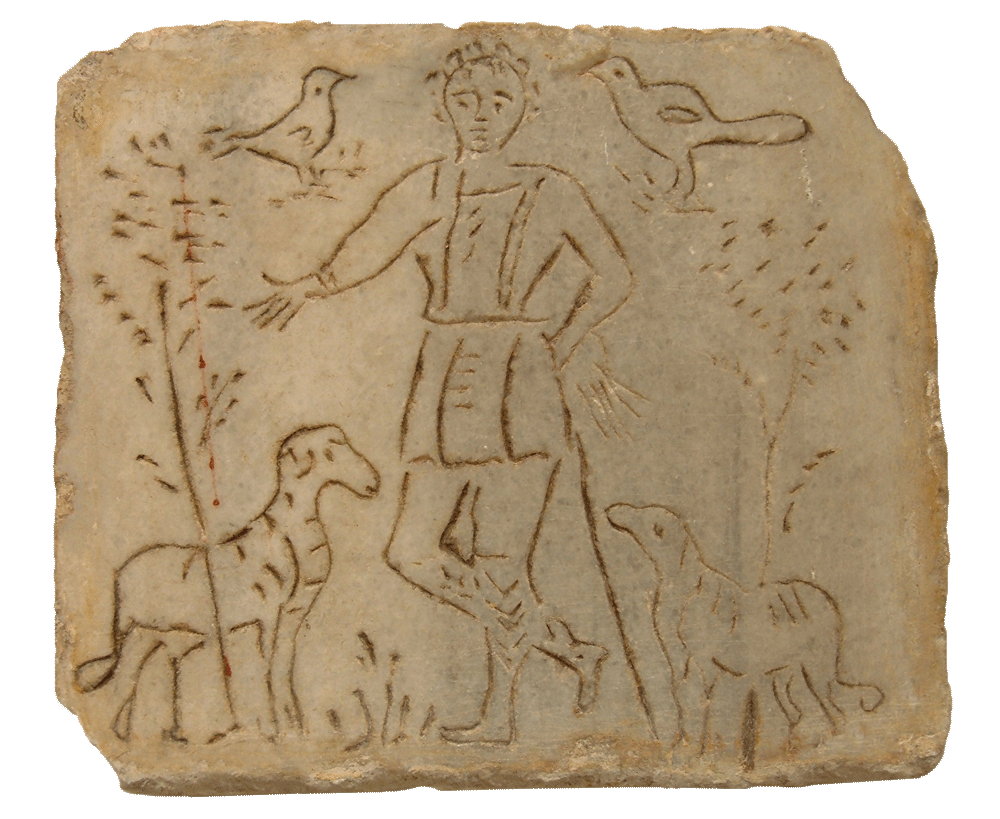
Images of the Good Shepherd, such as this one from the fourth century AD, were common in early Christian art.
In the body of the chapter, verses 4–14, Zechariah receives a commission to be a shepherd to God’s flock. He represents the good shepherd appointed by God to care for his people. “Marked for slaughter” indicates the sorry status of this flock. Their shepherds have no care or concern for them; rather, they deal ruthlessly with them, using them as objects for personal profit.
It becomes clear as the passage unfolds that the abused flock has the option of receiving or rejecting God’s shepherd. They decide to reject him. In rejecting God’s shepherd, they reject God’s help and salvation. They are left to suffer helplessly at the hands of their own countrymen and an oppressing king. This came true quite literally in the factionalism and civil strife of AD 70, when Rome oppressed the land and destroyed Jerusalem. God did not intervene, for they had rejected his salvation.
As Zechariah symbolically tends the flock, his care is particularly for the oppressed—those who recognize the word of the Lord being fulfilled in the coming of the shepherd. They are a small, despised minority.
In caring for the sheep, Zechariah takes up two staffs, one called Favor, the other called Union. The first signifies God’s special favor exercised on behalf of his people; the second signifies internal unity and cohesiveness within the nation, especially the two major factions, Judah and Israel. God’s shepherd replaces the leadership of Israel (the three shepherds, symbolic of the three offices of prophet, priest, and king). He is the perfect leader, ideal in every way. Yet the flock detests him and rejects him. Therefore he leaves them to their fate, dying and consuming one another.
The breaking of the staff called Favor (11:10) symbolizes the revoking of the protective covenant keeping the nations from harming Israel. Only the faithful remnant recognizes the Messiah at his coming and sees in the judgment that results from his rejection the fulfillment of God’s word (11:11).
The shepherd’s pay—thirty pieces of silver—was the price to be paid for a gored slave (Exod. 21:32). For God’s shepherd to be evaluated this way is a deliberate insult. God’s response is, “Throw it to the potter” (11:13), evidently an act symbolizing rejection and contempt. This symbolic act was fulfilled by Judas when he threw the thirty shekels into the temple and when the priests used it to buy a potter’s field for the burial of the poor (Matt. 27:3–10). Verse 14 describes the breaking of the second staff, Union, symbolizing the lack of internal cohesion within the nation.
Israel rejected the Good Shepherd provided by God for their benefit. There were immediate consequences, but much worse will be the time when they become subject to one whose qualities are opposite to those of the Good Shepherd (11:15–17). This is the antichrist, who will exercise terrible power during the tribulation (cf. Daniel 7; Revelation 13). He is a (spiritually) foolish (11:15) and worthless (11:17) shepherd. It will be a time of incredible hardship and suffering for Israel until God judges the false shepherd.
B. The second coming and reception (12:1–14:21). 12:1–14. As God sets out to unfold his great eschatological working in and on behalf of Israel (12:1–9), he reminds us that he is the Creator of heaven and earth and that he also formed man’s spirit within him. Thus he has the absolute right and sovereign ability to do as he wishes. There is no power in heaven or earth that can deter him from accomplishing his purpose. Israel as a nation (not just the northern kingdom) will be restored, the nations will be judged, and God’s kingdom will be established.
The expression “on [or “in”] that day” occurs sixteen times in the last three chapters of Zechariah. The setting is in the last days, when God judges the nations, restores Israel, and establishes his kingdom on earth. The particular setting of this paragraph is the last and climactic siege of Jerusalem by the forces of the enemies of God. It seems as though victory is in their grasp. But God intervenes, and it is not Jerusalem that is destroyed but the forces of the antichrist. The cup of reeling is a frequent prophetic metaphor describing the staggering effect God’s judgment will have on the nations (cf. Jer. 25:15–28). Instead of being drunk with the wine of revelry, they will drink the cup of God’s wrath. The nations view Jerusalem as a cup that will make them drunk with the joy of victory, but they will find that they will go away staggering in utter defeat at God’s hands.
Judah and Jerusalem are separated in verses 5–7. There is apparently some rift, or at least friction, between the two. Verse 7 seems to point to a spirit of elitism on the part of those in Jerusalem. Jerusalem will be a rock, apparently easy to deal with, but by God’s intervention a rock so heavy that the nations will injure themselves. Both the cup of reeling and the immovable stone metaphors graphically illustrate the sudden and unexpected disaster that befalls the attackers. Verse 4 makes it clear that it is God’s doing that saves Jerusalem. The three elements of panic, madness, and blindness are also present in the curse pronounced on a rebellious Israel (Deut. 28:28), but here the enemy is afflicted with these elements. At the same time that the enemy is struck with blindness, God will guard and protect Judah. The people of Jerusalem are strong because of their God. There seems to be an acknowledgment here not only of the power and reality of God but also of the fact that the people of Jerusalem have trusted God. At the very least their hearts are prepared for the appearance of the Messiah, their king. The leaders of Judah, encouraged and empowered by God, will overcome their enemies.
God’s deliverance is twofold: he provides a shield for the people, and he gives them supernatural strength so that the feeblest will be as heroic as David, and the leaders will be like God, like the angel of the Lord (equated here as elsewhere with God), the invincible “commander of the army of the Lord” (Josh. 5:14). No more are God’s people ready prey for their voracious enemies. God is their shield and strength. Verse 9 is a pointed summary of the whole paragraph. This eschatological attack against Jerusalem is God’s means of bringing the nations to judgment. To the attackers victory seems assured (they even penetrate Jerusalem initially [14:2]), and to Jerusalem it might seem hopeless, but the victory is the Lord’s.
Zechariah has described a great victory won on Israel’s behalf by the powerful intervention of God. Now an even greater victory is won, this time an internal victory over sinful and rebellious hearts (12:10–13:1). This victory is likewise won because of God’s gracious intervention. He takes the initiative and brings about a change in heart.
The outpouring of God’s Spirit, like an abundant stream of water onto arid ground, will bring about a miraculous transformation in human hearts (Isa. 32:15; 44:3; Ezek. 36:25–27; 39:29; Joel 2:28–29). Not until God does this will Israel’s blindness and hardness of heart be removed and will the people acknowledge and receive their Messiah. God’s spirit of grace will convict their hearts and move them to true repentance. His spirit of supplication will move them to cry out to God. On this great day the working of God’s Spirit will cause the scales to fall from Israel’s eyes, and they will see the Lord Jesus as their Messiah.
Verse 10 gives remarkable information about the one to whom they will look. (1) Since God is speaking, the “me” to whom they look is clearly God. (2) The one they have pierced is God. This conforms to Jesus’s claims to deity. (3) This passage links him with the Suffering Servant of Isaiah 53:5, who “was pierced for our transgressions.” John 19:34–37 sees the piercing of Jesus’s side by the spear as a fulfillment of this verse. (4) This passage clearly anticipates a twofold advent of the Messiah: the first when he was pierced; the second when they recognize him and trust in him. The result will be true repentance. The depth of their emotion and sense of loss because they have slain him instead of receiving him is vividly expressed. The mourning of that day is compared to the weeping of Hadad Rimmon in the plain of Megiddo. This most likely refers to the tradition of mourning for the death of Josiah in battle with Pharaoh Necho in the plains of Megiddo (2 Chron. 35:22–25). The loss of Josiah was keenly felt, particularly by the godly of the land, his death being a catastrophe. Thus the mourning of Israel described here is compared to that associated with great personal loss and terrible national catastrophe. The mourning is individualized to stress the fact that this is not a case of mass psychology or of ritual mourning. Each family and each individual, from the house of David on down, will grieve deeply for their sin.
13:1–9. God will respond to Israel’s repentance (13:1). An abundance of forgiveness is available to them (an open fountain). There is cleansing for every sin and every impurity. The Hebrew word for sin describes humanity’s missing the mark, falling short of God’s requirements. Impurity has to do with ceremonial matters, those things that disqualify a person from coming into God’s presence. After years of rejection, dispersion, and suffering, Israel now comes home, is united with her Savior, and finds glorious forgiveness and peace.
Zechariah 13:2–6 describes the love and loyalty of Israel for God in the kingdom age. Now that Israel is in right relationship to God through Jesus Christ, there is no room in the land for false prophets or idolatry.
Idolatry played an integral part in the sins of Israel leading to the destruction of Samaria and Jerusalem. It was not a problem as such after the exile. However, as the second coming of Christ approaches, it will once again increase in prominence, especially as people worship the antichrist and demons (Isa. 2:18, 20; Matt. 24:11, 15, 23–24; 2 Thess. 2:2–4; Rev. 9:20; 13:4–15). But in the messianic kingdom, the land will be purged of any form of idolatry. Christ alone will reign. The whole complex of idolatry, false prophets, and demon worship is spawned of Satan and will no longer be tolerated.
The convictions of redeemed Israel will be so firm and their love and loyalty to Christ will be so strong that parents will even put their own children to death for the sin of telling lies in the Lord’s name. False prophets will attempt to conceal their true identity by claiming to be farmers. Accused prophets will claim innocence, attributing probably self-inflicted wounds (see 1 Kings 18:28) to mistreatment at the hands of so-called friends. The impression that Zechariah leaves is that in actual fact these prophets have been involved in idolatrous activity.
Zechariah returns to the theme of the rejected shepherd, but now from a different perspective (13:7–9). In chapter 11 the flock rejected its shepherd. Human responsibility is stressed. Here the shepherd is slain by God’s decree. The result of the rejection of chapter 11 is that the flock becomes prey to the nations and ultimately comes under the rule of a false and worthless shepherd. Here, the flock is dispersed: two-thirds perish while the rest are refined and restored to fellowship with God. The resolution of the rejection of chapter 11 is seen in the repentance of 12:10 and the forgiveness of 13:1. The rejected shepherd is ultimately embraced. The final resolution of the smiting of the shepherd here is seen in the victorious return of the Lord and his reign over the whole earth.
God himself calls on the sword as the instrument of death to slay his shepherd. Though the redemptive reasons are not given here, the passage makes it clear that the rejection and slaying of the shepherd is no accident of history. He is the one whom God has appointed for his people, the one who alone can fully provide for all the needs of the flock. The remarkable designation “the man who is close to me” (13:7) identifies the shepherd as both man and “colleague” or “associate” of God. When the shepherd is struck, the sheep will be scattered. The term “little ones” emphasizes their helpless condition.
A great catastrophe is to come on Israel. The destruction of Jerusalem in AD 70 was but a foretaste of the tribulation to come. God will refine and purify as silver and gold the third of the flock that remains. As terrible as the coming tribulation will be, its purpose is to cleanse and prepare Israel to receive her Messiah. This is not punitive judgment but rather a means of drawing Israel back to God. As a result they will call on God’s name in repentance and in trust. Their hearts will be entirely directed toward God. They have turned away from all that grieves him. God will forgive them and receive them so that he can say “they are my people,” and they will be able to say “the Lord is our God.”
14:1–20. Chapter 14 returns to the final siege of Jerusalem. Besides adding some particulars omitted in chapter 12, chapter 14 has a different purpose. Both chapters show that much more is at stake than the defense of Jerusalem and the destruction of the enemy. In chapter 12 the impact of Christ’s coming brings God’s people to repentance and faith. In chapter 14 Christ’s coming is seen in its impact on the world at large, in the establishment of a worldwide kingdom where Christ alone is king. The repentance of Israel in chapter 12 is a prerequisite for her proper role in the Messiah’s world kingdom.
The king’s coming will be victorious (14:1–7). “A day of the Lord” is literally “a day for the Lord.” God is personally interested and involved in the events and their outcome. This day begins as a day of great darkness for Jerusalem (cf. Amos 5:18–20). The attacking nations will ransack Jerusalem. This is not a hit-and-run raid. Their intent is to impose the authority of the antichrist on Jerusalem completely. The attack on Jerusalem is brought about not by political or military considerations but by the satanically inspired motive of crushing the last major stronghold of resistance to the antichrist. But as in the case of the crucifixion of Christ, God is in control, using the ambition and malice of humans to accomplish his own ends (Acts 2:23). Initially the nations will have great success, capturing the city, ransacking the houses, raping the women. The attackers, however, will be suddenly and unexpectedly interrupted in their looting and pillaging. Just as they seem to have achieved final victory, the Lord himself will fight against them.
Some details of Christ’s coming and victory are now given. His feet will stand on the Mount of Olives, the place from which the glory of God left Jerusalem before the destruction of the temple in 586 BC (Ezek. 11:23) and from which Christ ascended into glory (Acts 1:9–12). Here also will the glory of God (in the person of Christ) return to Jerusalem (Ezek. 43:1–4). When the Lord touches the mountain, it will be split in two, forming a great valley running east to west. This is only one of a number of great, supernaturally caused changes that will take place (14:6–10). The people of Jerusalem will flee through this valley to Azel (a place east of the Mount of Olives, but not identified to date). Then the Lord will come. There is here a brief personal testimony of Zechariah’s personal identification with, and loyalty to, God in this conflict. At first there will be no light, no daytime or nighttime. Then, when evening comes, there will be light again. Evidently this describes a unique and heretofore unknown state of darkness (semidarkness?), which is neither day nor night, while God’s judging activity is going on. When evening comes the heavenly sources of light will resume their normal functioning. The whole universe is involved in the display of God’s power, heightening the terror of that day.
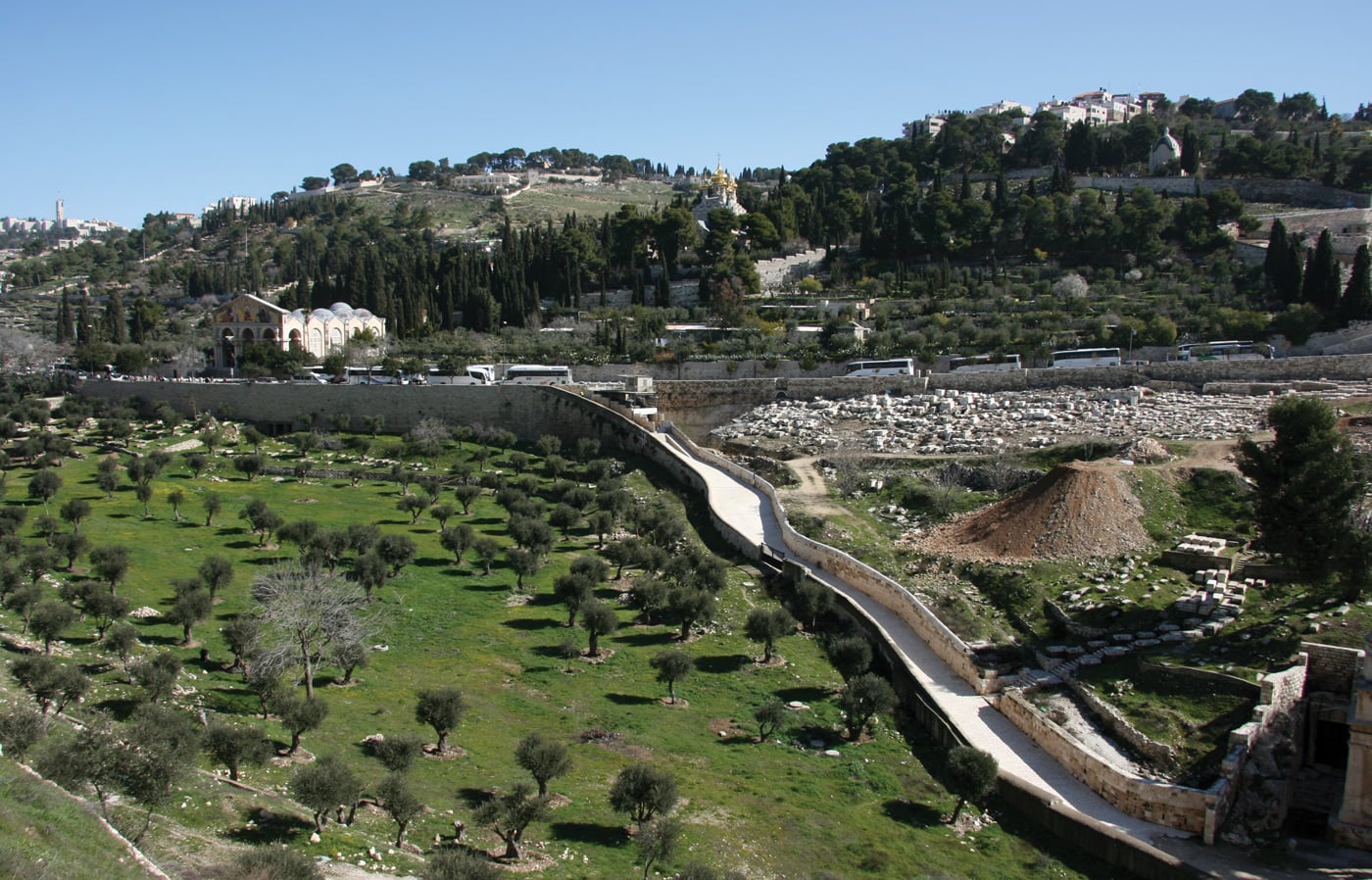
Zechariah 14:4 describes the Lord standing on the Mount of Olives, which is seen here from the Kidron Valley.
The physical rejuvenation of the land due to the perennial supply of living water flowing out of Jerusalem corresponds to the spiritual blessing and revitalization that the Lord effects in the lives of his people (14:8–11). No more will Israel rely on the leaky cistern of trust in false gods (Jer. 2:13). This abundant supply of water is as regular and plentiful in the dry summer season as in the wet winter. This is no wadi (intermittent stream) but a dependable, never-failing supply of water. This also serves as a wonderfully apt picture of the unfailing mercies and blessing of God to his own.
God will be king over the whole earth. His kingship will be universally acknowledged. Furthermore, there will be one Lord, and his name will be the only name. This both recalls and expounds the great Jewish Shema (Deut. 6:4). There is no longer any question as to who is Lord, who is to be worshiped. Now not only Israel but the whole world will recognize the truth: God is sovereign; he is the Redeemer; he forgives those who repent but judges the unrepentant. Probably as a part of the same upheavals in verse 4, the land around Jerusalem will become like the Arabah, the broad depression of the Jordan Valley, while Jerusalem will be raised up as a large mesa dominating the whole area. It will be inhabited, never to be destroyed again. It will be secure and remain so.
The manner in which the Lord deals with the attackers is briefly described (14:12–15). The Hebrew word for “plague” means literally “a striking [by God]” and is used in Exodus 9:14 to describe the way God strikes Egypt. The method God will employ is not stated. What is clear is that he makes a distinction, as he did in Egypt, between his own people and his enemies. After the nations attack each other, Judah will participate in the “mop-up” phase of the battle. They, along with the people of Jerusalem, will share in the wealth of all the surrounding nations as it is collected at Jerusalem. Now Jerusalem is not being plundered but enriched.
The attacking armies are completely destroyed. But there will be those among the nations of the world who will repent and turn to the Lord (14:16–19). These will enter the millennial kingdom and will join Israel in worshiping and obeying the Lord (cf. Isa. 2:1–4; Zech. 8:20–23). They will go up yearly to worship and to celebrate the Feast of Tabernacles. The celebration of this festival during the millennium will be appropriate in that (1) it follows shortly after the great day of atonement, a day of national repentance and forgiveness for sins; (2) it is a thanksgiving festival commemorating the end of centuries of homeless exile; and (3) as a harvest festival it acknowledges the gracious providence of God in both the physical and the spiritual realms. The keeping of the Feast of Tabernacles and the worship of the Lord are equated in verses 17–18. Since this festival is in part an acknowledgment of God as king and as gracious provider, to refuse to participate is to refuse to acknowledge God. The punishment fits the crime, since withholding rain results in crop failure. No amount of modern technology can counteract the withholding of God’s blessing on the land.
There are several possible reasons why Egypt is singled out here: (1) It is a link to Israel’s background as the land they left to journey to the land of promise. (2) Egypt was dependent on the Nile for the fertility of its land, but God can diminish and even dry up the Nile. (3) God had once before established the fact of his lordship by bringing Egypt to her knees. He can do it again. (See Isa. 19:18–23 for a remarkable description of the place Egypt will have among the redeemed in the millennial age.)
Jerusalem will for the first time truly be a “Holy City” (14:20–21). In the Mosaic economy the high priest had “Holy to the Lord” inscribed on his turban (Exod. 28:36). Now even the bells of the horses are so engraved. Ordinary cooking pots will be like the sacred bowls used for sprinkling blood on the altar. The distinction between sacred and profane is now eliminated, because all of Jerusalem is truly dedicated to the Lord. The priestly calling of Israel will become actuality. The term “Canaanite” (14:21) sometimes refers to traders or merchants (see Job 41:6; Prov. 31:24) and may refer to the fact that the need for traders (who sold holy utensils to pilgrim worshipers in the temple precincts) will no longer exist, since all that is in Jerusalem will be holy and suitable for temple worship. But more likely “Canaanites” are persons who are spiritually unclean and unfit to come into God’s presence. No longer will anyone come unworthily before the Lord, because God will have sanctified his people, making them fit to worship him.
Thus this great prophecy concludes with God’s having accomplished his intended program. Israel has been transformed into a people worthy of its calling, the hostile world powers have been judged, and the once-rejected Messiah now reigns supreme in a world of redeemed Jews and Gentiles that is blessed by his presence.
Select Bibliography
Baldwin, Joyce G. Haggai, Zechariah, Malachi. Tyndale Old Testament Commentaries. Downers Grove, IL: InterVarsity, 1972.
Barker, Kenneth L. “Zechariah.” In The Expositor’s Bible Commentary. Edited by Frank E. Gaebelein. Vol. 7. Grand Rapids: Zondervan, 1985.
Boda, Mark J. Zechariah. NIV Application Commentary. Grand Rapids: Zondervan, 2004.
Feinberg, Charles L. The Minor Prophets. Chicago: Moody, 1976.
Laney, J. Carl. Zechariah. Chicago: Moody, 1984.
McComiskey, Thomas Edward. “Zechariah.” In The Minor Prophets: An Exegetical and Expository Commentary. Edited by Thomas Edward McComiskey. Grand Rapids: Baker Academic, 1992.
Merrill, Eugene H. Haggai, Zechariah, Malachi. Chicago: Moody, 1994.
Smith, Ralph L. Micah–Malachi. Word Biblical Commentary. Waco: Word, 1984.
Unger, Merrill F. Zechariah: Prophet of Messiah’s Glory. Grand Rapids: Zondervan, 1962.
Webb, Barry G. The Message of Zechariah: Your Kingdom Come. The Bible Speaks Today. Downers Grove, IL: InterVarsity, 2003.