Hebrews
1. The Superiority of the Christian Faith (1:1–10:18)
A. Jesus Christ Superior to the Prophets (1:1–4)
B. Jesus Christ Superior to Angels (1:5–2:18)
C. Jesus Christ Superior to Moses (3:1–4:13)
D. Jesus Christ Superior to Aaron (4:14–10:18)
2. Exhortations to Persevere in Christian Faith (10:19–12:29)
A. The Danger of Apostasy (10:19–31)
B. Encouragements to Press On (10:32–39)
C. Faith Defined and Exemplified (11:1–40)
D. Jesus, the Superior Example of Faith (12:1–4)
E. The Meaning and Merit of Discipline (12:5–13)
F. Warning Not to Turn Away from God (12:14–29)
3. Concluding Exhortations (13:1–19)
4. Benediction and Greetings (13:20–25)
Introduction
Authorship
Although the Letter to the Hebrews was clearly written to address a spiritual crisis in a specific community of Christians by one well known to them, one cannot determine with certainty the identity of the author, the specific recipients or the location of their community, or the precise date of the letter’s composition.
Though the letter has been ascribed to Paul from at least the end of the second century in the Eastern church and nearly universally in Christendom from Augustine to the Reformation, the arguments against Pauline authorship now appear to be decisive. Chief among them are the following: (1) the letter is anonymous, which is uncharacteristic of Paul; (2) the style of Greek is significantly different from that of Paul’s letters; (3) the statement of Hebrews 2:3 seems impossible to reconcile with Galatians 1:12; and (4) the ambiguous testimony of the early fathers: Clement of Alexandria and Origen accepted Hebrews as Pauline but with major qualifications; Tertullian named Barnabas as the author and gave no hint of a controversy on that point—difficult to explain if the author were none other than the great apostle to the Gentiles.

The reference to Timothy (Heb. 13:23) and the ancient but inconsistent testimony to Pauline authorship have led to the widespread opinion that the author was at least a member of the Pauline circle. Origen suggested that he was a pupil of Paul who wrote what he had learned from the apostle. Others have proposed Luke either as the author or, as Clement of Alexandria supposed, the translator of Paul’s Hebrew original. Most modern scholarly opinion, however, is divided between Barnabas and Apollos. Barnabas was a Hellenistic Jew, a Levite in fact, a prominent member of the apostolic circle (even called an apostle in Acts 14:14; cf. 1 Cor. 9:5–6), and has the considerable support of Tertullian’s unqualified assertion that Barnabas was the author of Hebrews (On Modesty 20). Likewise Apollos, a highly educated Alexandrian Jew, a gifted controversialist, and a participant in the apostolic ministry (1 Cor. 1:12; 3:6), could well have written a work such as Hebrews, with its sophisticated use of Scripture and its elegant Greek. If the author of Hebrews was neither of these men, he was surely like them, “a good man, full of the Holy Spirit and faith” (Acts 11:24) and “a learned man, with a thorough knowledge of the Scriptures” (Acts 18:24; cf. 18:28). Plausible arguments can be advanced in favor of either of these and some others, but presently a firm conclusion remains unobtainable.
Certainly apostolicity was a prerequisite of canonicity, but this requirement could be satisfied by authorship by a member of the apostolic circle, as in the case of Mark or Luke-Acts. In any case, canonicity does not depend on the church’s present certainty as to the authorship of a particular biblical work (e.g., Judges, 1–2 Chronicles). Furthermore, the author of Hebrews would be among the first to insist that the human authorship of Scripture is of secondary importance, being only the instrumentality of its divine inspiration. As he reminds his readers (3:7; 4:7), David may have written Psalm 95, but the Holy Spirit was the primary author and the one who speaks to us in it.
Occasion, Purpose, and Audience
The author’s purpose in writing is quite clear, for he reiterates it regularly. He writes to arrest an incipient apostasy and to strengthen wavering faith. Perhaps some members of this community had already deserted the faith, turning their backs on the way of salvation and the Savior they had once acknowledged (6:4–6; 10:26–31). In any case, tempted to evade the persecution they were suffering on account of their faith and to find some way less costly than the discipleship to which Christ calls his people, many were trifling with apostasy by compromising their former beliefs (2:3, 18; 3:6, 12–15; 4:1, 11, 14; 6:4–6, 9–12; 10:19–29, 35–39; 12:1–3, 14–17, 25; 13:9, 13). With a keen appreciation of the fearful implications of such a spiritual defection and with a deep personal interest in the outcome, the author writes this often severe, always affectionate, intensely sympathetic, and practical “word of exhortation” (13:22).
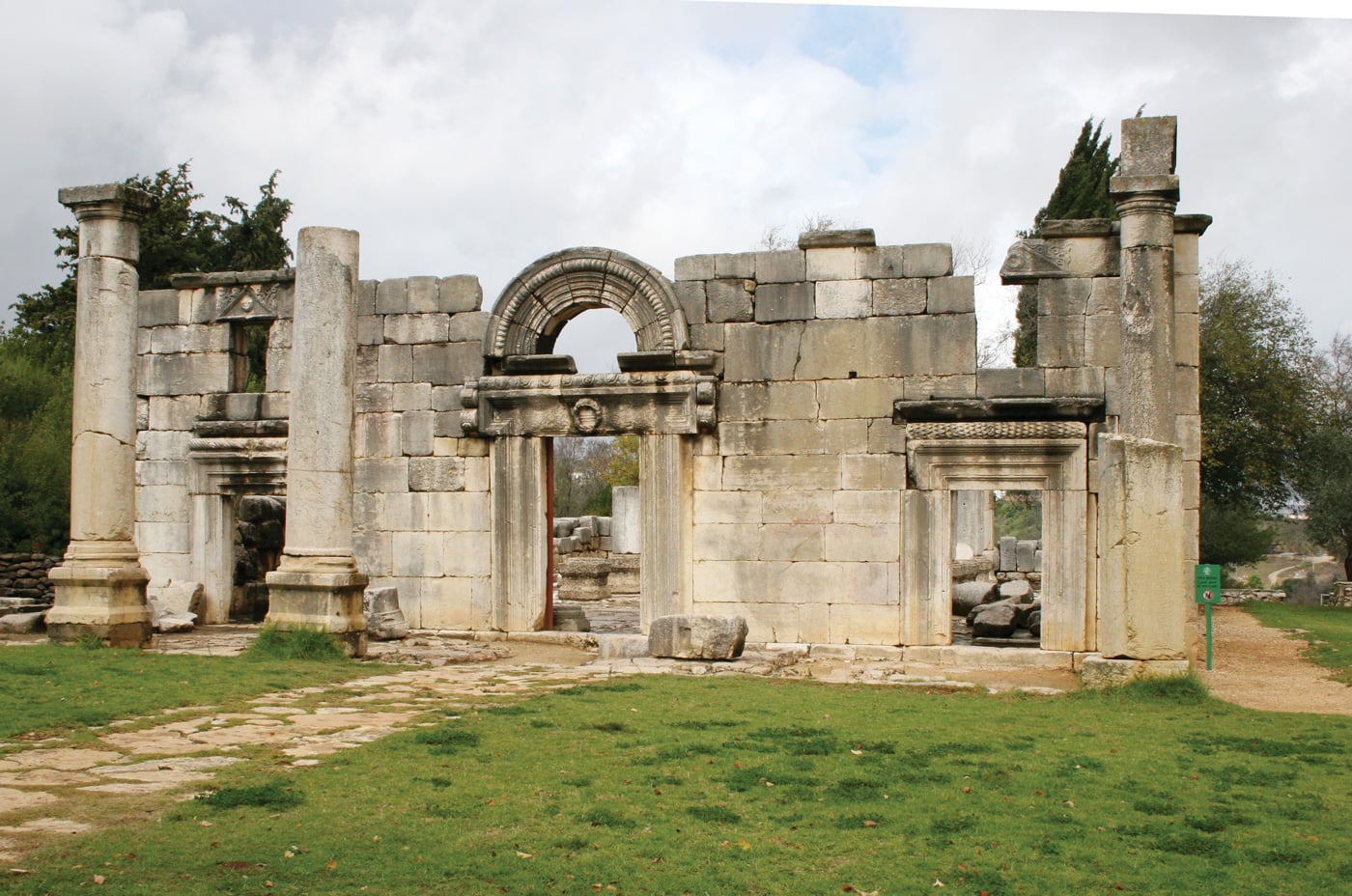
The ruins of the Jewish synagogue at Kefar Baram in Upper Galilee (third century AD). The Letter to the Hebrews was written to Jewish Christians who were tempted to return to Judaism.
Those addressed are a community of converts from Judaism who, encountering stiff opposition from their former brethren and finding difficult the pioneering demanded of them by their new faith, were tempted to return to the comfortable security of the old ways. In recent times some scholars have maintained that the recipients of the letter were Gentiles or Christians irrespective of race and that the title “To the Hebrews” is only the by-product of a later and erroneous interpretation of the letter. However, the evidence of the epistle itself conclusively favors a Jewish Christian audience, and this remains the conclusion of a majority of scholars. Admittedly, it cannot be demonstrated that the title was attached to the letter prior to the last quarter of the second century AD, and its vagueness may appear not to comport well with a letter obviously addressed to a particular community (10:32–34; 13:18–19, 22–23) and not to Jewish Christians generally. Nevertheless, the title is very old and, so far as anyone knows, “To the Hebrews” is the only title the letter has ever had.
Further, the author throughout assumes on the part of his readers both an exact acquaintance with the Scriptures and an unshaken and unshakable conviction of their divine authority. Of course, Gentile converts acknowledged the Old Testament as the Word of God, but if their commitment to Christianity was weakened, so too would be their confidence in the Scriptures.
Finally, and decisively, a Jewish Christian audience is demanded by the central argument of the letter, which is designed to counter the opinion that the Levitical institutions were God’s definitive provision for the salvation of humankind. The argument is constructed around three contrary-to-fact conditional statements (7:11; 8:7; 10:1–2), that is, statements in which the protasis (the “if” clause) is assumed to be false. The three statements and the massive argumentation marshaled in their support presuppose a real inclination on the part of the readers to assume the contrary, namely, that perfection could be attained through the Levitical priesthood, that the covenant life of Israel was and remains the ideal, and that the sacrifices could indeed make the worshiper perfect—thus rendering Christ and his work superfluous. Such assumptions were not a temptation for Gentile believers; and addressed to a Gentile audience, the great argument of the letter becomes what it definitely is not, a colorless examination of largely hypothetical questions. Rather, the letter is an impassioned plea to make complete and permanent the separation from Judaism (13:13).
One can possibly identify this community with some further precision. The Dead Sea Scrolls have greatly enlarged our knowledge of nonconformist Judaism in this period, that is, Judaism that was not primarily shaped by the rabbinical tradition and not represented by the Pharisees and Sadducees. Chief among representatives of such a separatist Judaism were the Essenes; it is widely believed that a community of Essenes was located at Qumran, where the Dead Sea Scrolls were found. Among the distinctives of this sect are a number that appear to bear some relation to the argument of Hebrews. These Jews looked for the fulfillment of Jeremiah’s new covenant but in the form of the restoration and purification of the Aaronic priesthood, with its system of ceremonies (cf. Heb. 7:11–28; 9:1–10); they anticipated the appearance of a great prophet, the second Moses of Deuteronomy 18:18 (Rule of the Community 9:11; 4QTestimonia; cf. Heb. 1:1–2), and sought a manner of life patterned after that of Israel in the wilderness (cf. Heb. 3:7–19; 4:1–11; 8:6–12; 12:18–21); they fostered extravagant speculations concerning angels, even expecting that in the coming kingdom the archangel Michael would play a more decisive role than the Messiah (War Scroll 17:6–7; cf. Heb. 1:4–2:18); they cast Melchizedek in the role of an eschatological deliverer (11QMelchizedek; cf. Heb. 7:1–17); and in their ritual they placed special emphasis on ceremonial washings (Damascus Document 10:10–13; War Scroll 14:2–3; cf. Heb. 6:2; 9:13). Though the evidence is by no means conclusive, a plausible case can be made for understanding Hebrews as a point-by-point refutation of the doctrines of a Jewish community of the Essene-Qumran variety; if correct, this would indicate that the recipients of the letter were originally converts from such a nonconformist Judaism and were now inclined to return to it.
Little more than this can be said about them. They were second-generation Christians. Never having seen or heard Jesus themselves, they had been evangelized by eyewitnesses (2:3). They were presumably Hellenistic (Greek-speaking) Jews, as the author cites the Greek version of the Old Testament, the Septuagint. They had suffered persecution but not yet martyrdom (10:32–34; 12:4). It may be that they were a distinct party or group that had separated itself from the larger believing community in their locality (10:25; 13:17, 24). Where they lived is impossible to determine. Jerusalem and Rome figure prominently in scholarly speculations, but the evidence is meager. Similarly, the place of the letter’s composition remains uncertain. The only evidence in the letter itself is ambiguous (13:24), and the tradition that it was written from Rome is quite late.
Date
Clement of Rome makes use of Hebrews in his first letter, which is ordinarily dated around AD 95, though possibly earlier. A first-century date is further required by the facts that the recipients of the letter had learned the gospel from eyewitnesses of the Lord and that Timothy was still alive (2:3; 13:23). Other evidence supports a date of composition prior to AD 70. The absence of any mention of the destruction of the temple in Jerusalem furnishes a virtually unanswerable argument that the letter was written beforehand, inasmuch as mention of the demise of the temple ritual would seem so well suited to the author’s purpose (8:13; 10:2). Further, the consistent use of the present tense in reference to the Levitical priesthood and ritual surely favors, though it does not demand, a date prior to the cessation of that ritual. Without knowing the location of this community of Jewish Christians, it is impossible to say more than this.
Theological Themes
The author describes his work as a “word of exhortation” (13:22), that is, a sermon, as appears from the use of the same phrase in Acts 13:15. Hebrews is a letter only secondarily, by reason of the few personal remarks at its conclusion and the fact that it was written in one place and dispatched to another. The sermonic form appears in the repeated reference to the author’s speech (Heb. 2:5; 5:11; 6:9; 8:1; 9:5; 11:32); in his method, which is the citation, exposition, and application of Scripture; and in his singleness of purpose. Hebrews vies only with Galatians for the distinction of being the most single-minded work in the New Testament. It is a discourse on the absolute necessity of perseverance in the Christian faith. The arguments enlisted on behalf of this proposition are those precisely suited to allay the doubts and to unmask the errors that were undermining the faith of the author’s readers.
However, the letter’s specific destination and pointed applications notwithstanding, Hebrews is not at all provincial or dated as might be expected of a long-ago sermon to a long-forgotten community of Christians. The danger of apostasy being always present (Matt. 24:10; 1 Cor. 10:12; 1 Tim. 4:1), Hebrews’ emphatic and solemn warning is always timely. The author supports his exhortation by appeal to some of the most fundamental elements of the good news, in particular those that have immediately to do with the nature and practicalities of the Christian’s life of faith in the world. In addressing his readers’ spiritual peril, he provides a scriptural elaboration of Christ’s supremacy as the incarnate Son of God; his mediatorial work as intercessor, priest, and sacrifice; the nature of the Christian faith and hope; the method of God’s dealing in mercy and judgment with his people; and the unity of the people of God and the gospel in the history of salvation. From these doctrines the author draws applications as profound and urgent for any believer today as for those to whom the sermon was first sent.
Like any good preacher, the author never loses sight of his readers’ pressing need or his own purpose. He returns to his exhortation regularly, so that what one encounters in Hebrews is a repeated alternation between scriptural or doctrinal exposition and its application to the great question of his readers’ perseverance in faith. (Note the recurring “therefore” in 2:1; 3:1; 4:1, 11, 14; 6:1; 10:19; 12:1, 28; cf. “the main point of what we are saying is this” [8:1].)
Two special features of the argument, crucial to a proper interpretation of the letter, require comment. First, the author’s purpose is to correct his readers’ ideas, derived from the principles and forms of the Judaism whence they came, that are incompatible with true faith and participation in the salvation of God. It is imperative that this purpose be given its due in the interpretation of the letter. Too often commentators have understood the author’s central argument (chaps. 3–12) to be contrasting Christianity with the provisional religion of the Mosaic administration. It is then supposed that he sustains his exhortation to persevere in the faith and to make the break with Judaism permanent by demonstrating that Judaism, embodying the temporary and imperfect economy of the Old Testament, has been superseded by and fulfilled in the religio-historical economy introduced by Christ and the apostles. Indeed, understood in this way, Hebrews is often thought to provide the New Testament’s most thoroughgoing elaboration of the historical relationship between the Old Testament and the New Testament and the most complete explanation of the superiority of the latter.
This understanding of Hebrews, though very common, is quite contrary to the author’s fundamental assumptions and clear statements. His contrast is never between a supposedly inferior faith, spirituality, and system of worship that prevailed in the age before Christ and their fulfillment in the Christian era. He says nothing about the difference between the religion or spiritual privileges of believers before and after Christ. On the contrary, at every point he identifies the situation of his readers with that of the ancient people of God: the gospel preached to them was preached to Israel in the wilderness (4:2); the promise, rest, and inheritance that pious Israelites grasped from afar is nothing other than that which is set before the believers to whom he writes and which they, likewise, will obtain only in the world to come and only if they endure in faith to the end (3:4, 19; 4:1; 6:11–12; 10:35–39; 11:10, 16, 35, 39–40; 12:1; 13:14); and the danger of apostasy and the enormity of its consequences are no less now that Christ has appeared (3:12; 4:11; 6:4–6; 10:26–31, 38–39; 12:25). It is striking and very important how completely this author identifies the situation that prevailed prior to the incarnation with that of the present and how readily he finds Christ present and active in the life of the Old Testament community (3:2–6; 11:26).
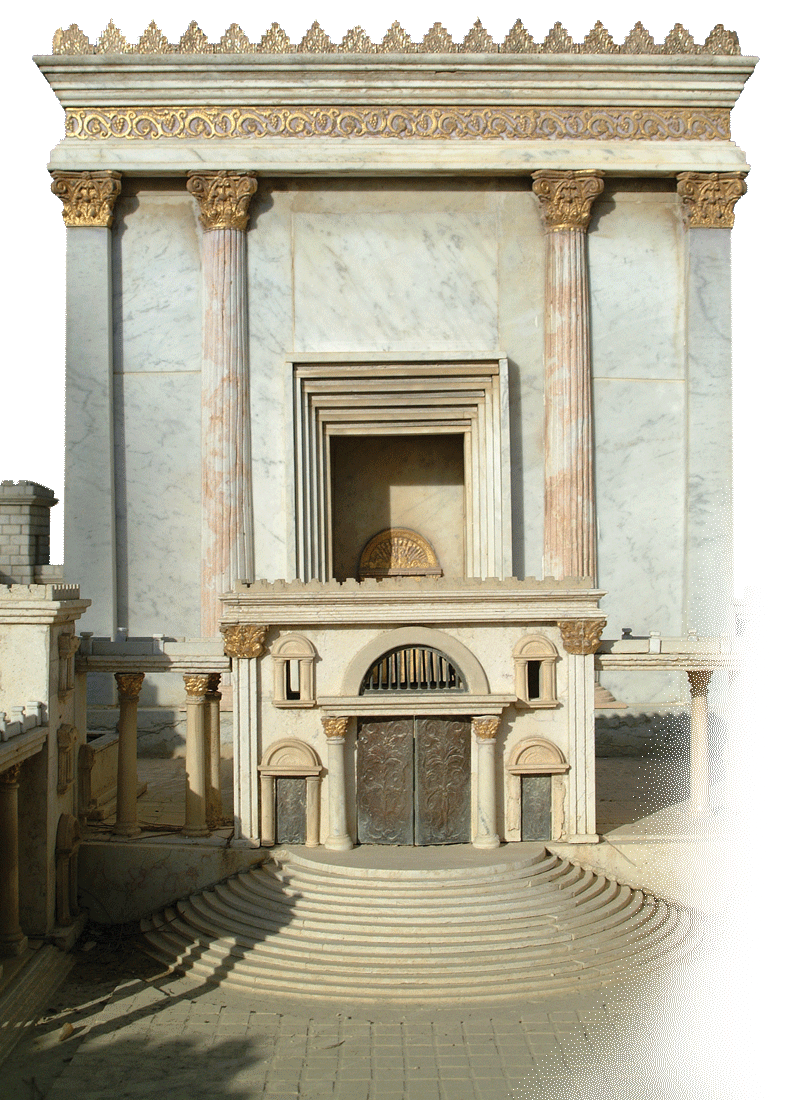
Few archaeological remains exist to help us imagine the magnificent second temple reconstructed by Herod the Great (first century BC). This large scale model (Israel Museum) helps us picture the place where observant Jews during the first century AD brought their sacrifices and offerings.
The contrast the author does draw is the radical contrast between unbelief and faith, apostasy and perseverance, the forfeiture of salvation and the eternal inheritance, and the wrath of God and his forgiveness. No doubt belonging to the church in the Christian era has advantages, but the author of Hebrews does not enumerate them. Indeed, although this letter is frequently claimed to be an assertion of the supremacy of the New Testament and the obsolescence of the Old Testament, on careful examination it proves instead to be the Bible’s most thorough demonstration of the unity of the covenant of grace, the church of God, and true spirituality and faith throughout all eras of the history of salvation. Crucial to the proper interpretation of the letter is how little interested this author is in distinguishing between the opportunities, privileges, responsibilities, and blessings of the saints before and after Christ and how completely he identifies them.
The failure to appreciate Hebrews’ sustained emphasis on the unity of the administration of divine grace throughout the history of salvation has bedeviled the interpretation of the letter and muted its warnings. The author fashions his exhortation on the assumption of this unity. The recognition of this is vital; otherwise it is impossible to rightly understand the severe criticism that the author levels against the Old Testament covenant and worship. An appreciation of his consistent assumption of the unity of the gospel and the life of faith before and after the incarnation opens the way to the following recognition. In his criticism the author does not have in view the Old Testament economy per se, but rather that economy which eventuated when the gospel was not combined with faith, when the covenant was shorn of all but its outward forms, that is, the Old Testament economy as it was understood and practiced by the unbelieving Judaism of the author’s day. This Judaism—not the true faith of the Old Testament—threatened his readers.
The great contrast drawn by this author is not between the old and new administrations, or between believers before and after the incarnation, but rather between two ways of salvation, one false and one true, and between two destinies, the one obtained by those who deny the faith and the other by those who patiently endure in faith and hope. In each case the former is illustrated in the letter chiefly by unbelieving Israel, the latter by the saints of that former era. One cannot overemphasize that the author treats the Mosaic administration, with its Levitical institutions, under the false view of them entertained in the Judaism of that day, a Judaism that had by this time so completely lost sight of the true meaning of the covenant, priesthood, and sacrifice that it no longer had any place for a redeemer who would die for the sins of the world. In the letter’s criticism of the Levitical institutions, therefore, one looks in vain for the author’s admission of the proper and holy purpose of the sacrifices to signify and to confirm God’s covenant, of the joy and peace that pious Israelites obtained in their evangelical use of them, and of their splendid and rightful place as an important part of covenant life. He does no justice to their rightful purpose but condemns them as utterly ineffectual to save sinners. “Weak and useless” is his scathing verdict (7:18–19). Indeed, to hear him tell it, it is hard to imagine what significant purpose was ever served by all these carnal regulations and performances (9:9–10; 10:11). The severely negative tone of his criticism of the Old Testament cultus is very impressive, and it is in no way mitigated by the author’s description of the shadowy, provisional character of these institutions, by any external efficacy he attributes to them, or by the fact that he declares them fulfilled in the sacrifice of Christ; for in this way he does not intend to pay tribute to the cultus but only further to demonstrate its worthlessness in comparison with the priesthood and sacrifice of Christ.
In this criticism of the Levitical institutions, then, the author places himself squarely in the tradition of the Old Testament prophets who were similarly scornful of that worship as it was practiced by a people who, without living faith in God or submission to his law, trusted instead in the efficacy of external ordinances (Isa. 1:10–20; Jer. 7:21–23; Amos 5:21–25). It is imperative to remember that almost certainly Hebrews was written when the sacrifices were still being offered and when Jewish Christians were still participating, and properly so, in temple worship (Acts 21:20–26; cf. 1 Cor. 7:18). The author does not call for the abolition of the sacrificial ritual and the priesthood any more than the prophets before him. But like them he condemns the confidence that faithless and disobedient people are investing in mere ceremonies.
In sum, this author describes the Levitical ritual in much the same way as a preacher today might speak scornfully of the Lord’s Supper to a congregation that imagines that one obtains the forgiveness of sins by the mere partaking of bread and wine. Interestingly, there is no mention of the Lord’s Supper in Hebrews. The author has no intention of calling the attention of his readers, in their present state of mind, to another ceremony. Their growing confidence in externals could only too easily be transferred from the Levitical rites to those of the apostolic church—a danger to which the whole course of church history from that day to this bears sad but eloquent testimony.
Second, until relatively recent times the interpretation of Hebrews was heavily influenced by the widespread opinion that the author was a product of the Alexandrian school of biblical exegesis and, in particular, deeply indebted to Philo for his conceptual framework, his hermeneutics, and his manner of statement. The most significant consequence of this opinion was the eclipse of the eschatological perspective of the letter, a casualty of the assumption that the author shared Philo’s conception of the timeless duality of the material and spiritual worlds. While there are certain affinities between Hebrews and the writings of Philo, the differences are profound and important. Recent scholarship has tended to discredit the alleged dependence on Philo, and the happy result of this has been a marked resurgence of interest in the eschatology of Hebrews. This is a great step forward, for in truth hardly any other book of the Bible more consistently throws the attention of the reader forward to the world to come.
Remarkably, the author is little interested in the present fulfillment of Old Testament prophecy. Indeed, the idea of fulfillment plays almost no role in the argument. For this author, the Old Testament is not a collection of prophecies now fulfilled in Christ so much as a contemporary word of God to be heard, believed, and obeyed. Expectation not fulfilled rather than unfulfilled animates the letter and drives its argument. The rest of God, the eternal country and city, the resurrection, the receiving of the promise and inheritance, and even salvation itself (1:14; 9:28) were the hope of the saints of ancient days and must be no less so for every generation of believers (4:11; 10:36–37; 11:39–40; 13:14). The author’s exhortation is always firmly fixed in his eschatology: the reason one must continue in the faith, holding fast to Christ, is not for fear of present consequences but because by shrinking back one forfeits the eternal rest and exposes oneself eventually to God’s fearful judgment and consuming fire. The sustained emphasis of Hebrews on the futurity of salvation is a corrective to an unbiblical preoccupation with the present benefits of faith in Christ. Further, it is a reminder that the obligations of faith and obedience will never weigh on the church as they must until the specter of eternity is fixed before her mind’s eye.
Commentary
1. The Superiority of the Christian Faith (1:1–10:18)
A. Jesus Christ superior to the prophets (1:1–4). The dramatic exordium is less an introduction than a thunderous opening salvo. This written sermon goes forth precisely to arrest a waning of conviction regarding the divine supremacy of Christ and the decisiveness of his work as the redeemer of sinners (1:1–2). The assertion of the Son’s preeminence among the prophets and the finality of his revelation is possibly intended to correct the expectation of an eschatological prophet within the circle of Judaism from which these readers had come and to which they were now tempted to return. Note that no distinction is made between the message spoken formerly and “in these last days.” It is not the message but the dignity of the messengers and the times and circumstances of their revelation that differ. God spoke then and now, and indeed continues to speak, through the ancient prophets as through his Son (e.g., 3:7; 10:37–38). One needs to remember that the living and active word of God (4:12) was for this author largely what is now called the Old Testament.
“These last days” (literally “at the end of these days”) is taken from the Septuagint, which literally rendered the Hebrew phrase used in the Old Testament to designate the prophetic future (cf. Gen. 49:1; Deut. 4:30; Isa. 2:2; Ezek. 38:16). “These” refers to the future days prophesied in the Old Testament, or some of those days, or the beginning of them (cf. Heb. 9:26).
In verse 3, “radiance” indicates the Son’s sharing of the divine attributes (cf. John 1:14; 2 Cor. 4:6), and “exact representation” indicates the correspondence of his nature with the Father’s (cf. Col. 1:15). “Sustaining all things” refers to his government by which he brings the course of history to its appointed end. “Sat down” signifies the completion of the atonement (10:12–14) and suggests Christ’s present activity as priest (4:14–16) and king (12:2). It is self-evident that if the Son’s person and work are as described, any religion that does not place them at its center, in which he is not the hope and joy of sinners and the chief object of faith and worship, stands self-condemned.
B. Jesus Christ superior to angels (1:5–2:18). The superiority of the Son to the angels is now distinctly stated and furnished with an impressive biblical demonstration (1:5–14). The author’s evident interest in providing conclusive proof of this point surely indicates that this was a matter of dispute. Possibly his readership attributed an unwarranted eminence to angels as a consequence of their function as mediators through whom God revealed the law (2:2; cf. Acts 7:53; Gal. 3:19). If the hypothesis of the readers’ background in nonconformist Judaism is granted, they knew well an eschatology in which an angel played a more decisive role than the Messiah himself. Since they were Jews and Christians, their retreat from Christianity was resulting in a growing hesitance to ascribe divinity to Jesus while yet wishing to revere him, leaving him as less than God but more than man—that is, an angel. That his superior name is inherited indicates that Jesus Christ is here being considered not in his eternal and essential dignity as the Son of God but as the mediator, the “man Christ Jesus” (1 Tim. 2:5), who by his humiliation became superior to the angels (Heb. 2:9).
The fact that the author has the incarnate Son of God (1:5) in view helps in understanding Psalm 2:7, the first of the seven citations from Scripture, which figures prominently in the New Testament as a prophecy of the incarnation, the messianic ministry, and especially the resurrection (Mark 1:11; Luke 1:32; Acts 13:33; Heb. 5:5; cf. Rom. 1:4). The eternal Son could be said to become or to “be begotten” as the Son of God only with reference to the exaltation of the human nature he took to himself when he came into the world.
The second citation (2 Sam. 7:14), God’s promise to David concerning Solomon, was extended in Old Testament prophecy and became the basis of the expectation of the messianic king of Davidic descent who would usher in God’s everlasting kingdom (Ps. 72:1–20; Isa. 9:7; 11:1–9; Jer. 23:5–6; Luke 1:32–33).
In verse 6, the third citation (Deut. 32:43, from the longer text of the Septuagint and Dead Sea Scrolls; cf. Ps. 97:7) verifies that when the Son of God came into the world as a man, he was worshiped as divine. Perhaps the specific allusion is to Luke 2:13. “Firstborn” is another messianic title (Ps. 89:27). It suggests his consecration to God (Exod. 13:2) and his precedence as an heir. The application of this text to Christ is an instance of the attribution of the divine name Yahweh to Jesus.
The contrasting citations in verses 7–9 (Ps. 45:6–7; 104:4) establish that the superiority of the Son to the angels is as clear and great as that of a king to those who do his bidding, indeed, as that of God to his creatures. Psalm 45, a wedding song for an Israelite king, is properly applied to the one who establishes the reign of which the Old Testament kingship was but a foreshadowing. The ascription of this text to Christ results in one of the few places in the New Testament where Christ is directly referred to as God (cf. John 1:1; 20:28; Rom. 9:5).
In verses 10–12, the sixth citation (Ps. 102:25–27) serves to recapitulate the divine dignity of the incarnate Son of God as the Creator (1:2) and his majesty as the eternal Yahweh. (The divine name is missing in the Hebrew text, but the Septuagint’s “O Lord” may bear witness to an earlier form of the Hebrew text. In any case, Yahweh is unmistakably being addressed, as the entire psalm demonstrates.)
The final citation, which occurs in verses 13–14, is from Psalm 110 and climactically reiterates the divine honor bestowed on Christ, the royal status he presently enjoys, and the inheritance soon to be his. On the other hand, the angels are but servants (cf. Ps. 103:20–21); some stand (Luke 1:19), but none sit in Christ’s seat of honor. Their special ministry is to those who will share in Christ’s inheritance. In his first mention of salvation, the author characteristically views it as yet future (2:5; 9:28).
The preceding exposition is now applied (2:1–4) in the first of many exhortatory sections that punctuate the letter and demonstrate its true purpose. The readers had no reservations concerning the legitimacy and severity of the sanctions of the Mosaic law, though it was mediated by angels (cf. Deut. 33:2 in the Septuagint; Acts 7:53; Gal. 3:19). How much more, then, ought they to fear the consequences of slighting a revelation communicated immediately by one far greater than angels, attested by eyewitnesses, and confirmed by miraculous signs of various kinds? The author is not belittling the law. It too was a revelation of God attested with marvelous signs (Heb. 12:18–27). But that only serves to heighten the sanction that attaches to the Son’s own announcement of God’s salvation. “Drift away” and “ignore” (2:1, 3) suggest less a deliberate repudiation of the faith than a squandering of salvation through an unwillingness to meet its stern requirements (3:12–13).
In the next section (2:5–18) the contrast between Christ and the angels continues. The assertion of the sovereignty of the Son over the world to come may be a direct rebuttal of such speculation regarding the role of angels in the coming kingdom now known to have been entertained among the Essenes. “The world to come” is the author’s theme and thus may be identified with the salvation just mentioned in 2:3 (cf. 9:28). Throughout Hebrews, the author views salvation in terms of its future consummation. Its present dimensions are not emphasized, since they are not immediately relevant to the author’s purpose, which is to call his readers to that persevering faith which alone obtains entrance to the heavenly country (Heb. 10:35–39).
The citation of Psalm 8:4–6 in verses 6–9 is introduced with an expression of striking indifference to the human authorship of Scripture. The psalm itself harks back to Genesis 1:26 and the supreme dignity bestowed on humanity, God’s unique image bearer and vice regent. Elsewhere in the New Testament (Matt. 21:16; 1 Cor. 15:27; Eph. 1:22) it receives a messianic interpretation. Jesus is the perfect fulfillment of that dignity as the Son of man and last Adam. The incarnate Son’s history has two periods: that of his humiliation and that of his eternal exaltation. Those in Christ recapitulate his history—they too, though lower now, will one day rule over angels (1 Cor. 6:3). Though the subjection of all things to Christ awaits the consummation, it is guaranteed by his exaltation to God’s right hand, a reward for his self-sacrifice for sinners (Heb. 10:13–14; 12:2; Phil. 2:6–11).
In the following paragraph (2:10–18) the author explains why the Son had to become a man and suffer and die as a man. As the larger subject of the comparison of the Son to angels is not forgotten (2:16), it may be assumed that this explanation is offered in part to allay the suspicion of his readers that Jesus’s reputation, on account of his humanity and humiliation at the hands of mere men, suffers in comparison with that of such purely spiritual and mighty beings.
The reason that the Son became a man and incurred such ignominy was precisely that in no other way could God save his people from their sins (2:10; 5:8–9; 9:15). The incarnation was not a pageant but a tragic necessity, for a salvation that would meet the exigencies of sinful humans and a just God required such suffering as only a divine-human Savior could endure. The Father is identified both as the original source of salvation in Christ and the ultimate beneficiary (cf. 1 Cor. 15:24, 28; 2 Cor. 5:18–21). “Pioneer,” or “trailblazer” (Greek archēgos, as in Heb. 12:2), is a better translation than “author” (NASB), since the term refers to one who opens the way that others might follow (2:10; cf. Heb. 6:20).
In Hebrews the sanctification that results from Christ’s sacrifice is not the moral renewal of the believer’s life, which flows from and follows on his justification (as in Paul), but rather his reconciliation to God (2:11; 10:10, 14, 29). What makes Christ one with the beneficiaries of his sacrifice is not that they have the same Father (both being sons of God) but that they share a common humanity. “Is not ashamed” (2:11) is an affirmation of the compassionate identification of Christ with his unworthy people, which led him to empty himself. It closely approximates Paul’s statement in Philippians 2:6–8.
Three citations are now offered to demonstrate the Son’s solidarity with the people of God (2:12–13). The first, from the unmistakably messianic Psalm 22, attests Christ’s brotherhood with the redeemed. The second and third are from Isaiah 8:17–18, the prophet’s cry of the heart interpreted messianically, especially on the strength of verse 14—“a stone that causes people to stumble” (cf. Rom. 9:33; 1 Pet. 2:8). Jesus is so much a man that he too must trust in God, and the people of God are his fellows not only as his brethren but also as his offspring (cf. Isa. 53:10).
The point of Christ’s sharing humanity is recapitulated and elaborated in 2:14–15. It was necessary that the Son of God become a man, since a human death was required for the sin that separated humankind from God and rendered humankind subject to the devil. Only a man could die and only the God-man could die for the sins of the world (Gal. 4:4–5). The breaking of the devil’s grip is accomplished precisely by the breaking of the grip of sin (Eph. 2:1–5), and liberation from the fear of death is nothing else but liberation from the guilt of sin or liability to God’s wrath (1 Cor. 15:54–57).
In 2:16–18, the author further develops the rationale for the incarnation. Because Christ’s purpose was to “help” (literally “take hold of”; the same Greek word occurs in Heb. 8:9) the people of God rather than angels, he had to become a man. Abraham’s descendants are characteristically viewed as a spiritual rather than a racial entity—the elect of God (Rom. 9:6; 11:1–8; Gal. 3:29). There are elect angels (1 Tim. 5:21), but God’s grace toward humankind is far more excellent than his grace to such angels, as it was a far more costly and heroic work to redeem sinners than to preserve angels in their original holiness. To deliver humankind required that Christ become his people’s High Priest, to represent them in offering himself as their substitute, and in dying for them to appease God’s holy wrath against their sin. The glory of Christ shines more brightly in his redeeming of one unworthy sinner than in his preserving the whole vast company of elect angels. “Make atonement for” (Greek hilaskomai) is better rendered “make propitiation for,” “placate,” or “pacify wrath for.” Propitiation is one of the main categories by which the Bible sets forth the nature and significance of Christ’s sacrifice of himself for sinners (Rom. 3:24–25; 1 John 2:2). Christ’s atonement is at once the gift of God’s love and the requirement of his justice. Further, the experience of suffering temptation gained during his life in the world equipped him to help his people now in their temptations, an especially relevant point in this sermon to a people under temptation and one to which the author will return (4:15). Heroes are usually either sympathetic or strong. Christ is both, offering understanding, which misery craves, and relief, which misery craves even more.
C. Jesus Christ superior to Moses (3:1–4:13). The author draws together his previous themes in a striking exhortation (3:1) that concludes the previous section and introduces the next. The readers’ failure to give Christ the place in their minds and hearts that his divine supremacy, mediatorial work, and human sympathy deserve has led to their crisis of faith. The holy direction and management of the heart and its thoughts is fundamental to sturdy faith and holy living (Prov. 4:23; Col. 3:1–2). Only in Hebrews is Jesus called an apostle, though the fact that Jesus was sent by God to act on his behalf is commonplace in the New Testament (cf. John 5:36).
The author now compares Jesus with Moses (3:1–6), again perhaps to counter an unhealthy veneration of Moses at the expense of Christ in his readers’ minds. At this point, interpretations of the letter frequently begin to go seriously astray. Commentators often allege that these verses amount to a contrast of the inferior Mosaic order with the superior religio-historical economy introduced by Christ and his apostles. But the order of thought gives another sense altogether: there is but one house of God in which Moses served but which Christ built, and that house includes us (3:6). Hebrews refers repeatedly to the people of God but never in order to distinguish parts or epochs. The continuity of God’s people or the church in all ages is a fundamental assumption of the author. That Christ should have built (the Greek word employed may also suggest administration) the house of God in former days is in keeping with the perspective of this author (Heb. 11:26; 13:8) and of the New Testament generally (1 Cor. 3:10; Jude 5). The Son is the builder (Heb. 3:4) only as the executor of the Father’s will (1:2), unless, as a number of commentators have thought, the author intends here to call Jesus God. The true superiority of Jesus to Moses will be adequately measured only in this way: Moses was never anything more than a member of the house that Christ was building and a servant in that house over which Christ ruled as God’s Son (3:5–6). Further, as a prophet, Moses pointed away from himself to Christ; his message was of salvation in Christ (cf. John 5:46; Rom. 10:6–10). Believers today belong to that house, as did Moses and the faithful before and after him (Heb. 11:1–40), if they hold fast to Christ and to no one and nothing else for salvation.
The warning of Hebrews 3:6 that membership in God’s household is suspended on a living and persevering faith introduces a long exhortatory section (3:7–4:13) in which the danger of apostasy and the necessity of an enduring faith are illustrated from the history of Israel. In 3:7–11, the author cites the warning of Psalm 95:7–11 as the living and active word of God (Heb. 4:12) demanding to be heard and obeyed now as then. It is introduced as the word of the Holy Spirit, though later it is ascribed to David (4:7), an example of the consistent assumption of the writers of the New Testament that what the Scripture says, God says (cf. Rom. 9:15, 17; Gal. 3:8; Heb. 9:8; 10:15). The cited portion of the psalm is an admonition not to imitate the wilderness generation in its faithlessness, only one particular instance of which is recollected in verse 8: rebellion and testing (Exod. 17:1–7; cf. Num. 20:1–13; 1 Cor. 10:1–11; Jude 5). The burden of the citation is the judgment pronounced on unbelief in the last verse. As the argument proceeds, it becomes clear that the failure to enter God’s rest means nothing less than the failure to obtain eternal life, of which entrance into the promised land was only a figure.

The desert of Sinai, “where your ancestors tested and tried me” (Heb. 3:9; see Ps. 95:9). Hebrews 3 warns against having hard hearts as did the Israelites during the exodus. Because of their rebellion, they perished in the wilderness instead of entering God’s rest.
The point of the citation is driven home as the author reminds his readers that in this fundamental respect nothing has changed since the wilderness (3:12–14): it is still possible for those numbered outwardly among the people of God to forfeit the eternal country; it still requires nothing more than spiritual neglect to harden a heart to the point that it will turn away from God; and it is still as vitally necessary to stand fast in faith all of one’s life (“as long as it is called ‘Today,’ ” 3:13) and to help one another stand (10:23–25).
As throughout the letter, the subject is not unbelief per se but apostasy, the rejection of Christ and the faith by one who professed to believe and was considered to belong to the church of God (cf. “brothers and sisters,” 3:12). The warning in no way contradicts the massive biblical witness to the security of the elect, rooted as it is in the merits of Christ and the eternal and immutable love of God (John 10:27–29; Rom. 8:28–39). But the elect are kept by the power of God through faith (1 Pet. 1:5), which is quickened and strengthened by warnings such as these. Further, many who claim to believe in fact do not. Some manifest the falseness of their faith by apostasy (1 John 2:19), while others remain undetected until the day of Christ (Matt. 7:21–23; 13:36–43).
For a readership that was inclined to consider the life of Israel in the wilderness as a paradigm for their own (3:15–19), it was particularly necessary to emphasize that it was precisely that generation, the generation lifted out of Egypt on eagles’ wings, that was rejected by God for unbelief. The exhortation of 3:12–14 is thus reinforced by this explicit recollection of Israel’s forfeiture of the rest of God.
That the alternatives Israel faced in the wilderness are the same ones believers face today is demonstrated by the use of the terms “promise” (4:1; cf. 6:12; 9:15; 10:36; 11:39–40) and “good news” (4:2; see also the verbal form in 4:6, euangelizō, “to evangelize”; cf. Rom. 10:16; Gal. 3:8) and by the striking inversion of order—not “they also,” but “we also” (Heb. 4:2). This serves as an impressive verification of the author’s consistent assumption that the gospel and its demands have remained unchanged from the beginning and that the spiritual world of the ancient people of God with its conditions, blessings, and powers is identical to that in which his readers now live. He commands them to take care (literally “fear”) and together to take care on each other’s behalf (Heb. 10:24–25). Eternal salvation must never be taken for granted but must be worked out in fear and trembling (Phil. 2:12–13), all the more as it is possible to belong to the people of God in an outward way and yet, for want of a genuine and enduring faith, fail to obtain eternal life. The rest that faithless Israel failed to obtain but that believers will obtain is now identified as participation in God’s own rest that began after the creation of the world (4:3–5; cf. Gen. 2:2–3). The present tense in verse 3 expresses a principle or rule and so looks to the future (cf. Acts 14:22). Israel, therefore, failed to obtain the rest not because the rest itself was not yet available but solely because of her unbelief. Further, Israel’s forfeiture of the rest is at issue (4:6–8), not her failure to enter Canaan, as if the rest were one thing in the Old Testament and another today. Canaan was only a symbol of the eternal inheritance that faith obtains (Heb. 11:9–10, 13–16). Joshua brought Israel into the land, and generations of Israelites had lived in the promised land when God issued the warning of Psalm 95. It was quite possible to inhabit Canaan and yet forfeit the rest of God.
So the rest of God has always been available to women and men and remains so today. The sole question is whether we will exercise that persevering faith that alone obtains rest. For it is a rest that no one enters in this life but only in the world to come, when the believer has rested from work (10:36). The author speaks of a “Sabbath-rest” (4:9) to connect the rest that the believer will obtain with the rest of God (4:4; cf. Gen. 2:2–3). It does not refer directly to the weekly Sabbath but to eternal salvation as different from and following this life of work. The use of this unusual word, “Sabbath-rest,” a word the author himself may have coined, suggests that the weekly Sabbath, or Lord’s day, is an eschatological sign pointing to a fulfillment still to come. It should not be thought that this rest is inactivity, however, for God’s rest is not (John 5:17). Again, note the author’s characteristic emphasis on the futurity of salvation. The consideration of this future blessedness concludes with another summary exhortation to eschew the example of Israel, to fear the wrath of God that befell Israel, to set mind and heart on the life to come, and to strive to live by faith.
This appeal is enforced by a consideration of the character of the word of God, which confronted Israel and confronts us still today (4:12–13). It is the living voice of God, which is never disobeyed with impunity. Here the word is thought of as an instrument of God’s judgment, discerning the secrets and motives of the heart (cf. 1 Cor. 4:5). The author’s readers must not suppose that they will obtain the rest of God because they are accepted by human beings or are counted as members of the people of God. The faith required is to be exercised and will be measured in the day of Christ as much in the thoughts of the heart as in outward conformity to the will of God. The phrases “soul and spirit, joints and marrow” (4:12) denote the inner life of humankind in all its aspects. The terms no more prove that human persons are composed of three parts (spirit, soul, and body) than Matthew 22:37 proves that they are composed of four.
D. Jesus Christ superior to Aaron (4:14–10:18). 4:14–5:10. The author now discusses Jesus Christ’s qualifications as our great High Priest, picking up the thread of his earlier statement that Christ is the High Priest of his people (2:17–3:1) and reiterating points made previously regarding his exaltation (2:9) and his experience of the trials of human life (2:18). After the stern warnings and the threat of God’s searching judgment in the previous verses, consolation and encouragement are offered to those who have discovered that the life of faith is full of painful difficulties and severe temptations. Jesus, true God and true human being, is the High Priest who is both fully willing to help (as his suffering for sinners demonstrates) and fully able, for he combines perfect understanding of and sympathy with the struggling believer’s lot in this world of sin (“in every way” [4:15]) with his unlimited ability to help. He knows how to deliver the godly from temptation, having been victorious himself in every moment of his sorely tested life. That he is now seated on a heavenly throne signifies both that his sacrifice for sin has been accepted by God (Heb. 1:3; 10:12–14) and that his perfect sympathy as a fellow man and brother of the saints is joined with divine omnipotence. Therefore, the believer who addresses Jesus should not doubt that he or she will receive both forgiveness for past sins and strength to bear up under present trials. “Approach” (4:16) translates the Greek term proserchomai, which the Septuagint often employs for the priest’s approach to God in the sacrificial ritual (e.g., Lev. 21:17, 21). The author’s meaning is not that access to God (limited in the Old Testament to the priest) is now extended to all believers, for the saints of the former age also came near to God (Heb. 11:6), as the psalms and other portions of the Old Testament emphatically demonstrate (e.g., Ps. 73:28). Rather, he means that the sinner must rely on Jesus, not on sacrificial ritual, for mercy and grace (Heb. 10:1–3).
The author now takes care to establish in the minds of his readers, steeped as they are in Levitical regulations, that Jesus is in every way qualified to be the believer’s great High Priest (5:1–10). First, as a representative of humanity, a priest must be a man with fellow feeling for those he represents to God (5:1–3). As one who offers sacrifices for sin, he must know what it is to do battle with sin. In the Levitical ritual, this was emphatically expressed in the requirement that even the high priest must offer sacrifice for his own sins (Lev. 16:6). Second, the high priest must be appointed to his office (Heb. 5:4; cf. Num. 20:23–28).
Now the author demonstrates in reverse order that Jesus meets both requirements (5:5–6). The two citations from the Psalter, both in the form of an address by the Father to the Son, establish that Jesus has his priestly office by divine appointment. Psalm 110:4 introduces the theme to which the author will return in 6:20–7:28. Jesus also meets the requirement of sympathy with those he represents (5:7–10). It is true that he did not sin and needed no sacrifice for his own sins (5:3), but he was tempted more severely than any other person, and only the one who has resisted to the end knows the full weight of any temptation. The point made twice before (2:17–18; 4:15) is now elaborated. Christ as a man discovered what it is to cry out to God in fear and distress. The allusion to Gethsemane (Matt. 26:36–46) is unmistakable. He learned to say, “Thy will be done” (Matt 26:42 KJV), when the will of God was the way of the cross. In answer to his prayer he was enabled to bear his trial just as he will enable believers to bear theirs (4:15–16). This statement serves to demonstrate how completely and unqualifiedly the Son of God became a man like other men, though without sin. Though he was the Son of God and a sinless man, he was not exempt from the principle that it is through suffering that a person discovers the true nature and cost of obedience (5:8–10; cf. 2:10). He was “a man of suffering, and familiar with pain” (Isa. 53:3), and it is precisely that suffering and perfect obedience in suffering that make him fit for his roles as Savior and High Priest. The necessity of obedience to Christ is not in contrast to the necessity of faith, for true faith and obedience are always found together, the latter the product and the sign of the former (Heb. 3:18–19; 4:2, 6). The reference to Melchizedek anticipates the exposition to come in 6:20–7:28.
5:11–6:8. The exposition of Christ’s high priesthood is interrupted in the interest of another exhortation to persevere in faith. This section begins with a rebuke and is more severe in tone. The author intends to say more of Christ’s priesthood but must first prepare the audience to listen with understanding and appreciation. Their spiritual childishness shows itself in a disposition to content themselves with their theological and spiritual status quo, apparently since by further progress they would only put greater distance between themselves and their Jewish past and sharpen the opposition they were already suffering. But such spiritual stagnation is dangerous; spiritual life is sustained by the solid food of sound doctrine, and it is protected by that spiritual and ethical discernment that is the fruit of an ever-deepening knowledge and constant exercise of faith.
Though in their present state of spiritual immaturity the process of digestion will be more painful, solid food is urgently required to invigorate their flagging faith. Each of the elementary teachings (6:1–2) mentioned had a place in Judaism but had been invested with new significance in Christian preaching. These basics are not to be discarded, but neither are they sufficient. This sentence amounts to a ringing affirmation both of the obligation laid on believers to cultivate their spiritual lives and of the importance of doctrine to sanctification. Knowledge feeds faith. “Acts that lead to death” (literally “dead works”) are not, as some have supposed, attempts to gain righteousness by means of works of the law or cultic performances but simply sins in general, all evil thoughts and actions from which the conscience must be cleansed (Heb. 9:14; cf. Rom. 6:21).
Though the believer is obliged to pursue maturity, God’s grace and action are necessary (6:1 reads, literally, “let us be carried to perfection”). The NIV omits the “for” with which verse 4 begins and which indicates that in the case of apostates, God is unwilling and not permitting (6:3). Perhaps some in this community had already apostatized; others were alarmingly near to doing so, prompting the author to warn of the grim and irrevocable effects of deserting the faith.
The severity of this warning and the gravity of the situation contemplated must not be mitigated. Scripture is not silent regarding the hopeless condition of those who, having been numbered among the people of God, professed faith in Christ, received instruction in the Word of God, and experienced some measure of the blessing of the Holy Spirit’s ministry and the reality of the unseen world, then deliberately repudiate Christ’s lordship and salvation (cf. Num. 15:30–31; Matt. 12:31–32; 1 John 5:16–17; Heb. 10:26–27). Of course, it is imperative to maintain that, appearances notwithstanding, such people were never born again or made genuine partakers of the redemption purchased by Christ (John 6:39; 10:27–29; Rom. 9:29–30; 1 Pet. 1:3–5, 23). The brief parable in verses 7–8, similar to others in the Bible (Isa. 5:1–7; Matt. 13:1–9, 18–30, 36–43), reminds us of the impossibility of distinguishing infallibly between the truly converted and the hypocrite and that spiritual fruit is the evidence of living faith. It also illustrates the righteousness of God’s condemnation of those who spurn his favor.
6:9–20. In the next section, the author encourages his readers to press on. As a matter of fact, the author has good hopes that his warnings will be taken to heart and be God’s instrument to invigorate his readers’ flagging faith. His confidence rests on his acquaintance with the genuinely faithful lives they have lived as Christians, especially in the early days of their faith in Jesus Christ (10:32–34). Such faith, love, and obedience, however, must continue as long as they live in the world. In exhorting his readers to imitate the faithful of the former epoch (as appears from the following verses), the author characteristically anticipates a theme he will subsequently enlarge on (11:1–12:1).
Abraham, to whom all Jews look as their father, is mentioned as a man of faith deserving of their emulation (6:13–15; cf. 2:16; 11:8–19), but the theme now is not Abraham’s faith but the certainty of God’s promise. Since faith must wait so long for its reward, the believer may be sorely tempted to grow weary and lose heart. The wait cannot be shortened, but hope can be revived by a reminder that hope in God will never be disappointed. Abraham had to wait many years for even the beginning of the fulfillment of the promise God made to him (Gen. 12:2; 17:5, 19, 21), but he did not wait in vain. The Lord added a solemn oath to his promise (Gen. 22:15–18) to strengthen Abraham’s faith during the lengthy wait when all appearances would have been contrary to God’s promise.
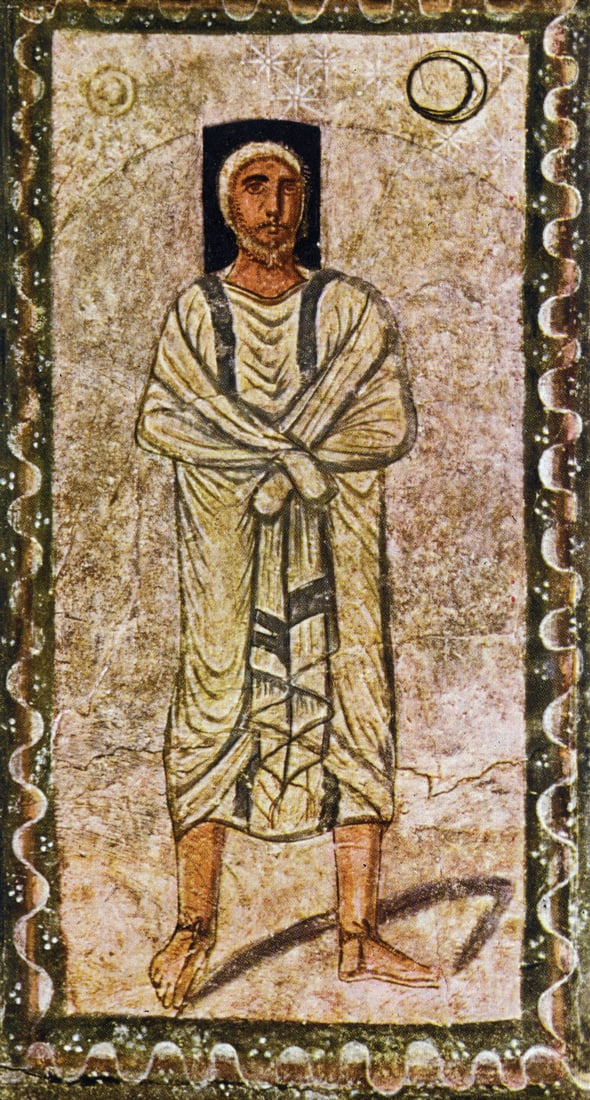
Abraham’s faith enabled him to wait patiently for the fulfillment of God’s promises (Heb. 6:13–15). This painting of Abraham is from the Dura Europos synagogue (Syria, AD 245).
Significantly, the incident in Genesis 22 followed not only the birth of Isaac but the trial of Abraham’s faith when God commanded him to offer his son as a sacrifice. In speaking of Abraham’s obtaining the promise, then, the author seems to be thinking not of what Abraham obtained in this life but of the fulfillment of the age to come (Heb. 11:13–16, 39–40). The birth of Isaac and the receiving of him back from the dead (11:19) are rather a pledge of the promise that Abraham would be a father of a great nation. As in Hebrews 3 and 4, the author assumes that the principles of life and salvation that applied in the days of Abraham and Israel are fundamentally the same as those that apply today. The promise was offered then as now (4:1) and is obtained by a patient and enduring faith now as then.
The oath God swore was a condescension on his part to his people’s frailty (6:16–18). His word needs no confirmation (John 17:17; Titus 1:2), but humankind’s faith is weak, the wait is long, and God takes pity on his children. Christ’s exaltation to the right hand of God (Heb. 1:3; 2:9; 4:14) only further confirms the certainty of the eventual fulfillment of God’s promise of eternal rest for those who trust in him. These readers were no more secure than Abraham had been, resting as he did on the immutable promise of God, but they had further cause to be encouraged and less excuse for a wavering faith now that Christ had appeared and accomplished eternal redemption. “The inner sanctuary” (6:19), a reference to the innermost chamber of the tabernacle and temple, anticipates the exposition of 9:6–14 and the contrast drawn there between the ineffectuality of the Levitical ritual and the power of Christ’s sacrifice to save to the uttermost.
7:1–28. The author now turns to discuss Melchizedek the priest. The few details about Melchizedek (7:1–3) are taken from Genesis 14:18–20. In distinction to the necessity of Aaronic ancestry as a prerequisite for Levitical priestly service (Heb. 7:14), nothing is said either of Melchizedek’s birth and ancestry or his death and posterity. For the author’s purpose, this fact demonstrates the existence in Scripture of another order of priesthood wholly separate from the Levitical. In this, Melchizedek serves as a type or embodied prophecy of Christ’s non-Levitical and eternal priesthood, which is confirmed not only directly in Psalm 110:4 (already cited in Heb. 5:6) but also by his name (“king of righteousness”) and his title (“king of peace”), both redolent of Christ’s messianic office and dignity (7:2; cf. Isa. 9:6; Jer. 23:6; Zech. 9:9–10).
Attention is now drawn to the fact that, according to Genesis 14, Abraham, though the heir of the promise and even in his hour of triumph, clearly behaves as Melchizedek’s inferior, in both paying him tithes and receiving his blessing. Abraham was under no legal obligation to pay tithes to Melchizedek as Israelites would later be required by God’s law to pay a tithe to the Levitical priesthood; hence, his paying of a tithe amounted to a voluntary recognition of Melchizedek’s inherent dignity as a priest of God (Heb. 7:16). “Who is declared to be living” (literally “it is testified,” i.e., in Scripture; 7:8) looks back to verse 3 and the silence of the record regarding Melchizedek’s birth and death. By the absence of this information, the type is perfected and more perfectly foreshadows Christ’s eternal priesthood. This argument, a minor afterthought, may gain importance by reason of the preoccupation with the Levitical ancestry among the Essenes, who repudiated the established priesthood of their time precisely because it was no longer occupied by descendants of Aaron.
With the ground thus laid, the author sets out to show that, of the two priesthoods reported in the Scripture, Jesus’s is superior (7:11–28) and the only source of salvation (see Heb. 5:9). Of great importance to the interpretation of Hebrews is the contrary-to-fact conditional statement in 7:11, together with two other such statements that figure prominently as the argument unfolds (8:7; 10:2). These clearly indicate that the readers of the letter, tempted to return to the comfortable paths of their former faith and associations, were inclined to precisely the opposite conclusions, namely, that perfection could come through the Levitical priesthood and that the sacrifices could make perfect those who offered them. The grammatical form of these statements favors the conclusion that the time reference is present—that is, “if perfection could now be obtained. . . .” Further, these conditional statements demonstrate that the author is criticizing the Levitical institutions precisely for failing to provide in themselves the forgiveness of sins and the perfection of the conscience (7:18–19; 9:13–14). The fact that they were never intended to do either (10:4; the blood of bulls and goats cannot take away sins) is immaterial because the author is dealing with these institutions under his readers’ view of them.
The statements frequently encountered in commentaries to the effect that the author is contrasting the provisional and ineffectual religious forms of the Old Testament with the fulfillment enjoyed by believers of the new era utterly overturn the historical-theological perspective of the Letter to the Hebrews and fail to account for the letter’s commonplaces: the nature and condition of salvation are not different now than formerly; the church in the new age is no less threatened by the specter of apostasy; salvation (perfection) is no more the present possession of believers now than it was of the faithful in the former epoch; and nothing is more necessary than that these readers imitate the saints of old. The contrast drawn is not between some supposed primitive and inadequate religious form with its merely provisional forgiveness and severely limited access to God on the one hand, and the free access and effective forms of New Testament Christianity, on the other. The contrast is rather between two ways of salvation—one by ritual performance and the other by the sacrifice of Jesus Christ. The argument advanced is designed to correct a misplaced confidence in rituals and to confirm the conviction that salvation is and could only be in Christ alone. The argument could be turned with equal effect on Christian ritualism and on the sacraments of the Christian church when they are conceived intrinsically as possessing saving efficacy.
The author rejects the argument that since the inauguration of the Levitical priesthood came later, it superseded Melchizedek’s order; for long after Aaron, the Word of God (Ps. 110:4) speaks of another priest in the order of Melchizedek (7:12–17). The law was served by the priesthood that upheld it, and the priesthood was, in turn, regulated by the law. But the law made no provision for a priesthood outside the tribe of Levi, and Jesus was of Judah. Christ’s appointment as priest and all the more as an eternal priest of a wholly different order thus constitutes a superseding of the Levitical institutions and a further demonstration that they were by no means God’s definitive provision for the salvation of humankind. That point is now repeated in a striking statement of the ineffectuality of that ritual. The author heaps scorn on it precisely for its failure to bring the sinner near to God (7:18–19).
Though at the time of writing the temple ritual continued, the author seems to have gathered that it was near to its demise, perhaps from the fact that the burgeoning Gentile church was doing without it altogether (Heb. 8:13; 9:10). But it is crucial to recognize that the Levitical cultus is being attacked for failing to provide what it was never intended to provide, a fact pious Israelites well understood (Ps. 51:16–17). It is being caricatured here because this caricature is precisely the view of the letter’s recipients. They viewed the ritual (or were severely tempted to view it) as a way of salvation, separated from the true covenant of God, from faith, from Christ and his work of which these rituals and institutions, like baptism and the Lord’s Supper after them, were but signs and seals. In this the readers were but following in the steps of their forefathers (Ps. 50:7–15; Jer. 7:1–26). All thought of the true and evangelical significance of that priesthood and sacrifice and of the joy and spiritual benefit that was the fruit of the believer’s participation in this ritual is set aside in order to pour contempt on these bare ceremonies as utterly incapable of making sinners right with God. In this, the author simply imitates the technique and the argument of the great prophets before him (Isa. 1:10–20; Amos 5:21–25; cf. 1 Cor. 10:1–5). The author’s intention is certainly not to contrast believing life and experience in the Old Testament with that of the New Testament, for the exact counterpart of the sacrifice is not the priesthood and sacrifice of Christ but the Lord’s Supper; and more significantly, while he states that those sacrifices could not save sinners, it is fundamental to his whole outlook and argument that sinners of the old epoch were saved just as sinners are now: by Christ, through the gospel and faith. This is underscored by his reference to the better hope. “Better” is an important term in Hebrews and refers not to some supposed but unmentioned comparative advantage enjoyed by New Testament believers but rather to the blessings of God’s eternal salvation, grasped by faith by the saints of all ages, in comparison with the false and worldly hopes of sinful humanity (7:19, 22; 8:6; 9:3; 10:34; 11:16, 35, 40; 12:24).
The superiority of Christ’s priesthood is further confirmed by its enactment through divine oath (7:20–22). Characteristically, the author anticipates the development of his argument in 8:6–13. It is noteworthy that in this first reference to the new covenant, Jesus is said to be its guarantor. In keeping with the author’s already well-established perspective, the new covenant, the fulfillment of subjective redemption or salvation, is not something the faithful of the former epoch awaited in hope but that Christians today enjoy as a present possession. One does not require a guarantor for what one already has (6:17–20). The new covenant, the rest of God, the promise, even salvation itself are presented in Hebrews as different aspects of the future consummation and the fulfillment of the world to come.
The permanence of Christ’s priesthood sets it above the Levitical (7:23–25). Christ’s priesthood does not need to be replaced generation after generation, which lends a continual efficacy to all aspects of his priestly work, including his intercession (Isa. 53:12; John 17:8–9; Rom. 8:34).
Finally, Christ’s priesthood excels the Levitical by reason of his personal perfection (7:26–28). The eternally holy Son of God lived a sinless life as a man (4:15) and advanced through suffering to the full-orbed perfection of human maturity (5:8–9). Unlike Levitical priests, then, he had no need to offer sacrifices for his own sin. His sacrifice of himself—the eternal Son of God and the true and perfectly obedient man (2:17–18)—thus has unlimited potency. Verses 26–28 serve to recapitulate the argument so far presented.

Moses was warned to build the tabernacle “according to the pattern shown you on the mountain,” because the sanctuary is “a copy and shadow of what is in heaven” (Heb. 8:5; see Exod. 25:40). Shown here is a life-size model of the tabernacle (Timnah, Israel).
8:1–13. The heavenly sphere of Jesus Christ’s priesthood is the subject of 8:1–6. The intricate comparison of the two priesthoods being completed, the author advances his argument by comparing the two priestly works. The point is that Jesus’s priesthood is exercised in heaven, in the very presence of God, and its effectuality is therefore neither earthly nor temporary but spiritual and eternal (8:1–2; cf. 4:14). He exercises his priesthood not at some distance from God but in God’s immediate presence (see 9:24). The point is reiterated to allay the suspicions of his Jewish readership (8:3–5). Although Christ is not now visible to his people as a priest, his priestly work is no less authentic inasmuch as it involves the offering of sacrifice (Heb. 5:1)—that of himself, not that of the law (7:27; 9:14). The recipients of the letter are attracted to the rites of the temple, but this earthly round of ritual and its setting are but a copy of the real, heavenly sacrifice, which Christ offered once and for all and on the basis of which he now intercedes for his people. The detailed instruction God gave to Moses concerning the construction of the tabernacle (Exodus 25–40) demonstrates that the tabernacle and, by implication, the temple were not the reality but only copies of it. The author’s readership is in danger of preferring the copy to the genuine article, of accepting an imitation as the true principle of salvation.
Now the author presents Jesus Christ as the guarantor of a better covenant (8:7–13). The argument now introduced in verse 7 parallels that of 7:11 and 10:2. Hebrews was written to a community inclined to regard the covenant life and experience of Israel, especially the wilderness period, as a paradigm for her own. These Jewish Christians were disposed to feel that they required nothing more than to duplicate the pattern of life with its outward forms established by their forebears. That pattern, in their minds, was the Mosaic covenant, but in fact, they conceived of that covenant not as the proclamation of the gospel (Heb. 4:1) but in legalistic and ritualistic terms. The author has already pointed out, in correcting the error of these ritualistically minded people, that the wilderness generation perished and forfeited the promise for lack of faith and thus is not at all to be emulated. In a similar way, he now argues that the very fact that another covenant was promised to replace the covenant with the fathers ipso facto demonstrates that the former covenant is obsolete and cannot serve as a paradigm for believers today (see another instance of this form of argument in Heb. 4:8).
But what are these two covenants? Commentaries are often singularly unhelpful at this point. It is usually asserted that the former covenant is the Mosaic administration per se and the new covenant is the superior administration introduced by Christ and the apostles. The contrast then is between a relatively inferior Old Testament revelation, faith, and spirituality and the fulfillment of the new epoch. But such an interpretation falls foul of the plain facts of the case and of the radical character of the distinction drawn between the two covenants (8:8–12). It does so in five ways.
First, the old covenant represents not Israel’s life of faith but her culpable and damning unbelief in the gospel, as the author emphasizes with his own striking introduction to the citation: “But God found fault with the people and said . . .” (8:8). The difference between the old covenant and the new is the difference between the forfeiture of salvation (“I turned away from them,” 8:9) and subjective redemption (“I will be their God,” 8:10), between death and eternal life.
Second, the fulfillment of the promises of the better covenant is not to be found in some comparative advantage enjoyed by believers in the new epoch but rather in the consummation. These better promises are only the ancient verities of Old Testament faith, which elsewhere in Hebrews are called “the good news,” “the inheritance,” the “rest” of God, “a better country,” and a “better resurrection.” Believers in the time before the incarnation claimed these promises from afar (Heb. 11:1–38), precisely as believers must today. The popular notion that the law of God was but some external ordinance in the Old Testament but now in the new era has been inscribed on the heart is not only generally unbiblical (Deut. 4:8–9; 6:5–6; 30:6, 14; Ps. 40:8; Prov. 3:1, 3; Isa. 51:7; Jer. 24:4–7) but wholly without support in this letter. It is very important to recognize that the author’s exhortation is never in the form a fortiori (from the lesser to the greater; for example, “if they could persevere in the old covenant, how much more ought we to do so in the new . . .”).
Third, the specific promises of Jeremiah’s prophecy of the new covenant are not considered by this author to have been fulfilled and cannot be so considered. Indeed, it would be highly ironic had the author understood that the expectation had now been fulfilled of a time when “no longer will they teach their neighbor, or say to one another, ‘Know the Lord,’ because they will all know me” (8:11) but then proceeded anyway to write Hebrews, which is nothing less than an impassioned plea to his brethren to “know the Lord” in the face of an incipient apostasy in principle no different than that of the fathers in the wilderness or of that against which Jeremiah protested.
Fourth, taken at face value, Jeremiah’s prophecy is not a prophecy of the New Testament epoch, in which Israel’s failure of faith would be repeated many times and on a far more terrible scale, but a prophecy of the final triumph of the grace of God, when the church will no more be a mixture of true and false sons or pass through periods of domination by unbelief as in the wilderness, in Jeremiah’s day, and not infrequently since. The prophecy has many affinities with other prophetic texts that portray the triumph and consummation of the kingdom of God in the world (e.g., Isa. 11:6–9; 54:11–15; 59:20–21; Ezek. 16:59–63; Jer. 32:36–41; 33:14–26; Rom. 11:26–27).
Fifth, as the argument is presented in 8:7, 13 and unfolds subsequently, the author seems interested in but two features of Jeremiah’s prophecy: the covenant guaranteed by Jesus promises forgiveness, and the very fact of such a promise of the new covenant constitutes a condemnation of the old. Indeed, if by “new covenant” the author means the new dispensation and by its blessings the comparative advantages believers enjoy today, he fails altogether to make that clear.
The old covenant is the broken relationship with God that resulted from Israel’s response of unbelief and disobedience. Such a situation prevailed when the gospel was not combined with faith (Heb. 4:2). Of course, in principle it can be repeated today; indeed, the threat of repeating a breaking of the covenant is what calls forth this letter. The old covenant is not the Mosaic administration except where that system was perverted by unbelief into an occasion of apostasy. The new covenant, contrarily, is the living relationship God creates with his people by means of his gracious and powerful working within them, calling them to faith and obedience. This covenant of grace is contemplated in Jeremiah’s prophecy from the vantage point of its consummation at the end of the history of the world, but, of course, it embraces all the people of God as one (11:39–40). This covenant, which is simply the divine application of the redemption which is in Christ to those who are being saved, mediates the heavenly realities of eternal life that have always been the hope of the faithful. In saying that the old covenant is soon to disappear, the author means that the entire ritual system of Israel—the contrast of the two covenants is presented in terms of that ritual (8:1–6)—is about to disappear (7:18). That system stands under divine judgment because it has been denatured by its separation from the gospel.
9:1–10. The tabernacle and its ritual frame the author’s discussion in 9:1–10. He continues his demonstration of the ineffectuality of the Levitical institutions to deal with sin and of his contention that forgiveness can be found only in Christ. Returning to the argument of 8:1–5, the author describes the earthly sanctuary and its furniture (9:1–5). He describes the tabernacle, not the similar plan of the temple, perhaps because of his readership’s fascination with the wilderness period of Israel’s history. The altar of incense appears to have been located in the Holy Place (Exod. 30:6; Lev. 16:12, 18), not the Most Holy Place. The wording here recalls that of 1 Kings 6:22 and perhaps is intended to suggest the intimate connection between this altar and the ark of the covenant in the priestly ritual. The activity of the priests and of the high priest on the Day of Atonement is described in 9:6–10 but now in the present tense (contra the NIV), furnishing an argument that Hebrews was written before the destruction of the temple and the cessation of its ritual in AD 70 and serving as a reminder that Jewish Christians were still participating without prejudice in that ritual (Acts 21:20–26). The fact that the divinely appointed order so severely restricted access to the Most Holy Place was an enacted lesson that the true, decisive ransom, of which the Levitical sacrifices were but a figure, had not yet been paid and that those sacrifices could not remove guilt. Under discussion is the single question of what sacrifice is the basis of salvation—the Levitical sacrifice or the sacrifice of Christ. The author ought not to be understood as suggesting that believers in the former era did not have direct access to God and full forgiveness through Christ, a notion against which the whole of Scripture rises in protest (e.g., Ps. 32:1–11; 103:1–22; Mic. 7:18–19; Rom. 4:1–8) and which is particularly impossible to reconcile with the perspective of the author of Hebrews (11:4–38). Again, he is belittling his readers’ view of the Levitical rites, separated as they were from Christ and from living faith, as mere externalities and, what is more, only temporary.
9:11–10:18. The next major subsection focuses on the sufficiency of the redemption obtained by Jesus Christ. The imagery continues to be that of the Day of Atonement, but Christ’s offering of himself is a transaction that transcends the earthly sphere and the potentialities of mere humans and their rituals. Though he died on a cross near Jerusalem (Heb. 13:12), his sacrifice is thought of as being offered in heaven (9:11). Text-critical considerations in 9:11 together with the author’s sustained emphasis on the futurity of salvation make the reading “the good things that are to come” (cf. 10:1) more likely than “the good things that are now already here.” Offering himself once and for all, Christ thus secured eternal redemption for his people (9:12). Redemption, along with propitiation and reconciliation, is a key concept in the Bible for the representation of the character and effect of Christ’s saving work. Redemption is deliverance from some bondage by the payment of a price or ransom (Exod. 6:6; 13:13–15; Lev. 25:25–27, 47–54; Mark 10:45; Rom. 3:24; Eph. 1:7). The bondage here contemplated is that of sinners to death, to the devil, and to divine wrath; the ransom is the death of Christ in the sinner’s place (Gal. 3:13; Heb. 2:14–17). Having obtained this eternal redemption, he entered heaven and sat down there to represent his people to God as their great High Priest and to await the consummation (Heb. 9:24, 28; 10:12–13).
The Levitical sacrifices and other rituals did avail to remove ceremonial defilement (9:13–14; the allusion to the ritual of sprinkling water containing the ashes of a heifer [Numbers 19] could be due to the significance attached to such ceremonies of cleansing in nonconformist Judaism; cf. Dead Sea Scrolls, Rule of the Community 2:25–3:12). But the sacrifice of the incarnate Son of God, infinite in his perfection as a substitute for his guilty people (Heb. 2:9–10), actually satisfied the demands of God’s justice on their behalf and turned away his holy wrath from them (Heb. 1:3; 2:17; 9:27, 28); it thus provided the removal of sin and guilt and established a living communion with God. “Eternal Spirit” refers either to the divine enablement of the Third Person of the Godhead by which Jesus performed his mission (Isa. 42:1; Mark 1:10) or, less probably, to his own eternal and spiritual life, by reason of which his sacrifice and priesthood are of everlasting value and effect (Heb. 7:16, 24).
The eternally effective sacrifice of himself constituted Christ the mediator, or better, guarantor of the new covenant, that is, of the eternal salvation that the gospel promises, which faith embraces, but the fulfillment of which awaits the consummation (Heb. 7:22). Verse 15 is often thought to mean that Christ, by his death, retroactively satisfied for the sins of those who lived before the incarnation. That Christ’s death had such a retroactive effect and was the basis of gospel forgiveness in the Old Testament is unquestionably true. But as an interpretation of the author’s statement it does grave injustice to a text as programmatic in scope as John 3:16. “The sins committed under the first covenant” are not the individual transgressions committed by those who lived before the incarnation but rather the sins connected with that covenant, that is, Israel’s broken relationship with God, namely, unbelief and disobedience (Heb. 3:18–19; 4:1, 6), which are conceived to be the fundamental sins and root of every actual transgression. The proof of this is that Christ’s dying for these old covenant sins guarantees the inheritance of this community of second-generation Christians (9:14; “our consciences”). Similarly, “those who are called” can hardly be restricted, as some commentators have supposed, to saints of the pre-Christian epoch. The phrase is thoroughly comprehensive in scope and intended to include the entire company of the elect, as appears from parallel statements elsewhere (“everyone,” “many sons”; Heb. 2:9–10; “many”; 9:28). The sins for which Christ suffered punishment in his people’s place are the sins that prevented Israel (and anyone) from sharing in the eternal inheritance. By the payment of his own life, Christ has delivered those whom God is calling to salvation from the guilt and the power of unbelief and disobedience, which alienate them from God.
The mention of inheritance in verse 15 perhaps prompted the author to draw an illustration in verses 16–22 from everyday life, made easier by the fact that diathēkē, which ordinarily means “covenant” in biblical Greek, commonly meant “last will and testament” in the Greek of the author’s day. Of course, a will takes effect only after the death of the testator. The new covenant (i.e., the living relationship that God has established with the called and the promise of eternal life) is made effectual by Christ’s death, a principle illustrated in the inauguration of the covenant at Sinai with blood. Several additional details not mentioned in Exodus 24:4–8 and the silence of the Pentateuch regarding any such sprinkling of the tabernacle suggest that the author was aware of sources no longer extant or drew from some authentic but now unattested tradition.
Recapitulating 7:27–28; 8:1–5; and 9:1–14, the author distinguishes the earthly ceremonies and sanctuary from the sacrifice of the Son and the spiritual and heavenly sphere of his priestly work (9:23–28). The principle of true salvation is not the oft-repeated Levitical rituals but the once-for-all, eternally effective self-sacrifice of Christ, sufficient to cover all the sins of all the called for all time. “Culmination of the ages” (9:26; NEB “the climax of history”) suggests that human destiny and the purpose of history pivots on this single event. As humans die but once, so he who took their place (Heb. 2:14, 17) dies but once, but with eternal effect; however, the full manifestation and development of this await Christ’s return.
The Levitical sacrifices are portrayed as inadequate in 10:1–4. They only foreshadowed the true salvation, which Christ has guaranteed and will someday bring to completion. This is the third and last of the contrary-to-fact conditional statements around which the central argument of this sermon is constructed. The appeal to the repetitive character of Levitical worship and its inability to cleanse the conscience (9:13–14) indicates that the author has not deviated from his original purpose. He is determined to persuade his readers that for salvation they must trust in Christ and his sacrifice and not in the rituals of Judaism. As is often supposed, he is not conceiving of the Old Testament order as a more primitive state of revelation and spirituality than the Christian era. He says nothing about that but instead compares a false theory of salvation with the fact of salvation in Christ alone. At the time Hebrews was written, a Christian might still have participated in the temple ritual (Acts 21:26) but could not think that such externalities were the substance of salvation any more than the faithful of the former epoch did (Ps. 51:16–17) or than a believer today should think of baptism or the Lord’s Supper as having in themselves, separated from Christ and faith, justifying or sanctifying efficacy. The coming of Christ is decisive to the author not because it lifts the religious experience of believers to a somewhat higher plane than that enjoyed by the saints of the former epoch but because Christ secured the salvation that all God’s people—past, present, and future—grasp by faith in this world and will enjoy in fullness in the next (Heb. 11:39–40). Believers in the former era rejoiced in the freedom from guilt that God’s grace provided (Exod. 34:6–7; Ps. 32:1–2; 103:10–12; 130:1–8; Isa. 38:17; Mic. 7:18–19). For that matter, the Lord’s Supper perpetually reminds the church today of her sin, for which she must constantly mourn, confess, and ask forgiveness (Matt. 5:3–6; 1 Cor. 11:27–32; 1 John 1:8–10).
Unwilling to leave a single stone unturned in his attempt to demonstrate to the satisfaction of his readers that the Levitical rituals are an insubstantial foundation on which to rest one’s hope of salvation, the author launches into another argument that adds some new points and recapitulates others (10:5–18).
The author understands Psalm 40:6–8, cited in verses 5–7, to be prophetic of Christ. The author takes the phrase “a body you prepared for me,” from the Septuagint rather than the Hebrew Masoretic Text, as referring to the body the Son of God assumed at his incarnation, the human nature in which he obeyed God and died in his people’s place (Heb. 2:14; 5:8; cf. John 6:38; Phil. 2:7–8). The citation is perfectly suited because it compares the Levitical sacrifices unfavorably with the work of Christ.
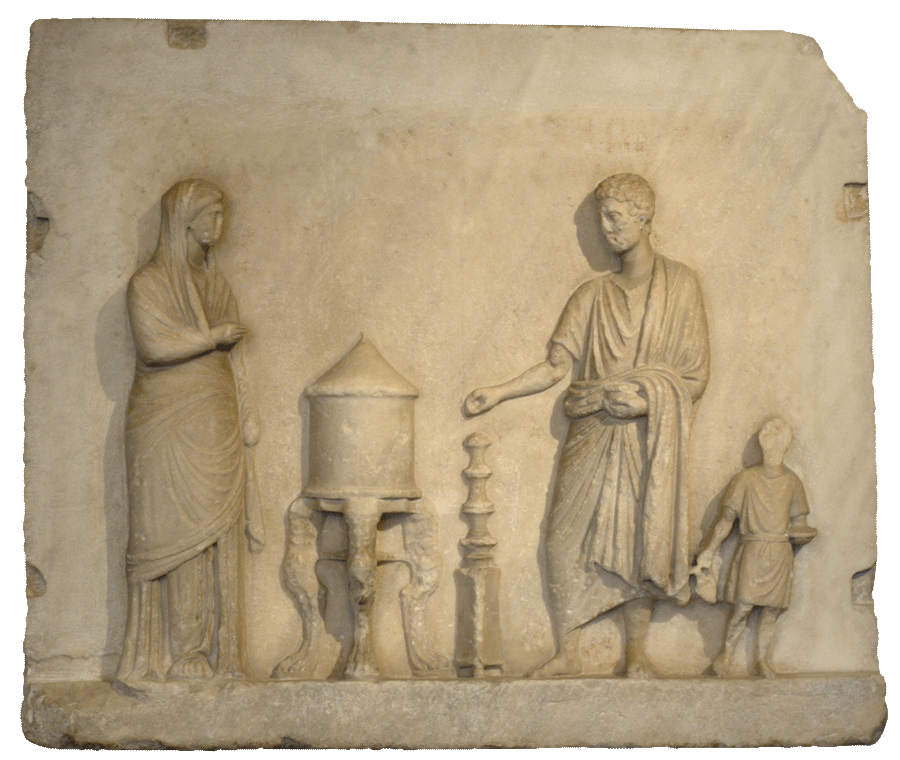
Hebrews 10:11 describes the religious duties performed by every priest at the Jerusalem temple: “again and again he offers the same sacrifices.” The Gentile readers of Hebrews could identify through their own experience of the repeated offerings given to Greco-Roman deities. This Roman relief shows a man offering incense to his gods (first century AD).
It was a truism of the Old Testament revelation that the Levitical ritual served no good purpose without faith and obedience on the part of the worshiper (10:8; 1 Sam. 15:22; Ps. 51:16–19; Isa. 1:11–17; Amos 5:21–24). This is the simple meaning of David’s words in Psalm 40:6–8. Further, the faithful of the former era did offer such willing obedience, and their sacrifices were pleasing to God (Heb. 11:4; cf. Lev. 1:9). But the author is dealing with sacrifice or, as the four different terms indicate, the whole Levitical ritual in itself, which obviously had no intrinsic power to save from sin. The individual to whom the author is addressing himself is not the person whose sacrificial worship merely gives expression to his trust in God the Redeemer and to the glad consecration of his life to God, but the one who hopes that the act of sacrifice itself will cleanse him of guilt.
But Christ and his sacrifice have just that saving efficacy in themselves that the Levitical ritual lacks (10:9–10). The contrast drawn between the alternatives of the psalm citation is intended to nullify any idea that the sacrificial ritual could ever be the substance of salvation. This holiness or perfection has both present and future aspects (6:1; 10:14; 12:23).
The point made earlier (10:1–4) is recapitulated in verses 11–14. The ineffectuality of sacrifices that must be performed repeatedly is contrasted with the once-for-all sacrifice of Christ, the effectuality of which is attested by the singular honor of a place at God’s right hand. The priests continue to stand (cf. Deut. 10:8; Ps. 134:1); the great High Priest has sat, a sign both of the ultimacy of his single sacrifice for sin (Heb. 1:3–4; 2:9) and of his royal dominion, now hidden but soon to be revealed (Heb. 1:13; 2:7–8). It is to Christ, therefore, not to Levitical priests and rituals, that sinners must come. In nonconformist Judaism of the Essene variety, likely the form of Judaism exerting the greatest influence on this community, there was an expectation of the restoration of the Aaronic priesthood, but it was never imagined that this would involve anything other than standing priests offering sacrifices repeatedly.
In verses 15–18 the author returns to the citation from Jeremiah 31:31–34 (cf. Heb. 8:8–12) for the dramatic conclusion to his great demonstration begun at 4:14 of the superiority of Christ’s priesthood and sacrifice. The true salvation in Christ that God promises and applies to the hearts of those he calls eventuates in a full and permanent absolution. Looking to some regularly repeated sacrificial ritual as the basis of forgiveness, as his readership is tempted to do, amounts to a repudiation of the glorious gospel of salvation by the grace of God (Heb. 13:9).
2. Exhortations to Persevere in Christian Faith (10:19–12:29)
A. The danger of apostasy (10:19–31). The author has completed his demonstration that salvation is to be found in Christ and is based on his sacrifice and not the Levitical rituals. Now he explicitly states and applies the purpose of that lengthy argument to the present crisis of faith in the particular community to which Hebrews is addressed. The exhortation that follows recapitulates the earlier exhortatory sections (2:1–2; 3:7–13; 4:1–11; 6:1–12) and confirms that the author has had a single purpose throughout: to reverse an incipient apostasy and to strengthen flagging faith.
First, he passes his just-completed argument briefly in review (10:19–21). Christ’s death for sin and his abiding priesthood provide free access to God (4:15–16; 6:19–20; 7:23–25; 9:8, 12–15). The “new and living way” does not suggest that believers of the former age were somehow fettered in their access to God, for neither the Old Testament nor Hebrews will tolerate the notion that those saints did not have full access to the Lord or confidence in laying claim to his forgiveness (see “draw near” in both 10:22 and 11:6). The old-new contrast in the Bible is absolute, not relative, and is never merely chronological. It always possesses an ethical-spiritual dimension. “Old” signifies the situation of humankind in sin, “new” the experience of God’s salvation (Ps. 98:1; Rom. 6:4, 6; 7:6; 1 Cor. 5:7, 8; 2 Cor. 3:6, 14; 5:17; Eph. 4:22–23; Col. 3:9, 10; Rev. 2:17; 5:9; 21:1, 5). It is not a question of varying access to God but of access where before there was none (Heb. 7:18–19). Believers of all ages have enjoyed this boldness of approach, but it has always been founded on Christ and his sacrifice, not on external rituals. “The curtain, that is, his body” is perhaps best understood as a comparison between the curtain through which the high priest gained access to the Most Holy Place (cf. Heb. 9:3; Mark 15:38) and Christ’s bodily sacrifice, by which believers gain access to God.
In verses 22–25 the exhortation is fourfold. The first two reiterate the author’s previous admonitions to persevere in faith with eyes fixed firmly on Christ (3:6, 14; 4:14). But such endurance requires the encouragement of others, and that is given and received chiefly in the life of the congregation. That the exhortation is in the first person throughout expresses the author’s personal interest in his readers, his hopes for their restoration, and his solidarity with them in the good fight of faith (cf. Heb. 6:9; on “hearts sprinkled” [10:22] see 9:13–14; Lev. 14:6–7; Ps. 51:7, 10). “Bodies washed” is no doubt a reference to baptism but in its spiritual signification (cf. Ezek. 36:25; John 3:5; Eph. 5:26; 1 Pet. 3:21).
Exhortation is now reinforced with solemn warnings (10:26–31), similar to that of 6:4–8, regarding the horrifying and irremediable consequences of apostasy (cf. Heb. 2:2–3; 2 Pet. 2:20–22). “Deliberately keep on sinning” refers not to the immense sinfulness that remains in every believer’s life, over which one mourns, of which one repents, and for which one turns to Christ (Heb. 4:15–5:12), but to the renunciation of the faith (3:12; 6:6). If, having once become acquainted with and having laid claim to the final and perfect sacrifice of Christ, one rejects it as the hope of salvation, all hope is forever lost. The Levitical sacrifices that this readership is tempted to prefer cannot make anyone perfect, and God will not grant repentance to apostates. This striking and grim definition of apostasy is a reminder of how differently the same thing may appear to a human and to God. What the apostate defends as a calculated step to serve his or her best interests, God regards as contempt for his beloved Son, as disdain for the terrible suffering and death he endured, and as an outrage against the Holy Spirit, impeaching his testimony to Christ’s lordship (Heb. 6:4; 1 John 5:6, 10). The certainty and ferocity of God’s wrath toward his enemies (Heb. 10:27), especially among his own highly favored people (Amos 3:2), is as unmistakable a datum of divine revelation (here Deut. 32:35–36) as his mercy toward those who repent and believe. That God is living renders his judgment inescapable by mere mortals. The author will return to this thought of God’s fierce judgment in 12:18–29.
B. Encouragements to press on (10:32–39). As in 6:9–12, warning is followed by encouragement, as the author reminds his readers of their noble steadfastness in the days of their first love. They have endured public scorn, willingly identified themselves with those already in prison for faith in Christ (and so exposed themselves to the possibility of a similar fate), and suffered the loss of their property by looting or as a legal penalty, which happened frequently when Christians became the objects of a community’s wrath. They suffered all but martyrdom (12:4) courageously, even gladly, confident that they would reap an eternal harvest if they did not give up (Gal. 6:9; cf. Matt. 5:11–12; Acts 5:41; 1 Pet. 4:13). They must not lose heart now and have no excuse to do so (10:35–36). The Lord helped them before to resist the opposition that now unnerves them, and he will do so again. Defection now would be tantamount to Israel’s irrational sin of losing confidence in the Almighty, who had lifted them out of Egypt on eagles’ wings, when they were within sight of the promised land (Heb. 4:16; Deut. 32:15; Ps. 78:9–55). The living faith that alone obtains the eternal inheritance expresses itself in a tenacity in the face of all manner of worldly opposition and temptation and the long waiting made necessary by the futurity of the consummation.
The citation of Habakkuk 2:3–4 in Hebrews 10:37–38 derives from the Septuagint, which has interpreted the original “it” (the revelation of divine judgment) as “he” (a personal deliverer), an interpretation that is ratified by the author of Hebrews, who adds the definite article to the Septuagint’s “he will surely come,” yielding “he who is coming” or “the one who is coming,” virtually a messianic title (cf. Matt. 11:3), though now with reference to Christ’s coming again. The two lines of Habakkuk 2:4 are transposed simply to clarify the author’s application of the citation to his own readership. There are but two alternatives and two destinies, and the author is confident that at least most of his readers, having flirted with danger, will at last stand fast (10:39).
C. Faith defined and exemplified (11:1–40). As a stronger faith is the need of the hour, the author sets before his readers the example of the heroes of faith (11:1–3). It is comforting to be reminded that the temptations one faces are neither unique nor even as severe as others have courageously endured, and the stirring examples of faith under trial will strengthen one’s determination to be equally worthy of God’s approval. In a statement similar to Romans 8:24–25, faith is defined as the unshakable confidence in the reality of the yet unseen world and the certainty of God’s yet unfulfilled promises. This definition of faith is illustrated by reference to the nature of creation by divine fiat.
The succession of heroes of faith begins with three from before the flood (11:4–7). The author does not explain in what way Abel’s sacrifice was superior, only that it was due to his faith. Abel was murdered, but he still speaks, crying out for the vindication that God will bring in due time (see Heb. 12:24; Gen. 4:10; Rev. 6:9–11). The signal honor afforded Enoch is the divine answer to his faith because he was commended as one who pleased God, which is impossible apart from faith. Noah’s faith is demonstrated in the remarkable building project he undertook solely on the strength of his confidence in God’s promise. Noah’s faith was vindicated, while the world that did not heed God’s warning was destroyed (cf. 2 Pet. 3:3–7).
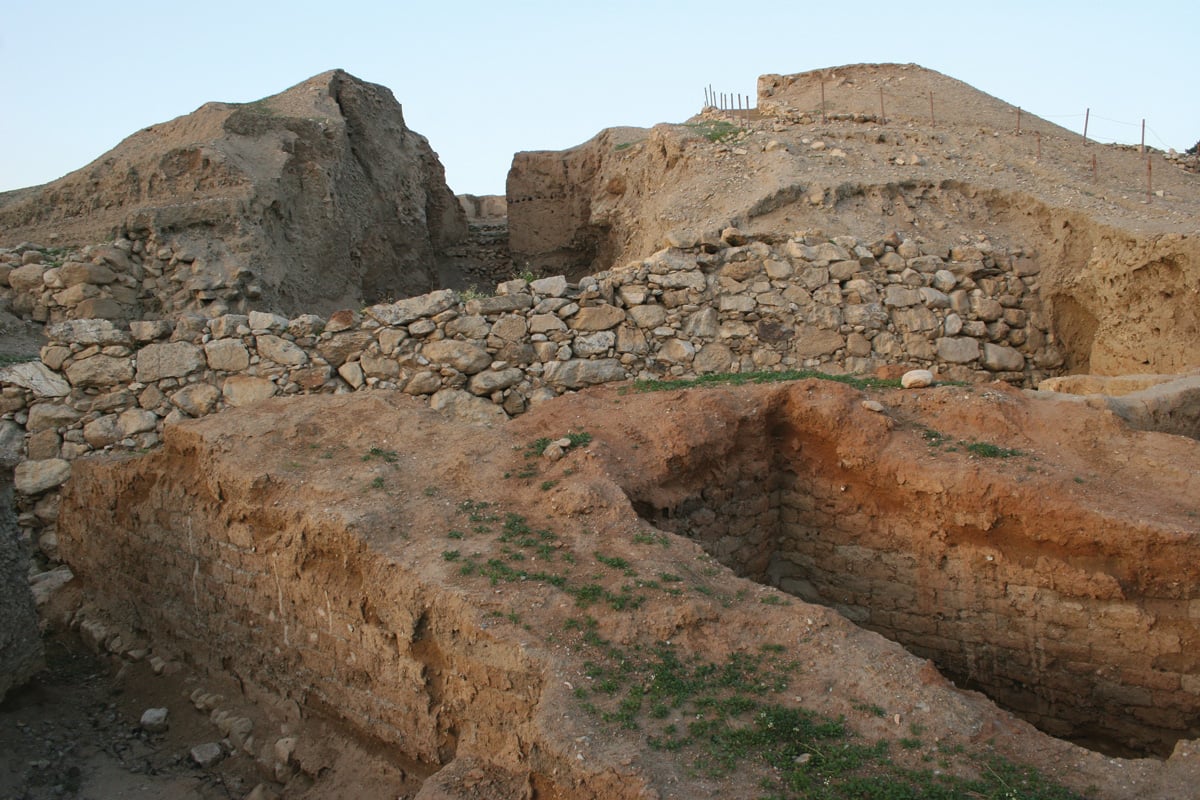
Hebrews 11:30 says that “by faith” the walls of Jericho fell. The archaeological site of the Jericho mentioned in the Old Testament is very eroded, and its excavation has been challenging. The walls uncovered here are from the Middle Bronze period, earlier than the time of Joshua.
The next set of exemplars of faith hail from the patriarchal period (11:8–22). Naturally Abraham occupies the largest place in this chapter, as Scripture itself singles out his faith (Gen. 15:6; Rom. 4:1–25; Gal. 3:6–9). On the strength of God’s promise alone, Abraham left his homeland for parts unknown, considered his inheritance a land that neither in his own lifetime nor in that of his son and grandson would actually belong to him (apart from a burial plot he purchased, Gen. 25:9–10), and expected God to give him a son though he was advanced in years and married to an aged and barren woman. Abraham understood both that God’s promises are indefectible and that their true fulfillment would be found not in this world but in the next. He understood that God had promised him vastly more than real estate for his descendants, indeed, nothing less than an inheritance with Enoch. Abraham’s obedient faith and perseverance remind us that faith must withstand not only the waiting until the promise is fulfilled but also appearances that seem directly to contradict the believer’s hope. Events have so far vindicated Abraham’s trust in God (11:12). The patriarchs all died with most of God’s promises to them yet unfulfilled (11:13–16); still they died in the sure hope of their eventual realization (11:20–21), which further confirms the assertion of verse 10. Canaan was no more the true homeland they sought than it was the true rest of God for Israel (Heb. 4:8–9). God “is not ashamed” to be called the God of Abraham, Isaac, and Jacob, that is, not of the dead but of the living who wait in hope (Matt. 22:31–32). The supreme illustration of Abraham’s faith as an invincible confidence in the promise of God and in God’s ability to fulfill it in defiance of appearances is his obedience in offering Isaac as a sacrifice (11:17–18). That such indeed was Abraham’s reasoning appears to be suggested in Genesis 22:5. One generation after another dies in the certainty that God’s promise will not fail (Heb. 11:19–22).
The third general section on the heroes of faith covers the period of the exodus and the conquest of the promised land (11:23–31). Moses’s faith first lived in his parents (cf. 2 Tim. 1:5). Apparently the author assumes that some divine communication was given to Moses’s parents of God’s purpose for their son, and their courage in the face of Pharaoh’s edict (Exod. 1:22) resulted in greater security and station for their son than they had thought possible. Moses later turned his back on the exalted status he enjoyed to identify himself with the downtrodden people of God (11:24–26). The short-lived pleasures of the Egyptian court were not to be compared with the eternal inheritance that God bestows on those who will deny themselves to follow him. The striking reference to Moses’s “disgrace for the sake of Christ” must not be minimized, as if “Christ” should be rendered “anointed one” and taken as a reference to the people of God or as if Christ is in some way to be understood as suffering in his people’s suffering, which then Moses shared. The phrase is not taken from the Old Testament; it is the author’s own. It agrees with his perspective that Christ was at work in the former epoch and already the object of faith (1:2; 3:2–3; 8:8; 12:2, 25; 13:8; cf. 1 Cor. 10:4; John 5:46; 8:56; Jude 5), and the parallel in 13:13 suggests that bearing disgrace for Christ’s sake is something done for Christ himself. Christ was building the house in which Moses was a servant, and Moses gladly bore his master’s reproach in confident expectation of his eternal glory. “He left Egypt” (11:27) probably refers to Moses’s flight to Midian, which is viewed as an act of discretion, not panic (Exod. 2:14–15), and his forty-year sojourn there as a time of patient waiting for the Lord’s call. Time after time Israel’s deliverance was accomplished in defiance of seemingly insurmountable obstacles, when people took God at his word and acted accordingly (11:28–30). The mention of a Gentile prostitute’s faith and courageous action verifies that faith alone and not natural identity or personal history obtains salvation. This may also be an implied rebuke of this Jewish readership (11:31).
Space allows for but a summary of the remainder of the history of faith in the former epoch, from the time of the judges through the heroic resistance of the Maccabean period (11:32–38; compare 11:35 with 2 Maccabees 6:18–31). Some of the historical references are unmistakable (“shut the mouths of lions” [Dan. 6:22]; “quenched the fury of the flames” [Dan. 3:19–27]; “women received back their dead” [1 Kings 17:17–22; 2 Kings 4:18–37]), others less clear. The inclusion of such figures as Samson and Jephthah is a reminder that the living faith can coexist with massive imperfection. The mention of “women,” “others,” and “some” indicates that this faith was as much the pattern of life of many humble people as it was of the heroes of biblical history.
Verses 39–40 are frequently understood to mean that what the faithful of the former era did not receive, Christians have. Believers today live in the age of fulfillment. “Something better” (11:40) then is taken to refer to the superior state of religious life introduced by Christ and his apostles. But such an interpretation utterly overturns the author’s argument. His readers have not received the promise (see Heb. 10:36) and will not unless they persevere in faith to the end as their forefathers did. The “something better” is surely not something other than the above-mentioned “better and lasting possessions” (10:34), “better country” (11:16), and “better resurrection” (11:35), which are no more the present possession of believers today than they were of Abraham or Moses. The entire chapter has been offered as encouragement to persevere in view of the fact that God’s promise remains unfulfilled, and the verses that immediately follow reiterate the same thought: one must persevere to the end if one is to receive. The thought is explicitly not a fortiori (from the lesser to the greater), as if the author were saying: “If they could endure with the promise unfulfilled, how much more we who have received it.” The comparison is not between the situation of believers in the old economy and that of Christians today but between what all believers enjoy on earth and what they will receive—after a lifetime of patient waiting—in the heavenly country. The basis of the author’s exhortation is not some dissimilarity but rather the correspondence between the circumstances of believers before and after the incarnation. The object of Abraham’s hope lay beyond the grave, and it is no different today. Verse 40 then means simply that the consummation was delayed, the ancients had to wait patiently for it, because God intended many more to share in his salvation (“planned”; literally “foreseen,” in the sense of election and predestination). In the same way, believers today must wait until the whole company of the called is gathered in (cf. Matt. 24:14; Heb. 9:15).
D. Jesus, the superior example of faith (12:1–4). The author now imagines the ancient heroes of faith as a great company of spectators ready to cheer on his readers in a race the former have already completed but which the latter must yet run (12:1–2). The Christian athlete must divest himself of anything that will hamper him in this spiritual race, which is another way of saying that a chief principle of Christian spirituality is self-denial or self-discipline (cf. Matt. 19:27–29; 1 Cor. 9:24–27). Further, it will greatly help to avoid a harmful distraction or a loss of heart if believers concentrate their attention on the prize they are to obtain at the end, which is Jesus himself (cf. Phil. 3:8; Col. 3:1–4; Heb. 11:26–27; 12:24). Jesus is to be looked to as the one on whom every believer’s faith “depends from start to finish” (NEB; cf. Heb. 4:14–16). But his life is also the perfect paradigm for the believer, who also will find strength to endure hardship in the prospect of heavenly joy. In verses 3–4 the recipients of this written sermon are reminded that their present suffering—the opposition they are encountering on account of their faith in Christ—is not to be compared with what Christ endured for them, nor even with the trials of many of their spiritual forebears (11:37), and thus provides no excuse for their present faintheartedness.
E. The meaning and merit of discipline (12:5–13). The testing of their faith is intended by the Lord to benefit them and indicates his love for them. Any true father disciplines his children, corrects them when they err, and cultivates their maturity by requiring the endurance of adversity. In this, Christians are only following in their master’s footsteps (Heb. 5:8). Though painful at the time, the heavenly Father’s discipline will yield its perfect fruit if believers humbly submit to it as from the Lord, trusting him to help them endure it (1 Cor. 10:13; James 1:2–4). In the confidence that such trials inevitably and necessarily litter the straight and narrow road that leads to life, the readers must press on (12:12–13; cf. Isa. 35:3–4 and Prov. 4:25–27, the language of which the author borrows).
F. Warning not to turn away from God (12:14–29). Each person must study holiness, as the gospel requires, and help others to do the same, taking special care to nip sin in the bud when it arises within the community (12:14–17; cf. Deut. 29:18; 1 Cor. 5:6). Esau exemplifies the person who exchanges the unseen and future inheritance for the sensible and immediate pleasures of this world and, consequently, “falls short of the grace of God,” that is, squanders irrevocably the blessing that was in one’s grasp (Heb. 6:4–6; 10:26–31). Esau’s tears showed remorse for the consequences of his folly, not godly sorrow that brings true repentance (cf. Gen. 27:34–40).
Verses 18–21 are commonly understood as setting forth a contrast: the old revelation and dispensation is earthly, menacing, and morbid in its concentration on law and judgment, while the new is spiritual, heavenly, and happy. But these verses present Israel not as a paradigm of Old Testament spirituality but of unbelief that leads to death in any epoch. That Israel “begged that no further word be spoken to them” was, in the judgment of this author, a culpable act of rebellion against God. The word the NIV translates “begged” in verse 19 is the same word it translates “refuse” in verse 25. Moreover, after all that has already been said of the unbelief of the wilderness generation (3:7–4:5), it is surely unlikely that here it is held up as exemplifying godly fear. The author correctly understands Israel’s request (cf. Deut. 5:23–29), though not in itself sinful, as neither genuine nor indicative of future commitments. Further, as the citation of Deuteronomy 9:19 confirms, Moses’s fear was not of the awesome manifestations of the divine holiness—he had already walked into that fire and gloom to the top of the mountain—but of the prospect of divine judgment against the people for the sin with the golden calf. These verses, then, depict the terror of the apostate face-to-face with the wrath of God, a terror no less the destiny of those who forsake the Lord today (Heb. 12:25, 29; see also 10:27, 30–31).

Pictured here is Jebel Katerina, a peak in the mountains of Sinai. Hebrews 12:18–24 says that believers in Christ have not come to a terrifying sight such as happened at Sinai during the exodus. Rather, Christians have come to the heavenly city and to Jesus, the perfect mediator.
Contrarily, the author is confident of better things concerning his readers, the things that are obtained by a living faith (12:22–24). The thought is similar to that of 6:9–10 and 10:39. He is persuaded that his readers are genuinely converted (the probable interpretation of Greek proserchomai, NIV “you have come to”; cf. Heb. 11:6), and thus that their situation is different from Israel’s in the same way it is unlike Esau’s. This confidence is the basis of his appeal to them to persevere. Of course, the blessings enumerated are not peculiar to the new epoch; they are the better things of the heavenly country that believers have always grasped from afar by faith (Heb. 11:10, 13–16, 26–27) and must so grasp by faith today. Hebrews was written to warn this community of believers that it would, like Israel, forfeit these very blessings if it chose to mimic Israel’s apostasy. “Church of the firstborn” (12:23) refers to the privileged station of the saints as set apart to God (Exod. 4:22; 13:2) and heirs of all things, the very privileges that Esau squandered (Heb. 12:16–17).
The admonition in verses 25–27 reiterates 3:7–12 and 4:1–2. The readers must not imitate faithless Israel in the wilderness. The threat of divine judgment is no less serious today. In view of the connection of thought between verses 24 and 25 (“that speaks . . . who speaks”), it is reasonable to assume that Jesus is to be understood as the one who thundered his law at Sinai and who utters the promise of Haggai 2:6. Believers have not yet taken possession of the better things, but soon they will, and that forever (12:28–29). That prospect ought to awaken them to glad thanksgiving and to a new determination to work out their salvation in fear and trembling so as not to be found at last among those who miss the grace of God (12:15) and instead must face God’s wrath. The warning reiterates Deuteronomy 4:23–24 and indicates that the word of God is no less menacing to the unbeliever and the disobedient today than it was in Moses’s day.
3. Concluding Exhortations (13:1–19)
In what amounts to a postscript to his sermon, the author takes care to specify particular ways in which this true and living faith expresses and evidences itself. As elsewhere in the Bible, the believer is not left to work out the ethical implications of faith in Christ; the particular obedience required is carefully defined. Pride of place goes to brotherly love (13:1–3), a costly virtue by which these believers have already distinguished themselves, especially in regard to prisoners (Heb. 6:10; 10:33–34). Abraham is again invoked as an example, this time of hospitality (Gen. 18:1–16; cf. 1 Pet. 4:9) and of the blessing that attends the gracious host. Christian sympathy and fellow feeling (cf. Rom. 14:15; 1 Cor. 12:26) will not be satisfied with the simpler forms of charity but will extend itself to those who cannot be brought into the home (Matt. 25:35–36).
Sexual impurity and the love of money (13:4–6) are linked elsewhere (1 Cor. 6:9–10; Eph. 5:6) as sins of dissatisfaction with God’s provision and thus sins of unbelief, as the citations from Deuteronomy 31:6 and Psalm 118:6–7 demonstrate. Neither the Lord’s threatened judgment of the worldly nor his promise to provide adequately for his children is taken seriously. For both sins, the antidote is contentment and fulfillment in what God has given (Prov. 5:15–20; 1 Tim. 6:6–11, 17, 19).
The leaders mentioned in Hebrews 13:7 are not, as in verses 17 and 24, the present elders but those who previously evangelized this community (Heb. 2:3), provided its initial instruction in the Christian life, and marvelously adorned their doctrine by the holiness of their lives (cf. Titus 2:10). As valuable as the examples of heroic faith from the distant past may be (Heb. 11:4–38), there is yet more reason to imitate the sturdy faith of those one has known in the flesh and to whom one is greatly indebted. Whether “outcome” suggests martyrdom or, as is probable, simply the righteous character of their lives, they are apparently now numbered among the “spirits of the righteous made perfect” (12:23) and thus serve as examples of those who have persevered to the end.
Amid all the uncertainties of life in this world, the character and word of Jesus Christ stand firm (13:8; see also 1:12; 7:24–25; 10:23). He who sustained the faith of the saints of old (11:26) and of their former leaders just mentioned will not forsake them.
In verse 9 the author returns one last time to the great interest of his letter: to warn his readers of the fatal error of pursuing a compromise with Judaism. Since salvation is by grace through faith in Christ, putting confidence once again in the saving virtue of ceremonial regulations regarding food and drink would amount to a repudiation of the gospel (Heb. 9:9–10; cf. 1 Cor. 8:8). The argument is in principle very similar to Paul’s protestation against the inroads of ritualistic legalism in the churches of Galatia and Colossae (Gal. 4:8–11; Col. 2:13–23).
The reference in verses 10–11 is again to the ritual of the Day of Atonement, which included the sin offering, the flesh of which the priests were not permitted to eat (Lev. 4:11–12; 16:15–27). The author has already demonstrated that this ritual typified the sacrifice of Christ (Heb. 9:6–12, 23–28). The superiority of the antitype (what the type foreshadows) is demonstrated in the fact that the believer has an altar—the sacrifice or sin offering of Christ, from which he is welcome always to partake (cf. John 6:53–56; 1 Cor. 5:7–8; 10:16). No doubt the readership is being swayed by the charge that Christianity suffers by comparison with Judaism for want of an altar. The church throughout the ages has never been immune from the temptation to gather confidence from the outward trappings of religion: altars, buildings, and impressive rites. The author’s rejoinder is that the church’s invisible altar is the reality of which the ceremonies of Judaism are but pale imitations (Heb. 8:1–5), and the church’s food is the eternal and spiritual benefits of the Son of God’s once-for-all sacrifice of himself for sin, for which beef or lamb, however impressively and ceremonially prepared, is no substitute.
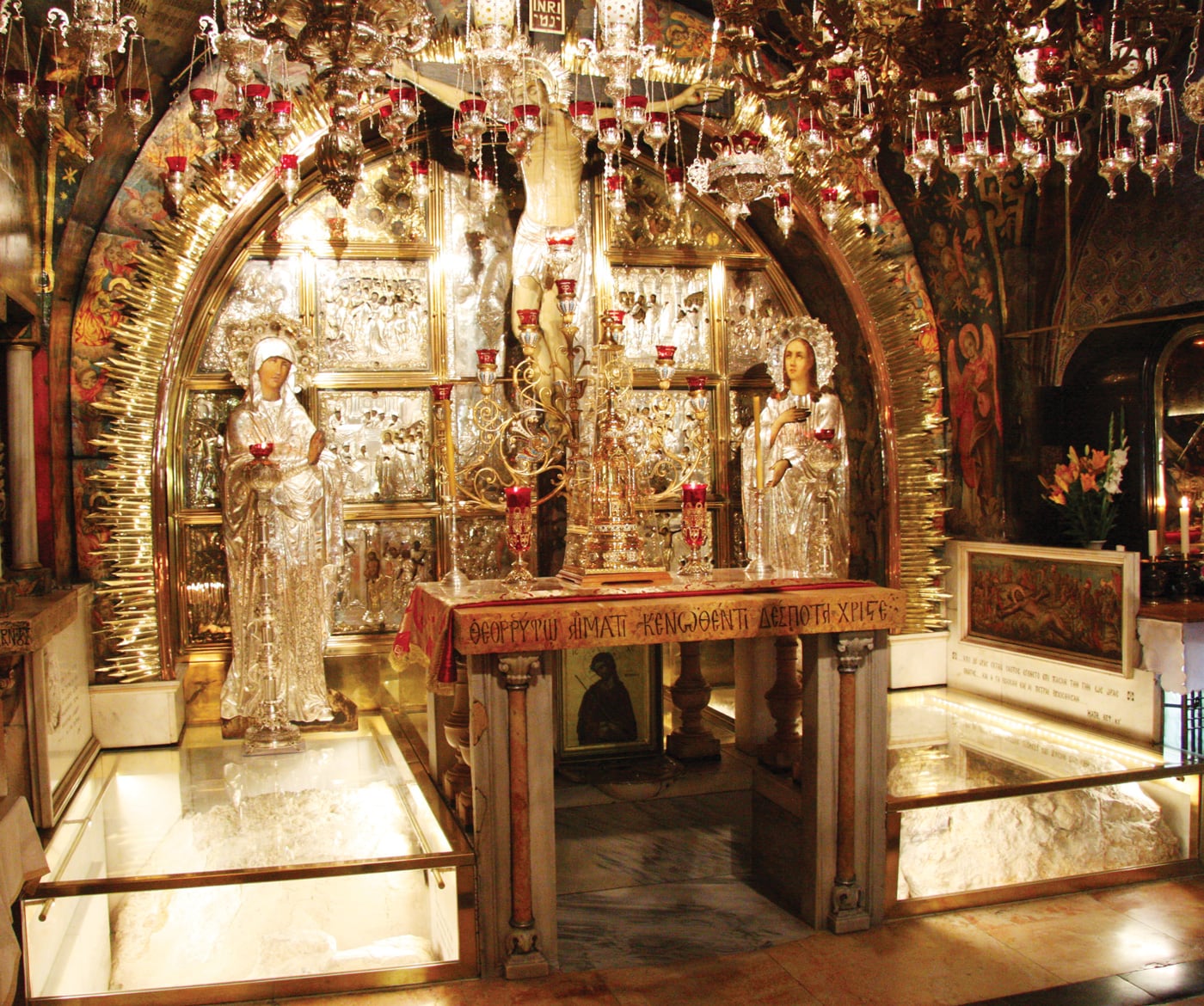
Jesus was crucified outside the city, a sign of his disgrace that Christians must be willing to bear in his name (Heb. 13:11–12). This chapel in the Church of the Holy Sepulchre is the traditional site of Calvary, where Jesus was crucified.
The author notes a further parallel between type and antitype (13:12–14): the carcasses of the sin offerings were burned outside the camp, while Jesus was crucified outside the city of Jerusalem. The significance of the latter fact seems chiefly to lie in its suggestion that Judaism as a whole had rejected Jesus. As once before in Israel’s history, when God left the camp of Israel after her sin with the golden calf and took up station outside the camp (Exod. 33:7–11), Christ’s sacrifice of himself outside the gate represented divine judgment on the people’s unbelief. To make peace with the Judaism that rejected Christ would be to make common cause with God’s enemies whom he has demonstrated to be objects of his wrath. Instead, the readers must make the break with that apostate people and their strange teachings of salvation through the blood and the flesh of bulls and goats. These remarks would be particularly appropriate directed to a community influenced by a form of Judaism like that given expression at Qumran, where great care was taken to organize the sect as a reproduction of the camp of Israel in the wilderness.
No doubt such a separation will be intensely painful for these believers, all the more because they will be marked by their former brethren with the stigma of a betrayal of the ancient faith. But loyalty to Christ demands it, and the prospect of the eternal city should lessen the sting of the severing of earthly associations. In any case, such a pilgrimage from the comfortable scenes of the past to the heavenly country would be a living up to their spiritual heritage as the descendants of Abraham and Moses (Heb. 11:8–10, 25–27). Those who call Jesus Lord are the true Israel (Rom. 9:1–9; Phil. 3:3).
They may no longer have animal sacrifices to offer to God, but there are yet more acceptable sacrifices than these: worship and good works (13:15–16). The superiority of such sacrifices of the heart was a truism of the Old Testament (1 Sam. 15:22; Ps. 50:13–14; 51:17; Hos. 14:2) reiterated in the New Testament (Rom. 12:1; Phil. 4:18; 1 Pet. 2:10).
It is likely that this group of Jewish Christians had been, by reason of their drift back toward Judaism, estranged from the larger Christian community. Perhaps en masse they had begun to separate themselves (Heb. 10:25) and in other ways make life difficult for the elders. In any case, the author expresses confidence that the present leadership would, if able to exercise its authority, steer his readers in the right direction. Texts such as Hebrews 13:17 provide a needed corrective to democratic or, worse, anarchic tendencies in the church. The church is a kingdom ruled by a king who exercises his dominion through officers (Matt. 16:18–19; 1 Thess. 5:12–13). This sacred authority should be prevented from degenerating into an authoritarianism by the genuine interest in the well-being of the people of God required of elders and by the prospect of accounting for their ministry at the judgment seat of Christ (cf. James 3:1). The spiritual prosperity of the church and the honor of Christ are best served when elders fulfill their stewardship in love and truth and when the saints submit to them as to the Lord.
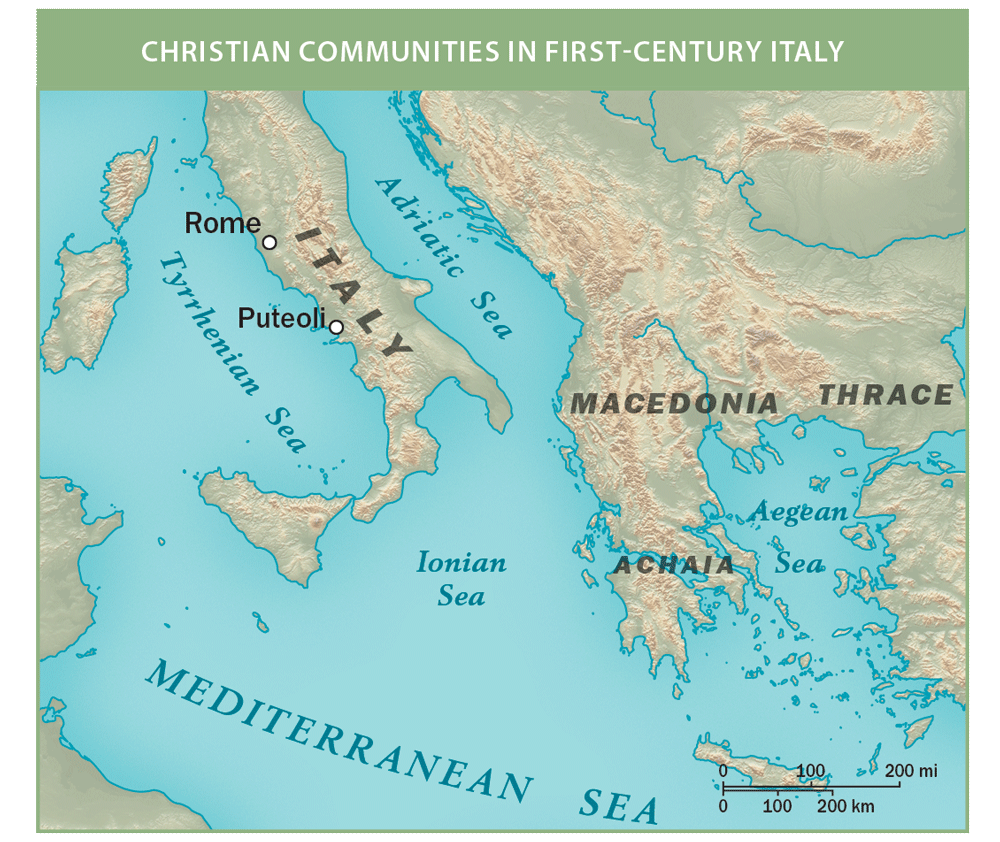
Like Paul, the author writes his stern and likely painful admonition with a clear conscience and with the humble recognition that he needs God’s grace and help fully as much as those to whom he writes (Heb. 13:18–19; cf. 2 Cor. 1:10–14). No doubt he wishes to assess the situation in person and to deal with it in a more thorough fashion than he can in a written sermon, brief as it is (13:22). Evidently he has had a close association with these believers previously, has been separated from them for some time, and has been prevented for some reason from returning to them.
4. Benediction and Greetings (13:20–25)
The beautiful benediction in verses 20–21 forms an exquisite conclusion to the entire work, especially in its concentration on the centrality of Christ in God’s grand program of restoring sinners to himself and to a life pleasing to him.
The personal notes in verses 23–24 do little more than tantalize. Nothing else is known of Timothy’s imprisonment, and further references are hopelessly speculative. “Those from Italy” is ambiguous and could suggest either that the author is writing from Italy or that he is writing from some other place to a community of believers in Italy and naturally includes the greetings of expatriate Italian believers who are with him.
The salutation (13:25) is profound in its simplicity (cf. Titus 3:15) and expresses both the author’s desire for and his confident expectation of the Lord’s restoring his readers to their once sturdy faith in Christ Jesus.
Select Bibliography
Bruce, F. F. The Epistle to the Hebrews. New International Commentary on the New Testament. Grand Rapids: Eerdmans, 1964.
Ellingworth, Paul. The Epistle to the Hebrews: A Commentary on the Greek Text. New International Greek Testament Commentary. Grand Rapids: Eerdmans, 1993.
Guthrie, Donald. The Epistle to the Hebrews. Tyndale New Testament Commentaries. Grand Rapids: Eerdmans, 1983.
Hagner, Donald A. Hebrews. New International Biblical Commentary. San Francisco: Harper & Row, 1983.
Hughes, Philip Edgcumbe. A Commentary on the Epistle to the Hebrews. Grand Rapids: Eerdmans, 1977.
Lane, William L. Hebrews. 2 vols. Word Biblical Commentary. Dallas: Word, 1991.
Moffat, J. A Critical and Exegetical Commentary on the Epistle to the Hebrews. International Critical Commentary. Edinburgh: T. & T. Clark, 1924.
Montefiore, Hugh. A Commentary on the Epistle to the Hebrews. London: Allenson, 1964.
Vos, Geerhardus. The Teaching of the Epistle to the Hebrews. Nutley, NJ: Presbyterian & Reformed, 1974.