Philemon
2. Prayer of Thanksgiving (4–7)
Introduction
Paul’s brief letter to Philemon is a fascinating work that provides an illustration of how the gospel transforms the lives of Christians and the way they treat one another. There are two features that make this epistle distinct among the New Testament writings. First, it is the shortest of Paul’s letters, consisting of 335 words in 25 verses in the Greek text. Second, it is one of the few letters addressed to an individual rather than to a church or a number of churches; however, Paul does include other addressees in his opening and closing greetings (vv. 2, 23–24), which suggests that on another level the personal letter was to be read in the wider church community.
The details in the epistle provide us with a rough sketch of the story behind the letter. Paul, who is in prison, writes to Philemon, his “dear friend” (literally “beloved one”) and “fellow worker” (v. 1). Philemon is apparently wealthy, since he is a slave owner and has a large house that is able to accommodate a church gathering (v. 2). The letter is accompanied by Onesimus, Philemon’s slave, who has been away from Philemon and with Paul for some time due to a breach in their slave-master relationship. Paul returns Onesimus—who has become a Christian while with Paul (v. 10)—to Philemon and appeals for restoration between Philemon and Onesimus. Despite these details of the three-way relationship between Paul, Philemon, and Onesimus, many essential aspects of the epistle are open to debate—including the letter’s occasion and purpose, the specifics of Paul’s request, the historical situation behind the letter, and his attitude toward slavery.

Authorship, Date, and Place of Origin
There has been no major challenge to Paul’s authorship of the letter (v. 1) or to the letter’s literary integrity. The letter indicates that Paul is imprisoned (vv. 1, 9–10), but the location of his imprisonment remains unclear. Scholars have put forward three main proposals: Ephesus in the mid-50s, Rome in the early 60s, and Caesarea Maritima in the late 50s. Of the three proposals, the two more plausible options are Rome and Ephesus. Since Rome is the traditional location for Paul’s “prison epistles” (Ephesians, Philippians, and Colossians), it could be the location of his imprisonment in this letter given the close link between Paul’s epistles to the Colossians and to Philemon (e.g., see the similar lists of Paul’s companions in Col. 4:10–14 and Philem. 23–24). However, the long distance from Rome to Philemon’s house in Colossae makes Onesimus’s travel to Philemon seem unrealistic. Ephesus, on the other hand, is in close proximity to Colossae, thus making Onesimus’s journey to Philemon more feasible. Unfortunately, the book of Acts and Paul’s letters do not mention an Ephesian imprisonment. In the end, the location of Paul’s imprisonment remains uncertain.
Occasion and Purpose
Why did Paul write this letter? As early as the end of the fourth century, the “traditional” explanation has been that Paul writes the letter to Philemon appealing on behalf of Onesimus, who is a runaway slave of Philemon. Since Paul finds himself in a delicate position of harboring a “fugitive” and being legally obligated to return Onesimus to Philemon, he sends him back to Philemon with a request for clemency on behalf of Onesimus. Proponents of this theory speculate that verse 18—“If he [Onesimus] has done you any wrong or owes you anything, charge it to me”—means Onesimus has defrauded Philemon or stolen from him, which has propelled him to flee. Those who affirm this view also perceive Paul as willing to repay Philemon for what Onesimus has done, or more specifically, what he has taken. Paul’s request, then, is for Philemon to readmit Onesimus into his household, clear his debt, and possibly grant him freedom (manumission).
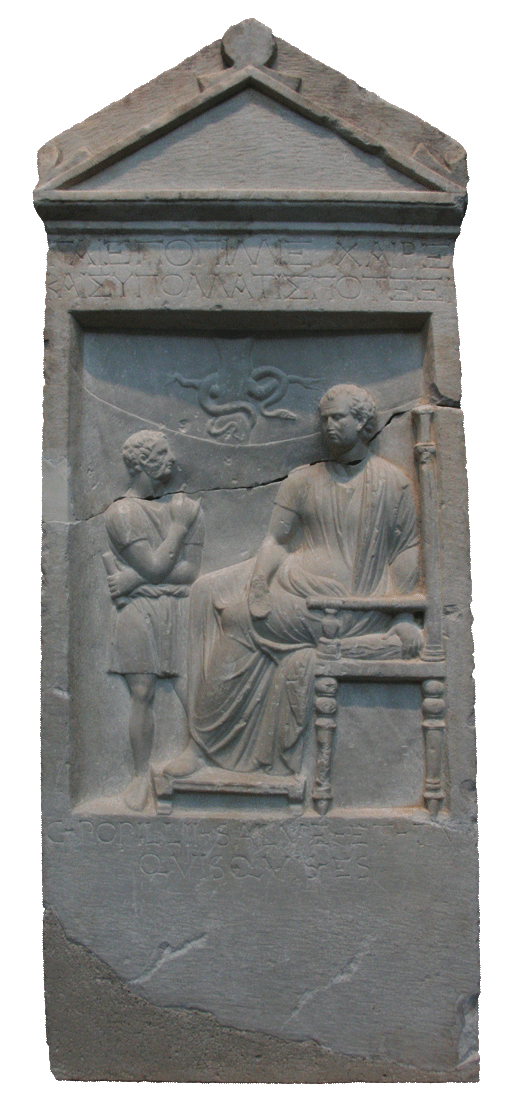
Paul sent his letter to Philemon via Philemon’s slave, Onesimus. The delivery of the letter may have resembled the scene on this gravestone (ca. 50 BC), in which a slave holding a scroll stands before Caius Popillius (the deceased).
Despite the popularity of the runaway interpretation, there are problems with it. In fact, there has been a widespread challenge to this view. One problem is the difficulty of accounting for why Onesimus, having defrauded or stolen from Philemon, would seek to obtain help from Philemon’s friend Paul. It is doubtful that Onesimus would risk being captured and punished by seeking out an apostle in prison. And it might be too great a coincidence if the two met by chance in the same prison. Also unlikely is the suggestion that Onesimus was captured and put into the same prison as Paul, since a runaway slave would not be placed with a Roman citizen under “house arrest,” and Paul would not be able to send a fellow prisoner to Colossae. Another difficulty of this interpretation is that, if Onesimus was a “fugitive,” Paul as a Roman citizen would have been obligated by Roman law to return Onesimus to Philemon. As a fugitive, Onesimus could suffer severe punishment, anywhere from beating to execution. In light of this severity, critics of the traditional interpretation have pointed out that if Paul writes that he will repay Philemon for what Onesimus has done (v. 18), then Paul is primarily concerned with some other matter than Onesimus’s running away. Moreover, if Onesimus was indeed a runaway slave, it is strange that Paul fails to mention Onesimus’s regret or sorrow, which we would expect to find in the letter. Thus, there is no clear evidence in the epistle that Onesimus is a runaway slave who has found Paul in prison.
Some interpreters have posited the scenario of Onesimus’s leaving Philemon due to his poor working conditions and possible abuse by Philemon. However, if Onesimus did seek Paul out regarding unfavorable conditions, we would expect Paul in the letter to make a reference to Philemon’s mistreatment and to ask him to treat Onesimus more favorably (cf. Col. 4:1). Furthermore, this interpretation places the blame primarily on Philemon, but Paul seems to admit that Onesimus, rather than Philemon, is at fault.
One strong proposal, which has a growing number of supporters, provides a scenario and corroboration of the text’s details better than the runaway theory. This interpretation contends that Onesimus did not defraud Philemon or steal from him but committed an error that financially burdened Philemon and probably aroused his anger. Onesimus, then, seeks out Paul as a mediator in this matter. There was a legal custom during that time that allowed Onesimus to seek out a friendly third party to advocate and intercede on his behalf. Pliny the Younger’s letter to Sabinianus (Letter 9.21) is a frequently cited ancient text that provides some striking parallels to the situation and to Paul’s strategy in the Letter to Philemon. This scenario, then, regards Onesimus as not having run away but having sought Paul’s intercession for the goal of returning to his master in more favorable circumstances.
In spite of the uncertainty surrounding the letter’s occasion, these views all recognize that Paul implores Philemon to be reconciled with Onesimus, given their new relationship in Christ. By coming to the defense of Onesimus, Paul follows Jesus’s pattern of self-giving love that embraces those who are weak and helpless. Furthermore, the major theme underlying the letter is the demonstration of how the gospel challenges the status quo of relationships by transforming and uniting believers in Christ as brothers and sisters, regardless of their social identity.
Philemon and Slavery
Many people have approached the Letter to Philemon as a Christian treatise on slavery, given that the letter involves an apostle, a slave owner, and a slave. (See Thompson, 229–66, for theological insights into the issue of Christianity and slavery.) The letter was especially important in the eighteenth and nineteenth centuries during the efforts to abolish slavery. Interestingly, it was used to support both the sanctioning and abolishment of slavery; for instance, proponents of slavery regarded Paul as condoning slavery since he sends a slave back to his owner. A careful reading of the text, however, reveals the complexity of this issue and points to a more prominent (though still related) issue of how the gospel transforms Christian relationships.
Although it does provide a social commentary on the realities of ancient society and the church, the letter does not provide a systematic treatment of slavery. In fact, it is difficult to ascertain Paul’s attitude toward slavery in general and whether he protests this established social institution and accepted way of life in the ancient world. It must be kept in mind that slavery in the ancient world was different from the slave trade in the modern era in North America and Europe, especially since the latter came to be viewed as morally abhorrent while the former was not. Again, Paul’s ultimate concern in the letter is that the gospel radically alters how Christians treat one another, regardless of their social positions and status. In Colossians 3:11 he momentously declares that “there is no Gentile or Jew, circumcised or uncircumcised, barbarian, Scythian, slave or free, but Christ is all, and is in all.” In regard to Philemon and Onesimus, then, Paul affirms how the gospel alters their relationship from master-slave to brothers in Christ: “no longer as a slave, but better than a slave, as a dear brother” (v. 16). Therefore, the gospel transforms and enhances any social relationship, regardless of its shape (e.g., master-slave), and breaks down barriers of inequality between brothers and sisters in Christ. It should be said, however, that in the case of Onesimus, Paul seems to expect that Philemon will liberate Onesimus from slavery (vv. 16, 21)—thus opposing the view that Paul simply accepted (and even endorsed) the realities of slavery.
Commentary
In his typical fashion Paul opens the letter according to the standard conventions of the time. Before giving his usual greeting of “grace” and “peace” (v. 3), he indicates that the letter is sent from himself and Timothy and is addressed to Philemon and other members in the church. There are four notable features in this opening greeting. First, Paul identifies himself as a “prisoner of Christ,” which is unusual since he typically describes himself in his letters as an “apostle” or “slave” of Christ. With the use of “prisoner” here Paul is probably (1) reminding his readers of his imprisonment, which results from his identification with Christ and his work for Christ, (2) evoking some emotional sympathy from Philemon and church members, (3) appealing to Philemon not based on his apostolic authority, and (4) identifying with Onesimus in a similarly humble status. Second, Timothy is included as a cosender (similar to Col. 1:1), probably because he was a close intimate of Paul and possibly knew Philemon. Third, although Philemon is the primary addressee, Paul also greets Apphia (Philemon’s wife?), Archippus (his son?), and the church that meets in Philemon’s home. This greeting highlights the public nature of this “personal” letter, since it would have been read aloud before the church. The inclusion of the church community in this private matter not only applies pressure on Philemon to act on Paul’s appeal but also underscores that the church has a right to be involved in the personal affairs of its members. So Paul is not merely concerned about Philemon and Onesimus but also about the unity and love of the church community. Finally, in the greeting Paul uses familial imagery of “brother” and “sister”—and also “dear friend” (literally “beloved one”)—which not only underscores the intimacy of the church but also prepares Philemon for the appeal to accept Onesimus as a “dear brother” (v. 16).
2. Prayer of Thanksgiving (4–7)
At this point, Paul is personally addressing Philemon, since the “you, your” are singular throughout verses 4–22. Paul asserts in verse 5 that he constantly thanks God: “I have heard of your love and faith, which you have for the Lord Jesus and for all the saints” (literal translation). Interpreters have often been puzzled by how the saints and Jesus could be the objects of both “love and faith.” For Paul, however, both ideas are intertwined—love and faith toward Christ result in love and faith unto others.
Verse 6 is one of the most obscure verses in the epistle and poses many problems for interpreters. Some have understood the phrase “the sharing [koinōnia] of your faith” (NKJV, RSV) as a reference to Philemon’s evangelistic work; however, the phrase more likely refers to Philemon’s sharing of the same faith with other Christ followers. Paul explains that this “active” (or “effective”) shared experience of faith in Christ will lead to the knowledge of every “good” that is ours, and for Christ, who is the origin and goal of the Christian life. In verse 7, by esteeming Philemon’s love and faith for the saints and his “refreshing” of their “hearts” (cf. v. 20), Paul intimates that Philemon should continue to show his love for the saints by extending it toward another saint, Onesimus.
It is important to bear in mind that in Paul’s epistles, the prayer of thanksgiving often hints to the issues that will be addressed in the remainder of the letter. In this letter, some key words in the thanksgiving that are taken up in the body of the letter are “love” (vv. 5, 9), “sharing, welcome” (vv. 6, 17), “good, favor” (vv. 6, 14), “heart” (vv. 7, 12, 20), “refresh” (vv. 7, 20), and “brother” (vv. 7, 20).
Although Paul is bold enough in Christ to command Philemon to do what he ought (v. 8), he appeals on the basis of love (v. 9). For Paul, the love believers share in Christ bonds them and solidifies Christ’s work of reconciliation on the cross (Col. 1:20–23; 3:11). In other words, this love breaks down social barriers and places all three individuals (Paul, Philemon, and Onesimus) on common ground in Christ. Paul, moreover, in his appeal to Philemon, refers to himself as an “old [or elderly] man” and as a “prisoner of Christ Jesus” (v. 9), two descriptors that would elicit compassion and respect from Philemon and the members of the church.
Paul then explains that his request to Philemon is for Paul’s “son,” Onesimus, whom Paul “fathered” (i.e., converted to Christ) while in prison (v. 10). In verse 11 Paul makes a play on the name “Onesimus,” which literally means “useful” and was a very common name during that era for slaves and those of servile origins. He asserts that even though Onesimus was once “useless,” he is now “useful” to both Paul and Philemon. And Paul makes another pun by using achrēstos (“useless”), which would be pronounced exactly like achristos (“Christless”), to articulate that Onesimus is now no longer “Christless” but indeed “useful” (euchrēstos) to Paul and Philemon.
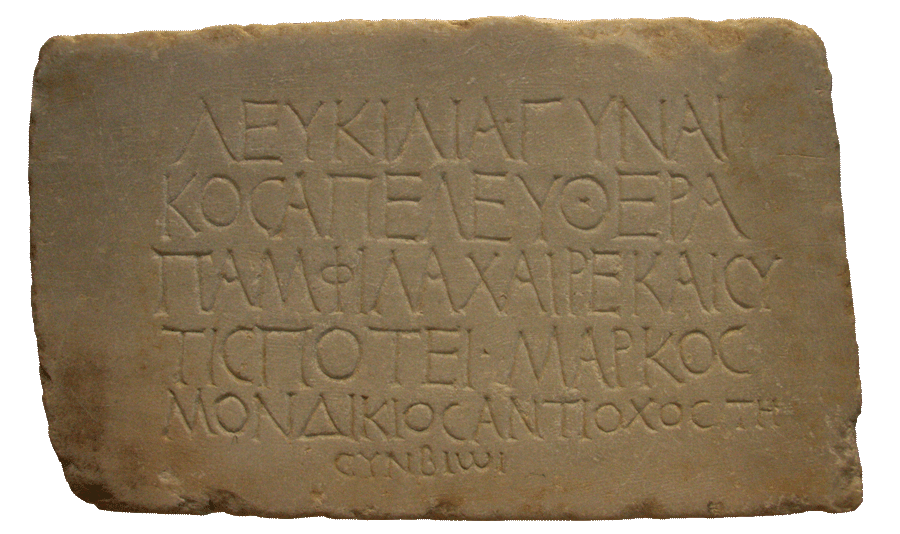
The freeing of slaves (manumission) by their owners was a frequent event in the Roman world. Many male slaves were freed prior to their thirtieth birthdays, and female slaves would be freed so they could marry. The Greek inscription on this relief commemorates the freeing of a female slave by her mistress (first century AD).
While telling Philemon that he is sending Onesimus back to him, Paul expresses that it is not easy for him to do so because Onesimus has become so dear to him—being Paul’s “very heart” (v. 12). Paul further explains that although he wanted to keep Onesimus with him, he would not do so without Philemon’s initiation or consent (vv. 13–14). Paul then suggests that perhaps there was a bigger, divine purpose behind Onesimus’s brief separation from Philemon, for Philemon might now “have him back for good” (v. 15). To be specific, Philemon will have Onesimus back “no longer as a slave, but better than a slave, as a dear brother” (v. 16). As noted above, in verses 1–2 Paul employed familial language, which prepares Philemon for the request here to accept Onesimus also as a “brother.” In fact, Paul stresses the common relationship that he, Philemon, and Onesimus share as brothers in the Lord. Thus, in verse 16 Paul accentuates a transformation in social relations for those in Christ by urging Philemon to embrace Onesimus first and foremost as a brother. Furthermore, it is quite possible to grasp Paul’s words “no longer as a slave” as an appeal for Onesimus’s manumission, since it could explain the new relationship “in the flesh and in the Lord” (literal translation). Regardless of whether Paul is appealing for Onesimus’s freedom here, he does spotlight this new kinship as the paramount relationship between Philemon and Onesimus rather than the master-slave relationship.
Having conveyed the emotional basis of his appeal (vv. 8–16), Paul now, in the climax of the letter, articulates his specific request to Philemon. After imploring Philemon to receive and embrace Onesimus based on their new kin relationship in Christ, Paul identifies with Onesimus by taking on the status of an indebted slave and asking Philemon to accept Onesimus as though he were accepting Paul—that is, as a “partner” (v. 17). Paul, in fact, strengthens his appeal by enjoining Philemon to reckon any of Onesimus’s debts to Paul (vv. 18–19). Although Onesimus’s fault and debt are not explained in the text, it is possible that Onesimus has wronged Philemon in some financial matter and consequently owes money to him. In extending an IOU (written with “my [Paul’s] own hand” [v. 19]) to Philemon, Paul asserts that he will not even mention the incredible debt and obligation that Philemon owes him (v. 19), which is probably a reference to Philemon’s conversion under Paul’s ministry. In verse 20 Paul makes another pun on Onesimus’s name by using its verb form (oninēmi) in his request to “have some benefit” (onaimēn) from Philemon, a request similar to the request for a “favor” (or “good work”) in verse 14. The benefit “in the Lord” that Paul is asking Philemon for is probably what was mentioned in verses 10–14: to accept Onesimus back, to clear any of his debts, possibly to grant him freedom, and to return him to Paul for further service in the work of the gospel, a work in which Onesimus has proven to be “useful” (vv. 11, 13).
Paul further requests Philemon, “Refresh my heart in Christ” (v. 20), which is an encouragement for him to “refresh” Onesimus—Paul’s “very heart” (v. 12)—according to their shared bond “in the Lord,” “in Christ” (v. 20). Paul, moreover, expects Philemon to be able to refresh his heart, since he earlier thanked God for Philemon’s refreshing of the saints’ hearts (v. 7). In fact, Paul states that he has no doubt about Philemon’s “obedience” (v. 21), which is interesting since Paul asserted earlier that he is not going to give Philemon any commands (v. 8). This confidence in Philemon’s obedience to an appeal based on love (v. 9) implies that Paul’s requests in the letter signify what the gospel requires rather than what Paul thinks Philemon should do. Paul even points out the extent of Philemon’s obedience, which is “even more” than what Paul asks for (v. 21). This degree of “even more” insinuates that Philemon should grant Onesimus his freedom from slavery and return Onesimus to Paul.
Before concluding the letter, Paul includes a request for a guest room to be prepared for him (v. 22). Paul apparently is confident that he will soon be released from imprisonment and be able to visit Philemon. Also, in the last clause of this verse, the “you, your” are plural, which means that Paul is again addressing the wider church community.
Paul closes the letter with a list of individuals who send their greetings to Philemon (again, the “you” in reference to Philemon is singular). This list (vv. 23–24) resembles the one in Colossians (4:10–14), except for some notable differences: there is an interchange between Epaphras and Aristarchus as “fellow prisoner,” the ordering of the names is different, and Jesus Justus is not included here. Though the two lists are not identical, the strong resemblance between them suggests that the epistles to Philemon and to the Colossians were written within a short time of each other. Finally, Paul’s closing benediction (v. 25), which addresses the members of the church (the “your” is plural), is in typical Pauline fashion and exhibits the distinct Christian substance of the letter (see the distinct Christian greeting in v. 3).
Select Bibliography
Dunn, James D. G. The Epistles to the Colossians and to Philemon. New International Greek Testament Commentary. Grand Rapids: Eerdmans, 1996.
Garland, David E. Colossians and Philemon. NIV Application Commentary. Grand Rapids: Zondervan, 1998.
O’Brien, Peter T. Colossians, Philemon. Word Biblical Commentary. Waco: Word, 1982.
Patzia, Arthur. “Philemon, Letter to.” In Dictionary of Paul and His Letters. Edited by Gerald F. Hawthorne, Ralph P. Martin, and Daniel G. Reid. Downers Grove, IL: InterVarsity, 1993.
Thompson, Marianne Meye. Colossians and Philemon. Two Horizons New Testament Commentary. Grand Rapids: Eerdmans, 2005.
Wright, N. T. Colossians and Philemon. Tyndale New Testament Commentaries. Grand Rapids: Eerdmans, 1986.