Joel
1. The Locust Invasion as the Lord’s Judgment of Judah (1:1–20)
A. The Devastating Consequences of the Locust Invasion (1:1–12)
B. The Lord’s Call for Judah’s Repentance (1:13–14)
C. Judah’s Appeal for the Lord’s Rescue (1:15–20)
2. Military Conquest as the Lord’s Judgment of Judah (2:1–17)
A. The Devastating Consequences of Judah’s Invasion by Her Enemies (2:1–11)
B. The Lord’s Call for Judah’s Repentance (2:12–17)
3. The Lord’s Response to Judah’s Appeal (2:18–32)
A. The Lord’s Conquest of the Enemy Restores Productivity to the Land (2:18–27)
B. The Rescue of the Lord’s People and His Reign on Mount Zion (2:28–32)
4. The Day of the Lord as Victorious Rule and Reign (3:1–21)
A. The Lord’s Defeat of Judah’s Enemies (3:1–16)
B. The Lord’s Establishment of a Permanent Kingdom in Jerusalem (3:17–21)
Introduction
The book of Joel tells the story of Judah and her dramatic rescue, tracing her journey through pestilence, famine, exile, and restoration. Equally significant is the prophetic overview of God’s ultimate victory and rule over his enemies embedded within Joel’s oracles. Despite the book’s brevity, the reader should not underestimate the eschatological significance of Joel’s prophecies for the original audience as well as its contribution to New Testament revelation. Joel’s frequent allusions to the Pentateuch, the five books of the Law, as the authoritative foundation for his prophecies, combined with his appeal to the work of his contemporaries, underscores the immediate historical relevance of his words to a nation in crisis. Joel describes current events as orchestrated by God, threatening rebellious Judah with divine chastisement while assuring her of eventual deliverance. The writer adeptly navigates the transitions between imminent fulfillment and the cosmological scope of a later, more complete realization of his prophecies. Incorporating apocalyptic imagery and language designed to incite hope for a devastated nation, Joel speaks in terms of visions, cosmic anomalies, and an ultimate final conflict between good and evil. Divine victory eradicates evil and establishes the cosmological reign of a messianic king. The citation of Joel 2:28–32 in Acts 2:17–21 associates this unique prophetic vision with the gift of the Holy Spirit at Pentecost, bridging the chasm between an ancient past and a glorious, unrealized future.
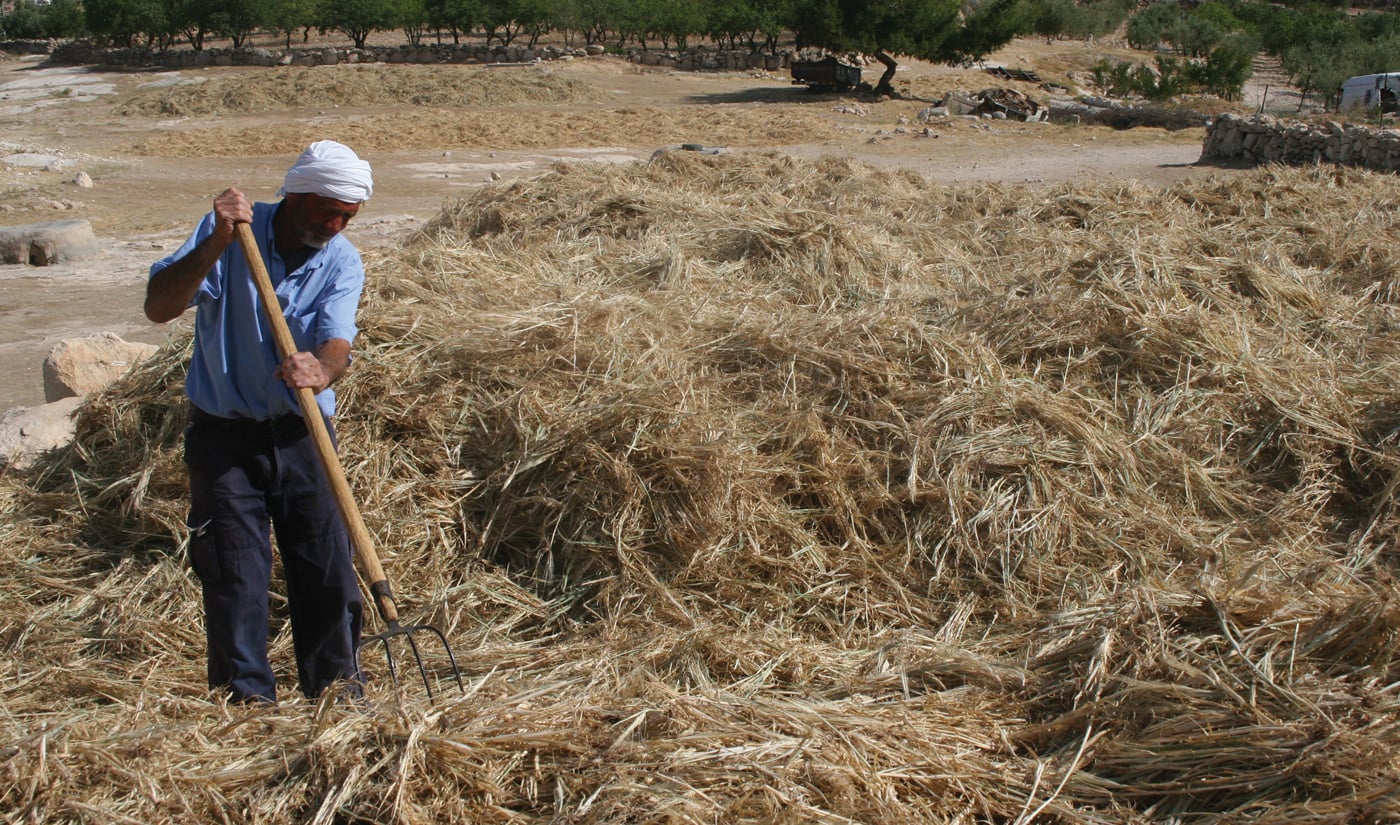
Joel the Prophet
The identities of Joel and his father, Pethuel, remain uncertain since 1 Chronicles mentions a number of individuals with the name Joel living during the period between the transition to Israel’s monarchy and the postexilic return (e.g., 1 Chron. 4:35; 5:4, 8, 12; 6:21; 7:3; 15:7, 11; 27:20). The geographic references to Jerusalem, Judah, and Zion, as well as Joel’s obvious familiarity with priestly practice and procedures, imply the prophet lived within the centralized temple community. While the majority of scholars affirm Joel as the author of the book, a few commentators doubt that the apocalyptic sections (1:15; 2:1–2, 10–11; 2:28–3:21) originated with the prophet.
Date
Scholarly opinions diverge widely concerning a date for the book. The superscription (1:1) does not specify the historical time period. Those who argue for a postexilic date for composition base their arguments on a number of criteria, suggesting that contextual evidence of regular sacrificial offerings and references to the priesthood point to the rebuilding of the temple, after 516 BC. In addition, the prophet does not specifically mention a king or the monarchy in his message. Allusions to Israel’s and Judah’s captivity and deportation appear to support a late date for the prophecies. Moreover, the transitional content of the book from prophecy to apocalyptic material leads some biblical experts to propose that it dates from the fourth century BC.
The same criteria used for a late date of the book, however, also support an eighth-century-BC composition. References to the temple and the priesthood could indicate a preexilic origin. The failure to mention Assyria, Babylon, or Persia as political threats, combined with the inclusion of the Phoenicians, Philistines, Egyptians, and Edomites (3:4, 19) as Israel’s enemies, argues favorably for an origin before the exile. In addition, an eighth-century historical setting best reflects the relative autonomy of those foreign nations listed in chapter 3. The mention of a city wall (2:9) may also suggest either an early or a late date. The book’s canonical position, situated with Hosea, Amos, and Jonah, presumes these works as contextual contemporaries, and the prophet’s association of the “day of the Lord” with an earthquake harmonizes well with King Uzziah’s reign and Amos’s descriptions. Joel employs literary themes and events consistent with a preexilic composition, sharing dozens of terminological and linguistic links with early prophetic works. The evidence therefore favors a compositional origin sometime in the mid-eighth century (ca. 750–740 BC).
Literary Features
A devastating locust plague occasions the writing of the book, which describes an insect invasion so comprehensive in scope that it threatens the survival of Judah’s population (1:2–12). Joel envisions the extent of the destruction by voracious locusts as equivalent to the widespread judgment of the day of the Lord. The prophetic warning in 2:1–11 uses the metaphor of a second, unparalleled locust plague, followed by drought, to characterize God’s chastising Judah by means of an enemy invasion. While locusts never figuratively symbolize armies in ancient Near Eastern literature or the biblical text, locusts are mentioned in Deuteronomy 28:38, 42 in light of future conquest and exile. The far-reaching consequences of the locust invasion that Joel emphasizes seem to extend beyond the realm of a literal swarm of pests to symbolize the wide-reaching effects of enemy attack and conquest of Judah. The connections between the two sections, offset by corresponding passages focusing on repentance (1:13–20; 2:12–17), reinforce the theological emphasis on the day of the Lord as a time of divine discipline and cleansing, followed by eventual restoration.
All the Hebrew manuscripts and ancient versions attest to the unity of the composition, although chapter-and-verse divisions vary. The Greek and Latin versions originally divided the text into three sections. The first rabbinic Bible as well as later Hebrew editions, including the modern standard edition (Biblia Hebraica Stuttgartensia), segment the book into four sections. Consequently, 3:1–5 in the Hebrew (Masoretic Text) corresponds to the English 2:28–32, and Hebrew 4:1–21 reflects its English counterpart, 3:1–21.
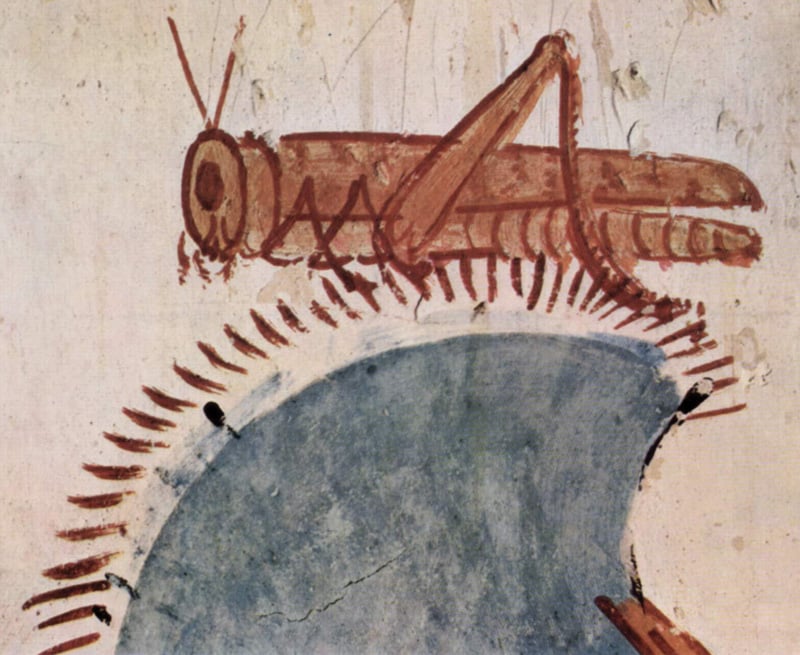
Locusts, such as the one pictured in this Egyptian tomb painting, will swarm when environmental conditions are right, leaving devastation in their wake (Joel 1:4).
The allusive nature of Joel’s prophecies becomes apparent in light of a generous number of shared literary links with eschatological or apocalyptic themes in other prophetic books, including several allusions to Isaiah (Joel 1:15 [Isa. 13:6]; 2:3 [Isa. 51:3]; 2:27 [Isa. 45:5–6, 18]; 3:2 [Isa. 66:18]), Jeremiah (Joel 3:1 [Jer. 33:15; 50:4, 20]), Ezekiel (Joel 1:15 [Ezek. 30:2–3]; 2:3 [Ezek. 36:35]; 2:28 [Ezek. 39:29]), and the Psalter (Joel 2:17 [Ps. 79:10]; 2:21 [Ps. 126:3]). These affinities reaffirm the continued theological struggle Israel experiences as she seeks to harmonize the merciful and compassionate disposition of God with the demands of his divine holiness, which punishes sin and requires restitution. In addition, Joel demonstrates a broad familiarity with other authoritative texts, interweaving motifs such as the exodus, the divine attributary formula (Exod. 34:6–7), and themes of judgment and restoration from Deuteronomy 32, along with mythological concepts, such as the sacred mountain or divine warrior imagery. In the process of drawing from authoritative, well-established texts recognized by the contemporary audience, Joel underscores the divine origin of his prophecies, validating his message as a continuation of previous revelation.
Theological Themes
The book of Joel has been recognized for its emphasis on eschatological themes, describing God’s role and relationship to Israel. The Lord preserves a remnant of his people, pouring out his Spirit on all of them without class distinction. Supernatural visible signs, such as the eclipse of the sun (3:15; cf. Amos 5:18–20; 8:9; Zeph. 1:15) and the hail of blood and fire, attend the day of the Lord. God regathers and rescues Israel and leads her in triumphal procession back to the land, engaging and defeating the enemy nations in a great final battle.
Structure
The clever structure of the book reflects Joel’s skillful use of repetition, in particular through the forty-seven instances of twice-repeated terms and phrases in the book. The two halves of the book correspond to one another, as reflected in the outline below.
Commentary
1. The Locust Invasion as the Lord’s Judgment of Judah (1:1–20)
A. The devastating consequences of the locust invasion (1:1–12). Joel first addresses the general population and the elders (1:2), invoking the audience to “hear” his message. The nuance of the Hebrew root for “hear” implies that the audience understands the message and responds. The prophet also implores the people to recount this event to their descendants, in hopes that their children will learn that covenantal disobedience requires divine punishment. The incomparable catastrophe that plagues the inhabitants of the land in the form of a locust swarm will certainly produce a story of legendary proportions that will become part of the nation’s history.
The prophet uses four different words for “locusts” in 1:4 and 2:25, perhaps reflecting the various stages of the development of locusts. He reinforces the totality of the devastation and emphasizes the long-range effects of the voracious insects on the productivity of the land and the subsequent starvation of the people. Joel commands the drunks to “wake up” and “weep” (1:5) because the locusts have destroyed the grapes, which produce wine. Most likely, he is addressing those who are oblivious to the consequences of widespread plague. The prophet compares the locusts to a “nation” (1:6), perhaps establishing the connection between a literal military invasion by Judah’s enemies and the destruction of her food source, preparing the reader for the analogy in chapter 2. Not only have the locusts consumed food-producing crops and the grains to sustain cattle; they have stripped the bark from fruit trees, leaving them vulnerable to disease by removing their protection (1:7). Similarly, Judah’s walls are breached and her defenses destroyed by the enemy (whether a reference to the Assyrian crisis or a foreshadowing of the Babylonian invasion and exile, 2:7–9).
The prophet then uses the analogy of a grieving bride, whose groom is unable to consummate the marriage because he lacks the bride-price normally paid to the bride’s family in exchange for betrothal. She wears sackcloth as a sign of her mourning. The infestation also affects religious life, interfering with regular temple offerings by the priests (1:9) and threatening the ritual worship of the Lord.
After the source of food and prosperity for the Lord’s people has been consumed by insects, a drought follows (1:10–12), robbing the land of necessary nutrients to feed and nurture subsequent crops. The onset of drought typically characterizes the Lord’s judgment on his people (Isa. 42:15–16).
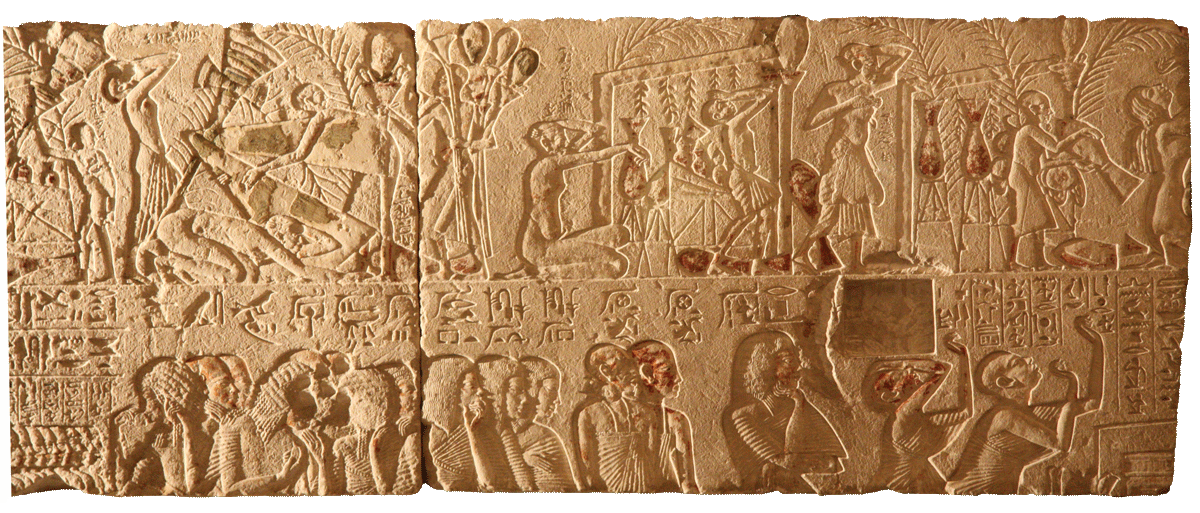
Joel 2:12 calls the people to return to the Lord “with fasting and weeping and mourning,” which may have resembled the weeping and mourning displayed in this Egyptian funeral procession scene (Saqqara, 1550–1292 BC).
B. The Lord’s call for Judah’s repentance (1:13–14). The first of two formal calls for repentance is introduced with a command to the priests to don sackcloth in penitence and remorse for the absence of produce for sacrificial offerings (1:13). The lack of offerings signifies the breach in the relationship between the Lord and his people, who no longer have a means for repairing their sinfulness before God. The prophet instructs the priests to “declare a holy fast” and “summon the elders and all who live in the land” (1:14) so that they can cry out and petition the Lord to restore productivity to the land and deliver his people from their suffering. (The formula “declare a holy fast, call a sacred assembly” recurs in 2:15; however, the purpose of the fast and the assembly in chapter 2 focuses on rejoicing instead of mourning.) The locusts have not only devoured all the vegetation but consumed the seeds for future crops, endangering the livestock. The language is reminiscent of the great fast called by the king of Nineveh, in which the people and the animals wear sackcloth in repentance (Jon. 3:5–8).
C. Judah’s appeal for the Lord’s rescue (1:15–20). The “day of the Lord,” an expression that recurs several times throughout the book (1:15; 2:1, 11, 31), typically denotes a time of divine wrath characterized by God’s war against evil. Immediate events in Judah represent just a foretaste of a greater, cosmological judgment of the Lord against his enemies. A drought follows the locust attack, suggesting a relationship between the two. While the connections are not readily apparent, it is possible that the same winds that drive the locust plague also absorb the moisture from the ground. It is also plausible that the drought is simply another manifestation of the Lord’s judgment, or a separate catastrophic event. Nevertheless, drought enhances the dangers of uncontrolled fires (1:19), which rage throughout the dry countryside. The nation calls out to the Lord with one voice, as if to call the Lord’s attention to their plight and incite him to act on their behalf.
2. Military Conquest as the Lord’s Judgment of Judah (2:1–17)
A. The devastating consequences of Judah’s invasion by her enemies (2:1–11). The blowing of the trumpet, or shofar, an instrument made from a ram’s horn, normally signifies a call of strength or victory. In addition, the priests sound the trumpet to mark the beginning of sacred festivals (Lev. 25:9; Ps. 81:3), to gather the community in anticipation of a theophany (an appearance by God; Exod. 19:16–19; 20:18; Zech. 9:14), or at the inauguration of a new king (2 Sam. 15:10; 1 Kings 1:34, 39; 2 Kings 9:13). The command to sound the trumpet here serves as a warning to the people of an approaching danger for which they should prepare (cf. Jer. 4:5, 19–21; 6:17; Isa. 18:3; Ezek. 33:3–6; Hos. 8:1). Joel announces the imminent arrival of “the day of the Lord” in ominous terms, as a large army converges on Judah from the north, obliterating the landscape and wreaking chaos and destruction in its wake. Similarly, the prophet Habakkuk predicts the Babylonian invasion of Judah (Hab. 1:5–11), highlighting the Lord’s use of foreign nations as agents of judgment or discipline. The blowing of the shofar in Zephaniah (1:16) also heralds the infamous day of the Lord.
Even the forces of devastation fall under the authority of a sovereign God. The Lord employs the military power of first Assyria and later Babylonia as instruments through which he punishes Judah, allowing the contingency to carry away captives, destroy Jerusalem, and profane the temple. The divine-warrior language in 2:10 describes the upheaval of nature at the arrival of the Lord. Typically, natural catastrophes such as earthquakes attend the arrival of the Lord, whether in judgment or triumphal victory. Even the celestial bodies fail to provide light, reinforcing the unparalleled severity of the Lord’s wrath toward his people.
While Joel’s words have immediate relevance for his contemporary audience, the apocalyptic nature of his prophecies points forward to unrealized fulfillment following worldwide catastrophic events in the eschatological future, when the Messiah himself will render judgment on the nations and exercise dominion from his throne in Jerusalem.
B. The Lord’s call for Judah’s repentance (2:12–17). In a second appeal (cf. Joel 1:13–14), the Lord calls for Judah’s repentance. The prophet instructs the people to rend their hearts rather than their garments. The ripping of garments publicly signified deep internal grief; however, the prophet asks not for outward expressions of mourning but for an internal response of true sorrow and penitence. In the prophetic address to the rebellious community, he adapts an abbreviated version of the formula in Exodus 34:6–7 describing divine attributes (originally recited by the Lord to Moses, who desired to see the presence of God). The formula reveals the inherent character of God, who forgives covenant misconduct and remains faithful to his commitments to Israel. The Lord not only demonstrates forbearance and patience in light of his people’s continual transgression but also demonstrates his covenant love (Hebrew hesed) in his willingness to abide by the covenant despite Israel’s unfaithfulness. In addition, the Lord’s hesed manifests itself in the restraint of his wrath. While the Lord chastises his people, he does not exact the full measure of his judgment on them.
Joel argues on the basis of the Lord’s character that the Lord may recognize true repentance and mitigate his wrath against Judah. If God is all-knowing, there is no human response he does not already anticipate, while God’s immutability—or the fact that he does not change—means that God does not “change his mind” on the basis of human decision. Thus, when Joel suggests that the Lord will “relent,” he is using human language to describe God’s unfathomable will in refraining from immediate divine judgment (2:13). Similarly, the book of Jonah represents the prophet’s struggle with God’s character as compassionate and merciful in light of his apparent failure to judge Nineveh for its evil behavior. Joel reinforces the inscrutability of God’s actions by the rhetorical expression, “Who knows?” (2:14). The text recalls the practice of gleaning, or allowing the poor to gather the remnants of harvest intentionally left behind out of pity for their circumstances. Joel suggests that the Lord may “bless” Judah by providing the means for offering temple sacrifices and reinstating her position of favor with God (2:14).
Once more, the prophet commands the priests to sound the shofar, this time for the purpose of a sacred assembly (2:15). The command extends to everyone, including nursing mothers, their children, and newlyweds, who are normally excluded from religious gatherings on the basis of purity laws (2:16). The Lord requires comprehensive repentance from a unified community, which is then instructed to plead for salvation and preservation from enemy invasion and oppression. Joel draws from language typically associated with a standard appeal for the Lord’s favor, calling attention to the Lord’s reputation among the nations, which is directly affected by whether he will preserve the nation associated with his name. What distinguish Israel and Judah from the Gentiles are the character and commitment of the Lord, his presence among them, and his covenant faithfulness toward them (Exod. 33:15–16). By allowing the nations to obliterate his people, the Lord brings reproach on himself. Joel employs the rhetorical question, “Why should they [the Gentiles] say . . . , ‘Where is their God?’” The same expression appears in similar contexts that frame the people’s lament from the perspective of the Lord’s reputation (Ps. 42:3, 10; 79:10; 115:2). The first call for a sacred assembly (1:14) mirrors the second (2:15–16), since the purpose of both is community prayer and repentance. The assembly enjoins the Lord not to allow her to be ridiculed by the Gentiles, using a formulaic expression commonly found in laments that center on military threat and oppression (cf. Ps. 79:4).
3. The Lord’s Response to Judah’s Appeal (2:18–32)
God responds to the cries of his people by delivering them from the clutches of the enemy and exercising his divine anger on the nations that persecuted them. In many ways, Joel 2 resembles the structure of Psalm 79, a lament that traces the destruction of Jerusalem by the enemy, recalls the pleas of the captives, recounts the Lord’s deliverance, and describes his subsequent victorious battle over the evil nations.
A. The Lord’s conquest of the enemy restores productivity to the land (2:18–27). The jealousy of God provokes his desire for vengeance against the nations who have tormented his people. Deuteronomy describes the Lord’s jealousy as his demand for exclusivity among the Israelites, depicting his wrathful response to the infidelity manifested in idolatry (Deut. 32:16, 21). God’s jealousy and protectiveness toward his people are incited in battle toward their adversaries (Isa. 42:13; 59:17; Zech. 1:14). The Hebrew term for “to be jealous” (qana) is related to the verb meaning “to acquire (as property)” or “to purchase” (qanah). God envisions Israel as his “property,” and those who encroach on them and seek to snatch them away from him arouse his fierce anger.
The Lord announces that he will restore their supplies of “grain, new wine and olive oil” (2:19), reversing the circumstances from 1:10, which depicts the ruin of grain, new wine, and oil as the result of the locust invasion. In addition, he promises to prevent his people from becoming the recipient of further ridicule by the nations (2:19), answering the community’s plea in 2:17.
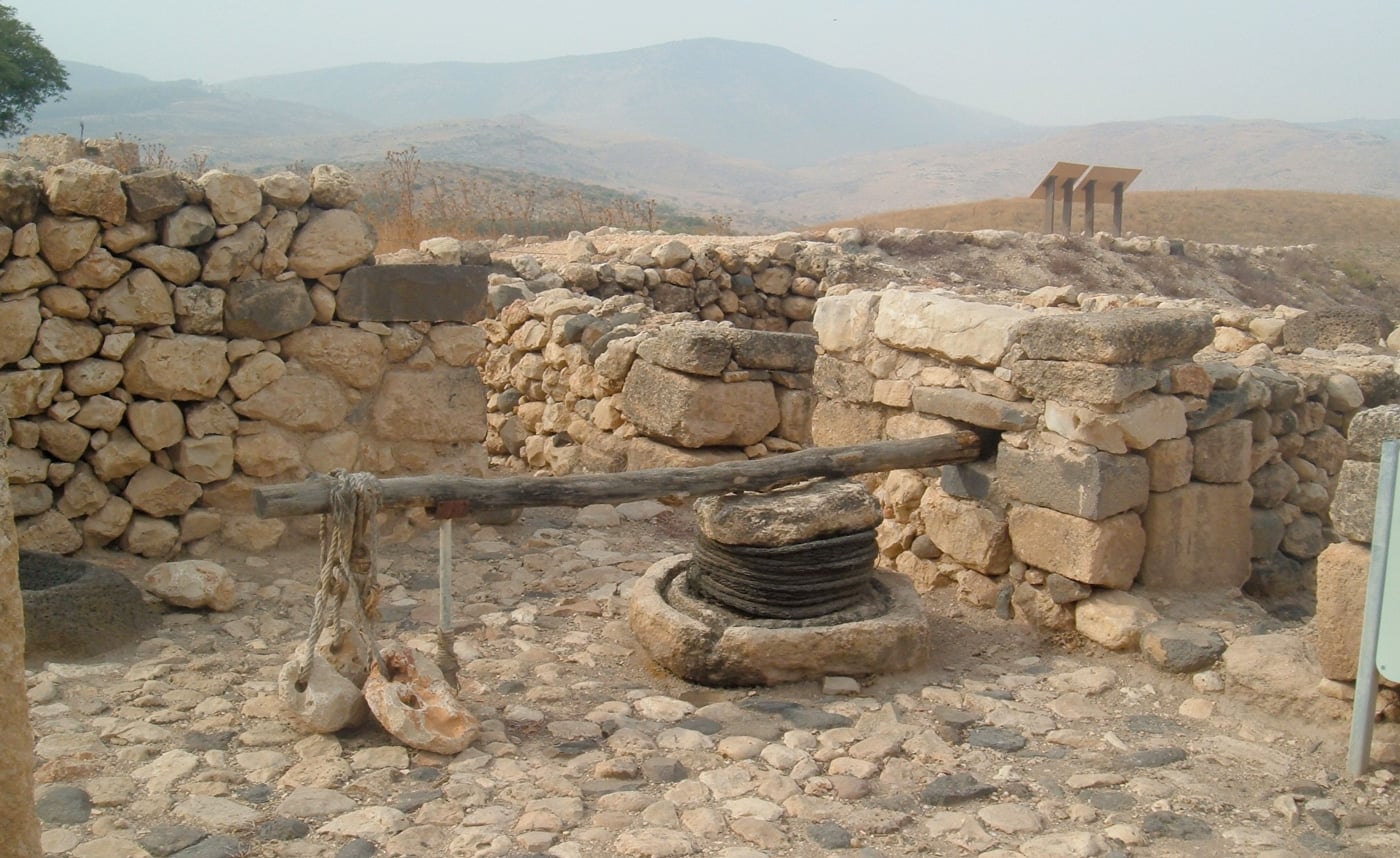
The new oil that the Lord promises as he restores productivity to the land (Joel 2:19, 24) would come from olive presses like this one, which were used to extract olive oil (Hazor, eighth century BC).
Joel prophesies concerning the hasty retreat of the invading army from the Lord and into the wilderness. Subsequently half are driven toward the Dead Sea in the east and the other half to the Mediterranean Sea in the west, where both groups seem to die. The imagery is reminiscent of the demise of Pharaoh’s army in Egypt following the departure of the Israelites from Egypt. The prophet calls on the land (2:20), the animals (2:22), the vegetation (2:22), and the people of Zion (2:23) to rejoice in the Lord’s rescue and restoration. The production of figs and olives as well as the ripening of grain and renewal of the grassy fields signifies the end of the Lord’s chastisement and the favorable standing of his people before him. The normal cycle of autumn and spring rains once again nourishes the land. The nation will once again prosper and, more importantly, have the means to offer sacrifices to the Lord at the temple. The people eagerly celebrate the reinstitution of worship in the community.
Suffering and adversity provide the occasion for glorifying God and affirming his sovereignty. The Lord declares that he will “restore” or “make whole” (NIV “repay”; from the same Hebrew root as shalom) his people for the losses they have endured as a result of the drought, the insect invasion, and the Babylonian conquest (2:25). God does not punish his people out of malice but rather to chastise them and purify them so they may once again enjoy a relationship with him. Consequently, the deliverance and restoration of Israel to her land and the renewed productivity and prosperity she enjoys testify to the benevolence and faithfulness of the Lord (2:26), providing another story of redemption to declare to future generations. The Lord’s presence will once again inhabit Jerusalem (2:27), where he will reign in authority as God alone. Twice the oracle promises that Israel will not be ashamed again (2:26–27); instead, she will inhabit the land with pride and confidence.
B. The rescue of the Lord’s people and his reign on Mount Zion (2:28–32). The apocalyptic themes represented in this section unquestionably point to future events not fully realized by the restoration of Judah and the return of God’s people from Babylonian exile. While 3:1–5 centers on the day of the Lord as an age of salvation and vindication for Judah, 3:1–17 depicts the day of the Lord as a terrifying display of divine wrath toward God’s adversaries.
Joel characterizes the day of the Lord as the “pouring out of the Spirit” on everyone, without distinction (2:28–29). The pouring out of the Spirit is normally associated with the advent of prophetic gifts (1 Sam. 10:6–10; 18:10; 1 Kings 22:22–23; Neh. 9:30; Zech. 7:12; 13:2); therefore, prophetic abilities will be poured out on all of Israel during this great age. Joel may also have the analogy of Amos 8:11 in mind, where Amos describes the failure to hear God’s word in terms of thirst and drought. Consequently, Judah’s reception of the Lord’s counsel constitutes the reversal of that spiritual drought.
Joel 2:28–29 sustains a number of parallels to Numbers 11–12, suggesting the prophet deliberately invokes the earlier narrative. All of God’s people will prophesy (Num. 11:25–29) through “dreams” and “visions” (Num. 12:6). The endowment of the Spirit follows famine in both passages (cf. Num. 11:4–6, 18–23, 31–34; Joel 1:1–2:32). Joel’s announcement fulfills Moses’s request that God would bestow his Spirit on all Israel (Num. 11:29). Joel, however, announces a radical innovation in his message; since cultural convention normally recognized prophecy as limited to men of elevated social standing, the expansion of prophetic gifts beyond gender and class distinction signifies a new age.
Perhaps the most familiar reference to the outpouring of the Spirit is Peter’s citation of Joel 2:28–32 at the day of Pentecost in Acts 2:17–21. The pouring out of the Holy Spirit caused ecstatic behavior resembling that of Old Testament prophets (1 Sam. 1:13–14; Jer. 23:9). In addition, all believers are equally indwelled by the Holy Spirit, retaining equal status before God. Although Joel perceives the Spirit as a phenomenon limited to Israel, in Christ the distinctions between Jew and Gentile have been eliminated.
Darkness prevails during the impending day of the Lord, and natural aberrations, such as earthquakes, fire, smoke, and a bloodred moon signal the salvation of Judah and the doom of judgment (2:30–31; cf. Amos 8:9; Isa. 60:2). These cosmological disruptions evoke imagery associated with theophany—God’s physical revelation to convey information—or epiphany—God’s physical intervention as divine warrior to rescue and deliver his people. Physical manifestations of the Lord, such as the pillar of cloud and fire that served as a sign of God’s presence among his people during the exodus, are replaced with immediate and personal access to the Lord as he reigns on earth. Only those who repent and rely solely on God will endure the day of the Lord (2:32).
4. The Day of the Lord as Victorious Rule and Reign (3:1–21)
Although the day of the Lord means salvation and restoration for Israel, the impending judgment of God awaits those who have tormented and abused the Lord’s elect nation.
A. The Lord’s defeat of Judah’s enemies (3:1–16). The idiomatic expression “restore the fortunes” includes the concept of a release from imprisonment or debt combined with the return of the Lord’s people to their homeland (Deut. 30:3; Ps. 14:7; 53:6; 126:4; Jer. 29:14; 30:3, 18; Hos. 6:11; Amos 9:14; Zeph. 2:7). The statement reiterates the context of 2:25, where the Lord promises to compensate Israel for her losses during the locust invasion and famine.
In a typical lawsuit format, the Lord gathers the adversaries in the “Valley of Jehoshaphat,” which means “the Lord judges.” The actual location defies identification, though some equate this valley with Kidron, a valley east of Jerusalem between the Mount of Olives and the temple, on the basis of other texts that refer to an area east of Jerusalem typically associated with visions and theophanies (Ezek. 10:19; 47:1–12). The fountain that flows from the Lord’s temple (3:18) also travels through this valley.
The Lord accuses the nations of relocating and dispersing his people from their land and selling them on open market as prostitutes (3:2–3). The prophet mentions Tyre and Sidon, two groups of people who made most of their income through barter and trade. The precious metals, temple vessels, and slave cargo transported by ship will be returned to the Lord one day (cf. Isa. 60:4–14), while the merchants bow in obeisance before the very captives they traded. The mention of Tyre, Sidon, and Philistia, minor enemies of Israel in comparison to the Assyrians or Babylonians, may support an early date for the book as preceding the Assyrian captivity. Although the mention of the Greeks seems troubling at first, there is evidence for Greek trade in the Mediterranean region during the eighth century.
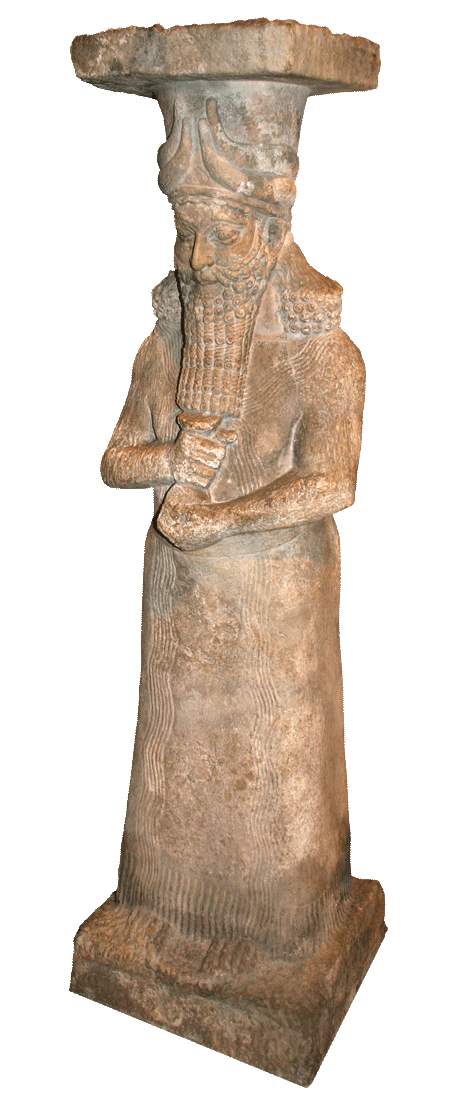
The streams of water flowing from the vessel held by a Mesopotamian deity in this statue at the entrance of the Nabu temple in Khorsabad (eighth century BC) are reminiscent of the fountain that Joel describes flowing out of the Lord’s house (3:18).
God’s judgment, ironically, enacts a reversal of roles as the captors are exported as captives, and those who were enslaved become slave owners (3:8), receiving honor from their oppressors. The punishment hints at the laws of lex talionis, or equal recompense for injuries received from another (Exod. 21:24; Lev. 24:18; Deut. 19:21).
Joel 3:10 reuses familiar imagery from Isaiah 2:4 characteristic of an eschatological return of Messiah (cf. Mic. 4:3) in which implements of war are transformed into tools of peace (“swords into plowshares”), but Joel reverses the meaning of the expression by warning Israel’s enemies to construct weapons of war from agricultural tools (“Beat your plowshares into swords”). The connections between the return of the Lord in Joel 2:28–32 and Isaiah 2:1–5 (Mic. 4:1–5) are hardly coincidental and appear to reflect the development of a unified theological understanding of the establishment of an ideal eschatological, messianic, worldwide kingdom.
The Lord’s trampling of the nations like grapes in a winepress (3:13) finds correspondence in Isaiah 63:3–6, which describes the total annihilation of the nations and the bloodshed as staining the garments of the Lord. Joel draws on parallels from other prophetic texts to inform and clarify his metaphors while also reinforcing the divine authority of his declarations.
Once again, the prophet adapts divine-warrior language as a means to convey the frightening proportions of the Lord’s wrath against the Gentiles (3:14–16). While the day of the Lord becomes a day of divine protection for Israel, the nations can only anticipate their demise in the face of an angry, vengeful God.
B. The Lord’s establishment of a permanent kingdom in Jerusalem (3:17–21). The Lord resides on his holy mountain, Zion, as a witness to his sovereignty. The inviolability of Jerusalem becomes a reality in that future age, and the Lord’s presence in his city as well as the productivity of the land provide abundance and peace for God’s people. The reference to a fountain flowing from the temple of the Lord (3:18) recalls Zechariah 14:8 and Ezekiel 47:1–12, both contexts describing the establishment of an eternal kingdom following the conquest of evil (cf. Rev. 22:1–2). Threats from Egypt and Edom, two of Israel’s most ferocious adversaries, have been eliminated (cf. Zech. 14:18–19), and the eternal safety and security of Jerusalem’s inhabitants prevails under the authority of the Lord. The Lord’s people finally experience the covenant rest God has promised. Such a rest prefigures an even greater rest, the security of salvation accomplished through the sacrifice of Christ for all believers.
Select Bibliography
Allen, Leslie C. The Books of Joel, Obadiah, Jonah, and Micah. New International Commentary on the Old Testament. Grand Rapids: Eerdmans, 1976.
Baker, David W. Joel, Obadiah, Malachi. NIV Application Commentary. Grand Rapids: Zondervan, 2006.
Barton, John. Joel and Obadiah. Old Testament Library. Louisville: Westminster John Knox, 2001.
Coggins, Richard J. “Joel.” Currents in Biblical Research 2, no. 1 (2003): 85–103.
Crenshaw, James. Joel. Anchor Bible. New York: Doubleday, 1995.
Dillard, Raymond Bryan. “Joel.” In The Minor Prophets: An Exegetical and Expository Commentary. Edited by Thomas Edward McComiskey. Grand Rapids: Baker Academic, 1992.
Garrett, Duane A. Hosea, Joel. New American Commentary. Nashville: Broadman & Holman, 1997.
Hubbard, David Allan. Joel and Amos. Tyndale Old Testament Commentaries. Downers Grove, IL: InterVarsity, 1989.
Sweeney, Marvin A. The Twelve Prophets: Hosea, Joel, Amos, Obadiah, Jonah. Berit Olam. Collegeville, MN: Liturgical Press, 2000.
Wolff, Hans. Joel and Amos. Hermeneia. Philadelphia: Fortress, 1977.