Jonah
1. The Lord’s First Commission to Jonah and Jonah’s Disobedience (1:1–16)
A. The Lord’s First Commission to Jonah (1:1–3)
B. The Lord’s Response to Jonah’s Refusal to Obey (1:4–6)
C. The Sailors’ Response to Crisis at Sea (1:7–16)
2. The Lord Protects and Rescues Jonah (1:17–2:10)
A. The Lord’s Provision of the Fish (1:17–2:1)
B. Jonah’s Prayer for the Lord’s Deliverance (2:2–9)
C. The Lord Delivers Jonah (2:10)
3. Jonah’s Second Commission and Nineveh’s Response (3:1–10)
A. Jonah’s Proclamation of the Lord’s Message to Nineveh (3:1–4)
B. Nineveh’s Response to the Lord’s Message (3:5–9)
C. The Lord Relents from Judgment (3:10)
4. Jonah’s Unjustified Anger and God’s Response (4:1–11)
A. Jonah’s Unjustified Anger toward God’s Sparing of Nineveh (4:1–4)
B. God’s Response to Jonah’s Unjustified Anger (4:5–11)
Introduction
The book of Jonah is one of the more dramatic narratives in the Old Testament. The human protagonist, the prophet Jonah, survives a savage ocean storm and entombment in a sea creature of mythic proportions, and is finally delivered from imminent death—all to witness the eleventh-hour reprieve of a wicked people and hated enemy. This biographical account of the prophet’s experiences as he attempts to disobey God and flee from the Lord’s presence resonates with the daily struggles of the faithful reader. Shedding practical theological insight on typical questions and concerns such as the measure of the Lord’s compassion, the narrative emphasizes the sovereignty of God and his willingness to forgive the truly repentant. The story transcends the limits of human comprehension, reaffirming God’s unfathomable nature while reasserting that no human can impede the divine will.
Authorship and Date
Although the text never mentions Jonah as the author, both Jewish and Christian traditions attribute authorship of the book to the eighth-century-BC prophet Jonah mentioned in 2 Kings 14:25. In this text Jonah predicts the restoration of Israel’s borders to those originally associated with the Davidic dynasty. Jonah, the son of Amittai, came from Gath Hepher near Nazareth and lived during the reign of Jeroboam II (782–753 BC) in the northern kingdom of Israel. While the book of Jonah is situated among the prophets, Jonah himself utters only five words of prophecy in the entire narrative.
A number of factors prompt some scholars to argue against Jonah as the writer, since most of the book is written in the third person. For example, the notion that God desires salvation for all of his people, including the Gentiles, reflects a late theological development more comfortable in the postexilic period. Other arguments for a possible fifth- or sixth-century date include literary affinities with other biblical texts, such as the Psalter, and the presence of several potentially late Hebrew terms as well as possible Aramaic influence. While the text itself remains essentially preserved, a few late Hebrew forms may simply reflect scribal updating. Linguistic studies no longer assume that Aramaic terms must indicate late composition, since many Aramaic terms have been located in biblical literature normally associated with the northern kingdom. Consequently, linguistic evidence does not preclude a mid-eighth-century date for the narrative. Historically, Nineveh was not destroyed until 612 BC, so the setting of the book depicts a time before Nineveh’s devastation.
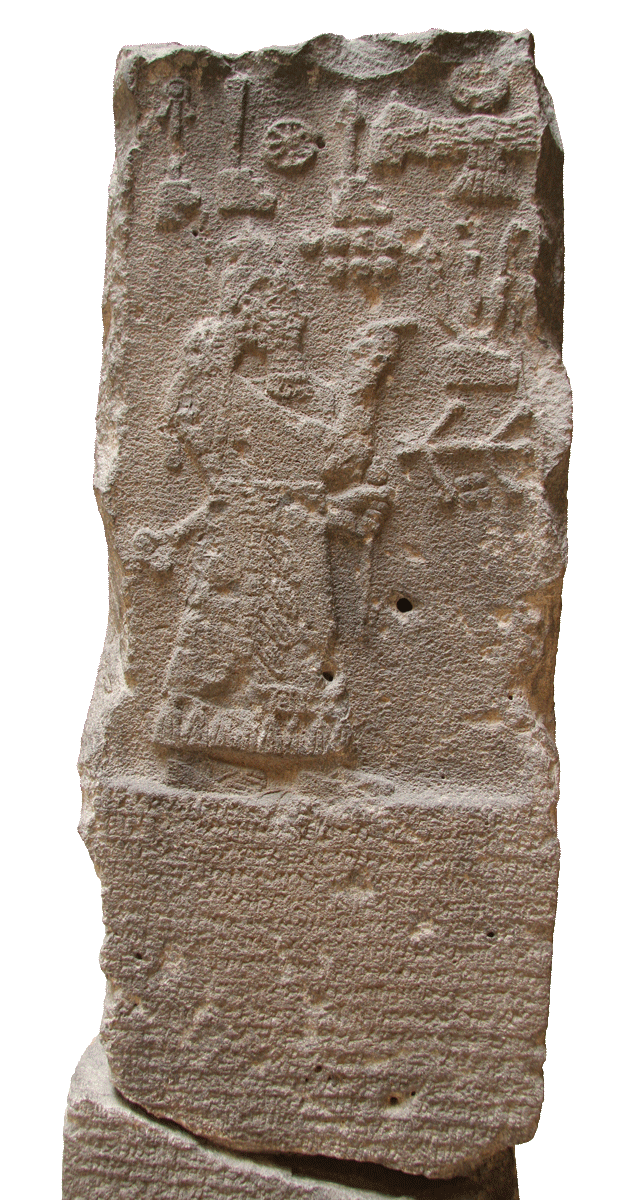
This stele shows Adad-Nirari III, king of Assyria, with the symbols of his gods. His sons were in power in Assyria during the time of Jonah son of Amittai.
Historical Context
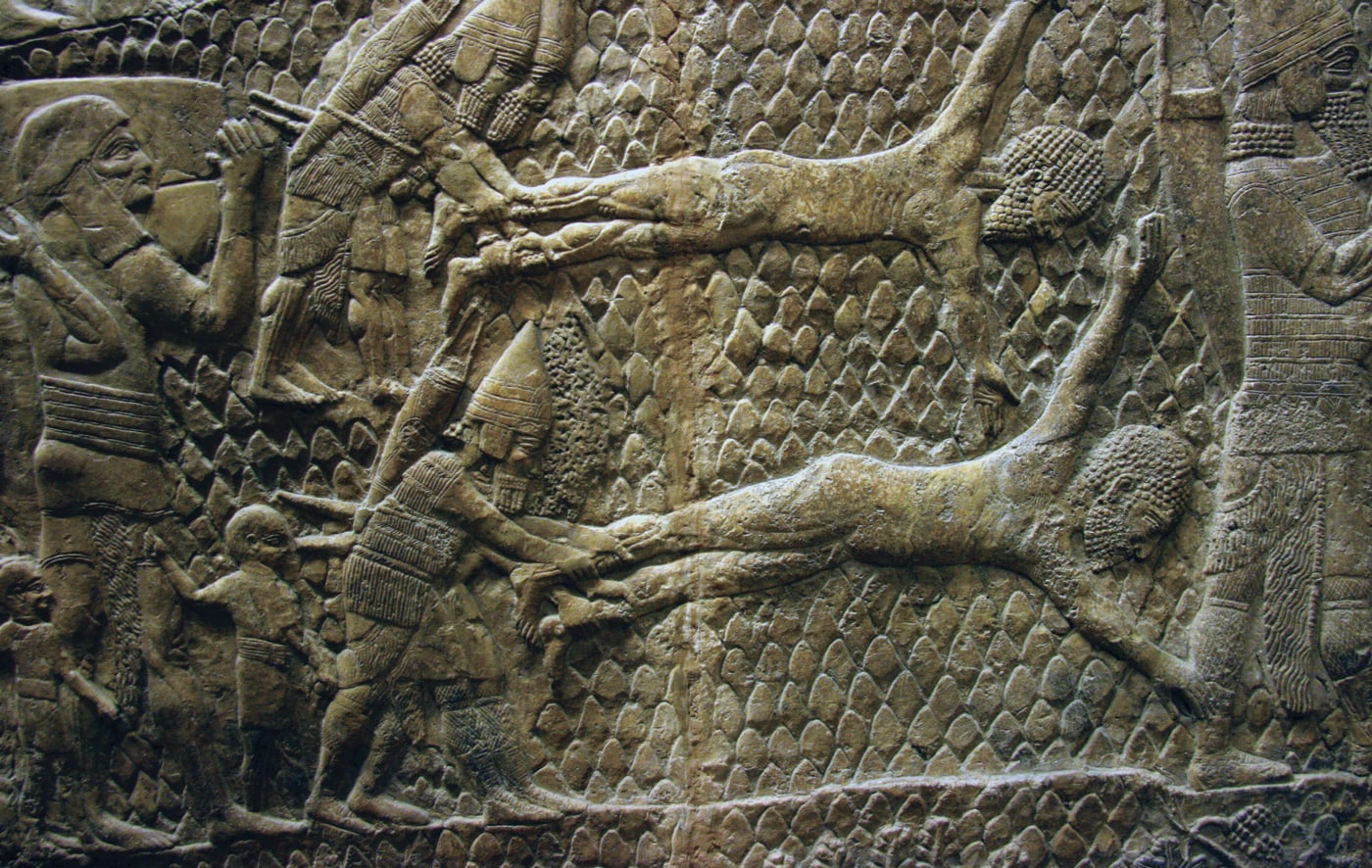
Nineveh was the capital city of Assyria, whose people enjoyed a reputation for their severe cruelty, especially toward Israel. Often they impaled their captives or wore amulets around their necks created from human heads. Idolatry played a significant role in Nineveh; the city was home to a number of temples, dedicated to deities such as Ashur, the source of power and life over all the Assyrian gods, and Nabu, the god of scribes and wisdom. Located at the apex of a central trade route, Nineveh was a commercially vital city with a healthy population of at least 120,000 men.
Theological Themes
Many struggle to identify a single theological theme for the book, since what seems simple on the surface actually harbors a number of complexities.
Although there is widespread familiarity with the story of Jonah and the whale, the book’s thematic diversity contains several intertwined theological threads, making it one of the most practical texts to teach and preach from. The overarching emphasis on God’s sovereignty over his creation and his creatures (1:4, 9, 15, 17; 4:6–8) is developed in light of the compatibility of God’s judgment of and his compassion toward sinners, particularly Gentiles (3:10; 4:2). In addition, the text addresses the nature of God’s gracious response to national and individual repentance. Consequently, the book addresses the prejudice of national exclusivity, the concept that Israel considered her relationship with the Lord as unique, limited to only one nation and people (3:9–10; 4:11). The subtle contrasts between the righteous actions of the sailors in Jonah 1, the ethical and moral repentance of the Ninevites in Jonah 3, and the stubborn and unyielding character of Jonah function to highlight the ironic obedience of the ungodly Gentiles to the Lord in comparison with Jonah’s refusal to comply with the Lord’s commands and failure to understand his ways.
Structure
The underlying structure of the book reveals two major sections, which mirror each other both in content and in sequence of events (1:1–2:10; 3:1–4:11). The language describing the Lord’s initial call to Jonah and Jonah’s negative response (1:1–3) recurs in the Lord’s second call to the prophet (3:1–4). Jonah 1:4–16 and 3:5–10 describe the repentance of the sailors and the unanticipated remorse of Nineveh’s population to the Lord’s impending judgment. Jonah emphasizes the Lord’s sovereignty, as God “appoints” (NIV “provides”) a great fish (1:17), a shading plant (4:6), a worm (4:7), and a hot wind (4:8). The first climactic episode begins with Jonah’s brush with death and concludes the entire first section with the Lord’s deliverance (1:17–2:10), while the second climactic episode (4:5–11) begins with Jonah’s desire to die (4:1–4) and concludes with the Lord’s deliverance of Nineveh. Repetition plays a significant role in the structure of the narrative, linking the parts contextually in the mind of the reader. The interplay between the Hebrew verbs meaning “rise” and “descend” mimics the rocking of the waves (1:2, 3 (2×), 5–6; 2:3, 6; 3:2–3, 6). These same words also figuratively trace Jonah’s progressive distance from the Lord and his subsequent restoration.
Commentary
1. The Lord’s First Commission to Jonah and Jonah’s Disobedience (1:1–16)
A. The Lord’s first commission to Jonah (1:1–3). While we cannot be certain exactly how God conveyed his message to Jonah, the initial phrase, “The word of the Lord came to Jonah,” typically introduces divine communication in the Old Testament. The Lord commands Jonah literally to “rise and go to Nineveh,” two commands that recur in Jonah’s second commissioning from God (3:1). The text characterizes Nineveh as a great city, most notably as the capital of Assyria. Nineveh’s inhabitants were well known for their barbaric and cruel treatment of their captives, specifically their mistreatment toward Israel; consequently, the depth of Nineveh’s moral decline draws God’s attention. Other prophetic books also describe Ninevites as arrogant and godless (Zeph. 2:13; Nah. 3:19). Jonah’s refusal to travel there underscores Israel’s animosity toward Nineveh’s population.
Jonah flees to the coast of Joppa, near Jerusalem. There he boards a ship headed to Tarshish, probably a seaport located on the west coast of the Mediterranean, in the opposite direction of Nineveh. Jonah seeks to escape Yahweh’s presence, despite his subconscious knowledge that God is all-knowing and everywhere. Jonah literally “descends” to Joppa, “descends” into the ship, and later “descends” to the bottom of the sea (1:2–3, 5; 2:4, 7). The concept of descent figuratively represents Jonah’s growing distance from the Lord.
B. The Lord’s response to Jonah’s refusal to obey (1:4–6). Yahweh makes the fact that he is all-present known through physical manifestations of his power. God “hurled a great wind” (1:4 NASB, RSV, ESV) toward the sea, rousting violent swells that threaten to capsize the ship full of pagan sailors. The polytheistic sailors, perhaps acknowledging that the sudden storm represents the active displeasure of a sea god, call out each to his own god, and when those prayers do not yield tangible results, they begin to hurl (ESV) cargo from the ship in an effort to lighten the load (1:5). The sailors attempt to avoid shipwreck, first by appealing to divine authority then taking matters into their own hands by throwing materials overboard. Meanwhile, the captain notes Jonah’s visible absence and confronts him in the berth where he is sleeping deeply. Jonah’s obvious lack of concern for the ship’s predicament troubles the sailors, who roust Jonah from below deck and beseech him to call on his God for rescue (1:6). The writer contrasts the Gentiles’ intuitional response to crisis by appealing to divine power with Jonah’s failure to respond appropriately. The man of God seems oblivious to the consequences of his disobedience, nor does he appear to feel any responsibility for the sailors he has endangered.
C. The sailors’ response to crisis at sea (1:7–16). The narrative never explicitly tells us that Jonah prays to Yahweh on behalf of the sailors. Frightened by the worsening conditions, the sailors once again seek a resolution to their impending destruction through drawing lots. Lots were often used as a means to seek divine direction in decision making. God’s sovereignty is once again demonstrated, as the lots indicate Jonah is somehow responsible for the raging storm. In an effort to discover more about the origin of the threat, the sailors ask Jonah to identify his occupation, his birthplace, and his ethnicity (1:8). All three of these answers would help the sailors understand which god was angry with Jonah, and help them determine how to appease that god’s anger. Jonah answers the question indirectly, first identifying himself as a Hebrew, then launching into a short doxology praising the sovereignty of the Lord, the one God, dwelling in heaven, “who made the sea and the dry land” (1:9 NASB, RSV). The expression reinforces the Lord’s control over all aspects of creation. The sailors grow even more frightened at Jonah’s response, perhaps in light of Yahweh’s reputation among the nations as a fierce and wrathful God and because Jonah has already told them he is fleeing from the Lord’s presence (1:10).
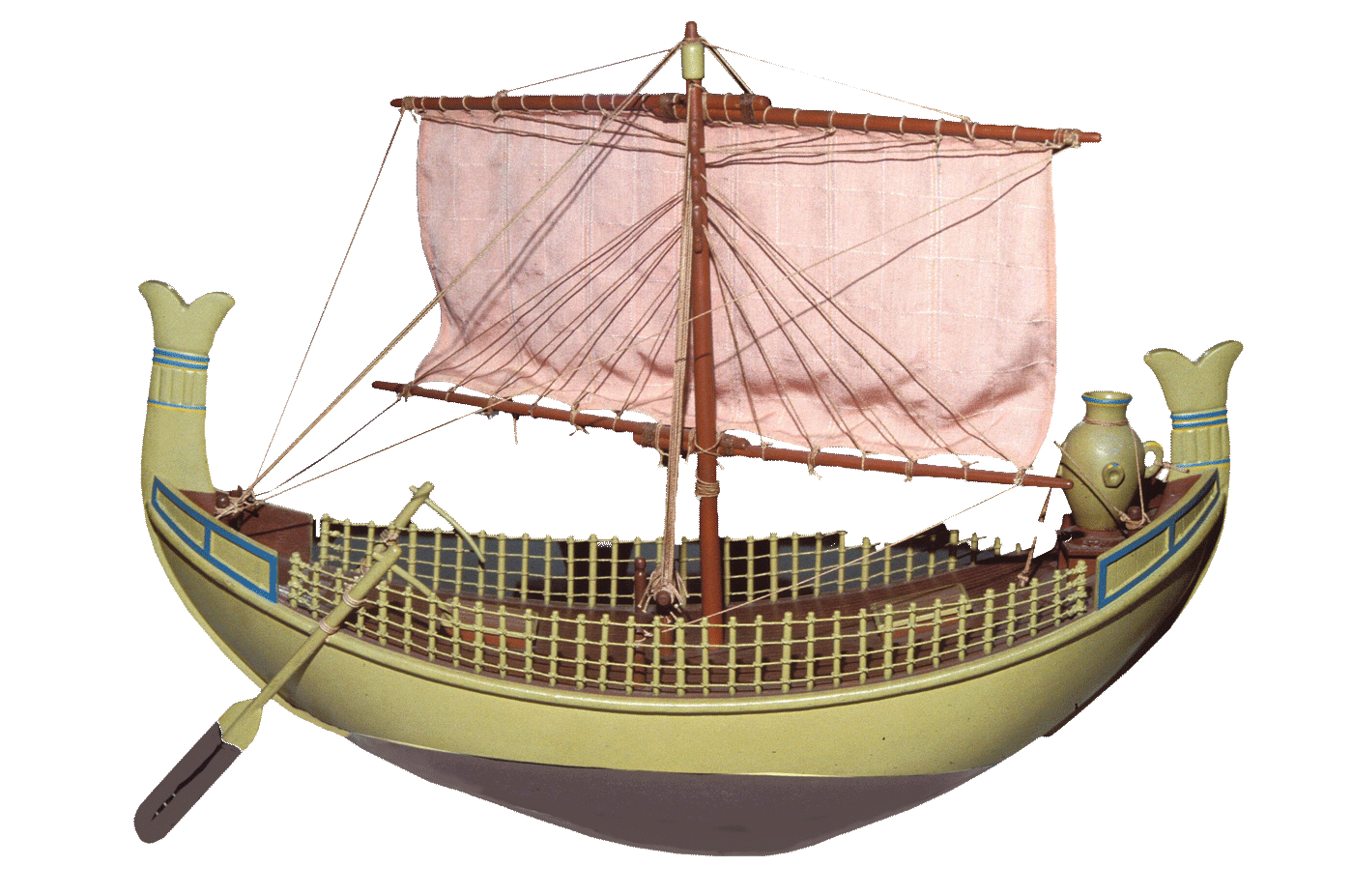
A model of a Canaanite merchant ship (ca. fourteenth century BC), which may be similar to the ship to Tarshish on which Jonah sailed
The sailors demonstrate remarkable ethical and moral standards as they struggle to determine how to deal with Jonah’s disobedience and the Lord’s wrath. Jonah instructs the crew to hurl him into the sea, assuring certain death; however, the sailors do not want to risk intensifying the Lord’s anger by killing one of his people, and make a final effort to wrestle the ship under their control (1:13). The narrative hints at the concept of human sacrifice as a means of appeasing the sea god and depicts the sailors as morally upright in seeking other alternatives. It is interesting to note that while Jonah seems unaware of the conflict facing the sailors, he does not find anything wrong with the request. Finally, the men seek the Lord’s mercy by asking him not to hold them responsible for shedding innocent blood as they hurl Jonah into the sea (1:15).
Following the immediate calming of the sea, the sailors offer sacrifices and make vows to the Lord in gratitude and allegiance. Clearly, the placid sea demonstrates that Jonah’s disobedience was the cause of the storm. Scholars debate whether the sailors’ actions constitute a genuine conversion or simply an acknowledgment of the Lord as one among their pantheon of gods. Religious syncretism was quite common in the ancient Near East, where people were willing to welcome additional gods into their pantheon. Furthermore, the adverse circumstances of the crew may have prompted them to appeal to God temporarily, out of desperation and the threat of imminent death rather than from religious conviction.
2. The Lord Protects and Rescues Jonah (1:17–2:10)
A. The Lord’s provision of the fish (1:17–2:1). The Lord provides (literally “appoints”) a “huge fish” or sea creature to swallow Jonah, in which Jonah remains alive for three days and nights (1:17). In the New Testament, Matthew (12:39–40) draws an analogy between the death and resurrection of Jesus Christ and the imprisonment of Jonah. Matthew identifies Jonah’s salvation by a providentially provided creature as a miraculous sign that typifies God’s provision of Christ as a means of salvation and depicts his resurrection from the dead. This is the first of only two occasions in which Jonah prays to God (2:1; 4:2).
B. Jonah’s prayer for the Lord’s deliverance (2:2–9). The prayer uttered by Jonah resembles the form of a typical thanksgiving psalm, and is linked to several psalms through similar language and themes (for example, Ps. 18:4–6; 30; 34; 40:1–12; 52; 56:13; 103:4). The unusually large number of affinities between psalm fragments and Jonah suggest that Jonah’s prayer may have originated later; at the very least, the composition suggests the prophet’s familiarity with temple worship songs. Jonah’s psalm includes an introductory call (2:1–2), followed by a description of his former catastrophe (2:3–6), and concludes with gratitude to the Lord for his rescue from Sheol, or death (2:7–8). In response to his deliverance, Jonah promises to make sacrifices and fulfill a former vow (2:9).
Both the genre of the prayer and the poem’s interruption of the flow of the narrative are what prompt some to argue that the passage is a later addition. However, other narratives contain mixed genres, and there is no reason to assume that a writer cannot vary in literary style. Others claim that the placement of a thanksgiving psalm before the text describing Jonah’s salvation seems inappropriate. Obviously, though, Jonah did not write down the psalm while in the belly of the sea creature but in retrospection; this presents a logical explanation for the awkward placement of the prayer before the Lord formally delivers Jonah in the passage.
Jonah calls out to the Lord from “the belly of Sheol,” a location normally associated with death (2:2; NIV “deep in the realm of the dead”), and observes that the bars of the earth restrain him (2:6). A number of texts mention the “bars” or “gates” of Sheol (Job 17:16; 38:17; Ps. 9:13; Isa. 38:10). The term designates a place of separation or removal from God, yet Jonah’s poem affirms that somehow God hears his prayer even from the roots of the mountains (2:2) and that he has been rescued by the Lord from the “pit” (another synonym for death, 2:6). Jonah’s submersion in the rough seas, combined with the choking mass of seaweed, threatens to drown the prophet (2:5). Although it seems as if Jonah has resigned himself to certain death and separation from God, he “remembers” the Lord, associating the presence of the Lord in the temple with the place where prayer is heard and answered (2:4, 7). Jonah’s utterance in verse 9 does not fit well in the psalm, but perhaps it reflects an admonition toward the sailors from the ship, who place their trust in worthless gods.
C. The Lord delivers Jonah (2:10). Creation responds at the spoken word of the Lord. Jonah is deposited unceremoniously on the dry land, apparently in proximity to God’s original destination. One can assume that the sailors thought Jonah had perished, and told the story of their voyage to others, so his reappearance, certainly very white and wrinkled as well as smelly, may have frightened the inhabitants of Nineveh, who could have perceived Jonah as a ghost or spirit.
3. Jonah’s Second Commission and Nineveh’s Response (3:1–10)
A. Jonah’s proclamation of the Lord’s message to Nineveh (3:1–4). The Lord’s second commission to Jonah mirrors 1:1–3 almost verbatim, although in this instance Jonah obeys the Lord and travels to Nineveh. While in 1:2 the Lord states the reason for Jonah’s visit to Nineveh, in 3:2 Jonah is simply told to proclaim the message the Lord is about to give him. The adjective “great” describes the city four times (1:2; 3:2, 3; 4:11), indicating its political, cultural, and geographic importance. Nineveh, located at the crossroads of two major trade routes, served as the capital of Assyria. While the text describes Jonah’s journey as of three days’ duration, we are uncertain whether it took three days to arrive at Nineveh or whether the prophet traveled around the eight-mile circumference of the city for three days. It is also possible that the three-day journey included visits to the entire district of Nineveh rather than just to the city itself. The use of “three days” alludes to the time Jonah spent in the sea creature and connects the preceding narrative with the events in Jonah 3. Nevertheless, since Nineveh has a population of at least 120,000 (4:11), God expresses divine concern over the degree of violence and evil rampant among the citizens (1:2).
Jonah’s proclamation, the only prophetic oracle in the book, announces the imminence of judgment within forty days (3:4). The number forty occurs frequently in Scripture to describe the length of a divine encounter (Gen. 7:4; Exod. 24:18; 34:28; Num. 13:25; Deut. 9:9–10; 1 Sam. 17:16; 1 Kings 19:8; Ezek. 4:6). The threat of judgment is not implausible in light of a military threat against Assyria from an enemy to the north.
B. Nineveh’s response to the Lord’s message (3:5–9). Significantly, the peasants, believing the oracle from God, take the initiative and begin fasting as a result of Jonah’s pronouncement (3:5). The practice of fasting as well as the donning of sackcloth, a fabric constructed from goat’s hair and extremely irritating to human skin, typically represented mourning (Ezek. 7:18). Prophets often wore sackcloth and fasted, outwardly demonstrating their grief over the people’s sinfulness (2 Kings 1:8; Zech. 13:4). The extent of the fast supersedes social strata and class distinction.
After hearing of Jonah’s announcement, the king officially decrees a fast throughout the kingdom and steps down from his throne to sit on the ground in the dust, a gesture of great humility (3:7). The king instructs the inhabitants not to eat or drink anything, nor to feed and water their domesticated animals. The participation of animals in ritual mourning seems unparalleled in the ancient Near East, yet Jonah does not question the practice.
The king then follows his physical decree with an ethical command, beseeching the citizens to “turn” or “repent” (NIV “give up”; Hebrew shub) from their violent and evil behavior (3:8). A call to moral reform is unusual, since typical Assyrian practice sought to divert divine wrath through rituals. The king carefully phrases his words, acknowledging that God is free to act despite the nation’s repentance, yet affirming the possibility that God could “turn” or “relent” (shub) and refrain from judgment (3:9).
C. The Lord relents from judgment (3:10). Significantly, the Lord recognizes not the outward expression of Nineveh’s contrition but the city’s willingness to renounce wickedness and evil (3:10). In his great compassion, the Lord “relents” (NASB; a different Hebrew verb from 3:9) and spares Nineveh from destruction. While some scholars believe this verse affirms that God can be swayed from a course of action by the repentance or the fervent prayer of creatures, such a claim would deny that God is all-knowing by suggesting that God cannot know for certain how a human being will respond. Consequently, the Lord’s acts are dependent or contingent on the actions of his creatures, which subjugates the divine will to human will. In addition, this view, known as the “openness of God,” assumes that God is not immutable or unchangeable and that, in fact, God can “change his mind.” It would follow, then, that if God can change his will or mind on one occasion, we cannot with any certainty know if God will change his mind about other matters, such as the salvation of believers. But we can only understand the author’s choice of words as an attempt to grapple with the inconceivability of God’s restraint from judgment in light of his divine holiness. The incomprehensible nature and will of God is expressed in terms that ascribe human qualities to the divine being in order to explain God’s actions within the limitations of human concepts.
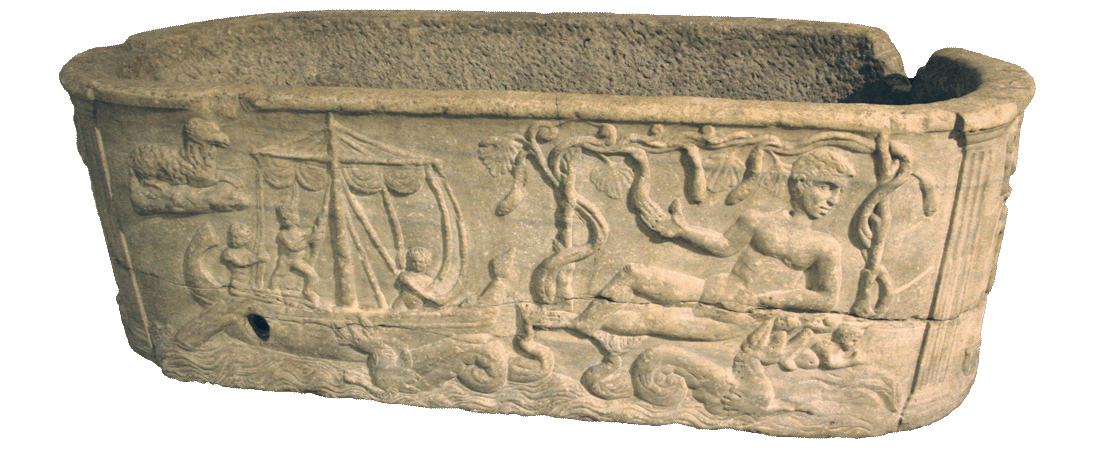
A late-Roman sarcophagus (ca. AD 300) with scenes from the story of Jonah
4. Jonah’s Unjustified Anger and God’s Response (4:1–11)
A. Jonah’s unjustified anger toward God’s sparing of Nineveh (4:1–4). Jonah demonstrates his arrogance and his lack of understanding as he reacts with unjustified anger after the Lord revokes his judgment toward Assyria. The Hebrew term for “evil” in Jonah 3:8, 10 recurs in 4:1, supporting the connection between God’s earlier act and Jonah’s presumptuous reaction to what he perceives as a great injustice or “evil” (NIV “to Jonah this seemed very wrong”). Ironically, God’s compassion lessens his divine wrath in 3:9–10, while the anger of Jonah, a mere mortal, is further inflamed. Jonah affirms his knowledge of God’s gracious and compassionate character, employing the formula in Exodus 34:6–7 describing divine attributes. The formula was first uttered in its fullest form to Moses; partial forms also occur in other texts (Num. 14:18; Ps. 103:8–13; Nah. 1:3; Mic. 7:18–19; Joel 2:13–14). Which part of the formula was quoted by a biblical writer depended on whether he wanted to emphasize the Lord’s mercy or the longevity of God’s anger. In some sense, Jonah believes that the Lord’s mercy toward his creatures is exclusive to the nation of Israel and that the parameters of the Lord’s grace should not extend to the Gentiles. Jonah concludes his outburst by telling God what he should do—that is, take Jonah’s life (4:3). Jonah’s request further clarifies his misunderstanding concerning the will of God, which is not constrained or dictated by his creatures. God questions Jonah’s right to be angry, since God has also extended grace and compassion toward Jonah despite his disobedience to the Lord’s commands (Jonah 1:4).
B. God’s response to Jonah’s unjustified anger (4:5–11). Jonah travels east of Nineveh and settles down to wait for Nineveh’s demise, as if it is inconceivable that the city will be spared by God (4:5). In an expression of his divine mercy and compassion, the Lord “appoints” or “provides” (4:6–8; cf. 1:17) a plant, probably a castor oil plant, to shade and cool Jonah as he sits in the desert. Jonah rejoices in God’s merciful provision, an accommodation that Jonah does not deserve in light of his opposition to the Lord (4:6).
Then the Lord appoints a weevil to chew the roots of the plant so that it withers and dies, and finally the Lord appoints an east wind to blow on the vulnerable Jonah. At the height of summer, the desert temperature can reach 110 degrees and, combined with the sirocco, or east wind, can render the air and ground devoid of any moisture whatsoever. The effects of the sirocco are so severe that people normally seek sturdy, protective shelter from the fierce winds. Jonah remains unprotected except for a booth, a small, temporary three-sided shelter consisting of large branches or other materials. Jonah suffers in the blazing heat and, once again, pleads to die (4:8).
The Lord once again asks Jonah if he is justified in his anger concerning the destruction of the shade plant, but the prophet adamantly refuses to acknowledge his error (4:9). God aims to bring Jonah to the realization that none of his creatures deserve the mercy and compassion of God and that the grace of God is freely dispensed according to his divine purpose and will. The author contrasts Jonah’s pleasure in God’s provision of undeserved mercy on his behalf with Jonah’s disappointment in God’s compassionate response to Nineveh. The Lord poses a rhetorical question that highlights his sovereignty and care for the world, yet it remains uncertain whether Jonah reaches a full understanding of the nature of God. Regardless, the Lord employs the ministry of Jonah to Nineveh and Assyria to reinforce his covenant promise to bless the nations through the descendants of Abraham (Gen. 12:1–3).
Select Bibliography
Alexander, T. Desmond, David W. Baker, and Bruce Waltke. Obadiah, Jonah, Micah. Tyndale Old Testament Commentaries. Downers Grove, IL: InterVarsity, 1988.
Baldwin, Joyce. “Jonah.” In The Minor Prophets: An Exegetical and Expository Commentary. Edited by Thomas Edward McComiskey. Grand Rapids: Baker Academic, 1992.
Bruckner, James K. Jonah, Nahum, Habakkuk, Zephaniah. NIV Application Commentary. Grand Rapids: Zondervan, 2004.
Fretheim, Terence. The Message of Jonah. Minneapolis: Augsburg, 1977.
Limburg, James. Jonah. Old Testament Library. Louisville: Westminster John Knox, 1993.
Magonet, Jonathan. Form and Meaning: Studies in the Literary Techniques in the Book of Jonah. Frankfurt, Germany: Peter Land, 1976.
Marcus, David. “Nineveh’s ‘Three Days’ Walk’ (Jonah 3:3): Another Interpretation.” In On the Way to Nineveh: Studies in Honor of George M. Landes. Edited by Stephen L. Cook and S. C. Winter. Atlanta: Scholars Press, 1999.
Sasson, Jack. Jonah: A New Translation with Commentary. Anchor Bible. New York: Doubleday, 1990.
Simon, Uriel. Jonah. JPS Bible Commentary. Philadelphia: Jewish Publication Society, 1999.
Sweeney, Marvin A. The Twelve Prophets: Hosea, Joel, Amos, Obadiah, Jonah. Berit Olam. Collegeville, MN: Liturgical Press, 2000.
Willis, John T. “The ‘Repentance’ of God in the Books of Samuel, Jeremiah, and Jonah.” Horizons in Biblical Theology 16 (1994): 156–75.