1–2 Samuel
1. A Period of Transition (1 Sam. 1:1–15:35)
B. The Early Years of Saul’s Reign (8:1–15:35)
2. David’s Rise to the Throne (1 Sam. 16:1–2 Sam. 8:18)
B. David’s Struggles with Saul (18:1–27:12)
C. Saul’s Final Battle (28:1–31:13)
D. David Unifies Judah and Israel (2 Sam. 1:1–5:25)
E. David Established as King (6:1–8:18)
3. David’s Successes and Failures (9:1–20:26)
A. David’s Success (9:1–10:19)
B. The Turning Point (11:1–12:31)
A. The Gibeonites’ Revenge (21:1–14)
B. Victories over the Philistines (21:15–22)
D. David’s Last Words (23:1–7)
E. David’s Mighty Men (23:8–39)
Introduction
The books of 1 and 2 Samuel are named after the prophet Samuel, who served as the last judge of Israel and who anointed both Saul and David to be kings of Israel. The books thus provide a transition between Judges, with its underlying argument for the unifying nature of a monarch, and 1 and 2 Kings, which tell the story of the Israelite monarchy. Originally 1 and 2 Samuel were one book, a unity attested by the earliest existing copy, the larger Samuel scroll among the Dead Sea Scrolls (4QSama), which partially preserves the text from what we know as 1 Samuel 1:11 to 2 Samuel 24:20. Jewish tradition continued to treat the books as one until the fifteenth century; this is most easily seen in the Masoretic marginal notes, which mark 1 Samuel 28:24 as “half of the book by verses.” At the same time, the division between 1 and 2 Samuel is natural enough, since 1 Samuel ends with the death of Israel’s first king, Saul, leaving 2 Samuel to focus on the reign of David. The division into two books occurred already in antiquity, likely due to space concerns; it was first divided by the translators of the Greek Old Testament (Septuagint), who referred to the two as the books of First and Second Kingdoms. The Latin Bible (Vulgate) called these books First and Second Kings and the books that followed, Third and Fourth Kings.
It is worth noting that the story of David does not end in 2 Samuel 24, but continues through 1 Kings 1, and his death is not mentioned until 1 Kings 2:10–11. Thus, not only is the division between 1 and 2 Samuel artificial, but the entirety of Joshua–Judges–Samuel–Kings reads, in their final forms at least, as a single, four-volume work that tells the story of the Israelite history in Canaan, from entrance to exile. Moreover, all four contain themes and explicit textual links to the book that apparently gave the historian of the final work his focus: Deuteronomy. It is thus important that as sensitive readers we bear in mind that with 1–2 Samuel we are stepping into the middle of an ongoing story. So, while Samuel, Saul, and David take center stage in this work, the central characters of the larger story are the Lord and Israel.
The Argument of 1–2 Samuel
In asking what 1–2 Samuel is about, we must remember that history-writing, whether ancient or modern, is never simply about “recording the facts.” Instead, a historian chooses which facts to include, orders them, and sometimes even dresses them up. This is done in order to make an argument about some person, event, or period in history—that is, to explain why something happened or to explain a person or event’s larger significance (see Frykenberg). The challenge with the biblical history writings is that it is often difficult to reconstruct enough of the historians’ settings to be able to identify accurately the specific underlying arguments in their books. Even so, it is helpful to ask oneself as one reads a book like 1–2 Samuel, Why is this event included? or, Why is it told this way?
As a whole, 1–2 Samuel describes two critical transitions in the story of Israel’s beginnings: from charismatic judges to prophets and from tribalism to monarchy. Each shift revolves around three or four figures. Eli, Samuel, Gad, and Nathan represent the shift from judge to prophet; Samuel, Saul, and David move Israel from a loose tribal association to centralized governance in the form of a dynastic monarchy. Within this overarching context of transition, one issue stands at the center and drives the historian’s argument: kingship.
Many scholars nowadays assert that the historian’s use of sources, some that were antimonarchy and others that were promonarchy, have left a confusing mix of narrative voices in the final book. Indeed, there is no doubt that both views can be discerned in the book, but if we assume a skillful historian behind the end product, we need not take the tension simply as a remnant of a complex compositional background; rather, the tension was more likely a deliberate rhetorical strategy allowing the historian to maintain two stances at once: as a political pragmatist the historian recognizes both the fact of the monarchy’s existence and that a monarchy provides a long-term solution to deal with outside threats (so also Judges); as a theological idealist the historian balks both at the challenge the monarchy makes to God’s kingship and the authority of the prophets and at the power of the monarchic authority to corrupt the king and so lead Israel astray (so also 1–2 Kings).
Even the early chapters, before a king is mentioned, contribute to the argument about monarchy: on the one hand, oppression by the Philistines implicitly picks up the argument at the end of Judges—Israel suffers chaos because there is no king (cf. Judg. 17:6; 18:1; 19:1; 21:25); on the other hand, the victory of the Lord over the Philistine god Dagon in 1 Samuel 5 suggests that if the Israelites had just been loyal their divine king would have provided peace for them. This issue of kingship hovers just below the surface of the entire narrative in the form of three questions: (1) Will Israel continue to recognize the Lord as its true king even though they now have a human monarch? (2) Who has greater authority, prophet or king? and (3) Who will be the next monarch?
Human versus divine monarch. Fundamental to the historian’s view was the belief that God as the divine king deserved the loyalty and worship of his people and that he also demonstrated his power to the nations. The request for a human king was thus seen as a rejection of the Lord, both his ability to protect his people and, to some degree, his authority. Typologically and theologically the request for a king mirrors the Israelites’ request at Sinai that Moses receive the Ten Commandments on their behalf—in both cases, the people elect to place a barrier between themselves and the Lord. It is thus not surprising that the historian views the institution of monarchy with disappointment and suspicion.
In fact, nowhere does the juxtaposition of anti- and promonarchy voices come out more clearly than in 1 Samuel 8–12—the chapters that describe the monarchy’s origin. The first and last episodes in this sequence present Samuel and the people in a discussion about the merits of a monarchy, and both render the judgment that it is, at its core, a rejection of the Lord as Israel’s king. As bookends to the entire sequence, 1 Samuel 8:1–22 and 12:1–25 ensure a negative evaluation of the establishment of the monarchy. The middle episode (10:17–27), in which Samuel summons the people to Mizpah for the official selection of Saul, is also a negative evaluation of the monarchy. Not only does Samuel remind the people of their disloyalty to the Lord by asking for a king, but their future king is found hiding among the luggage! It is an ignominious start for the monarchy.
In contrast, the second episode (9:1–10:16) asserts that the monarchy will be used by God for Israel’s deliverance. Moreover, the fourth episode (11:1–15) illustrates this benefit, with Saul’s first victory as the newly chosen king. Thus the historian has used both positive and negative stories about the institution of the Israelite monarchy. The positive stories reflect the recognition that being united under a central leader has great benefit. Throughout the ancient Near East, kings were responsible for maintaining justice and hearing legal cases, and 1–2 Kings on occasion depicts a ruler deciding such cases. The negative stories reflect the historian’s distrust of monarchy as an institution of power and wealth that can deter obedience to the command of the Lord (a view echoed in Deut. 17:14–17). These stories also reflect the historian’s view that Israel’s choice of a king was first and foremost a rejection of the Lord as their king and military leader (1 Sam. 8:7; 10:19), and, secondarily, a rejection of Samuel (8:8). Why is the rejection of Samuel important to the historian? Because it reflects a fundamental tension in the hierarchy of authority between king and prophet.
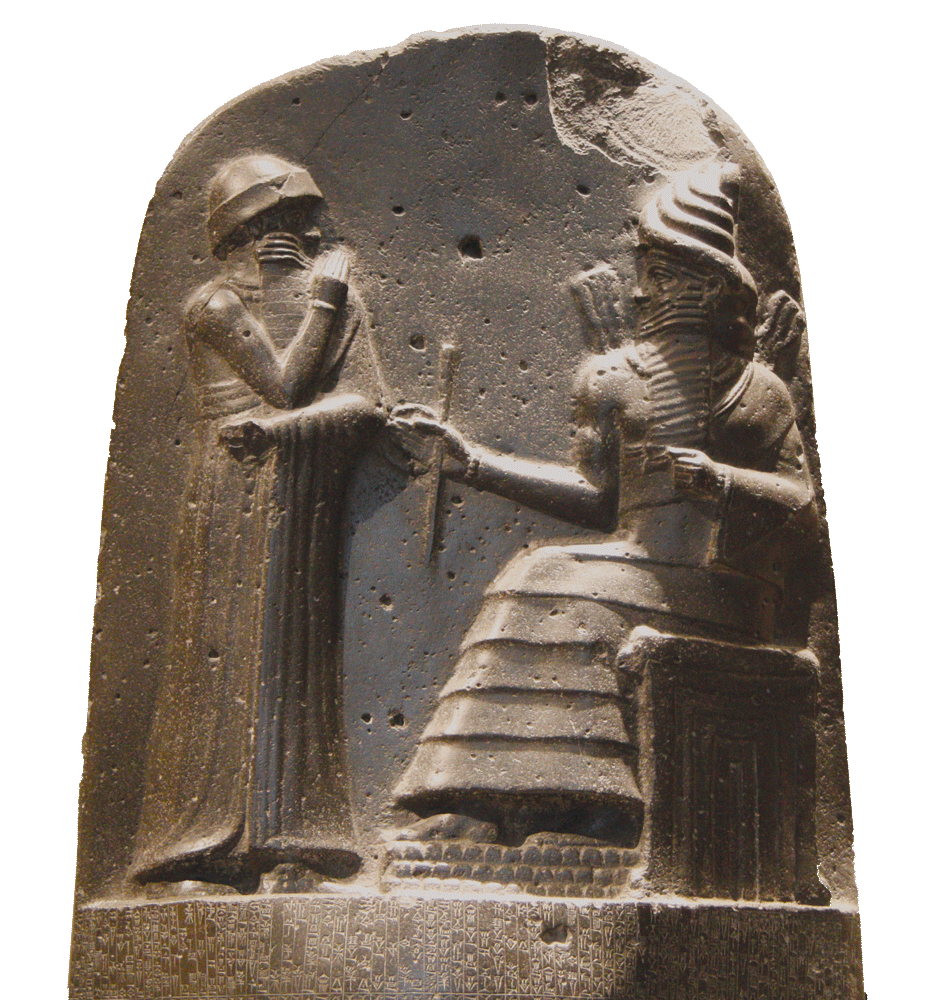
The top register of the Hammurabi Stele (eighteenth century BC) shows Hammurabi commissioned by the god Shamash to administer justice.
Prophet versus king. A second kingship-related thread in the stories of Samuel and Saul and David, Gad, and Nathan is the prophetic challenge to monarchic decisions. The common view throughout the ancient Near East was that the king served as the deity’s vice-regent, thus assuming a close alliance between the king and the deity. This alliance is described in this book (2 Sam. 7:14) and elsewhere (Ps. 2:7; 89:27–28) using adoption and the father-son relationship as metaphors. The relationship between prophet and king that is unfolded in Samuel, however, undercuts that view: for the historian, the prophet stood between the Israelite king and the Lord, so that a prophet like Samuel could even replace a sitting king by anointing a new one. This superiority of the prophet is strikingly portrayed in a story about David escaping one of Saul’s attempts to kill him (1 Sam. 19:18–24). This bizarre episode draws on the fact that one of the characteristic behaviors marking prophets was that they fell into ecstatic states. In this story not only do all of Saul’s messengers begin to prophesy, but even Saul himself falls into a prophetic frenzy when they approach Samuel’s encampment. The prophetic aura functions almost like a force field to keep Saul and his servants at bay, thus demonstrating the true power of prophet versus king.
As much as 1–2 Samuel is a history of the rise of the Israelite monarchy, it is a history of the dominance of prophets over kings. It expresses prophetic misgivings about kings and their tendencies—above all, their tendency to ignore the word of God through the prophet in preference for the desires of the people. And at each step it shows the prophet Samuel and, to a lesser extent, his prophetic successors, Nathan and Gad, in charge of the flow of events, anointing kings, limiting their powers, and dismissing them from office when they refuse to yield to the divine word announced by the prophet.
The historian’s shaping of the key episodes, from the choice of Saul to both Nathan’s and Gad’s rebukes of David, reflects his deep preference for the priority of prophets over the institution of the king. It is a theologically driven preference for the less institutionalized office of the judge and the highly charismatic office of the prophet that seems to lie behind the negative evaluation of kings that permeates this narrative of the rise of the monarchy. The role of the prophet was considered superior to that of kings, based on the pattern of Moses as the prophet par excellence in Deuteronomy 18.
Who shall rule? Finally, a question that becomes agonizing is that of succession. David is anointed in 1 Samuel 16 but is not installed as king of Judah in Hebron until 2 Samuel 2 and, finally, as king of all Israel in Jerusalem until 2 Samuel 5. It thus takes twenty-one chapters to answer if and how David will actually succeed Saul.
After David becomes king, God promises that David’s family will remain the royal family forever and his descendants will follow him on the throne. This promise later figures into the development of an expectation for an “anointed one” (Messiah) from the line of David to deliver the Jewish people from the oppression of foreign rule. Yet the promise does not ensure a smooth transition of power, and David himself witnesses struggles over who will succeed him. He endures an outright rebellion by one son, Absalom (2 Samuel 13–20), and, if we look ahead to 1 Kings 1–2, wrangling between two more sons, Adonijah and Solomon, which ends fatally for Adonijah. Typologically, there are parallels between Moses and David in that Moses also faced rebellion, had his authority challenged (even by his brother and sister), and faced the issue of succession. Similarly, David’s story, including its continuation into Kings, mirrors some elements of the patriarchal narratives in Genesis. For Genesis, an ongoing issue is who will carry on the promise made to Abraham and whether the successor is or will become worthy; this topos finds expression in Samuel-Kings and the historian’s evaluation of each king against the model of David, who, like Abraham, is an imperfect first recipient of his respective promise.
Title and Authorship
The book is named 1–2 Samuel not primarily on the basis of authorship but on the centrality of the figure of Samuel in the first half of the work: his birth is narrated in the first chapter and his death is reported in 1 Samuel 25:1. Even so, it appears that early interpreters took the association to indicate authorship—at least for the first half of the work, up to Samuel’s death—since the Babylonian Talmud asserts that “Samuel wrote ‘his’ book, Judges, and Ruth” (Baba Batra 14b). There are tantalizing hints that Samuel (or perhaps his followers) left a set of traditions. In 1 Chronicles 29:29 there is an interesting reference to “the words of Samuel the seer, the words of Nathan the prophet, and the words of Gad the seer” (author’s translation). Like Samuel, Nathan and Gad were prophets who were closely associated with David. Gad accompanied David during his years as a fugitive from Saul (1 Sam. 22:5), and Nathan was the one who ministered to David throughout his reign (2 Sam. 7:2; 12:1). Thus it is possible that the traditions mentioned by the writer of 1–2 Chronicles overlap with or perhaps lie behind 1–2 Samuel, much like the Book of Jashar that is mentioned as a source in 2 Samuel 1:18. Perhaps the historian who finalized 1–2 Samuel made use of several earlier sources, although it must be stressed both that most such theories are all but impossible to prove and that it matters little for the interpretation of the final form, the received biblical book.
Structure and Composition
Structurally, the book can be divided into four sections based on thematic emphases: 1 Samuel 1–15 (Samuel and Saul), 1 Samuel 16–2 Samuel 8 (the rise of David), 2 Samuel 9–20 (David’s reign), and 2 Samuel 21–24 (epilogue). The first section describes the transition from the period of the judges to the monarchy and includes a number of stories about the ark of the covenant. In the second section, we are told about David’s rise to the throne and how his dynasty is established. The third section is sometimes called the “Succession Narrative” or “court history” of David. Linked with 1 Kings 1–2, these chapters trace the rivalry among David’s sons as they vie for the right to succeed him as king. That these perceived thematic sections align with the historian’s intended flow is affirmed by four summaries that act as transitional markers: 1 Samuel 7:15–17, for Samuel as a judge; 1 Samuel 14:47–52, for Saul’s reign; 2 Samuel 8:15–18, for David’s reign; and 2 Samuel 20:23–26, listing David’s officials.
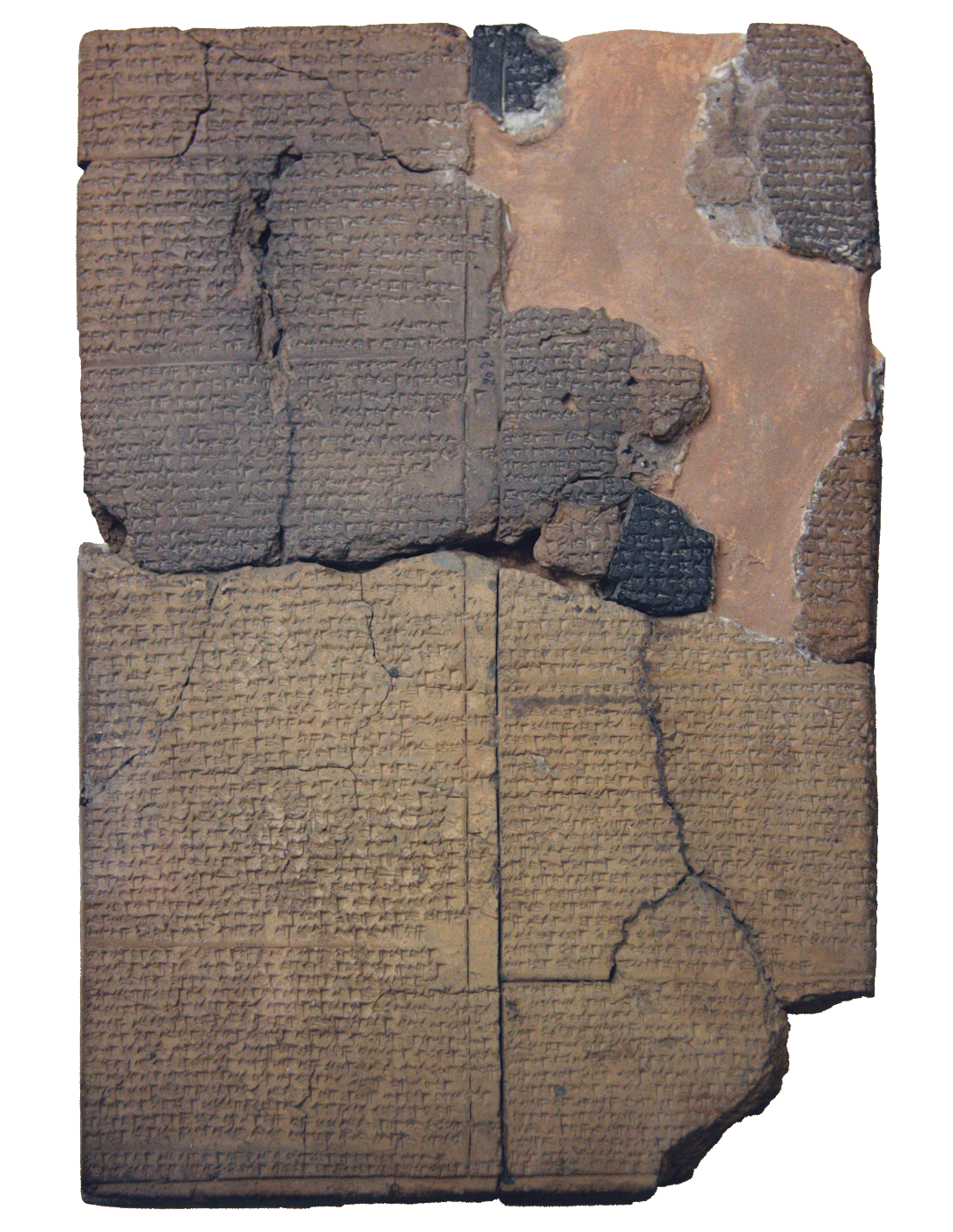
The Apology of Hattusilis. Tablet from Boğazköy (ancient Hattusas), thirteenth century BC, Hittite Empire.
Though it may be useful to read the book in the four parts mentioned above, the unity of the work as a whole should not be overlooked. One example of the intentionality of the final structure is the use of poems to mark the beginning (Hannah’s song in 1 Samuel 2), the middle (David’s elegy for Saul and Jonathan in 2 Sam. 1:19–27), and the end (David’s song in 2 Samuel 22 and David’s last words in 2 Samuel 23).
Research into the composition of the three thematic sections suggests that one or all may have existed as separate works in some form before being combined and edited into the larger narrative. For instance, considerable attention has been focused on the literary and rhetorical similarities between 1 Samuel 16–2 Samuel 8 and an ancient Hittite text called the Apology of Hattusilis. Like David, Hattusilis I (1275–1250 BC) took over the throne under unusual circumstances and was accused of being a usurper. But even if the interpretation of this middle section as a dynastic defense, an “apology,” is accurate and helpful for interpretation, it is not clear if the writer of 1–2 Samuel used the apology as a source; that is, it is difficult to discern whether it ever functioned independently of the other chapters or if it was created in its current form during the composition of the book as a whole.
The events described in these books cover a period of approximately one hundred and thirty years, from the birth of Samuel around 1100 BC to the end of David’s reign in circa 970 BC. David reigned seven years over Judah and thirty-three years over all Israel (2 Sam. 5:4–5) from circa 1010 to 970 BC, but the length of Saul’s reign is unclear. Apparently the text of 1 Samuel 13:1 became damaged or was miscopied by scribes, because both Saul’s age when he became king and the length of his reign are uncertain. Similarly, the length of Samuel’s tenure as a prophet and judge can be only approximated, although from 1 Samuel 8:1, 5 we learn that Samuel is an old man when the people ask him to select a king for them.
In all likelihood, the material in 1 Samuel is arranged in chronological order, but this is not always the case in 2 Samuel. For example, the establishment of the Davidic covenant (2 Samuel 7) may have occurred after the military victories described in 2 Samuel 8, because 7:1 says that “the Lord had given him rest from all his enemies.” Likewise, the victories over the Ammonites and Arameans discussed in 2 Samuel 10 may be either an elaboration of the battles described in 2 Samuel 8:3–12 or a completely different set of earlier engagements. Perhaps the lack of chronological order may be partly explained by the theory that 2 Samuel 7 and 8 conclude the “apology of David.”
The final four chapters of 2 Samuel are regarded as an epilogue, partly because of their uncertain chronology. The account of the Gibeonites’ revenge against the family of Saul is given in chapter 21, but it probably preceded the revolt of Absalom (chaps. 15–18). In 16:7–8 a descendant of Saul named Shimei curses David for shedding the blood of the family of Saul, and this may very well be a reference to the executions David permits in chapter 21. At the end of chapter 21 the author describes four battles against the Philistines, which are not likely in chronological order. The chronological issues notwithstanding, the epilogue serves as a transition between Samuel and Kings: the final episode describes David’s purchase of the location that will eventually become home to Solomon’s temple.
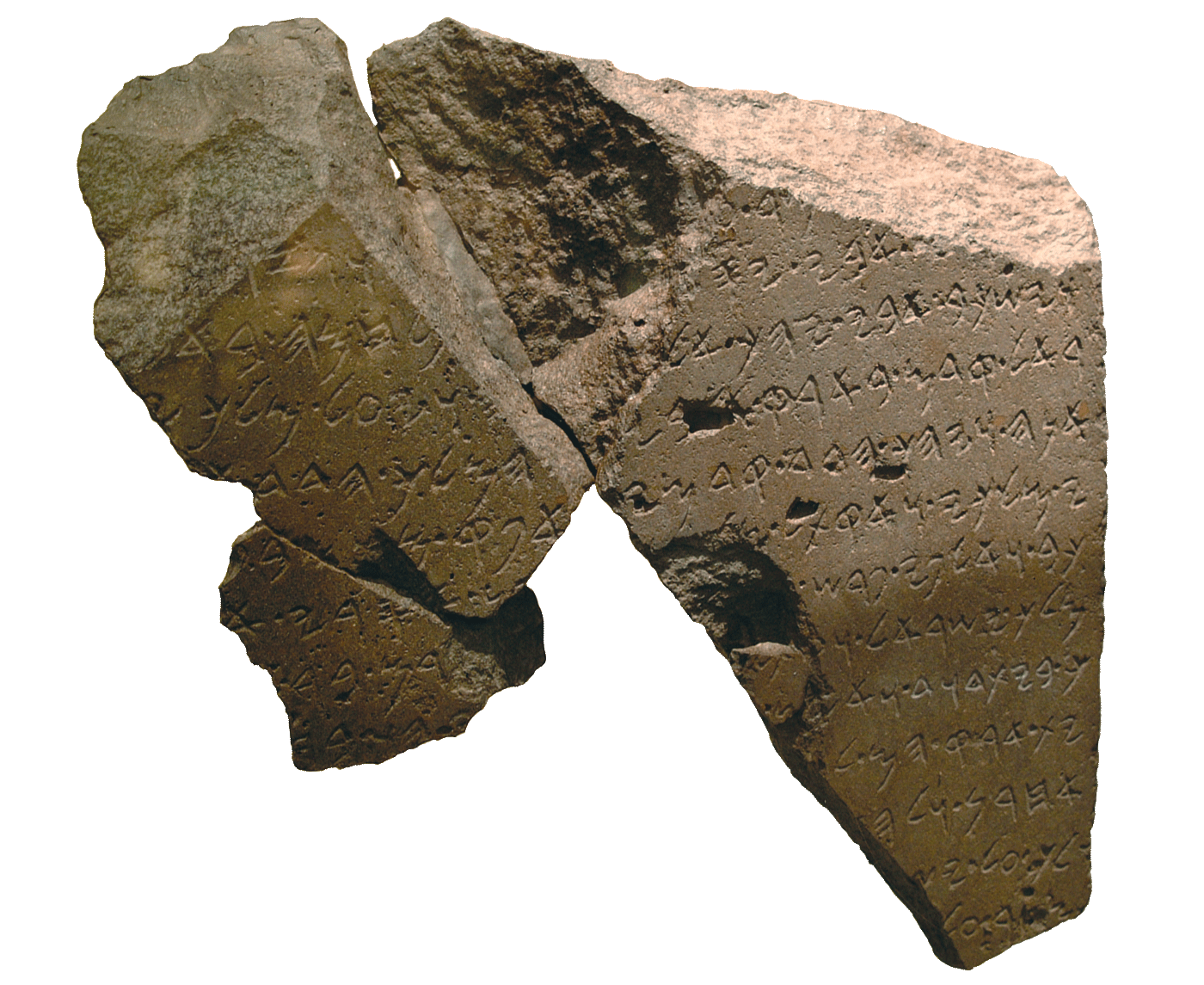
A portion of the Tel Dan Stele (ninth century BC) including the earliest reference to the house of David outside of the Bible.
Date
As with the issue of literary sources or traditions, so too the date of the book remains greatly disputed. Some scholars continue to treat the materials in 1–2 Samuel as a sort of running history contemporaneous with the events described; that is, the narratives were composed during or soon after Samuel, Saul, and David lived. In this view, even if a later editor combined earlier materials, the earlier sources were left largely intact. Although the lives of the figures themselves (since we assume that they did indeed exist) provide the logical terminus a quo, references like “Israel and Judah” (1 Sam. 11:8; 17:52; 18:16) and “the kings of Judah” (27:6) suggest that a more likely earliest date lies after the division of Solomon’s kingdom into north and south had taken place, perhaps in the late tenth century BC. The opposition faced by Solomon and his son and successor, Rehoboam, would have furnished a likely occasion for a vigorous defense of David’s dynasty such as we have in 1–2 Samuel and 1 Kings.
But the historicity of the figures in the book and the date of the book’s writing are not necessarily connected. While recent archaeological finds (such as the Tel Dan Stele, which likely mentions the “house [i.e., dynasty] of David”) suggest that more of “biblical” Israel existed in the tenth century than a few recent scholars are willing to admit, it is also legitimately possible to push the date quite a bit further away from the tenth century. If 1–2 Samuel is of a piece with 1–2 Kings and since the last edition of Kings belonged to the exile (the accession of the Babylonian king Awel-Marduk in 561 BC is mentioned in 2 Kings 25:27), it is only logical that the received form of 1–2 Samuel took shape some four hundred years removed from David. A work that, on the one hand, celebrates King David and provides a future hope for the monarchy by means of God’s promise to David and that, on the other hand, carries a warning about the havoc wreaked by the inevitable sins of monarchs fits the needs and reality of an exilic context.
There are numerous historical, political, and theological contexts that could lie behind 1–2 Samuel and the historian’s purposes. Unfortunately in a work like this there is not necessarily a direct link between the historian—who is unnamed—and the content, as there is in, for example, some of the prophetic books, such as Micah or Haggai. Thus, the explicit connections that we find in some books between the text and the historical context are missing or extremely subtle. While it can be beneficial to investigate how the book might have fit into various contexts, all but the hints in the text itself (see above on the book’s argument) have been lost to us. Thus, strong assertions about setting and purpose should be received with some suspicion. The only hard fact is the text as we have it, and the most significant context is that the book was ultimately intended for inclusion in Scripture.
Commentary
1. A Period of Transition (1 Sam. 1:1–15:35)
After the turbulent days of the judges, the people of Israel looked forward to better times. The economic and spiritual condition of the nation was deplorable, even though the Lord dwelled among his people and had appointed the priests to be their leaders.
A. Eli and Samuel (1:1–7:17). 1:1–2:11. Samuel’s importance can be seen in the lengthy account of his birth. There are no birth narratives for Saul and David, even though they are kings. The story of Samuel’s birth is a testimony to the faith of his mother, Hannah (1:1–8). Like Sarah and Rachel, Hannah has great difficulty becoming pregnant, and barrenness was considered to be a mark of the Lord’s disfavor. To make matters worse, her husband, Elkanah, has another wife who has several children and who taunts Hannah the way Hagar scorned Sarah (Gen. 16:4). Although no reason is given for Hannah’s barrenness, it is likely not the result of some sin, for verses 3–8 tell how she often accompanies her husband to the house of God. The yearly festival referred to in verse 3 might be the Feast of Tabernacles, celebrated at the end of the summer to commemorate God’s provision for Israel in the Sinai desert after the exodus (Lev. 23:43) and to give thanks for the summer harvest.
Though deeply discouraged, Hannah takes her problem to the Lord and to the high priest Eli at the tabernacle, which at that time was located at Shiloh, about twenty miles north of Jerusalem (1:9–18). In great earnestness, Hannah makes a solemn promise that if the Lord will give her a son, she will dedicate him to the Lord’s work. By promising that “no razor will ever be used on his head,” Hannah effectively places her son under the restrictions of a Nazirite vow, which also involved total abstinence from the fruit of the vine (Num. 6:1–3). Long hair was a symbol of an individual’s commitment to the work of the Lord. Through her vow, Hannah voluntarily places Samuel in the same position in which God put Samson, whose mother had also been sterile for years (Judg. 13:3–5). Both Samson and Samuel were to be Nazirites for life, though the vow was normally for a limited period.
Eli watches as Hannah prays, concludes that she is drunk, and admonishes her accordingly. But Hannah is not drunk, simply absorbed in her anguished prayer. To Eli’s credit, once he realizes his mistake, he blesses her. But Eli’s mistaken assessment is an important signal for the audience: it is used by the historian to indicate Eli’s lack of discernment (which is also seen in his inability to deal with his sons) and to comment on the spiritual conditions of Israel in general.
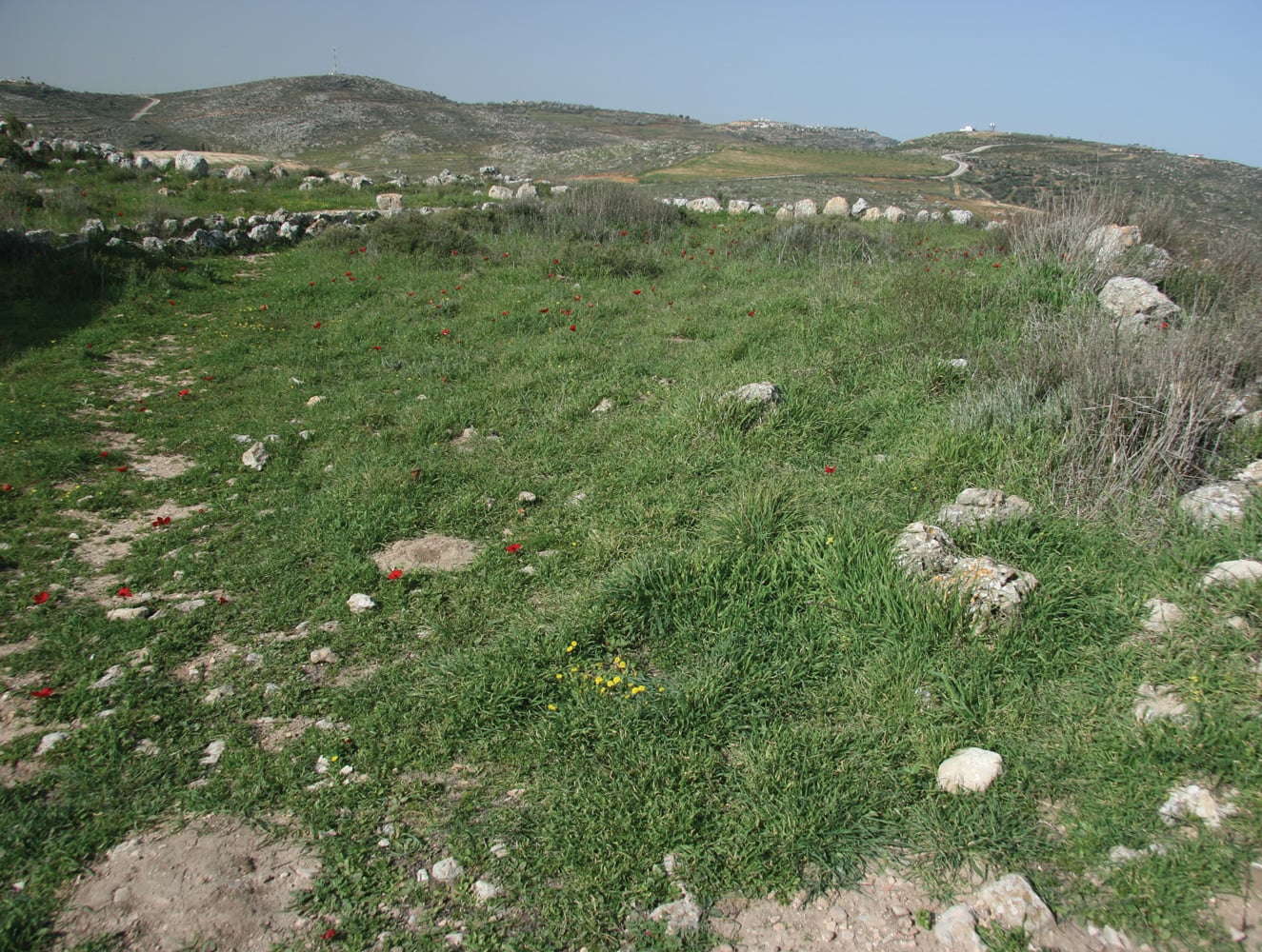
During Hannah’s day, the tabernacle may have stood in this area of the ancient site of Shiloh.
Upon Hannah’s return home to Ramah (about five miles north of Jerusalem), “the Lord remembered her,” as he had remembered the barren Rachel centuries earlier (1:19–20; Gen. 30:22). In due time Hannah gives birth to a son and names him Samuel. There is a wordplay in the Hebrew text that is missed in English but which the historian used to foreshadow the prophet-versus-king theme mentioned in the introduction. When Samuel is born, Hannah names him so because she requested him from the Lord (1:20). Even though the explanation suggests as much, the name Samuel does not sound like the Hebrew word for “requested” or “asked,” which is a theme word in the section (see also 1:27–28). Instead, the name Saul means “requested,” and Samuel perhaps means “his name is El” (although the name’s precise meaning remains obscure). However, the name Samuel also sounds similar to the phrase “God had heard,” so there might be a subtle wordplay intended. The name itself might connect the son to God’s merciful answer to Hannah’s request. The explanation for the name that the historian gives in the text subtly contrasts Samuel with Saul and thus foreshadows God’s (and the historian’s) opinion that a good prophet is always better than a monarch.
After the birth of Samuel, Elkanah returns to Shiloh to offer the annual sacrifice in fulfillment of a vow he has made. Hannah does not accompany her husband, but nurses Samuel until he is weaned, probably at three years of age. True to her promise, she then brings him to the tabernacle and turns him over to Eli (1:21–28). On this occasion she also sacrifices a bull in fulfillment of her vow (Num. 15:8–10) and reminds Eli that she has prayed for a child in his hearing. Here the emphasis is not on the Nazirite vow (1:11) but on the surrender of the child for a “whole life” of service.
While still at the sanctuary, Hannah again prays to God, this time lifting her heart in praise of his goodness (2:1–11). She rejoices not so much in her son, Samuel, but in the Lord who has given him to her: he is the “Rock,” the all-powerful God who provides security for his people. Hannah testifies that God humbles the proud and the rich and exalts the weak and the poor (2:3–9). Mary will later mention these reversals in her song of praise (Luke 1:51–53), and for both Hannah and Mary it is the birth of a son that brings such great blessing. The final couplet of Hannah’s song (2:10) is used to foreshadow Samuel’s role in establishing a monarchy for the Israelites.
2:12–36. One of the saddest episodes of this part of the story is the disintegration of the family of Eli. The weakness and gloom of Eli contrast sharply with the faith and joy of Hannah. If the sons of the priests are “scoundrels,” the condition of the nation is desperate indeed. Ironically, Eli’s sons sin in the way they handle the sacrifices—the very animals brought to make atonement for sin! According to the law of Moses the priests were allowed to eat part of the meat of the sacrificial animals (except for the burnt offerings), but certain restrictions applied (Lev. 7:31–37). The fat was always considered the Lord’s portion and had to be burned on the altar (Lev. 3:16). Yet Hophni and Phinehas take the meat before the fat is burned and apparently ignore the custom of boiling the meat (2:15). In spite of the complaints of the people, the priests refuse to change and treat “the Lord’s offering with contempt” (2:17). Such an attitude brought death to two of Aaron’s sons several centuries earlier (Lev. 10:1–3).
In sharp contrast to the sin of Eli’s sons are the Lord’s blessings on Samuel and his family (2:18–21). Once a year Samuel’s parents visit him, and his mother brings a robe that she has made. Apparently he wore this under the linen ephod, an apronlike garment worn by all the priests (1 Sam. 22:18). On one of the early visits, Eli blesses Elkanah and Hannah with the promise of additional children (2:20). Over the years three sons and two daughters are born to Hannah (2:21).
Faced by the mounting reports about the wicked deeds of his sons, Eli directly confronts them (2:22–25). Among other things, they are guilty of sexual immorality with women who serve at the entrance to the tabernacle. Such women are mentioned only in Exodus 38:8, but the exact nature of their function is not given. It is possible, though unlikely, that they were temple prostitutes like those present in Canaanite shrines to promote the overall fertility of the land (Num. 25:1–3), even though this practice was forbidden in Deuteronomy 23:18. Oblivious to their father’s belated warnings, Eli’s sons continue in their sinful ways. And for the second time in the chapter, Samuel’s behavior is directly compared with that of Eli’s sons (2:26): in contrast to Hophni and Phinehas, as he grows up Samuel pleases both God and men.
That God will not let Eli’s sons’ behavior go unpunished—nor Eli’s failure to rein them in—is confirmed by a visit from an unnamed prophet (2:27–36). Called “a man of God” (9:6, 10), this prophet makes it clear that part of the blame is Eli’s—he honors his sons more than God by failing to oppose their sinful ways.
In light of the unfaithfulness of Eli’s sons, the prophet announces that disaster will strike Eli’s family, and his descendants will not live out their days peacefully. This prediction is fulfilled when Eli’s sons—Hophni and Phinehas—both die on the same day (1 Sam. 4:11), a grim parallel to the sudden death of Aaron’s sons Nadab and Abihu (Lev. 10:1–3). Instead of having choice parts of meat from the sacrifices, Eli’s descendants will have to beg for “a loaf of bread” (2:36). Honor and prestige will be replaced by disgrace and poverty.
3:1–21. Samuel’s calling is told in 3:1–10. For the third time in the book, we read that Samuel ministers “before the Lord” (3:1). He serves as a kind of apprentice priest, and at this point is probably about twelve years old. The Lord begins to speak to Samuel one night while he is sleeping in his usual place near the tabernacle. Apparently it is close to dawn, because verse 3 mentions that the golden lampstand in the Holy Place is still burning. Every evening olive oil was brought in to keep the lamps burning until morning, when the flame either grew dim or went out (Exod. 27:20–21; 2 Chron. 13:11). The ark of the covenant was in the Most Holy Place, and it was from the ark that God used to speak with Moses (Num. 7:89). In this setting, then, it is altogether fitting for God to call a new Moses to lead his people. At first, Samuel thinks that Eli is calling him, but after Samuel has made three trips to Eli’s bed, the aged priest realizes that God is calling the boy.
Unfortunately for young Samuel, and especially for Eli, the divine message is one of judgment against Eli (3:11–21). Action that makes the ears tingle (3:11) is nothing short of catastrophe, and destruction lies ahead for Eli’s family. Eli has failed to restrain his sons, who treat the Lord with much contempt, even though he did try to warn them (2:22–25). They will never be forgiven for their stubborn rebellion, regardless of the number of sacrifices they handle.
Having observed Eli’s sons in action, Samuel may not have been surprised at the severity of the Lord’s message, but he must have wondered what he should tell Eli. This problem is solved when Eli uses a curse formula (3:17) to insist that Samuel tell him everything. When Samuel complies, Eli accepts God’s sentence and reacts the way Hezekiah does when he learns that his descendants will be exiled to Babylon (Isa. 39:8). In an era when “everyone did as they saw fit” (Judg. 21:25), God takes appropriate measures to judge the wicked. Since Samuel’s account of God’s revelation is the same as the announcement the man of God gave to Eli (2:27–36), Eli has no doubt that God has spoken to Samuel. As time goes by, Samuel’s message is fulfilled, and “all Israel” recognizes that he is a genuine prophet (3:20). Chapter 3 begins with the observation that visions are given only rarely, but it ends with a reference to God’s repeated revelations to Samuel. Here is a young man through whom the Lord will speak to his desperate people.
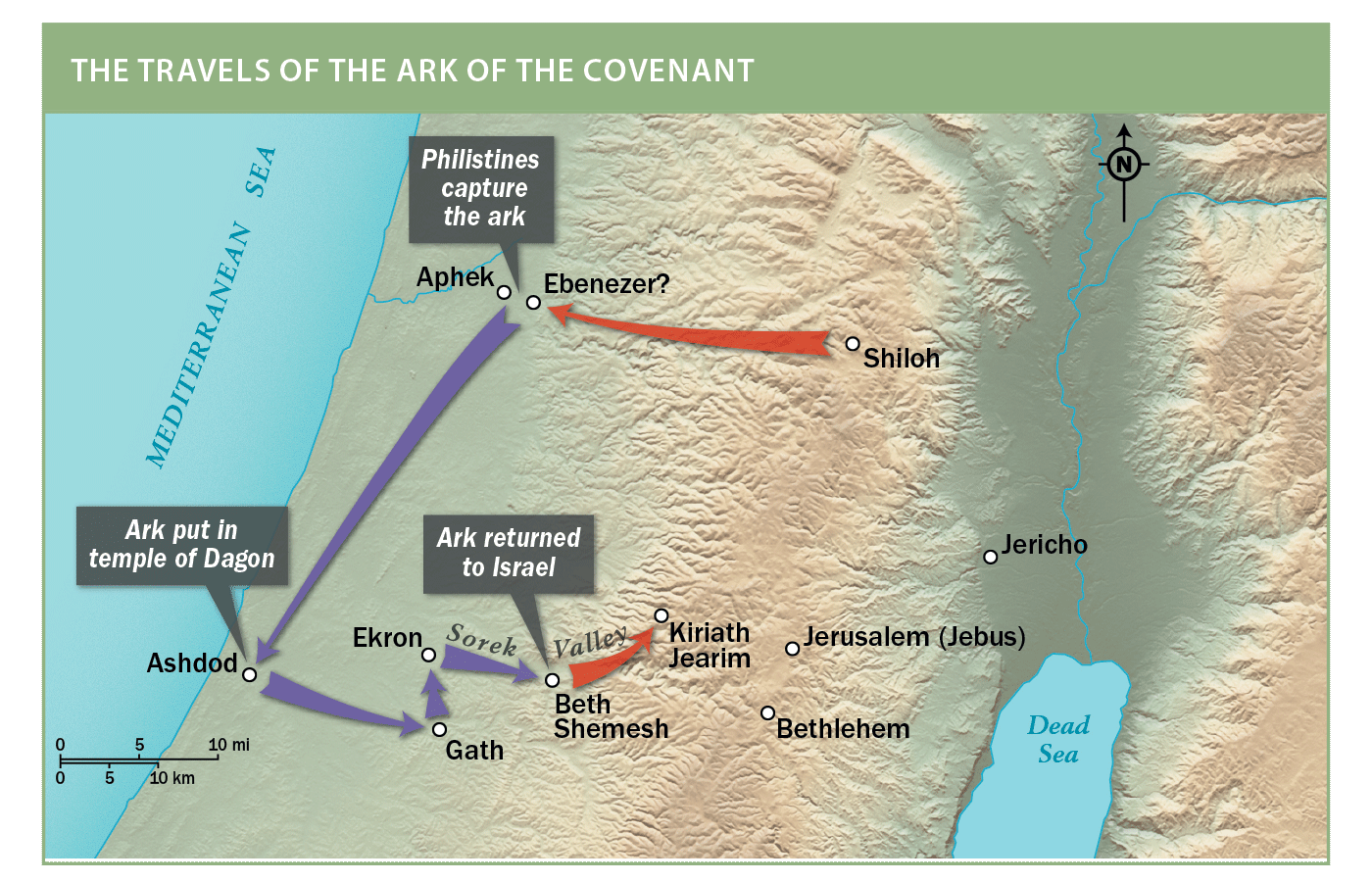
4:1–22. In fulfillment of the prophecies of chapter 3, Eli’s family suffers a devastating blow in the wake of a battle with the Philistines some years later (4:1–11). The conflict takes place near Aphek, a city about twenty miles west of Shiloh and somewhat north of the main Philistine territory along the Mediterranean Sea. According to Judges 13–16, the Philistines controlled the tribe of Judah and were putting pressure on tribal regions to the north. Unlike Samson, Israel’s army cannot gain the victory and in fact loses about four thousand (or four “companies” of) men. (Note that the same Hebrew word for “thousand” may also mean “company [of men]” as well as a “tribal clan.” Interpreters both modern and ancient likely have often misunderstood which meaning was intended in a given passage, because geographically and agriculturally the land of Canaan was simply unable to support the large numbers that are mentioned—or misinterpreted—in the Old Testament.)
Distraught, the rest of the soldiers wonder why the Lord has abandoned Israel, for they—like the surrounding nations—believe that the people with the strongest gods win battles (1 Kings 20:23). The soldiers recall how the ark of the covenant accompanied Israel’s armies when they crossed the Jordan River and defeated the city of Jericho (Josh. 3:11, 17; 6:6, 12). The ark was God’s footstool and symbolized his presence more than any other part of the tabernacle (4:4). Thus, the men reason that the ark will guarantee victory over the Philistines. The Philistines likewise believe that the presence of the ark is a bad omen, for they have heard about the plagues with which the Lord afflicted Egypt (4:8).
In reality the Philistines have little to worry about, for the ark is not a magical talisman; its mere physical presence cannot compel the Lord to give Israel a victory—especially when Eli’s two wicked sons, Hophni and Phinehas, accompany the ark to the battlefield. Their presence dooms Israel, and in the ensuing battle another thirty thousand (or thirty “companies” of) men die, including Eli’s two sons. The ark is captured. It is an unmitigated disaster.
Eli’s family suffers disaster as well (4:12–22). A messenger with “his clothes torn and dust on his head” brings news of Israel’s defeat to Shiloh (4:12). When Eli hears the commotion, he asks what has happened. According to verse 13, Eli had serious misgivings about taking the ark to battle. Old and feeble at age ninety-eight, Eli falls off his chair and breaks his neck when he hears the extent of the catastrophe, especially the news about the capture of the ark. This is worse than the report that his own two sons have been killed. Following the style of the book of Judges, the author notes that Eli “had led Israel forty years” (4:18), and his leadership had proved ineffective.
Death continues to stalk Eli’s family: his daughter-in-law dies in childbirth after learning what has happened to her husband and father-in-law. Before succumbing, she names her baby boy Ichabod, meaning “where is glory,” because of the capture of the ark. It is as though the cloud of glory that normally fills the Most Holy Place around the ark has left Israel. Since the Lord was “enthroned between the cherubim” above the ark (4:4), the loss of the ark symbolizes graphically his abandonment of Israel. He has refused to be manipulated by his own people.
5:1–7:1. After their triumph over Israel, the Philistines intend to celebrate their good fortune, but the Lord has other plans. After its capture, the ark is taken to the coastal city of Ashdod, about thirty-five miles west of Jerusalem and one of the five main centers of the Philistines (5:1–12). There they place it in a temple beside the image of Dagon, a god of grain worshiped in many parts of the Fertile Crescent and the Philistines’ leading deity. According to popular theology, Israel’s defeat would have meant that Dagon was more powerful than the Lord, but the ensuing events illustrate for the audience the power of Israel’s deity, the Lord. Twice the image topples to the ground before the ark, and the second time Dagon’s head and hands break off.
Meanwhile, the Lord afflicts the people of Ashdod with tumors of some sort, and the disease follows the ark to Gath, a city several miles to the east. Death comes to many, and the people panic, as do the residents of Ekron, about eleven miles northeast of Ashdod. The spread of the plague confirms the original reaction of the Philistines when the ark was brought into the Israelites’ camp (4:7–8). They have heard how Israel’s God struck the Egyptians with terrible plagues, and now they are experiencing a similar plague firsthand. Instead of having a prized trophy of victory, the Philistines possess an instrument of judgment that demonstrates the power of the Lord and the corresponding weakness of Dagon.
After seven difficult months, the Philistines are ready to send the ark back to Israel (6:1–9). But they want to make sure they do not offend the Lord any further, so they consult with their religious leaders. The leaders urge them to send a gift with the ark to compensate for the way they have dishonored Israel’s deity. This guilt offering consists of “five gold tumors and five gold rats” (6:4), representing the five main cities of the Philistines and reflecting the symptoms and likely medium of the plague (that is, the rats may have carried the disease as a bubonic plague). Through this offering and the return of the ark, the Philistines hope to bring an end to the plague.
To carry the ark, the priests suggest that a new cart be used, one that is “ceremonially clean.” The cart is to be drawn by “two cows that have calved and have never been yoked.” According to Numbers 19:2, in some cases a cow was not to be used in a sacrifice if it had been under a yoke. In relation to the new cart, it was likely a common ritual belief that the most appropriate instrument for dealing with a sacred object was something new—that is, something not used for nonreligious purposes. The two cows not only were usable for sacrificial purposes but may have been used by the Philistines as divination tools. If two cows would not only walk away from home and their unweaned calves but do so pulling a cart, even though they had never been yoked, then it would be clear (and it was!) that the Hebrew God was behind the entire event.
When the Philistines hitch the cows to the cart and send them on their way, the cows head straight up the Sorek Valley to Beth Shemesh, a city of Judah close to the Philistine border. The implication of the cows’ actions would have been obvious to the Philistines: the Israelite God had indeed been against them. Providentially Beth Shemesh was also a city belonging to the priests (cf. Josh. 21:16), who were responsible for the ark of the covenant. The people are harvesting wheat, which usually took place in May or June. When they see the ark they are overjoyed and proceed to sacrifice the cows as a burnt offering. They place the ark on a large rock, which becomes a monument to this event (6:18).
Tragedy strikes, however, when God puts seventy men to death for looking into the ark (6:19). According to the law of Moses, the sacred articles of the tabernacle were to be treated with great reverence. Not even the Levites could look at the holy things without risking death (cf. Num. 4:20). Since the ark was the most sacred object and since it was closely associated with the presence of God, access to it was very restricted. Not even the high priest could look into the ark without endangering his life, a reminder that being in the presence of God required ritual purity.
Distraught at the death of the men, the rest of the townspeople follow the example of the Philistines and look for another city where they can send the ark. Kiriath Jearim, located about fifteen miles northeast of Beth Shemesh, accepts the ark, and a man named Abinadab is given custody of it (7:1). The ark was probably not put back in the tabernacle because of the destruction of Shiloh by the Philistines. Although the tabernacle itself is moved in time, it will not have a more permanent home for many years.
7:2–17. Approximately twenty years elapse before the Israelites gain any lasting relief from Philistine oppression. Finally, Samuel senses that a genuine repentance is under way, so he challenges the people to rid themselves of their “foreign gods,” identified as their “Baals and Ashtoreths” (7:2–6). Throughout the period of the judges, many Israelites worshiped these deities. Baal was the Canaanite god of rain and agriculture and, ironically, was sometimes described as the son of Dagon. The Ashtoreths were female deities such as Astarte (the Babylonian Ishtar), goddess of fertility, love, and war. As in Judges 10:16, the Israelites stop worshiping these gods and return to being loyal to the Lord. Samuel gathers “all Israel” at Mizpah, about seven and a half miles north of Jerusalem, and promises to pray for them. As they fast and confess their sin, they pour out water before the Lord, perhaps symbolic of their earnestness and wholehearted commitment to God.
Believing that the Israelites have gathered at Mizpah for military reasons, the Philistines attack them (7:7–12). In light of their repentant attitude, the people of Israel beg Samuel to pray for them, which he does, as well as sacrificing a burnt offering. True to his covenant promise, the Lord intervenes on behalf of his beleaguered people and thunders against the Philistines. Apparently the Lord sends a storm similar to the ones that routed the Amorites (Josh. 10:11–12) and bogged down the chariots of Sisera (Judg. 5:20–21). Thunder, hail, and heavy rain cause panic among the Philistines and send them fleeing to the west and south. Recognizing that it is the Lord’s victory, Samuel sets up a stone as a monument and calls it Ebenezer, which means “stone of help.”
After this victory, the Israelites gain the upper hand over the Philistines and at least temporarily put an end to Philistine oppression. During this time of peace, Samuel travels to many towns in the tribe of Benjamin, serving as a judge and spiritual leader (7:13–17). Since Samuel ministers as a priest and prophet, he builds an altar to the Lord in his hometown of Ramah.
Here we can identify a literary strategy that the historian has continued from the books of Joshua and Judges: events that may have focused on one or two tribes or concerned a small regional conflict are placed in the context of the entire people and country. In 1–2 Samuel this literary device is used to broaden the scope of Samuel’s reputation and authority. For instance, Samuel’s yearly circuit as a judge is limited to Bethel and Mizpah, in the central hill country down to Gilgal, near Jericho in the Jordan Valley (7:16). Yet, he is said to have gathered “all Israel” at Mizpah (7:5), and the historian asserts that “all Israel from Dan to Beersheba” knows of Samuel’s prophetic abilities (3:20). What this information illustrates is the historian’s interest in making clear that events and people associated within a limited area often have broader implications for the entire nation.
B. The early years of Saul’s reign (8:1–15:35). 8:1–22. Even though Samuel has led the people well as a judge, he will be the last to hold this charismatic office. Under pressure from the people, Samuel anoints Saul as the first king and thereby ushers in a new era of Israel’s history. Saul’s initial years as king are promising, and it appears that the unified nation will be a powerful one.
Unlike most judges, Samuel appoints his sons to succeed him, but, like Eli before him, Samuel proves to be an unsuccessful parent: his sons are dishonest and create serious problems for both Samuel and the nation. Using the misconduct of Samuel’s sons as a pretext, the elders ask Samuel to appoint a king over Israel (8:1–9). They want what they perceive to be the stability and strength of a monarchy, as in the nations around them. By this request the people effectively reject the leadership of Samuel, and more important, the kingship of the Lord. From the standpoint of faith, the people choose to remove themselves one step from trust in God, with a human monarch standing between them and their divine king. Thus the Israelites repeat the mistakes of their past, for their ancestors made a similar choice at Mount Sinai, instructing Moses to listen to God and speak for them while they stood at a distance (Exod. 20:18–21).
To help the people see the implications of their request, Samuel tells them what it will be like to have a king (8:10–22). Using the policies of other ancient Near Eastern kings as a pattern and reflecting a similar caution in Deuteronomy 17:14–20, Samuel warns the Israelites how their sons and daughters will be drafted into the king’s service and how government officials will take control of fields and vineyards. In addition to the tithe required by the law of Moses, the king will demand an additional 10 percent of crops, flocks, and livestock. Samuel asserts that eventually the people will feel like the king’s slaves and will cry out to God for relief, just as they have cried for help during times of foreign oppression.
Ignoring the urgency of Samuel’s arguments, the people remain firm in their desire for a king. Their minds are made up even though Samuel has pointed out the painful consequences of establishing a monarchy. When Samuel takes their decision to the Lord, God tells him to “give them a king” (8:22).
9:1–10:27. The Lord’s choice is a man named Saul, who belongs to a prominent family from the tribe of Benjamin (9:1–13). He is tall—a head taller than anyone else—but he is looking for lost donkeys and not a crown when he encounters Samuel. After searching the tribal areas of Ephraim and Benjamin, Saul is ready to give up the search, but his servant suggests that they consult a highly respected man of God. Fortunately the servant has a small amount of silver to give to the prophet, for payment of some sort was customary (see 1 Kings 14:3). When the two men ask about the prophet, they are told that he is on his way to bless a sacrifice at the local high place. High places were shrines located on hills and contained, among other things, an altar. Later writers will associate high places with the worship of gods other than the Lord. Although both King Hezekiah (2 Kings 18:4) and King Josiah (2 Kings 23:8) are later praised for removing the high places in Judah and centralizing worship at the Jerusalem temple, it is clear that high places continue to be used even after the temple is built, particularly during times that are described as filled with sin and apostasy.
Unknown to Saul, the Lord has told Samuel that he is to anoint a man from Benjamin as king of Israel the very day of their meeting (9:14–10:1). The Hebrew verb mashah, “to anoint,” from which the noun “messiah” (“anointed one”) is derived, is used of a king for the second time in the book in verse 16 (see 1 Sam. 2:10). In Exodus it was priests who were anointed for service (Exod. 29:7; 40:12–15), but from this point on “the anointed one” is usually the king. Anointing indicated that a person had been set apart for a particular task and that the Lord would enable the person to perform the appointed task. The anointing oil was a symbol of the Holy Spirit, who empowers both Saul and David after they are anointed (see 1 Sam. 10:6; 16:13).
Note also the reason that the Lord gives Samuel for anointing a king, the day before Saul shows up: “For I have seen the suffering of my people, because their outcry has come to me” (9:16 NRSV). Similar language is used in connection with God’s call to Moses in Exodus 2:23. The intertextual allusion suggests that the historian viewed the establishment of the monarchy on par with the choice of Israel’s greatest leader.
When Saul meets Samuel, the prophet surprises him by announcing that the lost donkeys have been found and that “all the desire of Israel” is directed to Saul as the new king (9:20). Saul protests that the tribe of Benjamin is not very prominent (although it was neatly situated between the powerful tribes of Judah and Ephraim). During the period of the judges Benjamin was nearly wiped out in a civil war that seemed to end its influence permanently (Judg. 20:46–48). Like Gideon before him (Judg. 6:15), Saul protests that his clan is too small and insignificant to be considered for such an honor. But Samuel insists that Saul join the invited guests at the high place for a meal after the sacrifice, and Samuel reserves for Saul a choice part of the animal, the thigh. Normally the right thigh of fellowship offerings belonged to the priests (see Lev. 7:33–34), so the people realize that Saul is in line for special honor.
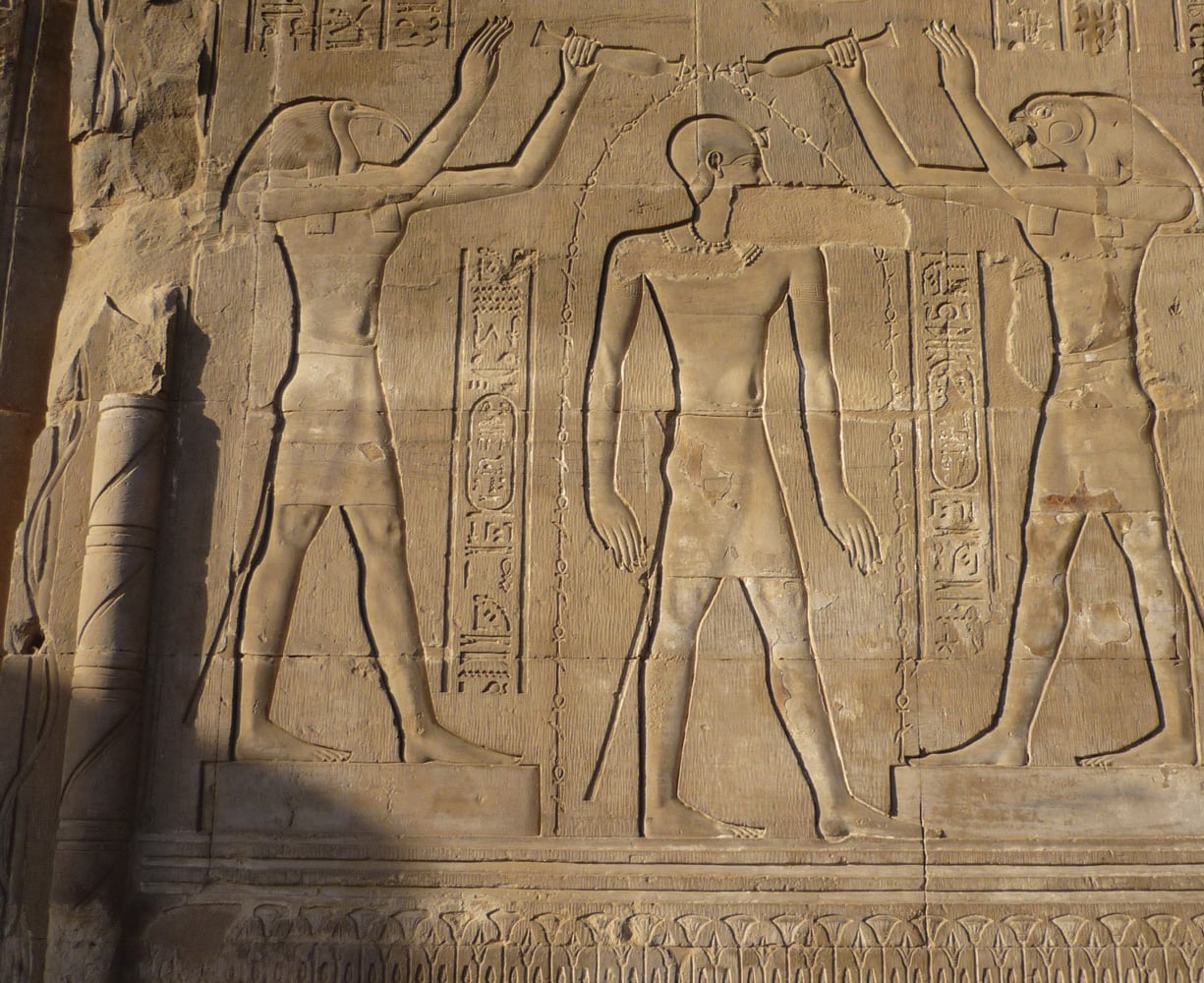
Anointing of kings occurred in Egypt as well as in Israel (1 Sam. 10:1). In this coronation scene from Kom Ombo, the pharaoh is anointed by the gods as life is poured from the jars.
Saul stays with Samuel that night, during which he likely receives instruction about his coming responsibilities and the challenges he will face. The next morning Saul and his servant prepare to leave, but Samuel sends the servant ahead while he gives Saul “a message from God” privately (9:27). Then, taking a flask of olive oil, Samuel pours it on Saul’s head and anoints him king. So begins Samuel’s key role as a king maker, and Israel’s monarchy is launched. A new era has begun.
Before Saul leaves, Samuel gives him some signs as further proof that God has indeed chosen him to be king (10:2–8). Samuel predicts the location at which Saul will meet various individuals and what they will do, demonstrating again that he is a legitimate prophet of the Lord (see Deut. 18:21–22). The third sign is the most significant, for it deals with Saul’s empowering by the Spirit of God. A group of prophets will approach Saul playing musical instruments. While the band of prophets is prophesying, Saul will join with them and the Spirit of the Lord will come upon him in power, just as it came upon Othniel (Judg. 3:10), Gideon (Judg. 6:34), and Jephthah (Judg. 11:29). Each of these judges was designated as God’s chosen leader in this fashion, and the same is true for both Saul and David.
When God gives an individual an assignment, he also supplies divine power to perform that assignment. In Saul’s case Samuel indicates that he will be “changed into a different person” (10:6), which likely refers to the ecstatic state or prophetic frenzy that will overcome Saul in the encounter with the Spirit of the Lord. The event might reflect the historian’s pro-prophet stance by asserting that some prophetic ability is necessary for a monarch to be acceptable. Whatever the precise significance, Saul recognizes that God is with him to bless and strengthen him.
Even though Saul will have the authority of a king, verse 8 is a reminder that he also needs to obey the word of God. At a forthcoming gathering at Gilgal—the sacred town near the Jordan River—Saul is instructed to wait a full week for Samuel to advise him.
The rapid fulfillment of signs leaves little doubt that God has spoken through Samuel (10:9–16). Saul’s participation in prophesying startles his friends, and they ask, “Is Saul also among the prophets?” (10:11). By this time the curiosity of Saul’s uncle has been aroused, but when he questions Saul about his visit with Samuel, Saul says nothing about the anointing. As rumors about Saul begin to multiply, Samuel summons the people to reveal God’s choice of king (10:17–27). Before proceeding with the selection, however, he scolds the people for rejecting the Lord and reminds them that God has rescued them from Egypt and saved them out of all their calamities. Even with a king, Israel has to remember that it is God who is the source of their strength and salvation.
The selection of the king was probably accomplished through casting lots in conjunction with the Urim and Thummim handled by the priest (see Exod. 28:30; 1 Sam. 14:41–42). By this means the tribe of Benjamin and the clan of Matri are chosen, and finally Saul himself is singled out. Knowing that he will be selected, Saul has hidden himself among the baggage (10:22); this response foreshadows the type of character flaws and lack of faith that will come out later in his interactions with David. When Saul is finally presented to the people, they shout with enthusiasm, “Long live the king!” (10:24).
At this point, Samuel reminds the people of “the rights and duties of kingship” (10:25), likely the same regulations, built on Deuteronomy 17:14–20, with which he tried to deter them from choosing a monarchy in 1 Samuel 8:10–22. Given Samuel’s prophetic perspective on monarchy, the depositing of this document about kingship “before the Lord” suggests that above all the people and the monarch must remember who is the true king of Israel.
When Saul returns to his hometown of Gibeah he enjoys the support of many valiant men. The tribe of Benjamin was renowned for its excellent warriors, and now one of their number is king of the whole land. Some of the people are dubious about Saul’s abilities, however, and openly withhold their support.
11:1–15. Before long Saul has a chance to prove himself, when the Ammonites besiege the city of Jabesh Gilead, a town just east of the Jordan River, about forty miles northeast of the area of Benjamin (11:1–5). The Ammonites also lived in the Transjordan and had captured a large section of Israel’s territory before Jephthah drove them out (Judg. 11:29–33).
Note that the great Samuel scroll from the Dead Sea Scrolls found at Qumran (4QSama) provides a transition between the end of chapter 10 and the beginning of chapter 11, a transition that most scholars take to be the original text that was lost by scribal errors. Before this scroll was discovered, the received text of this episode had long been puzzling. What are the reasons for the Ammonites’ sudden aggression against Jabesh Gilead? Why would Nahash, the Ammonite king, demand mutilation as the terms for surrender? Such mutilation was only appropriate for rebels or escaped prisoners of war, not for the subjects of newly conquered cities outside one’s domain. The text of 4QSama provides the necessary material to make sense of the rather abrupt beginning of 1 Samuel 11. Some Bible versions have added this material to the text of 1 Samuel (e.g., NRSV, The Message); the NIV includes it in a footnote at 11:1:
Now Nahash king of the Ammonites oppressed the Gadites and Reubenites severely. He gouged out all their right eyes and struck terror and dread in Israel. Not a man remained among the Israelites beyond the Jordan whose right eye was not gouged out by Nahash king of the Ammonites, except that seven thousand men fled from the Ammonites and entered Jabesh Gilead.
From this lost piece we learn that Nahash has previously reconquered area in the Transjordan that belonged to Ammon before the Israelite tribes or Reuben and Gad laid claim to it. In order to preclude recrimination, he mutilates the men so that they will not be able to effectively lead future campaigns against him. During the fighting, seven thousand (or seven “companies” of) Reubenite and Gadite warriors flee north to the Gileadite city Jabesh Gilead. Nahash’s attack on that city is punishment for sheltering the warriors he has defeated, whom he now considers his subjects. His insistence on mutilation reflects the fact that those harboring his enemies deserve the same punishment.
Since the people of Jabesh Gilead have close family ties with the tribe of Benjamin (cf. Judg. 21:12–14) and since Saul has been appointed king over all the tribes, they appeal to Saul for help. Saul hears the news when he comes in from plowing the fields, an indication that his kingly responsibilities are not yet very extensive.
For the second time, “the Spirit of God came powerfully upon him” (cf. 1 Sam. 10:6, 10) as Saul, like the judges before him, goes into action against the enemy (11:6–15). Asserting his authority as king, Saul cuts up two oxen and sends the pieces throughout the land to indicate that death is in store for those who do not respond to the crisis. More than three hundred thousand (or three hundred “companies” of) soldiers gather. Following the strategy used by Abraham and Gideon, Saul surprises the enemy in the middle of the night and thoroughly defeats them. Jabesh Gilead is saved and Saul is a hero.
On the heels of victory the people want to execute those who opposed the selection of Saul as king, but Saul refuses to go along with the idea. This is a day to rejoice, because God has given them a great victory. Samuel suggests that everyone assemble at Gilgal, the town near the Jordan where Joshua and his army celebrated the conquest of Canaan (Josh. 10:43). There they present fellowship offerings to thank the Lord for his goodness to the nation and to confirm Saul as king.
12:1–25. Like Moses and Joshua, Samuel does not relinquish his leadership without challenging the nation to be faithful to the Lord. The theme of covenant renewal that characterizes the whole book of Deuteronomy and Joshua 24 is emphasized once again in Samuel’s farewell.
Since the wickedness of Samuel’s sons was a factor behind the initial request for a king (cf. 8:3–5), Samuel begins his speech with an examination of his own conduct as leader (12:1–5). He challenges the people to point out any instance where he has wronged anyone or used his position for financial gain. By pointing to his own clean record Samuel hopes to provide an example for Saul and future kings.
As Samuel seeks to establish the monarchy on a sound footing, he reminds the Israelites of the way God has provided for them in the past (12:6–15). When they cried for relief in Egypt, the Lord sent Moses and Aaron to deliver them from slavery. When their own sinfulness brought oppression in Canaan, God raised up heroes such as Gideon, Barak, and Jephthah to rescue them from the enemy. God would have saved them from the recent Ammonite attack even if no king had been appointed. Although the Lord used Saul to deliver Jabesh Gilead, the monarchy brings with it a new danger. Will the people put their trust in a human leader at the expense of their faith in the Lord? Samuel warns that both the people and the king must serve and obey the Lord. The covenant structure remains the same, for the Lord demands the unwavering allegiance of all the people.
To impress on the Israelites the evil inherent in their request for a king—and their rejection of God as king—the Lord sends thunder and rain in the dry season (12:16–18). The wheat harvest normally occurred in June, and it rarely rained in Israel during the summer. The people stand in awe as their forefathers did at Mount Sinai, when God revealed his power in thunder and lightning (Exod. 19:16; 20:18). God spoke through Moses, and now he is speaking through Samuel, and the message must be taken seriously.
In 1 Samuel 7:8 the people asked Samuel to pray when the Philistines attacked. Now that God has revealed himself they ask Samuel to pray for them again (12:19–25). Like the generation at Mount Sinai, they are afraid they might die. Samuel assures them that the Lord will not reject them, but he urges them to “serve the Lord with all your heart” (12:20). God has done “great things” for them (12:24), and he will continue to work wonders on their behalf (cf. Ps. 126:2). And Samuel promises to keep praying for them and teaching them how to live. Although he is retiring as the military and judicial leader, he will continue to function as a prophet for the nation and as an advisor for the king.
13:1–22. After the victory over the Ammonites east of the Jordan, Saul turns his attention to the Philistines, Israel’s perennial enemy along the Mediterranean coast. Undoubtedly the Philistines were worried about Israel’s upstart king and likely wanted to attack him before he became too established and powerful.
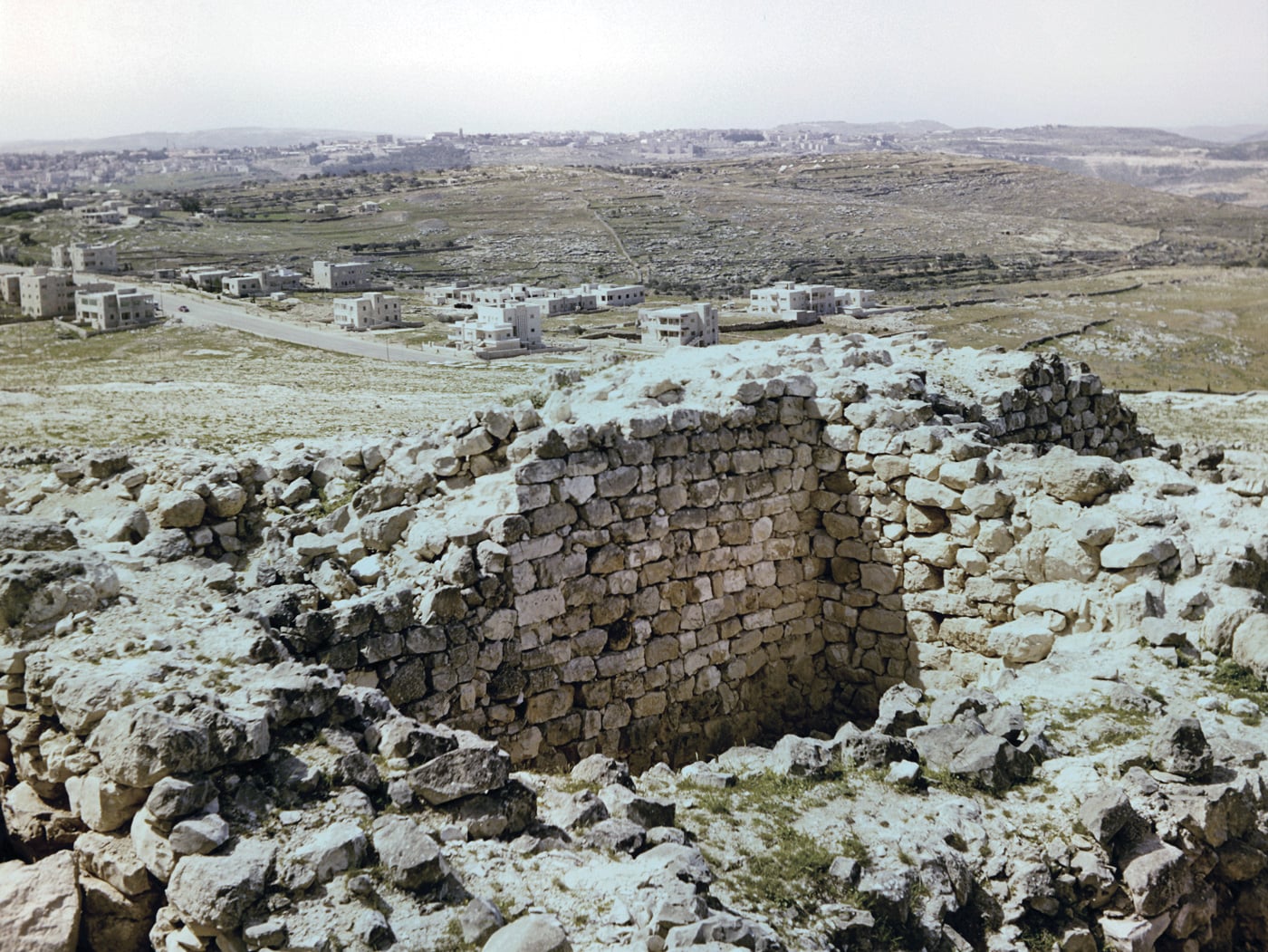
The remains of Saul’s palace at Gibeah
Since the initial conquest under Joshua, the cities that were most solidly under Israel’s control were located in the hill country, an area about two thousand feet above sea level that ran from north to south through much of central Palestine. Saul’s capital of Gibeah was located there, but this did not stop the Philistines. As chapter 13 begins, the Philistines have pushed to within five miles of the capital (13:1–7). Jonathan, Saul’s oldest son, attacks the Philistine outpost at Geba, and thus angers the Philistines. They amass an army supported by three thousand (or three “companies” of) chariots, and the Israelites withdraw to Gilgal, by the Jordan. Some of Saul’s soldiers hide “in caves and thickets, among the rocks, and in pits and cisterns” (13:6).
Saul starts with three thousand (or “companies” of) troops, but while he delays at Gilgal, some of the men grow fearful and begin to “scatter,” leaving Saul with a final tally of six hundred. He is waiting for Samuel to come and offer sacrifices as he has promised to do (cf. 1 Sam. 10:8). After seven days Saul violates Samuel’s command: he offers the sacrifices himself with the hope of gaining God’s blessing on the upcoming battle. When Samuel finally arrives, he condemns Saul’s action and announces that his son will not succeed him on the throne (13:8–15). Instead, God will now choose “a man after his own heart” to rule Israel (13:14; 16:7). This phrase “a man after his own heart” does not, contrary to popular interpretation, refer to the Lord’s particular favor of David or some special quality of David’s; rather, it refers to the Lord’s divine right and freedom to choose a new king. Thus it might be better translated “a man according to his [the Lord’s] choosing.” This new choice is motivated by Saul’s guilt in ignoring the Lord’s command through his prophet. In subsequent years, all of Israel’s kings will be responsible to obey the law of Moses and the instructions of the prophets (cf. Jer. 25:4). If a king is guilty of wrongdoing, often a prophet will appear on the scene to announce God’s judgment.
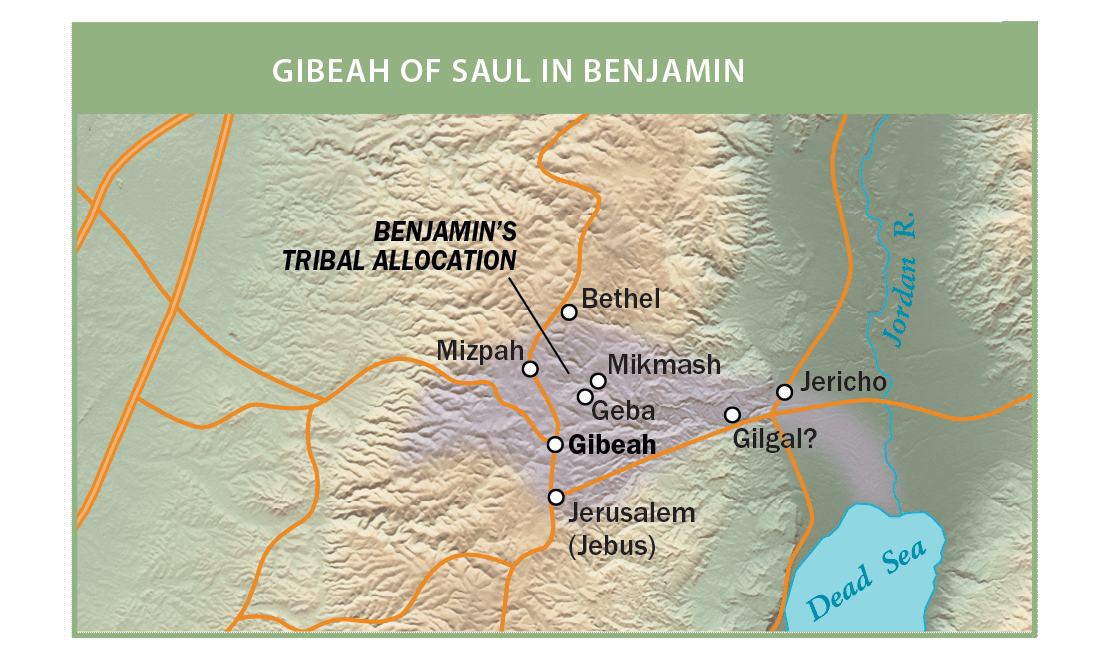
In spite of mounting difficulties, Saul and Jonathan return to Gibeah, only a few miles from the Philistines at Mikmash. The Philistines send out raiding parties to plunder and to demoralize the people, and Saul is unable to stop them (13:16–22). One reason for Israel’s predicament is a lack of weapons. According to verse 19 the Philistines have established a monopoly on the production of iron and have refused to share the secret. They may have learned how to smelt iron from the Hittites of Asia Minor, who used iron to great advantage prior to 1200 BC. The Israelites had to pay the Philistines to have their farming tools sharpened, but in time of war no plowshares were beaten into swords. Only Saul and Jonathan had a sword or spear; the rest of the troops used slingshots, bows and arrows, or even ox-goads. No wonder many of Saul’s men deserted!
13:23–14:52. When all seems lost, Jonathan leads a daring attack on the Philistine position north of the Mikmash pass (14:1–14). At the time Saul is still near Gibeah, trying to take care of national business as he sits under a pomegranate tree. No one else knows that Jonathan and his armor bearer are embarking on a dangerous mission. Jonathan believes that God will intervene on behalf of his people and save them from “those uncircumcised men” (14:6). As Jonathan and his armor bearer make their way across the Mikmash pass, the Philistines spot them and challenge them to come up and fight. This response is a sign to Jonathan “that the Lord has given them into [the hand of Israel]” (14:10). The Philistines mock Saul’s troops for hiding in holes and refer to the Israelites as “Hebrews,” a term sometimes used by foreigners in a disparaging way (cf. Gen. 39:17). This usage might be related to the word’s apparent etymology, from a term meaning “movers,” or it might refer to the Israelites’ origins in the hill country, as in “hillbillies.” Clearly the Philistines expect to make short work of the two men, but convinced that God is with them, Jonathan and his armor bearer fight and kill about twenty men. Their faith has been vindicated.
As confusion grows among the Philistine forces, the Lord sends the whole army into a panic by shaking the ground (14:15–23). The earth tremor frightens the Philistines, and they fight among themselves in all the confusion and flee the battleground. It is the same sort of panic that was behind the victory at Mizpah (1 Sam. 7:7–12) and the defeat of the Midianites under Gideon (Judg. 7:22).
Saul’s lookouts at Gibeah report the commotion to their commander, and Saul immediately consults Ahijah the priest, apparently about using the ark to address the Lord. Before receiving an answer from the Lord, however, Saul takes his men to the battle and finds the Philistines in total confusion. As word about the battle spreads, the soldiers who earlier abandoned Saul rejoin his forces to take part in the chase, just as the ranks of Gideon swelled once the Midianites were on the run (Judg. 7:23). Since Saul has done almost nothing to bring about the defeat of the Philistines, the credit for the victory is not his. It is the Lord who has rescued Israel. The victory leaves Israel with some security in their own heartland and keeps the Philistines at a safe distance for years to come.
As in the case of Jephthah’s victory over the Ammonites, in Judges 11:32–35, the celebration of the Philistines’ defeat ends abruptly because of an ill-advised oath (14:24–30). In an apparent attempt to win the Lord’s favor, Saul has put a curse on anyone who eats any food before the coming evening. The curse demonstrates Saul’s poor judgment, because the weary troops need to be refreshed so they can continue the pursuit of the Philistines. To make matters worse, Jonathan did not hear the curse and eats some honey along the way. He immediately receives some much-needed strength but is upset when someone tells him about his father’s oath.
As a direct result of Saul’s curse the rest of the troops transgress a purity restriction known also from the law of Moses (14:31–35). They are famished after chasing the Philistines into the western foothills, so when they are finally allowed to eat, they butcher animals without properly draining the blood. By eating blood they break the Lord’s command (see Lev. 17:11; Deut. 12:16), because blood was normally to be poured out in sacrifices and was considered sacred. Saul builds his first altar at this time, perhaps to atone for the actions of his men and to express thanks to God for the great victory over the Philistines.
After the soldiers eat and regain some strength, Saul proposes they continue to pursue the Philistines during the night to follow up the victory. The men agree, but when Ahijah inquires of the Lord—presumably through the Urim and Thummim—there is no answer. Saul reasons that someone must have broken his oath and prays that the Lord might identify the guilty party. Using the same Urim and Thummim to cast lots, Saul and the priest discover that Jonathan is the culprit (14:36–46). Even though Jonathan has only “tasted a little honey” (14:43), Saul asserts that he must die. The troops protest Saul’s decision, for they know that Jonathan is the one whom God has used to bring about an amazing victory. Why should he be put to death for being courageous? Whatever their arguments were, which are not specified, the people convince Saul to let Jonathan live, a happy outcome. Even so, the entire event signals that Saul’s judgment and leadership ability is already in decline and suffering from the reversal of God’s blessing (13:10–14). Moreover, the complications caused by Saul’s curse prevent the Israelites from taking full advantage of the disarray of the Philistines. Many of the Philistines make it safely back to their coastal cities and resume their attacks, eventually bringing about the death of Saul and the collapse of Israel (31:1–13).
The first main section of 1–2 Samuel ends with a summary of Saul’s rule as king (14:47–52). Even though Saul continues to rule for a bit longer (until the end of 1 Samuel), chapter 15 marks the transition to David’s rise to the throne.
Along with his victories over the Ammonites and Philistines, Saul enjoyed some success against Moab and Edom to the east and south and against the king of Zobah, a region in the Beqa’a Valley north of Israel. None of these other battles are recorded in Scripture, but chapter 15 does describe the victory over the Amalekites.
Saul’s sons are listed in verse 49, although Ish-Bosheth, who succeeds him as king briefly, is not named (see 2 Sam. 2:8). Saul’s two daughters, Merab and Michal, are also mentioned. Michal will play an important role as David’s first wife. The key military figure is Saul’s cousin, Abner, who commands the army throughout his reign.
15:1–35. As in the last chapter, Saul wins an important victory but makes a serious mistake (15:1–9). This time the enemy is the Amalekites, a Bedouin people that attacked the Israelites after they came out of Egypt (Exod. 17:8–16). In accord with the Lord’s harsh words about Amalek given to Moses, Samuel tells Saul to attack the Amalekites and “totally destroy” all their people and animals (15:3). This technical term for complete destruction was also applied to the Canaanites when Joshua invaded the land. Because of the wickedness of the people, God decreed that everybody and everything should be wiped out (Josh. 6:17–18). No plunder of any kind could be taken.
Saul musters a sizable army and heads south to carry out his mission. Before attacking, he warns the Kenites, a seminomadic community, to move out of the area. Unlike the Amalekites, the Kenites have been friendly to Israel, and Moses in fact married a Kenite woman. Once the Kenites leave, Saul battles the Amalekites, chasing them to the eastern border of Egypt and wiping out all of the people. But he unwisely spares the king, Agag, and “the best of the sheep and cattle” (15:9).
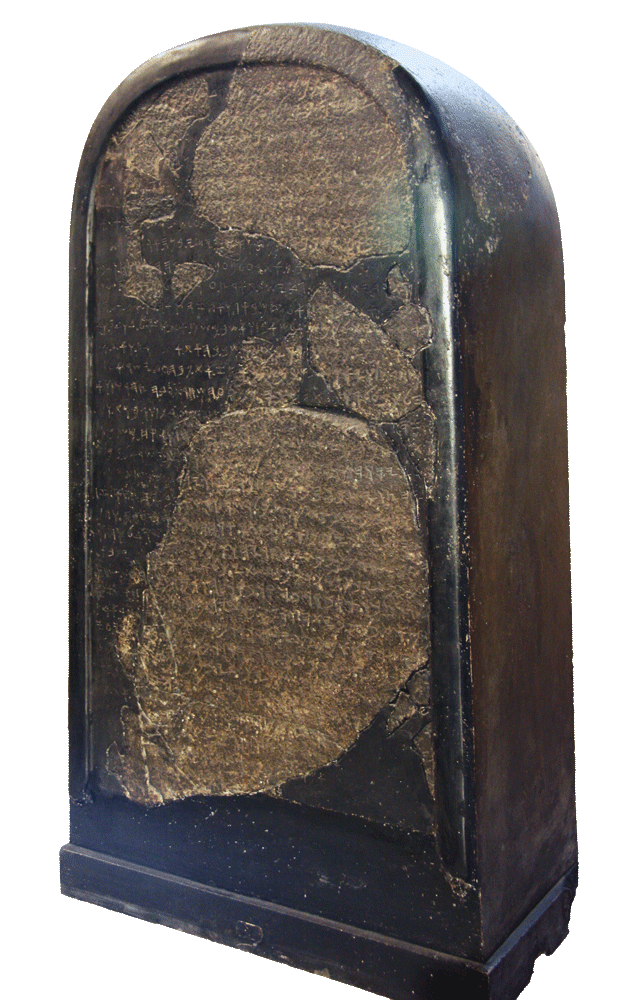
The Mesha Stele (eleventh century BC), shown here, records King Mesha’s total destruction of a city as commanded by his Moabite god, Chemosh; Saul is given a similar order in 1 Samuel 15:3.
Saul’s incomplete obedience creates an immediate crisis for the incipient monarchy because the Lord is grieved that he has made Saul king (15:10–21). Samuel knows that Saul’s future is bleak. Saul’s sin and the sin of his soldiers brings deep sorrow to God, and judgment is sure to follow. As he returns from the victory, Saul sets up a monument in his own honor, revealing an attitude of pride. Then he goes to Gilgal, where he was confirmed as king years earlier (11:14–15) but where he will now lose the kingship.
When Samuel meets him, Saul greets him warmly, but Samuel quickly dispenses with the niceties and instead responds by asking why the sheep and cattle have been spared. Saul tries to shift the blame to the soldiers, claiming that the animals were saved so that they might be sacrificed to the Lord. Even if the army had a spiritual purpose in mind, Samuel asserts that it was wrong to spare the animals. Saul protests vigorously, arguing that he did in fact carry out the assigned mission.
Samuel’s response to Saul gives the classic position about the relationship between sacrifice and obedience (15:22–31). Stated bluntly, “To obey is better than sacrifice” (15:22). Without question, the offering of sacrifices was an integral part of worship in ancient Israel and was valued highly, but it was an empty ritual without the proper motivation and piety. A rebellious and arrogant attitude nullified the effect of any sacrifice. Many of the prophets will wrestle with this issue and assert that a large number of sacrifices will never atone for injustice, oppression, or pride. Genuine repentance and obedience are necessary accompaniments to the presentation of sacrifices. Since Saul has deliberately disobeyed the Lord’s command, the Lord rejects him as king.
Alarmed by the severity of Samuel’s pronouncement, Saul finally admits his sin and begs forgiveness, but Samuel condemns him again and turns to leave. As he does so, Saul, who has taken hold of his robe, accidentally tears it. The action proves symbolic of the fact that the Lord has “torn the kingdom of Israel” from Saul and given it to David (15:28). Lest there be any doubt about the certainty of God’s word, Samuel reminds Saul that God “does not lie or change his mind” (15:29). Ironically, verse 29 is an allusion to Balaam’s words to the king of Moab warning him that God had fully determined to bless Israel (Num. 23:11–12). For Saul, God’s word has become a curse.
Although at first (15:26) Samuel refuses to accompany Saul to the place of worship, he finally agrees to go with him. If he had not gone, the break between the prophet and the king would publicly weaken Saul’s authority and thus that of the monarchy in general. The “honor” of verse 30 is probably the honor of Samuel’s presence at Gilgal, where the sacrifices were offered.
Another reason why Samuel goes to Gilgal is to deal with Agag, king of the Amalekites, whom Saul has spared (15:32–35). Normally victory was not complete until the opposing king was killed, especially if it was a war of “total destruction” (cf. 15:3). Like Joshua, who executed the five Amorite kings (Josh. 10:26), and Gideon, who killed the two kings of Midian (Judg. 8:21), Samuel strikes down Agag. It may seem like a strange role for the aged prophet and priest, but Samuel here is functioning as the “judge” in his military duties. That Samuel has to play the judge, even after the establishment of a monarchy, is yet another sign that Saul is failing.
2. David’s Rise to the Throne (1 Sam. 16:1–2 Sam. 8:18)
As noted in the introduction, these chapters serve as a defense of the dynasty of David, providing a full account of David’s rise to the throne and explaining why someone from the tribe of Judah replaces Saul of Benjamin. One of the key points in this “apology” is that Saul has disqualified himself as king by his actions, paving the way for the accession of David.
A. David’s fame (16:1–17:58). 16:1–23. The Old Testament contains many stories about the young and the obscure and how they become successful, but perhaps none is loved more than the story of David. Born the youngest of eight sons in the town of Bethlehem, David becomes a hero overnight and achieves a level of fame and fortune unmatched in Israelite tradition. As musician, poet, prophet, warrior, diplomat, and statesman, in his versatility and ability David sets the standard for all the monarchs that follow him, from his son and successor Solomon to the kings of the north and south after the monarchy splits. Before David is allowed to develop some of these gifts, however, he first has to survive Saul’s anger and jealousy.
After the series of disasters that marks Saul’s first years (military victories marred by Saul’s lack of faith and judgment), the Lord sends Samuel to Bethlehem, a town six miles south of Jerusalem, to anoint a new king (16:1–13). This was the setting for the story of Ruth and Boaz, and it is one of their great-grandsons that Samuel anoints (Ruth 4:17). Samuel is afraid Saul might kill him, but the Lord shows Samuel how to disguise the purpose of the visit by offering a sacrifice in Bethlehem. When he arrives there, the elders’ reaction—they meet Samuel with some trepidation—perhaps reflects that they either share his concern about a potential negative reaction from Saul or are worried that Samuel has come to reprove them. Whatever their worries, Samuel calms their fears. He has come only to offer a sacrifice. He then invites Jesse and his sons to come to the sacrifice with him.
When they arrive Samuel is impressed by the oldest son, Eliab, a tall and handsome man. But the Lord reminds Samuel that he considers the inner qualities of an individual rather than the outward appearance. None of Jesse’s seven sons present at the sacrifice is the chosen one, so Samuel insists that the youngest son be brought from tending the sheep. When David arrives, he too is handsome and fit, but as the youngest he is the unlikeliest choice; even so, the Lord chooses him to shepherd the people of Israel (cf. 2 Sam. 5:2). On the spot and with his family looking on, Samuel anoints David with oil as the new king-designate. “From that day on the Spirit of the Lord came powerfully upon David,” as it has come upon Saul at the earlier anointing (16:13; cf. 10:6–10). Throughout the rest of his life, David will enjoy the empowering of the Spirit on his work and ministry.
While David is receiving the Spirit of the Lord, it departs from Saul. In fact, the language and juxtaposition of these statements in verses 13–14 suggest that the historian saw these events as simultaneous and related. Not only, though, does Saul lose the divine spirit; the Lord sends an evil spirit to torment him. (We must remember that the Hebrews’ perspective on good and evil was that God created and controlled them both; see Isa. 45:7.) Saul’s jealousy and depression are made worse because of the influence of this evil spirit, and at times it will drive Saul to violence (cf. 1 Sam. 18:10–11). According to verse 23, the evil spirit affects Saul sporadically.
In an attempt to help Saul find relief from the evil spirit, Saul’s attendants suggest that he secure a musician to play soothing music. Ironically, the man they recommend is none other than David (16:14–23). In addition to his ability as a shepherd, David knows how to play the harp, and he has a fine personality. He also enjoys divine favor (16:18). By bringing David to his court, Saul gives his successor valuable training, during which David might have made important personal and political connections. Saul likes David very much and asks Jesse if David might remain in his service. While the court service introduces David to the inner workings of the monarchy, what catapults David into the public eye is his heroic victory over Goliath, an event that also betokens his later successes and eventual domination of the Philistines.
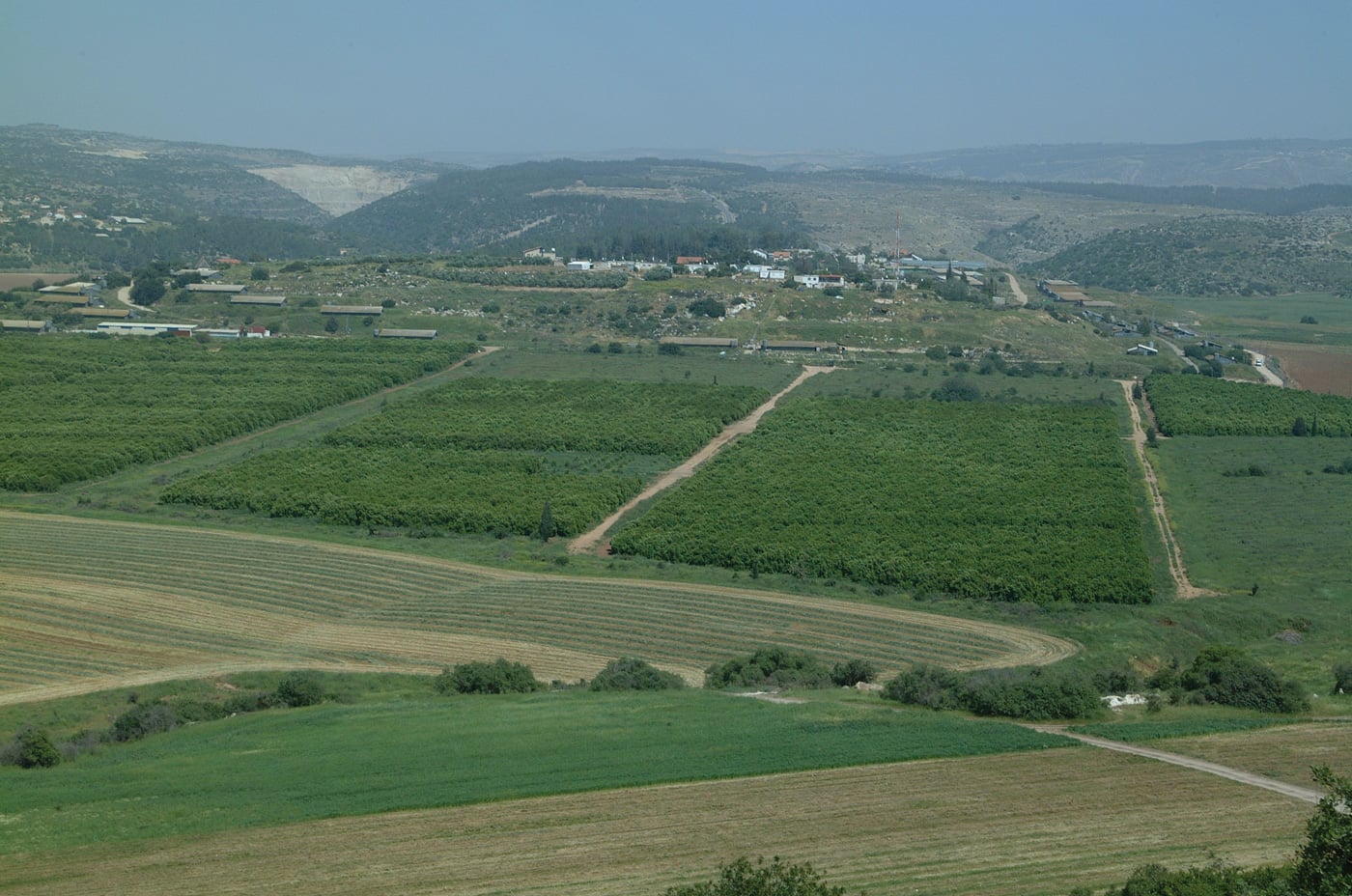
The Valley of Elah, the site of David’s defeat of Goliath (1 Samuel 17)
17:1–58. The setting of young David’s famous first military victory is the Valley of Elah, about fifteen miles west of Bethlehem. The Philistines have amassed their troops there in an apparent attempt to reassert control over the emerging Israelite monarchy. Instead of trying to engage the Israelites in full battle, the Philistines send out a champion fighter named Goliath to challenge the Israelites to send out a soldier of theirs for one-on-one combat. The outcome of the battle will thus hinge on the struggle between the two men. This custom was known also among the Greeks, and Homer’s Iliad contains the famouxtual sources all agree on the weight of his armor, which is more than even most modern soldiers carry in the field.) When Goliath hurls his challenge toward the Israelites, Saul and his men cower in fear. Their defeatist attitude is reminiscent of the fear of the ten spies who saw the “giant” residents of Hebron prior to the conquest (Num. 13:31–33).s example of Achilles’ victory over Hector. Apparently the Hittites of Asia Minor also practiced individual combat to a limited extent. According to 2 Samuel 2:15, a later war between Israel and Judah will be settled by a twelve-man “team” representing each side.
In view of Goliath’s great size and strength, it is easy to see why the Philistines are counting on him. According to the received Hebrew text, he is six cubits and a span tall (i.e., about nine feet, nine inches) and his armor weighs about one hundred and twenty-five pounds. (Other textual traditions, such as the Greek Septuagint, the Dead Sea Scroll text 4QSama, and Josephus give Goliath’s height as four cubits and a span, which would put him at six feet, nine inches tall. This is still significantly taller than the height of the average Iron Age male, which was just over five feet. The te
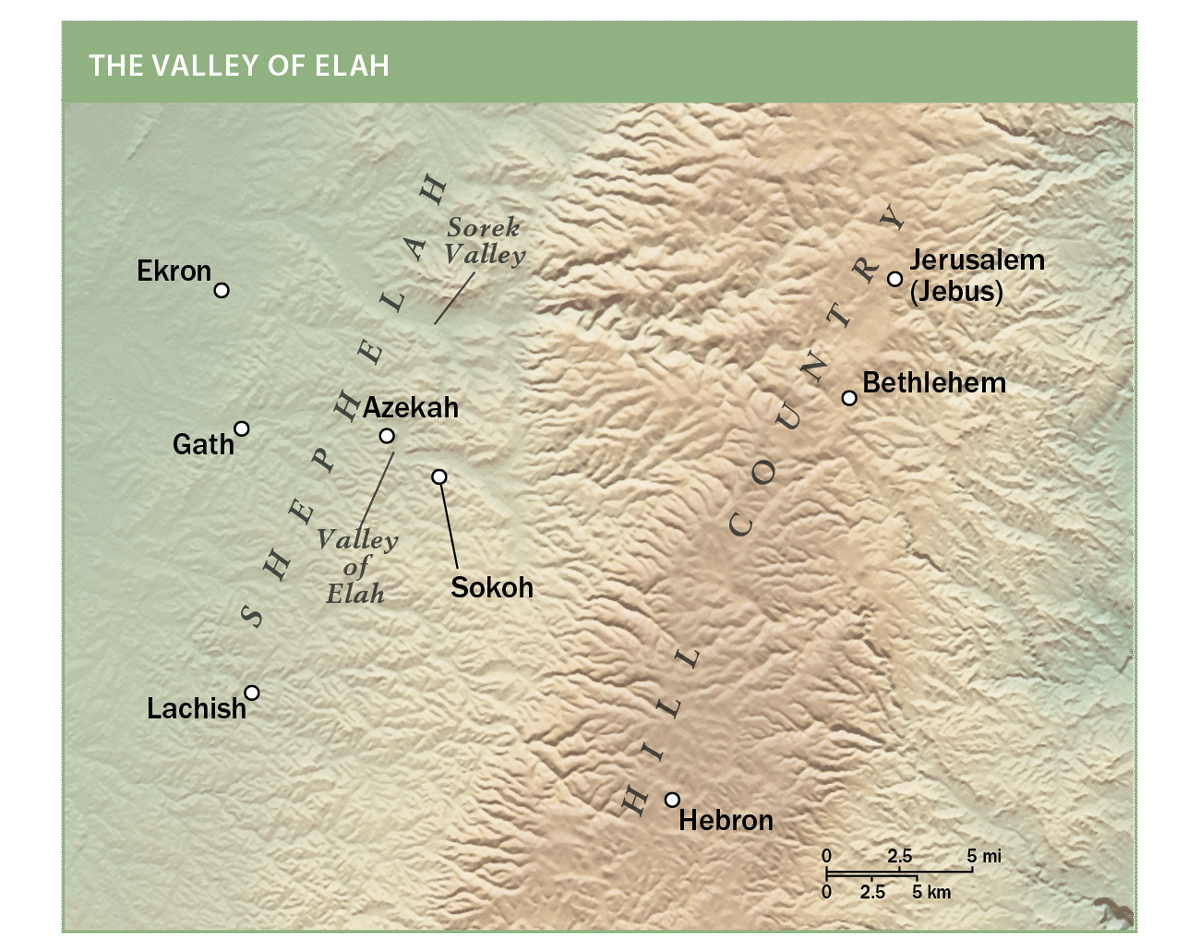
As tension mounts at the battle scene, we are told that David’s three oldest brothers are among Saul’s troops, listening to Goliath’s defiant challenge for forty days. David is back in Bethlehem taking care of the sheep, for Saul’s condition has apparently improved. Anxious about his older sons, Jesse decides to send David to visit the troops and take some food to his brothers and their commander. It is not hard to imagine that young David would have welcomed the chance to see the excitement of impending conflict and to find out why no battle had taken place yet. When he arrives at the scene, he soon discovers the problem and witnesses Goliath stepping forward to shout his defiance against Israel. David also sees the Israelites again shrink back in fear.
Although no one has yet volunteered to fight Goliath, Saul offers substantial rewards to the man who can defeat him. Wealth and honor will be his, along with exemption from taxes for his father’s family. The victor will also receive Saul’s daughter in marriage, with no further bride-price expected. Normally a sizable amount of silver or valuables had to be paid by the groom to the family of the bride, though military exploits were sometimes substituted. Saul’s offer is attractive, but who can stand a chance against the Philistine champion?
David is the first one to express any interest, taking youthful umbrage at Goliath’s defiance of “the armies of the living God” (17:26). As David tries to encourage the troops, he is severely reprimanded by his oldest brother, Eliab. Eliab may have been jealous of David’s anointing or he may have felt guilty for not volunteering to fight Goliath himself, but in any event his assessment of his brother is misguided. David is not trying to avoid family chores, nor is his heart conceited and wicked. With a combination of faith and naïveté that belongs predominantly to young men, David simply questions the Israelites’ fear and before long informs King Saul that he will fight the “uncircumcised Philistine.” In view of David’s age and inexperience, however, Saul at first rejects his offer. But David reminds Saul that as a shepherd he has killed a lion and a bear, both of which are far more agile than Goliath. David is confident that since God has saved him from wild animals, he will also save him from Goliath.
Convinced of David’s faith and courage, Saul gives him his blessing and offers David his own armor. But the armor does not fit David, nor will the bulky equipment be helpful since it would inhibit his movement. Instead, he takes his shepherd’s staff, his sling, and five smooth stones from the stream and goes to face Goliath.
After waiting for forty days, Goliath is disappointed and disgusted when he sees the youthful, unarmed David coming toward him. How much glory is there in killing a defenseless youth? David listens to Goliath’s curses and then acknowledges that his main weapon is “the name of the Lord Almighty” (17:45). Like Saul’s son, Jonathan, David believes that the battle is the Lord’s and that victory does not depend on who has the best weapons or the most soldiers. As with all the great acts of Israel’s warrior God, such as the parting of the Red Sea (Exod. 13:17–15:21) or the fall of Jericho’s walls (Josh. 5:13–6:27), so the death of Goliath will demonstrate the power of Israel’s God.
As Goliath moves in to silence his brash opponent, David slings one of the stones with unerring accuracy. It strikes the Philistine on the forehead, perhaps killing him instantly or at least incapacitating him (17:49). David then removes Goliath’s sword from the scabbard and cuts off his head. Stunned by this turn of events, the Philistines flee back toward the coast, to their cities of Gath and Ekron, with the Israelites in hot pursuit. As David predicted (17:46), many of the Philistines are killed along the way. David puts Goliath’s weapons in his own tent and later dedicates the sword to the Lord, taking it to the tabernacle (21:9) as a way of acknowledging that God gave him the victory. According to verse 54, David takes Goliath’s head to Jerusalem. This may refer to a later time after David has conquered Jerusalem (2 Sam. 5:1–9), or David may have displayed Goliath’s head in the Jebusite city as a warning that Jerusalem would suffer a similar fate in the future.
Saul’s questions about David’s identity seem peculiar in light of David’s earlier service as a court musician (16:18–23), not to mention the discussion between the two before David fought Goliath. Since David did not stay at the court permanently, however, it is possible that Saul has forgotten his name or at least the name of his father. Alternately, many scholars take this literary bump, as well as many others like it in this episode, as an indication that at least two popular traditions about young David were edited together by the historian. (See the comments on composition in the introduction.)
B. David’s struggles with Saul (18:1–27:12). 18:1–19:24. In spite of, or perhaps because of, the beneficial results that David’s triumph brings to Israel as a whole, Saul soon becomes jealous of David and begins to treat him as a rival to the throne. Perhaps Saul suspects that David is the “neighbor” who will replace him as king (15:28).
After a brief period of promotions and honor, David becomes persona non grata in Saul’s court, and the king tries several methods to get rid of him. Saul’s attitude is diametrically opposed to that of his son Jonathan, who does all he can to help David. Jonathan admires David greatly and comes to be his close friend (18:1–7). Both men are courageous warriors who depend on the Lord for victory, and both are national heroes. Out of his love for David, Jonathan makes a covenant with David and gives him clothes and weapons as a pledge of his friendship. Jonathan’s sword, in particular, must have been highly treasured by David. In spite of Saul’s increasing ill will toward David, he continues to give David additional military assignments and a high rank in the army due to David’s ability and successes.
When Saul and David return home after another defeat of the Philistines, the women of the land come out to greet them with singing and dancing, much like when Miriam and the women of Israel celebrated the victory over the Egyptians at the Red Sea (Exod. 15:20). Since David has killed Goliath, his name is included along with Saul’s as the women sing their praises: “Saul has slain his thousands, and David his tens of thousands” (18:7). The refrain must have been sung throughout the country because even the Philistines know about it (1 Sam. 21:11).
When Saul hears the refrain, he is infuriated and his jealousy and suspicion of David increase (18:8–16). Coupled with the influences of another “evil spirit from God” (18:10), this jealousy drives Saul to hurl his spear at David while the young warrior is temporarily back at his musician’s post. Saul misses twice, and then, frustrated, sends David back to the battlefield. He recognizes that the Lord is with David but somehow hopes that the Philistines will kill him in battle. When David wins additional battles, the people love him all the more and Saul’s apprehensions increase.
When David killed Goliath, he won the right to marry Saul’s daughter, Merab (18:17–30). Saul, however, adds further military responsibility as a condition of marriage (18:17). As the oldest daughter, Merab would have given her husband an important claim in the matter of succession to the throne. David politely refuses her hand, a decision for which we are not given any reason. In any event, when Saul’s other daughter, Michal, is offered to David, he agrees to the marriage in spite of the required bride-price. Saul hopes that one of the Philistines will kill David, but instead, David and his men double the bride-price by killing two hundred Philistines. Saul is forced to make good on his offer, and Michal becomes David’s wife. Twice the text states that Michal is in love with David (18:20, 28), so the marriage begins on a positive note in spite of the disgruntled father-in-law. Both Saul’s position and his state of mind are becoming more and more precarious while David’s standing steadily improves.
Unable to bring about David’s death at the hand of the Philistines, Saul appeals to his close associates to kill David. But Jonathan warns David and tells him to go into hiding. Jonathan then tries to persuade his father that David is a friend, not an enemy (19:1–7). After all, he argues, David risked his life to save Saul and Israel from the Philistine threat. Jonathan’s appeal convinces Saul, and he promises not to harm David. In fact, David is restored to Saul’s service in the court.
The reconciliation does not last long, however; and it may be David’s continued success as a general that triggers a new outburst of jealousy and violence (19:8–17). For the third time, an evil spirit afflicts Saul, and as in 18:10, David’s music does not soothe the king. Again Saul throws his spear at David, and again he misses. It is the last time David will dare to be in the presence of the increasingly unstable king.
David returns to his own home, but Michal convinces him to flee that night. Like Rahab with the two spies, Michal lowers David through a window so he can escape undetected. She then buys time for David by putting an idol in his bed and telling Saul’s messengers that David is sick. When Saul learns that Michal helped David escape, he is upset with her. She explains that David threatened her life unless she assisted him. Michal’s actions underscore her allegiance to her husband over her father.
Saul is thwarted in his attempt to capture David (19:18–24). David, deciding to take refuge with Samuel in Ramah, only a short distance from Saul’s capital at Gibeah, pours out his troubles to Samuel, who takes him to the nearby residence of the prophets. When Saul’s men come to capture David, the Spirit of God comes upon them and compels them to prophesy. After two more groups of messengers have the same experience, Saul himself comes in search of Samuel and David. On the way to Naioth the Spirit of the Lord also falls upon Saul, causing him to prophesy and strip off his clothes, a sign of an ecstatic state. Literarily this is an important juncture, since the prophetic frenzy that overtakes Saul here at his last meeting with Samuel mirrors what happened after Samuel first anointed him (10:11–12). Thus, Saul’s anointment began with Samuel and was marked with the sign of prophecy, and it ends with Samuel and is again marked by prophecy as well as the symbolic removal of his garments, representing his removal as the anointed king.
Although Jonathan is Saul’s oldest son and is expected to succeed him on the throne, he has become close friends with Saul’s chief rival. Jonathan sees that David is God’s chosen and does not allow his own ambition to oppose God’s will.
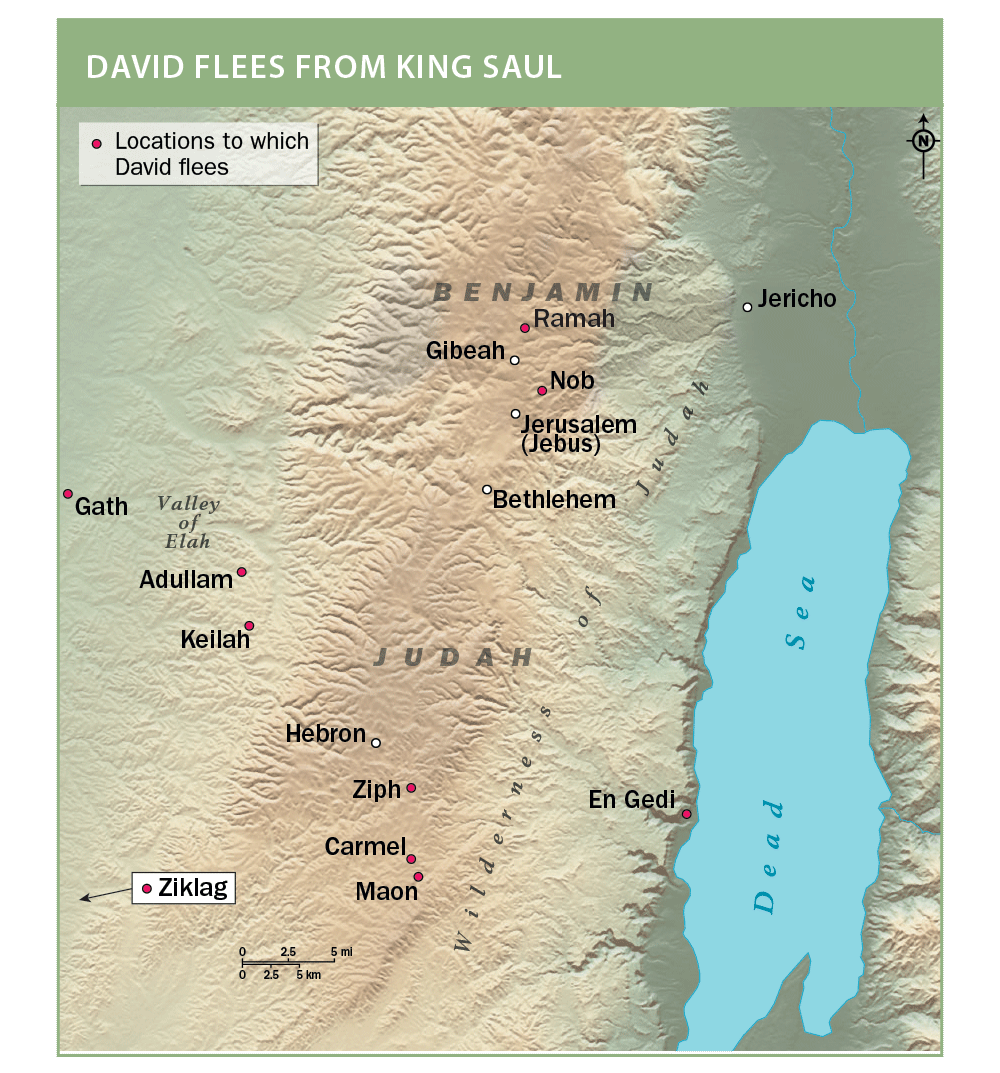
20:1–42. Within a short period of time David’s status has changed from national hero to fugitive. Disappointed and confused, David seeks out Jonathan for an explanation of Saul’s erratic behavior (20:1–10). Jonathan assures David that Saul would not harm him. But he does agree to sound out his father regarding his current feelings about David. The next day is the New Moon festival, a holiday on the first of the month, marked by rest and special offerings (20:5). Verse 27 indicates that it is a two-day festival. Since David is Saul’s son-in-law and has held a high position in the army, Saul evidently expects David to be present at his table. David uses the situation as a test of Saul’s intentions. He asks Jonathan to give Saul a false excuse for his absence and to note Saul’s response: if Saul accepts the excuse, David is safe, but if Saul is angered, his desire to kill David remains.
Sensing that Saul’s jealousy might make future contact with David impossible, Jonathan takes David outside for a long talk (20:11–23). He promises to carry out David’s wishes at the festival and to let David know if he should stay or flee. But beyond that, Jonathan wants to reaffirm his covenant with David. According to verse 13, Jonathan fully expects David to be the next king, and he wants David to promise that he will be kind to Jonathan’s family even after he takes the throne. Often a king from a new dynasty would put to death the descendants of the previous king. David reaffirms his oath to show “unfailing kindness” to Jonathan and his family (20:14–15). When he becomes king, David will remember his oath to Jonathan and make special provision for his crippled son Mephibosheth (2 Sam. 9:7).
All hope that Saul might be reconciled to David is dashed by what takes place at the New Moon festival (20:24–42). Saul assumes on the first day that David has a legitimate reason to be absent, but on the second day he explodes. When Jonathan tells Saul about the sacrifices in Bethlehem, Saul realizes that he will not have another chance to kill David, so he takes out his anger on Jonathan. Saul cannot understand how Jonathan could side with David when David is the one standing between him and the throne. In utter frustration, Saul hurls his spear across the table at Jonathan. He has clearly never been able to accept Samuel’s announcement that his kingdom will not endure, and in his obsession to kill David, Saul manages to alienate his own son as well.
The next day Jonathan goes to the field where David is hiding to give him the prearranged signal (20:35–42). Jonathan shoots an arrow beyond the boy who is with him as a sign that David must flee. Because Jonathan knows he might be watched, they have not planned to meet and talk, but after the boy returns to town, David ignores the danger. The two have a tearful parting, and Jonathan reminds David of their sworn friendship and of the Lord’s involvement in their families forever. Judging from his praise of the fallen Jonathan in 2 Samuel 1:26, David greatly values their friendship.
21:1–22:23. The next several years David spends as a fugitive, moving from place to place trying to avoid Saul. Most of the time he stays within the borders of his own tribe of Judah, although on two occasions he lives under Philistine jurisdiction.
David stops first at Nob, where the tabernacle is located, a town just northeast of Jerusalem (21:1–9). When he arrives alone, the high priest Ahimelek is startled and wonders what is wrong. David deceitfully replies that Saul has sent him on a secret mission, and then he asks for some food. The only food available is the bread of the Presence, the loaves kept in the Holy Place as a symbol of God’s provision. Normally this bread was eaten only by the priests (Lev. 24:9), but Ahimelek agrees to give it to David provided that he and his men are ceremonially clean. This involves, in particular, abstinence from sexual relations (Exod. 19:15). Jesus refers to David’s action as an example of doing what is right in an emergency even though it was, strictly speaking, “unlawful” (Mark 2:25–26).
After receiving the bread, David also takes with him the sword of Goliath that he dedicated to the Lord after his great victory. According to 22:10 and 15 Ahimelek inquires of the Lord to give David some much-needed guidance.
All of this time Ahimelek is unaware of David’s flight from Saul, since David has lied about the purpose of his visit. This deception may have helped David obtain what he needed, but it costs the priests dearly when Saul finds out what they have done for David (22:17–18).
Finding a safe hiding place in a small country is not easy, so David seeks out an area where Saul will be unlikely to follow him (21:10–15). It is nevertheless surprising that David goes immediately to Philistine territory and to Gath, the hometown of Goliath! He must have hoped that no one would recognize him, but he is immediately identified as “the king of the land” and a warrior like Saul (21:11). (It is unlikely that the Philistines would have been privy to David’s anointed status, and so in the phrase “the king of the land” we almost certainly see the historian’s hand, reminding the audience through even the mouth of Israel’s enemies that David was the true king.)
David’s response is to pretend to be insane, with the hope that they will not detain him. Upon seeing his behavior, Achish, the king of Gath, refuses to let him stay in the city. Although David will later return to Gath (1 Sam. 27:1–2), for the time being it is too dangerous.
After his narrow escape David travels about twelve miles further inland, to the cave of Adullam, in the western foothills (22:1–5). This is close to the place where he killed Goliath, in the Valley of Elah. Word of his whereabouts reaches his family and other individuals who are in trouble with Saul’s regime. About four hundred malcontents join him and are molded by David into an effective and loyal fighting force. Managing this motley crew would have been both extremely difficult and an excellent preparation for ruling the entire land. Since Saul will have likely taken measures against the rest of David’s family, David asks the king of Moab to allow his parents to live there for a while.
At this time we are introduced to the prophet Gad, who advises David and who is associated with a record of David’s reign (1 Chron. 29:29). It is Gad who gives David a choice of three options after David sins by taking a census of the land (2 Sam. 24:11–14).
Aware that David now has a growing group of supporters, Saul is worried about a conspiracy against his life (22:6–10). He knows that Jonathan is a close friend of David’s, and he is afraid that other high officials might have been tempted to defect to David’s side. If any are so inclined, Saul warns them that David is from the tribe of Judah and most of them are from Benjamin: will David give them high positions and valuable property if he becomes king?
To prove his loyalty to Saul, Doeg the Edomite, Saul’s head shepherd, reports what he has seen when David received help from Ahimelek the priest. The implication is that Ahimelek might be the next leader to join David.
Armed with this new information, Saul immediately sends for Ahimelek and the rest of the priests (22:11–15). He accuses Ahimelek of conspiring against him by giving valuable assistance to a traitor. Ahimelek protests that he had not realized that David was regarded as an outlaw and a fugitive. Moreover, Ahimelek complains, he perceived no reason to suspect David: David is the king’s own son-in-law and a respected military leader who has accomplished much for the whole nation. Besides, David told Ahimelek that he was on a secret mission for Saul (see 1 Sam. 21:2).
Ahimelek’s reasoning is sound, but Saul has moved beyond reason (22:16–23). When Saul orders the guards to kill the priests, they are unwilling; but Doeg the Edomite is willing and executes the priests. Doeg’s actions do not help relations between Edom and Israel, and David later treats the Edomites harshly (cf. 2 Sam. 8:12–14).
Not only does Saul order the death of eighty-five priests, but the whole town of Nob is put to the sword, including women and children. It is the sort of total destruction normally reserved for Israel’s worst enemies. Only one person escapes and reaches David with the news: a son of Ahimelek named Abiathar. When David hears about the massacre, he admits that his deception has contributed heavily to the priests’ deaths. Abiathar remains with David and uses the ephod with the Urim and Thummim to inquire of the Lord for David. Meanwhile Saul is left without any guidance from prophet or priest.
The general movement of David’s flight is toward the south and east and the more rugged areas of Judah. But with the help of local residents, Saul is able to track him closely.
23:1–24:22. Throughout his time as a fugitive David protects the cities of Judah from their enemies. When the Philistines steal grain from the threshing floors of Keilah, a city in the western foothills about ten miles northwest of Hebron, David and his men attack them and drive them off (23:1–6). Even though David is no longer in Saul’s employ, he continues to enjoy mastery over the Philistines. The victory nets David considerable plunder, especially livestock (23:5).
While David and his men stay in Keilah, Saul hears about it and prepares to besiege the city (23:7–13). David learns of Saul’s plans and inquires of the Lord through Abiathar. In spite of all that David has done for the people of Keilah, the Lord indicates that they will hand him over to Saul. The failure to extradite a fugitive was a significant provocation and thus a common cause for war in the ancient Near East, so the city elders did not want to risk the horrors of a siege. Since David is equally unwilling to fight Saul, he and his men—six hundred by now—leave the safety of the walled city.
David heads for the Desert of Ziph, south of Hebron, and the Lord protects him in the hills there. One day encouragement comes through an unexpected visit from Jonathan, Saul’s son (23:14–18). In this final meeting between the two dear friends, Jonathan assures David that he will become king and that Jonathan will serve under him. Before parting, the two reaffirm the covenant they have made.
In contrast to Jonathan the people of Ziph are eager to help Saul capture David, so they relay David’s precise location to the king (23:19–29). Saul thanks them, saying, “The Lord bless you for your concern for me” (23:21). But as in verse 7, when Saul thought that God had handed David over to him, the king is badly mistaken. God has abandoned him and is frustrating his every move. In this instance Saul and his men have David cornered in the Desert of Maon when news comes that the Philistines are attacking the land. The timing is providential from David’s perspective and allows David and his men to escape to the caves of En Gedi.
David’s new hideout is an area with many caves along the high cliffs. The whole region between the Dead Sea and the hill country of Judea consisted of steep valleys and gorges cut by the streams and wadis that flowed into the Dead Sea. En Gedi means “spring of the goats” because of the excellent water source located there.
When Saul returns to pursue David he happens to relieve himself in the same cave where David and his men are hiding (24:1–7). Apparently Saul is alone, leading David’s men to proclaim this as the Lord’s timing, with the implication that David should kill Saul. David does not kill Saul but instead sneaks up behind Saul and cuts off a corner of his robe.
After Saul leaves the cave, David calls out to him and tells him what he has done (24:8–15). Holding up the piece of the robe as evidence of his mercy, David asserts that he is not trying to wrest the throne from Saul and that he is not guilty of treason. Instead, he has committed the matter to the Lord, who will decide the case as a righteous Judge. Just as war was considered a contest between the gods of the rival nations, so this personal battle will be settled by the Lord in favor of the righteous party. According to verse 14 David is no more dangerous than a dead dog or a flea, and yet Saul is consuming time and energy in an effort to eliminate him.
Confronted by clear evidence that David has spared his life, Saul expresses remorse for seeking to kill David and admits that he has treated David badly (24:16–22). Echoing the words of his son Jonathan (23:17), Saul recognizes that David will indeed be the next king of Israel, but he makes David promise that as the new ruler he will not wipe out Saul’s descendants. In the light of this apparent reconciliation, it appears that David’s years as a fugitive are over; but David has learned that Saul’s word cannot be trusted (cf. 1 Sam. 19:6). Subsequent events indicate that before long Saul resumes his pursuit of David.
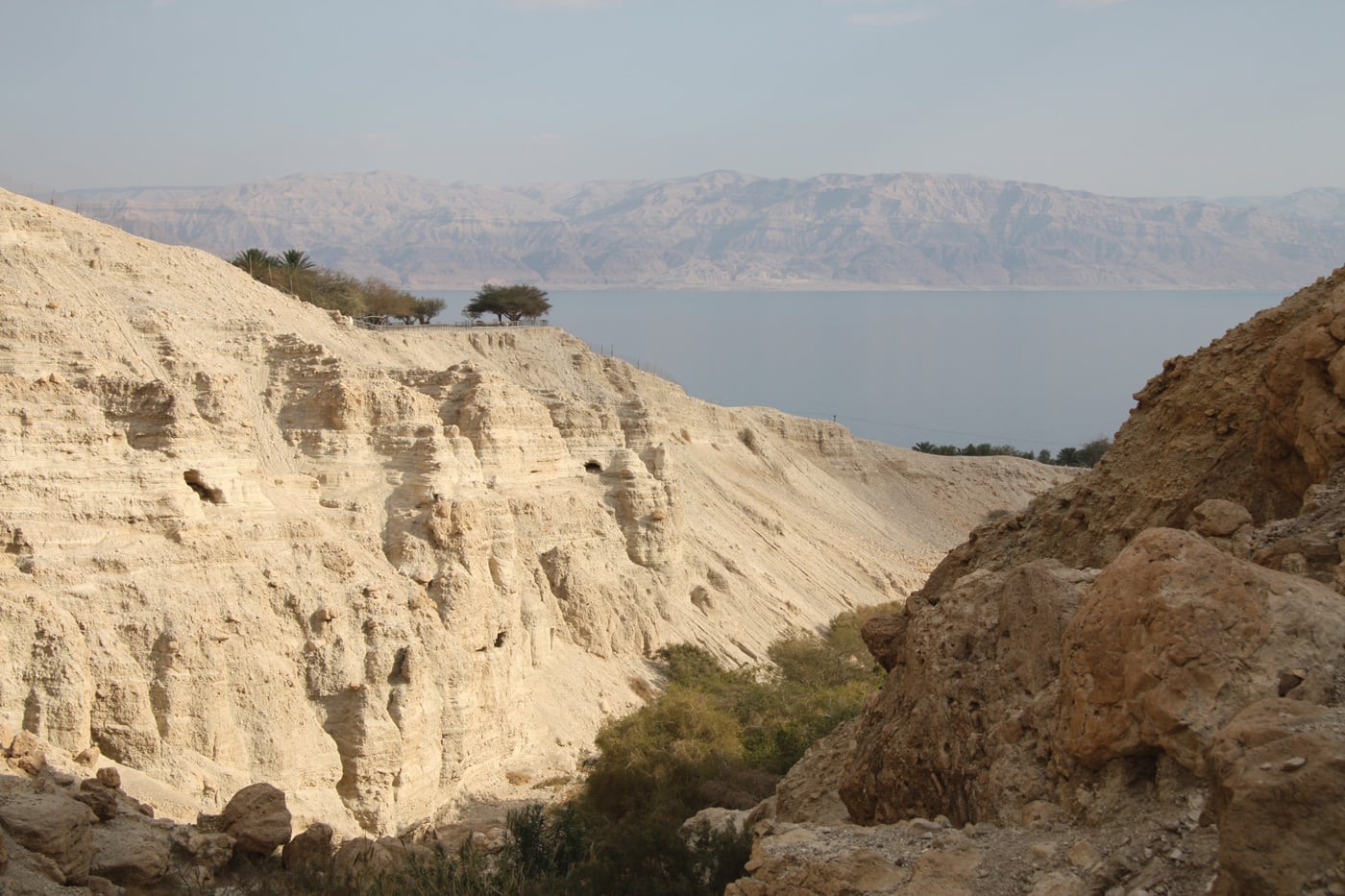
The area of En Gedi, where David hides from Saul in 1 Samuel 23:29. Notice the caves in the cliffs and the greenery in the gorge, which indicates the water below.
25:1–44. To make matters worse for David, the prophet Samuel dies (25:1). The revered leader who has presided over the beginning of the monarchy and has anointed both Saul and David is gone. He was a great figure in Israel’s history, playing important spiritual and political roles in the tradition of Moses. Thus, David is left without one of his strongest supporters.
After his meeting with Saul, David continues to live in the region south of Hebron. The “Carmel” mentioned in verse 2 was near Ziph and Maon, not the Mount Carmel of Elijah near the Mediterranean Sea in the northern part of the country. While living in Carmel, David and his men work for a wealthy man named Nabal, protecting his flocks and herds (25:2–13). When sheepshearing time arrives, David expects to be given meat and bread in exchange for his labors. Normally this was a time of feasting for all the family and workers. When Nabal receives David’s request from the ten men he has sent, he refuses to give him anything, calling David a nobody, a deserter.
News of Nabal’s insulting remarks spurs David to action. If Nabal will not pay willingly, David will take his pay by force and kill Nabal’s family in the process. Bent on revenge, David sets out with four hundred men.
Nabal has an intelligent and beautiful wife named Abigail who is wiser than her stingy husband (25:14–22). When she hears what Nabal has said to David, she follows the advice of one of the servants and takes matters into her own hands. Quickly she prepares a sizable gift of meat, bread, raisins, and figs and sends them to David. She herself mounts a donkey and heads in the same direction. As she approaches, David has just invoked a curse on himself that will take effect if he does not put to death all the males in Nabal’s household (25:22).
When Abigail begins her plea for mercy, she immediately disassociates herself from her husband (25:23–35). She admits that he is a scoundrel and that he deserves to die. To reinforce her point Abigail makes a play on her husband’s name, which sounds like the Hebrew word meaning “fool.” (The name itself likely derived from a word meaning “noble,” or perhaps his real name was suppressed and “Nabal” was used because of the character of the man.) In spite of his wealth, no one has anything good to say about him, least of all his wife.
Nine times Abigail refers to David as “my lord” or “my master,” an indication of her deference to David. Abigail’s implicit assessment of David contrasts sharply with her explicit assessment of her husband. Thus Nabal serves as a foil for David, whose wisdom is touted throughout the passage. David’s wisdom and mercy on Nabal in this episode epitomize, in the historian’s view, the differences between Saul, the first king, and David, the eventual second king. In the end Abigail admits her husband’s guilt but appeals to David’s mercy and good sense: taking revenge on members of his own tribe of Judah will tarnish David’s image as a wise and fair leader.
David thanks Abigail for her kind words and acknowledges that the Lord has used her to keep him from avenging himself. Instead of acting like the king he is destined to be, he has almost behaved like a brigand chief.
When Abigail returns home she finds Nabal very drunk. At sheepshearing time drunkenness and partying were common, and Nabal has enjoyed it to the hilt. The next morning Abigail tells him about her meeting with David, after which Nabal suffers a stroke or perhaps a heart attack. About ten days later he dies. David interprets Nabal’s death as the Lord’s judgment for mistreating him and probably many other people as well (25:36–44). The realization that the Lord has upheld his cause against Nabal gives David the confidence that God will decide the dispute with Saul in his favor also.
The death of Nabal also releases Abigail from marriage and gives David the freedom to take her as his wife. From David’s standpoint, marriage to the widow of a prominent citizen of Judah will help him politically, and a new wife is compensation for the loss of Michal, whom Saul has given to another man to weaken David’s claim to the throne. David never accepts Saul’s imposed divorce, however, and later takes Michal back as his wife (2 Sam. 3:13–16).
26:1–27:12. David again refuses to kill Saul (26:1–12). As in 24:2, Saul takes three thousand (or three “companies” of) men to track David down in the Desert of Ziph, where he narrowly escaped from Saul earlier (23:24–28). David’s scouts tell him where Saul and his army are camping for the night, and David himself comes close enough to see where Saul and Abner are lying down. With characteristic boldness, David decides to pay a visit to the camp, accompanied by Abishai, his nephew who will later become one of his top generals (2 Sam. 18:2). It seems like a foolish idea, but the Lord has put Saul’s army “into a deep sleep” (26:12). David and Abishai creep right up to Saul, and Abishai sees a golden opportunity to get rid of Saul. But as in the cave at En Gedi (24:6), David refuses the easy way out. Besides, the death of Nabal proved how rapidly God can strike down the enemy—without any help on David’s part. So David and his nephew take Saul’s water jug and spear and leave the camp.
When they reach a hill a safe distance away, David calls out loudly to Saul’s cousin Abner, the army commander (26:13–25). He scolds Abner for failing to guard the king and points out the security breach that has occurred. Awakened by the commotion, Saul reacts to David’s voice exactly as he has in 24:16: “Is that your voice, David my son?” David responds with another assertion of innocence and wonders aloud why Saul continues to chase him. He feels like a partridge relentlessly pursued by a hunter. If God has incited Saul against him, David is willing to make things right with the Lord and bring him an offering. If other men have urged Saul to pursue David, he calls on God to judge them.
As in 24:16–22, Saul seems convinced by David’s arguments and especially by the spear in David’s hand. The king admits he has acted like a fool and promises to leave David alone. In verse 25 Saul predicts that David “will do great things and surely triumph,” implying that eventually David will be king. Saul almost sounds like Balaam, who wanted to curse Israel but instead wound up predicting that Israel would crush their enemies (Num. 24:17).
Sad to say, this second set of conciliatory words is no better, and Saul soon forgets what he has promised. Frustrated and discouraged, David decides to find refuge in Philistine territory, where Saul will not likely venture (27:1–12). It is a calculated risk, because the Philistines might kill him and because the Israelites might consider him a traitor and might never welcome him back. These risks notwithstanding, David goes to the Philistines and uses the time to his benefit. David learns valuable information about their military tactics and about ironworking, and he also makes friends with some of the Philistines. Indeed, after he becomes king, several contingents from Philistia serve as faithful mercenary troops under him (2 Sam. 15:18).
As he did earlier (1 Sam. 21:10–15), David goes to Achish of Gath and asks for asylum. The historian provides no reason why this time the Philistines are not suspicious of David, but one may speculate that his reputation as an outcast and an enemy of Saul has become well established. Moreover, David’s six-hundred-man army could have served Achish as a valuable mercenary force. Whatever the reasons, David is allowed to live in Ziklag, a town in the transition zone between Philistia and southern Judah; the town is listed as Israelite in Joshua but has come under the control of the Philistines. While there David and his men have more freedom than they would have had in Gath.
During his time in Ziklag, David actually benefits the Israelites much more than the Philistines. Although he tells Achish that he is conducting raids against areas of Judah, instead he is attacking Israel’s enemies. Joshua was not able to conquer the land of the Geshurites in the south (Josh. 13:2), but now David soundly defeats them (27:8). Like Saul, David also successfully fights the Amalekites. Whenever he attacks a town, he leaves no survivors to complain to the Philistines, but he does take flocks, herds, and other valuables. David’s deception works, and Achish naively thinks that David has completely turned against the Israelites.
C. Saul’s final battle (28:1–31:13). 28:1–29:11. Throughout his reign Saul has battled the Philistines in an attempt to keep them from expanding beyond their coastal strongholds. With David’s help he has won many crucial victories, but now David is living among the Philistines, and Saul is left without the Lord’s favor.
David knows that eventually he will be called on to fight against Saul (28:1–6). As a mercenary of Achish, he will have to join with the rest of the Philistine forces. Although it is unthinkable for David to fight against his own people, he has the Philistines convinced that he is ready and eager to fight Saul. His actual statements, however, are ambiguous and leave the reader wondering if he ever intended to fight against Israel. Whether David would have fought against his own people is left an open question in the narrative, since the Philistine military leaders reject his involvement before battle commences (29:3–9).
The Philistines assemble their troops at Shunem, in the Valley of Jezreel near the Sea of Galilee, and the Israelites gather at Mount Gilboa, toward the eastern end of the valley. Saul is terrified and turns to inquire of the Lord, but the Lord has long since broken off contact with Saul. Revelation from God normally came through dreams, prophets, or priests, but Saul has massacred the priests himself (22:18), and Samuel is dead. Apparently, Saul is not in touch with any other prophet.
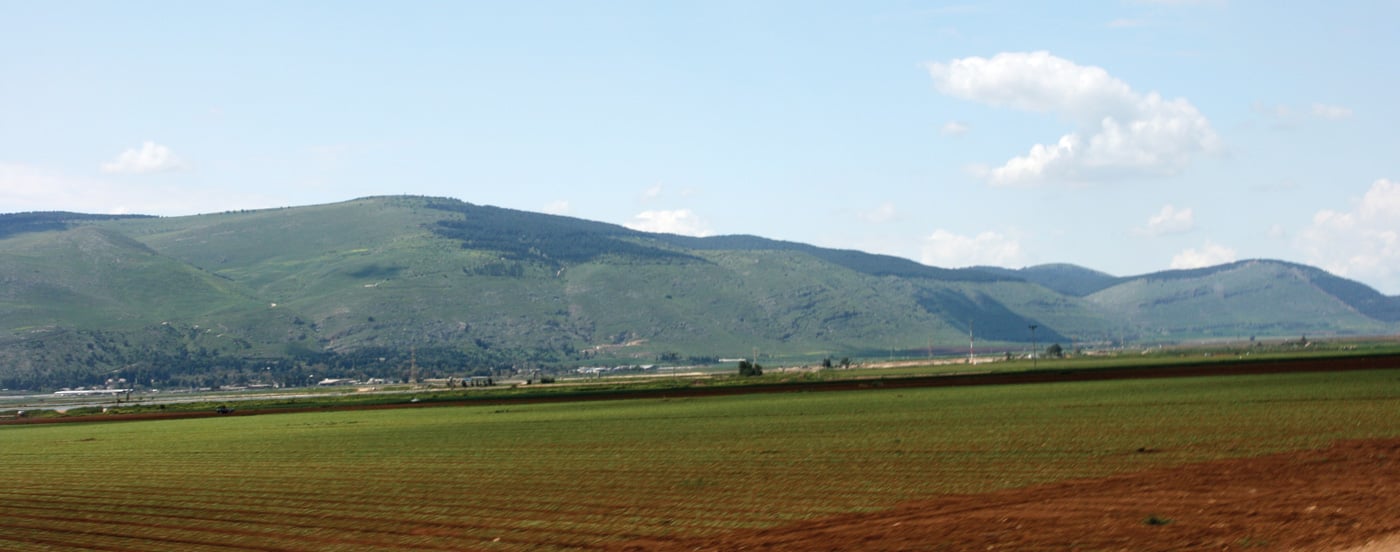
Mount Gilboa
Saul goes to Endor, a few miles north of Mount Gilboa, to inquire of a medium (28:7–14). Since Saul himself has apparently expelled the mediums and spiritists from the land earlier in his reign, he disguises himself and takes only two men with him. The disguise seems to work until the medium sees the spirit of Samuel coming up out of the ground, at which time she recognizes Saul. Consulting the dead is referred to in Deuteronomy 18:11 and Isaiah 8:19, and although it is strongly condemned by the biblical writers as characteristic of the spiritual corruption of other nations, its effectiveness is not denied. It was likely a fairly common practice in many periods of Israel’s history. Thus, we cannot fault Saul for seeking recourse in this way. An unusual aspect of this account is the description of Samuel as “spirit” (28:13 NIV 1984; NIV “a ghostly figure”), a word that means “God,” “gods,” or at least “divine beings.” This is one of the few hints in the Old Testament of some sort of dynamic existence after death and is thus all the more intriguing.
While Saul prostrates himself on the ground Samuel begins to speak, complaining about being disturbed in this fashion (28:15–19). The grave was to be a place of rest, where the righteous “enter into peace” (Isa. 57:2). Saul explains that the situation is desperate and that he has called for Samuel with the hope that perhaps in his mercy God will once again deliver Israel against great odds. He wants a glimmer of hope, a word of encouragement from Samuel, who himself has witnessed God’s miraculous intervention against the Philistines (1 Sam. 7:10–11).
Unhappily Samuel’s response is anything but encouraging and contains the same grim words he spoke at his last meeting with Saul after the battle with the Amalekites (1 Sam. 15:22–29). Because Saul has failed to carry out God’s fierce wrath against the Amalekites, he has lost the right to rule, and the next day he and his sons will die (28:18–19). Just as Eli and his sons died the same day the Philistines defeated the Israelites (1 Sam. 4:11, 18), so Saul and his family will fall before the same enemy. In both cases, Samuel announces God’s word of judgment prior to the catastrophe.
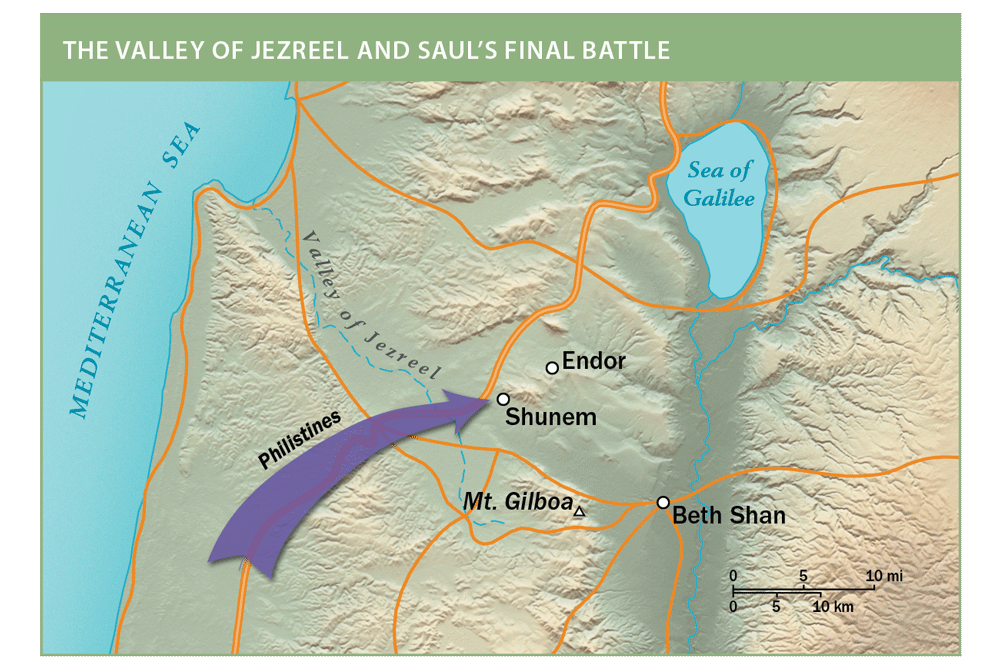
Recognizing that all hope is gone, Saul falls to the ground in despair (28:20–25). He is also completely exhausted, because he has eaten nothing all day in preparation for his encounter with Samuel. At the urging of the woman and his men, Saul finally agrees to eat something, and the woman butchers a fattened calf. In spite of his pitiful condition Saul is still the king, and she gives him the best she has.
As the battle draws near, David and his men are lined up on the Philistine side (29:1–11). They are “at the rear with Achish,” an indication of the esteem in which Achish holds David (not necessarily that David wants to stay out of the battle if possible). However, in light of the success that David has previously had in fighting against the Philistines, the other Philistine commanders are nervous about his presence. They are concerned that he might rejoin the Israelite side during the battle and be reconciled to Saul. In point of fact, in an earlier battle a number of renegade Israelites had switched back to their own side when the Philistines began to suffer losses (1 Sam. 14:21).
Achish protests that he has no reason to doubt David’s loyalty to his new allies, but he is clearly outvoted by the other commanders. When he breaks the news to David, David acts surprised and hurt. Clearly, however, the orders save him from the horns of a dilemma. Up to this point he has consistently refused to touch the Lord’s anointed and he has secretly helped the Israelites even while in exile. At this point, to fight against the people over whom he expected to be king would no doubt have been unpalatable and likely affected negatively the Israelites’ acceptance of David as the next king.
30:1–31. While David and his men are north with the Philistine armies, the Amalekites decide to get revenge for David’s earlier attacks against them (30:1–6). David’s city of Ziklag is burned and all of the women and children are taken captive. David and his men are heartbroken. The men even blame David and threaten to stone him, just as an earlier generation grumbled menacingly against Moses (Exod. 17:4). Yet in the midst of this opposition and his own personal sorrow at the loss of his two wives, “David found strength in the Lord his God” (30:6).
Since Abiathar the priest is there and can inquire of the Lord by means of the ephod, David determines that he can overtake the raiders (30:7–20). Encouraged, he and his men head to the southwest in pursuit. Only four hundred men are strong enough to keep up the pursuit, for they have already covered many miles in the three-day journey back home. Fortunately they receive valuable information from an Egyptian member of the raiding party who has been abandoned after taking ill. Revived by food and drink, he reveals that the Amalekites have taken advantage of all the parties involved in the war in the north by attacking several areas belonging to Judah and the Philistines (30:14). The amount of the plunder may have slowed them down, because David finds them celebrating enthusiastically. Apparently the Amalekites think they are a safe distance away from any pursuers, but David soundly defeats them and recovers all of the captives and plunder. Mourning turns to joy as the men are reunited with their families. It is a great triumph, reminiscent of Abraham’s recovery of the people and goods of Sodom after his daring pursuit of the four northern kings (Gen. 14:15–16).
After their return, a dispute arises over the distribution of the plunder (30:21–31). Should the two hundred men who could not keep up with the others receive an equal share of the goods? As a wise and fair leader David insists that all the shares be the same, for the victory was the work of the Lord and none of the men can claim credit for it. The same God who handed over Goliath to David has handed over the Amalekites. Because the plunder is so abundant David also sends presents to the elders in a number of the towns of Judah. Those towns are mostly to the south of Hebron, where David and his men tried to hide from Saul (23:24–25) and where David received valuable assistance. A number of these places had probably been plundered by the Amalekites and were no doubt grateful for the gift of goods and livestock.
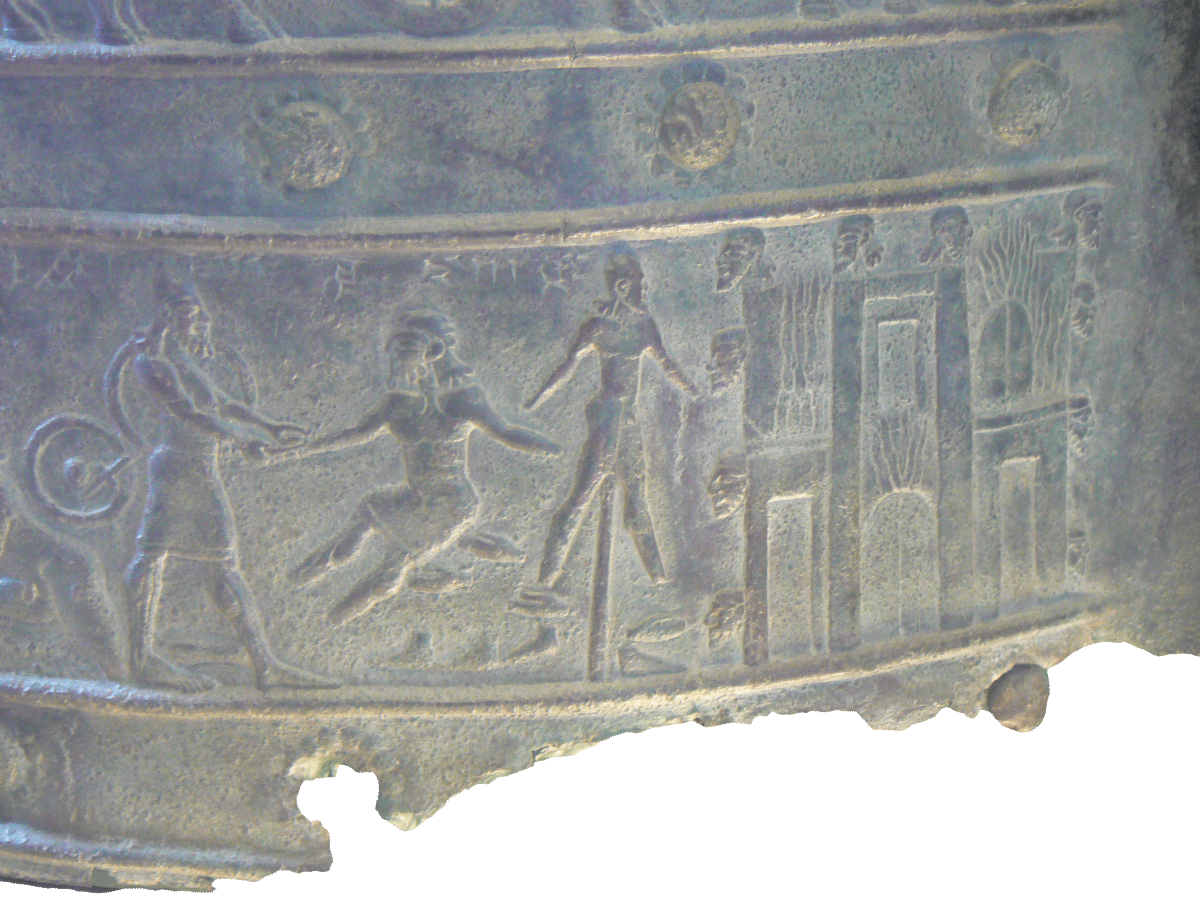
A depiction of heads hung on a city wall and bodies hung up on poles—similar to the fate of King Saul’s body at Beth Shan (1 Sam. 31:10)—on a bronze strip from the palace of Shalmaneser III (858–824 BC).
31:1–13. Saul fights the Philistines in the Valley of Jezreel, and for the first time their chariots may have given the Philistines a decided advantage. But even more important is the fact that God has abandoned Saul, weakening the armies of Israel (31:1–6). As the battle rages three of Saul’s sons are killed, including Jonathan, the crown prince and David’s close friend. One son—called Ish-Bosheth or Esh-Baal—survives, and he will serve as king briefly. Saul’s leading general, Abner, also somehow lives through the battle. Saul himself is critically wounded by the archers and asks his armor bearer to finish him off. When the armor bearer refuses to kill him, Saul falls on his sword, thus taking his own life. It is a tragic ending to a reign that began in such a promising fashion.
With their leaders gone and the army in full flight, the Israelites abandon their cities and flee, allowing the Philistines to take full control of the whole region (31:7–13). The next day the Philistines cut off Saul’s head, as David did to Goliath (cf. 17:51). Word of the Philistines’ triumph is announced in their temples, giving glory to their gods. Just as David placed Goliath’s sword in the tabernacle as a trophy of victory (21:9), so Saul’s armor is placed in the temple of their goddesses. Saul’s body is hung on the wall of the public square of Beth Shan.
When the men of Jabesh Gilead hear how Saul’s body is being displayed ingloriously, they cross the Jordan, take down his body and those of his sons, and return home. They remember how Saul rescued their city from the threat of the Ammonites when he first became king. Because the bodies have been mutilated, they are cremated rather than buried, though the bones are to some extent preserved and buried. Years later, David has the remains of Saul and Jonathan transferred to the family tomb of Saul’s father, Kish, in one of the towns of Benjamin (2 Sam. 21:11–14). To mourn the death of Saul, the people of Jabesh Gilead fast for seven days.
D. David unifies Judah and Israel (2 Sam. 1:1–5:25). 1:1–27. When Saul dies it appears that Israel’s experiment with the monarchy has been a failure. Philistine control has increased rather than decreased, and Israel is on the verge of splitting into north and south because of the dispute between Saul and David. Within seven years, however, David is able to unify the people of Judah and Israel, defeat the Philistines, and establish a strong national presence in the Near East. Israel’s golden age is about to begin.
It must have been with a heavy heart that David awaited news of the battle in the north. Although an Israelite defeat would hasten David’s rise to the throne, it would also bring hardship and sorrow to the young nation.
Three days after David’s return to Ziklag, he learns the outcome of the battle (1:1–16). An Amalekite who has escaped from the scene describes how he himself put Saul out of his misery. His account differs from that of 1 Samuel 31. Most likely the Amalekite claims credit for killing Saul with the hope of getting a reward from David. He undoubtedly reached Saul before the Philistines did, saw his dead body, and took the crown as plunder. Having confirmed the death of Saul and Jonathan, David and his men tear their clothes as a sign of their grief. David displays no joy whatsoever over Saul’s death and in fact orders that the Amalekite be executed because he testified that he had killed the Lord’s anointed. It is obviously not lost on the historian how ironic it is that an Amalekite is executed for Saul’s death since Saul’s downfall began with the failure to destroy the Amalekites (1 Sam. 15:18–19; 28:18). In light of David’s recent conflicts with the Amalekites (1 Samuel 30), the young man’s hope for a reward was slim to begin with.
David’s harsh treatment of Saul’s alleged murderer is an important part of David’s “apology.” To avoid the charge of being a usurper, David expresses displeasure with anyone who hastens the demise of Saul and his family. When Saul’s son Ish-Bosheth is assassinated, David likewise orders the execution of the two assassins (4:10–12). No one in the tribe of Benjamin can say that David is supporting those who have killed his political rivals.
David composes an elegy in honor of Israel’s fallen leaders (1:17–27). Known as the “lament of the bow,” it may have been sung by Israel’s warriors while they practiced their technique with the bow and arrow in the hope of avoiding defeat in battle. According to verse 18, this lament was also included in the Book of Jashar, a collection of battle accounts that appears to have been used as a source for biblical texts (cf. Josh. 10:12–13).
The lament begins and ends with the line, “How the mighty have fallen!” as David eulogizes Saul and Jonathan and emphasizes their accomplishments. Nowhere in the poem does David mention Saul’s weaknesses, failures, or jealousy; instead he links father and son as an effective team, victorious in battle and benefactors of the nation’s citizens. The second line of the lament (1:20) has the form of a command aimed at David’s audience, but it functions as a wish, that the Philistines will not gloat over Israel’s defeat (although they do in fact spread the news throughout the land, 1 Sam. 31:9). Turning his attention to the scene of the battle (1:21), David pronounces a curse on the mountains of Gilboa, as if the terrain itself were responsible for Israel’s defeat. Out of reverence for the royal men who have been slain there, David wishes that the soil would lie barren in sympathetic mourning over the terrible catastrophe. Although David honors the memory of Saul in several verses, his greatest praise is reserved for Jonathan. Jonathan made a covenant with David, linking their families forever (1 Sam. 20:14–16), but his loyalty to Saul kept him by his father’s side in this final and fatal conflict.
2:1–32. During Saul’s reign, the people of Judah were also torn between loyalty to the king and loyalty to the local hero David, whom Saul had declared an outlaw. Since David had cultivated the friendship of the elders of Judah even while allegedly an ally of the Philistines (1 Sam. 30:26), his leadership status is clearly established. Nonetheless, after Saul’s death David takes nothing for granted and seeks the Lord’s guidance before moving to Hebron, the most important city of Judah, centrally located in the hill country nineteen miles south of Jerusalem. There, where Abraham had lived for many years and where the patriarchs were buried, David is publicly crowned as king over Judah (2:1–7). He has waited about fifteen years since his private anointing by Samuel in Bethlehem (1 Sam. 16:13), but the time to rule has finally arrived.
Realizing that Saul’s supporters in the north will not readily accept him as king, David seeks to establish good relations with them immediately. He demonstrates his respect for Saul by thanking the men of Jabesh Gilead for burying him. By their brave actions they have shown kindness to Saul, and David promises to treat them kindly and fairly. Although this message is an indirect request for them to recognize David as king, the northern tribes refuse to acknowledge him for another seven years.
The general of Saul’s army, his cousin Abner, has managed to survive the Battle of Gilboa and emerged as the most powerful figure of the northern tribes. Instead of unifying the nation under David, Abner decides to place Saul’s remaining son, Ish-Bosheth, on the throne of Israel (2:8–11). His reasons for doing so are not entirely clear, but later on even Ish-Bosheth suspects that Abner wanted the throne for himself (3:6–8). The name Ish-Bosheth means “man of shame,” but this was a later development, a sort of derogatory nickname. Originally his name was apparently Ish-Baal, or Esh-Baal, meaning “man of Baal” (1 Chron. 8:33). Baal was the name of a prominent Canaanite god, but in Hebrew the word also meant “lord” or “master”; it was even sometimes used to refer to God. It is not clear whether Saul’s son’s name reflects a strain of syncretistic Baal worship by Saul’s house or refers to God—that is, “man of the Lord.” Similarly, Jonathan’s son Mephibosheth was originally named Merib-Baal (1 Chron. 8:34). Whatever the original intent of these names, later tradition often changes the “Baal” to “Bosheth” (“shame”) to emphasize that worshiping Baal was “a shameful thing.” Thus, it is possible that the tradition includes an implicit condemnation of Saul for Baal worship, whether that is justified or not.
Abner makes Ish-Bosheth king in Mahanaim, a city in the Transjordan that functioned as a “capital in exile.” He is called king of “all Israel” (2:9), but it is not likely that he exercised much control over the tribal areas west of the Jordan, where the Philistines apparently controlled many of the cities. An additional problem is the “two-year” reign of Ish-Bosheth (2:10), which is hard to reconcile with David’s seven-and-a-half-year reign over Judah (2:10–11). Does this mean that it took five years before all the northern tribes recognized Ish-Bosheth as king, or do the two years refer to the time it took for him and Abner to reestablish control over the area west of the Jordan?
With two kings vying for control of the land, conflict between the forces of David and Ish-Bosheth is inevitable (2:12–17). The first battle takes place at Gibeon, about six miles north of Jerusalem, close to Saul’s former capital at Gibeah. Abner brings in troops from the Transjordan, while David’s army is led by his nephew Joab, a loyal and effective commander to whom David has become greatly indebted. At times he is ruthless and quick to assassinate his foes, but David seems unable to punish him. In his opening battle, twelve men fight for each side in a kind of representative warfare similar to the one-on-one combat between David and Goliath. The result is indecisive, so a full-scale battle ensues. The civil war is underway, and David’s men win handily.
As the men of Israel flee the scene, Joab’s brother Asahel, who is a very swift runner, chases Abner (2:18–23). Asahel knows that if he can kill Abner, Ish-Bosheth’s “kingdom” might collapse completely, giving David control of the whole nation. Abner is much older and unable to outrun Asahel, but he does not want to anger Joab by killing his brother. He fears that Joab might seek revenge, even if the death takes place in battle. When no other alternative remains, Abner strikes Asahel with the butt of his spear, perhaps to stop but not kill him. The blow is a powerful one, however, and Asahel dies immediately.
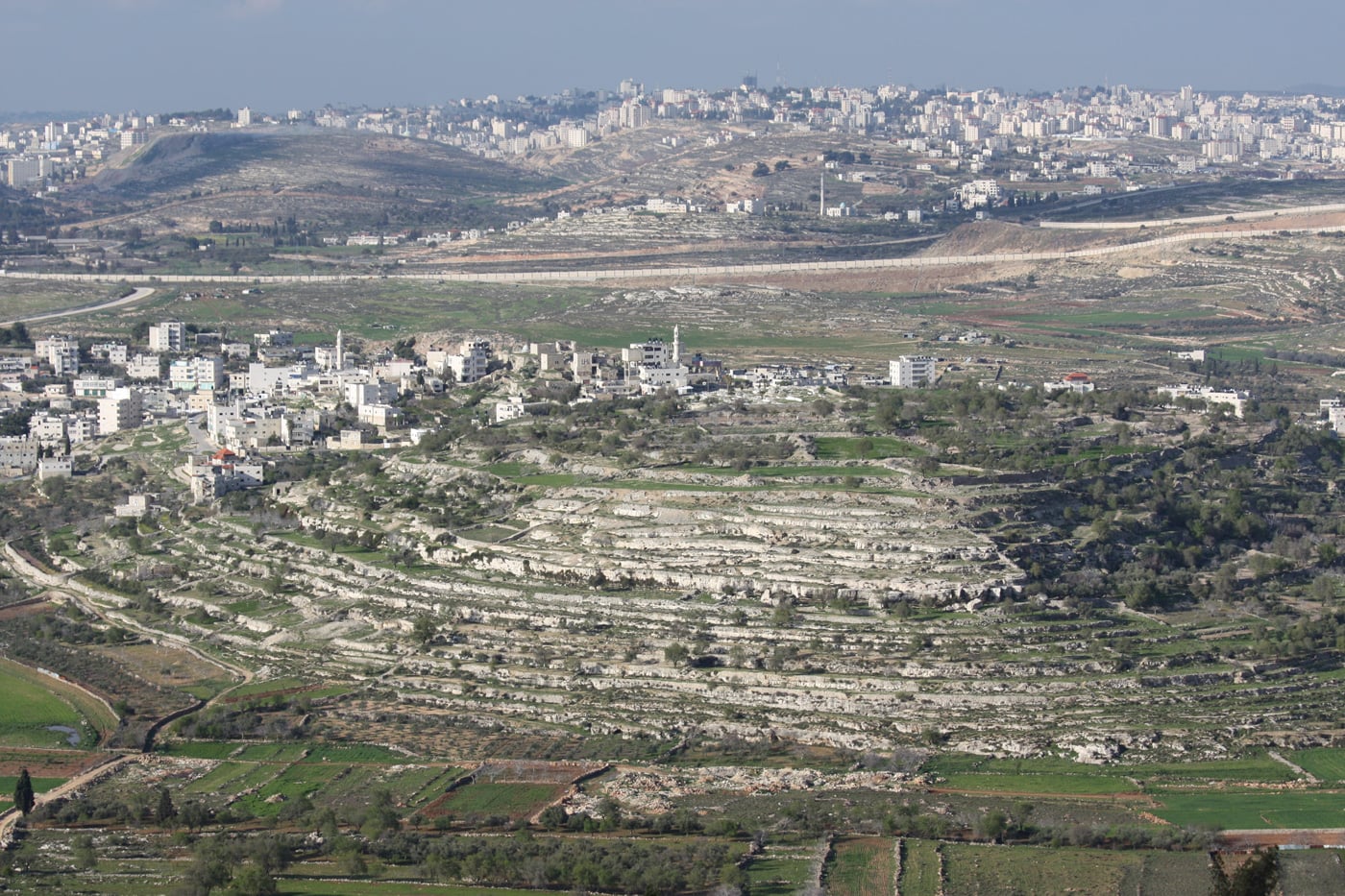
The modern village of el-Jib surrounds the site of ancient Gibeon (foreground), where David’s men fought Ish-Bosheth’s (2 Sam. 2:12–17).
After the death of their brother, Joab and Abishai keep up the chase until sunset, when Israel’s resistance stiffens (2:24–32). Abner calls for a truce, because the terrible results of civil war are already becoming clear to him. In light of the number of fatalities, Joab agrees to the truce, and the battle is finally over. Both armies march all night to return to their respective capitals by morning. Only nineteen of David’s men have perished, compared with three hundred and sixty casualties for Abner and Benjamin.
3:1–4:12. In the years that follow, David continues to enjoy success in the conflict with Ish-Bosheth. One sign of David’s increasing strength is the number of sons born to him in Hebron (3:1–5). Since none of the six have the same mother, we learn that David has taken four more wives. One of these—Maakah, daughter of the king of Geshur—was probably married to David for political reasons, to make an alliance with the Aramean city-state northeast of the Sea of Galilee. It is Maakah’s son Absalom who will kill David’s firstborn, Amnon, and then lead a rebellion against his own father.
Apparently Ish-Bosheth resents the fact that Abner is the power behind the throne, and in his jealousy he accuses Abner of wanting to seize the throne himself (3:6–11). The specific issue is whether Abner has slept with Saul’s concubine, because a king’s concubines normally became the property of his successor. Abner reacts to the charge by ending his allegiance to Saul’s family and vowing to “transfer the kingdom” to David (3:10). In his reply Abner admits that he knows the Lord has promised the throne to David. Abner’s reaction is more than Ish-Bosheth has bargained for, but his fear of Abner keeps him from raising any objections.
Abner immediately opens negotiations with David to discuss the conditions under which David might become the ruler of the entire nation (3:12–21). David is willing to work out an agreement, but only if Saul’s daughter Michal is returned to him. During David’s years as a fugitive, Saul forced Michal to divorce David, but David has continued to regard her as his wife. His marriage to Saul’s daughter would have measurably strengthened his claim to succeed Saul as king, particularly in the eyes of the northern ten tribes.
In the decision-making process, the role of the elders is an important one. As the heads of families and tribes, the elders have a voice in the selection and retention of a king (1 Sam. 15:30; 2 Sam. 5:3; 1 Kings 12:3), though their influence will decrease over the years as the dynastic model of monarchy becomes more entrenched. Knowing that many of Israel’s leaders have favored David all along, Abner encourages them to support him openly. Abner pays special attention to Saul’s tribe of Benjamin, who is the hardest to convince. Satisfied that the leaders of Israel will be willing to make a treaty with David, Abner personally goes to Hebron, where David prepares a feast in his honor. From all indications, David’s coronation over all Israel is not far off.
There is one member of David’s inner circle who is not happy about the move toward unity (3:22–27). David’s nephew, Joab, his top military commander, tries to convince David that Abner has come as a spy and that he cannot be trusted. In all likelihood, Joab feared that if the merger took place, he might lose his job to Abner. Joab has also never forgiven Abner for killing his brother Asahel during the Battle of Gibeon years before (2:23). Since Abner has not traveled very far from Hebron, Joab uses an excuse to bring him back secretly and then stabs him to death. Although Joab justifies his action on the basis of blood revenge, David’s reaction to Abner’s death exposes Joab’s treachery. Abner killed Asahel only after repeated warnings and as a last resort to save his own life. Moreover, it took place in the middle of a battle and was not comparable to Joab’s premeditated murder of Abner.
When David learns what Joab has done, he does everything possible to express his displeasure and to indicate that he was not personally involved (3:28–29). David goes so far as to place a curse on Joab and his descendants, asking God to punish them with disease, starvation, or violent death (3:29). David himself leads the mourners and weeps at Abner’s tomb, and he also composes a short lament in Abner’s honor (3:33–34). To emphasize his sorrowful attitude David fasts the rest of the day.
By regarding Abner’s death as a great tragedy, David convinces the nation that he was not implicated in the murder, and the fragile alliance with the northern tribes remains intact. At the same time, David probably should have taken some direct disciplinary action against Joab, who seems not to have lost any power.
David’s failure to discipline his officers and his sons constitutes one of his greatest weaknesses, and it will nearly cost him the kingdom some years later. Just before he dies David will tell Solomon to bring Joab to justice for his crimes, and shortly thereafter he is executed (1 Kings 2:5–6, 29–35).
With Abner gone, Ish-Bosheth’s weakness as a leader is evident even to the tribe of Benjamin (4:1–12). Not long after Abner’s death, two of Ish-Bosheth’s military officers gain entrance into the king’s house and stab him to death. Then they cut off his head and take it to David at Hebron, hoping to be rewarded for their action. When they arrive, the two brothers connect their assassination with the Lord’s vengeance “against Saul and his offspring” (4:8). To their surprise, David does not rejoice at the news of Ish-Bosheth’s death but instead orders that the murderers themselves be put to death. Once again David claims no responsibility for the elimination of any rival—whether Saul or Abner or Ish-Bosheth. In each case he is angry and dismayed. The bodies of the assassins are hung near the pool in Hebron as a warning to all and as a sign that David believes in justice.
After the death of Ish-Bosheth, there is no other member of Saul’s family who could be considered a serious contender for the throne. Jonathan does have a son named Mephibosheth, but he was crippled as a child (4:4). Years later David will make sure that he is well cared for in fulfillment of his covenant with Jonathan (2 Samuel 9).
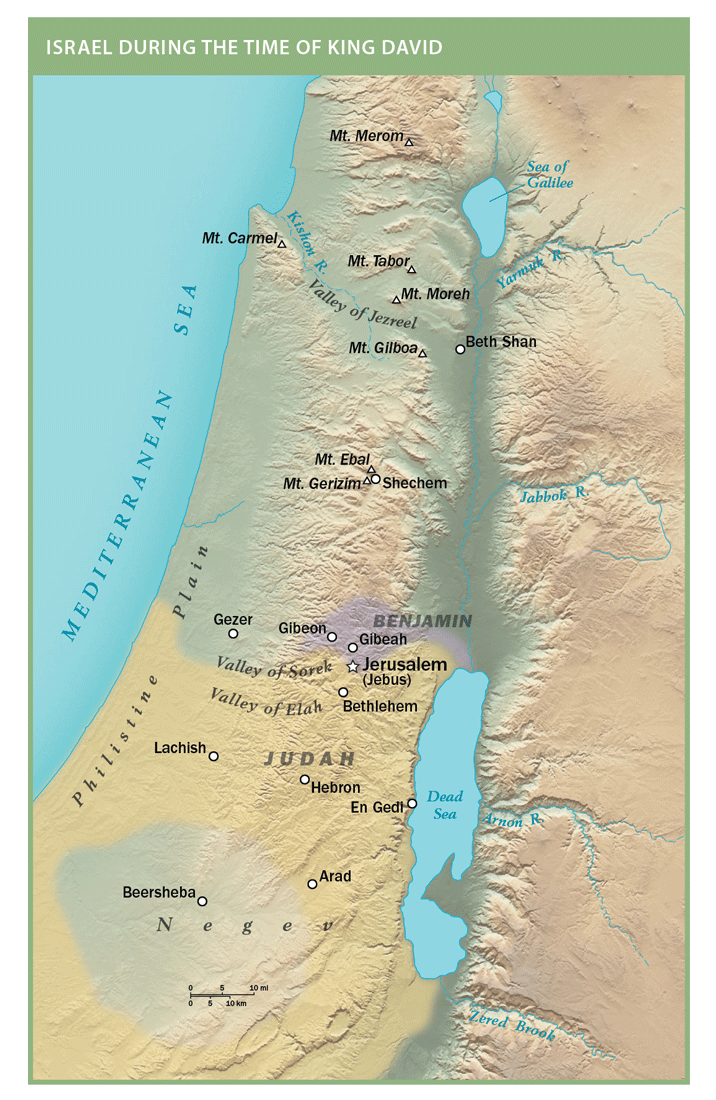
5:1–25. In recognition of their need of a strong leader, the tribes of Israel journey to the southern capital to anoint David (5:1–5). Many soldiers, representing all of the tribes, come together to make an agreement with David and to acclaim him as king. They acknowledge that the Lord has chosen him and that he has demonstrated his leadership ability over the years. Even during Saul’s reign, some soldiers from the northern tribes have defected to David (1 Chron. 12:1–22), but now the entire nation rallies around him. David is almost thirty-eight years old, and he will remain king until he is seventy. In the next thirty-three years David strengthens the nation and extends her borders in every direction. Before David dies, Israel has become a stable and secure force in the region between Egypt to the south and the Phoenician city-states and Mesopotamia to the north.
David makes many excellent choices during his lifetime, but none is better than his decision to make Jerusalem the capital of the united nation (5:6–8). Although Jerusalem briefly belonged to the Israelites (Judg. 1:8), they were unable to retain control of the city, leaving the Jebusites to rule it. Some biblical texts associate the name Jebus with the city (Josh. 15:8; 18:28; Judg. 19:10; 1 Chron. 11:4–5), which is really a reference to the ethnicity of the residents. Some scholars connect the Jebusites with the Hurrians, a people who exercised considerable influence in Mesopotamia and Asia Minor from 1800 to 1200 BC. The precise meaning of the name Jerusalem is unclear, but it might mean “foundation of peace” or “foundation of [the god] Shalem.” The city was also known by the shorter form Salem (Gen. 14:18) and by the name Zion, mentioned for the first time here in 5:7 (the etymology of “Zion” is also unknown).
In David’s time, Jerusalem was a hill covering about eleven acres, located on the border between Judah and Benjamin, making it an ideal neutral site for one who wanted to unite the north and the south. Deep valleys on every side except the north surrounded Jerusalem, so it could be easily defended, which explains the Jebusites’ confidence that David will not be able to capture the city (5:6). Jerusalem also possessed an excellent water source, the Gihon spring in the Kidron Valley, east of the city. But it may have been the “water shaft” running from the Gihon spring into the city that David’s men used to gain entrance into Jerusalem or at least to block the city’s water supply (5:8).
David takes immediate steps to fortify his new capital (5:9–16). His building efforts are aided by an alliance with Hiram, king of Tyre, one of the primary Phoenician city-states. Sending the famed cedars of Lebanon and skilled craftsmen, Hiram helps David build a palace. The Phoenicians were also excellent sailors who controlled the seas, and over the years the Israelites will trade them crops for merchandise. Both sides will profit from the alliance, which will become even stronger during the reign of Solomon. David acknowledges that his success is due to the Lord, who is making Israel a great nation, as he has promised.
As long as David is only the king of Judah, the Philistines do not seem upset by his rule. In fact, they may have considered him a vassal king, one step removed from the role he played under Achish as a mercenary commander. But once David becomes king of all Israel, the Philistines realize that he is a threat to their control of the northern parts of Israel (5:17–25). So before David has a chance to get established, the Philistines launch an attack, perhaps even before David has captured Jerusalem. It seems unlikely that they would allow him to enjoy the safety of a fortress if they could engage him in battle before this occurred.
Although David has not fought against the Philistines for several years, he has not lost his battle sense and once again emerges victorious. Both battles are fought west of Jerusalem and determine who will control the central hill country. After the first battle, the Philistines abandon their idols, just as the Israelites have lost the ark of the covenant in the days of Eli. (First Chronicles 14:12 adds that David burns the idols; this addition reflects the Chronicler’s interest in having David act in accord with Moses’s command [see Deut. 7:5].) The second battle begins after David hears “the sound of marching in the tops of the poplar trees” (5:24). This is the signal that the Lord and his angels are leading the way into battle. Just as the Lord went ahead of Barak as he moved against the army of Sisera (Judg. 4:14), so he enables David to rout the Philistines and chase them back to the coastal plain.
E. David established as king (6:1–8:18). 6:1–23. After a long wait marked by years of valuable training, David has now become the king of Israel. Because he is God’s new choice as king, the Lord gives him and his descendants the right to rule forever, and he gives David victory over all his enemies.
The ark of the covenant represents God’s presence more than does any other article in the tabernacle (1 Sam. 4:4), so David has it brought to Jerusalem. The ark has been in Kiriath Jearim, about nine miles west of Jerusalem, since the days of Eli and Samuel, but the time has come to move the ark to the new national capital. To emphasize the importance of the ark, David and his men lead a triumphant celebration, complete with singing and dancing. It is the type of celebration that usually accompanies a military victory and is David’s way of proclaiming that God deserves the recognition and glory for Israel’s triumphs.
In his zeal to honor the Lord, David places the ark on a new cart, the way the Philistines have done (6:1–11; see 1 Sam. 6:7). While a new cart is pure and this is an appropriate means of transporting a sacred object, it is also contrary to what is specified in Numbers 7:9; thus the historian likely sees in the next event a form of divine punishment. When the oxen pulling the cart stumble, a man named Uzzah—at whose home the ark has been kept—reaches out to steady the ark. As he does so, he is struck dead. There are many proposed explanations for this enigmatic event, but none is entirely satisfying, and the text provides no hint. There is no indication that Uzzah somehow sins or is ritually impure. The historian of 1–2 Chronicles ascribes Uzzah’s death to the non-Levitical mode of transport (1 Chron. 15:13). Whatever the reason, David is angry at the Lord’s action and so disturbed that he leaves the ark in the house of Obed-Edom.
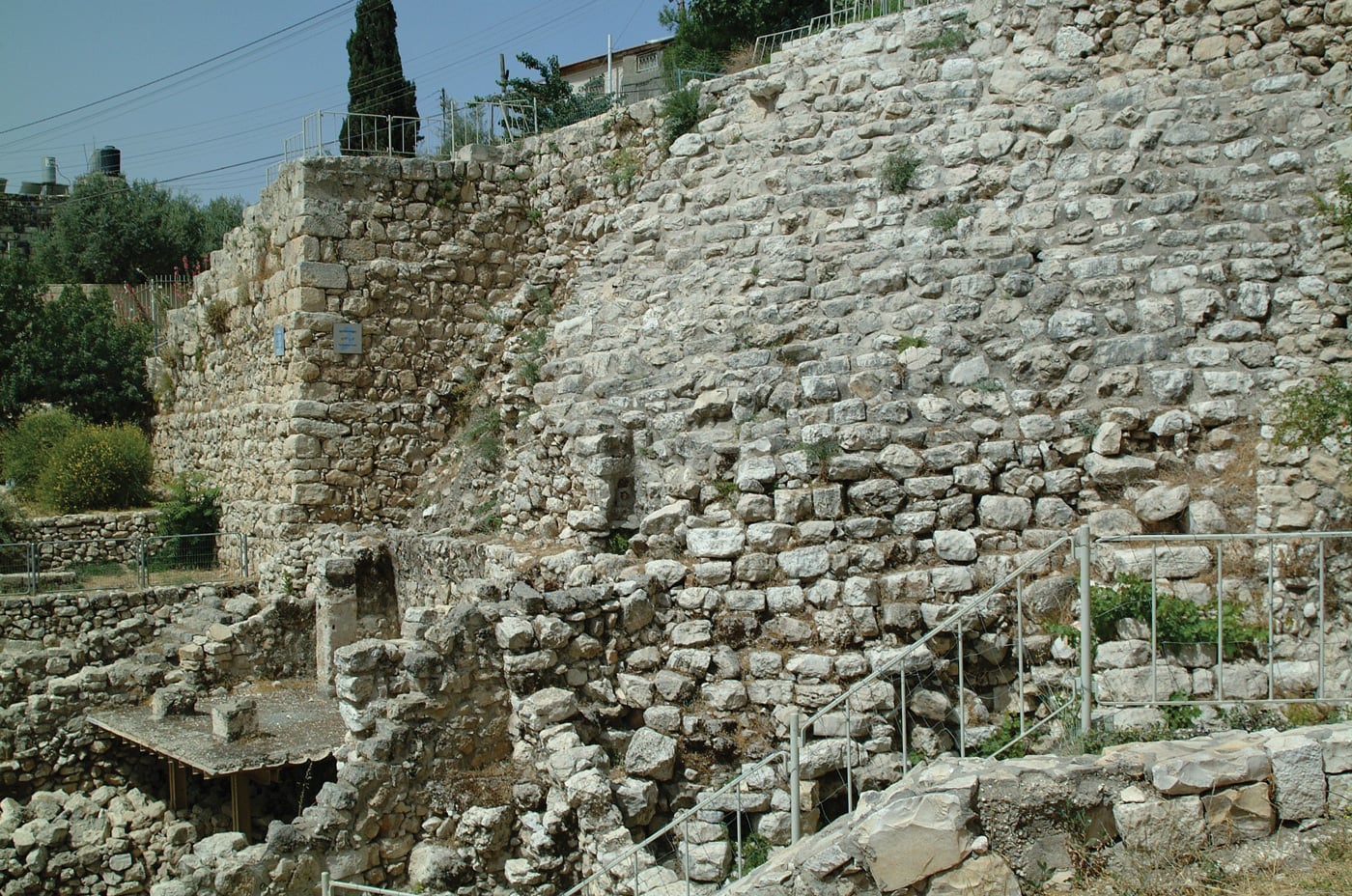
This stepped-stone structure, called the Millo, located in the ancient city of David in Jerusalem, may have supported a royal building such as David’s palace.
Three months later David is encouraged by the blessing that God has brought to the household of Obed-Edom (6:12–19). Realizing that the Lord is no longer angry, David prepares once more to bring the ark to Jerusalem. (The Chronicler adds that “those who were carrying the ark” were Levites, thus making the second attempt fall in line with Mosaic law [1 Chron. 15:15].) After the ark bearers have taken six steps and are still alive, David offers sacrifices in thanksgiving. As the procession continues amid music and shouting, David deliberately dresses like one of the Levites, putting on a robe of fine linen and a linen ephod, a garment usually reserved for the priest. When his wife Michal sees him dressed in this fashion, leaping and dancing before the Lord, she is shocked.
David does not try to bring the tabernacle to Jerusalem but sets up a special tent for the ark. Instead, Moses’s “Tent of Meeting” remains at Gibeon, about six miles northwest of Jerusalem (cf. 2 Chron. 1:3). David wants to build a permanent temple to honor the ark, as we learn in 2 Samuel 7. With the ark safely in Jerusalem, David sacrifices burnt offerings and fellowship offerings and gives gifts of food to all the people. This was also a custom at the coronation of a king, and, since the ark was the footstool of God’s throne, David may have been emphasizing God’s role as the great king over Israel.
Michal’s reaction to David’s behavior during the celebration is harshly critical. She apparently feels that the king should not have displayed such enthusiasm, behaving like “any vulgar fellow” (6:20). Perhaps she is afraid that David will be like her father Saul, whose ecstatic prophesying episodes bore some similarities to David’s behavior (cf. 1 Sam. 19:24). In any event, David rebukes her by reminding her of the context for his behavior, that it was in recognition that God is Israel’s true king and David but a servant. Moreover, the historian juxtaposes this exchange with the report that Michal never has any children, implying that the Lord is similarly critical of her response.
7:1–29. After the Phoenicians have built a palace for David out of the cedars of Lebanon, David wants to build a magnificent temple for the Lord (7:1–7). At first the prophet Nathan encourages him, but then the Lord reveals to Nathan that David will not be allowed to construct the temple. The reason is not explicit in 2 Samuel and differs from the Chronicler’s explanation, that David is a man of war who has shed much blood and that his son Solomon will be “a man of peace and rest,” who will be allowed to build the temple (1 Chron. 22:8–9). The implicit reason in Samuel seems to concern the direction of authority: who is whose benefactor?
Note David’s reasoning: he sees the disparity between his dwelling and that for the ark of the Lord and proposes to rectify this. God’s response is interesting. After God notes his previous practice, that he has never dwelt in a house before, he addresses David’s concern that God not be angry over the disparity by pointing out that none of the previous leaders have been punished for not building God a temple. But underneath this all, it seems that the Lord’s rejection of David’s proposal is in fact aimed at the suggestion that David might be the Lord’s patron. The use of first-person pronouns (“I”) in the Hebrew of the verses that follow stresses the Lord’s role as David’s patron. Over against David’s proposal to serve as benefactor for the Lord, the Lord asserts his role as benefactor to David (a role that is emphasized again in 7:11–12). Whereas it was commonplace in the ancient Near East for kings to build temples for their deity, this story restricts the king from making the deity indebted to him. And yet, the historian has to balance the direction of patronage with the fact that a temple is eventually built for God. Thus, it is assigned to David’s successor (7:13).
While God does not allow David to build his temple, he does reveal through Nathan that he will continue to bless David and the entire nation (7:8–17). God promises to make David’s name great, just as he promised to do for Abraham (Gen. 12:2). Powerful leaders will no longer oppress Israel the way the Egyptians or other neighboring peoples did during the period of the judges. Although Joshua helped plant the nation in the land promised to Abraham, David will plant them more firmly (7:10).
To encourage David even further, the Lord announces that instead of David building him a “house,” God will build David a “house,” meaning a dynasty. Unlike the judges or Saul before him, David’s family will continue to rule for generations. The son who immediately succeeds him (Solomon) will build the Lord’s temple, and his kingdom will be powerful and secure. In addition to all this, God promises to maintain a special father-son relationship with each king, assuring him of divine counsel. As the Lord’s “son,” however, the king is required to obey his commands faithfully. If the Davidic king sins, God will punish him, but he will not take the throne away from David’s family (1 Kings 11:34). Eventually a king will arise who will reign “with justice and righteousness” (Isa. 9:7), and the Spirit of the Lord will rest on him in a powerful way (Isa. 11:2). Many of the later prophecies about the Messiah draw on this great promise to David.
In response to what he has heard from Nathan, David enters the tent he has set up for the ark and worships the Lord (7:18–29). As he prays he addresses the Lord seven times as the “Sovereign Lord,” a title that stresses God’s control over the nations and his covenant relationship with Israel. It is a title frequently used in prayer. David marvels that God has made such promises to him and his family. Unlike Saul, who became proud in his role as king, David seems to have maintained some degree of humility.
At the same time David acknowledges God’s greatness and uniqueness and his choice of Israel to be his special people. David realizes that God’s promises to him are intimately connected with God’s favor for Israel in the past, as in the exodus from Egypt (7:23). With a grateful heart David prays that God will keep his promises.
8:1–18. The battles described in chapter 8 may have taken place over a period of years. Almost all of the nations adjacent to Israel’s borders fought against David, perhaps in an attempt to keep him from expanding or simply from becoming too influential over the important trade routes winding through Israel. But by defeating them, David becomes the head of an influential kingdom (8:1–6). One of his first foes is Moab, with whom he has earlier been allied (1 Sam. 22:3–4). Another foe north of Israel and northwest of Damascus is the powerful Aramean kingdom of Zobah. By his victory over King Hadadezer of Zobah, David establishes a presence to the north of Israel. The Aramean kingdom between Israel and Zobah was centered in Damascus, located about sixty-five miles northeast of the Sea of Galilee and an important trade center. Damascus was closely allied with Zobah, and when these Arameans come to the aid of Hadadezer, David also subdues them and places garrisons in Damascus. Israel remains in control of this Aramean stronghold until well into Solomon’s reign.
As a result of his military success, David receives significant wealth in the form of plunder and tribute payments from surrounding nations (8:7–14). Bronze, silver, and gold begin to pile up in Jerusalem. Even friendly neighbors such as Tou, king of Hamath, send gifts of precious metal to David. In recognition of the Lord’s blessing on his rule, David dedicates many of these articles to the Lord, and later on they are used in the construction of the temple. David’s victory over the Edomites gives him control of the rich copper mines south of the Dead Sea, adding further to his wealth.
Unlike the reign of many of the later kings, David’s rule is characterized by justice and righteousness (8:15). The historian juxtaposes this statement with the preceding description of David’s success to create a causal connection: David is successful due to his loyalty to God (8:15–18). David is assisted by several able administrators, including a “recorder” and a “secretary.” The former may have been the head administrator of royal affairs and the latter something like our secretary of state. Neither position is mentioned in the summary of Saul’s role in 1 Samuel 14:49–52, and this difference may indicate the growth of Israel as an administrative entity. Zadok the priest is mentioned for the first time here (8:17). A descendant of Eleazar son of Aaron, Zadok replaces Abiathar as the leading priest under Solomon, and his descendants hold the high priesthood throughout the rest of the monarchy. Strangely, David’s sons are also called “priests,” though the NIV 1984 translates the word as “royal advisers” (8:18). Sometimes priests did fulfill the role of advisors (cf. 1 Kings 4:5), but some scholars feel that David and his sons may have been priests of an order especially assigned to, and in this case including, members of the royal house. David did wear a linen ephod when he brought the ark to Jerusalem (6:14), and he is closely involved with the worship of the Lord throughout his reign. In later ancient translations, the reference to David’s sons as priests is often toned down to, for example, “great men” or “princes,” likely to avoid the suggestion that legitimate non-Levitical priests existed after Moses’s day.
3. David’s Successes and Failures (9:1–20:26)
Although for the most part David is a pious and effective ruler, his sin with Bathsheba is a terrible stain on his record. In the years that follow his adultery, David faces a rebellion led by his own son Absalom and another led by a Benjamite named Sheba. Jerusalem and all Israel are shaken by these events, and David struggles to maintain his throne. Because of the turmoil in his own family, the question of who will succeed him as king becomes an important one.
A. David’s success (9:1–10:19). Early in his career David is known as a wise and fair leader (1 Sam. 30:24–25), and when he becomes king he continues to handle problems with great skill. His kindness to Jonathan’s son Mephibosheth demonstrates his genuine compassion for others. As a military leader, David has known only victory in battle ever since his triumph over Goliath, and the Ammonites and Arameans learn about his military prowess the hard way.
In light of the covenant God has made with David promising to show kindness to his family forever, it is fitting that David remembers the covenant he made with Jonathan. When most kings came to power they sought to eliminate any survivors of the preceding king, but not David (9:1–5). Bound by covenant to his best friend, Jonathan, David is loyal to his oath and eager to take care of any of Jonathan’s descendants. Ziba, who was Saul’s chief steward, tells David about Mephibosheth, Jonathan’s crippled son, who is living in the Transjordan with a wealthy man named Makir.
We do not know if Mephibosheth knew anything about his father’s covenant with David, but he certainly does not anticipate that David will treat him so royally (9:6–13). Not only does David give him the income from Saul’s land, but Mephibosheth is allowed to eat at David’s table “like one of the king’s sons” (9:11). Ziba and his family are given the responsibility of working the land for Mephibosheth, and from 16:3–4 we learn that Ziba really wanted control of Saul’s land himself. For the time being, however, Ziba seems willing to serve Mephibosheth, and, unlike others who later rebel against David, Mephibosheth remains loyal to the king the rest of his life.
In light of the frequent fighting between Israel and the Ammonites, we might well wonder how and why the Ammonite king Nahash previously assisted David (10:1–5). Perhaps Nahash harbored David in some way while he was fleeing from Saul. Regardless, the old animosity is not far below the surface, and David’s attempt to congratulate the new king is interpreted as a spy mission. David’s men are badly mistreated. In the ancient Near East, beards were shaved only during times of personal or national catastrophe as a sign of deep mourning. By cutting off the men’s garments at the buttocks, the Ammonites treat the messengers as prisoners of war. Humiliated, David’s men cross the Jordan River and stay at Jericho until their beards grow back.
The Ammonites realize that David will regard their insulting behavior as an act of war, so they summon a substantial number of their Aramean allies for the upcoming battle (10:6–19). The small kingdoms of Beth Rehob, Maakah, and Tob lay to the east and north of the Sea of Galilee, with Zobah a little further to the north. (Note that David conquered Zobah and its ruler, Hadadezer, in chapter 8, after which there is no hint that he loses control of the region; this thus suggests that the events in this part of 2 Samuel are not in strict chronological order.) Faced by a powerful coalition, David sends Joab to engage the enemy in battle. As the leading general, Joab himself leads the best troops against the Arameans, and he sends Abishai to fight the Ammonites at their capital city of Rabbah, about thirty miles east of Jericho. Encouraging one another in the Lord, Joab and Abishai attack, with excellent results. The Ammonites take refuge behind the walls of their capital city while the Arameans head north. Hadadezer, king of Zobah, hires reinforcements from across the Euphrates, while David himself takes the men back across the Jordan to meet this new threat. In spite of the additional troops the Arameans fall before David, and a number of kings are forced to subject themselves to him. Initially, David intends to punish the Ammonites, but when the dust settles he finds himself in control of much of the land between Israel and the Euphrates.
B. The turning point (11:1–12:31). 11:1–27. At a time when David and his people seem to be thriving, the king commits adultery and murder. Although David repents and the Lord forgives his sin, this whole episode marks a major turning point in David’s rule. From this point on David faces serious challenges from his own family and fellow Israelites and in the process nearly loses the throne.
Like Samson before him, David is guilty of sexual immorality, with all its consequences. While committing adultery is bad enough, David compounds the problem by committing murder as well. The second crime is intended to cover up the first—but he soon finds out that nothing is hidden from the Lord.
The historian starts the narration of this scene by noting that kings customarily return to the battlefield after the rainy season ends in April and May (11:1). This provides a gauge by which to judge David’s choices. David and Joab want to complete the conquest of the Ammonites, so the army is sent to put Rabbah under siege. But David stays home, a decision contrary to custom and one that places him in the way of temptation. Thus he becomes involved with Bathsheba, the wife of one of his soldiers, Uriah the Hittite (11:1–5).
To make it appear that her husband has made her pregnant, David calls Uriah back from the battlefront under the guise of gaining information about the progress of the campaign (11:6–13). David sends Uriah home to relax with his wife, but Uriah refuses to go home and enjoy himself when the rest of the army is exposed to hardship in the open field. His dedication contrasts sharply with David’s self-indulgence. Sexual intercourse made a man ceremonially unclean and unfit for battle for a few days, and it appears that Uriah wanted to get back into action quickly. David keeps Uriah in Jerusalem one more day, hoping that he will sleep with his wife. To break down Uriah’s defenses, David sees to it that Uriah is made drunk, but even so, he does not go home.
Frustrated by the self-discipline of Uriah, David now takes more desperate measures to cover up his sin (11:14–27). In a painful bit of irony, David uses Uriah as a messenger to send a letter to Joab asking that Uriah be placed in a very dangerous position in the front line. With Uriah dead, David will then marry his widow and legitimize the birth of Bathsheba’s child. Joab complies by sending Uriah too close to the wall of Rabbah, where he is killed by Ammonite arrows. Joab clearly knows that this tactic is unwise and in the aftermath anticipates the king’s displeasure at losing soldiers in this way (11:20–21), but we can surmise it is his loyalty to David that leads him to follow David’s instructions. By way of contrast, David’s loyalty to Uriah is nonexistent. Though Uriah is one of David’s top thirty-seven soldiers (23:39) and more than willing to risk his life for David and for Israel, David mercilessly steals his wife and arranges for his death. Since only Joab suspects foul play, it looks like the perfect crime. Bathsheba mourns for her husband (perhaps seven days; cf. Gen. 50:10), then slips into the royal harem. It all looks very innocent, but the Lord notices. In his eyes David has broken the last five Mosaic commandments in this one brief episode. The consequences will be devastating.
12:1–31. The same prophet who told David about the eternal dynasty God has promised him (7:11–16) now appears to deliver a very difficult message (12:1–12). Although many months have passed since David’s sin, he has apparently not reckoned with the significance of his deeds. Nathan’s visit changes everything, as David listens to a parable and pronounces a death sentence on himself. The ewe lamb in Nathan’s parable is Bathsheba, and the poor man is Uriah. David as the reigning king is guilty of misusing the power God has given him. The king is regarded as the shepherd of Israel, and David now realizes what he has done to his flock.
After pointing out David’s guilt, Nathan announces that David will be punished the same way he has sinned. Violent death will strike his own family, and in subsequent years, three of his four oldest sons will die by the sword. Confronted by the prophetic word of God, David finally realizes the true nature of his actions (12:13–19). After David admits his sin (his contrition is only implied), Nathan informs him that God has forgiven him and will spare his life (cf. Psalm 51).
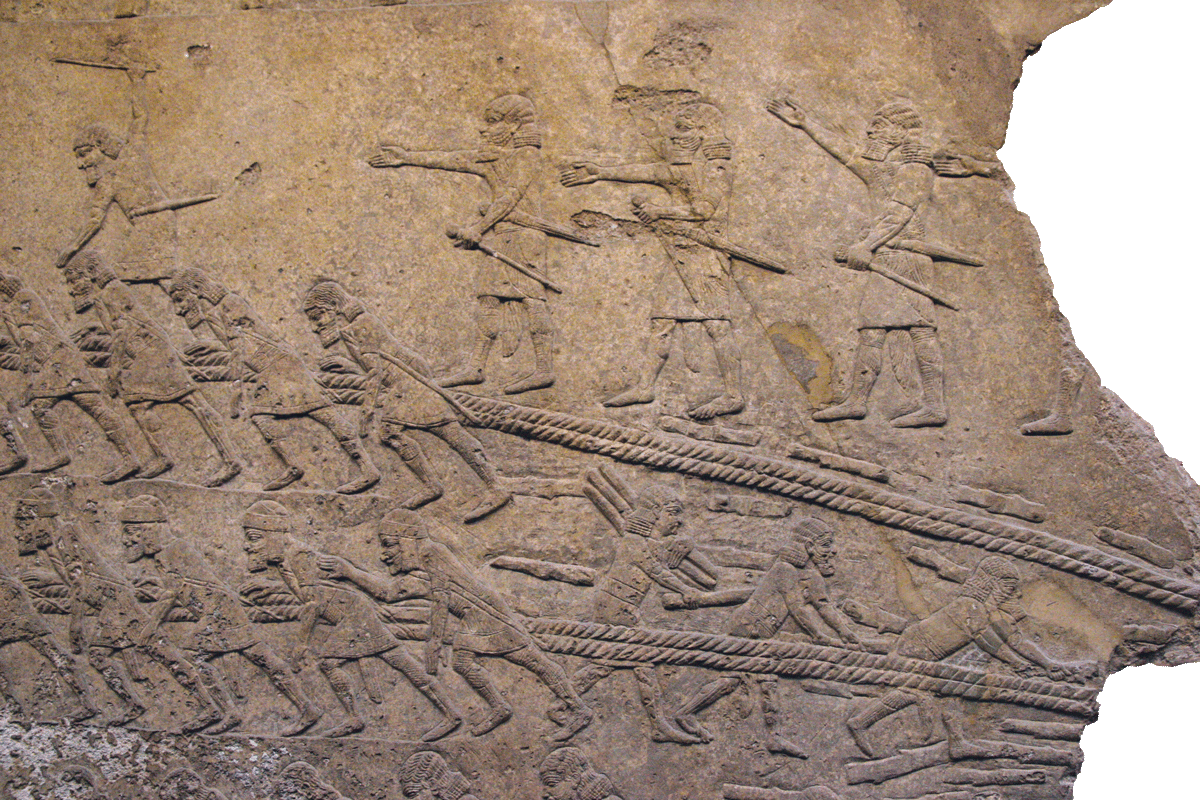
In the ancient world, conquered enemies often became slave labor (see 2 Sam. 12:31). This panel from the palace of Sennacherib (Nineveh, 700–692 BC) shows prisoners of war pulling ropes to haul a stone bull as part of a construction project.
Notice the confrontation between the prophet and the king. Especially telling is that David’s misdeed is characterized as despising the word of the Lord (12:9) and is thus cast as an offense against the prophetic office. Moreover, the analogy Nathan uses in his story of the rich man who steals the poor man’s sheep is just the sort of behavior Samuel warned is characteristic of kings: kings are takers, and they will appropriate what you cherish (see 1 Sam. 8:10–18). Thus this passage betrays the same critique of kings and advances the image of prophets as dominant over kings.
In the years that follow, David continues to reap the consequences of his sins with Bathsheba and Uriah, starting with the death of Bathsheba’s baby. For seven days David prays and fasts for the sick child with the hope that in his grace, God might also spare this little one. But the child dies, and David tastes the first bitter fruit of his sins. In spite of his pain, David accepts the death of the child as the Lord’s will and does not continue to lament (12:20–25). Encouraged by the knowledge that his own sin is forgiven, David goes into the house of the Lord and worships.
Some time later Bathsheba has another son, whom they name Solomon, which is formed from shalom, the Hebrew word for “peace” or “well-being.” He is also called Jedidiah, “beloved of the Lord.” Both names perhaps reflect what David hopes for and expects of this son; both names also aptly preview the historian’s assessment of Solomon’s reign.
After a long delay, the historian returns to the subject of the siege of Rabbah (12:26–31), where David probably should have been in the first place. More than a year has gone by since Joab began the siege. At Joab’s insistence, David participates in the final assault on the Ammonite capital and receives the honor for the victory. Of unusual interest is the seventy-five-pound gold crown taken from the king, part of the substantial plunder found in the city. Additional loot is taken from the other Ammonite cities, and the captives are put to work on various building projects. Slave labor of this sort played an important role in the construction activities of many ancient Near Eastern rulers.
C. Rebellion (13:1–20:26). 13:1–39. Although the Lord did not explicitly forbid polygamy, the story recounted in 13:1–14 illustrates why multiple marriages are unwise. Hatred and jealousy among half brothers was a constant problem and sometimes led to murder (cf. Judg. 9:5), especially when one’s own sister is violated (cf. Genesis 34). It is unlikely that the heart of the matter in this story is an unlawful relationship: while Leviticus 18:9 and 20:17 forbid sexual relations with one’s sister (half sister or not), taking a “wifster” (wife-sister) was commonplace if not encouraged, particularly in royal families. (This ensured, for instance, that any claims to the throne were kept within the family.) This episode probably reflects a power play by Amnon, perhaps to keep another pretender to the throne in line; in other words, Tamar is simply a tragic tool for getting at Absalom.
Taking the advice of his cousin Jonadab, Amnon pretends to be sick and asks that Tamar might visit him. When she is alone with him in the bedroom, his long-awaited chance comes. Tamar attempts to deter Amnon by suggesting his position as heir apparent to the throne could be placed in jeopardy by his action. Finally, in what is likely a last-ditch ruse to buy time, she suggests that David will allow the two of them to get married. In spite of these protests, Amnon refuses to listen and rapes her (which hints at his true motivation, the humiliation of Absalom).
Unlike the young prince Shechem, whose love for Dinah increases after he sleeps with her (Genesis 34), Amnon’s love is not genuine and is surpassed by his hate for his rival. Thus, Amnon quickly has Tamar removed from his house: his purposes have been accomplished (13:15–22). Shamed and rejected, Tamar leaves in mourning, throwing ashes on her head and tearing her beautiful ornamental robe that signifies her status as a virgin daughter of the king. Amnon’s hatred for Tamar and Absalom is more than equaled by Absalom’s hatred for Amnon once Absalom finds out about the violation, with all its implications for himself.
Like Dinah’s brothers in Genesis, Absalom responds against the guilty party with vengeance. David is also deeply upset over what has happened, but, strangely, he does nothing to punish Amnon. At the very least he should have announced that Amnon’s deed disqualified him as a contender for the throne. Just as Jacob’s oldest son Reuben lost the birthright by sleeping with his father’s concubine (Gen. 35:22; 49:4), so Amnon should have forfeited any right he had to the throne. Perhaps David is reluctant to take any action against Amnon because he himself has been guilty of adultery. David’s failure to discipline Joab, Amnon, and Absalom and to control the strife within his family in general constitutes a major character flaw and reflects the tragic course on which he has set his family by his mistreatment of Bathsheba and Uriah.
In spite of his intense hatred for Amnon, Absalom waits two years before taking revenge on his half brother (13:23–33). He chooses a normally festive occasion, the time of sheepshearing, to invite his brothers to visit his land in Ephraim, in the center of Israel. To make it look legitimate, he invites David to join them, but when David turns down the invitation, Amnon is invited as the king’s representative. Apparently none of the other brothers suspect anything either, until a somewhat drunk Amnon is struck down by Absalom’s men, after which they all flee in fear for their own lives. At first there is a rumor that all the king’s sons have been killed. David’s nephew Jonadab—who is partly responsible for the whole situation in the first place—correctly insists that only Amnon has been killed. By killing Amnon, Absalom gains revenge for the rape of Tamar and eliminates a rival for the throne. With Amnon dead, Absalom is apparently the oldest surviving son.
While the rest of David’s sons flee southward toward Jerusalem, Absalom heads north, toward the safety of his maternal grandfather’s kingdom of Geshur (3:3), northeast of the Sea of Galilee (13:34–39). David used the same strategy himself when he sought refuge in his great-grandmother Ruth’s native land of Moab (1 Sam. 22:3). In one stroke David loses Amnon by death and Absalom by flight. Absalom’s absence allows David time to postpone a decision about how to punish him. As time passes, the king recovers from the loss of Amnon and his heart grows softer toward Absalom.
14:1–33. Since David responded so well to Nathan’s indirect approach in 12:1–7, Joab decides to use the same method with reference to his cousin Absalom (14:1–11). The story told by the wise woman bears some resemblance to the struggle between Amnon and Absalom, but it is disguised to the extent that David can make an objective decision before applying it to his own case. He rules in the woman’s favor and in doing so creates tension between his ruling and his banishment of Absalom. Once David has solemnly promised to spare the guilty son from death, the wise woman of Tekoa cautiously applies the decision he has made to his own situation with Absalom (14:12–20). Her reference to the reconciliation of a “banished person” to God may be an allusion to David’s own restoration after he committed murder; it is also a powerful metaphor for God’s love of and desire for all sinners. As a final argument, the woman refers to David’s ability to make just decisions, such as a divine messenger would make. Although this may be partly flattery, David does possess excellent judgment—except when it comes to those close to him. By this point in the conversation David realizes that Joab has sent the woman to him and he believes that Joab is right about Absalom.
Grateful that the king has taken his “indirect” advice, Joab goes to Geshur to bring Absalom home (14:21–27). When he arrives in Jerusalem, Absalom is not allowed to see David, an indication that while he has been allowed back from exile, he is not fully restored into the king’s house. Because of his good looks, Absalom soon becomes very popular. There is special mention of his thick hair, which serves to enhance his vigorous appearance. In the ancient world, kings and warriors were often depicted with long hair as a sign of strength and courage. The birth of sons was also an evidence of manliness, and Absalom had three of them. He also had a daughter named after her aunt, Tamar.
After two years in Jerusalem Absalom demands to see the king to find out what his status really is (14:28–33). He wants David either to punish him or forgive him and to do so openly. Since Joab was instrumental in Absalom’s return to Jerusalem, Absalom calls on his cousin for help once more. This time Joab is reluctant to even talk about the problem, until Absalom has Joab’s barley field set on fire. This brings Joab on the run, and a visit with the king soon follows. In their face-to-face confrontation David kisses Absalom as a sign that he is forgiven and restored to the royal family. There is no indication that Absalom has repented of Amnon’s murder, so it seems that some disciplinary action is in order—perhaps a clear statement that Absalom will never be king. Although Absalom may have known that he would not be David’s choice as king, public censure might have made it more difficult for Absalom to gain support for his rebellion.
15:1–37. For four years Absalom develops a strategy to increase his popularity and chances for the throne (15:1–12). Pretending to be a champion of justice, Absalom wins the hearts of the people by agreeing with their complaints against the king. Handsome and charming, he personally meets large numbers of people near the city gates of Jerusalem, thereby ingratiating himself to the general populace.
All this time David apparently suspects nothing, so when Absalom asks permission to go to Hebron, David raises no objection. It sounds innocent enough, much like Samuel’s announcement that he would offer a sacrifice in Bethlehem—just before he anointed a king in place of Saul (1 Sam. 16:2–3). Hebron was the site of the cave of Machpelah, where Abraham and Sarah were buried, so it was a popular national center. But it was also the city where David was anointed king by both Judah and all Israel—and where Absalom was born.
By now Absalom is probably close to thirty years old and David about sixty. Very few individuals know about Absalom’s plans, not even the guests he has invited from Jerusalem. From the outset, however, Absalom enjoys the support of key individuals, especially David’s top advisor, Ahithophel. With their help, the revolt has a good chance of succeeding.
Up to this point in his career David has never suffered a defeat in battle, but he is forced to flee his beloved Jerusalem in the face of Absalom’s revolt (15:13–23). David does not want to subject the city to the horrors of war, so he takes his men and heads east toward the Jordan River, unsure how much support he would have if he stayed.
Accompanying David in his flight are the men who have been with him since the time he was a fugitive from Saul, as well as several contingents of mercenary troops from Philistine territory. According to 8:18 the Kerethites and Pelethites are commanded by David’s general Benaiah, and the six hundred Gittites are probably from the city of Gath, where David and his men earlier served as mercenaries. Ironically, the foreign troops are most loyal to David, although David releases Ittai the Gittite from any additional obligation. Ittai refuses the generous offer, though, and pledges his loyalty to David. In the showdown against Absalom, Ittai will play a key role (2 Sam. 18:2).
Since David has been a protector of the priests and since he has brought the ark to Jerusalem, it is fitting that the priests and the ark accompany him in leaving the capital. Both Zadok and Abiathar are with him, and their presence seems to ensure God’s blessing on David. Yet once they are safely out David sends the ark back to Jerusalem. It is particularly interesting that while David makes a declaration of trust in how the Lord will allow events to unfold, he also sets up a veritable spy network using the priests Zadok and Abiathar, whom he is sending back (15:24–29).
Leaving his trusted companions behind, David continues his sorrowful trek up the Mount of Olives. At the summit he meets Hushai, another of his close advisors, who has heard the news about Absalom (15:30–37). David asks Hushai if he is willing to return to Jerusalem and become an advisor to Absalom. In this way he might contradict the advice of Ahithophel and talk Absalom into a bad decision.
16:1–17:29. To make matters more confusing, David encounters two members of the tribe of Benjamin along the way (16:1–13). The first is Ziba, Mephibosheth’s servant, and the second is an angry relative of Saul named Shimei.
David knows Ziba from their earlier meeting, when David asked him to work for Jonathan’s son Mephibosheth (9:9–10). Now that David is headed toward the Transjordan, Ziba brings him some much-needed supplies. The amounts of bread and raisins are identical to those Abigail gave to David at an earlier time of crisis (1 Sam. 25:18) and help Ziba accomplish his objective. Apparently Ziba does not enjoy his subservient position and so tells David that Mephibosheth is hoping to regain control of his grandfather Saul’s kingdom. Since David is uncertain about the extent of the revolt, he believes the lie about Mephibosheth and gives Ziba control of Saul’s estate. It is a clever move by Ziba, who profits from the political crisis.
On the eastern side of the Mount of Olives and still only about two miles from Jerusalem, David is confronted by Shimei, a man from the same clan as Saul’s family (16:5). Still frustrated by the transfer of power from Saul to David, Shimei takes out his anger on David by cursing him and pelting him with stones. Calling David a troublemaker and a wicked man, Shimei asserts that God is punishing David for shedding the blood of the household of Saul. This may be a reference to the execution of seven of Saul’s descendants because of the Gibeonite problem (2 Sam. 21:1–9) or a more general allusion to casualties in the civil war between David and the remnants of Saul’s family. By throwing stones at David, Shimei implies that David should have been stoned to death for his crimes.
On the other hand, David’s men feel that Shimei deserves to die for cursing the king. According to the law, slander of this sort was akin to blaspheming God (Exod. 22:28). But David does not allow anyone to strike Shimei down, perhaps because he knows his own sin was behind his troubles and he deserves harsh words. By committing the matter to God, David hopes that the Lord will turn the curse into a blessing. Although David will later spare Shimei’s life again (2 Sam. 19:23), eventually Shimei is executed by Solomon (1 Kings 2:46).
When Absalom arrives in Jerusalem he is congratulated by Hushai the Arkite, the man David hopes will be able to nullify the counsel of Ahithophel. In spite of Absalom’s suspicions, Hushai is able to convince him that he will serve the new king because he is David’s son.
As expected, Ahithophel gives Absalom some shrewd advice (16:15–23), recommending that he sleep with his father’s concubines. Usually a king’s concubines belonged to his successor, so by this action Absalom strongly asserts his kingship. At the same time he states his complete contempt for his father. By sleeping with the concubines in a tent pitched on the roof, he also ensures that all Israel knows what he is doing.
Given the skill and the reputation of Ahithophel, it comes as a shock to see his advice rejected in 17:1–14. Ahithophel recommends that Absalom pursue David immediately, before he has a chance to escape very far or to organize his forces. If he had killed David quickly, then David’s supporters would likely have paid allegiance to Absalom and the nation would not have been divided by a long and bloody civil war. It is a good plan, but Hushai tries to buy time for David by pointing out the fallacies in Ahithophel’s suggestion. He refers to David’s reputation as a fighter and warns that he will not be captured so easily. Appealing to Absalom’s ego, Hushai urges him to gather a huge army and make sure that he can defeat David’s men.
As the historian asserts, it is in accord with God’s planning that Absalom chooses to follow the bad advice of Hushai and in doing so brings ruin on himself. God will not allow Absalom to usurp the throne at David’s expense, and thus God answers David’s prayer. Moreover, because of Ahithophel’s subsequent suicide, Absalom loses the services of his top advisor permanently.
Delighted with Absalom’s decision, Hushai decides that he will nonetheless take no chances and will warn David to cross the Jordan River as soon as possible (17:15–22). If he delays and if Absalom changes his mind and begins the pursuit immediately, David will be in grave danger. Following their prearranged plan, Hushai sends word to David through the sons of Zadok and Abiathar. Unfortunately they are spotted and have to hide in a well on the eastern slope of the Mount of Olives. In a ruse similar to that used by Rahab (Josh. 2:5), the woman hiding the men sends the pursuers on ahead. This enables the two messengers to avoid capture and to cover the fifteen miles to the Jordan River. Near the fords of the Jordan the men urge David to cross the river at once lest Absalom attack him before daybreak.
Convinced that Absalom will lose the war with David and that he and the other leading rebels will be put to death for treason, Ahithophel decides to commit suicide (17:23–29). It is a tragic end for one whose counsel has been sought so avidly. His death is a sign to Absalom and his followers that their cause is doomed.
Meanwhile, David heads for the city of Mahanaim, north of the Jabbok River, the same city that Ish-Bosheth used as his capital (2:8). By this point Absalom has brought a sizable army across the Jordan, led by Amasa, a cousin or half cousin of both Joab and Absalom. Cut off from the luxury and resources of Jerusalem, David and his men receive valuable supplies from Makir and Barzillai, wealthy Israelites in the Transjordan. David will never forget their kindness (1 Kings 2:7). More surprising is the aid he receives from the son of the king of the Ammonites, whose brother David defeated in battle (see 2 Samuel 10).
18:1–19:8. As the battle draws near, David’s men are commanded as usual by his nephews Joab and Abishai (10:9–10), but this time a mercenary contingent is led by Ittai from Gath (18:1–8). David volunteers to go with them but is dissuaded in view of the fact that the enemy wants above all to see him dead. As the troops march out to battle, David urges them to be gentle with Absalom. Since David and his men are outnumbered they choose the rugged terrain of “the forest of Ephraim” as the battle site (18:6). Aided by this unusual setting, David’s men outmaneuver the army of Israel and kill twenty thousand (or twenty “companies” of) men. Experienced and intensely loyal to David, his men win a decisive victory and save the throne for him.
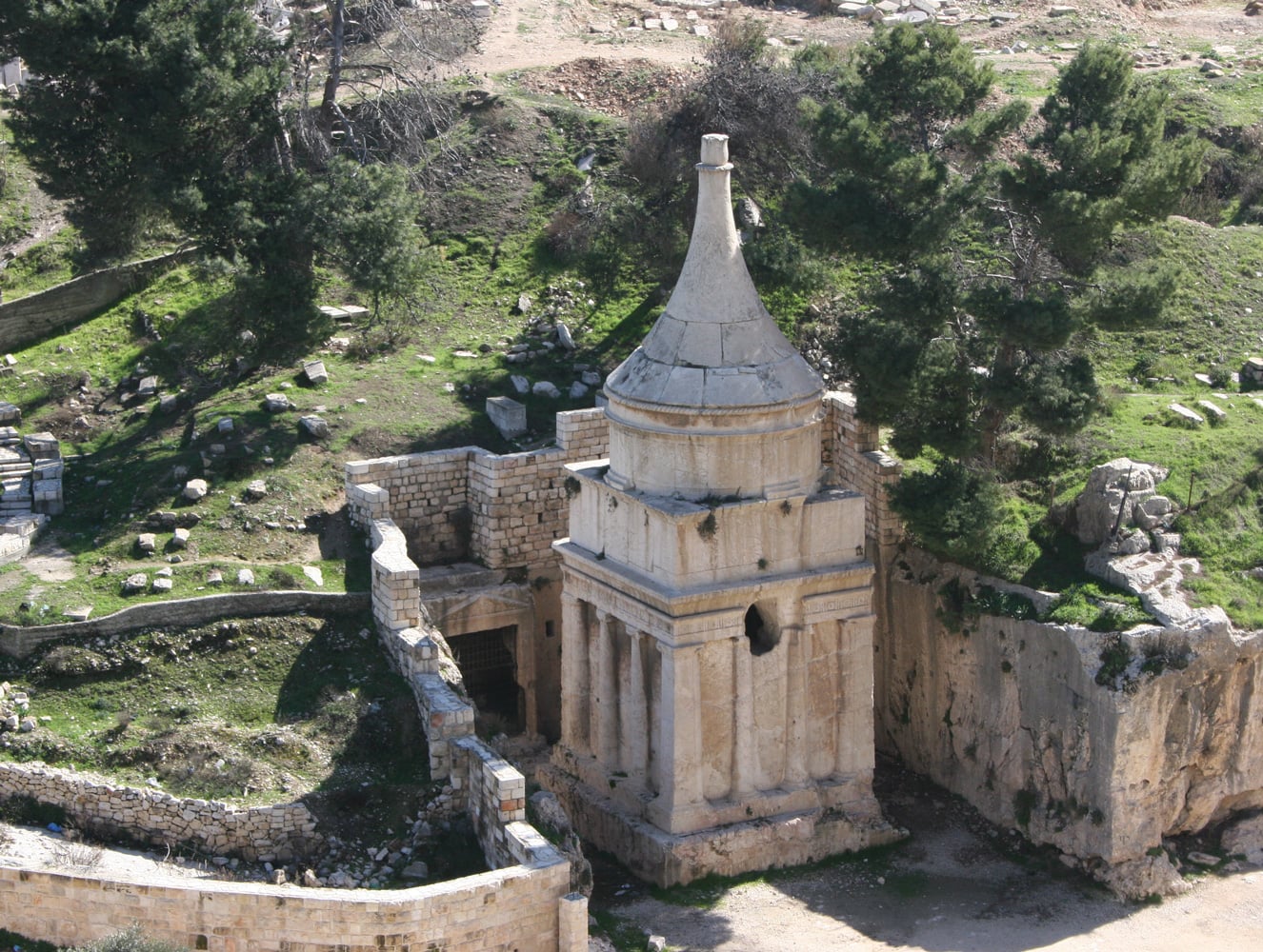
This burial monument from the first century AD, located in the Kidron Valley, has been traditionally identified as the tomb of Absalom.
During the course of the battle Absalom somehow becomes separated from his men, and his head—or possibly his thick hair—is caught in a low-hanging oak tree (18:9–18). Unable to extricate himself, Absalom is soon at the mercy of Joab, who plunges three javelins into his heart. In spite of David’s specific order not to harm Absalom, Joab likely realizes that without Absalom the revolt will collapse. Although Joab had been instrumental in bringing Absalom back from exile (2 Sam. 14:1–20), upon his revolt Joab clearly felt no pity for the handsome prince. Absalom’s body is thrown into a large pit, and a pile of rocks is heaped over him. The irony of this ignoble burial is not lost on the historian; he points out that Absalom previously erected “a monument to himself” near Jerusalem (18:18).
Whenever an important battle was in progress, the people who sent out the troops anxiously awaited news of the outcome. Naturally everyone hoped for good news, and the messenger was called “the one who takes the good news.” Sometimes, however, the news was anything but good, such as the time Eli was told about Israel’s crushing defeat (1 Sam. 4:12–17). As Joab prepares to dispatch a messenger, he realizes that from David’s perspective the news about Absalom’s death is bad (18:19–29). For this reason, Joab hesitates to send Ahimaaz son of Zadok, who has served as a messenger before (cf. 2 Sam. 17:17, 21). If David sees him coming, he will anticipate good news, and Joab does not want the king to get his hopes up. So Joab sends a foreigner, a Cushite, to take the news, although a little later he allows Ahimaaz to run behind him. By taking a different route, Ahimaaz outruns the Cushite and reaches David first. He tells the king about the victory but is unaware of Absalom’s fate. Judging from his questions, David seems to be more interested in Absalom’s condition than the outcome of the battle.
When the Cushite arrives, he gives David the information he wants in an indirect but clear way. David is crushed and begins to mourn his son’s death (18:30–19:4). The pain is so great that David wishes he had died instead of Absalom. Over the years the tension between father and son has been great, but clearly David has no desire for such a violent outcome. Though the troops return in triumph, their shouting and celebrating are quickly stilled in response to David’s mourning. Instead of congratulating his men, David continues to grieve uncontrollably over the death of Absalom. Although David’s response is understandable in his capacity as a father, it ignores his responsibilities as the king and military leader. For this reason Joab confronts David and rouses him from his despondency (19:5–8). In a short and sarcastic speech, Joab accuses David of ignoring the fact that his soldiers have just risked their lives to win a crucial victory and that they deserve the king’s profound thanks. By behaving as if he has lost the battle, David stands the chance of losing the support of the very men who have been so loyal to him. David responds to Joab’s plea, and his presence in the city gate consoles the men.
19:9–43. After the rebellion collapses, the people in the northern tribes blame themselves for what has happened. They reflect on all the good things David has done for the country and decide they want him to return as king (19:9–15). When David hears about this sentiment, he sends word to the elders of his own tribe of Judah to see how they feel. Although the rebellion was launched in Judah, David is willing to forgive them for their actions. In fact David even announces that he will make Absalom’s general Amasa the new commander of his army. It is possible that David has found out about Joab’s role in the death of Absalom and decided to punish his military chief. Encouraged by David’s forgiving spirit, the men of Judah enthusiastically urge him to return.
When David reaches the eastern banks of the Jordan River opposite Jericho, he is met by the man who cursed him as he fled from Jerusalem (19:16–23). This time Shimei is accompanied by a thousand (or a “company” of) other Benjamites, who may fear that Shimei’s disrespect will bring David’s wrath on the whole tribe. Bowing low, Shimei apologizes for his earlier behavior and begs David’s forgiveness. David’s men are not impressed by Shimei’s “repentance” and urge the king to execute him. But in light of the end of the civil war and David’s restoration to power, he determines that this is a time for conciliatory action, not revenge. David never fully forgives Shimei, however, and on his deathbed asks Solomon to find a way to put him to death (1 Kings 2:8–9).
Another piece of unfinished business has to do with Mephibosheth, Jonathan’s son, who was accused of participating in the revolt (19:24–30). He wanted to join David in exile but was left behind by his steward Ziba. Since the time David left Jerusalem, Mephibosheth has remained in an unkempt condition as a sign of deep mourning. Aware that as a descendant of Saul, he does not deserve David’s favor, Mephibosheth nonetheless politely asks David to rethink his decision to give Saul’s estate to Ziba. Uncertain as to who is telling the truth, David decides to divide the inheritance between Ziba and Mephibosheth.
On a more pleasant note, David says good-bye to Barzillai, who sustained him during the difficult days in the Transjordan (19:31–39). Although David wants him to live in Jerusalem, Barzillai declines the invitation because of his advanced age. At eighty he is too old to appreciate the finer things of life in the capital. He does agree to send Kimham (probably his son) to Jerusalem, and David is glad to oblige. The king never forgets the help Barzillai gave him, and he asks Solomon to treat his sons well even after David’s death (1 Kings 2:7).
The split between David and Absalom is symptomatic of the more basic division between north and south, the ten tribes of Israel and the tribe of Judah (19:40–43). As the various tribes scramble to be present when David crosses the Jordan and reenters the promised land, some of the northern tribes have not yet arrived. Apparently the men of Israel feel that the absence of these tribes could be interpreted as lack of support for David. There remains the lingering suspicion that David is partial to his own tribe, whereas the ten tribes constitute the bulk of the nation. So, at a time when David seems to have won back the hearts of the people, friction is already developing between the North and the South.
20:1–26. In spite of their recent affirmation of loyalty to David, the ten northern tribes are quick to defect under the leadership of Sheba (20:1–7). Using a rallying cry that will be repeated when the kingdom is divided after Solomon (1 Kings 12:16), Sheba reasserts the power the tribe of Benjamin lost after the death of Saul. David enters Jerusalem without fanfare and tries to deal with the new crisis. But first he dismisses his ten concubines from the palace and places them under guard in separate quarters since they are linked with the first rebellion, when Absalom slept with them.
True to his promise, David appoints Amasa commander over the army and orders him to take action against Sheba. When Amasa moves too slowly, David asks the veteran general Abishai to take charge, again ignoring his strong-headed nephew Joab. Yet when the troops are sent out, one contingent is “Joab’s men” (20:7), and before long Joab will lead them himself. The other troops include the Kerethites and Pelethites, who were loyal to David during Absalom’s rebellion.
About six miles north of Jerusalem Amasa catches up with the army, presumably bringing additional troops (20:8–13). As Joab steps forward to greet him, he stabs Amasa in the stomach with a dagger, once again eliminating someone who threatens his position as commander in chief. Joab knows how deeply obligated David is to him. As in the case of Shimei, David in his dying days finally asks Solomon to punish Joab for his treachery (1 Kings 2:5–6). After the death of Amasa, Joab takes charge of the army, placing his brother Abishai in the familiar role of second in command.
Meanwhile, Sheba shows respect for David’s army by retreating to Abel Beth Maakah, a city north of the Sea of Galilee (20:14–22). After gathering additional troops, he takes refuge inside the walls of the city. When Joab reaches Abel Beth Maakah, he surrounds the city and tries to batter down the wall. Usually this was accomplished by repeatedly hitting the wall with a large metal-tipped wooden beam. When the people inside the city see the damage being done, they are understandably upset. The city is known for the wisdom of its residents, so one of the wise women asks to speak to Joab. Joab explains what he wants, and the woman sees to it that the head of Sheba is thrown over the wall. The refusal to extradite a political foe was a legitimate reason for war in the ancient world, and earlier David himself was forced to leave a walled city to avoid being handed over to Saul (1 Sam. 23:7–13).
Without a leader the revolt collapses, and the northern tribes acknowledge David as their king. They continue to serve David and his son Solomon for more than forty years, until they revolt successfully under Jeroboam I about 930 BC.
Each of the major divisions of 1 and 2 Samuel ends with a list of the officials of Saul or David (1 Sam. 14:49–52; 2 Sam. 8:15–18) and each list is slightly longer than the previous list, indicating the gradual development in the size of the royal cabinet. The major change in the list in 20:23–26 is the addition of Adoniram, who “was in charge of forced labor” (20:24). As the kingdom expands, David employs Canaanites and prisoners of war in various building projects, and during Solomon’s reign even some Israelites will be used on occasion for this purpose. Adoniram continues in this position throughout Solomon’s reign, so he must have been appointed in the final years of David’s rule. Another administrative change is the appointment of Ira the Jairite as “David’s priest,” whose role may have been closer to that of a royal advisor.
Like the book of Judges, the two books of Samuel end with nonchronological epilogues arranged in a chiastic A-B-C-Cʹ-Bʹ-Aʹ pattern. There are two incidents describing God’s wrath against Israel (chaps. 21, 24) and several short accounts of the victories of David and his men (21:15–22; 23:8–39). Between these two clusters of heroic achievements are two poems written by David praising the Lord for his deliverance (22:1–23:7). Although their overall purpose remains opaque, the function of the two middle sections, David’s song and last words, is transparent, as is that of the final chapter, which prepares for Solomon’s building of the temple in 1 Kings 5–6.
A. The Gibeonites’ revenge (21:1–14). Because of the possible reference to this chapter in 2 Samuel 16:7–8, it is likely that the Gibeonite problem was resolved prior to the revolt of Absalom. There is no clue in 1 Samuel as to when Saul became involved with the Gibeonites.
When Joshua was conquering the promised land, he was tricked into making a treaty with the Gibeonites, guaranteeing that they would not be put to death (Josh. 9:15, 20). Since the city of Gibeon was located in the tribal territory of Benjamin, not far from Saul’s capital, at some point during his reign Saul violated this treaty by attacking and killing some of the Gibeonites. As punishment, the Lord afflicts Israel with three years of famine during David’s reign (21:1–6).
When David discovers the reason for this famine, he confers with the Gibeonites who have survived. Since the death of the guilty can turn away God’s wrath, David agrees with the Gibeonites’ request that seven of Saul’s male descendants should be killed at Gibeah, Saul’s capital. The number seven was probably chosen because it represented completeness.
As David assumes the responsibility of handing over Saul’s descendants, he spares Jonathan’s son Mephibosheth in light of the covenant they made. But David turns over to the Gibeonites the two sons of Saul’s concubine Rizpah and the five sons born to Saul’s daughter Merab (21:7–14). Ironically, Merab should have been David’s wife as a reward for killing Goliath. The seven are put to death in April during the barley harvest, and the family of Saul is effectively wiped out.
Normally the dead were buried quickly, but not in the case of those whose bodies were exposed “before the Lord” (21:6) to atone for sin involving the whole nation (cf. Num. 25:4). So Rizpah heroically guards the exposed bodies of her sons until the rains pour down as an indication that the drought that has caused the famine is over. David then orders that the bones of the deceased be buried in the tomb of Saul’s father, and he shows his respect for the whole family by transferring the remains of Saul and Jonathan from Jabesh Gilead to Benjamin.
B. Victories over the Philistines (21:15–22). Revenge is also the motive in a series of battles between the Philistines and Israelites. Ever since David’s victory over Goliath, the Philistines have tried to take revenge, but without success. Four specific Philistine warriors are mentioned, and each of them—like Goliath—is tall and powerful. All four are “descendants of Rapha,” probably a reference to the gigantic Rephaites (Deut. 2:11; Josh. 12:4).
According to verse 19 a man named Elhanan “killed Goliath the Gittite” (NIV 1984; see NIV note). Unless this is a different Goliath from the warrior in 1 Samuel 17, we seem to have a competing account of his death. In the parallel passage in 1 Chronicles 20:5, this difficulty is smoothed out by specifying that Elhanan “killed Lahmi the brother of Goliath.” Some commentators argue that Elhanan may be another name for David, since monarchs often had personal names and throne names. Others have suggested that Elhanan, not David, was the man who killed Goliath and that the hero story was later transferred to David, perhaps in the course of its telling through the generations. If we choose not to smooth the issue out by identifying Elhanan as David or suggesting two Goliaths, then we should understand the David and Goliath story as one akin to George Washington and the cherry tree—it may not be historically factual but it is true in a larger sense, since it accurately reflects the man’s character. After all, the whole account of David’s rise to the throne is predicated on his ability to defeat the Philistines, and the story of the slaying of Goliath is used as the catalyst for his amazingly quick move into the national spotlight.
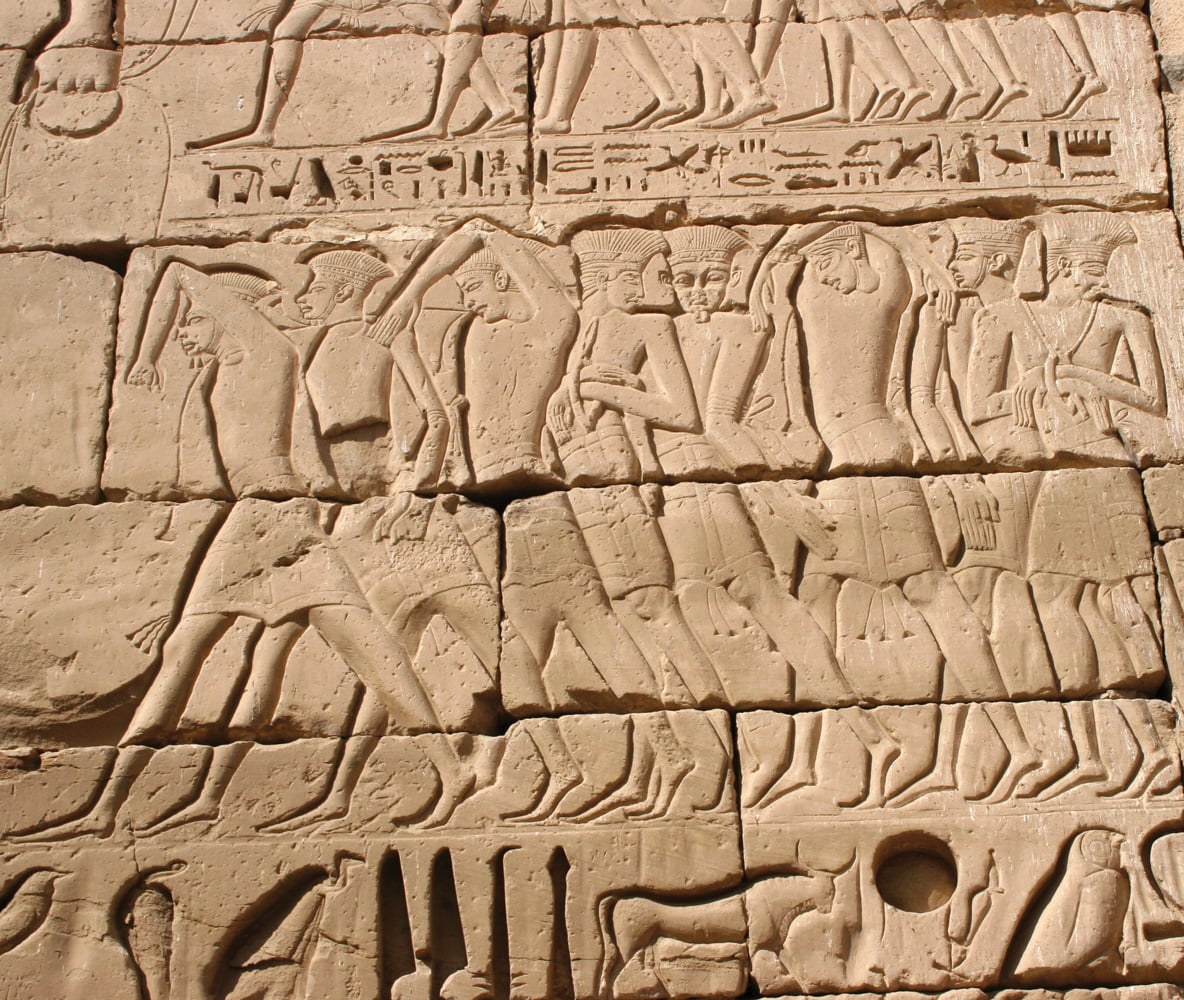
Philistines were one of the Sea Peoples, whose capture by Rameses III is depicted here in a relief from Medinet Habu (Luxor, Egypt, twelfth century BC).
C. David’s song (22:1–51). Just as 1–2 Samuel begins with Hannah’s song of thanksgiving for the birth of Samuel (1 Samuel 2), it ends with David’s song of praise for God’s deliverance from his enemies. The song appears in almost identical form in Psalm 18. In both passages the same historical heading referring to Saul and other enemies introduces the hymn.
When David was fleeing from Saul he was forced to take refuge in a number of caves (22:2–4). These hideouts are sometimes called “strongholds”; the same word is applied to the Lord in verse 2 (“fortress”). David thus acknowledges that God is the true source of his security and the one whom he can call on for help.
In words that anticipate the experience of Jonah, David describes his difficulty as if he had been drowning (22:5–7). The cords of death were wrapped around him like seaweed. Because of his extreme danger, death seemed close indeed. In his predicament, David called out to the Lord for help, and in his heavenly temple God heard his cry.
The next verses (22:8–16) describe a theophany—the coming of God to defeat his foes. The imagery is similar to the description of God’s appearance on Mount Sinai, when he descended in a thick cloud amid thunder and lightning. The earth shook as God spoke with Moses before the awestruck Israelites (Exod. 19:16–19). So powerful was God’s voice that it sounded like thunder. In Judges the Lord sent a thunderstorm to bog down the chariots of Sisera and give Israel a surprising victory (Judg. 5:4–5, 20–21). There may also be an allusion in 2 Samuel 22:16 to the demise of the Egyptians at the Red Sea, where the waters were rebuked by a strong wind (Exod. 14:21). The cherubim mentioned in verse 11 are said to be transporters of the throne of God in Ezekiel 10, and this throne symbolizes the authority of the mighty king.
Just as God delivered his people in time past, so he reached down and rescued David from his powerful enemy (22:17–20). Instead of being hemmed in and confined, David was brought “into a spacious place” (22:20) and given freedom from danger and oppression.
Grateful for God’s intervention, David reflects on God’s goodness to those who serve him and live righteously (22:21–30). His assertion of innocence does not mean that he is claiming to be sinless but that he is seeking to live in accord with God’s word (22:23). Since David is the king, he has an obligation to set an example for the rest of the nation and lead a godly life. His realization that God brings down the proud and exalts the humble (22:28) repeats an underlying theme of 1 and 2 Samuel. In his own struggle with Saul, David becomes well aware of what pride can do to a king out of touch with God.
David also knows that God responds in kind to the attitudes and actions of human beings. Those who are hostile toward God will eventually find that God will be hostile toward them (Lev. 26:27–28). Those who seek first God’s kingdom and his righteousness will discover that he will bless them in remarkable ways (Matt. 6:33). Because of David’s faithfulness as king, God has given him military victories, fame, and fortune.
Returning to the themes introduced in verses 2–4, David spells out in greater detail what God has done for him (22:31–46). With a sense of exuberance David tells how the Lord gave him strength, speed, and stability, enabling him to overwhelm the enemy. David describes the plight of his foes (22:38–43), who were crushed and trampled under his feet. When they cried for help the Lord did not answer; no one came to their rescue.
God delivered David from his enemies within the borders of Israel and in foreign lands. Though it had seemed that he was on the verge of dying, David was made “the head of nations” (22:44). As his enemies fell before him one by one, the kingdom of Israel grew into an empire stretching from Egypt to the Euphrates River. The covenant blessing promised by Moses has become a reality.
David knows that he does not deserve the credit for his success, so in the final verses of this song (22:47–51) he exalts “God, the Rock, my Savior!” (22:47). Through the prophet Nathan, God made a covenant with David, promising that his dynasty would last forever (2 Sam. 7:12–16); and David acknowledges that the Lord’s “unfailing kindness” (22:51) was a guarantee that the covenant would remain valid. Such a faithful God is one whom David wishes to praise “among the nations” (22:50).
D. David’s last words (23:1–7). The second song contained in the appendixes is much shorter than the first and gives us the last poetic piece attributed to David. Many psalms associated with David are in the book of Psalms, but this brief poem is not paralleled in the Psalter. As in chapter 22, David acknowledges God’s blessing on his life and in particular refers to the way the Spirit of the Lord spoke through him (23:2). Ever since he was anointed as king, the Spirit has rested on him and inspired him to write and sing the psalms loved by believers down through the centuries.
Empowered by the Lord, David has been able for the most part to rule in righteousness, bringing peace and prosperity to the whole nation. His rule became the standard against which all other rulers of Israel and Judah are judged and the pattern for at least some messianic expectations. As his own life comes to an end, David rejoices that God has made with him “an everlasting covenant” (23:5), assuring his descendants of continuing rule. According to verses 6–7 and Psalm 110, this will ultimately mean the destruction of wicked men when Christ places his enemies under his feet.
E. David’s mighty men (23:8–39). Like any commanding general, David knew the value of faithful, dedicated followers. Without the help of skilled warriors, he could not have established a powerful kingdom. Thirty-seven of his men deserved special credit for their courage and commitment.
A group called “the Three” fought so valiantly that they are singled out above the rest (23:8–12). Josheb-Basshebeth killed eight hundred men at one time. In another memorable battle against the Philistines, Eleazar son of Dodai single-handedly struck down the Philistines after the rest of the Israelites had retreated. The third hero, Shammah son of Agee, performed a similar exploit against the Philistines. Refusing to flee with the rest of the troops, Shammah stood his ground and successfully fought the enemy by himself.
Another story about three heroes—probably not the same three just mentioned—tells how they broke through Philistine lines to get water from the well near the gate of David’s hometown of Bethlehem (23:13–17). The incident may have occurred while David was a fugitive from Saul or just after he had been anointed king over all Israel. When the three men brought the water to David, he refused to drink it and poured it out as an offering before the Lord. By doing this he acknowledged God’s goodness in giving him followers who would risk their lives for him.
Two other men performed exploits that were comparable to those of “the Three” (23:18–23). David’s nephew Abishai once saved David’s life by killing a Philistine giant who had threatened David (2 Sam. 21:16–17). Here we are told that he was also responsible for killing three hundred men in battle. Benaiah son of Jehoiada was in charge of the Kerethites and Pelethites, two valuable mercenary bands that constituted the royal bodyguard, and later Benaiah will replace Joab as commander of Solomon’s army (1 Kings 2:35). On the way to becoming a leader, Benaiah gained fame for killing two of Moab’s finest soldiers and “a huge Egyptian” who was first disarmed and then killed with his own spear. In the best tradition of Samson, Benaiah also killed a lion in “a pit on a snowy day” (23:20).
While not quite attaining the stature of the aforementioned heroes, another thirty warriors constituted an elite group of mighty men (23:24–39). They came from many parts of Israel, including Saul’s capital city of Gibeah. Most of the individuals are otherwise unknown in Scripture, except for Joab’s brother Asahel, who died in the civil war against Abner (2 Sam. 2:23), Uriah the Hittite, the husband of Bathsheba, and Bathsheba’s father, Eliam. The figure of thirty-seven given in 2 Samuel 23:39 apparently includes “the Three,” Abishai and Benaiah, and possibly Joab, the indefatigable commander of the whole army.
F. David’s census (24:1–25). For the second time in the appendixes David has to face the wrath of God (cf. 2 Sam. 21:1–14), but this time he bears more of the blame. It is a hard lesson for David and his people, though the chapter ends on a note of worship that paves the way for the building of the temple.
A comparison of verse 1 with 1 Chronicles 21:1 reveals a startling difference about the identity of the one who incites David to take a census (24:1–9). According to 2 Samuel it is the Lord, whereas 1 Chronicles names Satan as the instigator. The change in the texts highlights a theological difference between the historian of 1–2 Samuel and the historian of 1–2 Chronicles. The majority of Old Testament writers held a worldview in which the Lord, as the Creator of all, was also responsible for both peace and disaster (or “evil”; Isa. 45:7). Of course, in the case of the census, it is not simply that God incites David to do something wrong (which is little different from sending the evil spirit to torment Saul in 1 Sam. 16:14); rather, what is really troubling is that God would then turn and punish David for doing the very thing he has incited him to do. It is no wonder that the historian of 1–2 Chronicles would have reworked this passage. Yet there is more to the replacement of the Lord with “Satan”: the view of the Chronicler represents a later theological development in thinking, one that imposes a strict separation between good and evil. Such a clean separation does not exist in most of the Old Testament.
It is worth pausing to consider the Old Testament view of “Satan.” Contrary to popular thinking, for the ancient Israelites this figure was not the personification of evil, the archnemesis of God—this view developed in later Judaism and Christianity. Rather, “satan” in the Old Testament describes a character (human or divine) who functions as an adversary or opponent, or even a prosecutor in legal contexts (cf. 1 Sam. 29:4 [David]; 2 Sam. 19:22 [Abishai]; 1 Kings 5:4; Ps. 109:4). Even in the book of Job, the “satan” is not evil but is associated with the group of divine beings called the “sons of God” whose duty it is to serve the Lord (Job 1:6; 2:1; see NIV notes). The “satan” in Job is a sort of divine prosecutor whose task is to ferret out hypocrisy.
Sometimes the taking of a census was perfectly acceptable (Numbers 1; 26), so David’s sin must here involve the motivation behind the census. In all probability David is guilty of pride as he glories in the size of his armies and the numerous victories he has won. Backed by faithful, highly skilled troops and courageous leaders, David may be overlooking his need to trust in the Lord, the one who gave Goliath into his hands. Even Joab recognizes that it is wrong to take this census, but David insists that he go ahead with it.
For almost ten months Joab and the other commanders travel throughout Israel, starting in the Transjordan and then counting all the able-bodied men west of the river. The total comes to eight hundred thousand (or eight hundred “companies of men”) from Israel and five hundred thousand (or five hundred “companies of men”) from Judah. After Joab and his men return David recognizes how wrong he has been and confesses his sin before the Lord (24:10–14). Earlier he repented of his adulterous relationship with Bathsheba when the prophet Nathan confronted him (2 Sam. 12:13). This time the prophet Gad is sent to David, offering the king a choice of three calamities. Faced with the prospect of three years of famine, three months of military defeat, or three days of plague, David chooses the final option, believing that the Lord will somehow be merciful in spite of the plague.
True to his word the Lord strikes Israel with a plague more severe than that connected with the Baal of Peor episode in Numbers 25 (24:15–17). Seventy thousand (or “clan groups”) die as the angel of the Lord moves through the land, bringing relentless judgment. When the angel comes to Jerusalem the Lord has mercy on his chosen city as David cries out on behalf of the people.
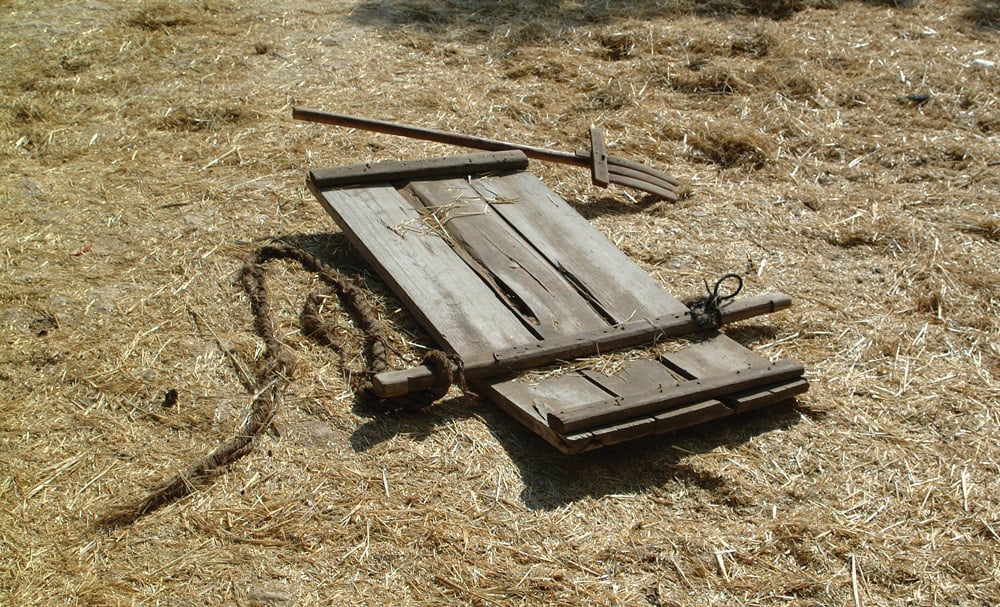
Threshing sledge and fork on a threshing floor. David buys the threshing floor of Araunah to build an altar to the Lord (2 Sam. 24:18–25).
As the angel with a drawn sword stands near him, David is ordered to build an altar to the Lord (24:18–25). The place where he sees the angel is the threshing floor of Araunah the Jebusite, located north of Jerusalem on a hill overlooking the city. Chronicles refers to this hill as Mount Moriah, and it will become the very site on which Solomon later builds the temple (2 Chron. 3:1). When David asks Araunah for permission to buy the threshing floor, the Jebusite agrees and even offers to give it to David along with oxen and wood for the offering. But David insists on paying for it, refusing to sacrifice burnt offerings that cost him nothing. He pays fifty shekels of silver for the threshing floor and the oxen, and according to 1 Chronicles 21:25 he pays six hundred shekels of gold for the whole site.
When the altar is built, David presents burnt offerings and fellowship offerings as a symbol of his renewed commitment to the Lord. These two offerings were also presented in the midst of an earlier national calamity during the time of the judges (Judg. 20:26), and Solomon will sacrifice numerous burnt offerings and fellowship offerings at the dedication of the temple. Coupled with David’s confession and repentance, the sacrifices make atonement for sin, and God answers his prayer in behalf of the land. The plague ends as the Lord has mercy on his covenant people.
Select Bibliography
Anderson, A. A. 2 Samuel. Word Biblical Commentary. Dallas: Word, 1989.
Arnold, Bill T. 1 & 2 Samuel. NIV Application Commentary. Grand Rapids: Zondervan, 2003.
Frykenberg, R. E. History and Belief: The Foundations of Historical Understanding. Grand Rapids: Eerdmans, 1996.
Gordon, Robert P. 1 & 2 Samuel. Library of Biblical Interpretation. Grand Rapids: Zondervan, 1986.
Hamilton, Victor P. Handbook on the Historical Books. Grand Rapids: Baker Academic, 2001.
Klein, Ralph W. 1 Samuel. Word Biblical Commentary. Waco: Word, 1983.
McCarter, P. Kyle, Jr. 1 Samuel. Anchor Bible. New York: Doubleday, 1980.
———. 2 Samuel. Anchor Bible. New York: Doubleday, 1984.
Nelson, Richard D. The Historical Books. Interpreting Biblical Texts. Nashville: Abingdon, 1998.
Tsumura, David Toshio. The First Book of Samuel. New International Commentary on the Old Testament. Grand Rapids: Eerdmans, 2007.
__________________
* Herb Wolf was one of my teachers at Wheaton College; I studied Old Testament, Hebrew, and Ugaritic with him. It is to his memory that I dedicate this revision. While I have added to and revised the original text, I have been very selective and have tried to retain as much of the original as possible. What changes I have made were done in the spirit of the original commentary.