1–2 Timothy and Titus
B. The Point of the Law (1:8–11)
C. Paul as Trophy of Grace (1:12–17)
3. Prayer and Worship (2:1–15)
A. The Prayer of All for All (2:1–7)
B. Men and Women at Worship (2:8–15)
A. Overseers or Bishops (3:1–7)
5. True and False Religion (3:14–5:2)
C. Timothy’s Responsibility for True Religion (4:6–5:2)
6. Widows, Elders, and Slaves (5:3–6:2)
A. Widows and Female Benefactors (5:3–16)
A. False Teaching and Love of Money (6:3–10)
B. What Makes Timothy Wealthy (6:11–16)
C. How the Wealthy Can Invest (6:17–19)
8. Closing Admonition: Opposing Spurious “Knowledge” (6:20–21)
2. Thanksgiving and Appeal (1:3–7)
B. First Appeal: Rekindle the Gift and Be Courageous (1:6–7)
3. Examples to Emulate and to Teach Others (1:8–2:13)
A. Christ’s Victory: A Gospel Worth Suffering For (1:8–10)
B. Paul’s Life: A Life Worth Emulating (1:11–14)
C. One Other Life to Emulate, Contrasted with Counterexamples (1:15–18)
D. Second Appeal: Teach Others (2:1–7)
E. Remember Christ Jesus (2:8–13)
A. Why to Resist False Teachers: Their Influence Is Corrupting (2:14–21)
B. How to Resist False Teachers: With Mature Gentleness (2:22–26)
C. The False Teachers Put in Their Last-Days Context (3:1–5)
D. The False Teachers and the Gullible Women (3:6–9)
A. Third Appeal, Part One: Stay with What You Know . . . (3:10–17)
B. Third Appeal, Part Two: . . . and Preach the Gospel (4:1–5)
C. Paul’s Final Testimony (4:6–8)
2. Leaders and Rebels (1:5–16)
A. Identifying and Appointing Leaders (1:5–9)
3. A Lifestyle in Accord with Sound Doctrine (2:1–15)
A. Relationships among Believers (2:1–10)
B. Theological Grounding: God’s Grace and Glory (2:11–15)
4. A Lifestyle Appropriate to Sound Doctrine (3:1–7)
A. Responsibilities in State and Society (3:1–2)
B. Theological Grounding: God’s Kindness and Benevolence (3:3–7)
5. Summary: “Good Works” versus Foolish Controversies (3:8–11)
6. Personal Instructions (3:12–15)
Introduction
The letters to Timothy and Titus, called the Pastoral Epistles, raise questions about the legacy of the apostle Paul. Evangelical scholars and some mainstream conservative scholars believe these writings provide Paul’s own ideas and applications for the next generation of church leaders. Other mainstream scholars tend to think the Pastorals came from the second or third generation of the Pauline movement and represent a falling away from Paul’s original vision.
This commentary treats the Pastoral Epistles as Paul’s own explanation of his main theological values, which he designs to reflect the culture of his heirs in ministry.

Distinctive Features
The Pastorals share a range of common features with the earlier letters of Paul but stand apart in several respects.
First, they are letters written to Paul’s co-workers as individuals instead of to a church or house church. (Philemon, by contrast, was written to a house church—see Philem. 2). Further, the Pastorals were written to perhaps the most “Greek” of Paul’s protégés: though half Jewish, Timothy had not even been circumcised at infancy; and the Gentile Titus was pointedly never circumcised (Gal. 2:3).
Second, the Pastorals show a distinctive writing style, marked by a smoother flow of sentences and less complicated grammar.
Third, the vocabulary shows more Greek influence. A third of the Pastorals’ vocabulary does not appear in the earlier writings of Paul. Words otherwise not used in the New Testament occur at the rate of about four to five per page in the earlier letters, but at the rate of about thirteen per page in the Pastorals. Some of this vocabulary is common to Greek moral and theological writings. Worthy of mention are the following: “godliness/piety,” “appearance” (instead of Paul’s more characteristic “presence”), and “healthy/sound.” Jewish writers like Philo of Alexandria, aiming at a Greek readership, had already begun using many of the terms that distinguish the Pastorals from Paul’s earlier letters.
It is interesting to note that Luke (Paul’s traveling companion, lone associate during the writing of 2 Timothy, and author of Luke-Acts) shares much of this vocabulary, lending support to the possibility that Luke assisted Paul with these letters. Two examples: first, Paul’s earlier letters denounce “greed” (1 Cor. 6:10; 1 Thess. 2:5), but the Pastorals and Luke denounce “love of money” (1 Tim. 6:10; 2 Tim. 3:2; cf. Luke 12:15; 16:14). Second, of the other New Testament writers, only Luke (“the beloved physician”) uses the Greek term from which we get “hygienic” to refer to the spiritual aspect of Jesus’s healing ministry (Luke 5:17; 15:27). The Pastorals use the same term to stress that doctrine should be not merely correct but also “healthy” or “sound” (1 Tim. 1:10; 2 Tim. 4:3; Titus 1:9; 2:1).
Fourth, while Paul mentions “overseers” (sometimes called “bishops”) and “deacons” in Philippians 1:1, in 1 Timothy and Titus he gives much greater focus to church office (in the case of 1 Timothy and Titus) and to the character required for office (when 2 Timothy is added).
Fifth, a different strategy for dealing with troublesome teaching or behavior emerges. Instead of making his case with the community (as in most earlier letters) or even praying his case before the communities (as in Ephesians 1–3), Paul reminds his co-workers of the basic truths they are to press home. He does so in condensed creedlike statements (1 Tim. 2:3–7; 3:16; 2 Tim. 1:8–10; Titus 2:11–14; 3:4–7). He is not instructing churches in things they do not know. Rather, he is reminding protégés of how to apply teaching with which they are quite familiar.
Sixth, the Pastorals amplify values from the earlier letters. For instance, Paul’s “let us do good to all, especially to those who are of the household of faith” (Gal. 6:10 NKJV) expands to “be ready to do whatever is good” in public life (Titus 3:1). Strikingly, earlier arguments against “works of the law” give way to an encouragement to do “good works.” In Galatians and Romans, “works” (plural) are almost always “works of the law” and are almost always bad (Rom. 2:6 is controversial). In those earlier letters Paul does say “faith working through love” is good (Gal. 5:6 RSV, NASB), and he can use the singular noun “work” in a positive way (e.g., “work of faith”; 1 Thess. 1:3 KJV, RSV). By Ephesians (written during Paul’s first imprisonment), Paul first reminds readers that salvation is “not by works” and then opens new ground by affirming that believers have been (re-)created in Christ Jesus “for good works” (Eph. 2:8–10 RSV, NASB). The Pastorals repeat Paul’s principle of “not by works” (Titus 3:5 KJV; cf. 2 Tim. 1:9) and extend Ephesians’ commendation of “good works” or “noble works” (1 Tim. 5:10, 25; 6:18; Titus 2:7, 14; 3:8, 14 KJV, ESV); but these letters accentuate the role of “good works” more than any of the earlier letters (see comments on 1 Tim. 3:14–16; Titus 2:1–10).
The Pastorals in the Early Church
Although the Pastorals show some differences from Paul’s earlier letters, the early church received them, almost unanimously, as being written by Paul. When Peter acknowledges the authority of the writings of “our dear brother Paul,” he does so in view of the way Paul expounded the Lord’s “patience” unto “salvation” (2 Pet. 3:15–16), terms that are joined in Paul’s writings only at 1 Timothy 1:15–16. The theology in the writings of Clement, Ignatius, and Polycarp shows evidence of influence from the Pastorals. The single curiosity from the early church is the Pastorals’ apparent exclusion from the earliest manuscript of Paul’s letters, the Chester Beatty Papyrus 46 (ca. AD 200). Because of its own writer’s preference for asceticism, the forged apocryphal Acts of Paul and Thecla took dead aim at the Pastorals. The heretic Marcion, teaching that there was a split between an evil creator God of the Old Testament and a good redeemer God of the New Testament, eliminated the Pastorals because they affirmed creation. Gnostics ignored them because the Pastorals’ opposition to “falsely called knowledge” hit close to home (1 Tim. 6:20–21).
Accounting for the Differences
Evangelical scholarship has resisted approaches that diminish the Pastorals’ voice and authorship. Older advocates of the theory of a different author maintained that the Pastorals’ author sought to honor Paul by employing an innocent, even transparent literary device by writing under Paul’s name. However, evangelical scholarship has noted that Christian, Jewish, and pagan writers at the time consistently denounced forgeries, especially when it came to letters. More recent advocates of a different author frankly maintain the Pastorals were a deliberate fabrication. Evangelical scholarship balks at the notion that such an amoral conscience would lie behind accepted scriptural documents that claim to speak for “God, who does not lie” (Titus 1:2), in advocating “sound doctrine” (1 Tim. 1:10; 2 Tim. 4:3). Moreover, evangelical scholars doubt that readers close to the events and at home with the language would have fallen for such a ruse. The tendency, then, among evangelicals is to accept the similarities to the earlier letters to be a signal of the genuineness of Paul’s authorship. They believe either that the differences are attributable to the fact that Paul was not under the burden (the way a fabricator would doubtless have been) of trying to sound like himself at every turn, or that some of the distinctive wording comes from a secretary.
If these letters are authentic, it is probably reasonable to assume that Paul was released from the house arrest of Acts 28 and ministered in the eastern Mediterranean, during which time he wrote 1 Timothy and Titus. Arrested again, he was sent to Rome, where he was martyred (per 1 Clement 5.7), but not before he wrote 2 Timothy.
The principal question advocates of Paul’s authorship have had to answer is, Has Paul lost some of the intensity evident in his earlier letters? The rejoinder is, Can we assume what Paul might say under the circumstances presented in these letters? If the apostle recognizes that his own course is near its end and that his gospel has established a toehold in European culture, letters precisely like these are altogether suitable advice to his closest—and most “European”—protégés for carrying on his legacy.
Commentary for 1 Timothy
In 1 Timothy, Paul addresses the challenges facing an established church. He directs Timothy to put down false teaching from rivals—perhaps even leaders—within the church (see Acts 20:30). The letter does not deal with the heresy directly. Paul’s interest, rather, lies in structuring the community in such a way as to promote true godliness. The church is the “pillar and foundation of the truth” (3:15).
Timothy is under attack. Appropriately, then, Paul begins by calling attention to the fact that it is only by the command of God that he himself is an apostle. In so doing, Paul underlines not only his but also Timothy’s authority. Paul’s primary purpose in this letter (see 1 Tim. 3:14–15) is to bring the church together as God’s family. Thus he begins by recognizing Timothy as his own true son in the faith. (For Paul’s becoming “father” to Timothy, see Acts 16:1–3.)
Three times Paul stresses that we are to place our hope in God alone and not in human devices (4:1–10, not in harsh regimens of self-denial; 5:5, not in our human family structures; 6:17, not in wealth). Significantly, Paul calls Christ Jesus our hope. God alone saves, and he does that through his divine Son.
Paul normally begins his letters, as he does here, by substituting “grace” for the typical Hellenistic “Greetings” and by offering the Jewish blessing: “peace.” Distinctive of his two letters to Timothy is his insertion of “mercy,” anticipating the way he says his own life demonstrates God’s mercy (1:15–16).
A. Love over law (1:3–7). Timothy’s mission is to make sure that side issues (“myths and endless genealogies . . . meaningless talk” [1:4, 6]) or contradictory teachings (law keeping, sexual and dietary restrictions) do not dilute the good news of God’s saving mercy. For Paul, it is almost as bad to go beyond Scripture (1 Cor. 4:6) as to contradict it. Thus, his instructions are twofold: to put down “false doctrines” (literally “different teaching”) and to advance “God’s work—which is by faith” (1:4). The work Paul has in mind consists of two things: first, the way God has brought redemption through his Son (Eph. 1:10; 1 Tim. 2:3–6; 2 Tim. 1:9–10; Titus 3:4–7), and second, the way the church as God’s household displays that redemption through right relationships (1 Tim. 3:14–16; Titus 1:1–10).
Timothy is to contend for the faith so that love may flourish. While the opponents promote teaching that appeals to intellectual pride and moral rule keeping, Paul teaches a gospel that gives people a new inner nature. When the incarnated and vindicated Jesus is believed on (1 Tim. 3:16), he enables people to live generously, out of a “pure heart and a good conscience and a sincere faith” (1:5).
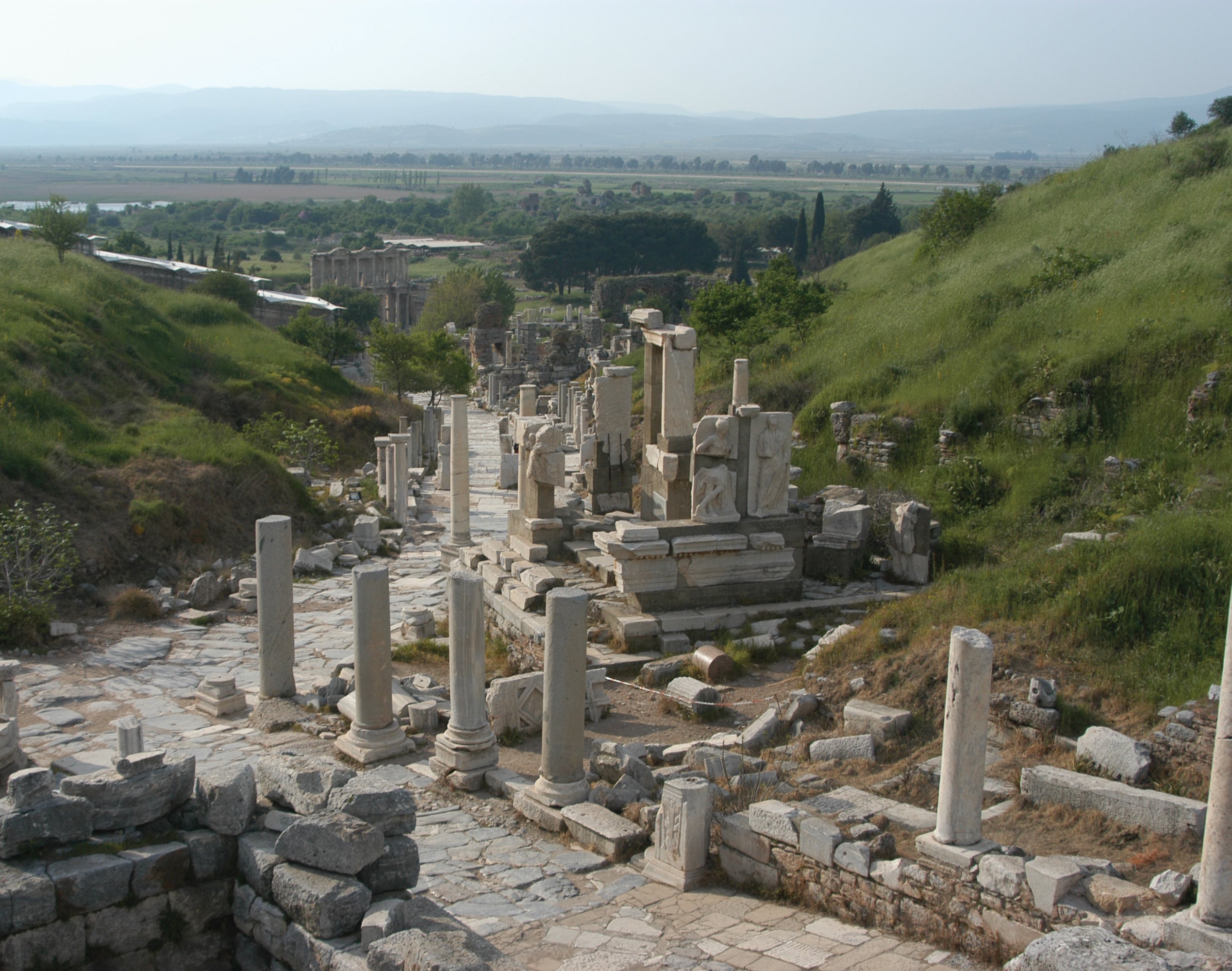
Curetes Street, one of the main thoroughfares in ancient Ephesus, near the ruins of the Memmius Monument. Paul urges Timothy to stay in Ephesus in order to “command certain people not to teach false doctrines any longer” (1 Tim. 1:3).
B. The point of the law (1:8–11). The law is good but cannot replace conscience as a guide to behavior. It can neither cover every situation in which love must be expressed, nor, as Paul taught the Galatians, enable the obedience it requires. As Paul will teach in verses 12–17, the inward transformation necessary for living according to God’s will begins with an experience of his mercy. Paul will build on this, teaching in subsequent chapters that the place where the Spirit shapes our moral responsiveness is within a well-ordered and rightly governed community of faith.
How then may one use the law “properly” (literally “lawfully,” an artful wordplay)? The law informs the conscience by clarifying the kind of people we are not to be. People who need the law are outside its limits: “not for the righteous but for lawbreakers and rebels” (1:9). Paul lists four terms invoking the first four of the Ten Commandments, then three terms invoking the commandment against murder, two terms covering the commandment against sexual immorality, one term covering theft, and two covering false witness. The way Paul uses what would be to him extreme examples of law violation is striking: not just murderers but patricides and matricides; not just those who engage in sex outside marriage but males who have sex with males; not just thieves but “man-stealers” (either the NIV’s “slave traders” or the NASB’s generic “kidnappers”). Instead of the concluding “you shall not covet” (which covers the heart), Paul closes with a sweeping “whatever else is contrary to the sound doctrine” (1:10). The law reveals the sickness of the soul; sound doctrine promotes the health of the soul. Gospel-centered teaching points us to “the gospel concerning the glory of the blessed God” (1:11), preparing us, as Paul says elsewhere, to take on “an eternal weight of glory” (2 Cor. 4:17 RSV, NASB). The law’s purpose is to drive us to God’s mercy. Paul next uses his own life as an example.
C. Paul as trophy of grace (1:12–17). Refusing at first to believe that Jesus was the living personification of Israel’s hopes (“I acted in ignorance and unbelief” [1:13]), Paul showed himself to be among those who were not righteous. Despite his claim to zeal for God (see Gal. 1:13–14), his hatred for Jesus had numbered him among those the law condemned. His language of self-condemnation here is exceptionally strong. His opposition to Jesus made him a “blasphemer” against God. He calls himself “a violent man,” using a term suggesting insolence and arrogance.
Solemnly, Paul names himself “worst of sinners” (1:16). When writing his early, “great epistles,” Paul felt it sufficient to acknowledge himself “least of the apostles” (1 Cor. 15:9). Writing later from prison and meditating on the comprehensive lordship of Christ, Paul moves himself further down the ladder: “I am less than the least of all the Lord’s people” (Eph. 3:8). Now, urging radical grace over proud speculation and moralism, he points to himself as exhibit A in God’s program of reclaiming a hopelessly ruined race.
In chapter 2, Paul will refer to the process by which Christ became our ransom (2:5). Here at 1:14, however, Paul emphasizes that the personal qualities of Jesus (the “faith” in God and “love” toward others that are “in Christ Jesus”) subsequently become ours by grace.
Because Paul sees himself as a trophy of God’s grace, not only does love follow but so does worship—thus, his doxology in verse 17.
D. What is at stake (1:18–20). Paul follows his brief doxology by returning to his commandment to Timothy (see 1:5), putting it in terms of a call to arms: “fight the good fight” (NIV “fight the battle well”). As 2 Timothy will make clear to us, courage will be necessary for Paul’s young co-worker (see especially 2 Tim. 1:7).
Timothy would do well to keep in mind his own need for the same “faith and a good conscience” (1:19) he is to commend to others. Moreover, he should keep before himself the vivid image of two false teachers, Hymenaeus and Alexander, who “have suffered shipwreck with regard to the faith” and whom Paul has put under discipline (1:20).
3. Prayer and Worship (2:1–15)
A. The prayer of all for all (2:1–7). When Paul thinks of the church gathered, he thinks of its being a praying community. He calls for prayer for all people and for those in authority. The short-term goal of the prayer for authorities is that “we may live peaceful and quiet lives” (2:2). However, this is not the “peace and quiet” of middle-class complacency. Paul wants the best platform possible for pressing upon all people that God “wants” them “to be saved and to come to a knowledge of the truth” (2:4). As inevitable as persecution is (2 Tim. 3:12), Paul nonetheless believes that a better climate for the church’s witness is one of political and social peace.
Paul differs from his opponents in seeing the scope of Christ’s mission, and thus the church’s, as being worldwide. That difference comes to elegant expression in the theological support Paul provides for his prayer for all people: “one God and one mediator” (2:5a). Paul means all people (see also Rom. 3:29–30) have access to God’s salvation (note: 3:1, believers pray for all; 3:4, God wants all to be saved; 3:6, Christ gave his life for all). There are hints in the Old Testament that God would save the world through a single individual (see “a man” in the Greek Old Testament at Num. 24:7, 17; Isa. 19:20). This offer of salvation is finally available through Christ’s incarnation (“the man Christ Jesus” [2:5b]) and his redemptive death (“who gave himself as a ransom” [2:6]—see also Matt. 20:28; Gal. 2:20). Paul closes this section by noting that Jesus is God’s own witness to his love for humanity, a witness that has come at the fulfillment of God’s timetable. Thus, Paul calls the church at Ephesus to take up its part in his ministry to the Gentiles through prayer and proclamation, aligning themselves with God’s purposes to save people of every race.
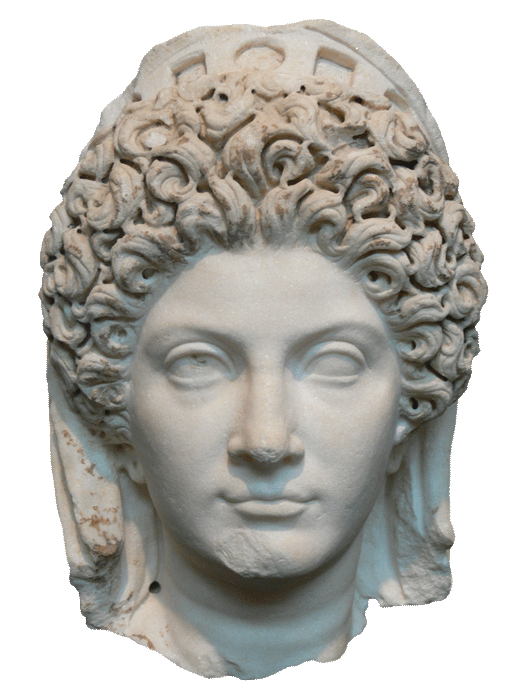
The head from a statue of Julia Titi (AD 61–91), daughter of the emperor Titus and mistress to her uncle Domitian. Notice the elaborate hairstyle. The diadem may have contained precious gems, and the complete statue would have been adorned with earrings and a necklace. Paul instructs women believers not to follow this trend in fashion but to dress “with decency and propriety” (1 Tim. 2:9).
B. Men and women at worship (2:8–15). Having issued his appeal for prayer, Paul turns to specific behaviors in worship. The statements about salvation have been for all people. The directives that follow are gender specific, though, clearly, some instructions apply equally to all (e.g., “holy hands” and “good deeds”). Throughout, Paul’s concern is that believers support the church’s mission by living “peaceful and quiet lives in all godliness and holiness” (2:2).
Men are called to holiness and peace (2:8). A picture of men raising angry fists at one another over who is to teach and what is to be taught needs to yield to a picture of men lifting cleansed and peaceful hands in prayer. The picture recalls Psalm 134:2, with its call for temple servants to bless the Lord in the night. But a reference to Malachi 1:11’s “in every place” sets the men’s prayers in the new context of God’s promise to bring salvation to the nations.
Women are called to modesty and to good deeds (2:9–10). The “also” of verse 9 indicates that women no less than men participate in the praying church’s continuation of the mediator’s work in reclaiming the earth for God. But no less disruptive—and thus subversive—of the church’s mission than some men’s quarrelsomeness is some Ephesian women’s flashy attire.
Paul seems to speak here to an incursion into the church of a fairly widespread phenomenon in his day, referred to in recent scholarship as the rise of “the new Roman woman.” Contemporary sources (literature such as Seneca, Plutarch, Epictetus, Philo; nonliterary indicators like statues, frescoes, coins) indicate many women in the Roman Empire were gaining economic independence, assuming greater roles in the public sector, and overthrowing traditional sexual taboos and domestic arrangements (including practicing contraception and abortion). Lavish hairstyles, jewelry, and self-promoting attire were emblems of the new stance (see Winter). Deftly, Paul invites Christian women to participate in nobler virtues.
Verse 11’s injunction to silence is a readily understandable requirement for all students of the Word—male as well as female. Evangelicals have taken verse 12’s prohibition of women’s speech in a number of ways.
Some evangelicals believe the prohibition is absolute. The difficulty with this view is that Paul seems to endorse women ministering through speech in the congregation in 1 Corinthians 11:5; moreover, from Acts 2:17 and 21:9 it appears that the New Testament church was familiar with the prophetic ministry of women.
Other evangelicals believe Paul teaches as a basic principle that in Christ’s new creation there is no “male and female” (2 Cor. 5:17; Gal. 3:28). They claim that Paul’s prohibition here is secondary or temporary. Noting that in verse 12 Paul employs a Greek verb (authenteō) that until this time is exceedingly rare, these evangelicals interpret him as forbidding teaching “in a domineering way.” (The verb authenteō is controversial. Some commentators think it has the sense of “to domineer”; others argue it simply means “to have authority.”) They argue that Paul excludes wealthy and pushy women, who, in this particular situation (1) declare themselves beyond domestic responsibilities, (2) wrongly interpret Scripture, and (3) contradict Paul’s teachings.
The difficulty with this view is that Paul’s argument is not primarily situational but theological. It is altogether apparent that in his estimation some sort of unholy convergence of factors has emerged in Ephesus. Though specifics of the situation remain elusive, the problem Paul addresses involves a combination of the misinterpretation of Scripture (1:3–11), wealthy women (2:8–9), teachers who preach freedom from domesticity (4:1–5), and a teaching that the resurrection has already happened (2 Tim. 2:18). Important as these factors are, Paul nonetheless bases his reserve on his narrative understanding of creation and the lingering effects of the fall in the era of redemption (1 Tim. 2:13–14).
Still other evangelicals believe that Paul extends to women permission to participate as sharers in the priesthood of all believers in the ministry of the Word in the congregation (Col. 3:16, including the praying and prophesying of 1 Cor. 11:5; see also Philip, who had seven prophesying daughters). However, they hold that when it comes to deliberating over what has been taught in a mixed-gender setting (1 Cor. 14:31–35) or to setting forth something like a formal teaching of the church, Paul stipulates male leadership. (These commentators interpret 1 Tim. 2:12’s authenteō to mean “to have authority.” See the comment on authenteō above.)
The difficulty with this view lies in understanding how in practice to embody an ethic that values and distinguishes women’s gifts for public ministry. Overall, it seems that the difficulties of this view are the least formidable. If this view is correct, it will be understandable that some evangelical communities will struggle with accommodating the following aspects of Paul’s theology: he teaches that there is no male and female, embraces women’s prophesying in the assembly, names two women among those co-workers who have struggled alongside him in gospel ministry (Euodia and Syntyche), calls one woman a minister or deacon (Phoebe), and (perhaps) another an apostle (Junia). Different aspects of Paul’s thinking will challenge other communities: in view of creation and the fall, he specifies certain conditions under which women should demur.
Though the NIV begins verse 15, “But women,” the Greek is actually, “But she,” and probably refers to Eve, who was the subject of the previous two verses. Counterpart to Adam in Romans, Eve here serves as a representative woman who “became a sinner” (the phrase is “came to be in transgression”). In Ephesus, some women have followed her example and have “already turned away to follow Satan” (1 Tim. 5:15) under the influence of “deceiving spirits and things taught by demons” (4:1). The Ephesian women must decide to whom they will listen: lying spirits and demons or the Lord himself (thus the emphasis in 2:11–12 on a quiet demeanor). Paul points women to a salvation that comes “through childbearing.” Some interpreters believe that Paul promises women that if they return to the faith, the Lord will be with them as a part of their childbearing. However, the Greek actually includes a definite article (“through the childbearing”); thus, other interpreters believe that Paul has in mind one particular instance of childbearing: Mary’s giving birth to Jesus. This reading has much to commend it: Paul seems to be asking women to take their bearings in their relationship with God, not from Eve’s deception by Satan, but from Mary’s receptivity to God’s promise. Mary’s faithful “May it be according to your word” brought about the human race’s salvation “through (the) childbearing”—and established a model for “faith, love and holiness with propriety.”
A. Overseers or bishops (3:1–7). Church leadership had become problematic in Ephesus. Charges were being brought against some church officers (1 Tim. 5:17–22), and disputes had erupted about who should be teaching (1:4–7). Immature believers had unwisely been elevated to spiritual leadership (3:6; 5:22), resulting in the scenario Paul had predicted for the church at Ephesus: “Even from your own number men will arise and distort the truth in order to draw away disciples after them” (Acts 20:30). Holding office in the church is no longer attractive to those who are genuinely qualified. Since those qualifications include being “not quarrelsome” and managing one’s own affairs rather than meddling in others’ for the sake of gain, the very people who are competent to serve have little inclination to be involved in the church’s leadership. Paul writes to encourage service to the Christian community at a time when prominent people in provincial cities are abandoning civic service for the sake of a quiet and undisturbed life. It is no coincidence that there is a large overlap between the virtues Paul requires of overseers and the virtues secular sources praise in community leaders.
Paul urges those who should be leaders to rise to the task: the one who aspires to be “an overseer” (or “bishop,” KJV, RSV, NRSV) “desires a noble task” (3:1). At the same time, Paul urges the church to reevaluate the criteria by which they have been selecting their leaders. The qualification list opens and closes with traits that have an eye to outsiders’ opinions: “above reproach,” “a good reputation with outsiders” (3:2, 7). This alone indicates that leaders who lack character have damaged the reputation of the believing community. Because church leadership, like household management (3:4–5), involves authoritative oversight, Paul looks for traits for preventing an abuse of power. Paul carefully describes the kind of person who should be put in authority over God’s household. It is a person who is faithful to his wife and who therefore can be expected to respect sexual boundaries. It is one who is temperate in sex, drink, and wealth and who will therefore offer judgments that are not corrupted by pleasure, addictions, or ambition. It is one whom the gospel has made “gentle” and who is therefore neither “violent” nor “quarrelsome.”
Paul’s list merely hints at the twofold role an overseer plays (that twofold role is repeated in 5:17, indicating that Paul is not distinguishing “overseers” or “bishops” from “elders” but rather discussing the same individuals from different aspects). One aspect of the leadership role is administrative and governing: he likens the task to household management and calls for hospitality. The other is educational: “able to teach” (3:2).
Paul warned in 2:14 that Eve had been deceived by the (there unnamed) devil and in this passage warns against a premature entry to office for those who will be susceptible to diabolic, arrogant pride.
B. Deacons (3:8–13). As at Philippians 1:1, Paul mentions a second kind of leadership role, “deacons.” Not anticipating questions later readers might ask, Paul assumes his readers know what deacons do, so he does not describe their tasks. Some think he means assistant overseers or overseers in training. Some think he means officers who care for the material needs of the congregation—see Acts 6:1–6, where the Jerusalem elders’ ability to attend to “prayer and the ministry [Greek diakonia] of the word” is protected by assigning others to “wait on tables” (diakoneō) for the church’s widows. Even there, though, there must be some flexibility of thought, since one of those “table waiters” is Stephen, who is known preeminently for his verbal defense of the gospel (Acts 6:5; 6:8–7:60). As the Acts passage shows, the diakon- word group is flexible. In the Pastorals alone it can cover both Paul’s and Timothy’s gospel ministry (1 Tim. 1:12; 4:6), as well as the general assistance Onesiphorus and Mark provide Paul in his ministry (2 Tim. 1:18; 4:11).
In Acts and other epistles written by Paul, diakon- terminology clusters around financial matters (Acts 12:25; Rom. 15:25, 31; 2 Cor. 8:4; 9:1). First Timothy shows concern for how the church should allot its resources to relief for the poor (5:1–16) and for how various groups within the community should regard and employ their riches (6:1–19). Perhaps, as Acts 6 suggests, a central role of deacons is to assist overseers by supervising the church’s finances and relief for the poor.
Character is required of deacons as well as for overseers. If deacons are to be trusted go-betweens, it is especially important that they be “sincere” (the Greek term is “not double-worded” or “not duplicitous”). If widows (see 1 Timothy 5) are under their care, it is particularly important that deacons are “not pursuing dishonest gain” (3:8).
Sandwiched between verses 10 and 12 is a discussion of women. The Greek text says, “In the same way, the women are to be worthy of respect” (the Greek word gynē means “woman” or “wife,” depending entirely on context). Paul refers either to “deacons’ wives” or to “women who are deacons.” Unfortunately, the context is not clear here. Paul could mean that deacons’ wives ought to conduct themselves in ways that befit their husbands’ callings, and it is not difficult to imagine him writing to that effect. If so, however, it is puzzling that Paul would not have first commented on overseers’ wives (especially since overseers are expected to be hospitable). On the other hand, it may be worth noting that at this point in the Greek language no separate word for “deaconess” had emerged; thus, Paul uses the masculine diakonos to refer to Phoebe, a ministerial assistant in Cenchreae, when he sends her to the church at Rome (Rom. 16:1–2). His opening of 3:11 (“In the same way”) probably indicates Paul envisions women as well as men being tested for service as deacons, to “gain an excellent standing and great assurance in their faith in Christ Jesus” (3:13).
5. True and False Religion (3:14–5:2)
A. True religion (3:14–16). In Paul’s absence, he expects Timothy to minister under his authority (see 1 Cor. 4:17, 19; 16:10–11; 1 Thess. 3:1–6). The gospel should be expressed visibly in the life of the church, and Paul wants Timothy’s life (like his own) to exemplify that.
The Bible calls God “the living God” when comparing him with dead, false gods. That is especially the case here. Ephesus was the site of a huge temple to the “great” Greek goddess Artemis (one of the seven wonders of the ancient world). Located just outside the city limits, this was an open-air structure in which the “mysteries” of Artemis were celebrated. Its 127 towering marble columns, each 60 feet tall, supported a massive roof structure beneath which the elaborately decorated statue of the goddess was visible to those outside. Not Artemis, counters Paul, but “the mystery from which true godliness springs is great.” That mystery is not a statue in a physical temple but Jesus, whose story (3:16) is revealed in the lives of his people (“the church of the living God, the pillar and foundation of the truth” [3:15]). The church is a countertemple—and is why it is so important to Paul that believers learn how “to conduct themselves in God’s household.”
The first two lines of the Christ poem in verse 16 cover Christ’s earthly ministry in terms of incarnation and resurrection (much like Rom. 1:3–4). The last four lines outline four ways his ministry continues because of his resurrection.
B. False religion (4:1–5). Paul senses a dark, demonic conspiracy against the church. Satanic forces are frustrating the calling to live and teach the mystery of godliness. Distrust of the gospel’s ability to teach inner control has led to a desire to be governed by the law (1 Tim. 1:3–10). A denial of the one God’s love for all people has led to prayer for only local concerns (2:1–7). A refusal to be informed by the creation-fall account has produced disorder in the church’s authority and leadership (2:1–15). Now, at the beginning of chapter 4, Paul expresses a surprisingly strong concern: demons are teaching the rejection of God-created food and marriage.
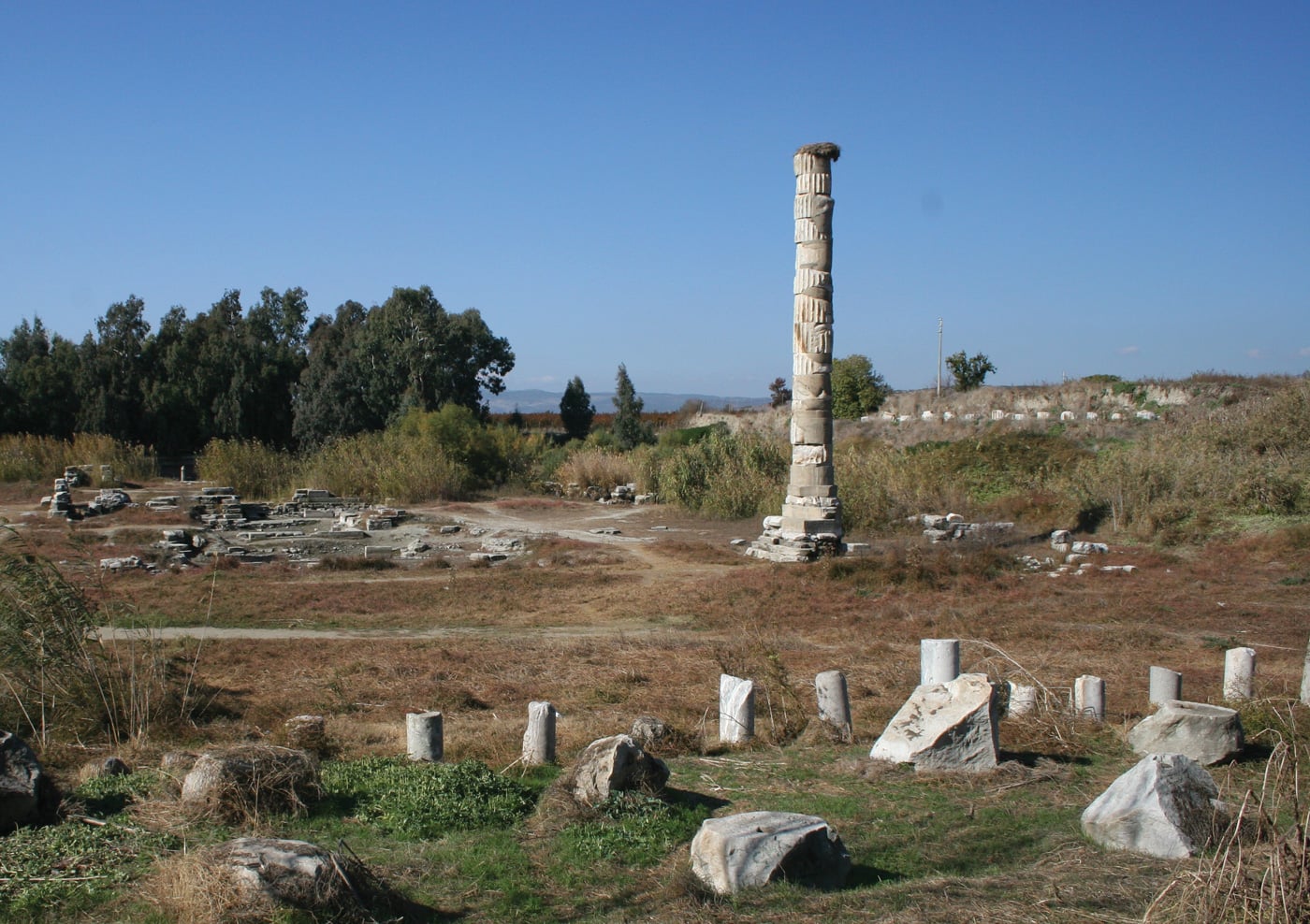
Only one tall pillar remains standing at the ruins of the Temple of Artemis in Ephesus. Paul tells Timothy that it is the church that is “the pillar and foundation of the truth” (1 Tim. 3:15).
First Timothy 4:1–5 takes its place within the drama Paul sees in Christ’s coming in the middle of time to effect redemption at Satan’s expense (esp. Gal. 1:1–4; Col. 2:15; Eph. 1:3–23; 2:1–10; 3:7–10; 6:12–20). This redemption has prompted an ultimately doomed response by Satan: the unleashing of a “secret power of lawlessness” (2 Thess. 2:7), masked, ironically, by teachers who promote phony lawfulness, a piety-pretending denial with respect to food and sex (the situation finds a parallel in Col. 2:8–23). Paul sets the opponents’ theology and practice within a specific framework: Satan’s “latter days” rebellion against the reconciliation of all things in Christ.
Paul responds to the false teachers by pointing to the teaching in Genesis 1 that creation is good. Evil lies not in a thing itself but in its misuse. Evil is an intrusion into creation, not a part of creation itself. It is not sexual activity that must be avoided but its corrupt misuse. Food is not the problem but rather the evil disordering of appetite. Part of what is restored in Christ is a prudence that allows believers to receive things for what they are, gifts God intended “to be received with thanksgiving” (4:3–4). In the Garden of Eden, the human race tragically exchanged the truth of God for a lie. A posture of grateful acceptance of creation and its gifts was traded for one of ingratitude and idolatry. Accordingly, God gave the race over to the corruption of conscience (Rom. 1:18–31). Now, in Christ, “those who believe and who know the truth” have had consciences re-informed by prayers of consecration and by the Word of God (see Gen. 1:31; Matt. 15:11; Mark 10:9).
C. Timothy’s responsibility for true religion (4:6–5:2). Paul compares the false teachers’ asceticism with a long-standing teaching offered by Greek moralists about the moral virtue that comes from athletic training. It is not noble philosophizing, counters Paul, but “old wives’ ” storytelling that promotes physical discipline as being the key to inner balance. The point of Paul’s “physical training is of some value” is that such training is of little benefit when compared with “godliness” that “has value for all things, holding promise for both the present life and the life to come” (4:8). What is really worth the effort (see verse 10, “we labor and strive,” both athletic terms) is the process Paul puts before Timothy, a set of disciplines that will lead to his salvation and that of those in his care.
The pursuit of godliness has as its aim the salvation of all, not a select minority of the selfishly motivated hyperdisciplined. Paul’s salvation is a full restoration of what it is to be human. It is available to all. Part of the guiding thought in the Pastorals is that the gospel empowers a kind of life that was envisioned in Greek thinking (see Titus 2:12). Paul notes that the source of the gospel’s life-giving power does not lie down the path of external conformity to the law (1 Tim. 1:8–11) or down the path of what is, in reality, ungodly self-denial (4:1–5). It is, in sum, the life of faith that Paul referred to in 1:4 as “God’s work—which is by faith.” Timothy’s life is to be an example in terms of godliness (“in conduct . . . in faith”—4:12), justice (“in love,” “an older man . . . as if he were your father. Treat younger men as brothers, older women as mothers, and younger women as sisters”—4:12; 5:1–2), courage (“Don’t let anyone look down on you because you are young”—4:12), and temperance (“in purity,” “with absolute purity”—4:12; 5:2). Godliness is promoted in the context of Christian community, not in isolation from it: “public reading of Scripture . . . preaching . . . teaching” (4:13). At the same time, godliness is intensely personal, as Paul urges Timothy: “Be diligent in these matters; give yourself wholly to them” (4:15). If the whole church is to provide visible proof of the truth of the gospel (3:16), Timothy’s life is to be first in being the “pillar and foundation of the truth” (3:15).
6. Widows, Elders, and Slaves (5:3–6:2)
A. Widows and female benefactors (5:3–16). The first part of this section (5:3–8) treats widows whose poverty qualifies them to come under the care of the church. Even though the church is to think of itself as a family (see 3:15, “God’s household”), the church is not a substitute for families. If there are “children or grandchildren” of a widow, these family members show their godliness (“put their religion into practice” [5:4a]; this is also the sense of 5:8) and their sense of justice (“repaying their parents and grandparents” [5:4b]) by providing for their own widowed grandmothers and mothers. However, if there is no family or if a family has insufficient resources to keep widows from sliding into poverty, Paul expects Christians to practice the relief for widows called for in the Old Testament (Exod. 22:22; Deut. 26:12) and famously characteristic of Jewish communities. Anna, the widowed prophetess who lived in the temple precincts, provides an example of the destitute widow of 1 Timothy 5:3–5 (see Luke 2:36–38). Paul maintains that care for elders is a divine and social obligation.
The second part of this section (5:9–16) treats widows whose record of ministry qualifies them for something like an office parallel to that of overseer or deacon (see 1 Tim. 3:1–7, 8–13). Like deacons, who are to be tested (3:10), these widows are to be installed after it has been established that their lives consist in “good deeds”—notably, “showing hospitality, washing the feet of the Lord’s people, helping those in trouble” (5:10). This is the kind of faithful woman who, even in her own widowhood, “has widows in her care.” Dorcas (known as Tabitha), the patroness of widows in Joppa, is an example of the care-providing woman that Paul envisions in this passage (see Acts 9:36); she is one who has extended rather than received “good works and acts of mercy” (NIV “always doing good and helping the poor”). The grief at Dorcas’s death by the widows who benefited from her kindness (Acts 9:39) is testimony to how important this role was in the early church. Paul wants to make sure that only suitably mature women are enrolled to this office. Younger widows are encouraged, instead, to take up new families rather than to risk reneging on their commitment to Christ and to those who would be dependent on them.
B. Elders (5:17–25). Having clarified which women are eligible for relief for widows (5:3–8) and which are to be supported as ministering widows, Paul now takes up the matters of paying and disciplining elders. Paul expects the church to find some of its leadership from the municipal elite and the independently wealthy. These are the kind of people who would readily recognize their own community values in the overseers list in 3:1–7. Paul mentions these wealthy individuals directly at 6:17–19. In addition, Paul expects some leaders will need to be paid for their service to the church (these, in the opinion of most interpreters, are in view in 6:8–10).
Skill in administration is vital to the life of God’s household, and Paul’s placing this section next to the widows’ passage suggests that some of the difficulties in Ephesus were a result of a breakdown in administration. However, even more necessary is the ability to teach. Thus, special priority (“double honor”) is put on “those whose work is preaching and teaching” (5:17). Paul quotes both the Old Testament (Deut. 25:4) and Jesus himself (Luke 10:7) to underline the importance of the church’s support of a leadership that is independent of secular social, economic, and political clout.
Even though the church in Ephesus is in a major Hellenistic city, Paul expects it to take its bearings from the Old Testament and from Jewish community life. Paul has just cited the Old Testament in support of the idea that spiritual leaders should be paid. Now he invokes the Old Testament (Deut. 19:15) to protect elders from false accusations. There is no way to be certain about the charges that have been brought. What is important is that Paul is concerned about due process (5:19) and avoiding favoritism (5:20–21).
Paul requires that mature believers, not recent converts, be placed in leadership in the church at Ephesus (unlike the church in Crete, which was a missionary setting). The temptation is to elevate too quickly either people whose secular power and prestige mask hidden agendas, or people whose glib tongues mask spiritual infancy or sinister motives. As if the stress that the relatively young Timothy is under in confronting an entrenched and socially powerful opposition isn’t enough, Timothy has developed stomach problems and is frequently ill, for which Paul prescribes “a little wine” (5:23; see Prov. 31:6). Of even more comfort to Timothy must have been Paul’s closing words in this chapter, assuring him that though the difference between good and evil sometimes comes to view in this life and sometimes only in the next, God will nonetheless ultimately make all things right.
C. Slaves and masters (6:1–2). Christian slaves are wondering what, in view of their redemption, they still owe their masters. In the Letter to Philemon, we see how diplomatically yet persuasively Paul can approach a Christian master about relating to a converted slave who is now a Christian brother. In that letter, he hints that Philemon should release his slave Onesimus to aid Paul in ministry. In 1 Timothy 6, by contrast, Paul urges slaves not only to consider how their continued—indeed, heightened—service can serve the gospel but also how disrespect toward their masters will not lead to a more consistent Christianity. Instead, it will lead to a slandering of God’s name by those outside the church. Paul instructs slaves of Christian masters not to “show them disrespect just because they are fellow believers” (6:2) but rather to “serve them even better.” In the Letter to Titus, he will say much the same, calling slaves to “adorn” the gospel through their service (Titus 2:10 KJV, RSV).
The phrase “those who benefit by their service” (RSV, NRSV; see NIV note; NIV “their masters”) is in dispute. If this translation is correct, Paul is turning contemporary values upside down by inviting slaves to become their masters’ benefactors through their ungrudging service. However, a more normal treatment of the language suggests Paul has in mind masters who “devote themselves to service.” In this case Paul would be asking Christian slaves to recognize that those masters who serve the community (who live out 6:17–19, for instance) are themselves doing so as brothers. Paul—like Jesus—will expect these masters to give up the normal benefits of their liberality and generosity (such as honorific statues and inscriptions, “front row” treatment like that sought in Luke 14:7–11). Household dependents should accord such masters a brotherly respect. Regardless of which reading is correct, Paul calls Christian slaves to a new way of thinking.
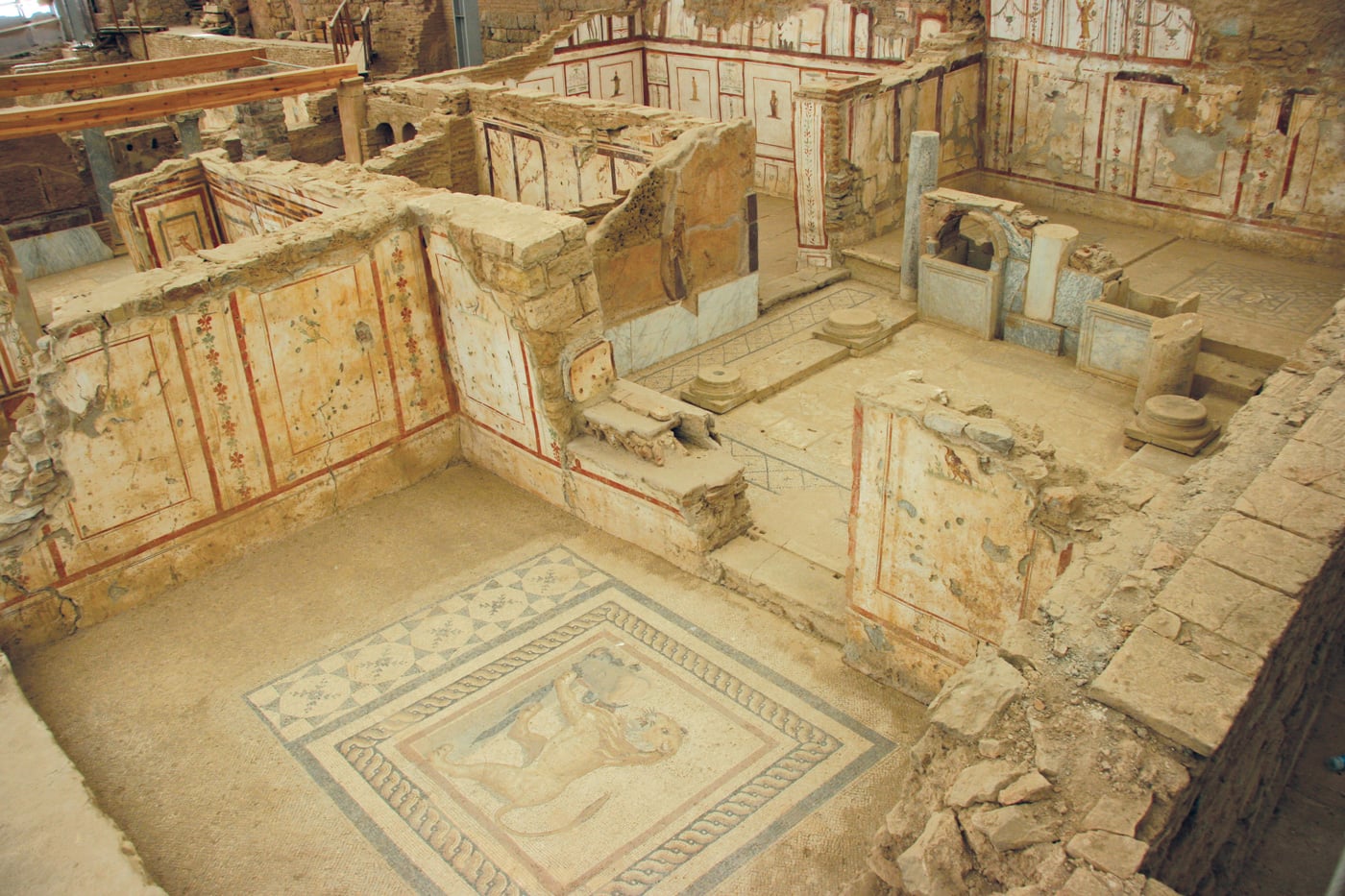
The beautiful mosaic floors and frescoed walls in these ancient terraced houses in Ephesus (occupied first century BC–seventh century AD) attest to the wealth that some individuals possessed. Paul addresses the dangers of wealth: “Those who want to get rich fall into temptation” (1 Tim. 6:9).
A. False teaching and love of money (6:3–10). Paul begins this section with a warning against false teaching that recalls the opening of the letter. He is returning to his concern about aspiring but confused teachers. In chapter 1, Paul addressed their speculations and their wrong use of the law. In chapter 4, he addressed their nonbiblical self-denial. Here in chapter 6, he speaks to the ill effects of their teaching and to the teachers’ unworthy motives.
The false teaching creates a climate of spiritual disease that has three elements: godlessness, social strife, and a corrupt inner life (see Titus 1:12; 2:12). First, the teaching is contrary to true godliness, pointing people to a focus on something other than Jesus Christ (6:3–4). Second, the teaching promotes “envy, strife, malicious talk, evil suspicions and constant friction.” Third, the teaching flows from people who are deluded about their own importance (they are “conceited” [6:4]) and are driven by an appetite for gain (6:5): “who think that godliness is a means to financial gain.”
Modern interpreters often dismiss this last statement as a mere rhetorical flourish. But in many respects Paul seems to get to the heart of the issue here. Confusion about wealth is a huge problem in this prosperous church. It is wealthy women who usurp teaching authority (chap. 2). It is prosperous household heads whom Paul urges to aspire to spiritual leadership (3:1). It is confusion over how families’ and the church’s resources should be managed in relief to widows that Paul addresses in chapter 5. The denunciation of greed among aspiring teachers (6:8–10) follows directly on the heels of instruction to provide “double honor”—that is, “twice the pay”—for elders who are especially apt at teaching and governing. The section will close with the only paragraph Paul ever addresses, at least in the writings that have come to us, to the rich about how they are to fit into the household of faith (6:17–19).
Greed is deadly to the soul and ruinous to community. Those who do not have money and those who do have money are equally susceptible to the vice of “love of money.” Those who do not have money dream about what it would be like to have it. (The NET’s “who long to be rich” is a better rendering of the Greek than the NIV’s “who want to get rich.”) Those who do have money find there is never enough (Luke 12:13–21, and the comments below on 1 Tim. 6:17–19). In the strongest terms, Paul instructs Timothy to look for would-be leaders whose godliness produces “contentment,” drawing on a rich layer of wisdom teaching from the Old Testament (with 6:7–8, cf. Job 1:21; Eccles. 5:14). As an adage, “the love of money is a root of all kinds of evil” can sound irrelevant and overused. However, in the case of the Ephesian church, the love of money has indeed created a host of pastoral problems.
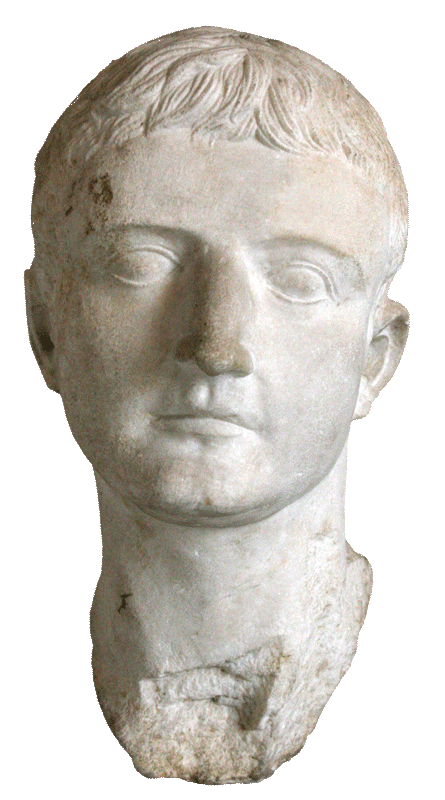
A bust of Tiberius, the Roman emperor from AD 14 to 37. In spite of the elevated status of the Roman emperors, Paul describes God as “the blessed and only Ruler . . . who alone is immortal” (1 Tim. 6:15–16).
B. What makes Timothy wealthy (6:11–16). As far back as the Letter to the Philippians, Paul expressed his trust in Timothy’s ability to model Christian truth (2:19–24). Certainly Paul is worried about whether Timothy will have the boldness to fight the powerful—some in social status, some in eloquence—opponents in Ephesus. Nonetheless, Paul’s instructions to Timothy about the life he is to lead indicate his confidence that in Timothy’s character, the Ephesian church will find an antidote to the greed and power-grabbing that is plaguing them. Paul tells Timothy to flee the entrapment of greed that is crippling the Ephesian church. He instructs Timothy to pursue a range of virtues to display what “godliness with contentment” (see 6:6)—in a word, what living in Christ—looks like (6:11).
Timothy himself is to be the opposite of those who desire the short-term gain that ministry could bring: money and influence. A minister’s wealth and influence are to be found in the virtues traditionally associated with Paul’s teachings: “faith, love,” and hope (expressed as “endurance. . . . Take hold of the eternal life to which you were called. . . . Keep this command without spot or blame until the appearing of our Lord Jesus Christ” [6:11–12, 14]); and also in the virtues that being in Christ empowers: “righteousness [= justice], godliness,” temperance (here expressed in terms of demeanor: “gentleness” rather than harshness—more on this at 2 Tim. 2:24–26—and “without spot or blame”), and courage (“Fight the good fight” [6:12]—again, more in 2 Timothy).
The theological values that are to be made transparent in Timothy’s life are notable: creation (“God, who gives life to everything”), redemption (note the way Paul appeals to the narrative of Christ’s suffering and to the promise of his return), and the majesty of God, the doxology of 6:15–16 nicely mirroring the doxology of 1:17.
C. How the wealthy can invest (6:17–19). Paul turns finally to those from whom the most serious issues at Ephesus have emerged: “those who are rich in this present world” (6:17). The women usurpers are rich (2:9–15). Prosperous household heads need to learn what is worthy of aspiring to and how to do so (3:1–10). Those with means must learn not to hoard for themselves but to care for family members (5:1–9) and for the church’s poor (5:9–16).
Wealth presents both dangers and opportunities. Paul leads with the dangers. First, the rich must not be “arrogant” (literally “high-minded”). They must not think of themselves as morally superior or more deserving than others. Second, they must not “put their hope in wealth.” It is easy to be seduced into thinking that power and possessions are permanent, or even that they can bestow a kind of immortality. (The ancient world was filled with memorials by which benefactors sought to have their largesse remembered forever.) But, Paul warns, wealth is “uncertain.” The only one worth putting hope in is God himself (compare 6:17 with 4:10; 5:5), who alone, as Paul has just noted, possesses immortality (6:15).
Wealth offers opportunities as well as dangers. First, while goods cannot substitute for God, they nonetheless should be seen as gifts from God. Though it is difficult to discern details about the false teaching in Ephesus, it is characterized by one thing specifically: contempt for creation (see especially 1 Tim. 4:1–5). Paul’s high view of creation comes into view nowhere better than here, where he argues that God “richly provides us with everything for our enjoyment” (6:17). God’s generosity is revealed not just at the cross where our sins are forgiven (though it is), not just in the outpouring of the Holy Spirit for gospel ministry (though it is). God’s generosity is revealed in every benefit of creation, from food and marriage and possessions all the way to his Son’s taking on a human body for our benefit. (Note the way Paul refers in 1 Tim. 2:5 to God’s Son as “the man Christ Jesus,” and in Titus 2:11; 3:4 as “the grace of God,” and, “the kindness and love of God.”) By saying that God gives things “for our enjoyment” (6:17), Paul underscores the Bible’s view of the absolute, and therefore redeemable, good of all God’s creation.
Second, wealth creates possibilities for cultivating virtue and for benefiting one’s community. Paul asks the Christian rich to be as generous with their resources as their pagan counterparts: “to do good, to be rich in good deeds, and to be generous and willing to share” (6:18). Wealth lies not in possessions but in relationships, for wealth creates the ability to benefit others.
The primary difference between the Christian rich and the pagan rich lies in the return they expect. Aristotle taught, “Hidden wealth kept buried” does you no good; rather, you should use it to gain friends and to attain honor. Benefactors gave so they might receive “liquid IOUs” and concrete things like (summarizing a list in Aristotle’s Rhetoric 1361a39–43) sacrifices in their honor, memorials in verse and prose, privileges, grants of land, front seats, public burial, state maintenance, “and among the barbarians, prostration and giving place, and all gifts which are prized in each country.” Instead, Paul, sounding much like his master, maintains that Christians “lay up treasure for themselves as a firm foundation for the coming age,” that is, for the day when they hope to hear their master’s “Well done” (see Matt. 6:20; 19:21; 25:21, 23; Luke 16:10).
8. Closing Admonition: Opposing Spurious “Knowledge” (6:20–21)
Paul closes 1 Timothy with one of his shortest letter-endings, perhaps itself a commentary on the folly of arguing over myths, endless genealogies, and controversial speculations (1:3–4). With his denunciation of “what is falsely called knowledge,” Paul almost prophetically provides the rallying cry for the second-century church’s battle with gnosticism.
Commentary for 2 Timothy
In 2 Timothy, Paul calls Timothy to his side as he faces probable martyrdom (4:9, 13, 21) and at the same time urges his young protégé to be courageous in ministry in his teacher’s absence.
The apostle discerns that Timothy needs fortification beyond the words of 1 Timothy. The distinctive terms of this second greeting provide further strengthening for Paul’s protégé. Paul’s own call is by “the will of God” himself, and his call, like Timothy’s, serves the “promise of life that is in Christ Jesus.” In addition, here Paul calls Timothy “my dear son” (literally “my beloved son”). Timothy is thus reminded, first, that he ministers under an authority that he ought not to ignore; second, that he ministers for the sake of a goal (the promotion of God’s life-giving promises) that is worth living and dying for; and third, that he does not do so alone—he is much loved.
2. Thanksgiving and Appeal (1:3–7)
A. Thanksgiving (1:3–5). In his first letter, Paul wrote without the normal prayer of thanks that he and other Hellenistic letter writers usually included. In that first letter, Paul seemed simply to want to get down to business. Now, sensing that Timothy’s position is more fragile and his resolve less solid than he originally thought, Paul prays. Paul thus describes Timothy’s ministry in the context of gratitude for the grand story line of covenant faithfulness that God has been working throughout the history of redemption. This includes Paul and Paul’s own family (now including Timothy) and Timothy’s own family. Timothy does not minister alone and in isolation. He stands in a long line of saints, and Paul’s nonstop prayers support him as well. Moreover, though Timothy seems to be crippled by his own fears, Paul wants to encourage him with what he finds touching about Timothy’s rich inward life: the tears he has shed in Paul’s presence and the knowledge that their reunion will bring Paul great joy. Paul has seen evidence of great faith at work in Timothy. He now appeals for more.
B. First appeal: Rekindle the gift and be courageous (1:6–7). Timothy’s ministry in Ephesus is challenging. He is a young man (1 Tim. 4:12) charged with the oversight of one of the largest and best-established churches in Paul’s mission. Paul has warned that strong, erring would-be leaders could emerge (Acts 20:30). Though Paul has written off by name two false teachers as being shipwrecked in faith (1 Tim. 1:19–20), at least one of those two is still in Ephesus teaching that the resurrection has already taken place (2 Tim. 2:17). Because Timothy is cowering at this challenge, Paul wants to strengthen his student’s faith to do battle.
Thus, Paul reminds Timothy of the gift of the Spirit that came to him from God when he was set aside for ministry. If, as Paul says elsewhere, the Spirit’s flow in us can be quenched (1 Thess. 5:19), so, too, can its fire be rekindled. Paul encourages Timothy to draw on the resource that is already within. God’s Spirit is not marked by timidity but by “power, love and self-discipline” (1:7).
In both biblical and extrabiblical literature, “timidity” (often translated “cowardice”) is an antonym of “courage” (see Josh. 1:9; Dio Chrysostom, Oration 23.8). While the other three Greek virtues (godliness, temperance, and justice) are stressed elsewhere in the Pastorals, the military virtue of “courage” dominates in 2 Timothy. Paul begins by telling Timothy not to play the coward. Paul challenges him instead to be a “good soldier of Christ Jesus” (2:3), recalling a theme he introduced at 1 Timothy 1:18: “wage the noble warfare” (NIV “fight the battle well”; cf. 1 Tim. 6:12; 2 Tim. 4:7). He explains cowardice’s opposite in several terms: first, “power” (God’s rule that will be manifest on the last day [2 Tim. 4:1] and is on display now when God converts sinners [see 1:8 and 2:25]); second, “love” (the goal of ministry—1 Tim. 1:5; 2 Tim. 1:13); and third, “self-discipline” (the kind of self-restraint that gives God room to grant repentance—see 2:22–26).
3. Examples to Emulate and to Teach Others (1:8–2:13)
A. Christ’s victory: A gospel worth suffering for (1:8–10). Courage will enable Timothy to join Paul and Jesus in standing for the truth. Just as the Lord himself testified before Pilate (despite the NIV’s “testimony about our Lord,” this “testimony of our Lord” is the same notion Paul described in 1 Tim. 6:13), so must Timothy be ready to testify and suffer. Nor should Timothy be ashamed of his own spiritual mentor, despite Paul’s having to minister from a Roman prison. The apostle stresses the power of God on display in the gospel (1:8). Verses 9 and 10 virtually sing of the glory of the story he and Timothy have been given to tell. Paul highlights three things: God’s salvation comes from his own purpose and grace; this salvation has been designed according to God’s own timetable; and finally, Christ has destroyed death and brought to light life and immortality.
B. Paul’s life: A life worth emulating (1:11–14). Paul has been called to serve this gospel as “a herald and an apostle and a teacher” (1:11). As a herald, he announces Christ’s lordship of the universe by virtue of his victory over sin and death. As an apostle, he establishes the foundation of Christian community. As a teacher, he instructs believers how to live in Christ (see also 1 Tim. 2:7). Paul exposes himself to physical suffering and emotional humiliation because he knows God’s resolve to see salvation through to “that day”: the day of Christ’s triumphal return to complete the restoration of all things (see Phil. 1:6).
Paul has delivered a “good deposit” that Timothy is to preserve by his own life of faith and love in Christ. This deposit is the sum of a “pattern of sound teaching” that Timothy is to teach others (see chap. 2), with the indwelling Holy Spirit’s help.
C. One other life to emulate, contrasted with counterexamples (1:15–18). Sadly, not everyone in Paul’s circle is staying true to the apostle. Though there is surely some exaggeration in Paul’s saying that “everyone in the province of Asia” (where Ephesus is situated, and where Timothy is ministering) “has deserted me,” it certainly means that Timothy is serving a church with little backing from Paul’s supporters. Paul is offended enough by two of them to name them, Phygelus (who is otherwise unknown) and Hermogenes (who may be the person identified in the noncanonical, late-second-century Acts of Paul and Thecla as a coppersmith and Paul’s opponent).
Paul is keen to present to Timothy the faithfulness of Ephesus’s own Onesiphorus. Paul prays God’s mercy for Onesiphorus, who has recently found the apostle in his Roman jail and ministered to him there. Paul reminds Timothy of the way Onesiphorus has served them in Ephesus. Onesiphorus’s lack of shame at Paul’s chains (the Greek phrase is a clever understatement) becomes yet another example for Timothy to follow.
D. Second appeal: Teach others (2:1–7). Paul solidifies his appeal to Timothy with an emphatic, “You then, my son.” The positive, flip side of Paul’s earlier negative warning against timidity (2 Tim. 1:7) lies here in his “be strong in the grace that is in Christ Jesus” (2:1). In these verses Paul comes to the point: Paul has taught Timothy so that Timothy can teach others, who in their turn can teach still others. Paul has carefully built the case for the urgency of the task: Timothy must fortify himself to fortify the church in Ephesus so that it can be a self-sustaining community. It becomes increasingly clear that Paul looks ahead to his own martyrdom and desires that Timothy come to him in Rome to comfort him. Thus, it is vital that Timothy rise to the urgent need: teach others who can tend the body in Ephesus.
With considerable skill, Paul appeals to three familiar Hellenistic metaphors: soldier, athlete, and farmer (cf. 1 Cor. 9:7, 24—see also, for example, Epictetus, Discourses 3.22.51–69; 4.8.35–40). Soldiers are loyal, athletes know their game, and farmers work hard. Crisply, Paul exhorts Timothy to apply these truths to his situation: Listen to me! Care about those who need you! Get to it!
E. Remember Christ Jesus (2:8–13). First and last, the church’s message is “Jesus Christ, raised from the dead” as the initiator of a new age, and “descended from David” as the sum of all God’s promises in the past (2:8). God reclaims the whole universe through Christ and does so by way of Israel’s story.
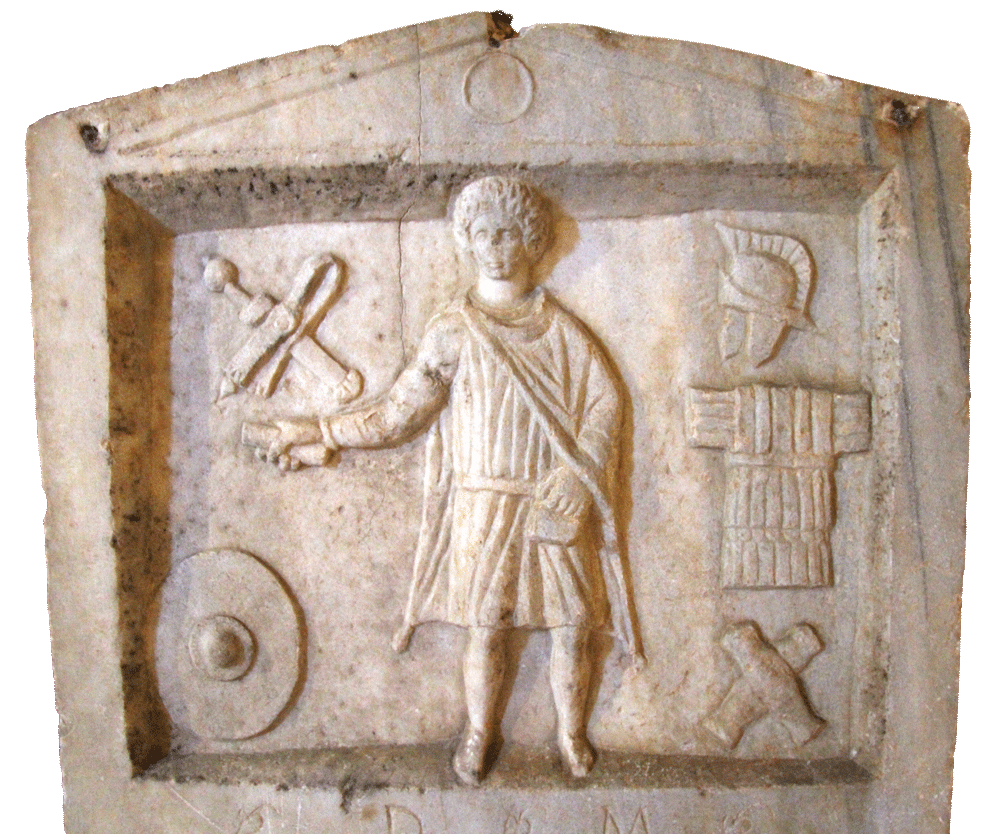
This relief of a Roman soldier from his grave stele is dated to the Roman Period (30 BC–AD 395). Paul exhorts Timothy to be “like a good soldier of Christ Jesus” (2 Tim. 2:3).
In the Greek, verses 8–10 make up a single sentence, beginning with Jesus’s resurrection and climaxing in believers’ final salvation in glory. To combat the false notion that the only resurrection to take place has already occurred (2:18), Paul reminds Timothy that Jesus’s resurrection brings the promise of his people’s resurrection. Between the beginning and end of this three-verse sentence, however, is language of suffering. Paul describes his chains, his ignoble status as a criminal (no longer under mere house arrest), but also his willingness to “endure everything.”
The reality of Christ’s resurrection in the past and the certainty of believers’ resurrection in the future create in Paul a confidence that though his body may be “chained . . . God’s word is not chained” (2:9; the NIV nicely brings out the similar Greek words translated “chain”). Because God’s word is unstoppable, Paul’s imprisonment provides another opportunity for God’s power to bring salvation to his people.
Paul hopes that Timothy will let his life take the same shape as Jesus’s and Paul’s. To that end, he invokes the last of the Pastoral Epistles’ five “trustworthy sayings.” Verses 11–13 are matchless in their poetic or hymnlike quality. Union with Christ in his death will bring life with him in resurrection (2:11; see also Rom. 6:8): now a cross, later a crown (2:12a; cf. Matt. 19:28).
However, if on the last day we deny Christ, he will deny us (2:12b; see also Matt. 10:33). Paul uses an unusual and emotionally charged future tense in the “if” clause that begins, “If we disown him” (literally “if we will disown him”), indicating the unthinkability of the act. Paul is remembering those who have abandoned him in prison (2 Tim. 1:15; 4:10). Others have abandoned Paul’s teaching (2:17–18). Paul fears the sum of their careers will amount to a fatal denial of Christ himself.
Verse 13 contains the poetic punch line. Paul’s deepest hope is that Timothy will choose a different path from those faithless ones. He is most confident, though, that regardless of anyone else’s faithfulness or faithlessness, God himself will remain faithful. The poem’s last line about God’s not being able to disown himself has puzzled commentators. The effect is to ask Timothy and subsequent readers to ask themselves hard questions. Those whose ongoing faithlessness leads to final denial of the Savior will discover that it will be impossible for the Lord to acknowledge them. Those who repent, however, can take solace in knowing that God faithfully forgives his people’s failings.
A. Why to resist false teachers: Their influence is corrupting (2:14–21). Paul continues his discussion from 2:2 about how to train leaders. It is they especially who must learn that “quarreling about words” will only bring ruin to “those who listen.” The warning against quarrelsomeness is important. Paul does not want his militant call (“wage the noble warfare” [1 Tim. 1:18; NIV “fight the battle well”], “no one serving as a soldier” [2:4]) to be taken the wrong way.
By contrast with those who distract with “quarreling about words” (2:14) and “godless chatter” (2:16), and those who confuse with error (2:18), Timothy is to show competence as one who “correctly handles the word of truth” (2:15). The only other places this verb occurs in the Bible are in the Septuagint at Proverbs 3:6 and 11:5, where it refers to clearing a straight road. Timothy is to focus on forthrightness of speech and correctness of meaning. His own approval before God is at stake, and so is the health of his (and their) hearers. Paul compares the ungodliness that the false teachers promote with flesh-decaying and foul-smelling gangrene—an image that fits the theme of “sound [i.e., healthy] doctrine” in the Pastorals (1 Tim. 1:10; 6:3; 2 Tim. 1:13; 4:3; Titus 1:9, 13; 2:1–2).
Paul believes it is critical to handle the word of truth correctly when it comes to the timeline of redemption (see also 1 Corinthians). It is folly of the worst sort to believe that you have arrived at your final goal when you are still merely on the way. Thus, it is a fatal error to teach—as Hymenaeus and Philetus (otherwise unknown to us) do—that the only resurrection that is to take place has already happened. Wrongly applying teachings like those in John 5:24 and Ephesians 2:4–7, they probably believed that our new birth or regeneration is our final resurrection.
With his “nevertheless” at verse 19, Paul assures Timothy that the danger in the church is more than matched by God’s provision, as illustrated by Israel’s history (Num. 16:5; Isa. 28:16; 26:13; 52:11). Likewise now, God is invested in his “large house” (2:20; cf. the image at 1 Tim. 3:15). All those in the house—but Paul is especially thinking of those who would teach—must cleanse themselves of that which is impure so that what they have to offer is noble, holy, and useful to the house’s master.
B. How to resist false teachers: With mature gentleness (2:22–26). Given the severity of Paul’s words about the peril in which the false teaching places the church, it is worth noting that Timothy is to conduct his campaign for the truth with a gentleness that keeps the door open for his opponents to repent.
The commandment to flee “the evil desires of youth” (2:22) is probably aimed, in the first place, at sexual temptations. (The same Greek term translated “evil desires” here Paul elsewhere associates with sexual sin; see Col. 3:5; 1 Thess. 4:5.) Intriguingly, Paul notes that individual purity of heart (see Matt. 5:8) is experienced in the fellowship of “those who call on the Lord.”
However, verse 23 suggests Paul’s greater concern is that Timothy might overcompensate for his youthful timidity by responding to his opponents with an immature harshness. Secure in his ability to teach, Timothy is to show kindness to all, friend and foe alike. He is to resist the temptation to be quarrelsome with or resentful of his opponents. The effect of a mature and measured response will be to give God room to grant repentance. Timothy needs to lead with what Paul calls elsewhere “the humility and gentleness of Christ” (2 Cor. 10:1) and leave the convicting to God himself.
C. The false teachers put in their last-days context (3:1–5). Paul has just given Timothy one reason why he need not take opposition personally: God is in control of all things and all hearts (see also Acts 13:48; 16:14; Rom. 8:28–30). Now he offers a second reason: opposition has a place in God’s timetable. Paul thus reintroduces the Satan-prompted opposition to Christ’s redemption he referred to at 1 Timothy 4:1–5.
In 1 Timothy, legalism and asceticism were Paul’s target. In 2 Timothy, Paul aims at a range of ethical failings flowing from an overrealized eschatology (the mistaken notion that the resurrection is “already,” and there is no “not-yet”). To deny that sin must die one last death at Jesus’s return is, ironically, to open the floodgates to an unbridled religion of self. It is not accidental that Paul’s list of vices opens with “lovers of themselves” (3:2) and closes with “lovers of pleasure rather than lovers of God” (3:4). Everything in between is about building up oneself and destroying others. Religion stressing only the already with no room for the not-yet cannot help but produce a narcissistic and abusive lifestyle. Whatever appearance of godliness such teaching maintains, it has nothing of the Spirit of God about it—the only power it knows is Satan’s.
Though he is to be gentle, Timothy is called to be a skillful surgeon of the soul, courageously cutting out a range of ailments that bespeak sickness of soul.
Second Timothy parallels 1 Corinthians in three striking ways. In both churches, believers’ final resurrection was being denied. In both churches, Paul warned against excesses of the flesh. In both cases, Paul says “courage”—at 1 Corinthians 16:13 through the direct command, “be courageous”; and at 2 Timothy 1:7 through the indirect observation of what God’s Spirit does and does not produce in us.
D. The false teachers and the gullible women (3:6–9). Paul indicates that a large part of the problem in Ephesus is that religious charlatans have found an audience among undiscerning women. This passage sheds significant light on gender relationships in 1 Timothy as well—see 1 Timothy 2:9–15; 3:11; 4:7; 5:3–16. Literature of the period provides numerous examples of women who are easy prey to religious frauds (for example, Lucian, Alexander the False Prophet 6). Unlike Timothy’s mother and grandmother (2 Tim. 1:5), some women in the Ephesian congregation do not have the grounding in the Scriptures to see the implications of the opponents’ teaching. Paul traces these women’s gullibility to their being “loaded down with sins” and being “swayed by all kinds of evil desires.” It is unclear whether he means simply that they have tender consciences making them vulnerable to wrong solutions (e.g., the asceticism of 1 Timothy) or, more sinisterly, that they are involved in illicit relations with the false teachers (the latter may explain Paul’s concern with sexual purity in these two letters—see 1 Tim. 2:9–10; 3:2; 5:2, 11–15). Regardless, these women have an insatiable religious hunger, and this hunger perfectly complements the false teachers and their manipulative speculations.
Paul likens the false teachers to the magicians who opposed Moses and produced lying miracles before Pharaoh (Exod. 7:11–12, 22; 8:7—Paul uses names supplied by Jewish tradition). Further, Paul refers to them in verse 13 with a term that often means “magicians,” but here is translated “imposters”—Paul likely means “charlatans.” It is not so much that the false teachers perform miracles but that their spurious ideas about the resurrection and their empty promises of godliness cast a spell over undiscerning listeners. Paul is confident that their falsehoods will eventually be found out.
A. Third appeal, part one: Stay with what you know . . . (3:10–17). The false teaching being circulated among the Ephesians is that the resurrection is entirely “now.” In his controversy with the Corinthians over whether there was still a resurrection to come, Paul pointed to his own sufferings as proof that “we have not yet begun to reign” (1 Cor. 4:8–13). Here in 2 Timothy, Paul reminds Timothy of the normalcy of suffering by taking him back to the events of Acts 13–14, when Paul ministered in Lystra, Timothy’s hometown. After being stoned and left for dead, Paul insisted on returning in order to teach: “We must go through many hardships to enter the kingdom of God” (Acts 14:22). Timothy must courageously recommit himself to living and to teaching the same pattern, regardless of an increasingly fierce opposition.
Timothy can trust the lives of the people whose experiences have been shaped by Scripture. Of greater benefit, however, are the Scriptures themselves (by which Paul means our Old Testament). The Scriptures are entirely trustworthy. They are the very breath of God, and they find their coherence (“make you wise for salvation through faith”) in Christ Jesus. In 3:16 Paul characterizes the Old Testament’s benefit using four terms that have been much discussed. It is probably best to understand them as a Jewish Christian’s use of the traditional categories of Scripture. First, “teaching”: the law told the story of God’s redemption of his people and spelled out implications for life in covenant with him. Second, “rebuking”: the prophets brought God’s covenantal lawsuit against his rebellious people; the prophets wrote in such a way as to convict an erring people of their waywardness, pointing them to one in whose sufferings and glory their hope lay. Third, “correcting”: in the so-called Writings (the Psalms and the wisdom literature), God provided songs and sayings designed to realign his people’s hearts with his own heart, teaching them to lament and rejoice and live in accordance with his wisdom. Finally, there is “training in righteousness”: an all-encompassing term for education and spiritual formation in Paul’s world. With this last phrase, Paul indicates that the world’s highest aspirations for wisdom are more than met in the account of redemption in Christ anticipated and embedded in Israel’s Scriptures.
B. Third appeal, part two: . . . and preach the gospel (4:1–5). In an ultimate effort to strengthen his timid protégé’s resolve, Paul brings Timothy before “the presence of God and of Christ Jesus, who will judge the living and the dead” (4:1; for Christ’s role in future judgment, see Acts 17:31; Rom. 2:16; 1 Cor. 4:5; 2 Cor. 5:10). He puts Timothy under oath and defines his duty with crisp verbs, five in verse 2 and four in verse 5. The overarching command comes first: “Preach the word”—Timothy is the herald of God’s restoration of creation and pardon for sinners through Christ. Second, Timothy is to be “prepared in season and out of season.” Contemporary teachers wrote about the need to accommodate the disposition of their audience. Accordingly, Paul tells Timothy that in view of the urgency of the moment and the dire need of the church in Ephesus, he is to be ready to “correct, rebuke and encourage—with great patience and careful instruction.”
Paul resumes the sober “latter day” thoughts of 1 Timothy 3:1–5, 12–13. Timothy should expect to encounter people who become discontent with sound teaching and who seek teachers who merely satisfy spiritual lusts. The false teachers specialize in ego-gratifying, speculative storytelling. “Itching ears” (4:3), it would seem, are eager to hear that resurrection life is all in the “now.”
In contrast with all counterfeit gospels and all false approaches to what it is for God to refashion us in his image, Timothy is to offer himself as one who is sober (“keep your head in all situations”), courageous (“endure hardship”), godly (“do the work of an evangelist”), and just (“discharge all the duties of your ministry”; 4:5).
C. Paul’s final testimony (4:6–8). Chief among the reasons that Timothy must get over his timidity (1:7) is that, to anticipate Paul’s athletic imagery, the baton is being passed. Paul sees his present imprisonment ending in martyrdom. He offers this final testimony as the reason for the appeal he has just given and as one last summary of the type of life he has lived and urges on Timothy (see 2 Tim. 1:11–12; 2:9–10; 3:10–11). Paul mixes Old Testament sacrificial imagery (the fulfillment of the Old Testament practice of a drink offering poured out in gratitude for God’s gift of redemption [see Num. 15:5, 7, 10; 28:7; Phil. 2:17]) with contemporary athletic imagery of a race well run (4:6–7; and see Acts 20:24). Because of the successful completion of his ministry, Paul anticipates a victory wreath—“the crown of righteousness” (4:8; see also 2:5; 1 Cor. 9:25; James 1:12; Rev. 2:10; 3:11). Such expectation is consistent with Jesus’s promise of “Well done!” to those who serve him honorably and faithfully (Matt. 25:21, 23; Luke 19:17; see also Rom. 2:8–10).
A bronze statue of a boxer (third–second century BC). In 2 Timothy 4:7, Paul tells Timothy, “I have fought the good fight.”
The pathos of this letter lies in Paul’s urgent, heartfelt request that Timothy join him. He appears to have sent Tychicus to relieve Timothy of his duties in Ephesus at least temporarily (4:5) so he can join Paul, awaiting martyrdom in Rome. Along the way—and this is one of the great stories of reconciliation in the New Testament—Timothy should bring along the once-estranged Mark (with 4:11; cf. Acts 13:5, 13; 15:36–41; Col. 4:10; Philem. 24). Paul’s situation is dire; he has survived a preliminary hearing before the Roman authorities, but he has dim prospects for acquittal in the upcoming final hearing. He is not under the comfortable house arrest with which the book of Acts concluded and that had permitted the writing of Philippians, Philemon, Colossians, and Ephesians. Paul is familiar enough with imprisonment; but it is only here in 2 Timothy that he refers to his being treated “like a criminal” (2:9). Not only that, but all his companions except Luke have left him, some for ignoble reasons, some for reasons unknown.
Still, the tone of confident faith is remarkable. Paul seems to be interpreting his situation through the lens of Psalm 22, the song with which Jesus expressed the anguish of sufferings on the cross and by which the writer to the Hebrews speaks of the risen Jesus as the church’s worship leader (see Heb. 2:12; 7:25; 8:1–2). As Jesus was abandoned on the cross (Matt. 27:46; Ps. 22:1), so Paul has been abandoned by Demas. As the psalmist looked to God for “rescue” from lions (Ps. 22:20–21), Paul has experienced “rescue” at his preliminary hearing and expects, even at death, “rescue” into God’s heavenly kingdom. Paul continues to see his life as a union with Christ in his sufferings and glory (Phil. 3:10–11).
Further, Paul still focuses on the work to which God has called him; he is grateful his duress has meant that “the message might be fully proclaimed and all the Gentiles might hear it” (4:17). His request for manuscripts has prompted much guesswork: he may mean copies of Scriptures he had to leave behind at his arrest; he may mean his own collected writings; he may mean writings he is still preparing. In any event, his request means he is still working. He continues to warn about those who oppose him and will no doubt oppose Timothy as well. Paul does not specify the “great deal of harm” Alexander the metalworker did to him. The likelihood is that Alexander was the cause of Paul’s arrest (thus his mention right after the cloak and parchments Paul had to leave behind in Troas). Even the greetings he sends indicate Paul is still on the job. He undergirds supporters in Ephesus (Priscilla and Aquila and the household of Onesiphorus; 4:19); he notes that Corinth’s city treasurer Erastus is still there (see Rom. 16:23); he has left Trophimus in charge in Miletus despite the latter’s illness; he completes his greetings with four named and with unnumbered and unnamed individuals from Rome. Though Paul is left without any ministerial assistance there besides Luke’s, God’s work goes on in the empire’s capital city.
Additionally, even if he expects his death in the near future, the apostle will not despair and simply wait for it: he asks for a cloak in case he lasts the winter.
Paul closes with two phrases—one an ascription, the other a benediction—that are fine capstones to his writing career.
First, the ascription: “To him be glory for ever and ever. Amen” (4:18). Paul has a passion for promoting the majesty of God. The insult to God’s dignity by Adam’s disobedience has been more than turned aside by the second man’s obedience. Christ has “destroyed death and has brought life and immortality to light” (2 Tim. 1:10), restoring God’s creation to its original design of reflecting his glory. Paul’s sufferings have done nothing but contribute to the reestablishment of God’s splendor.
Second, the benediction: “The Lord be with your spirit. Grace be with you all” (4:22). Paul continues to assure Timothy of the kindhearted nearness of God to his people. Paul endures the ignobility of being known as a criminal because his own Savior’s love took him to a criminal’s cross. In life or in death, God’s people can know that he is close by them and that he cherishes them.
Commentary for Titus
The Letter to Titus addresses a “missionary” or “church-planting” situation. Paul’s delegate has been left behind in Crete to (1) put in place leaders who can refute false teaching and (2) install a pattern of teaching that establishes the right fit between lifestyle and truth. Paul addresses the issue of Christians’ relation to “culture” more directly here than in any other place in his writings: living “sensibly, righteously [or “justly”] and godly in the present age” (2:12 NASB). Paul’s teachings contain the seedbed for what French commentator Ceslas Spicq dubbed a “Christian humanism” (ideas latent in Gal. 6:10; Rom. 12:17–18; Phil. 4:8).
Titus is one of the most trusted—and most “Greek”—of Paul’s protégés. Paul charges him with establishing church life on an island that is home to some of Greek civilization’s most ancient memories. Moreover, Titus is a veteran of Paul’s battle over Jewish custom and teaching in Gentile churches (Gal. 2:3). Paul considers him the perfect emissary for dealing with a situation in which teachers “of the circumcision” (1:10) complicate these new converts’ situation.
In this salutation, Paul deliberately emphasizes the purpose of his apostleship rather than its source. God’s elect people should be characterized by faith in Christ rather than by empty “Jewish myths” (see 1:14). In addition, “knowledge of the truth that leads to godliness” (1:1) stands in distinct contrast to popular pagan legends about Zeus’s origins as a man born and eventually buried on Crete (Kidd 1999, 185–209). Even Paul’s note about God not lying (1:2; the only assertion of this fact in the New Testament) stands in contrast with “divine” Zeus, who in fact did lie to have sexual relations with a human woman (taking the human form of her husband). The only hope for “eternal life” lies in what the true and living God promised “before the beginning of time” about executing his drama of creation, fall, redemption, and consummation. That promise has been fulfilled “at his appointed season” through Jesus Christ’s coming (which Paul discusses at Titus 2:11 and 3:4) and in the “preaching entrusted to me,” says the apostle (1:1–3).
Paul greets Titus, “my true son in our common faith,” with the standard “Grace and peace” (1:3) from the earlier letters (minus the addition of “mercy” as in 1 and 2 Timothy), suggesting to many commentators that this epistle was the first of the three Pastoral Epistles.

Crete is the fifth-largest island in the Mediterranean Sea. Paul explains to Titus why “I left you in Crete “ (Titus 1:5) and advises him on the continuing ministry there.
2. Leaders and Rebels (1:5–16)
A. Identifying and appointing leaders (1:5–9). As a prisoner journeying to Rome, Paul had made a brief stopover in a Cretan port city (Acts 27:7–13), but it is impossible to determine the impact of that encounter. The Letter to Titus appears to have been written after a missionary venture to the island following Paul’s first Roman imprisonment. Paul reminds Titus he has left him on Crete to finish their work by completing the organization of the churches (1:6–9), by dispatching the false teachers (1:10–15), and by laying out sound doctrine and ethics (chaps. 2–3).
The terms “elder” and “overseer” appear interchangeable, since Paul uses the latter term (1:7) to describe the attributes of those to be appointed to a role (that of “elder”) that could otherwise be thought of as merely honorific. Elders are to teach, both through lifestyle (1:6–8) and in word (1:9). Their verbal teaching will have aspects both positive (“encourage others by sound doctrine”) and negative (“and refute those who oppose it”).
In this missionary setting, elders model God’s plan to rehumanize a humanity that tells lies about God, destroys one another, and lives with uncontrolled passions (see 1:12). Christ has come to restore knowledge of God, rightness in relationships, and integrity of persons (see 2:12). Elders exemplify all three. The second half of verse 8 is especially revealing: elders are to be “self-controlled” (that is, rightly related to themselves), “upright” (that is, just in their dealings with others), “holy” (that is, rightly related to God), “and disciplined” (a synonym for “self-controlled”). Since it will be their task to encourage piety, justice, and self-control within the churches, the leaders’ impact is looked for first on their most immediate circle of influence: their children (1:6). Paul wants to ensure that the Cretan leaders’ children “believe” (that is, are pious), and do not leave themselves liable to a charge either of prodigality (the word the NIV translates as “being wild” has to do with personal dissipation, a lack of self-control—it’s an ironic synonym for “idle bellies”) or of being “disobedient” (that is, being “vicious beasts,” the opposite of living justly).
B. Silencing rebels (1:10–16). Paul orders the silencing of certain teachers. He faults their teaching in three ways: its theology, its social ethics, and its personal morality.
Paul considers the instruction of certain Jewish teachers to be theologically deceptive. They are lifting Old Testament characters out of the divine drama of redemption, making them nothing more than heroes in pointless yarns (see the apocryphal Testament of Abraham). To Paul, such teachers are “full of meaningless talk and deception” (1:10). Second, Paul regards the teachers as being relationally disruptive: they are themselves “rebellious” (1:10) and are “disrupting whole households” (1:11). To the extent that they promote any sort of ethic, they declare merely human “commands of those who reject the truth” (1:14), not rich biblical teaching. Third, Paul regards the teachers’ motives as corrupt (they teach “for the sake of dishonest gain” [1:11]) and their impact as corrupting. Rather than offer a genuine prescription for personal purity, these teachers locate the problem of cleanness in things rather than in the human heart itself (1:15; cf. Matt. 15:10–20), and their conscience-corrupted actions deny the God they claim to represent (1:16; cf. 1 Tim. 5:8; 2 Tim. 3:5).
Paul’s condemnation is so strong because he fears Cretan culture is receptive to a counterfeit gospel. Thus, he offers from “one of their own prophets” (traditionally, Epimenides of the sixth century BC) a probing self-critique about Crete’s distortion of theology, social ethics, and personal morality: “Cretans are always liars, evil brutes, lazy gluttons” (1:12). One of the Bible’s most delightful moments of irony lies in Paul’s literary wink: “This testimony is true” (1:13). Cretan Christians minister in a culture that confesses that when it comes to honoring the divine, promoting justice, and governing the self, there is a gap between aspiration and realization.
The Cretan prophet’s saying provides the keynote for Paul’s message to Crete’s Christians. This becomes clear when we get to Titus 2:11–12: “The grace of God . . . has appeared. . . . It teaches us . . . to live self-controlled, upright and godly lives.” Christ came to teach, and his followers are called to embody, the opposite of the Cretan prophet’s three phrases. Christ and his followers promote godliness, not religious lies. Christ and his followers display justice, not ethical viciousness. Christ and his followers embody self-control, not corrupt motives.
3. A Lifestyle in Accord with Sound Doctrine (2:1–15)
A. Relationships among believers (2:1–10). Paul indicates that, if the false teachers deny God by their actions (1:16), the faithful teacher must see to the confirming of God’s character in the lives of Christ’s followers—that is what he means by “what is in accord with sound doctrine” (2:1). The antidote for the sickness of soul Paul just diagnosed in Cretan culture and in the false teachers lies in the gospel’s power to reshape human lives. God’s character is visible where Christ creates people marked by “self-control” (2:2, 5–6, 12), where relationships bear these marks of God’s character (2:2–10), and where the story of Christ’s incarnation and redemptive work forms a people “zealous for good works” (2:11–14 NKJV, ESV). Throughout this section Paul has a missionary perspective, as is evident in his three “so that” phrases (2:5, 8, 10)—the first two having to do with the silencing of opposition and the last having to do with the furtherance of the gospel. The most profound argument Christians have that theirs is the true God “who does not lie” (see 1:2) is the lives they lead.
Older men are to exhibit confirmed integrity of character, and they are to display the gifts and virtues Paul urged in his earlier letters: “sound in faith, in love, and in endurance” (2:2; the practical outworking of hope).
Paul wishes older women to be prime examples of Jesus Christ’s power to reshape impiety into godliness (“reverent in the way they live”—the phrase carries priestly connotations), social viciousness into justice (“not to be slanderers . . .”), and intemperance into self-control (“. . . or addicted to much wine”) (2:3). The instruction would have particular meaning on Crete. Traditionally, Cretan women knew greater political independence and sexual freedom than their mainland sisters. That heritage has met with the rise of “the new Roman woman” (see the discussion at 1 Tim. 2:8–15), and Paul seems to be concerned about the abusive conversations and sexual adventures associated with Roman dinner parties. Paul calls the older women of the congregation to a brave—and not necessarily welcome—service to their younger sisters. They are to urge younger women to honor their responsibilities to their husbands and children, especially in showing sexual faithfulness to their husbands and in educating their children (Winter, 141–69).
To younger men, Paul addresses but one command: control yourselves. As unoriginal as the instruction may appear to us, it would have been altogether countercultural—and exceptionally community-formative—for Cretan young men to commit themselves to control over bodily appetites, avarice, ambition, temper, and tongue. What older women are to be to their younger sisters, Titus is to be to his younger brothers. In the whole of his behavior he is to be an example to them. In both the manner with which he teaches (“integrity, seriousness”; 2:7) and the theological accuracy with which he teaches (“and soundness of speech”; 2:8), Titus is to point younger men to an intersection of life and doctrine, robbing detractors of a potent point of critique.
In verse 10, Paul loads slaves’ faithfulness in the most basic behaviors (not back-talking and not pilfering) with the weightiest of freight: “they will make the teaching about God our Savior attractive” (2:10). Thus, Paul joins ranks with Jesus in embracing the radically countercultural notion that the most eloquent pulpit is a towel and a basin (John 13).
B. Theological grounding: God’s grace and glory (2:11–15). Paul transitions now to the idea that God came not to punish but to save us from our “ungodliness and worldly passions.” Thus he “has appeared” once in “grace” (2:11). There will also be a future “appearing of the glory of our great God and Savior, Jesus Christ” (2:13). Paul chooses his terms carefully, referring to Christ’s incarnation here and in 3:4 with abstract nouns: “grace,” “glory,” “kindness,” and “love of God.” To counter the Cretan religious lie that god emerged from humanity, Paul stresses that deity has come down to humanity. Further, it is as one who is already fully divine that Jesus bestows saving benefits—deity is not something conferred on him after the fact. Moreover, Paul describes Christ’s coming as bringing salvation “to all people,” a salvation that is defined in terms of Israel’s exodus (“redeem . . . a people that are his very own” [2:14; see Exod. 19:5]) and God’s promises for a restored Israel (“purify for himself” [1:14; see Ezek. 37:23]). A singular biblical story of creation, fall, redemption, and consummation is being played out in the world’s history.
In this paragraph, Paul demonstrates that for him “salvation” is an immensely dense complex of realities. In the first place, Jesus’s coming has educative value, answering Hellenistic culture’s deepest desire for a school of truth (for some Greeks “piety,” for others “prudence”), justice, and temperance. Second, as a work of “redemption” and “purification,” Jesus’s coming—like the exodus that had prefigured it in biblical history—breaks powers that hold humans in the control of alien domination—whether of “ungodliness” or “worldly passions” (2:12) or “all wickedness” (2:14; literally “lawlessness”). Third, Jesus’s coming provides redemption and purification precisely because and to the extent that his coming was one in which he “gave himself for us”—that is, to provide atonement (see 1 Tim. 2:6; Gal. 1:4; 2:20; 4:25; 8:1–4).
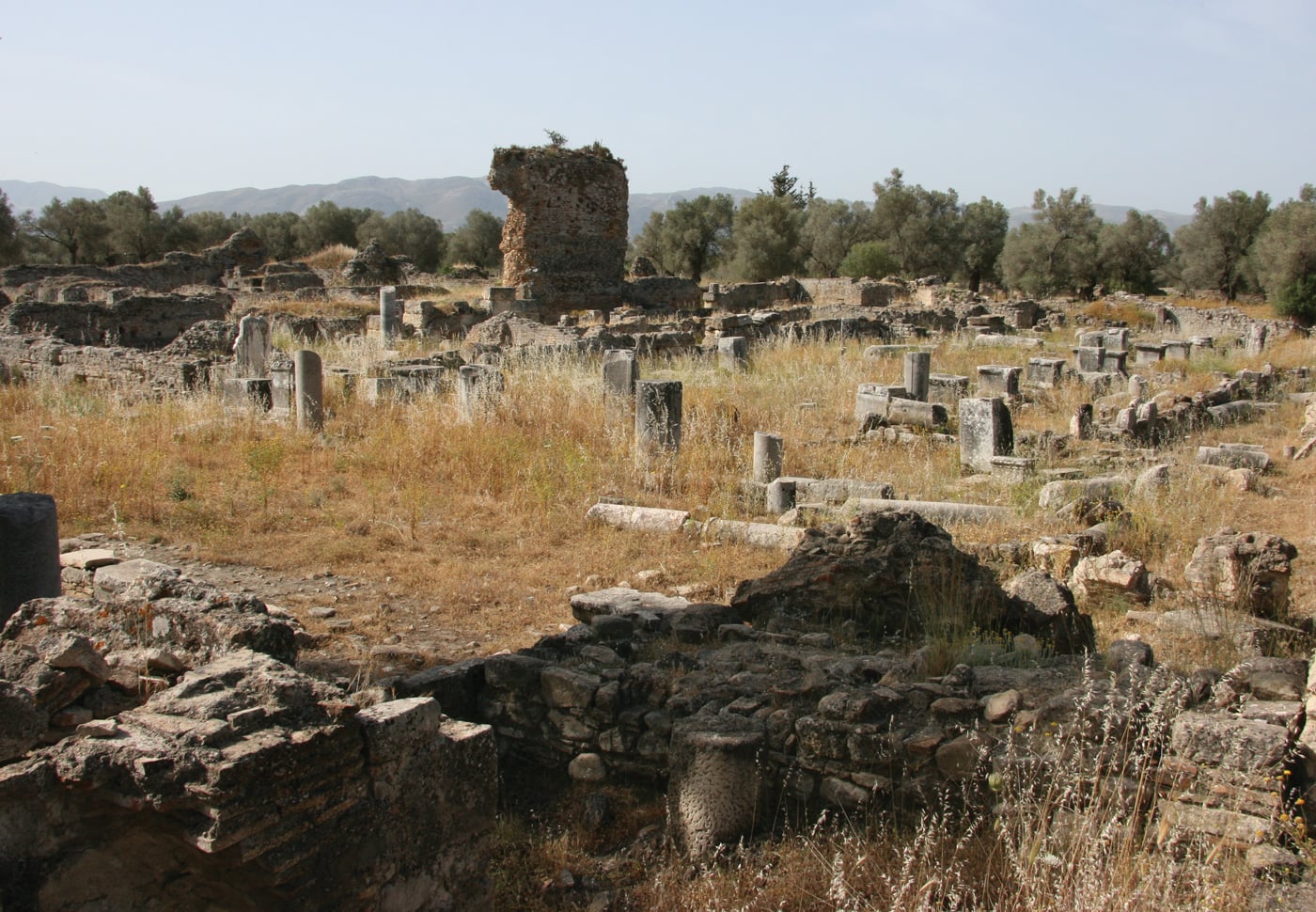
In Titus 3:1, Paul says, “Remind the people to be subject to rulers and authorities.” One local ruler was the praetor, a Roman governor stationed in Gortyna, Crete’s capital. Shown here are the ruins of his residence and of the government complex known as the praetorium (second century AD).
4. A Lifestyle Appropriate to Sound Doctrine (3:1–7)
A. Responsibilities in state and society (3:1–2). In 1 Timothy 2:2 Paul urges prayer for civil authorities. Now—as at Romans 13:1–7—Paul provides instruction for living under civil authority. The instructions in Romans 13 are simply to submit and be willing to pay taxes. Here the instructions are more active. The Greek term translated “be obedient” (3:1) indicates readiness of persuasion—an attitude of cooperation. In an age when municipal leaders often begged off when asked to help their communities, Paul tells Christians: “Be ready to do whatever is good.” Moreover, when Crete’s Christians step into the political arena, their demeanor should belie the Cretan prophet’s saying that Cretans are “vicious beasts” (Titus 1:12; NIV “evil brutes”). Christians in the public square are to be winsome and conciliatory: “to slander no one, to be peaceable and considerate, and always to be gentle toward everyone” (3:2).
B. Theological grounding: God’s kindness and benevolence (3:3–7). Without the grace of God, all people—not just Cretans!—show their incapacity for sobriety, justice, and piety. Thus Paul now includes himself in the confession of the misanthropic vices of humankind. As he did at 1 Corinthians 6:9–11, Paul here describes the turning point in terms of washing, justification, and the Holy Spirit.
Following verse 3’s stinging indictment, verses 4–7 (a single sentence in the Greek) offer a robust theology of personal transformation. This statement completes and elaborates thoughts begun in 2:11–14.
In 2:11, Paul called the incarnation a personification of “grace.” (At 2 Cor. 13:14, Paul indicates his association of Christ with “grace.”) Now in 3:4 he introduces two notable terms. The Greek word for “kindness” (chrēstotēs) sounds similar to the title Christ. Paul uses a distinctive Greek word for “love” (philanthrōpia). Its first appearance in Greek literature refers to the fact that Prometheus had so “loved humans” that he raised the ire of Zeus. Here Paul stresses God is not a Zeus-like, selfish misanthrope who actually hates humankind. The incarnation is proof of God’s philanthrōpia, his love for humankind.
Christ’s appearing “that offers salvation” in 2:11 (a virtually untranslatable Greek expression that means something like “with the capacity to save”) is completed by 3:5’s stronger statement: when Christ appeared, “he saved us.”
Christ’s work extrinsic to us in 2:11–14 finds its complement in the Holy Spirit’s work intrinsic to us in 3:4–7. What Christ accomplished for us, the Holy Spirit now makes active in us. Verses 4–7 not only move the discussion from the outside to the inside and from Christ’s work to the Holy Spirit’s; they also go one more step by including reference to the Father, making the discussion fully about the Trinity. For while it is altogether true that Christ is called Savior here (because he is the embodiment of God’s “kindness and love” and because it is through him that the Holy Spirit is outpoured), nonetheless it is the (implied) Father who is the subject of the main verb of the whole sentence: “he saved” (3:5). Moreover, it is the (implied) Father who pours out the Holy Spirit.
Finally, these verses sweep Paul’s use of Hellenistic aspirations (to sobriety, justice, and piety) and Hebrew narrative (exodus and covenant community) into his familiar theology of baptismal washing, justification “not because of righteous things we had done,” and inward “rebirth and renewal by the Holy Spirit.”
5. Summary: “Good Works” versus Foolish Controversies (3:8–11)
Titus is to teach with such authority (2:15) and so strongly to emphasize correct doctrine (3:8) because Paul wants the teaching to take visible shape through believers’ being “careful to devote themselves to doing what is good.” As those marked by a turning from irreligion, social viciousness, and personal dissolution (1:12; 3:3), believers display a life of gospel-shaped justice and self-control that is “excellent and profitable for everyone” (3:8; cf. Matt. 5:16).
Paul closes the body of the letter by repeating his warning about the false teachers (see 1:10–16). He adds here the provision to avoid those who are so divisive that they tear the fabric of the Christian community (cf. Rom. 16:17–20; 1 Cor. 5:1–13; 2 Cor. 2:5–11).
6. Personal Instructions (3:12–15)
The closing notes seem straightforward but are relevant in the question of Paul’s authorship of this letter. Mentioned here are names familiar in other letters of Paul (Tychicus and Apollos). However, there also appear two individuals (Artemas and Zenas) and a place (Nicopolis, apparently on the west coast of the Greek mainland) that are otherwise unattested in Paul. The unfamiliar names seem unlikely from the hand of someone posing as the apostle. In fact, the references seem implicitly to confirm that Paul was released and went to new places unrecorded in Acts.
Just before his final greetings, Paul reasserts his dominant concern: that believers on Crete show the proof of their teaching in their lives.
Select Bibliography
Fee, Gordon D. 1 and 2 Timothy, Titus. New International Biblical Commentary. Peabody, MA: Hendrickson, 1988.
Johnson, Luke Timothy. Letters to Paul’s Delegates: 1 Timothy, 2 Timothy, Titus. New Testament in Context. Valley Forge, PA: Trinity Press International, 1996.
Kelly, J. N. D. A Commentary on the Pastoral Epistles. Grand Rapids: Baker, 1963, 1981.
Kidd, Reggie M. “Titus as Apologia: Grace for Liars, Beasts, and Bellies.” Horizons in Biblical Theology 21, no. 2 (December 1999): 185–209.
———. Wealth and Beneficence in the Pastoral Epistles: A “Bourgeois” Form of Early Christianity? Atlanta: Scholars Press, 1990.
Knight, George W., III. The Pastoral Epistles: A Commentary on the Greek Text. New International Greek Testament Commentary. Grand Rapids: Eerdmans, 1992.
Marshall, I. Howard, and Philip H. Towner. A Critical and Exegetical Commentary on the Pastoral Epistles. International Critical Commentary. New York: T. & T. Clark, 1999, 2004.
Stott, John R. W. Guard the Gospel: The Message of 2 Timothy. The Bible Speaks Today. Downers Grove, IL: InterVarsity, 1973.
———. Guard the Truth: The Message of 1 Timothy and Titus. The Bible Speaks Today. Downers Grove, IL: InterVarsity, 1996.
Towner, Philip H. The Letters to Timothy and Titus. New International Commentary on the New Testament. Grand Rapids: Eerdmans, 2006.
Winter, Bruce W. Roman Wives, Roman Widows: The Appearance of New Women and the Pauline Communities. Grand Rapids: Eerdmans, 2003.
Witherington, Ben, III. A Socio-Rhetorical Commentary on Titus, 1–2 Timothy and 1–3 John. Vol. 1 of Letters and Homilies for Hellenized Christians. Downers Grove, IL: InterVarsity, 2006.